EP4008951B1 - Lichtmodul für einen kraftfahrzeugscheinwerfer - Google Patents
Lichtmodul für einen kraftfahrzeugscheinwerfer Download PDFInfo
- Publication number
- EP4008951B1 EP4008951B1 EP21212019.0A EP21212019A EP4008951B1 EP 4008951 B1 EP4008951 B1 EP 4008951B1 EP 21212019 A EP21212019 A EP 21212019A EP 4008951 B1 EP4008951 B1 EP 4008951B1
- Authority
- EP
- European Patent Office
- Prior art keywords
- light
- module
- sub
- wavelength
- distribution
- Prior art date
- Legal status (The legal status is an assumption and is not a legal conclusion. Google has not performed a legal analysis and makes no representation as to the accuracy of the status listed.)
- Active
Links
Images


Classifications
-
- F—MECHANICAL ENGINEERING; LIGHTING; HEATING; WEAPONS; BLASTING
- F21—LIGHTING
- F21S—NON-PORTABLE LIGHTING DEVICES; SYSTEMS THEREOF; VEHICLE LIGHTING DEVICES SPECIALLY ADAPTED FOR VEHICLE EXTERIORS
- F21S41/00—Illuminating devices specially adapted for vehicle exteriors, e.g. headlamps
- F21S41/10—Illuminating devices specially adapted for vehicle exteriors, e.g. headlamps characterised by the light source
- F21S41/14—Illuminating devices specially adapted for vehicle exteriors, e.g. headlamps characterised by the light source characterised by the type of light source
- F21S41/141—Light emitting diodes [LED]
- F21S41/143—Light emitting diodes [LED] the main emission direction of the LED being parallel to the optical axis of the illuminating device
-
- B—PERFORMING OPERATIONS; TRANSPORTING
- B60—VEHICLES IN GENERAL
- B60Q—ARRANGEMENT OF SIGNALLING OR LIGHTING DEVICES, THE MOUNTING OR SUPPORTING THEREOF OR CIRCUITS THEREFOR, FOR VEHICLES IN GENERAL
- B60Q1/00—Arrangement of optical signalling or lighting devices, the mounting or supporting thereof or circuits therefor
- B60Q1/02—Arrangement of optical signalling or lighting devices, the mounting or supporting thereof or circuits therefor the devices being primarily intended to illuminate the way ahead or to illuminate other areas of way or environments
- B60Q1/04—Arrangement of optical signalling or lighting devices, the mounting or supporting thereof or circuits therefor the devices being primarily intended to illuminate the way ahead or to illuminate other areas of way or environments the devices being headlights
-
- F—MECHANICAL ENGINEERING; LIGHTING; HEATING; WEAPONS; BLASTING
- F21—LIGHTING
- F21S—NON-PORTABLE LIGHTING DEVICES; SYSTEMS THEREOF; VEHICLE LIGHTING DEVICES SPECIALLY ADAPTED FOR VEHICLE EXTERIORS
- F21S41/00—Illuminating devices specially adapted for vehicle exteriors, e.g. headlamps
- F21S41/20—Illuminating devices specially adapted for vehicle exteriors, e.g. headlamps characterised by refractors, transparent cover plates, light guides or filters
- F21S41/25—Projection lenses
-
- F—MECHANICAL ENGINEERING; LIGHTING; HEATING; WEAPONS; BLASTING
- F21—LIGHTING
- F21S—NON-PORTABLE LIGHTING DEVICES; SYSTEMS THEREOF; VEHICLE LIGHTING DEVICES SPECIALLY ADAPTED FOR VEHICLE EXTERIORS
- F21S41/00—Illuminating devices specially adapted for vehicle exteriors, e.g. headlamps
- F21S41/20—Illuminating devices specially adapted for vehicle exteriors, e.g. headlamps characterised by refractors, transparent cover plates, light guides or filters
- F21S41/25—Projection lenses
- F21S41/255—Lenses with a front view of circular or truncated circular outline
-
- F—MECHANICAL ENGINEERING; LIGHTING; HEATING; WEAPONS; BLASTING
- F21—LIGHTING
- F21S—NON-PORTABLE LIGHTING DEVICES; SYSTEMS THEREOF; VEHICLE LIGHTING DEVICES SPECIALLY ADAPTED FOR VEHICLE EXTERIORS
- F21S41/00—Illuminating devices specially adapted for vehicle exteriors, e.g. headlamps
- F21S41/20—Illuminating devices specially adapted for vehicle exteriors, e.g. headlamps characterised by refractors, transparent cover plates, light guides or filters
- F21S41/25—Projection lenses
- F21S41/26—Elongated lenses
-
- F—MECHANICAL ENGINEERING; LIGHTING; HEATING; WEAPONS; BLASTING
- F21—LIGHTING
- F21S—NON-PORTABLE LIGHTING DEVICES; SYSTEMS THEREOF; VEHICLE LIGHTING DEVICES SPECIALLY ADAPTED FOR VEHICLE EXTERIORS
- F21S41/00—Illuminating devices specially adapted for vehicle exteriors, e.g. headlamps
- F21S41/20—Illuminating devices specially adapted for vehicle exteriors, e.g. headlamps characterised by refractors, transparent cover plates, light guides or filters
- F21S41/25—Projection lenses
- F21S41/275—Lens surfaces, e.g. coatings or surface structures
-
- F—MECHANICAL ENGINEERING; LIGHTING; HEATING; WEAPONS; BLASTING
- F21—LIGHTING
- F21S—NON-PORTABLE LIGHTING DEVICES; SYSTEMS THEREOF; VEHICLE LIGHTING DEVICES SPECIALLY ADAPTED FOR VEHICLE EXTERIORS
- F21S41/00—Illuminating devices specially adapted for vehicle exteriors, e.g. headlamps
- F21S41/40—Illuminating devices specially adapted for vehicle exteriors, e.g. headlamps characterised by screens, non-reflecting members, light-shielding members or fixed shades
-
- F—MECHANICAL ENGINEERING; LIGHTING; HEATING; WEAPONS; BLASTING
- F21—LIGHTING
- F21S—NON-PORTABLE LIGHTING DEVICES; SYSTEMS THEREOF; VEHICLE LIGHTING DEVICES SPECIALLY ADAPTED FOR VEHICLE EXTERIORS
- F21S41/00—Illuminating devices specially adapted for vehicle exteriors, e.g. headlamps
- F21S41/60—Illuminating devices specially adapted for vehicle exteriors, e.g. headlamps characterised by a variable light distribution
-
- F—MECHANICAL ENGINEERING; LIGHTING; HEATING; WEAPONS; BLASTING
- F21—LIGHTING
- F21S—NON-PORTABLE LIGHTING DEVICES; SYSTEMS THEREOF; VEHICLE LIGHTING DEVICES SPECIALLY ADAPTED FOR VEHICLE EXTERIORS
- F21S41/00—Illuminating devices specially adapted for vehicle exteriors, e.g. headlamps
- F21S41/60—Illuminating devices specially adapted for vehicle exteriors, e.g. headlamps characterised by a variable light distribution
- F21S41/63—Illuminating devices specially adapted for vehicle exteriors, e.g. headlamps characterised by a variable light distribution by acting on refractors, filters or transparent cover plates
-
- F—MECHANICAL ENGINEERING; LIGHTING; HEATING; WEAPONS; BLASTING
- F21—LIGHTING
- F21S—NON-PORTABLE LIGHTING DEVICES; SYSTEMS THEREOF; VEHICLE LIGHTING DEVICES SPECIALLY ADAPTED FOR VEHICLE EXTERIORS
- F21S41/00—Illuminating devices specially adapted for vehicle exteriors, e.g. headlamps
- F21S41/60—Illuminating devices specially adapted for vehicle exteriors, e.g. headlamps characterised by a variable light distribution
- F21S41/65—Illuminating devices specially adapted for vehicle exteriors, e.g. headlamps characterised by a variable light distribution by acting on light sources
- F21S41/663—Illuminating devices specially adapted for vehicle exteriors, e.g. headlamps characterised by a variable light distribution by acting on light sources by switching light sources
-
- G—PHYSICS
- G02—OPTICS
- G02B—OPTICAL ELEMENTS, SYSTEMS OR APPARATUS
- G02B27/00—Optical systems or apparatus not provided for by any of the groups G02B1/00 - G02B26/00, G02B30/00
- G02B27/09—Beam shaping, e.g. changing the cross-sectional area, not otherwise provided for
- G02B27/0938—Using specific optical elements
- G02B27/095—Refractive optical elements
- G02B27/0955—Lenses
- G02B27/0961—Lens arrays
-
- G—PHYSICS
- G02—OPTICS
- G02B—OPTICAL ELEMENTS, SYSTEMS OR APPARATUS
- G02B3/00—Simple or compound lenses
- G02B3/0006—Arrays
-
- F—MECHANICAL ENGINEERING; LIGHTING; HEATING; WEAPONS; BLASTING
- F21—LIGHTING
- F21W—INDEXING SCHEME ASSOCIATED WITH SUBCLASSES F21K, F21L, F21S and F21V, RELATING TO USES OR APPLICATIONS OF LIGHTING DEVICES OR SYSTEMS
- F21W2102/00—Exterior vehicle lighting devices for illuminating purposes
- F21W2102/10—Arrangement or contour of the emitted light
- F21W2102/13—Arrangement or contour of the emitted light for high-beam region or low-beam region
-
- F—MECHANICAL ENGINEERING; LIGHTING; HEATING; WEAPONS; BLASTING
- F21—LIGHTING
- F21W—INDEXING SCHEME ASSOCIATED WITH SUBCLASSES F21K, F21L, F21S and F21V, RELATING TO USES OR APPLICATIONS OF LIGHTING DEVICES OR SYSTEMS
- F21W2102/00—Exterior vehicle lighting devices for illuminating purposes
- F21W2102/10—Arrangement or contour of the emitted light
- F21W2102/13—Arrangement or contour of the emitted light for high-beam region or low-beam region
- F21W2102/135—Arrangement or contour of the emitted light for high-beam region or low-beam region the light having cut-off lines, i.e. clear borderlines between emitted regions and dark regions
- F21W2102/155—Arrangement or contour of the emitted light for high-beam region or low-beam region the light having cut-off lines, i.e. clear borderlines between emitted regions and dark regions having inclined and horizontal cutoff lines
-
- F—MECHANICAL ENGINEERING; LIGHTING; HEATING; WEAPONS; BLASTING
- F21—LIGHTING
- F21Y—INDEXING SCHEME ASSOCIATED WITH SUBCLASSES F21K, F21L, F21S and F21V, RELATING TO THE FORM OR THE KIND OF THE LIGHT SOURCES OR OF THE COLOUR OF THE LIGHT EMITTED
- F21Y2115/00—Light-generating elements of semiconductor light sources
- F21Y2115/10—Light-emitting diodes [LED]
Definitions
- the invention relates to a light module for a motor vehicle headlight for generating an overall light distribution.
- a light module of the type mentioned above is known, for example, from DE 10 2018 222 333 A1
- the light module comprises an LED array and a two-part lens optic.
- the LED array forms an active black and white display with high luminance.
- Each LED corresponds to a pixel of the display and can be controlled separately with different brightness levels. Due to the large number of pixels and the two-dimensional distribution of the pixels, it is possible to generate a variety of light distributions. These light distributions are projected into the environment by two-part lens optics.
- the light module can be integrated into a headlight in order to generate light distributions such as low beam, high beam, partial long-distance vision, cornering light, either alone or together with other light modules.
- the light module described has the disadvantage that the image generated is very colorful.
- the present invention is based on the object of providing a light module with which the disadvantages described above can be eliminated.
- the light module comprises a first sub-module for generating a first light distribution and at least one further, second sub-module for generating a second light distribution
- the first and second sub-modules each comprise at least one semiconductor light source with a light-emitting surface for emitting light and an optical system with a primary optic for bundling at least a portion of the emitted light and a secondary optic for projecting at least a portion of the bundled light in a light exit direction of the light module
- the overall light distribution of the light module comprises the superposition of the first light distribution and the second light distribution
- the semiconductor light source of the first sub-module is arranged in a wavelength-dependent focal point of a first wavelength of the optical system of the first sub-module
- the semiconductor light source of the second sub-module is arranged in a wavelength-dependent focal point of a second wavelength of the optical system of the second sub-module.
- the first sub-module is designed for a first wavelength and the second sub-module for a second wavelength.
- the light distributions of the first and second sub-modules each include a relatively large color error, whereby color error here means in particular the deviation of the light color from a certain white point.
- the first sub-module Because the first sub-module is designed for the first wavelength, the first sub-module images rays of the first wavelength sharply. Since the optical system does not include an achromat or an apochromat, the imaging of rays of other wavelengths, for example the second wavelength, is not optimal.
- the first light distribution therefore includes a color error, especially in edge areas. Color error is understood to mean a deviation in the color of the light from a white point.
- the light distribution at a light-dark boundary in the area that should appear dark, includes a color fringe that is created by rays of the second wavelength. In the area of the light-dark boundary that should appear bright, the proportion of rays of the second wavelength is again somewhat too low.
- chromatic aberration is not corrected by the first optical system. As already mentioned, this would require an achromat or an apochromat, with the result that the secondary optics would have to be replaced by an achromat or an apochromat. This would in turn increase the number of lenses in the optical system. This would be associated with higher costs, a larger installation space required, greater weight and possibly lower optical efficiency.
- the second sub-module sharply images rays of the second wavelength. Since the optical system includes neither an achromat nor an apochromat, the imaging of rays of other wavelengths, for example the first wavelength, is not optimal.
- the second light distribution therefore includes a color error, particularly in edge areas. For example, the light distribution at a light-dark boundary, in the area that should appear dark, includes a color fringe that is created by rays of the first wavelength. In the area of the light-dark boundary that should appear light, the proportion of rays of the first wavelength is again somewhat too low, so that rays of the second wavelength increasingly determine the light color here.
- the color errors of the first light distribution of the first sub-module and the second light distribution of the second sub-module are corrected by superimposing the two light distributions.
- the color of the overall light distribution can be significantly reduced.
- the overall light distribution that can be generated with the light module does not include a hard white contrast at the light-dark boundary.
- a hard white contrast is usually not desired in motor vehicle headlights. Additional effort is often made to reduce the contrast at the light-dark boundary, for example by microstructuring lens surfaces or frosting. Such measures are not necessary with the light module according to the invention.
- a sufficiently color-neutral overall light distribution can be created by appropriately designing the sub-modules of the light module and at the same time a hard white contrast at the light-dark boundary can be avoided.
- Achromats or apochromats and additional microstructuring or frosting of the lens surfaces can be dispensed with. This advantageously minimizes costs, weight and installation space.
- the optical efficiency can be increased by choosing the right material and design, which means that a smaller number of lenses or lens surfaces are required. absorption is reduced and there are fewer losses due to Fresnel reflection.
- the first light distribution of the first sub-module and the second light distribution of the second sub-module overlap at least partially, in particular largely. It can also prove advantageous if the illumination areas of the first and second sub-modules are identical, so that at least the first and second light distributions completely overlap.
- the semiconductor light source of the first sub-module and/or the semiconductor light source of the second sub-module comprises at least one, in particular several, light-emitting diodes, LEDs.
- the LEDs can be arranged in a matrix-like manner above and/or next to one another, so that they form an LED array.
- the LEDs of the semiconductor light sources can advantageously be controlled individually, in groups or all together.
- a numerical aperture of the optical system of the first and/or the second sub-module is at least 0.5, in particular at least 0.65.
- the secondary optics of the first sub-module and the secondary optics of the second sub-module is designed as a single piece. This reduces the number of components and thus the tolerances to be observed when positioning the components as well as costs. Furthermore, the particularly single-piece, cylindrical shape of the light exit surface can have a beneficial effect on the aesthetic appearance of the light module.
- the secondary optics of the first sub-module and/or the secondary optics of the second sub-module are designed as anamorphic lenses.
- At least one light entry surface of the anamorphic lens is designed as a cylindrical surface section with a horizontal axis of rotation and at least one light exit surface of the anamorphic lens is designed as a cylindrical surface section with a vertical axis of rotation.
- the first sub-module and/or the second sub-module comprises a cover.
- the cover of the first sub-module and the second sub-module is formed in one piece.
- the light module has a third sub-module for generating a third light distribution with at least one semiconductor light source with a light-emitting surface for emitting light and an optical system with a primary optic for bundling at least a portion of the emitted light and a secondary optic for projecting at least a portion of the bundled light in a light exit direction of the light module, wherein the overall light distribution of the light module comprises the superposition of the third light distribution, wherein the third sub-module is arranged in a wavelength-dependent focal point of a third wavelength of the optical system of the third sub-module, wherein the third wavelength is different from the first and the second wavelength.
- the design options described with reference to the first and/or second sub-module can also be applied to the third sub-module.
- the light module can comprise additional sub-modules that are designed in particular for other wavelengths.
- the first wavelength is approximately 500 nm and/or the second wavelength is approximately 570 nm and/or the third wavelength is approximately 470 nm
- a further embodiment comprises a motor vehicle headlight comprising at least one light module, wherein the light module is designed according to the above described embodiments.
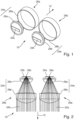
- the Figures 1 and 2 show a light module which is identified in its entirety with the reference number 10.
- the light module 10 is used in a motor vehicle headlight to generate a predeterminable overall light distribution in the light exit direction onto a roadway in front of the vehicle.
- the light module comprises a first sub-module 20a and a second sub-module 20b.
- the first sub-module 20a comprises a semiconductor light source 22a.
- the second sub-module 20b comprises a semiconductor light source 22b.
- the semiconductor light sources 22a, 22b comprise several light-emitting diodes, LEDs.
- the LEDs can be arranged in a matrix-like manner above and/or next to one another, so that they form an LED array.
- the LEDs of the semiconductor light sources 22a, 22b can advantageously be controlled individually, in groups or all together.
- first sub-module 20a and the second sub-module 20b each comprise an optical system 24a, 24b, each with a primary optics 26a, 26b for bundling at least a portion of the light from the semiconductor light sources 22a, 22b emitted light and a respective secondary optics 28a, 28b for projecting at least a portion of the bundled light as a first and second light distribution in the light exit direction 12 of the light module 10.
- the semiconductor light source 22a of the first sub-module is arranged in a wavelength-dependent focal point 30a of a first wavelength of the optical system 24a of the first sub-module 20a and the semiconductor light source 22b of the second sub-module 20b is arranged in a wavelength-dependent focal point 30b of a second wavelength of the optical system 24b of the second sub-module 20b.
- the first wavelength and the second wavelength differ from each other.
- the first sub-module 20a is designed for the first wavelength and the second sub-module is designed for the second wavelength.
- Design here means that the optical system 24a of the first sub-module 20a images the semiconductor light source 22a for the first wavelength and the optical system 24b of the second sub-module 20b images the semiconductor light source 22b for the second wavelength as sharply as possible.
- the Figures 3a and 3b each show a so-called spot diagram of the first and second sub-modules 20a, 20b for a central object point, ie for a point that lies on an intersection point of a plane of the respective semiconductor light source 22a, 22b and an optical axis of the respective optical system 24a, 24b.
- the spot diagram the impact points that emanate from the central object point are shown in the image plane.
- FIG 3a the spot diagram of the first sub-module 20a is shown. Rays of the first wavelength impinge on an area in the center of the diagram, while rays of the second wavelength impinge scattered around the area in the center, approximately in a radius of approximately 0.2 degrees.
- the impingement points of the rays of the first wavelength are marked by a cross.
- the impingement points of the rays of the second wavelength are marked by a square. Because the first sub-module 20a is designed for the first wavelength, the radius of the area in the center in which the rays of the first wavelength impinge is minimal. Since the optical system 24a comprises neither an achromat nor an apochromat, the imaging of rays of other wavelengths, for example the second wavelength, is not optimal.
- Light distributions that can be generated with the first sub-module 20a therefore include a color error, especially in the edge areas of the light distributions.
- Color error is understood to mean a deviation in the light color from a white point.
- a light distribution at a light-dark boundary in the area that is supposed to appear dark, a color fringe that is created by rays of the second wavelength.
- the proportion of rays of the second wavelength is again somewhat too low, so that here rays of the first wavelength determine the light color.
- This effect is also known as chromatic aberration.
- the chromatic aberration is not corrected by the first optical system 24a.
- an achromat or an apochromat would be necessary for this. This would in turn increase the number of components, in particular lenses, of the optical system 24a, and would therefore result in higher costs, a larger installation space required, greater weight and possibly lower optical efficiency.
- FIG 3b the spot diagram of the second sub-module 20b is shown. Rays of the second wavelength impinge on an area in the center of the diagram, while rays of the first wavelength impinge scattered at various points around the area in the center, approximately in a radius of approximately 0.2 degrees. The impingement points of the rays of the first wavelength are marked by a cross. The impingement points of the rays of the second wavelength are marked by a square. Because the second sub-module 20b is designed for the second wavelength, the radius of the area in the center in which the rays of the second wavelength impinge minimal. Since the optical system 24b also does not include an achromat or apochromat, the imaging of rays of other wavelengths, for example the first wavelength, is not optimal.
- Light distributions that can be generated with the second sub-module 20b therefore include a color error, particularly in the edge areas of the light distributions.
- a light distribution at a light-dark boundary in the area that should appear dark, includes a color fringe that is generated by rays of the first wavelength.
- the proportion of rays of the first wavelength is again somewhat too low, so that rays of the second wavelength determine the light color here.
- the chromatic aberration is also not corrected by the second optical system 24b.
- the color errors of the first light distribution of the first sub-module 20a and the second light distribution of the second sub-module 20b can be corrected by superimposing the two light distributions.
- the first light distribution of the first sub-module 20a and the second light distribution of the second sub-module 20b overlap at least partially, in particular largely. It can also prove advantageous if the illumination areas of the first and second sub-modules 20a, 20b are identical, so that at least the first and second light distributions completely overlap.
- the first wavelength is, for example, 500 nm and the second wavelength is, for example, 570 nm.
- the first light distribution includes a blue color fringe at the light-dark boundary, in the area that should appear dark, and a warm white to yellow light color in the area at the light-dark boundary that should appear light.
- the second light distribution includes a yellow color fringe at the light-dark boundary, in the area that should appear dark, and a cold white to blue light color in the area at the light-dark boundary that should appear light.
- the yellow and blue color fringe overlap at the light-dark boundary, in the area that should appear dark, and the cold white to blue light color and the warm white to yellow light color overlap in the area that should appear light, so that the overall light distribution includes a white light color.
- the color of the overall light distribution of the light module 10 can be significantly reduced.
- the overall light distribution that can be generated with the light module 10 does not include a hard white contrast at the light-dark boundary.
- a hard white contrast is usually not desired in motor vehicle headlights. Often, additional effort is even made to increase the contrast at the light-dark boundary, for example via so-called Microstructuring of lens surfaces or frosting. In the light module 10 according to the invention, such measures are not necessary.
- a suitable design of the sub-modules 20a, 20b of the light module 10 can produce a sufficiently color-neutral overall light distribution and at the same time avoid a hard white contrast at the light-dark boundary. Achromats or apochromats and additional microstructuring or frosting of the lens surfaces can be dispensed with. This advantageously minimizes costs, weight and installation space. At the same time, the optical efficiency can be increased with a suitable choice of material and design, since the absorption is reduced by a smaller required number of lenses or lens surfaces and thus fewer losses occur due to Fresnel reflection.
- beam paths 32a, 32b of the first and second sub-modules 20a, 20b are shown for the respective wavelength for which the sub-modules 20a, 20b are designed.
- the beam paths 32a, 32b each originate from a respective center of the respective semiconductor light source 22a, 22b located at the focal point 30a, 30b and are captured and imaged by the optical systems 24a, 24b.
- the representation of the beam paths arranged side by side is merely an example.
- the beam paths 32a, 32b overlap to form an overall light distribution of the light module 10.
- the beams emanating from the semiconductor light sources 22a, 22b have a high divergence.
- the semiconductor light sources 22a, 22b each radiate into the entire half-space.
- the numerical apparatus is proportional to the sine of the opening angle. If the semiconductor light sources 22a, 22b are Lambert radiators, the optical efficiency of the optical systems 24a, 24b is in turn proportional to the square of the numerical aperture. Consequently, the efficiency is proportional to the square of the sine of the opening angle. Consequently, it is very advantageous for the efficiency of the described light module 10 if the numerical aperture of the optical systems 24a, 24b is as high as possible.
- the numerical aperture of the optical systems 24a, 24b is at least 0.5, in particular 0.65.
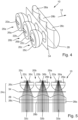
- Figures 4, 5 and 6 show various representations of another embodiment of a light module 10.
- the light module 10 comprises a further sub-module 20c.
- the sub-module 20c is in principle analogous to the already described
- Sub-modules 20a, 20b are constructed and advantageously designed for a third wavelength.
- the third wavelength differs from the first and the second wavelength.
- the light module in the Figures 4, 5 and 6 a cover 34.
- the cover 34 is designed as a single piece for the three sub-modules 20a, 20b, 20c.
- each sub-module 20a, 20b, 20c comprises a separate cover.
- the secondary optics 28a, 28b, 28c of the optical systems 24a, 24b, 24c of the sub-modules 20a, 20b, 20c are designed as a one-piece secondary optics 28.
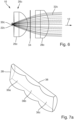
- the one-piece secondary optics 28 is also designed as an anamorphic lens. This is shown in Figures 7a and 7b shown.
- Figure 7a shows the anamorphic lens 28 from the light entrance side and Figure 7b from the light exit side.
- light entry surfaces 36a, 36b, 36c each comprise a cylindrical surface section with a vertical axis of rotation.
- the light exit surface 38 comprises a cylindrical surface section with a horizontal axis of rotation, in particular aligned perpendicular to the light exit direction 12.
- the light entry surfaces 36a, 36b, 36c are designed such that incoming light rays are bundled in the horizontal plane, cf. Fig. 5 .
- the light exit surface 38 is advantageously designed so that emerging light rays are bundled in the vertical plane, cf. Fig. 6 .
- the one-piece secondary optics 28 reduces the number of components required and thus the tolerances to be observed with regard to positioning and costs. Furthermore, the particularly one-piece, cylindrical shape of the light exit surface 38 can have a beneficial effect on the aesthetic appearance of the light module 10.
- Figure 8 a motor vehicle headlight 40.
- the headlight 40 comprises a housing 42, which is made of plastic, for example.
- the housing 42 has a light exit opening 44 in the light exit direction 12, which is closed by a transparent cover plate 46.
- a light module 10 according to the invention is arranged inside the housing 42.
- the light module 10 serves to generate any resulting driving light distribution of the motor vehicle headlight or a part thereof, for example a dipped beam, high beam, adaptive driving light (city light, country road light, motorway light, partial high beam, marker light), fog light or the like.
- the housing can accommodate 42
- Other light modules can also be arranged to generate any desired driving light distribution or part thereof, or light modules to implement any desired lighting function (e.g. indicator light, position light, parking light, daytime running light, parking light, reversing light, brake light or similar).
Landscapes
- Engineering & Computer Science (AREA)
- General Engineering & Computer Science (AREA)
- Physics & Mathematics (AREA)
- Optics & Photonics (AREA)
- General Physics & Mathematics (AREA)
- Microelectronics & Electronic Packaging (AREA)
- Mechanical Engineering (AREA)
- Non-Portable Lighting Devices Or Systems Thereof (AREA)
Description
- Die Erfindung betrifft ein Lichtmodul für einen Kraftfahrzeugscheinwerfer zum Erzeugen einer Gesamtlichtverteilung.
- Ein Lichtmodul der eingangs genannten Art ist beispielsweise aus der
DE 10 2018 222 333 A1 bekannt. Das Lichtmodul umfasst ein LED-Array und eine zweiteilige Linsenoptik. Das LED-Array bildet ein aktives Schwarz-Weiß-Display mit hoher Leuchtdichte. Jede LED entspricht einem Pixel des Displays und kann separat mit verschiedenen Helligkeitsstufen angesteuert werden. Durch die Vielzahl an Pixeln und die zweidimensionale Verteilung der Pixel, ist es möglich, eine Vielzahl an Lichtverteilungen zu generieren. Diese Lichtverteilungen werden durch zweiteilige Linsenoptik in die Umgebung projiziert. Das Lichtmodul kann in einen Scheinwerfer integriert werden, um dort alleine oder mit anderen Lichtmodulen zusammen Lichtverteilungen wie beispielsweise Abblendlicht, Fernlicht, Teil Fernsicht, Kurvenlicht zu erzeugen. Das beschriebene Lichtmodul hat den Nachteil, dass die erzeugte Abbildung eine hohe Farbigkeit aufweist. Dies liegt daran, dass durch den beschriebenen Aufbau der chromatische Fehler nicht korrigiert werden kann. Diese Problematik könnte durch Verwenden eines Achromats oder Apochromats gelöst werden. Dies führt jedoch zu höheren Kosten, einem höheren Gewicht, mehr benötigten Bauraum und in der Regel zu einer geringeren optischen Effizienz des Lichtmoduls, da die Verluste durch Fresnel-Reflexion und Materialabsorption steigen. Darüber hinaus reicht nach heutigem Stand der Technik ein solches Lichtmodul allein nicht aus, um in einem Scheinwerfer eine volle Fernlichtverteilung zu erzeugen. - Aus der
US 2008/055896 ist ein Lichtmodul bekannt, mit dem eine Helligkeit und/oder eine Lichtfarbe eines dynamisch einstellbar sind. Dazu sollen Farben des Lichts, das von LEDs, Clustern oder Gruppen von LEDs emittiert wird, stufenlos oder schrittweise variiert werden, um praktisch jedes gewünschte Muster kollimierten Licht zu erzeugen. Die Korrektur eines chromatischen Fehlers wird nicht beschrieben. Weitere Lichtmodule sind ausEP 3608585 A1 undKR 20160077990 A - Der vorliegenden Erfindung liegt die Aufgabe zugrunde, ein Lichtmodul bereitzustellen, mit dem die vorstehend beschriebenen Nachteile behoben werden können.
- Diese Aufgabe wird mit einem Lichtmodul gemäß Anspruch 1 gelöst.
- Erfindungsgemäß wird ausgehend von dem Lichtmodul der eingangs genannten Art vorgeschlagen, dass das Lichtmodul ein erstes Untermodul zum Erzeugen einer ersten Lichtverteilung und wenigstens ein weiteres, zweites Untermodul zum Erzeugen einer zweiten Lichtverteilung umfasst, wobei das erste und zweite Untermodul jeweils mindestens eine Halbleiterlichtquelle mit einer Licht emittierenden Fläche zum Abstrahlen von Licht und ein optisches System mit einer Primäroptik zum Bündeln zumindest eines Teils des abgestrahlten Lichts und einer Sekundäroptik zur Projektion zumindest eines Teils des gebündelten Lichts in eine Lichtaustrittsrichtung des Lichtmoduls umfassen, wobei die Gesamtlichtverteilung des Lichtmoduls die Überlagerung der ersten Lichtverteilung und der zweiten Lichtverteilung umfasst, und die Halbleiterlichtquelle des ersten Untermoduls in einem wellenlängenabhängigen Brennpunkt einer ersten Wellenlänge des optischen Systems des ersten Untermoduls und die Halbleiterlichtquelle des zweiten Untermoduls in einem wellenlängenabhängigen Brennpunkt einer zweiten Wellenlänge des optischen Systems des zweiten Untermoduls angeordnet ist, wobei die erste Wellenlänge von der zweiten Wellenlänge verschieden ist.
- Erfindungsgemäß ist das erste Untermodul also auf eine erste Wellenlänge und das zweite Untermodul auf eine zweite Wellenlänge ausgelegt. Die Lichtverteilungen des ersten und des zweiten Untermoduls umfassen jeweils einen relativ großen Farbfehler, wobei unter Farbfehler hier insbesondere die Abweichung der Lichtfarbe von einem bestimmten Weißpunkt gemeint ist. Durch die Überlagerung der Lichtverteilungen des ersten und des zweiten Untermoduls heben sich die Farbfehler in der Gesamtlichtverteilung des Lichtmoduls auf.
- Dadurch, dass das erste Untermodul auf die erste Wellenlänge ausgelegt ist, bildet das erste Untermodul Strahlen der ersten Wellenlänge scharf ab. Da das optische System weder einen Achromat noch einen Apochromat umfasst, ist die Abbildung von Strahlen anderer Wellenlängen, beispielsweise der zweiten Wellenlänge, nicht optimal. Die erste Lichtverteilung umfasst daher, insbesondere in Randbereichen, einen Farbfehler. Unter Farbfehler wird eine Abweichung in der Lichtfarbe von einem Weißpunkt verstanden. Beispielsweise umfasst die Lichtverteilung an einer Hell-Dunkel-Grenze, in dem Bereich der dunkel erscheinen soll, einen Farbsaum, der von Strahlen der zweiten Wellenlänge erzeugt wird. In dem Bereich der Hell-Dunkel-Grenze, der hell erscheinen soll, ist der Anteil von Strahlen der zweiten Wellenlänge wiederrum etwas zu gering, so dass hier verstärkt Strahlen der ersten Wellenlänge die Lichtfarbe bestimmen. Dieser Effekt ist auch als chromatisch Aberration bekannt. Die chromatische Aberration wird durch das erste optische System nicht korrigiert. Dafür wäre, wie bereits erwähnt, ein Achromat oder ein Apochromat nötig, mit der Folge, dass die Sekundäroptik durch einen Achromat oder einen Apochromat ersetzt werden müsste. Dies würde wiederum die Anzahl von Linsen des optischen Systems erhöhen. Dies wäre mit höheren Kosten, einem größeren benötigten Bauraum, einem größeren Gewicht und gegebenenfalls einer geringeren optischen Effizienz verbunden.
- Dadurch, dass das zweite Untermodul auf die zweite Wellenlänge ausgelegt ist, bildet das zweite Untermodul Strahlen der zweiten Wellenlänge scharf ab. Da das optische System weder einen Achromat noch einen Apochromat umfasst, ist die Abbildung von Strahlen anderer Wellenlängen, beispielsweise der ersten Wellenlänge, nicht optimal. Die zweite Lichtverteilung umfasst daher, insbesondere in Randbereichen, einen Farbfehler. Beispielsweise umfasst die Lichtverteilung an einer Hell-Dunkel-Grenze, in dem Bereich der dunkel erscheinen soll, einen Farbsaum, der von Strahlen der ersten Wellenlänge erzeugt wird. In dem Bereich der Hell-Dunkel-Grenze, der hell erscheinen soll, ist der Anteil von Strahlen der ersten Wellenlänge wiederrum etwas zu gering, so dass hier verstärkt Strahlen der zweiten Wellenlänge die Lichtfarbe bestimmen.
- Die Farbfehler der ersten Lichtverteilung des ersten Untermoduls und der zweiten Lichtverteilung des zweiten Untermoduls werden durch Überlagerung der beiden Lichtverteilungen korrigiert.
- Durch geeignete Auslegung des ersten und des zweiten Untermoduls kann somit die Farbigkeit der Gesamtlichtverteilung deutlich verringert werden.
- Die mit dem Lichtmodul erzeugbare Gesamtlichtverteilung umfasst keinen harten Weiß-Kontrast an der Hell-Dunkel-Grenze. Ein harter Weiß-Kontrast ist üblicherweise bei Kraftfahrzeugscheinwerfern nicht erwünscht. Häufig wird sogar zusätzlicher Aufwand betrieben, um den Kontrast an Hell-Dunkel-Grenze, beispielsweise über sogenannte Mikrostrukturierung von Linsenflächen oder Frostung, zu verringern. Bei dem erfindungsgemäßen Lichtmodul sind derartige Maßnahmen nicht notwendig.
- Insgesamt kann also durch geeignete Auslegung der Untermodule des Lichtmoduls eine ausreichend farbneutrale Gesamtlichtverteilung erzeugt und gleichzeitig ein harter Weiß-Kontrast an der Hell-Dunkel-Grenze vermieden werden. Dabei kann auf Achromaten bzw. Apochromaten und zusätzliche Mikrostrukturierung oder Frostung Der Linsenflächen verzichtet werden. Vorteilhafterweise werden so Kosten, Gewicht und Bauraum minimiert. Gleichzeitig kann vorteilhaft bei geeigneter Materialwahl und Auslegung die optische Effizienz erhöht werden, dass sich durch eine geringere erforderliche Anzahl an Linsen bzw. Linsenflächen die Absorption verringert und es weniger Verluste durch Fresnel-Reflexion auftreten.
- Gemäß einer bevorzugten Ausführungsform ist vorgesehen, dass die erste Lichtverteilung des ersten Untermoduls und die zweite Lichtverteilung des zweiten Untermoduls sich wenigstens teilweise, insbesondere größtenteils, überlagern. Es kann sich auch als vorteilhaft erweisen, wenn die Ausleuchtbereiche des ersten und des zweiten Untermoduls identisch sind, so dass sich die wenigstens erste und zweite Lichtverteilung vollständig überlappen.
- Gemäß einer bevorzugten Ausführungsform ist vorgesehen, dass die Halbleiterlichtquelle des ersten Untermoduls und/oder die Halbleiterlichtquelle des zweiten Untermoduls wenigstes eine, insbesondere mehrere, Leuchtdioden, LEDs, umfasst. Die LEDs können matrixartig über- und/oder nebeneinander angeordnet sein, so dass sie ein LED-Array bilden. Die LEDs der Halbleiterlichtquellen können vorteilhafterweise einzeln, gruppenweise oder alle gemeinsam angesteuert werden.
- Gemäß einer weiteren bevorzugten Ausführungsform ist vorgesehen, dass eine numerische Apertur des optischen Systems des ersten und/oder des zweiten Untermoduls wenigstens 0.5, insbesondere wenigstens 0.65, beträgt.
- Vorteilhafterweise kann vorgesehen sein, dass die Sekundäroptik des ersten Untermoduls und die Sekundäroptik des zweiten Untermoduls einteilig ausgebildet ist. Dadurch wird die Anzahl der Bauteile und damit die einzuhaltenden Toleranzen bei der Positionierung der Bauteile sowie Kosten reduziert. Ferner kann sich die insbesondere einteilige, zylindrische Form der Lichtaustrittsfläche vorteilhaft auf ein ästhetisches Erscheinungsbild des Lichtmoduls auswirken.
- Vorteilhafterweise kann vorgesehen sein, dass die Sekundäroptik des ersten Untermoduls und/oder die Sekundäroptik des zweiten Untermoduls als anamorphotische Linse ausgebildet ist.
- In Weiterbildung dieses Erfindungsgedankens kann es sich als vorteilhaft erweisen, wenn wenigstens eine Lichteintrittsfläche der anamorphotischen Linse als zylindrischer Flächenabschnitt mit einer horizontalen Rotationsachse und wenigstens eine Lichtaustrittsfläche der anamorphotischen Linse als zylindrischer Flächenabschnitt mit einer vertikalen Rotationsachse ausgebildet ist.
- Vorteilhafterweise kann vorgesehen sein, dass das erste Untermodul und/oder das zweite Untermodul eine Blende umfasst.
- Es kann sich als vorteilhaft erweisen, dass die Blende des ersten Untermoduls und des zweiten Untermoduls einteilig ausgebildet ist.
- Gemäß einer weiteren bevorzugten Ausführungsform ist vorgesehen, dass das Lichtmodul ein drittes Untermodul zum Erzeugen einer dritten Lichtverteilung mit mindestens einer Halbleiterlichtquelle mit einer Licht emittierenden Fläche zum Abstrahlen von Licht und ein optisches System mit einer Primäroptik zum Bündeln zumindest eines Teils des abgestrahlten Lichts und einer Sekundäroptik zur Projektion zumindest eines Teils des gebündelten Lichts in eine Lichtaustrittsrichtung des Lichtmoduls, wobei die Gesamtlichtverteilung des Lichtmoduls die Überlagerung der dritten Lichtverteilung umfasst, wobei das dritte Untermodul in einem wellenlängenabhängigen Brennpunkt einer dritten Wellenlänge des optischen Systems des dritten Untermoduls angeordnet ist, wobei die dritte Wellenlänger von der ersten und der zweiten Wellenlänge verschieden ist.
- Die mit Bezugnahme auf das erste und/oder zweite Untermodul beschriebenen Gestaltungsmöglichkeiten lassen sich auch auf das dritte Untermodul anwenden. Ferner kann das Lichtmodul noch zusätzliche weitere Untermodule, die insbesondere auf weitere Wellenlängen ausgelegt sind, umfassen.
- Vorteilhafterweise kann vorgesehen sein, dass die erste Wellenlänge ca. 500 nm und/oder die zweite Wellenlänge ca. 570 nm und/oder die dritte Wellenlänge ca. 470 nm beträgt
- Eine weitere Ausführungsform umfasst einen Kraftfahrzeugscheinwerfer umfassend wenigstens ein Lichtmodul wobei das Lichtmodul gemäß den vorstehend beschriebenen Ausführungsformen ausgebildet ist.
- Vorteilhafte Weiterbildungen und weitere bevorzugte Ausführungsbeispiele der vorliegenden Erfindung können den Unteransprüchen sowie der nachfolgenden Figurenbeschreibung und den dazugehörigen Figuren entnommen werden. Es zeigen
- Fig. 1
- ein erfindungsgemäßes Lichtmodul gemäß einer ersten Ausführungsform in einer perspektivischen Ansicht;
- Fig. 2
- das Lichtmodul aus
Figur 1 in einer Draufsicht von oben; - Fig. 3a und 3b
- jeweils ein Spot-Diagramm für ein erstes und ein zweites optisches System des Lichtmoduls aus den
Figuren 1 und 2 ; - Fig. 4
- ein erfindungsgemäßes Lichtmodul gemäß einer zweiten Ausführungsform in einer perspektivischen Ansicht;
- Fig. 5
- das Lichtmodul aus
Fig. 4 in einer Draufsicht von oben; - Fig. 6
- das Lichtmodul aus
Figuren 4 und Fig. 5 in einer Ansicht von der Seite; - Fig. 7a und 7b
- verschiedene Ausführungsformen einer Sekundäroptik des Lichtmoduls aus den
Figuren 4, 5 und6 , und - Fig. 8
- einen Kraftfahrzeugscheinwerfer mit einem erfindungsgemäßen Lichtmodul.
- Die
Figuren 1 und 2 zeigen ein Lichtmodul, das in seiner Gesamtheit mit dem Bezugszeichen 10 gekennzeichnet ist. Das Lichtmodul 10 wird in einem Kraftfahrzeugscheinwerfer zum Erzeugen einer vorgebbaren Gesamtlichtverteilung in Lichtaustrittsrichtung auf eine Fahrbahn vor dem Fahrzeug verwendet. - Das Lichtmodul umfasst ein erste Untermodul 20a und ein zweites Untermodul 20b. Das erste Untermodul 20a umfasst eine Halbleiterlichtquelle 22a. Das zweite Untermodul 20b umfasst eine Halbleiterlichtquelle 22b. Gemäß der dargestellten Ausführungsform umfassen die Halbleiterlichtquellen 22a, 22b mehrere Leuchtdioden, LEDS. Die LEDs können matrixartig über- und/oder nebeneinander angeordnet sein, so dass sie ein LED-Array bilden. Die LEDs der Halbleiterlichtquellen 22a, 22b können vorteilhafterweise einzeln, gruppenweise oder alle gemeinsam angesteuert werden.
- Weiter umfassen das erste Untermodul 20a und das zweite Untermodul 20b jeweils ein optisches System 24a, 24b mit jeweils einer Primäroptik 26a, 26b zum Bündeln zumindest eines Teils des von den Halbleiterlichtquellen 22a, 22b abgestrahlten Lichts und jeweils einer Sekundäroptik 28a, 28b zur Projektion zumindest eines Teils des gebündelten Lichts als erste und zweite Lichtverteilung in die Lichtaustrittsrichtung 12 des Lichtmoduls 10.
- Die Halbleiterlichtquelle 22a des ersten Untermoduls ist in einem wellenlängenabhängigen Brennpunkt 30a einer ersten Wellenlänge des optischen Systems 24a des ersten Untermoduls 20a und die Halbleiterlichtquelle 22b des zweiten Untermoduls 20b ist in einem wellenlängenabhängigen Brennpunkt 30b einer zweiten Wellenlänge des optischen Systems 24b des zweiten Untermoduls 20b angeordnet. Die erste Wellenlänge und die zweite Wellenlänge unterscheiden sich voneinander.
- Durch Anordnen der Halbleiterlichtquelle 22a in dem Brennpunkt 30a des optischen Systems 24a der ersten Wellenlänge und durch Anordnen der Halbleiterlichtquelle 22b in dem Brennpunkt 30b des optischen Systems 24b der zweiten Wellenlänge ist das erste Untermodul 20a auf die erste Wellenlänge und das zweite Untermodul auf die zweite Wellenlänge ausgelegt. Unter Auslegung wird hierbei verstanden, dass das optische System 24a des ersten Untermoduls 20a die Halbleiterlichtquelle 22a für die erste Wellenlänge und das optische System 24b des zweiten Untermoduls 20b die Halbleiterlichtquelle 22b für die zweite Wellenlänge möglichst scharf abbildet.
- Die
Figuren 3a und 3b zeigen jeweils ein sogenanntes Spot-Diagramm des ersten und des zweiten Untermoduls 20a, 20b für einen zentralen Objektpunkt, d.h. für einen Punkt, der auf einem Schnittpunkt einer Ebene der jeweiligen Halbleiterlichtquelle 22a, 22b und einer optischen Achse des jeweiligen optischen Systems 24a, 24b liegt. In dem Spot-Diagramm sind die Auftreffpunkte, die von dem zentralen Objektpunkt ausgehen, in der Bildebene dargestellt. - In
Figur 3a ist das Spot-Diagramm des ersten Untermoduls 20a dargestellt. In einem Bereich im Zentrum des Diagramms treffen Strahlen der ersten Wellenlänge auf, während Strahlen der zweiten Wellenlänge verstreut um den Bereich im Zentrum, etwa in einem Radius von ungefähr 0.2 Grad, auftreffen. Die Auftreffpunkte der Strahlen der ersten Wellenlänge sind durch ein Kreuz gekennzeichnet. Die Auftreffpunkte der Strahlen der zweiten Wellenlänge sind durch ein Viereck gekennzeichnet. Dadurch, dass das erste Untermodul 20a auf die erste Wellenlänge ausgelegt ist, wird der Radius des Bereichs im Zentrum in dem die Strahlen der ersten Wellenlänge auftreffen minimal. Da das optische System 24a weder ein Achromat noch ein Apochromat umfasst, ist die Abbildung von Strahlen anderer Wellenlängen, beispielsweise der zweiten Wellenlänge, nicht optimal. Mit dem ersten Untermodul 20a erzeugbare Lichtverteilungen umfassen daher, insbesondere in Randbereichen der Lichtverteilungen, einen Farbfehler. Unter Farbfehler wird eine Abweichung in der Lichtfarbe von einem Weißpunkt verstanden. Beispielsweise umfasst eine Lichtverteilung an einer Hell-Dunkel-Grenze, in dem Bereich der dunkel erscheinen soll, einen Farbsaum, der von Strahlen der zweiten Wellenlänge erzeugt wird. In dem Bereich der Hell-Dunkel-Grenze, der hell erscheinen soll, ist der Anteil von Strahlen der zweiten Wellenlänge wiederrum etwas zu gering, so dass hier verstärkt Strahlen der ersten Wellenlänge die Lichtfarbe bestimmen. Dieser Effekt ist auch unter der Bezeichnung chromatische Aberration bekannt. Die chromatische Aberration wird durch das erste optische System 24a nicht korrigiert. Dafür wäre beispielsweise, wie bereits erwähnt, ein Achromat oder ein Apochromat notwendig. Dies würde wiederum die Anzahl der Bauteile, insbesondere Linsen, des optischen Systems 24a erhöhen, und hätte somit höhere Kosten, einen größeren benötigten Bauraum, ein größeres Gewicht und gegebenenfalls eine geringere optische Effizienz zur Folge. - In
Figur 3b ist das Spot-Diagramm des zweiten Untermoduls 20b dargestellt. In einem Bereich im Zentrum des Diagramms treffen Strahlen der zweiten Wellenlänge auf, während Strahlen der ersten Wellenlänge verstreut an verschiedenen Punkten um den Bereich im Zentrum, etwa in einem Radius von ungefähr 0.2 Grad, auftreffen. Die Auftreffpunkte der Strahlen der ersten Wellenlänge sind durch ein Kreuz gekennzeichnet. Die Auftreffpunkte der Strahlen der zweiten Wellenlänge sind durch ein Viereck gekennzeichnet. Dadurch, dass das zweite Untermodul 20b auf die zweite Wellenlänge ausgelegt ist, wird der Radius des Bereichs im Zentrum in dem die Strahlen der zweiten Wellenlänge auftreffen minimal. Da das optische System 24b ebenfalls keinen Achromat oder Apochromat umfasst, ist die Abbildung von Strahlen anderer Wellenlängen, beispielsweise der ersten Wellenlänge, nicht optimal. Mit dem zweiten Untermodul 20b erzeugbare Lichtverteilungen umfassen daher, insbesondere in Randbereichen der Lichtverteilungen, einen Farbfehler. Beispielsweise umfasst eine Lichtverteilung an einer Hell-Dunkel-Grenze, in dem Bereich der dunkel erscheinen soll, einen Farbsaum, der von Strahlen der ersten Wellenlänge erzeugt wird. In dem Bereich der Hell-Dunkel-Grenze, der hell erscheinen soll, ist der Anteil von Strahlen der ersten Wellenlänge wiederrum etwas zu gering, so dass hier verstärkt Strahlen der zweiten Wellenlänge die Lichtfarbe bestimmen. Die chromatische Aberration wird auch durch das zweite optische System 24b nicht korrigiert. - Die Farbfehler der ersten Lichtverteilung des ersten Untermoduls 20a und der zweiten Lichtverteilung des zweiten Untermoduls 20b können durch Überlagerung der beiden Lichtverteilungen korrigiert werden. Vorteilhafterweise überlagern sich die erste Lichtverteilung des ersten Untermoduls 20a und die zweite Lichtverteilung des zweiten Untermoduls 20b wenigstens teilweise, insbesondere größtenteils. Es kann sich auch als vorteilhaft erweisen, wenn die Ausleuchtbereiche des ersten und des zweiten Untermoduls 20a, 20b identisch sind, so dass sich die wenigstens erste und zweite Lichtverteilung vollständig überlappen.
- Die erste Wellenlänge beträgt beispielsweise 500 nm und die zweite Wellenlänge beträgt beispielsweise 570 nm. In diesem Fall umfasst die erste Lichtverteilung an der Hell-Dunkel-Grenze, in dem Bereich der dunkel erscheinen soll, einen blauen Farbsaum, und in dem Bereich an der Hell-Dunkel-Grenze, der hell erscheinen soll, eine warm-weiße bis gelbe Lichtfarbe. Die zweite Lichtverteilung umfasst an der Hell-Dunkel-Grenze, in dem Bereich der dunkel erscheinen soll, einen gelben Farbsaum, und in dem Bereich an der Hell-Dunkel-Grenze, der hell erscheinen soll, eine kalt-weiße bis blaue Lichtfarbe. Durch Überlagerung der beiden Lichtverteilungen überlagern sich an der Hell-Dunkel-Grenze, in dem Bereich der dunkel erscheinen soll, der gelbe und der blaue Farbsaum, und in dem Bereich der hell erscheinen soll, die kalt-weiße bis blaue Lichtfarbe und die warm-weiße bis gelbe Lichtfarbe, sodass die Gesamtlichtverteilung eine weiße Lichtfarbe umfasst.
- Durch geeignete Auslegung des ersten und des zweiten Untermoduls 20a, 20b kann somit die Farbigkeit der Gesamtlichtverteilung des Lichtmoduls 10 deutlich verringert werden.
- Die mit dem Lichtmodul 10 erzeugbare Gesamtlichtverteilung umfasst keinen harten Weiß-Kontrast an der Hell-Dunkel-Grenze. Ein harter Weiß-Kontrast ist üblicherweise bei Kraftfahrzeugscheinwerfern nicht erwünscht. Häufig wird sogar zusätzlicher Aufwand betrieben, um den Kontrast an Hell-Dunkel-Grenze, beispielsweise über sogenannte Mikrostrukturierung von Linsenflächen oder Frostung, zu verringern. Bei dem erfindungsgemäßen Lichtmodul 10 sind derartige Maßnahmen nicht notwendig.
- Insgesamt kann also durch geeignete Auslegung der Untermodule 20a, 20b des Lichtmoduls 10 eine ausreichend farbneutrale Gesamtlichtverteilung erzeugt und gleichzeitig ein harter Weiß-Kontrast an der Hell-Dunkel-Grenze vermieden werden. Dabei kann auf Achromaten bzw. Apochromaten und zusätzliche Mikrostrukturierung oder Frostung der Linsenflächen verzichtet werden. Vorteilhafterweise werden so Kosten, Gewicht und Bauraum minimiert. Gleichzeitig kann vorteilhaft bei geeigneter Materialwahl und Auslegung die optische Effizienz erhöht werden, da sich durch eine geringere erforderliche Anzahl an Linsen bzw. Linsenflächen die Absorption verringert und so weniger Verluste durch Fresnel-Reflexion auftreten.
- In
Figur 2 sind zusätzlich Strahlengänge 32a, 32b des ersten und zweiten Untermoduls 20a, 20b für die jeweilige Wellenlänge auf die die Untermodule 20a, 20b ausgelegt sind, dargestellt. Die Strahlengänge 32a, 32b gehen jeweils von einem jeweiligen, im Brennpunkt 30a, 30b liegenden Zentrum der jeweiligen Halbleiterlichtquelle 22a, 22b aus und werden von den optischen Systemen 24a, 24b eingefangen und abgebildet. - Die nebeneinander angeordnete Darstellung der Strahlengänge ist dabei lediglich beispielhaft. Vorteilhafterweise überlagern sich die Strahlengänge 32a, 32b zu einer Gesamtlichtverteilung des Lichtmoduls 10.
- Die von den Halbleiterlichtquellen 22a, 22b ausgehenden Strahlen weisen eine hohe Divergenz auf. Typischerweise strahlen die Halbleiterlichtquelle 22a, 22b jeweils in den gesamten Halbraum ab. Je mehr dieser Strahlen von den optischen Systemen 24a, 24b eingefangen und abgebildet werden, desto größer ist eine sogenannte numerische Apparatur der optischen Systeme 24a, 24b. Die numerische Apparatur ist proportional zum Sinus des Öffnungswinkels. Handelt es sich bei den Halbleiterlichtquellen 22a, 22b um Lambert-Strahler, so ist die optische Effizienz des optischen Systeme 24a, 24b wiederum proportional zum Quadrat der numerischen Apertur. Folglich ist die Effizienz proportional zum Quadrat des Sinus des Öffnungswinkels. Folglich ist es für eine Effizienz des beschriebenen Lichtmoduls 10 sehr vorteilhaft, wenn die numerische Apertur der optischen Systeme 24a, 24b möglichst hoch ist. Vorteilhafterweise beträgt die numerische Apertur der optischen Systeme 24a, 24b mindestens 0.5, insbesondere 0.65.
-
Figuren 4, 5 und6 zeigen verschiedene Darstellungen einer weiteren Ausführungsform eines Lichtmoduls 10. - Gemäß der dargestellten Ausführungsform umfasst das Lichtmodul 10 ein weiteres Untermodul 20c. Das Untermodul 20c ist prinzipiell analog zu den bereits beschriebenen
- Untermodulen 20a, 20b aufgebaut und dabei vorteilhafterweise auf eine dritte Wellenlänge ausgelegt. Die dritte Wellenlänge unterscheidet sich dabei von der ersten und der zweiten Wellenlänge.
- Ferner umfasst das Lichtmodul in den
Figuren 4, 5 und6 eine Blende 34. Gemäß der dargestellten Ausführungsform ist die Blende 34 einteilig für die drei Untermodule 20a, 20b, 20c ausgebildet. Alternativ ist aber auch denkbar, dass jedes Untermodul 20a, 20b, 20c eine separate Blende umfasst. - Gemäß der in den
Figuren 4, 5 und6 dargestellten Ausführungsform sind die Sekundäroptiken 28a, 28b, 28c der optischen Systeme 24a, 24b, 24c der Untermodule 20a, 20b, 20c als eine einteilige Sekundäroptik 28 ausgebildet. Die einteilige Sekundäroptik 28 ist ferner als anamorphotische Linse ausgebildet. Dies ist inFiguren 7a und7b dargestellt. -
Figur 7a zeigt die anamorphotische Linse 28 von der Lichteintrittsseite undFigur 7b von der Lichtaustrittsseite aus. Gemäß der dargestellten Ausführungsform umfassen Lichteintrittsflächen 36a, 36b, 36c jeweils einen zylindrischen Flächenabschnitt mit einer vertikalen Rotationsachse. Die Lichtaustrittsfläche 38 umfasst einen zylindrischen Flächenabschnitt mit einer horizontalen, insbesondere senkrecht zu der Lichtaustrittsrichtung 12 ausgerichteten, Rotationsachse. - Die Lichteintrittsflächen 36a, 36b, 36c sind so ausgelegt, dass eintretende Lichtstrahlen in der horizontalen Ebene gebündelt werden, vgl.
Fig. 5 . Die Lichtaustrittsfläche 38 ist vorteilhafterweise so ausgelegt, dass austretende Lichtstrahlen in der vertikalen Ebene gebündelt werden, vgl.Fig. 6 . - Durch die einteilige Sekundäroptik 28 wird der Anzahl der benötigten Bauteile und damit die einzuhaltenden Toleranzen bzgl. Positionierung sowie Kosten reduziert. Ferner kann sich die insbesondere einteilige, zylindrische Form der Lichtaustrittsfläche 38 vorteilhaft auf das ästhetische Erscheinungsbild des Lichtmoduls 10 auswirken. Schließlich zeigt
Figur 8 einen Kraftfahrzeugscheinwerfer 40. Der Scheinwerfer 40 umfasst ein Gehäuse 42, das beispielsweise aus Kunststoff gefertigt ist. Das Gehäuse 42 weist in Lichtaustrittsrichtung 12 eine Lichtaustrittsöffnung 44 auf, die durch eine transparente Abdeckscheibe 46 verschlossen ist. Im Inneren des Gehäuses 42 ist ein erfindungsgemäßes Lichtmodul 10 angeordnet. Das Lichtmodul 10 dient zur Erzeugung einer beliebigen resultierenden Fahrt-Lichtverteilung des Kraftfahrzeugscheinwerfers oder eines Teils davon, bspw. eines Abblendlichts, Fernlichts, adaptiven Fahrtlichts (Stadtlicht, Landstraßenlicht, Autobahnlicht, Teilfernlicht, Markierungslicht), Nebellichts oder ähnliches. - Zusammen mit dem Lichtmodul 10 können in dem Gehäuse 42 auch noch andere Lichtmodule zur Erzeugung einer beliebigen Fahrt-Lichtverteilung oder eines Teils davon, oder Leuchtenmodule zur Realisierung einer beliebigen Leuchtenfunktion (z.B. Blinklicht, Positionslicht, Standlicht, Tagfahrlicht, Standlicht, Rückfahrlicht, Bremslicht oder ähnliches) angeordnet sein.
Claims (12)
- Lichtmodul (10) für einen Kraftfahrzeugscheinwerfer (40) zum Erzeugen einer Gesamtlichtverteilung, wobei das Lichtmodul (10) ein erstes Untermodul (20a) zum Erzeugen einer ersten Lichtverteilung und wenigstens ein weiteres, zweites Untermodul (20b) zum Erzeugen einer zweiten Lichtverteilung umfasst, wobei das erste und das zweite Untermodul (20a, 20b) jeweils mindestens eine Halbleiterlichtquelle (22a, 22b) mit einer Licht emittierenden Fläche zum Abstrahlen von Licht und ein optisches System (24a, 24b) mit einer Primäroptik (26a, 26b) zum Bündeln zumindest eines Teils des abgestrahlten Lichts und einer Sekundäroptik (28, 28a, 28b) zur Projektion zumindest eines Teils des gebündelten Lichts in eine Lichtaustrittsrichtung (12) des Lichtmoduls (10) umfassen, wobei die Gesamtlichtverteilung des Lichtmoduls (10) die Überlagerung der ersten Lichtverteilung und der zweiten Lichtverteilung umfasst, und die Halbleiterlichtquelle (22a) des ersten Untermoduls (20a) in einem wellenlängenabhängigen Brennpunkt (30a) einer ersten Wellenlänge des optischen Systems (24a) des ersten Untermoduls (20a), so dass das erste Untermodul (20a) auf die erste Wellenlänge ausgelegt ist und Strahlen der ersten Wellenlänge scharf abbildet, und die Halbleiterlichtquelle (22b) des zweiten Untermoduls (20b) in einem wellenlängenabhängigen Brennpunkt (30b) einer zweiten Wellenlänge des optischen Systems (24b) des zweiten Untermoduls (20b) angeordnet ist, so dass das zweite Untermodul (20b) auf die zweite Wellenlänge ausgelegt ist und Strahlen der zweiten Wellenlänge scharf abbildet, wobei die erste Wellenlänge von der zweiten Wellenlänge verschieden ist, dadurch gekennzeichnet, dass ein durch Strahlen der zweiten Wellenlänge hervorgerufener Farbfehler in der ersten Lichtverteilung des ersten Untermoduls (20a) und ein durch Strahlen der ersten Wellenlänge hervorgerufener Farbfehler in der zweiten Lichtverteilung durch die Überlagerung der ersten und der zweiten Lichtverteilung in der Gesamtlichtverteilung des Lichtmoduls aufgehoben wird.
- Lichtmodul (10) nach Anspruch 1, dadurch gekennzeichnet, dass die erste Lichtverteilung des ersten Untermoduls (20a) und die zweite Lichtverteilung des zweiten Untermoduls (20b) sich wenigstens teilweise, insbesondere größtenteils, überlagern.
- Lichtmodul (10) nach einem der vorhergehenden Ansprüche, dadurch gekennzeichnet, dass die Halbleiterlichtquelle (22a) des ersten Untermoduls (20a) und/oder die Halbleiterlichtquelle (22b) des zweiten Untermoduls (20b) wenigstes eine, insbesondere mehrere, Leuchtdioden umfasst.
- Lichtmodul (10) nach einem der vorhergehenden Ansprüche, dadurch gekennzeichnet, dass eine numerische Apertur des optischen Systems (24a, 24b) des ersten und/oder des zweiten Untermoduls (20a, 20b) wenigstens 0.5, insbesondere wenigstens 0.65, beträgt.
- Lichtmodul (10) nach einem der vorhergehenden Ansprüche, dadurch gekennzeichnet, dass die Sekundäroptik (28, 28a) des ersten Untermoduls (20a) und die Sekundäroptik (28, 28b) des zweiten Untermoduls (20b) einteilig ausgebildet ist.
- Lichtmodul (10) nach einem der vorhergehenden Ansprüche, dadurch gekennzeichnet, dass die Sekundäroptik (28, 28a) des ersten Untermoduls (20a) und/oder die Sekundäroptik (28, 28b) des zweiten Untermoduls (20b) als anamorphotische Linse (28) ausgebildet ist.
- Lichtmodul (10) nach Anspruch 6, dadurch gekennzeichnet, dass wenigstens eine Lichteintrittsfläche (36a, 36b, 36c) der anamorphotischen Linse (28) als zylindrischer Flächenabschnitt mit einer horizontalen Rotationsachse und wenigstens eine Lichtaustrittsfläche (38) der anamorphotischen Linse (28) als zylindrischer Flächenabschnitt mit einer vertikalen Rotationsachse ausgebildet ist.
- Lichtmodul (10) nach einem der vorhergehenden Ansprüche, dadurch gekennzeichnet, dass das erste Untermodul (20a) und/oder das zweite Untermodul (20b) eine Blende (34) umfasst.
- Lichtmodul (10) nach Anspruch 8, dadurch gekennzeichnet, dass die Blende (23) des ersten Untermoduls (20a) und des zweiten Untermoduls (20b) einteilig ausgebildet ist.
- Lichtmodul (10) nach einem der vorhergehenden Ansprüche, dadurch gekennzeichnet, dass das Lichtmodul (10) ein drittes Untermodul (20c) zum Erzeugen einer dritten Lichtverteilung mit mindestens einer Halbleiterlichtquelle (22c) mit einer Licht emittierenden Fläche zum Abstrahlen von Licht und einem optische System (24c) mit einer Primäroptik (26c) zum Bündeln zumindest eines Teils des abgestrahlten Lichts und einer Sekundäroptik (28c) zur Projektion zumindest eines Teils des gebündelten Lichts in eine Lichtaustrittsrichtung (12) des Lichtmoduls (10), wobei die Gesamtlichtverteilung des Lichtmoduls (10) eine Überlagerung der dritten Lichtverteilung umfasst, wobei die Halbleiterlichtquelle (22c) in einem wellenlängenabhängigen Brennpunkt (30c) einer dritten Wellenlänge des optischen Systems (24c) des dritten Untermoduls (20c) angeordnet ist, wobei die dritte Wellenlänger von der ersten und/oder der zweiten Wellenlänge verschieden ist.
- Lichtmodul (10) nach einem der vorhergehenden Ansprüche, dadurch gekennzeichnet, dass die erste Wellenlänge ca. 500 nm und/oder die zweite Wellenlänge ca. 570 nm und/oder die dritte Wellenlänge ca. 470 nm beträgt.
- Kraftfahrzeugscheinwerfer (40) umfassend wenigstens ein Lichtmodul (10), dadurch gekennzeichnet, dass das Lichtmodul (10) nach wenigstens einem der Ansprüche 1 bis 11 ausgebildet ist .
Applications Claiming Priority (1)
| Application Number | Priority Date | Filing Date | Title |
|---|---|---|---|
| DE102020132350.6A DE102020132350A1 (de) | 2020-12-04 | 2020-12-04 | Lichtmodul für einen Kraftfahrzeugscheinwerfer |
Publications (2)
| Publication Number | Publication Date |
|---|---|
| EP4008951A1 EP4008951A1 (de) | 2022-06-08 |
| EP4008951B1 true EP4008951B1 (de) | 2025-03-05 |
Family
ID=78821393
Family Applications (1)
| Application Number | Title | Priority Date | Filing Date |
|---|---|---|---|
| EP21212019.0A Active EP4008951B1 (de) | 2020-12-04 | 2021-12-02 | Lichtmodul für einen kraftfahrzeugscheinwerfer |
Country Status (3)
| Country | Link |
|---|---|
| EP (1) | EP4008951B1 (de) |
| CN (1) | CN114607979A (de) |
| DE (1) | DE102020132350A1 (de) |
Families Citing this family (2)
| Publication number | Priority date | Publication date | Assignee | Title |
|---|---|---|---|---|
| CN117628431A (zh) * | 2022-08-12 | 2024-03-01 | 巨铠精密工业股份有限公司 | 多光源照明模块及其汽车灯具 |
| US12449106B2 (en) | 2022-09-23 | 2025-10-21 | Autosystems, A Division Of Magna Exteriors Inc. | Vehicle headlight assembly and system with hybrid matrix low beam |
Family Cites Families (11)
| Publication number | Priority date | Publication date | Assignee | Title |
|---|---|---|---|---|
| US20080055896A1 (en) | 2006-08-30 | 2008-03-06 | David Charles Feldmeier | Systems, devices, components and methods for controllably configuring the color of light emitted by an automotive LED illumination system |
| DE102009053581B3 (de) * | 2009-10-05 | 2011-03-03 | Automotive Lighting Reutlingen Gmbh | Lichtmodul für eine Beleuchtungseinrichtung eines Kraftfahrzeugs |
| DE102010029176A1 (de) * | 2009-10-05 | 2012-12-27 | Automotive Lighting Reutlingen Gmbh | Kraftfahrzeugscheinwerfer mit einem Halbleiterlichtquellen, eine Primäroptik und eine Sekundäroptik aufweisenden Lichtmodul |
| JP5516854B2 (ja) * | 2009-10-08 | 2014-06-11 | スタンレー電気株式会社 | 車両用灯具 |
| DE102011075510A1 (de) * | 2011-05-09 | 2012-11-15 | Automotive Lighting Reutlingen Gmbh | Lichtmodul für einen Kraftfahrzeugscheinwerfer zur Erzeugung einer variablen Lichtverteilung und Kraftfahrzeugscheinwerfer mit einem solchen Lichtmodul |
| US8733992B2 (en) * | 2012-10-01 | 2014-05-27 | Osram Sylvania, Inc. | LED low profile linear front fog module |
| DE102014210500A1 (de) * | 2014-06-03 | 2015-12-03 | Osram Gmbh | Optik für eine Fahrzeug-Beleuchtungseinrichtung |
| KR102289753B1 (ko) * | 2014-12-24 | 2021-08-13 | 에스엘 주식회사 | 적응형 드라이빙 빔 모듈 |
| JP6600987B2 (ja) * | 2015-05-21 | 2019-11-06 | 市光工業株式会社 | 車両用灯具 |
| KR102392548B1 (ko) | 2017-12-29 | 2022-04-29 | 에스엘 주식회사 | 차량용 광학계 및 이를 이용한 차량용 램프 |
| EP3608585A1 (de) * | 2018-08-07 | 2020-02-12 | ZKW Group GmbH | Projektionseinrichtung aus einer vielzahl von mikro-optiksystemen und ein lichtmodul für einen kraftfahrzeugscheinwerfer |
-
2020
- 2020-12-04 DE DE102020132350.6A patent/DE102020132350A1/de active Pending
-
2021
- 2021-12-02 EP EP21212019.0A patent/EP4008951B1/de active Active
- 2021-12-02 CN CN202111457991.2A patent/CN114607979A/zh active Pending
Also Published As
| Publication number | Publication date |
|---|---|
| CN114607979A (zh) | 2022-06-10 |
| DE102020132350A1 (de) | 2022-06-09 |
| EP4008951A1 (de) | 2022-06-08 |
Similar Documents
| Publication | Publication Date | Title |
|---|---|---|
| EP3864341B1 (de) | Abblendlichtscheinwerfer | |
| EP2799761B1 (de) | Lichtmodul für einen kraftfahrzeugscheinwerfer | |
| EP2910847B1 (de) | Lichtmodul eines Kraftfahrzeugscheinwerfers und Scheinwerfer mit einem solchen Lichtmodul | |
| DE102011078653B4 (de) | Vorsatzoptik zur Bündelung von ausgesandtem Licht mindestens einer Halbleiterlichtquelle | |
| DE102009008631B4 (de) | Projektionsmodul für einen Kraftfahrzeugscheinwerfer | |
| DE102009053581B3 (de) | Lichtmodul für eine Beleuchtungseinrichtung eines Kraftfahrzeugs | |
| EP3014171B1 (de) | Scheinwerfer für fahrzeuge | |
| EP1818599B1 (de) | Abblendlichtscheinwerfer, der einen kontraststark ausgebildeten Cut-off erzeugt | |
| EP2420728B1 (de) | Projektionsscheinwerfer mit gezielt abgeschwächtem Lichtintensitätsgradienten an der Hell-Dunkel-Grenze | |
| DE102021122953B3 (de) | Beleuchtungsvorrichtung für ein Kraftfahrzeug | |
| DE102009037698A1 (de) | Fahrzeugbeleuchtungseinheit und Fahrzeugleuchte | |
| DE102012208566A1 (de) | Beleuchtungsvorrichtung für ein Kraftfahrzeug | |
| DE102013226624A1 (de) | Beleuchtungseinrichtung | |
| WO2011154470A1 (de) | Vorsatzoptik aus transparentem material zum bündeln von licht, linsenarray mit mindestens einer solchen vorsatzoptik und lichtmodul mit einem solchen linsenarray | |
| WO2020030573A1 (de) | Projektionseinrichtung, lichtmodul und kraftfahrzeugscheinwerfer aus mikrooptiken | |
| DE102019218776B4 (de) | Leuchte für Fahrzeug | |
| EP4008951B1 (de) | Lichtmodul für einen kraftfahrzeugscheinwerfer | |
| DE102016213380A1 (de) | Optisches element und beleuchtungsvorrichtung | |
| WO2016059180A1 (de) | Beleuchtungsanordnung mit einer blende bestehend aus einer vielzahl von öffnungen | |
| DE102021107851B4 (de) | Fahrzeugleuchte und fahrzeug | |
| DE102016118152A1 (de) | Lichtmodul für einen Kraftfahrzeugscheinwerfer | |
| EP2837962A1 (de) | Verfahren zum Berechnen der Oberflächen von optischen Linsen und nach dem Verfahren berechnete Projektionslinse für ein Lichtmodul eines Kraftfahrzeugscheinwerfers | |
| DE102015219211B4 (de) | Lichtmodul für eine Kfz-Beleuchtungseinrichtung | |
| DE102012215124B4 (de) | Beleuchtungseinrichtung mit mehreren Lichtquellen und Lichtleitkörpern sowie einem Reflektor | |
| DE102018105720B4 (de) | Lichtmodul für Kraftfahrzeugscheinwerfer |
Legal Events
| Date | Code | Title | Description |
|---|---|---|---|
| PUAI | Public reference made under article 153(3) epc to a published international application that has entered the european phase |
Free format text: ORIGINAL CODE: 0009012 |
|
| STAA | Information on the status of an ep patent application or granted ep patent |
Free format text: STATUS: THE APPLICATION HAS BEEN PUBLISHED |
|
| AK | Designated contracting states |
Kind code of ref document: A1 Designated state(s): AL AT BE BG CH CY CZ DE DK EE ES FI FR GB GR HR HU IE IS IT LI LT LU LV MC MK MT NL NO PL PT RO RS SE SI SK SM TR |
|
| STAA | Information on the status of an ep patent application or granted ep patent |
Free format text: STATUS: REQUEST FOR EXAMINATION WAS MADE |
|
| 17P | Request for examination filed |
Effective date: 20221026 |
|
| RBV | Designated contracting states (corrected) |
Designated state(s): AL AT BE BG CH CY CZ DE DK EE ES FI FR GB GR HR HU IE IS IT LI LT LU LV MC MK MT NL NO PL PT RO RS SE SI SK SM TR |
|
| STAA | Information on the status of an ep patent application or granted ep patent |
Free format text: STATUS: EXAMINATION IS IN PROGRESS |
|
| 17Q | First examination report despatched |
Effective date: 20230302 |
|
| GRAP | Despatch of communication of intention to grant a patent |
Free format text: ORIGINAL CODE: EPIDOSNIGR1 |
|
| STAA | Information on the status of an ep patent application or granted ep patent |
Free format text: STATUS: GRANT OF PATENT IS INTENDED |
|
| INTG | Intention to grant announced |
Effective date: 20240903 |
|
| GRAS | Grant fee paid |
Free format text: ORIGINAL CODE: EPIDOSNIGR3 |
|
| GRAA | (expected) grant |
Free format text: ORIGINAL CODE: 0009210 |
|
| STAA | Information on the status of an ep patent application or granted ep patent |
Free format text: STATUS: THE PATENT HAS BEEN GRANTED |
|
| RAP3 | Party data changed (applicant data changed or rights of an application transferred) |
Owner name: MARELLI GERMANY GMBH |
|
| P01 | Opt-out of the competence of the unified patent court (upc) registered |
Free format text: CASE NUMBER: APP_1974/2025 Effective date: 20250113 |
|
| AK | Designated contracting states |
Kind code of ref document: B1 Designated state(s): AL AT BE BG CH CY CZ DE DK EE ES FI FR GB GR HR HU IE IS IT LI LT LU LV MC MK MT NL NO PL PT RO RS SE SI SK SM TR |
|
| REG | Reference to a national code |
Ref country code: GB Ref legal event code: FG4D Free format text: NOT ENGLISH |
|
| REG | Reference to a national code |
Ref country code: CH Ref legal event code: EP |
|
| REG | Reference to a national code |
Ref country code: IE Ref legal event code: FG4D Free format text: LANGUAGE OF EP DOCUMENT: GERMAN |
|
| REG | Reference to a national code |
Ref country code: DE Ref legal event code: R096 Ref document number: 502021006850 Country of ref document: DE |
|
| PG25 | Lapsed in a contracting state [announced via postgrant information from national office to epo] |
Ref country code: RS Free format text: LAPSE BECAUSE OF FAILURE TO SUBMIT A TRANSLATION OF THE DESCRIPTION OR TO PAY THE FEE WITHIN THE PRESCRIBED TIME-LIMIT Effective date: 20250605 |
|
| PG25 | Lapsed in a contracting state [announced via postgrant information from national office to epo] |
Ref country code: FI Free format text: LAPSE BECAUSE OF FAILURE TO SUBMIT A TRANSLATION OF THE DESCRIPTION OR TO PAY THE FEE WITHIN THE PRESCRIBED TIME-LIMIT Effective date: 20250305 |
|
| REG | Reference to a national code |
Ref country code: NL Ref legal event code: MP Effective date: 20250305 |
|
| PG25 | Lapsed in a contracting state [announced via postgrant information from national office to epo] |
Ref country code: ES Free format text: LAPSE BECAUSE OF FAILURE TO SUBMIT A TRANSLATION OF THE DESCRIPTION OR TO PAY THE FEE WITHIN THE PRESCRIBED TIME-LIMIT Effective date: 20250305 |
|
| REG | Reference to a national code |
Ref country code: LT Ref legal event code: MG9D |
|
| PG25 | Lapsed in a contracting state [announced via postgrant information from national office to epo] |
Ref country code: NO Free format text: LAPSE BECAUSE OF FAILURE TO SUBMIT A TRANSLATION OF THE DESCRIPTION OR TO PAY THE FEE WITHIN THE PRESCRIBED TIME-LIMIT Effective date: 20250605 |
|
| PG25 | Lapsed in a contracting state [announced via postgrant information from national office to epo] |
Ref country code: HR Free format text: LAPSE BECAUSE OF FAILURE TO SUBMIT A TRANSLATION OF THE DESCRIPTION OR TO PAY THE FEE WITHIN THE PRESCRIBED TIME-LIMIT Effective date: 20250305 |
|
| PG25 | Lapsed in a contracting state [announced via postgrant information from national office to epo] |
Ref country code: LV Free format text: LAPSE BECAUSE OF FAILURE TO SUBMIT A TRANSLATION OF THE DESCRIPTION OR TO PAY THE FEE WITHIN THE PRESCRIBED TIME-LIMIT Effective date: 20250305 |
|
| PG25 | Lapsed in a contracting state [announced via postgrant information from national office to epo] |
Ref country code: GR Free format text: LAPSE BECAUSE OF FAILURE TO SUBMIT A TRANSLATION OF THE DESCRIPTION OR TO PAY THE FEE WITHIN THE PRESCRIBED TIME-LIMIT Effective date: 20250606 Ref country code: BG Free format text: LAPSE BECAUSE OF FAILURE TO SUBMIT A TRANSLATION OF THE DESCRIPTION OR TO PAY THE FEE WITHIN THE PRESCRIBED TIME-LIMIT Effective date: 20250305 |
|
| PG25 | Lapsed in a contracting state [announced via postgrant information from national office to epo] |
Ref country code: NL Free format text: LAPSE BECAUSE OF FAILURE TO SUBMIT A TRANSLATION OF THE DESCRIPTION OR TO PAY THE FEE WITHIN THE PRESCRIBED TIME-LIMIT Effective date: 20250305 |
|
| PG25 | Lapsed in a contracting state [announced via postgrant information from national office to epo] |
Ref country code: SE Free format text: LAPSE BECAUSE OF FAILURE TO SUBMIT A TRANSLATION OF THE DESCRIPTION OR TO PAY THE FEE WITHIN THE PRESCRIBED TIME-LIMIT Effective date: 20250305 |
|
| PG25 | Lapsed in a contracting state [announced via postgrant information from national office to epo] |
Ref country code: SM Free format text: LAPSE BECAUSE OF FAILURE TO SUBMIT A TRANSLATION OF THE DESCRIPTION OR TO PAY THE FEE WITHIN THE PRESCRIBED TIME-LIMIT Effective date: 20250305 |
|
| PG25 | Lapsed in a contracting state [announced via postgrant information from national office to epo] |
Ref country code: PT Free format text: LAPSE BECAUSE OF FAILURE TO SUBMIT A TRANSLATION OF THE DESCRIPTION OR TO PAY THE FEE WITHIN THE PRESCRIBED TIME-LIMIT Effective date: 20250707 |
|
| PG25 | Lapsed in a contracting state [announced via postgrant information from national office to epo] |
Ref country code: IT Free format text: LAPSE BECAUSE OF FAILURE TO SUBMIT A TRANSLATION OF THE DESCRIPTION OR TO PAY THE FEE WITHIN THE PRESCRIBED TIME-LIMIT Effective date: 20250305 Ref country code: PL Free format text: LAPSE BECAUSE OF FAILURE TO SUBMIT A TRANSLATION OF THE DESCRIPTION OR TO PAY THE FEE WITHIN THE PRESCRIBED TIME-LIMIT Effective date: 20250305 |
|
| PG25 | Lapsed in a contracting state [announced via postgrant information from national office to epo] |
Ref country code: EE Free format text: LAPSE BECAUSE OF FAILURE TO SUBMIT A TRANSLATION OF THE DESCRIPTION OR TO PAY THE FEE WITHIN THE PRESCRIBED TIME-LIMIT Effective date: 20250305 Ref country code: CZ Free format text: LAPSE BECAUSE OF FAILURE TO SUBMIT A TRANSLATION OF THE DESCRIPTION OR TO PAY THE FEE WITHIN THE PRESCRIBED TIME-LIMIT Effective date: 20250305 |
|
| PG25 | Lapsed in a contracting state [announced via postgrant information from national office to epo] |
Ref country code: RO Free format text: LAPSE BECAUSE OF FAILURE TO SUBMIT A TRANSLATION OF THE DESCRIPTION OR TO PAY THE FEE WITHIN THE PRESCRIBED TIME-LIMIT Effective date: 20250305 |
|
| PG25 | Lapsed in a contracting state [announced via postgrant information from national office to epo] |
Ref country code: SK Free format text: LAPSE BECAUSE OF FAILURE TO SUBMIT A TRANSLATION OF THE DESCRIPTION OR TO PAY THE FEE WITHIN THE PRESCRIBED TIME-LIMIT Effective date: 20250305 |
|
| PG25 | Lapsed in a contracting state [announced via postgrant information from national office to epo] |
Ref country code: IS Free format text: LAPSE BECAUSE OF FAILURE TO SUBMIT A TRANSLATION OF THE DESCRIPTION OR TO PAY THE FEE WITHIN THE PRESCRIBED TIME-LIMIT Effective date: 20250705 |
|
| REG | Reference to a national code |
Ref country code: DE Ref legal event code: R097 Ref document number: 502021006850 Country of ref document: DE |
|
| PGFP | Annual fee paid to national office [announced via postgrant information from national office to epo] |
Ref country code: DE Payment date: 20251126 Year of fee payment: 5 |
|
| PLBE | No opposition filed within time limit |
Free format text: ORIGINAL CODE: 0009261 |
|
| STAA | Information on the status of an ep patent application or granted ep patent |
Free format text: STATUS: NO OPPOSITION FILED WITHIN TIME LIMIT |
|
| PG25 | Lapsed in a contracting state [announced via postgrant information from national office to epo] |
Ref country code: DK Free format text: LAPSE BECAUSE OF FAILURE TO SUBMIT A TRANSLATION OF THE DESCRIPTION OR TO PAY THE FEE WITHIN THE PRESCRIBED TIME-LIMIT Effective date: 20250305 |
|
| PGFP | Annual fee paid to national office [announced via postgrant information from national office to epo] |
Ref country code: AT Payment date: 20260113 Year of fee payment: 5 |
|
| REG | Reference to a national code |
Ref country code: CH Ref legal event code: L10 Free format text: ST27 STATUS EVENT CODE: U-0-0-L10-L00 (AS PROVIDED BY THE NATIONAL OFFICE) Effective date: 20260114 |
|
| PGFP | Annual fee paid to national office [announced via postgrant information from national office to epo] |
Ref country code: FR Payment date: 20251120 Year of fee payment: 5 |
|
| 26N | No opposition filed |
Effective date: 20251208 |