EP4008457A1 - Aluminium alloy and process for additive manufacture of lightweight components - Google Patents
Aluminium alloy and process for additive manufacture of lightweight components Download PDFInfo
- Publication number
- EP4008457A1 EP4008457A1 EP21210643.9A EP21210643A EP4008457A1 EP 4008457 A1 EP4008457 A1 EP 4008457A1 EP 21210643 A EP21210643 A EP 21210643A EP 4008457 A1 EP4008457 A1 EP 4008457A1
- Authority
- EP
- European Patent Office
- Prior art keywords
- aluminium alloy
- fraction
- aluminium
- lightweight component
- range
- Prior art date
- Legal status (The legal status is an assumption and is not a legal conclusion. Google has not performed a legal analysis and makes no representation as to the accuracy of the status listed.)
- Pending
Links
Images


Classifications
-
- C—CHEMISTRY; METALLURGY
- C22—METALLURGY; FERROUS OR NON-FERROUS ALLOYS; TREATMENT OF ALLOYS OR NON-FERROUS METALS
- C22C—ALLOYS
- C22C21/00—Alloys based on aluminium
-
- B—PERFORMING OPERATIONS; TRANSPORTING
- B22—CASTING; POWDER METALLURGY
- B22F—WORKING METALLIC POWDER; MANUFACTURE OF ARTICLES FROM METALLIC POWDER; MAKING METALLIC POWDER; APPARATUS OR DEVICES SPECIALLY ADAPTED FOR METALLIC POWDER
- B22F10/00—Additive manufacturing of workpieces or articles from metallic powder
- B22F10/20—Direct sintering or melting
- B22F10/28—Powder bed fusion, e.g. selective laser melting [SLM] or electron beam melting [EBM]
-
- B—PERFORMING OPERATIONS; TRANSPORTING
- B22—CASTING; POWDER METALLURGY
- B22F—WORKING METALLIC POWDER; MANUFACTURE OF ARTICLES FROM METALLIC POWDER; MAKING METALLIC POWDER; APPARATUS OR DEVICES SPECIALLY ADAPTED FOR METALLIC POWDER
- B22F10/00—Additive manufacturing of workpieces or articles from metallic powder
- B22F10/60—Treatment of workpieces or articles after build-up
- B22F10/64—Treatment of workpieces or articles after build-up by thermal means
-
- B—PERFORMING OPERATIONS; TRANSPORTING
- B22—CASTING; POWDER METALLURGY
- B22F—WORKING METALLIC POWDER; MANUFACTURE OF ARTICLES FROM METALLIC POWDER; MAKING METALLIC POWDER; APPARATUS OR DEVICES SPECIALLY ADAPTED FOR METALLIC POWDER
- B22F12/00—Apparatus or devices specially adapted for additive manufacturing; Auxiliary means for additive manufacturing; Combinations of additive manufacturing apparatus or devices with other processing apparatus or devices
- B22F12/40—Radiation means
- B22F12/41—Radiation means characterised by the type, e.g. laser or electron beam
-
- B—PERFORMING OPERATIONS; TRANSPORTING
- B22—CASTING; POWDER METALLURGY
- B22F—WORKING METALLIC POWDER; MANUFACTURE OF ARTICLES FROM METALLIC POWDER; MAKING METALLIC POWDER; APPARATUS OR DEVICES SPECIALLY ADAPTED FOR METALLIC POWDER
- B22F9/00—Making metallic powder or suspensions thereof
- B22F9/002—Making metallic powder or suspensions thereof amorphous or microcrystalline
- B22F9/008—Rapid solidification processing
-
- B—PERFORMING OPERATIONS; TRANSPORTING
- B22—CASTING; POWDER METALLURGY
- B22F—WORKING METALLIC POWDER; MANUFACTURE OF ARTICLES FROM METALLIC POWDER; MAKING METALLIC POWDER; APPARATUS OR DEVICES SPECIALLY ADAPTED FOR METALLIC POWDER
- B22F9/00—Making metallic powder or suspensions thereof
- B22F9/02—Making metallic powder or suspensions thereof using physical processes
- B22F9/04—Making metallic powder or suspensions thereof using physical processes starting from solid material, e.g. by crushing, grinding or milling
-
- B—PERFORMING OPERATIONS; TRANSPORTING
- B22—CASTING; POWDER METALLURGY
- B22F—WORKING METALLIC POWDER; MANUFACTURE OF ARTICLES FROM METALLIC POWDER; MAKING METALLIC POWDER; APPARATUS OR DEVICES SPECIALLY ADAPTED FOR METALLIC POWDER
- B22F9/00—Making metallic powder or suspensions thereof
- B22F9/02—Making metallic powder or suspensions thereof using physical processes
- B22F9/06—Making metallic powder or suspensions thereof using physical processes starting from liquid material
- B22F9/08—Making metallic powder or suspensions thereof using physical processes starting from liquid material by casting, e.g. through sieves or in water, by atomising or spraying
- B22F9/082—Making metallic powder or suspensions thereof using physical processes starting from liquid material by casting, e.g. through sieves or in water, by atomising or spraying atomising using a fluid
-
- B—PERFORMING OPERATIONS; TRANSPORTING
- B33—ADDITIVE MANUFACTURING TECHNOLOGY
- B33Y—ADDITIVE MANUFACTURING, i.e. MANUFACTURING OF THREE-DIMENSIONAL [3-D] OBJECTS BY ADDITIVE DEPOSITION, ADDITIVE AGGLOMERATION OR ADDITIVE LAYERING, e.g. BY 3-D PRINTING, STEREOLITHOGRAPHY OR SELECTIVE LASER SINTERING
- B33Y10/00—Processes of additive manufacturing
-
- B—PERFORMING OPERATIONS; TRANSPORTING
- B33—ADDITIVE MANUFACTURING TECHNOLOGY
- B33Y—ADDITIVE MANUFACTURING, i.e. MANUFACTURING OF THREE-DIMENSIONAL [3-D] OBJECTS BY ADDITIVE DEPOSITION, ADDITIVE AGGLOMERATION OR ADDITIVE LAYERING, e.g. BY 3-D PRINTING, STEREOLITHOGRAPHY OR SELECTIVE LASER SINTERING
- B33Y40/00—Auxiliary operations or equipment, e.g. for material handling
- B33Y40/20—Post-treatment, e.g. curing, coating or polishing
-
- B—PERFORMING OPERATIONS; TRANSPORTING
- B33—ADDITIVE MANUFACTURING TECHNOLOGY
- B33Y—ADDITIVE MANUFACTURING, i.e. MANUFACTURING OF THREE-DIMENSIONAL [3-D] OBJECTS BY ADDITIVE DEPOSITION, ADDITIVE AGGLOMERATION OR ADDITIVE LAYERING, e.g. BY 3-D PRINTING, STEREOLITHOGRAPHY OR SELECTIVE LASER SINTERING
- B33Y70/00—Materials specially adapted for additive manufacturing
-
- B—PERFORMING OPERATIONS; TRANSPORTING
- B33—ADDITIVE MANUFACTURING TECHNOLOGY
- B33Y—ADDITIVE MANUFACTURING, i.e. MANUFACTURING OF THREE-DIMENSIONAL [3-D] OBJECTS BY ADDITIVE DEPOSITION, ADDITIVE AGGLOMERATION OR ADDITIVE LAYERING, e.g. BY 3-D PRINTING, STEREOLITHOGRAPHY OR SELECTIVE LASER SINTERING
- B33Y80/00—Products made by additive manufacturing
-
- C—CHEMISTRY; METALLURGY
- C22—METALLURGY; FERROUS OR NON-FERROUS ALLOYS; TREATMENT OF ALLOYS OR NON-FERROUS METALS
- C22C—ALLOYS
- C22C1/00—Making non-ferrous alloys
- C22C1/02—Making non-ferrous alloys by melting
-
- C—CHEMISTRY; METALLURGY
- C22—METALLURGY; FERROUS OR NON-FERROUS ALLOYS; TREATMENT OF ALLOYS OR NON-FERROUS METALS
- C22C—ALLOYS
- C22C21/00—Alloys based on aluminium
- C22C21/003—Alloys based on aluminium containing at least 2.6% of one or more of the elements: tin, lead, antimony, bismuth, cadmium, and titanium
-
- C—CHEMISTRY; METALLURGY
- C22—METALLURGY; FERROUS OR NON-FERROUS ALLOYS; TREATMENT OF ALLOYS OR NON-FERROUS METALS
- C22C—ALLOYS
- C22C21/00—Alloys based on aluminium
- C22C21/06—Alloys based on aluminium with magnesium as the next major constituent
-
- C—CHEMISTRY; METALLURGY
- C22—METALLURGY; FERROUS OR NON-FERROUS ALLOYS; TREATMENT OF ALLOYS OR NON-FERROUS METALS
- C22F—CHANGING THE PHYSICAL STRUCTURE OF NON-FERROUS METALS AND NON-FERROUS ALLOYS
- C22F1/00—Changing the physical structure of non-ferrous metals or alloys by heat treatment or by hot or cold working
- C22F1/002—Changing the physical structure of non-ferrous metals or alloys by heat treatment or by hot or cold working by rapid cooling or quenching; cooling agents used therefor
-
- C—CHEMISTRY; METALLURGY
- C22—METALLURGY; FERROUS OR NON-FERROUS ALLOYS; TREATMENT OF ALLOYS OR NON-FERROUS METALS
- C22F—CHANGING THE PHYSICAL STRUCTURE OF NON-FERROUS METALS AND NON-FERROUS ALLOYS
- C22F1/00—Changing the physical structure of non-ferrous metals or alloys by heat treatment or by hot or cold working
- C22F1/04—Changing the physical structure of non-ferrous metals or alloys by heat treatment or by hot or cold working of aluminium or alloys based thereon
-
- B—PERFORMING OPERATIONS; TRANSPORTING
- B22—CASTING; POWDER METALLURGY
- B22F—WORKING METALLIC POWDER; MANUFACTURE OF ARTICLES FROM METALLIC POWDER; MAKING METALLIC POWDER; APPARATUS OR DEVICES SPECIALLY ADAPTED FOR METALLIC POWDER
- B22F9/00—Making metallic powder or suspensions thereof
- B22F9/02—Making metallic powder or suspensions thereof using physical processes
- B22F9/04—Making metallic powder or suspensions thereof using physical processes starting from solid material, e.g. by crushing, grinding or milling
- B22F2009/048—Making metallic powder or suspensions thereof using physical processes starting from solid material, e.g. by crushing, grinding or milling by pulverising a quenched ribbon
-
- B—PERFORMING OPERATIONS; TRANSPORTING
- B22—CASTING; POWDER METALLURGY
- B22F—WORKING METALLIC POWDER; MANUFACTURE OF ARTICLES FROM METALLIC POWDER; MAKING METALLIC POWDER; APPARATUS OR DEVICES SPECIALLY ADAPTED FOR METALLIC POWDER
- B22F9/00—Making metallic powder or suspensions thereof
- B22F9/02—Making metallic powder or suspensions thereof using physical processes
- B22F9/06—Making metallic powder or suspensions thereof using physical processes starting from liquid material
- B22F9/08—Making metallic powder or suspensions thereof using physical processes starting from liquid material by casting, e.g. through sieves or in water, by atomising or spraying
- B22F9/082—Making metallic powder or suspensions thereof using physical processes starting from liquid material by casting, e.g. through sieves or in water, by atomising or spraying atomising using a fluid
- B22F2009/0824—Making metallic powder or suspensions thereof using physical processes starting from liquid material by casting, e.g. through sieves or in water, by atomising or spraying atomising using a fluid with a specific atomising fluid
- B22F2009/0828—Making metallic powder or suspensions thereof using physical processes starting from liquid material by casting, e.g. through sieves or in water, by atomising or spraying atomising using a fluid with a specific atomising fluid with water
-
- B—PERFORMING OPERATIONS; TRANSPORTING
- B22—CASTING; POWDER METALLURGY
- B22F—WORKING METALLIC POWDER; MANUFACTURE OF ARTICLES FROM METALLIC POWDER; MAKING METALLIC POWDER; APPARATUS OR DEVICES SPECIALLY ADAPTED FOR METALLIC POWDER
- B22F9/00—Making metallic powder or suspensions thereof
- B22F9/02—Making metallic powder or suspensions thereof using physical processes
- B22F9/06—Making metallic powder or suspensions thereof using physical processes starting from liquid material
- B22F9/08—Making metallic powder or suspensions thereof using physical processes starting from liquid material by casting, e.g. through sieves or in water, by atomising or spraying
- B22F9/082—Making metallic powder or suspensions thereof using physical processes starting from liquid material by casting, e.g. through sieves or in water, by atomising or spraying atomising using a fluid
- B22F2009/0832—Handling of atomising fluid, e.g. heating, cooling, cleaning, recirculating
-
- B—PERFORMING OPERATIONS; TRANSPORTING
- B22—CASTING; POWDER METALLURGY
- B22F—WORKING METALLIC POWDER; MANUFACTURE OF ARTICLES FROM METALLIC POWDER; MAKING METALLIC POWDER; APPARATUS OR DEVICES SPECIALLY ADAPTED FOR METALLIC POWDER
- B22F9/00—Making metallic powder or suspensions thereof
- B22F9/02—Making metallic powder or suspensions thereof using physical processes
- B22F9/06—Making metallic powder or suspensions thereof using physical processes starting from liquid material
- B22F9/08—Making metallic powder or suspensions thereof using physical processes starting from liquid material by casting, e.g. through sieves or in water, by atomising or spraying
- B22F9/082—Making metallic powder or suspensions thereof using physical processes starting from liquid material by casting, e.g. through sieves or in water, by atomising or spraying atomising using a fluid
- B22F2009/086—Cooling after atomisation
-
- B—PERFORMING OPERATIONS; TRANSPORTING
- B22—CASTING; POWDER METALLURGY
- B22F—WORKING METALLIC POWDER; MANUFACTURE OF ARTICLES FROM METALLIC POWDER; MAKING METALLIC POWDER; APPARATUS OR DEVICES SPECIALLY ADAPTED FOR METALLIC POWDER
- B22F2301/00—Metallic composition of the powder or its coating
- B22F2301/05—Light metals
- B22F2301/052—Aluminium
-
- B—PERFORMING OPERATIONS; TRANSPORTING
- B22—CASTING; POWDER METALLURGY
- B22F—WORKING METALLIC POWDER; MANUFACTURE OF ARTICLES FROM METALLIC POWDER; MAKING METALLIC POWDER; APPARATUS OR DEVICES SPECIALLY ADAPTED FOR METALLIC POWDER
- B22F2301/00—Metallic composition of the powder or its coating
- B22F2301/20—Refractory metals
- B22F2301/205—Titanium, zirconium or hafnium
-
- B—PERFORMING OPERATIONS; TRANSPORTING
- B22—CASTING; POWDER METALLURGY
- B22F—WORKING METALLIC POWDER; MANUFACTURE OF ARTICLES FROM METALLIC POWDER; MAKING METALLIC POWDER; APPARATUS OR DEVICES SPECIALLY ADAPTED FOR METALLIC POWDER
- B22F2301/00—Metallic composition of the powder or its coating
- B22F2301/45—Rare earth metals, i.e. Sc, Y, Lanthanides (57-71)
-
- B—PERFORMING OPERATIONS; TRANSPORTING
- B22—CASTING; POWDER METALLURGY
- B22F—WORKING METALLIC POWDER; MANUFACTURE OF ARTICLES FROM METALLIC POWDER; MAKING METALLIC POWDER; APPARATUS OR DEVICES SPECIALLY ADAPTED FOR METALLIC POWDER
- B22F2998/00—Supplementary information concerning processes or compositions relating to powder metallurgy
- B22F2998/10—Processes characterised by the sequence of their steps
-
- Y—GENERAL TAGGING OF NEW TECHNOLOGICAL DEVELOPMENTS; GENERAL TAGGING OF CROSS-SECTIONAL TECHNOLOGIES SPANNING OVER SEVERAL SECTIONS OF THE IPC; TECHNICAL SUBJECTS COVERED BY FORMER USPC CROSS-REFERENCE ART COLLECTIONS [XRACs] AND DIGESTS
- Y02—TECHNOLOGIES OR APPLICATIONS FOR MITIGATION OR ADAPTATION AGAINST CLIMATE CHANGE
- Y02P—CLIMATE CHANGE MITIGATION TECHNOLOGIES IN THE PRODUCTION OR PROCESSING OF GOODS
- Y02P10/00—Technologies related to metal processing
- Y02P10/25—Process efficiency
Definitions
- the invention relates to an aluminium alloy, to a process for additive manufacture of lightweight components using a powder of this aluminium alloy, and to the lightweight components produced by this process.
- Aluminium alloys are an important material for the production of lightweight components for aircraft.
- the reduction in total aircraft weight that is associated with the incorporation of these lightweight components into aircraft enables a reduction in fuel costs.
- the aluminium alloys which can be used for this purpose must additionally, from the standpoint of flight safety, possess high tensile strength, ductility, toughness and corrosion resistance.
- aluminium alloys which can be used in aircraft manufacture are the alloys having the designations AA2024, AA7349 and AA6061.
- they contain magnesium and copper as essential alloying partners, and additionally - necessarily or optionally - manganese, zirconium, chromium, iron, silicon, titanium and/or zinc.
- scandium-containing aluminium alloys which are available commercially under the product name Scalmalloy ® from APWorks GmbH, for example. They have even greater strength, ductility and corrosion resistance than the alloys referred to earlier on above. Of all the transition metals, scandium displays the greatest increase in strength through precipitation hardening of Al 3 Sc. Because of the low solubility of scandium in aluminium (about 0.3 wt% at around 660°C), however, Scalmalloy ® has to be produced by rapid solidification of a melt, such as melt spinning, and subsequent precipitation hardening, with formation of secondary Al 3 Sc precipitates in the aluminium matrix.
- Scalmalloy® A unique high strength and corrosion insensitive AlMgScZr material concept
- A.J. Bosch, R. Senden, W. Entelmann, M. Knüwer, F. Palm " Proceedings of the 11th International Conference on Aluminum Alloys in: “Aluminum Alloys: Their physical and mechanical properties", J. Hirsch, G. Gottstein, B. Skrotzki, Wiley-VCH ) and " Metallurgical peculiarities in hyper-eutectic AISc and AIMgSc engineering materials prepared by rapid solidification processing” (F. Palm, P. Vermeer, W. von Bestenbostel, D. Isheim, R. Schneider (loc. cit .)).
- Table 1 in Fig. 1 shows the chemical composition of the aluminium alloys indicated above that can be used for producing lightweight components for aircraft.
- the invention provides an aluminium alloy which comprises the following alloy components:
- the strength increases through precipitation hardening of secondary phases during the subsequent thermal aftertreatment.
- An AISc alloy additionally comprising Ti exhibits even better corrosion resistance.
- Ti does not produce such a large increase in strength at room temperature as Sc or Zr in an aluminium alloy.
- the majority of the Ti remains in solution in the solid solution during the rapid solidification.
- the coarsening of the precipitates is slower than predicted.
- the long-term durability or creep resistance is increased.
- the chemical driving force ⁇ F ch for the precipitation is significantly greater than Al 3 Zr than for Al 3 Ti.
- the elastic strain energy of Al 3 Ti in the precipitation, ⁇ F el prevents nucleation and is seven times greater than the elastic strain energy of Al 3 Zr.
- On rapid cooling, up to 2 wt% of Ti may be forcibly dissolved in the aluminium matrix.
- An advantage of Ti in the context of the additive manufacture of lightweight components from the aluminium alloy by the L-PBF process is its low vapour pressure or high enthalpy of vaporization.
- the vapour pressure of Ti is lower than that of the basis metal aluminium.
- the enthalpy of vaporization of Ti is higher than that of the basis metal aluminium.
- Ti ensures a high level of constitutional subcooling during solidification, leading to the activation of potent primary nucleation sites in the melt and hence resulting in grain refinement.
- the fine microstructure increases the strength of the aluminium alloy in accordance with Hall-Petch (strength increase is inverse proportion to the grain size, according to d ⁇ 1 2 ).
- Al 3 Zr produces effective nucleation sites in the melt even at high temperatures, since Al 3 Zr is deposited already at around 900°C and can therefore be activated by the constitutional subcooling. In contrast to this, Al 3 Sc is not precipitated until shortly before the solidus temperature is reached.
- the aluminium alloy prefferably contains Ti in a fraction of 0.5 wt% to 5.0 wt%, Sc in a fraction of 0.2 wt% to 1.5 wt% and Zr in a fraction of 0.2 wt% to 1.5 wt%.
- the aluminium alloy prefferably contains Ti in a fraction of 1.0 wt% to 5.0 wt%, preferably 1.0 wt% to 4.0 wt%, Sc in a fraction of 0.5 wt% to 1.0 wt% and Zr in a fraction of 0.2 wt% to 0.8 wt%.
- the aluminium alloy prefferably comprises one, two or more metals selected from the group consisting of hafnium (Hf), vanadium (V), niobium (Nb), chromium (Cr), molybdenum (Mo), silicon (Si), iron (Fe), cobalt (Co) and nickel (Ni), the fraction of each of these elements individually
- the aluminium alloy other than aluminium and unavoidable impurities, to comprise exclusively metals which have a higher enthalpy of vaporization or a lower vapour pressure than aluminium.
- the aluminium alloy prefferably comprises calcium (Ca) in a fraction in the range from 0.1 to 5 wt%, preferably in the range from more than 0.5 wt% to 5 wt%, more preferably in the range from 0.7 wt% to 3 wt%.
- Calcium on laser melting forms a coating of calcium oxide which hinders the unwanted evaporation of alloying elements.
- the aluminium alloy prefferably contains no magnesium and/or no manganese.
- the aluminium alloy prefferably consist of the combination of alloy components that has been described earlier on above.
- the aluminium alloy apart from unavoidable impurities, to consist of Al, Ti, Sc and Zr or of Al, Ti, Sc, Zr and one, two or more of the metals referred to earlier on above.
- the aluminium alloy apart from unavoidable impurities, to consist of Al, Ti, Sc, Zr and Cr, the Cr fraction being in the range from 0.2 wt% to 3.5 wt%, preferably 0.5 to 3.0 wt%.
- the aluminium alloy apart from unavoidable impurities, to consist of Al, Ti, Sc, Zr and Ni, the Ni fraction being in the range from 0.2 wt% to 2.5 wt%, preferably 0.5 wt% to 2.0 wt%.
- the aluminium alloy apart from unavoidable impurities, to consist of Al, Ti, Sc, Zr and Mo, the Mo fraction being in the range from 0.1 wt% to 1.3 wt%, preferably 0.5 wt% to 1.0 wt%.
- the aluminium alloy apart from unavoidable impurities, to consist of Al, Ti, Sc, Zr and Fe, the Fe fraction being in the range from 0.1 wt% to 2.5 wt%, preferably 0.5 wt% to 2.0 wt%.
- the aluminium alloy apart from unavoidable impurities, to consist of Al, Ti, Sc, Zr and Ca, the Ca fraction being in the range from 0.1 wt% to 5 wt%, preferably in the range from more than 0.5 wt% to 5 wt%, more preferably in the range from 0.7 wt% to 3 wt%.
- the invention provides a process for additive manufacture of a lightweight component precursor, which comprises:
- step b) or step b1) it is preferable for the cooling rate in step b) or step b1) to be maintained at least in a temperature range from 1800 K to 500 K.
- the molten aluminium alloy is cooled in step b), if the cooling rate is not too high, such as when the melt is cast into a crucible, the result is an aluminium matrix, with the alloying elements Ti, Sc and Zr being present primarily in the form of large primary precipitates.
- the above aluminium alloy is cooled very rapidly, such as at a rate of 1000 K/s to 10 000 000 K/s, the solidified aluminium alloy comprises the above-stated alloying elements substantially in solid solution.
- the precipitation of primary phases is suppressed by rapid cooling. The more rapidly the melt is cooled, the lower the fraction of primary precipitates.
- step e after the melting of the powder with the laser beam, there is very rapid cooling, during which the alloying elements solidify substantially in solid solution.
- This process step overall represents a remelting to give the desired alloy.
- the invention provides a process for additive manufacture of a lightweight component precursor from an aluminium alloy as described earlier on above, which comprises:
- the invention provides a process for producing a lightweight component which comprises heat-treating the lightweight component precursor obtained in the process described earlier on above at a temperature at which the lightweight component precursor is hardened by precipitation hardening.
- the invention provides a lightweight component precursor which is obtainable by the additive manufacturing process described above.
- the invention provides a lightweight component precursor which is obtainable by the hardening process described above.
- the invention provides for the use of the aluminium alloy as described earlier on above or of the powder obtainable by the process described above for producing a lightweight component precursor by selective laser melting and producing a lightweight component by selective laser melting and subsequent precipitation hardening.
- Fig. 1 shows in table 1 the composition of aluminium alloys which are used for producing lightweight aeronautical components. Like duralumin, the alloys AA2024, AA7349, AA7010 and AA6061 contain magnesium and copper.
- Duralumin is an aluminium alloy developed in 1906 by Alfred Wilm, which was found to have a strength that could be boosted significantly by precipitation hardening. With the boost in strength thus achieved it became possible to employ aluminium in alloyed form in aeronautics.
- a peculiarity of the two aluminium alloys AlSi10Mg and Scalmalloy ® in table 1 is that they are suitable for laser melting by the L-PBF process. These two alloys may therefore be processed to lightweight components for aircraft by additive manufacturing.
- Fig. 2 shows in table 2 the physical properties of various alloying elements.
- the alloying elements above aluminium have a higher enthalpy of vaporization than aluminium.
- Those below aluminium have a lower enthalpy of vaporization than aluminium.
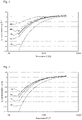
- Fig. 3 shows, in a diagram, the temperature dependency of the vapour pressure of the alloy constituents of Scalmalloy ® .
- Fig. 4 shows, in a diagram, the temperature dependency of the vapour pressure of an aluminium alloy of the invention.
- Described below are processes for producing aluminium alloys, a lightweight component precursor and a lightweight component.
- a first fraction of the melt is poured into an inert crucible, in which it cools and solidifies. On cooling, primary Al 3 Sc, Al 3 Zr and Al 3 Ti phases are precipitated. The material obtained is comminuted to a powder, which can be used for selective laser melting in a powder bed.
- a second fraction of the melt is poured in a melt spinning process onto a rotating, water-cooled copper roll.
- the melt cools at a rate of 1 000 000 K/s to form a strip.
- the cooling of the melt is sufficiently rapid to suppress a substantial part or all of the formation of Al 3 Sc, Al 3 Zr and Al 3 Ti.
- the strip is cut into short flakes.
- the alloy material obtained in the two cooling processes is comminuted to a powder, which can be used for selective laser melting in a powder bed.
- example 1 The process of example 1 is repeated, with additionally 2.0 wt% of vanadium being placed into the crucible and with the fraction of Ti, Sc and Zr kept constant.
- example 1 The process of example 1 is repeated, with additionally 1.2 wt% of nickel being placed into the crucible and with the fraction of Ti, Sc and Zr kept constant.
- example 1 The process of example 1 is repeated, with additionally 1.0 wt% of vanadium and 2.0 wt% of chromium being placed into the crucible, and with the fraction of titanium being increased to 5 wt%.
- the Zr fraction remains unchanged.
- a respective aluminium alloy powder from each of the above examples 1 to 5 is placed into a plant for additive manufacture by selective laser melting, to form a powder bed.
- the laser beam is moved over the three-dimensional powder bed in accordance with the digital information, with the powder bed being lowered step by step and with new powder layers being applied.
- the cooling of the locally melted aluminium alloy is sufficiently rapid but scandium, zirconium and titanium are "frozen" completely or substantially or predominantly in solid solution, irrespective of the composition of the aluminium alloy otherwise and irrespective of whether the powder was produced by normal cooling or by rapid cooling at a rate, for example, of 1 000 000 K/s.
- the component precursor composed of the aluminium alloy is removed from the powder bed.
- X Ti, Zr, Sc or any desired non-stochiometric mixture of the individual elements.
- Al 3 Ti is likewise precipitated, but by comparison with Al 3 Sc and Al 3 Zr there remains a predominant or sizable fraction of the titanium in solid solution.
Landscapes
- Chemical & Material Sciences (AREA)
- Engineering & Computer Science (AREA)
- Materials Engineering (AREA)
- Manufacturing & Machinery (AREA)
- Metallurgy (AREA)
- Organic Chemistry (AREA)
- Mechanical Engineering (AREA)
- Physics & Mathematics (AREA)
- Plasma & Fusion (AREA)
- Thermal Sciences (AREA)
- Crystallography & Structural Chemistry (AREA)
- Optics & Photonics (AREA)
- Health & Medical Sciences (AREA)
- General Health & Medical Sciences (AREA)
- Toxicology (AREA)
- Powder Metallurgy (AREA)
- Manufacture Of Metal Powder And Suspensions Thereof (AREA)
Applications Claiming Priority (1)
| Application Number | Priority Date | Filing Date | Title |
|---|---|---|---|
| DE102020131823.5A DE102020131823A1 (de) | 2020-12-01 | 2020-12-01 | Aluminiumlegierung und Verfahren zur additiven Herstellung von Leichtbauteilen |
Publications (1)
| Publication Number | Publication Date |
|---|---|
| EP4008457A1 true EP4008457A1 (en) | 2022-06-08 |
Family
ID=78806288
Family Applications (2)
| Application Number | Title | Priority Date | Filing Date |
|---|---|---|---|
| EP21816461.4A Pending EP4255655A1 (en) | 2020-12-01 | 2021-11-26 | Aluminium alloy and methods for additive manufacturing of lightweight parts |
| EP21210643.9A Pending EP4008457A1 (en) | 2020-12-01 | 2021-11-26 | Aluminium alloy and process for additive manufacture of lightweight components |
Family Applications Before (1)
| Application Number | Title | Priority Date | Filing Date |
|---|---|---|---|
| EP21816461.4A Pending EP4255655A1 (en) | 2020-12-01 | 2021-11-26 | Aluminium alloy and methods for additive manufacturing of lightweight parts |
Country Status (7)
| Country | Link |
|---|---|
| US (2) | US20220168811A1 (enExample) |
| EP (2) | EP4255655A1 (enExample) |
| JP (2) | JP2023551028A (enExample) |
| KR (1) | KR20220077102A (enExample) |
| CN (2) | CN116529003A (enExample) |
| DE (1) | DE102020131823A1 (enExample) |
| WO (1) | WO2022117441A1 (enExample) |
Families Citing this family (8)
| Publication number | Priority date | Publication date | Assignee | Title |
|---|---|---|---|---|
| EP4225958A4 (en) * | 2020-10-08 | 2025-08-20 | Univ North Texas | HETEROGENEOUS MICRO-STRUCTURED ALUMINUM ALLOYS |
| EP4438752A1 (en) | 2023-03-28 | 2024-10-02 | GF Casting Solutions AG | Aluminium alloy |
| CN117696058B (zh) * | 2023-11-13 | 2024-09-17 | 上海东化催化剂有限公司 | 一种催化剂载体、催化剂及其制备方法和应用 |
| PL447289A1 (pl) * | 2023-12-22 | 2025-06-23 | Sieć Badawcza Łukasiewicz - Instytut Metali Nieżelaznych | Sposób wytwarzania elementów przestrzennych z wykorzystaniem technologii Wire Arc Additive Manufacturing (WAAM) |
| PL447293A1 (pl) * | 2023-12-22 | 2025-06-23 | Sieć Badawcza Łukasiewicz - Instytut Metali Nieżelaznych | Sposób wytwarzania elementów przestrzennych ze stali z wykorzystaniem technologii Wire Arc Additive Manufacturing (WAAM) |
| PL447290A1 (pl) * | 2023-12-22 | 2025-06-23 | Sieć Badawcza Łukasiewicz - Instytut Metali Nieżelaznych | Sposób wytwarzania elementów przestrzennych z wykorzystaniem technologii Wire Arc Additive Manufacturing (WAAM) |
| CN119260020B (zh) * | 2024-10-18 | 2025-11-14 | 东北大学 | 一种高熵-钛铝合金及其激光熔融沉积制备方法 |
| CN119410964B (zh) * | 2024-11-11 | 2025-11-11 | 中航迈特增材科技(北京)有限公司 | 一种抑制增材制造飞溅的含铒高强铝合金及其制备方法 |
Citations (3)
| Publication number | Priority date | Publication date | Assignee | Title |
|---|---|---|---|---|
| EP3181711A1 (de) * | 2015-12-14 | 2017-06-21 | Airbus Defence and Space GmbH | Scandiumhaltige aluminiumlegierung für pulvermetallurgische technologien |
| WO2018144323A1 (en) | 2017-02-01 | 2018-08-09 | Hrl Laboratories, Llc | Aluminum alloys with grain refiners, and methods for making and using the same |
| CN111218586A (zh) * | 2020-01-10 | 2020-06-02 | 中国工程物理研究院机械制造工艺研究所 | 一种含有钪钛锆元素的3d打印用铝合金 |
Family Cites Families (14)
| Publication number | Priority date | Publication date | Assignee | Title |
|---|---|---|---|---|
| JPH0995750A (ja) * | 1995-09-30 | 1997-04-08 | Kobe Steel Ltd | 耐熱性に優れたアルミニウム合金 |
| DE102007018123B4 (de) | 2007-04-16 | 2009-03-26 | Eads Deutschland Gmbh | Verfahren zur Herstellung eines Strukturbauteils aus einer Aluminiumbasislegierung |
| DE102010053274A1 (de) | 2010-12-02 | 2012-06-21 | Eads Deutschland Gmbh | Verfahren zum Herstellen einer AlScCa-Legierung sowie AlScCa-Legierung |
| JP5556723B2 (ja) * | 2011-03-30 | 2014-07-23 | 株式会社豊田中央研究所 | 耐熱高強度アルミニウム合金およびその製造方法 |
| CN102952956B (zh) * | 2012-11-12 | 2014-04-09 | 北方工业大学 | 电解铝液微合金化六元中间合金及其制备和使用方法 |
| WO2015173368A2 (de) * | 2014-05-16 | 2015-11-19 | Mahle International Gmbh | Gelötete aluminiumvorrichtung |
| CN105781605B (zh) * | 2016-03-31 | 2018-02-09 | 广州森莱宝实业有限公司 | 一种抑爆剂及其制备方法 |
| CN106191501B (zh) * | 2016-08-12 | 2018-07-27 | 卓尔博(宁波)精密机电股份有限公司 | 一种无刷直流电动机及其制备工艺 |
| CN106358115A (zh) * | 2016-08-30 | 2017-01-25 | 宁波大诚和电子有限公司 | 一种多功能便携音箱的扬声控制单元 |
| KR20200030035A (ko) * | 2017-06-21 | 2020-03-19 | 오브쉬체스트보 에스 오그라니첸노이 오트벳스트베노스트유 “오베디넨나야 꼼파니야 루살 인제네르노-테크놀로지체스키 첸트르” | 알루미늄 합금 |
| CN108130451A (zh) * | 2017-11-14 | 2018-06-08 | 北京世联信诺科技有限公司 | 一种闭孔泡沫铝合金及制备方法 |
| CN108372292A (zh) * | 2018-01-31 | 2018-08-07 | 上海交通大学 | 一种激光增材制造用铝基复合材料粉末及其制备方法 |
| CN109047783B (zh) * | 2018-08-15 | 2021-10-01 | 长沙新材料产业研究院有限公司 | 一种铝合金粉末及其制备方法 |
| CN110791686A (zh) * | 2019-11-26 | 2020-02-14 | 华中科技大学 | 一种用于增材制造的铝合金粉末材料、制备方法及应用 |
-
2020
- 2020-12-01 DE DE102020131823.5A patent/DE102020131823A1/de active Pending
-
2021
- 2021-11-24 US US17/535,154 patent/US20220168811A1/en not_active Abandoned
- 2021-11-26 EP EP21816461.4A patent/EP4255655A1/en active Pending
- 2021-11-26 US US18/255,246 patent/US20240011131A1/en not_active Abandoned
- 2021-11-26 CN CN202180079924.3A patent/CN116529003A/zh active Pending
- 2021-11-26 JP JP2023532548A patent/JP2023551028A/ja active Pending
- 2021-11-26 EP EP21210643.9A patent/EP4008457A1/en active Pending
- 2021-11-26 WO PCT/EP2021/083084 patent/WO2022117441A1/en not_active Ceased
- 2021-11-30 JP JP2021193699A patent/JP2022087830A/ja active Pending
- 2021-12-01 CN CN202111457894.3A patent/CN114574731A/zh active Pending
- 2021-12-01 KR KR1020210169873A patent/KR20220077102A/ko active Pending
Patent Citations (3)
| Publication number | Priority date | Publication date | Assignee | Title |
|---|---|---|---|---|
| EP3181711A1 (de) * | 2015-12-14 | 2017-06-21 | Airbus Defence and Space GmbH | Scandiumhaltige aluminiumlegierung für pulvermetallurgische technologien |
| WO2018144323A1 (en) | 2017-02-01 | 2018-08-09 | Hrl Laboratories, Llc | Aluminum alloys with grain refiners, and methods for making and using the same |
| CN111218586A (zh) * | 2020-01-10 | 2020-06-02 | 中国工程物理研究院机械制造工艺研究所 | 一种含有钪钛锆元素的3d打印用铝合金 |
Non-Patent Citations (2)
Also Published As
| Publication number | Publication date |
|---|---|
| EP4255655A1 (en) | 2023-10-11 |
| JP2023551028A (ja) | 2023-12-06 |
| DE102020131823A1 (de) | 2022-06-02 |
| JP2022087830A (ja) | 2022-06-13 |
| US20220168811A1 (en) | 2022-06-02 |
| US20240011131A1 (en) | 2024-01-11 |
| CN114574731A (zh) | 2022-06-03 |
| KR20220077102A (ko) | 2022-06-08 |
| WO2022117441A1 (en) | 2022-06-09 |
| CN116529003A (zh) | 2023-08-01 |
Similar Documents
| Publication | Publication Date | Title |
|---|---|---|
| EP4008457A1 (en) | Aluminium alloy and process for additive manufacture of lightweight components | |
| US11976343B2 (en) | High strength aluminium alloy for rapid solidification manufacturing processes | |
| Liu et al. | Alloy design for laser powder bed fusion additive manufacturing: a critical review | |
| US11603583B2 (en) | Ribbons and powders from high strength corrosion resistant aluminum alloys | |
| JP7049312B2 (ja) | 高強度耐食性アルミニウム合金からのリボン及び粉末 | |
| US4359352A (en) | Nickel base superalloys which contain boron and have been processed by a rapid solidification process | |
| JP2021527758A (ja) | 溶接用及び付加製造用の高性能Al−Zn−Mg−Zr基アルミニウム合金 | |
| Coury et al. | Reassessment of the effects of Ce on quasicrystal formation and microstructural evolution in rapidly solidified Al–Mn alloys | |
| JPH0835029A (ja) | 高強度高延性鋳造アルミニウム合金およびその製造方法 | |
| JPH0116292B2 (enExample) | ||
| JP3110512B2 (ja) | 高強度高靭性マグネシウム合金材料 | |
| GB2146352A (en) | Aluminium alloys | |
| Bourdeau et al. | Development of iron aluminides | |
| KR100481250B1 (ko) | 인성내열성알루미늄합금및이의제조방법 | |
| US5015305A (en) | High temperature hydrogenation of gamma titanium aluminide | |
| WO1995020685A1 (en) | Ductile, light weight, high strength beryllium-aluminum cast composite alloy | |
| US11859266B2 (en) | Castable high temperature nickel-rare earth element alloys | |
| US5067988A (en) | Low temperature hydrogenation of gamma titanium aluminide | |
| US4481034A (en) | Process for producing high hafnium carbide containing alloys | |
| Chen et al. | Microstructure characterisation and mechanical properties of rapidly solidified Mg–Zn–Ca alloys with Ce addition | |
| JP3485961B2 (ja) | 高強度アルミニウム基合金 | |
| Ramirez et al. | Casting of iron aluminides | |
| JP4704722B2 (ja) | 耐磨耗性と加工性とに優れた耐熱性Al基合金 | |
| Satyanarayana et al. | Studies on spray casting of Al-alloys and their composites | |
| Koczak et al. | High performance powder metallurgy Aluminum alloys an overview |
Legal Events
| Date | Code | Title | Description |
|---|---|---|---|
| PUAI | Public reference made under article 153(3) epc to a published international application that has entered the european phase |
Free format text: ORIGINAL CODE: 0009012 |
|
| STAA | Information on the status of an ep patent application or granted ep patent |
Free format text: STATUS: THE APPLICATION HAS BEEN PUBLISHED |
|
| AK | Designated contracting states |
Kind code of ref document: A1 Designated state(s): AL AT BE BG CH CY CZ DE DK EE ES FI FR GB GR HR HU IE IS IT LI LT LU LV MC MK MT NL NO PL PT RO RS SE SI SK SM TR |
|
| STAA | Information on the status of an ep patent application or granted ep patent |
Free format text: STATUS: REQUEST FOR EXAMINATION WAS MADE |
|
| 17P | Request for examination filed |
Effective date: 20221208 |
|
| RBV | Designated contracting states (corrected) |
Designated state(s): AL AT BE BG CH CY CZ DE DK EE ES FI FR GB GR HR HU IE IS IT LI LT LU LV MC MK MT NL NO PL PT RO RS SE SI SK SM TR |