EP4003945B1 - Dehydrierungsverfahren und -system mit reaktorresequenzierung - Google Patents
Dehydrierungsverfahren und -system mit reaktorresequenzierung Download PDFInfo
- Publication number
- EP4003945B1 EP4003945B1 EP20847637.4A EP20847637A EP4003945B1 EP 4003945 B1 EP4003945 B1 EP 4003945B1 EP 20847637 A EP20847637 A EP 20847637A EP 4003945 B1 EP4003945 B1 EP 4003945B1
- Authority
- EP
- European Patent Office
- Prior art keywords
- dehydrogenation
- reactors
- productivity
- modes
- sequence
- Prior art date
- Legal status (The legal status is an assumption and is not a legal conclusion. Google has not performed a legal analysis and makes no representation as to the accuracy of the status listed.)
- Active
Links
Images


Classifications
-
- B—PERFORMING OPERATIONS; TRANSPORTING
- B01—PHYSICAL OR CHEMICAL PROCESSES OR APPARATUS IN GENERAL
- B01J—CHEMICAL OR PHYSICAL PROCESSES, e.g. CATALYSIS OR COLLOID CHEMISTRY; THEIR RELEVANT APPARATUS
- B01J19/00—Chemical, physical or physico-chemical processes in general; Their relevant apparatus
- B01J19/24—Stationary reactors without moving elements inside
- B01J19/2415—Tubular reactors
- B01J19/2425—Tubular reactors in parallel
-
- B—PERFORMING OPERATIONS; TRANSPORTING
- B01—PHYSICAL OR CHEMICAL PROCESSES OR APPARATUS IN GENERAL
- B01J—CHEMICAL OR PHYSICAL PROCESSES, e.g. CATALYSIS OR COLLOID CHEMISTRY; THEIR RELEVANT APPARATUS
- B01J23/00—Catalysts comprising metals or metal oxides or hydroxides, not provided for in group B01J21/00
- B01J23/70—Catalysts comprising metals or metal oxides or hydroxides, not provided for in group B01J21/00 of the iron group metals or copper
- B01J23/76—Catalysts comprising metals or metal oxides or hydroxides, not provided for in group B01J21/00 of the iron group metals or copper combined with metals, oxides or hydroxides provided for in groups B01J23/02 - B01J23/36
- B01J23/825—Catalysts comprising metals or metal oxides or hydroxides, not provided for in group B01J21/00 of the iron group metals or copper combined with metals, oxides or hydroxides provided for in groups B01J23/02 - B01J23/36 with gallium, indium or thallium
-
- B—PERFORMING OPERATIONS; TRANSPORTING
- B01—PHYSICAL OR CHEMICAL PROCESSES OR APPARATUS IN GENERAL
- B01J—CHEMICAL OR PHYSICAL PROCESSES, e.g. CATALYSIS OR COLLOID CHEMISTRY; THEIR RELEVANT APPARATUS
- B01J8/00—Chemical or physical processes in general, conducted in the presence of fluids and solid particles; Apparatus for such processes
- B01J8/02—Chemical or physical processes in general, conducted in the presence of fluids and solid particles; Apparatus for such processes with stationary particles, e.g. in fixed beds
- B01J8/0242—Chemical or physical processes in general, conducted in the presence of fluids and solid particles; Apparatus for such processes with stationary particles, e.g. in fixed beds the fluid flow within the bed being predominantly vertical
- B01J8/025—Chemical or physical processes in general, conducted in the presence of fluids and solid particles; Apparatus for such processes with stationary particles, e.g. in fixed beds the fluid flow within the bed being predominantly vertical in a cylindrical shaped bed
-
- B—PERFORMING OPERATIONS; TRANSPORTING
- B01—PHYSICAL OR CHEMICAL PROCESSES OR APPARATUS IN GENERAL
- B01J—CHEMICAL OR PHYSICAL PROCESSES, e.g. CATALYSIS OR COLLOID CHEMISTRY; THEIR RELEVANT APPARATUS
- B01J8/00—Chemical or physical processes in general, conducted in the presence of fluids and solid particles; Apparatus for such processes
- B01J8/02—Chemical or physical processes in general, conducted in the presence of fluids and solid particles; Apparatus for such processes with stationary particles, e.g. in fixed beds
- B01J8/0285—Heating or cooling the reactor
-
- C—CHEMISTRY; METALLURGY
- C07—ORGANIC CHEMISTRY
- C07C—ACYCLIC OR CARBOCYCLIC COMPOUNDS
- C07C11/00—Aliphatic unsaturated hydrocarbons
- C07C11/02—Alkenes
- C07C11/08—Alkenes with four carbon atoms
- C07C11/09—Isobutene
-
- C—CHEMISTRY; METALLURGY
- C07—ORGANIC CHEMISTRY
- C07C—ACYCLIC OR CARBOCYCLIC COMPOUNDS
- C07C4/00—Preparation of hydrocarbons from hydrocarbons containing a larger number of carbon atoms
- C07C4/02—Preparation of hydrocarbons from hydrocarbons containing a larger number of carbon atoms by cracking a single hydrocarbon or a mixture of individually defined hydrocarbons or a normally gaseous hydrocarbon fraction
- C07C4/06—Catalytic processes
-
- C—CHEMISTRY; METALLURGY
- C07—ORGANIC CHEMISTRY
- C07C—ACYCLIC OR CARBOCYCLIC COMPOUNDS
- C07C5/00—Preparation of hydrocarbons from hydrocarbons containing the same number of carbon atoms
- C07C5/32—Preparation of hydrocarbons from hydrocarbons containing the same number of carbon atoms by dehydrogenation with formation of free hydrogen
- C07C5/327—Formation of non-aromatic carbon-to-carbon double bonds only
- C07C5/333—Catalytic processes
- C07C5/3332—Catalytic processes with metal oxides or metal sulfides
-
- C—CHEMISTRY; METALLURGY
- C07—ORGANIC CHEMISTRY
- C07C—ACYCLIC OR CARBOCYCLIC COMPOUNDS
- C07C5/00—Preparation of hydrocarbons from hydrocarbons containing the same number of carbon atoms
- C07C5/32—Preparation of hydrocarbons from hydrocarbons containing the same number of carbon atoms by dehydrogenation with formation of free hydrogen
- C07C5/327—Formation of non-aromatic carbon-to-carbon double bonds only
- C07C5/333—Catalytic processes
- C07C5/3335—Catalytic processes with metals
- C07C5/3337—Catalytic processes with metals of the platinum group
-
- B—PERFORMING OPERATIONS; TRANSPORTING
- B01—PHYSICAL OR CHEMICAL PROCESSES OR APPARATUS IN GENERAL
- B01J—CHEMICAL OR PHYSICAL PROCESSES, e.g. CATALYSIS OR COLLOID CHEMISTRY; THEIR RELEVANT APPARATUS
- B01J2208/00—Processes carried out in the presence of solid particles; Reactors therefor
- B01J2208/02—Processes carried out in the presence of solid particles; Reactors therefor with stationary particles
- B01J2208/021—Processes carried out in the presence of solid particles; Reactors therefor with stationary particles comprising a plurality of beds with flow of reactants in parallel
-
- B—PERFORMING OPERATIONS; TRANSPORTING
- B01—PHYSICAL OR CHEMICAL PROCESSES OR APPARATUS IN GENERAL
- B01J—CHEMICAL OR PHYSICAL PROCESSES, e.g. CATALYSIS OR COLLOID CHEMISTRY; THEIR RELEVANT APPARATUS
- B01J2208/00—Processes carried out in the presence of solid particles; Reactors therefor
- B01J2208/02—Processes carried out in the presence of solid particles; Reactors therefor with stationary particles
- B01J2208/023—Details
- B01J2208/024—Particulate material
- B01J2208/025—Two or more types of catalyst
-
- C—CHEMISTRY; METALLURGY
- C07—ORGANIC CHEMISTRY
- C07C—ACYCLIC OR CARBOCYCLIC COMPOUNDS
- C07C2523/00—Catalysts comprising metals or metal oxides or hydroxides, not provided for in group C07C2521/00
- C07C2523/16—Catalysts comprising metals or metal oxides or hydroxides, not provided for in group C07C2521/00 of arsenic, antimony, bismuth, vanadium, niobium, tantalum, polonium, chromium, molybdenum, tungsten, manganese, technetium or rhenium
- C07C2523/24—Chromium, molybdenum or tungsten
- C07C2523/26—Chromium
Definitions
- the present invention relates generally to cyclic dehydrogenation processes and systems with multiple dehydrogenation reactors operating in alternating and synchronized production/regeneration modes. These processes include the dehydrogenation of alkanes over fixed beds of catalyst such as supported chromium, gallium, or platinum/tin or the like.
- the invention involves sequencing or re-sequencing the reactors to reduce fluctuation in production rates over a system cycle which allows productivity to be increased.
- Hydrocarbon dehydrogenation processes are conventionally practiced with systems having compressors and absorbers serving a plurality of sequenced reactors which operate in alternating production/regeneration modes over a system repeating cycle.
- a process for catalytic dehydrogenation of hydrocarbons carried out wherein the catalyst is alternately contacted with a hydrocarbon charge and subjected to regeneration by combustion of carbonaceous deposits resulting from dehydrogenation of the hydrocarbon charge.
- Each of the operations are carried out in a battery of reactors operated in a timed sequence of substantially equal periods of hydrocarbon conversion and catalyst regeneration.
- the sequence of operations for each reactor is as follows: (1) hydrocarbon dehydrogenation, (2) steam purging to free catalyst and reaction vessel of hydrocarbon products, (3) catalyst regeneration in oxygen-containing gas, (4) evacuation and (5) reduction of oxidized catalyst in hydrogencontaining gas.
- An exemplary form of the dehydrogenation system is illustrated in Figure 2 of GB 794,089 . As there is shown, the system comprises five reactors, R, which are operated in a cycle such that two are simultaneously on stream for catalytic dehydrogenation, two are being subjected to regeneration of catalyst therein, and one is in a stage involving an operation such as evacuation, steam purge, hydrogen reduction or valve changes.
- the diagram in Figure 3 of GB 794,089 shows how the reactors are operated on an approximately 22.5 minute cycle.
- FIG. 823,626 Another multi-reactor dehydrogenation system is shown in GB 823,626 .
- two or more 3-reactor batteries are used.
- An exemplary dehydrogenation system is illustrated in Figure 2 of GB 823,626 .
- the system comprises six reactors, R, which are arranged in two batteries of three reactors each and are operated in a sequence such that two, i.e., one reactor of each battery, are simultaneously on stream for catalytic dehydrogenation, two are being subjected to regeneration of catalyst therein, and two are in a stage involving an operation such as evacuation, steam purge, hydrogen reduction or valve changes.
- FIG. 3 of GB 823,626 shows how the reactors are operated on a 15 minute repeating cycle. It will be noted from an inspection of the cycle chart of Figure 3 of GB 823,626 that reactors 1 and 4, 2 and 5 and 3 and 6 are always in the same phase of a cycle. The desirability of such arrangements according to the GB 823,626 specification is dictated by the fact that the paired reactors are opposite each other, as shown in Figure 2 of GB 823,626 . Thus the gaseous materials charged to the paired reactors, and the gaseous materials withdrawn therefrom, will have equal distances of travel to the mains conducting the gases to and from the unit. The GB 823,626 specification further notes that staggered cycle times may be desirable in terms of reducing demands on associated auxiliaries such as pumps, compressors and the like since only one reactor at a time is making a transition.
- auxiliaries such as pumps, compressors and the like since only one reactor at a time is making a transition.
- productivity differences between reactors in a multi- reactor system can also lead to inefficiency, productivity and yield losses when the downstream product recovery equipment capacity, notably absorber capacity, is exceeded or underutilized.
- product recovery capacity When product recovery capacity is exceeded, dehydrogenation product is flared and lost.
- absorbers When absorbers are underutilized, hydrogen is sorbed unnecessarily, increasing energy requirements of the system.
- a preferred system for implementing the present invention is a multi-fixed bed, adiabatic endothermic reaction system known in the art as a Houdry dehydrogenation system as is shown in GB 794,089 and GB 823,626 .
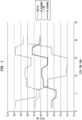
- Figure 1 is a plot of isobutylene yield over time for different reactor sequences over a system repeating cycle in a seven reactor system operating on a twenty-two (22) minute system cycle. It is seen in an initial sequence, prior to re-sequencing, the system exhibits a yield delta of about 8% or so, but that after re-sequencing, the yield delta is reduced to half of that or less; while peak productivity is lowered by about 5% on a relative basis, corresponding to 2.5% yield reduction.
- productivity may be increased in the re-sequenced system by increasing feed rates of hydrocarbon, by raising temperature of the hydrocarbon charge, by raising the regeneration air temperature or decreasing inlet pressure to produce 5% more product on an hourly basis with the same equipment as is shown in the dashed productivity line in Figure 1 .
- the invention may be realized in various ways by determining productivity of the various reactors and making adjustments to increase productivity. For instance, in a relatively simple system limited by a downstream product compressor to a yield value of 50, having 4 reactors, 2 reactors exhibiting yields of 50 operating simultaneously in dehydrogenation and regeneration modes alternating with two reactors having yield values of 40 operating simultaneously in dehydrogenation and regeneration modes over a cycle, the peak yield value will be 50 and the yield delta will be 10 over a system repeating operating cycle. If the reactors are re-sequenced over an operating cycle, with 1 reactor having a yield value of 50 and 1 reactor having a yield value of 40 being operating simultaneously in the same modes, the peak yield value is 45 and the yield delta goes away. Since the system can handle a yield value of 50, productivity can be increased by increasing feed rates of hydrocarbon, by raising temperature of the hydrocarbon charge, by raising the regeneration air temperature and so forth. Additional capacity is provided with no capital expense and only incremental operating expense.
- the number of reactors on-line at any given time is more or less the same prior to and after re-sequencing; However, it is also possible to sequester an over-active reactor (hot spot) or an underperforming reactor in order to bring the system into better balance, if so desired.
- an over-active reactor hot spot
- an underperforming reactor in order to bring the system into better balance, if so desired.
- Characteristic peak productivity refers to the aggregate maximum productivity of the reactors at a given point in time during a production cycle at a given feed rate, temperatures of operation and so forth.
- the characteristic peak productivity of the re-sequenced reactors may be calculated instead of measured, if so desired.
- Characteristic productivity delta is the difference between the aggregate maximum productivity of the reactors and the aggregate minimum productivity of the reactors during a system dehydrogenation cycle at a given feed rate, temperatures of operation and so forth.
- the minimum and maximum productivities of the re-sequenced reactors may be calculated instead of measured, if so desired.
- Liquid hourly space velocity based solely on the dehydrogenation reactant feed and is calculated as the hourly volumetric flow rate of liquid dehydrogenation reactant to the system divided by the volume of dehydrogenation catalyst beds in the multistage system, that is, in units of hr -1 .
- LHSV Liquid hourly space velocity
- percent refers to weight percent of a component or relative value to an initial value.
- Productivity of the system at any given time refers to the aggregate rate of dehydrogenation product produced by the reactor system by the reactors operating in dehydrogenation mode, in kg per hour or in like units.
- productivity is conveniently represented graphically by yield as is seen in Figure 1 , or may be approximated by conversion under a given set of conditions.
- Terminology to the effect that the characteristic productivity delta of the re-sequenced system is at least 25% lower than as compared with the characteristic productivity delta of the initial system sequence refers to the change in the difference between the aggregate peak and minimum productivity over a system cycle.
- the initial system cycle has a peak yield of 50% and a minimum yield of 40% over a cycle and the re-sequenced system has a peak yield of 47.5% and a minimum of 42.5%
- we refer to the characteristic productivity delta as decreasing from 10 to 5 or by 50% as compared to the initial system sequence.
- the re-sequenced system has a characteristic productivity delta of 3.6/7.8 or 46% lower as compared to the initial sequence.
- the characteristic productivity delta of the re-sequenced system is 3.6/47.3 or 7.6% of the characteristic peak productivity of the re-sequenced system.
- Figures 5 and 6 Complete repeating system cycles are shown in Figures 5 and 6 .
- Sequence “Sequence”, “re-sequence” and like terminology refers to the temporal order in which the various reactors are operated in a dehydrogenation mode before being switched to a regeneration mode of the reactor.
- Figure 5 shows a reactor sequence for the system cycle of 7 reactors as 1, 3, 5, 7, 2, 4, 6, while Figure 6 shows a reactor sequence of 1, 5, 4, 2, 7, 3, 6.
- the timed sequence is completed, the system cycle is repeated.
- the present invention may be applied to any suitable cyclical gas phase dehydrogenation process, for example, as described generally in United States Patent No. 4,172,854 to Ellis et al.
- Dehydrogenation processes which may be re-sequenced in accordance with the invention thus include isobutane to isobutylene; butane to butenes and butadiene; propionitrile to acrylonitrile; propionaldehyde to acrolein; ethyl chloride to vinyl chloride; methyl isobutyrate to methyl methacylate; 2 or 3-chlorobutene-1 or 2,3-dichlorobutane to chloroprene; ethyl pyridine to vinyl pyridine; ethylbenzene to styrene; isopropylbenzene to ⁇ -methyl styrene; ethylchlorohexane to styrene; cyclohexane to
- the preferred compounds to be dehydrogenated are hydrocarbons with a particularly preferred class being acyclic non-quaternary hydrocarbons having 3 to 5 carbon atoms or ethyl benzene and the preferred products are isobutene, propene, n-butene-1 or 2, butadiene-1,3vinyl acetylene, 2-methyl-1-butene, 3-methyl-1-butene, 3-methyl-2-butene, isoprene, styrene or mixtures thereof.
- Especially preferred as feed are isobutane, n-butane, isopentane, ethyl benzene mixtures thereof such as hydrocarbon mixtures containing these compounds in at least 50 mol percent.
- Suitable catalysts are described in Ullman's Encyclopedia of Industrial Chemistry, Hydrogenation and Dehydrogenation, Domenico Sanfilippo and Paul N. Rylander, Ed. Volume 18, PP. 451-471 Published Online: 15 OCT 2009, DOI: 10.1002/14356007.a13_487.pub2, Copyright ⁇ 2002 by Wiley-VCH Verlag GmbH & Co. KgaA and the references cited therein.
- the catalyst formulation includes promotion with alkali metals, which is fundamental for increasing the chromium active sites and decreasing the surface acidity (of both chromium and aluminum oxides). Potassium has the best effect if provided in the right amount. Typically, a volcano-shape curve of activity and selectivity is obtained by increasing the potassium content.
- Pt/Sn is supported either on alumina or on either ZnAl 2 O 4 or MgAl 2 O 4 .
- the catalyst is promoted with alkali metals and further promoters.
- Sn is to improve activity, selectivity, and stability because it neutralizes the acidity of supports, interacts electronically with Pt, and reduces the ensemble effect that favors coke formation.
- Increasing the loading of Pt + Sn, increasing the Sn/Pt ratio, or increasing the temperature of the reduction reaction causes the system to shift from separated phases towards the formation of Pt-Sn alloys.
- the catalyst preserves some bifunctional (acidic and noble-metal) activity, resulting in a moderate tendency to skeletal isomerization (e.g., isobutyl to n-butyl).
- Some characteristics of the catalysts have significant impact on the industrial implementation:
- the Pt/Sn catalysts undergo a double-mechanism ageing through coke fouling and sintering.
- the Pt/Sn catalysts can tolerate a coke build-up of several percentage points, preserving enough catalytic activity for allowing a period "on stream" of several hours/days before mandating a regeneration.
- the two promoted and optimized catalytic systems show comparable performances in terms of selectivity to olefins.
- a periodical regeneration with air is mandatory for both catalysts to burn off the coke.
- the catalyst will therefore undergo a cycle during which it will be exposed to a hydrocarbon atmosphere, followed by a period in the presence of oxygen (and/or some steam). It must therefore keep its morphological, structural, and chemical stability under severe hydrothermal conditions.
- the length of the time on hydrocarbon stream is distinctive of the selected active phase: typical values are minutes/hours for Cr catalysts and hours/days for the Pt ones.
- gallium (Ga) catalysts may be employed, as is seen in United States Patent Application Publication No. 2019/0126242 of Xing et al. with or without additional catalyst metals present. See United States Patent No. 5,219,816 to Zhou et al. which discloses Ga/Pt dehydrogenation catalysts.
- the catalyst beds may be undiluted, i.e. consist entirely of the supported active catalyst, or diluted with inert material if so desired and/or include a heat-generating material as is disclosed in United States Patent Nos.: 7,622,623 ; 7,973,207 ; 8,188,328 ; and 9,725,380 .
- the inert material may be, for example, a granular, alpha-alumina material of similar particle size to the supported catalyst.
- the heat generating material may include a metal selected from the group consisting of copper, chromium, molybdenum, vanadium, cerium, yttrium, scandium, tungsten, manganese, iron, cobalt, nickel, silver, bismuth and combinations thereof.
- Exemplary carriers for the heat-generating material include, but are not limited to, various aluminum oxides or hydroxides such as aluminum trihydroxide, boehmite, pseudo-boehmite, gibbsite, bayerite, transition aluminas or alpha-alumina, silica/alumina, silica, silicates, aluminates such as calcium aluminate or barium hexyluminate, calcined hydrotalcites, zeolites, zinc oxide, chromium oxides, magnesium oxides and combinations thereof.
- various aluminum oxides or hydroxides such as aluminum trihydroxide, boehmite, pseudo-boehmite, gibbsite, bayerite, transition aluminas or alpha-alumina, silica/alumina, silica, silicates, aluminates such as calcium aluminate or barium hexyluminate, calcined hydrotalcites, zeolites, zinc oxide, chromium oxides, magnesium oxide
- the heat-generating material may further comprise a promoter, such as an alkali, an alkaline earth metal, lithium, sodium, potassium, rubidium, cesium, beryllium, magnesium, calcium, strontium, zirconium, barium and a combination thereof.
- a promoter such as an alkali, an alkaline earth metal, lithium, sodium, potassium, rubidium, cesium, beryllium, magnesium, calcium, strontium, zirconium, barium and a combination thereof.
- the dehydrogenation reaction may be carried out in a gas phase at atmospheric pressure, superatmospheric pressure or at sub-atmospheric pressure.
- the total pressure of the system will normally be about atmospheric pressure or sub-atmospheric pressure. Generally the total pressure will be between about 101.3 kPa (1 p.s.i.a.) and about 618.5 kPa (75 p.s.i.a.). Preferably, the total pressure will be less than about 446.1 kPa (50 p.s.i.a.).
- the temperature of the dehydrogenation reaction will generally be in a range of about 350°C to 700°C with excellent results being obtained in the range of 400°C to 650°C.
- the gaseous reactants can be conducted through the reaction chamber at a fairly wide range of flow rates.
- the optimum flow rates will be dependent upon such variables as the temperature of reaction, pressure, particle size of the catalyst, and so forth. Desirable flow rates may be established by one skilled in the art.
- the flow rates will be within the range of about 0.10 to 10 liquid volumes of the organic compound to be dehydrogenated per volume of dehydrogenation zone containing catalyst per hour (referred to as LHSV).
- LHSV liquid volumes of the organic compound to be dehydrogenated per volume of dehydrogenation zone containing catalyst per hour
- the LHSV will be between 0.15 and about 5.
- the volume of a fixed bed dehydrogenation zone containing the catalyst is that original void volume of reactor space containing catalyst.
- the dehydrogenation is carried out in a series of cycles which comprise dehydrogenation of a suitable feed over the catalysts of the invention under the conditions as defined for a period of time, usually about 6 to 12 minutes followed by a regeneration cycle during which the coke deposited from the dehydrogenation is burnt off.
- the regeneration can be longer or shorter than the dehydrogenation cycle as needed to remove the coke, usually about 6 to 12 minutes will be sufficient.
- the coke is removed by passing oxygen at a temperature of 550°C to 650°C over the catalyst.
- a convenient source of oxygen is air, however, pure oxygen or a mixture of oxygen with inert gases, such as nitrogen, either in the same or different proportions as air, can be used.
- At least two reactors are concurrently operated in a dehydrogenation production mode and at least two reactors are in various stages of regeneration.
- the overall repeating dehydrogenation/regeneration sequence for the system may be about 20-25 minutes for a chrome/alumina catalyzed fixed bed reactor.
- a typical cycle of each reactor includes operating the reactor in a dehydrogenation mode for about 10 minutes, followed by regeneration including sequentially a steam purge, regeneration with air and optionally fuel gas, evacuation, and catalyst reduction. Steam purging continues for about 1 minute, regeneration with air and optionally fuel gas is carried out for about 10 minutes, evacuation of the reactors is accomplished in about 30 seconds and the catalyst is reduced with hydrogen for about 1 minute.
- Suitable reaction systems which may be re-sequenced in accordance with the present invention include those seen in GB 794,089 and GB 823,626 , as well as the reactor system shown schematically in Figures 2 , 3 of the present application which is a chromia catalyzed gas phase dehydrogenation system for producing isobutylene from isobutane.
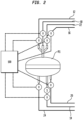
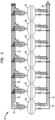
- FIG. 2 there is shown in Figure 2 a catalytic dehydrogenation reactor R1 connected in a battery of other reactors, R2 through R7, shown in Figure 3 .
- Reactor R1 is connected to a hydrocarbon charge feed line 12, a product discharge line 14, a steam line 16, an air regeneration line 18, a vacuum line 20, a reduction line 22, as well as a discharge line 24 for discharging of the gas from regeneration.
- reactor R1 Operation of reactor R1 is controlled via a plurality of valves V and output from the reactor is sampled via a port S to determine productivity.
- the valves are connected to a digital controller 100 which sequences the various steps in each of the various reactors in the reaction system, as described below in connection with Figure 3 .
- Each of reactors R2 through R7 are likewise provided with valves V and a sampling port S and are connected to controller 100 in the same manner as R1 and operate the same way.
- controller 100 connected to the valves, V, by way of dashed lines as indicated in the diagram. Connection to controller 100 are shown schematically only for the seven valves of reactor R1 ; it being appreciated that the valving on the other reactors is similarly connected and controlled by controller 100. Controller 100 is a DelataV DCS controller, model no. SD+ digital controller. If so desired, a second controller may be used to provide additional control integrity to critical features such as a Triconex controller, model 3008. Both can be utilized concurrently and are represented in the Figure collectively simply as controller 100.
- system 10 comprises seven reactors, R1 through R7, which are operated in a cycle such that three are simultaneously on stream for catalytic dehydrogenation, three are being subjected to regeneration of catalyst therein, and one is in a stage involving an operation such as evacuation, steam purge, hydrogen reduction or valve changes.
- the diagram in Figure 5 shows how the reactors are operated on a twenty-two (22) minute (Appx.) cycle; it will be understood that the same operation can be carried out on a somewhat longer or a somewhat shorter cycle period.
- cycle time for a single system cycle is conveniently represented in two modes, dehydrogenation extending to regeneration which, for purposes of Figures 5 , 6 , includes purging, air regeneration and reduction of the catalyst bed.
- Figures 5 , 6 While it is seen in Figures 5 , 6 that equal numbers of reactors are in dehydrogenation and regeneration modes at any given time in a cycle, the system may be sequenced such that more reactors are in dehydrogenation mode than regeneration mode at a given point in time in a cycle if so desired. That is Figures 5 , 6 show roughly a 3-3-1 distribution between dehydrogenation and regeneration modes with one reactor in transition, however, the system could be sequenced in a 4-2-1 distribution between dehydrogenation and regeneration modes if that would provide better productivity balance in the system.
- the hydrocarbon charge is fed to the battery of reactors by means of a line 12 connecting through suitable branch lines and valving arrangements to each of said reactors R1-R7 in the series; the motor operated valves therein being opened and closed at the appropriate time by the operation of a cycle controller 100.
- the hydrocarbon conversion products will be withdrawn from the system as by means of a line 14 also suitably connected with each of the reactors of the series by suitable branch lines and valving arrangement.
- the reactor effluent from line 14 is subjected to the series of steps for recovery of the desired products, including the use of a downstream product compressor and an absorber tower (not shown).
- each reactor is on stream for dehydrogenation for 9-10 minutes and is on regeneration for 9-10 minutes or so including purging and valve changes.
- 40-50% of the total time of the cycle is devoted to actual on-stream production of desired hydrocarbon products while roughly equal time is used for regeneration, purging and valve operation.
- the system is conveniently controlled with a digital controller 100 connected to the valves, V, by way of dashed lines as indicated in the diagram. Connection to controller 100 are shown schematically only for the seven valves of reactor R1 ; it being appreciated that the valving on the other reactors is similarly connected and controlled by controller 100.
- each reactor in Figures 2 , 3 is determined by sampling the branch lines from each reactor to output line 14 as indicated by the S designations and comparing with the hydrocarbon charge stream to the reactors.
- Means for determining reactor performance can be on-line or off line and include any suitable analytical technique such as chromatography, IR, or any suitable analytical technique.
- Sampling ports, S may be used to obtain a sample for off-line or on-line analysis by chromatography, NMR, spectrometry and so forth, or may be used for determining productivity on-line by way of optical, infra-red, or other spectral detectors, if so desired.
- System 10 is operated such that the operating limit of the downstream product compressor (as well as the other components such as the regeneration air compressor) is capable of accommodating peak productivity during the 22 minute cycle.
- peak production is seen at the beginning of a cycle and a yield delta of 8 or so is seen at mid-cycle.
- a yield delta of 8 or so is seen at mid-cycle.
- productivity is increased by simply raising temperature, all other things being equal, productivity may be increased to the dashed line of Figure 1 without exceeding the compressor limit.
- productivity can be increased following resequencing by increasing feed rates of hydrocarbon, by raising temperature of the hydrocarbon charge, by raising the regeneration air temperature and so forth since the peak yield is reduced.
- An increase in productivity of 5.5% generates millions of dollars in additional revenue.
- the reactor system of Figures 2 , 3 was operated in a reactor cycle of approximately twenty-two (22) minutes in an initial reactor sequence wherein each reactor alternated between a dehydrogenation (production) mode and regeneration mode as indicated in Table 2 and Figure 5 .
- the system of Figure 3 was re-sequenced to the sequence of Table 3 and Figure 6 .
- the re-sequencing and subsequent increase in productivity boosts output anywhere from about 2-10% and more using the same reactors, even though peak conversion is lower as noted above.
- Figure 7 is a diagram showing downstream product compressor turbine speed and temperature before and after re-sequencing.
- the invention allows one to increase downstream turbine speed by 20% or more and raise temperatures by 10% or more without causing an upset in the system.
- the re-sequencing methodology is based on determining the productivity characteristics of each reactor and sequencing them so as to reduce system productivity deltas over the system cycle, including reducing peak rates. While any particular calculation method may be employed, it is particularly convenient to base re-sequencing calculations on yield data for all of the reactors for a given feed rate and set of operating conditions.
- the present invention is directed to a method of operating a dehydrogenation system according to claim 1 with a plurality of dehydrogenation reactors alternating between dehydrogenation modes and regeneration modes in a timed sequence in a system cycle comprising: (a) operating the plurality of dehydrogenation reactors in an initial system sequence having an initial characteristic peak productivity over the course of a system cycle; (b) determining the productivity characteristics of each of the dehydrogenation reactors; (c) re-sequencing the reactors to operate in a second system sequence having a re-sequenced characteristic peak productivity lower than that of said initial characteristic peak productivity ; and (d) increasing the re-sequenced characteristic peak productivity to a re-sequenced operating level to thereby increase system productivity over a system cycle as compared with operation in the initial system sequence.
- the method of the invention preferably includes one or more of the process features listed below:
- the invention also relates to a dehydrogenation system according to claim 17 comprising: (a) a plurality of dehydrogenation reactors valved to operate in alternating dehydrogenation modes and regeneration modes in a timed sequence in a system cycle by way of the plurality of valves; (b) a programmable digital controller connected to the plurality of valves for sequencing the reactors; and (c) means for determining the productivity characteristics of each reactor over a system cycle, which is the aggregate rate of dehydrogenation product produced by the reactor system by the reactors operating in dehydrogenation mode.
- the digital controller is operable to re-sequence the reactors via a pluratlity of valves to reduce either characteristic peak productivity or characteristic productivity deltas over a system cycle.
- the dehydrogenation system of the invention preferably includes one or more of the features listed immediately below:
Landscapes
- Chemical & Material Sciences (AREA)
- Organic Chemistry (AREA)
- Chemical Kinetics & Catalysis (AREA)
- Physics & Mathematics (AREA)
- Fluid Mechanics (AREA)
- Engineering & Computer Science (AREA)
- General Chemical & Material Sciences (AREA)
- Oil, Petroleum & Natural Gas (AREA)
- Materials Engineering (AREA)
- Organic Low-Molecular-Weight Compounds And Preparation Thereof (AREA)
- Low-Molecular Organic Synthesis Reactions Using Catalysts (AREA)
Claims (20)
- Verfahren zum Betreiben eines Dehydrierungssystems mit einer Vielzahl von Dehydrierungsreaktoren, die zwischen Dehydrierungsmodi und Regenerationsmodi in einer zeitlichen Abfolge in einem sich wiederholenden Systemzyklus abwechseln, umfassend:(a) Betreiben der mehreren Dehydrierungsreaktoren in einer anfänglichen Systemsequenz mit einer anfänglichen charakteristischen Spitzenproduktivität über den Verlauf eines Systemzyklus;(b) Bestimmen der Produktivitätsmerkmale jedes der Dehydrierungsreaktoren;(c) Re-Sequenzierung der Reaktoren, um sie in einer zweiten Systemsequenz zu betreiben, die eine re-sequenzierte charakteristische Spitzenproduktivität aufweist, die niedriger ist als diejenige der anfänglichen charakteristischen Spitzenproduktivität; und(d) Erhöhen der re-sequenzierten charakteristischen Spitzenproduktivität auf ein re-sequenziertes Betriebsniveau, um dadurch die Systemproduktivität über einen Systemzyklus im Vergleich zum Betrieb in der anfänglichen Systemsequenz zu erhöhen.
- Verfahren zum Betreiben eines Dehydrierungssystems mit einer Vielzahl von Dehydrierungsreaktoren, die zwischen Dehydrierungsmodi und Regenerationsmodi in einer zeitlichen Abfolge in einem sich wiederholenden Systemzyklus abwechseln nach Anspruch 1, worin die re-sequenzierte charakteristische Spitzenproduktivität im Vergleich zur anfänglichen charakteristischen Spitzenproduktivität des Systems 2 % bis 20 % niedriger ist.
- Verfahren zum Betreiben eines Dehydrierungssystems mit einer Vielzahl von Dehydrierungsreaktoren, die zwischen Dehydrierungsmodi und Regenerationsmodi in einer zeitlichen Abfolge in einem sich wiederholenden Systemzyklus abwechseln nach Anspruch 2, worin die re-sequenzierte charakteristische Spitzenproduktivität im Vergleich zur anfänglichen charakteristischen Spitzenproduktivität des Systems 3 % bis 6 % niedriger ist.
- Verfahren zum Betreiben eines Dehydrierungssystems mit einer Vielzahl von Dehydrierungsreaktoren, die zwischen Dehydrierungsmodi und Regenerationsmodi in einer zeitlichen Abfolge in einem sich wiederholenden Systemzyklus abwechseln nach Anspruch 1, worin die Spitzenproduktivitäten aus der Ausbeute an Dehydrierungsprodukt bestimmt werden.
- Verfahren zum Betreiben eines Dehydrierungssystems mit einer Vielzahl von Dehydrierungsreaktoren, die zwischen Dehydrierungsmodi und Regenerationsmodi in einer zeitlichen Abfolge in einem sich wiederholenden Systemzyklus abwechseln nach Anspruch 1, worin die re-sequenzierten Reaktoren ein charakteristisches Produktivitätsdelta aufweisen, das niedriger ist als ein charakteristisches Produktivitätsdelta der anfänglichen Systemsequenz.
- Verfahren zum Betreiben eines Dehydrierungssystems mit einer Vielzahl von Dehydrierungsreaktoren, die zwischen Dehydrierungsmodi und Regenerationsmodi in einer zeitlichen Abfolge in einem sich wiederholenden Systemzyklus abwechseln nach Anspruch 1, worin das charakteristische Produktivitätsdelta des re-sequenzierten Systems im Vergleich zum charakteristischen Produktivitätsdelta der anfänglichen Systemsequenz um mindestens 25 % niedriger ist.
- Verfahren zum Betreiben eines Dehydrierungssystems mit einer Vielzahl von Dehydrierungsreaktoren, die zwischen Dehydrierungsmodi und Regenerationsmodi in einer zeitlichen Abfolge in einem sich wiederholenden Systemzyklus abwechseln nach Anspruch 6, worin das charakteristische Produktivitätsdelta des re-sequenzierten Systems im Vergleich zum charakteristischen Produktivitätsdelta der anfänglichen Systemsequenz um mindestens 40 % niedriger ist.
- Verfahren zum Betreiben eines Dehydrierungssystems mit einer Vielzahl von Dehydrierungsreaktoren, die zwischen Dehydrierungsmodi und Regenerationsmodi in einer zeitlichen Abfolge in einem sich wiederholenden Systemzyklus abwechseln nach Anspruch 5, worin die charakteristischen Produktivitätsdelta aus Unterschieden in der Produktausbeute bestimmt werden.
- Verfahren zum Betreiben eines Dehydrierungssystems mit einer Vielzahl von Dehydrierungsreaktoren, die zwischen Dehydrierungsmodi und Regenerationsmodi in einer zeitlichen Abfolge in einem sich wiederholenden Systemzyklus abwechseln nach Anspruch 1, worin der Schritt des Erhöhens der re-sequenzierten charakteristischen Spitzenproduktivität auf das re-sequenzierte Betriebsniveau umfasst: (i) das Erhöhen der Temperatur der Regenerationsluft oder (ii) das Erhöhen der Temperatur einer Kohlenwasserstoffzufuhr oder (iii) das Erhöhen der Vorschubgeschwindigkeit der Kohlenwasserstoffzufuhr des Dehydrierungssystems oder (iv) das Verringern des Einlassdrucks in das Dehydrierungssystem oder (v) Kombinationen von zwei oder mehreren der Punkte (i) bis (iv).
- Verfahren zum Betreiben eines Dehydrierungssystems mit einer Vielzahl von Dehydrierungsreaktoren, die zwischen Dehydrierungsmodi und Regenerationsmodi in einer zeitlichen Abfolge in einem sich wiederholenden Systemzyklus abwechseln nach Anspruch 1, worin das Dehydrierungssystem 5 bis 10 Reaktoren aufweist.
- Verfahren zum Betreiben eines Dehydrierungssystems mit einer Vielzahl von Dehydrierungsreaktoren, die zwischen Dehydrierungsmodi und Regenerationsmodi in einer zeitlichen Abfolge in einem sich wiederholenden Systemzyklus abwechseln nach Anspruch 1, worin eine Kohlenwasserstoffzufuhr der Reaktoren Isobutan umfasst.
- Verfahren zum Betreiben eines Dehydrierungssystems mit einer Vielzahl von Dehydrierungsreaktoren, die zwischen Dehydrierungsmodi und Regenerationsmodi in einer zeitlichen Abfolge in einem sich wiederholenden Systemzyklus abwechseln nach Anspruch 1, worin die Reaktoren feste Katalysatorbetten enthalten, die aus geträgerten Chromkatalysatoren, geträgerten Platin-Zinn-Katalysatoren und geträgerten galliummetallhaltigen Katalysatoren ausgewählt sind.
- Verfahren zum Betreiben eines Dehydrierungssystems mit einer Vielzahl von Dehydrierungsreaktoren, die zwischen Dehydrierungsmodi und Regenerationsmodi in einer zeitlichen Abfolge in einem sich wiederholenden Systemzyklus abwechseln nach Anspruch 12, worin der Katalysatorträger ausgewählt ist aus Aluminiumoxid, ZrO2, ZnAl2O4 und MgAl2O4.
- Verfahren zum Betreiben eines Dehydrierungssystems mit einer Vielzahl von Dehydrierungsreaktoren, die zwischen Dehydrierungsmodi und Regenerationsmodi in einer zeitlichen Abfolge in einem sich wiederholenden Systemzyklus abwechseln nach Anspruch 1, worin das charakteristische Produktivitätsdelta des re-sequenzierten Systems weniger als 25 % einer charakteristischen Spitzenproduktivität des Systemzyklus beträgt.
- Verfahren zum Betreiben eines Dehydrierungssystems mit einer Vielzahl von Dehydrierungsreaktoren, die zwischen Dehydrierungsmodi und Regenerationsmodi in einer zeitlichen Abfolge in einem sich wiederholenden Systemzyklus abwechseln nach Anspruch 14, worin das charakteristische Produktivitätsdelta des re-sequenzierten Systems weniger als 12,5 % einer charakteristischen Spitzenproduktivität des Systemzyklus beträgt.
- Verfahren zum Betreiben eines Dehydrierungssystems mit einer Vielzahl von Dehydrierungsreaktoren, die zwischen Dehydrierungsmodi und Regenerationsmodi in einer zeitlichen Abfolge in einem sich wiederholenden Systemzyklus abwechseln nach mindestens einem der Ansprüche 1 bis 15, worin die zweite Systemsequenz eine andere zeitliche Reihenfolge als die anfängliche Systemsequenz aufweist, in der die Reaktoren in dem Dehydrierungsmodus betrieben werden, bevor sie in den Regenerationsmodus umgeschaltet werden.
- Ein Dehydrierungssystem, das Folgendes umfasst:(a) eine Vielzahl von Dehydrierungsreaktoren, die mit Ventilen so gesteuert werden, dass sie abwechselnd in Dehydrierungsmodi und Regenerationsmodi arbeiten in einer zeitlich festgelegten Anfangssequenz in einem Systemzyklus vermittels der Vielzahl von Ventilen;(b) einen digitalen Regler, der mit der Vielzahl von Ventilen verbunden ist, für die Ablaufsteuerung der Reaktoren; und(c) Mittel zum Bestimmen der Produktivitätscharakteristika jedes Reaktors über einen Systemzyklus, wobei es sich um die Gesamtrate des Dehydrierungsprodukts handelt, das von dem Reaktorsystem durch die im Dehydrierungsmodus arbeitenden Reaktoren erzeugt wird,worin der programmierbare digitale Regler die Reaktoren über die Vielzahl von Ventilen in eine zweite Systemsequenz re-sequenziert, um entweder die charakteristische Spitzenproduktivität oder die charakteristischen Produktivitätsdeltas über einen Systemzyklus zu verringern, wobei die charakteristische Spitzenproduktivität die maximale Gesamtproduktivität der Reaktoren zu einem gegebenen Zeitpunkt während eines Produktionszyklus ist und das charakteristische Produktivitätsdelta die Differenz zwischen der maximalen Gesamtproduktivität der Reaktoren und der minimalen Gesamtproduktivität der Reaktoren während eines Dehydrierungszyklus des Systems ist, und worin die zweite Systemsequenz eine andere zeitliche Reihenfolge aufweist, in der die Reaktoren in dem Dehydrierungsmodus betrieben werden, bevor sie in den Regenerationsmodus umgeschaltet werden, als die anfängliche Systemsequenz.
- Dehydrierungssystem nach Anspruch 17, worin das Dehydrierungssystem 3 bis 12 Reaktoren aufweist.
- Dehydrierungssystem nach Anspruch 18, worin das Dehydrierungssystem 5 bis 10 Reaktoren aufweist.
- Dehydrierungssystem nach Anspruch 17, worin die Reaktoren Festbetten aus Katalysatoren enthalten, die aus geträgerten Chromkatalysatoren, geträgerten Platin-Zinn-Katalysatoren und geträgerten galliummetallhaltigen Katalysatoren ausgewählt sind.
Applications Claiming Priority (3)
| Application Number | Priority Date | Filing Date | Title |
|---|---|---|---|
| US201962878864P | 2019-07-26 | 2019-07-26 | |
| US16/587,161 US10836690B1 (en) | 2019-07-26 | 2019-09-30 | Dehydrogenation process and system with reactor re-sequencing |
| PCT/US2020/030734 WO2021021263A1 (en) | 2019-07-26 | 2020-04-30 | Dehydrogenation process and system with reactor re-sequencing |
Publications (3)
| Publication Number | Publication Date |
|---|---|
| EP4003945A1 EP4003945A1 (de) | 2022-06-01 |
| EP4003945A4 EP4003945A4 (de) | 2023-09-20 |
| EP4003945B1 true EP4003945B1 (de) | 2025-03-19 |
Family
ID=73263991
Family Applications (1)
| Application Number | Title | Priority Date | Filing Date |
|---|---|---|---|
| EP20847637.4A Active EP4003945B1 (de) | 2019-07-26 | 2020-04-30 | Dehydrierungsverfahren und -system mit reaktorresequenzierung |
Country Status (5)
| Country | Link |
|---|---|
| US (1) | US10836690B1 (de) |
| EP (1) | EP4003945B1 (de) |
| KR (1) | KR102889401B1 (de) |
| CN (2) | CN114222727B (de) |
| WO (1) | WO2021021263A1 (de) |
Families Citing this family (2)
| Publication number | Priority date | Publication date | Assignee | Title |
|---|---|---|---|---|
| CN114700005B (zh) * | 2022-06-06 | 2022-09-13 | 天津渤海石化有限公司 | Pdh工艺中反应器台数可变的自适应控制方法 |
| CN116617966A (zh) * | 2023-04-28 | 2023-08-22 | 中化学科学技术研究有限公司 | 一种脱氢系统及方法 |
Family Cites Families (21)
| Publication number | Priority date | Publication date | Assignee | Title |
|---|---|---|---|---|
| GB794089A (en) | 1955-10-17 | 1958-04-30 | Houdry Process Corp | System and method for dehydrogenation |
| GB823626A (en) | 1957-09-27 | 1959-11-18 | Houdry Process Corp | Improvements in or relating to dehydrogenation of hydrocarbons |
| US4172854A (en) | 1974-07-01 | 1979-10-30 | Petro-Tex Chemical Corporation | Dehydrogenation process and catalyst |
| US4581339A (en) | 1985-03-18 | 1986-04-08 | Air Products And Chemicals, Inc. | Catalytic dehydrogenation reactor cycle |
| IN165974B (de) * | 1985-06-05 | 1990-02-17 | Uop Inc | |
| US5219816A (en) | 1991-12-20 | 1993-06-15 | Exxon Research & Engineering Company | Dehydrogenation catalysts and process for preparing the catalysts |
| US7271307B2 (en) * | 2002-10-29 | 2007-09-18 | Sud-Chemie Inc. | Method for improving the performance of a dehydrogenation catalyst |
| MX2007005878A (es) * | 2004-11-18 | 2007-06-19 | Shell Int Research | Proceso de deshidrogenacion. |
| US7973207B2 (en) | 2005-09-02 | 2011-07-05 | Sud-Chemie Inc. | Endothermic hydrocarbon conversion process |
| US7622623B2 (en) | 2005-09-02 | 2009-11-24 | Sud-Chemie Inc. | Catalytically inactive heat generator and improved dehydrogenation process |
| DE102006035718A1 (de) * | 2006-07-28 | 2008-01-31 | Basf Ag | Verfahren zum Langzeitbetrieb einer kontinuierlich betriebenen heterogen katalysierten partiellen Dehydrierung eines zu dehydrierenden Kohlenwasserstoffs |
| EP2586524A1 (de) | 2011-10-24 | 2013-05-01 | Borealis AG | Katalysatorbettsystem für ein endothermes katalytisches Dehydrierverfahren und endothermes Dehydrierverfahren |
| US9085736B2 (en) | 2011-10-26 | 2015-07-21 | Chevron Phillips Chemical Company Lp | System and method for on stream catalyst replacement |
| US20140163292A1 (en) | 2012-12-06 | 2014-06-12 | Basf Se | Process for the Oxidative Dehydrogenation of N-Butenes to Butadiene |
| US9725380B2 (en) * | 2014-03-14 | 2017-08-08 | Clariant Corporation | Dehydrogenation process with heat generating material |
| US10017431B2 (en) * | 2014-12-10 | 2018-07-10 | Lummus Technology Inc. | Process for co-producing C3 olefins, iC4 olefins, nC4 olefins and diolefins, and/or C5 olefins and diolefins |
| RU2755979C1 (ru) | 2015-03-30 | 2021-09-23 | Дау Глоубл Текнолоджиз Ллк | Интегрированный способ дегидрирования c3-c4 углеводородов |
| CN106478351B (zh) * | 2015-08-28 | 2019-02-19 | 中国石油化工股份有限公司 | 异丁烷和/或丙烷脱氢的方法 |
| US9861976B2 (en) | 2016-03-01 | 2018-01-09 | Tpc Group Llc | Regeneration of oxidative dehydrogenation catalyst in a reactor |
| EP3619185A1 (de) | 2017-05-03 | 2020-03-11 | SABIC Global Technologies B.V. | Speicherprogrammierbare steuerung in dehydrierungsverfahren |
| CN111163865A (zh) | 2017-10-30 | 2020-05-15 | 科莱恩公司 | 脱氢催化剂 |
-
2019
- 2019-09-30 US US16/587,161 patent/US10836690B1/en active Active
-
2020
- 2020-04-30 WO PCT/US2020/030734 patent/WO2021021263A1/en not_active Ceased
- 2020-04-30 CN CN202080050920.8A patent/CN114222727B/zh active Active
- 2020-04-30 KR KR1020227006029A patent/KR102889401B1/ko active Active
- 2020-04-30 EP EP20847637.4A patent/EP4003945B1/de active Active
- 2020-04-30 CN CN202311168010.1A patent/CN117181126A/zh active Pending
Also Published As
| Publication number | Publication date |
|---|---|
| EP4003945A1 (de) | 2022-06-01 |
| KR102889401B1 (ko) | 2025-11-20 |
| US10836690B1 (en) | 2020-11-17 |
| KR20220038444A (ko) | 2022-03-28 |
| EP4003945A4 (de) | 2023-09-20 |
| CN114222727A (zh) | 2022-03-22 |
| WO2021021263A1 (en) | 2021-02-04 |
| CN114222727B (zh) | 2023-11-17 |
| CN117181126A (zh) | 2023-12-08 |
Similar Documents
| Publication | Publication Date | Title |
|---|---|---|
| US7622623B2 (en) | Catalytically inactive heat generator and improved dehydrogenation process | |
| EP4003945B1 (de) | Dehydrierungsverfahren und -system mit reaktorresequenzierung | |
| US4704497A (en) | Method for dehydrogenating hydrocarbons | |
| EP0403462B1 (de) | Verfahren zur katalytischen Dehydrierung von Kohlenwasserstoffen | |
| EP2969172B1 (de) | Verfahren zum abschalten eines reaktors | |
| US7094942B2 (en) | Carbon dioxide promoted dehydrogenation process for olefins | |
| EP2184106A1 (de) | Verfahren zur reaktivierung von metathese-katalysatoren und verfahren zur herstellung von olefinen mit der reaktivierung | |
| US2383643A (en) | Catalytic dehydrogenation | |
| CN101765576A (zh) | 用于烷烃脱氢的催化剂的再生 | |
| US9861976B2 (en) | Regeneration of oxidative dehydrogenation catalyst in a reactor | |
| US5691262A (en) | Regeneration of catalysts used in oxidative dehydrogenation of alkylaromatics and paraffins | |
| CA3230431A1 (en) | Catalysts for dehydrogenation process | |
| HK40062416A (en) | Dehydrogenation process and system with reactor re-sequencing | |
| HK40096801A (zh) | 反应器重新排序的脱氢工艺及系统 | |
| US20060183627A1 (en) | Method for regenerating re2o7 doped catalyst supports | |
| US20240254377A1 (en) | Heat storage in chemical reactors | |
| JP4406542B2 (ja) | オレフィン類への二酸化炭素促進脱水素プロセス | |
| KR20190123158A (ko) | 탈수소화 장치 및 방법 | |
| KR20190079406A (ko) | 탈수소화 장치 및 방법 | |
| CN1326817C (zh) | 一种在移动床上进行乙烯和丁烯反歧化制丙烯的方法 | |
| US20040176657A1 (en) | Dehydrogenation process for olefins | |
| CN107074682B (zh) | 吸热气相催化脱氢方法 | |
| US2371850A (en) | Process for dehydrogenation of hydrocarbons | |
| EA045638B1 (ru) | Аккумулирование тепла в химических реакторах | |
| WO2021250610A1 (en) | Process for hydrocarbon dehydrogenation |
Legal Events
| Date | Code | Title | Description |
|---|---|---|---|
| STAA | Information on the status of an ep patent application or granted ep patent |
Free format text: STATUS: THE INTERNATIONAL PUBLICATION HAS BEEN MADE |
|
| PUAI | Public reference made under article 153(3) epc to a published international application that has entered the european phase |
Free format text: ORIGINAL CODE: 0009012 |
|
| STAA | Information on the status of an ep patent application or granted ep patent |
Free format text: STATUS: REQUEST FOR EXAMINATION WAS MADE |
|
| 17P | Request for examination filed |
Effective date: 20220228 |
|
| AK | Designated contracting states |
Kind code of ref document: A1 Designated state(s): AL AT BE BG CH CY CZ DE DK EE ES FI FR GB GR HR HU IE IS IT LI LT LU LV MC MK MT NL NO PL PT RO RS SE SI SK SM TR |
|
| DAV | Request for validation of the european patent (deleted) | ||
| DAX | Request for extension of the european patent (deleted) | ||
| A4 | Supplementary search report drawn up and despatched |
Effective date: 20230822 |
|
| RIC1 | Information provided on ipc code assigned before grant |
Ipc: B01J 19/24 20060101ALI20230816BHEP Ipc: B01J 8/02 20060101ALI20230816BHEP Ipc: C07C 11/167 20060101ALI20230816BHEP Ipc: B01J 23/08 20060101ALI20230816BHEP Ipc: B01J 23/42 20060101ALI20230816BHEP Ipc: C07C 11/09 20060101ALI20230816BHEP Ipc: C07C 5/333 20060101AFI20230816BHEP |
|
| STAA | Information on the status of an ep patent application or granted ep patent |
Free format text: STATUS: EXAMINATION IS IN PROGRESS |
|
| 17Q | First examination report despatched |
Effective date: 20240822 |
|
| GRAP | Despatch of communication of intention to grant a patent |
Free format text: ORIGINAL CODE: EPIDOSNIGR1 |
|
| STAA | Information on the status of an ep patent application or granted ep patent |
Free format text: STATUS: GRANT OF PATENT IS INTENDED |
|
| INTG | Intention to grant announced |
Effective date: 20241217 |
|
| GRAS | Grant fee paid |
Free format text: ORIGINAL CODE: EPIDOSNIGR3 |
|
| GRAA | (expected) grant |
Free format text: ORIGINAL CODE: 0009210 |
|
| STAA | Information on the status of an ep patent application or granted ep patent |
Free format text: STATUS: THE PATENT HAS BEEN GRANTED |
|
| AK | Designated contracting states |
Kind code of ref document: B1 Designated state(s): AL AT BE BG CH CY CZ DE DK EE ES FI FR GB GR HR HU IE IS IT LI LT LU LV MC MK MT NL NO PL PT RO RS SE SI SK SM TR |
|
| REG | Reference to a national code |
Ref country code: GB Ref legal event code: FG4D |
|
| REG | Reference to a national code |
Ref country code: CH Ref legal event code: EP |
|
| REG | Reference to a national code |
Ref country code: IE Ref legal event code: FG4D |
|
| REG | Reference to a national code |
Ref country code: DE Ref legal event code: R096 Ref document number: 602020048074 Country of ref document: DE |
|
| PGFP | Annual fee paid to national office [announced via postgrant information from national office to epo] |
Ref country code: NL Payment date: 20250427 Year of fee payment: 6 |
|
| REG | Reference to a national code |
Ref country code: NL Ref legal event code: FP |
|
| PG25 | Lapsed in a contracting state [announced via postgrant information from national office to epo] |
Ref country code: RS Free format text: LAPSE BECAUSE OF FAILURE TO SUBMIT A TRANSLATION OF THE DESCRIPTION OR TO PAY THE FEE WITHIN THE PRESCRIBED TIME-LIMIT Effective date: 20250619 |
|
| PG25 | Lapsed in a contracting state [announced via postgrant information from national office to epo] |
Ref country code: FI Free format text: LAPSE BECAUSE OF FAILURE TO SUBMIT A TRANSLATION OF THE DESCRIPTION OR TO PAY THE FEE WITHIN THE PRESCRIBED TIME-LIMIT Effective date: 20250319 |
|
| PGFP | Annual fee paid to national office [announced via postgrant information from national office to epo] |
Ref country code: GB Payment date: 20250428 Year of fee payment: 6 |
|
| REG | Reference to a national code |
Ref country code: LT Ref legal event code: MG9D |
|
| PG25 | Lapsed in a contracting state [announced via postgrant information from national office to epo] |
Ref country code: NO Free format text: LAPSE BECAUSE OF FAILURE TO SUBMIT A TRANSLATION OF THE DESCRIPTION OR TO PAY THE FEE WITHIN THE PRESCRIBED TIME-LIMIT Effective date: 20250619 |
|
| PGFP | Annual fee paid to national office [announced via postgrant information from national office to epo] |
Ref country code: BE Payment date: 20250428 Year of fee payment: 6 |
|
| PG25 | Lapsed in a contracting state [announced via postgrant information from national office to epo] |
Ref country code: HR Free format text: LAPSE BECAUSE OF FAILURE TO SUBMIT A TRANSLATION OF THE DESCRIPTION OR TO PAY THE FEE WITHIN THE PRESCRIBED TIME-LIMIT Effective date: 20250319 |
|
| PG25 | Lapsed in a contracting state [announced via postgrant information from national office to epo] |
Ref country code: LV Free format text: LAPSE BECAUSE OF FAILURE TO SUBMIT A TRANSLATION OF THE DESCRIPTION OR TO PAY THE FEE WITHIN THE PRESCRIBED TIME-LIMIT Effective date: 20250319 |
|
| PG25 | Lapsed in a contracting state [announced via postgrant information from national office to epo] |
Ref country code: GR Free format text: LAPSE BECAUSE OF FAILURE TO SUBMIT A TRANSLATION OF THE DESCRIPTION OR TO PAY THE FEE WITHIN THE PRESCRIBED TIME-LIMIT Effective date: 20250620 Ref country code: BG Free format text: LAPSE BECAUSE OF FAILURE TO SUBMIT A TRANSLATION OF THE DESCRIPTION OR TO PAY THE FEE WITHIN THE PRESCRIBED TIME-LIMIT Effective date: 20250319 |
|
| REG | Reference to a national code |
Ref country code: AT Ref legal event code: MK05 Ref document number: 1776871 Country of ref document: AT Kind code of ref document: T Effective date: 20250319 |
|
| PG25 | Lapsed in a contracting state [announced via postgrant information from national office to epo] |
Ref country code: SE Free format text: LAPSE BECAUSE OF FAILURE TO SUBMIT A TRANSLATION OF THE DESCRIPTION OR TO PAY THE FEE WITHIN THE PRESCRIBED TIME-LIMIT Effective date: 20250319 |
|
| PG25 | Lapsed in a contracting state [announced via postgrant information from national office to epo] |
Ref country code: SM Free format text: LAPSE BECAUSE OF FAILURE TO SUBMIT A TRANSLATION OF THE DESCRIPTION OR TO PAY THE FEE WITHIN THE PRESCRIBED TIME-LIMIT Effective date: 20250319 |
|
| PG25 | Lapsed in a contracting state [announced via postgrant information from national office to epo] |
Ref country code: ES Free format text: LAPSE BECAUSE OF FAILURE TO SUBMIT A TRANSLATION OF THE DESCRIPTION OR TO PAY THE FEE WITHIN THE PRESCRIBED TIME-LIMIT Effective date: 20250319 Ref country code: PT Free format text: LAPSE BECAUSE OF FAILURE TO SUBMIT A TRANSLATION OF THE DESCRIPTION OR TO PAY THE FEE WITHIN THE PRESCRIBED TIME-LIMIT Effective date: 20250721 |
|
| PG25 | Lapsed in a contracting state [announced via postgrant information from national office to epo] |
Ref country code: PL Free format text: LAPSE BECAUSE OF FAILURE TO SUBMIT A TRANSLATION OF THE DESCRIPTION OR TO PAY THE FEE WITHIN THE PRESCRIBED TIME-LIMIT Effective date: 20250319 Ref country code: IT Free format text: LAPSE BECAUSE OF FAILURE TO SUBMIT A TRANSLATION OF THE DESCRIPTION OR TO PAY THE FEE WITHIN THE PRESCRIBED TIME-LIMIT Effective date: 20250319 |
|
| PG25 | Lapsed in a contracting state [announced via postgrant information from national office to epo] |
Ref country code: AT Free format text: LAPSE BECAUSE OF FAILURE TO SUBMIT A TRANSLATION OF THE DESCRIPTION OR TO PAY THE FEE WITHIN THE PRESCRIBED TIME-LIMIT Effective date: 20250319 |
|
| PG25 | Lapsed in a contracting state [announced via postgrant information from national office to epo] |
Ref country code: CZ Free format text: LAPSE BECAUSE OF FAILURE TO SUBMIT A TRANSLATION OF THE DESCRIPTION OR TO PAY THE FEE WITHIN THE PRESCRIBED TIME-LIMIT Effective date: 20250319 Ref country code: EE Free format text: LAPSE BECAUSE OF FAILURE TO SUBMIT A TRANSLATION OF THE DESCRIPTION OR TO PAY THE FEE WITHIN THE PRESCRIBED TIME-LIMIT Effective date: 20250319 |
|
| PG25 | Lapsed in a contracting state [announced via postgrant information from national office to epo] |
Ref country code: RO Free format text: LAPSE BECAUSE OF FAILURE TO SUBMIT A TRANSLATION OF THE DESCRIPTION OR TO PAY THE FEE WITHIN THE PRESCRIBED TIME-LIMIT Effective date: 20250319 |
|
| PG25 | Lapsed in a contracting state [announced via postgrant information from national office to epo] |
Ref country code: SK Free format text: LAPSE BECAUSE OF FAILURE TO SUBMIT A TRANSLATION OF THE DESCRIPTION OR TO PAY THE FEE WITHIN THE PRESCRIBED TIME-LIMIT Effective date: 20250319 |
|
| PG25 | Lapsed in a contracting state [announced via postgrant information from national office to epo] |
Ref country code: IS Free format text: LAPSE BECAUSE OF FAILURE TO SUBMIT A TRANSLATION OF THE DESCRIPTION OR TO PAY THE FEE WITHIN THE PRESCRIBED TIME-LIMIT Effective date: 20250719 |
|
| REG | Reference to a national code |
Ref country code: DE Ref legal event code: R119 Ref document number: 602020048074 Country of ref document: DE |
|
| REG | Reference to a national code |
Ref country code: CH Ref legal event code: H13 Free format text: ST27 STATUS EVENT CODE: U-0-0-H10-H13 (AS PROVIDED BY THE NATIONAL OFFICE) Effective date: 20251125 |
|
| PG25 | Lapsed in a contracting state [announced via postgrant information from national office to epo] |
Ref country code: LU Free format text: LAPSE BECAUSE OF NON-PAYMENT OF DUE FEES Effective date: 20250430 |
|
| PG25 | Lapsed in a contracting state [announced via postgrant information from national office to epo] |
Ref country code: MC Free format text: LAPSE BECAUSE OF FAILURE TO SUBMIT A TRANSLATION OF THE DESCRIPTION OR TO PAY THE FEE WITHIN THE PRESCRIBED TIME-LIMIT Effective date: 20250319 |
|
| PG25 | Lapsed in a contracting state [announced via postgrant information from national office to epo] |
Ref country code: DE Free format text: LAPSE BECAUSE OF NON-PAYMENT OF DUE FEES Effective date: 20251104 |
|
| PG25 | Lapsed in a contracting state [announced via postgrant information from national office to epo] |
Ref country code: DK Free format text: LAPSE BECAUSE OF FAILURE TO SUBMIT A TRANSLATION OF THE DESCRIPTION OR TO PAY THE FEE WITHIN THE PRESCRIBED TIME-LIMIT Effective date: 20250319 |
|
| PG25 | Lapsed in a contracting state [announced via postgrant information from national office to epo] |
Ref country code: CH Free format text: LAPSE BECAUSE OF NON-PAYMENT OF DUE FEES Effective date: 20250430 |
|
| PLBE | No opposition filed within time limit |
Free format text: ORIGINAL CODE: 0009261 |
|
| STAA | Information on the status of an ep patent application or granted ep patent |
Free format text: STATUS: NO OPPOSITION FILED WITHIN TIME LIMIT |
|
| REG | Reference to a national code |
Ref country code: CH Ref legal event code: L10 Free format text: ST27 STATUS EVENT CODE: U-0-0-L10-L00 (AS PROVIDED BY THE NATIONAL OFFICE) Effective date: 20260128 |