EP4001450A1 - 600mpa grade non-oriented electrical steel sheet and manufacturing method thereof - Google Patents
600mpa grade non-oriented electrical steel sheet and manufacturing method thereof Download PDFInfo
- Publication number
- EP4001450A1 EP4001450A1 EP20856427.8A EP20856427A EP4001450A1 EP 4001450 A1 EP4001450 A1 EP 4001450A1 EP 20856427 A EP20856427 A EP 20856427A EP 4001450 A1 EP4001450 A1 EP 4001450A1
- Authority
- EP
- European Patent Office
- Prior art keywords
- steel sheet
- oriented electrical
- electrical steel
- manufacturing
- grade non
- Prior art date
- Legal status (The legal status is an assumption and is not a legal conclusion. Google has not performed a legal analysis and makes no representation as to the accuracy of the status listed.)
- Pending
Links
Images

Classifications
-
- C—CHEMISTRY; METALLURGY
- C22—METALLURGY; FERROUS OR NON-FERROUS ALLOYS; TREATMENT OF ALLOYS OR NON-FERROUS METALS
- C22C—ALLOYS
- C22C38/00—Ferrous alloys, e.g. steel alloys
- C22C38/004—Very low carbon steels, i.e. having a carbon content of less than 0,01%
-
- C—CHEMISTRY; METALLURGY
- C21—METALLURGY OF IRON
- C21D—MODIFYING THE PHYSICAL STRUCTURE OF FERROUS METALS; GENERAL DEVICES FOR HEAT TREATMENT OF FERROUS OR NON-FERROUS METALS OR ALLOYS; MAKING METAL MALLEABLE, e.g. BY DECARBURISATION OR TEMPERING
- C21D9/00—Heat treatment, e.g. annealing, hardening, quenching or tempering, adapted for particular articles; Furnaces therefor
- C21D9/46—Heat treatment, e.g. annealing, hardening, quenching or tempering, adapted for particular articles; Furnaces therefor for sheet metals
-
- C—CHEMISTRY; METALLURGY
- C21—METALLURGY OF IRON
- C21D—MODIFYING THE PHYSICAL STRUCTURE OF FERROUS METALS; GENERAL DEVICES FOR HEAT TREATMENT OF FERROUS OR NON-FERROUS METALS OR ALLOYS; MAKING METAL MALLEABLE, e.g. BY DECARBURISATION OR TEMPERING
- C21D1/00—General methods or devices for heat treatment, e.g. annealing, hardening, quenching or tempering
- C21D1/26—Methods of annealing
- C21D1/28—Normalising
-
- C—CHEMISTRY; METALLURGY
- C21—METALLURGY OF IRON
- C21D—MODIFYING THE PHYSICAL STRUCTURE OF FERROUS METALS; GENERAL DEVICES FOR HEAT TREATMENT OF FERROUS OR NON-FERROUS METALS OR ALLOYS; MAKING METAL MALLEABLE, e.g. BY DECARBURISATION OR TEMPERING
- C21D1/00—General methods or devices for heat treatment, e.g. annealing, hardening, quenching or tempering
- C21D1/74—Methods of treatment in inert gas, controlled atmosphere, vacuum or pulverulent material
- C21D1/76—Adjusting the composition of the atmosphere
-
- C—CHEMISTRY; METALLURGY
- C21—METALLURGY OF IRON
- C21D—MODIFYING THE PHYSICAL STRUCTURE OF FERROUS METALS; GENERAL DEVICES FOR HEAT TREATMENT OF FERROUS OR NON-FERROUS METALS OR ALLOYS; MAKING METAL MALLEABLE, e.g. BY DECARBURISATION OR TEMPERING
- C21D6/00—Heat treatment of ferrous alloys
- C21D6/005—Heat treatment of ferrous alloys containing Mn
-
- C—CHEMISTRY; METALLURGY
- C21—METALLURGY OF IRON
- C21D—MODIFYING THE PHYSICAL STRUCTURE OF FERROUS METALS; GENERAL DEVICES FOR HEAT TREATMENT OF FERROUS OR NON-FERROUS METALS OR ALLOYS; MAKING METAL MALLEABLE, e.g. BY DECARBURISATION OR TEMPERING
- C21D6/00—Heat treatment of ferrous alloys
- C21D6/008—Heat treatment of ferrous alloys containing Si
-
- C—CHEMISTRY; METALLURGY
- C21—METALLURGY OF IRON
- C21D—MODIFYING THE PHYSICAL STRUCTURE OF FERROUS METALS; GENERAL DEVICES FOR HEAT TREATMENT OF FERROUS OR NON-FERROUS METALS OR ALLOYS; MAKING METAL MALLEABLE, e.g. BY DECARBURISATION OR TEMPERING
- C21D8/00—Modifying the physical properties of ferrous metals or ferrous alloys by deformation combined with, or followed by, heat treatment
- C21D8/12—Modifying the physical properties of ferrous metals or ferrous alloys by deformation combined with, or followed by, heat treatment during manufacturing of articles with special electromagnetic properties
- C21D8/1216—Modifying the physical properties of ferrous metals or ferrous alloys by deformation combined with, or followed by, heat treatment during manufacturing of articles with special electromagnetic properties characterised by the working steps
- C21D8/1222—Hot rolling
-
- C—CHEMISTRY; METALLURGY
- C21—METALLURGY OF IRON
- C21D—MODIFYING THE PHYSICAL STRUCTURE OF FERROUS METALS; GENERAL DEVICES FOR HEAT TREATMENT OF FERROUS OR NON-FERROUS METALS OR ALLOYS; MAKING METAL MALLEABLE, e.g. BY DECARBURISATION OR TEMPERING
- C21D8/00—Modifying the physical properties of ferrous metals or ferrous alloys by deformation combined with, or followed by, heat treatment
- C21D8/12—Modifying the physical properties of ferrous metals or ferrous alloys by deformation combined with, or followed by, heat treatment during manufacturing of articles with special electromagnetic properties
- C21D8/1216—Modifying the physical properties of ferrous metals or ferrous alloys by deformation combined with, or followed by, heat treatment during manufacturing of articles with special electromagnetic properties characterised by the working steps
- C21D8/1233—Cold rolling
-
- C—CHEMISTRY; METALLURGY
- C21—METALLURGY OF IRON
- C21D—MODIFYING THE PHYSICAL STRUCTURE OF FERROUS METALS; GENERAL DEVICES FOR HEAT TREATMENT OF FERROUS OR NON-FERROUS METALS OR ALLOYS; MAKING METAL MALLEABLE, e.g. BY DECARBURISATION OR TEMPERING
- C21D8/00—Modifying the physical properties of ferrous metals or ferrous alloys by deformation combined with, or followed by, heat treatment
- C21D8/12—Modifying the physical properties of ferrous metals or ferrous alloys by deformation combined with, or followed by, heat treatment during manufacturing of articles with special electromagnetic properties
- C21D8/1244—Modifying the physical properties of ferrous metals or ferrous alloys by deformation combined with, or followed by, heat treatment during manufacturing of articles with special electromagnetic properties characterised by the heat treatment
-
- C—CHEMISTRY; METALLURGY
- C21—METALLURGY OF IRON
- C21D—MODIFYING THE PHYSICAL STRUCTURE OF FERROUS METALS; GENERAL DEVICES FOR HEAT TREATMENT OF FERROUS OR NON-FERROUS METALS OR ALLOYS; MAKING METAL MALLEABLE, e.g. BY DECARBURISATION OR TEMPERING
- C21D8/00—Modifying the physical properties of ferrous metals or ferrous alloys by deformation combined with, or followed by, heat treatment
- C21D8/12—Modifying the physical properties of ferrous metals or ferrous alloys by deformation combined with, or followed by, heat treatment during manufacturing of articles with special electromagnetic properties
- C21D8/1244—Modifying the physical properties of ferrous metals or ferrous alloys by deformation combined with, or followed by, heat treatment during manufacturing of articles with special electromagnetic properties characterised by the heat treatment
- C21D8/1261—Modifying the physical properties of ferrous metals or ferrous alloys by deformation combined with, or followed by, heat treatment during manufacturing of articles with special electromagnetic properties characterised by the heat treatment following hot rolling
-
- C—CHEMISTRY; METALLURGY
- C21—METALLURGY OF IRON
- C21D—MODIFYING THE PHYSICAL STRUCTURE OF FERROUS METALS; GENERAL DEVICES FOR HEAT TREATMENT OF FERROUS OR NON-FERROUS METALS OR ALLOYS; MAKING METAL MALLEABLE, e.g. BY DECARBURISATION OR TEMPERING
- C21D8/00—Modifying the physical properties of ferrous metals or ferrous alloys by deformation combined with, or followed by, heat treatment
- C21D8/12—Modifying the physical properties of ferrous metals or ferrous alloys by deformation combined with, or followed by, heat treatment during manufacturing of articles with special electromagnetic properties
- C21D8/1244—Modifying the physical properties of ferrous metals or ferrous alloys by deformation combined with, or followed by, heat treatment during manufacturing of articles with special electromagnetic properties characterised by the heat treatment
- C21D8/1272—Final recrystallisation annealing
-
- C—CHEMISTRY; METALLURGY
- C21—METALLURGY OF IRON
- C21D—MODIFYING THE PHYSICAL STRUCTURE OF FERROUS METALS; GENERAL DEVICES FOR HEAT TREATMENT OF FERROUS OR NON-FERROUS METALS OR ALLOYS; MAKING METAL MALLEABLE, e.g. BY DECARBURISATION OR TEMPERING
- C21D8/00—Modifying the physical properties of ferrous metals or ferrous alloys by deformation combined with, or followed by, heat treatment
- C21D8/12—Modifying the physical properties of ferrous metals or ferrous alloys by deformation combined with, or followed by, heat treatment during manufacturing of articles with special electromagnetic properties
- C21D8/1277—Modifying the physical properties of ferrous metals or ferrous alloys by deformation combined with, or followed by, heat treatment during manufacturing of articles with special electromagnetic properties involving a particular surface treatment
- C21D8/1283—Application of a separating or insulating coating
-
- C—CHEMISTRY; METALLURGY
- C22—METALLURGY; FERROUS OR NON-FERROUS ALLOYS; TREATMENT OF ALLOYS OR NON-FERROUS METALS
- C22C—ALLOYS
- C22C33/00—Making ferrous alloys
- C22C33/04—Making ferrous alloys by melting
-
- C—CHEMISTRY; METALLURGY
- C22—METALLURGY; FERROUS OR NON-FERROUS ALLOYS; TREATMENT OF ALLOYS OR NON-FERROUS METALS
- C22C—ALLOYS
- C22C38/00—Ferrous alloys, e.g. steel alloys
- C22C38/001—Ferrous alloys, e.g. steel alloys containing N
-
- C—CHEMISTRY; METALLURGY
- C22—METALLURGY; FERROUS OR NON-FERROUS ALLOYS; TREATMENT OF ALLOYS OR NON-FERROUS METALS
- C22C—ALLOYS
- C22C38/00—Ferrous alloys, e.g. steel alloys
- C22C38/002—Ferrous alloys, e.g. steel alloys containing In, Mg, or other elements not provided for in one single group C22C38/001 - C22C38/60
-
- C—CHEMISTRY; METALLURGY
- C22—METALLURGY; FERROUS OR NON-FERROUS ALLOYS; TREATMENT OF ALLOYS OR NON-FERROUS METALS
- C22C—ALLOYS
- C22C38/00—Ferrous alloys, e.g. steel alloys
- C22C38/005—Ferrous alloys, e.g. steel alloys containing rare earths, i.e. Sc, Y, Lanthanides
-
- C—CHEMISTRY; METALLURGY
- C22—METALLURGY; FERROUS OR NON-FERROUS ALLOYS; TREATMENT OF ALLOYS OR NON-FERROUS METALS
- C22C—ALLOYS
- C22C38/00—Ferrous alloys, e.g. steel alloys
- C22C38/008—Ferrous alloys, e.g. steel alloys containing tin
-
- C—CHEMISTRY; METALLURGY
- C22—METALLURGY; FERROUS OR NON-FERROUS ALLOYS; TREATMENT OF ALLOYS OR NON-FERROUS METALS
- C22C—ALLOYS
- C22C38/00—Ferrous alloys, e.g. steel alloys
- C22C38/02—Ferrous alloys, e.g. steel alloys containing silicon
-
- C—CHEMISTRY; METALLURGY
- C22—METALLURGY; FERROUS OR NON-FERROUS ALLOYS; TREATMENT OF ALLOYS OR NON-FERROUS METALS
- C22C—ALLOYS
- C22C38/00—Ferrous alloys, e.g. steel alloys
- C22C38/04—Ferrous alloys, e.g. steel alloys containing manganese
-
- C—CHEMISTRY; METALLURGY
- C22—METALLURGY; FERROUS OR NON-FERROUS ALLOYS; TREATMENT OF ALLOYS OR NON-FERROUS METALS
- C22C—ALLOYS
- C22C38/00—Ferrous alloys, e.g. steel alloys
- C22C38/06—Ferrous alloys, e.g. steel alloys containing aluminium
-
- C—CHEMISTRY; METALLURGY
- C22—METALLURGY; FERROUS OR NON-FERROUS ALLOYS; TREATMENT OF ALLOYS OR NON-FERROUS METALS
- C22C—ALLOYS
- C22C38/00—Ferrous alloys, e.g. steel alloys
- C22C38/14—Ferrous alloys, e.g. steel alloys containing titanium or zirconium
-
- C—CHEMISTRY; METALLURGY
- C22—METALLURGY; FERROUS OR NON-FERROUS ALLOYS; TREATMENT OF ALLOYS OR NON-FERROUS METALS
- C22C—ALLOYS
- C22C38/00—Ferrous alloys, e.g. steel alloys
- C22C38/60—Ferrous alloys, e.g. steel alloys containing lead, selenium, tellurium, or antimony, or more than 0.04% by weight of sulfur
-
- H—ELECTRICITY
- H01—ELECTRIC ELEMENTS
- H01F—MAGNETS; INDUCTANCES; TRANSFORMERS; SELECTION OF MATERIALS FOR THEIR MAGNETIC PROPERTIES
- H01F1/00—Magnets or magnetic bodies characterised by the magnetic materials therefor; Selection of materials for their magnetic properties
- H01F1/01—Magnets or magnetic bodies characterised by the magnetic materials therefor; Selection of materials for their magnetic properties of inorganic materials
- H01F1/03—Magnets or magnetic bodies characterised by the magnetic materials therefor; Selection of materials for their magnetic properties of inorganic materials characterised by their coercivity
- H01F1/12—Magnets or magnetic bodies characterised by the magnetic materials therefor; Selection of materials for their magnetic properties of inorganic materials characterised by their coercivity of soft-magnetic materials
- H01F1/14—Magnets or magnetic bodies characterised by the magnetic materials therefor; Selection of materials for their magnetic properties of inorganic materials characterised by their coercivity of soft-magnetic materials metals or alloys
- H01F1/147—Alloys characterised by their composition
Definitions
- the present invention relates to a steel sheet and a manufacturing method therefor, in particular to a non-oriented electrical steel sheet and a manufacturing method therefor.
- a non-oriented electrical steel sheet for manufacturing an iron core of a motor or a compressor is required to have good electromagnetic properties (i.e., an ultralow iron loss and an ultrahigh magnetic induction) on the premise that the price advantage is guaranteed.
- good electromagnetic properties i.e., an ultralow iron loss and an ultrahigh magnetic induction
- CN 104726794 A discloses a non-oriented electrical steel sheet and a manufacturing method thereof.
- the iron loss is reduced by: adding Si and Al into steel as much as possible to remarkably increase the electrical resistivity of a finished steel sheet so as to reduce the iron loss; and adding a certain amount of P and Cr, resulting the iron loss of the finished steel sheet and particularly the iron loss in a high-frequency state being reduced.
- these measures may limit the increase of a normalizing temperature and lower the manufacturability of cold rolling to a certain extent and may also degrade the magnetic induction of the finished steel sheet.
- CN 103882293 A discloses a non-oriented electrical steel sheet and a manufacturing method thereof.
- the precipitation of sulfide inclusions in hot rolling and heat treatment processes can be favorably inhibited by treating with calcium and rare earth in a steel-making process.
- the removal and denaturation of large-size inclusions in the steel are very effective, the number of precipitates is significantly reduced and the size is coarsened, and the iron loss can be reduced by 0.4-0.8 W/kg without normalizing.
- JP H1161257 A discloses an electrical steel and a manufacturing method thereof.
- a low-temperature heating treatment is performed on a continuous casting billet at 950-1150°C, and an intermediate billet is heat-retained after rough rolling in hot rolling, wherein the temperature drop before finish rolling is required to be controlled within 40°C, the finishing rolling temperature of finish rolling is required to be controlled to be Ar1 (phase transformation point) + 20°C or above, and a coiling temperature is limited to be 640-750°C.
- JP H11189824 A (published on July 13, 1999 , "Manufacturing method for Non-oriented Electrical Steel Sheet with Low Iron Loss") discloses a non-oriented silicon steel with high strength and low iron loss.
- the content of S is limited to be within 10 ppm
- the content of P is limited to be 0.03-0.15%.
- a hot-rolled strip steel is normalized in H 2 atmosphere (H 2 content being 60% or above) and is subjected to soaking for 1-6 h. In this way, a lower iron loss and higher mechanical strength can be achieved after subsequent high-temperature continuous annealing.
- CN 102453837 A discloses a non-oriented silicon steel with high magnetic induction.
- the manufacturing method includes the following steps: 1) smelting and casting (steel-making, secondary refining, and casting to form a casting billet), wherein the non-oriented silicon steel includes the chemical elements in mass percentage: 0.1-1% of Si, 0.005-1% of Al, ⁇ 0.004% of C, 0.10-1.50% of Mn, ⁇ 0.2% of P, ⁇ 0.005% of S, ⁇ 0.002% of N, ⁇ 0.006% of Nb+V+Ti and the balance being Fe; 2) hot rolling, wherein the heating temperature ranges from 1150°C to 1200°C, the finishing rolling temperature ranges from 830°C to 900°C, and coiling is performed at the temperature of ⁇ 570°C; 3) flattening, which is a cold rolling with a reduction ratio of 2-5%;
- One objective of the present invention is to provide a high-strength non-oriented electrical steel sheet with excellent magnetic properties.
- the present invention provides a high-strength non-oriented electrical steel sheet with excellent magnetic properties, comprising the following chemical elements in mass percentage: 0 ⁇ C ⁇ 0.0035%; Si: 2.0-3.5%; Mn: 0.4-1.2%; P: 0.03-0.2%; Al: 0.4-2.0%; and the balance being Fe and unavoidable impurities.
- C in the high-strength non-oriented electrical steel sheet according to the present invention, C will strongly hinder the growth of grains of a finished steel sheet and easily combine with Nb, V, Ti and the like to form fine precipitates, thereby causing increased loss and generating magnetic aging.
- the mass percentage of C in the high-strength non-oriented electrical steel sheet according to the present invention is controlled to be > 0 and ⁇ 0.0035%.
- Si in the high-strength non-oriented electrical steel sheet according to the present invention, Si increases the electrical resistivity of a material and can effectively reduce the iron loss of steel.
- the mass percentage of Si is higher than 3.5%, the magnetic induction of the steel will be significantly lowered, and the rollability of cold rolling will be significantly lowered; and when the mass percentage of Si is lower than 2.0%, the effect of effectively reducing the iron loss cannot be achieved.
- the mass percentage of Si in the high-strength non-oriented electrical steel sheet according to the present invention is controlled to be 2.0-3.5%.
- Mn in the high-strength non-oriented electrical steel sheet according to the present invention, when the mass percentage of Mn is lower than 0.4%, the effect of improving the strength of steel cannot be achieved; and when the mass percentage of Mn is higher than 1.2%, the manufacturing cost of the steel will be increased, and a recrystallization effect of the steel will be inhibited. On this basis, the mass percentage of Mn in the high-strength non-oriented electrical steel sheet according to the present invention is controlled to be 0.4-1.2%.
- the mass percentage of P in the high-strength non-oriented electrical steel sheet according to the present invention, when the mass percentage of P is lower than 0.03%, it is not conducive to increase the electrical resistivity and ⁇ 100 ⁇ component; and when the mass percentage of P is higher than 0.2%, it tends to cause cold brittleness and reduce the manufacturability of cold rolling. On this basis, the mass percentage of P in the high-strength non-oriented electrical steel sheet according to the present invention is controlled to be 0.03-0.2%.
- Al increases the electrical resistivity of the material and can effectively reduce the iron loss of steel.
- the mass percentage of Al in the high-strength non-oriented electrical steel sheet according to the present invention is controlled to be 0.4-2.0%.
- the high-strength non-oriented electrical steel sheet according to the present invention further includes at least one of Sb and Sn in a total content of 0.003-0.2% by mass.
- the total content of at least one of Sb and Sn is set to be 0.003-0.2% due to the facts that: when the mass percentage of Sn and Sb is lower than 0.003%, the effects of improving a texture of steel and improving the magnetic induction of steel cannot be achieved; and when the mass percentage of Sn and Sb is higher than 0.2%, the crystal grains will be refined and the magnetic properties of the steel will be deteriorated.
- the high-strength non-oriented electrical steel sheet according to the present invention further comprises at least one of Mg, Ca and REM (Rare Earth Metal) in a total content of 0.0005-0.01% by mass.
- Mg, Ca and REM are Earth Metal
- the total content of at least one of Mg, Ca and REM is set to be 0.0005-0.01% due to the facts that: when the mass percentage of Mg, Ca and REM is lower than 0.0005%, the effect of removing oxygen and sulfide inclusions cannot be achieved; and when the mass percentage of Ca is higher than 0.01%, grain refinement tends to occur and rollability of cold rolling will be lowered.
- the unavoidable impurities include: S ⁇ 0.003%; Ti ⁇ 0.001%; O ⁇ 0.002%; and N ⁇ 0.002%.
- the unavoidable impurities should be controlled to be as less as possible.
- the mass percentage of S exceeds 0.003%, the quantity of harmful inclusions such as MnS and Cu 2 S will be greatly increased to strongly restrict the growth of grains and degrade the magnetic properties of the steel.
- a proportion of a ⁇ 100 ⁇ plane texture is ⁇ 25%, and a proportion of a ⁇ 111 ⁇ plane texture is ⁇ 31%.
- the ⁇ 100 ⁇ plane texture and ⁇ 111 ⁇ plane texture were measured with a SmartLab X-ray diffractometer according to "Metal material - Quantitative pole figure preparing method" (YB/T 5360-2006).
- the high-strength non-oriented electrical steel sheet according to the present invention contains inclusions with a size greater than 0.5 ⁇ m, wherein the inclusions are at least one of AlN, CaS, and composite inclusions of AlN and CaS.
- the high-strength non-oriented electrical steel sheet according to the present invention has an iron loss P 15/50 of ⁇ 2 W/kg, a magnetic induction B 50 of ⁇ 1.69 T and a tensile strength of ⁇ 600 MPa.
- the electromagnetic properties were measured with a Brockhaus magnetic measurement equipment (Germany) according to the Epstein square method (GB 10129-1988).
- P 10/50 represents an iron loss value tested under the conditions of 1.0 T and 50 Hz
- B 50 represents a magnetic induction value tested under the condition of 5000 A/m.
- the mechanical properties were measured with a 250kN/500kN sheet tensile testing machine according to "Metallic materials - Test pieces for tensile testing" (GB/T 6397-1986).
- another objective of the present invention is to provide a manufacturing method for the above-mentioned high-strength non-oriented electrical steel sheet.
- a high-strength non-oriented electrical steel sheet with improved cleanliness and excellent magnetic properties can be obtained.
- the present invention provides a manufacturing method for the above-mentioned high-strength non-oriented electrical steel sheet, including the following steps:
- the heating rate is controlled to be 50-2000°C/s due to the facts that: if the heating rate is too fast, the requirements for equipment capabilities will be too high, the cost will be expensive, and the residence time of the cold-rolled steel sheet in the high temperature stage will be too long, resulting in poor uniformity of the grain structure. Meanwhile, in view of the fact that (internal) oxidation and nitridation are prone to occur on the surface of the finished steel sheet under high temperature annealing conditions, it will result in grain refinement, the deterioration of iron loss of finished steel sheet and the decrease of the surface quality of finished steel sheet. Therefore, the volume content of H 2 in the annealing furnace is controlled to be ⁇ 55% and a dew point in the annealing furnace is controlled to be ⁇ -30°C.
- the finished steel sheet After the rapid heating annealing, the finished steel sheet is required to be slowly cooled, and a cooling rate is required to be limited to be ⁇ 5°C/s, so as to control the shape of the finished steel sheet and to reduce the stress in the steel sheet, and thus, the finally obtained non-oriented electrical steel sheet has good surface condition and is characterized by high magnetic induction, low iron loss and high strength.
- the heating rate is 100-600°C/s.
- the initial temperature T rapid heating initial ranges from room temperature to 750°C.
- 750°C is selected as the maximum initial temperature for rapid heating, and the main considerations are as follows: if the temperature is higher than 750°C, in the subsequent rapid heating process, in order to ensure a suitable soaking temperature and heating rate, the requirements for the configuration of the rapid heating equipment will be too high, and the economy and stability will be insufficient.
- a value of t/ ⁇ Al is 0.30-0.65, wherein t represents a time interval in minutes between adding the at least one of elements Mg, Ca and REM and adding the element Al, and ⁇ Al represents a total time in minutes from adding the element Al to the end of RH refining.
- a suitable amount of P is required to be added into steel in the smelting process, so that the recrystallization effect of a hot-rolled steel sheet can be improved, and the grain size of the finished steel sheet can be controlled.
- P content in the steel and by controlling the finishing temperature for hot rolling and coiling temperature (under the ordinary tapping temperature conditions of continuous casting billets), a good recrystallization effect of hot-rolled steel sheet can be achieved, the recrystallization rate of fiber structure of hot-rolled steel sheet can be increased, and the structure uniformity of hot-rolled steel sheet can be improved.
- the control of P content is critical.
- the P content is related to the contents of Si and Al (the higher the contents of Si and Al, the lower the content of P should be).
- P is prone to cause cold brittleness, thereby resulting in edge cracks and rolling fractures of the finished steel sheet in a cold rolling process. If the hot-rolled and cold-rolled fiber structures are developed, it will further lead to the development of coarse deformed grains, resulting in the surface of finished steel sheets prone to corrugated defects and the grains in finished steel sheets being refined to deteriorate the electromagnetic properties of finished steel sheets.
- P has the effects of significantly improving the electrical resistivity of finished steel sheets and accelerating the growth of grains in finished steel sheets, thereby improving the magnetic induction of finished steel sheets and reducing the iron loss of finished steel sheets. Therefore, a suitable content of P is critical for obtaining non-oriented electrical steel sheets with excellent magnetic properties.
- the content of Ti in steel is required to be controlled to be ⁇ 0.001%, so that the inhibition effect of TiN inclusions in the finished steel sheet on the growth of grain size can be effectively avoided in the continuous annealing process, and the magnetic induction of finished steel sheets can be effectively improved.
- Si is utilized for deoxidation to avoid the direct use of aluminum for deoxidation and the formation of fine-sized inclusions.
- ferro-silicon alloy is added, silicon oxide inclusions are easier to float up and remove.
- the alumina inclusions are not easy to float up and remove; thus, the alumina inclusions are treated with Mg, Ca and REM to generate aluminate compounds with a lower melting point, and at the same time, to suppress fine and dispersed small particle inclusions.
- the value of t/ ⁇ Al may be preferably controlled to be 0.30-0.65, so as to ensure the effective concentrations of Mg, Ca and REM in the molten steel, thereby ensuring that the inclusions can be fully denatured.
- the residence time of Mg, Ca and REM in the molten steel the molten steel can fully react with Mg, Ca and REM, so as to achieve a good effect of improving inclusions.
- a finishing rolling temperature is controlled to be ⁇ 850°C
- a coiling temperature is controlled to be 500-750°C.
- the upper limit of the coiling temperature is set to be 750°C.
- the lower limit of the coiling temperature is set to be 500°C.
- a single cold rolling process or a double cold rolling process with an intermediate annealing is used in the step of cold rolling.
- the production process can be greatly shortened, the manufacturing cost can be reduced, and the yield of the steel sheet can be increased. Therefore, the single cold rolling process is recommended.
- the double cold rolling process with an intermediate annealing when used, the rolling difficulty of cold rolling can be significantly lowered, and a better recrystallization effect of the microstructure of the intermediate steel sheet can be achieved. Therefore, the double cold rolling process with an intermediate annealing can be used when rolling equipment has advantages or special requirements for electromagnetic properties.
- each pass or stand in the step of cold rolling: at least one pair of working rolls in each pass or stand has a surface roughness of ⁇ 0.40 ⁇ m; and/or each pass or stand has an accumulative reduction ratio of 75-85%, and the final pass or stand has a reduction ratio of ⁇ 20%.
- the thickness of the hot-rolled steel sheet in the hot rolling process of the continuous casting billet, can be controlled to be 0.8-2.0 mm after rough rolling and finish rolling of hot rolling. Therefore, by reducing the thickness of the hot-rolled steel sheet, the overall temperature of the hot-rolled steel sheet in the hot rolling process can be raised, the temperature difference among the center, the upper surface and the lower surface of the hot-rolled steel sheet can be reduced, thereby promoting sufficient recrystallization and grain size growth and thus increasing the ratios of the favorable ⁇ 100 ⁇ plane texture and ⁇ 110 ⁇ plane texture in the steel.
- the single cold rolling process or the double cold rolling process with an intermediate annealing may be utilized, at least one pair of working rolls in each pass or stand has a surface roughness of ⁇ 0.40 ⁇ m, and the final pass or stand has a reduction ratio of ⁇ 20% so as to ensure the shape of a finished sheet such that the finished sheet after rolling has no edge crack, and to provide favorable conditions for subsequent annealing and applying coating.
- the accumulative reduction ratio of each pass or stand is controlled to be 75-85% to ensure that: no broken coarse columnar grains are generated, the rolling breakage and edge cracks of P-containing steel are controlled, the development of the coarse deformed grains is inhibited, and favorable conditions are provided for the sufficient recrystallization in the annealing process of finished steel sheets.
- the reduction ratio of the final pass in cold rolling is reduced, the number of dislocations in the cold-rolled steel sheet is reduced, a large amount of lattice distortion is not prone to occur, and lower energy storage is maintained.
- the high-strength non-oriented electrical steel sheet with excellent magnetic properties and the manufacturing method therefor disclosed by the present invention have the following advantages and beneficial effects:
- the manufacturing method according to the present invention also has the above-mentioned advantages and beneficial effects.
- the t/ ⁇ Al value is in the range of 0.30-0.65, wherein t represents a time interval in minutes between adding the at least one of elements Mg, Ca and REM and adding the element Al, and ⁇ Al represents a total time in minutes from adding the element Al to the end of RH refining.
- a single cold rolling process or a double cold rolling process with an intermediate annealing is utilized in step (4). And/or, in step (4), at least one pair of working rolls in each pass or stand has a surface roughness of ⁇ 0.40 ⁇ m; and/or each pass or stand has an accumulative reduction ratio of 75-85%, and the final pass or stand has a reduction ratio of ⁇ 20%.
- Table 1 lists the mass percentages of chemical elements of the high-strength non-oriented electrical steel sheets according to Inventive Examples A9-A20 and the conventional steel sheets according to Comparative Examples A1-A8.
- Table 2 lists the specific process parameters of the high-strength non-oriented electrical steel sheets according to Inventive Examples A9-A21 and the conventional steel sheets according to Comparative Examples A1-A8.
- the initial temperature for rapid heating T rapid heating initial was "/", which indicated that a rapid heating process was not utilized.
- Table 1 (%, the balance being Fe and other impurities other than S, Ti, O and N) No.
- Table 3 lists the performance values of the high-strength non-oriented electrical steel sheets according to Examples A9-A20 and conventional steel sheets according to Comparative Examples A1-A8.
- Table 3 No. Tensile strength [MPa] Iron loss P 15/50 [W/kg] Magnetic induction B 50 [T] Note A1 484 2.47 1.65 Comparative Example A2 511 2.61 1.64 Comparative Example A3 524 2.70 1.63 Comparative Example A4 498 2.35 1.65 Comparative Example A5 537 2.18 1.67 Comparative Example A6 531 2.20 1.68 Comparative Example A7 510 2.11 1.62 Comparative Example A8 581 2.18 1.62 Comparative Example A9 611 1.94 1.70 Inventive Example A10 632 1.85 1.71 Inventive Example A11 618 1.90 1.70 Inventive Example A12 627 1.94 1.71 Inventive Example A13 635 1.91 1.71 Inventive Example A14 660 1.88 1.69 Inventive Example A15 704 1.79 1.70 Inventive Example A16 641 1.
- the high-strength non-oriented electrical steel sheets in all Inventive Examples had high cleanliness, as well as a small quantity and a large size of inclusions; moreover, the finished steel sheets had good recrystallization effect, uniform and coarse grain size, a high proportion of favorable textures, and excellent electromagnetic properties, wherein the high-strength non-oriented electrical steel sheets according to each Inventive Example had an iron loss P 15/50 of ⁇ 2W/kg, a magnetic induction B 50 of ⁇ 1.69T and a tensile strength of ⁇ 600 MPa.
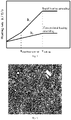
- Fig. 1 is a schematic diagram of annealing process curves using different annealing processes, i.e., the present technical solution and conventional process.
- the rapid heating annealing was utilized, which was different from a conventional heating annealing process.
- the heating rate in the present invention was controlled to be 50-2000°C/s due to the facts that: if the heating rate is too fast, the requirements for equipment capabilities will be too high, the cost will be expensive, and the residence time of the cold-rolled steel sheet in the high temperature stage will be too long, resulting in poor uniformity of the grain structure.
- the volume content of H 2 in the annealing furnace is controlled to be ⁇ 55% and a dew point in the annealing furnace is controlled to be ⁇ -30°C.
- the finished steel sheet After the rapid heating annealing, the finished steel sheet is required to be slowly cooled, and a cooling rate is required to be limited to be ⁇ 5°C/s, so as to control the shape of the finished steel sheet and to reduce the stress in the steel sheet, and thus, the finally obtained non-oriented electrical steel sheet has good surface condition and is characterized by high magnetic induction, low iron loss and high strength.
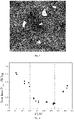
- Fig. 2 is a SEM diagram of the conventional steel sheet in Comparative Example A2.
- Fig. 3 is a SEM diagram of the high-strength non-oriented electrical steel sheet in Inventive Example A17.
- the high-strength non-oriented electrical steel sheet in Inventive Example A17 had high cleanliness, as well as a smaller quantity and a larger size of inclusions.
- Table 4 lists the types, sizes and quantities of inclusions in the specimen of finished product according to Comparative Example A2.
- Table 4 Inclusions AIN+MnS FeO FeO+SiO 2 MnS+Cu 2 S CaO+Al 2 O 3 +SiO 2 Al 2 O 3 Total 0-0.5 ⁇ m
- AlN, MnS and Cu 2 S inclusions 0.5-1.0 ⁇ m 44 0 0 20 3 0 67 1.0-1.5 ⁇ m 10 0 0 1 0 0 11 1.5-5.0 ⁇ m 18 6 1 2 2 4 33 5.0-10 ⁇ m 0 0 3 0 0 0 3
- Table 5 lists the types, sizes and quantities of inclusions in the specimen of finished product according to Inventive Example A17.
- Table 5 Inclusions AlN CaS SiO 2 Al 2 O 3 +MgO/SiO 2 AIN+CaS FeO Total 0-0.5 ⁇ m Almost no 0.5-1.0 ⁇ m 14 0 0 0 0 0 14 1.0-1.5 ⁇ m 14 8 0 0 0 0 22 1.5-5.0 ⁇ m 101 19 0 4 4 0 128 5.0-10 ⁇ m 0 0 1 1 0 0 2
- oxide inclusions of larger size had fully floated, and the binding capacity of Mg, Ca and REM with the element S was much greater than that of the elements Mn and S with the elements Cu and S, such that MgS, CaS and REM-S inclusions with a melting point as high as 2500°C would be preferentially precipitated, thereby effectively inhibiting the precipitation of MnS and Cu 2 S inclusions.
- AlN inclusions began to precipitate as the temperature of the molten steel continued to drop. Since most of the molten steel had solidified at this time, only a small quantity of AlN inclusions can be combined with CaS inclusions to form AIN+CaS composite inclusions of relatively larger size that were prone to float and remove.
- Fig. 4 schematically shows the effect of different t/ ⁇ Al values on iron loss.
- the alumina inclusions are not easy to float up and remove; thus, the alumina inclusions are treated with Mg, Ca and REM to generate aluminate compounds with a lower melting point, and at the same time, to suppress fine and dispersed small particle inclusions.
- the value of t/ ⁇ Al may be preferably controlled to be 0.30-0.65, so as to ensure the effective concentrations of Mg, Ca and REM in the molten steel, thereby ensuring that the inclusions can be fully denatured.
- the residence time of Mg, Ca and REM in the molten steel the molten steel can fully react with Mg, Ca and REM, so as to achieve a good effect of improving inclusions.
- t represents a time interval in minutes between adding the at least one of elements Mg, Ca and REM and adding the element Al
- ⁇ Al represents a total time in minutes from adding the element Al to the end of RH refining.
- Fig. 5 schematically shows the effect of different heating rates on the proportion of ⁇ 100 ⁇ plane texture.
- Fig. 6 schematically shows the effect of different heating rates on the proportion of ⁇ 111 ⁇ plane texture.
- the heating rate was controlled to be 50-2000°C/s
- the proportion of the ⁇ 100 ⁇ plane texture could be controlled to be ⁇ 25%
- the proportion of the ⁇ 111 ⁇ plane texture could be controlled to be ⁇ 31%. Therefore, it is proven that by utilizing the manufacturing method according to the present invention, the high-strength non-oriented electrical steel sheets had good recrystallization effect, uniform and coarse grain size, high proportion of favorable textures and excellent electromagnetic properties.
- the manufacturing method according to the present invention also has the above advantages and beneficial effects.
Landscapes
- Chemical & Material Sciences (AREA)
- Engineering & Computer Science (AREA)
- Materials Engineering (AREA)
- Mechanical Engineering (AREA)
- Metallurgy (AREA)
- Organic Chemistry (AREA)
- Physics & Mathematics (AREA)
- Thermal Sciences (AREA)
- Crystallography & Structural Chemistry (AREA)
- Electromagnetism (AREA)
- Manufacturing & Machinery (AREA)
- Dispersion Chemistry (AREA)
- Power Engineering (AREA)
- Manufacturing Of Steel Electrode Plates (AREA)
- Soft Magnetic Materials (AREA)
Abstract
Description
- The present invention relates to a steel sheet and a manufacturing method therefor, in particular to a non-oriented electrical steel sheet and a manufacturing method therefor.
- With an increasing demand for high efficiency, energy conservation and environment protection in a user market, a non-oriented electrical steel sheet for manufacturing an iron core of a motor or a compressor is required to have good electromagnetic properties (i.e., an ultralow iron loss and an ultrahigh magnetic induction) on the premise that the price advantage is guaranteed. Meanwhile, with development demands on the miniaturization, precision and high efficiency of power-driven equipment, the strength of the non-oriented electrical steel sheet is strictly required.
-
CN 104726794 A (published on June 24, 2015 , "Non-oriented Electrical Steel Sheet and Manufacturing Method thereof') discloses a non-oriented electrical steel sheet and a manufacturing method thereof. In this disclosure, the iron loss is reduced by: adding Si and Al into steel as much as possible to remarkably increase the electrical resistivity of a finished steel sheet so as to reduce the iron loss; and adding a certain amount of P and Cr, resulting the iron loss of the finished steel sheet and particularly the iron loss in a high-frequency state being reduced. However, these measures may limit the increase of a normalizing temperature and lower the manufacturability of cold rolling to a certain extent and may also degrade the magnetic induction of the finished steel sheet. -
CN 103882293 A (published on June 25, 2014 , "Non-oriented Electrical Steel Sheet and Manufacturing Method thereof') discloses a non-oriented electrical steel sheet and a manufacturing method thereof. In this disclosure, the precipitation of sulfide inclusions in hot rolling and heat treatment processes can be favorably inhibited by treating with calcium and rare earth in a steel-making process. For a heat with Si < 1%, after treated with calcium and rare earth, the removal and denaturation of large-size inclusions in the steel are very effective, the number of precipitates is significantly reduced and the size is coarsened, and the iron loss can be reduced by 0.4-0.8 W/kg without normalizing. For electrical steel containing 0.8%-1.6% of Si, by adding a suitable amount of rare earth elements Pr and Nd and utilizing a reasonable rolling process, grains can also be coarsened, the magnetic hysteresis loss can be effectively reduced, and the structure of the steel sheet can be further improved to increase the magnetic induction intensity. - In order to relieve the contradiction among thickness reduction, high mechanical properties and good electromagnetic properties,
JP H1161257 A (published on March 5, 1999 -
JP H11189824 A (published on July 13, 1999 -
CN 102453837 A (published on May 16, 2012 , "Manufacturing method for Non- oriented Silicon Steel with High Magnetic Induction") discloses a non-oriented silicon steel with high magnetic induction. In this disclosure, the manufacturing method includes the following steps: 1) smelting and casting (steel-making, secondary refining, and casting to form a casting billet), wherein the non-oriented silicon steel includes the chemical elements in mass percentage: 0.1-1% of Si, 0.005-1% of Al, ≤ 0.004% of C, 0.10-1.50% of Mn, ≤ 0.2% of P, ≤ 0.005% of S, ≤ 0.002% of N, ≤ 0.006% of Nb+V+Ti and the balance being Fe; 2) hot rolling, wherein the heating temperature ranges from 1150°C to 1200°C, the finishing rolling temperature ranges from 830°C to 900°C, and coiling is performed at the temperature of ≥570°C; 3) flattening, which is a cold rolling with a reduction ratio of 2-5%; 4) normalizing, wherein it is performed at a temperature of not lower than 950°C for 30-180 s; 5) acid pickling and cold rolling, i.e., performing cold rolling with an accumulative reduction ratio of 70-80% after acid pickling; and 6) annealing, wherein the heating rate is ≥ 100°C/s, the steel is kept at 800-1000°C for 5-60 s, and the steel is slowly cooled to 600-750°C at a rate of 3-15°C/s. - One objective of the present invention is to provide a high-strength non-oriented electrical steel sheet with excellent magnetic properties. By optimizing the design of the chemical composition of high-strength non-oriented electrical steel sheets, the cleanliness of steel is improved, and thus high-strength non-oriented electrical steel sheets with excellent magnetic properties are obtained.
- In order to achieve the above-mentioned objective, the present invention provides a high-strength non-oriented electrical steel sheet with excellent magnetic properties, comprising the following chemical elements in mass percentage:
0<C≤0.0035%; Si: 2.0-3.5%; Mn: 0.4-1.2%; P: 0.03-0.2%; Al: 0.4-2.0%; and the balance being Fe and unavoidable impurities. - For the high-strength non-oriented electrical steel sheet with excellent magnetic properties according to the present invention, the design principles of each chemical element are as follows.
- C: in the high-strength non-oriented electrical steel sheet according to the present invention, C will strongly hinder the growth of grains of a finished steel sheet and easily combine with Nb, V, Ti and the like to form fine precipitates, thereby causing increased loss and generating magnetic aging. On this basis, the mass percentage of C in the high-strength non-oriented electrical steel sheet according to the present invention is controlled to be > 0 and ≤ 0.0035%.
- Si: in the high-strength non-oriented electrical steel sheet according to the present invention, Si increases the electrical resistivity of a material and can effectively reduce the iron loss of steel. When the mass percentage of Si is higher than 3.5%, the magnetic induction of the steel will be significantly lowered, and the rollability of cold rolling will be significantly lowered; and when the mass percentage of Si is lower than 2.0%, the effect of effectively reducing the iron loss cannot be achieved. On this basis, the mass percentage of Si in the high-strength non-oriented electrical steel sheet according to the present invention is controlled to be 2.0-3.5%.
- Mn: in the high-strength non-oriented electrical steel sheet according to the present invention, when the mass percentage of Mn is lower than 0.4%, the effect of improving the strength of steel cannot be achieved; and when the mass percentage of Mn is higher than 1.2%, the manufacturing cost of the steel will be increased, and a recrystallization effect of the steel will be inhibited. On this basis, the mass percentage of Mn in the high-strength non-oriented electrical steel sheet according to the present invention is controlled to be 0.4-1.2%.
- P: in the high-strength non-oriented electrical steel sheet according to the present invention, when the mass percentage of P is lower than 0.03%, it is not conducive to increase the electrical resistivity and {100} component; and when the mass percentage of P is higher than 0.2%, it tends to cause cold brittleness and reduce the manufacturability of cold rolling. On this basis, the mass percentage of P in the high-strength non-oriented electrical steel sheet according to the present invention is controlled to be 0.03-0.2%.
- Al: Al increases the electrical resistivity of the material and can effectively reduce the iron loss of steel. When the content of Al is higher than 2.0%, the magnetic induction of the steel will be significantly lowered, and the rollability of cold rolling will be significantly lowered; and when the content of Al is lower than 0.4%, the effect of effectively reducing the iron loss cannot be achieved. On this basis, the mass percentage of Al in the high-strength non-oriented electrical steel sheet according to the present invention is controlled to be 0.4-2.0%.
- Preferably, the high-strength non-oriented electrical steel sheet according to the present invention further includes at least one of Sb and Sn in a total content of 0.003-0.2% by mass.
- In the above-mentioned solution, the total content of at least one of Sb and Sn is set to be 0.003-0.2% due to the facts that: when the mass percentage of Sn and Sb is lower than 0.003%, the effects of improving a texture of steel and improving the magnetic induction of steel cannot be achieved; and when the mass percentage of Sn and Sb is higher than 0.2%, the crystal grains will be refined and the magnetic properties of the steel will be deteriorated.
- Preferably, the high-strength non-oriented electrical steel sheet according to the present invention further comprises at least one of Mg, Ca and REM (Rare Earth Metal) in a total content of 0.0005-0.01% by mass.
- In the above-mentioned solution, the total content of at least one of Mg, Ca and REM is set to be 0.0005-0.01% due to the facts that: when the mass percentage of Mg, Ca and REM is lower than 0.0005%, the effect of removing oxygen and sulfide inclusions cannot be achieved; and when the mass percentage of Ca is higher than 0.01%, grain refinement tends to occur and rollability of cold rolling will be lowered.
- Preferably, in the high-strength non-oriented electrical steel sheet according to the present invention, the unavoidable impurities include: S≤0.003%; Ti≤0.001%; O≤0.002%; and N≤0.002%.
- In the above-mentioned solution, the unavoidable impurities should be controlled to be as less as possible. When the mass percentage of S exceeds 0.003%, the quantity of harmful inclusions such as MnS and Cu2S will be greatly increased to strongly restrict the growth of grains and degrade the magnetic properties of the steel.
- When the mass percentage of N is higher than 0.002%, precipitates, such as Nb, V, Ti and Al, of N are greatly increased to strongly hinder the growth of the grains and degrade the magnetic properties of the steel.
- When the mass percentage of O exceeds 0.002%, the quantity of oxide inclusions will be greatly increased to cause grain refinement and degrade the magnetic properties of the steel.
- When the mass percentage of Ti exceeds 0.001%, inclusions of Ti with C and N will be greatly increased to strongly hinder the growth of grains and degrade the magnetic properties of the steel.
- Preferably, in the high-strength non-oriented electrical steel sheet according to the present invention, a proportion of a {100} plane texture is ≥25%, and a proportion of a {111} plane texture is ≤31%. Herein, the {100} plane texture and {111} plane texture were measured with a SmartLab X-ray diffractometer according to "Metal material - Quantitative pole figure preparing method" (YB/T 5360-2006).
- Preferably, the high-strength non-oriented electrical steel sheet according to the present invention contains inclusions with a size greater than 0.5 µm, wherein the inclusions are at least one of AlN, CaS, and composite inclusions of AlN and CaS.
- Preferably, the high-strength non-oriented electrical steel sheet according to the present invention has an iron loss P15/50 of ≤2 W/kg, a magnetic induction B50 of ≥1.69 T and a tensile strength of ≥600 MPa. Herein, the electromagnetic properties were measured with a Brockhaus magnetic measurement equipment (Germany) according to the Epstein square method (GB 10129-1988). Herein, P10/50 represents an iron loss value tested under the conditions of 1.0 T and 50 Hz, and B50 represents a magnetic induction value tested under the condition of 5000 A/m. The mechanical properties were measured with a 250kN/500kN sheet tensile testing machine according to "Metallic materials - Test pieces for tensile testing" (GB/T 6397-1986).
- Correspondingly, another objective of the present invention is to provide a manufacturing method for the above-mentioned high-strength non-oriented electrical steel sheet. By using the manufacturing method, a high-strength non-oriented electrical steel sheet with improved cleanliness and excellent magnetic properties can be obtained.
- In order to achieve the above-mentioned inventive objective, the present invention provides a manufacturing method for the above-mentioned high-strength non-oriented electrical steel sheet, including the following steps:
- converter smelting, RH refining and casting;
- hot rolling;
- normalizing;
- cold rolling; and
- continuous annealing: rapidly heating a cold-rolled steel sheet from an initial temperature for rapid heating T rapid heating initial to a soaking temperature at a heating rate of 50-2000°C/s to perform rapid heating annealing, wherein a volume content of H2 in an annealing furnace is ≥55% and a dew point in the annealing furnace is ≤-30°C; and after the rapid heating annealing, slowly cooling the steel sheet at a cooling rate ≤5°C/s; and
- applying an insulation coating to obtain a finished non-oriented electrical steel sheet.
- In the manufacturing method according to the present invention, the heating rate is controlled to be 50-2000°C/s due to the facts that: if the heating rate is too fast, the requirements for equipment capabilities will be too high, the cost will be expensive, and the residence time of the cold-rolled steel sheet in the high temperature stage will be too long, resulting in poor uniformity of the grain structure. Meanwhile, in view of the fact that (internal) oxidation and nitridation are prone to occur on the surface of the finished steel sheet under high temperature annealing conditions, it will result in grain refinement, the deterioration of iron loss of finished steel sheet and the decrease of the surface quality of finished steel sheet. Therefore, the volume content of H2 in the annealing furnace is controlled to be ≥55% and a dew point in the annealing furnace is controlled to be ≤-30°C.
- After the rapid heating annealing, the finished steel sheet is required to be slowly cooled, and a cooling rate is required to be limited to be ≤5°C/s, so as to control the shape of the finished steel sheet and to reduce the stress in the steel sheet, and thus, the finally obtained non-oriented electrical steel sheet has good surface condition and is characterized by high magnetic induction, low iron loss and high strength.
- Preferably, in the manufacturing method according to the present invention, in the step of continuous annealing, the heating rate is 100-600°C/s.
- Preferably, in the manufacturing method according to the present invention, in the step of continuous annealing, the initial temperature T rapid heating initial ranges from room temperature to 750°C. Herein, 750°C is selected as the maximum initial temperature for rapid heating, and the main considerations are as follows: if the temperature is higher than 750°C, in the subsequent rapid heating process, in order to ensure a suitable soaking temperature and heating rate, the requirements for the configuration of the rapid heating equipment will be too high, and the economy and stability will be insufficient.
- Preferably, in the manufacturing method according to the present invention, in the step of RH refining, a value of t/ΣAl is 0.30-0.65, wherein t represents a time interval in minutes between adding the at least one of elements Mg, Ca and REM and adding the element Al, and ΣAl represents a total time in minutes from adding the element Al to the end of RH refining.
- In the above-mentioned solution, a suitable amount of P is required to be added into steel in the smelting process, so that the recrystallization effect of a hot-rolled steel sheet can be improved, and the grain size of the finished steel sheet can be controlled. By reasonably controlling the P content in the steel, and by controlling the finishing temperature for hot rolling and coiling temperature (under the ordinary tapping temperature conditions of continuous casting billets), a good recrystallization effect of hot-rolled steel sheet can be achieved, the recrystallization rate of fiber structure of hot-rolled steel sheet can be increased, and the structure uniformity of hot-rolled steel sheet can be improved. The control of P content is critical. On one hand, the P content is related to the contents of Si and Al (the higher the contents of Si and Al, the lower the content of P should be). P is prone to cause cold brittleness, thereby resulting in edge cracks and rolling fractures of the finished steel sheet in a cold rolling process. If the hot-rolled and cold-rolled fiber structures are developed, it will further lead to the development of coarse deformed grains, resulting in the surface of finished steel sheets prone to corrugated defects and the grains in finished steel sheets being refined to deteriorate the electromagnetic properties of finished steel sheets. On the other hand, as mentioned above, similar to Si, P has the effects of significantly improving the electrical resistivity of finished steel sheets and accelerating the growth of grains in finished steel sheets, thereby improving the magnetic induction of finished steel sheets and reducing the iron loss of finished steel sheets. Therefore, a suitable content of P is critical for obtaining non-oriented electrical steel sheets with excellent magnetic properties.
- In order to improve the magnetic induction of finished steel sheets, the content of Ti in steel is required to be controlled to be ≤0.001%, so that the inhibition effect of TiN inclusions in the finished steel sheet on the growth of grain size can be effectively avoided in the continuous annealing process, and the magnetic induction of finished steel sheets can be effectively improved.
- In the RH refining process, when performing deoxidation alloying after decarbonization, Si is utilized for deoxidation to avoid the direct use of aluminum for deoxidation and the formation of fine-sized inclusions. After ferro-silicon alloy is added, silicon oxide inclusions are easier to float up and remove. Afterwards, as the viscosity of the molten steel increases, the alumina inclusions are not easy to float up and remove; thus, the alumina inclusions are treated with Mg, Ca and REM to generate aluminate compounds with a lower melting point, and at the same time, to suppress fine and dispersed small particle inclusions. In order to ensure the treatment effect of Mg, Ca and REM, in addition to controlling the addition amount of Mg, Ca and REM, the value of t/ΣAl may be preferably controlled to be 0.30-0.65, so as to ensure the effective concentrations of Mg, Ca and REM in the molten steel, thereby ensuring that the inclusions can be fully denatured. By controlling the residence time of Mg, Ca and REM in the molten steel, the molten steel can fully react with Mg, Ca and REM, so as to achieve a good effect of improving inclusions.
- Preferably, in the manufacturing method according to the present invention, in the step of hot rolling, a finishing rolling temperature is controlled to be ≤850°C, and a coiling temperature is controlled to be 500-750°C. Herein, when the finishing rolling temperature is higher than 850°C, the precipitation of sulfide and nitride inclusions in the rolling process will be accelerated, which will inhibit the recrystallization effect of the hot-rolled steel sheet. Meanwhile, in view of the temperature drop range in the hot rolling process, the upper limit of the coiling temperature is set to be 750°C. Moreover, taking into account that when the coiling temperature is too low, the difficulty of steel sheet coiling will increase and problems such as poor shape of coiled sheet will occur, the lower limit of the coiling temperature is set to be 500°C.
- Preferably, in the manufacturing method according to the present invention, a single cold rolling process or a double cold rolling process with an intermediate annealing is used in the step of cold rolling. Herein, by using the single cold rolling process, the production process can be greatly shortened, the manufacturing cost can be reduced, and the yield of the steel sheet can be increased. Therefore, the single cold rolling process is recommended. In another respect, when the double cold rolling process with an intermediate annealing is used, the rolling difficulty of cold rolling can be significantly lowered, and a better recrystallization effect of the microstructure of the intermediate steel sheet can be achieved. Therefore, the double cold rolling process with an intermediate annealing can be used when rolling equipment has advantages or special requirements for electromagnetic properties.
- Preferably, in the manufacturing method according to the present invention, in the step of cold rolling: at least one pair of working rolls in each pass or stand has a surface roughness of ≤0.40 µm; and/or each pass or stand has an accumulative reduction ratio of 75-85%, and the final pass or stand has a reduction ratio of ≤20%.
- In some preferred embodiments, in the hot rolling process of the continuous casting billet, the thickness of the hot-rolled steel sheet can be controlled to be 0.8-2.0 mm after rough rolling and finish rolling of hot rolling. Therefore, by reducing the thickness of the hot-rolled steel sheet, the overall temperature of the hot-rolled steel sheet in the hot rolling process can be raised, the temperature difference among the center, the upper surface and the lower surface of the hot-rolled steel sheet can be reduced, thereby promoting sufficient recrystallization and grain size growth and thus increasing the ratios of the favorable {100} plane texture and {110} plane texture in the steel.
- In addition, in the above-mentioned solution, the single cold rolling process or the double cold rolling process with an intermediate annealing may be utilized, at least one pair of working rolls in each pass or stand has a surface roughness of ≤0.40 µm, and the final pass or stand has a reduction ratio of ≤20% so as to ensure the shape of a finished sheet such that the finished sheet after rolling has no edge crack, and to provide favorable conditions for subsequent annealing and applying coating. The accumulative reduction ratio of each pass or stand is controlled to be 75-85% to ensure that: no broken coarse columnar grains are generated, the rolling breakage and edge cracks of P-containing steel are controlled, the development of the coarse deformed grains is inhibited, and favorable conditions are provided for the sufficient recrystallization in the annealing process of finished steel sheets. In another respect, when the reduction ratio of the final pass in cold rolling is reduced, the number of dislocations in the cold-rolled steel sheet is reduced, a large amount of lattice distortion is not prone to occur, and lower energy storage is maintained. Therefore, in the subsequent continuous annealing process, crystal restoration can be effectively inhibited, and the remaining deformation storage energy before recrystallization can be increased; thus, the driving force for nucleation is increased, and the strength of <111>//ND recrystallization texture components is lowered, which is conducive to the improvement of electromagnetic properties.
- Compared with the prior art, the high-strength non-oriented electrical steel sheet with excellent magnetic properties and the manufacturing method therefor disclosed by the present invention have the following advantages and beneficial effects:
By optimizing the design of the chemical composition of the high-strength non-oriented electrical steel sheet according to the present invention, the cleanliness of steel is improved, and thus high-strength non-oriented electrical steel sheets with excellent magnetic properties are obtained. - In addition, the manufacturing method according to the present invention also has the above-mentioned advantages and beneficial effects.
-
-
Fig. 1 is a schematic diagram of annealing process curves using different annealing processes, i.e., the present technical solution and conventional process; -
Fig. 2 is a SEM diagram of the conventional steel sheet in Comparative Example A2; -
Fig. 3 is a SEM diagram of the high-strength non-oriented electrical steel sheet in Inventive Example A17; -
Fig. 4 schematically shows the effect of different t/ΣAl values on iron loss; -
Fig. 5 schematically shows the effect of different heating rates on the proportion of {100} plane texture; and -
Fig. 6 schematically shows the effect of different heating rates on the proportion of {111} plane texture. - The high-strength non-oriented electrical steel sheet with excellent magnetic properties and manufacturing method thereof according to the present invention will be further explained and illustrated below in combination with the accompanying drawings and specific embodiments. However, the technical solutions of the present invention are not limited to the explanation and illustration.
- The high-strength non-oriented electrical steel sheets in Inventive Examples A9-A20 and conventional steel sheets in Comparative Examples A1-A8 were manufactured by the following steps.
- (1) The molten iron and steel scrap were prepared according to the compositions as shown in Table 1. After converter smelting, RH refining which included decarbonization, deoxidation and alloying was carried out, and then the molten steel was cast by continuous casting to obtain a continuous casting billet.
- (2) Hot rolling: the thickness of a hot-rolled steel sheet was controlled to be 0.8-2.0 mm, a finishing rolling temperature was controlled to be ≤850°C, and a coiling temperature was controlled to be 500-750°C.
- (3) Normalizing: the hot-rolled steel sheet was normalized, wherein the soaking temperature for normalizing was set to be 800-1000°C and the soaking time was set to be 1-180 s.
- (4) Cold rolling: the steel sheet was rolled to a thickness of the finished product by using a single cold rolling process, wherein the thickness was 0.1-0.3 mm.
- (5) Continuous annealing: a cold-rolled steel sheet was rapidly heated from an initial temperature T rapid heating initial to a soaking temperature at a heating rate of 50-2000°C/s to perform rapid heating annealing, wherein the volume content of H2 in an annealing furnace was ≥55% and a dew point in the annealing furnace was ≤-30°C; and after the rapid heating annealing, the steel sheet was slowly cooled at a cooling rate ≤5°C/s. The initial temperature for rapid heating T rapid heating initial ranged from room temperature to 750°C.
- (6) An insulation coating was applied to obtain a finished non-oriented electrical steel sheet.
- In some preferred embodiments, in the step of RH refining, the t/ΣAl value is in the range of 0.30-0.65, wherein t represents a time interval in minutes between adding the at least one of elements Mg, Ca and REM and adding the element Al, and ΣAl represents a total time in minutes from adding the element Al to the end of RH refining.
- In some preferred embodiments, a single cold rolling process or a double cold rolling process with an intermediate annealing is utilized in step (4). And/or, in step (4), at least one pair of working rolls in each pass or stand has a surface roughness of ≤0.40 µm; and/or each pass or stand has an accumulative reduction ratio of 75-85%, and the final pass or stand has a reduction ratio of ≤20%.
- Table 1 lists the mass percentages of chemical elements of the high-strength non-oriented electrical steel sheets according to Inventive Examples A9-A20 and the conventional steel sheets according to Comparative Examples A1-A8.
- Table 2 lists the specific process parameters of the high-strength non-oriented electrical steel sheets according to Inventive Examples A9-A21 and the conventional steel sheets according to Comparative Examples A1-A8. For Comparative Examples A1 and A4, the initial temperature for rapid heating Trapid heating initial was "/", which indicated that a rapid heating process was not utilized.
Table 1 (%, the balance being Fe and other impurities other than S, Ti, O and N) No. C Si Mn P S Al O N Ti Mg Ca REM Sn Sb Note A1 0.0011 1.68 0.57 0.18 0.0028 2.16 0.0022 0.0018 0.0020 0.002 0.002 0.002 / / Comparative Example A2 0.0007 1.94 1.37 0.13 0.0025 0.71 0.0018 0.0013 0.0009 / / / 0.03 0.03 Comparative Example A3 0.0024 2.07 0.84 0.08 0.0013 0.92 0.0027 0.0012 0.0011 0.008 / / 0.03 0.007 Comparative Example A4 0.0006 2.11 0.41 0.06 0.0019 1.85 0.0011 0.0025 0.0007 / 0.005 / 0.05 0.08 Comparative Example A5 0.0018 2.83 1.00 0.06 0.0015 0.48 0.0009 0.0014 0.0005 / / 0.004 / 0.12 Comparative Example A6 0.0021 2.84 0.49 0.05 0.0035 1.93 0.0017 0.0009 0.0007 0.005 0.003 0.002 0.18 / Comparative Example A7 0.0007 3.17 0.21 0.02 0.0011 0.003 0.0008 0.0012 0.0005 0.001 0.003 0.006 0.01 0.16 Comparative Example A8 0.0018 3.65 0.87 0.06 0.0008 1.52 0.0006 0.0019 0.0012 0.003 0.005 0.001 0.003 0.01 Comparative Example A9 0.0022 2.15 1.16 0.18 0.0018 0.42 0.0007 0.0017 0.0005 0.0005 / / 0.05 / Inventive Example A10 0.0027 2.18 0.94 0.03 0.0008 1.91 0.0006 0.0011 0.0005 0.005 / 0.005 / 0.04 Inventive Example A11 0.0012 3.05 0.40 0.20 0.0030 1.14 0.0011 0.0013 0.0007 0.008 0.0011 / 0.03 0.05 Inventive Example A12 0.0035 2.00 0.77 0.08 0.0020 0.75 0.0020 0.0008 0.0004 0.001 0.0005 0.003 0.10 0.10 Inventive Example A13 0.0017 2.85 0.48 0.15 0.0015 0.97 0.0007 0.0012 0.0010 0.005 0.001 0.0005 0.01 0.01 Inventive Example A14 0.0032 2.91 0.82 0.07 0.0008 0.68 0.0006 0.0006 0.0008 0.001 0.003 0.001 0.003 / Inventive Example A15 0.0024 2.90 0.48 0.13 0.0011 0.40 0.0011 0.0020 0.0006 / / 0.0005 0.01 0.03 Inventive Example A16 0.0014 3.14 0.81 0.08 0.0006 0.52 0.0007 0.0009 0.0006 / 0.002 0.007 0.18 / Inventive Example A17 0.0023 2.88 0.67 0.05 0.0014 2.00 0.0014 0.0012 0.0004 0.001 / 0.008 / 0.11 Inventive Example A18 0.0012 3.21 0.83 0.05 0.0005 0.80 0.0005 0.0008 0.0005 0.001 0.001 0.001 0.05 0.02 Inventive Example A19 0.0016 3.50 1.20 0.04 0.0008 0.42 0.0006 0.0010 0.0005 / 0.008 0.002 0.04 0.08 Inventive Example A20 0.0028 3.48 0.41 0.04 0.0005 1.35 0.0008 0.0005 0.0008 / 0.010 / 0.05 0.007 Inventive Example Table 2 No. Elements used for deoxidation t/ΣAl Value Hot-rolled steel sheet thickness [mm] Finishing rolling temp. [°C] Coiling temp. [°C] Cold rolling mode Surface roughness of roll [µm] Total reduction ratio [%] Reduction ratio of final pass or stand [%] Trapid heating initial [°C] Heating rate [°C/s] Dew point in furnace [°C] H2 Content [%] Cooling rate [°C/s] Not∗ A1 Si / 2.0 820 750 Single 1.0 87.5 5 / 15 -20 30% 1 CE A2 Al 0.41 2.0 850 570 Single 0.4 90.0 10 25 150 -38 40% 2 CE A3 Si / 2.8 850 550 Single 0.2 91.1 15 300 350 -35 55% 2 CE A4 Al 0.17 1.6 835 600 Double 0.4 90.6 20 / 15 -30 60% 1 CE A5 Al 0.78 1.8 825 620 Single 2.0 86.1 5 600 600 -28 57% 2 CE A6 Si / 2.0 840 680 Double 0.2 85.0 10 450 400 -32 60% 3 CE A7 Al 0.52 2.0 850 570 Single 0.6 87.5 15 100 1800 -37 62% 6 CE A8 Al 0.39 2.0 815 600 Single 0.1 87.5 20 200 200 -35 65% 4 CE A9 Si 0.52 1.6 850 750 Single 0.4 84.4 20 400 2000 -40 55 1 IE A10 Si 0.30 1.8 840 650 Single 0.1 83.3 5 500 50 -37 57 2 IE A11 Si 0.65 1.2 840 620 Single 0.2 75 15 200 200 -40 60 2 IE A12 Si 0.52 1.6 855 570 Double 0.4 84.4 10 300 300 -35 60 2 IE A13 Si 0.40 0.8 815 500 Single 0.4 81.3 15 750 500 -40 55 5 IE A14 Si 0.49 1.2 845 650 Single 0.2 79.2 8 200 100 -30 55 3 IE A15 Si 0.60 2.0 820 550 Single 0.2 85.0 12 350 400 -35 55 2 IE A16 Si 0.62 2.0 825 680 Single 0.1 85.0 15 600 350 -38 63 2 IE A17 Si 0.52 2.0 840 570 Single 0.3 85.0 20 400 300 -37 61 1 IE A18 Si 0.42 2.0 835 650 Double 0.3 85.0 5 550 550 -35 57 1 IE A19 Si 0.63 1.2 815 530 Single 0.2 83.3 15 650 600 -38 55 4 IE A20 Si 0.48 1.6 825 720 Double 0.3 84.4 5 750 300 -40 65 3 IE ∗ CE= Comparative Example; IE= Inventive Example - Table 3 lists the performance values of the high-strength non-oriented electrical steel sheets according to Examples A9-A20 and conventional steel sheets according to Comparative Examples A1-A8.
Table 3 No. Tensile strength [MPa] Iron loss P15/50 [W/kg] Magnetic induction B50 [T] Note A1 484 2.47 1.65 Comparative Example A2 511 2.61 1.64 Comparative Example A3 524 2.70 1.63 Comparative Example A4 498 2.35 1.65 Comparative Example A5 537 2.18 1.67 Comparative Example A6 531 2.20 1.68 Comparative Example A7 510 2.11 1.62 Comparative Example A8 581 2.18 1.62 Comparative Example A9 611 1.94 1.70 Inventive Example A10 632 1.85 1.71 Inventive Example A11 618 1.90 1.70 Inventive Example A12 627 1.94 1.71 Inventive Example A13 635 1.91 1.71 Inventive Example A14 660 1.88 1.69 Inventive Example A15 704 1.79 1.70 Inventive Example A16 641 1.91 1.71 Inventive Example A17 665 1.89 1.70 Inventive Example A18 682 1.88 1.69 Inventive Example A19 739 1.86 1.70 Inventive Example A20 659 1.84 1.69 Inventive Example - As can be seen from
Figs. 1 to 3 , the high-strength non-oriented electrical steel sheets in all Inventive Examples had high cleanliness, as well as a small quantity and a large size of inclusions; moreover, the finished steel sheets had good recrystallization effect, uniform and coarse grain size, a high proportion of favorable textures, and excellent electromagnetic properties, wherein the high-strength non-oriented electrical steel sheets according to each Inventive Example had an iron loss P15/50 of ≤2W/kg, a magnetic induction B50 of ≥1.69T and a tensile strength of ≥600 MPa. -
Fig. 1 is a schematic diagram of annealing process curves using different annealing processes, i.e., the present technical solution and conventional process. - As shown in
Fig. 1 , in the manufacturing method according to the present invention, the rapid heating annealing was utilized, which was different from a conventional heating annealing process. The heating rate in the present invention was controlled to be 50-2000°C/s due to the facts that: if the heating rate is too fast, the requirements for equipment capabilities will be too high, the cost will be expensive, and the residence time of the cold-rolled steel sheet in the high temperature stage will be too long, resulting in poor uniformity of the grain structure. Meanwhile, in view of the fact that (internal) oxidation and nitridation are prone to occur on the surface of the finished steel sheet under high temperature annealing conditions, it will result in grain refinement, the deterioration of iron loss of finished steel sheet and the decrease of the surface quality of finished steel sheet. Therefore, the volume content of H2 in the annealing furnace is controlled to be ≥55% and a dew point in the annealing furnace is controlled to be ≤-30°C. After the rapid heating annealing, the finished steel sheet is required to be slowly cooled, and a cooling rate is required to be limited to be ≤5°C/s, so as to control the shape of the finished steel sheet and to reduce the stress in the steel sheet, and thus, the finally obtained non-oriented electrical steel sheet has good surface condition and is characterized by high magnetic induction, low iron loss and high strength. -
Fig. 2 is a SEM diagram of the conventional steel sheet in Comparative Example A2. -
Fig. 3 is a SEM diagram of the high-strength non-oriented electrical steel sheet in Inventive Example A17. - As can be seen from
Figs. 2 and3 , compared with Comparative Example A2, the high-strength non-oriented electrical steel sheet in Inventive Example A17 had high cleanliness, as well as a smaller quantity and a larger size of inclusions. - The inclusions in the specimens of finished products corresponding to Comparative Example A2 and Inventive Example A17 were observed with a HITACHI S4200 Scanning Electron Microscope. Each specimen was continuously observed for 10 fields of view. The distribution of the types, sizes and quantities of inclusions were counted and listed in Tables 4 and 5.
- Table 4 lists the types, sizes and quantities of inclusions in the specimen of finished product according to Comparative Example A2.
Table 4 Inclusions AIN+MnS FeO FeO+SiO2 MnS+Cu2S CaO+Al2O3+SiO2 Al2O3 Total 0-0.5 µm A large quantity of AlN, MnS and Cu2S inclusions 0.5-1.0 µm 44 0 0 20 3 0 67 1.0-1.5 µm 10 0 0 1 0 0 11 1.5-5.0 µm 18 6 1 2 2 4 33 5.0-10 µm 0 0 3 0 0 0 3 - Table 5 lists the types, sizes and quantities of inclusions in the specimen of finished product according to Inventive Example A17.
Table 5 Inclusions AlN CaS SiO2 Al2O3+MgO/SiO2 AIN+CaS FeO Total 0-0.5 µm Almost no 0.5-1.0 µm 14 0 0 0 0 0 14 1.0-1.5 µm 14 8 0 0 0 0 22 1.5-5.0 µm 101 19 0 4 4 0 128 5.0-10 µm 0 0 1 1 0 0 2 - As can be seen from
Figs. 4 and5 , according to the statistic data of inclusions, for the specimen of finished product in Comparative Example A2, there were a large quantity of AlN, MnS and Cu2S inclusions with a size of 0.5 µm or less; the inclusions with a size of 0.5 µm or more were mainly AIN+MnS composite inclusions or MnS+Cu2S composite inclusions, which were larger in quantity and smaller in size; and further, the specimen also contained a small quantity of oxide inclusions. In contrast, for the specimen of finished product in the Inventive Example, there were almost no inclusions with a size of 0.5 µm or less ; and the inclusions with a size of 0.5 µm or more were mainly AlN and CaS, accompanied by a small quantity of oxide inclusions and AIN+CaS composite inclusions which were relatively large in size. - The reasons were as follows: during the solidification process of the molten steel of the Comparative Example, oxide inclusions of larger size were first precipitated, and then MnS inclusions began to precipitate as the temperature of the molten steel continued to drop, and finally the AlN and Cu2S inclusions were precipitated with the MnS inclusion as the core respectively. In contrast, during the solidification process of the molten steel of the Inventive Example, oxide inclusions of larger size had fully floated, and the binding capacity of Mg, Ca and REM with the element S was much greater than that of the elements Mn and S with the elements Cu and S, such that MgS, CaS and REM-S inclusions with a melting point as high as 2500°C would be preferentially precipitated, thereby effectively inhibiting the precipitation of MnS and Cu2S inclusions. Then, AlN inclusions began to precipitate as the temperature of the molten steel continued to drop. Since most of the molten steel had solidified at this time, only a small quantity of AlN inclusions can be combined with CaS inclusions to form AIN+CaS composite inclusions of relatively larger size that were prone to float and remove.
-
Fig. 4 schematically shows the effect of different t/ΣAl values on iron loss. - As shown in
Fig. 4 , in the step of RH refining, when the t/ΣAl value was controlled to be 0.30-0.65, the magnetic properties of obtained non-oriented electrical steel sheets were better. The reasons were as follows: when performing deoxidation alloying after decarbonization, Si is utilized for deoxidation to avoid the direct use of aluminum for deoxidation and the formation of fine-sized inclusions. After ferro-silicon alloy is added, silicon oxide inclusions are easier to float up and remove. Afterwards, as the viscosity of the molten steel increases, the alumina inclusions are not easy to float up and remove; thus, the alumina inclusions are treated with Mg, Ca and REM to generate aluminate compounds with a lower melting point, and at the same time, to suppress fine and dispersed small particle inclusions. In order to ensure the treatment effect of Mg, Ca and REM, in addition to controlling the addition amount of Mg, Ca and REM, the value of t/ΣAl may be preferably controlled to be 0.30-0.65, so as to ensure the effective concentrations of Mg, Ca and REM in the molten steel, thereby ensuring that the inclusions can be fully denatured. By controlling the residence time of Mg, Ca and REM in the molten steel, the molten steel can fully react with Mg, Ca and REM, so as to achieve a good effect of improving inclusions. - It should be noted that t represents a time interval in minutes between adding the at least one of elements Mg, Ca and REM and adding the element Al, and ΣAl represents a total time in minutes from adding the element Al to the end of RH refining.
-
Fig. 5 schematically shows the effect of different heating rates on the proportion of {100} plane texture.Fig. 6 schematically shows the effect of different heating rates on the proportion of {111} plane texture. - As can be seen from
Figs. 5 and 6 , when the heating rate was controlled to be 50-2000°C/s, the proportion of the {100} plane texture could be controlled to be ≥25%, and the proportion of the {111} plane texture could be controlled to be ≤31%. Therefore, it is proven that by utilizing the manufacturing method according to the present invention, the high-strength non-oriented electrical steel sheets had good recrystallization effect, uniform and coarse grain size, high proportion of favorable textures and excellent electromagnetic properties. - To conclude, by optimizing the design of the chemical composition of high-strength non-oriented electrical steel sheets, the cleanliness of steel was improved, and thus high-strength non-oriented electrical steel sheets with excellent magnetic properties were obtained in the present invention.
- In addition, the manufacturing method according to the present invention also has the above advantages and beneficial effects.
- It should be noted that for the prior art part of protection scope of the present disclosure, it is not limited to the examples given in this application document. All the prior arts that do not contradict with the present disclosure, including but not limited to prior patent documents, prior publications, prior public use, etc., can be included in the protection scope of the present disclosure.
- In addition, the combination of various technical features in the present disclosure is not limited to the combination described in the claims or the combination described in specific embodiments. All the technical features described in the present disclosure can be freely combined or combined in any way unless there is a contradiction between them.
- It should also be noted that the above-listed Examples are only specific embodiments of the present disclosure. Apparently, the present disclosure is not limited to the above embodiments, and similar variations or modifications that are directly derived or easily conceived from the present disclosure by those skilled in the art should fall within the scope of the present disclosure.
Claims (14)
- A 600 MPa grade non-oriented electrical steel sheet, comprising the following chemical elements in mass percentage:
0<C≤0.0035%; Si: 2.0-3.5%; Mn: 0.4-1.2%; P: 0.03-0.2%; Al: 0.4-2.0%; and the balance being Fe and unavoidable impurities. - The 600 MPa grade non-oriented electrical steel sheet as claimed in claim 1, further comprising at least one of Sb and Sn in a total content of 0.003-0.2% by mass.
- The 600 MPa grade non-oriented electrical steel sheet as claimed in claim 1, further comprising at least one of Mg, Ca and REM in a total content of 0.0005-0.01% by mass.
- The 600 MPa grade non-oriented electrical steel sheet as claimed in claim 1, characterized in that the unavoidable impurities include: S≤0.003%; Ti≤0.001%; O≤0.002%; and N≤0.002%.
- The 600 MPa grade non-oriented electrical steel sheet as claimed in claim 1, characterized in that the 600 MPa grade non-oriented electrical steel sheet has a {100} plane texture in a proportion of ≥25% and a {111} plane texture in a proportion of ≤31%.
- The 600 MPa grade non-oriented electrical steel sheet as claimed in claim 1, characterized in that the 600 MPa grade non-oriented electrical steel sheet contains inclusions with a size greater than 0.5 µm, wherein the inclusions are at least one of AlN, CaS, and composite inclusions of AlN and CaS.
- The 600 MPa grade non-oriented electrical steel sheet as claimed in claim 1, characterized in that the 600 MPa grade non-oriented electrical steel sheet has an iron loss P15/50 of ≤2W/kg, a magnetic induction B50 of ≥1.69T and a tensile strength of ≥600 MPa.
- A manufacturing method for the 600 MPa grade non-oriented electrical steel sheet as claimed in any one of claims 1-7, including the following steps:converter smelting, RH refining and casting;hot rolling;normalizing;cold rolling;continuous annealing: rapidly heating a cold-rolled steel sheet from an initial temperature for rapid heating T rapid heating initial to a soaking temperature at a heating rate of 50-2000°C/s to perform rapid heating annealing, wherein a volume content of H2 in an annealing furnace is ≥55% and a dew point in the annealing furnace is ≤-30°C; and after the rapid heating annealing, slowly cooling the steel sheet at a cooling rate ≤5°C/s; andapplying an insulation coating to obtain a finished non-oriented electrical steel sheet.
- The manufacturing method as claimed in claim 8, characterized in that in the step of continuous annealing, the heating rate is 100-600°C/s.
- The manufacturing method as claimed in claim 8, characterized in that in the step of continuous annealing, the initial temperature for rapid heating Trapid heating initial ranges from room temperature to 750°C.
- The manufacturing method as claimed in claim 8, characterized in that in the step of RH refining, a value of t/ΣAl is in the range of 0.30-0.65, wherein t represents a time interval in minutes between adding at least one of elements Mg, Ca and REM and adding the element Al, and ΣAl represents a total time in minutes from adding the element Al to the end of RH refining.
- The manufacturing method as claimed in claim 8, characterized in that in the step of hot rolling, a finishing rolling temperature is controlled to be ≤850°C, and a coiling temperature is controlled to be 500-750°C.
- The manufacturing method as claimed in claim 8, characterized in that a single cold rolling process or a double cold rolling process with an intermediate annealing is utilized in the step of cold rolling.
- The manufacturing method as claimed in claim 13, characterized in that in the step of cold rolling,at least one pair of working rolls in each pass or stand has a surface roughness of ≤0.40 µm, and/oreach pass or stand has an accumulative reduction ratio of 75-85%, and the final pass or stand has a reduction ratio of ≤20%.
Applications Claiming Priority (2)
| Application Number | Priority Date | Filing Date | Title |
|---|---|---|---|
| CN201910790407.1A CN112430775A (en) | 2019-08-26 | 2019-08-26 | High-strength non-oriented electrical steel plate with excellent magnetic property and manufacturing method thereof |
| PCT/CN2020/111402 WO2021037061A1 (en) | 2019-08-26 | 2020-08-26 | 600mpa grade non-oriented electrical steel sheet and manufacturing method thereof |
Publications (2)
| Publication Number | Publication Date |
|---|---|
| EP4001450A1 true EP4001450A1 (en) | 2022-05-25 |
| EP4001450A4 EP4001450A4 (en) | 2022-07-20 |
Family
ID=74684187
Family Applications (1)
| Application Number | Title | Priority Date | Filing Date |
|---|---|---|---|
| EP20856427.8A Pending EP4001450A4 (en) | 2019-08-26 | 2020-08-26 | 600 MPA QUALITY NON-ORIENTED STEEL MAGNETIC SHEET AND METHOD OF MANUFACTURING IT |
Country Status (7)
| Country | Link |
|---|---|
| US (1) | US12480174B2 (en) |
| EP (1) | EP4001450A4 (en) |
| JP (1) | JP7462737B2 (en) |
| CN (1) | CN112430775A (en) |
| CA (1) | CA3146888C (en) |
| MX (1) | MX2022001810A (en) |
| WO (1) | WO2021037061A1 (en) |
Cited By (1)
| Publication number | Priority date | Publication date | Assignee | Title |
|---|---|---|---|---|
| EP4628613A4 (en) * | 2023-01-10 | 2026-03-18 | Baoshan Iron & Steel | NON-ORIENTED ELECTROSTEAL WITH OUTSTANDING OVERALL PERFORMANCE AND MANUFACTURING PROCESS FOR IT |
Families Citing this family (6)
| Publication number | Priority date | Publication date | Assignee | Title |
|---|---|---|---|---|
| CN115198203B (en) * | 2021-04-09 | 2024-02-13 | 宝山钢铁股份有限公司 | A non-oriented electrical steel plate free of normalized intermediate annealing and its manufacturing method |
| CN113621774B (en) * | 2021-10-14 | 2022-01-18 | 江苏省沙钢钢铁研究院有限公司 | High-silicon non-oriented electrical steel and production method thereof |
| WO2023190621A1 (en) * | 2022-03-30 | 2023-10-05 | 日本製鉄株式会社 | Non-oriented electromagnetic steel sheet and motor core |
| CN115198199A (en) * | 2022-09-14 | 2022-10-18 | 张家港扬子江冷轧板有限公司 | Production method of high-strength non-oriented silicon steel, high-strength non-oriented silicon steel and application |
| CN116516240A (en) * | 2023-04-12 | 2023-08-01 | 首钢智新迁安电磁材料有限公司 | Method for preparing high-performance non-oriented electrical steel by utilizing rare earth and boron microalloying |
| CN118639096A (en) * | 2024-05-07 | 2024-09-13 | 山西太钢不锈钢股份有限公司 | High-strength non-oriented electrical steel for hydro-generator rotor core and its manufacturing method |
Family Cites Families (35)
| Publication number | Priority date | Publication date | Assignee | Title |
|---|---|---|---|---|
| JPH0686625B2 (en) * | 1987-03-11 | 1994-11-02 | 新日本製鐵株式会社 | High tensile strength non-oriented electrical steel sheet manufacturing method |
| JPH0726156B2 (en) * | 1988-11-16 | 1995-03-22 | 川崎製鉄株式会社 | Method for producing grain-oriented electrical steel sheet with excellent magnetic properties and surface properties |
| JPH11189824A (en) | 1997-12-24 | 1999-07-13 | Nkk Corp | Manufacturing method of non-oriented electrical steel sheet with low iron loss |
| JP4337146B2 (en) | 1997-08-08 | 2009-09-30 | Jfeスチール株式会社 | Method for producing non-oriented electrical steel sheet |
| JP4023172B2 (en) * | 2002-02-06 | 2007-12-19 | 住友金属工業株式会社 | Non-oriented electrical steel sheet and manufacturing method thereof |
| JP4380199B2 (en) * | 2003-03-31 | 2009-12-09 | Jfeスチール株式会社 | Non-oriented electrical steel sheet and manufacturing method thereof |
| JP4546713B2 (en) * | 2003-10-06 | 2010-09-15 | 新日本製鐵株式会社 | Final product of high-strength electrical steel sheet with excellent magnetic properties, its use and manufacturing method |
| JP4329550B2 (en) * | 2004-01-23 | 2009-09-09 | 住友金属工業株式会社 | Method for producing non-oriented electrical steel sheet |
| JP4280201B2 (en) | 2004-05-19 | 2009-06-17 | 新日本製鐵株式会社 | Non-oriented electrical steel sheet with excellent magnetic properties |
| RU2278171C2 (en) | 2004-09-13 | 2006-06-20 | Открытое акционерное общество "Новолипецкий металлургический комбинат" (ОАО "НЛМК") | Method for heat treatment of isotropic electrical steel cold-rolled strip |
| RU2398894C1 (en) | 2006-06-16 | 2010-09-10 | Ниппон Стил Корпорейшн | Sheet of high strength electro-technical steel and procedure for its production |
| JP4648910B2 (en) * | 2006-10-23 | 2011-03-09 | 新日本製鐵株式会社 | Method for producing non-oriented electrical steel sheet with excellent magnetic properties |
| KR100797895B1 (en) * | 2006-12-22 | 2008-01-24 | 성진경 | Method for forming surface (100) surface, method for manufacturing non-oriented electrical steel sheet using same and non-oriented electrical steel sheet manufactured using same |
| CN101654757B (en) * | 2008-08-20 | 2012-09-19 | 宝山钢铁股份有限公司 | Coated semi-processed non-oriented electrical steel sheet and manufacturing method thereof |
| US20120267015A1 (en) * | 2009-12-28 | 2012-10-25 | Posco | Non-Oriented Electrical Steel Sheet Having Superior Magnetic Properties and a Production Method Therefor |
| CN102453837B (en) * | 2010-10-25 | 2013-07-17 | 宝山钢铁股份有限公司 | Method for preparing non-oriented silicon steel with high magnetic induction |
| CN102453838A (en) | 2010-10-25 | 2012-05-16 | 宝山钢铁股份有限公司 | High-strength non-oriented electrical steel with high magnetic induction and manufacturing method thereof |
| WO2013038020A1 (en) * | 2011-09-16 | 2013-03-21 | Voestalpine Stahl Gmbh | Non-grain-oriented higher-strength electrical strip with high polarisation and method for the production thereof |
| CN103305659B (en) * | 2012-03-08 | 2016-03-30 | 宝山钢铁股份有限公司 | The non-oriented electromagnetic steel sheet of excellent magnetic and calcium treating method thereof |
| JP5892327B2 (en) * | 2012-03-15 | 2016-03-23 | Jfeスチール株式会社 | Method for producing non-oriented electrical steel sheet |
| RU2489500C1 (en) | 2012-05-03 | 2013-08-10 | Открытое акционерное общество "Новолипецкий металлургический комбинат" | Manufacturing method of cold-rolled electrical isotropic steel with improved flatness |
| CN103834858B (en) * | 2012-11-23 | 2016-10-05 | 宝山钢铁股份有限公司 | A kind of manufacture method of low iron loss non-orientation silicon steel |
| CN103882296B (en) | 2012-12-21 | 2016-09-07 | 鞍钢股份有限公司 | High-strength wear-resistant special cold-rolled non-oriented electrical steel and production method thereof |
| CN103882288B (en) * | 2012-12-21 | 2016-03-02 | 鞍钢股份有限公司 | High-strength special cold-rolled non-oriented electrical steel and production method thereof |
| CN103498096B (en) * | 2013-09-16 | 2016-03-16 | 武汉钢铁(集团)公司 | The fine magnetic property non-oriented electrical steel of Rm >=600MPa and production method thereof |
| KR20150073800A (en) | 2013-12-23 | 2015-07-01 | 주식회사 포스코 | Non-oriented electrical steel sheets and method for manufacturing the same |
| CN103882293B (en) | 2014-04-04 | 2016-06-29 | 首钢总公司 | Non-oriented electrical steel and production method thereof |
| CN107109583B (en) | 2014-12-24 | 2019-11-08 | Posco公司 | non-oriented electrical steel sheet and method for manufacturing the same |
| KR101701194B1 (en) * | 2015-12-23 | 2017-02-01 | 주식회사 포스코 | Non-oriented electrical steel sheet and method for manufacturing the same |
| JP6794705B2 (en) * | 2016-08-05 | 2020-12-02 | 日本製鉄株式会社 | Manufacturing method of non-oriented electrical steel sheet, non-oriented electrical steel sheet and manufacturing method of motor core |
| JP6772911B2 (en) * | 2017-03-15 | 2020-10-21 | 日本製鉄株式会社 | Non-oriented electrical steel sheet |
| JP6880920B2 (en) | 2017-03-29 | 2021-06-02 | 日本製鉄株式会社 | Non-oriented electrical steel sheet and its manufacturing method, and motor core and its manufacturing method |
| CN110573643B (en) * | 2017-07-19 | 2020-10-27 | 日本制铁株式会社 | Non-oriented electrical steel sheet |
| CN108570595B (en) | 2018-05-17 | 2020-02-07 | 马鞍山钢铁股份有限公司 | Low-iron-loss high-magnetic-induction cold-rolled non-oriented electrical steel for new energy automobile driving motor and production method thereof |
| BR112021012502A2 (en) * | 2019-02-14 | 2021-09-21 | Nippon Steel Corporation | NON-ORIENTED ELECTRIC STEEL SHEET |
-
2019
- 2019-08-26 CN CN201910790407.1A patent/CN112430775A/en active Pending
-
2020
- 2020-08-26 EP EP20856427.8A patent/EP4001450A4/en active Pending
- 2020-08-26 CA CA3146888A patent/CA3146888C/en active Active
- 2020-08-26 MX MX2022001810A patent/MX2022001810A/en unknown
- 2020-08-26 US US17/636,787 patent/US12480174B2/en active Active
- 2020-08-26 WO PCT/CN2020/111402 patent/WO2021037061A1/en not_active Ceased
- 2020-08-26 JP JP2022511372A patent/JP7462737B2/en active Active
Cited By (1)
| Publication number | Priority date | Publication date | Assignee | Title |
|---|---|---|---|---|
| EP4628613A4 (en) * | 2023-01-10 | 2026-03-18 | Baoshan Iron & Steel | NON-ORIENTED ELECTROSTEAL WITH OUTSTANDING OVERALL PERFORMANCE AND MANUFACTURING PROCESS FOR IT |
Also Published As
| Publication number | Publication date |
|---|---|
| CA3146888A1 (en) | 2021-03-04 |
| BR112022003061A2 (en) | 2022-05-10 |
| US20220275472A1 (en) | 2022-09-01 |
| JP7462737B2 (en) | 2024-04-05 |
| JP2022545027A (en) | 2022-10-24 |
| US12480174B2 (en) | 2025-11-25 |
| WO2021037061A1 (en) | 2021-03-04 |
| EP4001450A4 (en) | 2022-07-20 |
| MX2022001810A (en) | 2022-03-11 |
| CN112430775A (en) | 2021-03-02 |
| CA3146888C (en) | 2024-01-09 |
Similar Documents
| Publication | Publication Date | Title |
|---|---|---|
| US12480174B2 (en) | 600 MPa grade non-oriented electrical steel sheet and manufacturing method thereof | |
| JP6580700B2 (en) | High magnetic flux density / low iron loss / non-oriented electrical steel sheet with good surface condition and manufacturing method thereof | |
| EP3719160B1 (en) | Non-oriented electrical steel sheet with excellent magnetism and manufacturing method therefor | |
| EP3992325B1 (en) | Non-oriented electrical steel sheet and manufacturing method therefor | |
| EP4001448A1 (en) | Non-oriented electrical steel plate and manufacturing method therefor | |
| JP7855698B2 (en) | Non-oriented electrical steel sheet with good magnetic properties and method for manufacturing the same | |
| CN116790999B (en) | A high-grade non-oriented silicon steel with low magnetic anisotropy and its preparation method | |
| EP4001451A1 (en) | Cu-containing non-oriented electrical steel sheet and manufacturing method therefor | |
| CN110640104B (en) | Non-oriented electrical steel plate with excellent magnetic property and manufacturing method thereof | |
| JP2026509847A (en) | High-strength and low-loss non-directional electrical steel sheet and method for manufacturing the same. | |
| JPWO2005100627A1 (en) | Nondirectional electromagnetic copper plate with excellent punching workability and magnetic properties after strain relief annealing and its manufacturing method | |
| WO2024080140A1 (en) | Nonoriented electromagnetic steel sheet and method for manufacturing same | |
| WO2024017345A1 (en) | Non-oriented electrical steel plate and manufacturing method therefor | |
| JP3575167B2 (en) | Manufacturing method of non-oriented electrical steel sheet with excellent low magnetic field characteristics | |
| JP4987190B2 (en) | Method for producing non-oriented electrical steel sheet with good workability and low iron loss after processing and strain relief annealing | |
| RU2789644C1 (en) | SHEET OF NON-TEXTURED ELECTRICAL STEEL GRADE 600 MPa AND THE METHOD FOR ITS MANUFACTURE | |
| RU2790231C1 (en) | Cu-containing non-textured electrical steel sheet and the sheet production method | |
| JP3845871B2 (en) | Method for producing non-oriented electrical steel sheet with high magnetic flux density | |
| JP3084571B2 (en) | High Si content steel plate with good workability | |
| JPH1060609A (en) | Non-oriented electrical steel sheet with excellent iron loss characteristics or low magnetic field characteristics | |
| JP3263815B2 (en) | Method of manufacturing thin sheet and ultra-high silicon electrical steel sheet by cold rolling | |
| WO2026042676A1 (en) | Non-oriented electrical steel sheet and method for manufacturing same | |
| BR112022003061B1 (en) | 600 MPA GRADE NON-ORIENTED ELECTRICAL STEEL PLATE AND MANUFACTURING METHOD FOR IT | |
| JPH0967655A (en) | Non-oriented electrical steel sheet with excellent low magnetic field characteristics | |
| JP2002161313A (en) | Method for producing non-oriented electrical steel sheet with excellent magnetic properties after magnetic annealing |
Legal Events
| Date | Code | Title | Description |
|---|---|---|---|
| STAA | Information on the status of an ep patent application or granted ep patent |
Free format text: STATUS: THE INTERNATIONAL PUBLICATION HAS BEEN MADE |
|
| PUAI | Public reference made under article 153(3) epc to a published international application that has entered the european phase |
Free format text: ORIGINAL CODE: 0009012 |
|
| STAA | Information on the status of an ep patent application or granted ep patent |
Free format text: STATUS: REQUEST FOR EXAMINATION WAS MADE |
|
| 17P | Request for examination filed |
Effective date: 20220217 |
|
| AK | Designated contracting states |
Kind code of ref document: A1 Designated state(s): AL AT BE BG CH CY CZ DE DK EE ES FI FR GB GR HR HU IE IS IT LI LT LU LV MC MK MT NL NO PL PT RO RS SE SI SK SM TR |
|
| A4 | Supplementary search report drawn up and despatched |
Effective date: 20220622 |
|
| DAV | Request for validation of the european patent (deleted) | ||
| DAX | Request for extension of the european patent (deleted) | ||
| RIC1 | Information provided on ipc code assigned before grant |
Ipc: C21D 6/00 20060101ALI20220616BHEP Ipc: C22C 33/04 20060101ALI20220616BHEP Ipc: C21D 1/76 20060101ALI20220616BHEP Ipc: C21D 1/28 20060101ALI20220616BHEP Ipc: C21D 8/12 20060101ALI20220616BHEP Ipc: C21D 9/46 20060101ALI20220616BHEP Ipc: C22C 38/60 20060101ALI20220616BHEP Ipc: C22C 38/14 20060101ALI20220616BHEP Ipc: C22C 38/00 20060101ALI20220616BHEP Ipc: C22C 38/06 20060101ALI20220616BHEP Ipc: C22C 38/04 20060101ALI20220616BHEP Ipc: C22C 38/02 20060101AFI20220616BHEP |
|
| RIN1 | Information on inventor provided before grant (corrected) |
Inventor name: LI, GUOBAO Inventor name: SHEN, KANYI Inventor name: WANG, BO Inventor name: LI, JUN Inventor name: LIU, BAOJUN Inventor name: ZHANG, FENG |
|
| STAA | Information on the status of an ep patent application or granted ep patent |
Free format text: STATUS: EXAMINATION IS IN PROGRESS |
|
| 17Q | First examination report despatched |
Effective date: 20240503 |