EP3981937B1 - Système de verrouillage d'une trappe, notamment d'une trappe de véhicule, et trappe de véhicule associée - Google Patents
Système de verrouillage d'une trappe, notamment d'une trappe de véhicule, et trappe de véhicule associée Download PDFInfo
- Publication number
- EP3981937B1 EP3981937B1 EP21201442.7A EP21201442A EP3981937B1 EP 3981937 B1 EP3981937 B1 EP 3981937B1 EP 21201442 A EP21201442 A EP 21201442A EP 3981937 B1 EP3981937 B1 EP 3981937B1
- Authority
- EP
- European Patent Office
- Prior art keywords
- lock
- rotation
- lever
- actuating member
- locking system
- Prior art date
- Legal status (The legal status is an assumption and is not a legal conclusion. Google has not performed a legal analysis and makes no representation as to the accuracy of the status listed.)
- Active
Links
Images

Classifications
-
- E—FIXED CONSTRUCTIONS
- E05—LOCKS; KEYS; WINDOW OR DOOR FITTINGS; SAFES
- E05B—LOCKS; ACCESSORIES THEREFOR; HANDCUFFS
- E05B63/00—Locks or fastenings with special structural characteristics
- E05B63/14—Arrangement of several locks or locks with several bolts, e.g. arranged one behind the other
- E05B63/143—Arrangement of several locks, e.g. in parallel or series, on one or more wings
-
- B—PERFORMING OPERATIONS; TRANSPORTING
- B60—VEHICLES IN GENERAL
- B60J—WINDOWS, WINDSCREENS, NON-FIXED ROOFS, DOORS, OR SIMILAR DEVICES FOR VEHICLES; REMOVABLE EXTERNAL PROTECTIVE COVERINGS SPECIALLY ADAPTED FOR VEHICLES
- B60J1/00—Windows; Windscreens; Accessories therefor
- B60J1/08—Windows; Windscreens; Accessories therefor arranged at vehicle sides
- B60J1/12—Windows; Windscreens; Accessories therefor arranged at vehicle sides adjustable
- B60J1/14—Windows; Windscreens; Accessories therefor arranged at vehicle sides adjustable with pivotal or rotary movement
-
- B—PERFORMING OPERATIONS; TRANSPORTING
- B61—RAILWAYS
- B61D—BODY DETAILS OR KINDS OF RAILWAY VEHICLES
- B61D49/00—Other details
-
- E—FIXED CONSTRUCTIONS
- E05—LOCKS; KEYS; WINDOW OR DOOR FITTINGS; SAFES
- E05B—LOCKS; ACCESSORIES THEREFOR; HANDCUFFS
- E05B79/00—Mounting or connecting vehicle locks or parts thereof
- E05B79/10—Connections between movable lock parts
- E05B79/20—Connections between movable lock parts using flexible connections, e.g. Bowden cables
-
- E—FIXED CONSTRUCTIONS
- E05—LOCKS; KEYS; WINDOW OR DOOR FITTINGS; SAFES
- E05B—LOCKS; ACCESSORIES THEREFOR; HANDCUFFS
- E05B83/00—Vehicle locks specially adapted for particular types of wing or vehicle
- E05B83/36—Locks for passenger or like doors
- E05B83/363—Locks for passenger or like doors for railway vehicles
-
- E—FIXED CONSTRUCTIONS
- E05—LOCKS; KEYS; WINDOW OR DOOR FITTINGS; SAFES
- E05B—LOCKS; ACCESSORIES THEREFOR; HANDCUFFS
- E05B85/00—Details of vehicle locks not provided for in groups E05B77/00 - E05B83/00
- E05B85/04—Strikers
- E05B85/045—Strikers for bifurcated bolts
-
- E—FIXED CONSTRUCTIONS
- E05—LOCKS; KEYS; WINDOW OR DOOR FITTINGS; SAFES
- E05B—LOCKS; ACCESSORIES THEREFOR; HANDCUFFS
- E05B85/00—Details of vehicle locks not provided for in groups E05B77/00 - E05B83/00
- E05B85/06—Lock cylinder arrangements
-
- E—FIXED CONSTRUCTIONS
- E05—LOCKS; KEYS; WINDOW OR DOOR FITTINGS; SAFES
- E05C—BOLTS OR FASTENING DEVICES FOR WINGS, SPECIALLY FOR DOORS OR WINDOWS
- E05C9/00—Arrangements of simultaneously actuated bolts or other securing devices at well-separated positions on the same wing
- E05C9/002—Arrangements of simultaneously actuated bolts or other securing devices at well-separated positions on the same wing with arrangements allowing the wing to be slam-shut, e.g. by securing elements with latching action
-
- E—FIXED CONSTRUCTIONS
- E05—LOCKS; KEYS; WINDOW OR DOOR FITTINGS; SAFES
- E05B—LOCKS; ACCESSORIES THEREFOR; HANDCUFFS
- E05B53/00—Operation or control of locks by mechanical transmissions, e.g. from a distance
- E05B53/003—Operation or control of locks by mechanical transmissions, e.g. from a distance flexible
- E05B53/005—Bowden
Definitions
- the invention applies in particular to locking systems for rail vehicle hatches.
- Vehicles particularly railway vehicles, generally include a multitude of compartments, notably accommodating electrical equipment. In order to protect the equipment located inside the compartments, they are covered by hatches, each hatch having a movable flap between an open position and a closed position. The shutter is for example brought to the open position during maintenance operations.
- locking systems operable by an operator, the locking systems comprising a lock maintaining the shutter in a locked closed position.
- the document US 2009/038352 describes for example a locking system for a glove box having a movable flap between a closed position and an open position.
- the locking system includes two movable locks between a locked configuration prohibiting the opening of the shutter and an unlocked configuration authorizing the opening of the shutter.
- An aim of this invention is to provide a locking system which improves security, while remaining easy to use.
- the invention relates to a locking system according to claim 1.
- the locking system according to the invention allows the hatch to be locked at several closing points, while being simple to unlock using a single control member.
- the locking system comprises one or more of the characteristics of claims 2 to 6, without departing from the scope of the invention defined by the appended claims.
- the invention also relates to a vehicle hatch according to claim 7.
- the hatch is according to claim 8.
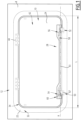
- FIG. 1 represents a wall 8 of a vehicle comprising a hatch 10 according to the invention.
- the vehicle is for example a railway vehicle, in particular a metro, a tram or a train.
- the vehicle is a bus.
- the wall 8 is intended to separate a first space (not visible on the figures 1 And 2 ) of a second space 12.
- the first space corresponds to the exterior of the vehicle and the second space 12 corresponds to the interior of the vehicle.
- the first space corresponds to an interior space of the vehicle intended to receive passengers and/or operators and the second space 12 is a compartment intended to receive vehicle equipment, for example electrical or electronic equipment.
- the wall 8 includes a frame 22.
- the hatch 10 comprises a flap 24 mounted movable relative to the frame 22 between a closed position and an open position.
- the shutter 24 is for example rotatably mounted relative to the frame 22, for example via at least one hinge.
- the hatch 10 also comprises a locking system 28 allowing selectively to prohibit the opening of the hatch 10 or to authorize the opening of the hatch 10.
- the locking system 28 is configured to selectively prohibit the opening of the shutter 24 or authorize the opening of the shutter 24.
- the frame 22 comprises an exterior face oriented toward the first space, an interior face 32 oriented toward the second space 12 as well as an edge 34 defining an opening.
- the interior face 32 of the frame 22 extends for example in the continuity of the wall 8 and is flush with the wall 8.
- the interior face 32 of the frame 22 is a region of the wall 8, as illustrated in the figure 1 . In this case, the opening is made in the wall 8.
- the shutter 24 in the closed position closes at least part of the opening, preferably the entire opening.
- the shutter 24 comprises in a known manner a contour edge complementary to that of the edge 34 of the frame 22, an exterior face (not visible), and an interior face 42.
- the shutter 24 is movably mounted on the frame 22 via a hinge 44 having a hinge pin.
- the flap 24 is movable in rotation relative to the frame 22 around the hinge axis.
- the flap 24 has an outline of generally rectangular shape.
- the flap 24 extends in a main direction A.
- the flap 24 has a width L of between 1200 mm and 3000 mm, the width L being measured in the main direction A.
- the shutter 24 is movable between an open position and a closed position.
- the flap 24 In the open position (not shown), the flap 24 is released from the opening so that the flap 24 does not separate the first space from the second space 12. In the open position of the flap 24 the second space 12 is accessible from the first space through the opening.
- the locking system 28 In the closed position of the shutter 24, the locking system 28 is movable between locked configuration in which it maintains the shutter 24 in the closed position and an unlocked configuration in which the locking system 28 authorizes the opening of the shutter 24.
- the locking system 28 further comprises a compensation system (not shown) making it possible to bring the shutter 24 to the open position.
- the outer face of the flap 24 is oriented towards the first space and the inner face 42 of the flap 24 is oriented towards the second space 12.
- the locking system 28 comprises a first lock 50 and a second lock 52 capable of maintaining the shutter 24 in the locked closed position.
- the locking system 28 further comprises a first actuating member 54 of the first lock 50 and a second actuating member 56 of the second lock 52, the second actuating member 56 being connected to the first actuating member 54 by a transmission member 58 in such a way that a movement of the first drive member 54 causes a corresponding movement of the second actuating member 56.
- the locking system 28 also includes a control member 60 configured to lock/unlock the locking system 28.
- the locking system 28 further comprises a support 61 configured to be fixed on the interior face 42 of the flap 24.
- the locking system 28, in particular the support 61, extends substantially in an extension direction.
- said direction of extension is substantially collinear with the main direction A, so that the locking system 28, in particular the support 61, extends substantially in the main direction A.
- Each of the first lock 50 and the second lock 52 is movable between a locked configuration and an unlocked configuration.
- the locking system 28 is unlocked.
- the locking system 28 is locked.
- the unlocking only one of the first and second locks 50, 52 does not allow the unlocking of the locking system 28.
- the distance D between the first lock 50 and the second lock 52 measured in the direction of extension of the locking system is greater than or equal to 300 mm.
- the locking system 28 thus includes two locking points making it difficult to forcefully open the hatch 10.
- the first lock 50 and the second lock 52 are identical.
- the manufacture of the locking system 28 is thus simplified, with only one lock reference being used.
- Each of the first lock 50 and the second lock 52 comprises a first complementary part 64 and a second part 66 intended to cooperate with each other and to ensure locking
- each lock 50, 52 preferably comprises a protective plate 67 fixed in part on the first part 64 of the lock 50, 52, as illustrated in the figure 1 .
- each lock 50, 52 is mounted on the wall 8, in particular on the interior face 32 of the frame 22 of the wall 8, and the second part 66 of each lock 50, 52 is mounted on the interior face 42 of section 24.
- the first part 64 comprises for example a base 70 fixed on the interior face 32 of the frame 22 of the wall 8, for example by screwing, gluing or welding, and a pin 72 extending projecting perpendicularly to the main direction A with respect to at base 70.
- the second part 66 comprises a blocking member 74 of the pin 72.
- the blocking member 74 has at least one stop blocking the pin 72 and preventing the opening of the hatch 10.
- the blocking member 74 comprises two hook-shaped stops capable of blocking the pin 72 between them when the lock 50, 52 is locked.
- Each actuating member 54, 56 is capable of cooperating with a respective lock 50, 52 to selectively lock or unlock the lock 50, 52.
- the first actuating member 54 comprises a first lever 82 capable of cooperating with the blocking member 74 of the first lock 50 and of unlocking said first lock 50 by rotation around a first secondary axis of rotation R 1 .
- the second actuating member 56 comprises a second lever 90 capable of cooperating with the blocking member 74 of the second lock 52 and of unlocking said lock 52 by rotation around a second secondary axis of rotation R 2 .
- first lever 82 and the second lever 90 are identical.
- first actuating member 54 and the second actuating member 56 are identical.
- the manufacture of the locking system 28 is thus simplified, a single actuating member reference being used.
- the transmission member 58 connects the first lever 82 and the second lever 90 and ensures the coupling between the actuating members 54, 56, so that the rotation of the first lever 82 by a given angle around the first axis of rotation secondary R 1 causes the rotation of the second lever 90 substantially at the same angle around the second secondary axis of rotation R 2 .
- the transmission member 58 is preferably a cable 92, for example a stainless steel cable.
- the cable 92 extends between a first end 93 fixed on the first actuating member 54 and a second end 94 fixed on the second actuating member 56.
- the cable 92 extends partly inside a sheath 96.
- the sheath 96 extends partly inside the support 61 which provides additional protection.
- the cable 92 has a length of between 300 mm and 3000 mm.
- the control member 60 is configured to open the first lock 50 by acting on the first actuating member 54 of the first lock 50.
- the control member 60 extends perpendicular to the plane of the shutter 24 according to its thickness.
- the control member 60 comprises a circular eccentric 100 arranged on the side of the interior face 42 of the shutter 24.
- the eccentric 100 is movable in rotation around a main axis of rotation B parallel to the secondary axes of rotation R 1 , R 2 , between a rest position, illustrated on the figure 2 , and an actuation position.
- the eccentric 100 is configured to cooperate with the first lever 82 by bearing on a control surface 84 of the first lever 82 provided so that a rotation of the eccentric 100 around the main axis of rotation B causes a pivoting of the first lever 82 around first secondary axis of rotation R 1 .
- the eccentric 100 comprises a return member (not shown), capable of returning the eccentric 100 from its actuation position to its rest position.
- the return member is a spring allowing the rearming of the system.
- the control member 60 also includes a lock (not shown) opening out at the exterior face of the shutter 24.
- the lock is configured to cooperate with a key and to drive the eccentric 100 from the rest position to the position d 'actuation by rotation of the key in the lock.
- the lock can be operated with a Berne key.
- the flap 24 of the hatch 10 is in the closed position, the locking system 28 being locked, as illustrated in figure 1 .
- Each lock 50, 52 is in the locked configuration and the locking system 28 maintains the shutter 24 in the closed position.
- An operator located in the first space inserts a key into the lock of the control member 60 and performs a rotation with said key.
- the operator rotates the key counterclockwise by 90° in the lock.
- the rotation of the key in the lock causes the rotation of the eccentric 100 around the main axis of rotation B, following the arrow shown on the figure 2 , from the rest position to the actuation position.
- the eccentric 100 activates the rotation of the first lever 82 around the first secondary axis of rotation R 1 .
- the rotation of the first lever 82 causes, on the one hand, the unlocking of the first lock 50 by opening the locking member 74 and releasing the pin 72 of the first lock 50, and on the other hand, traction on the cable 92 of the transmission member 58.
- the cable 92 then slides within the sheath 94 and causes the rotation of the second lever 90 around the second secondary axis of rotation R 2 .
- Said rotation in turn causes the unlocking of the second lock 52 by opening the locking member 74 and releasing the pin 72 of the second lock 52.
- the first and second locks 50, 52 are then both in the unlocked configuration and the flap 24 of the hatch 10 is in the unlocked closed position.
- control member 60 acts on the first locking member 54, which in turn acts on the second locking member 56 via the transmission member 58.
- the forces are transmitted in series from the control member 60 to the first locking member 54 then to the transmission member 58 then to the second locking member 56.
- the return member When the operator removes the key from the lock, the return member returns the eccentric 100 from the actuation position to the rest position.
- the actuating members 54, 56 then tilt again into their rest position illustrated on the figure 2 and the locks 50, 52 go into their locked configuration.
- the control member 60 acts, among the first lock 50 and the second lock 52, only on the first lock 50, and the first lock 50 acts on the second lock 52 via the transmission member 58.
- the control member 60, the first lock 50, the transmission member 58 and the second lock 52 are arranged in series in this order.
- the transmission member 58 achieves synchronization between the first lock 50 and the second lock 52.
- the locking system 28 is particularly advantageous since it improves security by locking the hatch 10 using two locks 50, 52. The risk of accidental or malicious opening of the hatch 10 is thus greatly reduced.
- the locking system 28, however, remains easy to use thanks to a single control member 60 allowing centralized opening of the two locks 50, 52
- the locking system 28 offers the possibility of control by a single control member 60. It also allows the synchronization of more than two locking points by extending the synchronization member.
- the locking system 28 is reversed, so that the support 61 and the second part 66 of the locks 50, 52 are fixed on the face interior 32 of the frame 22 of the wall 8 and the base 70 of the first part 64 of the locks 50, 52 is fixed on the interior face 42 of the shutter 24.
- the locking system 28, in particular the support 61 extends substantially in a direction of extension not collinear with the main direction A.
- the locking system 28, in particular the support 61 is extends substantially in a direction of extension normal to the main direction A.
Landscapes
- Engineering & Computer Science (AREA)
- Mechanical Engineering (AREA)
- Transportation (AREA)
- Structural Engineering (AREA)
- Lock And Its Accessories (AREA)
- Operating, Guiding And Securing Of Roll- Type Closing Members (AREA)
Description
- La présente invention concerne un système de verrouillage d'une trappe possédant un volet mobile entre une position fermée et une position ouverte, notamment d'une trappe de véhicule, comportant :
- un premier verrou mobile entre une configuration verrouillée interdisant l'ouverture du volet et une configuration déverrouillée autorisant l'ouverture du volet,
- un premier organe d'actionnement du premier verrou configuré pour déplacer le premier verrou entre la configuration verrouillée et la configuration déverrouillée, et
- un organe de commande manoeuvrable manuellement et lié au premier organe d'actionnement de sorte que le déplacement de l'organe de commande provoque le déplacement du premier organe d'actionnement.
- L'invention s'applique notamment aux systèmes de verrouillage de trappes de véhicules ferroviaires.
- Les véhicules, notamment les véhicules ferroviaires, comprennent généralement une multitude de compartiments, accueillant notamment des équipements électriques. Afin de protéger les équipements situés à l'intérieur des compartiments, ceux-ci sont recouverts par des trappes, chaque trappe possédant un volet mobile entre une position ouverte et une position fermée. Le volet est par exemple amené en position ouverte lors d'opérations de maintenance.
- Toutefois, afin d'éviter une ouverture inopinée du volet lorsque le train est en opération, il est connu d'utiliser des systèmes de verrouillage actionnables par un opérateur, les systèmes de verrouillage comprenant un verrou maintenant le volet dans une position fermée verrouillée.
- Le document
US 2009/038352 décrit par exemple un système de verrouillage d'une boite à gants possédant un volet mobile entre une position fermée et une position ouverte. Le système de verrouillage comprend deux verrous mobiles entre une configuration verrouillée interdisant l'ouverture du volet et une configuration déverrouillée autorisant l'ouverture du volet. - De tels systèmes de verrouillage de trappe ne donnent toutefois pas entière satisfaction, et sont susceptibles de s'ouvrir par inadvertance ou suite à un acte de malveillance. Il est critique de s'assurer que les trappes restent fermées et verrouillées durant la mise en opération du train.
- Un but de cette invention est de proposer un système de verrouillage améliorant la sécurité, tout en restant simple d'utilisation.
- A cet effet, l'invention a pour objet un système de verrouillage selon la revendication 1.
- Le système de verrouillage selon l'invention permet le verrouillage de la trappe en plusieurs points de fermeture, tout en étant simple à déverrouiller grâce à un seul organe de commande.
- Suivant d'autres modes de réalisation de l'invention, le système de verrouillage comporte l'une ou plusieurs des caractéristiques des revendications 2 à 6, sans sortir du cadre de l'invention définie par les revendications annexées.
- L'invention a également pour objet une trappe de véhicule selon la revendication 7.
- Selon un mode de réalisation particulier, la trappe est selon la revendication 8.
- L'invention et ses avantages seront mieux compris à la lecture de la description qui va suivre, donnée uniquement à titre d'exemple non limitatif, et faite en se référant aux dessins, sur lesquels :
- [
Fig 1 ] lafigure 1 est une vue de face intérieure d'une trappe de véhicule ferroviaire, la trappe étant en position fermée et munie d'un système de verrouillage et - [
Fig 2 ] lafigure 2 est une vue partielle de face intérieure du système de verrouillage de lafigure 1 . - La
figure 1 représente une paroi 8 de véhicule comprenant une trappe 10 selon l'invention. Le véhicule est par exemple un véhicule ferroviaire, notamment un métro, un tramway ou un train. En variante, le véhicule est un bus. - La paroi 8 est destinée à séparer un premier espace (non visible sur les
figures 1 et2 ) d'un deuxième espace 12. Par exemple, le premier espace correspond à l'extérieur du véhicule et le deuxième espace 12 correspond à l'intérieur du véhicule. En variante, le premier espace correspond à un espace intérieur du véhicule destiné à recevoir des passagers et/ou opérateurs et le deuxième espace 12 est un compartiment destiné à recevoir des équipements du véhicule, par exemple des équipements électriques ou électroniques. - La paroi 8 comprend un cadre 22.
- La trappe 10 comprend un volet 24 monté mobile par rapport au cadre 22 entre une position fermée et une position ouverte. Le volet 24 est par exemple monté rotatif par rapport au cadre 22, par exemple par l'intermédiaire d'au moins une charnière.
- La trappe 10 comprend par ailleurs un système de verrouillage 28 permettant sélectivement d'interdire l'ouverture de la trappe 10 ou d'autoriser l'ouverture de la trappe 10.
- Plus spécifiquement, le système de verrouillage 28 est configuré pour sélectivement interdire l'ouverture du volet 24 ou autoriser l'ouverture du volet 24.
- Le cadre 22 comprend une face extérieure orientée vers le premier espace, une face intérieure 32 orientée vers le deuxième espace 12 ainsi qu'un bord 34 définissant une ouverture. La face intérieure 32 du cadre 22 s'étend par exemple dans la continuité de la paroi 8 et affleure la paroi 8. Par exemple, la face intérieure 32 du cadre 22 est une région de la paroi 8, comme illustré sur la
figure 1 . Dans ce cas, l'ouverture est ménagée dans la paroi 8. - Le volet 24 en position fermée ferme au moins en partie l'ouverture, de préférence l'intégralité de l'ouverture. Le volet 24 comprend de manière connue un chant de contour complémentaire de celui du bord 34 du cadre 22, une face extérieure (non visible), et une face intérieure 42.
- Le volet 24 est monté mobile sur le cadre 22 par l'intermédiaire d'une charnière 44 possédant un axe de charnière. Le volet 24 est mobile en rotation par rapport au cadre 22 autour de l'axe de charnière.
- Sur la
figure 1 , le volet 24 présente un contour de forme générale rectangulaire. Le volet 24 s'étend selon une direction principale A. De préférence, le volet 24 présente un largeur L comprise entre 1200 mm et 3000 mm, la largeur L étant mesurée selon la direction principale A. - Le volet 24 est mobile entre une position ouverte et une position fermée.
- Dans la position ouverte (non représentée), le volet 24 est dégagé de l'ouverture de sorte le volet 24 ne sépare pas le premier espace du deuxième espace 12. Dans la position ouverte du volet 24 le deuxième espace 12 est accessible depuis le premier espace par l'ouverture.
- Dans la position fermée illustrée en
figure 1 , le volet 24 ferme l'ouverture. Le volet 24 interdit l'accès au deuxième espace 12. - Dans la position fermée du volet 24, le système de verrouillage 28 est mobile entre configuration verrouillée dans laquelle il maintient le volet 24 en position fermée et une configuration déverrouillée dans laquelle le système de verrouillage 28 autorise l'ouverture du volet 24.
- Lorsque le système de verrouillage 28 est en configuration déverrouillée, un effort appliqué sur le volet 24 est apte à amener le volet 24 vers une position ouverte.
- De préférence, le système de verrouillage 28 comprend en outre un système de compensation (non représenté) permettant d'amener le volet 24 vers la position ouverte.
- Lorsque le volet 24 est dans la position fermée, la face extérieure du volet 24 est orientée vers le premier espace et la face intérieure 42 du volet 24 est orientée vers le deuxième espace 12.
- Le système de verrouillage 28 comprend un premier verrou 50 et un deuxième verrou 52 propres à maintenir le volet 24 en position fermée verrouillée.
- Le système de verrouillage 28 comprend en outre un premier organe d'actionnement 54 du premier verrou 50 et un deuxième organe d'actionnement 56 du deuxième verrou 52, le deuxième organe d'actionnement 56 étant relié au premier organe d'actionnement 54 par un organe de transmission 58 de telle manière qu'un déplacement du premier organe d'entrainement 54 entraine un déplacement correspondant du deuxième organe d'actionnement 56.
- Le système de verrouillage 28 comprend également un organe de commande 60 configuré pour verrouiller/déverrouiller le système de verrouillage 28.
- Dans le mode de réalisation de la
figure 2 , le système de verrouillage 28 comprend en outre un support 61 configuré pour être fixé sur la face intérieure 42 du volet 24. - Le système de verrouillage 28, notamment le support 61, s'étend sensiblement selon une direction d'extension.
- Dans le mode de réalisation de la
figure 2 , ladite direction d'extension est sensiblement colinéaire à la direction principale A, de sorte que le système de verrouillage 28, notamment le support 61, s'étend sensiblement selon la direction principale A. - Chacun du premier verrou 50 et du deuxième verrou 52 est mobile entre une configuration verrouillée et une configuration déverrouillée.
- Lorsque chacun du premier verrou 50 et du deuxième verrou 52 est en configuration déverrouillée, le système de verrouillage 28 est déverrouillé.
- Lorsqu'au moins un du premier verrou 50 ou du deuxième verrou 52 est en configuration verrouillée, le système de verrouillage 28 est verrouillé. Ainsi, le déverrouillage d'un seul des premier et deuxième verrous 50, 52 ne permet pas le déverrouillage du système de verrouillage 28.
- De préférence, la distance D entre le premier verrou 50 et le deuxième verrou 52 mesurée selon la direction d'extension du système de verrouillage est supérieure ou égale à 300 mm.
- Le système de verrouillage 28 comprend ainsi deux points de verrouillage rendant difficile une ouverture en force de la trappe 10.
- De préférence, le premier verrou 50 et le deuxième verrou 52 sont identiques. La fabrication du système de verrouillage 28 est ainsi simplifiée, une seule référence de verrous étant utilisée.
- Chacun du premier verrou 50 et du deuxième verrou 52 comprend une première partie 64 et une deuxième partie 66 complémentaires destinées à coopérer entre elles et à assurer le verrouillage
- Selon un mode de réalisation particulier, chaque verrou 50, 52 comporte de préférence une plaque de protection 67 fixée en partie sur la première partie 64 du verrou 50, 52, comme illustrée sur la
figure 1 . - Dans le mode de réalisation représentée sur la
figure 2 , la première partie 64 de chaque verrou 50, 52 est montée sur la paroi 8, notamment sur la face intérieure 32 du cadre 22 de la paroi 8, et la deuxième partie 66 de chaque verrou 50, 52 est montée sur la face intérieure 42 du volet 24. - La première partie 64 comprend par exemple une base 70 fixée sur la face intérieure 32 du cadre 22 de la paroi 8, par exemple par vissage, collage ou soudage, et un pion 72 s'étendant en saillie perpendiculairement à la direction principale A par rapport à la base 70.
- La deuxième partie 66 comprend un organe de blocage 74 du pion 72. L'organe de blocage 74 présente au moins une butée bloquant le pion 72 et empêchant l'ouverture de la trappe 10. Dans le mode de réalisation de la
figure 2 , l'organe de blocage 74 comprend deux butées en forme de crochet propre à bloquer le pion 72 entre elles lorsque le verrou 50, 52 est verrouillé. - Chaque organe d'actionnement 54, 56 est propre à coopérer avec un verrou 50, 52 respectif pour sélectivement verrouiller ou déverrouiller le verrou 50, 52.
- Le premier organe d'actionnement 54 comporte un premier levier 82 apte à coopérer avec l'organe de blocage 74 du premier verrou 50 et à déverrouiller ledit premier verrou 50 par rotation autour d'un premier axe de rotation secondaire R1.
- Le deuxième organe d'actionnement 56 comporte un deuxième levier 90 apte à coopérer avec l'organe de blocage 74 du deuxième verrou 52 et à déverrouiller ledit verrou 52 par rotation autour d'un deuxième axe de rotation secondaire R2.
- De préférence, le premier levier 82 et le deuxième levier 90 sont identiques.
- En variante non représentée, le premier organe d'actionnement 54 et le deuxième organe d'actionnement 56 sont identiques. La fabrication du système de verrouillage 28 est ainsi simplifiée, une seule référence d'organes d'actionnement étant utilisée.
- L'organe de transmission 58 relie le premier levier 82 et le deuxième levier 90 et assure le couplage entre les organes d'actionnement 54, 56, de sorte que la rotation du premier levier 82 d'un angle donné autour du premier axe de rotation secondaire R1 entraine la rotation du deuxième levier 90 sensiblement d'un même angle autour du deuxième axe de rotation secondaire R2.
- L'organe de transmission 58 est de préférence un câble 92, par exemple un câble en acier Inoxydable. Le câble 92 s'étend entre une première extrémité 93 fixée sur le premier organe d'actionnement 54 et une deuxième extrémité 94 fixée sur le deuxième organe d'actionnement 56.
- Le câble 92 s'étend en partie à l'intérieur d'une gaine 96. Avantageusement, comme illustré sur la
figure 2 , la gaine 96 s'étend en partie à l'intérieur du support 61 qui assure une protection complémentaire. - De préférence, le câble 92 présente une longueur comprise entre 300 mm et 3000 mm.
- L'organe de commande 60 est configuré pour ouvrir le premier verrou 50 en agissant sur le premier organe d'actionnement 54 du premier verrou 50.
- L'organe de commande 60 s'étend perpendiculairement au plan du volet 24 selon son épaisseur.
- L'organe de commande 60 comporte un excentrique 100 circulaire agencé du côté de la face intérieure 42 du volet 24. L'excentrique 100 est mobile en rotation autour d'un axe principal de rotation B parallèle aux axes de rotation secondaires R1, R2, entre une position de repos, illustrée sur la
figure 2 , et une position d'actionnement. - L'excentrique 100 est configuré pour coopérer avec le premier levier 82 en prenant appui sur une surface de commande 84 du premier levier 82 prévue pour qu'une rotation de l'excentrique 100 autour de l'axe principale de rotation B entraîne un pivotement du premier levier 82 autour de premier axe de rotation secondaire R1.
- De préférence, l'excentrique 100 comporte un organe de rappel (non représenté), apte à ramener l'excentrique 100 de sa position d'actionnement à sa position de repos. Par exemple, l'organe de rappel est un ressort permettant le réarmement du système.
- L'organe de commande 60 comporte également une serrure (non représentée) débouchant au niveau de la face extérieure du volet 24. La serrure est configurée pour coopérer avec une clé et pour entrainer l'excentrique 100 de la position de repos à la position d'actionnement par rotation de la clé dans la serrure. Avantageusement, la serrure est actionnable avec une clé de Berne.
- Le fonctionnement du système de verrouillage 28 de la trappe 10 va à présent être décrit.
- Initialement, le volet 24 de la trappe 10 se trouve dans la position fermée, le système de verrouillage 28 étant verrouillée, comme illustré en
figure 1 . Chaque verrou 50, 52 est dans la configuration verrouillé et le système de verrouillage 28 maintient le volet 24 en position fermée. - Un opérateur se trouvant dans le premier espace insère une clé dans la serrure de l'organe de commande 60 et réalise avec ladite clé une rotation. Dans le mode de réalisation illustré sur les
figures 1 et2 , l'opérateur réalise une rotation antihoraire de 90° de la clé dans la serrure. - La rotation de la clé dans la serrure entraine la rotation de l'excentrique 100 autour de l'axe de rotation principal B, suivant la flèche représentée sur la
figure 2 , de la position de repos jusqu'à la position d'actionnement. Par son contact avec la surface de commande 84 du premier levier 82, l'excentrique 100 actionne la rotation du premier levier 82 autour du premier axe secondaire de rotation R1. - La rotation du premier levier 82 entraine, d'une part, le déverrouillage du premier verrou 50 par ouverture de l'organe du blocage 74 et libération du pion 72 du premier verrou 50, et d'autre part, une traction sur le câble 92 de l'organe de transmission 58.
- Le câble 92 coulisse alors au sein de la gaine 94 et entraine la rotation du deuxième levier 90 autour du deuxième axe secondaire de rotation R2.
- Ladite rotation entraine à son tour le déverrouillage du deuxième verrou 52 par ouverture de l'organe du blocage 74 et libération du pion 72 du deuxième verrou 52.
- Le premier et le deuxième verrous 50, 52 sont alors tous deux en configuration déverrouillée et le volet 24 de la trappe 10 est en position fermée déverrouillée. Un simple effort appliqué sur le volet 24, ainsi que de préférence l'assistance d'un système de compensation (non représenté), amène alors le volet 24 en position ouverte.
- Dans le système de verrouillage 28, l'organe de commande 60 agit sur le premier organe de verrouillage 54, qui agit à son tour sur le deuxième organe de verrouillage 56 par l'intermédiaire de l'organe de transmission 58. Les efforts sont transmis en série de l'organe de commande 60 au premier organe de verrouillage 54 puis à l'organe de transmission 58 puis au deuxième organe de verrouillage 56.
- Lorsque l'opérateur retire la clé de la serrure, l'organe de rappel ramène l'excentrique 100 de la position d'actionnement à la position de repos. Les organes d'actionnements 54, 56 basculent alors à nouveau dans leur position de repos illustrée sur la
figure 2 et les verrous 50, 52 passent dans leur configuration verrouillée. - Dans le système de verrouillage 28, l'organe de commande 60 agit, parmi le premier verrou 50 et le deuxième verrou 52, uniquement sur le premier verrou 50, et le premier verrou 50 agit sur le deuxième verrou 52 par l'intermédiaire de l'organe de transmission 58. L'organe de commande 60, le premier verrou 50, l'organe de transmission 58 et le deuxième verrou 52 sont agencés en série dans cette ordre. L'organe de transmission 58 réalise une synchronisation entre le premier verrou 50 et le deuxième verrou 52.
- Le système de verrouillage 28 est particulièrement avantageux puisqu'il améliore la sécurité en verrouillant la trappe 10 grâce à deux verrous 50, 52. Le risque d'une ouverture accidentelle ou malveillante de la trappe 10 est ainsi fortement réduit. Le système de verrouillage 28 reste cependant simple d'utilisation grâce à un unique organe de commande 60 permettant une ouverture centralisée des deux verrous 50, 52
- Lors de la fermeture de la trappe 10, le système de verrouillage 28 est réarmé automatiquement et aucune action complémentaire n'est nécessaire.
- Par ailleurs, l'utilisation de deux verrous 50, 52 identiques rend l'invention particulièrement économique et simple à fabriquer.
- Le système de verrouillage 28 selon l'invention offre la possibilité de commande par un seul organe de commande 60. Il permet également la synchronisation de plus de deux points de verrouillage en prolongeant l'organe de synchronisation.
- En variante non représentée, le système de verrouillage 28 est inversé, de sorte que le support 61 et la deuxième partie 66 des verrous 50, 52 sont fixées sur la face intérieure 32 du cadre 22 de la paroi 8 et la base 70 de la première partie 64 des verrous 50, 52 est fixée sur la face intérieure 42 du volet 24.
- En variante non représentée, le système de verrouillage 28, notamment le support 61, s'étend sensiblement selon une direction d'extension non colinéaire à la direction principale A. Par exemple, le système de verrouillage 28, notamment le support 61, s'étend sensiblement selon une direction d'extension normale à la direction principale A.
Claims (8)
- Système de verrouillage (28) d'une trappe (10) possédant un volet (24) mobile entre une position fermée et une position ouverte, notamment d'une trappe (10) de véhicule, comportant :- un premier verrou (50) mobile entre une configuration verrouillée interdisant l'ouverture du volet (24) et une configuration déverrouillée autorisant l'ouverture du volet (24),- un premier organe d'actionnement (54) du premier verrou (50) configuré pour déplacer le premier verrou (50) entre la configuration verrouillée et la configuration déverrouillée, et- un organe de commande (60) manoeuvrable manuellement et lié au premier organe d'actionnement (54) de sorte que le déplacement de l'organe de commande (60) provoque le déplacement du premier organe d'actionnement (54), le système de verrouillage (28) comprenant en outre :- un deuxième verrou (52) mobile entre une configuration verrouillée interdisant l'ouverture du volet (24) et une configuration déverrouillée autorisant l'ouverture du volet (24),- un deuxième organe d'actionnement (56) du deuxième verrou (52) configuré pour déplacer le deuxième verrou (52) entre la configuration verrouillée et la configuration déverrouillée, et- un organe de transmission (58) reliant le deuxième organe d'actionnement (56) au premier organe d'actionnement (54) de telle manière qu'un déplacement du premier organe d'actionnement (54) entraine un déplacement correspondant du deuxième organe d'actionnement (56),l'organe de commande (60) comportant un excentrique (100) présentant un axe de rotation principal (B) et en appui sur une surface de commande (84) du premier organe d'actionnement (54), de sorte qu'une rotation de l'excentrique (100) entraîne un déplacement du premier organe d'actionnement (54) faisant passer le premier verrou (50) de la configuration verrouillée à la configuration déverrouillée,caractérisé en ce que le premier organe d'actionnement (54) et le deuxième organe d'actionnement (56) comportent respectivement un premier levier (82) et un deuxième levier (90) dont le pivotement commande le passage entre la configuration verrouillée et la configuration déverrouillée respectivement du premier verrou (50) et du deuxième verrou (52), le premier levier (82) et le deuxième levier (90) étant de préférence identiques,le premier levier (82) présentant un premier axe de rotation secondaire (R1), le premier levier (82) étant configuré pour que la rotation de l'excentrique (100) autour de l'axe de rotation principal (B) entraine la rotation du premier levier autour du premier axe de rotation secondaire (R1), et le déverrouillage du premier verrou (50).
- Système de verrouillage (28) selon la revendication 1, dans lequel le premier verrou (50) et le deuxième verrou (52) sont identiques.
- Système de verrouillage (28) selon la revendication 1 ou 2, dans lequel le premier organe d'actionnement (54) et le deuxième organe d'actionnement (56) comportent respectivement un premier levier (82) et un deuxième levier (90) dont le pivotement commande le passage entre la configuration verrouillée et la configuration déverrouillée respectivement du premier verrou (50) et du deuxième verrou (52), le premier levier (82) et le deuxième levier (90) étant de préférence identiques.
- Système de verrouillage (28) selon l'une quelconque des revendications précédentes, dans lequel l'organe de commande (60) comporte en outre une serrure configurée pour coopérer avec une clé, de préférence une clé de Berne, et pour entrainer l'excentrique (100) en rotation autour de l'axe de rotation principal (B) du fait de la rotation de la clé dans la serrure.
- Système de verrouillage (28) selon l'une quelconque des revendications précédentes, dans lequel l'organe de transmission (58) comporte un câble (92) reliant le premier levier (82) au deuxième levier (90), la rotation du premier levier (82) autour du premier axe de rotation secondaire (R1) entrainant la rotation du deuxième levier (90) autour d'un deuxième axe de rotation secondaire (R2), et le déverrouillage du deuxième verrou (52).
- Système de verrouillage (28) selon l'une quelconque des revendications précédentes, dans lequel le premier verrou (50) et le deuxième verrou (52) sont espacés selon une direction d'extension, la distance entre le premier verrou (50) et le deuxième verrou (52) mesurée selon ladite direction d'extension étant supérieure ou égale à 300 mm.
- Trappe (10) de véhicule, notamment de véhicule ferroviaire, destinée à fermer une ouverture réalisée dans une paroi (8) séparant un premier espace d'un deuxième espace (12), la trappe (10) comportant un volet (24) destiné à fermer ladite ouverture de ladite paroi (8) et un système de verrouillage (28) selon l'une quelconque des revendications précédentes.
- Trappe (10) selon la revendication 7, dans laquelle chacun du premier verrou (50) et du deuxième verrou (52) comprend une première partie (64) et une deuxième partie (66) destinées à coopérer entre elles, l'une de la première partie (64) et de la deuxième partie (66) étant montée sur le volet (24) et l'autre de la premier partie (64) et de la deuxième partie (66) étant montée sur la paroi (8).
Applications Claiming Priority (1)
| Application Number | Priority Date | Filing Date | Title |
|---|---|---|---|
| FR2010247A FR3114832B1 (fr) | 2020-10-07 | 2020-10-07 | Système de verrouillage d’une trappe, notamment d’une trappe de véhicule, et trappe de véhicule associée |
Publications (2)
| Publication Number | Publication Date |
|---|---|
| EP3981937A1 EP3981937A1 (fr) | 2022-04-13 |
| EP3981937B1 true EP3981937B1 (fr) | 2023-11-29 |
Family
ID=74045720
Family Applications (1)
| Application Number | Title | Priority Date | Filing Date |
|---|---|---|---|
| EP21201442.7A Active EP3981937B1 (fr) | 2020-10-07 | 2021-10-07 | Système de verrouillage d'une trappe, notamment d'une trappe de véhicule, et trappe de véhicule associée |
Country Status (3)
| Country | Link |
|---|---|
| EP (1) | EP3981937B1 (fr) |
| ES (1) | ES2973238T3 (fr) |
| FR (1) | FR3114832B1 (fr) |
Cited By (1)
| Publication number | Priority date | Publication date | Assignee | Title |
|---|---|---|---|---|
| EP4585816A1 (fr) * | 2024-01-11 | 2025-07-16 | SNCF Voyageurs | Dispositif de verrouillage/deverrouillage et élément pivotant muni d'un tel dispositif de verrouillage/ deverrouillage |
Family Cites Families (4)
| Publication number | Priority date | Publication date | Assignee | Title |
|---|---|---|---|---|
| DE4434671A1 (de) * | 1994-09-28 | 1996-04-04 | Sfk Gmbh & Co Kg Seilzuege Fue | Selbsthemmendes Sicherheitsschloß |
| JP4900130B2 (ja) * | 2007-08-07 | 2012-03-21 | 豊田合成株式会社 | 車両用小物入れのロック装置 |
| DE102009044832B4 (de) * | 2009-12-09 | 2011-12-22 | Sfs Intec Holding Ag | Schloss für eine Gepäckbox |
| US10272003B2 (en) * | 2016-08-08 | 2019-04-30 | The Braun Corporation | Rear entry latch assembly |
-
2020
- 2020-10-07 FR FR2010247A patent/FR3114832B1/fr active Active
-
2021
- 2021-10-07 ES ES21201442T patent/ES2973238T3/es active Active
- 2021-10-07 EP EP21201442.7A patent/EP3981937B1/fr active Active
Cited By (2)
| Publication number | Priority date | Publication date | Assignee | Title |
|---|---|---|---|---|
| EP4585816A1 (fr) * | 2024-01-11 | 2025-07-16 | SNCF Voyageurs | Dispositif de verrouillage/deverrouillage et élément pivotant muni d'un tel dispositif de verrouillage/ deverrouillage |
| FR3158331A1 (fr) * | 2024-01-11 | 2025-07-18 | SNCF Voyageurs | Dispositif de verrouillage/deverrouillage et élément pivotant muni d’un tel dispositif de verrouillage/ deverrouillage |
Also Published As
| Publication number | Publication date |
|---|---|
| FR3114832B1 (fr) | 2025-04-04 |
| EP3981937A1 (fr) | 2022-04-13 |
| FR3114832A1 (fr) | 2022-04-08 |
| ES2973238T3 (es) | 2024-06-19 |
Similar Documents
| Publication | Publication Date | Title |
|---|---|---|
| EP1026349B1 (fr) | Poignée d'ouvrant de véhicule automobile | |
| EP2432954B1 (fr) | Poignee d'un ouvrant de vehicule automobile | |
| EP1894770B1 (fr) | Siège auto pour enfant pivotant entre une position d'utilisation et au moins une position d'installation, à crochet à double mode de verrouillage | |
| FR3072705A1 (fr) | Agencement de poignee exterieure de porte pour un vehicule automobile | |
| FR2937670A1 (fr) | Systeme de trappe. | |
| EP2563976B1 (fr) | Dispositif de voirie | |
| EP1965676B1 (fr) | Dispositif de positionnement et de maintien d'une clef de secours | |
| EP3981937B1 (fr) | Système de verrouillage d'une trappe, notamment d'une trappe de véhicule, et trappe de véhicule associée | |
| EP2220665B1 (fr) | Couvercle secondaire pour appareil électrique à boîtier moulé | |
| EP3775452A1 (fr) | Dispositif d'ouverture d'un ouvrant et véhicule équipé d'un tel dispositif | |
| EP0889185B1 (fr) | Dispositif d'ouverture d'une serrure de vehicule. | |
| EP1948499A1 (fr) | Dispositif d'ecartement securise a l'arrachement | |
| EP2112016B1 (fr) | Mécanisme d'ancrage d'un siège notamment d'un siège de véhicule automobile | |
| FR3134593A1 (fr) | Boîtier comprenant une porte et muni de deux dispositifs de verrouillage | |
| EP3921230B1 (fr) | Système d'éjection pour une issue de secours d'un véhicule | |
| EP1744926B1 (fr) | Dispositif de trappe a carburant pour vehicule automobile | |
| FR3008726A1 (fr) | Verrou pour portiere de vehicule automobile | |
| EP4185490B1 (fr) | Rangement a volet interieur mobile | |
| EP3379009B1 (fr) | Agencement d'arrêt d'une porte d'ouverture et de fermeture d'un espace tel que l'espace de chargement d'un véhicule, dans sa position ouverte | |
| FR3045513A1 (fr) | Fixation d'un actionneur sur un boitier d'une trappe a carburant | |
| FR2625183A1 (fr) | Sabot de blocage perfectionne pour porte de conteneur | |
| FR3043712B1 (fr) | Systeme de commande d'ouverture d'ouvrant de vehicule automobile | |
| EP4477826A1 (fr) | Commande d'ouverture interne pour véhicule automobile à portes antagonistes | |
| EP4477435A1 (fr) | Dispositif de gestion de contact pour véhicule automobile à portes antagonistes | |
| FR2985535A1 (fr) | Commande d'ouverture de porte a securite enfant integree. |
Legal Events
| Date | Code | Title | Description |
|---|---|---|---|
| PUAI | Public reference made under article 153(3) epc to a published international application that has entered the european phase |
Free format text: ORIGINAL CODE: 0009012 |
|
| STAA | Information on the status of an ep patent application or granted ep patent |
Free format text: STATUS: THE APPLICATION HAS BEEN PUBLISHED |
|
| AK | Designated contracting states |
Kind code of ref document: A1 Designated state(s): AL AT BE BG CH CY CZ DE DK EE ES FI FR GB GR HR HU IE IS IT LI LT LU LV MC MK MT NL NO PL PT RO RS SE SI SK SM TR |
|
| STAA | Information on the status of an ep patent application or granted ep patent |
Free format text: STATUS: REQUEST FOR EXAMINATION WAS MADE |
|
| 17P | Request for examination filed |
Effective date: 20220616 |
|
| RBV | Designated contracting states (corrected) |
Designated state(s): AL AT BE BG CH CY CZ DE DK EE ES FI FR GB GR HR HU IE IS IT LI LT LU LV MC MK MT NL NO PL PT RO RS SE SI SK SM TR |
|
| GRAP | Despatch of communication of intention to grant a patent |
Free format text: ORIGINAL CODE: EPIDOSNIGR1 |
|
| STAA | Information on the status of an ep patent application or granted ep patent |
Free format text: STATUS: GRANT OF PATENT IS INTENDED |
|
| INTG | Intention to grant announced |
Effective date: 20230605 |
|
| GRAS | Grant fee paid |
Free format text: ORIGINAL CODE: EPIDOSNIGR3 |
|
| GRAA | (expected) grant |
Free format text: ORIGINAL CODE: 0009210 |
|
| STAA | Information on the status of an ep patent application or granted ep patent |
Free format text: STATUS: THE PATENT HAS BEEN GRANTED |
|
| AK | Designated contracting states |
Kind code of ref document: B1 Designated state(s): AL AT BE BG CH CY CZ DE DK EE ES FI FR GB GR HR HU IE IS IT LI LT LU LV MC MK MT NL NO PL PT RO RS SE SI SK SM TR |
|
| REG | Reference to a national code |
Ref country code: GB Ref legal event code: FG4D Free format text: NOT ENGLISH |
|
| REG | Reference to a national code |
Ref country code: CH Ref legal event code: EP |
|
| P01 | Opt-out of the competence of the unified patent court (upc) registered |
Effective date: 20231026 |
|
| REG | Reference to a national code |
Ref country code: DE Ref legal event code: R096 Ref document number: 602021007251 Country of ref document: DE |
|
| REG | Reference to a national code |
Ref country code: IE Ref legal event code: FG4D Free format text: LANGUAGE OF EP DOCUMENT: FRENCH |
|
| REG | Reference to a national code |
Ref country code: LT Ref legal event code: MG9D |
|
| REG | Reference to a national code |
Ref country code: NL Ref legal event code: MP Effective date: 20231129 |
|
| PG25 | Lapsed in a contracting state [announced via postgrant information from national office to epo] |
Ref country code: GR Free format text: LAPSE BECAUSE OF FAILURE TO SUBMIT A TRANSLATION OF THE DESCRIPTION OR TO PAY THE FEE WITHIN THE PRESCRIBED TIME-LIMIT Effective date: 20240301 |
|
| PG25 | Lapsed in a contracting state [announced via postgrant information from national office to epo] |
Ref country code: IS Free format text: LAPSE BECAUSE OF FAILURE TO SUBMIT A TRANSLATION OF THE DESCRIPTION OR TO PAY THE FEE WITHIN THE PRESCRIBED TIME-LIMIT Effective date: 20240329 |
|
| PG25 | Lapsed in a contracting state [announced via postgrant information from national office to epo] |
Ref country code: LT Free format text: LAPSE BECAUSE OF FAILURE TO SUBMIT A TRANSLATION OF THE DESCRIPTION OR TO PAY THE FEE WITHIN THE PRESCRIBED TIME-LIMIT Effective date: 20231129 |
|
| PG25 | Lapsed in a contracting state [announced via postgrant information from national office to epo] |
Ref country code: LT Free format text: LAPSE BECAUSE OF FAILURE TO SUBMIT A TRANSLATION OF THE DESCRIPTION OR TO PAY THE FEE WITHIN THE PRESCRIBED TIME-LIMIT Effective date: 20231129 Ref country code: IS Free format text: LAPSE BECAUSE OF FAILURE TO SUBMIT A TRANSLATION OF THE DESCRIPTION OR TO PAY THE FEE WITHIN THE PRESCRIBED TIME-LIMIT Effective date: 20240329 Ref country code: GR Free format text: LAPSE BECAUSE OF FAILURE TO SUBMIT A TRANSLATION OF THE DESCRIPTION OR TO PAY THE FEE WITHIN THE PRESCRIBED TIME-LIMIT Effective date: 20240301 Ref country code: BG Free format text: LAPSE BECAUSE OF FAILURE TO SUBMIT A TRANSLATION OF THE DESCRIPTION OR TO PAY THE FEE WITHIN THE PRESCRIBED TIME-LIMIT Effective date: 20240229 |
|
| REG | Reference to a national code |
Ref country code: AT Ref legal event code: MK05 Ref document number: 1636265 Country of ref document: AT Kind code of ref document: T Effective date: 20231129 |
|
| PG25 | Lapsed in a contracting state [announced via postgrant information from national office to epo] |
Ref country code: NL Free format text: LAPSE BECAUSE OF FAILURE TO SUBMIT A TRANSLATION OF THE DESCRIPTION OR TO PAY THE FEE WITHIN THE PRESCRIBED TIME-LIMIT Effective date: 20231129 |
|
| PG25 | Lapsed in a contracting state [announced via postgrant information from national office to epo] |
Ref country code: SE Free format text: LAPSE BECAUSE OF FAILURE TO SUBMIT A TRANSLATION OF THE DESCRIPTION OR TO PAY THE FEE WITHIN THE PRESCRIBED TIME-LIMIT Effective date: 20231129 Ref country code: RS Free format text: LAPSE BECAUSE OF FAILURE TO SUBMIT A TRANSLATION OF THE DESCRIPTION OR TO PAY THE FEE WITHIN THE PRESCRIBED TIME-LIMIT Effective date: 20231129 Ref country code: PL Free format text: LAPSE BECAUSE OF FAILURE TO SUBMIT A TRANSLATION OF THE DESCRIPTION OR TO PAY THE FEE WITHIN THE PRESCRIBED TIME-LIMIT Effective date: 20231129 Ref country code: NO Free format text: LAPSE BECAUSE OF FAILURE TO SUBMIT A TRANSLATION OF THE DESCRIPTION OR TO PAY THE FEE WITHIN THE PRESCRIBED TIME-LIMIT Effective date: 20240229 Ref country code: NL Free format text: LAPSE BECAUSE OF FAILURE TO SUBMIT A TRANSLATION OF THE DESCRIPTION OR TO PAY THE FEE WITHIN THE PRESCRIBED TIME-LIMIT Effective date: 20231129 Ref country code: LV Free format text: LAPSE BECAUSE OF FAILURE TO SUBMIT A TRANSLATION OF THE DESCRIPTION OR TO PAY THE FEE WITHIN THE PRESCRIBED TIME-LIMIT Effective date: 20231129 Ref country code: HR Free format text: LAPSE BECAUSE OF FAILURE TO SUBMIT A TRANSLATION OF THE DESCRIPTION OR TO PAY THE FEE WITHIN THE PRESCRIBED TIME-LIMIT Effective date: 20231129 |
|
| REG | Reference to a national code |
Ref country code: ES Ref legal event code: FG2A Ref document number: 2973238 Country of ref document: ES Kind code of ref document: T3 Effective date: 20240619 |
|
| PG25 | Lapsed in a contracting state [announced via postgrant information from national office to epo] |
Ref country code: DK Free format text: LAPSE BECAUSE OF FAILURE TO SUBMIT A TRANSLATION OF THE DESCRIPTION OR TO PAY THE FEE WITHIN THE PRESCRIBED TIME-LIMIT Effective date: 20231129 |
|
| PG25 | Lapsed in a contracting state [announced via postgrant information from national office to epo] |
Ref country code: CZ Free format text: LAPSE BECAUSE OF FAILURE TO SUBMIT A TRANSLATION OF THE DESCRIPTION OR TO PAY THE FEE WITHIN THE PRESCRIBED TIME-LIMIT Effective date: 20231129 Ref country code: AT Free format text: LAPSE BECAUSE OF FAILURE TO SUBMIT A TRANSLATION OF THE DESCRIPTION OR TO PAY THE FEE WITHIN THE PRESCRIBED TIME-LIMIT Effective date: 20231129 |
|
| PG25 | Lapsed in a contracting state [announced via postgrant information from national office to epo] |
Ref country code: SK Free format text: LAPSE BECAUSE OF FAILURE TO SUBMIT A TRANSLATION OF THE DESCRIPTION OR TO PAY THE FEE WITHIN THE PRESCRIBED TIME-LIMIT Effective date: 20231129 |
|
| PG25 | Lapsed in a contracting state [announced via postgrant information from national office to epo] |
Ref country code: SM Free format text: LAPSE BECAUSE OF FAILURE TO SUBMIT A TRANSLATION OF THE DESCRIPTION OR TO PAY THE FEE WITHIN THE PRESCRIBED TIME-LIMIT Effective date: 20231129 Ref country code: SK Free format text: LAPSE BECAUSE OF FAILURE TO SUBMIT A TRANSLATION OF THE DESCRIPTION OR TO PAY THE FEE WITHIN THE PRESCRIBED TIME-LIMIT Effective date: 20231129 Ref country code: RO Free format text: LAPSE BECAUSE OF FAILURE TO SUBMIT A TRANSLATION OF THE DESCRIPTION OR TO PAY THE FEE WITHIN THE PRESCRIBED TIME-LIMIT Effective date: 20231129 Ref country code: EE Free format text: LAPSE BECAUSE OF FAILURE TO SUBMIT A TRANSLATION OF THE DESCRIPTION OR TO PAY THE FEE WITHIN THE PRESCRIBED TIME-LIMIT Effective date: 20231129 Ref country code: DK Free format text: LAPSE BECAUSE OF FAILURE TO SUBMIT A TRANSLATION OF THE DESCRIPTION OR TO PAY THE FEE WITHIN THE PRESCRIBED TIME-LIMIT Effective date: 20231129 Ref country code: CZ Free format text: LAPSE BECAUSE OF FAILURE TO SUBMIT A TRANSLATION OF THE DESCRIPTION OR TO PAY THE FEE WITHIN THE PRESCRIBED TIME-LIMIT Effective date: 20231129 Ref country code: AT Free format text: LAPSE BECAUSE OF FAILURE TO SUBMIT A TRANSLATION OF THE DESCRIPTION OR TO PAY THE FEE WITHIN THE PRESCRIBED TIME-LIMIT Effective date: 20231129 |
|
| PG25 | Lapsed in a contracting state [announced via postgrant information from national office to epo] |
Ref country code: PT Free format text: LAPSE BECAUSE OF FAILURE TO SUBMIT A TRANSLATION OF THE DESCRIPTION OR TO PAY THE FEE WITHIN THE PRESCRIBED TIME-LIMIT Effective date: 20240401 |
|
| PG25 | Lapsed in a contracting state [announced via postgrant information from national office to epo] |
Ref country code: PT Free format text: LAPSE BECAUSE OF FAILURE TO SUBMIT A TRANSLATION OF THE DESCRIPTION OR TO PAY THE FEE WITHIN THE PRESCRIBED TIME-LIMIT Effective date: 20240401 |
|
| REG | Reference to a national code |
Ref country code: DE Ref legal event code: R097 Ref document number: 602021007251 Country of ref document: DE |
|
| PLBE | No opposition filed within time limit |
Free format text: ORIGINAL CODE: 0009261 |
|
| STAA | Information on the status of an ep patent application or granted ep patent |
Free format text: STATUS: NO OPPOSITION FILED WITHIN TIME LIMIT |
|
| PG25 | Lapsed in a contracting state [announced via postgrant information from national office to epo] |
Ref country code: SI Free format text: LAPSE BECAUSE OF FAILURE TO SUBMIT A TRANSLATION OF THE DESCRIPTION OR TO PAY THE FEE WITHIN THE PRESCRIBED TIME-LIMIT Effective date: 20231129 |
|
| PG25 | Lapsed in a contracting state [announced via postgrant information from national office to epo] |
Ref country code: SI Free format text: LAPSE BECAUSE OF FAILURE TO SUBMIT A TRANSLATION OF THE DESCRIPTION OR TO PAY THE FEE WITHIN THE PRESCRIBED TIME-LIMIT Effective date: 20231129 |
|
| 26N | No opposition filed |
Effective date: 20240830 |
|
| PG25 | Lapsed in a contracting state [announced via postgrant information from national office to epo] |
Ref country code: MC Free format text: LAPSE BECAUSE OF FAILURE TO SUBMIT A TRANSLATION OF THE DESCRIPTION OR TO PAY THE FEE WITHIN THE PRESCRIBED TIME-LIMIT Effective date: 20231129 |
|
| PG25 | Lapsed in a contracting state [announced via postgrant information from national office to epo] |
Ref country code: BE Free format text: LAPSE BECAUSE OF NON-PAYMENT OF DUE FEES Effective date: 20241031 Ref country code: LU Free format text: LAPSE BECAUSE OF NON-PAYMENT OF DUE FEES Effective date: 20241007 |
|
| REG | Reference to a national code |
Ref country code: BE Ref legal event code: MM Effective date: 20241031 |
|
| PG25 | Lapsed in a contracting state [announced via postgrant information from national office to epo] |
Ref country code: FI Free format text: LAPSE BECAUSE OF FAILURE TO SUBMIT A TRANSLATION OF THE DESCRIPTION OR TO PAY THE FEE WITHIN THE PRESCRIBED TIME-LIMIT Effective date: 20231129 |
|
| PG25 | Lapsed in a contracting state [announced via postgrant information from national office to epo] |
Ref country code: IE Free format text: LAPSE BECAUSE OF NON-PAYMENT OF DUE FEES Effective date: 20241007 |
|
| REG | Reference to a national code |
Ref country code: CH Ref legal event code: U11 Free format text: ST27 STATUS EVENT CODE: U-0-0-U10-U11 (AS PROVIDED BY THE NATIONAL OFFICE) Effective date: 20251101 |
|
| PGFP | Annual fee paid to national office [announced via postgrant information from national office to epo] |
Ref country code: DE Payment date: 20251021 Year of fee payment: 5 |
|
| PGFP | Annual fee paid to national office [announced via postgrant information from national office to epo] |
Ref country code: GB Payment date: 20251022 Year of fee payment: 5 |
|
| PGFP | Annual fee paid to national office [announced via postgrant information from national office to epo] |
Ref country code: IT Payment date: 20251024 Year of fee payment: 5 |
|
| PGFP | Annual fee paid to national office [announced via postgrant information from national office to epo] |
Ref country code: FR Payment date: 20251030 Year of fee payment: 5 |
|
| PGFP | Annual fee paid to national office [announced via postgrant information from national office to epo] |
Ref country code: CH Payment date: 20251101 Year of fee payment: 5 |
|
| PG25 | Lapsed in a contracting state [announced via postgrant information from national office to epo] |
Ref country code: CY Free format text: LAPSE BECAUSE OF FAILURE TO SUBMIT A TRANSLATION OF THE DESCRIPTION OR TO PAY THE FEE WITHIN THE PRESCRIBED TIME-LIMIT; INVALID AB INITIO Effective date: 20211007 |
|
| PGFP | Annual fee paid to national office [announced via postgrant information from national office to epo] |
Ref country code: ES Payment date: 20251216 Year of fee payment: 5 |
|
| PG25 | Lapsed in a contracting state [announced via postgrant information from national office to epo] |
Ref country code: HU Free format text: LAPSE BECAUSE OF FAILURE TO SUBMIT A TRANSLATION OF THE DESCRIPTION OR TO PAY THE FEE WITHIN THE PRESCRIBED TIME-LIMIT; INVALID AB INITIO Effective date: 20211007 |