EP3981450A1 - Drug delivery device having a needle guard mechanism with a tunable threshold of resistance to needle guard movement - Google Patents
Drug delivery device having a needle guard mechanism with a tunable threshold of resistance to needle guard movement Download PDFInfo
- Publication number
- EP3981450A1 EP3981450A1 EP21211557.0A EP21211557A EP3981450A1 EP 3981450 A1 EP3981450 A1 EP 3981450A1 EP 21211557 A EP21211557 A EP 21211557A EP 3981450 A1 EP3981450 A1 EP 3981450A1
- Authority
- EP
- European Patent Office
- Prior art keywords
- needle guard
- drug delivery
- delivery device
- casing
- drug
- Prior art date
- Legal status (The legal status is an assumption and is not a legal conclusion. Google has not performed a legal analysis and makes no representation as to the accuracy of the status listed.)
- Pending
Links
Images


Classifications
-
- A—HUMAN NECESSITIES
- A61—MEDICAL OR VETERINARY SCIENCE; HYGIENE
- A61M—DEVICES FOR INTRODUCING MEDIA INTO, OR ONTO, THE BODY; DEVICES FOR TRANSDUCING BODY MEDIA OR FOR TAKING MEDIA FROM THE BODY; DEVICES FOR PRODUCING OR ENDING SLEEP OR STUPOR
- A61M5/00—Devices for bringing media into the body in a subcutaneous, intra-vascular or intramuscular way; Accessories therefor, e.g. filling or cleaning devices, arm-rests
- A61M5/178—Syringes
- A61M5/20—Automatic syringes, e.g. with automatically actuated piston rod, with automatic needle injection, filling automatically
-
- A—HUMAN NECESSITIES
- A61—MEDICAL OR VETERINARY SCIENCE; HYGIENE
- A61M—DEVICES FOR INTRODUCING MEDIA INTO, OR ONTO, THE BODY; DEVICES FOR TRANSDUCING BODY MEDIA OR FOR TAKING MEDIA FROM THE BODY; DEVICES FOR PRODUCING OR ENDING SLEEP OR STUPOR
- A61M5/00—Devices for bringing media into the body in a subcutaneous, intra-vascular or intramuscular way; Accessories therefor, e.g. filling or cleaning devices, arm-rests
- A61M5/178—Syringes
- A61M5/24—Ampoule syringes, i.e. syringes with needle for use in combination with replaceable ampoules or carpules, e.g. automatic
-
- A—HUMAN NECESSITIES
- A61—MEDICAL OR VETERINARY SCIENCE; HYGIENE
- A61M—DEVICES FOR INTRODUCING MEDIA INTO, OR ONTO, THE BODY; DEVICES FOR TRANSDUCING BODY MEDIA OR FOR TAKING MEDIA FROM THE BODY; DEVICES FOR PRODUCING OR ENDING SLEEP OR STUPOR
- A61M5/00—Devices for bringing media into the body in a subcutaneous, intra-vascular or intramuscular way; Accessories therefor, e.g. filling or cleaning devices, arm-rests
- A61M5/178—Syringes
- A61M5/31—Details
- A61M5/32—Needles; Details of needles pertaining to their connection with syringe or hub; Accessories for bringing the needle into, or holding the needle on, the body; Devices for protection of needles
- A61M5/3205—Apparatus for removing or disposing of used needles or syringes, e.g. containers; Means for protection against accidental injuries from used needles
- A61M5/321—Means for protection against accidental injuries by used needles
- A61M5/3243—Means for protection against accidental injuries by used needles being axially-extensible, e.g. protective sleeves coaxially slidable on the syringe barrel
-
- A—HUMAN NECESSITIES
- A61—MEDICAL OR VETERINARY SCIENCE; HYGIENE
- A61M—DEVICES FOR INTRODUCING MEDIA INTO, OR ONTO, THE BODY; DEVICES FOR TRANSDUCING BODY MEDIA OR FOR TAKING MEDIA FROM THE BODY; DEVICES FOR PRODUCING OR ENDING SLEEP OR STUPOR
- A61M5/00—Devices for bringing media into the body in a subcutaneous, intra-vascular or intramuscular way; Accessories therefor, e.g. filling or cleaning devices, arm-rests
- A61M5/178—Syringes
- A61M5/20—Automatic syringes, e.g. with automatically actuated piston rod, with automatic needle injection, filling automatically
- A61M2005/2006—Having specific accessories
- A61M2005/2013—Having specific accessories triggering of discharging means by contact of injector with patient body
-
- A—HUMAN NECESSITIES
- A61—MEDICAL OR VETERINARY SCIENCE; HYGIENE
- A61M—DEVICES FOR INTRODUCING MEDIA INTO, OR ONTO, THE BODY; DEVICES FOR TRANSDUCING BODY MEDIA OR FOR TAKING MEDIA FROM THE BODY; DEVICES FOR PRODUCING OR ENDING SLEEP OR STUPOR
- A61M5/00—Devices for bringing media into the body in a subcutaneous, intra-vascular or intramuscular way; Accessories therefor, e.g. filling or cleaning devices, arm-rests
- A61M5/178—Syringes
- A61M5/31—Details
- A61M5/32—Needles; Details of needles pertaining to their connection with syringe or hub; Accessories for bringing the needle into, or holding the needle on, the body; Devices for protection of needles
- A61M5/3202—Devices for protection of the needle before use, e.g. caps
Definitions
- the present disclosure relates to drug delivery devices. More particularly, the present disclosure relates to drug delivery devices that have needle guard mechanisms with interference arrangements, which provide a tunable threshold of resistance to movement of the needle guard that must be overcome by a patient or operator to effect needle insertion.
- Medications including, but not limited to biologics for the treatment of rheumatoid arthritis, psoriasis, dislypidemia, osteoporosis, and other conditions, may be delivered to the subcutaneous, intramuscular, or intradermal spaces of a patient.
- Drug delivery devices such as syringes, injectors, and autoinjectors can be used for delivery of such medications by injection.
- Injectors and autoinjectors are preferred for delivering many types of therapies, in part because they incorporate safety features, which traditional syringes do not provide. For example, it is desirable to provide protection against accidental needle sticks or unintended dosing while handling the injector.
- Syringes can be transported with a needle shield in place, which functions as a closure to maintain sterility of the injection needle, and provides a level of protection against accidental needle sticks or unintended dosing while handling the syringe.
- the needle shield must be removed to allow for drug delivery, thereby exposing the injection needle.
- As the injection process requires handling of the syringe without the needle shield in place during placement of the needle and delivery of the medication, there exists a safety risk of accidental needle stick or unintended delivery prior to injection.
- injectors It is desirable for injectors to protect against risks created by the exposed needle.
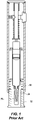
- many injectors include a retractable needle guard 52 which surrounds the injection needle 24 to protect against accidental needle sticks or unintended dosing after the needle shield 29 has been removed.
- the needle guard 52 requires an input force to expose the injection needle 24. This input force represents the user's intent to expose or insert the needle for injection. In the absence of input force, the needle guard 52 remains extended over the needle 24.
- the needle guard 24 can protect against unintended dosing by resisting the force tending to expose and/or insert the injection needle until a threshold input force is achieved.
- Several prior art mechanisms have been developed to provide this resistive force. Many of these mechanisms use springs to provide the resistive force, for example, as shown in FIG. 1 (spring 60).
- Other devices utilize automatic needle insertion mechanisms to provide resistive force.
- the use of springs or automatic needle insertion mechanisms adds complexity and additional components to the drug delivery device.
- the automatic needle insertion mechanisms in particular, add complexity that can reduce the reliability of the injector and increase cost of the device.
- Automatic needle insertion mechanisms provide energy to insert the injection needle.
- Some of these mechanisms may use one or more springs (hereinafter spring), which provide the potential energy to insert the injection needle.
- spring Prior to release, the spring stores potential energy.
- the potential energy increases, until the release threshold is achieved and the potential energy is converted to kinetic energy, subject to acceleration and/or deceleration.
- the active mass of the injector makes contact with the resisting force of the spring, the kinetic energy defines the inertia as a function of the active mass and speed of the active mass of the injection system, which in turn defines the speed and force of needle insertion.
- the potential energy of the spring can be adjusted to provide an optimal needle insertion speed and force.
- One of the benefits of the automatic needle insertion mechanism is the ability to optimize the needle insertion process.
- a drug delivery device comprising: a casing for housing a drug storage container, the drug storage container including a dose delivery member, at least an insertion portion of the dose delivery member extending through an opening in the casing; a needle guard movable relative to the casing between extended and retracted positions, the insertion portion of the dose delivery member being surrounded by the guard in the extended position and the insertion portion of the dose delivery member being at least partially exposed when the guard is in the retracted position; an interference arrangement for providing selected threshold of resistance to movement of the guard from the extended position to the retracted position during insertion of the dose delivery member into body tissue at an injection site, the detent arrangement having a first member associated with a surface within the casing, and a second member extending from the guard, the first and second members engaging one another to retain the guard in the extended position, one of the first and second members moving if the selected threshold of resistance is exceeded to allow the members to slide past one another to allow the guard to move into the retracted position when the device is pressed toward the injection site during insertion
- a method for administering a drug comprising: providing an delivery device comprising a casing, a guard, and an interference arrangement, the casing for housing a drug storage container, the drug storage container including a dose delivery member at least partially extending through an opening in the casing, the guard movable relative to the casing between extended and retracted positions, the dose delivery member concealed by the guard in the extended position and the dose delivery member exposed when the guard is in the retracted position, the interference arrangement having a first member associated with a surface within the casing, and a second member extending from the guard, the first and second members engaging one another to retain the guard in the extended position; and pressing the guard against body tissue at an injection site to insert the dose delivery member into the tissue, the interference arrangement providing a threshold of resistance to movement of the guard from the extended position, one of the first and second members moving if the threshold of resistance is exceeded to allow the members to slide past one another as the guard starts to move toward the casing into the retracted position.
- the device comprises: a casing having an opening, the casing configured to contain a drug storage container including a dose delivery member such that at least an insertion portion of the dose delivery member is configured to extend through the opening in the casing; a needle guard disposed adjacent to the opening and movable relative to the casing between an extended position and a retracted position, the insertion portion of the dose delivery member being surrounded by the needle guard in the extended position and the insertion portion of the dose delivery member being at least partially exposed when the needle guard is in the retracted position; an interference arrangement for providing a selected threshold of resistance to movement of the needle guard from the extended position to the retracted position during insertion of the dose delivery member into body tissue at an injection site, the interference arrangement having a first member associated with a surface of the casing, and a second member extending from the needle guard, the first and second members engaging one another to retain the needle guard in the extended position, one of the first and second members moving if the selected threshold of resistance is
- the method comprises: providing a delivery device comprising a casing, a needle guard, and an interference arrangement, the casing for housing a drug storage container, the drug storage container including a dose delivery member at least partially extending through an opening in the casing, the needle guard movable relative to the casing between extended and retracted positions, the dose delivery member concealed by the needle guard in the extended position and the dose delivery member exposed when the needle guard is in the retracted position, the interference arrangement having a first member associated with a surface within the casing, and a second member extending from the needle guard, the first and second members engaging one another to retain the needle guard in the extended position; and pressing the needle guard against body tissue at an injection site to insert the dose delivery member into the tissue, the interference arrangement providing a threshold of resistance to movement of the needle guard from the extended position, one of the first and second members moving if the threshold of resistance is exceeded to allow the members to slide past one another as the needle guard starts to move toward the casing into the re
- a drug delivery device comprising: a casing configured to contain a drug storage container with a dose delivery member for delivering a dose of the drug to a patient; a needle guard disposed adjacent to an opening in the casing from which the dose delivery member would extend, the needle guard being movable relative to the casing between an extended position for surrounding the dose delivery member and a retracted position for exposing the dose delivery member; and an interference arrangement providing a selected threshold of resistance that must be overcome in order to move the needle guard from the extended position to the retracted position, the interference arrangement having a first member associated with a surface of the casing, and a second member associated with the needle guard, the first and second members contacting each other when the needle guard is in the extended position, wherein at least one of the first and second members is carried by a flexible arm such that upon application of an axial force urging the needle guard from the extended position toward the retracted position, the flexible arm flexes to move the associated first and/or second member radially away from the other to
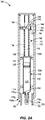
- FIG. 2A shows an embodiment of a hand-held drug delivery device 100 according to the present disclosure, which comprises a needle guard mechanism 150 having a tunable threshold of resistance to movement of a needle guard 152 to effect and optimize needle insertion, speed and force.
- the drug delivery device 100 can be configured as a single-use, disposable injector or a multiple-use reusable injector.
- the drug delivery device 100 can be configured to deliver any suitable medicament or drug including those having a viscosity which can range, for example, from about 1-200 centipoise.
- the drug delivery device 100 can be configured as an autoinjector for self-administration, although such devices can also be used by a caregiver or a formally trained healthcare provider to administer an injection. Referring to FIG.
- the drug delivery device 100 in various embodiments can further comprise an elongated housing or outer casing 110 that holds a drug storage device 120.
- the drug storage device 120 in various embodiments can include a primary container 122, a stopper 126 moveably disposed in an interior chamber 122c of the primary container 122 for expelling a medicament or drug 128 contained therein, and an injection needle 124 (as shown), cannula or any other suitable dose delivery member or element capable of penetrating body tissue and dispensing a drug into the body of a patient.
- the drug storage device 120 may comprise a conventional glass or plastic syringe or cartridge.
- a removable shield 129 can be installed over the injection needle 124 for maintaining same in a sterile state prior to use of the drug delivery device 100.
- the drug storage device 120 may be prefilled with the one or more doses of the medicament or drug 128.
- the interior surface 112 of the casing 110 can include one or more support members 114 for holding the drug storage device 120 in a fixed manner within the outer casing 110 with at least an insertion portion of the injection needle 124 extending through an opening 110o defined in a distal end 110de of the casing 110.
- various embodiments of the drug delivery device 100 can further comprise an injection drive mechanism 130 and a drive triggering mechanism 140.
- the injection drive mechanism 130 can be disposed within the casing 110 and in some embodiments may comprise a plunger 132 and a plunger drive spring 134 for propelling the plunger 132 into and through the primary container 122 of the drug storage device 120 to perform drug injection or dosing.
- the plunger 132 and the plunger drive spring 134 can be configured so that the plunger 132 extends through the plunger drive spring 134 with one end of the spring 134 engaging a head member 138 of the plunger 132 and the other end of the spring 134 engaging the drive triggering mechanism 140.
- the plunger 132 Prior to activation of the injection drive mechanism 130, in some embodiments the plunger 132 is in a position where the head member of the plunger 132 is disposed adjacent to the opening 122o of the primary container 122 of the drug storage device 120 with the spring 134 compressed between the head member 138 of the plunger 132 and the drive triggering mechanism 140.
- the plunger drive spring 134 expands to propel the plunger 132 into and through the primary container 122 of the drug storage device 120 to drive the stopper 126 through the primary container 122 to expel the drug 128 through the injection needle 124.
- the injection drive mechanism 130 of the drug delivery device 100 can comprise an electrical/mechanical arrangement (not shown) comprising one or more motors and/or solenoids and a drive train or transmission, or an arrangement that generates or releases a pressurized gas or fluid (not shown), to propel the plunger 132.
- an electrical/mechanical arrangement comprising one or more motors and/or solenoids and a drive train or transmission, or an arrangement that generates or releases a pressurized gas or fluid (not shown), to propel the plunger 132.
- the injection drive mechanism 130 may comprise a mechanical arrangement that generates or releases a pressurized gas or fluid (not shown) which acts directly on the stopper 126 to move it through the primary container 122 to expel the drug 128 therefrom through the injection needle 124.
- Such injection drive mechanisms are well known in the art.
- the drive triggering mechanism 140 can be disposed within the casing 110 and comprise an activation button 142 which extends through an opening in the side of the casing 110, a plunger release arm 144 extending from the activation button 142, and a trigger spring 148 disposed between the plunger release arm 144 and the interior surface 112 of the casing 110.
- the activation button 142 enables the drive triggering mechanism 140 to be actuated by the patient or other operator, which in turn, activates the injection drive mechanism 130.
- the plunger release arm 144 is moveable between a plunger hold position and a plunger release position.
- the plunger release arm 144 in the plunger hold position, holds the plunger 143 in position via a detent 146.
- the detent 146 may comprise a projection 146p on the plunger release arm 144 and a recess 146r formed in the side of the plunger 132.
- the plunger release arm 144 In the plunger release position, the plunger release arm 144 disengages the detent projection 146p from the detent recess 146r, which releases the plunger 132 and allows it to be propelled by the plunger drive spring 134.
- the trigger spring 148 applies a force which maintains the plunger release arm 144 in the plunger hold position with the detent projection 146p and recess 146r engaged.
- the drive triggering mechanism 140 can comprise an electrical/mechanical arrangement (not shown) comprising one or more switches, springs, and/or sensors to activate the injection drive mechanism 130.
- an electrical/mechanical arrangement comprising one or more switches, springs, and/or sensors to activate the injection drive mechanism 130.
- electrical/mechanical arrangements are well known in the art.
- the needle guard mechanism 150 in various embodiments comprises a needle guard 152 movably disposed at the distal end 110de of the casing 110 and a detent or interference arrangement 154.
- the needle guard 152 could be biased into the position depicted in FIG. 2A with a spring (not shown) similar to spring 60 shown in FIG. 1 .
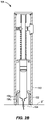
- the interference arrangement 154 retains the needle guard 152 in an extended position with a tunable or selectable threshold of resistance to the patient's or operator's effort to collapse and release the needle guard 152 and insert the injection needle 124 of the drug storage device 120 into body tissue as shown in FIG. 2B , thereby optimizing needle insertion speed and force and preventing unintended dosing after the needle shield 129 has been removed.
- the needle guard 152 in some embodiments can have a tubular structure that surrounds the insertion portion of the injection needle 124 extending from the distal end 110de of the casing 110 (extended position) to protect against accidental needle sticks.
- the needle guard 152 can be configured so that it collapses or retracts into the casing 110, as shown in FIG. 2B , or, in other versions, retracts over the casing 110 (not shown).
- the interference arrangement 154 in various embodiments can comprise a first member 154 1 associated with the casing 110, and a second member 154 2 associated with the needle guard 152. At least portions of the first and second members 154 1 , 154 2 engage one another to retain the needle guard 152 in the extended position and provide the selected threshold of resistance to movement or release of the needle guard 152.
- one of the first and second members 154 1 , 154 2 can be configured to move when an axial force is applied to the drug delivery device 100 by the patient or operator pressing the device 100 toward the injection site meets or exceeds the selected threshold of resistance, thereby allowing the other one of the first and second members 154 1 , 154 2 to slide past it to release the needle guard 152 and allow it to retract toward the casing 110 into the retracted position to achieve needle insertion as shown in FIG. 2B .
- the interference arrangement 154 can comprise an overcenter cam mechanism 254 comprising a fixed cam element 254c and one or more resiliently biased cam followers 254f.
- the fixed cam element 254c can comprise a circumferential bead 255 disposed on the interior surface 112 of the casing 110 adjacent to the opening 110o at the distal end 110de of the casing 110.
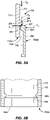
- the circumferential bead 255 can be continuous as shown in FIG. 3B or segmented as shown in FIG. 3C .
- the one or more of the resiliently biased cam followers 254f can comprise a flexible arm 256 that extends from a proximal end 152pe of the needle guard 152 and a projection 257 disposed on an outwardly facing surface 152o of the flexible arm 256. As shown in FIG. 3A , the one or more flexible arms 256 bias their corresponding projections 257 against the fixed circumferential bead cam element 255 (or elements in segmented embodiments).
- the fixed cam element 254c on the casing 110 and the cam followers 254f on the needle guard 152 include rounded (e.g., cammed or bulbous) external surfaces (e.g., profiles) to facilitate sliding interaction during use of the drug delivery device 100.
- rounded e.g., cammed or bulbous
- external surfaces e.g., profiles
- the threshold of resistance is equal to the force required to cause the flexible arms 256 carrying the cam followers 254f to deflect away from the fixed cam element 254 such that the rounded outer surfaces of the cam followers 254f are able slide relative to and beyond the fixed cam element 254c.
- the force applied by the user is shown as F p , and this translates into the fixed cam element 254c applying an axial force component F a and a radial force component F r on each of the cam followers 254f.
- the axial force F p applied by the user must be large enough to create a radial force component F r that is sufficient to overcome a natural resistive bias force F b of the flexible arms 256.
- the resistive bias force F b of the flexible arms 256 is primarily dependent on the material from which the arms 256 are constructed and the geometry of the arms 256 (e.g., the length of the arms 256, the width of the arms 256, the thickness of the arms 256, a cross-sectional shape of the arms, etc.).
- various embodiments of the overcenter cam mechanism 354 can comprise the circumferential bead 255 disposed on the interior surface 112 of the casing 110 as described earlier with respect to FIGS. 3A-3C , and one or more of the resiliently biased cam followers 356f configured as a rounded groove 357 formed in the flexible arm 356 that extends from the proximal end of the needle guard 152.
- the one or more flexible arms 356 bias their corresponding grooves 357 against the circumferential bead 255.
- FIG. 5 shows one embodiment of the overcenter cam mechanism 454 where the cam element 454c comprises a continuous or segmented circumferential groove 455 formed in the interior surface 112 of the casing 110 adjacent to the opening 110o at the distal end 110de of the casing 110.
- the one or more flexible arms 256 bias their corresponding projections 257 against the fixed circumferential groove 455.
- the needle guard 152 can be configured to retract over the exterior surface 113 of the casing 110.
- the fixed continuous or segmented circumferential bead 255 can be provided on the exterior surface 113 of the casing 110 and the projections 257 of the resiliently biased cam followers 254f can be provided on the inner surfaces 152i of the flexible arms 256.
- the needle guard 152 can include the earlier described fixed continuous or segmented circumferential bead 255 on an outer surface thereof and the casing 110 can include the one or more resiliently biased cam followers 254f including the flexible arms 256 and the projections 257.
- the interference arrangement can be configured to provide desired potential and kinetic energies as well as a desired inertia at the moment of injection needle contact with the body tissue.
- the force required to overcome the interference arrangement and the driven mass (device and patient/operator) represents the potential energy at the release of the needle guard.
- This potential energy converts to kinetic energy as the interference arrangement releases the needle guard, subject to acceleration/deceleration.
- the kinetic energy defines the speed and force of approach.
- each of the embodiments described above with reference to FIGs. 2A-7B include one or more resiliently biased cam followers on only one of the needle guard 152 (e.g., Figs. 2A-6 ) or the casing 110 (e.g., FIGs. 7A-7B ), other versions can include resiliently biased elements on both the needle guard 152 and the casing 110.
- the casing 110 could include a number of segmented circumferential beads, each carried by a flexible arm
- the needle guard 152 could include a corresponding number of cam followers, each carried by a flexible arm.
- the needle guard 152 could include a number of segmented circumferential beads, each carried by a flexible arm, and the casing 110 could include a corresponding number of cam followers, each carried by a flexible arm.
- the flexible arms on the casing 110 and the flexible arms on the needle guard 152 could deflect simultaneously in response to a force intending to overcome the resistive force of the interference arrangement, and this could provide for greater flexibility in patient-specific tuning of the interference arrangement.
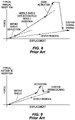
- FIG. 8 is a graph plotting effort versus distance for a prior art injector with a conventional, manual spring-based needle insertion mechanism. Starting from zero time and force, a force can be observed which rises from approximately zero (although the residual force on the needle guard spring can be adjusted to greater than zero to increase the starting force) and ramps up essentially linearly over until the injection needle is presented at the body tissue. In FIG. 8 , the force to insert the injection needle overlays the force of the needle guard spring. Thus, during needle insertion, the patient or operator is providing effort to overcome both the force of the needle guard spring and the force to insert the injection needle into the body tissue. As the injection needle approaches full insertion depth, a second mechanism is presented to initiate automatic dosing. As shown in FIG.
- this second mechanism appears as a sharp rise in effort, which indicates an option to provide further feedback to the patient or operator that dosing will initiate as a result of increased effort, although dosing can continue without this additional feedback to the patient or operator. This rise continues until the threshold force is achieved to activate dosing, at which time the force drops off with delivery.
- FIG. 9 is a graph plotting effort versus distance for a prior art injector having a conventional automatic needle insertion mechanism. Starting from zero time and force, a force can be observed which rises from approximately zero (again the starting force can be biased by adjusting the residual force of the resisting spring) and ramps up essentially linearly until the injection needle is presented at the body tissue.
- the force to insert the injection needle is independent of the force of the needle guard spring, however, there is an inertial effect which tends to be perceived as an additional force to be overcome to maintain the injector in intimate contact with the body tissue.
- the automatic mechanism continues to apply load to the drug container to force the full dose out through the injection needle. There is residual force to overcome during drug delivery to prevent the needle guard from extending to cover the injection needle. The residual force may also tend to push the injection needle from the body tissue.
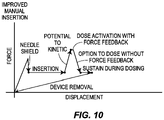
- FIG. 10 is a graph plotting effort versus distance for an embodiment of the drug delivery device of the present disclosure having the needle guard with the interference arrangement.
- the rise represents the force to overcome the resistance provided by the interference arrangement.
- the magnitude of this force can be selectively adjusted via the interference arrangement to tune the inertia available as needle guard release occurs, thus tuning the needle insertion experience to patient preference. Tuning can be achieved by adjusting one or more of the geometric shape, the dimensions, and the modulus of elasticity of the elements of the interference arrangement. Dosing can occur manually (as some patients of certain therapeutics prefer) or automatically.
- the dosing release i.e., activation of the injection drive
- the dosing release can occur either independently as shown in FIG. 10 , or can occur simultaneously to the insertion release so than needle insertion and the start of dosing occur at the same time.
- the injector with the conventional automatic needle insertion mechanism has force that builds with deflection of the needle guard and compression of the needle guard spring.
- the force for guard release occurs over the relatively long distance and therefore, the patient or operator is not provided with a clear indicator that they are near the point of activation.
- the force (resistance) for guard release occurs over a short distance so that there is stronger feedback to the patient or operator, which indicates that they are approaching the point of needle insertion.
- the duration of this activation event can be adjusted via the interference arrangement of the needle guard mechanism to optimize the patient or operator experience.
- the needle guard mechanism has been disclosed herein with reference to a hand-held drug delivery device, the needle guard mechanism can also be used in on-body drug delivery devices including injectors and autoinjectors, which are worn on the body of the patient.
- the above description describes various systems and methods for use with a drug delivery device. It should be clear that the system, drug delivery device or methods can further comprise use of a medicament listed below with the caveat that the following list should neither be considered to be all inclusive nor limiting.
- the medicament will be contained in a reservoir.
- the reservoir is the primary container that is either filled or pre-filled for treatment with the medicament.
- the primary container can be a cartridge or a pre-filled syringe.
- the drug delivery device or more specifically the reservoir of the device may be filled with colony stimulating factors, such as granulocyte colony-stimulating factor (G-CSF).
- G-CSF agents include, but are not limited to, Neupogen ® (filgrastim) and Neulasta ® (pegfilgrastim).
- the drug delivery device may be used with various pharmaceutical products, such as an erythropoiesis stimulating agent (ESA), which may be in a liquid or a lyophilized form.
- ESA erythropoiesis stimulating agent
- An ESA is any molecule that stimulates erythropoiesis, such as Epogen ® (epoetin alfa), Aranesp ® (darbepoetin alfa), Dynepo ® (epoetin delta), Mircera ® (methyoxy polyethylene glycol-epoetin beta), Hematide ® , MRK-2578, INS-22, Retacrit ® (epoetin zeta), Neorecormon ® (epoetin beta), Silapo ® (epoetin zeta), Binocrit ® (epoetin alfa), epoetin alfa Hexal, Abseamed ® (epoetin alfa), Ratioepo ® (epoetin theta), Eporatio ® (epoetin theta), Biopoin ® (epoetin
- An ESA can be an erythropoiesis stimulating protein.
- erythropoiesis stimulating protein means any protein that directly or indirectly causes activation of the erythropoietin receptor, for example, by binding to and causing dimerization of the receptor.
- Erythropoiesis stimulating proteins include erythropoietin and variants, analogs, or derivatives thereof that bind to and activate erythropoietin receptor; antibodies that bind to erythropoietin receptor and activate the receptor; or peptides that bind to and activate erythropoietin receptor.
- Erythropoiesis stimulating proteins include, but are not limited to, epoetin alfa, epoetin beta, epoetin delta, epoetin omega, epoetin iota, epoetin zeta, and analogs thereof, pegylated erythropoietin, carbamylated erythropoietin, mimetic peptides (including EMP1/hematide), and mimetic antibodies.
- Exemplary erythropoiesis stimulating proteins include erythropoietin, darbepoetin, erythropoietin agonist variants, and peptides or antibodies that bind and activate erythropoietin receptor (and include compounds reported in U.S. Publication Nos. 2003/0215444 and 2006/0040858 , the disclosures of each of which is incorporated herein by reference in its entirety) as well as erythropoietin molecules or variants or analogs thereof as disclosed in the following patents or patent applications, which are each herein incorporated by reference in its entirety: U.S. Patent Nos.
- Examples of other pharmaceutical products for use with the device may include, but are not limited to, antibodies such as Vectibix ® (panitumumab), Xgeva TM (denosumab) and Prolia TM (denosamab); other biological agents such as Enbrel ® (etanercept, TNF-receptor /Fc fusion protein, TNF blocker), Neulasta ® (pegfilgrastim, pegylated filgastrim, pegylated G-CSF, pegylated hu-Met-G-CSF), Neupogen ® (filgrastim , G-CSF, hu-MetG-CSF), and Nplate ® (romiplostim); small molecule drugs such as Sensipar ® (cinacalcet).
- antibodies such as Vectibix ® (panitumumab), Xgeva TM (denosumab) and Prolia TM (denosamab);
- the device may also be used with a therapeutic antibody, a polypeptide, a protein or other chemical, such as an iron, for example, ferumoxytol, iron dextrans, ferric glyconate, and iron sucrose.
- a therapeutic antibody for example, ferumoxytol, iron dextrans, ferric glyconate, and iron sucrose.
- the pharmaceutical product may be in liquid form, or reconstituted from lyophilized form.
- proteins are the specific proteins set forth below, including fusions, fragments, analogs, variants or derivatives thereof:
- OPGL specific antibodies, peptibodies, and related proteins, and the like also referred to as RANKL specific antibodies, peptibodies and the like
- fully humanized and human OPGL specific antibodies particularly fully humanized monoclonal antibodies, including but not limited to the antibodies described in PCT Publication No.
- WO 03/002713 which is incorporated herein in its entirety as to OPGL specific antibodies and antibody related proteins, particularly those having the sequences set forth therein, particularly, but not limited to, those denoted therein: 9H7; 18B2; 2D8; 2E11; 16E1; and 22B3, including the OPGL specific antibodies having either the light chain of SEQ ID NO:2 as set forth therein in Figure 2 and/or the heavy chain of SEQ ID NO:4, as set forth therein in Figure 4 , each of which is individually and specifically incorporated by reference herein in its entirety fully as disclosed in the foregoing publication;
- IL-4 receptor specific antibodies particularly those that inhibit activities mediated by binding of IL-4 and/or IL-13 to the receptor, including those described in PCT Publication No. WO 2005/047331 or PCT Application No. PCT/US2004/37242 and in U.S. Publication No.
- Interleukin 1-receptor 1 (“IL1-R1”) specific antibodies, peptibodies, and related proteins, and the like, including but not limited to those described in U.S. Publication No. 2004/097712 , which is incorporated herein by reference in its entirety in parts pertinent to IL1-R1 specific binding proteins, monoclonal antibodies in particular, especially, without limitation, those designated therein: 15CA, 26F5, 27F2, 24E12, and 10H7, each of which is individually and specifically incorporated by reference herein in its entirety fully as disclosed in the aforementioned publication;
- Ang2 specific antibodies, peptibodies, and related proteins, and the like including but not limited to those described in PCT Publication No. WO 03/057134 and U.S. Publication No. 2003/0229023 , each of which is incorporated herein by reference in its entirety particularly in parts pertinent to Ang2 specific antibodies and peptibodies and the like, especially those of sequences described therein and including but not limited to: L1(N); L1(N) WT; L1(N) 1K WT; 2 ⁇ L1(N); 2 ⁇ L1(N) WT; Con4 (N), Con4 (N) 1K WT, 2xCon4 (N) 1 K; L1C; L1C 1K; 2 ⁇ L1C; Con4C; Con4C 1K; 2xCon4C 1K; Con4-L1 (N); Con4-L1C; TN-12-9 (N); C17 (N); TN8-8(N); TN8-14 (N); Con 1 (N), also including anti
- WO 2003/030833 which is incorporated herein by reference in its entirety as to the same, particularly Ab526; Ab528; Ab531; Ab533; Ab535; Ab536; Ab537; Ab540; Ab543; Ab544; Ab545; Ab546; A551; Ab553; Ab555; Ab558; Ab559; Ab565; AbF1AbFD; AbFE; AbFJ; AbFK; AbG1D4; AbGC1E8; AbH1C12; AbIA1; AbIF; AbIK, AbIP; and AbIP, in their various permutations as described therein, each of which is individually and specifically incorporated by reference herein in its entirety fully as disclosed in the foregoing publication;
- NGF specific antibodies, peptibodies, and related proteins, and the like including, in particular, but not limited to those described in U.S. Publication No. 2005/0074821 and U.S. Patent No. 6,919,426 , which are incorporated herein by reference in their entirety particularly as to NGF-specific antibodies and related proteins in this regard, including in particular, but not limited to, the NGF-specific antibodies therein designated 4D4, 4G6, 6H9, 7H2, 14D10 and 14D11, each of which is individually and specifically incorporated by reference herein in its entirety fully as disclosed in the foregoing publication;
- IGF-1 receptor specific antibodies such as those described in PCT Publication No. WO 06/069202 , which is incorporated herein by reference in its entirety as to IGF-1 receptor specific antibodies and related proteins, including but not limited to the IGF-1 specific antibodies therein designated L1H1, L2H2, L3H3, L4H4, L5H5, L6H6, L7H7, L8H8, L9H9, L10H10, L11H11, L12H12, L13H13, L14H14, L15H15, L16H16, L17H17, L18H18, L19H19, L20H20, L21H21, L22H22, L23H23, L24H24, L25H25, L26H26, L27H27, L28H28, L29H29, L30H30, L31H31, L32H32, L33H33, L34H34, L35H35, L36H36, L37H
- anti-IGF-1R antibodies for use in the methods and compositions of the present invention are each and all of those described in:
- B7RP-1 B-7 related protein 1 specific antibodies, peptibodies, related proteins and the like
- B7RP-1 also is referred to in the literature as B7H2, ICOSL, B7h, and CD275
- B7RP-specific fully human monoclonal IgG2 antibodies particularly fully human IgG2 monoclonal antibody that binds an epitope in the first immunoglobulin-like domain of B7RP-1, especially those that inhibit the interaction of B7RP-1 with its natural receptor, ICOS, on activated T cells in particular, especially, in all of the foregoing regards, those disclosed in U.S. Publication No. 2008/0166352 and PCT Publication No.
- WO 07/011941 which are incorporated herein by reference in their entireties as to such antibodies and related proteins, including but not limited to antibodies designated therein as follow: 16H (having light chain variable and heavy chain variable sequences SEQ ID NO:1 and SEQ ID NO:7 respectively therein); 5D (having light chain variable and heavy chain variable sequences SEQ ID NO:2 and SEQ ID NO:9 respectively therein); 2H (having light chain variable and heavy chain variable sequences SEQ ID NO:3 and SEQ ID NO:10 respectively therein); 43H (having light chain variable and heavy chain variable sequences SEQ ID NO:6 and SEQ ID NO:14 respectively therein); 41H (having light chain variable and heavy chain variable sequences SEQ ID NO:5 and SEQ ID NO:13 respectively therein); and 15H (having light chain variable and heavy chain variable sequences SEQ ID NO:4 and SEQ ID NO:12 respectively therein), each of which is individually and specifically incorporated by reference herein in its entirety fully as disclosed in the foregoing publication;
- IL-15 specific antibodies, peptibodies, and related proteins, and the like such as, in particular, humanized monoclonal antibodies, particularly antibodies such as those disclosed in U.S. Publication Nos. 2003/0138421 ; 2003/023586 ; and 2004/0071702 ; and U.S. Patent No. 7,153,507 , each of which is incorporated herein by reference in its entirety as to IL-15 specific antibodies and related proteins, including peptibodies, including particularly, for instance, but not limited to, HuMax IL-15 antibodies and related proteins, such as, for instance, 146B7;
- IFN gamma specific antibodies peptibodies, and related proteins and the like, especially human IFN gamma specific antibodies, particularly fully human anti-IFN gamma antibodies, such as, for instance, those described in U.S. Publication No. 2005/0004353 , which is incorporated herein by reference in its entirety as to IFN gamma specific antibodies, particularly, for example, the antibodies therein designated 1118; 1118*; 1119; 1121; and 1121*.
- the entire sequences of the heavy and light chains of each of these antibodies, as well as the sequences of their heavy and light chain variable regions and complementarity determining regions, are each individually and specifically incorporated by reference herein in its entirety fully as disclosed in the foregoing publication and in Thakur etal.
- Specific antibodies include those having the heavy chain of SEQ ID NO:17 and the light chain of SEQ ID NO:18; those having the heavy chain variable region of SEQ ID NO:6 and the light chain variable region of SEQ ID NO:8; those having the heavy chain of SEQ ID NO:19 and the light chain of SEQ ID NO:20; those having the heavy chain variable region of SEQ ID NO:10 and the light chain variable region of SEQ ID NO:12; those having the heavy chain of SEQ ID NO:32 and the light chain of SEQ ID NO:20; those having the heavy chain variable region of SEQ ID NO:30 and the light chain variable region of SEQ ID NO:12; those having the heavy chain sequence of SEQ ID NO:21 and the light chain sequence of SEQ ID NO:22; those having the heavy chain variable region of SEQ ID NO:14 and the light chain variable region of SEQ ID
- TALL-1 specific antibodies such as those described in U.S. Publication Nos. 2003/0195156 and 2006/0135431 , each of which is incorporated herein by reference in its entirety as to TALL-1 binding proteins, particularly the molecules of Tables 4 and 5B, each of which is individually and specifically incorporated by reference herein in its entirety fully as disclosed in the foregoing publications;
- PTH Parathyroid hormone
- TPO-R Thrombopoietin receptor
- Hepatocyte growth factor (“HGF”) specific antibodies, peptibodies, and related proteins, and the like, including those that target the HGF/SF:cMet axis (HGF/SF:c-Met), such as the fully human monoclonal antibodies that neutralize hepatocyte growth factor/scatter (HGF/SF) described in U.S. Publication No. 2005/0118643 and PCT Publication No. WO 2005/017107 , huL2G7 described in U.S. Patent No. 7,220,410 and OA-5d5 described in U.S. Patent Nos. 5,686,292 and 6,468,529 and in PCT Publication No. WO 96/38557 , each of which is incorporated herein by reference in its entirety, particularly in parts pertinent to proteins that bind HGF;
- TRAIL-R2 specific antibodies, peptibodies, related proteins and the like such as those described in U.S. Patent No. 7,521,048 , which is herein incorporated by reference in its entirety, particularly in parts pertinent to proteins that bind TRAIL-R2;
- Activin A specific antibodies, peptibodies, related proteins, and the like, including but not limited to those described in U.S. Publication No. 2009/0234106 , which is herein incorporated by reference in its entirety, particularly in parts pertinent to proteins that bind Activin A;
- TGF-beta specific antibodies, peptibodies, related proteins, and the like including but not limited to those described in U.S. Patent No. 6,803,453 and U.S. Publication No. 2007/0110747 , each of which is herein incorporated by reference in its entirety, particularly in parts pertinent to proteins that bind TGF-beta;
- Amyloid-beta protein specific antibodies including but not limited to those described in PCT Publication No. WO 2006/081171 , which is herein incorporated by reference in its entirety, particularly in parts pertinent to proteins that bind amyloid-beta proteins.
- One antibody contemplated is an antibody having a heavy chain variable region comprising SEQ ID NO:8 and a light chain variable region having SEQ ID NO:6 as disclosed in the foregoing publication;
- c-Kit specific antibodies including but not limited to those described in U.S. Publication No. 2007/0253951 , which is incorporated herein by reference in its entirety, particularly in parts pertinent to proteins that bind c-Kit and/or other stem cell factor receptors;
- OX40L specific antibodies, peptibodies, related proteins, and the like including but not limited to those described in U.S. Publication No. 2006/0002929 , which is incorporated herein by reference in its entirety, particularly in parts pertinent to proteins that bind OX40L and/or other ligands of the OX40 receptor; and
- Activase ® (alteplase, tPA); Aranesp ® (darbepoetin alfa); Epogen ® (epoetin alfa, or erythropoietin); GLP-1, Avonex ® (interferon beta-1a); Bexxar ® (tositumomab, anti-CD22 monoclonal antibody); Betaseron ® (interferon-beta); Campath ® (alemtuzumab, anti-CD52 monoclonal antibody); Dynepo ® (epoetin delta); Velcade ® (bortezomib); MLN0002 (anti- ⁇ 4 ⁇ 7 mAb); MLN1202 (anti-CCR2 chemokine receptor mAb); Enbrel ® (etanercept, TNF-receptor /Fc fusion protein, TNF blocker); Eprex ® (epo
- Patent No. 7,153,507 Tysabri ® (natalizumab, anti- ⁇ 4integrin mAb); Valortim ® (MDX-1303, anti-B. anthracis protective antigen mAb); ABthrax TM ; Vectibix ® (panitumumab); Xolair ® (omalizumab); ETI211 (anti-MRSA mAb); IL-1 trap (the Fc portion of human IgG1 and the extracellular domains of both IL-1 receptor components (the Type I receptor and receptor accessory protein)); VEGF trap (Ig domains of VEGFR1 fused to IgG1 Fc); Zenapax ® (daclizumab); Zenapax ® (daclizumab, anti-IL-2R ⁇ mAb); Zevalin ® (ibritumomab tiuxetan); Zetia ® (ezetimibe); Orencia ® (atacicept, TACI-
- sclerostin antibody such as but not limited to romosozumab, blosozumab, or BPS 804 (Novartis).
- therapeutics such as rilotumumab, bixalomer, trebananib, ganitumab, conatumumab, motesanib diphosphate, brodalumab, vidupiprant, panitumumab, denosumab, NPLATE, PROLIA, VECTIBIX orXGEVA.
- a monoclonal antibody that binds human Proprotein Convertase Subtilisin/Kexin Type 9 (PCSK9), e.g. U.S. Patent No. 8,030,547 , U.S. Publication No.
- talimogene laherparepvec or another oncolytic HSV for the treatment of melanoma or other cancers.
- oncolytic HSV include, but are not limited to talimogene laherparepvec ( U.S. Patent Nos. 7,223,593 and 7,537,924 ); OncoVEXGALV/CD ( U.S. Pat. No. 7,981,669 ); OrienX010 ( Lei et al. (2013), World J. Gastroenterol., 19:5138-5143 ); G207, 1716; NV1020; NV12023; NV1034 and NV1042 ( Vargehes et al. (2002), Cancer Gene Ther., 9(12):967-978 ).
- TIMPs are endogenous tissue inhibitors of metalloproteinases (TIMPs) and are important in many natural processes.
- TIMP-3 is expressed by various cells or and is present in the extracellular matrix; it inhibits all the major cartilage-degrading metalloproteases, and may play a role in role in many degradative diseases of connective tissue, including rheumatoid arthritis and osteoarthritis, as well as in cancer and cardiovascular conditions.
- the amino acid sequence of TIMP-3, and the nucleic acid sequence of a DNA that encodes TIMP-3 are disclosed in U.S. Patent No. 6,562,596, issued May 13, 2003 , the disclosure of which is incorporated by reference herein. Description of TIMP mutations can be found in U.S. Publication No. 2014/0274874 and PCT Publication No. WO 2014/152012 .
- CGRP human calcitonin gene-related peptide
- a bispecific T cell engager antibody e.g. Blinotumomab
- Blinotumomab can be used in the device.
- included can be an APJ large molecule agonist e.g., apelin or analogues thereof in the device. Information relating to such molecules can be found in PCT Publication No. WO 2014/099984 .
- the medicament comprises a therapeutically effective amount of an anti-thymic stromal lymphopoietin (TSLP) or TSLP receptor antibody.
- TSLP anti-thymic stromal lymphopoietin
- anti-TSLP antibodies that may be used in such embodiments include, but are not limited to, those described in U.S. Patent Nos. 7,982,016 , and 8,232,372 , and U.S. Publication No. 2009/0186022 .
- anti-TSLP receptor antibodies include, but are not limited to, those described in U.S. Patent No. 8,101,182 .
- the medicament comprises a therapeutically effective amount of the anti-TSLP antibody designated as A5 within U.S. Patent No. 7,982,016 .
Landscapes
- Health & Medical Sciences (AREA)
- Engineering & Computer Science (AREA)
- Heart & Thoracic Surgery (AREA)
- Vascular Medicine (AREA)
- Anesthesiology (AREA)
- Biomedical Technology (AREA)
- Hematology (AREA)
- Life Sciences & Earth Sciences (AREA)
- Animal Behavior & Ethology (AREA)
- General Health & Medical Sciences (AREA)
- Public Health (AREA)
- Veterinary Medicine (AREA)
- Environmental & Geological Engineering (AREA)
- Infusion, Injection, And Reservoir Apparatuses (AREA)
- Materials For Medical Uses (AREA)
Abstract
Description
- Priority is claimed to
U.S. Provisional Patent Application No. 62/121,758, filed February 27, 2015 - The present disclosure relates to drug delivery devices. More particularly, the present disclosure relates to drug delivery devices that have needle guard mechanisms with interference arrangements, which provide a tunable threshold of resistance to movement of the needle guard that must be overcome by a patient or operator to effect needle insertion.
- Medications including, but not limited to biologics for the treatment of rheumatoid arthritis, psoriasis, dislypidemia, osteoporosis, and other conditions, may be delivered to the subcutaneous, intramuscular, or intradermal spaces of a patient. Drug delivery devices such as syringes, injectors, and autoinjectors can be used for delivery of such medications by injection.
- Injectors and autoinjectors (injectors) are preferred for delivering many types of therapies, in part because they incorporate safety features, which traditional syringes do not provide. For example, it is desirable to provide protection against accidental needle sticks or unintended dosing while handling the injector.
- Syringes can be transported with a needle shield in place, which functions as a closure to maintain sterility of the injection needle, and provides a level of protection against accidental needle sticks or unintended dosing while handling the syringe. The needle shield, however, must be removed to allow for drug delivery, thereby exposing the injection needle. As the injection process requires handling of the syringe without the needle shield in place during placement of the needle and delivery of the medication, there exists a safety risk of accidental needle stick or unintended delivery prior to injection.
- It is desirable for injectors to protect against risks created by the exposed needle. As shown in
FIG. 1 , many injectors include aretractable needle guard 52 which surrounds theinjection needle 24 to protect against accidental needle sticks or unintended dosing after theneedle shield 29 has been removed. Theneedle guard 52 requires an input force to expose theinjection needle 24. This input force represents the user's intent to expose or insert the needle for injection. In the absence of input force, theneedle guard 52 remains extended over theneedle 24. - The
needle guard 24 can protect against unintended dosing by resisting the force tending to expose and/or insert the injection needle until a threshold input force is achieved. Several prior art mechanisms have been developed to provide this resistive force. Many of these mechanisms use springs to provide the resistive force, for example, as shown inFIG. 1 (spring 60). Other devices utilize automatic needle insertion mechanisms to provide resistive force. The use of springs or automatic needle insertion mechanisms, however, adds complexity and additional components to the drug delivery device. The automatic needle insertion mechanisms, in particular, add complexity that can reduce the reliability of the injector and increase cost of the device. - Automatic needle insertion mechanisms provide energy to insert the injection needle. Some of these mechanisms may use one or more springs (hereinafter spring), which provide the potential energy to insert the injection needle. Prior to release, the spring stores potential energy. As the spring is compressed, the potential energy increases, until the release threshold is achieved and the potential energy is converted to kinetic energy, subject to acceleration and/or deceleration. As the active mass of the injector makes contact with the resisting force of the spring, the kinetic energy defines the inertia as a function of the active mass and speed of the active mass of the injection system, which in turn defines the speed and force of needle insertion. Hence, the potential energy of the spring can be adjusted to provide an optimal needle insertion speed and force. One of the benefits of the automatic needle insertion mechanism is the ability to optimize the needle insertion process.
- Accordingly, a drug delivery device with improved reliability, lower cost, and optimized needle insertion, is desired.
- A drug delivery device comprising: a casing for housing a drug storage container, the drug storage container including a dose delivery member, at least an insertion portion of the dose delivery member extending through an opening in the casing; a needle guard movable relative to the casing between extended and retracted positions, the insertion portion of the dose delivery member being surrounded by the guard in the extended position and the insertion portion of the dose delivery member being at least partially exposed when the guard is in the retracted position; an interference arrangement for providing selected threshold of resistance to movement of the guard from the extended position to the retracted position during insertion of the dose delivery member into body tissue at an injection site, the detent arrangement having a first member associated with a surface within the casing, and a second member extending from the guard, the first and second members engaging one another to retain the guard in the extended position, one of the first and second members moving if the selected threshold of resistance is exceeded to allow the members to slide past one another to allow the guard to move into the retracted position when the device is pressed toward the injection site during insertion of the dose delivery member.
- Further, a method for administering a drug comprising: providing an delivery device comprising a casing, a guard, and an interference arrangement, the casing for housing a drug storage container, the drug storage container including a dose delivery member at least partially extending through an opening in the casing, the guard movable relative to the casing between extended and retracted positions, the dose delivery member concealed by the guard in the extended position and the dose delivery member exposed when the guard is in the retracted position, the interference arrangement having a first member associated with a surface within the casing, and a second member extending from the guard, the first and second members engaging one another to retain the guard in the extended position; and pressing the guard against body tissue at an injection site to insert the dose delivery member into the tissue, the interference arrangement providing a threshold of resistance to movement of the guard from the extended position, one of the first and second members moving if the threshold of resistance is exceeded to allow the members to slide past one another as the guard starts to move toward the casing into the retracted position.
-
-
FIG. 1 is an elevational view in partial cross-section of a prior art drug delivery device. -
FIG. 2A is an elevational view in partial cross-section of an embodiment of a drug delivery device according to the present disclosure. -
FIG. 2B is an elevational view in partial cross-section of the drug delivery device ofFIG. 2B after completion of needle insertion. -
FIG. 3A is an elevational view showing a section of an embodiment of a needle guard mechanism of the drug delivery device and an embodiment of an interference arrangement of the needle guard mechanism. -
FIG. 3B is a sectional view of the interior of a casing of the drug delivery device showing an embodiment of a cam element of the interference arrangement shown inFIG. 3A . -
FIG. 3C is a sectional view of the interior of the casing of the drug delivery device showing another embodiment of the cam element of the interference arrangement shown inFIG. 3A . -
FIG. 3D is a perspective view of a needle guard showing an embodiment of a cam follower of the interference arrangement shown inFIG. 3A . -
FIG. 4 is an elevational view showing a section of the needle guard mechanism of the drug delivery device showing another embodiment of the interference arrangement. -
FIG. 5 is an elevational view showing a section of the needle guard mechanism of the drug delivery device showing another embodiment of the interference arrangement. -
FIG. 6 is an elevational view showing a section of another embodiment of the needle guard mechanism of the drug delivery device and another embodiment of the interference arrangement of the needle guard mechanism. -
FIGS. 7A and 7B are elevational views of showing sections of another embodiment of the needle guard mechanism and the interference arrangement and the operation thereof. -
FIG. 8 is a graph plotting effort versus distance for an injector with a conventional manual spring-based needle insertion mechanism. -
FIG. 9 is a graph plotting effort versus distance for an injector having a conventional automatic needle insertion mechanism. -
FIG. 10 is a graph plotting effort versus distance for an embodiment of the drug delivery device of the present disclosure having the needle guard with the interference arrangement. - The same reference numerals are used in the drawings to identify the same or similar elements and structures in the various embodiments.
- Disclosed herein is a drug delivery device. In various embodiments the device comprises: a casing having an opening, the casing configured to contain a drug storage container including a dose delivery member such that at least an insertion portion of the dose delivery member is configured to extend through the opening in the casing; a needle guard disposed adjacent to the opening and movable relative to the casing between an extended position and a retracted position, the insertion portion of the dose delivery member being surrounded by the needle guard in the extended position and the insertion portion of the dose delivery member being at least partially exposed when the needle guard is in the retracted position; an interference arrangement for providing a selected threshold of resistance to movement of the needle guard from the extended position to the retracted position during insertion of the dose delivery member into body tissue at an injection site, the interference arrangement having a first member associated with a surface of the casing, and a second member extending from the needle guard, the first and second members engaging one another to retain the needle guard in the extended position, one of the first and second members moving if the selected threshold of resistance is exceeded to allow the members to slide past one another and to allow the needle guard to move into the retracted position when the device is pressed toward the injection site during insertion of the dose delivery member.
- Further disclosed herein is a method for administering a drug. The method comprises: providing a delivery device comprising a casing, a needle guard, and an interference arrangement, the casing for housing a drug storage container, the drug storage container including a dose delivery member at least partially extending through an opening in the casing, the needle guard movable relative to the casing between extended and retracted positions, the dose delivery member concealed by the needle guard in the extended position and the dose delivery member exposed when the needle guard is in the retracted position, the interference arrangement having a first member associated with a surface within the casing, and a second member extending from the needle guard, the first and second members engaging one another to retain the needle guard in the extended position; and pressing the needle guard against body tissue at an injection site to insert the dose delivery member into the tissue, the interference arrangement providing a threshold of resistance to movement of the needle guard from the extended position, one of the first and second members moving if the threshold of resistance is exceeded to allow the members to slide past one another as the needle guard starts to move toward the casing into the retracted position.
- Further still disclosed herein is a drug delivery device comprising: a casing configured to contain a drug storage container with a dose delivery member for delivering a dose of the drug to a patient; a needle guard disposed adjacent to an opening in the casing from which the dose delivery member would extend, the needle guard being movable relative to the casing between an extended position for surrounding the dose delivery member and a retracted position for exposing the dose delivery member; and an interference arrangement providing a selected threshold of resistance that must be overcome in order to move the needle guard from the extended position to the retracted position, the interference arrangement having a first member associated with a surface of the casing, and a second member associated with the needle guard, the first and second members contacting each other when the needle guard is in the extended position, wherein at least one of the first and second members is carried by a flexible arm such that upon application of an axial force urging the needle guard from the extended position toward the retracted position, the flexible arm flexes to move the associated first and/or second member radially away from the other to allow the first and second members to slide past one another.
-
FIG. 2A shows an embodiment of a hand-helddrug delivery device 100 according to the present disclosure, which comprises aneedle guard mechanism 150 having a tunable threshold of resistance to movement of aneedle guard 152 to effect and optimize needle insertion, speed and force. Thedrug delivery device 100 can be configured as a single-use, disposable injector or a multiple-use reusable injector. Thedrug delivery device 100 can be configured to deliver any suitable medicament or drug including those having a viscosity which can range, for example, from about 1-200 centipoise. Further, thedrug delivery device 100 can be configured as an autoinjector for self-administration, although such devices can also be used by a caregiver or a formally trained healthcare provider to administer an injection. Referring toFIG. 2A , thedrug delivery device 100 in various embodiments can further comprise an elongated housing orouter casing 110 that holds adrug storage device 120. Thedrug storage device 120 in various embodiments can include aprimary container 122, astopper 126 moveably disposed in aninterior chamber 122c of theprimary container 122 for expelling a medicament ordrug 128 contained therein, and an injection needle 124 (as shown), cannula or any other suitable dose delivery member or element capable of penetrating body tissue and dispensing a drug into the body of a patient. In some embodiments, thedrug storage device 120 may comprise a conventional glass or plastic syringe or cartridge. Aremovable shield 129 can be installed over theinjection needle 124 for maintaining same in a sterile state prior to use of thedrug delivery device 100. Thedrug storage device 120 may be prefilled with the one or more doses of the medicament ordrug 128. - In various embodiments, the
interior surface 112 of thecasing 110 can include one ormore support members 114 for holding thedrug storage device 120 in a fixed manner within theouter casing 110 with at least an insertion portion of theinjection needle 124 extending through an opening 110o defined in a distal end 110de of thecasing 110. - Referring still to
FIG. 2A , various embodiments of thedrug delivery device 100 can further comprise aninjection drive mechanism 130 and a drive triggering mechanism 140. Theinjection drive mechanism 130 can be disposed within thecasing 110 and in some embodiments may comprise aplunger 132 and aplunger drive spring 134 for propelling theplunger 132 into and through theprimary container 122 of thedrug storage device 120 to perform drug injection or dosing. Theplunger 132 and theplunger drive spring 134 can be configured so that theplunger 132 extends through theplunger drive spring 134 with one end of thespring 134 engaging ahead member 138 of theplunger 132 and the other end of thespring 134 engaging the drive triggering mechanism 140. Prior to activation of theinjection drive mechanism 130, in some embodiments theplunger 132 is in a position where the head member of theplunger 132 is disposed adjacent to the opening 122o of theprimary container 122 of thedrug storage device 120 with thespring 134 compressed between thehead member 138 of theplunger 132 and the drive triggering mechanism 140. When theinjection drive mechanism 130 is activated by the drive triggering mechanism 140, theplunger drive spring 134 expands to propel theplunger 132 into and through theprimary container 122 of thedrug storage device 120 to drive thestopper 126 through theprimary container 122 to expel thedrug 128 through theinjection needle 124. - In other embodiments, the
injection drive mechanism 130 of thedrug delivery device 100 can comprise an electrical/mechanical arrangement (not shown) comprising one or more motors and/or solenoids and a drive train or transmission, or an arrangement that generates or releases a pressurized gas or fluid (not shown), to propel theplunger 132. Such injection drive mechanisms are well known in the art. In further embodiments, theinjection drive mechanism 130 may comprise a mechanical arrangement that generates or releases a pressurized gas or fluid (not shown) which acts directly on thestopper 126 to move it through theprimary container 122 to expel thedrug 128 therefrom through theinjection needle 124. Such injection drive mechanisms are well known in the art. - Referring still to
FIG. 2A , the drive triggering mechanism 140 can be disposed within thecasing 110 and comprise anactivation button 142 which extends through an opening in the side of thecasing 110, aplunger release arm 144 extending from theactivation button 142, and atrigger spring 148 disposed between theplunger release arm 144 and theinterior surface 112 of thecasing 110. Theactivation button 142 enables the drive triggering mechanism 140 to be actuated by the patient or other operator, which in turn, activates theinjection drive mechanism 130. Theplunger release arm 144 is moveable between a plunger hold position and a plunger release position. In some embodiments, in the plunger hold position, theplunger release arm 144 holds the plunger 143 in position via adetent 146. Thedetent 146 may comprise aprojection 146p on theplunger release arm 144 and arecess 146r formed in the side of theplunger 132. In the plunger release position, theplunger release arm 144 disengages thedetent projection 146p from thedetent recess 146r, which releases theplunger 132 and allows it to be propelled by theplunger drive spring 134. Thetrigger spring 148 applies a force which maintains theplunger release arm 144 in the plunger hold position with thedetent projection 146p andrecess 146r engaged. When theactivation button 142 is pressed, the force of thetrigger spring 148 is overcome and theplunger release arm 144 is moved out of the plunger hold position into the plunger release position, thereby disengaging thedetent 146 and releasing theplunger 132. - In other embodiments, the drive triggering mechanism 140 can comprise an electrical/mechanical arrangement (not shown) comprising one or more switches, springs, and/or sensors to activate the
injection drive mechanism 130. Such electrical/mechanical arrangements are well known in the art. - Referring still to
FIG. 2A , theneedle guard mechanism 150 in various embodiments comprises aneedle guard 152 movably disposed at the distal end 110de of thecasing 110 and a detent orinterference arrangement 154. Theneedle guard 152 could be biased into the position depicted inFIG. 2A with a spring (not shown) similar tospring 60 shown inFIG. 1 . Theinterference arrangement 154 retains theneedle guard 152 in an extended position with a tunable or selectable threshold of resistance to the patient's or operator's effort to collapse and release theneedle guard 152 and insert theinjection needle 124 of thedrug storage device 120 into body tissue as shown inFIG. 2B , thereby optimizing needle insertion speed and force and preventing unintended dosing after theneedle shield 129 has been removed. - The
needle guard 152 in some embodiments can have a tubular structure that surrounds the insertion portion of theinjection needle 124 extending from the distal end 110de of the casing 110 (extended position) to protect against accidental needle sticks. Theneedle guard 152 can be configured so that it collapses or retracts into thecasing 110, as shown inFIG. 2B , or, in other versions, retracts over the casing 110 (not shown). - The
interference arrangement 154 in various embodiments can comprise afirst member 1541 associated with thecasing 110, and asecond member 1542 associated with theneedle guard 152. At least portions of the first andsecond members needle guard 152 in the extended position and provide the selected threshold of resistance to movement or release of theneedle guard 152. In some embodiments, one of the first andsecond members drug delivery device 100 by the patient or operator pressing thedevice 100 toward the injection site meets or exceeds the selected threshold of resistance, thereby allowing the other one of the first andsecond members needle guard 152 and allow it to retract toward thecasing 110 into the retracted position to achieve needle insertion as shown inFIG. 2B . - Referring to
FIG. 3A , in some embodiments theinterference arrangement 154 can comprise anovercenter cam mechanism 254 comprising a fixedcam element 254c and one or more resilientlybiased cam followers 254f. As shown inFIG. 3B , the fixedcam element 254c can comprise acircumferential bead 255 disposed on theinterior surface 112 of thecasing 110 adjacent to the opening 110o at the distal end 110de of thecasing 110. Thecircumferential bead 255 can be continuous as shown inFIG. 3B or segmented as shown inFIG. 3C . As shown inFIG. 3D , the one or more of the resiliently biasedcam followers 254f can comprise aflexible arm 256 that extends from a proximal end 152pe of theneedle guard 152 and aprojection 257 disposed on an outwardly facing surface 152o of theflexible arm 256. As shown inFIG. 3A , the one or moreflexible arms 256 bias their correspondingprojections 257 against the fixed circumferential bead cam element 255 (or elements in segmented embodiments). - As also illustrated in
FIG. 3A , the fixedcam element 254c on thecasing 110 and thecam followers 254f on theneedle guard 152 include rounded (e.g., cammed or bulbous) external surfaces (e.g., profiles) to facilitate sliding interaction during use of thedrug delivery device 100. For example, as a user applies an axial force Fp to thedrug delivery device 100, a generally equal and opposite axial force is applied to theneedle guard 152 urging theneedle guar 152 toward its retracted position. But, the engagement of thecam element 254c andcam followers 254f prevents substantial retraction until the threshold of resistance is overcome. That is, in the version ofFIG. 3A , the threshold of resistance is equal to the force required to cause theflexible arms 256 carrying thecam followers 254f to deflect away from the fixedcam element 254 such that the rounded outer surfaces of thecam followers 254f are able slide relative to and beyond the fixedcam element 254c. InFIG. 3A , the force applied by the user is shown as Fp, and this translates into the fixedcam element 254c applying an axial force component Fa and a radial force component Fr on each of thecam followers 254f. Thus, in order to overcome the threshold of resistance, the axial force Fp applied by the user must be large enough to create a radial force component Fr that is sufficient to overcome a natural resistive bias force Fb of theflexible arms 256. The resistive bias force Fb of theflexible arms 256 is primarily dependent on the material from which thearms 256 are constructed and the geometry of the arms 256 (e.g., the length of thearms 256, the width of thearms 256, the thickness of thearms 256, a cross-sectional shape of the arms, etc.). - Referring to
FIG. 4 , various embodiments of the overcentercam mechanism 354 can comprise thecircumferential bead 255 disposed on theinterior surface 112 of thecasing 110 as described earlier with respect toFIGS. 3A-3C , and one or more of the resiliently biased cam followers 356f configured as arounded groove 357 formed in theflexible arm 356 that extends from the proximal end of theneedle guard 152. The one or moreflexible arms 356 bias theircorresponding grooves 357 against thecircumferential bead 255. -
FIG. 5 shows one embodiment of the overcentercam mechanism 454 where thecam element 454c comprises a continuous or segmentedcircumferential groove 455 formed in theinterior surface 112 of thecasing 110 adjacent to the opening 110o at the distal end 110de of thecasing 110. In this embodiment, the one or moreflexible arms 256 bias their correspondingprojections 257 against the fixedcircumferential groove 455. - Referring to
FIG. 6 , in further embodiments, theneedle guard 152 can be configured to retract over theexterior surface 113 of thecasing 110. In such embodiments, the fixed continuous or segmentedcircumferential bead 255 can be provided on theexterior surface 113 of thecasing 110 and theprojections 257 of the resiliently biasedcam followers 254f can be provided on theinner surfaces 152i of theflexible arms 256. - Referring to
FIGS. 7A and 7B , in still other embodiments, theneedle guard 152 can include the earlier described fixed continuous or segmentedcircumferential bead 255 on an outer surface thereof and thecasing 110 can include the one or more resilientlybiased cam followers 254f including theflexible arms 256 and theprojections 257. - The interference arrangement can be configured to provide desired potential and kinetic energies as well as a desired inertia at the moment of injection needle contact with the body tissue. The force required to overcome the interference arrangement and the driven mass (device and patient/operator) represents the potential energy at the release of the needle guard. This potential energy converts to kinetic energy as the interference arrangement releases the needle guard, subject to acceleration/deceleration. As the injection needle makes contact with the resistance of the body tissue, the kinetic energy defines the speed and force of approach. By optimizing the potential and kinetic energies, the speed and force of needle insertion can be defined at the moment of injection needle contact, therefore, optimizing the patient's experience to a level equal that may be equal to or better than automatic needle insertion mechanisms.
- While each of the embodiments described above with reference to
FIGs. 2A-7B include one or more resiliently biased cam followers on only one of the needle guard 152 (e.g.,Figs. 2A-6 ) or the casing 110 (e.g.,FIGs. 7A-7B ), other versions can include resiliently biased elements on both theneedle guard 152 and thecasing 110. For example, in one version, thecasing 110 could include a number of segmented circumferential beads, each carried by a flexible arm, and theneedle guard 152 could include a corresponding number of cam followers, each carried by a flexible arm. Of course, in other versions, theneedle guard 152 could include a number of segmented circumferential beads, each carried by a flexible arm, and thecasing 110 could include a corresponding number of cam followers, each carried by a flexible arm. In these alternative constructions, the flexible arms on thecasing 110 and the flexible arms on theneedle guard 152 could deflect simultaneously in response to a force intending to overcome the resistive force of the interference arrangement, and this could provide for greater flexibility in patient-specific tuning of the interference arrangement. -
FIG. 8 is a graph plotting effort versus distance for a prior art injector with a conventional, manual spring-based needle insertion mechanism. Starting from zero time and force, a force can be observed which rises from approximately zero (although the residual force on the needle guard spring can be adjusted to greater than zero to increase the starting force) and ramps up essentially linearly over until the injection needle is presented at the body tissue. InFIG. 8 , the force to insert the injection needle overlays the force of the needle guard spring. Thus, during needle insertion, the patient or operator is providing effort to overcome both the force of the needle guard spring and the force to insert the injection needle into the body tissue. As the injection needle approaches full insertion depth, a second mechanism is presented to initiate automatic dosing. As shown inFIG. 8 , this second mechanism appears as a sharp rise in effort, which indicates an option to provide further feedback to the patient or operator that dosing will initiate as a result of increased effort, although dosing can continue without this additional feedback to the patient or operator. This rise continues until the threshold force is achieved to activate dosing, at which time the force drops off with delivery. -
FIG. 9 is a graph plotting effort versus distance for a prior art injector having a conventional automatic needle insertion mechanism. Starting from zero time and force, a force can be observed which rises from approximately zero (again the starting force can be biased by adjusting the residual force of the resisting spring) and ramps up essentially linearly until the injection needle is presented at the body tissue. InFIG. 9 , the force to insert the injection needle is independent of the force of the needle guard spring, however, there is an inertial effect which tends to be perceived as an additional force to be overcome to maintain the injector in intimate contact with the body tissue. As the injection needle approaches full insertion depth, the automatic mechanism continues to apply load to the drug container to force the full dose out through the injection needle. There is residual force to overcome during drug delivery to prevent the needle guard from extending to cover the injection needle. The residual force may also tend to push the injection needle from the body tissue. -
FIG. 10 is a graph plotting effort versus distance for an embodiment of the drug delivery device of the present disclosure having the needle guard with the interference arrangement. Starting from zero time and force, there a relatively rapid rise in the force required as the needle guard is first brought into contact with the body tissue. The rise represents the force to overcome the resistance provided by the interference arrangement. The magnitude of this force can be selectively adjusted via the interference arrangement to tune the inertia available as needle guard release occurs, thus tuning the needle insertion experience to patient preference. Tuning can be achieved by adjusting one or more of the geometric shape, the dimensions, and the modulus of elasticity of the elements of the interference arrangement. Dosing can occur manually (as some patients of certain therapeutics prefer) or automatically. In the case of automatic dosing, the dosing release (i.e., activation of the injection drive) can occur either independently as shown inFIG. 10 , or can occur simultaneously to the insertion release so than needle insertion and the start of dosing occur at the same time. - As can be seen in
FIGS. 9 and10 , the injector with the conventional automatic needle insertion mechanism has force that builds with deflection of the needle guard and compression of the needle guard spring. The force for guard release occurs over the relatively long distance and therefore, the patient or operator is not provided with a clear indicator that they are near the point of activation. In a preferred embodiment, the force (resistance) for guard release occurs over a short distance so that there is stronger feedback to the patient or operator, which indicates that they are approaching the point of needle insertion. The duration of this activation event can be adjusted via the interference arrangement of the needle guard mechanism to optimize the patient or operator experience. - Although the needle guard mechanism has been disclosed herein with reference to a hand-held drug delivery device, the needle guard mechanism can also be used in on-body drug delivery devices including injectors and autoinjectors, which are worn on the body of the patient.
- The above description describes various systems and methods for use with a drug delivery device. It should be clear that the system, drug delivery device or methods can further comprise use of a medicament listed below with the caveat that the following list should neither be considered to be all inclusive nor limiting. The medicament will be contained in a reservoir. In some instances, the reservoir is the primary container that is either filled or pre-filled for treatment with the medicament. The primary container can be a cartridge or a pre-filled syringe.
- For example, the drug delivery device or more specifically the reservoir of the device may be filled with colony stimulating factors, such as granulocyte colony-stimulating factor (G-CSF). Such G-CSF agents include, but are not limited to, Neupogen® (filgrastim) and Neulasta® (pegfilgrastim). In various other embodiments, the drug delivery device may be used with various pharmaceutical products, such as an erythropoiesis stimulating agent (ESA), which may be in a liquid or a lyophilized form. An ESA is any molecule that stimulates erythropoiesis, such as Epogen® (epoetin alfa), Aranesp® (darbepoetin alfa), Dynepo® (epoetin delta), Mircera® (methyoxy polyethylene glycol-epoetin beta), Hematide®, MRK-2578, INS-22, Retacrit® (epoetin zeta), Neorecormon® (epoetin beta), Silapo® (epoetin zeta), Binocrit® (epoetin alfa), epoetin alfa Hexal, Abseamed® (epoetin alfa), Ratioepo® (epoetin theta), Eporatio® (epoetin theta), Biopoin® (epoetin theta), epoetin alfa, epoetin beta, epoetin zeta, epoetin theta, and epoetin delta, as well as the molecules or variants or analogs thereof as disclosed in the following patents or patent applications, each of which is herein incorporated by reference in its entirety:
U.S. Patent Nos. 4,703,008 ;5,441,868 ;5,547,933 ;5,618,698 ;5,621,080 ;5,756,349 ;5,767,078 ;5,773,569 ;5,955,422 ;5,986,047 ;6,583,272 ;7,084,245 ; and7,271,689 ; andPCT Publication Nos. WO 91/05867 WO 95/05465 WO 96/40772 WO 00/24893 WO 01/81405 WO 2007/136752 . - An ESA can be an erythropoiesis stimulating protein. As used herein, "erythropoiesis stimulating protein" means any protein that directly or indirectly causes activation of the erythropoietin receptor, for example, by binding to and causing dimerization of the receptor. Erythropoiesis stimulating proteins include erythropoietin and variants, analogs, or derivatives thereof that bind to and activate erythropoietin receptor; antibodies that bind to erythropoietin receptor and activate the receptor; or peptides that bind to and activate erythropoietin receptor. Erythropoiesis stimulating proteins include, but are not limited to, epoetin alfa, epoetin beta, epoetin delta, epoetin omega, epoetin iota, epoetin zeta, and analogs thereof, pegylated erythropoietin, carbamylated erythropoietin, mimetic peptides (including EMP1/hematide), and mimetic antibodies. Exemplary erythropoiesis stimulating proteins include erythropoietin, darbepoetin, erythropoietin agonist variants, and peptides or antibodies that bind and activate erythropoietin receptor (and include compounds reported in
U.S. Publication Nos. 2003/0215444 and2006/0040858 , the disclosures of each of which is incorporated herein by reference in its entirety) as well as erythropoietin molecules or variants or analogs thereof as disclosed in the following patents or patent applications, which are each herein incorporated by reference in its entirety:U.S. Patent Nos. 4,703,008 ;5,441,868 ;5,547,933 ;5,618,698 ;5,621,080 ;5,756,349 ;5,767,078 ;5,773,569 ;5,955,422 ;5,830,851 ;5,856,298 ;5,986,047 ;6,030,086 ;6,310,078 ;6,391,633 ;6,583,272 ;6,586,398 ;6,900,292 ;6,750,369 ;7,030,226 ;7,084,245 ; and7,217,689 ;U.S. Publication Nos. 2002/0155998 ;2003/0077753 ;2003/0082749 ;2003/0143202 ;2004/0009902 ;2004/0071694 ;2004/0091961 ;2004/0143857 ;2004/0157293 ;2004/0175379 ;2004/0175824 ;2004/0229318 ;2004/0248815 ;2004/0266690 ;2005/0019914 ;2005/0026834 ;2005/0096461 ;2005/0107297 ;2005/0107591 ;2005/0124045 ;2005/0124564 ;2005/0137329 ;2005/0142642 ;2005/0143292 ;2005/0153879 ;2005/0158822 ;2005/0158832 ;2005/0170457 ;2005/0181359 ;2005/0181482 ;2005/0192211 ;2005/0202538 ;2005/0227289 ;2005/0244409 ;2006/0088906 ; and2006/0111279 ; andPCT Publication Nos. WO 91/05867 WO 95/05465 WO 99/66054 WO 00/24893 WO 01/81405 WO 00/61637 WO 01/36489 WO 02/014356 WO 02/19963 WO 02/20034 WO 02/49673 WO 02/085940 WO 03/029291 WO 2003/055526 ;WO 2003/084477 ;WO 2003/094858 ;WO 2004/002417 ;WO 2004/002424 ;WO 2004/009627 ;WO 2004/024761 ;WO 2004/033651 ;WO 2004/035603 ;WO 2004/043382 ;WO 2004/101600 ;WO 2004/101606 ;WO 2004/101611 ;WO 2004/106373 ;WO 2004/018667 ;WO 2005/001025 ;WO 2005/001136 ;WO 2005/021579 ;WO 2005/025606 ;WO 2005/032460 ;WO 2005/051327 ;WO 2005/063808 ;WO 2005/063809 ;WO 2005/070451 ;WO 2005/081687 ;WO 2005/084711 ;WO 2005/103076 ;WO 2005/100403 ;WO 2005/092369 ;WO 2006/50959 WO 2006/02646 WO 2006/29094 - Examples of other pharmaceutical products for use with the device may include, but are not limited to, antibodies such as Vectibix® (panitumumab), Xgeva™ (denosumab) and Prolia™ (denosamab); other biological agents such as Enbrel® (etanercept, TNF-receptor /Fc fusion protein, TNF blocker), Neulasta® (pegfilgrastim, pegylated filgastrim, pegylated G-CSF, pegylated hu-Met-G-CSF), Neupogen® (filgrastim , G-CSF, hu-MetG-CSF), and Nplate® (romiplostim); small molecule drugs such as Sensipar® (cinacalcet). The device may also be used with a therapeutic antibody, a polypeptide, a protein or other chemical, such as an iron, for example, ferumoxytol, iron dextrans, ferric glyconate, and iron sucrose. The pharmaceutical product may be in liquid form, or reconstituted from lyophilized form.
- Among particular illustrative proteins are the specific proteins set forth below, including fusions, fragments, analogs, variants or derivatives thereof:
- OPGL specific antibodies, peptibodies, and related proteins, and the like (also referred to as RANKL specific antibodies, peptibodies and the like), including fully humanized and human OPGL specific antibodies, particularly fully humanized monoclonal antibodies, including but not limited to the antibodies described in
PCT Publication No. WO 03/002713 Figure 2 and/or the heavy chain of SEQ ID NO:4, as set forth therein inFigure 4 , each of which is individually and specifically incorporated by reference herein in its entirety fully as disclosed in the foregoing publication; - Myostatin binding proteins, peptibodies, and related proteins, and the like, including myostatin specific peptibodies, particularly those described in
U.S. Publication No. 2004/0181033 andPCT Publication No. WO 2004/058988 , which are incorporated by reference herein in their entirety particularly in parts pertinent to myostatin specific peptibodies, including but not limited to peptibodies of the mTN8-19 family, including those of SEQ ID NOS:305-351, including TN8-19-1 through TN8-19-40, TN8-19 con1 and TN8-19 con2; peptibodies of the mL2 family of SEQ ID NOS:357-383; the mL15 family of SEQ ID NOS:384-409; the mL17 family of SEQ ID NOS:410-438; the mL20 family of SEQ ID NOS:439-446; the mL21 family of SEQ ID NOS:447-452; the mL24 family of SEQ ID NOS:453-454; and those of SEQ ID NOS:615-631, each of which is individually and specifically incorporated by reference herein in their entirety fully as disclosed in the foregoing publication; - IL-4 receptor specific antibodies, peptibodies, and related proteins, and the like, particularly those that inhibit activities mediated by binding of IL-4 and/or IL-13 to the receptor, including those described in
PCT Publication No. WO 2005/047331 or PCT Application No.PCT/US2004/37242 and inU.S. Publication No. 2005/112694 , which are incorporated herein by reference in their entirety particularly in parts pertinent to IL-4 receptor specific antibodies, particularly such antibodies as are described therein, particularly, and without limitation, those designated therein: L1H1; L1H2; L1H3; L1H4; L1H5; L1H6; L1H7; L1H8; L1H9; L1H10; L1H11; L2H1; L2H2; L2H3; L2H4; L2H5; L2H6; L2H7; L2H8; L2H9; L2H10; L2H11; L2H12; L2H13; L2H14; L3H1; L4H1; L5H1; L6H1, each of which is individually and specifically incorporated by reference herein in its entirety fully as disclosed in the foregoing publication; - Interleukin 1-receptor 1 ("IL1-R1") specific antibodies, peptibodies, and related proteins, and the like, including but not limited to those described in
U.S. Publication No. 2004/097712 , which is incorporated herein by reference in its entirety in parts pertinent to IL1-R1 specific binding proteins, monoclonal antibodies in particular, especially, without limitation, those designated therein: 15CA, 26F5, 27F2, 24E12, and 10H7, each of which is individually and specifically incorporated by reference herein in its entirety fully as disclosed in the aforementioned publication; - Ang2 specific antibodies, peptibodies, and related proteins, and the like, including but not limited to those described in
PCT Publication No. WO 03/057134 U.S. Publication No. 2003/0229023 , each of which is incorporated herein by reference in its entirety particularly in parts pertinent to Ang2 specific antibodies and peptibodies and the like, especially those of sequences described therein and including but not limited to: L1(N); L1(N) WT; L1(N) 1K WT; 2×L1(N); 2×L1(N) WT; Con4 (N), Con4 (N) 1K WT, 2xCon4 (N) 1 K; L1C; L1C 1K; 2×L1C; Con4C; Con4C 1K; 2xCon4C 1K; Con4-L1 (N); Con4-L1C; TN-12-9 (N); C17 (N); TN8-8(N); TN8-14 (N); Con 1 (N), also including anti-Ang 2 antibodies and formulations such as those described inPCT Publication No. WO 2003/030833 which is incorporated herein by reference in its entirety as to the same, particularly Ab526; Ab528; Ab531; Ab533; Ab535; Ab536; Ab537; Ab540; Ab543; Ab544; Ab545; Ab546; A551; Ab553; Ab555; Ab558; Ab559; Ab565; AbF1AbFD; AbFE; AbFJ; AbFK; AbG1D4; AbGC1E8; AbH1C12; AbIA1; AbIF; AbIK, AbIP; and AbIP, in their various permutations as described therein, each of which is individually and specifically incorporated by reference herein in its entirety fully as disclosed in the foregoing publication; - NGF specific antibodies, peptibodies, and related proteins, and the like including, in particular, but not limited to those described in
U.S. Publication No. 2005/0074821 andU.S. Patent No. 6,919,426 , which are incorporated herein by reference in their entirety particularly as to NGF-specific antibodies and related proteins in this regard, including in particular, but not limited to, the NGF-specific antibodies therein designated 4D4, 4G6, 6H9, 7H2, 14D10 and 14D11, each of which is individually and specifically incorporated by reference herein in its entirety fully as disclosed in the foregoing publication; - CD22 specific antibodies, peptibodies, and related proteins, and the like, such as those described in
U.S. Patent No. 5,789,554 , which is incorporated herein by reference in its entirety as to CD22 specific antibodies and related proteins, particularly human CD22 specific antibodies, such as but not limited to humanized and fully human antibodies, including but not limited to humanized and fully human monoclonal antibodies, particularly including but not limited to human CD22 specific IgG antibodies, such as, for instance, a dimer of a human-mouse monoclonal hLL2 gamma-chain disulfide linked to a human-mouse monoclonal hLL2 kappa-chain, including, but limited to, for example, the human CD22 specific fully humanized antibody in Epratuzumab, CAS registry number 501423-23-0; - IGF-1 receptor specific antibodies, peptibodies, and related proteins, and the like, such as those described in
PCT Publication No. WO 06/069202 - Also among non-limiting examples of anti-IGF-1R antibodies for use in the methods and compositions of the present invention are each and all of those described in:
- (i)
U.S. Publication No. 2006/0040358 (published February 23, 2006 ),2005/0008642 (published January 13, 2005 ),2004/0228859 (published November 18, 2004 ), including but not limited to, for instance, antibody 1A (DSMZ Deposit No. DSM ACC 2586), antibody 8 (DSMZ Deposit No. DSM ACC 2589), antibody 23 (DSMZ Deposit No. DSM ACC 2588) and antibody 18 as described therein; - (ii)
PCT Publication No. WO 06/138729 (published December 28, 2006 WO 05/016970 (published February 24, 2005 - (iii)
PCT Publication No. WO 07/012614 (published February 1, 2007 WO 07/000328 (published January 4, 2007 WO 06/013472 (published February 9, 2006 WO 05/058967 (published June 30, 2005 WO 03/059951 (published July 24, 2003 - (iv)
U.S. Publication No. 2005/0084906 (published April 21, 2005 ), including but not limited to antibody 7C10, chimaeric antibody C7C10, antibody h7C10, antibody 7H2M, chimaeric antibody *7C10, antibody GM 607, humanized antibody 7C10 version 1, humanized antibody 7C10 version 2, humanized antibody 7C10 version 3, and antibody 7H2HM, as described therein; - (v)
U.S. Publication Nos. 2005/0249728 (published November 10, 2005 ),2005/0186203 (published August 25, 2005 ),2004/0265307 (published December 30, 2004 ), and2003/0235582 (published December 25, 2003 ) and Maloney et al. (2003), Cancer Res. 63:5073-5083, including but not limited to antibody EM164, resurfaced EM164, humanized EM164, huEM164 v1.0, huEM164 v1.1, huEM164 v1.2, and huEM164 v1.3 as described therein; - (vi)
U.S. Patent No. 7,037,498 (issued May 2, 2006 ),U.S. Publication Nos. 2005/0244408 (published November30, 2005 ) and2004/0086503 (published May 6, 2004 ), and Cohen, et al. (2005), Clinical Cancer Res. 11:2063-2073, e.g., antibody CP-751,871, including but not limited to each of the antibodies produced by the hybridomas having the ATCC accession numbers PTA-2792, PTA-2788, PTA-2790, PTA-2791, PTA-2789, PTA-2793, and antibodies 2.12.1, 2.13.2, 2.14.3, 3.1.1, 4.9.2, and 4.17.3, as described therein; - (vii)
U.S. Publication Nos. 2005/0136063 (published June 23, 2005 ) and2004/0018191 (published January 29, 2004 ), including but not limited to antibody 19D12 and an antibody comprising a heavy chain encoded by a polynucleotide in plasmid 15H12/19D12 HCA (γ4), deposited at the ATCC under number PTA-5214, and a light chain encoded by a polynucleotide in plasmid 15H12/19D12 LCF (κ), deposited at the ATCC under number PTA-5220, as described therein; and - (viii)
U.S. Publication No. 2004/0202655 (published October 14, 2004 ), including but not limited to antibodies PINT-6A1, PINT-7A2, PINT-7A4, PINT-7A5, PINT-7A6, PINT-8A1, PINT-9A2, PINT-11A1, PINT-11A2, PINT-11A3, PINT-11A4, PINT-11A5, PINT-11A7, PINT-11A12, PINT-12A1, PINT-12A2, PINT-12A3, PINT-12A4, and PINT-12A5, as described therein; each and all of which are herein incorporated by reference in their entireties, particularly as to the aforementioned antibodies, peptibodies, and related proteins and the like that target IGF-1 receptors; - B-7 related protein 1 specific antibodies, peptibodies, related proteins and the like ("B7RP-1," also is referred to in the literature as B7H2, ICOSL, B7h, and CD275), particularly B7RP-specific fully human monoclonal IgG2 antibodies, particularly fully human IgG2 monoclonal antibody that binds an epitope in the first immunoglobulin-like domain of B7RP-1, especially those that inhibit the interaction of B7RP-1 with its natural receptor, ICOS, on activated T cells in particular, especially, in all of the foregoing regards, those disclosed in
U.S. Publication No. 2008/0166352 andPCT Publication No. WO 07/011941 - IL-15 specific antibodies, peptibodies, and related proteins, and the like, such as, in particular, humanized monoclonal antibodies, particularly antibodies such as those disclosed in
U.S. Publication Nos. 2003/0138421 ;2003/023586 ; and2004/0071702 ; andU.S. Patent No. 7,153,507 , each of which is incorporated herein by reference in its entirety as to IL-15 specific antibodies and related proteins, including peptibodies, including particularly, for instance, but not limited to, HuMax IL-15 antibodies and related proteins, such as, for instance, 146B7; - IFN gamma specific antibodies, peptibodies, and related proteins and the like, especially human IFN gamma specific antibodies, particularly fully human anti-IFN gamma antibodies, such as, for instance, those described in
U.S. Publication No. 2005/0004353 , which is incorporated herein by reference in its entirety as to IFN gamma specific antibodies, particularly, for example, the antibodies therein designated 1118; 1118*; 1119; 1121; and 1121*. The entire sequences of the heavy and light chains of each of these antibodies, as well as the sequences of their heavy and light chain variable regions and complementarity determining regions, are each individually and specifically incorporated by reference herein in its entirety fully as disclosed in the foregoing publication and in Thakur etal. (1999), Mol. Immunol. 36:1107-1115. In addition, description of the properties of these antibodies provided in the foregoing publication is also incorporated by reference herein in its entirety. Specific antibodies include those having the heavy chain of SEQ ID NO:17 and the light chain of SEQ ID NO:18; those having the heavy chain variable region of SEQ ID NO:6 and the light chain variable region of SEQ ID NO:8; those having the heavy chain of SEQ ID NO:19 and the light chain of SEQ ID NO:20; those having the heavy chain variable region of SEQ ID NO:10 and the light chain variable region of SEQ ID NO:12; those having the heavy chain of SEQ ID NO:32 and the light chain of SEQ ID NO:20; those having the heavy chain variable region of SEQ ID NO:30 and the light chain variable region of SEQ ID NO:12; those having the heavy chain sequence of SEQ ID NO:21 and the light chain sequence of SEQ ID NO:22; those having the heavy chain variable region of SEQ ID NO:14 and the light chain variable region of SEQ ID NO:16; those having the heavy chain of SEQ ID NO:21 and the light chain of SEQ ID NO:33; and those having the heavy chain variable region of SEQ ID NO:14 and the light chain variable region of SEQ ID NO:31, as disclosed in the foregoing publication. A specific antibody contemplated is antibody 1119 as disclosed in the foregoing U.S. publication and having a complete heavy chain of SEQ ID NO:17 as disclosed therein and having a complete light chain of SEQ ID NO:18 as disclosed therein; - TALL-1 specific antibodies, peptibodies, and the related proteins, and the like, and other TALL specific binding proteins, such as those described in
U.S. Publication Nos. 2003/0195156 and2006/0135431 , each of which is incorporated herein by reference in its entirety as to TALL-1 binding proteins, particularly the molecules of Tables 4 and 5B, each of which is individually and specifically incorporated by reference herein in its entirety fully as disclosed in the foregoing publications; - Parathyroid hormone ("PTH") specific antibodies, peptibodies, and related proteins, and the like, such as those described in
U.S. Patent No. 6,756,480 , which is incorporated herein by reference in its entirety, particularly in parts pertinent to proteins that bind PTH; - Thrombopoietin receptor ("TPO-R") specific antibodies, peptibodies, and related proteins, and the like, such as those described in
U.S. Patent No. 6,835,809 , which is herein incorporated by reference in its entirety, particularly in parts pertinent to proteins that bind TPO-R; - Hepatocyte growth factor ("HGF") specific antibodies, peptibodies, and related proteins, and the like, including those that target the HGF/SF:cMet axis (HGF/SF:c-Met), such as the fully human monoclonal antibodies that neutralize hepatocyte growth factor/scatter (HGF/SF) described in
U.S. Publication No. 2005/0118643 andPCT Publication No. WO 2005/017107 , huL2G7 described inU.S. Patent No. 7,220,410 and OA-5d5 described inU.S. Patent Nos. 5,686,292 and6,468,529 and inPCT Publication No. WO 96/38557 - TRAIL-R2 specific antibodies, peptibodies, related proteins and the like, such as those described in
U.S. Patent No. 7,521,048 , which is herein incorporated by reference in its entirety, particularly in parts pertinent to proteins that bind TRAIL-R2; - Activin A specific antibodies, peptibodies, related proteins, and the like, including but not limited to those described in
U.S. Publication No. 2009/0234106 , which is herein incorporated by reference in its entirety, particularly in parts pertinent to proteins that bind Activin A; - TGF-beta specific antibodies, peptibodies, related proteins, and the like, including but not limited to those described in
U.S. Patent No. 6,803,453 andU.S. Publication No. 2007/0110747 , each of which is herein incorporated by reference in its entirety, particularly in parts pertinent to proteins that bind TGF-beta; - Amyloid-beta protein specific antibodies, peptibodies, related proteins, and the like, including but not limited to those described in
PCT Publication No. WO 2006/081171 , which is herein incorporated by reference in its entirety, particularly in parts pertinent to proteins that bind amyloid-beta proteins. One antibody contemplated is an antibody having a heavy chain variable region comprising SEQ ID NO:8 and a light chain variable region having SEQ ID NO:6 as disclosed in the foregoing publication; - c-Kit specific antibodies, peptibodies, related proteins, and the like, including but not limited to those described in
U.S. Publication No. 2007/0253951 , which is incorporated herein by reference in its entirety, particularly in parts pertinent to proteins that bind c-Kit and/or other stem cell factor receptors; - OX40L specific antibodies, peptibodies, related proteins, and the like, including but not limited to those described in
U.S. Publication No. 2006/0002929 , which is incorporated herein by reference in its entirety, particularly in parts pertinent to proteins that bind OX40L and/or other ligands of the OX40 receptor; and - Other exemplary proteins, including Activase® (alteplase, tPA); Aranesp® (darbepoetin alfa); Epogen® (epoetin alfa, or erythropoietin); GLP-1, Avonex® (interferon beta-1a); Bexxar® (tositumomab, anti-CD22 monoclonal antibody); Betaseron® (interferon-beta); Campath® (alemtuzumab, anti-CD52 monoclonal antibody); Dynepo® (epoetin delta); Velcade® (bortezomib); MLN0002 (anti- α4β7 mAb); MLN1202 (anti-CCR2 chemokine receptor mAb); Enbrel® (etanercept, TNF-receptor /Fc fusion protein, TNF blocker); Eprex® (epoetin alfa); Erbitux® (cetuximab, anti-EGFR / HER1 / c-ErbB-1); Genotropin® (somatropin, Human Growth Hormone); Herceptin® (trastuzumab, anti-HER2/neu (erbB2) receptor mAb); Humatrope® (somatropin, Human Growth Hormone); Humira® (adalimumab); insulin in solution; Infergen® (interferon alfacon-1); Natrecor® (nesiritide; recombinant human B-type natriuretic peptide (hBNP); Kineret® (anakinra); Leukine® (sargamostim, rhuGM-CSF); LymphoCide® (epratuzumab, anti-CD22 mAb); Benlysta™ (lymphostat B, belimumab, anti-BlyS mAb); Metalyse® (tenecteplase, t-PA analog); Mircera® (methoxy polyethylene glycol-epoetin beta); Mylotarg® (gemtuzumab ozogamicin); Raptiva® (efalizumab); Cimzia® (certolizumab pegol, CDP 870); Soliris™ (eculizumab); pexelizumab (anti-C5 complement); Numax® (MEDI-524); Lucentis® (ranibizumab); Panorex® (17-1A, edrecolomab); Trabio® (lerdelimumab); TheraCim hR3 (nimotuzumab); Omnitarg (pertuzumab, 2C4); Osidem® (IDM-1); OvaRex® (B43.13); Nuvion® (visilizumab); cantuzumab mertansine (huC242-DM1); NeoRecormon® (epoetin beta); Neumega® (oprelvekin, human interleukin-11); Neulasta® (pegylated filgastrim, pegylated G-CSF, pegylated hu-Met-G-CSF); Neupogen® (filgrastim , G-CSF, hu-MetG-CSF); Orthoclone OKT3® (muromonab-CD3, anti-CD3 monoclonal antibody); Procrit® (epoetin alfa); Remicade® (infliximab, anti-TNFa monoclonal antibody); Reopro® (abciximab, anti-GP IIb/IIia receptor monoclonal antibody); Actemra® (anti-IL6 Receptor mAb); Avastin® (bevacizumab), HuMax-CD4 (zanolimumab); Rituxan® (rituximab, anti-CD20 mAb); Tarceva® (erlotinib); Roferon-A®-(interferon alfa-2a); Simulect® (basiliximab); Prexige® (lumiracoxib); Synagis® (palivizumab); 146B7-CHO (anti-IL15 antibody, see
U.S. Patent No. 7,153,507 ); Tysabri® (natalizumab, anti-α4integrin mAb); Valortim® (MDX-1303, anti-B. anthracis protective antigen mAb); ABthrax™; Vectibix® (panitumumab); Xolair® (omalizumab); ETI211 (anti-MRSA mAb); IL-1 trap (the Fc portion of human IgG1 and the extracellular domains of both IL-1 receptor components (the Type I receptor and receptor accessory protein)); VEGF trap (Ig domains of VEGFR1 fused to IgG1 Fc); Zenapax® (daclizumab); Zenapax® (daclizumab, anti-IL-2Rα mAb); Zevalin® (ibritumomab tiuxetan); Zetia® (ezetimibe); Orencia® (atacicept, TACI-Ig); anti-CD80 monoclonal antibody (galiximab); anti-CD23 mAb (lumiliximab); BR2-Fc (huBR3 / huFc fusion protein, soluble BAFF antagonist); CNTO 148 (golimumab, anti-TNFa mAb); HGS-ETR1 (mapatumumab; human anti-TRAIL Receptor-1 mAb); HuMax-CD20 (ocrelizumab, anti-CD20 human mAb); HuMax-EGFR (zalutumumab); M200 (volociximab, anti-α5β1 integrin mAb); MDX-010 (ipilimumab, anti-CTLA-4 mAb and VEGFR-1 (IMC-18F1); anti-BR3 mAb; anti-C. difficile Toxin A and Toxin B C mAbs MDX-066 (CDA-1) and MDX-1388); anti-CD22 dsFv-PE38 conjugates (CAT-3888 and CAT-8015); anti-CD25 mAb (HuMax-TAC); anti-CD3 mAb (NI-0401); adecatumumab; anti-CD30 mAb (MDX-060); MDX-1333 (anti-IFNAR); anti-CD38 mAb (HuMax CD38); anti-CD40L mAb; anti-Cripto mAb; anti-CTGF Idiopathic Pulmonary Fibrosis Phase I Fibrogen (FG-3019); anti-CTLA4 mAb; anti-eotaxin1 mAb (CAT-213); anti-FGF8 mAb; anti-ganglioside GD2 mAb; anti-ganglioside GM2 mAb; anti-GDF-8 human mAb (MYO-029); anti-GM-CSF Receptor mAb (CAM-3001); anti-HepC mAb (HuMax HepC); anti-IFNa mAb (MEDI-545, MDX-1103); anti-IGF1R mAb; anti-IGF-1R mAb (HuMax-Inflam); anti-IL12 mAb (ABT-874); anti-IL12/IL23 mAb (CNTO 1275); anti-IL13 mAb (CAT-354); anti-IL2Ra mAb (HuMax-TAC); anti-IL5 Receptor mAb; anti-integrin receptors mAb (MDX-018, CNTO 95); anti-IP10 Ulcerative Colitis mAb (MDX-1100); anti-LLY antibody; BMS-66513; anti-Mannose Receptor/hCGβ mAb (MDX-1307); anti-mesothelin dsFv-PE38 conjugate (CAT-5001); anti-PD1mAb (MDX-1106 (ONO-4538)); anti-PDGFRa antibody (IMC-3G3); anti-TGFβ mAb (GC-1008); anti-TRAIL Receptor-2 human mAb (HGS-ETR2); anti-TWEAK mAb; anti-VEGFR/Flt-1 mAb; anti-ZP3 mAb (HuMax-ZP3); NVS Antibody #1; and NVS Antibody #2. - Also included can be a sclerostin antibody, such as but not limited to romosozumab, blosozumab, or BPS 804 (Novartis). Further included can be therapeutics such as rilotumumab, bixalomer, trebananib, ganitumab, conatumumab, motesanib diphosphate, brodalumab, vidupiprant, panitumumab, denosumab, NPLATE, PROLIA, VECTIBIX orXGEVA. Additionally, included in the device can be a monoclonal antibody (IgG) that binds human Proprotein Convertase Subtilisin/Kexin Type 9 (PCSK9), e.g.
U.S. Patent No. 8,030,547 ,U.S. Publication No. 2013/0064825 ,WO2008/057457 ,WO2008/057458 ,WO2008/057459 ,WO2008/063382 ,WO2008/133647 ,WO2009/100297 ,WO2009/100318 ,WO2011/037791 ,WO2011/053759 ,WO2011/053783 ,WO2008/125623 ,WO2011/072263 ,WO2009/055783 ,WO2012/0544438 WO2010/029513 ,WO2011/111007 ,WO2010/077854 ,WO2012/088313 ,WO2012/101251 ,WO2012/101252 ,WO2012/101253 ,WO2012/109530 , andWO2001/031007 . - Also included can be talimogene laherparepvec or another oncolytic HSV for the treatment of melanoma or other cancers. Examples of oncolytic HSV include, but are not limited to talimogene laherparepvec (
U.S. Patent Nos. 7,223,593 and7,537,924 ); OncoVEXGALV/CD (U.S. Pat. No. 7,981,669 ); OrienX010 (Lei et al. (2013), World J. Gastroenterol., 19:5138-5143); G207, 1716; NV1020; NV12023; NV1034 and NV1042 (Vargehes et al. (2002), Cancer Gene Ther., 9(12):967-978). - Also included are TIMPs. TIMPs are endogenous tissue inhibitors of metalloproteinases (TIMPs) and are important in many natural processes. TIMP-3 is expressed by various cells or and is present in the extracellular matrix; it inhibits all the major cartilage-degrading metalloproteases, and may play a role in role in many degradative diseases of connective tissue, including rheumatoid arthritis and osteoarthritis, as well as in cancer and cardiovascular conditions. The amino acid sequence of TIMP-3, and the nucleic acid sequence of a DNA that encodes TIMP-3, are disclosed in
U.S. Patent No. 6,562,596, issued May 13, 2003 , the disclosure of which is incorporated by reference herein. Description of TIMP mutations can be found inU.S. Publication No. 2014/0274874 andPCT Publication No. WO 2014/152012 . - Also included are antagonistic antibodies for human calcitonin gene-related peptide (CGRP) receptor and bispecific antibody molecule that target the CGRP receptor and other headache targets. Further information concerning these molecules can be found in
PCT Application No. WO 2010/075238 . - Additionally, a bispecific T cell engager antibody (BiTe), e.g. Blinotumomab can be used in the device. Alternatively, included can be an APJ large molecule agonist e.g., apelin or analogues thereof in the device. Information relating to such molecules can be found in
PCT Publication No. WO 2014/099984 . - In certain embodiments, the medicament comprises a therapeutically effective amount of an anti-thymic stromal lymphopoietin (TSLP) or TSLP receptor antibody. Examples of anti-TSLP antibodies that may be used in such embodiments include, but are not limited to, those described in
U.S. Patent Nos. 7,982,016 , and8,232,372 , andU.S. Publication No. 2009/0186022 . Examples of anti-TSLP receptor antibodies include, but are not limited to, those described inU.S. Patent No. 8,101,182 . In particularly preferred embodiments, the medicament comprises a therapeutically effective amount of the anti-TSLP antibody designated as A5 withinU.S. Patent No. 7,982,016 . - Although the drug delivery device, needle guard mechanism, systems, methods, and elements thereof have been described in terms of exemplary embodiments, they are not limited thereto. Rather, the appended claims should be construed broadly to include other variants and embodiments of same, which may be made by those skilled in the art without departing from the scope and range of equivalents of the device, needle guard mechanism, systems, methods, and their elements.
- Further disclosed are:
- 1. A drug delivery device comprising:
- a casing having an opening, the casing configured to contain a drug storage container including a dose delivery member such that at least an insertion portion of the dose delivery member is configured to extend through the opening in the casing;
- a needle guard disposed adjacent to the opening and movable relative to the casing between an extended position and a retracted position, the insertion portion of the dose delivery member being surrounded by the needle guard in the extended position and the insertion portion of the dose delivery member being at least partially exposed when the needle guard is in the retracted position;
- an interference arrangement for providing a selected threshold of resistance to movement of the needle guard from the extended position to the retracted position during insertion of the dose delivery member into body tissue at an injection site, the interference arrangement having a first member associated with a surface of the casing, and a second member extending from the needle guard, the first and second members engaging one another to retain the needle guard in the extended position, one of the first and second members moving if the selected threshold of resistance is exceeded to allow the members to slide past one another and to allow the needle guard to move into the retracted position when the device is pressed toward the injection site during insertion of the dose delivery member.
- 2. The drug delivery device of item 1, wherein one of the first and second members comprises a cam and the other one of the first and second members comprises a cam follower.
- 3. The drug delivery device of item 2, wherein the cam follower is biased against the cam.
- 4. The drug delivery device of any one of items 2-3, wherein the cam follower comprises a flexible arm applying a bias force to the cam follower against the cam.
- 5. The drug delivery device of item 4, wherein the cam follower further comprises a projection disposed at or adjacent to a free end of the flexible arm.
- 6. The drug delivery device of item 4, wherein the cam follower further comprises a groove disposed at or adjacent to a free end of the flexible arm.
- 7. The drug delivery device of any one of items 2-6, wherein the cam comprises an immovable continuous or segmented circumferential bead.
- 8. The drug delivery device of any one of items 2-5, wherein the cam comprises an immovable groove.
- 9. The delivery device of any of items 1-8, wherein the needle guard at least partially enters the casing in the retracted position.
- 10. The drug delivery device of any of items 2-9, wherein the first member comprises the cam member and the second member comprises the cam follower member.
- 11. The drug delivery device of any of items 2-9, wherein the first member comprises the cam follower member and the second member comprises the cam member.
- 12. The drug delivery device of any of items 1-11, wherein the surface comprises the interior surface of the casing.
- 13. The drug delivery device of any of items 1-12, wherein the drug storage container comprises a syringe.
- 14. The drug delivery device of any of items 1-13, wherein the drug storage container further comprises a stopper movably disposed in the container for expelling a drug, and further comprising an injection drive mechanism comprising a plunger for acting on the stopper and an energy source for exerting a force on the plunger to cause the plunger to act on the stopper to expel the drug.
- 15. The drug delivery device of any of items 1-14, wherein the dose delivery member comprises an injection needle or cannula.
- 16. The drug delivery device of any of items 1-15, further comprising a drug stored in the container.
- 17. The drug delivery device of item 16, wherein the drug is selected from the group consisting of TNF inhibitors, antibodies to the calcitonin gene-related peptide receptor, colony stimulating factors, erythropoiesis stimulating agents, apelin receptor agonists, anti-thymic stromal lymphopoietin antibodies, anti-thymic stromal lymphopoietinreceptor antibodies, antibodies that bind human Proprotein Convertase Subtilisin/Kexin Type 9 and tissue inhibitors of metalloproteinases.
- 18. A method for administering a drug comprising:
- providing a delivery device comprising a casing, a needle guard, and an interference arrangement, the casing for housing a drug storage container, the drug storage container including a dose delivery member at least partially extending through an opening in the casing, the needle guard movable relative to the casing between extended and retracted positions, the dose delivery member concealed by the needle guard in the extended position and the dose delivery member exposed when the needle guard is in the retracted position, the interference arrangement having a first member associated with a surface within the casing, and a second member extending from the needle guard, the first and second members engaging one another to retain the needle guard in the extended position; and
- pressing the needle guard against body tissue at an injection site to insert the dose delivery member into the tissue, the interference arrangement providing a threshold of resistance to movement of the needle guard from the extended position, one of the first and second members moving if the threshold of resistance is exceeded to allow the members to slide past one another as the needle guard starts to move toward the casing into the retracted position.
- 19. The method of item 18, wherein one of the first and second members comprises a cam and the other one of the first and second members comprises a cam follower.
- 20. The method of item 19, further comprising biasing cam follower against the cam when pressing the needle guard against body tissue.
- 21. The method of any one of items 19-20, wherein the cam follower comprises a flexible arm and pressing the needle guard against body tissue causes the flexible arm to flex away from the cam.
- 22. The method of any one of items 18-20, wherein the cam follower further comprises a projection disposed at or adjacent to a free end of the flexible arm, wherein pressing the needle guard against body tissue comprises applying a force with an axial component and a radial component against the projection of the cam follower.
- 23. The method of any one of items 18-20, wherein the cam follower further comprises a groove disposed at or adjacent to a free end of the flexible arm, wherein pressing the needle guard against body tissue comprises applying a force with an axial component and a radial component against the groove of the cam follower.
- 24. The method of any one of items 19-23, wherein the cam comprises an immovable continuous or segmented circumferential bead, wherein pressing the needle guard against body tissue comprises applying a force with an axial component and a radial component against the bead of the cam.
- 25. The method of any one of items 19-22, wherein the cam comprises an immovable groove.
- 26. The delivery device of any one of items 18-25, wherein the needle guard at least partially enters the casing in the retracted position when the threshold of resistance is exceeded.
- 27. The method of any one of items 19-26, wherein the first member comprises the cam member and the second member comprises the cam follower member.
- 28. The method of any one of items 19-26, wherein the first member comprises the cam follower member and the second member comprises the cam member.
- 29. The method of any one of items 18-28, wherein the surface comprises the interior surface of the casing.
- 30. The method of any one of items 18-29, wherein the drug storage container comprises a syringe.
- 31. The method of any one of items 18-30, further comprising moving a stopper movably disposed in the container for expelling a drug with an injection drive mechanism comprising a plunger for acting on the stopper and an energy source for exerting a force on the plunger to cause the plunger to act on the stopper to expel the drug.
- 32. The method of any one of items 18-31, wherein the dose delivery member comprises an injection needle or cannula.
- 33. The method of any one of items 18-32, further comprising expelling a drug stored in the container.
- 34. The method of item 30, wherein the drug is selected from the group consisting of TNF inhibitors, antibodies to the calcitonin gene-related peptide receptor, colony stimulating factors, erythropoiesis stimulating agents, apelin receptor agonists, anti-thymic stromal lymphopoietin antibodies, anti-thymic stromal lymphopoietinreceptor antibodies, antibodies that bind human Proprotein Convertase Subtilisin/Kexin Type 9 and tissue inhibitors of metalloproteinases.
- 35. A drug delivery device comprising:
- a casing configured to contain a drug storage container with a dose delivery member for delivering a dose of the drug to a patient;
- a needle guard disposed adjacent to an opening in the casing from which the dose delivery member would extend, the needle guard being movable relative to the casing between an extended position for surrounding the dose delivery member and a retracted position for exposing the dose delivery member; and
- an interference arrangement providing a selected threshold of resistance that must be overcome in order to move the needle guard from the extended position to the retracted position, the interference arrangement having a first member associated with a surface of the casing, and a second member associated with the needle guard, the first and second members contacting each other when the needle guard is in the extended position,
- wherein at least one of the first and second members is carried by a flexible arm such that upon application of an axial force urging the needle guard from the extended position toward the retracted position, the flexible arm flexes to move the associated first and/or second member radially away from the other to allow the first and second members to slide past one another.
- 36. The drug delivery device of item 35, further comprising the drug storage container disposed in the casing and the dose delivery member connected to the drug storage container and having an insertion portion extending out of the opening in the casing such that the needle guard surrounds the insertion portion of the dose delivery member when in the extended position and does not surround the insertion portion of the dose delivery member when in the retracted position.
- 37. The drug delivery device of any one of items 35-36, wherein one of the first and second members comprises a cam and the other one of the first and second members comprises a cam follower.
- 38. The drug delivery device of item 37, wherein the cam follower is biased against the cam.
- 39. The drug delivery device of any one of items 37-38, wherein the cam follower comprises the flexible arm applying the bias force to the cam follower against the cam.
- 40. The drug delivery device of item 39, wherein the cam follower further comprises a projection disposed at or adjacent to a free end of the flexible arm.
- 41. The drug delivery device of item 39, wherein the cam follower further comprises a groove disposed at or adjacent to a free end of the flexible arm.
- 42. The drug delivery device of any one of items 37-41, wherein the cam comprises an immovable continuous or segmented circumferential bead.
- 43. The drug delivery device of any one of items 37-40, wherein the cam comprises an immovable groove.
- 44. The delivery device of any of items 35-43, wherein the needle guard at least partially enters the casing in the retracted position.
- 45. The drug delivery device of any of items 37-44, wherein the first member comprises the cam member and the second member comprises the cam follower member.
- 46. The drug delivery device of any of items 37-44, wherein the first member comprises the cam follower member and the second member comprises the cam member.
- 47. The drug delivery device of any of items 35-46, wherein the surface comprises the interior surface of the casing.
- 48. The drug delivery device of any of items 36-47, wherein the drug storage container comprises a syringe.
- 49. The drug delivery device of any of items 36-48, wherein the drug storage container further comprises a stopper movably disposed in the container for expelling a drug, and further comprising an injection drive mechanism comprising a plunger for acting on the stopper and an energy source for exerting a force on the plunger to cause the plunger to act on the stopper to expel the drug.
- 50. The drug delivery device of any of items 36-49, wherein the dose delivery member comprises an injection needle or cannula.
- 51. The drug delivery device of any of items 36-50, further comprising a drug stored in the drug storage container.
- 52. The drug delivery device of item 51, wherein the drug is selected from the group consisting of TNF inhibitors, antibodies to the calcitonin gene-related peptide receptor, colony stimulating factors, erythropoiesis stimulating agents, apelin receptor agonists, anti-thymic stromal lymphopoietin antibodies, anti-thymic stromal lymphopoietinreceptor antibodies, antibodies that bind human Proprotein Convertase Subtilisin/Kexin Type 9 and tissue inhibitors of metalloproteinases.
Claims (10)
- A drug delivery device comprising:a casing (110) having an opening (110o);a drug storage device (120) including a primary container (122) having a proximal end and a distal end and a delivery member (124) positioned at the distal end of the primary container, the delivery member having an insertion end configured to extend at least partially through the opening during drug delivery;a stopper (126) moveable in a distal direction with respect to the drug storage device to expel a drug from the primary container through the delivery member;a drive mechanism (130) positioned at least partially within the casing and storing energy for moving the stopper in the distal direction;a needle guard (152) positioned adjacent to the opening and movable relative to the casing between an extended position and a retracted position, the insertion portion of the delivery member being surrounded by the needle guard in the extended position and the insertion portion of the delivery member being at least partially exposed when the needle guard is in the retracted position; andan interference arrangement (154) configured to resist relative movement between the needle guard and the casing until a threshold of resistance is exceeded by a user applied force, wherein the interference arrangement includes a first member (1541) positioned within the casing and a second member (1542) coupled with the needle guard.
- The drug delivery device of claim 1, wherein at least one of the first member and the second member moves if the threshold of resistance is exceeded by the user applied force to allow the first member and the second member to slide against one another and the needle guard to move into the retracted position.
- The drug delivery device of claim 2, wherein one of the first member and the second member rotates relative to the other one of the first member and the second member when the first member and the second member slide against one another.
- The drug delivery device of claim 3, wherein the first member rotates relative to the second member when the first member and the second member slide against one another.
- The drug delivery device of any one of claims 1 to 4, wherein one of the first member and the second member comprises a cam (254c) and the other one of the first member and the second member comprises a cam follower (254f).
- The drug delivery device of claim 5, wherein the first member comprises the cam follower and the second member comprises the cam.
- The drug delivery device of any one of claims 1 to 6, wherein the threshold of resistance is a selected threshold of resistance.
- The drug delivery device of claim 7, wherein the selected threshold of resistance depends on at least one of: a geometric shape of the arrangement, a dimension of the arrangement, and a modulus of elasticity of the arrangement.
- The drug delivery device of any one of claims 1 to 8, wherein the second member is integrally formed with the needle guard.
- The drug delivery device of any one of claims 1 to 9, further comprising a spring (60) configured to urge the needle guard in the distal direction, wherein at least a portion of the spring is distal to the proximal end of the primary container of the drug storage device.
Applications Claiming Priority (3)
| Application Number | Priority Date | Filing Date | Title |
|---|---|---|---|
| US201562121758P | 2015-02-27 | 2015-02-27 | |
| PCT/US2016/019870 WO2016138434A1 (en) | 2015-02-27 | 2016-02-26 | Drug delivery device having a needle guard mechanism with a tunable threshold of resistance to needle guard movement |
| EP16708912.7A EP3261690B1 (en) | 2015-02-27 | 2016-02-26 | Drug delivery device having a needle guard mechanism with a tunable threshold of resistance to needle guard movement |
Related Parent Applications (1)
| Application Number | Title | Priority Date | Filing Date |
|---|---|---|---|
| EP16708912.7A Division EP3261690B1 (en) | 2015-02-27 | 2016-02-26 | Drug delivery device having a needle guard mechanism with a tunable threshold of resistance to needle guard movement |
Publications (1)
| Publication Number | Publication Date |
|---|---|
| EP3981450A1 true EP3981450A1 (en) | 2022-04-13 |
Family
ID=55487189
Family Applications (2)
| Application Number | Title | Priority Date | Filing Date |
|---|---|---|---|
| EP21211557.0A Pending EP3981450A1 (en) | 2015-02-27 | 2016-02-26 | Drug delivery device having a needle guard mechanism with a tunable threshold of resistance to needle guard movement |
| EP16708912.7A Active EP3261690B1 (en) | 2015-02-27 | 2016-02-26 | Drug delivery device having a needle guard mechanism with a tunable threshold of resistance to needle guard movement |
Family Applications After (1)
| Application Number | Title | Priority Date | Filing Date |
|---|---|---|---|
| EP16708912.7A Active EP3261690B1 (en) | 2015-02-27 | 2016-02-26 | Drug delivery device having a needle guard mechanism with a tunable threshold of resistance to needle guard movement |
Country Status (5)
| Country | Link |
|---|---|
| US (3) | US11806509B2 (en) |
| EP (2) | EP3981450A1 (en) |
| JP (3) | JP2018512184A (en) |
| ES (1) | ES2905870T3 (en) |
| WO (1) | WO2016138434A1 (en) |
Cited By (1)
| Publication number | Priority date | Publication date | Assignee | Title |
|---|---|---|---|---|
| US12110324B2 (en) | 2022-07-22 | 2024-10-08 | Flagship Pioneering Innovations Vi, Llc | Antigen binding molecules targeting thymic stromal lymphopoietin (TSLP) |
Families Citing this family (10)
| Publication number | Priority date | Publication date | Assignee | Title |
|---|---|---|---|---|
| US11116911B2 (en) * | 2016-04-11 | 2021-09-14 | Biogen Ma, Inc. | Injector lockout prevention device |
| US11252996B2 (en) * | 2016-11-11 | 2022-02-22 | Adrian Rivera | Cigar tool |
| PT3801694T (en) | 2018-06-08 | 2025-10-30 | Antares Pharma Inc | Auto-insert injector |
| CA3104910C (en) | 2018-07-24 | 2023-08-29 | Antares Pharma, Inc. | Injector with safety cap |
| GB2577549B (en) * | 2018-09-28 | 2021-08-04 | Owen Mumford Ltd | Injection device with commit feature |
| WO2020091117A1 (en) * | 2018-11-01 | 2020-05-07 | 최규동 | Injection needle structure having multiple discharge holes |
| CN114423475B (en) * | 2019-09-30 | 2024-03-26 | 美国安进公司 | Drug delivery device and method for delivering a drug |
| CN114450048B (en) | 2019-09-30 | 2025-02-18 | 美国安进公司 | Drug delivery devices |
| AU2021309966A1 (en) | 2020-07-15 | 2023-02-09 | Biogen Ma Inc. | Medical system including two access ports |
| US12605537B2 (en) | 2022-02-15 | 2026-04-21 | Biogen Ma Inc. | Implantable medical device for use with or having recording electrode |
Citations (157)
| Publication number | Priority date | Publication date | Assignee | Title |
|---|---|---|---|---|
| US4703008A (en) | 1983-12-13 | 1987-10-27 | Kiren-Amgen, Inc. | DNA sequences encoding erythropoietin |
| WO1991005867A1 (en) | 1989-10-13 | 1991-05-02 | Amgen Inc. | Erythropoietin isoforms |
| WO1995005465A1 (en) | 1993-08-17 | 1995-02-23 | Amgen Inc. | Erythropoietin analogs |
| US5441868A (en) | 1983-12-13 | 1995-08-15 | Kirin-Amgen, Inc. | Production of recombinant erythropoietin |
| US5547933A (en) | 1983-12-13 | 1996-08-20 | Kirin-Amgen, Inc. | Production of erythropoietin |
| WO1996038557A1 (en) | 1995-06-02 | 1996-12-05 | Genentech, Inc. | Hepatocyte growth factor receptor antagonists and uses thereof |
| WO1996040772A2 (en) | 1995-06-07 | 1996-12-19 | Ortho Pharmaceutical Corporation | Agonist peptide dimers |
| US5773569A (en) | 1993-11-19 | 1998-06-30 | Affymax Technologies N.V. | Compounds and peptides that bind to the erythropoietin receptor |
| US5789554A (en) | 1994-08-12 | 1998-08-04 | Immunomedics, Inc. | Immunoconjugates and humanized antibodies specific for B-cell lymphoma and leukemia cells |
| US5830851A (en) | 1993-11-19 | 1998-11-03 | Affymax Technologies N.V. | Methods of administering peptides that bind to the erythropoietin receptor |
| US5856298A (en) | 1989-10-13 | 1999-01-05 | Amgen Inc. | Erythropoietin isoforms |
| WO1999066054A2 (en) | 1998-06-15 | 1999-12-23 | Genzyme Transgenics Corp. | Erythropoietin analog-human serum albumin fusion protein |
| US6030086A (en) | 1998-03-02 | 2000-02-29 | Becton, Dickinson And Company | Flash tube reflector with arc guide |
| WO2000024893A2 (en) | 1998-10-23 | 2000-05-04 | Amgen Inc. | Methods and compositions for the prevention and treatment of anemia |
| WO2000061637A1 (en) | 1999-04-14 | 2000-10-19 | Smithkline Beecham Corporation | Erythropoietin receptor antibodies |
| WO2001031007A2 (en) | 1999-10-22 | 2001-05-03 | Millennium Pharmaceuticals, Inc. | Nucleic acid molecules derived from rat brain and programmed cell death models |
| WO2001036489A2 (en) | 1999-11-12 | 2001-05-25 | Merck Patent Gmbh | Erythropoietin forms with improved properties |
| US6310078B1 (en) | 1998-04-20 | 2001-10-30 | Ortho-Mcneil Pharmaceutical, Inc. | Substituted amino acids as erythropoietin mimetics |
| WO2001081405A2 (en) | 2000-04-21 | 2001-11-01 | Amgen Inc. | Methods and compositions for the prevention and treatment of anemia |
| WO2002009797A1 (en) * | 2000-08-02 | 2002-02-07 | Becton Dickinson And Company | Pen needle and safety shield system |
| WO2002014356A2 (en) | 2000-08-11 | 2002-02-21 | Baxter Healthcare Sa | Therapeutic use of a recombinant erythropoietin having high activity and reduced side effects |
| WO2002020034A1 (en) | 2000-09-08 | 2002-03-14 | Gryphon Therapeutics, Inc. | 'pseudo'-native chemical ligation |
| US6391633B1 (en) | 1997-07-23 | 2002-05-21 | Roche Diagnostics Gmbh | Production of erythropoietin by endogenous gene activation |
| WO2002049673A2 (en) | 2000-12-20 | 2002-06-27 | F. Hoffmann-La Roche Ag | Conjugates of erythropoietin (pep) with polyethylene glycol (peg) |
| WO2002085940A2 (en) | 2001-04-04 | 2002-10-31 | Genodyssee | New polynucleotides and polypeptides of the erythropoietin gene |
| WO2003002713A2 (en) | 2001-06-26 | 2003-01-09 | Abgenix, Inc. | Antibodies to opgl |
| US20030023586A1 (en) | 2000-03-03 | 2003-01-30 | Super Internet Site System Pty Ltd. | On-line geographical directory |
| WO2003029291A2 (en) | 2001-09-25 | 2003-04-10 | F. Hoffmann-La Roche Ag | Pegylated and diglycosylated erythropoietin |
| WO2003030833A2 (en) | 2001-10-11 | 2003-04-17 | Amgen Inc. | Angiopoietin-2 specific binding agents |
| US20030082749A1 (en) | 2001-08-17 | 2003-05-01 | Sun Lee-Hwei K. | Fc fusion proteins of human erythropoietin with increased biological activities |
| US6562596B1 (en) | 1993-10-06 | 2003-05-13 | Amgen Inc. | Tissue inhibitor of metalloproteinase type three (TIMP-3) composition and methods |
| US6583272B1 (en) | 1999-07-02 | 2003-06-24 | Hoffmann-La Roche Inc. | Erythropoietin conjugates |
| US6586398B1 (en) | 2000-04-07 | 2003-07-01 | Amgen, Inc. | Chemically modified novel erythropoietin stimulating protein compositions and methods |
| WO2003055526A2 (en) | 2001-12-21 | 2003-07-10 | Maxygen Aps | Erythropoietin conjugates |
| WO2003057134A2 (en) | 2001-10-11 | 2003-07-17 | Amgen, Inc. | Specific binding agents of human angiopoietin-2 |
| WO2003059951A2 (en) | 2002-01-18 | 2003-07-24 | Pierre Fabre Medicament | Novel anti-igf-ir antibodies and uses thereof |
| US20030138421A1 (en) | 2001-08-23 | 2003-07-24 | Van De Winkel Jan G.J. | Human Antibodies specific for interleukin 15 (IL-15) |
| US20030143202A1 (en) | 2002-01-31 | 2003-07-31 | Binley Katie (Mary) | Anemia |
| US20030195156A1 (en) | 2001-05-11 | 2003-10-16 | Amgen Inc. | Peptides and related molecules that bind to TALL-1 |
| WO2003084477A2 (en) | 2002-03-29 | 2003-10-16 | Centocor, Inc. | Mammalian cdr mimetibodies, compositions, methods and uses |
| WO2003094858A2 (en) | 2002-05-13 | 2003-11-20 | Modigenetech Ltd. | Ctp-extended erythropoietin |
| US20030215444A1 (en) | 1994-07-26 | 2003-11-20 | Amgen Inc. | Antibodies which activate an erythropoietin receptor |
| US20030235582A1 (en) | 2002-06-14 | 2003-12-25 | Immunogen, Inc. | Anti-IGF-I receptor antibody |
| WO2004002424A2 (en) | 2002-06-28 | 2004-01-08 | Centocor, Inc. | Mammalian epo mimetic ch1 deleted mimetibodies, compositions, methods and uses |
| WO2004002417A2 (en) | 2002-06-28 | 2004-01-08 | Centocor, Inc. | Mammalian ch1 deleted mimetibodies, compositions, methods and uses |
| WO2004009627A1 (en) | 2002-07-19 | 2004-01-29 | Cangene Corporation | Pegylated erythropoietic compounds |
| US20040018191A1 (en) | 2002-05-24 | 2004-01-29 | Schering Corporation | Neutralizing human anti-IGFR antibody |
| WO2004018667A1 (en) | 2002-08-26 | 2004-03-04 | Kirin Beer Kabushiki Kaisha | Peptides and drugs containing the same |
| WO2004024761A1 (en) | 2002-09-11 | 2004-03-25 | Fresenius Kabi Deutschland Gmbh | Hasylated polypeptides, especially hasylated erythropoietin |
| US20040071702A1 (en) | 2001-08-23 | 2004-04-15 | Genmab, Inc. | Human antibodies specific for interleukin 15 (IL-15) |
| US20040071694A1 (en) | 2002-10-14 | 2004-04-15 | Devries Peter J. | Erythropoietin receptor binding antibodies |
| WO2004033651A2 (en) | 2002-10-09 | 2004-04-22 | Neose Technologies, Inc. | Erythropoietin: remodeling and glycoconjugation of erythropoietin |
| WO2004035603A2 (en) | 2002-10-14 | 2004-04-29 | Abbott Laboratories | Erythropoietin receptor binding antibodies |
| US20040086503A1 (en) | 2001-01-05 | 2004-05-06 | Cohen Bruce D. | Antibodies to insulin-like growth factor I receptor |
| US20040091961A1 (en) | 2002-11-08 | 2004-05-13 | Evans Glen A. | Enhanced variants of erythropoietin and methods of use |
| US20040097712A1 (en) | 2002-09-06 | 2004-05-20 | Amgen, Inc. A Corporation Of The State Of Delaware | Therapeutic human anti-IL1-R1 monoclonal antibody |
| US6756480B2 (en) | 2000-04-27 | 2004-06-29 | Amgen Inc. | Modulators of receptors for parathyroid hormone and parathyroid hormone-related protein |
| WO2004058988A2 (en) | 2002-12-20 | 2004-07-15 | Amgen, Inc. | Binding agents which inhibit myostatin |
| US20040175379A1 (en) | 2002-10-14 | 2004-09-09 | Devries Peter J. | Erythropoietin receptor binding antibodies |
| US6803453B1 (en) | 1998-11-27 | 2004-10-12 | Darwin Discovery Ltd. | Antibodies associated with alterations in bone density |
| US20040202655A1 (en) | 2003-03-14 | 2004-10-14 | Morton Phillip A. | Antibodies to IGF-I receptor for the treatment of cancers |
| US20040229318A1 (en) | 2003-05-17 | 2004-11-18 | George Heavner | Erythropoietin conjugate compounds with extended half-lives |
| US20040228859A1 (en) | 2003-04-02 | 2004-11-18 | Yvo Graus | Antibodies against insulin-like growth factor 1 receptor and uses thereof |
| WO2004101606A2 (en) | 2003-05-12 | 2004-11-25 | Affymax, Inc. | Novel peptides that bind to the erythropoietin receptor |
| WO2004101600A2 (en) | 2003-05-12 | 2004-11-25 | Affymax, Inc. | Novel poly(ethylene glycol) modified compounds and uses thereof |
| WO2004101611A2 (en) | 2003-05-12 | 2004-11-25 | Affymax, Inc. | Peptides that bind to the erythropoietin receptor |
| US6835809B1 (en) | 1998-10-23 | 2004-12-28 | Amgen Inc. | Thrombopoietic compounds |
| US20040266690A1 (en) | 2003-05-30 | 2004-12-30 | Chadler Pool | Formation of novel erythropoietin conjugates using transglutaminase |
| US20040265307A1 (en) | 2002-06-14 | 2004-12-30 | Immunogen Inc. | Anti-IGF-I receptor antibody |
| WO2005001025A2 (en) | 2003-05-06 | 2005-01-06 | Syntonix Pharmaceuticals, Inc. | Immunoglobulin chimeric monomer-dimer hybrids |
| US20050004353A1 (en) | 2002-10-16 | 2005-01-06 | Amgen, Inc., A Corporation Of The State Of Delaware | Human anti-IFN-gamma neutralizing antibodies as selective IFN-gamma pathway inhibitors |
| WO2005001136A1 (en) | 2003-06-04 | 2005-01-06 | Irm Llc | Methods and compositions for modulating erythropoietin expression |
| US20050008642A1 (en) | 2003-07-10 | 2005-01-13 | Yvo Graus | Antibodies against insulin-like growth factor 1 receptor and uses thereof |
| US20050019914A1 (en) | 2003-07-24 | 2005-01-27 | Aventis Pharma Deutschland Gmbh | Perfusion process for producing erythropoietin |
| US20050026834A1 (en) | 1999-01-14 | 2005-02-03 | Bolder Biotechnology, Inc. | Methods for making proteins containing free cysteine residues |
| WO2005017107A2 (en) | 2003-07-18 | 2005-02-24 | Amgen Inc. | Specific binding agents to hepatocyte growth factor |
| WO2005016970A2 (en) | 2003-05-01 | 2005-02-24 | Imclone Systems Incorporated | Fully human antibodies directed against the human insulin-like growth factor-1 receptor |
| WO2005021579A2 (en) | 2003-08-28 | 2005-03-10 | Biorexis Pharmaceutical Corporation | Epo mimetic peptides and fusion proteins |
| WO2005025606A1 (en) | 2003-09-09 | 2005-03-24 | Warren Pharmaceuticals, Inc. | Long acting erythropoietins that maintain tissue protective activity of endogenous erythropoietin |
| US20050074821A1 (en) | 2003-07-15 | 2005-04-07 | Wild Kenneth D. | Human anti-NGF neutralizing antibodies as selective NGF pathway inhibitors |
| WO2005032460A2 (en) | 2003-09-30 | 2005-04-14 | Centocor, Inc. | Human epo mimetic hinge core mimetibodies, compositions, methods and uses |
| US20050084906A1 (en) | 2002-01-18 | 2005-04-21 | Liliane Goetsch | Novel anti-IGF-IR antibodies and uses thereof |
| US20050096461A1 (en) | 1997-07-14 | 2005-05-05 | Bolder Biotechnology, Inc. | Cysteine variants of erythropoietin |
| WO2005047331A2 (en) | 2003-11-07 | 2005-05-26 | Immunex Corporation | Antibodies that bind interleukin-4 receptor |
| US20050124564A1 (en) | 2002-01-31 | 2005-06-09 | Binley Katie M. | Anemia |
| WO2005051327A2 (en) | 2003-11-24 | 2005-06-09 | Neose Technologies, Inc. | Glycopegylated erythropoietin |
| US20050136063A1 (en) | 2003-11-21 | 2005-06-23 | Schering Corporation | Anti-IGFR antibody therapeutic combinations |
| WO2005058967A2 (en) | 2003-12-16 | 2005-06-30 | Pierre Fabre Medicament | Novel anti-insulin/igf-i hybrid receptor or anti-insulin/igf-i hybrid receptor and igf-ir antibodies and uses thereof |
| WO2005063809A1 (en) | 2003-12-22 | 2005-07-14 | Dubai Genetics Fz-Llc | Nature-identical erythropoietin |
| US20050153879A1 (en) | 2002-03-26 | 2005-07-14 | Monica Svetina | Process for the preparation of a desired erythropoietin glyco-isoform profile |
| WO2005063808A1 (en) | 2003-12-31 | 2005-07-14 | Merck Patent Gmbh | Fc-ERYTHROPOIETIN FUSION PROTEIN WITH IMPROVED PHARMACOKINETICS |
| US6919426B2 (en) | 2002-09-19 | 2005-07-19 | Amgen Inc. | Peptides and related molecules that modulate nerve growth factor activity |
| US20050158822A1 (en) | 2004-01-20 | 2005-07-21 | Insight Biopharmaceuticals Ltd. | High level expression of recombinant human erythropoietin having a modified 5'-UTR |
| WO2005070451A1 (en) | 2004-01-22 | 2005-08-04 | Zafena Aktiebolag | Pharmaceutical composition comprising non-glycosylated erythropoietin |
| US20050170457A1 (en) | 2003-12-31 | 2005-08-04 | Chadler Pool | Novel recombinant proteins with N-terminal free thiol |
| US20050181359A1 (en) | 1999-04-15 | 2005-08-18 | Crucell Holland B.V. | Compositions of erythropoietin isoforms comprising Lewis-X structures and high sialic acid content |
| US20050181482A1 (en) | 2004-02-12 | 2005-08-18 | Meade Harry M. | Method for the production of an erythropoietin analog-human IgG fusion proteins in transgenic mammal milk |
| WO2005081687A2 (en) | 2003-09-30 | 2005-09-09 | Centocor, Inc. | Human hinge core mimetibodies, compositions, methods and uses |
| WO2005084711A1 (en) | 2004-03-02 | 2005-09-15 | Chengdu Institute Of Biological Products | A pegylated recombinant erythropoietin that has in vivo activity |
| US20050202538A1 (en) | 1999-11-12 | 2005-09-15 | Merck Patent Gmbh | Fc-erythropoietin fusion protein with improved pharmacokinetics |
| WO2005092369A2 (en) | 2004-03-11 | 2005-10-06 | Fresenius Kabi Deutschland Gmbh | Conjugates of hydroxyethyl starch and erythropoietin |
| US20050227289A1 (en) | 2004-04-09 | 2005-10-13 | Reilly Edward B | Antibodies to erythropoietin receptor and uses thereof |
| WO2005103076A2 (en) | 2004-04-23 | 2005-11-03 | Cambridge Antibody Technology Limited | Erythropoietin protein variants |
| US20060002929A1 (en) | 2004-03-23 | 2006-01-05 | Khare Sanjay D | Monoclonal antibodies |
| WO2006002646A2 (en) | 2004-07-07 | 2006-01-12 | H. Lundbeck A/S | Novel carbamylated epo and method for its production |
| WO2006013472A2 (en) | 2004-07-29 | 2006-02-09 | Pierre Fabre Medicament | Novel anti-igf-ir antibodies and uses thereof |
| US20060040358A1 (en) | 1998-12-03 | 2006-02-23 | Tanja Ligensa | IGF-1 receptor interacting proteins |
| WO2006029094A2 (en) | 2004-09-02 | 2006-03-16 | Xencor, Inc. | Erythropoietin derivatives with altered immunogenicity |
| WO2006050959A2 (en) | 2004-11-10 | 2006-05-18 | Aplagen Gmbh | Molecules which promote hematopoiesis |
| US20060111279A1 (en) | 2003-11-24 | 2006-05-25 | Neose Technologies, Inc. | Glycopegylated erythropoietin |
| WO2006069202A2 (en) | 2004-12-22 | 2006-06-29 | Amgen Inc. | Compositions comprising anti-igf-i receptor antibodies and methods for obtaining said antibodies |
| WO2006081171A1 (en) | 2005-01-24 | 2006-08-03 | Amgen Inc. | Humanized anti-amyloid antibody |
| WO2006138729A2 (en) | 2005-06-17 | 2006-12-28 | Imclone Systems Incorporated | Receptor antagonists for treatment of metastatic bone cancer |
| WO2007000328A1 (en) | 2005-06-27 | 2007-01-04 | Istituto Di Ricerche Di Biologia Molecolare P Angeletti Spa | Antibodies that bind to an epitope on insulin-like growth factor 1 receptor and uses thereof |
| WO2007011941A2 (en) | 2005-07-18 | 2007-01-25 | Amgen Inc. | Human anti-b7rp1 neutralizing antibodies |
| WO2007012614A2 (en) | 2005-07-22 | 2007-02-01 | Pierre Fabre Medicament | Novel anti-igf-ir antibodies and uses thereof |
| US7217689B1 (en) | 1989-10-13 | 2007-05-15 | Amgen Inc. | Glycosylation analogs of erythropoietin |
| US20070110747A1 (en) | 2005-05-03 | 2007-05-17 | Ucb S.A. | Binding agents |
| US7220410B2 (en) | 2003-04-18 | 2007-05-22 | Galaxy Biotech, Llc | Monoclonal antibodies to hepatocyte growth factor |
| US7223593B2 (en) | 2000-01-21 | 2007-05-29 | Biovex Limited | Herpes virus strains for gene therapy |
| US7271689B1 (en) | 2000-11-22 | 2007-09-18 | Fonar Corporation | Magnet structure |
| US20070253951A1 (en) | 2006-04-24 | 2007-11-01 | Gordon Ng | Humanized c-Kit antibody |
| WO2007136752A2 (en) | 2006-05-19 | 2007-11-29 | Glycofi, Inc. | Erythropoietin compositions |
| WO2008057458A2 (en) | 2006-11-07 | 2008-05-15 | Merck & Co., Inc. | Antagonists of pcsk9 |
| WO2008057457A2 (en) | 2006-11-07 | 2008-05-15 | Merck & Co., Inc. | Antagonists of pcsk9 |
| WO2008057459A2 (en) | 2006-11-07 | 2008-05-15 | Merck & Co., Inc. | Antagonists of pcsk9 |
| WO2008125623A2 (en) | 2007-04-13 | 2008-10-23 | Novartis Ag | Molecules and methods for modulating proprotein convertase subtilisin/kexin type 9 (pcsk9) |
| WO2008133647A2 (en) | 2006-11-07 | 2008-11-06 | Merck & Co., Inc. | Antagonists of pcsk9 |
| US7521048B2 (en) | 2005-08-31 | 2009-04-21 | Amgen Inc. | TRAIL receptor-2 polypeptides and antibodies |
| WO2009055783A2 (en) | 2007-10-26 | 2009-04-30 | Schering Corporation | Anti-pcsk9 and methods for treating lipid and cholesterol disorders |
| US20090186022A1 (en) | 2006-02-23 | 2009-07-23 | Novartis Ag | Organic Compounds |
| WO2009100318A1 (en) | 2008-02-07 | 2009-08-13 | Merck & Co., Inc. | 1b20 pcsk9 antagonists |
| WO2009100297A1 (en) | 2008-02-07 | 2009-08-13 | Merck & Co., Inc. | 1d05 pcsk9 antagonists |
| EP2090326A1 (en) * | 2008-02-13 | 2009-08-19 | ARTSANA S.p.A. | Safety pen needle with cannula protector element |
| US20090234106A1 (en) | 2006-09-08 | 2009-09-17 | Amgen Inc. | Anti-activin a antibodies and uses thereof |
| WO2010029513A2 (en) | 2008-09-12 | 2010-03-18 | Rinat Neuroscience Corporation | Pcsk9 antagonists |
| WO2010075238A1 (en) | 2008-12-23 | 2010-07-01 | Amgen Inc. | Human cgrp receptor binding proteins |
| WO2010077854A1 (en) | 2008-12-15 | 2010-07-08 | Regeneron Pharamaceuticals, Inc. | High affinity human antibodies to pcsk9 |
| WO2011037791A1 (en) | 2009-09-25 | 2011-03-31 | Merck Sharp & Dohme Corp. | Antagonists of pcsk9 |
| WO2011053759A1 (en) | 2009-10-30 | 2011-05-05 | Merck Sharp & Dohme Corp. | Ax1 and ax189 pcsk9 antagonists and variants |
| WO2011053783A2 (en) | 2009-10-30 | 2011-05-05 | Merck Sharp & Dohme Corp. | Ax213 and ax132 pcsk9 antagonists and variants |
| WO2011072263A1 (en) | 2009-12-11 | 2011-06-16 | Irm Llc | Pcsk9 antagonists |
| US7981669B2 (en) | 2003-07-25 | 2011-07-19 | Biovex Limited | Viral vectors |
| US7982016B2 (en) | 2007-09-10 | 2011-07-19 | Amgen Inc. | Antigen binding proteins capable of binding thymic stromal lymphopoietin |
| US20110196339A1 (en) * | 2008-08-11 | 2011-08-11 | Hirschel Juerg | Automatic injection device for administering a fixed dose |
| WO2011111007A2 (en) | 2010-03-11 | 2011-09-15 | Rinat Neuroscience Corporation | ANTIBODIES WITH pH DEPENDENT ANTIGEN BINDING |
| US8030547B2 (en) | 2002-03-29 | 2011-10-04 | Kumiai Chemical Industry Co., Ltd. | Gene coding for acetolactate synthase |
| US8101182B2 (en) | 2007-06-20 | 2012-01-24 | Novartis Ag | Methods and compositions for treating allergic diseases |
| WO2012054438A1 (en) | 2010-10-22 | 2012-04-26 | Schering Corporation | Anti-pcsk9 |
| WO2012088313A1 (en) | 2010-12-22 | 2012-06-28 | Genentech, Inc. | Anti-pcsk9 antibodies and methods of use |
| US8232372B2 (en) | 2006-12-14 | 2012-07-31 | Schering Corp. | Engineered anti-TSLP antibody |
| WO2012101253A1 (en) | 2011-01-28 | 2012-08-02 | Sanofi | Pharmaceutical compositions comprising human antibodies to pcsk9 |
| WO2012109530A1 (en) | 2011-02-11 | 2012-08-16 | Irm Llc | Pcsk9 antagonists |
| US20130064825A1 (en) | 2011-05-10 | 2013-03-14 | Amgen Inc. | Methods of treating or preventing cholesterol related disorders |
| WO2014099984A1 (en) | 2012-12-20 | 2014-06-26 | Amgen Inc. | Apj receptor agonists and uses thereof |
| US20140274874A1 (en) | 2013-03-14 | 2014-09-18 | Amgen Inc. | Variants of tissue inhibitor of metalloproteinase type three (timp-3), compositions and methods |
| WO2014152012A2 (en) | 2013-03-14 | 2014-09-25 | Amgen Inc. | Variants of tissue inhibitor of metalloproteinase type three (timp-3), compositions and methods |
Family Cites Families (25)
| Publication number | Priority date | Publication date | Assignee | Title |
|---|---|---|---|---|
| US4752290A (en) * | 1987-07-27 | 1988-06-21 | Schramm James J | Needle bearing medical device with three-position shield |
| FR2733155B1 (en) * | 1995-04-18 | 1997-09-19 | Tebro | RECHARGEABLE SELF-INJECTOR |
| EP1056413A4 (en) * | 1998-02-27 | 2003-08-20 | Bioelastics Res Ltd | Injectable implants for tissue augmentation and restoration |
| GB9903974D0 (en) * | 1998-11-04 | 1999-04-14 | Choudhary Prajendra P | Needle assembly |
| JP2002253670A (en) | 2001-03-01 | 2002-09-10 | Mitsubishi Pencil Co Ltd | Injection needle with safety device |
| US6796967B2 (en) * | 2001-10-22 | 2004-09-28 | Nps Pharmaceuticals, Inc. | Injection needle assembly |
| US20050027255A1 (en) | 2003-07-31 | 2005-02-03 | Sid Technologies, Llc | Automatic injector |
| EP1814616A1 (en) * | 2004-11-04 | 2007-08-08 | Sid Technologies Llc | Automatic injector |
| FR2905273B1 (en) * | 2006-09-06 | 2009-04-03 | Becton Dickinson France Soc Pa | AUTOMATIC INJECTION DEVICE WITH TIMING MEANS. |
| JP2008301885A (en) | 2007-06-05 | 2008-12-18 | Fukai Kogyo Kk | Mixed injection tube |
| DE102007030327A1 (en) | 2007-06-29 | 2009-01-02 | Tecpharma Licensing Ag | Injection device with a spring for a needle protection sleeve |
| EP2211945B1 (en) | 2007-09-25 | 2017-09-20 | Becton Dickinson France | Autoinjector received in external socket |
| JP5591105B2 (en) * | 2008-03-28 | 2014-09-17 | テルモ株式会社 | Puncture needle assembly and chemical injection device |
| EP2362795B1 (en) | 2008-09-29 | 2018-04-25 | Becton Dickinson France | Automatic injection device |
| EP2399628A1 (en) * | 2010-06-28 | 2011-12-28 | Sanofi-Aventis Deutschland GmbH | Auto-injector |
| JP6173210B2 (en) | 2010-08-19 | 2017-08-02 | ノボ・ノルデイスク・エー/エス | Medical automatic injection device for manual needle insertion with needle shield, damping mechanism and auditory and tactile feedback |
| JP5940545B2 (en) | 2010-10-08 | 2016-06-29 | サノフィ−アベンティス・ドイチュラント・ゲゼルシャフト・ミット・ベシュレンクテル・ハフツング | Automatic syringe |
| EP3744372B1 (en) * | 2011-01-04 | 2023-04-26 | Sanofi-Aventis Deutschland GmbH | A safety device for a pre-filled syringe and an injection device |
| US9061106B2 (en) | 2011-01-04 | 2015-06-23 | Sanofi-Aventis Deutschland Gmbh | Safety device for a pre-filled syringe and an injection device |
| US8961470B2 (en) * | 2011-02-17 | 2015-02-24 | Steven Schraga | Pen needle with safety shield system |
| RU2620351C2 (en) * | 2011-09-22 | 2017-05-24 | Эббви Инк. | Automated injector |
| EP2662104A1 (en) | 2012-05-07 | 2013-11-13 | Sanofi-Aventis Deutschland GmbH | Detent mechanism for a medicament delivery device |
| LT2908887T (en) * | 2012-10-19 | 2018-08-10 | Eli Lilly And Company | Automatic injection device with trigger assembly |
| JP2016519976A (en) * | 2013-06-03 | 2016-07-11 | ノボ・ノルデイスク・エー/エス | Medical injection device |
| JP6727138B2 (en) * | 2014-06-05 | 2020-07-22 | サノフイSanofi | Actuation mechanism for drug delivery device and drug delivery device |
-
2016
- 2016-02-26 WO PCT/US2016/019870 patent/WO2016138434A1/en not_active Ceased
- 2016-02-26 JP JP2017542827A patent/JP2018512184A/en active Pending
- 2016-02-26 EP EP21211557.0A patent/EP3981450A1/en active Pending
- 2016-02-26 EP EP16708912.7A patent/EP3261690B1/en active Active
- 2016-02-26 US US15/540,114 patent/US11806509B2/en active Active
- 2016-02-26 ES ES16708912T patent/ES2905870T3/en active Active
-
2020
- 2020-11-18 US US16/951,987 patent/US11872374B2/en active Active
-
2022
- 2022-03-15 JP JP2022039981A patent/JP2022088452A/en active Pending
-
2023
- 2023-09-28 US US18/374,288 patent/US12551623B2/en active Active
-
2024
- 2024-09-13 JP JP2024158877A patent/JP2024178246A/en active Pending
Patent Citations (206)
| Publication number | Priority date | Publication date | Assignee | Title |
|---|---|---|---|---|
| US5441868A (en) | 1983-12-13 | 1995-08-15 | Kirin-Amgen, Inc. | Production of recombinant erythropoietin |
| US5547933A (en) | 1983-12-13 | 1996-08-20 | Kirin-Amgen, Inc. | Production of erythropoietin |
| US4703008A (en) | 1983-12-13 | 1987-10-27 | Kiren-Amgen, Inc. | DNA sequences encoding erythropoietin |
| US5618698A (en) | 1983-12-13 | 1997-04-08 | Kirin-Amgen, Inc. | Production of erythropoietin |
| US5621080A (en) | 1983-12-13 | 1997-04-15 | Kirin-Amgen, Inc. | Production of erythropoietin |
| US5756349A (en) | 1983-12-13 | 1998-05-26 | Amgen Inc. | Production of erythropoietin |
| US5955422A (en) | 1983-12-13 | 1999-09-21 | Kirin-Amgen, Inc. | Production of erthropoietin |
| US5856298A (en) | 1989-10-13 | 1999-01-05 | Amgen Inc. | Erythropoietin isoforms |
| WO1991005867A1 (en) | 1989-10-13 | 1991-05-02 | Amgen Inc. | Erythropoietin isoforms |
| US7217689B1 (en) | 1989-10-13 | 2007-05-15 | Amgen Inc. | Glycosylation analogs of erythropoietin |
| WO1995005465A1 (en) | 1993-08-17 | 1995-02-23 | Amgen Inc. | Erythropoietin analogs |
| US6562596B1 (en) | 1993-10-06 | 2003-05-13 | Amgen Inc. | Tissue inhibitor of metalloproteinase type three (TIMP-3) composition and methods |
| US5830851A (en) | 1993-11-19 | 1998-11-03 | Affymax Technologies N.V. | Methods of administering peptides that bind to the erythropoietin receptor |
| US5773569A (en) | 1993-11-19 | 1998-06-30 | Affymax Technologies N.V. | Compounds and peptides that bind to the erythropoietin receptor |
| US5986047A (en) | 1993-11-19 | 1999-11-16 | Affymax Technologies N.V. | Peptides that bind to the erythropoietin receptor |
| US20030215444A1 (en) | 1994-07-26 | 2003-11-20 | Amgen Inc. | Antibodies which activate an erythropoietin receptor |
| US5789554A (en) | 1994-08-12 | 1998-08-04 | Immunomedics, Inc. | Immunoconjugates and humanized antibodies specific for B-cell lymphoma and leukemia cells |
| WO1996038557A1 (en) | 1995-06-02 | 1996-12-05 | Genentech, Inc. | Hepatocyte growth factor receptor antagonists and uses thereof |
| US6468529B1 (en) | 1995-06-02 | 2002-10-22 | Genentech, Inc. | Hepatocyte growth factor receptor antagonists and uses thereof |
| US5686292A (en) | 1995-06-02 | 1997-11-11 | Genentech, Inc. | Hepatocyte growth factor receptor antagonist antibodies and uses thereof |
| US5767078A (en) | 1995-06-07 | 1998-06-16 | Johnson; Dana L. | Agonist peptide dimers |
| WO1996040772A2 (en) | 1995-06-07 | 1996-12-19 | Ortho Pharmaceutical Corporation | Agonist peptide dimers |
| US20050107591A1 (en) | 1997-07-14 | 2005-05-19 | Bolder Biotechnology, Inc. | Cysteine variants of erythropoietin |
| US20050096461A1 (en) | 1997-07-14 | 2005-05-05 | Bolder Biotechnology, Inc. | Cysteine variants of erythropoietin |
| US6391633B1 (en) | 1997-07-23 | 2002-05-21 | Roche Diagnostics Gmbh | Production of erythropoietin by endogenous gene activation |
| US6030086A (en) | 1998-03-02 | 2000-02-29 | Becton, Dickinson And Company | Flash tube reflector with arc guide |
| US6310078B1 (en) | 1998-04-20 | 2001-10-30 | Ortho-Mcneil Pharmaceutical, Inc. | Substituted amino acids as erythropoietin mimetics |
| US20040248815A1 (en) | 1998-04-20 | 2004-12-09 | Ortho Mcneil Pharmaceutical, Inc. | Substituted amino acids as erythropoietin mimetics |
| US6750369B2 (en) | 1998-04-20 | 2004-06-15 | Ortho Mcneil Pharmaceutical, Inc. | Substituted amino acids as erythropoietin mimetics |
| WO1999066054A2 (en) | 1998-06-15 | 1999-12-23 | Genzyme Transgenics Corp. | Erythropoietin analog-human serum albumin fusion protein |
| US20050158832A1 (en) | 1998-06-15 | 2005-07-21 | Michael Young | Erythropoietin analog-human serum albumin fusion |
| US20040143857A1 (en) | 1998-06-15 | 2004-07-22 | Michael Young | Erythropoietin analog-human serum albumin fusion |
| US20020155998A1 (en) | 1998-06-15 | 2002-10-24 | Genzyme Transgenics Corporation, A Massachusetts Corporation | Erythropoietin analog-human serum albumin fusion |
| US6835809B1 (en) | 1998-10-23 | 2004-12-28 | Amgen Inc. | Thrombopoietic compounds |
| WO2000024893A2 (en) | 1998-10-23 | 2000-05-04 | Amgen Inc. | Methods and compositions for the prevention and treatment of anemia |
| US6803453B1 (en) | 1998-11-27 | 2004-10-12 | Darwin Discovery Ltd. | Antibodies associated with alterations in bone density |
| US20060040358A1 (en) | 1998-12-03 | 2006-02-23 | Tanja Ligensa | IGF-1 receptor interacting proteins |
| US20050026834A1 (en) | 1999-01-14 | 2005-02-03 | Bolder Biotechnology, Inc. | Methods for making proteins containing free cysteine residues |
| US20050244409A1 (en) | 1999-04-14 | 2005-11-03 | Smithkline Beecham Corporation | Erythropoietin receptor antibodies |
| WO2000061637A1 (en) | 1999-04-14 | 2000-10-19 | Smithkline Beecham Corporation | Erythropoietin receptor antibodies |
| US20050181359A1 (en) | 1999-04-15 | 2005-08-18 | Crucell Holland B.V. | Compositions of erythropoietin isoforms comprising Lewis-X structures and high sialic acid content |
| US6583272B1 (en) | 1999-07-02 | 2003-06-24 | Hoffmann-La Roche Inc. | Erythropoietin conjugates |
| WO2001031007A2 (en) | 1999-10-22 | 2001-05-03 | Millennium Pharmaceuticals, Inc. | Nucleic acid molecules derived from rat brain and programmed cell death models |
| WO2001036489A2 (en) | 1999-11-12 | 2001-05-25 | Merck Patent Gmbh | Erythropoietin forms with improved properties |
| US20050202538A1 (en) | 1999-11-12 | 2005-09-15 | Merck Patent Gmbh | Fc-erythropoietin fusion protein with improved pharmacokinetics |
| US7223593B2 (en) | 2000-01-21 | 2007-05-29 | Biovex Limited | Herpes virus strains for gene therapy |
| US7537924B2 (en) | 2000-01-21 | 2009-05-26 | Biovex Limited | Virus strains |
| US20030023586A1 (en) | 2000-03-03 | 2003-01-30 | Super Internet Site System Pty Ltd. | On-line geographical directory |
| US6586398B1 (en) | 2000-04-07 | 2003-07-01 | Amgen, Inc. | Chemically modified novel erythropoietin stimulating protein compositions and methods |
| WO2001081405A2 (en) | 2000-04-21 | 2001-11-01 | Amgen Inc. | Methods and compositions for the prevention and treatment of anemia |
| US6756480B2 (en) | 2000-04-27 | 2004-06-29 | Amgen Inc. | Modulators of receptors for parathyroid hormone and parathyroid hormone-related protein |
| WO2002009797A1 (en) * | 2000-08-02 | 2002-02-07 | Becton Dickinson And Company | Pen needle and safety shield system |
| WO2002014356A2 (en) | 2000-08-11 | 2002-02-21 | Baxter Healthcare Sa | Therapeutic use of a recombinant erythropoietin having high activity and reduced side effects |
| WO2002019963A2 (en) | 2000-09-08 | 2002-03-14 | Gryphon Therapeutics, Inc. | Synthetic erythropoiesis stimulating proteins |
| WO2002020034A1 (en) | 2000-09-08 | 2002-03-14 | Gryphon Therapeutics, Inc. | 'pseudo'-native chemical ligation |
| US7271689B1 (en) | 2000-11-22 | 2007-09-18 | Fonar Corporation | Magnet structure |
| WO2002049673A2 (en) | 2000-12-20 | 2002-06-27 | F. Hoffmann-La Roche Ag | Conjugates of erythropoietin (pep) with polyethylene glycol (peg) |
| US20040086503A1 (en) | 2001-01-05 | 2004-05-06 | Cohen Bruce D. | Antibodies to insulin-like growth factor I receptor |
| US20050244408A1 (en) | 2001-01-05 | 2005-11-03 | Cohen Bruce D | Antibodies to insulin-like growth factor I receptor |
| US7037498B2 (en) | 2001-01-05 | 2006-05-02 | Abgenix, Inc. | Antibodies to insulin-like growth factor I receptor |
| WO2002085940A2 (en) | 2001-04-04 | 2002-10-31 | Genodyssee | New polynucleotides and polypeptides of the erythropoietin gene |
| US20060135431A1 (en) | 2001-05-11 | 2006-06-22 | Amgen Inc. | Peptides and related molecules that bind to TALL-1 |
| US20030195156A1 (en) | 2001-05-11 | 2003-10-16 | Amgen Inc. | Peptides and related molecules that bind to TALL-1 |
| WO2003002713A2 (en) | 2001-06-26 | 2003-01-09 | Abgenix, Inc. | Antibodies to opgl |
| US7030226B2 (en) | 2001-08-17 | 2006-04-18 | Sun Lee-Hwei K | Fc fusion proteins of human erythropoietin with increased biological activities |
| US20050124045A1 (en) | 2001-08-17 | 2005-06-09 | Sun Lee-Hwei K. | Fc fusion proteins of human erythropoietin with increased biological activities |
| US20040175824A1 (en) | 2001-08-17 | 2004-09-09 | Sun Lee-Hwei K. | Fc fusion proteins of human erythropoietin with high biological activities |
| US6900292B2 (en) | 2001-08-17 | 2005-05-31 | Lee-Hwei K. Sun | Fc fusion proteins of human erythropoietin with increased biological activities |
| US20030082749A1 (en) | 2001-08-17 | 2003-05-01 | Sun Lee-Hwei K. | Fc fusion proteins of human erythropoietin with increased biological activities |
| US20050142642A1 (en) | 2001-08-17 | 2005-06-30 | Sun Lee-Hwei K. | Fc fusion proteins of human erythropoietin with increased biological activities |
| US20040071702A1 (en) | 2001-08-23 | 2004-04-15 | Genmab, Inc. | Human antibodies specific for interleukin 15 (IL-15) |
| US7153507B2 (en) | 2001-08-23 | 2006-12-26 | Genmab A/S | Human antibodies specific for interleukin 15 (IL-15) |
| US20030138421A1 (en) | 2001-08-23 | 2003-07-24 | Van De Winkel Jan G.J. | Human Antibodies specific for interleukin 15 (IL-15) |
| WO2003029291A2 (en) | 2001-09-25 | 2003-04-10 | F. Hoffmann-La Roche Ag | Pegylated and diglycosylated erythropoietin |
| US20030077753A1 (en) | 2001-09-25 | 2003-04-24 | Wilhelm Tischer | Diglycosylated erythropoietin |
| US20060088906A1 (en) | 2001-10-10 | 2006-04-27 | Neose Technologies, Inc. | Erythropoietin: remodeling and glycoconjugation of erythropoietin |
| US20030229023A1 (en) | 2001-10-11 | 2003-12-11 | Oliner Jonathan Daniel | Specific binding agents of human angiopoietin-2 |
| WO2003057134A2 (en) | 2001-10-11 | 2003-07-17 | Amgen, Inc. | Specific binding agents of human angiopoietin-2 |
| WO2003030833A2 (en) | 2001-10-11 | 2003-04-17 | Amgen Inc. | Angiopoietin-2 specific binding agents |
| WO2003055526A2 (en) | 2001-12-21 | 2003-07-10 | Maxygen Aps | Erythropoietin conjugates |
| WO2003059951A2 (en) | 2002-01-18 | 2003-07-24 | Pierre Fabre Medicament | Novel anti-igf-ir antibodies and uses thereof |
| US20050084906A1 (en) | 2002-01-18 | 2005-04-21 | Liliane Goetsch | Novel anti-IGF-IR antibodies and uses thereof |
| US20050124564A1 (en) | 2002-01-31 | 2005-06-09 | Binley Katie M. | Anemia |
| US20030143202A1 (en) | 2002-01-31 | 2003-07-31 | Binley Katie (Mary) | Anemia |
| US20050153879A1 (en) | 2002-03-26 | 2005-07-14 | Monica Svetina | Process for the preparation of a desired erythropoietin glyco-isoform profile |
| WO2003084477A2 (en) | 2002-03-29 | 2003-10-16 | Centocor, Inc. | Mammalian cdr mimetibodies, compositions, methods and uses |
| US8030547B2 (en) | 2002-03-29 | 2011-10-04 | Kumiai Chemical Industry Co., Ltd. | Gene coding for acetolactate synthase |
| WO2003094858A2 (en) | 2002-05-13 | 2003-11-20 | Modigenetech Ltd. | Ctp-extended erythropoietin |
| US20040009902A1 (en) | 2002-05-13 | 2004-01-15 | Irving Boime | CTP extended erythropoietin |
| US20040018191A1 (en) | 2002-05-24 | 2004-01-29 | Schering Corporation | Neutralizing human anti-IGFR antibody |
| US20050186203A1 (en) | 2002-06-14 | 2005-08-25 | Immunogen Inc. | Anti-IGF-I receptor antibody |
| US20050249728A1 (en) | 2002-06-14 | 2005-11-10 | Immunogen Inc. | Anti-IGF-I receptor antibody |
| US20040265307A1 (en) | 2002-06-14 | 2004-12-30 | Immunogen Inc. | Anti-IGF-I receptor antibody |
| US20030235582A1 (en) | 2002-06-14 | 2003-12-25 | Immunogen, Inc. | Anti-IGF-I receptor antibody |
| WO2004002424A2 (en) | 2002-06-28 | 2004-01-08 | Centocor, Inc. | Mammalian epo mimetic ch1 deleted mimetibodies, compositions, methods and uses |
| WO2004002417A2 (en) | 2002-06-28 | 2004-01-08 | Centocor, Inc. | Mammalian ch1 deleted mimetibodies, compositions, methods and uses |
| WO2004009627A1 (en) | 2002-07-19 | 2004-01-29 | Cangene Corporation | Pegylated erythropoietic compounds |
| WO2004018667A1 (en) | 2002-08-26 | 2004-03-04 | Kirin Beer Kabushiki Kaisha | Peptides and drugs containing the same |
| US20040097712A1 (en) | 2002-09-06 | 2004-05-20 | Amgen, Inc. A Corporation Of The State Of Delaware | Therapeutic human anti-IL1-R1 monoclonal antibody |
| WO2004024761A1 (en) | 2002-09-11 | 2004-03-25 | Fresenius Kabi Deutschland Gmbh | Hasylated polypeptides, especially hasylated erythropoietin |
| US6919426B2 (en) | 2002-09-19 | 2005-07-19 | Amgen Inc. | Peptides and related molecules that modulate nerve growth factor activity |
| WO2004033651A2 (en) | 2002-10-09 | 2004-04-22 | Neose Technologies, Inc. | Erythropoietin: remodeling and glycoconjugation of erythropoietin |
| US20040175379A1 (en) | 2002-10-14 | 2004-09-09 | Devries Peter J. | Erythropoietin receptor binding antibodies |
| US20040071694A1 (en) | 2002-10-14 | 2004-04-15 | Devries Peter J. | Erythropoietin receptor binding antibodies |
| WO2004035603A2 (en) | 2002-10-14 | 2004-04-29 | Abbott Laboratories | Erythropoietin receptor binding antibodies |
| US20050004353A1 (en) | 2002-10-16 | 2005-01-06 | Amgen, Inc., A Corporation Of The State Of Delaware | Human anti-IFN-gamma neutralizing antibodies as selective IFN-gamma pathway inhibitors |
| US20040157293A1 (en) | 2002-11-08 | 2004-08-12 | Evans Glen A. | Enhanced variants of erythropoietin and methods of use |
| US20040091961A1 (en) | 2002-11-08 | 2004-05-13 | Evans Glen A. | Enhanced variants of erythropoietin and methods of use |
| WO2004043382A2 (en) | 2002-11-08 | 2004-05-27 | Egea Biosciences, Inc. | Enhanced variants of erythropoietin and methods of use |
| US20040181033A1 (en) | 2002-12-20 | 2004-09-16 | Hq Han | Binding agents which inhibit myostatin |
| WO2004058988A2 (en) | 2002-12-20 | 2004-07-15 | Amgen, Inc. | Binding agents which inhibit myostatin |
| US20040202655A1 (en) | 2003-03-14 | 2004-10-14 | Morton Phillip A. | Antibodies to IGF-I receptor for the treatment of cancers |
| US20040228859A1 (en) | 2003-04-02 | 2004-11-18 | Yvo Graus | Antibodies against insulin-like growth factor 1 receptor and uses thereof |
| US7220410B2 (en) | 2003-04-18 | 2007-05-22 | Galaxy Biotech, Llc | Monoclonal antibodies to hepatocyte growth factor |
| WO2005016970A2 (en) | 2003-05-01 | 2005-02-24 | Imclone Systems Incorporated | Fully human antibodies directed against the human insulin-like growth factor-1 receptor |
| WO2005001025A2 (en) | 2003-05-06 | 2005-01-06 | Syntonix Pharmaceuticals, Inc. | Immunoglobulin chimeric monomer-dimer hybrids |
| US20050107297A1 (en) | 2003-05-12 | 2005-05-19 | Holmes Christopher P. | Novel poly(ethylene glycol) modified compounds and uses thereof |
| US20050137329A1 (en) | 2003-05-12 | 2005-06-23 | Affymax, Inc. | Novel peptides that bind to the erythropoietin receptor |
| WO2004101606A2 (en) | 2003-05-12 | 2004-11-25 | Affymax, Inc. | Novel peptides that bind to the erythropoietin receptor |
| US20060040858A1 (en) | 2003-05-12 | 2006-02-23 | Affymax, Inc. | Novel peptides that bind to the erythropoietin receptor |
| US7084245B2 (en) | 2003-05-12 | 2006-08-01 | Affymax, Inc. | Peptides that bind to the erythropoietin receptor |
| WO2004101600A2 (en) | 2003-05-12 | 2004-11-25 | Affymax, Inc. | Novel poly(ethylene glycol) modified compounds and uses thereof |
| WO2004101611A2 (en) | 2003-05-12 | 2004-11-25 | Affymax, Inc. | Peptides that bind to the erythropoietin receptor |
| WO2004106373A1 (en) | 2003-05-17 | 2004-12-09 | Centocor, Inc. | Erythropoietin conjugate compounds with extended half-lives |
| US20040229318A1 (en) | 2003-05-17 | 2004-11-18 | George Heavner | Erythropoietin conjugate compounds with extended half-lives |
| US20040266690A1 (en) | 2003-05-30 | 2004-12-30 | Chadler Pool | Formation of novel erythropoietin conjugates using transglutaminase |
| WO2005001136A1 (en) | 2003-06-04 | 2005-01-06 | Irm Llc | Methods and compositions for modulating erythropoietin expression |
| US20050008642A1 (en) | 2003-07-10 | 2005-01-13 | Yvo Graus | Antibodies against insulin-like growth factor 1 receptor and uses thereof |
| US20050074821A1 (en) | 2003-07-15 | 2005-04-07 | Wild Kenneth D. | Human anti-NGF neutralizing antibodies as selective NGF pathway inhibitors |
| WO2005017107A2 (en) | 2003-07-18 | 2005-02-24 | Amgen Inc. | Specific binding agents to hepatocyte growth factor |
| US20050118643A1 (en) | 2003-07-18 | 2005-06-02 | Burgess Teresa L. | Specific binding agents to hepatocyte growth factor |
| US20050019914A1 (en) | 2003-07-24 | 2005-01-27 | Aventis Pharma Deutschland Gmbh | Perfusion process for producing erythropoietin |
| US7981669B2 (en) | 2003-07-25 | 2011-07-19 | Biovex Limited | Viral vectors |
| WO2005021579A2 (en) | 2003-08-28 | 2005-03-10 | Biorexis Pharmaceutical Corporation | Epo mimetic peptides and fusion proteins |
| WO2005025606A1 (en) | 2003-09-09 | 2005-03-24 | Warren Pharmaceuticals, Inc. | Long acting erythropoietins that maintain tissue protective activity of endogenous erythropoietin |
| WO2005081687A2 (en) | 2003-09-30 | 2005-09-09 | Centocor, Inc. | Human hinge core mimetibodies, compositions, methods and uses |
| WO2005032460A2 (en) | 2003-09-30 | 2005-04-14 | Centocor, Inc. | Human epo mimetic hinge core mimetibodies, compositions, methods and uses |
| US20050112694A1 (en) | 2003-11-07 | 2005-05-26 | Carter Paul J. | Antibodies that bind interleukin-4 receptor |
| WO2005047331A2 (en) | 2003-11-07 | 2005-05-26 | Immunex Corporation | Antibodies that bind interleukin-4 receptor |
| US20050136063A1 (en) | 2003-11-21 | 2005-06-23 | Schering Corporation | Anti-IGFR antibody therapeutic combinations |
| US20050143292A1 (en) | 2003-11-24 | 2005-06-30 | Defrees Shawn | Glycopegylated erythropoietin |
| US20060111279A1 (en) | 2003-11-24 | 2006-05-25 | Neose Technologies, Inc. | Glycopegylated erythropoietin |
| WO2005051327A2 (en) | 2003-11-24 | 2005-06-09 | Neose Technologies, Inc. | Glycopegylated erythropoietin |
| WO2005058967A2 (en) | 2003-12-16 | 2005-06-30 | Pierre Fabre Medicament | Novel anti-insulin/igf-i hybrid receptor or anti-insulin/igf-i hybrid receptor and igf-ir antibodies and uses thereof |
| WO2005063809A1 (en) | 2003-12-22 | 2005-07-14 | Dubai Genetics Fz-Llc | Nature-identical erythropoietin |
| US20050192211A1 (en) | 2003-12-31 | 2005-09-01 | Emd Lexigen Research Center Corp. | Fc-erythropoietin fusion protein with improved pharmacokinetics |
| WO2005063808A1 (en) | 2003-12-31 | 2005-07-14 | Merck Patent Gmbh | Fc-ERYTHROPOIETIN FUSION PROTEIN WITH IMPROVED PHARMACOKINETICS |
| US20050170457A1 (en) | 2003-12-31 | 2005-08-04 | Chadler Pool | Novel recombinant proteins with N-terminal free thiol |
| US20050158822A1 (en) | 2004-01-20 | 2005-07-21 | Insight Biopharmaceuticals Ltd. | High level expression of recombinant human erythropoietin having a modified 5'-UTR |
| WO2005070451A1 (en) | 2004-01-22 | 2005-08-04 | Zafena Aktiebolag | Pharmaceutical composition comprising non-glycosylated erythropoietin |
| US20050181482A1 (en) | 2004-02-12 | 2005-08-18 | Meade Harry M. | Method for the production of an erythropoietin analog-human IgG fusion proteins in transgenic mammal milk |
| WO2005084711A1 (en) | 2004-03-02 | 2005-09-15 | Chengdu Institute Of Biological Products | A pegylated recombinant erythropoietin that has in vivo activity |
| WO2005092369A2 (en) | 2004-03-11 | 2005-10-06 | Fresenius Kabi Deutschland Gmbh | Conjugates of hydroxyethyl starch and erythropoietin |
| US20060002929A1 (en) | 2004-03-23 | 2006-01-05 | Khare Sanjay D | Monoclonal antibodies |
| WO2005100403A2 (en) | 2004-04-09 | 2005-10-27 | Abbott Laboratories | Antibodies to erythropoietin receptor and uses thereof |
| US20050227289A1 (en) | 2004-04-09 | 2005-10-13 | Reilly Edward B | Antibodies to erythropoietin receptor and uses thereof |
| WO2005103076A2 (en) | 2004-04-23 | 2005-11-03 | Cambridge Antibody Technology Limited | Erythropoietin protein variants |
| WO2006002646A2 (en) | 2004-07-07 | 2006-01-12 | H. Lundbeck A/S | Novel carbamylated epo and method for its production |
| WO2006013472A2 (en) | 2004-07-29 | 2006-02-09 | Pierre Fabre Medicament | Novel anti-igf-ir antibodies and uses thereof |
| WO2006029094A2 (en) | 2004-09-02 | 2006-03-16 | Xencor, Inc. | Erythropoietin derivatives with altered immunogenicity |
| WO2006050959A2 (en) | 2004-11-10 | 2006-05-18 | Aplagen Gmbh | Molecules which promote hematopoiesis |
| WO2006069202A2 (en) | 2004-12-22 | 2006-06-29 | Amgen Inc. | Compositions comprising anti-igf-i receptor antibodies and methods for obtaining said antibodies |
| WO2006081171A1 (en) | 2005-01-24 | 2006-08-03 | Amgen Inc. | Humanized anti-amyloid antibody |
| US20070110747A1 (en) | 2005-05-03 | 2007-05-17 | Ucb S.A. | Binding agents |
| WO2006138729A2 (en) | 2005-06-17 | 2006-12-28 | Imclone Systems Incorporated | Receptor antagonists for treatment of metastatic bone cancer |
| WO2007000328A1 (en) | 2005-06-27 | 2007-01-04 | Istituto Di Ricerche Di Biologia Molecolare P Angeletti Spa | Antibodies that bind to an epitope on insulin-like growth factor 1 receptor and uses thereof |
| US20080166352A1 (en) | 2005-07-18 | 2008-07-10 | Amgen Inc. | Human anti-B7RP1 Neutralizing Antibodies |
| WO2007011941A2 (en) | 2005-07-18 | 2007-01-25 | Amgen Inc. | Human anti-b7rp1 neutralizing antibodies |
| WO2007012614A2 (en) | 2005-07-22 | 2007-02-01 | Pierre Fabre Medicament | Novel anti-igf-ir antibodies and uses thereof |
| US7521048B2 (en) | 2005-08-31 | 2009-04-21 | Amgen Inc. | TRAIL receptor-2 polypeptides and antibodies |
| US20090186022A1 (en) | 2006-02-23 | 2009-07-23 | Novartis Ag | Organic Compounds |
| US20070253951A1 (en) | 2006-04-24 | 2007-11-01 | Gordon Ng | Humanized c-Kit antibody |
| WO2007136752A2 (en) | 2006-05-19 | 2007-11-29 | Glycofi, Inc. | Erythropoietin compositions |
| US20090234106A1 (en) | 2006-09-08 | 2009-09-17 | Amgen Inc. | Anti-activin a antibodies and uses thereof |
| WO2008133647A2 (en) | 2006-11-07 | 2008-11-06 | Merck & Co., Inc. | Antagonists of pcsk9 |
| WO2008057459A2 (en) | 2006-11-07 | 2008-05-15 | Merck & Co., Inc. | Antagonists of pcsk9 |
| WO2008063382A2 (en) | 2006-11-07 | 2008-05-29 | Merck & Co., Inc. | Antagonists of pcsk9 |
| WO2008057458A2 (en) | 2006-11-07 | 2008-05-15 | Merck & Co., Inc. | Antagonists of pcsk9 |
| WO2008057457A2 (en) | 2006-11-07 | 2008-05-15 | Merck & Co., Inc. | Antagonists of pcsk9 |
| US8232372B2 (en) | 2006-12-14 | 2012-07-31 | Schering Corp. | Engineered anti-TSLP antibody |
| WO2008125623A2 (en) | 2007-04-13 | 2008-10-23 | Novartis Ag | Molecules and methods for modulating proprotein convertase subtilisin/kexin type 9 (pcsk9) |
| US8101182B2 (en) | 2007-06-20 | 2012-01-24 | Novartis Ag | Methods and compositions for treating allergic diseases |
| US7982016B2 (en) | 2007-09-10 | 2011-07-19 | Amgen Inc. | Antigen binding proteins capable of binding thymic stromal lymphopoietin |
| WO2009055783A2 (en) | 2007-10-26 | 2009-04-30 | Schering Corporation | Anti-pcsk9 and methods for treating lipid and cholesterol disorders |
| WO2009100297A1 (en) | 2008-02-07 | 2009-08-13 | Merck & Co., Inc. | 1d05 pcsk9 antagonists |
| WO2009100318A1 (en) | 2008-02-07 | 2009-08-13 | Merck & Co., Inc. | 1b20 pcsk9 antagonists |
| EP2090326A1 (en) * | 2008-02-13 | 2009-08-19 | ARTSANA S.p.A. | Safety pen needle with cannula protector element |
| US20110196339A1 (en) * | 2008-08-11 | 2011-08-11 | Hirschel Juerg | Automatic injection device for administering a fixed dose |
| WO2010029513A2 (en) | 2008-09-12 | 2010-03-18 | Rinat Neuroscience Corporation | Pcsk9 antagonists |
| WO2010077854A1 (en) | 2008-12-15 | 2010-07-08 | Regeneron Pharamaceuticals, Inc. | High affinity human antibodies to pcsk9 |
| WO2010075238A1 (en) | 2008-12-23 | 2010-07-01 | Amgen Inc. | Human cgrp receptor binding proteins |
| WO2011037791A1 (en) | 2009-09-25 | 2011-03-31 | Merck Sharp & Dohme Corp. | Antagonists of pcsk9 |
| WO2011053759A1 (en) | 2009-10-30 | 2011-05-05 | Merck Sharp & Dohme Corp. | Ax1 and ax189 pcsk9 antagonists and variants |
| WO2011053783A2 (en) | 2009-10-30 | 2011-05-05 | Merck Sharp & Dohme Corp. | Ax213 and ax132 pcsk9 antagonists and variants |
| WO2011072263A1 (en) | 2009-12-11 | 2011-06-16 | Irm Llc | Pcsk9 antagonists |
| WO2011111007A2 (en) | 2010-03-11 | 2011-09-15 | Rinat Neuroscience Corporation | ANTIBODIES WITH pH DEPENDENT ANTIGEN BINDING |
| WO2012054438A1 (en) | 2010-10-22 | 2012-04-26 | Schering Corporation | Anti-pcsk9 |
| WO2012088313A1 (en) | 2010-12-22 | 2012-06-28 | Genentech, Inc. | Anti-pcsk9 antibodies and methods of use |
| WO2012101253A1 (en) | 2011-01-28 | 2012-08-02 | Sanofi | Pharmaceutical compositions comprising human antibodies to pcsk9 |
| WO2012101251A1 (en) | 2011-01-28 | 2012-08-02 | Sanofi | Human antibodies to pcsk9 for use in methods of treatment based on particular dosage regimens |
| WO2012101252A2 (en) | 2011-01-28 | 2012-08-02 | Sanofi | Human antibodies to pcsk9 for use in methods of treating particular groups of subjects |
| WO2012109530A1 (en) | 2011-02-11 | 2012-08-16 | Irm Llc | Pcsk9 antagonists |
| US20130064825A1 (en) | 2011-05-10 | 2013-03-14 | Amgen Inc. | Methods of treating or preventing cholesterol related disorders |
| WO2014099984A1 (en) | 2012-12-20 | 2014-06-26 | Amgen Inc. | Apj receptor agonists and uses thereof |
| US20140274874A1 (en) | 2013-03-14 | 2014-09-18 | Amgen Inc. | Variants of tissue inhibitor of metalloproteinase type three (timp-3), compositions and methods |
| WO2014152012A2 (en) | 2013-03-14 | 2014-09-25 | Amgen Inc. | Variants of tissue inhibitor of metalloproteinase type three (timp-3), compositions and methods |
Non-Patent Citations (7)
| Title |
|---|
| CAS , no. 501423-23-0 |
| COHEN ET AL., CLINICAL CANCER RES., vol. 11, 2005, pages 2063 - 2073 |
| LEI ET AL., WORLD J. GASTROENTEROL., vol. 19, 2013, pages 5138 - 5143 |
| LU ET AL., J. BIOL. CHEM., vol. 279, 2004, pages 2856 - 2865 |
| MALONEY ET AL., CANCER RES., vol. 63, 2003, pages 5073 - 5083 |
| THAKUR ET AL., MOL. IMMUNOL., vol. 36, 1999, pages 1107 - 1115 |
| VARGEHES ET AL., CANCER GENE THER., vol. 9, no. 12, 2002, pages 967 - 978 |
Cited By (1)
| Publication number | Priority date | Publication date | Assignee | Title |
|---|---|---|---|---|
| US12110324B2 (en) | 2022-07-22 | 2024-10-08 | Flagship Pioneering Innovations Vi, Llc | Antigen binding molecules targeting thymic stromal lymphopoietin (TSLP) |
Also Published As
| Publication number | Publication date |
|---|---|
| JP2024178246A (en) | 2024-12-24 |
| US20240024579A1 (en) | 2024-01-25 |
| WO2016138434A1 (en) | 2016-09-01 |
| EP3261690B1 (en) | 2021-12-15 |
| JP2018512184A (en) | 2018-05-17 |
| EP3261690A1 (en) | 2018-01-03 |
| US20210069416A1 (en) | 2021-03-11 |
| US12551623B2 (en) | 2026-02-17 |
| JP2022088452A (en) | 2022-06-14 |
| US20180193562A1 (en) | 2018-07-12 |
| US11806509B2 (en) | 2023-11-07 |
| US11872374B2 (en) | 2024-01-16 |
| ES2905870T3 (en) | 2022-04-12 |
Similar Documents
| Publication | Publication Date | Title |
|---|---|---|
| US20240325651A1 (en) | Autoinjector with shock reducing elements | |
| US12551623B2 (en) | Drug delivery device having a needle guard mechanism with a turnable threshold of resistance to needle guard movement | |
| EP3164175B1 (en) | Autoinjector with low energy plunger loading | |
| EP3478342B1 (en) | Drug delivery device having minimized risk of component fracture upon impact events | |
| US20250050026A1 (en) | Injection systems for drug delivery with internal force transmission | |
| EP3826701B1 (en) | Delivery devices for administering drugs | |
| US12290666B2 (en) | Drug delivery devices with partial needle retraction |
Legal Events
| Date | Code | Title | Description |
|---|---|---|---|
| PUAI | Public reference made under article 153(3) epc to a published international application that has entered the european phase |
Free format text: ORIGINAL CODE: 0009012 |
|
| STAA | Information on the status of an ep patent application or granted ep patent |
Free format text: STATUS: THE APPLICATION HAS BEEN PUBLISHED |
|
| AC | Divisional application: reference to earlier application |
Ref document number: 3261690 Country of ref document: EP Kind code of ref document: P |
|
| AK | Designated contracting states |
Kind code of ref document: A1 Designated state(s): AL AT BE BG CH CY CZ DE DK EE ES FI FR GB GR HR HU IE IS IT LI LT LU LV MC MK MT NL NO PL PT RO RS SE SI SK SM TR |
|
| STAA | Information on the status of an ep patent application or granted ep patent |
Free format text: STATUS: REQUEST FOR EXAMINATION WAS MADE |
|
| RAP3 | Party data changed (applicant data changed or rights of an application transferred) |
Owner name: AMGEN INC. |
|
| 17P | Request for examination filed |
Effective date: 20221013 |
|
| RBV | Designated contracting states (corrected) |
Designated state(s): AL AT BE BG CH CY CZ DE DK EE ES FI FR GB GR HR HU IE IS IT LI LT LU LV MC MK MT NL NO PL PT RO RS SE SI SK SM TR |
|
| P01 | Opt-out of the competence of the unified patent court (upc) registered |
Effective date: 20230516 |
|
| STAA | Information on the status of an ep patent application or granted ep patent |
Free format text: STATUS: EXAMINATION IS IN PROGRESS |
|
| 17Q | First examination report despatched |
Effective date: 20231127 |