EP3975299A1 - Herstellungsmethode von katalysatorbeschichteten membranen - Google Patents
Herstellungsmethode von katalysatorbeschichteten membranen Download PDFInfo
- Publication number
- EP3975299A1 EP3975299A1 EP20198923.3A EP20198923A EP3975299A1 EP 3975299 A1 EP3975299 A1 EP 3975299A1 EP 20198923 A EP20198923 A EP 20198923A EP 3975299 A1 EP3975299 A1 EP 3975299A1
- Authority
- EP
- European Patent Office
- Prior art keywords
- block
- peo
- polyethylene oxide
- glass
- ceramic substrate
- Prior art date
- Legal status (The legal status is an assumption and is not a legal conclusion. Google has not performed a legal analysis and makes no representation as to the accuracy of the status listed.)
- Withdrawn
Links
- 239000003054 catalyst Substances 0.000 title claims abstract description 125
- 238000004519 manufacturing process Methods 0.000 title abstract description 12
- 239000012528 membrane Substances 0.000 title description 41
- 238000000034 method Methods 0.000 claims abstract description 93
- 239000000758 substrate Substances 0.000 claims abstract description 93
- 239000002241 glass-ceramic Substances 0.000 claims abstract description 72
- 229920005597 polymer membrane Polymers 0.000 claims abstract description 72
- 239000000446 fuel Substances 0.000 claims abstract description 15
- 229920003171 Poly (ethylene oxide) Polymers 0.000 claims description 52
- 229910052751 metal Inorganic materials 0.000 claims description 36
- 239000002184 metal Substances 0.000 claims description 36
- 230000008569 process Effects 0.000 claims description 20
- 239000004793 Polystyrene Substances 0.000 claims description 19
- -1 polyethylene Polymers 0.000 claims description 19
- 230000015572 biosynthetic process Effects 0.000 claims description 17
- 229920002223 polystyrene Polymers 0.000 claims description 17
- 239000000725 suspension Substances 0.000 claims description 17
- 238000003786 synthesis reaction Methods 0.000 claims description 16
- 238000003825 pressing Methods 0.000 claims description 15
- 229920000642 polymer Polymers 0.000 claims description 13
- 238000007669 thermal treatment Methods 0.000 claims description 13
- 239000012018 catalyst precursor Substances 0.000 claims description 12
- 150000002739 metals Chemical class 0.000 claims description 12
- 239000004698 Polyethylene Substances 0.000 claims description 11
- 229910021397 glassy carbon Inorganic materials 0.000 claims description 11
- 239000002904 solvent Substances 0.000 claims description 11
- 229920001400 block copolymer Polymers 0.000 claims description 10
- 229920000573 polyethylene Polymers 0.000 claims description 10
- 239000002243 precursor Substances 0.000 claims description 10
- 229920001451 polypropylene glycol Polymers 0.000 claims description 9
- LFQSCWFLJHTTHZ-UHFFFAOYSA-N Ethanol Chemical compound CCO LFQSCWFLJHTTHZ-UHFFFAOYSA-N 0.000 claims description 8
- ZHNUHDYFZUAESO-UHFFFAOYSA-N Formamide Chemical compound NC=O ZHNUHDYFZUAESO-UHFFFAOYSA-N 0.000 claims description 8
- WYURNTSHIVDZCO-UHFFFAOYSA-N Tetrahydrofuran Chemical compound C1CCOC1 WYURNTSHIVDZCO-UHFFFAOYSA-N 0.000 claims description 8
- 230000009477 glass transition Effects 0.000 claims description 8
- 150000003839 salts Chemical class 0.000 claims description 8
- 239000005062 Polybutadiene Substances 0.000 claims description 7
- 238000001354 calcination Methods 0.000 claims description 7
- 229910052799 carbon Inorganic materials 0.000 claims description 7
- 239000000203 mixture Substances 0.000 claims description 7
- 230000000737 periodic effect Effects 0.000 claims description 7
- 229920002857 polybutadiene Polymers 0.000 claims description 7
- CSCPPACGZOOCGX-UHFFFAOYSA-N Acetone Chemical compound CC(C)=O CSCPPACGZOOCGX-UHFFFAOYSA-N 0.000 claims description 6
- WEVYAHXRMPXWCK-UHFFFAOYSA-N Acetonitrile Chemical compound CC#N WEVYAHXRMPXWCK-UHFFFAOYSA-N 0.000 claims description 6
- YMWUJEATGCHHMB-UHFFFAOYSA-N Dichloromethane Chemical compound ClCCl YMWUJEATGCHHMB-UHFFFAOYSA-N 0.000 claims description 6
- OKKJLVBELUTLKV-UHFFFAOYSA-N Methanol Chemical compound OC OKKJLVBELUTLKV-UHFFFAOYSA-N 0.000 claims description 6
- 229920000471 Poly(ethylene oxide)-block-polylactide Polymers 0.000 claims description 6
- YXFVVABEGXRONW-UHFFFAOYSA-N Toluene Chemical compound CC1=CC=CC=C1 YXFVVABEGXRONW-UHFFFAOYSA-N 0.000 claims description 6
- 238000001816 cooling Methods 0.000 claims description 6
- 238000001035 drying Methods 0.000 claims description 6
- KGIGUEBEKRSTEW-UHFFFAOYSA-N 2-vinylpyridine Chemical compound C=CC1=CC=CC=N1 KGIGUEBEKRSTEW-UHFFFAOYSA-N 0.000 claims description 5
- AEMRFAOFKBGASW-UHFFFAOYSA-N Glycolic acid Polymers OCC(O)=O AEMRFAOFKBGASW-UHFFFAOYSA-N 0.000 claims description 5
- 229920000954 Polyglycolide Polymers 0.000 claims description 5
- 229920000469 amphiphilic block copolymer Polymers 0.000 claims description 5
- HEDRZPFGACZZDS-UHFFFAOYSA-N Chloroform Chemical compound ClC(Cl)Cl HEDRZPFGACZZDS-UHFFFAOYSA-N 0.000 claims description 4
- RTZKZFJDLAIYFH-UHFFFAOYSA-N Diethyl ether Chemical compound CCOCC RTZKZFJDLAIYFH-UHFFFAOYSA-N 0.000 claims description 4
- IAZDPXIOMUYVGZ-UHFFFAOYSA-N Dimethylsulphoxide Chemical compound CS(C)=O IAZDPXIOMUYVGZ-UHFFFAOYSA-N 0.000 claims description 4
- 229920000475 Poly(ethylene oxide)-block-polycaprolactone Polymers 0.000 claims description 4
- 239000002202 Polyethylene glycol Substances 0.000 claims description 4
- RTAQQCXQSZGOHL-UHFFFAOYSA-N Titanium Chemical compound [Ti] RTAQQCXQSZGOHL-UHFFFAOYSA-N 0.000 claims description 4
- 229920003229 poly(methyl methacrylate) Polymers 0.000 claims description 4
- 239000004926 polymethyl methacrylate Substances 0.000 claims description 4
- 239000010703 silicon Substances 0.000 claims description 4
- 229910052710 silicon Inorganic materials 0.000 claims description 4
- 229920000468 styrene butadiene styrene block copolymer Polymers 0.000 claims description 4
- YLQBMQCUIZJEEH-UHFFFAOYSA-N tetrahydrofuran Natural products C=1C=COC=1 YLQBMQCUIZJEEH-UHFFFAOYSA-N 0.000 claims description 4
- 229910052719 titanium Inorganic materials 0.000 claims description 4
- 239000010936 titanium Substances 0.000 claims description 4
- XLYOFNOQVPJJNP-UHFFFAOYSA-N water Substances O XLYOFNOQVPJJNP-UHFFFAOYSA-N 0.000 claims description 4
- 229920000451 Polycaprolactone-block-polytetrahydrofuran-block-polycaprolactone Polymers 0.000 claims description 3
- 239000004743 Polypropylene Substances 0.000 claims description 3
- KJTLSVCANCCWHF-UHFFFAOYSA-N Ruthenium Chemical compound [Ru] KJTLSVCANCCWHF-UHFFFAOYSA-N 0.000 claims description 3
- XUIMIQQOPSSXEZ-UHFFFAOYSA-N Silicon Chemical compound [Si] XUIMIQQOPSSXEZ-UHFFFAOYSA-N 0.000 claims description 3
- 229920002125 Sokalan® Polymers 0.000 claims description 3
- 229910052741 iridium Inorganic materials 0.000 claims description 3
- GKOZUEZYRPOHIO-UHFFFAOYSA-N iridium atom Chemical compound [Ir] GKOZUEZYRPOHIO-UHFFFAOYSA-N 0.000 claims description 3
- 239000004584 polyacrylic acid Substances 0.000 claims description 3
- 229920001610 polycaprolactone Polymers 0.000 claims description 3
- 229920001195 polyisoprene Polymers 0.000 claims description 3
- 229920001155 polypropylene Polymers 0.000 claims description 3
- 229910052707 ruthenium Inorganic materials 0.000 claims description 3
- NLMKTBGFQGKQEV-UHFFFAOYSA-N 2-[2-[2-[2-[2-[2-[2-[2-[2-[2-[2-[2-[2-[2-[2-[2-[2-[2-[2-(2-hexadecoxyethoxy)ethoxy]ethoxy]ethoxy]ethoxy]ethoxy]ethoxy]ethoxy]ethoxy]ethoxy]ethoxy]ethoxy]ethoxy]ethoxy]ethoxy]ethoxy]ethoxy]ethoxy]ethoxy]ethanol Chemical compound CCCCCCCCCCCCCCCCOCCOCCOCCOCCOCCOCCOCCOCCOCCOCCOCCOCCOCCOCCOCCOCCOCCOCCOCCOCCO NLMKTBGFQGKQEV-UHFFFAOYSA-N 0.000 claims description 2
- QTBSBXVTEAMEQO-UHFFFAOYSA-M Acetate Chemical compound CC([O-])=O QTBSBXVTEAMEQO-UHFFFAOYSA-M 0.000 claims description 2
- ZOXJGFHDIHLPTG-UHFFFAOYSA-N Boron Chemical compound [B] ZOXJGFHDIHLPTG-UHFFFAOYSA-N 0.000 claims description 2
- OYPRJOBELJOOCE-UHFFFAOYSA-N Calcium Chemical compound [Ca] OYPRJOBELJOOCE-UHFFFAOYSA-N 0.000 claims description 2
- KRKNYBCHXYNGOX-UHFFFAOYSA-K Citrate Chemical compound [O-]C(=O)CC(O)(CC([O-])=O)C([O-])=O KRKNYBCHXYNGOX-UHFFFAOYSA-K 0.000 claims description 2
- RYGMFSIKBFXOCR-UHFFFAOYSA-N Copper Chemical compound [Cu] RYGMFSIKBFXOCR-UHFFFAOYSA-N 0.000 claims description 2
- GYHNNYVSQQEPJS-UHFFFAOYSA-N Gallium Chemical compound [Ga] GYHNNYVSQQEPJS-UHFFFAOYSA-N 0.000 claims description 2
- DGAQECJNVWCQMB-PUAWFVPOSA-M Ilexoside XXIX Chemical compound C[C@@H]1CC[C@@]2(CC[C@@]3(C(=CC[C@H]4[C@]3(CC[C@@H]5[C@@]4(CC[C@@H](C5(C)C)OS(=O)(=O)[O-])C)C)[C@@H]2[C@]1(C)O)C)C(=O)O[C@H]6[C@@H]([C@H]([C@@H]([C@H](O6)CO)O)O)O.[Na+] DGAQECJNVWCQMB-PUAWFVPOSA-M 0.000 claims description 2
- WHXSMMKQMYFTQS-UHFFFAOYSA-N Lithium Chemical compound [Li] WHXSMMKQMYFTQS-UHFFFAOYSA-N 0.000 claims description 2
- FYYHWMGAXLPEAU-UHFFFAOYSA-N Magnesium Chemical compound [Mg] FYYHWMGAXLPEAU-UHFFFAOYSA-N 0.000 claims description 2
- CERQOIWHTDAKMF-UHFFFAOYSA-M Methacrylate Chemical compound CC(=C)C([O-])=O CERQOIWHTDAKMF-UHFFFAOYSA-M 0.000 claims description 2
- 229920000974 Poly(dimethylsiloxane-ethylene oxide) Polymers 0.000 claims description 2
- ZLMJMSJWJFRBEC-UHFFFAOYSA-N Potassium Chemical compound [K] ZLMJMSJWJFRBEC-UHFFFAOYSA-N 0.000 claims description 2
- QAOWNCQODCNURD-UHFFFAOYSA-L Sulfate Chemical compound [O-]S([O-])(=O)=O QAOWNCQODCNURD-UHFFFAOYSA-L 0.000 claims description 2
- ATJFFYVFTNAWJD-UHFFFAOYSA-N Tin Chemical compound [Sn] ATJFFYVFTNAWJD-UHFFFAOYSA-N 0.000 claims description 2
- HCHKCACWOHOZIP-UHFFFAOYSA-N Zinc Chemical compound [Zn] HCHKCACWOHOZIP-UHFFFAOYSA-N 0.000 claims description 2
- QCWXUUIWCKQGHC-UHFFFAOYSA-N Zirconium Chemical compound [Zr] QCWXUUIWCKQGHC-UHFFFAOYSA-N 0.000 claims description 2
- 229910052783 alkali metal Inorganic materials 0.000 claims description 2
- 150000001340 alkali metals Chemical class 0.000 claims description 2
- 229910052784 alkaline earth metal Inorganic materials 0.000 claims description 2
- 150000001342 alkaline earth metals Chemical class 0.000 claims description 2
- 150000004703 alkoxides Chemical class 0.000 claims description 2
- 150000005215 alkyl ethers Chemical class 0.000 claims description 2
- 229910052782 aluminium Inorganic materials 0.000 claims description 2
- XAGFODPZIPBFFR-UHFFFAOYSA-N aluminium Chemical compound [Al] XAGFODPZIPBFFR-UHFFFAOYSA-N 0.000 claims description 2
- 229910052788 barium Inorganic materials 0.000 claims description 2
- DSAJWYNOEDNPEQ-UHFFFAOYSA-N barium atom Chemical compound [Ba] DSAJWYNOEDNPEQ-UHFFFAOYSA-N 0.000 claims description 2
- 125000001797 benzyl group Chemical group [H]C1=C([H])C([H])=C(C([H])=C1[H])C([H])([H])* 0.000 claims description 2
- 229910052797 bismuth Inorganic materials 0.000 claims description 2
- JCXGWMGPZLAOME-UHFFFAOYSA-N bismuth atom Chemical compound [Bi] JCXGWMGPZLAOME-UHFFFAOYSA-N 0.000 claims description 2
- 229910052796 boron Inorganic materials 0.000 claims description 2
- CQEYYJKEWSMYFG-UHFFFAOYSA-N butyl acrylate Chemical compound CCCCOC(=O)C=C CQEYYJKEWSMYFG-UHFFFAOYSA-N 0.000 claims description 2
- 229910052793 cadmium Inorganic materials 0.000 claims description 2
- BDOSMKKIYDKNTQ-UHFFFAOYSA-N cadmium atom Chemical compound [Cd] BDOSMKKIYDKNTQ-UHFFFAOYSA-N 0.000 claims description 2
- 229910052792 caesium Inorganic materials 0.000 claims description 2
- TVFDJXOCXUVLDH-UHFFFAOYSA-N caesium atom Chemical compound [Cs] TVFDJXOCXUVLDH-UHFFFAOYSA-N 0.000 claims description 2
- 229910052791 calcium Inorganic materials 0.000 claims description 2
- 239000011575 calcium Substances 0.000 claims description 2
- 229910017052 cobalt Inorganic materials 0.000 claims description 2
- 239000010941 cobalt Substances 0.000 claims description 2
- GUTLYIVDDKVIGB-UHFFFAOYSA-N cobalt atom Chemical compound [Co] GUTLYIVDDKVIGB-UHFFFAOYSA-N 0.000 claims description 2
- 229910052802 copper Inorganic materials 0.000 claims description 2
- 239000010949 copper Substances 0.000 claims description 2
- 150000002148 esters Chemical class 0.000 claims description 2
- SFNALCNOMXIBKG-UHFFFAOYSA-N ethylene glycol monododecyl ether Chemical compound CCCCCCCCCCCCOCCO SFNALCNOMXIBKG-UHFFFAOYSA-N 0.000 claims description 2
- 229910052733 gallium Inorganic materials 0.000 claims description 2
- 229910052732 germanium Inorganic materials 0.000 claims description 2
- GNPVGFCGXDBREM-UHFFFAOYSA-N germanium atom Chemical compound [Ge] GNPVGFCGXDBREM-UHFFFAOYSA-N 0.000 claims description 2
- 150000004677 hydrates Chemical class 0.000 claims description 2
- 229910052738 indium Inorganic materials 0.000 claims description 2
- APFVFJFRJDLVQX-UHFFFAOYSA-N indium atom Chemical compound [In] APFVFJFRJDLVQX-UHFFFAOYSA-N 0.000 claims description 2
- 229910052744 lithium Inorganic materials 0.000 claims description 2
- 229910052749 magnesium Inorganic materials 0.000 claims description 2
- 239000011777 magnesium Substances 0.000 claims description 2
- WPBNNNQJVZRUHP-UHFFFAOYSA-L manganese(2+);methyl n-[[2-(methoxycarbonylcarbamothioylamino)phenyl]carbamothioyl]carbamate;n-[2-(sulfidocarbothioylamino)ethyl]carbamodithioate Chemical compound [Mn+2].[S-]C(=S)NCCNC([S-])=S.COC(=O)NC(=S)NC1=CC=CC=C1NC(=S)NC(=O)OC WPBNNNQJVZRUHP-UHFFFAOYSA-L 0.000 claims description 2
- 229910001507 metal halide Inorganic materials 0.000 claims description 2
- 150000005309 metal halides Chemical class 0.000 claims description 2
- 229910001960 metal nitrate Inorganic materials 0.000 claims description 2
- 229920000075 poly(4-vinylpyridine) Polymers 0.000 claims description 2
- 229920000747 poly(lactic acid) Polymers 0.000 claims description 2
- 229920001606 poly(lactic acid-co-glycolic acid) Polymers 0.000 claims description 2
- 239000004632 polycaprolactone Substances 0.000 claims description 2
- 229920001223 polyethylene glycol Polymers 0.000 claims description 2
- 229910052700 potassium Inorganic materials 0.000 claims description 2
- 239000011591 potassium Substances 0.000 claims description 2
- 229910052701 rubidium Inorganic materials 0.000 claims description 2
- IGLNJRXAVVLDKE-UHFFFAOYSA-N rubidium atom Chemical compound [Rb] IGLNJRXAVVLDKE-UHFFFAOYSA-N 0.000 claims description 2
- 229910052706 scandium Inorganic materials 0.000 claims description 2
- SIXSYDAISGFNSX-UHFFFAOYSA-N scandium atom Chemical compound [Sc] SIXSYDAISGFNSX-UHFFFAOYSA-N 0.000 claims description 2
- 229910052708 sodium Inorganic materials 0.000 claims description 2
- 239000011734 sodium Substances 0.000 claims description 2
- 229910052712 strontium Inorganic materials 0.000 claims description 2
- CIOAGBVUUVVLOB-UHFFFAOYSA-N strontium atom Chemical compound [Sr] CIOAGBVUUVVLOB-UHFFFAOYSA-N 0.000 claims description 2
- 229910052716 thallium Inorganic materials 0.000 claims description 2
- BKVIYDNLLOSFOA-UHFFFAOYSA-N thallium Chemical compound [Tl] BKVIYDNLLOSFOA-UHFFFAOYSA-N 0.000 claims description 2
- 229910052718 tin Inorganic materials 0.000 claims description 2
- 229910052723 transition metal Inorganic materials 0.000 claims description 2
- 150000003624 transition metals Chemical class 0.000 claims description 2
- 229910052720 vanadium Inorganic materials 0.000 claims description 2
- LEONUFNNVUYDNQ-UHFFFAOYSA-N vanadium atom Chemical compound [V] LEONUFNNVUYDNQ-UHFFFAOYSA-N 0.000 claims description 2
- 229910052727 yttrium Inorganic materials 0.000 claims description 2
- VWQVUPCCIRVNHF-UHFFFAOYSA-N yttrium atom Chemical compound [Y] VWQVUPCCIRVNHF-UHFFFAOYSA-N 0.000 claims description 2
- 229910052725 zinc Inorganic materials 0.000 claims description 2
- 239000011701 zinc Substances 0.000 claims description 2
- 229910052726 zirconium Inorganic materials 0.000 claims description 2
- 229920002367 Polyisobutene Polymers 0.000 claims 2
- 239000005977 Ethylene Substances 0.000 claims 1
- 229920001577 copolymer Chemical compound 0.000 claims 1
- 229920000036 polyvinylpyrrolidone Polymers 0.000 claims 1
- 239000001267 polyvinylpyrrolidone Substances 0.000 claims 1
- 235000013855 polyvinylpyrrolidone Nutrition 0.000 claims 1
- 238000000576 coating method Methods 0.000 description 10
- 238000010438 heat treatment Methods 0.000 description 10
- 239000000463 material Substances 0.000 description 10
- 239000011148 porous material Substances 0.000 description 9
- 230000000694 effects Effects 0.000 description 8
- OKTJSMMVPCPJKN-UHFFFAOYSA-N Carbon Chemical compound [C] OKTJSMMVPCPJKN-UHFFFAOYSA-N 0.000 description 6
- 229920000557 Nafion® Polymers 0.000 description 6
- 239000000693 micelle Substances 0.000 description 6
- 239000012298 atmosphere Substances 0.000 description 5
- 239000011248 coating agent Substances 0.000 description 5
- 230000008901 benefit Effects 0.000 description 4
- 239000000919 ceramic Substances 0.000 description 4
- 239000002131 composite material Substances 0.000 description 4
- 238000001878 scanning electron micrograph Methods 0.000 description 4
- 238000005507 spraying Methods 0.000 description 4
- 239000004809 Teflon Substances 0.000 description 3
- 229920006362 Teflon® Polymers 0.000 description 3
- QVGXLLKOCUKJST-UHFFFAOYSA-N atomic oxygen Chemical compound [O] QVGXLLKOCUKJST-UHFFFAOYSA-N 0.000 description 3
- 239000011230 binding agent Substances 0.000 description 3
- 239000011258 core-shell material Substances 0.000 description 3
- 239000007789 gas Substances 0.000 description 3
- 238000007731 hot pressing Methods 0.000 description 3
- 229910044991 metal oxide Inorganic materials 0.000 description 3
- 150000004706 metal oxides Chemical class 0.000 description 3
- 238000000926 separation method Methods 0.000 description 3
- 239000007787 solid Substances 0.000 description 3
- 239000000126 substance Substances 0.000 description 3
- 239000002918 waste heat Substances 0.000 description 3
- DIOQZVSQGTUSAI-UHFFFAOYSA-N decane Chemical compound CCCCCCCCCC DIOQZVSQGTUSAI-UHFFFAOYSA-N 0.000 description 2
- 238000000354 decomposition reaction Methods 0.000 description 2
- 238000010586 diagram Methods 0.000 description 2
- 238000009792 diffusion process Methods 0.000 description 2
- HTXDPTMKBJXEOW-UHFFFAOYSA-N dioxoiridium Chemical compound O=[Ir]=O HTXDPTMKBJXEOW-UHFFFAOYSA-N 0.000 description 2
- 238000009826 distribution Methods 0.000 description 2
- 239000003792 electrolyte Substances 0.000 description 2
- 239000011521 glass Substances 0.000 description 2
- 230000003993 interaction Effects 0.000 description 2
- 239000010416 ion conductor Substances 0.000 description 2
- 229910000457 iridium oxide Inorganic materials 0.000 description 2
- 238000011068 loading method Methods 0.000 description 2
- 229920002521 macromolecule Polymers 0.000 description 2
- 239000002082 metal nanoparticle Substances 0.000 description 2
- 230000004048 modification Effects 0.000 description 2
- 238000012986 modification Methods 0.000 description 2
- 239000002086 nanomaterial Substances 0.000 description 2
- 229910052760 oxygen Inorganic materials 0.000 description 2
- 239000001301 oxygen Substances 0.000 description 2
- 238000004151 rapid thermal annealing Methods 0.000 description 2
- 239000007921 spray Substances 0.000 description 2
- 229920003937 Aquivion® Polymers 0.000 description 1
- 206010013786 Dry skin Diseases 0.000 description 1
- 206010022528 Interactions Diseases 0.000 description 1
- 239000004642 Polyimide Substances 0.000 description 1
- VYPSYNLAJGMNEJ-UHFFFAOYSA-N Silicium dioxide Chemical compound O=[Si]=O VYPSYNLAJGMNEJ-UHFFFAOYSA-N 0.000 description 1
- 238000005411 Van der Waals force Methods 0.000 description 1
- FZNCGRZWXLXZSZ-CIQUZCHMSA-N Voglibose Chemical compound OCC(CO)N[C@H]1C[C@](O)(CO)[C@@H](O)[C@H](O)[C@H]1O FZNCGRZWXLXZSZ-CIQUZCHMSA-N 0.000 description 1
- 239000002253 acid Substances 0.000 description 1
- 150000007513 acids Chemical class 0.000 description 1
- 239000004480 active ingredient Substances 0.000 description 1
- 239000000853 adhesive Substances 0.000 description 1
- 230000001070 adhesive effect Effects 0.000 description 1
- 238000000137 annealing Methods 0.000 description 1
- 230000000712 assembly Effects 0.000 description 1
- 238000000429 assembly Methods 0.000 description 1
- 239000002585 base Substances 0.000 description 1
- 230000015556 catabolic process Effects 0.000 description 1
- 230000003197 catalytic effect Effects 0.000 description 1
- 230000008859 change Effects 0.000 description 1
- 238000006243 chemical reaction Methods 0.000 description 1
- 238000002485 combustion reaction Methods 0.000 description 1
- 230000000536 complexating effect Effects 0.000 description 1
- 239000002178 crystalline material Substances 0.000 description 1
- 238000006731 degradation reaction Methods 0.000 description 1
- 230000001419 dependent effect Effects 0.000 description 1
- 239000003937 drug carrier Substances 0.000 description 1
- 238000005516 engineering process Methods 0.000 description 1
- 238000005530 etching Methods 0.000 description 1
- 238000001704 evaporation Methods 0.000 description 1
- 230000008020 evaporation Effects 0.000 description 1
- 238000001914 filtration Methods 0.000 description 1
- 229910002804 graphite Inorganic materials 0.000 description 1
- 239000010439 graphite Substances 0.000 description 1
- 229910052736 halogen Inorganic materials 0.000 description 1
- 150000002367 halogens Chemical class 0.000 description 1
- 229910052739 hydrogen Inorganic materials 0.000 description 1
- 239000001257 hydrogen Substances 0.000 description 1
- 150000002431 hydrogen Chemical class 0.000 description 1
- 229920013746 hydrophilic polyethylene oxide Polymers 0.000 description 1
- 238000002513 implantation Methods 0.000 description 1
- 230000006698 induction Effects 0.000 description 1
- 229920000554 ionomer Polymers 0.000 description 1
- 150000002500 ions Chemical class 0.000 description 1
- VRIVJOXICYMTAG-IYEMJOQQSA-L iron(ii) gluconate Chemical compound [Fe+2].OC[C@@H](O)[C@@H](O)[C@H](O)[C@@H](O)C([O-])=O.OC[C@@H](O)[C@@H](O)[C@H](O)[C@@H](O)C([O-])=O VRIVJOXICYMTAG-IYEMJOQQSA-L 0.000 description 1
- 238000005224 laser annealing Methods 0.000 description 1
- 239000004973 liquid crystal related substance Substances 0.000 description 1
- 230000014759 maintenance of location Effects 0.000 description 1
- 239000013335 mesoporous material Substances 0.000 description 1
- 239000002105 nanoparticle Substances 0.000 description 1
- 238000006864 oxidative decomposition reaction Methods 0.000 description 1
- 230000035515 penetration Effects 0.000 description 1
- 108010021753 peptide-Gly-Leu-amide Proteins 0.000 description 1
- BASFCYQUMIYNBI-UHFFFAOYSA-N platinum Chemical compound [Pt] BASFCYQUMIYNBI-UHFFFAOYSA-N 0.000 description 1
- 229920001721 polyimide Polymers 0.000 description 1
- 229920000128 polypyrrole Polymers 0.000 description 1
- 238000002360 preparation method Methods 0.000 description 1
- 238000004064 recycling Methods 0.000 description 1
- 239000012266 salt solution Substances 0.000 description 1
- 238000007650 screen-printing Methods 0.000 description 1
- 230000035939 shock Effects 0.000 description 1
- LIVNPJMFVYWSIS-UHFFFAOYSA-N silicon monoxide Chemical group [Si-]#[O+] LIVNPJMFVYWSIS-UHFFFAOYSA-N 0.000 description 1
- 229910052814 silicon oxide Inorganic materials 0.000 description 1
- 239000004094 surface-active agent Substances 0.000 description 1
- 230000002195 synergetic effect Effects 0.000 description 1
- 229920002994 synthetic fiber Polymers 0.000 description 1
- 238000005979 thermal decomposition reaction Methods 0.000 description 1
- 230000009466 transformation Effects 0.000 description 1
- 239000002699 waste material Substances 0.000 description 1
Images



Classifications
-
- H—ELECTRICITY
- H01—ELECTRIC ELEMENTS
- H01M—PROCESSES OR MEANS, e.g. BATTERIES, FOR THE DIRECT CONVERSION OF CHEMICAL ENERGY INTO ELECTRICAL ENERGY
- H01M4/00—Electrodes
- H01M4/86—Inert electrodes with catalytic activity, e.g. for fuel cells
- H01M4/8605—Porous electrodes
-
- C—CHEMISTRY; METALLURGY
- C25—ELECTROLYTIC OR ELECTROPHORETIC PROCESSES; APPARATUS THEREFOR
- C25B—ELECTROLYTIC OR ELECTROPHORETIC PROCESSES FOR THE PRODUCTION OF COMPOUNDS OR NON-METALS; APPARATUS THEREFOR
- C25B1/00—Electrolytic production of inorganic compounds or non-metals
- C25B1/01—Products
- C25B1/02—Hydrogen or oxygen
- C25B1/04—Hydrogen or oxygen by electrolysis of water
-
- C—CHEMISTRY; METALLURGY
- C25—ELECTROLYTIC OR ELECTROPHORETIC PROCESSES; APPARATUS THEREFOR
- C25B—ELECTROLYTIC OR ELECTROPHORETIC PROCESSES FOR THE PRODUCTION OF COMPOUNDS OR NON-METALS; APPARATUS THEREFOR
- C25B11/00—Electrodes; Manufacture thereof not otherwise provided for
- C25B11/02—Electrodes; Manufacture thereof not otherwise provided for characterised by shape or form
- C25B11/03—Electrodes; Manufacture thereof not otherwise provided for characterised by shape or form perforated or foraminous
- C25B11/031—Porous electrodes
-
- C—CHEMISTRY; METALLURGY
- C25—ELECTROLYTIC OR ELECTROPHORETIC PROCESSES; APPARATUS THEREFOR
- C25B—ELECTROLYTIC OR ELECTROPHORETIC PROCESSES FOR THE PRODUCTION OF COMPOUNDS OR NON-METALS; APPARATUS THEREFOR
- C25B11/00—Electrodes; Manufacture thereof not otherwise provided for
- C25B11/04—Electrodes; Manufacture thereof not otherwise provided for characterised by the material
- C25B11/051—Electrodes formed of electrocatalysts on a substrate or carrier
-
- C—CHEMISTRY; METALLURGY
- C25—ELECTROLYTIC OR ELECTROPHORETIC PROCESSES; APPARATUS THEREFOR
- C25B—ELECTROLYTIC OR ELECTROPHORETIC PROCESSES FOR THE PRODUCTION OF COMPOUNDS OR NON-METALS; APPARATUS THEREFOR
- C25B11/00—Electrodes; Manufacture thereof not otherwise provided for
- C25B11/04—Electrodes; Manufacture thereof not otherwise provided for characterised by the material
- C25B11/051—Electrodes formed of electrocatalysts on a substrate or carrier
- C25B11/052—Electrodes comprising one or more electrocatalytic coatings on a substrate
-
- C—CHEMISTRY; METALLURGY
- C25—ELECTROLYTIC OR ELECTROPHORETIC PROCESSES; APPARATUS THEREFOR
- C25B—ELECTROLYTIC OR ELECTROPHORETIC PROCESSES FOR THE PRODUCTION OF COMPOUNDS OR NON-METALS; APPARATUS THEREFOR
- C25B11/00—Electrodes; Manufacture thereof not otherwise provided for
- C25B11/04—Electrodes; Manufacture thereof not otherwise provided for characterised by the material
- C25B11/051—Electrodes formed of electrocatalysts on a substrate or carrier
- C25B11/073—Electrodes formed of electrocatalysts on a substrate or carrier characterised by the electrocatalyst material
- C25B11/075—Electrodes formed of electrocatalysts on a substrate or carrier characterised by the electrocatalyst material consisting of a single catalytic element or catalytic compound
-
- C—CHEMISTRY; METALLURGY
- C25—ELECTROLYTIC OR ELECTROPHORETIC PROCESSES; APPARATUS THEREFOR
- C25B—ELECTROLYTIC OR ELECTROPHORETIC PROCESSES FOR THE PRODUCTION OF COMPOUNDS OR NON-METALS; APPARATUS THEREFOR
- C25B11/00—Electrodes; Manufacture thereof not otherwise provided for
- C25B11/04—Electrodes; Manufacture thereof not otherwise provided for characterised by the material
- C25B11/051—Electrodes formed of electrocatalysts on a substrate or carrier
- C25B11/073—Electrodes formed of electrocatalysts on a substrate or carrier characterised by the electrocatalyst material
- C25B11/075—Electrodes formed of electrocatalysts on a substrate or carrier characterised by the electrocatalyst material consisting of a single catalytic element or catalytic compound
- C25B11/081—Electrodes formed of electrocatalysts on a substrate or carrier characterised by the electrocatalyst material consisting of a single catalytic element or catalytic compound the element being a noble metal
-
- C—CHEMISTRY; METALLURGY
- C25—ELECTROLYTIC OR ELECTROPHORETIC PROCESSES; APPARATUS THEREFOR
- C25B—ELECTROLYTIC OR ELECTROPHORETIC PROCESSES FOR THE PRODUCTION OF COMPOUNDS OR NON-METALS; APPARATUS THEREFOR
- C25B11/00—Electrodes; Manufacture thereof not otherwise provided for
- C25B11/04—Electrodes; Manufacture thereof not otherwise provided for characterised by the material
- C25B11/051—Electrodes formed of electrocatalysts on a substrate or carrier
- C25B11/073—Electrodes formed of electrocatalysts on a substrate or carrier characterised by the electrocatalyst material
- C25B11/075—Electrodes formed of electrocatalysts on a substrate or carrier characterised by the electrocatalyst material consisting of a single catalytic element or catalytic compound
- C25B11/089—Alloys
-
- C—CHEMISTRY; METALLURGY
- C25—ELECTROLYTIC OR ELECTROPHORETIC PROCESSES; APPARATUS THEREFOR
- C25B—ELECTROLYTIC OR ELECTROPHORETIC PROCESSES FOR THE PRODUCTION OF COMPOUNDS OR NON-METALS; APPARATUS THEREFOR
- C25B13/00—Diaphragms; Spacing elements
- C25B13/02—Diaphragms; Spacing elements characterised by shape or form
-
- C—CHEMISTRY; METALLURGY
- C25—ELECTROLYTIC OR ELECTROPHORETIC PROCESSES; APPARATUS THEREFOR
- C25B—ELECTROLYTIC OR ELECTROPHORETIC PROCESSES FOR THE PRODUCTION OF COMPOUNDS OR NON-METALS; APPARATUS THEREFOR
- C25B13/00—Diaphragms; Spacing elements
- C25B13/04—Diaphragms; Spacing elements characterised by the material
- C25B13/08—Diaphragms; Spacing elements characterised by the material based on organic materials
-
- C—CHEMISTRY; METALLURGY
- C25—ELECTROLYTIC OR ELECTROPHORETIC PROCESSES; APPARATUS THEREFOR
- C25B—ELECTROLYTIC OR ELECTROPHORETIC PROCESSES FOR THE PRODUCTION OF COMPOUNDS OR NON-METALS; APPARATUS THEREFOR
- C25B9/00—Cells or assemblies of cells; Constructional parts of cells; Assemblies of constructional parts, e.g. electrode-diaphragm assemblies; Process-related cell features
- C25B9/17—Cells comprising dimensionally-stable non-movable electrodes; Assemblies of constructional parts thereof
- C25B9/19—Cells comprising dimensionally-stable non-movable electrodes; Assemblies of constructional parts thereof with diaphragms
- C25B9/23—Cells comprising dimensionally-stable non-movable electrodes; Assemblies of constructional parts thereof with diaphragms comprising ion-exchange membranes in or on which electrode material is embedded
-
- H—ELECTRICITY
- H01—ELECTRIC ELEMENTS
- H01M—PROCESSES OR MEANS, e.g. BATTERIES, FOR THE DIRECT CONVERSION OF CHEMICAL ENERGY INTO ELECTRICAL ENERGY
- H01M4/00—Electrodes
- H01M4/86—Inert electrodes with catalytic activity, e.g. for fuel cells
- H01M4/88—Processes of manufacture
- H01M4/8803—Supports for the deposition of the catalytic active composition
- H01M4/8814—Temporary supports, e.g. decal
-
- H—ELECTRICITY
- H01—ELECTRIC ELEMENTS
- H01M—PROCESSES OR MEANS, e.g. BATTERIES, FOR THE DIRECT CONVERSION OF CHEMICAL ENERGY INTO ELECTRICAL ENERGY
- H01M4/00—Electrodes
- H01M4/86—Inert electrodes with catalytic activity, e.g. for fuel cells
- H01M4/88—Processes of manufacture
- H01M4/8825—Methods for deposition of the catalytic active composition
- H01M4/8842—Coating using a catalyst salt precursor in solution followed by evaporation and reduction of the precursor
-
- H—ELECTRICITY
- H01—ELECTRIC ELEMENTS
- H01M—PROCESSES OR MEANS, e.g. BATTERIES, FOR THE DIRECT CONVERSION OF CHEMICAL ENERGY INTO ELECTRICAL ENERGY
- H01M4/00—Electrodes
- H01M4/86—Inert electrodes with catalytic activity, e.g. for fuel cells
- H01M4/88—Processes of manufacture
- H01M4/8878—Treatment steps after deposition of the catalytic active composition or after shaping of the electrode being free-standing body
- H01M4/8882—Heat treatment, e.g. drying, baking
-
- H—ELECTRICITY
- H01—ELECTRIC ELEMENTS
- H01M—PROCESSES OR MEANS, e.g. BATTERIES, FOR THE DIRECT CONVERSION OF CHEMICAL ENERGY INTO ELECTRICAL ENERGY
- H01M4/00—Electrodes
- H01M4/86—Inert electrodes with catalytic activity, e.g. for fuel cells
- H01M4/88—Processes of manufacture
- H01M4/8878—Treatment steps after deposition of the catalytic active composition or after shaping of the electrode being free-standing body
- H01M4/8892—Impregnation or coating of the catalyst layer, e.g. by an ionomer
-
- H—ELECTRICITY
- H01—ELECTRIC ELEMENTS
- H01M—PROCESSES OR MEANS, e.g. BATTERIES, FOR THE DIRECT CONVERSION OF CHEMICAL ENERGY INTO ELECTRICAL ENERGY
- H01M8/00—Fuel cells; Manufacture thereof
- H01M8/10—Fuel cells with solid electrolytes
- H01M2008/1095—Fuel cells with polymeric electrolytes
-
- H—ELECTRICITY
- H01—ELECTRIC ELEMENTS
- H01M—PROCESSES OR MEANS, e.g. BATTERIES, FOR THE DIRECT CONVERSION OF CHEMICAL ENERGY INTO ELECTRICAL ENERGY
- H01M4/00—Electrodes
- H01M4/86—Inert electrodes with catalytic activity, e.g. for fuel cells
- H01M4/90—Selection of catalytic material
- H01M4/9016—Oxides, hydroxides or oxygenated metallic salts
-
- Y—GENERAL TAGGING OF NEW TECHNOLOGICAL DEVELOPMENTS; GENERAL TAGGING OF CROSS-SECTIONAL TECHNOLOGIES SPANNING OVER SEVERAL SECTIONS OF THE IPC; TECHNICAL SUBJECTS COVERED BY FORMER USPC CROSS-REFERENCE ART COLLECTIONS [XRACs] AND DIGESTS
- Y02—TECHNOLOGIES OR APPLICATIONS FOR MITIGATION OR ADAPTATION AGAINST CLIMATE CHANGE
- Y02E—REDUCTION OF GREENHOUSE GAS [GHG] EMISSIONS, RELATED TO ENERGY GENERATION, TRANSMISSION OR DISTRIBUTION
- Y02E60/00—Enabling technologies; Technologies with a potential or indirect contribution to GHG emissions mitigation
- Y02E60/30—Hydrogen technology
- Y02E60/36—Hydrogen production from non-carbon containing sources, e.g. by water electrolysis
-
- Y—GENERAL TAGGING OF NEW TECHNOLOGICAL DEVELOPMENTS; GENERAL TAGGING OF CROSS-SECTIONAL TECHNOLOGIES SPANNING OVER SEVERAL SECTIONS OF THE IPC; TECHNICAL SUBJECTS COVERED BY FORMER USPC CROSS-REFERENCE ART COLLECTIONS [XRACs] AND DIGESTS
- Y02—TECHNOLOGIES OR APPLICATIONS FOR MITIGATION OR ADAPTATION AGAINST CLIMATE CHANGE
- Y02E—REDUCTION OF GREENHOUSE GAS [GHG] EMISSIONS, RELATED TO ENERGY GENERATION, TRANSMISSION OR DISTRIBUTION
- Y02E60/00—Enabling technologies; Technologies with a potential or indirect contribution to GHG emissions mitigation
- Y02E60/30—Hydrogen technology
- Y02E60/50—Fuel cells
Definitions
- the invention relates to a method for producing a catalyst-coated polymer membrane for an electrolyzer and/or a fuel cell.
- the method preferably includes the provision of a glass-ceramic substrate.
- a mesoporous catalyst layer is then preferably synthesized on the glass-ceramic substrate.
- a polymer membrane is preferably pressed onto the glass-ceramic substrate coated with the catalyst layer at a first temperature T 1 .
- a sandwich structure is thereby obtained.
- the sandwich structure is separated, with the catalyst layer being separated from the glass-ceramic substrate and adhering to the polymer membrane.
- the invention relates to a polymer membrane, which was produced by the method of the type mentioned at the outset, as well as an electrolyzer or a fuel cell with such a polymer membrane.
- Fuel cells and electrolyzer cells consist of electrodes that are separated from one another by an electrolyte (ion conductor).
- the electrolyte can consist of a semi-permeable membrane which is only suitable for one type of ion, e.g. As protons, is permeable.
- electrolyzer cells and fuel cells with a proton-conducting membrane (PEM) in addition to catalyst-coated gas diffusion layers (CCG), above all catalyst-coated membranes (CCM) are used, also as membrane-electrode assemblies - MEAs) named, used.
- PEM proton-conducting membrane
- CCG catalyst-coated gas diffusion layers
- MEAs membrane-electrode assemblies
- electrocatalytically active catalyst layers are applied to proton-conducting membranes (Nafion, Aquivion). These are usually contacted with gas diffusion layers and mounted in a cell.
- the pamphlet US20020136940 A1 discloses, for example, a so-called decal process.
- a catalyst is placed on a transfer medium (Teflon) and transferred from this transfer medium to the ion-conducting membrane via a hot-pressing step.
- Teflon transfer medium
- the documents US5879828A and US6040077A also disclose an indirect method using a polymer (polyimide) substrate as the transfer medium.
- the catalyst material is applied to the transfer medium and then pressed onto a Nafion membrane.
- a membrane comprising a catalyst layer is obtained as the product.
- the object of the invention was therefore to eliminate the disadvantages of the prior art and to provide a polymer membrane with a nanostructured mesoporous catalyst layer and in particular a method for producing such a polymer membrane.
- the polymer membrane cannot be coated directly with the mesoporous catalyst, since the synthesis of a mesoporous templated catalyst layer requires thermal treatment, which would destroy the polymer membrane. Therefore, a method had to be found to synthesize an intact catalyst layer and then transfer it to the polymer membrane without destroying it. Since the catalyst layer has a high porosity, it is also very fragile, so it has to be produced on a rigid substrate and thermally treated.
- the substrate to be used had to ensure that the catalyst layer produced could be transferred to a membrane without being destroyed.
- a glass-ceramic substrate is particularly suitable for this.
- the layer can advantageously be pressed onto a polymer membrane without the use of a binder.
- avoiding the binder advantageously leads to increased activity due to better accessibility of active centers.
- the glass-ceramic substrate advantageously has sufficient structural integrity.
- it can withstand thermal treatment in an oxygen-containing atmosphere.
- mechanical adhesion of the synthesized catalyst layer is advantageously ensured and on the other hand it is also possible to detach the layer again.
- the substrate to be used also exclusively has glass or ceramic properties.
- substrates titanium, silicon, quartz glass
- silicon silicon, quartz glass
- oxygen functions present on the substrate surface can form covalent and/or ionic bonds with the catalyst layer during the thermal treatment, resulting in strong mechanical adhesion. This strong adhesion prevents transfer of the catalyst layer after the pressing process.
- Teflon is also not suitable as a substrate.
- Teflon decomposes in connection with the temperatures required for the synthesis of the nanostructured mesoporous catalyst layer (T 3 - thermal treatment) with the formation of harmful vapors.
- T 3 - thermal treatment the temperatures required for the synthesis of the nanostructured mesoporous catalyst layer
- the synthesis of a mesoporous catalyst layer on the glass-ceramic substrate which preferably takes place before the mesoporous catalyst layer is applied to the polymer membrane, advantageously leads to the indirect (transfer) method mentioned at the beginning, so that a thermal treatment necessary for the synthesis is made possible.
- the polymer membrane would be destroyed under the influence of high temperatures, so that direct synthesis is ruled out.
- the indirect method has emerged as a particularly preferred alternative.
- a polymer membrane is pressed onto the glass-ceramic substrate coated with the catalyst layer at a first temperature T 1 .
- the mesoporous catalyst layer is preferably transferred to a polymer membrane by pressing (at elevated temperature).
- the polymer chains contained therein become mobile and can be shifted in relation to one another.
- the catalyst layer penetrates a certain distance into the membrane.
- the polymer chains solidify and form a covalent bond with the catalyst layer.
- the adhesive forces between the catalyst and the membrane are greater than between the catalyst layer and the glass-ceramic substrate.
- the membrane is pulled off, separating the catalyst layer from the glass-ceramic substrate.
- a sandwich structure is preferably a materially bonded composite, which is preferably configured from the polymembrane, catalyst layer and glass-ceramic substrate.
- the polymembrane and the catalyst layer as well as the glass-ceramic substrate are stacked on top of each other by pressing under increased pressure.
- they can be detached from one another without great effort, so that a user can detach the sandwich structure from one another, for example with tweezers or small pliers (see Fig. 2 ). It has been shown that the mesoporous structure of the catalyst layer is not destroyed by the pressing process step, so that this structure can advantageously be transferred to the polymer membrane.
- Nanostructuring is preferably to be understood as meaning the structuring of a solid at the atomic level (on the nanoscale).
- Targeted modification (implantation) changes atomic, chemical, etc., mostly surface-near solid properties.
- a nanostructured mesoporous catalyst layer is preferably to be understood as an ordered nanostructure of the mesoporous catalyst layer. This means that a catalyst layer repeatedly (periodically) comprises approximately the same structural elements (e.g. mesopores with a diameter of 2 to 50 nm) (e.g. lined up) in the same way.
- the method is characterized in that the glass-ceramic substrate is a glassy carbon.
- Vitreous carbon is a synthetic material made from pure carbon, which combines vitreous ceramic properties with those of graphite and is therefore particularly suitable for use as a glass-ceramic substrate.
- a mesoporous templated catalyst layer on a polymer membrane For a person skilled in the art, the use of glassy carbon as a substrate in the production of oxide layers (catalyst layers) is unusual, since thermal treatment at temperatures higher than 300° C. and an atmosphere containing oxygen is required.
- the use of glassy carbon as a transfer medium in the hot press process is unusual, since it breaks easily under pressure.
- substrates with graphitic carbon coatings can preferably be used as glass-ceramic substrates.
- the carbon in the coating behaves similarly to the glassy carbon. Further carbon modifications are also preferably suitable for such coatings.
- the glass-ceramic substrate has materials and/or coatings that decompose during the thermal treatment.
- the decomposition (or change in the coating) is preferably low, so that the bond between the templated mesoporous catalyst layer and the substrate is weakened but not lost.
- a chemical treatment is preferably also conceivable. Etching or detachment of the uppermost substrate layer could preferably be implemented, for example.
- the method is characterized in that the method step c) and the method step d) are interposed by the following method step: c1) Cooling of the sandwich structure to a second temperature T 2
- a metal salt is preferably dispersed as a catalyst precursor together with a template in a suitable solvent and this mixture is transferred to the glass-ceramic substrate. Subsequent evaporation of the solvent leads to an advantageous periodic arrangement of the template surrounded by a catalyst precursor. A subsequent thermal treatment at preferred temperatures between 300 °C - 600 °C burns the template and converts the precursor into the actual catalyst, preferably a metal oxide. The removal of the template creates pores that are linked to one another and, particularly advantageously, provide a high surface area for catalytic processes.
- the oxidative decomposition of the top layer of the glass-ceramic substrate leads to the beginning detachment of the adhering catalyst layer. However, the layer continues to adhere to the substrate. This effect is surprising because the A person skilled in the art expects the oxide layer on the glass-ceramic substrate to be completely detached or disintegrated.
- the synthesis on the glass-ceramic substrate is successful because a short calcination time (preferably 10 minutes) at a high temperature (preferably 300° C.-600° C.) is sufficient for the production of an active catalyst layer. Long calcination times can lead to degradation of the catalyst layer due to more extensive decomposition of the supporting glass-ceramic substrate.
- the preferred synthetic approach is based on templates that serve as placeholders for a desired pore structure.
- the template is enclosed by the surrounding material (catalyst precursor) and leaves behind a defined porous material after its removal.
- pore structures with pore sizes from a few micrometers to a few nanometers are formed. Materials with an ordered pore structure and a monomodal pore size distribution can therefore preferably be synthesized using so-called templating processes.
- templates serve as placeholders for the desired pore shape.
- the template preferably comprises surfactants, block copolymers and/or dendritic core-shell polymers.
- the template leads to advantageous mesoporous structuring within the catalyst layer, with the template being able to form micelles or also have other structuring.
- the template can also comprise a core-shell macromolecule which does not form micelles, to a certain extent a unimolecular micelle.
- block copolymers can also adopt lamellar structures.
- templates are designed as soft templates.
- Soft templates are deformable structure-directing units. These can be micelles or lamellar structures made of amphiphilic polymers (often block copolymers). Typically, the micelles or lamellae form above a critical concentration of a polymer dispersed in a solvent.
- the soft templates also include dendritic or hyper-branched core-shell polymers, with the core and shell of the polymers showing different hydrophilicities, which means they are also amphiphilic.
- templates are designed as hard templates.
- Hard templates are rigid structure-directing units.
- Nanostructured hard templates include metals, oxides, often silicon oxides (e.g. MCM group, SBA group, FDU group, KIT group, MSU group, TUD group, HMM group, FSM group) and carbons (e.g. CMK Group). These hard templates can be individual nanoparticles or larger nanostructured structures.
- the method is characterized in that the temperature T 1 is in a range between 80°C and 800°C, preferably in a range between 100°C and 300°C and in particular at 120°C.
- Pressing at elevated temperatures advantageously enables pressing with low forces, with the transfer (from the glass-ceramic substrate to the polymer membrane) of the mesoporous catalyst layer being possible—despite the low forces is. Elevated temperatures lead to an improved reaction of the different materials in the sandwich structure and enable a complete transfer of the catalyst layer from the glass-ceramic substrate to the polymer membrane. In the range of 100°C and 300°C, the cost of the energy to be applied is kept relatively low, and the pressing time can be reduced to a minimum. Pressing at around 120 °C leads to particularly good reproducible results, so that the process can be automated. In addition, a sandwich structure that is particularly easy to separate is obtained. In particular, the temperature of about 120° C. is particularly advantageous for using a Nafion membrane as the polymer membrane, since this has a glass transition temperature of 110° C.
- a manual hydraulic heat press is preferably used to apply the pressing force, with the sandwich structure being heated via two heating plates which are arranged above and below the structure.
- the transfer can be done with one hand of a user in which the sandwich structure, for example, with a stream of hot air, a heating plate or an oven is sufficiently heated and then pressed firmly by hand.
- Coating or synthesis of a mesoporous catalyst layer on a glass-ceramic substrate with a complex structure is advantageously possible with the method according to the invention.
- this in turn can serve as a stamp for the formation of patterns (or similar) on the polymer membrane during the transfer of the catalyst layer to the polymer membrane (in the sandwich structure).
- the glass-ceramic substrate can also preferably be made very small, so that a pattern can arise on the membrane in interaction with other glass-ceramic substrates.
- the method is characterized in that the polymer membrane is pressed onto the glass-ceramic substrate coated with the catalyst layer with a contact pressure p 1 in a range from 1000 N/cm 2 to 3000 N/cm 2 and a time t 1 is pressed in a range of 5 minutes to 60 minutes.
- a short process time can preferably be achieved in the described pressure ranges of 1000 N/cm 2 to 3000 N/cm 2 .
- the pressure goes beyond that to the fact that the glass-ceramic substrate is not destroyed, the pressure advantageously enabling the composite partners to interact, so that the mesoporous catalyst layer can form a covalent bond with the polymer chains of the polymer membrane.
- the method is characterized in that the polymer membrane is pressed onto the glass-ceramic substrate coated with the catalyst layer with a contact pressure p 1 in a range from 300 N/cm 2 to 10000 N/cm 2 and a time t 1 is pressed in a range from 5 s to 300 min.
- the named pressure range in combination with the time range advantageously results in a particularly uniformly pronounced mesoporous catalyst layer.
- the composite of glass-ceramic substrate is present as a sandwich structure.
- the method is characterized in that the polymer membrane is pressed onto the glass-ceramic substrate coated with the catalyst layer with a contact pressure p 1 in a range of approximately 2000 N/cm 2 and a time t 1 in a range of approximately pressed for 15 minutes.
- the pressing was carried out at a temperature of about 120°C. It has been shown that particularly good mesoporous catalyst layers can be applied to polymembranes when these parameters are implemented. This advantageously results in synergistic effects of contact pressure, contact time and contact temperature, which lead to a particularly long service life of the polymer membrane.
- the polymer membrane is pressed onto the glass-ceramic substrate coated with the catalyst layer with a contact pressure p 1 of, in particular, approx. 200 kg/m 2 pressed.
- the method is characterized in that the temperature T 2 is a temperature below the Glass point of the polymer membrane corresponds and the temperature T 4 is in a range between 18 ° C -80 ° C.
- the sandwich structure can be separated, because cooling the membrane below the glass transition point solidifies the polymer chains and forms a strong bond (due to covalent bonding and/or Van der Waals forces) with the catalyst layer. Since the temperature below the glass transition point is already sufficient and does not have to be cooled down any further, relatively short process times can advantageously be achieved. In addition, no cooling units have to be applied to enable rapid cooling.
- the sandwich structure is distanced from the heating plates after the hot pressing, so that the sandwich structure can advantageously cool down quickly.
- the temperature T 2 is preferably around 50°C.
- the temperature T 2 is preferably below 110°. More preferably, the temperature T 2 is between 18°C and 108°C. However, variants are also conceivable in which the temperature T 2 is ⁇ 0° C. at very low temperatures.
- the drying of the layer on the glassy carbon substrate can take place in the temperature range from room temperature to 80°C. As a result, advantageously only very little energy is applied. In addition, for such temperatures, the waste heat from the heating systems is sufficient as drying energy in order to obtain rapid drying of the suspension film. This also leads to large economic savings of the process.
- the thermal treatment takes place in heating systems.
- an air flow tube furnace or muffle furnace can be used to remove the template.
- Such furnaces have a uniform temperature distribution, so that the repeatability of the process is advantageous.
- the waste heat from the furnaces can be used advantageously for further process steps (eg drying) in order to save energy as a result.
- the thermal treatment can also be carried out using the following methods instead of heating in an oven.
- the glass-ceramic substrate comprising catalyst precursors is preferably thermally treated via rapid thermal annealing (RTA) with the waste heat of a halogen lamp.
- RTA rapid thermal annealing
- the glass-ceramic substrate comprising catalyst precursors is preferably heated via flash lamp annealing. This advantageously leads to rapid heating and exclusive heating of the surface.
- the laser annealing method is also preferred. This method leads to an even faster heating of the glass-ceramic substrate comprising catalyst precursors, a very small depth of penetration being achieved and only the surface being heated. It would be possible to heat a suitable substrate with an induction furnace. This also leads to very rapid heating.
- the method is characterized in that the temperature T 3 is in a range between 200° C. and 700° C., preferably between 300° C. and 600° C., and the calcination time t 3 is in a range between 1 minute and 1440 minutes, especially at 10 minutes.
- the catalyst precursor is preferably calcined.
- the calcination leads to a drastic volume loss of the layer, caused by the combustion of the template and the transformation of the amorphous pore wall into a crystalline material. Since the adhesion of the layer to the substrate is comparatively strong, e.g. due to covalent bonds between the substrate surface and the metal oxide species, the layer only contracts perpendicularly to the substrate without the layer tearing.
- the method is characterized in that the template comprises one or more amphiphilic block copolymers.
- Preferred templates for the synthesis of ordered mesoporous solids are amphiphilic molecules. These advantageously form micelles through self-organization and arrange themselves into liquid-crystalline phases. These liquid crystals, with a Nanostructuring of typically 2 nm to 50 nm, preferably serve as endo templates in the synthesis of mesoporous oxides.
- the glass-ceramic substrate comprising catalyst precursors is thermally treated in an inert atmosphere. This is because the block copolymer substrates also decompose in inert atmospheres at temperatures above 350.degree. If the catalyst synthesis is carried out in an inert atmosphere, a further thermal treatment in an air atmosphere is then preferably carried out in order to weaken the bond between the catalyst layer and the glass-ceramic substrate.
- amphiphilic block copolymers which have a hydrophilic polyethylene oxide block (PEO).
- the method is characterized in that the amphiphilic block copolymer is selected from the group consisting of AB block copolymers (polyethylene oxide block polystyrene (PEO-PS), polyethylene oxide block polymethyl methacrylate (PEO-PMMA), Poly-2-vinylpyridine-block-polyallyl methacrylate (P2VP-PAMA), polybutadiene-blockpolyethylene oxide (PB-PEO), polyisoprene-block-polydimethylaminoethylmetacrlyte (PI-PDMAEMA), polybutadiene-block-polydimethylaminoethylmetacrlyte (PB-PDMAEMA), polyethylene-block polyethylene oxide (PE-PEO), polyisobutylene-block-polyethylene oxide (PIB-PEO) and poly(ethylene-co-butylene)-block-poly(ethylene oxide) (PEB-PEO), polystyrene-block
- the method is characterized in that a metal salt or a plurality of metal salts of different metals, or their hydrates, are used as the metal precursor.
- metal nanoparticles can also be used as metal precursors, which can be deposited as a layer in mesoporous templates with the aid of polymer templates.
- Metal nanoparticles can advantageously be obtained as waste products from industry and can therefore be reused in a recycling process.
- the method is characterized in that the metal salts are selected from the group comprising metal nitrate, metal halide, metal sulfate, metal acetate, metal citrate, metal alkoxide or mixtures thereof.
- the method is characterized in that the metals contained in the metal precursor are selected from the group comprising alkali metals, preferably lithium, sodium, potassium, rubidium, cesium, alkaline earth metals, preferably magnesium, calcium, strontium, barium, metals of the third main group of the periodic table, preferably boron, aluminum, indium, gallium, thallium, metals of the fourth main group of the periodic table, preferably tin, silicon, germanium, lead, metals of the fifth main group of the periodic table, preferably bismuth, and transition metals, preferably iridium, ruthenium , Cobalt, Zinc, Copper, Manganese, Cadmium, Vanadium, Yttrium, Zirconium, Scandium, Titanium.
- alkali metals preferably lithium, sodium, potassium, rubidium, cesium, alkaline earth metals, preferably magnesium, calcium, strontium, barium, metals of the third main group of the periodic table, preferably boron,
- the method is characterized in that ruthenium and/or iridium are used as metal precursors. These two metals in particular lead to a catalyst layer which has a high level of stability.
- the method is characterized in that the solvent used is water or a C1-C4 alcohol, C2-C4 ester, C2-C4 ether, formamide, acetonitrile, acetone, tetrahydrofuran, benzyl, toluene, dimethyl sulfoxide, dichloromethane , Chloroform or mixtures thereof are used, preferably methanol, ethanol, formamide and / or tetrahydrofuran.
- the solvent used is water or a C1-C4 alcohol, C2-C4 ester, C2-C4 ether, formamide, acetonitrile, acetone, tetrahydrofuran, benzyl, toluene, dimethyl sulfoxide, dichloromethane , Chloroform or mixtures thereof are used, preferably methanol, ethanol, formamide and / or tetrahydrofuran.
- the invention relates to a polymer membrane for an electrolyzer and/or a fuel cell, preferably produced by a method of the type mentioned at the outset, comprising a nanostructured mesoporous catalyst layer.
- a polymer membrane comprising a nanostructured mesoporous catalyst layer leads to significant advantages.
- the higher mass activity of the species in a mesoporous catalyst layer has been demonstrated (cf. also 6 ).
- the invention relates to a fuel cell or electrolyzer comprising a polymer membrane of the type described above mentioned Art.
- a polymer membrane according to the invention leads to improved energy production (current generated per milligram Pt).
- PEM electrolyzers and fuel cells for the generation or reconversion of hydrogen, is particularly preferred.
- the preferred nanostructured mesoporous polymer membrane according to the invention can preferably also be used in other areas.
- mesoporous materials are preferably used as drug carriers. Macromolecules are stored in the porous system and can be released as an active ingredient at a suitable location over a longer period of time. The targeted adjustability of the porosity and the material is an important factor here.
- nanostructured mesoporous polymer membranes in relation to a material separation - such as in connection with a filtration or osmosis - are conceivable.
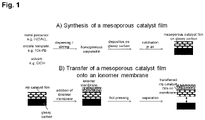
- sequence A a mesoporous catalyst layer is synthesized on a glass-ceramic substrate, particularly preferably a glassy carbon
- sequence B the mesoporous catalyst layer is transferred to the polymer membrane.
- a homogeneous suspension is prepared, the suspension preferably containing a metal precursor (e.g. Ir(OAc) 3 , a solvent (e.g. EtOH) and a micelle-forming template (e.g. 10k-Pb; PEO-PB- PEO)
- a metal precursor e.g. Ir(OAc) 3
- a solvent e.g. EtOH
- a micelle-forming template e.g. 10k-Pb; PEO-PB- PEO
- process B a polymembrane is pressed onto the glass-ceramic substrate with the mesoporous catalyst layer contained thereon at an elevated temperature (hot-pressing process). Finally, the polymer membrane is separated from the glass-ceramic substrate, with the catalyst layer adhering to the polymer membrane.
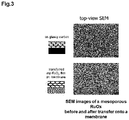
- 3 shows an SEM image (scanning electron microscope) in a comparison with a schematic sketch of mesoporous RuO x layers, at the time before and after a transfer from a glass-ceramic substrate to the polymer membrane. 3 shows the retention of the mesopore morphology during the preferred process sequence, especially after the transfer of the catalyst layer to the polymer membrane.
- FIG. 5 shows photographic and SEM images of catalyst layers on membranes.
- a catalyst-coated membrane produced by a preferred method according to the invention is compared with a catalyst-coated membrane from the prior art.
- the catalyst-coated membrane (i) with a mesoporous oxide layer produced using the preferred method according to the invention shows ordered mesopores and a nanocrystalline structure.
- the catalyst-coated membrane (ii) produced from an ink using a spraying method does not show a defined nanostructure.
- the graph shown shows the electrocatalytic activity of a transfer-method catalyst-coated membrane with templated mesoporous iridium oxide catalyst compared to a spray-method catalyst-coated membrane with commercial Ir catalyst.
- the membrane which is provided with a mesoporous catalyst layer via the transfer method, achieves an Ir mass activity that is about 35% higher than the Als reference system with a comparable geometric Ir loading
- the cathode coating in both catalyst-coated membranes is the same Pt/C catalyst applied via a spraying process.
- the systems differ in the anode coatings.
Landscapes
- Chemical & Material Sciences (AREA)
- Chemical Kinetics & Catalysis (AREA)
- Electrochemistry (AREA)
- Engineering & Computer Science (AREA)
- Materials Engineering (AREA)
- Metallurgy (AREA)
- Organic Chemistry (AREA)
- General Chemical & Material Sciences (AREA)
- Manufacturing & Machinery (AREA)
- Inorganic Chemistry (AREA)
- Physics & Mathematics (AREA)
- Thermal Sciences (AREA)
- Catalysts (AREA)
- Inert Electrodes (AREA)
- Separation Using Semi-Permeable Membranes (AREA)
- Fuel Cell (AREA)
Abstract
Die Erfindung betrifft ein Verfahren zur Herstellung einer katalysatorbeschichteten Polymermembran für einen Elektrolyseur und/oder eine Brennstoffzelle. Dabei umfasst das Verfahren in einem ersten Schritt bevorzugt die Bereitstellung eines Glas-Keramik-Substrats. Anschließend wird bevorzugt eine mesoporöse Katalysatorschicht auf das Glas-Keramik-Substrat synthetisiert. In einem nachfolgenden Schritt wird bevorzugt eine Polymermembran auf das mit der Katalysatorschicht beschichtete Glas-Keramik-Substrat unter einer ersten Temperatur T1 gepresst. Dadurch wird ein Sandwichgebilde erhalten. In einem abschließenden Verfahrensschritt wird das Sandwichgebilde separiert, wobei die Katalysatorschicht vom Glas-Keramik-Substrat getrennt wird und an der Polymermembran haftet.
Zudem betrifft die Erfindung eine Polymermembran, welche durch das Verfahren eingangs genannter Art hergestellt wurde, sowie einen Elektrolyseur oder eine Brennstoffzelle mit einer solchen Polymermembran.
Description
- Die Erfindung betrifft ein Verfahren zur Herstellung einer katalysatorbeschichteten Polymermembran für einen Elektrolyseur und/oder eine Brennstoffzelle. Dabei umfasst das Verfahren in einem ersten Schritt bevorzugt die Bereitstellung eines Glas-Keramik-Substrats. Anschließend wird bevorzugt eine mesoporöse Katalysatorschicht auf das Glas-Keramik-Substrat synthetisiert. In einem nachfolgenden Schritt wird bevorzugt eine Polymermembran auf das mit der Katalysatorschicht beschichtete Glas-Keramik-Substrat unter einer ersten Temperatur T1 gepresst. Dadurch wird ein Sandwichgebilde erhalten. In einem abschließenden Verfahrensschritt wird das Sandwichgebilde separiert, wobei die Katalysatorschicht vom Glas-Keramik-Substrat getrennt wird und an der Polymermembran haftet.
- Zudem betrifft die Erfindung eine Polymermembran, welche durch das Verfahren eingangs genannter Art hergestellt wurde, sowie einen Elektrolyseur oder eine Brennstoffzelle mit einer solchen Polymermembran.
- Brennstoffzellen und Elektrolyseurzellen bestehen aus Elektroden, die durch einen Elektrolyten (lonenleiter) voneinander getrennt sind. Der Elektrolyt kann aus einer semipermeablen Membran bestehen, die nur für eine lonensorte, z. B. Protonen, durchlässig ist. In Elektrolyseurzellen und Brennstoffzellen mit protonenleitender Membran (PEM) werden neben katalysatorbeschichteten Gas Diffusionsschichten (catalyst coated gas diffusion layer - CCG) vor allem katalysatorbeschichtete Membranen (catalyst-coated membranes - CCM), auch als Membran-Elektroden-Einheiten (membrane-electrode-assemblies - MEAs) benannt, eingesetzt.
- Zur Herstellung einer katalysatorbeschichteten Membran werden elektrokatalytisch aktive Katalysatorschichten auf protonenleitende Membranen (Nafion, Aquivion) aufgetragen. Diese werden üblicherweise mit Gasdiffusionsschichten (gas diffusion layers) kontaktiert und in einer Zelle montiert.
- Aus dem Stand der Technik (
US 7972743 B2 undJP 2003211063 A - Die Herstellung einer katalysatorbeschichteten Membran anhand einer aus dem Stand der Technik bekannten Beschichtung, insbesondere einer homogenen Sprühbeschichtung, ist nachteilig zeitaufwendig und ist bei einer manuellen Präparation nicht reproduzierbar. Eine Herstellung mit einem Roboter, bevorzugt einem Sprühroboter, führt zwar zu gleichmäßigeren Ergebnissen, ist aber kostenintensiv.
- Überdies sind indirekte Methoden zur Aufbringung einer Katalysatorschicht auf eine Membran bekannt.
- Die Druckschrift
US20020136940 A1 offenbart beispielsweise ein sogenanntes Decal-Verfahren. Darin wird ein Katalysator auf ein Transfermedium (Teflon) gebracht und von diesem Transfermedium über einen Hotpressing-Schritt auf die ionenleitende Membran überführt. - Die Dokumente
US5879828 A undUS6040077 A offenbaren ebenfalls eine indirekte Methode, wobei ein Polymer(Polyimid)-Substrat als Transfermedium eingesetzt wird. Das Katalysatormaterial wird in den Offenbarungen auf das Transfermedium aufgetragen und anschließend auf eine Nafionmembran gepresst. Als Produkt wird eine Katalysatorschicht umfassende Membran erhalten. - Die bekannten Verfahren (sowohl direkte als auch indirekte Verfahren) zur Herstellung einer katalysatorbeschichten Membran ermöglichen jedoch nachteilig keine nanostrukturierten mesoporösen Katalysatorschichten auf Polymermembranen. Insbesondere derartige Schichten sind jedoch mit wesentlichen Vorteilen verbunden. Es hat sich gezeigt, dass im Halbzellenmaßstab mesoporös templatierte Katalysatorschichten eine deutlich höhere Massenaktivität der elektrochemisch aktiven Spezies aufweisen, als vergleichbare herkömmliche Katalysatorschichten, die bspw. über eine Ink-basierte Methode hergestellt wurden. Der Einsatz von nanostrukturierten mesoporösen Katalysatorschichten auf Polymermembranen in realer Umgebung ist aus dem Stand der Technik nicht bekannt.
- Die Aufgabe der Erfindung war es daher die Nachteile aus dem Stand der Technik zu beseitigen und eine Polymermembran mit einer nanostrukturierten mesoporösen Katalysatorschicht und insbesondere ein Verfahren zur Herstellung einer solchen Polymermembran bereitzustellen.
- Die erfindungsgemäße Aufgabe wird gelöst durch die Merkmale der unabhängigen Ansprüche. Vorteilhafte Ausgestaltungen der Erfindung sind in den abhängigen Ansprüchen beschrieben.
- In einer bevorzugten Ausführungsform betrifft die Erfindung ein Verfahren zur Herstellung einer katalysatorbeschichteten Polymermembran für einen Elektrolyseur und/oder eine Brennstoffzelle
umfassend die nachfolgenden Schritte: - a) Bereitstellung eines Glas-Keramik-Substrats
- b) Synthese einer mesoporösen Katalysatorschicht auf das Glas-Keramik-Substrat
- c) Pressen einer Polymermembran auf das mit der Katalysatorschicht beschichtete Glas-Keramik-Substrat unter einer ersten Temperatur T1, wodurch ein Sandwichgebilde erzeugt wird
- d) Separieren des Sandwichgebildes, wobei die Katalysatorschicht vom Glas-Keramik-Substrat getrennt wird und an der Polymermembran haftet.
- Um höchst leistungsfähigen Katalysatorschichten (nanostrukturierte mesoporöse Katalysatorschichten) in einen PEM-Elektrolyseur zu überführen, musste ein Verfahren entwickelt werden, welches das Aufbringen einer mesoporösen Schicht auf die Polymermembran ermöglicht. Die Erfinder waren mit verschiedenartigen Problemstellungen bei der Entwicklung des bevorzugten Verfahrens konfrontiert und mussten diese durch ein hohes Maß an erfinderischen Überlegungen lösen.
- So kann die Polymermembran nicht direkt mit dem mesoporösen Katalysator beschichtet werden, da die Synthese einer mesoporös templatierten Katalysatorschicht eine thermische Behandlung erfordert, die die Polymermembran zerstören würde. Es musste daher eine Methode gefunden werden, eine intakte Katalysatorschicht zu synthetisieren, und diese anschließend ohne Zerstörung auf die Polymermembran zu überführen. Da die Katalysatorschicht eine hohe Porosität aufweist, ist sie darüber hinaus sehr fragil, daher muss sie auf einem rigiden Substrat erzeugt und thermisch behandelt werden.
- Die Kombination der vorliegenden Verfahrensschritte führt zu einem überraschenden Synergieeffekt, der zu den vorteilhaften Eigenschaften und dem damit einhergehenden Gesamterfolg der Erfindung führt, wobei die einzelnen Merkmale in Wechselwirkung zueinander stehen. Ein wichtiger Vorteil des erfindungsgemäßen Verfahrens ist zudem die überaus schnelle, reproduzierbare und wirtschaftliche Syntheseprozedur.
- Darüber hinaus musste das zu verwendete Substrat sicherstellen, dass die erzeugte Katalysatorschicht zerstörungsfrei auf eine Membran überführt werden kann. Es hat sich überraschend herausgestellt, dass ein Glas-Keramik-Substrat sich besonders gut dafür eignet. Durch die Verwendung eines Glas-Keramik-Substrates zur Synthese einer leicht ablösbaren, trotzdem stabilen, mesoporösen Schicht, kann die Schicht vorteilhaft ohne den Einsatz eines Binders auf eine Polymermembran gepresst werden. Die Vermeidung des Binders führt dabei vorteilhaft bei einer Schicht, die als Katalysator dient, zu einer erhöhten Aktivität aufgrund besser Zugänglichkeit aktiver Zentren.
- Im Sinne der Erfindung ist ein Glas-Keramik-Substrat bevorzugt ein Werkstoff, welcher glasartige und/oder keramische Eigenschaften aufweist. Folgende Eigenschaften sind bevorzugt unter glasartig zu verstehen;
- mit vielen anderen Materialien ohne Wechselwirkungen kombinierbar
- lässt sich bei sehr hohen Temperaturen formen, bleibt im kalten Zustand jedoch formstabil
- verträgt relativ hohe Temperaturen
- gasdicht
- Charakteristische keramische Eigenschaften sind hingegen bevorzugt
- relativ niedrige Zugbelastbarkeit
- sprödes Verhalten
- hohe Temperaturresistenz
- niedrige Temperaturwechselbeständigkeit
- schlechte thermische Leitfähigkeit
- Unlöslichkeit in Wasser,
- Schwerlöslichkeit in Säuren, Basen und Salzlösungen.
- Das Glas-Keramik-Substrat verfügt demnach vorteilhafterweise über eine ausreichende strukturelle Integrität. Darüber hinaus kann es einer thermischen Behandlung in sauerstoffhaltiger Atmosphäre standhalten. Ferner wird einerseits vorteilhaft eine mechanische Haftung der synthetisierten Katalysatorschicht gewährleistet und andererseits trotzdem auch eine Wiederablösung der Schicht ermöglicht.
- Es ist bevorzugt, dass das zu verwendete Substrat auch ausschließlich Glas- oder Keramik-Eigenschaften aufweist.
- Andere Substrate (Titan, Silicium, Quarzglas) sind nicht geeignet, da sie über eine natürliche (Titan), bzw. kontrolliert erzeugte (Silicium) dünne Oxidschicht auf der Oberfläche verfügen. Beschichtet man nun diese Substrate, können auf der Substratoberfläche vorhandene Sauerstofffunktionen während der thermischen Behandlung eine kovalente und/oder ionische Bindungen mit der Katalysatorschicht eingehen, wodurch starke mechanische Haftung resultiert. Diese starke Haftung verhindert eine Übertragung der Katalysatorschicht nach dem Pressvorgang.
- Auch Teflon ist nicht als Substrat geeignet. Unter anderem tritt bei Teflon nämlich im Zusammenhang mit den für die Synthese der nanostrukturierten mesoporösen Katalysatorschicht notwendigen Temperaturen (T3 - thermische Behandlung) Zersetzung unter Bildung gesundheitsschädlicher Dämpfe ein. Die Synthese einer mesoporösen Katalysatorschicht auf das Glas-Keramik-Substrat, welche bevorzugt vor der Auftragung der mesoporöse Katalysatorschicht auf die Polymermembran erfolgt, führt vorteilhaft zu der eingangs benannten indirekten (Transfer-) Methode, sodass eine für die Synthese notwendige thermische Behandlung ermöglicht wird. Wie schon erläutert, würde die Polymermembran unter Einfluss von hohen Temperaturen zerstört werden, sodass ein direktes Synthetisieren ausscheidet. Die indirekte Methode hat sich als besonders bevorzugte Alternative herausgestellt. Nach der erörterten Synthese der Katalysatorschicht auf das Glas-Keramik-Substrat wird eine Polymermembran auf das mit der Katalysatorschicht beschichtete Glas-Keramik-Substrat unter einer ersten Temperatur T1 gepresst. Die mesoporöse Katalysatorschicht wird bevorzugt durch das Pressen (bei erhöhter Temperatur) auf eine Polymermembran überführt. Im Bereich des Glasübergangpunktes der Membran werden die darin enthaltenen Polymerketten mobil und können gegeneinander verschoben werden. Die Katalysatorschicht dringt, abhängig von Temperatur, Anpressdruck und Zeit, eine gewisse Weglänge in die Membran ein. Durch Abkühlen der Membran erstarren die Polymerketten und bilden eine kovalente Bindung mit der Katalysatorschicht. Die Adhäsionskräfte zwischen Katalysator und Membran sind dabei größer als zwischen Katalysatorschicht und Glas-Keramik-Substrat. In einem nachgeschalteten Trennungsschritt wird die Membran abgezogen wodurch der Katalysatorschicht vom Glas-Keramik-Substrat getrennt wird.
- Ein Sandwichgebilde ist im Sinne der Erfindung bevorzugt ein stoffschlüssiger Verbund, wobei dieser bevorzugt aus der Polymembran, Katalysatorschicht und Glas-Keramik-Substrat ausgestaltet ist. Die Polymembran und die Katalysatorschicht sowie das Glas-Keramik-Substrat werden anhand des Pressens unter erhöhtem Druck übereinandergestapelt. Sie sind jedoch ohne große Kraftaufwendungen voneinander lösbar, sodass ein Anwender das Sandwichgebilde beispielsweise mit einer Pinzette oder kleinen Zange voneinander lösen kann (s.
Fig. 2 ). Es hat sich gezeigt, dass durch den Verfahrensschritt des Pressens die mesoporöse Struktur der Katalysatorschicht nicht zerstört wird, sodass diese Struktur vorteilhaft auf die Polymermembran übertragen werden kann. - Unter einer Nanostrukturierung ist bevorzugt die Strukturierung eines Festkörpers auf atomarem Niveau (im Nanomaßstab) zu verstehen. Durch gezielte Modifikation (Implantation) werden atomare, chemische usw. meist oberflächennahe Festkörpereigenschaften verändert.
- Eine nanostrukturierte mesoporöse Katalysatorschicht ist bevorzugt als eine geordnete Nanostruktur der mesoporöse Katalysatorschicht zu verstehen. Das bedeutet, dass einer Katalysatorschicht wiederholend (periodisch) in gleicher Weise in etwa gleiche Strukturelemente (z. B. Mesoporen mit einem Durchmesser von 2 bis 50 nm) umfasst sind (bspw. aneinandergereiht).
- In einer weiteren bevorzugten Ausführungsform ist das Verfahren dadurch gekennzeichnet, dass das Glas-Keramik-Substrat ein Glaskohlenstoff ist.
- Glaskohlenstoff ist ein synthetischer Werkstoff aus reinem Kohlenstoff, der glasartige keramische Eigenschaften mit denen des Graphits vereint und daher besonders bevorzugt für die Verwendung als Glas-Keramik-Substrat geeignet ist. Dass die Verwendung eines solchen Substrates zu einer erfolgreichen Herstellung einer mesoporösen templatierten Katalysatorschicht auf eine Polymermembran geführt hat, war dennoch nicht vorherzusehen. Für den Fachmann ist die Verwendung von Glaskohlenstoff als Substrat bei der Herstellung von Oxidschichten (Katalysatorschichten) ungewöhnlich, da eine thermische Behandlung bei Temperaturen höher als 300 °C und sauerstoffhaltige Atmosphäre erfordert wird. Weiterhin ist die Verwendung von Glaskohlenstoff als Transfermedium im Hotpress-Verfahren (Pressen bei erhöhter Temperatur) ungewöhnlich, da es unter Druck leicht bricht.
- In einer weiteren bevorzugten Ausführungsform können als Glas-Keramik-Substrate bevorzugt Substrate mit graphitischen Kohlenstoffbeschichtungen eingesetzt werden. Der Kohlenstoff in der Beschichtung zeigt ein ähnliches Verhalten auf, wie der Glaskohlenstoff. Ferner eignen sich bevorzugt auch weitere Kohlenstoffmodifikationen für derartige Beschichtungen.
- In einer weiteren bevorzugten Ausführungsform weist das Glas-Keramik-Substrat Materialien und/oder Beschichtungen auf, die sich bei der thermischen Behandlung zersetzen. Die Zersetzung (bzw. Veränderung der Beschichtung) ist dabei bevorzugt gering, sodass die Bindung zwischen templatiert mesoporösem Katalysatorschicht und Substrat geschwächt wird, aber nicht verloren geht. In dem Fall, dass die Ablösung durch thermische Zersetzung der oberen Lage des Substrats nicht gelingt, ist bevorzugt auch eine chemische Behandlung denkbar. Bevorzugt könnte zum Beispiel eine Ätzung oder Ablösung der obersten Substratschicht umgesetzt werden.
- In einer weiteren bevorzugten Ausführungsform ist das Verfahren dadurch gekennzeichnet, dass dem Verfahrensschritt c) und dem Verfahrensschritt d) der nachfolgende Verfahrensschritt zwischensteht:
c1)Abkühlen des Sandwichgebildes, auf eine zweite Temperatur T2 - Das Abkühlen ist insbesondere von hoher Bedeutung, wenn das Sandwichgebilde auf eine Temperatur gebracht wurde, welches oberhalb des Glasübergangspunktes der Polymermembran befindet, denn insbesondere unterhalb der Glasübergangstemperatur bilden sich hohe Adhäsionskräfte zwischen der Katalysatorschicht der Membran. Dies führt zu einer möglichst vollständigen (ohne Schäden) Übertragung der Katalysatorschicht ausgehend vom Glas-Keramik-Substrat auf die Polymermembran. In einer weiteren bevorzugten Ausführungsform ist das Verfahren dadurch gekennzeichnet, dass der Verfahrensschritt b) die nachfolgenden Schritte umfasst:
- (i) Herstellung einer Suspension umfassend ein Templat, einen Metall-Präkursor und ein Lösungsmittel;
- (ii) Auftragen der Suspension auf das Glas-Keramik-Substrat, sodass sich ein Suspensionsfilm auf dem Glas-Keramik-Substrat bildet;
- (iii) Trocknen des Suspensionsfilms auf dem Glas-Keramik-Substrat bei einer Temperatur T4, sodass das Lösungsmittel innerhalb des Suspensionsfilms verdampft und eine Schicht einer Katalysatorvorstufe mit integrierten Templatstrukturen erhalten wird;
- (iv) thermische Behandlung des Katalysatorvorstufen umfassenden Glas-Keramik-Substrats bei einer dritten Temperatur T3 und einer Kalzinierzeit t3, sodass eine mesoporöse Katalysatorschicht entsteht.
- In diesem Zusammenhang wird bevorzugt ein Metallsalz als Katalysatorvorstufe zusammen mit einem Templat in einem geeigneten Lösungsmittel dispergiert und diese Mischung auf das Glas-Keramik-Substrat überführt. Das nachfolgende Verdampfen des Lösungsmittels führt zu einer vorteilhaften periodischen Anordnung des Templats umgeben von einer Katalysatorvorstufe. Eine anschließende thermische Behandlung bei bevorzugten Temperaturen zwischen 300 °C - 600 °C verbrennt das Templat und überführt die Vorstufe in den eigentlichen Katalysator, bevorzugt ein Metalloxid. Durch die Entfernung des Templats entstehen Poren, die miteinander verknüpft sind und besonders vorteilhaft eine hohe Oberfläche für katalytische Prozesse zur Verfügung stellen.
- Die oxidative Zersetzung der obersten Lage des Glas-Keramik-Substrats führt zu einer beginnenden Ablösung der anhaftenden Katalysatorschicht. Die Schicht hält jedoch weiterhin auf dem Substrat. Dieser Effekt ist überraschend, denn der Fachmann erwartet eine komplette Ablösung beziehungsweise ein Zerfall der Oxidschicht auf dem Glas-Keramik-Substrats.
- Die Synthese auf das Glas-Keramik Substrat gelingt, da schon eine kurze Kalzinierzeit (bevorzugt 10 Minuten) bei hoher Temperatur (bevorzugt 300 °C - 600 °C) für die Erzeugung aktiver Katalysatorschicht ausreicht. Lange Kalzinierzeiten können zur Degradation der Katalysatorschicht aufgrund der ausführlicheren Zersetzung des tragenden Glas-Keramik-Substrats führen.
- Der bevorzugte Syntheseansatz basiert auf Templaten die als Platzhalter für ein gewünschtes Porengefüge dienen. Während der Synthese wird das Templat vom umgebenden Material (Katalysatorvorstufe) eingeschlossen und hinterlassen nach ihrer Entfernung ein definiert poröses Material. Abhängig von der Templatgröße entstehen Porenstrukturen mit Porengrößen von einigen Mikrometern bis zu wenigen Nanometern. Materialien mit einer geordneten Porenstruktur und einer monomodalen Porengrößenverteilung können demnach bevorzugt über sogenannte Templatierungsverfahren synthetisiert werden. Bei diesem Syntheseansatz dienen Template als Platzhalter für die gewünschte Porenform.
- In weiteren bevorzugten Ausführungsformen umfasst das Templat bevorzugt Tenside, Block-Copolymere und/oder dendritische Kern-Schalenpolymere. Das Templat führt zu vorteilhaften mesoporösen Strukturierungen innerhalb der Katalysatorschicht, wobei das Templat Mizellen bilden oder aber auch andere Strukturierungen aufweisen kann. Das Templat kann in weiteren Alternativen auch ein nicht Mizellen bildendes Kern-Schale-Makromolekül, gewissermaßen eine unimolekulare Mizelle, umfassen. Weiterhin können Block-Copolymere auch lamellare Strukturen annehmen.
- In einer bevorzugten Ausführungsform sind Template als Softtemplate ausgestaltet. Softtemplate sind verformbare strukturdirigierende Einheiten. Dies können Mizellen oder lamellare Strukturen aus amphiphilen Polymeren (oftmals Block-Copolymere) sein. Typischerweise entstehen die Mizellen oder Lamellen oberhalb einer kritischen Konzentration eines in einem Lösungsmittel dispergierten Polymers. Zu den Softtemplaten gehören auch dendritische oder hyperverzweigte Kern-Schalenpolymere, wobei Kern und Schale der Polymere unterschiedliche Hydrophilizitäten zeigen, somit auch amphiphil sind.
- In einer weiteren bevorzugten Ausführungsform sind Template als Hardtemplate ausgestaltet. Hardtemplate sind starre sturkturdirigierende Einheiten. Zu nanostrukturierte Hardtemplaten zählen Metalle, Oxide, oftmals Siliziumoxide (z.B. MCM-Gruppe, SBA-Gruppe, FDU-Gruppe, KIT-Gruppe, MSU-Gruppe, TUD-Gruppe, HMM-Gruppe, FSM-Gruppe) sowie Kohlenstoffe (z.B. CMK-Gruppe). Es kann sich bei diesen Hardtemplaten um einzelne Nanopartikel oder um nanostrukturierte größere Gebilde handeln.
- In einer weiteren bevorzugten Ausführungsform ist das Verfahren dadurch gekennzeichnet, dass die Temperatur T1 in einem Bereich liegt zwischen 80°C und 800°C, bevorzugt in einem Bereich zwischen 100°C und 300°C und insbesondere bei 120°C.
- Das Pressen bei erhöhten Temperaturen, bevorzugt in den Bereichen von 80°C und 800°C, ermöglicht vorteilhaft ein Pressen mit geringen Kräften, wobei die Transferierung (vom Glas-Keramik-Substrat zur Polymermembran) der mesoporösen Katalysatorschicht - trotz der geringen Kräfte- möglich ist. Erhöhte Temperaturen führen zu einer verbesserten Reaktion der verschiedenen Werkstoffe im Sandwichgebilde und ermöglichen ein vollständiges Übertragen der Katalysatorschicht vom Glas-Keramik-Substrat auf die Polymermembran. In dem Bereich von 100°C und 300°C werden die Kosten der aufzubringenden Energie relativ geringgehalten, wobei die Pressdauer auf ein Minimum reduziert werden kann. Das Pressen bei etwa 120 °C führt zu besonders guten reproduzierbaren Ergebnissen, sodass der Prozess automatisiert abfolgen kann. Darüber hinaus wird ein besonders einfach zu separierendes Sandwichgebilde erhalten Insbesondere ist die Temperatur von etwa 120 °C für Verwendung einer Nafionmembran als Polymermembran besonders vorteilhaft, da diese eine Glasübergangstemperatur bei 110° C aufweist.
- Für die Aufwendung der Presskraft wird bevorzugt eine manuelle hydraulische Hitzepresse verwendet, wobei das Sandwichgebilde über zwei Heizplatten, welche oberhalb und unterhalb des Gebildes angeordnet sind, erwärmt wird. Es sind jedoch auch andere Varianten möglich, um die Presskraft und die bevorzugte Temperatur T1 zu erhalten. So kann beispielsweise der Transfer mit einer Hand eines Anwenders erfolgen, in dem das Sandwichgebilde beispielsweise mit einem Heißluftstrom, einer Heizplatte oder einem Ofen ausreichend erwärmt wird und anschließend mit der Hand festgedruckt wird.
- Vorteilhaft ist durch das erfindungsgemäße Verfahren eine Beschichtung bzw. eine Synthese einer mesoporösen Katalysatorschicht auf ein komplex strukturiertes Glas-Keramik-Substrat möglich. Dieses wiederum kann im Zuge der vorliegenden Erfindung während des Transfers der Katalysatorschicht auf die Polymermembran (im Sandwichgebilde) als Stempel für die Bildung von Mustern (oder ähnlichen) auf der Polymermembran dienen. Weiterhin bevorzugt kann das Glas-Keramik-Substrat auch sehr klein ausgestaltet sein, sodass im Zusammenspiel mit anderen Glas-Keramik-Substraten ein Muster auf der Membran entstehen kann.
- Alle in diesem Dokument offenbarten Parameterbereiche, wie bspw. Temperaturen, Kräfte, Drücke, Abstände etc., umfassen selbstverständlich alle Werte innerhalb der angegebenen Bereiche sowie deren maximalen und minimalen Grenzwerte. Es ist für einen Fachmann ersichtlich, dass die Werte auch gewissen Schwankungen unterliegen. Im vorliegenden Fall handelt sich demnach um einen Temperaturberiech von etwa 80°C und 800°C, und bevorzugt etwa 100°C und 300°C und insbesondere etwa 120°C. Dies lässt sich auch auf alle weiteren Parameterbereiche des Dokumentes analog übertragen.
- Begriffe wie "im Wesentlichen", "ungefähr", "etwa", "ca." etc. beschreiben bevorzugt einen Toleranzbereich von weniger als ± 40%, bevorzugt weniger als ± 20%, besonders bevorzugt weniger als ± 10 %, noch stärker bevorzugt weniger als ± 5% und insbesondere weniger als ± 1% und umfassen stets den exakten Wert. "Ähnlich" beschreibt bevorzugt Größen die "ungefähr gleich" sind. "Teilweise" beschreibt bevorzugt zu mindestens 5 %, besonders bevorzugt zu mindestens 10 %, und insbesondere zu mindestens 20 %, in einigen Fällen zu mindestens 40 %.
- In einer weiteren bevorzugten Ausführungsform ist das Verfahren dadurch gekennzeichnet, dass die Polymermembran auf das mit der Katalysatorschicht beschichtete Glas-Keramik-Substrat mit einem Anpressdruck p1 in einem Bereich von 1000 N/cm2 bis 3000 N/cm2 und einer Zeit t1 in einem Bereich von 5 min bis 60 min gepresst wird.
- In den beschriebenen Druckbereichen von 1000 N/cm2 bis 3000 N/cm2 kann bevorzugt eine kurze Prozesszeit erreicht werde. Der Druck führt darüber hinaus dazu, dass Glas-Keramik-Substrat nicht zerstört wird, wobei vorteilhaft der Druck das Interagieren der Verbundpartner ermöglicht, sodass die mesoporöse Katalysatorschicht eine kovalente Bindung mit den Polymerketten der Polymermembran eingehen kann.
- In einer weiteren bevorzugten Ausführungsform ist das Verfahren dadurch gekennzeichnet, dass die Polymermembran auf das mit der Katalysatorschicht beschichtete Glas-Keramik-Substrat mit einem Anpressdruck p1 in einem Bereich von 300 N/cm2 bis 10000 N/cm2 und einer Zeit t1 in einem Bereich von 5 s bis 300 min gepresst wird. Der benannte Druckbereich in Kombination mit dem Zeitbereich führt vorteilhaft im Ergebnis zu einer besonders gleichmäßig ausgeprägten mesoporösen Katalysatorschicht.
- Für die Dauer der Pressung (bis zur Separation der Polymermembran) liegt der Verbund aus Glas-Keramik-Substrat als ein Sandwichgebilde vor.
- In einer weiteren bevorzugten Ausführungsform ist das Verfahren dadurch gekennzeichnet, dass die Polymermembran auf das mit der Katalysatorschicht beschichtete Glas-Keramik-Substrat mit einem Anpressdruck p1 in einem Bereich von etwa 2000 N/cm2 und einer Zeit t1 in einem Bereich von etwa 15 min gepresst wird. Bevorzugt wurde die Pressung unter einer Temperatur von etwa 120°C durchgeführt. Es hat sich gezeigt, dass unter Durchführung dieser Parameter besonders gute mesoporöse Katalysatorschichten auf Polymembranen aufbringen lassen. Dabei ergeben sich vorteilhafterweise synergistische Effekte von Anpressdruck, Anpresszeit und Anpresstemperatur, welche zu einer besonders langen Lebensdauer der Polymermembran führen.
- In einer weiteren bevorzugten Ausführungsform wird die Polymermembran auf das mit der Katalysatorschicht beschichtete Glas-Keramik-Substrat mit einem Anpressdruck p1 von insbesondere etwa. 200 kg/m2 gepresst.
- In einer weiteren bevorzugten Ausführungsform wird die Polymermembran auf das mit der Katalysatorschicht beschichtete Glas-Keramik-Substrat mit einer Zeit von etwa t1= 15 min durchgeführt.
- In einer weiteren bevorzugten Ausführungsform ist das Verfahren dadurch gekennzeichnet, dass die Temperatur T2 einer Temperatur unterhalb des Glaspunktes der Polymermembran entspricht und die Temperatur T4 in einem Bereich zwischen 18°C -80°C liegt.
- Sobald die Temperatur T2 auf eine Temperatur unterhalb des Glaspunktes der Polymermembran abgekühlt ist, kann die Sandwichgebilde separiert werden, denn durch Abkühlen der Membran unterhalb des Glaspunktes erstarren die Polymerketten und bilden eine starke Haftung (aufgrund von kovalenter Bindung und/oder Van der Waals-Kräfte) mit der Katalysatorschicht aus. Da die Temperatur unterhalb des Glaspunktes schon ausreicht und nicht weiter heruntergekühlt werden muss, können vorteilhaft relativ kurze Prozesszeiten erreicht werden. Darüber hinaus müssen keine Kühlaggregate angewendet, um ein schnelles Abkühlen zu ermöglichen.
- In einer bevorzugten Ausführungsform wird das Sandwichgebilde nach dem Heizpressen von den Heizplatten distanziert, sodass das Sandwichgebilde vorteilhaft schnell abkühlen kann. Bevorzugt liegt die Temperatur T2 bei etwa 50°C.
- Im Fall einer Nafionmembran ist die Temperatur T2 bevorzugt unterhalb von 110°. Stärker bevorzugt liegt die Temperatur T2 zwischen 18°C und 108°C. Es sind jedoch auch durchaus Varianten vorstellbar in denen die Temperatur T2 bei sehr niedrigen Temperaturen <0°C liegt.
- Das Trocknen der Schicht auf dem Glaskohlenstoffsubstrat kann im Temperaturbereich von der Raumtemperatur bis 80°C stattfinden. Dadurch wird vorteilhaft nur sehr wenig Energie aufgebracht. Zudem reicht für derartige Temperaturen die Abwärme der Erwärmungsanlagen als Trocknungsenergie um ein schnelles Trocknen des Suspensionsfilms zu erhalten. Dies führt darüber hinaus zu großen wirtschaftlichen Ersparnissen des Verfahrens.
- In einer bevorzugten Ausführungsform findet die thermische Behandlung in Erwärmungsanlagen statt. Zur Entfernung des Templats kann beispielsweise ein Rohrofen im Luftstrom oder Muffelofen verwendet werden. Derartige Öfen weisen eine gleichmäßige Temperaturverteilung auf, sodass die Wiederholbarkeit des Verfahrens vorteilhaft gegeben ist. Ferner kann die Abwärme der Öfen vorteilhaft für weitere Verfahrensschritte (z.B. Trocknung) verwendet werden, um damit einhergehend Energie zu sparen.
- In einer weiteren bevorzugten Ausführungsform kann die thermische Behandlung auch - anstelle einer Erwärmung durch einen Ofen - mit weiteren folgenden Verfahren erfolgen. Bevorzugt wird das Katalysatorvorstufen umfassenden Glas-Keramik-Substrat über Rapid Thermal Annealing (RTA) mit der Abwärme einer Halogenlampe thermisch behandelt. Weiterhin bevorzugt wird das Katalysatorvorstufen umfassenden Glas-Keramik-Substrat über ein Flash-Lamp Annealing erwärmt. Dies führt vorteilhaft zu einer schnellen Aufheizung und einer ausschließlichen Erhitzung der Oberfläche. Darüber hinaus ist das Verfahren Laser Annealing ebenso bevorzugt. Dieses Verfahren führt zu einer noch schnelleren Erwärmung des Katalysatorvorstufen umfassenden Glas-Keramik-Substrats, wobei eine sehr geringe Eindringtiefe erreicht wird und ausschließlich die Oberfläche erhitzt wird. Möglich wäre die Erhitzung eines geeigneten Substrates mit einem Induktionsofen. Auch dies führt zu einer sehr schnellen Erhitzung.
- In einer weiteren bevorzugten Ausführungsform ist das Verfahren dadurch gekennzeichnet, dass die Temperatur T3 in einem Bereich liegt zwischen 200°C und 700°C, bevorzugt zwischen 300°C und 600°C, und die Kalzinierzeit t3 in einem Bereich liegt zwischen 1 Minute und 1440 Minuten, insbesondere bei 10 Minuten.
- Um das Templat thermisch zu zersetzten und die anorganische Spezies in ein kristallines Metalloxid umzuwandeln, wird die Katalysatorvorstufe bevorzugt kalziniert.
- Die Kalzinierung führt zu einem drastischen Volumenverlust der Schicht, verursacht durch die Verbrennung des Templats und der Umwandlung der amorphen Porenwand zu einem kristallinen Material. Da die Haftung der Schicht auf dem Substrat vergleichsweise stark ist, u.a. durch kovalente Bindungen zwischen der Substratoberfläche und der Metalloxid-Spezies, kommt es zu einer Kontraktion der Schicht ausschließlich senkrecht zum Substrat, ohne dass der Schicht reißt.
- In einer weiteren bevorzugten Ausführungsform ist das Verfahren dadurch gekennzeichnet, dass das Templat ein oder mehrere amphiphile Block-Copolymere umfasst.
- Bevorzugte Template für die Synthese von geordnet mesoporösen Feststoffen sind amphiphile Moleküle. Diese bilden vorteilhaft durch Selbstorganisation Mizellen aus und ordnen sich zu flüssigkristallinen Phasen. Diese Flüssigkristalle, mit einer Nanostrukturierung von typischerweise 2 nm bis 50 nm, dienen bevorzugt als Endotemplate bei der Synthese von mesoporösen Oxiden.
- In einer weiteren bevorzugten Ausführungsform wird das Katalysatorvorstufen umfassenden Glas-Keramik-Substrats in einer inerten Atmosphäre thermisch behandelt. Die Block-Copolymer-Substrate zersetzen sich nämlich auch in inerten Atmosphären bei Temperaturen oberhalb von 350°C. Falls die Katalysatorsynthese in inerter Atmosphäre durchgeführt wird, wird anschließend bevorzugt eine weitere thermische Behandlung in Luftatmosphäre durchgeführt, um die Bindung zwischen Katalysatorschicht und Glas-Keramik-Substrat zu schwächen.
- Für die Templatierung von geordnet mesoporösen Katalysatorschichten werden bevorzugt amphiphilen Blockcopolymere verwendet, die einen hydrophilen Polyethylenoxidblock (PEO) aufweisen
- In einer weiteren bevorzugten Ausführungsform ist das Verfahren dadurch gekennzeichnet, dass das amphiphile Block-Copolymer ausgewählt ist aus der Gruppe umfassend AB-Block Copolymeren (Polyethylenoxid-block-polystyrene (PEO-PS), Polyethylenoxid-block-polymethylmethacrylat (PEO-PMMA), Poly-2-venlypyridin-block-polyallylmethacrylat (P2VP-PAMA), Polybutadien-bockpolyethyleneoxid (PB-PEO), Polyisopren-bock-polydimethylaminoethylmetacrlyt (PI-PDMAEMA), Polybutadien-bock-polydimethylaminoethylmetacrlyt (PB-PDMAEMA), Polyethylen-block-polyethylenoxid (PE-PEO), Polyisobutylen-block-po-lyethylenoxid (PIB-PEO) und Poly(ethylen-co-buty-len)-block-poly(ethylenoxid) (PEB-PEO), Polystyrol-block-poly(4-vinylpyridin) (PS-P4VP), Polyisopren-block-polyethyleneoxid (PI-PEO), Polydimethoxyanilin-block-polystyrol (PDMA-PS), Polyethylenoxid-blockpoly-n-utylacrylat (PEO-PBA), Polybutadien-bock- poly(2-vinylpyridin (PB-P2VP)), Polyethylenoxid-block-polylactid (PEO-PLA), Polyethylenoxid-block-polyglycolid (PEO-PLGA), Polyethylenoxid-block-polycaprolacton (PEO-PCL), Polyethylen-block-polyethylenglycol (PE-PEO), Polystyrol-block-polymethylmethacrlyt (PS-PMMA), Polystyrol-block-polyacrylsäure (PS-PAA), polypyrrol-block-polycaprolacton (PPy-PCL), Polysilicon-block-polyetylenoxid (PDMS-PEO), ABA-Block Copolymeren (Polyethylenoxid-block-polybutadien-block-polyethylenoxid (PEO-PB-PEO), Polyethylenoxid-block-polypropylenoxid-block-polyethylenoxid (PEO-PPO-PEO), Polypropylenoxid-block-polyethylenoxid-block-polypropylenoxid (PPO-PEO-PPO), Polyethylenoxid-block-polyisobutylen-block-polyethylenoxid (PEO-PIB-PEO), Polyethylenoxid-block-polybutadien-block-polyethylenoxid (PEO-PB-PEO),), Polylactid-block-polyethylenoxid-block-polylactidd (PLA-PEO-PLA), Polyglycolid-block-polyethylenoxid-block-polyglycolid (PGLA-PEO-PGLA), Polylactid-cocaprolacton-block-polyethylenoxid-block-polylactid-co-caprolacton (PLCL-PEO-PLCL), Polycaprolacton-blockpolytetrahydrofuran-blockpolycaprolacton (PCL-PTHF-PCL), Polypropylenoxid-block-Polyethylenoxid-block-polypropylenoxid (PPG-PEO-PPG), Polystyrol-block-polybutadien-block-polystyrol (PS-PB-PS), Polystyrol-blockpolyethylen-ran-butylen-block-polystyrol (PS-PEB-PS), Polystyrol-block-polyisopren-block-polystyrol (PS-PI-PS), ABC-Block Coplymeren (Polyisopren-block-polystyrol-block-polyethyleneoxid (PI-PS-PEO), Polystyrol-block-Polyvinylpyrrolidon-block-polyethyleneoxid (PS-PVP-PEO), Polystyrol-block-poly-2-venylpyridin-block-polyethylenoxid (PS-P2VP-PEO), Polystyrol-block-poly-2-venylpyridin-block-polyethylenoxid (PS-P2VP-PEO), Polystyrol-block-polyacrylsäure-polyethylenoxid (PS-PAA-PEO)), Polyethylenoxid-block-polylactid-block-decan (PEO-PLA-decan),
sowie anderen amphiphilen Polymeren (Polyethylenoxid-alkylether (PEO-Cxx), z.B. Brij35, Brij56, Brij58) oder Gemischen dieser, vorzugsweise PEO-PB, PEO-PPO, PEO-PB-PEO, PEO-PPO-PEO - In einer weiteren bevorzugten Ausführungsform ist das Verfahren dadurch gekennzeichnet, dass als Metall-Präkursor ein Metallsalz oder mehrere Metallsalze jeweils unterschiedlicher Metalle, oder deren Hydrate, eingesetzt werden.
- In weiteren bevorzugten Ausführungsformen können auch Metallnanopartikel als Metall-Präkursor eingesetzt werden, die mit Hilfe von Polymertemplaten mesoporöstemplatiert als Schicht abgeschieden werden können. Metallnanopartikel sind vorteilhaft ggf. als Abfallprodukte aus der Industrie zu erhalten und demnach in einem Recycle-Prozess wieder zu verwerten.
- In einer weiteren bevorzugten Ausführungsform ist das Verfahren dadurch gekennzeichnet, dass die Metallsalze ausgewählt sind aus der Gruppe umfassend Metallnitrat, Metallhalogenid, Metallsulfat, Metallacetat, Metallcitrat, Metallalkoxid oder deren Gemischen.
- In alternativen Ausführungsformen sind auch weitere Salze einsetzbar sofern sie im geeigneten Lösungsmittel, ggf. unter Zugabe weiterer komplexierender Stoffe, löslich sind.
- In einer weiteren bevorzugten Ausführungsform ist das Verfahren dadurch gekennzeichnet, dass die im Metall-Präkursor enthaltenen Metalle ausgewählt sind aus der Gruppe umfassend Alkalimetallen, vorzugsweise Lithium, Natrium, Kalium, Rubidium, Cäsium, Erdalkalimetallen, vorzugsweise Magnesium, Calcium, Strontium, Barium, Metallen der dritten Hauptgruppe des Periodensystems, vorzugsweise Bor, Aluminium, Indium, Gallium, Thallium, Metallen der vierten Hauptgruppe des Periodensystems, vorzugsweise Zinn, Silicium, Germanium, Blei, Metallen der fünften Hauptgruppe des Periodensystems, vorzugsweise Bismut, und Übergangsmetallen, vorzugsweise Iridium, Ruthenium, Cobalt, Zink, Kupfer, Mangan, Cadmium, Vanadium, Yttrium, Zirkonium, Scandium, Titan.
- In einer bevorzugten Ausgestaltung ist das Verfahren dadurch gekennzeichnet, dass Ruthenium und/oder Iridium als Metall-Präkursor verwandet werden. Insbesondere diese beiden Metalle führen zu einer Katalysatorschicht, welche eine hohe Stabilität aufweist.
- In einer weiteren bevorzugten Ausführungsform ist das Verfahren dadurch gekennzeichnet, dass als Lösungsmittel Wasser oder ein C1-C4-Alkohol, C2-C4-Ester, C2-C4-Ether, Formamid, Acetonitril, Aceton, Tetrahydrofuran, Benzyl, Toluol, Dimethylsulfoxid, Dichlormethan, Chloroform oder deren Mischungen eingesetzt werden, vorzugsweise Methanol, Ethanol, Formamid und/oder Tetrahydrofuran.
- Die Vorteile und bevorzugten Ausführungsformen des erfindungsmäßen Verfahrens sind analog auf die erfindungsgemäße Polymermembran, sowie Brennstoffzelle oder Elektrolyseur zu übertragen und umgekehrt.
- In einer weiteren bevorzugten Ausführungsform betrifft die Erfindung eine Polymermembran für eine für einen Elektrolyseur und/oder eine Brennstoffzelle, bevorzugt hergestellt durch ein Verfahren der eingangs genannten Art, umfassend eine nanostrukturierte mesoporöse Katalysatorschicht.
- Eine Polymermembran umfassend eine nanostrukturierte mesoporöse Katalysatorschicht führt zu wesentlichen Vorteilen. So ist die höhere Massenaktivität der Spezies einer mesoporösen Katalysatorschicht nachgewiesen worden (vgl. auch
Fig. 6 ). - In einer weiteren bevorzugten Ausführungsform betrifft die Erfindung eine Brennstoffzelle oder Elektrolyseur umfassend eine Polymermembran der eingangs genannten Art. Der Verwendung einer erfindungsgemäßen Polymermembran führt zu verbesserter Energiegewinnung (erzeugter Strom pro Milligramm Pt).
- Die Anwendung in PEM Elektrolyseuren sowie Brennstoffzellen, zur Erzeugung respektive Rückverstromung von Wasserstoff, ist insbesondere bevorzugt.
- Die erfindungsgemäße bevorzugte nanostrukturierte mesoporöse Polymermembran kann bevorzugt auch in anderen Bereichen eingesetzt werden. In der Medizintechnik werden bevorzugt mesoporöse Materialien als Wirkstoffträger verwendet. Makromoleküle werden im porösen System gespeichert und können über einen längeren Zeitraum verteilt als Wirkstoff an geeigneter Stelle abgegeben werden. Hier ist die gezielte Einstellbarkeit der Porosität und des Materials ein wichtiger Faktor.
- Weiterhin sind Anwendungen nanostrukturierte mesoporöse Polymermembran in Bezug auf eine stoffliche Trennung - wie im Zusammenhang einer Fitration oder Osmose - denkbar.
- Im Folgenden soll die Erfindung an Hand von Figuren näher erläutert werden, ohne auf diese beschränkt zu sein.
-
- Fig. 1
- Schematische Ablaufdarstellung des bevorzugten Verfahrens zur Herstellung einer katalysatorbeschichteten Polymermembran
- Fig. 2
- Graphische Darstellung zusammen mit schematischen Skizzen vor (A) und nach (B) der Transferierung einer mesoporösen Katalysatorschicht auf eine kreisförmige Membran
- Fig. 3
- REM-Darstellung in Gegenüberstellung einer schematischen Skizze von mesoporösen RuOx-Schichten, zum Zeitpunkt vor und nach einem Transfer von einem Glas-Keramik-Substrat auf die Polymermembran
- Fig. 4
- REM-Darstellung von mesoporösen IrOx-Schichte, welche bei unterschiedlichen Temperaturen kalziniert wurden, zum Zeitpunkt vor und nach einem Transfer von einem Glas-Keramik-Substrat auf die Polymermembran
- Fig. 5
- Vergleich einer transferierten mesoporösen IrOx-Schicht mit einer konventionellen IrOx-Schicht, der auf Nafion-Membranen mit ähnlichen geometrischen Ir-Belastungen hergestellt wurde
- Fig. 6
- Darstellung in einem Diagramm der elektrokatalytische Aktivität einer über die das erfindungsgemäße bevorzugte Verfahren hergestellten katalysatorbeschichteten Membran mit templatiertem mesoporösen Iridiumoxid Katalysator im Vergleich zu einer über eine Sprühmethode hergestellte katalysatorbeschichteten Membran mit kommerziellem Ir-Katalysator
-
Fig. 1 illustriert in einer schematische Ablaufdarstellung ein bevorzugtes Verfahren zur Herstellung einer katalysatorbeschichteten Polymermembran für einen Elektrolyseur und/oder eine Brennstoffzelle. Das Verfahren ist bevorzugt in zwei Abläufe zu unterteilen. Einerseits (Ablauf A) wird eine mesoporöse Katalysatorschicht auf ein Glas-Keramik-Substrat, besonders bevorzugt ein Glaskohlenstoff, synthetisiert, andererseits (Ablauf B) wird die mesoporöse Katalysatorschicht auf die Polymermembran übertragen. - In einem ersten Schritt des Ablaufs A wird eine homogene Suspension hergestellt, wobei die Suspension bevorzugt einen Metall-Präkursor (z.B. Ir(OAc)3, ein Lösungsmittel (z.B. EtOH) und ein Mizellen bildendes Templat (z.B. 10k-Pb; PEO-PB-PEO) umfasst. In einem nächsten Schritt wird die Suspension auf ein Glas-Keramik-Substrat, besonders bevorzugt ein Glaskohlenstoff, aufgetragen und in Luft kalziniert, sodass eine mesoporöse Katalysatorschicht entsteht.
- Im Ablauf B wird eine Polymembran auf das Glas-Keramik-Substrat mit der darauf enthaltenden mesoporösen Katalysatorschicht unter einer erhöhten Temperatur (HotPressing Verfahren) gepresst. Abschließend wird die Polymermembran vom Glas-Keramik-Substrat getrennt, wobei die Katalysatorschicht auf der Polymermembran haftet.
- Die in
Fig. 2 abgebildete Darstellungsfolge zeigt einen bevorzugten Ablauf des Verfahrens zur Herstellung einer katalysatorbeschichteten Polymermembran. Insbesondere wird eine graphische Darstellung zusammen mit schematischen Skizzen vor (A) und nach (B) der Transferierung einer mesoporösen Katalysatorschicht auf eine kreisförmige Membran illustriert. Ein Glaskohlenstoff wird mit einer mesoporösen RuOx-Katalysatorschicht bereitgestellt. Anschließend wird eine Nafion-Membran auf den Glaskohlenstoff umfassend der Katalysatorschicht gepresst, wobei nach dem Separieren des Pressverbundes die Katalysatorschicht auf der Membran haftet. -
Fig. 3 zeigt eine REM-Darstellung (Rasterelektronenmikroskop) in einer Gegenüberstellung mit einer schematischen Skizze von mesoporösen RuOx-Schichten, zum Zeitpunkt vor und nach einem Transfer von einem Glas-Keramik-Substrat auf die Polymermembran.Fig. 3 zeigt dabei den Beibehalt der Mesoporenmorphologie während des bevorzugten Verfahrensablaufs auf, insbesondere nach dem Transfer der Katalysatorschicht auf die Polymermembran. -
Fig. 4 zeigt eine REM-Darstellung von mesoporösen IrOx-Schichten, welche bei unterschiedlichen Temperaturen kalziniert wurden, zum Zeitpunkt vor und nach einem Transfer von einem Glas-Keramik-Substrat auf die Polymermembran. Auch bei unterschiedlichen Temperaturen wird die Mesoporenmorphologie der Katalysatorschicht beibehalten. -
Fig. 5 zeigt photographische sowie REM-Aufnahmen von Katalysatorschichten auf Membranen. Eine katalysatorbeschichtete Membran hergestellt durch ein erfindungsgemäßes bevorzugtes Verfahren wird dabei mit einer katalysatorbeschichteten Membran aus dem Stand der Technik verglichen. Die über das erfindungsgemäße bevorzugte Verfahren hergestellte katalysatorbeschichtete Membran (i) mit einer mesoporösen Oxidschicht zeigt geordnete Mesoporen und eine nanokristalline Struktur auf. Die auf der aus einem Ink über eine Sprühmethode hergestellte katalysatorbeschichtete Membran (ii) zeigt hingegen keine definierte Nanostruktur auf. - Das in
Fig. 6 dargestellte Diagramm zeigt die elektrokatalytische Aktivität einer über die Transfermethode hergestellten katalysatorbeschichteten Membran mit templatiertem mesoporösen Iridiumoxid Katalysator im Vergleich zu einer über eine Sprühmethode hergestellte katalysatorbeschichteten Membran mit kommerziellem Ir-Katalysator. Die über die Transfermethode mit einer mesoporösen Katalysatorschicht versehene Membran erreicht bei vergleichbarer geometrischen Ir-Beladung, eine um etwa 35% höhere Ir-Massenaktivität als das Referenzsystem Als Kathodenbeschichtung dient in beiden katalysatorbeschichteten Membranen der gleiche Pt/C Katalysator, der über eine Sprühverfahren aufgebracht wurde. Die Systeme unterscheiden sich in den Anodenbeschichtungen.
Claims (15)
- Verfahren zur Herstellung einer katalysatorbeschichteten Polymermembran für einen Elektrolyseur und/oder eine Brennstoffzelle
umfassend die nachfolgenden Schritte:a) Bereitstellung eines Glas-Keramik-Substrats;b) Synthese einer mesoporösen Katalysatorschicht auf das Glas-Keramik-Substrat;c) Pressen einer Polymermembran auf das mit der Katalysatorschicht beschichtete Glas-Keramik-Substrat unter einer ersten Temperatur T1, wodurch ein Sandwichgebilde erzeugt wird;d) Separieren des Sandwichgebildes, wobei die Katalysatorschicht vom Glas-Keramik-Substrat getrennt wird und an der Polymermembran haftet. - Verfahren nach Anspruch 1
dadurch gekennzeichnet, dass
das Glas-Keramik-Substrat ein Glaskohlenstoff ist. - Verfahren nach einem oder beiden der vorhergehenden Ansprüche
dadurch gekennzeichnet, dass
dem Verfahrensschritt c) und dem Verfahrensschritt d) der nachfolgende Verfahrensschritt zwischensteht:
c1)Abkühlen des Sandwichgebildes, auf eine zweite Temperatur T2. - Verfahren nach einem oder mehreren der vorhergehenden Ansprüche
dadurch gekennzeichnet, dass
der Verfahrensschritt b) die nachfolgenden Schritte umfasst:(i) Herstellung einer Suspension umfassend, ein Templat, einen Metall-Präkursor und ein Lösungsmittel;(ii) Auftragen der Suspension auf das Glas-Keramik-Substrat, sodass sich ein Suspensionsfilm auf dem Glas-Keramik-Substrat bildet;(iii) Trocknen des Suspensionsfilms auf dem Glas-Keramik-Substrat bei einer Temperatur T4, sodass das Lösungsmittel innerhalb des Suspensionsfilms verdampft und eine Schicht einer Katalysatorvorstufe mit integrierten Templatstrukturen erhalten wird;(iv) thermische Behandlung des Katalysatorvorstufen umfassenden Glas-Keramik-Substrats bei einer dritten Temperatur T3, und einer Kalzinierzeit t3, sodass eine mesoporöse Katalysatorschicht entsteht. - Verfahren nach einem oder mehreren der vorhergehenden Ansprüche
dadurch gekennzeichnet, dass
die Temperatur T1 in einem Bereich liegt zwischen 80°C und 800°C, bevorzugt in einem Bereich zwischen 200°C und 600°C und insbesondere bei 400°C. - Verfahren nach einem oder mehreren der vorhergehenden Ansprüche
dadurch gekennzeichnet, dass
die Polymermembran auf das mit der Katalysatorschicht beschichtete Glas-Keramik-Substrat mit einem Anpressdruck p1 in einem Bereich von100 N/cm2 bis 10000 N/cm2, bevorzugt 1000 N/cm2 bis 3000 N/cm2 und einer Zeit t1 in einem Bereich von 5 s bis 300 min, bevorzugt 5 min bis 60 min gepresst wird. - Verfahren nach Anspruch 3
dadurch gekennzeichnet, dass
die Temperatur T2 einer Temperatur unterhalb des Glaspunktes der Polymermembran entspricht und die Temperatur T4 in einem Bereich zwischen 18°C -80°C liegt und/oder die Temperatur T3 in einem Bereich liegt zwischen 200°C und 700°C, bevorzugt zwischen 300°C und 600°C, und die Kalzinierzeit t3 in einem Bereich liegt zwischen 1 Minute und 1440 Minuten, insbesondere bei 10 Minuten. - Verfahren nach Anspruch 4
dadurch gekennzeichnet, dass
die Suspension ein oder mehrere amphiphile Block-Copolymere umfasst. - Verfahren nach Anspruch 8
dadurch gekennzeichnet, dass
das amphiphile Block-Copolymer ausgewählt ist aus der Gruppe umfassend:AB-Block Copolymeren (Polyethylenoxid-block-polystyrene (PEO-PS), Polyethylenoxid-block-polymethylmethacrylat (PEO-PMMA), Poly-2-venlypyridin-block-polyallylmethacrylat (P2VP-PAMA), Polybutadien-bockpolyethyleneoxid (PB-PEO), Polyisopren-bock-polydimethylaminoethylmetacrlyt (PI-PDMAEMA), Polybutadien-bock-polydimethylaminoethylmetacrlyt (PB-PDMAEMA), Polyethylen-block-polyethylenoxid (PE-PEO), Polyisobutylen-block-po-lyethylenoxid (PIB-PEO) und Poly(ethylen-co-buty-len)-block-poly(ethylenoxid) (PEB-PEO), Polystyrol-block-poly(4-vinylpyridin) (PS-P4VP), Polyisopren-block-polyethyleneoxid (PI-PEO), Polydimethoxyanilin-block-polystyrol (PDMA-PS), Polyethylenoxid-block-poly-n-utylacrylat (PEO-PBA), Polybutadien-bock- poly(2-vinylpyridin (PB-P2VP)), Polyethylenoxid-block-polylactid (PEO-PLA), Polyethylenoxid-block-polyglycolid (PEO-PLGA), Polyethylenoxid-block-polycaprolacton (PEO-PCL), Polyethylen-block-polyethylenglycol (PE-PEO), Polystyrol-block-polymethylmethacrlyt (PS-PMMA), Polystyrol-block-polyacrylsäure (PS-PAA), polypyrrol-block-polycaprolacton (PPy-PCL), Polysilicon-block-polyetylenoxid (PDMS-PEO),ABA-Block Copolymeren (Polyethylenoxid-block-polybutadien-block-polyethylenoxid (PEO-PB-PEO), Polyethylenoxid-block-polypropylenoxid-block-polyethylenoxid (PEO-PPO-PEO), Polypropylenoxid-block-polyethylenoxid-block-polypropylenoxid (PPO-PEO-PPO), Polyethylenoxid-block-polyisobutylen-block-polyethylenoxid (PEO-PIB-PEO), Polyethylenoxid-block-polybutadien-block-polyethylenoxid (PEO-PB-PEO)), Polylactid-block-polyethylenoxid-block-polylactidd (PLA-PEO-PLA),Polyglycolid-block-polyethylenoxid-block-polyglycolid (PGLA-PEO-PGLA), Polylactid-co-caprolacton-block-polyethylenoxid-block-polylactid-cocaprolacton (PLCL-PEO-PLCL), Polycaprolacton-blockpolytetrahydrofuran-blockpolycaprolacton (PCL-PTHF-PCL), Polypropylenoxid-block-Polyethylenoxid-block-polypropylenoxid (PPG-PEO-PPG), Polystyrol-block-polybutadien-block-polystyrol (PS-PB-PS), Polystyrol-block-polyethylen-ranbutylen-block-polystyrol (PS-PEB-PS), Polystyrol-block-polyisopren-block-polystyrol (PS-PI-PS),ABC-Block Coplymeren (Polyisopren-block-polystyrol-block-polyethyleneoxid (PI-PS-PEO), Polystyrol-block-Polyvinylpyrrolidon-block- polyethyleneoxid (PS-PVP-PEO), Polystyrol-block-poly-2-venylpyridin-block-polyethylenoxid (PS-P2VP-PEO), Polystyrol-block-poly-2-venylpyridin-block-polyethylenoxid (PS-P2VP-PEO), Polystyrol-block-polyacrylsäure-polyethylenoxid (PS-PAA-PEO)), Polyethylenoxid-block-polylactid-block-decan (PEO-PLA-decan),sowie anderen amphiphilen Polymeren (Polyethylenoxid-alkylether (PEO-Cxx), z.B. Brij35, Brij56, Brij58)oder Gemischen dieser,vorzugsweise PEO-PB, PEO-PPO, PEO-PB-PEO, PEO-PPO-PEO. - Verfahren nach Anspruch 4
dadurch gekennzeichnet, dass
als Metall-Präkursor ein Metallsalz oder mehrere Metallsalze jeweils unterschiedlicher Metalle, oder deren Hydrate, eingesetzt werden. - Verfahren nach Anspruch 10
dadurch gekennzeichnet, dass
die Metallsalze ausgewählt sind aus der Gruppe umfassend Metallnitrat, Metallhalogenid, Metallsulfat, Metallacetat, Metallcitrat, Metallalkoxid oder deren Gemischen. - Verfahren nach einem oder beiden der vorhergehenden Ansprüche 10 und/oder 11
dadurch gekennzeichnet, dass
die im Metall-Präkursor enthaltenen Metalle ausgewählt sind aus der Gruppe umfassend Alkalimetallen, vorzugsweise Lithium, Natrium, Kalium, Rubidium, Cäsium, Erdalkalimetallen, vorzugsweise Magnesium, Calcium, Strontium, Barium, Metallen der dritten Hauptgruppe des Periodensystems, vorzugsweise Bor, Aluminium, Indium, Gallium, Thallium, Metallen der vierten Hauptgruppe des Periodensystems, vorzugsweise Zinn, Silicium, Germanium, Blei, Metallen der fünften Hauptgruppe des Periodensystems, vorzugsweise Bismut, und Übergangsmetallen, vorzugsweise Iridium, Ruthenium, Cobalt, Zink, Kupfer, Mangan, Cadmium, Vanadium, Yttrium, Zirkonium, Scandium, Titan. - Verfahren nach Anspruch 4
dadurch gekennzeichnet, dass
als Lösungsmittel Wasser oder ein C1-C4-Alkohol, C2-C4-Ester, C2-C4-Ether, Formamid, Acetonitril, Aceton, Tetrahydrofuran, Benzyl, Toluol, Dimethylsulfoxid, Dichlormethan, Chloroform oder deren Mischungen eingesetzt werden, vorzugsweise Methanol, Ethanol, Formamid und/oder Tetrahydrofuran. - Polymermembran für eine für einen Elektrolyseur und/oder eine Brennstoffzelle, bevorzugt hergestellt durch ein Verfahren nach einem oder mehreren der vorhergehenden Ansprüche, umfassend eine nanostrukturierte mesoporöse Katalysatorschicht.
- Brennstoffzelle oder Elektrolyseur umfassend eine Polymermembran nach Anspruch 14.
Priority Applications (8)
| Application Number | Priority Date | Filing Date | Title |
|---|---|---|---|
| EP20198923.3A EP3975299A1 (de) | 2020-09-29 | 2020-09-29 | Herstellungsmethode von katalysatorbeschichteten membranen |
| PCT/EP2021/076742 WO2022069515A1 (de) | 2020-09-29 | 2021-09-29 | Herstellungsmethode von katalysatorbeschichteten membranen |
| AU2021353475A AU2021353475A1 (en) | 2020-09-29 | 2021-09-29 | Method for producing catalyst-coated membranes |
| CN202180066884.9A CN116670332A (zh) | 2020-09-29 | 2021-09-29 | 制备催化剂涂覆膜的方法 |
| JP2023519278A JP2023545656A (ja) | 2020-09-29 | 2021-09-29 | 触媒コーティングされた膜の生成方法 |
| US18/247,009 US12315938B2 (en) | 2020-09-29 | 2021-09-29 | Method for producing catalyst-coated membranes |
| CA3193029A CA3193029A1 (en) | 2020-09-29 | 2021-09-29 | Preparation method of catalyst-coated membranes |
| EP21785875.2A EP4222797B1 (de) | 2020-09-29 | 2021-09-29 | Herstellungsmethode von katalysatorbeschichteten membranen |
Applications Claiming Priority (1)
| Application Number | Priority Date | Filing Date | Title |
|---|---|---|---|
| EP20198923.3A EP3975299A1 (de) | 2020-09-29 | 2020-09-29 | Herstellungsmethode von katalysatorbeschichteten membranen |
Publications (1)
| Publication Number | Publication Date |
|---|---|
| EP3975299A1 true EP3975299A1 (de) | 2022-03-30 |
Family
ID=72670546
Family Applications (2)
| Application Number | Title | Priority Date | Filing Date |
|---|---|---|---|
| EP20198923.3A Withdrawn EP3975299A1 (de) | 2020-09-29 | 2020-09-29 | Herstellungsmethode von katalysatorbeschichteten membranen |
| EP21785875.2A Active EP4222797B1 (de) | 2020-09-29 | 2021-09-29 | Herstellungsmethode von katalysatorbeschichteten membranen |
Family Applications After (1)
| Application Number | Title | Priority Date | Filing Date |
|---|---|---|---|
| EP21785875.2A Active EP4222797B1 (de) | 2020-09-29 | 2021-09-29 | Herstellungsmethode von katalysatorbeschichteten membranen |
Country Status (7)
| Country | Link |
|---|---|
| US (1) | US12315938B2 (de) |
| EP (2) | EP3975299A1 (de) |
| JP (1) | JP2023545656A (de) |
| CN (1) | CN116670332A (de) |
| AU (1) | AU2021353475A1 (de) |
| CA (1) | CA3193029A1 (de) |
| WO (1) | WO2022069515A1 (de) |
Cited By (1)
| Publication number | Priority date | Publication date | Assignee | Title |
|---|---|---|---|---|
| CN115012071A (zh) * | 2022-05-24 | 2022-09-06 | 东华大学 | 一种介孔金属氧化物半导体复合纤维的制备方法 |
Families Citing this family (1)
| Publication number | Priority date | Publication date | Assignee | Title |
|---|---|---|---|---|
| CN114717587B (zh) * | 2022-05-12 | 2023-01-31 | 清华大学 | 质子交换膜电解池 |
Citations (8)
| Publication number | Priority date | Publication date | Assignee | Title |
|---|---|---|---|---|
| US5879828A (en) | 1997-10-10 | 1999-03-09 | Minnesota Mining And Manufacturing Company | Membrane electrode assembly |
| US6040077A (en) | 1997-10-10 | 2000-03-21 | 3M Innovative Properties Company | Catalyst for membrane electrode assembly and method of making |
| US20020136940A1 (en) | 2001-01-29 | 2002-09-26 | 3M Innovative Properties Company | Decal method of making membrane electrode assemblies for fuel cells |
| JP2003211063A (ja) | 2002-01-18 | 2003-07-29 | Toyota Motor Corp | スプレイ塗布方法 |
| US20100183804A1 (en) * | 2009-01-20 | 2010-07-22 | Yu Seung Kim | Methods of making membrane electrode assemblies |
| US7972743B2 (en) | 2004-03-12 | 2011-07-05 | Nagaoka University Of Technology | Membrane electrode assembly, method for producing the same, and solid state polymer fuel cell |
| EP3229303A1 (de) * | 2016-04-06 | 2017-10-11 | Greenerity GmbH | Verfahren und vorrichtung zur herstellung einer katalysatorbeschichteten membran |
| US20180323459A1 (en) * | 2017-05-06 | 2018-11-08 | Daimler Ag | Catalyst coated membranes and preparation methods for fuel cells |
Family Cites Families (15)
| Publication number | Priority date | Publication date | Assignee | Title |
|---|---|---|---|---|
| FR2297079A1 (fr) * | 1975-01-10 | 1976-08-06 | Anvar | Nouveau catalyseur pour l'oxydation electrolytique de l'hydrogene |
| JP2002338229A (ja) * | 2001-05-10 | 2002-11-27 | Canon Inc | シリカメソ構造体薄膜、メソポーラスシリカ薄膜、シリカメソ構造体薄膜の製造方法及びメソポーラスシリカ薄膜の製造方法 |
| JP2007533583A (ja) * | 2004-04-13 | 2007-11-22 | ユニバーシティ・カレッジ・コークーナショナル・ユニバーシティ・オブ・アイルランド,コーク | メソポーラス材料の調製方法 |
| JP2006327854A (ja) * | 2005-05-24 | 2006-12-07 | Canon Inc | メソポーラス材料薄膜、レーザー発光部、レーザー及びメソポーラス材料薄膜の製造方法 |
| JP5156256B2 (ja) * | 2007-04-17 | 2013-03-06 | 花王株式会社 | メソポーラスシリカ膜 |
| JP6307960B2 (ja) * | 2013-09-27 | 2018-04-11 | 凸版印刷株式会社 | 固体高分子形燃料電池用触媒層付電解質膜の製造方法、固体高分子形燃料電池および触媒層付電解質膜 |
| CN103554537B (zh) * | 2013-10-30 | 2016-10-19 | 中国计量学院 | 一种膜及其制备方法 |
| JP6164752B2 (ja) * | 2015-03-17 | 2017-07-19 | 国立研究開発法人物質・材料研究機構 | メソポーラス金属膜を用いた分子センサー、酸化還元触媒及びリチウムイオン電池電極 |
| US10287692B2 (en) * | 2015-03-30 | 2019-05-14 | De Nora Tech Inc. | Diaphragm-electrode assembly for use in alkaline water electrolysers |
| US10115530B2 (en) * | 2015-04-01 | 2018-10-30 | Sequence Design Ltd. | Solar cell and methods of fabrication and use thereof |
| JP2017031508A (ja) * | 2015-07-29 | 2017-02-09 | 株式会社エーディエス | 電気分解セル及びその製造方法 |
| WO2017091832A1 (en) * | 2015-11-29 | 2017-06-01 | The Regents Of The University Of California | Mesoporous nickel-iron-manganese-alloy based metal/metal oxide composite thick film catalysts |
| JP2017142931A (ja) * | 2016-02-09 | 2017-08-17 | トヨタ自動車株式会社 | 燃料電池用電極触媒インクの添加溶媒の選定方法 |
| JP6927870B2 (ja) * | 2016-12-09 | 2021-09-01 | トヨタ自動車株式会社 | 燃料電池用電極触媒 |
| JP7123338B2 (ja) * | 2018-02-22 | 2022-08-23 | 旭化成株式会社 | アルカリ水電解用電極の評価方法、アルカリ水電解用電極の製造方法、及びアルカリ水電解用電極 |
-
2020
- 2020-09-29 EP EP20198923.3A patent/EP3975299A1/de not_active Withdrawn
-
2021
- 2021-09-29 US US18/247,009 patent/US12315938B2/en active Active
- 2021-09-29 JP JP2023519278A patent/JP2023545656A/ja active Pending
- 2021-09-29 CA CA3193029A patent/CA3193029A1/en active Pending
- 2021-09-29 AU AU2021353475A patent/AU2021353475A1/en active Pending
- 2021-09-29 WO PCT/EP2021/076742 patent/WO2022069515A1/de not_active Ceased
- 2021-09-29 EP EP21785875.2A patent/EP4222797B1/de active Active
- 2021-09-29 CN CN202180066884.9A patent/CN116670332A/zh active Pending
Patent Citations (8)
| Publication number | Priority date | Publication date | Assignee | Title |
|---|---|---|---|---|
| US5879828A (en) | 1997-10-10 | 1999-03-09 | Minnesota Mining And Manufacturing Company | Membrane electrode assembly |
| US6040077A (en) | 1997-10-10 | 2000-03-21 | 3M Innovative Properties Company | Catalyst for membrane electrode assembly and method of making |
| US20020136940A1 (en) | 2001-01-29 | 2002-09-26 | 3M Innovative Properties Company | Decal method of making membrane electrode assemblies for fuel cells |
| JP2003211063A (ja) | 2002-01-18 | 2003-07-29 | Toyota Motor Corp | スプレイ塗布方法 |
| US7972743B2 (en) | 2004-03-12 | 2011-07-05 | Nagaoka University Of Technology | Membrane electrode assembly, method for producing the same, and solid state polymer fuel cell |
| US20100183804A1 (en) * | 2009-01-20 | 2010-07-22 | Yu Seung Kim | Methods of making membrane electrode assemblies |
| EP3229303A1 (de) * | 2016-04-06 | 2017-10-11 | Greenerity GmbH | Verfahren und vorrichtung zur herstellung einer katalysatorbeschichteten membran |
| US20180323459A1 (en) * | 2017-05-06 | 2018-11-08 | Daimler Ag | Catalyst coated membranes and preparation methods for fuel cells |
Cited By (1)
| Publication number | Priority date | Publication date | Assignee | Title |
|---|---|---|---|---|
| CN115012071A (zh) * | 2022-05-24 | 2022-09-06 | 东华大学 | 一种介孔金属氧化物半导体复合纤维的制备方法 |
Also Published As
| Publication number | Publication date |
|---|---|
| AU2021353475A1 (en) | 2023-05-04 |
| US12315938B2 (en) | 2025-05-27 |
| CA3193029A1 (en) | 2022-04-07 |
| JP2023545656A (ja) | 2023-10-31 |
| EP4222797A1 (de) | 2023-08-09 |
| EP4222797B1 (de) | 2024-10-23 |
| CN116670332A (zh) | 2023-08-29 |
| WO2022069515A1 (de) | 2022-04-07 |
| US20230361315A1 (en) | 2023-11-09 |
Similar Documents
| Publication | Publication Date | Title |
|---|---|---|
| EP1017476B1 (de) | Ionenleitender, stoffdurchlässiger verbundwerkstoff, verfahren zu dessen herstellung und die verwendung des verbundwerkstoffes | |
| DE2813904C2 (de) | ||
| EP4222797B1 (de) | Herstellungsmethode von katalysatorbeschichteten membranen | |
| DE112012003921T5 (de) | Verfahren zur Herstellung einer Trägertyp-Überzugsmembran unter Anwendung des Foliengießverfahrens | |
| DE10039595B4 (de) | Verfahren zur Herstellung einer Metallverbundmembran, damit hergestellte Metallverbundmembran und deren Verwendung | |
| DE102005035762A1 (de) | Hochporöse Schichten aus MOF-Materialien und Verfahren zur Herstellung derartiger Schichten | |
| DE10335355B4 (de) | Katalysatormaterial und Verfahren zur Herstellung von geträgertem Katalysatormaterial | |
| DE2838537B2 (de) | Verfahren zur Herstellung von positiven Mangandioxid-Elektroden für nichtwäßrige Zellen | |
| EP2503018A1 (de) | Plasmaspritzverfahren zum Herstellen einer ionenleitenden Membran | |
| EP4278397B1 (de) | Herstellungsmethode einer katalysatorbeschichteten dreidi-mensional strukturierten elektrode | |
| DE102018215464A1 (de) | Verfahren zum Herstellen einer Gasdiffusionslage für eine Brennstoffzelle | |
| DE10141647B4 (de) | Verfahren zur Herstellung einer Membran-Elektroden-Einheit und deren Verwendung | |
| EP1951641B1 (de) | Verfahren zur herstellung eines porösen keramischen dünnfilms | |
| DE69409348T2 (de) | Herstellungsverfahren von Brennstoffzellenkathoden | |
| EP4173701A1 (de) | Herstellungsmethode metallhaltiger sphärisch poröser kohlenstoffpartikel | |
| WO2002038260A1 (de) | Feinstporiger verbundwerkstoff, verfahren zu dessen herstellung und die verwendung des verbundwerkstoffes | |
| DE2206567C1 (de) | Verfahren zur Herstellung von porösen Membranen für die Ultrafiltration und nach diesem Verfahren hergestellte Membranen | |
| EP1236233B1 (de) | Herstellung von katalysatorschichten auf membranen für niedertemperatur-brennstoffzellen | |
| CN118324515B (zh) | 一种多孔材料及其制备方法 | |
| DE10163388B4 (de) | Verfahren zur Herstellung einer Sauerstoff-Elektrode und Verwendung einer nach dem Verfahren hergestellten Sauerstoff-Elektrode | |
| DE102019214265A1 (de) | Verfahren zur Herstellung einer grenzflächenoptimierten Membranelektrodeneinheit | |
| WO1998036465A1 (de) | Herstellung einer membran mit aufgebrachter elektrode mittels ultraschall | |
| WO2025073708A1 (de) | Elektrode für elektrochemische zellen | |
| DD208998A5 (de) | Katalytische partikel aus einem katalysator und einem traegermaterial | |
| EP4456205A1 (de) | Beschichten von kationenaustauschmembranen |
Legal Events
| Date | Code | Title | Description |
|---|---|---|---|
| PUAI | Public reference made under article 153(3) epc to a published international application that has entered the european phase |
Free format text: ORIGINAL CODE: 0009012 |
|
| STAA | Information on the status of an ep patent application or granted ep patent |
Free format text: STATUS: THE APPLICATION HAS BEEN PUBLISHED |
|
| AK | Designated contracting states |
Kind code of ref document: A1 Designated state(s): AL AT BE BG CH CY CZ DE DK EE ES FI FR GB GR HR HU IE IS IT LI LT LU LV MC MK MT NL NO PL PT RO RS SE SI SK SM TR |
|
| STAA | Information on the status of an ep patent application or granted ep patent |
Free format text: STATUS: THE APPLICATION IS DEEMED TO BE WITHDRAWN |
|
| 18D | Application deemed to be withdrawn |
Effective date: 20221001 |