EP3974777B1 - Computerimplementierte systeme und verfahren für routenempfehlungen in einem laden - Google Patents
Computerimplementierte systeme und verfahren für routenempfehlungen in einem laden Download PDFInfo
- Publication number
- EP3974777B1 EP3974777B1 EP21174360.4A EP21174360A EP3974777B1 EP 3974777 B1 EP3974777 B1 EP 3974777B1 EP 21174360 A EP21174360 A EP 21174360A EP 3974777 B1 EP3974777 B1 EP 3974777B1
- Authority
- EP
- European Patent Office
- Prior art keywords
- product
- user
- merchant
- store
- location
- Prior art date
- Legal status (The legal status is an assumption and is not a legal conclusion. Google has not performed a legal analysis and makes no representation as to the accuracy of the status listed.)
- Active
Links
Images








Classifications
-
- G—PHYSICS
- G01—MEASURING; TESTING
- G01C—MEASURING DISTANCES, LEVELS OR BEARINGS; SURVEYING; NAVIGATION; GYROSCOPIC INSTRUMENTS; PHOTOGRAMMETRY OR VIDEOGRAMMETRY
- G01C21/00—Navigation; Navigational instruments not provided for in groups G01C1/00 - G01C19/00
- G01C21/20—Instruments for performing navigational calculations
- G01C21/206—Instruments for performing navigational calculations specially adapted for indoor navigation
-
- G—PHYSICS
- G06—COMPUTING OR CALCULATING; COUNTING
- G06Q—INFORMATION AND COMMUNICATION TECHNOLOGY [ICT] SPECIALLY ADAPTED FOR ADMINISTRATIVE, COMMERCIAL, FINANCIAL, MANAGERIAL OR SUPERVISORY PURPOSES; SYSTEMS OR METHODS SPECIALLY ADAPTED FOR ADMINISTRATIVE, COMMERCIAL, FINANCIAL, MANAGERIAL OR SUPERVISORY PURPOSES, NOT OTHERWISE PROVIDED FOR
- G06Q10/00—Administration; Management
- G06Q10/04—Forecasting or optimisation specially adapted for administrative or management purposes, e.g. linear programming or "cutting stock problem"
- G06Q10/043—Optimisation of two dimensional placement, e.g. cutting of clothes or wood
-
- G—PHYSICS
- G06—COMPUTING OR CALCULATING; COUNTING
- G06Q—INFORMATION AND COMMUNICATION TECHNOLOGY [ICT] SPECIALLY ADAPTED FOR ADMINISTRATIVE, COMMERCIAL, FINANCIAL, MANAGERIAL OR SUPERVISORY PURPOSES; SYSTEMS OR METHODS SPECIALLY ADAPTED FOR ADMINISTRATIVE, COMMERCIAL, FINANCIAL, MANAGERIAL OR SUPERVISORY PURPOSES, NOT OTHERWISE PROVIDED FOR
- G06Q10/00—Administration; Management
- G06Q10/04—Forecasting or optimisation specially adapted for administrative or management purposes, e.g. linear programming or "cutting stock problem"
- G06Q10/047—Optimisation of routes or paths, e.g. travelling salesman problem
-
- G—PHYSICS
- G06—COMPUTING OR CALCULATING; COUNTING
- G06Q—INFORMATION AND COMMUNICATION TECHNOLOGY [ICT] SPECIALLY ADAPTED FOR ADMINISTRATIVE, COMMERCIAL, FINANCIAL, MANAGERIAL OR SUPERVISORY PURPOSES; SYSTEMS OR METHODS SPECIALLY ADAPTED FOR ADMINISTRATIVE, COMMERCIAL, FINANCIAL, MANAGERIAL OR SUPERVISORY PURPOSES, NOT OTHERWISE PROVIDED FOR
- G06Q10/00—Administration; Management
- G06Q10/06—Resources, workflows, human or project management; Enterprise or organisation planning; Enterprise or organisation modelling
- G06Q10/063—Operations research, analysis or management
- G06Q10/0637—Strategic management or analysis, e.g. setting a goal or target of an organisation; Planning actions based on goals; Analysis or evaluation of effectiveness of goals
-
- G—PHYSICS
- G06—COMPUTING OR CALCULATING; COUNTING
- G06Q—INFORMATION AND COMMUNICATION TECHNOLOGY [ICT] SPECIALLY ADAPTED FOR ADMINISTRATIVE, COMMERCIAL, FINANCIAL, MANAGERIAL OR SUPERVISORY PURPOSES; SYSTEMS OR METHODS SPECIALLY ADAPTED FOR ADMINISTRATIVE, COMMERCIAL, FINANCIAL, MANAGERIAL OR SUPERVISORY PURPOSES, NOT OTHERWISE PROVIDED FOR
- G06Q10/00—Administration; Management
- G06Q10/08—Logistics, e.g. warehousing, loading or distribution; Inventory or stock management
- G06Q10/087—Inventory or stock management, e.g. order filling, procurement or balancing against orders
-
- G—PHYSICS
- G06—COMPUTING OR CALCULATING; COUNTING
- G06Q—INFORMATION AND COMMUNICATION TECHNOLOGY [ICT] SPECIALLY ADAPTED FOR ADMINISTRATIVE, COMMERCIAL, FINANCIAL, MANAGERIAL OR SUPERVISORY PURPOSES; SYSTEMS OR METHODS SPECIALLY ADAPTED FOR ADMINISTRATIVE, COMMERCIAL, FINANCIAL, MANAGERIAL OR SUPERVISORY PURPOSES, NOT OTHERWISE PROVIDED FOR
- G06Q30/00—Commerce
- G06Q30/02—Marketing; Price estimation or determination; Fundraising
- G06Q30/0241—Advertisements
- G06Q30/0251—Targeted advertisements
- G06Q30/0269—Targeted advertisements based on user profile or attribute
-
- G—PHYSICS
- G06—COMPUTING OR CALCULATING; COUNTING
- G06Q—INFORMATION AND COMMUNICATION TECHNOLOGY [ICT] SPECIALLY ADAPTED FOR ADMINISTRATIVE, COMMERCIAL, FINANCIAL, MANAGERIAL OR SUPERVISORY PURPOSES; SYSTEMS OR METHODS SPECIALLY ADAPTED FOR ADMINISTRATIVE, COMMERCIAL, FINANCIAL, MANAGERIAL OR SUPERVISORY PURPOSES, NOT OTHERWISE PROVIDED FOR
- G06Q30/00—Commerce
- G06Q30/02—Marketing; Price estimation or determination; Fundraising
- G06Q30/0281—Customer communication at a business location, e.g. providing product or service information, consulting
-
- G—PHYSICS
- G06—COMPUTING OR CALCULATING; COUNTING
- G06Q—INFORMATION AND COMMUNICATION TECHNOLOGY [ICT] SPECIALLY ADAPTED FOR ADMINISTRATIVE, COMMERCIAL, FINANCIAL, MANAGERIAL OR SUPERVISORY PURPOSES; SYSTEMS OR METHODS SPECIALLY ADAPTED FOR ADMINISTRATIVE, COMMERCIAL, FINANCIAL, MANAGERIAL OR SUPERVISORY PURPOSES, NOT OTHERWISE PROVIDED FOR
- G06Q30/00—Commerce
- G06Q30/06—Buying, selling or leasing transactions
- G06Q30/0601—Electronic shopping [e-shopping]
- G06Q30/0631—Recommending goods or services
-
- G—PHYSICS
- G06—COMPUTING OR CALCULATING; COUNTING
- G06Q—INFORMATION AND COMMUNICATION TECHNOLOGY [ICT] SPECIALLY ADAPTED FOR ADMINISTRATIVE, COMMERCIAL, FINANCIAL, MANAGERIAL OR SUPERVISORY PURPOSES; SYSTEMS OR METHODS SPECIALLY ADAPTED FOR ADMINISTRATIVE, COMMERCIAL, FINANCIAL, MANAGERIAL OR SUPERVISORY PURPOSES, NOT OTHERWISE PROVIDED FOR
- G06Q30/00—Commerce
- G06Q30/06—Buying, selling or leasing transactions
- G06Q30/0601—Electronic shopping [e-shopping]
- G06Q30/0639—Locating goods or services, e.g. based on physical position of the goods or services within a shopping facility
-
- G—PHYSICS
- G06—COMPUTING OR CALCULATING; COUNTING
- G06Q—INFORMATION AND COMMUNICATION TECHNOLOGY [ICT] SPECIALLY ADAPTED FOR ADMINISTRATIVE, COMMERCIAL, FINANCIAL, MANAGERIAL OR SUPERVISORY PURPOSES; SYSTEMS OR METHODS SPECIALLY ADAPTED FOR ADMINISTRATIVE, COMMERCIAL, FINANCIAL, MANAGERIAL OR SUPERVISORY PURPOSES, NOT OTHERWISE PROVIDED FOR
- G06Q30/00—Commerce
- G06Q30/06—Buying, selling or leasing transactions
- G06Q30/0601—Electronic shopping [e-shopping]
- G06Q30/0641—Electronic shopping [e-shopping] utilising user interfaces specially adapted for shopping
-
- H—ELECTRICITY
- H04—ELECTRIC COMMUNICATION TECHNIQUE
- H04W—WIRELESS COMMUNICATION NETWORKS
- H04W4/00—Services specially adapted for wireless communication networks; Facilities therefor
- H04W4/02—Services making use of location information
-
- H—ELECTRICITY
- H04—ELECTRIC COMMUNICATION TECHNIQUE
- H04W—WIRELESS COMMUNICATION NETWORKS
- H04W4/00—Services specially adapted for wireless communication networks; Facilities therefor
- H04W4/02—Services making use of location information
- H04W4/024—Guidance services
-
- H—ELECTRICITY
- H04—ELECTRIC COMMUNICATION TECHNIQUE
- H04W—WIRELESS COMMUNICATION NETWORKS
- H04W4/00—Services specially adapted for wireless communication networks; Facilities therefor
- H04W4/30—Services specially adapted for particular environments, situations or purposes
- H04W4/33—Services specially adapted for particular environments, situations or purposes for indoor environments, e.g. buildings
-
- H—ELECTRICITY
- H04—ELECTRIC COMMUNICATION TECHNIQUE
- H04L—TRANSMISSION OF DIGITAL INFORMATION, e.g. TELEGRAPHIC COMMUNICATION
- H04L67/00—Network arrangements or protocols for supporting network services or applications
- H04L67/2866—Architectures; Arrangements
- H04L67/30—Profiles
- H04L67/303—Terminal profiles
Definitions
- the present application relates to navigation and, more particularly, to the use of computer technology to assist with locating a product, and recommending a route to reach the product, in a physical retail store.
- a merchant may operate a physical retail store that users are able to visit in person in order to view and purchase products.
- a physical retail store is sometimes alternatively referred to as a "brick and mortar" store.
- Computer technology is currently used to assist users (e.g. a customer) with finding a product in the physical retail store.
- a user may use their user device (e.g. mobile phone) in order to access a software application ("app") that allows the user to search a catalog of products for sale in the store.
- the app may indicate the aisle in which the product is located.
- the computer is faced with the computational challenge of trying to determine the recommended route along which the user should be directed. Computation of this route might not be based solely on shortest distance to the target product, but may also or alternatively be based on factors that may vary on a user-by-user basis, such as the previous commerce activity of the user.
- the route may also or instead be based on factors that may vary on a product-by-product basis, e.g. if the target product is sunscreen then sun hats may be recommended and so the route may preferably pass by sun hats.
- the route may also or instead be based on factors that may be merchant specific and dynamically vary, e.g. the merchant has socks on clearance this week and so socks may be a recommended product by which the user preferably walks.
- a system according to claim 13 is also disclosed.
- the methods disclosed herein may be performed on or in relation to a commerce platform, which will be referred to herein as an e-commerce platform. Therefore, for completeness, an example of an e-commerce platform will first be described.
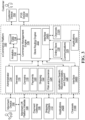
- FIG. 1 illustrates an e-commerce platform 100, according to one embodiment.
- the e-commerce platform 100 may be used to provide merchant products and services to customers. While the disclosure contemplates using the apparatus, system, and process to purchase products and services, for simplicity the description herein will refer to products. All references to products throughout this disclosure should also be understood to be references to products and/or services, including physical products, digital content, tickets, subscriptions, services to be provided, and the like.
- a merchant may sell across channels 110A-B and then manage their sales through the e-commerce platform 100, where channels 110A may be provided internal to the e-commerce platform 100 or from outside the e-commerce channel 110B.
- a merchant may sell in their physical retail store, at pop ups, through wholesale, over the phone, and the like, and then manage their sales through the e-commerce platform 100.
- a merchant may employ all or any combination of these, such as maintaining a business through a physical storefront utilizing POS devices 152, maintaining a virtual storefront through the online store 138, and utilizing a communication facility 129 to leverage customer interactions and analytics 132 to improve the probability of sales.
- a customer may interact through a customer device 150 (e.g., computer, laptop computer, mobile computing device, and the like), a POS device 152 (e.g., retail device, a kiosk, an automated checkout system, and the like), or any other commerce interface device known in the art.
- the e-commerce platform 100 may enable merchants to reach customers through the online store 138, through POS devices 152 in physical locations (e.g., a merchant's storefront or elsewhere), to promote commerce with customers through dialog via electronic communication facility 129, and the like, providing a system for reaching customers and facilitating merchant services for the real or virtual pathways available for reaching and interacting with customers.
- the e-commerce platform 100 may be implemented as a cloud computing service, a software as a service (SaaS), infrastructure as a service (IaaS), platform as a service (PaaS), desktop as a Service (DaaS), managed software as a service (MSaaS), mobile backend as a service (MBaaS), information technology management as a service (ITMaaS), and the like, such as in a software and delivery model in which software is licensed on a subscription basis and centrally hosted (e.g., accessed by users using a client (for example, a thin client) via a web browser or other application, accessed through by POS devices, and the like).
- SaaS software as a service
- IaaS infrastructure as a service
- PaaS platform as a service
- DaaS desktop as a Service
- MSaaS managed software as a service
- MaaS mobile backend as a service
- ITMaaS information technology management as a service
- elements of the e-commerce platform 100 may be implemented to operate on various platforms and operating systems, such as iOS, Android, on the web, and the like (e.g., the administrator 114 being implemented in multiple instances for a given online store for iOS, Android, and for the web, each with similar functionality).
- online stores 138 may be served by the e-commerce platform 100 to customers, where customers can browse and purchase the various products available (e.g., add them to a cart, purchase immediately through a buy-button, and the like). Online stores 138 may be served to customers in a transparent fashion without customers necessarily being aware that it is being provided through the e-commerce platform 100 (rather than directly from the merchant).
- Merchants may use a merchant configurable domain name, a customizable HTML theme, and the like, to customize their online store 138.
- Merchants may customize the look and feel of their website through a theme system, such as where merchants can select and change the look and feel of their online store 138 by changing their theme while having the same underlying product and business data shown within the online store's product hierarchy.
- the e-commerce platform 100 may provide merchants with transactional facilities for products through a number of different channels 110A-B, including the online store 138, over the telephone, as well as through physical POS devices 152 as described herein.
- the e-commerce platform 100 may include business support services 116, an administrator 114, and the like associated with running an on-line business, such as providing a domain service 118 associated with their online store, payment services 120 for facilitating transactions with a customer, shipping services 122 for providing customer shipping options for purchased products, risk and insurance services 124 associated with product protection and liability, merchant billing, and the like.
- Services 116 may be provided via the e-commerce platform 100 or in association with external facilities, such as through a payment gateway 106 for payment processing, shipping providers 112 for expediting the shipment of products, and the like.
- the e-commerce platform 100 may provide for integrated shipping services 122 (e.g., through an e-commerce platform shipping facility or through a third-party shipping carrier), such as providing merchants with real-time updates, tracking, automatic rate calculation, bulk order preparation, label printing, and the like.
- integrated shipping services 122 e.g., through an e-commerce platform shipping facility or through a third-party shipping carrier
- FIG. 2 depicts a non-limiting embodiment for a home page of an administrator 114, which may show information about daily tasks, a store's recent activity, and the next steps a merchant can take to build their business.
- a merchant may log in to administrator 114 via a merchant device 102 such as from a desktop computer or mobile device, and manage aspects of their online store 138, such as viewing the online store's 138 recent activity, updating the online store's 138 catalog, managing orders, recent visits activity, total orders activity, and the like.
- the merchant may be able to access the different sections of administrator 114 by using the sidebar, such as shown on FIG. 2 .
- Sections of the administrator 114 may include various interfaces for accessing and managing core aspects of a merchant's business, including orders, products, customers, available reports and discounts.
- the administrator 114 may also include interfaces for managing sales channels for a store including the online store, mobile application(s) made available to customers for accessing the store (Mobile App), POS devices, and/or a buy button.
- the administrator 114 may also include interfaces for managing applications (Apps) installed on the merchant's account; settings applied to a merchant's online store 138 and account.
- a merchant may use a search bar to find products, pages, or other information. Depending on the device 102 or software application the merchant is using, they may be enabled for different functionality through the administrator 114.
- a merchant logs in to the administrator 114 from a browser, they may be able to manage all aspects of their online store 138. If the merchant logs in from their mobile device (e.g. via a mobile application), they may be able to view all or a subset of the aspects of their online store 138, such as viewing the online store's 138 recent activity, updating the online store's 138 catalog, managing orders, and the like.
- More detailed information about commerce and visitors to a merchant's online store 138 may be viewed through acquisition reports or metrics, such as displaying a sales summary for the merchant's overall business, specific sales and engagement data for active sales channels, and the like.
- Reports may include, acquisition reports, behavior reports, customer reports, finance reports, marketing reports, sales reports, custom reports, and the like.
- the merchant may be able to view sales data for different channels 110A-B from different periods of time (e.g., days, weeks, months, and the like), such as by using dropdown menus.
- An overview dashboard may be provided for a merchant that wants a more detailed view of the store's sales and engagement data.
- An activity feed in the home metrics section may be provided to illustrate an overview of the activity on the merchant's account.
- the e-commerce platform 100 may provide for a platform payment facility 120, which is another example of a component that utilizes data from the commerce management engine 136 but may be located outside so as to not violate the isolation principle.
- the platform payment facility 120 may allow customers interacting with online stores 138 to have their payment information stored safely by the commerce management engine 136 such that they only have to enter it once. When a customer visits a different online store 138, even if they've never been there before, the platform payment facility 120 may recall their information to enable a more rapid and correct check out.
- the model of passable areas 315 is defined at step 504 of method 500.
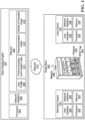
- the model of passable areas 315 provides a mapping of traversable (e.g. walkable) paths within the physical retail store 340, which is stored in memory 308 of the store routing engine 302.
- the model may be determined based on a merchant traversing through the physical retail store 340 using a merchant device 320 (e.g. at the same time as recording the location of each product in step 502). Additionally or alternatively, the model may be determined based on a mapping of the physical retail store, and/or traffic patterns of users determined using an in-store radar, etc., some embodiments of which are described herein.
- one or more recommended products are determined.
- the one or more recommended products are additional products that the user may be interested in, and may be identified by the store routing engine 302 based on at least one of: the target product, criteria indicated by the merchant, or user-specific criteria based on information from user profile 309.
- the store routing engine 302 may use recommendation rules 313 stored in memory 308 to recommend a product to a visitor who has identified a target product. For example, Fred may indicate that he is seeking men's blue jeans in Jane's Menswear retail store 340.
- the store routing engine 302 may identify a blue flannel shirt as a recommended product for Fred based on a preference for the color blue noted on Fred's user profile 309 and Fred's purchase history indicating that he has not recently purchased a shirt.
- images of the physical retail store 340 captured in a real-time scan using the merchant device 320 may be compared to images of a previously conducted image scan of the store.
- an augmented reality (AR) framework may be used to perform a full scan of the physical retail store 340 using depth, surface, and location information captured using the merchant device's camera feed and/or a light detection and ranging (LiDAR) sensor.
- the images of the real-time capture may be compared to locations within the store, known from the previous in-depth scan. Comparing real-time captured images to previous in-depth scan images stored in memory, instead of comparing to images captured earlier in a real-time stream, may reduce the time and processor requirements of the system.
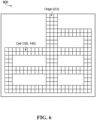
- Each cell is associated with a location in the store, e.g. a virtual coordinate.
- a location in the store e.g. a virtual coordinate.
- the virtual coordinate at the center of the cell may be defined as the location of the cell.
- FIG. 7 is an example of a merchant device 320 navigating a virtual coordinate representation of passable area in physical retail store 340, according to an embodiment.
- Model 700 displays the merchant beginning at an origin point (0,0), and traversing through the passable area of the store. The merchant's path is recorded by the merchant device 320 being held by the merchant and mapped as cells indicating passable area in the model 700.
- the model 700 may assume that an area within the store that is not populated by cells is not a passable area. However, in some embodiments additional cells may be added as the merchant device 320 (or one or more buyer/visitor devices) move about the store, e.g. the merchant device 320 may keep tracking and adding cells over a long period of time as the merchant moves about the store in their daily activity.
- the passable areas and/or unpassable areas might be determined by a customer device, e.g. user device 330.
- user device 330 may be running the store's app, which relays information relating to the user device's location back to the store routing engine 302.
- a location of the user device 330 may be assumed to be a passable area of the retail store 340.
- a product may be recommended based on factors such as: user specific criteria, and/or the target product, and/or criteria indicated by the merchant.
- User-specific criteria may be determined based on the user profile 309 associated with the user stored in memory 308 of the store routing engine 302.
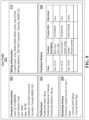
- the user profile such as profile 309 of FIG. 8 , may include a user's preferences, purchase history, browsing history, etc. For example, if the purchase history of the user shows that they purchase shoes with high frequency, then shoes may be a recommended product. As another example, if the online browsing history of Fred on Jane's Menswear website indicates that Fred viewed a particular black flannel shirt sold by Jane's Menswear, then that black flannel shirt may be a recommended product.
- the target product may also or instead be used by the store routing engine 302 to determine a complementary recommended product. For example, if Fred's target product is men's blue jeans, then a leather belt, which is typically worn with jeans, may be determined to be a recommended product.
- criteria indicated by the merchant may also or instead be used by the store routing engine 302 to determine recommended products for a user.
- the merchant may define one or more recommended products. These recommended products may be products that the merchant wishes to sell or highlight to any user who enters their physical retail store 340. For example, a merchant may recommend products on discount or clearance, seasonal products, or any products that the merchant may wish to clear out of the store's inventory, such as last year's models or dead inventory.
- recommendation rules are defined and used to recommend a product. These recommendation rules may be recommendation rules 313 stored in memory 308 of the store routing engine 302.
- a recommendation rule may be a unit of decision-making logic that recommends a particular product or product type or category when certain conditions are met.
- a recommendation rule may be in the form of an "if-then” statement.
- Some recommendation rules may be based solely on the target product, e.g. "if target product is men's blue jeans then recommend belts”.
- Some recommendation rules may additionally or alternatively be based on user-specific information in the user profile 309 associated with the user, e.g.
- Some recommendation rules may additionally or alternatively be based on the user's purchase and/or browsing history and products purchased by other users with similar purchase and/or browsing history, e.g. "if users who viewed a green flannel shirt eventually purchased a black flannel shirt in Jane's Menswear retail store, then recommend the black flannel shirt to a user who viewed the green flannel shirt”.
- the use of collaborative filtering and other like approaches may be used to generate such a recommendation rule.
- Some recommendation rules may additionally or alternatively be based on merchant-defined rules, e.g.
- a recommendation rule may be generated in different ways, depending upon the implementation.
- a recommendation rule may be custom-created by a merchant, e.g. using the user interface 328 of merchant device 320.
- a recommendation rule may be added for the merchant based on recommendation rules used by other merchants that resulted in a positive outcome for those other merchants (such as a high sales conversion).
- These recommendation rules may be determined using aggregate data associated with similar products, product categories, or other products used within the same industry as the target product.
- the aggregate data may be collected from several merchants using the application associated with the store routing engine 302.
- the several merchants may be on a same e-commerce platform, e.g.
- model 1100 may be a real-time model used to instruct Fred via user device 330 to direct him towards men's blue jeans in Jane's Menswear, shown as target product 1102.
- the store routing engine 302 may determine that a blue flannel shirt is a recommended product, shown as recommended product 1106 in FIG. 11 .
- the product inventory and location data 311 is used to determine the location of the recommended product 1106.
- Model 1100 provides costs associated with traversing through the passable areas within Jane's Menswear retail store, and reduces the cost of walking down the aisle with the blue flannel shirt en route to the men's blue jeans.
- Recommended products 1206b and 1206c are considered to be "highly recommended", such that the cost value associated with the cells nearby these products is lower than the cost of these cells in the models of FIGS. 10 and 11 , and lower than the value that may be assigned if the product was recommended but not "highly recommended”.
- Recommended products 1206a and 1206d are categorized as "normal recommendations”.
- a "highly recommended” product may be a product that satisfies multiple conditions (e.g. multiple recommendation rules).
- a "highly recommended” product may be a product that is recommended because of the user's past purchase history and target product and merchant criteria (e.g. shoes are highly recommended if the user purchases shoes on a frequent basis and the target product is a purse and the shoes are on sale).
- Recommended product 1206a is not on a shortest (or relatively short) path to the target product 1202, and the category of recommendation is "normal". Therefore, the cost values assigned to the cells around recommended product 1206a are not changed.
- Recommended product 1206b is also not on a shortest (or relatively short) path to the target product 1202, but the cost value assigned to the cells around recommended product 1206b is still lowered because the category of recommendation is "highly recommended”.
- the cells leading down the aisle of recommended product 1206d are reduced in cost, but not as much as the cells leading down the aisle of recommended product 1206c because recommended product 1206c is highly recommended.
- an additional check may be implemented to constrain the overall physical route distance to a maximum deviation from the shortest possible route to the target product (e.g. increased route distance cannot be more than 10% or 1 extra minute of walking time as compared to the time/distance of the shortest route to the target product).
- the minimum cost route may be rejected and a higher cost (but physically shorter) route may ultimately be selected by the algorithm for presentation to the user.
- the location of the user device 330 may be used as the location of the user, and the same methods described above in relation to the merchant device 320 may be implemented to track the location of the user device 330, e.g.: an indoor positioning system (IPS), and/or GPS (if applicable), and/or beacon technology and/or computer vision.
- IPS indoor positioning system
- GPS GPS
- beacon technology e.g.: beacon technology and/or computer vision.
- the merchant may prepopulate a database of digital images of the retail store 340 and associated physical locations, and use the data to train a computer vision algorithm, e.g. using machine learning.
- the trained computer vision algorithm may then accept an image of the store captured by the camera of the user device 330 and return a decision as to the location of the user device 330 in the store.
- the location of the user device 330 may be mapped to the same virtual coordinate system as defined by the merchant. For example, the user may scan a QR code or barcode at one or more fixed locations to associate the user device 330 with a particular virtual coordinate, and any subsequent movement of the user device 330 is measured in relation to that virtual coordinate to track the location of the user in the virtual coordinate space.
- the actual route guidance may be provided to the user via the user interface 338 of user device 330 by displaying directions, and/or audibly announcing such directions, and/or possibly using augmented reality (AR) or mixed reality (MR).
- displaying directions on the user device 330 may be achieved through an indoor map version of or akin to Google Maps TM visual navigation directions (or the like) and/or by providing text direction on the user interface 338, such as "Turn left".
- a visual guide such as an arrow, may be displayed on the screen of the user's device 330, e.g. superimposed on top of the image captured by the camera of the user's device 330.
- the user device 330 is an AR device such as AR glasses worn by the user, the arrow may be displayed as a digital AR object on the AR glasses. As the user walks along the route, the direction of the arrow is updated.
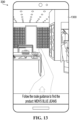
- FIG. 13 is the user interface 338 of the user device 330 providing the recommended routes using AR (or a variant thereof, such as MR), according to one embodiment.
- the user interface 338 of the user's user device 330 includes a display 1300 that provides the user with real-time guidance along a route, where an arrow directing the user is superimposed on top of the image captured of the physical retail store 340.
- display 1300 on user device 330 belonging to user Fred may be used to guide Fred to his specified target item.
- Display 1300 may include an image capture of Jane's Menswear retail store 340, with arrows as digital AR objects directing Fred to the location of the men's blue jeans.
- a message may be presented at the user interface 338 of the user device 330 that brings the user's attention to the recommended product, e.g. a visual or audible message (e.g. "Note that our shoes are on sale this week").
- a haptic notification may be provided to the user in addition to the visual and/or audible message.
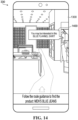
- FIG. 14 illustrates a variation of FIG. 13 in which a recommended product is highlighted, according to one embodiment.
- display 1300 in FIG. 14 provides an image captured by the camera of user device 330 and displayed through user interface 338.
- FIG. 14 also includes visual message 1400, which indicates that the user is passing by a recommended product.
- display 1300 shown on Fred's user device 330 may show route guidance in Jane's Menswear retail store 340.
- the recommended route to the target product, men's blue jeans may involve passing by one or more recommended products, such as the blue flannel shirt.
- Display 1300 notifies Fred that he is passing by a recommended product through the use of visual message 1400, which states "You may be interested in this BLUE FLANNEL SHIRT".
- the message 1400 may include a hyperlink that, when selected by Fred through user interface 338, retrieves and displays a webpage providing product information relating to the recommended product.
- the merchant is assumed to be Merchant Jane introduced earlier.
- Merchant Jane is running the physical retail store 340 Jane's Menswear and uses merchant device 320.
- the person visiting the store is assumed to be user Fred introduced earlier, having user device 330 and having user profile 309 shown in FIG. 8 .
- FIG. 15 is a computer-implemented method 1500, according to one embodiment.
- the method may be performed by a computing device, e.g. the store routing engine 302.
- the steps are described as being performed by the processor 304 of the store routing engine 302, but this is only an example.
- the method may instead be performed by another entity, which might or might not be part of an e-commerce platform.
- the processor 304 obtains an identification of a target product from a user device input.
- the target product is for sale by a merchant (e.g. Merchant Jane) in a retail store (e.g. retail store 340).
- the identification of the target product originates from input at a user device.
- the processor 304 of the store routing engine 302 obtains the identification of the target product based on an input through the user interface 338 of user device 330, where the target product may be a product stored in the product inventory and location data 311.
- Fred may enter Jane's Menswear retail store 340 and enter his target product as "men's blue jeans" through a software application on his user device 330.
- the store routing engine 302 may then identify the men's blue jeans as the target product.
- step 1502 may instead involve identifying a target location in a physical retail store 340, rather than identifying a target product.
- the user may wish to find a customer service desk within the retail store, or a particular section of the store.
- user Fred may wish to find the "casual wear" section in Jane's Menswear retail store 340. Fred may enter this section as his target location in the retail store 340 through the software application on his user device 330.
- the processor 304 of the store routine engine 302 retrieves a user profile associated with the user device.
- the user profile stores information about the user.
- the processor 304 of the store routing engine 302 may determine a user profile 309 stored in memory 308 associated with a user device 330 of a visitor to the physical retail store 340.
- user Fred may be logged in to a software application associated with Jane's Menswear retail store on his user device 330, which then retrieves Fred's user profile 309.
- Fred's user profile includes personal information 802, preferences 804, browsing and purchase history 808 and 806, and billing information 810.
- Fred's user profile 309 indicates that Fred prefers the color blue and has recently purchased a green flannel shirt.
- step 1504 might not be performed in some embodiments of method 1500, and the processor 304 of the store routing engine 302 may carry out the operations of determining recommended products and a subsequent recommended route without particular knowledge of the store's visitor.
- a recommended product is obtained based on one or more of: the target product, information from a profile associated with the user device, and/or a merchantprovided criterion.
- the processor 304 of the store routing engine 302 may determine recommended products using information relating to the user's preferences 804 and/or browsing and/or purchase history 806 and 808, such as the information from user profile 309 in FIG. 8 .
- Recommended products may also or instead be determined based on the target product, e.g., items that are typically used together, and/or based on criteria set by the merchant, e.g., the merchant may recommend items based on their desire to move inventory.
- Steps 1508 to 1512 are then performed as the user device moves in the retail store.
- user location data is received while the user device moves in the retail store.
- the user location data indicates a location of the user device.
- the user location data may be determined via wireless communication between the user device 330 and the store routing engine 302 using one or more of the location determination methods described earlier, e.g. IPS, GPS, and/or beacon technology, such as beacon 346.
- an instruction to guide the user device along a particular route is generated, e.g. based on the user location data and/or a location of the target product and/or a location of the recommended product.
- the processor 304 of store routing engine 302 determines one or more recommended routes that may pass by one of more recommended products in the retail store 340 based on the current location of user device 330.
- the particular route may be generated using a model of passable areas 315 in the physical retail store 340, where cells are used to indicate passable areas, and the determination of an optimal path from a user device's origin location to the location of a target product in store.
- store routing engine 302 may determine a route to direct Fred to the men's blue jeans based on the current location of Fred's user device 330 in Jane's Menswear retail store 340.
- the generated instruction or instructions may guide Fred directly to his target product, e.g., the route shown in FIG. 10 , and/or may guide Fred past products recommended for Fred, such as the blue flannel shirt, brown leather belt, etc., such as the routes of FIGS. 11 and 12 .
- the particular route determined in step 1510 may be associated with a plurality of contiguous segments stored in memory.
- each segment of the contiguous segments may correspond to a respective different passable area of the retail store.
- Each segment may be assigned a respective cost value.
- method 1500 may further include generating a plurality of instructions that guide the user device along the particular route based on a comparison of cost values between segments of alternative routes to the target product. For example, an algorithm, such as the A* algorithm described earlier, may be used to evaluate cost values assigned to segments (cells) in a model of passable areas 315 in order to determine an optimal path from the user device's location to the target product.
- a route may be chosen that reduces or minimizes cost compared to other routes to the target product. Determining the chosen route may be performed by comparing cost values between alternative routes to the target product.
- the model 1100 of FIG. 11 indicates the cost of traversing through passable areas of a store en route to a target product.
- the route passing by the recommended product 1106 has a lower cost compared to alternative routes that do not pass by recommended product 1106.
- each segment is assigned the respective cost value based at least on the location of the target product.
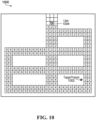
- the algorithm applied to the model of passable areas 315 may assign cost values, such that segments that bring the user nearer to the target product have a lower associated cost. For example, in FIG. 10 the segments to the left of the user 1004 are assigned a cost value of 3, whereas the segments to the right of the user 1004 are assigned a cost value of 2, because the target product 1002 is located to the right of the user 1004.
- the cost value of at least one of the segments is based on both the location of the target product and the location of the recommended product.
- the processor 304 of the store routing engine 302 may execute the algorithm such that it incorporates product recommendation information to determine the cost value of a particular segment. For instance, a segment directly in front of a recommended product may be assigned a lower cost value than the same segment would be assigned if the recommended product was not present at this location, even if it does not lie on a direct path between the user's current location and the target product location.
- the model of passable areas in FIG. 12 includes the cost associated with each segment, where the costs are influenced by the location of recommended products.
- the segments directly in front of recommended product 1206c are assigned the cost value 0, as they pass by the recommended product and do not require the user to deviate from a short path to reach target product 1202.
- the reduced cost of traversing through segments near the recommended products provides incentive (e.g. in the sense of lowering overall cost) for the store routing engine 302 to direct the user device 330 past the recommended product.
- the particular route along which the user device is guided passes through a set of segments each having cost values lower than the cost values of alternative segments on the alternative routes, where the set of segments includes the particular segment.
- the recommended product may be in proximity to the particular segment and the cost value of the particular segment may be lower than if the recommended product was not in proximity to the particular segment.
- the models of passable areas of FIGS. 10 and 11 are models of the same physical retail store 340.
- the segment in front of recommended product 1106 in model 1100 is assigned a cost value of 0.
- the same segment is assigned a cost value of 2 in model 1000, where the recommended product is not present.
- the recommended product is a first recommended product
- method 1500 further includes obtaining a second recommended product based on one or more of: the information from the profile associated with the user device, the target product, and/or a criterion provided by the merchant.
- the method may further include assigning a first cost value to a first segment based on both the location of the target product and the location of the first recommended product; and, assigning a second cost value to a second segment based on both the location of the target product and the location of the second recommended product.
- the first segment directly in front of the first recommended product 1206c may be assigned a cost value of 0 and the second segment directly in front of the second recommended product 1206a may be assigned a cost value of 9.
- the assigned cost value of the first segment may be lower than the cost of the second segment, as the first recommended product falls under the category "highly recommended” and the second recommended product falls under the category "normal recommendation".
- the assigned cost value of the first segment may be lower than the cost of the second segment because the first segment is located along a shorter path to the target product 1202.
- the first recommended product may be the blue flannel shirt and the second recommended product may be the red plaid shirt.
- the blue flannel shirt may be more highly recommended to Fred based on information found on his user profile 309, and the blue flannel shirt may be located along a shorter path to the men's blue jeans from Fred's current location.
- the first cost value is assigned a different value than the second cost value based on the first recommended product being in a different category than the second recommended product, where the first recommended product belongs to a first category and the second recommended product belongs to a second category.
- the first category may be that the recommendation is based on both the information from the profile associated with the user device and the target product.
- the processor 304 of the store routing engine 302 may determine that two recommended products for Fred, whose target product is men's blue jeans, may be a blue flannel shirt and a red plaid shirt.
- the blue flannel shirt may be the product belonging to the first category, as the user profile 309 associated with user Fred indicates his preference for the color blue and flannel material, and such a shirt may match well with the men's blue jeans he is searching for in the physical retail store 340.
- the first recommended product may be considered to be "highly recommended” and have a lower associated first cost value.
- the blue flannel shirt may be recommended product 1206c in model 1200, where the cost of the segment in front of the product is 0.
- the recommended product 1206a may be the red plaid shirt, where the cost of the segment in front of the product is 9.
- the second recommended product is in proximity to the second segment, and the second cost value of the second segment is the same as if the second recommended product was not in proximity to the second segment.
- the red plaid shirt may be recommended product 1206a in FIG. 12 .
- the cost of the segment directly in front of the product has an associated cost value of 9.
- FIG. 11 provides a model of the same physical retail store 340, in which the second recommended product has not been identified as a recommended product to the user.
- the cost value of the noted second segment is still 9.
- the method 1500 may further include obtaining at least some of the plurality of contiguous segments by monitoring movement of a merchant device through the retail store and mapping different physical locations of the merchant device to different segments. For example, determining the location of the products, including the target product, in the physical retail store 340 may involve the merchant traversing through the retail store with merchant device 320 to also determine a model of passable areas 315 within the store 340.
- the model of passable areas 315 may include segments, which are populated by the recognition of the merchant device 320 moving through an area having an associated location determined, e.g. by IPS, GPS, beacon technology, or computer vision techniques.
- the method 1500 may further include implementing the instruction guiding the user device as a visual guide in the form of an augmented or mixed reality digital image on a screen of the user device.
- the instruction output at user device 330 at step 1512 of the method may be provided as an AR image on the user interface 338, such as that shown in FIGS. 13 and 14 .
- the display 1300 on Fred's user device 330 may show an AR representation of Jane's Menswear 340 retail store, where an arrow is superimposed on top of the store image to provide guidance along a particular route to a target product, such as men's blue jeans.
- a message indicating that the user device 330 is near a recommended product may be transmitted and displayed to the user via the user device's user interface 338, such as message 1400 in FIG. 14 .
- display 1300 of FIG. 14 may be an AR representation of Jane's Menswear retail store, in which Fred is searching for men's blue jeans. The instruction is guiding Fred along a route in the store and message 1400 may appear to inform him that he is passing by a product that may be of interest, the blue flannel shirt.
- the information from the profile associated with the user device includes purchase history of a user, and the recommended product is generated at least based on the purchase history.
- a product may be recommended to user Fred based on the purchase history 806 saved in his user profile 309. Fred's purchase history 806 indicates that he has recently bought a green flannel shirt from Merchant Jane.
- the processor 304 of store routing engine 302 may recommend a product that is similar to the green flannel shirt, such as the blue flannel shirt, which he does not already own but is made of a similar fabric.
- Any module, component, or device exemplified herein that executes instructions may include or otherwise have access to a non-transitory computer/processor-readable storage medium or media for storage of information, such as computer/processor-readable instructions, data structures, program modules, and/or other data.
Landscapes
- Business, Economics & Management (AREA)
- Engineering & Computer Science (AREA)
- Strategic Management (AREA)
- Economics (AREA)
- Accounting & Taxation (AREA)
- Finance (AREA)
- Physics & Mathematics (AREA)
- General Physics & Mathematics (AREA)
- Human Resources & Organizations (AREA)
- Development Economics (AREA)
- Theoretical Computer Science (AREA)
- Marketing (AREA)
- General Business, Economics & Management (AREA)
- Radar, Positioning & Navigation (AREA)
- Remote Sensing (AREA)
- Entrepreneurship & Innovation (AREA)
- Game Theory and Decision Science (AREA)
- Tourism & Hospitality (AREA)
- Operations Research (AREA)
- Quality & Reliability (AREA)
- Signal Processing (AREA)
- Computer Networks & Wireless Communication (AREA)
- Automation & Control Theory (AREA)
- Educational Administration (AREA)
- Management, Administration, Business Operations System, And Electronic Commerce (AREA)
- Databases & Information Systems (AREA)
- Data Mining & Analysis (AREA)
- General Engineering & Computer Science (AREA)
- Navigation (AREA)
Claims (14)
- Ein computerimplementiertes Verfahren, beinhaltend:Erhalten (1502) einer Identifikation eines Zielprodukts (1202) zum Verkauf durch einen Händler in einem Einzelhandelsgeschäft, wobei die Identifikation aus einer Eingabe an einer Benutzervorrichtung stammt;Erhalten (1506) eines empfohlenen Produkts (1206) basierend auf mindestens einem von Folgendem: dem Zielprodukt, Informationen von einem mit der Benutzervorrichtung assoziierten Profil (309) oder einem von dem Händler bereitgestellten Kriterium; undwährend sich die Benutzervorrichtung in dem Einzelhandelsgeschäft bewegt:Empfangen (1508) von Benutzerstandortdaten, die einen Standort der Benutzervorrichtung angeben,Bestimmen einer speziellen Route basierend auf den Benutzerstandortdaten, einem Standort des Zielprodukts (1202) und einem Standort des empfohlenen Produkts (1206), wobei die spezielle Route auf einem Vergleich von Kostenwerten zwischen Segmenten alternativer Routen zu dem Zielprodukt basiert, wobei jedem Segment ein entsprechender Kostenwert zugeordnet ist, wobei der Kostenwert von mindestens einem der Segmente sowohl auf dem Standort des Zielprodukts als auch dem Standort des empfohlenen Produkts basiert,Erzeugen (1510) einer Anweisung, die die Benutzervorrichtung entlang der speziellen Route leitet, undÜbertragen (1512) der Anweisung zur Ausgabe an der Benutzervorrichtung.
- Computerimplementiertes Verfahren gemäß Anspruch 1, wobei die spezielle Route mit einer Vielzahl von in einem Speicher gespeicherten zusammenhängenden Segmenten assoziiert ist, wobei jedes Segment der Vielzahl von zusammenhängenden Segmenten einem jeweiligen anderen passierbaren Bereich innerhalb eines definierten Modells passierbarer Bereiche des Einzelhandelsgeschäfts entspricht, das in dem Speicher gespeichert ist.
- Computerimplementiertes Verfahren gemäß Anspruch 1 oder 2, wobei der jeweilige Kostenwert, der jedem Segment zugeordnet ist, mindestens auf dem Standort des Zielprodukts (1202) basiert.
- Computerimplementiertes Verfahren gemäß einem der vorhergehenden Ansprüche, wobei die spezielle Route, entlang der die Benutzervorrichtung geleitet wird, durch eine Reihe von Segmenten führt, die jeweils niedrigere Kostenwerte aufweisen als die Kostenwerte alternativer Segmente auf den alternativen Routen, wobei die Reihe von Segmenten ein spezielles Segment umfasst, wobei sich das empfohlene Produkt (1206) in der Nähe des speziellen Segments befindet und wobei der Kostenwert des speziellen Segments niedriger ist, als wenn sich das empfohlene Produkt (1206) nicht in der Nähe des speziellen Segments befände.
- Computerimplementiertes Verfahren gemäß einem der vorhergehenden Ansprüche, wobei das empfohlene Produkt ein erstes empfohlenes Produkt ist und wobei das Verfahren ferner Folgendes beinhaltet:Erhalten eines zweiten empfohlenen Produkts basierend auf mindestens einem von Folgendem: den Informationen von dem mit der Benutzervorrichtung assoziierten Profil, dem Zielprodukt oder einem von dem Händler bereitgestellten Kriterium;Zuordnen eines ersten Kostenwerts zu einem ersten Segment basierend sowohl auf dem Standort des Zielprodukts als auch dem Standort des ersten empfohlenen Produkts;Zuordnen eines zweiten Kostenwerts zu einem zweiten Segment basierend sowohl auf dem Standort des Zielprodukts als auch dem Standort des zweiten empfohlenen Produkts;wobei dem ersten Kostenwert ein anderer Wert als dem zweiten Kostenwert zugewiesen wird, basierend auf Folgendem: (i) das erste empfohlene Produkt befindet sich in einer anderen Kategorie als das zweite empfohlene Produkt; und/oder (ii) das erste empfohlene Produkt befindet sich auf einem ersten Weg zu dem Zielprodukt, der kürzer ist als ein zweiter Weg zu dem Zielprodukt (1202), auf dem das zweite empfohlene Produkt befindlich ist.
- Computerimplementiertes Verfahren gemäß Anspruch 5, wobei dem ersten Kostenwert ein anderer Wert als dem zweiten Kostenwert zugewiesen wird, basierend darauf, dass sich das erste empfohlene Produkt in einer anderen Kategorie als das zweite empfohlene Produkt befindet, wobei das erste empfohlene Produkt zu einer ersten Kategorie gehört, wobei das zweite empfohlene Produkt zu einer zweiten Kategorie gehört und wobei die erste Kategorie darin besteht, dass die Empfehlung sowohl auf den Informationen von dem mit der Benutzervorrichtung assoziierten Profil als auch auf dem Zielprodukt (1202) basiert.
- Computerimplementiertes Verfahren gemäß Anspruch 5, wobei sich das zweite empfohlene Produkt in der Nähe des zweiten Segments befindet und wobei der zweite Kostenwert des zweiten Segments derselbe ist, als wenn sich das zweite empfohlene Produkt nicht in der Nähe des zweiten Segments befände.
- Computerimplementiertes Verfahren gemäß Anspruch 2 oder einem beliebigen von Anspruch 2 abhängigen Anspruch, ferner beinhaltend das Definieren des Modells durch das Erhalten mindestens einiger der Vielzahl von zusammenhängenden Segmenten durch das Überwachen der Bewegung einer Händlervorrichtung durch das Einzelhandelsgeschäft und Zuweisen verschiedener physischer Standorte der Händlervorrichtung zu verschiedenen Segmenten.
- Computerimplementiertes Verfahren gemäß Anspruch 8, ferner beinhaltend das Speichern eines Standorts von Produkten in dem Einzelhandelsgeschäft in dem Speicher als Produktbestands- und -standortdaten, wobei der Standort der Produkte während des Überwachens der Bewegung der Händlervorrichtung durch das Einzelhandelsgeschäft bestimmt wird.
- Computerimplementiertes Verfahren gemäß einem der vorhergehenden Ansprüche, wobei die Anweisung, die die Benutzervorrichtung leitet, als visuelle Anleitung in Form eines digitalen Augmented-Reality-Bildes auf einem Bildschirm der Benutzervorrichtung implementiert wird.
- Computerimplementiertes Verfahren gemäß einem der vorhergehenden Ansprüche, ferner beinhaltend:basierend auf den Benutzerstandortdaten und dem Standort des empfohlenen Produkts, Bestimmen, dass sich die Benutzervorrichtung in der Nähe des empfohlenen Produkts befindet;als Reaktion auf das Bestimmen, dass sich die Benutzervorrichtung in der Nähe des empfohlenen Produkts befindet: Übertragen einer Nachricht zur Ausgabe an der Benutzervorrichtung, wobei die Nachricht die Aufmerksamkeit auf das empfohlene Produkt lenken soll.
- Computerimplementiertes Verfahren gemäß einem der vorhergehenden Ansprüche, wobei die Informationen von dem mit der Benutzervorrichtung assoziierten Profil (309) mindestens eines von Folgendem beinhalten:eine Kaufhistorie eines Benutzers, und das empfohlene Produkt wird mindestens basierend auf der Kaufhistorie erzeugt; odereine Angabe eines oder mehrerer von einem Benutzer online angesehener Produkte, und das empfohlene Produkt wird mindestens basierend auf der Angabe des einen oder der mehreren von dem Benutzer online angesehenen Produkte erzeugt.
- Ein System, beinhaltend:einen Speicher (308) zum Speichern einer Identifikation eines Zielprodukts zum Verkauf durch einen Händler in einem Einzelhandelsgeschäft (340), wobei die Identifikation aus einer Eingabe an einer Benutzervorrichtung (320, 330) stammt; mindestens einen Prozessor (304);und wobei das System konfiguriert ist, um das Verfahren gemäß einem der vorhergehenden Ansprüche zu vollziehen.
- Ein Computerprogramm, das, wenn es durch einen Computer ausgeführt wird, den Computer veranlasst, das Verfahren gemäß einem der Ansprüche 1 bis 12 durchzuführen.
Priority Applications (7)
| Application Number | Priority Date | Filing Date | Title |
|---|---|---|---|
| CA3128768A CA3128768C (en) | 2020-09-23 | 2021-08-23 | COMPUTER SYSTEMS AND METHODS FOR STORE TRACKING RECOMMENDATIONS |
| AU2021221864A AU2021221864A1 (en) | 2020-09-23 | 2021-08-26 | Computer-implemented systems and methods for in-store route recommendations |
| TW110132660A TWI868395B (zh) | 2020-09-23 | 2021-09-02 | 用於店內路徑推薦之電腦實施系統及方法 |
| KR1020210123231A KR102693085B1 (ko) | 2020-09-23 | 2021-09-15 | 스토어 내 루트 추천들을 위한 컴퓨터 구현 시스템들 및 방법들 |
| JP2021152883A JP7579226B2 (ja) | 2020-09-23 | 2021-09-21 | 店舗内ルート推薦のためのコンピュータ実装システムおよび方法 |
| CN202111115244.0A CN114526736B (zh) | 2020-09-23 | 2021-09-23 | 用于店内路线推荐的计算机实现的系统和方法 |
| AU2025275205A AU2025275205A1 (en) | 2020-09-23 | 2025-12-04 | Computer-implemented systems and methods for in-store route recommendations |
Applications Claiming Priority (1)
| Application Number | Priority Date | Filing Date | Title |
|---|---|---|---|
| US17/029,454 US11631122B2 (en) | 2020-09-23 | 2020-09-23 | Computer-implemented systems and methods for in-store route recommendations |
Publications (2)
| Publication Number | Publication Date |
|---|---|
| EP3974777A1 EP3974777A1 (de) | 2022-03-30 |
| EP3974777B1 true EP3974777B1 (de) | 2024-07-03 |
Family
ID=75977663
Family Applications (1)
| Application Number | Title | Priority Date | Filing Date |
|---|---|---|---|
| EP21174360.4A Active EP3974777B1 (de) | 2020-09-23 | 2021-05-18 | Computerimplementierte systeme und verfahren für routenempfehlungen in einem laden |
Country Status (8)
| Country | Link |
|---|---|
| US (2) | US11631122B2 (de) |
| EP (1) | EP3974777B1 (de) |
| JP (1) | JP7579226B2 (de) |
| KR (1) | KR102693085B1 (de) |
| CN (1) | CN114526736B (de) |
| AU (2) | AU2021221864A1 (de) |
| CA (1) | CA3128768C (de) |
| TW (1) | TWI868395B (de) |
Families Citing this family (18)
| Publication number | Priority date | Publication date | Assignee | Title |
|---|---|---|---|---|
| US9171281B1 (en) * | 2013-06-01 | 2015-10-27 | Thomas Francis | Techniques for filling orders |
| CN110163666B (zh) * | 2019-05-06 | 2025-04-29 | 北京三快在线科技有限公司 | 一种商品推荐的方法及装置 |
| US11887173B2 (en) | 2020-04-17 | 2024-01-30 | Shopify Inc. | Computer-implemented systems and methods for in-store product recommendations |
| US11631122B2 (en) | 2020-09-23 | 2023-04-18 | Shopify Inc. | Computer-implemented systems and methods for in-store route recommendations |
| JP7468300B2 (ja) * | 2020-11-02 | 2024-04-16 | トヨタ自動車株式会社 | 情報処理装置、情報処理方法、およびプログラム |
| KR102948500B1 (ko) * | 2021-02-22 | 2026-04-03 | 현대자동차 주식회사 | 펫 케어 관리 서버 및 이를 이용한 펫 케어 서비스 방법 |
| JP7650683B2 (ja) * | 2021-03-02 | 2025-03-25 | 東芝テック株式会社 | 情報処理装置及び情報処理システム |
| US20220383397A1 (en) * | 2021-05-27 | 2022-12-01 | Shopify Inc. | Customize a virtual store based on buyer preferences and movement |
| US12488384B2 (en) | 2021-05-27 | 2025-12-02 | Shopify Inc. | Build and update a virtual store based on a physical store |
| JP7318683B2 (ja) * | 2021-07-30 | 2023-08-01 | 富士通株式会社 | 情報処理プログラム、情報処理方法、および情報処理装置 |
| US11868961B2 (en) * | 2022-04-21 | 2024-01-09 | Maplebear Inc. | Creation and arrangement of items in an online concierge system-specific portion of a warehouse for order fulfillment |
| TWI822132B (zh) * | 2022-06-20 | 2023-11-11 | 國立臺北科技大學 | 快遞輔助系統及快遞輔助系統的使用方法 |
| CN115659002A (zh) * | 2022-09-07 | 2023-01-31 | 上海天擎天拓信息技术股份有限公司 | 一种营销网点推荐方法及系统 |
| US12607703B2 (en) * | 2023-03-02 | 2026-04-21 | OnPoint Systems, LLC | Mobile entity management |
| CN118379118B (zh) * | 2024-06-25 | 2024-09-10 | 青州市坦博尔服饰股份有限公司 | 基于大数据的冲锋衣个性化推荐方法及系统 |
| CN119539869A (zh) * | 2024-10-16 | 2025-02-28 | 杭州流视互动科技有限公司 | 商品信息提供模型的构建方法、商品信息提供方法 |
| CN120106935B (zh) * | 2025-02-14 | 2026-03-17 | 飞鱼(广州)互动传媒有限公司 | 一种基于大数据分析的商品推荐管理系统及方法 |
| CN120672237B (zh) * | 2025-08-21 | 2025-11-18 | 辽宁高速通智慧出行有限责任公司 | 一种基于高速公路收费数据的网络货运平台优化系统 |
Family Cites Families (40)
| Publication number | Priority date | Publication date | Assignee | Title |
|---|---|---|---|---|
| US5903830A (en) | 1996-08-08 | 1999-05-11 | Joao; Raymond Anthony | Transaction security apparatus and method |
| US6123259A (en) | 1998-04-30 | 2000-09-26 | Fujitsu Limited | Electronic shopping system including customer relocation recognition |
| US6587835B1 (en) | 2000-02-09 | 2003-07-01 | G. Victor Treyz | Shopping assistance with handheld computing device |
| US7069449B2 (en) | 2000-08-03 | 2006-06-27 | Itech Group, Inc. | Method and system for encrypting and storing content to a user |
| CA2346158A1 (en) | 2001-05-02 | 2002-11-02 | Soma Networks, Inc. | Method, system and apparatus for provisioning services to subscribers in a telecommunications network |
| US8107937B2 (en) | 2001-07-31 | 2012-01-31 | Nokia Corporation | System and method for automatic provisioning detection and notification |
| JP3422489B2 (ja) | 2001-08-31 | 2003-06-30 | 株式会社アビリティキャスト・エンターテイメント | 画像データ提供装置及び画像データ提供方法 |
| US20050254429A1 (en) * | 2002-06-28 | 2005-11-17 | Takeshi Kato | Management node deice, node device, network configuration management system, network configuration management method, node device control method, management node device control method |
| KR100703444B1 (ko) | 2003-06-03 | 2007-04-03 | 삼성전자주식회사 | 네비게이션 시스템에서 위치 정보에 관련된 영상의 다운로드 및 표시 장치 및 방법 |
| US7203687B2 (en) | 2004-02-26 | 2007-04-10 | International Business Machines Corporation | Peer-to-peer replication member initialization and deactivation |
| US20060131385A1 (en) | 2004-12-16 | 2006-06-22 | Kim Mike I | Conditional transaction notification and implied approval system |
| US20060131390A1 (en) | 2004-12-16 | 2006-06-22 | Kim Mike I | Method and system for providing transaction notification and mobile reply authorization |
| GB0616472D0 (en) | 2006-08-18 | 2006-09-27 | Fujitsu Ltd | Communication systems |
| US7953627B2 (en) | 2006-12-12 | 2011-05-31 | American Express Travel Related Services Company, Inc. | Identifying industry segments with highest potential for new customers or new spending for current customers |
| US20080298230A1 (en) | 2007-05-30 | 2008-12-04 | Luft Siegfried J | Scheduling of workloads in a distributed compute environment |
| US7580699B1 (en) | 2007-10-18 | 2009-08-25 | At&T Mobility Ii Llc | Network systems and methods utilizing mobile devices to enhance consumer experience |
| US7865308B2 (en) | 2007-12-28 | 2011-01-04 | Yahoo! Inc. | User-generated activity maps |
| US8639440B2 (en) * | 2010-03-31 | 2014-01-28 | International Business Machines Corporation | Augmented reality shopper routing |
| US9141987B2 (en) * | 2010-11-15 | 2015-09-22 | Microsoft Technology Licensing, Llc | System, method, and medium for generating a map of a geographic region based on client location data |
| CN102750274B (zh) * | 2011-01-04 | 2014-12-10 | 张越峰 | 一种初具人类思维的现场智能引导服务系统及方法 |
| US20130030915A1 (en) * | 2011-06-23 | 2013-01-31 | Qualcomm Incorporated | Apparatus and method for enhanced in-store shopping services using mobile device |
| US10977701B2 (en) * | 2012-12-04 | 2021-04-13 | Crutchfield Corporation | Techniques for providing retail customers a seamless, individualized discovery and shopping experience between online and brick and mortar retail locations |
| JP5497936B1 (ja) | 2013-04-04 | 2014-05-21 | 楽天株式会社 | 商品情報提供システム、商品情報提供装置、商品情報提供方法、及び商品情報提供プログラム |
| KR102144129B1 (ko) * | 2013-07-05 | 2020-08-12 | 주식회사 엘지유플러스 | 쇼핑 공간에서의 동선 거리 제공 단말 및 방법 |
| US10672062B2 (en) * | 2013-12-30 | 2020-06-02 | Paypal, Inc. | Systems and methods for managing shopping lists and shopping routes |
| WO2015103020A1 (en) * | 2013-12-31 | 2015-07-09 | Crutchfield Corporation | Techniques for providing retail customers a seamless, individualized discovery and shopping experience |
| US10235706B2 (en) * | 2014-10-30 | 2019-03-19 | Walmart Apollo, Llc | Methods and systems for providing reminders for products in proximity |
| US9470532B2 (en) | 2015-01-30 | 2016-10-18 | Wal-Mart Stores, Inc. | System for adjusting map navigation path in retail store and method of using same |
| JP6794679B2 (ja) | 2016-06-30 | 2020-12-02 | 株式会社ニコン | プログラム、情報処理装置、電子機器、及び情報処理システム |
| US11461820B2 (en) * | 2016-08-16 | 2022-10-04 | Adobe Inc. | Navigation and rewards involving physical goods and services |
| US20190251619A1 (en) * | 2016-10-21 | 2019-08-15 | Diebold Nixdorf Incorporated | Apparatuses, systems, and methods for in store shopping |
| US10572932B2 (en) | 2017-01-27 | 2020-02-25 | Walmart Apollo, Llc | System for providing optimal shopping routes in retail store and method of using same |
| WO2018195934A1 (zh) * | 2017-04-28 | 2018-11-01 | 深圳市元征科技股份有限公司 | 一种商品导购方法及终端 |
| CN107609945A (zh) * | 2017-09-15 | 2018-01-19 | 泾县麦蓝网络技术服务有限公司 | 一种应用于实体商店的商品推荐方法和系统 |
| CN109246617B (zh) * | 2018-09-21 | 2020-11-17 | 京东方科技集团股份有限公司 | 商品引导方法、商品引导装置及存储介质 |
| CN109579851A (zh) * | 2019-01-17 | 2019-04-05 | 深圳壹账通智能科技有限公司 | 一种线下购物导航方法、装置、计算机设备及存储介质 |
| EP3715790A1 (de) * | 2019-03-29 | 2020-09-30 | Naver Corporation | System und verfahren zur erzeugung von touren |
| US11210857B2 (en) | 2019-09-26 | 2021-12-28 | The Toronto-Dominion Bank | Systems and methods for providing an augmented-reality virtual treasure hunt |
| US12008608B2 (en) * | 2019-12-03 | 2024-06-11 | Target Brands, Inc. | Providing personalized item recommendations during in-store shopping experience |
| US11631122B2 (en) | 2020-09-23 | 2023-04-18 | Shopify Inc. | Computer-implemented systems and methods for in-store route recommendations |
-
2020
- 2020-09-23 US US17/029,454 patent/US11631122B2/en active Active
-
2021
- 2021-05-18 EP EP21174360.4A patent/EP3974777B1/de active Active
- 2021-08-23 CA CA3128768A patent/CA3128768C/en active Active
- 2021-08-26 AU AU2021221864A patent/AU2021221864A1/en not_active Abandoned
- 2021-09-02 TW TW110132660A patent/TWI868395B/zh active
- 2021-09-15 KR KR1020210123231A patent/KR102693085B1/ko active Active
- 2021-09-21 JP JP2021152883A patent/JP7579226B2/ja active Active
- 2021-09-23 CN CN202111115244.0A patent/CN114526736B/zh active Active
-
2023
- 2023-03-15 US US18/184,269 patent/US12118608B2/en active Active
-
2025
- 2025-12-04 AU AU2025275205A patent/AU2025275205A1/en active Pending
Also Published As
| Publication number | Publication date |
|---|---|
| JP7579226B2 (ja) | 2024-11-07 |
| US12118608B2 (en) | 2024-10-15 |
| CN114526736B (zh) | 2024-03-08 |
| JP2022052749A (ja) | 2022-04-04 |
| KR20220040396A (ko) | 2022-03-30 |
| US11631122B2 (en) | 2023-04-18 |
| TW202219870A (zh) | 2022-05-16 |
| CA3128768C (en) | 2024-07-02 |
| KR102693085B1 (ko) | 2024-08-07 |
| EP3974777A1 (de) | 2022-03-30 |
| AU2025275205A1 (en) | 2026-01-15 |
| US20230214909A1 (en) | 2023-07-06 |
| AU2021221864A1 (en) | 2022-04-07 |
| US20220092681A1 (en) | 2022-03-24 |
| TWI868395B (zh) | 2025-01-01 |
| CN114526736A (zh) | 2022-05-24 |
| CA3128768A1 (en) | 2022-03-23 |
Similar Documents
| Publication | Publication Date | Title |
|---|---|---|
| US12118608B2 (en) | Computer-implemented systems and methods for in-store route recommendations | |
| US20240119503A1 (en) | Computer-implemented systems and methods for in-store product recommendations | |
| JP7495034B2 (ja) | 物理的アイテムに関する拡張現実シーンを生成するシステムおよび方法 | |
| US12086859B2 (en) | Systems and methods for recommending a product based on an image of a scene | |
| CA3170178C (en) | Systems and methods for training and using a machine learning model for matching objects | |
| EP3757932A1 (de) | Systeme und verfahren zur erleichterung der rückgabe von e-handel-produkten unter verwendung von aufträgen für zurückgegebene gegenstände | |
| US11907992B2 (en) | Methods and systems for colour-based image analysis and search | |
| US20240257474A1 (en) | Systems and methods for selectively displaying ar content | |
| US20230113506A1 (en) | Systems and methods for generating content for a user interface | |
| US12585248B2 (en) | Augmented reality (AR)-based management of manual assembly processes |
Legal Events
| Date | Code | Title | Description |
|---|---|---|---|
| PUAI | Public reference made under article 153(3) epc to a published international application that has entered the european phase |
Free format text: ORIGINAL CODE: 0009012 |
|
| STAA | Information on the status of an ep patent application or granted ep patent |
Free format text: STATUS: THE APPLICATION HAS BEEN PUBLISHED |
|
| AK | Designated contracting states |
Kind code of ref document: A1 Designated state(s): AL AT BE BG CH CY CZ DE DK EE ES FI FR GB GR HR HU IE IS IT LI LT LU LV MC MK MT NL NO PL PT RO RS SE SI SK SM TR |
|
| STAA | Information on the status of an ep patent application or granted ep patent |
Free format text: STATUS: REQUEST FOR EXAMINATION WAS MADE |
|
| 17P | Request for examination filed |
Effective date: 20220811 |
|
| RBV | Designated contracting states (corrected) |
Designated state(s): AL AT BE BG CH CY CZ DE DK EE ES FI FR GB GR HR HU IE IS IT LI LT LU LV MC MK MT NL NO PL PT RO RS SE SI SK SM TR |
|
| GRAP | Despatch of communication of intention to grant a patent |
Free format text: ORIGINAL CODE: EPIDOSNIGR1 |
|
| STAA | Information on the status of an ep patent application or granted ep patent |
Free format text: STATUS: GRANT OF PATENT IS INTENDED |
|
| INTG | Intention to grant announced |
Effective date: 20240318 |
|
| GRAS | Grant fee paid |
Free format text: ORIGINAL CODE: EPIDOSNIGR3 |
|
| GRAA | (expected) grant |
Free format text: ORIGINAL CODE: 0009210 |
|
| STAA | Information on the status of an ep patent application or granted ep patent |
Free format text: STATUS: THE PATENT HAS BEEN GRANTED |
|
| AK | Designated contracting states |
Kind code of ref document: B1 Designated state(s): AL AT BE BG CH CY CZ DE DK EE ES FI FR GB GR HR HU IE IS IT LI LT LU LV MC MK MT NL NO PL PT RO RS SE SI SK SM TR |
|
| REG | Reference to a national code |
Ref country code: CH Ref legal event code: EP |
|
| REG | Reference to a national code |
Ref country code: DE Ref legal event code: R096 Ref document number: 602021015024 Country of ref document: DE |
|
| REG | Reference to a national code |
Ref country code: LT Ref legal event code: MG9D |
|
| REG | Reference to a national code |
Ref country code: NL Ref legal event code: MP Effective date: 20240703 |
|
| PG25 | Lapsed in a contracting state [announced via postgrant information from national office to epo] |
Ref country code: PT Free format text: LAPSE BECAUSE OF FAILURE TO SUBMIT A TRANSLATION OF THE DESCRIPTION OR TO PAY THE FEE WITHIN THE PRESCRIBED TIME-LIMIT Effective date: 20241104 |
|
| REG | Reference to a national code |
Ref country code: AT Ref legal event code: MK05 Ref document number: 1700230 Country of ref document: AT Kind code of ref document: T Effective date: 20240703 |
|
| PG25 | Lapsed in a contracting state [announced via postgrant information from national office to epo] |
Ref country code: NL Free format text: LAPSE BECAUSE OF FAILURE TO SUBMIT A TRANSLATION OF THE DESCRIPTION OR TO PAY THE FEE WITHIN THE PRESCRIBED TIME-LIMIT Effective date: 20240703 |
|
| PG25 | Lapsed in a contracting state [announced via postgrant information from national office to epo] |
Ref country code: PT Free format text: LAPSE BECAUSE OF FAILURE TO SUBMIT A TRANSLATION OF THE DESCRIPTION OR TO PAY THE FEE WITHIN THE PRESCRIBED TIME-LIMIT Effective date: 20241104 Ref country code: NL Free format text: LAPSE BECAUSE OF FAILURE TO SUBMIT A TRANSLATION OF THE DESCRIPTION OR TO PAY THE FEE WITHIN THE PRESCRIBED TIME-LIMIT Effective date: 20240703 |
|
| PG25 | Lapsed in a contracting state [announced via postgrant information from national office to epo] |
Ref country code: NO Free format text: LAPSE BECAUSE OF FAILURE TO SUBMIT A TRANSLATION OF THE DESCRIPTION OR TO PAY THE FEE WITHIN THE PRESCRIBED TIME-LIMIT Effective date: 20241003 |
|
| PG25 | Lapsed in a contracting state [announced via postgrant information from national office to epo] |
Ref country code: FI Free format text: LAPSE BECAUSE OF FAILURE TO SUBMIT A TRANSLATION OF THE DESCRIPTION OR TO PAY THE FEE WITHIN THE PRESCRIBED TIME-LIMIT Effective date: 20240703 Ref country code: GR Free format text: LAPSE BECAUSE OF FAILURE TO SUBMIT A TRANSLATION OF THE DESCRIPTION OR TO PAY THE FEE WITHIN THE PRESCRIBED TIME-LIMIT Effective date: 20241004 Ref country code: PL Free format text: LAPSE BECAUSE OF FAILURE TO SUBMIT A TRANSLATION OF THE DESCRIPTION OR TO PAY THE FEE WITHIN THE PRESCRIBED TIME-LIMIT Effective date: 20240703 |
|
| PG25 | Lapsed in a contracting state [announced via postgrant information from national office to epo] |
Ref country code: BG Free format text: LAPSE BECAUSE OF FAILURE TO SUBMIT A TRANSLATION OF THE DESCRIPTION OR TO PAY THE FEE WITHIN THE PRESCRIBED TIME-LIMIT Effective date: 20240703 |
|
| PG25 | Lapsed in a contracting state [announced via postgrant information from national office to epo] |
Ref country code: LV Free format text: LAPSE BECAUSE OF FAILURE TO SUBMIT A TRANSLATION OF THE DESCRIPTION OR TO PAY THE FEE WITHIN THE PRESCRIBED TIME-LIMIT Effective date: 20240703 |
|
| PG25 | Lapsed in a contracting state [announced via postgrant information from national office to epo] |
Ref country code: AT Free format text: LAPSE BECAUSE OF FAILURE TO SUBMIT A TRANSLATION OF THE DESCRIPTION OR TO PAY THE FEE WITHIN THE PRESCRIBED TIME-LIMIT Effective date: 20240703 Ref country code: IS Free format text: LAPSE BECAUSE OF FAILURE TO SUBMIT A TRANSLATION OF THE DESCRIPTION OR TO PAY THE FEE WITHIN THE PRESCRIBED TIME-LIMIT Effective date: 20241103 |
|
| PG25 | Lapsed in a contracting state [announced via postgrant information from national office to epo] |
Ref country code: CZ Free format text: LAPSE BECAUSE OF FAILURE TO SUBMIT A TRANSLATION OF THE DESCRIPTION OR TO PAY THE FEE WITHIN THE PRESCRIBED TIME-LIMIT Effective date: 20240703 Ref country code: HR Free format text: LAPSE BECAUSE OF FAILURE TO SUBMIT A TRANSLATION OF THE DESCRIPTION OR TO PAY THE FEE WITHIN THE PRESCRIBED TIME-LIMIT Effective date: 20240703 |
|
| PG25 | Lapsed in a contracting state [announced via postgrant information from national office to epo] |
Ref country code: ES Free format text: LAPSE BECAUSE OF FAILURE TO SUBMIT A TRANSLATION OF THE DESCRIPTION OR TO PAY THE FEE WITHIN THE PRESCRIBED TIME-LIMIT Effective date: 20240703 Ref country code: RS Free format text: LAPSE BECAUSE OF FAILURE TO SUBMIT A TRANSLATION OF THE DESCRIPTION OR TO PAY THE FEE WITHIN THE PRESCRIBED TIME-LIMIT Effective date: 20241003 |
|
| PG25 | Lapsed in a contracting state [announced via postgrant information from national office to epo] |
Ref country code: RS Free format text: LAPSE BECAUSE OF FAILURE TO SUBMIT A TRANSLATION OF THE DESCRIPTION OR TO PAY THE FEE WITHIN THE PRESCRIBED TIME-LIMIT Effective date: 20241003 Ref country code: PL Free format text: LAPSE BECAUSE OF FAILURE TO SUBMIT A TRANSLATION OF THE DESCRIPTION OR TO PAY THE FEE WITHIN THE PRESCRIBED TIME-LIMIT Effective date: 20240703 Ref country code: NO Free format text: LAPSE BECAUSE OF FAILURE TO SUBMIT A TRANSLATION OF THE DESCRIPTION OR TO PAY THE FEE WITHIN THE PRESCRIBED TIME-LIMIT Effective date: 20241003 Ref country code: LV Free format text: LAPSE BECAUSE OF FAILURE TO SUBMIT A TRANSLATION OF THE DESCRIPTION OR TO PAY THE FEE WITHIN THE PRESCRIBED TIME-LIMIT Effective date: 20240703 Ref country code: IS Free format text: LAPSE BECAUSE OF FAILURE TO SUBMIT A TRANSLATION OF THE DESCRIPTION OR TO PAY THE FEE WITHIN THE PRESCRIBED TIME-LIMIT Effective date: 20241103 Ref country code: HR Free format text: LAPSE BECAUSE OF FAILURE TO SUBMIT A TRANSLATION OF THE DESCRIPTION OR TO PAY THE FEE WITHIN THE PRESCRIBED TIME-LIMIT Effective date: 20240703 Ref country code: GR Free format text: LAPSE BECAUSE OF FAILURE TO SUBMIT A TRANSLATION OF THE DESCRIPTION OR TO PAY THE FEE WITHIN THE PRESCRIBED TIME-LIMIT Effective date: 20241004 Ref country code: FI Free format text: LAPSE BECAUSE OF FAILURE TO SUBMIT A TRANSLATION OF THE DESCRIPTION OR TO PAY THE FEE WITHIN THE PRESCRIBED TIME-LIMIT Effective date: 20240703 Ref country code: ES Free format text: LAPSE BECAUSE OF FAILURE TO SUBMIT A TRANSLATION OF THE DESCRIPTION OR TO PAY THE FEE WITHIN THE PRESCRIBED TIME-LIMIT Effective date: 20240703 Ref country code: CZ Free format text: LAPSE BECAUSE OF FAILURE TO SUBMIT A TRANSLATION OF THE DESCRIPTION OR TO PAY THE FEE WITHIN THE PRESCRIBED TIME-LIMIT Effective date: 20240703 Ref country code: BG Free format text: LAPSE BECAUSE OF FAILURE TO SUBMIT A TRANSLATION OF THE DESCRIPTION OR TO PAY THE FEE WITHIN THE PRESCRIBED TIME-LIMIT Effective date: 20240703 Ref country code: AT Free format text: LAPSE BECAUSE OF FAILURE TO SUBMIT A TRANSLATION OF THE DESCRIPTION OR TO PAY THE FEE WITHIN THE PRESCRIBED TIME-LIMIT Effective date: 20240703 |
|
| REG | Reference to a national code |
Ref country code: DE Ref legal event code: R097 Ref document number: 602021015024 Country of ref document: DE |
|
| PG25 | Lapsed in a contracting state [announced via postgrant information from national office to epo] |
Ref country code: DK Free format text: LAPSE BECAUSE OF FAILURE TO SUBMIT A TRANSLATION OF THE DESCRIPTION OR TO PAY THE FEE WITHIN THE PRESCRIBED TIME-LIMIT Effective date: 20240703 Ref country code: RO Free format text: LAPSE BECAUSE OF FAILURE TO SUBMIT A TRANSLATION OF THE DESCRIPTION OR TO PAY THE FEE WITHIN THE PRESCRIBED TIME-LIMIT Effective date: 20240703 Ref country code: SM Free format text: LAPSE BECAUSE OF FAILURE TO SUBMIT A TRANSLATION OF THE DESCRIPTION OR TO PAY THE FEE WITHIN THE PRESCRIBED TIME-LIMIT Effective date: 20240703 |
|
| PG25 | Lapsed in a contracting state [announced via postgrant information from national office to epo] |
Ref country code: EE Free format text: LAPSE BECAUSE OF FAILURE TO SUBMIT A TRANSLATION OF THE DESCRIPTION OR TO PAY THE FEE WITHIN THE PRESCRIBED TIME-LIMIT Effective date: 20240703 |
|
| PG25 | Lapsed in a contracting state [announced via postgrant information from national office to epo] |
Ref country code: IT Free format text: LAPSE BECAUSE OF FAILURE TO SUBMIT A TRANSLATION OF THE DESCRIPTION OR TO PAY THE FEE WITHIN THE PRESCRIBED TIME-LIMIT Effective date: 20240703 Ref country code: SK Free format text: LAPSE BECAUSE OF FAILURE TO SUBMIT A TRANSLATION OF THE DESCRIPTION OR TO PAY THE FEE WITHIN THE PRESCRIBED TIME-LIMIT Effective date: 20240703 |
|
| PLBE | No opposition filed within time limit |
Free format text: ORIGINAL CODE: 0009261 |
|
| STAA | Information on the status of an ep patent application or granted ep patent |
Free format text: STATUS: NO OPPOSITION FILED WITHIN TIME LIMIT |
|
| 26N | No opposition filed |
Effective date: 20250404 |
|
| PG25 | Lapsed in a contracting state [announced via postgrant information from national office to epo] |
Ref country code: SE Free format text: LAPSE BECAUSE OF FAILURE TO SUBMIT A TRANSLATION OF THE DESCRIPTION OR TO PAY THE FEE WITHIN THE PRESCRIBED TIME-LIMIT Effective date: 20240703 |
|
| PGFP | Annual fee paid to national office [announced via postgrant information from national office to epo] |
Ref country code: DE Payment date: 20250919 Year of fee payment: 5 |
|
| PGFP | Annual fee paid to national office [announced via postgrant information from national office to epo] |
Ref country code: GB Payment date: 20250805 Year of fee payment: 5 |
|
| PGFP | Annual fee paid to national office [announced via postgrant information from national office to epo] |
Ref country code: FR Payment date: 20250925 Year of fee payment: 5 |
|
| REG | Reference to a national code |
Ref country code: CH Ref legal event code: H13 Free format text: ST27 STATUS EVENT CODE: U-0-0-H10-H13 (AS PROVIDED BY THE NATIONAL OFFICE) Effective date: 20251223 |
|
| PG25 | Lapsed in a contracting state [announced via postgrant information from national office to epo] |
Ref country code: LU Free format text: LAPSE BECAUSE OF NON-PAYMENT OF DUE FEES Effective date: 20250518 |
|
| PG25 | Lapsed in a contracting state [announced via postgrant information from national office to epo] |
Ref country code: CH Free format text: LAPSE BECAUSE OF NON-PAYMENT OF DUE FEES Effective date: 20250531 |
|
| REG | Reference to a national code |
Ref country code: BE Ref legal event code: MM Effective date: 20250531 |
|
| PG25 | Lapsed in a contracting state [announced via postgrant information from national office to epo] |
Ref country code: MC Free format text: LAPSE BECAUSE OF FAILURE TO SUBMIT A TRANSLATION OF THE DESCRIPTION OR TO PAY THE FEE WITHIN THE PRESCRIBED TIME-LIMIT Effective date: 20240703 |
|
| PG25 | Lapsed in a contracting state [announced via postgrant information from national office to epo] |
Ref country code: IE Free format text: LAPSE BECAUSE OF NON-PAYMENT OF DUE FEES Effective date: 20250518 |
|
| PG25 | Lapsed in a contracting state [announced via postgrant information from national office to epo] |
Ref country code: BE Free format text: LAPSE BECAUSE OF NON-PAYMENT OF DUE FEES Effective date: 20250531 |