EP3973915B1 - Detection device and data collection method - Google Patents
Detection device and data collection method Download PDFInfo
- Publication number
- EP3973915B1 EP3973915B1 EP20810158.4A EP20810158A EP3973915B1 EP 3973915 B1 EP3973915 B1 EP 3973915B1 EP 20810158 A EP20810158 A EP 20810158A EP 3973915 B1 EP3973915 B1 EP 3973915B1
- Authority
- EP
- European Patent Office
- Prior art keywords
- unit
- electron source
- electrode
- abnormality
- bacteria
- Prior art date
- Legal status (The legal status is an assumption and is not a legal conclusion. Google has not performed a legal analysis and makes no representation as to the accuracy of the status listed.)
- Active
Links
Images


Classifications
-
- G—PHYSICS
- G01—MEASURING; TESTING
- G01N—INVESTIGATING OR ANALYSING MATERIALS BY DETERMINING THEIR CHEMICAL OR PHYSICAL PROPERTIES
- G01N27/00—Investigating or analysing materials by the use of electric, electrochemical, or magnetic means
- G01N27/26—Investigating or analysing materials by the use of electric, electrochemical, or magnetic means by investigating electrochemical variables; by using electrolysis or electrophoresis
- G01N27/28—Electrolytic cell components
- G01N27/30—Electrodes, e.g. test electrodes; Half-cells
- G01N27/327—Biochemical electrodes, e.g. electrical or mechanical details for in vitro measurements
- G01N27/3275—Sensing specific biomolecules, e.g. nucleic acid strands, based on an electrode surface reaction
- G01N27/3277—Sensing specific biomolecules, e.g. nucleic acid strands, based on an electrode surface reaction being a redox reaction, e.g. detection by cyclic voltammetry
-
- A—HUMAN NECESSITIES
- A61—MEDICAL OR VETERINARY SCIENCE; HYGIENE
- A61B—DIAGNOSIS; SURGERY; IDENTIFICATION
- A61B5/00—Measuring for diagnostic purposes; Identification of persons
- A61B5/145—Measuring characteristics of blood in vivo, e.g. gas concentration or pH-value ; Measuring characteristics of body fluids or tissues, e.g. interstitial fluid or cerebral tissue
- A61B5/14539—Measuring characteristics of blood in vivo, e.g. gas concentration or pH-value ; Measuring characteristics of body fluids or tissues, e.g. interstitial fluid or cerebral tissue for measuring pH
-
- A—HUMAN NECESSITIES
- A61—MEDICAL OR VETERINARY SCIENCE; HYGIENE
- A61B—DIAGNOSIS; SURGERY; IDENTIFICATION
- A61B5/00—Measuring for diagnostic purposes; Identification of persons
- A61B5/45—For evaluating or diagnosing the musculoskeletal system or teeth
- A61B5/4538—Evaluating a particular part of the muscoloskeletal system or a particular medical condition
- A61B5/4542—Evaluating the mouth, e.g. the jaw
- A61B5/4552—Evaluating soft tissue within the mouth, e.g. gums or tongue
-
- A—HUMAN NECESSITIES
- A61—MEDICAL OR VETERINARY SCIENCE; HYGIENE
- A61C—DENTISTRY; APPARATUS OR METHODS FOR ORAL OR DENTAL HYGIENE
- A61C19/00—Dental auxiliary appliances
- A61C19/04—Measuring instruments specially adapted for dentistry
-
- C—CHEMISTRY; METALLURGY
- C12—BIOCHEMISTRY; BEER; SPIRITS; WINE; VINEGAR; MICROBIOLOGY; ENZYMOLOGY; MUTATION OR GENETIC ENGINEERING
- C12Q—MEASURING OR TESTING PROCESSES INVOLVING ENZYMES, NUCLEIC ACIDS OR MICROORGANISMS; COMPOSITIONS OR TEST PAPERS THEREFOR; PROCESSES OF PREPARING SUCH COMPOSITIONS; CONDITION-RESPONSIVE CONTROL IN MICROBIOLOGICAL OR ENZYMOLOGICAL PROCESSES
- C12Q1/00—Measuring or testing processes involving enzymes, nucleic acids or microorganisms; Compositions therefor; Processes of preparing such compositions
- C12Q1/02—Measuring or testing processes involving enzymes, nucleic acids or microorganisms; Compositions therefor; Processes of preparing such compositions involving viable microorganisms
- C12Q1/04—Determining presence or kind of microorganism; Use of selective media for testing antibiotics or bacteriocides; Compositions containing a chemical indicator therefor
- C12Q1/06—Quantitative determination
-
- A—HUMAN NECESSITIES
- A61—MEDICAL OR VETERINARY SCIENCE; HYGIENE
- A61B—DIAGNOSIS; SURGERY; IDENTIFICATION
- A61B1/00—Instruments for performing medical examinations of the interior of cavities or tubes of the body by visual or photographical inspection, e.g. endoscopes; Illuminating arrangements therefor
- A61B1/12—Instruments for performing medical examinations of the interior of cavities or tubes of the body by visual or photographical inspection, e.g. endoscopes; Illuminating arrangements therefor with cooling or rinsing arrangements
- A61B1/121—Instruments for performing medical examinations of the interior of cavities or tubes of the body by visual or photographical inspection, e.g. endoscopes; Illuminating arrangements therefor with cooling or rinsing arrangements provided with means for cleaning post-use
-
- A—HUMAN NECESSITIES
- A61—MEDICAL OR VETERINARY SCIENCE; HYGIENE
- A61B—DIAGNOSIS; SURGERY; IDENTIFICATION
- A61B5/00—Measuring for diagnostic purposes; Identification of persons
- A61B5/45—For evaluating or diagnosing the musculoskeletal system or teeth
- A61B5/4538—Evaluating a particular part of the muscoloskeletal system or a particular medical condition
- A61B5/4542—Evaluating the mouth, e.g. the jaw
- A61B5/4547—Evaluating teeth
Definitions
- the present invention relates to a detection apparatus and a data collection method.
- a dental implant treatment is a treatment method for joining an artificial tooth to which the functions and form of a tooth are imparted on a fixture that is an artificial tooth root embedded in the jawbone.
- the artificial tooth may be directly coupled to the fixture (one-piece type) or may be fixed to an abutment (abutment portion) fixed to the fixture (two-piece type).
- Patent Literature 1 describes "a dental implant (118) or an element thereof comprising a transmucosal portion (122), wherein at least a part of the transmucosal portion (122) includes a biocide (132) and/or a pH adjuster”.
- Patent Literature 1 JP 2017-511241 A Further relevant prior art documents are US 2012/077258 A1 , JP 2006 067997 A , JP 2014 097027 A and US 2011/111361 A1 .
- a method in which a dentist diagnoses a state of a tissue around the implant is often adopted in a periodic examination by the dentist.
- an object of the present invention is to provide an apparatus capable of easily obtaining information for determining presence or absence of an abnormality related to bacteria attached to an object.
- another object of the present invention is to provide a data collection method.
- the present invention it is possible to provide an apparatus capable of easily obtaining information for evaluating the activity of bacteria around a dental implant.
- the present invention can also provide a data collection method.
- a detection apparatus 10 according to a first embodiment of the present invention will be described with reference to the drawings.
- the detection apparatus 10 detects an abnormality related to bacteria attached to a dental implant (exemplifying an object).
- the abnormality related to bacteria is, for example, activation of bacteria or proliferation of bacteria or the like.
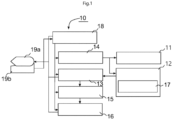
- Fig. 1 is a block diagram of the detection apparatus 10
- Fig. 2 is a hardware configuration diagram of the detection apparatus 10
- Fig. 3 is a schematic diagram of the detection apparatus 10.
- the detection apparatus 10 illustrated in Fig. 1 includes an electrode formation unit 11, a detection unit 12, a measurement unit 13, an adjustment unit 14, a comparison unit 15, an abnormality detection unit 16, an electron source emission unit 17, a control unit 18, and an input/output device including a display device 19a and an input device 19b.
- the control unit 18 includes a central processing unit 18a and a storage device 18b, and the comparison unit 15 and the abnormality detection unit 16 correspond to a program stored in the storage device 18b and to the central processing unit 18a.
- the adjustment unit 14 and the measurement unit 13 are controlled by the control unit 18, and the detection unit 12, the electron source emission unit 17, which is constituted integrally with the detection unit 12, and the electrode formation unit 11 are controlled by the control unit 18 via the adjustment unit 14 and the measurement unit 13.
- the electrode formation unit 11 and a dental implant Imp are brought into contact with each other to form one electrode (working electrode WE). That is, the electrode formation unit 11 forms the working electrode WE by coming into contact with the dental implant Imp.
- the "dental implant” means a one-piece type fixture and abutment and a two-piece type fixture and abutment and usually includes a conductive material such as titanium or a titanium alloy.
- the dental implant Imp is usually arranged in the oral cavity, and the periphery thereof is wetted with an electrolytic solution such as saliva.
- the detection unit 12 constitutes an electrode (counter electrode CE) paired with the working electrode WE, and the working electrode WE and the counter electrode CE are arranged apart from each other via the electrolytic solution.
- the electrode formation unit 11 and the detection unit 12 are electrically connected via the measurement unit 13, and the measurement unit 13 can measure a current flowing between the working electrode WE and the counter electrode CE.
- the present inventor has conducted intensive studies to electrochemically detect the activity of bacteria in the oral cavity. As a result, it has been found that bacteria transfer electrons to an extracellular solid (electron conductor), thereby obtaining energy in a state in which the bacteria can exert pathogenicity.
- becoming a state in which pathogenicity can be exhibited means, for example, becoming a state in which a biofilm is formed as a result of activation or proliferation of bacteria (that is, occurrence of an abnormality related to bacteria) and a state in which the biofilm is acidified.
- the biofilm is a membrane formed by attachment of bacteria to a surface.
- Streptococcus mutans bacteria cultured under acidic conditions (pH 4) and Streptococcus mutans bacteria cultured under neutral conditions the present inventor observed sections stained specifically for oxidation-reduction reaction with a transmission electron microscope and found that the surface of a cell wall and an inner cell membrane are specifically stained in a case where the Streptococcus mutans bacteria are cultured under acidic conditions.
- Capnocytophaga ochracea bacteria which are also known as causative bacteria of periodontal diseases, specifically express electron transfer enzymes in an anaerobic environment.
- Fig. 4 is a graph illustrating experimental results (temporal changes in a current) regarding electron transfer in the intraoral bacteria.
- the current was measured by an anaerobic reactor device including three electrodes (reference electrode, working electrode, and indium tin oxide (ITO) electrode).
- the current was measured in the presence of the intraoral bacteria in the presence of 10 mM glucose (electron source).
- intraoral bacteria cultured in an acidic unbuffered solution pH 4.6 ⁇ 0.2
- each electrode was arranged in a culture solution of the intraoral bacteria in which 10 mM glucose was present, and a current flowing between the working electrode and the ITO electrode when an electric potential was applied was measured.
- the detection apparatus 10 of the present invention employs a configuration in which an abnormality related to bacteria is detected according to a change in a current flowing between electrodes.
- a time length for detecting temporal changes in the current is any length.
- a temporal change in the current may be detected for a very short time length (for example, for several seconds).
- the dental implant Imp is formed as one electrode and is connected to the counter electrode CE (detection unit 12) via the measurement unit 13. Therefore, the detection of the current value in the detection apparatus 10 means a state in which electron transfer from the bacteria to the dental implant Imp has occurred, that is, a state in which the bacteria can exert pathogenicity (for example, a state in which a biofilm is formed and a state in which the biofilm is acidified). Eventually, it is a state in which an abnormality related to the bacteria attached to the dental implant Imp has occurred. As understood from the above description, it can also be said that the current flowing between the electrode pair reflects an activity situation of the bacteria present around the working electrode WE and the counter electrode CE (for example, a situation of activation of the bacteria or a situation of proliferation of the bacteria).
- abnormality occurrence position By scanning over the dental implant Imp with the detection unit 12 and observing a change in the current value during the scan, it is possible to specify a place where the above-described abnormality has occurred (abnormality occurrence position).
- the abnormality occurrence position can be easily and quickly specified, and the abnormality can also be detected at a stage before visible inflammation occurs.
- the detection apparatus 10 includes the adjustment unit 14.
- the adjustment unit 14 applies an electric potential between the working electrode WE formed by the electrode formation unit 11 and the counter electrode CE that is the detection unit 12. Since the detection apparatus 10 includes the adjustment unit 14, even in a case where the number of cells of the bacteria is small, a more excellent response speed can be obtained by applying an electric potential between both electrodes.
- the form of the adjustment unit 14 is not particularly limited, but typically, a potentio/galvanostat (P/G stat, illustrated a symbol "PGST" in Fig. 2 ) including the measurement unit 13 and the adjustment unit 14 can be used.
- the detection apparatus 10 includes the adjustment unit 14, but the detection apparatus 10 according to the first embodiment of the present invention may not include the adjustment unit 14.
- the bacteria transfer electrons to the dental implant Imp that is an extracellular solid (electrical conductor) to obtain energy. That is, in a case where the bacteria exhibit pathogenicity, it is possible to detect a current without applying an electric potential if a connection to the counter electrode CE and the dental implant Imp is made to form a circuit.
- the dental implant Imp is embedded in a jawbone 33, and an artificial tooth 30 is fixed to a tip portion. A part of the dental implant Imp is exposed from gums 32.
- the electrode formation unit 11 is brought in contact with the dental implant Imp at an exposed portion Pos1, and the electrode formation unit 11 and the dental implant Imp constitute the working electrode WE.
- the detection unit 12 includes an electrode 34 and the electron source emission unit 17.
- the electron source emission unit 17 includes a nozzle 17a for emitting an electron source (typically, an aqueous solution containing an electron source), an electron source storage unit 17c communicating with the nozzle 17a via a pipe, and a pump 17b arranged in the pipe, and the electron source emission unit 17 is configured so that a predetermined amount of the electron source is emitted by operating the pump 17b controlled by the control unit 18.
- an electron source typically, an aqueous solution containing an electron source
- the electron source emission unit 17 is configured so that a predetermined amount of the electron source is emitted by operating the pump 17b controlled by the control unit 18.
- the electrode 34 is arranged so as to come in contact with an electrolytic solution 31 (typically saliva) present around the dental implant Imp and is arranged with the working electrode WE via the electrolytic solution 31 to function as the counter electrode CE.
- an electrolytic solution 31 typically saliva
- Each of the electrodes is electrically connected by the potentio/galvano (P/G) stat PGST, and a current flowing between both electrodes can be measured.
- the electron source emitted from the electron source emission unit 17 is selected from glucose or lactic acid or solutions thereof.
- the electron source emission unit 17 may emit the electron source itself and may emit a solution containing the electron source.
- an aqueous solution containing the electron source can be used, and examples thereof include physiological saline containing the electron source and the like.
- Fig. 5 is a schematic diagram illustrating a method of detecting the occurrence of the abnormality by the detection apparatus 10 and specifying the abnormality occurrence position.
- a fine biofilm 42 is formed on the dental implant Imp, and the bacteria are activated.
- Fig. 5(a) schematically illustrates a response detected by the measurement unit 13 with a horizontal axis representing observation time and a vertical axis representing a current.
- a broken line illustrates a response in a case where there is no abnormality (in a case where there is no electron transfer), and a solid line illustrates a response in a case where there is an abnormality (in a case where there is electron transfer).
- the biofilm 42 is formed on the dental implant Imp, and electron transfer from the bacteria to the dental implant Imp occurs. According to the detection apparatus 10, the occurrence of the abnormality can be detected by detecting a current caused by the electron transfer.
- the detection apparatus 10 since the detection apparatus 10 includes the detection unit 12 formed by integrating the electrode 34 and the electron source emission unit 17 (nozzle 17a), it is possible to specify the abnormality occurrence position by scanning over the dental implant Imp with the detection unit 12.
- a scan is performed from a position illustrated by (A) to a position illustrated by (B) in Fig. 5 with the detection unit 12.
- a response measured at the position of (A) is defined as (a)
- a response measured at the position of (B) is defined as (b).
- an electron source 41 emitted from the nozzle 17a is more likely to reach the bacteria in the biofilm 42, at the position of (A), and thus, as illustrated in (a), the detected current increases after emission inj of the electron source 41.
- the electron source 41 emitted from the nozzle 17a is less likely to reach the biofilm 42 due to the bacteria in the biofilm and thus the current increases more gradually or does not increase.
- the detection apparatus 10 includes the electron source emission unit 17, the detection apparatus 10 can detect a smaller amount of the bacteria and has a wider dynamic range and/or has a faster response speed.
- the electron source emission unit 17 includes the nozzle 17a for emitting the electron source (typically, an aqueous solution containing an electron source), the electron source storage unit 17c communicating with the nozzle 17a via a pipe, and the pump 17b arranged in the pipe, and the electron source emission unit 17 is configured so that a predetermined amount of the electron source is emitted by operating the pump 17b controlled by the control unit 18.
- the electron source typically, an aqueous solution containing an electron source
- the electron source storage unit 17c communicating with the nozzle 17a via a pipe
- the pump 17b arranged in the pipe
- the electron source emission unit 17 is configured so that a predetermined amount of the electron source is emitted by operating the pump 17b controlled by the control unit 18.
- the detection unit 12 and the electron source emission unit 17 are integrally formed, and the electron source emitted from the electron source emission unit 17 can be more efficiently arranged between the detection unit 12 and the dental implant Imp.
- the detection apparatus 10 is not limited to the above, and the detection unit 12 and the electron source emission unit 17 may be arranged separately.
- an amount of the electron source emitted by the electron source emission unit 17 and a timing when the electron source is emitted by the electron source emission unit 17 are controlled by the control unit 18, but the detection apparatus 10 according to the first embodiment of the present invention is not limited to the above, and the operation and stop of the pump 17b may be controlled by an operator.
- the measurement unit 13 measures the current between the working electrode WE and the counter electrode CE. When the current is measured, a measurement ID is generated by the measurement unit 13, and data on time from the start of the measurement and a current value obtained at corresponding observation time is generated and stored for each measurement ID in an area secured in the storage device 18b.
- the data generated by the measurement unit 13 is passed to the comparison unit 15.
- the comparison unit 15 compares the data generated by the measurement unit 13 with a predetermined reference (hereinafter referred to as a "reference threshold"). For example, the comparison unit 15 extracts data on the current value at a predetermined observation time and compares the extracted data with the reference threshold. Specifically, the comparison unit 15 compares whether the extracted data exceeds the reference threshold.
- a result of the comparison is passed to the abnormality detection unit 16.
- the abnormality detection unit 16 detects an abnormality related to the bacteria attached to the dental implant Imp on the basis of the result of the comparison by the comparison unit 15. Specifically, in a case where the comparison unit 15 determines that the extracted data exceeds the reference threshold, the abnormality detection unit 16 determines that there is an abnormality related to the bacteria attached to the dental implant Imp. Then, the abnormality detection unit 16 prompts the display device 19a to display the measurement result, and the process ends.
- the abnormality detection unit 16 determines that there is no abnormality related to the bacteria attached to the dental implant Imp.
- the comparison unit 15 and the abnormality detection unit 16 function as a "determination unit” for determining the presence or absence of an abnormality related to the bacteria attached to the dental implant Imp according to the current measured by the measurement unit 13. Note that it is not essential for the abnormality detection unit 16 to prompt the display device 19a to display the measurement result.
- the display device 19a and the input device 19b, and the P/G stat PGST including the measurement unit 13 and the adjustment unit 14 are constituted separately but may be constituted integrally.
- the detection apparatus 10 includes the display device 19a and the input device 19b
- the detection apparatus 10 according to the first embodiment of the present invention may not include the display device 19a and the input device 19b.
- a tablet terminal or the like that can wirelessly communicate with the detection apparatus 10 can also be used as a display device and an input device.
- the abnormality detection unit 16 prompts the display device 19a to display attention calling information.
- the attention calling information typically means that the activity of the bacteria improves or the bacteria may be proliferating on an implant surface, more specifically, on a measurement target site (position of the detection unit 12).
- the dental implant Imp serves as one electrode
- the detection unit 12 serves as the other electrode
- Even for the same tooth it is possible to easily obtain information for evaluating the activity of the bacteria in a narrow range by dividing the tooth into sites on a buccal side (lip side), a palate side (tongue side), and the like.
- the detection apparatus 10 may further include a reference electrode.
- a reference electrode In a case where the detection apparatus 10 includes the reference electrode, an electrode potential can be measured.
- the detection apparatus 10 may be arranged independently from the electrode formation unit 11 and the detection unit 12 or may be arranged integrally with the electrode formation unit 11 and/or the detection unit 12. In particular, it is preferable that the detection unit 12 and the reference electrode are constituted integrally from the viewpoint of easier handling.
- a data collection method of the present invention is a data collection method according to claim 7.
- Fig. 6 is a flowchart of the data collection method.
- an electrical conductor is brought into contact with a dental implant in contact with an electrolytic solution to form an electrode (S1).
- the electrical conductor is not particularly limited, and examples thereof include carbon, gold, platinum, silver, molybdenum, cobalt, nickel, palladium, ruthenium, and the like, and the electrical conductor may be indium tin oxide or the like.
- a shape and the like are not particularly limited, but the shape is preferably a probe shape or a wire shape from the viewpoint of easier contact with the dental implant.
- the electrolytic solution is typically preferably saliva around the dental implant or the like and may be a mixture of an aqueous solution containing an electron source (for example, physiological saline containing glucose) and saliva.
- an electron source for example, physiological saline containing glucose
- a material of the electrode is not particularly limited, and the materials exemplified above as the electrical conductor can be used.
- a shape and the like are not particularly limited, but the shape is preferably a probe shape or a wire shape the viewpoint of easier contact with the dental implant.
- An electrode pair is formed as described above, and then a current flowing between the electrode pair is measured (S3).
- the current reflects the activity of pathogenic microorganisms around the dental implant.
- data collected using the above data collection method can be used to evaluate the activity of pathogenic microorganisms around the dental implant.
- Fig. 7 is a schematic diagram illustrating a usage aspect of a detection apparatus 10 according to the second embodiment.
- Fig. 7 only an electrode formation unit 11 and a detection unit 12 in the detection apparatus 10 are illustrated for convenience.
- an abnormality related to the bacteria attached to the dental implant is detected, but in the second embodiment, an abnormality related to bacteria attached to an endoscope 50 (exemplifying an object) is detected.
- the endoscope 50 is a medical device for observing the inside of the human body (for example, the gastrointestinal tract and the large intestine). Specifically, the endoscope 50 includes an insertion unit 51 and an operation unit 52.
- the insertion unit 51 is a portion to be inserted into the human body.
- An imaging element C capable of imaging the inside of the human body is mounted at a distal end of the insertion unit 51.
- the operation unit 52 is an operator operated by an operator (typically, a doctor).
- an abnormality related to the bacteria attached to the insertion unit 51 of the endoscope 50 is detected.
- the electrode formation unit 11 is in contact with the insertion unit 51, and the electrode formation unit 11 and the insertion unit 51 constitutes a working electrode WE.
- the detection unit 12 constitutes an electrode (counter electrode CE) paired with the working electrode WE.
- the working electrode WE and the counter electrode CE are arranged apart from each other via an electrolytic solution. Note that in the second embodiment, for example, physiological saline is used as the electrolytic solution.
- a scan over the insertion unit 51 is performed with the detection unit 12, and a change in a current value during the scan is observed as in the first embodiment.
- the bacteria transfer electrons to the insertion unit 51 that is an extracellular solid (electrical conductor). Therefore, a current is detected by a measurement unit 13.
- the measurement unit 13 measures a current between the working electrode WE and the counter electrode CE.
- the comparison unit 15 compares data on the current value measured by the measurement unit 13 with a reference threshold. Then, as in the first embodiment, an abnormality detection unit 16 detects an abnormality related to bacteria attached to the insertion unit 51 on the basis of a result of the comparison by the comparison unit 15.
- a configuration for detecting an abnormality related to bacteria attached to the surface of the insertion unit 51 has been exemplified, but a portion for detecting an abnormality related to bacteria in the endoscope 50 is not limited to the above example.
- an abnormality related to bacteria in the operation unit 52 may be detected.
- an object to be detected for an abnormality related to bacteria is not limited to the dental implant and the endoscope.
- Various articles capable of functioning as electrodes are exemplified as the object.
- various medical instruments such as surgical instruments (for example, scalpels and forceps) and cannulas are exemplified as the object.
- a tubular article such as a cannula
- various devices used in food factories, factories manufacturing precision devices, and the like may be used as the object.
- various objects in which occurrence of bacteria is a problem are targets for detecting an abnormality related to bacteria in the detection apparatus of the present application.
- Bacteria attached to various objects cause various problems in terms of hygiene and health. For example, conventionally, it is general that, as for inflammation caused by bacteria occurring between a dental implant and the gums, it is confirmed visually that inflammation had occurred and then the inflammation is addressed. In contrast, by using the detection apparatus according to the present invention, it is possible to perform measurement easily and quickly, and it is possible to detect before the occurrence of visible inflammation, more specifically, to detect, on the basis of a current, a situation in which the activity of bacteria increases.
- the detection apparatus since bacteria attached to the endoscope can cause an infection or the like, it is particularly important to detect an abnormality related to the bacteria attached to the endoscope.
- the detection apparatus With the detection apparatus according to the present invention, it is possible to reliably detect an abnormality related to bacteria with an configuration for easy and quick measuring a current between electrodes.
Landscapes
- Health & Medical Sciences (AREA)
- Life Sciences & Earth Sciences (AREA)
- Chemical & Material Sciences (AREA)
- General Health & Medical Sciences (AREA)
- Physics & Mathematics (AREA)
- Engineering & Computer Science (AREA)
- Molecular Biology (AREA)
- Biophysics (AREA)
- Biomedical Technology (AREA)
- Animal Behavior & Ethology (AREA)
- Dentistry (AREA)
- Veterinary Medicine (AREA)
- Public Health (AREA)
- Oral & Maxillofacial Surgery (AREA)
- Pathology (AREA)
- Organic Chemistry (AREA)
- Analytical Chemistry (AREA)
- Biochemistry (AREA)
- Epidemiology (AREA)
- Immunology (AREA)
- Wood Science & Technology (AREA)
- Zoology (AREA)
- Heart & Thoracic Surgery (AREA)
- Surgery (AREA)
- Proteomics, Peptides & Aminoacids (AREA)
- Medical Informatics (AREA)
- Electrochemistry (AREA)
- General Physics & Mathematics (AREA)
- Spectroscopy & Molecular Physics (AREA)
- Chemical Kinetics & Catalysis (AREA)
- Rheumatology (AREA)
- Bioinformatics & Cheminformatics (AREA)
- Biotechnology (AREA)
- Microbiology (AREA)
- Optics & Photonics (AREA)
- Physical Education & Sports Medicine (AREA)
- Orthopedic Medicine & Surgery (AREA)
- Toxicology (AREA)
- General Engineering & Computer Science (AREA)
- Genetics & Genomics (AREA)
Applications Claiming Priority (2)
| Application Number | Priority Date | Filing Date | Title |
|---|---|---|---|
| JP2019094196 | 2019-05-20 | ||
| PCT/JP2020/019026 WO2020235403A1 (ja) | 2019-05-20 | 2020-05-12 | 検出装置、及び、データ収集方法 |
Publications (3)
| Publication Number | Publication Date |
|---|---|
| EP3973915A1 EP3973915A1 (en) | 2022-03-30 |
| EP3973915A4 EP3973915A4 (en) | 2023-05-17 |
| EP3973915B1 true EP3973915B1 (en) | 2024-09-25 |
Family
ID=73459253
Family Applications (1)
| Application Number | Title | Priority Date | Filing Date |
|---|---|---|---|
| EP20810158.4A Active EP3973915B1 (en) | 2019-05-20 | 2020-05-12 | Detection device and data collection method |
Country Status (4)
| Country | Link |
|---|---|
| US (1) | US12146850B2 (https=) |
| EP (1) | EP3973915B1 (https=) |
| JP (1) | JP7136508B2 (https=) |
| WO (1) | WO2020235403A1 (https=) |
Families Citing this family (1)
| Publication number | Priority date | Publication date | Assignee | Title |
|---|---|---|---|---|
| EP4365585A4 (en) * | 2021-06-29 | 2025-06-18 | National Institute for Materials Science | METHOD FOR IN VITRO DIAGNOSIS OF PERIODONTAL DISEASES AND METHOD FOR DETECTING PG BACTERIA |
Family Cites Families (15)
| Publication number | Priority date | Publication date | Assignee | Title |
|---|---|---|---|---|
| JPH039715A (ja) | 1989-06-08 | 1991-01-17 | Teisa Sangyo Kk | 便座除菌装置のソレノイド装置 |
| JPH065777Y2 (ja) * | 1989-06-16 | 1994-02-16 | 株式会社長田中央研究所内 | 歯周炎検出用電極 |
| JPH05500311A (ja) * | 1989-11-07 | 1993-01-28 | インフォメトリックス・インコーポレーテッド | 細菌個体数を電気化学的に決定する方法 |
| US5254461A (en) | 1989-11-07 | 1993-10-19 | Infometrix, Incorporated | Method of and apparatus for determining microorganism populations electrochemically |
| HU213361B (en) * | 1995-05-09 | 1997-07-28 | Dentimpex Kereskedelmi Es Kult | Method and apparatus for testing electrochemical effect of metal prothesis implanted in living organism causing allergic symptoms and inflammations, as well as reference electrode and measuring electrode touching the tissue and the metal prothesis |
| DE602005025226D1 (de) | 2004-08-02 | 2011-01-20 | Daikin Ind Ltd | Verfahren zum zählen von bakterien, bakterienzählgerät und für das zählgerät vewendete zelle |
| JP3753153B1 (ja) * | 2004-08-02 | 2006-03-08 | ダイキン工業株式会社 | 菌数測定方法及び菌数測定装置 |
| WO2010094649A1 (de) * | 2009-02-17 | 2010-08-26 | Siemens Aktiengesellschaft | Diagnosegerät |
| DK2496173T3 (en) * | 2009-11-06 | 2017-12-18 | Univ New York State Res Found | Device for detecting non-cavitated, early dental caries lesions |
| US8326413B1 (en) * | 2011-12-08 | 2012-12-04 | Mcclain Maxine | Method and device for determining tooth status underneath a crown |
| JP2014097027A (ja) * | 2012-11-15 | 2014-05-29 | Bio Device Technology:Kk | 生菌数測定方法及び生菌数測定キット |
| DE102013201884A1 (de) * | 2013-02-05 | 2014-08-07 | Urs Brodbeck | Behandlungssystem zur Reinigung eines mit Biofilm verunreinigten Bauteils, insbesondere eines Implantat-Teils |
| WO2015112638A1 (en) * | 2014-01-21 | 2015-07-30 | The Regents Of The University Of California | Salivary biosensors and biofuel cells |
| ES2847885T3 (es) | 2014-04-17 | 2021-08-04 | Actimplant Ag | Medios y procedimientos para prevenir o tratar la inflamación asociada a implantes dentales |
| JP6804063B2 (ja) | 2018-02-19 | 2020-12-23 | 福井県 | 微生物検出装置及び検出方法 |
-
2020
- 2020-05-12 EP EP20810158.4A patent/EP3973915B1/en active Active
- 2020-05-12 JP JP2021520726A patent/JP7136508B2/ja active Active
- 2020-05-12 WO PCT/JP2020/019026 patent/WO2020235403A1/ja not_active Ceased
- 2020-05-12 US US17/600,313 patent/US12146850B2/en active Active
Also Published As
| Publication number | Publication date |
|---|---|
| JP7136508B2 (ja) | 2022-09-13 |
| JPWO2020235403A1 (https=) | 2020-11-26 |
| EP3973915A4 (en) | 2023-05-17 |
| EP3973915A1 (en) | 2022-03-30 |
| US12146850B2 (en) | 2024-11-19 |
| WO2020235403A1 (ja) | 2020-11-26 |
| US20220214302A1 (en) | 2022-07-07 |
Similar Documents
| Publication | Publication Date | Title |
|---|---|---|
| JP5295390B2 (ja) | 胃内視鏡 | |
| JP2015507481A (ja) | 埋込型カテーテルの電気化学的殺菌 | |
| JP2007200739A (ja) | 体内飲み込み型発電池 | |
| CN114667112B (zh) | 接触系统和该接触系统的使用 | |
| EP3973915B1 (en) | Detection device and data collection method | |
| JP5295389B2 (ja) | 胃内視鏡 | |
| US20170196488A1 (en) | Serial Electrochemical Measurements of Blood Components | |
| KR102155354B1 (ko) | 무선운용 멀티센싱 임플란트 및 이를 포함하는 고위험 노인질환 상시 모니터링 시스템 | |
| Lin et al. | Parameters to define peri-implantitis: A review and a proposed multi-domain scale | |
| CN100377687C (zh) | 用于采集生物机体官能数据和新陈代谢数据的方法和装置 | |
| Richter et al. | Mapping electrical impedance spectra of the healthy oral mucosa: A pilot study | |
| Tamam et al. | Effects of pH and elevated glucose levels on the electrochemical behavior of dental implants | |
| Golabchi et al. | Long‐term neural recording performance of PEDOT/CNT/dexamethasone‐coated electrode array implanted in visual cortex of rats | |
| HU192218B (en) | Method and device for testing the electrochemical effects shown by metal prothesis, implants in living organism | |
| CN206979842U (zh) | 一种心脏起搏电流提供单元及装置 | |
| RU2782295C1 (ru) | Способ измерения биопотенциалов в полости рта и устройство для его осуществления | |
| de Oliveira Escócio et al. | Postoperative pain after foraminal enlargement in teeth with necrosis and apical periodontitis: a prospective and randomized clinical trial | |
| RU215908U1 (ru) | Устройство для оценки состояния тканей пародонта джоульметрическим методом | |
| JP2004208777A (ja) | 糖検出電極装置 | |
| US5978692A (en) | Apparatus for examining electrochemical effects of in vivo metal implants causing allergic symptoms and/or inflammation in a living organism | |
| RU156333U1 (ru) | Устройство для измерения параметров биологической среды отделяемого из устья слуховой трубы | |
| RU2764365C1 (ru) | Способ маркировки участка слизистой оболочки полости рта | |
| Demidov et al. | Development of a System for Rapid Assessment of the Dynamics of the Inflammatory Process of Periodontal Tissues | |
| Borkar | Tooth tattoo: a new paradigm to detect bacteria on teeth enamel | |
| CN110313911B (zh) | 一种肌纤维介质的活性探测装置 |
Legal Events
| Date | Code | Title | Description |
|---|---|---|---|
| STAA | Information on the status of an ep patent application or granted ep patent |
Free format text: STATUS: THE INTERNATIONAL PUBLICATION HAS BEEN MADE |
|
| PUAI | Public reference made under article 153(3) epc to a published international application that has entered the european phase |
Free format text: ORIGINAL CODE: 0009012 |
|
| STAA | Information on the status of an ep patent application or granted ep patent |
Free format text: STATUS: REQUEST FOR EXAMINATION WAS MADE |
|
| 17P | Request for examination filed |
Effective date: 20210923 |
|
| AK | Designated contracting states |
Kind code of ref document: A1 Designated state(s): AL AT BE BG CH CY CZ DE DK EE ES FI FR GB GR HR HU IE IS IT LI LT LU LV MC MK MT NL NO PL PT RO RS SE SI SK SM TR |
|
| DAV | Request for validation of the european patent (deleted) | ||
| DAX | Request for extension of the european patent (deleted) | ||
| A4 | Supplementary search report drawn up and despatched |
Effective date: 20230419 |
|
| RIC1 | Information provided on ipc code assigned before grant |
Ipc: A61C 19/04 20060101ALI20230413BHEP Ipc: A61B 5/00 20060101ALI20230413BHEP Ipc: A61B 1/12 20060101ALI20230413BHEP Ipc: A61B 5/145 20060101ALI20230413BHEP Ipc: C12Q 1/06 20060101ALI20230413BHEP Ipc: G01N 27/416 20060101ALI20230413BHEP Ipc: A61C 8/00 20060101AFI20230413BHEP |
|
| STAA | Information on the status of an ep patent application or granted ep patent |
Free format text: STATUS: EXAMINATION IS IN PROGRESS |
|
| 17Q | First examination report despatched |
Effective date: 20231013 |
|
| GRAP | Despatch of communication of intention to grant a patent |
Free format text: ORIGINAL CODE: EPIDOSNIGR1 |
|
| STAA | Information on the status of an ep patent application or granted ep patent |
Free format text: STATUS: GRANT OF PATENT IS INTENDED |
|
| INTG | Intention to grant announced |
Effective date: 20240416 |
|
| GRAS | Grant fee paid |
Free format text: ORIGINAL CODE: EPIDOSNIGR3 |
|
| GRAA | (expected) grant |
Free format text: ORIGINAL CODE: 0009210 |
|
| STAA | Information on the status of an ep patent application or granted ep patent |
Free format text: STATUS: THE PATENT HAS BEEN GRANTED |
|
| AK | Designated contracting states |
Kind code of ref document: B1 Designated state(s): AL AT BE BG CH CY CZ DE DK EE ES FI FR GB GR HR HU IE IS IT LI LT LU LV MC MK MT NL NO PL PT RO RS SE SI SK SM TR |
|
| REG | Reference to a national code |
Ref country code: GB Ref legal event code: FG4D |
|
| REG | Reference to a national code |
Ref country code: CH Ref legal event code: EP |
|
| REG | Reference to a national code |
Ref country code: DE Ref legal event code: R096 Ref document number: 602020038400 Country of ref document: DE |
|
| REG | Reference to a national code |
Ref country code: IE Ref legal event code: FG4D |
|
| REG | Reference to a national code |
Ref country code: LT Ref legal event code: MG9D |
|
| PG25 | Lapsed in a contracting state [announced via postgrant information from national office to epo] |
Ref country code: NO Free format text: LAPSE BECAUSE OF FAILURE TO SUBMIT A TRANSLATION OF THE DESCRIPTION OR TO PAY THE FEE WITHIN THE PRESCRIBED TIME-LIMIT Effective date: 20241225 |
|
| PG25 | Lapsed in a contracting state [announced via postgrant information from national office to epo] |
Ref country code: GR Free format text: LAPSE BECAUSE OF FAILURE TO SUBMIT A TRANSLATION OF THE DESCRIPTION OR TO PAY THE FEE WITHIN THE PRESCRIBED TIME-LIMIT Effective date: 20241226 Ref country code: FI Free format text: LAPSE BECAUSE OF FAILURE TO SUBMIT A TRANSLATION OF THE DESCRIPTION OR TO PAY THE FEE WITHIN THE PRESCRIBED TIME-LIMIT Effective date: 20240925 |
|
| PG25 | Lapsed in a contracting state [announced via postgrant information from national office to epo] |
Ref country code: BG Free format text: LAPSE BECAUSE OF FAILURE TO SUBMIT A TRANSLATION OF THE DESCRIPTION OR TO PAY THE FEE WITHIN THE PRESCRIBED TIME-LIMIT Effective date: 20240925 |
|
| PG25 | Lapsed in a contracting state [announced via postgrant information from national office to epo] |
Ref country code: LV Free format text: LAPSE BECAUSE OF FAILURE TO SUBMIT A TRANSLATION OF THE DESCRIPTION OR TO PAY THE FEE WITHIN THE PRESCRIBED TIME-LIMIT Effective date: 20240925 |
|
| PG25 | Lapsed in a contracting state [announced via postgrant information from national office to epo] |
Ref country code: RS Free format text: LAPSE BECAUSE OF FAILURE TO SUBMIT A TRANSLATION OF THE DESCRIPTION OR TO PAY THE FEE WITHIN THE PRESCRIBED TIME-LIMIT Effective date: 20241225 |
|
| REG | Reference to a national code |
Ref country code: NL Ref legal event code: MP Effective date: 20240925 |
|
| PG25 | Lapsed in a contracting state [announced via postgrant information from national office to epo] |
Ref country code: RS Free format text: LAPSE BECAUSE OF FAILURE TO SUBMIT A TRANSLATION OF THE DESCRIPTION OR TO PAY THE FEE WITHIN THE PRESCRIBED TIME-LIMIT Effective date: 20241225 Ref country code: NO Free format text: LAPSE BECAUSE OF FAILURE TO SUBMIT A TRANSLATION OF THE DESCRIPTION OR TO PAY THE FEE WITHIN THE PRESCRIBED TIME-LIMIT Effective date: 20241225 Ref country code: LV Free format text: LAPSE BECAUSE OF FAILURE TO SUBMIT A TRANSLATION OF THE DESCRIPTION OR TO PAY THE FEE WITHIN THE PRESCRIBED TIME-LIMIT Effective date: 20240925 Ref country code: GR Free format text: LAPSE BECAUSE OF FAILURE TO SUBMIT A TRANSLATION OF THE DESCRIPTION OR TO PAY THE FEE WITHIN THE PRESCRIBED TIME-LIMIT Effective date: 20241226 Ref country code: FI Free format text: LAPSE BECAUSE OF FAILURE TO SUBMIT A TRANSLATION OF THE DESCRIPTION OR TO PAY THE FEE WITHIN THE PRESCRIBED TIME-LIMIT Effective date: 20240925 Ref country code: BG Free format text: LAPSE BECAUSE OF FAILURE TO SUBMIT A TRANSLATION OF THE DESCRIPTION OR TO PAY THE FEE WITHIN THE PRESCRIBED TIME-LIMIT Effective date: 20240925 |
|
| REG | Reference to a national code |
Ref country code: AT Ref legal event code: MK05 Ref document number: 1726038 Country of ref document: AT Kind code of ref document: T Effective date: 20240925 |
|
| PG25 | Lapsed in a contracting state [announced via postgrant information from national office to epo] |
Ref country code: NL Free format text: LAPSE BECAUSE OF FAILURE TO SUBMIT A TRANSLATION OF THE DESCRIPTION OR TO PAY THE FEE WITHIN THE PRESCRIBED TIME-LIMIT Effective date: 20240925 |
|
| PG25 | Lapsed in a contracting state [announced via postgrant information from national office to epo] |
Ref country code: PT Free format text: LAPSE BECAUSE OF FAILURE TO SUBMIT A TRANSLATION OF THE DESCRIPTION OR TO PAY THE FEE WITHIN THE PRESCRIBED TIME-LIMIT Effective date: 20250127 Ref country code: IS Free format text: LAPSE BECAUSE OF FAILURE TO SUBMIT A TRANSLATION OF THE DESCRIPTION OR TO PAY THE FEE WITHIN THE PRESCRIBED TIME-LIMIT Effective date: 20250125 |
|
| PG25 | Lapsed in a contracting state [announced via postgrant information from national office to epo] |
Ref country code: RO Free format text: LAPSE BECAUSE OF FAILURE TO SUBMIT A TRANSLATION OF THE DESCRIPTION OR TO PAY THE FEE WITHIN THE PRESCRIBED TIME-LIMIT Effective date: 20240925 Ref country code: SM Free format text: LAPSE BECAUSE OF FAILURE TO SUBMIT A TRANSLATION OF THE DESCRIPTION OR TO PAY THE FEE WITHIN THE PRESCRIBED TIME-LIMIT Effective date: 20240925 |
|
| PG25 | Lapsed in a contracting state [announced via postgrant information from national office to epo] |
Ref country code: ES Free format text: LAPSE BECAUSE OF FAILURE TO SUBMIT A TRANSLATION OF THE DESCRIPTION OR TO PAY THE FEE WITHIN THE PRESCRIBED TIME-LIMIT Effective date: 20240925 |
|
| PG25 | Lapsed in a contracting state [announced via postgrant information from national office to epo] |
Ref country code: AT Free format text: LAPSE BECAUSE OF FAILURE TO SUBMIT A TRANSLATION OF THE DESCRIPTION OR TO PAY THE FEE WITHIN THE PRESCRIBED TIME-LIMIT Effective date: 20240925 Ref country code: EE Free format text: LAPSE BECAUSE OF FAILURE TO SUBMIT A TRANSLATION OF THE DESCRIPTION OR TO PAY THE FEE WITHIN THE PRESCRIBED TIME-LIMIT Effective date: 20240925 |
|
| PG25 | Lapsed in a contracting state [announced via postgrant information from national office to epo] |
Ref country code: CZ Free format text: LAPSE BECAUSE OF FAILURE TO SUBMIT A TRANSLATION OF THE DESCRIPTION OR TO PAY THE FEE WITHIN THE PRESCRIBED TIME-LIMIT Effective date: 20240925 Ref country code: PL Free format text: LAPSE BECAUSE OF FAILURE TO SUBMIT A TRANSLATION OF THE DESCRIPTION OR TO PAY THE FEE WITHIN THE PRESCRIBED TIME-LIMIT Effective date: 20240925 |
|
| PG25 | Lapsed in a contracting state [announced via postgrant information from national office to epo] |
Ref country code: IT Free format text: LAPSE BECAUSE OF FAILURE TO SUBMIT A TRANSLATION OF THE DESCRIPTION OR TO PAY THE FEE WITHIN THE PRESCRIBED TIME-LIMIT Effective date: 20240925 Ref country code: SK Free format text: LAPSE BECAUSE OF FAILURE TO SUBMIT A TRANSLATION OF THE DESCRIPTION OR TO PAY THE FEE WITHIN THE PRESCRIBED TIME-LIMIT Effective date: 20240925 |
|
| REG | Reference to a national code |
Ref country code: DE Ref legal event code: R097 Ref document number: 602020038400 Country of ref document: DE |
|
| PGFP | Annual fee paid to national office [announced via postgrant information from national office to epo] |
Ref country code: DE Payment date: 20250521 Year of fee payment: 6 |
|
| PG25 | Lapsed in a contracting state [announced via postgrant information from national office to epo] |
Ref country code: DK Free format text: LAPSE BECAUSE OF FAILURE TO SUBMIT A TRANSLATION OF THE DESCRIPTION OR TO PAY THE FEE WITHIN THE PRESCRIBED TIME-LIMIT Effective date: 20240925 |
|
| PGFP | Annual fee paid to national office [announced via postgrant information from national office to epo] |
Ref country code: FR Payment date: 20250528 Year of fee payment: 6 |
|
| PLBE | No opposition filed within time limit |
Free format text: ORIGINAL CODE: 0009261 |
|
| STAA | Information on the status of an ep patent application or granted ep patent |
Free format text: STATUS: NO OPPOSITION FILED WITHIN TIME LIMIT |
|
| 26N | No opposition filed |
Effective date: 20250626 |
|
| PG25 | Lapsed in a contracting state [announced via postgrant information from national office to epo] |
Ref country code: SE Free format text: LAPSE BECAUSE OF FAILURE TO SUBMIT A TRANSLATION OF THE DESCRIPTION OR TO PAY THE FEE WITHIN THE PRESCRIBED TIME-LIMIT Effective date: 20240925 |
|
| REG | Reference to a national code |
Ref country code: CH Ref legal event code: H13 Free format text: ST27 STATUS EVENT CODE: U-0-0-H10-H13 (AS PROVIDED BY THE NATIONAL OFFICE) Effective date: 20251223 |
|
| PG25 | Lapsed in a contracting state [announced via postgrant information from national office to epo] |
Ref country code: HR Free format text: LAPSE BECAUSE OF FAILURE TO SUBMIT A TRANSLATION OF THE DESCRIPTION OR TO PAY THE FEE WITHIN THE PRESCRIBED TIME-LIMIT Effective date: 20240925 Ref country code: LU Free format text: LAPSE BECAUSE OF NON-PAYMENT OF DUE FEES Effective date: 20250512 |
|
| PG25 | Lapsed in a contracting state [announced via postgrant information from national office to epo] |
Ref country code: CH Free format text: LAPSE BECAUSE OF NON-PAYMENT OF DUE FEES Effective date: 20250531 |
|
| GBPC | Gb: european patent ceased through non-payment of renewal fee |
Effective date: 20250512 |
|
| REG | Reference to a national code |
Ref country code: BE Ref legal event code: MM Effective date: 20250531 |
|
| PG25 | Lapsed in a contracting state [announced via postgrant information from national office to epo] |
Ref country code: MC Free format text: LAPSE BECAUSE OF FAILURE TO SUBMIT A TRANSLATION OF THE DESCRIPTION OR TO PAY THE FEE WITHIN THE PRESCRIBED TIME-LIMIT Effective date: 20240925 |
|
| PG25 | Lapsed in a contracting state [announced via postgrant information from national office to epo] |
Ref country code: GB Free format text: LAPSE BECAUSE OF NON-PAYMENT OF DUE FEES Effective date: 20250512 |
|
| PG25 | Lapsed in a contracting state [announced via postgrant information from national office to epo] |
Ref country code: IE Free format text: LAPSE BECAUSE OF NON-PAYMENT OF DUE FEES Effective date: 20250512 |
|
| PG25 | Lapsed in a contracting state [announced via postgrant information from national office to epo] |
Ref country code: BE Free format text: LAPSE BECAUSE OF NON-PAYMENT OF DUE FEES Effective date: 20250531 |