EP3973898B1 - Mehrachsiges knochenfixierungselement - Google Patents
Mehrachsiges knochenfixierungselement Download PDFInfo
- Publication number
- EP3973898B1 EP3973898B1 EP21189838.2A EP21189838A EP3973898B1 EP 3973898 B1 EP3973898 B1 EP 3973898B1 EP 21189838 A EP21189838 A EP 21189838A EP 3973898 B1 EP3973898 B1 EP 3973898B1
- Authority
- EP
- European Patent Office
- Prior art keywords
- fastener
- anchor body
- fastener device
- defines
- diameter
- Prior art date
- Legal status (The legal status is an assumption and is not a legal conclusion. Google has not performed a legal analysis and makes no representation as to the accuracy of the status listed.)
- Active
Links
Images





Classifications
-
- A—HUMAN NECESSITIES
- A61—MEDICAL OR VETERINARY SCIENCE; HYGIENE
- A61B—DIAGNOSIS; SURGERY; IDENTIFICATION
- A61B17/00—Surgical instruments, devices or methods
- A61B17/56—Surgical instruments or methods for treatment of bones or joints; Devices specially adapted therefor
- A61B17/58—Surgical instruments or methods for treatment of bones or joints; Devices specially adapted therefor for osteosynthesis, e.g. bone plates, screws or setting implements
- A61B17/68—Internal fixation devices, including fasteners and spinal fixators, even if a part thereof projects from the skin
- A61B17/70—Spinal positioners or stabilisers, e.g. stabilisers comprising fluid filler in an implant
- A61B17/7001—Screws or hooks combined with longitudinal elements which do not contact vertebrae
-
- A—HUMAN NECESSITIES
- A61—MEDICAL OR VETERINARY SCIENCE; HYGIENE
- A61B—DIAGNOSIS; SURGERY; IDENTIFICATION
- A61B17/00—Surgical instruments, devices or methods
- A61B17/56—Surgical instruments or methods for treatment of bones or joints; Devices specially adapted therefor
- A61B17/58—Surgical instruments or methods for treatment of bones or joints; Devices specially adapted therefor for osteosynthesis, e.g. bone plates, screws or setting implements
- A61B17/68—Internal fixation devices, including fasteners and spinal fixators, even if a part thereof projects from the skin
- A61B17/70—Spinal positioners or stabilisers, e.g. stabilisers comprising fluid filler in an implant
- A61B17/7001—Screws or hooks combined with longitudinal elements which do not contact vertebrae
- A61B17/7035—Screws or hooks, wherein a rod-clamping part and a bone-anchoring part can pivot relative to each other
- A61B17/7037—Screws or hooks, wherein a rod-clamping part and a bone-anchoring part can pivot relative to each other wherein pivoting is blocked when the rod is clamped
-
- A—HUMAN NECESSITIES
- A61—MEDICAL OR VETERINARY SCIENCE; HYGIENE
- A61B—DIAGNOSIS; SURGERY; IDENTIFICATION
- A61B17/00—Surgical instruments, devices or methods
- A61B17/56—Surgical instruments or methods for treatment of bones or joints; Devices specially adapted therefor
- A61B17/58—Surgical instruments or methods for treatment of bones or joints; Devices specially adapted therefor for osteosynthesis, e.g. bone plates, screws or setting implements
- A61B17/68—Internal fixation devices, including fasteners and spinal fixators, even if a part thereof projects from the skin
- A61B17/70—Spinal positioners or stabilisers, e.g. stabilisers comprising fluid filler in an implant
- A61B17/7001—Screws or hooks combined with longitudinal elements which do not contact vertebrae
- A61B17/7035—Screws or hooks, wherein a rod-clamping part and a bone-anchoring part can pivot relative to each other
- A61B17/7038—Screws or hooks, wherein a rod-clamping part and a bone-anchoring part can pivot relative to each other to a different extent in different directions, e.g. within one plane only
-
- A—HUMAN NECESSITIES
- A61—MEDICAL OR VETERINARY SCIENCE; HYGIENE
- A61B—DIAGNOSIS; SURGERY; IDENTIFICATION
- A61B17/00—Surgical instruments, devices or methods
- A61B17/56—Surgical instruments or methods for treatment of bones or joints; Devices specially adapted therefor
- A61B17/58—Surgical instruments or methods for treatment of bones or joints; Devices specially adapted therefor for osteosynthesis, e.g. bone plates, screws or setting implements
- A61B17/68—Internal fixation devices, including fasteners and spinal fixators, even if a part thereof projects from the skin
- A61B17/84—Fasteners therefor or fasteners being internal fixation devices
- A61B17/86—Pins or screws or threaded wires; nuts therefor
- A61B17/8605—Heads, i.e. proximal ends projecting from bone
-
- A—HUMAN NECESSITIES
- A61—MEDICAL OR VETERINARY SCIENCE; HYGIENE
- A61B—DIAGNOSIS; SURGERY; IDENTIFICATION
- A61B17/00—Surgical instruments, devices or methods
- A61B17/56—Surgical instruments or methods for treatment of bones or joints; Devices specially adapted therefor
- A61B17/58—Surgical instruments or methods for treatment of bones or joints; Devices specially adapted therefor for osteosynthesis, e.g. bone plates, screws or setting implements
- A61B17/68—Internal fixation devices, including fasteners and spinal fixators, even if a part thereof projects from the skin
- A61B17/84—Fasteners therefor or fasteners being internal fixation devices
- A61B17/86—Pins or screws or threaded wires; nuts therefor
- A61B17/8685—Pins or screws or threaded wires; nuts therefor comprising multiple separate parts
Definitions
- the present application relates generally to medical devices. More specifically, the present application is related to devices for treatment of a spine.
- spinal disorders may be surgically corrected to stabilize a patient's spinal column.
- Spinal disorders may include curvatures or other defects that are correctable with a spinal fusion procedure.
- One method of spinal fusion involves one or more elongated members, typically spinal rods, longitudinally placed on the posterior spine. When a pair of elongated members is used in the spinal fusion procedure, the elongated members may be placed on either side of spinous processes of the vertebral column, for example.
- Each elongated member may be attached to one or more of the vertebrae of the spine by way of fastener devices.
- the fastener devices each may include an anchor body defining a rod-receiving channel configured to receive a portion of the elongated member therein, and a locking cap configured to clamp and secure the position of the elongated member within the rod-receiving channel.
- the fastener devices each may further include a fastener configured to secure the anchor body to a vertebra.
- fastener devices To facilitate insertion of the elongated members into the rod-receiving channels and to provide additional flexibility in the positioning of the elongated members and the fastener devices, fastener devices have been developed wherein the anchor body is pivotable with respect to the fastener. These fastener devices may be referred to as polyaxial fastener devices.
- WO 2009/055407 describes a pedicle screw construct which includes a pedicle screw, a coupling, and a collet.
- the pedicle screw includes a shank having a helical thread formed thereon and a head at one end.
- the collet is positioned atop the head of the pedicle screw.
- the collet and pedicle screw are inserted into the coupling.
- the pedicle screw is rotatable and pivotable relative to the collet and coupling assembly.
- the collet and the coupling each have a saddle that is adapted and configured for receiving a rod member.
- US 2006/235385 describes a bone anchor assembly including a bone anchor having a distal shaft configured to engage bone and a hollow hemi-spherical proximal head defined by a convex outer surface and a concave inner surface, a receiving member for receiving a spinal fixation element and for engaging the head of the bone anchor, and a compression member positionable in the receiving member.
- the compression member has an upper portion configured to seat the spinal fixation element and a lower portion configured to engage the concave inner surface of the anchor head.
- WO 2011/004222 describes a multi-axial pedicle screw system comprising a load transferring rod, a screw head which holds the rod, a screw body which fits multi-axially on the screw head, a clip which keeps the rod in the screw head, a clip screw which locks the clip and the rod from the top and a multi-axial transverse connector that connects two parallel rods to each other. Summary
- the present application discloses a fastener device comprising an anchor body and a fastener.
- the anchor body including an anchor body housing, the anchor body defining a through hole that extends through the anchor body housing, the anchor body further including an upper end, a lower end, and an inner surface that 2 defines a least a portion of the through hole, and at least a portion of the inner surface defining a portion of a first sphere.
- the fastener including a head, a threaded shaft that extends out with respect to the head in a distal direction, and a neck that extends between the head and the threaded shaft.
- the head including an outer surface, at least a portion of the outer surface defining a portion of a second sphere, and the head further including a concave surface of the fastener that extends along both the head and the neck.
- the fastener device defines a configuration in which both: 1) the portion of the outer surface rides along the portion of the inner surface, and 2) the anchor body abuts the neck at a location that is spaced in the distal direction from an entirety of the concave surface such that movement of the fastener relative to the anchor body in at least one direction is blocked.
- the present application discloses a fastener device comprising an anchor body and a fastener.
- the anchor body including an anchor body housing, the anchor body defining a through hole that extends through the anchor body housing, the anchor body further including an upper end, a lower end, and an inner surface, and the inner surface defining at least a portion of the through hole.
- the fastener including a head, a threaded shaft that extends out with respect to the head in a distal direction, and a neck that extends between the head and the threaded shaft.
- the head including a convex outer surface, a portion of the convex surface both defining a portion of a sphere and being configured to articulate along the inner surface when the fastener head is positioned in the through hole, and the fastener including a concave surface that extends along both the head and the neck.
- the fastener is configured such that all lines that: 1) lie entirely within a plane parallel to the distal direction, and 2) are tangent to the portion of the convex outer surface are noncollinear with all lines that: 1) lie entirely within the plane, and 2) are tangent to the concave surface.
- references herein to a first structure articulating along or riding along a second structure refers to the first structure directly contacting the second structure, and precludes an intermediate structure or surface between the first structure and the second structure.
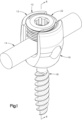
- a medical device 10 is configured to secure an elongated member to a portion of a patient's anatomy.
- the medical device 10 can include a fastener device 12 configured to secure a spinal rod 14 to a patient's vertebra, for example a pedicle or lateral mass of the patient's vertebra.
- the fastener device 12 may be referred to as a pedicle screw when the fastener device 12 is configured to secure the spinal rod 14 to the pedicle of the patient's vertebra.
- the fastener device 12 includes an anchor body 16 configured to receive the spinal rod 14, and a fastener 18 configured to be inserted into the anchor body 16 and secured to the patient's vertebra.
- the fastener device 12 may further include a saddle 20 and a cap 22. As shown in the illustrated embodiment the saddle 20 is configured to abut both the fastener 18 and the spinal rod 14, and the cap 22 is configured to secure the spinal rod 14 relative to the fastener device 12, as described in further detail below.
- the anchor body 16 includes an upper end 24, a lower end 26 spaced from the upper end 24 in a longitudinal direction L, and an anchor body housing 28 that extends from the upper end 24 to the lower end 26.
- the anchor body 16 defines a through hole 30 that extends through the anchor body housing 28.
- the fastener 18 includes a head 32, a threaded shaft 34 that extends out with respect to the head 32 in a distal direction D, and a neck 36 that extends between the head 32 and the threaded shaft 34.
- the fastener 18 is configured to be positioned into the anchor body 16 by moving the fastener 18 in the longitudinal direction L, until the threaded shaft 34 passes through the lower end 26 and the head 32 is positioned within the through hole 30.
- the fastener device 12 is configured such that when the head 32 is positioned in the through hole 30 the fastener 18 is movable, polyaxially, with respect to the anchor body 16.
- the saddle 20 can be moved in the longitudinal direction L, until the saddle 20 contacts the head 32.
- the spinal rod 14 can then be moved in the longitudinal direction L until the spinal rod 14 contacts the saddle 20.
- the cap 22 can be moved in the longitudinal direction L until the cap 22 contacts the spinal rod 14.
- the cap 22 can include a single piece, or as shown in the illustrated embodiment, a multiple piece, for example two-pieces.
- the cap 22 includes threads 38, for example external threads, that are configured to threadingly engage with threads 40, for example internal threads, of the anchor body 16.
- the cap 22 is rotated in a first direction of rotation about an axis, for example an axis parallel to the longitudinal direction L, such that the threads 38 engage with the threads 40 and the cap 22 moves in the longitudinal direction L with respect to the anchor body 16.
- the cap 22 is configured to be rotated until the cap 22 is no longer rotatable in the first direction of rotation when a set torque is applied to the cap 22, thereby securing the spinal rod 14 to the fastener device 12 such that relative movement of the spinal rod 14 and the fastener device 12 is limited, for example prevented, and thereby securing the fastener 18 to the anchor body 16 such that relative movement of the fastener 18 and the anchor body 16 is limited, for example prevented.
- the set torque is between about 2 Newton-meters (N-m) and about 3 N-m.
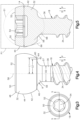
- the head 32 of the fastener 18 includes an outer surface 42.
- a portion 44 of the outer surface 42 may be convex, may define a portion of a first sphere S1, or both.
- the first sphere S1 defines a first diameter D1.
- the first diameter D1 may be greater than about 4.5 mm.
- the first diameter D1 may be greater than about 5.0 mm.
- the first diameter D1 may be in a range between about 5.0 mm and about 8.0 mm.
- the first diameter D1 may be about 6.0 mm.
- the outer surface 42 may include one or more additional portions that do not define a portion of the first sphere S1. As shown in the illustrated embodiment, the outer surface 42 may include a distal portion 46 that is positioned in the distal direction D with respect to the portion 44, a proximal portion 48 that is positioned in a proximal direction P, which is opposite the distal direction D, with respect to the portion 44, or both the distal portion 46 and the proximal portion 48. According to another aspect of the disclosure, an entirety of the outer surface 42 may include the portion 44, such that the outer surface 42 is devoid of the distal portion 46 and the proximal portion 48.
- the head 32 of the fastener 18 may define a location 50 such that the fastener 18 is devoid of any locations positioned in the proximal direction P from the location 50.
- the head 32 includes an upper surface 52 that defines a drive mechanism 54, the drive mechanism 54 configured to receive a driving force that rotates the fastener 18 to secure the fastener 18 to a vertebra.
- the upper surface 52 can be substantially flat, such that any point on the upper surface 52 can define the location 50.
- the upper surface 52 can be not flat, for example curved such that an apex of the upper surface 52 defines the location 50.
- the fastener 18 may include a surface 56 that extends along both the head 32 and the neck 36.
- the surface 56 may be concave such that the surface 56 defines a radius of curvature R.
- the radius of curvature R may be constant along an entirety of the surface 56.
- the surface 56 may define a radius of curvature R of between about 0.25 mm and about 2.0 mm.
- the surface 56 may define a radius of curvature R of between about 0.4 mm and about 1.0 mm.
- the radius of curvature R may vary along the surface 56.
- the surface 56 may include two perpendicular surfaces such that the surface 56 does not define a radius of curvature R.
- the portion of the fastener 18 between the head 32 and the shaft 34, for example the neck 36, is a potential area where the fastener 18 may fail under load.
- radius of curvature R of the concave surface 56 may distribute stresses within the fastener 18, thereby increasing the effective strength of the fastener 18.
- a first fastener 18 that defines a first radius of curvature R that is larger than a second radius of curvature defined by a second fastener 18 may result in a better distribution of stresses under load in the first fastener 18 when compared to the second fastener 18, and thus the first fastener 18 may have an increased effective strength compared to the second fastener 18.
- the neck 36 defines a second diameter D2 that may be measured both in a direction perpendicular to the distal direction D and at a location 57 that is in the distal direction D with respect to the surface 56.
- the second diameter D2 may be measured both in the distal direction D and at the location 57 which is in the distal direction D with respect to an entirety of the surface 56 which defines the radius of curvature R.
- the second diameter D2 may be constant such that the second diameter D2 at first and second locations spaced apart with respect to the distal direction D, is the same.
- the second diameter D2 may vary, for example decrease in the distal direction D2.
- the second diameter D2 may be in a range between about 1.0 mm and about 4.0 mm. According to another aspect of the disclosure, the second diameter D2 may be about 2.5 mm.
- the fastener 18 defines a ratio of the first diameter D1 to the second diameter D2. According to one aspect of the disclosure, the ratio of the first diameter D1 to the second diameter D2 is in a range between about 2 to 1 and about 3 to 1.
- the fastener 18 may be elongate along an axis, for example a central fastener axis 58. As shown in the illustrated embodiment, the central fastener axis 58 is parallel to the distal direction D.
- the portion 44 of the outer surface 42 may include a first point 60 that is located in the distal direction with respect to all other points of the portion 44 of the outer surface 42
- the surface 56 includes a second point 62 that is located in the proximal direction P with respect to all other points of the surface 56
- the first point 60 is spaced from the central fastener axis 58 a first distance L1 measured in a direction perpendicular to the distal direction D
- the second point 62 is spaced from the central fastener axis 58 a second distance L2 measured in a direction perpendicular to the distal direction D
- the first distance L1 is greater than the second distance L2.
- the head 32 may include an intermediate surface 64 that extends between the surface 56 and the outer surface 42. According to one aspect of the disclosure, at least a portion of the intermediate surface 64 may be substantially flat and perpendicular to the distal direction D.
- the fastener 18 may be configured such that all lines that both lie entirely within a plane P1 that is parallel to the distal direction D and that are tangent to the portion 44 of the outer surface 42 are noncollinear with all lines that both lie entirely within the plane P1 and that are tangent to the surface 56.
- a line 66 which both lies entirely within the plane P1 and is tangent to the portion 44 is not collinear with a line 68 which both lies entirely within the plane P1 and is tangent to the surface 56.
- the anchor body 16 may define a rod-receiving channel 69 that is configured to receive a spinal rod, for example the spinal rod 14 (as shown in Fig. 1 ).
- the rod-receiving channel 69 extends through the anchor body housing 28 and may be oriented such that the rod-receiving channel 69 is offset from, for example perpendicular to, the through hole 30.
- the rod-receiving channel 69 may be a U-shaped channel.
- the anchor body 16 may further include an inner surface 70 that defines at least a portion of the through hole 30.
- a portion 72 of the inner surface 70 may be concave, may define a portion of a second sphere S2, or both.
- the second sphere S2 defines a third diameter D3.
- the third diameter D3 is equal to the first diameter D1.
- the third diameter D3 is either greater than or less than the first diameter D1.
- the inner surface 70 defines a minimum inner diameter D4 that is measured both in a direction perpendicular to the longitudinal direction L and at a location 74 that is closer to the lower end 26 as measured along the longitudinal direction L than the location 74 is to the upper end 24 as measured along the longitudinal direction L.
- the location 74 may be spaced a distance from the lower end 26 measured along the longitudinal direction L, such that the inner surface 70 tapers radially outward with respect to a central anchor body axis 76 as the inner surface 70 extends from the location 74 to the lower end 26.
- the location 74 may be located at the lower end 26.
- the location 74 may be positioned on the portion 72 such that no point on the portion 72 is positioned in the longitudinal direction L with respect to the location 74.
- the anchor body 16 defines an inner diameter D5 that is greater than the minimum inner diameter D4.
- the inner diameter D5 may be defined by the inner surface 70 at a location that is spaced from the portion 72 in a direction opposite the longitudinal direction L.
- the inner diameter D5 may be defined by the upper end 24.
- the inner diameter D5 may be a maximum inner diameter of the anchor body 16.
- the upper end 24 defines an upper opening 78 where the through hole 30 exits the anchor body housing 28 in the direction opposite the longitudinal direction L
- the lower end 26 defines a lower opening 80 where the through hole 30 exits the anchor body housing 28 in the longitudinal direction L, or both.
- the anchor body 16 may define a plane P2 (shown as a line which extends into and out of the page).
- the plane P2 may include an entirety of the lower opening 80, may be perpendicular to the longitudinal direction L, or both.
- the fastener device 12 defines an assembled configuration in which the portion 44 of the outer surface 42 rides along (contacts at more than one point) the portion 72 of the inner surface 70 such that the fastener 18 is movable with respect to the anchor body 16.
- the contact between the portion 44 and the portion 72 may define a circle, a portion of a circle, a portion of a sphere, or any combination thereof.
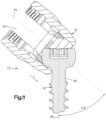
- the fastener 18 is movable polyaxially with respect to the anchor body 16 such that the fastener device 12 defines a cone of angulation that includes all of the angles at which the central fastener axis 58 and the central anchor body axis 76 can be offset from one another when the fastener device 12 is in the assembled configuration.
- the cone of angulation may be defined by a maximum angle ⁇ (alpha), for example the cone of angulation may be twice the maximum angle ⁇ (alpha).
- the maximum angle ⁇ (alpha) is measured between the central fastener axis 58 and the central anchor body axis 76 when the anchor body 16 abuts the neck 36 at a location that is spaced in the distal direction D from an entirety of the surface 56 such that movement of the fastener 18 relative to the anchor body 16 in at least one direction is blocked.
- the maximum angle ⁇ (alpha) is greater than about 45 degrees.
- the maximum angle ⁇ (alpha) is greater than about 50 degrees.
- the maximum angle ⁇ (alpha) is between about 50 degrees and about 60 degrees.
- the fastener device 12 may be configured as a cervical fastener device with a maximum angle ⁇ (alpha) of about 50 degrees.
- the fastener device 12 may be configured as a lumbar fastener device with a maximum angle ⁇ (alpha) of about 30 degrees.
- the central fastener axis 58 and the central anchor body axis 76 may be parallel, for example collinear.
- the central fastener axis 58 and the central anchor body axis 76 may be angularly offset, for example by the maximum angle ⁇ (alpha) or by any angle less than maximum angle ⁇ (alpha).
- the fastener 18 is configured to be inserted into the through hole 30 along the longitudinal direction L such that the portion 44 of the outer surface 42 rides along the portion 72 of the inner surface 70.
- the fastener device 12 can be described as a top-loading fastener device as opposed to a bottom-loading (or pop-on) fastener device.
- the fastener device 12 being configured as a top-loading fastener device allows the size of the first diameter D1 and the size of the second diameter D2 to remain larger than in a comparable bottom-loading screw, which can result in a fastener device 12, and specifically a fastener 18, with increased strength.
- the fastener device 12 defines a configuration in which the location 50 is positioned a third distance L3 from the upper end 24 measured along the longitudinal direction L, the lower end 26 is positioned a fourth distance L4 from the upper end 24 measured along the longitudinal direction L, and the third distance L3 is greater than the fourth distance L4.
- the fastener device 12 defines a configuration in which the location 50 is spaced in the longitudinal direction L with respect to the plane P2.
- the fastener device 12 defines a configuration (referred to herein as a maximum angled configuration) in which both the portion 44 of the outer surface 42 rides along the portion 72 of the inner surface 70, and the anchor body 16 abuts the neck 36 at the location 57 that is spaced in the distal direction D from an entirety of the surface 56 such that movement of the fastener 18 relative to the anchor body 16 in at least one direction is blocked.
- Figs. 8 and 9 the fastener device 12 is illustrated with the saddle 20 abutting the fastener 18, and the spinal rod 14 and the cap 22 are not shown.
- the description of Figs. 8 and 9 applies to the fastener device 12 with and without any combination of the saddle 20, the cap 22, and the spinal rod 14.
- a gap 84 is defined between the surface 56 and the anchor body 16.
- the gap 84 is enclosed in both the longitudinal direction L and the direction opposite the longitudinal direction L.
- a region of contact that includes all of the points of contact between the anchor body 16 and the fastener 18 as measured in a plane that is perpendicular to the longitudinal direction L defines a portion of a circle that is less than a full circle.
- the strength of the fastener 18 may be increased by maximizing the second diameter D2.
- increasing the size of the second diameter D2 while not changing other dimensions of the fastener 18, for example the first diameter D1 may result in a fastener device 12 with a lower maximum angle ⁇ (alpha).
- maximizing the second diameter D2 while maintaining the ratio of the first diameter D1 to the second diameter D2 may result in a fastener 18 with increased strength and a fastener device 12 with a greater maximum angle ⁇ (alpha).
- the strength of the fastener 18 may be increased by increasing the size of the radius of curvature R.
- the increased size of the radius of curvature R may result in less material being present in the area between the head 32 and the threaded shaft 34, however the large radius of curvature may reduce stress concentrations within the area between the head 32 and the threaded shaft 34, thereby resulting in increased strength of the fastener 18.
- the fastener device 12 may be devoid of a collet or other intermediate structure between the portion 44 and the portion 72.
- the inclusion of a collet or other intermediate structure positioned within the through hole 30 of a given size would result in the use of a fastener with a first diameter D1 being smaller than the first diameter D1 of the fastener 18 which is configured for use with the fastener device 12 that is devoid of a collet or other intermediate structure.
- the fastener device 12 being devoid of a collet or other intermediate structure between the portion 44 and the portion 72 may result in increased strength in the fastener 18 configured for use with the fastener device 12.
- a method (not claimed) of making the fastener device 12 may include the step of inserting the fastener 18 into the anchor body 16 such that the threaded shaft 34 passes through the lower opening 80 of the anchor body 16.
- the method of making the fastener device 12 may further include the steps of: inserting the saddle 20 into the anchor body 16; inserting the spinal rod 14 into the anchor body 16; inserting the cap 22 into the anchor body 16; or any combination thereof.
- the method of making the fastener device 12 may further include the step of tightening the cap 22.
- the fastener device 12 is configured such that after the step of inserting the fastener 18 into the anchor body 16, and before the tightening step the fastener 18 is freely movable within the through hole 30 with respect to the anchor body 16, and vice versa.
- the fastener 18 being freely movable includes the fastener 18 being translatable with respect to the anchor body 16 along the longitudinal direction L, the fastener 18 being polyaxially rotatable with respect to the anchor body 16, or both.
- the fastener 18 being freely movable within the through hole 30 with respect to the anchor body 16 may result in undesired movement of the anchor body 16 relative to the fastener 18 during insertion of the fastener 18 into hole 30.
- the fastener 18 and the anchor body 16 may be offset with respect to the longitudinal direction L, for example the central fastener axis 58 and the central anchor body axis 76 may be angularly offset by an angle, ⁇ (beta).
- the angular offset of the central fastener axis 58 and the central anchor body axis 76 may result in a force, such as the force of gravity on the anchor body 16, being sufficient to move the anchor body 16 relative to the fastener 18, for example until the neck 36 of the fastener 18 contacts the anchor body 16, as shown in Fig. 11 .
- the fastener device 12 may include a biasing member 102 configured to restrict, for example by providing a force, relative movement of the anchor body 16 and the fastener 18 after the fastener 18 is inserted into the anchor body 16, and before the cap 22 is inserted into the through hole 30 such that the cap 22 abuts the spinal rod 14.
- a biasing member 102 configured to restrict, for example by providing a force, relative movement of the anchor body 16 and the fastener 18 after the fastener 18 is inserted into the anchor body 16, and before the cap 22 is inserted into the through hole 30 such that the cap 22 abuts the spinal rod 14.
- Biasing member 102 may be disposed in a recess 106 in anchor body 16 such that movement of the biasing member 102 relative to the anchor body 16 is limited in a direction, for example a direction parallel to the central anchor body axis 76.
- the biasing member 102 may further be configured to provide a force on the outer surface 42 of the fastener 18.
- the biasing member 102 may be a split ring.
- the biasing member 102 may be a non-circular shape, such as but not limited to a polygonal shape.
- the recess 106 may be defined by the anchor body 16.
- the biasing member 102 may be configured to expand radially with respect to the central anchor body axis 76.
- the biasing member 102 defines an inner diameter D6 having a first dimension.
- the biasing member 102 may be configured to expand as the fastener 18 is inserted into the through hole 30, and the outer surface 42 of the fastener contacts the biasing member 102.
- the biasing member 102 is configured such that increasing the size of the inner diameter D6 imparts a force on the outer surface 44 of the fastener 18.
- the fastener device 12 is configured such that the biasing member 102 imparts the force on the outer surface 42 in a direction substantially perpendicular to the central anchor body axis 76.
- the biasing member 102 includes an inner surface 112 and an outer surface 114.
- the inner surface 112 defines a through hole 115 that extends through the biasing member 100.
- the inner surface 112 may define at least a portion, for example greater than half of, a circle.
- the circle of which at least a portion is defined by the inner surface 112 may include a center 116.
- the inner diameter D6 is measured along a straight line from a first point on the inner surface 112, through the center 116, to a second point on the inner surface 112 spaced apart from the first point.
- the biasing member 102 may further define an outer diameter D7 measured along a straight line from a first point on the outer surface 114, through the center 116, to a second point on the outer surface 114 spaced apart from the first point on the outer surface 114.
- the outer diameter D7 is greater than the inner diameter D6.
- the inner surface 70 of the anchor body 16 defines the recess 106.
- the recess 106 extends radially into the inner surface 70 of the anchor body 16 and terminates at a base surface 118.
- the recess 106 further extends into the inner surface 70 of the anchor body 16 such that the recess 106 defines a recess height RH.
- the recess height RH is measured along a straight line that is parallel to the central anchor body axis 76 from a recess upper surface 120 to a recess lower surface 122.
- the anchor body 16 defines an inner diameter D8 measured along a straight line that is perpendicular to the central anchor body axis 76 from a first point on the base surface 118, through the central anchor body axis 76, to a second point on the base surface 118 that is spaced from the first point.
- the anchor body 16 further defines an inner diameter D9 measured along a straight line that is perpendicular to the central anchor body axis 76 from a first point on the inner surface 70 that is offset from the recess in the direction opposite the longitudinal direction L, through the central anchor body axis 76, to a second point on the inner surface 70 that is spaced from the first point.
- the anchor body 16 further defines an inner diameter D10 measured along a straight line that is perpendicular to the central anchor body axis 76 from a first point on a portion 86 of the inner surface 70 that is offset from the recess in the longitudinal direction L, through the central anchor body axis 76, to a second point on the portion 86 of the inner surface 70 that is spaced from the first point.
- the inner diameter D8 is larger than both the inner diameter D9 and the inner diameter D10.
- the portion 86 may be curved and define a portion of a sphere having a diameter.
- the biasing member 102 includes an unbiased state when the fastener 18 is not abutting the inner surface 112 and the anchor body 16 is not abutting the outer surface 114.
- the biasing member 102 further includes a biased state when the fastener 18 is abutting the inner surface 112, the anchor body 16 is abutting the outer surface 114, or both.
- the fastener device 12 may be configured such that the biasing member 102 is configured to be positioned within the recess 106.
- the biasing member 102 is configured to be in the unbiased state when positioned within the recess 106, and the recess 106 is configured to retain the biasing member 102 within the recess 106, as shown in Fig. 15 .
- the fastener device 12 may be configured such that, in the unbiased state, the inner diameter D6 is smaller than both the inner diameter D9 and the inner diameter D10, the outer diameter D7 is larger than both the inner diameter D9 and the inner diameter D10, and the inner diameter D8 is larger than the outer diameter D7.
- the biasing member 102 in the unbiased state, is disposed within the recess 106 such that movement of the biasing member 102 out of the recess along the longitudinal direction L is blocked by the upper surface 120 and the lower surface 122.
- the recess 106 further provides room for the biasing member 102 to expand radially out toward the base surface 118.
- the biasing member 102 may further include a top surface 130 and a bottom surface 132 opposite the top surface 130. As shown in the illustrated embodiment, the bottom surface 132 faces in the longitudinal direction L and the top surface 130 faces in the direction opposite the longitudinal direction L.
- the biasing member 102 may further include one or more tapered surfaces 134.
- the one or more tapered surfaces 134 may include a first tapered surface 134' that extends between the upper surface 130 and the inner surface 112, a second tapered surface 134" that extends between the lower surface 132 and the inner surface 112, or both.
- the one or more tapered surfaces 134 may be linear, curved, or partially linear and partially curved.
- the one or more tapered surfaces 134 are configured to enable easier entry of the fastener 18 into the through hole 115, for example by lowering the amount of force required compared to a biasing member 102 devoid of the one or more tapered surfaces 134.
- the fastener 18 is configured to be inserted into the through hole 30 such that the threaded shaft 34 extends through the lower opening 80 and the outer surface 42 abuts the inner surface 112, thereby transitioning the biasing member 102 into a biased state.
- the fastener device 12 may define a fully seated configuration in which the outer surface 42 abuts the portion 86 of the inner surface 70. When the fastener device 12 is in the fully seated configuration the biasing member 102 exerts a force on the fastener 18, and that force resists relative to movement of the fastener 18 and the anchor body 16.
- Relative movement of the fastener 18 and the anchor body 16 along the longitudinal direction L is resisted by the biasing member 102, which is exerting an inward radial force on the fastener 18, abutting either the upper surface 120 or the lower surface 122.
- Relative rotation, for example polyaxial rotation, of the fastener 18 and the anchor body 16 is resisted by a drag force or friction force resulting from the inward radial force exerted by the biasing member 102 on the fastener 18.
- the fastener 18 defines a widest location 136 that is larger, as measured along a straight line perpendicular to the central fastener axis 58 from a first point on the outer surface 42, through the central fastener axis 58, to a second point on the outer surface 42, than any other location on the head 32.
- the fastener device 12 may be configured such that in the fully seated configuration, when the central fastener axis 58 is parallel to the central anchor body axis 76, the biasing member 102 abuts the outer surface 42 at a location aligned with the widest location 136 with respect to the distal direction D.
- the fastener device 12 may be configured such that in the fully seated configuration, when the central fastener axis 58 is parallel to the central anchor body axis 76, the biasing member 102 abuts the outer surface 42 at a location either spaced from the widest location 136 in the distal direction D, or spaced from the widest location 136 in the proximal direction P.
- the method (not claimed) of making the fastener device 12 may include the step of inserting the fastener 18 into the biasing member 102 until the outer surface 42 abuts the portion 86 of the inner surface 70.
- the above step of inserting the fastener 18 into the biasing member 102 may include the step of radially expanding the biasing member 102 such that the inner diameter D6 increases.
- the above step of inserting the fastener 18 into the biasing member 102 may further include, after the step of radially expanding the biasing member 102, the step of radially contracting the biasing member 102 such that the inner diameter D6 decreases.
- the biasing member 102 is configured to resist undesired relative movement of the fastener 18 and the anchor body 16, but allow desired relative movement of the fastener 18 and the anchor body 16.
- the anchor body 16 may be moved relative to the fastener 18, for example by a surgeon manipulating at least one of the fastener 18 and the anchor body 16.
- the biasing member 102 prevents relative movement of the anchor body 16 relative to the fastener 18, for example due to gravity acting on the anchor body 16 when the central fastener axis 58 is angular offset from the central anchor body axis 76 by the angle ⁇ (beta).
- the angle ⁇ (beta) may be between 0 and the maximum angle ⁇ (alpha).
- biasing member 102 illustrated in Figs. 12 to 17 also applies to the embodiments illustrated in Figs. 1 to 11 . Additionally, the description of the embodiments illustrated in Figs. 1 to 11 is applicable to the embodiments illustrated in Figs. 12 to 17 .
Landscapes
- Health & Medical Sciences (AREA)
- Orthopedic Medicine & Surgery (AREA)
- Life Sciences & Earth Sciences (AREA)
- Surgery (AREA)
- Neurology (AREA)
- Heart & Thoracic Surgery (AREA)
- Engineering & Computer Science (AREA)
- Biomedical Technology (AREA)
- Nuclear Medicine, Radiotherapy & Molecular Imaging (AREA)
- Medical Informatics (AREA)
- Molecular Biology (AREA)
- Animal Behavior & Ethology (AREA)
- General Health & Medical Sciences (AREA)
- Public Health (AREA)
- Veterinary Medicine (AREA)
- Surgical Instruments (AREA)
Claims (15)
- Eine Befestigungsteilvorrichtung (12), die konfiguriert ist, um einen Spinalstab relativ zu einem Knochen zu fixieren, wobei die Befestigungsteilvorrichtung Folgendes beinhaltet:einen Verankerungskörper (16), der ein Verankerungskörpergehäuse (28) umfasst, wobei der Verankerungskörper ein Durchgangsloch definiert, das sich durch das Verankerungskörpergehäuse erstreckt, wobei der Verankerungskörper ferner einen Stabaufnahmekanal definiert, der konfiguriert ist, um den Spinalstab aufzunehmen, und der in Bezug auf das Durchgangsloch versetzt ist, wobei der Verankerungskörper ferner ein oberes Ende (24), ein unteres Ende (26) und eine innere Oberfläche (70) umfasst, wobei die innere Oberfläche mindestens einen Abschnitt des Durchgangslochs definiert; undein Befestigungsteil (18), das einen Kopf (32), einen Gewindeschaft (34), der sich in Bezug auf den Kopf in einer distalen Richtung (D) auswärts erstreckt, und einen Hals (36), der sich zwischen dem Kopf und dem Gewindeschaft erstreckt, umfasst, wobei der Kopf eine äußere Oberfläche (42) umfasst, die konfiguriert ist, um entlang der inneren Oberfläche ein Gelenk zu bilden, wenn der Befestigungsteilkopf in das Durchgangsloch eingesetzt ist, wobei mindestens ein Abschnitt (44) der äußeren Oberfläche konvex ist und einen Abschnitt einer Kugel definiert, wobei die Kugel einen ersten Durchmesser (D1) definiert und wobei das Befestigungsteil eine konkave Oberfläche (56) umfasst, die sich sowohl entlang des Kopfes als auch entlang des Halses erstreckt, wobei der Hals einen zweiten Durchmesser (D2) definiert, gemessen: 1) in einer zu der distalen Richtung senkrechten Richtung und 2) an einer Stelle (57), die in der distalen Richtung einer Gänze der konkaven Oberfläche beabstandet ist, wobei das Befestigungsteil ein Verhältnis des ersten Durchmessers zu dem zweiten Durchmesser in einem Bereich von zwischen etwa 2 zu 1 und etwa 3 zu 1 definiert.
- Befestigungsteilvorrichtung gemäß Anspruch 1, wobei:das Befestigungsteil entlang einer Mittelachse, die zu der distalen Richtung parallel ist, länglich ist;der Abschnitt der äußeren Oberfläche einen ersten Punkt umfasst, der in Bezug auf alle anderen Punkte des Abschnitts der äußeren Oberfläche in der distalen Richtung angeordnet ist;die konkave Oberfläche einen zweiten Punkt umfasst, der in Bezug auf alle anderen Punkte der konkaven Oberfläche in einer proximalen Richtung, welche der distalen Richtung entgegengesetzt ist, angeordnet ist; undder erste Punkt von der Mittelachse um eine erste Entfernung, die in einer zu der distalen Richtung senkrechten Richtung gemessen ist, beabstandet ist, der zweite Punkt von der Mittelachse um eine zweite Entfernung, die in einer zu der distalen Richtung senkrechten Richtung gemessen ist, beabstandet ist und die erste Entfernung größer als die zweite Entfernung ist.
- Befestigungsteilvorrichtung gemäß Anspruch 1, wobei die Stelle eine erste Stelle ist, sich das Durchgangsloch von dem oberen Ende weg und zu dem unteren Ende hin in einer Längsrichtung erstreckt und die innere Oberfläche einen Mindestinnendurchmesser definiert, der sowohl: 1) an einer zweiten Stelle gemessen ist, die sich auf der inneren Oberfläche befindet, als auch 2) in einer zu der Längsrichtung senkrechten Richtung gemessen ist, wobei die zweite Stelle näher an dem unteren Ende, gemessen entlang der Längsrichtung, liegt als die zweite Stelle an dem oberen Ende, gemessen entlang der Längsrichtung, liegt.
- Befestigungsteilvorrichtung gemäß Anspruch 3, wobei das untere Ende eine untere Öffnung definiert, wo das Durchgangsloch aus dem Verankerungskörpergehäuse austritt, der Verankerungskörper eine Ebene definiert, die eine Gänze der unteren Öffnung umfasst, der Kopf des Befestigungsteils eine dritte Stelle definiert, sodass das Befestigungsteil frei von jeglichen Stellen ist, die in einer proximalen Richtung, die der distalen Richtung entgegengesetzt ist, von der dritten Stelle liegen, und die Befestigungsteilvorrichtung eine Konfiguration definiert, in der die dritte Stelle in einer ersten Entfernung von dem oberen Ende positioniert ist, das untere Ende in einer zweiten Entfernung von dem oberen Ende positioniert ist, die erste Entfernung und die zweite Entfernung jeweils entlang der Längsrichtung gemessen sind und die erste Entfernung größer als die zweite Entfernung ist.
- Befestigungsteilvorrichtung gemäß Anspruch 3, wobei der erste Durchmesser größer als der Mindestinnendurchmesser ist.
- Befestigungsteilvorrichtung gemäß Anspruch 5, wobei das obere Ende eine obere Öffnung definiert, wo das Durchgangsloch aus dem Verankerungskörpergehäuse austritt, die obere Öffnung einen Innendurchmesser definiert, der in der zu der Längsrichtung senkrechten Richtung gemessen ist, und der Innendurchmesser größer als sowohl der erste Durchmesser als auch der Mindestinnendurchmesser ist.
- Befestigungsteilvorrichtung gemäß Anspruch 1, wobei alle Linien, die 1) gänzlich innerhalb einer zu der distalen Richtung parallelen Ebene liegen und 2) zu dem Abschnitt der äußeren Oberfläche tangential sind, mit allen Linien, die 1) gänzlich innerhalb der Ebene liegen und 2) zu der konkaven Oberfläche tangential sind, nicht kollinear sind.
- Befestigungsteilvorrichtung gemäß Anspruch 1, die ferner einen Stabilisierungsmechanismus beinhaltet, der konfiguriert ist, um in dem Durchgangsloch so positioniert zu werden, dass, wenn das Befestigungsteil in das Durchgangsloch eingesetzt wird, sodass die äußere Oberfläche die innere Oberfläche berührt, der Stabilisierungsmechanismus eine Kraft auf das Befestigungsteil ausübt, die einer relativen Bewegung des Befestigungsteils und des Verankerungskörpers entgegenwirkt.
- Befestigungsteilvorrichtung gemäß Anspruch 8, wobei der Stabilisierungsmechanismus ein Vorspannelement umfasst, das konfiguriert ist, um sich aufzuweiten, wenn der Kopf des Befestigungsteils das Vorspannelement berührt, sodass das aufgeweitete Vorspannelement die Kraft auf die äußere Oberfläche des Befestigungsteils ausübt.
- Befestigungsteilvorrichtung gemäß Anspruch 9, wobei der Verankerungskörper eine Aussparung definiert, die konfiguriert ist, um das Vorspannelement aufzunehmen, sodass das Vorspannelement innerhalb der Aussparung gehalten wird.
- Befestigungsteilvorrichtung gemäß Anspruch 1, wobei das Befestigungsteil entlang einer Befestigungsteil-Mittelachse, die zu der distalen Richtung parallel ist, länglich ist, sich das Durchgangsloch in einer Längsrichtung entlang einer Lochmittelachse von dem oberen Ende weg und zu dem unteren Ende hin erstreckt,wobei die Befestigungsteilvorrichtung eine Konfiguration definiert, in der sowohl 1) der Abschnitt der äußeren Oberfläche entlang eines Abschnitts der inneren Oberfläche gleitet als auch 2) der Verankerungskörper an einer Stelle, die in der distalen Richtung von einer Gänze der konkaven Oberfläche beabstandet ist, an den Hals stößt, sodass die Bewegung des Befestigungsteils relativ zu dem Verankerungskörper in mindestens einer Richtung blockiert ist, undwobei, wenn die Befestigungsteilvorrichtung in der Konfiguration ist, die Befestigungsteil-Mittelachse um einen Winkel, der größer als 45 Grad ist, angular von der Lochmittelachse versetzt ist.
- Befestigungsteilvorrichtung gemäß Anspruch 11, wobei, wenn die Befestigungsteilvorrichtung in der Konfiguration ist, die Befestigungsteil-Mittelachse um einen Winkel, der größer als etwa 50 Grad ist, angular von der Lochmittelachse versetzt ist.
- Befestigungsteilvorrichtung gemäß Anspruch 12, wobei, wenn die Befestigungsteilvorrichtung in der Konfiguration ist, die Befestigungsteil-Mittelachse um einen Winkel, der zwischen etwa 50 Grad und etwa 60 Grad liegt, angular von der Lochmittelachse versetzt ist.
- Befestigungsteilvorrichtung gemäß Anspruch 1, wobei die konkave Oberfläche einen Krümmungsradius (R) definiert, der entlang einer Gänze der konkaven Oberfläche konstant ist, wobei der Krümmungsradius (R) zwischen etwa 0,25 mm und etwa 2,0 mm beträgt.
- Befestigungsteilvorrichtung gemäß Anspruch 1, wobei 1) die innere Oberfläche (70) einen Mindestinnendurchmesser (D4) definiert, der sowohl in einer zu einer Längsrichtung (L) senkrechten Richtung als auch an einer Stelle (74), die näher an dem unteren Ende (26), gemessen entlang der Längsrichtung (L), liegt als die Stelle (74) an dem oberen Ende (24), gemessen entlang der Längsrichtung (L), liegt, gemessen ist und 2) der erste Durchmesser (D1) größer als der Mindestinnendurchmesser (D4) ist, sodass der Kopf (32) des Befestigungsteils (18) nicht entlang der der Längsrichtung (L) entgegengesetzten Richtung in das Durchgangsloch (30) eingesetzt werden kann, sodass mindestens der Abschnitt (44) der äußeren Oberfläche (42) entlang des Abschnitts (72) der inneren Oberfläche (70) gleitet.
Applications Claiming Priority (3)
| Application Number | Priority Date | Filing Date | Title |
|---|---|---|---|
| US201662300456P | 2016-02-26 | 2016-02-26 | |
| PCT/US2017/019280 WO2017147372A1 (en) | 2016-02-26 | 2017-02-24 | Polyaxial bone fixation element |
| EP17709305.1A EP3419537B1 (de) | 2016-02-26 | 2017-02-24 | Mehrachsiges knochenfixierungselement |
Related Parent Applications (1)
| Application Number | Title | Priority Date | Filing Date |
|---|---|---|---|
| EP17709305.1A Division EP3419537B1 (de) | 2016-02-26 | 2017-02-24 | Mehrachsiges knochenfixierungselement |
Publications (2)
| Publication Number | Publication Date |
|---|---|
| EP3973898A1 EP3973898A1 (de) | 2022-03-30 |
| EP3973898B1 true EP3973898B1 (de) | 2025-06-04 |
Family
ID=58231778
Family Applications (2)
| Application Number | Title | Priority Date | Filing Date |
|---|---|---|---|
| EP21189838.2A Active EP3973898B1 (de) | 2016-02-26 | 2017-02-24 | Mehrachsiges knochenfixierungselement |
| EP17709305.1A Active EP3419537B1 (de) | 2016-02-26 | 2017-02-24 | Mehrachsiges knochenfixierungselement |
Family Applications After (1)
| Application Number | Title | Priority Date | Filing Date |
|---|---|---|---|
| EP17709305.1A Active EP3419537B1 (de) | 2016-02-26 | 2017-02-24 | Mehrachsiges knochenfixierungselement |
Country Status (6)
| Country | Link |
|---|---|
| US (4) | US10675061B2 (de) |
| EP (2) | EP3973898B1 (de) |
| JP (1) | JP6965257B2 (de) |
| CN (1) | CN108697445B (de) |
| AU (1) | AU2017222593B9 (de) |
| WO (1) | WO2017147372A1 (de) |
Families Citing this family (7)
| Publication number | Priority date | Publication date | Assignee | Title |
|---|---|---|---|---|
| WO2012128825A1 (en) * | 2011-03-24 | 2012-09-27 | Jackson Roger P | Polyaxial bone anchor with compound articulation and pop-on shank |
| EP3973898B1 (de) | 2016-02-26 | 2025-06-04 | Medos International Sarl | Mehrachsiges knochenfixierungselement |
| US10274125B2 (en) | 2016-04-29 | 2019-04-30 | Really Right Stuff, Llc | Quick detach connector |
| EP3656320B1 (de) * | 2018-11-20 | 2022-08-24 | Biedermann Technologies GmbH & Co. KG | Verankerungselement für eine polyaxiale knochenverankerungsvorrichtung und polyaxiale knochenverankerungsvorrichtung mit solch einem verankerungselement |
| EP3831322B1 (de) | 2019-12-06 | 2025-03-19 | Biedermann Technologies GmbH & Co. KG | Kopplungsvorrichtung zur kopplung einer stange mit einem knochenanker |
| TWI911474B (zh) * | 2022-08-09 | 2026-01-11 | 陳健煜 | 兩節式懸吊錨釘及其系統與零件組 |
| USD1037845S1 (en) * | 2022-11-08 | 2024-08-06 | Madhu Sudan Saini | Screw |
Family Cites Families (101)
| Publication number | Priority date | Publication date | Assignee | Title |
|---|---|---|---|---|
| DE3614101C1 (de) | 1986-04-25 | 1987-10-22 | Juergen Prof Dr Med Harms | Pedikelschraube |
| DE4243951C2 (de) | 1992-12-23 | 1997-07-03 | Plus Endoprothetik Ag | Vorrichtung zur Versteifung eines aus wenigstens zwei Wirbeln bestehenden Wirbelsäulenabschnitts |
| DE4307576C1 (de) | 1993-03-10 | 1994-04-21 | Biedermann Motech Gmbh | Knochenschraube |
| JPH07180714A (ja) * | 1993-12-24 | 1995-07-18 | Nippon Steel Corp | 疲労強度の優れたボルトの製造法 |
| US5961517A (en) | 1994-07-18 | 1999-10-05 | Biedermann; Lutz | Anchoring member and adjustment tool therefor |
| DE19509332C1 (de) | 1995-03-15 | 1996-08-14 | Harms Juergen | Verankerungselement |
| US5733285A (en) | 1995-07-13 | 1998-03-31 | Fastenetix, Llc | Polyaxial locking mechanism |
| US5879350A (en) | 1996-09-24 | 1999-03-09 | Sdgi Holdings, Inc. | Multi-axial bone screw assembly |
| US5885286A (en) | 1996-09-24 | 1999-03-23 | Sdgi Holdings, Inc. | Multi-axial bone screw assembly |
| US5728098A (en) | 1996-11-07 | 1998-03-17 | Sdgi Holdings, Inc. | Multi-angle bone screw assembly using shape-memory technology |
| KR100417222B1 (ko) | 1996-12-12 | 2004-02-05 | 신테스 아게 츄어 | 페디클 스크류와 횡방향 지지대를 연결하기 위한 장치 |
| US5782833A (en) | 1996-12-20 | 1998-07-21 | Haider; Thomas T. | Pedicle screw system for osteosynthesis |
| DE59712497D1 (de) | 1997-01-22 | 2005-12-29 | Synthes Ag | Vorrichtung zur verbindung eines langsträgers mit einer pedikelschraube |
| US5733286A (en) | 1997-02-12 | 1998-03-31 | Third Millennium Engineering, Llc | Rod securing polyaxial locking screw and coupling element assembly |
| US6248105B1 (en) | 1997-05-17 | 2001-06-19 | Synthes (U.S.A.) | Device for connecting a longitudinal support with a pedicle screw |
| US5891145A (en) | 1997-07-14 | 1999-04-06 | Sdgi Holdings, Inc. | Multi-axial screw |
| US6010503A (en) | 1998-04-03 | 2000-01-04 | Spinal Innovations, Llc | Locking mechanism |
| FR2778089B1 (fr) | 1998-04-30 | 2000-07-21 | Dimso Sa | Systeme d'osteosynthese rachidienne avec bride et verrou |
| US6113601A (en) | 1998-06-12 | 2000-09-05 | Bones Consulting, Llc | Polyaxial pedicle screw having a loosely coupled locking cap |
| US6090111A (en) | 1998-06-17 | 2000-07-18 | Surgical Dynamics, Inc. | Device for securing spinal rods |
| EP1117336B1 (de) | 1998-09-29 | 2004-05-19 | SYNTHES AG Chur | Vorrichtung zur verbindung eines längsträgers mit einem knochenfixationsmittel |
| US6254602B1 (en) | 1999-05-28 | 2001-07-03 | Sdgi Holdings, Inc. | Advanced coupling device using shape-memory technology |
| FR2794637B1 (fr) | 1999-06-14 | 2001-12-28 | Scient X | Implant pour dispositif d'osteosynthese notamment du rachis |
| FR2796545B1 (fr) | 1999-07-22 | 2002-03-15 | Dimso Sa | Liaison poly-axiale pour systeme d'osteosynthese, notamment pour le rachis |
| DE19936286C2 (de) | 1999-08-02 | 2002-01-17 | Lutz Biedermann | Knochenschraube |
| ES2153331B1 (es) | 1999-08-05 | 2001-09-01 | Traiber S A | Sistema de fijacion intervertebral para tratamientos de columna. |
| US6280442B1 (en) | 1999-09-01 | 2001-08-28 | Sdgi Holdings, Inc. | Multi-axial bone screw assembly |
| CA2423973A1 (en) | 1999-09-27 | 2001-04-05 | Blackstone Medical, Inc. | A surgical screw system and related methods |
| US6554834B1 (en) * | 1999-10-07 | 2003-04-29 | Stryker Spine | Slotted head pedicle screw assembly |
| DE10005386A1 (de) | 2000-02-07 | 2001-08-09 | Ulrich Gmbh & Co Kg | Pedikelschraube |
| DE10005385A1 (de) | 2000-02-07 | 2001-08-09 | Ulrich Gmbh & Co Kg | Pedikelschraube |
| US6485491B1 (en) | 2000-09-15 | 2002-11-26 | Sdgi Holdings, Inc. | Posterior fixation system |
| US6488681B2 (en) * | 2001-01-05 | 2002-12-03 | Stryker Spine S.A. | Pedicle screw assembly |
| AU2002235349B2 (en) | 2001-01-12 | 2006-05-18 | Depuy Spine, Inc. | Polyaxial screw with improved locking |
| DE10115014A1 (de) | 2001-03-27 | 2002-10-24 | Biedermann Motech Gmbh | Verankerungselement |
| US6974460B2 (en) * | 2001-09-14 | 2005-12-13 | Stryker Spine | Biased angulation bone fixation assembly |
| US6800079B2 (en) | 2002-03-15 | 2004-10-05 | Lock-N-Stitch, Inc. | Orthopedic stabilization device and method |
| KR100379194B1 (en) | 2001-10-31 | 2003-04-08 | U & I Co Ltd | Apparatus for fixing bone |
| US7066937B2 (en) * | 2002-02-13 | 2006-06-27 | Endius Incorporated | Apparatus for connecting a longitudinal member to a bone portion |
| US7879075B2 (en) | 2002-02-13 | 2011-02-01 | Zimmer Spine, Inc. | Methods for connecting a longitudinal member to a bone portion |
| US6837889B2 (en) | 2002-03-01 | 2005-01-04 | Endius Incorporated | Apparatus for connecting a longitudinal member to a bone portion |
| ES2629431T3 (es) * | 2002-10-30 | 2017-08-09 | Zimmer Spine, Inc. | Sistema de estabilización espinal por inserción |
| US7087057B2 (en) * | 2003-06-27 | 2006-08-08 | Depuy Acromed, Inc. | Polyaxial bone screw |
| AU2004266737B2 (en) | 2003-08-20 | 2010-05-13 | Warsaw Orthopedic, Inc. | Multi-axial orthopedic device and system, e.g. for spinal surgery |
| US20060058788A1 (en) | 2004-08-27 | 2006-03-16 | Hammer Michael A | Multi-axial connection system |
| US8951290B2 (en) | 2004-08-27 | 2015-02-10 | Blackstone Medical, Inc. | Multi-axial connection system |
| US20140121703A1 (en) | 2012-10-31 | 2014-05-01 | Roger P. Jackson | Polyaxial bone anchor with pop-on multi-thread shank, some with diametric interference fit inserts |
| US8444681B2 (en) | 2009-06-15 | 2013-05-21 | Roger P. Jackson | Polyaxial bone anchor with pop-on shank, friction fit retainer and winged insert |
| US9168069B2 (en) | 2009-06-15 | 2015-10-27 | Roger P. Jackson | Polyaxial bone anchor with pop-on shank and winged insert with lower skirt for engaging a friction fit retainer |
| EP1871302A4 (de) | 2005-03-25 | 2012-05-02 | Blackstone Medical Inc | Multiaxiales verbindungssystem |
| US20060235385A1 (en) * | 2005-03-31 | 2006-10-19 | Dale Whipple | Low profile polyaxial screw |
| US20070191839A1 (en) * | 2006-01-27 | 2007-08-16 | Sdgi Holdings, Inc. | Non-locking multi-axial joints in a vertebral implant and methods of use |
| US7699876B2 (en) | 2006-11-08 | 2010-04-20 | Ebi, Llc | Multi-axial bone fixation apparatus |
| US8197517B1 (en) | 2007-05-08 | 2012-06-12 | Theken Spine, Llc | Frictional polyaxial screw assembly |
| US7951173B2 (en) | 2007-05-16 | 2011-05-31 | Ortho Innovations, Llc | Pedicle screw implant system |
| US7942910B2 (en) | 2007-05-16 | 2011-05-17 | Ortho Innovations, Llc | Polyaxial bone screw |
| US8398683B2 (en) | 2007-10-23 | 2013-03-19 | Pioneer Surgical Technology, Inc. | Rod coupling assembly and methods for bone fixation |
| JP5651472B2 (ja) * | 2007-10-23 | 2015-01-14 | ケー2エム, インコーポレイテッド | テーパーロックを有する後方椎弓根スクリュー |
| US20110087288A1 (en) | 2007-10-24 | 2011-04-14 | Tara Stevenson | Surgical Fixation System and Related Methods |
| US8167914B1 (en) | 2008-07-16 | 2012-05-01 | Zimmer Spine, Inc. | Locking insert for spine stabilization and method of use |
| US8377101B2 (en) * | 2008-11-05 | 2013-02-19 | K2M, Inc. | Multi-planar taper lock screw with increased rod friction |
| EP2204129B1 (de) | 2008-12-30 | 2011-11-30 | Biedermann Motech GmbH | Aufnahmeteil für die Aufnahme einer Stange zur Kopplung der Stange in einem Knochenverankerungselement und eine Knochenverankerungsvorrichtung mit einem derartigen Aufnahmeteil |
| ES2548580T3 (es) | 2009-02-20 | 2015-10-19 | Biedermann Technologies Gmbh & Co. Kg | Parte receptora para alojar una varilla para el acoplamiento a un elemento de anclaje óseo y dispositivo de anclaje óseo que incluye tal parte receptora |
| US8998959B2 (en) | 2009-06-15 | 2015-04-07 | Roger P Jackson | Polyaxial bone anchors with pop-on shank, fully constrained friction fit retainer and lock and release insert |
| US20130103098A1 (en) * | 2009-06-15 | 2013-04-25 | Roger P. Jackson | Polyaxial bone anchor with pop-on shank, friction fit retainer and lateral alignment feature |
| WO2011004222A1 (en) * | 2009-07-10 | 2011-01-13 | Kamil Bal | Pedicular screw system |
| ES2477272T3 (es) * | 2009-09-25 | 2014-07-16 | Biedermann Technologies Gmbh & Co. Kg | Dispositivo de anclaje óseo |
| AU2010303934B2 (en) | 2009-10-05 | 2014-03-27 | Roger P. Jackson | Polyaxial bone anchor with non-pivotable retainer and pop-on shank, some with friction fit |
| US8986319B2 (en) | 2010-10-08 | 2015-03-24 | Alphatec Spine, Inc. | Screw head locker apparatus and methods of use |
| US9232969B2 (en) | 2010-10-29 | 2016-01-12 | Warsaw Orthopedic, Inc. | Directional control for a multi-axial screw assembly |
| ES2567724T3 (es) | 2010-11-22 | 2016-04-26 | Biedermann Technologies Gmbh & Co. Kg | Dispositivo de anclaje óseo poliaxial |
| EP2457527B1 (de) | 2010-11-24 | 2014-04-16 | Biedermann Technologies GmbH & Co. KG | Mehrachsige Knochenverankerungsvorrichtung mit vergrößertem Schwenkwinkel |
| ES2461843T3 (es) | 2010-12-23 | 2014-05-21 | Biedermann Technologies Gmbh & Co. Kg | Dispositivo de anclaje de hueso |
| ES2433933T3 (es) | 2010-12-27 | 2013-12-13 | Biedermann Technologies Gmbh & Co. Kg | Dispositivo poliaxial de anclaje para huesos |
| CN102133132B (zh) * | 2010-12-31 | 2013-01-02 | 上海微创骨科医疗科技有限公司 | 动态椎弓根螺钉植入物 |
| US8337530B2 (en) | 2011-03-09 | 2012-12-25 | Zimmer Spine, Inc. | Polyaxial pedicle screw with increased angulation |
| US9060812B2 (en) | 2011-03-29 | 2015-06-23 | Alphatec Spine, Inc. | Screw assembly with deformable bushing |
| CN103687560B (zh) | 2011-05-26 | 2016-08-24 | 艾泽特奇有限责任公司 | 具有连接部分的骨螺钉系统 |
| US20120310284A1 (en) | 2011-06-03 | 2012-12-06 | Royal Oak Industries | Polyaxial pedicle screw |
| US9358047B2 (en) | 2011-07-15 | 2016-06-07 | Globus Medical, Inc. | Orthopedic fixation devices and methods of installation thereof |
| US9186187B2 (en) | 2011-07-15 | 2015-11-17 | Globus Medical, Inc. | Orthopedic fixation devices and methods of installation thereof |
| ES2504067T3 (es) | 2011-08-18 | 2014-10-08 | Biedermann Technologies Gmbh & Co. Kg | Dispositivo de anclaje óseo poliaxial con ángulo de giro ampliado |
| US8906068B1 (en) | 2011-09-13 | 2014-12-09 | Bernard M. Bedor | Spinal fixation system and method |
| EP2918237A1 (de) * | 2011-09-15 | 2015-09-16 | Biedermann Technologies GmbH & Co. KG | Mehrachsige knochenverankerungsvorrichtung mit vergrössertem schwenkwinkel |
| DE102011054203A1 (de) | 2011-10-05 | 2013-04-11 | Aesculap Ag | Nachjustierbare polyaxiale Pedikelschraube |
| EP2939623A1 (de) * | 2011-10-27 | 2015-11-04 | Biedermann Technologies GmbH & Co. KG | Polyaxiale knochenverankerungsvorrichtung mit hoher abwinkelung |
| US8663290B2 (en) | 2011-10-28 | 2014-03-04 | Ortho Innovations, Llc | Top loading polyaxial ball and socket fastener with saddle |
| EP2606841B1 (de) | 2011-12-23 | 2016-03-09 | Biedermann Technologies GmbH & Co. KG | Polyaxiale Knochenverankerungsvorrichtung |
| EP2837347B1 (de) | 2012-01-30 | 2018-10-03 | Biedermann Technologies GmbH & Co. KG | Knochenverankerungsvorrichtung |
| ES2563785T3 (es) | 2012-06-01 | 2016-03-16 | Biedermann Technologies Gmbh & Co. Kg | Dispositivo de anclaje de hueso poliaxial |
| ES2552987T3 (es) | 2012-07-03 | 2015-12-03 | Biedermann Technologies Gmbh & Co. Kg | Dispositivo de anclaje de hueso poliaxial |
| EP2687171B1 (de) | 2012-07-18 | 2015-04-22 | Biedermann Technologies GmbH & Co. KG | Polyaxiale Knochenverankerungsvorrichtung |
| ES2556462T3 (es) * | 2012-12-10 | 2016-01-18 | Biedermann Technologies Gmbh & Co. Kg | Elemento de anclaje adecuado para ser utilizado en un dispositivo de anclaje de hueso poliaxial y dispositivo de anclaje de hueso poliaxial con un ángulo de giro ampliado hacia un lado |
| US9271761B2 (en) | 2012-12-11 | 2016-03-01 | Zimmer Spine | Bone anchoring device |
| EP2983602B1 (de) | 2013-04-12 | 2019-12-04 | Alphatec Spine, Inc. | Uniplanare schraubenanordnung |
| CN105378303B (zh) * | 2013-07-08 | 2017-05-03 | 株式会社托普拉 | 螺栓部件 |
| EP2829243B1 (de) | 2013-07-24 | 2016-11-02 | Biedermann Technologies GmbH & Co. KG | Kopplungsvorrichtung zum Koppeln einer Stange an einem Knochenverankerungselement, Kit für eine solche Kopplungsanordnung mit unterschiedlichen Stangenaufnahmeelement und Knochenverankerungsvorrichtung |
| US9549765B2 (en) | 2014-04-03 | 2017-01-24 | Zimmer Spine, Inc. | Uniplanar bone screw |
| DE102014215529A1 (de) | 2014-08-06 | 2016-02-11 | Silony Medical International AG | Osteosynthesevorrichtung |
| EP2985001B1 (de) | 2014-08-11 | 2017-04-19 | Biedermann Technologies GmbH & Co. KG | Polyaxiale Knochenverankerungsvorrichtung |
| EP3973898B1 (de) | 2016-02-26 | 2025-06-04 | Medos International Sarl | Mehrachsiges knochenfixierungselement |
-
2017
- 2017-02-24 EP EP21189838.2A patent/EP3973898B1/de active Active
- 2017-02-24 CN CN201780013474.1A patent/CN108697445B/zh active Active
- 2017-02-24 EP EP17709305.1A patent/EP3419537B1/de active Active
- 2017-02-24 US US15/441,326 patent/US10675061B2/en active Active
- 2017-02-24 JP JP2018544849A patent/JP6965257B2/ja active Active
- 2017-02-24 WO PCT/US2017/019280 patent/WO2017147372A1/en not_active Ceased
- 2017-02-24 AU AU2017222593A patent/AU2017222593B9/en active Active
-
2020
- 2020-05-11 US US16/871,085 patent/US11547449B2/en active Active
-
2022
- 2022-12-07 US US18/062,605 patent/US12396758B2/en active Active
-
2025
- 2025-08-04 US US19/289,357 patent/US20250359894A1/en active Pending
Also Published As
| Publication number | Publication date |
|---|---|
| US20170245894A1 (en) | 2017-08-31 |
| JP2019508135A (ja) | 2019-03-28 |
| US11547449B2 (en) | 2023-01-10 |
| AU2017222593B9 (en) | 2021-04-22 |
| US10675061B2 (en) | 2020-06-09 |
| US20200268416A1 (en) | 2020-08-27 |
| CN108697445A (zh) | 2018-10-23 |
| US20250359894A1 (en) | 2025-11-27 |
| EP3973898A1 (de) | 2022-03-30 |
| CN108697445B (zh) | 2022-04-19 |
| WO2017147372A1 (en) | 2017-08-31 |
| AU2017222593B2 (en) | 2021-04-08 |
| JP6965257B2 (ja) | 2021-11-10 |
| EP3419537B1 (de) | 2021-09-01 |
| AU2017222593A1 (en) | 2018-09-13 |
| EP3419537A1 (de) | 2019-01-02 |
| US20230102605A1 (en) | 2023-03-30 |
| US12396758B2 (en) | 2025-08-26 |
| WO2017147372A8 (en) | 2018-03-22 |
Similar Documents
| Publication | Publication Date | Title |
|---|---|---|
| US12396758B2 (en) | Polyaxial bone fixation element | |
| US11849978B2 (en) | Constrained motion bone screw assembly | |
| US8845700B2 (en) | Adjustable bone screw assembly | |
| US20190247094A1 (en) | Orthopedic fixation devices and methods of installation thereof | |
| US11076887B2 (en) | Orthopedic fixation devices and methods of installation thereof | |
| US9649134B2 (en) | Uniplanar screw assembly and methods of use | |
| US20060235385A1 (en) | Low profile polyaxial screw | |
| US20080077143A1 (en) | Apparatus for connecting a longitudinal member to a bone portion | |
| US9005249B2 (en) | Spinal rod connector assembly | |
| US20160143678A1 (en) | Monoplanar bone anchoring device with selectable pivot plane | |
| US9480501B2 (en) | Modular pedicle screw | |
| US20240180594A1 (en) | Monoaxial - uniplanar hybrid screw | |
| US20250090203A1 (en) | Orthopedic Fixation Devices and Methods of Installation Thereof |
Legal Events
| Date | Code | Title | Description |
|---|---|---|---|
| PUAI | Public reference made under article 153(3) epc to a published international application that has entered the european phase |
Free format text: ORIGINAL CODE: 0009012 |
|
| STAA | Information on the status of an ep patent application or granted ep patent |
Free format text: STATUS: THE APPLICATION HAS BEEN PUBLISHED |
|
| AC | Divisional application: reference to earlier application |
Ref document number: 3419537 Country of ref document: EP Kind code of ref document: P |
|
| AK | Designated contracting states |
Kind code of ref document: A1 Designated state(s): AL AT BE BG CH CY CZ DE DK EE ES FI FR GB GR HR HU IE IS IT LI LT LU LV MC MK MT NL NO PL PT RO RS SE SI SK SM TR |
|
| STAA | Information on the status of an ep patent application or granted ep patent |
Free format text: STATUS: REQUEST FOR EXAMINATION WAS MADE |
|
| 17P | Request for examination filed |
Effective date: 20220930 |
|
| RBV | Designated contracting states (corrected) |
Designated state(s): AL AT BE BG CH CY CZ DE DK EE ES FI FR GB GR HR HU IE IS IT LI LT LU LV MC MK MT NL NO PL PT RO RS SE SI SK SM TR |
|
| GRAP | Despatch of communication of intention to grant a patent |
Free format text: ORIGINAL CODE: EPIDOSNIGR1 |
|
| STAA | Information on the status of an ep patent application or granted ep patent |
Free format text: STATUS: GRANT OF PATENT IS INTENDED |
|
| RIC1 | Information provided on ipc code assigned before grant |
Ipc: A61B 17/70 20060101AFI20241127BHEP |
|
| INTG | Intention to grant announced |
Effective date: 20241206 |
|
| GRAJ | Information related to disapproval of communication of intention to grant by the applicant or resumption of examination proceedings by the epo deleted |
Free format text: ORIGINAL CODE: EPIDOSDIGR1 |
|
| STAA | Information on the status of an ep patent application or granted ep patent |
Free format text: STATUS: REQUEST FOR EXAMINATION WAS MADE |
|
| RAP3 | Party data changed (applicant data changed or rights of an application transferred) |
Owner name: MEDOS INTERNATIONAL SARL |
|
| GRAS | Grant fee paid |
Free format text: ORIGINAL CODE: EPIDOSNIGR3 |
|
| STAA | Information on the status of an ep patent application or granted ep patent |
Free format text: STATUS: GRANT OF PATENT IS INTENDED |
|
| GRAP | Despatch of communication of intention to grant a patent |
Free format text: ORIGINAL CODE: EPIDOSNIGR1 |
|
| INTC | Intention to grant announced (deleted) | ||
| P01 | Opt-out of the competence of the unified patent court (upc) registered |
Free format text: CASE NUMBER: APP_13855/2025 Effective date: 20250320 |
|
| GRAA | (expected) grant |
Free format text: ORIGINAL CODE: 0009210 |
|
| STAA | Information on the status of an ep patent application or granted ep patent |
Free format text: STATUS: THE PATENT HAS BEEN GRANTED |
|
| INTG | Intention to grant announced |
Effective date: 20250416 |
|
| AC | Divisional application: reference to earlier application |
Ref document number: 3419537 Country of ref document: EP Kind code of ref document: P |
|
| AK | Designated contracting states |
Kind code of ref document: B1 Designated state(s): AL AT BE BG CH CY CZ DE DK EE ES FI FR GB GR HR HU IE IS IT LI LT LU LV MC MK MT NL NO PL PT RO RS SE SI SK SM TR |
|
| REG | Reference to a national code |
Ref country code: GB Ref legal event code: FG4D |
|
| REG | Reference to a national code |
Ref country code: CH Ref legal event code: EP |
|
| REG | Reference to a national code |
Ref country code: DE Ref legal event code: R096 Ref document number: 602017089859 Country of ref document: DE |
|
| REG | Reference to a national code |
Ref country code: IE Ref legal event code: FG4D |
|
| REG | Reference to a national code |
Ref country code: NL Ref legal event code: MP Effective date: 20250604 |
|
| PG25 | Lapsed in a contracting state [announced via postgrant information from national office to epo] |
Ref country code: ES Free format text: LAPSE BECAUSE OF FAILURE TO SUBMIT A TRANSLATION OF THE DESCRIPTION OR TO PAY THE FEE WITHIN THE PRESCRIBED TIME-LIMIT Effective date: 20250604 Ref country code: FI Free format text: LAPSE BECAUSE OF FAILURE TO SUBMIT A TRANSLATION OF THE DESCRIPTION OR TO PAY THE FEE WITHIN THE PRESCRIBED TIME-LIMIT Effective date: 20250604 |
|
| REG | Reference to a national code |
Ref country code: LT Ref legal event code: MG9D |
|
| PG25 | Lapsed in a contracting state [announced via postgrant information from national office to epo] |
Ref country code: GR Free format text: LAPSE BECAUSE OF FAILURE TO SUBMIT A TRANSLATION OF THE DESCRIPTION OR TO PAY THE FEE WITHIN THE PRESCRIBED TIME-LIMIT Effective date: 20250905 Ref country code: NO Free format text: LAPSE BECAUSE OF FAILURE TO SUBMIT A TRANSLATION OF THE DESCRIPTION OR TO PAY THE FEE WITHIN THE PRESCRIBED TIME-LIMIT Effective date: 20250904 |
|
| PG25 | Lapsed in a contracting state [announced via postgrant information from national office to epo] |
Ref country code: PL Free format text: LAPSE BECAUSE OF FAILURE TO SUBMIT A TRANSLATION OF THE DESCRIPTION OR TO PAY THE FEE WITHIN THE PRESCRIBED TIME-LIMIT Effective date: 20250604 |
|
| PG25 | Lapsed in a contracting state [announced via postgrant information from national office to epo] |
Ref country code: BG Free format text: LAPSE BECAUSE OF FAILURE TO SUBMIT A TRANSLATION OF THE DESCRIPTION OR TO PAY THE FEE WITHIN THE PRESCRIBED TIME-LIMIT Effective date: 20250604 |
|
| PG25 | Lapsed in a contracting state [announced via postgrant information from national office to epo] |
Ref country code: HR Free format text: LAPSE BECAUSE OF FAILURE TO SUBMIT A TRANSLATION OF THE DESCRIPTION OR TO PAY THE FEE WITHIN THE PRESCRIBED TIME-LIMIT Effective date: 20250604 |
|
| PG25 | Lapsed in a contracting state [announced via postgrant information from national office to epo] |
Ref country code: RS Free format text: LAPSE BECAUSE OF FAILURE TO SUBMIT A TRANSLATION OF THE DESCRIPTION OR TO PAY THE FEE WITHIN THE PRESCRIBED TIME-LIMIT Effective date: 20250904 |
|
| PG25 | Lapsed in a contracting state [announced via postgrant information from national office to epo] |
Ref country code: LV Free format text: LAPSE BECAUSE OF FAILURE TO SUBMIT A TRANSLATION OF THE DESCRIPTION OR TO PAY THE FEE WITHIN THE PRESCRIBED TIME-LIMIT Effective date: 20250604 |
|
| PG25 | Lapsed in a contracting state [announced via postgrant information from national office to epo] |
Ref country code: NL Free format text: LAPSE BECAUSE OF FAILURE TO SUBMIT A TRANSLATION OF THE DESCRIPTION OR TO PAY THE FEE WITHIN THE PRESCRIBED TIME-LIMIT Effective date: 20250604 |
|
| PG25 | Lapsed in a contracting state [announced via postgrant information from national office to epo] |
Ref country code: PT Free format text: LAPSE BECAUSE OF FAILURE TO SUBMIT A TRANSLATION OF THE DESCRIPTION OR TO PAY THE FEE WITHIN THE PRESCRIBED TIME-LIMIT Effective date: 20251006 |
|
| REG | Reference to a national code |
Ref country code: AT Ref legal event code: MK05 Ref document number: 1799616 Country of ref document: AT Kind code of ref document: T Effective date: 20250604 |
|
| PG25 | Lapsed in a contracting state [announced via postgrant information from national office to epo] |
Ref country code: IS Free format text: LAPSE BECAUSE OF FAILURE TO SUBMIT A TRANSLATION OF THE DESCRIPTION OR TO PAY THE FEE WITHIN THE PRESCRIBED TIME-LIMIT Effective date: 20251004 |
|
| PG25 | Lapsed in a contracting state [announced via postgrant information from national office to epo] |
Ref country code: AT Free format text: LAPSE BECAUSE OF FAILURE TO SUBMIT A TRANSLATION OF THE DESCRIPTION OR TO PAY THE FEE WITHIN THE PRESCRIBED TIME-LIMIT Effective date: 20250604 Ref country code: SM Free format text: LAPSE BECAUSE OF FAILURE TO SUBMIT A TRANSLATION OF THE DESCRIPTION OR TO PAY THE FEE WITHIN THE PRESCRIBED TIME-LIMIT Effective date: 20250604 |
|
| PG25 | Lapsed in a contracting state [announced via postgrant information from national office to epo] |
Ref country code: CZ Free format text: LAPSE BECAUSE OF FAILURE TO SUBMIT A TRANSLATION OF THE DESCRIPTION OR TO PAY THE FEE WITHIN THE PRESCRIBED TIME-LIMIT Effective date: 20250604 |
|
| PG25 | Lapsed in a contracting state [announced via postgrant information from national office to epo] |
Ref country code: EE Free format text: LAPSE BECAUSE OF FAILURE TO SUBMIT A TRANSLATION OF THE DESCRIPTION OR TO PAY THE FEE WITHIN THE PRESCRIBED TIME-LIMIT Effective date: 20250604 |
|
| PG25 | Lapsed in a contracting state [announced via postgrant information from national office to epo] |
Ref country code: RO Free format text: LAPSE BECAUSE OF FAILURE TO SUBMIT A TRANSLATION OF THE DESCRIPTION OR TO PAY THE FEE WITHIN THE PRESCRIBED TIME-LIMIT Effective date: 20250604 Ref country code: SK Free format text: LAPSE BECAUSE OF FAILURE TO SUBMIT A TRANSLATION OF THE DESCRIPTION OR TO PAY THE FEE WITHIN THE PRESCRIBED TIME-LIMIT Effective date: 20250604 |
|
| PG25 | Lapsed in a contracting state [announced via postgrant information from national office to epo] |
Ref country code: IT Free format text: LAPSE BECAUSE OF FAILURE TO SUBMIT A TRANSLATION OF THE DESCRIPTION OR TO PAY THE FEE WITHIN THE PRESCRIBED TIME-LIMIT Effective date: 20250604 |
|
| REG | Reference to a national code |
Ref country code: CH Ref legal event code: U11 Free format text: ST27 STATUS EVENT CODE: U-0-0-U10-U11 (AS PROVIDED BY THE NATIONAL OFFICE) Effective date: 20260301 |
|
| REG | Reference to a national code |
Ref country code: DE Ref legal event code: R097 Ref document number: 602017089859 Country of ref document: DE |
|
| PGFP | Annual fee paid to national office [announced via postgrant information from national office to epo] |
Ref country code: GB Payment date: 20260106 Year of fee payment: 10 |
|
| PLBE | No opposition filed within time limit |
Free format text: ORIGINAL CODE: 0009261 |
|
| STAA | Information on the status of an ep patent application or granted ep patent |
Free format text: STATUS: NO OPPOSITION FILED WITHIN TIME LIMIT |
|
| PG25 | Lapsed in a contracting state [announced via postgrant information from national office to epo] |
Ref country code: DK Free format text: LAPSE BECAUSE OF FAILURE TO SUBMIT A TRANSLATION OF THE DESCRIPTION OR TO PAY THE FEE WITHIN THE PRESCRIBED TIME-LIMIT Effective date: 20250604 |
|
| PGFP | Annual fee paid to national office [announced via postgrant information from national office to epo] |
Ref country code: DE Payment date: 20260102 Year of fee payment: 10 |
|
| REG | Reference to a national code |
Ref country code: CH Ref legal event code: L10 Free format text: ST27 STATUS EVENT CODE: U-0-0-L10-L00 (AS PROVIDED BY THE NATIONAL OFFICE) Effective date: 20260416 |
|
| PGFP | Annual fee paid to national office [announced via postgrant information from national office to epo] |
Ref country code: CH Payment date: 20260301 Year of fee payment: 10 |