EP3973518B1 - Ankermonitor - Google Patents
Ankermonitor Download PDFInfo
- Publication number
- EP3973518B1 EP3973518B1 EP20727382.2A EP20727382A EP3973518B1 EP 3973518 B1 EP3973518 B1 EP 3973518B1 EP 20727382 A EP20727382 A EP 20727382A EP 3973518 B1 EP3973518 B1 EP 3973518B1
- Authority
- EP
- European Patent Office
- Prior art keywords
- anchor
- data
- velocity
- roll angle
- acceleration
- Prior art date
- Legal status (The legal status is an assumption and is not a legal conclusion. Google has not performed a legal analysis and makes no representation as to the accuracy of the status listed.)
- Active
Links
Images



Classifications
-
- G—PHYSICS
- G08—SIGNALLING
- G08B—SIGNALLING SYSTEMS, e.g. PERSONAL CALLING SYSTEMS; ORDER TELEGRAPHS; ALARM SYSTEMS
- G08B21/00—Alarms responsive to a single specified undesired or abnormal condition and not otherwise provided for
- G08B21/02—Alarms for ensuring the safety of persons
-
- B—PERFORMING OPERATIONS; TRANSPORTING
- B63—SHIPS OR OTHER WATERBORNE VESSELS; RELATED EQUIPMENT
- B63B—SHIPS OR OTHER WATERBORNE VESSELS; EQUIPMENT FOR SHIPPING
- B63B79/00—Monitoring properties or operating parameters of vessels in operation
- B63B79/10—Monitoring properties or operating parameters of vessels in operation using sensors, e.g. pressure sensors, strain gauges or accelerometers
-
- B—PERFORMING OPERATIONS; TRANSPORTING
- B63—SHIPS OR OTHER WATERBORNE VESSELS; RELATED EQUIPMENT
- B63B—SHIPS OR OTHER WATERBORNE VESSELS; EQUIPMENT FOR SHIPPING
- B63B21/00—Tying-up; Shifting, towing, or pushing equipment; Anchoring
-
- G—PHYSICS
- G01—MEASURING; TESTING
- G01C—MEASURING DISTANCES, LEVELS OR BEARINGS; SURVEYING; NAVIGATION; GYROSCOPIC INSTRUMENTS; PHOTOGRAMMETRY OR VIDEOGRAMMETRY
- G01C9/00—Measuring inclination, e.g. by clinometers, by levels
- G01C9/02—Details
-
- G—PHYSICS
- G01—MEASURING; TESTING
- G01P—MEASURING LINEAR OR ANGULAR SPEED, ACCELERATION, DECELERATION, OR SHOCK; INDICATING PRESENCE, ABSENCE, OR DIRECTION, OF MOVEMENT
- G01P13/00—Indicating or recording presence, absence, or direction, of movement
-
- G—PHYSICS
- G01—MEASURING; TESTING
- G01P—MEASURING LINEAR OR ANGULAR SPEED, ACCELERATION, DECELERATION, OR SHOCK; INDICATING PRESENCE, ABSENCE, OR DIRECTION, OF MOVEMENT
- G01P15/00—Measuring acceleration; Measuring deceleration; Measuring shock, i.e. sudden change of acceleration
-
- G—PHYSICS
- G01—MEASURING; TESTING
- G01P—MEASURING LINEAR OR ANGULAR SPEED, ACCELERATION, DECELERATION, OR SHOCK; INDICATING PRESENCE, ABSENCE, OR DIRECTION, OF MOVEMENT
- G01P15/00—Measuring acceleration; Measuring deceleration; Measuring shock, i.e. sudden change of acceleration
- G01P15/18—Measuring acceleration; Measuring deceleration; Measuring shock, i.e. sudden change of acceleration in two or more dimensions
-
- G—PHYSICS
- G08—SIGNALLING
- G08B—SIGNALLING SYSTEMS, e.g. PERSONAL CALLING SYSTEMS; ORDER TELEGRAPHS; ALARM SYSTEMS
- G08B23/00—Alarms responsive to unspecified undesired or abnormal conditions
-
- H—ELECTRICITY
- H04—ELECTRIC COMMUNICATION TECHNIQUE
- H04B—TRANSMISSION
- H04B13/00—Transmission systems characterised by the medium used for transmission, not provided for in groups H04B3/00 - H04B11/00
- H04B13/02—Transmission systems in which the medium consists of the earth or a large mass of water thereon, e.g. earth telegraphy
-
- B—PERFORMING OPERATIONS; TRANSPORTING
- B63—SHIPS OR OTHER WATERBORNE VESSELS; RELATED EQUIPMENT
- B63B—SHIPS OR OTHER WATERBORNE VESSELS; EQUIPMENT FOR SHIPPING
- B63B21/00—Tying-up; Shifting, towing, or pushing equipment; Anchoring
- B63B2021/003—Mooring or anchoring equipment, not otherwise provided for
-
- B—PERFORMING OPERATIONS; TRANSPORTING
- B63—SHIPS OR OTHER WATERBORNE VESSELS; RELATED EQUIPMENT
- B63B—SHIPS OR OTHER WATERBORNE VESSELS; EQUIPMENT FOR SHIPPING
- B63B21/00—Tying-up; Shifting, towing, or pushing equipment; Anchoring
- B63B2021/003—Mooring or anchoring equipment, not otherwise provided for
- B63B2021/008—Load monitors
-
- B—PERFORMING OPERATIONS; TRANSPORTING
- B63—SHIPS OR OTHER WATERBORNE VESSELS; RELATED EQUIPMENT
- B63B—SHIPS OR OTHER WATERBORNE VESSELS; EQUIPMENT FOR SHIPPING
- B63B21/00—Tying-up; Shifting, towing, or pushing equipment; Anchoring
- B63B2021/003—Mooring or anchoring equipment, not otherwise provided for
- B63B2021/009—Drift monitors
Definitions
- the present invention relates to techniques for monitoring a water vessel's anchor, and in particular (but not exclusively) techniques for monitoring the reliability with which the anchor has been set, and/or for providing an indication of potential or actual anchor failure.
- Reliable anchoring is an important requirement for all kinds of water vessels such as boats, ships and rafts.
- the anchor and rode are under no load and the vessel is normally safe.
- the anchoring system is placed under tension and the unknown interface between anchor and the waterbed is all that holds the vessel safely in place.
- this can also fail with no warning placing the vessel and occupants in danger. If the anchor comes loose, significant damage can result to the water vessel, other water vessels, and/or crew or passengers.
- GPS-based applications have been developed which can advise a captain if the vessel has drifted outside a pre-set safe anchoring radius.
- such applications only provide an indication of a hazardous situation after the fact.
- they do not provide a means of improving and managing anchoring security.
- US Patent No. 4,912,464 discloses an alarm system comprising a motion sensor connected to an anchor and configured to monitor a motion signal produced by the motion sensor and raise an alarm under certain conditions, in particular when acceleration above a threshold occurs.
- US 2003/0128138 A1 discloses a device that generates an alarm when a condition at an anchor or an anchor chain exceeds a set value, in particular when a jerk exceeds a predetermined measure, or when a predetermined force is exceeded.
- DE 100 64 419 Al discloses a movement or inclination monitoring device which has two or more base bodies, such as an anchor and its chain, that are directly or indirectly connected, and two or more measurement elements that are used for continuous measurement of the acceleration of one or more base bodies, measurement of angles 'alpha' of the base body axes relative to the gravitational force vector, a rotation 'beta' around a body axis, or a rate of rotation relative to 'alpha' and/or 'beta'.
- the measurement elements are linked by cable or in a wireless manner. If a variation in acceleration, angle, rotation angle, or rotational velocity exceeds a predetermined threshold, an alarm signal may be displayed.
- DE 38 10 084 Al discloses an alarm device which indicates the breaking loose or slippage of an anchor, the alarm having a position encoder (displacement sensor) which is connected to the anchor and rests with a wheel on the anchor (holding) ground and transmits the breaking away or slippage of the anchor to a signalling device present in the water craft by means of a pulse generator and a transmission device, such as a cable or in a wireless fashion, e.g. by ultra sound.
- a position encoder displacement sensor
- US 2014/0222336 A1 discloses a method for determining displacement of an anchor comprising of the steps of determining an initial position of the anchor, determining a displacement of the anchor by measuring anchor acceleration values, measuring at least one further physical quantity associated with the anchoring, and deciding whether the anchor is at rest or in motion, wherein a value of the further physical quantity is taken into account in the decision, and the acceleration values are integrated twice over time during intervals when the anchor is deemed to be in motion.
- the document EP2765074 discloses integrating the signals from an accelerometer built into the anchor of a ship to obtain the displacement of the anchor.
- the quantities measured in the known techniques do not correlate optimally with movement of an anchor, and thus may not provide a good indication of the reliability of an anchoring.
- anchoring may remain reliable even if very high forces or jerks occur; in particular, an anchor may remain at least essentially stationary under such conditions.
- the known devices may trigger false alarms.
- both boat and anchor may drift and the anchor may thus be significantly displaced, without large forces or jerks occurring on the anchor or anchor rode, or without wheels or other rotatable elements attached to the anchor being rotated.
- the displacement may be circular or reversing and not indicate that the anchor has never made firm contact in the seabed. Such situations may thus go undetected with the known techniques, leaving the vessel, and its occupants at risk.
- the present invention may provide the advantage that, by using an accelerometer to produce roll angle data and velocity data and transmitting this data to the surface, it may be possible to provide sufficient information to allow the setting of the anchor and its reliability to be monitored in an efficient and cost-effective way.
- the water vessel is preferably located at a water surface, while the anchor is preferably located at a waterbed (for example, seabed or riverbed).
- the anchor is preferably connected to the water vessel by an anchor rode, which in one embodiment is a chain, although it may also be a rope, a combination of rope and chain, or any other appropriate means for connecting the anchor to the water vessel.
- the device is preferably connected to or otherwise associated with the anchor.
- the device may be part of a connecting link connecting the anchor to the rode, or the device may be fixed directly to the anchor.
- successive values of the roll angle data and the velocity data are transmitted continually.
- the invention is based on findings in field trials performed by the applicant that, during an anchor setting procedure, anchor deceleration was greatest when the anchor was vertical or orientated within a certain range of angles from the vertical, such as plus or minus 20° or 10°; and that when the anchor starts to dig into the seabed its velocity reduces and when the dragging force of the anchor provided by a water vessel equals the resisting force of the seabed the anchor velocity becomes zero at which time the anchor has set reliably.
- Such findings therefore teach that an anchor can be deemed to have set reliably in a seabed if it is substantially vertical in orientation and its velocity has reduced to zero, and further that by continually monitoring anchor velocity and roll angle the reliability of an anchoring can be continually assessed in a quantitative manner.
- the invention is also based on the finding that acceleration values measured by an accelerometer in a link attached to an anchor that was constrained by a clevis joint to roll with the anchor in the y-z plane but to be able to rotate freely in the x-z plane were for all practical purposes the same as the acceleration values measured by an acceleration sensor directly attached to the anchor.
- the accelerometer may be a 3-axis accelerometer arranged to produce acceleration data with three orthogonal components.
- the three orthogonal components may be x, y and z-components.
- the z-component of the acceleration data may be a component having a direction which is vertical relative to the earth's surface.
- the x-component may be a component having a direction which is horizontal, and substantially parallel with the direction of a rode connecting the anchor to the water vessel when the rode is in tension (or a horizontal component thereof).
- the y-component may be a component having a direction which is horizontal, and substantially perpendicular to the direction of the rode when the rode is in tension.
- the velocity data is obtained by integrating a component of the acceleration data with respect to time.
- the x-component of the acceleration data may be integrated once with respect to time to obtain the velocity data. This may provide a simple and convenient way of obtaining the velocity data.
- the velocity data is obtained by integrating just the x-component of the acceleration data with respect to time.
- the anchor will not normally move without force being applied by the anchor rode.
- the rode is in tension, and that movement will be predominantly in the x-direction. It has therefore been found that meaningful velocity data can be obtained by integrating just the x-component of the acceleration data with respect to time, and that correction for link pitch angle may result in no significant improvement in calculation of velocity.
- one or both of the y and z-components of the acceleration data could also be used to obtain the velocity data.
- the roll angle data is obtained by comparing the acceleration data with the gravity vector.
- the device may further comprise means for storing a gravity vector, and the roll angle data may be produced by comparing two (or more) components of the acceleration data with the gravity vector. For example, the y and z-components of the acceleration data may be compared with the y and z-components of the gravity vector, respectively. The results of the comparison may then be used to obtain the roll angle data using the appropriate trigonometric function.
- the device is contained within a connecting link which connects the anchor to the rode.
- the connecting link may be possible for the connecting link to rotate in at least one plane relative to the anchor.
- the device may further comprise means for processing the acceleration data to yield pitch angle data, the pitch angle data indicating the pitch angle of the device, and the transmitting means may be arranged to transmit the pitch angle data to the receiver unit.
- the pitch angle data may be obtained by comparing two (or more) components of the acceleration data with corresponding components of the gravity vector. For example, the x and z-components of the acceleration data may be compared with the x and z-components of the gravity vector, respectively. The results of the comparison may then be used to obtain the pitch angle data using the appropriate trigonometric function.
- the device may further comprise means for averaging the roll angle data, the velocity data and/or the pitch angle data with respect to time. This may reduce the amount of data that needs to be transmitted.
- the device further comprises a memory arranged to store the average values of the roll angle data, the velocity data and/or the pitch angle data.
- the device may comprise means for packaging the average values of the roll angle data, the velocity data and/or the pitch angle data into a data set, and the transmitting means may be arranged to transmit the data set from the device to the receiver unit.
- the data set may include an identification of the anchor. This may allow, for example, a receiver unit to distinguish between data sets transmitted by devices attached to different anchors.
- anchor measurement data In calm conditions the anchor and rode are usually under no load and the boat is safe. In this case, it may only be necessary for anchor measurement data to be made available intermittently. However, when wind strength, waves and/or current increase the anchoring system is placed under tension and there is a greater risk of the interface between the anchor and the seabed failing. In this case it may be desirable for anchor measurement data to be made available more frequently.
- the device further comprises means for varying time intervals at which data are transmitted from the device in dependence on at least one of the velocity data and the pitch angle data. This can allow data to be transmitted more frequently when it is most needed, while avoiding unnecessary transmissions during periods of low danger.
- the device may comprise means for comparing the anchor velocity data to a velocity threshold value and means for decreasing the time intervals at which successive data values are transmitted if the velocity threshold is exceeded.
- the velocity threshold value may be, for example, substantially zero (with a margin to account for noise) so that the time intervals are decreased as soon as the anchor starts to move, although other values could be used instead.
- the device may comprise means for comparing the device pitch angle data to a pitch angle threshold value, and means for decreasing the time intervals at which successive data values are transmitted if the pitch angle is less than the pitch angle threshold value.
- the pitch angle threshold value may be, for example, 30°, 20° or 10° from horizontal, so that the time intervals are decreased as the device approaches the horizontal, although other values either greater than or less than any of these values may be used instead.
- the data to be transmitted comprises roll angle data, velocity data and optionally pitch angle data.
- the data may be transmitted at, for example, 1, 2, 3 or 5 second intervals if the velocity threshold is exceeded and/or if the pitch angle is less than the pitch angle threshold value, and at 10, 20 or 30 second intervals if the velocity threshold is not exceeded and/or if the pitch angle is greater than the pitch angle threshold value.
- other values either greater than or less than any of these values may be used instead.
- the transmitting means comprises an acoustic transmitter.
- the acoustic transmitter may comprise, for example, means for modulating the data onto a carrier signal, and means for converting the modulated signal into an acoustic signal.
- the converting means may be for example an acoustic transducer such as a piezo-electric transducer.
- acoustic transmission through an anchor rode may provide a reliable, convenient and cost-effective way of transmitting data from an anchor to a water vessel.
- the acoustic transmitter is arranged to transmit an acoustic signal through a rode, which is preferably a chain between the anchor and the water vessel. This may avoid the need to mount an acoustic transducer below the water line on the water vessel or on a separate buoy, and thus may provide a more convenient and cost-effective way of transmitting data than previously known techniques.
- the acoustic transmitter may transmit an acoustic signal through the rode with a carrier frequency greater than 50Hz, 500Hz, 1 kHz, 2kHz or 3kHz and/or less than 1 MHz, 100kHz, 40kHz or 12 kHz, although other values greater or less than any of these values may be used instead.
- the acoustic transmitter is arranged to transmit an acoustic signal through water.
- the acoustic signal may be received by an acoustic transducer below the water line on the water vessel, or by a separate buoy, which may receive and demodulate the data and relay it to a device on the water vessel or elsewhere.
- the device may be contained within a connecting link which connects the anchor to the rode.
- a connecting link for connecting an anchor to a rode comprising a device in any of the forms described above.
- the connecting link may comprise a joint for connecting the link to the anchor, and a joint for connecting the link to a rode such as a chain.
- the connecting link is connected to the anchor by means of a joint which constrains rotation of the connecting link relative to the anchor in at least one plane.
- the joint may constrain movement of the connecting link relative to the anchor in the y-z plane but allow rotation of the connecting link relative to the anchor in the x-z plane.
- This may allow the device to have a roll angle which varies with the roll angle of the anchor, and/or a pitch angle which is independent of that of the anchor and dependent upon the tension in the rode.
- the device roll angle may be the same as that of the anchor, while the device pitch angle may be independent of that of the anchor.
- the connecting link may be arranged to accommodate the device, and/or a battery powering the device.
- the connecting link may comprise two or more parts which may open to reveal the device and/or battery, and which may close to seal around the device and/or battery.
- the two or more parts may pivot with respect to each other in order to open and close around the device and/or battery.
- the two or more parts may screw together in order to seal around the device and/or battery.
- the connecting link may comprise an acoustic transducer for transmitting the roll angle data and the velocity data acoustically to the receiver unit.
- the acoustic transducer may be for example a piezo-electric transducer.
- the acoustic transducer is arranged to transmit the roll angle data and the velocity data acoustically through a rode between the anchor and the water vessel.
- the acoustic transducer may be mechanically and acoustically coupled to the connecting link such that vibrations from the transducer are transmitted to the rode.
- the acoustic transducer may be open to the water such that vibrations from the transducer are transmitted to the water.
- a corresponding receiver unit may also be provided.
- the receiver unit may further comprise a display for displaying the roll angle data and the velocity data.
- This aspect of the invention may provide the advantage that, by receiving and displaying the roll angle data and the velocity data, the operator may be provided with the information needed to assess whether the anchor has set, the reliability of the setting, and/or whether the setting is failing or is likely to fail.
- the receiver unit may further comprise means for receiving pitch angle data indicating a pitch angle of a measurement device attached to the anchor and means for providing the pitch angle data to the display.
- the receiver unit may be arranged to receive data from a device and/or a connecting link in any of the forms described above.
- the receiver unit itself may comprise a display for displaying the roll angle data, the velocity data and/or the pitch angle data.
- the receiver unit may relay the roll angle data, the velocity data and/or the pitch angle data to another device (such as an external portable device) which includes a display.
- the roll angle data, the velocity data and/or the pitch angle data are received and displayed continually.
- the receiver unit may further comprise means for determining whether the anchor has set based on at least one of anchor velocity data, anchor roll angle data, and pitch angle data.
- the determining means may determine that the anchor has been set based on one or more of the following:
- the receiver unit may comprise means for determining whether the anchor setting has failed (for example, the anchor has broken loose), and means for generating an alarm signal if it is determined that the anchor setting has failed.
- the failure determining means may comprise, for example, means for comparing the anchor velocity to a predetermined velocity threshold, and means for generating the alarm signal if the threshold is exceeded.
- the velocity threshold may be, for example, zero velocity, or a value close to zero velocity to take into account noise and to reduce the likelihood of false alarms.
- the failure determining means may comprise means for comparing the anchor roll angle to a predetermined roll angle threshold, and means for generating the alarm signal if the threshold is exceeded.
- the predetermined roll angle threshold may be, for example, an angle from the vertical beyond which the alarm signal is generated. The angle may be, for example, 30°, 20° or 10° from vertical, although other values either greater than or less than any of these values may be used instead.
- the receiver unit may further comprise means for sending an alarm signal to an external portable device. This can allow an operator to be informed of anchor failure or potential anchor failure as he or she moves about the water vessel, another water vessel, or the shore.
- the receiver unit may also be arranged to transmit velocity data, roll angle data and/or pitch angle data to an external portable device, to allow that device to display the data.
- the receiver unit may further comprise means for providing an indication of potential anchor movement based on pitch angle data.
- the receiver unit may comprise means for comparing the pitch angle data to a pitch angle threshold, and means for generating an early warning indicator signal if the threshold is exceeded. This can allow an operator to be alerted to potential anchor movement.
- the pitch angle threshold may be, for example, 30°, 20° or 10° from horizontal, although other values either greater than or less than any of these values may be used instead.
- receiver unit has been used, it will be appreciated that the various different functions described above may be provided in a single physical piece of apparatus, or may be distributed across two or more different pieces of apparatus.
- receiver equipment comprising a receiver unit in any of the forms described above, and a pickup unit, the pickup unit comprising an acoustic transducer for receiving an acoustic signal transmitted through a rode between the anchor and the water vessel.
- the pickup unit receives the acoustic signal, converts it to an electrical signal, demodulates the signal, and transmits the demodulated signal to the receiver unit. This may avoid the need to mount an acoustic transducer below the water line of the water vessel or on a separate buoy, and thus may provide a more convenient and cost-effective way of receiving the data.
- a monitoring system for monitoring an anchor for anchoring a water vessel comprising a device or a connecting link in any of the forms described above, and a receiver unit in any of the forms described above.
- the method may further comprise:
- the method may be a method of determining a successful initial setting of a water vessel's anchor in the seabed, and may comprise the steps of continually:
- the method may be a method of monitoring the reliability of an anchoring of a water vessel's anchor in the seabed after it has been set, and may comprise the steps of continually:
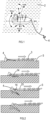
- Figure 1 shows schematically parts of a boat with a known anchoring system.
- the boat 1 floats on the water surface 2, and is connected by means of a rode (chain) 3 to an anchor 4 in the waterbed.
- a rode (chain) 3 is also shown in Figure 1 .
- Modern stockless anchors typically comprise one or more flukes connected by a pivot to a shank.
- tripping palms are provided which drag on the seabed, forcing the main flukes to dig in.
- FIG 2 illustrates the action of a stockless anchor being set.
- the anchor 4 is initially dragged by the rode (chain) 3 an unpredictable distance along the seabed 5 as shown in the first image.
- the anchor fluke 14 starts to dig into the seabed as shown in the second image.
- the anchor fluke 14 then rotates relative to the shank 15 as it digs in and the anchor sets, as shown in the third and fourth images.
- anchoring reliability can be determined by how the anchor is imbedded in the seabed relative to the optimum setting orientation the manufacturer designed the anchor for. Modern stockless anchors have optimal holding power when the anchor fluke is substantially vertical, and/or the shank is horizontal or below.
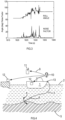
- Figure 3 is a diagram showing experimental data obtained by the present applicant during field trials.
- the lower line shows variation of a "noise factor" with time.
- the "noise factor” is an indication of the reliability of the setting of the anchor, calculated using an 3-axis acceleration heuristic.
- the upper line shows variation of anchor roll angle with time. Referring to Figure 3 , it can be seen that there is a good correlation between the roll angle and the reliability of the anchor setting. Thus, a key finding was that roll angle is a good indicator of anchor setting reliability.
- measurement of anchor roll angle together with velocity can provide a) an indication of how reliably the anchor is set, and b) an indication of whether the anchor is setting or pulling out and if it is stabilizing or worsening in either case. For example, if the anchor is set, acceleration will be very high and velocity zero. If the anchor is setting in or pulling out the acceleration will be high and velocity greater than zero.
- the link will hang down when there is no rode force. As rode force is applied the link will rise as the rode tightens showing acceleration in the z-direction (vertical) before acceleration in the x-direction (horizontal) appears. If the captain is able to see this pre-warning he or she can let out more rode to prevent the rode force lifting the anchor. If the conditions continue to worsen he or she can monitor anchor movement and prepare to pull anchor and move the boat in a controlled manner.
- FIG. 4 shows parts of a system for determining and displaying velocity and roll angle of an anchor in accordance with an embodiment of the present invention.
- a boat 1 is anchored by means of an anchor 4 imbedded in a seabed 5.
- the anchor 4 is attached to an anchor rode 3 by means of a connecting link 6.
- the anchor rode 3 is further attached to boat 1 on a water surface 2 at an end remote from connecting link 6.
- the connecting link 6 is used to provide the physical connection between the rode 3 and the anchor 4.
- the connecting link 6 comprises a measurement device which is used to obtain and transmit anchor velocity and roll angle and connecting link pitch angle.
- the device comprises a battery powered measurement unit which comprises a 3-axis accelerometer for producing acceleration data, an electronic microprocessor unit for processing the acceleration data and for calculating anchor velocity, roll angle and link pitch angle, and a communication unit for transmitting calculated data and optionally battery status by acoustic means via the anchor chain to a receiver on the boat.
- the pickup unit 13 is magnetically attached to the anchor chain 3 near the bow roller or to the bow roller.
- the pickup unit 13 comprises a sensor (acoustic transducer), a demodulator and a transmission unit.
- the pickup unit 13 collects the acoustic signal transmitted via the chain 3 and converts it to an electrical signal, demodulates the signal, and transmits the demodulated signal to the receiver unit 10 either wirelessly or by cable.
- Receiver unit 10 is a battery powered unit located on the boat 1.
- Receiver unit 10 comprises a communication unit configured to receive calculated data by cable or wirelessly from pickup unit 13 and has an audio/visual display that displays the calculated data received from the connecting link 6.
- Receiver unit 10 also comprises an electronic microprocessor that determines when anchor velocity exceeds a predetermined limit after which it sends an alarm initiation signal to alarm units 12 located in water vessel 1 or at a location nearby or on land.
- Receiver 10 has a SIM card enabling an alarm message to be contemporaneously sent to a mobile telephone 11 by SMS means.
- the microprocessor determines this and sends a corresponding alarm disable signal to alarm units 12, and sends an alarm cancelled message to a mobile telephone 11 by SMS means.
- a portable alarm unit 12 receives alarm signals from the receiver unit 10 when a predetermined anchor velocity threshold is exceeded and upon receiving an alarm initiation signal initiates its audible and visible alarm output; and upon receiving an alarm disable signal from receiver unit 10 cancels the audio and visual alarm.
- a SIM card unit in receiver unit 10 receives alarm messages from the electronic microprocessor when a predetermined anchor velocity threshold is exceeded and sends messages reporting the anchor angle and the anchor velocity to a nominated mobile phone 11 by SMS means.
- the mechanical link 6 between the anchor 4 and the anchor rode 3 is tightly connected to the anchor 4 to ensure that they will remain in physical contact to allow for exact determination of the acceleration and therefore velocity and roll angle of the anchor.
- the link 6 is constrained by a joint to move with the anchor 4 laterally in the y-axis but free to rotate vertically in the x-z plane relative to the anchor shank.
- the preferred embodiment of such a joint is a clevis mechanism with a single bolt fixing it to the anchor head.
- the mechanical link 6 may be directly and tightly fixed to the anchor 4 at a position other than between the anchor and the anchor rode.
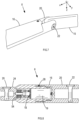
- FIG. 5 shows parts of a connecting link in an embodiment of the invention.
- the connecting link 6 comprises a main body 16 which provides a physical connection between the anchor and the rode.
- the main body 16 comprises a clevis joint 20 and a bolt or pin 22 at one end for connecting the link 6 to the anchor head.
- a joint 24 and bolt or pin 26 are used to connect the link 6 to the anchor rode.
- the main body 16 may be constructed from any suitable material such as a metal, for example, stainless steel or brass.
- the main body 16 is also arranged to house a measurement device 18.
- the main body is in two parts which can pivot with respect to each other about the joint 24 in order to open and close around the device 18 to facilitate changing the battery.
- the main body is shown in its open state in which access can be gained to the device 18.
- the measurement device 18 is battery powered and is enclosed in a waterproof casing.
- the device 18 comprises a 3-axis accelerometer for producing acceleration data, an electronic microprocessor unit for processing the acceleration data and for calculating anchor velocity, roll angle and link pitch angle, and a communication unit for transmitting calculated data and battery status by acoustic means via the anchor chain to a receiver on the boat.
- Figure 6 shows the connecting link 6 in its closed state, in which the two parts of the main body 16 are closed around the device 18. In this state, a screw 28 is used to hold the two parts of the main body together. Also shown in Figure 6 is part of an anchor chain 3 which is connected to the link 6 by means of the joint 24 and the bolt 26.
- Figure 7 shows part of the connecting link connected to the shank of an anchor.
- the main body 16 of the connecting link 6 is connected to the shank 15 of an anchor by means of the clevis joint 20 and a bolt or pin 22.
- the clevis joint 20 allows the connecting link 6 to rotate freely with respect to the anchor shank 15 in the x-z plane.
- the connecting link 6 is constrained by the clevis joint 20 such that it rotates with the anchor shank 15 in the y-z plane.
- Figure 8 shows parts of a connecting link in another embodiment of the invention.
- the connecting link 6 comprises a main body 16 in two parts which provides a physical connection between the anchor and the chain.
- the main body 16 comprises a clevis joint 20 and a bolt or pin 22 at one end for connecting the link 6 to the anchor head.
- a joint 24 and bolt or pin 26 are used to connect the link 6 to the rode.
- the main body 16 is also arranged to house a measurement device 18 and a battery 19.
- the main body is in two parts which can be screwed together in order to open and close to facilitate changing the battery.
- the two parts of the main body 16 are screwed together around the device 18 and battery 19.
- the measurement device 18 and battery 19 are then enclosed in the connecting link which forms a waterproof casing.
- a screw 28 is used to prevent the two parts of the main body from unscrewing.
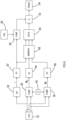
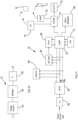
- Figure 9 shows parts of the measurement device 18 which is used to obtain and transmit anchor velocity and roll angle.
- the device comprises 3-axis accelerometer 32, integrating module 34, x- and z-axis comparison module 36, y- and z-axis comparison module 38, gravity vector module 40, averaging modules 42, 44, 46, memory 48, data packaging module 50, transmission module 52, transducer 54, comparison module 56 and threshold module 58.
- Some or all of the modules may be implemented as software routines running on an electronic microprocessor unit with associated memory, and/or as firmware or hardware, as appropriate.
- the accelerometer 32 measures acceleration in three orthogonal directions (x, y and z) to produce raw, 3-dimensional acceleration data a.
- the acceleration is sampled at a frequency of 200Hz to produce digital outputs at 5ms intervals, although other values could be used instead.
- the x-component of the acceleration data is fed to the integrating module 34, which is used to calculate velocity data v as will be explained below.
- the x- and z-components of the acceleration data are fed to comparator module 36, which is used to calculate link pitch angle ⁇ p .
- the y- and z-components of the acceleration data are fed to the comparator module 38, which is used to calculate anchor roll angle ⁇ r .
- the averaging modules 42, 44, 46 each performs a 200-point moving average calculation on one of the three respective calculated data sets and writes the averaged data into memory 48.
- the data packaging module 50 reads the averaged data from the memory 48, together with any other appropriate parameters, and packages the data into a data set.
- the data set comprises a unique anchor ID, average velocity, average roll angle, average link pitch angle, and optionally other diagnostic data such as battery status.
- the transmission module 52 modulates the data set onto a carrier frequency to produce a modulated signal.
- the modulated signal is converted to an acoustic signal by the transducer 54 and transmitted acoustically to the signal pickup unit 13 on the boat.
- the average velocity data are also fed to comparison module 56.
- the comparison module 56 compares the average velocity data to thresholds stored in threshold module 58 to determine the time intervals at which the data set should be transmitted. In one embodiment, if the velocity is above a threshold, the transmission module 52 transmits the current data set at 1, 2, 3 or 5 second intervals, although other values greater or less than any of these values may be used instead. If velocity is below the threshold, the transmission module 52 transmits the data set at 10, 20 or 30 second intervals, however other values either greater than or less than any of these values may be used instead.
- the threshold may be close to zero (including an error factor to take into account any noise) so that data is transmitted at 1, 2, 3 or 5 second intervals as soon as there is determined to be any movement of the anchor. Of course, other values of the threshold and the intervals may be used instead.
- the time intervals at which the data are transmitted may also be varied in dependence on the value of the link pitch angle. For example, if the link pitch angle approaches horizontal, indicating that the chain is under tension, then the data may be transmitted more frequently than if the link pitch angle indicates that the chain is hanging at rest.
- the integrating module 34 receives the x-component of the acceleration data from the accelerometer 32.
- the integrating module 34 integrates the x-axis acceleration data once with respect to time, in order to obtain velocity data v.
- the accelerometer 32 measures acceleration at small time intervals in the order of 5ms with a 200Hz sampling rate. After each time interval the integrating module 34 calculates the product a x ⁇ t. Since the timesteps are small, v 0 may be assumed to be the previously calculated value of v, so addition of the current values of v 0 and a x ⁇ t will accurately yield current velocity v. The current velocity v is then fed to averaging module 42, where it is averaged over time and then stored in memory 48.
- the comparison module 38 receives the y- and z-components of the acceleration data from the accelerometer 32. The comparison module 38 then compares these components with the corresponding components of the gravity vector g which is stored in the gravity vector module 40.
- the gravity vector g is the acceleration due to gravity which is experienced by the device 18 when it is in a particular orientation, and is pre-stored in the device.
- ⁇ r is the roll angle
- g y is the y-component of the gravity vector
- g z is the z-component of the gravity vector
- a y is the y-component of the acceleration data
- a z is the z-component of the acceleration data.
- the roll angle ⁇ r is then fed to averaging module 46, where it is averaged over time and then stored in memory 48.
- the connecting link 6 is 'keyed' to the anchor shank 15 and will lie at the same roll angle as the anchor but can rotate freely in the x-z plane relative to the anchor shank. If the anchor is lying on its side, it is not set. Therefore, in this case, a rising link pitch angle will provide no meaningful early warning of anchor movement because little force is required to move the anchor on its side. However, if the anchor is substantially vertical and set well, measurement of the link pitch angle relative to horizontal is meaningful. Link pitch angle may be an angle between 90 degrees (hanging at rest) and around zero degrees (horizontal in tension).
- the comparison module 36 receives the x- and z-components of the acceleration data from the accelerometer 32. The comparison module 36 then compares these components with the corresponding components of the gravity vector g which is stored in the gravity vector module 40.
- the link pitch angle ⁇ p is then fed to averaging module 44, where it is averaged over time and then stored in memory 48.
- the transmission module 52 comprises a modem that modulates a carrier frequency in the 2-12 kHz range with the data set from the module 50 to produce a modulated signal.
- the modulated signal is supplied to the transducer 54, which converts the modulated signal into an acoustic signal.
- the transducer 54 in this embodiment is a piezo-electric element that is mechanically and acoustically coupled to the main body 16 of the connecting link 6, preferably in the vicinity of the joint 24.
- the transducer 54 transmits the acoustic signal to the receiver on the boat by means of vibration through the chain 3.
- the time intervals at which the data set is transmitted are varied in dependence on the value of the velocity data and/or the link pitch angle data.
- the data set is transmitted at more frequent intervals (for example, 1, 2, 3 or 5 second intervals). This situation is likely to correspond to the chain being in tension, when reliable acoustic coupling between links can be achieved.
- any failure of the anchor setting is likely to be accompanied by the chain being in tension, since such failure is usually caused by the chain pulling on the anchor. Therefore, the data set can be reliably sent to the receiver unit at the surface at a relatively high data rate at those times when there is most risk of failure of the anchor setting and when the data is most needed.
- the pickup unit 13 comprises a piezo-electric acoustic pickup attached to the chain at the bow-roller or attached to the bow roller by magnet to receive the acoustic signal.
- the pickup unit also comprises an acoustic modem inbuilt to decode the data set and a transmitter unit to send the calculated data set to receiver unit 10.
- the pickup unit 13 is battery powered and is enclosed in a ruggedized housing.
- the receiver unit 10 on the boat is a battery powered handheld device connected by a cable or wirelessly connected to the piezo-electric acoustic pickup unit 13.
- the receiver unit 10 receives the data set from the pickup unit and displays the data on a display.
- the receiver unit 10 also has an RF transmitter that can send and cancel alarms to an alarm pods 12 within radio range of the boat, and a GSM transmitter 9 that can send an SMS alarm and all-safe messages to nominated mobile phones 11.
- the pickup unit comprises an acoustic transducer 61 which in this example is a piezo-electric pickup, modem 63, and transmission module 65.
- the pickup 61 receives acoustic signals transmitted by the connecting link 6 through the chain 3 and converts them into electrical signals.
- the modem 63 demodulates the electrical signal to obtain the current data set.
- the transmission module 65 transmits the data set either wirelessly or via a cable to the receiver unit 10.
- the data set may be transmitted using a wireless protocol such as Bluetooth or Wi-Fi (IEEE 802.11), or any other appropriate protocol.
- FIG 11 shows parts of the receiver unit 10 in an embodiment of the invention.
- the receiver unit comprises a receiver unit 60, data extraction module 62, display unit 64, anchor setting determination module 66, setting flag module 68, comparison module 70, threshold module 72, alarm generating module 74, output device 75, wireless or RF transmitter 76 and cellular transmitter 78.
- Some or all of the modules may be implemented as software routines running on an electronic microprocessor unit with associated memory, and/or as firmware or hardware, as appropriate.
- the receiver unit 10 may be implemented as a single physical piece of apparatus, or its functions may be distributed across two or more different pieces of apparatus. In one embodiment, the receiver unit 10 may be implemented as software running on a mobile processing device such as a mobile telephone.
- the receiver module 60 receives the current data set transmitted from the pickup unit 13 and passes it to the data extraction module 62.
- the data extraction module 62 extracts the values of the velocity v, anchor roll angle ⁇ r , link pitch angle ⁇ p , anchor ID, and any other parameters such as battery status, from the data set.
- the values of velocity, anchor roll angle and link pitch angle are displayed on the display 64. The displayed values can be used by an operator to determine whether the anchor has set, and to monitor its movement.
- a separate pickup unit 13 and data extraction module 62 may be provided for each anchor. In this case, a plurality of data sets will be received, one from each anchor.
- the data extraction module 62 extracts the anchor ID from each transmitted data set, so that the unit knows which anchor the data set is associated with.
- the values from each anchor may be displayed simultaneously or alternately on the display 64.
- the velocity v, anchor roll angle ⁇ r , and link pitch angle ⁇ p are also provided to the anchor setting determination module 66.
- the setting determination module 66 compares the velocity data to predetermined patterns of velocity data which are known to correspond to the setting of an anchor. In particular, when an anchor is setting, the velocity is usually characterized by a period in which the velocity is greater than zero, followed by a period in which the velocity decreases rapidly to zero. If such a pattern of velocity data is also accompanied by the anchor roll angle ⁇ r indicating that the anchor fluke is orientated at or close to vertical (for example, within 10 or 20 degrees of vertical), then it can be determined with a reasonable degree of certainty that the anchor has set.
- the anchor is moving through the seabed if the anchor rode is taut and the anchor velocity is greater than zero. It may also be assumed that the anchor is set when the anchor rode is under tension and the anchor velocity is zero.
- the link pitch angle ⁇ p may also be used in determining whether or not the anchor is set. In particular, if the link pitch angle is at or close to horizontal, indicating that the rode is under tension, and the velocity is zero, then this either alone or in combination with the other factors discussed above may be used to determine that the anchor has set.
- the setting determination module 66 determines that the anchor has set, it outputs a signal indicating this condition to the setting flag module 68.
- the setting flag module 68 sets a flag indicating that the anchor has been determined to have set. This indication is provided to the comparison module 70 and may also be displayed on the display 64.
- the velocity v and anchor roll angle ⁇ r are also provided to the comparison module 70.
- the comparison module 70 compares the current values of the velocity and the anchor roll angle to preset thresholds stored in the threshold module 72. If either or both of the thresholds are exceeded, and the set flag module 68 indicates that the anchor is determined to be set, then the comparison module outputs a signal to the alarm generating module 74. For example, if the velocity value rises above a noise threshold, or if the anchor roll angle deviates from the vertical by more than a certain amount, then the comparison module outputs a signal to the alarm generating module 74. In this situation, a signal is also output to the set flag module 68 to clear the flag indicating that the anchor has been determined to have set.
- the alarm generating module 74 When the alarm generating module 74 receives the signal from the comparison module 70 indicating that the thresholds have been exceeded, it causes the output device 75 to produce an audible and/or visual alarm to alert the captain that the anchor may be coming loose. In addition, the alarm generating module 74 sends a signal to the wireless or RF transmitter 76 that can send and cancel alarms to portable alarm unit 12 within radio range of the boat. The alarm generating module 74 also sends a signal to cellular transmitter 78 that can send an SMS alarm and all-safe messages to nominated mobile phones 11. Alarm signals may also be displayed on the display 64.
- the setting determination module 66 determines that the anchor has re-set, and the comparison module 70 determines that the thresholds stored in the threshold module 72 are no longer exceeded, then the comparison module 70 indicates this new situation to the alarm generating module 74.
- the alarm generating module 74 stops producing an alarm on the output device 75.
- the alarm generating module 74 also sends an alarm cancel signal to the RF transmitter 76 and the cellular transmitter 78, which cancel the alarms sent to their respect devices.
- the link pitch angle ⁇ p is also fed to comparison module 70.
- the comparison module 70 compares the current value of the link pitch angle to a preset threshold value stored in the threshold module 72.
- the threshold value is set to be a certain angle from the horizontal (for example 20° or 10° from the horizontal). If the threshold is exceeded (indicating that the link is approaching horizontal), and the setting flag module 68 indicates that the anchor is set, then the comparison module outputs a signal to early warning indicator 80.
- the early warning indicator 80 may produce an audible and/or visual early warning indicator and may also display an early warning indicator on the display 64. If the operator sees this early warning indicator, they can let out more rode to prevent the rode force lifting the anchor. If the conditions continue to worsen they can monitor anchor movement and prepare to pull anchor and move the boat in a controlled manner.
- FIG 12 shows an example of a receiver unit 10.
- the receiver includes a display 64 which in this example displays the current anchor speed and anchor roll angle.
- the anchor speed and the anchor roll angle are both indicated against backgrounds having regions of green, yellow and red, indicating degree of anchor safety.
- the receiver unit 10 may also output audio and/or visual alarms.
- the receiver unit 10 may indicate the status of the battery in the measuring unit 18. If two or more anchors are being used, the receiver unit 10 may switch the display 84 between the different anchors.
- Figure 13 shows an example of a portable alarm unit 12.
- the unit includes a warning light 82 and an acoustic transducer which allow the device to output visual and audible warnings of anchor movement.
- FIG 14 shows parts of a system for determining and displaying velocity and roll angle of an anchor in accordance with another embodiment of the invention.
- a boat 1 is anchored by means of an anchor 4 imbedded in a seabed 5.
- the anchor 4 is attached to an anchor rode 3 by means of a connecting link 6'.
- the anchor rode 3 is further attached to boat 1 on a water surface 2 at an end remote from connecting link 6'.
- the connecting link 6' is used to provide the physical connection between the rode 3 and the anchor 4.
- the connecting link 6' comprises a measurement device which is used to obtain and transmit anchor velocity and roll angle to the water surface.
- a transmitter in the connecting link 6' sends the calculated data by sonar means through the water to a receiver in a float 8 at the water surface.
- the float 8 sits half submerged in water, with a sonar receiver below the surface and a RF transmitter above the surface.
- the float 8 comprises a processing unit which may include some or all of the processing modules of the receiver unit 10 described above and shown in Figure 11 .
- the processing unit in the float receives the calculated data from the connecting link 6' and routes the data to the RF transmitter.
- the RF transmitter sends the data by radio waves through the air to the receiver unit 10.
- the receiver unit 10 displays the velocity data, anchor pitch angle data and/or link pitch angle data on its display.
- the processing unit also produces alarm signals and sends the alarm signals by radio waves through the air to portable alarm units 12.
- a cellular transmitter may send SMS alarm signals and all-safe messages to nominated mobile phones 11 on a GSM network 9.
- the sonar receiver is in a device attached to or suspended from the boat below the water surface.
- the RF transmission link may be replaced by a wired transmission link.
- the system comprises a measurement device fitted in a link between an anchor and anchor rode that measures 3-axis acceleration of the anchor, a microprocessor that calculates velocity and roll-angle of an anchor from the acceleration data, and a transmitter that sends the calculated data by acoustic vibration means across the anchor chain to a hand held receiver on the water vessel, which displays the calculated data, and in the case that the calculated data exceeds set values, relays an alarm actuation signal to a portable alarm to initiate a visible and audible alarm, and to send an SMS alarm message to a mobile telephone by GSM network.
- Preferred embodiments of the invention provide means for continual observation of the reliability of an anchoring by continually measuring 3-axis acceleration of an anchor, continually calculating velocity and roll angle of an anchor, and continually displaying this data on a handheld audio-visual device onboard or near the water vessel. Preferred embodiments also provide means for triggering an alarm on an alarm device onboard or near the floating vessel if predetermined anchor movement thresholds are exceeded, and for contemporaneously sending an SMS alarm message to a mobile phone if predetermined anchor movement thresholds are exceeded.
- a preferred method embodiment comprises the steps of measuring anchor acceleration values in 3 axes in particular as a function of time; integrating the acceleration values in the x-axis or direction of the rode once over time, preferably by means of numerical integration to calculate anchor velocity; and estimating anchor roll angle by calculating the difference between the vertical z-axis and horizontal y-axis acceleration vectors and the gravitational vector.
- a preferred system embodiment comprises two battery-powered devices, each independently powered by a battery, namely:
Landscapes
- Engineering & Computer Science (AREA)
- Physics & Mathematics (AREA)
- General Physics & Mathematics (AREA)
- Combustion & Propulsion (AREA)
- Ocean & Marine Engineering (AREA)
- Mechanical Engineering (AREA)
- Chemical & Material Sciences (AREA)
- Computer Networks & Wireless Communication (AREA)
- Signal Processing (AREA)
- Business, Economics & Management (AREA)
- Emergency Management (AREA)
- Remote Sensing (AREA)
- Radar, Positioning & Navigation (AREA)
- Testing Or Calibration Of Command Recording Devices (AREA)
- Examining Or Testing Airtightness (AREA)
- Indicating Or Recording The Presence, Absence, Or Direction Of Movement (AREA)
- Arrangements For Transmission Of Measured Signals (AREA)
Claims (15)
- Vorrichtung (6) zum Überwachen eines Ankers (4) zum Verankern eines Wasserfahrzeugs (1), wobei die Vorrichtung Folgendes umfasst:einen Beschleunigungsmesser (32), der konfiguriert ist, um eine Beschleunigung der Vorrichtung zu messen, um Beschleunigungsdaten zu liefern; undeine Einrichtung (34), die konfiguriert ist, um die Beschleunigungsdaten zu verarbeiten, um Geschwindigkeitsdaten zu liefern;gekennzeichnet durch:eine Einrichtung (38), die konfiguriert ist, um die Beschleunigungsdaten zu verarbeiten, um Rollwinkeldaten zu liefern, wobei die Rollwinkeldaten einen Rollwinkel des Ankers (4) angeben; undeine Einrichtung (52, 54), die konfiguriert ist, um die Rollwinkeldaten und die Geschwindigkeitsdaten von der Vorrichtung (6) an eine Empfängereinheit (10) zur Nutzung mit dem Wasserfahrzeug (1) zu übertragen.
- Vorrichtung nach Anspruch 1, wobei der Beschleunigungsmesser ein 3-Achsen-Beschleunigungsmesser ist, der dazu ausgelegt ist, Beschleunigungsdaten mit drei orthogonalen Komponenten zu erzeugen.
- Vorrichtung nach Anspruch 2, wobei die Geschwindigkeitsdaten durch das Integrieren einer Komponente der Beschleunigungsdaten mit Bezug auf die Zeit erhalten werden.
- Vorrichtung nach Anspruch 2 oder 3, die ferner eine Einrichtung (40), die konfiguriert ist, um einen Schwerevektor zu speichern, umfasst, wobei die Rollwinkeldaten durch das Vergleichen von zwei Komponenten der Beschleunigungsdaten mit dem Schwerevektor erzeugt werden.
- Vorrichtung nach einem der vorhergehenden Ansprüche, die ferner eine Einrichtung (38), die konfiguriert ist, um die Beschleunigungsdaten zu verarbeiten, um Nickwinkeldaten zu liefern, umfasst, wobei die Nickwinkeldaten den Nickwinkel der Vorrichtung (6) angeben, wobei die Übertragungseinrichtung (52, 54) dazu ausgelegt ist, die Nickwinkeldaten von der Vorrichtung (6) an die Empfängereinheit (10) zu übertragen.
- Vorrichtung nach einem der vorhergehenden Ansprüche, die ferner eine Einrichtung (42, 44, 46), die konfiguriert ist, um Durchschnittswerte der Rollwinkeldaten, der Geschwindigkeitsdaten und/oder der Nickwinkeldaten mit Bezug auf die Zeit zu ermitteln, und vorzugsweise einen Speicher (48), der dazu ausgelegt ist, die Durchschnittswerte der Rollwinkeldaten, der Geschwindigkeitsdaten und/oder der Nickwinkeldaten zu speichern, umfasst.
- Vorrichtung nach Anspruch 6, die ferner eine Einrichtung (50), die konfiguriert ist, um die Durchschnittswerte der Rollwinkeldaten, der Geschwindigkeitsdaten und/oder der Nickwinkeldaten in einem Datensatz zusammenzufassen, umfasst, wobei die Übertragungseinrichtung (52, 54) dazu ausgelegt ist, den Datensatz von der Vorrichtung (6) an die Empfängereinheit (10) zu übertragen, wobei der Datensatz vorzugsweise eine Kennung des Ankers enthält.
- Verbindungsglied (6) zum Verbinden eines Ankers (4) mit einem Tau, wobei das Verbindungsglied eine Vorrichtung nach einem der vorhergehenden Ansprüche umfasst, wobei das Verbindungsglied über ein Gelenk (20), das die Drehung des Verbindungsglieds relativ zu dem Anker in mindestens einer Ebene einschränkt, mit dem Anker (4) verbunden ist.
- Verbindungsglied nach Anspruch 8, wobei das Verbindungsglied einen Schallwandler (54) umfasst, der konfiguriert ist, um die Rollwinkeldaten und die Geschwindigkeitsdaten, vorzugsweise durch ein Tau (3) zwischen dem Anker (4) und dem Wasserfahrzeug (1), akustisch an die Empfängereinheit (10) zu übertragen.
- Empfängereinheit (10) zur Nutzung mit einem mit einem Anker (4) verbundenen Wasserfahrzeug (1), wobei die Empfängereinheit Folgendes umfasst:eine Einrichtung (60), die konfiguriert ist, um Rollwinkeldaten, die einen Rollwinkel des Ankers angeben, und Geschwindigkeitsdaten, die eine Geschwindigkeit des Ankers angeben, zu empfangen; undeine Einrichtung (66), die konfiguriert ist, um basierend auf den Ankergeschwindigkeitsdaten und den Ankerrollwinkeldaten zu bestimmen, ob sich der Anker (4) gesetzt hat.
- Empfängereinheit nach Anspruch 10, die ferner Folgendes umfasst:eine Einrichtung (70), die konfiguriert ist, um basierend auf den Ankergeschwindigkeitsdaten und den Ankerrollwinkeldaten zu bestimmen, ob die Ankersetzung fehlgeschlagen ist; undeine Einrichtung (74) zum Generieren eines Alarmsignals, wenn bestimmt wird, dass die Ankersetzung fehlgeschlagen ist.
- Empfängereinheit nach Anspruch 10 oder 11, die ferner eine Einrichtung (60), die konfiguriert ist, um Nickwinkeldaten zu empfangen, umfasst, wobei der Nickwinkel beim Bestimmen, ob sich der Anker (4) gesetzt hat und/oder ob die Ankersetzung fehlgeschlagen ist, genutzt wird.
- Überwachungssystem zum Überwachen eines Ankers (4) zum Verankern eines Wasserfahrzeugs (1), wobei das Überwachungssystem eine Vorrichtung (6) nach einem der Ansprüche 1 bis 7 oder ein Verbindungsglied nach Anspruch 8 oder 9 und eine Empfängereinheit (10) nach einem der Ansprüche 10 bis 12 umfasst.
- Verfahren zum Überwachen eines Ankers (4) zum Verankern eines Wasserfahrzeugs (1), wobei das Verfahren Folgendes umfasst:Messen einer Beschleunigung einer an dem Anker (4) befestigten Vorrichtung (6), um Beschleunigungsdaten zu liefern; undVerarbeiten der Beschleunigungsdaten, um Geschwindigkeitsdaten zu liefern;gekennzeichnet durch:Verarbeiten der Beschleunigungsdaten, um Rollwinkeldaten zu liefern, wobei die Rollwinkeldaten einen Rollwinkel des Ankers (4) angeben;Übertragen der Rollwinkeldaten und der Geschwindigkeitsdaten von der Vorrichtung (6) an eine Empfängereinheit (10) zur Nutzung mit dem Wasserfahrzeug (1); undBestimmen basierend auf den Ankergeschwindigkeitsdaten und den Ankerrollwinkeldaten, ob sich der Anker (4) gesetzt hat.
- Verfahren nach Anspruch 14, das ferner umfasst, dass basierend auf den Ankergeschwindigkeitsdaten und den Ankerrollwinkeldaten bestimmt wird, ob die Ankersetzung fehlgeschlagen ist.
Priority Applications (1)
| Application Number | Priority Date | Filing Date | Title |
|---|---|---|---|
| EP24173821.0A EP4386705A3 (de) | 2019-05-20 | 2020-05-12 | Ankermonitor |
Applications Claiming Priority (2)
| Application Number | Priority Date | Filing Date | Title |
|---|---|---|---|
| GB1907111.7A GB2584274B (en) | 2019-05-20 | 2019-05-20 | Anchor monitor |
| PCT/IB2020/054474 WO2020234692A1 (en) | 2019-05-20 | 2020-05-12 | Anchor monitor |
Related Child Applications (2)
| Application Number | Title | Priority Date | Filing Date |
|---|---|---|---|
| EP24173821.0A Division-Into EP4386705A3 (de) | 2019-05-20 | 2020-05-12 | Ankermonitor |
| EP24173821.0A Division EP4386705A3 (de) | 2019-05-20 | 2020-05-12 | Ankermonitor |
Publications (2)
| Publication Number | Publication Date |
|---|---|
| EP3973518A1 EP3973518A1 (de) | 2022-03-30 |
| EP3973518B1 true EP3973518B1 (de) | 2024-07-24 |
Family
ID=67385180
Family Applications (2)
| Application Number | Title | Priority Date | Filing Date |
|---|---|---|---|
| EP20727382.2A Active EP3973518B1 (de) | 2019-05-20 | 2020-05-12 | Ankermonitor |
| EP24173821.0A Pending EP4386705A3 (de) | 2019-05-20 | 2020-05-12 | Ankermonitor |
Family Applications After (1)
| Application Number | Title | Priority Date | Filing Date |
|---|---|---|---|
| EP24173821.0A Pending EP4386705A3 (de) | 2019-05-20 | 2020-05-12 | Ankermonitor |
Country Status (6)
| Country | Link |
|---|---|
| US (2) | US11999452B2 (de) |
| EP (2) | EP3973518B1 (de) |
| AU (2) | AU2020280254B2 (de) |
| CA (1) | CA3139223A1 (de) |
| GB (1) | GB2584274B (de) |
| WO (1) | WO2020234692A1 (de) |
Cited By (1)
| Publication number | Priority date | Publication date | Assignee | Title |
|---|---|---|---|---|
| US20240270357A1 (en) * | 2019-05-20 | 2024-08-15 | Koto Holdings Limited | Anchor monitor |
Families Citing this family (10)
| Publication number | Priority date | Publication date | Assignee | Title |
|---|---|---|---|---|
| KR102892499B1 (ko) * | 2018-10-22 | 2025-11-27 | 테크닙 에너지스 프랑스 | 위치와 요, 롤 및 피치 회전운동을 이용한 선박계류 모니터링 시스템과 방법 |
| US11396352B2 (en) * | 2020-04-13 | 2022-07-26 | Eric R. Sirkin | Methods and apparatus for measuring and monitoring an anchoring operation |
| US11674806B2 (en) * | 2021-02-25 | 2023-06-13 | Navico Holding As | Anchoring systems and methods for marine vessels |
| US12258099B2 (en) * | 2021-07-14 | 2025-03-25 | Joseph Raffaele Spatola | Anchor stowage safety system |
| US20230068755A1 (en) * | 2021-09-01 | 2023-03-02 | Blue Ocean Gear, Inc. | Display of ocean-based gear position to users |
| CN113947949B (zh) * | 2021-09-18 | 2023-01-24 | 杭州晟冠科技有限公司 | 海缆保护区基于轮船危险系数的智能跟踪方法和系统 |
| CN114013567B (zh) * | 2021-10-27 | 2022-10-18 | 山东北溟科技有限公司 | 一种锚装置 |
| CN113911289B (zh) * | 2021-11-12 | 2023-12-19 | 中交第三航务工程局有限公司 | 一种漂浮式风机半潜式平台运营期监测方法 |
| CN116353763B (zh) * | 2023-05-08 | 2026-04-17 | 风潮海洋工程(深圳)有限公司 | 缓释重力锚及其投放作业方法 |
| US12539948B2 (en) * | 2023-06-30 | 2026-02-03 | Navico, Inc. | Devices, systems, and methods for alerting users on a watercraft |
Family Cites Families (10)
| Publication number | Priority date | Publication date | Assignee | Title |
|---|---|---|---|---|
| CH659981A5 (de) * | 1983-06-22 | 1987-03-13 | Martin W Oettli | Verfahren zur ueberwachung der drift eines vor anker liegenden schiffes und einrichtung zur durchfuehrung des verfahrens. |
| DE3810084A1 (de) | 1988-03-25 | 1989-10-05 | Herbert Walter | Einrichtung zur anzeige der gefahr eines vertreibens vor anker liegender wasserfahrzeuge |
| US4912464A (en) | 1989-02-17 | 1990-03-27 | Bachman Donald H | Anchor alarm for boats and the like |
| DE19716684B4 (de) | 1997-04-21 | 2009-11-26 | Deep Blue Technology Ag | Anker-/Ankerketten-Überwachungsvorrichtung |
| DE10064419C2 (de) * | 2000-12-21 | 2003-10-30 | I For T Gmbh | Bewegungs- und Neigungsüberwachungsvorrichtung |
| GB2501303A (en) * | 2012-04-19 | 2013-10-23 | Pulse Structural Monitoring Ltd | Monitoring of underwater mooring lines |
| CH707573A1 (de) | 2013-02-07 | 2014-08-15 | Thomas Frizlen | Verfahren und System zur Bestimmung der Verlagerung eines Ankers. |
| US20150116496A1 (en) * | 2013-10-29 | 2015-04-30 | Ottarr, Llc | Camera, Sensor and/or Light-Equipped Anchor |
| GB2610328B (en) * | 2019-05-20 | 2023-05-31 | Koto Holdings Ltd | Anchor monitor |
| GB2584274B (en) * | 2019-05-20 | 2023-02-08 | Koto Holdings Ltd | Anchor monitor |
-
2019
- 2019-05-20 GB GB1907111.7A patent/GB2584274B/en active Active
-
2020
- 2020-05-12 WO PCT/IB2020/054474 patent/WO2020234692A1/en not_active Ceased
- 2020-05-12 EP EP20727382.2A patent/EP3973518B1/de active Active
- 2020-05-12 AU AU2020280254A patent/AU2020280254B2/en active Active
- 2020-05-12 CA CA3139223A patent/CA3139223A1/en active Pending
- 2020-05-12 US US17/610,337 patent/US11999452B2/en active Active
- 2020-05-12 EP EP24173821.0A patent/EP4386705A3/de active Pending
-
2024
- 2024-04-24 US US18/644,292 patent/US12275505B2/en active Active
- 2024-12-23 AU AU2024287144A patent/AU2024287144A1/en active Pending
Cited By (2)
| Publication number | Priority date | Publication date | Assignee | Title |
|---|---|---|---|---|
| US20240270357A1 (en) * | 2019-05-20 | 2024-08-15 | Koto Holdings Limited | Anchor monitor |
| US12275505B2 (en) * | 2019-05-20 | 2025-04-15 | Koto Holdings Limited | Anchor monitor |
Also Published As
| Publication number | Publication date |
|---|---|
| US11999452B2 (en) | 2024-06-04 |
| GB2584274B (en) | 2023-02-08 |
| AU2020280254B2 (en) | 2025-03-13 |
| EP3973518A1 (de) | 2022-03-30 |
| AU2020280254A1 (en) | 2021-12-23 |
| US20240270357A1 (en) | 2024-08-15 |
| AU2024287144A1 (en) | 2025-01-16 |
| CA3139223A1 (en) | 2020-11-26 |
| US20220242533A1 (en) | 2022-08-04 |
| EP4386705A2 (de) | 2024-06-19 |
| GB201907111D0 (en) | 2019-07-03 |
| US12275505B2 (en) | 2025-04-15 |
| EP4386705A3 (de) | 2024-10-09 |
| WO2020234692A1 (en) | 2020-11-26 |
| GB2584274A (en) | 2020-12-02 |
Similar Documents
| Publication | Publication Date | Title |
|---|---|---|
| EP3973518B1 (de) | Ankermonitor | |
| EP3511237B1 (de) | Verfahren und system zur bestimmung der verschiebung eines ankers | |
| US9250082B2 (en) | Method and system for determining displacement of an anchor | |
| ES2214713T3 (es) | Dispositivo de control de ancla o cadena de ancla. | |
| US4912464A (en) | Anchor alarm for boats and the like | |
| US10155569B2 (en) | Swivel for mooring arrangement having an electric power generator which converts relative rotation between two elements into electric power | |
| GB2610328A (en) | Anchor monitor | |
| JP7023494B2 (ja) | 波浪観測通知システム | |
| JP2014016292A (ja) | 水中施工装置とその施工方法 | |
| US9815532B2 (en) | Device for detecting dislogded anchoring apparatus and the like | |
| JPS6046438A (ja) | 空気式防舷材の内圧検知装置 | |
| CN113711253B (zh) | 用于对已经掉出船外的集装箱进行检测和地理定位的设备 | |
| JPH10338189A (ja) | 海中観測係留系の係留状況監視装置 | |
| JP2012236445A (ja) | 係留ブイシステム、係留ブイ、および係留索の張力算出方法 | |
| SI26012A (sl) | Sistem za nadzor nad zdrsom sidra | |
| JP3951160B2 (ja) | 津波検知装置 | |
| KR102888481B1 (ko) | 해양 구조대원 모니터링 시스템 | |
| CN117571050A (zh) | 一种用于单点系泊装置的浮筒结构监测方法和系统 | |
| KR20050080824A (ko) | 부두에 계류된 선박의 계류 안전성 경보시스템 및 그제어방법 | |
| CN206615365U (zh) | 一种能及时发觉船舶走锚的装置 | |
| CN116416760A (zh) | 一种人员落水报警装置及报警启动方法 | |
| JP5426958B2 (ja) | 水中切離装置 | |
| JPH0229558B2 (ja) | Senpakunobyosakaramiboshisochi | |
| JPS62159076A (ja) | 投錨通報装置 |
Legal Events
| Date | Code | Title | Description |
|---|---|---|---|
| STAA | Information on the status of an ep patent application or granted ep patent |
Free format text: STATUS: UNKNOWN |
|
| STAA | Information on the status of an ep patent application or granted ep patent |
Free format text: STATUS: THE INTERNATIONAL PUBLICATION HAS BEEN MADE |
|
| PUAI | Public reference made under article 153(3) epc to a published international application that has entered the european phase |
Free format text: ORIGINAL CODE: 0009012 |
|
| STAA | Information on the status of an ep patent application or granted ep patent |
Free format text: STATUS: REQUEST FOR EXAMINATION WAS MADE |
|
| 17P | Request for examination filed |
Effective date: 20211101 |
|
| AK | Designated contracting states |
Kind code of ref document: A1 Designated state(s): AL AT BE BG CH CY CZ DE DK EE ES FI FR GB GR HR HU IE IS IT LI LT LU LV MC MK MT NL NO PL PT RO RS SE SI SK SM TR |
|
| DAV | Request for validation of the european patent (deleted) | ||
| DAX | Request for extension of the european patent (deleted) | ||
| GRAP | Despatch of communication of intention to grant a patent |
Free format text: ORIGINAL CODE: EPIDOSNIGR1 |
|
| STAA | Information on the status of an ep patent application or granted ep patent |
Free format text: STATUS: GRANT OF PATENT IS INTENDED |
|
| INTG | Intention to grant announced |
Effective date: 20240220 |
|
| GRAS | Grant fee paid |
Free format text: ORIGINAL CODE: EPIDOSNIGR3 |
|
| GRAA | (expected) grant |
Free format text: ORIGINAL CODE: 0009210 |
|
| STAA | Information on the status of an ep patent application or granted ep patent |
Free format text: STATUS: THE PATENT HAS BEEN GRANTED |
|
| AK | Designated contracting states |
Kind code of ref document: B1 Designated state(s): AL AT BE BG CH CY CZ DE DK EE ES FI FR GB GR HR HU IE IS IT LI LT LU LV MC MK MT NL NO PL PT RO RS SE SI SK SM TR |
|
| REG | Reference to a national code |
Ref country code: GB Ref legal event code: FG4D |
|
| REG | Reference to a national code |
Ref country code: CH Ref legal event code: EP |
|
| REG | Reference to a national code |
Ref country code: DE Ref legal event code: R096 Ref document number: 602020034465 Country of ref document: DE |
|
| REG | Reference to a national code |
Ref country code: IE Ref legal event code: FG4D |
|
| REG | Reference to a national code |
Ref country code: NL Ref legal event code: FP |
|
| REG | Reference to a national code |
Ref country code: LT Ref legal event code: MG9D |
|
| PG25 | Lapsed in a contracting state [announced via postgrant information from national office to epo] |
Ref country code: PT Free format text: LAPSE BECAUSE OF FAILURE TO SUBMIT A TRANSLATION OF THE DESCRIPTION OR TO PAY THE FEE WITHIN THE PRESCRIBED TIME-LIMIT Effective date: 20241125 |
|
| REG | Reference to a national code |
Ref country code: AT Ref legal event code: MK05 Ref document number: 1707055 Country of ref document: AT Kind code of ref document: T Effective date: 20240724 |
|
| PG25 | Lapsed in a contracting state [announced via postgrant information from national office to epo] |
Ref country code: PT Free format text: LAPSE BECAUSE OF FAILURE TO SUBMIT A TRANSLATION OF THE DESCRIPTION OR TO PAY THE FEE WITHIN THE PRESCRIBED TIME-LIMIT Effective date: 20241125 |
|
| PG25 | Lapsed in a contracting state [announced via postgrant information from national office to epo] |
Ref country code: NO Free format text: LAPSE BECAUSE OF FAILURE TO SUBMIT A TRANSLATION OF THE DESCRIPTION OR TO PAY THE FEE WITHIN THE PRESCRIBED TIME-LIMIT Effective date: 20241024 |
|
| PG25 | Lapsed in a contracting state [announced via postgrant information from national office to epo] |
Ref country code: FI Free format text: LAPSE BECAUSE OF FAILURE TO SUBMIT A TRANSLATION OF THE DESCRIPTION OR TO PAY THE FEE WITHIN THE PRESCRIBED TIME-LIMIT Effective date: 20240724 Ref country code: GR Free format text: LAPSE BECAUSE OF FAILURE TO SUBMIT A TRANSLATION OF THE DESCRIPTION OR TO PAY THE FEE WITHIN THE PRESCRIBED TIME-LIMIT Effective date: 20241025 Ref country code: PL Free format text: LAPSE BECAUSE OF FAILURE TO SUBMIT A TRANSLATION OF THE DESCRIPTION OR TO PAY THE FEE WITHIN THE PRESCRIBED TIME-LIMIT Effective date: 20240724 |
|
| PG25 | Lapsed in a contracting state [announced via postgrant information from national office to epo] |
Ref country code: BG Free format text: LAPSE BECAUSE OF FAILURE TO SUBMIT A TRANSLATION OF THE DESCRIPTION OR TO PAY THE FEE WITHIN THE PRESCRIBED TIME-LIMIT Effective date: 20240724 |
|
| PG25 | Lapsed in a contracting state [announced via postgrant information from national office to epo] |
Ref country code: LV Free format text: LAPSE BECAUSE OF FAILURE TO SUBMIT A TRANSLATION OF THE DESCRIPTION OR TO PAY THE FEE WITHIN THE PRESCRIBED TIME-LIMIT Effective date: 20240724 |
|
| PG25 | Lapsed in a contracting state [announced via postgrant information from national office to epo] |
Ref country code: AT Free format text: LAPSE BECAUSE OF FAILURE TO SUBMIT A TRANSLATION OF THE DESCRIPTION OR TO PAY THE FEE WITHIN THE PRESCRIBED TIME-LIMIT Effective date: 20240724 Ref country code: IS Free format text: LAPSE BECAUSE OF FAILURE TO SUBMIT A TRANSLATION OF THE DESCRIPTION OR TO PAY THE FEE WITHIN THE PRESCRIBED TIME-LIMIT Effective date: 20241124 |
|
| PG25 | Lapsed in a contracting state [announced via postgrant information from national office to epo] |
Ref country code: HR Free format text: LAPSE BECAUSE OF FAILURE TO SUBMIT A TRANSLATION OF THE DESCRIPTION OR TO PAY THE FEE WITHIN THE PRESCRIBED TIME-LIMIT Effective date: 20240724 |
|
| PG25 | Lapsed in a contracting state [announced via postgrant information from national office to epo] |
Ref country code: RS Free format text: LAPSE BECAUSE OF FAILURE TO SUBMIT A TRANSLATION OF THE DESCRIPTION OR TO PAY THE FEE WITHIN THE PRESCRIBED TIME-LIMIT Effective date: 20241024 Ref country code: ES Free format text: LAPSE BECAUSE OF FAILURE TO SUBMIT A TRANSLATION OF THE DESCRIPTION OR TO PAY THE FEE WITHIN THE PRESCRIBED TIME-LIMIT Effective date: 20240724 |
|
| PG25 | Lapsed in a contracting state [announced via postgrant information from national office to epo] |
Ref country code: RS Free format text: LAPSE BECAUSE OF FAILURE TO SUBMIT A TRANSLATION OF THE DESCRIPTION OR TO PAY THE FEE WITHIN THE PRESCRIBED TIME-LIMIT Effective date: 20241024 Ref country code: PL Free format text: LAPSE BECAUSE OF FAILURE TO SUBMIT A TRANSLATION OF THE DESCRIPTION OR TO PAY THE FEE WITHIN THE PRESCRIBED TIME-LIMIT Effective date: 20240724 Ref country code: NO Free format text: LAPSE BECAUSE OF FAILURE TO SUBMIT A TRANSLATION OF THE DESCRIPTION OR TO PAY THE FEE WITHIN THE PRESCRIBED TIME-LIMIT Effective date: 20241024 Ref country code: LV Free format text: LAPSE BECAUSE OF FAILURE TO SUBMIT A TRANSLATION OF THE DESCRIPTION OR TO PAY THE FEE WITHIN THE PRESCRIBED TIME-LIMIT Effective date: 20240724 Ref country code: IS Free format text: LAPSE BECAUSE OF FAILURE TO SUBMIT A TRANSLATION OF THE DESCRIPTION OR TO PAY THE FEE WITHIN THE PRESCRIBED TIME-LIMIT Effective date: 20241124 Ref country code: HR Free format text: LAPSE BECAUSE OF FAILURE TO SUBMIT A TRANSLATION OF THE DESCRIPTION OR TO PAY THE FEE WITHIN THE PRESCRIBED TIME-LIMIT Effective date: 20240724 Ref country code: GR Free format text: LAPSE BECAUSE OF FAILURE TO SUBMIT A TRANSLATION OF THE DESCRIPTION OR TO PAY THE FEE WITHIN THE PRESCRIBED TIME-LIMIT Effective date: 20241025 Ref country code: FI Free format text: LAPSE BECAUSE OF FAILURE TO SUBMIT A TRANSLATION OF THE DESCRIPTION OR TO PAY THE FEE WITHIN THE PRESCRIBED TIME-LIMIT Effective date: 20240724 Ref country code: ES Free format text: LAPSE BECAUSE OF FAILURE TO SUBMIT A TRANSLATION OF THE DESCRIPTION OR TO PAY THE FEE WITHIN THE PRESCRIBED TIME-LIMIT Effective date: 20240724 Ref country code: BG Free format text: LAPSE BECAUSE OF FAILURE TO SUBMIT A TRANSLATION OF THE DESCRIPTION OR TO PAY THE FEE WITHIN THE PRESCRIBED TIME-LIMIT Effective date: 20240724 Ref country code: AT Free format text: LAPSE BECAUSE OF FAILURE TO SUBMIT A TRANSLATION OF THE DESCRIPTION OR TO PAY THE FEE WITHIN THE PRESCRIBED TIME-LIMIT Effective date: 20240724 |
|
| PG25 | Lapsed in a contracting state [announced via postgrant information from national office to epo] |
Ref country code: SM Free format text: LAPSE BECAUSE OF FAILURE TO SUBMIT A TRANSLATION OF THE DESCRIPTION OR TO PAY THE FEE WITHIN THE PRESCRIBED TIME-LIMIT Effective date: 20240724 Ref country code: RO Free format text: LAPSE BECAUSE OF FAILURE TO SUBMIT A TRANSLATION OF THE DESCRIPTION OR TO PAY THE FEE WITHIN THE PRESCRIBED TIME-LIMIT Effective date: 20240724 Ref country code: DK Free format text: LAPSE BECAUSE OF FAILURE TO SUBMIT A TRANSLATION OF THE DESCRIPTION OR TO PAY THE FEE WITHIN THE PRESCRIBED TIME-LIMIT Effective date: 20240724 |
|
| PG25 | Lapsed in a contracting state [announced via postgrant information from national office to epo] |
Ref country code: EE Free format text: LAPSE BECAUSE OF FAILURE TO SUBMIT A TRANSLATION OF THE DESCRIPTION OR TO PAY THE FEE WITHIN THE PRESCRIBED TIME-LIMIT Effective date: 20240724 |
|
| PG25 | Lapsed in a contracting state [announced via postgrant information from national office to epo] |
Ref country code: CZ Free format text: LAPSE BECAUSE OF FAILURE TO SUBMIT A TRANSLATION OF THE DESCRIPTION OR TO PAY THE FEE WITHIN THE PRESCRIBED TIME-LIMIT Effective date: 20240724 |
|
| REG | Reference to a national code |
Ref country code: DE Ref legal event code: R097 Ref document number: 602020034465 Country of ref document: DE |
|
| PG25 | Lapsed in a contracting state [announced via postgrant information from national office to epo] |
Ref country code: SK Free format text: LAPSE BECAUSE OF FAILURE TO SUBMIT A TRANSLATION OF THE DESCRIPTION OR TO PAY THE FEE WITHIN THE PRESCRIBED TIME-LIMIT Effective date: 20240724 |
|
| PLBE | No opposition filed within time limit |
Free format text: ORIGINAL CODE: 0009261 |
|
| STAA | Information on the status of an ep patent application or granted ep patent |
Free format text: STATUS: NO OPPOSITION FILED WITHIN TIME LIMIT |
|
| PGFP | Annual fee paid to national office [announced via postgrant information from national office to epo] |
Ref country code: NL Payment date: 20250528 Year of fee payment: 6 |
|
| 26N | No opposition filed |
Effective date: 20250425 |
|
| PGFP | Annual fee paid to national office [announced via postgrant information from national office to epo] |
Ref country code: DE Payment date: 20250530 Year of fee payment: 6 |
|
| PGFP | Annual fee paid to national office [announced via postgrant information from national office to epo] |
Ref country code: GB Payment date: 20250530 Year of fee payment: 6 |
|
| PGFP | Annual fee paid to national office [announced via postgrant information from national office to epo] |
Ref country code: IT Payment date: 20250529 Year of fee payment: 6 |
|
| PGFP | Annual fee paid to national office [announced via postgrant information from national office to epo] |
Ref country code: FR Payment date: 20250528 Year of fee payment: 6 |
|
| PGFP | Annual fee paid to national office [announced via postgrant information from national office to epo] |
Ref country code: CH Payment date: 20250601 Year of fee payment: 6 |
|
| PG25 | Lapsed in a contracting state [announced via postgrant information from national office to epo] |
Ref country code: SE Free format text: LAPSE BECAUSE OF FAILURE TO SUBMIT A TRANSLATION OF THE DESCRIPTION OR TO PAY THE FEE WITHIN THE PRESCRIBED TIME-LIMIT Effective date: 20240724 |
|
| PG25 | Lapsed in a contracting state [announced via postgrant information from national office to epo] |
Ref country code: LU Free format text: LAPSE BECAUSE OF NON-PAYMENT OF DUE FEES Effective date: 20250512 |
|
| REG | Reference to a national code |
Ref country code: BE Ref legal event code: MM Effective date: 20250531 |
|
| PG25 | Lapsed in a contracting state [announced via postgrant information from national office to epo] |
Ref country code: MC Free format text: LAPSE BECAUSE OF FAILURE TO SUBMIT A TRANSLATION OF THE DESCRIPTION OR TO PAY THE FEE WITHIN THE PRESCRIBED TIME-LIMIT Effective date: 20240724 |
|
| PG25 | Lapsed in a contracting state [announced via postgrant information from national office to epo] |
Ref country code: IE Free format text: LAPSE BECAUSE OF NON-PAYMENT OF DUE FEES Effective date: 20250512 |
|
| PG25 | Lapsed in a contracting state [announced via postgrant information from national office to epo] |
Ref country code: BE Free format text: LAPSE BECAUSE OF NON-PAYMENT OF DUE FEES Effective date: 20250531 |