EP3972944B1 - Leichter verbundwerkstoff mit kratzfester oberfläche und verfahren zu dessen herstellung - Google Patents
Leichter verbundwerkstoff mit kratzfester oberfläche und verfahren zu dessen herstellung Download PDFInfo
- Publication number
- EP3972944B1 EP3972944B1 EP20717128.1A EP20717128A EP3972944B1 EP 3972944 B1 EP3972944 B1 EP 3972944B1 EP 20717128 A EP20717128 A EP 20717128A EP 3972944 B1 EP3972944 B1 EP 3972944B1
- Authority
- EP
- European Patent Office
- Prior art keywords
- composite material
- filler
- particles
- resin
- mpa
- Prior art date
- Legal status (The legal status is an assumption and is not a legal conclusion. Google has not performed a legal analysis and makes no representation as to the accuracy of the status listed.)
- Active
Links
Images

Classifications
-
- C—CHEMISTRY; METALLURGY
- C04—CEMENTS; CONCRETE; ARTIFICIAL STONE; CERAMICS; REFRACTORIES
- C04B—LIME, MAGNESIA; SLAG; CEMENTS; COMPOSITIONS THEREOF, e.g. MORTARS, CONCRETE OR LIKE BUILDING MATERIALS; ARTIFICIAL STONE; CERAMICS; REFRACTORIES; TREATMENT OF NATURAL STONE
- C04B20/00—Use of materials as fillers for mortars, concrete or artificial stone according to more than one of groups C04B14/00 - C04B18/00 and characterised by shape or grain distribution; Treatment of materials according to more than one of the groups C04B14/00 - C04B18/00 specially adapted to enhance their filling properties in mortars, concrete or artificial stone; Expanding or defibrillating materials
- C04B20/10—Coating or impregnating
- C04B20/1092—Coating or impregnating with pigments or dyes
-
- C—CHEMISTRY; METALLURGY
- C04—CEMENTS; CONCRETE; ARTIFICIAL STONE; CERAMICS; REFRACTORIES
- C04B—LIME, MAGNESIA; SLAG; CEMENTS; COMPOSITIONS THEREOF, e.g. MORTARS, CONCRETE OR LIKE BUILDING MATERIALS; ARTIFICIAL STONE; CERAMICS; REFRACTORIES; TREATMENT OF NATURAL STONE
- C04B14/00—Use of inorganic materials as fillers, e.g. pigments, for mortars, concrete or artificial stone; Treatment of inorganic materials specially adapted to enhance their filling properties in mortars, concrete or artificial stone
- C04B14/02—Granular materials, e.g. microballoons
- C04B14/04—Silica-rich materials; Silicates
- C04B14/14—Minerals of vulcanic origin
- C04B14/16—Minerals of vulcanic origin porous, e.g. pumice
-
- C—CHEMISTRY; METALLURGY
- C04—CEMENTS; CONCRETE; ARTIFICIAL STONE; CERAMICS; REFRACTORIES
- C04B—LIME, MAGNESIA; SLAG; CEMENTS; COMPOSITIONS THEREOF, e.g. MORTARS, CONCRETE OR LIKE BUILDING MATERIALS; ARTIFICIAL STONE; CERAMICS; REFRACTORIES; TREATMENT OF NATURAL STONE
- C04B14/00—Use of inorganic materials as fillers, e.g. pigments, for mortars, concrete or artificial stone; Treatment of inorganic materials specially adapted to enhance their filling properties in mortars, concrete or artificial stone
- C04B14/02—Granular materials, e.g. microballoons
- C04B14/04—Silica-rich materials; Silicates
- C04B14/06—Quartz; Sand
-
- C—CHEMISTRY; METALLURGY
- C04—CEMENTS; CONCRETE; ARTIFICIAL STONE; CERAMICS; REFRACTORIES
- C04B—LIME, MAGNESIA; SLAG; CEMENTS; COMPOSITIONS THEREOF, e.g. MORTARS, CONCRETE OR LIKE BUILDING MATERIALS; ARTIFICIAL STONE; CERAMICS; REFRACTORIES; TREATMENT OF NATURAL STONE
- C04B26/00—Compositions of mortars, concrete or artificial stone, containing only organic binders, e.g. polymer or resin concrete
- C04B26/02—Macromolecular compounds
- C04B26/04—Macromolecular compounds obtained by reactions only involving carbon-to-carbon unsaturated bonds
- C04B26/06—Acrylates
-
- C—CHEMISTRY; METALLURGY
- C04—CEMENTS; CONCRETE; ARTIFICIAL STONE; CERAMICS; REFRACTORIES
- C04B—LIME, MAGNESIA; SLAG; CEMENTS; COMPOSITIONS THEREOF, e.g. MORTARS, CONCRETE OR LIKE BUILDING MATERIALS; ARTIFICIAL STONE; CERAMICS; REFRACTORIES; TREATMENT OF NATURAL STONE
- C04B26/00—Compositions of mortars, concrete or artificial stone, containing only organic binders, e.g. polymer or resin concrete
- C04B26/02—Macromolecular compounds
- C04B26/10—Macromolecular compounds obtained otherwise than by reactions only involving carbon-to-carbon unsaturated bonds
- C04B26/16—Polyurethanes
-
- C—CHEMISTRY; METALLURGY
- C04—CEMENTS; CONCRETE; ARTIFICIAL STONE; CERAMICS; REFRACTORIES
- C04B—LIME, MAGNESIA; SLAG; CEMENTS; COMPOSITIONS THEREOF, e.g. MORTARS, CONCRETE OR LIKE BUILDING MATERIALS; ARTIFICIAL STONE; CERAMICS; REFRACTORIES; TREATMENT OF NATURAL STONE
- C04B26/00—Compositions of mortars, concrete or artificial stone, containing only organic binders, e.g. polymer or resin concrete
- C04B26/02—Macromolecular compounds
- C04B26/10—Macromolecular compounds obtained otherwise than by reactions only involving carbon-to-carbon unsaturated bonds
- C04B26/18—Polyesters; Polycarbonates
-
- C—CHEMISTRY; METALLURGY
- C04—CEMENTS; CONCRETE; ARTIFICIAL STONE; CERAMICS; REFRACTORIES
- C04B—LIME, MAGNESIA; SLAG; CEMENTS; COMPOSITIONS THEREOF, e.g. MORTARS, CONCRETE OR LIKE BUILDING MATERIALS; ARTIFICIAL STONE; CERAMICS; REFRACTORIES; TREATMENT OF NATURAL STONE
- C04B2103/00—Function or property of ingredients for mortars, concrete or artificial stone
- C04B2103/0041—Non-polymeric ingredients chosen for their physico-chemical characteristics
- C04B2103/0043—Compounds chosen for their specific Moh's hardness
-
- C—CHEMISTRY; METALLURGY
- C04—CEMENTS; CONCRETE; ARTIFICIAL STONE; CERAMICS; REFRACTORIES
- C04B—LIME, MAGNESIA; SLAG; CEMENTS; COMPOSITIONS THEREOF, e.g. MORTARS, CONCRETE OR LIKE BUILDING MATERIALS; ARTIFICIAL STONE; CERAMICS; REFRACTORIES; TREATMENT OF NATURAL STONE
- C04B2111/00—Mortars, concrete or artificial stone or mixtures to prepare them, characterised by specific function, property or use
- C04B2111/00241—Physical properties of the materials not provided for elsewhere in C04B2111/00
- C04B2111/00405—Materials with a gradually increasing or decreasing concentration of ingredients or property from one layer to another
-
- C—CHEMISTRY; METALLURGY
- C04—CEMENTS; CONCRETE; ARTIFICIAL STONE; CERAMICS; REFRACTORIES
- C04B—LIME, MAGNESIA; SLAG; CEMENTS; COMPOSITIONS THEREOF, e.g. MORTARS, CONCRETE OR LIKE BUILDING MATERIALS; ARTIFICIAL STONE; CERAMICS; REFRACTORIES; TREATMENT OF NATURAL STONE
- C04B2111/00—Mortars, concrete or artificial stone or mixtures to prepare them, characterised by specific function, property or use
- C04B2111/20—Resistance against chemical, physical or biological attack
- C04B2111/28—Fire resistance, i.e. materials resistant to accidental fires or high temperatures
-
- C—CHEMISTRY; METALLURGY
- C04—CEMENTS; CONCRETE; ARTIFICIAL STONE; CERAMICS; REFRACTORIES
- C04B—LIME, MAGNESIA; SLAG; CEMENTS; COMPOSITIONS THEREOF, e.g. MORTARS, CONCRETE OR LIKE BUILDING MATERIALS; ARTIFICIAL STONE; CERAMICS; REFRACTORIES; TREATMENT OF NATURAL STONE
- C04B2111/00—Mortars, concrete or artificial stone or mixtures to prepare them, characterised by specific function, property or use
- C04B2111/54—Substitutes for natural stone, artistic materials or the like
- C04B2111/542—Artificial natural stone
-
- C—CHEMISTRY; METALLURGY
- C04—CEMENTS; CONCRETE; ARTIFICIAL STONE; CERAMICS; REFRACTORIES
- C04B—LIME, MAGNESIA; SLAG; CEMENTS; COMPOSITIONS THEREOF, e.g. MORTARS, CONCRETE OR LIKE BUILDING MATERIALS; ARTIFICIAL STONE; CERAMICS; REFRACTORIES; TREATMENT OF NATURAL STONE
- C04B2111/00—Mortars, concrete or artificial stone or mixtures to prepare them, characterised by specific function, property or use
- C04B2111/60—Flooring materials
-
- C—CHEMISTRY; METALLURGY
- C04—CEMENTS; CONCRETE; ARTIFICIAL STONE; CERAMICS; REFRACTORIES
- C04B—LIME, MAGNESIA; SLAG; CEMENTS; COMPOSITIONS THEREOF, e.g. MORTARS, CONCRETE OR LIKE BUILDING MATERIALS; ARTIFICIAL STONE; CERAMICS; REFRACTORIES; TREATMENT OF NATURAL STONE
- C04B2111/00—Mortars, concrete or artificial stone or mixtures to prepare them, characterised by specific function, property or use
- C04B2111/80—Optical properties, e.g. transparency or reflexibility
Definitions
- the present invention relates to a lightweight composite material with a scratch-resistant surface and a method for producing such a composite material.
- Composite materials are known from the state of the art and can be used in many areas. Important areas of application for composite materials, for example those made from minerals, include coatings for floor or wall surfaces, and sanitary products such as washbasins, shower trays, or even kitchen sinks. Composite materials are also increasingly being used in furniture construction. Particularly when composite materials are used as work surfaces, for example in a kitchen, the composite material must meet stringent requirements in terms of its resilience. In these areas, composite materials are exposed to high mechanical and thermal stresses. They are also usually very visible, so they must offer a permanently attractive appearance. The visible surface should have as variable a surface roughness as possible, be as non-porous as possible, and be easy to clean. Furthermore, it should retain this property permanently and not be damaged, for example, during kitchen work. In particular, damage to the surface from cuts should be avoided.
- acrylate- or polyester-bonded composites were increasingly used for these applications. These composites can be given the desired optical surface properties by partially colored fillers such as granules or mixtures of granules with effect pigments.
- Such composites consist, for example, of colored quartz sand in a polymer matrix made of, for example, polyester, acrylic resin, PU resin. These composite materials typically contain between 60 and 80% by weight of mineral filler of varying grain sizes. These materials are typically manufactured using a casting process. A mixture of mineral filler and polymer binder is mixed and then poured into a mold, for example, made of metal or fiberglass. The polymer cures in this mold, and the composite material takes its final shape.
- the so-called Breton process is also known for plate-shaped workpieces such as worktops and wall panels.
- the mineral filler – usually based on quartz – is mixed with a polymer, usually at a weight fraction of > 80%, and after being poured into a mold, it is compacted pore-free by mechanical pressure. The polymer hardens in the mold so that the molded composite material can then be removed.
- this process first fills a cuboid mold with a mixture of selected minerals (e.g., quartz) and polymer material and compresses it pore-free using mechanical pressure. After the polymer cures in the cuboid mold, panels of a defined thickness are sawn from the resulting composite cuboid, similar to natural stone processing, and then post-treated. Mechanical polishing is particularly necessary to achieve the desired surface properties.
- selected minerals e.g., quartz
- the mechanical strength of the surface is essentially determined by the choice of fillers.
- hard minerals e.g., a Mohs hardness > 5
- quartz e.g., quartz
- the composites produced using the process described above typically exhibit abrasion of less than 30 mg per 100 cycles, measured using the Taber Abrasor method (DIN EN 13310).
- Higher proportions of mineral fillers and larger mineral particles typically have a positive effect on abrasion behavior.
- the choice of binder in contrast, has a lesser influence on abrasion resistance.
- PL227566 discloses a process for producing a composite material in which nickel oxide powder, characterized by a higher density, slowly sediments, thereby creating a concentration gradient. The resulting molded parts are dried, and then the polymeric binder is cured.
- the density of such a composite material increases with the proportion of mineral fillers and, at the high filler levels required for the desired surface durability, such as quartz, results in a composite density of approximately 2.2–2.5 kg/l.
- One square meter of a worktop just 10 mm thick therefore weighs around 25 kg.
- fitters or mechanical aids are required for on-site assembly.
- Such a composite material should be easy to rework, preferably using conventional tools, while still being scratch- and abrasion-resistant.
- the scratch hardness according to DIN 68861-4 should ideally be in the range ⁇ 1.5 to ⁇ 2 N.
- the density of the composite material should be well below 2 kg/l, preferably in the range between 1.2 and 1.5 kg/l.
- the particles of the second filler are selected from a group comprising hollow polymer spheres, polymer granules, hollow glass spheres, synthetic porous glass or ceramic spheres, zeolite, aluminum trihydroxide, expanded perlite and pumice.
- a composite material as described above preferably comprises an isotropic granular material as filler and a viscous (before curing) resin.
- the viscosity of the resin or binder is preferably ⁇ 25 mPa•s, preferably ⁇ 50 mPa•s, preferably ⁇ 100 mPa•s, particularly preferably ⁇ 250 mPa•s, especially preferably ⁇ 300 mPa•s, but for some applications even ⁇ 500 mPa•s or ⁇ 750 mPa•s.
- the viscosity of the resin is preferably ⁇ 10,000 mPa•s, preferably ⁇ 5,000 mPa•s, preferably ⁇ 1,200 mPa•s, particularly preferably ⁇ 750 mPa•s, especially preferably ⁇ 500 mPa•s.
- the resin preferably has a viscosity as stated above, at least at the time of filling into a casting mold.
- a viscosity of around 300 mPa•s ( ⁇ 100 mPa•s) is preferred, and when using a polyester resin, a viscosity of ⁇ 300 to ⁇ 1200 mPa•s (each ⁇ 100 mPa•s) is preferred, with particular preference being given to the lower viscosities in the respective ranges.
- a viscosity of ⁇ 300 to ⁇ 1200 mPa•s is also preferred, with particular preference given here to selecting a viscosity from the lower sub-range, i.e., between approximately 300 and 800 mPa•s, particularly preferably between 300 and 500 mPa•s.
- a viscosity in one of the above-defined ranges allows the first and second fillers to have a certain mobility within the binder until the gel point is reached (at which the resin assumes the properties of a solid and has an E-modulus) and to accumulate or deplete in certain areas of the mold according to their density.
- the particles of the first filler and the particles of the second filler differ in at least one property that enables separation and/or enrichment or depletion within predetermined regions of the composite material before it cures.
- the differentiating property is preferably selected from a group that includes density, grain size (Sedigraph), morphology, and contact angle to the binder.
- the denser particles of the first filler will preferentially accumulate in the lower region of the casting mold due to gravitational force, while the particles of the second filler with lower density and/or smaller grain size are preferably arranged in the upper region of the casting mold.
- the composite material After the composite material has cured in the casting mold, it has a higher concentration of particles of the first filler on the underside, whereas the concentration of particles of the second filler is higher in the upper region.
- a local enrichment or depletion of the particles of the first filler and the particles of the second filler via density-independent parameters such as grain size is particularly preferred for composite materials with a homogeneous surface color.
- a fine-grained ATH could be used as the second filler and a coarser-grained first filler, such as cristobalite.
- the first filler is preferably opaque white.
- the composite described above preferably lacks a region where a sudden change in the thermal expansion coefficient occurs. Such a region could lead to a so-called "bimetallic" effect. This would result in deformation of the panels during cooling and curing of the binder, particularly in thin panels with low bending moments. Even if the deformation could be counteracted, at least a shear stress of the boundary layer would still occur in the region of the sudden change in the thermal expansion coefficient, which could lead to delamination in the long term. Durability in this regard could be determined, for example, by measuring the temperature resistance according to the AMK-MB-01 test standard.
- the tests showed that with a gradual change in the concentration of at least the first filler particles (if necessary by adjusting the viscosity of the binder, the filler-binder mixture, or adjusting the gel time), deformation of the composite due to differential shrinkage during polymerization can be completely avoided or at least virtually eliminated.
- the bimetallic effect described above thus does not occur or only occurs to a minimal extent.
- a sudden change in the thermal expansion coefficient can be avoided, particularly preferably, by achieving a gradual transition between the abrasion-resistant layer and the substrate, and by ensuring that the filler content of the composite material is at least substantially constant by increasing the concentration of the second fillers throughout the height of the composite material.
- the shrinkage of the binder during its polymerization is thus essentially the same in all areas of the composite material, so that it does not promote deformation.
- the particles of the first filler are selected from a group comprising quartz, calcium carbonate (less preferred because of low resistance to acids), ATH (less preferred because of the hardness of approximately 3 according to Mohs comparatively soft), island and structural silicates (e.g., feldspar), cristoballite, aluminum oxide, silicon carbide, and hematite. These have proven particularly suitable due to their great hardness and high density.
- the first filler preferably has a particle size (d 50 Sedigraph) ⁇ 0.5 ⁇ m, preferably ⁇ 1 ⁇ m, preferably ⁇ 2 ⁇ m, preferably ⁇ 3 ⁇ m, particularly preferably ⁇ 5 ⁇ m, preferably ⁇ 10 ⁇ m, preferably ⁇ 20 ⁇ m. Additionally or alternatively, it is preferred that the first filler has a particle size (d 50 Sedigraph) ⁇ 1000 ⁇ m, preferably ⁇ 500 ⁇ m, preferably ⁇ 200 ⁇ m, preferably ⁇ 100 ⁇ m, preferably ⁇ 50 ⁇ m, preferably ⁇ 20 ⁇ m, preferably ⁇ 10 ⁇ m.
- Inorganic materials are preferred as the second filler.
- the above-mentioned materials have proven particularly suitable due to their sufficient hardness and low density.
- the hardness (according to Mohs) of the particles of the second filler is preferably ⁇ 2 and additionally or alternatively ⁇ 4, preferably in the range of 2.5 to 3.5 (limit values included).
- the second filler preferably has a particle size (d 50 Sedigraph) ⁇ 1 ⁇ m, preferably ⁇ 2 ⁇ m, particularly preferably ⁇ 5 ⁇ m, further preferably ⁇ 10 ⁇ m, preferably ⁇ 20 ⁇ m, preferably ⁇ 50 ⁇ m, preferably ⁇ 100 ⁇ m. Additionally or alternatively, it is preferred that the first filler has a particle size (d 50 Sedigraph) ⁇ 2000 ⁇ m, preferably ⁇ 1000 ⁇ m, preferably ⁇ 500 ⁇ m, preferably ⁇ 200 ⁇ m, particularly preferably ⁇ 100 ⁇ m, preferably ⁇ 50 ⁇ m, preferably ⁇ 20 ⁇ m, preferably ⁇ 10 ⁇ m.
- the binder preferably has a density that lies between the density of the first and second fillers.
- the binder has a density ⁇ 0.8 kg/l, preferably ⁇ 0.9 kg/l, preferably ⁇ 1 kg/l, preferably ⁇ 1.1 kg/l, preferably ⁇ 1.2 kg/l, and additionally or alternatively ⁇ 1.7 kg/l, preferably ⁇ 1.6 kg/l, preferably ⁇ 1.5 kg/l, preferably ⁇ 1.4 kg/l, preferably ⁇ 1.3 kg/l, preferably ⁇ 1.2 kg/l, preferably ⁇ 1.1 kg/l.
- a particularly good enrichment or depletion of the respective fillers could be achieved in the different regions along the vertical extent of the composite material.
- hollow polymer spheres are suitable.
- hollow polymer spheres in particular cannot contribute to increasing the mechanical strength of the composite material, but rather act as pores in the composite material, reducing its strength.
- Hollow glass spheres have also proven less preferred, as those made of soda-lime glass or E-glass pose the risk of corrosion in the matrix due to moisture diffusing in, which can lead to destruction of the composite.
- Hollow glass spheres made of corrosion-resistant glass, such as borosilicate glass do not have this problem, but are usually uneconomical due to their high purchase price.
- Hollow glass beads generally have the problem that they can easily be destroyed under mechanical stress, such as that which can occur during mixing. This has proven particularly disadvantageous when used simultaneously with hard primary fillers.
- natural mineral fillers with low density such as expanded perlite or pumice
- secondary fillers These contain larger amounts of aluminum oxide and are therefore very stable even against attack by alkalis with a high pH value or water.
- Another advantage is the structure of these natural raw materials, which resembles a closed-pore foam.
- the (cell) walls of these raw materials can be thought of as very thin glass layers.
- glass foams are easy to machine, as the layers break under localized mechanical stress (e.g., during sawing). Since the pores are closed and have an average size (diameter) of only a few ⁇ m, moisture penetration into the particles of the secondary filler is prevented.
- the grain strength of these fillers is high. Accordingly, they can also absorb mechanical stress in composite materials.
- the composite material has a volume fraction of fillers of ⁇ 40%, preferably ⁇ 45%, particularly preferably ⁇ 50%, preferably ⁇ 60%, preferably ⁇ 70% and additionally or alternatively ⁇ 80%, preferably ⁇ 70%, preferably ⁇ 60%, preferably ⁇ 55%, preferably ⁇ 50%.
- a volume fraction of fillers in this range has proven advantageous, as it allows the proportion of cost-intensive binder to be minimized, while at the same time ensuring sufficient strength and crosslinking. can be ensured by the binder. At this level, the filler particles in the polymer matrix can still move past each other without significant friction.
- the average particle size (d 50 Sedigraph) of the second filler is larger than the average particle size (d 50 Sedigraph) of the first filler by a factor of ⁇ 1.5, preferably ⁇ 2, particularly preferably ⁇ 5, further preferably ⁇ 10 and/or by ⁇ 1 ⁇ m, preferably ⁇ 2 ⁇ m, particularly preferably ⁇ 5 ⁇ m, further preferably ⁇ 10 ⁇ m, preferably ⁇ 20 ⁇ m, preferably ⁇ 50 ⁇ m. Due to such a different grain size distribution of the first and second fillers, the particles of the second filler form cavities in the composite material, which can be occupied by the smaller particles of the first filler.
- the remaining portion of the other filler is only added to the casting mold at a later point in time, preferably at a point in time when the viscosity of the resin (or of the mixture already in the casting mold) has increased. This increase in viscosity reduces the mobility of the particles of the filler added later, thus promoting the formation of the desired gradient in the distribution of the first and second filler.
- This local enrichment or depletion usually occurs until the polymer begins to gel. Adjusting the viscosity and/or gel time therefore represents a further This represents a possibility for adjusting the properties of the composite material.
- the location of the onset and progression of gelation in the resin can be controlled through appropriate process control (e.g., setting a predetermined temperature profile during gel formation). This also enables (alternatively or in addition to the measures described above) the monitoring and control of the local enrichment or depletion of the particles of the first and second filler.
- a mixture of 90% by weight pumice with a particle size of 0.25–0.5 mm is mixed with 10% by weight sand with a particle size of 0.63–0.3 mm. This mixture is blended with a binder to a filler content of 50–60% by weight. After curing the resulting composite in a mold, the Taber Abrasor Test determines abrasion of only 18 ⁇ g per 100 cycles. The density of the composite is approximately 1.3–1.4 kg/l. The composite can be cut dry with a carbide saw blade without sparking.
- the first filler and the second filler as well as the binder are identical.
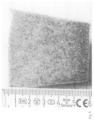
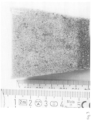
- Figures 1 and 2 The composites shown in the figure differ in the gradient with which the concentration of the first (darker) filler decreases with decreasing height. While in the case of the Figure 1 While the gel time of the binder was chosen to be extremely short in the composite material shown in Figure 2, the composite material shown in Figure 2 is based on a mixture that had a long gel time of the binder. Due to the longer gel time, Figure 2 The mixture shown in the figure shows a comparatively long time available for the accumulation or depletion of the particles of the first and second filler in certain areas of the composite material. Accordingly, the Figure 1 The embodiment shown has an extremely flat gradient, while the gradient in the Figure 2 shown embodiment, is clearly visible.
Landscapes
- Chemical & Material Sciences (AREA)
- Engineering & Computer Science (AREA)
- Ceramic Engineering (AREA)
- Materials Engineering (AREA)
- Structural Engineering (AREA)
- Organic Chemistry (AREA)
- Chemical Kinetics & Catalysis (AREA)
- Civil Engineering (AREA)
- Compositions Of Macromolecular Compounds (AREA)
Applications Claiming Priority (2)
| Application Number | Priority Date | Filing Date | Title |
|---|---|---|---|
| DE102019113330 | 2019-05-20 | ||
| PCT/EP2020/059116 WO2020233880A1 (de) | 2019-05-20 | 2020-03-31 | Leichter verbundwerkstoff mit kratzfester oberfläche und verfahren zu dessen herstellung |
Publications (2)
| Publication Number | Publication Date |
|---|---|
| EP3972944A1 EP3972944A1 (de) | 2022-03-30 |
| EP3972944B1 true EP3972944B1 (de) | 2025-07-09 |
Family
ID=70189922
Family Applications (1)
| Application Number | Title | Priority Date | Filing Date |
|---|---|---|---|
| EP20717128.1A Active EP3972944B1 (de) | 2019-05-20 | 2020-03-31 | Leichter verbundwerkstoff mit kratzfester oberfläche und verfahren zu dessen herstellung |
Country Status (5)
| Country | Link |
|---|---|
| US (1) | US12466768B2 (pl) |
| EP (1) | EP3972944B1 (pl) |
| DE (1) | DE102020108862A1 (pl) |
| PL (1) | PL3972944T3 (pl) |
| WO (1) | WO2020233880A1 (pl) |
Families Citing this family (2)
| Publication number | Priority date | Publication date | Assignee | Title |
|---|---|---|---|---|
| EP4303256A1 (en) * | 2022-07-07 | 2024-01-10 | ACS International Products, L.P. | Composite material with coating layer |
| DE102024133477A1 (de) * | 2024-03-01 | 2025-09-04 | Gebrüder Dorfner GmbH & Co. Kaolin- und Kristallquarzsand-Werke KG | Zusammensetzung für Verbundwerkstoffe und Verbundwerkstoffformteil |
Family Cites Families (6)
| Publication number | Priority date | Publication date | Assignee | Title |
|---|---|---|---|---|
| JP2001132137A (ja) * | 1999-11-04 | 2001-05-15 | Green Kk | 石材調軽量樹脂製ブロック、塀及び門柱 |
| SI1706448T1 (sl) | 2004-01-23 | 2009-10-31 | Blanco Gmbh & Co Kg | Livna masa, zlasti za izdelavo kuhinjskih pomivalnih korit, oblikovanih sanitarnih izdelkov, kuhinjskih delovnih ploĺ äś ali podobnega |
| DE102004021425A1 (de) | 2004-04-30 | 2005-11-24 | Institut für Neue Materialien Gemeinnützige GmbH | Verwendung photokatalytischer TiO2-Schichten zur Funktionalisierung von Substraten |
| US20090110909A1 (en) * | 2007-10-26 | 2009-04-30 | E. I. Dupont De Nemours And Company | Asymmetric dielectric film |
| PL227566B1 (pl) * | 2012-01-26 | 2017-12-29 | Politechnika Warszawska | Sposób otrzymywania kompozytu ceramika-metal |
| NL2015111B1 (en) | 2015-07-07 | 2017-01-17 | Innovative Stone Tech B V | A method for manufacturing a slab. |
-
2020
- 2020-03-31 DE DE102020108862.0A patent/DE102020108862A1/de active Pending
- 2020-03-31 WO PCT/EP2020/059116 patent/WO2020233880A1/de not_active Ceased
- 2020-03-31 EP EP20717128.1A patent/EP3972944B1/de active Active
- 2020-03-31 US US17/612,506 patent/US12466768B2/en active Active
- 2020-03-31 PL PL20717128.1T patent/PL3972944T3/pl unknown
Also Published As
| Publication number | Publication date |
|---|---|
| WO2020233880A1 (de) | 2020-11-26 |
| US20220212987A1 (en) | 2022-07-07 |
| EP3972944A1 (de) | 2022-03-30 |
| PL3972944T3 (pl) | 2025-10-27 |
| US12466768B2 (en) | 2025-11-11 |
| DE102020108862A1 (de) | 2020-11-26 |
Similar Documents
| Publication | Publication Date | Title |
|---|---|---|
| EP0851808B1 (de) | Integrales plattenförmiges bauteil und verfahren zu seiner herstellung | |
| DE102012113000B4 (de) | Verbundwerkstoff, Verfahren zu dessen Herstellung und dessen Verwendung | |
| DE2337728A1 (de) | Bauelement aus beton od. dgl | |
| EP2182137A2 (de) | Terrazzofußboden und Herstellungsverfahren dazu | |
| EP3972944B1 (de) | Leichter verbundwerkstoff mit kratzfester oberfläche und verfahren zu dessen herstellung | |
| EP0991707A1 (de) | Verfahren zur herstellung von platten oder formteilen sowie plattenförmiges halbzeug und raumausstattungsgegenstände, die nach dem verfahren hergestellt worden sind | |
| DE19549104A1 (de) | Pigmentierter Kunststoffboden und Verfahren zu seiner Herstellung | |
| EP1180070B1 (de) | Kunststoffformkörper | |
| DE69923006T2 (de) | Weichverbundmaterial mit hoher härte | |
| EP0248045B1 (de) | Verfahren zur herstellung eines gegebenenfalls schwimmenden fussbodenbelages | |
| DE19708991C2 (de) | Verfahren zur Herstellung von platten- oder profilförmigen Bauelementen zur Befestigung an Gebäudewänden sowie deren Verwendungen | |
| DE102008027986A1 (de) | Mineralische Zugmasse, Zugmasse auf Dispersionsbasis, Epoxidharz | |
| EP0049733A1 (de) | Fliessfähige Masse aus Wasser, Füll- und Bindematerialien sowie Verwendung dieser Masse zum Formen oder Giessen von Bauelementen mit Isoliereigenschaften und Bauelement in Form einer Platte, eines Blockes oder eines Paneeles | |
| DE60100076T2 (de) | Verfahren zur Herstellung eines Industriebodens, Mittel zur Durchführung des Verfahrens und so erhaltener Boden | |
| EP0924175B1 (de) | Bau-Formteile auf Basis von porösem Material | |
| DE102007014496B3 (de) | Verlegware und ein Verfahren zur Herstellung einer solchen | |
| EP1137359B1 (de) | Armaturenteile mit granitdekoroberfläche | |
| EP0998387B1 (de) | Plattenförmiger werkstoff | |
| AT522437B1 (de) | Kunststein | |
| DE9410620U1 (de) | Fußbodenausgleichsmasse | |
| EP0484478A1 (de) | Dekorativer kunstharzbodenbelag | |
| EP2960277B1 (de) | Verbundwerkstoff mit verändertem quervernetzungsgrad und verfahren zu dessen herstellung | |
| DE2645445B2 (de) | Verfahren zur Herstellung von Kunststoffwaschbecken | |
| DE3318364A1 (de) | Verfahren zur herstellung wasserfester kacheln aus gips und giessform | |
| DE20215919U1 (de) | Verbundplatte |
Legal Events
| Date | Code | Title | Description |
|---|---|---|---|
| STAA | Information on the status of an ep patent application or granted ep patent |
Free format text: STATUS: UNKNOWN |
|
| STAA | Information on the status of an ep patent application or granted ep patent |
Free format text: STATUS: THE INTERNATIONAL PUBLICATION HAS BEEN MADE |
|
| PUAI | Public reference made under article 153(3) epc to a published international application that has entered the european phase |
Free format text: ORIGINAL CODE: 0009012 |
|
| STAA | Information on the status of an ep patent application or granted ep patent |
Free format text: STATUS: REQUEST FOR EXAMINATION WAS MADE |
|
| 17P | Request for examination filed |
Effective date: 20211126 |
|
| AK | Designated contracting states |
Kind code of ref document: A1 Designated state(s): AL AT BE BG CH CY CZ DE DK EE ES FI FR GB GR HR HU IE IS IT LI LT LU LV MC MK MT NL NO PL PT RO RS SE SI SK SM TR |
|
| DAV | Request for validation of the european patent (deleted) | ||
| DAX | Request for extension of the european patent (deleted) | ||
| STAA | Information on the status of an ep patent application or granted ep patent |
Free format text: STATUS: EXAMINATION IS IN PROGRESS |
|
| 17Q | First examination report despatched |
Effective date: 20230217 |
|
| GRAP | Despatch of communication of intention to grant a patent |
Free format text: ORIGINAL CODE: EPIDOSNIGR1 |
|
| STAA | Information on the status of an ep patent application or granted ep patent |
Free format text: STATUS: GRANT OF PATENT IS INTENDED |
|
| GRAS | Grant fee paid |
Free format text: ORIGINAL CODE: EPIDOSNIGR3 |
|
| GRAA | (expected) grant |
Free format text: ORIGINAL CODE: 0009210 |
|
| STAA | Information on the status of an ep patent application or granted ep patent |
Free format text: STATUS: THE PATENT HAS BEEN GRANTED |
|
| INTG | Intention to grant announced |
Effective date: 20250522 |
|
| AK | Designated contracting states |
Kind code of ref document: B1 Designated state(s): AL AT BE BG CH CY CZ DE DK EE ES FI FR GB GR HR HU IE IS IT LI LT LU LV MC MK MT NL NO PL PT RO RS SE SI SK SM TR |
|
| REG | Reference to a national code |
Ref country code: GB Ref legal event code: FG4D Free format text: NOT ENGLISH |
|
| REG | Reference to a national code |
Ref country code: CH Ref legal event code: EP |
|
| REG | Reference to a national code |
Ref country code: IE Ref legal event code: FG4D Free format text: LANGUAGE OF EP DOCUMENT: GERMAN |
|
| REG | Reference to a national code |
Ref country code: DE Ref legal event code: R096 Ref document number: 502020011381 Country of ref document: DE |
|
| REG | Reference to a national code |
Ref country code: DE Ref legal event code: R081 Ref document number: 502020011381 Country of ref document: DE Owner name: GEBRUEDER DORFNER GMBH & CO. KAOLIN- UND KRIST, DE Free format text: FORMER OWNER: ANMELDERANGABEN UNKLAR / UNVOLLSTAENDIG, 80297 MUENCHEN, DE Ref country code: DE Ref legal event code: R081 Ref document number: 502020011381 Country of ref document: DE Owner name: GEBRUEDER DORFNER GMBH & CO. KG, DE Free format text: FORMER OWNER: ANMELDERANGABEN UNKLAR / UNVOLLSTAENDIG, 80297 MUENCHEN, DE |
|
| REG | Reference to a national code |
Ref country code: DE Ref legal event code: R081 Ref document number: 502020011381 Country of ref document: DE Owner name: GEBRUEDER DORFNER GMBH & CO. KG, DE Free format text: FORMER OWNER: GEBRUEDER DORFNER GMBH & CO. KAOLIN- UND KRISTALLQUARZSANDWERKE KG, 92242 HIRSCHAU, DE |
|
| REG | Reference to a national code |
Ref country code: SK Ref legal event code: T3 Ref document number: E 46942 Country of ref document: SK |
|
| REG | Reference to a national code |
Ref country code: NL Ref legal event code: MP Effective date: 20250709 |
|
| PG25 | Lapsed in a contracting state [announced via postgrant information from national office to epo] |
Ref country code: PT Free format text: LAPSE BECAUSE OF FAILURE TO SUBMIT A TRANSLATION OF THE DESCRIPTION OR TO PAY THE FEE WITHIN THE PRESCRIBED TIME-LIMIT Effective date: 20251110 |
|
| PG25 | Lapsed in a contracting state [announced via postgrant information from national office to epo] |
Ref country code: NL Free format text: LAPSE BECAUSE OF FAILURE TO SUBMIT A TRANSLATION OF THE DESCRIPTION OR TO PAY THE FEE WITHIN THE PRESCRIBED TIME-LIMIT Effective date: 20250709 |
|
| PG25 | Lapsed in a contracting state [announced via postgrant information from national office to epo] |
Ref country code: IS Free format text: LAPSE BECAUSE OF FAILURE TO SUBMIT A TRANSLATION OF THE DESCRIPTION OR TO PAY THE FEE WITHIN THE PRESCRIBED TIME-LIMIT Effective date: 20251109 |
|
| PG25 | Lapsed in a contracting state [announced via postgrant information from national office to epo] |
Ref country code: NO Free format text: LAPSE BECAUSE OF FAILURE TO SUBMIT A TRANSLATION OF THE DESCRIPTION OR TO PAY THE FEE WITHIN THE PRESCRIBED TIME-LIMIT Effective date: 20251009 |
|
| REG | Reference to a national code |
Ref country code: LT Ref legal event code: MG9D |
|
| PG25 | Lapsed in a contracting state [announced via postgrant information from national office to epo] |
Ref country code: FI Free format text: LAPSE BECAUSE OF FAILURE TO SUBMIT A TRANSLATION OF THE DESCRIPTION OR TO PAY THE FEE WITHIN THE PRESCRIBED TIME-LIMIT Effective date: 20250709 |
|
| PG25 | Lapsed in a contracting state [announced via postgrant information from national office to epo] |
Ref country code: HR Free format text: LAPSE BECAUSE OF FAILURE TO SUBMIT A TRANSLATION OF THE DESCRIPTION OR TO PAY THE FEE WITHIN THE PRESCRIBED TIME-LIMIT Effective date: 20250709 |
|
| PG25 | Lapsed in a contracting state [announced via postgrant information from national office to epo] |
Ref country code: GR Free format text: LAPSE BECAUSE OF FAILURE TO SUBMIT A TRANSLATION OF THE DESCRIPTION OR TO PAY THE FEE WITHIN THE PRESCRIBED TIME-LIMIT Effective date: 20251010 |
|
| PG25 | Lapsed in a contracting state [announced via postgrant information from national office to epo] |
Ref country code: SE Free format text: LAPSE BECAUSE OF FAILURE TO SUBMIT A TRANSLATION OF THE DESCRIPTION OR TO PAY THE FEE WITHIN THE PRESCRIBED TIME-LIMIT Effective date: 20250709 |
|
| PG25 | Lapsed in a contracting state [announced via postgrant information from national office to epo] |
Ref country code: LV Free format text: LAPSE BECAUSE OF FAILURE TO SUBMIT A TRANSLATION OF THE DESCRIPTION OR TO PAY THE FEE WITHIN THE PRESCRIBED TIME-LIMIT Effective date: 20250709 |
|
| PG25 | Lapsed in a contracting state [announced via postgrant information from national office to epo] |
Ref country code: BG Free format text: LAPSE BECAUSE OF FAILURE TO SUBMIT A TRANSLATION OF THE DESCRIPTION OR TO PAY THE FEE WITHIN THE PRESCRIBED TIME-LIMIT Effective date: 20250709 |
|
| PG25 | Lapsed in a contracting state [announced via postgrant information from national office to epo] |
Ref country code: RS Free format text: LAPSE BECAUSE OF FAILURE TO SUBMIT A TRANSLATION OF THE DESCRIPTION OR TO PAY THE FEE WITHIN THE PRESCRIBED TIME-LIMIT Effective date: 20251009 |
|
| PG25 | Lapsed in a contracting state [announced via postgrant information from national office to epo] |
Ref country code: ES Free format text: LAPSE BECAUSE OF FAILURE TO SUBMIT A TRANSLATION OF THE DESCRIPTION OR TO PAY THE FEE WITHIN THE PRESCRIBED TIME-LIMIT Effective date: 20250709 |