EP3972003B1 - Matériau électroluminescent - Google Patents
Matériau électroluminescent Download PDFInfo
- Publication number
- EP3972003B1 EP3972003B1 EP21206373.9A EP21206373A EP3972003B1 EP 3972003 B1 EP3972003 B1 EP 3972003B1 EP 21206373 A EP21206373 A EP 21206373A EP 3972003 B1 EP3972003 B1 EP 3972003B1
- Authority
- EP
- European Patent Office
- Prior art keywords
- substituted
- unsubstituted
- mmol
- compound
- present disclosure
- Prior art date
- Legal status (The legal status is an assumption and is not a legal conclusion. Google has not performed a legal analysis and makes no representation as to the accuracy of the status listed.)
- Active
Links
Classifications
-
- C—CHEMISTRY; METALLURGY
- C09—DYES; PAINTS; POLISHES; NATURAL RESINS; ADHESIVES; COMPOSITIONS NOT OTHERWISE PROVIDED FOR; APPLICATIONS OF MATERIALS NOT OTHERWISE PROVIDED FOR
- C09K—MATERIALS FOR MISCELLANEOUS APPLICATIONS, NOT PROVIDED FOR ELSEWHERE
- C09K11/00—Luminescent materials, e.g. electroluminescent or chemiluminescent
- C09K11/06—Luminescent materials, e.g. electroluminescent or chemiluminescent containing organic luminescent materials
-
- C—CHEMISTRY; METALLURGY
- C07—ORGANIC CHEMISTRY
- C07D—HETEROCYCLIC COMPOUNDS
- C07D239/00—Heterocyclic compounds containing 1,3-diazine or hydrogenated 1,3-diazine rings
- C07D239/70—Heterocyclic compounds containing 1,3-diazine or hydrogenated 1,3-diazine rings condensed with carbocyclic rings or ring systems
- C07D239/72—Quinazolines; Hydrogenated quinazolines
- C07D239/74—Quinazolines; Hydrogenated quinazolines with only hydrogen atoms, hydrocarbon or substituted hydrocarbon radicals, attached to ring carbon atoms of the hetero ring
-
- C—CHEMISTRY; METALLURGY
- C07—ORGANIC CHEMISTRY
- C07D—HETEROCYCLIC COMPOUNDS
- C07D241/00—Heterocyclic compounds containing 1,4-diazine or hydrogenated 1,4-diazine rings
- C07D241/36—Heterocyclic compounds containing 1,4-diazine or hydrogenated 1,4-diazine rings condensed with carbocyclic rings or ring systems
- C07D241/38—Heterocyclic compounds containing 1,4-diazine or hydrogenated 1,4-diazine rings condensed with carbocyclic rings or ring systems with only hydrogen or carbon atoms directly attached to the ring nitrogen atoms
- C07D241/40—Benzopyrazines
- C07D241/42—Benzopyrazines with only hydrogen atoms, hydrocarbon or substituted hydrocarbon radicals, directly attached to carbon atoms of the hetero ring
-
- C—CHEMISTRY; METALLURGY
- C07—ORGANIC CHEMISTRY
- C07D—HETEROCYCLIC COMPOUNDS
- C07D251/00—Heterocyclic compounds containing 1,3,5-triazine rings
- C07D251/02—Heterocyclic compounds containing 1,3,5-triazine rings not condensed with other rings
- C07D251/12—Heterocyclic compounds containing 1,3,5-triazine rings not condensed with other rings having three double bonds between ring members or between ring members and non-ring members
- C07D251/14—Heterocyclic compounds containing 1,3,5-triazine rings not condensed with other rings having three double bonds between ring members or between ring members and non-ring members with hydrogen or carbon atoms directly attached to at least one ring carbon atom
- C07D251/24—Heterocyclic compounds containing 1,3,5-triazine rings not condensed with other rings having three double bonds between ring members or between ring members and non-ring members with hydrogen or carbon atoms directly attached to at least one ring carbon atom to three ring carbon atoms
-
- C—CHEMISTRY; METALLURGY
- C07—ORGANIC CHEMISTRY
- C07D—HETEROCYCLIC COMPOUNDS
- C07D487/00—Heterocyclic compounds containing nitrogen atoms as the only ring hetero atoms in the condensed system, not provided for by groups C07D451/00 - C07D477/00
- C07D487/02—Heterocyclic compounds containing nitrogen atoms as the only ring hetero atoms in the condensed system, not provided for by groups C07D451/00 - C07D477/00 in which the condensed system contains two hetero rings
- C07D487/04—Ortho-condensed systems
-
- C—CHEMISTRY; METALLURGY
- C09—DYES; PAINTS; POLISHES; NATURAL RESINS; ADHESIVES; COMPOSITIONS NOT OTHERWISE PROVIDED FOR; APPLICATIONS OF MATERIALS NOT OTHERWISE PROVIDED FOR
- C09K—MATERIALS FOR MISCELLANEOUS APPLICATIONS, NOT PROVIDED FOR ELSEWHERE
- C09K11/00—Luminescent materials, e.g. electroluminescent or chemiluminescent
- C09K11/02—Use of particular materials as binders, particle coatings or suspension media therefor
- C09K11/025—Use of particular materials as binders, particle coatings or suspension media therefor non-luminescent particle coatings or suspension media
-
- H—ELECTRICITY
- H10—SEMICONDUCTOR DEVICES; ELECTRIC SOLID-STATE DEVICES NOT OTHERWISE PROVIDED FOR
- H10K—ORGANIC ELECTRIC SOLID-STATE DEVICES
- H10K50/00—Organic light-emitting devices
- H10K50/10—OLEDs or polymer light-emitting diodes [PLED]
- H10K50/11—OLEDs or polymer light-emitting diodes [PLED] characterised by the electroluminescent [EL] layers
-
- H—ELECTRICITY
- H10—SEMICONDUCTOR DEVICES; ELECTRIC SOLID-STATE DEVICES NOT OTHERWISE PROVIDED FOR
- H10K—ORGANIC ELECTRIC SOLID-STATE DEVICES
- H10K85/00—Organic materials used in the body or electrodes of devices covered by this subclass
- H10K85/60—Organic compounds having low molecular weight
- H10K85/615—Polycyclic condensed aromatic hydrocarbons, e.g. anthracene
-
- H—ELECTRICITY
- H10—SEMICONDUCTOR DEVICES; ELECTRIC SOLID-STATE DEVICES NOT OTHERWISE PROVIDED FOR
- H10K—ORGANIC ELECTRIC SOLID-STATE DEVICES
- H10K85/00—Organic materials used in the body or electrodes of devices covered by this subclass
- H10K85/60—Organic compounds having low molecular weight
- H10K85/615—Polycyclic condensed aromatic hydrocarbons, e.g. anthracene
- H10K85/626—Polycyclic condensed aromatic hydrocarbons, e.g. anthracene containing more than one polycyclic condensed aromatic rings, e.g. bis-anthracene
-
- H—ELECTRICITY
- H10—SEMICONDUCTOR DEVICES; ELECTRIC SOLID-STATE DEVICES NOT OTHERWISE PROVIDED FOR
- H10K—ORGANIC ELECTRIC SOLID-STATE DEVICES
- H10K85/00—Organic materials used in the body or electrodes of devices covered by this subclass
- H10K85/60—Organic compounds having low molecular weight
- H10K85/631—Amine compounds having at least two aryl rest on at least one amine-nitrogen atom, e.g. triphenylamine
-
- H—ELECTRICITY
- H10—SEMICONDUCTOR DEVICES; ELECTRIC SOLID-STATE DEVICES NOT OTHERWISE PROVIDED FOR
- H10K—ORGANIC ELECTRIC SOLID-STATE DEVICES
- H10K85/00—Organic materials used in the body or electrodes of devices covered by this subclass
- H10K85/60—Organic compounds having low molecular weight
- H10K85/649—Aromatic compounds comprising a hetero atom
- H10K85/654—Aromatic compounds comprising a hetero atom comprising only nitrogen as heteroatom
-
- H—ELECTRICITY
- H10—SEMICONDUCTOR DEVICES; ELECTRIC SOLID-STATE DEVICES NOT OTHERWISE PROVIDED FOR
- H10K—ORGANIC ELECTRIC SOLID-STATE DEVICES
- H10K85/00—Organic materials used in the body or electrodes of devices covered by this subclass
- H10K85/60—Organic compounds having low molecular weight
- H10K85/649—Aromatic compounds comprising a hetero atom
- H10K85/657—Polycyclic condensed heteroaromatic hydrocarbons
- H10K85/6572—Polycyclic condensed heteroaromatic hydrocarbons comprising only nitrogen in the heteroaromatic polycondensed ring system, e.g. phenanthroline or carbazole
-
- H—ELECTRICITY
- H10—SEMICONDUCTOR DEVICES; ELECTRIC SOLID-STATE DEVICES NOT OTHERWISE PROVIDED FOR
- H10K—ORGANIC ELECTRIC SOLID-STATE DEVICES
- H10K85/00—Organic materials used in the body or electrodes of devices covered by this subclass
- H10K85/60—Organic compounds having low molecular weight
- H10K85/649—Aromatic compounds comprising a hetero atom
- H10K85/657—Polycyclic condensed heteroaromatic hydrocarbons
- H10K85/6574—Polycyclic condensed heteroaromatic hydrocarbons comprising only oxygen in the heteroaromatic polycondensed ring system, e.g. cumarine dyes
-
- H—ELECTRICITY
- H10—SEMICONDUCTOR DEVICES; ELECTRIC SOLID-STATE DEVICES NOT OTHERWISE PROVIDED FOR
- H10K—ORGANIC ELECTRIC SOLID-STATE DEVICES
- H10K85/00—Organic materials used in the body or electrodes of devices covered by this subclass
- H10K85/60—Organic compounds having low molecular weight
- H10K85/649—Aromatic compounds comprising a hetero atom
- H10K85/657—Polycyclic condensed heteroaromatic hydrocarbons
- H10K85/6576—Polycyclic condensed heteroaromatic hydrocarbons comprising only sulfur in the heteroaromatic polycondensed ring system, e.g. benzothiophene
-
- C—CHEMISTRY; METALLURGY
- C09—DYES; PAINTS; POLISHES; NATURAL RESINS; ADHESIVES; COMPOSITIONS NOT OTHERWISE PROVIDED FOR; APPLICATIONS OF MATERIALS NOT OTHERWISE PROVIDED FOR
- C09K—MATERIALS FOR MISCELLANEOUS APPLICATIONS, NOT PROVIDED FOR ELSEWHERE
- C09K2211/00—Chemical nature of organic luminescent or tenebrescent compounds
- C09K2211/10—Non-macromolecular compounds
- C09K2211/1018—Heterocyclic compounds
-
- H—ELECTRICITY
- H10—SEMICONDUCTOR DEVICES; ELECTRIC SOLID-STATE DEVICES NOT OTHERWISE PROVIDED FOR
- H10K—ORGANIC ELECTRIC SOLID-STATE DEVICES
- H10K2101/00—Properties of the organic materials covered by group H10K85/00
- H10K2101/10—Triplet emission
-
- H—ELECTRICITY
- H10—SEMICONDUCTOR DEVICES; ELECTRIC SOLID-STATE DEVICES NOT OTHERWISE PROVIDED FOR
- H10K—ORGANIC ELECTRIC SOLID-STATE DEVICES
- H10K2101/00—Properties of the organic materials covered by group H10K85/00
- H10K2101/90—Multiple hosts in the emissive layer
-
- H—ELECTRICITY
- H10—SEMICONDUCTOR DEVICES; ELECTRIC SOLID-STATE DEVICES NOT OTHERWISE PROVIDED FOR
- H10K—ORGANIC ELECTRIC SOLID-STATE DEVICES
- H10K85/00—Organic materials used in the body or electrodes of devices covered by this subclass
- H10K85/30—Coordination compounds
- H10K85/341—Transition metal complexes, e.g. Ru(II)polypyridine complexes
- H10K85/342—Transition metal complexes, e.g. Ru(II)polypyridine complexes comprising iridium
Definitions
- the present disclosure relates to an electroluminescent compound.
- OLED organic electroluminescent device
- TPD/AIq3 bilayer consisting of a light-emitting layer and a charge transport layer. Since then, the research on an OLED has been rapidly carried out, and it has been commercialized.
- An OLED changes electric energy into light by applying electricity to an organic light-emitting material, and commonly comprises an anode, a cathode, and an organic layer formed between the two electrodes.
- the organic layer of the OLED may comprise a hole injection layer, a hole transport layer, a hole auxiliary layer, a light-emitting auxiliary layer, an electron blocking layer, a light-emitting layer, an electron buffer layer, a hole blocking layer, an electron transport layer, an electron injection layer, etc., if necessary.
- the materials used in the organic layer can be classified into a hole injection material, a hole transport material, a hole auxiliary material, a light-emitting auxiliary material, an electron blocking material, a light-emitting material layer (containing host and dopant materials), an electron buffer material, a hole blocking material, an electron transport material, an electron injection material, etc., depending on functions.
- the most important factor determining luminous efficiency in an OLED is light-emitting materials.
- the light-emitting materials are required to have high quantum efficiency, high movement degree of an electron and a hole, and uniformity and stability of the formed light-emitting material layer.
- the light-emitting material is classified into blue, green, and red light-emitting materials according to the light-emitting color, and further includes yellow or orange light-emitting materials.
- the light-emitting material is classified into a host material and a dopant material in a functional aspect. Recently, an urgent task is the development of an OLED having high efficiency and long lifespan.
- a host material should have high purity and a suitable molecular weight in order to be deposited under vacuum. Furthermore, a host material is required to have high glass transition temperature and pyrolysis temperature to achieve thermal stability, high electrochemical stability to achieve a long lifespan, easy formability of an amorphous thin film, good adhesion with adjacent layers, and no movement between layers.
- Korean Patent No. 1311934 and Korean Patent Application Laid-Open No. 2015-124902 disclose an organic electroluminescent device comprising an indolocarbazole compound as one of a plurality of host materials.
- the development for improving the performance of an OLED is still required.
- KR20140122680 (A ) and WO2017095156 (A1 ) disclose electroluminescent compounds based on diazanaphthalene substituted benzofluorene core.
- a material having various residues in an organic electroluminescent device can exhibit excellent luminescent properties by improving hole and electron properties.
- the higher the molecular weight the higher the temperature required for deposition, and a higher deposition temperature is required.
- heat is applied at a high deposition temperature for a period of time, the material is denatured, thereby deteriorating the inherent properties of the material and deteriorating the luminescent properties.
- the objective of the present disclosure is to provide an electroluminescent compound according to the claims.
- the present disclosure shows that the combination of a compound of formula 1 and a compound of formula 11 as a light-emitting material can exhibit excellent luminescent properties by improving hole and electron properties by separating a HOMO part responsible for the hole properties and a LUMO part responsible for the electron properties.
- the combination can have favorable conditions for thermal denaturation by having a low deposition temperature.
- a plurality of host materials can be deposited at a relatively low temperature, so that deterioration of luminescent properties can be reduced.
- an organic electroluminescent device comprising the compounds represented by formula 1 and formula 11 may have a lower driving voltage, higher luminous efficiency and/or longer lifetime.
- the above objective can be achieved by a plurality of host materials comprising a first host material and a second host material, wherein the first host material comprises a compound represented by the following formula 1 (not forming part of the claimed invention): wherein
- an organic electroluminescent device having a lower driving voltage, higher luminous efficiency and/or longer lifetime may be provided.
- the present disclosure may provide a plurality of host materials having a composition favorable to thermal denaturation due to a low deposition temperature, while improving hole properties and electronic properties of HOMO and LUMO, by comprising separate compounds represented by complementary formulas 1 and 2 in a light-emitting layer.
- organic electroluminescent material in the present disclosure means a material that may be used in an organic electroluminescent device, and may comprise at least one compound.
- the organic electroluminescent material may be comprised in any layer constituting an organic electroluminescent device, as necessary.
- the organic electroluminescent material may be a hole injection material, a hole transport material, a hole auxiliary material, a light-emitting auxiliary material, an electron blocking material, a light-emitting material (containing host and dopant materials), an electron buffer material, a hole blocking material, an electron transport material, an electron injection material, etc.
- a plurality of organic electroluminescent materials in the present disclosure means an organic electroluminescent material as a combination of at least two compounds, which may be comprised in any layer constituting an organic electroluminescent device. It may mean both a material before being comprised in an organic electroluminescent device (for example, before vapor deposition) and a material after being comprised in an organic electroluminescent device (for example, after vapor deposition).
- a plurality of organic electroluminescent materials may be a combination of at least two compounds which may be comprised in at least one of a hole injection layer, a hole transport layer, a hole auxiliary layer, a light-emitting auxiliary layer, an electron blocking layer, a light-emitting layer, an electron buffer layer, a hole blocking layer, an electron transport layer, and an electron injection layer.
- At least two compounds may be comprised in the same layer or different layers by means of the methods used in the art, for example, may be mixture-evaporated or co-evaporated, or may be individually evaporated.
- a plurality of host materials in the present disclosure means a host material as a combination of at least two compounds, which may be comprised in any light-emitting layer constituting an organic electroluminescent device. It may mean both a material before being comprised in an organic electroluminescent device (for example, before vapor deposition) and a material after being comprised in an organic electroluminescent device (for example, after vapor deposition).
- a plurality of host materials of the present disclosure may be a combination of at least two host materials, and may optionally conventional materials used in the organic electroluminescent material. At least two compounds comprised in a plurality of host materials may be comprised together in one light-emitting layer or may respectively be comprised in different light-emitting layers. If at least two host materials are comprised in one layer, for example, they may be mixture-evaporated to form a layer, or may be separately co-evaporated at the same time to form a layer.
- (C1-C30)alkyl is meant to be a linear or branched alkyl having 1 to 30 carbon atoms constituting the chain, in which the number of carbon atoms is preferably 1 to 20, and more preferably 1 to 10.
- the above alkyl may include methyl, ethyl, n-propyl, isopropyl, n-butyl, iso-butyl, tert-butyl, etc.
- (C2-C30)alkenyl is meant to be a linear or branched alkenyl having 2 to 30 carbon atoms constituting the chain, in which the number of carbon atoms is preferably 2 to 20, and more preferably 2 to 10.
- the above alkenyl may include vinyl, 1-propenyl, 2-propenyl, 1-butenyl, 2-butenyl, 3-butenyl, 2-methylbut-2-enyl, etc.
- (C2-C30)alkynyl is meant to be a linear or branched alkynyl having 2 to 30 carbon atoms constituting the chain, in which the number of carbon atoms is preferably 2 to 20, and more preferably 2 to 10.
- the above alkynyl may include ethynyl, 1-propynyl, 2-propynyl, 1-butynyl, 2-butynyl, 3-butynyl, 1-methylpent-2-ynyl, etc.
- (C3-C30)cycloalkyl is meant to be a mono- or polycyclic hydrocarbon having 3 to 30 ring backbone carbon atoms, in which the number of carbon atoms is preferably 3 to 20, and more preferably 3 to 7.
- the above cycloalkyl may include cyclopropyl, cyclobutyl, cyclopentyl, cyclohexyl, etc.
- (3- to 7-membered)heterocycloalkyl is meant to be a cycloalkyl having 3 to 7, preferably 5 to 7, ring backbone atoms, and including at least one heteroatom selected from the group consisting of B, N, O, S, Si, and P, and preferably the group consisting of O, S, and N.
- the above heterocycloalkyl may include tetrahydrofuran, pyrrolidine, thiolan, tetrahydropyran, etc.
- (C6-C30)aryl(ene) is meant to be a monocyclic or fused ring radical derived from an aromatic hydrocarbon having 6 to 30 ring backbone carbon atoms, in which the number of the ring backbone carbon atoms is preferably 6 to 25, more preferably 6 to 18.
- the above aryl(ene) may be partially saturated, and may comprise a spiro structure.
- the above aryl may include phenyl, biphenyl, terphenyl, naphthyl, binaphthyl, phenylnaphthyl, naphthylphenyl, phenylterphenyl, fluorenyl, phenylfluorenyl, benzofluorenyl, dibenzofluorenyl, phenanthrenyl, phenylphenanthrenyl, anthracenyl, indenyl, triphenylenyl, pyrenyl, tetracenyl, perylenyl, chrysenyl, naphthacenyl, fluoranthenyl, spirobifluorenyl, etc.
- (3- to 30-membered)heteroaryl(ene) is an aryl having 3 to 30 ring backbone atoms, and including at least one, preferably 1 to 4 heteroatoms selected from the group consisting of B, N, O, S, Si, and P.
- the above heteroaryl(ene) may be a monocyclic ring, or a fused ring condensed with at least one benzene ring; may be partially saturated; may be one formed by linking at least one heteroaryl or aryl group to a heteroaryl group via a single bond(s); and may comprise a spiro structure.
- the above heteroaryl may include a monocyclic ring-type heteroaryl such as furyl, thiophenyl, pyrrolyl, imidazolyl, pyrazolyl, thiazolyl, thiadiazolyl, isothiazolyl, isoxazolyl, oxazolyl, oxadiazolyl, triazinyl, tetrazinyl, triazolyl, tetrazolyl, furazanyl, pyridyl, pyrazinyl, pyrimidinyl, and pyridazinyl, and a fused ring-type heteroaryl such as benzofuranyl, benzothiophenyl, isobenzofuranyl, dibenzofuranyl, dibenzothiophenyl, benzimidazolyl, benzothiazolyl, benzoisothiazolyl, benzoisoxazolyl, benzoxazolyl, isoindolyl
- substituted in the expression “substituted or unsubstituted” means that a hydrogen atom in a certain functional group is replaced with another atom or another functional group, i.e., a substituent.
- the substituents are at least one of a (C1-C20)alkyl and a (C6-C25)aryl. According to another embodiment of the present disclosure, the substituents, each independently, are at least one of a (C1-C10)alkyl and a (C6-C18)aryl. For example, the substituents, each independently, are at least one of a methyl and a phenyl.
- the heteroaryl(ene) and the heterocycloalkyl may contain at least one heteroatom selected from B, N, O, S, Si, and P.
- the heteroatom may be bonded to at least one selected from the group consisting of hydrogen, deuterium, a halogen, a cyano, a substituted or unsubstituted (C1-C30)alkyl, a substituted or unsubstituted (C6-C30)aryl, a substituted or unsubstituted (5- to 30-membered)heteroaryl, a substituted or unsubstituted (C3-C30)cycloalkyl, a substituted or unsubstituted (C1-C30)alkoxy, a substituted or unsubstituted tri(C1-C30)alkylsilyl, a substituted or unsubstituted di(C1-C30)alkyl(C6-C30)arylsilyl, a substitute
- the ring may be a mono- or polycyclic, alicyclic or aromatic ring, or the combination thereof, in which the formed ring may contain at least one heteroatom selected from nitrogen, oxygen, and sulfur.
- L 1 and L 2 each independently, represent a single bond, a substituted or unsubstituted (C6-C30)arylene, or a substituted or unsubstituted (3- to 30-membered)heteroarylene.
- L 1 and L 2 each independently, represent a single bond, a substituted or unsubstituted (C6-C25)arylene, or a substituted or unsubstituted (5- to 25-membered)heteroarylene.
- L 1 and L 2 each independently, represent a single bond, an unsubstituted (C6-C18)arylene, or an unsubstituted (5- to 18-membered)heteroarylene.
- L 1 and L 2 each independently, may represent a single bond, a phenylene, a naphthylene, a biphenylene, or a carbazolylene.
- Ar 1 and Ar 2 each independently, represent a substituted or unsubstituted (C6-C30)aryl, a substituted or unsubstituted (3- to 30-membered)heteroaryl, an amino, a substituted or unsubstituted mono- or di- (C1-C30)alkylamino, a substituted or unsubstituted mono- or di- (C6-C30)arylamino, or a substituted or unsubstituted (C1-C30)alkyl(C6-C30)arylamino.
- Ar 1 and Ar 2 each independently, represent a substituted or unsubstituted (C6-C25)aryl, a substituted or unsubstituted (3- to 25-membered)heteroaryl, or a substituted or unsubstituted mono- or di-(C6-C30)arylamino.
- Ar 1 and Ar 2 each independently, represent a (C6-C18)aryl unsubstituted or substituted with at least one of (C1-C10)alkyl, an unsubstituted (5- to 18-membered)heteroaryl, or an unsubstituted di(C6-C18)arylamino.
- Ar, and Ar 2 each independently, may represent a phenyl, a naphthyl, a biphenyl, a terphenyl, a phenanthrenyl, a dimethylfluorenyl, a dimethylbenzofluorenyl, a dibenzothiophenyl, a dibenzofuranyl, a diphenylamino, a phenylbiphenylamino, or a phenylnaphthylamino.
- a and B each independently, represent a benzene ring or a naphthalene ring, with the proviso that at least one of A and B represents a naphthalene ring.
- A represents a naphthalene ring
- B represents a benzene ring or a naphthalene ring.
- R 1 to R 3 each independently, represent hydrogen, deuterium, a halogen, a cyano, a substituted or unsubstituted (C1-C30)alkyl, a substituted or unsubstituted (C2-C30)alkenyl, a substituted or unsubstituted (C6-C30)aryl, a substituted or unsubstituted (3- to 30-membered)heteroaryl, a substituted or unsubstituted (C3-C30)cycloalkyl, a substituted or unsubstituted (C1-C30)alkoxy, a substituted or unsubstituted tri(C1-C30)alkylsilyl, a substituted or unsubstituted di(C1-C30)alkyl(C6-C30)arylsilyl, a substituted or unsubstituted (C1-C
- R 1 to R 3 each independently, represent hydrogen, a substituted or unsubstituted (C1-C20)alkyl, a substituted or unsubstituted (C2-C20)alkenyl, a substituted or unsubstituted (C6-C25)aryl, or a substituted or unsubstituted (5- to 25-membered)heteroaryl; or each of R 1 to R 3 may be linked to each other to form a substituted or unsubstituted (3- to 25-membered) mono- or polycyclic ring.
- R 1 to R 3 each independently, represent hydrogen, an unsubstituted (C1-C10)alkyl, an unsubstituted (C2-C10)alkenyl, or an unsubstituted (C6-C18)aryl; or two adjacent R 3 's may be linked to each other to form a substituted or unsubstituted (3- to 18-membered) mono- or polycyclic ring.
- R 1 may be hydrogen or a phenyl
- R 2 may be hydrogen
- R 3 may be hydrogen or a phenyl, or two adjacent R 3 's may be linked to each other to form a benzene ring.
- a represents an integer of 1 to 4, when A represents a benzene ring; or a represents an integer of 1 to 6, when A represents a naphthalene ring; b represents 1 or 2, when B represents a benzene ring; or b represents an integer of 1 to 4, when B represents a naphthalene ring; and c represents an integer of 1 to 4.
- a to c each independently, are an integer of 2 or more, each of R 1 to R 3 may be the same or different. According to one embodiment of the present disclosure, a to c, each independently, represent 1 or 2.
- the compound represented by fomula 1 may be represented by at least one of the following formulas 3 and 4.
- L 1 , L 2 , Ar 1 , Ar 2 , R 1 to R 3 , and a to c are as defined in formula 1.
- the compound represented by formula 1 (not forming part of the claimed invention), includes the following compounds, but is not limited thereto.
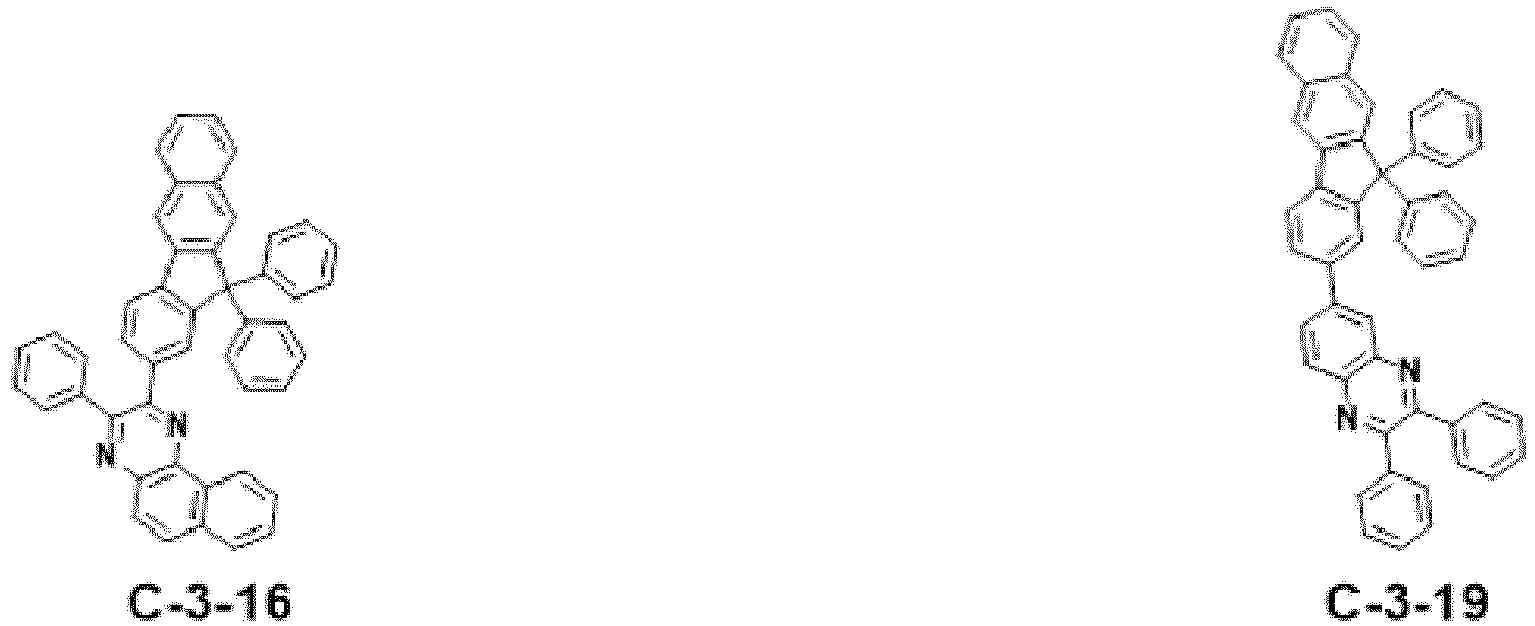
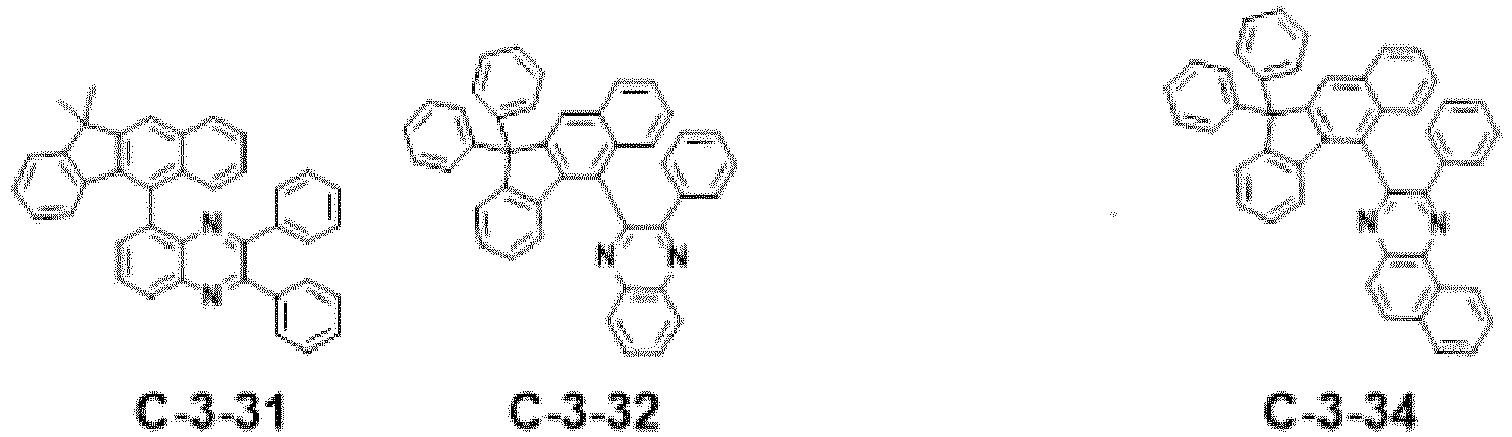
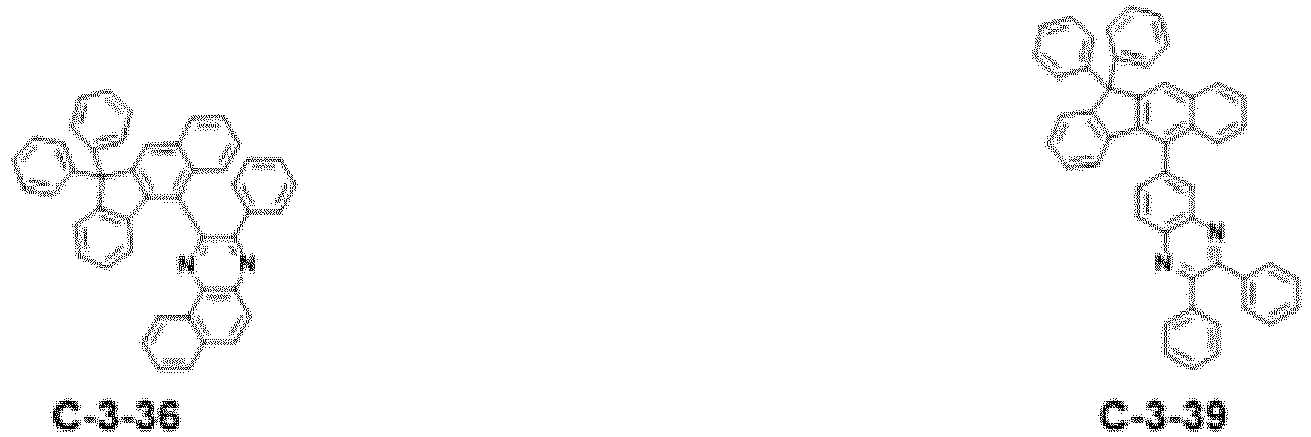
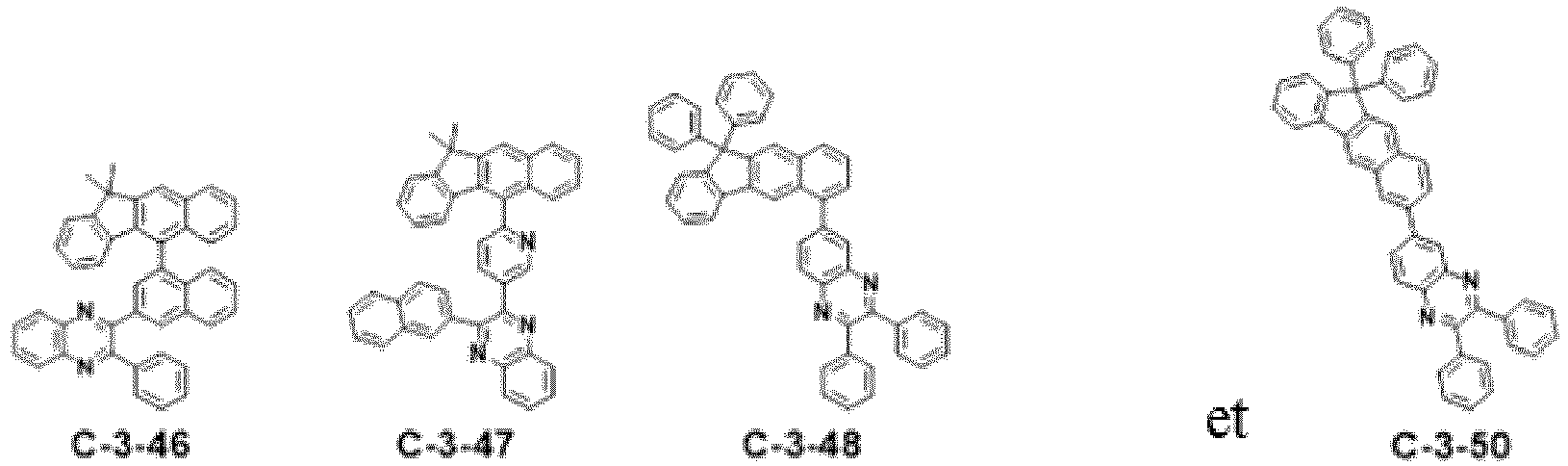
- the compound represented by formula 11 includes the following compounds, but is not limited thereto.
- the combination of at least one of compounds C-1-1 to C-1-140 and at least one of compounds C-2 or C-3 according to claim 2 may be used in an organic electroluminescent device.
- the present disclosure may provide a combination of the compound represented by formula 1 (not forming part of the claimed invention), and the compound represented by the following formula 11.
- the organic electroluminescent device according to the present disclosure may comprise a compound represented by the following formula 11, which may be used as a host material.
- the present disclosure may provide a host material comprising a compound represented by the following formula 11.
- the host material may consist of only a single host, or may comprise a plurality of hosts.
- Ar 11 to Ar 20 each independently, represent hydrogen, deuterium, a substituted or unsubstituted (C1-C30)alkyl, a substituted or unsubstituted (C6-C30)aryl, a substituted or unsubstituted (5- to 30-membered)heteroaryl, a substituted or unsubstituted (3-to 7-membered)heterocycloalkyl, or a substituted or unsubstituted (C3-C30)cycloalkyl; with the proviso that at least one of Ar 11 to Ar 20 is represented by the following formula 11-1: Wherein HAr 11 represents
- At least one of Ar 11 to Ar 20 is represented by formula 11-1, and the others of Ar 11 to Ar 20 represent hydrogen.
- L 11 represents a single bond, a substituted or unsubstituted (C6-C25)arylene, or a substituted or unsubstituted (5- to 25-membered)heteroarylene.
- L 11 represents a single bond, an unsubstituted (C6-C18)arylene, or an unsubstituted (5- to 20-membered)heteroarylene.
- L 11 may represent a single bond, a phenylene, a naphthylene, or a pyridylene.
- R 10 and R 11 each independently, represent a substituted or unsubstituted (C1-C20)alkyl, or a substituted or unsubstituted (C6-C25)aryl; or R 10 and R 11 may be linked to each other to form a ring.
- R 10 and R 11 may be the same as or different from each other.
- R 10 and R 11 each independently, represent an unsubstituted (C1-C10)alkyl, or an unsubstituted (C6-C18)aryl; or R 10 and R 11 may be linked to each other to form a spiro ring.
- R 10 and R 11 each independently, represent a methyl or a phenyl; or R 10 and R 11 may be linked to each other to form a spirofluorene ring.
- R 31 each independently, represent hydrogen, deuterium, a substituted or unsubstituted (C1-C20)alkyl, a substituted or unsubstituted (C6-C25)aryl.
- R 31 each independently, represent hydrogen, deuterium, or a (C6-C18)aryl unsubstituted or substituted with a (C1-C6)alkyl;
- R 31 each independently, may represent hydrogen, a phenyl, a naphthyl, a biphenyl, a naphthylphenyl, a phenylnaphthyl, a phenanthrenyl, a triphenylenyl, a dimethylfluorenyl, or a dimethylbenzofluorenyl;
- the combination of at least one of compounds C-1-1 to C-1-140, and/or at least one of compounds of formula 11 above may be used in an organic electroluminescent device.
- the compound of formula 1 according to the present disclosure may be prepared by a synthetic method known to one skilled in the art.
- the compound represented by formula 3 or 4 can be prepared by referring to the following reaction scheme 1 or 2, but is not limited thereto.
- L 1 , L 2 , Ar 1 , Ar 2 , R 1 to R 3 , and a to c are as defined in formula 1.
- the compound of formula 11 according to the claimed invention may be prepared by a synthetic method known to one skilled in the art.
- the compound represented by formula 11 can be prepared by referring to the following reaction scheme 5 or 6, but is not limited thereto.
- R 10 , R 11 , L 11 , and HAr 11 are as defined in formula 11.
- the organic electroluminescent device comprises an anode, a cathode, and at least one organic layer between the anode and the cathode.
- the organic layer may comprise a plurality of organic electroluminescent materials in which the compound represented by formula 1 is included as a first organic electroluminescent material, and the compound represented by formula 11 is included as a second organic electroluminescent material.
- the organic electroluminescent device comprises an anode, a cathode, and at least one light-emitting layer between the anode and the cathode, and at least one layer of the light-emitting layer may comprise the compound represented by formula 1 and the compound represented by formula 11.
- the light-emitting layer comprises a host and a dopant.
- the host comprises a plurality of host materials.
- the plurality of host materials comprises a first host material and a second host material.
- the first host material may consist of the compound represented by formula 1 alone, or may consist of at least one compound represented by the formula 1.
- the first host material may further comprise conventional materials included in the organic electroluminescent material.
- the second host material may consist of the compound represented by formula 11 alone, or may consist of at least one compound represented by the formula 11.
- the second host material may further comprise conventional materials included in the organic electroluminescent material.
- the weight ratio of the first host compound to the second host compound is in the range of about 1:99 to about 99:1, preferably about 10:90 to about 90:10, more preferably about 30:70 to about 70:30, even more preferably about 40:60 to 60:40, and still more preferably about 50:50.
- the light-emitting layer is a layer from which light is emitted, and can be a single layer or a multi-layer in which two or more layers are stacked.
- the first and second host materials may both be comprised in one layer or may be respectively comprised in different light-emitting layers.
- the doping concentration of the dopant compound with respect to the host compound is less than 20 wt%.
- the organic electroluminescent device of the present disclosure may further comprise at least one layer selected from a hole injection layer, a hole transport layer, a hole auxiliary layer, a light-emitting auxiliary layer, an electron transport layer, an electron injection layer, an interlayer, an electron buffer layer, a hole blocking layer, and an electron blocking layer.
- the organic electroluminescent device may further comprise amine-based compounds in addition to a plurality of host materials of the present disclosure as at least one of a hole injection material, a hole transport material, a hole auxiliary material, a light-emitting material, a light-emitting auxiliary material and an electron blocking material.
- the organic electroluminescent device may further comprise azine-based compounds in addition to a plurality of host materials of the present disclosure as at least one of an electron transport material, an electron injection material, an electron buffer material and a hole blocking material.
- the dopant compound which can be used in combination with the host compound of the present discloasure, may comprise the compound represented by the following formula 101, but is not limited thereto.
- L 1 is selected from the following structures 1 and 2:
- R 100 to R 103 each independently, represent hydrogen, deuterium, a halogen, a (C1-C30)alkyl unsubstituted or substituted with deuterium or a halogen, a substituted or unsubstituted (C3-C30)cycloalkyl, a substituted or unsubstituted (C6-C30)aryl, a cyano, a substituted or unsubstituted (3- to 30-membered)heteroaryl, or a substituted or unsubstituted (C1-C30)alkoxy; or may be linked to adjacent R 100 to R 103 , to form a substituted or unsubstituted fused ring together with pyridine, e.g., a substituted or unsubstituted quinoline, a substituted or unsubstituted isoquinoline, a substituted or unsubstituted benzofuropyridine, a substituted or unsubsti
- R 104 to R 107 each independently, represent hydrogen, deuterium, a halogen, a (C1-C30)alkyl unsubstituted or substituted with deuterium or a halogen, a substituted or unsubstituted (C3-C30)cycloalkyl, a substituted or unsubstituted (C6-C30)aryl, a substituted or unsubstituted (3- to 30-membered)heteroaryl, a cyano, or a substituted or unsubstituted (C1-C30)alkoxy; or may be linked to adjacent R 104 to R 107 to form a substituted or unsubstituted fused ring together with benzene, e.g., a substituted or unsubstituted naphthalene, a substituted or unsubstituted fluorene, a substituted or unsubstituted dibenzothiophene, a substitute
- R 201 to R 211 each independently, represent hydrogen, deuterium, a halogen, a (C1-C30)alkyl unsubstituted or substituted with deuterium or a halogen, a substituted or unsubstituted (C3-C30)cycloalkyl, or a substituted or unsubstituted (C6-C30)aryl; or may be linked to adjacent R 201 to R 211 to form a substituted or unsubstituted fused ring; and
- n an integer of 1 to 3.
- dopant compound is as follows, but are not limited thereto.
- dry film-forming methods such as vacuum evaporation, sputtering, plasma and ion plating methods, or wet film-forming methods such as ink jet printing, nozzle printing, slot coating, spin coating, dip coating, and flow coating methods can be used.
- a thin film can be formed by dissolving or diffusing materials forming each layer into any suitable solvent such as ethanol, chloroform, tetrahydrofuran, dioxane, etc.
- the solvent can be any solvent where the materials forming each layer can be dissolved or diffused, and where there are no problems in film-formation capability.
- first and the second host compounds of the present disclosure may be film-formed in the above-listed methods, commonly by a co-evaporation process or a mixture-evaporation process.
- the co-evaporation is a mixed deposition method in which two or more materials are placed in a respective individual crucible source and a current is applied to both cells at the same time to evaporate the materials.
- the mixture-evaporation is a mixed deposition method in which two or more materials are mixed in one crucible source before evaporating them, and a current is applied to the cell to evaporate the materials.
- the two host compounds can be individually deposited. For example, a first host compound may be deposited, and then a second host compound may be deposited.
- the present disclosure may provide a display device by using a plurality of host materials comprising the compound represented by the formula 1 and the compound represented by the formula 11.
- a display system or a lighting system by using the plurality of host materials of the present disclosure.
- a display system e.g., a display system for smartphones, tablets, notebooks, PCs, TVs, or cars
- a lighting system e.g., an outdoor or indoor lighting system
- An OLED not forming part of the present invention was produced as follows: A transparent electrode indium tin oxide (ITO) thin film (10 ⁇ /sq) on a glass substrate for an OLED (GEOMATEC CO., LTD., Japan) was subjected to an ultrasonic washing with acetone, ethanol and distilled water, sequentially, and then was stored in isopropanol.
- the ITO substrate was mounted on a substrate holder of a vacuum vapor deposition apparatus.
- Compound HI-1 was introduced into a cell of the vacuum vapor deposition apparatus, and then the pressure in the chamber of the apparatus was then controlled to 10 -6 torr.
- compound HI-2 was introduced into another cell of the vacuum vapor deposition apparatus and was evaporated by applying an electric current to the cell, thereby forming a second hole injection layer having a thickness of 5 nm on the first hole injection layer.
- Compound HT-1 was then introduced into another cell of the vacuum vapor deposition apparatus and was evaporated by applying an electric current to the cell, thereby forming a first hole transport layer having a thickness of 10 nm on the second hole injection layer.
- Compound HT-2 was then introduced into another cell of the vacuum vapor deposition apparatus and was evaporated by applying an electric current to the cell, thereby forming a second hole transport layer having a thickness of 60 nm on the first hole transport layer.
- a light-emitting layer was formed thereon as follows: The first host and the second host shown in Tables 1 to 3 were introduced into one cell of the vacuum vapor depositing apparatus at a ratio of 50:50, and compound D-39 was introduced into another cell as a dopant.
- the three materials were evaporated and the dopant was deposited in a doping amount of 3 wt% based on the total amount of the hosts and dopant to form a light-emitting layer having a thickness of 40 nm on the second hole transport layer.
- compound ET-1 and compound El-1 were evaporated at a rate of 1:1 in two other cells to deposit an electron transport layer having a thickness of 35 nm on the light-emitting layer.
- an Al cathode having a thickness of 80 nm was deposited on the electron injection layer by another vacuum vapor deposition apparatus.
- an OLED was produced.
- Comparative Examples 1-1 and 1-2 Producing an OLED comprising only the first host of the present disclosure
- OLEDs were produced in the same manner as in Device Example 1, except that only the first host of the present disclosure is used as a host.
- Comparative Examples 2-1 to 2-7 Producing an OLED comprising only the second host of the present disclosure
- OLEDs were produced in the same manner as in Device Example 1, except that only the second host of the present disclosure is used as a host.
- Comparative Examples 3-1 and 3-2 Producing an OLED comprising a conventional compound
- OLEDs were produced in the same manner as in Device Example 1, except that the conventional compounds A and B are used as a host.
- the driving voltage and power efficiency based on a luminance of 5,000 nits, and the time taken to be reduced from 100% to 99% of the luminance (lifespan; T99) at 5,000 nits and a constant current of the produced OLEDs are provided in Table 1 below.
- the driving voltage and power efficiency based on a luminance of 8,000 nits, and the time taken to be reduced from 100% to 98% of the luminance (lifespan; T98) at 5,000 nits and a constant current of the produced OLEDs are provided in Table 2 below.
- the driving voltage and power efficiency based on a luminance of 1,000 nits, and the time taken to be reduced from 100% to 97% of the luminance (lifespan; T97) at 5,000 nits and a constant current of the produced OLEDs are provided in Table 3 below.
- an OLED having lower driving voltage, higher power efficiency and/or longer lifespan may be produced by comprising a plurality of host materials having a compound represented by formula 1.
- the present disclosure could use the combination of the compound represented by formula 1, which is responsible for hole properties, and the compound represented by formula 11, which is responsible for electron properties, separately. It makes it possible to deposit at a lower deposition temperature by having a lower molecular weight than one light-emitting material having both a hole part responsible for the hole properties and an electron part responsible for the electron properties.
- An OLED was produced in the same manner as in Device Example 1, except that compound C-3-29 of the present disclosure was used as a sole host.
- Comparative Example 4 Producing an OLED comprising a conventional compound
- An OLED was produced in the same manner as in Device Example 1, except that the conventional compound C was used as a sole host.
- an OLED comprising the compound represented by formula 11 has lower driving voltage, higher current efficiency and/or higher power efficiency compared to an OLED comprising a conventional compound.
Landscapes
- Chemical & Material Sciences (AREA)
- Organic Chemistry (AREA)
- Engineering & Computer Science (AREA)
- Materials Engineering (AREA)
- Physics & Mathematics (AREA)
- Spectroscopy & Molecular Physics (AREA)
- Optics & Photonics (AREA)
- Electroluminescent Light Sources (AREA)
- Organic Low-Molecular-Weight Compounds And Preparation Thereof (AREA)
Claims (2)
- Composé électroluminescent organique représenté par la formule 11 suivante :
 Arn à Ar20, chacun indépendamment, représentent un hydrogène, un deutérium, un (C1-C30)alkyle substitué ou non substitué, un (C6-C30)aryle substitué ou non substitué, un hétéroaryle (à 5 à 30 chaînons) substitué ou non substitué, un hétérocycloalkyle (à 3 à 7 chaînons) substitué ou non substitué ou un (C3-C30)cycloalkyle substitué ou non substitué, sous réserve qu'au moins l'un de Arn à Ar20 soit représenté par la formule 11-1 suivante :
 dans laquelle HAr11 représente :
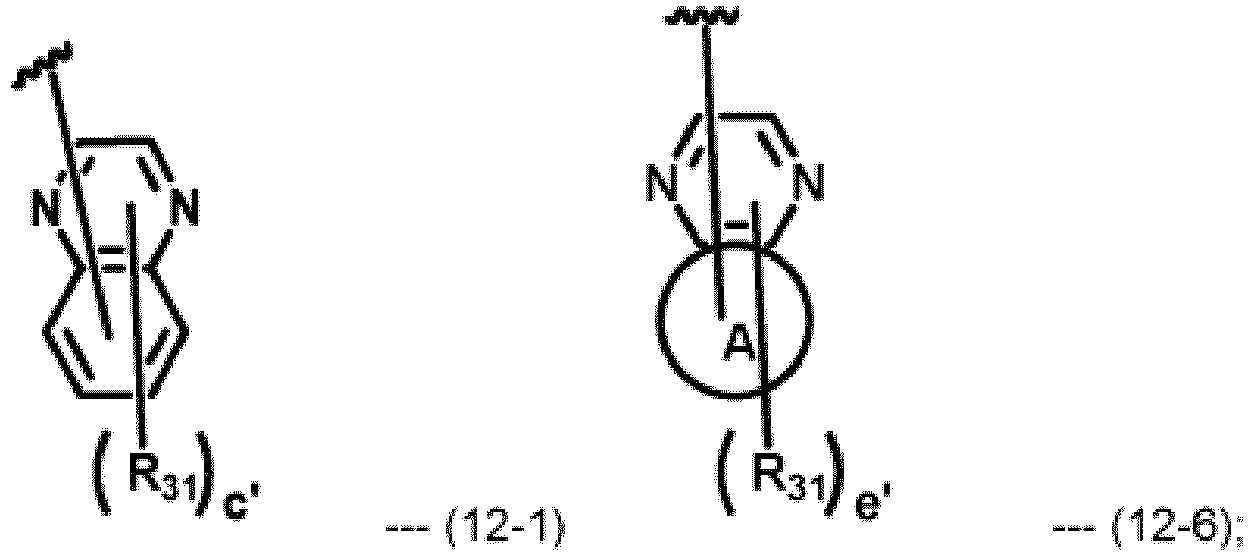 le cycle A représente un cycle naphtalène ;Lu représente une liaison simple, un (C6-C30)arylène substitué ou non substitué ou un hétéroarylène (à 5 à 30 chaînons) substitué ou non substitué ;R10 et R11, chacun indépendamment, représentent un hydrogène, un deutérium, un halogène, un cyano, un (C1-C30)alkyle substitué ou non substitué, un (C3-C30)cycloalkyle substitué ou non substitué, un (C3-C30)cycloalcényle substitué ou non substitué, un hétérocycloalkyle (à 3 à 7 chaînons) substitué ou non substitué, un (C6-C30)aryle substitué ou non substitué, un hétéroaryle (à 3 à 25 chaînons) substitué ou non substitué, -NR5R6 ou -SiR7R8R9 ; ou R10 et R11 peuvent être liés l'un à l'autre pour former un cycle ;caractérisé en ce que :R31 représente un hydrogène, un deutérium, un halogène, un cyano, un (C1-C30)alkyle substitué ou non substitué, un (C3-C30)cycloalkyle substitué ou non substitué, un (C3-C30)cycloalcényle substitué ou non substitué, un hétérocycloalkyle (à 3 à 7 chaînons) substitué ou non substitué, un (C6-C30)aryle substitué ou non substitué, - NR5R6 ou -SiR7R8R9 ; etR5 à R9, chacun indépendamment, représentent un (C1-C30)alkyle substitué ou non substitué, un (C6-C30)aryle substitué ou non substitué ou un hétéroaryle (à 3 à 30 chaînons) substitué ou non substitué ;c' représente un nombre entier de 1 à 5, e' représente un nombre entier de 1 à 7, où si c' et e', chacun indépendamment, sont un nombre entier de 2 ou plus, chaque R31 peut être identique ou différent.
 - Composé électroluminescent organique selon la revendication 1, où le composé représenté par la formule 11 est choisi dans le groupe constitué des composés suivants :





Applications Claiming Priority (4)
| Application Number | Priority Date | Filing Date | Title |
|---|---|---|---|
| KR20170122681 | 2017-09-22 | ||
| KR1020180095843A KR102697017B1 (ko) | 2017-09-22 | 2018-08-17 | 복수 종의 호스트 재료 및 이를 포함하는 유기 전계 발광 소자 |
| EP18857740.7A EP3685453B1 (fr) | 2017-09-22 | 2018-09-21 | Pluralité de matériaux hôtes et dispositif électroluminescent organique les comprenant |
| PCT/KR2018/011199 WO2019059695A1 (fr) | 2017-09-22 | 2018-09-21 | Pluralité de matériaux hôtes et dispositif électroluminescent organique les comprenant |
Related Parent Applications (2)
| Application Number | Title | Priority Date | Filing Date |
|---|---|---|---|
| EP18857740.7A Division-Into EP3685453B1 (fr) | 2017-09-22 | 2018-09-21 | Pluralité de matériaux hôtes et dispositif électroluminescent organique les comprenant |
| EP18857740.7A Division EP3685453B1 (fr) | 2017-09-22 | 2018-09-21 | Pluralité de matériaux hôtes et dispositif électroluminescent organique les comprenant |
Publications (3)
| Publication Number | Publication Date |
|---|---|
| EP3972003A2 EP3972003A2 (fr) | 2022-03-23 |
| EP3972003A3 EP3972003A3 (fr) | 2022-06-22 |
| EP3972003B1 true EP3972003B1 (fr) | 2024-07-31 |
Family
ID=66104576
Family Applications (2)
| Application Number | Title | Priority Date | Filing Date |
|---|---|---|---|
| EP18857740.7A Active EP3685453B1 (fr) | 2017-09-22 | 2018-09-21 | Pluralité de matériaux hôtes et dispositif électroluminescent organique les comprenant |
| EP21206373.9A Active EP3972003B1 (fr) | 2017-09-22 | 2018-09-21 | Matériau électroluminescent |
Family Applications Before (1)
| Application Number | Title | Priority Date | Filing Date |
|---|---|---|---|
| EP18857740.7A Active EP3685453B1 (fr) | 2017-09-22 | 2018-09-21 | Pluralité de matériaux hôtes et dispositif électroluminescent organique les comprenant |
Country Status (5)
| Country | Link |
|---|---|
| US (3) | US11856850B2 (fr) |
| EP (2) | EP3685453B1 (fr) |
| JP (1) | JP2020534700A (fr) |
| KR (3) | KR102697017B1 (fr) |
| CN (1) | CN111149229B (fr) |
Families Citing this family (18)
| Publication number | Priority date | Publication date | Assignee | Title |
|---|---|---|---|---|
| KR102598350B1 (ko) * | 2017-09-26 | 2023-11-07 | 롬엔드하스전자재료코리아유한회사 | 유기 전계 발광 화합물 및 이를 포함하는 유기 전계 발광 소자 |
| KR102801558B1 (ko) * | 2018-06-11 | 2025-05-08 | 엘지디스플레이 주식회사 | 유기발광 화합물 및 이를 포함하는 유기발광소자 |
| WO2020054977A1 (fr) * | 2018-09-10 | 2020-03-19 | Rohm And Haas Electronic Materials Korea Ltd. | Pluralité de matériaux hôtes et dispositif électroluminescent organique les comprenant |
| CN109180567B (zh) | 2018-09-25 | 2022-05-20 | 武汉天马微电子有限公司 | 氮杂环化合物、显示面板以及显示装置 |
| KR102888006B1 (ko) * | 2019-07-01 | 2025-11-24 | 듀폰스페셜티머터리얼스코리아 유한회사 | 유기 전계 발광 화합물 및 이를 포함하는 유기 전계 발광 소자 |
| WO2021020947A1 (fr) * | 2019-07-31 | 2021-02-04 | 주식회사 엘지화학 | Dispositif électroluminescent organique |
| KR102869108B1 (ko) | 2019-10-24 | 2025-10-14 | 듀폰스페셜티머터리얼스코리아 유한회사 | 복수 종의 호스트 재료 및 이를 포함하는 유기 전계 발광 소자 |
| EP3961736A4 (fr) * | 2019-12-19 | 2022-08-10 | Lg Chem, Ltd. | Dispositif électroluminescent organique |
| KR102893627B1 (ko) * | 2020-10-20 | 2025-12-02 | 삼성디스플레이 주식회사 | 유기 전계 발광 소자 |
| CN113061136B (zh) | 2021-01-22 | 2022-03-11 | 陕西莱特光电材料股份有限公司 | 一种有机化合物以及使用其的电子元件和电子装置 |
| WO2022211594A1 (fr) * | 2021-04-01 | 2022-10-06 | 삼성에스디아이 주식회사 | Composition pour dispositif optoélectronique organique, dispositif optoélectronique organique et dispositif d'affichage |
| KR102303190B1 (ko) | 2021-08-05 | 2021-09-17 | 덕산네오룩스 주식회사 | 유기전기소자용 화합물, 이를 이용한 유기전기소자 및 그 전자 장치 |
| KR102349311B1 (ko) | 2021-08-20 | 2022-01-10 | 덕산네오룩스 주식회사 | 유기전기소자용 화합물, 이를 이용한 유기전기소자 및 그 전자 장치 |
| KR20230164900A (ko) * | 2022-05-26 | 2023-12-05 | 덕산네오룩스 주식회사 | 유기전기소자용 화합물, 이를 이용한 유기전기소자 및 그 전자 장치 |
| CN115477939B (zh) * | 2022-09-28 | 2025-01-07 | 京东方科技集团股份有限公司 | 有机电致发光组合物、有机电致发光器件以及包含其的显示装置 |
| CN116535408B (zh) * | 2023-04-07 | 2025-07-29 | 安徽秀朗新材料科技有限公司 | 一种咔唑类有机电致发光主体材料的制备方法 |
| CN117105944A (zh) * | 2023-08-23 | 2023-11-24 | 长春海谱润斯科技股份有限公司 | 一种化合物及其有机电致发光器件 |
| CN119899193A (zh) * | 2025-01-12 | 2025-04-29 | 西北工业大学 | 一种基于二芳基并咔唑材料的制备方法 |
Family Cites Families (25)
| Publication number | Priority date | Publication date | Assignee | Title |
|---|---|---|---|---|
| KR100730132B1 (ko) * | 2005-05-30 | 2007-06-19 | 삼성에스디아이 주식회사 | 유기 발광 표시 소자 |
| KR101311934B1 (ko) | 2009-06-08 | 2013-09-26 | 제일모직주식회사 | 유기광전소자용 조성물 및 이를 이용한 유기광전소자 |
| KR101387738B1 (ko) * | 2009-12-29 | 2014-04-22 | 제일모직주식회사 | 유기광전소자용 화합물 및 이를 포함하는 유기광전소자 |
| US20140299865A1 (en) | 2011-10-21 | 2014-10-09 | Idemitsu Kosan Co., Ltd. | Organic electroluminescence element and material for organic electroluminescence element |
| KR101358784B1 (ko) * | 2012-02-14 | 2014-02-10 | 삼성디스플레이 주식회사 | 개선된 효율 특성을 갖는 유기 발광 소자 및 이를 포함하는 유기 발광 표시 장치 |
| KR101612903B1 (ko) | 2013-04-09 | 2016-04-19 | 희성소재 (주) | 페나진계 화합물 및 이를 포함하는 유기발광소자 |
| KR20150071624A (ko) * | 2013-12-18 | 2015-06-26 | 롬엔드하스전자재료코리아유한회사 | 유기 전계 발광 화합물 및 이를 포함하는 유기 전계 발광 소자 |
| KR102214622B1 (ko) | 2013-12-27 | 2021-02-15 | 롬엔드하스전자재료코리아유한회사 | 신규한 유기 전계 발광 화합물 및 이를 포함하는 유기 전계 발광 소자 |
| KR102491209B1 (ko) | 2014-04-29 | 2023-01-26 | 롬엔드하스전자재료코리아유한회사 | 복수종의 호스트 재료 및 이를 포함하는 유기 전계 발광 소자 |
| WO2015167259A1 (fr) * | 2014-04-29 | 2015-11-05 | Rohm And Haas Electronic Materials Korea Ltd. | Matière hôte à constituants multiples et dispositif électroluminescent organique la comprenant |
| KR102395933B1 (ko) * | 2014-05-07 | 2022-05-11 | 롬엔드하스전자재료코리아유한회사 | 복수종의 호스트 재료와 이를 포함하는 유기 전계 발광 소자 |
| EP2991128B1 (fr) * | 2014-08-29 | 2017-04-12 | Samsung Electronics Co., Ltd. | Dispositif électroluminescent organique |
| KR102291492B1 (ko) | 2015-01-16 | 2021-08-20 | 삼성디스플레이 주식회사 | 유기 발광 소자 |
| WO2016148390A1 (fr) * | 2015-03-13 | 2016-09-22 | Rohm And Haas Electronic Materials Korea Ltd. | Pluralité de matériaux hôtes et dispositif électroluminescent organique comprenant ces matériaux |
| KR102613166B1 (ko) * | 2015-03-13 | 2023-12-14 | 롬엔드하스전자재료코리아유한회사 | 복수 종의 호스트 재료 및 이를 포함하는 유기 전계 발광 소자 |
| US20160351817A1 (en) | 2015-05-27 | 2016-12-01 | Samsung Display Co., Ltd. | Organic light-emitting device |
| KR102112786B1 (ko) | 2015-08-19 | 2020-05-20 | 롬엔드하스전자재료코리아유한회사 | 유기 전계 발광 화합물 및 이를 포함하는 유기 전계 발광 소자 |
| WO2017030283A1 (fr) * | 2015-08-19 | 2017-02-23 | Rohm And Haas Electronic Materials Korea Ltd. | Composés électroluminescents organiques et dispositif électroluminescent organique les comprenant |
| WO2017078403A1 (fr) * | 2015-11-03 | 2017-05-11 | Rohm And Haas Electronic Materials Korea Ltd. | Pluralité de matériaux hôtes et dispositif électroluminescent organique comprenant ces matériaux |
| KR102792006B1 (ko) | 2015-12-04 | 2025-04-09 | 듀폰스페셜티머터리얼스코리아 유한회사 | 유기 전계 발광 화합물 및 이를 포함하는 유기 전계 발광 소자 |
| WO2017095156A1 (fr) * | 2015-12-04 | 2017-06-08 | Rohm And Haas Electronic Materials Korea Ltd. | Composés électroluminescents organiques et dispositif électroluminescent organique les comprenant |
| WO2020027444A1 (fr) * | 2018-07-31 | 2020-02-06 | Rohm And Haas Electronic Materials Korea Ltd. | Pluralité de matériaux hôtes et dispositif électroluminescent organique les comprenant |
| KR102712205B1 (ko) * | 2018-08-29 | 2024-10-04 | 듀폰스페셜티머터리얼스코리아 유한회사 | 복수 종의 호스트 재료 및 이를 포함하는 유기 전계 발광 소자 |
| KR102828052B1 (ko) * | 2018-09-10 | 2025-07-04 | 듀폰스페셜티머터리얼스코리아 유한회사 | 복수 종의 호스트 재료 및 이를 포함하는 유기 전계 발광 소자 |
| CN113387936A (zh) * | 2020-02-27 | 2021-09-14 | 罗门哈斯电子材料韩国有限公司 | 有机电致发光化合物、多种主体材料和包含其的有机电致发光装置 |
-
2018
- 2018-08-17 KR KR1020180095843A patent/KR102697017B1/ko active Active
- 2018-09-21 EP EP18857740.7A patent/EP3685453B1/fr active Active
- 2018-09-21 JP JP2020516610A patent/JP2020534700A/ja active Pending
- 2018-09-21 US US16/640,082 patent/US11856850B2/en active Active
- 2018-09-21 EP EP21206373.9A patent/EP3972003B1/fr active Active
- 2018-09-21 CN CN201880061125.1A patent/CN111149229B/zh active Active
-
2023
- 2023-11-10 US US18/506,195 patent/US20240122069A1/en active Pending
-
2024
- 2024-06-10 KR KR1020240075031A patent/KR20240093412A/ko active Pending
-
2025
- 2025-11-18 US US19/392,512 patent/US20260076092A1/en active Pending
- 2025-11-21 KR KR1020250177684A patent/KR20250166822A/ko active Pending
Also Published As
| Publication number | Publication date |
|---|---|
| JP2020534700A (ja) | 2020-11-26 |
| US20260076092A1 (en) | 2026-03-12 |
| EP3685453A1 (fr) | 2020-07-29 |
| KR20190034074A (ko) | 2019-04-01 |
| KR20240093412A (ko) | 2024-06-24 |
| EP3685453B1 (fr) | 2025-07-23 |
| KR102697017B1 (ko) | 2024-08-22 |
| EP3685453A4 (fr) | 2022-01-12 |
| EP3972003A3 (fr) | 2022-06-22 |
| US11856850B2 (en) | 2023-12-26 |
| KR20250166822A (ko) | 2025-11-28 |
| CN111149229A (zh) | 2020-05-12 |
| CN111149229B (zh) | 2024-04-26 |
| US20240122069A1 (en) | 2024-04-11 |
| US20200212310A1 (en) | 2020-07-02 |
| EP3972003A2 (fr) | 2022-03-23 |
Similar Documents
| Publication | Publication Date | Title |
|---|---|---|
| EP3972003B1 (fr) | Matériau électroluminescent | |
| JP7791926B2 (ja) | 複数のホスト材料及びそれを含む有機エレクトロルミネセントデバイス | |
| EP3589614B1 (fr) | Composé électroluminescent organique et dispositif électroluminescent organique le comprenant | |
| US11706984B2 (en) | Plurality of host materials and organic electroluminescent device comprising the same | |
| US12389794B2 (en) | Plurality of host materials and organic electroluminescent device comprising the same | |
| EP3492553B1 (fr) | Composition pour élément optoélectronique organique, élément optoélectronique organique et dispositif d'affichage | |
| KR101712808B1 (ko) | 유기 전계 발광 화합물, 및 이를 포함하는 복수종의 호스트 재료 및 유기 전계 발광 소자 | |
| JP6599860B2 (ja) | 新規な有機電界発光化合物及びそれを含む有機電界発光デバイス | |
| EP3256453B1 (fr) | Dispositif électroluminescent organique | |
| KR20200026083A (ko) | 복수 종의 호스트 재료 및 이를 포함하는 유기 전계 발광 소자 | |
| KR102638345B1 (ko) | 인광 호스트 재료 및 이를 포함하는 유기 전계 발광 소자 | |
| TW201915003A (zh) | 有機電致發光化合物及包括其之有機電致發光器件 | |
| JP6886969B2 (ja) | 有機電界発光化合物及びそれを含む有機電界発光デバイス | |
| EP3680309B1 (fr) | Composition pour élément optoélectronique organique, élément optoélectronique organique et dispositif d'affichage |
Legal Events
| Date | Code | Title | Description |
|---|---|---|---|
| PUAI | Public reference made under article 153(3) epc to a published international application that has entered the european phase |
Free format text: ORIGINAL CODE: 0009012 |
|
| STAA | Information on the status of an ep patent application or granted ep patent |
Free format text: STATUS: REQUEST FOR EXAMINATION WAS MADE |
|
| 17P | Request for examination filed |
Effective date: 20211104 |
|
| AC | Divisional application: reference to earlier application |
Ref document number: 3685453 Country of ref document: EP Kind code of ref document: P |
|
| AK | Designated contracting states |
Kind code of ref document: A2 Designated state(s): AL AT BE BG CH CY CZ DE DK EE ES FI FR GB GR HR HU IE IS IT LI LT LU LV MC MK MT NL NO PL PT RO RS SE SI SK SM TR |
|
| PUAL | Search report despatched |
Free format text: ORIGINAL CODE: 0009013 |
|
| AK | Designated contracting states |
Kind code of ref document: A3 Designated state(s): AL AT BE BG CH CY CZ DE DK EE ES FI FR GB GR HR HU IE IS IT LI LT LU LV MC MK MT NL NO PL PT RO RS SE SI SK SM TR |
|
| RIC1 | Information provided on ipc code assigned before grant |
Ipc: H01L 51/54 20060101AFI20220518BHEP |
|
| REG | Reference to a national code |
Ref country code: DE Ref legal event code: R079 Free format text: PREVIOUS MAIN CLASS: H01L0051540000 Ipc: C07D0239740000 Ref country code: DE Ref legal event code: R079 Ref document number: 602018072645 Country of ref document: DE Free format text: PREVIOUS MAIN CLASS: H01L0051540000 Ipc: C07D0239740000 |
|
| RIC1 | Information provided on ipc code assigned before grant |
Ipc: H10K 50/11 20230101ALN20240201BHEP Ipc: H10K 85/30 20230101ALN20240201BHEP Ipc: H10K 85/60 20230101ALI20240201BHEP Ipc: C09K 11/06 20060101ALI20240201BHEP Ipc: C09K 11/02 20060101ALI20240201BHEP Ipc: C07D 487/04 20060101ALI20240201BHEP Ipc: C07D 251/24 20060101ALI20240201BHEP Ipc: C07D 241/42 20060101ALI20240201BHEP Ipc: C07D 239/74 20060101AFI20240201BHEP |
|
| GRAP | Despatch of communication of intention to grant a patent |
Free format text: ORIGINAL CODE: EPIDOSNIGR1 |
|
| STAA | Information on the status of an ep patent application or granted ep patent |
Free format text: STATUS: GRANT OF PATENT IS INTENDED |
|
| RIC1 | Information provided on ipc code assigned before grant |
Ipc: H10K 50/11 20230101ALN20240219BHEP Ipc: H10K 85/30 20230101ALN20240219BHEP Ipc: H10K 85/60 20230101ALI20240219BHEP Ipc: C09K 11/06 20060101ALI20240219BHEP Ipc: C09K 11/02 20060101ALI20240219BHEP Ipc: C07D 487/04 20060101ALI20240219BHEP Ipc: C07D 251/24 20060101ALI20240219BHEP Ipc: C07D 241/42 20060101ALI20240219BHEP Ipc: C07D 239/74 20060101AFI20240219BHEP |
|
| INTG | Intention to grant announced |
Effective date: 20240315 |
|
| GRAS | Grant fee paid |
Free format text: ORIGINAL CODE: EPIDOSNIGR3 |
|
| GRAA | (expected) grant |
Free format text: ORIGINAL CODE: 0009210 |
|
| STAA | Information on the status of an ep patent application or granted ep patent |
Free format text: STATUS: THE PATENT HAS BEEN GRANTED |
|
| RAP3 | Party data changed (applicant data changed or rights of an application transferred) |
Owner name: DUPONT SPECIALTY MATERIALS KOREA LTD. |
|
| AC | Divisional application: reference to earlier application |
Ref document number: 3685453 Country of ref document: EP Kind code of ref document: P |
|
| AK | Designated contracting states |
Kind code of ref document: B1 Designated state(s): AL AT BE BG CH CY CZ DE DK EE ES FI FR GB GR HR HU IE IS IT LI LT LU LV MC MK MT NL NO PL PT RO RS SE SI SK SM TR |
|
| REG | Reference to a national code |
Ref country code: CH Ref legal event code: EP Ref country code: GB Ref legal event code: FG4D |
|
| REG | Reference to a national code |
Ref country code: DE Ref legal event code: R096 Ref document number: 602018072645 Country of ref document: DE |
|
| REG | Reference to a national code |
Ref country code: IE Ref legal event code: FG4D |
|
| REG | Reference to a national code |
Ref country code: LT Ref legal event code: MG9D |
|
| REG | Reference to a national code |
Ref country code: NL Ref legal event code: MP Effective date: 20240731 |
|
| PG25 | Lapsed in a contracting state [announced via postgrant information from national office to epo] |
Ref country code: PT Free format text: LAPSE BECAUSE OF FAILURE TO SUBMIT A TRANSLATION OF THE DESCRIPTION OR TO PAY THE FEE WITHIN THE PRESCRIBED TIME-LIMIT Effective date: 20241202 |
|
| REG | Reference to a national code |
Ref country code: AT Ref legal event code: MK05 Ref document number: 1708377 Country of ref document: AT Kind code of ref document: T Effective date: 20240731 |
|
| PG25 | Lapsed in a contracting state [announced via postgrant information from national office to epo] |
Ref country code: PT Free format text: LAPSE BECAUSE OF FAILURE TO SUBMIT A TRANSLATION OF THE DESCRIPTION OR TO PAY THE FEE WITHIN THE PRESCRIBED TIME-LIMIT Effective date: 20241202 |
|
| PG25 | Lapsed in a contracting state [announced via postgrant information from national office to epo] |
Ref country code: NO Free format text: LAPSE BECAUSE OF FAILURE TO SUBMIT A TRANSLATION OF THE DESCRIPTION OR TO PAY THE FEE WITHIN THE PRESCRIBED TIME-LIMIT Effective date: 20241031 |
|
| PG25 | Lapsed in a contracting state [announced via postgrant information from national office to epo] |
Ref country code: NL Free format text: LAPSE BECAUSE OF FAILURE TO SUBMIT A TRANSLATION OF THE DESCRIPTION OR TO PAY THE FEE WITHIN THE PRESCRIBED TIME-LIMIT Effective date: 20240731 Ref country code: PL Free format text: LAPSE BECAUSE OF FAILURE TO SUBMIT A TRANSLATION OF THE DESCRIPTION OR TO PAY THE FEE WITHIN THE PRESCRIBED TIME-LIMIT Effective date: 20240731 Ref country code: GR Free format text: LAPSE BECAUSE OF FAILURE TO SUBMIT A TRANSLATION OF THE DESCRIPTION OR TO PAY THE FEE WITHIN THE PRESCRIBED TIME-LIMIT Effective date: 20241101 Ref country code: FI Free format text: LAPSE BECAUSE OF FAILURE TO SUBMIT A TRANSLATION OF THE DESCRIPTION OR TO PAY THE FEE WITHIN THE PRESCRIBED TIME-LIMIT Effective date: 20240731 |
|
| PG25 | Lapsed in a contracting state [announced via postgrant information from national office to epo] |
Ref country code: BG Free format text: LAPSE BECAUSE OF FAILURE TO SUBMIT A TRANSLATION OF THE DESCRIPTION OR TO PAY THE FEE WITHIN THE PRESCRIBED TIME-LIMIT Effective date: 20240731 |
|
| PG25 | Lapsed in a contracting state [announced via postgrant information from national office to epo] |
Ref country code: LV Free format text: LAPSE BECAUSE OF FAILURE TO SUBMIT A TRANSLATION OF THE DESCRIPTION OR TO PAY THE FEE WITHIN THE PRESCRIBED TIME-LIMIT Effective date: 20240731 |
|
| PG25 | Lapsed in a contracting state [announced via postgrant information from national office to epo] |
Ref country code: IS Free format text: LAPSE BECAUSE OF FAILURE TO SUBMIT A TRANSLATION OF THE DESCRIPTION OR TO PAY THE FEE WITHIN THE PRESCRIBED TIME-LIMIT Effective date: 20241130 Ref country code: AT Free format text: LAPSE BECAUSE OF FAILURE TO SUBMIT A TRANSLATION OF THE DESCRIPTION OR TO PAY THE FEE WITHIN THE PRESCRIBED TIME-LIMIT Effective date: 20240731 |
|
| PG25 | Lapsed in a contracting state [announced via postgrant information from national office to epo] |
Ref country code: HR Free format text: LAPSE BECAUSE OF FAILURE TO SUBMIT A TRANSLATION OF THE DESCRIPTION OR TO PAY THE FEE WITHIN THE PRESCRIBED TIME-LIMIT Effective date: 20240731 |
|
| PG25 | Lapsed in a contracting state [announced via postgrant information from national office to epo] |
Ref country code: ES Free format text: LAPSE BECAUSE OF FAILURE TO SUBMIT A TRANSLATION OF THE DESCRIPTION OR TO PAY THE FEE WITHIN THE PRESCRIBED TIME-LIMIT Effective date: 20240731 Ref country code: RS Free format text: LAPSE BECAUSE OF FAILURE TO SUBMIT A TRANSLATION OF THE DESCRIPTION OR TO PAY THE FEE WITHIN THE PRESCRIBED TIME-LIMIT Effective date: 20241031 |
|
| PG25 | Lapsed in a contracting state [announced via postgrant information from national office to epo] |
Ref country code: RS Free format text: LAPSE BECAUSE OF FAILURE TO SUBMIT A TRANSLATION OF THE DESCRIPTION OR TO PAY THE FEE WITHIN THE PRESCRIBED TIME-LIMIT Effective date: 20241031 Ref country code: PL Free format text: LAPSE BECAUSE OF FAILURE TO SUBMIT A TRANSLATION OF THE DESCRIPTION OR TO PAY THE FEE WITHIN THE PRESCRIBED TIME-LIMIT Effective date: 20240731 Ref country code: NO Free format text: LAPSE BECAUSE OF FAILURE TO SUBMIT A TRANSLATION OF THE DESCRIPTION OR TO PAY THE FEE WITHIN THE PRESCRIBED TIME-LIMIT Effective date: 20241031 Ref country code: NL Free format text: LAPSE BECAUSE OF FAILURE TO SUBMIT A TRANSLATION OF THE DESCRIPTION OR TO PAY THE FEE WITHIN THE PRESCRIBED TIME-LIMIT Effective date: 20240731 Ref country code: LV Free format text: LAPSE BECAUSE OF FAILURE TO SUBMIT A TRANSLATION OF THE DESCRIPTION OR TO PAY THE FEE WITHIN THE PRESCRIBED TIME-LIMIT Effective date: 20240731 Ref country code: IS Free format text: LAPSE BECAUSE OF FAILURE TO SUBMIT A TRANSLATION OF THE DESCRIPTION OR TO PAY THE FEE WITHIN THE PRESCRIBED TIME-LIMIT Effective date: 20241130 Ref country code: HR Free format text: LAPSE BECAUSE OF FAILURE TO SUBMIT A TRANSLATION OF THE DESCRIPTION OR TO PAY THE FEE WITHIN THE PRESCRIBED TIME-LIMIT Effective date: 20240731 Ref country code: GR Free format text: LAPSE BECAUSE OF FAILURE TO SUBMIT A TRANSLATION OF THE DESCRIPTION OR TO PAY THE FEE WITHIN THE PRESCRIBED TIME-LIMIT Effective date: 20241101 Ref country code: FI Free format text: LAPSE BECAUSE OF FAILURE TO SUBMIT A TRANSLATION OF THE DESCRIPTION OR TO PAY THE FEE WITHIN THE PRESCRIBED TIME-LIMIT Effective date: 20240731 Ref country code: ES Free format text: LAPSE BECAUSE OF FAILURE TO SUBMIT A TRANSLATION OF THE DESCRIPTION OR TO PAY THE FEE WITHIN THE PRESCRIBED TIME-LIMIT Effective date: 20240731 Ref country code: BG Free format text: LAPSE BECAUSE OF FAILURE TO SUBMIT A TRANSLATION OF THE DESCRIPTION OR TO PAY THE FEE WITHIN THE PRESCRIBED TIME-LIMIT Effective date: 20240731 Ref country code: AT Free format text: LAPSE BECAUSE OF FAILURE TO SUBMIT A TRANSLATION OF THE DESCRIPTION OR TO PAY THE FEE WITHIN THE PRESCRIBED TIME-LIMIT Effective date: 20240731 |
|
| PG25 | Lapsed in a contracting state [announced via postgrant information from national office to epo] |
Ref country code: RO Free format text: LAPSE BECAUSE OF FAILURE TO SUBMIT A TRANSLATION OF THE DESCRIPTION OR TO PAY THE FEE WITHIN THE PRESCRIBED TIME-LIMIT Effective date: 20240731 Ref country code: SM Free format text: LAPSE BECAUSE OF FAILURE TO SUBMIT A TRANSLATION OF THE DESCRIPTION OR TO PAY THE FEE WITHIN THE PRESCRIBED TIME-LIMIT Effective date: 20240731 Ref country code: DK Free format text: LAPSE BECAUSE OF FAILURE TO SUBMIT A TRANSLATION OF THE DESCRIPTION OR TO PAY THE FEE WITHIN THE PRESCRIBED TIME-LIMIT Effective date: 20240731 |
|
| PG25 | Lapsed in a contracting state [announced via postgrant information from national office to epo] |
Ref country code: MC Free format text: LAPSE BECAUSE OF FAILURE TO SUBMIT A TRANSLATION OF THE DESCRIPTION OR TO PAY THE FEE WITHIN THE PRESCRIBED TIME-LIMIT Effective date: 20240731 Ref country code: EE Free format text: LAPSE BECAUSE OF FAILURE TO SUBMIT A TRANSLATION OF THE DESCRIPTION OR TO PAY THE FEE WITHIN THE PRESCRIBED TIME-LIMIT Effective date: 20240731 |
|
| PG25 | Lapsed in a contracting state [announced via postgrant information from national office to epo] |
Ref country code: CZ Free format text: LAPSE BECAUSE OF FAILURE TO SUBMIT A TRANSLATION OF THE DESCRIPTION OR TO PAY THE FEE WITHIN THE PRESCRIBED TIME-LIMIT Effective date: 20240731 |
|
| PG25 | Lapsed in a contracting state [announced via postgrant information from national office to epo] |
Ref country code: SK Free format text: LAPSE BECAUSE OF FAILURE TO SUBMIT A TRANSLATION OF THE DESCRIPTION OR TO PAY THE FEE WITHIN THE PRESCRIBED TIME-LIMIT Effective date: 20240731 Ref country code: IT Free format text: LAPSE BECAUSE OF FAILURE TO SUBMIT A TRANSLATION OF THE DESCRIPTION OR TO PAY THE FEE WITHIN THE PRESCRIBED TIME-LIMIT Effective date: 20240731 |
|
| REG | Reference to a national code |
Ref country code: CH Ref legal event code: PL |
|
| REG | Reference to a national code |
Ref country code: DE Ref legal event code: R097 Ref document number: 602018072645 Country of ref document: DE |
|
| PG25 | Lapsed in a contracting state [announced via postgrant information from national office to epo] |
Ref country code: LU Free format text: LAPSE BECAUSE OF NON-PAYMENT OF DUE FEES Effective date: 20240921 |
|
| PLBE | No opposition filed within time limit |
Free format text: ORIGINAL CODE: 0009261 |
|
| STAA | Information on the status of an ep patent application or granted ep patent |
Free format text: STATUS: NO OPPOSITION FILED WITHIN TIME LIMIT |
|
| GBPC | Gb: european patent ceased through non-payment of renewal fee |
Effective date: 20241031 |
|
| 26N | No opposition filed |
Effective date: 20250501 |
|
| PG25 | Lapsed in a contracting state [announced via postgrant information from national office to epo] |
Ref country code: GB Free format text: LAPSE BECAUSE OF NON-PAYMENT OF DUE FEES Effective date: 20241031 |
|
| REG | Reference to a national code |
Ref country code: BE Ref legal event code: MM Effective date: 20240930 |
|
| PG25 | Lapsed in a contracting state [announced via postgrant information from national office to epo] |
Ref country code: BE Free format text: LAPSE BECAUSE OF NON-PAYMENT OF DUE FEES Effective date: 20240930 |
|
| PG25 | Lapsed in a contracting state [announced via postgrant information from national office to epo] |
Ref country code: FR Free format text: LAPSE BECAUSE OF NON-PAYMENT OF DUE FEES Effective date: 20240930 |
|
| PG25 | Lapsed in a contracting state [announced via postgrant information from national office to epo] |
Ref country code: CH Free format text: LAPSE BECAUSE OF NON-PAYMENT OF DUE FEES Effective date: 20240930 |
|
| PG25 | Lapsed in a contracting state [announced via postgrant information from national office to epo] |
Ref country code: IE Free format text: LAPSE BECAUSE OF NON-PAYMENT OF DUE FEES Effective date: 20240921 |
|
| PG25 | Lapsed in a contracting state [announced via postgrant information from national office to epo] |
Ref country code: SE Free format text: LAPSE BECAUSE OF FAILURE TO SUBMIT A TRANSLATION OF THE DESCRIPTION OR TO PAY THE FEE WITHIN THE PRESCRIBED TIME-LIMIT Effective date: 20240731 |
|
| PGFP | Annual fee paid to national office [announced via postgrant information from national office to epo] |
Ref country code: DE Payment date: 20250730 Year of fee payment: 8 |
|
| PG25 | Lapsed in a contracting state [announced via postgrant information from national office to epo] |
Ref country code: CY Free format text: LAPSE BECAUSE OF FAILURE TO SUBMIT A TRANSLATION OF THE DESCRIPTION OR TO PAY THE FEE WITHIN THE PRESCRIBED TIME-LIMIT; INVALID AB INITIO Effective date: 20180921 |
|
| PG25 | Lapsed in a contracting state [announced via postgrant information from national office to epo] |
Ref country code: HU Free format text: LAPSE BECAUSE OF FAILURE TO SUBMIT A TRANSLATION OF THE DESCRIPTION OR TO PAY THE FEE WITHIN THE PRESCRIBED TIME-LIMIT; INVALID AB INITIO Effective date: 20180921 |