EP3971969B1 - Anzeigevorrichtung und verfahren zu deren herstellung - Google Patents
Anzeigevorrichtung und verfahren zu deren herstellung Download PDFInfo
- Publication number
- EP3971969B1 EP3971969B1 EP21197004.1A EP21197004A EP3971969B1 EP 3971969 B1 EP3971969 B1 EP 3971969B1 EP 21197004 A EP21197004 A EP 21197004A EP 3971969 B1 EP3971969 B1 EP 3971969B1
- Authority
- EP
- European Patent Office
- Prior art keywords
- electrode
- layer
- disposed
- rme3
- rme2
- Prior art date
- Legal status (The legal status is an assumption and is not a legal conclusion. Google has not performed a legal analysis and makes no representation as to the accuracy of the status listed.)
- Active
Links
Images










Classifications
-
- H—ELECTRICITY
- H10—SEMICONDUCTOR DEVICES; ELECTRIC SOLID-STATE DEVICES NOT OTHERWISE PROVIDED FOR
- H10W—GENERIC PACKAGES, INTERCONNECTIONS, CONNECTORS OR OTHER CONSTRUCTIONAL DETAILS OF DEVICES COVERED BY CLASS H10
- H10W90/00—Package configurations
-
- H—ELECTRICITY
- H10—SEMICONDUCTOR DEVICES; ELECTRIC SOLID-STATE DEVICES NOT OTHERWISE PROVIDED FOR
- H10H—INORGANIC LIGHT-EMITTING SEMICONDUCTOR DEVICES HAVING POTENTIAL BARRIERS
- H10H20/00—Individual inorganic light-emitting semiconductor devices having potential barriers, e.g. light-emitting diodes [LED]
- H10H20/80—Constructional details
- H10H20/83—Electrodes
- H10H20/831—Electrodes characterised by their shape
- H10H20/8312—Electrodes characterised by their shape extending at least partially through the bodies
-
- H—ELECTRICITY
- H10—SEMICONDUCTOR DEVICES; ELECTRIC SOLID-STATE DEVICES NOT OTHERWISE PROVIDED FOR
- H10D—INORGANIC ELECTRIC SEMICONDUCTOR DEVICES
- H10D86/00—Integrated devices formed in or on insulating or conducting substrates, e.g. formed in silicon-on-insulator [SOI] substrates or on stainless steel or glass substrates
- H10D86/40—Integrated devices formed in or on insulating or conducting substrates, e.g. formed in silicon-on-insulator [SOI] substrates or on stainless steel or glass substrates characterised by multiple TFTs
-
- H—ELECTRICITY
- H10—SEMICONDUCTOR DEVICES; ELECTRIC SOLID-STATE DEVICES NOT OTHERWISE PROVIDED FOR
- H10H—INORGANIC LIGHT-EMITTING SEMICONDUCTOR DEVICES HAVING POTENTIAL BARRIERS
- H10H20/00—Individual inorganic light-emitting semiconductor devices having potential barriers, e.g. light-emitting diodes [LED]
- H10H20/01—Manufacture or treatment
-
- H—ELECTRICITY
- H10—SEMICONDUCTOR DEVICES; ELECTRIC SOLID-STATE DEVICES NOT OTHERWISE PROVIDED FOR
- H10H—INORGANIC LIGHT-EMITTING SEMICONDUCTOR DEVICES HAVING POTENTIAL BARRIERS
- H10H20/00—Individual inorganic light-emitting semiconductor devices having potential barriers, e.g. light-emitting diodes [LED]
- H10H20/80—Constructional details
- H10H20/83—Electrodes
- H10H20/831—Electrodes characterised by their shape
- H10H20/8316—Multi-layer electrodes comprising at least one discontinuous layer
-
- H—ELECTRICITY
- H10—SEMICONDUCTOR DEVICES; ELECTRIC SOLID-STATE DEVICES NOT OTHERWISE PROVIDED FOR
- H10H—INORGANIC LIGHT-EMITTING SEMICONDUCTOR DEVICES HAVING POTENTIAL BARRIERS
- H10H20/00—Individual inorganic light-emitting semiconductor devices having potential barriers, e.g. light-emitting diodes [LED]
- H10H20/80—Constructional details
- H10H20/85—Packages
- H10H20/857—Interconnections, e.g. lead-frames, bond wires or solder balls
-
- H—ELECTRICITY
- H10—SEMICONDUCTOR DEVICES; ELECTRIC SOLID-STATE DEVICES NOT OTHERWISE PROVIDED FOR
- H10H—INORGANIC LIGHT-EMITTING SEMICONDUCTOR DEVICES HAVING POTENTIAL BARRIERS
- H10H29/00—Integrated devices, or assemblies of multiple devices, comprising at least one light-emitting semiconductor element covered by group H10H20/00
- H10H29/10—Integrated devices comprising at least one light-emitting semiconductor component covered by group H10H20/00
- H10H29/14—Integrated devices comprising at least one light-emitting semiconductor component covered by group H10H20/00 comprising multiple light-emitting semiconductor components
- H10H29/142—Two-dimensional arrangements, e.g. asymmetric LED layout
-
- H—ELECTRICITY
- H10—SEMICONDUCTOR DEVICES; ELECTRIC SOLID-STATE DEVICES NOT OTHERWISE PROVIDED FOR
- H10W—GENERIC PACKAGES, INTERCONNECTIONS, CONNECTORS OR OTHER CONSTRUCTIONAL DETAILS OF DEVICES COVERED BY CLASS H10
- H10W20/00—Interconnections in chips, wafers or substrates
- H10W20/20—Interconnections within wafers or substrates, e.g. through-silicon vias [TSV]
-
- H—ELECTRICITY
- H10—SEMICONDUCTOR DEVICES; ELECTRIC SOLID-STATE DEVICES NOT OTHERWISE PROVIDED FOR
- H10W—GENERIC PACKAGES, INTERCONNECTIONS, CONNECTORS OR OTHER CONSTRUCTIONAL DETAILS OF DEVICES COVERED BY CLASS H10
- H10W20/00—Interconnections in chips, wafers or substrates
- H10W20/40—Interconnections external to wafers or substrates, e.g. back-end-of-line [BEOL] metallisations or vias connecting to gate electrodes
-
- H—ELECTRICITY
- H10—SEMICONDUCTOR DEVICES; ELECTRIC SOLID-STATE DEVICES NOT OTHERWISE PROVIDED FOR
- H10W—GENERIC PACKAGES, INTERCONNECTIONS, CONNECTORS OR OTHER CONSTRUCTIONAL DETAILS OF DEVICES COVERED BY CLASS H10
- H10W20/00—Interconnections in chips, wafers or substrates
- H10W20/40—Interconnections external to wafers or substrates, e.g. back-end-of-line [BEOL] metallisations or vias connecting to gate electrodes
- H10W20/41—Interconnections external to wafers or substrates, e.g. back-end-of-line [BEOL] metallisations or vias connecting to gate electrodes characterised by their conductive parts
- H10W20/43—Layouts of interconnections
-
- H—ELECTRICITY
- H10—SEMICONDUCTOR DEVICES; ELECTRIC SOLID-STATE DEVICES NOT OTHERWISE PROVIDED FOR
- H10W—GENERIC PACKAGES, INTERCONNECTIONS, CONNECTORS OR OTHER CONSTRUCTIONAL DETAILS OF DEVICES COVERED BY CLASS H10
- H10W20/00—Interconnections in chips, wafers or substrates
- H10W20/40—Interconnections external to wafers or substrates, e.g. back-end-of-line [BEOL] metallisations or vias connecting to gate electrodes
- H10W20/49—Adaptable interconnections, e.g. fuses or antifuses
-
- H—ELECTRICITY
- H10—SEMICONDUCTOR DEVICES; ELECTRIC SOLID-STATE DEVICES NOT OTHERWISE PROVIDED FOR
- H10W—GENERIC PACKAGES, INTERCONNECTIONS, CONNECTORS OR OTHER CONSTRUCTIONAL DETAILS OF DEVICES COVERED BY CLASS H10
- H10W70/00—Package substrates; Interposers; Redistribution layers [RDL]
- H10W70/60—Insulating or insulated package substrates; Interposers; Redistribution layers
- H10W70/62—Insulating or insulated package substrates; Interposers; Redistribution layers characterised by their interconnections
- H10W70/65—Shapes or dispositions of interconnections
-
- H—ELECTRICITY
- H10—SEMICONDUCTOR DEVICES; ELECTRIC SOLID-STATE DEVICES NOT OTHERWISE PROVIDED FOR
- H10H—INORGANIC LIGHT-EMITTING SEMICONDUCTOR DEVICES HAVING POTENTIAL BARRIERS
- H10H20/00—Individual inorganic light-emitting semiconductor devices having potential barriers, e.g. light-emitting diodes [LED]
- H10H20/01—Manufacture or treatment
- H10H20/032—Manufacture or treatment of electrodes
-
- H—ELECTRICITY
- H10—SEMICONDUCTOR DEVICES; ELECTRIC SOLID-STATE DEVICES NOT OTHERWISE PROVIDED FOR
- H10H—INORGANIC LIGHT-EMITTING SEMICONDUCTOR DEVICES HAVING POTENTIAL BARRIERS
- H10H20/00—Individual inorganic light-emitting semiconductor devices having potential barriers, e.g. light-emitting diodes [LED]
- H10H20/01—Manufacture or treatment
- H10H20/036—Manufacture or treatment of packages
- H10H20/0364—Manufacture or treatment of packages of interconnections
Definitions
- the disclosure relates to a display device and a method of fabricating the same.
- Display devices are becoming more important with developments in multimedia technology. Accordingly, various display devices such as a liquid crystal display (LCD) device, an organic light-emitting diode (OLED) display device, and the like have been developed.
- LCD liquid crystal display
- OLED organic light-emitting diode
- a typical display device may include a display panel for displaying an image, such as an OLED display panel or an LCD panel.
- a light-emitting display panel which is a type of display panel, may include light-emitting elements such as, for example, light-emitting diodes (LEDs).
- the LEDs may be classified into OLEDs using an organic material as a light-emitting material and inorganic LEDs (ILEDs) using an inorganic material as a light-emitting material.
- this background of the technology section is, in part, intended to provide useful background for understanding the technology.
- this background of the technology section may also include ideas, concepts, or recognitions that were not part of what was known or appreciated by those skilled in the pertinent art prior to a corresponding effective filing date of the subject matter disclosed herein.
- WO 2020/040384 A1 discloses a light-emitting device comprising: a substrate; first and second electrodes disposed to be spaced apart from each other on the substrate; an insulating layer disposed on the substrate on which the first and second electrodes are formed, the insulating layer including grooves extending along a first direction crossing the first and second electrodes, and first and second contact portions respectively exposing one area of the first and second electrodes; a plurality of light-emitting diodes disposed on the grooves so as to be positioned between the first and second electrodes, the light-emitting diodes including first and second ends electrically connected to the first and second electrodes, respectively; first contact electrodes electrically connected to the light-emitting diodes at the first ends, and electrically connected to the first electrode at the first contact portion; and a second contact electrode electrically connected to the light-emitting diodes at the second ends, and electrically connected to the second electrode at the second contact portion.
- US 2020/066699 A1 discloses a display device including a pixel circuit, an insulating layer covering the pixel circuit, a first partition portion which is disposed on the insulating layer and extends in a first direction, a second partition portion which is spaced apart from the first partition portion in a second direction intersecting the first direction and extends in the first direction, a plurality of connection partition portions disposed between the first and second partition portions, where each of the plurality of connection partition portions extends in the second direction, a first electrode disposed on the first partition portion and electrically connected to the pixel circuit, a second electrode disposed on the second partition portion, and a light emitting element disposed between the plurality of connection partition portions and electrically connected to the first electrode and the second electrode.
- US 2020/075667 A1 discloses a display device that comprises a substrate including a display area having a plurality of pixel areas and a non-display area located around the display area; a circuit element layer including a circuit element in each of the pixel areas and a reference voltage wiring in the non-display area, the reference voltage wiring being electrically coupled to the circuit element; and a display element layer including a first pixel electrode on the circuit element layer in each of the pixel areas, and a second pixel electrode located opposite to the first pixel electrode.
- Embodiments provide a display device including electrodes disposed in the same layer and electrodes disposed in a different layer from the other electrodes.
- Embodiments also provide a method of fabricating a display device, which is capable of minimizing the misalignment of light-emitting elements using electrodes disposed in different layers.
- a display device and a method of manufacturing the same includes the features defined in the appended independent device claim 1, respectively independent method claim 11. Preferred embodiments are defined in the dependent claims.
- the display device including electrodes disposed in different layers
- light-emitting elements can be aligned using electrodes from different layers during the fabrication of the display device. Therefore, the degree of alignment of the light-emitting elements can be improved, and as a result, the display device can have an improved quality.
- spatially relative terms “below”, “beneath”, “lower”, “above”, “upper”, or the like, may be used herein for ease of description to describe the relations between one element or component and another element or component as illustrated in the drawings. It will be understood that the spatially relative terms are intended to encompass different orientations of the device in use or operation, in addition to the orientation depicted in the drawings. For example, in the case where a device illustrated in the drawing is turned over, the device positioned “below” or “beneath” another device may be placed “above” another device. Accordingly, the illustrative term “below” may include both the lower and upper positions. The device may also be oriented in other directions and thus the spatially relative terms may be interpreted differently depending on the orientations.
- overlap or “overlapped” mean that a first object may be above or below or to a side of a second object, and vice versa. Additionally, the term “overlap” may include layer, stack, face or facing, extending over, covering, or partly covering or any other suitable term as would be appreciated and understood by those of ordinary skill in the art.
- face and facing mean that a first element may directly or indirectly oppose a second element. In a case in which a third element intervenes between the first and second element, the first and second element may be understood as being indirectly opposed to one another, although still facing each other.
- connection to or “coupled to” may include a physical or electrical connection or coupling.
- FIG. 1 is a plan view of a display device according to an embodiment.
- a display device 10 displays a moving or still image.
- the display device 10 may refer to nearly all types of electronic devices that include a display screen. Examples of the display device 10 may include a television (TV), a notebook computer, a monitor, a billboard, an Internet-of-Things (IoT) device, a mobile phone, a smartphone, a tablet personal computer (PC), an electronic watch, a smartwatch, a watchphone, a head-mounted display (HMD), a mobile communication terminal, an electronic notepad, an electronic book (e-book), a portable multimedia player (PMP), a navigation device, a gaming console, a digital camera, a camcorder, and the like within the scope of the disclosure.
- TV television
- notebook computer a monitor
- a billboard an Internet-of-Things (IoT) device
- IoT Internet-of-Things
- mobile phone a smartphone
- PC personal computer
- HMD head-mounted display
- HMD head-mounted display
- PMP portable
- the display device 10 may include a display panel including a display screen.
- Examples of the display panel of the display device 10 include an inorganic light-emitting diode (ILED) display panel, an organic light-emitting diode (OLED) display panel, a quantum-dot light-emitting diode (QLED) display panel, a plasma display panel (PDP), a field-emission display (FED) panel, and the like within the scope of the disclosure.
- the display panel of the display device 10 will hereinafter be described as being, for example, an ILED display panel, but the disclosure is not limited thereto. For example, various other display panels are also applicable to the display panel of the display device 10.
- the shape of the display device 10 may vary.
- the display device 10 may have a substantially rectangular shape extending longer in a horizontal direction than in a vertical direction, a substantially rectangular shape extending longer in the vertical direction than in the horizontal direction, a substantially square shape, a substantially tetragonal shape with substantially rounded corners, a substantially non-tetragonal polygonal shape, or a substantially circular shape.
- the shape of a display area DPA of the display device 10 may be similar to or substantially similar to the shape of the display device 10.
- FIG. 1 illustrates that the display device 10 and the display area DPA both have a substantially rectangular shape extending in a second direction DR2.
- the display device 10 may include the display area DPA and a non-display area NDA.
- the display area DPA may be an area in which a screen is displayed, and the non-display area NDA may be an area in which a screen is not displayed.
- the display area DPA may also be referred to as an active area, and the non-display area NDA may also be referred to as an inactive area.
- the display area DPA may occupy the middle portion of the display device 10.
- the display area DPA may include a plurality of pixels PX.
- the pixels PX may be arranged or disposed in row and column directions.
- the pixels PX may have a substantially rectangular or substantially square shape in a plan view, but the disclosure is not limited thereto.
- the pixels PX may have a substantially rhombus shape having sides inclined with respect to a particular or given direction.
- the pixels PX may be alternately arranged or disposed in a stripe arrangement or a PenTile ® arrangement.
- Each of the pixels PX may include one or more light-emitting elements, which emit light of a particular or selected wavelength range.
- the non-display area NDA may be disposed around the display area DPA.
- the non-display area NDA may surround or may be adjacent to the entire display area DPA or a portion of the display area DPA.
- the display area DPA may have a substantially rectangular shape, and the non-display area NDA may be disposed adjacent to four sides of the display area DPA.
- the non-display area NDA may form the bezel of the display device 10. Wires or circuit drivers included in the display device 10 may be disposed in the non-display area NDA, or external devices may be mounted in the non-display area NDA.
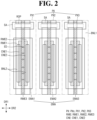
- FIG. 2 is a plan view of a pixel of the display device of FIG. 1 .
- a pixel PX may include a plurality of subpixels PXn (where n is an integer of 1 to 3).
- the pixel PX may include first, second, and third subpixels PX1, PX2, and PX3, however, the disclosure is not limited thereto.
- the first subpixel PX1 may emit first-color light
- the second subpixel PX2 may emit second-color light
- the third subpixel PX3 may emit third-color light.
- the first-color light, the second-color light, and the third-color light may be red light, green light, and blue light, respectively, but the disclosure is not limited thereto.
- the subpixels PXn may all emit light of the same color.
- FIG. 2 illustrates that the pixel PX may include three subpixels PXn, but the disclosure is not limited thereto.
- the pixel PX may include more than three subpixels PXn.
- Each of the subpixels PXn may include an emission area EMA and a non-emission area.
- the emission area EMA may be an area that outputs light of a particular or selected wavelength range due to light-emitting elements ED being disposed therein, and the non-emission area may be an area in which no light-emitting elements ED are disposed and which does not output light due to not being reached by light emitted by light-emitting elements ED.
- the emission area EMA may include a region in which light-emitting elements ED are disposed and regions around the light-emitting elements ED that output light emitted by the light-emitting elements ED.
- the emission area EMA may also include regions that output light emitted by the light-emitting elements ED and then reflected or refracted by other members.
- a plurality of light-emitting elements ED may be disposed in each of the subpixels PXn to form an emission area EMA including a region in which the plurality of light-emitting elements ED are disposed and the surroundings of the region in which the plurality of light-emitting elements ED are disposed.
- FIG. 2 illustrates that first, second, and third emission areas EMA1, EMA2, and EMA3 of the first, second, and third subpixels PX1, PX2, and PX3 have substantially the same size.
- the emission areas EMA of the subpixels PXn may have different sizes depending on the color or the wavelength of light emitted by light-emitting elements ED.
- Each of the subpixels PXn may further include a subarea SA, which may be disposed in the non-emission area of the display device 10.
- the subareas SA of the subpixels PXn may be disposed on first sides, in the first direction DR1, of the emission areas EMA of the subpixels PXn, between emission areas EMA of pairs of adjacent subpixels PXn in the first direction DR1.
- a plurality of emission areas EMA may be arranged or disposed one after another in the second direction DR2
- a plurality of subareas SA may be arranged or disposed one after another in the second direction DR2
- the plurality of emission areas EMA and the plurality of subareas SA may be alternately arranged or disposed in the first direction DR1.
- a first bank BNL1 may be disposed between the subareas SA and the emission areas EMA of the subpixels PXn, and the distance between the subareas SA and the emission areas EMA of the subpixels PXn may vary depending on the width of the first bank BNL1.
- Portions of electrodes RME may be disposed in the subareas SA of the subpixels PXn that do not output light due to no light-emitting elements ED being disposed therein.
- the electrodes RME may be divided in the subareas SA of the subpixels PXn.
- the first bank BNL1 may include portions that extend in the first direction DR1 and portions that extend in the second direction DR2 and may be arranged or disposed in a lattice pattern over the entire surface of the display area DPA.
- the first bank BNL1 may be disposed along the boundaries between the subpixels PXn to define the subpixels PXn.
- the first bank BNL1 may be disposed to surround, and thereby define, the emission areas EMA and the subareas SA of the subpixels PXn.
- FIG. 3 is a plan view of the first subpixel of FIG. 2 .
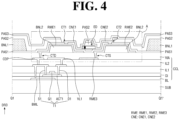
- FIG. 4 is a schematic cross-sectional view taken along line Q1-Q1' of FIG. 3.
- FIG. 3 illustrates a first subpixel PX1 of a pixel PX of the display device 10
- FIG. 4 illustrates a schematic cross-sectional view taken from one (or an) end portion to the other end (or another end) portion of a light-emitting element ED included in the first subpixel PX1 of FIG. 3 .
- the display device 10 includes the first substrate SUB and a semiconductor layer, a plurality of conductive layers, and a plurality of insulating layers, which are disposed on the first substrate SUB.
- the semiconductor layer, the conductive layers, and the insulating layers may form a circuit layer CCL and a display element layer of the display device 10.
- the first substrate SUB may be an insulating substrate.
- the first substrate SUB may be formed of an insulating material such as glass, quartz, or a polymer resin.
- the first substrate SUB may be a rigid substrate or may be a flexible substrate that may be bendable, foldable, or rollable.
- a first conductive layer may be disposed on the first substrate SUB.
- the first conductive layer may include a lower metal layer BML, and the lower metal layer BML may be disposed to overlap an active layer ACT1 of a first transistor T1.
- the lower metal layer BML may include a material capable of blocking the transmission of light and may prevent light from being incident upon the active layer ACT1 of the first transistor T1. In an embodiment, the lower metal layer BML may not be provided.
- a buffer layer BL may be disposed on the lower metal layer BML and on the entire surface of the first substrate SUB.
- the buffer layer BML may be formed on the first substrate SUB to protect the transistors of the first subpixel PX1 from moisture that may penetrate through the first substrate SUB, which is vulnerable to moisture, and may perform a surface planarization function.
- the semiconductor layer may be disposed on the buffer layer BL.
- the semiconductor layer may include the active layer ACT1 of the first transistor T1.
- the active layer ACT1 may be disposed to partially overlap a gate electrode G1 in a second conductive layer that will be described later.
- the semiconductor layer may include polycrystalline silicon, monocrystalline silicon, or an oxide semiconductor.
- the oxide semiconductor may be an oxide semiconductor containing indium (In).
- the oxide semiconductor may be at least one of indium tin oxide (ITO), indium zinc oxide (IZO), indium gallium oxide (IGO), indium zinc tin oxide (IZTO), indium gallium tin oxide (IGTO), or indium gallium zinc tin oxide (IGZTO).
- FIGS. 3 and 4 illustrate only the first transistor T1, but the disclosure is not limited thereto.
- the first subpixel PX1 may include other transistors than the first transistor T1.
- a first gate insulating layer GI may be disposed on the semiconductor layer and the buffer layer BL.
- the first gate insulating layer GI may function as a gate insulating film for the transistors of the first subpixel PX1.
- a second conductive layer may be disposed on the first gate insulating layer GI.
- the second conductive layer may include a gate electrode G1 of the first transistor T1.
- the gate electrode G1 may be disposed to overlap the channel region of the active layer ACT1 in a thickness direction, for example, in a third direction DR3.
- the second conductive layer may further include the capacitive electrode of a storage capacitor.
- a first interlayer insulating layer IL1 may be disposed on the second conductive layer.
- the first interlayer insulating layer IL1 may function as an insulating film between the second conductive layer and layers disposed on the second conductive layer and may protect the second conductive layer.
- a third conductive layer may be disposed on the first interlayer insulating layer IL1.
- the third conductive layer may include a first source electrode S1 and a first drain electrode D1 of the first transistor T1.
- the first source electrode S1 and the first drain electrode D1 of the first transistor T1 may be in electrical contact with the active layer ACT1 through contact holes that penetrate the first interlayer insulating layer IL1 and the first gate insulating layer GI.
- the first source electrode S1 may be in electrical contact with the lower metal layer BML through another contact hole.
- the third conductive layer may include a plurality of data lines or the capacitive electrode of the storage capacitor.
- a second interlayer insulating layer IL2 may be disposed on the third conductive layer.
- the second interlayer insulating layer IL2 may function as an insulating film between the third conductive layer and layers disposed on the third conductive layer and may protect the third conductive layer.
- a fourth conductive layer may be disposed on the second interlayer insulating layer IL2.
- the fourth conductive layer may include a first voltage line VL1, a third electrode RME3 and a first conductive pattern CDP.
- a high-potential voltage (or a first power supply voltage) to be provided to the first transistor T1 may be applied to the first voltage line VL1, and a low-potential voltage (or a second power supply voltage) to be provided to a second electrode RME2 may be applied to the third electrode RME3.
- the first conductive pattern CDP is electrically connected to the first transistor T1.
- the first conductive pattern CDP is in electrical contact with a first electrode RME1 that will be described later, and the first transistor T1 may transmit the first power supply voltage applied thereto from the first voltage line VL1 to the first electrode RME1.
- the third electrode RME3 may be disposed to overlap the light-emitting elements ED in the third direction DR3, which is the thickness direction.
- the third electrode RME3 is electrically connected or directly electrically connected to the second electrode RME2, and an alignment signal for aligning the light-emitting elements ED may be applied to the third electrode RME3 during the fabrication of the display device 10.
- the display device 10 may align the light-emitting elements ED not only using the first and second electrodes RME1 and RME2, but also using the third electrode RME3 below the first and second electrodes RME1 and RME2, and as a result, the degree of alignment of the light-emitting elements ED can be improved.
- the second power supply voltage may be applied to the third electrode RME3, and the third electrode RME3 may transmit the second power supply voltage to the second electrode RME2.
- the display device 10 may use wiring for applying electrical signals to the second electrode RME2 in fabricating the light-emitting elements ED, the quality of the display device 10 can be improved without the need of other wiring.
- FIGS. 3 and 4 illustrate that the fourth conductive layer may include the first voltage line VL1 and the third electrode RME3, to which the first and second power supply voltages, respectively, are applied, but the disclosure is not limited thereto.
- the third electrode RME3 may not be electrically connected to the second electrode RME2, and the fourth conductive layer may further include separate voltage wiring for applying the second power supply voltage to the second electrode RME2. This will be described later in detail.
- Each of the buffer layer BL, the first gate insulating layer GI, the first interlayer insulating layer IL1, and the second interlayer insulating layer IL2 may consist of a plurality of inorganic layers that may be alternately stacked each other.
- each of the buffer layer BL, the first gate insulating layer GI, the first interlayer insulating layer IL1, and the second interlayer insulating layer IL2 may be formed as a double- or multilayer in which inorganic layers of at least one of silicon oxide (SiO x ), silicon nitride (SiN x ), and silicon oxynitride (SiO x N y ) may be alternately stacked on each other, but the disclosure is not limited thereto.
- each of the buffer layer BL, the first gate insulating layer GI, the first interlayer insulating layer IL1, and the second interlayer insulating layer IL2 may be formed as a single inorganic layer including silicon oxide (SiO x ), silicon nitride (SiN x ), or silicon oxynitride (SiO x N y ).
- the second, third, and fourth conductive layers may be formed as single layers or multilayers including molybdenum (Mo), aluminium (Al), chromium (Cr), gold (Au), titanium (Ti), nickel (Ni), neodymium (Nd), copper (Cu), or an alloy thereof, but the disclosure is not limited thereto.
- Mo molybdenum
- Al aluminium
- Cr chromium
- Au gold
- Ti titanium
- Ni nickel
- Nd neodymium
- Cu copper
- a via layer VIA may be disposed on the fourth conductive layer.
- the via layer VIA may include an organic insulating material such as, for example, polyimide (PI), and may perform a surface planarization function.
- PI polyimide
- a plurality of banks (BNL1 and BNL2), a plurality of electrodes RME, light-emitting elements ED, and a plurality of contact electrodes CNE may be disposed on the via layer VIA as a display element layer. Also, a plurality of insulating layers (PAS1, PAS2, and PAS3) may be further disposed on the via layer VIA.
- a plurality of second banks BNL2 may be disposed on or directly disposed on the via layer VIA and may be spaced apart from each other in the first emission area EMA1.
- the second banks BNL2 may be disposed to be spaced apart from each other in the second direction DR2, in the first emission area EMA1.
- the second banks BNL2 may be spaced apart from each other in the second direction DR2, at the center of the first emission area EMA1.
- the second banks BNL2 may extend in the first direction DR1 and may have a smaller length than the first bank BNL1 in the first direction DR1.
- the second banks BNL2 may be disposed in the first emission area EMA1 of the first subpixel PX1 and may be spaced apart from each other in the first direction DR1, within the first emission area EMA1 of the first subpixel PX1.
- the second banks BNL2 may form island patterns having a relatively small width and extending in one or a direction, over the entire display area DPA.
- At least portions of the second banks BNL2 may protrude from the top surface of the via layer VIA. Portions of the second banks BNL2 that protrude may each have inclined side surfaces, and light emitted by the light-emitting elements ED may be reflected by the electrodes RME, which are disposed on the second banks BNL2, to be emitted in an upward direction from the via layer VIA.
- the disclosure is not limited to this.
- the outer surfaces of the second banks BNL2 may have a substantially semicircular or substantially semielliptical shape with a curvature.
- the second banks BNL2 may include an organic insulating material such as polyimide, but the disclosure is not limited thereto. In an embodiment, the second banks BNL2 may not be provided.
- First and second electrodes RME1 and RME2 may extend in one (or a) direction and may be disposed in the first subpixel PX1.
- the first and second electrodes RME1 and RME2 may extend in the first direction DR1 and may be disposed in the first subpixel PX1 to be spaced apart from each other in the second direction DR2.
- the first and second electrodes RME1 and RME2 may extend beyond a portion of the first bank BNL1 that extends in the second direction DR2, and may thus be disposed in portion in the subarea SA of the first subpixel PX1.
- First electrodes RME1 and second electrodes RME2 from two different subpixels PXn may be disposed in the subarea SA of one subpixel PXn.
- First electrodes RME1 or second electrodes RME2 from two different subpixels PXn may be spaced apart from each other by a separation portion ROP in the subarea SA of one subpixel PXn.
- the first electrode RME1 may be disposed on the left side of the center of the first emission area EMA1.
- the first electrode RME1 may be disposed in portion on the second bank BNL2 disposed on the left side of the center of the first emission area EMA1.
- the second electrode RME2 may be spaced apart from the first electrode RME1 in the second direction DR2 and may be disposed on the right side of the center of the first emission area EMA1.
- the second electrode RME2 may be disposed in portion on the second bank BNL2 disposed on the right side of the center of the first emission area EMA1.
- the first and second electrodes RME1 and RME2 may be electrically connected to the fourth conductive layer disposed therebelow.
- the first electrode RME1 is in electrical contact with the first conductive pattern CDP through a first electrode contact hole CTD that penetrates the via layer VIA
- the second electrode RME2 is in electrical contact with the third electrode RME3 through a second electrode contact hole CTS that penetrates the via layer VIA.
- the first electrode RME1 is electrically connected to the first transistor T1 via the first conductive pattern CDP and may thus receive the first power supply voltage
- the second electrode RME2 is electrically connected to the third electrode RME3 and may thus receive the second power supply voltage.
- the first and second electrodes RME1 and RME2 are disposed in each of the subpixels PXn to be divided, groups of light-emitting elements ED of different subpixels PX can emit light separately.
- the width, in the second direction DR2, of the first and second electrodes RME1 and RME2 may be greater than the width, in the second direction DR2, of the second banks BNL2.
- the first and second electrodes RME1 and RME2 may be disposed to cover or overlap both side surfaces of each of the second banks BNL2 and thereby reflect light emitted by the light-emitting elements ED, but the disclosure is not limited thereto.
- the first and second electrodes RME1 and RME2 may be formed to have a smaller width than the second banks BNL2 and cover or overlap only the opposing side surfaces of the second banks BNL2.
- the distance, in the second direction DR2, between the first and second electrodes RME1 and RME2 may be smaller than the distance, in the second direction DR2, between the second banks BNL2. At least portions of the first and second electrodes RME1 and RME2 may be disposed on or directly disposed on the via layer VIA and may thus fall on the same plane.
- the electrodes RME may be electrically connected to the light-emitting elements ED.
- the electrodes RME may be electrically connected to both end portions of each of the light-emitting elements ED via the contact electrodes CNE that will be described later, and may transmit electrical signals applied from the fourth conductive layer to the light-emitting elements ED. Electrical signals for causing the light-emitting elements ED to emit light may be applied to or directly applied to the first and second electrodes RME1 and RME2.
- the first and second electrodes RME1 and RME2 are used to form, in the first subpixel PX1, an electric field for aligning the light-emitting elements ED during the fabrication of the display device 10.
- the light-emitting elements ED may receive a dielectrophoretic force from the electric field formed on the electrodes RME and may thus be aligned on the electrodes RME.
- the display device 10 may include the first and second electrodes RME1 and RME2, disposed on the (or a) same plane, and the third electrode RME3, disposed on a different plane from the first and second electrodes RME1 and RME2, and may thus be able to align the light-emitting elements ED.
- the first and second electrodes RME1 and RME2 may include a conductive material with high reflectance.
- the first and second electrodes RME1 and RME2 may include a material with high reflectance, for example, a metal such as silver (Ag), Cu, or A1 or an alloy of Al, Ni, or lanthanum (La).
- the first and second electrodes RME1 and RME2 may upwardly reflect light emitted by the light-emitting elements ED and then traveling toward the side surfaces of the first bank BNL1 or the side surfaces of each of the second banks BNL2.
- the first and second electrodes RME1 and RME2 may further include a transparent conductive material.
- the first and second electrodes RME1 and RME2 may include a material such as ITO, IZO, or ITZO.
- the first and second electrodes RME1 and RME2 may be formed as a stack of more than one layer of a transparent conductive material and more than one metal layer with high reflectance or as single layers including a transparent conductive material and a metal with high reflectance.
- the first and second electrodes RME1 and RME2 may have a stack of ITO/Ag/ITO/, ITO/Ag/IZO, or ITO/Ag/ITZO/IZO.
- the first insulating layer PAS1 may be disposed on the first and second electrodes RME1 and RME2 and the second banks BNL2.
- the first insulating layer PAS1 may be disposed to entirely cover or overlap the first and second electrodes RME1 and RME2 and the second banks BNL2 and may protect and insulate the first and second electrodes RME1 and RME2 from each other.
- the first insulating layer PAS1 may prevent the light-emitting elements ED disposed thereon from being in direct contact with, and damaged by, other members.
- the first insulating layer PAS1 may be formed to be recessed in a portion between the first and second electrodes RME1 and RME2 that are spaced apart from each other in the second direction DR2.
- the light-emitting elements ED may be disposed on the (or a) top surface of the portion of the first insulating layer PAS1 that may be recessed, and a space may be formed between the light-emitting elements ED and the first insulating layer PAS 1.
- the disclosure is not limited to this example.
- the first insulating layer PAS1 may include the contact portions (CT1 and CT2), which expose portions of the top surfaces of the first and second electrodes RME1 and RME2.
- the contact portions (CT1 and CT2) may penetrate the first insulating layer PAS1, and the contact electrodes CNE that will be described later may be in electrical contact with portions of the first and second electrodes RME1 and RME2 exposed by the contact portions (CT1 and CT2).
- the first bank BNL1 may be disposed on the first insulating layer PAS1.
- the first bank BNL1 may include portions that extend in the first direction DR1 and portions that extend in the second direction DR2 and may be arranged or disposed in a lattice pattern.
- the first bank BNL1 may be formed to have a predetermined height and may thus define areas.
- the first bank BNL1 may be disposed along the boundaries between the subpixels PXn to define the subpixels PXn.
- the first bank BNL1 may be disposed to surround, and thereby define, the emission areas EMA and the subareas SA of the subpixels PXn.
- the portions of the first bank BNL1 that extend in the first direction DR1 may have a greater width between the emission areas EMA of the subpixels PXn than between the subareas SA of the subpixels PXn, but the disclosure is not limited thereto.
- the portions of the first bank BNL1 that extend in the second direction DR2 may have a greater width between the subareas SA of the subpixels PXn than between the emission areas EMA of the subpixels PXn.
- the first bank BNL1 may be formed to have a greater height than the second banks BNL2.
- the first bank BNL1 may prevent ink sprayed into one subpixel PXn from spilling over to other neighboring subpixels PXn during inkjet printing.
- the first bank BNL1 may also prevent the ink from being mixed between different subpixels PXn.
- the first bank BNL1 may be formed of the same or similar material as the second banks BNL2 and may thus have substantially the same height as the second banks BNL2.
- the light-emitting elements ED may be disposed on the first insulating layer PAS1.
- the light-emitting elements ED may be disposed to be spaced apart from one another in the direction in which the electrodes RME extend, for example, in a second direction DR2, and may be aligned substantially in parallel to one another.
- the light-emitting elements ED may extend in one (or a) direction, and the direction in which the electrodes RME extend may form a substantially right angle with the direction in which the light-emitting elements ED extend.
- the disclosure is not limited to this.
- the light-emitting elements ED may be arranged or disposed diagonally with respect to the direction in which the electrodes RME extend.
- Each of the light-emitting elements ED may include semiconductor layers doped to have different conductivity types. As each of the light-emitting elements ED may include a plurality of semiconductor layers, the light-emitting elements ED may be aligned so that first end portions of each of the light-emitting elements ED may face a particular or given direction depending on the direction of an electric field formed on the electrodes RME. Also, each of the light-emitting elements ED may include a light-emitting layer 36 (of FIG. 6 ) and may thus emit light of a particular or selected wavelength range. Light-emitting layers 36 of different light-emitting elements ED may emit light of different wavelength ranges depending on the material(s) thereof, but the disclosure is not limited thereto. As an example, different light-emitting elements ED may emit light of the same color.
- Each of the light-emitting elements ED may include a plurality of layers that are arranged or disposed in a direction parallel to the top surface of the first substrate SUB.
- the light-emitting elements ED may be arranged or disposed such that a direction in which the light-emitting elements ED extend may be parallel to the first substrate SUB, and the semiconductor layers included in each of the light-emitting elements ED may be sequentially arranged or disposed in a direction parallel to the top surface of the first substrate SUB.
- the disclosure is not limited to this.
- the plurality of layers included in each of the light-emitting elements ED may be arranged or disposed in a direction perpendicular to the first substrate SUB.
- the light-emitting elements ED may be disposed on electrodes RME that are spaced apart from each other in the second direction DR2, between the second banks BNL2.
- the length of the light-emitting elements ED may be greater than the distance between the first and second electrodes RME1 and RME2, and both end portions of each of the light-emitting elements ED may be disposed on different electrodes RME.
- each of the light-emitting elements ED may include a plurality of semiconductor layers, first and second end portions of each of the light-emitting elements ED may be defined based on one of the semiconductor layers.
- the first and second end portions of each of the light-emitting elements ED may be disposed on different electrodes RME.
- the first and second end portions of each of the light-emitting elements ED may be disposed on the first and second electrodes RME1 and RME2, respectively, but the disclosure is not limited thereto.
- at least some or a number of the light-emitting elements ED may have only one end or a portion thereof disposed on the electrodes RME depending on the direction in which they are aligned between the electrodes RME.
- the light-emitting elements ED may be disposed to overlap the third electrode RME3 below the via layer VIA, in the thickness direction.
- the third electrode RME3 may form an electric field for aligning the light-emitting elements ED together with the first and second electrodes RME1 and RME2 and may align the light-emitting elements ED to be placed on the first and second electrodes RME1 and RME2.
- Both end portions of each of the light-emitting elements ED may be in electrical contact with the contact electrodes CNE.
- the exposed semiconductor layers may be in electrical contact with the contact electrodes CNE, but the disclosure is not limited thereto.
- at least a portion of the insulating film 38 may be removed so that portions of side surfaces of the semiconductor layers of each of the light-emitting elements ED may be exposed.
- the exposed side surfaces of the semiconductor layers may be in electrical contact with or direct electrical contact with the contact electrodes CNE.
- the light-emitting elements ED may be electrically connected to one another or to the electrodes RME via the contact electrodes CNE.
- a second insulating layer PAS2 may be disposed on portions of the light-emitting elements ED.
- the second insulating layer PAS2 may be disposed to surround portions of the outer surfaces of the light-emitting elements ED, but not to cover or overlap the first and second end portions of each of the light-emitting elements ED.
- the second insulating layer PAS2 may form linear or island patterns in the first subpixel PX1.
- the second insulating layer PAS2 may protect and fix the light-emitting elements ED during the fabrication of the display device 10.
- the second insulating layer PAS2 may be disposed to fill the space between the light-emitting elements ED and the first insulating layer PAS1.
- the second insulating layer PAS2 may be disposed even on the first bank BNL1 and the second banks BNL2.
- the second insulating layer PAS2 may be disposed on the first insulating layer PAS1 and the first bank BNL1 to expose both end portions of each of the light-emitting elements ED and the regions in which the electrodes RME may be disposed.
- the second insulating layer PAS2 may be initially disposed on the entire surface of the first insulating layer IL1 during the fabrication of the display device 10 and may then be partially removed to expose both end portions of each of the light-emitting elements ED.
- the second insulating layer PAS2 may be disposed in portion in the first subarea SA1.
- the electrodes RME may be initially formed to extend in the first direction DR1 and be electrically connected throughout the first subpixel PX1, and may then each be divided into two portions in the subarea SA after the alignment of the light-emitting elements ED and the formation of the second insulating layer PAS2.
- a third insulating layer PAS3 may be disposed on or directly disposed on the via layer VIA, in regions from which the electrodes RME and the first and second insulating layers PAS1 and PAS2 are partially removed.
- the disclosure is not limited to this.
- the third insulating layer PAS3 may also be removed from the first subarea SA1 in which the electrodes RME are divided, and as a result, the via layer VIA may be partially exposed.
- another insulating layer disposed on the third insulating layer PAS3 to cover or overlap other elements may be disposed on or disposed directly on the via layer VIA.
- the contact electrodes CNE and the third insulating layer PAS3 may be disposed on the second insulating layer PAS2.
- the contact electrodes CNE may be in electrical contact with one (or an) end portion of each of the light-emitting elements ED and at least one of the electrodes RME.
- the contact electrodes CNE may be in electrical contact with one (or an) end portion of each of the light-emitting elements ED, exposed by the second insulating layer PAS2, and with at least one of the electrodes RME through contact portions (CT1 and CT2), which may be formed in the first insulating layer PAS1 to expose portions of the electrodes RME.
- First and second contact electrodes CNE1 and CNE2 may be disposed on portions of the first and second electrodes RME1 and RME2, respectively.
- the first and second contact electrodes CNE1 and CNE2 may extend in the first direction DR1 and may form linear patterns in the first emission area EMA1.
- the first contact electrode CNE1 may be in electrical contact with the first electrode RME1 through a first contact portion CT1 that exposes the top surface of the first electrode RME1
- the second contact electrode CNE2 may be in electrical contact with the second electrode RME2 through a second contact portion CT2 that exposes the top surface of the second electrode RME2.
- first contact electrode CNE1 may be in electrical contact with the first end portions of the light-emitting elements ED
- second contact electrode CNE2 may be in electrical contact with the second end portions of the light-emitting elements ED.
- the first and second contact electrodes CNE1 and CNE2 may transmit electrical signals applied to the first and second electrodes RME1 and RME2 to one of the first and second end portions of each of the light-emitting elements ED.
- FIGS. 3 and 4 illustrate that there is one first contact electrode CNE1 and one second contact electrode CNE2 disposed in the first subpixel PX1, but the disclosure is not limited thereto.
- the number and shape of the contact electrodes CNE may vary depending on the number of electrodes RME disposed in the first subpixel PX1.
- the contact electrodes CNE may include a conductive material.
- the contact electrodes CNE may include ITO, IZO, ITZO, or aluminium (Al).
- the contact electrodes CNE may include a transparent conductive material, and light emitted from the light-emitting elements ED may pass through the contact electrodes CNE and may thus travel toward the electrodes RME.
- the disclosure is not limited to this.
- the contact electrodes CNE may be disposed in the same layer, and other contact electrodes CNE may be disposed in another layer.
- the second contact electrode CNE2 may be disposed on the second insulating layer PAS2, and the first contact electrode CNE1 may be disposed on the third insulating layer PAS3.
- the second contact electrode CNE2 may be disposed in an area in which the second insulating layer PAS2 is exposed, and the first contact electrode CNE1 may be disposed in areas in which the second and third insulating layers PAS2 and PAS3 are exposed.
- the first and second contact electrodes CNE1 and CNE2 may be disposed on or directly disposed on the first insulating layer PAS 1 in areas in which the second and third insulating layers PAS2 and PAS3 may not be disposed so that both end portions of each of the light-emitting elements ED are exposed.
- the third insulating layer PAS3 may be disposed on the second contact electrode CNE2.
- the third insulating layer PAS3 may also be disposed even on the entire second insulating layer PAS2, except for an area in which the first contact electrode CNE1 may be disposed.
- the third insulating layer PAS3 may insulate the first and second contact electrodes CNE1 and CNE2 from each other such that the first and second contact electrodes CNE1 and CNE2 may not be in electrical contact or direct electrical contact with each other.
- the third insulating layer PAS3 may be disposed between the second contact electrode CNE2 to insulate the first and second contact electrodes CNE1 and CNE2 from each other.
- the third insulating layer PAS3 may not be provided, in which case, the contact electrodes CNE may all be disposed in the same layer.
- an insulating layer may be further disposed on the contact electrodes CNE and the third insulating layer PAS3 to cover or overlap the contact electrodes CNE and the third insulating layer PAS3.
- the insulating layer may be disposed on the entire surface of the first substrate SUB to protect the elements disposed on the first substrate SUB from an external environment.
- the display device 10 may include the first and second electrodes RME1 and RME2, disposed in the (or a) same layer, and may further include the third electrode RME3, disposed in a different layer from the first and second electrodes.
- the display device 10 can align the light-emitting elements ED using electrodes disposed in different layers. The relative arrangement of the electrodes RME and the light-emitting elements ED will hereinafter be described.
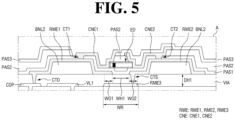
- FIG. 5 is an enlarged schematic cross-sectional view of portion A of FIG. 4 .
- FIG. 5 is a schematic cross-sectional view illustrating the relative arrangement of the electrodes RME.
- the display device 10 includes the first and second electrodes RME1 and RME2, disposed on the via layer VIA to be spaced apart from each other, and the third electrode RME3, disposed below the via layer VIA.
- the third electrode RME3, like the first and second electrodes RME1 and RME2, may extend in the first direction DR1.
- the third electrode RME3 may be disposed beyond the boundaries of the first subpixel PX1 and may be arranged or disposed in and across multiple subpixels PXn that are arranged or disposed in the first direction DR1.
- the third electrode RME3 may be disposed to overlap a region between the first and second electrodes RME1 and RME2 in the thickness direction.
- the third electrode RME3 overlaps the light-emitting elements ED in the thickness direction.
- a width WR of the third electrode RME3 may be greater than a distance WH1 between the first and second electrodes RME1 and RME2.
- the third electrode RME3 may form an electric field together with at least one of the first and second electrodes RME1 and RME2 on the via layer VIA.
- the third electrode RME3 can induce the light-emitting elements ED to be placed in the region between the first and second electrodes RME1 and RME2 in accordance with the electric field formed with the other electrode(s) RME.
- the third electrode RME3 is disposed to overlap the first and second electrodes RME1 and RME2 in the thickness direction.
- the third electrode RME3 is electrically connected or directly electrically connected to the second electrode RME2.
- the second electrode RME2 is electrically connected to the third electrode RME3 through the second electrode contact hole CTS that penetrates the via layer VIA.
- the second electrode contact hole CTS may be formed adjacent to a side surface of the second electrode RME2, from the center of the second electrode RME2, that faces the first electrode RME1.
- the second and third electrodes RME2 and RME3 may have the same electric potential, and the first electrode RME1 may have a different electric potential from the second and third electrodes RME2 and RME3.
- an alignment signal may be applied to the electrodes RME.
- An electric field may be formed due to the first and third electrodes RME1 and RME3 having different electric potentials, whereas no electric field may be formed between the second and third electrodes RME2 and RME3 due to the second and third electrodes RME2 and RME3 having the same electric potential.
- the light-emitting elements ED may be disposed in the region between the first and second electrodes RME1 and RME2 by the electric field formed by the first and second electrodes RME1 and RME2.
- the third electrode RME3 may be divided from its center into a half adjacent to the first electrode RME1 and a half adjacent to the second electrode RME2.
- the electric field formed by the first and third electrodes RME1 and RME3 may have a high density in the half of the third electrode RME3 adjacent to the first electrode RME1 and a low density in the half of the third electrode RME3 adjacent to the second electrode RME2.
- Light-emitting elements ED dispersed in ink may receive the increased dielectrophoretic force from above the first and second electrodes RME1 and RME2, and most of the light-emitting elements ED may be properly arranged or disposed on the first and second electrodes RME1 and RME2.
- the width WR of the third electrode RME3 may be greater than the distance WH1 between the first and second electrodes RME1 and RME2 and may overlap portions of the first and second electrodes RME1 and RME2 in the thickness direction. At least portions of the first and second electrodes RME1 and RME2 may be disposed on or directly disposed on the via layer VIA, and the third electrode RME3 may overlap the portions of the first and second electrodes RME1 and RME2 on or directly on the via layer VIA, in the thickness direction.
- a width WO1 of a portion of the first electrode RME1 that overlaps the third electrode RME3 in the thickness direction and a width WO2 of a portion of the second electrode RME2 that overlaps the third electrode RME3 may be smaller than the distance WH1 between the first and second electrodes RME1 and RME2.
- the width WR and the arrangement of the third electrode RME3 may be adjusted such that the density of an electric field can differ from one location to another location between the first and second electrodes RME1 and RME2.
- the direction and the density of an electric field formed by different electrodes may vary depending on the material and the thickness of a layer disposed between the different electrodes.
- the first insulating layer PAS1 may be disposed between the first and second electrodes RME1 and RME2, and the via layer VIA may be disposed between the first and third electrodes RME1 and RME3.
- a thickness DH1 of the via layer VIA may be adjusted such that an electric field may be formed by the first and third electrodes RME1 and RME3 in a direction that does not interfere with the alignment of the light-emitting elements ED.
- the via layer VIA may have a greater thickness than the first insulating layer PAS1, but a smaller thickness than the distance WH1 between the first and second electrodes RME1 and RME2.
- the thickness DH1 of the via layer VIA may be in a range of about 1 ⁇ m to about 3 ⁇ m.
- the thickness DH1 of the via layer VIA is less than about 1 ⁇ m, an electric field may be formed by the first and third electrodes RME1 and RME3 in a direction perpendicular to the top surface of the via layer VIA and may thus interfere with the alignment of the light-emitting elements ED. If the via layer VIA is too thick, the electric field formed by the first and third electrodes RME1 and RME3 may be weak, and differences in the electric field that are caused with the use of the third electrode RME3 may be insignificant. However, if the thickness DH1 of the via layer VIA is in the range of about 1 ⁇ m to about 3 ⁇ m, the degree of alignment of the light-emitting elements ED can be improved by the third electrode RME3. The thickness DH1 of the via layer VIA may vary depending on the material of the via layer VIA and the thickness and the material of the first insulating layer PAS1.
- the display device 10 may include the first and second electrodes RME1 and RME2, disposed in the (or a) same layer, and further may include the third electrode RME3, disposed in a different layer from the first and second electrodes RME1 and RME2.
- the degree of alignment of the light-emitting elements ED can be improved using the third electrode RME3, and as a result, the quality of the display device 10 can be improved.
- FIG. 6 is a perspective view of a light-emitting element according to an embodiment.
- a light-emitting element ED may be a light-emitting diode (LED), for example, an ILED having a size of several nanometers or micrometers and formed of an inorganic material. If an electric field is formed in a particular or given direction between two opposite electrodes, the light-emitting element ED may be aligned between the two electrodes where polarities are formed.
- LED light-emitting diode
- the light-emitting element ED may have a shape extending in one (or a) direction.
- the light-emitting element ED may have the shape substantially of a cylinder, substantially a rod, substantially a wire, or substantially a tube, but the shape of the light-emitting element ED is not particularly limited.
- the light-emitting element ED may have the shape of a substantially polygonal column such as a substantially regular cube, a substantially rectangular parallelepiped, or a substantially hexagonal column or may have a shape extending in one (or a) direction but with a partially inclined outer surface.
- the light-emitting element ED may include semiconductor layers doped with impurities of an arbitrary conductivity type (for example, a ptype or an n-type).
- the semiconductor layers may receive electrical signals from an external power source to emit light of a particular or selected wavelength range.
- the light-emitting element ED may include a first semiconductor layer 31, a second semiconductor layer 32, the light-emitting layer 36, an electrode layer 37, and the insulating film 38.
- the first semiconductor layer 31 may include an n-type semiconductor.
- the first semiconductor layer 31 may include a semiconductor material Al x Ga y In 1-x-y N (where 0 ⁇ x ⁇ 1, 0 ⁇ y ⁇ 1, and 0 ⁇ x+y ⁇ 1).
- the semiconductor material Al x Ga y In 1-x-y N may be at least one of AlGaInN, GaN, AlGaN, InGaN, AlN, and InN that are doped with an n-type dopant or a combination thereof.
- the first semiconductor layer 31 may be doped with an n-type dopant, and the n-type dopant may be Si, Ge, or Sn.
- a first end portion of the light-emitting element ED may be a portion of the light-emitting element ED where the first semiconductor layer 31 may be disposed with respect to the light-emitting layer 36.
- the second semiconductor layer 32 may be disposed on the first semiconductor layer 31 with the light-emitting layer 36 interposed therebetween.
- the second semiconductor layer 32 may include a p-type semiconductor.
- the second semiconductor layer 32 may include a semiconductor material Al x Ga y In 1-x-y N (where 0 ⁇ x ⁇ 1, 0 ⁇ y ⁇ 1, and 0 ⁇ x+y ⁇ 1).
- the semiconductor material Al x Ga y In 1-x-y N may be at least one of AlGaInN, GaN, AlGaN, InGaN, AlN, and InN that are doped with a p-type dopant or a combination thereof.
- the second semiconductor layer 32 may be doped with a p-type dopant, and the p-type dopant may be Mg, Zn, Ca, Se, or Ba.
- a second end portion of the light-emitting element ED may be portion of the light-emitting element ED where the second semiconductor layer 32 may be disposed with respect to the light-emitting layer 36.
- FIG. 6 illustrates that the first and second semiconductor layers 31 and 32 are formed as single layers, but the disclosure is not limited thereto.
- each of the first and second semiconductor layers 31 and 32 may include more than one layer such as, for example, a clad layer or a tensile strain barrier reducing (TSBR) layer, depending on the material of the light-emitting layer 36.
- TSBR tensile strain barrier reducing
- the light-emitting layer 36 may be disposed between the first and second semiconductor layers 31 and 32.
- the light-emitting layer 36 may include a single- or multi-quantum well structure material.
- the light-emitting layer 36 may have a structure in which multiple quantum layers and multiple well layers may be alternately stacked on each other.
- the light-emitting layer 36 may emit light by combining electron-hole pairs in accordance with electrical signals applied thereto via the first and second semiconductor layers 31 and 32.
- the light-emitting layer 36 may include a material such as AlGaN or AlGaInN.
- the quantum layers may include a material such as AlGaN or AlGaInN
- the well layers may include a material such as GaN or AlInN.
- the light-emitting layer 36 may have a structure in which a semiconductor material having a large band gap energy and a semiconductor material having a small band gap energy may be alternately stacked on each other or may include group-III or group-V semiconductor materials depending on the wavelength of light to be emitted.
- the type of light emitted by the light-emitting layer 36 is not particularly limited.
- the light-emitting layer 36 may emit light of a red or green wavelength range as necessary, instead of blue light.
- the electrode layer 37 may be an ohmic contact electrode, but the disclosure is not limited thereto. As an example, the electrode layer 37 may be a Schottky contact electrode.
- the light-emitting element ED may include at least one electrode layer 37.
- the light-emitting element ED may include more than one electrode layer 37, but the disclosure is not limited thereto. As an example, the electrode layer 37 may not be provided.
- the electrode layer 37 may reduce the resistance between the light-emitting element ED and electrodes (or contact electrodes) in a case that the light-emitting element ED is electrically connected to the electrodes (or the contact electrodes).
- the electrode layer 37 may include a conductive metal.
- the electrode layer 37 may include at least one of Al, Ti, In, gold (Au), Ag, ITO, IZO, and ITZO or a combination thereof.
- the insulating film 38 may be disposed to surround the first and second semiconductor layers 31 and 32 and the electrode layer 37.
- the insulating film 38 may be disposed to surround at least the light-emitting layer 36, but to expose both end portions, in the length direction, h, of the light-emitting element ED.
- the insulating film 38 may be formed to be rounded in a schematic cross-sectional view, in a region adjacent to at least one (or an) end of the light-emitting element ED.
- the insulating film 38 may include a material with insulating properties such as, for example, silicon oxide (SiO x ), silicon nitride (SiN x ), silicon oxynitride (SiO x N y ), aluminium nitride (AlN x ), or aluminium oxide (AlO x ).
- the insulating film 38 is illustrated as being a single-layer film, but the disclosure is not limited thereto. As an example, in an embodiment, the insulating film 38 may be formed as a multilayer film in which multiple layers may be stacked each other.
- the insulating film 38 may protect the other elements of the light-emitting element ED.
- the insulating film 38 can prevent any short circuit that may occur in the light-emitting element 36 in case the light-emitting element ED may be in electrical contact or in direct electrical contact with electrodes to which electrical signals are applied. Also, the insulating film 38 can prevent the degradation of the emission efficiency of the light-emitting element ED.
- the outer surface of the insulating film 38 may be subjected to surface treatment.
- the light-emitting element ED may be sprayed on electrodes while being dispersed in predetermined ink.
- the surface of the insulating film 38 may be hydrophobically or hydrophilically treated to keep the light-emitting element ED dispersed in ink without agglomerating with other neighboring light-emitting elements ED.
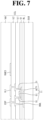
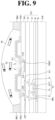
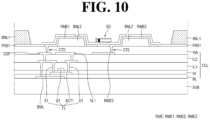
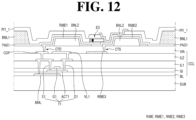
- FIGS. 7 through 13 are schematic cross-sectional views illustrating steps of a method of fabricating a display device according to an embodiment.
- a first substrate SUB is prepared, and a circuit layer CCL is formed on the first substrate SUB.
- the circuit layer CCL may include a plurality of conductive layers and insulating layers.
- the circuit layer CCL may include a lower metal layer BML, a first transistor T1, a first voltage line VL1, and a third electrode RME3.
- the first voltage line VL1 and the third electrode RME3 may be formed of a fourth conductive layer, and a via layer VIA may be disposed on the fourth conductive layer.
- the formation of the conductive layers and the insulating layers of the circuit layer CCL may be formed by typical deposition and patterning processes. The order in which the conductive layers and the insulating layers of the circuit layer CCL are formed will hereinafter be described in detail, but descriptions of how to form the conductive layers and the insulating layers of the circuit layer CCL will be omitted.
- a plurality of second banks BNL2, first and second electrodes RME1 and RME2, a first insulating layer PAS1, and a first bank BNL1 are formed on the via layer VIA of the circuit layer CCL.
- the structures of the second banks BNL2, the first and second electrodes RME1 and RME2, the first insulating layer PAS1, and the first bank BNL1 are as already described above with reference to FIG. 4 .
- the first bank BNL1 may prevent ink from spilling over to other neighboring subpixels PXn during the arrangement of light-emitting elements ED.
- a plurality of light-emitting elements ED are disposed on the third electrode RME3.
- the arrangement of the light-emitting elements ED during the fabrication of the display device 10 may be performed by an inkjet printing process.
- the light-emitting elements ED may be prepared as being dispersed in ink "Ink”, and the ink "Ink” may be sprayed into each subpixel PXn by an inkjet printing device.
- each subpixel PXn electric fields (EL1 and EL2) is formed by applying electrical signals to the first, second, and third electrodes RME1, RME2, and RME3.
- Each of the light-emitting elements ED may include semiconductor layers doped with dopants of different conductivity types and has dipoles in their molecules.
- the light-emitting elements ED may receive a dielectrophoretic force from the electric fields (EL1 and EL2), within the ink "Ink”, and may thus be arranged or disposed on electrode lines.
- the second electrode RME2 is, according to the invention, electrically connected or directly electrically connected to the third electrode RME3 through a second electrode contact hole CTS and may have the same electric potential as the third electrode RME3, but a different electric potential from the first electrode RME1.
- the first electrode RME1 may form first and second electric fields EL1 and EL2 with the second and third electrodes RME2 and RME3, respectively, which have a different electric potential from the first electrode RME1.
- the second electric field EL2 formed by the third electrode RME3 may have a higher density in a half of the third electrode RME3 adjacent to the first electrode RME1 than in a half of the third electrode RME3 adjacent to the second electrode RME2.
- the light-emitting elements ED dispersed in the ink "Ink” may receive a dielectrophoretic force due to differences in the density of the electric fields (EL1 and EL2) from one location to another location, and the difference in the density of the second electric field EL2 formed by the third electrode RME3 may increase.
- the light-emitting elements ED may receive a stronger dielectrophoretic force than when using only the first and second electrodes RME1 and RME2 and may thus be able to be properly aligned on the first and second electrodes RME1 and RME2. Therefore, the risk of the light-emitting elements ED being aligned at any undesirable location and being lost can be minimized, and the degree of alignment of the light-emitting elements ED can be improved by aligning the light-emitting elements ED with a strong dielectrophoretic force.
- a first insulating material layer PI1 is formed to cover or overlap the light-emitting elements ED.
- the first insulating material layer PI1 may cover or overlap the light-emitting elements ED and may be formed on the entire surfaces of the first insulating layer PAS 1 and the first bank BNL1.
- the first insulating material layer PI1 may fix the light-emitting elements ED and may be patterned later into a second insulating layer PAS2.
- the first insulating material layer PI1 is patterned into a first insulating material layer PI1_1 to expose one (or an) end portion of each of the light-emitting elements ED, and a second contact electrode CNE2 is formed.
- the first insulating material layer PI1 may be patterned to expose second end portions of the light-emitting elements ED on the second electrode RME2.
- the second contact electrode CNE2 may be disposed in a region exposed by the first insulating material layer PI1_1 to be in electrical contact with the light-emitting elements ED and the second electrode RME2.
- a third insulating layer PAS3 is formed to cover or overlap the first insulating material layer PI1_1 and the second contact electrode CNE2 and expose the other end portion of each of the light-emitting elements ED.
- the first insulating layer PI1_1 may be patterned so that the second insulating layer PAS2 may be formed.
- a first contact electrode CNE1 is formed to be in electrical contact with the exposed end portions of the light-emitting elements ED.
- the display device 10 may be obtained.
- the display device 10 can properly align the light-emitting elements ED using electrodes from different layers and can reduce the risk of the light-emitting elements ED being aligned at any undesirable location and being lost can be minimized.
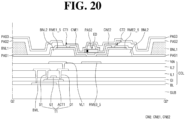
- FIGS. 14 and 15 are schematic cross-sectional views of portions of display devices according to embodiments.
- a display device 10_1 may further include a passivation layer PVL1, which may be disposed on a fourth conductive layer.
- the display device 10_1 differs from the display device 10 of FIG. 4 in that it further may include the passivation layer PVL1, which may be disposed between the fourth conductive layer and a via layer VIA.
- the passivation layer PVL1 may be disposed on the fourth conductive layer and a second interlayer insulating layer IL2.
- the passivation layer PVL1 may be disposed to cover or overlap a third electrode RME3, a first voltage line VL1, and a first conductive pattern CDP of the fourth conductive layer and prevent the third electrode RME3, the first voltage line VL1, and the first conductive pattern CDP from being damaged in subsequent processes.
- electrode contact holes (CTD and CTS) which are formed in the via layer VIA, may penetrate the passivation layer PVL1, and the passivation layer PVL1 may prevent the fourth conductive layer from being damaged during the formation of the electrode contact holes (CTD and CTS) or the via layer VIA.
- the passivation layer PVL1 may be formed as a single layer of an inorganic material such as, for example, silicon oxide (SiO x ), silicon nitride (SiN x ), and silicon oxynitride (SiO x N y ) or as a double- or multilayer in which at least one of silicon oxide (SiO x ), silicon nitride (SiN x ), and silicon oxynitride (SiO x N y ) or a combination thereof may be stacked each other.
- silicon oxide SiO x
- SiN x silicon nitride
- SiO x N y silicon oxynitride
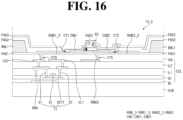
- a display device 10_2 does not include a second interlayer insulating layer IL2 and a fourth conductive layer, and a third electrode RME3_2 may be disposed on a third conductive layer.
- a first voltage line VL1_2 may be formed of the third conductive layer, and the third electrode RME3_2 may be disposed on or directly disposed on a first interlayer insulating layer IL1.
- the display device 10_2 may differ from the display device 10 of FIG. 4 in that a fourth conductive layer and a second interlayer insulating layer IL2 may not be provided, and that the third electrode RME3_2 and the first voltage line VL1_2 are formed of the third conductive layer.
- the third electrode RME3_2 may be disposed on the first interlayer insulating layer IL1.
- the first voltage line VL1_2 may be disposed on or directly disposed on the first interlayer insulating layer IL1 and may be electrically connected to an active layer ACT1 of the first transistor T1.
- a portion of the first voltage line VL1_2 may serve as the first drain electrode D1 of the first transistor T1.
- a via layer VIA_2 may be disposed on the third conductive layer and the first interlayer insulating layer IL1.
- the first electrode RME1 may be electrically connected to the first source electrode S1 of the first transistor T1 through a first electrode contact hole CTD that penetrates the via layer VIA_2.
- the fabrication of the display device 10_2 can be simplified.
- FIG. 16 is a schematic cross-sectional view of portion of a display device according to an embodiment.
- a display device 10_3 may not include a plurality of second banks BNL2.
- First and second electrodes RME1_3 and RME2_3 may be disposed on or directly disposed on a via layer VIA to have a uniform height.
- a first bank BNL1 may protrude from the top surface of the via layer VIA and may reflect light emitted from both end portions of each of the light-emitting elements ED in an upward direction or in a third direction DR3.
- Light generated by the light-emitting elements ED may be emitted in random directions without any particular or given directivity, and a sufficient amount of light can be emitted regardless of the absence of the second banks BNL2.
- the display device 10_3 can have sufficient luminance regardless of the absence of the second banks BNL2. As the second banks BNL2 may not be provided, the number of processes of the fabrication of the display device 10_3 can be reduced, and differences between the heights of the elements disposed in the emission area EMA of each subpixel PXn can be reduced. Accordingly, the residues of the materials of electrodes RME or contact electrodes CNE can be prevented from being left unremoved during the formation of the display device 10_3.
- FIG. 17 is a schematic cross-sectional view of portion of a display device according to an embodiment falling outside the scope of the claimed invention.
- a display device 10_4 may include second and third electrodes RME2_4 and RME3_4, which may not be electrically connected, and a fourth conductive layer of the display device 10_4 may further include a second voltage line VL2_4, which is electrically connected to the second electrode RME2_4.
- the third electrode RME3_4 may be disposed in a region between a first electrode RME1_4 and the second electrode RME2_4 and may not be electrically connected to the second electrode RME2_4.
- the second electrode RME2_4 may be electrically connected to the second voltage line VL2_4 via a second electrode contact hole CTS, and a second power supply voltage may be applied to the second voltage line VL2_4 via the second voltage line VL2_4 during the driving of the display device 10_4.
- a second power supply voltage may be applied to the third electrode RME3_4 separately from the second electrode RME2_4 so that the third electrode RME3_4 may have a different electric potential from the second electrode RME2_4, and that an electric field may be formed even between the second and third electrodes RME2_4 and RME3_4.
- FIG. 18 is a schematic cross-sectional view illustrating a step of a method of fabricating the display device of FIG. 17 .
- the second and third electrodes RME2_4 and RME3_4 may have different electric potentials, and a third electric field EL3 may be formed between the second and third electrodes RME2_4 and RME3_4.
- a second electric field EL2 may cause a difference in the density of a first electric field EL1, which is formed between the first and second electrodes RME1_4 and RME2_4, and the third electric field EL3 may further increase the intensity of the first electric field EL1.
- the directions of the first, second, and third electric fields EL1, EL2, and EL3 may all become the same by sequentially increasing or reducing the electric potentials of electrical signals applied to the third electrode RME3_4 and the second electrode RME2_4 based on the first electrode RME1_4.
- the alignment of the light-emitting elements ED can be further improved by causing differences in an electric field in a region where the light-emitting elements ED are to be disposed, while increasing the intensity of the electric field.
- the second and third electrodes RME2_4 and RME3_4 are not electrically connected, the degree of alignment of the light-emitting elements ED can be improved.
- electrode contact holes (CTD and CTS) that penetrate a via layer VIA may be formed in portions of first and second electrodes RME1 and RME2 that may be located or disposed in an emission area EMA, but the disclosure is not limited thereto.
- the electrode contact holes (CTD and CTS) may be formed in areas other than the emission area EMA.
- FIG. 19 is a plan view of a subpixel of a display device according to an embodiment.
- FIG. 20 is a schematic cross-sectional view taken along line Q2-Q2' of FIG. 19 .
- FIG. 21 is a schematic cross-sectional view taken along line Q3-Q3' of FIG. 19 .
- FIG. 20 illustrates a schematic cross-sectional view taken from one (or an) end portion to the other end (or another end) portion of a light-emitting element ED included in the subpixel of FIG. 19
- FIG. 21 illustrates a schematic cross-sectional view taken across first and second contact holes CTD and CTS of FIG. 19 .
- the first and second contact holes CTD and CTS of a display device 10_5 may be formed in portions of first and second electrodes RME1_5 and RME2_5 that overlap a first bank BNL1.
- the first and second electrodes RME1_5 and RME2_5 may be electrically connected to an underlying conductive layer in a non-emission area in which the first bank BNL1 is not disposed, rather than in a first emission area EMA1.
- the first and second contact holes CTD and CTS may be formed in portions of the first bank BNL1 that extend in a second direction DR2, between the emission area EMA and a subarea SA.
- a first conductive pattern CDP which is electrically connected to the first electrode RME1_5, may be disposed below the first bank BNL1, not in the first emission area EMA1.
- first and second electrodes RME1_5 and RME2_5 may have a smaller width than second banks BNL2 in the second direction DR2 and may be disposed to cover or overlap only opposing side surfaces of the second banks BNL2.
Landscapes
- Electroluminescent Light Sources (AREA)
- Devices For Indicating Variable Information By Combining Individual Elements (AREA)
- Physics & Mathematics (AREA)
- Geometry (AREA)
Claims (12)
- Anzeigevorrichtung (10), Folgendes umfassend:ein Substrat (SUB);einen ersten Transistor (T1), der auf dem Substrat (SUB) angeordnet ist;eine Zwischenschicht-Isolierschicht (IL1, IL2), die auf dem ersten Transistor (T1) angeordnet ist;eine Durchkontaktierungsschicht (VIA), die auf der Zwischenschicht-Isolierschicht (IL1, IL2) angeordnet ist;eine erste Elektrode (RME1) und eine zweite Elektrode (RME2), die auf der Durchkontaktierungsschicht (VIA) angeordnet und voneinander beabstandet sind;eine leitfähige Schicht, umfassendeine dritte Elektrode (RME3, RME3_2, RME3_5), die einen Bereich zwischen der ersten Elektrode (RME1) und der zweiten Elektrode (RME2) in einer Dickenrichtung überlappt, undein erstes leitfähiges Muster (CDP), das von der dritten Elektrode (RME3, RME3_2, RME3_5) beabstandet ist und mit dem ersten Transistor (T1) elektrisch verbunden ist, und das auf der Zwischenschicht-Isolierschicht (IL1, IL2) angeordnet ist; undeine Vielzahl von lichtemittierenden Elementen (ED), die auf der ersten Elektrode (RME1) und der zweiten Elektrode (RME2) angeordnet sind,wobei die dritte Elektrode (RME3) Abschnitte der ersten Elektrode (RME1) und der zweiten Elektrode (RME2) in der Dickenrichtung überlappt,wobei die Durchkontaktierungsschicht (VIA) direkt auf der leitfähigen Schicht angeordnet ist;wobei das erste leitfähige Muster (CDP) über ein erstes Elektrodenkontaktloch (CTD), das durch die Durchkontaktierungsschicht (VIA) hindurchgeht, direkt mit der ersten Elektrode (RME1) verbunden ist, unddie zweite Elektrode (RME2) über ein zweites Elektrodenkontaktloch (CTS), das durch die Durchkontaktierungsschicht (VIA) hindurchgeht, direkt mit der dritten Elektrode (RME3) verbunden ist.
- Anzeigevorrichtung (10) nach Anspruch 1, wobeieine Breite (WR) der dritten Elektrode (RME3, RME3_2, RME3_5) größer ist als ein Abstand (WH1) zwischen der ersten Elektrode (RME1) und der zweiten Elektrode (RME2), undder Abstand (WH1) zwischen der ersten Elektrode (RME1) und der zweiten Elektrode (RME2) größer ist als eine Breite (WO1) eines Abschnitts der ersten Elektrode (RME1), der die dritte Elektrode (RME3, RME3_2, RME3_5) überlappt.
- Anzeigevorrichtung (10) nach Anspruch 2, wobei mindestens Abschnitte der ersten Elektrode (RME1) und der zweiten Elektrode (RME2) direkt auf der Durchkontaktierungsschicht (VIA) angeordnet sind.
- Anzeigevorrichtung (10) nach einem der vorhergehenden Ansprüche, wobei:(i) das zweite Elektroden-Kontaktloch (CTS) an eine Seitenfläche der zweiten Elektrode (RME2) angrenzt, wobei die Seitenfläche der zweiten Elektrode der ersten Elektrode (RME1) zugewandt ist; und/oder(ii) die Anzeigevorrichtung (10) ferner Folgendes umfasst:eine erste Spannungsleitung (VL1), die in einer gleichen Schicht wie die dritte Elektrode (RME3, RME3_2, RME3_5) angeordnet ist,wobei die erste Elektrode (RME1) mit der ersten Spannungsleitung (VL1) elektrisch verbunden ist.
- Anzeigevorrichtung (10) nach einem der Ansprüche 1 bis 4, wobei die dritte Elektrode (RME3, RME3_2, RME3_5) die Vielzahl von lichtemittierenden Elementen (ED) in der Dickenrichtung überlappt.
- Anzeigevorrichtung (10) nach Anspruch 5, ferner Folgendes umfassend:eine erste Isolierschicht (PAS1), die auf der ersten Elektrode (RME1) und der zweiten Elektrode (RME2) angeordnet ist,wobei die Vielzahl von lichtemittierenden Elementen (ED) direkt auf der ersten Isolierschicht (PAS1) angeordnet sind, wobei optional eine Dicke der Durchkontaktierungsschicht (VIA) größer als eine Dicke der ersten Isolierschicht (PAS1) und kleiner als ein Abstand (WH1) zwischen der ersten Elektrode (RME1) und der zweiten Elektrode (RME2) ist.
- Anzeigevorrichtung (10) nach Anspruch 6, ferner Folgendes umfassend:eine erste Kontaktelektrode (CNE1), die auf der ersten Elektrode (RME1) angeordnet ist und mit ersten Endabschnitten der Vielzahl von lichtemittierenden Elementen (ED) in elektrischem Kontakt steht; undeine zweite Kontaktelektrode (CNE2), die auf der zweiten Elektrode (RME2) angeordnet ist und mit zweiten Endabschnitten der Vielzahl von lichtemittierenden Elementen (ED) in elektrischem Kontakt steht,wobei die erste Kontaktelektrode (CNE1) und die zweite Kontaktelektrode (CNE2) über Kontaktabschnitte (CT1, CT2), die durch die erste Isolierschicht (PAS1) hindurchgehen, mit der ersten Elektrode (RME1) bzw. der zweiten Elektrode (RME2) in elektrischem Kontakt stehen.
- Anzeigevorrichtung (10) nach Anspruch 6 oder Anspruch 7, ferner Folgendes umfassend:
eine erste Bank (BNL1), die auf der ersten Isolierschicht (PAS1) angeordnet ist, wobei die erste Bank (BNL1) eine Emissionszone (EMA) umgibt, die die Vielzahl von lichtemittierenden Elementen (ED) einschließt, wobei die Anzeigevorrichtung (10) optional ferner Folgendes umfasst:
eine Vielzahl von zweiten Bänken (BNL2), die zwischen der ersten Elektrode (RME1) und der Durchkontaktierungsschicht (VIA) angeordnet sind und zwischen der zweiten Elektrode (RME2) und der Durchkontaktierungsschicht (VIA) angeordnet sind. - Anzeigevorrichtung (10) nach einem der Ansprüche 1 bis 8, ferner Folgendes umfassend:eine erste leitfähige Schicht, die eine untere Metallschicht (BML) einschließt, die auf dem Substrat (SUB) angeordnet ist;eine Pufferschicht (BL), die auf der ersten leitfähigen Schicht angeordnet ist;eine aktive Schicht (ACT1), die auf der Pufferschicht (BL) angeordnet ist;eine Gate-Isolierschicht (GI), die auf der aktiven Schicht (ACT1) angeordnet ist;eine zweite leitfähige Schicht, die auf der Gate-Isolierschicht (GI) angeordnet ist, wobei die zweite leitfähige Schicht eine Gate-Elektrode (G1) einschließt, welche die aktive Schicht (ACT1) überlappt;eine erste Zwischenschicht-Isolierschicht (IL1), die auf der zweiten leitfähigen Schicht angeordnet ist; undeine dritte leitfähige Schicht, die auf der ersten Zwischenschicht-Isolierschicht (IL1) angeordnet ist, wobei die dritte leitfähige Schicht eine erste Source-Elektrode (S1) und eine erste Drain-Elektrode (D1) einschließt, die mit der aktiven Schicht (ACT1) elektrisch verbunden sind.
- Anzeigevorrichtung (10) nach Anspruch 9, wobei:(i) die dritte Elektrode (RME3_2) direkt auf der ersten Zwischenschicht-Isolierschicht (IL1) angeordnet ist; oder(ii) die Anzeigevorrichtung (10) ferner Folgendes umfasst:eine zweite Zwischenschicht-Isolierschicht (IL2), die auf der dritten leitfähigen Schicht angeordnet ist,wobei die dritte Elektrode (RME3, RME3_5) direkt auf der zweiten Zwischenschicht-Isolierschicht (IL2) angeordnet ist.
- Verfahren zum Herstellen einer Anzeigevorrichtung (10), Folgendes umfassend:Vorbereiten eines Substrats (SUB);Anordnen eines ersten Transistors (T1) auf dem Substrat (SUB);Anordnen einer Zwischenschicht-Isolierschicht (IL1, IL2) auf dem ersten Transistor (T1);Anordnen einer Durchkontaktierungsschicht (VIA) auf der Zwischenschicht-Isolierschicht (IL1, IL2);Anordnen einer ersten Elektrode (RME1) und einer zweiten Elektrode (RME2) auf der Durchkontaktierungsschicht (VIA), sodass sie voneinander beabstandet sind;Anordnen einer leitfähigen Schicht, welche Folgendes umfasst:ein erstes leitfähiges Muster (CDP) und eine dritte Elektrode (RME3) zwischen der Zwischenschicht-Isolierschicht (IL1, IL2) und der Durchkontaktierungsschicht (VIA), wobei das erste leitfähige Muster (CDP) von der dritten Elektrode (RME3, RME3_2, RME3_5) beabstandet ist und mit dem ersten Transistor (T1) elektrisch verbunden ist und die dritte Elektrode (RME3, RME3_2, RME3_5) die erste Elektrode (RME1) und die zweite Elektrode (RME2) überlappt und einen Bereich zwischen der ersten Elektrode (RME1) und der zweiten Elektrode (RME2) überlappt;Aufsprühen von Tinte (Ink), die eine Vielzahl von lichtemittierenden Elementen (ED) einschließt, auf die erste Elektrode (RME1) und die zweite Elektrode (RME2) in der Dickenrichtung; undAusbilden eines elektrischen Feldes (EL1, EL2, EL3) auf der Durchkontaktierungsschicht (VIA) durch Anlegen eines Ausrichtungssignals an die erste Elektrode (RME1), die zweite Elektrode (RME2) und die dritte Elektrode (RME3), um die Vielzahl von lichtemittierenden Elementen (ED) auf der ersten Elektrode (RME1) und der zweiten Elektrode (RME2) zu positionieren;wobei die Durchkontaktierungsschicht (VIA) direkt auf der leitfähigen Schicht angeordnet ist;wobei das erste leitfähige Muster (CDP) über ein erstes Elektrodenkontaktloch (CTD), das durch die Durchkontaktierungsschicht (VIA) hindurchgeht, direkt mit der ersten Elektrode verbunden ist, unddie zweite Elektrode (RME2) über ein zweites Elektrodenkontaktloch (CTS), das durch die Durchkontaktierungsschicht (VIA) hindurchgeht, direkt mit der dritten Elektrode (RME3) verbunden ist.
- Verfahren nach Anspruch 11, wobei:(i) die zweite Elektrode (RME2) ein elektrisches Potential aufweist, das gleich einem elektrischen Potential der dritten Elektrode (RME3, RME3_2, RME3_5) ist und sich von einem elektrischen Potential der ersten Elektrode (RME1) unterscheidet, durch Anlegen des Ausrichtungssignals.
Applications Claiming Priority (1)
| Application Number | Priority Date | Filing Date | Title |
|---|---|---|---|
| KR1020200118880A KR20220037017A (ko) | 2020-09-16 | 2020-09-16 | 표시 장치 및 이의 제조 방법 |
Publications (2)
| Publication Number | Publication Date |
|---|---|
| EP3971969A1 EP3971969A1 (de) | 2022-03-23 |
| EP3971969B1 true EP3971969B1 (de) | 2025-06-11 |
Family
ID=78032362
Family Applications (1)
| Application Number | Title | Priority Date | Filing Date |
|---|---|---|---|
| EP21197004.1A Active EP3971969B1 (de) | 2020-09-16 | 2021-09-15 | Anzeigevorrichtung und verfahren zu deren herstellung |
Country Status (4)
| Country | Link |
|---|---|
| US (1) | US12568718B2 (de) |
| EP (1) | EP3971969B1 (de) |
| KR (1) | KR20220037017A (de) |
| CN (1) | CN114267699A (de) |
Families Citing this family (2)
| Publication number | Priority date | Publication date | Assignee | Title |
|---|---|---|---|---|
| KR20230140634A (ko) * | 2022-03-29 | 2023-10-10 | 삼성디스플레이 주식회사 | 표시 장치 |
| KR20230142050A (ko) * | 2022-03-31 | 2023-10-11 | 삼성디스플레이 주식회사 | 표시 장치 및 이의 제조 방법 |
Family Cites Families (12)
| Publication number | Priority date | Publication date | Assignee | Title |
|---|---|---|---|---|
| KR20110041401A (ko) | 2009-10-15 | 2011-04-21 | 샤프 가부시키가이샤 | 발광 장치 및 그 제조 방법 |
| WO2015005655A1 (ko) | 2013-07-09 | 2015-01-15 | 피에스아이 주식회사 | 초소형 led 전극어셈블리 및 이의 제조방법 |
| JP2016004084A (ja) * | 2014-06-13 | 2016-01-12 | 株式会社ジャパンディスプレイ | 液晶表示装置 |
| JP2018205590A (ja) * | 2017-06-07 | 2018-12-27 | 株式会社ジャパンディスプレイ | 表示装置 |
| US10693042B2 (en) * | 2017-11-23 | 2020-06-23 | Lg Display Co., Ltd. | Light-emitting device and display device using the same |
| KR102550732B1 (ko) * | 2017-12-13 | 2023-07-03 | 삼성디스플레이 주식회사 | 표시장치 |
| KR102517393B1 (ko) | 2018-04-18 | 2023-04-03 | 삼성디스플레이 주식회사 | 표시 장치 및 이의 제조 방법 |
| CN110544661A (zh) * | 2018-05-29 | 2019-12-06 | 普因特工程有限公司 | 微led转印头及利用其的微led转印系统 |
| KR102557981B1 (ko) | 2018-08-20 | 2023-07-24 | 삼성디스플레이 주식회사 | 발광 장치, 그의 제조 방법, 및 이를 구비한 표시 장치 |
| KR102572340B1 (ko) | 2018-08-21 | 2023-08-31 | 삼성디스플레이 주식회사 | 표시 장치 및 표시 장치 제조 방법 |
| KR102509929B1 (ko) | 2018-09-05 | 2023-03-14 | 삼성디스플레이 주식회사 | 표시 장치 및 이의 제조 방법 |
| KR102516131B1 (ko) * | 2018-09-21 | 2023-04-03 | 삼성디스플레이 주식회사 | 표시 장치 및 그의 제조 방법 |
-
2020
- 2020-09-16 KR KR1020200118880A patent/KR20220037017A/ko active Pending
-
2021
- 2021-08-30 US US17/461,183 patent/US12568718B2/en active Active
- 2021-09-15 EP EP21197004.1A patent/EP3971969B1/de active Active
- 2021-09-16 CN CN202111085694.XA patent/CN114267699A/zh active Pending
Also Published As
| Publication number | Publication date |
|---|---|
| EP3971969A1 (de) | 2022-03-23 |
| CN114267699A (zh) | 2022-04-01 |
| US20220085248A1 (en) | 2022-03-17 |
| KR20220037017A (ko) | 2022-03-24 |
| US12568718B2 (en) | 2026-03-03 |
Similar Documents
| Publication | Publication Date | Title |
|---|---|---|
| US12489096B2 (en) | Display device | |
| US12477869B2 (en) | Display device | |
| US20250351633A1 (en) | Light-emitting device and display comprising same | |
| US20250133928A1 (en) | Display device | |
| US20250316665A1 (en) | Display device and method of fabricating the same | |
| EP4016623A1 (de) | Anzeigevorrichtung mit potenzialfreien elektroden | |
| US12334484B2 (en) | Display device | |
| EP4213205A1 (de) | Anzeigevorrichtung | |
| EP3971969B1 (de) | Anzeigevorrichtung und verfahren zu deren herstellung | |
| KR102951333B1 (ko) | 표시 장치 | |
| US12219823B2 (en) | Display device | |
| US12205959B2 (en) | Display device | |
| KR102772228B1 (ko) | 표시 장치 | |
| US12219818B2 (en) | Display device | |
| US12610663B2 (en) | Display device with improved connecting resistance between electrodes and method of manufacturing the same | |
| US12261160B2 (en) | Display device including dummy pattern on bank | |
| US12593730B2 (en) | Display device including protruding portion and method of manufacturing the same | |
| US11950479B2 (en) | Display device and method for fabricating the same | |
| CN220210915U (zh) | 显示装置 | |
| US20230155064A1 (en) | Display device | |
| CN117637970A (zh) | 显示装置 | |
| CN117637797A (zh) | 显示装置 |
Legal Events
| Date | Code | Title | Description |
|---|---|---|---|
| PUAI | Public reference made under article 153(3) epc to a published international application that has entered the european phase |
Free format text: ORIGINAL CODE: 0009012 |
|
| STAA | Information on the status of an ep patent application or granted ep patent |
Free format text: STATUS: THE APPLICATION HAS BEEN PUBLISHED |
|
| AK | Designated contracting states |
Kind code of ref document: A1 Designated state(s): AL AT BE BG CH CY CZ DE DK EE ES FI FR GB GR HR HU IE IS IT LI LT LU LV MC MK MT NL NO PL PT RO RS SE SI SK SM TR |
|
| STAA | Information on the status of an ep patent application or granted ep patent |
Free format text: STATUS: REQUEST FOR EXAMINATION WAS MADE |
|
| 17P | Request for examination filed |
Effective date: 20220922 |
|
| RBV | Designated contracting states (corrected) |
Designated state(s): AL AT BE BG CH CY CZ DE DK EE ES FI FR GB GR HR HU IE IS IT LI LT LU LV MC MK MT NL NO PL PT RO RS SE SI SK SM TR |
|
| P01 | Opt-out of the competence of the unified patent court (upc) registered |
Effective date: 20230516 |
|
| GRAP | Despatch of communication of intention to grant a patent |
Free format text: ORIGINAL CODE: EPIDOSNIGR1 |
|
| STAA | Information on the status of an ep patent application or granted ep patent |
Free format text: STATUS: GRANT OF PATENT IS INTENDED |
|
| INTG | Intention to grant announced |
Effective date: 20250107 |
|
| GRAS | Grant fee paid |
Free format text: ORIGINAL CODE: EPIDOSNIGR3 |
|
| GRAA | (expected) grant |
Free format text: ORIGINAL CODE: 0009210 |
|
| STAA | Information on the status of an ep patent application or granted ep patent |
Free format text: STATUS: THE PATENT HAS BEEN GRANTED |
|
| AK | Designated contracting states |
Kind code of ref document: B1 Designated state(s): AL AT BE BG CH CY CZ DE DK EE ES FI FR GB GR HR HU IE IS IT LI LT LU LV MC MK MT NL NO PL PT RO RS SE SI SK SM TR |
|
| REG | Reference to a national code |
Ref country code: GB Ref legal event code: FG4D |
|
| REG | Reference to a national code |
Ref country code: CH Ref legal event code: EP |
|
| REG | Reference to a national code |
Ref country code: IE Ref legal event code: FG4D |
|
| REG | Reference to a national code |
Ref country code: DE Ref legal event code: R096 Ref document number: 602021032029 Country of ref document: DE |
|
| REG | Reference to a national code |
Ref country code: NL Ref legal event code: FP |
|
| PG25 | Lapsed in a contracting state [announced via postgrant information from national office to epo] |
Ref country code: ES Free format text: LAPSE BECAUSE OF FAILURE TO SUBMIT A TRANSLATION OF THE DESCRIPTION OR TO PAY THE FEE WITHIN THE PRESCRIBED TIME-LIMIT Effective date: 20250611 Ref country code: FI Free format text: LAPSE BECAUSE OF FAILURE TO SUBMIT A TRANSLATION OF THE DESCRIPTION OR TO PAY THE FEE WITHIN THE PRESCRIBED TIME-LIMIT Effective date: 20250611 |
|
| PGFP | Annual fee paid to national office [announced via postgrant information from national office to epo] |
Ref country code: DE Payment date: 20250922 Year of fee payment: 5 |
|
| REG | Reference to a national code |
Ref country code: LT Ref legal event code: MG9D |
|
| PG25 | Lapsed in a contracting state [announced via postgrant information from national office to epo] |
Ref country code: NO Free format text: LAPSE BECAUSE OF FAILURE TO SUBMIT A TRANSLATION OF THE DESCRIPTION OR TO PAY THE FEE WITHIN THE PRESCRIBED TIME-LIMIT Effective date: 20250911 Ref country code: GR Free format text: LAPSE BECAUSE OF FAILURE TO SUBMIT A TRANSLATION OF THE DESCRIPTION OR TO PAY THE FEE WITHIN THE PRESCRIBED TIME-LIMIT Effective date: 20250912 |
|
| PGFP | Annual fee paid to national office [announced via postgrant information from national office to epo] |
Ref country code: NL Payment date: 20250922 Year of fee payment: 5 |
|
| PG25 | Lapsed in a contracting state [announced via postgrant information from national office to epo] |
Ref country code: BG Free format text: LAPSE BECAUSE OF FAILURE TO SUBMIT A TRANSLATION OF THE DESCRIPTION OR TO PAY THE FEE WITHIN THE PRESCRIBED TIME-LIMIT Effective date: 20250611 |
|
| PGFP | Annual fee paid to national office [announced via postgrant information from national office to epo] |
Ref country code: GB Payment date: 20250922 Year of fee payment: 5 |
|
| PG25 | Lapsed in a contracting state [announced via postgrant information from national office to epo] |
Ref country code: HR Free format text: LAPSE BECAUSE OF FAILURE TO SUBMIT A TRANSLATION OF THE DESCRIPTION OR TO PAY THE FEE WITHIN THE PRESCRIBED TIME-LIMIT Effective date: 20250611 |
|
| PGFP | Annual fee paid to national office [announced via postgrant information from national office to epo] |
Ref country code: AT Payment date: 20251020 Year of fee payment: 5 Ref country code: FR Payment date: 20250925 Year of fee payment: 5 |
|
| PG25 | Lapsed in a contracting state [announced via postgrant information from national office to epo] |
Ref country code: RS Free format text: LAPSE BECAUSE OF FAILURE TO SUBMIT A TRANSLATION OF THE DESCRIPTION OR TO PAY THE FEE WITHIN THE PRESCRIBED TIME-LIMIT Effective date: 20250911 |
|
| PG25 | Lapsed in a contracting state [announced via postgrant information from national office to epo] |
Ref country code: LV Free format text: LAPSE BECAUSE OF FAILURE TO SUBMIT A TRANSLATION OF THE DESCRIPTION OR TO PAY THE FEE WITHIN THE PRESCRIBED TIME-LIMIT Effective date: 20250611 |
|
| REG | Reference to a national code |
Ref country code: DE Ref legal event code: R079 Ref document number: 602021032029 Country of ref document: DE Free format text: PREVIOUS MAIN CLASS: H01L0025075000 Ipc: H10H0029240000 |
|
| PG25 | Lapsed in a contracting state [announced via postgrant information from national office to epo] |
Ref country code: PT Free format text: LAPSE BECAUSE OF FAILURE TO SUBMIT A TRANSLATION OF THE DESCRIPTION OR TO PAY THE FEE WITHIN THE PRESCRIBED TIME-LIMIT Effective date: 20251013 |
|
| REG | Reference to a national code |
Ref country code: AT Ref legal event code: MK05 Ref document number: 1802962 Country of ref document: AT Kind code of ref document: T Effective date: 20250611 |
|
| PG25 | Lapsed in a contracting state [announced via postgrant information from national office to epo] |
Ref country code: IS Free format text: LAPSE BECAUSE OF FAILURE TO SUBMIT A TRANSLATION OF THE DESCRIPTION OR TO PAY THE FEE WITHIN THE PRESCRIBED TIME-LIMIT Effective date: 20251011 |
|
| PG25 | Lapsed in a contracting state [announced via postgrant information from national office to epo] |
Ref country code: SM Free format text: LAPSE BECAUSE OF FAILURE TO SUBMIT A TRANSLATION OF THE DESCRIPTION OR TO PAY THE FEE WITHIN THE PRESCRIBED TIME-LIMIT Effective date: 20250611 Ref country code: AT Free format text: LAPSE BECAUSE OF FAILURE TO SUBMIT A TRANSLATION OF THE DESCRIPTION OR TO PAY THE FEE WITHIN THE PRESCRIBED TIME-LIMIT Effective date: 20250611 |
|
| PG25 | Lapsed in a contracting state [announced via postgrant information from national office to epo] |
Ref country code: CZ Free format text: LAPSE BECAUSE OF FAILURE TO SUBMIT A TRANSLATION OF THE DESCRIPTION OR TO PAY THE FEE WITHIN THE PRESCRIBED TIME-LIMIT Effective date: 20250611 |
|
| PG25 | Lapsed in a contracting state [announced via postgrant information from national office to epo] |
Ref country code: PL Free format text: LAPSE BECAUSE OF FAILURE TO SUBMIT A TRANSLATION OF THE DESCRIPTION OR TO PAY THE FEE WITHIN THE PRESCRIBED TIME-LIMIT Effective date: 20250611 |
|
| PG25 | Lapsed in a contracting state [announced via postgrant information from national office to epo] |
Ref country code: EE Free format text: LAPSE BECAUSE OF FAILURE TO SUBMIT A TRANSLATION OF THE DESCRIPTION OR TO PAY THE FEE WITHIN THE PRESCRIBED TIME-LIMIT Effective date: 20250611 |
|
| PG25 | Lapsed in a contracting state [announced via postgrant information from national office to epo] |
Ref country code: SK Free format text: LAPSE BECAUSE OF FAILURE TO SUBMIT A TRANSLATION OF THE DESCRIPTION OR TO PAY THE FEE WITHIN THE PRESCRIBED TIME-LIMIT Effective date: 20250611 Ref country code: RO Free format text: LAPSE BECAUSE OF FAILURE TO SUBMIT A TRANSLATION OF THE DESCRIPTION OR TO PAY THE FEE WITHIN THE PRESCRIBED TIME-LIMIT Effective date: 20250611 |
|
| PG25 | Lapsed in a contracting state [announced via postgrant information from national office to epo] |
Ref country code: DK Free format text: LAPSE BECAUSE OF FAILURE TO SUBMIT A TRANSLATION OF THE DESCRIPTION OR TO PAY THE FEE WITHIN THE PRESCRIBED TIME-LIMIT Effective date: 20250611 |
|
| PG25 | Lapsed in a contracting state [announced via postgrant information from national office to epo] |
Ref country code: IT Free format text: LAPSE BECAUSE OF FAILURE TO SUBMIT A TRANSLATION OF THE DESCRIPTION OR TO PAY THE FEE WITHIN THE PRESCRIBED TIME-LIMIT Effective date: 20250611 |
|
| PLBE | No opposition filed within time limit |
Free format text: ORIGINAL CODE: 0009261 |
|
| STAA | Information on the status of an ep patent application or granted ep patent |
Free format text: STATUS: NO OPPOSITION FILED WITHIN TIME LIMIT |
|
| REG | Reference to a national code |
Ref country code: CH Ref legal event code: L10 Free format text: ST27 STATUS EVENT CODE: U-0-0-L10-L00 (AS PROVIDED BY THE NATIONAL OFFICE) Effective date: 20260423 |