EP3967744A1 - Test device - Google Patents
Test device Download PDFInfo
- Publication number
- EP3967744A1 EP3967744A1 EP21197801.0A EP21197801A EP3967744A1 EP 3967744 A1 EP3967744 A1 EP 3967744A1 EP 21197801 A EP21197801 A EP 21197801A EP 3967744 A1 EP3967744 A1 EP 3967744A1
- Authority
- EP
- European Patent Office
- Prior art keywords
- bacteria
- fungi
- microscopic observation
- culture
- proliferation
- Prior art date
- Legal status (The legal status is an assumption and is not a legal conclusion. Google has not performed a legal analysis and makes no representation as to the accuracy of the status listed.)
- Pending
Links
Images








Classifications
-
- C—CHEMISTRY; METALLURGY
- C12—BIOCHEMISTRY; BEER; SPIRITS; WINE; VINEGAR; MICROBIOLOGY; ENZYMOLOGY; MUTATION OR GENETIC ENGINEERING
- C12M—APPARATUS FOR ENZYMOLOGY OR MICROBIOLOGY; APPARATUS FOR CULTURING MICROORGANISMS FOR PRODUCING BIOMASS, FOR GROWING CELLS OR FOR OBTAINING FERMENTATION OR METABOLIC PRODUCTS, i.e. BIOREACTORS OR FERMENTERS
- C12M41/00—Means for regulation, monitoring, measurement or control, e.g. flow regulation
- C12M41/30—Means for regulation, monitoring, measurement or control, e.g. flow regulation of concentration
- C12M41/36—Means for regulation, monitoring, measurement or control, e.g. flow regulation of concentration of biomass, e.g. colony counters or by turbidity measurements
-
- C—CHEMISTRY; METALLURGY
- C12—BIOCHEMISTRY; BEER; SPIRITS; WINE; VINEGAR; MICROBIOLOGY; ENZYMOLOGY; MUTATION OR GENETIC ENGINEERING
- C12Q—MEASURING OR TESTING PROCESSES INVOLVING ENZYMES, NUCLEIC ACIDS OR MICROORGANISMS; COMPOSITIONS OR TEST PAPERS THEREFOR; PROCESSES OF PREPARING SUCH COMPOSITIONS; CONDITION-RESPONSIVE CONTROL IN MICROBIOLOGICAL OR ENZYMOLOGICAL PROCESSES
- C12Q1/00—Measuring or testing processes involving enzymes, nucleic acids or microorganisms; Compositions therefor; Processes of preparing such compositions
- C12Q1/02—Measuring or testing processes involving enzymes, nucleic acids or microorganisms; Compositions therefor; Processes of preparing such compositions involving viable microorganisms
- C12Q1/04—Determining presence or kind of microorganism; Use of selective media for testing antibiotics or bacteriocides; Compositions containing a chemical indicator therefor
-
- C—CHEMISTRY; METALLURGY
- C12—BIOCHEMISTRY; BEER; SPIRITS; WINE; VINEGAR; MICROBIOLOGY; ENZYMOLOGY; MUTATION OR GENETIC ENGINEERING
- C12M—APPARATUS FOR ENZYMOLOGY OR MICROBIOLOGY; APPARATUS FOR CULTURING MICROORGANISMS FOR PRODUCING BIOMASS, FOR GROWING CELLS OR FOR OBTAINING FERMENTATION OR METABOLIC PRODUCTS, i.e. BIOREACTORS OR FERMENTERS
- C12M1/00—Apparatus for enzymology or microbiology
- C12M1/34—Measuring or testing with condition measuring or sensing means, e.g. colony counters
-
- C—CHEMISTRY; METALLURGY
- C12—BIOCHEMISTRY; BEER; SPIRITS; WINE; VINEGAR; MICROBIOLOGY; ENZYMOLOGY; MUTATION OR GENETIC ENGINEERING
- C12M—APPARATUS FOR ENZYMOLOGY OR MICROBIOLOGY; APPARATUS FOR CULTURING MICROORGANISMS FOR PRODUCING BIOMASS, FOR GROWING CELLS OR FOR OBTAINING FERMENTATION OR METABOLIC PRODUCTS, i.e. BIOREACTORS OR FERMENTERS
- C12M23/00—Constructional details, e.g. recesses, hinges
- C12M23/02—Form or structure of the vessel
- C12M23/12—Well or multiwell plates
-
- C—CHEMISTRY; METALLURGY
- C12—BIOCHEMISTRY; BEER; SPIRITS; WINE; VINEGAR; MICROBIOLOGY; ENZYMOLOGY; MUTATION OR GENETIC ENGINEERING
- C12M—APPARATUS FOR ENZYMOLOGY OR MICROBIOLOGY; APPARATUS FOR CULTURING MICROORGANISMS FOR PRODUCING BIOMASS, FOR GROWING CELLS OR FOR OBTAINING FERMENTATION OR METABOLIC PRODUCTS, i.e. BIOREACTORS OR FERMENTERS
- C12M41/00—Means for regulation, monitoring, measurement or control, e.g. flow regulation
- C12M41/46—Means for regulation, monitoring, measurement or control, e.g. flow regulation of cellular or enzymatic activity or functionality, e.g. cell viability
-
- C—CHEMISTRY; METALLURGY
- C12—BIOCHEMISTRY; BEER; SPIRITS; WINE; VINEGAR; MICROBIOLOGY; ENZYMOLOGY; MUTATION OR GENETIC ENGINEERING
- C12Q—MEASURING OR TESTING PROCESSES INVOLVING ENZYMES, NUCLEIC ACIDS OR MICROORGANISMS; COMPOSITIONS OR TEST PAPERS THEREFOR; PROCESSES OF PREPARING SUCH COMPOSITIONS; CONDITION-RESPONSIVE CONTROL IN MICROBIOLOGICAL OR ENZYMOLOGICAL PROCESSES
- C12Q1/00—Measuring or testing processes involving enzymes, nucleic acids or microorganisms; Compositions therefor; Processes of preparing such compositions
- C12Q1/02—Measuring or testing processes involving enzymes, nucleic acids or microorganisms; Compositions therefor; Processes of preparing such compositions involving viable microorganisms
- C12Q1/04—Determining presence or kind of microorganism; Use of selective media for testing antibiotics or bacteriocides; Compositions containing a chemical indicator therefor
- C12Q1/06—Quantitative determination
- C12Q1/08—Quantitative determination using multifield media
-
- G—PHYSICS
- G06—COMPUTING OR CALCULATING; COUNTING
- G06T—IMAGE DATA PROCESSING OR GENERATION, IN GENERAL
- G06T1/00—General purpose image data processing
-
- G—PHYSICS
- G06—COMPUTING OR CALCULATING; COUNTING
- G06T—IMAGE DATA PROCESSING OR GENERATION, IN GENERAL
- G06T7/00—Image analysis
- G06T7/0002—Inspection of images, e.g. flaw detection
- G06T7/0012—Biomedical image inspection
- G06T7/0014—Biomedical image inspection using an image reference approach
- G06T7/0016—Biomedical image inspection using an image reference approach involving temporal comparison
-
- G—PHYSICS
- G02—OPTICS
- G02B—OPTICAL ELEMENTS, SYSTEMS OR APPARATUS
- G02B21/00—Microscopes
- G02B21/24—Base structure
- G02B21/26—Stages; Adjusting means therefor
-
- G—PHYSICS
- G02—OPTICS
- G02B—OPTICAL ELEMENTS, SYSTEMS OR APPARATUS
- G02B21/00—Microscopes
- G02B21/36—Microscopes arranged for photographic purposes or projection purposes or digital imaging or video purposes including associated control and data processing arrangements
- G02B21/365—Control or image processing arrangements for digital or video microscopes
- G02B21/367—Control or image processing arrangements for digital or video microscopes providing an output produced by processing a plurality of individual source images, e.g. image tiling, montage, composite images, depth sectioning, image comparison
-
- G—PHYSICS
- G02—OPTICS
- G02B—OPTICAL ELEMENTS, SYSTEMS OR APPARATUS
- G02B21/00—Microscopes
- G02B21/36—Microscopes arranged for photographic purposes or projection purposes or digital imaging or video purposes including associated control and data processing arrangements
- G02B21/368—Microscopes arranged for photographic purposes or projection purposes or digital imaging or video purposes including associated control and data processing arrangements details of associated display arrangements, e.g. mounting of LCD monitor
-
- G—PHYSICS
- G06—COMPUTING OR CALCULATING; COUNTING
- G06T—IMAGE DATA PROCESSING OR GENERATION, IN GENERAL
- G06T2207/00—Indexing scheme for image analysis or image enhancement
- G06T2207/10—Image acquisition modality
- G06T2207/10056—Microscopic image
Definitions
- the present invention relates to a testing instrument, and for example, relates to a testing instrument used in an antimicrobial susceptibility testing of bacteria or fungi.
- a causative bacterium of an infectious disease is cultured and identification and antimicrobial susceptibility of the bacterial species are determined based on the presence or absence of proliferation thereof.
- a specimen such as blood, a throat swab, and sputum is collected from a patient.
- isolation culture for obtaining the infection causative bacterium in a single colony is performed for overnight.
- a bacterial suspension is prepared from the single colony, and culture for examining identification culture or antimicrobial susceptibility is performed for overnight.
- the determination result of the antimicrobial susceptibility testing is obtained and appropriate medication is performed three days, for example, after the specimen is collected from the patient.
- An infection causative bacterium which has a slow proliferation rate and needs to be cultured for a long time requires more days.
- testing instrument As a testing instrument for achieving automation and energy-saving in isolation culture, a testing instrument which obtains an image of bacterial colonies in a culture dish and measures micro-organisms or cells, and the like have been developed (refer to PTL 1). In addition, an apparatus for simplifying the antimicrobial susceptibility testing has been sold (NPL 1). In the apparatuses, it is determined that bacteria are proliferated by the culturing and turbidity of a culture fluid increases.
- Examples of a method which does not use the apparatus include a disk method based on a microdilution method and a Kirby-Bauer method (NPL 2).
- the invention has been made in consideration of the above-referenced circumstances, and there is provided a technology in which determination of bacterial identification or antimicrobial susceptibility can be promptly performed.
- a testing instrument which performs an identification testing or an antimicrobial susceptibility testing of bacteria or fungi.
- the testing instrument includes: a microscopic observation optical system which has a plurality of wells and performs microscopic observation at a plurality of points of time at which germs in a culture fluid containing antimicrobial or antifungal agents and the bacteria or fungi are set in advance in each of the wells; and a processor configured to display images obtained by the microscopic observation on a display screen.
- the processor is configured to generate influence determination information that shows influence given by the antimicrobial or antifungal agent to the bacteria or fungi with respect to plural types of antimicrobial agents and plural types of concentrations, based on the image, and displays the influence determination information in a time series.
- Fig. 1 is a view illustrating a schematic configuration of a bacteriological testing instrument according to the embodiment of the invention.
- the bacteriological testing instrument 1 includes a cover 11, a placement table 12, a microscopic observation optical system and a turbidity measurement optical system 13, a temperature controller 16, a gripper 17 for transporting a culture plate 18, and a drive control device 19 which controls movement and positioning of the gripper 17.
- the bacteriological testing instrument 1 includes a computer 20 for inputting information related to processing conditions and biological samples, information related to types and concentrations of antimicrobial agents, information related to patient specimens, and other various types of information.
- the computer 20 is configured of a processor, a memory, a storage device, an input device (a keyboard, a mouse, a touch panel, or a microphone), an output device (a display, a printer, or a speaker), a storage device, or a communication device.
- An examination performed by using the bacteriological testing instrument 1 is, for example, a antimicrobial susceptibility testing of bacteria or fungi.
- the antimicrobial susceptibility testing denotes an examination in which bacteria or fungi is cultured in culture fluids respectively containing various types of antimicrobial or antifungal agents having predetermined concentrations and conditions of proliferation of the bacteria or the fungi are examined for antimicrobiotic resistance, or an examination determining the minimum inhibitory concentration (MIC) of bacteria or fungi.
- Target bacteria to be examined by using the bacteriological testing instrument 1 are not particularly limited.
- Staphylococcus aureus Enteroccoas faecalis, Streptococcus pneumoniae, E coli, Pseudomonas aeruginosa, Klebsiella pneumoniae, and the like can be exemplified.
- the bacteriological testing instrument 1 when an examination is performed by using the bacteriological testing instrument 1, there are many cases where a bacterial suspension is prepared by using a single colony obtained from a clinical specimen through isolation culture. However, in a case where the possibility of contamination with respect to the clinical specimen is low and a single species of bacteria is included, without preparing the bacterial suspension, the specimen may be used with no change or may be used by being appropriately diluted.
- the bacteriological testing instrument 1 when an examination is performed by using the bacteriological testing instrument 1, it is desirable that specimens are collected, are carried, and are subjected to isolation culture in accordance with a method recommended by the Clinical and Laboratory Standards Institute (CLSI, Wayne, P.A). Preparation of antimicrobiotic agents and preparation of culture mediums are performed in a similar manner. However, the preparations are not limited thereto. In addition, it is also desirable that a culture temperature and a culture fluid to be used are adopted in a similar manner based on the method recommended by CLSI. However, the culture temperature and the culture fluid are not limited thereto.
- culture is performed by mixing a bacterial suspension prepared from a specimen with a culture fluid in the culture plate (for example, a culture plate which has 96 wells in total is used) 18.
- a culture fluid in the culture plate for example, a culture plate which has 96 wells in total is used
- antimicrobial agents different from each other are set so as to be respectively contained in the culture fluids in each of the wells in particular concentrations.
- An order of the culturing is as follows. First, the bacterial suspension is introduced into the culture plate 18. Then, the bacterial suspension is in a state of being mixed with the culture fluid which is included in each of the wells, and the temperature controller 16 is set to a temperature of approximately 35°C.
- culture is performed by performing incubation such that the temperature of each of the wells in the culture plate 18 reaches the set temperature. Then, in the bacteriological testing instrument 1, while performing the incubation, the bacteria included in each of the wells can be monitored through the microscopic observation optical system.
- the microscopic observation may be performed for a set period of time from the start of the incubation till the end thereof by continuously monitoring the state of bacterial proliferation.
- the monitoring may be performed at the set time after setting appropriate time, and the monitoring result can be compared with the monitoring result when the incubation is started.
- the turbidity of each of the wells may be measured through the turbidity measurement optical system while incubating the culture plate 18.
- the measured result may be compared with the monitored result of the microscopic observation optical system.
- Fig. 2 is a view illustrating a configuration example of the microscopic observation optical system and the turbidity measurement optical system used in the bacteriological testing instrument 1 according to the embodiment of the invention.
- a culture plate 21 (the same as the culture plate 18) is irradiated with light from a light source 22.
- the light source may be a white light source or a light source such as an LED having a spectrum in a certain wavelength range.
- the light source 22 is adjusted by a filter 23 so as to be in a suitable wavelength range.
- the filter 23 When the microscopic observation is performed, there is no need to particularly limit the wavelength. However, when the measurement of the turbidity is performed, unnecessary wavelength ranges are cut by the filter 23 such that the culture plate 21 is irradiated with light having the wavelength in the vicinity of 600 nm.
- the culture plate 21 is irradiated with light from the light source 22 via a dichroic mirror 24 and an objective lens 25.
- the scattered light from the culture plate 21 passes through the objective lens 25 and is measured by a CCD element 27, and a microscopic observation image is obtained.
- the light from the light source 22 passes through the objective lens 25, and the culture plate 21 is irradiated with light for the measurement of the turbidity through the dichroic mirror 24.
- the irradiation light is measured by a photodiode 26 installed above the culture plate 21.
- the light which has passed through the dichroic mirror 24 is measured by the photodiode 26 installed on a side opposite to the light source 22.
- the turbidity can be calculated based on the amount of light measured by the two photodiodes 26.
- Fig. 3 is a flowchart for describing the MIC determination processing executed by the bacteriological testing instrument 1 according to the embodiment of the invention.
- Fig. 3A illustrates a concept of the processing in the bacteriological testing instrument 1
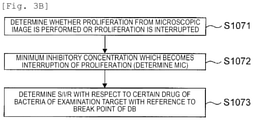
- Fig. 3B is a flowchart for describing step 107 in detail.
- the processing from steps 101 to 104 is performed by a "human”. Therefore, the processing (processing executed by the computer (processor)) which is practically automatically executed is steps 105 to 113.
- a user prepares a bacterial suspension which is the specimen to be introduced into the apparatus (step 101), and the bacterial suspension is introduced into a culture plate (step 102). Thereafter, the culture plate is introduced into the bacteriological testing instrument (step 103).
- the user instructs the testing instrument to start the examination by inputting necessary information such as information for the specimen or information for the antimicrobial agents, or by pushing a start button or the like (step 104).
- the culture plate introduced into the apparatus is incubated by the bacteriological testing instrument 1 to a temperature of approximately 35°C, and culture is performed.
- the processor of the computer 20 drives the microscopic optical system and obtains an image through microscopic observation of the wells in the culture plate at the time set in advance.
- the image obtaining may also be discretely performed at an interval determined in advance, or the image may also be obtained as an image for the processing at the time interval determined in advance through continuous observation.
- the processor carries out processing necessary for the obtained image.
- image treatment raw image data illustrated in Figs. 8 to 11 is binarization-processed as illustrated in Figs. 4 to 6 , or is processed to grey scale image data.
- processing of calculating the areas of the bacteria, the bacterial number, the circularity of the bacteria, the aspect ratio of the bacteria, and the perimeter length of the bacterium, based on the image data in Figs. 4 and 6 is included.
- the processor attempts the MIC determination by using the image data obtained in step 106.
- the specific processing is as illustrated in Fig. 3B , and will be described later.
- the processor attempts the determination of the MIC from turbidity data by performing the turbidity measurement of each of the wells of the culture plate. In general, since it requires 18 hours or longer of time to perform the turbidity determination from the start of culture, it is not possible to perform the turbidity determination when 30 minutes or 1 hour is elapsed. Therefore, the MIC determination is not possible when 30 minutes or 1 hour has elapsed.
- the processor further attempts the determination of the MIC by comparing the information of the image or the information of turbidity (value) in the database, with the information of the image or the information of the turbidity which is obtained in the above-described step (refer to Fig. 7 ).
- the processor displays the determination result of the MIC or the like at this point of time. Specifically, the determination result (S/I/R determination, MIC determination, a time series graph, a microscopic image, or the like) obtained in step 107 is displayed.
- the processor determines whether or not the proliferation of the bacteria proceeds (whether or not the incubation is continuously performed) until the determination of the MIC can be finally confirmed. In a case where it is determined that the proliferation of the bacteria does not proceed (in a case of YES in step 112), the processor continues the incubation, and repeatedly performs the process from the image obtaining.
- step 113 In a case where it is determined that the proliferation of the bacteria proceeds (in a case of NO in step 112), the processing moves to step 113.
- the MIC is determined with respect to the antimicrobial agent included in the culture plate, the processing with respect to the antimicrobial agent of which the MIC can be determined is completed, and in a case where it is determined that it is difficult to perform the determination with respect to the remaining antimicrobial agent, the processing moves to step 113.
- the processor determines final MIC considering the MIC determined from the image, the MIC determined from the turbidity, and the MIC determined from the comparison with the database, and the examination is completed.
- the process is automatically performed based on the condition set for each culture plate.
- a plurality of culture plates can be installed in the bacteriological testing instrument 1 at the same time, but a different condition may be changed for each of the culture plates, or the process may be performed under the same condition.
- the processor determines whether the bacteria proliferate or the proliferation is interrupted under the corresponding culture condition, based on the microscopic image to which the above-described necessary treatments are performed.
- the determination whether or not the proliferation is performed is performed by comparing with the information obtained based on the images at different times in the same container. More specifically, based on the image after the treatment illustrated in Figs. 4 to 6 , for example, the areas of the bacteria are calculated, and it is determined whether or not the proliferation is performed by creating the graph as illustrated in Fig. 12 .
- the processor combines the information on whether or not the proliferation is performed under the culture condition with a combination of a certain concentration of the antimicrobial agent, and determines the minimum concentration of the antimicrobial agent (MIC, minimum inhibitory concentration) which becomes interruption of proliferation.
- the MIC determination is performed with respect to all of the wells provided on the culture plate 21.
- there are 96 wells on the culture plate 21, and various types of antimicrobial agents having different concentrations for example, 0 ⁇ g/mL, 0.5 ⁇ g/mL, 1 ⁇ g/mL, 2.0 ⁇ g/mL, 4.0 ⁇ g/mL, 8.0 ⁇ g/mL, 16.0 ⁇ g/mL, ...) enter the wells. Therefore, the minimum concentration (MIC) of the antimicrobial agent which becomes interruption of proliferation can be ascertained.
- the processor further determines whether the bacteria of the examination target is sensitive (S), resistant (R), and intermediate (I) with respect to the corresponding antimicrobial agent by comparing with a break point (a break point of Clinical and Laboratory Standards Institute (CLSI), a break point of Japanese Society of Chemotherapy, or a break point of EUCAST) which is stored as reference data.
- a break point a break point of Clinical and Laboratory Standards Institute (CLSI), a break point of Japanese Society of Chemotherapy, or a break point of EUCAST
- CLSI Clinical and Laboratory Standards Institute
- EUCAST a break point of EUCAST
- Figs. 4 to 6 are views illustrating an example of an image obtained by executing predetermined processing (for example, binarization processing) with respect to the image (raw image) obtained by a microscope.
- predetermined processing for example, binarization processing
- Fig. 4 illustrates that images obtained by performing the microscopic observation with respect to the state where E coli (ATCC25922) in a Mueller-Hinton culture medium not containing ampicillin is cultured, are binarized. States after (a) zero minutes and (b) 180 minutes from the start of culture are respectively illustrated. Similarly, Fig.
- FIG. 5 illustrates a state where the E coli (ATCC25922) is cultured in a culture fluid containing ampicillin of 2 ⁇ g/mL
- Fig. 6 illustrates a state where the E. coli (ATCC25922) is cultured in a culture fluid containing ampicillin of 16 ⁇ g/mL, respectively, by performing the predetermined processing (binarization processing) through the microscopic observation.
- predetermined processing binarization processing
- Fig. 5(b) it is possible to confirm a state where the E coli (ATCC25922) in the culture fluid containing ampicillin of 2 ⁇ g/mL is elongated by an action of a ⁇ -lactamase antimicrobial agent.
- Fig. 7 is a view illustrating a concept of processing of comparing the obtained images (for example, images of Figs. 4 to 6 ) with images accumulated in the database.
- culture is performed under the conditions in which the antimicrobial agents varied in type and concentration are applied to the bacteria which are the testing target, and the MIC is determined by testing whether or not the bacteria can proliferate.
- the database stores the images of the bacteria in a case where culture is performed with particular types and concentrations of the antimicrobial agent for each species of the bacteria. Even though the species of the bacteria are the same as each other, when the strains thereof are different from each other, sensitivity with respect to a drug varies.
- the MIC can be determined by performing comparison of the image which is similar to an image of the examination target obtained from a plurality of images stored in the database under the conditions of types and concentrations of the antimicrobial agent.
- the MIC can be accurately performed. For example, as illustrated in Fig. 5(b) , in a state where the bacteria are in an elongated state, the effect of the antimicrobial agent is achieved. However, eventually, it is confirmed that extinction of the bacteria has not achieved. Therefore, it can be ascertained that the MIC becomes higher than the concentration thereof.
- identification or antimicrobial susceptibility of the bacteria may be determined by performing comparison of the bacterial numbers present in the image; the areas of the bacteria present in the image; and feature values such as the circularity, the aspect ratio, and the perimeter length of the bacterium extracted from the image.
- the feature values such as the average area, the circularity, the aspect ratio, and the perimeter length of the bacterium are extracted from the image stored in the database, and the feature values are extracted from an image obtained by the testing, thereby performing the MIC determination by comparing the feature values with each other.
- a form of performing comparison may be employed by storing an image database or various feature values of the bacteria in the server and having access thereto when the MIC determination is performed.
- the MIC can be determined by utilizing the information obtained by the microscopic observation. Therefore, the MIC can be determined not only from the result of the measurement of the turbidity, but also from the image, and thus, determination can be more accurately performed.
- Figs. 8 to 11 are views illustrating the microscopic observation images (raw image data before the image treatment) of Enterococcus faecalis (ATCC29212).
- the obtained image data is stored and held in the control PC, and is used in the bacterial identification or the determination of the MIC.
- Fig. 8 illustrates images obtained by imaging a state of the Enterococcus faecalis in the Mueller-Hinton culture medium not containing levofloxacin respectively after (a) zero minutes, (b) 90 minutes, (c) 150 minutes, and (d) 210 minutes from the start of culture.
- Fig. 8 illustrates images obtained by imaging a state of the Enterococcus faecalis in the Mueller-Hinton culture medium not containing levofloxacin respectively after (a) zero minutes, (b) 90 minutes, (c) 150 minutes, and (d) 210 minutes from the start of culture.
- FIG. 9 illustrates images of Enterococcus faecalis in the culture fluid containing levofloxacin of 0.5 ⁇ g/mL
- Fig. 10 illustrates images thereof in the culture fluid containing 1.0 ⁇ g/mL
- Fig. 11 illustrates images thereof in the culture fluid containing levofloxacin of 2.0 ⁇ g/mL
- the target subjects which appear to be white in Figs. 8 to 11 are the Enterococcus faecalis.
- Figs. 8 and 9 a state where Enterococcus faecalis proliferated and was divided in a chain state with the lapse of time after the start of culture could be observed. Meanwhile, in Figs. 10 and 11 , the Enterococcus faecalis was grown to a certain extent till the times of Figs. 10(c) and 11(c) (after 150 minutes), but a state where the Enterococcus faecalis is hardly grown thereafter can be observed.
- Fig. 12 illustrates a graph that shows time-dependent change of the areas of the bacteria observed in the image. When there is no antimicrobial agent to be plotted by a "rhomboidal (diamond) shape" in the graph of Fig.
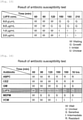
- Fig. 13 illustrates a table summarizing the determination result from the graph of Fig. 12 .
- the antimicrobial agent is not contained, it is difficult to determine whether or not the proliferation is performed for 120 minutes from the start of culture, Waiting is determined, and "W" is displayed. After this, since the areas of the bacteria increase after 150 minutes, Growth is determined, and "G” is displayed.
- levofloxacin of 0.5 ⁇ g/mL is included
- it is difficult to determine whether or not the proliferation is performed for 90 minutes after the start of culture, Waiting is determined, and "W” is displayed. After this, since the areas of the bacteria increase after 120 minutes, Growth is determined, and "G” is displayed.
- G is determined under the culture condition where levofloxacin of 0.5 ⁇ g/mL is included, in addition to the information. Furthermore, information displayed every time when the number of times of measurement increases as time elapses, is added.
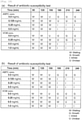
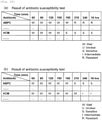
- Fig. 14 illustrates a result of determining R, I, and S with respect to each of the antimicrobial agents by performing the determination illustrated in Fig. 13 for each antimicrobial agent at each measurement time and comparing the break points.
- Fig. 14 is a view summarizing which antimicrobial agent is effective and which antimicrobial agent is ineffective with respect to a certain bacterium. Summarization by representing sensitivity with respect to the antimicrobial agent by R, I, and S by summarizing the data of the same type of bacteria obtained by separating the table illustrated in Fig.
- Fig. 14 is a table which is a base thereof.
- the result (R, I, and S) of the sensitivity determination for each measurement time is obtained. Therefore, the data which is a base of the antibiogram of the related art is obtained in more detail. Furthermore, Fig.
- Fig. 13 is configured of data obtained by the sensitivity determination (R, I, and S) at various concentrations with respect to each of the antimicrobial agents, that is, Fig. 13 . Therefore, it is possible to refer to the result with respect to each of the antimicrobial agents.
- Fig. 13 is determined from the graph illustrated in Fig. 12 created based on the observation result at each measurement time. Therefore, it is possible to refer to time series data of the areas of the bacteria under the culture condition of various antimicrobial agent concentrations. In this manner, since it is possible to more specifically refer to the data that is the base of the antibiogram, not only the type of the antimicrobial agent but also the information of the sensitivity with respect to the antimicrobial agent can be promptly and specifically obtained.
- the field of levofloxacin of antimicrobial agent is hatched by grey in the table illustrated in Fig. 14 .
- the antimicrobial agent which is currently being administered is highlighted (emphasized), and it is also possible to easily determine whether or not the use of the antimicrobial agent which is being administered should be continued.
- the antimicrobial agent may be displayed to be greater than other antimicrobial agents, may be displayed in a bold latter, or may be displayed by blinking.
- the column of 16 hrs in the table of Fig. 14 is the result obtained by performing the determination of R, I, and S using the MIC determination according to the method of the related art, but the columns on the left side therefrom illustrate the result obtained by performing the determination of R, I, and S based on the measurement result at 60 to 180 minutes.
- the determination of R, I, and S is performed after one night is elapsed from the start of culture, but according to the embodiment of the invention, it is possible to display the determination result of R, I, and S in each microscopic observation.
- Fig. 15 is a view illustrating an examination result of the E coli separated from different patients. Specifically, Fig. 15(a) illustrates time-depending change of the areas of bacteria in a case where the E coli separated from a patient A is cultured under the condition where ampicillin is included. In addition, Fig. 15(b) illustrates time-depending change of the E coli in a case where the E coli separated from a patient B is cultured under the condition where ampicillin is included. Both of Figs. 15(a) and 15(b) standardize the areas of the bacteria by the areas of the bacteria when the culture is started.
- Fig. 15(a) compared to a case where the antimicrobial agent is not included, the area slightly increases even in a case of ampicillin of 512 ⁇ g/mL Meanwhile, in Fig. 15(b) , the increase tends to be stopped in a case of ampicillin of 4 ⁇ g/mL, and when the concentration of ampicillin is 8 ⁇ g/mL or greater, it can be ascertained that the bacteria are damaged due to the action of the ampicillin and the area tends to decrease.
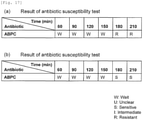
- Fig. 16 is a view illustrating the proliferation determination result (MIC determination result) of the E coli separated from each of the patients A and B. Any of the E coli separated from the patient A illustrated in Fig. 16(a) is determined to proliferate. Meanwhile, in a case of the E coli separated from the patient B illustrated in Fig. 16(b) , it is determined that the proliferation is interrupted after 180 minutes from the start of culture when the concentration of ampicillin is 8 ⁇ g/mL or greater. From the result, it is determined that the strains of the E coli separated from the patients A and B are different from each other.
- MIC determination result proliferation determination result
- the determination result of the antimicrobial susceptibility is obtained on the next day of the start of culture, but according to the invention, it is possible to perform the proliferation determination of the bacteria by interpreting the change in areas of the bacteria every time when performing the microscopic observation, and to promptly perform the determination of the strains of the bacteria.
- Fig. 17 is a view illustrating the result (result of comparison with the break points) obtained by performing the sensitivity determination of the E coli separated from each of the patients A and B.
- ampicillin durability is determined.
- ampicillin sensitivity is determined in a case of the E coli separated from the patient B illustrated in Fig. 17(b) .
- Fig. 18 is a view illustrating an examination result of Staphylococcus aureus separated from different patients. Specifically, Figs. 18(a) and 18(c) illustrate time-dependent change of the areas of the bacteria in a case where the Staphylococcus aureus separated from the patient A is cultured under the condition where ampicillin or vancomycin is included. In addition, Figs. 18(b) and 18(d) illustrate time-dependent change of the E coli in a case where the Staphylococcus aureus separated from the patient B is cultured under the condition where ampicillin or vancomycin is included. In Figs. 18(a) to 18(d) , the area of the bacteria is standardized by the area of the bacteria at the start of culture.
- Fig. 18(a) compared to a case where the antimicrobial agent is not included, the area slightly increases even in a case of ampicillin of 0.125 ⁇ g/mL, and proliferation of ampicillin is interrupted when the concentration of ampicillin is 0.25 ⁇ g/mL or greater. Meanwhile, in Fig. 18(b) , the proliferation is substantially interrupted when the concentration of ampicillin is 0.125 ⁇ g/mL. In addition, in Fig. 18(c) , when the antimicrobial agent is not included, in a case where the concentration of vancomycin is 0.25 ⁇ g/mL, the proliferation is confirmed, but in Fig.
- the proliferation is recognized until the concentration of vancomycin reaches 0.5 ⁇ g/mL
- the Staphylococcus aureus separated from the patient A and the Staphylococcus aureus separated from the patient B have different MICs with respect to the ampicillin and vancomycin. Since the data illustrated in Fig. 18 is a result interpreted from the image obtained within 300 minutes from the start of culture, it can be ascertained that it is possible to more promptly recognize the strains of the bacteria compared to the method of the related art.
- Fig. 19 is a view illustrating the proliferation determination result (MIC determination result) with respect to the Staphylococcus aureus separated from each of the patients A and B.
- the proliferation is performed until the concentration of ampicillin reaches 0.125 ⁇ g/mL, and it is determined that the proliferation is interrupted when the concentration of ampicillin is 0.25 ⁇ g/mL or greater.
- the proliferation is performed when the concentration of vancomycin is 0.25 ⁇ g/mL, and it is determined that the proliferation is interrupted when the concentration of vancomycin is 0.5 ⁇ g/mL or greater.
- Fig. 20 is a view illustrating the result (result of comparison with the break points) obtained by performing a antimicrobial susceptibility testing with respect to the Staphylococcus aureus separated from each of the patients A and B.
- the resistance of ampicillin and the sensitivity of vancomycin are determined.
- the susceptibility of ampicillin and vancomycin is determined as Intermediate.
- the determination of antimicrobial susceptibility is obtained on the next day of the start of culture.
- the proliferation determination of the bacteria by interpreting the change of the areas of the bacteria every time when the microscopic observation is performed, and to promptly perform the determination of the sensitivity or resitance of the bacteria with respect to the antimicrobial, by using the proliferation determination of the bacteria at the concentrations of each of the antimicrobial agents.
- a prompt response for example, a change of antimicrobial agent or a change of a treating method, becomes possible.
- Fig. 22 is a view (graph) illustrating a result obtained by antimicrobial susceptibility testing with respect to meropenem of Pseudomonas aeruginosa.
- the graph acquires the circularity of the Pseudomonas aeruginosa in the image measured through the microscopic observation, and illustrates the time-dependent change thereof.
- the plurality of Pseudomonas aeruginosa are observed in one image, but the circularity of each of the Pseudomonas aeruginosa is acquired, and the value obtained by calculating an average value of the bacteria in the image is plotted.
- the circularity is a value calculated by 4 ⁇ ⁇ (area)/ (perimeter length) ⁇ 2.
- the concentration of meropenem of which the circularity continues to decrease is 0.125 ⁇ g/mL and 0.25 ⁇ g/mL
- the bacteria are elongated by the effect of the antimicrobial agent, but it is determined that the Pseudomonas aeruginosa has not become extinct yet.
- the concentration of meropenem of which the decrease in circularity is stopped is 0.5 ⁇ g/mL or greater
- the shape of the bacteria changes. However, since the bacteria become extinct at a higher concentration of antimicrobial agent, the circularity does not change.
- the circularity decreases once in accordance with the concentration of antimicrobial agent, and the circularity does not decrease at a higher concentration of antimicrobial agent, but the concentration can be estimated as MBC.
- the exemplary embodiment is an example in which the time-dependent change of the circularity of the bacteria is plotted instead of plotting the time-dependent change of the areas of the bacteria.
- the time-dependent change of the feature values that become an index for indicating a degree of proliferation or growth of the bacteria in addition to the bacterial numbers or the areas of the bacteria, not only the minimum inhibitory concentration (MIC) of the bacteria but also the minimum bactericidal concentration (MBC) can be determined.
- MIC minimum inhibitory concentration
- MBC minimum bactericidal concentration
- the influence determination information that shows influence given by the antimicrobial agent to the bacteria or fungi is generated with respect to the plural types of antimicrobial agents and the plural types of concentrations, and the influence determination information is displayed in a time series. According to this, it is possible to accelerate the selection of the treating method with respect to the patient, and to perform prompt and appropriate drug administration. In other words, in the invention, it is determined whether or not the bacteria proliferate by performing the microscopic observation with respect to the culture fluid for the bacterial identification culture or the antimicrobial susceptibility examination.
- an testing instrument having a temperature adjusting function including: a light source for performing the microscopic observation of each of the wells in the culture plate for the bacterial identification culture or the antimicrobial susceptibility testing, a mirror, an objective lens, and a CCD for obtaining an image; a light source for performing measurement of absorbance of each of the wells in the culture plate, a mirror, and a photodiode; and an XYZ stage for changing the position of the culture plate in order to observe or measure each of the wells, is used.
- the light source or the mirror for the microscopic observation may be the same as the light source or the mirror for the measurement of absorbance, or may be separately installed.
- the turbidity (absorbance in the vicinity of the wavelength of 600 nm) can be measured by installing a suitable bandpass filter between the light source and the mirror.
- the microscopic observation in white light can be performed by switching the bandpass filter with a different filter.
- a mirror may be installed in front of the CCD for obtaining the microscopic observation image, or the photodiode for measuring absorbance, and the mirror may be switched when performing measurement thereof.
- the culture plate is installed on the XYZ stage, culture is performed while the temperature is controlled to be approximately 35°C, the XYZ stage is operated at the set time, and the state of each of the wells in the culture plate is observed.
- controlling is performed by setting the conditions using the control PC set in the testing instrument.
- the control PC also sets the timing to perform observation of the wells in the culture plate or the timing to perform measurement of absorbance and records the result thereof.
- the shape or the number of bacteria in the wells is measured by the microscopic observation.
- the measurement result is interpreted by the PC, the time-dependent change of the shape, the number, or the area of the bacteria in the wells is made in a graph and is determined, and accordingly, it is determined whether or not the bacteria proliferate in each of the wells for each measurement.
- the bacteriological testing instrument in the related art monitors the proliferation of bacteria by measuring the turbidity of the culture fluid.
- the culture fluid and the quantity of bacteria are defined, and it is not easy to reduce the time of examination by performing the measurement of absorbance.
- the growth of the bacteria can be monitored by performing the microscopic observation using an objective lens of approximately twenty magnifications, so that it is possible to determine whether or not each of the bacteria is grown. Accordingly, when the phase shifts from an induction phase (lag phase) to a logarithmic phase (log phase), it is possible to determine whether or not the bacteria is grown. Generally, the proliferation profile of bacteria shifts from the induction phase to the logarithmic phase within 30 minutes to 3 hours. Therefore, it is possible to determine whether the bacteria proliferate faster than the determination performed based on the turbidity.
- the determination result by displaying the determination result on the screen, it is possible to provide the information of resistance to antibiotics every time when the microscopic observation is finished.
- the number of times of microscopic observation also increases when the culture time is elapsed, the plurality of determination results are provided, and it is possible to gradually improve the accuracy of the determination result.
- the result of the antimicrobial susceptibility testng is displayed at each time set in advance, and the results of the antimicrobial susceptibility determination with respect to the plurality of bacteria or fungi are displayed in parallel. According to this, it is possible to help determination whether the strains of the bacteria are the same or are different from each other, or to help specification of the route of nosocomial infection.
- the invention can also be realized by a program code of software which realizes the function of the embodiment.
- a storage medium in which the program code is recorded is provided in a system or an apparatus, and a computer (otherwise, a CPU or an MPU) of the system or the apparatus reads out the program code stored in the storage medium.
- the program code itself which is read out from the storage medium realizes the above-described function of the embodiment, and the program code itself and the storage medium storing the program code are configured to be the invention.
- a flexible disk for example, a flexible disk, a CD-ROM, a DVD-ROM, a hard disk, an optical disk, a magneto-optic disk, a CD-R, a magnetic tape, a non-volatile memory card, and a ROM are used.
- an operating system (OS) driven in the computer, or the like may perform a portion or the entirety of the actual processing, and the above-described function of the embodiment may be realized through the processing.
- the program code read out from the storage medium may be written in a memory in the computer. Thereafter, based on the instruction of the program code thereof, the CPU or the like of the computer may perform a portion of the entirety of the actual processing, and above-described function of the embodiment may be realized through the processing.
- the program code of the software which realizes the function of the embodiment may be delivered via a network.
- the program code may be stored in storage means such as the hard disk or the memory of the system or the apparatus; or the storage medium such as a CD-RW and a CD-R.
- the computer otherwise, the CPU or the MPU of the system or the apparatus may read out and execute the program code stored in the storage means or the storage medium.
- the above-referenced software may be implemented by a wide-range program or a script language such as an assembler, C/C++, perl, Shell, PHP, and Java (registered trademark).
- control lines or the information lines considered to be necessary in the description are indicated. All the control lines or the information lines in a product are not necessarily indicated. All the configurations may be connected to each other.
Landscapes
- Chemical & Material Sciences (AREA)
- Engineering & Computer Science (AREA)
- Health & Medical Sciences (AREA)
- Life Sciences & Earth Sciences (AREA)
- Organic Chemistry (AREA)
- Wood Science & Technology (AREA)
- Zoology (AREA)
- Bioinformatics & Cheminformatics (AREA)
- Biotechnology (AREA)
- General Health & Medical Sciences (AREA)
- Microbiology (AREA)
- Genetics & Genomics (AREA)
- Biochemistry (AREA)
- General Engineering & Computer Science (AREA)
- Analytical Chemistry (AREA)
- Proteomics, Peptides & Aminoacids (AREA)
- Physics & Mathematics (AREA)
- Biomedical Technology (AREA)
- Sustainable Development (AREA)
- Molecular Biology (AREA)
- Immunology (AREA)
- Toxicology (AREA)
- Biophysics (AREA)
- Theoretical Computer Science (AREA)
- General Physics & Mathematics (AREA)
- Medicinal Chemistry (AREA)
- Radiology & Medical Imaging (AREA)
- Clinical Laboratory Science (AREA)
- Medical Informatics (AREA)
- Nuclear Medicine, Radiotherapy & Molecular Imaging (AREA)
- Cell Biology (AREA)
- Quality & Reliability (AREA)
- Computer Vision & Pattern Recognition (AREA)
- Measuring Or Testing Involving Enzymes Or Micro-Organisms (AREA)
- Apparatus Associated With Microorganisms And Enzymes (AREA)
- Image Processing (AREA)
- Image Analysis (AREA)
Applications Claiming Priority (3)
| Application Number | Priority Date | Filing Date | Title |
|---|---|---|---|
| JP2015013445A JP6504834B2 (ja) | 2015-01-27 | 2015-01-27 | 検査装置 |
| EP16743230.1A EP3252138B1 (en) | 2015-01-27 | 2016-01-22 | Test device |
| PCT/JP2016/051770 WO2016121627A1 (ja) | 2015-01-27 | 2016-01-22 | 検査装置 |
Related Parent Applications (2)
| Application Number | Title | Priority Date | Filing Date |
|---|---|---|---|
| EP16743230.1A Division-Into EP3252138B1 (en) | 2015-01-27 | 2016-01-22 | Test device |
| EP16743230.1A Division EP3252138B1 (en) | 2015-01-27 | 2016-01-22 | Test device |
Publications (1)
| Publication Number | Publication Date |
|---|---|
| EP3967744A1 true EP3967744A1 (en) | 2022-03-16 |
Family
ID=56543240
Family Applications (2)
| Application Number | Title | Priority Date | Filing Date |
|---|---|---|---|
| EP21197801.0A Pending EP3967744A1 (en) | 2015-01-27 | 2016-01-22 | Test device |
| EP16743230.1A Active EP3252138B1 (en) | 2015-01-27 | 2016-01-22 | Test device |
Family Applications After (1)
| Application Number | Title | Priority Date | Filing Date |
|---|---|---|---|
| EP16743230.1A Active EP3252138B1 (en) | 2015-01-27 | 2016-01-22 | Test device |
Country Status (4)
| Country | Link |
|---|---|
| US (2) | US10793821B2 (https=) |
| EP (2) | EP3967744A1 (https=) |
| JP (1) | JP6504834B2 (https=) |
| WO (1) | WO2016121627A1 (https=) |
Families Citing this family (7)
| Publication number | Priority date | Publication date | Assignee | Title |
|---|---|---|---|---|
| JP2020532993A (ja) * | 2017-09-07 | 2020-11-19 | コーニング インコーポレイテッド | 光学的細胞培養監視及び検体測定システム |
| JP7032216B2 (ja) * | 2018-04-04 | 2022-03-08 | 株式会社日立ハイテク | 細菌検査装置および細菌検査方法 |
| JP7319407B2 (ja) * | 2018-04-04 | 2023-08-01 | 株式会社日立ハイテク | 細菌検査装置および細菌検査方法 |
| JP7130109B2 (ja) * | 2019-03-04 | 2022-09-02 | 株式会社日立ハイテク | 検査装置および検査方法 |
| CN112400023A (zh) * | 2019-03-14 | 2021-02-23 | 株式会社日立高新技术 | 药剂敏感性检查方法 |
| EP3996583B1 (en) * | 2019-07-08 | 2026-02-25 | Emory University | Method and system for determining antimicrobial resistance of a sample using surface topography determined from optical imaging data |
| WO2021067170A1 (en) * | 2019-10-01 | 2021-04-08 | Beth Israel Deaconess Medical Center, Inc. | Rapid antimicrobial susceptibility testing by image analysis |
Citations (6)
| Publication number | Priority date | Publication date | Assignee | Title |
|---|---|---|---|---|
| WO2001009371A1 (en) * | 1999-07-30 | 2001-02-08 | Akzo Nobel N.V. | Apparatus and method for detecting, quantifying and characterizing microorganisms |
| US20090093046A1 (en) * | 2005-11-11 | 2009-04-09 | Nikon Corporation | Incubation apparatus |
| US20120077206A1 (en) * | 2003-07-12 | 2012-03-29 | Accelr8 Technology Corporation | Rapid Microbial Detection and Antimicrobial Susceptibility Testing |
| EP2757371A1 (en) * | 2011-09-13 | 2014-07-23 | Osaka University | Method for testing antibacterial-drug sensitivity of bacterium or fungus and system used for same |
| WO2014145899A1 (en) * | 2013-03-15 | 2014-09-18 | Accelerate Diagnostics, Inc. | Rapid determination of microbial growth and antimicrobial susceptibility |
| WO2015141040A1 (ja) * | 2014-03-19 | 2015-09-24 | 株式会社日立ハイテクノロジーズ | 検査装置 |
Family Cites Families (14)
| Publication number | Priority date | Publication date | Assignee | Title |
|---|---|---|---|---|
| US5698414A (en) * | 1989-10-24 | 1997-12-16 | Infectech, Inc. | Method and apparatus for testing paraffinophilic microorganisms for antimicrobial agent sensitivity |
| JP3045566B2 (ja) * | 1991-05-22 | 2000-05-29 | 和光純薬工業株式会社 | 細菌検査装置 |
| IL101522A (en) | 1992-04-08 | 1997-09-30 | Combact Imaging Systems Ltd | Detection of microorganisms in a sample and determination of the sensitivity of microorganisms to antibiotics |
| JPH09117299A (ja) * | 1995-10-25 | 1997-05-06 | Shimadzu Corp | 細菌の抗生物質感受性検査方法 |
| US6420622B1 (en) | 1997-08-01 | 2002-07-16 | 3M Innovative Properties Company | Medical article having fluid control film |
| JP4217378B2 (ja) * | 1997-08-01 | 2009-01-28 | スリーエム カンパニー | 微生物の検知および計数の方法および器具 |
| WO2000067037A2 (en) | 1999-04-29 | 2000-11-09 | Dade Microscan Inc. | A combined rapid anti-microbial susceptibility assay and microorganism identification system |
| GB2372147A (en) | 2001-02-13 | 2002-08-14 | Marconi Applied Techn Ltd | Magnetron with radiation absorbing dielectric resonator |
| US6645737B2 (en) | 2001-04-24 | 2003-11-11 | Dade Microscan Inc. | Method for maintaining test accuracy within a microbiological test array |
| JP2005261260A (ja) * | 2004-03-17 | 2005-09-29 | Fuji Electric Holdings Co Ltd | 微生物または細胞の検査装置及び検査方法 |
| JP4839010B2 (ja) * | 2005-03-29 | 2011-12-14 | シスメックス株式会社 | 分析システム、データ処理装置、及びアプリケーションプログラム |
| PL217886B1 (pl) | 2009-03-13 | 2014-08-29 | Int Tobacco Machinery Poland | Układ transferujący, współpracujący z maszyną do produkcji sztabek produktów tytoniowych i filtrowych, oraz sposób transferu takich sztabek w układzie transferującym |
| JP2010213598A (ja) * | 2009-03-16 | 2010-09-30 | Kyokuto Seiyaku Kogyo Kk | 抗菌薬の微生物に対する有効性の検査方法 |
| JP2013538567A (ja) * | 2010-08-12 | 2013-10-17 | ザ リージェンツ オブ ザ ユニバーシティ オブ カリフォルニア | 抗菌化合物を同定するおよび抗生物質感受性を決定する方法 |
-
2015
- 2015-01-27 JP JP2015013445A patent/JP6504834B2/ja active Active
-
2016
- 2016-01-22 US US15/544,302 patent/US10793821B2/en active Active
- 2016-01-22 EP EP21197801.0A patent/EP3967744A1/en active Pending
- 2016-01-22 EP EP16743230.1A patent/EP3252138B1/en active Active
- 2016-01-22 WO PCT/JP2016/051770 patent/WO2016121627A1/ja not_active Ceased
-
2020
- 2020-09-02 US US17/010,467 patent/US11851642B2/en active Active
Patent Citations (6)
| Publication number | Priority date | Publication date | Assignee | Title |
|---|---|---|---|---|
| WO2001009371A1 (en) * | 1999-07-30 | 2001-02-08 | Akzo Nobel N.V. | Apparatus and method for detecting, quantifying and characterizing microorganisms |
| US20120077206A1 (en) * | 2003-07-12 | 2012-03-29 | Accelr8 Technology Corporation | Rapid Microbial Detection and Antimicrobial Susceptibility Testing |
| US20090093046A1 (en) * | 2005-11-11 | 2009-04-09 | Nikon Corporation | Incubation apparatus |
| EP2757371A1 (en) * | 2011-09-13 | 2014-07-23 | Osaka University | Method for testing antibacterial-drug sensitivity of bacterium or fungus and system used for same |
| WO2014145899A1 (en) * | 2013-03-15 | 2014-09-18 | Accelerate Diagnostics, Inc. | Rapid determination of microbial growth and antimicrobial susceptibility |
| WO2015141040A1 (ja) * | 2014-03-19 | 2015-09-24 | 株式会社日立ハイテクノロジーズ | 検査装置 |
Non-Patent Citations (2)
| Title |
|---|
| JAPANESE JOURNAL OF CHEMOTHERAPY, vol. 50, no. 5, 2002, pages 259 - 265 |
| JOURNAL OF CLINICAL MICROBIOLOGY, vol. 38, no. 6, 2000, pages 2108 - 2111 |
Also Published As
| Publication number | Publication date |
|---|---|
| US11851642B2 (en) | 2023-12-26 |
| EP3252138A1 (en) | 2017-12-06 |
| EP3252138B1 (en) | 2021-10-27 |
| US10793821B2 (en) | 2020-10-06 |
| US20180010084A1 (en) | 2018-01-11 |
| US20200399581A1 (en) | 2020-12-24 |
| JP6504834B2 (ja) | 2019-04-24 |
| JP2016136876A (ja) | 2016-08-04 |
| WO2016121627A1 (ja) | 2016-08-04 |
| EP3252138A4 (en) | 2018-08-08 |
Similar Documents
| Publication | Publication Date | Title |
|---|---|---|
| US11851642B2 (en) | Test device | |
| US11578300B2 (en) | Test apparatus | |
| Vonk et al. | Protocol for application, standardization and validation of the forskolin-induced swelling assay in cystic fibrosis human colon organoids | |
| Kirchhoff et al. | Simple ciprofloxacin resistance test and determination of minimal inhibitory concentration within 2 h using Raman spectroscopy | |
| Delves et al. | Routine in vitro culture of P. falciparum gametocytes to evaluate novel transmission-blocking interventions | |
| US20190162655A1 (en) | Combined optical-spectroscopic method for identifying microbial pathogens | |
| JP6906005B2 (ja) | 細菌または真菌の同定検査や薬剤感受性検査の判定を行う方法、および検査装置 | |
| Guo et al. | Whole genome sequencing highlights the pathogenic profile in Nocardia keratitis | |
| Mirza et al. | Ad hoc analysis of the phase III ENGOT-OV16/NOVA study: niraparib efficacy in germline BRCA wild-type recurrent ovarian cancer with homologous recombination repair defects | |
| Qu et al. | Live imaging of microtubule dynamics at excitatory presynaptic boutons in primary hippocampal neurons and acute hippocampal slices | |
| JP6636109B2 (ja) | 検査装置 | |
| Garcia et al. | Semi-automatic pd-l1 characterization and enumeration of circulating tumor cells from non-small cell lung cancer patients by immunofluorescence | |
| McAdam | Reducing contamination of blood cultures: consider costs and clinical benefits | |
| Kahng et al. | High-confidence and high-throughput quantification of synapse engulfment by oligodendrocyte precursor cells | |
| Wager et al. | A fence barrier method of leading edge cell capture for explorative biochemical research | |
| Winfree et al. | Quantitative dextran trafficking to the Coxiella burnetii parasitophorous vacuole | |
| Hames et al. | Analyzing macrophage infection at the organ level | |
| Milanová et al. | Application of dicentric chromosome assay for evaluation of radioprotective effect | |
| CN210736776U (zh) | 一种培养检测仪 | |
| Mayerhöfer et al. | Moving raman spectroscopy into the clinic | |
| Walsh | Diagnostic Methods Employed in Oral and Maxillofacial Pathology | |
| Choi et al. | Single-cell morphological analysis for rapid antimicrobial susceptibility test | |
| Khdeda et al. | Functional Characterization of POLE1 Variant Fibroblasts Reveals Replication Stress and Increased Sensitivity to Genotoxic Stress | |
| Malmberg | Development of a robust and rapid microfluidics-based antibiotic susceptibility test: From prototype to clinical implementation | |
| Chan et al. | Application of laser tweezers Raman spectroscopy techniques to the monitoring of single cell response to stimuli |
Legal Events
| Date | Code | Title | Description |
|---|---|---|---|
| PUAI | Public reference made under article 153(3) epc to a published international application that has entered the european phase |
Free format text: ORIGINAL CODE: 0009012 |
|
| STAA | Information on the status of an ep patent application or granted ep patent |
Free format text: STATUS: REQUEST FOR EXAMINATION WAS MADE |
|
| 17P | Request for examination filed |
Effective date: 20211027 |
|
| AC | Divisional application: reference to earlier application |
Ref document number: 3252138 Country of ref document: EP Kind code of ref document: P |
|
| AK | Designated contracting states |
Kind code of ref document: A1 Designated state(s): AL AT BE BG CH CY CZ DE DK EE ES FI FR GB GR HR HU IE IS IT LI LT LU LV MC MK MT NL NO PL PT RO RS SE SI SK SM TR |
|
| STAA | Information on the status of an ep patent application or granted ep patent |
Free format text: STATUS: EXAMINATION IS IN PROGRESS |
|
| 17Q | First examination report despatched |
Effective date: 20240701 |