EP3966073B1 - Kopfstütze und fahrzeugsitz - Google Patents
Kopfstütze und fahrzeugsitz Download PDFInfo
- Publication number
- EP3966073B1 EP3966073B1 EP20725149.7A EP20725149A EP3966073B1 EP 3966073 B1 EP3966073 B1 EP 3966073B1 EP 20725149 A EP20725149 A EP 20725149A EP 3966073 B1 EP3966073 B1 EP 3966073B1
- Authority
- EP
- European Patent Office
- Prior art keywords
- headrest
- wave
- cushion
- cushion support
- headrest according
- Prior art date
- Legal status (The legal status is an assumption and is not a legal conclusion. Google has not performed a legal analysis and makes no representation as to the accuracy of the status listed.)
- Active
Links
Images

Classifications
-
- B—PERFORMING OPERATIONS; TRANSPORTING
- B60—VEHICLES IN GENERAL
- B60N—SEATS SPECIALLY ADAPTED FOR VEHICLES; VEHICLE PASSENGER ACCOMMODATION NOT OTHERWISE PROVIDED FOR
- B60N2/00—Seats specially adapted for vehicles; Arrangement or mounting of seats in vehicles
- B60N2/80—Head-rests
-
- B—PERFORMING OPERATIONS; TRANSPORTING
- B60—VEHICLES IN GENERAL
- B60N—SEATS SPECIALLY ADAPTED FOR VEHICLES; VEHICLE PASSENGER ACCOMMODATION NOT OTHERWISE PROVIDED FOR
- B60N2/00—Seats specially adapted for vehicles; Arrangement or mounting of seats in vehicles
- B60N2/80—Head-rests
- B60N2/888—Head-rests with arrangements for protecting against abnormal g-forces, e.g. by displacement of the head-rest
Definitions
- the invention relates to a headrest for a vehicle seat, comprising a cushion support, a cushion arranged or arrangeable on the cushion support, and at least one support rod extending vertically from the cushion support for fastening the headrest to the vehicle seat, wherein the cushion support has a head impact region on a horizontally and vertically extending front side.
- the invention relates to a vehicle seat with such a headrest.
- Headrests and vehicle seats of the type mentioned above are already known from the prior art.
- the published patent application DE 10 2008 019 193 A1 A headrest for a vehicle seat with a cushion support to which a cushion and a support rod can be attached.
- the cushion serves to comfortably support a user's head
- the support rod serves to arrange and secure the cushion support to the vehicle seat.
- a headrest has two such support rods, which are inserted into receptacles in the vehicle seat and locked into the receptacles to position and secure the headrest to the vehicle seat.
- the above-mentioned publication proposes providing a plurality of adjacent depressions and protrusions to increase mechanical stability.
- the cushion support which is designed as a thin-walled shell body, in order to reliably absorb impact forces, in particular when a user's head strikes the cushion support or the headrest.
- the cushion support has a head impact area, which serves to advantageously absorb the impact forces.
- a similar headrest is also described in the published application WO 2017/005660 A1 It is proposed to provide a rib structure of spaced apart and laterally separated rib elements in the head impact area.
- DE 100 45 070 A1 discloses a headrest with a cushion support which has horizontally running grooves which are inclined downwards in cross-section.
- the invention is based on the object of providing an improved headrest for a vehicle seat which ensures improved positioning of a head in the event of an impact on the head impact area and improved absorption of impact forces.
- the object underlying the invention is achieved by a headrest with the features of claim 1.
- This has the advantage that, due to an advantageous design of the cushion support, impact forces are advantageously introduced into the cushion support, and that, on the other hand, an advantageous positioning of the head on the cushion support takes place, which in particular prevents the user's head from slipping off the headrest.
- This advantageous design ensures that the head is advantageously positioned and held on the headrest in the event of an impact.
- the cushion support has a closed wave profile in the head impact area with vertically adjacent wave crests that extend horizontally, in particular parallel to one another and preferably in a straight line.
- the head impact area is thus formed by a closed profile, namely a closed wave profile.
- the waves run horizontally and thus extend transversely, in particular perpendicular to the longitudinal extent of the support rod. By providing a plurality of wave crests, these then lie vertically one above the other or, according to the invention, vertically adjacent and separated from one another by wave troughs.
- the advantageous design of the closed wave profile ensures optimal head positioning in the event of an impact against the headrest. Furthermore, the closed wave profile ensures the headrest's high robustness in the event of an impact, reducing the risk of injury to the user.
- the cushion support is constructed in several parts, in particular in two parts, with a base part carrying the support rod and a profile element having the wave profile.
- the multi-part construction simplifies production and reduces manufacturing costs.
- different wave profiles can be arranged on a headrest, for example, depending on further boundary conditions relating to the motor vehicle having the headrest, thus creating an advantageous headrest system that can be easily Replacing or selecting a specific profile element allows for adjustment of the headrest.
- the profile element is conveniently attached to the cushion support or the base part. Particularly preferably, the profile element is held in place by a form-fitting manner on the cushion support.
- screwing the profile element to the cushion support is also conceivable.
- the profile element is preferably made of plastic. This ensures a low weight and allows for advantageous force absorption.
- the profile element in particular the profile element made of plastic, is integrally connected to the base part.
- the integral connection is preferably created by welding, soldering, or gluing the profile element to the base part.
- the profile element is preferably positively connected to the base part or fastened to it.
- the positive connection is realized in particular by one or more plug-in connections or snap-in connections.
- the profile element is designed to be elastically deformable in order to ensure that, in the event of high impact forces, the profile element does not break or splinter and the impact of the head on the headrest is cushioned.
- the padding is particularly preferably made of a foam material to ensure a comfortable head position as well as advantageous force absorption and distribution.
- the cushion has a wave structure on a holding section associated with the profile element that corresponds to, in particular complements, the wave profile, so that the wave structure of the cushion and the wave profile of the cushion support interlock for fixation.
- the interlocking wave crests and wave troughs of the wave profile and wave structure ensure that the cushion is advantageously aligned and fixed to the cushion support or to the profile element of the cushion support.
- the interlocking or fixation ensures that the cushion does not shift relative to the cushion support when a cover or the like is pulled on.
- the profile element has a curvature, in particular a concave curvature, viewed horizontally, into which the then preferably also curved holding section of the cushion, in particular a convexly curved holding section, engages, thus preventing horizontal or lateral displacement of the cushion relative to the profile element.
- the advantageous concave curvature of the profile element further improves the accommodation and alignment of the head in the event of an impact.
- the base part of the profile support is made of plastic. This makes the headrest lightweight overall and allows for cost-effective production.
- the base part has a plurality of horizontally adjacent and vertically extending stiffening ribs.
- the stiffening ribs stiffen the base part, which is particularly designed as a thin-walled or shell-shaped base part, in a simple and cost-effective manner.
- two parallel support rods are arranged on the base part. This ensures a clear and secure positioning of the headrest on the vehicle seat.
- the vehicle seat according to the invention with the features of claim 15 is characterized by the inventive design of the headrest.
- the vehicle seat has a receiving recess for each support rod of the headrest, into which the support rod can be inserted to arrange the headrest on the vehicle seat.
- the vehicle seat and/or the respective support rod have means for latching or locking the support rod in the receiving recess to prevent the headrest from accidentally detaching from the vehicle seat.
- FIG. 1 shows a simplified perspective view of a vehicle seat 1 for a motor vehicle not shown in detail here.
- the vehicle seat 1 has a backrest 2, at the upper end of which a headrest 3 is arranged.
- the headrest 3 has two holding rods 4, which are inserted into receiving recesses 5 in the backrest along their longitudinal extent.
- the holding rods 4 and the backrest 2 have means 6 for releasably locking the holding rods in the respective receiving recess 5 in order to fasten the headrest 3 to the backrest 2, in particular at different heights.
- Such vehicle seats 1 are generally known, so that the locking capability or fastening of the headrest 3 to the backrest 2 will not be discussed in detail here.
- the headrest 3 has a cushion cover 7 with a cushion 8 made of a foam material, which is arranged on a cushion support 9 of the headrest 3.
- the cushion support 9 has a base part 10 and a profile element 11 fastened to the base part 10.
- the base part 10 and the profile element 11 are both preferably made of plastic.
- the base element 10 is designed as a thin-walled shell element.
- the support rods 4 are preferably fastened to the base part 10.
- the profile element 11 is arranged on a front side of the base part 10, so that the base part 11 forms a front side 12 of the cushion support 9.
- the front side 12 faces the head of a user sitting on the vehicle seat 1, i.e., normally points forward during forward travel.
- the wave crests 14 When used as intended, the wave crests 14 thus extend along horizontal lines and are arranged vertically or vertically spaced from one another, with a wave trough 15 being formed between each two adjacent wave crests 14. Furthermore, the profile element 11 is concave on the front side 12 in the longitudinal extension of the wave crests 14, so that the profile element 11 offers advantageous positioning and a protective effect for a user's head in the event that the user's head impacts the headrest 3, for example due to a rear-end collision. The wave profile 13 thus forms a head impact area 16 of the headrest 3 on the front side 12.
- Figure 2 shows the advantageous headrest 3 in a side view.
- the wave crests 14 and the intermediate wave troughs 15 are advantageously visible.
- Support rods 14 extend at least substantially vertically or perpendicularly relative to the wave crests 14 of the wave profile 13.
- Figure 3 shows a rear view of the headrest 3.
- the base part 10 is not designed as a closed profile, but rather as a thin-walled shell element, as already described, which has a plurality of openings 17 that contribute to weight savings.
- the base part 10 has a plurality of vertically extending stiffening ribs 18 that are arranged horizontally adjacent to one another.
- the stiffening ribs 18 increase the robustness and load-bearing capacity of the headrest 3 despite its thin-walled design, so that even high impact forces can be safely absorbed.
- the profile element 11 is preferably designed to be elastically deformable, so that impact forces can be advantageously dampened directly at the profile element.
- the padding 8 also contributes to the damping.
- Figure 4 shows a sectional view through the headrest 3, which shows the cushion 8 arranged on the cushion support 9.
- the cushion 8 has a holding section 19 which faces the profile element 11, in particular the corrugated profile 13.
- the holding section 19 has a corrugated structure 20 which is designed to correspond to the corrugated profile 13 in such a way that the corrugated structure 20 is complementary to the corrugated profile 13.
- the corrugated structure 20 fills the spaces between the adjacent wave crests 14 of the corrugated profile 13, so that the corrugated structure 20 and the corrugated profile 13 engage with one another for fixing.
Landscapes
- Engineering & Computer Science (AREA)
- Aviation & Aerospace Engineering (AREA)
- Transportation (AREA)
- Mechanical Engineering (AREA)
- Seats For Vehicles (AREA)
Description
- Die Erfindung betrifft eine Kopfstütze für einen Fahrzeugsitz, mit einem Polsterträger, mit einem an dem Polsterträger angeordneten oder anordenbaren Polster, und mit zumindest einer sich von dem Polsterträger vertikal erstreckenden Haltestange zum Befestigen der Kopfstütze an dem Fahrzeugsitz, wobei der Polsterträger auf einer sich horizontal und vertikal erstreckenden Frontseite einen Kopfaufprallbereich aufweist.
- Weiterhin betrifft die Erfindung einen Fahrzeugsitz mit einer derartigen Kopfstütze.
- Kopfstützen und Fahrzeugsitze der eingangs genannten Art sind aus dem Stand der Technik bereits bekannt. So offenbart beispielsweise die Offenlegungsschrift
DE 10 2008 019 193 A1 eine Kopfstütze für einen Fahrzeugsitz mit einem Polsterträger, an welchem ein Polster sowie eine Haltestange befestigbar sind. Das Polster dient zur bequemen Kopfanlage eines Benutzers, die Haltestütze dient zum Anordnen und Befestigen des Polsterträgers an dem Fahrzeugsitz. Üblicherweise weist eine Kopfstütze zwei derartige Haltestangen auf, die in Aufnahmen des Fahrzeugsitzes eingeschoben und in den Aufnahmen verrastet werden, um die Kopfstütze an dem Fahrzeugsitz zu positionieren und zu arretieren. Um die Struktur der Kopfstütze zu versteifen, schlägt die oben genannte Druckschrift vor, eine Vielzahl einander benachbarter Vertiefungen und der Hervorhebungen zum Erhöhen der mechanischen Stabilität vorzusehen. Dadurch wird der Polsterträger, der als dünnwandiger Schalenkörper ausgebildet ist, versteift, um insbesondere Aufprallkräfte sicher aufzunehmen, wenn der Kopf eines Benutzers gegen den Polsterträger beziehungsweise die Kopfstütze trifft. Der Polsterträger weist dabei einen Kopfaufprallbereich auf, welcher zur vorteilhaften Aufnahme der Aufprallkräfte dient. Eine ähnliche Kopfstütze wird auch in der OffenlegungsschriftWO 2017/005660 A1 offenbart. Dabei wird vorgeschlagen, im Kopfaufprallbereich eine Rippenstruktur von beabstandet zueinander angeordneten und lateral voneinander getrennten Rippenelementen vorzusehen. Die OffenlegungsschriftDE 100 45 070 A1 offenbart eine Kopfstütze mit einem Polsterträger, welcher waagerecht verlaufende und im Querschnitt schräg nach unten gerichtete Rillen aufweist. - Der Erfindung liegt die Aufgabe zugrunde, eine verbesserte Kopfstütze für einen Fahrzeugsitz zu schaffen, die eine verbesserte Positionierung eines Kopfes bei einem Aufprall auf den Kopfaufprallbereich sowie eine verbesserte Aufnahme von Aufprallkräften gewährleistet.
- Die der Erfindung zugrundeliegende Aufgabe wird durch eine Kopfstütze mit den Merkmalen des Anspruchs 1 gelöst. Diese hat den Vorteil, dass aufgrund einer vorteilhaften Gestaltung des Polsterträgers zum einen Aufprallkräfte vorteilhaft in den Polsterträger eingeleitet werden, und dass zum anderen eine vorteilhafte Positionierung des Kopfs an dem Polsterträger erfolgt, die insbesondere ein Abrutschen des Kopfs des Benutzers von der Kopfstütze verhindert. Durch die vorteilhafte Ausbildung wird gewährleistet, dass der Kopf beim Aufprallen vorteilhaft an der Kopfstütze positioniert und gehalten wird. Erfindungsgemäß ist dazu vorgesehen, dass der Polsterträger in dem Kopfaufprallbereich ein geschlossenes Wellenprofil mit vertikal benachbarten und sich horizontal insbesondere parallel zueinander und vorzugsweise geradlinig erstreckenden Wellenbergen aufweist. Der Kopfaufprallbereich ist somit durch ein geschlossenes Profil, nämlich ein geschlossenes Wellenprofil gebildet. Die Wellen verlaufen dabei horizontal, und erstrecken sich somit quer, insbesondere senkrecht zur Längserstreckung der Haltestange. Durch das Vorsehen mehrerer Wellenberge liegen diese dann vertikal übereinander beziehungsweise erfindungsgemäß vertikal durch Wellentäler voneinander getrennt benachbart. Durch die vorteilhafte Ausbildung als geschlossenes Wellenprofil ergibt sich eine vorteilhafte Kopfpositionierung bei einem Aufprall gegen die Kopfstütze. Darüber hinaus wird durch das geschlossene Wellenprofil eine hohe Robustheit der Kopfstütze bei dem Aufprall gewährleistet, welche das Verletzungsrisiko für den Benutzer reduziert.
- Gemäß einer bevorzugten Ausführungsform der Erfindung ist der Polsterträger einteilig ausgebildet. Dadurch wird das Wellenprofil durch den Polsterträger selbst ausgebildet. Dadurch ergibt sich der Vorteil einer einfachen Handhabung des Polsterträgers sowie einer einfachen und schnellen Montage. Vorzugsweise ist der Polsterträger aus Kunststoff gefertigt, wodurch er kostengünstig herstellbar ist und ein geringes Gewicht aufweist.
- Gemäß einer alternativen Ausführungsform der Erfindung ist der Polsterträger mehrteilig, insbesondere zweiteilig ausgebildet, mit einem die Haltestange tragenden Basisteil und mit einem das Wellenprofil aufweisenden Profilelement. Durch die mehrteilige Ausbildung wird die Herstellung vereinfacht und Herstellungskosten werden reduziert. Darüber hinaus können unterschiedliche Wellenprofile an einer Kopfstütze, beispielsweise in Abhängigkeit von weiteren das die Kopfstütze aufweisenden Kraftfahrzeugs betreffenden Randbedingungen, angeordnet werden, wodurch ein vorteilhaftes Kopfstützensystem entsteht, das einfach, durch den Austausch oder die Auswahl eines bestimmten Profilelements eine Anpassung der Kopfstütze erlaubt. Zweckmäßigerweise ist das Profilelement an dem Polsterträger beziehungsweise dem Basisteil befestigt. Besonders bevorzugt ist das Profilelement an dem Polsterträger formschlüssig gehalten. Optional ist auch ein Verschrauben des Profilelements mit dem Polsterträger denkbar.
- Bevorzugt ist das Profilelement aus Kunststoff gefertigt. Dadurch weist das Profilelement ein geringes Eigengewicht auf und erlaubt eine vorteilhafte Kraftaufnahme.
- Weiterhin ist bevorzugt vorgesehen, dass das Profilelement ein Spritzgussteil ist. Dadurch ist das Profilelement, insbesondere aus Kunststoff, vorteilhaft herstellbar, weil eine zeitnahe und kostengünstige Herstellung auch bei einer komplexen Profilstruktur möglich ist.
- Gemäß einer bevorzugten Weiterbildung der Erfindung ist das Profilelement, insbesondere das aus Kunststoff gefertigte Profilelement, stoffschlüssig mit dem Basisteil verbunden. Dadurch ergibt sich eine besonders belastbare Befestigung des Profilelements an dem Basisteil, die auch bei Auftreten hoher Aufprallkräfte einen sicheren Halt des Profilelements an dem Basisteil gewährleistet. Der Stoffschluss wird bevorzugt durch Verschweißen, Verlöten oder Verkleben des Profilelements an dem Basisteil hergestellt. Alternativ oder zusätzlich zu der stoffschlüssigen Verbindung ist das Profilelement bevorzugt formschlüssig mit dem Basisteil verbunden oder an diesem befestigt. Der Formschluss wird insbesondere durch eine oder mehrere Steckverbindungen oder Rastverbindungen realisiert.
- Vorzugsweise ist das Profilelement, insbesondere das aus Kunststoff gefertigte Spritzgussteil, an das Basisteil angespritzt. Dadurch ergibt sich eine einfache Herstellung sowie eine integrale Ausbildung des Profilelements an dem Polsterträger beziehungsweise dem Basisteil. Insbesondere ergibt sich dadurch der Vorteil, dass die Herstellung des Profilelements sowie dessen Befestigung an dem Basisteil in einem Schritt erfolgen können. Vorzugsweise hintergreift das Profilelement das Basisteil zumindest abschnittsweise, um zusätzlich zu der stoffschlüssigen Verbindung auch eine formschlüssige Arretierung des Profilelements an dem Basisteil zu gewährleisten.
- Besonders bevorzugt ist das Profilelement elastisch verformbar ausgebildet, um zu gewährleisten, dass bei Auftreten von hohen Aufprallkräften ein Zerbrechen oder Zersplittern des Profilelements unterbleibt und der Aufprall des Kopfes auf der Kopfstütze gedämpft wird. Besonders bevorzugt ist das Polster aus einem Schaummaterial gefertigt, um eine bequeme Kopfanlage sowie eine vorteilhafte Kraftaufnahme und -verteilung zu gewährleisten.
- Besonders bevorzugt weist das Polster auf einem dem Profilelement zugeordneten Halteabschnitt eine zu dem Wellenprofil korrespondierende, insbesondere komplementäre Wellenstruktur auf, sodass die Wellenstruktur des Polsters und das Wellenprofil des Polsterträgers zur Fixierung ineinander greifen. Wird das Polster an dem Polsterträger angeordnet, bewirken die ineinandergreifenden Wellenberge und Wellentäler von Wellenprofil und Wellenstruktur, dass das Polster an dem Polsterträger beziehungsweise an dem Profilelement des Polsterträgers vorteilhaft ausgerichtet und fixiert ist. Insbesondere wird durch das Ineinandergreifen beziehungsweise die Fixierung gewährleistet, dass sich das Polster zu dem Polsterträger beim Aufziehen eines Bezugs oder dergleichen nicht verschiebt. Unter dem Ineinandergreifen von Wellenprofil und Wellenstruktur ist zu verstehen, dass die Wellenberge des Wellenprofils oder der Wellenstruktur in die Wellentäler der Wellenstruktur oder des Wellenprofils eingreifen, sodass Wellenprofil und Wellenstruktur insbesondere flächig, insbesondere durchgehend flächig aneinander anliegen, sodass zum einen eine vorteilhafte Kraftübertragung von dem Polster auf das Profilelement gewährleistet ist, und dass zum anderen das Polster vorteilhaft an dem Profilelement vor einem Verschieben oder Verrutschen gesichert ist.
- Optional weist das Profilelement in Horizontalerstreckung gesehen eine Krümmung, insbesondere eine konkave Krümmung auf, in welche der dann bevorzugt ebenfalls gekrümmte Halteabschnitt des Polsters, insbesondere konvex gekrümmte Halteabschnitt, eingreift, sodass auch ein horizontales beziehungsweise seitliches Verschieben des Polsters zu dem Profilelement verhindert ist. Darüber hinaus wird durch die vorteilhafte konkave Krümmung des Profilelements die Aufnahme und Ausrichtung des Kopfes bei einem Aufprall weiter verbessert.
- Gemäß einer bevorzugten Weiterbildung der Erfindung ist das Basisteil des Profilträgers aus Kunststoff gefertigt. Dadurch weist die Kopfstütze insgesamt ein geringes Gewicht auf und erlaubt eine kostengünstige Herstellung.
- Besonders bevorzugt weist das Basisteil mehrere horizontal benachbarte und vertikal verlaufende Versteifungsrippen auf. Durch die Versteifungsrippen wird das Basisteil, das insbesondere als dünnwandiges oder schalenförmiges Basisteil ausgebildet ist, auf einfache und kostengünstige Art und Weise versteift.
- Weiterhin ist bevorzugt vorgesehen, dass an dem Basisteil zwei parallel zueinander ausgerichtete Haltestangen angeordnet sind. Dadurch ist eine eindeutige und sichere Positionierung der Kopfstütze an dem Fahrzeugsitz gewährleistet.
- Der erfindungsgemäße Fahrzeugsitz mit den Merkmalen des Anspruchs 15 zeichnet sich durch die erfindungsgemäße Ausbildung der Kopfstütze aus. Es ergeben sich dadurch die bereits genannten Vorteile. Besonders bevorzugt weist der Fahrzeugsitz für jede Haltestange der Kopfstütze jeweils eine Aufnahmevertiefung auf, in welche die Haltestange zur Anordnung der Kopfstütze an dem Fahrzeugsitz einschiebbar ist. Insbesondere weisen der Fahrzeugsitz und/oder die jeweilige Haltestange Mittel zum Verrasten oder Arretieren der Haltestange in der Aufnahmevertiefung auf, um ein ungewolltes Lösen der Kopfstütze von dem Fahrzeugsitz zu verhindern.
- Weitere Vorteile und bevorzugte Merkmale und Merkmalskombinationen ergeben sich insbesondere aus dem zuvor Beschriebenen. Im Folgenden soll die Erfindung anhand der Zeichnungen näher erläutert werden. Dazu zeigen
- Figur 1
- einen Fahrzeugsitz mit einer vorteilhaften Kopfstütze in einer vereinfachten perspektivischen Darstellung,
- Figur 2
- die Kopfstütze in einer Seitenansicht,
- Figur 3
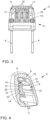
- die Kopfstütze in einer Rückansicht und
- Figur 4
- eine vereinfachte Schnittdarstellung der Kopfstütze.
-
Figur 1 zeigt in einer vereinfachten perspektivischen Darstellung ein Fahrzeugsitz 1 für ein hier nicht näher dargestelltes Kraftfahrzeug. Der Fahrzeugsitz 1 weist eine Rückenlehne 2 auf, an deren oberen Ende eine Kopfstütze 3 angeordnet ist. Die Kopfstütze 3 weist dazu zwei Haltestangen 4 auf, die in Aufnahmevertiefungen 5 in der Rückenlehne in ihrer Längserstreckung eingeschoben sind. Die Haltestangen 4 sowie die Rückenlehne 2 weisen dabei Mittel 6 zum lösbaren Arretieren der Haltestangen in der jeweiligen Aufnahmevertiefung 5 auf, um die Kopfstütze 3 an der Rückenlehne 2, insbesondere in unterschiedlichen Höhen zu befestigen. Derartige Fahrzeugsitze 1 sind grundsätzlich bekannt, sodass insbesondere auch die Verrastbarkeit beziehungsweise Befestigung der Kopfstütze 3 an der Rückenlehne 2 an dieser Stelle nicht näher eingegangen werden soll. - Die Kopfstütze 3 weist einen Polsterbezug 7 mit einem aus einem Schaummaterial gefertigten Polster 8 auf, das auf einem Polsterträger 9 der Kopfstütze 3 angeordnet ist. Der Polsterträger 9 weist gemäß dem vorliegenden Ausführungsbeispiel ein Basisteil 10 sowie ein an dem Basisteil 10 befestigtes Profilelement 11 auf. Das Basisteil 10 und das Profilelement 11 sind beide bevorzugt jeweils aus Kunststoff gefertigt. Insbesondere ist das Basiselement 10 als dünnwandiges Schalenelement ausgebildet. Die Haltestangen 4 sind bevorzugt an dem Basisteil 10 befestigt.
- Das Profilelement 11 ist an einer Frontseite des Basisteils 10 angeordnet, sodass das Basisteil 11 eine Frontseite 12 des Polsterträgers 9 bildet. Die Frontseite 12 ist dabei dem Kopf eines auf dem Fahrzeugsitz 1 befindlichen Benutzers zugewandt, weist also im Normalfall in Vorwärtsfahrt nach vorne.
- Das Profilelement 11 ist bevorzugt auf das Basisteil 10 aufgespritzt beziehungsweise - gegossen. Dadurch entsteht eine stoffschlüssige Verbindung zwischen dem Profilelement 11 und dem Basisteil 10, wodurch das Profilelement 11 vorteilhaft an dem Basisteil 10 gehalten und mit diesem verbunden ist.
- Das Profilelement 11 weist an seiner Frontseite 12 ein geschlossenes Wellenprofil 13 auf, das mehrere, vorliegend drei, vertikal benachbarte und sich geradlinig horizontal parallel zueinander erstreckende Wellenberge 14 aufweist.
- Bei bestimmungsgemäßem Gebrauch erstrecken sich somit die Wellenberge 14 entlang horizontaler Linien und sind vertikal beziehungsweise in der Höhe beabstandet zueinander angeordnet, wobei zwischen zwei benachbarten Wellenbergen 14 jeweils ein Wellental 15 ausgebildet ist. Darüber hinaus ist das Profilelement 11 auf der Frontseite 12 konkav in Längserstreckung der Wellenberge 14 ausgebildet, sodass das Profilelement 11 eine vorteilhafte Positionierung und schützende Wirkung für den Kopf eines Benutzers für den Fall bietet, dass der Kopf des Benutzers beispielsweise aufgrund eines Auffahrunfalls gegen die Kopfstütze 3 aufprallt. Das Wellenprofil 13 bildet an der Frontseite 12 somit einen Kopfaufprallbereich 16 der Kopfstütze 3 aus.
-
Figur 2 zeigt die vorteilhafte Kopfstütze 3 in einer Seitenansicht. In dieser Ansicht sind die Wellenberge 14 und dazwischenliegende Wellentäler 15 vorteilhaft erkennbar. Die Haltestangen 14 erstrecken sich zumindest im Wesentlichen vertikal beziehungsweise senkrecht bezogen zu den Wellenbergen 14 des Wellenprofils 13. -
Figur 3 zeigt eine Rückansicht der Kopfstütze 3. Diese zeigt insbesondere die Ausgestaltung des Basisteils 10. Im Unterschied zu dem Profilelement 11 ist das Basisteil 10 nicht als geschlossenes Profil ausgebildet, sondern vielmehr als dünnwandiges Schalenelement, wie zuvor bereits beschrieben, gestaltet, das mehrere zur Gewichtssparung beitragende Öffnungen 17 aufweist. Darüber hinaus weist das Basisteil 10 mehrere sich vertikal erstreckende Versteifungsrippe 18 auf, die horizontal benachbart zueinander angeordnet sind. Durch die Versteifungsrippen 18 wird die Robustheit und Belastbarkeit der Kopfstütze 3 trotz seiner dünnwandigen Ausbildung erhöht, sodass auch hohe Aufprallkräfte sicher aufgenommen werden können. Das Profilelement 11 ist bevorzugt elastisch verformbar ausgebildet, sodass Aufprallkräfte direkt an dem Profilelement vorteilhaft gedämpft werden können. Zur Dämpfung trägt darüber hinaus auch noch das Polster 8 bei. -
Figur 4 zeigt dazu eine Schnittdarstellung durch die Kopfstütze 3, welche das an dem Polsterträger 9 angeordnete Polster 8 zeigt. WieFigur 4 zu entnehmen ist, umschließt das Polster 8 nahezu vollständig den Polsterträger 9. Dabei weist das Polster 8 einen Halteabschnitt 19 auf, welcher dem Profilelement 11, insbesondere dem Wellenprofil 13 zugewandt ist. Der Halteabschnitt 19 weist eine Wellenstruktur 20 auf, die korrespondierend zu dem Wellenprofil 13 derart ausgebildet ist, dass die Wellenstruktur 20 komplementär zu dem Wellenprofil 13 ausgebildet ist. Dadurch füllt die Wellenstruktur 20 die Zwischenräume zwischen den benachbarten Wellenbergen 14 des Wellenprofils 13 aus, sodass Wellenstruktur 20 und Wellenprofil 13 zur Fixierung ineinander greifen. Dazu weist die Wellenstruktur 20 ebenfalls horizontal verlaufende Wellenberge 21 und Wellentäler 22 auf, wobei die Wellenberge 21 dazu ausgebildet sind, die Wellentäler 15 des Wellenprofils 13 vollständig auszufüllen, sodass insbesondere eine im Wesentlichen insgesamt flächige Anlage des Polsters 8 zumindest im Halteabschnitt 19 an der Frontseite 12 des Profilelements 11 gewährleistet ist. - Durch die komplementäre Ausbildung von Wellenstruktur 19 und Wellenprofil 13 und die dadurch erreichte formschlüssige Fixierung wird erreicht, dass bei der Montage der Kopfstütze 3 das Polster nicht an dem Polsterträger 9 verrutscht, wenn beispielsweise ein Bezug über das Polster 8 gezogen wird. Die komplementäre Ausbildung erlaubt eine eindeutige und einfache Anordnung und Vormontierung des Polsters 8 an dem Polsterträger 9. Darüber hinaus gewährleistet die komplementäre Ausbildung eine optimale Kraftübertragung beziehungsweise Kraftableitung bei einem Kopfaufprall gegen den Kopfaufprallbereich 16.
-
- 1
- Fahrzeugsitz
- 2
- Rückenlehne
- 3
- Kopfstütze
- 4
- Haltestange
- 5
- Aufnahmevertiefung
- 6
- Mittel
- 7
- Polsterbezug
- 8
- Polster
- 9
- Polsterträger
- 10
- Basisteil
- 11
- Profilelement
- 12
- Frontseite
- 13
- Wellenprofil
- 14
- Wellenberg
- 15
- Wellental
- 16
- Kopfaufprallbereich
- 17
- Öffnung
- 18
- Versteifungsrippe
- 19
- Halteabschnitt
- 20
- Wellenstruktur
- 21
- Wellenberg
- 22
- Wellental
Claims (15)
- Kopfstütze (3) für einen Fahrzeugsitz (1), mit einem Polsterträger (9), mit einem an dem Polsterträger (9) angeordneten oder anordenbaren Polster (8), und mit zumindest einer sich von dem Polsterträger (9) vertikal erstreckenden Haltestange (4) zum Befestigen der Kopfstütze (3) an dem Fahrzeugsitz (1), wobei der Polsterträger (9) auf einer sich horizontal und vertikal erstreckenden Frontseite (12) einen Kopfaufprallbereich (16) aufweist, dadurch gekennzeichnet, dass der Polsterträger (9) in dem Kopfaufprallbereich (16) ein geschlossenes sinusförmiges Wellenprofil (13) mit sich horizontal erstreckenden und vertikal durch Wellentäler (15) voneinander getrennt benachbarten Wellenbergen (14) aufweist.
- Kopfstütze nach Anspruch 1, dadurch gekennzeichnet, dass der insbesondere aus Kunststoff gefertigte Polsterträger (9) einteilig ausgebildet ist.
- Kopfstütze nach Anspruch 1, dadurch gekennzeichnet, dass der Polsterträger (9) mehrteilig ausgebildet ist, mit einem die Haltestange (4) tragenden Basisteil (10) und mit einem das Wellenprofil (13) aufweisenden Profilelement (11).
- Kopfstütze nach Anspruch 3, dadurch gekennzeichnet, dass das Profilelement (11) aus Kunststoff gefertigt ist.
- Kopfstütze nach einem der Ansprüche 3 und 4, dadurch gekennzeichnet, dass das Profilelement (11) ein Spritzgussteil ist.
- Kopfstütze nach einem der Ansprüche (integriert) 3 bis 5, dadurch gekennzeichnet, dass das Profilelement (11) stoffschlüssig und/oder formschlüssig mit dem Basisteil (10) verbunden ist.
- Kopfstütze nach einem der Ansprüche 3 bis 6, dadurch gekennzeichnet, dass das Profilelement (11) an das Basisteil (10) angespritzt ist.
- Kopfstütze nach einem der Ansprüche 3 bis 7, dadurch gekennzeichnet, dass das Profilelement (11) elastisch verformbar ausgebildet ist.
- Kopfstütze nach einem der vorhergehenden Ansprüche, dadurch gekennzeichnet, dass das Polster (8) aus einem Schaummaterial gefertigt ist.
- Kopfstütze nach einem der vorhergehenden Ansprüche, dadurch gekennzeichnet, dass das Polster (8) auf einem dem Profilelement (11) zugeordneten Halteabschnitt (19) eine zu dem Wellenprofil (13) korrespondierende Wellenstruktur (20) aufweist, sodass die Wellenstruktur (20) des Polsters (8) und das Wellenprofil (13) des Polsterträgers (9) zur Fixierung ineinander greifen.
- Kopfstütze nach einem der vorhergehenden Ansprüche, dadurch gekennzeichnet, dass das Wellenprofil (13) des Polsterträgers (9) in seiner horizontalen Erstreckung eine insbesondere konkave Krümmung aufweist.
- Kopfstütze nach einem der Ansprüche 3 bis 11, dadurch gekennzeichnet, dass das Basisteil (10) aus Kunststoff gefertigt ist.
- Kopfstütze nach einem der Ansprüche 3 bis 12, dadurch gekennzeichnet, dass das Basisteil (10) mehrere horizontal benachbarte und vertikal verlaufende Versteifungsrippen (18) aufweist.
- Kopfstütze nach einem der vorhergehenden Ansprüche, dadurch gekennzeichnet, dass an der Kopfstütze (3) zwei Haltestangen (4) parallel zueinander ausgerichtet angeordnet sind.
- Fahrzeugsitz (1) mit einer Kopfstütze (3) gemäß einem der Ansprüche 1 bis 14.
Applications Claiming Priority (2)
| Application Number | Priority Date | Filing Date | Title |
|---|---|---|---|
| DE102019206828.6A DE102019206828A1 (de) | 2019-05-10 | 2019-05-10 | Kopfstütze und Fahrzeugsitz |
| PCT/EP2020/062801 WO2020229324A1 (de) | 2019-05-10 | 2020-05-08 | Kopfstütze und fahrzeugsitz |
Publications (2)
| Publication Number | Publication Date |
|---|---|
| EP3966073A1 EP3966073A1 (de) | 2022-03-16 |
| EP3966073B1 true EP3966073B1 (de) | 2025-07-09 |
Family
ID=70680501
Family Applications (1)
| Application Number | Title | Priority Date | Filing Date |
|---|---|---|---|
| EP20725149.7A Active EP3966073B1 (de) | 2019-05-10 | 2020-05-08 | Kopfstütze und fahrzeugsitz |
Country Status (3)
| Country | Link |
|---|---|
| EP (1) | EP3966073B1 (de) |
| DE (1) | DE102019206828A1 (de) |
| WO (1) | WO2020229324A1 (de) |
Family Cites Families (12)
| Publication number | Priority date | Publication date | Assignee | Title |
|---|---|---|---|---|
| DE3022551A1 (de) * | 1980-06-16 | 1982-01-07 | Kunststoffwerk Philippine Gmbh & Co Kg, 5420 Lahnstein | Elastisches, ringfoermiges stuetzelement |
| JPS6112831Y2 (de) * | 1980-12-22 | 1986-04-21 | ||
| DE10045070B4 (de) * | 2000-09-12 | 2006-01-05 | Lear Corporation Gmbh & Co. Kg | Kopfstütze |
| DE102006032639B3 (de) * | 2006-07-13 | 2007-10-11 | Johnson Controls Gmbh | Aktuierungsmittel für die Kopfstütze eines Fahrzeugsitzes |
| DE102008019193B4 (de) * | 2008-04-17 | 2023-07-27 | Volkswagen Ag | Kopfstütze für Fahrzeugsitze |
| US8348347B2 (en) * | 2009-05-06 | 2013-01-08 | Lear Corporation | Folding vehicle head restraint assembly |
| EP2729326A2 (de) * | 2011-07-05 | 2014-05-14 | Johnson Controls GmbH | Kopfstütze für einen fahrzeugsitz und verfahren zu deren herstellung |
| DE102013201813A1 (de) * | 2013-02-05 | 2014-08-07 | Johnson Controls Gmbh | Kopfstütze für ein Fahrzeug und Verfahren zu deren Herstellung |
| JP6102771B2 (ja) * | 2014-01-29 | 2017-03-29 | トヨタ紡織株式会社 | 可動式ヘッドレスト |
| DE102015011477B4 (de) * | 2015-02-20 | 2023-08-03 | Grammer Aktiengesellschaft | Kopfstütze |
| DE102015212510A1 (de) * | 2015-07-03 | 2017-01-05 | Johnson Controls Gmbh | Kopfstützenkörper und Kopfstütze |
| DE102017129857A1 (de) * | 2017-02-09 | 2018-08-09 | Grammer Ag | Kopfstütze |
-
2019
- 2019-05-10 DE DE102019206828.6A patent/DE102019206828A1/de not_active Withdrawn
-
2020
- 2020-05-08 WO PCT/EP2020/062801 patent/WO2020229324A1/de not_active Ceased
- 2020-05-08 EP EP20725149.7A patent/EP3966073B1/de active Active
Also Published As
| Publication number | Publication date |
|---|---|
| WO2020229324A1 (de) | 2020-11-19 |
| DE102019206828A1 (de) | 2020-11-12 |
| EP3966073A1 (de) | 2022-03-16 |
Similar Documents
| Publication | Publication Date | Title |
|---|---|---|
| DE102010001908B4 (de) | Grundkörper einer Kopfstütze eines Fahrzeugsitzes | |
| DE102004030215B4 (de) | Kopfstütze für Sitze | |
| EP2583862B1 (de) | Fahrzeugsitz, insbesondere Schienenfahrzeugsitz, mit einem Polsterelementbefestigungsrahmen | |
| EP2736762B1 (de) | Fahrzeugsitz, insbesondere kraftfahrzeugsitz | |
| DE102017102531A1 (de) | Verbundwerkstoff-Sitzstruktur | |
| EP3317143B1 (de) | Kopfstützenkörper und kopfstütze | |
| EP1946962A2 (de) | Sitzstruktur für einen Fahrzeugsitz | |
| DE10126014C1 (de) | Klappbare Rückenlehne für einen Rücksitz eines Kraftfahrzeugs | |
| DE102008036870A1 (de) | Fahrzeugaufbau | |
| EP3658447A1 (de) | Trägeranordnung für seitliche gepäckbehältnisse eines motorrades | |
| DE19728052A1 (de) | Sitzelement mit Rahmen | |
| EP2846661B1 (de) | Kabelbefestigungselement an einer sitzfedermatte fuer einen fahrzeugsitz, sitzfedermatte und fahrzeugsitz | |
| DE102010038250B4 (de) | Kopfstütze mit Verstellung in Längsrichtung | |
| EP3966073B1 (de) | Kopfstütze und fahrzeugsitz | |
| DE102008019193B4 (de) | Kopfstütze für Fahrzeugsitze | |
| EP2877368B1 (de) | Stützvorrichtung für einen sitz und damit ausgerüsteter fahrzeugsitz | |
| EP2783910B1 (de) | Fahrzeugsitz mit einer integrierten Kopfstütze und Verfahren zur Herstellung eines Fahrzeugsitzes | |
| DE102012204813A1 (de) | Fahrzeugsitz mit einer integrierten Kopfstütze und Verfahren zur Herstellung eines Fahrzeugsitzes | |
| DE102010026215A1 (de) | Längseinsteller-Entriegelungsvorrichtung für einen Fahrzeugsitz | |
| DE102007039063B4 (de) | Kopfstütze für einen Fahrzeugsitz | |
| DE19927532C2 (de) | Mechanismus zum Anbringen eines Sicherheitsgurtes eines mittleren Sitzplatzes von einem Fahrzeugsitz | |
| WO2004085197A1 (de) | Rückenlehne für einen fahrzeugsitz | |
| DE19803784A1 (de) | Fahrzeugsitz, insbesondere Kraftfahrzeugsitz | |
| DE102009050840A1 (de) | Lehnenschlossanbindung für eine Rückenlehne einer Rücksitzanlage eines Kraftfahrzeugs | |
| DE102016120333B4 (de) | Lehnenentriegelungseinrichtung für einen Fahrzeugsitz und Fahrzeugsitz |
Legal Events
| Date | Code | Title | Description |
|---|---|---|---|
| STAA | Information on the status of an ep patent application or granted ep patent |
Free format text: STATUS: UNKNOWN |
|
| STAA | Information on the status of an ep patent application or granted ep patent |
Free format text: STATUS: THE INTERNATIONAL PUBLICATION HAS BEEN MADE |
|
| PUAI | Public reference made under article 153(3) epc to a published international application that has entered the european phase |
Free format text: ORIGINAL CODE: 0009012 |
|
| STAA | Information on the status of an ep patent application or granted ep patent |
Free format text: STATUS: REQUEST FOR EXAMINATION WAS MADE |
|
| 17P | Request for examination filed |
Effective date: 20211210 |
|
| AK | Designated contracting states |
Kind code of ref document: A1 Designated state(s): AL AT BE BG CH CY CZ DE DK EE ES FI FR GB GR HR HU IE IS IT LI LT LU LV MC MK MT NL NO PL PT RO RS SE SI SK SM TR |
|
| DAV | Request for validation of the european patent (deleted) | ||
| DAX | Request for extension of the european patent (deleted) | ||
| STAA | Information on the status of an ep patent application or granted ep patent |
Free format text: STATUS: EXAMINATION IS IN PROGRESS |
|
| 17Q | First examination report despatched |
Effective date: 20230831 |
|
| GRAP | Despatch of communication of intention to grant a patent |
Free format text: ORIGINAL CODE: EPIDOSNIGR1 |
|
| STAA | Information on the status of an ep patent application or granted ep patent |
Free format text: STATUS: GRANT OF PATENT IS INTENDED |
|
| INTG | Intention to grant announced |
Effective date: 20250402 |
|
| GRAS | Grant fee paid |
Free format text: ORIGINAL CODE: EPIDOSNIGR3 |
|
| GRAA | (expected) grant |
Free format text: ORIGINAL CODE: 0009210 |
|
| STAA | Information on the status of an ep patent application or granted ep patent |
Free format text: STATUS: THE PATENT HAS BEEN GRANTED |
|
| AK | Designated contracting states |
Kind code of ref document: B1 Designated state(s): AL AT BE BG CH CY CZ DE DK EE ES FI FR GB GR HR HU IE IS IT LI LT LU LV MC MK MT NL NO PL PT RO RS SE SI SK SM TR |
|
| REG | Reference to a national code |
Ref country code: GB Ref legal event code: FG4D Free format text: NOT ENGLISH |
|
| REG | Reference to a national code |
Ref country code: CH Ref legal event code: EP |
|
| REG | Reference to a national code |
Ref country code: IE Ref legal event code: FG4D Free format text: LANGUAGE OF EP DOCUMENT: GERMAN |
|
| REG | Reference to a national code |
Ref country code: DE Ref legal event code: R096 Ref document number: 502020011384 Country of ref document: DE |
|
| P01 | Opt-out of the competence of the unified patent court (upc) registered |
Free format text: CASE NUMBER: UPC_APP_5460_3966073/2025 Effective date: 20250901 |
|
| REG | Reference to a national code |
Ref country code: NL Ref legal event code: MP Effective date: 20250709 |
|
| PG25 | Lapsed in a contracting state [announced via postgrant information from national office to epo] |
Ref country code: PT Free format text: LAPSE BECAUSE OF FAILURE TO SUBMIT A TRANSLATION OF THE DESCRIPTION OR TO PAY THE FEE WITHIN THE PRESCRIBED TIME-LIMIT Effective date: 20251110 |
|
| PG25 | Lapsed in a contracting state [announced via postgrant information from national office to epo] |
Ref country code: NL Free format text: LAPSE BECAUSE OF FAILURE TO SUBMIT A TRANSLATION OF THE DESCRIPTION OR TO PAY THE FEE WITHIN THE PRESCRIBED TIME-LIMIT Effective date: 20250709 |
|
| PG25 | Lapsed in a contracting state [announced via postgrant information from national office to epo] |
Ref country code: IS Free format text: LAPSE BECAUSE OF FAILURE TO SUBMIT A TRANSLATION OF THE DESCRIPTION OR TO PAY THE FEE WITHIN THE PRESCRIBED TIME-LIMIT Effective date: 20251109 |
|
| PG25 | Lapsed in a contracting state [announced via postgrant information from national office to epo] |
Ref country code: NO Free format text: LAPSE BECAUSE OF FAILURE TO SUBMIT A TRANSLATION OF THE DESCRIPTION OR TO PAY THE FEE WITHIN THE PRESCRIBED TIME-LIMIT Effective date: 20251009 |
|
| REG | Reference to a national code |
Ref country code: LT Ref legal event code: MG9D |
|
| PG25 | Lapsed in a contracting state [announced via postgrant information from national office to epo] |
Ref country code: FI Free format text: LAPSE BECAUSE OF FAILURE TO SUBMIT A TRANSLATION OF THE DESCRIPTION OR TO PAY THE FEE WITHIN THE PRESCRIBED TIME-LIMIT Effective date: 20250709 |
|
| PG25 | Lapsed in a contracting state [announced via postgrant information from national office to epo] |
Ref country code: HR Free format text: LAPSE BECAUSE OF FAILURE TO SUBMIT A TRANSLATION OF THE DESCRIPTION OR TO PAY THE FEE WITHIN THE PRESCRIBED TIME-LIMIT Effective date: 20250709 |
|
| PG25 | Lapsed in a contracting state [announced via postgrant information from national office to epo] |
Ref country code: GR Free format text: LAPSE BECAUSE OF FAILURE TO SUBMIT A TRANSLATION OF THE DESCRIPTION OR TO PAY THE FEE WITHIN THE PRESCRIBED TIME-LIMIT Effective date: 20251010 |
|
| PG25 | Lapsed in a contracting state [announced via postgrant information from national office to epo] |
Ref country code: SE Free format text: LAPSE BECAUSE OF FAILURE TO SUBMIT A TRANSLATION OF THE DESCRIPTION OR TO PAY THE FEE WITHIN THE PRESCRIBED TIME-LIMIT Effective date: 20250709 |
|
| PG25 | Lapsed in a contracting state [announced via postgrant information from national office to epo] |
Ref country code: LV Free format text: LAPSE BECAUSE OF FAILURE TO SUBMIT A TRANSLATION OF THE DESCRIPTION OR TO PAY THE FEE WITHIN THE PRESCRIBED TIME-LIMIT Effective date: 20250709 |
|
| PG25 | Lapsed in a contracting state [announced via postgrant information from national office to epo] |
Ref country code: PL Free format text: LAPSE BECAUSE OF FAILURE TO SUBMIT A TRANSLATION OF THE DESCRIPTION OR TO PAY THE FEE WITHIN THE PRESCRIBED TIME-LIMIT Effective date: 20250709 Ref country code: BG Free format text: LAPSE BECAUSE OF FAILURE TO SUBMIT A TRANSLATION OF THE DESCRIPTION OR TO PAY THE FEE WITHIN THE PRESCRIBED TIME-LIMIT Effective date: 20250709 |
|
| PG25 | Lapsed in a contracting state [announced via postgrant information from national office to epo] |
Ref country code: RS Free format text: LAPSE BECAUSE OF FAILURE TO SUBMIT A TRANSLATION OF THE DESCRIPTION OR TO PAY THE FEE WITHIN THE PRESCRIBED TIME-LIMIT Effective date: 20251009 |
|
| PG25 | Lapsed in a contracting state [announced via postgrant information from national office to epo] |
Ref country code: ES Free format text: LAPSE BECAUSE OF FAILURE TO SUBMIT A TRANSLATION OF THE DESCRIPTION OR TO PAY THE FEE WITHIN THE PRESCRIBED TIME-LIMIT Effective date: 20250709 |
|
| PG25 | Lapsed in a contracting state [announced via postgrant information from national office to epo] |
Ref country code: SM Free format text: LAPSE BECAUSE OF FAILURE TO SUBMIT A TRANSLATION OF THE DESCRIPTION OR TO PAY THE FEE WITHIN THE PRESCRIBED TIME-LIMIT Effective date: 20250709 |
|
| PG25 | Lapsed in a contracting state [announced via postgrant information from national office to epo] |
Ref country code: DK Free format text: LAPSE BECAUSE OF FAILURE TO SUBMIT A TRANSLATION OF THE DESCRIPTION OR TO PAY THE FEE WITHIN THE PRESCRIBED TIME-LIMIT Effective date: 20250709 |
|
| PG25 | Lapsed in a contracting state [announced via postgrant information from national office to epo] |
Ref country code: IT Free format text: LAPSE BECAUSE OF FAILURE TO SUBMIT A TRANSLATION OF THE DESCRIPTION OR TO PAY THE FEE WITHIN THE PRESCRIBED TIME-LIMIT Effective date: 20250709 |
|
| PG25 | Lapsed in a contracting state [announced via postgrant information from national office to epo] |
Ref country code: CZ Free format text: LAPSE BECAUSE OF FAILURE TO SUBMIT A TRANSLATION OF THE DESCRIPTION OR TO PAY THE FEE WITHIN THE PRESCRIBED TIME-LIMIT Effective date: 20250709 |
|
| PG25 | Lapsed in a contracting state [announced via postgrant information from national office to epo] |
Ref country code: SK Free format text: LAPSE BECAUSE OF FAILURE TO SUBMIT A TRANSLATION OF THE DESCRIPTION OR TO PAY THE FEE WITHIN THE PRESCRIBED TIME-LIMIT Effective date: 20250709 Ref country code: EE Free format text: LAPSE BECAUSE OF FAILURE TO SUBMIT A TRANSLATION OF THE DESCRIPTION OR TO PAY THE FEE WITHIN THE PRESCRIBED TIME-LIMIT Effective date: 20250709 |