EP3963320B1 - Zerstörungsfreie detektion von oberflächen und oberflächennahen anomalien in einem metallischen produkt - Google Patents
Zerstörungsfreie detektion von oberflächen und oberflächennahen anomalien in einem metallischen produkt Download PDFInfo
- Publication number
- EP3963320B1 EP3963320B1 EP20716548.1A EP20716548A EP3963320B1 EP 3963320 B1 EP3963320 B1 EP 3963320B1 EP 20716548 A EP20716548 A EP 20716548A EP 3963320 B1 EP3963320 B1 EP 3963320B1
- Authority
- EP
- European Patent Office
- Prior art keywords
- radiation
- output
- threshold value
- scattered radiation
- sample
- Prior art date
- Legal status (The legal status is an assumption and is not a legal conclusion. Google has not performed a legal analysis and makes no representation as to the accuracy of the status listed.)
- Active
Links
Images




Classifications
-
- G—PHYSICS
- G01—MEASURING; TESTING
- G01N—INVESTIGATING OR ANALYSING MATERIALS BY DETERMINING THEIR CHEMICAL OR PHYSICAL PROPERTIES
- G01N23/00—Investigating or analysing materials by the use of wave or particle radiation, e.g. X-rays or neutrons, not covered by groups G01N3/00 – G01N17/00, G01N21/00 or G01N22/00
- G01N23/20—Investigating or analysing materials by the use of wave or particle radiation, e.g. X-rays or neutrons, not covered by groups G01N3/00 – G01N17/00, G01N21/00 or G01N22/00 by using diffraction of the radiation by the materials, e.g. for investigating crystal structure; by using scattering of the radiation by the materials, e.g. for investigating non-crystalline materials; by using reflection of the radiation by the materials
- G01N23/207—Diffractometry using detectors, e.g. using a probe in a central position and one or more displaceable detectors in circumferential positions
- G01N23/2073—Diffractometry using detectors, e.g. using a probe in a central position and one or more displaceable detectors in circumferential positions using neutron detectors
-
- G—PHYSICS
- G01—MEASURING; TESTING
- G01N—INVESTIGATING OR ANALYSING MATERIALS BY DETERMINING THEIR CHEMICAL OR PHYSICAL PROPERTIES
- G01N23/00—Investigating or analysing materials by the use of wave or particle radiation, e.g. X-rays or neutrons, not covered by groups G01N3/00 – G01N17/00, G01N21/00 or G01N22/00
- G01N23/20—Investigating or analysing materials by the use of wave or particle radiation, e.g. X-rays or neutrons, not covered by groups G01N3/00 – G01N17/00, G01N21/00 or G01N22/00 by using diffraction of the radiation by the materials, e.g. for investigating crystal structure; by using scattering of the radiation by the materials, e.g. for investigating non-crystalline materials; by using reflection of the radiation by the materials
- G01N23/20008—Constructional details of analysers, e.g. characterised by X-ray source, detector or optical system; Accessories therefor; Preparing specimens therefor
- G01N23/20025—Sample holders or supports therefor
-
- G—PHYSICS
- G01—MEASURING; TESTING
- G01N—INVESTIGATING OR ANALYSING MATERIALS BY DETERMINING THEIR CHEMICAL OR PHYSICAL PROPERTIES
- G01N23/00—Investigating or analysing materials by the use of wave or particle radiation, e.g. X-rays or neutrons, not covered by groups G01N3/00 – G01N17/00, G01N21/00 or G01N22/00
- G01N23/20—Investigating or analysing materials by the use of wave or particle radiation, e.g. X-rays or neutrons, not covered by groups G01N3/00 – G01N17/00, G01N21/00 or G01N22/00 by using diffraction of the radiation by the materials, e.g. for investigating crystal structure; by using scattering of the radiation by the materials, e.g. for investigating non-crystalline materials; by using reflection of the radiation by the materials
- G01N23/207—Diffractometry using detectors, e.g. using a probe in a central position and one or more displaceable detectors in circumferential positions
-
- G—PHYSICS
- G01—MEASURING; TESTING
- G01N—INVESTIGATING OR ANALYSING MATERIALS BY DETERMINING THEIR CHEMICAL OR PHYSICAL PROPERTIES
- G01N33/00—Investigating or analysing materials by specific methods not covered by groups G01N1/00 - G01N31/00
- G01N33/20—Metals
-
- G—PHYSICS
- G01—MEASURING; TESTING
- G01N—INVESTIGATING OR ANALYSING MATERIALS BY DETERMINING THEIR CHEMICAL OR PHYSICAL PROPERTIES
- G01N33/00—Investigating or analysing materials by specific methods not covered by groups G01N1/00 - G01N31/00
- G01N33/20—Metals
- G01N33/204—Structure thereof, e.g. crystal structure
- G01N33/2045—Defects
-
- G—PHYSICS
- G01—MEASURING; TESTING
- G01N—INVESTIGATING OR ANALYSING MATERIALS BY DETERMINING THEIR CHEMICAL OR PHYSICAL PROPERTIES
- G01N2223/00—Investigating materials by wave or particle radiation
- G01N2223/10—Different kinds of radiation or particles
- G01N2223/1003—Different kinds of radiation or particles monochromatic
-
- G—PHYSICS
- G01—MEASURING; TESTING
- G01N—INVESTIGATING OR ANALYSING MATERIALS BY DETERMINING THEIR CHEMICAL OR PHYSICAL PROPERTIES
- G01N2223/00—Investigating materials by wave or particle radiation
- G01N2223/20—Sources of radiation
- G01N2223/204—Sources of radiation source created from radiated target
-
- G—PHYSICS
- G01—MEASURING; TESTING
- G01N—INVESTIGATING OR ANALYSING MATERIALS BY DETERMINING THEIR CHEMICAL OR PHYSICAL PROPERTIES
- G01N2223/00—Investigating materials by wave or particle radiation
- G01N2223/60—Specific applications or type of materials
- G01N2223/646—Specific applications or type of materials flaws, defects
-
- G—PHYSICS
- G01—MEASURING; TESTING
- G01N—INVESTIGATING OR ANALYSING MATERIALS BY DETERMINING THEIR CHEMICAL OR PHYSICAL PROPERTIES
- G01N2223/00—Investigating materials by wave or particle radiation
- G01N2223/60—Specific applications or type of materials
- G01N2223/646—Specific applications or type of materials flaws, defects
- G01N2223/6462—Specific applications or type of materials flaws, defects microdefects
Definitions
- This invention relates to a method of non-destructive detection of surface and near surface abnormalities in a metallic product.
- White layer otherwise known as amorphous layer, nanocrystalline layer, white etching layer, adiabatic shear band, severely plastically deformed layer, or heat affected layer, is a surface or near surface abnormality that may be formed in the metal or metal alloy during the machining process. Machining processes include, amongst others, milling, drilling, grinding, broaching, or electrical discharge machining.
- White layer can have a detrimental effect on the machined parts' performance due to altered mechanical and microstructural properties of the resultant machined part, in particular reduced fatigue life.
- White layers are usually found in the region of the surface of the post-machined parts, white layers typically have a thickness lying in the range of microns to the tens of microns. White layer regions receive their name due to their appearance when viewed through an optical microscope. It is generally assumed that the white or slightly off-white colour is due to light-scattering off the constituent grains in the layer.
- the white layer formed during the machining process is caused by either phase transformation, by grain refinement through severe plastic deformation or by surface chemical reactions. In some cases, the formation of white layer may be enhanced by either high cutting speeds or when cutting using worn tools.
- Figure 1 is the representative example of a specimen (100) sample of a part (i.e. a section of part) with no surface abnormalities (101) present.
- Figure 2 is a specimen (200) having white layer (201) formed on the machined surface due to the deformation of material caused by rubbing of the cutting tool on the workpiece.
- optical microscopy method of analysis is costly and unsuitable for an automated inspection as the method:
- Patent application EP3147653 discloses a method for analysing crystallographic anomalies formed during the manufacturing of a component, the method comprising: activating an X-ray radiation source to transmit X-ray radiation to the component; obtaining a beam pattern based on the component interfering with the radiation; comparing the beam pattern to a reference beam pattern; and detecting that an anomaly exists in the material when the comparison indicates a deviation between the beam pattern and the reference beam pattern wherein the anomaly includes recrystallized grains (RX), secondary grains, freckles, slivers grains, and misaligned primary dendrite; the method further comprises: rejecting the component when the deviation is greater than a threshold.
- RX recrystallized grains
- the method allows assessment of the presence of unwanted abnormalities on the surface of the metallic machined objects, by comparing the produced output with a pre-established threshold value, below which no or an acceptable/tolerable level of abnormality is present in the sample.
- a threshold value is derived from one or more reference samples with no surface abnormality present.
- this provides a reference value that can be further used when analysing a sample with an unknown structure.
- said surface abnormality is induced by machining, friction, shaping or forming.
- said surface abnormality is one or more of a white layer, white etching layer, amorphous layer, and/or thermo-mechanically deformed region.
- said incident radiation includes at least one of X-ray radiation, laser radiation, and/or neutron radiation.
- said incident radiation includes at least one of X-ray radiation, laser radiation, and/or neutron radiation.
- the output is an intensity value corresponding to an intensity of the detected scattered radiation.
- the output is derived from the intensity ratio of one or more scattered radiation peaks. This is advantageous as it allows detection of samples with a white layer by showing that the surface has a different texture, i.e. one crystallographic orientation is favoured over another. Using more than one peak allows selection of the peaks which give the greatest distinction to the baseline sample.
- the threshold value is derived from the intensity of one or more scattered radiation peaks of the one or more reference samples with no surface abnormality present.
- a reference value that is used as a threshold for assessing the presence/absence of the white layer.
- a number of reference samples can be obtained and analysed to be subsequently collectively used as a threshold value, the threshold value being indicative of "good" samples with no or tolerable amount of surface or near surface abnormality present.
- the threshold value is derived from the intensity ratio of one or more scattered radiation peaks. Once the reference samples have been obtained and analysed, the intensity of the scattered radiation peaks is detected.
- this intensity can be used as a term of comparison with the intensity of the scattered peaks of the machined samples with unknown surface structure. By comparing with a sample without defect it is possible to set this threshold level which can then be used as an indicator for the presence of white layer if it is exceeded in an unknown surface.
- the output is derived from a width of a scattered radiation peak corresponding to the scattered radiation. Estimating the width of the produced radiation peaks allows the resulting values to be used as a comparison means with the widths of the peaks of the samples with unknown structure.
- the threshold value is derived from one or more widths of the one or more scattered radiation peaks of the one or more reference samples with no surface abnormality present.
- this allows for more precise measurements. That is, when a plurality of samples with no or a tolerable level of surface abnormality present are used as reference samples, the measurement accuracy is improved.
- the output is obtained by using filtered monochromatic X-rays.
- this allows the production of diffraction peaks by constructive interference of a monochromatic beam of projected X-rays scattered from the lattice planes of the samples.
- the output is obtained by scanning with a detector through a range of angles.
- scanning across the range of angles allows detection of multiple peaks originating from the same sample, and to use alternative peak intensities when some of the most commonly used intensities are hindered or not present in the resultant radiation pattern from the sample.
- the range of angles is 2 ⁇ .
- the output is obtained by arranging the detector at a fixed angle.
- this allows the analysis time to be shortened by scanning at an angle where the intensity of the output from the sample is predicted/known to be at its highest, thus avoiding the need to scan through the full range of angles.
- This limitation of the scanning angle that is generally slightly above the total reflection angle of the material, further allows analysis of thin film samples.
- the source of monochromatic X-ray is any one of copper, iron, molybdenum, chromium, manganese, silver or cobalt.
- a number of X-ray sources can be advantageously employed for diffraction studies, thus covering the possibilities to study samples with a variety of properties and structures.
- the output is obtained using polychromatic X-rays.
- polychromatic X-rays advantageously allows X-ray diffraction techniques to be employed with a polychromatic beam in energy-dispersive mode (EDX) as it negates the need for a goniometer to scan over a range of angles.
- energy-dispersive XRD is less sensitive to a sample shape which allows analysis of the samples of various shapes and sizes.
- said sample comprises any alloy from the list: titanium, nickel, iron, aluminium.
- FIG. 3 is a schematic representation of the process of detecting surface abnormalities in a sample.
- the arrangement consists of three basic elements: an emitter 301, a detector 302 and a processing unit (CPU) 303.
- an emitter can be an X-ray source. It will be understood, that any X-ray source can be used without limitation to operate the method of the claimed invention, including but not limited to: copper, iron, molybdenum, chromium, manganese, silver or cobalt.
- the emitter is configured to generate X rays substantially in a range between substantially 10-60 kV.
- the emitter 301 can generate X-rays in the range of substantially 30-50 kV, and optionally at substantially 40 kV.
- the emitter 301 can be a laser source.
- Laser sources include high intensity lasers available in a variety of wavelengths, spanning from the ultraviolet to the near-infrared.
- typical suitable laser wavelengths include: 244 nm, 257 nm, 325 nm, 364 nm, 457 nm, 473 nm, 488 nm, 514 nm, 532 nm, 633 nm, 660 nm, 785 nm, 830 nm, 980 nm, 1064 nm.
- the emitter 301 can be a neutron source capable of producing ionizing radiation in the form of hot, thermal or cold free neutrons that can be generated by any suitable process including: in a fission reactor (uranium nuclei break) or using a spallation source (proton bombardment of lead nuclei).
- the detector 302 can be any suitable detector known in the art for detecting emission from a given emitter, such as a photon counting silicon strip detector.
- the detector 102 can be one of a silicon based multichannel array detector of UV, visible and near-infra light, or a CCD (Charged Coupled Device).
- the detector 302 for neutron radiation can include gas-filled detectors, large area detectors or scintillators.
- the processing unit 303 can be of any suitable type of computing device configured to run a software capable of processing a received output.
- said software can also be configured to control and execute one or more stages of the process of detecting the surface abnormality without user input, i.e. automatically.
- a machined sample 304 such as a machined alloy part is positioned in such a way that an incident beam 305 can reach the sample under an angle ⁇ .
- the incident angle ⁇ can be anywhere in the range between 0 and 90°.
- Said incident radiation is capable of interaction with the constituent matter of the sample 304 and after the interaction can be further scattered at a scattered angle ⁇ '.
- Said scattered radiation 306 is then reflected into the detector 102 which produces an output in the form of a radiation pattern.
- This scattered radiation pattern is then further processed by the processing unit 303. The step of determining whether or not the surface abnormality is present 307 in the sample will be described in further detail below.
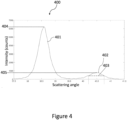
- Figure 4 shows a graph 400 showing the output of the detector 303 depicted as an intensity of the scattered radiation on the scattered angle ⁇ '. Peaks 401 and 402 are related to the measured structural property of the sample 204. Methods for detecting the abnormality from the graph 400 are described below.
- FWHM full width at half maximum 403
- Another approach to estimate the presence of the surface abnormality is to use the ratio of peak intensities as a criterion of whether the surface abnormality is present. That is, if there are at least two obtained radiation peaks depicted as result of the irradiating the sample with the incident radiation beam, the ratio between the at least two peaks can be used as an indication of the presence of the abnormality.
- a first peak 401 has a first intensity 404
- a second peak 402 has a second intensity 405, and the ratio can be derived as the intensity of the first peak divided by the intensity of the second peak.
- both approaches to estimating the presence of the surface abnormality can be used together or as a check (i.e. if one approach detects the presence of surface abnormality above a threshold limit then the second approach may be used as a check or verification).
- a reference value from the sample with no abnormality is needed. That is, a threshold value above/below which no, or a tolerable level of, abnormality can be found, has to be set. This can be done by analysing the samples of a known structure, preferably but not necessarily pre-machined, where no surface abnormality is expected to be found. This allows a threshold value to be derived from the intensity and/or width of the one or more scattered radiation peaks and use this value as a term of comparison when assessing the presence of abnormalities in the samples with unknown structure.
- the tolerable level of surface abnormality e.g. the maximum amount of white layer that is acceptable on the surface of a part without resulting in rejection of the part
- the appropriate regulatory body or part manufacturer may be set by the appropriate regulatory body or part manufacturer.
- the following algorithm is employed to detect the surface abnormality.
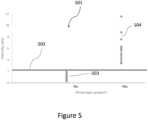
- the peak intensity ratio of a plurality of reference samples was used to determine a threshold value 502.
- a range of samples of unknown structure was then analysed, and the peak intensity values of the scattered radiation peaks were obtained from the detector output. If the peak intensity ratio of the sample exceeds the threshold value 502, the peak intensity ratio lies in a region 504 above the threshold 502, and therefore the surface abnormality is present. If, however, the peak intensity ratio is below the threshold value 502 and lies in the region 504 below the threshold 503, no, or a tolerable level of, surface abnormality can be detected.
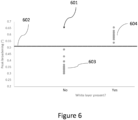
- the peak widths of the plurality of reference samples were used 601 to determine a threshold value 602.
- a range of samples of the unknown structure are analysed, and the peak width values 604 of the scattered radiation peaks are obtained from the detector 302 output. If the peak width of the sample exceeds the threshold value 602, the peak width lies in a region above the threshold 602, and therefore an intolerable level of the surface abnormality is present. If, however, the peak width value 602 is below the threshold value 602 and lies in the region below the threshold 602, no, or a tolerable level of, surface abnormality can be detected.
- X-Ray diffraction can be used to detect a surface abnormality. Being a bulk technique, with its penetration depth in the range of tens of microns, it is suitable for detecting surface abnormalities such as white layer of the thicknesses in the range of microns to the tens of microns. Generally, the method is suitable for detecting surface abnormalities to a depth in the range of the hundreds of microns.
- An X-ray beam 305 generated by an emitter 301 such as cathode ray tube and filtered to produce monochromatic radiation hits the sample 304 placed in the path of the said incident beam 305.
- the source of monochromatic X-rays can be any one of copper, iron, molybdenum, chromium, manganese, silver or cobalt. Interaction of the X-rays with the sample produces a diffracted/scattered ray if the condition of Bragg's law (below) is met.
- n ⁇ 2 d sin ⁇
- n is an integer
- ⁇ is a wavelength of the incident X-ray beam 305
- d is a distance between atomic layers in the crystal lattice of the sample 304
- ⁇ is an angle of incidence
- Specific crystallographic planes will diffract the X-ray beam 305 only at certain angles of incidence ⁇ .
- the reflections from all the crystal planes can be detected by a detector 302. This output can be recorded as a diffraction pattern.
- the diffraction pattern obtained from the surface of the material is known as a diffractogram that is plotted as a function of intensity v diffraction angles.
- the peaks 401, 402 on the diffractogram correspond to the crystal planes of the sample 304.
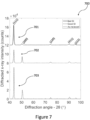
- a typical XRD pattern 700 is represented on Figure 7 . It can be seen that the intensity and the peak width of the reflections corresponding to crystal planes having notations (1 1 1) and (2 0 0) reflections for the processed (e.g. machined) samples 701 and 702 are different from that of the as received non-treated unprocessed sample 703 with no surface abnormality present.
- a surface abnormality such as white layer is considered to be present above tolerable level. If the ratio of the intensities of the two peaks is below the threshold value, no, or a tolerable level of, surface abnormality such as white layer can then be detected.
- a similar approach can be used for assessing the presence of white layer when peak widths 603, 604 is used as an assessment parameter against a threshold 602.
- the detector can be arranged at a fixed angular position for a relevant crystal lattice plane (i.e. the detector in this instance is a fixed line detector).
- the detector in this instance is a fixed line detector.
- pole figure (PF) measurements can be carried out by rotating the sample within a Euler cradle whilst maintaining the same diffraction angle between the radiation transmitter and detector. By doing this, a full picture of the crystallographic texture (the orientations of all grains) can be built.
- Figures 8 and 9 are an exemplary embodiment of a typical PF measurement for a sample with basal texture wherein the basal plane is largely parallel to the machined surface (i.e. the basal pole pointed perpendicular to the machined surface).
- Figure 8 shows results from a pole figure measurement 800 taken at the diffraction angle corresponding to the basal peak on a machined surface with a high measured multiples of random density (mrd) in the normal direction (ND) (in a sample with a surface abnormality present).
- mrd random density
- ND normal direction
- Figure 9 a sample without a surface abnormality (and therefore without basal orientation), has a smaller fraction of grains in that orientation in a pole figure measurement, so the measured mrd 900 is lower in the ND (see figure 9 ) relative to the sample with a surface abnormality present.
- pole figure measurements can provide equivalent information to previously described intensity measurements.
- a polychromatic beam 305 can be used in an energy dispersive mode as a source of photons.
- a scattering angle is fixed and the intensity is plotted as a function of energy. This allows determination of structural variations rapidly and with higher special resolution.
- the scattering angle is fixed there is no need to use a goniometer to provide scans over different angles.
- a high intensity laser can be used as a source of radiation.
- This laser radiation is then focused onto the sample, interacts with the molecular vibrations and the scattered light is collected by means of lenses.
- a highly sensitive CCD detector 302 is then used to detect the scattered light, and the obtained output from the detector 302 is then processed by the processing unit 303.
- This scattered light is called Raman scattered light and it can provide information about the chemical and structural composition of the samples.
- the resulting pattern (Raman spectrum) is then plotted as an intensity of the scattered light vs frequency (or energy) of light.
- the peaks on the spectra can become narrower, broader or shift in frequency, these deviations from the expected position and shape are typically characteristic of the structural changes, i.e. stress, crystallinity or the amount of material present (in case of multicomponent systems).
Landscapes
- Chemical & Material Sciences (AREA)
- Life Sciences & Earth Sciences (AREA)
- Health & Medical Sciences (AREA)
- Physics & Mathematics (AREA)
- Pathology (AREA)
- Analytical Chemistry (AREA)
- Biochemistry (AREA)
- General Health & Medical Sciences (AREA)
- General Physics & Mathematics (AREA)
- Immunology (AREA)
- Crystallography & Structural Chemistry (AREA)
- Medicinal Chemistry (AREA)
- Food Science & Technology (AREA)
- Engineering & Computer Science (AREA)
- Spectroscopy & Molecular Physics (AREA)
- Analysing Materials By The Use Of Radiation (AREA)
Claims (14)
- Verfahren zur zerstörungsfreien Detektion von Oberflächen- und oberflächennahen Anomalien in einem metallischen Produkt, wobei das Verfahren Folgendes umfasst:Positionieren einer Probe (204, 304) mit einer Oberfläche unter einer Quelle einer einfallenden Strahlung;Bestrahlen der Oberfläche mit der einfallenden Strahlung von der Quelle;Detektieren einer Streustrahlung;Erzeugen eines Strahlungsmusters aus der detektierten Streustrahlung;Analysieren des Strahlungsmusters;Erzeugen einer Ausgabe, die die Streustrahlung von der Probe (204, 304) angibt;Vergleichen der Ausgabe mit einem Schwellenwert (502, 602), wobei der Schwellenwert eine maximal akzeptable detektierte Oberflächenanomalie angibt; undIdentifizieren des Vorliegens einer Oberflächenanomalie, wenn die Ausgabe den Schwellenwert (502, 602) überschreitet,wobei die Oberflächenanomalie während eines Herstellungsprozesses des metallischen Produkts gebildet wird und die Oberflächenanomalie eines oder mehrere von einer weißen Schicht, einer weißen Ätzschicht, einer amorphen Schicht und/oder einer thermomechanisch verformten Region umfasst; undwobei die einfallende Strahlung mindestens eine von einer Röntgenstrahlung und/oder Neutronenstrahlung enthält.
- Verfahren nach Anspruch 1, wobei der Schwellenwert von einer oder mehreren Referenzproben ohne vorliegende Oberflächenanomalie abgeleitet ist.
- Verfahren nach Anspruch 1, wobei die Oberflächenanomalie durch maschinelle Bearbeitung, Reibung, Formgebung oder Umformung hervorgerufen wird.
- Verfahren nach einem der Ansprüche 1 bis 3, wobei die Ausgabe ein Intensitätswert ist, der einer Intensität der detektierten Streustrahlung entspricht.
- Verfahren nach einem vorhergehenden Anspruch, wobei die Ausgabe von dem Intensitätsverhältnis einer oder mehrerer Streustrahlungsspitzen abgeleitet ist.
- Verfahren nach einem der Ansprüche 2 bis 5, wobei der Schwellenwert von der Intensität einer oder mehrerer Streustrahlungsspitzen der einen oder mehreren Referenzproben ohne vorliegende Oberflächenanomalie abgeleitet ist.
- Verfahren nach Anspruch 6, wobei der Schwellenwert von dem Intensitätsverhältnis einer oder mehrerer Streustrahlungsspitzen abgeleitet ist.
- Verfahren nach einem der Ansprüche 1 bis 7, wobei die Ausgabe von einer Breite einer Streustrahlungsspitze abgeleitet ist, die der Streustrahlung entspricht, und optional
wobei der Schwellenwert (502, 602) von einer oder mehreren Breiten der einen oder mehreren Streustrahlungsspitzen der einen oder mehreren Referenzproben ohne vorliegende Oberflächenanomalie abgeleitet ist. - Verfahren nach den Ansprüchen 1 bis 8, wobei die Ausgabe durch Verwendung gefilterter monochromatischer Röntgenstrahlen erhalten wird.
- Verfahren nach Anspruch 9, wobei die Ausgabe durch Abtasten mit einem Detektor (302) über einen Winkelbereich erhalten wird, wobei optional der Einfallswinkel θ ist und der Winkelbereich 2θ beträgt.
- Verfahren nach Anspruch 9, wobei die Ausgabe durch Anordnen des Detektors (302) in einem festen Winkel erhalten wird.
- Verfahren nach einem der Ansprüche 10 bis 11, wobei die Quelle der monochromatischen Röntgenstrahlen (301) eines von Kupfer, Eisen, Molybdän, Chrom, Mangan, Silber oder Kobalt ist.
- Verfahren nach den Ansprüchen 1 bis 8, wobei die Ausgabe unter Verwendung polychromatischer Röntgenstrahlen erhalten wird.
- Verfahren nach Anspruch 1, wobei die Probe (204, 304) eine beliebige Legierung aus der folgenden Liste umfasst: Titan, Nickel, Eisen, Aluminium.
Applications Claiming Priority (2)
| Application Number | Priority Date | Filing Date | Title |
|---|---|---|---|
| GBGB1906037.5A GB201906037D0 (en) | 2019-04-30 | 2019-04-30 | Non-destructive detection of surface and near surface abnormalities in a metallic product |
| PCT/GB2020/050795 WO2020221986A1 (en) | 2019-04-30 | 2020-03-25 | Non-destructive detection of surface and near surface abnormalities in a metallic product |
Publications (2)
| Publication Number | Publication Date |
|---|---|
| EP3963320A1 EP3963320A1 (de) | 2022-03-09 |
| EP3963320B1 true EP3963320B1 (de) | 2024-10-30 |
Family
ID=66809100
Family Applications (1)
| Application Number | Title | Priority Date | Filing Date |
|---|---|---|---|
| EP20716548.1A Active EP3963320B1 (de) | 2019-04-30 | 2020-03-25 | Zerstörungsfreie detektion von oberflächen und oberflächennahen anomalien in einem metallischen produkt |
Country Status (8)
| Country | Link |
|---|---|
| US (1) | US11815477B2 (de) |
| EP (1) | EP3963320B1 (de) |
| CA (1) | CA3135684A1 (de) |
| ES (1) | ES2999543T3 (de) |
| GB (1) | GB201906037D0 (de) |
| PL (1) | PL3963320T3 (de) |
| SG (1) | SG11202111005VA (de) |
| WO (1) | WO2020221986A1 (de) |
Family Cites Families (8)
| Publication number | Priority date | Publication date | Assignee | Title |
|---|---|---|---|---|
| US5835220A (en) | 1995-10-27 | 1998-11-10 | Nkk Corporation | Method and apparatus for detecting surface flaws |
| JPH11295241A (ja) | 1998-04-10 | 1999-10-29 | Nkk Corp | 表面疵検査装置及びその方法 |
| US7034931B2 (en) | 2003-06-30 | 2006-04-25 | United Technologies Corporation | Method to grain inspect directionally solidified castings |
| WO2008007817A1 (en) | 2006-07-12 | 2008-01-17 | Postech Foundation | A method of bright-field imaging using x-rays |
| EP2223089A1 (de) * | 2007-12-14 | 2010-09-01 | Ab Skf | Verfahren zur bestimmung von ermüdungslebensdauer und verbleibender lebensdauer |
| WO2014050609A1 (ja) | 2012-09-28 | 2014-04-03 | Jx日鉱日石エネルギー株式会社 | 不規則な凹凸表面を有する基板を検査する装置及びそれを用いた検査方法 |
| US9939393B2 (en) | 2015-09-28 | 2018-04-10 | United Technologies Corporation | Detection of crystallographic properties in aerospace components |
| JP6117398B1 (ja) * | 2016-03-30 | 2017-04-19 | 日新製鋼株式会社 | 鋼板の表面欠陥検査装置および表面欠陥検査方法 |
-
2019
- 2019-04-30 GB GBGB1906037.5A patent/GB201906037D0/en not_active Ceased
-
2020
- 2020-03-25 WO PCT/GB2020/050795 patent/WO2020221986A1/en not_active Ceased
- 2020-03-25 SG SG11202111005VA patent/SG11202111005VA/en unknown
- 2020-03-25 US US17/606,995 patent/US11815477B2/en active Active
- 2020-03-25 EP EP20716548.1A patent/EP3963320B1/de active Active
- 2020-03-25 PL PL20716548.1T patent/PL3963320T3/pl unknown
- 2020-03-25 CA CA3135684A patent/CA3135684A1/en active Pending
- 2020-03-25 ES ES20716548T patent/ES2999543T3/es active Active
Also Published As
| Publication number | Publication date |
|---|---|
| WO2020221986A1 (en) | 2020-11-05 |
| US20220205934A1 (en) | 2022-06-30 |
| EP3963320A1 (de) | 2022-03-09 |
| ES2999543T3 (en) | 2025-02-26 |
| PL3963320T3 (pl) | 2025-02-10 |
| GB201906037D0 (en) | 2019-06-12 |
| US11815477B2 (en) | 2023-11-14 |
| SG11202111005VA (en) | 2021-10-28 |
| CA3135684A1 (en) | 2020-11-05 |
Similar Documents
| Publication | Publication Date | Title |
|---|---|---|
| JP7510463B2 (ja) | アレイ検知による短波長特徴x線回折装置及び方法 | |
| Epp | X-ray diffraction (XRD) techniques for materials characterization | |
| Sato et al. | A Rietveld-type analysis code for pulsed neutron Bragg-edge transmission imaging and quantitative evaluation of texture and microstructure of a welded α-iron plate | |
| TWI515426B (zh) | 表面加工狀態的評估系統及評估方法、非敏化材的應力腐蝕破裂感受性評估方法 | |
| Allen et al. | Measurement of internal stress within bulk materials using neutron diffraction | |
| Peetermans et al. | Cold neutron diffraction contrast tomography of polycrystalline material | |
| US7590220B1 (en) | X-ray inspection and detection system and method | |
| Ramadhan et al. | Mapping residual strain induced by cold working and by laser shock peening using neutron transmission spectroscopy | |
| US20130089182A1 (en) | Evaluation System and Evaluation Method of Plastic Strain | |
| CN108490006A (zh) | 一种利用中子衍射技术测试厚板残余应力的方法 | |
| Boyce et al. | Detecting rare, abnormally large grains by x-ray diffraction | |
| Naghedolfeizi et al. | X-ray fluorescence microtomography study of trace elements in a SiC nuclear fuel shell | |
| EP3963320B1 (de) | Zerstörungsfreie detektion von oberflächen und oberflächennahen anomalien in einem metallischen produkt | |
| US12399141B2 (en) | Damage measurement method, apparatus and program, and x-ray diffraction apparatus | |
| Sanyal et al. | Direct non-destructive total reflection X-ray fluorescence elemental determinations in zirconium alloy samples | |
| JP5346916B2 (ja) | エネルギーフィルタ及び角度フィルタを行う回折アナライザシステムを備えた試料のx線解析装置 | |
| Lehmann et al. | Edge enhancement investigations by means of experiments and simulations | |
| JP7594282B2 (ja) | 結晶性材料の評価方法 | |
| Van Tran et al. | Phase and texture evaluation of transformation-induced plasticity effect by neutron imaging | |
| Tremsin et al. | Investigation of microstructure within metal welds by energy resolved neutron imaging | |
| Bilheux et al. | Neutron characterization of additively manufactured inconel 718 | |
| Banovic et al. | Studies of deformation-induced texture development in sheet materials using diffraction techniques | |
| Lozano-Perez | Characterization techniques for assessing irradiated and ageing materials in nuclear power plant systems, structures and components (SSC) | |
| Coelho et al. | Through-thickness texture profiling by energy dispersive synchrotron diffraction | |
| Zaka | Energy resolution improvement of a laboratory scale X-ray absorption spectrometer using a position-sensitive detector |
Legal Events
| Date | Code | Title | Description |
|---|---|---|---|
| STAA | Information on the status of an ep patent application or granted ep patent |
Free format text: STATUS: UNKNOWN |
|
| STAA | Information on the status of an ep patent application or granted ep patent |
Free format text: STATUS: THE INTERNATIONAL PUBLICATION HAS BEEN MADE |
|
| PUAI | Public reference made under article 153(3) epc to a published international application that has entered the european phase |
Free format text: ORIGINAL CODE: 0009012 |
|
| STAA | Information on the status of an ep patent application or granted ep patent |
Free format text: STATUS: REQUEST FOR EXAMINATION WAS MADE |
|
| 17P | Request for examination filed |
Effective date: 20210930 |
|
| AK | Designated contracting states |
Kind code of ref document: A1 Designated state(s): AL AT BE BG CH CY CZ DE DK EE ES FI FR GB GR HR HU IE IS IT LI LT LU LV MC MK MT NL NO PL PT RO RS SE SI SK SM TR |
|
| DAV | Request for validation of the european patent (deleted) | ||
| DAX | Request for extension of the european patent (deleted) | ||
| RIN1 | Information on inventor provided before grant (corrected) |
Inventor name: GHADBEIGI, HASSAN Inventor name: WYNNE, BRADLEY PETER Inventor name: CRAWFORTH, PETER LAWRENCE Inventor name: BROWN, MATTHEW |
|
| P01 | Opt-out of the competence of the unified patent court (upc) registered |
Effective date: 20230503 |
|
| GRAP | Despatch of communication of intention to grant a patent |
Free format text: ORIGINAL CODE: EPIDOSNIGR1 |
|
| STAA | Information on the status of an ep patent application or granted ep patent |
Free format text: STATUS: GRANT OF PATENT IS INTENDED |
|
| RIC1 | Information provided on ipc code assigned before grant |
Ipc: G01N 23/207 20180101ALI20240527BHEP Ipc: G01N 33/2045 20190101AFI20240527BHEP |
|
| INTG | Intention to grant announced |
Effective date: 20240613 |
|
| GRAS | Grant fee paid |
Free format text: ORIGINAL CODE: EPIDOSNIGR3 |
|
| GRAA | (expected) grant |
Free format text: ORIGINAL CODE: 0009210 |
|
| STAA | Information on the status of an ep patent application or granted ep patent |
Free format text: STATUS: THE PATENT HAS BEEN GRANTED |
|
| AK | Designated contracting states |
Kind code of ref document: B1 Designated state(s): AL AT BE BG CH CY CZ DE DK EE ES FI FR GB GR HR HU IE IS IT LI LT LU LV MC MK MT NL NO PL PT RO RS SE SI SK SM TR |
|
| REG | Reference to a national code |
Ref country code: GB Ref legal event code: FG4D |
|
| REG | Reference to a national code |
Ref country code: CH Ref legal event code: EP |
|
| REG | Reference to a national code |
Ref country code: IE Ref legal event code: FG4D |
|
| REG | Reference to a national code |
Ref country code: DE Ref legal event code: R096 Ref document number: 602020040270 Country of ref document: DE |
|
| REG | Reference to a national code |
Ref country code: SE Ref legal event code: TRGR |
|
| REG | Reference to a national code |
Ref country code: LT Ref legal event code: MG9D |
|
| REG | Reference to a national code |
Ref country code: ES Ref legal event code: FG2A Ref document number: 2999543 Country of ref document: ES Kind code of ref document: T3 Effective date: 20250226 |
|
| REG | Reference to a national code |
Ref country code: NL Ref legal event code: MP Effective date: 20241030 |
|
| PG25 | Lapsed in a contracting state [announced via postgrant information from national office to epo] |
Ref country code: HR Free format text: LAPSE BECAUSE OF FAILURE TO SUBMIT A TRANSLATION OF THE DESCRIPTION OR TO PAY THE FEE WITHIN THE PRESCRIBED TIME-LIMIT Effective date: 20241030 Ref country code: IS Free format text: LAPSE BECAUSE OF FAILURE TO SUBMIT A TRANSLATION OF THE DESCRIPTION OR TO PAY THE FEE WITHIN THE PRESCRIBED TIME-LIMIT Effective date: 20250228 Ref country code: PT Free format text: LAPSE BECAUSE OF FAILURE TO SUBMIT A TRANSLATION OF THE DESCRIPTION OR TO PAY THE FEE WITHIN THE PRESCRIBED TIME-LIMIT Effective date: 20250228 |
|
| PG25 | Lapsed in a contracting state [announced via postgrant information from national office to epo] |
Ref country code: NL Free format text: LAPSE BECAUSE OF FAILURE TO SUBMIT A TRANSLATION OF THE DESCRIPTION OR TO PAY THE FEE WITHIN THE PRESCRIBED TIME-LIMIT Effective date: 20241030 Ref country code: FI Free format text: LAPSE BECAUSE OF FAILURE TO SUBMIT A TRANSLATION OF THE DESCRIPTION OR TO PAY THE FEE WITHIN THE PRESCRIBED TIME-LIMIT Effective date: 20241030 |
|
| REG | Reference to a national code |
Ref country code: AT Ref legal event code: MK05 Ref document number: 1737345 Country of ref document: AT Kind code of ref document: T Effective date: 20241030 |
|
| PG25 | Lapsed in a contracting state [announced via postgrant information from national office to epo] |
Ref country code: BG Free format text: LAPSE BECAUSE OF FAILURE TO SUBMIT A TRANSLATION OF THE DESCRIPTION OR TO PAY THE FEE WITHIN THE PRESCRIBED TIME-LIMIT Effective date: 20241030 |
|
| PG25 | Lapsed in a contracting state [announced via postgrant information from national office to epo] |
Ref country code: NO Free format text: LAPSE BECAUSE OF FAILURE TO SUBMIT A TRANSLATION OF THE DESCRIPTION OR TO PAY THE FEE WITHIN THE PRESCRIBED TIME-LIMIT Effective date: 20250130 |
|
| PG25 | Lapsed in a contracting state [announced via postgrant information from national office to epo] |
Ref country code: GR Free format text: LAPSE BECAUSE OF FAILURE TO SUBMIT A TRANSLATION OF THE DESCRIPTION OR TO PAY THE FEE WITHIN THE PRESCRIBED TIME-LIMIT Effective date: 20250131 Ref country code: LV Free format text: LAPSE BECAUSE OF FAILURE TO SUBMIT A TRANSLATION OF THE DESCRIPTION OR TO PAY THE FEE WITHIN THE PRESCRIBED TIME-LIMIT Effective date: 20241030 Ref country code: AT Free format text: LAPSE BECAUSE OF FAILURE TO SUBMIT A TRANSLATION OF THE DESCRIPTION OR TO PAY THE FEE WITHIN THE PRESCRIBED TIME-LIMIT Effective date: 20241030 |
|
| PG25 | Lapsed in a contracting state [announced via postgrant information from national office to epo] |
Ref country code: RS Free format text: LAPSE BECAUSE OF FAILURE TO SUBMIT A TRANSLATION OF THE DESCRIPTION OR TO PAY THE FEE WITHIN THE PRESCRIBED TIME-LIMIT Effective date: 20250130 |
|
| PG25 | Lapsed in a contracting state [announced via postgrant information from national office to epo] |
Ref country code: SM Free format text: LAPSE BECAUSE OF FAILURE TO SUBMIT A TRANSLATION OF THE DESCRIPTION OR TO PAY THE FEE WITHIN THE PRESCRIBED TIME-LIMIT Effective date: 20241030 |
|
| PG25 | Lapsed in a contracting state [announced via postgrant information from national office to epo] |
Ref country code: DK Free format text: LAPSE BECAUSE OF FAILURE TO SUBMIT A TRANSLATION OF THE DESCRIPTION OR TO PAY THE FEE WITHIN THE PRESCRIBED TIME-LIMIT Effective date: 20241030 |
|
| PGFP | Annual fee paid to national office [announced via postgrant information from national office to epo] |
Ref country code: ES Payment date: 20250409 Year of fee payment: 6 |
|
| PG25 | Lapsed in a contracting state [announced via postgrant information from national office to epo] |
Ref country code: EE Free format text: LAPSE BECAUSE OF FAILURE TO SUBMIT A TRANSLATION OF THE DESCRIPTION OR TO PAY THE FEE WITHIN THE PRESCRIBED TIME-LIMIT Effective date: 20241030 |
|
| PG25 | Lapsed in a contracting state [announced via postgrant information from national office to epo] |
Ref country code: RO Free format text: LAPSE BECAUSE OF FAILURE TO SUBMIT A TRANSLATION OF THE DESCRIPTION OR TO PAY THE FEE WITHIN THE PRESCRIBED TIME-LIMIT Effective date: 20241030 |
|
| PG25 | Lapsed in a contracting state [announced via postgrant information from national office to epo] |
Ref country code: SK Free format text: LAPSE BECAUSE OF FAILURE TO SUBMIT A TRANSLATION OF THE DESCRIPTION OR TO PAY THE FEE WITHIN THE PRESCRIBED TIME-LIMIT Effective date: 20241030 |
|
| PG25 | Lapsed in a contracting state [announced via postgrant information from national office to epo] |
Ref country code: CZ Free format text: LAPSE BECAUSE OF FAILURE TO SUBMIT A TRANSLATION OF THE DESCRIPTION OR TO PAY THE FEE WITHIN THE PRESCRIBED TIME-LIMIT Effective date: 20241030 |
|
| REG | Reference to a national code |
Ref country code: DE Ref legal event code: R097 Ref document number: 602020040270 Country of ref document: DE |
|
| PLBE | No opposition filed within time limit |
Free format text: ORIGINAL CODE: 0009261 |
|
| STAA | Information on the status of an ep patent application or granted ep patent |
Free format text: STATUS: NO OPPOSITION FILED WITHIN TIME LIMIT |
|
| 26N | No opposition filed |
Effective date: 20250731 |
|
| PG25 | Lapsed in a contracting state [announced via postgrant information from national office to epo] |
Ref country code: MC Free format text: LAPSE BECAUSE OF FAILURE TO SUBMIT A TRANSLATION OF THE DESCRIPTION OR TO PAY THE FEE WITHIN THE PRESCRIBED TIME-LIMIT Effective date: 20241030 |
|
| REG | Reference to a national code |
Ref country code: CH Ref legal event code: H13 Free format text: ST27 STATUS EVENT CODE: U-0-0-H10-H13 (AS PROVIDED BY THE NATIONAL OFFICE) Effective date: 20251024 |
|
| PG25 | Lapsed in a contracting state [announced via postgrant information from national office to epo] |
Ref country code: LU Free format text: LAPSE BECAUSE OF NON-PAYMENT OF DUE FEES Effective date: 20250325 |
|
| REG | Reference to a national code |
Ref country code: BE Ref legal event code: MM Effective date: 20250331 |
|
| PG25 | Lapsed in a contracting state [announced via postgrant information from national office to epo] |
Ref country code: BE Free format text: LAPSE BECAUSE OF NON-PAYMENT OF DUE FEES Effective date: 20250331 |
|
| PG25 | Lapsed in a contracting state [announced via postgrant information from national office to epo] |
Ref country code: CH Free format text: LAPSE BECAUSE OF NON-PAYMENT OF DUE FEES Effective date: 20250331 |
|
| PGFP | Annual fee paid to national office [announced via postgrant information from national office to epo] |
Ref country code: SE Payment date: 20260313 Year of fee payment: 7 |
|
| PGFP | Annual fee paid to national office [announced via postgrant information from national office to epo] |
Ref country code: GB Payment date: 20260316 Year of fee payment: 7 |
|
| PGFP | Annual fee paid to national office [announced via postgrant information from national office to epo] |
Ref country code: DE Payment date: 20260311 Year of fee payment: 7 Ref country code: IE Payment date: 20260311 Year of fee payment: 7 |
|
| PGFP | Annual fee paid to national office [announced via postgrant information from national office to epo] |
Ref country code: IT Payment date: 20260305 Year of fee payment: 7 |
|
| PGFP | Annual fee paid to national office [announced via postgrant information from national office to epo] |
Ref country code: FR Payment date: 20260310 Year of fee payment: 7 |
|
| PGFP | Annual fee paid to national office [announced via postgrant information from national office to epo] |
Ref country code: TR Payment date: 20260224 Year of fee payment: 7 |
|
| PGFP | Annual fee paid to national office [announced via postgrant information from national office to epo] |
Ref country code: PL Payment date: 20260223 Year of fee payment: 7 |