EP3961652A1 - Kernbrennstoffpellet - Google Patents
Kernbrennstoffpellet Download PDFInfo
- Publication number
- EP3961652A1 EP3961652A1 EP20933527.2A EP20933527A EP3961652A1 EP 3961652 A1 EP3961652 A1 EP 3961652A1 EP 20933527 A EP20933527 A EP 20933527A EP 3961652 A1 EP3961652 A1 EP 3961652A1
- Authority
- EP
- European Patent Office
- Prior art keywords
- pellet
- defects
- fuel
- uranium dioxide
- grain size
- Prior art date
- Legal status (The legal status is an assumption and is not a legal conclusion. Google has not performed a legal analysis and makes no representation as to the accuracy of the status listed.)
- Pending
Links
Images

Classifications
-
- G—PHYSICS
- G21—NUCLEAR PHYSICS; NUCLEAR ENGINEERING
- G21C—NUCLEAR REACTORS
- G21C3/00—Reactor fuel elements and their assemblies; Selection of substances for use as reactor fuel elements
- G21C3/02—Fuel elements
- G21C3/04—Constructional details
- G21C3/045—Pellets
- G21C3/048—Shape of pellets
-
- G—PHYSICS
- G21—NUCLEAR PHYSICS; NUCLEAR ENGINEERING
- G21C—NUCLEAR REACTORS
- G21C3/00—Reactor fuel elements and their assemblies; Selection of substances for use as reactor fuel elements
- G21C3/42—Selection of substances for use as reactor fuel
- G21C3/58—Solid reactor fuel Pellets made of fissile material
- G21C3/62—Ceramic fuel
-
- G—PHYSICS
- G21—NUCLEAR PHYSICS; NUCLEAR ENGINEERING
- G21C—NUCLEAR REACTORS
- G21C21/00—Apparatus or processes specially adapted to the manufacture of reactors or parts thereof
- G21C21/02—Manufacture of fuel elements or breeder elements contained in non-active casings
-
- Y—GENERAL TAGGING OF NEW TECHNOLOGICAL DEVELOPMENTS; GENERAL TAGGING OF CROSS-SECTIONAL TECHNOLOGIES SPANNING OVER SEVERAL SECTIONS OF THE IPC; TECHNICAL SUBJECTS COVERED BY FORMER USPC CROSS-REFERENCE ART COLLECTIONS [XRACs] AND DIGESTS
- Y02—TECHNOLOGIES OR APPLICATIONS FOR MITIGATION OR ADAPTATION AGAINST CLIMATE CHANGE
- Y02E—REDUCTION OF GREENHOUSE GAS [GHG] EMISSIONS, RELATED TO ENERGY GENERATION, TRANSMISSION OR DISTRIBUTION
- Y02E30/00—Energy generation of nuclear origin
- Y02E30/30—Nuclear fission reactors
Definitions
- the invention relates to the field of nuclear industry, in particular - to the design of pelleted fuel for fuel elements of light water reactors, for example, WER reactors (water-water energetic reactor), and can be used for fuel elements of reactors operating in long-term fuel cycles, and in modes of reactor power maneuvering.
- WIR reactors water-water energetic reactor
- pellet RU 2 376 665 , IPC G21C 3/62, publ. of 2009
- aluminum oxide 0.005 to 0.03% wt.
- silicon - 0.003 to 0.02% wt. weight ratio of aluminum to silicon is 1.5 to 4
- the grain size of uranium dioxide varies within 20 to 45 ⁇ m.
- nuclear fuel pellet (RU 2 193 242 , IPC G21C 3/62, C01G 43/025, publ. of 2002), made of uranium dioxide with additives of aluminum 0.03 to 0.10% wt. and silicon 0.01 to 0.05% wt. as oxides, distributed along the boundaries of uranium dioxide grains.
- this pellet can also contain additives of ferric oxide, partially distributed along the grain boundaries and partially as a solid solution in uranium dioxide, and also additives of niobium oxide distributed as a solid solution in uranium dioxide.
- the pellet made of uranium dioxide can have a grain size 10 to 20 ⁇ m, or 12 to 30 ⁇ m.
- the pellet can contain an additive of gadolinium oxide 0.3 to 10.0% wt., or erbium oxide 0.3 to 0.8% wt.
- this known pellet is a high content of alloying elements exceeding the applicable requirements, that increases the Total Boron Equivalent (TBE) of the fuel; and a small grain size, that reduces the capacity to retain the Gaseous Fission Products (GFP) and prevents reaching the high burnup.
- TBE Total Boron Equivalent
- pellet ( RU 2 339 094 , IPC G21C 3/62, publ. of 2007) of nuclear uranium-erbium ceramic fuel containing 0.36 to 0.64% wt. of erbium, with additive of aluminum oxide powder (Al 2 O 3 ) and powder of one of the following oxides: TiO 2 , Nb 2 O 5 , SiO 2 , CaO, MgO; or just with a single additive of mineral aluminum silicates: kaolin, metakaolin, halloysite, montmorillonite, vermiculite.
- Al 2 O 3 aluminum oxide powder
- TiO 2 , Nb 2 O 5 powder of one of the following oxides: TiO 2 , Nb 2 O 5 , SiO 2 , CaO, MgO
- mineral aluminum silicates kaolin, metakaolin, halloysite, montmorillonite, vermiculite.
- this known pellet is a high content of alloying elements - up to 0.10% wt. per each element, that exceeds the applicable requirements and increases the fuel TBE.
- the pellet grain size reaches 50 ⁇ m, that reduces strength characteristics of fuel and increases the pellet spalling capacity.
- pellet ( RU 2 268 507 , IPC G21C 3/62, 21/00, publ. of 2005) of nuclear fuel made of uranium dioxide or uranium dioxide with additive of gadolinium oxide in the amount of 2.0-8.0% wt., with additive of aluminum oxide powder (Al 2 O 3 ) and powder of one of the following oxides: TiO 2 , Nb 2 O 5 , SiO 2 , CaO, MgO, BeO, Na 2 O, P 2 O 5 in the amount ensuring the content of aluminum and oxide forming element from the specified range within 20-500 ppm pf each element in relation to uranium, at ratio: 60-85% Al, the rest is oxide forming element from the specified range.
- Al 2 O 3 aluminum oxide powder
- this known pellet is a high content of alloying elements, that exceeds the applicable requirements and increases the fuel TBE.
- the pellet grain size reaches 100 ⁇ m, that reduces strength characteristics of fuel and increases the pellet spalling capacity.
- the objective of the claimed invention is to ensure safe operation of fuel elements with fuel pellets in normal operation modes, in case of disturbance in normal operation, and in the reactor operation maneuvering modes, and also to increase the fuel burnup range.
- the technical result is to reduce tension circumferential stresses in fuel elements cladding due to reduction in the size of individual defects of the pellet appearance, and also to reduce the emissions of gaseous fission products due to introduction of additives increasing the grain size.
- this nuclear fuel pellet is made as a cylinder with outer faces and a central aperture along the longitudinal axis.
- the size of individual defects of the pellet appearance 1.3% as maximum of the pellet outer surface area for defects of end face surface; 1.0% as maximum of the pellet outer surface area for defects of side cylindrical surface; and 0.7% as maximum of the pellet outer surface area for defects adjacent to the outer boundary of the face.
- the average grain size of uranium dioxide is 6 to 35 ⁇ m.
- the nuclear fuel pellet contains aluminum - 0.002 to 0.020% wt., and silicon - 0.001 to 0.010% wt. as oxides, evenly distributed throughout the entire pellet volume.
- the nuclear fuel pellet contains 0.3 to 10.0% wt. gadolinium, which is in the form of solid solution with uranium dioxide evenly distributed throughout the entire pellet volume.
- the nuclear fuel pellet contains 0.3 to 2.5% wt. erbium, which is in the form of solid solution with uranium dioxide evenly distributed throughout the entire pellet volume.
- Ensuring the safe operation of fuel elements with fuel pellets in normal operation modes, in case of disturbance in normal operation, and in the reactor operation maneuvering modes, is achieved due to reduction in tension circumferential stresses in fuel elements cladding, obtained due to reduction in the size of individual defects of the pellet appearance.
- Reduction of the defect size, reduction of pellet damage during manufacture and of spalling capacity in the course of loading and transporting are achieved due to increase in strength of briquettes and pellets as consequence of reduction in residual stresses on briquettes thanks to optimization of the pellet geometrical parameters, in particular - outer faces; and to optimization of aluminum and silicon additive content in the nuclear fuel pellets, and the grain size range.
- Increase in the fuel burnup range is ensured by reduction in emissions of gaseous fission products due to introduction of additives increasing the grain size to the nuclear fuel pellets.
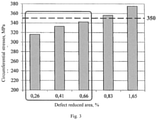
- SC1 stress criterion of the fuel element cladding for short-term modes limits the allowable size of individual defect adjacent to the face outer boundary of the nuclear fuel pellet, by the magnitude corresponding to 0.7% of the total pellet surface area.
- the requirements to maximum allowable area of individual defects on the fuel pellet surface are established; this area permits to justify the fuel element cladding strength in transient modes of reactor operation.
- the maximum area of individual defects for the end face and the side cylindrical surfaces is calculated as an equivalent area of two combined defects.
- the area of individual defect 1 of the end face surface is reduced from 1.7% to 1.3% of the pellet outer surface area.
- the area of individual defect 2 of the side cylindrical surface is reduced from 2.0% to 1.0% of the pellet outer surface area.
- the area of individual defect 3 adjacent to the face outer boundary is reduced from 1.7% to 0.7% of the pellet outer surface area.
- Increase in the fuel burnup range is achieved, generally, due to the use of fuel with increased grain size.
- the applicable requirements suppose an average grain size for standard fuel pellets made of uranium dioxide with no microadditives 10-25 ⁇ m; for pellets with microadditives of aluminum and silicon - 25 ⁇ m as minimum; for pellets with gadolinium oxide additive - 6 to 25 ⁇ m.
- the optimal grain size for the claimed pellet, depending on the additives used, is 6 to 35 ⁇ m. Reduction in GFP emissions is ensured due to introduction of aluminum and silicon additives, increasing the grain size up to 25-35 ⁇ m [ A.V. Medvedev, J.K. Bibilashvili, O.V. Milovanov, S.M.
- the nuclear fuel pellet it contains aluminum - 0.002 to 0.020% wt., and silicon - 0.001 to 0.010% wt. as oxides, evenly distributed throughout the entire pellet volume; and the grain size of uranium dioxide is 25 to 35 ⁇ m.
- This range of grain size on the one hand, contributes efficient reduction in GFP emissions; on the other hand, it limits the increase in spalling capacity and permits to minimize the amount of additives introduced in order to activate the increase in grain size when manufacturing pellets.
- the nuclear fuel pellet it contains 0.3 to 10.0% wt. gadolinium, or 0.3 to 2.5% wt. erbium, which are in the form of solid solution with uranium dioxide evenly distributed throughout the entire pellet volume; and the grain size is 6 to 25 ⁇ m.
- the nuclear fuel pellet described is manufactured using a well-known method, using ordinary means on standard equipment.
- the fuel shall have a specific phase composition, average grain size and other standard parameters.
- a mixer in particular, two- or three-plane gravity type mixer, a multicomponent mixture is prepared using uranium dioxide (UO 2 ), concentrated uranium oxide (U 3 O 8 ), porophore, microadditives of silicon and aluminum as SiO 2 and Al 2 O 3 or Al(OH) 3 . Then this mixture is subject to granulation, after that a plasticizing agent is introduced to the granulate using a ligature, it is mixed in the mixer and screened through a sieve. Then pellets are pressed, put into a molybdenum boat and subject to high-temperature sintering. After that pellets are polished using a centerless grinding machine and automatically put to the pallets.
- UO 2 uranium dioxide
- U 3 O 8 concentrated uranium oxide
- porophore microadditives of silicon and aluminum as SiO 2 and Al 2 O 3 or Al(OH) 3 .
- the stage of preparation of powder homogenized mixture can additionally comprise ligature mixing of components with further processing in a mixer and/or vibrating mill.
- a design of nuclear fuel pellet is developed, which ensures safe operation of fuel elements in normal operation modes, in case of disturbance in normal operation, and in the reactor operation maneuvering modes, due to reduction in the size of individual defects of the pellet appearance, and decrease in tension circumferential stresses in the cladding of fuel elements, and also due to increase the fuel burnup range thanks to introduction of additives increasing the grain size, and reduction in emissions of gaseous fission products.
Landscapes
- Engineering & Computer Science (AREA)
- Physics & Mathematics (AREA)
- Plasma & Fusion (AREA)
- General Engineering & Computer Science (AREA)
- High Energy & Nuclear Physics (AREA)
- Chemical & Material Sciences (AREA)
- Ceramic Engineering (AREA)
- Manufacturing & Machinery (AREA)
- Monitoring And Testing Of Nuclear Reactors (AREA)
- Inorganic Compounds Of Heavy Metals (AREA)
Applications Claiming Priority (2)
| Application Number | Priority Date | Filing Date | Title |
|---|---|---|---|
| RU2020116142A RU2741782C1 (ru) | 2020-04-27 | 2020-04-27 | Таблетка ядерного топлива |
| PCT/RU2020/000579 WO2021221533A1 (ru) | 2020-04-27 | 2020-11-02 | Таблетка ядерного топлива |
Publications (2)
| Publication Number | Publication Date |
|---|---|
| EP3961652A1 true EP3961652A1 (de) | 2022-03-02 |
| EP3961652A4 EP3961652A4 (de) | 2023-11-08 |
Family
ID=74554351
Family Applications (1)
| Application Number | Title | Priority Date | Filing Date |
|---|---|---|---|
| EP20933527.2A Pending EP3961652A4 (de) | 2020-04-27 | 2020-11-02 | Kernbrennstoffpellet |
Country Status (5)
| Country | Link |
|---|---|
| EP (1) | EP3961652A4 (de) |
| CN (1) | CN113874955B (de) |
| EA (1) | EA202192974A1 (de) |
| RU (1) | RU2741782C1 (de) |
| WO (1) | WO2021221533A1 (de) |
Families Citing this family (1)
| Publication number | Priority date | Publication date | Assignee | Title |
|---|---|---|---|---|
| RU206228U1 (ru) * | 2021-05-04 | 2021-09-01 | Российская Федерация, в лице которой выступает Государственная корпорация по атомной энергии "Росатом" | Таблетка СНУП топлива |
Family Cites Families (27)
| Publication number | Priority date | Publication date | Assignee | Title |
|---|---|---|---|---|
| GB1508080A (en) * | 1976-11-30 | 1978-04-19 | Gen Electric Canada | Nuclear fuel element |
| RU1669308C (ru) * | 1989-06-26 | 1994-04-30 | Производственное объединение "Машиностроительный завод" | Твэл стержневого типа |
| RU2197022C2 (ru) * | 2000-08-07 | 2003-01-20 | Открытое акционерное общество "Новосибирский завод химконцентратов" | Топливная таблетка из диоксида урана |
| RU2268507C2 (ru) * | 2003-04-04 | 2006-01-20 | Открытое акционерное общество "Ульбинский металлургический завод" | Таблетка ядерного керамического топлива с регулируемой микроструктурой |
| WO2006003266A1 (fr) * | 2004-06-01 | 2006-01-12 | Areva Np | Procede d'exploitation d'un reacteur nucleaire et utilisation d'un alliage specifique de gaine de crayon de combustible pour reduire l'endommagement par interaction pastilles/gaine |
| RU2339094C2 (ru) * | 2004-10-06 | 2008-11-20 | Акционерное общество "Ульбинский металлургический завод" | Таблетка ядерного уран-эрбиевого керамического топлива |
| FR2890767B1 (fr) * | 2005-09-09 | 2007-10-19 | Framatome Anp Sas | Procede de determination d'au moins un facteur d'incertitude technologique d'elements de combustible nucleaire, procede de conception, procede de fabrication et procede de controle d'elements de combustible nucleaire correspondants. |
| SE532185C2 (sv) * | 2007-04-10 | 2009-11-10 | Westinghouse Electric Sweden | Förfarande för att driva en reaktor hos en kärnanläggning |
| RU2376665C2 (ru) * | 2007-12-27 | 2009-12-20 | Открытое акционерное общество "ТВЭЛ" | Таблетка ядерного топлива высокого выгорания и способ ее изготовления (варианты) |
| WO2010038109A1 (en) * | 2008-09-30 | 2010-04-08 | Areva Np | Nuclear reactor green and sintered fuel pellets, corresponding fuel rod and fuel assembly |
| KR101023233B1 (ko) * | 2009-04-06 | 2011-03-21 | 한국수력원자력 주식회사 | 무연삭 환형 핵연료 소결체 제조방법 |
| RU2427936C1 (ru) * | 2010-02-18 | 2011-08-27 | Российская Федерация (РФ), от имени которой выступает Министерство образования и науки Российской Федерации (Минобрнауки России) | Комбинированная таблетка ядерного топлива |
| RU2467410C1 (ru) * | 2011-12-14 | 2012-11-20 | Скрипник Анастасия Андреевна | Таблетка смешанного ядерного топлива (варианты) |
| RU2467415C1 (ru) * | 2011-12-14 | 2012-11-20 | Скрипник Анастасия Андреевна | Тепловыделяющий элемент ядерного реактора (варианты) |
| RU2502141C1 (ru) * | 2012-11-13 | 2013-12-20 | Федеральное государственное автономное образовательное учреждение высшего профессионального образования "Национальный исследовательский технологический университет "МИСиС" | Уран-гадолиниевое ядерное топливо и способ его получения |
| RU2525828C1 (ru) * | 2013-03-01 | 2014-08-20 | Открытое акционерное общество "Машиностроительный завод" | Способ получения таблеток ядерного керамического топлива с регулируемой микроструктурой |
| WO2015195115A1 (en) * | 2014-06-18 | 2015-12-23 | Neucon Technology, Llc | Triso-isotropic (triso) based light water reactor fuel |
| KR101622569B1 (ko) * | 2014-10-31 | 2016-05-19 | 한국원자력연구원 | 핵연료 복합재료 소결체 및 이의 제조방법 |
| KR101652729B1 (ko) * | 2015-04-09 | 2016-09-01 | 한국원자력연구원 | 열전도성 금속망이 형성된 핵연료 소결체의 제조방법 및 이에 따라 제조되는 핵연료 소결체 |
| KR101677175B1 (ko) * | 2015-08-07 | 2016-11-21 | 서울시립대학교 산학협력단 | 기지상보다 수축율이 큰 코팅층을 갖는 삼층구조 등방성 핵연료 입자를 포함하는 완전 세라믹 캡슐형 핵연료 조성물, 소재 및 그 제조방법 |
| JP2017062185A (ja) * | 2015-09-25 | 2017-03-30 | 株式会社東芝 | 燃料棒及び燃料集合体 |
| CN106935298B (zh) * | 2015-12-31 | 2019-06-11 | 中核建中核燃料元件有限公司 | 一种仪表棒装配方法 |
| WO2018124915A1 (ru) * | 2016-12-29 | 2018-07-05 | Акционерное Общество "Твэл" | Таблетка ядерного топлива и способ её получения |
| CN107993728A (zh) * | 2017-12-29 | 2018-05-04 | 安徽中科超安科技有限公司 | 核电宝用燃料组件及固态燃料片的制造方法 |
| CN108218456B (zh) * | 2018-02-01 | 2021-08-06 | 中国工程物理研究院材料研究所 | 一种高安全性二氧化铀核燃料芯块的制备方法 |
| EA033850B8 (ru) * | 2018-10-31 | 2020-01-22 | Федеральное государственное унитарное предприятие "Научно-исследовательский институт Научно-производственное объединение "ЛУЧ" (ФГУП "НИИ НПО "ЛУЧ") | Способ изготовления дисперсионного тепловыделяющего элемента и топливных таблеток на его основе |
| RU2711006C1 (ru) * | 2019-06-07 | 2020-01-14 | Публичное акционерное общество "Машиностроительный завод" | Способ изготовления керамического ядерного топлива с выгорающим поглотителем |
-
2020
- 2020-04-27 RU RU2020116142A patent/RU2741782C1/ru active
- 2020-11-02 WO PCT/RU2020/000579 patent/WO2021221533A1/ru not_active Ceased
- 2020-11-02 EA EA202192974A patent/EA202192974A1/ru unknown
- 2020-11-02 EP EP20933527.2A patent/EP3961652A4/de active Pending
- 2020-11-02 CN CN202080038892.8A patent/CN113874955B/zh active Active
Also Published As
| Publication number | Publication date |
|---|---|
| CN113874955B (zh) | 2025-01-07 |
| EA202192974A1 (ru) | 2022-02-22 |
| EP3961652A4 (de) | 2023-11-08 |
| WO2021221533A1 (ru) | 2021-11-04 |
| RU2741782C1 (ru) | 2021-01-28 |
| CN113874955A (zh) | 2021-12-31 |
Similar Documents
| Publication | Publication Date | Title |
|---|---|---|
| EP3326173B1 (de) | Verfahren zur herstellung eines vollkeramisch mikroverkapselten kernbrennstoffes | |
| EP2345040B1 (de) | Kernreaktor-grün- und gesinterte Brennstoff-Pellets, entsprechender Brennstab und Brennelement | |
| KR101733832B1 (ko) | 핵연료, 핵연료 요소, 핵연료 어셈블리 및 핵연료의 제조 방법 | |
| EP2280400A1 (de) | Verfahren zur herstellung von kernbrennstoff-pellets, brennstoffbaugruppe, verfahren zur herstellung der brennstoffbaugruppe und uranpulver | |
| JP6961719B2 (ja) | 核燃料ペレット、燃料棒、および燃料アセンブリ | |
| US20160049211A1 (en) | Silicon carbide multilayered cladding and nuclear reactor fuel element for use in water-cooled nuclear power reactors | |
| US20120314831A1 (en) | Light Water Reactor TRISO Particle-Metal-Matrix Composite Fuel | |
| EP3961652A1 (de) | Kernbrennstoffpellet | |
| CN113161021A (zh) | 一种快中子反应堆中空氮化铀燃料元件 | |
| EP3745418B1 (de) | Kernbrennstoffsinterkörper mit ausgezeichneter schlagfestigkeit | |
| JP3960338B2 (ja) | 二重構造核燃料焼結体の製造方法 | |
| Kang et al. | Effects of MnO-Al2O3 on the grain growth and high-temperature deformation strain of UO2 fuel pellets | |
| EA042283B1 (ru) | Таблетка ядерного топлива | |
| Carter | Experimental investigation of various pellet geometries to reduce strains in zirconium alloy cladding | |
| CN109801727B (zh) | 燃料板及其制备方法 | |
| Markov et al. | State of fuel rods spent in the VVER-1000 reactor up to a fuel burnup of 75 мW· day/KGu | |
| RU2197022C2 (ru) | Топливная таблетка из диоксида урана | |
| KR102273295B1 (ko) | 핵연료 소결체의 산화저항성을 향상시킬 수 있는 피막을 형성시키는 소결 첨가제 및 이의 제조방법 | |
| JP5085522B2 (ja) | 長期連続運転用原子炉の炉心 | |
| JP2009145251A (ja) | 燃料棒およびその製造方法 | |
| Okunev | The impact of using innovative fuel cladding materials on the neutron-physical characteristics of light-water nuclear reactors | |
| Ohai et al. | Sintered pellets obtaining for advanced fuel manufacturing | |
| Yang et al. | Development of doped-UO2 pellets for a PCI remedy | |
| JPH06281765A (ja) | 原子炉用燃料被覆管 | |
| JP2017015602A (ja) | 高速炉の高速炉炉心および高速炉 |
Legal Events
| Date | Code | Title | Description |
|---|---|---|---|
| STAA | Information on the status of an ep patent application or granted ep patent |
Free format text: STATUS: THE INTERNATIONAL PUBLICATION HAS BEEN MADE |
|
| PUAI | Public reference made under article 153(3) epc to a published international application that has entered the european phase |
Free format text: ORIGINAL CODE: 0009012 |
|
| STAA | Information on the status of an ep patent application or granted ep patent |
Free format text: STATUS: REQUEST FOR EXAMINATION WAS MADE |
|
| 17P | Request for examination filed |
Effective date: 20211124 |
|
| AK | Designated contracting states |
Kind code of ref document: A1 Designated state(s): AL AT BE BG CH CY CZ DE DK EE ES FI FR GB GR HR HU IE IS IT LI LT LU LV MC MK MT NL NO PL PT RO RS SE SI SK SM TR |
|
| DAV | Request for validation of the european patent (deleted) | ||
| DAX | Request for extension of the european patent (deleted) | ||
| A4 | Supplementary search report drawn up and despatched |
Effective date: 20231010 |
|
| RIC1 | Information provided on ipc code assigned before grant |
Ipc: G21C 21/02 20060101ALI20231004BHEP Ipc: G21C 3/04 20060101ALI20231004BHEP Ipc: G21C 3/62 20060101AFI20231004BHEP |