EP3954577B1 - System für ein fahrzeug mit einem fahrzeugsitz und einem fahrzeugdach - Google Patents
System für ein fahrzeug mit einem fahrzeugsitz und einem fahrzeugdach Download PDFInfo
- Publication number
- EP3954577B1 EP3954577B1 EP21187171.0A EP21187171A EP3954577B1 EP 3954577 B1 EP3954577 B1 EP 3954577B1 EP 21187171 A EP21187171 A EP 21187171A EP 3954577 B1 EP3954577 B1 EP 3954577B1
- Authority
- EP
- European Patent Office
- Prior art keywords
- vehicle
- headrest
- roof
- image
- projection
- Prior art date
- Legal status (The legal status is an assumption and is not a legal conclusion. Google has not performed a legal analysis and makes no representation as to the accuracy of the status listed.)
- Active
Links
Images



Classifications
-
- B—PERFORMING OPERATIONS; TRANSPORTING
- B60—VEHICLES IN GENERAL
- B60N—SEATS SPECIALLY ADAPTED FOR VEHICLES; VEHICLE PASSENGER ACCOMMODATION NOT OTHERWISE PROVIDED FOR
- B60N2/00—Seats specially adapted for vehicles; Arrangement or mounting of seats in vehicles
- B60N2/80—Head-rests
- B60N2/879—Head-rests with additional features not related to head-rest positioning, e.g. heating or cooling devices or loudspeakers
-
- B—PERFORMING OPERATIONS; TRANSPORTING
- B60—VEHICLES IN GENERAL
- B60R—VEHICLES, VEHICLE FITTINGS, OR VEHICLE PARTS, NOT OTHERWISE PROVIDED FOR
- B60R11/00—Arrangements for holding or mounting articles, not otherwise provided for
- B60R11/02—Arrangements for holding or mounting articles, not otherwise provided for for radio sets, television sets, telephones, or the like; Arrangement of controls thereof
- B60R11/0229—Arrangements for holding or mounting articles, not otherwise provided for for radio sets, television sets, telephones, or the like; Arrangement of controls thereof for displays, e.g. cathodic tubes
- B60R11/0235—Arrangements for holding or mounting articles, not otherwise provided for for radio sets, television sets, telephones, or the like; Arrangement of controls thereof for displays, e.g. cathodic tubes of flat type, e.g. LCD
-
- G—PHYSICS
- G03—PHOTOGRAPHY; CINEMATOGRAPHY; ANALOGOUS TECHNIQUES USING WAVES OTHER THAN OPTICAL WAVES; ELECTROGRAPHY; HOLOGRAPHY
- G03B—APPARATUS OR ARRANGEMENTS FOR TAKING PHOTOGRAPHS OR FOR PROJECTING OR VIEWING THEM; APPARATUS OR ARRANGEMENTS EMPLOYING ANALOGOUS TECHNIQUES USING WAVES OTHER THAN OPTICAL WAVES; ACCESSORIES THEREFOR
- G03B21/00—Projectors or projection-type viewers; Accessories therefor
-
- B—PERFORMING OPERATIONS; TRANSPORTING
- B60—VEHICLES IN GENERAL
- B60K—ARRANGEMENT OR MOUNTING OF PROPULSION UNITS OR OF TRANSMISSIONS IN VEHICLES; ARRANGEMENT OR MOUNTING OF PLURAL DIVERSE PRIME-MOVERS IN VEHICLES; AUXILIARY DRIVES FOR VEHICLES; INSTRUMENTATION OR DASHBOARDS FOR VEHICLES; ARRANGEMENTS IN CONNECTION WITH COOLING, AIR INTAKE, GAS EXHAUST OR FUEL SUPPLY OF PROPULSION UNITS IN VEHICLES
- B60K2360/00—Indexing scheme associated with groups B60K35/00 or B60K37/00 relating to details of instruments or dashboards
- B60K2360/20—Optical features of instruments
- B60K2360/33—Illumination features
- B60K2360/334—Projection means
-
- B—PERFORMING OPERATIONS; TRANSPORTING
- B60—VEHICLES IN GENERAL
- B60N—SEATS SPECIALLY ADAPTED FOR VEHICLES; VEHICLE PASSENGER ACCOMMODATION NOT OTHERWISE PROVIDED FOR
- B60N2/00—Seats specially adapted for vehicles; Arrangement or mounting of seats in vehicles
- B60N2/90—Details or parts not otherwise provided for
- B60N2002/905—Details or parts not otherwise provided for the head-rest or seat used as an anchorage point, for an object not covered by groups in B60N, e.g. for a canvas
-
- B—PERFORMING OPERATIONS; TRANSPORTING
- B60—VEHICLES IN GENERAL
- B60R—VEHICLES, VEHICLE FITTINGS, OR VEHICLE PARTS, NOT OTHERWISE PROVIDED FOR
- B60R11/00—Arrangements for holding or mounting articles, not otherwise provided for
- B60R2011/0001—Arrangements for holding or mounting articles, not otherwise provided for characterised by position
- B60R2011/0003—Arrangements for holding or mounting articles, not otherwise provided for characterised by position inside the vehicle
- B60R2011/0012—Seats or parts thereof
- B60R2011/0017—Head-rests
Definitions
- the invention relates to a system for a vehicle with at least one vehicle seat, which comprises a seat part and a backrest with a headrest arranged above it and with a vehicle roof which extends at least over the headrest, according to the preamble of patent claim 1.
- DE10226451 shows a system for a vehicle with at least one vehicle seat, which comprises a seat part and a backrest with a headrest arranged above it, and with a vehicle roof, which extends at least over the headrest, wherein a projection device is integrated into the headrest, which projects an image onto an inner side of the vehicle roof.
- An essential idea of the invention is that in a system for a vehicle with at least one vehicle seat, which comprises a seat part and a backrest with a headrest arranged above it, and with a vehicle roof which extends at least over the headrest, a projection device is integrated in the headrest, which projects an image onto an inside of the vehicle roof.
- Projection devices can be arranged in individual vehicle pillars on their inside, for example on both B-pillars, which are intended to illuminate the inside of the vehicle roof. This has the advantage that a change in position of the projection devices is not possible, whereas a headrest can be adjusted in height and therefore the focus of the image to be projected must be corrected, for example by changing lens focal lengths by adjusting lenses.
- the arrangement of the projection device in the center console is also not conceivable.
- Such a system for projecting images of various types onto the inside of the vehicle roof, regardless of whether the inside has a roof liner or is just the inside of a convertible's folding roof, advantageously enables the projection device to be positioned in a location that is not disruptive to any of the vehicle's occupants and is generally not directly visible to all occupants.
- the positioning of the projection device on the top or in the upper area of a headrest is not perceived as disruptive by anyone, as long as the design of the headrest itself is not affected and the function of the headrest is not impaired in the event of an impact. This also applies to the positioning of the projection devices on the inside of the vehicle pillars in the upper area.
- Such an integration of a projection device in the upper part of a headrest is associated with the difficulty that it is difficult to see due to the short distance from the headrest to the inside of the roof or the headliner, it is not easy to project a correspondingly large image without the desired distortion onto the inside of the roof using a projector.
- a lens structure is used for this purpose which distributes the projection light beams carrying image data emitted by the projection device over an angle of 150° - 220°, preferably 180°, starting in a surface extension of a virtual plane on the top of the headrest.
- This not only enables the imaging of image components in a medium, large and largely flat area of a roof liner above the headrest, but also the imaging of image elements in the areas of the A, B and C pillars, along which the roof liner extends downwards to a certain limit.
- the lower inside of a vehicle roof can be, for example, the roof liner mentioned above or a textile cover of a glass roof.
- the inside of a convertible vehicle's folding roof or the inside of a retractable hard top are also conceivable.
- the inside is provided with an image-reproducing optimization layer, such as a luminescence layer, a light reflection layer and/or a retroreflective layer or a metal-pigmented paint layer.
- an image-reproducing optimization layer such as a luminescence layer, a light reflection layer and/or a retroreflective layer or a metal-pigmented paint layer.
- additional blinds or other darkening measures on the side windows and on the front and rear windows can be used to create a darker ambience within the interior of the vehicle in order to support such an image display.
- the lens structure according to the invention which can also consist of two or more lens units arranged next to each other on the headrest or integrated into the headrest, it is possible to enable a projection of the image to be projected that is adapted to the 3D geometry of the roof lining without undesirable distortion.
- one lens unit can provide a projection for the left side of the roof lining and the other lens unit for the right side of the roof lining when viewed in the direction of travel.
- one lens covers the rear area of the roof lining and the other lens covers the front area of the roof lining with a projection.
- such arrangements of two or more lenses can also enable light shows and moving images, as is known from light organs, for example. These moving images can even be played in opposite directions in their circular course.
- Such lens structures and in particular their lens units can include, for example, a fisheye lens and/or a short-throw projector in order to achieve a strong distribution of image light rays over the short distance between the headrest and the roof liner.
- a fisheye lens and/or a short-throw projector in order to achieve a strong distribution of image light rays over the short distance between the headrest and the roof liner.
- other optical aids are also conceivable for this purpose.
- appropriately programmed software can also be used to enable distortion-free radiation of the image light rays after the 3D shape of a roof liner has been recorded and calculated.
- a control device which, by means of control elements in the projection device and possibly a calculation device, controls and possibly calculates the distribution of the projection light beams/image light beams on the preferably three-dimensionally extending inside of the vehicle roof in such a way that a distortion-free image is created.
- the control device additionally controls individual lens elements and possibly other elements that deflect light beams, such as mirror elements, in such a way that the deflection of the light beams creates a distortion-free image on the roof liner.
- the image mentioned can be not only a still image, but also a moving and/or animated image.
- different scenarios could represent ambient lighting, such as a starry sky as an image, a cloudy sky as an image or something similar. These starry and cloudy skies could then also move across the roof liner as an image.
- FIG. 1 The system according to the invention is shown in a schematic representation according to a first embodiment of the invention. This shows a vehicle seat with a seat part 1 and a backrest 2, with a headrest 3 attached to the top of the backrest 2.
- a projection device 4 with a lens structure 5 is arranged, which can be more or less integrated into the headrest 3 without impairing the actual cushioning function and impact function of the headrest.
- Such a control device can also be arranged centrally within the headrest 3 in order to have all the elements for implementing the system according to the invention arranged within the headrest.
- a control device outside the headrest, for example underneath the seat part 1.
- the lens structure 5 is designed in such a way that it can emit light rays in a wide variety of directions, preferably over an angle ⁇ of 180° along a virtual plane 6 that brushes the top of the headrest 3 in a horizontal orientation, so that a projection of an image with the light rays 10 is not only possible on the top of a mostly slightly curved roof liner 9 of a vehicle roof 7, but also on A, B or C pillars (not shown in detail here) arranged at the side, onto which the roof liner partially extends. This means that a projection of an image is possible even at the level of the virtual plane 6, i.e. at the level of the top of the headrest, in the side area of the vehicle interior.
- individual light projection devices can be arranged in the vehicle pillars, such as the two B pillars, in order to emit the projection light rays to the inside of the vehicle roof.
- the vehicle roof 7 also advantageously has a surface layer 8 on the inner side 9 of the vehicle roof or its roof liner, which has a surface structure or composition that optimizes the image data.
- a surface layer 8 on the inner side 9 of the vehicle roof or its roof liner, which has a surface structure or composition that optimizes the image data. Examples of this are luminescence layers, light reflection layers, retroreflection layers or metal-pigmented paint layers.
- laser-emitting projection devices can be used as light projection devices, but also projection systems based on DLP (Digital Light Processing), for example.
- images are generated by modulating a digital image onto a light beam.
- the light beam is broken down into pixels by a rectangular arrangement of movable micromirrors and then reflected pixel by pixel either into the projection path or out of the projection path.
- normal light beam emitting sources can also be used as projection devices, whereby - as with the sources mentioned above - a fisheye lens is used in combination in the lens structure in order to achieve an appropriate distribution of the light beams.
- a fisheye lens can also be used in combination with laser sources, just like a short-throw projector.
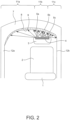
- Fig. 2 the system according to the invention is shown in accordance with a further embodiment. From this illustration it can be seen that in a vehicle seat with a seat part, a backrest 2 and a headrest 3 on the upper side 3a of the headrest 3, the lens structure does not consist of just one lens unit, but of a total of three lens units 5a, 5b and 5c.
- This arrangement of the lens units next to the actual projection device 4 means that the area to be illuminated for the reproduction of the image can be divided between the three lenses.
- the advantage here is that the short distance between the lens units and the inside does not make it difficult to reproduce a distortion-free image, since the entire surface area over 180° does not have to be covered with a single lens unit.
- the surface area 11a of the inside of the roof is covered with the first lens unit 5a, the surface area 11b with the lens unit 5b and the surface area 11c with the lens unit 5c.
- the individual areas or sections of the vehicle roof to be covered can be illuminated across the board, so that certain overlapping areas are created in sections 11a, 11b and 11c with regard to the light rays. This allows special effects to be achieved in these overlapping areas in the desired form.
- This illustration also shows, for example, two B-pillars 12a and 12b, which have parts of a roof liner 9 and the associated surface layer 8 in their upper area. It can therefore be seen from this illustration that parts of the B-pillars 12a and 12b are illuminated with an image when the roof liner is illuminated at 180° and can therefore enhance the desired ambience due to the roof liner being pulled down at the side.
- Fig.3 is a schematic representation of a side view of the system according to the invention according to a third embodiment of the connection.
- This representation is intended to make it clear that the projection device can be arranged in the dashboard area, for example on the dashboard or on the I-panel/dashboard, in order to provide the roof liner of a vehicle roof with an image to be projected from there.
- a side view shows that the projection device can be arranged in the rear area of a vehicle, i.e. behind a rear seat on the parcel shelf, for example, in order to project an image from there onto the roof liner in accordance with the arrow rays shown.
Landscapes
- Engineering & Computer Science (AREA)
- Mechanical Engineering (AREA)
- Aviation & Aerospace Engineering (AREA)
- Transportation (AREA)
- Physics & Mathematics (AREA)
- General Physics & Mathematics (AREA)
- Arrangements Of Lighting Devices For Vehicle Interiors, Mounting And Supporting Thereof, Circuits Therefore (AREA)
- Chair Legs, Seat Parts, And Backrests (AREA)
- Seats For Vehicles (AREA)
Description
- Die Erfindung betrifft ein System für ein Fahrzeug mit mindestens einem Fahrzeugsitz, der ein Sitzteil und eine Rückenlehne mit einer darüber angeordneten Kopfstütze umfasst und mit einem Fahrzeugdach, welches sich zumindest über die Kopfstütze hinweg erstreckt, gemäß dem Oberbegriff des Patentanspruches 1.
- Herkömmlicherweise weisen Fahrzeuge ein Fahrzeugdach und Fahrzeugsitze auf. Insbesondere PKWs sind an der Innenseite des Fahrzeugdaches mit einem Fahrzeughimmel ausgestattet, sofern es sich um ein nichtbewegliches Fahrzeugdach handelt. Aber auch Cabrios sind unabhängig davon, ob sie mit einem Retractable Hard Top oder einem Faltdach ausgestattet sind, an der Innenseite des Fahrzeugdaches - zumindest im geschlossenen Zustand des Hardtops oder des Faltdaches - mit einer Innenseite ausgestattet, deren Oberfläche glatt ist.
- Da im Zuge der Weiterentwicklung von Fahrzeugen, insbesondere PKWs, - auch in Hinblick auf das autonome Fahren - immer mehr der Aufenthalt innerhalb eines Fahrzeuges ohne aktive Teilnahme der Person und/oder des Fahrers am Verkehrsgeschehen stadtfinden wird, besteht vermehrt der Wunsch nach einer zunehmenden Innenraumbeleuchtung des Fahrzeuges, die auch den Fahrzeughimmel bzw. die Innenseite des Fahrzeugdaches mit einschließt. Bisher sind dazu keine Systeme bekannt, die es ermöglichen, den Fahrzeughimmel bzw. die Innenseite des Fahrzeugdaches zumindest teilweise flächenmäßig auszuleuchten bzw. mit bestimmten Lichteffekten zu bestrahlen, um ein angenehmes Ambiente innerhalb des Fahrzeugraumes für die sich darin aufhaltenden Personen zu schaffen. Die
DE10226451 zeigt ein System für ein Fahrzeug mit mindestens einem Fahrzeugsitz, der ein Sitzteil und eine Rückenlehne mit darüber angeordneter Kopfstütze umfasst, und mit einem Fahrzeugdach, welches sich zumindest über die Kopfstütze hinweg erstreckt, wobei in die Kopfstütze ein Projektionsgerät integriert ist, welches ein Bild auf eine Innenseite des Fahrzeugdaches projiziert. - Deshalb ist es Aufgabe der Erfindung, ein System für ein Fahrzeug mit mind. einem Fahrzeugsitz, mit einer Kopfstütze und einem Fahrzeugdach zur Verfügung zu stellen, in welchem sich die Innenseite des Fahrzeugdaches in seiner Oberflächendarstellung verändern lässt.
- Diese Aufgabe wird erfindungsgemäß durch die Merkmale des Patentanspruches 1 gelöst.
- Ein wesentlicher Gedanke der Erfindung liegt darin, dass bei einem System für ein Fahrzeug mit mindestens einem Fahrzeugsitz, der ein Sitzteil und eine Rückenlehne mit darüber angeordneter Kopfstütze umfasst und mit einem Fahrzeugdach, welches sich zumindest über die Kopfstütze hinweg erstreckt, ein Projektionsgerät in die Kopfstütze integriert ist, welches ein Bild auf eine Innenseite des Fahrzeugdaches projiziert. Nicht erfindungsgemäß können Projektionsgeräte in einzelnen Fahrzeugsäulen an deren Innenseite, beispielsweise an beiden B-Säulen, angeordnet sein, welche die Innenseite des Fahrzeugdaches ausleuchten sollen. Dies hat den Vorteil, dass eine Positionsveränderung der Projektionsgeräte nicht möglich ist, wohingegen eine Kopfstütze in ihrer Höhe verstellt werden kann und deshalb eine Schärfeeinstellung des zu projizierenden Bildes korrigiert werden muss, indem beispielsweise Linsenbrennweiten durch Verstellen von Linsen verändert werden. Nicht erfindungsgemäß ist auch die Anordnung des Projektionsgerätes in der Mittelkonsole denkbar.
- Ein derartiges System zur Projektierung von Bildern verschiedenster Art auf die Innenseite des Fahrzeugdaches unabhängig davon, ob die Innenseite einen Dachhimmel aufweist oder lediglich die Innenseite eines Faltdaches bei einem Cabrio ist, ermöglicht vorteilhaft die Anordnung des Projektionsgerätes an einem Ort, der für jeden Insassen des Fahrzeuges nicht störend wirkt und in der Regel von allen Insassen nicht direkt sichtbar ist. Denn die Anordnung des Projektionsgerätes an der Oberseite bzw. im oberen Bereich einer Kopfstütze wird von keiner Person störend wahrgenommen, solang das Design der Kopfstütze an sich nicht darunter leidet und die Funktion der Kopfstütze im Falle eines Aufpralles nicht beeinträchtigt wird. Dies trifft auch auf die Anordnung der Projektionsgeräte an der inneren Seite der Fahrzeugsäulen im oberen Bereich zu.
- Zwar ist eine derartige Integration eines Projektionsgerätes im oberen Bereich einer Kopfstütze mit der Schwierigkeit verbunden, dass es aufgrund des kurzen Abstandes von der Kopfstütze zu der Innenseite des Daches bzw. dem Dachhimmel nicht ganz einfach ist, ein entsprechend flächengroßes Bild ohne gewünschte Verzerrung auf die Innenseite des Daches mit einem Projektor zu werfen.
- Jedoch ist hierzu erfindungsgemäß ein Linsenaufbau im Einsatz, der eine Verteilung der vom Projektionsgerät ausgesendeten bilddatentragenden Projektionslichtstrahlen über einen Winkel von 150° - 220°, vorzugsweise 180° ausgehend in einer Flächenerstreckung einer virtuellen Ebene an einer Oberseite der Kopfstütze durchführt. Dies ermöglicht nicht nur die Abbildung von Bildbestandteilen in einem mittleren, großflächigen und weitestgehend ebenen Bereich eines Dachhimmels oberhalb der Kopfstütze, sondern auch die Abbildung von Bildelementen in den Bereichen der A-, B- und C-Säulen, an denen entlang sich der Dachhimmel bis zu einer gewissen Grenze nach unten zieht.
- Ebenso ist es denkbar, dass aufgrund der Ausbildung eines bestimmten Linsenaufbaus eine Textilabdeckung eines großflächigen Schiebedaches als Projektionsfläche dient.
- Als untere Innenseite eines Fahrzeugdaches kann bspw. ein bereits erwähnter Dachhimmel oder eine Textilabdeckung eines Glasdaches dienen. Ebenso ist die Innenseite eines Faltdaches eines Cabriolet-Fahrzeuges oder die Innenseite eines Retractable Hard Tops denkbar.
- Gemäß einer bevorzugten Ausführungsform ist bei dem erwähnten erfindungsgemäßen System die Innenseite mit einer bildwiedergebenden Optimierungsschicht, wie eine Lumineszenzschicht, eine Lichtreflexionsschicht und/oder eine Retroreflexionsschicht oder eine metallpigmentierten Lackschicht versehen. Dies ermöglicht, dass an der Oberfläche eines Dachhimmels oder allgemein einer Innenseite eines Fahrzeugdaches eine verbesserte Bilddarstellung auch während des Tages, an dem Tageslicht in das Fahrzeug gelangt, möglich ist.
- Selbstverständlich können zusätzliche Jalousieelemente oder andere Verdunklungsmaßnahmen an den Seitenscheiben und an der Vorder- und Rückscheibe dazu dienen, ein dunkleres Ambiente innerhalb des Innenraums des Fahrzeuges zu schaffen, um eine derartige Bilddarstellung entsprechend zu unterstützen.
- Aufgrund des erfindungsgemäßen Linsenaufbaus, der auch aus zwei oder mehreren an der Kopfstütze nebeneinander angeordneten oder in die Kopfstütze integrierten Linseneinheiten bestehen kann, ist es möglich, dass eine an die 3D-Geometrie des Dachhimmels angepasste Projektion des zu projizierenden Bildes ohne ungewünschte Verzerrung ermöglicht wird. So kann beispielsweise bei der Anordnung von zwei Linseneinheiten nebeneinander auf der Oberseite der Kopfstütze erreicht werden, dass die eine Linseneinheit für die linke Seite des Dachhimmels und die andere Linseneinheit für die rechte Seite des Dachhimmels, bei Betrachtung in Fahrtrichtung, eine Projektion zur Verfügung stellt. Ebenso ist denkbar, dass die eine Linse den hinteren Bereich des Dachhimmels und die andere Linse den vorderen Bereich des Dachhimmels mit einer Projektion abdeckt. Selbstverständlich können aufgrund derartiger Anordnungen von zwei oder mehreren Linsen auch Lichtspiele und sich bewegende Bilder, wie es bspw. bei Lichtorgeln bekannt ist, ermöglicht werden. Diese bewegenden Bilder können sogar gegenläufig in ihrem Kreisverlauf abgespielt werden.
- Derartige Linsenaufbauten und insbesondere deren Linseneinheiten können bspw. eine Fischaugenlinse und/oder einen Kurzdistanzbeamer umfassen, um auf diese Weise eine starke Bildlichtstrahlenverteilung über die kurze Distanz zwischen Kopfstütze und Dachhimmel zu erreichen. Selbstverständlich sind auch andere optische Hilfsmittel hierfür denkbar. Insbesondere kann auch eine entsprechend programmierte Software dazu dienen, nach Erfassung und Berechnung der 3D Form eines Dachhimmels eine verzerrungsfreie Abstrahlung der Bildlichtstrahlen zu ermöglichen.
- Erfindungsgemäß ist eine Steuerungseinrichtung vorhanden, die mittels Steuerungselemente in dem Projektionsgerät und eventuell einer Berechnungseinrichtung die Verteilung der Projektionslichtstrahlen/Bildlichtstrahlen an der sich vorzugsweise dreidimensional erstreckenden Innenseite des Fahrzeugdaches derart steuert und eventuell berechnet, dass ein verzerrungsfreies Bild entsteht. Hierfür ist es auch denkbar, dass die Steuerungseinrichtung zusätzlich einzelne Linsenelemente und ggf. lichtstrahlenablenkende andere Elemente, wie bspw. Spiegelelemente, derart steuert, dass durch die Umlenkung der Lichtstrahlen ein verzerrungsfreies Bild am Dachhimmel entsteht.
- Das erwähnte Bild kann nicht nur ein stehendes, sondern auch ein sich bewegendes und/oder animiertes Bild sein. Beispielsweise könnten unterschiedliche Szenarien eine Ambientebeleuchtung darstellen, wie einen Sternenhimmel als Abbildung, einen Wolkenhimmel als Abbildung oder dergleichen. Diese Sternen- und Wolkenhimmel könnten sich dann auch über den Dachhimmel hinweg als Bild bewegen.
- Weitere vorteilhafte Ausführungsformen ergeben sich aus der Zeichnung in Verbindung mit der Beschreibung.
- Hierbei zeigen:
- Fig. 1
- in einer schematischen Darstellung einer Seitendarstellung eines erfindungsgemäßen Systems mit einem Fahrzeugdach und einem Fahrzeugsitz mit Kopfstütze, gemäß einer ersten Ausführungsform der Erfindung;
- Fig. 2
- in einer Vorderansicht ein erfindungsgemäßes System mit einem Fahrzeugsitz, mit Kopfstütze und Dach gemäß einer zweiten Ausführungsform der Erfindung;
- Fig.3
- in einer schematischen Darstellung einer Seitenansicht eines erfindungsgemäßen Systems gemäß einer dritten Ausführungsform der Erfindung;
- Fig.4
- in einer schematischen Darstellung einer Seitenansicht des erfindungsgemäßen Systems gemäß einer vierten Ausführungsform der Erfindung.
- In
Fig. 1 ist in einer schematischen Darstellung das erfindungsgemäße System gemäß einer ersten Ausführungsform der Erfindung gezeigt. Hierbei wird ein Fahrzeugsitz mit einem Sitzteil 1 und einer Rückenlehne 2 wiedergegeben, wobei an der Oberseite der Rückenlehne 2 sich eine Kopfstütze 3 anschließt. - Auf einer Oberseite 3a der Kopfstütze 3 ist ein Projektionsgerät 4 mit einem Linsenaufbau 5 angeordnet, welches mehr oder weniger in der Kopfstütze 3 integriert eingebaut sein kann, ohne die eigentliche polsternde Funktion und Aufprallfunktion der Kopfstütze zu beeinträchtigen.
- Eine derartige Steuerungseinrichtung kann ebenso innerhalb der Kopfstütze 3 mittig angeordnet sein, um so sämtliche Elemente innerhalb der Kopfstütze für die Durchführung des erfindungsgemäßen Systems angeordnet zu haben. Alternativ ist selbstverständlich die Anordnung einer Steuereinrichtung außerhalb der Kopfstütze, beispielsweise unterhalb des Sitzteils 1, denkbar.
- Der Linsenaufbau 5 ist derart gestaltet, dass er bevorzugt über einen Winkel α von 180° entlang einer virtuellen Ebene 6, die die Oberseite der Kopfstütze 3 in horizontaler Ausrichtung streift, Lichtstrahlen in verschiedenste Richtungen ausstrahlen kann, sodass eine Projektion eines Bildes mit den Lichtstrahlen 10 nicht nur an der Oberseite eines zumeist leicht gewölbten Dachhimmels 9 eines Fahrzeugdaches 7 ermöglicht wird, sondern auch an hier nicht näher dargestellten seitlich angeordneten A-, B- oder C-Säulen, auf die sich teilweise der Dachhimmel heruntererstreckt. Somit ist eine Projektion eines Bildes selbst auf Höhe der virtuellen Ebene 6, also auf der Höhe der Oberseite der Kopfstütze, im seitlichen Bereich des Fahrzeuginnenraumes möglich. Zusätzlich oder alternativ können einzelne Lichtprojektionsgeräte in den Fahrzeug-Säulen, wie beispielsweise den beiden B-Säulen, angeordnet sein, um hier aus die Projektionslichtstrahlen an die Innenseite des Fahrzeugdaches auszusenden.
- Das Fahrzeugdach 7 weist zudem an der Innenseite 9 des Fahrzeugdaches bzw. dessen Dachhimmel vorteilhaft eine Oberflächenschicht 8 auf, die eine entsprechend bilddatenoptimierende Oberflächenstruktur oder Zusammensetzung aufweist. Beispiele hierfür sind Lumineszenzschichten, Lichtreflexionsschichten, Retroreflexionsschichten oder metallpigmentierte Lackschichten.
- Als Lichtprojektionseinrichtungen können nicht nur Laser emittierende Projektionseinrichtungen verwendet werden, sondern auch beispielsweise auf DLP (Digital Light Processing) beruhende Projektionsanlagen. Hierbei werden Bilder erzeugt, indem ein digitales Bild auf einen Lichtstrahl aufmoduliert wird. Dabei wird der Lichtstrahl durch eine rechteckige Anordnung von beweglichen Mikrospiegeln in Pixel zerlegt und dann pixelweise entweder in dem Projektionsweg hinein oder aus dem Projektionsweg hinaus reflektiert.
- Selbstverständlich können auch ganz normale lichtstrahlwiedergebende Quellen als Projektionseinrichtungen verwendet werden, wobei hierbei - ebenso wie bei den oben genannten Quellen - in Kombination eine Fischaugenlinse im Linsenaufbau verwendet wird, um eine entsprechende Verteilung der Lichtstrahlen zu erreichen. Eine derartige Fischaugenlinse kann jedoch auch ebenso wie ein Kurzdistanzbeamer in Kombination mit Laserquellen verwendet werden.
- In
Fig. 2 ist das erfindungsgemäße System gemäß einer weiteren Ausführungsform dargestellt. Dieser Darstellung ist zu entnehmen, dass bei einem Fahrzeugsitz mit einem Sitzteil, einer Rückenlehne 2 und einer Kopfstütze 3 an der Oberseite 3a der Kopfstütze 3 der Linsenaufbau nicht nur aus einer Linseneinheit, sondern aus insgesamt drei Linseneinheiten 5a, 5b und 5c besteht. - Diese Nebeneinanderanordnung der Linseneinheiten mit der eigentlichen Projektionseinrichtung 4 hat zufolge, dass man die zu bestrahlende Fläche für die Wiedergabe des Bildes auf die drei Linsen aufteilen kann. Vorteilhaft ist hierbei, dass die kurze Entfernung zwischen den Linseneinheiten und der Innenseite für die Wiedergabe eines verzerrungsfreien Bildes nicht erschwerend entgegensteht, da nicht der gesamte Flächenbereich über 180° mit einer einzigen Linseneinheit abgedeckt werden muss.
- Vielmehr wird mit der ersten Linseneinheit 5a der Flächenbereich 11a der Innenseite des Daches abgedeckt, mit der Linseneinheit 5b der Flächenbereich 11b und mit der Linseneinheit 5c der Flächenbereich 11c. Die einzelnen abzudeckenden Bereiche bzw. Abschnitte des Fahrzeugdaches, können hierbei übergreifend beleuchtet werden, sodass bestimmte in den Abschnitten 11a, 11b und 11c sich überlappende Bereiche hinsichtlich der Lichtstrahlen entstehen. Hierdurch können spezielle Effekte in diesen überlappenden Bereichen in gewünschter Form erreicht werden.
- In dieser Darstellung sind auch beispielsweise zwei B-Säulen 12a und 12b wiedergegeben, die Teile eines Dachhimmels 9 und der dazugehörigen Oberflächenschicht 8 in ihrem oberen Bereich aufweisen. Somit ist dieser Darstellung zu entnehmen, dass Teile der B-Säulen 12a und 12b bei einer 180° Ausleuchtung des Dachhimmels mit einem Bild mitbeleuchtet werden und somit das gewünschte Ambiente aufgrund des seitlich heruntergezogenen Dachhimmels verstärken können.
- In
Fig.3 ist in einer schematischen Darstellung eine Seitenansicht des erfindungsgemäßen Systems gemäß einer dritten Ausführungsform der Verbindung gezeigt. In dieser Darstellung soll verdeutlicht werden, dass im Armaturenbereich, beispielsweise auf dem Armaturenbrett bzw. auf der I-Tafel/Armaturentafel das Projektionsgerät angeordnet sein kann, um von dort den Dachhimmel eines Fahrzeugdaches mit einem zu projizierenden Bild zu versehen. - In
Fig.4 wird gemäß einer vierten Ausführungsform der Erfindung in einer Seitendarstellung widergegeben, dass das Projektionsgerät im hinteren Bereich eines Fahrzeuges, also hinter einer Rücksitzbank auf der Hutablage beispielsweise angeordnet sein kann, um von dort die Projektion eines Bildes auf den Dachhimmel gemäß den dargestellten Pfeilstrahlen durchzuführen. -
- 1
- Sitzteil
- 2
- Rückenlehne
- 3
- Kopfstütze,
- 3a
- Oberseite der Kopfstütze
- 4
- Projektionsgerät, Projektionseinrichtung
- 5
- Linsenaufbau
- 5a, 5b, 5c
- Linseneinheiten
- 6
- virtuelle Ebene
- 7
- Fahrzeugdach
- 8
- Oberflächenschicht
- 9
- Dachhimmel, Innenseite des Fahrzeugdaches
- 10
- Lichtstrahlen
- 11a, 11b, 11c
- Flächenbereiche der Innenseite des Daches
- 12a, 12b
- B-Säulen
- α
- Winkel
Claims (8)
- System für ein Fahrzeug mit mindestens einem Fahrzeugsitz, der ein Sitzteil (1) und eine Rückenlehne (2) mit darüber angeordneter Kopfstütze (3) umfasst, und mit einem Fahrzeugdach (7), welches sich zumindest über die Kopfstütze (3) hinweg erstreckt, wobeiin die Kopfstütze (3) ein Projektionsgerät (4) integriert ist, welches ein Bild auf eine Innenseite (9) des Fahrzeugdaches (7) projiziert,dadurch gekennzeichnet, dassdas Projektionsgerät (4) einen Linsenaufbau (5) aufweist, der eine direkte Verteilung der vom Projektionsgerät (4) ausgesendeten bilddatentragenden Projektionslichtstrahlen (10) über einen Winkel (α) von 150°-220°, ausgehend von einer Flächenerstreckung einer virtuellen Ebene (6) an einer Oberseite (3a) der Kopfstütze (3), durchführt,wobei das System eine Steuerungseinrichtung umfasst, die mittels Steuerungselementen in den Projektionsgerät (4) die Verteilung der Projektionslichtstrahlen (10) an der sich dreidimensional erstreckenden Innenseite des Fahrzeugdaches (7) derart steuert, dass ein verzerrungsfreies Bild entsteht.
- System nach Anspruch 1,
dadurch gekennzeichnet, dass
die Innenseite (9) des Fahrzeugdaches (7) ein Dachhimmel und/oder eine Textilabdeckung eines Glasdaches ist. - System nach einem der vorangegangenen Ansprüche,
dadurch gekennzeichnet, dass
die Innenseite (9) mit einer bildwiedergebenden Optimierungsschicht, wie eine Lumineszenzschicht, einer Lichtreflexionsschicht und/oder einer Retroreflexionsschicht und/oder einer metallpigmentierten Lackschicht versehen ist. - System nach einem der vorangegangenen Ansprüche,
dadurch gekennzeichnet, dass
die Lichtstrahlen (10) über einen Winkel (α) von 180° ausgehend von der Flächenstreckung der virtuellen Ebene (6) verteilt sind. - System nach Anspruch 4,
dadurch gekennzeichnet, dass
der Linsenaufbau mindestens eine Fischaugenlinse und/oder einen Kurzdistanzbeamer umfasst. - System nach Anspruch 4 oder 5,
dadurch gekennzeichnet, dass
der Linsenaufbau aus zwei oder mehreren an der Kopfstütze (3) nebeneinander angeordneten Linseneinheiten (5a, 5b, 5c) besteht, deren Projektionslichtstrahlen (10) einzelne ihnen zugeordnete Abschnitte (11a, 11b, 11c) der Innenseite (9) des Fahrzeugdaches beleuchten. - System nach einem der vorangegangenen Ansprüche,
dadurch gekennzeichnet, dass
eine Steuerungseinrichtung mittels Steuerungselemente in dem Projektionsgerät (4) und/oder eine Berechnungseinrichtung die Verteilung der Projektionslichtstrahlen (10) an der sich vorzugsweise dreidimensional erstreckenden Innenseite (9) des Fahrzeugdaches (7) derart steuert und/oder berechnet, dass ein verzerrungsfreies Bild entsteht. - System nach einem der vorangegangenen Ansprüche,
dadurch gekennzeichnet, dass
das Bild ein sich bewegendes und/oder animiertes Bild ist.
Applications Claiming Priority (1)
| Application Number | Priority Date | Filing Date | Title |
|---|---|---|---|
| DE102020121077.9A DE102020121077B4 (de) | 2020-08-11 | 2020-08-11 | System für ein Fahrzeug mit einem Fahrzeugsitz und einem Fahrzeugdach |
Publications (2)
| Publication Number | Publication Date |
|---|---|
| EP3954577A1 EP3954577A1 (de) | 2022-02-16 |
| EP3954577B1 true EP3954577B1 (de) | 2024-10-30 |
Family
ID=77021254
Family Applications (1)
| Application Number | Title | Priority Date | Filing Date |
|---|---|---|---|
| EP21187171.0A Active EP3954577B1 (de) | 2020-08-11 | 2021-07-22 | System für ein fahrzeug mit einem fahrzeugsitz und einem fahrzeugdach |
Country Status (2)
| Country | Link |
|---|---|
| EP (1) | EP3954577B1 (de) |
| DE (1) | DE102020121077B4 (de) |
Families Citing this family (2)
| Publication number | Priority date | Publication date | Assignee | Title |
|---|---|---|---|---|
| DE102021212047A1 (de) | 2021-10-26 | 2023-04-27 | Robert Bosch Gesellschaft mit beschränkter Haftung | Beleuchtungsvorrichtung für eine Beobachtungsvorrichtung für ein Fahrzeug |
| DE102022131168A1 (de) * | 2022-11-24 | 2024-05-29 | Bayerische Motoren Werke Aktiengesellschaft | Verfahren zur projektion von bildinhalten |
Citations (3)
| Publication number | Priority date | Publication date | Assignee | Title |
|---|---|---|---|---|
| JP2002114095A (ja) * | 2000-10-06 | 2002-04-16 | Imasen Electric Ind Co Ltd | スポットランプ |
| DE202015102061U1 (de) * | 2015-04-24 | 2015-06-30 | Lisa Dräxlmaier GmbH | Innenbeleuchtung eines Fahrzeugs |
| US20170240106A1 (en) * | 2016-02-24 | 2017-08-24 | Valeo Vision | Lighting system for motor vehicle passenger compartment |
Family Cites Families (7)
| Publication number | Priority date | Publication date | Assignee | Title |
|---|---|---|---|---|
| US3867633A (en) * | 1971-12-17 | 1975-02-18 | Texas Instruments Inc | Wide angle viewing system for limited visibility conditions |
| DE10226451C1 (de) | 2002-06-13 | 2003-07-17 | Webasto Vehicle Sys Int Gmbh | Vorrichtung zum Darstellen von visuellen Informationen in Fahrzeugen |
| US20120105808A1 (en) | 2010-10-28 | 2012-05-03 | Gm Global Technology Operations, Inc. | Vehicle display system |
| EP2746833A1 (de) * | 2012-12-18 | 2014-06-25 | Volvo Car Corporation | Fahrzeuganpassung an einen automatischen fahrerunabhängigen Steuerungsmodus |
| US10095097B2 (en) | 2016-11-29 | 2018-10-09 | Hyundai Motor Company | Projection-type optical module |
| DE102019000120A1 (de) * | 2019-01-11 | 2020-07-16 | Grammer Ag | Kopfstütze und Kopfstützensystem |
| DE202019102868U1 (de) * | 2019-05-04 | 2019-07-08 | Viktor Schatz | Personen-Transportfahrzeug mit Aufprall-Sicherheits-System |
-
2020
- 2020-08-11 DE DE102020121077.9A patent/DE102020121077B4/de not_active Expired - Fee Related
-
2021
- 2021-07-22 EP EP21187171.0A patent/EP3954577B1/de active Active
Patent Citations (3)
| Publication number | Priority date | Publication date | Assignee | Title |
|---|---|---|---|---|
| JP2002114095A (ja) * | 2000-10-06 | 2002-04-16 | Imasen Electric Ind Co Ltd | スポットランプ |
| DE202015102061U1 (de) * | 2015-04-24 | 2015-06-30 | Lisa Dräxlmaier GmbH | Innenbeleuchtung eines Fahrzeugs |
| US20170240106A1 (en) * | 2016-02-24 | 2017-08-24 | Valeo Vision | Lighting system for motor vehicle passenger compartment |
Also Published As
| Publication number | Publication date |
|---|---|
| EP3954577A1 (de) | 2022-02-16 |
| DE102020121077A1 (de) | 2022-02-17 |
| DE102020121077B4 (de) | 2023-08-24 |
Similar Documents
| Publication | Publication Date | Title |
|---|---|---|
| EP3847499B1 (de) | Verfahren zum betreiben einer blickfeldanzeigevorrichtung für ein kraftfahrzeug | |
| EP3013642B1 (de) | Kraftfahrzeug | |
| DE102013203162B4 (de) | Virtuelle Cabrioverdecke, Sonnedächer und Heckfenster sowie Systeme und Verfahren zum Vorsehen derselben | |
| EP3954577B1 (de) | System für ein fahrzeug mit einem fahrzeugsitz und einem fahrzeugdach | |
| DE102007005028A1 (de) | Verfahren und Vorrichtung zum Wiedergeben von Information auf einer Projektionsfläche in einem Fahrzeug | |
| DE102018209934A1 (de) | Blickfeldanzeigevorrichtung für ein Kraftfahrzeug | |
| DE102016225745A1 (de) | Kraftfahrzeug mit einem Bildschirm in einem Fahrzeuginnenraum | |
| DE102021122159A1 (de) | Kompaktes Doppel-Head-up-Display für zwei Insassen in einem Fahrzeug | |
| DE102018200408A1 (de) | Bedienvorrichtung mit mehrteiliger Anzeigefläche für ein Kraftfahrzeug sowie Kraftfahrzeug | |
| DE102023003959A1 (de) | Projektionsanordnung für einen Kraftwagen sowie Verfahren | |
| DE102018207078A1 (de) | Kraftfahrzeug mit selbstleuchtendem Bildschirm sowie zugehöriges Betriebsverfahren | |
| DE102019132460A1 (de) | Einstellen eines Rückspiegels an einem Fahrzeug | |
| DE102018203875A1 (de) | Kraftfahrzeug | |
| DE102014213683A1 (de) | Vorrichtung zur optischen Darstellung von Informationen in einem Fahrzeug | |
| DE102021208588B4 (de) | Dynamisches Sonnenschutzsystem für ein Kraftfahrzeug und Verfahren zum dynamischen Sonnenschutz mittels Sitzverstellung | |
| DE102019121048A1 (de) | Waveguide-basiertes Direktsichtdisplay | |
| DE102020102742A1 (de) | Kraftfahrzeug mit einer Beleuchtungsvorrichtung für seinen Innenraum | |
| DE102020102287A1 (de) | Verfahren zum Kalibrieren einer Blickfeldanzeigevorrichtung für ein Fahrzeug | |
| DE202015008142U1 (de) | Head-up-Display eines Kraftfahrzeugs sowie Kraftfahrzeug | |
| DE102021126195A1 (de) | Projektionsanzeigevorrichtung für zusätzliche Fahrerinformationen im Innenspiegel über Reflexion an der Heckscheibe | |
| DE102017221531B3 (de) | Head-Up-Display-System | |
| DE102024100769A1 (de) | Seitenspiegelersatz-Display mit schwebender realer Bildebene in einem Fahrzeug | |
| DE102019209940A1 (de) | Kollisionswarnung | |
| DE20211819U1 (de) | Projektionssystem | |
| DE19850406C1 (de) | Übungssimulator |
Legal Events
| Date | Code | Title | Description |
|---|---|---|---|
| PUAI | Public reference made under article 153(3) epc to a published international application that has entered the european phase |
Free format text: ORIGINAL CODE: 0009012 |
|
| STAA | Information on the status of an ep patent application or granted ep patent |
Free format text: STATUS: THE APPLICATION HAS BEEN PUBLISHED |
|
| AK | Designated contracting states |
Kind code of ref document: A1 Designated state(s): AL AT BE BG CH CY CZ DE DK EE ES FI FR GB GR HR HU IE IS IT LI LT LU LV MC MK MT NL NO PL PT RO RS SE SI SK SM TR |
|
| STAA | Information on the status of an ep patent application or granted ep patent |
Free format text: STATUS: REQUEST FOR EXAMINATION WAS MADE |
|
| 17P | Request for examination filed |
Effective date: 20220728 |
|
| RBV | Designated contracting states (corrected) |
Designated state(s): AL AT BE BG CH CY CZ DE DK EE ES FI FR GB GR HR HU IE IS IT LI LT LU LV MC MK MT NL NO PL PT RO RS SE SI SK SM TR |
|
| STAA | Information on the status of an ep patent application or granted ep patent |
Free format text: STATUS: EXAMINATION IS IN PROGRESS |
|
| 17Q | First examination report despatched |
Effective date: 20230317 |
|
| REG | Reference to a national code |
Ref country code: DE Ref legal event code: R079 Free format text: PREVIOUS MAIN CLASS: B60N0002879000 Ipc: G03B0021000000 Ref document number: 502021005611 Country of ref document: DE |
|
| RIC1 | Information provided on ipc code assigned before grant |
Ipc: B60R 11/02 20060101ALI20240502BHEP Ipc: B60R 11/00 20060101ALI20240502BHEP Ipc: B60N 2/879 20180101ALI20240502BHEP Ipc: B60N 2/90 20180101ALI20240502BHEP Ipc: G03B 21/00 20060101AFI20240502BHEP |
|
| GRAP | Despatch of communication of intention to grant a patent |
Free format text: ORIGINAL CODE: EPIDOSNIGR1 |
|
| STAA | Information on the status of an ep patent application or granted ep patent |
Free format text: STATUS: GRANT OF PATENT IS INTENDED |
|
| INTG | Intention to grant announced |
Effective date: 20240607 |
|
| GRAS | Grant fee paid |
Free format text: ORIGINAL CODE: EPIDOSNIGR3 |
|
| GRAA | (expected) grant |
Free format text: ORIGINAL CODE: 0009210 |
|
| STAA | Information on the status of an ep patent application or granted ep patent |
Free format text: STATUS: THE PATENT HAS BEEN GRANTED |
|
| AK | Designated contracting states |
Kind code of ref document: B1 Designated state(s): AL AT BE BG CH CY CZ DE DK EE ES FI FR GB GR HR HU IE IS IT LI LT LU LV MC MK MT NL NO PL PT RO RS SE SI SK SM TR |
|
| REG | Reference to a national code |
Ref country code: GB Ref legal event code: FG4D Free format text: NOT ENGLISH |
|
| REG | Reference to a national code |
Ref country code: CH Ref legal event code: EP |
|
| REG | Reference to a national code |
Ref country code: IE Ref legal event code: FG4D Free format text: LANGUAGE OF EP DOCUMENT: GERMAN |
|
| REG | Reference to a national code |
Ref country code: DE Ref legal event code: R096 Ref document number: 502021005611 Country of ref document: DE |
|
| REG | Reference to a national code |
Ref country code: LT Ref legal event code: MG9D |
|
| REG | Reference to a national code |
Ref country code: NL Ref legal event code: MP Effective date: 20241030 |
|
| PG25 | Lapsed in a contracting state [announced via postgrant information from national office to epo] |
Ref country code: PT Free format text: LAPSE BECAUSE OF FAILURE TO SUBMIT A TRANSLATION OF THE DESCRIPTION OR TO PAY THE FEE WITHIN THE PRESCRIBED TIME-LIMIT Effective date: 20250228 Ref country code: IS Free format text: LAPSE BECAUSE OF FAILURE TO SUBMIT A TRANSLATION OF THE DESCRIPTION OR TO PAY THE FEE WITHIN THE PRESCRIBED TIME-LIMIT Effective date: 20250228 Ref country code: HR Free format text: LAPSE BECAUSE OF FAILURE TO SUBMIT A TRANSLATION OF THE DESCRIPTION OR TO PAY THE FEE WITHIN THE PRESCRIBED TIME-LIMIT Effective date: 20241030 |
|
| PG25 | Lapsed in a contracting state [announced via postgrant information from national office to epo] |
Ref country code: NL Free format text: LAPSE BECAUSE OF FAILURE TO SUBMIT A TRANSLATION OF THE DESCRIPTION OR TO PAY THE FEE WITHIN THE PRESCRIBED TIME-LIMIT Effective date: 20241030 Ref country code: FI Free format text: LAPSE BECAUSE OF FAILURE TO SUBMIT A TRANSLATION OF THE DESCRIPTION OR TO PAY THE FEE WITHIN THE PRESCRIBED TIME-LIMIT Effective date: 20241030 |
|
| PG25 | Lapsed in a contracting state [announced via postgrant information from national office to epo] |
Ref country code: BG Free format text: LAPSE BECAUSE OF FAILURE TO SUBMIT A TRANSLATION OF THE DESCRIPTION OR TO PAY THE FEE WITHIN THE PRESCRIBED TIME-LIMIT Effective date: 20241030 |
|
| PG25 | Lapsed in a contracting state [announced via postgrant information from national office to epo] |
Ref country code: ES Free format text: LAPSE BECAUSE OF FAILURE TO SUBMIT A TRANSLATION OF THE DESCRIPTION OR TO PAY THE FEE WITHIN THE PRESCRIBED TIME-LIMIT Effective date: 20241030 |
|
| PG25 | Lapsed in a contracting state [announced via postgrant information from national office to epo] |
Ref country code: NO Free format text: LAPSE BECAUSE OF FAILURE TO SUBMIT A TRANSLATION OF THE DESCRIPTION OR TO PAY THE FEE WITHIN THE PRESCRIBED TIME-LIMIT Effective date: 20250130 |
|
| PG25 | Lapsed in a contracting state [announced via postgrant information from national office to epo] |
Ref country code: GR Free format text: LAPSE BECAUSE OF FAILURE TO SUBMIT A TRANSLATION OF THE DESCRIPTION OR TO PAY THE FEE WITHIN THE PRESCRIBED TIME-LIMIT Effective date: 20250131 Ref country code: LV Free format text: LAPSE BECAUSE OF FAILURE TO SUBMIT A TRANSLATION OF THE DESCRIPTION OR TO PAY THE FEE WITHIN THE PRESCRIBED TIME-LIMIT Effective date: 20241030 |
|
| PG25 | Lapsed in a contracting state [announced via postgrant information from national office to epo] |
Ref country code: PL Free format text: LAPSE BECAUSE OF FAILURE TO SUBMIT A TRANSLATION OF THE DESCRIPTION OR TO PAY THE FEE WITHIN THE PRESCRIBED TIME-LIMIT Effective date: 20241030 |
|
| PG25 | Lapsed in a contracting state [announced via postgrant information from national office to epo] |
Ref country code: RS Free format text: LAPSE BECAUSE OF FAILURE TO SUBMIT A TRANSLATION OF THE DESCRIPTION OR TO PAY THE FEE WITHIN THE PRESCRIBED TIME-LIMIT Effective date: 20250130 |
|
| PG25 | Lapsed in a contracting state [announced via postgrant information from national office to epo] |
Ref country code: SM Free format text: LAPSE BECAUSE OF FAILURE TO SUBMIT A TRANSLATION OF THE DESCRIPTION OR TO PAY THE FEE WITHIN THE PRESCRIBED TIME-LIMIT Effective date: 20241030 |
|
| PG25 | Lapsed in a contracting state [announced via postgrant information from national office to epo] |
Ref country code: DK Free format text: LAPSE BECAUSE OF FAILURE TO SUBMIT A TRANSLATION OF THE DESCRIPTION OR TO PAY THE FEE WITHIN THE PRESCRIBED TIME-LIMIT Effective date: 20241030 |
|
| PG25 | Lapsed in a contracting state [announced via postgrant information from national office to epo] |
Ref country code: EE Free format text: LAPSE BECAUSE OF FAILURE TO SUBMIT A TRANSLATION OF THE DESCRIPTION OR TO PAY THE FEE WITHIN THE PRESCRIBED TIME-LIMIT Effective date: 20241030 |
|
| PG25 | Lapsed in a contracting state [announced via postgrant information from national office to epo] |
Ref country code: RO Free format text: LAPSE BECAUSE OF FAILURE TO SUBMIT A TRANSLATION OF THE DESCRIPTION OR TO PAY THE FEE WITHIN THE PRESCRIBED TIME-LIMIT Effective date: 20241030 |
|
| PG25 | Lapsed in a contracting state [announced via postgrant information from national office to epo] |
Ref country code: SK Free format text: LAPSE BECAUSE OF FAILURE TO SUBMIT A TRANSLATION OF THE DESCRIPTION OR TO PAY THE FEE WITHIN THE PRESCRIBED TIME-LIMIT Effective date: 20241030 |
|
| PG25 | Lapsed in a contracting state [announced via postgrant information from national office to epo] |
Ref country code: CZ Free format text: LAPSE BECAUSE OF FAILURE TO SUBMIT A TRANSLATION OF THE DESCRIPTION OR TO PAY THE FEE WITHIN THE PRESCRIBED TIME-LIMIT Effective date: 20241030 |
|
| PG25 | Lapsed in a contracting state [announced via postgrant information from national office to epo] |
Ref country code: IT Free format text: LAPSE BECAUSE OF FAILURE TO SUBMIT A TRANSLATION OF THE DESCRIPTION OR TO PAY THE FEE WITHIN THE PRESCRIBED TIME-LIMIT Effective date: 20241030 |
|
| REG | Reference to a national code |
Ref country code: DE Ref legal event code: R097 Ref document number: 502021005611 Country of ref document: DE |
|
| PLBE | No opposition filed within time limit |
Free format text: ORIGINAL CODE: 0009261 |
|
| STAA | Information on the status of an ep patent application or granted ep patent |
Free format text: STATUS: NO OPPOSITION FILED WITHIN TIME LIMIT |
|
| PG25 | Lapsed in a contracting state [announced via postgrant information from national office to epo] |
Ref country code: SE Free format text: LAPSE BECAUSE OF FAILURE TO SUBMIT A TRANSLATION OF THE DESCRIPTION OR TO PAY THE FEE WITHIN THE PRESCRIBED TIME-LIMIT Effective date: 20241030 |
|
| 26N | No opposition filed |
Effective date: 20250731 |
|
| PGFP | Annual fee paid to national office [announced via postgrant information from national office to epo] |
Ref country code: DE Payment date: 20250722 Year of fee payment: 5 |
|
| PGFP | Annual fee paid to national office [announced via postgrant information from national office to epo] |
Ref country code: AT Payment date: 20251020 Year of fee payment: 5 |
|
| REG | Reference to a national code |
Ref country code: CH Ref legal event code: H13 Free format text: ST27 STATUS EVENT CODE: U-0-0-H10-H13 (AS PROVIDED BY THE NATIONAL OFFICE) Effective date: 20260224 |
|
| PG25 | Lapsed in a contracting state [announced via postgrant information from national office to epo] |
Ref country code: LU Free format text: LAPSE BECAUSE OF NON-PAYMENT OF DUE FEES Effective date: 20250722 |
|
| GBPC | Gb: european patent ceased through non-payment of renewal fee |
Effective date: 20250722 |
|
| REG | Reference to a national code |
Ref country code: BE Ref legal event code: MM Effective date: 20250731 |
|
| PG25 | Lapsed in a contracting state [announced via postgrant information from national office to epo] |
Ref country code: GB Free format text: LAPSE BECAUSE OF NON-PAYMENT OF DUE FEES Effective date: 20250722 |
|
| PG25 | Lapsed in a contracting state [announced via postgrant information from national office to epo] |
Ref country code: BE Free format text: LAPSE BECAUSE OF NON-PAYMENT OF DUE FEES Effective date: 20250731 |
|
| PG25 | Lapsed in a contracting state [announced via postgrant information from national office to epo] |
Ref country code: FR Free format text: LAPSE BECAUSE OF NON-PAYMENT OF DUE FEES Effective date: 20250731 |
|
| PG25 | Lapsed in a contracting state [announced via postgrant information from national office to epo] |
Ref country code: CH Free format text: LAPSE BECAUSE OF NON-PAYMENT OF DUE FEES Effective date: 20250731 |