EP3933456A1 - Optical lens - Google Patents
Optical lens Download PDFInfo
- Publication number
- EP3933456A1 EP3933456A1 EP20762455.2A EP20762455A EP3933456A1 EP 3933456 A1 EP3933456 A1 EP 3933456A1 EP 20762455 A EP20762455 A EP 20762455A EP 3933456 A1 EP3933456 A1 EP 3933456A1
- Authority
- EP
- European Patent Office
- Prior art keywords
- formula
- thermoplastic resin
- bis
- fluorene
- optical lens
- Prior art date
- Legal status (The legal status is an assumption and is not a legal conclusion. Google has not performed a legal analysis and makes no representation as to the accuracy of the status listed.)
- Pending
Links
- 230000003287 optical effect Effects 0.000 title claims abstract description 50
- 229920005992 thermoplastic resin Polymers 0.000 claims abstract description 89
- KDLHZDBZIXYQEI-UHFFFAOYSA-N Palladium Chemical compound [Pd] KDLHZDBZIXYQEI-UHFFFAOYSA-N 0.000 claims description 60
- YMWUJEATGCHHMB-UHFFFAOYSA-N Dichloromethane Chemical compound ClCCl YMWUJEATGCHHMB-UHFFFAOYSA-N 0.000 claims description 33
- 125000003118 aryl group Chemical group 0.000 claims description 31
- NIHNNTQXNPWCJQ-UHFFFAOYSA-N fluorene Chemical compound C1=CC=C2CC3=CC=CC=C3C2=C1 NIHNNTQXNPWCJQ-UHFFFAOYSA-N 0.000 claims description 28
- 229910052763 palladium Inorganic materials 0.000 claims description 22
- 229920000728 polyester Polymers 0.000 claims description 21
- RJGDLRCDCYRQOQ-UHFFFAOYSA-N anthrone Chemical compound C1=CC=C2C(=O)C3=CC=CC=C3CC2=C1 RJGDLRCDCYRQOQ-UHFFFAOYSA-N 0.000 claims description 20
- BVKZGUZCCUSVTD-UHFFFAOYSA-L Carbonate Chemical compound [O-]C([O-])=O BVKZGUZCCUSVTD-UHFFFAOYSA-L 0.000 claims description 17
- ZDZHCHYQNPQSGG-UHFFFAOYSA-N 1-naphthalen-1-ylnaphthalene Chemical compound C1=CC=C2C(C=3C4=CC=CC=C4C=CC=3)=CC=CC2=C1 ZDZHCHYQNPQSGG-UHFFFAOYSA-N 0.000 claims description 13
- 229920000515 polycarbonate Polymers 0.000 claims description 9
- 239000004417 polycarbonate Substances 0.000 claims description 9
- 230000009477 glass transition Effects 0.000 claims description 6
- 238000003384 imaging method Methods 0.000 abstract description 8
- 150000002009 diols Chemical class 0.000 description 53
- YXFVVABEGXRONW-UHFFFAOYSA-N Toluene Chemical compound CC1=CC=CC=C1 YXFVVABEGXRONW-UHFFFAOYSA-N 0.000 description 52
- 229920005989 resin Polymers 0.000 description 38
- 239000011347 resin Substances 0.000 description 38
- 238000006243 chemical reaction Methods 0.000 description 28
- 239000003054 catalyst Substances 0.000 description 22
- 125000001624 naphthyl group Chemical group 0.000 description 21
- 229920000642 polymer Polymers 0.000 description 19
- OFOBLEOULBTSOW-UHFFFAOYSA-N Malonic acid Chemical compound OC(=O)CC(O)=O OFOBLEOULBTSOW-UHFFFAOYSA-N 0.000 description 18
- -1 boronic acid aromatic compound Chemical class 0.000 description 18
- 239000000243 solution Substances 0.000 description 17
- 150000001875 compounds Chemical class 0.000 description 16
- 150000002430 hydrocarbons Chemical group 0.000 description 16
- 125000001997 phenyl group Chemical group [H]C1=C([H])C([H])=C(*)C([H])=C1[H] 0.000 description 16
- 239000012760 heat stabilizer Substances 0.000 description 14
- 238000000034 method Methods 0.000 description 14
- 125000004432 carbon atom Chemical group C* 0.000 description 13
- 239000000203 mixture Substances 0.000 description 13
- 125000003983 fluorenyl group Chemical group C1(=CC=CC=2C3=CC=CC=C3CC12)* 0.000 description 12
- 238000004519 manufacturing process Methods 0.000 description 12
- 238000001308 synthesis method Methods 0.000 description 12
- 239000003795 chemical substances by application Substances 0.000 description 11
- 230000000052 comparative effect Effects 0.000 description 11
- 239000007858 starting material Substances 0.000 description 11
- ISWSIDIOOBJBQZ-UHFFFAOYSA-N Phenol Chemical compound OC1=CC=CC=C1 ISWSIDIOOBJBQZ-UHFFFAOYSA-N 0.000 description 10
- 125000004435 hydrogen atom Chemical group [H]* 0.000 description 10
- 238000000465 moulding Methods 0.000 description 10
- 239000006096 absorbing agent Substances 0.000 description 9
- HEDRZPFGACZZDS-UHFFFAOYSA-N Chloroform Chemical compound ClC(Cl)Cl HEDRZPFGACZZDS-UHFFFAOYSA-N 0.000 description 8
- 125000005843 halogen group Chemical group 0.000 description 8
- 125000005647 linker group Chemical group 0.000 description 8
- XLYOFNOQVPJJNP-UHFFFAOYSA-N water Substances O XLYOFNOQVPJJNP-UHFFFAOYSA-N 0.000 description 8
- NQXNYVAALXGLQT-UHFFFAOYSA-N 2-[4-[9-[4-(2-hydroxyethoxy)phenyl]fluoren-9-yl]phenoxy]ethanol Chemical compound C1=CC(OCCO)=CC=C1C1(C=2C=CC(OCCO)=CC=2)C2=CC=CC=C2C2=CC=CC=C21 NQXNYVAALXGLQT-UHFFFAOYSA-N 0.000 description 7
- 150000008425 anthrones Chemical class 0.000 description 7
- YLQWCDOCJODRMT-UHFFFAOYSA-N fluoren-9-one Chemical compound C1=CC=C2C(=O)C3=CC=CC=C3C2=C1 YLQWCDOCJODRMT-UHFFFAOYSA-N 0.000 description 7
- 238000004128 high performance liquid chromatography Methods 0.000 description 7
- 238000002354 inductively-coupled plasma atomic emission spectroscopy Methods 0.000 description 7
- 239000008188 pellet Substances 0.000 description 7
- 229920005668 polycarbonate resin Polymers 0.000 description 7
- 239000004431 polycarbonate resin Substances 0.000 description 7
- 239000011541 reaction mixture Substances 0.000 description 7
- 125000001622 2-naphthyl group Chemical group [H]C1=C([H])C([H])=C2C([H])=C(*)C([H])=C([H])C2=C1[H] 0.000 description 6
- OKTJSMMVPCPJKN-UHFFFAOYSA-N Carbon Chemical compound [C] OKTJSMMVPCPJKN-UHFFFAOYSA-N 0.000 description 6
- XEKOWRVHYACXOJ-UHFFFAOYSA-N Ethyl acetate Chemical compound CCOC(C)=O XEKOWRVHYACXOJ-UHFFFAOYSA-N 0.000 description 6
- LYCAIKOWRPUZTN-UHFFFAOYSA-N Ethylene glycol Chemical compound OCCO LYCAIKOWRPUZTN-UHFFFAOYSA-N 0.000 description 6
- VYPSYNLAJGMNEJ-UHFFFAOYSA-N Silicium dioxide Chemical compound O=[Si]=O VYPSYNLAJGMNEJ-UHFFFAOYSA-N 0.000 description 6
- HEMHJVSKTPXQMS-UHFFFAOYSA-M Sodium hydroxide Chemical compound [OH-].[Na+] HEMHJVSKTPXQMS-UHFFFAOYSA-M 0.000 description 6
- 125000006615 aromatic heterocyclic group Chemical group 0.000 description 6
- 239000013078 crystal Substances 0.000 description 6
- 229910052751 metal Inorganic materials 0.000 description 6
- 239000002184 metal Substances 0.000 description 6
- VLKZOEOYAKHREP-UHFFFAOYSA-N n-Hexane Chemical compound CCCCCC VLKZOEOYAKHREP-UHFFFAOYSA-N 0.000 description 6
- NFHFRUOZVGFOOS-UHFFFAOYSA-N palladium;triphenylphosphane Chemical compound [Pd].C1=CC=CC=C1P(C=1C=CC=CC=1)C1=CC=CC=C1.C1=CC=CC=C1P(C=1C=CC=CC=1)C1=CC=CC=C1.C1=CC=CC=C1P(C=1C=CC=CC=1)C1=CC=CC=C1.C1=CC=CC=C1P(C=1C=CC=CC=1)C1=CC=CC=C1 NFHFRUOZVGFOOS-UHFFFAOYSA-N 0.000 description 6
- 239000000047 product Substances 0.000 description 6
- 239000007787 solid Substances 0.000 description 6
- 229910052717 sulfur Inorganic materials 0.000 description 6
- 239000006097 ultraviolet radiation absorber Substances 0.000 description 6
- 125000001637 1-naphthyl group Chemical group [H]C1=C([H])C([H])=C2C(*)=C([H])C([H])=C([H])C2=C1[H] 0.000 description 5
- HBTONAMIPDVQRI-UHFFFAOYSA-N 2-[4-[9-[4-(2-hydroxyethoxy)-3-phenylphenyl]fluoren-9-yl]-2-phenylphenoxy]ethanol Chemical compound OCCOC1=CC=C(C2(C3=CC=CC=C3C3=CC=CC=C32)C=2C=C(C(OCCO)=CC=2)C=2C=CC=CC=2)C=C1C1=CC=CC=C1 HBTONAMIPDVQRI-UHFFFAOYSA-N 0.000 description 5
- 230000015572 biosynthetic process Effects 0.000 description 5
- 238000001816 cooling Methods 0.000 description 5
- 239000006185 dispersion Substances 0.000 description 5
- 238000001035 drying Methods 0.000 description 5
- 239000013067 intermediate product Substances 0.000 description 5
- 239000010410 layer Substances 0.000 description 5
- 239000000178 monomer Substances 0.000 description 5
- 239000012044 organic layer Substances 0.000 description 5
- 238000006116 polymerization reaction Methods 0.000 description 5
- 125000001424 substituent group Chemical group 0.000 description 5
- PPTXVXKCQZKFBN-UHFFFAOYSA-N (S)-(-)-1,1'-Bi-2-naphthol Chemical compound C1=CC=C2C(C3=C4C=CC=CC4=CC=C3O)=C(O)C=CC2=C1 PPTXVXKCQZKFBN-UHFFFAOYSA-N 0.000 description 4
- OZGFLBCWIQDWLO-UHFFFAOYSA-N 2-[1-[2-(carboxymethoxy)naphthalen-1-yl]naphthalen-2-yl]oxyacetic acid Chemical compound C1=CC=C2C(C3=C4C=CC=CC4=CC=C3OCC(=O)O)=C(OCC(O)=O)C=CC2=C1 OZGFLBCWIQDWLO-UHFFFAOYSA-N 0.000 description 4
- JWUYZBRLVGICME-UHFFFAOYSA-N 2-[4-[9-[4-(2-hydroxyethoxy)phenyl]-2,7-dinaphthalen-2-ylfluoren-9-yl]phenoxy]ethanol Chemical compound OCCOc1ccc(cc1)C1(c2cc(ccc2-c2ccc(cc12)-c1ccc2ccccc2c1)-c1ccc2ccccc2c1)c1ccc(OCCO)cc1 JWUYZBRLVGICME-UHFFFAOYSA-N 0.000 description 4
- LFQSCWFLJHTTHZ-UHFFFAOYSA-N Ethanol Chemical compound CCO LFQSCWFLJHTTHZ-UHFFFAOYSA-N 0.000 description 4
- OAICVXFJPJFONN-UHFFFAOYSA-N Phosphorus Chemical compound [P] OAICVXFJPJFONN-UHFFFAOYSA-N 0.000 description 4
- NINIDFKCEFEMDL-UHFFFAOYSA-N Sulfur Chemical compound [S] NINIDFKCEFEMDL-UHFFFAOYSA-N 0.000 description 4
- KKEYFWRCBNTPAC-UHFFFAOYSA-N Terephthalic acid Chemical compound OC(=O)C1=CC=C(C(O)=O)C=C1 KKEYFWRCBNTPAC-UHFFFAOYSA-N 0.000 description 4
- 239000002253 acid Substances 0.000 description 4
- 230000004075 alteration Effects 0.000 description 4
- IISBACLAFKSPIT-UHFFFAOYSA-N bisphenol A Chemical compound C=1C=C(O)C=CC=1C(C)(C)C1=CC=C(O)C=C1 IISBACLAFKSPIT-UHFFFAOYSA-N 0.000 description 4
- ZADPBFCGQRWHPN-UHFFFAOYSA-N boronic acid Chemical compound OBO ZADPBFCGQRWHPN-UHFFFAOYSA-N 0.000 description 4
- 229910052799 carbon Inorganic materials 0.000 description 4
- 230000000694 effects Effects 0.000 description 4
- 238000001746 injection moulding Methods 0.000 description 4
- QQVIHTHCMHWDBS-UHFFFAOYSA-N isophthalic acid Chemical compound OC(=O)C1=CC=CC(C(O)=O)=C1 QQVIHTHCMHWDBS-UHFFFAOYSA-N 0.000 description 4
- 125000002496 methyl group Chemical group [H]C([H])([H])* 0.000 description 4
- 229910052698 phosphorus Inorganic materials 0.000 description 4
- 239000011574 phosphorus Substances 0.000 description 4
- 239000002243 precursor Substances 0.000 description 4
- 239000011342 resin composition Substances 0.000 description 4
- 239000011593 sulfur Substances 0.000 description 4
- 238000003786 synthesis reaction Methods 0.000 description 4
- 125000006273 (C1-C3) alkyl group Chemical group 0.000 description 3
- 125000004178 (C1-C4) alkyl group Chemical group 0.000 description 3
- 238000005160 1H NMR spectroscopy Methods 0.000 description 3
- ZKBUCVUKEWAMGB-UHFFFAOYSA-N 2-[1-[2-(2-hydroxyethoxy)-6-phenylnaphthalen-1-yl]-6-phenylnaphthalen-2-yl]oxyethanol Chemical compound C1(=CC=CC=C1)C=1C=C2C=CC(=C(C2=CC=1)C1=C(C=CC2=CC(=CC=C12)C1=CC=CC=C1)OCCO)OCCO ZKBUCVUKEWAMGB-UHFFFAOYSA-N 0.000 description 3
- HSASKNPEYJOZHA-UHFFFAOYSA-N 2-[3-(carboxymethoxy)-5-(1-hydroxy-2-oxo-2-phenylethyl)phenoxy]acetic acid Chemical compound C(=O)(O)COC=1C=C(C(C(C2=CC=CC=C2)=O)O)C=C(C=1)OCC(=O)O HSASKNPEYJOZHA-UHFFFAOYSA-N 0.000 description 3
- JVBWCQOTLXWAIF-UHFFFAOYSA-N 2-[4-[9-[4-(2-hydroxyethoxy)phenyl]-2,7-dinaphthalen-1-ylfluoren-9-yl]phenoxy]ethanol Chemical compound OCCOc1ccc(cc1)C1(c2cc(ccc2-c2ccc(cc12)-c1cccc2ccccc12)-c1cccc2ccccc12)c1ccc(OCCO)cc1 JVBWCQOTLXWAIF-UHFFFAOYSA-N 0.000 description 3
- JQJYTWHASCGDRQ-UHFFFAOYSA-N 2-[4-[9-[4-(2-hydroxyethoxy)phenyl]-2,7-diphenylfluoren-9-yl]phenoxy]ethanol Chemical compound OCCOc1ccc(cc1)C1(c2cc(ccc2-c2ccc(cc12)-c1ccccc1)-c1ccccc1)c1ccc(OCCO)cc1 JQJYTWHASCGDRQ-UHFFFAOYSA-N 0.000 description 3
- SSADPHQCUURWSW-UHFFFAOYSA-N 3,9-bis(2,6-ditert-butyl-4-methylphenoxy)-2,4,8,10-tetraoxa-3,9-diphosphaspiro[5.5]undecane Chemical compound CC(C)(C)C1=CC(C)=CC(C(C)(C)C)=C1OP1OCC2(COP(OC=3C(=CC(C)=CC=3C(C)(C)C)C(C)(C)C)OC2)CO1 SSADPHQCUURWSW-UHFFFAOYSA-N 0.000 description 3
- DYOPVXMHYSXHNG-UHFFFAOYSA-N 6-[9-(6-hydroxynaphthalen-2-yl)fluoren-9-yl]naphthalen-2-ol Chemical compound C1=C(O)C=CC2=CC(C3(C4=CC=CC=C4C4=CC=CC=C43)C3=CC4=CC=C(C=C4C=C3)O)=CC=C21 DYOPVXMHYSXHNG-UHFFFAOYSA-N 0.000 description 3
- OKKJLVBELUTLKV-UHFFFAOYSA-N Methanol Chemical compound OC OKKJLVBELUTLKV-UHFFFAOYSA-N 0.000 description 3
- 125000002029 aromatic hydrocarbon group Chemical group 0.000 description 3
- VBICKXHEKHSIBG-UHFFFAOYSA-N beta-monoglyceryl stearate Natural products CCCCCCCCCCCCCCCCCC(=O)OCC(O)CO VBICKXHEKHSIBG-UHFFFAOYSA-N 0.000 description 3
- 125000002619 bicyclic group Chemical group 0.000 description 3
- 150000004650 carbonic acid diesters Chemical class 0.000 description 3
- 239000007795 chemical reaction product Substances 0.000 description 3
- 125000000753 cycloalkyl group Chemical group 0.000 description 3
- 230000018044 dehydration Effects 0.000 description 3
- 238000006297 dehydration reaction Methods 0.000 description 3
- 150000002148 esters Chemical group 0.000 description 3
- 238000011156 evaluation Methods 0.000 description 3
- 150000002220 fluorenes Chemical group 0.000 description 3
- 125000005842 heteroatom Chemical group 0.000 description 3
- 229920001225 polyester resin Polymers 0.000 description 3
- 239000004645 polyester resin Substances 0.000 description 3
- TYJJADVDDVDEDZ-UHFFFAOYSA-M potassium hydrogencarbonate Chemical compound [K+].OC([O-])=O TYJJADVDDVDEDZ-UHFFFAOYSA-M 0.000 description 3
- 239000000377 silicon dioxide Substances 0.000 description 3
- 239000002904 solvent Substances 0.000 description 3
- 125000004434 sulfur atom Chemical group 0.000 description 3
- 238000005809 transesterification reaction Methods 0.000 description 3
- KLDXJTOLSGUMSJ-UNTFVMJOSA-N (3s,3ar,6s,6ar)-2,3,3a,5,6,6a-hexahydrofuro[3,2-b]furan-3,6-diol Chemical compound O[C@H]1CO[C@@H]2[C@@H](O)CO[C@@H]21 KLDXJTOLSGUMSJ-UNTFVMJOSA-N 0.000 description 2
- 125000006704 (C5-C6) cycloalkyl group Chemical group 0.000 description 2
- JYEUMXHLPRZUAT-UHFFFAOYSA-N 1,2,3-triazine Chemical compound C1=CN=NN=C1 JYEUMXHLPRZUAT-UHFFFAOYSA-N 0.000 description 2
- RFDNUPWFKBZDFC-UHFFFAOYSA-N 2-[1-[2-(2-hydroxyethoxy)-6-naphthalen-2-ylnaphthalen-1-yl]-6-naphthalen-2-ylnaphthalen-2-yl]oxyethanol Chemical compound C1=C(C=CC2=CC=CC=C12)C=1C=C2C=CC(=C(C2=CC=1)C1=C(C=CC2=CC(=CC=C12)C1=CC2=CC=CC=C2C=C1)OCCO)OCCO RFDNUPWFKBZDFC-UHFFFAOYSA-N 0.000 description 2
- OVJPYIRGUFWANT-UHFFFAOYSA-N 2-[1-[2-(2-hydroxyethoxy)naphthalen-1-yl]naphthalen-2-yl]oxyethanol Chemical compound C1=CC=C2C(C3=C4C=CC=CC4=CC=C3OCCO)=C(OCCO)C=CC2=C1 OVJPYIRGUFWANT-UHFFFAOYSA-N 0.000 description 2
- IFTVECOAHZIWGG-UHFFFAOYSA-N 2-[4-[9-[4-(2-hydroxyethoxy)phenyl]-3,6-dinaphthalen-2-ylfluoren-9-yl]phenoxy]ethanol Chemical compound OCCOc1ccc(cc1)C1(c2ccc(cc2-c2cc(ccc12)-c1ccc2ccccc2c1)-c1ccc2ccccc2c1)c1ccc(OCCO)cc1 IFTVECOAHZIWGG-UHFFFAOYSA-N 0.000 description 2
- DELWPYMOALIYAX-UHFFFAOYSA-N 2-[6-[9-[6-(2-hydroxyethoxy)naphthalen-2-yl]-2,7-dinaphthalen-2-ylfluoren-9-yl]naphthalen-2-yl]oxyethanol Chemical compound OCCOC=1C=C2C=CC(=CC2=CC=1)C1(C2=CC(=CC=C2C=2C=CC(=CC1=2)C1=CC2=CC=CC=C2C=C1)C1=CC2=CC=CC=C2C=C1)C1=CC2=CC=C(C=C2C=C1)OCCO DELWPYMOALIYAX-UHFFFAOYSA-N 0.000 description 2
- GUFIKYXJLDNKON-UHFFFAOYSA-N 2-[6-[9-[6-(2-hydroxyethoxy)naphthalen-2-yl]-2,7-diphenylfluoren-9-yl]naphthalen-2-yl]oxyethanol Chemical compound OCCOC=1C=C2C=CC(=CC2=CC=1)C1(C2=CC(=CC=C2C=2C=CC(=CC1=2)C1=CC=CC=C1)C1=CC=CC=C1)C1=CC2=CC=C(C=C2C=C1)OCCO GUFIKYXJLDNKON-UHFFFAOYSA-N 0.000 description 2
- JWAZRIHNYRIHIV-UHFFFAOYSA-N 2-naphthol Chemical compound C1=CC=CC2=CC(O)=CC=C21 JWAZRIHNYRIHIV-UHFFFAOYSA-N 0.000 description 2
- VWGKEVWFBOUAND-UHFFFAOYSA-N 4,4'-thiodiphenol Chemical compound C1=CC(O)=CC=C1SC1=CC=C(O)C=C1 VWGKEVWFBOUAND-UHFFFAOYSA-N 0.000 description 2
- GEJAZLOKTGLXTF-UHFFFAOYSA-N 4-[9-(4-hydroxyphenyl)-2,7-dinaphthalen-1-ylfluoren-9-yl]phenol Chemical compound Oc1ccc(cc1)C1(c2cc(ccc2-c2ccc(cc12)-c1cccc2ccccc12)-c1cccc2ccccc12)c1ccc(O)cc1 GEJAZLOKTGLXTF-UHFFFAOYSA-N 0.000 description 2
- KPMLRPHWNXXOPB-UHFFFAOYSA-N 4-[9-(4-hydroxyphenyl)-2,7-dinaphthalen-2-ylfluoren-9-yl]phenol Chemical compound Oc1ccc(cc1)C1(c2cc(ccc2-c2ccc(cc12)-c1ccc2ccccc2c1)-c1ccc2ccccc2c1)c1ccc(O)cc1 KPMLRPHWNXXOPB-UHFFFAOYSA-N 0.000 description 2
- BBOADZJZUHXHIC-UHFFFAOYSA-N 4-[9-(4-hydroxyphenyl)-2,7-diphenylfluoren-9-yl]phenol Chemical compound Oc1ccc(cc1)C1(c2cc(ccc2-c2ccc(cc12)-c1ccccc1)-c1ccccc1)c1ccc(O)cc1 BBOADZJZUHXHIC-UHFFFAOYSA-N 0.000 description 2
- 125000002373 5 membered heterocyclic group Chemical group 0.000 description 2
- 125000004070 6 membered heterocyclic group Chemical group 0.000 description 2
- 229920001651 Cyanoacrylate Polymers 0.000 description 2
- QIGBRXMKCJKVMJ-UHFFFAOYSA-N Hydroquinone Chemical compound OC1=CC=C(O)C=C1 QIGBRXMKCJKVMJ-UHFFFAOYSA-N 0.000 description 2
- MWCLLHOVUTZFKS-UHFFFAOYSA-N Methyl cyanoacrylate Chemical compound COC(=O)C(=C)C#N MWCLLHOVUTZFKS-UHFFFAOYSA-N 0.000 description 2
- YGYAWVDWMABLBF-UHFFFAOYSA-N Phosgene Chemical compound ClC(Cl)=O YGYAWVDWMABLBF-UHFFFAOYSA-N 0.000 description 2
- ATUOYWHBWRKTHZ-UHFFFAOYSA-N Propane Chemical compound CCC ATUOYWHBWRKTHZ-UHFFFAOYSA-N 0.000 description 2
- UIIMBOGNXHQVGW-UHFFFAOYSA-M Sodium bicarbonate Chemical compound [Na+].OC([O-])=O UIIMBOGNXHQVGW-UHFFFAOYSA-M 0.000 description 2
- 239000000654 additive Substances 0.000 description 2
- WNLRTRBMVRJNCN-UHFFFAOYSA-N adipic acid Chemical compound OC(=O)CCCCC(O)=O WNLRTRBMVRJNCN-UHFFFAOYSA-N 0.000 description 2
- 125000000217 alkyl group Chemical group 0.000 description 2
- 125000003710 aryl alkyl group Chemical group 0.000 description 2
- RWCCWEUUXYIKHB-UHFFFAOYSA-N benzophenone Chemical compound C=1C=CC=CC=1C(=O)C1=CC=CC=C1 RWCCWEUUXYIKHB-UHFFFAOYSA-N 0.000 description 2
- 239000012965 benzophenone Substances 0.000 description 2
- QRUDEWIWKLJBPS-UHFFFAOYSA-N benzotriazole Chemical compound C1=CC=C2N[N][N]C2=C1 QRUDEWIWKLJBPS-UHFFFAOYSA-N 0.000 description 2
- 239000012964 benzotriazole Substances 0.000 description 2
- 125000003178 carboxy group Chemical group [H]OC(*)=O 0.000 description 2
- 230000021615 conjugation Effects 0.000 description 2
- 238000013461 design Methods 0.000 description 2
- 150000001991 dicarboxylic acids Chemical class 0.000 description 2
- 238000007599 discharging Methods 0.000 description 2
- 238000004821 distillation Methods 0.000 description 2
- 238000005516 engineering process Methods 0.000 description 2
- 125000001495 ethyl group Chemical group [H]C([H])([H])C([H])([H])* 0.000 description 2
- 230000001771 impaired effect Effects 0.000 description 2
- 238000005259 measurement Methods 0.000 description 2
- RXOHFPCZGPKIRD-UHFFFAOYSA-N naphthalene-2,6-dicarboxylic acid Chemical compound C1=C(C(O)=O)C=CC2=CC(C(=O)O)=CC=C21 RXOHFPCZGPKIRD-UHFFFAOYSA-N 0.000 description 2
- 229910052757 nitrogen Inorganic materials 0.000 description 2
- IJGRMHOSHXDMSA-UHFFFAOYSA-N nitrogen Substances N#N IJGRMHOSHXDMSA-UHFFFAOYSA-N 0.000 description 2
- 125000004433 nitrogen atom Chemical group N* 0.000 description 2
- QJGQUHMNIGDVPM-UHFFFAOYSA-N nitrogen group Chemical group [N] QJGQUHMNIGDVPM-UHFFFAOYSA-N 0.000 description 2
- BDJRBEYXGGNYIS-UHFFFAOYSA-N nonanedioic acid Chemical compound OC(=O)CCCCCCCC(O)=O BDJRBEYXGGNYIS-UHFFFAOYSA-N 0.000 description 2
- 239000003960 organic solvent Substances 0.000 description 2
- 125000004430 oxygen atom Chemical group O* 0.000 description 2
- 238000012856 packing Methods 0.000 description 2
- 238000005453 pelletization Methods 0.000 description 2
- HXITXNWTGFUOAU-UHFFFAOYSA-N phenylboronic acid Chemical compound OB(O)C1=CC=CC=C1 HXITXNWTGFUOAU-UHFFFAOYSA-N 0.000 description 2
- XNGIFLGASWRNHJ-UHFFFAOYSA-N phthalic acid Chemical compound OC(=O)C1=CC=CC=C1C(O)=O XNGIFLGASWRNHJ-UHFFFAOYSA-N 0.000 description 2
- WLJVNTCWHIRURA-UHFFFAOYSA-N pimelic acid Chemical compound OC(=O)CCCCCC(O)=O WLJVNTCWHIRURA-UHFFFAOYSA-N 0.000 description 2
- BASFCYQUMIYNBI-UHFFFAOYSA-N platinum Chemical compound [Pt] BASFCYQUMIYNBI-UHFFFAOYSA-N 0.000 description 2
- 239000002685 polymerization catalyst Substances 0.000 description 2
- BWHMMNNQKKPAPP-UHFFFAOYSA-L potassium carbonate Chemical compound [K+].[K+].[O-]C([O-])=O BWHMMNNQKKPAPP-UHFFFAOYSA-L 0.000 description 2
- 239000012264 purified product Substances 0.000 description 2
- 230000035484 reaction time Effects 0.000 description 2
- 238000001953 recrystallisation Methods 0.000 description 2
- GHMLBKRAJCXXBS-UHFFFAOYSA-N resorcinol Chemical compound OC1=CC=CC(O)=C1 GHMLBKRAJCXXBS-UHFFFAOYSA-N 0.000 description 2
- TYFQFVWCELRYAO-UHFFFAOYSA-N suberic acid Chemical compound OC(=O)CCCCCCC(O)=O TYFQFVWCELRYAO-UHFFFAOYSA-N 0.000 description 2
- DCXXMTOCNZCJGO-UHFFFAOYSA-N tristearoylglycerol Chemical compound CCCCCCCCCCCCCCCCCC(=O)OCC(OC(=O)CCCCCCCCCCCCCCCCC)COC(=O)CCCCCCCCCCCCCCCCC DCXXMTOCNZCJGO-UHFFFAOYSA-N 0.000 description 2
- ARVUDIQYNJVQIW-UHFFFAOYSA-N (4-dodecoxy-2-hydroxyphenyl)-phenylmethanone Chemical compound OC1=CC(OCCCCCCCCCCCC)=CC=C1C(=O)C1=CC=CC=C1 ARVUDIQYNJVQIW-UHFFFAOYSA-N 0.000 description 1
- 125000004169 (C1-C6) alkyl group Chemical group 0.000 description 1
- GLCPRUJXNXWSRF-UHFFFAOYSA-N 1,2,3,4,4a,5,6,7,8,8a-decahydronaphthalene-2,6-dicarboxylic acid Chemical compound C1C(C(O)=O)CCC2CC(C(=O)O)CCC21 GLCPRUJXNXWSRF-UHFFFAOYSA-N 0.000 description 1
- IBABXJRXGSAJLQ-UHFFFAOYSA-N 1,4-bis(2,6-diethyl-4-methylanilino)anthracene-9,10-dione Chemical compound CCC1=CC(C)=CC(CC)=C1NC(C=1C(=O)C2=CC=CC=C2C(=O)C=11)=CC=C1NC1=C(CC)C=C(C)C=C1CC IBABXJRXGSAJLQ-UHFFFAOYSA-N 0.000 description 1
- PXGZQGDTEZPERC-UHFFFAOYSA-N 1,4-cyclohexanedicarboxylic acid Chemical compound OC(=O)C1CCC(C(O)=O)CC1 PXGZQGDTEZPERC-UHFFFAOYSA-N 0.000 description 1
- 125000001140 1,4-phenylene group Chemical group [H]C1=C([H])C([*:2])=C([H])C([H])=C1[*:1] 0.000 description 1
- RTBFRGCFXZNCOE-UHFFFAOYSA-N 1-methylsulfonylpiperidin-4-one Chemical compound CS(=O)(=O)N1CCC(=O)CC1 RTBFRGCFXZNCOE-UHFFFAOYSA-N 0.000 description 1
- ZDSPTFQHKJLGFQ-UHFFFAOYSA-N 10,10-bis(4-hydroxyphenyl)anthracen-9-one Chemical compound C1=CC(O)=CC=C1C1(C=2C=CC(O)=CC=2)C2=CC=CC=C2C(=O)C2=CC=CC=C21 ZDSPTFQHKJLGFQ-UHFFFAOYSA-N 0.000 description 1
- GJDRKHHGPHLVNI-UHFFFAOYSA-N 2,6-ditert-butyl-4-(diethoxyphosphorylmethyl)phenol Chemical compound CCOP(=O)(OCC)CC1=CC(C(C)(C)C)=C(O)C(C(C)(C)C)=C1 GJDRKHHGPHLVNI-UHFFFAOYSA-N 0.000 description 1
- FYEFHYMUEWRCRF-UHFFFAOYSA-N 2,7-dibromofluoren-1-one Chemical compound BrC1=CC=C2C3=CC=C(Br)C(=O)C3=CC2=C1 FYEFHYMUEWRCRF-UHFFFAOYSA-N 0.000 description 1
- JLZIIHMTTRXXIN-UHFFFAOYSA-N 2-(2-hydroxy-4-methoxybenzoyl)benzoic acid Chemical compound OC1=CC(OC)=CC=C1C(=O)C1=CC=CC=C1C(O)=O JLZIIHMTTRXXIN-UHFFFAOYSA-N 0.000 description 1
- LEVFXWNQQSSNAC-UHFFFAOYSA-N 2-(4,6-diphenyl-1,3,5-triazin-2-yl)-5-hexoxyphenol Chemical compound OC1=CC(OCCCCCC)=CC=C1C1=NC(C=2C=CC=CC=2)=NC(C=2C=CC=CC=2)=N1 LEVFXWNQQSSNAC-UHFFFAOYSA-N 0.000 description 1
- IYAZLDLPUNDVAG-UHFFFAOYSA-N 2-(benzotriazol-2-yl)-4-(2,4,4-trimethylpentan-2-yl)phenol Chemical compound CC(C)(C)CC(C)(C)C1=CC=C(O)C(N2N=C3C=CC=CC3=N2)=C1 IYAZLDLPUNDVAG-UHFFFAOYSA-N 0.000 description 1
- RVSHVBMXBWNNPQ-UHFFFAOYSA-N 2-[1-(2-hydroxyethoxy)naphthalen-2-yl]oxyethanol Chemical compound C1=CC=CC2=C(OCCO)C(OCCO)=CC=C21 RVSHVBMXBWNNPQ-UHFFFAOYSA-N 0.000 description 1
- CKVNLAOTQSXMKW-UHFFFAOYSA-N 2-[1-[2-(2-hydroxyethoxy)-3-methylnaphthalen-1-yl]-3-methylnaphthalen-2-yl]oxyethanol Chemical compound OCCOC1=C(C2=CC=CC=C2C=C1C)C1=C(C(=CC2=CC=CC=C12)C)OCCO CKVNLAOTQSXMKW-UHFFFAOYSA-N 0.000 description 1
- LZWDMEOGUYVTEM-UHFFFAOYSA-N 2-[1-[2-(2-hydroxyethoxy)-3-naphthalen-2-ylnaphthalen-1-yl]-3-naphthalen-2-ylnaphthalen-2-yl]oxyethanol Chemical compound OCCOc1c(cc2ccccc2c1-c1c(OCCO)c(cc2ccccc12)-c1ccc2ccccc2c1)-c1ccc2ccccc2c1 LZWDMEOGUYVTEM-UHFFFAOYSA-N 0.000 description 1
- YNLJSWZWJWFIFM-UHFFFAOYSA-N 2-[1-[2-(2-hydroxyethoxy)-3-phenylnaphthalen-1-yl]-3-phenylnaphthalen-2-yl]oxyethanol Chemical compound OCCOc1c(cc2ccccc2c1-c1c(OCCO)c(cc2ccccc12)-c1ccccc1)-c1ccccc1 YNLJSWZWJWFIFM-UHFFFAOYSA-N 0.000 description 1
- BRMGGANYHCLEAX-UHFFFAOYSA-N 2-[1-[2-(2-hydroxyethoxy)-6-methylnaphthalen-1-yl]-6-methylnaphthalen-2-yl]oxyethanol Chemical compound OCCOC1=C(C2=CC=C(C=C2C=C1)C)C1=C(C=CC2=CC(=CC=C12)C)OCCO BRMGGANYHCLEAX-UHFFFAOYSA-N 0.000 description 1
- MTQWYEDWHQYTAB-UHFFFAOYSA-N 2-[1-[2-(2-hydroxyethoxy)-7-methylnaphthalen-1-yl]-7-methylnaphthalen-2-yl]oxyethanol Chemical compound OCCOC1=C(C2=CC(=CC=C2C=C1)C)C1=C(C=CC2=CC=C(C=C12)C)OCCO MTQWYEDWHQYTAB-UHFFFAOYSA-N 0.000 description 1
- NPCZIMYOPZKESX-UHFFFAOYSA-N 2-[1-[2-(2-hydroxyethoxy)-7-naphthalen-2-ylnaphthalen-1-yl]-7-naphthalen-2-ylnaphthalen-2-yl]oxyethanol Chemical compound C1=CC=C2C=C(C=CC2=C1)C3=CC4=C(C=C3)C=CC(=C4C5=C(C=CC6=C5C=C(C=C6)C7=CC8=CC=CC=C8C=C7)OCCO)OCCO NPCZIMYOPZKESX-UHFFFAOYSA-N 0.000 description 1
- BZAFEQMQPSPOPY-UHFFFAOYSA-N 2-[1-[2-(2-hydroxyethoxy)-7-phenylnaphthalen-1-yl]-7-phenylnaphthalen-2-yl]oxyethanol Chemical compound OCCOC1=C(C2=CC(=CC=C2C=C1)C1=CC=CC=C1)C1=C(C=CC2=CC=C(C=C12)C1=CC=CC=C1)OCCO BZAFEQMQPSPOPY-UHFFFAOYSA-N 0.000 description 1
- YBHWVDKCKDWQBX-UHFFFAOYSA-N 2-[2-cyclohexyl-4-[9-[3-cyclohexyl-4-(2-hydroxyethoxy)phenyl]fluoren-9-yl]phenoxy]ethanol Chemical compound OCCOC1=CC=C(C2(C3=CC=CC=C3C3=CC=CC=C32)C=2C=C(C(OCCO)=CC=2)C2CCCCC2)C=C1C1CCCCC1 YBHWVDKCKDWQBX-UHFFFAOYSA-N 0.000 description 1
- ZSSVCEUEVMALRD-UHFFFAOYSA-N 2-[4,6-bis(2,4-dimethylphenyl)-1,3,5-triazin-2-yl]-5-(octyloxy)phenol Chemical compound OC1=CC(OCCCCCCCC)=CC=C1C1=NC(C=2C(=CC(C)=CC=2)C)=NC(C=2C(=CC(C)=CC=2)C)=N1 ZSSVCEUEVMALRD-UHFFFAOYSA-N 0.000 description 1
- BBITXNWQALLODC-UHFFFAOYSA-N 2-[4-(4-oxo-3,1-benzoxazin-2-yl)phenyl]-3,1-benzoxazin-4-one Chemical group C1=CC=C2C(=O)OC(C3=CC=C(C=C3)C=3OC(C4=CC=CC=C4N=3)=O)=NC2=C1 BBITXNWQALLODC-UHFFFAOYSA-N 0.000 description 1
- UTNSTOOXQPHXJQ-UHFFFAOYSA-N 2-[4-[4-(2-hydroxyethoxy)phenyl]sulfonylphenoxy]ethanol Chemical compound C1=CC(OCCO)=CC=C1S(=O)(=O)C1=CC=C(OCCO)C=C1 UTNSTOOXQPHXJQ-UHFFFAOYSA-N 0.000 description 1
- LUXQHIIWBDDUDE-UHFFFAOYSA-N 2-[4-[9-[4-(2-hydroxyethoxy)-3-methylphenyl]fluoren-9-yl]-2-methylphenoxy]ethanol Chemical compound C1=C(OCCO)C(C)=CC(C2(C3=CC=CC=C3C3=CC=CC=C32)C=2C=C(C)C(OCCO)=CC=2)=C1 LUXQHIIWBDDUDE-UHFFFAOYSA-N 0.000 description 1
- ZBZHIQJOQNWMKP-UHFFFAOYSA-N 2-[4-[9-[4-(2-hydroxyethoxy)phenyl]-1,8-dinaphthalen-1-ylfluoren-9-yl]phenoxy]ethanol Chemical compound OCCOc1ccc(cc1)C1(c2c(cccc2-c2cccc3ccccc23)-c2cccc(c12)-c1cccc2ccccc12)c1ccc(OCCO)cc1 ZBZHIQJOQNWMKP-UHFFFAOYSA-N 0.000 description 1
- OCEPSCPCFFTVOE-UHFFFAOYSA-N 2-[4-[9-[4-(2-hydroxyethoxy)phenyl]-1,8-dinaphthalen-2-ylfluoren-9-yl]phenoxy]ethanol Chemical compound OCCOc1ccc(cc1)C1(c2c(cccc2-c2ccc3ccccc3c2)-c2cccc(c12)-c1ccc2ccccc2c1)c1ccc(OCCO)cc1 OCEPSCPCFFTVOE-UHFFFAOYSA-N 0.000 description 1
- BVTFKBSENOACHO-UHFFFAOYSA-N 2-[4-[9-[4-(2-hydroxyethoxy)phenyl]-1,8-diphenylfluoren-9-yl]phenoxy]ethanol Chemical compound OCCOc1ccc(cc1)C1(c2c(cccc2-c2ccccc2)-c2cccc(c12)-c1ccccc1)c1ccc(OCCO)cc1 BVTFKBSENOACHO-UHFFFAOYSA-N 0.000 description 1
- BGEWHWOGKDWSOX-UHFFFAOYSA-N 2-[4-[9-[4-(2-hydroxyethoxy)phenyl]-2,7-dithiophen-2-ylfluoren-9-yl]phenoxy]ethanol Chemical compound C1=CSC(=C1)C2=CC3=C(C=C2)C4=C(C3(C5=CC=C(C=C5)OCCO)C6=CC=C(C=C6)OCCO)C=C(C=C4)C7=CC=CS7 BGEWHWOGKDWSOX-UHFFFAOYSA-N 0.000 description 1
- WGHVINBZDNYFSB-UHFFFAOYSA-N 2-[4-[9-[4-(2-hydroxyethoxy)phenyl]-3,6-dinaphthalen-1-ylfluoren-9-yl]phenoxy]ethanol Chemical compound OCCOc1ccc(cc1)C1(c2ccc(cc2-c2cc(ccc12)-c1cccc2ccccc12)-c1cccc2ccccc12)c1ccc(OCCO)cc1 WGHVINBZDNYFSB-UHFFFAOYSA-N 0.000 description 1
- YGOXPJMNEYLRMH-UHFFFAOYSA-N 2-[4-[9-[4-(2-hydroxyethoxy)phenyl]-3,6-diphenylfluoren-9-yl]phenoxy]ethanol Chemical compound OCCOc1ccc(cc1)C1(c2ccc(cc2-c2cc(ccc12)-c1ccccc1)-c1ccccc1)c1ccc(OCCO)cc1 YGOXPJMNEYLRMH-UHFFFAOYSA-N 0.000 description 1
- PTSYQRZXKINUGC-UHFFFAOYSA-N 2-[4-[9-[4-(2-hydroxyethoxy)phenyl]-4,5-dinaphthalen-1-ylfluoren-9-yl]phenoxy]ethanol Chemical compound OCCOc1ccc(cc1)C1(c2cccc(c2-c2c1cccc2-c1cccc2ccccc12)-c1cccc2ccccc12)c1ccc(OCCO)cc1 PTSYQRZXKINUGC-UHFFFAOYSA-N 0.000 description 1
- CGABDRYBRPWKBS-UHFFFAOYSA-N 2-[4-[9-[4-(2-hydroxyethoxy)phenyl]-4,5-dinaphthalen-2-ylfluoren-9-yl]phenoxy]ethanol Chemical compound OCCOc1ccc(cc1)C1(c2cccc(c2-c2c1cccc2-c1ccc2ccccc2c1)-c1ccc2ccccc2c1)c1ccc(OCCO)cc1 CGABDRYBRPWKBS-UHFFFAOYSA-N 0.000 description 1
- QJUVWCWKRCPQDI-UHFFFAOYSA-N 2-[4-[9-[4-(2-hydroxyethoxy)phenyl]-4,5-diphenylfluoren-9-yl]phenoxy]ethanol Chemical compound OCCOC1=CC=C(C=C1)C1(C2=CC=CC(=C2C=2C(=CC=CC1=2)C1=CC=CC=C1)C1=CC=CC=C1)C1=CC=C(C=C1)OCCO QJUVWCWKRCPQDI-UHFFFAOYSA-N 0.000 description 1
- FHZQOYSKWUJKDZ-UHFFFAOYSA-N 2-[6-[9-[6-(2-hydroxyethoxy)naphthalen-2-yl]fluoren-9-yl]naphthalen-2-yl]oxyethanol Chemical compound C1=C(OCCO)C=CC2=CC(C3(C4=CC=CC=C4C4=CC=CC=C43)C3=CC4=CC=C(C=C4C=C3)OCCO)=CC=C21 FHZQOYSKWUJKDZ-UHFFFAOYSA-N 0.000 description 1
- SVMHXXNTXNFJIJ-UHFFFAOYSA-N 2-[6-bromo-1-[6-bromo-2-(2-hydroxyethoxy)naphthalen-1-yl]naphthalen-2-yl]oxyethanol Chemical compound OCCOc1ccc2cc(Br)ccc2c1-c1c(OCCO)ccc2cc(Br)ccc12 SVMHXXNTXNFJIJ-UHFFFAOYSA-N 0.000 description 1
- XKQLXXPJPFHGFQ-UHFFFAOYSA-N 2-[9-(1-carboxyethyl)fluoren-9-yl]propanoic acid Chemical compound CC(C(O)=O)C1(C(C)C(O)=O)C2=CC=CC=C2C2=C1C=CC=C2 XKQLXXPJPFHGFQ-UHFFFAOYSA-N 0.000 description 1
- GUOJMJSQXJSZTR-UHFFFAOYSA-N 2-[9-(1-carboxypropyl)fluoren-9-yl]butanoic acid Chemical compound C(=O)(O)C(CC)C1(C2=CC=CC=C2C=2C=CC=CC1=2)C(CC)C(=O)O GUOJMJSQXJSZTR-UHFFFAOYSA-N 0.000 description 1
- JLLWCLHYTLPHJE-UHFFFAOYSA-N 2-[9-(carboxymethyl)fluoren-9-yl]acetic acid Chemical compound C1=CC=C2C(CC(=O)O)(CC(O)=O)C3=CC=CC=C3C2=C1 JLLWCLHYTLPHJE-UHFFFAOYSA-N 0.000 description 1
- KNBLDQKPBPTQLD-UHFFFAOYSA-N 2-[[2-(2-hydroxyethoxy)-6-phenyl-1-(6-phenylnaphthalen-1-yl)-3H-naphthalen-2-yl]oxy]ethanol Chemical compound OCCOC1(C(=C2C=CC(=CC2=CC1)C1=CC=CC=C1)C1=CC=CC2=CC(=CC=C12)C1=CC=CC=C1)OCCO KNBLDQKPBPTQLD-UHFFFAOYSA-N 0.000 description 1
- ISMCBJGIFVWFSY-UHFFFAOYSA-N 2-[[9-(2-carboxybutyl)fluoren-9-yl]methyl]butanoic acid Chemical compound C(=O)(O)C(CC1(C2=CC=CC=C2C=2C=CC=CC1=2)CC(CC)C(=O)O)CC ISMCBJGIFVWFSY-UHFFFAOYSA-N 0.000 description 1
- UQFAPXHGDUABRM-UHFFFAOYSA-N 2-cyclohexyl-4-[9-(3-cyclohexyl-4-hydroxyphenyl)fluoren-9-yl]phenol Chemical compound OC1=CC=C(C2(C3=CC=CC=C3C3=CC=CC=C32)C=2C=C(C(O)=CC=2)C2CCCCC2)C=C1C1CCCCC1 UQFAPXHGDUABRM-UHFFFAOYSA-N 0.000 description 1
- 125000000094 2-phenylethyl group Chemical group [H]C1=C([H])C([H])=C(C([H])=C1[H])C([H])([H])C([H])([H])* 0.000 description 1
- YMTYZTXUZLQUSF-UHFFFAOYSA-N 3,3'-Dimethylbisphenol A Chemical compound C1=C(O)C(C)=CC(C(C)(C)C=2C=C(C)C(O)=CC=2)=C1 YMTYZTXUZLQUSF-UHFFFAOYSA-N 0.000 description 1
- ISFQDDCNAWAIGY-UHFFFAOYSA-N 3-[9-(1-carboxypropan-2-yl)fluoren-9-yl]butanoic acid Chemical compound C(=O)(O)CC(C)C1(C2=CC=CC=C2C=2C=CC=CC1=2)C(CC(=O)O)C ISFQDDCNAWAIGY-UHFFFAOYSA-N 0.000 description 1
- HVIAEALBBMNFIW-UHFFFAOYSA-N 3-[9-(2-carboxyethyl)fluoren-9-yl]propanoic acid Chemical compound C1=CC=C2C(CCC(=O)O)(CCC(O)=O)C3=CC=CC=C3C2=C1 HVIAEALBBMNFIW-UHFFFAOYSA-N 0.000 description 1
- ZCGJHSAXOJMREL-UHFFFAOYSA-N 3-[9-(2-carboxypropyl)fluoren-9-yl]-2-methylpropanoic acid Chemical compound C(=O)(O)C(CC1(C2=CC=CC=C2C=2C=CC=CC12)CC(C)C(=O)O)C ZCGJHSAXOJMREL-UHFFFAOYSA-N 0.000 description 1
- WIPCCEOPVALDJL-UHFFFAOYSA-N 3-[9-(3-carboxybutan-2-yl)fluoren-9-yl]-2-methylbutanoic acid Chemical compound C(=O)(O)C(C(C)C1(C2=CC=CC=C2C=2C=CC=CC1=2)C(C(C)C(=O)O)C)C WIPCCEOPVALDJL-UHFFFAOYSA-N 0.000 description 1
- BEJIINQWHNJXME-UHFFFAOYSA-N 3-[9-(3-carboxypentan-2-yl)fluoren-9-yl]-2-ethylbutanoic acid Chemical compound C(=O)(O)C(C(C)C1(C2=CC=CC=C2C=2C=CC=CC1=2)C(C(CC)C(=O)O)C)CC BEJIINQWHNJXME-UHFFFAOYSA-N 0.000 description 1
- XBIUWALDKXACEA-UHFFFAOYSA-N 3-[bis(2,4-dioxopentan-3-yl)alumanyl]pentane-2,4-dione Chemical compound CC(=O)C(C(C)=O)[Al](C(C(C)=O)C(C)=O)C(C(C)=O)C(C)=O XBIUWALDKXACEA-UHFFFAOYSA-N 0.000 description 1
- HSSYVKMJJLDTKZ-UHFFFAOYSA-N 3-phenylphthalic acid Chemical compound OC(=O)C1=CC=CC(C=2C=CC=CC=2)=C1C(O)=O HSSYVKMJJLDTKZ-UHFFFAOYSA-N 0.000 description 1
- VPWNQTHUCYMVMZ-UHFFFAOYSA-N 4,4'-sulfonyldiphenol Chemical compound C1=CC(O)=CC=C1S(=O)(=O)C1=CC=C(O)C=C1 VPWNQTHUCYMVMZ-UHFFFAOYSA-N 0.000 description 1
- IBNFPRMKLZDANU-UHFFFAOYSA-N 4-(4-hydroxy-3-methylphenyl)sulfanyl-2-methylphenol Chemical compound C1=C(O)C(C)=CC(SC=2C=C(C)C(O)=CC=2)=C1 IBNFPRMKLZDANU-UHFFFAOYSA-N 0.000 description 1
- BATCUENAARTUKW-UHFFFAOYSA-N 4-[(4-hydroxyphenyl)-diphenylmethyl]phenol Chemical compound C1=CC(O)=CC=C1C(C=1C=CC(O)=CC=1)(C=1C=CC=CC=1)C1=CC=CC=C1 BATCUENAARTUKW-UHFFFAOYSA-N 0.000 description 1
- UMPGNGRIGSEMTC-UHFFFAOYSA-N 4-[1-(4-hydroxyphenyl)-3,3,5-trimethylcyclohexyl]phenol Chemical compound C1C(C)CC(C)(C)CC1(C=1C=CC(O)=CC=1)C1=CC=C(O)C=C1 UMPGNGRIGSEMTC-UHFFFAOYSA-N 0.000 description 1
- ICYDRUIZSPKQOH-UHFFFAOYSA-N 4-[1-(4-hydroxyphenyl)decyl]phenol Chemical compound C=1C=C(O)C=CC=1C(CCCCCCCCC)C1=CC=C(O)C=C1 ICYDRUIZSPKQOH-UHFFFAOYSA-N 0.000 description 1
- PVFQHGDIOXNKIC-UHFFFAOYSA-N 4-[2-[3-[2-(4-hydroxyphenyl)propan-2-yl]phenyl]propan-2-yl]phenol Chemical compound C=1C=CC(C(C)(C)C=2C=CC(O)=CC=2)=CC=1C(C)(C)C1=CC=C(O)C=C1 PVFQHGDIOXNKIC-UHFFFAOYSA-N 0.000 description 1
- NUDSREQIJYWLRA-UHFFFAOYSA-N 4-[9-(4-hydroxy-3-methylphenyl)fluoren-9-yl]-2-methylphenol Chemical compound C1=C(O)C(C)=CC(C2(C3=CC=CC=C3C3=CC=CC=C32)C=2C=C(C)C(O)=CC=2)=C1 NUDSREQIJYWLRA-UHFFFAOYSA-N 0.000 description 1
- FLMZHPQIDVOWEJ-UHFFFAOYSA-N 4-[9-(4-hydroxy-3-phenylphenyl)fluoren-9-yl]-2-phenylphenol Chemical compound OC1=CC=C(C2(C3=CC=CC=C3C3=CC=CC=C32)C=2C=C(C(O)=CC=2)C=2C=CC=CC=2)C=C1C1=CC=CC=C1 FLMZHPQIDVOWEJ-UHFFFAOYSA-N 0.000 description 1
- GEASTAZSFXCDRL-UHFFFAOYSA-N 4-[9-(4-hydroxyphenyl)-1,8-dinaphthalen-1-ylfluoren-9-yl]phenol Chemical compound Oc1ccc(cc1)C1(c2c(cccc2-c2cccc3ccccc23)-c2cccc(c12)-c1cccc2ccccc12)c1ccc(O)cc1 GEASTAZSFXCDRL-UHFFFAOYSA-N 0.000 description 1
- QTSPEHMQWSQKAA-UHFFFAOYSA-N 4-[9-(4-hydroxyphenyl)-1,8-dinaphthalen-2-ylfluoren-9-yl]phenol Chemical compound Oc1ccc(cc1)C1(c2c(cccc2-c2ccc3ccccc3c2)-c2cccc(c12)-c1ccc2ccccc2c1)c1ccc(O)cc1 QTSPEHMQWSQKAA-UHFFFAOYSA-N 0.000 description 1
- ZBEAQBWOCZZINI-UHFFFAOYSA-N 4-[9-(4-hydroxyphenyl)-1,8-diphenylfluoren-9-yl]phenol Chemical compound C1=2C=3C(C(C=2C(=CC=C1)C1=CC=CC=C1)(C1=CC=C(O)C=C1)C1=CC=C(O)C=C1)=C(C1=CC=CC=C1)C=CC=3 ZBEAQBWOCZZINI-UHFFFAOYSA-N 0.000 description 1
- HEHCVQMGPDMYAK-UHFFFAOYSA-N 4-[9-(4-hydroxyphenyl)-3,6-dinaphthalen-1-ylfluoren-9-yl]phenol Chemical compound Oc1ccc(cc1)C1(c2ccc(cc2-c2cc(ccc12)-c1cccc2ccccc12)-c1cccc2ccccc12)c1ccc(O)cc1 HEHCVQMGPDMYAK-UHFFFAOYSA-N 0.000 description 1
- ILGZYUSAAALNFF-UHFFFAOYSA-N 4-[9-(4-hydroxyphenyl)-3,6-dinaphthalen-2-ylfluoren-9-yl]phenol Chemical compound Oc1ccc(cc1)C1(c2ccc(cc2-c2cc(ccc12)-c1ccc2ccccc2c1)-c1ccc2ccccc2c1)c1ccc(O)cc1 ILGZYUSAAALNFF-UHFFFAOYSA-N 0.000 description 1
- KMXJFYHKPRHZJU-UHFFFAOYSA-N 4-[9-(4-hydroxyphenyl)-3,6-diphenylfluoren-9-yl]phenol Chemical compound C1=CC(O)=CC=C1C1(C=2C=CC(O)=CC=2)C2=CC=C(C=3C=CC=CC=3)C=C2C2=CC(C=3C=CC=CC=3)=CC=C21 KMXJFYHKPRHZJU-UHFFFAOYSA-N 0.000 description 1
- OTIKVAVEFOTTHE-UHFFFAOYSA-N 4-[9-(4-hydroxyphenyl)-4,5-dinaphthalen-1-ylfluoren-9-yl]phenol Chemical compound Oc1ccc(cc1)C1(c2cccc(c2-c2c1cccc2-c1cccc2ccccc12)-c1cccc2ccccc12)c1ccc(O)cc1 OTIKVAVEFOTTHE-UHFFFAOYSA-N 0.000 description 1
- DPAYUZYAMDEHLN-UHFFFAOYSA-N 4-[9-(4-hydroxyphenyl)-4,5-dinaphthalen-2-ylfluoren-9-yl]phenol Chemical compound Oc1ccc(cc1)C1(c2cccc(c2-c2c1cccc2-c1ccc2ccccc2c1)-c1ccc2ccccc2c1)c1ccc(O)cc1 DPAYUZYAMDEHLN-UHFFFAOYSA-N 0.000 description 1
- QFWIOEXQLMPSNN-UHFFFAOYSA-N 4-[9-(4-hydroxyphenyl)-4,5-diphenylfluoren-9-yl]phenol Chemical compound OC1=CC=C(C=C1)C1(C2=CC=CC(=C2C=2C(=CC=CC1=2)C1=CC=CC=C1)C1=CC=CC=C1)C1=CC=C(C=C1)O QFWIOEXQLMPSNN-UHFFFAOYSA-N 0.000 description 1
- RXASRDGXHAPVIL-UHFFFAOYSA-N 6-[9-(5-carboxypentyl)fluoren-9-yl]hexanoic acid Chemical compound C1=CC=C2C(CCCCCC(=O)O)(CCCCCC(O)=O)C3=CC=CC=C3C2=C1 RXASRDGXHAPVIL-UHFFFAOYSA-N 0.000 description 1
- OORIFUHRGQKYEV-UHFFFAOYSA-N 6-bromo-1-(6-bromo-2-hydroxynaphthalen-1-yl)naphthalen-2-ol Chemical compound BrC1=CC=C2C(C3=C4C=CC(Br)=CC4=CC=C3O)=C(O)C=CC2=C1 OORIFUHRGQKYEV-UHFFFAOYSA-N 0.000 description 1
- YWFPGFJLYRKYJZ-UHFFFAOYSA-N 9,9-bis(4-hydroxyphenyl)fluorene Chemical compound C1=CC(O)=CC=C1C1(C=2C=CC(O)=CC=2)C2=CC=CC=C2C2=CC=CC=C21 YWFPGFJLYRKYJZ-UHFFFAOYSA-N 0.000 description 1
- VOWWYDCFAISREI-UHFFFAOYSA-N Bisphenol AP Chemical compound C=1C=C(O)C=CC=1C(C=1C=CC(O)=CC=1)(C)C1=CC=CC=C1 VOWWYDCFAISREI-UHFFFAOYSA-N 0.000 description 1
- SDDLEVPIDBLVHC-UHFFFAOYSA-N Bisphenol Z Chemical compound C1=CC(O)=CC=C1C1(C=2C=CC(O)=CC=2)CCCCC1 SDDLEVPIDBLVHC-UHFFFAOYSA-N 0.000 description 1
- CPELXLSAUQHCOX-UHFFFAOYSA-M Bromide Chemical compound [Br-] CPELXLSAUQHCOX-UHFFFAOYSA-M 0.000 description 1
- WKBOTKDWSSQWDR-UHFFFAOYSA-N Bromine atom Chemical compound [Br] WKBOTKDWSSQWDR-UHFFFAOYSA-N 0.000 description 1
- PZKCPIUNZRZZRT-UHFFFAOYSA-N C(=O)(O)C1(CCCCC1)C1(C2=CC=CC=C2C=2C=CC=CC1=2)C1(CCCCC1)C(=O)O Chemical compound C(=O)(O)C1(CCCCC1)C1(C2=CC=CC=C2C=2C=CC=CC1=2)C1(CCCCC1)C(=O)O PZKCPIUNZRZZRT-UHFFFAOYSA-N 0.000 description 1
- ZAMOUSCENKQFHK-UHFFFAOYSA-N Chlorine atom Chemical compound [Cl] ZAMOUSCENKQFHK-UHFFFAOYSA-N 0.000 description 1
- ZAFNJMIOTHYJRJ-UHFFFAOYSA-N Diisopropyl ether Chemical compound CC(C)OC(C)C ZAFNJMIOTHYJRJ-UHFFFAOYSA-N 0.000 description 1
- KMTRUDSVKNLOMY-UHFFFAOYSA-N Ethylene carbonate Chemical compound O=C1OCCO1 KMTRUDSVKNLOMY-UHFFFAOYSA-N 0.000 description 1
- PXGOKWXKJXAPGV-UHFFFAOYSA-N Fluorine Chemical compound FF PXGOKWXKJXAPGV-UHFFFAOYSA-N 0.000 description 1
- 238000012695 Interfacial polymerization Methods 0.000 description 1
- KLDXJTOLSGUMSJ-JGWLITMVSA-N Isosorbide Chemical compound O[C@@H]1CO[C@@H]2[C@@H](O)CO[C@@H]21 KLDXJTOLSGUMSJ-JGWLITMVSA-N 0.000 description 1
- 238000005481 NMR spectroscopy Methods 0.000 description 1
- GWFGDXZQZYMSMJ-UHFFFAOYSA-N Octadecansaeure-heptadecylester Natural products CCCCCCCCCCCCCCCCCOC(=O)CCCCCCCCCCCCCCCCC GWFGDXZQZYMSMJ-UHFFFAOYSA-N 0.000 description 1
- JKIJEFPNVSHHEI-UHFFFAOYSA-N Phenol, 2,4-bis(1,1-dimethylethyl)-, phosphite (3:1) Chemical compound CC(C)(C)C1=CC(C(C)(C)C)=CC=C1OP(OC=1C(=CC(=CC=1)C(C)(C)C)C(C)(C)C)OC1=CC=C(C(C)(C)C)C=C1C(C)(C)C JKIJEFPNVSHHEI-UHFFFAOYSA-N 0.000 description 1
- KDYFGRWQOYBRFD-UHFFFAOYSA-N Succinic acid Natural products OC(=O)CCC(O)=O KDYFGRWQOYBRFD-UHFFFAOYSA-N 0.000 description 1
- 238000006069 Suzuki reaction reaction Methods 0.000 description 1
- LZGAFUNRMOUFFI-UHFFFAOYSA-N [3-(2-cyano-3,3-diphenylprop-2-enoyl)oxyphenyl] 2-cyano-3,3-diphenylprop-2-enoate Chemical compound C=1C=CC=CC=1C(C=1C=CC=CC=1)=C(C#N)C(=O)OC(C=1)=CC=CC=1OC(=O)C(C#N)=C(C=1C=CC=CC=1)C1=CC=CC=C1 LZGAFUNRMOUFFI-UHFFFAOYSA-N 0.000 description 1
- VSVVZZQIUJXYQA-UHFFFAOYSA-N [3-(3-dodecylsulfanylpropanoyloxy)-2,2-bis(3-dodecylsulfanylpropanoyloxymethyl)propyl] 3-dodecylsulfanylpropanoate Chemical group CCCCCCCCCCCCSCCC(=O)OCC(COC(=O)CCSCCCCCCCCCCCC)(COC(=O)CCSCCCCCCCCCCCC)COC(=O)CCSCCCCCCCCCCCC VSVVZZQIUJXYQA-UHFFFAOYSA-N 0.000 description 1
- AYVGBNGTBQLJBG-UHFFFAOYSA-N [3-(hydroxymethyl)cyclopentyl]methanol Chemical compound OCC1CCC(CO)C1 AYVGBNGTBQLJBG-UHFFFAOYSA-N 0.000 description 1
- BGYHLZZASRKEJE-UHFFFAOYSA-N [3-[3-(3,5-ditert-butyl-4-hydroxyphenyl)propanoyloxy]-2,2-bis[3-(3,5-ditert-butyl-4-hydroxyphenyl)propanoyloxymethyl]propyl] 3-(3,5-ditert-butyl-4-hydroxyphenyl)propanoate Chemical compound CC(C)(C)C1=C(O)C(C(C)(C)C)=CC(CCC(=O)OCC(COC(=O)CCC=2C=C(C(O)=C(C=2)C(C)(C)C)C(C)(C)C)(COC(=O)CCC=2C=C(C(O)=C(C=2)C(C)(C)C)C(C)(C)C)COC(=O)CCC=2C=C(C(O)=C(C=2)C(C)(C)C)C(C)(C)C)=C1 BGYHLZZASRKEJE-UHFFFAOYSA-N 0.000 description 1
- OCKWAZCWKSMKNC-UHFFFAOYSA-N [3-octadecanoyloxy-2,2-bis(octadecanoyloxymethyl)propyl] octadecanoate Chemical compound CCCCCCCCCCCCCCCCCC(=O)OCC(COC(=O)CCCCCCCCCCCCCCCCC)(COC(=O)CCCCCCCCCCCCCCCCC)COC(=O)CCCCCCCCCCCCCCCCC OCKWAZCWKSMKNC-UHFFFAOYSA-N 0.000 description 1
- RDCRVCNPGSYUCY-UHFFFAOYSA-N [4-(hydroxymethyl)-3-bicyclo[2.2.1]heptanyl]methanol Chemical compound C1CC2(CO)C(CO)CC1C2 RDCRVCNPGSYUCY-UHFFFAOYSA-N 0.000 description 1
- YIMQCDZDWXUDCA-UHFFFAOYSA-N [4-(hydroxymethyl)cyclohexyl]methanol Chemical compound OCC1CCC(CO)CC1 YIMQCDZDWXUDCA-UHFFFAOYSA-N 0.000 description 1
- BEIOEBMXPVYLRY-UHFFFAOYSA-N [4-[4-bis(2,4-ditert-butylphenoxy)phosphanylphenyl]phenyl]-bis(2,4-ditert-butylphenoxy)phosphane Chemical compound CC(C)(C)C1=CC(C(C)(C)C)=CC=C1OP(C=1C=CC(=CC=1)C=1C=CC(=CC=1)P(OC=1C(=CC(=CC=1)C(C)(C)C)C(C)(C)C)OC=1C(=CC(=CC=1)C(C)(C)C)C(C)(C)C)OC1=CC=C(C(C)(C)C)C=C1C(C)(C)C BEIOEBMXPVYLRY-UHFFFAOYSA-N 0.000 description 1
- KBWLBXSZWRTHKM-UHFFFAOYSA-N [6-(hydroxymethyl)-1,2,3,4,4a,5,6,7,8,8a-decahydronaphthalen-2-yl]methanol Chemical compound C1C(CO)CCC2CC(CO)CCC21 KBWLBXSZWRTHKM-UHFFFAOYSA-N 0.000 description 1
- 238000010521 absorption reaction Methods 0.000 description 1
- 230000009471 action Effects 0.000 description 1
- 239000001361 adipic acid Substances 0.000 description 1
- 235000011037 adipic acid Nutrition 0.000 description 1
- 125000002723 alicyclic group Chemical group 0.000 description 1
- 125000001931 aliphatic group Chemical group 0.000 description 1
- 125000005037 alkyl phenyl group Chemical group 0.000 description 1
- 125000002947 alkylene group Chemical group 0.000 description 1
- JFCQEDHGNNZCLN-UHFFFAOYSA-N anhydrous glutaric acid Natural products OC(=O)CCCC(O)=O JFCQEDHGNNZCLN-UHFFFAOYSA-N 0.000 description 1
- 125000005577 anthracene group Chemical group 0.000 description 1
- FNGGVJIEWDRLFV-UHFFFAOYSA-N anthracene-1,2-dicarboxylic acid Chemical compound C1=CC=CC2=CC3=C(C(O)=O)C(C(=O)O)=CC=C3C=C21 FNGGVJIEWDRLFV-UHFFFAOYSA-N 0.000 description 1
- 239000003963 antioxidant agent Substances 0.000 description 1
- 230000003078 antioxidant effect Effects 0.000 description 1
- 239000002216 antistatic agent Substances 0.000 description 1
- QVGXLLKOCUKJST-UHFFFAOYSA-N atomic oxygen Chemical compound [O] QVGXLLKOCUKJST-UHFFFAOYSA-N 0.000 description 1
- 230000008901 benefit Effects 0.000 description 1
- 125000001797 benzyl group Chemical group [H]C1=C([H])C([H])=C(C([H])=C1[H])C([H])([H])* 0.000 description 1
- 229950011260 betanaphthol Drugs 0.000 description 1
- FQUNFJULCYSSOP-UHFFFAOYSA-N bisoctrizole Chemical compound N1=C2C=CC=CC2=NN1C1=CC(C(C)(C)CC(C)(C)C)=CC(CC=2C(=C(C=C(C=2)C(C)(C)CC(C)(C)C)N2N=C3C=CC=CC3=N2)O)=C1O FQUNFJULCYSSOP-UHFFFAOYSA-N 0.000 description 1
- GDTBXPJZTBHREO-UHFFFAOYSA-N bromine Substances BrBr GDTBXPJZTBHREO-UHFFFAOYSA-N 0.000 description 1
- 229910052794 bromium Inorganic materials 0.000 description 1
- YHWCPXVTRSHPNY-UHFFFAOYSA-N butan-1-olate;titanium(4+) Chemical compound [Ti+4].CCCC[O-].CCCC[O-].CCCC[O-].CCCC[O-] YHWCPXVTRSHPNY-UHFFFAOYSA-N 0.000 description 1
- CDQSJQSWAWPGKG-UHFFFAOYSA-N butane-1,1-diol Chemical compound CCCC(O)O CDQSJQSWAWPGKG-UHFFFAOYSA-N 0.000 description 1
- KDYFGRWQOYBRFD-NUQCWPJISA-N butanedioic acid Chemical compound O[14C](=O)CC[14C](O)=O KDYFGRWQOYBRFD-NUQCWPJISA-N 0.000 description 1
- 125000000484 butyl group Chemical group [H]C([*])([H])C([H])([H])C([H])([H])C([H])([H])[H] 0.000 description 1
- 125000005587 carbonate group Chemical group 0.000 description 1
- 150000004649 carbonic acid derivatives Chemical class 0.000 description 1
- 150000001732 carboxylic acid derivatives Chemical class 0.000 description 1
- 230000001413 cellular effect Effects 0.000 description 1
- 239000000460 chlorine Substances 0.000 description 1
- 229910052801 chlorine Inorganic materials 0.000 description 1
- 150000001805 chlorine compounds Chemical class 0.000 description 1
- 229910052681 coesite Inorganic materials 0.000 description 1
- 239000013065 commercial product Substances 0.000 description 1
- 238000009833 condensation Methods 0.000 description 1
- 230000005494 condensation Effects 0.000 description 1
- 238000011109 contamination Methods 0.000 description 1
- 238000007334 copolymerization reaction Methods 0.000 description 1
- 229910052906 cristobalite Inorganic materials 0.000 description 1
- 238000002425 crystallisation Methods 0.000 description 1
- 230000008025 crystallization Effects 0.000 description 1
- 125000000113 cyclohexyl group Chemical group [H]C1([H])C([H])([H])C([H])([H])C([H])(*)C([H])([H])C1([H])[H] 0.000 description 1
- 125000001511 cyclopentyl group Chemical group [H]C1([H])C([H])([H])C([H])([H])C([H])(*)C1([H])[H] 0.000 description 1
- 238000010790 dilution Methods 0.000 description 1
- 239000012895 dilution Substances 0.000 description 1
- JGJWEXOAAXEJMW-UHFFFAOYSA-N dimethyl naphthalene-1,2-dicarboxylate Chemical compound C1=CC=CC2=C(C(=O)OC)C(C(=O)OC)=CC=C21 JGJWEXOAAXEJMW-UHFFFAOYSA-N 0.000 description 1
- GWZCCUDJHOGOSO-UHFFFAOYSA-N diphenic acid Chemical compound OC(=O)C1=CC=CC=C1C1=CC=CC=C1C(O)=O GWZCCUDJHOGOSO-UHFFFAOYSA-N 0.000 description 1
- ROORDVPLFPIABK-UHFFFAOYSA-N diphenyl carbonate Chemical compound C=1C=CC=CC=1OC(=O)OC1=CC=CC=C1 ROORDVPLFPIABK-UHFFFAOYSA-N 0.000 description 1
- 238000004090 dissolution Methods 0.000 description 1
- 238000009826 distribution Methods 0.000 description 1
- 238000009760 electrical discharge machining Methods 0.000 description 1
- 238000010828 elution Methods 0.000 description 1
- 230000032050 esterification Effects 0.000 description 1
- 238000005886 esterification reaction Methods 0.000 description 1
- 238000005530 etching Methods 0.000 description 1
- AXEXZNPRDSBQSI-UHFFFAOYSA-N ethyl 2-[1-[2-(2-ethoxy-2-oxoethoxy)naphthalen-1-yl]naphthalen-2-yl]oxyacetate Chemical compound C1=CC=C2C(C3=C4C=CC=CC4=CC=C3OCC(=O)OCC)=C(OCC(=O)OCC)C=CC2=C1 AXEXZNPRDSBQSI-UHFFFAOYSA-N 0.000 description 1
- 125000004494 ethyl ester group Chemical group 0.000 description 1
- 125000000816 ethylene group Chemical group [H]C([H])([*:1])C([H])([H])[*:2] 0.000 description 1
- UKFXDFUAPNAMPJ-UHFFFAOYSA-N ethylmalonic acid Chemical compound CCC(C(O)=O)C(O)=O UKFXDFUAPNAMPJ-UHFFFAOYSA-N 0.000 description 1
- 238000000605 extraction Methods 0.000 description 1
- 239000000945 filler Substances 0.000 description 1
- 239000000706 filtrate Substances 0.000 description 1
- 239000003063 flame retardant Substances 0.000 description 1
- 229910052731 fluorine Inorganic materials 0.000 description 1
- 239000011737 fluorine Substances 0.000 description 1
- 239000011521 glass Substances 0.000 description 1
- 150000004820 halides Chemical class 0.000 description 1
- MHIBEGOZTWERHF-UHFFFAOYSA-N heptane-1,1-diol Chemical compound CCCCCCC(O)O MHIBEGOZTWERHF-UHFFFAOYSA-N 0.000 description 1
- ACCCMOQWYVYDOT-UHFFFAOYSA-N hexane-1,1-diol Chemical compound CCCCCC(O)O ACCCMOQWYVYDOT-UHFFFAOYSA-N 0.000 description 1
- 229920001519 homopolymer Polymers 0.000 description 1
- 239000012535 impurity Substances 0.000 description 1
- 125000003454 indenyl group Chemical group C1(C=CC2=CC=CC=C12)* 0.000 description 1
- 238000002955 isolation Methods 0.000 description 1
- 125000001449 isopropyl group Chemical group [H]C([H])([H])C([H])(*)C([H])([H])[H] 0.000 description 1
- 229960002479 isosorbide Drugs 0.000 description 1
- 238000004898 kneading Methods 0.000 description 1
- 239000000463 material Substances 0.000 description 1
- 239000000155 melt Substances 0.000 description 1
- 238000002844 melting Methods 0.000 description 1
- 230000008018 melting Effects 0.000 description 1
- 230000005499 meniscus Effects 0.000 description 1
- 150000002739 metals Chemical class 0.000 description 1
- 150000004702 methyl esters Chemical class 0.000 description 1
- ZIYVHBGGAOATLY-UHFFFAOYSA-N methylmalonic acid Chemical compound OC(=O)C(C)C(O)=O ZIYVHBGGAOATLY-UHFFFAOYSA-N 0.000 description 1
- 125000002950 monocyclic group Chemical group 0.000 description 1
- NXPPAOGUKPJVDI-UHFFFAOYSA-N naphthalene-1,2-diol Chemical compound C1=CC=CC2=C(O)C(O)=CC=C21 NXPPAOGUKPJVDI-UHFFFAOYSA-N 0.000 description 1
- ABMFBCRYHDZLRD-UHFFFAOYSA-N naphthalene-1,4-dicarboxylic acid Chemical compound C1=CC=C2C(C(=O)O)=CC=C(C(O)=O)C2=C1 ABMFBCRYHDZLRD-UHFFFAOYSA-N 0.000 description 1
- HRRDCWDFRIJIQZ-UHFFFAOYSA-N naphthalene-1,8-dicarboxylic acid Chemical compound C1=CC(C(O)=O)=C2C(C(=O)O)=CC=CC2=C1 HRRDCWDFRIJIQZ-UHFFFAOYSA-N 0.000 description 1
- KHARCSTZAGNHOT-UHFFFAOYSA-N naphthalene-2,3-dicarboxylic acid Chemical compound C1=CC=C2C=C(C(O)=O)C(C(=O)O)=CC2=C1 KHARCSTZAGNHOT-UHFFFAOYSA-N 0.000 description 1
- WPUMVKJOWWJPRK-UHFFFAOYSA-N naphthalene-2,7-dicarboxylic acid Chemical compound C1=CC(C(O)=O)=CC2=CC(C(=O)O)=CC=C21 WPUMVKJOWWJPRK-UHFFFAOYSA-N 0.000 description 1
- 239000012299 nitrogen atmosphere Substances 0.000 description 1
- FVXBCDWMKCEPCL-UHFFFAOYSA-N nonane-1,1-diol Chemical compound CCCCCCCCC(O)O FVXBCDWMKCEPCL-UHFFFAOYSA-N 0.000 description 1
- 125000003261 o-tolyl group Chemical group [H]C1=C([H])C(*)=C(C([H])=C1[H])C([H])([H])[H] 0.000 description 1
- SSDSCDGVMJFTEQ-UHFFFAOYSA-N octadecyl 3-(3,5-ditert-butyl-4-hydroxyphenyl)propanoate Chemical compound CCCCCCCCCCCCCCCCCCOC(=O)CCC1=CC(C(C)(C)C)=C(O)C(C(C)(C)C)=C1 SSDSCDGVMJFTEQ-UHFFFAOYSA-N 0.000 description 1
- NKBWPOSQERPBFI-UHFFFAOYSA-N octadecyl octadecanoate Chemical compound CCCCCCCCCCCCCCCCCCOC(=O)CCCCCCCCCCCCCCCCC NKBWPOSQERPBFI-UHFFFAOYSA-N 0.000 description 1
- OEIJHBUUFURJLI-UHFFFAOYSA-N octane-1,8-diol Chemical compound OCCCCCCCCO OEIJHBUUFURJLI-UHFFFAOYSA-N 0.000 description 1
- 150000002902 organometallic compounds Chemical class 0.000 description 1
- 229910052760 oxygen Inorganic materials 0.000 description 1
- 239000001301 oxygen Substances 0.000 description 1
- 150000002941 palladium compounds Chemical class 0.000 description 1
- UWJJYHHHVWZFEP-UHFFFAOYSA-N pentane-1,1-diol Chemical compound CCCCC(O)O UWJJYHHHVWZFEP-UHFFFAOYSA-N 0.000 description 1
- YNPNZTXNASCQKK-UHFFFAOYSA-N phenanthrene Chemical group C1=CC=C2C3=CC=CC=C3C=CC2=C1 YNPNZTXNASCQKK-UHFFFAOYSA-N 0.000 description 1
- AJDJKHROQJQURF-UHFFFAOYSA-N phenanthrene-1,2-dicarboxylic acid Chemical compound C1=CC=C2C3=CC=C(C(=O)O)C(C(O)=O)=C3C=CC2=C1 AJDJKHROQJQURF-UHFFFAOYSA-N 0.000 description 1
- 150000002989 phenols Chemical class 0.000 description 1
- 230000000704 physical effect Effects 0.000 description 1
- 239000004014 plasticizer Substances 0.000 description 1
- 229910052697 platinum Inorganic materials 0.000 description 1
- 238000005498 polishing Methods 0.000 description 1
- 238000006068 polycondensation reaction Methods 0.000 description 1
- 125000005575 polycyclic aromatic hydrocarbon group Chemical group 0.000 description 1
- 125000003367 polycyclic group Chemical group 0.000 description 1
- 229910000027 potassium carbonate Inorganic materials 0.000 description 1
- 239000001294 propane Substances 0.000 description 1
- ULWHHBHJGPPBCO-UHFFFAOYSA-N propane-1,1-diol Chemical compound CCC(O)O ULWHHBHJGPPBCO-UHFFFAOYSA-N 0.000 description 1
- 125000001436 propyl group Chemical group [H]C([*])([H])C([H])([H])C([H])([H])[H] 0.000 description 1
- 238000000425 proton nuclear magnetic resonance spectrum Methods 0.000 description 1
- 238000000746 purification Methods 0.000 description 1
- 238000010898 silica gel chromatography Methods 0.000 description 1
- 229910000030 sodium bicarbonate Inorganic materials 0.000 description 1
- 235000017557 sodium bicarbonate Nutrition 0.000 description 1
- 239000011949 solid catalyst Substances 0.000 description 1
- 229910052682 stishovite Inorganic materials 0.000 description 1
- 239000000126 substance Substances 0.000 description 1
- 239000000758 substrate Substances 0.000 description 1
- 125000000999 tert-butyl group Chemical group [H]C([H])([H])C(*)(C([H])([H])[H])C([H])([H])[H] 0.000 description 1
- 125000001544 thienyl group Chemical group 0.000 description 1
- 125000003944 tolyl group Chemical group 0.000 description 1
- 229910052723 transition metal Inorganic materials 0.000 description 1
- 150000003624 transition metals Chemical class 0.000 description 1
- 238000002834 transmittance Methods 0.000 description 1
- ZFZDWMXUMXACHS-IACGZSPGSA-N tricyclo[5.2.1.02,6]decane-4,8-dimethanol Chemical compound C([C@H]1C2)C(CO)[C@H]2C2C1CC(CO)C2 ZFZDWMXUMXACHS-IACGZSPGSA-N 0.000 description 1
- 229910052905 tridymite Inorganic materials 0.000 description 1
- 125000005023 xylyl group Chemical group 0.000 description 1
Images


Classifications
-
- C—CHEMISTRY; METALLURGY
- C08—ORGANIC MACROMOLECULAR COMPOUNDS; THEIR PREPARATION OR CHEMICAL WORKING-UP; COMPOSITIONS BASED THEREON
- C08G—MACROMOLECULAR COMPOUNDS OBTAINED OTHERWISE THAN BY REACTIONS ONLY INVOLVING UNSATURATED CARBON-TO-CARBON BONDS
- C08G64/00—Macromolecular compounds obtained by reactions forming a carbonic ester link in the main chain of the macromolecule
- C08G64/04—Aromatic polycarbonates
- C08G64/06—Aromatic polycarbonates not containing aliphatic unsaturation
-
- G—PHYSICS
- G02—OPTICS
- G02B—OPTICAL ELEMENTS, SYSTEMS OR APPARATUS
- G02B1/00—Optical elements characterised by the material of which they are made; Optical coatings for optical elements
- G02B1/04—Optical elements characterised by the material of which they are made; Optical coatings for optical elements made of organic materials, e.g. plastics
- G02B1/041—Lenses
-
- C—CHEMISTRY; METALLURGY
- C08—ORGANIC MACROMOLECULAR COMPOUNDS; THEIR PREPARATION OR CHEMICAL WORKING-UP; COMPOSITIONS BASED THEREON
- C08G—MACROMOLECULAR COMPOUNDS OBTAINED OTHERWISE THAN BY REACTIONS ONLY INVOLVING UNSATURATED CARBON-TO-CARBON BONDS
- C08G63/00—Macromolecular compounds obtained by reactions forming a carboxylic ester link in the main chain of the macromolecule
- C08G63/64—Polyesters containing both carboxylic ester groups and carbonate groups
-
- C—CHEMISTRY; METALLURGY
- C08—ORGANIC MACROMOLECULAR COMPOUNDS; THEIR PREPARATION OR CHEMICAL WORKING-UP; COMPOSITIONS BASED THEREON
- C08G—MACROMOLECULAR COMPOUNDS OBTAINED OTHERWISE THAN BY REACTIONS ONLY INVOLVING UNSATURATED CARBON-TO-CARBON BONDS
- C08G63/00—Macromolecular compounds obtained by reactions forming a carboxylic ester link in the main chain of the macromolecule
- C08G63/66—Polyesters containing oxygen in the form of ether groups
- C08G63/668—Polyesters containing oxygen in the form of ether groups derived from polycarboxylic acids and polyhydroxy compounds
- C08G63/672—Dicarboxylic acids and dihydroxy compounds
-
- C—CHEMISTRY; METALLURGY
- C08—ORGANIC MACROMOLECULAR COMPOUNDS; THEIR PREPARATION OR CHEMICAL WORKING-UP; COMPOSITIONS BASED THEREON
- C08G—MACROMOLECULAR COMPOUNDS OBTAINED OTHERWISE THAN BY REACTIONS ONLY INVOLVING UNSATURATED CARBON-TO-CARBON BONDS
- C08G64/00—Macromolecular compounds obtained by reactions forming a carbonic ester link in the main chain of the macromolecule
-
- C—CHEMISTRY; METALLURGY
- C08—ORGANIC MACROMOLECULAR COMPOUNDS; THEIR PREPARATION OR CHEMICAL WORKING-UP; COMPOSITIONS BASED THEREON
- C08G—MACROMOLECULAR COMPOUNDS OBTAINED OTHERWISE THAN BY REACTIONS ONLY INVOLVING UNSATURATED CARBON-TO-CARBON BONDS
- C08G64/00—Macromolecular compounds obtained by reactions forming a carbonic ester link in the main chain of the macromolecule
- C08G64/02—Aliphatic polycarbonates
-
- C—CHEMISTRY; METALLURGY
- C08—ORGANIC MACROMOLECULAR COMPOUNDS; THEIR PREPARATION OR CHEMICAL WORKING-UP; COMPOSITIONS BASED THEREON
- C08G—MACROMOLECULAR COMPOUNDS OBTAINED OTHERWISE THAN BY REACTIONS ONLY INVOLVING UNSATURATED CARBON-TO-CARBON BONDS
- C08G64/00—Macromolecular compounds obtained by reactions forming a carbonic ester link in the main chain of the macromolecule
- C08G64/04—Aromatic polycarbonates
-
- C—CHEMISTRY; METALLURGY
- C08—ORGANIC MACROMOLECULAR COMPOUNDS; THEIR PREPARATION OR CHEMICAL WORKING-UP; COMPOSITIONS BASED THEREON
- C08G—MACROMOLECULAR COMPOUNDS OBTAINED OTHERWISE THAN BY REACTIONS ONLY INVOLVING UNSATURATED CARBON-TO-CARBON BONDS
- C08G64/00—Macromolecular compounds obtained by reactions forming a carbonic ester link in the main chain of the macromolecule
- C08G64/20—General preparatory processes
- C08G64/30—General preparatory processes using carbonates
-
- C—CHEMISTRY; METALLURGY
- C08—ORGANIC MACROMOLECULAR COMPOUNDS; THEIR PREPARATION OR CHEMICAL WORKING-UP; COMPOSITIONS BASED THEREON
- C08L—COMPOSITIONS OF MACROMOLECULAR COMPOUNDS
- C08L69/00—Compositions of polycarbonates; Compositions of derivatives of polycarbonates
- C08L69/005—Polyester-carbonates
-
- G—PHYSICS
- G02—OPTICS
- G02B—OPTICAL ELEMENTS, SYSTEMS OR APPARATUS
- G02B13/00—Optical objectives specially designed for the purposes specified below
- G02B13/001—Miniaturised objectives for electronic devices, e.g. portable telephones, webcams, PDAs, small digital cameras
- G02B13/0015—Miniaturised objectives for electronic devices, e.g. portable telephones, webcams, PDAs, small digital cameras characterised by the lens design
- G02B13/002—Miniaturised objectives for electronic devices, e.g. portable telephones, webcams, PDAs, small digital cameras characterised by the lens design having at least one aspherical surface
-
- C—CHEMISTRY; METALLURGY
- C08—ORGANIC MACROMOLECULAR COMPOUNDS; THEIR PREPARATION OR CHEMICAL WORKING-UP; COMPOSITIONS BASED THEREON
- C08G—MACROMOLECULAR COMPOUNDS OBTAINED OTHERWISE THAN BY REACTIONS ONLY INVOLVING UNSATURATED CARBON-TO-CARBON BONDS
- C08G64/00—Macromolecular compounds obtained by reactions forming a carbonic ester link in the main chain of the macromolecule
- C08G64/04—Aromatic polycarbonates
- C08G64/06—Aromatic polycarbonates not containing aliphatic unsaturation
- C08G64/08—Aromatic polycarbonates not containing aliphatic unsaturation containing atoms other than carbon, hydrogen or oxygen
-
- C—CHEMISTRY; METALLURGY
- C08—ORGANIC MACROMOLECULAR COMPOUNDS; THEIR PREPARATION OR CHEMICAL WORKING-UP; COMPOSITIONS BASED THEREON
- C08L—COMPOSITIONS OF MACROMOLECULAR COMPOUNDS
- C08L2201/00—Properties
- C08L2201/10—Transparent films; Clear coatings; Transparent materials
-
- C—CHEMISTRY; METALLURGY
- C08—ORGANIC MACROMOLECULAR COMPOUNDS; THEIR PREPARATION OR CHEMICAL WORKING-UP; COMPOSITIONS BASED THEREON
- C08L—COMPOSITIONS OF MACROMOLECULAR COMPOUNDS
- C08L2203/00—Applications
- C08L2203/20—Applications use in electrical or conductive gadgets
Definitions
- the present invention relates to a novel optical lens comprising a thermoplastic resin with a high refractive index and a low Abbe number.
- Imaging modules are used in devices such as cameras, video cameras, camera-equipped cellular phones, videophones and camera-equipped door phones.
- downsizing has been a particular requirement for the optical systems used in such imaging modules.
- downsizing of an optical system leads to the major problem of chromatic aberration in the optical system. It is known that chromatic aberration can be compensated for by using a combination of an optical lens having a high refractive index and a reduced Abbe number for high dispersion, with an optical lens having a low refractive index and increased Abbe number for low dispersion.
- Known resins with high refractive indexes and low Abbe numbers used as optical lenses for high dispersion include resins with fluorene backbones and binaphthalene backbones.
- High refractive index resins with a refractive index of 1.64, using 9,9-bis(4-(2-hydroxyethoxy)phenyl)fluorene, are described in PTLs 1 and 2, for example.
- PTL 3 describes a thermoplastic resin comprising 9,9-bis(4-(2-hydroxyethoxy)-3-phenylphenyl)fluorene.
- Imaging lenses are designed with combinations of such lenses with mutually differing optical characteristics, as described above.
- the present invention provides an optical lens that can extend the range of options to allow different types of lenses to be employed by designers of imaging lenses.
- the optical lens of the invention comprises a thermoplastic resin, wherein the thermoplastic resin has a b* value according to the CIE1976 (L*a*b*) color system of 10.0 or lower, as measured using a 13 mass% solution in methylene chloride (a solution of 1.0 g dissolved in 5 ml of methylene chloride), and has a refractive index (nD) and Abbe number (v) satisfying the following numerical formula (A): nD ⁇ ⁇ 0.02 ⁇ ⁇ + 2.040 (where 1.660 ⁇ nD).
- thermoplastic resin used in the lens of the invention has a high refractive index and low Abbe number distributed in a range that has not existed in the prior art, being distributed in the range described by mathematical formula (A).
- the thermoplastic resin to be used in the optical lens of the invention is also excellent in that it has a small degree of coloration.
- an imaging lens designer can employ various types of lenses, providing a major advantage for lens design.
- Such an optical lens is especially advantageous for downsizing of imaging lenses.
- thermoplastic resin ⁇ Physical properties of thermoplastic resin>
- the thermoplastic resin used in the optical lens of the invention has a refractive index (nD) of greater than 1.660 at a wavelength of 589 nm, measured at 25°C.
- the refractive index (nD) may be 1.670 or greater, 1.680 or greater, 1.690 or greater, 1.700 or greater or 1.710 or greater, and 1.770 or lower, 1.750 or lower, 1.730 or lower, 1.710 or lower, 1.700 or lower, 1.695 or lower or 1.690 or lower.
- the refractive index (nD) may be greater than 1.660 and 1.770 or lower, or 1.670 to 1.750, or 1.680 to 1.730.
- the Abbe number (v) of the thermoplastic resin is less than 18.75.
- the Abbe number (v) may be 18.0 or lower, 17.0 or lower, 16.0 or lower or 15.0 or lower, and it may be 10.0 or greater, 11.0 or greater, 12.0 or greater, 13.0 or greater, 14.0 or greater, 15.0 or greater or 16.0 or greater.
- the Abbe number (v) may be 10.0 or greater and less than 18.75, 11.0 to 18.0, or 14.0 to 17.5.
- the thermoplastic resin may have a refractive index (nD) and Abbe number (v) satisfying the following mathematical formula (B): nD ⁇ ⁇ 0.02 ⁇ ⁇ + 1.960
- thermoplastic resin may also have a refractive index (nD) and Abbe number (v) satisfying the following mathematical formula (C): nD ⁇ ⁇ 0.02 ⁇ ⁇ + ⁇ (where ⁇ is 2.035, 2.030, 2.025, 2.020 or 2.015).
- the thermoplastic resin may also have a refractive index (nD) and Abbe number (v) satisfying the following mathematical formula (D): nD ⁇ ⁇ 0.02 ⁇ ⁇ + ⁇ (where ⁇ is 1.965, 1.970, 1.975, 1.980, 1.985, 1.990, 1.995 or 2.000).
- the thermoplastic resin has a low degree of coloration, and particularly a yellowish color.
- the b* value according to the CIE1976 (L*a*b*) color system is 10.0 or lower and preferably 8.0 or lower, 6.0 or lower, 5.0 or lower or 3.0 or lower, and it may be 0.01 or higher, 0.1 or higher, 1.0 or higher or 3.0 or higher.
- the b* value may be 0.01 to 10.0 or 0.1 to 5.0.
- the b* value is the value in the CIE1976 (L*a*b*) color system, measured with a spectrophotometer for a solution of 1.0 g dissolved in 5 ml of methylene chloride (a solution dissolved at 13 mass% in methylene chloride).
- thermoplastic resins for optical lenses Although palladium catalysts are used for obtaining thermoplastic resins for optical lenses, the present inventors have found that the residual amount of palladium catalyst is connected with coloration of the thermoplastic resin. The present inventors have also found that a useful optical lens can be obtained by using a thermoplastic resin as described above, having the residual amount of palladium catalyst adjusted.
- the glass transition temperature of the thermoplastic resin when measured at a temperature-elevating rate of 20°C/min using a DSC-60A by Shimadzu Corp., may be 120°C or higher, 130°C or higher, 140°C or higher, 150°C or higher or 160°C or higher, and 190°C or lower, 180°C or lower, 170°C or lower or 160°C or lower.
- the glass transition temperature may be 120°C to 190°C or 130°C to 170°C.
- the glass transition temperature is preferably within this range as the balance between heat resistance and moldability will be excellent.
- the relative viscosity of the thermoplastic resin may be 0.10 or higher, 0.12 or higher, 0.15 or higher, 0.18 or higher, 0.20 or higher or 0.25 or higher, and 0.5 or lower, 0.45 or lower, 0.4 or lower, 0.35 or lower or 0.3 or lower.
- the relative viscosity may be 0.12 to 0.40, 0.15 to 0.35 or 0.18 to 0.30.
- the relative viscosity is preferably within this range as the balance between moldability and mechanical strength will be excellent.
- the relative viscosity is measured at 20°C, using a solution of 0.7 g of the resin obtained upon completion of polymerization, in 100 ml of methylene chloride.
- thermoplastic resin used in the optical lens of the invention is not particularly restricted so long as it has the refractive index (nD) and Abbe number (v) specified above.
- thermoplastic resins include polyesters, polyester carbonates and polycarbonates.
- thermoplastic resin having the specified refractive index and Abbe number preferably includes a spatial structural component unit, where the spatial structural component unit preferably comprises 4 or more aromatic groups selected from the group consisting of monocyclic aromatic groups and fused polycyclic aromatic groups.
- the spatial structural component unit is a conjugated structure of 3 or more monocyclic aromatic groups, or a conjugated structure of one or more monocyclic aromatic groups and one or more fused polycyclic aromatic groups, or a conjugated structure of two or more fused polycyclic aromatic groups.
- the monocyclic aromatic groups and fused polycyclic aromatic groups preferably form conjugated bonds each with a single bond.
- the refractive index will tend to be even higher if the conjugated structure is thus spread out. Because this will result in a high increase in the refractive index in the short wavelength range and a significantly reduced Abbe number, it is useful for an optical lens for high dispersion use.
- a conjugated structure is defined as a conjugated structure where the ⁇ electrons of an aromatic group or multiple bonds are delocalized.
- the spatial structural component unit preferably has a fluorene-based component unit or anthrone-based component unit including an aromatic substituent on a side chain, and/or a binaphthalene-based component unit including an aromatic substituent.
- a fluorene-based component unit or anthrone-based component unit and binaphthalene-based component unit can be obtained by reacting an organometallic compound (such as a boronic acid aromatic compound) with a fluorene-based, anthrone-based or binaphthalene-based halide (such as a bromide) using a transition metal catalyst (such as a platinum element-based catalyst, and especially a palladium-based catalyst).
- an organometallic compound such as a boronic acid aromatic compound
- a fluorene-based, anthrone-based or binaphthalene-based halide such as a bromide
- a transition metal catalyst such as a platinum element-based catalyst, and especially a palladium
- aromatic group as used herein is not limited to aromatic groups formed from carbon atoms and hydrogen atoms alone, and encompasses heteroatom-containing heterocyclic aromatic groups as well. Heteroatoms include oxygen atoms, sulfur atoms and nitrogen atoms. The term “aromatic group” also includes monocyclic aromatic groups and fused polycyclic aromatic groups, unless otherwise specified.
- thermoplastic resin to be used in an optical lens of the invention may contain a spatial structural component unit as described above at 10 mol% or greater, 20 mol% or greater, 30 mol% or greater, 40 mol% or greater, 50 mol% or greater, 60 mol% or greater or 70 mol% or greater, and 100 mol% or lower, 90 mol% or lower, 80 mol% or lower, 70 mol% or lower, 60 mol% or lower, 50 mol% or lower or 40 mol% or lower.
- the thermoplastic resin may include such a spatial structural component unit at 10 mol% to 100 mol% or 20 mol% to 100 mol%.
- fluorene-based component units or anthrone-based component units having aromatic substituents on side chains include repeating units represented by the following formula (1).
- ring Z represents the same or different aromatic hydrocarbon rings
- R 1 and R 2 each independently represent a hydrogen atom, a halogen atom or a hydrocarbon group of 1 to 12 carbon atoms optionally containing an aromatic group
- Ar 1 and Ar 2 each represent an aromatic group optionally containing a substituent
- L 1 and L 2 each independently represent a divalent linking group
- j and k each independently represent an integer of 0 or greater
- m and n each independently represent 0 or 1
- W is at least one group selected from groups represented by the following formula (2) or (3).
- a conjugated structure is not formed between the two benzene rings which are monocyclic aromatic groups included in fluorene or anthrone, and the ring Z situated on the main chain.
- a conjugated structure may be formed between at least the monocyclic aromatic group of the fluorene or anthrone and Ar 1 and/or Ar 2 .
- the aromatic hydrocarbon ring represented by ring Z in formula (1) may be a benzene ring or a fused polycyclic aromatic hydrocarbon ring having at least a benzene ring backbone, with preferred examples being fused bi- to tetracyclic hydrocarbon rings such as fused bicyclic hydrocarbon rings and fused tricyclic hydrocarbon rings.
- a fused bicyclic hydrocarbon ring is preferably C 8-20 , such as an indene ring or naphthalene ring, with C 10-16 fused bicyclic hydrocarbon rings being more preferred.
- a fused tricyclic hydrocarbon ring is preferably an anthracene ring or phenanthrene ring.
- a benzene ring or naphthalene ring is preferred for the ring Z.
- 1,4-phenylene, 1,4-naphthalenediyl and 2,6-naphthalenediyl groups are preferred and 1,4-phenylene and 2,6-naphthalenediyl groups are more preferred.
- R 1 and R 2 each independently represent a hydrogen atom, a halogen atom or a hydrocarbon group optionally containing an aromatic group of 1 to 12 carbon atoms, with a hydrogen atom, a methyl group or a phenyl group being preferred.
- alkyl groups include C 1-6 alkyl groups, C 1-4 alkyl groups or C 1-3 alkyl groups such as methyl, ethyl, propyl, isopropyl, butyl and t -butyl groups, with C 1-4 alkyl groups and C 1-3 alkyl groups being preferred, C 1-3 alkyl groups being more preferred and methyl and ethyl groups being even more preferred.
- cycloalkyl groups C 5-8 cycloalkyl groups and C 5-6 cycloalkyl groups such as cyclopentyl and cyclohexyl groups are preferred, and C 5-6 cycloalkyl groups are more preferred.
- aryl groups are phenyl and alkylphenyl groups (such as mono- or dimethylphenyl, tolyl, 2-methylphenyl and xylyl groups), with phenyl groups being more preferred.
- naphthyl groups include 1-naphthyl group and 2-naphthyl group.
- aralkyl groups include C 6-10 aryl-C 1-4 alkyl groups such as benzyl and phenethyl groups.
- Preferred halogen atoms are fluorine, chlorine and bromine.
- Ar 1 and Ar 2 may each independently represent a monocyclic aromatic group or fused polycyclic aromatic group of 4 to 10 carbon atoms optionally having a substituent, or a 5- or 6-membered heterocyclic aromatic group optionally having a substituent, or a fused heterocyclic aromatic group containing it, where the aromatic group of 4 to 10 carbon atoms is preferably an optionally substituted thienyl, phenyl or naphthyl group, and more preferably a phenyl or naphthyl group. In the case of naphthyl, a 1-naphthyl or 2-naphthyl group is more preferred.
- the bonding positions of Ar 1 and Ar 2 are preferably the 1-position and 8-position, the 2-position and 7-position, the 3-position and 6-position or the 4-position and 5-position, more preferably the 2-position and 7-position, the 3-position and 6-position or the 4-position and 5-position, and even more preferably the 2-position and 7-position, of the fluorene backbone or anthrone backbone.
- the heterocyclic aromatic group is preferably a 5- or 6-membered heterocyclic aromatic group or a fused heterocyclic aromatic group containing it, with heteroatoms including oxygen, sulfur and nitrogen atoms, and especially sulfur atom.
- PTL 3 describes a thermoplastic resin obtained using 9,9-bis(4-(2-hydroxyethoxy)-3-phenylphenyl)fluorene having the following formula (hereunder referred to as "BOPPEF").
- the polymer described in PTL 3 has a phenyl group introduced into the main chain of a fluorene backbone polymer, but the present inventors have found that the refractive index of a polymer having an aromatic group introduced into a side chain of a fluorene backbone polymer is drastically increased compared to the refractive index of the polymer described in PTL 3.
- a difference of 0.01 in the refractive index is considered to be a very significant difference, and therefore when homopolymers were compared depending on the whether the aromatic group was included in the main chain portion or on a side chain portion, the finding of a difference in refractive index of 0.02 or greater was a very surprising result.
- a higher refractive index is connected with a lower Abbe number, and it has been found that a polymer with an aromatic group introduced into a side chain has a markedly lower Abbe number, thus deviating from the conventionally known linear relationship between refractive index and Abbe number.
- the polymer of formula (1) above has a higher refractive index and a lower Abbe number.
- the reason for this is believed to be that the free volume is smaller than a polymer having an aromatic group introduced into the polymer main chain as according to prior art technology, whereby the refractive index is increased and the Abbe number is lowered (packing effect).
- the packing effect is potentially more effective.
- Introduction of an aromatic group into a side chain also imparts an extensive fluorene ring-containing conjugated structure, significantly improving polarizability. Since the band gap is therefore smaller than a commonly used material of the prior art, the absorption edge in the ultraviolet region is shifted toward the visible light range end.
- a compound with a long conjugated structure therefore has a high refractive index property. It is conjectured that since the high refractive index property has a greater effect at the short wavelength end, the refractive index dispersion property is increased and the Abbe number is significantly lowered. This can be applied not only to polymers with fluorene backbones but also to polymers with anthrone backbones.
- the present inventors have also found that, among the aromatic groups of Ar 1 and Ar 2 , naphthyl groups impart an even higher refractive index compared to phenyl groups.
- the effect of increasing the refractive index was also found to differ significantly depending on the type of naphthyl group (1-naphthyl or 2-naphthyl group).
- a notable difference in birefringence was also found, depending on the type of naphthyl group (1-naphthyl or 2-naphthyl group). The reason for this is believed to be that the overall conjugated state of the side chains containing the fluorene or anthrone portions differs depending on differences in the bonding positions of the naphthyl groups.
- the heat resistance can be increased and a balance between birefringence and moldability can be obtained.
- L 1 and L 2 each independently represent a divalent linking group, which is preferably an alkylene group of 1 to 12 carbon atoms, and more preferably an ethylene group.
- W is at least one group selected from groups represented by formula (2) or (3) above.
- formula (1) When W is formula (2), formula (1) will be a carbonate unit, and when W is formula (3), formula (1) will be an ester unit.
- the repeating unit represented by formula (1) is preferably included at a minimum of 5 mol%, 10 mol% or greater, 20 mol% or greater, 30 mol% or greater, 40 mol% or greater, 50 mol% or greater, 60 mol% or greater or 70 mol% or greater, based on the total repeating units.
- the repeating unit represented by formula (1) is preferably in this range as the refractive index will be high. It is also preferably included at a maximum of no greater than 100 mol%, no greater than 90 mol%, no greater than 80 mol%, no greater than 70 mol%, no greater than 60 mol%, no greater than 50 mol% or no greater than 40 mol%. If the repeating unit represented by formula (1) is in this range, it will be easier to obtain a resin with a high refractive index, a low Abbe number, low birefringence, and balance between heat resistance and moldability.
- X represents a divalent linking group, preferably a hydrocarbon group optionally containing an aromatic group of 1 to 30 carbon atoms, and more preferably phenylene, naphthalenediyl or a group represented by the following formula (4) or formula (5).
- R 11 and R 12 each independently represent a hydrogen atom, a hydrocarbon group of 1 to 12 carbon atoms optionally containing an aromatic group, or a halogen atom.
- a thermoplastic resin to be used in the optical lens of the invention may include at least one selected from the group consisting of units represented by the following formulas (6) to (8), as a repeating unit.
- R 13 and R 14 each independently represent a hydrogen atom, a hydrocarbon group of 1 to 12 carbon atoms optionally containing an aromatic group, or a halogen atom.
- R 15 and R 16 each independently represent a hydrogen atom, a hydrocarbon group of 1 to 12 carbon atoms optionally containing an aromatic group, or a halogen atom.
- R 17 and R 18 each independently represent a hydrogen atom, a hydrocarbon group of 1 to 12 carbon atoms optionally containing an aromatic group, or a halogen atom, and Y is a single bond or a divalent linking group.
- the molar ratio of repeating units, between the repeating unit represented by formula (1) and/or the repeating unit represented by the following formula (9), and the group comprising units represented by formulas (6) to (8) is preferably 95:5 to 5:95, more preferably 90:10 to 10:90, 80:20 to 20:80 or 70:30 to 30:70.
- repeating units represented by formula (1) and/or at least one repeating unit selected from the group consisting of repeating units represented by formula (9) below and units represented by formulas (6) to (8) is within this range, it will be easier to obtain a resin with a high refractive index and low Abbe number, and also with low birefringence, and balance between heat resistance and moldability.
- R 13 to R 18 each independently represent a hydrogen atom, a hydrocarbon group of 1 to 12 carbon atoms optionally containing an aromatic group, or a halogen atom, and it may be a hydrogen atom or phenyl group, in particular.
- Y is a single bond or a divalent linking group, and it may be a divalent hydrocarbon group of 1 to 12 carbon atoms, an oxygen atom or a sulfur atom, for example.
- binaphthalene-based component units containing aromatic substituents include repeating units represented by the following formula (9).
- L 1 , L 2 , W, m, n, Ar 1 and Ar 2 are the same as in formula (1). Since the two naphthyl groups in the binaphthalene structure are essentially orthogonal, the ⁇ electrons pass through the naphthyl groups without being delocalized, and therefore a conjugated structure is not formed. Each naphthyl group forms a conjugated structure with Ar 1 or Ar 2 .
- repeating units of formula (9) are repeating units of formula (9-1) in which Ar 1 and Ar 2 are positioned as shown below, because a conjugated structure will form more easily between the naphthyl groups and Ar 1 and Ar 2 .
- the repeating unit represented by formula (9) is preferably included at a minimum of 5 mol%, 10 mol% or greater, 20 mol% or greater, 30 mol% or greater, 40 mol% or greater, 50 mol% or greater, 60 mol% or greater or 70 mol% or greater, based on the total repeating units.
- the repeating unit represented by formula (9) is preferably in this range as the refractive index will be high. It is also preferably included at a maximum of no greater than 100 mol%, no greater than 90 mol%, no greater than 80 mol%, no greater than 70 mol%, no greater than 60 mol%, no greater than 50 mol% or no greater than 40 mol%. If the repeating unit represented by formula (9) is in this range, it will be easier to obtain a resin with a high refractive index and low Abbe number, as well as low birefringence and balance between heat resistance and moldability.
- the thermoplastic resin may also have another repeating unit so long as the properties according to the invention are not impaired.
- the other repeating unit preferably constitutes less than 30 mol%, 20 mol% or less, 10 mol% or less or 5 mol% or less of the total repeating units.
- the diol component as the starting material of formula (1) for the invention is primarily a diol component represented by formula (a), and a single type may be used alone or two or more different types may be used in combination.
- ring Z, R 1 , R 2 , Ar 1 , Ar 2 , L 1 , L 2 , j, k, m and n are the same as the respective symbols in formula (1).
- These compounds have two monocyclic aromatic groups of the fluorene backbone or anthrone backbone in a conjugated structure, the conjugated structure being preferred because both Ar 1 and Ar 2 which are bonded by single bonds to the two monocyclic aromatic groups further form a conjugated structure.
- formula (a10) 9,9-bis(4-(2-hydroxyethoxy)phenyl)-2,7-di(1-naphthyl)fluorene
- formula (a14) 9,9-
- Substituents may also be present in the naphthyl groups of Ar 1 and Ar 2 .
- formula (a10), formula (a14), formula (a18) and formula (a22), and their corresponding anthrone compounds are especially preferred because the two monocyclic aromatic groups of the fluorene backbone or anthrone backbone are in a conjugated structure, with the conjugated structure having more extensive conjugation with the two fused polycyclic aromatic groups each bonded by a single bond to the two respective monocyclic aromatic groups.
- the diol component as formula (a) may be 9,9-bis(4-(2-hydroxyethoxy)phenyl)-2,7-di(2-thienyl)fluorene represented by the following formula (a25), for example:
- the diol is preferred because it has the two monocyclic aromatic groups of the fluorene backbone and the heterocyclic aromatic groups bonded to them each by one single bond, forming a conjugated structure overall.
- examples of compounds include 9,9-bis(6-(2-hydroxyethoxy)-2-naphthyl)-2,7-diphenylfluorene represented by formula (a26) (hereunder also referred to as "BNDP2”) and 9,9-bis(6-(2-hydroxyethoxy)-2-naphthyl)-2,7-di(2-naphthyl)fluorene represented by formula (a27) (hereunder also referred to as "BNDN2”), and their corresponding anthrone compounds.
- BNDP2 9,9-bis(6-(2-hydroxyethoxy)-2-naphthyl)-2,7-diphenylfluorene represented by formula (a26)
- BNDN2 9,9-bis(6-(2-hydroxyethoxy)-2-naphthyl)-2,7-di(2-naphthyl)fluorene represented by formula (a27)
- thermoplastic resin may also have a repeating unit represented by formulas (6) to (8), the following being diol components as starting materials of formulas (6) to (8). These may be used alone or in combinations of two or more.
- Diol components as starting materials for formula (6) include 2,2'-bis(2-hydroxyethoxy)-3,3'-dimethyl-1,1'-binaphthalene, 2,2'-bis(2-hydroxyethoxy)-6,6'-dimethyl-1,1'-binaphthalene, 2,2'-bis(2-hydroxyethoxy)-7,7'-dimethyl-1, 1'-binaphthalene and 2,2'-bis(2-hydroxyethoxy)-1,1'-binaphthalene.
- diol components as starting materials for formula (7) examples include 9,9-bis(4-(2-hydroxyethoxy)phenyl)fluorene, 9,9-bis(4-(2-hydroxyethoxy)-3-methylphenyl)fluorene, 9,9-bis(4-(2-hydroxyethoxy)-3-cyclohexylphenyl)fluorene and 9,9-bis(4-(2-hydroxyethoxy)-3-phenylphenyl)fluorene, and their corresponding anthrone compounds, with 9,9-bis(4-(2-hydroxyethoxy)phenyl)fluorene and 9,9-bis(4-(2-hydroxyethoxy)-3-phenylphenyl)fluorene and their corresponding anthrone compounds being particularly preferred. These may be used alone or in combinations of two or more.
- diol components as starting materials of formula (8) examples include 2,2-bis(4-hydroxyphenyl)propane, 2,2-bis(3-methyl-4-hydroxyphenyl)propane, 1,1-bis(4-hydroxyphenyl)-1-phenylethane, 1,3-bis(2-(4-hydroxyphenyl)-2-propyl)benzene, 1,1-bis(4-hydroxyphenyl)-3,3,5-trimethylcyclohexane, 1,1-bis(4-hydroxyphenyl)cyclohexane, bis(4-hydroxyphenyl)diphenylmethane, 1,1-bis(4-hydroxyphenyl)decane, bis(4-hydroxyphenyl)sulfide, bis(4-hydroxy-3-methylphenyl)sulfide, biphenol, 9,9-bis(4-hydroxyphenyl)fluorene, 9,9-bis(4-hydroxy-3-methylphenyl)fluorene, 9,9-bis(4-hydroxy-3-cyclohexy
- the diol component as the starting material of formula (9) for the invention is primarily a diol component represented by formula (b), and a single type may be used alone or two or more different types may be used in combination.
- L 1 , L 2 , m, n, Ar 1 and Ar 2 are the same as in formula (1).
- the diol component of formula (b) may be 2,2'-bis(2-hydroxyethoxy)-3,3'-diphenyl-1, 1'-binaphthalene, 2,2'-bis(2-hydroxyethoxy)-6,6'-diphenyl-1, 1'-binaphthalene or 2,2'-bis(2-hydroxyethoxy)-7,7'-diphenyl-1,1'-binaphthalene.
- the compound 2,2'-bis(2-hydroxyethoxy)-6,6'-diphenyl-1,1'-binaphthalene represented by formula (b1) (hereunder also referred to as "BHEB6") is preferred because it will form a conjugated structure between one fused polycyclic aromatic group (naphthyl group) of the binaphthalene backbone and the one monocyclic aromatic group (phenyl group) bonded to it.
- the diol component of formula (b) may be 2,2'-bis(2-hydroxyethoxy)-3,3'-di(2-naphthyl)-1,1'-binaphthalene, 2,2'-bis(2-hydroxyethoxy)-6,6'-di(2-naphthyl)-1, 1'-binaphthalene or 2,2'-bis(2-hydroxyethoxy)-7,7'-di(2-naphthyl)-1,1'-binaphthalene.
- the compound 2,2'-bis(2-hydroxyethoxy)-6,6'-di(2-naphthyl)-1,1'-binaphthalene represented by formula (b2) is preferred because it will form a conjugated structure between the one fused polycyclic aromatic group (naphthyl group) of the binaphthalene backbone and the one fused polycyclic aromatic group (2-naphthyl group) bonded to it.
- the thermoplastic resin may also have copolymerization of another diol component, to an extent that does not impair the properties according to the invention.
- the other diol component preferably constitutes less than 30 mol%, 20 mol% or less, 10 mol% or less or 5 mol% or less of the total repeating units.
- thermoplastic resin examples include ethylene glycol, propanediol, butanediol, pentanediol, hexanediol, heptanediol, octanediol, nonanediol, tricyclo[5.2.1.0 2,6 ]decanedimethanol, cyclohexane-1,4-dimethanol, decalin-2,6-dimethanol, norbornanedimethanol, pentacyclopentadecanedimethanol, cyclopentane-1,3-dimethanol, spiroglycol, isosorbide, isomannide, isoidide, hydroquinone, resorcinol, bis(4-(2-hydroxyethoxy)phenyl)sulfone, 1,1'-bi-2-naphthol, dihydroxynaphthalene and bis(2-hydroxyethoxy)naphthalene, any
- a dicarboxylic acid component to be used as a unit represented by formula (1) or formula (9) in the thermoplastic resin is primarily preferred to be a dicarboxylic acid represented by HOOC-X-COOH, or an ester-forming derivative thereof.
- X represents a divalent linking group for attachment of a unit represented by formula (1) or formula (9).
- dicarboxylic acids or their ester-forming derivatives represented by the formula HOOC-X-COOH include compounds of formula (a) or (b) of the invention wherein the diol is a dicarboxylic acid or its ester-forming derivative.
- Dicarboxylic acid components to be used in the thermoplastic resin of the invention include aliphatic dicarboxylic acid components such as malonic acid, succinic acid, glutaric acid, adipic acid, pimelic acid, suberic acid, azelaic acid, methylmalonic acid and ethylmalonic acid, monocyclic aromatic dicarboxylic acid components such as phthalic acid, isophthalic acid and terephthalic acid, polycyclic aromatic dicarboxylic acid components such as 2,6-naphthalenedicarboxylic acid, 2,7-naphthalenedicarboxylic acid, 2,3-naphthalenedicarboxylic acid, 1,4-naphthalenedicarboxylic acid, 1,8-naphthalenedicarboxylic acid, anthracenedicarboxylic acid, phenanthrenedicarboxylic acid, 2,2'-bis(carboxymethoxy)-1,1'-binaphthalene, 9,9-bis(carboxymethyl
- thermoplastic resin of the invention is produced, for example, by a method of reacting a carbonate precursor such as phosgene or a carbonic acid diester with a diol component, or a method of reacting a dicarboxylic acid or its ester-forming derivative with a diol component. Specific examples are listed below.
- thermoplastic resin ⁇ Method for producing thermoplastic resin>
- the polycarbonate resin, polyester carbonate resin or polyester resin of the invention is produced by commonly known reaction means for producing resins, such as a method of reacting a carbonate precursor such as a carbonic acid diester with a dihydroxy compound, in the case of a polycarbonate.
- the production method may be carried out with reference to PTL 3, except for using a monomer that provides a repeating unit of formula (a) or (b).
- thermoplastic resin is a polycarbonate
- a diol component and a carbonate precursor are reacted by interfacial polymerization or melt polymerization.
- a catalyst, end terminator, antioxidant or the like may also be used as necessary during production of the polycarbonate.
- thermoplastic resin is a polyester
- the diol component and the dicarboxylic acid or its ester-forming derivative may be reacted by esterification or transesterification reaction, and the obtained reaction product may be subjected to polycondensation reaction to form a polymer of the desired molecular weight.
- This method may also employ a known protocol.
- thermoplastic resin When the thermoplastic resin is a polyester carbonate, it may be produced by reacting a diol component and a dicarboxylic acid or its ester-forming derivative, with phosgene or a carbonate precursor such as a carbonic acid diester.
- the polymerization method used may be the same known method as used for a polycarbonate or polyester.
- the residual phenol content of the thermoplastic resin is preferably 1 to 500 ppm, more preferably 1 to 400 ppm and even more preferably 1 to 300 ppm.
- the phenol content is preferably adjusted by the reaction time at a pressure of below 1.3 kPa. The phenol content increases when reaction is not conducted at a degree of vacuum of below 1.3 kPa. If the reaction time is too long, too much will tend to distill off from the resin.
- the phenol content can be adjusted after the thermoplastic resin has been obtained.
- a method of dissolving the thermoplastic resin in an organic solvent and rinsing the organic solvent layer with water or a method of using a commonly used single-screw or twin-screw extruder or a kneading machine such as any of various types of kneaders, for devolatilization at a pressure of 133 to 13.3 Pa and a temperature of 200 to 320°C.
- a suitable residual phenol content it is possible to increase the molding fluidity without loss of heat resistance.
- the thermal stability during hot melting of the resin is also satisfactory, and die contamination during injection molding of the resin can also be prevented.
- phenols tend to undergo coloration when oxidized, the color tone of the thermoplastic resin is less likely to be impaired and the molding fluidity is also satisfactory within this range.
- the residual fluorenone content of the thermoplastic resin is preferably 1 to 500 ppm, more preferably 1 to 300 ppm, even more preferably 1 to 100 ppm and most preferably 1 to 50 ppm. If the residual fluorenone content in the thermoplastic resin is suitable it will be possible to prevent coloration of the resin.
- Fluorenone is used as a starting material for production of monomers with fluorene-based units, and it remains if not completely removed during the production process.
- the present inventors have found that the residual amount of fluorenone is connected with coloration of the thermoplastic resin.
- the thermoplastic resin preferably includes no palladium.
- the amount of residual palladium in the thermoplastic resin is preferably no greater than 10 ppm, and more preferably no greater than 5.0 ppm, no greater than 3.0 ppm, no greater than 1.0 ppm or 0.5 ppm, but it may be 0.0 ppm or greater, 0.1 ppm or greater, 0.2 ppm or greater or 0.5 ppm or greater. If the amount of residual palladium in the thermoplastic resin is suitable it will be possible to prevent coloration of the resin.
- Palladium catalysts are used as catalysts for bonding aromatic substituents to fluorene-based component units or anthrone-based component units, or binaphthalene-based component units, and they commonly remain in thermoplastic resins that contain fluorene-based component units or anthrone-based component units that include aromatic substituents on side chains, and/or binaphthalene-based component units that include aromatic substituents.
- the present inventors have found that the residual amount of palladium catalyst is connected with coloration of a thermoplastic resin. In order to lower the amount of residual palladium in a resin, an appropriate palladium catalyst type may be selected, or the palladium catalyst residue-containing monomer and/or resin may be subjected to palladium removal treatment.
- thermoplastic resin composition for formation of an optical lens of the invention may also have addition of appropriate additives such as release agents, heat stabilizers, ultraviolet absorbers, blueing agents, antistatic agents, flame retardants, plasticizers and fillers as necessary, in addition to the thermoplastic resin.
- Particularly preferred release agents include stearic acid monoglyceride, stearic acid triglyceride, pentaerythritol tetrastearate, and mixtures of stearic acid triglyceride and stearyl stearate.
- the amount of ester in the release agent is preferably 90 mass% or greater and more preferably 95 mass% or greater, with 100 mass% as the amount of release agent.
- the release agent is added to the thermoplastic resin composition preferably in the range of 0.005 to 2.0 parts by mass, more preferably in the range of 0.01 to 0.6 part by mass and even more preferably in the range of 0.02 to 0.5 part by mass, with respect to 100 parts by mass of the thermoplastic resin.
- Heat stabilizers include phosphorus-based heat stabilizers, sulfur-based heat stabilizers and hindered phenol-based heat stabilizers.
- Particularly preferred phosphorus-based heat stabilizers for use are tris(2,4-di- tert- butylphenyl)phosphite, bis(2,6-di- tert -butyl-4-methylphenyl)pentaerythritol diphosphite and tetrakis(2,4-di- tert -butylphenyl)-4,4'-biphenylene diphosphonite.
- the content of the phosphorus-based heat stabilizer in the thermoplastic resin is preferably 0.001 to 0.2 part by mass with respect to 100 parts by mass of the thermoplastic resin.
- a particularly preferred sulfur-based heat stabilizer is pentaerythritol-tetrakis(3-laurylthiopropionate).
- the content of a sulfur-based heat stabilizer in the thermoplastic resin is preferably 0.001 to 0.2 part by mass with respect to 100 parts by mass of the thermoplastic resin.
- Preferred hindered phenol-based heat stabilizers are octadecyl-3-(3,5-di- tert -butyl-4-hydroxyphenyl)propionate and pentaerythritol-tetrakis[3-(3,5-di- tert -butyl-4-hydroxyphenyl)propionate] .
- the content of a hindered phenol-based heat stabilizer in the thermoplastic resin is preferably 0.001 to 0.3 part by mass with respect to 100 parts by mass of the thermoplastic resin.
- a phosphorus-based heat stabilizer and a hindered phenol-based heat stabilizer may also be used in combination.
- the ultraviolet absorber is preferably at least one type of ultraviolet absorber selected from the group consisting of benzotriazole-based ultraviolet absorbers, benzophenone-based ultraviolet absorbers, triazine-based ultraviolet absorbers, cyclic imino ester-based ultraviolet absorbers and cyanoacrylate-based compounds.
- Benzophenone-based ultraviolet absorbers include 2-hydroxy-4- n- dodecyloxybenzophenone and 2-hydroxy-4-methoxy-2'-carboxybenzophenone.
- Triazine-based ultraviolet absorbers include 2-(4,6-diphenyl-1,3,5-triazin-2-yl)-5-[(hexyl)oxy]-phenol and 2-(4,6-bis(2.4-dimethylphenyl)-1,3,5-triazin-2-yl)-5-[(octyl)oxy]-phenol.
- a particularly suitable cyclic imino ester-based ultraviolet absorber is 2,2'-p-phenylenebis(3,1-benzoxazin-4-one).
- Cyanoacrylate-based ultraviolet absorbers include 1,3-bis-[(2'-cyano-3',3'-diphenylacryloyl)oxy]-2,2-bis[(2-cyano-3,3-diphenylacryloyl)oxy]methyl)propane and 1,3-bis-[(2-cyano-3,3-diphenylacryloyl)oxy]benzene.
- the content of the ultraviolet absorber is preferably 0.01 to 3.0 parts by mass with respect to 100 parts by mass of the thermoplastic resin, as a content within this range can impart sufficient weather resistance to the thermoplastic resin molded article, according to the purpose of use.
- Blueing agents include MACROLEX Violet B and MACROLEX Blue RR by Bayer Ltd., and Polysynthren Blue RLS by Clariant Japan.
- a blueing agent is effective for eliminating yellowishness of the thermoplastic resin.
- addition of an ultraviolet absorber in a fixed amount currently tends to produce a yellowish color in the resin composition by the "action and color of the ultraviolet absorber", and therefore addition of a blueing agent is highly effective for imparting natural transparency to lenses.
- the blueing agent content is preferably 0.05 to 1.5 ppm and more preferably 0.1 to 1.2 ppm with respect to 100 parts by mass of the thermoplastic resin.
- molding is preferably carried out under conditions with a cylinder temperature of 230 to 350°C and a mold temperature of 70 to 180°C. More preferably, molding is carried out under conditions with a cylinder temperature of 250 to 300°C and a mold temperature of 80 to 170°C.
- the cylinder temperature is higher than 350°C the thermoplastic resin tends to decompose and undergo coloration, and when it is lower than 230°C the melt viscosity increases, tending to hamper molding.
- the mold temperature is higher than 180°C, it tends to become difficult to remove molded pieces composed of the thermoplastic resin from the die.
- the mold temperature is below 70°C, on the other hand, the resin hardens too quickly inside the die during molding, making it difficult for the molded piece shape to be controlled and tending to make it difficult for the mold shape of the die to be transferred.
- an aspherical lens shape it is preferred to use an aspherical lens shape, as necessary, for an optical lens of the invention.
- An aspherical lens allows spherical aberration to be reduced to essentially zero with a single lens, thus making it unnecessary to eliminate spherical aberration by a combination of multiple spherical lenses, and allowing the weight to be reduced and the molding cost to be reduced. Therefore, an aspherical lens is useful among optical lenses, particularly as a camera lens.
- the lens size is such that the center section thickness is 0.05 to 3.0 mm, more preferably 0.05 to 2.0 mm and even more preferably 0.1 to 2.0 mm.
- the diameter is 1.0 mm to 20.0 mm, more preferably 1.0 to 10.0 mm and more preferably 3.0 to 10.0 mm.
- a meniscus lens is preferred, having a shape which is convex on one side and concave on the other side.
- An optical lens of the invention is molded by any desired method such as die molding, shaving, polishing, laser working, electrical discharge machining or etching. Die molding is more preferred among these, from the viewpoint of production cost.
- the amount of metal component in the resins obtained in the Examples were measured with the following apparatus. Device: Agilent 5100 ICP-OES by Agilent Technologies, Inc.
- fusing component and the boronic acid component were changed as listed in Table 1 for production of the diols of formula (a) listed in Table 1.
- the synthesis methods A to D described below were used for production of the diols.
- Fig. 2 shows the 1 H NMR spectrum for BPDP2.
- Table 1 Diol of formula (a) Condensation component Boronic acid component BPDP2 phenoxyethanol phenylboronic acid BNDP2 2-naphthoxyethanol phenylboronic acid BPDN2 phenoxyethanol 2-naphthaleneboronic acid BNDN2 2-naphthoxyethanol 2-naphthaleneboronic acid
- Synthesis method A synthesis method using PL catalyst
- the PL catalyst was a powdered solid catalyst having palladium supported on silica, by N.E. Chemcat Corp., and is abbreviated as Pd/SiO 2 .
- This catalyst is specialized for Suzuki coupling reaction, and it promotes more ligand-free reaction for bromoaryl substrates than a homogeneous palladium catalyst. It is also often supported on silica, in which case there is low elution of Pd into products after reaction.
- step A-1 After charging 0.03 mol of the target intermediate product obtained in step A-1, 0.066 mol of a boronic acid component of Table 1 selected for the target diol, 0.2 g of a PL catalyst by N.E. Chemcat Corp. (Pd-equivalent value: 200 ppm), 150 g of toluene and 35 mL of a 2 M aqueous potassium carbonate solution into a 500 mL flask equipped with a stirrer, cooler and thermometer, the mixture was stirred at 80°C for reaction. Progression of the reaction was confirmed by appropriate HPLC, and completion of the reaction was confirmed when the peak area of the target intermediate product fell to or below 0.1% of the total peak area.
- Synthesis method B Synthesis method using catalyst containing 100 ppm Pd
- step B-1 After cooling the reaction mixture obtained in step B-1 to room temperature, there were added 58 mL of a 4 M aqueous potassium carbonate solution, 0.21 mol of the boronic acid component in Table 1 selected for the target diol, and tetrakis(triphenylphosphine)palladium to a palladium content of 100 ppm, and the mixture was stirred at 80°C for reaction. Progression of the reaction was confirmed by appropriate HPLC, and completion of the reaction was confirmed when the peak area of the target intermediate product fell to or below 0.1% of the total peak area. The obtained reaction mixture was cooled to room temperature, and after adding ethanol to produce crystallization, the solid was filtered and collected.
- a 4 M aqueous potassium carbonate solution 0.21 mol of the boronic acid component in Table 1 selected for the target diol
- tetrakis(triphenylphosphine)palladium to a palladium content of 100 ppm
- the collected solid was dissolved in chloroform and rinsed 3 times with hot water, after which the chloroform layer was subjected to decoloration treatment with active carbon and treated for palladium removal, and subsequently concentrated to obtain a partially purified product.
- the obtained solid partially purified product was recrystallized from toluene to obtain the final target product as white crystals.
- Pd was in the range of 15.0 to 20.0 ppm for all of the diols.
- Synthesis method C Synthesis method using catalyst containing 30 ppm Pd
- a final target product was obtained as white crystals by the same method as the step B group, except that tetrakis(triphenylphosphine)palladium was added to a palladium content of 30 ppm.
- Pd was in the range of 8.0 to 10.0 ppm for all of the diols.
- Synthesis method D Synthesis method using catalyst containing 100 ppm Pd, and without Pd removal treatment
- a final target product was obtained as a faint yellow solid in the same manner as the step B group, except that Pd removal treatment was not carried out.
- Pd was in the range of 70.0 to 80 ppm for all of the diols.
- reaction mixture was adjusted to 70°C and rinsed 3 times with 200 g of water, after which the aqueous layer was removed.
- Toluene was added to the organic layer, decoloration was carried out with active carbon, diisopropyl ether was added to the treatment solution and the mixture was stirred at 60°C for 1 hour, after which it was cooled to 10°C for recrystallization to obtain the target compound 9,9-bis(6-hydroxy-2-naphthyl)fluorene (hereunder also abbreviated as BNF).
- BNF 9,9-bis(6-hydroxy-2-naphthyl)fluorene
- diols and dicarboxylic acids other than those mentioned above which were used in the Examples were either commercial products or were produced by publicly known methods.
- the jacket was then kept at 260°C while reducing the pressure to 0.13 kPa over a period of 50 minutes, and polymerization reaction was carried out under conditions of 260°C, ⁇ 0.13 kPa until a predetermined torque of the stirrer was reached. Upon completion of the reaction, the produced resin was extruded while being pelletized, to obtain polycarbonate resin pellets.
- the properties of the obtained polycarbonate resin are shown in Table 2.
- Polycarbonate resin pellets and optical lenses were obtained for Examples 2 to 9 and Comparative Examples 1 to 4, changing the composition of Example 1 as shown in Table 2.
- the molar ratio of the diol and DPC was 1:1.01 for these examples.
- the pressure was then reduced to 40 kPa over a period of 20 minutes while simultaneously increasing the temperature of the jacket to 260°C at a rate of 60°C/hr, for transesterification reaction.
- the pressure was then lowered to 0.13 kPa over a period of 70 minutes, and polymerization reaction was carried out under conditions of 0.13 kPa until a predetermined torque of the stirrer was reached.
- the produced resin was extruded while being pelletized, to obtain polyester carbonate resin pellets.
- the total of the diol components (BPDP2, BHEB) introduced into the polyester carbonate resin was 65 mol% with respect to the total monomer components (total diol component + total dicarboxylic acid component), and the total of the carboxylic acid component introduced into the polyester carbonate resin was 35 mol% with respect to the total monomer components (total diol component + total dicarboxylic acid component).
- the properties of the obtained polyester carbonate resin are shown in Table 3.
- Polyester carbonate resin pellets and optical lenses were obtained for Examples 11 and 12 and Comparative Example 8, changing the composition of Example 10 as shown in Table 3.
- Polyester carbonate resin or polyester resin pellets and optical lenses were obtained for Example 13 and Comparative Examples 5, 6 and 7, changing the composition of Example 10 as shown in Table 3, and changing the polymerization catalyst to 1.70 ⁇ 10 -3 parts by mass of titanium tetrabutoxide.
- the evaluation results for the polycarbonate resin examples are shown in Table 2.
- the 1 H NMR results for Example 4 and Example 5 are shown in Fig. 3 and Fig. 4 , respectively.
- the polymer obtained in Comparative Example 4 had strong coloration due to the palladium catalyst, and lower transmittance in the short wavelength range, making it difficult to calculate the Abbe number.
- Table 3 shows the evaluation results for the polyester carbonate resin and polyester resin examples.
- Table 2 Polycarbonate compositional ratio [mol%] Synthesis method for diol of formula (a) Pd residue in polymer [ppm] Polymer properties Diol of formula (a) Diol of formula (b) Other diol BPDP2 BNDP2 BPDN2 BNDN2 BHEB6 BOPPEF BNEF BNF BPEF BHEB BINOL nD ⁇ Solution b* value
- Example 1 100 A 3 1.683 14.8 4.5
- Example 2 100 A 3 1.727 12.0 4.5
- Example 3 100 c 8 1.750 11.9 8.2
- Example 4 50 50 A 1.7 1.664 17.9 3.5
- Example 5 50 50 B 9.2 1.692 14.6 9.1
- Example 6 40 10 50 B 7.4 1.677 16.9 7.8
- Example 7 30 10 60 B 6.4 1.690 16.5 7.0
- Example 9 100
- Example 1 35 10 55 - - 1.691 18.5 3.6 Comp.
- Example 2 10 90 - - 1.666 19.0 2.5 Comp.
- Example 3 50 50 D 42.8 1.692 14.6 18.0 Comp.
- Example 4 50 50 D 42.8 1.685 N.d.
- Example 5 13.5 31.5 5 50 - - 1.652 20.0 2.5 Comp.
- Example 6 30 10 10 50 - - 1.686 18.2 5.8 Comp.
- Example 7 20 20 10 50 - - 1.684 18.4 7.3
- Example 8 20 45 35 0.33 D 19.3 1.681 17.3 16.7 *Molar ratio of DPC with respect to total of diol and dicarboxylic acid
- Fig. 1 shows plots of the refractive indexes and Abbe numbers of thermoplastic resins used in the optical lenses of Examples 1 to 13 and Comparative Examples 1 to 8. Comparative Example 3 and Comparative Example 8 were excluded since the b* values of the solutions were greater than 10.
- the thermoplastic resins used in the optical lenses of Examples 1 to 13 had high refractive indexes and low Abbe numbers distributed in a range that has not existed in the prior art, being distributed in the range described by mathematical formula (A).
Landscapes
- Chemical & Material Sciences (AREA)
- Health & Medical Sciences (AREA)
- Chemical Kinetics & Catalysis (AREA)
- Medicinal Chemistry (AREA)
- Polymers & Plastics (AREA)
- Organic Chemistry (AREA)
- Physics & Mathematics (AREA)
- General Physics & Mathematics (AREA)
- Optics & Photonics (AREA)
- Polyesters Or Polycarbonates (AREA)
- Compositions Of Macromolecular Compounds (AREA)
- Optical Fibers, Optical Fiber Cores, And Optical Fiber Bundles (AREA)
Abstract
Description
- The present invention relates to a novel optical lens comprising a thermoplastic resin with a high refractive index and a low Abbe number.
- Imaging modules are used in devices such as cameras, video cameras, camera-equipped cellular phones, videophones and camera-equipped door phones. In recent years, downsizing has been a particular requirement for the optical systems used in such imaging modules. However, downsizing of an optical system leads to the major problem of chromatic aberration in the optical system. It is known that chromatic aberration can be compensated for by using a combination of an optical lens having a high refractive index and a reduced Abbe number for high dispersion, with an optical lens having a low refractive index and increased Abbe number for low dispersion.
- Known resins with high refractive indexes and low Abbe numbers used as optical lenses for high dispersion include resins with fluorene backbones and binaphthalene backbones. High refractive index resins with a refractive index of 1.64, using 9,9-bis(4-(2-hydroxyethoxy)phenyl)fluorene, are described in
PTLs -
- [PTL 1] International Patent Publication No.
2007/142149 - [PTL 2]
Japanese Unexamined Patent Publication HEI No. 7-198901 - [PTL 3]
Japanese Unexamined Patent Publication No. 2015-86265 - Imaging lenses are designed with combinations of such lenses with mutually differing optical characteristics, as described above. The refractive index and Abbe number that a single lens should have therefore cannot be defined for all cases since it depends on the refractive index and Abbe number of the other lens.
- Designers of imaging lenses have been limited in the lenses that can be used in designs because when the intention is to employ a lens having a specific refractive index and a specific Abbe number, such a lens may not exist in some cases.
- The present invention provides an optical lens that can extend the range of options to allow different types of lenses to be employed by designers of imaging lenses.
- The present inventors have found that the problem can be solved by an invention having the following aspects.
- <
Aspect 1> An optical lens comprising a thermoplastic resin, wherein the thermoplastic resin has a b* value according to the CIE1976 (L*a*b*) color system of 10.0 or lower, as measured using a 13 mass% solution in methylene chloride (a solution of 1.0 g dissolved in 5 ml of methylene chloride), and has a refractive index (nD) and Abbe number (v) satisfying the following mathematical formula (A):
- <
Aspect 2> The optical lens according toaspect 1, wherein the thermoplastic resin has a refractive index (nD) and Abbe number (v) satisfying the following mathematical formula (B):
- <Aspect 3> The optical lens according to
aspect - the thermoplastic resin includes a spatial structural component unit,
- the spatial structural component unit includes 4 or more aromatic groups selected from the group consisting of monocyclic aromatic groups and fused polycyclic aromatic groups, and
- the spatial structural component unit has 3 or more monocyclic aromatic groups in a conjugated structure, or one or more monocyclic aromatic groups and one or more fused polycyclic aromatic groups in a conjugated structure, or two or more fused polycyclic aromatic groups in a conjugated structure.
- <
Aspect 4> The optical lens according to any one ofaspects 1 to 3, wherein the spatial structural component unit has a fluorene-based component unit or anthrone-based component unit including an aromatic substituent on a side chain, and/or a binaphthalene-based component unit including an aromatic substituent. - <Aspect 5> The optical lens according to any one of
aspects 1 to 4, wherein the relative viscosity of the thermoplastic resin is 0.12 to 0.40. - <Aspect 6> The optical lens according to any one of
aspects 1 to 5, wherein the glass transition temperature of the thermoplastic resin is 130 to 170°C. - <Aspect 7> The optical lens according to any one of
aspects 1 to 6, wherein the thermoplastic resin is a polyester, polyester carbonate or polycarbonate. - <Aspect 8> The optical lens according to any one of
aspects 1 to 7, wherein the amount of residual palladium in the thermoplastic resin is 10 ppm or lower. -
-
Fig. 1 shows the relationship between refractive index and Abbe number for a thermoplastic resin used in a lens of the invention, and a conventional resin. -
Fig. 2 shows 1H NMR results for BPDP2 (9,9-bis(4-(2-hydroxyethoxy)phenyl)-2,7-diphenylfluorene). -
Fig. 3 shows the H NMR results for the polycarbonate resin obtained in Example 4. -
Fig. 4 shows the 1H NMR results for the polycarbonate resin obtained in Example 5. - The optical lens of the invention comprises a thermoplastic resin, wherein the thermoplastic resin has a b* value according to the CIE1976 (L*a*b*) color system of 10.0 or lower, as measured using a 13 mass% solution in methylene chloride (a solution of 1.0 g dissolved in 5 ml of methylene chloride), and has a refractive index (nD) and Abbe number (v) satisfying the following numerical formula (A):

- When refractive index and Abbe number were plotted as shown in
Fig. 1 , a high refractive index as in the prior art (Comparative Example) produced an Abbe number of about 20, with a distribution outside of the range of mathematical formula (A). In contrast, the thermoplastic resin used in the lens of the invention has a high refractive index and low Abbe number distributed in a range that has not existed in the prior art, being distributed in the range described by mathematical formula (A). The thermoplastic resin to be used in the optical lens of the invention is also excellent in that it has a small degree of coloration. - Since the resin used has a refractive index and Abbe number in the specified relationship, and low coloration, an imaging lens designer can employ various types of lenses, providing a major advantage for lens design. Such an optical lens is especially advantageous for downsizing of imaging lenses.
- The thermoplastic resin used in the optical lens of the invention has a refractive index (nD) of greater than 1.660 at a wavelength of 589 nm, measured at 25°C. The refractive index (nD) may be 1.670 or greater, 1.680 or greater, 1.690 or greater, 1.700 or greater or 1.710 or greater, and 1.770 or lower, 1.750 or lower, 1.730 or lower, 1.710 or lower, 1.700 or lower, 1.695 or lower or 1.690 or lower. For example, the refractive index (nD) may be greater than 1.660 and 1.770 or lower, or 1.670 to 1.750, or 1.680 to 1.730.
- As used herein, the "Abbe number (v)" is that calculated from the refractive indexes measured at wavelengths of 486 nm, 589 nm and 656 nm at 25°C, using the following formula, the values being measured by the method described in the Examples:

- The Abbe number (v) of the thermoplastic resin is less than 18.75. The Abbe number (v) may be 18.0 or lower, 17.0 or lower, 16.0 or lower or 15.0 or lower, and it may be 10.0 or greater, 11.0 or greater, 12.0 or greater, 13.0 or greater, 14.0 or greater, 15.0 or greater or 16.0 or greater. For example, the Abbe number (v) may be 10.0 or greater and less than 18.75, 11.0 to 18.0, or 14.0 to 17.5.
- The thermoplastic resin may have a refractive index (nD) and Abbe number (v) satisfying the following mathematical formula (B):

- However, the thermoplastic resin may also have a refractive index (nD) and Abbe number (v) satisfying the following mathematical formula (C):

- The thermoplastic resin may also have a refractive index (nD) and Abbe number (v) satisfying the following mathematical formula (D):

- The thermoplastic resin has a low degree of coloration, and particularly a yellowish color. Specifically, the b* value according to the CIE1976 (L*a*b*) color system is 10.0 or lower and preferably 8.0 or lower, 6.0 or lower, 5.0 or lower or 3.0 or lower, and it may be 0.01 or higher, 0.1 or higher, 1.0 or higher or 3.0 or higher. For example, the b* value may be 0.01 to 10.0 or 0.1 to 5.0. The b* value is the value in the CIE1976 (L*a*b*) color system, measured with a spectrophotometer for a solution of 1.0 g dissolved in 5 ml of methylene chloride (a solution dissolved at 13 mass% in methylene chloride).
- Although palladium catalysts are used for obtaining thermoplastic resins for optical lenses, the present inventors have found that the residual amount of palladium catalyst is connected with coloration of the thermoplastic resin. The present inventors have also found that a useful optical lens can be obtained by using a thermoplastic resin as described above, having the residual amount of palladium catalyst adjusted.
- The glass transition temperature of the thermoplastic resin, when measured at a temperature-elevating rate of 20°C/min using a DSC-60A by Shimadzu Corp., may be 120°C or higher, 130°C or higher, 140°C or higher, 150°C or higher or 160°C or higher, and 190°C or lower, 180°C or lower, 170°C or lower or 160°C or lower. For example, the glass transition temperature may be 120°C to 190°C or 130°C to 170°C. The glass transition temperature is preferably within this range as the balance between heat resistance and moldability will be excellent.
- The relative viscosity of the thermoplastic resin may be 0.10 or higher, 0.12 or higher, 0.15 or higher, 0.18 or higher, 0.20 or higher or 0.25 or higher, and 0.5 or lower, 0.45 or lower, 0.4 or lower, 0.35 or lower or 0.3 or lower. For example, the relative viscosity may be 0.12 to 0.40, 0.15 to 0.35 or 0.18 to 0.30. The relative viscosity is preferably within this range as the balance between moldability and mechanical strength will be excellent. The relative viscosity is measured at 20°C, using a solution of 0.7 g of the resin obtained upon completion of polymerization, in 100 ml of methylene chloride.
- The structure of the thermoplastic resin used in the optical lens of the invention is not particularly restricted so long as it has the refractive index (nD) and Abbe number (v) specified above. Examples of such thermoplastic resins include polyesters, polyester carbonates and polycarbonates.
- A thermoplastic resin having the specified refractive index and Abbe number preferably includes a spatial structural component unit, where the spatial structural component unit preferably comprises 4 or more aromatic groups selected from the group consisting of monocyclic aromatic groups and fused polycyclic aromatic groups.
- Most preferably, the spatial structural component unit is a conjugated structure of 3 or more monocyclic aromatic groups, or a conjugated structure of one or more monocyclic aromatic groups and one or more fused polycyclic aromatic groups, or a conjugated structure of two or more fused polycyclic aromatic groups. In this case, the monocyclic aromatic groups and fused polycyclic aromatic groups preferably form conjugated bonds each with a single bond. The refractive index will tend to be even higher if the conjugated structure is thus spread out. Because this will result in a high increase in the refractive index in the short wavelength range and a significantly reduced Abbe number, it is useful for an optical lens for high dispersion use.
- For the present purpose, a conjugated structure is defined as a conjugated structure where the π electrons of an aromatic group or multiple bonds are delocalized.
- The spatial structural component unit preferably has a fluorene-based component unit or anthrone-based component unit including an aromatic substituent on a side chain, and/or a binaphthalene-based component unit including an aromatic substituent. Such a fluorene-based component unit or anthrone-based component unit and binaphthalene-based component unit can be obtained by reacting an organometallic compound (such as a boronic acid aromatic compound) with a fluorene-based, anthrone-based or binaphthalene-based halide (such as a bromide) using a transition metal catalyst (such as a platinum element-based catalyst, and especially a palladium-based catalyst).
- Unless otherwise specified, the term "aromatic group" as used herein is not limited to aromatic groups formed from carbon atoms and hydrogen atoms alone, and encompasses heteroatom-containing heterocyclic aromatic groups as well. Heteroatoms include oxygen atoms, sulfur atoms and nitrogen atoms. The term "aromatic group" also includes monocyclic aromatic groups and fused polycyclic aromatic groups, unless otherwise specified.
- For example, a thermoplastic resin to be used in an optical lens of the invention may contain a spatial structural component unit as described above at 10 mol% or greater, 20 mol% or greater, 30 mol% or greater, 40 mol% or greater, 50 mol% or greater, 60 mol% or greater or 70 mol% or greater, and 100 mol% or lower, 90 mol% or lower, 80 mol% or lower, 70 mol% or lower, 60 mol% or lower, 50 mol% or lower or 40 mol% or lower. For example, the thermoplastic resin may include such a spatial structural component unit at 10 mol% to 100 mol% or 20 mol% to 100 mol%.
- Examples of fluorene-based component units or anthrone-based component units having aromatic substituents on side chains include repeating units represented by the following formula (1).
-

- In the formulas, ring Z represents the same or different aromatic hydrocarbon rings, R1 and R2 each independently represent a hydrogen atom, a halogen atom or a hydrocarbon group of 1 to 12 carbon atoms optionally containing an aromatic group, Ar1 and Ar2 each represent an aromatic group optionally containing a substituent, L1 and L2 each independently represent a divalent linking group, j and k each independently represent an integer of 0 or greater, m and n each independently represent 0 or 1, and W is at least one group selected from groups represented by the following formula (2) or (3).


- In the formula, X represents a divalent linking group.
- A conjugated structure is not formed between the two benzene rings which are monocyclic aromatic groups included in fluorene or anthrone, and the ring Z situated on the main chain. In the repeating unit of formula (1), however, a conjugated structure may be formed between at least the monocyclic aromatic group of the fluorene or anthrone and Ar1 and/or Ar2.
- The aromatic hydrocarbon ring represented by ring Z in formula (1) may be a benzene ring or a fused polycyclic aromatic hydrocarbon ring having at least a benzene ring backbone, with preferred examples being fused bi- to tetracyclic hydrocarbon rings such as fused bicyclic hydrocarbon rings and fused tricyclic hydrocarbon rings.
- A fused bicyclic hydrocarbon ring is preferably C8-20, such as an indene ring or naphthalene ring, with C10-16 fused bicyclic hydrocarbon rings being more preferred. A fused tricyclic hydrocarbon ring is preferably an anthracene ring or phenanthrene ring.
- A benzene ring or naphthalene ring is preferred for the ring Z.
- Among specific examples of aromatic hydrocarbon rings represented by ring Z in formula (1), 1,4-phenylene, 1,4-naphthalenediyl and 2,6-naphthalenediyl groups are preferred and 1,4-phenylene and 2,6-naphthalenediyl groups are more preferred.
- In formula (1), R1 and R2 each independently represent a hydrogen atom, a halogen atom or a hydrocarbon group optionally containing an aromatic group of 1 to 12 carbon atoms, with a hydrogen atom, a methyl group or a phenyl group being preferred.
- Examples of hydrocarbon groups represented by R1 and R2 in formula (1) include alkyl, cycloalkyl, aryl, naphthyl and aralkyl groups.
- Specific preferred examples of alkyl groups include C1-6 alkyl groups, C1-4 alkyl groups or C1-3 alkyl groups such as methyl, ethyl, propyl, isopropyl, butyl and t-butyl groups, with C1-4 alkyl groups and C1-3 alkyl groups being preferred, C1-3 alkyl groups being more preferred and methyl and ethyl groups being even more preferred.
- Among specific examples of cycloalkyl groups, C5-8 cycloalkyl groups and C5-6 cycloalkyl groups such as cyclopentyl and cyclohexyl groups are preferred, and C5-6 cycloalkyl groups are more preferred.
- Preferred among specific examples of aryl groups are phenyl and alkylphenyl groups (such as mono- or dimethylphenyl, tolyl, 2-methylphenyl and xylyl groups), with phenyl groups being more preferred.
- Specific preferred examples of naphthyl groups include 1-naphthyl group and 2-naphthyl group.
- Specific preferred examples of aralkyl groups include C6-10 aryl-C1-4 alkyl groups such as benzyl and phenethyl groups.
- Preferred halogen atoms are fluorine, chlorine and bromine.
- In formula (1), Ar1 and Ar2 may each independently represent a monocyclic aromatic group or fused polycyclic aromatic group of 4 to 10 carbon atoms optionally having a substituent, or a 5- or 6-membered heterocyclic aromatic group optionally having a substituent, or a fused heterocyclic aromatic group containing it, where the aromatic group of 4 to 10 carbon atoms is preferably an optionally substituted thienyl, phenyl or naphthyl group, and more preferably a phenyl or naphthyl group. In the case of naphthyl, a 1-naphthyl or 2-naphthyl group is more preferred. The bonding positions of Ar1 and Ar2 are preferably the 1-position and 8-position, the 2-position and 7-position, the 3-position and 6-position or the 4-position and 5-position, more preferably the 2-position and 7-position, the 3-position and 6-position or the 4-position and 5-position, and even more preferably the 2-position and 7-position, of the fluorene backbone or anthrone backbone. The heterocyclic aromatic group is preferably a 5- or 6-membered heterocyclic aromatic group or a fused heterocyclic aromatic group containing it, with heteroatoms including oxygen, sulfur and nitrogen atoms, and especially sulfur atom.
- PTL 3 describes a thermoplastic resin obtained using 9,9-bis(4-(2-hydroxyethoxy)-3-phenylphenyl)fluorene having the following formula (hereunder referred to as "BOPPEF").

- The polymer described in PTL 3 has a phenyl group introduced into the main chain of a fluorene backbone polymer, but the present inventors have found that the refractive index of a polymer having an aromatic group introduced into a side chain of a fluorene backbone polymer is drastically increased compared to the refractive index of the polymer described in PTL 3. In this technical field, a difference of 0.01 in the refractive index is considered to be a very significant difference, and therefore when homopolymers were compared depending on the whether the aromatic group was included in the main chain portion or on a side chain portion, the finding of a difference in refractive index of 0.02 or greater was a very surprising result. A higher refractive index is connected with a lower Abbe number, and it has been found that a polymer with an aromatic group introduced into a side chain has a markedly lower Abbe number, thus deviating from the conventionally known linear relationship between refractive index and Abbe number.
- The reason for this is believed to be as follows.
- Specifically, based on the relational expression for molecular structure and refractive index, known as the Lorentz-Lorenz formula, it is known that the refractive index of a substance increases by raising the electron density of the molecules and reducing the molecular volume. Based on this theory, resins having fluorene backbones or binaphthalene backbones in the prior art have been given higher refractive indexes by introducing numerous aromatic groups into the molecule. In the polymer of PTL 3, an aromatic group is introduced into the main chain of the polymer of a resin formed from a fluorene backbone, to further increase the refractive index.
- In contrast, the polymer of formula (1) above has a higher refractive index and a lower Abbe number. The reason for this is believed to be that the free volume is smaller than a polymer having an aromatic group introduced into the polymer main chain as according to prior art technology, whereby the refractive index is increased and the Abbe number is lowered (packing effect). When the aromatic groups are in a symmetrical positional relationship with the fluorene backbone, the packing effect is potentially more effective. Introduction of an aromatic group into a side chain also imparts an extensive fluorene ring-containing conjugated structure, significantly improving polarizability. Since the band gap is therefore smaller than a commonly used material of the prior art, the absorption edge in the ultraviolet region is shifted toward the visible light range end. A compound with a long conjugated structure therefore has a high refractive index property. It is conjectured that since the high refractive index property has a greater effect at the short wavelength end, the refractive index dispersion property is increased and the Abbe number is significantly lowered. This can be applied not only to polymers with fluorene backbones but also to polymers with anthrone backbones.
- The present inventors have also found that, among the aromatic groups of Ar1 and Ar2, naphthyl groups impart an even higher refractive index compared to phenyl groups. The effect of increasing the refractive index was also found to differ significantly depending on the type of naphthyl group (1-naphthyl or 2-naphthyl group). A notable difference in birefringence was also found, depending on the type of naphthyl group (1-naphthyl or 2-naphthyl group). The reason for this is believed to be that the overall conjugated state of the side chains containing the fluorene or anthrone portions differs depending on differences in the bonding positions of the naphthyl groups. That is, presumably a large difference was seen between the refractive index and birefringence because the conjugated state between 2-naphthyl groups and fluorene or anthrone portions is more spread out than the conjugated state between 1-naphthyl groups and fluorene or anthrone portions and the polarizability is higher.
- In addition, since it has a fluorene backbone or anthrone backbone with introduced aromatic groups, the heat resistance can be increased and a balance between birefringence and moldability can be obtained.
- In formula (1), L1 and L2 each independently represent a divalent linking group, which is preferably an alkylene group of 1 to 12 carbon atoms, and more preferably an ethylene group. By adjusting the lengths of the linking groups L1 and L2, it is possible to adjust the glass transition temperature of the resin.
- In formula (1), W is at least one group selected from groups represented by formula (2) or (3) above. When W is formula (2), formula (1) will be a carbonate unit, and when W is formula (3), formula (1) will be an ester unit.
- The repeating unit represented by formula (1) is preferably included at a minimum of 5 mol%, 10 mol% or greater, 20 mol% or greater, 30 mol% or greater, 40 mol% or greater, 50 mol% or greater, 60 mol% or greater or 70 mol% or greater, based on the total repeating units. The repeating unit represented by formula (1) is preferably in this range as the refractive index will be high. It is also preferably included at a maximum of no greater than 100 mol%, no greater than 90 mol%, no greater than 80 mol%, no greater than 70 mol%, no greater than 60 mol%, no greater than 50 mol% or no greater than 40 mol%. If the repeating unit represented by formula (1) is in this range, it will be easier to obtain a resin with a high refractive index, a low Abbe number, low birefringence, and balance between heat resistance and moldability.
- In formula (3), X represents a divalent linking group, preferably a hydrocarbon group optionally containing an aromatic group of 1 to 30 carbon atoms, and more preferably phenylene, naphthalenediyl or a group represented by the following formula (4) or formula (5).

- In the formula, R11 and R12 each independently represent a hydrogen atom, a hydrocarbon group of 1 to 12 carbon atoms optionally containing an aromatic group, or a halogen atom.

- A thermoplastic resin to be used in the optical lens of the invention may include at least one selected from the group consisting of units represented by the following formulas (6) to (8), as a repeating unit.


- When the thermoplastic resin includes at least one group selected from the group consisting of units represented by formulas (6) to (8) as a repeating unit, the molar ratio of repeating units, between the repeating unit represented by formula (1) and/or the repeating unit represented by the following formula (9), and the group comprising units represented by formulas (6) to (8), is preferably 95:5 to 5:95, more preferably 90:10 to 10:90, 80:20 to 20:80 or 70:30 to 30:70. If the molar ratio between repeating units represented by formula (1) and/or at least one repeating unit selected from the group consisting of repeating units represented by formula (9) below and units represented by formulas (6) to (8) is within this range, it will be easier to obtain a resin with a high refractive index and low Abbe number, and also with low birefringence, and balance between heat resistance and moldability.
- In formulas (6) to (8), R13 to R18 each independently represent a hydrogen atom, a hydrocarbon group of 1 to 12 carbon atoms optionally containing an aromatic group, or a halogen atom, and it may be a hydrogen atom or phenyl group, in particular. Y is a single bond or a divalent linking group, and it may be a divalent hydrocarbon group of 1 to 12 carbon atoms, an oxygen atom or a sulfur atom, for example.
- Examples of binaphthalene-based component units containing aromatic substituents include repeating units represented by the following formula (9).
-

- Here, L1, L2, W, m, n, Ar1 and Ar2 are the same as in formula (1). Since the two naphthyl groups in the binaphthalene structure are essentially orthogonal, the π electrons pass through the naphthyl groups without being delocalized, and therefore a conjugated structure is not formed. Each naphthyl group forms a conjugated structure with Ar1 or Ar2.
- Most preferred among repeating units of formula (9) are repeating units of formula (9-1) in which Ar1 and Ar2 are positioned as shown below, because a conjugated structure will form more easily between the naphthyl groups and Ar1 and Ar2.

- The repeating unit represented by formula (9) is preferably included at a minimum of 5 mol%, 10 mol% or greater, 20 mol% or greater, 30 mol% or greater, 40 mol% or greater, 50 mol% or greater, 60 mol% or greater or 70 mol% or greater, based on the total repeating units. The repeating unit represented by formula (9) is preferably in this range as the refractive index will be high. It is also preferably included at a maximum of no greater than 100 mol%, no greater than 90 mol%, no greater than 80 mol%, no greater than 70 mol%, no greater than 60 mol%, no greater than 50 mol% or no greater than 40 mol%. If the repeating unit represented by formula (9) is in this range, it will be easier to obtain a resin with a high refractive index and low Abbe number, as well as low birefringence and balance between heat resistance and moldability.
- The thermoplastic resin may also have another repeating unit so long as the properties according to the invention are not impaired. The other repeating unit preferably constitutes less than 30 mol%, 20 mol% or less, 10 mol% or less or 5 mol% or less of the total repeating units.
- The diol component as the starting material of formula (1) for the invention is primarily a diol component represented by formula (a), and a single type may be used alone or two or more different types may be used in combination.

- In formula (a), ring Z, R1, R2, Ar1, Ar2, L1, L2, j, k, m and n are the same as the respective symbols in formula (1). These compounds have two monocyclic aromatic groups of the fluorene backbone or anthrone backbone in a conjugated structure, the conjugated structure being preferred because both Ar1 and Ar2 which are bonded by single bonds to the two monocyclic aromatic groups further form a conjugated structure.
- Specific representative examples of diol components represented by formula (a) will now be listed, with the understanding that the starting materials to be used in formula (1) are not limited to these.
- When Ar1 and Ar2 are phenyl groups, compounds represented by the following formulas (a1) to (a8) (formula (a1): 9,9-bis(4-(2-hydroxyethoxy)phenyl)-1,8-diphenylfluorene, formula (a2): 9,9-bis(4-(2-hydroxyethoxy)phenyl)-2,7-diphenylfluorene (hereunder also referred to as "BPDP2"), formula (a3): 9,9-bis(4-(2-hydroxyethoxy)phenyl)-3,6-diphenylfluorene, formula (a4): 9,9-bis(4-(2-hydroxyethoxy)phenyl)-4,5-diphenylfluorene, formula (a5): 9,9-bis(4-hydroxyphenyl)-1,8-diphenylfluorene, formula (a6): 9,9-bis(4-hydroxyphenyl)-2,7-diphenylfluorene, formula (a7): 9,9-bis(4-hydroxyphenyl)-3,6-diphenylfluorene and formula (a8): 9,9-bis(4-hydroxyphenyl)-4,5-diphenylfluorene, and their corresponding anthrone compounds) are preferred, with compounds represented by formula (a2): BPDP2 and formula (a6): 9,9-bis(4-hydroxyphenyl)-2,7-diphenylfluorene, and their corresponding anthrone compounds, being particularly preferred.
- These may be used alone or in combinations of two or more. Substituents may also be present in the phenyl groups of Ar1 and Ar2.


- Among the above, structures represented by formula (a2) and formula (a6) are particularly preferred because the resulting structure has more extensive conjugation between the two monocyclic aromatic groups of the fluorene backbone or anthrone backbone and the two monocyclic aromatic groups bonded to them.
- When Ar1 and Ar2 are naphthyl groups, compounds represented by the following formula (a9): 9,9-bis(4-(2-hydroxyethoxy)phenyl)-1,8-di(1-naphthyl)fluorene, formula (a10): 9,9-bis(4-(2-hydroxyethoxy)phenyl)-2, 7-di(1-naphthyl)fluorene, formula (a11): 9,9-bis(4-(2-hydroxyethoxy)phenyl)-3,6-di(1-naphthyl)fluorene, formula (al2): 9,9-bis(4-(2-hydroxyethoxy)phenyl)-4,5-di(1-naphthyl)fluorene, formula (a13): 9,9-bis(4-hydroxyphenyl)-1,8-di(1-naphthyl)fluorene, formula (a14): 9,9-bis(4-hydroxyphenyl)-2,7-di(1-naphthyl)fluorene, formula (a15): 9,9-bis(4-hydroxyphenyl)-3,6-di(1-naphthyl)fluorene, formula (a16): 9,9-bis(4-hydroxyphenyl)-4,5-di(1-naphthyl)fluorene, formula (a17): 9,9-bis(4-(2-hydroxyethoxy)phenyl)-1,8-di(2-naphthyl)fluorene, formula (a18): 9,9-bis(4-(2-hydroxyethoxy)phenyl)-2,7-di(2-naphthyl)fluorene, formula (a19): 9,9-bis(4-(2-hydroxyethoxy)phenyl)-3,6-di(2-naphthyl)fluorene, formula (a20): 9,9-bis(4-(2-hydroxyethoxy)phenyl)-4,5-di(2-naphthyl)fluorene, formula (a21): 9,9-bis(4-hydroxyphenyl)-1,8-di(2-naphthyl)fluorene, formula (a22): 9,9-bis(4-hydroxyphenyl)-2,7-di(2-naphthyl)fluorene, formula (a23): 9,9-bis(4-hydroxyphenyl)-3,6-di(2-naphthyl)fluorene and formula (a24): 9,9-bis(4-hydroxyphenyl)-4,5-di(2-naphthyl)fluorene, and their corresponding anthrone compounds, are more preferred.
- Particularly preferred are compounds represented by formula (a10): 9,9-bis(4-(2-hydroxyethoxy)phenyl)-2,7-di(1-naphthyl)fluorene, formula (a14): 9,9-bis(4-hydroxyphenyl)-2,7-di(1-naphthyl)fluorene, formula (a18): 9,9-bis(4-(2-hydroxyethoxy)phenyl)-2,7-di(2-naphthyl)fluorene (hereunder also referred to as "BPDN2") and formula (a22): 9,9-bis(4-hydroxyphenyl)-2,7-di(2-naphthyl)fluorene, and their corresponding anthrone compounds.
- These may be used alone or in combinations of two or more. Substituents may also be present in the naphthyl groups of Ar1 and Ar2.


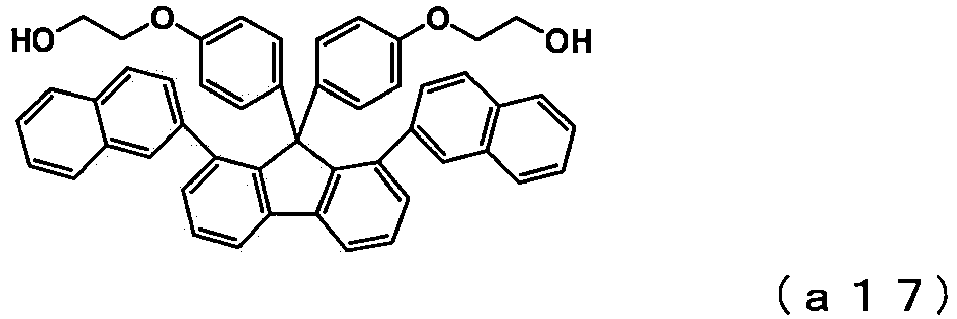


- The structures of formula (a10), formula (a14), formula (a18) and formula (a22), and their corresponding anthrone compounds, are especially preferred because the two monocyclic aromatic groups of the fluorene backbone or anthrone backbone are in a conjugated structure, with the conjugated structure having more extensive conjugation with the two fused polycyclic aromatic groups each bonded by a single bond to the two respective monocyclic aromatic groups.
- When Ar1 and Ar2 are heterocyclic aromatic groups, the diol component as formula (a) may be 9,9-bis(4-(2-hydroxyethoxy)phenyl)-2,7-di(2-thienyl)fluorene represented by the following formula (a25), for example:
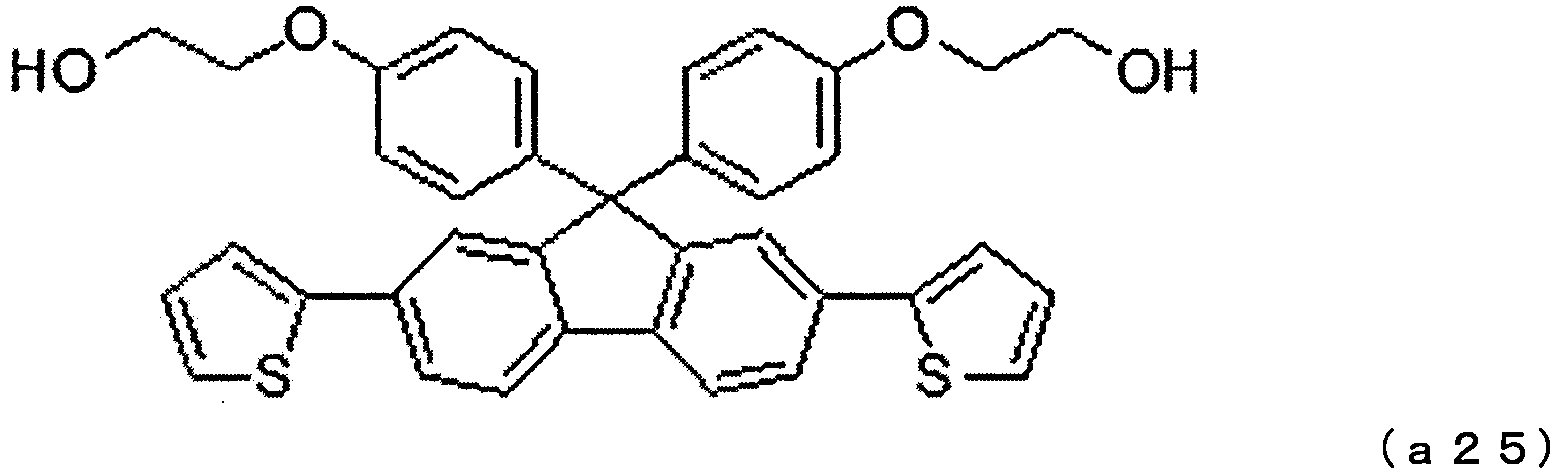
- The diol is preferred because it has the two monocyclic aromatic groups of the fluorene backbone and the heterocyclic aromatic groups bonded to them each by one single bond, forming a conjugated structure overall.
- When the ring Z is a naphthalene ring, examples of compounds include 9,9-bis(6-(2-hydroxyethoxy)-2-naphthyl)-2,7-diphenylfluorene represented by formula (a26) (hereunder also referred to as "BNDP2") and 9,9-bis(6-(2-hydroxyethoxy)-2-naphthyl)-2,7-di(2-naphthyl)fluorene represented by formula (a27) (hereunder also referred to as "BNDN2"), and their corresponding anthrone compounds.


- These are preferred because they have the two monocyclic aromatic groups of the fluorene backbone or anthrone backbone and the monocyclic aromatic group or fused polycyclic aromatic group bonded each by one single bond, forming a conjugated structure overall.
- The thermoplastic resin may also have a repeating unit represented by formulas (6) to (8), the following being diol components as starting materials of formulas (6) to (8). These may be used alone or in combinations of two or more.
- Diol components as starting materials for formula (6) include 2,2'-bis(2-hydroxyethoxy)-3,3'-dimethyl-1,1'-binaphthalene, 2,2'-bis(2-hydroxyethoxy)-6,6'-dimethyl-1,1'-binaphthalene, 2,2'-bis(2-hydroxyethoxy)-7,7'-dimethyl-1, 1'-binaphthalene and 2,2'-bis(2-hydroxyethoxy)-1,1'-binaphthalene.
- Examples of diol components as starting materials for formula (7) include 9,9-bis(4-(2-hydroxyethoxy)phenyl)fluorene, 9,9-bis(4-(2-hydroxyethoxy)-3-methylphenyl)fluorene, 9,9-bis(4-(2-hydroxyethoxy)-3-cyclohexylphenyl)fluorene and 9,9-bis(4-(2-hydroxyethoxy)-3-phenylphenyl)fluorene, and their corresponding anthrone compounds, with 9,9-bis(4-(2-hydroxyethoxy)phenyl)fluorene and 9,9-bis(4-(2-hydroxyethoxy)-3-phenylphenyl)fluorene and their corresponding anthrone compounds being particularly preferred. These may be used alone or in combinations of two or more.
- Examples of diol components as starting materials of formula (8) include 2,2-bis(4-hydroxyphenyl)propane, 2,2-bis(3-methyl-4-hydroxyphenyl)propane, 1,1-bis(4-hydroxyphenyl)-1-phenylethane, 1,3-bis(2-(4-hydroxyphenyl)-2-propyl)benzene, 1,1-bis(4-hydroxyphenyl)-3,3,5-trimethylcyclohexane, 1,1-bis(4-hydroxyphenyl)cyclohexane, bis(4-hydroxyphenyl)diphenylmethane, 1,1-bis(4-hydroxyphenyl)decane, bis(4-hydroxyphenyl)sulfide, bis(4-hydroxy-3-methylphenyl)sulfide, biphenol, 9,9-bis(4-hydroxyphenyl)fluorene, 9,9-bis(4-hydroxy-3-methylphenyl)fluorene, 9,9-bis(4-hydroxy-3-cyclohexylphenyl)fluorene, 9,9-bis(4-hydroxy-3-phenylphenyl)fluorene, bis(4-hydroxyphenyl)sulfone and 10,10-bis(4-hydroxyphenyl)anthrone, with 2,2-bis(4-hydroxyphenyl)propane and bis(4-hydroxyphenyl)sulfide being particularly preferred. These may be used alone or in combinations of two or more.
- The diol component as the starting material of formula (9) for the invention is primarily a diol component represented by formula (b), and a single type may be used alone or two or more different types may be used in combination.

- Here, L1 , L2 , m, n, Ar1 and Ar2 are the same as in formula (1).
- When Ar1 and Ar2 are phenyl groups, the diol component of formula (b) may be 2,2'-bis(2-hydroxyethoxy)-3,3'-diphenyl-1, 1'-binaphthalene, 2,2'-bis(2-hydroxyethoxy)-6,6'-diphenyl-1, 1'-binaphthalene or 2,2'-bis(2-hydroxyethoxy)-7,7'-diphenyl-1,1'-binaphthalene.
- The
compound 2,2'-bis(2-hydroxyethoxy)-6,6'-diphenyl-1,1'-binaphthalene represented by formula (b1) (hereunder also referred to as "BHEB6") is preferred because it will form a conjugated structure between one fused polycyclic aromatic group (naphthyl group) of the binaphthalene backbone and the one monocyclic aromatic group (phenyl group) bonded to it.
- When Ar1 and Ar2 are naphthyl groups, the diol component of formula (b) may be 2,2'-bis(2-hydroxyethoxy)-3,3'-di(2-naphthyl)-1,1'-binaphthalene, 2,2'-bis(2-hydroxyethoxy)-6,6'-di(2-naphthyl)-1, 1'-binaphthalene or 2,2'-bis(2-hydroxyethoxy)-7,7'-di(2-naphthyl)-1,1'-binaphthalene.
- The
compound 2,2'-bis(2-hydroxyethoxy)-6,6'-di(2-naphthyl)-1,1'-binaphthalene represented by formula (b2) is preferred because it will form a conjugated structure between the one fused polycyclic aromatic group (naphthyl group) of the binaphthalene backbone and the one fused polycyclic aromatic group (2-naphthyl group) bonded to it.
- The thermoplastic resin may also have copolymerization of another diol component, to an extent that does not impair the properties according to the invention. The other diol component preferably constitutes less than 30 mol%, 20 mol% or less, 10 mol% or less or 5 mol% or less of the total repeating units.
- Examples of other diol components to be used in the thermoplastic resin include ethylene glycol, propanediol, butanediol, pentanediol, hexanediol, heptanediol, octanediol, nonanediol, tricyclo[5.2.1.02,6]decanedimethanol, cyclohexane-1,4-dimethanol, decalin-2,6-dimethanol, norbornanedimethanol, pentacyclopentadecanedimethanol, cyclopentane-1,3-dimethanol, spiroglycol, isosorbide, isomannide, isoidide, hydroquinone, resorcinol, bis(4-(2-hydroxyethoxy)phenyl)sulfone, 1,1'-bi-2-naphthol, dihydroxynaphthalene and bis(2-hydroxyethoxy)naphthalene, any of which may be used alone or in combinations of two or more.
- A dicarboxylic acid component to be used as a unit represented by formula (1) or formula (9) in the thermoplastic resin is primarily preferred to be a dicarboxylic acid represented by HOOC-X-COOH, or an ester-forming derivative thereof. In this formula, X represents a divalent linking group for attachment of a unit represented by formula (1) or formula (9).
- Specific typical examples of dicarboxylic acids or their ester-forming derivatives represented by the formula HOOC-X-COOH include compounds of formula (a) or (b) of the invention wherein the diol is a dicarboxylic acid or its ester-forming derivative.
- Dicarboxylic acid components to be used in the thermoplastic resin of the invention include aliphatic dicarboxylic acid components such as malonic acid, succinic acid, glutaric acid, adipic acid, pimelic acid, suberic acid, azelaic acid, methylmalonic acid and ethylmalonic acid, monocyclic aromatic dicarboxylic acid components such as phthalic acid, isophthalic acid and terephthalic acid, polycyclic aromatic dicarboxylic acid components such as 2,6-naphthalenedicarboxylic acid, 2,7-naphthalenedicarboxylic acid, 2,3-naphthalenedicarboxylic acid, 1,4-naphthalenedicarboxylic acid, 1,8-naphthalenedicarboxylic acid, anthracenedicarboxylic acid, phenanthrenedicarboxylic acid, 2,2'-bis(carboxymethoxy)-1,1'-binaphthalene, 9,9-bis(carboxymethyl)fluorene, 9,9-bis(2-carboxyethyl)fluorene, 9,9-bis(1-carboxyethyl)fluorene, 9,9-bis(1-carboxypropyl)fluorene, 9,9-bis(2-carboxypropyl)fluorene, 9,9-bis(2-carboxy-1-methylethyl)fluorene, 9,9-bis(2-carboxy-1-methylpropyl)fluorene, 9,9-bis(2-carboxybutyl)fluorene, 9,9-bis(2-carboxy-1-methylbutyl)fluorene, 9,9-bis(5-carboxypentyl)fluorene and 9,9-bis(carboxycyclohexyl)fluorene, biphenyldicarboxylic acid components such as 2,2'-biphenyldicarboxylic acid, and alicyclic dicarboxylic acid components such as 1,4-cyclohexanedicarboxylic acid and 2,6-decalinedicarboxylic acid, with isophthalic acid, terephthalic acid, 2,6-naphthalenedicarboxylic acid and 2,2'-bis(carboxymethoxy)-1,1'-binaphthalene being preferred. These may be used alone or in combinations of two or more. As ester-forming derivatives there may be used acid chlorides, or esters such as methyl ester, ethyl ester or phenyl ester.
- The thermoplastic resin of the invention is produced, for example, by a method of reacting a carbonate precursor such as phosgene or a carbonic acid diester with a diol component, or a method of reacting a dicarboxylic acid or its ester-forming derivative with a diol component. Specific examples are listed below.
- The polycarbonate resin, polyester carbonate resin or polyester resin of the invention is produced by commonly known reaction means for producing resins, such as a method of reacting a carbonate precursor such as a carbonic acid diester with a dihydroxy compound, in the case of a polycarbonate. The production method may be carried out with reference to PTL 3, except for using a monomer that provides a repeating unit of formula (a) or (b).
- When the thermoplastic resin is a polycarbonate, it is obtained by a conventionally known method in which a diol component and a carbonate precursor are reacted by interfacial polymerization or melt polymerization. A catalyst, end terminator, antioxidant or the like may also be used as necessary during production of the polycarbonate.
- When the thermoplastic resin is a polyester, the diol component and the dicarboxylic acid or its ester-forming derivative may be reacted by esterification or transesterification reaction, and the obtained reaction product may be subjected to polycondensation reaction to form a polymer of the desired molecular weight. This method may also employ a known protocol.
- When the thermoplastic resin is a polyester carbonate, it may be produced by reacting a diol component and a dicarboxylic acid or its ester-forming derivative, with phosgene or a carbonate precursor such as a carbonic acid diester. The polymerization method used may be the same known method as used for a polycarbonate or polyester.
- The residual phenol content of the thermoplastic resin is preferably 1 to 500 ppm, more preferably 1 to 400 ppm and even more preferably 1 to 300 ppm. The phenol content is preferably adjusted by the reaction time at a pressure of below 1.3 kPa. The phenol content increases when reaction is not conducted at a degree of vacuum of below 1.3 kPa. If the reaction time is too long, too much will tend to distill off from the resin.
- The phenol content can be adjusted after the thermoplastic resin has been obtained. For example, it is possible to use a method of dissolving the thermoplastic resin in an organic solvent and rinsing the organic solvent layer with water, or a method of using a commonly used single-screw or twin-screw extruder or a kneading machine such as any of various types of kneaders, for devolatilization at a pressure of 133 to 13.3 Pa and a temperature of 200 to 320°C. With a suitable residual phenol content, it is possible to increase the molding fluidity without loss of heat resistance. In addition, the thermal stability during hot melting of the resin is also satisfactory, and die contamination during injection molding of the resin can also be prevented. Furthermore, while phenols tend to undergo coloration when oxidized, the color tone of the thermoplastic resin is less likely to be impaired and the molding fluidity is also satisfactory within this range.
- The residual fluorenone content of the thermoplastic resin is preferably 1 to 500 ppm, more preferably 1 to 300 ppm, even more preferably 1 to 100 ppm and most preferably 1 to 50 ppm. If the residual fluorenone content in the thermoplastic resin is suitable it will be possible to prevent coloration of the resin.
- Fluorenone is used as a starting material for production of monomers with fluorene-based units, and it remains if not completely removed during the production process. The present inventors have found that the residual amount of fluorenone is connected with coloration of the thermoplastic resin.
- The thermoplastic resin preferably includes no palladium. The amount of residual palladium in the thermoplastic resin is preferably no greater than 10 ppm, and more preferably no greater than 5.0 ppm, no greater than 3.0 ppm, no greater than 1.0 ppm or 0.5 ppm, but it may be 0.0 ppm or greater, 0.1 ppm or greater, 0.2 ppm or greater or 0.5 ppm or greater. If the amount of residual palladium in the thermoplastic resin is suitable it will be possible to prevent coloration of the resin.
- Palladium catalysts are used as catalysts for bonding aromatic substituents to fluorene-based component units or anthrone-based component units, or binaphthalene-based component units, and they commonly remain in thermoplastic resins that contain fluorene-based component units or anthrone-based component units that include aromatic substituents on side chains, and/or binaphthalene-based component units that include aromatic substituents. The present inventors have found that the residual amount of palladium catalyst is connected with coloration of a thermoplastic resin. In order to lower the amount of residual palladium in a resin, an appropriate palladium catalyst type may be selected, or the palladium catalyst residue-containing monomer and/or resin may be subjected to palladium removal treatment.
- The thermoplastic resin composition for formation of an optical lens of the invention may also have addition of appropriate additives such as release agents, heat stabilizers, ultraviolet absorbers, blueing agents, antistatic agents, flame retardants, plasticizers and fillers as necessary, in addition to the thermoplastic resin.
- Specific release agents and heat stabilizers that are preferred include those mentioned in International Patent Publication No.
2011/010741 . - Particularly preferred release agents include stearic acid monoglyceride, stearic acid triglyceride, pentaerythritol tetrastearate, and mixtures of stearic acid triglyceride and stearyl stearate. The amount of ester in the release agent is preferably 90 mass% or greater and more preferably 95 mass% or greater, with 100 mass% as the amount of release agent. The release agent is added to the thermoplastic resin composition preferably in the range of 0.005 to 2.0 parts by mass, more preferably in the range of 0.01 to 0.6 part by mass and even more preferably in the range of 0.02 to 0.5 part by mass, with respect to 100 parts by mass of the thermoplastic resin.
- Heat stabilizers include phosphorus-based heat stabilizers, sulfur-based heat stabilizers and hindered phenol-based heat stabilizers.
- Particularly preferred phosphorus-based heat stabilizers for use are tris(2,4-di-tert-butylphenyl)phosphite, bis(2,6-di-tert-butyl-4-methylphenyl)pentaerythritol diphosphite and tetrakis(2,4-di-tert-butylphenyl)-4,4'-biphenylene diphosphonite. The content of the phosphorus-based heat stabilizer in the thermoplastic resin is preferably 0.001 to 0.2 part by mass with respect to 100 parts by mass of the thermoplastic resin.
- A particularly preferred sulfur-based heat stabilizer is pentaerythritol-tetrakis(3-laurylthiopropionate). The content of a sulfur-based heat stabilizer in the thermoplastic resin is preferably 0.001 to 0.2 part by mass with respect to 100 parts by mass of the thermoplastic resin.
- Preferred hindered phenol-based heat stabilizers are octadecyl-3-(3,5-di-tert-butyl-4-hydroxyphenyl)propionate and pentaerythritol-tetrakis[3-(3,5-di-tert-butyl-4-hydroxyphenyl)propionate] .
- The content of a hindered phenol-based heat stabilizer in the thermoplastic resin is preferably 0.001 to 0.3 part by mass with respect to 100 parts by mass of the thermoplastic resin.
- A phosphorus-based heat stabilizer and a hindered phenol-based heat stabilizer may also be used in combination.
- The ultraviolet absorber is preferably at least one type of ultraviolet absorber selected from the group consisting of benzotriazole-based ultraviolet absorbers, benzophenone-based ultraviolet absorbers, triazine-based ultraviolet absorbers, cyclic imino ester-based ultraviolet absorbers and cyanoacrylate-based compounds.
- More preferred benzotriazole-based ultraviolet absorbers are 2-(2-hydroxy-5-tert-octylphenyl)benzotriazole and 2,2'-methylenebis[4-(1,1,3,3-tetramethylbutyl)-6-(2H-benzotriazol-2-yl)phenol] .
- Benzophenone-based ultraviolet absorbers include 2-hydroxy-4-n-dodecyloxybenzophenone and 2-hydroxy-4-methoxy-2'-carboxybenzophenone.
- Triazine-based ultraviolet absorbers include 2-(4,6-diphenyl-1,3,5-triazin-2-yl)-5-[(hexyl)oxy]-phenol and 2-(4,6-bis(2.4-dimethylphenyl)-1,3,5-triazin-2-yl)-5-[(octyl)oxy]-phenol.
- A particularly suitable cyclic imino ester-based ultraviolet absorber is 2,2'-p-phenylenebis(3,1-benzoxazin-4-one).
- Cyanoacrylate-based ultraviolet absorbers include 1,3-bis-[(2'-cyano-3',3'-diphenylacryloyl)oxy]-2,2-bis[(2-cyano-3,3-diphenylacryloyl)oxy]methyl)propane and 1,3-bis-[(2-cyano-3,3-diphenylacryloyl)oxy]benzene.
- The content of the ultraviolet absorber is preferably 0.01 to 3.0 parts by mass with respect to 100 parts by mass of the thermoplastic resin, as a content within this range can impart sufficient weather resistance to the thermoplastic resin molded article, according to the purpose of use.
- Blueing agents include MACROLEX Violet B and MACROLEX Blue RR by Bayer Ltd., and Polysynthren Blue RLS by Clariant Japan. A blueing agent is effective for eliminating yellowishness of the thermoplastic resin. Particularly in the case of a thermoplastic resin composition that has been given weather resistance, addition of an ultraviolet absorber in a fixed amount currently tends to produce a yellowish color in the resin composition by the "action and color of the ultraviolet absorber", and therefore addition of a blueing agent is highly effective for imparting natural transparency to lenses.
- The blueing agent content is preferably 0.05 to 1.5 ppm and more preferably 0.1 to 1.2 ppm with respect to 100 parts by mass of the thermoplastic resin.
- When an optical lens of the invention is to be produced by injection molding, molding is preferably carried out under conditions with a cylinder temperature of 230 to 350°C and a mold temperature of 70 to 180°C. More preferably, molding is carried out under conditions with a cylinder temperature of 250 to 300°C and a mold temperature of 80 to 170°C. When the cylinder temperature is higher than 350°C the thermoplastic resin tends to decompose and undergo coloration, and when it is lower than 230°C the melt viscosity increases, tending to hamper molding. Also, when the mold temperature is higher than 180°C, it tends to become difficult to remove molded pieces composed of the thermoplastic resin from the die. When the mold temperature is below 70°C, on the other hand, the resin hardens too quickly inside the die during molding, making it difficult for the molded piece shape to be controlled and tending to make it difficult for the mold shape of the die to be transferred.
- It is preferred to use an aspherical lens shape, as necessary, for an optical lens of the invention. An aspherical lens allows spherical aberration to be reduced to essentially zero with a single lens, thus making it unnecessary to eliminate spherical aberration by a combination of multiple spherical lenses, and allowing the weight to be reduced and the molding cost to be reduced. Therefore, an aspherical lens is useful among optical lenses, particularly as a camera lens.
- Specifically, the lens size is such that the center section thickness is 0.05 to 3.0 mm, more preferably 0.05 to 2.0 mm and even more preferably 0.1 to 2.0 mm. The diameter is 1.0 mm to 20.0 mm, more preferably 1.0 to 10.0 mm and more preferably 3.0 to 10.0 mm. A meniscus lens is preferred, having a shape which is convex on one side and concave on the other side.
- An optical lens of the invention is molded by any desired method such as die molding, shaving, polishing, laser working, electrical discharge machining or etching. Die molding is more preferred among these, from the viewpoint of production cost.
- The invention will now be described in greater detail by examples, with the understanding that they are not restrictive on the invention.
- After dissolving 3 g of an obtained resin in 50 ml of methylene chloride, the solution was cast onto a glass dish. After thoroughly drying at room temperature, it was dried for 8 hours at a temperature of 120°C or below to prepare a film with a thickness of approximately 100 µm. The refractive index at 25°C (wavelength: 589 nm) and the Abbe number (calculated from the refractive index at wavelengths of 486 nm, 589 nm and 656 nm, using the following formula) of the film were measured using a DR-M2 Abbe refractometer by Atago.

- The following definitions are used for the purpose of the invention:
- nD: refractive index at 589 nm wavelength,
- nC: refractive index at 656 nm wavelength,
- nF: refractive index at 486 nm wavelength.
- After dissolving 1 g of the obtained resin in 5 ml of methylene chloride, the CIE1976 (L*a*b*) color system value of the solution was measured using a U-3310 spectrophotometer by Hitachi, Ltd.
- The amount of metal component in the resins obtained in the Examples were measured with the following apparatus.
Device: Agilent 5100 ICP-OES by Agilent Technologies, Inc. - The fusing component and the boronic acid component were changed as listed in Table 1 for production of the diols of formula (a) listed in Table 1. The synthesis methods A to D described below were used for production of the diols.
Fig. 2 shows the 1H NMR spectrum for BPDP2.Table 1 Diol of formula (a) Condensation component Boronic acid component BPDP2 phenoxyethanol phenylboronic acid BNDP2 2-naphthoxyethanol phenylboronic acid BPDN2 phenoxyethanol 2-naphthaleneboronic acid BNDN2 2-naphthoxyethanol 2-naphthaleneboronic acid - The PL catalyst was a powdered solid catalyst having palladium supported on silica, by N.E. Chemcat Corp., and is abbreviated as Pd/SiO2. This catalyst is specialized for Suzuki coupling reaction, and it promotes more ligand-free reaction for bromoaryl substrates than a homogeneous palladium catalyst. It is also often supported on silica, in which case there is low elution of Pd into products after reaction.
- After charging 150 g of toluene as a solvent and 2.19 g of 12-phosphotungstic(VI) acid n-hydrate (H3[PW12O40]·nH2O) into a 500 mL flask equipped with a stirrer, cooler and thermometer, azeotropic dehydration was carried out with toluene circulation. After cooling the contents, 33.8 g (0.10 mol) of 2,7-dibromofluorenone (hereunder also abbreviated as DBFN) and 1.0 mol of a fusing component of Table 1 selected for the target diol were added, and the mixture was stirred while circulating toluene and discharging the reaction-produced water out of the system.
- Progression of the reaction was confirmed by appropriate HPLC, and completion of the reaction was confirmed when the peak area of DBFN fell to or below 0.1% of the total peak area. After adding 150 g of toluene to the obtained reaction mixture, it was rinsed 3 times with 300 g of water. After rinsing, the organic layer was subjected to activated carbon treatment and concentrated under reduced pressure to distill off the toluene solvent and excess fusing component. The obtained mixture was recrystallized from methanol and the precipitated crystals were filtered, collected and dried to obtain faint yellow crystals of the target intermediate product (fused reaction product of DBFN and fusing component).
- After charging 0.03 mol of the target intermediate product obtained in step A-1, 0.066 mol of a boronic acid component of Table 1 selected for the target diol, 0.2 g of a PL catalyst by N.E. Chemcat Corp. (Pd-equivalent value: 200 ppm), 150 g of toluene and 35 mL of a 2 M aqueous potassium carbonate solution into a 500 mL flask equipped with a stirrer, cooler and thermometer, the mixture was stirred at 80°C for reaction. Progression of the reaction was confirmed by appropriate HPLC, and completion of the reaction was confirmed when the peak area of the target intermediate product fell to or below 0.1% of the total peak area. After cooling the obtained reaction mixture to room temperature, chloroform was added to completely dissolve the reaction product, and the solid from the palladium compound was filtered and collected. The collected filtrate was rinsed 3 times with water, concentrated and recrystallized with ethyl acetate/hexane to obtain white crystals of the final target product. When the residual metal content was measured by ICP-OES, Pd was in the range of 3.0 to 5.0 ppm for all of the diols.
- After charging 150 g of toluene as a solvent and 2.19 g of 12-phosphotungstic(VI) acid n-hydrate (H3[PW12O40]·nH2O) into a 500 mL flask equipped with a stirrer, cooler and thermometer, azeotropic dehydration was carried out with toluene circulation. After cooling the contents, 0.10 mol of DBFN and 0.40 mol of a fusing component of Table 1 selected for the target diol were added, and the mixture was stirred while circulating toluene and discharging the reaction-produced water out of the system.
- Progression of the reaction was confirmed by appropriate HPLC, and completion of the reaction was confirmed when the peak area of DBFN fell to or below 0.1% of the total peak area. The obtained target intermediate product was used directly in the reaction of the following step B-2 without isolation or purification.
- After cooling the reaction mixture obtained in step B-1 to room temperature, there were added 58 mL of a 4 M aqueous potassium carbonate solution, 0.21 mol of the boronic acid component in Table 1 selected for the target diol, and tetrakis(triphenylphosphine)palladium to a palladium content of 100 ppm, and the mixture was stirred at 80°C for reaction. Progression of the reaction was confirmed by appropriate HPLC, and completion of the reaction was confirmed when the peak area of the target intermediate product fell to or below 0.1% of the total peak area. The obtained reaction mixture was cooled to room temperature, and after adding ethanol to produce crystallization, the solid was filtered and collected. The collected solid was dissolved in chloroform and rinsed 3 times with hot water, after which the chloroform layer was subjected to decoloration treatment with active carbon and treated for palladium removal, and subsequently concentrated to obtain a partially purified product. The obtained solid partially purified product was recrystallized from toluene to obtain the final target product as white crystals. When the residual metal content was measured by ICP-OES, Pd was in the range of 15.0 to 20.0 ppm for all of the diols.
- A final target product was obtained as white crystals by the same method as the step B group, except that tetrakis(triphenylphosphine)palladium was added to a palladium content of 30 ppm. When the residual metal content was measured by ICP-OES, Pd was in the range of 8.0 to 10.0 ppm for all of the diols.
- A final target product was obtained as a faint yellow solid in the same manner as the step B group, except that Pd removal treatment was not carried out. When the residual metal content was measured by ICP-OES, Pd was in the range of 70.0 to 80 ppm for all of the diols.
- The compound BHEB6 (2,2-bis(2-hydroxyethoxy)-6,6'-diphenyl-1,1'-binaphthalene), as a diol of formula (b), was synthesized by the following synthesis method.
- After charging 5.0 g (11.3 millimole) of the commercial product 6,6'-dibromo-1,1'-bi-2-naphthol (hereunder also abbreviated as BN-6Br), 2.3 g (25.9 millimole) of ethylene carbonate, 0.16 g (1.9 millimole) of potassium carbonate and 15 g of toluene into a flask equipped with a stirrer, cooler and thermometer, reaction was conducted at 110°C for 5 hours. Progression of the reaction was confirmed by appropriate HPLC, and completion of the reaction was confirmed when the peak area of BN-6Br fell to or below 0.1% of the total peak area. After then adding 65 g of toluene to the obtained reaction mixture for dilution, 8 g of a 10 mass% aqueous sodium hydroxide solution was added, the mixture was stirred at 85°C for 1 hour and the aqueous layer was removed by separatory funnel. After concentrating the organic layer, it was dissolved in ethyl acetate and rinsed, and the aqueous layer was removed by separatory funnel. As a result of further addition of hexane and direct recrystallization, the
target compound 2,2'-bis(2-hydroxyethoxy)-6,6'-dibromo-1,1'-binaphthalene (hereunder also abbreviated as BHEB-6Br) was obtained as a white solid. - After charging 3.5 g (6.6 millimole) of BHEB-6Br, 2.1 g (16.5 millimole) of phenylboronic acid, 0.112 g (0.1 millimole, about 2100 ppm in terms of Pd) of tetrakis(triphenylphosphine)palladium, 9 mL of a 2 M aqueous potassium carbonate solution, 33 mL of toluene and 12 mL of ethanol into a flask equipped with a stirrer, cooler and thermometer under a nitrogen atmosphere, reaction was conducted at 80°C for 2 hours. Progression of the reaction was confirmed by appropriate HPLC, and completion of the reaction was confirmed when the peak area of BHEB-6Br fell to or below 0.1% of the total peak area. After concentrating the obtained reaction mixture, a 1 M aqueous sodium hydroxide solution was added and extraction was performed with chloroform. Active carbon was added to the obtained organic layer and the mixture was stirred for 1 hour, after which the active carbon was filtered out and the organic layer was concentrated. After concentration it was purified by silica gel column chromatography to obtain 2.6 g of the target compound BHEB6 as white crystals (75% yield, 99.2% purity). Measurement of the residual metals by ICP-OES showed Pd at 7.0 ppm.
- After charging 340 g of toluene as a solvent and 2.94 g of 12-phosphotungstic(VI) acid n-hydrate (H3[PW12O40]·nH2O) into a 3 L three-necked flask equipped with a stirrer, cooler and thermometer, azeotropic dehydration was carried out for 30 minutes with toluene circulation. After cooling the contents, 54.1 g (0.3 mol) of fluorenone, 173 g (1.2 mol) of 2-naphthol and 50 g of toluene were added, and the mixture was stirred with toluene circulation while the water generated by the reaction was discharged out of the system.
- Progression of the reaction was confirmed by appropriate HPLC, and the end point of the reaction was confirmed when the peak area of fluorenone fell to or below 0.1% of the total peak area. The obtained reaction mixture was adjusted to 70°C and rinsed 3 times with 200 g of water, after which the aqueous layer was removed. Toluene was added to the organic layer, decoloration was carried out with active carbon, diisopropyl ether was added to the treatment solution and the mixture was stirred at 60°C for 1 hour, after which it was cooled to 10°C for recrystallization to obtain the target compound 9,9-bis(6-hydroxy-2-naphthyl)fluorene (hereunder also abbreviated as BNF).
- The diols and dicarboxylic acids other than those mentioned above which were used in the Examples were either commercial products or were produced by publicly known methods.
- After placing 100 mol (59.03 parts by mass) of the synthesized BPDP2, 101 mol (21.64 parts by mass) of diphenyl carbonate (hereunder also abbreviated as DPC) and 42.0 × 10⁻⁵ parts by mass of sodium hydrogencarbonate in a jacketed reaction vessel equipped with a stirrer and distillation device, nitrogen exchange was carried out 3 times, and the jacket was heated to 180°C to melt the starting materials. After complete dissolution, the pressure was reduced to 20 kPa over a period of 5 minutes while simultaneously increasing the temperature of the jacket to 260°C at a rate of 60°C/hr, for transesterification reaction. The jacket was then kept at 260°C while reducing the pressure to 0.13 kPa over a period of 50 minutes, and polymerization reaction was carried out under conditions of 260°C, ≤0.13 kPa until a predetermined torque of the stirrer was reached. Upon completion of the reaction, the produced resin was extruded while being pelletized, to obtain polycarbonate resin pellets. The properties of the obtained polycarbonate resin are shown in Table 2.
- After drying the obtained resin at 120°C for 4 hours, 0.05 mass% of bis(2,6-di-tert-butyl-4-methylphenyl)pentaerythritol diphosphite and 0.10 mass% of glycerin monostearate were added, based on the mass of the resin, and a vented ϕ 15 mm twin-screw extruder was used for pelletizing. After drying the pellets at 120°C for 4 hours, they were subjected to injection molding at a cylinder temperature of 280°C and a mold temperature of 130°C, to obtain an optical lens with a thickness of 0.3 mm, a convex curvature radius of 5 mm and a concave curvature radius of 4 mm.
- Polycarbonate resin pellets and optical lenses were obtained for Examples 2 to 9 and Comparative Examples 1 to 4, changing the composition of Example 1 as shown in Table 2. The molar ratio of the diol and DPC was 1:1.01 for these examples.
- After placing 8.85 parts by mass of BPDP2, 12.64 parts by mass of BHEB, 10.56 parts by mass of BCMB (2,2'-bis(carboxymethoxy)-1,1'-binaphthalene), 5.30 parts by mass of DPC, and 38.9 × 10⁻³ parts by mass of aluminum acetylacetonate and 85.4 × 10⁻³ parts by mass of diethyl 3,5-di-tert-butyl-4-hydroxybenzylphosphonate as polymerization catalysts in a jacketed reaction vessel equipped with a stirrer and distillation device, nitrogen exchange was carried out 3 times, and the jacket was heated to 180°C to melt the starting materials. The pressure was then reduced to 40 kPa over a period of 20 minutes while simultaneously increasing the temperature of the jacket to 260°C at a rate of 60°C/hr, for transesterification reaction. The pressure was then lowered to 0.13 kPa over a period of 70 minutes, and polymerization reaction was carried out under conditions of 0.13 kPa until a predetermined torque of the stirrer was reached. Upon completion of the reaction, the produced resin was extruded while being pelletized, to obtain polyester carbonate resin pellets. The total of the diol components (BPDP2, BHEB) introduced into the polyester carbonate resin was 65 mol% with respect to the total monomer components (total diol component + total dicarboxylic acid component), and the total of the carboxylic acid component introduced into the polyester carbonate resin was 35 mol% with respect to the total monomer components (total diol component + total dicarboxylic acid component). The properties of the obtained polyester carbonate resin are shown in Table 3.
- After drying the obtained resin at 120°C for 4 hours, 0.05 mass% of bis(2,6-di-tert-butyl-4-methylphenyl)pentaerythritol diphosphite and 0.10 mass% of glycerin monostearate were added, based on the mass of the resin, and a vented ϕ 15 mm twin-screw extruder was used for pelletizing. After drying the pellets at 120°C for 4 hours, they were subjected to injection molding at a cylinder temperature of 280°C and a mold temperature of 130°C, to obtain a lens with a thickness of 0.3 mm, a convex curvature radius of 5 mm and a concave curvature radius of 4 mm.
- Polyester carbonate resin pellets and optical lenses were obtained for Examples 11 and 12 and Comparative Example 8, changing the composition of Example 10 as shown in Table 3.
- Polyester carbonate resin or polyester resin pellets and optical lenses were obtained for Example 13 and Comparative Examples 5, 6 and 7, changing the composition of Example 10 as shown in Table 3, and changing the polymerization catalyst to 1.70 × 10⁻³ parts by mass of titanium tetrabutoxide.
- The evaluation results for the polycarbonate resin examples are shown in Table 2. The 1H NMR results for Example 4 and Example 5 are shown in
Fig. 3 andFig. 4 , respectively. The polymer obtained in Comparative Example 4 had strong coloration due to the palladium catalyst, and lower transmittance in the short wavelength range, making it difficult to calculate the Abbe number. - Table 3 shows the evaluation results for the polyester carbonate resin and polyester resin examples.
Table 2 Polycarbonate compositional ratio [mol%] Synthesis method for diol of formula (a) Pd residue in polymer [ppm] Polymer properties Diol of formula (a) Diol of formula (b) Other diol BPDP2 BNDP2 BPDN2 BNDN2 BHEB6 BOPPEF BNEF BNF BPEF BHEB BINOL nD ν Solution b* value Example 1 100 A 3 1.683 14.8 4.5 Example 2 100 A 3 1.727 12.0 4.5 Example 3 100 c 8 1.750 11.9 8.2 Example 4 50 50 A 1.7 1.664 17.9 3.5 Example 5 50 50 B 9.2 1.692 14.6 9.1 Example 6 40 10 50 B 7.4 1.677 16.9 7.8 Example 7 30 10 60 B 6.4 1.690 16.5 7.0 Example 8 20 31 49 c 2.3 1.693 15.8 3.9 Example 9 100 - 7 1.708 16.0 7.5 Comp. Example 1 35 10 55 - - 1.691 18.5 3.6 Comp. Example 2 10 90 - - 1.666 19.0 2.5 Comp. Example 3 50 50 D 42.8 1.692 14.6 18.0 Comp. Example 4 50 50 D 42.8 1.685 N.d. 34.3 Table 3 Compositional ratio of polyester carbonate or polyester [mol%] DPC molar ratio * Synthesis method for diol of formula (a) Pd residue in polymer [ppm] Polymer properties Diol of formula (a) Other diol Dicarboxylic acid BPDP2 BNDP2 BPDN2 BPEF BNEF BHEB EG BCMB NDCM BNAC-E nD v Solution b* value Example 10 20 45 35 0.33 A 0.8 1.681 17.3 2.9 Example 11 25 30 45 0.11 B 1.1 1.698 16.3 3.1 Example 12 20 35 45 0.11 B 4.6 1.700 15.3 5.7 Example 13 20 40 40 0.32 c 2.9 1.704 14.4 4.4 Comp. Example 5 13.5 31.5 5 50 - - 1.652 20.0 2.5 Comp. Example 6 30 10 10 50 - - 1.686 18.2 5.8 Comp. Example 7 20 20 10 50 - - 1.684 18.4 7.3 Comp. Example 8 20 45 35 0.33 D 19.3 1.681 17.3 16.7 *Molar ratio of DPC with respect to total of diol and dicarboxylic acid -
- BPDP2: 9,9-bis(4-(2-hydroxyethoxy)phenyl)-2,7-diphenylfluorene
- BNDP2: 9,9-bis(6-(2-hydroxyethoxy)-2-naphthyl)-2,7-diphenylfluorene
- BPDN2: 9,9-bis(4-(2-hydroxyethoxy)phenyl)-2,7-di(2-naphthyl)fluorene
- BNDN2: 9,9-bis(6-(2-hydroxyethoxy)-2-naphthyl)-2,7-di(2-naphthyl)fluorene
- BHEB6: 2,2'-bis(2-hydroxyethoxy)-6,6'-diphenyl-1,1'-binaphthalene
- BPEF: 9,9-bis(4-(2-hydroxyethoxy)phenyl)fluorene
- BOPPEF: 9,9-bis(4-(2-hydroxyethoxy)-3-phenylphenyl)fluorene
- BNEF: 9,9-bis(6-(2-hydroxyethoxy)-2-naphthyl)fluorene
- BNF: 9,9-bis(6-hydroxy-2-naphthyl)fluorene
- BHEB: 2,2'-bis(2-hydroxyethoxy)-1,1'-binaphthalene
- BINOL: 2,2'-dihydroxy-1,1'-binaphthalene
- EG: ethylene glycol
- BCMB: 2,2'-bis(carboxymethoxy)-1,1'-binaphthalene
- NDCM: dimethyl naphthalenedicarboxylate
- BNAC-E: 2,2'-bis(ethoxycarbonylmethoxy)-1,1'binaphthalene
-
Fig. 1 shows plots of the refractive indexes and Abbe numbers of thermoplastic resins used in the optical lenses of Examples 1 to 13 and Comparative Examples 1 to 8. Comparative Example 3 and Comparative Example 8 were excluded since the b* values of the solutions were greater than 10. The thermoplastic resins used in the optical lenses of Examples 1 to 13 had high refractive indexes and low Abbe numbers distributed in a range that has not existed in the prior art, being distributed in the range described by mathematical formula (A).
Claims (8)
- An optical lens comprising a thermoplastic resin, wherein the thermoplastic resin has a b* value according to the CIE1976 (L*a*b*) color system of 10.0 or lower, as measured using a 13 mass% solution in methylene chloride (a solution of 1.0 g dissolved in 5 ml of methylene chloride), and has a refractive index (nD) and Abbe number (v) satisfying the following mathematical formula (A):

- The optical lens according to claim 1, wherein the thermoplastic resin has a refractive index (nD) and Abbe number (v) satisfying the following mathematical formula (B):

- The optical lens according to claim 1 or 2, wherein:the thermoplastic resin includes a spatial structural component unit,the spatial structural component unit includes 4 or more aromatic groups selected from the group consisting of monocyclic aromatic groups and fused polycyclic aromatic groups, andthe spatial structural component unit has 3 or more monocyclic aromatic groups in a conjugated structure, or one or more monocyclic aromatic groups and one or more fused polycyclic aromatic groups in a conjugated structure, or two or more fused polycyclic aromatic groups in a conjugated structure.
- The optical lens according to any one of claims 1 to 3, wherein the spatial structural component unit has a fluorene-based component unit or anthrone-based component unit including an aromatic substituent on a side chain, and/or a binaphthalene-based component unit including an aromatic substituent.
- The optical lens according to any one of claims 1 to 4, wherein the relative viscosity of the thermoplastic resin is 0.12 to 0.40.
- The optical lens according to any one of claims 1 to 5, wherein the glass transition temperature of the thermoplastic resin is 130 to 170°C.
- The optical lens according to any one of claims 1 to 6, wherein the thermoplastic resin is a polyester, polyester carbonate or polycarbonate.
- The optical lens according to any one of claims 1 to 7, wherein the amount of residual palladium in the thermoplastic resin is 10 ppm or lower.
Applications Claiming Priority (3)
| Application Number | Priority Date | Filing Date | Title |
|---|---|---|---|
| JP2017165528 | 2017-08-30 | ||
| JP2019034940A JP2020012094A (en) | 2017-08-30 | 2019-02-27 | Optical lens |
| PCT/JP2020/007855 WO2020175577A1 (en) | 2017-08-30 | 2020-02-26 | Optical lens |
Publications (2)
| Publication Number | Publication Date |
|---|---|
| EP3933456A1 true EP3933456A1 (en) | 2022-01-05 |
| EP3933456A4 EP3933456A4 (en) | 2022-06-22 |
Family
ID=65525425
Family Applications (2)
| Application Number | Title | Priority Date | Filing Date |
|---|---|---|---|
| EP18851819.5A Pending EP3677614A4 (en) | 2017-08-30 | 2018-07-13 | THERMOPLASTIC RESIN AND OPTICAL ELEMENT |
| EP20762455.2A Pending EP3933456A4 (en) | 2017-08-30 | 2020-02-26 | OPTICAL LENS |
Family Applications Before (1)
| Application Number | Title | Priority Date | Filing Date |
|---|---|---|---|
| EP18851819.5A Pending EP3677614A4 (en) | 2017-08-30 | 2018-07-13 | THERMOPLASTIC RESIN AND OPTICAL ELEMENT |
Country Status (7)
| Country | Link |
|---|---|
| US (2) | US11261294B2 (en) |
| EP (2) | EP3677614A4 (en) |
| JP (2) | JP2020012094A (en) |
| KR (2) | KR102362026B1 (en) |
| CN (2) | CN110741030B (en) |
| TW (2) | TWI787317B (en) |
| WO (2) | WO2019044214A1 (en) |
Cited By (1)
| Publication number | Priority date | Publication date | Assignee | Title |
|---|---|---|---|---|
| EP4428173A4 (en) * | 2022-08-25 | 2025-03-26 | LG Chem, Ltd. | Polycarbonate resin and method for producing same |
Families Citing this family (38)
| Publication number | Priority date | Publication date | Assignee | Title |
|---|---|---|---|---|
| CN110741030B (en) * | 2017-08-30 | 2022-06-17 | 帝人株式会社 | Thermoplastic resin and optical member |
| JP6956807B2 (en) * | 2017-12-28 | 2021-11-02 | 帝人株式会社 | Method for producing poly (ester) carbonate and poly (ester) carbonate |
| WO2019146507A1 (en) * | 2018-01-23 | 2019-08-01 | 三菱瓦斯化学株式会社 | Polycarbonate resin composition, production method therefor, and optical lens |
| KR102683885B1 (en) * | 2018-01-31 | 2024-07-10 | 데이진 가부시키가이샤 | Compounds having a fluorene skeleton and methods for producing the same |
| JP7204735B2 (en) | 2018-03-12 | 2023-01-16 | 帝人株式会社 | Polyester resin or polyester carbonate resin, and optical member using said resin |
| CN111511799B (en) | 2018-03-30 | 2022-08-16 | 帝人株式会社 | Polycarbonate resin and optical member containing same |
| WO2020085222A1 (en) * | 2018-10-25 | 2020-04-30 | 帝人株式会社 | Crystal of compound having fluorene skeleton and method for producing same |
| JP7231389B2 (en) * | 2018-11-26 | 2023-03-01 | 帝人株式会社 | Method for producing compound having fluorene skeleton and compound having fluorene skeleton with less impurities |
| CN113260883A (en) * | 2018-12-28 | 2021-08-13 | 三菱瓦斯化学株式会社 | Thermoplastic resin, method for producing same, and optical lens comprising same |
| KR102625933B1 (en) | 2019-02-27 | 2024-01-16 | 데이진 가부시키가이샤 | Thermoplastics and optical components |
| JP7568617B2 (en) | 2019-04-17 | 2024-10-16 | 大阪ガスケミカル株式会社 | Dicarboxylic acids, their production method and use |
| CN113710638B (en) * | 2019-05-08 | 2025-02-28 | 本州化学工业株式会社 | Method for producing binaphthyl carboxylic acids |
| JP7597852B2 (en) * | 2019-05-09 | 2024-12-10 | 帝人株式会社 | Compound having a fluorene skeleton and method for producing the same |
| TWI878291B (en) * | 2019-05-09 | 2025-04-01 | 日商帝人股份有限公司 | Compound having fluorene skeleton and method for producing the same |
| CN113795476B (en) * | 2019-05-09 | 2024-04-09 | 帝人株式会社 | Compound having fluorene skeleton and method for producing the same |
| JP7303055B2 (en) * | 2019-05-09 | 2023-07-04 | 帝人株式会社 | Compound having fluorene skeleton and method for producing the same |
| JP7303062B2 (en) * | 2019-08-19 | 2023-07-04 | 帝人株式会社 | Compound having fluorene skeleton and method for producing the same |
| WO2021014962A1 (en) * | 2019-07-19 | 2021-01-28 | 帝人株式会社 | Thermoplastic resin and optical member containing same |
| CN115461388B (en) * | 2020-04-28 | 2024-03-26 | 帝人株式会社 | Thermoplastic resin and optical member |
| EP4174126A4 (en) * | 2020-06-26 | 2023-11-15 | Mitsubishi Gas Chemical Company, Inc. | RESIN COMPOSITION |
| US20230235118A1 (en) * | 2020-06-30 | 2023-07-27 | Teijin Limited | Thermoplastic resin and optical member containing same |
| WO2022025071A1 (en) * | 2020-07-28 | 2022-02-03 | 三井化学株式会社 | Compound, resin, polycarbonate resin, and optical molded body |
| JP7705311B2 (en) * | 2020-08-31 | 2025-07-09 | 大阪ガスケミカル株式会社 | Fluorene compound and method for producing same |
| US20240010834A1 (en) * | 2020-10-27 | 2024-01-11 | Teijin Limited | Thermoplastic resin and optical member including same |
| JP7588707B2 (en) * | 2021-03-09 | 2024-11-22 | 帝人株式会社 | Thermoplastic resins and optical components |
| JP7770960B2 (en) * | 2021-03-11 | 2025-11-17 | 大阪ガスケミカル株式会社 | Aromatic thermoplastic resin, its production method and use |
| JP7016976B1 (en) * | 2021-03-16 | 2022-02-07 | 大阪ガスケミカル株式会社 | Phase difference film |
| WO2022245074A1 (en) * | 2021-05-17 | 2022-11-24 | 주식회사 엘지화학 | Resin and method for manufacturing same |
| US12497484B2 (en) | 2021-08-12 | 2025-12-16 | Lg Chem, Ltd. | Resin, preparation method therefor, resin composition, and molded product |
| JP7731434B2 (en) | 2021-10-26 | 2025-08-29 | 帝人株式会社 | Thermoplastic resins and optical components |
| TW202336084A (en) * | 2021-11-12 | 2023-09-16 | 日商三菱瓦斯化學股份有限公司 | Polycarbonate resin, and optical lens and optical film using same |
| WO2023182652A1 (en) * | 2022-03-23 | 2023-09-28 | 주식회사 엘지화학 | Polycarbonate resin and method for preparing same |
| JP7841796B2 (en) * | 2022-07-05 | 2026-04-07 | エルジー・ケム・リミテッド | Polycarbonate resin and method for manufacturing the same |
| WO2024053804A1 (en) * | 2022-09-07 | 2024-03-14 | 주식회사 엘지화학 | Resin and method for manufacturing same |
| TWI885506B (en) * | 2022-10-05 | 2025-06-01 | 南韓商Lg化學股份有限公司 | Polycarbonate resin and preparation method thereof |
| JPWO2024122531A1 (en) * | 2022-12-06 | 2024-06-13 | ||
| KR20250172669A (en) * | 2023-04-25 | 2025-12-09 | 데이진 가부시키가이샤 | Polycarbonate resin and optical member using the resin |
| CN118909238B (en) * | 2023-11-29 | 2025-07-15 | 万华化学集团股份有限公司 | High-refractive-index polycarbonate resin and preparation method and application thereof |
Family Cites Families (89)
| Publication number | Priority date | Publication date | Assignee | Title |
|---|---|---|---|---|
| US4584335A (en) | 1984-12-28 | 1986-04-22 | Chevron Research Company | 5-keto-bis(hydroxyphenyl)anthracene polyarylate copolymers and alloys |
| US5446173A (en) | 1992-03-24 | 1995-08-29 | Daiso Co., Ltd. | Cyclic sulfide compound, polymerizable compositions for optical products and optical products formed thereof |
| CA2139325A1 (en) | 1992-07-16 | 1994-02-03 | Stephen E. Bales | Thiodiphenol copolycarbonates and their use as components of multilayered polymeric reflective bodies |
| JPH06145317A (en) | 1992-11-05 | 1994-05-24 | Teijin Chem Ltd | New aromatic polyester carbonate resin |
| JP2774229B2 (en) | 1993-04-27 | 1998-07-09 | 帝人化成株式会社 | Optical molded products |
| US5532331A (en) | 1993-06-24 | 1996-07-02 | The Dow Chemical Company | Thiodiphenol copolycarbonates and their use as components of multilayered polymeric reflective bodies |
| JPH07198901A (en) | 1993-12-27 | 1995-08-01 | Kanebo Ltd | Polyesteer resin for plastic lens |
| JPH0854615A (en) | 1994-08-09 | 1996-02-27 | Teijin Ltd | Film substrate for liquid crystal display panel |
| US5605979A (en) | 1995-05-22 | 1997-02-25 | Bayer Corporation | Method for modifying the backbone of polymeric resins |
| JP3160209B2 (en) | 1996-01-30 | 2001-04-25 | 帝人株式会社 | Polycarbonate copolymer containing oxaspiroundecan group and process for producing the same |
| EP0787756B1 (en) | 1996-01-30 | 2000-04-26 | Teijin Limited | Polycarbonate copolymer containing oxaspiroundecane group and production process therefor |
| JP3603921B2 (en) | 1996-06-21 | 2004-12-22 | 三菱瓦斯化学株式会社 | Copolycarbonate polymer and method for producing the same |
| JPH1087800A (en) | 1996-09-10 | 1998-04-07 | Teijin Chem Ltd | Polyester carbonate resin |
| JPH10101786A (en) | 1996-09-30 | 1998-04-21 | Teijin Ltd | Polycarbonate copolymer and method for producing the same |
| AU729121B2 (en) | 1996-10-18 | 2001-01-25 | Mitsubishi Gas Chemical Company, Inc. | Novel copolycarbonate resin and resin composition comprising the same |
| JPH10120777A (en) | 1996-10-18 | 1998-05-12 | Mitsubishi Gas Chem Co Inc | New polycarbonate resin |
| US6310161B1 (en) * | 1997-07-25 | 2001-10-30 | Ucb S.A. | Sulfur-containing compounds for optical grade polymeric casting compositions |
| JPH11269259A (en) | 1998-03-24 | 1999-10-05 | Mitsubishi Gas Chem Co Inc | Molding material for optical recording media |
| JP2000204150A (en) | 1999-01-14 | 2000-07-25 | Mitsubishi Gas Chem Co Inc | Copolycarbonate polymer |
| JP2000212271A (en) | 1999-01-27 | 2000-08-02 | Teijin Ltd | Aromatic polycarbonate resin with good moldability, stability, and clarity |
| JP2000219736A (en) | 1999-02-02 | 2000-08-08 | Mitsubishi Gas Chem Co Inc | Polycarbonate polymer and method for producing the same |
| JP2000302857A (en) | 1999-04-21 | 2000-10-31 | Mitsubishi Gas Chem Co Inc | Molding material for optical recording media |
| JP2001072872A (en) | 1999-07-02 | 2001-03-21 | Konica Corp | Resin composition and optical lens |
| JP3856115B2 (en) | 2001-01-16 | 2006-12-13 | 三菱瓦斯化学株式会社 | Polycarbonate resin |
| JP4739571B2 (en) | 2001-04-18 | 2011-08-03 | 帝人化成株式会社 | Stretched film |
| JP2002332345A (en) | 2001-05-08 | 2002-11-22 | Konica Corp | Resin composition and optical lens |
| JP4196326B2 (en) | 2002-06-12 | 2008-12-17 | 三菱瓦斯化学株式会社 | Polycarbonate copolymer |
| JP3994802B2 (en) | 2002-06-19 | 2007-10-24 | 日本電気株式会社 | Malfunction prevention circuit and integrated circuit device using the same |
| US6689863B1 (en) | 2002-10-08 | 2004-02-10 | General Electric Company | Polycarbonate copolymers and methods for producing the polycarbonate copolymers |
| DE60333218D1 (en) | 2002-11-14 | 2010-08-12 | Teijin Chemicals Ltd | POLYCARBONATE COPOLYMER, RESIN COMPOSITION AND FORM BODY |
| CN1315907C (en) | 2002-11-14 | 2007-05-16 | 帝人化成株式会社 | Polycarbonate copolymer, resin composition, and molded article |
| JP4369741B2 (en) | 2003-12-25 | 2009-11-25 | 大阪瓦斯株式会社 | Fluorene resin composition and molded article thereof |
| JP2005232252A (en) | 2004-02-18 | 2005-09-02 | Teijin Chem Ltd | Modified polycarbonate resin |
| JP4780919B2 (en) | 2004-02-26 | 2011-09-28 | 三菱瓦斯化学株式会社 | Optical lens |
| CN101018824B (en) | 2004-07-15 | 2011-05-04 | 大阪瓦斯株式会社 | Resin composition and molded object thereof |
| JP2006047736A (en) | 2004-08-05 | 2006-02-16 | Idemitsu Kosan Co Ltd | Optical lens |
| JP2007246629A (en) | 2006-03-14 | 2007-09-27 | Jsr Corp | Optical film and manufacturing method thereof |
| CN103257376B (en) | 2006-06-05 | 2015-12-09 | 三菱瓦斯化学株式会社 | Optical lens |
| KR20140121894A (en) | 2007-06-19 | 2014-10-16 | 테이진 카세이 가부시키가이샤 | Optical film |
| JP2009080424A (en) | 2007-09-27 | 2009-04-16 | Teijin Chem Ltd | Optical member |
| WO2009058396A1 (en) * | 2007-11-02 | 2009-05-07 | Akron Polymer Systems Inc. | Negative birefringent optical films with flat or reversed birefringence wavelength dispersions for liquid crystal displays |
| JP2009235256A (en) | 2008-03-27 | 2009-10-15 | Idemitsu Kosan Co Ltd | Catalyst for producing polycarbonate and method for producing polycarbonate |
| JP2009249307A (en) | 2008-04-03 | 2009-10-29 | Kri Inc | Bis(hydroxyphenyl)anthracene compound, and method of producing the same |
| EP2378320A4 (en) | 2008-12-16 | 2017-07-19 | Teijin Chemicals, Ltd. | Optical film |
| JP2010189562A (en) | 2009-02-19 | 2010-09-02 | Fujifilm Corp | Organic-inorganic composite material, molding, optical part, and lens |
| JP5558741B2 (en) | 2009-05-28 | 2014-07-23 | 帝人株式会社 | Polycarbonate copolymer with high refractive index and excellent heat resistance |
| JP5585999B2 (en) | 2009-07-02 | 2014-09-10 | 大和製罐株式会社 | Polyester resin composition and molded body |
| CN102471467B (en) * | 2009-07-24 | 2013-07-17 | 帝人化成株式会社 | Optical lens, and polyester carbonate copolymer for use in optical lenses |
| CN105348503A (en) | 2009-11-17 | 2016-02-24 | 三菱化学株式会社 | Polycarbonate resin and transparent film formed from the polycarbonate resin |
| JP5437106B2 (en) * | 2010-02-19 | 2014-03-12 | 大阪ガスケミカル株式会社 | Polyester resin having a fluorene skeleton |
| JP5668077B2 (en) | 2010-11-12 | 2015-02-12 | 帝人株式会社 | Copolycarbonate |
| JP5688101B2 (en) | 2011-01-14 | 2015-03-25 | 帝人株式会社 | Optical lens made of aromatic-aliphatic polycarbonate resin |
| JP2012155193A (en) | 2011-01-27 | 2012-08-16 | Mitsubishi Gas Chemical Co Inc | Polycarbonate resin composition |
| JP5741026B2 (en) | 2011-02-03 | 2015-07-01 | 三菱瓦斯化学株式会社 | Glycol having acenaphthenone structure and polyester resin comprising the same |
| CN102352039B (en) * | 2011-07-22 | 2013-07-24 | 中山大学 | Soluble functional polyimide based on fluorene structure as well as preparation method and application thereof |
| JP5914261B2 (en) * | 2011-08-29 | 2016-05-11 | 大阪ガスケミカル株式会社 | Polyester resin having a fluorene skeleton |
| JP2013076982A (en) | 2011-09-14 | 2013-04-25 | Mitsubishi Chemicals Corp | Phase difference film, circularly polarizing plate using the same, and image display device |
| JP2014038772A (en) | 2012-08-16 | 2014-02-27 | Fujitsu Component Ltd | Cable connector |
| JP5973587B2 (en) * | 2012-10-05 | 2016-08-23 | 帝人株式会社 | Thermoplastic resin composition having fluorene skeleton and optical member |
| JP6311264B2 (en) * | 2012-10-16 | 2018-04-18 | 三菱ケミカル株式会社 | Resin composition, stretched film, circularly polarizing plate and image display device |
| CN108329464B (en) | 2012-11-07 | 2021-05-11 | 三菱瓦斯化学株式会社 | Polycarbonate resin, process for producing the same, and optical molded article |
| JP6154337B2 (en) | 2013-02-20 | 2017-06-28 | 帝人株式会社 | Polycarbonate copolymer |
| JP6398242B2 (en) | 2013-03-21 | 2018-10-03 | 三菱ケミカル株式会社 | Resin composition and film using the same |
| JP6077918B2 (en) | 2013-04-10 | 2017-02-08 | 大阪瓦斯株式会社 | Abbe number improver |
| JP6336261B2 (en) | 2013-10-29 | 2018-06-06 | 帝人株式会社 | Thermoplastic resin and optical member comprising the same |
| EP3112392B1 (en) | 2014-02-28 | 2017-11-15 | Teijin Limited | Polycarbonate and optical member including same |
| CN106103543B (en) | 2014-03-20 | 2018-01-19 | 帝人株式会社 | Polycarbonate resin and optical film |
| US10689486B2 (en) | 2014-05-07 | 2020-06-23 | Mitsubishi Gas Chemical Company, Inc. | Resin produced by polycondensation, and resin composition |
| CN104263287B (en) * | 2014-09-19 | 2016-08-24 | 华烁科技股份有限公司 | A kind of rigid/flexible combined printed circuit board high heat-resisting low fluidity adhesive, glued membrane and preparation method thereof |
| JP6225150B2 (en) * | 2014-09-30 | 2017-11-01 | 大阪ガスケミカル株式会社 | Polyester resin having fluorene skeleton and molded product thereof |
| KR101532334B1 (en) * | 2014-10-21 | 2015-06-29 | (주)코앤코 | Photocurable Resin Compositions Having High Refractive Index |
| KR102607476B1 (en) | 2015-07-13 | 2023-11-28 | 데이진 가부시키가이샤 | Imaging lens |
| JP6523915B2 (en) | 2015-10-23 | 2019-06-05 | 帝人株式会社 | Polycarbonate resin and optical member |
| JP2019066501A (en) | 2016-02-23 | 2019-04-25 | 三井化学株式会社 | Thermoplastic resin composition for optical material and application thereof |
| JP2017155163A (en) | 2016-03-03 | 2017-09-07 | Jxtgエネルギー株式会社 | Tetracarboxylic dianhydride, polyimide and method for producing the same |
| JP6764353B2 (en) | 2016-03-16 | 2020-09-30 | 大阪ガスケミカル株式会社 | High refractive index resin and molded product |
| JP6831650B2 (en) | 2016-03-28 | 2021-02-17 | 大阪ガスケミカル株式会社 | High refractive index polycarbonate resin and molded product |
| KR102245600B1 (en) * | 2016-07-04 | 2021-04-27 | 데이진 가부시키가이샤 | Thermoplastic resin |
| JP6689146B2 (en) | 2016-07-04 | 2020-04-28 | 帝人株式会社 | Thermoplastic resin |
| JP6739255B2 (en) | 2016-07-04 | 2020-08-12 | 帝人株式会社 | Thermoplastic resin |
| CN113603878B (en) | 2016-07-21 | 2024-10-29 | 三菱瓦斯化学株式会社 | Polycarbonate resin, method for producing same, and optical lens |
| JP6968642B2 (en) | 2016-10-06 | 2021-11-17 | 大阪ガスケミカル株式会社 | Polyester resin with fluorene skeleton |
| JP7082872B2 (en) | 2016-12-26 | 2022-06-09 | 大阪ガスケミカル株式会社 | High heat resistant polycarbonate resin and molded product |
| JP6916026B2 (en) | 2017-04-06 | 2021-08-11 | 帝人株式会社 | Thermoplastic resin |
| CN114716658B (en) | 2017-08-30 | 2024-12-31 | 三菱瓦斯化学株式会社 | Polycarbonate resin, method for producing the same, and optical lens |
| CN110741030B (en) | 2017-08-30 | 2022-06-17 | 帝人株式会社 | Thermoplastic resin and optical member |
| JP6956807B2 (en) | 2017-12-28 | 2021-11-02 | 帝人株式会社 | Method for producing poly (ester) carbonate and poly (ester) carbonate |
| KR102683885B1 (en) | 2018-01-31 | 2024-07-10 | 데이진 가부시키가이샤 | Compounds having a fluorene skeleton and methods for producing the same |
| TWI849065B (en) * | 2019-02-27 | 2024-07-21 | 日商三菱瓦斯化學股份有限公司 | Thermoplastic resin, method for producing the same, and optical lens |
-
2018
- 2018-07-13 CN CN201880038675.1A patent/CN110741030B/en active Active
- 2018-07-13 EP EP18851819.5A patent/EP3677614A4/en active Pending
- 2018-07-13 US US16/638,594 patent/US11261294B2/en active Active
- 2018-07-13 KR KR1020197035949A patent/KR102362026B1/en active Active
- 2018-07-13 WO PCT/JP2018/026613 patent/WO2019044214A1/en not_active Ceased
- 2018-08-07 TW TW107127404A patent/TWI787317B/en active
-
2019
- 2019-02-27 JP JP2019034940A patent/JP2020012094A/en active Pending
-
2020
- 2020-02-26 CN CN202080017039.8A patent/CN113474685B/en active Active
- 2020-02-26 EP EP20762455.2A patent/EP3933456A4/en active Pending
- 2020-02-26 JP JP2021502335A patent/JP7227345B2/en active Active
- 2020-02-26 TW TW109106245A patent/TWI834822B/en active
- 2020-02-26 KR KR1020217020892A patent/KR102678426B1/en active Active
- 2020-02-26 WO PCT/JP2020/007855 patent/WO2020175577A1/en not_active Ceased
- 2020-02-26 US US17/434,138 patent/US12240944B2/en active Active
Cited By (1)
| Publication number | Priority date | Publication date | Assignee | Title |
|---|---|---|---|---|
| EP4428173A4 (en) * | 2022-08-25 | 2025-03-26 | LG Chem, Ltd. | Polycarbonate resin and method for producing same |
Also Published As
| Publication number | Publication date |
|---|---|
| US12240944B2 (en) | 2025-03-04 |
| TWI787317B (en) | 2022-12-21 |
| JPWO2020175577A1 (en) | 2021-11-04 |
| TW201920352A (en) | 2019-06-01 |
| US20220146713A1 (en) | 2022-05-12 |
| WO2020175577A1 (en) | 2020-09-03 |
| KR102678426B1 (en) | 2024-06-25 |
| CN113474685B (en) | 2024-05-28 |
| CN110741030B (en) | 2022-06-17 |
| CN113474685A (en) | 2021-10-01 |
| EP3933456A4 (en) | 2022-06-22 |
| US11261294B2 (en) | 2022-03-01 |
| EP3677614A1 (en) | 2020-07-08 |
| WO2019044214A1 (en) | 2019-03-07 |
| CN110741030A (en) | 2020-01-31 |
| KR20190140074A (en) | 2019-12-18 |
| JP2020012094A (en) | 2020-01-23 |
| EP3677614A4 (en) | 2020-07-08 |
| US20210147621A1 (en) | 2021-05-20 |
| TWI834822B (en) | 2024-03-11 |
| JP7227345B2 (en) | 2023-02-21 |
| TW202045582A (en) | 2020-12-16 |
| KR20210097779A (en) | 2021-08-09 |
| KR102362026B1 (en) | 2022-02-10 |
Similar Documents
| Publication | Publication Date | Title |
|---|---|---|
| US12240944B2 (en) | Optical lens | |
| JP7405133B2 (en) | Thermoplastic resin, its manufacturing method, and optical lens | |
| TWI503349B (en) | Polycarbonate resin and transparency film containing the same | |
| KR20200041975A (en) | Polycarbonate resin, its manufacturing method, and optical lens | |
| JP7117932B2 (en) | Thermoplastic resin and optical components | |
| EP3932972B1 (en) | Thermoplastic resin and optical member | |
| WO2021014962A1 (en) | Thermoplastic resin and optical member containing same | |
| JP7588707B2 (en) | Thermoplastic resins and optical components | |
| JP2025533627A (en) | Oligomeric binaphthyl compounds and thermoplastic resins | |
| EP4257630A1 (en) | Resin and method for manufacturing same | |
| KR20250115379A (en) | Binaphthyl compounds and thermoplastic resins | |
| WO2025249586A1 (en) | Binaphthyl compounds as additives in resin compositions | |
| KR20240108783A (en) | Resin and preparation method thereof | |
| KR20240135274A (en) | Resin and preparation method thereof | |
| CN120882788A (en) | Dibenzothiophene-substituted aromatic compounds and thermoplastic resins prepared therefrom |
Legal Events
| Date | Code | Title | Description |
|---|---|---|---|
| STAA | Information on the status of an ep patent application or granted ep patent |
Free format text: STATUS: THE INTERNATIONAL PUBLICATION HAS BEEN MADE |
|
| PUAI | Public reference made under article 153(3) epc to a published international application that has entered the european phase |
Free format text: ORIGINAL CODE: 0009012 |
|
| STAA | Information on the status of an ep patent application or granted ep patent |
Free format text: STATUS: REQUEST FOR EXAMINATION WAS MADE |
|
| 17P | Request for examination filed |
Effective date: 20210812 |
|
| AK | Designated contracting states |
Kind code of ref document: A1 Designated state(s): AL AT BE BG CH CY CZ DE DK EE ES FI FR GB GR HR HU IE IS IT LI LT LU LV MC MK MT NL NO PL PT RO RS SE SI SK SM TR |
|
| DAV | Request for validation of the european patent (deleted) | ||
| DAX | Request for extension of the european patent (deleted) | ||
| A4 | Supplementary search report drawn up and despatched |
Effective date: 20220523 |
|
| RIC1 | Information provided on ipc code assigned before grant |
Ipc: G02B 3/00 20060101ALI20220517BHEP Ipc: C08L 101/00 20060101ALI20220517BHEP Ipc: C08G 64/04 20060101ALI20220517BHEP Ipc: C08G 63/66 20060101ALI20220517BHEP Ipc: C08G 63/64 20060101ALI20220517BHEP Ipc: C08G 63/19 20060101ALI20220517BHEP Ipc: G02B 1/04 20060101AFI20220517BHEP |
|
| STAA | Information on the status of an ep patent application or granted ep patent |
Free format text: STATUS: EXAMINATION IS IN PROGRESS |
|
| STAA | Information on the status of an ep patent application or granted ep patent |
Free format text: STATUS: REQUEST FOR EXAMINATION WAS MADE |
|
| STAA | Information on the status of an ep patent application or granted ep patent |
Free format text: STATUS: EXAMINATION IS IN PROGRESS |
|
| 17Q | First examination report despatched |
Effective date: 20220923 |
|
| 17Q | First examination report despatched |
Effective date: 20221006 |