EP3932945A1 - Polypeptides inhibiting cd40l - Google Patents
Polypeptides inhibiting cd40l Download PDFInfo
- Publication number
- EP3932945A1 EP3932945A1 EP21179221.3A EP21179221A EP3932945A1 EP 3932945 A1 EP3932945 A1 EP 3932945A1 EP 21179221 A EP21179221 A EP 21179221A EP 3932945 A1 EP3932945 A1 EP 3932945A1
- Authority
- EP
- European Patent Office
- Prior art keywords
- cd40l
- polypeptide
- seq
- binding
- amino acid
- Prior art date
- Legal status (The legal status is an assumption and is not a legal conclusion. Google has not performed a legal analysis and makes no representation as to the accuracy of the status listed.)
- Withdrawn
Links
Images
Classifications
-
- C—CHEMISTRY; METALLURGY
- C07—ORGANIC CHEMISTRY
- C07K—PEPTIDES
- C07K16/00—Immunoglobulins [IG], e.g. monoclonal or polyclonal antibodies
- C07K16/18—Immunoglobulins [IG], e.g. monoclonal or polyclonal antibodies against material from animals or humans
- C07K16/28—Immunoglobulins [IG], e.g. monoclonal or polyclonal antibodies against material from animals or humans against receptors, cell surface antigens or cell surface determinants
- C07K16/2875—Immunoglobulins [IG], e.g. monoclonal or polyclonal antibodies against material from animals or humans against receptors, cell surface antigens or cell surface determinants against the NGF/TNF superfamily, e.g. CD70, CD95L, CD153, CD154
-
- A—HUMAN NECESSITIES
- A61—MEDICAL OR VETERINARY SCIENCE; HYGIENE
- A61P—SPECIFIC THERAPEUTIC ACTIVITY OF CHEMICAL COMPOUNDS OR MEDICINAL PREPARATIONS
- A61P1/00—Drugs for disorders of the alimentary tract or the digestive system
- A61P1/04—Drugs for disorders of the alimentary tract or the digestive system for ulcers, gastritis or reflux esophagitis, e.g. antacids, inhibitors of acid secretion, mucosal protectants
-
- A—HUMAN NECESSITIES
- A61—MEDICAL OR VETERINARY SCIENCE; HYGIENE
- A61P—SPECIFIC THERAPEUTIC ACTIVITY OF CHEMICAL COMPOUNDS OR MEDICINAL PREPARATIONS
- A61P11/00—Drugs for disorders of the respiratory system
- A61P11/06—Antiasthmatics
-
- A—HUMAN NECESSITIES
- A61—MEDICAL OR VETERINARY SCIENCE; HYGIENE
- A61P—SPECIFIC THERAPEUTIC ACTIVITY OF CHEMICAL COMPOUNDS OR MEDICINAL PREPARATIONS
- A61P13/00—Drugs for disorders of the urinary system
- A61P13/12—Drugs for disorders of the urinary system of the kidneys
-
- A—HUMAN NECESSITIES
- A61—MEDICAL OR VETERINARY SCIENCE; HYGIENE
- A61P—SPECIFIC THERAPEUTIC ACTIVITY OF CHEMICAL COMPOUNDS OR MEDICINAL PREPARATIONS
- A61P17/00—Drugs for dermatological disorders
- A61P17/06—Antipsoriatics
-
- A—HUMAN NECESSITIES
- A61—MEDICAL OR VETERINARY SCIENCE; HYGIENE
- A61P—SPECIFIC THERAPEUTIC ACTIVITY OF CHEMICAL COMPOUNDS OR MEDICINAL PREPARATIONS
- A61P19/00—Drugs for skeletal disorders
- A61P19/02—Drugs for skeletal disorders for joint disorders, e.g. arthritis, arthrosis
-
- A—HUMAN NECESSITIES
- A61—MEDICAL OR VETERINARY SCIENCE; HYGIENE
- A61P—SPECIFIC THERAPEUTIC ACTIVITY OF CHEMICAL COMPOUNDS OR MEDICINAL PREPARATIONS
- A61P21/00—Drugs for disorders of the muscular or neuromuscular system
- A61P21/04—Drugs for disorders of the muscular or neuromuscular system for myasthenia gravis
-
- A—HUMAN NECESSITIES
- A61—MEDICAL OR VETERINARY SCIENCE; HYGIENE
- A61P—SPECIFIC THERAPEUTIC ACTIVITY OF CHEMICAL COMPOUNDS OR MEDICINAL PREPARATIONS
- A61P25/00—Drugs for disorders of the nervous system
-
- A—HUMAN NECESSITIES
- A61—MEDICAL OR VETERINARY SCIENCE; HYGIENE
- A61P—SPECIFIC THERAPEUTIC ACTIVITY OF CHEMICAL COMPOUNDS OR MEDICINAL PREPARATIONS
- A61P29/00—Non-central analgesic, antipyretic or antiinflammatory agents, e.g. antirheumatic agents; Non-steroidal antiinflammatory drugs [NSAID]
-
- A—HUMAN NECESSITIES
- A61—MEDICAL OR VETERINARY SCIENCE; HYGIENE
- A61P—SPECIFIC THERAPEUTIC ACTIVITY OF CHEMICAL COMPOUNDS OR MEDICINAL PREPARATIONS
- A61P3/00—Drugs for disorders of the metabolism
- A61P3/08—Drugs for disorders of the metabolism for glucose homeostasis
- A61P3/10—Drugs for disorders of the metabolism for glucose homeostasis for hyperglycaemia, e.g. antidiabetics
-
- A—HUMAN NECESSITIES
- A61—MEDICAL OR VETERINARY SCIENCE; HYGIENE
- A61P—SPECIFIC THERAPEUTIC ACTIVITY OF CHEMICAL COMPOUNDS OR MEDICINAL PREPARATIONS
- A61P37/00—Drugs for immunological or allergic disorders
- A61P37/02—Immunomodulators
- A61P37/06—Immunosuppressants, e.g. drugs for graft rejection
-
- A—HUMAN NECESSITIES
- A61—MEDICAL OR VETERINARY SCIENCE; HYGIENE
- A61P—SPECIFIC THERAPEUTIC ACTIVITY OF CHEMICAL COMPOUNDS OR MEDICINAL PREPARATIONS
- A61P37/00—Drugs for immunological or allergic disorders
- A61P37/08—Antiallergic agents
-
- A—HUMAN NECESSITIES
- A61—MEDICAL OR VETERINARY SCIENCE; HYGIENE
- A61P—SPECIFIC THERAPEUTIC ACTIVITY OF CHEMICAL COMPOUNDS OR MEDICINAL PREPARATIONS
- A61P7/00—Drugs for disorders of the blood or the extracellular fluid
- A61P7/04—Antihaemorrhagics; Procoagulants; Haemostatic agents; Antifibrinolytic agents
-
- A—HUMAN NECESSITIES
- A61—MEDICAL OR VETERINARY SCIENCE; HYGIENE
- A61P—SPECIFIC THERAPEUTIC ACTIVITY OF CHEMICAL COMPOUNDS OR MEDICINAL PREPARATIONS
- A61P9/00—Drugs for disorders of the cardiovascular system
- A61P9/10—Drugs for disorders of the cardiovascular system for treating ischaemic or atherosclerotic diseases, e.g. antianginal drugs, coronary vasodilators, drugs for myocardial infarction, retinopathy, cerebrovascula insufficiency, renal arteriosclerosis
-
- C—CHEMISTRY; METALLURGY
- C07—ORGANIC CHEMISTRY
- C07K—PEPTIDES
- C07K16/00—Immunoglobulins [IG], e.g. monoclonal or polyclonal antibodies
- C07K16/18—Immunoglobulins [IG], e.g. monoclonal or polyclonal antibodies against material from animals or humans
-
- A—HUMAN NECESSITIES
- A61—MEDICAL OR VETERINARY SCIENCE; HYGIENE
- A61K—PREPARATIONS FOR MEDICAL, DENTAL OR TOILETRY PURPOSES
- A61K39/00—Medicinal preparations containing antigens or antibodies
- A61K2039/505—Medicinal preparations containing antigens or antibodies comprising antibodies
-
- C—CHEMISTRY; METALLURGY
- C07—ORGANIC CHEMISTRY
- C07K—PEPTIDES
- C07K2317/00—Immunoglobulins specific features
- C07K2317/20—Immunoglobulins specific features characterized by taxonomic origin
- C07K2317/22—Immunoglobulins specific features characterized by taxonomic origin from camelids, e.g. camel, llama or dromedary
-
- C—CHEMISTRY; METALLURGY
- C07—ORGANIC CHEMISTRY
- C07K—PEPTIDES
- C07K2317/00—Immunoglobulins specific features
- C07K2317/30—Immunoglobulins specific features characterized by aspects of specificity or valency
- C07K2317/31—Immunoglobulins specific features characterized by aspects of specificity or valency multispecific
-
- C—CHEMISTRY; METALLURGY
- C07—ORGANIC CHEMISTRY
- C07K—PEPTIDES
- C07K2317/00—Immunoglobulins specific features
- C07K2317/30—Immunoglobulins specific features characterized by aspects of specificity or valency
- C07K2317/33—Crossreactivity, e.g. for species or epitope, or lack of said crossreactivity
-
- C—CHEMISTRY; METALLURGY
- C07—ORGANIC CHEMISTRY
- C07K—PEPTIDES
- C07K2317/00—Immunoglobulins specific features
- C07K2317/50—Immunoglobulins specific features characterized by immunoglobulin fragments
- C07K2317/56—Immunoglobulins specific features characterized by immunoglobulin fragments variable (Fv) region, i.e. VH and/or VL
- C07K2317/565—Complementarity determining region [CDR]
-
- C—CHEMISTRY; METALLURGY
- C07—ORGANIC CHEMISTRY
- C07K—PEPTIDES
- C07K2317/00—Immunoglobulins specific features
- C07K2317/50—Immunoglobulins specific features characterized by immunoglobulin fragments
- C07K2317/56—Immunoglobulins specific features characterized by immunoglobulin fragments variable (Fv) region, i.e. VH and/or VL
- C07K2317/567—Framework region [FR]
-
- C—CHEMISTRY; METALLURGY
- C07—ORGANIC CHEMISTRY
- C07K—PEPTIDES
- C07K2317/00—Immunoglobulins specific features
- C07K2317/50—Immunoglobulins specific features characterized by immunoglobulin fragments
- C07K2317/56—Immunoglobulins specific features characterized by immunoglobulin fragments variable (Fv) region, i.e. VH and/or VL
- C07K2317/569—Single domain, e.g. dAb, sdAb, VHH, VNAR or nanobody®
-
- C—CHEMISTRY; METALLURGY
- C07—ORGANIC CHEMISTRY
- C07K—PEPTIDES
- C07K2317/00—Immunoglobulins specific features
- C07K2317/70—Immunoglobulins specific features characterized by effect upon binding to a cell or to an antigen
- C07K2317/73—Inducing cell death, e.g. apoptosis, necrosis or inhibition of cell proliferation
-
- C—CHEMISTRY; METALLURGY
- C07—ORGANIC CHEMISTRY
- C07K—PEPTIDES
- C07K2317/00—Immunoglobulins specific features
- C07K2317/70—Immunoglobulins specific features characterized by effect upon binding to a cell or to an antigen
- C07K2317/76—Antagonist effect on antigen, e.g. neutralization or inhibition of binding
-
- C—CHEMISTRY; METALLURGY
- C07—ORGANIC CHEMISTRY
- C07K—PEPTIDES
- C07K2317/00—Immunoglobulins specific features
- C07K2317/90—Immunoglobulins specific features characterized by (pharmaco)kinetic aspects or by stability of the immunoglobulin
- C07K2317/92—Affinity (KD), association rate (Ka), dissociation rate (Kd) or EC50 value
-
- C—CHEMISTRY; METALLURGY
- C07—ORGANIC CHEMISTRY
- C07K—PEPTIDES
- C07K2317/00—Immunoglobulins specific features
- C07K2317/90—Immunoglobulins specific features characterized by (pharmaco)kinetic aspects or by stability of the immunoglobulin
- C07K2317/94—Stability, e.g. half-life, pH, temperature or enzyme-resistance
-
- C—CHEMISTRY; METALLURGY
- C07—ORGANIC CHEMISTRY
- C07K—PEPTIDES
- C07K2319/00—Fusion polypeptide
- C07K2319/31—Fusion polypeptide fusions, other than Fc, for prolonged plasma life, e.g. albumin
Definitions
- ISVDs immunoglobulin single variable domains
- the present invention also relates to a polypeptide as described herein, in which
- the present invention also relates to a polypeptide as described herein, wherein said polypeptide binds to CD40L with an IC 50 between 1E -07 M and 1E -12 M, such as between 1E -08 M and 1E -11 M, for instance as determined by a B-cell proliferation assay or as determined by a B-cell signaling assay.
- the present invention also relates to a polypeptide as described herein, wherein said polypeptide antagonizes an activity of CD40L.
- the present invention also relates to a polypeptide as described herein, wherein said ISVD binding serum albumin essentially consists of 4 framework regions (FR1 to FR4, respectively) and 3 complementarity determining regions (CDR1 to CDR3 respectively), in which CDR1 is SEQ ID NO: 74, CDR2 is SEQ ID NO: 75 CDR1 is SEQ ID NO: 76.
- the present invention also relates to a polypeptide as described herein, wherein said polypeptide has at least 80%, 90%, 95% or 100% sequence identity with C010003318 (SEQ ID NO: 9) or C010003313 (SEQ ID NO: 78).
- the present invention provides polypeptides antagonizing CD40L with improved prophylactic, therapeutic and/or pharmacological properties, including a safer profile, compared to the prior art amino acid sequences and antibodies.
- Amino acid residues will be indicated according to the standard three-letter or one-letter amino acid code. Reference is made to Table A-2 on page 48 of WO 08/020079 .
- Such conservative amino acid substitutions are well known in the art, for example from WO 04/037999 , GB 335768 , WO 98/49185 , WO 00/46383 and WO 01/09300 ; and (preferred) types and/or combinations of such substitutions may be selected on the basis of the pertinent teachings from WO 04/037999 as well as WO 98/49185 and from the further references cited therein.
- amino acid difference may be any of one, two, three or maximal four substitutions, deletions or insertions, or any combination thereof, that either improve the properties of the ISVD of the invention or that at least do not detract too much from the desired properties or from the balance or combination of desired properties of the ISVD of the invention.
- the resulting polypeptide of the invention should at least bind CD40L with the same, about the same, or preferably a higher affinity or potency compared to the polypeptide comprising the ISVD binding CD40L comprising one or more CDR sequences without the one, two, three or maximal four substitutions, deletions or insertions.
- the present invention relates to polypeptides as described herein, wherein said polypeptide binds to CD40L with a K off better than 28B02 and 46B03, respectively, such as at least 1.5 fold, 2 fold, 3 fold, 4 fold, 5 fold or even more, such as 10 fold better, for instance as determined by SPR.
- the present invention relates to a polypeptide as described herein, in which
- the present invention relates to a polypeptide as described herein, in which said ISVD is SEQ ID NO: 8 or SEQ ID NO: 6.
- Nanobody family refers to a group of Nanobodies and/or VHH sequences that have identical lengths ( i.e. they have the same number of amino acids within their sequence) and of which the amino acid sequence between position 8 and position 106 (according to Kabat numbering) has an amino acid sequence identity of at least 80%, such as for instance 85%, 90%, 95% or even more, e.g. 99%.
- an antigen-binding molecule such as an immunoglobulin, a conventional antibody, an immunoglobulin single variable domain and/or a polypeptide of the invention.
- a polypeptide of the invention The part of an antigen-binding molecule (such as an immunoglobulin, a conventional antibody, an immunoglobulin single variable domain and/or a polypeptide of the invention) that recognizes the epitope is called a "paratope”.
- the K D for biological interactions which are considered meaningful are typically in the range of 10 -10 M (0.1 nM) to 10 -5 M (10000 nM). The stronger an interaction is, the lower is its K D .
- Specific binding of an antigen-binding protein to an antigen or antigenic determinant may be determined in any suitable manner known per se, including, for example, Scatchard analysis and/or competitive binding assays, such as radioimmunoassays (RIA), enzyme immunoassays (EIA) and sandwich competition assays, and the different variants thereof known per se in the art; as well as the other techniques mentioned herein.
- the dissociation constant may be the actual or apparent dissociation constant. Methods for determining the dissociation constant will be clear to the skilled person, and for example include the techniques mentioned on pages 53-56 of WO 08/020079 .
- the present invention relates to a polypeptide of the invention, wherein said polypeptide cross-blocks the binding to CD40L of at least one of the polypeptides 46B03 (SEQ ID NO: 6), 28B02 (SEQ ID NO: 3) C010003290 (SEQ ID NO: 8) and C010003318 (SEQ ID NO: 9) and/or is cross-blocked from binding to CD40L by at least one of the polypeptides 46B03 (SEQ ID NO: 6), 28B02 (SEQ ID NO: 3) C010003290 (SEQ ID NO: 8) and C010003318 (SEQ ID NO: 9).
- modulating or “to modulate” generally means altering an activity of CD40L, as measured using a suitable in vitro, cellular or in vivo assay (such as those mentioned herein).
- modulating or “to modulate” may mean either reducing or inhibiting an activity of, or alternatively increasing an activity of CD40L, as measured using a suitable in vitro, cellular or in vivo assay (for instance, such as those mentioned herein), by at least 1%, preferably at least 5%, such as at least 10% or at least 25%, for example by at least 50%, at least 60%, at least 70%, at least 80%, or 90% or more, compared to activity of CD40L in the same assay under the same conditions but without the presence of the immunoglobulin or polypeptide of the invention.
- the term "potency" of a polypeptide of the invention is a function of the amount of polypeptide of the invention required for its specific effect to occur. It is measured simply as the inverse of the IC 50 for that polypeptide. It refers to the capacity of said polypeptide of the invention to modulate and/or partially or fully inhibit an activity of CD40L. More particularly, it may refer to the capacity of said polypeptide to reduce or even totally inhibit the activity of CD40L activity as defined herein. As such, it may refer to the capacity of said polypeptide to inhibit proliferation of T-cells and/or suppress activation of T-cells resulting in the inhibition of certain immune responses in vivo.
- the amide bond in the primary structure of polypeptides is in the order that the amino acids are written, in which the amine end (N-terminus) of a polypeptide is always on the left, while the acid end (C-terminus) is on the right.
- Nanobody 1) - [linker] - ISVD 2 (e.g. Nanobody 2) - [C-terminal extension]; or (ii) ISVD 2 (e.g. Nanobody 2) - [linker]- ISVD 1 (e.g. Nanobody 1) - [C-terminal extension]; (wherein the moieties between the square brackets, i.e. linker and C-terminal extension, are optional). All orientations are encompassed by the invention. Polypeptides that contain an orientation of ISVDs that provides desired binding characteristics may be easily identified by routine screening, for instance as exemplified in the examples section. The preferred order is from N-terminus to C-terminus: ISVD binding CD40L - [linker]- ISVD binding serum albumin - [C-terminal extension], wherein the moieties between the square brackets are optional.
- linkers include the linkers that are used in the art to link antibody fragments or antibody domains. These include the linkers mentioned in the publications cited above, as well as for example linkers that are used in the art to construct diabodies or ScFv fragments (in this respect, however, it should be noted that, whereas in diabodies and in ScFv fragments, the linker sequence used should have a length, a degree of flexibility and other properties that allow the pertinent V H and V L domains to come together to form the complete antigen-binding site, there is no particular limitation on the length or the flexibility of the linker used in the polypeptide of the invention, since each ISVD, such as a Nanobody by itself forms a complete antigen-binding site).
- the ISVDs may be derived from a V HH , V H or a V L domain, however, the ISVDs are chosen such that they do not form complementary pairs of V H and V L domains in the polypeptides of the invention of the invention.
- the Nanobody, V HH , and humanized V HH are unusual in that they are derived from natural camelid antibodies which have no light chains, and indeed these domains are unable to associate with camelid light chains to form complementary V HH and V L pairs.
- the polypeptides of the present invention do not comprise complementary ISVDs and/or form complementary ISVD pairs, such as, for instance, complementary V H / V L pairs.
- the polypeptide of the invention may be coupled to a labeling group (labeled polypeptide), which may then be used e.g. for diagnostic purposes.
- labeling groups may be selected from radioisotopes (e.g. those mentioned supra ) or groups containing a radioisotope, radionuclides, fluorescent groups (e.g. fluorescent proteins such as GFP, RFP etc., Alexa-Fluor ® dyes, rhodamines, fluorescein and its derivatives such as FITC, cyanine dyes such as Cy3 ® and Cy5 ® ), enzymatic groups (e.g.
- immunoglobulin and “immunoglobulin sequence” - whether used herein to refer to a heavy chain antibody or to a conventional 4-chain antibody - is used as a general term to include both the full-size antibody, the individual chains thereof, as well as all parts, domains or fragments thereof (including but not limited to antigen-binding domains or fragments such as V HH domains or V H /V L domains, respectively).
- immunoglobulin domain refers to a globular region of an antibody chain (such as e.g., a chain of a conventional 4-chain antibody or of a heavy chain antibody), or to a polypeptide that essentially consists of such a globular region. Immunoglobulin domains are characterized in that they retain the immunoglobulin fold characteristic of antibody molecules, which consists of a two-layer sandwich of about seven antiparallel beta-strands arranged in two beta-sheets, optionally stabilized by a conserved disulphide bond.
- immunoglobulin single variable domains are capable of specifically binding to an epitope of the antigen without pairing with an additional immunoglobulin variable domain.
- the binding site of an immunoglobulin single variable domain is formed by a single V HH , V H or V L domain.
- the antigen binding site of an immunoglobulin single variable domain is formed by no more than three CDRs.
- variable domains can be derived from certain species of shark (for example, the so-called "IgNAR domains", see for example WO 05/18629 ).
- the amino acid residues of a VHH domain are numbered according to the general numbering for V H domains given by Kabat et al. ("Sequence of proteins of immunological interest", US Public Health Services, NIH Bethesda, MD, Publication No. 91 ), as applied to VHH domains from Camelids, as shown e.g., in Figure 2 of Riechmann and Muyldermans (J. Immunol. Methods 231: 25-38, 1999 ).
- Alternative methods for numbering the amino acid residues of V H domains which methods can also be applied in an analogous manner to VHH domains, are known in the art. However, in the present description, claims and figures, the numbering according to Kabat applied to VHH domains as described above will be followed, unless indicated otherwise.
- CDR regions may also be done according to different methods.
- FR1 of a VHH comprises the amino acid residues at positions 1-30
- CDR1 of a VHH comprises the amino acid residues at positions 31-35
- FR2 of a VHH comprises the amino acids at positions 36-49
- CDR2 of a VHH comprises the amino acid residues at positions 50-65
- FR3 of a VHH comprises the amino acid residues at positions 66-94
- CDR3 of a VHH comprises the amino acid residues at positions 95-102
- FR4 of a VHH comprises the amino acid residues at positions 103-113.
- Multiparatopic polypeptides such as e.g., biparatopic polypeptides” or “triparatopic polypeptides", comprise or essentially consist of two or more binding units that each have a different paratope.
- polypeptides of the invention which comprise such half-life extending moieties or immunoglobulin single variable domains will become clear to the skilled person based on the further disclosure herein; and for example include, without limitation, polypeptides in which the one or more immunoglobulin single variable domains of the invention are suitably linked to one or more serum proteins or fragments thereof (such as (human) serum albumin or suitable fragments thereof) or to one or more binding units that can bind to serum proteins (such as, for example, ISVDs, domain antibodies, single domain antibodies, "dAb"'s, or Nanobodies that can bind to serum proteins such as serum albumin (such as human serum albumin), serum immunoglobulins such as IgG, or transferrin; reference is made to the further description and references mentioned herein); polypeptides of the invention comprising one or more small proteins or peptides that can bind to serum proteins, such as, without limitation, the proteins and peptides described in WO 91/01743 , WO 01/45746
- the compounds or polypeptides of the invention with increased half-life may have a half-life e.g., in humans that is increased with more than 1 hours, preferably more than 2 hours, more preferably more than 6 hours, such as more than 12 hours, or even more than 24, 48 or 72 hours, compared to the corresponding amino acid sequence of the invention, e.g. ISVD binding CD40L per se.
- the pharmaceutical compositions comprising a polypeptide of the invention are for use in medicine or diagnostics.
- the pharmaceutical compositions are for use in human medicine, but they may also be used for veterinary purposes.
- polypeptide of the invention may be used in additional applications in vivo and in vitro.
- polypeptides of the invention may be employed for diagnostic purposes, e.g. in assays designed to detect and/or quantify the presence of CD40L and/or to purify CD40L.
- Polypeptides may also be tested in animal models of particular diseases and for conducting toxicology, safety and dosage studies.
- Nanobodies Dilution series of Nanobodies were incubated for 5 days at 37 °C and 5 % CO2 in a wet chamber with irradiated 1x10 4 CHO hCD40L 4B11 cells and 5x10 4 B-cells in assay medium (RPMI-1640 (Invitrogen, Cat 72400-054) + 10 % FBS (Sigma, Cat F7524) + 1 % Pen/Step (Invitrogen, Cat 15140-122)). On the fifth day the plate was centrifuged for 5 minutes, 250 g at 4 °C.
- Nanobodies recognised different epitopes on the CD40L protein
- purified Nanobodies were binned against a smaller set of Nanobodies displayed on phage in a competition ELISA.
- Each well of a 96-well F bottom plate Nunc-Immuno TM (NUNC) was incubated overnight at 4 °C with 50 ng of hCD40L (produced in HEK cells, R&D, cat#: 6420-CL/CF) protein in PBS. After blocking with 4 % (w/v) skimmed-milk for 1h at RT, Nanobody-phage were added in the presence or absence of 0.5 ⁇ M purified Nanobody.
- the homology across different species was assessed by calculating the percentage of identity and number of different residues of aligned sequences of CD40L of different species, but considering only the extracellular domain.
- the percentage identity with human CD40L ranged from 99.5% for rhesus monkey to 88% for llama and less than 75% for mouse and rat.
- the high homology of human CD40L (hCD40L) with llama CD40L confounds antibody generation.
- the low homology of human CD40L with rat and mouse CD40L complicates the finding of cross-reactive Nanobodies.
- llamas Five outbred llamas were immunized. Two llamas were immunized with recombinant human CD40L (PeproTech, 310-02). Three llamas were immunized with Llana cells expressing hCD40L. Notwithstanding the high homology between hCD40L and llama CD40L, all llamas showed a strong immune response against hCD40L.
- Nanobody clones were selected for further characterization, i.e. the lead panel. Only clones which blocked the CD40/CD40L interaction in AlphaScreen ® , which bound to the native conformation of CD40L (FACS) and which had an off-rate ⁇ 4x10 -3 , were considered further.
- B-cell activation and proliferation An important phenotype that is induced by the CD40L-CD40 interaction is B-cell activation and proliferation.
- the B-cell can present antigens to helper T-cells. If an activated T-cell recognizes the peptide presented by the B-cell, CD40L on the T-cell binds to the B-cell its CD40 receptor, causing resting B-cell activation. The T-cell also produces IL-4, which directly influences B-cells. As a result of these stimulations, the B-cell can undergo division.
- HLE half-life extended
- HSA human serum albumin
- Table 6.7 Human/cyno/rhesus cross-reactivity (ligand competition) human CD40 cyno CD40 rhesus CD40 Construct IC50 (M) % block 2* IC50 (M) % block IC50 (M) % block C0100028B02 4,43E-09 71 4,70E-09 75 4,55E-09 72 C0100029C10 1,42E-10* 98 8,07E-09 81 1,24E-08 87 C0100044B07 5,89E-09 82 5,28E-09 79 5,41E-09 83 C0100046B03 1,53E-08 96 2,27E-08 97 2,82E-08 100 *suboptimal curve fit; maximum observed effect
- C010003318 has a higher potency than non-pegylated CDP7657, although C010003318 has a 10 to 6 fold lower potency compared to 5C8.
- TT tetanus toxoid
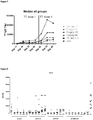
- Nanobodies 3313 and 3320 were proven to be efficacious in significantly reducing the TT-IgG response when compared to the vehicle group.
- these Nanobodies impair the settling and growth of hu PBL in the spleen of TT immunized human PBMC engrafted immune deficient mice as well (data not shown).
- Nanobodies neutralize CD40L activity in TT studies in cynomolgus monkey.
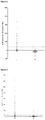
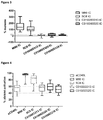
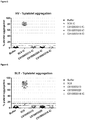
- C010003313 and C010003318 were assayed in a platelet activation assay and platelet aggregation assay as set out before. 5C8 was taken along as a positive control in these assays as well as ADP. Both for healthy volunteers and SLE patients, platelet activation was observed for 5C8. In contrast, C010003313 and C010003318 demonstrated a non-activating profile in healthy volunteers and SLE patients ( Figure 3 and Figure 4 , respectively). In addition, these Nanobodies were tested in the platelet aggregation assay with healthy volunteer and SLE patient blood, and were concluded not to induce platelet aggregation, whereas 5C8 did. The results of the platelet aggregation assay are depicted in Figure 5 (Healthy volunteers) and Figure 6 (SLE patients).
- cytokine induction by the exemplary Nanobody C010003318 was comparable to that of the unstimulated PBMCs.
- Body weights were recorded weekly commencing from Week -2. A weight was recorded on the day of scheduled necropsy. All animals had a body temperature recorded once during pretreatment (in the afternoon at the expected time of postdose measurement). During the dosing period, all animals had a body temperature recorded weekly at approximately 8 h post dose on each dosing day and before necropsy.
- Blood samples (1 mL) were taken into tubes containing 3.8% (w/v) trisodium citrate and processed for plasma, which was analysed for the parameters activated partial thromboplastin time fibrinogen and prothrombin time.
- the no-observed-adverse-effect level was considered to be 300 mg/kg/week as the highest dosage (tested).
- ADA sample analysis was performed to support toxicokinetic evaluation and/or safety evaluation.
- Plasma samples were evaluated for the presence of anti-drug antibodies (ADAs) using a validated electrochemiluminescence (ECL)-based bridging format for ADA sample analysis (on an MSD platform).
- ECL electrochemiluminescence
Landscapes
- Health & Medical Sciences (AREA)
- Chemical & Material Sciences (AREA)
- Organic Chemistry (AREA)
- Medicinal Chemistry (AREA)
- General Health & Medical Sciences (AREA)
- Life Sciences & Earth Sciences (AREA)
- Immunology (AREA)
- Engineering & Computer Science (AREA)
- Bioinformatics & Cheminformatics (AREA)
- Animal Behavior & Ethology (AREA)
- General Chemical & Material Sciences (AREA)
- Nuclear Medicine, Radiotherapy & Molecular Imaging (AREA)
- Chemical Kinetics & Catalysis (AREA)
- Pharmacology & Pharmacy (AREA)
- Veterinary Medicine (AREA)
- Public Health (AREA)
- Genetics & Genomics (AREA)
- Biophysics (AREA)
- Biochemistry (AREA)
- Molecular Biology (AREA)
- Proteomics, Peptides & Aminoacids (AREA)
- Diabetes (AREA)
- Pulmonology (AREA)
- Orthopedic Medicine & Surgery (AREA)
- Urology & Nephrology (AREA)
- Hematology (AREA)
- Physical Education & Sports Medicine (AREA)
- Neurology (AREA)
- Rheumatology (AREA)
- Cardiology (AREA)
- Vascular Medicine (AREA)
- Pain & Pain Management (AREA)
- Neurosurgery (AREA)
- Transplantation (AREA)
- Obesity (AREA)
- Endocrinology (AREA)
- Heart & Thoracic Surgery (AREA)
- Biomedical Technology (AREA)
- Emergency Medicine (AREA)
- Dermatology (AREA)
Applications Claiming Priority (4)
| Application Number | Priority Date | Filing Date | Title |
|---|---|---|---|
| US201562260411P | 2015-11-27 | 2015-11-27 | |
| US201662345967P | 2016-06-06 | 2016-06-06 | |
| PCT/EP2016/079048 WO2017089618A1 (en) | 2015-11-27 | 2016-11-28 | Polypeptides inhibiting cd40l |
| EP16805359.3A EP3380517B1 (en) | 2015-11-27 | 2016-11-28 | Polypeptides inhibiting cd40l |
Related Parent Applications (2)
| Application Number | Title | Priority Date | Filing Date |
|---|---|---|---|
| EP16805359.3A Division EP3380517B1 (en) | 2015-11-27 | 2016-11-28 | Polypeptides inhibiting cd40l |
| EP16805359.3A Division-Into EP3380517B1 (en) | 2015-11-27 | 2016-11-28 | Polypeptides inhibiting cd40l |
Publications (1)
| Publication Number | Publication Date |
|---|---|
| EP3932945A1 true EP3932945A1 (en) | 2022-01-05 |
Family
ID=57471837
Family Applications (2)
| Application Number | Title | Priority Date | Filing Date |
|---|---|---|---|
| EP21179221.3A Withdrawn EP3932945A1 (en) | 2015-11-27 | 2016-11-28 | Polypeptides inhibiting cd40l |
| EP16805359.3A Active EP3380517B1 (en) | 2015-11-27 | 2016-11-28 | Polypeptides inhibiting cd40l |
Family Applications After (1)
| Application Number | Title | Priority Date | Filing Date |
|---|---|---|---|
| EP16805359.3A Active EP3380517B1 (en) | 2015-11-27 | 2016-11-28 | Polypeptides inhibiting cd40l |
Country Status (22)
| Country | Link |
|---|---|
| US (1) | US11248055B2 (https=) |
| EP (2) | EP3932945A1 (https=) |
| JP (1) | JP7256011B2 (https=) |
| KR (1) | KR20180080337A (https=) |
| CN (1) | CN108473561B (https=) |
| AU (1) | AU2016360987A1 (https=) |
| BR (1) | BR112018010802A2 (https=) |
| CA (1) | CA3006398A1 (https=) |
| CL (1) | CL2018001400A1 (https=) |
| CO (1) | CO2018005921A2 (https=) |
| DO (1) | DOP2018000128A (https=) |
| EC (1) | ECSP18046820A (https=) |
| GT (1) | GT201800102A (https=) |
| IL (1) | IL259249A (https=) |
| MA (1) | MA43302A (https=) |
| MX (1) | MX2018006377A (https=) |
| PE (1) | PE20181956A1 (https=) |
| PH (1) | PH12018501114A1 (https=) |
| RU (1) | RU2018122255A (https=) |
| SG (2) | SG11201803976VA (https=) |
| TN (1) | TN2018000180A1 (https=) |
| WO (1) | WO2017089618A1 (https=) |
Families Citing this family (13)
| Publication number | Priority date | Publication date | Assignee | Title |
|---|---|---|---|---|
| RU2022101604A (ru) | 2016-12-07 | 2022-03-29 | Аблинкс Нв | Улучшенные отдельные вариабельные домены иммуноглобулина, связывающиеся с сывороточным альбумином |
| HRP20241501T1 (hr) | 2017-01-17 | 2025-01-03 | Ablynx Nv | Poboljšana veziva albumina u serumu |
| SG10202108972RA (en) | 2017-01-17 | 2021-09-29 | Ablynx Nv | Improved serum albumin binders |
| CN111433224B (zh) * | 2017-11-17 | 2024-03-19 | 南京传奇生物科技有限公司 | 抗pd-l1的单结构域抗体及其变体 |
| WO2021116182A1 (en) * | 2019-12-09 | 2021-06-17 | Ablynx Nv | Polypeptides comprising immunoglobulin single variable domains targeting il-13 and tslp |
| CN114149508B (zh) * | 2021-11-25 | 2023-04-28 | 苏州普乐康医药科技有限公司 | 一种结合cd40l的融合蛋白及其应用 |
| AR131494A1 (es) | 2022-12-23 | 2025-03-26 | Ablynx Nv | Vehículos de conjugación a base de proteína |
| JP2026506075A (ja) | 2023-02-17 | 2026-02-20 | アブリンクス エン.ヴェー. | 新生児型fc受容体に結合するポリペプチド |
| TW202543670A (zh) | 2023-12-22 | 2025-11-16 | 比利時商艾伯霖克斯公司 | 用於核內投予之基於蛋白質的接合載劑 |
| US20250236673A1 (en) | 2023-12-22 | 2025-07-24 | Ablynx N.V. | Protein-based carriers for site-specific amine conjugation |
| WO2025235683A1 (en) | 2024-05-07 | 2025-11-13 | Eledon Pharmaceuticals, Inc. | Methods and compositions for prevention of transplant rejection |
| WO2025235670A1 (en) | 2024-05-07 | 2025-11-13 | Eledon Pharmaceuticals, Inc. | Use of anti-cd40 ligand antibodies for immunosuppression in islet cell transplantation |
| US20260007757A1 (en) | 2024-06-18 | 2026-01-08 | Ablynx Nv | Antibody-recruiting molecules |
Citations (59)
| Publication number | Priority date | Publication date | Assignee | Title |
|---|---|---|---|---|
| GB335768A (en) | 1929-10-24 | 1930-10-02 | Jacoviac Maurice | Improvements in protecting devices for gramophone disc records |
| EP0368684A1 (en) | 1988-11-11 | 1990-05-16 | Medical Research Council | Cloning immunoglobulin variable domain sequences. |
| WO1991001743A1 (en) | 1989-08-01 | 1991-02-21 | Cemu Bioteknik Ab | Stabilized protein or peptide conjugates |
| WO1994004678A1 (en) | 1992-08-21 | 1994-03-03 | Casterman Cecile | Immunoglobulins devoid of light chains |
| WO1994025591A1 (en) | 1993-04-29 | 1994-11-10 | Unilever N.V. | PRODUCTION OF ANTIBODIES OR (FUNCTIONALIZED) FRAGMENTS THEREOF DERIVED FROM HEAVY CHAIN IMMUNOGLOBULINS OF $i(CAMELIDAE) |
| WO1995004079A1 (fr) | 1993-08-02 | 1995-02-09 | Raymond Hamers | Vecteur recombinant contenant une sequence d'un gene de lipoproteine pour l'expression de sequences de nucleotides |
| WO1996034103A1 (en) | 1995-04-25 | 1996-10-31 | Vrije Universiteit Brussel | Variable fragments of immunoglobulins - use for therapeutic or veterinary purposes |
| WO1997049805A2 (en) | 1996-06-27 | 1997-12-31 | Vlaams Interuniversitair Instituut Voor Biotechnologie Vzw | Recognition molecules interacting specifically with the active site or cleft of a target molecule |
| WO1998049185A1 (en) | 1997-04-28 | 1998-11-05 | Fmc Corporation | Lepidopteran gaba-gated chloride channels |
| WO1999023221A2 (en) | 1997-10-27 | 1999-05-14 | Unilever Plc | Multivalent antigen-binding proteins |
| WO1999037681A2 (en) | 1998-01-26 | 1999-07-29 | Unilever Plc | Method for producing antibody fragments |
| WO1999042077A2 (en) | 1998-02-19 | 1999-08-26 | Xcyte Therapies, Inc. | Compositions and methods for regulating lymphocyte activation |
| EP0967284A1 (en) | 1998-05-28 | 1999-12-29 | Pfizer Limited | Phosphodiesterases |
| WO2000040968A1 (en) | 1999-01-05 | 2000-07-13 | Unilever Plc | Binding of antibody fragments to solid supports |
| WO2000043507A1 (en) | 1999-01-19 | 2000-07-27 | Unilever Plc | Method for producing antibody fragments |
| WO2000046383A2 (en) | 1999-02-05 | 2000-08-10 | Rijksuniversiteit Leiden | Method of modulating metabolite biosynthesis in recombinant cells |
| WO2000055318A2 (en) | 1999-03-15 | 2000-09-21 | University Of British Columbia | Abc1 polypeptide and methods and reagents for modulating cholesterol levels |
| WO2000065057A1 (en) | 1999-04-22 | 2000-11-02 | Unilever Plc | Inhibition of viral infection using monovalent antigen-binding proteins |
| WO2000078972A2 (en) | 1999-06-18 | 2000-12-28 | Cv Therapeutics, Inc. | Regulation with binding cassette transporter protein abc1 |
| WO2001009300A2 (en) | 1999-08-02 | 2001-02-08 | Keygene N.V. | Method for generating cgmmv resistant plants, genetic constructs, and obtained cgmmv-resistant plants |
| EP1085089A2 (en) | 1999-09-17 | 2001-03-21 | Pfizer Limited | Human cyclic nucleotide phosphodiesterase |
| WO2001021817A1 (en) | 1999-09-24 | 2001-03-29 | Vlaams Interuniversitair Instituut Voor Biotechnologie Vzw | Recombinant phages capable of entering host cells via specific interaction with an artificial receptor |
| WO2001040310A2 (en) | 1999-11-29 | 2001-06-07 | Unilever Plc | Immobilisation of proteins using a polypeptide segment |
| WO2001044301A1 (en) | 1999-11-29 | 2001-06-21 | Unilever Plc | Immobilized single domain antigen-binding molecules |
| WO2001045746A2 (en) | 1999-12-24 | 2001-06-28 | Genentech, Inc. | Methods and compositions for prolonging elimination half-times of bioactive compounds |
| GB2357768A (en) | 1999-11-18 | 2001-07-04 | Bayer Ag | GABA B receptors |
| EP1134231A1 (en) | 2000-03-14 | 2001-09-19 | Unilever N.V. | Antibody heavy chain variable domains against human dietary enzymes, and their uses |
| WO2001090190A2 (en) | 2000-05-26 | 2001-11-29 | National Research Council Of Canada | Single-domain antigen-binding antibody fragments derived from llama antibodies |
| WO2002048193A2 (en) | 2000-12-13 | 2002-06-20 | Unilever N.V. | Camelidae antibody arrays |
| WO2002076489A1 (en) | 2001-03-09 | 2002-10-03 | Dyax Corp. | Serum albumin binding moieties |
| WO2003002609A2 (en) | 2001-06-28 | 2003-01-09 | Domantis Limited | Dual-specific ligand and its use |
| WO2003025020A1 (en) | 2001-09-13 | 2003-03-27 | Institute For Antibodies Co., Ltd. | Method of constructing camel antibody library |
| WO2003035694A2 (en) | 2001-10-24 | 2003-05-01 | Vlaams Interuniversitair Instituut Voor Biotechnologie Vzw | Functional heavy chain antibodies, fragments thereof, library thereof and methods of production thereof |
| WO2003050531A2 (en) | 2001-12-11 | 2003-06-19 | Algonomics N.V. | Method for displaying loops from immunoglobulin domains in different contexts |
| WO2003054016A2 (en) | 2001-12-21 | 2003-07-03 | Vlaams Interuniversitair Instituut Voor Biotechnologie Vzw | Method for cloning of variable domain sequences |
| WO2003055527A2 (en) | 2002-01-03 | 2003-07-10 | Vlaams Interuniversitair Instituut Voor Biotechnologie Vzw | Immunoconjugates useful for treatment of tumours |
| WO2004037999A2 (en) | 2002-10-23 | 2004-05-06 | Ludwig Institute For Cancer Research | A34 and a33-like 3 dna, proteins, antibodies thereto and methods of treatment using same |
| WO2004041862A2 (en) | 2002-11-08 | 2004-05-21 | Ablynx N.V. | Single domain antibodies directed against tumour necrosis factor-alpha and uses therefor |
| WO2004041867A2 (en) | 2002-11-08 | 2004-05-21 | Ablynx N.V. | Camelidae antibodies against imminoglobulin e and use thereof for the treatment of allergic disorders |
| WO2004062551A2 (en) | 2003-01-10 | 2004-07-29 | Ablynx N.V. | RECOMBINANT VHH SINGLE DOMAIN ANTIBODY FROM CAMELIDAE AGAINST VON WILLEBRAND FACTOR (vWF) OR AGAINST COLLAGEN |
| WO2004068820A2 (en) | 2003-01-23 | 2004-08-12 | Unspam, Llc. | Method and apparatus for a non-revealing do-not-contact list system |
| WO2005018629A1 (en) | 2003-08-12 | 2005-03-03 | Yarbrough William M | Treatment for acne vulgaris and method of use |
| WO2005044858A1 (en) | 2003-11-07 | 2005-05-19 | Ablynx N.V. | Camelidae single domain antibodies vhh directed against epidermal growth factor receptor and uses therefor |
| WO2006003388A2 (en) | 2004-06-30 | 2006-01-12 | Domantis Limited | Compositions and methods for treating inflammatory disorders |
| WO2006030220A1 (en) | 2004-09-17 | 2006-03-23 | Domantis Limited | Compositions monovalent for cd40l binding and methods of use |
| WO2006040153A2 (en) | 2004-10-13 | 2006-04-20 | Ablynx N.V. | Single domain camelide anti -amyloid beta antibodies and polypeptides comprising the same for the treatment and diagnosis of degenarative neural diseases such as alzheimer's disease |
| WO2006079372A1 (en) | 2005-01-31 | 2006-08-03 | Ablynx N.V. | Method for generating variable domain sequences of heavy chain antibodies |
| WO2006122787A1 (en) | 2005-05-18 | 2006-11-23 | Ablynx Nv | Serum albumin binding proteins |
| WO2006122825A2 (en) | 2005-05-20 | 2006-11-23 | Ablynx Nv | Single domain vhh antibodies against von willebrand factor |
| WO2008020079A1 (en) | 2006-08-18 | 2008-02-21 | Ablynx N.V. | Amino acid sequences directed against il-6r and polypeptides comprising the same for the treatment of deseases and disorders associated with il-6-mediated signalling |
| WO2008068280A1 (en) | 2006-12-05 | 2008-06-12 | Ablynx N.V. | Peptides capable of binding to serum proteins |
| WO2008101985A2 (en) | 2007-02-21 | 2008-08-28 | Ablynx N.V. | Amino acid sequences directed against vascular endothelial growth factor and polypeptides comprising the same for the treatment of conditions and diseases characterized by excessive and/or pathological angiogenesis or neovascularization |
| WO2008142164A2 (en) | 2007-05-24 | 2008-11-27 | Ablynx N.V. | Amino acid sequences directed against rank-l and polypeptides comprising the same for the treatment of bone diseases and disorders |
| WO2009127691A1 (en) | 2008-04-17 | 2009-10-22 | Ablynx N.V. | Peptides capable of binding to serum proteins and compounds, constructs and polypeptides comprising the same |
| US20100104573A1 (en) | 2007-03-22 | 2010-04-29 | Ucb Parma S.A. | Binding proteins, including antibodies, antibody derivatives and antibody fragments, that specifically bind cd154 and uses thereof |
| WO2012175741A2 (en) | 2011-06-23 | 2012-12-27 | Ablynx Nv | Techniques for predicting, detecting and reducing aspecific protein interference in assays involving immunoglobulin single variable domains |
| WO2012175400A1 (en) * | 2011-06-23 | 2012-12-27 | Ablynx Nv | Serum albumin binding proteins |
| WO2013056068A1 (en) | 2011-10-13 | 2013-04-18 | Bristol-Myers Squibb Company | Antibody polypeptides that antagonize cd40l |
| WO2015143209A1 (en) * | 2014-03-19 | 2015-09-24 | Bristol-Myers Squibb Company | Methods of treating transplant rejection using a domain antibody directed against cd40l |
Family Cites Families (8)
| Publication number | Priority date | Publication date | Assignee | Title |
|---|---|---|---|---|
| GB0006398D0 (en) | 2000-03-16 | 2000-05-03 | Novartis Ag | Organic compounds |
| BRPI0913366A8 (pt) * | 2008-06-03 | 2017-07-11 | Abbott Lab | Imunoglobulinas de domínio variável duplo e seus usos |
| EP2513145B1 (en) * | 2009-12-14 | 2018-01-24 | Ablynx N.V. | Single variable domain antibodies against ox40l, constructs and therapeutic use |
| WO2012088302A2 (en) * | 2010-12-22 | 2012-06-28 | Abbott Laboratories | Half immunoglobulin binding proteins and uses thereof |
| SG2014010482A (en) | 2011-08-17 | 2014-04-28 | Glaxo Group Ltd | Modified proteins and peptides |
| CN105814082A (zh) | 2013-09-26 | 2016-07-27 | 埃博灵克斯股份有限公司 | 双特异性纳米抗体 |
| IL256800B2 (en) | 2015-07-14 | 2023-04-01 | Immunext Inc | An anti-cd154 antibody with improved binding, functional and safety properties and use in human immunotherapy |
| PE20180802A1 (es) | 2015-08-05 | 2018-05-09 | Janssen Biotech Inc | Anticuerpos anti-cd154 y metodos de uso de estos |
-
2016
- 2016-11-28 WO PCT/EP2016/079048 patent/WO2017089618A1/en not_active Ceased
- 2016-11-28 AU AU2016360987A patent/AU2016360987A1/en not_active Abandoned
- 2016-11-28 PE PE2018001013A patent/PE20181956A1/es unknown
- 2016-11-28 SG SG11201803976VA patent/SG11201803976VA/en unknown
- 2016-11-28 JP JP2018527745A patent/JP7256011B2/ja active Active
- 2016-11-28 RU RU2018122255A patent/RU2018122255A/ru unknown
- 2016-11-28 US US15/778,677 patent/US11248055B2/en active Active
- 2016-11-28 CA CA3006398A patent/CA3006398A1/en not_active Abandoned
- 2016-11-28 MX MX2018006377A patent/MX2018006377A/es unknown
- 2016-11-28 KR KR1020187018169A patent/KR20180080337A/ko not_active Withdrawn
- 2016-11-28 BR BR112018010802A patent/BR112018010802A2/pt not_active Application Discontinuation
- 2016-11-28 CN CN201680068704.XA patent/CN108473561B/zh active Active
- 2016-11-28 SG SG10201913503VA patent/SG10201913503VA/en unknown
- 2016-11-28 TN TNP/2018/000180A patent/TN2018000180A1/en unknown
- 2016-11-28 MA MA043302A patent/MA43302A/fr unknown
- 2016-11-28 EP EP21179221.3A patent/EP3932945A1/en not_active Withdrawn
- 2016-11-28 EP EP16805359.3A patent/EP3380517B1/en active Active
-
2018
- 2018-05-09 IL IL259249A patent/IL259249A/en unknown
- 2018-05-21 GT GT201800102A patent/GT201800102A/es unknown
- 2018-05-22 DO DO2018000128A patent/DOP2018000128A/es unknown
- 2018-05-24 CL CL2018001400A patent/CL2018001400A1/es unknown
- 2018-05-25 PH PH12018501114A patent/PH12018501114A1/en unknown
- 2018-06-08 CO CONC2018/0005921A patent/CO2018005921A2/es unknown
- 2018-06-21 EC ECSENADI201846820A patent/ECSP18046820A/es unknown
Patent Citations (63)
| Publication number | Priority date | Publication date | Assignee | Title |
|---|---|---|---|---|
| GB335768A (en) | 1929-10-24 | 1930-10-02 | Jacoviac Maurice | Improvements in protecting devices for gramophone disc records |
| EP0368684A1 (en) | 1988-11-11 | 1990-05-16 | Medical Research Council | Cloning immunoglobulin variable domain sequences. |
| WO1991001743A1 (en) | 1989-08-01 | 1991-02-21 | Cemu Bioteknik Ab | Stabilized protein or peptide conjugates |
| WO1994004678A1 (en) | 1992-08-21 | 1994-03-03 | Casterman Cecile | Immunoglobulins devoid of light chains |
| WO1994025591A1 (en) | 1993-04-29 | 1994-11-10 | Unilever N.V. | PRODUCTION OF ANTIBODIES OR (FUNCTIONALIZED) FRAGMENTS THEREOF DERIVED FROM HEAVY CHAIN IMMUNOGLOBULINS OF $i(CAMELIDAE) |
| WO1995004079A1 (fr) | 1993-08-02 | 1995-02-09 | Raymond Hamers | Vecteur recombinant contenant une sequence d'un gene de lipoproteine pour l'expression de sequences de nucleotides |
| WO1996034103A1 (en) | 1995-04-25 | 1996-10-31 | Vrije Universiteit Brussel | Variable fragments of immunoglobulins - use for therapeutic or veterinary purposes |
| WO1997049805A2 (en) | 1996-06-27 | 1997-12-31 | Vlaams Interuniversitair Instituut Voor Biotechnologie Vzw | Recognition molecules interacting specifically with the active site or cleft of a target molecule |
| WO1998049185A1 (en) | 1997-04-28 | 1998-11-05 | Fmc Corporation | Lepidopteran gaba-gated chloride channels |
| WO1999023221A2 (en) | 1997-10-27 | 1999-05-14 | Unilever Plc | Multivalent antigen-binding proteins |
| WO1999037681A2 (en) | 1998-01-26 | 1999-07-29 | Unilever Plc | Method for producing antibody fragments |
| WO1999042077A2 (en) | 1998-02-19 | 1999-08-26 | Xcyte Therapies, Inc. | Compositions and methods for regulating lymphocyte activation |
| EP0967284A1 (en) | 1998-05-28 | 1999-12-29 | Pfizer Limited | Phosphodiesterases |
| WO2000040968A1 (en) | 1999-01-05 | 2000-07-13 | Unilever Plc | Binding of antibody fragments to solid supports |
| WO2000043507A1 (en) | 1999-01-19 | 2000-07-27 | Unilever Plc | Method for producing antibody fragments |
| WO2000046383A2 (en) | 1999-02-05 | 2000-08-10 | Rijksuniversiteit Leiden | Method of modulating metabolite biosynthesis in recombinant cells |
| WO2000055318A2 (en) | 1999-03-15 | 2000-09-21 | University Of British Columbia | Abc1 polypeptide and methods and reagents for modulating cholesterol levels |
| WO2000065057A1 (en) | 1999-04-22 | 2000-11-02 | Unilever Plc | Inhibition of viral infection using monovalent antigen-binding proteins |
| WO2000078972A2 (en) | 1999-06-18 | 2000-12-28 | Cv Therapeutics, Inc. | Regulation with binding cassette transporter protein abc1 |
| WO2001009300A2 (en) | 1999-08-02 | 2001-02-08 | Keygene N.V. | Method for generating cgmmv resistant plants, genetic constructs, and obtained cgmmv-resistant plants |
| EP1085089A2 (en) | 1999-09-17 | 2001-03-21 | Pfizer Limited | Human cyclic nucleotide phosphodiesterase |
| WO2001021817A1 (en) | 1999-09-24 | 2001-03-29 | Vlaams Interuniversitair Instituut Voor Biotechnologie Vzw | Recombinant phages capable of entering host cells via specific interaction with an artificial receptor |
| GB2357768A (en) | 1999-11-18 | 2001-07-04 | Bayer Ag | GABA B receptors |
| WO2001040310A2 (en) | 1999-11-29 | 2001-06-07 | Unilever Plc | Immobilisation of proteins using a polypeptide segment |
| WO2001044301A1 (en) | 1999-11-29 | 2001-06-21 | Unilever Plc | Immobilized single domain antigen-binding molecules |
| WO2001045746A2 (en) | 1999-12-24 | 2001-06-28 | Genentech, Inc. | Methods and compositions for prolonging elimination half-times of bioactive compounds |
| EP1134231A1 (en) | 2000-03-14 | 2001-09-19 | Unilever N.V. | Antibody heavy chain variable domains against human dietary enzymes, and their uses |
| WO2001090190A2 (en) | 2000-05-26 | 2001-11-29 | National Research Council Of Canada | Single-domain antigen-binding antibody fragments derived from llama antibodies |
| WO2002048193A2 (en) | 2000-12-13 | 2002-06-20 | Unilever N.V. | Camelidae antibody arrays |
| WO2002076489A1 (en) | 2001-03-09 | 2002-10-03 | Dyax Corp. | Serum albumin binding moieties |
| WO2003002609A2 (en) | 2001-06-28 | 2003-01-09 | Domantis Limited | Dual-specific ligand and its use |
| WO2003025020A1 (en) | 2001-09-13 | 2003-03-27 | Institute For Antibodies Co., Ltd. | Method of constructing camel antibody library |
| EP1433793A1 (en) | 2001-09-13 | 2004-06-30 | Institute for Antibodies Co., Ltd. | Method of constructing camel antibody library |
| WO2003035694A2 (en) | 2001-10-24 | 2003-05-01 | Vlaams Interuniversitair Instituut Voor Biotechnologie Vzw | Functional heavy chain antibodies, fragments thereof, library thereof and methods of production thereof |
| WO2003050531A2 (en) | 2001-12-11 | 2003-06-19 | Algonomics N.V. | Method for displaying loops from immunoglobulin domains in different contexts |
| WO2003054016A2 (en) | 2001-12-21 | 2003-07-03 | Vlaams Interuniversitair Instituut Voor Biotechnologie Vzw | Method for cloning of variable domain sequences |
| WO2003055527A2 (en) | 2002-01-03 | 2003-07-10 | Vlaams Interuniversitair Instituut Voor Biotechnologie Vzw | Immunoconjugates useful for treatment of tumours |
| WO2004037999A2 (en) | 2002-10-23 | 2004-05-06 | Ludwig Institute For Cancer Research | A34 and a33-like 3 dna, proteins, antibodies thereto and methods of treatment using same |
| WO2004041862A2 (en) | 2002-11-08 | 2004-05-21 | Ablynx N.V. | Single domain antibodies directed against tumour necrosis factor-alpha and uses therefor |
| WO2004041863A2 (en) | 2002-11-08 | 2004-05-21 | Ablynx N.V. | Single domain antibodies directed against interferon- gamma and uses therefor |
| WO2004041867A2 (en) | 2002-11-08 | 2004-05-21 | Ablynx N.V. | Camelidae antibodies against imminoglobulin e and use thereof for the treatment of allergic disorders |
| WO2004041865A2 (en) | 2002-11-08 | 2004-05-21 | Ablynx N.V. | Stabilized single domain antibodies |
| WO2004062551A2 (en) | 2003-01-10 | 2004-07-29 | Ablynx N.V. | RECOMBINANT VHH SINGLE DOMAIN ANTIBODY FROM CAMELIDAE AGAINST VON WILLEBRAND FACTOR (vWF) OR AGAINST COLLAGEN |
| WO2004068820A2 (en) | 2003-01-23 | 2004-08-12 | Unspam, Llc. | Method and apparatus for a non-revealing do-not-contact list system |
| WO2005018629A1 (en) | 2003-08-12 | 2005-03-03 | Yarbrough William M | Treatment for acne vulgaris and method of use |
| WO2005044858A1 (en) | 2003-11-07 | 2005-05-19 | Ablynx N.V. | Camelidae single domain antibodies vhh directed against epidermal growth factor receptor and uses therefor |
| WO2006003388A2 (en) | 2004-06-30 | 2006-01-12 | Domantis Limited | Compositions and methods for treating inflammatory disorders |
| WO2006030220A1 (en) | 2004-09-17 | 2006-03-23 | Domantis Limited | Compositions monovalent for cd40l binding and methods of use |
| WO2006040153A2 (en) | 2004-10-13 | 2006-04-20 | Ablynx N.V. | Single domain camelide anti -amyloid beta antibodies and polypeptides comprising the same for the treatment and diagnosis of degenarative neural diseases such as alzheimer's disease |
| WO2006079372A1 (en) | 2005-01-31 | 2006-08-03 | Ablynx N.V. | Method for generating variable domain sequences of heavy chain antibodies |
| WO2006122787A1 (en) | 2005-05-18 | 2006-11-23 | Ablynx Nv | Serum albumin binding proteins |
| WO2006122786A2 (en) | 2005-05-18 | 2006-11-23 | Ablynx Nv | Improved nanobodies™ against tumor necrosis factor-alpha |
| WO2006122825A2 (en) | 2005-05-20 | 2006-11-23 | Ablynx Nv | Single domain vhh antibodies against von willebrand factor |
| WO2008020079A1 (en) | 2006-08-18 | 2008-02-21 | Ablynx N.V. | Amino acid sequences directed against il-6r and polypeptides comprising the same for the treatment of deseases and disorders associated with il-6-mediated signalling |
| WO2008068280A1 (en) | 2006-12-05 | 2008-06-12 | Ablynx N.V. | Peptides capable of binding to serum proteins |
| WO2008101985A2 (en) | 2007-02-21 | 2008-08-28 | Ablynx N.V. | Amino acid sequences directed against vascular endothelial growth factor and polypeptides comprising the same for the treatment of conditions and diseases characterized by excessive and/or pathological angiogenesis or neovascularization |
| US20100104573A1 (en) | 2007-03-22 | 2010-04-29 | Ucb Parma S.A. | Binding proteins, including antibodies, antibody derivatives and antibody fragments, that specifically bind cd154 and uses thereof |
| WO2008142164A2 (en) | 2007-05-24 | 2008-11-27 | Ablynx N.V. | Amino acid sequences directed against rank-l and polypeptides comprising the same for the treatment of bone diseases and disorders |
| WO2009127691A1 (en) | 2008-04-17 | 2009-10-22 | Ablynx N.V. | Peptides capable of binding to serum proteins and compounds, constructs and polypeptides comprising the same |
| WO2012175741A2 (en) | 2011-06-23 | 2012-12-27 | Ablynx Nv | Techniques for predicting, detecting and reducing aspecific protein interference in assays involving immunoglobulin single variable domains |
| WO2012175400A1 (en) * | 2011-06-23 | 2012-12-27 | Ablynx Nv | Serum albumin binding proteins |
| WO2013056068A1 (en) | 2011-10-13 | 2013-04-18 | Bristol-Myers Squibb Company | Antibody polypeptides that antagonize cd40l |
| WO2015143209A1 (en) * | 2014-03-19 | 2015-09-24 | Bristol-Myers Squibb Company | Methods of treating transplant rejection using a domain antibody directed against cd40l |
Non-Patent Citations (58)
| Title |
|---|
| "UniProt", Database accession no. G7N4M5 |
| ADV. ENZYMOL., vol. 47, 1978, pages 45 - 149 |
| ANTHONY SHOCK ET AL: "CDP7657, an anti-CD40L antibody lacking an Fc domain, inhibits CD40L-dependent immune responses without thrombotic complications: an in vivo study", ARTHRITIS RESEARCH & THERAPY, vol. 17, no. 1, 3 September 2015 (2015-09-03), XP055353616, DOI: 10.1186/s13075-015-0757-4 * |
| ARUFFO ET AL., CELL, vol. 72, 1993, pages 291 - 300 |
| BARBAS ET AL., PROC. NAT. ACAD. SCI, vol. 91, 1994, pages 3809 - 3813 |
| BIOTECHNOL, vol. 13, 1995, pages 475 - 479 |
| BLOTTA ET AL., J. IMMUNOL., vol. 156, 1996, pages 3133 - 3140 |
| BUHLMANN, J. IMMUNOL., vol. 162, 1999, pages 4373 - 4376 |
| CAUX ET AL., J. EXP. MED., vol. 180, 1994, pages 1263 - 1272 |
| CHOUFASMAN, BIOCHEMISTRY, vol. 13, no. 211, 1974 |
| DAVIESRIECHMANN, FEBS, vol. 339, 1994, pages 285 - 290 |
| DECANNIERE ET AL., STRUCTURE, vol. 7, no. 4, 1999, pages 361 |
| DESMYTER ET AL., NATURE STRUCTURAL BIOLOGY, vol. 3, 1996, pages 803 |
| DRAKE, ANALYTICAL BIOCHEMISTRY, vol. 328, 2004, pages 35 - 43 |
| EISENBERG ET AL., PROC. NATL. ACAD SCI. USA, vol. 81, 1984, pages 140 - 144 |
| EISSNER, CYTOKINE & GROWTH FACTOR REVIEWS, vol. 15, 2004, pages 353 - 366 |
| F. AUSUBEL ET AL.: "Current protocols in molecular biology", 1987, GREEN PUBLISHING AND WILEY INTERSCIENCE |
| FRALEY ET AL., BIOANALYSIS, vol. 5, 2013, pages 1765 - 74 |
| FRIGUET ET AL., J. IMMUNOL. METHODS, vol. 77, 1985, pages 305 - 19 |
| GIBALDIPERRON: "Pharmacokinetics", 1982, MARCEL DEKKER |
| GOLDMAN ET AL., ANN. REV. BIOPHYS. CHEM., vol. 15, 1986, pages 321 - 353 |
| GONZALES ET AL., TUMOUR BIOL, vol. 26, no. 1, 2005, pages 31 - 43 |
| GREWALFLAVELL, ANNU. REV. IMMUNOL., vol. 16, 1998, pages 111 - 135 |
| HAMERS-CASTERMAN ET AL., NATURE, vol. 363, 1993, pages 446 - 448 |
| HAWKINS ET AL., J. MOL. BIOL., vol. 226, no. 889, 1992, pages 896 |
| HOLT ET AL., TENDS IN BIOTECHNOLOGY, vol. 21, 2003, pages 484 - 490 |
| IRVING ET AL., J. IMMUNOL. METHODS, vol. 248, no. 1-2, 2001, pages 31 - 45 |
| J. H. XIE ET AL: "Engineering of a Novel Anti-CD40L Domain Antibody for Treatment of Autoimmune Diseases", THE JOURNAL OF IMMUNOLOGY, vol. 192, no. 9, 26 March 2014 (2014-03-26), pages 4083 - 4092, XP055197472, ISSN: 0022-1767, DOI: 10.4049/jimmunol.1303239 * |
| JACKSON ET AL., J. IMMUNOL., vol. 154, 1995, pages 3310 - 4092 |
| JOHNSONHAWKINS: "Affinity maturation of antibodies using phage display", 1996, OXFORD UNIVERSITY PRESS |
| KAWAI ET AL., NAT. MED., vol. 6, 2000, pages 114 |
| KENNEDY ET AL., EUR. J. IMMUNOL., vol. 24, 1994, pages 116 - 123 |
| KENNETH ET AL.: "Chemical Stability of Pharmaceuticals: A Handbook for Pharmacists", 1986, JOHN WILEY & SONS INC |
| KIRK ET AL., NAT. MED., vol. 5, 1999, pages 686 - 693 |
| KOPPENHOEFER ET AL., FEBS LETTERS, vol. 414, 1997, pages 444 - 448 |
| KYTEDOOLITTLE, J. MOLEC. BIOL., vol. 157, 1981, pages 105 - 132 |
| LEVINWEISS, MOL. BIOSYST., vol. 2, no. 1, 2006, pages 49 - 57 |
| MACDOUGALL ET AL., KIDNEY INT, vol. 81, 2012, pages 727 - 32 |
| MARKS ET AL., BIOTECHNOLOGY, vol. 10, 1992, pages 779 - 783 |
| MCLELLAN, EUR. J. IMMUNOL., vol. 26, 1996, pages 1204 - 1210 |
| MILLER, JOURNAL OF IMMUNOLOGICAL METHODS, vol. 365, 2011, pages 118 - 125 |
| MUYLDERMANS, REVIEWS IN MOLECULAR BIOTECHNOLOGY, vol. 74, 2001, pages 277 - 302 |
| OBER, INTERN. IMMUNOLOGY, vol. 13, 2001, pages 1551 - 1559 |
| PRESTA, ADV. DRUG DELIV. REV., vol. 58, no. 5-6, 2006, pages 640 - 56 |
| PROT. ENG., vol. 9, 1996, pages 531 - 537 |
| RIECHMANNMUYLDERMANS, J. IMMUNOL. METHODS, vol. 231, 1999, pages 25 - 38 |
| RONDELLI ET AL., BLOOD, vol. 94, 1999, pages 2293 - 2300 |
| ROTH ET AL., TRANSPLANTATION, vol. 78, 2004, pages 1238 - 9 |
| SCHMITZ ET AL., PLACENTA 21 SUPPL, 2000, pages S106 - 12 |
| SEIDL ET AL., PHARM RES, vol. 29, 2012, pages 1454 - 1467 |
| SHIER ET AL., GENE, vol. 169, 1995, pages 147 - 155 |
| SHOCK ET AL., ARTHRITIS RESEARCH & THERAPY, vol. 17, 2015, pages 234 |
| SPINELLI ET AL., NATURAL STRUCTURAL BIOLOGY, vol. 3, 1996, pages 752 - 757 |
| WAKEFIELD ET AL., ARTHRITIS RHEUM, vol. 62, 2010, pages 1243 - 51 |
| WARD ET AL., NATURE, vol. 341, 1989, pages 544 - 546 |
| XIAO-CHI JIA ET AL., JOURNAL OF IMMUNOLOGICAL METHODS, vol. 288, 2004, pages 91 - 98 |
| YANGWILSON, SCIENCE, vol. 273, 1996, pages 1864 - 1867 |
| YELTON ET AL., IMMUNOL, vol. 155, 1995, pages 1994 - 2004 |
Also Published As
| Publication number | Publication date |
|---|---|
| MA43302A (fr) | 2021-03-17 |
| WO2017089618A1 (en) | 2017-06-01 |
| DOP2018000128A (es) | 2018-09-30 |
| RU2018122255A3 (https=) | 2020-04-06 |
| PH12018501114A1 (en) | 2019-01-28 |
| KR20180080337A (ko) | 2018-07-11 |
| GT201800102A (es) | 2019-08-15 |
| US20180355050A1 (en) | 2018-12-13 |
| PE20181956A1 (es) | 2018-12-17 |
| RU2018122255A (ru) | 2019-12-19 |
| JP2019504822A (ja) | 2019-02-21 |
| AU2016360987A1 (en) | 2018-06-07 |
| EP3380517A1 (en) | 2018-10-03 |
| BR112018010802A2 (pt) | 2018-11-27 |
| CN108473561B (zh) | 2022-12-16 |
| EP3380517B1 (en) | 2021-08-04 |
| SG11201803976VA (en) | 2018-06-28 |
| US11248055B2 (en) | 2022-02-15 |
| JP7256011B2 (ja) | 2023-04-11 |
| SG10201913503VA (en) | 2020-03-30 |
| TN2018000180A1 (en) | 2019-10-04 |
| CN108473561A (zh) | 2018-08-31 |
| MX2018006377A (es) | 2018-09-05 |
| CO2018005921A2 (es) | 2018-06-20 |
| ECSP18046820A (es) | 2018-07-31 |
| CL2018001400A1 (es) | 2018-10-26 |
| CA3006398A1 (en) | 2017-06-01 |
| IL259249A (en) | 2018-07-31 |
Similar Documents
| Publication | Publication Date | Title |
|---|---|---|
| EP3380517B1 (en) | Polypeptides inhibiting cd40l | |
| US20240182575A1 (en) | Amino acid sequences that modulate the interaction between cells of the immune system | |
| JP6159684B2 (ja) | Il−6r関連疾患及び障害の治療のためのil−6rに指向性を有する改善されたアミノ酸配列及びこれを含むポリペプチド | |
| ES3057272T3 (en) | Immunoglobulin single variable domain antibodies against ox40l, constructs and their therapeutic use | |
| US10618964B2 (en) | Nanobody against IL-6R | |
| US20110053865A1 (en) | Amino acid sequences directed against heterodimeric cytokines and/or their receptors and polypeptides comprising the same | |
| US20200157216A1 (en) | T cell recruiting polypeptides capable of binding cd123 and tcr alpha/beta | |
| JP6822848B2 (ja) | Kv1.3結合免疫グロブリン | |
| JP2010500876A (ja) | Il−6媒介性シグナル伝達に関連する疾患及び障害の治療のための、il−6rに指向性を有するアミノ酸配列及びこれを含むポリペプチド | |
| EP4069293A1 (en) | Polypeptides comprising immunoglobulin single variable domains targeting tnfa and ox40l | |
| KR102752550B1 (ko) | Adamts 결합성 면역글로불린 | |
| CA2835340A1 (en) | Inhibition of bone resorption with rankl binding peptides |
Legal Events
| Date | Code | Title | Description |
|---|---|---|---|
| PUAI | Public reference made under article 153(3) epc to a published international application that has entered the european phase |
Free format text: ORIGINAL CODE: 0009012 |
|
| STAA | Information on the status of an ep patent application or granted ep patent |
Free format text: STATUS: THE APPLICATION HAS BEEN PUBLISHED |
|
| AC | Divisional application: reference to earlier application |
Ref document number: 3380517 Country of ref document: EP Kind code of ref document: P |
|
| AK | Designated contracting states |
Kind code of ref document: A1 Designated state(s): AL AT BE BG CH CY CZ DE DK EE ES FI FR GB GR HR HU IE IS IT LI LT LU LV MC MK MT NL NO PL PT RO RS SE SI SK SM TR |
|
| B565 | Issuance of search results under rule 164(2) epc |
Effective date: 20211203 |
|
| STAA | Information on the status of an ep patent application or granted ep patent |
Free format text: STATUS: REQUEST FOR EXAMINATION WAS MADE |
|
| 17P | Request for examination filed |
Effective date: 20220630 |
|
| RBV | Designated contracting states (corrected) |
Designated state(s): AL AT BE BG CH CY CZ DE DK EE ES FI FR GB GR HR HU IE IS IT LI LT LU LV MC MK MT NL NO PL PT RO RS SE SI SK SM TR |
|
| STAA | Information on the status of an ep patent application or granted ep patent |
Free format text: STATUS: EXAMINATION IS IN PROGRESS |
|
| 17Q | First examination report despatched |
Effective date: 20231219 |
|
| STAA | Information on the status of an ep patent application or granted ep patent |
Free format text: STATUS: THE APPLICATION IS DEEMED TO BE WITHDRAWN |
|
| 18D | Application deemed to be withdrawn |
Effective date: 20240620 |