EP3928887B1 - Method for manufacturing a hub bearing unit - Google Patents
Method for manufacturing a hub bearing unit Download PDFInfo
- Publication number
- EP3928887B1 EP3928887B1 EP20787498.3A EP20787498A EP3928887B1 EP 3928887 B1 EP3928887 B1 EP 3928887B1 EP 20787498 A EP20787498 A EP 20787498A EP 3928887 B1 EP3928887 B1 EP 3928887B1
- Authority
- EP
- European Patent Office
- Prior art keywords
- staking
- hub
- pressing die
- rotation axis
- unit bearing
- Prior art date
- Legal status (The legal status is an assumption and is not a legal conclusion. Google has not performed a legal analysis and makes no representation as to the accuracy of the status listed.)
- Active
Links
Images





Classifications
-
- B—PERFORMING OPERATIONS; TRANSPORTING
- B21—MECHANICAL METAL-WORKING WITHOUT ESSENTIALLY REMOVING MATERIAL; PUNCHING METAL
- B21J—FORGING; HAMMERING; PRESSING METAL; RIVETING; FORGE FURNACES
- B21J9/00—Forging presses
- B21J9/02—Special design or construction
- B21J9/06—Swaging presses; Upsetting presses
-
- F—MECHANICAL ENGINEERING; LIGHTING; HEATING; WEAPONS; BLASTING
- F16—ENGINEERING ELEMENTS AND UNITS; GENERAL MEASURES FOR PRODUCING AND MAINTAINING EFFECTIVE FUNCTIONING OF MACHINES OR INSTALLATIONS; THERMAL INSULATION IN GENERAL
- F16C—SHAFTS; FLEXIBLE SHAFTS; ELEMENTS OR CRANKSHAFT MECHANISMS; ROTARY BODIES OTHER THAN GEARING ELEMENTS; BEARINGS
- F16C19/00—Bearings with rolling contact, for exclusively rotary movement
- F16C19/02—Bearings with rolling contact, for exclusively rotary movement with bearing balls essentially of the same size in one or more circular rows
- F16C19/14—Bearings with rolling contact, for exclusively rotary movement with bearing balls essentially of the same size in one or more circular rows for both radial and axial load
- F16C19/18—Bearings with rolling contact, for exclusively rotary movement with bearing balls essentially of the same size in one or more circular rows for both radial and axial load with two or more rows of balls
- F16C19/181—Bearings with rolling contact, for exclusively rotary movement with bearing balls essentially of the same size in one or more circular rows for both radial and axial load with two or more rows of balls with angular contact
- F16C19/183—Bearings with rolling contact, for exclusively rotary movement with bearing balls essentially of the same size in one or more circular rows for both radial and axial load with two or more rows of balls with angular contact with two rows at opposite angles
- F16C19/184—Bearings with rolling contact, for exclusively rotary movement with bearing balls essentially of the same size in one or more circular rows for both radial and axial load with two or more rows of balls with angular contact with two rows at opposite angles in O-arrangement
- F16C19/185—Bearings with rolling contact, for exclusively rotary movement with bearing balls essentially of the same size in one or more circular rows for both radial and axial load with two or more rows of balls with angular contact with two rows at opposite angles in O-arrangement with two raceways provided integrally on a part other than a race ring, e.g. a shaft or housing
-
- B—PERFORMING OPERATIONS; TRANSPORTING
- B21—MECHANICAL METAL-WORKING WITHOUT ESSENTIALLY REMOVING MATERIAL; PUNCHING METAL
- B21D—WORKING OR PROCESSING OF SHEET METAL OR METAL TUBES, RODS OR PROFILES WITHOUT ESSENTIALLY REMOVING MATERIAL; PUNCHING METAL
- B21D41/00—Application of procedures in order to alter the diameter of tube ends
- B21D41/04—Reducing; Closing
-
- B—PERFORMING OPERATIONS; TRANSPORTING
- B21—MECHANICAL METAL-WORKING WITHOUT ESSENTIALLY REMOVING MATERIAL; PUNCHING METAL
- B21J—FORGING; HAMMERING; PRESSING METAL; RIVETING; FORGE FURNACES
- B21J9/00—Forging presses
- B21J9/02—Special design or construction
- B21J9/025—Special design or construction with rolling or wobbling dies
-
- B—PERFORMING OPERATIONS; TRANSPORTING
- B21—MECHANICAL METAL-WORKING WITHOUT ESSENTIALLY REMOVING MATERIAL; PUNCHING METAL
- B21K—MAKING FORGED OR PRESSED METAL PRODUCTS, e.g. HORSE-SHOES, RIVETS, BOLTS OR WHEELS
- B21K1/00—Making machine elements
- B21K1/05—Making machine elements cages for bearings
-
- B—PERFORMING OPERATIONS; TRANSPORTING
- B21—MECHANICAL METAL-WORKING WITHOUT ESSENTIALLY REMOVING MATERIAL; PUNCHING METAL
- B21K—MAKING FORGED OR PRESSED METAL PRODUCTS, e.g. HORSE-SHOES, RIVETS, BOLTS OR WHEELS
- B21K1/00—Making machine elements
- B21K1/28—Making machine elements wheels; discs
- B21K1/40—Making machine elements wheels; discs hubs
-
- B—PERFORMING OPERATIONS; TRANSPORTING
- B21—MECHANICAL METAL-WORKING WITHOUT ESSENTIALLY REMOVING MATERIAL; PUNCHING METAL
- B21K—MAKING FORGED OR PRESSED METAL PRODUCTS, e.g. HORSE-SHOES, RIVETS, BOLTS OR WHEELS
- B21K25/00—Uniting components to form integral members, e.g. turbine wheels and shafts, caulks with inserts, with or without shaping of the components
-
- B—PERFORMING OPERATIONS; TRANSPORTING
- B60—VEHICLES IN GENERAL
- B60B—VEHICLE WHEELS; CASTORS; AXLES FOR WHEELS OR CASTORS; INCREASING WHEEL ADHESION
- B60B27/00—Hubs
- B60B27/0078—Hubs characterised by the fixation of bearings
- B60B27/0084—Hubs characterised by the fixation of bearings caulking to fix inner race
-
- B—PERFORMING OPERATIONS; TRANSPORTING
- B60—VEHICLES IN GENERAL
- B60B—VEHICLE WHEELS; CASTORS; AXLES FOR WHEELS OR CASTORS; INCREASING WHEEL ADHESION
- B60B35/00—Axle units; Parts thereof ; Arrangements for lubrication of axles
- B60B35/02—Dead axles, i.e. not transmitting torque
-
- F—MECHANICAL ENGINEERING; LIGHTING; HEATING; WEAPONS; BLASTING
- F16—ENGINEERING ELEMENTS AND UNITS; GENERAL MEASURES FOR PRODUCING AND MAINTAINING EFFECTIVE FUNCTIONING OF MACHINES OR INSTALLATIONS; THERMAL INSULATION IN GENERAL
- F16C—SHAFTS; FLEXIBLE SHAFTS; ELEMENTS OR CRANKSHAFT MECHANISMS; ROTARY BODIES OTHER THAN GEARING ELEMENTS; BEARINGS
- F16C19/00—Bearings with rolling contact, for exclusively rotary movement
- F16C19/02—Bearings with rolling contact, for exclusively rotary movement with bearing balls essentially of the same size in one or more circular rows
- F16C19/14—Bearings with rolling contact, for exclusively rotary movement with bearing balls essentially of the same size in one or more circular rows for both radial and axial load
- F16C19/18—Bearings with rolling contact, for exclusively rotary movement with bearing balls essentially of the same size in one or more circular rows for both radial and axial load with two or more rows of balls
-
- F—MECHANICAL ENGINEERING; LIGHTING; HEATING; WEAPONS; BLASTING
- F16—ENGINEERING ELEMENTS AND UNITS; GENERAL MEASURES FOR PRODUCING AND MAINTAINING EFFECTIVE FUNCTIONING OF MACHINES OR INSTALLATIONS; THERMAL INSULATION IN GENERAL
- F16C—SHAFTS; FLEXIBLE SHAFTS; ELEMENTS OR CRANKSHAFT MECHANISMS; ROTARY BODIES OTHER THAN GEARING ELEMENTS; BEARINGS
- F16C19/00—Bearings with rolling contact, for exclusively rotary movement
- F16C19/02—Bearings with rolling contact, for exclusively rotary movement with bearing balls essentially of the same size in one or more circular rows
- F16C19/14—Bearings with rolling contact, for exclusively rotary movement with bearing balls essentially of the same size in one or more circular rows for both radial and axial load
- F16C19/18—Bearings with rolling contact, for exclusively rotary movement with bearing balls essentially of the same size in one or more circular rows for both radial and axial load with two or more rows of balls
- F16C19/181—Bearings with rolling contact, for exclusively rotary movement with bearing balls essentially of the same size in one or more circular rows for both radial and axial load with two or more rows of balls with angular contact
- F16C19/183—Bearings with rolling contact, for exclusively rotary movement with bearing balls essentially of the same size in one or more circular rows for both radial and axial load with two or more rows of balls with angular contact with two rows at opposite angles
- F16C19/184—Bearings with rolling contact, for exclusively rotary movement with bearing balls essentially of the same size in one or more circular rows for both radial and axial load with two or more rows of balls with angular contact with two rows at opposite angles in O-arrangement
- F16C19/186—Bearings with rolling contact, for exclusively rotary movement with bearing balls essentially of the same size in one or more circular rows for both radial and axial load with two or more rows of balls with angular contact with two rows at opposite angles in O-arrangement with three raceways provided integrally on parts other than race rings, e.g. third generation hubs
-
- F—MECHANICAL ENGINEERING; LIGHTING; HEATING; WEAPONS; BLASTING
- F16—ENGINEERING ELEMENTS AND UNITS; GENERAL MEASURES FOR PRODUCING AND MAINTAINING EFFECTIVE FUNCTIONING OF MACHINES OR INSTALLATIONS; THERMAL INSULATION IN GENERAL
- F16C—SHAFTS; FLEXIBLE SHAFTS; ELEMENTS OR CRANKSHAFT MECHANISMS; ROTARY BODIES OTHER THAN GEARING ELEMENTS; BEARINGS
- F16C35/00—Rigid support of bearing units; Housings, e.g. caps, covers
- F16C35/04—Rigid support of bearing units; Housings, e.g. caps, covers in the case of ball or roller bearings
- F16C35/06—Mounting or dismounting of ball or roller bearings; Fixing them onto shaft or in housing
- F16C35/063—Fixing them on the shaft
-
- F—MECHANICAL ENGINEERING; LIGHTING; HEATING; WEAPONS; BLASTING
- F16—ENGINEERING ELEMENTS AND UNITS; GENERAL MEASURES FOR PRODUCING AND MAINTAINING EFFECTIVE FUNCTIONING OF MACHINES OR INSTALLATIONS; THERMAL INSULATION IN GENERAL
- F16C—SHAFTS; FLEXIBLE SHAFTS; ELEMENTS OR CRANKSHAFT MECHANISMS; ROTARY BODIES OTHER THAN GEARING ELEMENTS; BEARINGS
- F16C43/00—Assembling bearings
- F16C43/04—Assembling rolling-contact bearings
-
- F—MECHANICAL ENGINEERING; LIGHTING; HEATING; WEAPONS; BLASTING
- F16—ENGINEERING ELEMENTS AND UNITS; GENERAL MEASURES FOR PRODUCING AND MAINTAINING EFFECTIVE FUNCTIONING OF MACHINES OR INSTALLATIONS; THERMAL INSULATION IN GENERAL
- F16C—SHAFTS; FLEXIBLE SHAFTS; ELEMENTS OR CRANKSHAFT MECHANISMS; ROTARY BODIES OTHER THAN GEARING ELEMENTS; BEARINGS
- F16C19/00—Bearings with rolling contact, for exclusively rotary movement
- F16C19/22—Bearings with rolling contact, for exclusively rotary movement with bearing rollers essentially of the same size in one or more circular rows, e.g. needle bearings
- F16C19/34—Bearings with rolling contact, for exclusively rotary movement with bearing rollers essentially of the same size in one or more circular rows, e.g. needle bearings for both radial and axial load
- F16C19/38—Bearings with rolling contact, for exclusively rotary movement with bearing rollers essentially of the same size in one or more circular rows, e.g. needle bearings for both radial and axial load with two or more rows of rollers
- F16C19/383—Bearings with rolling contact, for exclusively rotary movement with bearing rollers essentially of the same size in one or more circular rows, e.g. needle bearings for both radial and axial load with two or more rows of rollers with tapered rollers, i.e. rollers having essentially the shape of a truncated cone
- F16C19/385—Bearings with rolling contact, for exclusively rotary movement with bearing rollers essentially of the same size in one or more circular rows, e.g. needle bearings for both radial and axial load with two or more rows of rollers with tapered rollers, i.e. rollers having essentially the shape of a truncated cone with two rows, i.e. double-row tapered roller bearings
- F16C19/386—Bearings with rolling contact, for exclusively rotary movement with bearing rollers essentially of the same size in one or more circular rows, e.g. needle bearings for both radial and axial load with two or more rows of rollers with tapered rollers, i.e. rollers having essentially the shape of a truncated cone with two rows, i.e. double-row tapered roller bearings in O-arrangement
-
- F—MECHANICAL ENGINEERING; LIGHTING; HEATING; WEAPONS; BLASTING
- F16—ENGINEERING ELEMENTS AND UNITS; GENERAL MEASURES FOR PRODUCING AND MAINTAINING EFFECTIVE FUNCTIONING OF MACHINES OR INSTALLATIONS; THERMAL INSULATION IN GENERAL
- F16C—SHAFTS; FLEXIBLE SHAFTS; ELEMENTS OR CRANKSHAFT MECHANISMS; ROTARY BODIES OTHER THAN GEARING ELEMENTS; BEARINGS
- F16C2220/00—Shaping
- F16C2220/40—Shaping by deformation without removing material
-
- F—MECHANICAL ENGINEERING; LIGHTING; HEATING; WEAPONS; BLASTING
- F16—ENGINEERING ELEMENTS AND UNITS; GENERAL MEASURES FOR PRODUCING AND MAINTAINING EFFECTIVE FUNCTIONING OF MACHINES OR INSTALLATIONS; THERMAL INSULATION IN GENERAL
- F16C—SHAFTS; FLEXIBLE SHAFTS; ELEMENTS OR CRANKSHAFT MECHANISMS; ROTARY BODIES OTHER THAN GEARING ELEMENTS; BEARINGS
- F16C2226/00—Joining parts; Fastening; Assembling or mounting parts
- F16C2226/50—Positive connections
- F16C2226/52—Positive connections with plastic deformation, e.g. caulking or staking
-
- F—MECHANICAL ENGINEERING; LIGHTING; HEATING; WEAPONS; BLASTING
- F16—ENGINEERING ELEMENTS AND UNITS; GENERAL MEASURES FOR PRODUCING AND MAINTAINING EFFECTIVE FUNCTIONING OF MACHINES OR INSTALLATIONS; THERMAL INSULATION IN GENERAL
- F16C—SHAFTS; FLEXIBLE SHAFTS; ELEMENTS OR CRANKSHAFT MECHANISMS; ROTARY BODIES OTHER THAN GEARING ELEMENTS; BEARINGS
- F16C2326/00—Articles relating to transporting
- F16C2326/01—Parts of vehicles in general
- F16C2326/02—Wheel hubs or castors
Definitions
- the present invention relates to a method of manufacturing a hub bearing unit
- a hub unit bearing is known as an example of a staking assembly in which a first member and a second member are combined in the axial direction. Vehicle wheels and braking rotating bodies are rotatably supported to suspension devices by the hub unit bearings.
- Fig. 13 shows an example of a conventional hub unit bearing.
- a hub unit bearing 100 rotatably supports a hub 102 on the inner radial side of an outer race 101 through a plurality of rolling elements 103a and 103b.
- the outside in the axial direction is the left side of Fig. 13 which is the outside in the width direction of the vehicle body while the hub unit bearing 100 is assembled to the automobile.
- the inside in the axial direction is the right side of Fig. 11 which is the center side in the width direction of the vehicle body while the hub unit bearing 1 is assembled to the automobile.
- the inside in the axial direction corresponds to one side in the axial direction and the outside in the axial direction corresponds to the other side in the axial direction.
- the outer race 101 includes double-row outer race tracks 104a and 104b provided on an inner peripheral surface and includes a stationary flange 105 which is provided in an axially intermediate portion to support and fix the outer race 101 to a knuckle of a suspension device.
- the hub 102 includes double-row inner race tracks 106a and 106b provided on an outer peripheral surface and includes a rotary flange 107 provided in an axially outer portion to support and fix the vehicle wheel and the braking rotating body by the hub 102.
- the plurality of rolling elements 103a and 103b are arranged for each row between the double-row outer race tracks 104a and 104b and the double-row inner race tracks 106a and 106b. With such a configuration, the hub 102 is rotatably supported on the inner radial side of the outer race 101.
- the hub 102 has a combination of a hub main body (hub race) 108 corresponding to a first hub element (first member) and an internal inner race 109 corresponding to a second hub element (second member).
- the inner race track 106a on the inside in the axial direction in the double-row inner race tracks 106a and 106b is provided on the outer peripheral surface of the internal inner race 109.
- the inner race track 106b on the outside in the axial direction in the double-row inner race tracks 106a and 106b is provided on the outer peripheral surface of the axially intermediate portion of the hub main body 108.
- the rotary flange 107 is provided in the axially outer portion of the hub main body 108.
- the hub main body 108 includes a fitting surface portion 110 provided on the outer peripheral surface of the axially inner portion and includes a step surface 111 provided at the axially outer end portion of the fitting surface portion 110 to be directed axially inward.
- the internal inner race 109 is externally fitted to the fitting surface portion 110 while the axially outer end surface abuts against the step surface 111.
- a staking portion 113 is formed by plastically deforming a cylindrical portion 112, protruding axially inward from a portion to which the internal inner race 109 is externally fitted in the hub main body 108, axially outward.
- the axially inner end surface of the internal inner race 109 is suppressed by the staking portion 113.
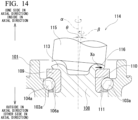
- a staking device 114 including a pressing die (staking die) 115 shown in Fig. 14 is known (for example, see Japanese Unexamined Patent Application No. 2001-162338 (Patent Literature 1)).
- the pressing die 115 is supported to be rotatable about a rotation axis ⁇ inclined by an angle ⁇ with respect to a reference axis ⁇ .
- the lower end portion of the pressing die 115 is provided with a processing surface portion 116.
- the processing surface portion 116 is formed by an inner surface of an annular concave portion centered on the rotation axis ⁇ .
- the pressing die 115 When forming the staking portion 113, the pressing die 115 is rotationally driven about the reference axis ⁇ without rotating the hub main body 108 about the reference axis ⁇ while pressing a part of the processing surface portion 116 in the circumferential direction in the pressing die 115 against a part of the cylindrical portion 112 of the hub main body 108 in the circumferential direction in a state in which the center axis of the hub main body 108 is aligned to the reference axis ⁇ . Then, the pressing die 115 is rotated about the rotation axis ⁇ based on a frictional force acting on the contact portion between the processing surface portion 116 and the cylindrical portion 112 in accordance with this operation.
- an application position of a processing force directed downward in the up and down direction (axially outward) and radially outward is continuously changed in the circumferential direction of the cylindrical portion 112 while applying the processing force from a part of the processing surface portion 116 of the pressing die 115 in the circumferential direction to a part of the cylindrical portion 112 in the circumferential direction.
- the staking portion 113 is formed by plastically deforming the cylindrical portion 112 to be expanded radially outward while axially crushing the cylindrical portion.
- Patent literature 2 discloses a method of manufacturing a hub bearing unit, wherein the step of forming the stacking portion comprises a first step of applying load at a first angle, an intermediate step of changing the angle and a second step of applying load at a second angle.
- Patent Literature 1 Japanese Patent Application, Publication No. 2001-162338 Japanese Patent Application, Publication No. 2005-195084A
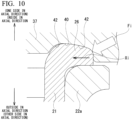
- the processing force directed downward in the up and down direction and radially outward is applied from the processing surface portion 116 of the pressing die 115 to the cylindrical portion 112 from the start to the end of processing for forming the staking portion 113. Therefore, at the final stage of processing for forming the staking portion 113, the thick portion of the axially inner end portion of the hub main body 108 flows radially outward along the axially inner surface of the internal inner race 109 as indicated by an arrow Xo in Fig. 12 . Then, when such a thick portion flows, a force is applied to the axially inner surface of the internal inner race 109 in the diameter expansion direction and the internal inner race 109 expands in the diameter expansion direction.
- the hub unit bearing 100 it is desired to prevent or suppress (control the outer shape) the expansion of the internal inner race 109 in the diameter expansion direction in accordance with the above-described processing of the staking portion 113.
- the outer shape control of the inner race 109 is advantageous for preventing the breakage of the internal inner race 109, suppressing a variation in preload, or decreasing the rotational friction of the hub 102 with respect to the outer race 101 due to the formation of the staking portion 113. Additionally, the same also applies to the other staking assembly in which the first member and the second member are combined in the axial direction.
- An object of the present invention is to provide a method of manufacturing a hub bearing unit according to claim 1 and a method of manufacturing a vehicle according to claim 4, which are advantageous for improving quality.
- a method of manufacturing a hub bearing unit is defined in claim 1.
- a hub unit bearing to be manufactured includes an outer race having double-row outer race tracks provided on an inner peripheral surface, a hub having double-row inner race tracks provided on an outer peripheral surface, and a plurality of rolling elements arranged for each row between the double-row inner race tracks and the double-row outer race tracks.
- the hub includes a first hub element and a second hub element in which an inner race track on one side in the axial direction in the double-row inner race tracks is provided on an outer peripheral surface.
- the second hub element is externally fitted to the first hub element and suppresses a side surface on one side in the axial direction by a staking portion provided at one axial end portion of the first hub element.
- the hub unit bearing to be manufactured in the present invention it is possible to obtain a configuration in which the inner race track on the outside in the axial direction in the double-row inner race tracks is provided on the outer peripheral surface of the first hub element or a configuration in which the inner race track on the outside in the axial direction in the double-row inner race tracks is provided on the outer peripheral surface of the other hub element externally fitted to the first hub element.
- the staking portion forming step includes the first and second steps below.
- the first step is a step of forming a staking portion intermediary body by plastically deforming a cylindrical portion provided at one axial end portion of the first hub element before forming the staking portion to be expanded radially outward while axially crushing the cylindrical portion in such a manner that an application position of a processing force directed toward the other side in the axial direction and directed radially outward is continuously changed in the circumferential direction of the cylindrical portion while applying the processing force to a part of the cylindrical portion in the circumferential direction.
- the second step is a step of forming the staking portion by plastically deforming the staking portion intermediary body to be pressed radially inward while axially crushing the staking portion intermediary body in such a manner that an application position of a processing force directed toward the other side in the axial direction and directed inward in the radial direction is continuously changed in the circumferential direction of the staking portion intermediary body while applying the processing force to a part of the staking portion intermediary body in the circumferential direction.
- the first hub element and a pressing die are relatively rotated about a center axis of the first hub element while pressing a part of a processing surface portion in the circumferential direction in the pressing die including a rotation axis inclined with respect to the center axis of the first hub element and the processing surface portion formed by an inner surface of an annular concave portion centered on the rotation axis against a part of a processing object which is the cylindrical portion or the staking portion intermediary body in the circumferential direction in order to continuously change the application position of the processing force in the circumferential direction of the processing object while applying the processing force to the processing object.
- the pressing die is rotated about the rotation axis based on a frictional force acting on the contact portion between the processing surface portion and the processing object by rotationally driving the first hub element about the center axis of the first hub element without rotating the pressing die about the center axis of the first hub element while pressing a part of the processing surface portion in the circumferential direction in the pressing die against a part of the processing object in the circumferential direction.
- the first hub element is rotated about the center axis of the first hub element based on a frictional force acting on the contact portion between the processing surface portion and the processing object by rotationally driving the pressing die about the rotation axis without rotating the pressing die about the center axis of the first hub element while pressing a part of the processing surface portion in the circumferential direction in the pressing die against a part of the processing object in the circumferential direction.
- the pressing die is rotated about the rotation axis based on a frictional force acting on the contact portion between the processing surface portion and the processing object by rotationally driving the pressing die about the center axis of the first hub element without rotating the first hub element about the center axis of the first hub element while pressing a part of the processing surface portion in the circumferential direction in the pressing die against a part of the processing object in the circumferential direction.
- a position of the pressing die in the axial direction of the rotation axis in the second step may be disposed to be shifted toward the first hub element in relation to the position of the pressing die in the axial direction of the rotation axis in the first step.
- an inclination angle of the rotation axis with respect to the center axis of the first hub element in the second step may be set to be larger than an inclination angle of the rotation axis for the center axis of the first hub element in the first step.
- a time point of ending the first step may be determined by using a value of a torque for relatively rotating the first hub element and the pressing die about the center axis of the first hub element.
- the first step and the second step may be performed by using one staking device.
- a staking device includes: a reference axis; a pressing die which includes a rotation axis inclined with respect to the reference axis and a processing surface portion formed by an inner surface of an annular concave portion centered on the rotation axis; and a mechanism which displaces the pressing die in the axial direction of the rotation axis.
- the staking device includes: a reference axis; a pressing die which includes a rotation axis inclined with respect to the reference axis and a processing surface portion formed by an inner surface of an annular concave portion centered on the rotation axis; and a mechanism which changes an inclination angle of the rotation axis with respect to the reference axis.
- the staking device may further include a mechanism which rotationally drives the first hub element about the reference axis while a center axis of the first hub element is aligned to the reference axis.
- the staking device may further include a mechanism which rotationally drives the pressing die about the rotation axis.
- a staking assembly includes: a first member; and a second member having a hole into which the first member is inserted and axially combined with the first member, wherein the first member includes a staking portion for the second member formed by deforming a shaft end of the first member radially outward, and wherein the staking portion includes a radially outer portion having a deformed portion at which a load was applied.
- a vehicle in an aspect of the present invention, includes the hub unit bearing.
- a method of manufacturing a vehicle manufactures the hub unit bearing by the method of manufacturing the hub unit bearing.
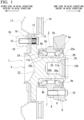
- Fig. 1 shows a hub unit bearing 1 to be manufactured.
- the hub unit bearing (staking assembly, staking unit) 1 is for a driven wheel and includes an outer race 2, a hub 3, and a plurality of rolling elements 4a and 4b.
- the outside in the axial direction is the left side of Fig. 1 which is the outside in the width direction of the vehicle while the hub unit bearing is assembled to the vehicle.
- the inside in the axial direction is the right side of Fig. 1 which is the center side in the width direction of the vehicle while the hub unit bearing is assembled to the vehicle.
- the inside in the axial direction corresponds to one side in the axial direction and the outside in the axial direction corresponds to the other side in the axial direction.
- the outer race 2 includes double-row outer race tracks 5a and 5b and a stationary flange 6.
- the outer races 5a and 5b are made of a hard metal such as medium carbon steel.
- the outer races 5a and 5b can be made of different materials.
- the double-row outer race tracks 5a and 5b are provided on the inner peripheral surface of the axially intermediate portion of the outer race 2 over the entire circumference.
- the stationary flange 6 protrudes radially outward from the axially intermediate portion of the outer race 2 and includes support holes 7 which are screw holes at a plurality of positions in the circumferential direction.
- the outer race 2 is supported and fixed to a knuckle 8 in such a manner that a bolt 10 inserted through a passage hole 9 of the knuckle 8 constituting the suspension device of the vehicle is screwed and tightened into a support hole 7 of the stationary flange 6 from the inside in the axial direction.
- the hub (staking assembly, staking unit) 3 is disposed on the radially inner side of the outer race 2 coaxially with the outer race 2.
- the hub 3 includes double-row inner race tracks 11a and 11b and a rotary flange 12.
- the double-row inner race tracks 11a and 11b are provided at portions facing the double-row outer race tracks 5a and 5b in the outer peripheral surface (outer surface) of the hub 3 over the entire circumference.
- the rotary flange 12 protrudes radially outward from a portion located on the axially outer side in relation to the outer race 2 in the hub 3 and includes attachment holes 13 provided at a plurality of positions in the circumferential direction.
- a serration portion provided near a base end of a stud 15 is press-inserted into the attachment hole 13 in order to connect and fix a braking rotating body 14 such as a disc or a drum to the rotary flange 12. Further, the intermediate portion of the stud 15 is press-inserted into the passage hole 16 of the braking rotating body 14. Further, in order to fix a wheel 17 constituting a vehicle wheel to the rotary flange 12, a nut 19 is screwed and tightened to a male screw portion provided at the front end portion of the stud 15 while the male screw portion is inserted through a passage hole 18 of the wheel 17.
- a plurality of the rolling elements 4a and 4b are arranged for each row between the double-row outer race tracks 5a and 5b and the double-row inner race tracks 11a and 11b.
- each of the rolling elements 4a and 4b is made of a hard metal such as bearing steel or ceramics.
- the rolling elements 4a and 4b can be made of different materials.
- the rolling elements 4a and 4b are rotatably held by cages 20a and 20b for each row.
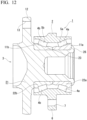
- balls are used as the rolling elements 4a and 4b, but tapered rollers (tapered hubs) are also used as shown in the example of Fig. 12 in some cases.
- the hub (staking assembly, staking unit) 3 is composed of a hub main body (first member, hub race) 21, an internal inner race (second member) 22a, and an external inner race 22b.
- the hub main body 21 is made of a hard metal such as medium carbon steel.
- Each of the internal inner race 22a and the external inner race 22b is made of a hard metal such as bearing steel.
- the hub main body 21, the internal inner race 22a, and the external inner race 22b can be made of different materials.
- the hub (staking assembly) 3 substantially has a combination of the hub main body (first member) 21 and the inner races (second member) 22a and 22b in the axial direction.
- the hub 3 includes the hub main body 21 which includes an outer peripheral surface (outer surface) 23 and the inner races 22a and 22b which are arranged on the outer peripheral surface (outer surface) 23 of the hub main body 21 and are held by the hub main body 21. Additionally, the hub main body 21 corresponds to the first hub element (first member) and the internal inner race 22a corresponds to the second hub element (second member).
- the inner race track 11a on the inside in the axial direction is provided on the outer peripheral surface of the internal inner race 22a.
- the inner race track 11b on the outside in the axial direction is provided on the outer peripheral surface of the external inner race 22b.
- the rotary flange 12 is provided in the axially outer portion of the hub main body 21.
- the hub main body 21 includes a cylindrical fitting surface portion 23 which is provided on the outer peripheral surface of the axially intermediate portion. Further, the hub main body 21 includes a step surface 24 which is provided at the axially outer end portion of the fitting surface portion 23 to face the inside in the axial direction. The internal inner race 22a and the external inner race 22b are externally fitted to the fitting surface portion 23 of the hub main body 21 by tightening (press-fitting). Further, the hub main body 21 includes a staking portion 26 which is provided at the axially inner end portion.
- the staking portion 26 is bent radially outward from the axially inner end portion of the portion to which the internal inner race 22a is externally fitted in the hub main body 21 and suppresses the axially inner surface of the internal inner race 22a. That is, the internal inner race 22a and the external inner race 22b are connected and fixed to the hub main body 21 while being sandwiched between the staking portion 26 and the step surface 24 of the hub main body 21 in the axial direction. In this state, a preload is applied to the rolling elements 4a and 4b together with the contact angle of the back surface combination type.
- the hub main body 21 includes the staking portion 26 for the inner races 22a and 22b (the staking portion 26 for holding the inner races 22a and 22b).
- the hub main body 21 is inserted into holes 120 of the inner races 22a and 22b.
- the staking portion 26 which has a bend extending in the circumferential direction and covers the shaft end portion of the inner race 22a is provided in the peripheral wall of the hub main body 21.
- the staking portion 26 is formed by plastically deforming a cylindrical portion 25 extending axially inward from the axially inner end portion of the portion to which the internal inner race 22a is externally fitted in the hub main body 21 before forming the staking portion 26.
- the hub main body 1 includes the staking portion 26 for the inner race 22a formed by deforming the shaft end of the hub main body 1 radially outward and the staking portion includes a radially outer portion having a deformed portion (processing mark) 130 ( Fig. 7 ) at which a load was applied.
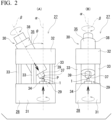
- a staking device 27 which forms the staking portion 26 and connects and fixes the hub main body 21 to the internal inner race 22a and the external inner race 22b will be described with reference to Figs. 2 to 4 .
- the staking device 27 includes a frame 28, a work side device (first device) 29, and a tool side device (second device) 30.
- the frame 28 includes a lower frame 31, an upper frame 32 which is disposed above the lower frame 31, and a plurality of columns 33 which support the upper frame 32 with respect to the lower frame 31.
- a work side device 29 is supported by the lower frame 31.
- the work side device 29 includes a holder 34, an outer race support mechanism (not shown), a pressing mechanism (not shown), and a rotational drive mechanism (not shown).
- the holder 34 can support the hub main body 21 constituting the hub unit bearing 1 assembled as below before forming the staking portion 26. Specifically, the holder 34 can support the axially outer portion (lower portion) of the hub 3 (hub main body 21) while the axially inner portion of the hub unit bearing 1 before forming the staking portion 26 is directed upward and the center axis of the hub 3 (the center axis of the hub main body 21) is aligned to the reference axis ⁇ in the up and down direction which is the own center axis.
- the outer race support mechanism is a mechanism which non-rotatably supports the outer race 2 while the axially outer portion of the hub main body 21 constituting the hub unit bearing 1 is supported by the holder 34.
- the pressing mechanism is, for example, a mechanism which uses a hydraulic pump as a drive source and moves the holder 34 and the outer race support mechanism in the axial direction (the up and down direction) of the reference axis ⁇ .
- the pressing mechanism can move the hub unit bearing 1 supported by the holder 34 and the outer race support mechanism in the axial direction (the up and down direction) of the reference axis ⁇ .
- the rotational drive mechanism is, for example, a mechanism which uses an electric motor as a drive source and rotationally drives the holder 34 about the reference axis ⁇ .
- the rotational drive mechanism can rotationally drive the hub 3 supported by the holder 34 about the reference axis ⁇ .
- a tool side device 30 is supported by the upper frame 32.
- the tool side device 30 includes a cylinder attached spindle 35 and a pressing die (molding die, staking die) 37.
- the cylinder attached spindle 35 includes a hydraulic or pneumatic cylinder device 38 and a spindle 39.
- the cylinder device 38 rotatably supports the spindle 39 therein about the center axis ⁇ of the spindle 39.
- the cylinder device 38 can displace the spindle 39 in the axial direction of the center axis ⁇ .
- Such a cylinder attached spindle 35 is supported by the upper frame 32 while the center axis ⁇ of the spindle 39 is inclined with respect to the reference axis ⁇ by an angle ⁇ .
- a point P in part (A) of Fig. 2 , part (A) and part (B) of Fig. 3 , part (A) and part (B) of Fig. 5 , and 6 to be described later is an intersection between the reference axis ⁇ and the rotation axis ⁇ .
- the pressing die 37 is fixed to the lower end portion which is the front end portion of the spindle 39 directly or through other members coaxially with the spindle 39.
- the pressing die 37 is supported by the cylinder device 38 to be rotatable about the own center axis (the center axis ⁇ of the spindle 39) through the spindle 39.
- the cylinder device 38 can displace the pressing die 37 in the axial direction of the center axis ⁇ through the spindle 39.
- the center axis of the pressing die 37 is appropriately referred to as the rotation axis ⁇ (that is, the same symbol ⁇ as the center axis of the spindle 39 is used as the symbol of the rotation axis).
- the lower end surface which is the front end surface of the pressing die 37 is provided with a processing surface portion 40 which is formed by an inner surface of an annular concave portion centered on the rotation axis ⁇ .
- a method of manufacturing the hub unit bearing 1 includes a step of combining the hub main body (first hub element) 21 and the inner races (second hub elements) 22a and 22b in the axial direction and a staking portion forming step of forming the staking portion 26 for the inner race 22a in the hub main body 21.
- the staking portion forming step includes applying a load including a first load component directed inward in the radial direction to the radially outer portion of the hub main body 21 as will be described later.
- the work of forming the staking portion 26 is performed in an assembly state (first assembly state) of the hub unit bearing 1 before forming the staking portion 26. Therefore, the hub unit bearing 1 before forming the staking portion 26 is assembled in advance.
- the hub unit bearing 1 before forming the staking portion 26 can be assembled by an appropriate procedure, but can be assembled, for example, by the following procedure.
- the rolling element 4a of the inner row in the axial direction is disposed on the inner radial side of the outer race track 5a on the inside in the axial direction of the outer race 2 while being held by the cage 20a on the inside in the axial direction.
- the rolling element 4b of the outer row in the axial direction is disposed on the inner radial side of the outer race track 5b on the outside in the axial direction of the outer race 2 while being held by the cage 20b on the outside in the axial direction.
- the internal inner race 22a is inserted into the inner radial side of the outer race 2 from the inside in the axial direction.
- the external inner race 22b is inserted from the outside in the axial direction.
- the internal inner race 22a and the external inner race 22b are externally fitted to the fitting surface portion 23 of the hub main body 21 before forming the staking portion 26 while mutually facing axial side surfaces are in contact with each other.
- the axially outer surface of the external inner race 22b is brought into contact with the step surface 24 of the hub main body 21. Accordingly, the hub unit bearing 1 before forming the staking portion 26 is assembled. Additionally, the assembly procedure can be appropriately changed.
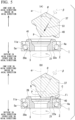
- the hub unit bearing 1 before forming the staking portion 26 is set in the staking device 27. Specifically, as shown in Fig. 3(A) , the axially inner portion of the hub unit bearing 1 before forming the staking portion 26 is directed upward and the center axis of the hub 3 (the center axis of the holder 34 constituting the staking device 27) is aligned to the reference axis ⁇ . In a state in which the axes are aligned to each other, the axially outer portion (lower portion) of the hub main body 21 is supported by the holder 34 (see part (A) and (B) of Fig. 2 ).
- the outer race 2 is non-rotatably supported by the outer race support mechanism. Additionally, the hub unit bearing 1 is located below the position shown in Fig. 3(A) in the state before starting to process the staking portion 26 and the pressing die 37 does not come into contact with the cylindrical portion 25 of the hub main body 21.
- the work of forming the staking portion 26 is subsequently started.
- the work of forming the staking portion 26 is divided into a first step and a second step.
- the hub 3 is rotated about the reference axis ⁇ with respect to the outer race 2 based on the rotational driving of the holder 34 using the rotational drive mechanism of the work side device 29. Then, in this state, the hub unit bearing 1 is moved upward based on the upward moving of the holder 34 and the outer race support mechanism using the pressing mechanism of the work side device 29. Accordingly, as shown in Fig. 3(A) , the hub 3 is rotated about the reference axis ⁇ with respect to the outer race 2 without rotating the pressing die 37 about the reference axis ⁇ while pressing a part in the circumferential direction of the cylindrical portion 25 by a part in the circumferential direction of the processing surface portion 40 in the pressing die 37.
- the pressing die 37 is rotated about the rotation axis ⁇ based on the frictional force acting on the contact portion between the processing surface portion 40 and the cylindrical portion 25 in accordance with this operation. Accordingly, in a state in which a processing force Fo which is directed downward in the up and down direction and is directed radially outward is applied to a part in the circumferential direction of the cylindrical portion 25 from a part in the circumferential direction of the processing surface portion 40 of the pressing die 37, the application position of the processing force Fo is continuously changed in the circumferential direction of the cylindrical portion 25. A load including a load component directed radially outward is applied to the cylindrical portion 25 using the pressing die 37 and the load application position moves in the circumferential direction.
- a staking portion intermediary body 41 is formed by plastically deforming the cylindrical portion 25 to be expanded radially outward while axially crushing the cylindrical portion.
- the staking portion intermediary body 41 is formed in a shape in which the axially outer surface of the staking portion intermediary body 41 slightly contacts the axially inner surface of the internal inner race 22a to a degree that the inner race track 11a on the inside in the axial direction is not deformed or the axially outer surface does not contact the axially inner surface of the internal inner race 22a.
- the staking portion intermediary body 41 is formed in a shape in which the preload of the hub unit bearing 1 does not change with the formation of the staking portion intermediary body 41.
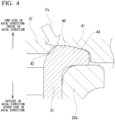
- the processing surface portion 40 is in a state in which both the radially inner portion 42 and the radially outer portion 43 contact the staking portion intermediary body 41 at a portion in which the axially inner surfaces of the processing surface portion 40 and the staking portion intermediary body 41 contact each other.
- the radially inner portion 42 of the processing surface portion 40 is a portion which is inclined in a direction moving away from the hub main body 21 (upward in Fig. 3(B) and Fig. 4 ) with respect to the axial direction of the reference axis ⁇ as it moves outward (rightward in Fig. 3(B) and Fig. 4 ) in the radial direction centered on the reference axis ⁇ .
- the radially outer portion 43 of the processing surface portion 40 is a portion which is inclined in a direction moving close to the hub main body 21 (downward in Fig. 3(B) and Fig. 4 ) with respect to the axial direction of the reference axis ⁇ as it moves outward in the radial direction centered on the reference axis ⁇ .
- the upward movement of the hub unit bearing 1 is temporarily stopped based on the fact that the upward movement of the holder 34 and the outer race support mechanism by the pressing mechanism of the work side device 29 is temporarily stopped at the time point of forming the staking portion intermediary body 41.
- a time point (timing) of stopping the upward movement of the hub unit bearing 1 is determined based on a drive torque Ts which is a torque for rotationally driving the holder 34 by the rotational drive mechanism (a torque for relatively rotating the pressing die 37 and the hub 3 about the reference axis ⁇ ).
- Ts a drive torque for rotationally driving the holder 34 by the rotational drive mechanism
- the drive torque Ts can be measured, for example, based on a current value of an electric motor which is a drive source of the rotational drive mechanism.
- Fig. 8 is a diagram showing a time change of the drive torque Ts when processing the cylindrical portion 25 into the staking portion 26 without temporarily stopping the upward movement of the hub unit bearing 1.
- the drive torque Ts gradually increases in the time zone t1 after the start of processing, settles at a substantially constant value in the subsequent time zone t2, gradually decreases in the subsequent time zone t3, and settles at a substantially constant value again in the subsequent time zone t4.
- the axially inner end portion (the cylindrical portion 25, the staking portion intermediary body 41, the staking portion 26) of the hub main body 21 which is processed by the processing surface portion 40 of the pressing die 37 does not contact the axially inner surface of the internal inner race 22a in the time zones t1 and t2.
- the axially inner end portion contacts the axially inner surface of the internal inner race 22a to a degree that the internal inner race 22a is not deformed in the diameter expansion direction (a degree that the inner race track 11a is not deformed axially inward).
- the internal inner race 22a is deformed in the diameter expansion direction.
- the shape of the axially inner end portion of the hub main body 21 at this time is substantially the same (a shape curved like the staking portion 26 after completion) in each of the time zones t2, t3, and t4 when observing only the outer shape.
- the upward movement of the hub unit bearing 1 is temporarily stopped at the time point before entering the time zone t4 which is the time point before the deformation of the internal inner race 22a in the diameter expansion direction while confirming the drive torque Ts.
- the time point before entering the time zone t4 it is possible to adopt, for example, a time point immediately after shifting to the time zone t2, that is, a time point Q1 at which the drive torque Ts first begins to settle to a substantially constant value after the start of processing, or a time point immediately after shifting to the time zone t3, that is, a time point Q2 at which the drive torque Ts first begins to settle to a substantially constant value and then the drive torque Ts begins to decrease after the start of processing.
- the upward movement of the hub unit bearing 1 is temporarily stopped at a time point at which the above-described staking portion intermediary body 41 is formed.
- the hub unit bearing 1 is slightly moved downward based on the downward movement of the holder 34 and the outer race support mechanism using the pressing mechanism of the work side device 29. Accordingly, as shown in part (B) of Fig. 3 to part (A) of Fig. 5 , the processing surface portion 40 of the pressing die 37 and the staking portion intermediary body 41 are separated in the up and down direction and the first step is ended.
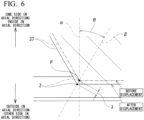
- the pressing die 37 is displaced by a predetermined amount ⁇ (for example, ⁇ is about 0.1 mm to 5 mm) toward the hub 3 (the direction of the arrow S1) in the axial direction of the rotation axis ⁇ based on the axial displacement of the spindle 39 of the cylinder device 38. That is, as shown in Fig. 6 which is an enlarged view of a B part of Fig. 5(B) , the front end position Z of the pressing die 37 is slightly displaced to the left in the drawing from the reference axis ⁇ .
- ⁇ for example, ⁇ is about 0.1 mm to 5 mm
- the hub unit bearing 1 is moved upward again based on the upward movement of the holder 34 and the outer race support mechanism using the pressing mechanism of the work side device 29 in this state. Accordingly, the hub 3 is rotated about the reference axis ⁇ with respect to the outer race 2 without rotating the pressing die 37 about the reference axis ⁇ while pressing a part of the processing surface portion 40 in the circumferential direction in the pressing die 37 against a part of the staking portion intermediary body 41 in the circumferential direction. A load including a load component directed radially inward is applied to the radially outer portion of the staking portion intermediary body 41 using the pressing die 37 and the application position of the load moves in the circumferential direction.
- the pressing die 37 is rotated about the rotation axis ⁇ based on a frictional force acting on the contact portion between the processing surface portion 40 and the staking portion intermediary body 41 in accordance with this operation.
- the staking portion 26 is formed by plastically deforming the staking portion intermediary body 41 to be pressed radially inward while axially crushing the staking portion intermediary body as shown in part (A) and part (B) of Fig. 5 , and Fig. 7 .
- the staking portion 26 when the staking portion 26 is formed as shown in part (A) and part (B) of Fig. 5 , and Fig. 7 by displacing the pressing die 37 by a predetermined amount in the direction of the arrow S1 as described above, in the processing surface portion 40, the radially inner portion 42 does not contact the staking portion intermediary body 41 (the staking portion 26) and only the radially outer portion 43 contacts the staking portion intermediary body 41 (the staking portion 26) at the contact portion between the processing surface portion 40 and the axially inner surface of the staking portion intermediary body 41 (the staking portion 26).
- a processing force Fi directed downward in the up and down direction and directed radially inward is applied from a part of the processing surface portion 40 in the circumferential direction to a part of the staking portion intermediary body 41 (the staking portion 26) in the circumferential direction.
- the amount in which the pressing die 37 is displaced in the direction of the arrow S1 as described above is regulated so that only the radially outer portion 43 in the processing surface portion 40 contacts the staking portion intermediary body 41 (the staking portion 26) at the contact portion between the processing surface portion 40 and the axially inner surface of the staking portion intermediary body 41 (the staking portion 26) when forming the staking portion 26 as shown in part (A) and part (B) of Fig. 5 .
- the processing force (the load including a component directed radially inward) Fi directed downward in the up and down direction and directed radially inward is applied from the radially outer portion 43 of the processing surface portion 40 to the staking portion 26. Therefore, in the second step, the thick portion of the staking portion 26 flows radially inward along the axially inner surface of the internal inner race 22a as indicated by an arrow Xi in Fig. 7 .
- the step of forming the staking portion 26 includes the first step of deforming a part of the hub main body 21 radially outward by applying a load including a load component directed radially outward to the hub main body 21 using the pressing die 37 and the second step of applying a load including a load component directed radially inward to a radially outer portion of a deformed portion (staking portion intermediary body (intermediate staking portion) 41) of the hub main body 21 using the pressing die 37.
- the pressing die 37 (and the spindle 39) can be rotationally driven about the rotation axis ⁇ using the rotational drive mechanism and the hub 3 (and the holder 34) is supported to be rotatable about the reference axis ⁇ .
- the pressing die 37 is rotationally driven about the rotation axis ⁇ without rotating the pressing die 37 about the reference axis ⁇ while pressing a part of the processing surface portion 40 in the circumferential direction in the pressing die 37 against a part of the processing object (the cylindrical portion 25, the staking portion intermediary body 41) in the circumferential direction when forming the staking portion 26.
- the hub 3 is rotated about the reference axis ⁇ based on a frictional force acting on the contact portion between the processing surface portion 40 and the processing object (the cylindrical portion 25, the staking portion intermediary body 41) in accordance with this operation. That is, in the above-described example, the processing object was processed by rotationally driving the hub 3 about the reference axis ⁇ while rotating the pressing die 37 about the rotation axis ⁇ in a following manner. In this example, it is possible to process the processing object by rotationally driving the pressing die 37 about the rotation axis ⁇ while rotating the hub 3 about the reference axis ⁇ in a following manner.
- a device different from the staking device 27 shown in Fig. 2 is used as the staking device for performing the work of forming the staking portion 26.
- the staking device is obtained by adding a mechanism that changes the inclination angle ⁇ of the rotation axis ⁇ with respect to the reference axis ⁇ to the staking device 27 shown in Fig. 2 .
- the mechanism that changes the inclination angle ⁇ of the rotation axis ⁇ with respect to the reference axis ⁇ can be realized by, for example, an arc-shaped linear guide including an arc-shaped guide rail and a guide block moving along the guide rail.
- the guide rail is fixed to the upper frame 32 and the guide block is fixed to the cylinder attached spindle 35 while the center of curvature of the arc-shaped guide rail is aligned to an intersection P between the reference axis ⁇ and the rotation axis ⁇ .
- the cylinder attached spindle 35 and the pressing die 37 are swung about the intersection P by moving the guide block along the guide rail in this state, the inclination angle ⁇ can be changed.
- the mechanism that changes the inclination angle ⁇ further includes an angle adjusting motor which is a drive source for swinging the cylinder attached spindle 35 and the pressing die 37 (rotation axis ⁇ ) about the intersection P (adjusting the inclination angle ⁇ ).
- an appropriate mechanism different from the above one can be adopted as the mechanism that changes the inclination angle ⁇ .
- the first step of the work of forming the staking portion 26 is performed similarly to the case of the first example of the embodiment.
- a method of applying the processing force Fi directed downward in the up and down direction and directed radially inward from a part of the processing surface portion 40 in the circumferential direction to a part of the staking portion intermediary body 41 (the staking portion 26) in the circumferential direction in the second step of the work of forming the staking portion 26 is different from the case of the embodiment.
- the inclination angle ⁇ of the rotation axis ⁇ with respect to the reference axis ⁇ is first increased by a predetermined amount (for example, about 1° to 15°) by swinging the pressing die 37 about the intersection P between the reference axis ⁇ and the rotation axis ⁇ in the direction of the arrow S2 as shown in part (A) of Fig. 9 based on the driving of the angle adjusting motor. Accordingly, as shown in part (A) and part (B) of Fig. 9 , and Fig.
- the present invention can be carried out by appropriately combining the configurations of the above-described embodiments as long as there is no contradiction.
- a staking device different from those of the above-described embodiments, that is, a staking device (swaging device) including a rotating head which can be rotationally driven about the reference axis ⁇ (see Figs. 3 , 5 , and 9 ) and supports the pressing die 37 to be rotatable about the rotation axis ⁇ , when forming the staking portion 26.
- the pressing die 37 rotates (revolves) about the reference axis ⁇ as the rotating head rotates about the reference axis ⁇ .
- the pressing die 37 can rotate (revolve) about the rotation axis ⁇ .
- the pressing die 37 is rotationally driven about the reference axis ⁇ together with the rotating head without rotating the hub 3 about the reference axis ⁇ while pressing a part of the processing surface portion 40 in the circumferential direction in the pressing die 37 against a part of the processing object (the cylindrical portion 25, the staking portion intermediary body 41) in the circumferential direction.
- the pressing die 37 rotates about the rotation axis ⁇ based on a frictional force acting on the contact portion between the processing surface portion 40 and the processing object (the cylindrical portion 25, the staking portion intermediary body 41).
- the application position of the processing force is continuously changed in the circumferential direction of the processing object (the cylindrical portion 25, the staking portion intermediary body 41) while applying the processing force to the processing object (the cylindrical portion 25, the staking portion intermediary body 41).
- a mechanism that displaces the pressing die 37 in the axial direction of the rotation axis ⁇ or a mechanism that changes the inclination angle ⁇ of the rotation axis ⁇ with respect to the reference axis ⁇ can be added to the above-described swaging device.
- the first step and the second step of the work of forming the staking portion 26 can be performed by using one swaging device as in the case of the above-described embodiments.
- the staking portion 26 is formed in the hub main body 21 by swaging.
- the staking portion forming step includes a first step of deforming a part of the hub main body 21 radially outward by applying a load including a load component (second load component) directed radially outward to the hub main body 21 using the pressing die 37 by swaging and a second step of applying a load including a load component (first load component) directed radially inward to a radially outer portion of a deformed portion (staking portion intermediary body (intermediate staking portion) 41) of the hub main body 21 using the pressing die 37 by swaging.
- at least one of swinging movements, positions (swing start position, swing end position), and postures (swing start posture, swing end posture) of the pressing die 37 differs from each other between the first step and the second step.
- Fig. 11 is a partially schematic view of a vehicle 200 including a hub unit bearing (bearing unit) 151.
- the present invention can be applied to both a hub unit bearing for a drive wheel and a hub unit bearing for a driven wheel.
- the hub unit bearing 151 is for a driven wheel and includes an outer race 152, a hub 153, and a plurality of rolling elements 156.
- the outer race 152 is fixed to a knuckle 201 of a suspension device by using a bolt and the like.
- a vehicle wheel (and braking rotating body 22) 202 is fixed to a flange (rotary flange) 153A provided in the hub 153 by using a bolt and the like.
- the vehicle 200 can have the above-described support structure for the hub unit bearing 151 used for a driven wheel.
Landscapes
- Engineering & Computer Science (AREA)
- Mechanical Engineering (AREA)
- General Engineering & Computer Science (AREA)
- Rolling Contact Bearings (AREA)
- Mounting Of Bearings Or Others (AREA)
- Forging (AREA)
Description
- The present invention relates to a method of manufacturing a hub bearing unit
- A hub unit bearing is known as an example of a staking assembly in which a first member and a second member are combined in the axial direction. Vehicle wheels and braking rotating bodies are rotatably supported to suspension devices by the hub unit bearings.
Fig. 13 shows an example of a conventional hub unit bearing. A hub unit bearing 100 rotatably supports ahub 102 on the inner radial side of anouter race 101 through a plurality ofrolling elements - Regarding the hub unit bearing 100, the outside in the axial direction is the left side of
Fig. 13 which is the outside in the width direction of the vehicle body while the hub unit bearing 100 is assembled to the automobile. The inside in the axial direction is the right side ofFig. 11 which is the center side in the width direction of the vehicle body while the hub unit bearing 1 is assembled to the automobile. In the example ofFig. 13 , regarding the hub unit bearing 100, the inside in the axial direction corresponds to one side in the axial direction and the outside in the axial direction corresponds to the other side in the axial direction. - The
outer race 101 includes double-rowouter race tracks stationary flange 105 which is provided in an axially intermediate portion to support and fix theouter race 101 to a knuckle of a suspension device. Thehub 102 includes double-rowinner race tracks rotary flange 107 provided in an axially outer portion to support and fix the vehicle wheel and the braking rotating body by thehub 102. The plurality ofrolling elements outer race tracks inner race tracks hub 102 is rotatably supported on the inner radial side of theouter race 101. - In the example of
Fig. 13 , thehub 102 has a combination of a hub main body (hub race) 108 corresponding to a first hub element (first member) and an internalinner race 109 corresponding to a second hub element (second member). Theinner race track 106a on the inside in the axial direction in the double-rowinner race tracks inner race 109. Theinner race track 106b on the outside in the axial direction in the double-rowinner race tracks main body 108. Therotary flange 107 is provided in the axially outer portion of the hubmain body 108. The hubmain body 108 includes afitting surface portion 110 provided on the outer peripheral surface of the axially inner portion and includes astep surface 111 provided at the axially outer end portion of thefitting surface portion 110 to be directed axially inward. The internalinner race 109 is externally fitted to thefitting surface portion 110 while the axially outer end surface abuts against thestep surface 111. In this state, astaking portion 113 is formed by plastically deforming acylindrical portion 112, protruding axially inward from a portion to which the internalinner race 109 is externally fitted in the hubmain body 108, axially outward. The axially inner end surface of the internalinner race 109 is suppressed by the stakingportion 113. In this way, the axially inner end surface of the internalinner race 109 is suppressed by thestaking portion 113 so that a preload is applied to therolling elements - As a device for forming the
staking portion 113 used when manufacturing the hub unit bearing 100, astaking device 114 including a pressing die (staking die) 115 shown inFig. 14 is known (for example, seeJapanese Unexamined Patent Application No. 2001-162338 pressing die 115 is supported to be rotatable about a rotation axis β inclined by an angle θ with respect to a reference axis α. The lower end portion of thepressing die 115 is provided with aprocessing surface portion 116. Theprocessing surface portion 116 is formed by an inner surface of an annular concave portion centered on the rotation axis β. - When forming the
staking portion 113, thepressing die 115 is rotationally driven about the reference axis α without rotating the hubmain body 108 about the reference axis α while pressing a part of theprocessing surface portion 116 in the circumferential direction in thepressing die 115 against a part of thecylindrical portion 112 of the hubmain body 108 in the circumferential direction in a state in which the center axis of the hubmain body 108 is aligned to the reference axis α. Then, thepressing die 115 is rotated about the rotation axis β based on a frictional force acting on the contact portion between theprocessing surface portion 116 and thecylindrical portion 112 in accordance with this operation. Accordingly, an application position of a processing force directed downward in the up and down direction (axially outward) and radially outward is continuously changed in the circumferential direction of thecylindrical portion 112 while applying the processing force from a part of theprocessing surface portion 116 of thepressing die 115 in the circumferential direction to a part of thecylindrical portion 112 in the circumferential direction. Accordingly, thestaking portion 113 is formed by plastically deforming thecylindrical portion 112 to be expanded radially outward while axially crushing the cylindrical portion. -
Japanese Patent Application, Publication No. 2005-195084A Patent literature 2, forming the closest prior art) discloses a method of manufacturing a hub bearing unit, wherein the step of forming the stacking portion comprises a first step of applying load at a first angle, an intermediate step of changing the angle and a second step of applying load at a second angle. - [Patent Literature 1]
Japanese Patent Application, Publication No. 2001-162338
Japanese Patent Application, Publication No. 2005-195084A - In the conventional method of manufacturing the hub unit bearing 100, there is room for improvement in terms of improving the quality of the hub unit bearing 100. This point will be described below. That is, in the method of manufacturing the conventional hub unit bearing 100, the processing force directed downward in the up and down direction and radially outward is applied from the
processing surface portion 116 of thepressing die 115 to thecylindrical portion 112 from the start to the end of processing for forming thestaking portion 113. Therefore, at the final stage of processing for forming thestaking portion 113, the thick portion of the axially inner end portion of the hubmain body 108 flows radially outward along the axially inner surface of the internalinner race 109 as indicated by an arrow Xo inFig. 12 . Then, when such a thick portion flows, a force is applied to the axially inner surface of the internalinner race 109 in the diameter expansion direction and the internalinner race 109 expands in the diameter expansion direction. - In the manufacturing of the hub unit bearing 100, it is desired to prevent or suppress (control the outer shape) the expansion of the internal
inner race 109 in the diameter expansion direction in accordance with the above-described processing of thestaking portion 113. The outer shape control of theinner race 109 is advantageous for preventing the breakage of the internalinner race 109, suppressing a variation in preload, or decreasing the rotational friction of thehub 102 with respect to theouter race 101 due to the formation of thestaking portion 113. Additionally, the same also applies to the other staking assembly in which the first member and the second member are combined in the axial direction. - An object of the present invention is to provide a method of manufacturing a hub bearing unit according to
claim 1 and a method of manufacturing a vehicle according to claim 4, which are advantageous for improving quality. - In an aspect of the present invention, a method of manufacturing a hub bearing unit is defined in
claim 1. - Advantageously, a hub unit bearing to be manufactured includes an outer race having double-row outer race tracks provided on an inner peripheral surface, a hub having double-row inner race tracks provided on an outer peripheral surface, and a plurality of rolling elements arranged for each row between the double-row inner race tracks and the double-row outer race tracks.
- The hub includes a first hub element and a second hub element in which an inner race track on one side in the axial direction in the double-row inner race tracks is provided on an outer peripheral surface.
- The second hub element is externally fitted to the first hub element and suppresses a side surface on one side in the axial direction by a staking portion provided at one axial end portion of the first hub element.
- As a configuration of the hub unit bearing to be manufactured in the present invention, it is possible to obtain a configuration in which the inner race track on the outside in the axial direction in the double-row inner race tracks is provided on the outer peripheral surface of the first hub element or a configuration in which the inner race track on the outside in the axial direction in the double-row inner race tracks is provided on the outer peripheral surface of the other hub element externally fitted to the first hub element.
- In the manufacturing method, the staking portion forming step includes the first and second steps below.
- The first step is a step of forming a staking portion intermediary body by plastically deforming a cylindrical portion provided at one axial end portion of the first hub element before forming the staking portion to be expanded radially outward while axially crushing the cylindrical portion in such a manner that an application position of a processing force directed toward the other side in the axial direction and directed radially outward is continuously changed in the circumferential direction of the cylindrical portion while applying the processing force to a part of the cylindrical portion in the circumferential direction.
- The second step is a step of forming the staking portion by plastically deforming the staking portion intermediary body to be pressed radially inward while axially crushing the staking portion intermediary body in such a manner that an application position of a processing force directed toward the other side in the axial direction and directed inward in the radial direction is continuously changed in the circumferential direction of the staking portion intermediary body while applying the processing force to a part of the staking portion intermediary body in the circumferential direction.
- In the manufacturing method, the first hub element and a pressing die are relatively rotated about a center axis of the first hub element while pressing a part of a processing surface portion in the circumferential direction in the pressing die including a rotation axis inclined with respect to the center axis of the first hub element and the processing surface portion formed by an inner surface of an annular concave portion centered on the rotation axis against a part of a processing object which is the cylindrical portion or the staking portion intermediary body in the circumferential direction in order to continuously change the application position of the processing force in the circumferential direction of the processing object while applying the processing force to the processing object.
- For example, as a more specific aspect in this case, the following first to third aspects can be adopted.
- In the first aspect, the pressing die is rotated about the rotation axis based on a frictional force acting on the contact portion between the processing surface portion and the processing object by rotationally driving the first hub element about the center axis of the first hub element without rotating the pressing die about the center axis of the first hub element while pressing a part of the processing surface portion in the circumferential direction in the pressing die against a part of the processing object in the circumferential direction.
- In the second aspect, the first hub element is rotated about the center axis of the first hub element based on a frictional force acting on the contact portion between the processing surface portion and the processing object by rotationally driving the pressing die about the rotation axis without rotating the pressing die about the center axis of the first hub element while pressing a part of the processing surface portion in the circumferential direction in the pressing die against a part of the processing object in the circumferential direction.
- In the third aspect, the pressing die is rotated about the rotation axis based on a frictional force acting on the contact portion between the processing surface portion and the processing object by rotationally driving the pressing die about the center axis of the first hub element without rotating the first hub element about the center axis of the first hub element while pressing a part of the processing surface portion in the circumferential direction in the pressing die against a part of the processing object in the circumferential direction.
- In an aspect of the present invention, a position of the pressing die in the axial direction of the rotation axis in the second step may be disposed to be shifted toward the first hub element in relation to the position of the pressing die in the axial direction of the rotation axis in the first step.
- In an aspect of the present invention, an inclination angle of the rotation axis with respect to the center axis of the first hub element in the second step may be set to be larger than an inclination angle of the rotation axis for the center axis of the first hub element in the first step.
- In an aspect of the present invention, a time point of ending the first step may be determined by using a value of a torque for relatively rotating the first hub element and the pressing die about the center axis of the first hub element.
- In an aspect of the present invention, the first step and the second step may be performed by using one staking device.
- In an aspect of the present invention, a staking device includes: a reference axis; a pressing die which includes a rotation axis inclined with respect to the reference axis and a processing surface portion formed by an inner surface of an annular concave portion centered on the rotation axis; and a mechanism which displaces the pressing die in the axial direction of the rotation axis.
- In an aspect of the present invention, the staking device includes: a reference axis; a pressing die which includes a rotation axis inclined with respect to the reference axis and a processing surface portion formed by an inner surface of an annular concave portion centered on the rotation axis; and a mechanism which changes an inclination angle of the rotation axis with respect to the reference axis.
- In an aspect of the present invention, the staking device may further include a mechanism which rotationally drives the first hub element about the reference axis while a center axis of the first hub element is aligned to the reference axis.
- In an aspect of the present invention, the staking device may further include a mechanism which rotationally drives the pressing die about the rotation axis.
- In an aspect of the present invention, a staking assembly includes: a first member; and a second member having a hole into which the first member is inserted and axially combined with the first member, wherein the first member includes a staking portion for the second member formed by deforming a shaft end of the first member radially outward, and wherein the staking portion includes a radially outer portion having a deformed portion at which a load was applied.
- In an aspect of the present invention, a vehicle includes the hub unit bearing.
- In an aspect of the present invention, a method of manufacturing a vehicle manufactures the hub unit bearing by the method of manufacturing the hub unit bearing.
-
-
Fig. 1 is a cross-sectional view showing a state in which a hub unit bearing is assembled to a vehicle. - Part (A) of
Fig. 2 is a front view of a staking device of an embodiment and part (B) ofFig. 2 is a view seen from the right side of part (A) ofFig. 2 . - Part (A) of
Fig. 3 is a partially cross-sectional view showing a state at the time of starting a step of forming a staking portion and part (B) ofFig. 3 is a partially cross-sectional view showing an intermediate stage of the step. -
Fig. 4 is an enlarged view of an A part inFig. 3(B) . - Part (A) of
Fig. 5 is a partially cross-sectional view showing a stage in the middle of the step of forming the staking portion and a stage following part (B) ofFig. 3 and part (B) ofFig. 5 is a partially cross-sectional view showing a state at the time of ending the step. -
Fig. 6 is an enlarged view of a B part inFig. 5(B) . -
Fig. 7 is an enlarged view of a C part inFig. 5(B) . -
Fig. 8 is a diagram showing a time change of torque for relatively rotating a pressing die and a hub main body about a reference axis when forming the staking portion without changing the position of the pressing die in a rotation axis direction or the angles between the reference axis and the rotation axis on the way. - Part (A) and part (B) of
Fig. 9 shows diagrams according to another embodiment similar to part (A) and (B) ofFig. 5 . -
Fig. 10 is an enlarged view of a D part inFig. 9(B) . -
Fig. 11 is a partially schematic view of a vehicle including a hub unit bearing (bearing unit). -
Fig. 12 is a cross-sectional view showing an example of a hub unit bearing using a tapered roller. -
Fig. 13 is a cross-sectional view showing an example of a conventional hub unit bearing. -
Fig. 14 is a partially cross-sectional view showing a state in which a staking portion is formed by a conventional method. - An embodiment of the present invention will be described with reference to
Figs. 1 to 8 . -
Fig. 1 shows a hub unit bearing 1 to be manufactured. The hub unit bearing (staking assembly, staking unit) 1 is for a driven wheel and includes anouter race 2, ahub 3, and a plurality of rollingelements - Regarding the hub unit bearing 1, the outside in the axial direction is the left side of
Fig. 1 which is the outside in the width direction of the vehicle while the hub unit bearing is assembled to the vehicle. The inside in the axial direction is the right side ofFig. 1 which is the center side in the width direction of the vehicle while the hub unit bearing is assembled to the vehicle. In this example, regarding the hub unit bearing 1, the inside in the axial direction corresponds to one side in the axial direction and the outside in the axial direction corresponds to the other side in the axial direction. - The
outer race 2 includes double-rowouter race tracks stationary flange 6. In an example, theouter races outer races outer race tracks outer race 2 over the entire circumference. Thestationary flange 6 protrudes radially outward from the axially intermediate portion of theouter race 2 and includes support holes 7 which are screw holes at a plurality of positions in the circumferential direction. - The
outer race 2 is supported and fixed to aknuckle 8 in such a manner that abolt 10 inserted through apassage hole 9 of theknuckle 8 constituting the suspension device of the vehicle is screwed and tightened into asupport hole 7 of thestationary flange 6 from the inside in the axial direction. - The hub (staking assembly, staking unit) 3 is disposed on the radially inner side of the
outer race 2 coaxially with theouter race 2. Thehub 3 includes double-rowinner race tracks rotary flange 12. The double-rowinner race tracks outer race tracks hub 3 over the entire circumference. Therotary flange 12 protrudes radially outward from a portion located on the axially outer side in relation to theouter race 2 in thehub 3 and includes attachment holes 13 provided at a plurality of positions in the circumferential direction. - In an example, a serration portion provided near a base end of a
stud 15 is press-inserted into theattachment hole 13 in order to connect and fix abraking rotating body 14 such as a disc or a drum to therotary flange 12. Further, the intermediate portion of thestud 15 is press-inserted into thepassage hole 16 of thebraking rotating body 14. Further, in order to fix awheel 17 constituting a vehicle wheel to therotary flange 12, anut 19 is screwed and tightened to a male screw portion provided at the front end portion of thestud 15 while the male screw portion is inserted through apassage hole 18 of thewheel 17. - A plurality of the rolling
elements outer race tracks inner race tracks elements elements elements cages Fig. 1 , balls are used as the rollingelements Fig. 12 in some cases. - The hub (staking assembly, staking unit) 3 is composed of a hub main body (first member, hub race) 21, an internal inner race (second member) 22a, and an external
inner race 22b. In an example, the hubmain body 21 is made of a hard metal such as medium carbon steel. Each of the internalinner race 22a and the externalinner race 22b is made of a hard metal such as bearing steel. In another example, the hubmain body 21, the internalinner race 22a, and the externalinner race 22b can be made of different materials. The hub (staking assembly) 3 substantially has a combination of the hub main body (first member) 21 and the inner races (second member) 22a and 22b in the axial direction. Thehub 3 includes the hubmain body 21 which includes an outer peripheral surface (outer surface) 23 and theinner races main body 21 and are held by the hubmain body 21. Additionally, the hubmain body 21 corresponds to the first hub element (first member) and the internalinner race 22a corresponds to the second hub element (second member). Theinner race track 11a on the inside in the axial direction is provided on the outer peripheral surface of the internalinner race 22a. Theinner race track 11b on the outside in the axial direction is provided on the outer peripheral surface of the externalinner race 22b. Therotary flange 12 is provided in the axially outer portion of the hubmain body 21. The hubmain body 21 includes a cylindricalfitting surface portion 23 which is provided on the outer peripheral surface of the axially intermediate portion. Further, the hubmain body 21 includes astep surface 24 which is provided at the axially outer end portion of thefitting surface portion 23 to face the inside in the axial direction. The internalinner race 22a and the externalinner race 22b are externally fitted to thefitting surface portion 23 of the hubmain body 21 by tightening (press-fitting). Further, the hubmain body 21 includes a stakingportion 26 which is provided at the axially inner end portion. The stakingportion 26 is bent radially outward from the axially inner end portion of the portion to which the internalinner race 22a is externally fitted in the hubmain body 21 and suppresses the axially inner surface of the internalinner race 22a. That is, the internalinner race 22a and the externalinner race 22b are connected and fixed to the hubmain body 21 while being sandwiched between the stakingportion 26 and thestep surface 24 of the hubmain body 21 in the axial direction. In this state, a preload is applied to the rollingelements main body 21 includes the stakingportion 26 for theinner races portion 26 for holding theinner races main body 21 is inserted intoholes 120 of theinner races portion 26 which has a bend extending in the circumferential direction and covers the shaft end portion of theinner race 22a is provided in the peripheral wall of the hubmain body 21. - Additionally, the staking
portion 26 is formed by plastically deforming acylindrical portion 25 extending axially inward from the axially inner end portion of the portion to which the internalinner race 22a is externally fitted in the hubmain body 21 before forming the stakingportion 26. In an embodiment, the hubmain body 1 includes the stakingportion 26 for theinner race 22a formed by deforming the shaft end of the hubmain body 1 radially outward and the staking portion includes a radially outer portion having a deformed portion (processing mark) 130 (Fig. 7 ) at which a load was applied. - Next, a
staking device 27 which forms the stakingportion 26 and connects and fixes the hubmain body 21 to the internalinner race 22a and the externalinner race 22b will be described with reference toFigs. 2 to 4 . - As shown in a schematic configuration of
Fig. 2 , the stakingdevice 27 includes aframe 28, a work side device (first device) 29, and a tool side device (second device) 30. - The
frame 28 includes alower frame 31, anupper frame 32 which is disposed above thelower frame 31, and a plurality ofcolumns 33 which support theupper frame 32 with respect to thelower frame 31. - A
work side device 29 is supported by thelower frame 31. Thework side device 29 includes aholder 34, an outer race support mechanism (not shown), a pressing mechanism (not shown), and a rotational drive mechanism (not shown). - The
holder 34 can support the hubmain body 21 constituting the hub unit bearing 1 assembled as below before forming the stakingportion 26. Specifically, theholder 34 can support the axially outer portion (lower portion) of the hub 3 (hub main body 21) while the axially inner portion of the hub unit bearing 1 before forming the stakingportion 26 is directed upward and the center axis of the hub 3 (the center axis of the hub main body 21) is aligned to the reference axis α in the up and down direction which is the own center axis. - The outer race support mechanism is a mechanism which non-rotatably supports the
outer race 2 while the axially outer portion of the hubmain body 21 constituting the hub unit bearing 1 is supported by theholder 34. - The pressing mechanism is, for example, a mechanism which uses a hydraulic pump as a drive source and moves the
holder 34 and the outer race support mechanism in the axial direction (the up and down direction) of the reference axis α. Thus, the pressing mechanism can move the hub unit bearing 1 supported by theholder 34 and the outer race support mechanism in the axial direction (the up and down direction) of the reference axis α. - The rotational drive mechanism is, for example, a mechanism which uses an electric motor as a drive source and rotationally drives the
holder 34 about the reference axis α. Thus, the rotational drive mechanism can rotationally drive thehub 3 supported by theholder 34 about the reference axis α. - A
tool side device 30 is supported by theupper frame 32. Thetool side device 30 includes a cylinder attached spindle 35 and a pressing die (molding die, staking die) 37. - The cylinder attached spindle 35 includes a hydraulic or
pneumatic cylinder device 38 and aspindle 39. Thecylinder device 38 rotatably supports thespindle 39 therein about the center axis β of thespindle 39. Thecylinder device 38 can displace thespindle 39 in the axial direction of the center axis β. Such a cylinder attached spindle 35 is supported by theupper frame 32 while the center axis β of thespindle 39 is inclined with respect to the reference axis α by an angle θ. Additionally, a point P in part (A) ofFig. 2 , part (A) and part (B) ofFig. 3 , part (A) and part (B) ofFig. 5 , and6 to be described later is an intersection between the reference axis α and the rotation axis β. - The
pressing die 37 is fixed to the lower end portion which is the front end portion of thespindle 39 directly or through other members coaxially with thespindle 39. Thus, thepressing die 37 is supported by thecylinder device 38 to be rotatable about the own center axis (the center axis β of the spindle 39) through thespindle 39. Further, thecylinder device 38 can displace thepressing die 37 in the axial direction of the center axis β through thespindle 39. Additionally, in the following description, the center axis of thepressing die 37 is appropriately referred to as the rotation axis β (that is, the same symbol β as the center axis of thespindle 39 is used as the symbol of the rotation axis). The lower end surface which is the front end surface of thepressing die 37 is provided with aprocessing surface portion 40 which is formed by an inner surface of an annular concave portion centered on the rotation axis β. - Next, a method of forming the staking
portion 26 using thestaking device 27 at the time of manufacturing the hub unit bearing 1 will be described. A method of manufacturing the hub unit bearing 1 includes a step of combining the hub main body (first hub element) 21 and the inner races (second hub elements) 22a and 22b in the axial direction and a staking portion forming step of forming the stakingportion 26 for theinner race 22a in the hubmain body 21. The staking portion forming step includes applying a load including a first load component directed inward in the radial direction to the radially outer portion of the hubmain body 21 as will be described later. - The work of forming the staking
portion 26 is performed in an assembly state (first assembly state) of the hub unit bearing 1 before forming the stakingportion 26. Therefore, the hub unit bearing 1 before forming the stakingportion 26 is assembled in advance. - The hub unit bearing 1 before forming the staking
portion 26 can be assembled by an appropriate procedure, but can be assembled, for example, by the following procedure. First, the rollingelement 4a of the inner row in the axial direction is disposed on the inner radial side of theouter race track 5a on the inside in the axial direction of theouter race 2 while being held by thecage 20a on the inside in the axial direction. At the same time, the rollingelement 4b of the outer row in the axial direction is disposed on the inner radial side of theouter race track 5b on the outside in the axial direction of theouter race 2 while being held by thecage 20b on the outside in the axial direction. Next, the internalinner race 22a is inserted into the inner radial side of theouter race 2 from the inside in the axial direction. On the other hand, the externalinner race 22b is inserted from the outside in the axial direction. Next, the internalinner race 22a and the externalinner race 22b are externally fitted to thefitting surface portion 23 of the hubmain body 21 before forming the stakingportion 26 while mutually facing axial side surfaces are in contact with each other. On the other hand, the axially outer surface of the externalinner race 22b is brought into contact with thestep surface 24 of the hubmain body 21. Accordingly, the hub unit bearing 1 before forming the stakingportion 26 is assembled. Additionally, the assembly procedure can be appropriately changed. - When forming the staking
portion 26 using thestaking device 27, first, the hub unit bearing 1 before forming the stakingportion 26 is set in thestaking device 27. Specifically, as shown inFig. 3(A) , the axially inner portion of the hub unit bearing 1 before forming the stakingportion 26 is directed upward and the center axis of the hub 3 (the center axis of theholder 34 constituting the staking device 27) is aligned to the reference axis α. In a state in which the axes are aligned to each other, the axially outer portion (lower portion) of the hubmain body 21 is supported by the holder 34 (see part (A) and (B) ofFig. 2 ). Further, theouter race 2 is non-rotatably supported by the outer race support mechanism. Additionally, the hub unit bearing 1 is located below the position shown inFig. 3(A) in the state before starting to process the stakingportion 26 and thepressing die 37 does not come into contact with thecylindrical portion 25 of the hubmain body 21. - If the hub unit bearing 1 before forming the staking
portion 26 is set in thestaking device 27 as described above, the work of forming the stakingportion 26 is subsequently started. The work of forming the stakingportion 26 is divided into a first step and a second step. - In the first step, the
hub 3 is rotated about the reference axis α with respect to theouter race 2 based on the rotational driving of theholder 34 using the rotational drive mechanism of thework side device 29. Then, in this state, the hub unit bearing 1 is moved upward based on the upward moving of theholder 34 and the outer race support mechanism using the pressing mechanism of thework side device 29. Accordingly, as shown inFig. 3(A) , thehub 3 is rotated about the reference axis α with respect to theouter race 2 without rotating thepressing die 37 about the reference axis α while pressing a part in the circumferential direction of thecylindrical portion 25 by a part in the circumferential direction of theprocessing surface portion 40 in thepressing die 37. Then, thepressing die 37 is rotated about the rotation axis β based on the frictional force acting on the contact portion between theprocessing surface portion 40 and thecylindrical portion 25 in accordance with this operation. Accordingly, in a state in which a processing force Fo which is directed downward in the up and down direction and is directed radially outward is applied to a part in the circumferential direction of thecylindrical portion 25 from a part in the circumferential direction of theprocessing surface portion 40 of thepressing die 37, the application position of the processing force Fo is continuously changed in the circumferential direction of thecylindrical portion 25. A load including a load component directed radially outward is applied to thecylindrical portion 25 using thepressing die 37 and the load application position moves in the circumferential direction. Accordingly, as shown in part (A) and part (B) ofFig. 3 , andFig. 4 , a staking portionintermediary body 41 is formed by plastically deforming thecylindrical portion 25 to be expanded radially outward while axially crushing the cylindrical portion. - In an example, as shown in
Fig. 3(B) andFig. 4 , the staking portionintermediary body 41 is formed in a shape in which the axially outer surface of the staking portionintermediary body 41 slightly contacts the axially inner surface of the internalinner race 22a to a degree that theinner race track 11a on the inside in the axial direction is not deformed or the axially outer surface does not contact the axially inner surface of the internalinner race 22a. In other words, the staking portionintermediary body 41 is formed in a shape in which the preload of the hub unit bearing 1 does not change with the formation of the staking portionintermediary body 41. Additionally, in this example, as shown inFig. 3(B) andFig. 4 , theprocessing surface portion 40 is in a state in which both the radiallyinner portion 42 and the radiallyouter portion 43 contact the staking portionintermediary body 41 at a portion in which the axially inner surfaces of theprocessing surface portion 40 and the staking portionintermediary body 41 contact each other. Here, the radiallyinner portion 42 of theprocessing surface portion 40 is a portion which is inclined in a direction moving away from the hub main body 21 (upward inFig. 3(B) andFig. 4 ) with respect to the axial direction of the reference axis α as it moves outward (rightward inFig. 3(B) andFig. 4 ) in the radial direction centered on the reference axis α. On the other hand, the radiallyouter portion 43 of theprocessing surface portion 40 is a portion which is inclined in a direction moving close to the hub main body 21 (downward inFig. 3(B) andFig. 4 ) with respect to the axial direction of the reference axis α as it moves outward in the radial direction centered on the reference axis α. In this example, the upward movement of the hub unit bearing 1 is temporarily stopped based on the fact that the upward movement of theholder 34 and the outer race support mechanism by the pressing mechanism of thework side device 29 is temporarily stopped at the time point of forming the staking portionintermediary body 41. - In an example, in order to form the staking portion
intermediary body 41, a time point (timing) of stopping the upward movement of the hub unit bearing 1 is determined based on a drive torque Ts which is a torque for rotationally driving theholder 34 by the rotational drive mechanism (a torque for relatively rotating thepressing die 37 and thehub 3 about the reference axis α). This point will be described with reference toFig. 8 . Additionally, the drive torque Ts can be measured, for example, based on a current value of an electric motor which is a drive source of the rotational drive mechanism. -
Fig. 8 is a diagram showing a time change of the drive torque Ts when processing thecylindrical portion 25 into the stakingportion 26 without temporarily stopping the upward movement of thehub unit bearing 1. In this case, the drive torque Ts gradually increases in the time zone t1 after the start of processing, settles at a substantially constant value in the subsequent time zone t2, gradually decreases in the subsequent time zone t3, and settles at a substantially constant value again in the subsequent time zone t4. - The axially inner end portion (the
cylindrical portion 25, the staking portionintermediary body 41, the staking portion 26) of the hubmain body 21 which is processed by theprocessing surface portion 40 of thepressing die 37 does not contact the axially inner surface of the internalinner race 22a in the time zones t1 and t2. In the time zone t3, the axially inner end portion contacts the axially inner surface of the internalinner race 22a to a degree that the internalinner race 22a is not deformed in the diameter expansion direction (a degree that theinner race track 11a is not deformed axially inward). In the time zone t4, the internalinner race 22a is deformed in the diameter expansion direction. Additionally, the shape of the axially inner end portion of the hubmain body 21 at this time is substantially the same (a shape curved like the stakingportion 26 after completion) in each of the time zones t2, t3, and t4 when observing only the outer shape. - Here, in this example, the upward movement of the hub unit bearing 1 is temporarily stopped at the time point before entering the time zone t4 which is the time point before the deformation of the internal
inner race 22a in the diameter expansion direction while confirming the drive torque Ts. Here, as the time point before entering the time zone t4, it is possible to adopt, for example, a time point immediately after shifting to the time zone t2, that is, a time point Q1 at which the drive torque Ts first begins to settle to a substantially constant value after the start of processing, or a time point immediately after shifting to the time zone t3, that is, a time point Q2 at which the drive torque Ts first begins to settle to a substantially constant value and then the drive torque Ts begins to decrease after the start of processing. - Then, in this example, the upward movement of the hub unit bearing 1 is temporarily stopped at a time point at which the above-described staking portion
intermediary body 41 is formed. Then, the hub unit bearing 1 is slightly moved downward based on the downward movement of theholder 34 and the outer race support mechanism using the pressing mechanism of thework side device 29. Accordingly, as shown in part (B) ofFig. 3 to part (A) ofFig. 5 , theprocessing surface portion 40 of thepressing die 37 and the staking portionintermediary body 41 are separated in the up and down direction and the first step is ended. - In the second step, in the state shown in
Fig. 5(A) , thepressing die 37 is displaced by a predetermined amount λ (for example, λ is about 0.1 mm to 5 mm) toward the hub 3 (the direction of the arrow S1) in the axial direction of the rotation axis β based on the axial displacement of thespindle 39 of thecylinder device 38. That is, as shown inFig. 6 which is an enlarged view of a B part ofFig. 5(B) , the front end position Z of thepressing die 37 is slightly displaced to the left in the drawing from the reference axis α. - Then, the hub unit bearing 1 is moved upward again based on the upward movement of the
holder 34 and the outer race support mechanism using the pressing mechanism of thework side device 29 in this state. Accordingly, thehub 3 is rotated about the reference axis α with respect to theouter race 2 without rotating thepressing die 37 about the reference axis α while pressing a part of theprocessing surface portion 40 in the circumferential direction in thepressing die 37 against a part of the staking portionintermediary body 41 in the circumferential direction. A load including a load component directed radially inward is applied to the radially outer portion of the staking portionintermediary body 41 using thepressing die 37 and the application position of the load moves in the circumferential direction. Then, thepressing die 37 is rotated about the rotation axis β based on a frictional force acting on the contact portion between theprocessing surface portion 40 and the staking portionintermediary body 41 in accordance with this operation. Accordingly, the stakingportion 26 is formed by plastically deforming the staking portionintermediary body 41 to be pressed radially inward while axially crushing the staking portion intermediary body as shown in part (A) and part (B) ofFig. 5 , andFig. 7 . - Here, in this example, when the staking
portion 26 is formed as shown in part (A) and part (B) ofFig. 5 , andFig. 7 by displacing thepressing die 37 by a predetermined amount in the direction of the arrow S1 as described above, in theprocessing surface portion 40, the radiallyinner portion 42 does not contact the staking portion intermediary body 41 (the staking portion 26) and only the radiallyouter portion 43 contacts the staking portion intermediary body 41 (the staking portion 26) at the contact portion between theprocessing surface portion 40 and the axially inner surface of the staking portion intermediary body 41 (the staking portion 26). Accordingly, a processing force Fi directed downward in the up and down direction and directed radially inward is applied from a part of theprocessing surface portion 40 in the circumferential direction to a part of the staking portion intermediary body 41 (the staking portion 26) in the circumferential direction. In other words, in this example, the amount in which thepressing die 37 is displaced in the direction of the arrow S1 as described above is regulated so that only the radiallyouter portion 43 in theprocessing surface portion 40 contacts the staking portion intermediary body 41 (the staking portion 26) at the contact portion between theprocessing surface portion 40 and the axially inner surface of the staking portion intermediary body 41 (the staking portion 26) when forming the stakingportion 26 as shown in part (A) and part (B) ofFig. 5 . - As described above, in this example, in the second step of the work of forming the staking
portion 26, the processing force (the load including a component directed radially inward) Fi directed downward in the up and down direction and directed radially inward is applied from the radiallyouter portion 43 of theprocessing surface portion 40 to the stakingportion 26. Therefore, in the second step, the thick portion of the stakingportion 26 flows radially inward along the axially inner surface of the internalinner race 22a as indicated by an arrow Xi inFig. 7 . Additionally, in this example, since the radiallyinner portion 42 of theprocessing surface portion 40 does not contact the stakingportion 26 and a slight gap exists between the radiallyinner portion 42 and the stakingportion 26 at this time, the flow of the thick portion in the direction indicated by the arrow Xi is likely to occur based on the existence of the gap. Then, in this example, a force in the diameter contraction direction is applied to the axially inner surface of the internalinner race 22a due to the flow of the thick portion. Thus, in this example, it is possible to prevent or suppress the expansion of the internalinner race 22a in the diameter expansion direction in accordance with the formation of the stakingportion 26. As a result, it is possible to prevent the breakage of the internalinner race 22a, suppress a variation in preload, or decrease the rotational friction of thehub 3 with respect to theouter race 2 in accordance with the formation of the stakingportion 26. In this way, in this example, the step of forming the stakingportion 26 includes the first step of deforming a part of the hubmain body 21 radially outward by applying a load including a load component directed radially outward to the hubmain body 21 using thepressing die 37 and the second step of applying a load including a load component directed radially inward to a radially outer portion of a deformed portion (staking portion intermediary body (intermediate staking portion) 41) of the hubmain body 21 using thepressing die 37. - Alternatively and/or additionally, it is possible to measure the torque applied from the
outer race 2 to the outer race support mechanism of thework side device 29 when the stakingportion 26 is formed. Since the value of this torque becomes a degree corresponding to the preload of the hub unit bearing 1 increasing in accordance with the formation of the stakingportion 26, it is possible to determine the time when ending the work of forming the stakingportion 26 based on the torque measurement value. - In another example, it is possible to adopt a configuration of moving the pressing die 37 (and the cylinder attached spindle 35) in the axial direction of the reference axis α instead of moving the hub unit bearing 1 (and the holder 34) in the axial direction of the reference axis α as a configuration of relatively moving the pressing die 37 (and the cylinder attached spindle 35) and the hub unit bearing 1 (and the holder 34) in the axial direction of the reference axis α when forming the staking
portion 26. - In a modified example, it is possible to adopt a configuration in which the pressing die 37 (and the spindle 39) can be rotationally driven about the rotation axis β using the rotational drive mechanism and the hub 3 (and the holder 34) is supported to be rotatable about the reference axis α. When such a configuration is adopted, the
pressing die 37 is rotationally driven about the rotation axis β without rotating thepressing die 37 about the reference axis α while pressing a part of theprocessing surface portion 40 in the circumferential direction in thepressing die 37 against a part of the processing object (thecylindrical portion 25, the staking portion intermediary body 41) in the circumferential direction when forming the stakingportion 26. Then, thehub 3 is rotated about the reference axis α based on a frictional force acting on the contact portion between theprocessing surface portion 40 and the processing object (thecylindrical portion 25, the staking portion intermediary body 41) in accordance with this operation. That is, in the above-described example, the processing object was processed by rotationally driving thehub 3 about the reference axis α while rotating thepressing die 37 about the rotation axis β in a following manner. In this example, it is possible to process the processing object by rotationally driving thepressing die 37 about the rotation axis β while rotating thehub 3 about the reference axis α in a following manner. - Another embodiment of the present invention will be described with reference to
Figs. 9 and10 . - In an embodiment, a device different from the staking
device 27 shown inFig. 2 is used as the staking device for performing the work of forming the stakingportion 26. In an embodiment, the staking device is obtained by adding a mechanism that changes the inclination angle θ of the rotation axis β with respect to the reference axis α to thestaking device 27 shown inFig. 2 . The mechanism that changes the inclination angle θ of the rotation axis β with respect to the reference axis α can be realized by, for example, an arc-shaped linear guide including an arc-shaped guide rail and a guide block moving along the guide rail. Specifically, the guide rail is fixed to theupper frame 32 and the guide block is fixed to the cylinder attached spindle 35 while the center of curvature of the arc-shaped guide rail is aligned to an intersection P between the reference axis α and the rotation axis β. When the cylinder attached spindle 35 and the pressing die 37 (rotation axis β) are swung about the intersection P by moving the guide block along the guide rail in this state, the inclination angle θ can be changed. Further, in an example, the mechanism that changes the inclination angle θ further includes an angle adjusting motor which is a drive source for swinging the cylinder attached spindle 35 and the pressing die 37 (rotation axis β) about the intersection P (adjusting the inclination angle θ). When carrying out the present invention, an appropriate mechanism different from the above one can be adopted as the mechanism that changes the inclination angle θ. - In an example, the first step of the work of forming the staking
portion 26 is performed similarly to the case of the first example of the embodiment. In this example, a method of applying the processing force Fi directed downward in the up and down direction and directed radially inward from a part of theprocessing surface portion 40 in the circumferential direction to a part of the staking portion intermediary body 41 (the staking portion 26) in the circumferential direction in the second step of the work of forming the stakingportion 26 is different from the case of the embodiment. - That is, in this example, in the second step, the inclination angle θ of the rotation axis β with respect to the reference axis α is first increased by a predetermined amount (for example, about 1° to 15°) by swinging the
pressing die 37 about the intersection P between the reference axis α and the rotation axis β in the direction of the arrow S2 as shown in part (A) ofFig. 9 based on the driving of the angle adjusting motor. Accordingly, as shown in part (A) and part (B) ofFig. 9 , andFig. 10 , when forming the stakingportion 26 from the staking portionintermediary body 41, only the radiallyouter portion 43 in theprocessing surface portion 40 contacts the staking portion intermediary body 41 (the staking portion 26) in the contact portion between theprocessing surface portion 40 and the axially inner surface of the staking portion intermediary body 41 (the staking portion 26). Accordingly, the processing force Fi directed downward in the up and down direction and directed radially inward is applied from a part of theprocessing surface portion 40 in the circumferential direction to a part of the staking portion intermediary body 41 (the staking portion 26) in the circumferential direction. Other configurations and effects can be the same as in the above-described embodiment. - The present invention can be carried out by appropriately combining the configurations of the above-described embodiments as long as there is no contradiction.
- Additionally, when carrying out the present invention, it is possible to use a staking device different from those of the above-described embodiments, that is, a staking device (swaging device) including a rotating head which can be rotationally driven about the reference axis α (see
Figs. 3 ,5 , and9 ) and supports thepressing die 37 to be rotatable about the rotation axis β, when forming the stakingportion 26. In such a swaging device, thepressing die 37 rotates (revolves) about the reference axis α as the rotating head rotates about the reference axis α. At this time, thepressing die 37 can rotate (revolve) about the rotation axis β. When the stakingportion 26 is formed by using such a swaging device, thepressing die 37 is rotationally driven about the reference axis α together with the rotating head without rotating thehub 3 about the reference axis α while pressing a part of theprocessing surface portion 40 in the circumferential direction in thepressing die 37 against a part of the processing object (thecylindrical portion 25, the staking portion intermediary body 41) in the circumferential direction. Thepressing die 37 rotates about the rotation axis β based on a frictional force acting on the contact portion between theprocessing surface portion 40 and the processing object (thecylindrical portion 25, the staking portion intermediary body 41). Accordingly, the application position of the processing force is continuously changed in the circumferential direction of the processing object (thecylindrical portion 25, the staking portion intermediary body 41) while applying the processing force to the processing object (thecylindrical portion 25, the staking portion intermediary body 41). Further, a mechanism that displaces thepressing die 37 in the axial direction of the rotation axis β or a mechanism that changes the inclination angle θ of the rotation axis β with respect to the reference axis α can be added to the above-described swaging device. When such a mechanism is added, the first step and the second step of the work of forming the stakingportion 26 can be performed by using one swaging device as in the case of the above-described embodiments. - According to the invention, the staking
portion 26 is formed in the hubmain body 21 by swaging. The staking portion forming step includes a first step of deforming a part of the hubmain body 21 radially outward by applying a load including a load component (second load component) directed radially outward to the hubmain body 21 using thepressing die 37 by swaging and a second step of applying a load including a load component (first load component) directed radially inward to a radially outer portion of a deformed portion (staking portion intermediary body (intermediate staking portion) 41) of the hubmain body 21 using thepressing die 37 by swaging. In an example, at least one of swinging movements, positions (swing start position, swing end position), and postures (swing start posture, swing end posture) of thepressing die 37 differs from each other between the first step and the second step. -
Fig. 11 is a partially schematic view of avehicle 200 including a hub unit bearing (bearing unit) 151. The present invention can be applied to both a hub unit bearing for a drive wheel and a hub unit bearing for a driven wheel. InFig. 11 , the hub unit bearing 151 is for a driven wheel and includes anouter race 152, a hub 153, and a plurality of rolling elements 156. Theouter race 152 is fixed to aknuckle 201 of a suspension device by using a bolt and the like. A vehicle wheel (and braking rotating body 22) 202 is fixed to a flange (rotary flange) 153A provided in the hub 153 by using a bolt and the like. Further, thevehicle 200 can have the above-described support structure for the hub unit bearing 151 used for a driven wheel. -
- 1 Hub unit bearing
- 2 Outer race
- 3 Hub
- 4a, 4b Rolling element
- 5a, 5b Outer race track
- 6 Stationary flange
- 7 Support hole
- 8 Knuckle
- 9 Passage hole
- 10 Bolt
- 11a, 11b Inner race track
- 12 Rotary flange
- 13 Attachment hole
- 14 Braking rotating body
- 15 Stud
- 16 Passage hole
- 17 Wheel
- 18 Passage hole
- 19 Nut
- 20a, 20b Cage
- 21 Hub main body (hub race, first member)
- 22a Inner race (internal inner race, second member)
- 22b Inner race (external inner race, second member)
- 23 Fitting surface portion
- 24 Step surface
- 25 Cylindrical portion
- 26 Staking portion
- 27 Staking device
- 28 Frame
- 29 Work side device
- 30 Tool side device
- 31 Lower frame
- 32 Upper frame
- 33 Column
- 34 Holder
- 35 Cylinder attached spindle
- 37 Pressing die
- 38 Cylinder device
- 39 Spindle
- 40 Processing surface portion
- 41 Staking portion intermediary body
- 42 Radially inner portion
- 43 Radially outer portion
- 100 Hub unit bearing
- 101 Outer race
- 102 Hub
- 103a, 103b Rolling element
- 104a, 104b Outer race track
- 105 Stationary flange
- 106a, 106b Inner race track
- 107 Rotary flange
- 108 Hub main body (hub race)
- 109 Internal inner race
- 110 Fitting surface portion
- 111 Step surface
- 112 Cylindrical portion
- 113 Staking portion
- 114 Staking device
- 115 Pressing die
- 116 Processing surface portion
Claims (4)
- A method of manufacturing a hub unit bearing (1) comprising the steps of:preparing a pressing die (37) including a rotation axis (β) that is inclined with respect to a reference axis (α) and including a processing surface portion (40) formed by an inner surface of an annular concave portion centered on the rotation axis (β),axially combining a first member (21) with a second member (22a), the second member (22a) having a hole into which the first member (21) is inserted in a direction along the reference axis (α); andrelatively rotating the first member (21) and the pressing die (37) with each other about the reference axis (α) to form a staking portion (26) by deforming a part of the first member (21) radially outward, wherein the step of forming the staking portion (26) includes:a first step of applying a load including a load component directed radially outward to the first member (21) using a radially inner portion (42) of the annular concave portion (40) of the pressing die (37) to deform a part of the first member (21) radially outwards;an intermediate step of: (a) displacing the pressing die (37) in an axial direction of the rotation axis (β); or (b) changing an inclination angle of the rotation axis (β) with respect to the reference axis (α); anda second step of applying a load including a load component directed radially inward to a radially outer portion (43) of the first member (21) using a radially outer portion (43) of the annular concave portion (40) of the pressing die (37), while the radially inner portion (42) of the annular concave portion (40) does not contact the first member (21).
- The method of manufacturing a hub unit bearing (1) according to claim 1,
wherein a time point of ending the first step is determined by using a value of a torque for relatively rotation of the first member (21) and the pressing die (37). - The method of manufacturing a hub unit bearing (1) according to claim 1 or 2, wherein the first step and the second step are performed by a staking device (27) comprising:a reference axis (α);a pressing die (37) which includes a rotation axis (β) inclined with respect to the reference axis (α) and a processing surface portion (40) formed by an inner surface of an annular concave portion centered on the rotation axis (β);a mechanism which (a) adapted to displace the pressing die (37) in the axial direction of the rotation axis (β) or (b) adapted to change an inclination angle of the rotation axis (β) with respect to the reference axis (α);a mechanism adapted to perform a relative rotation of the first member (21) and the pressing die (37) with each other about the reference axis (α) while a center axis of the first member (21) is aligned to the reference axis (α); anda mechanism which rotationally drives the pressing die (37) about the rotation axis (β).
- A method of manufacturing a vehicle including a hub unit bearing (1),
wherein the hub unit bearing (1) is manufactured by the method of manufacturing the hub unit bearing (1) according to any one of claims 1 to 3.
Applications Claiming Priority (4)
| Application Number | Priority Date | Filing Date | Title |
|---|---|---|---|
| JP2019074550 | 2019-04-10 | ||
| JP2019157605 | 2019-08-30 | ||
| PCT/JP2020/006675 WO2020208947A1 (en) | 2019-04-10 | 2020-02-20 | Method for manufacturing caulking assembly, method for manufacturing hub unit bearing, and method for manufacturing vehicle |
| PCT/JP2020/015920 WO2020209321A1 (en) | 2019-04-10 | 2020-04-09 | Method for manufacturing swaging assembly, method for manufacturing hub unit bearing, swaging assembly, and method for manufacturing vehicle |
Publications (3)
| Publication Number | Publication Date |
|---|---|
| EP3928887A1 EP3928887A1 (en) | 2021-12-29 |
| EP3928887A4 EP3928887A4 (en) | 2023-01-04 |
| EP3928887B1 true EP3928887B1 (en) | 2025-03-05 |
Family
ID=99552931
Family Applications (1)
| Application Number | Title | Priority Date | Filing Date |
|---|---|---|---|
| EP20787498.3A Active EP3928887B1 (en) | 2019-04-10 | 2020-04-09 | Method for manufacturing a hub bearing unit |
Country Status (6)
| Country | Link |
|---|---|
| US (2) | US12179251B2 (en) |
| EP (1) | EP3928887B1 (en) |
| JP (2) | JP6940011B2 (en) |
| KR (1) | KR102915542B1 (en) |
| CN (1) | CN113631294B (en) |
| WO (1) | WO2020209321A1 (en) |
Families Citing this family (5)
| Publication number | Priority date | Publication date | Assignee | Title |
|---|---|---|---|---|
| CN113405517B (en) * | 2021-05-31 | 2022-07-22 | 北京航空航天大学 | Method, device and system for assembling parts of aero-engine and industrial personal computer |
| CN114367586B (en) * | 2022-01-14 | 2024-12-27 | 宁波共孚自动化装备有限公司 | A rotary riveting machine and its processing technology |
| CN115090814B (en) * | 2022-07-25 | 2024-09-24 | 浙江斯凯福汽车零部件有限公司 | Finish forging forming device and process for automobile hub outer ring |
| JPWO2025210955A1 (en) * | 2024-04-05 | 2025-10-09 | ||
| CN120861679B (en) * | 2025-09-29 | 2025-12-12 | 苏州托克斯冲压设备有限公司 | A rivetless riveting device and method for cylindrical battery casing |
Family Cites Families (21)
| Publication number | Priority date | Publication date | Assignee | Title |
|---|---|---|---|---|
| FR382249A (en) | 1907-09-26 | 1908-02-01 | Edwin Elmer Slick | Process and apparatus for the manufacture of metal wheels, tires and the like |
| SU1276410A1 (en) | 1984-09-20 | 1986-12-15 | Ордена Трудового Красного Знамени Научно-Исследовательский Институт Технологии Автомобильной Промышленности | Method and apparatus for hot generating of bevel gears |
| EP0854303B1 (en) | 1997-01-17 | 2003-10-29 | Nsk Ltd | Rolling bearing unit for supporting vehicle wheel |
| JPH10196661A (en) | 1997-01-17 | 1998-07-31 | Nippon Seiko Kk | Hub unit for wheel support |
| JP2001162338A (en) | 1999-12-06 | 2001-06-19 | Koyo Seiko Co Ltd | Gaulking method of hub unit for vehicle |
| JP2002225503A (en) | 2000-11-29 | 2002-08-14 | Nsk Ltd | Method for manufacturing wheel supporting hub unit and stamping die for manufacturing the same |
| JP4337301B2 (en) * | 2002-03-20 | 2009-09-30 | 日本精工株式会社 | Manufacturing method of wheel supporting hub unit |
| JP2005195084A (en) * | 2004-01-06 | 2005-07-21 | Nsk Ltd | Caulking method for bearing device |
| JP2007271045A (en) | 2006-03-31 | 2007-10-18 | Jtekt Corp | Manufacturing method of rolling bearing device for wheel |
| JP6237100B2 (en) | 2013-10-17 | 2017-11-29 | 日本精工株式会社 | Manufacturing method of wheel bearing rolling bearing unit |
| US10065235B2 (en) | 2014-09-19 | 2018-09-04 | Electroimpact, Inc. | System using an air gap for workpiece protection in a fastener machine |
| JP2017013079A (en) | 2015-06-29 | 2017-01-19 | Ntn株式会社 | Processing method of bearing device for wheel |
| JP6222177B2 (en) | 2015-07-13 | 2017-11-01 | 日本精工株式会社 | Rolling bearing unit manufacturing method, vehicle manufacturing method |
| JP6222197B2 (en) | 2015-10-02 | 2017-11-01 | 日本精工株式会社 | Method and apparatus for manufacturing rolling bearing unit and method for manufacturing vehicle |
| JP6575339B2 (en) | 2015-12-08 | 2019-09-18 | 日本精工株式会社 | Rolling bearing unit manufacturing method, rolling bearing unit manufacturing apparatus, and vehicle manufacturing method |
| WO2018012450A1 (en) | 2016-07-12 | 2018-01-18 | 日本精工株式会社 | Method and apparatus for manufacturing bearing unit for supporting wheel and method for manufacturing vehicle |
| KR20190008881A (en) | 2016-07-12 | 2019-01-25 | 닛본 세이고 가부시끼가이샤 | Inspection device for rocking forging device, tool for inspection, inspection method, manufacturing device of bearing unit, and manufacturing method of bearing unit |
| CN110290885B (en) * | 2017-03-02 | 2023-09-19 | 日本精工株式会社 | Swing forging device, swing forging method, manufacturing method of wheel hub unit bearing using the swing forging method, and vehicle manufacturing method |
| DE102017106449A1 (en) | 2017-03-24 | 2018-09-27 | Böllhoff Verbindungstechnik GmbH | Multi-stage joining device and joining method for it |
| JP7039241B6 (en) | 2017-10-12 | 2022-04-18 | キヤノン株式会社 | Zoom lens and image pickup device |
| JP7017756B2 (en) | 2018-03-09 | 2022-02-09 | 日本地工株式会社 | Buried object detection structure in excavation soil removal device and its buried object detection method |
-
2020
- 2020-04-09 CN CN202080025587.5A patent/CN113631294B/en active Active
- 2020-04-09 EP EP20787498.3A patent/EP3928887B1/en active Active
- 2020-04-09 JP JP2020562219A patent/JP6940011B2/en active Active
- 2020-04-09 WO PCT/JP2020/015920 patent/WO2020209321A1/en not_active Ceased
- 2020-04-09 US US17/599,712 patent/US12179251B2/en active Active
- 2020-04-09 KR KR1020217031137A patent/KR102915542B1/en active Active
-
2021
- 2021-08-19 JP JP2021133776A patent/JP7512977B2/en active Active
-
2024
- 2024-11-19 US US18/952,499 patent/US12569902B2/en active Active
Also Published As
| Publication number | Publication date |
|---|---|
| CN113631294A (en) | 2021-11-09 |
| US12569902B2 (en) | 2026-03-10 |
| KR20210148142A (en) | 2021-12-07 |
| JPWO2020209321A1 (en) | 2021-05-06 |
| US20250073772A1 (en) | 2025-03-06 |
| CN113631294B (en) | 2025-01-03 |
| JP7512977B2 (en) | 2024-07-09 |
| JP6940011B2 (en) | 2021-09-22 |
| WO2020209321A1 (en) | 2020-10-15 |
| EP3928887A4 (en) | 2023-01-04 |
| EP3928887A1 (en) | 2021-12-29 |
| JP2022048986A (en) | 2022-03-28 |
| US20220055089A1 (en) | 2022-02-24 |
| KR102915542B1 (en) | 2026-01-20 |
| US12179251B2 (en) | 2024-12-31 |
Similar Documents
| Publication | Publication Date | Title |
|---|---|---|
| EP3928887B1 (en) | Method for manufacturing a hub bearing unit | |
| JP6566167B2 (en) | Rocking forging device, rocking forging method, hub unit bearing manufacturing method and vehicle manufacturing method using the rocking forging method | |
| JP6897893B2 (en) | Manufacturing method of caulking assembly, manufacturing method of hub unit bearing and manufacturing method of vehicle | |
| JP2019181571A5 (en) | ||
| JP2019211084A (en) | Hub unit bearing and manufacturing method thereof, and automobile and manufacturing method thereof | |
| JP4082000B2 (en) | Manufacturing method and manufacturing apparatus for rolling bearing unit for supporting wheel | |
| CN101309804A (en) | Complete bearing assembly and assembly method thereof | |
| JP2019116917A (en) | Method of manufacturing hub unit bearing | |
| US12123466B2 (en) | Staking apparatus and staking method for bearing unit, manufacturing method and manufacturing apparatus of hub unit bearing, and manufacturing method of vehicle | |
| EP3533526B1 (en) | Rotary swaging device, method for manufacturing hub unit bearing, and method for manufacturing vehicle | |
| JP2005195084A (en) | Caulking method for bearing device | |
| JP2006021605A (en) | Rolling bearing unit for wheel support and manufacturing method thereof | |
| EP4656308A1 (en) | Crimping joining method, method for manufacturing hub unit bearing, method for manufacturing vehicle, method for manufacturing machine device, and crimping device | |
| JP4259358B2 (en) | Method for manufacturing rolling bearing unit for driving wheel | |
| JP2026075114A (en) | Crimping joint method, method for manufacturing hub unit bearings, method for manufacturing vehicles, method for manufacturing mechanical equipment, and crimping apparatus | |
| JP2006071057A (en) | Wheel support bearing unit and manufacturing method thereof |
Legal Events
| Date | Code | Title | Description |
|---|---|---|---|
| STAA | Information on the status of an ep patent application or granted ep patent |
Free format text: STATUS: THE INTERNATIONAL PUBLICATION HAS BEEN MADE |
|
| PUAI | Public reference made under article 153(3) epc to a published international application that has entered the european phase |
Free format text: ORIGINAL CODE: 0009012 |
|
| STAA | Information on the status of an ep patent application or granted ep patent |
Free format text: STATUS: REQUEST FOR EXAMINATION WAS MADE |
|
| 17P | Request for examination filed |
Effective date: 20210924 |
|
| AK | Designated contracting states |
Kind code of ref document: A1 Designated state(s): AL AT BE BG CH CY CZ DE DK EE ES FI FR GB GR HR HU IE IS IT LI LT LU LV MC MK MT NL NO PL PT RO RS SE SI SK SM TR |
|
| DAV | Request for validation of the european patent (deleted) | ||
| DAX | Request for extension of the european patent (deleted) | ||
| RIC1 | Information provided on ipc code assigned before grant |
Ipc: B60B 35/02 20060101ALI20220812BHEP Ipc: F16C 43/04 20060101ALI20220812BHEP Ipc: F16C 35/063 20060101ALI20220812BHEP Ipc: F16C 19/18 20060101ALI20220812BHEP Ipc: B21K 1/05 20060101ALI20220812BHEP Ipc: B21J 9/02 20060101ALI20220812BHEP Ipc: B21D 39/00 20060101AFI20220812BHEP |
|
| A4 | Supplementary search report drawn up and despatched |
Effective date: 20221205 |
|
| RIC1 | Information provided on ipc code assigned before grant |
Ipc: B60B 35/02 20060101ALI20221129BHEP Ipc: F16C 43/04 20060101ALI20221129BHEP Ipc: F16C 35/063 20060101ALI20221129BHEP Ipc: F16C 19/18 20060101ALI20221129BHEP Ipc: B21K 1/05 20060101ALI20221129BHEP Ipc: B21J 9/02 20060101ALI20221129BHEP Ipc: B21D 39/00 20060101AFI20221129BHEP |
|
| STAA | Information on the status of an ep patent application or granted ep patent |
Free format text: STATUS: EXAMINATION IS IN PROGRESS |
|
| 17Q | First examination report despatched |
Effective date: 20230816 |
|
| GRAP | Despatch of communication of intention to grant a patent |
Free format text: ORIGINAL CODE: EPIDOSNIGR1 |
|
| STAA | Information on the status of an ep patent application or granted ep patent |
Free format text: STATUS: GRANT OF PATENT IS INTENDED |
|
| INTG | Intention to grant announced |
Effective date: 20241111 |
|
| GRAS | Grant fee paid |
Free format text: ORIGINAL CODE: EPIDOSNIGR3 |
|
| GRAA | (expected) grant |
Free format text: ORIGINAL CODE: 0009210 |
|
| STAA | Information on the status of an ep patent application or granted ep patent |
Free format text: STATUS: THE PATENT HAS BEEN GRANTED |
|
| AK | Designated contracting states |
Kind code of ref document: B1 Designated state(s): AL AT BE BG CH CY CZ DE DK EE ES FI FR GB GR HR HU IE IS IT LI LT LU LV MC MK MT NL NO PL PT RO RS SE SI SK SM TR |
|
| REG | Reference to a national code |
Ref country code: GB Ref legal event code: FG4D |
|
| REG | Reference to a national code |
Ref country code: CH Ref legal event code: EP |
|
| REG | Reference to a national code |
Ref country code: IE Ref legal event code: FG4D |
|
| REG | Reference to a national code |
Ref country code: DE Ref legal event code: R096 Ref document number: 602020047285 Country of ref document: DE |
|
| PG25 | Lapsed in a contracting state [announced via postgrant information from national office to epo] |
Ref country code: RS Free format text: LAPSE BECAUSE OF FAILURE TO SUBMIT A TRANSLATION OF THE DESCRIPTION OR TO PAY THE FEE WITHIN THE PRESCRIBED TIME-LIMIT Effective date: 20250605 |
|
| PG25 | Lapsed in a contracting state [announced via postgrant information from national office to epo] |
Ref country code: FI Free format text: LAPSE BECAUSE OF FAILURE TO SUBMIT A TRANSLATION OF THE DESCRIPTION OR TO PAY THE FEE WITHIN THE PRESCRIBED TIME-LIMIT Effective date: 20250305 |
|
| PGFP | Annual fee paid to national office [announced via postgrant information from national office to epo] |
Ref country code: DE Payment date: 20250408 Year of fee payment: 6 |
|
| REG | Reference to a national code |
Ref country code: NL Ref legal event code: MP Effective date: 20250305 |
|
| PG25 | Lapsed in a contracting state [announced via postgrant information from national office to epo] |
Ref country code: ES Free format text: LAPSE BECAUSE OF FAILURE TO SUBMIT A TRANSLATION OF THE DESCRIPTION OR TO PAY THE FEE WITHIN THE PRESCRIBED TIME-LIMIT Effective date: 20250305 |
|
| REG | Reference to a national code |
Ref country code: LT Ref legal event code: MG9D |
|
| PG25 | Lapsed in a contracting state [announced via postgrant information from national office to epo] |
Ref country code: NO Free format text: LAPSE BECAUSE OF FAILURE TO SUBMIT A TRANSLATION OF THE DESCRIPTION OR TO PAY THE FEE WITHIN THE PRESCRIBED TIME-LIMIT Effective date: 20250605 |
|
| PG25 | Lapsed in a contracting state [announced via postgrant information from national office to epo] |
Ref country code: HR Free format text: LAPSE BECAUSE OF FAILURE TO SUBMIT A TRANSLATION OF THE DESCRIPTION OR TO PAY THE FEE WITHIN THE PRESCRIBED TIME-LIMIT Effective date: 20250305 |
|
| PG25 | Lapsed in a contracting state [announced via postgrant information from national office to epo] |
Ref country code: LV Free format text: LAPSE BECAUSE OF FAILURE TO SUBMIT A TRANSLATION OF THE DESCRIPTION OR TO PAY THE FEE WITHIN THE PRESCRIBED TIME-LIMIT Effective date: 20250305 |
|
| PG25 | Lapsed in a contracting state [announced via postgrant information from national office to epo] |
Ref country code: GR Free format text: LAPSE BECAUSE OF FAILURE TO SUBMIT A TRANSLATION OF THE DESCRIPTION OR TO PAY THE FEE WITHIN THE PRESCRIBED TIME-LIMIT Effective date: 20250606 Ref country code: BG Free format text: LAPSE BECAUSE OF FAILURE TO SUBMIT A TRANSLATION OF THE DESCRIPTION OR TO PAY THE FEE WITHIN THE PRESCRIBED TIME-LIMIT Effective date: 20250305 |
|
| REG | Reference to a national code |
Ref country code: AT Ref legal event code: MK05 Ref document number: 1772475 Country of ref document: AT Kind code of ref document: T Effective date: 20250305 |
|
| PG25 | Lapsed in a contracting state [announced via postgrant information from national office to epo] |
Ref country code: NL Free format text: LAPSE BECAUSE OF FAILURE TO SUBMIT A TRANSLATION OF THE DESCRIPTION OR TO PAY THE FEE WITHIN THE PRESCRIBED TIME-LIMIT Effective date: 20250305 |
|
| PG25 | Lapsed in a contracting state [announced via postgrant information from national office to epo] |
Ref country code: SE Free format text: LAPSE BECAUSE OF FAILURE TO SUBMIT A TRANSLATION OF THE DESCRIPTION OR TO PAY THE FEE WITHIN THE PRESCRIBED TIME-LIMIT Effective date: 20250305 |
|
| PG25 | Lapsed in a contracting state [announced via postgrant information from national office to epo] |
Ref country code: SM Free format text: LAPSE BECAUSE OF FAILURE TO SUBMIT A TRANSLATION OF THE DESCRIPTION OR TO PAY THE FEE WITHIN THE PRESCRIBED TIME-LIMIT Effective date: 20250305 |
|
| PG25 | Lapsed in a contracting state [announced via postgrant information from national office to epo] |
Ref country code: PT Free format text: LAPSE BECAUSE OF FAILURE TO SUBMIT A TRANSLATION OF THE DESCRIPTION OR TO PAY THE FEE WITHIN THE PRESCRIBED TIME-LIMIT Effective date: 20250707 |
|
| PG25 | Lapsed in a contracting state [announced via postgrant information from national office to epo] |
Ref country code: IT Free format text: LAPSE BECAUSE OF FAILURE TO SUBMIT A TRANSLATION OF THE DESCRIPTION OR TO PAY THE FEE WITHIN THE PRESCRIBED TIME-LIMIT Effective date: 20250305 Ref country code: PL Free format text: LAPSE BECAUSE OF FAILURE TO SUBMIT A TRANSLATION OF THE DESCRIPTION OR TO PAY THE FEE WITHIN THE PRESCRIBED TIME-LIMIT Effective date: 20250305 |
|
| PG25 | Lapsed in a contracting state [announced via postgrant information from national office to epo] |
Ref country code: AT Free format text: LAPSE BECAUSE OF FAILURE TO SUBMIT A TRANSLATION OF THE DESCRIPTION OR TO PAY THE FEE WITHIN THE PRESCRIBED TIME-LIMIT Effective date: 20250305 |
|
| PG25 | Lapsed in a contracting state [announced via postgrant information from national office to epo] |
Ref country code: EE Free format text: LAPSE BECAUSE OF FAILURE TO SUBMIT A TRANSLATION OF THE DESCRIPTION OR TO PAY THE FEE WITHIN THE PRESCRIBED TIME-LIMIT Effective date: 20250305 Ref country code: CZ Free format text: LAPSE BECAUSE OF FAILURE TO SUBMIT A TRANSLATION OF THE DESCRIPTION OR TO PAY THE FEE WITHIN THE PRESCRIBED TIME-LIMIT Effective date: 20250305 |
|
| PG25 | Lapsed in a contracting state [announced via postgrant information from national office to epo] |
Ref country code: RO Free format text: LAPSE BECAUSE OF FAILURE TO SUBMIT A TRANSLATION OF THE DESCRIPTION OR TO PAY THE FEE WITHIN THE PRESCRIBED TIME-LIMIT Effective date: 20250305 |
|
| PG25 | Lapsed in a contracting state [announced via postgrant information from national office to epo] |
Ref country code: SK Free format text: LAPSE BECAUSE OF FAILURE TO SUBMIT A TRANSLATION OF THE DESCRIPTION OR TO PAY THE FEE WITHIN THE PRESCRIBED TIME-LIMIT Effective date: 20250305 |
|
| PG25 | Lapsed in a contracting state [announced via postgrant information from national office to epo] |
Ref country code: IS Free format text: LAPSE BECAUSE OF FAILURE TO SUBMIT A TRANSLATION OF THE DESCRIPTION OR TO PAY THE FEE WITHIN THE PRESCRIBED TIME-LIMIT Effective date: 20250705 |
|
| REG | Reference to a national code |
Ref country code: CH Ref legal event code: H13 Free format text: ST27 STATUS EVENT CODE: U-0-0-H10-H13 (AS PROVIDED BY THE NATIONAL OFFICE) Effective date: 20251125 |
|
| REG | Reference to a national code |
Ref country code: DE Ref legal event code: R097 Ref document number: 602020047285 Country of ref document: DE |
|
| PG25 | Lapsed in a contracting state [announced via postgrant information from national office to epo] |
Ref country code: LU Free format text: LAPSE BECAUSE OF NON-PAYMENT OF DUE FEES Effective date: 20250409 |
|
| PG25 | Lapsed in a contracting state [announced via postgrant information from national office to epo] |
Ref country code: MC Free format text: LAPSE BECAUSE OF FAILURE TO SUBMIT A TRANSLATION OF THE DESCRIPTION OR TO PAY THE FEE WITHIN THE PRESCRIBED TIME-LIMIT Effective date: 20250305 |
|
| REG | Reference to a national code |
Ref country code: BE Ref legal event code: MM Effective date: 20250430 |
|
| PLBE | No opposition filed within time limit |
Free format text: ORIGINAL CODE: 0009261 |
|
| STAA | Information on the status of an ep patent application or granted ep patent |
Free format text: STATUS: NO OPPOSITION FILED WITHIN TIME LIMIT |
|
| PG25 | Lapsed in a contracting state [announced via postgrant information from national office to epo] |
Ref country code: DK Free format text: LAPSE BECAUSE OF FAILURE TO SUBMIT A TRANSLATION OF THE DESCRIPTION OR TO PAY THE FEE WITHIN THE PRESCRIBED TIME-LIMIT Effective date: 20250305 |
|
| REG | Reference to a national code |
Ref country code: CH Ref legal event code: L10 Free format text: ST27 STATUS EVENT CODE: U-0-0-L10-L00 (AS PROVIDED BY THE NATIONAL OFFICE) Effective date: 20260114 |
|
| PG25 | Lapsed in a contracting state [announced via postgrant information from national office to epo] |
Ref country code: BE Free format text: LAPSE BECAUSE OF NON-PAYMENT OF DUE FEES Effective date: 20250430 |
|
| PG25 | Lapsed in a contracting state [announced via postgrant information from national office to epo] |
Ref country code: CH Free format text: LAPSE BECAUSE OF NON-PAYMENT OF DUE FEES Effective date: 20250430 |
|
| 26N | No opposition filed |
Effective date: 20251208 |
|
| PGFP | Annual fee paid to national office [announced via postgrant information from national office to epo] |
Ref country code: GB Payment date: 20260313 Year of fee payment: 7 |
|
| PG25 | Lapsed in a contracting state [announced via postgrant information from national office to epo] |
Ref country code: IE Free format text: LAPSE BECAUSE OF NON-PAYMENT OF DUE FEES Effective date: 20250409 |
|
| PGFP | Annual fee paid to national office [announced via postgrant information from national office to epo] |
Ref country code: FR Payment date: 20260309 Year of fee payment: 7 |