EP3925751B1 - Verfahren zur kontinuierlichen herstellung von expandierten schaumstoffpartikeln - Google Patents
Verfahren zur kontinuierlichen herstellung von expandierten schaumstoffpartikeln Download PDFInfo
- Publication number
- EP3925751B1 EP3925751B1 EP20180779.9A EP20180779A EP3925751B1 EP 3925751 B1 EP3925751 B1 EP 3925751B1 EP 20180779 A EP20180779 A EP 20180779A EP 3925751 B1 EP3925751 B1 EP 3925751B1
- Authority
- EP
- European Patent Office
- Prior art keywords
- pressure
- thermoplastic polymer
- process according
- granulates
- impregnation zone
- Prior art date
- Legal status (The legal status is an assumption and is not a legal conclusion. Google has not performed a legal analysis and makes no representation as to the accuracy of the status listed.)
- Active
Links
Images
Classifications
-
- C—CHEMISTRY; METALLURGY
- C08—ORGANIC MACROMOLECULAR COMPOUNDS; THEIR PREPARATION OR CHEMICAL WORKING-UP; COMPOSITIONS BASED THEREON
- C08J—WORKING-UP; GENERAL PROCESSES OF COMPOUNDING; AFTER-TREATMENT NOT COVERED BY SUBCLASSES C08B, C08C, C08F, C08G or C08H
- C08J9/00—Working-up of macromolecular substances to porous or cellular articles or materials; After-treatment thereof
- C08J9/16—Making expandable particles
- C08J9/18—Making expandable particles by impregnating polymer particles with the blowing agent
-
- B—PERFORMING OPERATIONS; TRANSPORTING
- B29—WORKING OF PLASTICS; WORKING OF SUBSTANCES IN A PLASTIC STATE IN GENERAL
- B29B—PREPARATION OR PRETREATMENT OF THE MATERIAL TO BE SHAPED; MAKING GRANULES OR PREFORMS; RECOVERY OF PLASTICS OR OTHER CONSTITUENTS OF WASTE MATERIAL CONTAINING PLASTICS
- B29B9/00—Making granules
- B29B9/12—Making granules characterised by structure or composition
-
- B—PERFORMING OPERATIONS; TRANSPORTING
- B29—WORKING OF PLASTICS; WORKING OF SUBSTANCES IN A PLASTIC STATE IN GENERAL
- B29B—PREPARATION OR PRETREATMENT OF THE MATERIAL TO BE SHAPED; MAKING GRANULES OR PREFORMS; RECOVERY OF PLASTICS OR OTHER CONSTITUENTS OF WASTE MATERIAL CONTAINING PLASTICS
- B29B9/00—Making granules
- B29B9/16—Auxiliary treatment of granules
-
- B—PERFORMING OPERATIONS; TRANSPORTING
- B29—WORKING OF PLASTICS; WORKING OF SUBSTANCES IN A PLASTIC STATE IN GENERAL
- B29C—SHAPING OR JOINING OF PLASTICS; SHAPING OF MATERIAL IN A PLASTIC STATE, NOT OTHERWISE PROVIDED FOR; AFTER-TREATMENT OF THE SHAPED PRODUCTS, e.g. REPAIRING
- B29C44/00—Shaping by internal pressure generated in the material, e.g. swelling or foaming ; Producing porous or cellular expanded plastics articles
- B29C44/34—Auxiliary operations
- B29C44/3442—Mixing, kneading or conveying the foamable material
- B29C44/3446—Feeding the blowing agent
- B29C44/3453—Feeding the blowing agent to solid plastic material
-
- B—PERFORMING OPERATIONS; TRANSPORTING
- B29—WORKING OF PLASTICS; WORKING OF SUBSTANCES IN A PLASTIC STATE IN GENERAL
- B29C—SHAPING OR JOINING OF PLASTICS; SHAPING OF MATERIAL IN A PLASTIC STATE, NOT OTHERWISE PROVIDED FOR; AFTER-TREATMENT OF THE SHAPED PRODUCTS, e.g. REPAIRING
- B29C44/00—Shaping by internal pressure generated in the material, e.g. swelling or foaming ; Producing porous or cellular expanded plastics articles
- B29C44/34—Auxiliary operations
- B29C44/3461—Making or treating expandable particles
-
- C—CHEMISTRY; METALLURGY
- C08—ORGANIC MACROMOLECULAR COMPOUNDS; THEIR PREPARATION OR CHEMICAL WORKING-UP; COMPOSITIONS BASED THEREON
- C08J—WORKING-UP; GENERAL PROCESSES OF COMPOUNDING; AFTER-TREATMENT NOT COVERED BY SUBCLASSES C08B, C08C, C08F, C08G or C08H
- C08J9/00—Working-up of macromolecular substances to porous or cellular articles or materials; After-treatment thereof
- C08J9/04—Working-up of macromolecular substances to porous or cellular articles or materials; After-treatment thereof using blowing gases generated by a previously added blowing agent
- C08J9/12—Working-up of macromolecular substances to porous or cellular articles or materials; After-treatment thereof using blowing gases generated by a previously added blowing agent by a physical blowing agent
- C08J9/122—Hydrogen, oxygen, CO2, nitrogen or noble gases
-
- B—PERFORMING OPERATIONS; TRANSPORTING
- B29—WORKING OF PLASTICS; WORKING OF SUBSTANCES IN A PLASTIC STATE IN GENERAL
- B29B—PREPARATION OR PRETREATMENT OF THE MATERIAL TO BE SHAPED; MAKING GRANULES OR PREFORMS; RECOVERY OF PLASTICS OR OTHER CONSTITUENTS OF WASTE MATERIAL CONTAINING PLASTICS
- B29B9/00—Making granules
- B29B9/16—Auxiliary treatment of granules
- B29B2009/161—Absorbing, i.e. introducing a gas, a liquid or a solid material into the granules
-
- B—PERFORMING OPERATIONS; TRANSPORTING
- B29—WORKING OF PLASTICS; WORKING OF SUBSTANCES IN A PLASTIC STATE IN GENERAL
- B29B—PREPARATION OR PRETREATMENT OF THE MATERIAL TO BE SHAPED; MAKING GRANULES OR PREFORMS; RECOVERY OF PLASTICS OR OTHER CONSTITUENTS OF WASTE MATERIAL CONTAINING PLASTICS
- B29B9/00—Making granules
- B29B9/02—Making granules by dividing preformed material
- B29B9/06—Making granules by dividing preformed material in the form of filamentary material, e.g. combined with extrusion
- B29B9/065—Making granules by dividing preformed material in the form of filamentary material, e.g. combined with extrusion under-water, e.g. underwater pelletizers
-
- C—CHEMISTRY; METALLURGY
- C08—ORGANIC MACROMOLECULAR COMPOUNDS; THEIR PREPARATION OR CHEMICAL WORKING-UP; COMPOSITIONS BASED THEREON
- C08J—WORKING-UP; GENERAL PROCESSES OF COMPOUNDING; AFTER-TREATMENT NOT COVERED BY SUBCLASSES C08B, C08C, C08F, C08G or C08H
- C08J2203/00—Foams characterized by the expanding agent
- C08J2203/06—CO2, N2 or noble gases
-
- C—CHEMISTRY; METALLURGY
- C08—ORGANIC MACROMOLECULAR COMPOUNDS; THEIR PREPARATION OR CHEMICAL WORKING-UP; COMPOSITIONS BASED THEREON
- C08J—WORKING-UP; GENERAL PROCESSES OF COMPOUNDING; AFTER-TREATMENT NOT COVERED BY SUBCLASSES C08B, C08C, C08F, C08G or C08H
- C08J2203/00—Foams characterized by the expanding agent
- C08J2203/08—Supercritical fluid
-
- C—CHEMISTRY; METALLURGY
- C08—ORGANIC MACROMOLECULAR COMPOUNDS; THEIR PREPARATION OR CHEMICAL WORKING-UP; COMPOSITIONS BASED THEREON
- C08J—WORKING-UP; GENERAL PROCESSES OF COMPOUNDING; AFTER-TREATMENT NOT COVERED BY SUBCLASSES C08B, C08C, C08F, C08G or C08H
- C08J2300/00—Characterised by the use of unspecified polymers
- C08J2300/22—Thermoplastic resins
-
- C—CHEMISTRY; METALLURGY
- C08—ORGANIC MACROMOLECULAR COMPOUNDS; THEIR PREPARATION OR CHEMICAL WORKING-UP; COMPOSITIONS BASED THEREON
- C08J—WORKING-UP; GENERAL PROCESSES OF COMPOUNDING; AFTER-TREATMENT NOT COVERED BY SUBCLASSES C08B, C08C, C08F, C08G or C08H
- C08J2375/00—Characterised by the use of polyureas or polyurethanes; Derivatives of such polymers
- C08J2375/04—Polyurethanes
-
- C—CHEMISTRY; METALLURGY
- C08—ORGANIC MACROMOLECULAR COMPOUNDS; THEIR PREPARATION OR CHEMICAL WORKING-UP; COMPOSITIONS BASED THEREON
- C08J—WORKING-UP; GENERAL PROCESSES OF COMPOUNDING; AFTER-TREATMENT NOT COVERED BY SUBCLASSES C08B, C08C, C08F, C08G or C08H
- C08J2377/00—Characterised by the use of polyamides obtained by reactions forming a carboxylic amide link in the main chain; Derivatives of such polymers
Definitions
- the present invention relates to a process for continuously producing expanded foam particles by impregnation of thermoplastic polymer granules with nitrogen (N 2 ) and/or carbon dioxide (CO 2 ) in the gas phase.
- WO 2014/198779 relates to a method for producing expanded granulate from a thermoplastic elastomer having a breaking elongation of more than 100% by impregnating the polymer melt with CO 2 and/or N 2 and extruding the impregnated melt through a die plate into an underwater pelletizer to obtain expanded granulate grains having a closed skin. This process requires an extruder and energy for melting the polymer.
- WO 96/06129 discloses a process for the production of expanded polyolefin beads by impregnating polyolefin particles with volatile blowing agents at a temperature at most 50°C below and at most 30°C above the crystallite melting point of the polyolefin, which comprises fluidizing particulate propylene or ethylene homopolymers or copolymers under pressure in a fluidized bed and at the same time impregnating them with a blowing agent which is gaseous at the selected temperature, and expanding the impregnated polyolefin particles by decompression.
- thermoplastic elastomer particles are impregnated with carbon dioxide, nitrogen or mixtures thereof in the gaseous phase at high pressure in the range from 200 to 600 bar and at temperatures above the glass transition temperature T g - 40°C in case of amorphous elastomers or between the glass transition temperature T g and the melting temperature T m - 5°C in case of semi crystalline thermoplastic elastomers and subsequently expanded at a pressure below the pressure of the impregnation step and ambient pressure.
- JP8-113664 A discloses a two-step process comprising a primary expansion step with impregnation of a thermoplastic polyurethane in an autoclave with butane or carbon dioxide as blowing agent and expansion to produce primarily expanded thermoplastic polyurethane foam particles and a secondary expansion step after impregnation of the resulting primary expanded resin beads again with carbon dioxide and expanding in a mold.
- US 5,580,503 pertains to a continuous process for expanding thermoplastic minipellets, particularly polypropylene.
- the minipellets are continuously expanded by continuously charging and mixing water and minipellets in a slurry tank to form a slurry which is subsequently pressurized.
- a blowing agent such as butane is entrained into the pressurized slurry flow, which said slurry is then heated by a heating means, such as a shell and tube heat exchanger, to the softening point of the minipellets.
- the heated minipellets are given the time necessary for impregnation by permitting them to flow through one or more impregnation vessels.
- the impregnated minipellets are released through an orifice into an expansion vessel where the blowing agent flashes off, thereby expanding the minipellets.
- This process uses a suspension medium such as water and a low-boiling hydrocarbon as blowing agent. This process consumes high energy and needs wastewater treatment.
- EP 1 132 422 A2 discloses a method for manufacturing polyolefin foam beads by a continuous process by which the polyolefin foam beads can be produced with increased efficiency and productivity.
- the method comprises a step of impregnating foaming agent into polyolefin resin by mixing polyolefin resin particles, water and the foaming agent in an impregnation chamber under heat and pressure, followed by a step of storing the polyolefin resin containing the foaming agent in a storing chamber under heat and pressure.
- the resin particles are subjected to a foaming step by continuously or intermittently discharging the resin particles from the storing chamber to a low pressure expansion chamber by utilizing a discharging device, in the same time period when a next batch of polyolefin resin is added and mixed in the impregnation chamber after being supplied with the resin particles from a resin supply chamber.
- the present invention was made in view of the prior art described above, and the object of the present invention is to provide a continuous process for producing foam particles from polymer granules by impregnation with nitrogen (N 2 ) and/or carbon dioxide (CO 2 ) in the gas phase.
- N 2 nitrogen
- CO 2 carbon dioxide
- the present invention provides a continuous process for continuously producing expanded foam particles, comprising the steps of
- the gaseous blowing agent from step e) is fed through a compressor back to the impregnation zone R2.
- the impregnation zone R2 is preferably maintained at a temperature in the range from 31 to 250°C and a pressure from 10 to 22 MPa.
- thermoplastic polymer granulates in step a) are preferably charged into the pressurized impregnation zone R2 through a pressure changing chamber comprising two automated valves or one or more rotary valves.
- the impregnated thermoplastic polymer granulates in step d) are preferably discharged from the pressurized impregnation zone R2 through a pressure changing chamber comprising two automated valves, an orifice or a Laval nozzle.
- the pressure drop rate in step d) is preferably in the range from 10 to 20 kPa/ms.
- Suitable thermoplastic polymers for the granulates include amorphous or semi-crystalline rigid or elastomeric thermoplastics, such as styrene polymers (PS), polyester (PE), polyolefines (PO) polyamides (PA) or thermoplastic polyurethanes (TPU).
- PS styrene polymers
- PE polyester
- PO polyolefines
- PA polyamide
- TPU thermoplastic polyurethanes
- thermoplastic polyamide granulates Preferably polypropylene (PP), polyamide (PA), Polyetherblockamide (PEBA), styrene polymers, polylactic acid (PLA) and biodegradable, aliphatic-aromatic polyesters or mixtures thereof, polyvinyl alcohol (PVOH) or thermoplastic elastomer (TPE) granulates, such as thermoplastic polyurethanes (TPU) or thermoplastic polyester (TPEE) or mixtures of the above-mentioned polymers are used as thermoplastic polymer granulates. Most preferably thermoplastic polyamide granulates are used as thermoplastic polymer granulates.
- the process according to the invention is a continuous process to produce foam particles in a one step process using preferably supercritical carbon dioxide as blowing agent.
- the polymer particles in solid state are dosed into a reaction chamber where impregnation occurs at high pressure and temperature.
- the temperature is kept above the polymer glass transition temperature (Tg) and below the melting temperature (Tm).
- Tg polymer glass transition temperature
- Tm melting temperature
- the process uses a pressure vessel which is filled continuously via a rotary valve.
- the pressure vessel is discharged also continuously via a pressure release gage which only allows single polymer-particle to pass through. After passing the release gage the particles start to foam.
- the released gases blowing agent may be collected, compressed and reused again.
- the process according to the invention allows to control the foaming and the quality of the foamed particles by adjusting the temperature, pressure and time of the impregnation.
- the time of impregnation is determined by the residence time of the particles and can be adjusted by the size and design of the impregnation zone R2 and the flow rate of the gas stream.
- the process also allows to control the temperature and speed of the pressure drop at the release gage.
- the process according to the invention provides foam particles with homogeneous properties of the individual particles.
- the densities and the cell-sizes of the foam particles show a very narrow distribution range.
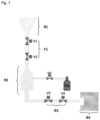
- Fig. 1 is a schematic drawing of a preferred equipment for carrying out the process according to the invention.
- Solid polymer particles are generally stored in the storage tank R1 at normal temperature and ambient pressure.
- the storage tank R1 may be a silo, a container or an equivalent equipment.
- the polymer particles are dosed continuously into a pressurized chamber F1. Dosing may be done by a series of rotary valves, a slurry pump, by premixing the solid polymer particles and the liquid CO 2 , or any other equipment following identical principles of mechanic or hydraulic dosing.
- the polymer particles are impregnated with a liquified gas, preferably N 2 , CO 2 or a mixture of CO 2 and N 2 .
- the liquified gas is pumped continuously to the impregnation zone R2.
- the impregnation zone R2 is preferably a reactor and maintained a temperature between 31°C and 250°C and is continuously fed with the liquified gas to keep the desired pressure at a pressure of generally in the range from10 - 300 bar, preferably in the range from 50-250 bar, more preferably in the range from 100 - 220 bar.
- the impregnation zone R2 is designed to allow a residence time in the range from 5 - 600 min, preferably in the range from 15 - 30 minutes.
- Chamber R3 is designed in a way that the expanding gas and, therefore, also the particles, reach the velocity of sound.
- R3 may be a nozzle, an orifice, a capillary tube or an expansion chamber, which is able to induce a pressure drop rate of 100 to 200 mbar/ms
- the foamed particles leave the separator R4, from the bottom by gravity and the expanded gas is recompressed by a compressor C1 and returned to the impregnation zone R2.
- the separator does not allow the foamed particles to leave with the gas.
- the outlet pipe of the separator is designed so that the settling velocity of the foamed particles is larger than 1.5 times the gas velocity.
- the foamed particles may be stored in a storage tank R5.
- Particles are foamed up to 18 times of the volume of the origin particles.
- the densities of the foamed particles are generally in the range from 200 kg/l to 300 kg/l.
- the foamed particles have a fine pore structure and homogeneous foam morphology
- the process according to the invention has the advantage that it does not need to use of solvents (VOC) or water.
- VOC solvents
- the blowing agent CO 2 and/or N 2 may be recycled. It is a continuous process and the reactor does not need to be opened or closed for dosing the polymer particles.
- the experimental step as shown in Fig. 1 is equipped with a container R1 to store the particles, connected by a pipe, in which two valves here named V1 and V2 are placed, to an impregnation reactor R2.
- the impregnation reactor R2 is continuously fed with gas to keep the pressure constant.
- the temperature of the impregnation reactor is controlled via a jacket with hot fluid flow.
- the pressure is controlled with a pressure gauge and a control valve, here named V0.
- the outlet from the reactor is a pipe to the atmosphere, in which two valves here named V3 and V4 are placed.
- TPU minipellets (Elastollan ® 1180A) were stored in R1 and dosed via F1 into the pressurized reactor R2 (pressurized at 150 bar) and impregnated with carbon dioxide at 130 C. After a residence time of 20 min, the impregnated particles were released to ambient pressure through R3 and were collected as expanded foam particles in a catch pot R4. The average density of the foamed particles was 200 g/l.
Landscapes
- Chemical & Material Sciences (AREA)
- Engineering & Computer Science (AREA)
- Mechanical Engineering (AREA)
- Materials Engineering (AREA)
- Health & Medical Sciences (AREA)
- Chemical Kinetics & Catalysis (AREA)
- Medicinal Chemistry (AREA)
- Polymers & Plastics (AREA)
- Organic Chemistry (AREA)
- Manufacture Of Porous Articles, And Recovery And Treatment Of Waste Products (AREA)
Claims (9)
- Verfahren zur kontinuierlichen Herstellung von expandierten Schaumstoffpartikeln, umfassend die Schrittea) Laden von thermoplastischem Polymergranulat aus einem Vorratsbehälter R1 in eine druckbeaufschlagte Imprägnierzone R2,b) kontinuierliches Zuführen von verflüssigtem Kohlendioxid, Stickstoff oder einem Gemisch davon als Treibmittel in die Imprägnierzone R2, wobei die Imprägnierzone R2 unter überkritischen Bedingungen bei einer Temperatur in dem Bereich von 31 bis 250 °C und einem Druck von 1 bis 30 MPa gehalten wird,c) Imprägnieren des thermoplastischen Polymergranulats mit dem Treibmittel während einer Verweilzeit zwischen 5 und 600 Minuten in der Imprägnierzone R2,d) Ausstoßen des imprägnierten thermoplastischen Polymergranulats aus der Imprägnierzone R2 in eine Niederdruck-Expansionszone R3 unter Expansion des thermoplastischen Polymergranulats, um expandierte Schaumstoffpartikel zu bilden,e) Trennen der expandierten Schaumstoffpartikel von dem gasförmigen Treibmittel in einer Trennzone R4.
- Verfahren nach Anspruch 1, wobei das gasförmige Treibmittel aus Schritt e) durch einen Kompressor zurück in die Imprägnierzone R2 geführt wird.
- Verfahren nach Anspruch 1 oder 2, wobei die Imprägnierzone R2 bei einer Temperatur in dem Bereich von 31 bis 250 °C und einem Druck von 10 bis 22 MPa gehalten wird.
- Verfahren nach einem der Ansprüche 1 bis 3, wobei das thermoplastische Polymergranulat bei Schritt a) durch eine Druckwechselkammer, die zwei automatisierte Ventile oder ein oder mehrere Drehventile umfasst, in die druckbeaufschlagte Imprägnierzone R2 geladen wird.
- Verfahren nach einem der Ansprüche 1 bis 4, wobei das imprägnierte thermoplastischen Polymergranulat bei Schritt d) aus der druckbeaufschlagten Imprägnierzone R2 durch eine Druckwechselkammer, die zwei automatisierte Ventilen, eine Öffnung oder eine Lavaldüse umfasst, ausgestoßen wird.
- Verfahren nach einem der Ansprüche 1 bis 5, wobei die Druckabfallrate bei Schritt d) in dem Bereich von 10 bis 20 kPa/ms liegt.
- Verfahren nach einem der Ansprüche 1 bis 6, wobei thermoplastisches Elastomergranulat als thermoplastisches Polymergranulat verwendet wird.
- Verfahren nach einem der Ansprüche 1 bis 6, wobei thermoplastisches Polyamidgranulat als thermoplastisches Polymergranulat verwendet wird.
- Verfahren nach einem der Ansprüche 1 bis 6, wobei thermoplastisches Polyurethan (TPU), Polyetherblockamid (PEBA), Styrolpolymere, Polymilchsäure (PLA), bioabbaubare aliphatisch-aromatische Polyester oder Gemische davon als thermoplastisches Polymergranulat verwendet wird.
Priority Applications (1)
| Application Number | Priority Date | Filing Date | Title |
|---|---|---|---|
| EP20180779.9A EP3925751B1 (de) | 2020-06-18 | 2020-06-18 | Verfahren zur kontinuierlichen herstellung von expandierten schaumstoffpartikeln |
Applications Claiming Priority (1)
| Application Number | Priority Date | Filing Date | Title |
|---|---|---|---|
| EP20180779.9A EP3925751B1 (de) | 2020-06-18 | 2020-06-18 | Verfahren zur kontinuierlichen herstellung von expandierten schaumstoffpartikeln |
Publications (3)
| Publication Number | Publication Date |
|---|---|
| EP3925751A1 EP3925751A1 (de) | 2021-12-22 |
| EP3925751B1 true EP3925751B1 (de) | 2025-02-19 |
| EP3925751C0 EP3925751C0 (de) | 2025-02-19 |
Family
ID=71108470
Family Applications (1)
| Application Number | Title | Priority Date | Filing Date |
|---|---|---|---|
| EP20180779.9A Active EP3925751B1 (de) | 2020-06-18 | 2020-06-18 | Verfahren zur kontinuierlichen herstellung von expandierten schaumstoffpartikeln |
Country Status (1)
| Country | Link |
|---|---|
| EP (1) | EP3925751B1 (de) |
Citations (3)
| Publication number | Priority date | Publication date | Assignee | Title |
|---|---|---|---|---|
| US4721588A (en) * | 1986-06-09 | 1988-01-26 | Epsilon Holdings, N.V. | Closed circuit process for the production of expanded polystyrene foam |
| US20140272379A1 (en) * | 2013-03-15 | 2014-09-18 | Nike, Inc. | Process for foaming thermoplastic elastomers |
| US20170036377A1 (en) * | 2013-03-15 | 2017-02-09 | Nike, Inc. | Decorative foam and method |
Family Cites Families (8)
| Publication number | Priority date | Publication date | Assignee | Title |
|---|---|---|---|---|
| CA2107157C (en) | 1992-09-29 | 1998-02-03 | Thomas N. Hall, Iii | Continuous process for expanding thermoplastic minipellets |
| DE4429844A1 (de) | 1994-08-23 | 1996-02-29 | Basf Ag | Verfahren zur Herstellung von expandierten Polyolefin-Partikeln |
| JP3100844B2 (ja) | 1994-10-18 | 2000-10-23 | 積水化成品工業株式会社 | 熱可塑性ポリウレタン発泡成形体及びその製造方法 |
| KR100341777B1 (ko) | 2000-02-08 | 2002-06-24 | 정문조 | 폴리올레핀 발포체 입자의 연속식 제조방법 |
| EP3008122B1 (de) | 2013-06-13 | 2017-08-09 | Basf Se | Verfahren zur herstellung von expandiertem granulat |
| CN104275766B (zh) * | 2013-07-11 | 2017-02-08 | 宁波大学 | 一种模压发泡过程中超临界流体的捕集及循环利用装置 |
| TWI656153B (zh) | 2013-10-11 | 2019-04-11 | 巴斯夫歐洲公司 | 膨脹熱塑性彈性體珠粒之製造 |
| CN109385058B (zh) * | 2018-09-06 | 2020-08-11 | 广东奔迪新材料科技有限公司 | 一种超临界流体制备无模立体结构发泡制品的方法 |
-
2020
- 2020-06-18 EP EP20180779.9A patent/EP3925751B1/de active Active
Patent Citations (3)
| Publication number | Priority date | Publication date | Assignee | Title |
|---|---|---|---|---|
| US4721588A (en) * | 1986-06-09 | 1988-01-26 | Epsilon Holdings, N.V. | Closed circuit process for the production of expanded polystyrene foam |
| US20140272379A1 (en) * | 2013-03-15 | 2014-09-18 | Nike, Inc. | Process for foaming thermoplastic elastomers |
| US20170036377A1 (en) * | 2013-03-15 | 2017-02-09 | Nike, Inc. | Decorative foam and method |
Also Published As
| Publication number | Publication date |
|---|---|
| EP3925751A1 (de) | 2021-12-22 |
| EP3925751C0 (de) | 2025-02-19 |
Similar Documents
| Publication | Publication Date | Title |
|---|---|---|
| CN107922662B (zh) | 聚乳酸发泡成形材料、其发泡成形品和制造方法 | |
| US7776973B2 (en) | Process for the catalytic polymerization of olefins, a reactor system and its use in the same process | |
| KR101453105B1 (ko) | 발포제를 함유하는 중합체 용융물의 과립화 방법 및 장치 | |
| KR102447143B1 (ko) | 열가소성 폴리우레탄에 기초한 폼의 제조 방법 | |
| EP3663358B1 (de) | Thermoplastisches polymerelastomermaterial mit mikroluftlöcher und vorbereitung davon | |
| CN101856853B (zh) | 一种塑料泡沫制品的成型装置及其制备方法 | |
| PL207638B1 (pl) | Sposób wydzielania lotnego materiału z poliolefiny | |
| CN109551701A (zh) | 一种半结晶聚合物原位发泡模塑成型方法 | |
| EP0376064A2 (de) | Verfahren zur Herstellung von Schaumharz | |
| US20170320973A1 (en) | Polymerisation process and polymerisation unit comprising a degassing section | |
| WO2019024586A1 (zh) | 一种微粒径热塑性微气囊聚氨酯弹性体材料及其制备方法 | |
| EP3925751B1 (de) | Verfahren zur kontinuierlichen herstellung von expandierten schaumstoffpartikeln | |
| US6403662B2 (en) | Continuous process for manufacturing polyolefin foam beads | |
| TWI616301B (zh) | 預發泡粒子之總體密度測量裝置及預發泡粒子之製造方法 | |
| US20020122838A1 (en) | Blow molding method and system | |
| KR101786214B1 (ko) | 매트리스 성형장치 | |
| CN113736048B (zh) | 一种连续制备发泡热塑性聚氨酯弹性体珠粒的方法及装置 | |
| JP2007283576A (ja) | 廃発泡ポリオレフィン系樹脂成形体の加圧減容品を利用した発泡ポリオレフィン系樹脂成型体の製造方法 | |
| JP3749027B2 (ja) | 高倍率に2次発泡させたポリオレフィン系樹脂発泡粒子の製法 | |
| JPH0457838A (ja) | 熱可塑性樹脂粒子の予備発泡方法およびそれに用いる装置 | |
| KR102657062B1 (ko) | 스티로폼 재활용 알갱이와 그 제조방법 | |
| WO2018108621A1 (en) | Improved process and system for vapor phase polymerization of olefin monomers | |
| JPS6146009B2 (de) | ||
| JPH0432852B2 (de) | ||
| WO2001090240A1 (en) | Process for the production of finely divided polymers |
Legal Events
| Date | Code | Title | Description |
|---|---|---|---|
| PUAI | Public reference made under article 153(3) epc to a published international application that has entered the european phase |
Free format text: ORIGINAL CODE: 0009012 |
|
| STAA | Information on the status of an ep patent application or granted ep patent |
Free format text: STATUS: THE APPLICATION HAS BEEN PUBLISHED |
|
| AK | Designated contracting states |
Kind code of ref document: A1 Designated state(s): AL AT BE BG CH CY CZ DE DK EE ES FI FR GB GR HR HU IE IS IT LI LT LU LV MC MK MT NL NO PL PT RO RS SE SI SK SM TR |
|
| B565 | Issuance of search results under rule 164(2) epc |
Effective date: 20201222 |
|
| STAA | Information on the status of an ep patent application or granted ep patent |
Free format text: STATUS: REQUEST FOR EXAMINATION WAS MADE |
|
| 17P | Request for examination filed |
Effective date: 20220622 |
|
| RBV | Designated contracting states (corrected) |
Designated state(s): AL AT BE BG CH CY CZ DE DK EE ES FI FR GB GR HR HU IE IS IT LI LT LU LV MC MK MT NL NO PL PT RO RS SE SI SK SM TR |
|
| STAA | Information on the status of an ep patent application or granted ep patent |
Free format text: STATUS: EXAMINATION IS IN PROGRESS |
|
| 17Q | First examination report despatched |
Effective date: 20230301 |
|
| GRAP | Despatch of communication of intention to grant a patent |
Free format text: ORIGINAL CODE: EPIDOSNIGR1 |
|
| STAA | Information on the status of an ep patent application or granted ep patent |
Free format text: STATUS: GRANT OF PATENT IS INTENDED |
|
| INTG | Intention to grant announced |
Effective date: 20240913 |
|
| GRAS | Grant fee paid |
Free format text: ORIGINAL CODE: EPIDOSNIGR3 |
|
| GRAA | (expected) grant |
Free format text: ORIGINAL CODE: 0009210 |
|
| STAA | Information on the status of an ep patent application or granted ep patent |
Free format text: STATUS: THE PATENT HAS BEEN GRANTED |
|
| AK | Designated contracting states |
Kind code of ref document: B1 Designated state(s): AL AT BE BG CH CY CZ DE DK EE ES FI FR GB GR HR HU IE IS IT LI LT LU LV MC MK MT NL NO PL PT RO RS SE SI SK SM TR |
|
| REG | Reference to a national code |
Ref country code: GB Ref legal event code: FG4D |
|
| REG | Reference to a national code |
Ref country code: CH Ref legal event code: EP |
|
| REG | Reference to a national code |
Ref country code: IE Ref legal event code: FG4D |
|
| REG | Reference to a national code |
Ref country code: DE Ref legal event code: R096 Ref document number: 602020046205 Country of ref document: DE |
|
| U01 | Request for unitary effect filed |
Effective date: 20250313 |
|
| RAP4 | Party data changed (patent owner data changed or rights of a patent transferred) |
Owner name: BASF SE |
|
| U07 | Unitary effect registered |
Designated state(s): AT BE BG DE DK EE FI FR IT LT LU LV MT NL PT RO SE SI Effective date: 20250403 |
|
| PG25 | Lapsed in a contracting state [announced via postgrant information from national office to epo] |
Ref country code: RS Free format text: LAPSE BECAUSE OF FAILURE TO SUBMIT A TRANSLATION OF THE DESCRIPTION OR TO PAY THE FEE WITHIN THE PRESCRIBED TIME-LIMIT Effective date: 20250519 |
|
| PG25 | Lapsed in a contracting state [announced via postgrant information from national office to epo] |
Ref country code: PL Free format text: LAPSE BECAUSE OF FAILURE TO SUBMIT A TRANSLATION OF THE DESCRIPTION OR TO PAY THE FEE WITHIN THE PRESCRIBED TIME-LIMIT Effective date: 20250219 |
|
| PG25 | Lapsed in a contracting state [announced via postgrant information from national office to epo] |
Ref country code: ES Free format text: LAPSE BECAUSE OF FAILURE TO SUBMIT A TRANSLATION OF THE DESCRIPTION OR TO PAY THE FEE WITHIN THE PRESCRIBED TIME-LIMIT Effective date: 20250219 |
|
| PG25 | Lapsed in a contracting state [announced via postgrant information from national office to epo] |
Ref country code: NO Free format text: LAPSE BECAUSE OF FAILURE TO SUBMIT A TRANSLATION OF THE DESCRIPTION OR TO PAY THE FEE WITHIN THE PRESCRIBED TIME-LIMIT Effective date: 20250519 Ref country code: IS Free format text: LAPSE BECAUSE OF FAILURE TO SUBMIT A TRANSLATION OF THE DESCRIPTION OR TO PAY THE FEE WITHIN THE PRESCRIBED TIME-LIMIT Effective date: 20250619 |
|
| PG25 | Lapsed in a contracting state [announced via postgrant information from national office to epo] |
Ref country code: HR Free format text: LAPSE BECAUSE OF FAILURE TO SUBMIT A TRANSLATION OF THE DESCRIPTION OR TO PAY THE FEE WITHIN THE PRESCRIBED TIME-LIMIT Effective date: 20250219 |
|
| PG25 | Lapsed in a contracting state [announced via postgrant information from national office to epo] |
Ref country code: GR Free format text: LAPSE BECAUSE OF FAILURE TO SUBMIT A TRANSLATION OF THE DESCRIPTION OR TO PAY THE FEE WITHIN THE PRESCRIBED TIME-LIMIT Effective date: 20250520 |
|
| U20 | Renewal fee for the european patent with unitary effect paid |
Year of fee payment: 6 Effective date: 20250703 |
|
| PG25 | Lapsed in a contracting state [announced via postgrant information from national office to epo] |
Ref country code: SM Free format text: LAPSE BECAUSE OF FAILURE TO SUBMIT A TRANSLATION OF THE DESCRIPTION OR TO PAY THE FEE WITHIN THE PRESCRIBED TIME-LIMIT Effective date: 20250219 |
|
| PG25 | Lapsed in a contracting state [announced via postgrant information from national office to epo] |
Ref country code: CZ Free format text: LAPSE BECAUSE OF FAILURE TO SUBMIT A TRANSLATION OF THE DESCRIPTION OR TO PAY THE FEE WITHIN THE PRESCRIBED TIME-LIMIT Effective date: 20250219 |
|
| PG25 | Lapsed in a contracting state [announced via postgrant information from national office to epo] |
Ref country code: SK Free format text: LAPSE BECAUSE OF FAILURE TO SUBMIT A TRANSLATION OF THE DESCRIPTION OR TO PAY THE FEE WITHIN THE PRESCRIBED TIME-LIMIT Effective date: 20250219 |