EP3922098B1 - Vorrichtung zur versorgung von muscheln in einer aquakultur - Google Patents
Vorrichtung zur versorgung von muscheln in einer aquakultur Download PDFInfo
- Publication number
- EP3922098B1 EP3922098B1 EP21175684.6A EP21175684A EP3922098B1 EP 3922098 B1 EP3922098 B1 EP 3922098B1 EP 21175684 A EP21175684 A EP 21175684A EP 3922098 B1 EP3922098 B1 EP 3922098B1
- Authority
- EP
- European Patent Office
- Prior art keywords
- mussel
- feed
- supply
- opening
- mussels
- Prior art date
- Legal status (The legal status is an assumption and is not a legal conclusion. Google has not performed a legal analysis and makes no representation as to the accuracy of the status listed.)
- Active
Links
Images

Classifications
-
- A—HUMAN NECESSITIES
- A01—AGRICULTURE; FORESTRY; ANIMAL HUSBANDRY; HUNTING; TRAPPING; FISHING
- A01K—ANIMAL HUSBANDRY; AVICULTURE; APICULTURE; PISCICULTURE; FISHING; REARING OR BREEDING ANIMALS, NOT OTHERWISE PROVIDED FOR; NEW BREEDS OF ANIMALS
- A01K61/00—Culture of aquatic animals
- A01K61/50—Culture of aquatic animals of shellfish
- A01K61/54—Culture of aquatic animals of shellfish of bivalves, e.g. oysters or mussels
-
- Y—GENERAL TAGGING OF NEW TECHNOLOGICAL DEVELOPMENTS; GENERAL TAGGING OF CROSS-SECTIONAL TECHNOLOGIES SPANNING OVER SEVERAL SECTIONS OF THE IPC; TECHNICAL SUBJECTS COVERED BY FORMER USPC CROSS-REFERENCE ART COLLECTIONS [XRACs] AND DIGESTS
- Y02—TECHNOLOGIES OR APPLICATIONS FOR MITIGATION OR ADAPTATION AGAINST CLIMATE CHANGE
- Y02A—TECHNOLOGIES FOR ADAPTATION TO CLIMATE CHANGE
- Y02A40/00—Adaptation technologies in agriculture, forestry, livestock or agroalimentary production
- Y02A40/80—Adaptation technologies in agriculture, forestry, livestock or agroalimentary production in fisheries management
- Y02A40/81—Aquaculture, e.g. of fish
Definitions
- the invention relates to a device for supplying at least one mussel in an aquaculture with a water flow, the mussel having two shell flaps that can be opened at an opening angle and generating an inhalation flow, with a fixing device and a supply pipe for each individual mussel, the supply pipe having a the mussel facing supply opening and a remote connection opening, which is connected to a supply unit for the provision of supply material.
- Mussels are traded fresh, frozen or canned as a valuable foodstuff, with mussels also increasingly being harvested from land- or water-based aquaculture.
- marine and freshwater mussel species are also raised and reproduced in aquaculture for nature conservation projects and presented in public exhibitions (aquariums).
- the present invention deals with the rearing of bivalve bivalves (scientifically bivalvia ). They form a class of mollusks and have a shell consisting of two calcareous valves. The shell flaps are connected to each other by an elastic lock band (ligament) and are actively pulled together by two sphincters. mussels live worldwide in salt water (80%), brackish water and fresh water.
- ligament elastic lock band
- Native mussel species are in particular mussels, oysters, clams and scallops, which are a few centimeters in size. Most mussels are sessile (horizontal or vertical) on the bottom of the water. They are attached to it or lie freely on it, so that they can also move a little in the sediment. Most species of mussels feed on plankton, which they filter with their gills from the inhalation flow sucked in through a breathing opening and transport it to the internal mouth opening in a mucous packet. The gills thus serve both to supply the mussel with oxygen (“breathe”) and with food (“eat”).
- the mussels In order to transport more water (and thus more food and oxygen) into their interior, the mussels can also open their shell flaps, whereby the opening angle is formed between the shell flaps. The open mussel can thus filter larger amounts of water.
- the species-appropriate and efficient supply of mussels is one of the main tasks in aquaculture.
- mussels need to be provided with large amounts of food because they invest large amounts of energy in the production of gametes.
- this process is usually not optimized in aquaculture.
- the algae fed to the animals, the production of which is a labor-intensive and costly process, are suspended in the running water.
- a large part of the mussels is not used, which leads to food waste and water pollution.
- An individualization of the supply to the individual mussel is therefore advantageous.
- the term "supply” includes both the feeding and care of adult mussels and the reproduction and rearing of young mussels.
- the term "mussel” is used below, this generally means a large number of animals of a specific species, with each individual animal being treated accordingly.
- a pearl mussel feed and care box used for aquaculture is described. Pearl oysters have two shell flaps.
- the box consists of a box body that is open at the top and closed at the bottom. A single shell is placed in the box at an angle so that the box acts as a fixation device for the shell.
- a telescoping supply tube is assigned to each individual shell, which has a cannula with a supply opening at one end. This is inserted into the inside of the mussel through a hole that has previously been drilled in one of the two shell flaps. The other end of the supply pipe has a connection opening with which it is connected to a supply device.
- the hole in the clam shell may be 6.5mm in diameter.
- the known device has a massively invasive effect on each individual mussel, which is detrimental to their well-being.
- a method for land-based oyster farming in which individual oysters are reared in individual tanks in a circulatory system in which each individual tank has its own water inlet and water outlet.
- a method for land-based oyster farming is known, in which up to 50 oysters per tank are fed in a circulatory system in a batch or dropping process.
- a land-based method for growing pearl oysters is known.
- KR 10 2017 0 122 390 A a method for determining the shell movements of bivalves in aquaculture farms by means of a sensor on one half of the shell is known.
- the object of the present invention is to develop the generic device in such a way that the mussels can be better supplied with supplies without damaging the mussels invasive to affect.
- the device should be as simple and inexpensive to implement as possible.
- the use of the supplied supply should be optimized and the water pollution with unused supply should be minimized.
- the solution to this problem can be found in the main claim.
- the generic device for supplying living mussels in aquaculture provides that the supply opening of the supply pipe is arranged at a distance of between 5 mm and 100 mm (original claim 2 and description on page 6, 2nd paragraph) in front of the mussel in the area of the inhalation flow where the distance from the supply opening to the mussel depends on the size of the mussel, the strength of the inhalation flow and the water flow. There are no other "means" (objects, obstacles, large distances) between the supply opening and the mussel, so that a direct alignment and supply of the supply material to the mussel is guaranteed.
- Arranging the supply opening as close as possible in front of the mussel is advantageous, whereby the mussel itself is not touched, but little or no supply material can be displaced between the supply opening and the mussel by the water flow in aquaculture.
- the relative (local) arrangement of the supply opening to the mussel or the mussel in front of the supply opening depends in turn on the respective species, ie at which point of the respective mussel the inhaled flow is sucked into the interior.
- each individual mussel is treated individually without having an invasive effect on it, in particular no shell flap is pierced. This not only protects the mussel but also simplifies the supply process, in particular the preparation for implementation.
- the supply opening is positioned in the area of its inhalation flow so that the direct supply of each mussel is nevertheless guaranteed. It has already been explained above that mussels obtain both oxygen and food via their inhalation flow.
- the supplies released with the claimed device into the water of the aquaculture reach i.e. with the inhalation flow directly into the inside of the shell.
- the inhaled flow is drawn in by the mussel into the area between the shell flaps and its tissue and from there it is filtered through the gills.
- the device according to the invention can bring about a significant reduction in the amount of feed (or other products such as supplements or medicines) required for the conditioning of mussel fry and the growth of juvenile mussels. At the same time, a reduction in the corresponding costs is achieved. Furthermore, the waste products in the water after feeding can be reduced, thereby reducing the environmental impact. At the same time, higher water recirculation rates can be achieved. This may enable the development of mussel hatcheries and farms in arid and pollution-sensitive zones. Due to these serious advantages, the system claimed by the invention is suitable both for the production of filter feeders in the form of mussels and fish larvae and for their rearing. However, a scientific application is also possible, in which the efficiency of feed conversion by filter feeders is examined.
- the distance between the supply opening and the mussel in the region of its inhalation flow depends on the size of the mussel (i.e. the mussel species, not the individual size, which varies only to a limited extent within a species), the strength of its inhalation flow (which in turn depends on the mussel species to be supplied) and on the water flow in aquaculture.
- the latter parameter is a system parameter that can be easily controlled in terms of flow technology.
- the selected strength of the current naturally also depends on the mussel species, but also, among other things, on the number and density of the supplying mussels in a tank.
- the supply pub be placed in front of the shell at a distance of between 5 mm and 100 mm.
- It can preferably and advantageously be 50 mm or 75 mm. This depends on the size of the mussel species used, for example the distance can be less than 10 mm for oysters Ostrea edulis , for giant clams Tridacna sp. at 50 mm or above. Varieties that are too small will tend not to be supplied, since each mussel is assigned individually to a separate supply pipe is technically too complex. In the case of larger or gigantic mussels, the claimed individual supply is particularly advantageous.
- each clam is fed individually, rather than having the fed supplies suspended throughout the volume of water, correspondingly fewer supplies are needed.
- This can be both food, in particular algae, and additives, for example food supplements or medicines.
- a reduction in the amount of algae required in particular means lower investments in algae production, which leads to financial gains.
- the amount of direct (unused) and indirect (excreted by the mussel) waste products is also reduced, which can also reduce the associated environmental problems.
- Cleaner water also requires less cleaning effort, which in turn has a cost-effective effect.
- the supply opening is formed by the opening of a pipette made of plastic or glass, which is inserted into the supply tube.
- the size and position of the supply opening is precisely defined by the pipette. In addition, it can be easily removed and cleaned or replaced.
- the supply pipe can advantageously and preferably have a return pipe to the supply unit.
- a circulatory system can be set up via the supply source through the return pipe.
- Feed can be kept in constant circulation.
- the supply pipe has a metering valve between the supply opening and the return pipe, the metering depending on the size of the mussel, the distance between the supply opening and the mussel, the opening angle between the shell flaps, the strength of the inhalation flow and the water flow and/or the type of supply.
- the dosage can be adjusted between a maximum dose and a minimum dose. This ensures that neither too little nor too much food or other substances are supplied.
- Each supply tube has a metering valve and a return tube. If there are a large number of mussels to be supplied, a large number of metering valves and return pipes are then provided corresponding to the number of supply pipes.
- the supply material is preferably delivered via the metering valve which is arranged between the supply opening and the return pipe.
- the metering valve can operate in an open or closed state, just like a metering system that controls the amount of supply. For example, when the metering valve is open, the supply flows to the clam; when it is closed, the supply flows back to the reservoir. This creates a flow of food through the return pipe, which allows the food to circulate in a loop, which avoids undesirable effects in aquaculture, such as anoxia - lack of oxygen in the water due to "over-fertilization" by algae in particular.
- the opening/closing of the dosing valve and the set Dose depends on the rhythm in which something is to be fed to the mussel or in which it demands something.
- the dosing valve can preferably and advantageously be connected to a shell flap of the mussel and can be actuated as a function of the opening angle of the mussel.
- the mechanical connection with the shell flap for example by gluing, does not bother the mussel.
- the mussel draws the inhaled stream into its interior via its ingestion opening and there through its gills. These are used both for respiration and for filtering food from the water.
- the mussel can open at an opening angle. When it does so, in the above embodiment of the invention, it also actuates the metering valve via its flap movement and supply flows into the interior of the shell.
- the mussel can also be conditioned accordingly to a food request via this connection.
- a mechanical, but non-invasive connection with a shell valve of the turbinate is required.
- the shell actuates the dosing valve directly with its opening movement.
- a sensor for detecting the opening angle of the mussel can be arranged on at least one shell flap, it being possible for the sensor to generate a signal for actuating the metering valve.
- the dosing valve does not have to be completely closed. A small opening can be maintained to allow small amounts of feed or other material to be dispensed continuously. These can be used by the mussels as chemical signals, letting them know that food is available.
- a non-contact sensor for detecting the opening angle of the mussel can preferably and advantageously also be arranged in the invention, with the sensor in turn generating a signal for actuating the metering valve.
- the individual mussel is no longer bothered in any way.
- the preparatory work for feeding the mussel is simplified accordingly. It can preferably and advantageously be optical or magnetic sensors. Sensors can be used to monitor the opening, such as magnetic sensors (Hall sensors), which measure the distance between the two shell flaps (corresponds to the opening angle).
- an optical sensor can preferably and advantageously be used, which is fastened to the supply pipe in the vicinity of the supply opening in the viewing direction of the mussel.
- Sensors based on other physical principles can also be used. A number of sensors are commercially available that are suitable.
- the supply unit comprises a supply source and a peristaltic pump.
- a peristaltic pump (or hose pump) is a displacement pump in which the medium to be pumped is pushed through the hose in portions by external mechanical deformation.
- Such pumps work very reliably and are easily expandable, so that a large number of supply pipes can be continuously supplied with supply material.
- Algae for example, can be grown in the supply source.
- an illumination device and/or various other sensors are provided in the supply source. Algae growth can be supported via the lighting device. If the mussels are fed a dietary supplement or medication, it can It may be necessary for certain parameters in the supply source to be detected in order to ensure optimal conditions. The detection can take place via the sensors provided, which measure, for example, the temperature or the pH value of the solution.
- a fixing device for the mussels is used in the invention.
- This can preferably and advantageously include at least one support frame or a holding box that does not impede the flow of water and or in which the shell can be fixed.
- a separate supply pipe then leads to each shell fixed in the fixing device or a separate supply pipe branches off from a superordinate pipe.
- a scaffold is usually constructed like a grid with a large number of individual levels and allows for a good flow of water.
- any other design of a frame or flow-permeable support boxes is also possible.
- the mussels can fix themselves to the framework via their foot or their byssus threads, or they can be fixed to it by suitable means, for example with an elastic quick-acting adhesive or a rubber ring that does not hinder the opening of the mussel. Or they are simply plugged into a holding box (without special fixing devices such as glue or rubber) so that they cannot change their position.
- a good water flow and a close proximity of the mussels to each other allows a good transport of gametes, so that despite the fixation of the mussels, fertilization and thus multiplication of the mussels is possible.
- metering valve and the supply unit can be provided. All metering valves and the supply unit can be controlled in particular as a function of the sensor signals from the individual mussels.
- the device can be automated and can work autonomously.
- a fully automatic dosing system for mussels can be made available, in which the dosing, in particular of feed, but also of supplements or medication, can be optimized individually for each mussel. As a result, resources can be conserved and the water can be kept free of unused supplies. Further details on this and on the modifications of the invention described above can be found in the following exemplary embodiments.
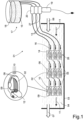
- a device 01 for the care and rearing of mussels 02 in a land-based aquaculture with a water basin 03 with water 04 is shown, in which the mussels 02 are conditioned or reared (breeding) for their care.
- the mussels 02 are fixed individually in a frame 05 as a fixing device 26 with several grid-like columns and rows, through which the water 04 can easily flow. It flows through an inlet 06 into the water basin 03 and out again through an outlet 07 , so that a water flow 11 is generated in the water basin 03 .
- Aquaculture can be designed as a closed loop system or as an open flow system.
- the inset in figure 1 shows the structure of a mussel 02 with two shell flaps 08 ( bivalvia ). These are connected to each other via a ligament 09 .
- An inhalation flow 10 is sucked into the gills by the conch 02 ; for this purpose, the conch 02 can open at an opening angle.
- the shell 02 can have filaments or a foot 12 for fixation. However, it can also float freely in the water and then be fixed to the framework 05 with an external fixing agent.
- a supply pipe 13 is arranged in front of each shell 02 .
- each supply tube 13 has a supply opening 14 , which is arranged at a small distance in front of the conch 02 in the region of its inhalation flow 10 .
- the shell flaps 08 are not touched and are therefore not impaired.
- the supply opening 14 is located approximately 10 mm in front of the shell 02 , but other distances of between 5 mm and 50 mm can also be set, primarily depending on the shell size, the inhalation flow 10 and the water flow 11 .
- the supply opening 14 is not located in front of the shell flaps 08 or the ligament 09 , so that the supply material 15, in particular food, but also additives or medication, can also get directly into the interior of the mussel 02 when the mussel 02 is opened (arrows for the flow of food) and is not deflected by Ligament 09 .
- the exact arrangement of the supply opening 14 in the area of the inhalation flow 10 of the conch 02 can also depend on the geometry of the fixation of the conch 02 in the frame 05 . In particular, a symmetrical structure with a straight arrangement of all supply pipes 13 is particularly favorable.
- the supply opening 14 is the opening of a pipette 16 made of plastic, which is inserted into the supply pipe 13 , which is designed like a hose, and is therefore to be regarded as part of it.
- All supply pipes 13 are connected to a supply unit 17 via a connection opening 27 facing away from the shell 02 (only indicated in the case of the shells 02 in the left and middle row of the frame 05 ), which comprises a supply source 18 and an electric peristaltic pump 19 .
- supply material in particular food in the form of algae, can be delivered to the mussels 02 .
- the conveyance takes place via the rotors 20 assigned to the individual supply pipes 13.
- each mussel 02 can be supplied individually.
- Groups of mussels 02 or all mussels 02 can also be supplied together via shared rotors 20 .
- sensors 21 are attached to the shell flaps 08 opposite the ligament 09 , which sensors send signals to a computer-aided controller 22 when an opening angle is generated between the shell flaps 08 .
- the sensors 21 can be based on magnetic or optical signal generation, for example.
- the supply pipe 13 has a return pipe 23 to the supply source 18.
- the return pipe 23 is inserted into the supply pipe 13 via a T-piece 24 and ensures a supply circuit. This runs when a metering valve 25 between the supply opening 14 and the return pipe 23 is in the appropriate state.
- metering valve 25 When metering valve 25 is actuated via the signal, supply 15 is directed to shell 02 .
- the dose supplied in each case depends primarily on the size of the mussel 02 and the strength of its inhalation flow 10 and the water flow 11 .
- the metering valve 25 is controlled individually via the opening behavior of the mussel 02, so that the mussels 02 can be supplied fully automatically with a high degree of utilization of the supply material 15 .
- the metering valve 25 can also be actuated mechanically via the shell flaps 08 or via sensors 21 which are arranged opposite the shell flaps 08 and do not touch them.
- a lighting device 28 and various sensors 29, 30 are also provided in the supply source 18 .
- the supply material 15, in particular food in the form of algae, can be irradiated with light via the lighting device 28 and its growth can be supported. Incidentally, light can also reach the algae via transparent supply pipes 13 (hoses). If certain conditions are to be set in the supply source 18 , they can be monitored via the sensors 29 (eg temperature) and 30 (eg pH value).
Landscapes
- Life Sciences & Earth Sciences (AREA)
- Environmental Sciences (AREA)
- Marine Sciences & Fisheries (AREA)
- Zoology (AREA)
- Animal Husbandry (AREA)
- Biodiversity & Conservation Biology (AREA)
- Farming Of Fish And Shellfish (AREA)
Description
- Die Erfindung bezieht sich auf eine Vorrichtung zur Versorgung von zumindest einer Muschel in einer Aquakultur mit einer Wasserströmung, wobei die Muschel zwei unter einem Öffnungswinkel öffenbare Schalenklappen aufweist und einen Einatemstrom erzeugt, mit einer Fixierungsvorrichtung und einem Versorgungsrohr für jede einzelne Muschel, wobei das Versorgungsrohr eine der Muschel zugewandte Versorgungsöffnung und eine abgewandte Anschlussöffnung, welche mit einer Versorgungseinheit zur Bereitstellung von Versorgungsmaterial verbunden ist, aufweist.
- Muscheln werden frisch, gefroren oder konserviert als wertvolles Lebensmittel gehandelt, wobei zunehmend auch Muscheln aus land- oder wassergestützter Aquakultur geerntet werden. Darüber hinaus werden in der Aquakultur auch Meeres- und Süßwassermuschelarten für Naturschutzprojekte aufgezogen und reproduziert und in öffentlichen Ausstellungen präsentiert (Aquarien). Die vorliegende Erfindung befasst sich mit der Aufzucht von zweiklappigen Muscheln (wissenschaftlich Bivalvia). Sie bilden eine Klasse der Weichtiere und besitzen eine aus zwei kalkigen Klappen bestehende Schale. Die Schalenklappen sind über ein elastisches Schlossband (Ligament) miteinander verbunden und werden über zwei Schließmuskeln aktiv aneinander gezogen. Muscheln leben weltweit in Salzwasser (zu 80 %), Brackwasser und Süßwasser. Sie können je nach Spezies zwischen einigen Millimetern bis hin zu einem Meter und mehr groß sein. Heimische Muschelarten sind insbesondere Miesmuscheln, Austern, Venusmuscheln und Kammmuscheln, die einige Zentimeter groß sind. Die meisten Muscheln leben (in horizontaler oder vertikaler Ausrichtung) sessil am Gewässergrund. Sie sind an ihm festgewachsen oder liegen frei auf ihm, sodass sie sich im Sediment auch etwas bewegen können. Die meisten Muschelarten ernähren sich von Plankton, das sie mit ihren Kiemen aus dem über eine Atemöffnung eingesogenen Einatemstrom filtern und in einem Schleimpaket zur internen Mundöffnung befördern. Die Kiemen dienen somit sowohl der Versorgung der Muschel mit Sauerstoff ("atmen") als auch mit Nahrung ("fressen"). Um mehr Wasser (und damit auch mehr Nahrung und Sauerstoff) in ihr Inneres zu befördern, können die Muscheln ihre Schalenklappen auch öffnen, wobei sich zwischen den Schalenklappen der Öffnungswinkel ausbildet. Die geöffnete Muschel kann somit größere Wassermengen filtrieren. Die artgerechte und effiziente Versorgung von Muscheln ist eine der Hauptaufgaben in der Aquakultur.
- Insbesondere während der Laichperiode müssen Muscheln mit großen Mengen Futter versorgt werden, da sie große Energiemengen in die Produktion von Gameten investieren. Dieser Prozess ist aber in der Regel in den Aquakulturen nicht optimiert. Die an die Tiere verfütterten Algen, deren Produktion ein arbeits- und kostenintensiver Prozess ist, werden im fließenden Wasser suspendiert. Dabei wird aber ein großer Teil von den Muscheln nicht genutzt, was zu einer Futterverschwendung und Wasserbelastung führt. Eine Individualisierung der Versorgung auf die einzelne Muschel ist daher vorteilhaft. Dabei umfasst der Begriff "Versorgung" sowohl die Fütterung und Pflege erwachsener Muscheln als auch die Reproduktion und Aufzucht von Muschelnachwuchs. Wenn im Folgenden von "Muschel" gesprochen wird, ist damit in der Regel eine Vielzahl von Tieren einer speziellen Spezies gemeint, wobei jedes einzelne Tier entsprechend behandelt wird. Ebenso ist bei Parameterangaben, beispielsweise der Größe, nicht die Größe eines einzelnen Individuums, sondern die durchschnittliche Größe der Spezies gemeint. Es soll aber durchaus auch die Versorgung eines einzelnen Tieres, beispielsweise einer Riesenmuschel in einem eigenen Aquarium, beispielsweise für Schauzwecke, umfasst sein.
- Der der Erfindung nächstliegende Stand der Technik ist aus der
CN 106 035 182 A bekannt. Beschrieben wird eine Perlmuschelfutter- und pflegebox, die für die Aquakultur verwendet wird. Perlmuscheln weisen zwei Schalenklappen auf. Die Box besteht aus einem Kastenkörper, der oben offen und unten geschlossen ist. Eine einzelne Muschel wird schräg in die Box eingelegt, sodass die Box als Fixierungsvorrichtung für die Muschel fungiert. Jeder einzelnen Muschel ist ein teleskopartiges Versorgungsrohr zugeordnet, das an seinem einen Ende eine Kanüle mit einer Versorgungsöffnung aufweist. Diese wird durch ein Loch, das zuvor in eine der beiden Schalenklappen gebohrt worden ist, in das Muschelinnere eingeführt. Das andere Ende des Versorgungsrohrs weist eine Anschlussöffnung auf, mit der es an eine Versorgungseinrichtung angeschlossen ist. Von dieser wird Futter in die Muschel geleitet, die damit "zwangsernährt" wird. Dabei ist nicht auszuschließen, dass ein Teil des Futters ungenutzt wieder ausgeschieden wird. Das Loch in der Muschelschale kann einen Durchmesser von 6,5 mm aufweisen. Abgesehen davon, dass es verhältnismäßig aufwändig ist, jede einzelne Muschel entsprechend anzubohren, zu positionieren und an die Versorgungseinheit anzuschließen, wirkt die bekannte Vorrichtung massiv invasiv auf jede einzelne Muschel ein, was deren Wohlergehen abträglich ist. - Aus der
CN 103 621 445 A ist es bekannt, Perlmuscheln mit einem Kern zur Perlenbildung zu impfen. Dazu wird die Muschel geöffnet, mit einer Vorrichtung offengehalten und mit einer Stahlkanüle der Kern in die Weichteile injiziert. Weiterhin ist es aus derJP 2012 019 746 A US 2018/0084765 A1 ist eine Vorrichtung zur Verhaltenserkennung von Fischen in einem Wasserbecken bekannt. Dazu wird gesteuert über eine Pipette Futter in das Wasser abgegeben und über Bewegungssensoren die Fischbewegungen detektiert. Ziel ist ein Training der Fische auf die gesteuerte Futterabgabe, um Futterverschwendung zu vermeiden. Eine ähnliche Vorrichtung ist aus derUS 5 732 655 A bekannt. - Aus der
KR 10 2014 078 038 A US 2018/0 317 460 A1 ist ein Verfahren zur landbasierten Austernaufzucht bekannt, bei dem jeweils bis zu 50 Austern pro Tank in einem Kreislaufsystem in einem Batch- oder einem Dropping-Verfahren gefüttert werden. Aus derUS 6 357 392 B1 ist ein landbasiertes Verfahren zur Aufzucht von Perlaustern bekannt. Aus derKR 10 2017 0 122 390 A - Ausgehend von der bekannten Vorrichtung zur Versorgung von Muscheln gemäß dem weiter oben beschriebenen nächstliegenden Stand der Technik ist die Aufgabe für die vorliegende Erfindung darin zu sehen, die gattungsbildende Vorrichtung so weiterzubilden, dass eine verbesserte Versorgung der Muscheln mit Versorgungsmaterialien erfolgen kann, ohne dabei die Muscheln invasiv zu beeinträchtigen. Gleichzeitig soll die Vorrichtung möglichst einfach und kostengünstig umsetzbar sein. Die Nutzung des zugeführten Versorgungsmaterials soll optimiert und die Wasserbelastung mit ungenutztem Versorgungsmaterial minimiert sein. Die Lösung für diese Aufgabe ist dem Hauptanspruch zu entnehmen. Vorteilhafte Modifikationen der Erfindung werden in den Unteransprüchen aufgezeigt und im Folgenden zusammen mit der Erfindung näher erläutert.
- Erfindungsgemäß ist bei der gattungsgemäßen Vorrichtung zur Versorgung von lebenden Muscheln in Aquakultur vorgesehen, dass die Versorgungsöffnung des Versorgungsrohrs mit einem Abstand zwischen 5 mm und 100 mm (Anspruch 2 ursprünglich und Beschreibung Seite 6, 2. Absatz) vor der Muschel im Bereich des Einatemstroms angeordnet ist, wobei der Abstand der Versorgungsöffnung zur Muschel abhängig ist von der Größe der Muschel, der Stärke des Einatemstroms und der Wasserströmung. Dabei befinden sich keine weiteren "Mittel" (Gegenstände, Hindernisse, große Wegstrecken) zwischen der Versorgungsöffnung und der Muschel, sodass eine direkte Ausrichtung und Zuführung des Versorgungsmaterials an die Muschel gewährleistet ist. Eine möglichst nahe Anordnung der Versorgungsöffnung vor der Muschel ist vorteilhaft, wobei die Muschel selbst zwar nicht berührt wird, trotzdem aber kein oder nur sehr wenig Versorgungsmaterial zwischen der Versorgungsöffnung und der Muschel durch die Wasserströmung in der Aquakultur abgedrängt werden kann. Die relative (lokale) Anordnung der Versorgungsöffnung zur Muschel bzw. der Muschel vor der Versorgungsöffnung hängt wiederum von der jeweiligen Spezies ab, d.h. an welcher Stelle der jeweiligen Muschel der Einatemstrom in das Innere gesogen wird. Bei der Erfindung wird somit eine individuelle Versorgung jeder einzelnen Muschel vorgenommen, ohne dabei invasiv auf diese einzuwirken, insbesondere wird keine Schalenklappe durchbohrt. Dadurch wird sowohl die Muschel geschont also auch der Versorgungsprozess, insbesondere die Vorbereitung zur Durchführung, vereinfacht. Damit die unmittelbare Versorgung jeder Muschel trotzdem sicher gewährleistet ist, wird die Versorgungsöffnung im Bereich ihres Einatemstroms positioniert. Weiter oben wurde bereits ausgeführt, dass sich Muscheln über ihren Einatemstrom sowohl mit Sauerstoff als auch mit Nahrung versorgen. Die mit der beanspruchten Vorrichtung in das Wasser der Aquakultur abgegeben Versorgungsstoffe gelangen also mit dem Einatemstrom auf direktem Wege in das Innere der Muschel. Der Einatemstrom wird von der Muschel in den Bereich zwischen den Schalenklappen und ihrem Gewebe eingesogen und von dort über die Kiemen gefiltert.
- Durch die erfindungsgemäße Vorrichtung kann eine bedeutsame Reduzierung der benötigten Futtermittelmenge (oder anderer Produkte wie Ergänzungsstoffe oder Medikamente) bewirkt werden, die für die Konditionierung von Muschelbrut und Wachstum von Jungmuscheln notwendig ist. Gleichzeitig wird eine Reduzierung der entsprechenden Kosten erreicht. Weiterhin können die Abfallprodukte im Wasser nach der Fütterung reduziert werden, wodurch die Umweltbelastung verringert wird. Zugleich können höhere Rezirkulationsraten des Wassers erreicht werden. Dies kann die Entwicklung von Muschelbrütereien und -zuchtanlagen in wasserarmen und verschmutzungsempfindlichen Zonen ermöglichen. Durch diese gravierenden Vorteile eignet sich die mit der Erfindung beanspruchte Anlage sowohl für die Produktion von Filterfressern in Form von Muscheln und Fischlarven als auch für deren Aufzucht. Aber auch eine wissenschaftliche Anwendung ist möglich, bei der die Effizienz der Futterverwertung durch Filterfresser untersucht wird.
- Der Abstand der Versorgungsöffnung von der Muschel im Bereich ihres Einatemstroms hängt von der Größe der Muschel (also der Muschelspezies, nicht der individuellen Größe, die aber innerhalb einer Spezies auch nur in begrenztem Maße variiert), der Stärke ihres Einatemstroms (was wiederum abhängig ist von der zu versorgenden Muschelspezies) und von der Wasserströmung in der Aquakultur ab. Der letztgenannte Parameter ist ein Anlagenparameter, der strömungstechnisch einfach geregelt werden kann. Dabei hängt natürlich auch die gewählte Stärke der Strömung von der Muschelspezies ab, aber auch unter anderem von der Anzahl und der Dichte der versorgenden Muscheln in einem Becken. Erfindungsgemäß kann die Versorgungsöff nung mit einem Abstand zwischen 5 mm und 100 mm vor der Muschel angeordnet sein. Er kann bevorzugt und vorteilhaft 50 oder 75 mm mm betragen. Dieser hängt von der Größe der verwendeten Muschelspezies ab, beispielsweise kann für Austern Ostrea edulis der Abstand unter 10 mm liegen, für Riesenmuscheln Tridacna sp. bei 50 mm oder oberhalb davon. Zu kleine Sorten werden eher nicht versorgt werden, da hier eine individuelle Zuordnung jeder Muschel zu einem eigenen Versorgungsrohr technisch zu aufwändig ist. Bei größeren oder riesenhaften Muscheln ist die beanspruchte Einzelversorgung besonders vorteilhaft.
- Wenn jede Muschel einzeln versorgt wird, anstatt dass die zugeführten Versorgungsmaterialien im gesamten Wasservolumen suspendiert sind, werden entsprechend weniger Versorgungsmaterialien benötigt. Dabei kann es sich sowohl um Nahrung, insbesondere Algen, als auch um Zusatzstoffe, beispielsweise Nahrungsergänzungsmittel oder Medikamente, handeln. Eine Reduzierung insbesondere der benötigten Algenmengen bedeutet geringere Investitionen in die Algenproduktion, was zu finanziellen Gewinnen führt. Weiterhin wird auch die Menge der direkten (ungenutzt) und indirekten (von der Muschel ausgeschiedenen) Abfallprodukte reduziert, wodurch die damit verbundenen Umweltprobleme ebenfalls reduziert werden können. Dadurch kann in geschlossenen oder teilgeschlossenen Aquakulturanlagen eine höhere Wasserrückführungsrate erreicht werden. Saubereres Wasser benötigt auch einen geringeren Reinigungsaufwand, was sich wiederum kostengünstig auswirkt. Diese Vorteile sind für die Ansiedlung von Anlagen in Gebieten mit begrenzter oder sensibler Wasserversorgung von besonderer Bedeutung. Hier sind dann auch Durchflussanlagen möglich.
- Bevorzugt und vorteilhaft ist es gemäß einer weiteren Ausgestaltung der mit der Erfindung beanspruchten Vorrichtung, wenn die Versorgungsöffnung von der Öffnung einer Pipette aus Kunststoff oder Glas gebildet ist, die in das Versorgungsrohr eingesteckt ist. Durch die Pipette wird die Versorgungsöffnung in ihrer Größe und Lage genau definiert. Außerdem kann sie leicht entnommen und gereinigt oder ausgetauscht werden.
- Weiterhin kann vorteilhaft und bevorzugt das Versorgungsrohr ein Rücklaufrohr zur Versorgungseinheit aufweisen. Durch das Rücklaufrohr kann ein Kreislaufsystem über die Versorgungsquelle aufgebaut werden. Insbesondere das Futter kann in einem ständigen Umlauf gehalten werden. Bei kann es beispielsweise beleuchtet werden, sodass sich Algen als Futtermittel besonders gut entwickeln. Weiterhin ist es bevorzugt und vorteilhaft, wenn das Versorgungsrohr ein Dosierventil zwischen der Versorgungsöffnung und dem Rücklaufrohr aufweist, wobei die Dosierung in Abhängigkeit von der Größe der Muschel, vom Abstand der Versorgungsöffnung von der Muschel, vom Öffnungswinkel zwischen den Schalenklappen, von der Stärke des Einatemstroms und der Wasserströmung und/oder von der Art des Versorgungsmaterials einstellbar ist. Dabei ist die Dosierung zwischen einer maximalen Dosis und einer minimalen Dosis einstellbar. Dadurch ist sichergestellt, dass weder zuwenig noch zuviel Nahrung oder anderer Stoff zugeführt wird. Bei einer Einstellung der Dosierung in Abhängigkeit von der Art des Versorgungsmaterials kann unterschieden werden zwischen einer reinen Fütterung, einer Fütterung mit Ergänzungsstoffen und einer Fütterung mit Zusatz von Medikamenten. Jedes Versorgungsrohr weist ein Dosierventil und ein Rücklaufrohr auf. Bei einer Vielzahl von zu versorgenden Muscheln sind dann entsprechend der Anzahl von Versorgungsrohren viele Dosierventile und Rücklaufrohre vorgesehen.
- Abgegeben wird das Versorgungsmaterial bevorzugt über das Dosierventil, das zwischen der Versorgungsöffnung und dem Rücklaufrohr angeordnet ist. Das Dosierventil kann in offenem oder geschlossenem Zustand arbeiten, genau wie ein Dosiersystem, das die Menge des Versorgungsmaterials kontrolliert. Ist beispielsweise das Dosierventil geöffnet, strömt das Versorgungsmaterial zur Muschel, ist es geschlossen, strömt das Versorgungsmaterial in den Vorratsbehälter zurück. Dadurch wird ein Fluss der Nahrung durch das Rücklaufrohr erzeugt, der die Nahrung in einer Schleife zirkulieren lässt, wodurch in der Aquakultur unerwünschte Effekte, wie beispielsweise Anoxie - Sauerstoffmangel im Wasser durch "Überdüngung" durch insbesondere Algen -, vermieden werden. Dabei hängen das Öffnen/schließen des Dosierventils und der eingestellten Dosis davon ab, in welchem Rhythmus der Muschel etwas zugeführt werden soll bzw. sie etwas abfordert. In einer Ausführungsform der Erfindung kann bevorzugt und vorteilhaft das Dosierventil mit einer Schalenklappe der Muschel verbindbar und in Abhängigkeit vom Öffnungswinkel der Muschel betätigbar sein. Die mechanische Verbindung mit der Schalenklappe, beispielsweise durch eine Klebung, behelligt die Muschel dabei nicht. Über ihre Ingestionsöffnung zieht die Muschel den Einatemstrom in ihr Inneres und dort durch ihre Kiemen. Diese dienen sowohl der Atmung als auch der Nahrungsfilterung aus dem Wasser. Zum Einziehen des Wassers kann sich die Muschel unter einem Öffnungswinkel öffnen. Wenn sie dies tut, betätigt sie bei der oben genannten Ausführungsform der Erfindung über ihre Klappenbewegung auch das Dosierventil und Versorgungsmaterial strömt in das Innere der Muschel ein. Die Muschel kann über diesen Zusammenhang auch entsprechend auf eine Futterabforderung konditioniert werden.
- Für die genannte Ausführungsform ist eine mechanische, aber nicht invasive Verbindung mit einer Schalenklappe der Muschel erforderlich. Die Muschel betätigt direkt mit ihrer Öffnungsbewegung das Dosierventil. Bevorzugt und vorteilhaft existiert eine alternative Ausführungsform, bei der an zumindest einer Schalenklappe ein Sensor zur Detektion des Öffnungswinkels der Muschel anordenbar ist, wobei dabei vom Sensor ein Signal zur Betätigung des Dosierventils erzeugbar ist. Das Dosierventil muss nicht vollständig geschlossen werden. Es kann eine kleine Öffnung beibehalten werden, damit kleine Mengen an Futtermitteln oder anderen Stoffen ständig abgegeben werden können. Diese können von den Muscheln als chemische Signale verwendet werden, durch die sie spüren, dass Futter zur Verfügung steht. Alternativ zu einem Sensor, der an einer oder beiden Schalenklappen der Muschel be festigt ist, kann bevorzugt und vorteilhaft bei der Erfindung auch ein berührungsfreier Sensor zur Detektion des Öffnungswinkels der Muschel angeordnet sein, wobei dabei vom Sensor wiederum ein Signal zur Betätigung des Dosierventils erzeugt wird. Bei dieser Ausführungsform wird die einzelne Muschel in keiner Weise mehr behelligt. Die Vorbereitungsarbeiten zur Ernährung der Muschel werden entsprechend vereinfacht. Bevorzugt und vorteilhaft kann es sich um optische oder magnetische Sensoren handeln. Es können Sensoren zur Überwachung der Öffnung, wie z.B. Magnetsensoren (Hallsensoren), eingesetzt werden, die den Abstand zwischen den beiden Schalenklappen (entspricht dem Öffnungswinkel) messen. Als weitere Alternative kann bevorzugt und vorteilhaft ein optischer Sensor eingesetzt werden, der am Versorgungsrohr in der Nähe der Versorgungsöffnung mit Blickrichtung auf die Muschel befestigt ist. Auch solche Sensoren können zum Einsatz kommen, die auf anderen physikalischen Prinzipien basieren. Es ist kommerziell eine Reihe von Sensoren erhältlich, die geeignet sind.
- Gemäß einer nächsten Ausführungsform der Erfindung ist bevorzugt und vorteilhaft vorgesehen, dass die Versorgungseinheit eine Versorgungsquelle und ein Peristaltikpumpe umfasst. Eine Peristaltikpumpe (oder Schlauchpumpe) ist eine Verdrängerpumpe, bei der das zu fördernde Medium durch äußere mechanische Verformung eines Schlauches durch diesen portionsweise hindurchgedrückt wird. Derartige Pumpen arbeiten sehr zuverlässig und sind gut erweiterbar, sodass eine Vielzahl von Versorgungsrohren kontinuierlich mit Versorgungsmaterial versorgt werden kann. In der Versorgungsquelle können beispielsweise Algen aufgezogen werden. Weiterhin kann bevorzugt und vorteilhaft vorgesehen sein, dass in der Versorgungsquelle eine Beleuchtungseinrichtung und/oder verschiedene weitere Sensoren vorgesehen sind. Über die Beleuchtungseinrichtung kann das Algenwachstum unterstützt werden. Wird den Muscheln eine Nahrungsergänzung oder ein Medikament zugeführt, kann es erforderlich sein, dass bestimmte Parameter in der Versorgungsquelle erfasst werden, um für optimale Bedingungen zu sorgen. Die Erfassung kann über die vorgesehenen Sensoren erfolgen, die beispielsweise die Temperatur oder den pH-Wert der Lösung messen.
- Um eine gute Ausrichtung der Versorgungsöffnung des Versorgungsrohrs in Richtung auf den Einatemstrom der Muschel sicher gewährleisten zu können, wird bei der Erfindung eine Fixierungsvorrichtung für die Muscheln benutzt. Diese kann bevorzugt und vorteilhaft zumindest ein Haltegerüst oder einen Hälterungskasten umfassen, die die Wasserströmung nicht behindern und an oder in denen die Muschel fixierbar ist. Zu jeder in der Fixierungseinrichtung fixierten Muschel führt dann ein eigenes Versorgungsrohr bzw. zweigt ein eigenes Versorgungsrohr von einem übergeordneten Rohr ab. Ein Gerüst ist in der Regel gitterartig mit einer Vielzahl von einzelnen Ebenen aufgebaut und lässt eine gute Durchströmung mit Wasser zu. Aber auch jede andere Ausführung eines Gerüsts oder von strömungsdurchlässigen Halterungskästen ist möglich. Die Muscheln können sich selbst über ihren Fuß oder ihre Byssusfäden an dem Gerüst fixieren oder mit geeigneten Mitteln, beispielsweise mit einem elastischen Schnellkleber oder einem Gummiring, der das Öffnen der Muschel nicht behindert, daran fixiert werden. Oder sie werden einfach in einen Hälterungskasten eingesteckt (ohne spezielle Fixiervorrichtung wie Kleber oder Gummis), sodass sie ihre Lage nicht verändern können. Eine gute Wasserdurchströmung und eine enge Benachbarung der Muscheln zueinander erlaubt einen guten Transport von Gameten, sodass trotz der Fixierung der Muscheln eine Befruchtung und damit Vermehrung der Muscheln möglich ist.
- Gemäß einer letzten Erfindungsausgestaltung kann eine computergestützte Steuerung des Dosierventils und der Versorgungseinheit vorgesehen sein. Alle Dosierventile und die Versorgungseinheit können insbesondere in Abhängigkeit von den Sensorsignalen von den einzelnen Muscheln gesteuert werden. Dadurch ist die Vorrichtung automatisierbar und kann autark arbeiten. Es kann ein vollautomatisches Dosiersystem für Muscheln zur Verfügung gestellt werden, bei dem die Dosierung, insbesondere von Futter, aber auch von Ergänzungsstoffen oder von Medikamenten, individuell für jede Muschel optimiert werden kann. Dadurch können die Ressourcen geschont und das Wasser von ungenutzten Versorgungsmaterialien freigehalten werden. Nähere Details hierzu und zu den oben beschriebenen Modifikationen der Erfindung sind den nachfolgenden Ausführungsbeispielen zu entnehmen.
- Die Vorrichtung zur Versorgung von Muscheln in einer Aquakultur nach der Erfindung und ihre vorteilhaften Modifikationen werden anhand der schematischen, nicht maßstäblichen Figuren zum besseren Verständnis nachfolgend noch weitergehend erläutert. Im Einzelnen zeigt die
- Figur 1
- eine schematische Darstellung der Vorrichtung in einer Grundausführung und
- Figur 2
- eine schematische Detail-Darstellung der Vorrichtung in einer vollautomatischen Ausführung.
- In der
Figur 1 ist eine Vorrichtung 01 zur Versorgung und Aufzucht von Muscheln 02 in einer landgestützten Aquakultur mit einem Wasserbecken 03 mit Wasser 04 gezeigt, in der die Muscheln 02 auf ihre Versorgung hin konditioniert oder aufgezogen (Nachzucht) werden. Die Muscheln 02 sind einzeln in einem Gerüst 05 als Fixierungsvorrichtung 26 mit mehreren gitterförmigen Spalten und Reihen fixiert, durch das das Wasser 04 gut hindurchströmen kann. Es fließt durch einen Zulauf 06 in das Wasserbecken 03 hinein und durch einen Ablauf 07 wieder aus diesem heraus, sodass eine Wasserströmung 11 im Wasserbecken 03 erzeugt wird. Die Aquakultur kann als geschlossenes Kreislaufsystem oder als offenes Durchlaufsystem konzipiert sein. - Der Einschub in
Figur 1 zeigt den Aufbau einer Muschel 02 mit zwei Schalenklappen 08 (Bivalvia). Diese sind über ein Ligament 09 miteinander verbunden. Ein Einatemstrom 10 wird von der Muschel 02 in die Kiemen eingesogen, dazu kann sich die Muschel 02 unter einem Öffnungswinkel öffnen. Die Muschel 02 kann über Filamente oder einen Fuß 12 zur Fixierung verfügen. Sie kann aber auch im Wasser frei schwimmen und dann mit einem externen Fixierungsmittel am Gerüst 05 fixiert werden. - Vor jeder Muschel 02 ist ein Versorgungsrohr 13 angeordnet. Jedes Versorgungsrohr 13 weist an seinem der Muschel 02 zugewandten Ende eine Versorgungsöffnung 14 auf, die in einem geringen Abstand vor der Muschel 02 im Bereich ihres Einatemstroms 10 angeordnet ist. Dabei werden die Schalenklappen 08 aber nicht berührt und damit auch nicht beeinträchtigt. Im gezeigten Ausführungsbeispiel ist die Versorgungsöffnung 14 ca. 10 mm vor der Muschel 02 angeordnet, es können aber auch in Abhängigkeit vor allem von der Muschelgröße, dem Einatemstrom 10 und der Wasserströmung 11 andere Abstände zwischen 5 mm und 50 mm eingestellt werden. Weiterhin ist die Versorgungsöffnung 14 nicht vor den Schalenklappen 08 oder dem Ligament 09 angeordnet, damit Versorgungsmaterial 15, insbesondere Futter, aber auch Zusatzstoffe oder Medikamente, beim Öffnen der Muschel 02 auch direkt in das Innere der Muschel 02 gelangt (Pfeile für den Futterstrom) und nicht vom Ligament 09 abgelenkt wird. Die genaue Anordnung der Versorgungsöffnung 14 im Bereich des Einatemstroms 10 der Muschel 02 kann zusätzlich von der Geometrie der Fixierung der Muschel 02 im Gerüst 05 abhängen. Insbesondere ein symmetrischer Aufbau mit einer geraden Anordnung aller Versorgungsrohre 13 ist besonders günstig. Im gezeigten Ausführungsbeispiel ist die Versorgungsöffnung 14 die Öffnung einer Pipette 16 aus Kunststoff, die in das schlauchartig ausgebildete Versorgungsrohr 13 eingesteckt und damit als Teil davon anzusehen ist.
- Alle Versorgungsrohre 13 sind mit einer von der Muschel 02 abgewandten Anschlussöffnung 27 mit einer Versorgungseinheit 17 verbunden (bei den Muscheln 02 in der linken und mittleren Reihe des Gerüsts 05 nur angedeutet), die eine Versorgungsquelle 18 und eine elektrische Peristaltikpumpe 19 umfasst. Mit der Peristaltikpumpe 19 kann Versorgungsmaterial 15, insbesondere Futter in Form von Algen, an die Muscheln 02 abgegeben werden. Die Förderung erfolgt über den einzelnen Versorgungsrohren 13 zugeordnete Rotoren 20. Dadurch kann jede Muschel 02 individuell versorgt werden. Über gemeinsame Rotoren 20 können auch Konvolute von Muscheln 02 oder alle Muscheln 02 gemeinsam versorgt werden.
- In der
Figur 2 ist ein Ausschnitt aus der Vorrichtung im Bereich einer Muschel 02 mit einer Sensorik zum Erkennen der geöffneten Muschel 02 dargestellt. Im gezeigten Ausführungsbeispiel sind an den Schalenklappen 08 gegenüber dem Ligament 09 Sensoren 21 befestigt, die beim Erzeugen eines Öffnungswinkels zwischen den Schalenklappen 08 Signale an eine computergestützte Steuerung 22 senden. Die Sensoren 21 können beispielsweise auf magnetischer oder optischer Signalerzeugung beruhen. Das Versorgungsrohr 13 verfügt über ein Rücklaufrohr 23 zur Versorgungsquelle 18. Das Rücklaufrohr 23 ist über ein T-Stück 24 in das Versorgungsrohr 13 eingesetzt und gewährleistet einen Versorgungskreislauf. Dieser läuft dann, wenn ein Dosierventil 25 zwischen der Versorgungsöffnung 14 und dem Rücklaufrohr 23 in dem entsprechenden Zustand ist. Wenn das Dosierventil 25 über das Signal betätigt wird, wird Versorgungsmaterial 15 zur Muschel 02 geleitet. Die jeweils zugeleitete Dosis hängt dabei vor allem von der Größe der Muschel 02 und der Stärke ihres Einatemstroms 10 und der Wasserströmung 11 ab. Die Ansteuerung des Dosierventils 25 erfolgt in dieser Ausführungsform individuell über das Öffnungsverhalten der Muschel 02, sodass eine vollautomatische Versorgung der Muscheln 02 mit einem hohen Ausnutzungsgrad des Versorgungsmaterials 15 erreicht werden kann. Das Dosierventil 25 kann auch mechanisch über die Schalenklappen 08 oder über Sensoren 21, die gegenüber der Schalenklappen 08 angeordnet sind und diese nicht berühren, betätigt werden. - In der Versorgungsquelle 18 sind im gezeigten Ausführungsbeispiel noch eine Beleuchtungsvorrichtung 28 und verschiedene Sensoren 29, 30 vorgesehen. Über die Beleuchtungsvorrichtung 28 kann das Versorgungsmaterial 15, insbesondere Futter in Form von Algen, mit Licht bestrahlt und in seinem Wachstum unterstützt werden. Licht kann im Übrigen auch über transparente Versorgungsrohre 13 (Schläuche) an die Algen gelangen. Sollen bestimmte Bedingungen in der Versorgungsquelle 18 eingestellt werden, können die über die Sensoren 29 (z.B. Temperatur) und 30 (z.B. pH-Wert) kontrolliert werden.
-
- 01
- Vorrichtung
- 02
- Muschel
- 03
- Wasserbecken
- 04
- Wasser
- 05
- Gerüst
- 06
- Zulauf
- 07
- Ablauf
- 08
- Schalenklappe
- 09
- Ligament
- 10
- Einatemstrom
- 11
- Wasserströmung in 03
- 12
- Filament, Fuß
- 13
- Versorgungsrohr
- 14
- Versorgungsöffnung
- 15
- Versorgungsmaterial
- 16
- Pipette
- 17
- Versorgungseinheit
- 18
- Versorgungsquelle
- 19
- Peristaltikpumpe
- 20
- Rotor
- 21
- Sensor (Öffnungswinkel 02)
- 22
- computergestützte Steuerung
- 23
- Rücklaufrohr
- 24
- T-Stück
- 25
- Dosierventil
- 26
- Fixierungsvorrichtung
- 27
- Anschlussöffnung
- 28
- Beleuchtungsvorrichtung
- 29
- Sensor (Temperatur 15)
- 30
- Sensor (pH-Wert 15)
Claims (13)
- Vorrichtung (01) zur Versorgung von zumindest einer Muschel (02) in einer Aquakultur mit einer Wasserströmung (11), wobei die Muschel (02) zwei unter einem Öffnungswinkel öffenbare Schalenklappen (08) aufweist und einen Einatemstrom (10) erzeugt, mit einer Fixierungsvorrichtung (26) und einem Versorgungsrohr (13) für jede einzelne Muschel (02), wobei das Versorgungsrohr (13) eine der Muschel (02) zugewandte Versorgungsöffnung (14) und eine abgewandte Anschlussöffnung (27), welche mit einer Versorgungseinheit (17) zur Bereitstellung von Versorgungsmaterial (15) verbunden ist, aufweist,
dadurch gekennzeichnet, dass
die Versorgungsöffnung (14) des Versorgungsrohrs (13) mit einem Abstand zwischen 5 mm und 100 mm vor der Muschel (02) im Bereich des Einatemstroms (10) angeordnet ist, wobei der Abstand der Versorgungsöffnung (14) zur Muschel (2) abhängig ist von der Größe der Muschel, der Stärke des Einatemstroms (10) und der Wasserströmung (11). - Vorrichtung (01) nach Anspruch 1,
dadurch gekennzeichnet, dass
die Versorgungsöffnung (14) mit einem Abstand von 50 mm oder 75 mm vor der Muschel (02) angeordnet ist. - Vorrichtung (01) nach Anspruch 1 oder 2,
dadurch gekennzeichnet, dass
die Versorgungsöffnung (14) von der Öffnung einer Pipette (16) aus Kunststoff oder Glas gebildet ist, die in das Versorgungsrohr (13) eingesteckt ist. - Vorrichtung (01) nach einem der vorangehenden Ansprüche,
dadurch gekennzeichnet, dass
das Versorgungsrohr (13) ein Rücklaufrohr (23) zur Versorgungseinheit (17) aufweist. - Vorrichtung (01) nach Anspruch 4,
dadurch gekennzeichnet, dass
das Versorgungsrohr (13) ein Dosierventil (25) zwischen der Versorgungsöffnung (14) und dem Rücklaufrohr (23) aufweist, wobei die Dosierung in Abhängigkeit von der Größe der Muschel (02), vom Abstand der Versorgungsöffnung (14) von der Muschel (02), vom Öffnungswinkel zwischen den Schalenklappen (08), von der Stärke des Einatemstroms (10) und der Wasserströmung (11) und/oder von der Art des Versorgungsmaterials (15) zwischen einer maximalen Dosis und einer minimalen Dosis (Anspruch 6 ursprünglich) einstellbar ist. - Vorrichtung (01) nach Anspruch 5,
dadurch gekennzeichnet, dass
das Dosierventil (25) mit einer Schalenklappe (08) der Muschel (02) verbindbar und in Abhängigkeit vom Öffnungswinkel der Muschel (02) betätigbar ist. - Vorrichtung (01) nach Anspruch 5 oder 6,
dadurch gekennzeichnet, dass
zumindest ein Sensor (21) umfasst ist, der an zumindest einer Schalenklappe (08) zur Detektion des Öffnungswinkels der Muschel (02) anordenbar ist, wobei dabei vom Sensor (021) ein Signal zur Betätigung des Dosierventils (25) erzeugbar ist. - Vorrichtung (01) nach Anspruch 5 oder 6,
dadurch gekennzeichnet, dass
ein berührungsfreier Sensor (21) zur Detektion des Öffnungswinkels der Muschel (02) angeordnet ist, wobei dabei vom Sensor (21) ein Signal zur Betätigung des Dosierventils (25) erzeugt wird. - Vorrichtung (01) nach Anspruch 7 oder 8,
dadurch gekennzeichnet, dass
ein optischer oder magnetischer Sensor (21) eingesetzt wird. - Vorrichtung (01) nach einem der vorangehenden Ansprüche,
dadurch gekennzeichnet, dass
die Versorgungseinheit (17) eine Versorgungsquelle (18) und eine Peristaltikpumpe (19) umfasst. - Vorrichtung (01) nach Anspruch 10,
dadurch gekennzeichnet, dass
in der Versorgungsquelle (18) eine Beleuchtungseinrichtung (28) und oder verschiedene weitere Sensoren (29,30) vorgesehen sind. - Vorrichtung (01) nach einem der vorangehenden Ansprüche,
dadurch gekennzeichnet, dass
die Fixierungseinrichtung (26) zumindest ein Haltegerüst (05) oder einen Hälterungskasten umfasst, die die Wasserströmung (11) nicht behindern und an oder in denen die Muschel (02) fixierbar ist. - Vorrichtung (01) nach einem der vorangehenden Ansprüche,
dadurch gekennzeichnet, dass
eine computergestützte Steuerung (22) des Dosierventils (25) und der Versorgungseinheit (17) vorgesehen ist.
Applications Claiming Priority (1)
| Application Number | Priority Date | Filing Date | Title |
|---|---|---|---|
| DE102020115538.7A DE102020115538B3 (de) | 2020-06-11 | 2020-06-11 | Vorrichtung zur Versorgung von Muscheln in einer Aquakultur |
Publications (2)
| Publication Number | Publication Date |
|---|---|
| EP3922098A1 EP3922098A1 (de) | 2021-12-15 |
| EP3922098B1 true EP3922098B1 (de) | 2023-04-12 |
Family
ID=76098858
Family Applications (1)
| Application Number | Title | Priority Date | Filing Date |
|---|---|---|---|
| EP21175684.6A Active EP3922098B1 (de) | 2020-06-11 | 2021-05-25 | Vorrichtung zur versorgung von muscheln in einer aquakultur |
Country Status (3)
| Country | Link |
|---|---|
| EP (1) | EP3922098B1 (de) |
| DE (1) | DE102020115538B3 (de) |
| ES (1) | ES2946107T3 (de) |
Family Cites Families (10)
| Publication number | Priority date | Publication date | Assignee | Title |
|---|---|---|---|---|
| JP3101938B2 (ja) | 1996-03-27 | 2000-10-23 | 株式会社日立製作所 | 水棲生物用自動給餌装置及び方法 |
| JP2000245297A (ja) | 1998-12-28 | 2000-09-12 | Denshi Bussei Sogo Kenkyusho:Kk | 魚介類飼育装置 |
| JP5029854B2 (ja) | 2010-07-15 | 2012-09-19 | 義裕 藤芳 | 二枚貝等の底棲生物の養殖装置 |
| KR20140078038A (ko) | 2012-12-14 | 2014-06-25 | 박송범 | 개체굴 양성장치 |
| CN103621445B (zh) | 2013-12-02 | 2015-10-07 | 浙江海洋学院 | 珍珠蚌的插核方法 |
| CN107404862B (zh) | 2015-02-13 | 2021-05-28 | 综合牡蛎股份有限公司 | 牡蛎的陆地养殖方法 |
| US10568305B2 (en) | 2015-09-28 | 2020-02-25 | Georgetown University | Systems and methods for automated control of animal training and discrimination learning |
| KR101843635B1 (ko) | 2016-04-27 | 2018-03-29 | 오션테크 주식회사 | 이매패류의 패각운동을 이용한 양식장 빈산소 환경 모니터링 방법 |
| KR101769711B1 (ko) * | 2016-05-11 | 2017-08-21 | 오션테크 주식회사 | 이매패류 패각활동 측정을 이용한 양식장 환경 모니터링 시스템 |
| CN106035182A (zh) | 2016-08-15 | 2016-10-26 | 郭伟锋 | 珍珠蚌供料寄养盒 |
-
2020
- 2020-06-11 DE DE102020115538.7A patent/DE102020115538B3/de not_active Expired - Fee Related
-
2021
- 2021-05-25 ES ES21175684T patent/ES2946107T3/es active Active
- 2021-05-25 EP EP21175684.6A patent/EP3922098B1/de active Active
Also Published As
| Publication number | Publication date |
|---|---|
| ES2946107T3 (es) | 2023-07-12 |
| DE102020115538B3 (de) | 2021-09-16 |
| EP3922098A1 (de) | 2021-12-15 |
Similar Documents
| Publication | Publication Date | Title |
|---|---|---|
| DE60027305T2 (de) | Anlage und verfahren zum züuchten von krebstierlarven | |
| DE102018101697B3 (de) | Vorrichtung zur Aufzucht von Pflanzen und Bewässerungsvorrichtung der Vorrichtung zur Aufzucht von Pflanzen | |
| EP2883448B1 (de) | Kontrollfutterschale und Fütterungsanordnung für die Geflügelhaltung | |
| DE69327337T2 (de) | Aquakulturanlage und verfahren zur anwendung dieser anlage | |
| EP3993621B1 (de) | Landbasierte aquakulturanlage zur produktion von wassertieren und anwendung der anlage | |
| DE69032207T3 (de) | Einführung von bakterien in ovo | |
| CN104126549A (zh) | 水蛭苗种与螺类和水草共栖标粗培育方法 | |
| DE69726867T2 (de) | Melkstand zum Aufnehmen eines Tieres, dass einer tierbezogenen Behandlung unterzogen werden soll | |
| CN105409846A (zh) | 一种金鱼的养殖方法 | |
| DE10392651T5 (de) | Fischbrut-Aufzuchtverfahren und -Vorrichtung | |
| DE102020115538B3 (de) | Vorrichtung zur Versorgung von Muscheln in einer Aquakultur | |
| DE602005003642T2 (de) | System für die aufzucht, den transport und die freisetzung von jung-crustacea und verwendung des systems | |
| DE60112418T3 (de) | Milchfütterung von jungtieren | |
| EP3726966B1 (de) | Verfahren zur aufzucht von schweinen | |
| DE102016014424B3 (de) | Vorrichtung und Verfahren zur Bekämpfung von Lachsläusen | |
| EP1333728A1 (de) | Futtermittel | |
| DE102010033048A1 (de) | Verwendung eines mikroverkapselten Nahrungssubstrats | |
| CN207784000U (zh) | 一种适用于多层立体工厂化养殖宽体金线蛭装置 | |
| DE1900916C (de) | Anlage zur Kultur und zur Fisch haltung von im Wasser lebenden Klein tieren | |
| DE69916108T2 (de) | Verfahren zum kommerziellen züchten von euro-asiatischem zander | |
| DE102019134230B4 (de) | Landbasiertes Verfahren und Vorrichtung zum Besatz eines Trägerkörpers mit Larven von sessilen Wassertieren | |
| Ohlsen | Observational Field Study on Pastures with Common Ragwort (Senecio jacobaea L.) from an Animal Health and Nature Conservation Perspective | |
| EP4000388A1 (de) | Tränkesystem | |
| DE202022100853U1 (de) | Vorrichtung zur Erzeugung von aufbereitetem Wasser und zur Verteilung dieses Wassers in einem landwirtschaftlichen Betrieb | |
| Molnár et al. | Effects of two different watering tray types on the behaviour of geese |
Legal Events
| Date | Code | Title | Description |
|---|---|---|---|
| PUAI | Public reference made under article 153(3) epc to a published international application that has entered the european phase |
Free format text: ORIGINAL CODE: 0009012 |
|
| STAA | Information on the status of an ep patent application or granted ep patent |
Free format text: STATUS: THE APPLICATION HAS BEEN PUBLISHED |
|
| AK | Designated contracting states |
Kind code of ref document: A1 Designated state(s): AL AT BE BG CH CY CZ DE DK EE ES FI FR GB GR HR HU IE IS IT LI LT LU LV MC MK MT NL NO PL PT RO RS SE SI SK SM TR |
|
| B565 | Issuance of search results under rule 164(2) epc |
Effective date: 20211026 |
|
| STAA | Information on the status of an ep patent application or granted ep patent |
Free format text: STATUS: REQUEST FOR EXAMINATION WAS MADE |
|
| 17P | Request for examination filed |
Effective date: 20220518 |
|
| RBV | Designated contracting states (corrected) |
Designated state(s): AL AT BE BG CH CY CZ DE DK EE ES FI FR GB GR HR HU IE IS IT LI LT LU LV MC MK MT NL NO PL PT RO RS SE SI SK SM TR |
|
| GRAP | Despatch of communication of intention to grant a patent |
Free format text: ORIGINAL CODE: EPIDOSNIGR1 |
|
| STAA | Information on the status of an ep patent application or granted ep patent |
Free format text: STATUS: GRANT OF PATENT IS INTENDED |
|
| INTG | Intention to grant announced |
Effective date: 20230126 |
|
| GRAS | Grant fee paid |
Free format text: ORIGINAL CODE: EPIDOSNIGR3 |
|
| GRAA | (expected) grant |
Free format text: ORIGINAL CODE: 0009210 |
|
| STAA | Information on the status of an ep patent application or granted ep patent |
Free format text: STATUS: THE PATENT HAS BEEN GRANTED |
|
| AK | Designated contracting states |
Kind code of ref document: B1 Designated state(s): AL AT BE BG CH CY CZ DE DK EE ES FI FR GB GR HR HU IE IS IT LI LT LU LV MC MK MT NL NO PL PT RO RS SE SI SK SM TR |
|
| REG | Reference to a national code |
Ref country code: GB Ref legal event code: FG4D Free format text: NOT ENGLISH |
|
| REG | Reference to a national code |
Ref country code: CH Ref legal event code: EP |
|
| REG | Reference to a national code |
Ref country code: DE Ref legal event code: R096 Ref document number: 502021000557 Country of ref document: DE |
|
| REG | Reference to a national code |
Ref country code: IE Ref legal event code: FG4D Free format text: LANGUAGE OF EP DOCUMENT: GERMAN |
|
| REG | Reference to a national code |
Ref country code: AT Ref legal event code: REF Ref document number: 1559297 Country of ref document: AT Kind code of ref document: T Effective date: 20230515 |
|
| REG | Reference to a national code |
Ref country code: ES Ref legal event code: FG2A Ref document number: 2946107 Country of ref document: ES Kind code of ref document: T3 Effective date: 20230712 |
|
| REG | Reference to a national code |
Ref country code: LT Ref legal event code: MG9D |
|
| REG | Reference to a national code |
Ref country code: NL Ref legal event code: MP Effective date: 20230412 |
|
| PG25 | Lapsed in a contracting state [announced via postgrant information from national office to epo] |
Ref country code: NL Free format text: LAPSE BECAUSE OF FAILURE TO SUBMIT A TRANSLATION OF THE DESCRIPTION OR TO PAY THE FEE WITHIN THE PRESCRIBED TIME-LIMIT Effective date: 20230412 |
|
| PG25 | Lapsed in a contracting state [announced via postgrant information from national office to epo] |
Ref country code: SE Free format text: LAPSE BECAUSE OF FAILURE TO SUBMIT A TRANSLATION OF THE DESCRIPTION OR TO PAY THE FEE WITHIN THE PRESCRIBED TIME-LIMIT Effective date: 20230412 Ref country code: PT Free format text: LAPSE BECAUSE OF FAILURE TO SUBMIT A TRANSLATION OF THE DESCRIPTION OR TO PAY THE FEE WITHIN THE PRESCRIBED TIME-LIMIT Effective date: 20230814 Ref country code: NO Free format text: LAPSE BECAUSE OF FAILURE TO SUBMIT A TRANSLATION OF THE DESCRIPTION OR TO PAY THE FEE WITHIN THE PRESCRIBED TIME-LIMIT Effective date: 20230712 |
|
| PG25 | Lapsed in a contracting state [announced via postgrant information from national office to epo] |
Ref country code: RS Free format text: LAPSE BECAUSE OF FAILURE TO SUBMIT A TRANSLATION OF THE DESCRIPTION OR TO PAY THE FEE WITHIN THE PRESCRIBED TIME-LIMIT Effective date: 20230412 Ref country code: PL Free format text: LAPSE BECAUSE OF FAILURE TO SUBMIT A TRANSLATION OF THE DESCRIPTION OR TO PAY THE FEE WITHIN THE PRESCRIBED TIME-LIMIT Effective date: 20230412 Ref country code: LV Free format text: LAPSE BECAUSE OF FAILURE TO SUBMIT A TRANSLATION OF THE DESCRIPTION OR TO PAY THE FEE WITHIN THE PRESCRIBED TIME-LIMIT Effective date: 20230412 Ref country code: LT Free format text: LAPSE BECAUSE OF FAILURE TO SUBMIT A TRANSLATION OF THE DESCRIPTION OR TO PAY THE FEE WITHIN THE PRESCRIBED TIME-LIMIT Effective date: 20230412 Ref country code: IS Free format text: LAPSE BECAUSE OF FAILURE TO SUBMIT A TRANSLATION OF THE DESCRIPTION OR TO PAY THE FEE WITHIN THE PRESCRIBED TIME-LIMIT Effective date: 20230812 Ref country code: HR Free format text: LAPSE BECAUSE OF FAILURE TO SUBMIT A TRANSLATION OF THE DESCRIPTION OR TO PAY THE FEE WITHIN THE PRESCRIBED TIME-LIMIT Effective date: 20230412 Ref country code: GR Free format text: LAPSE BECAUSE OF FAILURE TO SUBMIT A TRANSLATION OF THE DESCRIPTION OR TO PAY THE FEE WITHIN THE PRESCRIBED TIME-LIMIT Effective date: 20230713 Ref country code: AL Free format text: LAPSE BECAUSE OF FAILURE TO SUBMIT A TRANSLATION OF THE DESCRIPTION OR TO PAY THE FEE WITHIN THE PRESCRIBED TIME-LIMIT Effective date: 20230412 |
|
| PG25 | Lapsed in a contracting state [announced via postgrant information from national office to epo] |
Ref country code: FI Free format text: LAPSE BECAUSE OF FAILURE TO SUBMIT A TRANSLATION OF THE DESCRIPTION OR TO PAY THE FEE WITHIN THE PRESCRIBED TIME-LIMIT Effective date: 20230412 |
|
| REG | Reference to a national code |
Ref country code: DE Ref legal event code: R097 Ref document number: 502021000557 Country of ref document: DE |
|
| PG25 | Lapsed in a contracting state [announced via postgrant information from national office to epo] |
Ref country code: SK Free format text: LAPSE BECAUSE OF FAILURE TO SUBMIT A TRANSLATION OF THE DESCRIPTION OR TO PAY THE FEE WITHIN THE PRESCRIBED TIME-LIMIT Effective date: 20230412 |
|
| PG25 | Lapsed in a contracting state [announced via postgrant information from national office to epo] |
Ref country code: MC Free format text: LAPSE BECAUSE OF FAILURE TO SUBMIT A TRANSLATION OF THE DESCRIPTION OR TO PAY THE FEE WITHIN THE PRESCRIBED TIME-LIMIT Effective date: 20230412 |
|
| REG | Reference to a national code |
Ref country code: BE Ref legal event code: MM Effective date: 20230531 |
|
| PG25 | Lapsed in a contracting state [announced via postgrant information from national office to epo] |
Ref country code: SM Free format text: LAPSE BECAUSE OF FAILURE TO SUBMIT A TRANSLATION OF THE DESCRIPTION OR TO PAY THE FEE WITHIN THE PRESCRIBED TIME-LIMIT Effective date: 20230412 Ref country code: SK Free format text: LAPSE BECAUSE OF FAILURE TO SUBMIT A TRANSLATION OF THE DESCRIPTION OR TO PAY THE FEE WITHIN THE PRESCRIBED TIME-LIMIT Effective date: 20230412 Ref country code: RO Free format text: LAPSE BECAUSE OF FAILURE TO SUBMIT A TRANSLATION OF THE DESCRIPTION OR TO PAY THE FEE WITHIN THE PRESCRIBED TIME-LIMIT Effective date: 20230412 Ref country code: MC Free format text: LAPSE BECAUSE OF FAILURE TO SUBMIT A TRANSLATION OF THE DESCRIPTION OR TO PAY THE FEE WITHIN THE PRESCRIBED TIME-LIMIT Effective date: 20230412 Ref country code: LU Free format text: LAPSE BECAUSE OF NON-PAYMENT OF DUE FEES Effective date: 20230525 Ref country code: EE Free format text: LAPSE BECAUSE OF FAILURE TO SUBMIT A TRANSLATION OF THE DESCRIPTION OR TO PAY THE FEE WITHIN THE PRESCRIBED TIME-LIMIT Effective date: 20230412 Ref country code: DK Free format text: LAPSE BECAUSE OF FAILURE TO SUBMIT A TRANSLATION OF THE DESCRIPTION OR TO PAY THE FEE WITHIN THE PRESCRIBED TIME-LIMIT Effective date: 20230412 Ref country code: CZ Free format text: LAPSE BECAUSE OF FAILURE TO SUBMIT A TRANSLATION OF THE DESCRIPTION OR TO PAY THE FEE WITHIN THE PRESCRIBED TIME-LIMIT Effective date: 20230412 |
|
| PLBE | No opposition filed within time limit |
Free format text: ORIGINAL CODE: 0009261 |
|
| STAA | Information on the status of an ep patent application or granted ep patent |
Free format text: STATUS: NO OPPOSITION FILED WITHIN TIME LIMIT |
|
| REG | Reference to a national code |
Ref country code: IE Ref legal event code: MM4A |
|
| 26N | No opposition filed |
Effective date: 20240115 |
|
| PG25 | Lapsed in a contracting state [announced via postgrant information from national office to epo] |
Ref country code: IE Free format text: LAPSE BECAUSE OF NON-PAYMENT OF DUE FEES Effective date: 20230525 |
|
| PG25 | Lapsed in a contracting state [announced via postgrant information from national office to epo] |
Ref country code: IE Free format text: LAPSE BECAUSE OF NON-PAYMENT OF DUE FEES Effective date: 20230525 |
|
| PG25 | Lapsed in a contracting state [announced via postgrant information from national office to epo] |
Ref country code: SI Free format text: LAPSE BECAUSE OF FAILURE TO SUBMIT A TRANSLATION OF THE DESCRIPTION OR TO PAY THE FEE WITHIN THE PRESCRIBED TIME-LIMIT Effective date: 20230412 |
|
| PG25 | Lapsed in a contracting state [announced via postgrant information from national office to epo] |
Ref country code: SI Free format text: LAPSE BECAUSE OF FAILURE TO SUBMIT A TRANSLATION OF THE DESCRIPTION OR TO PAY THE FEE WITHIN THE PRESCRIBED TIME-LIMIT Effective date: 20230412 Ref country code: IT Free format text: LAPSE BECAUSE OF FAILURE TO SUBMIT A TRANSLATION OF THE DESCRIPTION OR TO PAY THE FEE WITHIN THE PRESCRIBED TIME-LIMIT Effective date: 20230412 Ref country code: BE Free format text: LAPSE BECAUSE OF NON-PAYMENT OF DUE FEES Effective date: 20230531 |
|
| PG25 | Lapsed in a contracting state [announced via postgrant information from national office to epo] |
Ref country code: BG Free format text: LAPSE BECAUSE OF FAILURE TO SUBMIT A TRANSLATION OF THE DESCRIPTION OR TO PAY THE FEE WITHIN THE PRESCRIBED TIME-LIMIT Effective date: 20230412 |
|
| PG25 | Lapsed in a contracting state [announced via postgrant information from national office to epo] |
Ref country code: BG Free format text: LAPSE BECAUSE OF FAILURE TO SUBMIT A TRANSLATION OF THE DESCRIPTION OR TO PAY THE FEE WITHIN THE PRESCRIBED TIME-LIMIT Effective date: 20230412 |
|
| REG | Reference to a national code |
Ref country code: CH Ref legal event code: PL |
|
| PG25 | Lapsed in a contracting state [announced via postgrant information from national office to epo] |
Ref country code: CH Free format text: LAPSE BECAUSE OF NON-PAYMENT OF DUE FEES Effective date: 20240531 |
|
| PGFP | Annual fee paid to national office [announced via postgrant information from national office to epo] |
Ref country code: DE Payment date: 20250409 Year of fee payment: 5 |
|
| PGFP | Annual fee paid to national office [announced via postgrant information from national office to epo] |
Ref country code: ES Payment date: 20250601 Year of fee payment: 5 |
|
| PGFP | Annual fee paid to national office [announced via postgrant information from national office to epo] |
Ref country code: FR Payment date: 20250612 Year of fee payment: 6 |
|
| PGFP | Annual fee paid to national office [announced via postgrant information from national office to epo] |
Ref country code: AT Payment date: 20250721 Year of fee payment: 5 |
|
| PG25 | Lapsed in a contracting state [announced via postgrant information from national office to epo] |
Ref country code: CY Free format text: LAPSE BECAUSE OF FAILURE TO SUBMIT A TRANSLATION OF THE DESCRIPTION OR TO PAY THE FEE WITHIN THE PRESCRIBED TIME-LIMIT; INVALID AB INITIO Effective date: 20210525 |
|
| PG25 | Lapsed in a contracting state [announced via postgrant information from national office to epo] |
Ref country code: HU Free format text: LAPSE BECAUSE OF FAILURE TO SUBMIT A TRANSLATION OF THE DESCRIPTION OR TO PAY THE FEE WITHIN THE PRESCRIBED TIME-LIMIT; INVALID AB INITIO Effective date: 20210525 |
|
| PG25 | Lapsed in a contracting state [announced via postgrant information from national office to epo] |
Ref country code: TR Free format text: LAPSE BECAUSE OF FAILURE TO SUBMIT A TRANSLATION OF THE DESCRIPTION OR TO PAY THE FEE WITHIN THE PRESCRIBED TIME-LIMIT Effective date: 20230412 |
|
| GBPC | Gb: european patent ceased through non-payment of renewal fee |
Effective date: 20250525 |
|
| PG25 | Lapsed in a contracting state [announced via postgrant information from national office to epo] |
Ref country code: GB Free format text: LAPSE BECAUSE OF NON-PAYMENT OF DUE FEES Effective date: 20250525 |