EP3920552B1 - Zentralisierte verarbeitung eines eingangs-audiodatenstroms - Google Patents
Zentralisierte verarbeitung eines eingangs-audiodatenstroms Download PDFInfo
- Publication number
- EP3920552B1 EP3920552B1 EP21175742.2A EP21175742A EP3920552B1 EP 3920552 B1 EP3920552 B1 EP 3920552B1 EP 21175742 A EP21175742 A EP 21175742A EP 3920552 B1 EP3920552 B1 EP 3920552B1
- Authority
- EP
- European Patent Office
- Prior art keywords
- audio
- equipment
- audio stream
- playback
- processing
- Prior art date
- Legal status (The legal status is an assumption and is not a legal conclusion. Google has not performed a legal analysis and makes no representation as to the accuracy of the status listed.)
- Active
Links
Images

Classifications
-
- H—ELECTRICITY
- H04—ELECTRIC COMMUNICATION TECHNIQUE
- H04S—STEREOPHONIC SYSTEMS
- H04S7/00—Indicating arrangements; Control arrangements, e.g. balance control
- H04S7/30—Control circuits for electronic adaptation of the sound field
-
- H—ELECTRICITY
- H04—ELECTRIC COMMUNICATION TECHNIQUE
- H04R—LOUDSPEAKERS, MICROPHONES, GRAMOPHONE PICK-UPS OR LIKE ACOUSTIC ELECTROMECHANICAL TRANSDUCERS; ELECTRIC HEARING AIDS; PUBLIC ADDRESS SYSTEMS
- H04R5/00—Stereophonic arrangements
- H04R5/04—Circuit arrangements, e.g. for selective connection of amplifier inputs/outputs to loudspeakers, for loudspeaker detection, or for adaptation of settings to personal preferences or hearing impairments
-
- G—PHYSICS
- G06—COMPUTING OR CALCULATING; COUNTING
- G06F—ELECTRIC DIGITAL DATA PROCESSING
- G06F3/00—Input arrangements for transferring data to be processed into a form capable of being handled by the computer; Output arrangements for transferring data from processing unit to output unit, e.g. interface arrangements
- G06F3/16—Sound input; Sound output
- G06F3/165—Management of the audio stream, e.g. setting of volume, audio stream path
-
- H—ELECTRICITY
- H04—ELECTRIC COMMUNICATION TECHNIQUE
- H04R—LOUDSPEAKERS, MICROPHONES, GRAMOPHONE PICK-UPS OR LIKE ACOUSTIC ELECTROMECHANICAL TRANSDUCERS; ELECTRIC HEARING AIDS; PUBLIC ADDRESS SYSTEMS
- H04R3/00—Circuits for transducers
- H04R3/12—Circuits for transducers for distributing signals to two or more loudspeakers
-
- H—ELECTRICITY
- H04—ELECTRIC COMMUNICATION TECHNIQUE
- H04S—STEREOPHONIC SYSTEMS
- H04S1/00—Two-channel systems
- H04S1/002—Non-adaptive circuits, e.g. manually adjustable or static, for enhancing the sound image or the spatial distribution
-
- H—ELECTRICITY
- H04—ELECTRIC COMMUNICATION TECHNIQUE
- H04R—LOUDSPEAKERS, MICROPHONES, GRAMOPHONE PICK-UPS OR LIKE ACOUSTIC ELECTROMECHANICAL TRANSDUCERS; ELECTRIC HEARING AIDS; PUBLIC ADDRESS SYSTEMS
- H04R2420/00—Details of connection covered by H04R, not provided for in its groups
- H04R2420/07—Applications of wireless loudspeakers or wireless microphones
-
- H—ELECTRICITY
- H04—ELECTRIC COMMUNICATION TECHNIQUE
- H04S—STEREOPHONIC SYSTEMS
- H04S2400/00—Details of stereophonic systems covered by H04S but not provided for in its groups
- H04S2400/01—Multi-channel, i.e. more than two input channels, sound reproduction with two speakers wherein the multi-channel information is substantially preserved
-
- H—ELECTRICITY
- H04—ELECTRIC COMMUNICATION TECHNIQUE
- H04S—STEREOPHONIC SYSTEMS
- H04S2400/00—Details of stereophonic systems covered by H04S but not provided for in its groups
- H04S2400/13—Aspects of volume control, not necessarily automatic, in stereophonic sound systems
Definitions
- the invention relates to the field of domestic multimedia installations.
- Modern domestic multimedia installations commonly include different types of equipment which integrate one or more audio reproduction devices, each comprising a loudspeaker.
- This equipment is, for example, amplified speakers, which can receive audio streams via network protocols.
- These speakers can be autonomous connected speakers (or smartspeakers ), with advanced internal processing capabilities, but also sometimes simpler speakers, such as Bluetooth speakers intended to be controlled by other equipment such as a smartphone for example. .
- a speaker it is common for a speaker to use no equalization, or simplified equalization, when used alone, but the same speaker model applies more complex equalization to the signal when grouped together in a pair of speakers, for example to distribute the low frequency output differently or to perform a more complex downmix .
- some speakers are capable of applying spatialization effects, which are logically absent when the speaker is used alone.
- a speaker receiving a stereo audio stream will simply perform a monophonic downmix when used alone, whereas once grouped in pairs, the speakers can possibly apply complex treatments to modify the spatialization.
- the decoder boxes present in users' homes are gradually enriched with advanced audio functions, with for example sound reproduction capabilities through speakers directly integrated into the decoder box, and the ability to control speakers connected by a wireless connection.
- the speakers in question must of course have been designed for this type of use, and integrate the processing capabilities necessary for correct reproduction. multichannel environments as encountered in these configurations.
- the object of the invention is to improve sound reproduction in an audio system comprising a plurality of equipment, without increasing the cost of the audio system and without prerequisites on the design of the equipment.
- the processing device makes it possible to apply processing chains (equalization, effects, channel distribution, etc.) to the input audio stream so as to produce processed audio streams each adapted to one of the restitution channels. This significantly improves sound reproduction in the audio system.
- the processed audio streams are therefore generated and reproduced by the equipment even though all the equipment (except that or those which integrate the master element and the configurator element) are not necessarily initially intended to apply such processing.
- the master element is in charge of all the calculations necessary to transform the input audio stream into several processed audio streams which are sent for broadcast to the equipment (which are generally speakers) integrating the audio restitution devices, without said equipment do not have to modify the input audio stream themselves.
- processing chain associated and adapted to a restitution pathway implements processing operations comprising the creation of a particular audio stream adapted to said restitution channel, and/or equalization and/or dynamic adjustment of a gain and/or adjustment of a relative volume implemented on the audio stream particular to produce the processed audio stream adapted to said restitution channel.
- the first characteristics of the input audio stream include a number of source channels of the input audio stream and a spatial configuration of the input audio stream.
- the second characteristics of the audio restitution devices comprise restitution information relating to the acoustic capacities of the audio reproduction devices and to a spatial configuration of the restitution channels.
- a processing device as previously described, in which the restitution information is acquired by the configurator element via an application programming interface cooperating with a pre-filled database, or via reception of dedicated messages sent by the equipment integrating said audio restitution devices, or are transmitted to the configurator element by the master element.
- an audio system comprising a plurality of equipment integrating audio restitution devices each comprising a loudspeaker, the audio system comprising a processing device as previously described, which is implemented by at least two separate pieces of equipment.
- the at least two separate pieces of equipment comprise a master piece of equipment in which the master element is implemented and a configuring device in which the configuring element is implemented.
- the at least two separate pieces of equipment comprise at least two master pieces of equipment in each of which a master element is implemented.
- a computer-readable recording medium is provided, on which the computer program as previously described is recorded.
- An audio system in which the invention is implemented, comprises a plurality of equipment integrating audio restitution devices.
- An “audio restitution device” comprises a loudspeaker and means for shaping an audio signal transmitted to said loudspeaker to be reproduced (said shaping means which may be common to several audio reproduction devices within the same equipment).
- the audio restitution devices are integrated into the plurality of equipment: not all the equipment of the audio system necessarily includes an audio reproduction device, while some equipment may include several.
- the audio reproduction devices of the audio system are arranged to form a plurality of reproduction channels (spatial channels).
- the audio system integrates a processing device comprising a master element and a configurator element.
- the processing device is implemented in one or more of the audio system equipment.
- the master element acquires an input audio stream, which comes from any source: cloud service (which can be translated as “cloud”), local network, broadcast (which can be translated as “broadcasting” ), etc.
- cloud service which can be translated as “cloud”
- local network which can be translated as “broadcasting”
- broadcast which can be translated as “broadcasting”
- the master element has knowledge, thanks to the configurator element, of the sound reproduction configuration and/or the acoustic characteristics of the equipment comprising the audio reproduction devices (and therefore the speakers).
- the master element applies the necessary calculations and processing in order to obtain processed audio streams each adapted to a restitution channel.
- the master element therefore produces n processed audio streams for n restitution channels.
- the master element transmits to each piece of equipment comprising an audio restitution device the processed audio stream adapted to the restitution channel to which said audio reproduction device belongs.
- the equipment then each reproduce their dedicated processed audio stream(s), without applying any additional processing.
- the master element can be located in various entities, for example in a broadcast service located in the cloud, or in one or more pieces of equipment such as an audio receiver located on the local network, a speaker, a device holding or not the role of speaker (for example a digital video decoder box), etc.
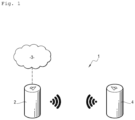
- the audio system 1 of the figure 1 comprises a connected speaker 2 which acquires an input audio stream coming from a streaming service 3 from the cloud.
- the connected speaker 2 reproduces one of the audio channels, and is responsible for retransmitting, for example via a wireless connection (Wi-Fi, Bluetooth, etc.), the input audio stream to a second connected speaker 4, which will reproduce the other path.
- the connected speakers 2 and 4 are synchronized with each other by known means.
- the connected speakers 2 and 4 must both, when they are configured for synchronized rendering of the same input audio stream, apply equalization parameters to the input audio stream to be reproduced. This therefore requires equalization application capabilities both in connected speaker 2 and in connected speaker 4.
- This master element is responsible for applying the desired equalization parameters in place of the speakers.
- the master element can be integrated into the connected speaker 2.
- the connected speaker 2 applies the equalizations and effects for its own reproduction channel, but also for the speaker's reproduction channel connected 4.
- the connected speaker 4 may be a less advanced model, not requiring the ability to apply sound processing.
- the connected speaker 2 will therefore be equipped with a more powerful processor and/or a DSP (for Digital Signal Processor), while the connected speaker 4 may have a less powerful processor and/or not have a DSP, which will reduce the cost of the connected speaker 4.
- DSP Digital Signal Processor
- the master element could be located in the broadcast service 3.
- the master element is aware of the model of the connected speaker 2 and the model of the connected speaker 4, and directly applies the desired processing to the audio stream input for optimal reproduction in a stereo configuration reproduced by speakers of the same model as the connected speakers 2 and 4.
- the connected speakers 2 and 4 therefore do not have to apply any processing to the sound signal themselves, and can therefore both be simpler (and older and less expensive) models.
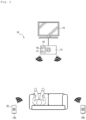
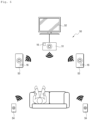
- an audio system 10 comprises a plurality of pieces of equipment, in this case a decoder box 11 and two external speakers 12: a left external speaker 12a and a right external speaker 12b.
- the decoder box 11 is located in front of the position intended for the user (and approximately in front), while the left external speaker 12a is located behind and to the left of the user, and the right external speaker 12b is located behind and to the right of the user.
- the decoder box 11 includes a video output connected to a screen 14.
- the decoder box 11 further comprises communication means by which it is connected to the two external speakers 12.
- the communication means implement a wireless connection here using a Wi-Fi protocol.
- the connection could be a another wireless connection (for example a Bluetooth connection) , or a wired connection.
- the plurality of equipment of the audio system 10 integrates audio restitution devices each comprising a loudspeaker, the audio reproduction devices forming a plurality of restitution channels.
- substitution channels are addressable audio outputs, which can receive an audio signal dedicated to this output alone.
- An external monaural speaker is considered as a single reproduction channel.
- An external stereo speaker is considered as two reproduction channels.
- Each external speaker 12 here comprises a single audio reproduction device comprising a loudspeaker.
- the audio restitution device of the left external speaker 12a therefore forms a (single) left restitution channel and the audio reproduction device of the right external speaker 12b therefore forms a (single) right restitution channel.
- the decoder box 11 for its part, is equipped here with sound reproduction capabilities. This means that it includes at least one audio reproduction device and therefore at least one speaker, and that it is at least capable of monophonic reproduction.
- the decoder box 11 may also be capable of reproducing a multichannel stream (such as for example a 5.1 stream), or even of reproducing a multichannel stream with elevation taken into account (such as for example a Dolby Atmos type stream with a 5.1.2 configuration).
- the decoder box 11 is capable of reproducing a multichannel stream and therefore comprises N (N>1) audio reproduction devices each comprising a loudspeaker.
- the decoder box 11 is capable of sending a different signal to each of its N speakers, so that we consider that the N audio reproduction devices of the decoder box 11 form N restitution channels called here front restitution channels .
- the decoder box 11 further comprises one or more processing components which implement a processing device 15 which comprises a master element 16 and a configurator element 17.
- the processing components are adapted to execute instructions of a program to put implements the steps of the treatment process which will be described below.
- the processing components include for example one or more of the following components: processor, microcontroller, programmable logic circuit such as an FPGA (for Field Programmable Gate Arrays) or an ASIC (for Application Specifies Integrated Circuit ).
- the decoder box 11 acquires an incoming stream which may be an audiovisual stream or a stream comprising only audio components.
- the incoming stream can be an external incoming stream coming from an external source: local network, satellite, cable, DVB-T (for Digital Video Broadcasting-Terrestrial ), xDSL (which can be interpreted as “digital access line” ), etc.
- the incoming flow can also be an incoming flow internal coming from a source internal to the decoder box 11, for example from an HDD type hard disk (for Hard Disk Drive).
- the decoder box 11 extracts an input audio stream from the incoming stream: either the input audio stream is a separate, distinct stream, and the extraction consists only of acquiring the input audio stream, or the decoder box 11 performs demultiplexing to obtain the input audio stream.
- the master element 16 acquires the input audio stream, and applies processing operations adapted to each restitution channel to the input audio stream, so as to produce processed audio streams each adapted to one of the restitution channels.
- the master element 16 then transmits to the left external speaker 12a the processed audio stream dedicated to it and to the right external speaker 12b the processed audio stream dedicated to it.
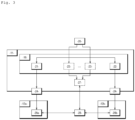
- the master element 16 of the decoder box 11 acquires the input audio stream 20, and implements a plurality of processing chains: a left processing chain 21 adapted to the left restitution channel (of the left external speaker 12a), a right processing chain 22 adapted to the right restitution channel (of the right external enclosure 12b), and N front processing chains 23 adapted to the front reproduction channels (of the decoder box 11).
- the processing chains are associated and each adapted to a distinct restitution pathway.
- Each processing chain includes a succession of several treatments and forms a “pipeline” with several stages.
- the processing operations adapted to each restitution channel and implemented in each processing chain include first of all, for each processing chain, the creation of a particular audio stream adapted to said restitution channel. Creating specific audio streams involves recalculating the target channels based on the source channels.
- Each particular audio stream is then processed in its processing chain and undergoes all or some of the following treatments to produce the desired effects adapted to the associated restitution channel: equalization, dynamic gain adjustment, relative volume adjustment, processing of bass, etc.
- equalization equalization, dynamic gain adjustment, relative volume adjustment, processing of bass, etc.
- Equalization consists, for example, of increasing the low frequency levels of audio streams transmitted to audio reproduction devices if their performance is limited in low frequencies.
- the dynamic adjustment may be an adjustment depending on both the level of the audio signal contained in the input audio stream and the acoustic characteristics of the audio reproduction devices.
- the processed audio streams therefore include a left processed audio stream adapted to the left restitution channel, a right processed audio stream adapted to the right restitution channel, and N front processed audio streams each adapted to one of the front restitution channels.
- the left processed audio stream and the right processed audio stream are then encoded (for example in Opus format) or used without encoding (PCM samples, for Pulse Code Modulation ) , and are transmitted by the master element 16 respectively to the external speaker left 12a and the right external speaker 12b (and therefore to their respective audio reproduction device).
- PCM samples for Pulse Code Modulation
- the transmission uses the communication means 24 of the decoder box 11 which make it possible to connect the decoder box 11 to the left external speaker 12a and to the right external speaker 12b.
- the audio streams processed before are transmitted internally in the decoder box 11 by the master element 16 to the restitution devices 27 of the decoder box 11.
- the left external speaker 12a, the right external speaker 12b and the decoder box 11 then carry out sound playback and therefore restitution of the processed audio streams.
- the left connected speaker 12a uses its restitution device 26a for this
- the right connected speaker 12b uses its restitution device 26b for this
- the decoder box 11 uses its restitution devices 27 for this.
- the sound readings are synchronized, via known synchronization means 28, with the video reading produced by the decoder box 11 via the screen 14, in order to ensure the consistency of the reproduction between the image and the sound.
- boxes 23 and 27 are shown in dotted lines to illustrate the fact that the decoder box 11 could perfectly integrate the master element 16 without having audio restitution capabilities.
- the master element 16 produces processed audio streams which are each adapted to one of the restitution channels.
- the left external speaker 12a and the right external speaker 12b do not apply any undesired processing (for example when they do not know the real spatial configuration) and, in particular, do not carry out processing likely to mix the processed audio streams or to modify the spatialization obtained following the processing carried out by the master element 16
- the external speakers must not carry out any processing likely to affect the separation of the channels, and must not reproduce processing already carried out by the master element 16.
- the left processed audio stream and the right processed audio stream are configured for this purpose by the master element 16.
- the configuration of a processed audio stream may consist of associating it with a specific message or a dedicated command, to indicate to the external speaker 12 not to “process” the sound. This is the most reliable way, but it is not necessarily possible to implement this means: the command does not necessarily exist, in particular if it concerns speakers not initially intended for this case of use.
- the configuration of the processed audio stream may consist of transmitting it in dual channel mode.
- Dual channel mode generally has semantics meaning that the contents of the two channels (left/right) are independent and must not be mixed.
- the dual channel mode is conventionally used to manage cases where the restitution channels (channels) of semantically different contents are conveyed simultaneously, without being stereo channels. This is for example the case when a first channel contains speech in a first language, and a second channel contains speech in a second language different from the first. These two channels, although conveyed simultaneously, are intended to be considered differently from a stereo transmission.
- Dual channel mode is for example available in the audio coding formats MPEG-1 (ISO/IEC 11172-3), MPEG-2 (ISO/IEC 13818-3 and 13818-7), and SBC (used to encode audio on Bluetooth in the AD2P profile).
- MPEG-1 ISO/IEC 11172-3
- MPEG-2 ISO/IEC 13818-3 and 13818-7
- SBC used to encode audio on Bluetooth in the AD2P profile.
- dual channel mode ensures transmission of two channels independently: no mixing of audio signals and no processing impacting spatialization are implemented by the speakers and/or decoders restoring such a flow (unlike by example in stereo mode).
- the dual channel mode is therefore diverted here from its semantics and its initial function, to ensure that the sound channels do not undergo subsequent processing and mixing likely to affect the spatialization and/or separation of the channels.
- dual channel content can contain two different channels, or the same channel twice.
- the configuration of the processed audio stream can also consist of transmitting it in monophonic mode to each of the external speakers 12a, 12b of the external stereo pair, instead of transmitting a stereo stream to the speakers.
- each of the external speakers will only receive the processed audio stream intended for it, thus preventing the speaker from being able to apply sound processing affecting the distribution of the audio channels and likely to mix the processed audio streams or modify the spatialization.
- monophonic transmissions can be advantageous in the case of a pair of external speakers capable of receiving either a stereophonic stream, or a monophonic stream for each speaker (therefore two different monophonic streams), but not being capable of correctly receive and/or process a dual-channel stream.
- each processed audio stream may consist of transmitting it in stereophonic mode, with two channels carrying the same audio signal.
- the left lane and the right lane are the same.
- This configuration is called dual mono mode.
- each of the external speakers receives a stereophonic audio stream whose two channels are identical, said stream being dedicated to said speaker. This can be advantageous if the capabilities of the external speakers do not allow the use of dual channel mode or the use of monaural mode. In this case, even if the enclosure attempted to apply processing affecting the separation of channels, this processing would be ineffective, the two channels being identical.
- the parameters of the processing chains depend of course on the spatial configuration of the different restitution devices, but also on their characteristics, in particular in terms of their sound rendering capabilities.
- the audio system 10 in question here includes the decoder box 11, which is capable of reproducing multi-channel sound, as well as two external rear speakers 12.
- the external speakers 12 are speakers whose sound reproduction capabilities are low in low frequencies (this is for example often the case for speakers intended mainly to be used in rear channels), then the channel dedicated to low frequencies (the LFE channel, for Low-Frequency Effects ) will be reproduced by the bass speaker of the decoder box 11.
- the external speakers 12 are more qualitative speakers, with good bass reproduction capabilities, it is desirable to have them reproduce the LFE channel instead of the decoder box 11 (which has a more limited physical volume to reproduce low frequencies).
- the source signal channel will be mixed with the rear channels to create the signals intended for the external rear speakers 12, so that the low frequencies are reproduced by these speakers.
- the decoder box 11 which has sound reproduction capabilities, was initially used alone by the user, and that the user subsequently added speakers additional, which are the external speakers 12.
- the processing chains implemented are of course different in the case where the decoder box 11 is used alone (all the source channels are then restored, after processing, by the decoder box 11) and in the case where the decoder box 11 is used in conjunction with the pair of external speakers 12.
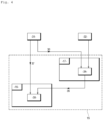
- the configurator element 17 acquires input parameters comprising first characteristics 30 of the input audio stream 31 and second characteristics 32 of the audio restitution devices.
- Analysis means 34 of the configurator element 17 analyze the input parameters and produce configuration parameters 35 from the input parameters.
- the first characteristics 30 of the input audio stream 31 include a number of source channels of the input audio stream 31 and a spatial configuration of the input audio stream 31.
- the second characteristics 32 of the audio restitution devices include restitution information relating to the acoustic capacities of the audio reproduction devices and to a spatial configuration of the restitution channels.
- the master element 16 then acquires, in addition to sound samples 37 from the input audio stream 31, the configuration parameters 35, and defines from the configuration parameters 35 the different processing chains 38.
- the configuration parameters 35 may include parameters used in strings treatments 38.
- the configuration parameters 35 can designate the treatments to be carried out in the different processing chains 38: it is then the configurator element 17 which selects the processing chains 38, and the master element 16 which puts them implemented.
- the configurator element 17 can acquire the restitution information associated with the audio reproduction devices of the external speakers 12 via dedicated messages transmitted by the external speakers 12.
- the configurator element 17 can also acquire the restitution information associated with the audio reproduction devices external speakers 12 via an application programming interface (API) cooperating with a pre-filled database.
- API application programming interface
- the API allows you to know the model of the external speakers 12, and the pre-populated database includes information on the speaker models. This information can also be obtained by the configurator element 17 from the master element 16 which will relay the information on the audio restitution devices whose processing chains it manages.
- the entire processing device 15 that is to say the master element 16 and the configurator element 17, is integrated into the same physical equipment (the decoder box 11 in this case).
- the master element 16 and the configurator element 17 could be integrated into two different physical equipment. We can have in the audio system two distinct pieces of equipment comprising master equipment in which the master element 16 is implemented and configurator equipment in which the configurator element 17 is implemented.
- the configurator element 17 could be integrated into a decoder box (which is then the configurator equipment), and the master element 16 in a connected external enclosure equipped with sufficient processing capabilities (the connected enclosure is then master equipment). This reduces the processor load required in the decoder box.
- the master element 16 is distributed among several pieces of equipment. We then have several master elements 16. We thus have at least two distinct pieces of equipment comprising at least two master pieces of equipment in each of which a master element 16 is implemented.
- the audio system 40 comprises a decoder box 41 connected to a screen 42, as well as two connected speakers 43 and two auxiliary speakers 44.
- the decoder box 41 does not include an audio reproduction device (and therefore no speaker), and has low processing capabilities.
- the decoder box 41 is connected via Wi-Fi to a left connected speaker 43a and to a right connected speaker 43b, which act as front channels.
- the left connected speaker 43a is connected via Bluetooth to a left auxiliary speaker 44a.
- the right connected speaker 43b is connected via Bluetooth to a right auxiliary speaker 44b.
- the left auxiliary speaker 44a and the right auxiliary speaker 44b act as rear channels.
- the configurator element 17 is located in the decoder box 41.
- the two connected speakers 43 fulfill the function of master element, which makes it possible to reduce the processor load of the decoder box 41.
- the two connected speakers 43 are therefore two pieces of equipment masters.
- the left connected speaker 43a will therefore take charge of the processing chains for the two left speakers, that is to say for the left connected speaker 43a and the left auxiliary speaker 44a.
- the right connected speaker 43b will therefore take charge of the processing chains for the two right speakers, that is to say for the right connected speaker 43b and the right auxiliary speaker 44b.
- an audio system 50 again comprises a decoder box 51 connected to a screen 52, two connected speakers 53 and two connected speakers 54.
- the decoder box 51 is equipped with speakers and receives the input audio stream.
- the decoder box 51 is connected via Wi-Fi to the two connected speakers 53 acting as front channels.
- the two 53 connected speakers are equipped with advanced processing capabilities.
- the decoder box 51 is also connected via Wi-Fi to the two other connected speakers 54 serving as rear channels, and having only low processing capacities.
- the decoder box 51 will manage the processing chains for itself and for the connected speakers 54, while the connected speakers 53 will each manage their own processing chain. In this way, the processing resources of the decoder box 51 are preserved as much as possible, in order to possibly be able to use them for other uses (for example to implement an advanced graphical interface).
- the three master devices are the decoder box 51 and the connected speakers 53.
Landscapes
- Engineering & Computer Science (AREA)
- Physics & Mathematics (AREA)
- Acoustics & Sound (AREA)
- Signal Processing (AREA)
- Theoretical Computer Science (AREA)
- Health & Medical Sciences (AREA)
- General Health & Medical Sciences (AREA)
- Human Computer Interaction (AREA)
- Audiology, Speech & Language Pathology (AREA)
- Multimedia (AREA)
- General Engineering & Computer Science (AREA)
- General Physics & Mathematics (AREA)
- Otolaryngology (AREA)
- Stereophonic System (AREA)
- Circuit For Audible Band Transducer (AREA)
Claims (14)
- Verarbeitungsvorrichtung (15) zur Verarbeitung eines Eingangsaudiostroms (31), die ausgebildet ist, in ein Audiosystem integriert zu werden, das eine Vielzahl von Ausrüstungen umfasst, in die Audiowiedergabevorrichtungen integriert sind, die jeweils einen Lautsprecher umfassen, wobei die Audiowiedergabevorrichtungen ausgebildet sind, eine Vielzahl von Wiedergabekanälen zu bilden, wobei die Verarbeitungsvorrichtung (15) umfasst:- ein Konfigurationselement (17), das ausgebildet ist, Eingangsparameter zu erfassen, die erste Charakteristika (30) des Eingangsaudiostroms und zweite Charakteristika (32) der Audiowiedergabevorrichtungen umfassen, und Konfigurationsparameter (35) anhand der Eingangsparameter zu erzeugen;- ein Master-Element (16), das ausgebildet ist, den Eingangsaudiostrom sowie die Konfigurationsparameter (35) zu erfassen, um anhand der Konfigurationsparameter Verarbeitungsketten (21, 22, 23) zu definieren und auf den Eingangsaudiostrom anzuwenden, wobei die Verarbeitungsketten jeweils einem Wiedergabekanal zugeordnet und an diesen angepasst sind, um verarbeitete Audioströme zu erzeugen, die jeweils an einen der Wiedergabekanäle angepasst sind und eine Verräumlichung definieren, und an jede Ausrüstung, die eine Audiowiedergabevorrichtung umfasst, den verarbeiteten Audiostrom zu übertragen, der an den Wiedergabekanal angepasst ist, zu dem die Audiowiedergabevorrichtung gehört, dadurch gekennzeichnet, dass die verarbeiteten Audioströme durch das Master-Element so konfiguriert werden, dass die Ausrüstungen, die die verarbeiteten Audioströme von dem Master-Element empfangen, keine Verarbeitung durchführen, die die genannten verarbeiteten Audioströme mischen könnte oder die Verräumlichung modifizieren könnte, wobei die Konfiguration jedes verarbeiteten Audiostroms darin besteht, ihn in einem Zweikanalmodus zu übertragen, wobei der verarbeitete Audiostrom in einem Format ist, in dem der Zweikanalmodus verfügbar ist, wie MPEG-1 oder MPEG-2 oder SBC,wobei die Konfiguration jedes verarbeiteten Audiostroms darin besteht, ihn in einem Stereomodus zu übertragen, mit zwei Kanälen, die ein selbes Audiosignal übertragen.
oder - Verarbeitungsvorrichtung nach Anspruch 1, bei der die Verarbeitungskette, die einem Wiedergabekanal zugeordnet und an diesen angepasst ist, Verarbeitungen durchführt, die die Erzeugung eines besonderen Audiostroms umfassen, der an den genannten Wiedergabekanal angepasst ist, und/oder eine Entzerrung und/oder eine dynamische Anpassung einer Verstärkung und/oder eine Anpassung eines relativen Volumens, die an dem besonderen Audiostrom durchgeführt wird, um den verarbeiteten Audiostrom zu erzeugen, der an den genannten Wiedergabekanal angepasst ist.
- Verarbeitungsvorrichtung nach einem der vorhergehenden Ansprüche, bei der die ersten Charakteristika des Eingangsaudiostroms eine Anzahl von Quellkanälen des Eingangsaudiostroms und eine räumliche Konfiguration des Eingangsaudiostroms umfassen.
- Verarbeitungsvorrichtung nach einem der vorhergehenden Ansprüche, bei dem die zweiten Charakteristika der Audiowiedergabevorrichtungen Wiedergabeinformationen bezüglich der akustischen Fähigkeiten der Audiowiedergabevorrichtungen und bezüglich einer räumlichen Konfiguration der Wiedergabekanäle umfassen.
- Verarbeitungsvorrichtung nach Anspruch 4, bei der die Wiedergabeinformationen von dem Konfigurationselement (17) über eine Anwendungsprogrammierschnittstelle erfasst werden, die mit einer vorgefüllten Datenbank zusammenwirkt, ober über ein Empfangen von dedizierten Nachrichten, die von den Ausrüstungen, in denen die genannten Audiowiedergabevorrichtungen integriert sind, emittiert werden, oder von dem Master-Element (16) an das Konfigurationselement (17) übertragen werden.
- Ausrüstung, umfassend eine Verarbeitungsvorrichtung (15) nach einem der vorhergehenden Ansprüche.
- Ausrüstung nach Anspruch 6, wobei die Ausrüstung eine Set-Top-Box (11) ist.
- Audiosystem, umfassend eine Vielzahl von Ausrüstungen, in die Audiowiedergabevorrichtungen integriert sind, die jeweils einen Lautsprecher umfassen, wobei das Audiosystem eine Verarbeitungsvorrichtung (15) nach einem der Ansprüche 1 bis 5 umfasst, die von mindestens zwei verschiedenen Ausrüstungen implementiert wird.
- Audiosystem nach Anspruch 8, bei dem die mindestens zwei verschiedenen Ausrüstungen eine Master-Ausrüstung umfassen, in der das Master-Element (16) implementiert ist, und eine Konfigurationsausrüstung, in der das Konfigurationselement (17) implementiert ist.
- Audiosystem nach Anspruch 8, bei dem die mindestens zwei verschiedenen Ausrüstungen mindestens zwei Master-Ausrüstungen (43; 51, 53) umfassen, in denen jeweils ein Master-Element (16) implementiert ist.
- Verarbeitungsverfahren, das in einer Verarbeitungsvorrichtung nach einem der Ansprüche 1 bis 5 durchgeführt wird, und umfassend die Schritte:- Erfassen der Eingangsparameter, die erste Charakteristika (30) des Eingangsaudiostroms und zweite Charakteristika (31) der Audiowiedergabevorrichtungen umfassen, und Erzeugen von Konfigurationsparametern (35) anhand der Eingangsparameter;- Erfassen des Eingangsaudiostroms sowie der Konfigurationsparameter (35), Definieren von Verarbeitungsketten (21, 22, 23) anhand der Konfigurationsparameter und Anwenden der Verarbeitungsketten auf den Eingangsaudiostrom, wobei die Verarbeitungsketten jeweils einem Wiedergabekanal zugeordnet und daran angepasst sind, um verarbeitete Audioströme zu erzeugen, die jeweils an einen der Wiedergabekanäle angepasst sind, und Übertragen des verarbeiteten Audiostroms, der an den Wiedergabekanal angepasst ist, zu dem die genannte Audiowiedergabevorrichtung gehört, an jede Ausrüstung, die eine Audiowiedergabevorrichtung umfasst.
- Computerprogramm, das Anweisungen umfasst, die die Verarbeitungsvorrichtung nach einem der Ansprüche 1 bis 5 veranlassen, die Schritte des Verarbeitungsverfahrens nach Anspruch 11 auszuführen.
- Computerlesbarer Aufzeichnungsträger, auf dem das Computerprogramm nach Anspruch 12 gespeichert ist.
- Audiosystem, umfassend eine Vielzahl von Ausrüstungen, in die Audiowiedervorrichtungen integriert sind, die jeweils einen Lautsprecher umfassen, wobei die Audiowiedergabevorrichtungen ausgebildet sind, eine Vielzahl von Wiedergabekanälen zu bilden, wobei das Audiosystem eine Verarbeitungsvorrichtung (15) zur Verarbeitung eines Eingangsaudiostroms (31) umfasst, wobei die Verarbeitungsvorrichtung (15) umfasst:- ein Konfigurationselement (17), das ausgebildet ist, Eingangsparameter zu erfassen, die erste Charakteristika (30) des Eingangsaudiostroms und zweite Charakteristika (32) der Audiowiedergabevorrichtungen umfassen, und Konfigurationsparameter (35) anhand der Eingangsparameter zu erzeugen;- ein Master-Element (16), das ausgebildet ist, den Eingangsaudiostrom sowie die Konfigurationsparameter (35) zu erfassen, um anhand der Konfigurationsparameter Verarbeitungsketten (21, 22, 23) zu definieren und auf den Eingangsaudiostrom anzuwenden, wobei die Verarbeitungsketten jeweils einem Wiedergabekanal zugeordnet und an diesen angepasst sind, um verarbeitete Audioströme zu erzeugen, die jeweils an einen der Wiedergabekanäle angepasst sind und eine Verräumlichung definieren, und an jede Ausrüstung des Audiosystems, die eine Audiowiedergabevorrichtung umfasst, den verarbeiteten Audiostrom zu übertragen, der an den Wiedergabekanal angepasst ist, zu dem die Audiowiedergabevorrichtung gehört, wobei die verarbeiteten Audioströme durch das Master-Element konfiguriert werden, dadurch gekennzeichnet, dass die Ausrüstungen des Audiosystems ausgebildet sind, gemäß einem ersten Modus zu funktionieren, in dem sie Verarbeitungen implementieren, die die genannten verarbeiteten Audioströme vermischen könnten oder die Verräumlichung modifizieren könnten,und gemäß einem zweiten Modus, in dem sie die genannten Verarbeitungen nicht implementieren, wobei die Konfiguration jedes verarbeiteten Audiostroms darin besteht, ihm eine spezifische Nachricht oder einen dedizierten Befehl zuzuordnen, wobei die spezifische Nachricht oder der dedizierte Befehl derart ist, dass die sie empfangenden Ausrüstungen gemäß dem zweiten Modus funktionieren.
Applications Claiming Priority (1)
| Application Number | Priority Date | Filing Date | Title |
|---|---|---|---|
| FR2005773A FR3111040B1 (fr) | 2020-06-02 | 2020-06-02 | Traitement centralisé d’un flux audio d’entrée |
Publications (2)
| Publication Number | Publication Date |
|---|---|
| EP3920552A1 EP3920552A1 (de) | 2021-12-08 |
| EP3920552B1 true EP3920552B1 (de) | 2023-09-13 |
Family
ID=72801584
Family Applications (1)
| Application Number | Title | Priority Date | Filing Date |
|---|---|---|---|
| EP21175742.2A Active EP3920552B1 (de) | 2020-06-02 | 2021-05-25 | Zentralisierte verarbeitung eines eingangs-audiodatenstroms |
Country Status (3)
| Country | Link |
|---|---|
| US (1) | US11924622B2 (de) |
| EP (1) | EP3920552B1 (de) |
| FR (1) | FR3111040B1 (de) |
Families Citing this family (3)
| Publication number | Priority date | Publication date | Assignee | Title |
|---|---|---|---|---|
| US12573407B2 (en) | 2022-10-26 | 2026-03-10 | Sony Group Corporation | Quick audio profile using voice assistant |
| US12602197B2 (en) * | 2023-01-10 | 2026-04-14 | Sony Group Corporation | Configuration of platform application with audio profile of a user |
| US12294457B2 (en) * | 2023-09-29 | 2025-05-06 | Qualcomm Incorporated | Techniques for stereo on peripheral devices |
Family Cites Families (7)
| Publication number | Priority date | Publication date | Assignee | Title |
|---|---|---|---|---|
| JP4368210B2 (ja) * | 2004-01-28 | 2009-11-18 | ソニー株式会社 | 送受信システム、送信装置およびスピーカ搭載機器 |
| CA2839088A1 (en) * | 2011-06-13 | 2012-12-20 | Shakeel Naksh Bandi P Pyarejan SYED | System for producing 3 dimensional digital stereo surround sound natural 360 degrees (3d dssr n-360) |
| US9723406B2 (en) * | 2015-01-21 | 2017-08-01 | Qualcomm Incorporated | System and method for changing a channel configuration of a set of audio output devices |
| US9763280B1 (en) * | 2016-06-21 | 2017-09-12 | International Business Machines Corporation | Mobile device assignment within wireless sound system based on device specifications |
| WO2019208012A1 (ja) * | 2018-04-24 | 2019-10-31 | ソニー株式会社 | 信号処理装置、チャネル設定方法、プログラム、スピーカシステム |
| CN109951767A (zh) * | 2019-03-11 | 2019-06-28 | 青岛海信传媒网络技术有限公司 | 一种音频信号播放方法及装置 |
| CN112073890B (zh) * | 2020-09-11 | 2022-08-02 | 成都极米科技股份有限公司 | 音频数据处理方法、装置和终端设备 |
-
2020
- 2020-06-02 FR FR2005773A patent/FR3111040B1/fr not_active Expired - Fee Related
-
2021
- 2021-05-25 EP EP21175742.2A patent/EP3920552B1/de active Active
- 2021-06-02 US US17/337,128 patent/US11924622B2/en active Active
Also Published As
| Publication number | Publication date |
|---|---|
| US20210377687A1 (en) | 2021-12-02 |
| EP3920552A1 (de) | 2021-12-08 |
| FR3111040B1 (fr) | 2022-07-01 |
| FR3111040A1 (fr) | 2021-12-03 |
| US11924622B2 (en) | 2024-03-05 |
Similar Documents
| Publication | Publication Date | Title |
|---|---|---|
| EP1992198B1 (de) | Optimierung des binauralen raumklangeffektes durch mehrkanalkodierung | |
| RU2661775C2 (ru) | Передача сигнальной информации рендеринга аудио в битовом потоке | |
| EP3826316B1 (de) | Decodiergerät, das eine anweisung eines anzuwendenden audioprofils erzeugt | |
| CN108616800B (zh) | 音频的播放方法和装置、存储介质、电子装置 | |
| EP3920552A1 (de) | Zentralisierte verarbeitung eines eingangs-audiodatenstroms | |
| EP2042001A1 (de) | Binaurale spatialisierung kompressionsverschlüsselter tondaten | |
| EP3329489A1 (de) | Auf codierten audiometadaten basierte entzerrung | |
| EP3254389A1 (de) | Gerät zum empfangen und lesen von audiosignalen und live-ton-anlage | |
| EP3840388B1 (de) | Dual audio-link decoder ausrüstung | |
| EP3475943A1 (de) | Verfahren zur umwandlung, stereophonen codierung, decodierung und transcodierung eines dreidimensionalen audiosignals | |
| EP4135350A1 (de) | Verarbeitung eines monophonen signals in einem 3d-audiodekoder zur darstellung binauraler inhalte | |
| EP3842923A1 (de) | Vernetzte box mit einer lan- und einer wpan-schnittstelle | |
| FR3065137A1 (fr) | Procede de spatialisation sonore | |
| EP1886535B1 (de) | Verfahren zum herstellen mehrerer zeitsignale | |
| EP1994526B1 (de) | Gemeinsame schallsynthese und -spatialisierung | |
| EP4203486B1 (de) | Set-top-box zur wiedergabe einer zusätzlichen audiospur | |
| CA2616484A1 (fr) | Systeme de diffusion sonore | |
| EP4199502B1 (de) | Vorrichtung und verfahren zur synchronisierten audio-video-wiedergabe | |
| FR3161334A1 (fr) | Restitution d’un signal audio multicanal | |
| EP3890348B1 (de) | Audioinstallation und verfahren zur anwendung eines satzes von ausgleichsparametern | |
| EP3108670B1 (de) | Verfahren und vorrichtung zur wiedergabe eines mehrkanalaudiosignals in einer hörzone | |
| WO2006075079A1 (fr) | Procede d’encodage de pistes audio d’un contenu multimedia destine a une diffusion sur terminaux mobiles | |
| EP4018674A1 (de) | Remote-tonwiedergabesystem mit einem digitalen audiosender, der durch mindestens zwei drahtlose verbindungen mit einem digitalen audioempfänger verbunden ist | |
| FR3026541A1 (fr) | Systeme de restitution sonore avec casques audio dotes de processeurs sonores, composants d'un tel systeme et procede associe | |
| FR2931614A1 (fr) | Procede de restitution d'un canal de donnees audio, produit programme d'ordinateur, moyen de stockage et premier dispositif recepteur correspondants |
Legal Events
| Date | Code | Title | Description |
|---|---|---|---|
| PUAI | Public reference made under article 153(3) epc to a published international application that has entered the european phase |
Free format text: ORIGINAL CODE: 0009012 |
|
| STAA | Information on the status of an ep patent application or granted ep patent |
Free format text: STATUS: EXAMINATION IS IN PROGRESS |
|
| 17P | Request for examination filed |
Effective date: 20210525 |
|
| AK | Designated contracting states |
Kind code of ref document: A1 Designated state(s): AL AT BE BG CH CY CZ DE DK EE ES FI FR GB GR HR HU IE IS IT LI LT LU LV MC MK MT NL NO PL PT RO RS SE SI SK SM TR |
|
| B565 | Issuance of search results under rule 164(2) epc |
Effective date: 20211027 |
|
| GRAP | Despatch of communication of intention to grant a patent |
Free format text: ORIGINAL CODE: EPIDOSNIGR1 |
|
| STAA | Information on the status of an ep patent application or granted ep patent |
Free format text: STATUS: GRANT OF PATENT IS INTENDED |
|
| INTG | Intention to grant announced |
Effective date: 20230418 |
|
| GRAS | Grant fee paid |
Free format text: ORIGINAL CODE: EPIDOSNIGR3 |
|
| GRAA | (expected) grant |
Free format text: ORIGINAL CODE: 0009210 |
|
| STAA | Information on the status of an ep patent application or granted ep patent |
Free format text: STATUS: THE PATENT HAS BEEN GRANTED |
|
| AK | Designated contracting states |
Kind code of ref document: B1 Designated state(s): AL AT BE BG CH CY CZ DE DK EE ES FI FR GB GR HR HU IE IS IT LI LT LU LV MC MK MT NL NO PL PT RO RS SE SI SK SM TR |
|
| REG | Reference to a national code |
Ref country code: CH Ref legal event code: EP |
|
| REG | Reference to a national code |
Ref country code: DE Ref legal event code: R096 Ref document number: 602021005070 Country of ref document: DE |
|
| REG | Reference to a national code |
Ref country code: IE Ref legal event code: FG4D Free format text: LANGUAGE OF EP DOCUMENT: FRENCH |
|
| RAP4 | Party data changed (patent owner data changed or rights of a patent transferred) |
Owner name: SAGEMCOM BROADBAND SAS |
|
| REG | Reference to a national code |
Ref country code: LT Ref legal event code: MG9D |
|
| REG | Reference to a national code |
Ref country code: NL Ref legal event code: MP Effective date: 20230913 |
|
| PG25 | Lapsed in a contracting state [announced via postgrant information from national office to epo] |
Ref country code: GR Free format text: LAPSE BECAUSE OF FAILURE TO SUBMIT A TRANSLATION OF THE DESCRIPTION OR TO PAY THE FEE WITHIN THE PRESCRIBED TIME-LIMIT Effective date: 20231214 |
|
| PG25 | Lapsed in a contracting state [announced via postgrant information from national office to epo] |
Ref country code: SE Free format text: LAPSE BECAUSE OF FAILURE TO SUBMIT A TRANSLATION OF THE DESCRIPTION OR TO PAY THE FEE WITHIN THE PRESCRIBED TIME-LIMIT Effective date: 20230913 Ref country code: RS Free format text: LAPSE BECAUSE OF FAILURE TO SUBMIT A TRANSLATION OF THE DESCRIPTION OR TO PAY THE FEE WITHIN THE PRESCRIBED TIME-LIMIT Effective date: 20230913 Ref country code: NO Free format text: LAPSE BECAUSE OF FAILURE TO SUBMIT A TRANSLATION OF THE DESCRIPTION OR TO PAY THE FEE WITHIN THE PRESCRIBED TIME-LIMIT Effective date: 20231213 Ref country code: LV Free format text: LAPSE BECAUSE OF FAILURE TO SUBMIT A TRANSLATION OF THE DESCRIPTION OR TO PAY THE FEE WITHIN THE PRESCRIBED TIME-LIMIT Effective date: 20230913 Ref country code: LT Free format text: LAPSE BECAUSE OF FAILURE TO SUBMIT A TRANSLATION OF THE DESCRIPTION OR TO PAY THE FEE WITHIN THE PRESCRIBED TIME-LIMIT Effective date: 20230913 Ref country code: HR Free format text: LAPSE BECAUSE OF FAILURE TO SUBMIT A TRANSLATION OF THE DESCRIPTION OR TO PAY THE FEE WITHIN THE PRESCRIBED TIME-LIMIT Effective date: 20230913 Ref country code: GR Free format text: LAPSE BECAUSE OF FAILURE TO SUBMIT A TRANSLATION OF THE DESCRIPTION OR TO PAY THE FEE WITHIN THE PRESCRIBED TIME-LIMIT Effective date: 20231214 Ref country code: FI Free format text: LAPSE BECAUSE OF FAILURE TO SUBMIT A TRANSLATION OF THE DESCRIPTION OR TO PAY THE FEE WITHIN THE PRESCRIBED TIME-LIMIT Effective date: 20230913 |
|
| REG | Reference to a national code |
Ref country code: AT Ref legal event code: MK05 Ref document number: 1612501 Country of ref document: AT Kind code of ref document: T Effective date: 20230913 |
|
| PG25 | Lapsed in a contracting state [announced via postgrant information from national office to epo] |
Ref country code: NL Free format text: LAPSE BECAUSE OF FAILURE TO SUBMIT A TRANSLATION OF THE DESCRIPTION OR TO PAY THE FEE WITHIN THE PRESCRIBED TIME-LIMIT Effective date: 20230913 |
|
| PG25 | Lapsed in a contracting state [announced via postgrant information from national office to epo] |
Ref country code: IS Free format text: LAPSE BECAUSE OF FAILURE TO SUBMIT A TRANSLATION OF THE DESCRIPTION OR TO PAY THE FEE WITHIN THE PRESCRIBED TIME-LIMIT Effective date: 20240113 |
|
| PG25 | Lapsed in a contracting state [announced via postgrant information from national office to epo] |
Ref country code: AT Free format text: LAPSE BECAUSE OF FAILURE TO SUBMIT A TRANSLATION OF THE DESCRIPTION OR TO PAY THE FEE WITHIN THE PRESCRIBED TIME-LIMIT Effective date: 20230913 |
|
| PG25 | Lapsed in a contracting state [announced via postgrant information from national office to epo] |
Ref country code: ES Free format text: LAPSE BECAUSE OF FAILURE TO SUBMIT A TRANSLATION OF THE DESCRIPTION OR TO PAY THE FEE WITHIN THE PRESCRIBED TIME-LIMIT Effective date: 20230913 |
|
| PG25 | Lapsed in a contracting state [announced via postgrant information from national office to epo] |
Ref country code: SM Free format text: LAPSE BECAUSE OF FAILURE TO SUBMIT A TRANSLATION OF THE DESCRIPTION OR TO PAY THE FEE WITHIN THE PRESCRIBED TIME-LIMIT Effective date: 20230913 Ref country code: RO Free format text: LAPSE BECAUSE OF FAILURE TO SUBMIT A TRANSLATION OF THE DESCRIPTION OR TO PAY THE FEE WITHIN THE PRESCRIBED TIME-LIMIT Effective date: 20230913 Ref country code: IS Free format text: LAPSE BECAUSE OF FAILURE TO SUBMIT A TRANSLATION OF THE DESCRIPTION OR TO PAY THE FEE WITHIN THE PRESCRIBED TIME-LIMIT Effective date: 20240113 Ref country code: ES Free format text: LAPSE BECAUSE OF FAILURE TO SUBMIT A TRANSLATION OF THE DESCRIPTION OR TO PAY THE FEE WITHIN THE PRESCRIBED TIME-LIMIT Effective date: 20230913 Ref country code: EE Free format text: LAPSE BECAUSE OF FAILURE TO SUBMIT A TRANSLATION OF THE DESCRIPTION OR TO PAY THE FEE WITHIN THE PRESCRIBED TIME-LIMIT Effective date: 20230913 Ref country code: CZ Free format text: LAPSE BECAUSE OF FAILURE TO SUBMIT A TRANSLATION OF THE DESCRIPTION OR TO PAY THE FEE WITHIN THE PRESCRIBED TIME-LIMIT Effective date: 20230913 Ref country code: AT Free format text: LAPSE BECAUSE OF FAILURE TO SUBMIT A TRANSLATION OF THE DESCRIPTION OR TO PAY THE FEE WITHIN THE PRESCRIBED TIME-LIMIT Effective date: 20230913 Ref country code: PT Free format text: LAPSE BECAUSE OF FAILURE TO SUBMIT A TRANSLATION OF THE DESCRIPTION OR TO PAY THE FEE WITHIN THE PRESCRIBED TIME-LIMIT Effective date: 20240115 Ref country code: SK Free format text: LAPSE BECAUSE OF FAILURE TO SUBMIT A TRANSLATION OF THE DESCRIPTION OR TO PAY THE FEE WITHIN THE PRESCRIBED TIME-LIMIT Effective date: 20230913 |
|
| PG25 | Lapsed in a contracting state [announced via postgrant information from national office to epo] |
Ref country code: PL Free format text: LAPSE BECAUSE OF FAILURE TO SUBMIT A TRANSLATION OF THE DESCRIPTION OR TO PAY THE FEE WITHIN THE PRESCRIBED TIME-LIMIT Effective date: 20230913 Ref country code: IT Free format text: LAPSE BECAUSE OF FAILURE TO SUBMIT A TRANSLATION OF THE DESCRIPTION OR TO PAY THE FEE WITHIN THE PRESCRIBED TIME-LIMIT Effective date: 20230913 |
|
| REG | Reference to a national code |
Ref country code: DE Ref legal event code: R097 Ref document number: 602021005070 Country of ref document: DE |
|
| PG25 | Lapsed in a contracting state [announced via postgrant information from national office to epo] |
Ref country code: DK Free format text: LAPSE BECAUSE OF FAILURE TO SUBMIT A TRANSLATION OF THE DESCRIPTION OR TO PAY THE FEE WITHIN THE PRESCRIBED TIME-LIMIT Effective date: 20230913 |
|
| PLBE | No opposition filed within time limit |
Free format text: ORIGINAL CODE: 0009261 |
|
| STAA | Information on the status of an ep patent application or granted ep patent |
Free format text: STATUS: NO OPPOSITION FILED WITHIN TIME LIMIT |
|
| PG25 | Lapsed in a contracting state [announced via postgrant information from national office to epo] |
Ref country code: DK Free format text: LAPSE BECAUSE OF FAILURE TO SUBMIT A TRANSLATION OF THE DESCRIPTION OR TO PAY THE FEE WITHIN THE PRESCRIBED TIME-LIMIT Effective date: 20230913 |
|
| 26N | No opposition filed |
Effective date: 20240614 |
|
| PG25 | Lapsed in a contracting state [announced via postgrant information from national office to epo] |
Ref country code: SI Free format text: LAPSE BECAUSE OF FAILURE TO SUBMIT A TRANSLATION OF THE DESCRIPTION OR TO PAY THE FEE WITHIN THE PRESCRIBED TIME-LIMIT Effective date: 20230913 |
|
| PG25 | Lapsed in a contracting state [announced via postgrant information from national office to epo] |
Ref country code: SI Free format text: LAPSE BECAUSE OF FAILURE TO SUBMIT A TRANSLATION OF THE DESCRIPTION OR TO PAY THE FEE WITHIN THE PRESCRIBED TIME-LIMIT Effective date: 20230913 |
|
| PG25 | Lapsed in a contracting state [announced via postgrant information from national office to epo] |
Ref country code: BG Free format text: LAPSE BECAUSE OF FAILURE TO SUBMIT A TRANSLATION OF THE DESCRIPTION OR TO PAY THE FEE WITHIN THE PRESCRIBED TIME-LIMIT Effective date: 20230913 |
|
| PG25 | Lapsed in a contracting state [announced via postgrant information from national office to epo] |
Ref country code: BG Free format text: LAPSE BECAUSE OF FAILURE TO SUBMIT A TRANSLATION OF THE DESCRIPTION OR TO PAY THE FEE WITHIN THE PRESCRIBED TIME-LIMIT Effective date: 20230913 |
|
| REG | Reference to a national code |
Ref country code: CH Ref legal event code: PL |
|
| PG25 | Lapsed in a contracting state [announced via postgrant information from national office to epo] |
Ref country code: MC Free format text: LAPSE BECAUSE OF FAILURE TO SUBMIT A TRANSLATION OF THE DESCRIPTION OR TO PAY THE FEE WITHIN THE PRESCRIBED TIME-LIMIT Effective date: 20230913 |
|
| PG25 | Lapsed in a contracting state [announced via postgrant information from national office to epo] |
Ref country code: LU Free format text: LAPSE BECAUSE OF NON-PAYMENT OF DUE FEES Effective date: 20240525 |
|
| PG25 | Lapsed in a contracting state [announced via postgrant information from national office to epo] |
Ref country code: MC Free format text: LAPSE BECAUSE OF FAILURE TO SUBMIT A TRANSLATION OF THE DESCRIPTION OR TO PAY THE FEE WITHIN THE PRESCRIBED TIME-LIMIT Effective date: 20230913 Ref country code: LU Free format text: LAPSE BECAUSE OF NON-PAYMENT OF DUE FEES Effective date: 20240525 Ref country code: CH Free format text: LAPSE BECAUSE OF NON-PAYMENT OF DUE FEES Effective date: 20240531 |
|
| REG | Reference to a national code |
Ref country code: BE Ref legal event code: MM Effective date: 20240531 |
|
| PG25 | Lapsed in a contracting state [announced via postgrant information from national office to epo] |
Ref country code: IE Free format text: LAPSE BECAUSE OF NON-PAYMENT OF DUE FEES Effective date: 20240525 |
|
| PG25 | Lapsed in a contracting state [announced via postgrant information from national office to epo] |
Ref country code: BE Free format text: LAPSE BECAUSE OF NON-PAYMENT OF DUE FEES Effective date: 20240531 |
|
| PGFP | Annual fee paid to national office [announced via postgrant information from national office to epo] |
Ref country code: DE Payment date: 20250423 Year of fee payment: 5 |
|
| PGFP | Annual fee paid to national office [announced via postgrant information from national office to epo] |
Ref country code: GB Payment date: 20250423 Year of fee payment: 5 |
|
| PGFP | Annual fee paid to national office [announced via postgrant information from national office to epo] |
Ref country code: FR Payment date: 20250423 Year of fee payment: 5 |
|
| PG25 | Lapsed in a contracting state [announced via postgrant information from national office to epo] |
Ref country code: HU Free format text: LAPSE BECAUSE OF FAILURE TO SUBMIT A TRANSLATION OF THE DESCRIPTION OR TO PAY THE FEE WITHIN THE PRESCRIBED TIME-LIMIT; INVALID AB INITIO Effective date: 20210525 |
|
| PG25 | Lapsed in a contracting state [announced via postgrant information from national office to epo] |
Ref country code: CY Free format text: LAPSE BECAUSE OF FAILURE TO SUBMIT A TRANSLATION OF THE DESCRIPTION OR TO PAY THE FEE WITHIN THE PRESCRIBED TIME-LIMIT; INVALID AB INITIO Effective date: 20210525 |