EP3919906B1 - Verfahren zur immunologischen analyse von freiem aim in einer biologischen probe und verfahren zum nachweis von nash in einem subjekt - Google Patents
Verfahren zur immunologischen analyse von freiem aim in einer biologischen probe und verfahren zum nachweis von nash in einem subjekt Download PDFInfo
- Publication number
- EP3919906B1 EP3919906B1 EP20749087.1A EP20749087A EP3919906B1 EP 3919906 B1 EP3919906 B1 EP 3919906B1 EP 20749087 A EP20749087 A EP 20749087A EP 3919906 B1 EP3919906 B1 EP 3919906B1
- Authority
- EP
- European Patent Office
- Prior art keywords
- aim
- antibody
- free
- igm
- free aim
- Prior art date
- Legal status (The legal status is an assumption and is not a legal conclusion. Google has not performed a legal analysis and makes no representation as to the accuracy of the status listed.)
- Active
Links
Images


Classifications
-
- G—PHYSICS
- G01—MEASURING; TESTING
- G01N—INVESTIGATING OR ANALYSING MATERIALS BY DETERMINING THEIR CHEMICAL OR PHYSICAL PROPERTIES
- G01N33/00—Investigating or analysing materials by specific methods not covered by groups G01N1/00 - G01N31/00
- G01N33/48—Biological material, e.g. blood, urine; Haemocytometers
- G01N33/50—Chemical analysis of biological material, e.g. blood, urine; Testing involving biospecific ligand binding methods; Immunological testing
- G01N33/68—Chemical analysis of biological material, e.g. blood, urine; Testing involving biospecific ligand binding methods; Immunological testing involving proteins, peptides or amino acids
- G01N33/6893—Chemical analysis of biological material, e.g. blood, urine; Testing involving biospecific ligand binding methods; Immunological testing involving proteins, peptides or amino acids related to diseases not provided for elsewhere
-
- C—CHEMISTRY; METALLURGY
- C07—ORGANIC CHEMISTRY
- C07K—PEPTIDES
- C07K16/00—Immunoglobulins [IG], e.g. monoclonal or polyclonal antibodies
- C07K16/18—Immunoglobulins [IG], e.g. monoclonal or polyclonal antibodies against material from animals or humans
- C07K16/28—Immunoglobulins [IG], e.g. monoclonal or polyclonal antibodies against material from animals or humans against receptors, cell surface antigens or cell surface determinants
- C07K16/2896—Immunoglobulins [IG], e.g. monoclonal or polyclonal antibodies against material from animals or humans against receptors, cell surface antigens or cell surface determinants against molecules with a "CD"-designation, not provided for elsewhere
-
- G—PHYSICS
- G01—MEASURING; TESTING
- G01N—INVESTIGATING OR ANALYSING MATERIALS BY DETERMINING THEIR CHEMICAL OR PHYSICAL PROPERTIES
- G01N33/00—Investigating or analysing materials by specific methods not covered by groups G01N1/00 - G01N31/00
- G01N33/48—Biological material, e.g. blood, urine; Haemocytometers
- G01N33/50—Chemical analysis of biological material, e.g. blood, urine; Testing involving biospecific ligand binding methods; Immunological testing
- G01N33/53—Immunoassay; Biospecific binding assay; Materials therefor
- G01N33/5306—Improving reaction conditions, e.g. reduction of non-specific binding, promotion of specific binding
-
- G—PHYSICS
- G01—MEASURING; TESTING
- G01N—INVESTIGATING OR ANALYSING MATERIALS BY DETERMINING THEIR CHEMICAL OR PHYSICAL PROPERTIES
- G01N33/00—Investigating or analysing materials by specific methods not covered by groups G01N1/00 - G01N31/00
- G01N33/48—Biological material, e.g. blood, urine; Haemocytometers
- G01N33/50—Chemical analysis of biological material, e.g. blood, urine; Testing involving biospecific ligand binding methods; Immunological testing
- G01N33/53—Immunoassay; Biospecific binding assay; Materials therefor
- G01N33/576—Immunoassay; Biospecific binding assay; Materials therefor for hepatitis
-
- G—PHYSICS
- G01—MEASURING; TESTING
- G01N—INVESTIGATING OR ANALYSING MATERIALS BY DETERMINING THEIR CHEMICAL OR PHYSICAL PROPERTIES
- G01N2333/00—Assays involving biological materials from specific organisms or of a specific nature
- G01N2333/435—Assays involving biological materials from specific organisms or of a specific nature from animals; from humans
- G01N2333/46—Assays involving biological materials from specific organisms or of a specific nature from animals; from humans from vertebrates
- G01N2333/47—Assays involving proteins of known structure or function as defined in the subgroups
- G01N2333/4701—Details
- G01N2333/4703—Regulators; Modulating activity
- G01N2333/4704—Inhibitors; Supressors
-
- G—PHYSICS
- G01—MEASURING; TESTING
- G01N—INVESTIGATING OR ANALYSING MATERIALS BY DETERMINING THEIR CHEMICAL OR PHYSICAL PROPERTIES
- G01N2800/00—Detection or diagnosis of diseases
- G01N2800/08—Hepato-biliairy disorders other than hepatitis
- G01N2800/085—Liver diseases, e.g. portal hypertension, fibrosis, cirrhosis, bilirubin
Definitions
- the present invention relates to an immunoassay method for free AIM in a biological sample, and an assay kit.
- the present invention also relates to a method for improving a specific reaction in an immunoassay method for free AIM in a biological sample.
- the present invention also relates to a method for detecting NASH in a subject and a diagnostic kit.
- AIM apoptosis inhibitor of macrophage
- AIM is a secretory blood protein with a molecular weight of about 50 kDa produced by tissue macrophages.
- AIM has a structure in which three scavenger recipient cysteine-rich (SRCR) domains having specific sequences containing many cysteine residues are connected in tandem, and the cysteine residues are considered to be disulfide-bonded to each other in each domain to form a compact spherical three-dimensional structure.
- SRCR scavenger recipient cysteine-rich
- AIM is known to have the characteristic of binding to various molecules such as lipopolysaccharide, IgM, complement regulatory factors, and fatty acid synthetases. Particularly, AIM is known to exist in the form of a complex with IgM in the blood. Since IgM is a huge protein complex exceeding 500 kDa, AIM does not pass through the glomerulus and transfer to urine as long as AIM is bound to IgM, and a high blood concentration of AIM is maintained. When dissociated from IgM, AIM is promptly excreted into urine. Therefore, most of AIM forms a complex with IgM in the blood and are rarely present in the blood in a free state rather than as a conjugate.
- Kidney disease detection and diagnostic methods including a step for detecting or quantifying free AIM and a kidney disease testing or diagnostic aid kit including antibodies that bind to free AIM have also been developed (Patent document 2).
- Nonalcoholic fatty liver disease is a general term for a pathological condition of non-drinkers developing fatty liver.
- NAFLD nonalcoholic steatohepatitis
- NASH nonalcoholic steatohepatitis
- NASH nonalcoholic steatohepatitis
- Patent Document 1 WO 2017/043617
- Patent Document 2 WO 2017/022315
- a biopsy of liver tissue is indispensable for a definitive diagnosis of NASH, and the biopsy of liver tissue is used for comprehending an amount of fat, a degree of inflammation, and a degree of progression of fibrosis to enable diagnosis of NASH.
- the biopsy of liver tissue involves piercing the liver with a needle to collect a portion of tissue or cells, which imposes an excessive burden on patients and medical staffs, and is associated with a risk of complications etc. Therefore, a demand exists for development of a new NASH diagnostic method that can be performed more easily and does not impose a burden on patients and medical staffs.
- An object of the present invention is to provide an immunoassay method for measuring an amount of free AIM in a biological sample containing complex AIM and free AIM with excellent specificity, and a method for detecting NASH in a subject with excellent specificity and sensitivity.
- the present inventor found that the specificity for free AIM of an antibody specifically reacting with free AIM can further be improved by using an anti-IgM antibody and that NASH can be detected in a subject by combining a use of an anti-IgM antibody and a use of an antibody specifically reacting with free AIM, thereby completing the present invention.
- Example 3 of Patent Document 1 it is described that no difference was observed in the amount of free AIM in the sera of a healthy person, a subject suffering from NAFL, and a subject suffering from NASH. Nonetheless, when an analysis was performed in the presence of an anti-IgM antibody, a significant difference was confirmed in the amount of free AIM in the sera of a subject suffering from NAFL and a subject suffering from NASH. This is surprising. Specifically, the present invention is as follows.
- the specificity for free AIM of an antibody specifically reacting with free AIM can further be improved.
- NASH can be diagnosed without imposing a burden on patients and medical staffs.
- Examples of a biological sample analyzable in the present invention include solid tissues and body fluids derived from living bodies (organisms), and body fluids are preferably used.
- the biological sample analyzable in the present invention is more preferably a body fluid sample such as blood, serum, plasma, urine, saliva, sputum, tear fluid, otorrhea, or prostatic fluid, further preferably blood, serum, plasma, or urine.
- Examples of the living body or the subject include humans or animals (e.g., mice, guinea pigs, rats, monkeys, dogs, cats, hamsters, horses, bovines, and pigs), and are preferably humans.
- the biological sample from the subject may be collected or prepared at the time of implementation of the present invention or may preliminarily be collected or prepared and stored.
- the person preparing the sample and the person analyzing an amount of free AIM in the sample may be different.
- the biological sample can be an in vivo sample.
- the biological sample can be collected from a subject possibly suffering from NASH or a subject suffering from NASH.
- the biological sample contains both free AIM and complex AIM.
- AIM apoptosis inhibitor of macrophage
- AIM is a secretory blood protein with a molecular weight of about 50 kDa produced by tissue macrophages.
- AIM has a structure in which three scavenger recipient cysteine-rich (SRCR) domains, i.e., specific sequences containing many cysteine residues, are connected in tandem, and the cysteine residues are considered to be disulfide-bonded to each other in each domain to form a compact spherical three-dimensional structure.
- SRCR scavenger recipient cysteine-rich
- Human AIM is composed of 347 amino acids represented by SEQ ID NO: 1 and contains three SRCR domains rich in cysteine.
- the SRCR1 domain corresponds to amino acid numbers 24 to 125 in the amino acid sequence represented by SEQ ID NO: 1.
- the SRCR2 domain corresponds to amino acid numbers 138 to 239 in the amino acid sequence represented by SEQ ID NO: 1.
- the SRCR3 domain corresponds to amino acid numbers 244 to 346 in the amino acid sequence represented by SEQ ID NO: 1.
- amino acid sequence of human AIM is as follows.
- amino acid sequences of the SRCR1 domain, the SRCR2 domain, and the SRCR3 domain in human AIM are as follows.
- the "free AIM” means AIM existing in a free state without being bound to other substances such as lipopolysaccharide or IgM.
- AIM bound to other substances such as lipopolysaccharide or IgM and existing in a state of a complex is referred to as complex AIM.
- the free AIM is preferably a human AIM existing in a free state.
- the free AIM is preferably human free AIM, and the complex AIM is preferably human complex AIM.
- anti-IgM antibody as used herein means an antibody having a property of binding to IgM.
- the "anti-IgM antibody” means a substance from which human IgM and a precipitation line are generated by the Ouchterlony method.
- the antibody may have a binding property to another antigen as long as the antibody has a binding property to IgM and the effect of the present invention is not impaired.
- the anti-IgM antibody used in the present invention is preferably an anti-human IgM antibody.
- a monoclonal antibody is preferably used from the viewpoint of ensuring the sensitivity of the antibody specifically reacting with free AIM.
- the anti-IgM antibody may be a functional fragment capable of binding to IgM.
- the non-specific reaction due to complex AIM can be reduced to 50 % or less, preferably 40 % or less, as compared to the case where the anti-IgM antibody is not added.
- a commercially available anti-IgM antibody can also be used as the anti-IgM antibody used in the present invention.
- the commercially available anti-IgM antibody can be HBR-1, HBR-3, HBR-6, HBR-9, HBR20, HBR21, HBR23, HBR26 (SCANTIBODIES), etc.
- HBR-6 and/or HRB-20 is preferably used since non-specific reactions are effectively prevented.
- the additive concentration of the anti-IgM antibody is not particularly limited as long as a sufficient non-specific reaction suppressing effect is achieved and a main reaction of immunoassay is not affected, and in the case of a monoclonal antibody, the antibody is desirably used in a concentration range of 1 to 1000 ⁇ g/mL, more desirably 10 to 1000 ⁇ g/mL, further desirably 10 to 300 ⁇ g/mL.
- the antibody is desirably used in a concentration range of 0.01 to 2 wt%, desirably used in a concentration range of 0.03 to 2 wt%, further desirably used in a concentration range of 0.05 to 1 wt%.
- the binding affinity of the anti-IgM antibody to IgM is not particularly limited as long as the effect of the present invention can be obtained, and, for example, the binding affinity to IgM can be Kd of at least about 10 -4 M, at least about 10 -5 M, at least about 10 -6 M, at least about 10 -7 M, at least about 10 -8 M, at least about 10 -9 M, at least about 10 -10 M, at least about 10 -11 M, at least about 10 -12 M or more.
- the anti-IgM antibody can be prepared as either a monoclonal antibody or a polyclonal antibody according to a known method.
- the monoclonal antibody can be obtained by, for example, isolating spleen cells or lymph node cells, which are antibody-producing cells, from a non-human mammal immunized with IgM or IgM fragments, by fusing the cells with a myeloma-derived cell line having a high proliferative capacity to produce a hybridoma, and purifying an antibody produced by this hybridoma.
- the polyclonal antibody can be obtained from the serum of an animal immunized with IgM or IgM fragments. Examples of immunogens include, but not limited to, IgM or IgM fragments of primates such as humans and monkeys, rodents such as rats and mice, dogs, cats, horses, sheep, and pigs.
- the anti-IgM antibody can be a whole antibody molecule as well as a fragment of an antibody having an antigen-antibody reaction activity and can be an antibody obtained through an immunization step of an animal as described above or obtained by using a gene recombination technique or can be a chimeric antibody.
- the fragment of the antibody is preferably a functional fragment; examples thereof include F(ab') 2 , Fab', scFv, etc.; and these fragments can be produced by processing the antibody obtained as described above with a proteolytic enzyme (e.g., pepsin or papain), or by cloning of DNA of the antibody and expression in a culture system using Escherichia coli or yeast.
- a proteolytic enzyme e.g., pepsin or papain
- non-specific reaction means that a substance other than free AIM binds to the anti-AIM antibody used in the present invention.
- a non-specific reaction due to complex AIM, or particularly, complex AIM having IgM bound as a binding partner can be suppressed by using the anti-IgM antibody.
- the "antibody specifically reacting with free AIM” means an antibody reacting only with free AIM and not substantially reacting with complex AIM in the absence of an anti-IgM antibody.
- “not substantially reacting with complex AIM” means that when a reactivity of an antibody is measured by a method known to those skilled in the art, the binding force to complex AIM is less than 10 % when the binding force to free AIM is 100.
- the "anti-AIM antibody” means an antibody reacting with free AIM. Therefore, the term “anti-AIM antibody” as used herein includes an antibody specifically reacting with free AIM and an antibody reacting with both free AIM and complex AIM.
- the antibody specifically reacting with free AIM used in an immunoassay method of the present invention can bind to an epitope in the SRCR2 domain of human AIM.
- the antibody specifically reacting with free AIM used in the immunoassay method of the present invention preferably binds to an epitope within the SRCR2 domain of human AIM and does not bind to the SRCR1 domain.
- the antibody specifically reacting with free AIM used in the immunoassay method of the present invention more preferably binds to an epitope in the SRCR2 domain of human AIM and does not bind to either the SRCR1 domain or the SRCR3 domain.
- the immunoassay method of the present invention uses at least one antibody specifically reacting with free AIM.
- one of the antibodies may be an antibody specifically reacting with free AIM and the other antibody may be an anti-AIM antibody, or preferably, both of the two antibodies are antibodies specifically reacting with free AIM.
- the two antibodies preferably recognize different epitopes.
- an antibody specifically reacting with free AIM is preferably used as a solid phase antibody immobilized on a solid phase.
- the binding affinity of the antibody specifically reacting with free AIM to free AIM used in the immunoassay method of the present invention is not particularly limited as long as the effect of the present invention can be obtained, and, for example, the binding affinity to IgM can be Kd of at least about 10 -4 M, at least about 10 -5 M, at least about 10 -6 M, at least about 10 -7 M, at least about 10 -8 M, at least about 10 -9 M, at least about 10 -10 M, at least about 10 -11 M, at least about 10 -12 M or more.
- an antibody and a specific compound such as complex AIM “substantially do not react” can be confirmed by an antigen solid phase ELISA method, a competitive ELISA method, a sandwich ELISA method, etc. as well as by a method (SPR method) using the principle of surface plasmon resonance etc.
- the SPR method can be performed by using devices, sensors, and reagents commercially available under the name of Biacore (registered trademark).
- the presence of the anti-IgM antibody in the reaction system can reduce the reactivity between the antibody specifically reacting with free AIM and complex AIM.
- the timing of adding the anti-IgM antibody to the measurement system is not particularly limited as long as the effects of the present invention can be obtained, the anti-IgM antibody is preferably added before or at the same time as the addition of the antibody specifically reacting with free AIM.
- the antibody specifically reacting with free AIM can be prepared as either a monoclonal antibody or a polyclonal antibody according to a known method.
- the monoclonal antibody can be obtained by, for example, isolating spleen cells or lymph node cells, which are antibody-producing cells, from a non-human mammal immunized with free AIM or a free AIM fragment and/or complex AIM or a complex AIM fragment, fusing the cells with a myeloma-derived cell line having a high proliferative capacity to produce a hybridoma, and purifying an antibody produced by this hybridoma.
- the polyclonal antibody can be obtained from the serum of an animal immunized with free AIM or a free AIM fragment and/or complex AIM or a complex AIM fragment.
- immunogens include, but not limited to, free AIM or free AIM fragments and/or complex AIM or complex AIM fragments of primates such as humans and monkeys, rodents such as rats and mice, dogs, cats, horses, sheep, and pigs.
- the antibody specifically reacting with free AIM can be a whole antibody molecule as well as a fragment of an antibody having an antigen-antibody reaction activity.
- the antibody can be an antibody obtained through an immunization step of an animal as described above or obtained by using a gene recombination technique or can be a chimeric antibody.
- the fragment of the antibody is preferably a functional fragment, and examples thereof include F(ab') 2 , Fab', scFv, etc. These fragments can be produced by processing the antibody obtained as described above with a proteolytic enzyme (e.g., pepsin or papain), or by cloning of DNA of the antibody and expression in a culture system using Escherichia coli or yeast.
- a proteolytic enzyme e.g., pepsin or papain
- an "insoluble carrier” may be represented as a “solid phase”, and physically or chemically supporting an antigen or antibody with an insoluble carrier or the supporting state may be represented as “immobilizing”, “immobilized”, or “solid phased”.
- analysis must be construed in the broadest sense, including the existence proof and/or the quantitation of free AIM and must not be construed in a limited manner in any sense.
- immunoassay method of the present invention examples include, but not limited to, electrochemiluminescence immunoassay (ECL method), ELISA, enzyme immunoassay, an immunohistochemical staining method, a surface plasmon resonance method, latex agglutination immunoassay, chemiluminescence immunoassay, a fluorescent antibody method, radioimmunoassay, an immunoprecipitation method, a Western Blot method, immunochromatography, the EATA method (Electrokinetic Analyte Transport Assay), and high performance liquid chromatography (HPLC).
- ECL method electrochemiluminescence immunoassay
- ELISA enzyme immunoassay
- an immunohistochemical staining method a surface plasmon resonance method
- latex agglutination immunoassay chemiluminescence immunoassay
- chemiluminescence immunoassay a fluorescent antibody method
- radioimmunoassay an immunoprecipitation method
- a labeled antibody (secondary antibody) that can bind to the antibody used, an amount of the antibody bound to free AIM can be measured, and an amount of free AIM in a biological sample can thereby be measured.
- a labeling substance for producing the labeled antibody include enzymes, fluorescent substances, chemical luminescent substances, biotin, avidin, radioisotopes, colloidal gold particles, or colored latex. Those skilled in the art can appropriately select the immunoassay method depending on an antibody and a labeling substance used.
- the electrochemiluminescence immunoassay is preferably used as the immunoassay method.
- the electrochemiluminescence immunoassay means a method of calculating an amount of an analyte by causing a labeling substance to emit light by an electrochemical stimulus and detecting an amount of luminescence.
- a ruthenium complex can be used as a labeling substance. The amount of luminescence of this ruthenium complex can be detected by disposing an electrode on a solid phase (microplate or beads etc.) and causing an electrochemical stimulus on the electrode.
- the electrochemiluminescence immunoassay is preferably performed by using the antibody specifically reacting with free AIM as a solid phase antibody and the anti-AIM antibody recognizing an epitope different from the solid phase antibody as a detection antibody (labeled antibody).
- ECL method electrochemiluminescence immunoassay
- an antibody specifically reacting with free AIM is used as a solid phase antibody while an anti-AIM antibody is used as a labeled antibody, and beads and a ruthenium complex are used as a solid phase and a label, respectively
- the measurement principle is as follows. The following describes the measurement principle in an embodiment of the present invention and does not limit the scope of the present invention at all.
- An antibody specifically reacting with free AIM and recognizing an epitope different from the solid phase antibody can also be used as the ruthenium-labeled antibody.
- the ELISA method using an enzyme label is also preferable since a target can easily and quickly be measured.
- an insoluble carrier having an antibody specifically reacting with free AIM immobilized thereto and an anti-AIM antibody labeled with a labeling substance and recognizing an epitope different from the immobilized antibody can be used.
- the insoluble carrier is preferably a plate (immunoplate), and the labeling substance can appropriately be selected and used.
- the sandwich ELISA is preferably performed by using the antibody specifically reacting with free AIM as a solid phase antibody and the anti-AIM antibody recognizing an epitope different from the solid phase antibody as a detection antibody (labeled antibody).
- the antibody specifically reacting with free AIM immobilized on the insoluble carrier captures the free AIM in the sample and forms an antibody-free AIM complex on the insoluble carrier in the presence of the anti-IgM antibody.
- the antibody labeled with the labeling substance binds to the captured free AIM to form a sandwich with the antibody-free AIM complex described above.
- the free AIM in the sample can be measured by measuring an amount of the labeling substance by a method corresponding to the labeling substance.
- a method corresponding to the labeling substance For specific methods, such as a method for immobilizing the antibody on the insoluble carrier and a method for binding the antibody and the labeling substance, the methods well known to those skilled in the art can be used without limitation.
- An antibody specifically reacting with free AIM and recognizing an epitope different from the solid phase antibody can also be used as the labeled antibody.
- the high performance liquid chromatography method (HPLC method) or the EATA method (Electrokinetic Analyte Transport Assay) can also be used as the immunoassay method.
- the EATA method can be performed by using ⁇ TAS Wako i30 manufactured by FUJIFILM Wako Pure Chemical Corporation.
- a latex immunoagglutination method (hereinafter also referred to as an LTIA method) is a typical particle agglutination immunoassay and is also preferable as the immunoassay method.
- LTIA method latex particles carrying an antibody to a target component are used, and a degree of agglutination (turbidity) of the latex particles caused by binding between an antigen that is the target component and the antibody-supporting latex particles forming an antigen-antibody complex is detected by optical means (e.g., a turbidimetric method for measuring transmitted light, a turbidity method for measuring scattered light), so that the target component can be analyzed.
- optical means e.g., a turbidimetric method for measuring transmitted light, a turbidity method for measuring scattered light
- latex particles carrying the antibody specifically reacting with free AIM are used, and a degree of agglutination of the latex particles caused by binding between free AIM that is the target component and the antibody-supporting latex particles forming an antigen-antibody complex can be detected by optical means.
- the LTIA method two or more antibodies specifically binding to free AIM can be used, or the antibody specifically reacting with free AIM and the antibody having a property of reacting with both free AIM and complex AIM can also be used.
- An assay kit for a free AIM amount of the present invention includes an anti-IgM antibody and at least one antibody specifically reacting with free AIM.
- the assay kit of the present invention can also include other test reagents, specimen diluents, and/or instructions for use.
- the assay kit for a free AIM amount of the present invention preferably includes (1) to (3) below:
- the assay kit of the present invention preferably includes a solid phase on which an antibody specifically reacting with free AIM is immobilized, and an anti-AIM antibody labeled with an electrochemical luminescent material such as a ruthenium complex.
- an electrochemical luminescent material such as a ruthenium complex.
- a biological sample is added to and reacted with the microbeads on which the antibody specifically reacting with free AIM is solid-phased in the presence of an anti-IgM antibody, and the sample is then removed and washed.
- an anti-AIM antibody labeled with an electrochemical luminescent material and recognizing an epitope different from the antibody specifically reacting with free AIM is added and reacted.
- electric energy is applied for luminescence, and an amount of luminescence of the labeling substance can be measured to obtain a free AIM concentration.
- At least one of the immobilized antibody and the labeled antibody may be the antibody specifically reacting with free AIM, and the antibody specifically reacting with free AIM and recognizing an epitope different from the solid phase antibody can also be used as the antibody labeled with an electrochemical luminescent substance.
- the assay kit includes at least (1) to (3) below:
- a biological sample is added to the insoluble carrier on which the solid phase antibody is immobilized in the presence of the anti-IgM antibody, and is then incubated, and the sample is removed and washed.
- the labeled antibody is added and then incubated, and a substrate is added for coloring.
- the free AIM concentration in the biological sample can be obtained by measuring the coloring with a plate reader etc.
- At least one of the immobilized antibody and the labeled antibody may be the antibody specifically reacting with free AIM, and the antibody specifically reacting with free AIM and recognizing an epitope different from the solid phase antibody can also be used as the labeled antibody.
- the assay kit can be a free AIM assay kit using the LTIA method including at least (1) to (3) below:
- the first solid phase antibody and the second solid phase antibody aggregate via free AIM in the presence of anti-IgM antibody.
- the free AIM concentration in the biological sample can be obtained by detecting a degree of agglutination by using optical means.
- Nonalcoholic fatty liver disease is roughly classified into simple fatty liver in which fat is only deposited in hepatocytes, and steatohepatitis in which fat deposition is accompanied by hepatocyte degeneration/necrosis and inflammation as well as fibrosis.
- NAFLD nonalcoholic fatty liver disease
- NASH Nonalcoholic Fatty Liver Disease/Nonalcoholic Steatohepatitis
- patients can be classified based on the Mattenoni classification described on page 80 of the guideline, and Types 3 and 4 can be diagnosed as NASH.
- Types 1 and 2 can be diagnosed with NAFL.
- patients are classified based on NAS (NAFLD Activity Score) described on page 82 of the guideline, and a patient having NAS of 5 points or more is highly likely to have NASH.
- NAS NAFLD Activity Score
- NASH liver cirrhosis with advanced NASH and does not include hepatocellular carcinoma with advanced NASH.
- Patent Document 1 describes that no difference was found in the amount of free AIM in the sera of the subjects suffering from NAFL and the subjects suffering from NASH. Nevertheless, when the analysis was performed in the presence of an anti-IgM antibody, a significant difference could be confirmed in the amount of free AIM in the sera of the subjects suffering from NAFL and the subjects suffering from NASH. In Patent Document 1, it is presumed that a non-specific reaction due to complex AIM occurred in the immunoassay method for free AIM and prevented generation of a significant difference between the subjects.
- NASH detection method may be performed on a patient and/or a NASH therapeutic agent may be administered to a patient, if necessary.
- the signal is not particularly limited as long as the free AIM amount can accurately be measured, and any signal known to those skilled in the art can be adopted.
- the signal can be a signal emitted by the labeling substance for labeling the antibody.
- the labeling substance for labeling the antibody include enzymes, fluorescent substances, chemiluminescent substances, biotin, avidin, radioisotopes, colloidal gold particles, or colored latex.
- a method for binding the labeling substance and the antibody can be a method such as a glutaraldehyde method, a maleimide method, a pyridyl disulfide method, or a periodic acid method, which can be used by those skilled in the art.
- the enzyme activity can be measured by using the specific substrate of the enzyme (e.g., 1,2-phenylenediamine or 3,3',5,5'-tetramethylbenzidine when the enzyme is horseradish peroxidase, or p-nitrophenyl phosphate when the enzyme is alkaline phosphatase), and when biotin is used as the labeling substance, at least avidin labeled with a labeling substance other than biotin is typically reacted therewith.
- the specific substrate of the enzyme e.g., 1,2-phenylenediamine or 3,3',5,5'-tetramethylbenzidine when the enzyme is horseradish peroxidase, or p-nitrophenyl phosphate when the enzyme is alkaline phosphatase
- a degree of latex agglutination can be optically measured by using scattered light intensity, transmitted light intensity, absorbance, etc., and the degree of latex agglutination can be used as the signal.
- the optical measurement can be performed by using any general biochemical automatic analyzer represented by an optical device capable of detecting scattered light intensity, transmitted light intensity, absorbance, etc., or an optical device equipped with a plurality of these detection methods.
- a conventionally known method is used as the method for optically measuring a degree of agglutination, and examples thereof include a turbidimetric method in which the formation of agglutination is perceived as an increase in turbidity, a method in which the formation of agglutination is perceived as a change in particle size distribution or average particle size, and an integrating sphere turbidity method in which a change in forward scattered light due to the formation of agglutination is measured by using an integrating sphere for comparison of the ratio to the transmitted light intensity.
- the method for detecting NASH of the present invention includes comparing a measured free AIM amount with a reference value.
- NASH can be detected by using the fact that the amount of free AIM in the subject is higher than the amount of free AIM in a healthy subject group or an NAFL group. Specifically, for example, when the amount of free AIM in the subject is equal to or greater than a threshold value (reference value) for the healthy subject group or the NAFL group, it can be determined that a possibility of having NASH is high.
- the threshold value is expected to change depending on various conditions such as underlying disease, gender, and age; however, those skilled in the art can appropriately select a proper population corresponding to a subject and can determine a normal value range or the threshold value by performing statistical processing on data obtained from the population.
- the reference value can be a value in the human serum of 0.1 ⁇ g/mL, 0.2 ⁇ g/mL, 0.3 ⁇ g/mL, 0.4 ⁇ g/mL, 0.5 ⁇ g/mL, 0.6 ⁇ g/mL, 0.
- the method for detecting NASH of the present invention can also monitor a progress of NAFL to NASH in a subject.
- an amount of free AIM in a subject suffering from NAFL is measured at a particular time point, and an amount of free AIM of this subject is measured again after a certain period (e.g., after 1, 3, 6, or 12 months, or 3 to 6 months)
- a certain period e.g., after 1, 3, 6, or 12 months, or 3 to 6 months
- the assay kit for a free AIM amount can be used as a diagnostic kit for NASH.
- the assay kit for free AIM using the ECL method including (1) to (3) the assay kit for a free AIM amount using the sandwich ELISA method including (1) to (3), and the assay kit for a free AIM amount using the LTIA method including (1) to (3), can be used as the diagnostic kit for NASH.
- An antibody No. 1 and an antibody No. 2 were mouse anti-human AIM monoclonal antibodies and were obtained by the following procedure.
- Popliteal lymph nodes were aseptically removed from the mice after cardiac blood was collected under anesthesia and were placed on a beaker with #200 mesh and pressed with a silicon rod to prepare a cell suspension.
- the cells were centrifugally washed twice in RPMI 1640 and then the number of cells was counted.
- Myeloma cells in the logarithmic growth phase were collected by centrifugation, washed, and then adjusted so that the ratio of lymphocytes to myeloma cells was 5: 1, and mixing centrifugation was performed.
- Cell fusion was performed by using PEG1500 (783641 Roche).
- a medium was added, and 200 ⁇ L was placed in each of 15 96-well plates for 1 week of culture.
- a HAT supplement (21060-017 GIBCO) was added to a medium for myeloma cells to adjust the FBS concentration to 15 %.
- Size fractionation of 10 ⁇ L of a human specimen was performed by size exclusion chromatography (TSKgel G3000 SWXL, Tosoh) to obtain respective fractions of complex AIM and free AIM (complex AIM: fraction Nos. 6 and 7, free AIM: fraction Nos. 14 and 15).
- HPLC was performed by using a phosphate buffer at a flow rate of 1 mL/min to acquire 500 ⁇ L of each fraction.
- Fig. 1 The results are shown in Fig. 1 .
- the count ratio of F6+F7 was 94.3%, 88.3%, 87.6%, 92.3%, 81.8%, 91.2%, 91.3%, or 91.0% with respect to the measurement system to which the anti-IgM antibody was not added. Therefore, the non-specific reaction of the antibody to complex AIM was suppressed in any of the measurement systems to which the anti-IgM antibody was added.
- Fig. 2 shows a percentage of an IgM-AIM detection amount or a percentage of a free AIM detection amount to a total amount of the IgM-AIM detection amount and the free AIM detection amount.
- the measurement system of Example 2 is a measurement system using the antibody No. 2, which is a monoclonal antibody specific for free AIM, and therefore, when the percentage of the IgM-AIM amount to the total of the IgM-AIM amount and the free AIM amount, the non-specific reactions due to IgM-AIM are probably decreased. Therefore, the detected amount of IgM-AIM probably represents a degree of the non-specific reaction due to IgM-AIM to the antibody No. 2.
- the IgM-AIM amount was 2.4% of the total amount of the IgM-AIM amount and the free AIM amount, and in the measurement system to which the anti-human IgM antibody was not added, the IgM-AIM amount was 7.5% of the total amount of the IgM-AIM amount and the free AIM amount. Therefore, it was found that the addition of an anti-human IgM antibody can suppress the non-specific reaction of the antibody specifically binding to free AIM due to IgM-AIM.
- the degree of the non-specific reaction due to the IgM-AIM amount was compared between the measurement system of the present invention and an existing measurement system.
- the free AIM amount and the IgM-AIM amount were measured for each of the fractions containing IgM-AIM and containing free AIM.
- the free AIM amount and the IgM-AIM amount were measured for each of the fractions containing IgM-AIM and containing free AIM.
- the protocol followed the package insert of the Human AIM ELISA kit. The results are shown in Fig. 3 .
- the IgM-AIM amount was 2.5 % of the total amount of the IgM-AIM amount and the free AIM amount, and in the existing measurement system, the IgM-AIM amount was 19.7 % of the total amount of the IgM-AIM amount and the free AIM amount. Therefore, it was demonstrated that the measurement system of the present invention has significantly less non-specific reactions than the existing measurement system.
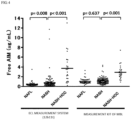
- the free AIM amount was measured in 42 specimens of NAFL patient sera, 141 specimens of NASH patient sera, and 26 specimens of NASH-HCC patient sera to study whether a significant difference was generated among the patients.
- the free AIM amount was measured in 42 specimens of NAFL patient sera, 141 specimens of NASH patient sera, and 26 specimens of NASH-HCC patient sera to study whether a significant difference was generated among the patients.
- the protocol followed the package insert of the Human AIM ELISA kit. The results are shown in Fig. 4 .
- the free AIM amount in the NASH patient sera was significantly higher than the free AIM amount in the NAFL patient sera.
- the free AIM amount in the NASH patient sera was at the same level as the free AIM amount in the NAFL patient sera, and no significant difference was observed between the patients.
- the addition of the anti-IgM antibody to the measurement system can probably suppress the non-specific reaction of IgM-AIM to the free AIM-specific antibody so that a significant difference is generated between the free AIM amount in the NASH patient sera and the free AIM amount in the NAFL patient sera.
- the specificity for free AIM of an antibody specifically reacting with free AIM can further be improved.
- NASH can be diagnosed without imposing a burden on patients and medical staffs.
Landscapes
- Health & Medical Sciences (AREA)
- Life Sciences & Earth Sciences (AREA)
- Immunology (AREA)
- Engineering & Computer Science (AREA)
- Chemical & Material Sciences (AREA)
- Molecular Biology (AREA)
- Biomedical Technology (AREA)
- Urology & Nephrology (AREA)
- Hematology (AREA)
- General Health & Medical Sciences (AREA)
- Medicinal Chemistry (AREA)
- Biochemistry (AREA)
- Analytical Chemistry (AREA)
- Food Science & Technology (AREA)
- Biotechnology (AREA)
- Physics & Mathematics (AREA)
- Cell Biology (AREA)
- Microbiology (AREA)
- General Physics & Mathematics (AREA)
- Pathology (AREA)
- Proteomics, Peptides & Aminoacids (AREA)
- Chemical Kinetics & Catalysis (AREA)
- Organic Chemistry (AREA)
- Communicable Diseases (AREA)
- Genetics & Genomics (AREA)
- Biophysics (AREA)
- Peptides Or Proteins (AREA)
Claims (10)
- Immunoassay-Verfahren für freies AIM in einer biologischen Probe, die komplexiertes AIM und freies AIM enthält, wobei das Verfahren umfasst: in Kontakt bringen der biologischen Probe mit einem Antikörper, der spezifisch mit freiem AIM in Anwesenheit eines anti-IgM-Antikörpers reagiert,wobei "freies AIM" AIM meint, das in einem freien Zustand vorliegt, ohne an andere Substanzen wie Lipopolysaccharid oder IgM gebunden zu sein,wobei "komplexiertes AIM" AIM meint, das an andere Substanzen wie Lipopolysaccharid oder IgM gebunden ist und im Zustand eines Komplexes vorliegt, undwobei der Anti-IgM-Antikörper weiterhin die Spezifität für freies AIM von einem Antikörper verbessert, der spezifisch mit freiem AIM reagiert.
- Immunoassay-Verfahren für freies AIM in einer biologischen Probe gemäß Anspruch 1, wobei die biologische Probe eine Körperflüssigkeitsprobe ist.
- Immunoassay-Verfahren für freies AIM in einer biologischen Probe gemäß Anspruch 1 oder 2, wobei der Antikörper, der spezifisch mit freiem AIM reagiert, ein monoklonaler Antikörper ist.
- Verfahren zur Verbesserung einer spezifischen Reaktion in einem Immunoassay für freies AIM in einer biologischen Probe, die komplexiertes AIM und freies AIM enthält, wobei das Verfahren umfasst: in Kontakt bringen der biologischen Probe mit einem Antikörper, der spezifisch mit freiem AIM in der Anwesenheit eines anti-IgM-Antikörpers reagiert,wobei "freies AIM" AIM meint, das in einem freien Zustand vorliegt, ohne an andere Substanzen wie Lipopolysaccharid oder IgM gebunden zu sein,wobei "komplexiertes AIM" AIM meint, das an andere Substanzen wie Lipopolysaccharid oder IgM gebunden ist und im Zustand eines Komplexes vorliegt, undwobei der Anti-IgM-Antikörper weiterhin die Spezifität für freies AIM von einem Antikörper verbessert, der spezifisch mit freiem AIM reagiert.
- Verfahren zur Verbesserung einer spezifischen Reaktion gemäß Anspruch 4, wobei die biologische Probe eine Körperflüssigkeitsprobe ist.
- Verfahren zur Verbesserung einer spezifischen Reaktion gemäß Anspruch 4 oder 5, wobei die unspezifische Reaktion eine unspezifische Reaktion aufgrund von IgM in der biologischen Probe ist.
- Immunoassay-Verfahren gemäß irgendeinem der Ansprüche 1 bis 3, wobei das Immunoassay-Verfahren ein Verfahren zum Nachweis von NASH ist, umfassend:In Kontakt bringen einer biologischen Probe, die komplexiertes AIM und freies AIM enthält, mit einem Antikörper, der spezifisch mit freiem AIM in Gegenwart eines Anti-IgM-Antikörpers reagiert;Messen der Menge an freiem AIM in der biologischen Probe durch Detektion eines Signals; undVergleichen der gemessenen Menge an freiem AIM mit einem Referenzwert,wobei "NASH" eine nichtalkoholische Fettlebererkrankung, anders als einfache Fettleber, bei der Fett nur in Hepatozyten abgelagert wird, meint.
- Verfahren zum Nachweis von NASH gemäß Anspruch 7, wobei NAFL und NASH voneinander abgegrenzt werden.
- Verwendung eines Assay-Kits für freies AIM in einer biologischen Probe, die komplexiertes AIM und freies AIM in der Immunoassay-Methode, wie in irgendeinem der Ansprüche 1 bis 3 oder 7 bis 8 definiert, enthält, wobei das Kit einen Anti-IgM-Antikörper und einen Antikörper umfasst, der spezifisch mit freiem AIM reagiert,wobei "freies AIM" AIM meint, das in einem freien Zustand vorliegt, ohne an andere Substanzen wie Lipopolysaccharid oder IgM gebunden zu sein,wobei "komplexiertes AIM" AIM meint, das an andere Substanzen wie Lipopolysaccharid oder IgM gebunden ist und im Zustand eines Komplexes vorliegt, undwobei der Anti-IgM-Antikörper weiterhin die Spezifität für freies AIM von einem Antikörper verbessert, der spezifisch mit freiem AIM reagiert.
- Assay-Kit für eine freie AIM-Menge, wobei das Assay-Kit umfasst:- eine feste Phase, auf der ein Antikörper, der spezifisch mit freiem AIM reagiert, immobilisiert ist;- einen Anti-AIM-Antikörper, der mit einer elektrochemischen lumineszierenden Substanz markiert ist und ein Epitop erkennt, das sich von dem immobilisierten Antikörper unterscheidet; und- einen Anti-IgM-Antikörper,wobei "freies AIM" AIM bedeutet, das in einem freien Zustand vorliegt, ohne an andere Substanzen wie Lipopolysaccharid oder IgM gebunden zu sein, undwobei der Anti-IgM-Antikörper die Spezifität für freies AIM von einem Antikörper, der spezifisch mit freiem AIM reagiert, weiterhin verbessert.
Applications Claiming Priority (2)
| Application Number | Priority Date | Filing Date | Title |
|---|---|---|---|
| JP2019015224 | 2019-01-31 | ||
| PCT/JP2020/003416 WO2020158858A1 (ja) | 2019-01-31 | 2020-01-30 | 生物学的試料中の遊離aimの免疫学的分析方法及び対象におけるnashの検出方法 |
Publications (3)
| Publication Number | Publication Date |
|---|---|
| EP3919906A1 EP3919906A1 (de) | 2021-12-08 |
| EP3919906A4 EP3919906A4 (de) | 2022-11-09 |
| EP3919906B1 true EP3919906B1 (de) | 2025-01-01 |
Family
ID=71841846
Family Applications (1)
| Application Number | Title | Priority Date | Filing Date |
|---|---|---|---|
| EP20749087.1A Active EP3919906B1 (de) | 2019-01-31 | 2020-01-30 | Verfahren zur immunologischen analyse von freiem aim in einer biologischen probe und verfahren zum nachweis von nash in einem subjekt |
Country Status (5)
| Country | Link |
|---|---|
| US (1) | US12352766B2 (de) |
| EP (1) | EP3919906B1 (de) |
| JP (1) | JP7315968B2 (de) |
| CN (1) | CN113711038B (de) |
| WO (1) | WO2020158858A1 (de) |
Families Citing this family (3)
| Publication number | Priority date | Publication date | Assignee | Title |
|---|---|---|---|---|
| US12265083B2 (en) | 2019-01-31 | 2025-04-01 | Sekisui Medical Co., Ltd. | Immunoassay method for free AIM in biological sample, and assay kit |
| WO2020158856A1 (ja) * | 2019-01-31 | 2020-08-06 | 積水メディカル株式会社 | 生物学的試料中の遊離aimの免疫学的分析方法 |
| JP2022075614A (ja) * | 2020-11-06 | 2022-05-18 | 徹 宮崎 | 遊離aimに特異的なモノクローナル抗体およびその利用 |
Family Cites Families (13)
| Publication number | Priority date | Publication date | Assignee | Title |
|---|---|---|---|---|
| US6159937A (en) * | 1994-07-05 | 2000-12-12 | Steeno Research Group A/S | Immunomodulators |
| EA022925B1 (ru) * | 2009-02-19 | 2016-03-31 | Глаксо Груп Лимитед | Улучшенные полипептиды, вариабельные домены антител и антагонисты против tnfr1 |
| US20100331244A1 (en) * | 2009-06-01 | 2010-12-30 | The University Of Tokyo | Pharmaceutical composition, food or drink, and methods related thereto |
| CN102243232A (zh) * | 2010-05-14 | 2011-11-16 | 北京贝尔生物工程有限公司 | 肠道病毒71型抗体(IgM)诊断试剂盒(酶联免疫法) |
| EP2870970B1 (de) | 2012-04-27 | 2018-02-21 | Toru Miyazaki | Prophylaktikum oder therapeutikum für lebererkrankungen |
| KR102176382B1 (ko) * | 2012-09-28 | 2020-11-09 | 세키스이 메디칼 가부시키가이샤 | 면역학적 검출 방법 및 면역학적 검출 시약 |
| MX2016004420A (es) * | 2013-10-06 | 2017-03-31 | Abbvie Inc | Proteinas de union especificas duales dirigidas contra los receptores de células inmunes y autoantígenos de señalización de tlr. |
| CN103773738A (zh) * | 2014-01-15 | 2014-05-07 | 东北林业大学 | 抗f-PSA单克隆抗体产生的杂交瘤及化学发光免疫分析试剂盒的制备 |
| US10996217B2 (en) | 2015-08-06 | 2021-05-04 | Sekisui Medical Co., Ltd. | Method for examining renal disease |
| JP6084759B1 (ja) * | 2015-08-17 | 2017-02-22 | 積水メディカル株式会社 | 免疫学的検出方法及びこれに用いるテストストリップ |
| JP6688307B2 (ja) * | 2015-09-10 | 2020-04-28 | 積水メディカル株式会社 | 肝癌の検査方法 |
| CN107907689A (zh) * | 2017-10-10 | 2018-04-13 | 北京大学 | 外泌体蛋白cd5l的检测方法 |
| EP3476863A1 (de) * | 2017-10-30 | 2019-05-01 | Fundació Institut d'Investigació en Ciències de la Salut Germans Trias i Pujol | Anti-cd5 l antikörper und dessen benutzung |
-
2020
- 2020-01-30 JP JP2020569719A patent/JP7315968B2/ja active Active
- 2020-01-30 CN CN202080011502.8A patent/CN113711038B/zh active Active
- 2020-01-30 EP EP20749087.1A patent/EP3919906B1/de active Active
- 2020-01-30 US US17/427,294 patent/US12352766B2/en active Active
- 2020-01-30 WO PCT/JP2020/003416 patent/WO2020158858A1/ja not_active Ceased
Also Published As
| Publication number | Publication date |
|---|---|
| EP3919906A1 (de) | 2021-12-08 |
| US12352766B2 (en) | 2025-07-08 |
| US20220120762A1 (en) | 2022-04-21 |
| JPWO2020158858A1 (ja) | 2021-12-23 |
| EP3919906A4 (de) | 2022-11-09 |
| CN113711038A (zh) | 2021-11-26 |
| WO2020158858A1 (ja) | 2020-08-06 |
| JP7315968B2 (ja) | 2023-07-27 |
| CN113711038B (zh) | 2024-09-06 |
Similar Documents
| Publication | Publication Date | Title |
|---|---|---|
| EP3349011B1 (de) | Testverfahren für leberkrebs | |
| US20110165701A1 (en) | Monoclonal antibody and immunoassay using the same | |
| WO2017022315A1 (ja) | 腎疾患の検査方法 | |
| US12352766B2 (en) | Immunoassay method for free aim in biological sample, and method for detecting NASH in subject | |
| US20250130237A1 (en) | Point of Care Assays | |
| EP3919903B1 (de) | Verfahren zur immunologischen analyse eines freien aim in einer biologischen probe und mess-kit | |
| JP7315966B2 (ja) | 生物学的試料中の遊離aimの免疫学的分析方法 | |
| EP3879270B1 (de) | Methode zur unterscheidung von viralem leberkrebs von viraler hepatitis oder viraler leberzirrhose | |
| WO2025100378A1 (ja) | Gpc3の測定方法及びそのためのキット |
Legal Events
| Date | Code | Title | Description |
|---|---|---|---|
| STAA | Information on the status of an ep patent application or granted ep patent |
Free format text: STATUS: THE INTERNATIONAL PUBLICATION HAS BEEN MADE |
|
| PUAI | Public reference made under article 153(3) epc to a published international application that has entered the european phase |
Free format text: ORIGINAL CODE: 0009012 |
|
| STAA | Information on the status of an ep patent application or granted ep patent |
Free format text: STATUS: REQUEST FOR EXAMINATION WAS MADE |
|
| 17P | Request for examination filed |
Effective date: 20210729 |
|
| AK | Designated contracting states |
Kind code of ref document: A1 Designated state(s): AL AT BE BG CH CY CZ DE DK EE ES FI FR GB GR HR HU IE IS IT LI LT LU LV MC MK MT NL NO PL PT RO RS SE SI SK SM TR |
|
| RIN1 | Information on inventor provided before grant (corrected) |
Inventor name: HIROTA, JIRO Inventor name: KANETSUKI, YUKA Inventor name: ASAI, TOMOHIDE Inventor name: OKANQUE, TAKESHI Inventor name: MIYAZAKI, TORU |
|
| RAP3 | Party data changed (applicant data changed or rights of an application transferred) |
Owner name: MIYAZAKI, TORU Owner name: SOCIAL WELFARE ORGANIZATION "SAISEIKAI" IMPERIAL GIFT FOUNDATION INC. Owner name: SEKISUI MEDICAL CO., LTD. |
|
| RIN1 | Information on inventor provided before grant (corrected) |
Inventor name: HIROTA, JIRO Inventor name: KANETSUKI, YUKA Inventor name: ASAI, TOMOHIDE Inventor name: OKANOUE, TAKESHI Inventor name: MIYAZAKI, TORU |
|
| RAP3 | Party data changed (applicant data changed or rights of an application transferred) |
Owner name: SOCIAL WELFARE ORGANIZATION "SAISEIKAI" IMPERIAL GIFT FOUNDATION INC. Owner name: MIYAZAKI, TORU Owner name: SEKISUI MEDICAL CO., LTD. |
|
| DAV | Request for validation of the european patent (deleted) | ||
| DAX | Request for extension of the european patent (deleted) | ||
| A4 | Supplementary search report drawn up and despatched |
Effective date: 20221010 |
|
| RIC1 | Information provided on ipc code assigned before grant |
Ipc: G01N 33/53 20060101AFI20221004BHEP |
|
| STAA | Information on the status of an ep patent application or granted ep patent |
Free format text: STATUS: EXAMINATION IS IN PROGRESS |
|
| 17Q | First examination report despatched |
Effective date: 20230626 |
|
| GRAP | Despatch of communication of intention to grant a patent |
Free format text: ORIGINAL CODE: EPIDOSNIGR1 |
|
| STAA | Information on the status of an ep patent application or granted ep patent |
Free format text: STATUS: GRANT OF PATENT IS INTENDED |
|
| INTG | Intention to grant announced |
Effective date: 20240726 |
|
| RIN1 | Information on inventor provided before grant (corrected) |
Inventor name: ASAI, TOMOHIDE Inventor name: OKANOUE, TAKESHI Inventor name: MIYAZAKI, TORU Inventor name: HIROTA, JIRO Inventor name: KANETSUKI, YUKA |
|
| GRAS | Grant fee paid |
Free format text: ORIGINAL CODE: EPIDOSNIGR3 |
|
| GRAA | (expected) grant |
Free format text: ORIGINAL CODE: 0009210 |
|
| STAA | Information on the status of an ep patent application or granted ep patent |
Free format text: STATUS: THE PATENT HAS BEEN GRANTED |
|
| AK | Designated contracting states |
Kind code of ref document: B1 Designated state(s): AL AT BE BG CH CY CZ DE DK EE ES FI FR GB GR HR HU IE IS IT LI LT LU LV MC MK MT NL NO PL PT RO RS SE SI SK SM TR |
|
| REG | Reference to a national code |
Ref country code: GB Ref legal event code: FG4D |
|
| REG | Reference to a national code |
Ref country code: DE Ref legal event code: R096 Ref document number: 602020044061 Country of ref document: DE |
|
| REG | Reference to a national code |
Ref country code: CH Ref legal event code: EP |
|
| P01 | Opt-out of the competence of the unified patent court (upc) registered |
Free format text: CASE NUMBER: APP_65863/2024 Effective date: 20241213 |
|
| REG | Reference to a national code |
Ref country code: IE Ref legal event code: FG4D |
|
| REG | Reference to a national code |
Ref country code: LT Ref legal event code: MG9D |
|
| REG | Reference to a national code |
Ref country code: NL Ref legal event code: MP Effective date: 20250101 |
|
| REG | Reference to a national code |
Ref country code: AT Ref legal event code: MK05 Ref document number: 1756737 Country of ref document: AT Kind code of ref document: T Effective date: 20250101 |
|
| PG25 | Lapsed in a contracting state [announced via postgrant information from national office to epo] |
Ref country code: NL Free format text: LAPSE BECAUSE OF FAILURE TO SUBMIT A TRANSLATION OF THE DESCRIPTION OR TO PAY THE FEE WITHIN THE PRESCRIBED TIME-LIMIT Effective date: 20250101 |
|
| PG25 | Lapsed in a contracting state [announced via postgrant information from national office to epo] |
Ref country code: FI Free format text: LAPSE BECAUSE OF FAILURE TO SUBMIT A TRANSLATION OF THE DESCRIPTION OR TO PAY THE FEE WITHIN THE PRESCRIBED TIME-LIMIT Effective date: 20250101 |
|
| PG25 | Lapsed in a contracting state [announced via postgrant information from national office to epo] |
Ref country code: PL Free format text: LAPSE BECAUSE OF FAILURE TO SUBMIT A TRANSLATION OF THE DESCRIPTION OR TO PAY THE FEE WITHIN THE PRESCRIBED TIME-LIMIT Effective date: 20250101 |
|
| PG25 | Lapsed in a contracting state [announced via postgrant information from national office to epo] |
Ref country code: ES Free format text: LAPSE BECAUSE OF FAILURE TO SUBMIT A TRANSLATION OF THE DESCRIPTION OR TO PAY THE FEE WITHIN THE PRESCRIBED TIME-LIMIT Effective date: 20250101 |
|
| PG25 | Lapsed in a contracting state [announced via postgrant information from national office to epo] |
Ref country code: NO Free format text: LAPSE BECAUSE OF FAILURE TO SUBMIT A TRANSLATION OF THE DESCRIPTION OR TO PAY THE FEE WITHIN THE PRESCRIBED TIME-LIMIT Effective date: 20250401 Ref country code: IS Free format text: LAPSE BECAUSE OF FAILURE TO SUBMIT A TRANSLATION OF THE DESCRIPTION OR TO PAY THE FEE WITHIN THE PRESCRIBED TIME-LIMIT Effective date: 20250501 |
|
| PG25 | Lapsed in a contracting state [announced via postgrant information from national office to epo] |
Ref country code: HR Free format text: LAPSE BECAUSE OF FAILURE TO SUBMIT A TRANSLATION OF THE DESCRIPTION OR TO PAY THE FEE WITHIN THE PRESCRIBED TIME-LIMIT Effective date: 20250101 |
|
| PG25 | Lapsed in a contracting state [announced via postgrant information from national office to epo] |
Ref country code: LV Free format text: LAPSE BECAUSE OF FAILURE TO SUBMIT A TRANSLATION OF THE DESCRIPTION OR TO PAY THE FEE WITHIN THE PRESCRIBED TIME-LIMIT Effective date: 20250101 Ref country code: PT Free format text: LAPSE BECAUSE OF FAILURE TO SUBMIT A TRANSLATION OF THE DESCRIPTION OR TO PAY THE FEE WITHIN THE PRESCRIBED TIME-LIMIT Effective date: 20250502 |
|
| PG25 | Lapsed in a contracting state [announced via postgrant information from national office to epo] |
Ref country code: GR Free format text: LAPSE BECAUSE OF FAILURE TO SUBMIT A TRANSLATION OF THE DESCRIPTION OR TO PAY THE FEE WITHIN THE PRESCRIBED TIME-LIMIT Effective date: 20250402 Ref country code: BG Free format text: LAPSE BECAUSE OF FAILURE TO SUBMIT A TRANSLATION OF THE DESCRIPTION OR TO PAY THE FEE WITHIN THE PRESCRIBED TIME-LIMIT Effective date: 20250101 |
|
| PG25 | Lapsed in a contracting state [announced via postgrant information from national office to epo] |
Ref country code: AT Free format text: LAPSE BECAUSE OF FAILURE TO SUBMIT A TRANSLATION OF THE DESCRIPTION OR TO PAY THE FEE WITHIN THE PRESCRIBED TIME-LIMIT Effective date: 20250101 |
|
| PG25 | Lapsed in a contracting state [announced via postgrant information from national office to epo] |
Ref country code: CZ Free format text: LAPSE BECAUSE OF FAILURE TO SUBMIT A TRANSLATION OF THE DESCRIPTION OR TO PAY THE FEE WITHIN THE PRESCRIBED TIME-LIMIT Effective date: 20250101 |
|
| REG | Reference to a national code |
Ref country code: CH Ref legal event code: PL |
|
| PG25 | Lapsed in a contracting state [announced via postgrant information from national office to epo] |
Ref country code: SE Free format text: LAPSE BECAUSE OF FAILURE TO SUBMIT A TRANSLATION OF THE DESCRIPTION OR TO PAY THE FEE WITHIN THE PRESCRIBED TIME-LIMIT Effective date: 20250101 |
|
| PG25 | Lapsed in a contracting state [announced via postgrant information from national office to epo] |
Ref country code: LU Free format text: LAPSE BECAUSE OF NON-PAYMENT OF DUE FEES Effective date: 20250130 |
|
| REG | Reference to a national code |
Ref country code: DE Ref legal event code: R097 Ref document number: 602020044061 Country of ref document: DE |
|
| PG25 | Lapsed in a contracting state [announced via postgrant information from national office to epo] |
Ref country code: SM Free format text: LAPSE BECAUSE OF FAILURE TO SUBMIT A TRANSLATION OF THE DESCRIPTION OR TO PAY THE FEE WITHIN THE PRESCRIBED TIME-LIMIT Effective date: 20250101 |
|
| PG25 | Lapsed in a contracting state [announced via postgrant information from national office to epo] |
Ref country code: DK Free format text: LAPSE BECAUSE OF FAILURE TO SUBMIT A TRANSLATION OF THE DESCRIPTION OR TO PAY THE FEE WITHIN THE PRESCRIBED TIME-LIMIT Effective date: 20250101 |
|
| PG25 | Lapsed in a contracting state [announced via postgrant information from national office to epo] |
Ref country code: MC Free format text: LAPSE BECAUSE OF FAILURE TO SUBMIT A TRANSLATION OF THE DESCRIPTION OR TO PAY THE FEE WITHIN THE PRESCRIBED TIME-LIMIT Effective date: 20250101 |
|
| PG25 | Lapsed in a contracting state [announced via postgrant information from national office to epo] |
Ref country code: IT Free format text: LAPSE BECAUSE OF FAILURE TO SUBMIT A TRANSLATION OF THE DESCRIPTION OR TO PAY THE FEE WITHIN THE PRESCRIBED TIME-LIMIT Effective date: 20250101 |
|
| PG25 | Lapsed in a contracting state [announced via postgrant information from national office to epo] |
Ref country code: BE Free format text: LAPSE BECAUSE OF NON-PAYMENT OF DUE FEES Effective date: 20250131 |
|
| PG25 | Lapsed in a contracting state [announced via postgrant information from national office to epo] |
Ref country code: CH Free format text: LAPSE BECAUSE OF NON-PAYMENT OF DUE FEES Effective date: 20250131 |
|
| PG25 | Lapsed in a contracting state [announced via postgrant information from national office to epo] |
Ref country code: EE Free format text: LAPSE BECAUSE OF FAILURE TO SUBMIT A TRANSLATION OF THE DESCRIPTION OR TO PAY THE FEE WITHIN THE PRESCRIBED TIME-LIMIT Effective date: 20250101 |
|
| REG | Reference to a national code |
Ref country code: BE Ref legal event code: MM Effective date: 20250131 |
|
| PG25 | Lapsed in a contracting state [announced via postgrant information from national office to epo] |
Ref country code: RO Free format text: LAPSE BECAUSE OF FAILURE TO SUBMIT A TRANSLATION OF THE DESCRIPTION OR TO PAY THE FEE WITHIN THE PRESCRIBED TIME-LIMIT Effective date: 20250101 |
|
| PG25 | Lapsed in a contracting state [announced via postgrant information from national office to epo] |
Ref country code: SK Free format text: LAPSE BECAUSE OF FAILURE TO SUBMIT A TRANSLATION OF THE DESCRIPTION OR TO PAY THE FEE WITHIN THE PRESCRIBED TIME-LIMIT Effective date: 20250101 |
|
| PLBE | No opposition filed within time limit |
Free format text: ORIGINAL CODE: 0009261 |
|
| STAA | Information on the status of an ep patent application or granted ep patent |
Free format text: STATUS: NO OPPOSITION FILED WITHIN TIME LIMIT |
|
| 26N | No opposition filed |
Effective date: 20251002 |
|
| PGFP | Annual fee paid to national office [announced via postgrant information from national office to epo] |
Ref country code: GB Payment date: 20251211 Year of fee payment: 7 |
|
| PGFP | Annual fee paid to national office [announced via postgrant information from national office to epo] |
Ref country code: FR Payment date: 20251128 Year of fee payment: 7 |
|
| PG25 | Lapsed in a contracting state [announced via postgrant information from national office to epo] |
Ref country code: IE Free format text: LAPSE BECAUSE OF NON-PAYMENT OF DUE FEES Effective date: 20250130 |
|
| PGFP | Annual fee paid to national office [announced via postgrant information from national office to epo] |
Ref country code: DE Payment date: 20251203 Year of fee payment: 7 |