EP3909427B1 - Verfahren und vorrichtungen zur kapillar unterstützten vitrifizierung - Google Patents
Verfahren und vorrichtungen zur kapillar unterstützten vitrifizierung Download PDFInfo
- Publication number
- EP3909427B1 EP3909427B1 EP21179466.4A EP21179466A EP3909427B1 EP 3909427 B1 EP3909427 B1 EP 3909427B1 EP 21179466 A EP21179466 A EP 21179466A EP 3909427 B1 EP3909427 B1 EP 3909427B1
- Authority
- EP
- European Patent Office
- Prior art keywords
- capillary
- vitrification
- mixture
- desiccation
- membrane
- Prior art date
- Legal status (The legal status is an assumption and is not a legal conclusion. Google has not performed a legal analysis and makes no representation as to the accuracy of the status listed.)
- Active
Links
Images







Classifications
-
- A—HUMAN NECESSITIES
- A01—AGRICULTURE; FORESTRY; ANIMAL HUSBANDRY; HUNTING; TRAPPING; FISHING
- A01N—PRESERVATION OF BODIES OF HUMANS OR ANIMALS OR PLANTS OR PARTS THEREOF; BIOCIDES, e.g. AS DISINFECTANTS, AS PESTICIDES OR AS HERBICIDES; PEST REPELLANTS OR ATTRACTANTS; PLANT GROWTH REGULATORS
- A01N1/00—Preservation of bodies of humans or animals, or parts thereof
- A01N1/10—Preservation of living parts
- A01N1/14—Mechanical aspects of preservation; Apparatus or containers therefor
- A01N1/142—Apparatus
-
- A—HUMAN NECESSITIES
- A01—AGRICULTURE; FORESTRY; ANIMAL HUSBANDRY; HUNTING; TRAPPING; FISHING
- A01N—PRESERVATION OF BODIES OF HUMANS OR ANIMALS OR PLANTS OR PARTS THEREOF; BIOCIDES, e.g. AS DISINFECTANTS, AS PESTICIDES OR AS HERBICIDES; PEST REPELLANTS OR ATTRACTANTS; PLANT GROWTH REGULATORS
- A01N1/00—Preservation of bodies of humans or animals, or parts thereof
- A01N1/10—Preservation of living parts
- A01N1/14—Mechanical aspects of preservation; Apparatus or containers therefor
- A01N1/142—Apparatus
- A01N1/144—Apparatus for temperature control, e.g. refrigerators or freeze-drying apparatus
-
- A—HUMAN NECESSITIES
- A01—AGRICULTURE; FORESTRY; ANIMAL HUSBANDRY; HUNTING; TRAPPING; FISHING
- A01N—PRESERVATION OF BODIES OF HUMANS OR ANIMALS OR PLANTS OR PARTS THEREOF; BIOCIDES, e.g. AS DISINFECTANTS, AS PESTICIDES OR AS HERBICIDES; PEST REPELLANTS OR ATTRACTANTS; PLANT GROWTH REGULATORS
- A01N1/00—Preservation of bodies of humans or animals, or parts thereof
- A01N1/10—Preservation of living parts
- A01N1/14—Mechanical aspects of preservation; Apparatus or containers therefor
- A01N1/146—Non-refrigerated containers specially adapted for transporting or storing living parts whilst preserving
-
- A—HUMAN NECESSITIES
- A01—AGRICULTURE; FORESTRY; ANIMAL HUSBANDRY; HUNTING; TRAPPING; FISHING
- A01N—PRESERVATION OF BODIES OF HUMANS OR ANIMALS OR PLANTS OR PARTS THEREOF; BIOCIDES, e.g. AS DISINFECTANTS, AS PESTICIDES OR AS HERBICIDES; PEST REPELLANTS OR ATTRACTANTS; PLANT GROWTH REGULATORS
- A01N1/00—Preservation of bodies of humans or animals, or parts thereof
- A01N1/10—Preservation of living parts
- A01N1/16—Physical preservation processes
-
- A—HUMAN NECESSITIES
- A01—AGRICULTURE; FORESTRY; ANIMAL HUSBANDRY; HUNTING; TRAPPING; FISHING
- A01N—PRESERVATION OF BODIES OF HUMANS OR ANIMALS OR PLANTS OR PARTS THEREOF; BIOCIDES, e.g. AS DISINFECTANTS, AS PESTICIDES OR AS HERBICIDES; PEST REPELLANTS OR ATTRACTANTS; PLANT GROWTH REGULATORS
- A01N1/00—Preservation of bodies of humans or animals, or parts thereof
- A01N1/10—Preservation of living parts
- A01N1/16—Physical preservation processes
- A01N1/162—Temperature processes, e.g. following predefined temperature changes over time
-
- A—HUMAN NECESSITIES
- A01—AGRICULTURE; FORESTRY; ANIMAL HUSBANDRY; HUNTING; TRAPPING; FISHING
- A01N—PRESERVATION OF BODIES OF HUMANS OR ANIMALS OR PLANTS OR PARTS THEREOF; BIOCIDES, e.g. AS DISINFECTANTS, AS PESTICIDES OR AS HERBICIDES; PEST REPELLANTS OR ATTRACTANTS; PLANT GROWTH REGULATORS
- A01N1/00—Preservation of bodies of humans or animals, or parts thereof
- A01N1/10—Preservation of living parts
- A01N1/16—Physical preservation processes
- A01N1/165—Pressure processes, e.g. following predefined pressure changes over time
-
- C—CHEMISTRY; METALLURGY
- C12—BIOCHEMISTRY; BEER; SPIRITS; WINE; VINEGAR; MICROBIOLOGY; ENZYMOLOGY; MUTATION OR GENETIC ENGINEERING
- C12M—APPARATUS FOR ENZYMOLOGY OR MICROBIOLOGY; APPARATUS FOR CULTURING MICROORGANISMS FOR PRODUCING BIOMASS, FOR GROWING CELLS OR FOR OBTAINING FERMENTATION OR METABOLIC PRODUCTS, i.e. BIOREACTORS OR FERMENTERS
- C12M47/00—Means for after-treatment of the produced biomass or of the fermentation or metabolic products, e.g. storage of biomass
- C12M47/14—Drying
-
- C—CHEMISTRY; METALLURGY
- C12—BIOCHEMISTRY; BEER; SPIRITS; WINE; VINEGAR; MICROBIOLOGY; ENZYMOLOGY; MUTATION OR GENETIC ENGINEERING
- C12N—MICROORGANISMS OR ENZYMES; COMPOSITIONS THEREOF; PROPAGATING, PRESERVING, OR MAINTAINING MICROORGANISMS; MUTATION OR GENETIC ENGINEERING; CULTURE MEDIA
- C12N5/00—Undifferentiated human, animal or plant cells, e.g. cell lines; Tissues; Cultivation or maintenance thereof; Culture media therefor
- C12N5/54—Mechanical aspects of preservation of animal cells or human cells; Apparatus or containers therefor
- C12N5/542—Apparatus
- C12N5/544—Apparatus for temperature control, e.g. refrigerators or freeze-drying apparatus
-
- C—CHEMISTRY; METALLURGY
- C12—BIOCHEMISTRY; BEER; SPIRITS; WINE; VINEGAR; MICROBIOLOGY; ENZYMOLOGY; MUTATION OR GENETIC ENGINEERING
- C12N—MICROORGANISMS OR ENZYMES; COMPOSITIONS THEREOF; PROPAGATING, PRESERVING, OR MAINTAINING MICROORGANISMS; MUTATION OR GENETIC ENGINEERING; CULTURE MEDIA
- C12N5/00—Undifferentiated human, animal or plant cells, e.g. cell lines; Tissues; Cultivation or maintenance thereof; Culture media therefor
- C12N5/54—Mechanical aspects of preservation of animal cells or human cells; Apparatus or containers therefor
- C12N5/546—Non-refrigerated containers specially adapted for transporting or storing animal cells or human cells whilst preserving
-
- C—CHEMISTRY; METALLURGY
- C12—BIOCHEMISTRY; BEER; SPIRITS; WINE; VINEGAR; MICROBIOLOGY; ENZYMOLOGY; MUTATION OR GENETIC ENGINEERING
- C12N—MICROORGANISMS OR ENZYMES; COMPOSITIONS THEREOF; PROPAGATING, PRESERVING, OR MAINTAINING MICROORGANISMS; MUTATION OR GENETIC ENGINEERING; CULTURE MEDIA
- C12N5/00—Undifferentiated human, animal or plant cells, e.g. cell lines; Tissues; Cultivation or maintenance thereof; Culture media therefor
- C12N5/56—Physical preservation processes for animal cells or human cells
- C12N5/562—Temperature processes, e.g. following predefined temperature changes over time
-
- C—CHEMISTRY; METALLURGY
- C12—BIOCHEMISTRY; BEER; SPIRITS; WINE; VINEGAR; MICROBIOLOGY; ENZYMOLOGY; MUTATION OR GENETIC ENGINEERING
- C12N—MICROORGANISMS OR ENZYMES; COMPOSITIONS THEREOF; PROPAGATING, PRESERVING, OR MAINTAINING MICROORGANISMS; MUTATION OR GENETIC ENGINEERING; CULTURE MEDIA
- C12N5/00—Undifferentiated human, animal or plant cells, e.g. cell lines; Tissues; Cultivation or maintenance thereof; Culture media therefor
- C12N5/56—Physical preservation processes for animal cells or human cells
- C12N5/565—Pressure processes, e.g. following predefined pressure changes over time
Definitions
- the present invention relates to non-cryogenic vitrification of biological materials, in particular biological materials vitrified in a vitrification medium by capillary assisted fast drying.
- Vitrification is the process of direct transition from a liquid to an amorphous glassy state and is often utilized to preserve biological materials by cooling them to cryogenic temperatures at high cooling rates.
- vitrification technique avoids the damaging effects of ice crystals, which are known to form during conventional cryopreservation using slow cooling rates.
- 6-8M cryoprotectants
- CPAs cryoprotectants
- DMSO dimethyl sulfoxide
- EG ethylene glycol
- PROH 1,2-propanediol
- Anhydrous vitrification at ambient temperatures may also be an alternative strategy for preserving biological materials.
- a wide variety of organisms can survive extreme dehydration which correlates in many cases with the accumulation of large amounts (as much as 20% of their dry weight) of glass forming sugars such as trehalose and sucrose in intracellular space.
- glass forming sugars such as trehalose and sucrose in intracellular space.
- Such "glass forming" sugars need to be present on both sides of the plasma membrane to provide protection against the damaging effects of desiccation. Desiccation techniques dramatically limit or arrests the material's biochemical processes in a glassy matrix.
- broader applications to cellular materials still requires one to increase the desiccation tolerance of the cells.
- Methods to enhance desiccation tolerance include utilizing improved vitrification medium containing trehalose, glycerol and sucrose. While improved methods for loading cells with protective agents are helpful, there is a further need to develop techniques to minimize cellular injury during desiccation. Damage and degradation may result from the high sensitivity of cells in general to prolonged exposure to osmotic stress during dry processing. Osmotic stress can cause cell death at relatively high moisture content even in the presence of protective sugars like trehalose.
- US 2004/0081588 Al discloses a lyophilisation apparatus comprising a cavity divided into a lyophilisation compartment and a vacuum-processing compartment, wherein the upper face of the lyophilisation compartment is fabricated with a flexible controlled pore membrane.
- Embodiments of the present invention solve one or more problems of the prior art by providing in at least one embodiment, a method for fast and uniform moisture removal during non-cryogenic vitrification of biological materials.
- a preferred vitrification composition to preserve the structural integrity (physiological and/or molecular) of the biological material during fast drying comprises trehalose, glycerol and ionic buffer containing one or more large organic ions such as choline and betine.
- a non-cryogenic vitrification device comprises providing a receptacle with walls containing a plurality of capillary channels and a requisite quantity of said biological materials and vitrification medium operably in contact with the first openings of the capillary channels, and providing an enclosure operably in communication with the second openings of the capillary channels as well as with an external environment wherein the pressure, temperature and humidity within the enclosure can be controlled.
- a vitrification and long term storage protocol for the said vitrified biological materials includes placing a requisite quantity of said biological materials with vitrification medium in a receptacle comprising a plurality of said capillary channels, employing the vitrification method of the present disclosure, packaging the said receptacle with vitrified biological materials in a protective enclosure and storing the said package between -196°C to 60°C temperatures for long term storage.
- Amorphous or “glass” refers to a non-crystalline material in which there is no long-range order of the positions of the atoms referring to an order parameter of 0.3 or less. Solidification of a vitreous solid occurs at the glass transition temperature T g .
- the vitrification medium may be an amorphous material.
- the biological material may be amorphous material.
- Glass transition temperature means the temperature above which material behaves like liquid and below which material behaves in a manner similar to that of a solid phase and enters into amorphous/glassy state. This is not a fixed point in temperature, but is instead variable dependent on the timescale of the measurement used.
- glassy state may refer to the state the biological composition enters upon dropping below its glass transition temperature.
- the glassy state may refer to the state the vitrification mixture and/ or vitrification agent enters upon dropping below its glass transition temperature.
- the glassy state may have the mechanical rigidity of a crystal, but the random disordered arrangement of molecules characterizes a liquid.
- Crystal means a three-dimensional atomic, ionic, or molecular structure consisting of one specific orderly geometrical array, periodically repeated and termed lattice or unit cell.
- Crystallization means that form of a substance that is comprised of constituents arranged in an ordered structure at the atomic level, as opposed to glassy or amorphous. Solidification of a crystalline solid occurs at the crystallization temperature T c .
- Vitrification is a process of converting a material into an amorphous material.
- the amorphous solid may be free of any crystalline structure.
- Vitrification mixture as used herein, means a heterogeneous mixture of biological materials and a vitrification medium containing vitrification agents and optionally other materials.
- biological material refers to materials that may be isolated or derived from living organisms. Examples of biological materials include, but are not limited to, proteins, cells, tissues, organs, cell-based constructs, or combinations thereof.
- biological material may refer to mammalian cells.
- biological material may refer to human mesenchymal stem cells, murine fibroblast cells, blood platelets, bacteria, viruses, mammalian cell membranes, liposomes, enzymes, or combinations thereof.
- biological material may refer to reproductive cells including sperm cells, spermatocytes, oocytes, ovum, embryos, germinal vesicles, or combinations thereof.
- biological material may refer to whole blood, red blood cells, white blood cells, platelets, viruses, bacteria, algae, fungi, or combinations thereof.
- Vitrification agent is a material that forms an amorphous structure, or that suppress the formation of crystals in other material(s), as the mixture of the vitrification agent and other material(s) cools or desiccates.
- the vitrification agent(s) may also provide osmotic protection or otherwise enable cell survival during dehydration.
- the vitrification agent(s) may be any water soluble solution that yields a suitable amorphous structure for storage of biological materials.
- the vitrification agent may be imbibed within a cell, tissue, or organ.
- Storable or storage refers to a biological material's ability to be preserved and remain viable for use at a later time.
- “Above cryogenic temperature,” as used herein, refers to a temperature above - 80° C.
- Room temperature as used herein, refers to a temperature range between 18 and 37 0 C.
- Hydrophilic means attracting or associating preferentially with water molecules. Hydrophilic materials with a special affinity for water, maximize contact with water and have smaller contact angles with water.
- Hydrophobic as used herein, means lacking affinity for water. Materials that are hydrophobic naturally repel water, causing droplets to form, and have small contact angles with water.
- Capillary as used herein, pertains to or occurring in or as if in a tube of fine bore having a cross sectional area of 2000 ⁇ m 2 or less.
- Vitrified materials are often prepared by rapidly cooling a liquid material, or small volumes of biological materials directly immersed into liquid nitrogen. The cooling reduces the mobility of the material's molecules before they can pack into a more thermodynamically favorable crystalline state. Additives that interfere with the primary constituent's ability to crystallize may produce amorphous/vitrified material. In the presence of appropriate glass forming agents it is possible to store biological materials in a vitrified matrix above cryogenic temperatures and the vitrification can be achieved by dehydration.
- Some animals and numerous plants are capable of surviving complete dehydration. This ability to survive in a dry state (anhydrobiosis) depends on several complex intracellular physiochemical and genetic mechanisms. Among these mechanisms is the intracellular accumulation of sugars (e.g., saccharides, disaccharides, oligosaccharides) that act as a protectant during desiccation, Trehalose is one example of a disaccharide naturally produced in desiccation tolerant organisms.
- sugars e.g., saccharides, disaccharides, oligosaccharides
- Sugars like trehalose may offer protection to desiccation tolerant organisms in several different ways.
- a trehalose molecule may effectively replace a hydrogen-bounded water molecule from the surface of a folded protein without changing its conformational geometry and folding due to the unique placement of the hydroxyl groups on a trehalose molecule.
- a sugar molecule may also prevent cytoplasmic leakage during rehydration by binding with the phospholipid heads of the lipid bilayer.
- many sugars have a high glass transition temperature, allowing them to form an above cryogenic temperature or a room temperature glass at low water content. The highly viscous 'glassy' state reduces the molecular mobility, which in turn prevents degradative biochemical reactions that lead to deterioration of cell function and death.
- Vitrification of biological materials by dehydration in the presence of glass forming sugar trehalose has been disclosed N Chakraborty, et al., Biopreservation and Biobanking, 2010, 8 (2), 107-114 .
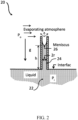
- the system 10 is the most common approach to dehydrating a biological material.
- a sessile droplet 11 is placed on a substrate 12 and evaporatively desiccated in an enclosure 16 having low humidity environment 13.
- the humidity, pressure and temperature inside the enclosure can be operably controlled by a control device 17.
- desiccation using evaporative drying of sessile droplets of the system 10 is inherently slow and non-uniform in nature.
- a glassy skin 15 forms at the liquid/vapor interface 14 of the sample when the biological materials are desiccated in glass forming medium. This glassy skin 15 slows and ultimately prevents further desiccation of the sample beyond a certain level of dryness and induces significant spatial non-uniformity of the water content across the sample. As a result, cells trapped in the partially desiccated sample underneath the glassy skin may not vitrify but degrade due to high molecular mobility.
- one aspect of the present invention relates to a method for fast and uniform desiccation of a vitrification mixture.
- An object of another aspect of the present invention is to provide a device to perform the method efficiently.
- liquid column height h This is the height at which gravitational head balances the maximum capillary driving force causing cessation of flow, and could also be viewed as characteristic length for a given capillary.
- capillary meniscus 26 will drop resulting in capillary pressure drop or head h drop. Liquid will flow into the capillary to make up for the head loss.
- capillary assisted evaporation rate is affected by both atmospheric demand (humidity, temperature and velocity of air/gas at the evaporating surface), and (i) the characteristics of the capillary channels that generate the driving capillary force, (ii) the liquid meniscus depth, and (iii) the viscous resistance to flow through the capillary. Consequently, complex and highly dynamic interactions between capillary properties, transport processes, and boundary conditions result in wide range of evaporation behaviors.
- the key parameters are: (1) the conditions that support formation and sustain a liquid network at the evaporating surface and (2) the characteristics that promote formation of capillary pressure that induce sufficient flow to supply water at the evaporating surface.
- the capillary pressure gradient towards the surface is opposed by gravitational forces and viscous dissipation, whereas capillary pressure gradient is supported by smaller capillary diameter as well as smaller contact angle or hydrophilic capillary material. It is to be noted that smaller the capillary diameter, higher is the viscous dissipation. To achieve optimum evaporation rate, the contact angle or wettability, the length and the diameter of the capillary channel must be carefully balanced.
- aspect 30 provides a capillary drying method where the drying is performed on a support including capillary channels 34.
- the gravitational force instead of opposing the capillary pressure gradient, becomes additive.
- the capillary diameter can be enlarged, reducing the viscous dissipation which controls the evaporation rate.
- the liquid/vapor meniscus always remains outside the capillary preventing air entry into the capillary, thus enabling steady drying till complete desiccation.
- a smaller contact angle or hydrophilic capillary material favors higher capillary head and is preferred.
- an entirely hydrophilic capillary material is not preferred for best drying. Referring to FIG.
- a hydrophilic capillary material would promote the spreading of the water on the tip 46 and would form a moisture boundary layer reducing the evaporation rate.
- a hydrophilic capillary 34 with a hydrophobic tip 36 of aspect 30 in FIG. 3 provides improved characteristics for drying. However, significant drying still can be achieved in the absence of this combination.
- a reduced pressure at the evaporating interface i.e., P o ⁇ P i
- P o ⁇ P i a reduced pressure at the evaporating interface
- aspect 50 discloses a method for vitrification of biological materials, the method comprising: providing a plurality of capillary channels forming a capillary plate/membrane 53, the capillary channels having a first opening 54 and a second opening 56; placing a vitrification mixture 52 on the first opening 54, further exposing the second openings 56 and the vitrification mixture's surface 59 to a surrounding atmosphere 58 having lower humidity than the vitrification mixture; and desiccating away the said vitrification mixture by capillary action until the said vitrification mixture enters into a glassy state.
- the chemistry, humidity, pressure and temperature inside the enclosure 55 is controlled through a control mechanism 57.
- the control mechanism 57 is simplified for illustration purposes only and can have multiple systems and mechanisms to attain the most favorable conditions for desiccation and vitrification.
- a second capillary plate/membrane similar to 53 is placed directly on top of the vitrification mixture 52 to benefit from the capillary assisted drying method of the present disclosure at the top surface of vitrification mixture 52.
- gravity will not favor the capillary force on the top.
- a flow of low humidity gas (less than 30% relative humidity) is provided across the second openings 56 of the capillary plate/membrane so as to enhance the capillary effect.
- Inert or relatively inert gases such as nitrogen, argon, xenon, or others may be used as a low humidity gas.
- a reduced pressure or vacuum is maintained inside the enclosure 55.
- a suction force/pressure is provided across the second opening 56 to achieve increased desiccation speed. It is to be noted that, maintaining a low humidity surrounding (optionally 5% relative humidity or less) is essential to prevent rehydration after desiccation has been performed.
- the capillary plate/membrane includes a substrate 62 with cylindrical holes 64 forming a plurality of capillary channels.
- straight, substantially parallel, channels are shown for purposes of illustration only, the channels actually used may be of any cross-sectional shape and configuration suited to the purpose, illustratively oval, circular, polygonal, irregular, or other shape.
- FIG. 6B shows an aspect 65 where square cross section channels 69 are formed by weaving threads 67.
- the capillary drying plate/membrane is sufficiently thin and strong so as to provide low viscous dissipation yet to contain the biological materials during desiccation process.
- a capillary channel has a length optionally defined by the thickness of a substrate that forms the channels or by one or a plurality of individual channels themselves.
- a capillary channel length is optionally one millimeter or less, but isn't limited to this specification.
- a capillary channel length is between 0.1 microns to 1000 microns, or any value or range therebetween.
- a capillary channel length is 5-100 microns, optionally 1-200 microns, optionally 1-100 microns.
- a capillary channel length is optionally 5, 10, 15, 20, 25, 30, 35, 40, 45, 50, 55, 60, 65, 70, 75, 80, 85, 90, 95, or 100 microns.
- the length of the capillary channels varies throughout a plurality of capillary channels, optionally in a non-uniform variation.
- the cross-sectional area of the capillary channel(s) will be 2000 ⁇ m 2 or less.
- a cross-sectional area is from 0.01 ⁇ m 2 to 2000 ⁇ m 2 , optionally 100 ⁇ m 2 to 2000 ⁇ m 2 , or any value or range therebetween.
- a cross-sectional area of the capillary channel(s) is 100, 200, 300, 400, 500, 600, 700, 800, 900, 1000, 1100, 1200, 1300, 1400, 1500, 1600, 1700, 1800, 1900, or 2000 ⁇ m 2 or less.
- each of the capillary channels has a cross-sectional area of 0.01 to 100 square microns.
- the capillary channel(s) of the invention will have a linear cross sectional dimension, optionally a diameter, of 0.1-10 microns, or any value or range therebetween.
- a linear cross sectional dimension optionally a diameter, of 0.1-10 microns, or any value or range therebetween.
- the capillary drying plate/membrane may be made of a material that is not toxic to the biomaterials and doesn't react chemically or physically with the vitrification medium. This can be a suitable polymer, metal, ceramic, glass, or a combination thereof. Inert polymers or their composites are preferred.
- a capillary membrane is formed from polydimethylsiloxane (PDMS), polycarbonate, polyurethane, polyester (e.g. polyethylene terephthalate), among others.
- PDMS polydimethylsiloxane
- polycarbonate polycarbonate
- polyurethane polyurethane
- polyester e.g. polyethylene terephthalate
- Illustrative examples of a capillary channel containing membrane suitable as a surface in the devices and processes provided herein include hydrophilic filtration membranes such as those sold by EMD Millipore, Bellerica, MA.
- a capillary drying plate/membrane is optionally formed of a material that is non-reactive to the biological material or vitrification agent, or other reagents/materials used in the system.
- a non-reactive capillary drying plate/membrane will not substantially bind, alter, or otherwise produce a chemical or physical association with a component of a vitrification medium (e.g. biological sample).
- a capillary drying plate/membrane is optionally not derivitized.
- capillary channels may be formed in a substrate of desired material and thickness by PDMS formation techniques, laser drilling, or other bore forming technique as is known in the art.
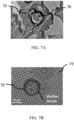
- vitrification agent(s) may also provide osmotic protection or otherwise enable cell survival during dehydration. Referring to FIG. 7A , undesirable and harmful dendritic structures 72 that signify crystallization as well as compromised/damaged oocyte 70 can be seen in the sample when it was desiccated employing the method of the current disclosure in the absence of any glass forming vitrification agent.
- the details of the experimental protocol is provided in the Example 2.
- a vitrification agent examples include, but are not limited to, dimethylsulfoxide, glycerol, sugars, polyalcohols, methylamines, betines, antifreeze proteins, synthetic anti-nucleating agents, polyvinyl alcohol, cyclohexanetriols, cyclohexanediols, inorganic salts, organic salts, ionic liquids, or combinations thereof.
- a vitrification medium optionally contains 1, 2, 3, 4, or more vitrification agents.
- the vitrification medium includes a vitrification agent at a concentration that is dependent on the identity of the vitrification agent.
- the concentration of the vitrification agent is at a concentration that is below that which will be toxic to the biological sample being vitrified where toxic is such that functional or biological viability is not achieved upon subsequent sample use.
- the concentration of a vitrification agent is optionally 500 ⁇ M to 6 M, or any value or range therebetween.
- the concentration is optionally from 1 M to 6 M.
- the total concentration of all vitrification agents when combined is optionally from 1M to 6M.
- the vitrification medium optionally includes water or other solvent, a buffering agent, one or more salts or other components.
- a buffering agent is any agent with a pKa of 6 to 8.5 at 25°C.
- Illustrative examples of buffering agents include HEPES, TRIS, PIPES, MOPS, among others.
- a buffering agent is provided at a concentration suitable to stabilize the pH of the vitrification medium to a desired level.
- FIG. 7B complete vitrification was achieved when mouse oocytes were desiccated employing the method of the current disclosure utilizing a vitrification mixture containing trehalose (1.8 M), glycerol, choline and betine (60 mM).
- the integrity of the oocyte 75 is evident and signifies the benefits of the capillary 77 assisted vitrification method disclosed herein.
- the importance of appropriate vitrification medium is further illustrated in FIGs. 8A and 8B . Even at the fast desiccation rates possible in ultra-thin films (spin drying such as is used on prior methods as illustrated in FIG. 1 ) homogeneous vitrification is not guaranteed, and FIG.
- FIG. 8A shows formation of ice crystals 84 in the vitrification mixture comprising Chinese hamster ovary (CHO) cells but no glass forming agent.
- the a vitrification medium comprising trehalose, HEPES, ChCl, and Betine resulted in uniformly vitrified 86 biological material under ultra-thin films (spin drying) configuration as shown in FIG. 8B .
- spin drying the capillary assisted desiccation method disclosed herein doesn't restrict the biological material mixture to conform to ultra-thin film form to achieve very fast desiccation rates of 3gH 2 O/gdw/min - 2gH 2 O/gdw/min.
- Trehalose a glass forming sugar
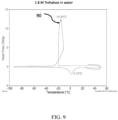
- differential scanning calorimetry shows that a vitrified 1.8M trehalose in water has a glass transition temperature 90 of -15.43°C. To achieve vitrification above water freezing point 0°C, this concentration isn't ideal and higher concentrations (6-8M) are required which could be damaging to the biological materials.
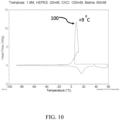
- a vitrified mixture including 1.8M trehalose, 20mM HEPES, 120mM ChCl, and 60 mM Betine shows a glass transition temperature, 100 of +9 0 C. Further attention is drawn to the influence of the buffering agents. As shown in FIG.
- An exemplary vitrification medium for the capillary assisted vitrification method disclosed herein may include trehalose, and one or more buffering agents containing large organic ions (>120 kDa) such as choline or betine or HEPES as well as buffering agent(s) containing small ions such as K or Na or Cl.
- buffering agents containing large organic ions >120 kDa
- buffering agent(s) containing small ions such as K or Na or Cl.
- a vitrification medium including trehalose (to preserve/stabilization large biomolecules), glycerol (to preserve/stabilize small biomolecules and prevent molecular mobility at interstitial spaces), and choline chloride buffer.
- trehalose to preserve/stabilization large biomolecules
- glycerol to preserve/stabilize small biomolecules and prevent molecular mobility at interstitial spaces
- choline chloride buffer to preserve/stabilize small biomolecules and prevent molecular mobility at interstitial spaces
- This exemplary composition doesn't limit the scope of using alternative formulations for the method disclosed herein.
- the capillary assisted vitrification method may be performed at a temperature from -80°C to +60°C.
- the temperature range is optionally where the mobility of water molecules in the sample is high and the temperature is not detrimental to the health and viability of the biological material. This would vary from material to material as well as the composition of the vitrification medium.
- the vitrification temperature is 0.1°C to 40°C.
- the vitrification temperature is 4°C to 26°C.
- the vitrification temperature is 25°C.
- the capillary assisted vitrification method may be performed in a dry atmosphere or environment.
- a dry environment is an environment with a humidity level below saturation.
- the humidity level of the environment such as the environment on the second side of the capillary tube is 30% relative humidity or less, optionally 20% or less, optionally 10% or less, optionally 5% or less.
- a dry environment optionally has a humidity between 1% and 30% or any value or range therebetween, optionally between 1% and 5%.
- the capillary assisted vitrification method may be performed in a low pressure environment (less than 1 atm (760 mmHg)).
- a low pressure environment will have favorable impact on the rate or vitrification.
- the environmental pressure is optionally 100 mmHg or 0.1 atm.
- the environmental pressure is from 10 mmHg to 760 mmHg, or any value or range therebetween.
- the environmental pressure is from 10 mmHg to 200 mmHg.
- the capillary assisted vitrification method may be performed for a desiccation time.
- a desiccation time is a time sufficient to promote suitable drying to vitrify the vitrification medium.
- a desiccation time is optionally 1 second to 1 hour.
- a desiccation time is 1 second to 50 min, optionally 5 seconds to 60 min. Desiccation time may vary dependent on the sample type or physical characteristics and the particulars of the capillary channels.
- FIG. 17 The benefits of the capillary assisted vitrification method disclosed herein are further illustrated in FIG. 17 .
- Various proteinous material can be stabilized following the capillary assisted vitrification method disclosed herein. It is appreciated that these vitrified biological materials can be sealed in protective packages, for transportation and long term storage. Further, some of the vitrified biological samples can be stored in ambient temperatures without requiring a cold chain. They can be utilized upon rehydration. Examples include but not limited to insulin, interleukin 1, interleukin 2, tetanus and hepatitis vaccines etc.
- aspect 120 illustrates an exemplary non-cryogenic biological material vitrification device to exploit the benefits of the capillary assisted vitrification method as provided herein, including: a receptacle 126 made of capillary drying plate/membrane of the current disclosure, having a first capillary opening inside the receptacle and a second capillary opening outside the receptacle; a removable lid 127 made of capillary drying plate/membrane of the current disclosure to fill a requisite quantity of said vitrification mixture 125 within the receptacle wherein said vitrification mixture is operably in contact with the first openings of the capillary channels; and an enclosure 121 operably in gaseous communication with the second openings of the capillary channels as well as with an external environment wherein the pressure, temperature and humidity within the enclosure can operably be controlled.
- the outside surface of the receptacle 126 maintains a gap 128 from the enclosure 121 boundary by placing perforated separators 124 to facilitate gas flow and
- the enclosure of aspect 120 is impervious to moisture and gas and has sealable inlet(s) 122 and outlet(s) 123.
- the sealable inlet(s) and outlet(s) enable flow of gas across or maintain reduced pressure across the outside surface of the receptacle in order to enhance desiccation action.
- the sealing mechanism may be mechanical or adhesive based or thermal consolidation (heat sealing).
- the capillary assisted vitrification method can be carried out in-situ by connecting the inlet(s) and outlet(s) to appropriate devices that can control the humidity, pressure and temperature inside the enclosure. Very fast desiccation is achieved due to enhanced capillary contact area with the vitrification mixture from all sides.
- the thickness of the sample will be 1 centimeter or less.
- the thickness will be about 1 millimeter or less. It is understood that the thickness specification of aspect 120 is along the vertical axis of the picture and can be interchanged in a three dimensional construct. The method can be performed across large area.
- the inlet and outlet are sealed to prevent rehydration of the vitrified material.
- the receptacle can be utilized to desiccate the vitrification mixture in a separate chamber employing the method disclosed here and then sealed in the enclosure 121.
- the device 120 can be configured into a wearable device optionally wherein the top lid 127 and external enclosure along the seal line 122 and 123 can be removed and adhesively attached to the application surface.
- Many possible configurations and applications are possible. Illustrative examples of a wearable device can be found in U.S. Patent Application Publication No: 2011/0054285 A1 .
- Capillary device 139 can be a hollow cylinder comprising the characteristics of the receptacle 136 as shown in 1395.
- a pipe can be envisioned as a substantially tubular substrate of capillary channels that extends into the sample so as to effectively increase the surface area of the environment external to the sample.
- the end of the pipe in contact with the vitrification mixture is optionally closed.
- a wick comprising capillary channels can be also utilized, however, a pipe is preferred.
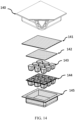
- an additional aspect 140 including a receptacle formed of multiple cavities 144 with inter cavity drying space and one common lid 142 in order to enhance desiccation action.
- each cavity can also have individual lids.
- Specification 141 and 145 constitute the external enclosure and 143 is the vitrification mixture including the sample.
- the inlets and outlets of the device are not shown in the picture, the device operates according to the teachings of the current disclosure and discussions pertaining to aspect 120 and 130 are applicable to this aspect. Further, the capillary pipes/wicks of aspect 130 can also be deployed in this aspect.
- the devices in aspects 120, 130, and 140 are sufficiently flexible and reconfigurable to become a wearable device.
- a biological material may remain viable in vitrified state during storage above cryogenic temperature may vary from one sample material to the next. In some aspects, a biological material may remain viable while in storage above cryogenic temperature for 2-20 days. In other aspects, a biological material may remain viable while in storage above cryogenic temperature for 10 weeks. In other aspects, a biological material may remain viable in storage above cryogenic temperature for up to one year. In other aspects, a biological material may remain viable while in storage above cryogenic temperature for up to 10 years.
- the vitrified biological material can be stored at cryogenic temperatures for very long periods. For many biological materials, this is a preferred approach to avoid cryoinjury that commonly occurs during direct vitrification at cryogenic temperatures.
- a preferred approach in one aspect is to vitrify the biological materials at room temperatures utilizing low concentrations of vitrification agents (e.g. ⁇ 2M trehalose) and then immediately store at cryogenic temperatures. Therefore, the said device is optionally made out of materials storable at a temperature between -196°C to 60°C following the vitrification according to the teachings of the current disclosure.
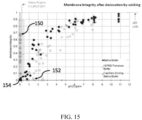
- FIG. 15 the cell membrane integrity of desiccated Chinese hamster ovary (CHO) cells is compared at different moisture levels.
- Open circles 152 represent the membrane integrity vs moisture level while desiccating a vitrification mixture comprising 1.8M trehalose with HEPES buffer in a conventional dry box.
- the cell membrane is completely destroyed by the time the moisture level reached 1 gH 2 O/gdw.
- Betine buffer was utilized in dry box desiccation process the membrane integrity represented by closed circles 154 improved compared HEPES buffer, however the membranes were almost destroyed when the moisture reached 1 gH 2 O/gdw level.
- capillary assisted fast desiccation method disclosed herein is illustrated by the closed circles 150 demonstrating that the membrane integrity is largely preserved even when the moisture level has reached extremely low level that is not feasible in conventional dry box desiccation processes.
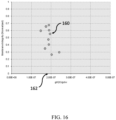
- the moisture levels that are achievable by the disclosed method is further illustrated in FIG. 16 . While Betine buffer helps in the preservation of the membrane integrity, the fast desiccation process of the current disclosure vitrifies the biological materials before even they realize which is largely responsible for the retention their integrity.
- CHO cells Chinese hamster ovary (CHO) cells were obtained from American Type Culture Collection (ATCC, Manassas, VA), and cultured in Dulbecco' modified Eagle's medium (DMEM) (Invitrogen, Carlsbad, CA) supplemented with 10% fetal bovine serum (Atlanta Biologicals, Norcross, GA) and 2% penicillin-streptomycin (10 U/mL penicillin G and 10 ⁇ g/mL streptomycin sulfate, Invitrogen, Carlsbad, CA). Cultures were maintained in 25-cm 2 T-flasks (Corning Incorporated, NY) at 37°C and equilibrated with 10% CO 2 -90% air. Following cell culture to desired confluency of 70%, the cells were trypsinized, pelleted and re-dispersed to create a concentration of 1 ⁇ 10 5 cells/mL in DMEM.
- DMEM Dulbecco' modified Eagle's medium
- a PDMS cast was created having a dimension of 0.25 inch x 0.38 inch having a central circular cavity (0.05 inch) and a polypropylene membrane (obtained from Sterlitech Corporation, Kent, WA) having pore sizes of 5 ⁇ m and thickness of 100 ⁇ m was placed on it. These pores provided the desired capillary action to desiccate the cells.
- This assembly was utilized as the capillary device.
- the entire set-up was housed inside a custom-built enclosure (polystyrene, 6x8x6 inches) containing a low moisture atmosphere ( ⁇ 2% RH) and was purged with medical grade nitrogen to prevent moisture pickup through the open surface of the sample.
- a lid attached to a computer-controlled micro-pump Dolomite, Charlestown, MA was placed on the cavity to facilitate fast removal of moisture from the samples through the capillary channels.
- Desiccation After placing a 20 ⁇ L sample of cells suspended at a concentration of 1 ⁇ 10 5 cells/mL on top of the capillary substrate, the micro pump was initiated (1 mL/min) to desiccate the sample. The desiccation of the biological sample took place within 5 secs. Desiccation experiments were conducted with cell samples without glass forming agents such as trehalose as well as with a vitrification medium comprising HEPES: 20mM, ChCl: 120mM, Trehalose: 1.8M, Betine: 60mM, and the pH adjusted with potassium salts to 7.2 (SAMADHI). Comparative experiments were also conducted on quartz substrates without employing the capillary device in a conventional dry box containing low moisture and was purged with medical grade nitrogen. Following desiccation, the cell samples were removed and membrane integrity was evaluated.
- the membrane integrity was determined using Syto-13/ethydium bromide membrane integrity assays (Molecular Probes, Eugene, OR).
- the stock solution for the Syto-13/ethydium bromide staining was prepared by adding 10 ⁇ L of 1 mg/mL Syto-13 solution (aq.) and 5 ⁇ L of 1.0 mg/mL solution ethydium bromide solution (aq.) to 8 mL of DMEM without phenol red or serum (Invitrogen Inc., Carlsbad, CA). After rehydration, 500 ⁇ L of Syto-13/ethydium bromide solution were added to the cells attached on coverslips, and the samples were incubated at 37°C for 5 min.
- HTF human tubal fluid
- FBS fetal bovine serum
- Desiccation experiments were performed employing the capillary device described in Example 1 above and following the same protocols.
- EMD Millipore (Billerica, MA) hydrophilic membrane with 0.22 ⁇ m pore size was used as the capillary substrate. All samples were placed within a vacuum chamber which was connected to an Edwards RV3 Two Stage Rotary Vane Pump (Crawley, United Kingdom) and Drierite desiccation column. The insulin-based samples were then continuously dried under vacuum for a duration of 25 minutes at a pressure between -27 and -30 in Hg. After drying, samples were removed and reweighed to determine the amount of water loss due to drying. The Moisture Residue Ratio (gH 2 O/gdw) was calculated for all desiccated samples to quantify the efficiency of the desiccation procedure.
Landscapes
- Life Sciences & Earth Sciences (AREA)
- Engineering & Computer Science (AREA)
- Health & Medical Sciences (AREA)
- Zoology (AREA)
- Wood Science & Technology (AREA)
- General Health & Medical Sciences (AREA)
- Bioinformatics & Cheminformatics (AREA)
- Chemical & Material Sciences (AREA)
- Organic Chemistry (AREA)
- Biotechnology (AREA)
- Biomedical Technology (AREA)
- Genetics & Genomics (AREA)
- Environmental Sciences (AREA)
- Dentistry (AREA)
- General Engineering & Computer Science (AREA)
- Biochemistry (AREA)
- Microbiology (AREA)
- Cell Biology (AREA)
- Sustainable Development (AREA)
- Apparatus Associated With Microorganisms And Enzymes (AREA)
- Micro-Organisms Or Cultivation Processes Thereof (AREA)
- Physics & Mathematics (AREA)
- Thermal Sciences (AREA)
- Hematology (AREA)
- Agricultural Chemicals And Associated Chemicals (AREA)
Claims (8)
- Verfahren zur Vitrifizierung eines oder mehrerer biologischer Materialien oberhalb kryogener Temperatur, wobei das Verfahren folgendes umfasst:a) Bereitstellen einer Kapillarmembran, die mehrere Kapillarkanäle umfasst, wobei jeder der Kapillarkanäle eine erste Öffnung (54) und eine zweite Öffnung (56) besitzt, wobei die mehreren Kapillarkanäle in einem Substrat untergebracht sind und unter Bildung der Kapillarmembran miteinander verbunden sind und wobei jeder der Kapillarkanäle eine Querschnittsfläche von 0,01 - 100 Quadratmikron hat;b) Bereitstellen einer Vitrifizierungsmischung (52), wobei die Vitrifizierungsmischung eines oder mehrere biologische Materialien und ein Vitrifizierungsmedium umfasst;c) Inkontaktbringen der Kapillarmembran mit der Vitrifizierungsmischung derart, dass die Kapillarmembran eine Oberfläche der Vitrifizierungsmischung berührt, wobei die Kapillarmembran die Vitrifizierungsmischung so berührt, dass die erste Öffnung der Kapillarkanäle in Funktion in Kontakt mit der Vitrifizierungsmischung steht;d) die zweiten Öffnungen der Kapillarkanäle stehen in Funktion in Verbindung mit einer Umgebungsatmosphäre (58), die eine Luftfeuchtigkeit unterhalb derjenigen der Vitrifizierungsmischung aufweist; unde) Trocknen der Vitrifizierungsmischung durch Kapillarwirkung, bis die Vitrifizierungsmischung in einen glasartigen Zustand gelangt.
- Verfahren gemäß Anspruch 1, bei dem die Kapillarmembran eine Dicke von 1 Mikron bis 500 Mikron hat.
- Verfahren gemäß Anspruch 1 oder 2, bei dem die Vitrifizierungsmischung Trehalose, Glycerin und Betin und/oder Cholin enthält.
- Verfahren gemäß mindestens einem der Ansprüche 1-3, das ferner den zusätzlichen Schritt umfasst, dass ein Fluss von Gas über die zweiten Öffnungen hinweg bereitgestellt wird.
- Verfahren gemäß Anspruch 4, bei dem das Gas Luft oder Inertgas mit einem relativen Luftfeuchtigkeitsniveau von 30 % oder weniger ist.
- Verfahren gemäß mindestens einem der Ansprüche 1-5, bei dem die Kapillarmembran aus einem hydrophilen Material hergestellt ist.
- Verfahren gemäß Anspruch 1, das ferner den zusätzlichen Schritt umfasst, dass die Vitrifizierungsmischung in einem glasartigen Zustand in einen Schutzeinschluss eingeschlossen wird, wobei der Einschluss undurchlässig für Wasser und Luft ist, und der Schutzeinschluss für eine Lagerungszeit von 20 Tagen oder mehr bei einer Temperatur zwischen -196°C bis +60°C gelagert wird.
- Vorrichtung zur nicht-kryogenen Vitrifizierung, die umfasst:ein Gefäß mit Wänden, die mehrere Kapillarkanäle umfassen, von denen jeder eine erste Öffnung und eine zweite Öffnung aufweist, wobei die mehreren Kapillarkanäle in einem Substrat untergebracht sind und unter Bildung einer Kapillarmembran miteinander verbunden sind, wobei die Kapillarmembran aus einem hydrophilen Material hergestellt ist und wobei die Kapillarmembran so angeordnet ist, dass, wenn eine Vitrifizierungsmischung in das Gefäß gegeben wird, die Vitrifizierungsmischung in Funktion in Kontakt mit den ersten Öffnungen der Kapillarkanäle steht; undeinen Einschluss, der in Funktion in Verbindung mit den zweiten Öffnungen der Kapillarkanäle sowie auch mit einer äußeren Umgebung steht, wobei ein Druck, Temperatur und Luftfeuchtigkeit innerhalb des Einschlusses kontrolliert werden können.
Priority Applications (1)
| Application Number | Priority Date | Filing Date | Title |
|---|---|---|---|
| EP25161490.5A EP4544910A1 (de) | 2014-06-09 | 2015-06-09 | Kapillargestützte vitrifizierungsverfahren und -vorrichtungen |
Applications Claiming Priority (3)
| Application Number | Priority Date | Filing Date | Title |
|---|---|---|---|
| US201462009562P | 2014-06-09 | 2014-06-09 | |
| EP15806082.2A EP3152291B1 (de) | 2014-06-09 | 2015-06-09 | Verfahren und vorrichtungen zur kapillar unterstützten vitrifizierung |
| PCT/US2015/034887 WO2015191570A1 (en) | 2014-06-09 | 2015-06-09 | Capillary assisted vitrification processes and devices |
Related Parent Applications (2)
| Application Number | Title | Priority Date | Filing Date |
|---|---|---|---|
| EP15806082.2A Division EP3152291B1 (de) | 2014-06-09 | 2015-06-09 | Verfahren und vorrichtungen zur kapillar unterstützten vitrifizierung |
| EP15806082.2A Division-Into EP3152291B1 (de) | 2014-06-09 | 2015-06-09 | Verfahren und vorrichtungen zur kapillar unterstützten vitrifizierung |
Related Child Applications (1)
| Application Number | Title | Priority Date | Filing Date |
|---|---|---|---|
| EP25161490.5A Division EP4544910A1 (de) | 2014-06-09 | 2015-06-09 | Kapillargestützte vitrifizierungsverfahren und -vorrichtungen |
Publications (3)
| Publication Number | Publication Date |
|---|---|
| EP3909427A1 EP3909427A1 (de) | 2021-11-17 |
| EP3909427B1 true EP3909427B1 (de) | 2025-04-02 |
| EP3909427C0 EP3909427C0 (de) | 2025-04-02 |
Family
ID=54834187
Family Applications (3)
| Application Number | Title | Priority Date | Filing Date |
|---|---|---|---|
| EP21179466.4A Active EP3909427B1 (de) | 2014-06-09 | 2015-06-09 | Verfahren und vorrichtungen zur kapillar unterstützten vitrifizierung |
| EP25161490.5A Pending EP4544910A1 (de) | 2014-06-09 | 2015-06-09 | Kapillargestützte vitrifizierungsverfahren und -vorrichtungen |
| EP15806082.2A Active EP3152291B1 (de) | 2014-06-09 | 2015-06-09 | Verfahren und vorrichtungen zur kapillar unterstützten vitrifizierung |
Family Applications After (2)
| Application Number | Title | Priority Date | Filing Date |
|---|---|---|---|
| EP25161490.5A Pending EP4544910A1 (de) | 2014-06-09 | 2015-06-09 | Kapillargestützte vitrifizierungsverfahren und -vorrichtungen |
| EP15806082.2A Active EP3152291B1 (de) | 2014-06-09 | 2015-06-09 | Verfahren und vorrichtungen zur kapillar unterstützten vitrifizierung |
Country Status (9)
| Country | Link |
|---|---|
| US (4) | US10433540B2 (de) |
| EP (3) | EP3909427B1 (de) |
| CN (2) | CN106574221B (de) |
| AU (3) | AU2015274813B2 (de) |
| CA (1) | CA2951692A1 (de) |
| DK (1) | DK3152291T3 (de) |
| ES (2) | ES2894846T3 (de) |
| WO (1) | WO2015191570A1 (de) |
| ZA (3) | ZA201708442B (de) |
Families Citing this family (16)
| Publication number | Priority date | Publication date | Assignee | Title |
|---|---|---|---|---|
| AU2015274813B2 (en) | 2014-06-09 | 2019-08-22 | Somnio Global Holdings, Llc | Capillary assisted vitrification processes and devices |
| WO2017064715A1 (en) * | 2015-10-13 | 2017-04-20 | Fertilesafe Ltd. | Devices and methods for preparation of a biological sample for a cryoprocedure |
| US11617365B2 (en) | 2015-10-13 | 2023-04-04 | Fertilesafe Ltd. | Devices and methods for preparation of a biological sample for a cryoprocedure |
| US11612162B2 (en) * | 2015-10-29 | 2023-03-28 | Asymptote Ltd. | Methods for cryopreservation |
| WO2017160835A1 (en) | 2016-03-14 | 2017-09-21 | The Regents Of The University Of Michigan | A surface tension mediated lyo-processing technique for preservation of biologics |
| WO2020086803A1 (en) | 2018-10-24 | 2020-04-30 | Somnio Global Holdings, Llc | Functional wound healing dressings |
| CN109997841B (zh) * | 2019-04-09 | 2021-02-02 | 上海交通大学 | 维持常压空气氛围的人类配子快速冻融可视化环境舱 |
| JP7770330B2 (ja) * | 2020-02-28 | 2025-11-14 | アンビエント バイオサイエンス インコーポレーテッド | 生物学的試料を保存するための、キャピラリーを使ったガラス化方法および材料 |
| US20230365914A1 (en) * | 2020-03-20 | 2023-11-16 | The General Hospital Corporation | High aspect ratio devices and methods for vitrification of biological samples by rapid cooling |
| CN115867805A (zh) * | 2020-03-31 | 2023-03-28 | 乌普卡拉公司 | 用于快速检测生物样品中的目标分析物的装置和方法 |
| JP2023552690A (ja) * | 2020-11-19 | 2023-12-19 | アップカラ インコーポレイテッド | 環境温度での脂質粒子貯蔵システム及び方法 |
| CN116829574A (zh) * | 2020-11-19 | 2023-09-29 | 乌普卡拉股份有限公司 | 环境温度脂质颗粒储存系统和方法 |
| EP4247159A4 (de) * | 2020-11-19 | 2024-11-13 | Upkara, Inc. | Verfahren zur stabilen vitrifizierung |
| US20240277840A1 (en) * | 2021-07-01 | 2024-08-22 | Upkara, Inc. | Superconcentrated formulations of bioactive agents |
| CN114020077B (zh) * | 2021-11-02 | 2022-08-09 | 上海理工大学 | 细胞组织样品的低温保护剂加载设备及方法 |
| WO2025059636A1 (en) * | 2023-09-15 | 2025-03-20 | Ambient Biosciences, Inc. | Device and methods for sensitive biological sample storage |
Family Cites Families (25)
| Publication number | Priority date | Publication date | Assignee | Title |
|---|---|---|---|---|
| US3732627A (en) * | 1970-11-23 | 1973-05-15 | R Wertheim | Removal of a liquid phase from a material |
| US6509146B1 (en) | 1996-05-29 | 2003-01-21 | Universal Preservation Technologies, Inc. | Scalable long-term shelf preservation of sensitive biological solutions and suspensions |
| CN1113690C (zh) | 1997-10-31 | 2003-07-09 | 范培昌 | 室温玻化机 |
| ES2212641T5 (es) * | 1998-10-14 | 2012-06-06 | Katrina T. Forest | Método para la vitrificación de un espécimen biológico |
| US6300130B1 (en) | 1998-11-16 | 2001-10-09 | The General Hospital Corporation And University Of Massachusetts | Ultra rapid freezing for cell cryopreservation |
| CN1340710A (zh) | 2000-08-29 | 2002-03-20 | 上海正源生命技术有限公司 | 应用室温玻化技生产室温稳定的免疫层析试条 |
| US7422726B2 (en) * | 2002-10-23 | 2008-09-09 | Blood Cell Storage, Inc. | Integrated container for lyophilization, rehydration and processing of biological materials |
| WO2005113147A2 (en) | 2004-04-08 | 2005-12-01 | Biomatrica, Inc. | Integration of sample storage and sample management for life science |
| ATE479096T1 (de) | 2004-07-29 | 2010-09-15 | Relia Diagnostic Systems Llc | Querstromsystem und assay |
| US20060177426A1 (en) * | 2005-02-09 | 2006-08-10 | Cecil Gibson | Method of preserving lyophilized microorganisms for transport, storage and recovery of viable microorganisms |
| GB0523638D0 (en) | 2005-11-21 | 2005-12-28 | Cambridge Biostability Ltd | Pharmaceutical device for the administration of substances to patients |
| WO2007120829A2 (en) | 2006-04-14 | 2007-10-25 | The General Hospital Corporation | Methods for the cryopreservation of mammalian cells |
| US7883664B2 (en) | 2007-06-27 | 2011-02-08 | University Of North Carolina At Charlotte | Microwave drying process for vitrification of biologics |
| US8349252B2 (en) | 2007-06-27 | 2013-01-08 | University Of North Carolina At Charlotte | Vitrified composition which preserves biological materials |
| CN102803507B (zh) * | 2009-06-12 | 2016-05-25 | 精密公司 | 用于微流体装置中在板反应剂的脱水储存的组合物及方法 |
| US10092691B2 (en) | 2009-09-02 | 2018-10-09 | Becton, Dickinson And Company | Flexible and conformal patch pump |
| US20130260452A1 (en) * | 2009-10-16 | 2013-10-03 | Mehmet Toner | Methods For The Cryopreservation Of Mammalian Cells |
| CL2010000920A1 (es) | 2010-08-30 | 2010-12-17 | Metodo para criopreservar espermatozoides humanos libres de plasma seminal, mediante un proceso rapido y simple de vitrificacion - desvitrificacion aseptica; un kit portable para el montaje del metodo. | |
| US20140212985A1 (en) | 2011-06-30 | 2014-07-31 | Koninklijke Philips N.V. | Preparation of reaction chambers with dried proteins |
| CA2844927C (en) | 2011-08-12 | 2017-10-31 | Merial Limited | Vacuum-assisted preservation of biological products, in particular of vaccines |
| US9770672B2 (en) * | 2011-08-22 | 2017-09-26 | Brian J. Peever | Dewatering method using a wicking material |
| US20130309656A1 (en) | 2012-05-17 | 2013-11-21 | David C. Davis | Antibody detection method and device for a saliva sample from a non-human animal |
| WO2014185457A1 (ja) | 2013-05-16 | 2014-11-20 | 三菱製紙株式会社 | 細胞又は組織のガラス化凍結保存用治具 |
| JP6022602B2 (ja) | 2013-10-29 | 2016-11-09 | 学校法人北里研究所 | 細胞または組織のガラス化凍結保存用治具 |
| AU2015274813B2 (en) * | 2014-06-09 | 2019-08-22 | Somnio Global Holdings, Llc | Capillary assisted vitrification processes and devices |
-
2015
- 2015-06-09 AU AU2015274813A patent/AU2015274813B2/en active Active
- 2015-06-09 US US15/317,256 patent/US10433540B2/en active Active
- 2015-06-09 ES ES15806082T patent/ES2894846T3/es active Active
- 2015-06-09 WO PCT/US2015/034887 patent/WO2015191570A1/en not_active Ceased
- 2015-06-09 EP EP21179466.4A patent/EP3909427B1/de active Active
- 2015-06-09 CN CN201580042589.4A patent/CN106574221B/zh active Active
- 2015-06-09 DK DK15806082.2T patent/DK3152291T3/da active
- 2015-06-09 EP EP25161490.5A patent/EP4544910A1/de active Pending
- 2015-06-09 CA CA2951692A patent/CA2951692A1/en active Pending
- 2015-06-09 CN CN201911132466.6A patent/CN110734844B/zh active Active
- 2015-06-09 ES ES21179466T patent/ES3027136T3/es active Active
- 2015-06-09 EP EP15806082.2A patent/EP3152291B1/de active Active
-
2017
- 2017-12-01 ZA ZA2017/08442A patent/ZA201708442B/en unknown
-
2018
- 2018-05-31 ZA ZA2018/03683A patent/ZA201803683B/en unknown
-
2019
- 2019-03-05 US US16/293,238 patent/US10568318B2/en active Active
- 2019-03-07 ZA ZA2019/01434A patent/ZA201901434B/en unknown
- 2019-11-06 US US16/675,817 patent/US11576374B2/en active Active
- 2019-11-11 AU AU2019261829A patent/AU2019261829B2/en active Active
-
2020
- 2020-09-30 AU AU2020244494A patent/AU2020244494B2/en active Active
-
2023
- 2023-01-13 US US18/096,671 patent/US12075773B2/en active Active
Also Published As
| Publication number | Publication date |
|---|---|
| WO2015191570A1 (en) | 2015-12-17 |
| CN110734844B (zh) | 2023-05-30 |
| CA2951692A1 (en) | 2015-12-17 |
| DK3152291T3 (da) | 2021-10-18 |
| ES2894846T3 (es) | 2022-02-16 |
| EP3152291B1 (de) | 2021-07-21 |
| US20170135336A1 (en) | 2017-05-18 |
| AU2020244494A1 (en) | 2020-10-29 |
| EP3152291A4 (de) | 2018-02-21 |
| EP4544910A1 (de) | 2025-04-30 |
| EP3909427C0 (de) | 2025-04-02 |
| ZA201901434B (en) | 2021-01-27 |
| AU2019261829B2 (en) | 2020-07-02 |
| US10433540B2 (en) | 2019-10-08 |
| AU2015274813A1 (en) | 2017-01-05 |
| US11576374B2 (en) | 2023-02-14 |
| CN106574221B (zh) | 2019-12-10 |
| CN106574221A (zh) | 2017-04-19 |
| AU2020244494B2 (en) | 2021-07-29 |
| US20190200603A1 (en) | 2019-07-04 |
| AU2019261829A1 (en) | 2019-12-05 |
| ZA201803683B (en) | 2019-07-31 |
| EP3152291A1 (de) | 2017-04-12 |
| US12075773B2 (en) | 2024-09-03 |
| AU2015274813B2 (en) | 2019-08-22 |
| CN110734844A (zh) | 2020-01-31 |
| ZA201708442B (en) | 2019-08-28 |
| US10568318B2 (en) | 2020-02-25 |
| US20200068875A1 (en) | 2020-03-05 |
| ES3027136T3 (en) | 2025-06-12 |
| US20230172192A1 (en) | 2023-06-08 |
| EP3909427A1 (de) | 2021-11-17 |
Similar Documents
| Publication | Publication Date | Title |
|---|---|---|
| US12075773B2 (en) | Capillary assisted vitrification processes and devices | |
| Amini et al. | Technologies for vitrification based cryopreservation | |
| US20110165553A1 (en) | Vitrified composition which preserves biological materials | |
| US10834917B2 (en) | Methods for cryopreservation of biological materials | |
| US20230413807A1 (en) | Methods of stable vitrification | |
| HK40126411A (en) | Capillary assisted vitrification processes and devices | |
| EP3879979B1 (de) | Vorrichtung und verfahren zum einfrieren einer biologischen lösung | |
| JP6667903B2 (ja) | 中空糸凍結保存用具及び細胞凍結保存方法 | |
| WO2025155668A1 (en) | Vitrified reagents for enhanced transfection and processes thereof |
Legal Events
| Date | Code | Title | Description |
|---|---|---|---|
| PUAI | Public reference made under article 153(3) epc to a published international application that has entered the european phase |
Free format text: ORIGINAL CODE: 0009012 |
|
| STAA | Information on the status of an ep patent application or granted ep patent |
Free format text: STATUS: THE APPLICATION HAS BEEN PUBLISHED |
|
| AC | Divisional application: reference to earlier application |
Ref document number: 3152291 Country of ref document: EP Kind code of ref document: P |
|
| AK | Designated contracting states |
Kind code of ref document: A1 Designated state(s): AL AT BE BG CH CY CZ DE DK EE ES FI FR GB GR HR HU IE IS IT LI LT LU LV MC MK MT NL NO PL PT RO RS SE SI SK SM TR |
|
| B565 | Issuance of search results under rule 164(2) epc |
Effective date: 20211014 |
|
| STAA | Information on the status of an ep patent application or granted ep patent |
Free format text: STATUS: REQUEST FOR EXAMINATION WAS MADE |
|
| 17P | Request for examination filed |
Effective date: 20220505 |
|
| RBV | Designated contracting states (corrected) |
Designated state(s): AL AT BE BG CH CY CZ DE DK EE ES FI FR GB GR HR HU IE IS IT LI LT LU LV MC MK MT NL NO PL PT RO RS SE SI SK SM TR |
|
| GRAP | Despatch of communication of intention to grant a patent |
Free format text: ORIGINAL CODE: EPIDOSNIGR1 |
|
| STAA | Information on the status of an ep patent application or granted ep patent |
Free format text: STATUS: GRANT OF PATENT IS INTENDED |
|
| INTG | Intention to grant announced |
Effective date: 20241024 |
|
| RIN1 | Information on inventor provided before grant (corrected) |
Inventor name: CHAKRABORTY, NILAY Inventor name: MOHANTY, PRAVANSU S. |
|
| RAP1 | Party data changed (applicant data changed or rights of an application transferred) |
Owner name: AMBIENT BIOSCIENCES, INC. |
|
| GRAS | Grant fee paid |
Free format text: ORIGINAL CODE: EPIDOSNIGR3 |
|
| GRAA | (expected) grant |
Free format text: ORIGINAL CODE: 0009210 |
|
| STAA | Information on the status of an ep patent application or granted ep patent |
Free format text: STATUS: THE PATENT HAS BEEN GRANTED |
|
| AC | Divisional application: reference to earlier application |
Ref document number: 3152291 Country of ref document: EP Kind code of ref document: P |
|
| AK | Designated contracting states |
Kind code of ref document: B1 Designated state(s): AL AT BE BG CH CY CZ DE DK EE ES FI FR GB GR HR HU IE IS IT LI LT LU LV MC MK MT NL NO PL PT RO RS SE SI SK SM TR |
|
| REG | Reference to a national code |
Ref country code: GB Ref legal event code: FG4D |
|
| REG | Reference to a national code |
Ref country code: IE Ref legal event code: FG4D |
|
| REG | Reference to a national code |
Ref country code: DE Ref legal event code: R096 Ref document number: 602015091382 Country of ref document: DE |
|
| U01 | Request for unitary effect filed |
Effective date: 20250415 |
|
| U07 | Unitary effect registered |
Designated state(s): AT BE BG DE DK EE FI FR IT LT LU LV MT NL PT RO SE SI Effective date: 20250423 |
|
| REG | Reference to a national code |
Ref country code: ES Ref legal event code: FG2A Ref document number: 3027136 Country of ref document: ES Kind code of ref document: T3 Effective date: 20250612 |
|
| PGFP | Annual fee paid to national office [announced via postgrant information from national office to epo] |
Ref country code: GB Payment date: 20250619 Year of fee payment: 11 |
|
| U20 | Renewal fee for the european patent with unitary effect paid |
Year of fee payment: 11 Effective date: 20250620 |
|
| PGFP | Annual fee paid to national office [announced via postgrant information from national office to epo] |
Ref country code: ES Payment date: 20250703 Year of fee payment: 11 |
|
| PG25 | Lapsed in a contracting state [announced via postgrant information from national office to epo] |
Ref country code: NO Free format text: LAPSE BECAUSE OF FAILURE TO SUBMIT A TRANSLATION OF THE DESCRIPTION OR TO PAY THE FEE WITHIN THE PRESCRIBED TIME-LIMIT Effective date: 20250702 Ref country code: GR Free format text: LAPSE BECAUSE OF FAILURE TO SUBMIT A TRANSLATION OF THE DESCRIPTION OR TO PAY THE FEE WITHIN THE PRESCRIBED TIME-LIMIT Effective date: 20250703 |
|
| PG25 | Lapsed in a contracting state [announced via postgrant information from national office to epo] |
Ref country code: PL Free format text: LAPSE BECAUSE OF FAILURE TO SUBMIT A TRANSLATION OF THE DESCRIPTION OR TO PAY THE FEE WITHIN THE PRESCRIBED TIME-LIMIT Effective date: 20250402 |
|
| PG25 | Lapsed in a contracting state [announced via postgrant information from national office to epo] |
Ref country code: HR Free format text: LAPSE BECAUSE OF FAILURE TO SUBMIT A TRANSLATION OF THE DESCRIPTION OR TO PAY THE FEE WITHIN THE PRESCRIBED TIME-LIMIT Effective date: 20250402 |
|
| PGFP | Annual fee paid to national office [announced via postgrant information from national office to epo] |
Ref country code: CH Payment date: 20250701 Year of fee payment: 11 |
|
| PG25 | Lapsed in a contracting state [announced via postgrant information from national office to epo] |
Ref country code: RS Free format text: LAPSE BECAUSE OF FAILURE TO SUBMIT A TRANSLATION OF THE DESCRIPTION OR TO PAY THE FEE WITHIN THE PRESCRIBED TIME-LIMIT Effective date: 20250702 |
|
| PG25 | Lapsed in a contracting state [announced via postgrant information from national office to epo] |
Ref country code: IS Free format text: LAPSE BECAUSE OF FAILURE TO SUBMIT A TRANSLATION OF THE DESCRIPTION OR TO PAY THE FEE WITHIN THE PRESCRIBED TIME-LIMIT Effective date: 20250802 |
|
| PG25 | Lapsed in a contracting state [announced via postgrant information from national office to epo] |
Ref country code: SM Free format text: LAPSE BECAUSE OF FAILURE TO SUBMIT A TRANSLATION OF THE DESCRIPTION OR TO PAY THE FEE WITHIN THE PRESCRIBED TIME-LIMIT Effective date: 20250402 |
|
| PG25 | Lapsed in a contracting state [announced via postgrant information from national office to epo] |
Ref country code: CZ Free format text: LAPSE BECAUSE OF FAILURE TO SUBMIT A TRANSLATION OF THE DESCRIPTION OR TO PAY THE FEE WITHIN THE PRESCRIBED TIME-LIMIT Effective date: 20250402 |
|
| PG25 | Lapsed in a contracting state [announced via postgrant information from national office to epo] |
Ref country code: SK Free format text: LAPSE BECAUSE OF FAILURE TO SUBMIT A TRANSLATION OF THE DESCRIPTION OR TO PAY THE FEE WITHIN THE PRESCRIBED TIME-LIMIT Effective date: 20250402 |
|
| PG25 | Lapsed in a contracting state [announced via postgrant information from national office to epo] |
Ref country code: MC Free format text: LAPSE BECAUSE OF FAILURE TO SUBMIT A TRANSLATION OF THE DESCRIPTION OR TO PAY THE FEE WITHIN THE PRESCRIBED TIME-LIMIT Effective date: 20250402 |
|
| PLBE | No opposition filed within time limit |
Free format text: ORIGINAL CODE: 0009261 |
|
| STAA | Information on the status of an ep patent application or granted ep patent |
Free format text: STATUS: NO OPPOSITION FILED WITHIN TIME LIMIT |
|
| REG | Reference to a national code |
Ref country code: CH Ref legal event code: L10 Free format text: ST27 STATUS EVENT CODE: U-0-0-L10-L00 (AS PROVIDED BY THE NATIONAL OFFICE) Effective date: 20260211 |
|
| 26N | No opposition filed |
Effective date: 20260105 |