EP3901305A2 - Hochfester baustahl mit ausgezeichneter kaltbiegefähigkeit und verfahren zu seiner herstellung - Google Patents
Hochfester baustahl mit ausgezeichneter kaltbiegefähigkeit und verfahren zu seiner herstellung Download PDFInfo
- Publication number
- EP3901305A2 EP3901305A2 EP19898344.7A EP19898344A EP3901305A2 EP 3901305 A2 EP3901305 A2 EP 3901305A2 EP 19898344 A EP19898344 A EP 19898344A EP 3901305 A2 EP3901305 A2 EP 3901305A2
- Authority
- EP
- European Patent Office
- Prior art keywords
- surface layer
- steel
- layer part
- structural steel
- strength structural
- Prior art date
- Legal status (The legal status is an assumption and is not a legal conclusion. Google has not performed a legal analysis and makes no representation as to the accuracy of the status listed.)
- Granted
Links
Images


Classifications
-
- C—CHEMISTRY; METALLURGY
- C21—METALLURGY OF IRON
- C21D—MODIFYING THE PHYSICAL STRUCTURE OF FERROUS METALS; GENERAL DEVICES FOR HEAT TREATMENT OF FERROUS OR NON-FERROUS METALS OR ALLOYS; MAKING METAL MALLEABLE, e.g. BY DECARBURISATION OR TEMPERING
- C21D8/00—Modifying the physical properties of ferrous metals or ferrous alloys by deformation combined with, or followed by, heat treatment
- C21D8/02—Modifying the physical properties of ferrous metals or ferrous alloys by deformation combined with, or followed by, heat treatment during manufacturing of plates or strips
- C21D8/0247—Modifying the physical properties of ferrous metals or ferrous alloys by deformation combined with, or followed by, heat treatment during manufacturing of plates or strips characterised by the heat treatment
- C21D8/0263—Modifying the physical properties of ferrous metals or ferrous alloys by deformation combined with, or followed by, heat treatment during manufacturing of plates or strips characterised by the heat treatment following hot rolling
-
- C—CHEMISTRY; METALLURGY
- C22—METALLURGY; FERROUS OR NON-FERROUS ALLOYS; TREATMENT OF ALLOYS OR NON-FERROUS METALS
- C22C—ALLOYS
- C22C38/00—Ferrous alloys, e.g. steel alloys
-
- C—CHEMISTRY; METALLURGY
- C21—METALLURGY OF IRON
- C21D—MODIFYING THE PHYSICAL STRUCTURE OF FERROUS METALS; GENERAL DEVICES FOR HEAT TREATMENT OF FERROUS OR NON-FERROUS METALS OR ALLOYS; MAKING METAL MALLEABLE, e.g. BY DECARBURISATION OR TEMPERING
- C21D1/00—General methods or devices for heat treatment, e.g. annealing, hardening, quenching or tempering
- C21D1/18—Hardening; Quenching with or without subsequent tempering
- C21D1/19—Hardening; Quenching with or without subsequent tempering by interrupted quenching
-
- C—CHEMISTRY; METALLURGY
- C21—METALLURGY OF IRON
- C21D—MODIFYING THE PHYSICAL STRUCTURE OF FERROUS METALS; GENERAL DEVICES FOR HEAT TREATMENT OF FERROUS OR NON-FERROUS METALS OR ALLOYS; MAKING METAL MALLEABLE, e.g. BY DECARBURISATION OR TEMPERING
- C21D6/00—Heat treatment of ferrous alloys
- C21D6/005—Heat treatment of ferrous alloys containing Mn
-
- C—CHEMISTRY; METALLURGY
- C21—METALLURGY OF IRON
- C21D—MODIFYING THE PHYSICAL STRUCTURE OF FERROUS METALS; GENERAL DEVICES FOR HEAT TREATMENT OF FERROUS OR NON-FERROUS METALS OR ALLOYS; MAKING METAL MALLEABLE, e.g. BY DECARBURISATION OR TEMPERING
- C21D8/00—Modifying the physical properties of ferrous metals or ferrous alloys by deformation combined with, or followed by, heat treatment
- C21D8/02—Modifying the physical properties of ferrous metals or ferrous alloys by deformation combined with, or followed by, heat treatment during manufacturing of plates or strips
-
- C—CHEMISTRY; METALLURGY
- C21—METALLURGY OF IRON
- C21D—MODIFYING THE PHYSICAL STRUCTURE OF FERROUS METALS; GENERAL DEVICES FOR HEAT TREATMENT OF FERROUS OR NON-FERROUS METALS OR ALLOYS; MAKING METAL MALLEABLE, e.g. BY DECARBURISATION OR TEMPERING
- C21D8/00—Modifying the physical properties of ferrous metals or ferrous alloys by deformation combined with, or followed by, heat treatment
- C21D8/02—Modifying the physical properties of ferrous metals or ferrous alloys by deformation combined with, or followed by, heat treatment during manufacturing of plates or strips
- C21D8/0221—Modifying the physical properties of ferrous metals or ferrous alloys by deformation combined with, or followed by, heat treatment during manufacturing of plates or strips characterised by the working steps
- C21D8/0226—Hot rolling
-
- C—CHEMISTRY; METALLURGY
- C22—METALLURGY; FERROUS OR NON-FERROUS ALLOYS; TREATMENT OF ALLOYS OR NON-FERROUS METALS
- C22C—ALLOYS
- C22C38/00—Ferrous alloys, e.g. steel alloys
- C22C38/001—Ferrous alloys, e.g. steel alloys containing N
-
- C—CHEMISTRY; METALLURGY
- C22—METALLURGY; FERROUS OR NON-FERROUS ALLOYS; TREATMENT OF ALLOYS OR NON-FERROUS METALS
- C22C—ALLOYS
- C22C38/00—Ferrous alloys, e.g. steel alloys
- C22C38/002—Ferrous alloys, e.g. steel alloys containing In, Mg, or other elements not provided for in one single group C22C38/001 - C22C38/60
-
- C—CHEMISTRY; METALLURGY
- C22—METALLURGY; FERROUS OR NON-FERROUS ALLOYS; TREATMENT OF ALLOYS OR NON-FERROUS METALS
- C22C—ALLOYS
- C22C38/00—Ferrous alloys, e.g. steel alloys
- C22C38/02—Ferrous alloys, e.g. steel alloys containing silicon
-
- C—CHEMISTRY; METALLURGY
- C22—METALLURGY; FERROUS OR NON-FERROUS ALLOYS; TREATMENT OF ALLOYS OR NON-FERROUS METALS
- C22C—ALLOYS
- C22C38/00—Ferrous alloys, e.g. steel alloys
- C22C38/04—Ferrous alloys, e.g. steel alloys containing manganese
-
- C—CHEMISTRY; METALLURGY
- C22—METALLURGY; FERROUS OR NON-FERROUS ALLOYS; TREATMENT OF ALLOYS OR NON-FERROUS METALS
- C22C—ALLOYS
- C22C38/00—Ferrous alloys, e.g. steel alloys
- C22C38/06—Ferrous alloys, e.g. steel alloys containing aluminium
-
- C—CHEMISTRY; METALLURGY
- C21—METALLURGY OF IRON
- C21D—MODIFYING THE PHYSICAL STRUCTURE OF FERROUS METALS; GENERAL DEVICES FOR HEAT TREATMENT OF FERROUS OR NON-FERROUS METALS OR ALLOYS; MAKING METAL MALLEABLE, e.g. BY DECARBURISATION OR TEMPERING
- C21D1/00—General methods or devices for heat treatment, e.g. annealing, hardening, quenching or tempering
- C21D1/18—Hardening; Quenching with or without subsequent tempering
- C21D1/19—Hardening; Quenching with or without subsequent tempering by interrupted quenching
- C21D1/20—Isothermal quenching, e.g. bainitic hardening
-
- C—CHEMISTRY; METALLURGY
- C21—METALLURGY OF IRON
- C21D—MODIFYING THE PHYSICAL STRUCTURE OF FERROUS METALS; GENERAL DEVICES FOR HEAT TREATMENT OF FERROUS OR NON-FERROUS METALS OR ALLOYS; MAKING METAL MALLEABLE, e.g. BY DECARBURISATION OR TEMPERING
- C21D1/00—General methods or devices for heat treatment, e.g. annealing, hardening, quenching or tempering
- C21D1/18—Hardening; Quenching with or without subsequent tempering
- C21D1/19—Hardening; Quenching with or without subsequent tempering by interrupted quenching
- C21D1/22—Martempering
-
- C—CHEMISTRY; METALLURGY
- C21—METALLURGY OF IRON
- C21D—MODIFYING THE PHYSICAL STRUCTURE OF FERROUS METALS; GENERAL DEVICES FOR HEAT TREATMENT OF FERROUS OR NON-FERROUS METALS OR ALLOYS; MAKING METAL MALLEABLE, e.g. BY DECARBURISATION OR TEMPERING
- C21D2211/00—Microstructure comprising significant phases
- C21D2211/001—Austenite
-
- C—CHEMISTRY; METALLURGY
- C21—METALLURGY OF IRON
- C21D—MODIFYING THE PHYSICAL STRUCTURE OF FERROUS METALS; GENERAL DEVICES FOR HEAT TREATMENT OF FERROUS OR NON-FERROUS METALS OR ALLOYS; MAKING METAL MALLEABLE, e.g. BY DECARBURISATION OR TEMPERING
- C21D2211/00—Microstructure comprising significant phases
- C21D2211/002—Bainite
-
- C—CHEMISTRY; METALLURGY
- C21—METALLURGY OF IRON
- C21D—MODIFYING THE PHYSICAL STRUCTURE OF FERROUS METALS; GENERAL DEVICES FOR HEAT TREATMENT OF FERROUS OR NON-FERROUS METALS OR ALLOYS; MAKING METAL MALLEABLE, e.g. BY DECARBURISATION OR TEMPERING
- C21D2211/00—Microstructure comprising significant phases
- C21D2211/005—Ferrite
-
- C—CHEMISTRY; METALLURGY
- C21—METALLURGY OF IRON
- C21D—MODIFYING THE PHYSICAL STRUCTURE OF FERROUS METALS; GENERAL DEVICES FOR HEAT TREATMENT OF FERROUS OR NON-FERROUS METALS OR ALLOYS; MAKING METAL MALLEABLE, e.g. BY DECARBURISATION OR TEMPERING
- C21D6/00—Heat treatment of ferrous alloys
- C21D6/008—Heat treatment of ferrous alloys containing Si
-
- C—CHEMISTRY; METALLURGY
- C22—METALLURGY; FERROUS OR NON-FERROUS ALLOYS; TREATMENT OF ALLOYS OR NON-FERROUS METALS
- C22C—ALLOYS
- C22C38/00—Ferrous alloys, e.g. steel alloys
- C22C38/08—Ferrous alloys, e.g. steel alloys containing nickel
-
- C—CHEMISTRY; METALLURGY
- C22—METALLURGY; FERROUS OR NON-FERROUS ALLOYS; TREATMENT OF ALLOYS OR NON-FERROUS METALS
- C22C—ALLOYS
- C22C38/00—Ferrous alloys, e.g. steel alloys
- C22C38/12—Ferrous alloys, e.g. steel alloys containing tungsten, tantalum, molybdenum, vanadium, or niobium
-
- C—CHEMISTRY; METALLURGY
- C22—METALLURGY; FERROUS OR NON-FERROUS ALLOYS; TREATMENT OF ALLOYS OR NON-FERROUS METALS
- C22C—ALLOYS
- C22C38/00—Ferrous alloys, e.g. steel alloys
- C22C38/14—Ferrous alloys, e.g. steel alloys containing titanium or zirconium
-
- C—CHEMISTRY; METALLURGY
- C22—METALLURGY; FERROUS OR NON-FERROUS ALLOYS; TREATMENT OF ALLOYS OR NON-FERROUS METALS
- C22C—ALLOYS
- C22C38/00—Ferrous alloys, e.g. steel alloys
- C22C38/16—Ferrous alloys, e.g. steel alloys containing copper
-
- C—CHEMISTRY; METALLURGY
- C22—METALLURGY; FERROUS OR NON-FERROUS ALLOYS; TREATMENT OF ALLOYS OR NON-FERROUS METALS
- C22C—ALLOYS
- C22C38/00—Ferrous alloys, e.g. steel alloys
- C22C38/18—Ferrous alloys, e.g. steel alloys containing chromium
-
- C—CHEMISTRY; METALLURGY
- C22—METALLURGY; FERROUS OR NON-FERROUS ALLOYS; TREATMENT OF ALLOYS OR NON-FERROUS METALS
- C22C—ALLOYS
- C22C38/00—Ferrous alloys, e.g. steel alloys
- C22C38/18—Ferrous alloys, e.g. steel alloys containing chromium
- C22C38/40—Ferrous alloys, e.g. steel alloys containing chromium with nickel
- C22C38/42—Ferrous alloys, e.g. steel alloys containing chromium with nickel with copper
-
- C—CHEMISTRY; METALLURGY
- C22—METALLURGY; FERROUS OR NON-FERROUS ALLOYS; TREATMENT OF ALLOYS OR NON-FERROUS METALS
- C22C—ALLOYS
- C22C38/00—Ferrous alloys, e.g. steel alloys
- C22C38/18—Ferrous alloys, e.g. steel alloys containing chromium
- C22C38/40—Ferrous alloys, e.g. steel alloys containing chromium with nickel
- C22C38/44—Ferrous alloys, e.g. steel alloys containing chromium with nickel with molybdenum or tungsten
-
- C—CHEMISTRY; METALLURGY
- C22—METALLURGY; FERROUS OR NON-FERROUS ALLOYS; TREATMENT OF ALLOYS OR NON-FERROUS METALS
- C22C—ALLOYS
- C22C38/00—Ferrous alloys, e.g. steel alloys
- C22C38/18—Ferrous alloys, e.g. steel alloys containing chromium
- C22C38/40—Ferrous alloys, e.g. steel alloys containing chromium with nickel
- C22C38/46—Ferrous alloys, e.g. steel alloys containing chromium with nickel with vanadium
-
- C—CHEMISTRY; METALLURGY
- C22—METALLURGY; FERROUS OR NON-FERROUS ALLOYS; TREATMENT OF ALLOYS OR NON-FERROUS METALS
- C22C—ALLOYS
- C22C38/00—Ferrous alloys, e.g. steel alloys
- C22C38/18—Ferrous alloys, e.g. steel alloys containing chromium
- C22C38/40—Ferrous alloys, e.g. steel alloys containing chromium with nickel
- C22C38/48—Ferrous alloys, e.g. steel alloys containing chromium with nickel with niobium or tantalum
-
- C—CHEMISTRY; METALLURGY
- C22—METALLURGY; FERROUS OR NON-FERROUS ALLOYS; TREATMENT OF ALLOYS OR NON-FERROUS METALS
- C22C—ALLOYS
- C22C38/00—Ferrous alloys, e.g. steel alloys
- C22C38/18—Ferrous alloys, e.g. steel alloys containing chromium
- C22C38/40—Ferrous alloys, e.g. steel alloys containing chromium with nickel
- C22C38/50—Ferrous alloys, e.g. steel alloys containing chromium with nickel with titanium or zirconium
-
- C—CHEMISTRY; METALLURGY
- C22—METALLURGY; FERROUS OR NON-FERROUS ALLOYS; TREATMENT OF ALLOYS OR NON-FERROUS METALS
- C22C—ALLOYS
- C22C38/00—Ferrous alloys, e.g. steel alloys
- C22C38/18—Ferrous alloys, e.g. steel alloys containing chromium
- C22C38/40—Ferrous alloys, e.g. steel alloys containing chromium with nickel
- C22C38/54—Ferrous alloys, e.g. steel alloys containing chromium with nickel with boron
-
- C—CHEMISTRY; METALLURGY
- C22—METALLURGY; FERROUS OR NON-FERROUS ALLOYS; TREATMENT OF ALLOYS OR NON-FERROUS METALS
- C22C—ALLOYS
- C22C38/00—Ferrous alloys, e.g. steel alloys
- C22C38/18—Ferrous alloys, e.g. steel alloys containing chromium
- C22C38/40—Ferrous alloys, e.g. steel alloys containing chromium with nickel
- C22C38/58—Ferrous alloys, e.g. steel alloys containing chromium with nickel with more than 1.5% by weight of manganese
Definitions
- the present disclosure relates to a high-strength structural steel and a method of manufacturing the same, and more particularly, to a high-strength structural steel particularly suitable for cold bending processing by optimizing a steel composition, microstructure and manufacturing process, and a method of manufacturing the same.
- Patent Document 1 proposes a technique for fine-graining the surface layer of a steel material, but the surface layer is mainly made of equiaxial ferrite grains and elongated ferrite grains, and there is a problem that the technique cannot be applied to high-strength steels having a tensile strength of 800 MPa or higher.
- the rolling process should be essentially performed in the middle of the heat recuperative treatment of the surface layer, in order to refine the surface layer, which leads to difficulty in controlling the rolling process.
- Patent Document 1 Japanese Patent Laid-Open Publication No. 2002-020835 (published on January 23, 2002 )
- a high-strength structural steel having excellent cold bendability and a method of manufacturing the same may be provided.
- a high-strength structural steel having excellent cold bendability comprises, by weight%, 0.02-0.1% of C, 0.01-0.6% of Si, 1.7-2.5% of Mn, 0.005-0.5% of Al, 0.02% or less of P, 0.01% or less of S, 0.0015-0.015% of N, a balance of Fe, and other unavoidable impurities, wherein the high-strength structural steel are microstructurally divided into an outer surface layer part and an inner central part in a thickness direction, wherein the surface layer part comprises tempered bainite as a matrix structure, and the central part comprises bainitic ferrite as a matrix structure.
- the surface layer part may include an upper surface layer portion on an upper side of the steel, and a lower surface-layer portion on a lower side of the steel, and the upper surface layer portion and the lower surface layer portion may each have a thickness of 3 to 10% of a thickness of the steel.
- the surface layer part may further include fresh martensite as a second structure, and the tempered bainite and the fresh martensite may be included in the surface layer part in a fraction of 95 area% or more.
- the surface layer part may further include austenite as a residual structure, and the austenite may be included in the surface layer part in a fraction of 5 area% or less.
- the bainitic ferrite may be included in the central part in a fraction of 95 area% or more.
- An average grain size of a microstructure of the surface layer part may be 3 ⁇ m or less (excluding 0 ⁇ m).
- An average grain size of a microstructure of the central part may be 5 to 20 ⁇ m.
- the high-strength structural steel having excellent cold bendability may further include, by weight%, one or two or more of Ni: 0.01-2.0%, Cu: 0.01-1.0%, Cr: 0.05-1.0%, Mo: 0.01-1.0%, Ti: 0.005-0.1%, Nb: 0.005-0.1%, V: 0.005-0.3%, B: 0.0005-0.004%, and Ca: 0.006% or less.
- a tensile strength of the steel may be 800 MPa or more, and a high angle grain boundary fraction of the surface layer part may be 45% or more.
- a critical curvature ratio (r/t) may be 1.0 or less, the critical curvature ratio (r/t) being a ratio of the tip curvature radii (r) of the cold bending jig at a time when the cracks occur in the surface layer part of the steel, with respect to a thickness (t) of the steel.
- a method of manufacturing a high-strength structural steel having excellent cold bendability includes reheating a slab at a temperature ranging of 1050 to 1250 °C, the slab including, by weight%, 0.02-0.1% of C, 0.01-0.6% of Si, 1.7-2.5% of Mn, 0.005-0.5% of Al, 0.02% or less of P, 0.01% or less of S, 0.0015-0.015% of N, a balance of Fe, and other unavoidable impurities, rough rolling the slab in a temperature range of Tnr to 1150°C to provide a rough-rolled bar, first cooling the rough-rolled bar to a temperature ranging from Ms to Bs °C at a cooling rate of 5 °C/s or more, maintaining a surface layer part of the first cooled rough-rolled bar to be reheated to a temperature ranging from (Ac1+40°C) to (Ac3-5°C) by heat recupreation, finish rolling the slab in a temperature range of 10
- the slab may further include, by weight%, one or two or more of Ni: 0.01 to 2.0%, Cu: 0.01 to 1.0%, Cr: 0.05 to 1.0%, Mo: 0.01 to 1.0%, Ti: 0.005 to 0.1%, Nb: 0.005 to 0.1%, V: 0.005 to 0.3%, B: 0.0005 to 0.004%, and Ca: 0.006% or less.
- the rough-rolled bar may be first cooled by water cooling immediately after the rough-rolling.
- the first cooling may be initiated at a temperature of Ae3+100°C or less, based on a temperature of the surface layer part of the rough-rolled bar.
- the rough-rolled bar may be finishing rolled in a temperature range of Bs to Tnr°C.
- the present disclosure relates to a high-strength structural steel having excellent cold bendability and a method of manufacturing the same, and hereinafter, exemplary embodiments of the present disclosure will be described.
- Embodiments of the present disclosure may be modified in various forms, and the scope of the present disclosure should not be construed as being limited to the embodiments described below.
- the embodiments are provided in order to further detail the present disclosure to those of ordinary skill in the art to which the present disclosure pertains.
- a high-strength structural steel having excellent cold bendability may include, by weight%, 0.02-0.1% of C, 0.01-0.6% of Si, 1.7-2.5% of Mn, 0.005-0.5% of Al, 0.02% or less of P, 0.01% or less of S, 0.0015-0.015% of N, a balance of Fe, and other unavoidable impurities.
- the high-strength structural steel having excellent cold bendability may further include, by weight%, one or two or more of Ni: 0.01-2.0%, Cu: 0.01-1.0%, Cr: 0.05-1.0%, Mo: 0.01-1.0%, Ti: 0.005-0.1%, Nb: 0.005-0.1%, V: 0.005-0.3%, B: 0.0005-0.004%, and Ca: 0.006% or less.
- Carbon (C) is an important element for securing hardenability in the present disclosure.
- carbon (C) is also an element that significantly affects the formation of the bainitic ferrite structure in the present invention. Accordingly, carbon (C) needs to be included in the steel within an appropriate range to obtain this effect, and in the present disclosure, the lower limit of the carbon (C) content may be limited to 0.02%.
- the upper limit of the content of carbon (C) may be limited to 0.10%. Accordingly, the carbon (C) content in the present disclosure may be 0.02 to 0.10%.
- Silicon (Si) is an element used as a deoxidizer, and is an element that contributes to improving strength and improving toughness. Accordingly, in an exemplary embodiment of the present disclosure, the lower limit of the silicon (Si) content may be limited to 0.01% to obtain such an effect. A preferable lower limit of the silicon (Si) content may be 0.05%, and a more preferable lower limit of the silicon (Si) content may be 0.1%. However, if the content of silicon (Si) is added excessively, low-temperature toughness and weldability may be deteriorated, and thus, in the present disclosure, the upper limit of the content of silicon (Si) may be limited to 0.6%. The preferable upper limit of the silicon (Si) content may be 0.5%, and more preferably, the upper limit of the silicon (Si) content may be 0.45%.
- Manganese (Mn) is an element useful for improving strength by solid solution strengthening, and is also an element that may economically increase hardenability. Therefore, in an exemplary embodiment of the present disclosure, the lower limit of the manganese (Mn) content may be limited to 1.7% to obtain such an effect. A preferable lower limit of the manganese (Mn) content may be 1.72%, and a more preferable lower limit of the manganese (Mn) content may be 1.75%. However, if manganese (Mn) is added excessively, the toughness of the weld may be greatly reduced due to an excessive increase in hardenability. Thus, in the present disclosure, the upper limit of the manganese (Mn) content may be limited to 2.5%. The preferable upper limit of the manganese (Mn) content may be 2.4%, and more preferably, the upper limit of the manganese (Mn) content may be 2.35%.
- Aluminum (Al) is a representative deoxidizing agent that may economically deoxidize molten steel, and is an element that contributes to improving the strength of a steel material. Therefore, in an exemplary embodiment of the present disclosure, the lower limit of the aluminum (Al) content may be limited to 0.005% to obtain this effect.
- the lower limit of the aluminum (Al) content may preferably be 0.01%, and more preferably, the lower limit of the aluminum (Al) content may be limited to 0.015%.
- the upper limit of the aluminum (Al) content may be limited to 0.5%.
- the upper limit of the aluminum (Al) content may be 0.3%, and more preferably, the upper limit of the aluminum (Al) content may be 0.1%.
- Phosphorus (P) 0.02% or less
- Phosphorus (P) is an element that contributes to improving strength and improving corrosion resistance, but it may be preferable to keep the content thereof as low as possible because phosphorus may greatly impair impact toughness. Accordingly, the phosphorus (P) content in an exemplary embodiment of the present disclosure may be 0.02% or less, and more preferably, phosphorus (P) content may be 0.15% or less.
- Sulfur (S) is an element that greatly inhibits impact toughness by forming non-metallic inclusions such as MnS or the like, and thus, it may be preferable to keep the content as low as possible. Therefore, in the present disclosure, the upper limit of the sulfur (S) content may be limited to 0.01%, and the upper limit of the sulfur (S) content may more preferably be 0.005%. However, sulfur (S) is an impurity that is unavoidably introduced in the steelmaking process, and controlling the amount thereof to be a level of less than 0.001% is not desirable from an economic standpoint.
- Nitrogen (N) is an element that contributes to improving the strength of steel material. However, if the addition amount is excessive, the toughness of the steel material is greatly reduced, and thus, in an exemplary embodiment of the present disclosure, the upper limit of the nitrogen (N) content may be limited to 0.015%. The upper limit of the nitrogen (N) content may preferably be 0.012%. However, nitrogen (N) is an impurity that is unavoidably introduced in the steelmaking process, and controlling the nitrogen (N) content to be a level of less than 0.0015% is not desirable from an economic standpoint.
- Nickel (Ni) is almost the only element capable of simultaneously improving the strength and toughness of the base material, and in an exemplary embodiment of the present disclosure, the lower limit of the nickel (Ni) content may be limited to 0.01% to obtain this effect.
- a preferable lower limit of the nickel (Ni) content may be 0.03%, and a more preferable lower limit of the nickel (Ni) content may be 0.05%.
- nickel (Ni) is an expensive element, and excessive addition is not preferable in terms of economic efficiency, and weldability may deteriorate if the amount of nickel (Ni) is excessive. Therefore, in an exemplary embodiment of the present disclosure, the upper limit of the nickel (Ni) content may be limited to 2.0 %.
- the upper limit of the nickel (Ni) content may preferably be 1.5%, and the upper limit of the nickel (Ni) content may more preferably be 1.2%.
- Copper (Cu) is an element that contributes to strength improvement while significantly reducing the decrease in toughness of the base material. Therefore, in an exemplary embodiment of the present disclosure, the lower limit of the copper (Cu) content may be limited to 0.01% to obtain this effect. A preferable lower limit of the copper (Cu) content may be 0.02%, and a more preferable lower limit of the copper (Cu) content may be 0.03%. However, if the amount of copper (Cu) is excessive, the quality of the final product surface may be impaired. In the present disclosure, the upper limit of the copper (Cu) content may be limited to 1.0%. The upper limit of the copper (Cu) content may preferably be 0.8%, and the upper limit of the copper (Cu) content may more preferably be 0.6%.
- the lower limit of the chromium (Cr) content may be limited to 0.05% to obtain this effect.
- the lower limit of the chromium (Cr) content may preferably be 0.06%.
- the upper limit of the content of chromium (Cr) may be limited to 1.0%.
- the upper limit of the chromium (Cr) content may preferably be 0.8%, and the upper limit of the chromium (Cr) content may more preferably be 0.6%.
- Molybdenum (Mo) is an element that greatly improves the hardenability with only a small amount of addition, and molybdenum suppresses the generation of ferrite, thereby greatly improving the strength of the steel material. Therefore, in an exemplary embodiment of the present disclosure, the lower limit of the molybdenum (Mo) content may be limited to 0.01% to obtain this effect. A preferable lower limit of the molybdenum (Mo) content may be 0.012%, and a more preferable lower limit of the molybdenum (Mo) content may be 0.014%.
- the upper limit of the content of molybdenum (Mo) may be limited to 1.0%.
- the upper limit of the molybdenum (Mo) content may preferably be 0.7%, and the upper limit of the molybdenum (Mo) content may more preferably be 0.5%.
- Titanium (Ti) is an element that greatly improves low-temperature toughness by suppressing the growth of crystal grains during reheating. Accordingly, in an exemplary embodiment of the present disclosure, the lower limit of the titanium (Ti) content may be limited to 0.005% to obtain this effect. A preferable lower limit of the titanium (Ti) content may be 0.007%, and a more preferable lower limit of the titanium (Ti) content may be 0.009%. However, if the content of titanium (Ti) is added excessively, problems such as clogging of the continuous casting nozzle or reduction of low-temperature toughness due to crystallization in the central part may occur. Therefore, in an exemplary embodiment of the present disclosure, the upper limit of the titanium (Ti) content may be limited to 0.1%. A preferable upper limit of the titanium (Ti) content may be 0.08%, and a more preferable upper limit of the titanium (Ti) content may be 0.06%.
- Niobium (Nb) is one of important elements in the manufacture of TMCP steel, and is also an element that greatly contributes to the improvement of the strength of the base material and the weld by depositing in the form of carbide or nitride.
- niobium (Nb) dissolved during reheating of the slab suppresses recrystallization of austenite, and suppresses the transformation of ferrite and bainite to refine the structure, and the lower limit of the niobium (Nb) content in an exemplary embodiment of the present disclosure may be 0.005%.
- a preferable lower limit of the niobium (Nb) content may be 0.01%, and a more preferable lower limit of the niobium (Nb) content may be 0.015%.
- the upper limit of the niobium (Nb) content may be limited to 0.1%.
- the upper limit of the niobium (Nb) content may preferably be 0.08%, and the upper limit of the niobium (Nb) content may more preferably be 0.06%.
- Vanadium (V) has a lower solid solution temperature than other alloy compositions, and is an element capable of preventing a decrease in strength of the weld by being precipitated in the weld heat-affected zone. Accordingly, in an exemplary embodiment of the present disclosure, the lower limit of the vanadium (V) content may be limited to 0.005% to obtain this effect. A preferable lower limit of the vanadium (V) content may be 0.008%, and a more preferable lower limit of the vanadium (V) content may be 0.01%.
- the upper limit of the vanadium (V) content may be limited to 0.3%.
- a preferable upper limit of the vanadium (V) content may be 0.28%, and a more preferable upper limit of the vanadium (V) content may be 0.25%.
- Boron (B) is an inexpensive addition element, but it is a beneficial element that may effectively increase hardenability even with a small amount of addition. Further, in the present disclosure, since boron (B) is an element that greatly contributes to the formation of bainite even under low-speed cooling conditions in cooling after rough rolling, in an exemplary embodiment of the present disclosure, the lower limit of the boron (B) content may be limited to 0.0005%. A preferable lower limit of the boron (B) content may be 0.0008%, and a more preferable lower limit of the boron (B) content may be 0.001%.
- the upper limit of the boron (B) content may be limited to 0.004%.
- the upper limit of the boron (B) content may preferably be 0.0035%, and the upper limit of the boron (B) content may more preferably be 0.003%.
- Calcium (Ca) is mainly used as an element that controls the shape of non-metallic inclusions such as MnS or the like and improves low-temperature toughness.
- excessive addition of calcium (Ca) causes formation of a large amount of CaO-CaS and formation of coarse inclusions due to bonding, and thus, problems such as a decrease in the cleanliness of the steel and a decrease in field weldability may occur.
- the upper limit of the calcium (Ca) content may be limited to 0.006%, and more preferably, the upper limit of the calcium (Ca) content may be 0.004%.
- the remainder may contain Fe and unavoidable impurities.
- Unavoidable impurities may be unintentionally incorporated in a general steel manufacturing process and the mixing thereof cannot be completely excluded, and those skilled in the ordinary steel manufacturing field may easily understand the meaning.
- the present disclosure does not entirely exclude addition of a composition other than the aforementioned steel composition.
- the high-strength structural steel having excellent cold bendability is not particularly limited in thickness, but may preferably be a structural thick steel having a thickness of 10 mm or more, and may more preferably be a structural thick steel having a thickness of 20 to 100 mm.
- a high-strength structural steel having excellent cold bendability may be divided into surface layer parts on the surfaces of the steel material and a central part positioned between the surface layer parts, which is micro-structured in the thickness direction of the steel material.
- the surface layer part may be divided into an upper surface layer portion in the upper side of the steel material and a lower surface layer portion in the lower side of the steel material.
- the upper surface layer portion and the lower surface layer portion may each have a thickness of a level of 3 to 10% of a thickness t of the steel material.
- the surface layer part may include tempered bainite as a matrix structure, and fresh martensite and austenite as a second structure and a balance structure, respectively.
- a fraction occupied by tempered bainite and fresh martensite within the surface layer part may be 95 area% or more, and a fraction occupied by an austenite structure within the surface layer part may be 5 area% or less.
- the fraction occupied by the austenite structure in the surface layer part may also be 0 area%.
- the central part may include bainitic ferrite as a matrix structure, and a fraction occupied by the bainitic ferrite in the central part may be 95 area% or more. In terms of securing the required strength, a more preferable fraction of bainitic ferrite may be 98 area% or more.
- a microstructure of the surface layer part may have an average grain size of 3 ⁇ m or less (excluding 0 ⁇ m), and a microstructure of the central part may have an average grain size of 5 to 20 ⁇ m.
- the average grain size of the microstructure of the surface layer part may indicate the case in which the average grain size of each of tempered bainite, fresh martensite, and austenite is 3 ⁇ m or less (excluding 0 ⁇ m)
- the average grain size of the microstructure of the central part may indicate the case in which the average grain size of bainitic ferrite is 5 to 20 ⁇ m.
- the average grain size of the microstructure of the central part may be 10 to 20 ⁇ m.
- FIG. 2 is an image of a cross section of a steel specimen according to an embodiment of the present disclosure.
- the steel specimen according to an embodiment of the present disclosure is divided into upper and lower surface layer portions (A, A') on the upper and lower surface sides thereof, and a central part (B) between the upper and lower surface layer portions (A, A'), and it can be seen that the boundary between the upper and lower surface layer portions (A, A') and the central part (B) is clearly formed enough to be seen with the naked eye.
- the upper and lower surface layer portions (A, A') and the central part (B) of the steel material according to an exemplary embodiment of the present disclosure are clearly distinguished micro-structurally.
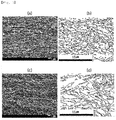
- FIGS. 3A to 3D are images of an observation of the microstructure of the upper surface layer portion (A) and the central part (B) of the specimen of FIG. 2 .
- FIGS. 3A and 3B are images of the upper surface layer portion (A) of the specimen observed with a scanning electron microscope (SEM), and a high angle grain boundary map imaged using EBSD for the upper surface layer portion (A) of the specimen.
- FIGS. 3C and 3D are images of the central part (B) of the specimen observed with a scanning electron microscope (SEM), and a high angle grain boundary map imaged using EBSD for the upper surface layer portion (A) of the specimen. As illustrated in FIGS.
- the upper surface layer portion (A) contains tempered bainite and fresh martensite having an average grain size of about 3 ⁇ m or less, whereas the central part (B) contains bainitic ferrite having an average grain size of about 15 ⁇ m.
- the high-strength structural steel having excellent cold bendability has a surface layer part and a central part distinguished micro-structurally, and in this case, the central part contains bainitic ferrite as a matrix structure, and thus, high-strength characteristics may be effectively secured with a tensile strength of 800 MPa or more.
- the high-strength structural steel having excellent cold bendability includes a surface layer part and a central part divided into microstructure, and in this case, the relatively fine-grained surface layer part includes tempered bainite as a matrix structure, and fresh martensite as a second structure, and may secure a high angle grain boundary fraction of 45% or more, thereby securing excellent cold bendability.
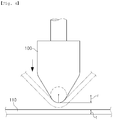
- FIG. 4 is a diagram schematically illustrating an example of a cold bending test. As illustrated in FIG. 4 , the tip of a cold bending jig 100 is provided so as to be compressed to the surface of a steel material 110 to cold-bend the steel material 110 by 180°, and the cold bendability of the steel material 110 may be evaluated, based on whether or not cracks occur on the surface of the cold bending processed-portion side of the steel material 110.
- 180° cold bending may be performed on a plurality of specimens manufactured with the same composition and manufacturing method, and in this case, the cold bending may be performed in a manner of sequential decrease in the curvature radii (r) of the tip portions. Therefore, the cold bendability may be evaluated based on whether cracks occur on the surfaces of the processed-portion sides of the specimens.
- the critical curvature ratio (r/t) which is the ratio of the tip curvature radius (r) of the cold bending jig with respect to the thickness (t) of the specimen, is calculated.
- the high-strength structural steel having excellent cold bendability has a critical curvature ratio (r/t) of 1.0 or less, thereby securing excellent cold bendability.
- a preferable critical curvature ratio (r/t) may be 0.5 or less, and a more preferable critical curvature ratio (r/t) may be 0.4 or less.
- the slab provided in the manufacturing method of the present disclosure is provided with a steel composition corresponding to the steel composition of the steel material described above, the description of the steel composition of the slab is replaced by the description of the steel composition of the steel material described above.
- the slab manufactured with the above-described steel composition may be reheated at a temperature ranging of 1050 to 1250 °C.
- the lower limit of the reheating temperature of the slab may be limited to 1050°C.
- austenite may become coarse, and it takes an excessive time for the surface layer temperature of the rough-rolled bar to reach the first cooling start temperature after rough rolling, and thus, the upper limit of the reheating temperature may be limited to 1250°C.
- Rough rolling may be performed after reheating to adjust the shape of the slab and destroy the cast structure such as dendrite.
- rough rolling may preferably be performed at the temperature (Tnr, °C) or higher, at which recrystallization of austenite stops, and the upper limit of the rough rolling temperature may be preferably limited to 1150°C in consideration of the cooling start temperature of the first cooling. Therefore, the rough rolling temperature in the present disclosure may be in the range of Tnr - 1150 °C.
- the rough rolling in the present disclosure may be carried out under conditions of a cumulative reduction ratio of 20 to 70%.
- first cooling may be performed to form lath bainite on the surface layer part of the rough-rolled bar.
- the preferable cooling rate of the first cooling may be 5 °C/s or more, and the preferable cooling attainment temperature of the first cooling may be in a temperature range of Ms to Bs °C. If the cooling rate of the first cooling is less than a certain level, a polygonal ferrite or granular bainite structure rather than a lath bainite structure is formed on the surface layer part. In the present disclosure, therefore, the cooling rate of the first cooling may be limited to 5°C/s or more.
- the cooling method of the first cooling is not particularly limited, but water cooling may be more preferable in terms of cooling efficiency.
- the starting temperature of the first cooling may be limited to Ae3 + 100°C or less.
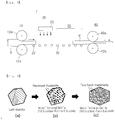
- FIG. 5 is a diagram schematically illustrating an example of a facility 1 for implementing the manufacturing method in the present disclosure.
- a roughing mill 10 a cooling device 20
- a recuperative treatment table 30 and a finishing mill 40 are sequentially disposed, and the roughing mill 10 and the finishing mill 40 are provided with rough rolling rollers 12a and 12b and finish rolling rollers 42a and 42b, respectively, to perform rolling of the slab 5 and a rough rolled bar 5'.
- the cooling device 20 may include a bar cooler 25 capable of spraying cooling water and an auxiliary roller 22 guiding the movement of the rough rolled bar 5'.
- the bar cooler 25 is disposed immediately after the roughing mill 10.
- the recuperative treatment table 30 is disposed at the rear of the cooling device 20, and the rough-rolled bar 5' may be recuperative-treated while moving along an auxiliary roller 32.
- the rough-rolled bar 5' after the heat recuperative treatment may be moved to the finishing mill 40 to be finished rolled.
- a heat recuperative treatment in which the surface layer side of the rough-rolled bar is reheated by high heat at the central part side of the rough-rolled bar may be performed.
- the heat recuperative treatment may be performed until the temperature of the surface layer part of the rough-rolled bar reaches a temperature range of (Ac1+40°C) to (Ac3-5°C).
- the lath bainite in the surface layer part may be transformed into a fine tempered bainite and fresh martensite structure, and a portion of the lath bainite in the surface layer part may be reversely transformed into austenite.
- FIG. 6 is a conceptual diagram schematically illustrating a change in the microstructure of the surface layer part by the heat recuperative treatment in the present disclosure.
- the microstructure of the surface layer part immediately after the first cooling may be formed of a lath bainite structure.
- the lath bainite in the surface layer part is transformed into a tempered bainite structure, and a portion of the lath bainite in the surface layer part may be reversely transformed into austenite.
- FIG. 6C By performing finishing rolling and second cooling after the heat recuperative treatment, as illustrated in FIG. 6C , a two-phase mixed structure of tempered bainite and fresh martensite may be formed, and some austenite structure may remain.
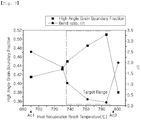
- FIG. 7 is a graph provided by experimentally measuring the relationship between the temperature attaining the heat recuperative treatment, the high angle grain boundary fraction of the surface layer part and the critical bending ratio (r/t).
- a specimen was manufactured under conditions that satisfy the alloy composition and manufacturing method of the present disclosure, but the experiment was performed by varying the temperature at which the reheat treatment was attained during the reheat treatment.
- the high angle grain boundary fraction was evaluated by measuring the fraction of the high angle grain boundary having an azimuth difference of 15 degrees or more by using EBSD, and the critical bending ratio (r/t) was evaluated according to the method described above. As illustrated in FIG.
- the attainment temperature on the surface layer part during heat recuperative treatment may be preferably limited to a temperature range of (Ac1 +40°C) to (Ac3-5°C), such that the surface layer structure is refined, and a high angle grain boundary fraction of 15° or more is 45% or more, and the critical bending ratio (r/t) is 1.0 or less.
- Finish rolling is performed to introduce a non-uniform microstructure into the austenite structure of the rough-rolled bar.
- the finishing rolling may be performed in a temperature range of the bainite transformation start temperature (Bs) or more and the austenite recrystallization temperature (Tnr) or less.
- second cooling may be performed to form bainitic ferrite in the central part of the steel material.
- the preferable cooling rate of the second cooling may be 5°C/s or higher, and the preferable cooling reaching temperature of the second cooling may be Bf°C or lower.
- the cooling method of the second cooling is also not particularly limited, but water cooling may be preferable in terms of cooling efficiency. If the cooling attainment temperature of the second cooling exceeds a predetermined range or the cooling rate does not reach a certain level, granular ferrite is formed in the central part of the steel material, thereby causing a decrease in strength. Therefore, the cooling attainment temperature of the second cooling in the present disclosure may be limited to Bf°C or lower, and the cooling rate may be limited to 5°C/s or higher.
- a slab having the steel composition of Table 1 was prepared, and the transformation temperature was calculated based on the steel composition of Table 1 and illustrated in Table 2.
- Table 1 the contents of boron (B), nitrogen (N) and calcium (Ca) are based on ppm.
- the slabs having the composition of Table 1 were subjected to rough rolling, first cooling and heat recuperative treatment under the conditions of Table 3 below, and finishing rolling and second cooling were performed under the conditions of Table 4.
- the evaluation results for the steels manufactured under the conditions of Tables 3 and 4 are illustrated in Table 5 below.
- the average grain size of the surface layer part, the high angle grain boundary fraction of the surface layer part, the mechanical properties, and the critical bending ratio (r/t) were measured.
- the grain size and the high angle grain boundary fraction are measured by Electron Back Scattering Diffraction (EBSD) method, measuring a 500m*500m area with a 0.5m step size, and based thereon, a grain boundary map with a crystal orientation difference of 15 degrees or more with neighboring particles was created, and based thereon, the average grain size and high angle grain boundary fraction were evaluated.
- EBSD Electron Back Scattering Diffraction
- Yield strength (YS) and tensile strength (TS) were evaluated by obtaining an average value by performing a tensile test on three test pieces in the width direction of the plate, and the critical bending ratio (r/t) was evaluated through the above-described cold bending test.
- Steel grades A, B, C, D and E are steels that satisfy the alloy composition of the present disclosure. Thereamong, in A-1. A-2, A-3, B-1, B-2, B-3, C-1, C-2, D-1, D-2, E-1 and E-2 which satisfy the process conditions of the present disclosure, it can be confirmed that the high angle grain boundary fraction of the surface layer part satisfies 45% or more, the average grain size of the surface layer part satisfies 3 ⁇ m or less, the tensile strength satisfies 800 MPa or more, and the critical bending ratio (r/t) satisfies 1.0 or less.
- the heat recuperative treatment temperature exceeds the scope of the present disclosure
- the high angle grain boundary fraction of the surface layer part is less than 45%
- the average grain size of the surface layer part exceeds 3 ⁇ m
- the critical bending ratio (r/t) exceeds 1.0. This is because the surface layer part of the steel is heated to a temperature higher than that of the two-phase region, such that the structure of the surface layer part is overall, reversely transformed to austenite, and thus the final structure of the surface layer part is formed of lath bainite.
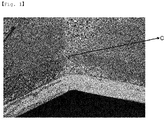
- FIGS. 8A and 8B are cross-sectional images and enlarged optical images of the surface layer part after cooling bending under the conditions of a bending ratio (r/t) of 0.3 on B-1
- FIGS. 8C and 8D are cross-sectional images and enlarged optical images of the surface layer part after cooling bending under the conditions of a bending ratio (r/t) of 0.3 on B-4.
- FIGS. 8A to FIG. 8D in the case of B-1 that satisfies the alloy composition and process conditions of the present disclosure, cracks did not occur on the surface of the processed portion, whereas in the case of B-3 that does not satisfy the process conditions of the present disclosure, it can be confirmed that a crack (C) has occurred on the surface of the processed portion.
- the high angle grain boundary fraction of the surface layer part is less than 45%, the average grain size of the surface layer part exceeds 3 ⁇ m, and the critical bending ratio (r/t) exceeds 1.0. This is because the surface layer part of the steel is excessively cooled during the first cooling, and the reverse transformation austenite in the surface layer part is not sufficiently formed.
Landscapes
- Chemical & Material Sciences (AREA)
- Engineering & Computer Science (AREA)
- Mechanical Engineering (AREA)
- Materials Engineering (AREA)
- Metallurgy (AREA)
- Organic Chemistry (AREA)
- Physics & Mathematics (AREA)
- Thermal Sciences (AREA)
- Crystallography & Structural Chemistry (AREA)
- Heat Treatment Of Steel (AREA)
Applications Claiming Priority (2)
| Application Number | Priority Date | Filing Date | Title |
|---|---|---|---|
| KR1020180165284A KR102200222B1 (ko) | 2018-12-19 | 2018-12-19 | 냉간 벤딩성이 우수한 고강도 구조용 강재 및 그 제조방법 |
| PCT/KR2019/017148 WO2020130436A2 (ko) | 2018-12-19 | 2019-12-06 | 냉간 벤딩성이 우수한 고강도 구조용 강재 및 그 제조방법 |
Publications (3)
| Publication Number | Publication Date |
|---|---|
| EP3901305A4 EP3901305A4 (de) | 2021-10-27 |
| EP3901305A2 true EP3901305A2 (de) | 2021-10-27 |
| EP3901305B1 EP3901305B1 (de) | 2024-01-31 |
Family
ID=71102856
Family Applications (1)
| Application Number | Title | Priority Date | Filing Date |
|---|---|---|---|
| EP19898344.7A Active EP3901305B1 (de) | 2018-12-19 | 2019-12-06 | Hochfester baustahl mit ausgezeichneter kaltbiegefähigkeit und verfahren zu seiner herstellung |
Country Status (6)
| Country | Link |
|---|---|
| US (1) | US12305249B2 (de) |
| EP (1) | EP3901305B1 (de) |
| JP (1) | JP7348948B2 (de) |
| KR (1) | KR102200222B1 (de) |
| CN (1) | CN113227425B (de) |
| WO (1) | WO2020130436A2 (de) |
Families Citing this family (4)
| Publication number | Priority date | Publication date | Assignee | Title |
|---|---|---|---|---|
| KR100695762B1 (ko) * | 2006-12-20 | 2007-03-16 | 동산엔지니어링 주식회사 | 저압전선 접속용 분기 슬리브 |
| KR102440756B1 (ko) * | 2020-12-15 | 2022-09-08 | 주식회사 포스코 | 표면 경도가 낮고 저온 충격인성이 우수한 강재 및 그 제조방법 |
| CN115821157B (zh) * | 2022-11-18 | 2024-01-02 | 钢铁研究总院有限公司 | 一种高钢级抗硫化氢腐蚀油井管及其制备方法 |
| CN119899974A (zh) * | 2023-10-26 | 2025-04-29 | 宝山钢铁股份有限公司 | 一种扩孔和折弯性能优异的热轧高强度钢及其制造方法 |
Family Cites Families (18)
| Publication number | Priority date | Publication date | Assignee | Title |
|---|---|---|---|---|
| JP2760713B2 (ja) * | 1992-09-24 | 1998-06-04 | 新日本製鐵株式会社 | 耐火性及び靱性の優れた制御圧延形鋼の製造方法 |
| KR0135231B1 (ko) * | 1994-08-23 | 1998-04-22 | 김주용 | 고속 테스트 기능을 갖는 메모리 소자 |
| JP2002020835A (ja) | 2000-05-02 | 2002-01-23 | Nippon Steel Corp | 脆性き裂伝播停止特性と板厚方向破壊特性の優れた鋼材およびその製造方法 |
| JP4058097B2 (ja) | 2006-04-13 | 2008-03-05 | 新日本製鐵株式会社 | アレスト性に優れた高強度厚鋼板 |
| KR100833076B1 (ko) * | 2006-12-22 | 2008-05-27 | 주식회사 포스코 | 저온인성과 취성균열전파정지특성이 우수한 고강도저항복비 구조용 강재 및 그 제조방법 |
| JP2010126808A (ja) * | 2008-12-01 | 2010-06-10 | Sumitomo Metal Ind Ltd | 冷延鋼板およびその製造方法 |
| WO2012108543A1 (ja) | 2011-02-08 | 2012-08-16 | Jfeスチール株式会社 | 長大脆性き裂伝播停止特性に優れる板厚50mm以上の厚鋼板およびその製造方法ならびに長大脆性き裂伝播停止性能を評価する方法および試験装置 |
| JP6004903B2 (ja) * | 2011-11-14 | 2016-10-12 | 山九株式会社 | 大型の円環形状物品の輸送用トレーラ |
| JP2013104124A (ja) | 2011-11-16 | 2013-05-30 | Jfe Steel Corp | 曲げ加工性に優れた直接焼入れ焼戻し型高張力鋼板およびその製造方法 |
| JP5878829B2 (ja) | 2012-05-31 | 2016-03-08 | 株式会社神戸製鋼所 | 曲げ性に優れた高強度冷延鋼板およびその製造方法 |
| EP2857539A4 (de) | 2012-05-31 | 2016-07-20 | Kobe Steel Ltd | Hochfeste kaltgewalzte stahlplatte und herstellungsverfahren dafür |
| JP5679091B1 (ja) * | 2013-04-04 | 2015-03-04 | Jfeスチール株式会社 | 熱延鋼板およびその製造方法 |
| JP6007882B2 (ja) | 2013-10-15 | 2016-10-19 | 新日鐵住金株式会社 | 引張最大強度780MPaを有する衝突特性に優れた高強度鋼板、高強度溶融亜鉛めっき鋼板、並びに、高強度合金化溶融亜鉛めっき鋼板 |
| JP6123713B2 (ja) | 2014-03-17 | 2017-05-10 | Jfeスチール株式会社 | 厚肉熱延鋼帯およびその製造方法 |
| KR101819356B1 (ko) * | 2016-08-08 | 2018-01-17 | 주식회사 포스코 | 취성균열전파 저항성이 우수한 극후물 강재 및 그 제조방법 |
| JP6565887B2 (ja) | 2016-12-12 | 2019-08-28 | Jfeスチール株式会社 | 低降伏比角形鋼管用熱延鋼板の製造方法および低降伏比角形鋼管の製造方法 |
| KR101999015B1 (ko) | 2017-12-24 | 2019-07-10 | 주식회사 포스코 | 취성균열 전파 저항성이 우수한 구조용 강재 및 그 제조방법 |
| KR102200224B1 (ko) * | 2018-12-19 | 2021-01-08 | 주식회사 포스코 | 취성파괴 저항성이 우수한 구조용 강재 및 그 제조방법 |
-
2018
- 2018-12-19 KR KR1020180165284A patent/KR102200222B1/ko active Active
-
2019
- 2019-12-06 EP EP19898344.7A patent/EP3901305B1/de active Active
- 2019-12-06 CN CN201980084388.9A patent/CN113227425B/zh active Active
- 2019-12-06 US US17/415,394 patent/US12305249B2/en active Active
- 2019-12-06 WO PCT/KR2019/017148 patent/WO2020130436A2/ko not_active Ceased
- 2019-12-06 JP JP2021535061A patent/JP7348948B2/ja active Active
Also Published As
| Publication number | Publication date |
|---|---|
| KR102200222B1 (ko) | 2021-01-08 |
| JP7348948B2 (ja) | 2023-09-21 |
| JP2022514018A (ja) | 2022-02-09 |
| EP3901305A4 (de) | 2021-10-27 |
| CN113227425B (zh) | 2023-07-07 |
| EP3901305B1 (de) | 2024-01-31 |
| WO2020130436A3 (ko) | 2020-09-03 |
| WO2020130436A2 (ko) | 2020-06-25 |
| US20220064745A1 (en) | 2022-03-03 |
| CN113227425A (zh) | 2021-08-06 |
| KR20200076804A (ko) | 2020-06-30 |
| US12305249B2 (en) | 2025-05-20 |
Similar Documents
| Publication | Publication Date | Title |
|---|---|---|
| EP2617850B1 (de) | Hochfestes heissgewalztes stahlblech mit hervorragender bruchfestigkeit und herstellungsverfahren dafür | |
| KR100957970B1 (ko) | 후물 고강도 고인성 강판 및 그 제조방법 | |
| EP2881482A1 (de) | Abriebfeste stahlplatte und herstellungsverfahren dafür | |
| EP3561111B1 (de) | Dickes stahlblech mit hervorragender kryogener schlagfestigkeit und herstellungsverfahren dafür | |
| US12264387B2 (en) | Steel plate having excellent heat affected zone toughness and method for manufacturing thereof | |
| CN108368594A (zh) | 具有优异的低温应变时效冲击特性和焊接热影响区冲击特性的高强度钢材及其制造方法 | |
| US12509742B2 (en) | Ultra-high strength steel sheet having excellent shear workability and method for manufacturing same | |
| EP3901305B1 (de) | Hochfester baustahl mit ausgezeichneter kaltbiegefähigkeit und verfahren zu seiner herstellung | |
| CN114729435A (zh) | 低温冲击韧性优异的高硬度耐磨钢及其制造方法 | |
| EP3733905B1 (de) | Hochfestes baustahlmaterial mit hervorragenden ermüdungsrissausbreitungshemmenden eigenschaften und herstellungsverfahren dafür | |
| CN108368593A (zh) | 具有优异的低温应变时效冲击特性的高强度钢材及其制造方法 | |
| KR102164112B1 (ko) | 연성 및 저온 인성이 우수한 고강도 강재 및 이의 제조방법 | |
| EP3901306B1 (de) | Baustahl mit ausgezeichneter sprödbruchfestigkeit und verfahren zu seiner herstellung | |
| KR102830746B1 (ko) | 수소유기균열 저항성이 우수한 피팅부품 및 그 제조방법 | |
| EP3889301A1 (de) | Druckbehälterstahl mit ausgezeichneter wasserstoffinduzierter rissbeständigkeit und herstellungsverfahren dafür | |
| KR102153170B1 (ko) | 강도 및 dwtt 저온인성이 우수한 극후물 열연강판 및 그 제조방법 | |
| JP2022106590A (ja) | 電縫鋼管および電縫鋼管の製造方法 | |
| KR102255818B1 (ko) | 내부식성이 우수한 고강도 구조용 강재 및 그 제조방법 | |
| KR20250093022A (ko) | 강판 및 그 제조방법 | |
| KR20240100530A (ko) | 강판 및 그 제조방법 | |
| EP3872207A1 (de) | Stahlmaterial mit niedriger ausbeute und ausgezeichneter wärmebeeinflusster zonenzähigkeit und verfahren zu seiner herstellung |
Legal Events
| Date | Code | Title | Description |
|---|---|---|---|
| STAA | Information on the status of an ep patent application or granted ep patent |
Free format text: STATUS: THE INTERNATIONAL PUBLICATION HAS BEEN MADE |
|
| PUAI | Public reference made under article 153(3) epc to a published international application that has entered the european phase |
Free format text: ORIGINAL CODE: 0009012 |
|
| STAA | Information on the status of an ep patent application or granted ep patent |
Free format text: STATUS: REQUEST FOR EXAMINATION WAS MADE |
|
| 17P | Request for examination filed |
Effective date: 20210707 |
|
| A4 | Supplementary search report drawn up and despatched |
Effective date: 20210910 |
|
| AK | Designated contracting states |
Kind code of ref document: A2 Designated state(s): AL AT BE BG CH CY CZ DE DK EE ES FI FR GB GR HR HU IE IS IT LI LT LU LV MC MK MT NL NO PL PT RO RS SE SI SK SM TR |
|
| DAV | Request for validation of the european patent (deleted) | ||
| DAX | Request for extension of the european patent (deleted) | ||
| STAA | Information on the status of an ep patent application or granted ep patent |
Free format text: STATUS: EXAMINATION IS IN PROGRESS |
|
| 17Q | First examination report despatched |
Effective date: 20220721 |
|
| RAP3 | Party data changed (applicant data changed or rights of an application transferred) |
Owner name: POSCO HOLDINGS INC. |
|
| RIC1 | Information provided on ipc code assigned before grant |
Ipc: C22C 38/58 20060101ALN20221024BHEP Ipc: C22C 38/54 20060101ALN20221024BHEP Ipc: C22C 38/50 20060101ALN20221024BHEP Ipc: C22C 38/48 20060101ALN20221024BHEP Ipc: C22C 38/46 20060101ALN20221024BHEP Ipc: C22C 38/44 20060101ALN20221024BHEP Ipc: C22C 38/42 20060101ALN20221024BHEP Ipc: B21B 37/74 20060101ALN20221024BHEP Ipc: C21D 6/00 20060101ALN20221024BHEP Ipc: C21D 1/22 20060101ALN20221024BHEP Ipc: C21D 1/20 20060101ALN20221024BHEP Ipc: C22C 38/18 20060101ALN20221024BHEP Ipc: C22C 38/16 20060101ALN20221024BHEP Ipc: C22C 38/14 20060101ALN20221024BHEP Ipc: C22C 38/12 20060101ALN20221024BHEP Ipc: C22C 38/08 20060101ALN20221024BHEP Ipc: C22C 38/06 20060101ALI20221024BHEP Ipc: C21D 1/19 20060101ALI20221024BHEP Ipc: C21D 8/02 20060101ALI20221024BHEP Ipc: C22C 38/00 20060101ALI20221024BHEP Ipc: C22C 38/02 20060101ALI20221024BHEP Ipc: C22C 38/04 20060101AFI20221024BHEP |
|
| RIC1 | Information provided on ipc code assigned before grant |
Ipc: C22C 38/58 20060101ALN20221106BHEP Ipc: C22C 38/54 20060101ALN20221106BHEP Ipc: C22C 38/50 20060101ALN20221106BHEP Ipc: C22C 38/48 20060101ALN20221106BHEP Ipc: C22C 38/46 20060101ALN20221106BHEP Ipc: C22C 38/44 20060101ALN20221106BHEP Ipc: C22C 38/42 20060101ALN20221106BHEP Ipc: B21B 37/74 20060101ALN20221106BHEP Ipc: C21D 6/00 20060101ALN20221106BHEP Ipc: C21D 1/22 20060101ALN20221106BHEP Ipc: C21D 1/20 20060101ALN20221106BHEP Ipc: C22C 38/18 20060101ALN20221106BHEP Ipc: C22C 38/16 20060101ALN20221106BHEP Ipc: C22C 38/14 20060101ALN20221106BHEP Ipc: C22C 38/12 20060101ALN20221106BHEP Ipc: C22C 38/08 20060101ALN20221106BHEP Ipc: C22C 38/06 20060101ALI20221106BHEP Ipc: C21D 1/19 20060101ALI20221106BHEP Ipc: C21D 8/02 20060101ALI20221106BHEP Ipc: C22C 38/00 20060101ALI20221106BHEP Ipc: C22C 38/02 20060101ALI20221106BHEP Ipc: C22C 38/04 20060101AFI20221106BHEP |
|
| RIC1 | Information provided on ipc code assigned before grant |
Ipc: C22C 38/58 20060101ALN20221115BHEP Ipc: C22C 38/54 20060101ALN20221115BHEP Ipc: C22C 38/50 20060101ALN20221115BHEP Ipc: C22C 38/48 20060101ALN20221115BHEP Ipc: C22C 38/46 20060101ALN20221115BHEP Ipc: C22C 38/44 20060101ALN20221115BHEP Ipc: C22C 38/42 20060101ALN20221115BHEP Ipc: B21B 37/74 20060101ALN20221115BHEP Ipc: C21D 6/00 20060101ALN20221115BHEP Ipc: C21D 1/22 20060101ALN20221115BHEP Ipc: C21D 1/20 20060101ALN20221115BHEP Ipc: C22C 38/18 20060101ALN20221115BHEP Ipc: C22C 38/16 20060101ALN20221115BHEP Ipc: C22C 38/14 20060101ALN20221115BHEP Ipc: C22C 38/12 20060101ALN20221115BHEP Ipc: C22C 38/08 20060101ALN20221115BHEP Ipc: C22C 38/06 20060101ALI20221115BHEP Ipc: C21D 1/19 20060101ALI20221115BHEP Ipc: C21D 8/02 20060101ALI20221115BHEP Ipc: C22C 38/00 20060101ALI20221115BHEP Ipc: C22C 38/02 20060101ALI20221115BHEP Ipc: C22C 38/04 20060101AFI20221115BHEP |
|
| GRAP | Despatch of communication of intention to grant a patent |
Free format text: ORIGINAL CODE: EPIDOSNIGR1 |
|
| STAA | Information on the status of an ep patent application or granted ep patent |
Free format text: STATUS: GRANT OF PATENT IS INTENDED |
|
| RAP1 | Party data changed (applicant data changed or rights of an application transferred) |
Owner name: POSCO CO., LTD |
|
| INTG | Intention to grant announced |
Effective date: 20230207 |
|
| GRAS | Grant fee paid |
Free format text: ORIGINAL CODE: EPIDOSNIGR3 |
|
| GRAJ | Information related to disapproval of communication of intention to grant by the applicant or resumption of examination proceedings by the epo deleted |
Free format text: ORIGINAL CODE: EPIDOSDIGR1 |
|
| GRAL | Information related to payment of fee for publishing/printing deleted |
Free format text: ORIGINAL CODE: EPIDOSDIGR3 |
|
| STAA | Information on the status of an ep patent application or granted ep patent |
Free format text: STATUS: EXAMINATION IS IN PROGRESS |
|
| GRAP | Despatch of communication of intention to grant a patent |
Free format text: ORIGINAL CODE: EPIDOSNIGR1 |
|
| STAA | Information on the status of an ep patent application or granted ep patent |
Free format text: STATUS: GRANT OF PATENT IS INTENDED |
|
| INTC | Intention to grant announced (deleted) | ||
| RIC1 | Information provided on ipc code assigned before grant |
Ipc: C22C 38/58 20060101ALN20230706BHEP Ipc: C22C 38/54 20060101ALN20230706BHEP Ipc: C22C 38/50 20060101ALN20230706BHEP Ipc: C22C 38/48 20060101ALN20230706BHEP Ipc: C22C 38/46 20060101ALN20230706BHEP Ipc: C22C 38/44 20060101ALN20230706BHEP Ipc: C22C 38/42 20060101ALN20230706BHEP Ipc: B21B 37/74 20060101ALN20230706BHEP Ipc: C21D 6/00 20060101ALN20230706BHEP Ipc: C21D 1/22 20060101ALN20230706BHEP Ipc: C21D 1/20 20060101ALN20230706BHEP Ipc: C22C 38/18 20060101ALN20230706BHEP Ipc: C22C 38/16 20060101ALN20230706BHEP Ipc: C22C 38/14 20060101ALN20230706BHEP Ipc: C22C 38/12 20060101ALN20230706BHEP Ipc: C22C 38/08 20060101ALN20230706BHEP Ipc: C22C 38/06 20060101ALI20230706BHEP Ipc: C21D 1/19 20060101ALI20230706BHEP Ipc: C21D 8/02 20060101ALI20230706BHEP Ipc: C22C 38/00 20060101ALI20230706BHEP Ipc: C22C 38/02 20060101ALI20230706BHEP Ipc: C22C 38/04 20060101AFI20230706BHEP |
|
| INTG | Intention to grant announced |
Effective date: 20230726 |
|
| GRAF | Information related to payment of grant fee modified |
Free format text: ORIGINAL CODE: EPIDOSCIGR3 |
|
| GRAA | (expected) grant |
Free format text: ORIGINAL CODE: 0009210 |
|
| STAA | Information on the status of an ep patent application or granted ep patent |
Free format text: STATUS: THE PATENT HAS BEEN GRANTED |
|
| AK | Designated contracting states |
Kind code of ref document: B1 Designated state(s): AL AT BE BG CH CY CZ DE DK EE ES FI FR GB GR HR HU IE IS IT LI LT LU LV MC MK MT NL NO PL PT RO RS SE SI SK SM TR |
|
| REG | Reference to a national code |
Ref country code: GB Ref legal event code: FG4D Ref country code: CH Ref legal event code: EP |
|
| REG | Reference to a national code |
Ref country code: DE Ref legal event code: R096 Ref document number: 602019046043 Country of ref document: DE |
|
| REG | Reference to a national code |
Ref country code: IE Ref legal event code: FG4D |
|
| REG | Reference to a national code |
Ref country code: LT Ref legal event code: MG9D |
|
| REG | Reference to a national code |
Ref country code: NL Ref legal event code: MP Effective date: 20240131 |
|
| PG25 | Lapsed in a contracting state [announced via postgrant information from national office to epo] |
Ref country code: IS Free format text: LAPSE BECAUSE OF FAILURE TO SUBMIT A TRANSLATION OF THE DESCRIPTION OR TO PAY THE FEE WITHIN THE PRESCRIBED TIME-LIMIT Effective date: 20240531 |
|
| PG25 | Lapsed in a contracting state [announced via postgrant information from national office to epo] |
Ref country code: LT Free format text: LAPSE BECAUSE OF FAILURE TO SUBMIT A TRANSLATION OF THE DESCRIPTION OR TO PAY THE FEE WITHIN THE PRESCRIBED TIME-LIMIT Effective date: 20240131 |
|
| PG25 | Lapsed in a contracting state [announced via postgrant information from national office to epo] |
Ref country code: GR Free format text: LAPSE BECAUSE OF FAILURE TO SUBMIT A TRANSLATION OF THE DESCRIPTION OR TO PAY THE FEE WITHIN THE PRESCRIBED TIME-LIMIT Effective date: 20240501 |
|
| REG | Reference to a national code |
Ref country code: AT Ref legal event code: MK05 Ref document number: 1653911 Country of ref document: AT Kind code of ref document: T Effective date: 20240131 |
|
| PG25 | Lapsed in a contracting state [announced via postgrant information from national office to epo] |
Ref country code: HR Free format text: LAPSE BECAUSE OF FAILURE TO SUBMIT A TRANSLATION OF THE DESCRIPTION OR TO PAY THE FEE WITHIN THE PRESCRIBED TIME-LIMIT Effective date: 20240131 Ref country code: RS Free format text: LAPSE BECAUSE OF FAILURE TO SUBMIT A TRANSLATION OF THE DESCRIPTION OR TO PAY THE FEE WITHIN THE PRESCRIBED TIME-LIMIT Effective date: 20240430 Ref country code: NL Free format text: LAPSE BECAUSE OF FAILURE TO SUBMIT A TRANSLATION OF THE DESCRIPTION OR TO PAY THE FEE WITHIN THE PRESCRIBED TIME-LIMIT Effective date: 20240131 |
|
| PG25 | Lapsed in a contracting state [announced via postgrant information from national office to epo] |
Ref country code: ES Free format text: LAPSE BECAUSE OF FAILURE TO SUBMIT A TRANSLATION OF THE DESCRIPTION OR TO PAY THE FEE WITHIN THE PRESCRIBED TIME-LIMIT Effective date: 20240131 |
|
| PG25 | Lapsed in a contracting state [announced via postgrant information from national office to epo] |
Ref country code: AT Free format text: LAPSE BECAUSE OF FAILURE TO SUBMIT A TRANSLATION OF THE DESCRIPTION OR TO PAY THE FEE WITHIN THE PRESCRIBED TIME-LIMIT Effective date: 20240131 |
|
| PG25 | Lapsed in a contracting state [announced via postgrant information from national office to epo] |
Ref country code: RS Free format text: LAPSE BECAUSE OF FAILURE TO SUBMIT A TRANSLATION OF THE DESCRIPTION OR TO PAY THE FEE WITHIN THE PRESCRIBED TIME-LIMIT Effective date: 20240430 Ref country code: NO Free format text: LAPSE BECAUSE OF FAILURE TO SUBMIT A TRANSLATION OF THE DESCRIPTION OR TO PAY THE FEE WITHIN THE PRESCRIBED TIME-LIMIT Effective date: 20240430 Ref country code: NL Free format text: LAPSE BECAUSE OF FAILURE TO SUBMIT A TRANSLATION OF THE DESCRIPTION OR TO PAY THE FEE WITHIN THE PRESCRIBED TIME-LIMIT Effective date: 20240131 Ref country code: LT Free format text: LAPSE BECAUSE OF FAILURE TO SUBMIT A TRANSLATION OF THE DESCRIPTION OR TO PAY THE FEE WITHIN THE PRESCRIBED TIME-LIMIT Effective date: 20240131 Ref country code: IS Free format text: LAPSE BECAUSE OF FAILURE TO SUBMIT A TRANSLATION OF THE DESCRIPTION OR TO PAY THE FEE WITHIN THE PRESCRIBED TIME-LIMIT Effective date: 20240531 Ref country code: HR Free format text: LAPSE BECAUSE OF FAILURE TO SUBMIT A TRANSLATION OF THE DESCRIPTION OR TO PAY THE FEE WITHIN THE PRESCRIBED TIME-LIMIT Effective date: 20240131 Ref country code: GR Free format text: LAPSE BECAUSE OF FAILURE TO SUBMIT A TRANSLATION OF THE DESCRIPTION OR TO PAY THE FEE WITHIN THE PRESCRIBED TIME-LIMIT Effective date: 20240501 Ref country code: FI Free format text: LAPSE BECAUSE OF FAILURE TO SUBMIT A TRANSLATION OF THE DESCRIPTION OR TO PAY THE FEE WITHIN THE PRESCRIBED TIME-LIMIT Effective date: 20240131 Ref country code: ES Free format text: LAPSE BECAUSE OF FAILURE TO SUBMIT A TRANSLATION OF THE DESCRIPTION OR TO PAY THE FEE WITHIN THE PRESCRIBED TIME-LIMIT Effective date: 20240131 Ref country code: BG Free format text: LAPSE BECAUSE OF FAILURE TO SUBMIT A TRANSLATION OF THE DESCRIPTION OR TO PAY THE FEE WITHIN THE PRESCRIBED TIME-LIMIT Effective date: 20240131 Ref country code: AT Free format text: LAPSE BECAUSE OF FAILURE TO SUBMIT A TRANSLATION OF THE DESCRIPTION OR TO PAY THE FEE WITHIN THE PRESCRIBED TIME-LIMIT Effective date: 20240131 |
|
| PG25 | Lapsed in a contracting state [announced via postgrant information from national office to epo] |
Ref country code: PT Free format text: LAPSE BECAUSE OF FAILURE TO SUBMIT A TRANSLATION OF THE DESCRIPTION OR TO PAY THE FEE WITHIN THE PRESCRIBED TIME-LIMIT Effective date: 20240531 Ref country code: PL Free format text: LAPSE BECAUSE OF FAILURE TO SUBMIT A TRANSLATION OF THE DESCRIPTION OR TO PAY THE FEE WITHIN THE PRESCRIBED TIME-LIMIT Effective date: 20240131 |
|
| PG25 | Lapsed in a contracting state [announced via postgrant information from national office to epo] |
Ref country code: SE Free format text: LAPSE BECAUSE OF FAILURE TO SUBMIT A TRANSLATION OF THE DESCRIPTION OR TO PAY THE FEE WITHIN THE PRESCRIBED TIME-LIMIT Effective date: 20240131 Ref country code: PT Free format text: LAPSE BECAUSE OF FAILURE TO SUBMIT A TRANSLATION OF THE DESCRIPTION OR TO PAY THE FEE WITHIN THE PRESCRIBED TIME-LIMIT Effective date: 20240531 Ref country code: PL Free format text: LAPSE BECAUSE OF FAILURE TO SUBMIT A TRANSLATION OF THE DESCRIPTION OR TO PAY THE FEE WITHIN THE PRESCRIBED TIME-LIMIT Effective date: 20240131 Ref country code: LV Free format text: LAPSE BECAUSE OF FAILURE TO SUBMIT A TRANSLATION OF THE DESCRIPTION OR TO PAY THE FEE WITHIN THE PRESCRIBED TIME-LIMIT Effective date: 20240131 |
|
| PG25 | Lapsed in a contracting state [announced via postgrant information from national office to epo] |
Ref country code: DK Free format text: LAPSE BECAUSE OF FAILURE TO SUBMIT A TRANSLATION OF THE DESCRIPTION OR TO PAY THE FEE WITHIN THE PRESCRIBED TIME-LIMIT Effective date: 20240131 |
|
| PG25 | Lapsed in a contracting state [announced via postgrant information from national office to epo] |
Ref country code: SM Free format text: LAPSE BECAUSE OF FAILURE TO SUBMIT A TRANSLATION OF THE DESCRIPTION OR TO PAY THE FEE WITHIN THE PRESCRIBED TIME-LIMIT Effective date: 20240131 |
|
| PG25 | Lapsed in a contracting state [announced via postgrant information from national office to epo] |
Ref country code: CZ Free format text: LAPSE BECAUSE OF FAILURE TO SUBMIT A TRANSLATION OF THE DESCRIPTION OR TO PAY THE FEE WITHIN THE PRESCRIBED TIME-LIMIT Effective date: 20240131 Ref country code: EE Free format text: LAPSE BECAUSE OF FAILURE TO SUBMIT A TRANSLATION OF THE DESCRIPTION OR TO PAY THE FEE WITHIN THE PRESCRIBED TIME-LIMIT Effective date: 20240131 |
|
| PG25 | Lapsed in a contracting state [announced via postgrant information from national office to epo] |
Ref country code: SK Free format text: LAPSE BECAUSE OF FAILURE TO SUBMIT A TRANSLATION OF THE DESCRIPTION OR TO PAY THE FEE WITHIN THE PRESCRIBED TIME-LIMIT Effective date: 20240131 |
|
| PG25 | Lapsed in a contracting state [announced via postgrant information from national office to epo] |
Ref country code: SM Free format text: LAPSE BECAUSE OF FAILURE TO SUBMIT A TRANSLATION OF THE DESCRIPTION OR TO PAY THE FEE WITHIN THE PRESCRIBED TIME-LIMIT Effective date: 20240131 Ref country code: SK Free format text: LAPSE BECAUSE OF FAILURE TO SUBMIT A TRANSLATION OF THE DESCRIPTION OR TO PAY THE FEE WITHIN THE PRESCRIBED TIME-LIMIT Effective date: 20240131 Ref country code: RO Free format text: LAPSE BECAUSE OF FAILURE TO SUBMIT A TRANSLATION OF THE DESCRIPTION OR TO PAY THE FEE WITHIN THE PRESCRIBED TIME-LIMIT Effective date: 20240131 Ref country code: EE Free format text: LAPSE BECAUSE OF FAILURE TO SUBMIT A TRANSLATION OF THE DESCRIPTION OR TO PAY THE FEE WITHIN THE PRESCRIBED TIME-LIMIT Effective date: 20240131 Ref country code: DK Free format text: LAPSE BECAUSE OF FAILURE TO SUBMIT A TRANSLATION OF THE DESCRIPTION OR TO PAY THE FEE WITHIN THE PRESCRIBED TIME-LIMIT Effective date: 20240131 Ref country code: CZ Free format text: LAPSE BECAUSE OF FAILURE TO SUBMIT A TRANSLATION OF THE DESCRIPTION OR TO PAY THE FEE WITHIN THE PRESCRIBED TIME-LIMIT Effective date: 20240131 |
|
| REG | Reference to a national code |
Ref country code: DE Ref legal event code: R097 Ref document number: 602019046043 Country of ref document: DE |
|
| PG25 | Lapsed in a contracting state [announced via postgrant information from national office to epo] |
Ref country code: IT Free format text: LAPSE BECAUSE OF FAILURE TO SUBMIT A TRANSLATION OF THE DESCRIPTION OR TO PAY THE FEE WITHIN THE PRESCRIBED TIME-LIMIT Effective date: 20240131 |
|
| PLBE | No opposition filed within time limit |
Free format text: ORIGINAL CODE: 0009261 |
|
| STAA | Information on the status of an ep patent application or granted ep patent |
Free format text: STATUS: NO OPPOSITION FILED WITHIN TIME LIMIT |
|
| PG25 | Lapsed in a contracting state [announced via postgrant information from national office to epo] |
Ref country code: IT Free format text: LAPSE BECAUSE OF FAILURE TO SUBMIT A TRANSLATION OF THE DESCRIPTION OR TO PAY THE FEE WITHIN THE PRESCRIBED TIME-LIMIT Effective date: 20240131 |
|
| 26N | No opposition filed |
Effective date: 20241101 |
|
| PG25 | Lapsed in a contracting state [announced via postgrant information from national office to epo] |
Ref country code: SI Free format text: LAPSE BECAUSE OF FAILURE TO SUBMIT A TRANSLATION OF THE DESCRIPTION OR TO PAY THE FEE WITHIN THE PRESCRIBED TIME-LIMIT Effective date: 20240131 |
|
| PG25 | Lapsed in a contracting state [announced via postgrant information from national office to epo] |
Ref country code: MC Free format text: LAPSE BECAUSE OF FAILURE TO SUBMIT A TRANSLATION OF THE DESCRIPTION OR TO PAY THE FEE WITHIN THE PRESCRIBED TIME-LIMIT Effective date: 20240131 |
|
| REG | Reference to a national code |
Ref country code: CH Ref legal event code: PL |
|
| PG25 | Lapsed in a contracting state [announced via postgrant information from national office to epo] |
Ref country code: LU Free format text: LAPSE BECAUSE OF NON-PAYMENT OF DUE FEES Effective date: 20241206 |
|
| REG | Reference to a national code |
Ref country code: BE Ref legal event code: MM Effective date: 20241231 |
|
| PG25 | Lapsed in a contracting state [announced via postgrant information from national office to epo] |
Ref country code: BE Free format text: LAPSE BECAUSE OF NON-PAYMENT OF DUE FEES Effective date: 20241231 |
|
| PG25 | Lapsed in a contracting state [announced via postgrant information from national office to epo] |
Ref country code: FR Free format text: LAPSE BECAUSE OF NON-PAYMENT OF DUE FEES Effective date: 20241231 |
|
| PG25 | Lapsed in a contracting state [announced via postgrant information from national office to epo] |
Ref country code: CH Free format text: LAPSE BECAUSE OF NON-PAYMENT OF DUE FEES Effective date: 20241231 |
|
| PG25 | Lapsed in a contracting state [announced via postgrant information from national office to epo] |
Ref country code: IE Free format text: LAPSE BECAUSE OF NON-PAYMENT OF DUE FEES Effective date: 20241206 |
|
| PGFP | Annual fee paid to national office [announced via postgrant information from national office to epo] |
Ref country code: DE Payment date: 20251105 Year of fee payment: 7 |
|
| PGFP | Annual fee paid to national office [announced via postgrant information from national office to epo] |
Ref country code: GB Payment date: 20251105 Year of fee payment: 7 |
|
| PG25 | Lapsed in a contracting state [announced via postgrant information from national office to epo] |
Ref country code: CY Free format text: LAPSE BECAUSE OF FAILURE TO SUBMIT A TRANSLATION OF THE DESCRIPTION OR TO PAY THE FEE WITHIN THE PRESCRIBED TIME-LIMIT; INVALID AB INITIO Effective date: 20191206 |