EP3900953B1 - Tire - Google Patents
Tire Download PDFInfo
- Publication number
- EP3900953B1 EP3900953B1 EP19901329.3A EP19901329A EP3900953B1 EP 3900953 B1 EP3900953 B1 EP 3900953B1 EP 19901329 A EP19901329 A EP 19901329A EP 3900953 B1 EP3900953 B1 EP 3900953B1
- Authority
- EP
- European Patent Office
- Prior art keywords
- tire
- cord
- belt
- reinforcing
- width
- Prior art date
- Legal status (The legal status is an assumption and is not a legal conclusion. Google has not performed a legal analysis and makes no representation as to the accuracy of the status listed.)
- Active
Links
Images


Classifications
-
- B—PERFORMING OPERATIONS; TRANSPORTING
- B60—VEHICLES IN GENERAL
- B60C—VEHICLE TYRES; TYRE INFLATION; TYRE CHANGING; CONNECTING VALVES TO INFLATABLE ELASTIC BODIES IN GENERAL; DEVICES OR ARRANGEMENTS RELATED TO TYRES
- B60C9/00—Reinforcements or ply arrangement of pneumatic tyres
- B60C9/18—Structure or arrangement of belts or breakers, crown-reinforcing or cushioning layers
- B60C9/20—Structure or arrangement of belts or breakers, crown-reinforcing or cushioning layers built-up from rubberised plies each having all cords arranged substantially parallel
- B60C9/22—Structure or arrangement of belts or breakers, crown-reinforcing or cushioning layers built-up from rubberised plies each having all cords arranged substantially parallel the plies being arranged with all cords disposed along the circumference of the tyre
- B60C9/2204—Structure or arrangement of belts or breakers, crown-reinforcing or cushioning layers built-up from rubberised plies each having all cords arranged substantially parallel the plies being arranged with all cords disposed along the circumference of the tyre obtained by circumferentially narrow strip winding
-
- B—PERFORMING OPERATIONS; TRANSPORTING
- B60—VEHICLES IN GENERAL
- B60C—VEHICLE TYRES; TYRE INFLATION; TYRE CHANGING; CONNECTING VALVES TO INFLATABLE ELASTIC BODIES IN GENERAL; DEVICES OR ARRANGEMENTS RELATED TO TYRES
- B60C9/00—Reinforcements or ply arrangement of pneumatic tyres
- B60C9/18—Structure or arrangement of belts or breakers, crown-reinforcing or cushioning layers
- B60C9/20—Structure or arrangement of belts or breakers, crown-reinforcing or cushioning layers built-up from rubberised plies each having all cords arranged substantially parallel
- B60C9/22—Structure or arrangement of belts or breakers, crown-reinforcing or cushioning layers built-up from rubberised plies each having all cords arranged substantially parallel the plies being arranged with all cords disposed along the circumference of the tyre
-
- B—PERFORMING OPERATIONS; TRANSPORTING
- B60—VEHICLES IN GENERAL
- B60C—VEHICLE TYRES; TYRE INFLATION; TYRE CHANGING; CONNECTING VALVES TO INFLATABLE ELASTIC BODIES IN GENERAL; DEVICES OR ARRANGEMENTS RELATED TO TYRES
- B60C9/00—Reinforcements or ply arrangement of pneumatic tyres
- B60C9/18—Structure or arrangement of belts or breakers, crown-reinforcing or cushioning layers
- B60C9/20—Structure or arrangement of belts or breakers, crown-reinforcing or cushioning layers built-up from rubberised plies each having all cords arranged substantially parallel
- B60C9/22—Structure or arrangement of belts or breakers, crown-reinforcing or cushioning layers built-up from rubberised plies each having all cords arranged substantially parallel the plies being arranged with all cords disposed along the circumference of the tyre
- B60C2009/2238—Physical properties or dimensions of the ply coating rubber
- B60C2009/2247—Thickness
-
- B—PERFORMING OPERATIONS; TRANSPORTING
- B60—VEHICLES IN GENERAL
- B60C—VEHICLE TYRES; TYRE INFLATION; TYRE CHANGING; CONNECTING VALVES TO INFLATABLE ELASTIC BODIES IN GENERAL; DEVICES OR ARRANGEMENTS RELATED TO TYRES
- B60C9/00—Reinforcements or ply arrangement of pneumatic tyres
- B60C9/18—Structure or arrangement of belts or breakers, crown-reinforcing or cushioning layers
- B60C9/20—Structure or arrangement of belts or breakers, crown-reinforcing or cushioning layers built-up from rubberised plies each having all cords arranged substantially parallel
- B60C9/22—Structure or arrangement of belts or breakers, crown-reinforcing or cushioning layers built-up from rubberised plies each having all cords arranged substantially parallel the plies being arranged with all cords disposed along the circumference of the tyre
- B60C2009/2252—Physical properties or dimension of the zero degree ply cords
- B60C2009/2257—Diameters of the cords; Linear density thereof
-
- B—PERFORMING OPERATIONS; TRANSPORTING
- B60—VEHICLES IN GENERAL
- B60C—VEHICLE TYRES; TYRE INFLATION; TYRE CHANGING; CONNECTING VALVES TO INFLATABLE ELASTIC BODIES IN GENERAL; DEVICES OR ARRANGEMENTS RELATED TO TYRES
- B60C9/00—Reinforcements or ply arrangement of pneumatic tyres
- B60C9/18—Structure or arrangement of belts or breakers, crown-reinforcing or cushioning layers
- B60C9/20—Structure or arrangement of belts or breakers, crown-reinforcing or cushioning layers built-up from rubberised plies each having all cords arranged substantially parallel
- B60C9/22—Structure or arrangement of belts or breakers, crown-reinforcing or cushioning layers built-up from rubberised plies each having all cords arranged substantially parallel the plies being arranged with all cords disposed along the circumference of the tyre
- B60C2009/2252—Physical properties or dimension of the zero degree ply cords
- B60C2009/2266—Density of the cords in width direction
-
- B—PERFORMING OPERATIONS; TRANSPORTING
- B60—VEHICLES IN GENERAL
- B60C—VEHICLE TYRES; TYRE INFLATION; TYRE CHANGING; CONNECTING VALVES TO INFLATABLE ELASTIC BODIES IN GENERAL; DEVICES OR ARRANGEMENTS RELATED TO TYRES
- B60C9/00—Reinforcements or ply arrangement of pneumatic tyres
- B60C9/18—Structure or arrangement of belts or breakers, crown-reinforcing or cushioning layers
- B60C9/20—Structure or arrangement of belts or breakers, crown-reinforcing or cushioning layers built-up from rubberised plies each having all cords arranged substantially parallel
- B60C9/22—Structure or arrangement of belts or breakers, crown-reinforcing or cushioning layers built-up from rubberised plies each having all cords arranged substantially parallel the plies being arranged with all cords disposed along the circumference of the tyre
- B60C2009/2252—Physical properties or dimension of the zero degree ply cords
- B60C2009/2276—Tensile strength
-
- B—PERFORMING OPERATIONS; TRANSPORTING
- B60—VEHICLES IN GENERAL
- B60C—VEHICLE TYRES; TYRE INFLATION; TYRE CHANGING; CONNECTING VALVES TO INFLATABLE ELASTIC BODIES IN GENERAL; DEVICES OR ARRANGEMENTS RELATED TO TYRES
- B60C9/00—Reinforcements or ply arrangement of pneumatic tyres
- B60C9/18—Structure or arrangement of belts or breakers, crown-reinforcing or cushioning layers
- B60C9/20—Structure or arrangement of belts or breakers, crown-reinforcing or cushioning layers built-up from rubberised plies each having all cords arranged substantially parallel
- B60C9/22—Structure or arrangement of belts or breakers, crown-reinforcing or cushioning layers built-up from rubberised plies each having all cords arranged substantially parallel the plies being arranged with all cords disposed along the circumference of the tyre
- B60C2009/2252—Physical properties or dimension of the zero degree ply cords
- B60C2009/228—Elongation of the reinforcements at break point
Definitions
- the present invention relates to tires, and more particularly to tires which can be suitably used for high-performance four-wheel vehicles.
- the diameter growth in which the tire expands in the tire radial direction during high-speed traveling is effectively suppressed, and high-speed durability can be enhanced.
- the diameter growth of the tire during high-speed traveling can be suppressed.
- SA slip angle
- the cornering force of the rear tire to which the steering angle is not given can be effectively increased, and the lap time of the racecourse can be improved.
- an object of the present invention is to provide a tire in which the cornering force generated at a low slip angle is further enhanced while improving high-speed durability.
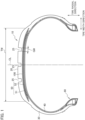
- FIG. 1 is a sectional view of the pneumatic tire 10 according to the present embodiment. Specifically, FIG. 1 is a cross-sectional view of pneumatic tire 10 taken along tire width direction and tire radial direction. In FIG. 1 , the sectional hatching is partially omitted (hereinafter the same).
- a tire equatorial line CL represents the center of the pneumatic tire 10 in tire width direction and tire circumferential direction.
- the pneumatic tire 10 includes a tread 20, a tire side portion 30, the carcass 40, a crossing belt layer 50, a bead portion 60 and the spiral belt 100.
- the pneumatic tire 10 is a pneumatic tire for a four-wheel vehicle such as a passenger vehicle and can be suitably used especially for a high-performance four-wheel vehicle (including vehicles for racing).
- the tread 20 is a portion in contact with the road surface.
- a pattern (unillustrated) corresponding to the use environment of the pneumatic tire 10 and the type of vehicle to be mounted is formed.
- a circumferential groove 25 extending along the tire circumferential direction is formed in the tread 20.
- the circumferential groove 25 is a linear groove extending in parallel with the tire circumferential direction.
- three circumferential grooves 25 are formed including on the tire equatorial line CL.
- a widthwise groove (lug groove) extending to the tire width direction may be formed and may communicate with the circumferential groove 25.
- the tire side portion 30 is continuous to the tread 20 and positioned inside the tire radial direction of the tread 20.
- the tire side portion 30 is an area from the outer edge of the tire width direction of the tread 20 to the upper edge of the bead portion 60.
- the tire side portion 30 is sometimes referred to as a sidewall.
- the carcass 40 forms the skeleton of the pneumatic tire 10.
- the carcass 40 has a radial structure in which a carcass cord 41 (not shown in FIG. 1 , see FIG. 2 ) arranged radially along the tire radial direction is covered with a rubber material.
- the carcass 40 is not limited to a radial structure, and may be a bias structure in which the carcass cords 41 are arranged so as to cross each other in the tire radial direction.
- the crossing belt layer 50 is disposed inside the tire radial direction of the tread 20.
- the crossing belt layer 50 is provided between the carcass 40 and the spiral belt 100.
- the crossing belt layer 50 is formed by a pair of crossing belts, specifically, a crossing belt 51 and a crossing belt 52. That is, the crossing belt layer 50 is disposed inside the tire radial direction of the spiral belt 100.
- the crossing belt 51 is in contact with the carcass 40 and is disposed outside the tire radial direction of the carcass 40 .
- the crossing belt 52 is in contact with the crossing belt 51 and is disposed outside the tire radial direction of the crossing belt 51.
- the bead portion 60 is continuous to the tire side portion 30 and is positioned inside tire radial direction of tire side portion 30.
- the bead portion 60 is annular and the carcass 40 is folded from the inside of the tire width direction to the outside of the tire width direction via the bead portion 60.
- the spiral belt 100 is disposed inside the tire radial direction of the tread 20.
- the spiral belt 100 constitutes the reinforcing belt.
- the spiral belt 100 is provided in an area of 80% or more of the overall width TW of the tread in the tire width direction.
- the spiral belt 100 may be provided in an area of 100% or more of the overall width TW, if possible.
- the overall width TW is based on the condition that the pneumatic tire 10 is assembled to an appropriate rim wheel, the pneumatic tire 10 is set to a normal internal pressure, and the pneumatic tire 10 is loaded with a normal load.
- the normal internal pressure is the air pressure corresponding to the maximum load capacity of the JATMA (Japan Automobile Tire Manufacturers Association) YearBook in Japan
- the normal load is the maximum load capacity (maximum load) corresponding to the maximum load capacity of the JATMA YearBook.
- ETRTO in Europe, TRA in the U.S., and other tire standards in each country correspond to it.
- FIG. 2 is a top view (tread surface view) showing a part of the carcass 40, the crossing belt layer 50 and the spiral belt 100 of the pneumatic tire 10.
- the carcass 40 is of radial construction and has a carcass cord 41 disposed radially along the tire radial direction.
- the carcass cord 41 can be made of an organic fiber such as nylon, similar to the tire for general high-performance four-wheel vehicles.
- the crossing belt 51 forming the crossing belt layer 50 is provided outside the carcass 40.
- the crossing belt 51 has a belt cord 51 a inclined with respect to the tire width direction.
- the crossing belt 52 forming the crossing belt layer 50 is provided outside the crossing belt 51.
- the crossing belt 52 also has a belt cord 52 a inclined with respect to the tire width direction.
- the belt cord 52 a is inclined in a direction opposite to the belt cord 51 a with the tire width direction as a reference (alternatively, the tire equatorial line CL may be used as a reference.).
- the angle ⁇ 1 between the belt cord 51 a and the tire width direction is approximately 40 degrees.
- the belt cord 52 a is inclined in the direction opposite to the belt cord 51 a, the angle ⁇ 2 between the belt cord 52 a and the tire width direction is also approximately 40 degrees.
- the belt cord 51 a and the belt cord 52 a are formed of organic fiber or steel.
- organic fibers for example, polyester or Kevlar can be used.
- the spiral belt 100 has a spiral cord 111 wound in tire circumferential direction. Specifically, the spiral belt 100 has the spiral cord 111 wound so as to be substantially parallel to the tire circumferential direction.
- the angle formed by the spiral cord 111 with the tire circumferential direction (tire equatorial line CL) is preferably ⁇ 10 degrees or less, and more preferably ⁇ 5 degrees or less.
- the spiral cord 111 is formed of organic fiber or steel. Although the material of the spiral cord 111 and the material of the belt cord 51 a and the belt cord 52 a may be the same, they are preferably different from each other in consideration of the performance required for the pneumatic tire 10. Specifically, the spiral cord 111 is preferably stronger than the belt cord 51 a and the belt cord 52 a. In the case of organic fibers, for example, Kevlar can be used.
- the tensile elongation at break of the spiral cord 111 is preferably 10 cN/dtex or more.
- the elongation at break of the spiral cord 111 is preferably 13% or less.
- the tensile elongation at break and the elongation at break are measured by the corresponding JIS measurement method.
- the arrangement interval (may be referred to as arrangement density) of the spiral cords 111 in the tire width direction is 10 cords/cm or more.
- FIG. 3 is a perspective view of a part of the spiral belt 100.
- the spiral belt 100 comprises a plurality of cord units 110.
- the spiral belt 100 is formed by winding the cord units 110, in which a plurality of spiral cords 111 are arranged along the tire width direction, around the tire circumferential direction.
- the cord unit 110 has two spiral cords 111 spaced in tire width direction.
- the cord unit 110 may be referred to as a two-strip winding (number of the spiral cords 111 included in the cord unit 110).
- the size of the cord unit 110 in the tire width direction is preferably 4% or less of the overall width TW (see Fig. 1 ) of the tread 20.
- the lower limit of the unit width W is not particularly limited, it is considered that the unit width W is actually 0.3% or more of the overall width TW in consideration of the ease of manufacturing the cord unit 110.
- the spiral belt 100 formed by the cord unit 110 may be called a mono-spiral belt (MSB).
- the spiral belt 100 is formed by winding the cord unit 110 having two spiral cords 111 a plurality of times in tire circumferential direction.
- the cord unit 110 is wound a plurality of times around the tire circumferential direction from one end toward the other end in the tire width direction.
- the width of the cord unit 110 in the tire width direction that is, the unit width W is narrower than the width GW (see Fig. 1 ) of the circumferential groove 25 in the tire width direction.
- the ratio of the width GW to the unit width W is 2.5 to 20.0.
- the spiral cord 111 is preferably twisted depending on a material (organic fiber or steel).
- the organic fiber (Kevlar) is preferably twisted at about 4 to 5 times/cm.
- the number of the spiral cords 111 to be driven is 2 pieces/mm 2 or less for the cross sectional area of the cord unit 110, specifically, the product of the unit width W and the unit height H.
- the spiral belt 100 has the spiral cord 111 wound in the tire circumferential direction.
- the tensile elongation at break of the spiral cord 111 is 10 cN/dtex or more. Further, the elongation at break of the spiral cord 111 is 13% or less.
- the spiral belt 100 having the spiral cord 111 having high elasticity effectively suppresses pantograph deformation of the crossing belt layer 50. Furthermore, the spiral belt 100 effectively suppresses deformation of the crossing belt layer 50 in the tire circumferential direction, specifically deformation of a shoulder part of the tread 20 when lateral force is input to the pneumatic tire 10. That is, the shearing rigidity in the crossing belt layer 50 is improved.
- SA slip angle
- CF cornering force
- the tensile elongation at break of the spiral cord 111 is high and the elongation at break is low, particularly, the amount of distortion due to repetition of compression and tension of the spiral belt 100 at the time of high-speed rolling of the pneumatic tire 10 can be effectively suppressed.
- the width (unit width W) of the cord unit 110 in the tire width direction is narrower than the width GW of the circumferential groove 25 in the tire width direction. Therefore, the cord unit 110 has high followability to the shape of the circumferential groove 25, and the gauge (rubber thickness) between the groove bottom part of the circumferential groove 25 and the cord unit 110 is easily made uniform after manufacturing. Thus, the rigidity distribution in the vicinity of the circumferential groove 25 is made uniform, and uneven wear in the vicinity of the circumferential groove 25 can be suppressed. Further, uniformity of gauge and rigidity distribution may also contribute to high speed durability.
- the spiral belt 100 is formed by winding the cord units 110, in which a plurality of the spiral cords 111 are arranged along the tire width direction, around the tire circumferential direction. Therefore, since the cord units 110 can be wound along the tire circumferential direction, the spiral belt 100 can be easily manufactured (time reduction), and strength required for the spiral belt 100 can be easily secured.
- the cornering force generated at a low slip angle can be further enhanced while improving high-speed durability.
- the spiral cord 111 is formed of an organic fiber such as Kevlar or steel.
- the arrangement interval of the spiral cords 111 in the tire width direction is 10 cords/cm or more.
- the spiral belt 100 is provided in an area of 80% or more of the overall width TW of the tread 20 in the tire width direction.
- the improvement of the tensile elongation at break of the spiral cord 111 and the suppression of elongation at break can be made compatible in a high dimension. This can further enhance the high-speed durability of the pneumatic tire 10 and the cornering force at a low slip angle.
- the belt cord 51 a and the belt cord 52 a are made of organic fiber or steel.
- the pantograph deformation of the crossing belt layer 50 can be further suppressed. This can further enhance the high-speed durability of the pneumatic tire 10 and the cornering force at a low slip angle.
- the spiral cord 111 is wound so as to be substantially parallel to the tire circumferential direction, but the spiral cord 111 may be wound at a certain angle.
- the angle formed by the spiral cord 111 and the tire circumferential direction may be ⁇ 10 degrees or less. That is, the angle between the spiral cord 111 and the tire width direction may be ⁇ 60 degrees or more.
- the cord unit 110 is a two-strip winding (two spiral cords 111), but as long as the unit width W ⁇ the width GW is satisfied, the number of the spiral cords 111 included in the cord unit 110 may be slightly increased.
- the spiral belt 100 may be formed by winding one rubber-coated spiral cord 111 along the tire circumferential direction without using the cord unit 110.
- the spiral belt 100 and the spiral cord 111 may also be referred to as a circumferential belt and a circumferential cord.
- the pneumatic tire 10 has been described as being a pneumatic tire for four-wheel vehicles such as passenger vehicles, and in particular, may be suitably used for high performance four-wheel vehicles (including vehicles for racing), whereas the pneumatic tire 10 may be used for general passenger vehicles, or may be widely used not only for four-wheel vehicles, but also for vehicles that use slip angles to corner.
Landscapes
- Engineering & Computer Science (AREA)
- Mechanical Engineering (AREA)
- Tires In General (AREA)
Description
- The present invention relates to tires, and more particularly to tires which can be suitably used for high-performance four-wheel vehicles.
- Conventionally, in the pneumatic tire (hereinafter abbreviated as tire) for four-wheel vehicles such as passenger vehicles, and particularly in the tire for high-performance four-wheel vehicles (including vehicles for racing), a structure having a reinforcing belt (also called a spiral belt), in which a reinforcing cord is wound along the tire circumferential direction, is disposed on the outside of the tire radial direction of a pair of crossing belts is widely used (see Patent Literature 1.).
- Thus, in particular, the diameter growth in which the tire expands in the tire radial direction during high-speed traveling is effectively suppressed, and high-speed durability can be enhanced.
-
- [PTL 1]
Japanese Unexamined Patent Application Publication No. 2006-240471 - [PTL 2]
JP 2008195148 A - [PTL 3]
JP 2016147655 A - [PTL 4]
JP 2018108753 A - [PTL 5]
JP 2003182307 A - [PTL 6]
US 2018/093532 A1 discloses a passenger vehicle tire having hooping layer that has a force at break FR per mm of axial width of the hooping layer at least equal to 35 daN/mm and has a secant extension modulus MA at least equal to 250 daN/mm, for an applied force F equal to 15% of FR. Working reinforcement comprises a single working layer the working reinforcers of which form, with the circumferential direction, an angle AT at least equal to 30° and at most equal to 50°. The carcass reinforcers of the at least one carcass layer form, with the circumferential direction and in the equatorial plane, an angle AC2 at least equal to 55° and at most equal to 80° and having an orientation opposite of that of angle AT of the working reinforcers so that the carcass reinforcers and the working reinforcers constitute a triangulation. - [PTL 7]
EP 1209009 A2 discloses a pneumatic tire comprising a breaker disposed radially outside the carcass crown and a band disposed radially outside the breaker and made of one or more cords laid at an angle of not more than 5 degrees with respect to the tire circumferential direction; the band cords are an organic fiber cord which has a single-twist structure, a cord thickness D of from 500 to 3200 dtex, a twist coefficient T of from 150 to 750 which is defined by the product of the square root of the cord thickness D and the twist number N (turn) per 10 cm length of the cord, and an elongation of from 4.0 to 8.0 % under a tension of 2.7 g/ dtex; the band cord count per 1 cm width of the band is in a range of from 5 to 25; and when the tire is not inflated and loaded with no tire load, a tensile force Ls of a band cord in the tire is in a range of from 4 to 25 N, and the total of the tensile forces LS of the band cords per 1 cm width of the band is in a range of from 50 to 250 N. - According to the tire described above, the diameter growth of the tire during high-speed traveling can be suppressed. On the other hand, particularly in the case of a high-performance four-wheel vehicle, there is a demand for further improving a cornering force (CF) at a low slip angle (SA) in such a tire.
- Thus, in particular, the cornering force of the rear tire to which the steering angle is not given can be effectively increased, and the lap time of the racecourse can be improved.
- Accordingly, an object of the present invention is to provide a tire in which the cornering force generated at a low slip angle is further enhanced while improving high-speed durability.
- According to the present invention, there is a tire (pneumatic tire 10) according to claim 1.
- Further preferred features are defined in the dependent claims.
-
-
FIG. 1 is a cross-sectional view of apneumatic tire 10. -
FIG. 2 is a top view (tread surface view) of a part of acarcass 40, acrossing belt layer 50 and aspiral belt 100 of thepneumatic tire 10. -
FIG. 3 is a perspective view of a part of thespiral belt 100. - Embodiments will be described below with reference to the drawings. The same functions and configurations are denoted by the same or similar reference numerals, and description thereof will be omitted as appropriate.
- Embodiments will be described below with reference to the drawings. The same functions and configurations are denoted by the same or similar reference numerals, and description thereof will be omitted as appropriate.
-
FIG. 1 is a sectional view of thepneumatic tire 10 according to the present embodiment. Specifically,FIG. 1 is a cross-sectional view ofpneumatic tire 10 taken along tire width direction and tire radial direction. InFIG. 1 , the sectional hatching is partially omitted (hereinafter the same). A tire equatorial line CL represents the center of thepneumatic tire 10 in tire width direction and tire circumferential direction. - As shown in
FIG. 1 , thepneumatic tire 10 includes atread 20, atire side portion 30, thecarcass 40, acrossing belt layer 50, abead portion 60 and thespiral belt 100. - The
pneumatic tire 10 is a pneumatic tire for a four-wheel vehicle such as a passenger vehicle and can be suitably used especially for a high-performance four-wheel vehicle (including vehicles for racing). - The
tread 20 is a portion in contact with the road surface. On thetread 20, a pattern (unillustrated) corresponding to the use environment of thepneumatic tire 10 and the type of vehicle to be mounted is formed. - A
circumferential groove 25 extending along the tire circumferential direction is formed in thetread 20. Thecircumferential groove 25 is a linear groove extending in parallel with the tire circumferential direction. In this embodiment, threecircumferential grooves 25 are formed including on the tire equatorial line CL. - A widthwise groove (lug groove) extending to the tire width direction may be formed and may communicate with the
circumferential groove 25. - The
tire side portion 30 is continuous to thetread 20 and positioned inside the tire radial direction of thetread 20. Thetire side portion 30 is an area from the outer edge of the tire width direction of thetread 20 to the upper edge of thebead portion 60. Thetire side portion 30 is sometimes referred to as a sidewall. - The
carcass 40 forms the skeleton of thepneumatic tire 10. Thecarcass 40 has a radial structure in which a carcass cord 41 (not shown inFIG. 1 , seeFIG. 2 ) arranged radially along the tire radial direction is covered with a rubber material. However, thecarcass 40 is not limited to a radial structure, and may be a bias structure in which thecarcass cords 41 are arranged so as to cross each other in the tire radial direction. - The
crossing belt layer 50 is disposed inside the tire radial direction of thetread 20. Thecrossing belt layer 50 is provided between thecarcass 40 and thespiral belt 100. - The
crossing belt layer 50 is formed by a pair of crossing belts, specifically, acrossing belt 51 and acrossing belt 52. That is, thecrossing belt layer 50 is disposed inside the tire radial direction of thespiral belt 100. - The
crossing belt 51 is in contact with thecarcass 40 and is disposed outside the tire radial direction of thecarcass 40 . Thecrossing belt 52 is in contact with thecrossing belt 51 and is disposed outside the tire radial direction of thecrossing belt 51. - The
bead portion 60 is continuous to thetire side portion 30 and is positioned inside tire radial direction oftire side portion 30. Thebead portion 60 is annular and thecarcass 40 is folded from the inside of the tire width direction to the outside of the tire width direction via thebead portion 60. - The
spiral belt 100 is disposed inside the tire radial direction of thetread 20. In this embodiment, thespiral belt 100 constitutes the reinforcing belt. - The
spiral belt 100 is provided in an area of 80% or more of the overall width TW of the tread in the tire width direction. Thespiral belt 100 may be provided in an area of 100% or more of the overall width TW, if possible. - The overall width TW is based on the condition that the
pneumatic tire 10 is assembled to an appropriate rim wheel, thepneumatic tire 10 is set to a normal internal pressure, and thepneumatic tire 10 is loaded with a normal load. - The normal internal pressure is the air pressure corresponding to the maximum load capacity of the JATMA (Japan Automobile Tire Manufacturers Association) YearBook in Japan, and the normal load is the maximum load capacity (maximum load) corresponding to the maximum load capacity of the JATMA YearBook. In addition, ETRTO in Europe, TRA in the U.S., and other tire standards in each country correspond to it.
- Next, the internal structure of the
pneumatic tire 10 will be further described.FIG. 2 is a top view (tread surface view) showing a part of thecarcass 40, the crossingbelt layer 50 and thespiral belt 100 of thepneumatic tire 10. - As shown in
FIG. 2 , thecarcass 40 is of radial construction and has acarcass cord 41 disposed radially along the tire radial direction. Thecarcass cord 41 can be made of an organic fiber such as nylon, similar to the tire for general high-performance four-wheel vehicles. - The crossing
belt 51 forming the crossingbelt layer 50 is provided outside thecarcass 40. The crossingbelt 51 has abelt cord 51 a inclined with respect to the tire width direction. - The crossing
belt 52 forming the crossingbelt layer 50 is provided outside the crossingbelt 51. The crossingbelt 52 also has abelt cord 52 a inclined with respect to the tire width direction. - The
belt cord 52 a is inclined in a direction opposite to thebelt cord 51 a with the tire width direction as a reference (alternatively, the tire equatorial line CL may be used as a reference.). - In the present embodiment, the angle θ1 between the
belt cord 51 a and the tire width direction is approximately 40 degrees. Although thebelt cord 52 a is inclined in the direction opposite to thebelt cord 51 a, the angle θ2 between thebelt cord 52 a and the tire width direction is also approximately 40 degrees. - The
belt cord 51 a and thebelt cord 52 a are formed of organic fiber or steel. In the case of organic fibers, for example, polyester or Kevlar can be used. - The
spiral belt 100 has aspiral cord 111 wound in tire circumferential direction. Specifically, thespiral belt 100 has thespiral cord 111 wound so as to be substantially parallel to the tire circumferential direction. - The angle formed by the
spiral cord 111 with the tire circumferential direction (tire equatorial line CL) is preferably ± 10 degrees or less, and more preferably ± 5 degrees or less. - The
spiral cord 111 is formed of organic fiber or steel. Although the material of thespiral cord 111 and the material of thebelt cord 51 a and thebelt cord 52 a may be the same, they are preferably different from each other in consideration of the performance required for thepneumatic tire 10. Specifically, thespiral cord 111 is preferably stronger than thebelt cord 51 a and thebelt cord 52 a. In the case of organic fibers, for example, Kevlar can be used. - In this embodiment, the tensile elongation at break of the
spiral cord 111 is preferably 10 cN/dtex or more. The elongation at break of thespiral cord 111 is preferably 13% or less. The tensile elongation at break and the elongation at break are measured by the corresponding JIS measurement method. - Further, in the present embodiment, the arrangement interval (may be referred to as arrangement density) of the
spiral cords 111 in the tire width direction is 10 cords/cm or more. - Next, the structure of the
spiral belt 100 will be further described.FIG. 3 is a perspective view of a part of thespiral belt 100. - As shown in
FIG. 3 , thespiral belt 100 comprises a plurality ofcord units 110. Specifically, thespiral belt 100 is formed by winding thecord units 110, in which a plurality ofspiral cords 111 are arranged along the tire width direction, around the tire circumferential direction. - In this embodiment, the
cord unit 110 has twospiral cords 111 spaced in tire width direction. Thecord unit 110 may be referred to as a two-strip winding (number of thespiral cords 111 included in the cord unit 110). - The size of the
cord unit 110 in the tire width direction, specifically, the unit width W is preferably 4% or less of the overall width TW (seeFig. 1 ) of thetread 20. Although the lower limit of the unit width W is not particularly limited, it is considered that the unit width W is actually 0.3% or more of the overall width TW in consideration of the ease of manufacturing thecord unit 110. - The
spiral belt 100 formed by thecord unit 110 may be called a mono-spiral belt (MSB). Thespiral belt 100 is formed by winding thecord unit 110 having two spiral cords 111 a plurality of times in tire circumferential direction. - That is, the
cord unit 110 is wound a plurality of times around the tire circumferential direction from one end toward the other end in the tire width direction. - The width of the
cord unit 110 in the tire width direction, that is, the unit width W is narrower than the width GW (seeFig. 1 ) of thecircumferential groove 25 in the tire width direction. The ratio of the width GW to the unit width W (GW/W) is 2.5 to 20.0. - The
spiral cord 111 is preferably twisted depending on a material (organic fiber or steel). The organic fiber (Kevlar) is preferably twisted at about 4 to 5 times/cm. - The number of the
spiral cords 111 to be driven is 2 pieces/mm2 or less for the cross sectional area of thecord unit 110, specifically, the product of the unit width W and the unit height H. - According to the embodiment described above, the following effects can be obtained. In the
pneumatic tire 10, thespiral belt 100 has thespiral cord 111 wound in the tire circumferential direction. The tensile elongation at break of thespiral cord 111 is 10 cN/dtex or more. Further, the elongation at break of thespiral cord 111 is 13% or less. - The
spiral belt 100 having thespiral cord 111 having high elasticity effectively suppresses pantograph deformation of the crossingbelt layer 50. Furthermore, thespiral belt 100 effectively suppresses deformation of the crossingbelt layer 50 in the tire circumferential direction, specifically deformation of a shoulder part of thetread 20 when lateral force is input to thepneumatic tire 10. That is, the shearing rigidity in the crossingbelt layer 50 is improved. - Thus, at a low slip angle (SA), specifically, in a region where SA is 2 degrees or less, a larger cornering force (CF) than that of a conventional similar tire can be generated, and the cornering performance of a vehicle mounted with the
pneumatic tire 10 is greatly improved. In particular, the cornering force of the rear tire to which the steering angle is not given can be effectively enhanced. - Further, since the tensile elongation at break of the
spiral cord 111 is high and the elongation at break is low, particularly, the amount of distortion due to repetition of compression and tension of thespiral belt 100 at the time of high-speed rolling of thepneumatic tire 10 can be effectively suppressed. - Thus, failure caused by heat generation of rubber around the
spiral belt 100 and thespiral belt 100 can be prevented. - Furthermore, the width (unit width W) of the
cord unit 110 in the tire width direction is narrower than the width GW of thecircumferential groove 25 in the tire width direction. Therefore, thecord unit 110 has high followability to the shape of thecircumferential groove 25, and the gauge (rubber thickness) between the groove bottom part of thecircumferential groove 25 and thecord unit 110 is easily made uniform after manufacturing. Thus, the rigidity distribution in the vicinity of thecircumferential groove 25 is made uniform, and uneven wear in the vicinity of thecircumferential groove 25 can be suppressed. Further, uniformity of gauge and rigidity distribution may also contribute to high speed durability. - The
spiral belt 100 is formed by winding thecord units 110, in which a plurality of thespiral cords 111 are arranged along the tire width direction, around the tire circumferential direction. Therefore, since thecord units 110 can be wound along the tire circumferential direction, thespiral belt 100 can be easily manufactured (time reduction), and strength required for thespiral belt 100 can be easily secured. - That is, according to the
pneumatic tire 10, the cornering force generated at a low slip angle can be further enhanced while improving high-speed durability. - In this embodiment, the
spiral cord 111 is formed of an organic fiber such as Kevlar or steel. The arrangement interval of thespiral cords 111 in the tire width direction is 10 cords/cm or more. Further, thespiral belt 100 is provided in an area of 80% or more of the overall width TW of thetread 20 in the tire width direction. - Therefore, the improvement of the tensile elongation at break of the
spiral cord 111 and the suppression of elongation at break can be made compatible in a high dimension. This can further enhance the high-speed durability of thepneumatic tire 10 and the cornering force at a low slip angle. - In this embodiment, the
belt cord 51 a and thebelt cord 52 a are made of organic fiber or steel. Thus, the pantograph deformation of the crossingbelt layer 50 can be further suppressed. This can further enhance the high-speed durability of thepneumatic tire 10 and the cornering force at a low slip angle. - Although the contents of the present invention have been described above with reference to the examples, the present invention is not limited thereto but only by the appended claims.
- For example, in the embodiment described above, the
spiral cord 111 is wound so as to be substantially parallel to the tire circumferential direction, but thespiral cord 111 may be wound at a certain angle. - Specifically, the angle formed by the
spiral cord 111 and the tire circumferential direction (tire equatorial line CL) may be ± 10 degrees or less. That is, the angle between thespiral cord 111 and the tire width direction may be ± 60 degrees or more. - For example, in the above-described embodiment, the
cord unit 110 is a two-strip winding (two spiral cords 111), but as long as the unit width W < the width GW is satisfied, the number of thespiral cords 111 included in thecord unit 110 may be slightly increased. - Alternatively, the
spiral belt 100 may be formed by winding one rubber-coatedspiral cord 111 along the tire circumferential direction without using thecord unit 110. - The
spiral belt 100 and thespiral cord 111 may also be referred to as a circumferential belt and a circumferential cord. - In the embodiment described above, the
pneumatic tire 10 has been described as being a pneumatic tire for four-wheel vehicles such as passenger vehicles, and in particular, may be suitably used for high performance four-wheel vehicles (including vehicles for racing), whereas thepneumatic tire 10 may be used for general passenger vehicles, or may be widely used not only for four-wheel vehicles, but also for vehicles that use slip angles to corner. -
- 10 pneumatic tire
- 20 tread
- 25 circumferential groove
- 30 tire side portion
- 40 carcass
- 41 carcass cord
- 50 crossing belt layer
- 51, 52 crossing belt
- 51 a, 52 a belt cord
- 60 bead portion
- 100 spiral belt
- 110 cord unit
- 111 spiral cord
Claims (6)
- A tire (10) comprising at least:a tread (20) in contact with a road surface; anda reinforcing belt (100) disposed inside in a tire radial direction of the tread, whereina circumferential groove (25) extending along the tire circumferential direction is formed on the tread,the reinforcing belt has a reinforcing cord (111) wound around a tire circumferential direction,the tensile strength at break of the reinforcing cord is 10 cN/dtex or more,the reinforcing cord has an elongation at break of 13% or less,the reinforcing belt is formed by a cord unit (110) in which a plurality of the reinforcing cords (111) are arranged along the tire width direction and are wound around the tire circumferential direction, andthe width (W) of the cord unit (110) in the tire width direction is narrower than the width (GW) of the circumferential groove in the tire width direction,a ratio (GW/W) of the width (GW) of the circumferential groove to the unit width (W) is 2.5 or more to 20.0 or less, anda number of the reinforcing cords (111) driven is 2 pieces/mm2 or less for the cross sectional area of the cord unit (110) as the product of the unit width (W) and a unit height (H) of the cord unit (110),wherein a crossing belt layer (50) formed by a pair of crossing belts (51, 52) is disposed inside in the tire radial direction of the reinforcing belt,the crossing belt layer (50) has a belt cord inclined with respect to tire width direction, andthe belt cord is formed of an organic fiber or steel.
- The tire according to claim 1, wherein the reinforcing cord (111) formed of an organic fiber or steel.
- The tire according to claim 1 or 2, wherein the reinforcing cord (111) is wound so as to be substantially parallel to the tire circumferential direction.
- The tire according to claim 1, wherein, the belt cord is formed of a material different from the reinforcing cord.
- The tire according to any one of claims 1 to 4, wherein an interval of the reinforcing cords in the tire width direction is 10 cords/cm or more.
- The tire according to any one of claims 1 to 5, wherein the reinforcing belt (100) is disposed in an area of 80% or more of the total width of the tread.
Applications Claiming Priority (2)
| Application Number | Priority Date | Filing Date | Title |
|---|---|---|---|
| JP2018235261A JP2020097263A (en) | 2018-12-17 | 2018-12-17 | tire |
| PCT/JP2019/049378 WO2020129971A1 (en) | 2018-12-17 | 2019-12-17 | Tire |
Publications (3)
| Publication Number | Publication Date |
|---|---|
| EP3900953A1 EP3900953A1 (en) | 2021-10-27 |
| EP3900953A4 EP3900953A4 (en) | 2022-08-31 |
| EP3900953B1 true EP3900953B1 (en) | 2024-09-25 |
Family
ID=71101973
Family Applications (1)
| Application Number | Title | Priority Date | Filing Date |
|---|---|---|---|
| EP19901329.3A Active EP3900953B1 (en) | 2018-12-17 | 2019-12-17 | Tire |
Country Status (5)
| Country | Link |
|---|---|
| US (1) | US12202304B2 (en) |
| EP (1) | EP3900953B1 (en) |
| JP (1) | JP2020097263A (en) |
| CN (1) | CN113195257A (en) |
| WO (1) | WO2020129971A1 (en) |
Families Citing this family (1)
| Publication number | Priority date | Publication date | Assignee | Title |
|---|---|---|---|---|
| JP6915720B1 (en) * | 2020-04-07 | 2021-08-04 | 横浜ゴム株式会社 | Pneumatic tires |
Family Cites Families (23)
| Publication number | Priority date | Publication date | Assignee | Title |
|---|---|---|---|---|
| JP4053727B2 (en) * | 2000-11-22 | 2008-02-27 | 住友ゴム工業株式会社 | Pneumatic radial tire |
| JP4318419B2 (en) * | 2001-12-18 | 2009-08-26 | 住友ゴム工業株式会社 | Pneumatic radial tire |
| JP4234912B2 (en) * | 2001-06-13 | 2009-03-04 | 住友ゴム工業株式会社 | Pneumatic radial tire |
| JP4433725B2 (en) * | 2003-08-28 | 2010-03-17 | 横浜ゴム株式会社 | Pneumatic radial tire |
| JP4545018B2 (en) | 2005-03-03 | 2010-09-15 | 株式会社ブリヂストン | Pneumatic tire |
| US7503363B2 (en) * | 2005-03-30 | 2009-03-17 | The Goodyear Tire & Rubber Company | Belt package for super single truck tires |
| JP2008195148A (en) * | 2007-02-09 | 2008-08-28 | Bridgestone Corp | Pneumatic tire |
| US20100300595A1 (en) | 2009-06-01 | 2010-12-02 | Serge Julien Auguste Imhoff | Pneumatic tire with an overlay reinforcement |
| EP2463119B1 (en) | 2009-08-05 | 2017-05-03 | Bridgestone Corporation | Pneumatic tire |
| JP5665766B2 (en) * | 2009-11-26 | 2015-02-04 | 株式会社ブリヂストン | Pneumatic tire |
| JP5580369B2 (en) * | 2012-07-04 | 2014-08-27 | 株式会社ブリヂストン | tire |
| JP5620537B2 (en) * | 2013-04-03 | 2014-11-05 | 株式会社ブリヂストン | Pneumatic tire |
| WO2015045728A1 (en) * | 2013-09-30 | 2015-04-02 | コニカミノルタ株式会社 | Lens unit and imaging device |
| DE102014216260A1 (en) | 2014-08-15 | 2016-02-18 | Continental Reifen Deutschland Gmbh | Hybrid cord for use as a strength carrier in a belt bandage of a pneumatic vehicle tire |
| JP2016147655A (en) * | 2015-02-06 | 2016-08-18 | 横浜ゴム株式会社 | Pneumatic tire |
| FR3035025B1 (en) * | 2015-04-17 | 2017-03-31 | Michelin & Cie | PNEUMATIC REINFORCING REINFORCEMENT |
| EP3405605A1 (en) * | 2016-01-22 | 2018-11-28 | Kordsa Teknik Tekstil Anonim Sirketi | High tenacity low extensible nylon 6.6 cord |
| JP6660249B2 (en) * | 2016-05-20 | 2020-03-11 | 株式会社ブリヂストン | tire |
| JP6777536B2 (en) * | 2016-12-28 | 2020-10-28 | Toyo Tire株式会社 | Pneumatic tires |
| JP2018164967A (en) * | 2017-03-28 | 2018-10-25 | 艶金化学繊維株式会社 | Heat-resistant protective cover for work robot |
| JP6863000B2 (en) * | 2017-03-30 | 2021-04-21 | 住友ゴム工業株式会社 | Motorcycle tires |
| PL3604668T3 (en) * | 2017-03-31 | 2021-10-11 | Asahi Kasei Kabushiki Kaisha | Doubled-and-twisted yarn cord comprising organic fiber |
| JP6911513B2 (en) * | 2017-05-17 | 2021-07-28 | 住友ゴム工業株式会社 | Pneumatic tires |
-
2018
- 2018-12-17 JP JP2018235261A patent/JP2020097263A/en active Pending
-
2019
- 2019-12-17 CN CN201980083325.1A patent/CN113195257A/en active Pending
- 2019-12-17 US US17/414,020 patent/US12202304B2/en active Active
- 2019-12-17 EP EP19901329.3A patent/EP3900953B1/en active Active
- 2019-12-17 WO PCT/JP2019/049378 patent/WO2020129971A1/en not_active Ceased
Also Published As
| Publication number | Publication date |
|---|---|
| US12202304B2 (en) | 2025-01-21 |
| CN113195257A (en) | 2021-07-30 |
| EP3900953A4 (en) | 2022-08-31 |
| US20220024254A1 (en) | 2022-01-27 |
| WO2020129971A1 (en) | 2020-06-25 |
| EP3900953A1 (en) | 2021-10-27 |
| JP2020097263A (en) | 2020-06-25 |
Similar Documents
| Publication | Publication Date | Title |
|---|---|---|
| US9108472B2 (en) | Pneumatic heavy-duty tire having circumferential reinforcing layer and sipes | |
| JP3113592B2 (en) | Pneumatic radial tire | |
| EP2206612B1 (en) | Tire for motor-bicycle | |
| EP2179871B1 (en) | Pneumatic tire | |
| US9038682B2 (en) | Pneumatic tire | |
| US20170355230A1 (en) | Pneumatic Tire | |
| EP3594019B1 (en) | Heavy duty pneumatic tire | |
| WO2016067513A1 (en) | Pneumatic tire for passenger cars | |
| EP1097824A2 (en) | Radial tyre for motorcycle | |
| JP4377934B2 (en) | Pneumatic tire | |
| JP2012071791A (en) | Pneumatic tire | |
| JP5778916B2 (en) | Pneumatic tire | |
| JP6450112B2 (en) | Pneumatic tire | |
| EP3900953B1 (en) | Tire | |
| CN101346246B (en) | Pneumatic tire with improved belt structure | |
| CN102046396B (en) | motorcycle tire | |
| US20230241922A1 (en) | Pneumatic tire | |
| CN110475678B (en) | Pneumatic tires | |
| EP4173844B1 (en) | Pneumatic tire | |
| JP2016020159A (en) | Pneumatic tire for racing cart | |
| US20230339267A1 (en) | Pneumatic tire | |
| EP3932695A1 (en) | Motorcycle tire | |
| JP6825475B2 (en) | Tires for two-wheeled vehicles | |
| EP3398792B1 (en) | Tire for two-wheeled automotive vehicle | |
| JP6529127B2 (en) | Pneumatic tire |
Legal Events
| Date | Code | Title | Description |
|---|---|---|---|
| STAA | Information on the status of an ep patent application or granted ep patent |
Free format text: STATUS: THE INTERNATIONAL PUBLICATION HAS BEEN MADE |
|
| PUAI | Public reference made under article 153(3) epc to a published international application that has entered the european phase |
Free format text: ORIGINAL CODE: 0009012 |
|
| STAA | Information on the status of an ep patent application or granted ep patent |
Free format text: STATUS: REQUEST FOR EXAMINATION WAS MADE |
|
| 17P | Request for examination filed |
Effective date: 20210701 |
|
| AK | Designated contracting states |
Kind code of ref document: A1 Designated state(s): AL AT BE BG CH CY CZ DE DK EE ES FI FR GB GR HR HU IE IS IT LI LT LU LV MC MK MT NL NO PL PT RO RS SE SI SK SM TR |
|
| DAV | Request for validation of the european patent (deleted) | ||
| DAX | Request for extension of the european patent (deleted) | ||
| A4 | Supplementary search report drawn up and despatched |
Effective date: 20220801 |
|
| RIC1 | Information provided on ipc code assigned before grant |
Ipc: B60C 9/22 20060101ALI20220726BHEP Ipc: B60C 9/00 20060101AFI20220726BHEP |
|
| STAA | Information on the status of an ep patent application or granted ep patent |
Free format text: STATUS: EXAMINATION IS IN PROGRESS |
|
| 17Q | First examination report despatched |
Effective date: 20231031 |
|
| GRAP | Despatch of communication of intention to grant a patent |
Free format text: ORIGINAL CODE: EPIDOSNIGR1 |
|
| STAA | Information on the status of an ep patent application or granted ep patent |
Free format text: STATUS: GRANT OF PATENT IS INTENDED |
|
| INTG | Intention to grant announced |
Effective date: 20240419 |
|
| P01 | Opt-out of the competence of the unified patent court (upc) registered |
Effective date: 20240514 |
|
| GRAS | Grant fee paid |
Free format text: ORIGINAL CODE: EPIDOSNIGR3 |
|
| GRAA | (expected) grant |
Free format text: ORIGINAL CODE: 0009210 |
|
| STAA | Information on the status of an ep patent application or granted ep patent |
Free format text: STATUS: THE PATENT HAS BEEN GRANTED |
|
| AK | Designated contracting states |
Kind code of ref document: B1 Designated state(s): AL AT BE BG CH CY CZ DE DK EE ES FI FR GB GR HR HU IE IS IT LI LT LU LV MC MK MT NL NO PL PT RO RS SE SI SK SM TR |
|
| REG | Reference to a national code |
Ref country code: GB Ref legal event code: FG4D |
|
| REG | Reference to a national code |
Ref country code: CH Ref legal event code: EP |
|
| REG | Reference to a national code |
Ref country code: DE Ref legal event code: R096 Ref document number: 602019059590 Country of ref document: DE |
|
| REG | Reference to a national code |
Ref country code: IE Ref legal event code: FG4D |
|
| REG | Reference to a national code |
Ref country code: LT Ref legal event code: MG9D |
|
| PG25 | Lapsed in a contracting state [announced via postgrant information from national office to epo] |
Ref country code: NO Free format text: LAPSE BECAUSE OF FAILURE TO SUBMIT A TRANSLATION OF THE DESCRIPTION OR TO PAY THE FEE WITHIN THE PRESCRIBED TIME-LIMIT Effective date: 20241225 |
|
| PG25 | Lapsed in a contracting state [announced via postgrant information from national office to epo] |
Ref country code: GR Free format text: LAPSE BECAUSE OF FAILURE TO SUBMIT A TRANSLATION OF THE DESCRIPTION OR TO PAY THE FEE WITHIN THE PRESCRIBED TIME-LIMIT Effective date: 20241226 Ref country code: FI Free format text: LAPSE BECAUSE OF FAILURE TO SUBMIT A TRANSLATION OF THE DESCRIPTION OR TO PAY THE FEE WITHIN THE PRESCRIBED TIME-LIMIT Effective date: 20240925 |
|
| PG25 | Lapsed in a contracting state [announced via postgrant information from national office to epo] |
Ref country code: BG Free format text: LAPSE BECAUSE OF FAILURE TO SUBMIT A TRANSLATION OF THE DESCRIPTION OR TO PAY THE FEE WITHIN THE PRESCRIBED TIME-LIMIT Effective date: 20240925 |
|
| PG25 | Lapsed in a contracting state [announced via postgrant information from national office to epo] |
Ref country code: LV Free format text: LAPSE BECAUSE OF FAILURE TO SUBMIT A TRANSLATION OF THE DESCRIPTION OR TO PAY THE FEE WITHIN THE PRESCRIBED TIME-LIMIT Effective date: 20240925 |
|
| PG25 | Lapsed in a contracting state [announced via postgrant information from national office to epo] |
Ref country code: RS Free format text: LAPSE BECAUSE OF FAILURE TO SUBMIT A TRANSLATION OF THE DESCRIPTION OR TO PAY THE FEE WITHIN THE PRESCRIBED TIME-LIMIT Effective date: 20241225 |
|
| REG | Reference to a national code |
Ref country code: NL Ref legal event code: MP Effective date: 20240925 |
|
| PG25 | Lapsed in a contracting state [announced via postgrant information from national office to epo] |
Ref country code: RS Free format text: LAPSE BECAUSE OF FAILURE TO SUBMIT A TRANSLATION OF THE DESCRIPTION OR TO PAY THE FEE WITHIN THE PRESCRIBED TIME-LIMIT Effective date: 20241225 Ref country code: NO Free format text: LAPSE BECAUSE OF FAILURE TO SUBMIT A TRANSLATION OF THE DESCRIPTION OR TO PAY THE FEE WITHIN THE PRESCRIBED TIME-LIMIT Effective date: 20241225 Ref country code: LV Free format text: LAPSE BECAUSE OF FAILURE TO SUBMIT A TRANSLATION OF THE DESCRIPTION OR TO PAY THE FEE WITHIN THE PRESCRIBED TIME-LIMIT Effective date: 20240925 Ref country code: GR Free format text: LAPSE BECAUSE OF FAILURE TO SUBMIT A TRANSLATION OF THE DESCRIPTION OR TO PAY THE FEE WITHIN THE PRESCRIBED TIME-LIMIT Effective date: 20241226 Ref country code: FI Free format text: LAPSE BECAUSE OF FAILURE TO SUBMIT A TRANSLATION OF THE DESCRIPTION OR TO PAY THE FEE WITHIN THE PRESCRIBED TIME-LIMIT Effective date: 20240925 Ref country code: BG Free format text: LAPSE BECAUSE OF FAILURE TO SUBMIT A TRANSLATION OF THE DESCRIPTION OR TO PAY THE FEE WITHIN THE PRESCRIBED TIME-LIMIT Effective date: 20240925 |
|
| REG | Reference to a national code |
Ref country code: AT Ref legal event code: MK05 Ref document number: 1726368 Country of ref document: AT Kind code of ref document: T Effective date: 20240925 |
|
| PG25 | Lapsed in a contracting state [announced via postgrant information from national office to epo] |
Ref country code: NL Free format text: LAPSE BECAUSE OF FAILURE TO SUBMIT A TRANSLATION OF THE DESCRIPTION OR TO PAY THE FEE WITHIN THE PRESCRIBED TIME-LIMIT Effective date: 20240925 |
|
| PG25 | Lapsed in a contracting state [announced via postgrant information from national office to epo] |
Ref country code: PT Free format text: LAPSE BECAUSE OF FAILURE TO SUBMIT A TRANSLATION OF THE DESCRIPTION OR TO PAY THE FEE WITHIN THE PRESCRIBED TIME-LIMIT Effective date: 20250127 Ref country code: IS Free format text: LAPSE BECAUSE OF FAILURE TO SUBMIT A TRANSLATION OF THE DESCRIPTION OR TO PAY THE FEE WITHIN THE PRESCRIBED TIME-LIMIT Effective date: 20250125 |
|
| PG25 | Lapsed in a contracting state [announced via postgrant information from national office to epo] |
Ref country code: RO Free format text: LAPSE BECAUSE OF FAILURE TO SUBMIT A TRANSLATION OF THE DESCRIPTION OR TO PAY THE FEE WITHIN THE PRESCRIBED TIME-LIMIT Effective date: 20240925 Ref country code: SM Free format text: LAPSE BECAUSE OF FAILURE TO SUBMIT A TRANSLATION OF THE DESCRIPTION OR TO PAY THE FEE WITHIN THE PRESCRIBED TIME-LIMIT Effective date: 20240925 |
|
| PG25 | Lapsed in a contracting state [announced via postgrant information from national office to epo] |
Ref country code: ES Free format text: LAPSE BECAUSE OF FAILURE TO SUBMIT A TRANSLATION OF THE DESCRIPTION OR TO PAY THE FEE WITHIN THE PRESCRIBED TIME-LIMIT Effective date: 20240925 |
|
| PG25 | Lapsed in a contracting state [announced via postgrant information from national office to epo] |
Ref country code: EE Free format text: LAPSE BECAUSE OF FAILURE TO SUBMIT A TRANSLATION OF THE DESCRIPTION OR TO PAY THE FEE WITHIN THE PRESCRIBED TIME-LIMIT Effective date: 20240925 Ref country code: AT Free format text: LAPSE BECAUSE OF FAILURE TO SUBMIT A TRANSLATION OF THE DESCRIPTION OR TO PAY THE FEE WITHIN THE PRESCRIBED TIME-LIMIT Effective date: 20240925 |
|
| PG25 | Lapsed in a contracting state [announced via postgrant information from national office to epo] |
Ref country code: PL Free format text: LAPSE BECAUSE OF FAILURE TO SUBMIT A TRANSLATION OF THE DESCRIPTION OR TO PAY THE FEE WITHIN THE PRESCRIBED TIME-LIMIT Effective date: 20240925 Ref country code: CZ Free format text: LAPSE BECAUSE OF FAILURE TO SUBMIT A TRANSLATION OF THE DESCRIPTION OR TO PAY THE FEE WITHIN THE PRESCRIBED TIME-LIMIT Effective date: 20240925 |
|
| PG25 | Lapsed in a contracting state [announced via postgrant information from national office to epo] |
Ref country code: IT Free format text: LAPSE BECAUSE OF FAILURE TO SUBMIT A TRANSLATION OF THE DESCRIPTION OR TO PAY THE FEE WITHIN THE PRESCRIBED TIME-LIMIT Effective date: 20240925 Ref country code: SK Free format text: LAPSE BECAUSE OF FAILURE TO SUBMIT A TRANSLATION OF THE DESCRIPTION OR TO PAY THE FEE WITHIN THE PRESCRIBED TIME-LIMIT Effective date: 20240925 |
|
| REG | Reference to a national code |
Ref country code: DE Ref legal event code: R097 Ref document number: 602019059590 Country of ref document: DE |
|
| PG25 | Lapsed in a contracting state [announced via postgrant information from national office to epo] |
Ref country code: MC Free format text: LAPSE BECAUSE OF FAILURE TO SUBMIT A TRANSLATION OF THE DESCRIPTION OR TO PAY THE FEE WITHIN THE PRESCRIBED TIME-LIMIT Effective date: 20240925 |
|
| PG25 | Lapsed in a contracting state [announced via postgrant information from national office to epo] |
Ref country code: DK Free format text: LAPSE BECAUSE OF FAILURE TO SUBMIT A TRANSLATION OF THE DESCRIPTION OR TO PAY THE FEE WITHIN THE PRESCRIBED TIME-LIMIT Effective date: 20240925 |
|
| REG | Reference to a national code |
Ref country code: CH Ref legal event code: PL |
|
| PLBE | No opposition filed within time limit |
Free format text: ORIGINAL CODE: 0009261 |
|
| STAA | Information on the status of an ep patent application or granted ep patent |
Free format text: STATUS: NO OPPOSITION FILED WITHIN TIME LIMIT |
|
| PG25 | Lapsed in a contracting state [announced via postgrant information from national office to epo] |
Ref country code: LU Free format text: LAPSE BECAUSE OF NON-PAYMENT OF DUE FEES Effective date: 20241217 |
|
| GBPC | Gb: european patent ceased through non-payment of renewal fee |
Effective date: 20241225 |
|
| 26N | No opposition filed |
Effective date: 20250626 |
|
| PG25 | Lapsed in a contracting state [announced via postgrant information from national office to epo] |
Ref country code: SE Free format text: LAPSE BECAUSE OF FAILURE TO SUBMIT A TRANSLATION OF THE DESCRIPTION OR TO PAY THE FEE WITHIN THE PRESCRIBED TIME-LIMIT Effective date: 20240925 |
|
| REG | Reference to a national code |
Ref country code: BE Ref legal event code: MM Effective date: 20241231 |
|
| PG25 | Lapsed in a contracting state [announced via postgrant information from national office to epo] |
Ref country code: BE Free format text: LAPSE BECAUSE OF NON-PAYMENT OF DUE FEES Effective date: 20241231 Ref country code: GB Free format text: LAPSE BECAUSE OF NON-PAYMENT OF DUE FEES Effective date: 20241225 |
|
| PG25 | Lapsed in a contracting state [announced via postgrant information from national office to epo] |
Ref country code: CH Free format text: LAPSE BECAUSE OF NON-PAYMENT OF DUE FEES Effective date: 20241231 |
|
| PG25 | Lapsed in a contracting state [announced via postgrant information from national office to epo] |
Ref country code: IE Free format text: LAPSE BECAUSE OF NON-PAYMENT OF DUE FEES Effective date: 20241217 |
|
| PGFP | Annual fee paid to national office [announced via postgrant information from national office to epo] |
Ref country code: DE Payment date: 20251211 Year of fee payment: 7 |
|
| PG25 | Lapsed in a contracting state [announced via postgrant information from national office to epo] |
Ref country code: HR Free format text: LAPSE BECAUSE OF FAILURE TO SUBMIT A TRANSLATION OF THE DESCRIPTION OR TO PAY THE FEE WITHIN THE PRESCRIBED TIME-LIMIT Effective date: 20240925 |
|
| PGFP | Annual fee paid to national office [announced via postgrant information from national office to epo] |
Ref country code: FR Payment date: 20251229 Year of fee payment: 7 |