EP3899414B1 - Verbesserungen in bezug auf eine vorrichtung und ein verfahren zur verwendung mit einer munition - Google Patents
Verbesserungen in bezug auf eine vorrichtung und ein verfahren zur verwendung mit einer munition Download PDFInfo
- Publication number
- EP3899414B1 EP3899414B1 EP19828294.9A EP19828294A EP3899414B1 EP 3899414 B1 EP3899414 B1 EP 3899414B1 EP 19828294 A EP19828294 A EP 19828294A EP 3899414 B1 EP3899414 B1 EP 3899414B1
- Authority
- EP
- European Patent Office
- Prior art keywords
- projectile
- munition
- submunition
- water
- hydrostatic pressure
- Prior art date
- Legal status (The legal status is an assumption and is not a legal conclusion. Google has not performed a legal analysis and makes no representation as to the accuracy of the status listed.)
- Active
Links
Images






Classifications
-
- F—MECHANICAL ENGINEERING; LIGHTING; HEATING; WEAPONS; BLASTING
- F42—AMMUNITION; BLASTING
- F42B—EXPLOSIVE CHARGES, e.g. FOR BLASTING, FIREWORKS, AMMUNITION
- F42B12/00—Projectiles, missiles or mines characterised by the warhead, the intended effect, or the material
- F42B12/02—Projectiles, missiles or mines characterised by the warhead, the intended effect, or the material characterised by the warhead or the intended effect
- F42B12/36—Projectiles, missiles or mines characterised by the warhead, the intended effect, or the material characterised by the warhead or the intended effect for dispensing materials; for producing chemical or physical reaction; for signalling ; for transmitting information
- F42B12/56—Projectiles, missiles or mines characterised by the warhead, the intended effect, or the material characterised by the warhead or the intended effect for dispensing materials; for producing chemical or physical reaction; for signalling ; for transmitting information for dispensing discrete solid bodies
- F42B12/58—Cluster or cargo ammunition, i.e. projectiles containing one or more submissiles
-
- F—MECHANICAL ENGINEERING; LIGHTING; HEATING; WEAPONS; BLASTING
- F42—AMMUNITION; BLASTING
- F42B—EXPLOSIVE CHARGES, e.g. FOR BLASTING, FIREWORKS, AMMUNITION
- F42B10/00—Means for influencing, e.g. improving, the aerodynamic properties of projectiles or missiles; Arrangements on projectiles or missiles for stabilising, steering, range-reducing, range-increasing or fall-retarding
- F42B10/02—Stabilising arrangements
- F42B10/14—Stabilising arrangements using fins spread or deployed after launch, e.g. after leaving the barrel
- F42B10/16—Wrap-around fins
-
- F—MECHANICAL ENGINEERING; LIGHTING; HEATING; WEAPONS; BLASTING
- F42—AMMUNITION; BLASTING
- F42B—EXPLOSIVE CHARGES, e.g. FOR BLASTING, FIREWORKS, AMMUNITION
- F42B12/00—Projectiles, missiles or mines characterised by the warhead, the intended effect, or the material
- F42B12/02—Projectiles, missiles or mines characterised by the warhead, the intended effect, or the material characterised by the warhead or the intended effect
- F42B12/20—Projectiles, missiles or mines characterised by the warhead, the intended effect, or the material characterised by the warhead or the intended effect of high-explosive type
- F42B12/201—Projectiles, missiles or mines characterised by the warhead, the intended effect, or the material characterised by the warhead or the intended effect of high-explosive type characterised by target class
- F42B12/204—Projectiles, missiles or mines characterised by the warhead, the intended effect, or the material characterised by the warhead or the intended effect of high-explosive type characterised by target class for attacking structures, e.g. specific buildings or fortifications, ships or vehicles
-
- F—MECHANICAL ENGINEERING; LIGHTING; HEATING; WEAPONS; BLASTING
- F42—AMMUNITION; BLASTING
- F42B—EXPLOSIVE CHARGES, e.g. FOR BLASTING, FIREWORKS, AMMUNITION
- F42B12/00—Projectiles, missiles or mines characterised by the warhead, the intended effect, or the material
- F42B12/02—Projectiles, missiles or mines characterised by the warhead, the intended effect, or the material characterised by the warhead or the intended effect
- F42B12/36—Projectiles, missiles or mines characterised by the warhead, the intended effect, or the material characterised by the warhead or the intended effect for dispensing materials; for producing chemical or physical reaction; for signalling ; for transmitting information
- F42B12/56—Projectiles, missiles or mines characterised by the warhead, the intended effect, or the material characterised by the warhead or the intended effect for dispensing materials; for producing chemical or physical reaction; for signalling ; for transmitting information for dispensing discrete solid bodies
- F42B12/58—Cluster or cargo ammunition, i.e. projectiles containing one or more submissiles
- F42B12/62—Cluster or cargo ammunition, i.e. projectiles containing one or more submissiles the submissiles being ejected parallel to the longitudinal axis of the projectile
-
- F—MECHANICAL ENGINEERING; LIGHTING; HEATING; WEAPONS; BLASTING
- F42—AMMUNITION; BLASTING
- F42B—EXPLOSIVE CHARGES, e.g. FOR BLASTING, FIREWORKS, AMMUNITION
- F42B12/00—Projectiles, missiles or mines characterised by the warhead, the intended effect, or the material
- F42B12/02—Projectiles, missiles or mines characterised by the warhead, the intended effect, or the material characterised by the warhead or the intended effect
- F42B12/36—Projectiles, missiles or mines characterised by the warhead, the intended effect, or the material characterised by the warhead or the intended effect for dispensing materials; for producing chemical or physical reaction; for signalling ; for transmitting information
- F42B12/56—Projectiles, missiles or mines characterised by the warhead, the intended effect, or the material characterised by the warhead or the intended effect for dispensing materials; for producing chemical or physical reaction; for signalling ; for transmitting information for dispensing discrete solid bodies
- F42B12/58—Cluster or cargo ammunition, i.e. projectiles containing one or more submissiles
- F42B12/62—Cluster or cargo ammunition, i.e. projectiles containing one or more submissiles the submissiles being ejected parallel to the longitudinal axis of the projectile
- F42B12/625—Cluster or cargo ammunition, i.e. projectiles containing one or more submissiles the submissiles being ejected parallel to the longitudinal axis of the projectile a single submissile arranged in a carrier missile for being launched or accelerated coaxially; Coaxial tandem arrangement of missiles which are active in the target one after the other
-
- F—MECHANICAL ENGINEERING; LIGHTING; HEATING; WEAPONS; BLASTING
- F42—AMMUNITION; BLASTING
- F42B—EXPLOSIVE CHARGES, e.g. FOR BLASTING, FIREWORKS, AMMUNITION
- F42B19/00—Marine torpedoes, e.g. launched by surface vessels or submarines; Sea mines having self-propulsion means
- F42B19/46—Marine torpedoes, e.g. launched by surface vessels or submarines; Sea mines having self-propulsion means adapted to be launched from aircraft
-
- F—MECHANICAL ENGINEERING; LIGHTING; HEATING; WEAPONS; BLASTING
- F42—AMMUNITION; BLASTING
- F42B—EXPLOSIVE CHARGES, e.g. FOR BLASTING, FIREWORKS, AMMUNITION
- F42B21/00—Depth charges
-
- F—MECHANICAL ENGINEERING; LIGHTING; HEATING; WEAPONS; BLASTING
- F42—AMMUNITION; BLASTING
- F42B—EXPLOSIVE CHARGES, e.g. FOR BLASTING, FIREWORKS, AMMUNITION
- F42B22/00—Marine mines, e.g. launched by surface vessels or submarines
- F42B22/04—Influenced mines, e.g. by magnetic or acoustic effect
-
- F—MECHANICAL ENGINEERING; LIGHTING; HEATING; WEAPONS; BLASTING
- F42—AMMUNITION; BLASTING
- F42B—EXPLOSIVE CHARGES, e.g. FOR BLASTING, FIREWORKS, AMMUNITION
- F42B30/00—Projectiles or missiles, not otherwise provided for, characterised by the ammunition class or type, e.g. by the launching apparatus or weapon used
- F42B30/08—Ordnance projectiles or missiles, e.g. shells
-
- F—MECHANICAL ENGINEERING; LIGHTING; HEATING; WEAPONS; BLASTING
- F42—AMMUNITION; BLASTING
- F42C—AMMUNITION FUZES; ARMING OR SAFETY MEANS THEREFOR
- F42C11/00—Electric fuzes
- F42C11/001—Electric circuits for fuzes characterised by the ammunition class or type
- F42C11/005—Electric circuits for fuzes characterised by the ammunition class or type for marine warheads, e.g. torpedoes, mines, depth charges
-
- F—MECHANICAL ENGINEERING; LIGHTING; HEATING; WEAPONS; BLASTING
- F42—AMMUNITION; BLASTING
- F42C—AMMUNITION FUZES; ARMING OR SAFETY MEANS THEREFOR
- F42C13/00—Proximity fuzes; Fuzes for remote detonation
- F42C13/06—Proximity fuzes; Fuzes for remote detonation operated by sound waves
-
- F—MECHANICAL ENGINEERING; LIGHTING; HEATING; WEAPONS; BLASTING
- F42—AMMUNITION; BLASTING
- F42C—AMMUNITION FUZES; ARMING OR SAFETY MEANS THEREFOR
- F42C15/00—Arming-means in fuzes; Safety means for preventing premature detonation of fuzes or charges
- F42C15/005—Combination-type safety mechanisms, i.e. two or more safeties are moved in a predetermined sequence to each other
-
- F—MECHANICAL ENGINEERING; LIGHTING; HEATING; WEAPONS; BLASTING
- F42—AMMUNITION; BLASTING
- F42C—AMMUNITION FUZES; ARMING OR SAFETY MEANS THEREFOR
- F42C15/00—Arming-means in fuzes; Safety means for preventing premature detonation of fuzes or charges
- F42C15/32—Arming-means in fuzes; Safety means for preventing premature detonation of fuzes or charges operated by change of fluid pressure
-
- F—MECHANICAL ENGINEERING; LIGHTING; HEATING; WEAPONS; BLASTING
- F42—AMMUNITION; BLASTING
- F42C—AMMUNITION FUZES; ARMING OR SAFETY MEANS THEREFOR
- F42C15/00—Arming-means in fuzes; Safety means for preventing premature detonation of fuzes or charges
- F42C15/40—Arming-means in fuzes; Safety means for preventing premature detonation of fuzes or charges wherein the safety or arming action is effected electrically
-
- F—MECHANICAL ENGINEERING; LIGHTING; HEATING; WEAPONS; BLASTING
- F42—AMMUNITION; BLASTING
- F42C—AMMUNITION FUZES; ARMING OR SAFETY MEANS THEREFOR
- F42C5/00—Fuzes actuated by exposure to a predetermined ambient fluid pressure
-
- F—MECHANICAL ENGINEERING; LIGHTING; HEATING; WEAPONS; BLASTING
- F42—AMMUNITION; BLASTING
- F42C—AMMUNITION FUZES; ARMING OR SAFETY MEANS THEREFOR
- F42C99/00—Subject matter not provided for in other groups of this subclass
-
- G—PHYSICS
- G01—MEASURING; TESTING
- G01B—MEASURING LENGTH, THICKNESS OR SIMILAR LINEAR DIMENSIONS; MEASURING ANGLES; MEASURING AREAS; MEASURING IRREGULARITIES OF SURFACES OR CONTOURS
- G01B7/00—Measuring arrangements characterised by the use of electric or magnetic techniques
- G01B7/16—Measuring arrangements characterised by the use of electric or magnetic techniques for measuring the deformation in a solid, e.g. by resistance strain gauge
-
- G—PHYSICS
- G01—MEASURING; TESTING
- G01B—MEASURING LENGTH, THICKNESS OR SIMILAR LINEAR DIMENSIONS; MEASURING ANGLES; MEASURING AREAS; MEASURING IRREGULARITIES OF SURFACES OR CONTOURS
- G01B7/00—Measuring arrangements characterised by the use of electric or magnetic techniques
- G01B7/16—Measuring arrangements characterised by the use of electric or magnetic techniques for measuring the deformation in a solid, e.g. by resistance strain gauge
- G01B7/18—Measuring arrangements characterised by the use of electric or magnetic techniques for measuring the deformation in a solid, e.g. by resistance strain gauge using change in resistance
-
- F—MECHANICAL ENGINEERING; LIGHTING; HEATING; WEAPONS; BLASTING
- F42—AMMUNITION; BLASTING
- F42B—EXPLOSIVE CHARGES, e.g. FOR BLASTING, FIREWORKS, AMMUNITION
- F42B10/00—Means for influencing, e.g. improving, the aerodynamic properties of projectiles or missiles; Arrangements on projectiles or missiles for stabilising, steering, range-reducing, range-increasing or fall-retarding
- F42B10/32—Range-reducing or range-increasing arrangements; Fall-retarding means
- F42B10/48—Range-reducing, destabilising or braking arrangements, e.g. impact-braking arrangements; Fall-retarding means, e.g. balloons, rockets for braking or fall-retarding
- F42B10/56—Range-reducing, destabilising or braking arrangements, e.g. impact-braking arrangements; Fall-retarding means, e.g. balloons, rockets for braking or fall-retarding of parachute or paraglider type
-
- F—MECHANICAL ENGINEERING; LIGHTING; HEATING; WEAPONS; BLASTING
- F42—AMMUNITION; BLASTING
- F42B—EXPLOSIVE CHARGES, e.g. FOR BLASTING, FIREWORKS, AMMUNITION
- F42B12/00—Projectiles, missiles or mines characterised by the warhead, the intended effect, or the material
- F42B12/02—Projectiles, missiles or mines characterised by the warhead, the intended effect, or the material characterised by the warhead or the intended effect
- F42B12/36—Projectiles, missiles or mines characterised by the warhead, the intended effect, or the material characterised by the warhead or the intended effect for dispensing materials; for producing chemical or physical reaction; for signalling ; for transmitting information
- F42B12/365—Projectiles transmitting information to a remote location using optical or electronic means
-
- F—MECHANICAL ENGINEERING; LIGHTING; HEATING; WEAPONS; BLASTING
- F42—AMMUNITION; BLASTING
- F42B—EXPLOSIVE CHARGES, e.g. FOR BLASTING, FIREWORKS, AMMUNITION
- F42B19/00—Marine torpedoes, e.g. launched by surface vessels or submarines; Sea mines having self-propulsion means
- F42B19/12—Propulsion specially adapted for torpedoes
-
- F—MECHANICAL ENGINEERING; LIGHTING; HEATING; WEAPONS; BLASTING
- F42—AMMUNITION; BLASTING
- F42C—AMMUNITION FUZES; ARMING OR SAFETY MEANS THEREFOR
- F42C13/00—Proximity fuzes; Fuzes for remote detonation
- F42C13/08—Proximity fuzes; Fuzes for remote detonation operated by variations in magnetic field
-
- F—MECHANICAL ENGINEERING; LIGHTING; HEATING; WEAPONS; BLASTING
- F42—AMMUNITION; BLASTING
- F42C—AMMUNITION FUZES; ARMING OR SAFETY MEANS THEREFOR
- F42C3/00—Fuzes actuated by exposure to a liquid, e.g. seawater
-
- F—MECHANICAL ENGINEERING; LIGHTING; HEATING; WEAPONS; BLASTING
- F42—AMMUNITION; BLASTING
- F42C—AMMUNITION FUZES; ARMING OR SAFETY MEANS THEREFOR
- F42C7/00—Fuzes actuated by application of a predetermined mechanical force, e.g. tension, torsion, pressure
-
- F—MECHANICAL ENGINEERING; LIGHTING; HEATING; WEAPONS; BLASTING
- F42—AMMUNITION; BLASTING
- F42C—AMMUNITION FUZES; ARMING OR SAFETY MEANS THEREFOR
- F42C9/00—Time fuzes; Combined time and percussion or pressure-actuated fuzes; Fuzes for timed self-destruction of ammunition
Definitions
- the present invention relates generally to a munition or munition assembly, and in particular to a munition or munition assembly that is adapted to be launched, into the air, from a gun barrel.
- a related submunition, assembly, method, and reconnaissance projectile assembly and reconnaissance sub-projectile are also provided.
- Apparatus and methods suitable for use with such munitions and submunitions, and suitable for more general use, are also provided.
- munition will be understood to cover the term submunition.
- this is in instances where it is not important if the functionality is linked to the "sub" nature of the submunition, but is instead linked to the explosive nature of the munition in general. In other words, it may not be necessary for the munition to be expelled from a carrier, in order to embody the inventive concept that is being described. This is clear from the disclosure as a whole.
- Munitions are provided in a number of different forms, for a number of different applications. Typically, a particular munition will be used for a particular application or intention. A good example of this is when an application involves engaging with or generally interacting with an underwater object (e.g. a target).
- an underwater object e.g. a target
- a typical approach is to use a depth charge.
- the depth charge is dropped off the side of a vessel, or from a helicopter or similar, and the depth charge then descends in the water to a predetermined depth where the depth charge is activated (i.e. detonates).
- this depth will be in the general vicinity of the object or target to be engaged, to damage or disable that target.
- One of the main disadvantages is range.
- the depth charge may inflict the required damage on the underwater target, this may be difficult or impossible to achieve if the underwater target is not located immediately below the vessel engaged in that target, but is instead located some distance away from the vessel (e.g. measured across the surface of the water), for example hundreds of metres, or kilometres. Additionally, it may be difficult to engage the target with multiple depth charges simultaneously, or simultaneously from multiple vessels. Also, any explosion caused by the depth charge may, if in the vicinity of the vessel itself, risk damaging the actual vessel that deployed the depth charge.
- helicopters can of course significantly increase the range of the use of depth charge from the vessel deploying the depth charge or helicopter, this then necessarily involves the use of a helicopter, which can be expensive or risky.
- helicopters it is not practical, and sometimes not possible, to use one or more, or a swarm, of helicopters in order to deploy multiple, or a swarm, of depth charges at any significant distance from the vessel.
- helicopters are fast moving, it may take a significant amount of time for a helicopter to reach a target location, and deploy the depth charge. This is particularly the case when the helicopter is not already in flight, when a command or instruction to engage is issued.
- Mortar bombs may be launched from the deck of a vessel, and into the surrounding water, where the mortar bombs then descend to a particular depth and explode to disable or damage the underwater target. While these mortar bombs perhaps have an increased range in comparison with the use of depth charges, their explosive capability is perhaps not as significant as a depth charge. Also, the firing accuracy is not ideal, and the range of the mortar bomb, is still limited.
- torpedoes for example deck-launched torpedoes launched from the deck of a vessel, or those launched from a submarine, helicopter or airplane.
- the use of torpedoes might overcome some of the problems discussed above with regard to range, mainly because torpedoes are self-propelled.
- torpedoes are ultimately too expensive to be used speculatively, or too expensive to use multiple torpedoes at any one time to cause multiple explosions in or around the vicinity of an expected or determined location of the target.
- a natural (e.g. ballistic) trajectory will result in impact with a surface of a body of waterthat is likely to cause damage to the munition, a significant change of course of the munition, or generally result in the munition not functioning as perhaps initially intended.
- hydrostatic-pressure for example depth
- based functionality with munitions.
- the functionality might relate to when an explosive charge of the munition is to be triggered at a certain depth.
- the pressure-based triggering of the functionality could be based on a timing of or for which the munition descends through the water, or even by the munition physically impacting a particular object at a particular depth.
- pressure sensors may be used to implement the pressure-based functionality.
- the cruder implementations are often not subtle of sophisticated enough to meet required needs, for example in terms of accuracy, reliability, or general functionality of the implementation. More advanced approaches may be impractical, too costly or have negative impacts on other aspects of the munition.
- a fluid which may be a gas or an air
- pressure-based functionality can be better implemented
- FR2640371 which discloses enhancements to mine igniters
- US2803135 which discloses a fixed depth pressure detector or indicator.
- US2955558A discloses a torpedo with a hydrostatic pressure sensor.
- the outer housing may be a substantially sealed outer housing.
- the system may be arranged to at least partially arm a fuze of the projectile, using the obtained indication of hydrostatic pressure.
- the system may be arranged to trigger an explosive charge of the projectile, using the obtained indication of hydrostatic pressure.
- the system may be arranged to transmit the obtained indication of hydrostatic pressure away from the projectile.
- the projectile may be a munition.
- the munition may be a submunition.
- the projectile may be a reconnaissance projectile.
- the projectile may be suitable for moving through water, and the hydrostatic pressure may be a water pressure.
- an assembly comprising: a carrier for an projectile, the carrier comprising a cavity in which the projectile is located; and a projectile according to the first aspect, carried by the carrier in the cavity, the projectile arranged to be controllably expelled from the carrier, and wherein the assembly is adapted to be launched, and where the projectile is then arranged to be controllably expelled from the carrier; and the projectile is adapted to perform a hydrostatic pressure related function.
- the projectile may be a submunition having a submunition fuze and/or a submunition explosive charge, and the fuze is arranged to be at least partially armed, or the submunition explosive charge is arranged to be triggered, dependent on the obtained indication of the hydrostatic pressure.
- the assembly may be adapted to be launched, into the air, from a gun barrel.
- the projectile may then be arranged to be controllably expelled from the carrier and enter a body of water.
- the projectile is adapted to perform a hydrostatic pressure related function when in the water. If a submunition, the submunition fuze may be adapted to trigger the submunition explosive charge underwater.
- any one or more features described in relation to any one aspect may be used in combination with, or in place of, any one or more feature of any one or more other aspects of the invention, unless such replacement or combination would be understood by the skilled person to be mutually exclusive, after a reading of the present disclosure.
- the present disclosure provides a munition.
- the munition comprises an explosive charge and a fuze.
- the munition is adapted to be launched, into the air.
- the munition is adapted to be launched from a gun barrel.
- the munition typically (and practically likely) includes, or is at least used in conjunction with, a propelling explosive, and is capable of being explosively propelled and withstanding such explosive propulsion.
- a depth charge, or torpedo Being launched from a gun barrel, this is also in contrast with a mortar bomb.
- the munition is adapted to be launched and then enter a body of water, typically within which body of water a target or object to be engaged would be located.
- the fuze of the munition is adapted to trigger the explosive charge of the munition under water, for example in accordance with pre-set criteria.
- the use of a gun barrel also ensures high degree of accuracy in terms of ranging and general targeting.
- the disclosure is subtle but powerful. The disclosure is subtle because it perhaps takes advantage of some existing technologies, in the form of firing a munition from a gun barrel. This means that the range of the munition would be hundreds of metres, or even kilometres, overcoming range problems associated with existing apparatus or methodology. At the same time, the munition will typically be a projectile, therefore being unpropelled and/or including no form of self-propulsion. This means that the munition is relatively simple and inexpensive. Altogether then, this means that the munition according to example embodiments can be used to accurately, cheaply, effectively, and generally efficiently engage with targets located at quite some distance from an assembly (e.g. a platform, vessel, vehicle, and so on, or a related gun) that launches the projectile.
- an assembly e.g. a platform, vessel, vehicle, and so on, or a related gun
- a munition that is capable of being launched from a gun barrel means that multiple munitions can be launched very quickly in succession from the same gun barrel, or in succession and/or in parallel from multiple gun barrels, optionally from different assemblies, or optionally being targeted onto or into the same location/vicinity of the same body of water. Again then, target engagement efficiency and effectiveness may be increased, in a relatively simple manner.
- Figure 1 schematically depicts an assembly in accordance with an example embodiment.
- the assembly comprises a vessel 2 located on a body of water 4.
- the vessel comprises a gun 6 having a gun barrel 8.
- the assembly need not include a particular vehicle, and could simply comprise a gun.
- the munition 10 is shown as being explosively launched into the air. As discussed above, this gives the munition 10 significant range, and accuracy at range.
- the munition 10 Prior to being launched into the air, the munition 10 (or more specifically its fuze) might be programmed in some way.
- the programming might take place within the gun 6, within the barrel 8, or even within a particular range after launch of the munition 10, for example by a wireless transmission or similar.
- the programming might be undertaken to implement or change particular fuze criteria, for example to trigger explosive within the munition 10 in accordance with particular criteria. This will be explained in more detail below.
- the munition 10 will comprise a programmable fuze. That is, the fuze is able to be configured.
- the munition will typically be arranged to be launched from a smooth bore gun barrel.
- the munition may be fin-stabilised.
- the munition may be arranged to be launched from a rifled bore. The exact configuration will be dependent on the required application.
- munition properties e.g. size, weight, shape and so on
- launch specifications e.g. explosive propulsion
- Such concepts will be known or derivable from munitions technologies typically involved in gun-based launching.
- Figure 2 shows the munition as it is directed to and is about to enter the body of water 4. Having been explosively launched from a gun barrel 8, the munition 10 will enter the body of water 4 with significant speed. In a practical implementation, care will need to be undertaken to ensure that the combination of munition properties (e.g. size, weight, shape and so on) and impact speed with the water 4 is such that the munition 10 does not explode on impact. This might require particular care to be given to the impact resistance of the munition 10, or at least constituent parts located within the munition, typically associated with initiating an explosion of the munition 10.
- munition properties e.g. size, weight, shape and so on
- impact speed with the water 4 is such that the munition 10 does not explode on impact. This might require particular care to be given to the impact resistance of the munition 10, or at least constituent parts located within the munition, typically associated with initiating an explosion of the munition 10.
- a simple but effective feature which may assist in this regard is the head or tip 20 of the munition being ogive-shaped or roundly-shaped or tapering, in accordance with the typical shape of munitions. Again, this is in contrast with a depth charge or similar. However, this may not be sufficient in isolation, or even in combination with structural impact-resistant features of a munition, to prevent explosion of the munition 10 on impact with the water, or to damage the munition such that it does not work satisfactorily under the water 4.
- FIG 3 shows that in addition to, or alternatively to, an impact resistant or accommodating structure of the munition 10, the munition 10 may be provided with a deployable configuration that is arranged, when deployed, to slow the munition 10 in the air before entry into the water 4.
- the speed of decent of the munition down, through the water 4 to the target may be less important than the speed of delivery of the munition from the gun to the location at/above the target.
- the munition 10 does not need to enter the water 4 at a particularly high velocity. Therefore, deceleration of the munition 10 prior to entering the water 4 is acceptable, and may actually be desirable. That is, slowing the munition 10 prior to entering the water 4 may be far simpler or easier to achieve than designing the munition to withstand high speed impact with the water 4.
- Figure 3 shows that, in one example, the deployable configuration could comprise a parachute 30.
- the parachute could be deployed after a certain time from launch of the munition 10, or could, with appropriate sensing or similar, be deployed upon particular distance proximity sensing with respect to the water 4.
- a similar munition 32 is shown.
- this similar munition 32 comprises a different deployable configuration in the form of one or more deployable wings or fins 34.
- These deployable wings or fins 34 may be deployed in the same manner as the parachute 30 previously described.
- the wings or fins 34 might optionally provide a degree of auto rotation to slow or further slow the munition 32.
- the fins and/or wings 34 previously described may be controllable to provide directional control of the descent of the munition 32, for example via a moveable control surface provided in or by the fins or wings.
- Such control is typically not to be used during projectile-like flight of the munition 32, for example immediately after launch, but instead might be used for a degree of tuning control of the descent of the projectile into the body of water. This might improve engagement accuracy and effectiveness with a target located in the body of water 4.
- the munition according to example embodiments may be free of such directional (descent) control, to ensure that the cost and complexity of the munition is minimised, and such that any related cost or space budget is taken up with more core aspects, such as volume of explosive.
- the munition After entering the body of water, the munition may be arranged to retract or dispose of the deployable configuration, so that the deployable configuration does not slow (or slow to too great an extent) the descent of the munition toward the target.
- the munition might be free of any such deployable configuration, such that there is no impact on descent in the water. Descent through the water may need to be as fast as possible (e.g. to avoid the object moving to avoid the munition).
- the munition After entering the body of water, the munition will descend within the body of water.
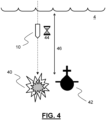
- the fuze within the munition is adapted to trigger the explosive charge within the munition in the water (that is under the water surface). This triggering can be achieved in one of a number of different ways. Figures 4 to 6 give typical examples.
- Figure 4 shows that the fuze may be adapted to trigger 40 explosive within the munition 10 in order to successfully and effectively engage an underwater target 42.
- This might be achieved by triggering the explosive charge after a particular time 44, for example from one or more of a combination of launch from the gun barrel described above, and/or a predetermined time period after entering the water 4.
- This time period will typically equate to a particular depth 46 within the water 4 (e.g. based on expected or calculate rate of descent).
- the triggering 40 may occur at the particular depth 46 in combination with or irrespective of the timing 44.
- an alternative or additional approach might involve the direct detection of depth (via one or more sensors or similar).
- Depth may be detected based on time, as above, or perhaps based on water pressure under the surface, the salinity of the water, the temperature of the water, or even at a predetermined speed-of-sound in the water. All of these may be indicative of depth within the water, for example which may be known in advance from mapping of the area, and/or sensed by the munition 10 via one or more sensors when descending through the water.
- the fuze may be also be adapted to trigger the explosive charge upon impact with the target 42.
- it may be safer to employ some form of depth-activation, so that the munition explodes at/near the depth of the target, avoiding possible unintentional explosions at or near objects that are not targets.
- the fuze may be programmed with such criteria, or related criteria necessary for the fuze to trigger the explosive as and when intended.
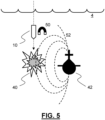
- Figure 5 shows a different adaptation for triggering 40 an explosive charge of the munition 10 under the water, this time upon magnetic detection 50 of a target magnetic signature 52.
- the target magnetic signature could simply be the detection of anything magnetic, indicating the presence of a magnetic or magnetisable structure. For instance, once a detected magnetic a field strength is above a relevant threshold, the munition 10 might explode. In a more sophisticated manner, it may be known or derivable in advance to determine what the expected magnetic signature 52 of the particular target 42 might be, might look like, or might approximate to. This might equate to field strength, or field lines, or changes therein. In this example, the munition 10 might not be triggered 40 to explode until the magnetic detection 50 detects a very particular magnetic signature 52, and not simply any magnetic field or change therein.
- Figure 5 discusses the use of magnetic fields, much the same principle may be used to detect electric field signatures.
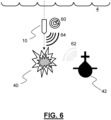
- Figure 6 shows another example of triggering.
- the triggering 40 of the explosive charge in the munition 10 is undertaken based on the detection of pressure waves in the water 4, thereby implementing a sonar-like system 60.
- the system may be implemented in one of a number of different ways.
- the munition 10 may be arranged to detect a pressure wave 62 emanating from target object 42. This could be a sonar pulse 62 originating from the object 42, or simply detection of sound generated by the object 42, or could instead be a reflection 62 of a sonar pulse 64 originating from the munition 10. That is, the projectile 10 may not only detect pressure waves, but may emit pressure waves.
- the explosive charge may be triggered 40 when a target sonar signature is detected 60, and this could be when any pressure wave is detected, or more likely when a pressure wave above a certain threshold is detected, or when a particular pressure wave or a series of pressure waves is detected which is indicative of the presence of a particular target 42.
- the munition may be able to detect or infer entry into the water, or making contact with the water. This might be useful in initiating or priming fuze activity, for example starting a timer, taking a base or initial reading of pressure, salinity, temperature, and so on (or any relevant criteria), or anything which may assist in the subsequent use of the fuze to trigger the explosive.
- This sensing or inference could be via an environmental sensor or similar that is (already) present in order to perform another function, for example those discussed or alluded to above.
- the sensing or inference could be via a dedicated sensor, for example a dedicated impact or water/moisture sensor, or temperate sensor, pressure sensor, salinity sensor, and so on.
- the munition may be able to detect or infer entry into the water, or making contact with the water, for safety reasons, where some (e.g. explosive) function is prevented prior to water contact/entry.
- the munition is adapted to be launched, into the air, from a gun barrel. This gives good range, and good targeting accuracy, good engagement speed, all at relatively low cost.
- the munition may be described as, or form part of, an artillery shell.
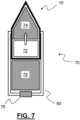
- Figure 7 shows such an artillery shell 70.
- the artillery shell 70 comprises a munition 10 according to any embodiment described herein.
- the munition 10 will typically comprise a fuze 72 (likely a programmable fuze, as discussed above), which is adapted to trigger an explosive charge 74 also located within a munition.
- the artillery shell 70 will also comprise a primer 76 and an explosive propellant 78 which may be cased (as shown) or bagged.
- a casing 80 might also be provided, to hold the munition 10, explosive 78, and primer 76.
- the fuze could be located in the nose of the munition (e.g. as opposed to behind the nose as shown in Figure 7 ).
- the munition according to the present disclosure is capable of withstanding explosive propulsion-based launch from a gun barrel, in contrast with for instance a depth charge or torpedo.
- the munition and/or artillery shell (which could be the same thing) will typically have a diameter of 200mm or less, in contrast with depth charges.
- the gun barrel-munition/artillery shell assembly typically will be such that the munition has a range of well over 100 metres, typically over 1000 metres, and quite possibly in excess of 20 to 30 kilometres.
- One or more assemblies can be used to launch one or more munitions with such range and effectiveness, in contrast with the launching of depth charges, helicopters including such depth charges, or multiple torpedoes.
- Figure 8 schematically depicts general principles associated with the method of launching a munition according to an example embodiment.
- the munition comprises an explosive charge, and a fuze.
- the munition is adapted to be launched, into the air, from a gun barrel, and enter a body of water.
- the fuze is adapted to trigger the explosives charge under the water.
- the method comprises launching the munition into the air, from a gun barrel 90.
- the launch is configured such that the munition is launched into the body of water 92, such that, as discussed above, the fuze may then be adapted to trigger the explosive charge under the water 92.
- a munition has been described and detailed.
- the munition includes an explosive charge.
- many of the principles discussed above can still be taken advantage of, but without using a projectile including an explosive charge. That is, the above principles can be used to ensure that a projectile can be launched from a gun barrel and into a body of water, when the projectile is then arranged to interact or engage with an object in the water, but without necessarily including an explosive charge to disable or damage that object.
- the present disclosure additionally provides a reconnaissance projectile.
- the reconnaissance projectile is adapted to be launched, into the air, from a gun barrel, and then into contact with a body of water (onto the water surface, or to descend below the surface).
- the projectile may be launched at a high range, with a high degree of accuracy, relatively cheaply and quickly.
- the reconnaissance projectile is arranged to initiate a reconnaissance function when in contact with the body of water (which includes when impacting the water, when on the body of water, or, as above, typically when located under the surface of the water).
- the reconnaissance function could be anything of particular use in relation to the particular application, but would typically comprise emission and/or detection of a pressure wave in the body of water, in a manner similar to that discussed above in relation to Figure 6 .
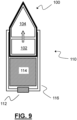
- FIG. 9 shows a reconnaissance projectile 100 in accordance with an example embodiment.
- the reconnaissance projectile 100 comprises a sensor 102.
- the sensor may be used to detect when the projectile 100 has come into contact with a body of water, and/or provide some other sensing functionality, for example one or more of the sensing or initiation criteria described above in relation to the munition.
- the sensor 102 may be arranged to detect a particular passage of time, or a particular pressure change, or particular depth, and so on.
- the reconnaissance projectile 100 also comprises a transceiver 104, in this example.
- the transceiver may be arranged to emit and/or detect pressure waves in the body of water.
- the sensor 102 may initiate or process transmission or detection of the waves by transceiver 104.
- the sensor 102 might, instead or additionally, be or comprise a processor for processing implementing one or more of these functions.
- the reconnaissance projectile may take one of a number of different forms, similar or different to that shown in Figure 9.
- Figure 9 is shown simply as a way of schematically depicting what such a projectile 100 might look like.
- the reconnaissance projectile 100 might be used or fired or launched in isolation in some way. However, it is likely that the projectile, being explosively propelled, might take the form of, or form part of, an artillery shell 110.
- the artillery shell 110 might comprise much the same primer 112, explosive 114 and casing 116 as is already described above in relation to the arrangement of Figure 7 . Referring back to Figure 9 , a difference here is that the artillery shell 110 comprises a non-explosive projectile 100, as opposed to an explosive-carrying munition.
- a reconnaissance projectile may be launched into a body of water in order to perform a reconnaissance function in relation to a target. That reconnaissance projectile may be provided with a transmitter for transmitting reconnaissance information back to the assembly from which the projectile was launched. This reconnaissance information or data may then be used in the programming of subsequently fired or launched explosive munitions according to example embodiments. Indeed, a volley of projectiles may be launched toward an underwater target in accordance with an example embodiment.
- One or more of those projectiles may be a munition as described herein, and one or more of those projectiles may be a reconnaissance projectile as described herein.
- the munitions projectile and the reconnaissance projectile may be arranged to communicate with one another.
- a first-fired reconnaissance projectile may enter the body of water and detect or otherwise the presence of a target
- a subsequently fired munitions projectile which may be in the air or in the body of water at the same time as a reconnaissance projectile, may receive reconnaissance information from a reconnaissance projectile and use this in the initiation (or otherwise) of the explosive charge of the munitions projectile.
- This may mean that the munitions projectile does not need to carry sophisticated (or as sophisticated) transmission or sensing equipment, which could reduce overall cost or system complexity.
- the reconnaissance projectile described above could actually be a munitions projectile, for example one of those shown in relation to Figures 5 and 6 .
- One or more munitions projectiles may be arranged to perform a reconnaissance functionality, but not necessarily initiate the explosive charge. Any acquired information on the target may be used to initiate the explosives charge of subsequently launched munitions projectiles.
- Or, or more reconnaissance projectiles may be arranged to perform an explosive function, but not necessarily use the reconnaissance function.
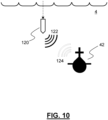
- FIG 10 shows a projectile 120 with reconnaissance functionality 122, 124 entering the body of water 4 in the vicinity of the target 42.
- Reconnaissance functionality 122, 124 might include emission 122 and/or detection 124 of pressure waves.
- the reconnaissance functionality 122, 124 may be completely independent of any explosives charge that the munition 120 is, or is not, provided with. That is, the projectile 120 might have explosive capability, reconnaissance functionality, or a combination of both. Different projectiles 120 launched into the water may have different combinations of such explosive/reconnaissance functionality.
- the explosive charge could be cartridged or bagged charge.
- the casing could be reactive. Any explosive might be dependent on how the system is to be used, for example getting the munition near the target, or simply close enough. In the former, an explosive yielding a high bubble effect might be useful. In the latter, simply the level of blast might be more important.
- the disclosure also relates to very closely related concepts, but in submunition or sub-projectile form, as in a munition or projectile carried by and then expelled from another (carrier) projectile.
- the munition or reconnaissance projectile is more particularly a submunition of a munition assembly, or a reconnaissance sub-projectile of a reconnaissance projectile assembly.
- the submunition or reconnaissance sub-projectile is the object for which controlled entry into, and functionality in, the water is achieved, whereas a carrier of the assembly is simply a tool to get the submunition or reconnaissance sub-projectile to, or proximate to, a target location.
- the assembly as a whole, and particularly an outer carrier for carrying the submunition or sub-projectile can be well or better configured for launch from a gun, with the range and accuracy that such configurations brings.
- the assembly or the carrier can be bullet-shaped, ogive-shaped or roundly-shaped or tapering, in accordance with the typical shape of munitions.
- the submunition or sub-projectile can then have any desired shape, since the submunition or reconnaissance sub-projectile does not need to be configured for being fired from a gun. This means that the submunition or reconnaissance sub-projectile can then be more easily and readily configured for controlled descent toward and into the water, reducing or preventing damage that might otherwise occur if the munition was fired directly into the water.
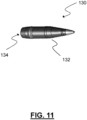
- FIG 11 shows a munition assembly 130, arranged to be launched from a gun, much as with the munition of previous examples.
- the assembly 130 comprises a carrier 132 for a submunition 134.
- a nose of the carrier 132 is ogive-shaped or roundly-shaped or tapering, for greater aerodynamic performance.
- the carrier 132 comprises (which includes defines) a cavity in which the submunition 134 is located. The cavity retains and protects the submunition 134, and so shields the submunition 134 during launch and flight conditions of the assembly 130.
- the assembly 130 may be launched and generally handled much as with the munition of earlier examples. However, in previous examples, controlled descent of the entire launched projectile, in the form of the (single-bodied) munition, is implemented. In the present examples, the submunition is expelled from its carrier, and controlled descent of the submunition is implemented, in the same manner as with the munition of previous examples. Again, then, the advantage of the present examples is that munition assembly can be tailored for launch and flight conditions, and the submunition can be tailored for descent and target engagement. The two-body approach allows for tailoring of a two-part problem.
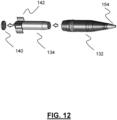
- Figure 12 shows that the submunition 134, initially carried by the carrier 132 in the cavity, is arranged to be controllably expelled from the carrier.
- a fuze and an expulsion charge for example a carrier fuze 154 and a carrier expulsion charge.
- the carrier fuze 154 may operate on a timer, triggering the carrier expulsion charge to expel the submunition at or proximate to a target location, for example above a location of a target.
- the carrier fuze may be programmed with a particular timing, or any other set of conditions, for example location-based activation, environmental sensing-based activation, and so on.
- the submunition 134 is expelled via a rear end of the carrier 132. This is advantageous, as this might better ensure the maintenance of a predictable ballistic trajectory of the submunition 134 or carrier 132, or prevent the carrier 132 from impacting upon the submunition 134. As above, it is the submunition 134 for which slow, controlled descent is desirable, and so leaving the carrier 132 via a rear end allows for much more design and functional control, in implementing this.
- the submunition may be arranged to be expelled from a rear end of the carrier via a closure 140.
- the closure might generally close or seal off the submunition 134 within the carrier 132. This might be useful for handling or safety reasons, or assist in shielding the submunition from launch and flight conditions.
- the closure 140 is arranged to be opened before or during expulsion of the submunition 134. This could be an active opening, for example via a controlled electronic or pneumatic switch or opening mechanism. However, it is likely to be simpler for this opening to be relatively passive or responsive, in that the closure 140 is arranged to open, for example via a shearing action, due to pressure of the expulsion charge on the opening, either directly, or indirectly via contact with the submunition 134 itself.
- the submunition 134 comprises a deployable configuration 142 that is arranged, when deployed, to slow the submunition 142 in the air, after expulsion from the carrier 132, and before entry to the water.
- the deployment could be active, for example based on sensing of air flow or submunition release, and an electrical or mechanical system actively deploying the configuration 142.
- a more passive, automatic deployment may be simpler to implement, and more reliable.
- Figure 12 shows that wings or fins 142 might automatically deploy, to provide a degree of auto rotation to slow or further slow the munition 134 during its descent.
- the wings or fins 142 could be spring loaded, in a compressed or closed state, when in carrier 132, and then automatically uncompress or open when expulsion is implemented. Alternatively, the act of air flow during or after expulsion may force the wings or fins 142 to deploy.
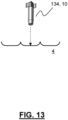
- Figure 13 shows that the submunition 134 functions largely as the munition 10 of previous examples, descending toward and eventually onto or into the body of water 4, for engagement with a target.
- a submunition fuze is then adapted to trigger a submunition explosive charge, under water.
- FIG 14 shows a more detailed view of the munition assembly 130.
- the munition assembly 130 is arranged to be launched from a gun.
- the assembly 130 comprises: a carrier 132 for a submunition 134.
- the carrier comprises a cavity 150 in which the submunition 134 is located.
- the carrier 132 may be, or may form, a (carrier) shell.
- the submunition 134 carried by the carrier 132 in the cavity 150, is arranged to be controllably expelled from the carrier 134.
- the carrier 132 comprises a carrier expulsion charge 152 and a carrier fuze 154, the charge 152 being located in-between the submunition 134 and the fuze 154.
- the fuze is typically located in a nose of the assembly 130 or carrier 132.
- the carrier fuze 154 is adapted to trigger the carrier expulsion charge 152 to controllably expel the submunition 134 from the carrier 132, via the closure 140 at the rear of the carrier 132
- the submunition 134 comprises wings or fins 142, arranged to auto-deploy upon expulsion, so as to slow down the descent of the submunition toward and into the water.
- Such a deployable configuration is typically located at a rear (in terms of eventual descent direction) end of the submunition, to maintain descent stability.
- the submunition comprises a submunition (main) explosive charge 156, and a submunition fuze 158.
- the submunition fuze 158 is typically located at a rear (in terms of eventual descent direction) end of the submunition 134, to reduce the risk of damage to any sensitive components, during impact with the water.
- the munition assembly 130 is adapted to be launched, into the air, from a gun barrel, where the submunition 134 is then arranged to be controllably expelled from the carrier 132 and enter a body of water, and the submunition fuze 158 is adapted to trigger the submunition explosive charge 156 underwater.
- descent of the submunition, and activation of its fuze may be implemented as described above in relation to the munition embodiments.
- the principles described in relation to the submunition apply equally to a reconnaissance sub-projectile carried by a carrier of a reconnaissance projectile assembly. That is, the reconnaissance sub-projectile has the benefits of being carried and deployed like the submunition as described above, but also with the reconnaissance functionality, as described above.
- any of the projectiles described herein, including munitions, submunitions, or reconnaissance projectiles or sub-projectiles, may be arranged to communication with, ortransmit to, other objects.
- munitions, submunitions, or reconnaissance projectiles or sub-projectiles may be arranged to transmit a communication signal, external to and away from the submunition after entering the water, and optionally after a predetermined time period after entering the water; upon detection of a target sonar signature; upon detection of a target magnetic signature; upon detection of a target electric field signature; at a predetermined pressure under the water surface; at a predetermined depth under the water surface; at a predetermined salinity of water; at a predetermined temperature of water; at a predetermined speed-of-sound in water; or upon impact with a target under the water surface.
- the communication with, or transmission to, could be in relation to a remote weapon or platform, which could engage with the target depending on the communication or transmission.
- a submunition or reconnaissance sub-projectile may provide a warning shot, or a detection function, in advance of a more escalated engagement from the remote weapon or platform (e.g. a submarine, or torpedoes from a submarine).
- a fuze has been discussed and described quite generally. In practice, that fuze may be connected to or form part of a fuze system, for example for use in arming or triggering the fuze and the related explosive charge. In those same above examples, it has been shown that obtaining an indication of depth of the munition is particularly useful, for example in triggering an explosive charge at a certain depth, or communicating from a reconnaissance projectile at a certain depth, or communicating the depth that the reconnaissance projectile is at.
- depth-sensing can be undertaken in one of a number of different ways, for example using a time of descent of the munition or projectile, or via a pressure sensor or similar.
- these approaches might not be desirable.
- the timing may not be a particular accurate way of predicting or assuming a depth of the munition, for example due to currents in the water, or an otherwise unexpected rate of descent of the munition or projectile through the water.
- a pressure sensor is desirable.
- pressure sensors may be too complex or costly to justify inclusion in a munition.
- a pressure sensor located on the outside of the munition to obtain accurate reading of pressure may negatively affect the performance of the munition or projectile.
- this external location of the pressure sensor might affect aerodynamic properties of the munition or projectile, or the path taken by the munition or projectile when underwater.
- this external pressure sensor will need to communicate with internal systems of the munition or projectile to implement the pressure-related functionality. In a simple way, this is likely to require perforations or other apertures in a housing of the projectile or munition.
- any sensor pressure may be wirelessly communicated to an interior of the munition or projectile, but then this increases costs and complexity, and still does not overcome the problem of the sensor being on the outside of the munition or projectile. If the sensor is located within the projectile or munition, it may be difficult or impossible to accurately measure the environmental pressure with existing approaches.
- the present invention relates to an object for moving through a fluid.
- the object comprises an outer housing, arranged to be exposed to a hydrostatic pressure exerted by the fluid.
- the object further comprises a strain gauge, arranged to obtain an indication of the hydrostatic pressure.
- a first part of the strain gauge is arranged to be in contact with the outer housing. This is such that the strain gauge is arranged to obtain an indication of the hydrostatic pressure acting on the object by, in fact, obtaining an indication of the strain on the housing.
- the housing forms part of the pressure-sensing arrangement or configuration.
- This approach is subtle, but has many advantages. Firstly, this might reduce the number or complexity of components needed to sense pressure. This might also reduce costs. Also, and perhaps most importantly, this means that the pressure sensor can be located inside of the outer housing, which might typically be a sealed housing, and yet still be able to accurately detect hydrostatic pressure via the change in shape or size (i.e. strain on or of) the housing itself.
- Figure 15 is a simplified view of part of the munition 134 of Figure 14 .
- the Figure shows that the fuze 158 is, in fact, part of a fuze system 200.
- the overall system 200 may be used, for example, in terms of fuze arming or charge triggering functionality.
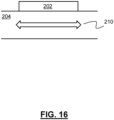
- the system 200 is shown as comprising a strain gauge. At least a first part of the strain gauge 202 is arranged to be in contact with an outer housing 204 of the munition 134.
- a second part of the strain gauge 206 is provided to read or otherwise process interactions with the first part of the strain gauge 202. For instance, this might involve the second part 206 optically reading changes in periodicity or spacing of lines or markings of or provided by the first part of the strain gauge 202 (e.g. a grating), or the second part 206 electronically or optically reading, interrogating, or processing signals related to the functionality of the first part of the strain gauge 202.
- the second part 206 might be or form part of a system which is used to communicate with or in some way operate the fuze 158, described above.
- the parts may represent different functions of the same object, or same sensor. That is, the different parts do not need to be distinct structural components, spatially separated from one another.
- the strain gauge 202 and related components, are all included within the housing 204 of the submunition 134. No compromises need to be made in the structural integrity of the housing 204 by implementing this embodiment, for example by needing to drill holes in the housing 204 for the passage of wires or cables, or for the provision of optical windows or similar.
- Figure 16 shows that the first part of the strain gauge 202 is in direct contact with an internal surface of the housing 204 of the munition.
- a strain 210 on or of the housing 204 will directly impact the part of the gauge 202, thereby allowing pressure readings to be undertaken, accurately, from within the housing 204.
- the invention is applied to a projectile, where simplicity and cost-effectiveness is perhaps key.
- the part of the strain gauge that obtains an indication of strain of the housing is shown as being located on an internal surface of the housing, it is conceivable that the same or similar benefits could be achieved if the part of the strain gauge was in some way embedded within the material forming the housing. Benefits may also be achieved in terms of simplicity and cost-effectiveness if the strain gauge is located on an external surface of the housing, but this would then likely need wireless transmission of any sensed changes, to the system within the munition, perhaps increasing cost or complexity, or passage of wires or cables or similar through the housing, compromising structural integrity.
- the sensing has been described as being useful for arming a fuze, or perhaps triggering an explosives charge.
- Other implementations are possible, for example the system could be arranged to simply transmit hydrostatic pressure information away from the object, particularly when the object is a reconnaissance projectile, or in some way used in a general reconnaissance functionality.
- the strain gauge could be any suitable gauge, for example comprising a fibre-optic strain gauge, or a grating that is readable in an optical manner, and so on.
- Figure 17 schematically depicts general methodology associated with the more apparatus-like principles already discussed in relation to Figures 15 and 16 .
- a method of obtaining an indication of a hydrostatic pressure on an object is depicted.
- the method comprises obtaining an indication of the hydrostatic pressure by obtaining an indication of a strain on an outer housing of the object (e.g. housing that is exposed to that pressure) 220.
- the method is undertaken using at least part of a strain gauge in contact with the outer housing 222. This might alternatively or additionally be defined as the method being undertaken using the outer housing of the object, in general.
Landscapes
- Engineering & Computer Science (AREA)
- General Engineering & Computer Science (AREA)
- Chemical & Material Sciences (AREA)
- Combustion & Propulsion (AREA)
- Physics & Mathematics (AREA)
- Fluid Mechanics (AREA)
- Ocean & Marine Engineering (AREA)
- General Physics & Mathematics (AREA)
- Aviation & Aerospace Engineering (AREA)
- Aiming, Guidance, Guns With A Light Source, Armor, Camouflage, And Targets (AREA)
Claims (12)
- Projektil zum Bewegen durch eine Flüssigkeit (134), das Projektil umfassend:
ein Außengehäuse (204), das angeordnet ist, um einem hydrostatischen Druck, der durch die Flüssigkeit ausgeübt wird, ausgesetzt zu sein; einen Dehnungsmessstreifen (202, 206), der angeordnet ist, um eine Anzeige des hydrostatischen Drucks zu erhalten, wobei sich ein erster Teil (202) des Dehnungsmessstreifens innerhalb des Außengehäuses befindet und angeordnet ist, um auf oder in einer Innenoberfläche des Außengehäuses zu sein, derart, dass der Dehnungsmessstreifen angeordnet ist, um eine Anzeige des hydrostatischen Drucks durch Erhalten einer Anzeige der Dehnung auf dem Gehäuse zu erhalten, wobei das Projektil ein System umfasst und der Dehnungsmessstreifen einen Teil des Systems bildet, wobei das System angeordnet ist, um eine Funktionalität des Projektils zu ermöglichen, wobei sich die Funktionalität auf den hydrostatischen Druck bezieht. - Projektil nach einem der vorstehenden Ansprüche, wobei das Außengehäuse ein im Wesentlichen abgedichtetes Außengehäuse ist.
- Projektil nach einem der vorstehenden Ansprüche, wobei das System angeordnet ist, um einen Zünder des Projektils unter Verwendung der erhaltenen Anzeige des hydrostatischen Drucks mindestens teilweise scharf zu machen.
- Projektil nach einem der vorstehenden Ansprüche, wobei das System angeordnet ist, um, unter Verwendung der erhaltenen Anzeige des hydrostatischen Drucks, eine Sprengladung des Projektils auszulösen.
- Projektil nach einem der vorstehenden Ansprüche, wobei das System angeordnet ist, um die erhaltene Anzeige des hydrostatischen Drucks von dem Projektil weg zu übertragen.
- Projektil nach einem der vorstehenden Ansprüche, wobei das Projektil eine Munition ist.
- Projektil nach Anspruch 6, wobei die Munition eine Submunition ist.
- Projektil nach einem der Ansprüche 1 bis 6, wobei das Projektil ein Aufklärungsprojektil ist.
- Baugruppe, die Baugruppe umfassend:
einen Träger für ein Projektil, der Träger umfassend einen Hohlraum, in dem sich das Projektil befindet; und ein Projektil nach einem der vorstehenden Ansprüche, das durch den Träger in dem Hohlraum getragen wird, wobei das Projektil angeordnet ist, um aus dem Träger steuerbar ausgestoßen zu werden, und wobei die Baugruppe angepasst ist, um abgeschossen zu werden, und wobei das Projektil dann angeordnet ist, um aus dem Träger steuerbar ausgestoßen zu werden; und das Projektil angepasst ist, um eine Funktion, die sich auf einen hydrostatische Druck bezieht, durchzuführen. - Baugruppe nach Anspruch 9, wobei das Projektil eine Submunition ist, die einen Submunitionszünder und/oder einer Submunitionssprengladung aufweist, und der Zünder angeordnet ist, um mindestens teilweise scharf gemacht zu werden, oder die Submunitionssprengladung angeordnet ist, um abhängig von der erhaltenen Anzeige des hydrostatischen Drucks ausgelöst zu werden.
- Baugruppe nach Anspruch 9 oder 10, wobei die Baugruppe angepasst ist, um aus einem Gewehrlauf in die Luft abgeschossen zu werden, und optional die Submunition dann angeordnet ist, um aus dem Träger steuerbar ausgestoßen zu werden und in ein Gewässer einzudringen; und das Projektil optional angepasst ist, um eine Funktion, die sich auf einen hydrostatische Druck bezieht, durchzuführen, wenn es in dem Wasser ist; optional, wenn eine Submunition, ein Submunitionszünder angepasst ist, um, die Submunitionssprengladung unter Wasser auszulösen.
- Verfahren zum Erhalten einer Anzeige eines hydrostatischen Drucks auf ein Projektil, das Verfahren umfassend:
Erhalten der Anzeige des hydrostatischen Drucks durch Erhalten einer Anzeige einer Dehnung an einem Außengehäuse des Projektils (220) unter Verwendung von mindestens einem Teil eines Dehnungsmessstreifens, der sich innerhalb des Außengehäuses und an oder in einer Innenoberfläche des Außengehäuses (222) befindet, und Ermöglichen der Funktionalität des Projektils, wobei die Funktionalität sich auf den hydrostatischen Druck bezieht.
Applications Claiming Priority (8)
| Application Number | Priority Date | Filing Date | Title |
|---|---|---|---|
| GBGB1820705.0A GB201820705D0 (en) | 2018-12-19 | 2018-12-19 | Munition |
| EP18275186.7A EP3671103A1 (de) | 2018-12-19 | 2018-12-19 | Munition |
| GB1912696.0A GB2586820B (en) | 2019-09-04 | 2019-09-04 | A munition and munition assembly |
| GB1917753.4A GB2580776B (en) | 2018-12-19 | 2019-12-05 | Munitions and projectiles |
| GB1917754.2A GB2583394B (en) | 2018-12-19 | 2019-12-05 | Munitions and projectiles |
| EP19275140 | 2019-12-05 | ||
| EP19275141 | 2019-12-05 | ||
| PCT/GB2019/053583 WO2020128453A1 (en) | 2018-12-19 | 2019-12-17 | Improvements relating to apparatus and method suitable for use with a munition |
Publications (2)
| Publication Number | Publication Date |
|---|---|
| EP3899414A1 EP3899414A1 (de) | 2021-10-27 |
| EP3899414B1 true EP3899414B1 (de) | 2024-08-28 |
Family
ID=76545391
Family Applications (3)
| Application Number | Title | Priority Date | Filing Date |
|---|---|---|---|
| EP19828294.9A Active EP3899414B1 (de) | 2018-12-19 | 2019-12-17 | Verbesserungen in bezug auf eine vorrichtung und ein verfahren zur verwendung mit einer munition |
| EP19828295.6A Active EP3899416B1 (de) | 2018-12-19 | 2019-12-17 | Verbesserte vorrichtung und verfahren zur verwendung mit einer munition |
| EP19828292.3A Active EP3899415B1 (de) | 2018-12-19 | 2019-12-17 | Vorrichtung und verfahren zur verwendung mit einer munition |
Family Applications After (2)
| Application Number | Title | Priority Date | Filing Date |
|---|---|---|---|
| EP19828295.6A Active EP3899416B1 (de) | 2018-12-19 | 2019-12-17 | Verbesserte vorrichtung und verfahren zur verwendung mit einer munition |
| EP19828292.3A Active EP3899415B1 (de) | 2018-12-19 | 2019-12-17 | Vorrichtung und verfahren zur verwendung mit einer munition |
Country Status (5)
| Country | Link |
|---|---|
| US (3) | US12181264B2 (de) |
| EP (3) | EP3899414B1 (de) |
| AU (3) | AU2019411513B2 (de) |
| CA (2) | CA3122350A1 (de) |
| PL (2) | PL3899415T3 (de) |
Families Citing this family (4)
| Publication number | Priority date | Publication date | Assignee | Title |
|---|---|---|---|---|
| GB2583394B (en) | 2018-12-19 | 2022-09-21 | Bae Systems Plc | Munitions and projectiles |
| EP3899414B1 (de) | 2018-12-19 | 2024-08-28 | BAE SYSTEMS plc | Verbesserungen in bezug auf eine vorrichtung und ein verfahren zur verwendung mit einer munition |
| GB2586820B (en) | 2019-09-04 | 2023-12-20 | Bae Systems Plc | A munition and munition assembly |
| IL298308A (en) * | 2020-05-18 | 2023-01-01 | Instr And Engineering Services Inc | Dynamic hardened target layer and void detector sensor for use with a warhead or projectile penetrator |
Citations (2)
| Publication number | Priority date | Publication date | Assignee | Title |
|---|---|---|---|---|
| US2955558A (en) * | 1954-09-30 | 1960-10-11 | Thomas D Johnson | Wide range depth control |
| US4703693A (en) * | 1985-07-24 | 1987-11-03 | Messerschmitt-Boelkow-Blohm Gesellschaft Mit Beschraenkter Haftung | Apparatus for controlling a weapon, especially a droppable bomb |
Family Cites Families (103)
| Publication number | Priority date | Publication date | Assignee | Title |
|---|---|---|---|---|
| FR473708A (fr) | 1913-10-09 | 1915-01-22 | Giovani Emanuele Elia | Mines sous-marines accouplées pouvant etre lancées à distance à la manière de projectiles |
| US1339188A (en) * | 1918-11-20 | 1920-05-04 | Zigmond Frecska | Aerial torpedo |
| US2060198A (en) | 1932-11-28 | 1936-11-10 | Jr John Hays Hammond | Echo torpedo detonator |
| US2489255A (en) | 1941-03-15 | 1949-11-29 | Eastern Ind Inc | Sound responsive control |
| US3115833A (en) * | 1944-01-28 | 1963-12-31 | Harry H Hall | Acoustical doppler firing device |
| US2480927A (en) * | 1944-03-16 | 1949-09-06 | Raymonde Briggs Hopkins | Aerial torpedo |
| US2391966A (en) * | 1944-05-18 | 1946-01-01 | Cons Vultee Aircraft Corp | Accelerometer |
| US2995102A (en) * | 1944-11-20 | 1961-08-08 | Bell Telephone Labor Inc | Torpedo steering system |
| US3017832A (en) | 1950-12-13 | 1962-01-23 | Waldron S Macdonald | Echo firing device for a depth charge |
| US3011738A (en) * | 1952-01-17 | 1961-12-05 | Harold K Skramstad | Autopilot |
| US2969033A (en) * | 1952-10-15 | 1961-01-24 | Sperry Rand Corp | Automatic depth control system |
| US3005434A (en) * | 1953-04-14 | 1961-10-24 | Arthur F Bennett | Torpedo control system |
| US3677184A (en) | 1955-08-16 | 1972-07-18 | Us Army | Proximity fuzes |
| US2803135A (en) * | 1955-09-12 | 1957-08-20 | John C New | Fixed depth pressure detector or indicator |
| US2884859A (en) | 1955-11-04 | 1959-05-05 | James M Alexander | Rocket projectile |
| US4189999A (en) | 1956-03-05 | 1980-02-26 | The United States Of America As Represented By The Secretary Of The Navy | Vector acoustic mine mechanism |
| US3723954A (en) * | 1956-08-24 | 1973-03-27 | Us Navy | Reverberation filter system |
| US3853081A (en) * | 1958-10-28 | 1974-12-10 | Us Navy | Method and apparatus for destroying submarines |
| US2960009A (en) | 1959-06-03 | 1960-11-15 | Ralph F Hereth | Launcher |
| US4207819A (en) | 1963-04-12 | 1980-06-17 | The United States Of America As Represented By The Secretary Of The Navy | Helicopter destroyer |
| US3252417A (en) | 1964-04-17 | 1966-05-24 | Magnavox Co | Arming and firing mechanism |
| US3728982A (en) * | 1964-06-15 | 1973-04-24 | Us Navy | Acoustic homing torpedo |
| US5012717A (en) * | 1964-09-29 | 1991-05-07 | The United States Of America As Represented By The Secretary Of The Navy | Air-to-subsurface missile system |
| US3343492A (en) | 1965-05-28 | 1967-09-26 | Janus Products Inc | System for ultrasonic translation of electrical energy |
| US3738270A (en) | 1966-03-24 | 1973-06-12 | Us Navy | Homing depth bomb for searching for an underwater target |
| US4977545A (en) | 1966-05-03 | 1990-12-11 | The United States Of America As Represented By The Secretary Of The Navy | Target detector |
| US4129086A (en) * | 1966-12-24 | 1978-12-12 | Schwarz Hans Dieter | Method and means for the acoustical steering of submarine torpedoes |
| US4274353A (en) * | 1967-12-22 | 1981-06-23 | The United States Of America As Represented By The Secretary Of The Navy | Acoustic imaging system for wire guided torpedo |
| US3648636A (en) * | 1967-12-26 | 1972-03-14 | Gen Electric | Acoustic guidance system |
| US5761154A (en) | 1969-08-26 | 1998-06-02 | The United States Of America As Represented By The Secretary Of The Navy | Acoustic exploder |
| US3653324A (en) * | 1970-02-10 | 1972-04-04 | Us Army | Electronic device applicable to ordnance safety and arming systems |
| US3651697A (en) | 1970-02-20 | 1972-03-28 | Anthony Pete Ianuzzi | Depth variation indicator |
| US3938438A (en) | 1971-04-12 | 1976-02-17 | The United States Of America As Represented By The Secretary Of The Navy | Pressure-armed explosive apparatus |
| US3802365A (en) * | 1972-01-12 | 1974-04-09 | Us Navy | Vehicular control system |
| FR2285600A1 (fr) * | 1974-09-23 | 1976-04-16 | France Etat | Appareil pour mesurer les variations de flottabilite d'un flotteur dues aux variations de pressions |
| FR2640371A1 (fr) | 1976-02-04 | 1990-06-15 | France Etat Armement | Perfectionnements aux allumeurs de mines |
| US4064806A (en) | 1976-09-01 | 1977-12-27 | The United States Of America As Represented By The Secretary Of The Army | Ultrasonic remote control system |
| US4215630A (en) | 1978-03-06 | 1980-08-05 | General Dynamics Corporation Pomona Division | Anti-ship torpedo defense missile |
| US4372239A (en) * | 1980-03-03 | 1983-02-08 | General Dynamics, Pomona Division | Undersea weapon with hydropulse system and periodical seawater admission |
| US4341173A (en) * | 1980-03-03 | 1982-07-27 | General Dynamics, Pomona Division | Hydropulse underwater propulsion system |
| US10514240B1 (en) | 1981-10-02 | 2019-12-24 | The Boeing Company | Multiple wire guided submissile target assignment logic |
| DE3344751C2 (de) | 1983-12-10 | 1987-01-15 | Dornier Gmbh, 7990 Friedrichshafen | Programmierkoppler |
| DE3442456A1 (de) | 1984-11-22 | 1986-09-04 | Honeywell Gmbh, 6050 Offenbach | Anordnung zum programmieren des zuenders von minen |
| US4603635A (en) | 1984-12-17 | 1986-08-05 | Avco Corporation | Dual safing for base element fuze |
| US4680584A (en) * | 1985-05-03 | 1987-07-14 | The United States Of America As Represented By The Secretary Of The Navy | Acoustic prelaunch weapon communication system |
| DE3610358A1 (de) | 1986-03-27 | 1987-10-01 | Diehl Gmbh & Co | Sicherungseinrichtung fuer sekundaersprengstoff-detonator |
| DE3706819A1 (de) | 1987-03-03 | 1988-09-15 | Diehl Gmbh & Co | Submunition mit zuendeinrichtung |
| DE3800407C1 (en) | 1988-01-09 | 1989-03-23 | Messerschmitt-Boelkow-Blohm Gmbh, 8012 Ottobrunn, De | Different distribution of submunitions |
| GB9014653D0 (en) | 1989-10-18 | 1997-11-05 | Messerschmitt Boelkow Blohm | Auswerfen und verteilen von submunition |
| DE3937762C2 (de) | 1989-11-14 | 1993-11-25 | Diehl Gmbh & Co | Artilleriegeschoß-Submunition |
| US5078069A (en) | 1990-03-27 | 1992-01-07 | Hughes Aircraft Company | Warhead |
| DE4122892A1 (de) | 1991-07-11 | 1993-01-14 | Diehl Gmbh & Co | Verfahren und vorrichtung zum bekaempfen eines getauchten zielobjektes |
| JPH0518698A (ja) * | 1991-07-12 | 1993-01-26 | Mitsubishi Heavy Ind Ltd | 水中航走体防御装置 |
| DE4123649C2 (de) | 1991-07-17 | 1993-11-11 | Rheinmetall Gmbh | Ausstoßvorrichtung |
| US5241314A (en) | 1991-08-16 | 1993-08-31 | Kaman Aerospace Corporation | Image lidar transmitter downlink for command guidance of underwater vehicle |
| US5245927A (en) | 1992-04-28 | 1993-09-21 | Northrop Corporation | Dual-tandem unmanned air vehicle system |
| US5271327A (en) | 1992-06-19 | 1993-12-21 | Alliant Techsystems Inc. | Elecro-mechanical base element fuze |
| US5275107A (en) * | 1992-06-19 | 1994-01-04 | Alliant Techsystems Inc. | Gun launched non-spinning safety and arming mechanism |
| GB2277980A (en) | 1993-05-13 | 1994-11-16 | Marconi Gec Ltd | Gun launchable shell and fuse |
| US5456427A (en) | 1994-07-25 | 1995-10-10 | The United States Of America As Represented By The Secretary Of The Navy | Air-launchable gliding sonobuoy |
| DE69606950T2 (de) | 1995-06-07 | 2000-11-16 | Raytheon Co., El Segundo | Aerodynamisch stabilisiertes projektilsystem zur anwendung gegen unterwasserobjekte |
| US5677506A (en) | 1996-12-30 | 1997-10-14 | The United States Of America As Represented By The Secretary Of The Navy | Submarine extendible turret system |
| US5831206A (en) * | 1997-07-02 | 1998-11-03 | The United States Of America As Represented By The Secretary Of The Navy | Ring vortex depth charge |
| IL121428A (en) | 1997-07-30 | 2003-01-12 | Israel Military Ind | Self-destruct fuze for submunition grenade |
| US5955698A (en) | 1998-01-28 | 1999-09-21 | The United States Of America As Represented By The Secretary Of The Navy | Air-launched supercavitating water-entry projectile |
| IL124693A0 (en) * | 1998-05-29 | 1999-11-30 | Israel Military Ind | Projectile |
| US6494140B1 (en) | 1999-04-22 | 2002-12-17 | Lockheed Martin Corporation | Modular rocket boosted penetrating warhead |
| US6220168B1 (en) * | 1999-05-04 | 2001-04-24 | The United States Of America As Represented By The Secretary Of The Navy | Underwater intelligence gathering weapon system |
| US6108270A (en) | 1999-07-06 | 2000-08-22 | Depoy, Ii; Martin L. | Torpedo seeker head having directional detection independent of frequency |
| US6405653B1 (en) | 2000-10-26 | 2002-06-18 | Atlantic Research Corporation | Supercavitating underwater projectile |
| US6453790B1 (en) * | 2001-04-12 | 2002-09-24 | The United States Of America As Represented By The Secretary Of The Air Force | Munitions success information system |
| US6411565B1 (en) * | 2001-05-11 | 2002-06-25 | The United States Of America As Represented By The Secretary Of The Navy | Multi-use torpedo dispensed single mode optical fiber |
| US6622647B2 (en) | 2001-06-26 | 2003-09-23 | Depoy Martin L. | Active noise cancellation for a torpedo seeker head |
| US6718881B2 (en) * | 2001-09-07 | 2004-04-13 | Alliant Techsystems Inc. | Ordnance control and initiation system and related method |
| US6622629B2 (en) * | 2001-10-17 | 2003-09-23 | Northrop Grumman Corporation | Submunition fuzing and self-destruct using MEMS arm fire and safe and arm devices |
| US6629498B1 (en) | 2002-05-10 | 2003-10-07 | The United States Of America As Represented By The Secretary Of The Navy | Proximity submunition fuze safety logic |
| US6679159B1 (en) * | 2002-10-31 | 2004-01-20 | United Defense, L.P. | Ammunition transfer system |
| US7213518B2 (en) | 2003-02-21 | 2007-05-08 | Engel Ballistic Research, Inc. | Modular electronic fuze |
| US7530315B2 (en) * | 2003-05-08 | 2009-05-12 | Lone Star Ip Holdings, Lp | Weapon and weapon system employing the same |
| US8916809B2 (en) | 2003-08-12 | 2014-12-23 | Omnitek Partners Llc | Projectile having a window for transmitting power and/or data into the projectile interior |
| US9587924B2 (en) * | 2007-07-10 | 2017-03-07 | Omnitek Partners Llc | Shock detection circuit and method of shock detection |
| DE102007048072A1 (de) | 2007-10-05 | 2009-04-09 | Rheinmetall Waffe Munition Gmbh | Artillerie- oder Mörser-Sprenggeschoss |
| DE102008046432A1 (de) | 2008-09-09 | 2010-03-11 | Rheinmetall Waffe Munition Gmbh | Vorrichtung und Verfahren zur Abwehr von sich einem Schiff unter oder auf dem Wasser nähernden Objekten |
| MX2011004241A (es) * | 2008-10-24 | 2011-07-28 | Battelle Memorial Institute | Sistema de detonador electronico. |
| KR101222530B1 (ko) | 2010-09-13 | 2013-01-15 | 국방과학연구소 | 음성부력을 가진 수중 운동체의 부양장치 제어방법 |
| US8740071B1 (en) | 2011-11-22 | 2014-06-03 | The Boeing Company | Method and apparatus for shockwave attenuation via cavitation |
| US8985025B1 (en) | 2011-12-06 | 2015-03-24 | The United States Of America As Represented By The Secretary Of The Army | Submunition and cluster munition containing submunitions |
| US9366515B2 (en) | 2012-04-05 | 2016-06-14 | Lockheed Martin Corporation | Explosive device and mini depth charge grenade |
| US9074858B2 (en) | 2012-07-13 | 2015-07-07 | The Boeing Company | Projectile-deployed countermeasure system |
| IN2015DN02774A (de) | 2012-09-07 | 2015-09-04 | Check Cap Ltd | |
| US9234728B2 (en) | 2013-11-08 | 2016-01-12 | Lonestar Inventions, L.P. | Rocket or artillery launched smart reconnaissance pod |
| WO2015181516A1 (en) * | 2014-05-28 | 2015-12-03 | Bae Systems Plc | Improved structural health monitoring |
| AU2016207867B2 (en) * | 2015-01-13 | 2020-07-23 | Bae Systems Plc | Structural damage detection |
| US9857156B1 (en) * | 2015-10-07 | 2018-01-02 | The United States Of America As Represented By The Secretary Of The Navy | Extended range support module |
| GB2550963B (en) | 2016-06-03 | 2021-12-29 | Bae Systems Plc | Model-based protection algorithms |
| US9846011B1 (en) | 2016-10-21 | 2017-12-19 | Raytheon Company | Motion analysis unit |
| GB2557345B (en) * | 2016-12-08 | 2021-10-13 | Bae Systems Plc | MIMO communication system and data link |
| US10065718B1 (en) * | 2017-09-14 | 2018-09-04 | SparkCognition, Inc. | Anti-aircraft autonomous undersea system (AUS) with machine vision target acquisition |
| GB2575989B (en) | 2018-07-30 | 2021-02-24 | Thales Holdings Uk Plc | A safety and arming unit for a munition |
| GB2583394B (en) | 2018-12-19 | 2022-09-21 | Bae Systems Plc | Munitions and projectiles |
| WO2020128453A1 (en) | 2018-12-19 | 2020-06-25 | Bae Systems Plc | Improvements relating to apparatus and method suitable for use with a munition |
| EP3899414B1 (de) | 2018-12-19 | 2024-08-28 | BAE SYSTEMS plc | Verbesserungen in bezug auf eine vorrichtung und ein verfahren zur verwendung mit einer munition |
| US11047340B2 (en) | 2019-08-15 | 2021-06-29 | Raytheon Company | Integrated warhead ESAD/multi-pulse rocket motor EISD device |
-
2019
- 2019-12-17 EP EP19828294.9A patent/EP3899414B1/de active Active
- 2019-12-17 AU AU2019411513A patent/AU2019411513B2/en active Active
- 2019-12-17 US US17/413,149 patent/US12181264B2/en active Active
- 2019-12-17 AU AU2019403985A patent/AU2019403985B2/en active Active
- 2019-12-17 PL PL19828292.3T patent/PL3899415T3/pl unknown
- 2019-12-17 AU AU2019411517A patent/AU2019411517B2/en active Active
- 2019-12-17 CA CA3122350A patent/CA3122350A1/en active Pending
- 2019-12-17 US US17/413,233 patent/US11846496B2/en active Active
- 2019-12-17 EP EP19828295.6A patent/EP3899416B1/de active Active
- 2019-12-17 US US17/413,141 patent/US11619475B2/en active Active
- 2019-12-17 PL PL19828294.9T patent/PL3899414T3/pl unknown
- 2019-12-17 CA CA3123525A patent/CA3123525A1/en active Pending
- 2019-12-17 EP EP19828292.3A patent/EP3899415B1/de active Active
Patent Citations (2)
| Publication number | Priority date | Publication date | Assignee | Title |
|---|---|---|---|---|
| US2955558A (en) * | 1954-09-30 | 1960-10-11 | Thomas D Johnson | Wide range depth control |
| US4703693A (en) * | 1985-07-24 | 1987-11-03 | Messerschmitt-Boelkow-Blohm Gesellschaft Mit Beschraenkter Haftung | Apparatus for controlling a weapon, especially a droppable bomb |
Also Published As
| Publication number | Publication date |
|---|---|
| AU2019411513B2 (en) | 2025-03-06 |
| AU2019411517A1 (en) | 2021-07-08 |
| US11846496B2 (en) | 2023-12-19 |
| US11619475B2 (en) | 2023-04-04 |
| US20220120546A1 (en) | 2022-04-21 |
| CA3122350A1 (en) | 2020-06-25 |
| EP3899416A1 (de) | 2021-10-27 |
| AU2019403985A1 (en) | 2021-07-01 |
| EP3899414A1 (de) | 2021-10-27 |
| CA3123525A1 (en) | 2020-06-25 |
| AU2019411517B2 (en) | 2025-03-13 |
| PL3899414T3 (pl) | 2024-10-21 |
| CA3123743A1 (en) | 2020-06-25 |
| PL3899415T3 (pl) | 2024-11-04 |
| US20220065604A1 (en) | 2022-03-03 |
| EP3899415B1 (de) | 2024-08-28 |
| US20220049943A1 (en) | 2022-02-17 |
| EP3899416B1 (de) | 2024-10-09 |
| US12181264B2 (en) | 2024-12-31 |
| AU2019403985B2 (en) | 2025-03-20 |
| EP3899415A1 (de) | 2021-10-27 |
| AU2019411513A1 (en) | 2021-07-08 |
Similar Documents
| Publication | Publication Date | Title |
|---|---|---|
| GB2581426A (en) | Improvements relating to apparatus and method suitable for use with a munition | |
| EP3899414B1 (de) | Verbesserungen in bezug auf eine vorrichtung und ein verfahren zur verwendung mit einer munition | |
| US11859953B2 (en) | Munition and munition assembly | |
| GB2586820A (en) | A munition and munition assembly | |
| EP3671103A1 (de) | Munition | |
| CA3123743C (en) | Apparatus and method suitable for use with a munition |
Legal Events
| Date | Code | Title | Description |
|---|---|---|---|
| STAA | Information on the status of an ep patent application or granted ep patent |
Free format text: STATUS: UNKNOWN |
|
| STAA | Information on the status of an ep patent application or granted ep patent |
Free format text: STATUS: THE INTERNATIONAL PUBLICATION HAS BEEN MADE |
|
| PUAI | Public reference made under article 153(3) epc to a published international application that has entered the european phase |
Free format text: ORIGINAL CODE: 0009012 |
|
| STAA | Information on the status of an ep patent application or granted ep patent |
Free format text: STATUS: REQUEST FOR EXAMINATION WAS MADE |
|
| 17P | Request for examination filed |
Effective date: 20210621 |
|
| AK | Designated contracting states |
Kind code of ref document: A1 Designated state(s): AL AT BE BG CH CY CZ DE DK EE ES FI FR GB GR HR HU IE IS IT LI LT LU LV MC MK MT NL NO PL PT RO RS SE SI SK SM TR |
|
| DAV | Request for validation of the european patent (deleted) | ||
| DAX | Request for extension of the european patent (deleted) | ||
| GRAP | Despatch of communication of intention to grant a patent |
Free format text: ORIGINAL CODE: EPIDOSNIGR1 |
|
| STAA | Information on the status of an ep patent application or granted ep patent |
Free format text: STATUS: GRANT OF PATENT IS INTENDED |
|
| INTG | Intention to grant announced |
Effective date: 20240517 |
|
| GRAS | Grant fee paid |
Free format text: ORIGINAL CODE: EPIDOSNIGR3 |
|
| GRAA | (expected) grant |
Free format text: ORIGINAL CODE: 0009210 |
|
| STAA | Information on the status of an ep patent application or granted ep patent |
Free format text: STATUS: THE PATENT HAS BEEN GRANTED |
|
| AK | Designated contracting states |
Kind code of ref document: B1 Designated state(s): AL AT BE BG CH CY CZ DE DK EE ES FI FR GB GR HR HU IE IS IT LI LT LU LV MC MK MT NL NO PL PT RO RS SE SI SK SM TR |
|
| REG | Reference to a national code |
Ref country code: CH Ref legal event code: EP |
|
| REG | Reference to a national code |
Ref country code: DE Ref legal event code: R096 Ref document number: 602019058001 Country of ref document: DE |
|
| REG | Reference to a national code |
Ref country code: NL Ref legal event code: FP |
|
| REG | Reference to a national code |
Ref country code: IE Ref legal event code: FG4D |
|
| REG | Reference to a national code |
Ref country code: SE Ref legal event code: TRGR |
|
| REG | Reference to a national code |
Ref country code: LT Ref legal event code: MG9D |
|
| REG | Reference to a national code |
Ref country code: AT Ref legal event code: MK05 Ref document number: 1718370 Country of ref document: AT Kind code of ref document: T Effective date: 20240828 |
|
| PG25 | Lapsed in a contracting state [announced via postgrant information from national office to epo] |
Ref country code: FI Free format text: LAPSE BECAUSE OF FAILURE TO SUBMIT A TRANSLATION OF THE DESCRIPTION OR TO PAY THE FEE WITHIN THE PRESCRIBED TIME-LIMIT Effective date: 20240828 Ref country code: GR Free format text: LAPSE BECAUSE OF FAILURE TO SUBMIT A TRANSLATION OF THE DESCRIPTION OR TO PAY THE FEE WITHIN THE PRESCRIBED TIME-LIMIT Effective date: 20241129 Ref country code: PT Free format text: LAPSE BECAUSE OF FAILURE TO SUBMIT A TRANSLATION OF THE DESCRIPTION OR TO PAY THE FEE WITHIN THE PRESCRIBED TIME-LIMIT Effective date: 20241230 |
|
| PG25 | Lapsed in a contracting state [announced via postgrant information from national office to epo] |
Ref country code: BG Free format text: LAPSE BECAUSE OF FAILURE TO SUBMIT A TRANSLATION OF THE DESCRIPTION OR TO PAY THE FEE WITHIN THE PRESCRIBED TIME-LIMIT Effective date: 20240828 |
|
| PG25 | Lapsed in a contracting state [announced via postgrant information from national office to epo] |
Ref country code: LV Free format text: LAPSE BECAUSE OF FAILURE TO SUBMIT A TRANSLATION OF THE DESCRIPTION OR TO PAY THE FEE WITHIN THE PRESCRIBED TIME-LIMIT Effective date: 20240828 |
|
| PG25 | Lapsed in a contracting state [announced via postgrant information from national office to epo] |
Ref country code: AT Free format text: LAPSE BECAUSE OF FAILURE TO SUBMIT A TRANSLATION OF THE DESCRIPTION OR TO PAY THE FEE WITHIN THE PRESCRIBED TIME-LIMIT Effective date: 20240828 Ref country code: IS Free format text: LAPSE BECAUSE OF FAILURE TO SUBMIT A TRANSLATION OF THE DESCRIPTION OR TO PAY THE FEE WITHIN THE PRESCRIBED TIME-LIMIT Effective date: 20241228 |
|
| PG25 | Lapsed in a contracting state [announced via postgrant information from national office to epo] |
Ref country code: HR Free format text: LAPSE BECAUSE OF FAILURE TO SUBMIT A TRANSLATION OF THE DESCRIPTION OR TO PAY THE FEE WITHIN THE PRESCRIBED TIME-LIMIT Effective date: 20240828 |
|
| PG25 | Lapsed in a contracting state [announced via postgrant information from national office to epo] |
Ref country code: RS Free format text: LAPSE BECAUSE OF FAILURE TO SUBMIT A TRANSLATION OF THE DESCRIPTION OR TO PAY THE FEE WITHIN THE PRESCRIBED TIME-LIMIT Effective date: 20241128 Ref country code: ES Free format text: LAPSE BECAUSE OF FAILURE TO SUBMIT A TRANSLATION OF THE DESCRIPTION OR TO PAY THE FEE WITHIN THE PRESCRIBED TIME-LIMIT Effective date: 20240828 |
|
| PG25 | Lapsed in a contracting state [announced via postgrant information from national office to epo] |
Ref country code: RS Free format text: LAPSE BECAUSE OF FAILURE TO SUBMIT A TRANSLATION OF THE DESCRIPTION OR TO PAY THE FEE WITHIN THE PRESCRIBED TIME-LIMIT Effective date: 20241128 Ref country code: PT Free format text: LAPSE BECAUSE OF FAILURE TO SUBMIT A TRANSLATION OF THE DESCRIPTION OR TO PAY THE FEE WITHIN THE PRESCRIBED TIME-LIMIT Effective date: 20241230 Ref country code: LV Free format text: LAPSE BECAUSE OF FAILURE TO SUBMIT A TRANSLATION OF THE DESCRIPTION OR TO PAY THE FEE WITHIN THE PRESCRIBED TIME-LIMIT Effective date: 20240828 Ref country code: IS Free format text: LAPSE BECAUSE OF FAILURE TO SUBMIT A TRANSLATION OF THE DESCRIPTION OR TO PAY THE FEE WITHIN THE PRESCRIBED TIME-LIMIT Effective date: 20241228 Ref country code: HR Free format text: LAPSE BECAUSE OF FAILURE TO SUBMIT A TRANSLATION OF THE DESCRIPTION OR TO PAY THE FEE WITHIN THE PRESCRIBED TIME-LIMIT Effective date: 20240828 Ref country code: GR Free format text: LAPSE BECAUSE OF FAILURE TO SUBMIT A TRANSLATION OF THE DESCRIPTION OR TO PAY THE FEE WITHIN THE PRESCRIBED TIME-LIMIT Effective date: 20241129 Ref country code: FI Free format text: LAPSE BECAUSE OF FAILURE TO SUBMIT A TRANSLATION OF THE DESCRIPTION OR TO PAY THE FEE WITHIN THE PRESCRIBED TIME-LIMIT Effective date: 20240828 Ref country code: ES Free format text: LAPSE BECAUSE OF FAILURE TO SUBMIT A TRANSLATION OF THE DESCRIPTION OR TO PAY THE FEE WITHIN THE PRESCRIBED TIME-LIMIT Effective date: 20240828 Ref country code: BG Free format text: LAPSE BECAUSE OF FAILURE TO SUBMIT A TRANSLATION OF THE DESCRIPTION OR TO PAY THE FEE WITHIN THE PRESCRIBED TIME-LIMIT Effective date: 20240828 Ref country code: AT Free format text: LAPSE BECAUSE OF FAILURE TO SUBMIT A TRANSLATION OF THE DESCRIPTION OR TO PAY THE FEE WITHIN THE PRESCRIBED TIME-LIMIT Effective date: 20240828 |
|
| PG25 | Lapsed in a contracting state [announced via postgrant information from national office to epo] |
Ref country code: RO Free format text: LAPSE BECAUSE OF FAILURE TO SUBMIT A TRANSLATION OF THE DESCRIPTION OR TO PAY THE FEE WITHIN THE PRESCRIBED TIME-LIMIT Effective date: 20240828 Ref country code: DK Free format text: LAPSE BECAUSE OF FAILURE TO SUBMIT A TRANSLATION OF THE DESCRIPTION OR TO PAY THE FEE WITHIN THE PRESCRIBED TIME-LIMIT Effective date: 20240828 Ref country code: SM Free format text: LAPSE BECAUSE OF FAILURE TO SUBMIT A TRANSLATION OF THE DESCRIPTION OR TO PAY THE FEE WITHIN THE PRESCRIBED TIME-LIMIT Effective date: 20240828 |
|
| PG25 | Lapsed in a contracting state [announced via postgrant information from national office to epo] |
Ref country code: EE Free format text: LAPSE BECAUSE OF FAILURE TO SUBMIT A TRANSLATION OF THE DESCRIPTION OR TO PAY THE FEE WITHIN THE PRESCRIBED TIME-LIMIT Effective date: 20240828 |
|
| PG25 | Lapsed in a contracting state [announced via postgrant information from national office to epo] |
Ref country code: CZ Free format text: LAPSE BECAUSE OF FAILURE TO SUBMIT A TRANSLATION OF THE DESCRIPTION OR TO PAY THE FEE WITHIN THE PRESCRIBED TIME-LIMIT Effective date: 20240828 |
|
| PG25 | Lapsed in a contracting state [announced via postgrant information from national office to epo] |
Ref country code: SK Free format text: LAPSE BECAUSE OF FAILURE TO SUBMIT A TRANSLATION OF THE DESCRIPTION OR TO PAY THE FEE WITHIN THE PRESCRIBED TIME-LIMIT Effective date: 20240828 |
|
| REG | Reference to a national code |
Ref country code: DE Ref legal event code: R097 Ref document number: 602019058001 Country of ref document: DE |
|
| PLBE | No opposition filed within time limit |
Free format text: ORIGINAL CODE: 0009261 |
|
| STAA | Information on the status of an ep patent application or granted ep patent |
Free format text: STATUS: NO OPPOSITION FILED WITHIN TIME LIMIT |
|
| PG25 | Lapsed in a contracting state [announced via postgrant information from national office to epo] |
Ref country code: MC Free format text: LAPSE BECAUSE OF FAILURE TO SUBMIT A TRANSLATION OF THE DESCRIPTION OR TO PAY THE FEE WITHIN THE PRESCRIBED TIME-LIMIT Effective date: 20240828 |
|
| REG | Reference to a national code |
Ref country code: CH Ref legal event code: PL |
|
| 26N | No opposition filed |
Effective date: 20250530 |
|
| PG25 | Lapsed in a contracting state [announced via postgrant information from national office to epo] |
Ref country code: LU Free format text: LAPSE BECAUSE OF NON-PAYMENT OF DUE FEES Effective date: 20241217 |
|
| REG | Reference to a national code |
Ref country code: BE Ref legal event code: MM Effective date: 20241231 |
|
| PG25 | Lapsed in a contracting state [announced via postgrant information from national office to epo] |
Ref country code: BE Free format text: LAPSE BECAUSE OF NON-PAYMENT OF DUE FEES Effective date: 20241231 |
|
| PG25 | Lapsed in a contracting state [announced via postgrant information from national office to epo] |
Ref country code: FR Free format text: LAPSE BECAUSE OF NON-PAYMENT OF DUE FEES Effective date: 20241231 |
|
| PG25 | Lapsed in a contracting state [announced via postgrant information from national office to epo] |
Ref country code: CH Free format text: LAPSE BECAUSE OF NON-PAYMENT OF DUE FEES Effective date: 20241231 |
|
| PG25 | Lapsed in a contracting state [announced via postgrant information from national office to epo] |
Ref country code: IE Free format text: LAPSE BECAUSE OF NON-PAYMENT OF DUE FEES Effective date: 20241217 |
|
| PGFP | Annual fee paid to national office [announced via postgrant information from national office to epo] |
Ref country code: NL Payment date: 20251119 Year of fee payment: 7 |
|
| PGFP | Annual fee paid to national office [announced via postgrant information from national office to epo] |
Ref country code: DE Payment date: 20251126 Year of fee payment: 7 |
|
| PGFP | Annual fee paid to national office [announced via postgrant information from national office to epo] |
Ref country code: GB Payment date: 20251120 Year of fee payment: 7 |
|
| PGFP | Annual fee paid to national office [announced via postgrant information from national office to epo] |
Ref country code: NO Payment date: 20251121 Year of fee payment: 7 |
|
| PGFP | Annual fee paid to national office [announced via postgrant information from national office to epo] |
Ref country code: IT Payment date: 20251119 Year of fee payment: 7 |
|
| PGFP | Annual fee paid to national office [announced via postgrant information from national office to epo] |
Ref country code: SE Payment date: 20251119 Year of fee payment: 7 |
|
| PGFP | Annual fee paid to national office [announced via postgrant information from national office to epo] |
Ref country code: PL Payment date: 20251126 Year of fee payment: 7 |