EP3898613B1 - Antikrebsverbindungen - Google Patents
Antikrebsverbindungen Download PDFInfo
- Publication number
- EP3898613B1 EP3898613B1 EP19832321.4A EP19832321A EP3898613B1 EP 3898613 B1 EP3898613 B1 EP 3898613B1 EP 19832321 A EP19832321 A EP 19832321A EP 3898613 B1 EP3898613 B1 EP 3898613B1
- Authority
- EP
- European Patent Office
- Prior art keywords
- substituted
- unsubstituted
- group
- alkyl
- substituents
- Prior art date
- Legal status (The legal status is an assumption and is not a legal conclusion. Google has not performed a legal analysis and makes no representation as to the accuracy of the status listed.)
- Active
Links
Classifications
-
- C—CHEMISTRY; METALLURGY
- C07—ORGANIC CHEMISTRY
- C07D—HETEROCYCLIC COMPOUNDS
- C07D417/00—Heterocyclic compounds containing two or more hetero rings, at least one ring having nitrogen and sulfur atoms as the only ring hetero atoms, not provided for by group C07D415/00
- C07D417/02—Heterocyclic compounds containing two or more hetero rings, at least one ring having nitrogen and sulfur atoms as the only ring hetero atoms, not provided for by group C07D415/00 containing two hetero rings
- C07D417/12—Heterocyclic compounds containing two or more hetero rings, at least one ring having nitrogen and sulfur atoms as the only ring hetero atoms, not provided for by group C07D415/00 containing two hetero rings linked by a chain containing hetero atoms as chain links
-
- A—HUMAN NECESSITIES
- A61—MEDICAL OR VETERINARY SCIENCE; HYGIENE
- A61K—PREPARATIONS FOR MEDICAL, DENTAL OR TOILETRY PURPOSES
- A61K31/00—Medicinal preparations containing organic active ingredients
- A61K31/33—Heterocyclic compounds
- A61K31/395—Heterocyclic compounds having nitrogen as a ring hetero atom, e.g. guanethidine or rifamycins
- A61K31/41—Heterocyclic compounds having nitrogen as a ring hetero atom, e.g. guanethidine or rifamycins having five-membered rings with two or more ring hetero atoms, at least one of which being nitrogen, e.g. tetrazole
- A61K31/425—Thiazoles
- A61K31/427—Thiazoles not condensed and containing further heterocyclic rings
-
- A—HUMAN NECESSITIES
- A61—MEDICAL OR VETERINARY SCIENCE; HYGIENE
- A61K—PREPARATIONS FOR MEDICAL, DENTAL OR TOILETRY PURPOSES
- A61K31/00—Medicinal preparations containing organic active ingredients
- A61K31/33—Heterocyclic compounds
- A61K31/395—Heterocyclic compounds having nitrogen as a ring hetero atom, e.g. guanethidine or rifamycins
- A61K31/435—Heterocyclic compounds having nitrogen as a ring hetero atom, e.g. guanethidine or rifamycins having six-membered rings with one nitrogen as the only ring hetero atom
- A61K31/44—Non condensed pyridines; Hydrogenated derivatives thereof
- A61K31/4427—Non condensed pyridines; Hydrogenated derivatives thereof containing further heterocyclic ring systems
- A61K31/4439—Non condensed pyridines; Hydrogenated derivatives thereof containing further heterocyclic ring systems containing a five-membered ring with nitrogen as a ring hetero atom, e.g. omeprazole
-
- A—HUMAN NECESSITIES
- A61—MEDICAL OR VETERINARY SCIENCE; HYGIENE
- A61K—PREPARATIONS FOR MEDICAL, DENTAL OR TOILETRY PURPOSES
- A61K31/00—Medicinal preparations containing organic active ingredients
- A61K31/33—Heterocyclic compounds
- A61K31/395—Heterocyclic compounds having nitrogen as a ring hetero atom, e.g. guanethidine or rifamycins
- A61K31/535—Heterocyclic compounds having nitrogen as a ring hetero atom, e.g. guanethidine or rifamycins having six-membered rings with at least one nitrogen and one oxygen as the ring hetero atoms, e.g. 1,2-oxazines
- A61K31/5375—1,4-Oxazines, e.g. morpholine
- A61K31/5377—1,4-Oxazines, e.g. morpholine not condensed and containing further heterocyclic rings, e.g. timolol
-
- A—HUMAN NECESSITIES
- A61—MEDICAL OR VETERINARY SCIENCE; HYGIENE
- A61K—PREPARATIONS FOR MEDICAL, DENTAL OR TOILETRY PURPOSES
- A61K31/00—Medicinal preparations containing organic active ingredients
- A61K31/66—Phosphorus compounds
- A61K31/661—Phosphorus acids or esters thereof not having P—C bonds, e.g. fosfosal, dichlorvos, malathion or mevinphos
-
- A—HUMAN NECESSITIES
- A61—MEDICAL OR VETERINARY SCIENCE; HYGIENE
- A61K—PREPARATIONS FOR MEDICAL, DENTAL OR TOILETRY PURPOSES
- A61K31/00—Medicinal preparations containing organic active ingredients
- A61K31/70—Carbohydrates; Sugars; Derivatives thereof
- A61K31/7042—Compounds having saccharide radicals and heterocyclic rings
- A61K31/7048—Compounds having saccharide radicals and heterocyclic rings having oxygen as a ring hetero atom, e.g. leucoglucosan, hesperidin, erythromycin, nystatin, digitoxin or digoxin
-
- A—HUMAN NECESSITIES
- A61—MEDICAL OR VETERINARY SCIENCE; HYGIENE
- A61K—PREPARATIONS FOR MEDICAL, DENTAL OR TOILETRY PURPOSES
- A61K31/00—Medicinal preparations containing organic active ingredients
- A61K31/70—Carbohydrates; Sugars; Derivatives thereof
- A61K31/7042—Compounds having saccharide radicals and heterocyclic rings
- A61K31/7052—Compounds having saccharide radicals and heterocyclic rings having nitrogen as a ring hetero atom, e.g. nucleosides, nucleotides
- A61K31/7056—Compounds having saccharide radicals and heterocyclic rings having nitrogen as a ring hetero atom, e.g. nucleosides, nucleotides containing five-membered rings with nitrogen as a ring hetero atom
-
- A—HUMAN NECESSITIES
- A61—MEDICAL OR VETERINARY SCIENCE; HYGIENE
- A61P—SPECIFIC THERAPEUTIC ACTIVITY OF CHEMICAL COMPOUNDS OR MEDICINAL PREPARATIONS
- A61P35/00—Antineoplastic agents
-
- C—CHEMISTRY; METALLURGY
- C07—ORGANIC CHEMISTRY
- C07D—HETEROCYCLIC COMPOUNDS
- C07D413/00—Heterocyclic compounds containing two or more hetero rings, at least one ring having nitrogen and oxygen atoms as the only ring hetero atoms
- C07D413/02—Heterocyclic compounds containing two or more hetero rings, at least one ring having nitrogen and oxygen atoms as the only ring hetero atoms containing two hetero rings
- C07D413/12—Heterocyclic compounds containing two or more hetero rings, at least one ring having nitrogen and oxygen atoms as the only ring hetero atoms containing two hetero rings linked by a chain containing hetero atoms as chain links
-
- C—CHEMISTRY; METALLURGY
- C07—ORGANIC CHEMISTRY
- C07D—HETEROCYCLIC COMPOUNDS
- C07D417/00—Heterocyclic compounds containing two or more hetero rings, at least one ring having nitrogen and sulfur atoms as the only ring hetero atoms, not provided for by group C07D415/00
- C07D417/14—Heterocyclic compounds containing two or more hetero rings, at least one ring having nitrogen and sulfur atoms as the only ring hetero atoms, not provided for by group C07D415/00 containing three or more hetero rings
-
- C—CHEMISTRY; METALLURGY
- C07—ORGANIC CHEMISTRY
- C07D—HETEROCYCLIC COMPOUNDS
- C07D493/00—Heterocyclic compounds containing oxygen atoms as the only ring hetero atoms in the condensed system
- C07D493/02—Heterocyclic compounds containing oxygen atoms as the only ring hetero atoms in the condensed system in which the condensed system contains two hetero rings
- C07D493/04—Ortho-condensed systems
-
- C—CHEMISTRY; METALLURGY
- C07—ORGANIC CHEMISTRY
- C07D—HETEROCYCLIC COMPOUNDS
- C07D493/00—Heterocyclic compounds containing oxygen atoms as the only ring hetero atoms in the condensed system
- C07D493/12—Heterocyclic compounds containing oxygen atoms as the only ring hetero atoms in the condensed system in which the condensed system contains three hetero rings
- C07D493/14—Ortho-condensed systems
-
- C—CHEMISTRY; METALLURGY
- C07—ORGANIC CHEMISTRY
- C07F—ACYCLIC, CARBOCYCLIC OR HETEROCYCLIC COMPOUNDS CONTAINING ELEMENTS OTHER THAN CARBON, HYDROGEN, HALOGEN, OXYGEN, NITROGEN, SULFUR, SELENIUM OR TELLURIUM
- C07F9/00—Compounds containing elements of Groups 5 or 15 of the Periodic Table
- C07F9/02—Phosphorus compounds
- C07F9/06—Phosphorus compounds without P—C bonds
- C07F9/08—Esters of oxyacids of phosphorus
- C07F9/141—Esters of phosphorous acids
-
- C—CHEMISTRY; METALLURGY
- C07—ORGANIC CHEMISTRY
- C07H—SUGARS; DERIVATIVES THEREOF; NUCLEOSIDES; NUCLEOTIDES; NUCLEIC ACIDS
- C07H15/00—Compounds containing hydrocarbon or substituted hydrocarbon radicals directly attached to hetero atoms of saccharide radicals
- C07H15/26—Acyclic or carbocyclic radicals, substituted by hetero rings
-
- C—CHEMISTRY; METALLURGY
- C07—ORGANIC CHEMISTRY
- C07H—SUGARS; DERIVATIVES THEREOF; NUCLEOSIDES; NUCLEOTIDES; NUCLEIC ACIDS
- C07H19/00—Compounds containing a hetero ring sharing one ring hetero atom with a saccharide radical; Nucleosides; Mononucleotides; Anhydro-derivatives thereof
- C07H19/02—Compounds containing a hetero ring sharing one ring hetero atom with a saccharide radical; Nucleosides; Mononucleotides; Anhydro-derivatives thereof sharing nitrogen
- C07H19/24—Heterocyclic radicals containing oxygen or sulfur as ring hetero atom
Definitions
- the present invention relates to new anticancer compounds, their use as anticancer agents, their pharmaceutical compositions and methods for their synthesis.
- Yamaguchi et al. reported the isolation of althiomycin from a Streptomyces assigned to Streptomyces althioticus, n. sp ( Yamaguchi, H et al. J. of Antibiotics A, 1957, 10, 195-200 ). This paper also disclosed its antibiotic activity against both gram positive and gram negative bacteria.
- althiomycin had IC 50 values in the micro molar range against gastric cancer cell lines SNU-638, SNU-216 and AGS (0.77 ⁇ M, 0.77 ⁇ M and 0.85 ⁇ M, respectively) and against liver cancer cell lines HepG2, Hep3B and SK-HEP-1 (1.43 ⁇ M, 0.88 ⁇ M and 0.81 ⁇ M, respectively).
- WO2010137351 discloses compounds A-D, which have blocking activities of T-type calcium channels or voltage sodium channels as the tetrodotoxin-sensitive (TTX-S) blockers such as Na V1.3 and Na V1.7 with IC 50 values in the micro molar range. This patent application also discloses the use of these compounds in the treatment of several diseases, including cancer.
- TTX-S tetrodotoxin-sensitive
- the present invention is directed to a compound of formula I or a pharmaceutically acceptable salt or ester thereof wherein:
- the present invention is directed to a compound of formula I or a pharmaceutically acceptable salt or ester thereof wherein:
- a pharmaceutical composition comprising a compound according to the present invention, or a pharmaceutically acceptable salt or ester thereof, and a pharmaceutically acceptable carrier.
- a dosage form comprising a pharmaceutical composition according to the present invention.
- a compound, pharmaceutical composition or dosage form according to the present invention for use as a medicament.
- a compound, pharmaceutical composition or dosage form according to the present invention for use in the treatment of cancer.
- a compound, pharmaceutical composition or dosage form according to the present invention for the manufacture of a medicament, preferably for the treatment of cancer.
- a method for the prevention or treatment of cancer comprising administering an effective amount of a compound according to the present invention, administering an effective amount of a pharmaceutical composition according to the present invention, or administering an effective amount of a dosage form according to the present invention to a patient in need thereof, notably a human.
- kits comprising a therapeutically effective amount of a compound according to the present invention and a pharmaceutically acceptable carrier.
- the kit is preferably for use in the treatment of cancer.
- a process for obtaining compounds of formula I or a pharmaceutically acceptable salt or ester thereof comprising the coupling of a compound of formula II with a compound of formula III in accordance to Scheme I : wherein R 1 , R 2 , R 3 , R 4 , R 5 , Y, and Z are as defined in the compound of formula I or an appropriately protected group as needed.
- compound 1 at a purity of above about 80%, above about 90%, above about 95%, above about 98%, above about 99%, above about 99.5% or above about 99.9%.
- composition comprising compound 1 in crystalline form.
- the composition may comprise compound 1 in at least 30% crystalline form, in at least 50% crystalline form, in at least 75% crystalline form, in at least 90% crystalline form, in at least 95% crystalline form, in at least 99% crystalline form, or in about 100% crystalline form.
- a solid pharmaceutical composition including a tablet, pill, capsule, or granule
- a liquid composition including a solution, suspension or emulsion of compound 1 or a pharmaceutically acceptable salt or ester thereof.
- composition adapted for oral, topical or parenteral administration of compound 1 or a pharmaceutically acceptable salt or ester thereof.
- Alkyl groups may be branched or unbranched, and preferably have from 1 to about 24 carbon atoms.
- One preferred class of alkyl groups has from 1 to about 12 carbon atoms.
- One more preferred class of alkyl groups has from 1 to about 8 carbon atoms or from 1 to about 6 carbon atoms.
- Even more preferred are alkyl groups having 1, 2, 3 or 4 carbon atoms.
- Methyl, ethyl, n -propyl, isopropyl, n -butyl, t -butyl, sec -butyl and isobutyl are particularly preferred alkyl groups in the compounds of the present invention.
- the term alkyl unless otherwise stated, refers to both cyclic and noncyclic groups, although cyclic groups will comprise at least three carbon ring members.
- Cycloalkylalkyl groups are non-cyclic alkyl groups substituted with a cycloalkyl group.
- a preferred class of cycloalkylalkyl group has a cycloalkyl moiety with from 3 to about 6 carbon ring atoms and an alkyl moiety with from 1 to about 12 carbon atoms.
- One more preferred class of cycloalkylalkyl groups has a cycloalkyl moiety with from 3 to about 4 carbon ring atoms and an alkyl moiety with from 1 to about 6 carbon atoms.
- Cyclopropylmethyl is a particularly preferred cycloalkyl group in the compounds of the present invention.
- alkenyl and alkynyl groups in the compounds of the present invention may be branched or unbranched, have one or more unsaturated linkages and from 2 to about 12 carbon atoms.
- One more preferred class of alkenyl and alkynyl groups has from 2 to about 8 carbon atoms or from 2 to about 6 carbon atoms. Even more preferred are alkenyl and alkynyl groups having 2, 3 or 4 carbon atoms.
- alkenyl and alkynyl as used herein refer to both cyclic and noncyclic groups, although cyclic groups will comprise at least three carbon ring members.
- Suitable aryl groups in the compounds of the present invention include single and multiple ring compounds, including multiple ring compounds that contain separate and/or fused aryl groups.
- Typical aryl groups contain from 1 to 3 separated and/or fused rings and from 6 to about 18 carbon ring atoms.
- Preferably aryl groups contain from 6 to about 14 carbon ring atoms.
- Specially preferred aryl groups include substituted or unsubstituted phenyl, substituted or unsubstituted naphthyl, substituted or unsubstituted biphenyl, substituted or unsubstituted phenanthryl and substituted or unsubstituted anthryl. The most preferred aryl group is substituted or unsubstituted phenyl.
- Suitable heterocyclic groups may be saturated or unsaturated and include heteroaromatic and heteroalicyclic groups, the latter of which may be partially unsaturated, both the aromatic and the alicyclic heterocyclic groups containing from 1 to 3 separated and/or fused rings and from 5 to about 18 ring atoms.
- heteroaromatic and heteroalicyclic groups contain from 5 to about 10 ring atoms, more preferably 5, 6 or 7 ring atoms.
- Suitable heteroaromatic groups in the compounds of the present invention contain one, two or three heteroatoms selected from N, O or S atoms and include, e.g., coumarinyl including 8-coumarinyl, quinolyl including 8-quinolyl, isoquinolyl, pyridyl, pyrazinyl, pyrazolyl, pyrimidinyl, furyl, pyrrolyl, thienyl, thiazolyl, isothiazolyl, triazolyl, tetrazolyl, isoxazolyl, oxazolyl, imidazolyl, indolyl, isoindolyl, indazolyl, indolizinyl, phthalazinyl, pteridinyl, purinyl, oxadiazolyl, thiadiazolyl, furazanyl, pyridazinyl, triazinyl, cinnolinyl, benzimi
- Suitable heteroalicyclic groups in the compounds of the present invention contain one, two or three heteroatoms selected from N, O or S atoms and include, e.g., pyrrolidinyl, tetrahydrofuranyl, dihydrofuranyl, tetrahydrothienyl, tetrahydrothiopyranyl, piperidyl, morpholinyl, thiomorpholinyl, thioxanyl, piperazinyl, azetidinyl, oxetanyl, thietanyl, homopiperidinyl, oxepanyl, thiepanyl, oxazepinyl, diazepinyl, thiazepinyl, 1,2,3,6-tetrahydropyridyl, 2-pyrrolinyl, 3-pyrrolinyl, indolinyl, 2H-pyranyl, 4H-pyranyl, dioxanyl, 1,3-dio
- Heterocycloalkyl groups are non-cyclic alkyl groups substituted with a heterocyclic group.
- a preferred class of heterocycloalkyl group has a heterocyclic moiety with from 5 to about 10 ring atoms and 1 or 2 heteroatoms independently selected from O, N and S, and an alkyl moiety with from 1 to about 6 carbon atoms.
- One more preferred class of cycloalkylalkyl groups has a heterocyclic moiety with from 5 to 6 ring atoms and 1 or 2 heteroatoms independently selected from O and N and an alkyl moiety with from 1 to about 6 carbon atoms.
- Suitable monosaccharides include aldoses, a saccharide bearing an aldehyde functional group at the terminal position, and more particularly an aldohexose, a saccharide with 6 carbon atoms, or an aldopentose, a saccharide with 5 carbon atoms, preferably an aldohexose. It will thus be in particular allose, altrose, glucose, mannose, gulose, idose, galactose, talose, ribose, arabinose, xylose or lyxose, in D or L form.
- the monosaccharide will be preferably in a cyclized form, in particular in a pyranose form, a 6-member ring, or in a furanose form, a 5 member ring.
- the aldehyde functional group borne by the saccharide is in a hemiacetal form, also called a pseudoaldehyde functional group. It is particular preferred the piranose form.
- monosaccharide residue is meant, in the context of the present invention, the part of the monosaccharide, as defined above, that is connected to the rest of the molecule via its carbon atom 1 following a condensation reaction between the aldehyde, or pseudoaldehyde, functional group of the monosaccharide and a hydroxy (OH) functional group.
- Suitable halogen groups or substituents in the compounds of the present invention include F, CI, Br and I. Fluorine is the most preferred halogen group in the compounds of the present invention.
- halogen-substituted group refer to a group substituted with one or more halogen atoms at one or more suitable positions, wherein the halogen atoms at each halogen-substituted group may be the same or different.
- pharmaceutically acceptable salt and " ester” refers to any pharmaceutically acceptable salt or ester which, upon administration to the patient is capable of providing (directly or indirectly) a compound as described herein.
- non-pharmaceutically acceptable salts also fall within the scope of the invention since those may be useful in the preparation of pharmaceutically acceptable salts.
- the preparation of salts can be carried out by methods known in the art.
- salts of compounds provided herein are synthesized from the parent compound, which contains a basic or acidic moiety, by conventional chemical methods.
- such salts are, for example, prepared by reacting the free acid or base forms of these compounds with a stoichiometric amount of the appropriate base or acid in water or in an organic solvent or in a mixture of both.
- nonaqueous media like ether, ethyl acetate, ethanol, 2-propanol or acetonitrile are preferred.
- acid addition salts include mineral acid addition salts such as, for example, hydrochloride, hydrobromide, hydroiodide, sulfate, nitrate, phosphate, and organic acid addition salts such as, for example, acetate, trifluoroacetate, maleate, fumarate, citrate, oxalate, succinate, tartrate, malate, mandelate, methanesulfonate and p -toluenesulfonate.
- mineral acid addition salts such as, for example, hydrochloride, hydrobromide, hydroiodide, sulfate, nitrate, phosphate
- organic acid addition salts such as, for example, acetate, trifluoroacetate, maleate, fumarate, citrate, oxalate, succinate, tartrate, malate, mandelate, methanesulfonate and p -toluenesulfonate.
- alkali addition salts include inorganic salts such as, for example, sodium, potassium, calcium and ammonium salts, and organic alkali salts such as, for example, ethylenediamine, ethanolamine, N , N- dialkylenethanolamine, triethanolamine and basic aminoacids salts.
- the compounds of the invention may be in amorphous form or in crystalline form either as free compounds or as solvates (e.g. hydrates) and it is intended that all forms are within the scope of the present invention. Methods of solvation are generally known within the art.
- Stereoisomerism about the asymmetric carbons with unspecified stereochemistry is possible, therefore in such cases the asymmetric carbon can have ( R ) or ( S ) configuration. All diastereomers generated by a specific configuration of such asymmetric carbons in conjunction with the other asymmetric carbons present in the molecule, and mixtures thereof, are considered within the scope of the present invention.
- Stereoisomerism about the double bond is also possible, therefore in some cases the molecule could exist as ( E )-isomer or ( Z )-isomer. If the molecule contains several double bonds, each double bond will have its own stereoisomerism, that could be the same or different than the stereoisomerism of the other double bonds of the molecule.
- compounds referred to herein may exist as atropoisomers.
- the single stereoisomers including diastereoisomers, geometric isomers and atropoisomers of the compounds referred to herein, and mixtures thereof fall within the scope of the present invention.
- compounds referred to herein may exist in isotopically-labelled forms. All pharmaceutically acceptable salts, esters and isotopically labelled forms of the compounds referred to herein, and mixtures thereof, are considered within the scope of the present invention.
- Protected forms of the compounds disclosed herein are considered within the scope of the present invention. Suitable protecting groups are well known for the skilled person in the art. A general review of protecting groups in organic chemistry is provided by Wuts, P.G.M. and Greene T.W. in Protecting Groups in Organic Synthesis, 4th Ed. Wiley-Interscience , and by Kocienski P.J. in Protecting Groups, 3rd Ed. Georg Thieme Verlag . These references provide sections on protecting groups for OH and amino groups.
- a protecting group for OH is defined to be the O-bonded moiety resulting from the protection of the OH group through the formation of a suitable protected OH group.
- protected OH groups include ethers, silyl ethers, esters, sulfonates, sulfenates and sulfinates, carbonates, and carbamates.
- the protecting group for the OH can be selected from methyl, methoxymethyl, methylthiomethyl, (phenyldimethylsilyl)methoxymethyl, benzyloxymethyl, p -methoxybenzyloxymethyl, [(3,4-dimethoxybenzyl)oxy]methyl, p -nitrobenzyloxymethyl, o-nitrobenzyloxymethyl, [( R )-1-(2-nitrophenyl)ethoxy]methyl, (4-methoxy-phenoxy)methyl, guaiacolmethyl, [( p -phenylphenyl)oxy]methyl, t -butoxy-methyl, 4-pentenyloxymethyl, siloxymethyl, 2-methoxyethoxymethyl, 2-cyanoethoxymethyl, bis(2-chloroethoxy)methyl, 2,2,2-trichloroethoxymethyl, 2-(trimethylsilyl)ethoxymethyl, menthoxymethyl, O -bis(2-acetoxyethoxy
- the protecting group for the OH can be selected from trimethylsilyl, triethylsilyl, triisopropylsilyl, dimethylisopropylsilyl, diethylisopropylsilyl, dimethylthexylsilyl, 2-norbornyldimethylsilyl, t -butyldimethylsilyl, t -butyldiphenylsilyl, tribenzylsilyl, tri- p -xylylsilyl, triphenylsilyl, diphenylmethylsilyl, di- t -butylmethylsilyl, bis( t -butyl)-1-pyrenylmethoxysilyl, tris(trimethylsilyl)silyl, (2-hydroxystyryl)dimethylsilyl, (2-hydroxystyryl)diisopropylsilyl, t -butylmethoxy
- esters the protecting group for the OH together with the oxygen atom of the unprotected OH group to which it is attached form an ester that can be selected from formate, benzoylformate, acetate, chloroacetate, dichloroacetate, trichloroacetate, trichloroacetamidate, trifluoroacetate, methoxyacetate, triphenylmethoxyacetate, phenoxyacetate, p -chlorophenoxyacetate, phenylacetate, diphenylacetate, 3-phenylpropionate, bisfluorous chain type propanoyl, 4-pentenoate, 4-oxopentanoate, 4,4-(ethylenedithio)pentanoate, 5-[3-bis(4-methoxyphenyl)hydroxymethylphenoxy]levulinate, pivaloate, 1-adamantoate, crotonate, 4-methoxycrotonate, benzoate, p-phenylbenzoate, 2,
- the protecting group for the OH together with the oxygen atom of the unprotected OH group to which it is attached form a group that can be selected from sulfate, allylsulfonate, methanesulfonate, benzylsulfonate, tosylate, 2-[(4-nitrophenyl)ethyl]sulfonate, 2-trifluoromethylbenzenesulfonate, 4-monomethoxytritylsulfenate, alkyl 2,4-dinitrophe-nylsulfenate, and 2,2,5,5-tetramethylpyrrolidin-3-one-1-sulfinate.
- the protecting group for the OH together with the oxygen atom of the unprotected OH group to which it is attached form a carbamate that can be selected from dimethylthiocarbamate, N -phenylcarbamate, N -methyl- N -( o -nitrophenyl)carbamate.
- an amino protecting group is defined to be the N-bonded moiety resulting from the protection of the amino group through the formation of a suitable protected amino group.
- protected amino groups include carbamates, ureas, amides, heterocyclic systems, N -alkyl amines, N -alkenyl amines, N -alkynyl amines, N- aryl amines, imines, enamines, N -metal derivatives, N-N derivatives, N-P derivatives, N-Si derivatives, and N-S derivatives.
- the protecting group for the amino group together with the nitrogen atom of the unprotected amino group to which it is attached form a carbamate that can be selected from methylcarbamate, ethylcarbamate, 9-fluorenylmethylcarbamate, 2,6-di-t-butyl-9-fluorenylmethylcarbamate, 2,7-bis(trimethylsilyl)fluorenylmethylcarbamate, 9-(2-sulfo)fluorenylmethylcarbamate, 9-(2,7-dibromo)fluorenylmethylcarbamate, 17-tetrabenzo[ a , c,g,i ]fluorenylmethylcarbamate, 2-chloro-3-indenylmethylcarbamate, benz[ f ]inden-3-ylmethylcarbamate, 1,1-dioxobenzo[ b ]-thiophene-2-ylmethylcarbamate, 2-methylsulfony
- the protecting groups for the amino group can be selected from phenothiazinyl-(10)-carbonyl, N' - p -toluenesulfonylaminocarbonyl, N'- phenylaminothiocarbonyl, 4-hydroxyphenylaminocarbonyl, 3-hydroxytryptaminocarbonyl, and N' -phenyl-aminothiocarbonyl.
- the protecting group for the amino group together with the nitrogen atom of the unprotected amino group to which it is attached form an amide group that can be selected from formamide, acetamide, chloroacetamide, trichloroacetamide, trifluoroacetamide, phenylacetamide, 3-phenylpropanamide, pent-4-enamide, picolinamide, 3-pyridylcarboxamide, N -benzoylphenylalanyl, benzamide, p- phenylbenzamide, o-nitrophenylacetamide, 2,2-dimethyl-2-( o -nitrophenyl)acetamide, o- nitrophenoxyacetamide, 3-( o -nitrophenyl)propanamide, 2-methyl-2-( o -nitrophenoxy)-propanamide, 3-methyl-3-nitrobutanamide, o-nitrocinnamide, o-nitrobenzamide, 3-(4- t -butyl-2,6-dini
- the protecting group for the amino group together with the nitrogen group of the unprotected amino group to which it is attached form a heterocyclic system that can be selected from 4,5-diphenyl-3-oxazolin-2-one, N- phthalimide, N -dichlorophthalimide, N -tetrachlorophthalimide, N -4-nitrophthalimide, N- thiodiglycoloyl, N -dithiasuccinimide, N -2,3-diphenylmaleimide, N -2,3-dimethylmaleimide, N -2,5-dimethylpyrrole, N -2,5-bis(triisopropylsiloxy)pyrrole, N -1,1,4,4-tetramethyldisilylazacyclopentane adduct, N -1,1,3,3-tetramethyl-1,3-disilaisoindoline, N -diphenylsilyldi
- the protecting group for the amino group can be selected from N -methyl, N - t -butyl, N -allyl, N -prenyl, N -cinnamyl, N -phenylallyl, N -propargyl, N- methoxymethyl, N -[2-(trimethylsilyl)ethoxy]methyl, N -3-acetoxypropyl, N -cyanomethyl, N -2-azanorbornenes, N -2,4-dinitrophenyl, o -methoxyphenyl, p -methoxyphenyl, N -benzyl, N -4-methoxybenzyl, N -2,4-dimethoxybenzyl, N -2-hydroxybenzyl, N -9-phenylfluorenyl, N -fluorenyl, N -fluorenyl, N -aryl amines
- the protecting group for the amino group can be selected from N -methyl, N
- the protecting group for the amino group can be selected from N -1,1-dimethylthiomethylene, N- benzylidene, N - p -methoxybenzylidene, N -diphenylmethylene, N -[2-pyridyl)mesityl]methylene, N -( N ', N '-dimethylaminomethylene), N -( N ', N '-dibenzylaminomethylene), N -( N '- t- butylaminomethylene), N , N '-isopropylidene, N - p -nitrobenzylidene, N -salicylidene, N -5-chlorosalicylidene, N -(5-chloro-2-hydroxyphenyl)phenylmethylene, N -cyclohexylidene, and N-t- butylidene.
- the protecting group for the amino group can be selected from N -(5,5-dimethyl-3-oxo-1-cyclohexenyl), N -2,7-dichloro-9-fluorenylmethylene, N -1-(4,4-dimethyl-2,6-dioxocyclohexylidene)ethyl, N -(1,3-dimethyl-2,4,6-(1 H ,3 H ,5 H )-trioxopyrimidine-5-ylidene)methyl, N -4,4,4-trifluoro-3-oxo-1-butenyl, and N -(1-isopropyl-4-nitro-2-oxo-3-pyrrolin-3-yl).
- N -metal derivatives the protecting group for the amino group together with the nitrogen atom of the unprotected amino group form a derivative that can be selected from N- borane derivative, N -diphenylborinic acid derivative, N -diethylborinic acid derivative, N -9-borabicyclononane derivative, N -difluoroborinic acid derivative, and 3,5-bis(trifluoromethyl)phenylboronic acid derivative; and also including N- [phenyl(pentacarbonylchromium)]carbenyl, N -[phenyl(pentacarbonyltungsten)]carbenyl, N- [methyl(pentacarbonylchromium)]carbenyl, N -[methyl(pentacarbonyltungsten)]carbenyl, N- copper chelate, N -zinc chelate, and a 18-crown-6-derivative.
- N-N derivatives the protecting group for the amino group together with the nitrogen atom of the unprotected amino group to which it is attached form a derivative that can be selected from N -nitro derivative, N- nitroso derivative, N -oxide derivative, azide derivative, triazene derivative, and N- trimethylsilylmethyl- N -benzylhydrazine derivative.
- N -P derivatives the protecting group for the amino group together with the nitrogen group of the unprotected amino group to which it is attached form a N-P derivative that can be selected from N -diphenylphosphinamide, dimethylthiophosphinamide, diphenylthiophosphinamide, dialkyl phosphoramidate, dibenzyl phosphoramidate, diphenyl phosphoramidate, and iminotriphenylphosphorane.
- the protecting group for the amino group can be selected from t -butyldiphenylsilyl and triphenylsilyl.
- N-S derivatives the protecting group for the amino group together with the nitrogen atom of the unprotected amino group to which it is attached from a N-S derivative that can be selected from N -sulfenyl or N -sulfonyl derivatives.
- the N -sulfenyl derivatives can be selected from benzenesulfenamide, 2-nitrobenzenesulfenamide, 2,4-dinitrobenzenesulfenamide, pentachlorobenzenesulfenamide, 2-nitro-4-methoxybenzenesul-fenamide, triphenylmethylsulfenamide, 1-(2,2,2)-trifluoro-1,1-diphenyl)ethylsulfenamide, and N- 3-nitro-2-pyridinesulfenamide.
- the N -sulfonyl derivatives can be selected from methanesulfonamide, trifluoromethanesulfonamide, t -butylsulfonamide, benzylsulfonamide, 2-(trimethylsilyl)ethanesulfonamide, p -toluenesulfonamide, benzenesulfonamide, o- anisylsulfonamide, 2-nitrobenzenesulfonamide, 4-nitrobenzenesulfonamide, 2,4-dinitrobenzenesulfonamide, 2-naphthalenesulfonamide, 4-(4',8'-dimethoxynaphthylmethyl)benzenesulfonamide, 2-(4-methylphenyl)-6-methoxy-4-methylsulfonamide, 9-anthracenesul-fonamide, pyridine-2-sulfonamide, benzothiazole-2-sulfonamide,
- Suitable coupling agents are well known for the skilled person in the art.
- Examples of coupling agents are N , N' -dicyclohexylcarbodiimide (DCC), N -(3-dimethylaminopropyl)- N'- ethylcarbodiimide (EDC) and its salts, 1-[3-(dimethylamino)propyl]-3-ethylcarbodiimide methiodide (EDC methiodide), N , N' -diisopropylcarbodiimide, 1- t -butyl-3-ethyl carbodiimide, N- cyclohexyl- N' -(2-morpholinoethyl)carbodiimide metho-p-toluenesulfonate (CMC), N,N'- di -t- butylcarbodiimide, 1,3-Di-p-tolylcarbodiimide, 1,1
- particularly preferred compounds of formula I are those also having formula Ia or a pharmaceutically acceptable salt or ester thereof wherein R 2 , R 3 , R 4 , R 5 , Y, and Z have the same meanings given above.
- the compound of formula I, Ia, or Ib is not a natural product, more preferably the compound of formula I, Ia, or Ib is not compound 1 of formula
- R 1 is selected from hydrogen, halogen and substituted or unsubstituted C 2 -C 6 alkynyl, being more preferred R 1 hydrogen and substituted or unsubstituted C 2 -C 6 alkynyl, wherein the optional substituents are one or more substituents R x ; being hydrogen the most preferred R 1 group.
- R 2 is hydrogen, substituted or unsubstituted C 1 -C 24 alkyl, substituted or unsubstituted C 2 -C 24 alkenyl, -OR a , and -NR c R d , wherein the optional substituents are one or more substituents R x ; wherein R a , R c and R d are defined herein.
- R 2 is hydrogen, substituted or unsubstituted C 1 -C 6 alkyl, substituted or unsubstituted C 2 -C 6 alkenyl, wherein the optional substituents are one or more substituents R x ; -OR a , and -NR c R d ; where R a is selected from hydrogen, a silylether protecting group for OH, substituted or unsubstituted C 1 -C 12 alkyl, substituted or unsubstituted C 2 -C 12 alkenyl, substituted or unsubstituted C 2 -C 12 alkynyl, substituted or unsubstituted C 3 -C 6 cycloalkyl-C 1 -C 6 alkyl, -(CH 2 CH 2 O) p CH 2 CH 3 where p is from 1 to about 15, and the optional substituents are one or more substituents R x ; and R c and R d are independently selected from substituted or un
- R a is hydrogen, substituted or unsubstituted C 1 -C 8 alkyl, substituted or unsubstituted C 2 -C 8 alkenyl, substituted or unsubstituted C 2 -C 8 alkynyl, substituted or unsubstituted C 3 -C 4 cycloalkyl-C 1 -C 4 alkyl, -(CH 2 CH 2 O) p CH 2 CH 3 where p is from 1 to about 10 and the optional substituents are one or more substituents R x , and a silylether protecting group for OH selected from trimethylsilyl, triethylsilyl, triisopropylsilyl, dimethylisopropylsilyl, diethylisopropylsilyl, dimethylhexylsilyl, 2-norbornyldimethylsilyl, t- butyldimethylsilyl (TBS), t -butyldipheny
- R c and R d are independently selected from substituted or unsubstituted C 1 -C 4 alkyl wherein the optional substituents are one or more substituents R x .
- More preferred R 2 is hydrogen, substituted or unsubstituted methyl, substituted or unsubstituted ethyl, substituted or unsubstituted i- propyl, substituted or unsubstituted isopropyl, substituted or unsubstituted n -butyl, substituted or unsubstituted t -butyl, substituted or unsubstituted isobutyl, substituted or unsubstituted sec -butyl, substituted or unsubstituted vinyl, substituted or unsubstituted allyl, wherein the optional substituents are one or more substituents R x , -OR a , and -NR c R d where R a is selected from hydrogen, substituted or unsubsti
- R 2 is hydrogen, methyl, vinyl, allyl, NEt 2 , and OR a where R a is selected from hydrogen, methyl, ethyl, n -butyl, n -heptyl, allyl, propargyl, cyclopropylmethyl, -(CH 2 ) 3 NHBoc, - (CH 2 ) 3 NH 2 , and -(CH 2 CH 2 O) 3 CH 2 CH 3 .
- R 2 is hydrogen, substituted or unsubstituted C 1 -C 24 alkyl, substituted or unsubstituted C 2 -C 24 alkenyl, -OR a , and -NR c R d , wherein the optional substituents are one or more substituents R x ; wherein R a , R c and R d are defined herein, other than when R 2 is -OR a , R a is not unsubstituted methyl.
- R 2 is hydrogen, substituted or unsubstituted C 1 -C 6 alkyl, substituted or unsubstituted C 2 -C 6 alkenyl, wherein the optional substituents are one or more substituents R x , -OR a , and -NR c R d ;
- R a is selected from hydrogen, a silylether protecting group for OH, substituted C 1 -C 12 alkyl, unsubstituted C 2 -C 12 alkyl, substituted or unsubstituted C 2 -C 12 alkenyl, substituted or unsubstituted C 2 -C 12 alkynyl, substituted or unsubstituted C 3 -C 6 cycloalkyl-C 1 -C 6 alkyl, -(CH 2 CH 2 O) p CH 2 CH 3 where p is from 1 to about 15 and the optional substituents are one or more substituents R x ; and R c and R
- R a is hydrogen, substituted or unsubstituted C 2 -C 8 alkyl, substituted or unsubstituted C 2 -C 8 alkenyl, substituted or unsubstituted C 2 -C 8 alkynyl, substituted or unsubstituted C 3 -C 4 cycloalkyl-C 1 -C 4 alkyl, -(CH 2 CH 2 O) p CH 2 CH 3 wherein p is from 1 to about 10 and the optional substituents are one or more substituents R x , and a silylether protecting group for OH selected from trimethylsilyl, triethylsilyl, triisopropylsilyl, dimethylisopropylsilyl, diethylisopropylsilyl, dimethylhexylsilyl, 2-norbornyldimethylsilyl, t- butyldimethylsilyl (TBS), t -butyldiphen
- R c and R d are independently selected from substituted or unsubstituted C 1 -C 4 alkyl wherein the optional substituents are one or more substituents R x .
- More preferred R 2 is hydrogen, substituted or unsubstituted methyl, substituted or unsubstituted ethyl, substituted or unsubstituted n -propyl, substituted or unsubstituted isopropyl, substituted or unsubstituted n -butyl, substituted or unsubstituted t -butyl, substituted or unsubstituted isobutyl, substituted or unsubstituted sec -butyl, substituted or unsubstituted vinyl, substituted or unsubstituted allyl, wherein the optional substituents are one or more substituents R x , -OR a , and -NR c R d where R a is selected from hydrogen, substituted methyl,
- R 2 is hydrogen, methyl, vinyl, allyl, NEt 2 , and OR a where R a is selected from hydrogen, ethyl, n -butyl, n -heptyl, allyl, propargyl, cyclopropylmethyl, -(CH 2 ) 3 NHBoc, -(CH 2 ) 3 NH 2 , and -(CH 2 CH 2 O) 3 CH 2 CH 3 .
- R 3 is selected from halogen-substituted or unsubstituted C 1 -C 6 alkyl and substituted or unsubstituted C 3 -C 4 cycloalkyl-C 1 -C 4 alkyl, wherein the optional substituents are one or more substituents R x and the halogen substituents are one or more substituents independently selected form F, Cl, Br, and I.
- R 3 is halogen-substituted or unsubstituted methyl, halogen-substituted or unsubstituted ethyl, halogen-substituted or unsubstituted n -propyl, halogen-substituted or unsubstituted isopropyl, halogen-substituted or unsubstituted n -butyl, halogen-substituted or unsubstituted t -butyl, halogen-substituted or unsubstituted isobutyl and halogen-substituted or unsubstituted sec-butyl, wherein the optional substituents are one or more substituents R x and the halogen substituents are one or more substituents independently selected from F, Cl, Br, and I.
- R 3 is n -propyl, 3,3,3-trifluoropropyl, and is
- R 4 is hydrogen and substituted or unsubstituted C 1 -C 6 alkyl wherein the optional substituents are one or more substituents R x . More preferred R 4 is hydrogen, substituted or unsubstituted methyl, substituted or unsubstituted ethyl, substituted or unsubstituted n -propyl, substituted or unsubstituted isopropyl, substituted or unsubstituted n -butyl, substituted or unsubstituted t -butyl, substituted or unsubstituted isobutyl, and substituted or unsubstituted sec-butyl, wherein the optional substituents are one or more substituents R x . Most preferred R 4 is hydrogen and methyl.
- R g is substituted or unsubstituted methyl, substituted or unsubstituted ethyl, substituted or unsubstituted n -propyl, substituted or unsubstituted isopropyl, substituted or unsubstituted n -butyl, substituted or unsubstituted t -butyl, substituted or unsubstituted isobutyl, and substituted or unsubstituted sec -butyl, wherein the optional substituents are one or more substituents R x .
- R a is selected from substituted or unsubstituted methyl, substituted or unsubstituted ethyl, substituted or unsubstituted n -propyl, substituted or unsubstituted isopropyl, substituted or unsubstituted n -butyl, substituted or unsubstituted t -butyl, substituted or unsubstituted isobutyl, and substituted or unsubstituted sec -butyl, wherein the optional substituents are one or more substituents R x .
- R c and R d are independently selected from hydrogen and substituted or unsubstituted methyl, substituted or unsubstituted ethyl, substituted or unsubstituted n -propyl, substituted or unsubstituted isopropyl, substituted or unsubstituted n -butyl, substituted or unsubstituted t -butyl, substituted or unsubstituted isobutyl, and substituted or unsubstituted sec -butyl, wherein the optional substituents are one or more substituents R x .
- R e is substituted or unsubstituted methyl, substituted or unsubstituted ethyl, substituted or n -propyl, substituted or unsubstituted isopropyl, substituted or unsubstituted n -butyl, substituted or unsubstituted t -butyl, substituted or unsubstituted isobutyl, and substituted or unsubstituted sec-butyl, wherein the optional substituents are one or more substituents R x .
- R f is substituted or unsubstituted methyl, substituted or unsubstituted ethyl, substituted or unsubstituted n -propyl, substituted or unsubstituted isopropyl, substituted or unsubstituted n -butyl, substituted or unsubstituted t -butyl, substituted or unsubstituted isobutyl, substituted or unsubstituted sec -butyl, -CH 2 O(CH 2 CH 2 O) p CH 3 where p is from 1 to about 10 and the optional substituents are one or more substituents R x , and a group of formula: where each R group is, at each occurrence, independently selected from hydrogen, and substituted or unsubstituted C 1 -C 6 alkyl group; or two adjacent OR groups form an isopropylidene ketal or an acetal group selected from methylene-, methoxymethylene-,
- R a is ethyl or benzyl
- R c is -(CH 2 ) 3 NHBoc
- R f is -(CH 2 ) 5 -NHBoc, -CH 2 O(CH 2 CH 2 O) 2 Me or a group of formula: and
- R h is selected from hydrogen, methyl, allyl, proparg
- the preferences described above for the different substituents are combined.
- the present invention is also directed to such combinations of preferred substitutions in the formula I, Ia or Ib above.
- Particularly preferred compounds of formula I, Ia or Ib are compounds: or pharmaceutically acceptable salts or esters thereof.
- More preferred compounds of the invention are compounds or pharmaceutically acceptable salts or esters thereof.
- Particularly preferred compounds include compounds 1, 2, 64, 70, 71, 71a, 72, 72a, 73a, 74, 74a, 75, 75a, 76, 76a, 78, 93, 94, 95, 98, 107, 110, 111, 113, 115, 116, 128, 136, 137, 141, 144, 145, 147, 148, 149, 152, 153, 154, 155, 156, 157, 158, 159, 161, 163, 164, 165, 166, 170, 172, 175, 178, 179, 182, 183, 185, 191, and 192 or pharmaceutically acceptable salts or esters thereof.
- Further preferred compounds include compounds 71, 74, 74a, 75, 75a, 76, 76a, 113, 115, 149, 153, 154, 156, 158, 161, 163, 170, 179 and 192, or pharmaceutically acceptable salts or esters thereof.
- Preferred compounds of formula I further include compounds wherein:
- R 1 , R 2 , R 3 , R 4 , R 5 , Y, and Z are as defined above, can be obtained synthetically by coupling an amine of formula II with a carboxylic acid of formula III wherein R 1 , R 2 , R 3 , R 4 , R 5 , Y, and Z in the compounds of formula II and III are as defined above in the compounds of formula I or an appropriately protected group as needed.
- R 1 , R 2 , R 3 , and Y in the intermediates of formula II and particularly preferred R 4 , R 5 , and Z in the intermediates of formula III are as defined above in preferred embodiments of compounds of formula I or an appropriately protected group as needed; and particularly preferred R 5 is selected from -C(OR e ) 2 R g and a group where m is 0, 1 or 2 and each E group is independently selected from O and S, R e is substituted or unsubstituted C 1 -C 6 alkyl, wherein the optional substituents are one or more substituents R x , and R g is selected from hydrogen and substituted or unsubstituted C 1 -C 6 alkyl wherein the optional substituents are one or more substituents R x .
- R 5 is a - C(OR e ) 2 R g group where R g and R e are independently substituted or unsubstituted C 1 -C 6 alkyl wherein the optional substituents are one or more substituents R x .
- R g and R e are independently substituted or unsubstituted methyl, substituted or unsubstituted ethyl, substituted or unsubstituted n -propyl, substituted or unsubstituted isopropyl, substituted or unsubstituted n -butyl, substituted or unsubstituted t -butyl, substituted or unsubstituted isobutyl, and substituted or unsubstituted sec-butyl, wherein the optional substituents are one or more substituents R x .
- Most preferred R 5 is -C(OEt) 2 Me.
- the process can further comprise alkylation, acylation, or phosphorylation of the OH group of the oxime to give the corresponding ether, ester or phosphate.
- particularly preferred intermediates of formula IIa are those also having formula IIb or a salt thereof
- R 1 is selected from hydrogen, halogen and substituted or unsubstituted C 2 -C 6 alkynyl, wherein the optional substituents are one or more substituents R x ; being hydrogen the most preferred R 1 group.
- R 2 is selected from hydrogen, substituted or unsubstituted C 1 -C 6 alkyl, substituted or unsubstituted C 2 -C 6 alkenyl, wherein the optional substituents are one or more substituents R x , -OR a , -OSO 2 R b , and -NR c R d ; where R a is selected from hydrogen, a silylether protecting group for OH, substituted or unsubstituted C 1 -C 12 alkyl, substituted or unsubstituted C 2 -C 12 alkenyl, substituted or unsubstituted C 2 -C 12 alkynyl, substituted or unsubstituted C 3 -C 6 cycloalkyl-C 1 -C 6 alkyl, and -(CH 2 CH 2 O) p CH 2 CH 3 where p is from 1 to about 15 and the optional substituents are one
- R a is selected from hydrogen, substituted or unsubstituted C 1 -C 8 alkyl, substituted or unsubstituted C 2 -C 8 alkenyl, substituted or unsubstituted C 2 -C 8 alkynyl, substituted or unsubstituted C 3 -C 4 cycloalkyl-C 1 -C 4 alkyl, -(CH 2 CH 2 O) p CH 2 CH 3 where p is from 1 to about 10 and the optional substituents are one or more substituents R x , and a silyl ether protecting group for OH selected from trimethylsilyl, triethylsilyl, triisopropylsilyl, dimethylisopropylsilyl, diethylisopropylsilyl, dimethylhexylsilyl, 2-norbornyldimethylsilyl, t -butyldimethylsilyl (TBS), t -butyl
- Particularly preferred R b is selected from substituted or unsubstituted C 1 -C 6 alkyl and substituted or unsubstituted phenyl, wherein the optional substituents are one or more substituents R x .
- Particularly preferred R c and R d are independently selected from substituted or unsubstituted C 1 -C 4 alkyl wherein the optional substituents are one or more substituents R x .
- R 2 is selected from hydrogen, substituted or unsubstituted methyl, substituted or unsubstituted ethyl, substituted or unsubstituted n -propyl, substituted or unsubstituted isopropyl, substituted or unsubstituted n -butyl, substituted or unsubstituted t -butyl, substituted or unsubstituted isobutyl, substituted or unsubstituted sec-butyl, substituted or unsubstituted vinyl, substituted or unsubstituted allyl, wherein the optional substituents are one or more substituents R x , -OR a , - OSO 2 R b , and -NR c R d ; where R a is selected from hydrogen, substituted or unsubstituted methyl, substituted or unsubstituted ethyl, substituted or unsubstituted n -propyl
- R 2 is selected from hydrogen, methyl, vinyl, allyl, OTosyl, ONs, OTf, NEt 2 , and OR a where R a is hydrogen, methyl, ethyl, n -propyl, n -butyl, n -heptyl, allyl, propargyl, cyclopropylmethyl, -(CH 2 ) 3 NHBoc, -(CH 2 ) 3 NH 2 , and -(CH 2 CH 2 O) 3 CH 2 CH 3 .
- R 3 is selected from halogen-substituted or unsubstituted C 1 -C 6 alkyl and substituted or unsubstituted C 3 -C 4 cycloalkyl-C 1 -C 4 alkyl, wherein the optional substituents are one or more substituents R x and the halogen substituents are one or more substituents independently selected from F, Cl, Br, and I.
- Particularly preferred R 3 is an halogen substituted or unsubstituted C 1 -C 6 alkyl, wherein the halogen substituents are one or more substituents independently selected from F, Cl, Br, and I.
- R 3 is selected from halogen-substituted or unsubstituted methyl, halogen-substituted or unsubstituted ethyl, halogen-substituted or unsubstituted n -propyl, halogen-substituted or unsubstituted isopropyl, halogen-substituted or unsubstituted n -butyl, halogen-substituted or unsubstituted t -butyl, halogen-substituted or unsubstituted isobutyl and halogen-substituted or unsubstituted sec-butyl, wherein the halogen substituents are one or more substituents independently selected from F, Cl, Br and I. Most preferred R 3 is n-propyl, 3,3,3-trifluoropropyl and isobutyl.
- R 6 is hydrogen or t-butoxycarbonyl.
- the preferences described above for the different substituents are combined.
- the present invention is also directed to such combinations of preferred substitutions in the formula IIa, lib or IIc above.
- Particularly preferred intermediates of formula IIa, lib or IIc are selected from: or salts thereof.
- R 4 is unsubstituted C 1 -C 6 alkyl. More preferred R 4 is selected from unsubstituted methyl, unsubstituted ethyl, unsubstituted n -propyl, unsubstituted isopropyl, unsubstituted n -butyl, unsubstituted t -butyl, unsubstituted isobutyl, and unsubstituted sec -butyl. Most preferred R 4 is methyl.
- R 5 is selected from - C(OR e ) 2 R g and a group where m is 0, 1 or 2, and each E group is independently selected from -O- and -S-; where each R g and R e groups are, independently, a substituted or unsubstituted C 1 -C 6 alkyl group, wherein the optional substituents are one or more substituents R x .
- R g and R e are substituted or unsubstituted methyl, substituted or unsubstituted ethyl, substituted or unsubstituted n -propyl, substituted or unsubstituted isopropyl, substituted or unsubstituted n- butyl, substituted or unsubstituted t -butyl, substituted or unsubstituted isobutyl, and substituted or unsubstituted sec-butyl, wherein the optional substituents are one or more substituents R x .
- Particularly preferred m is 0 or 1 and particularly preferred E is -O-.
- R 5 is - C(OR e ) 2 R g , wherein R e and R g are independently selected from substituted or unsubstituted methyl, substituted or unsubstituted ethyl, substituted or unsubstituted n -propyl, substituted or unsubstituted isopropyl, substituted or unsubstituted n -butyl, substituted or unsubstituted t -butyl, substituted or unsubstituted isobutyl, and substituted or unsubstituted sec-butyl, wherein the optional substituents are one or more substituents R x .
- Most preferred R 5 is -C(OEt) 2 Me.
- R, R a , R c , R d , R e , R f , R, R x , R y or R z present in the compounds of the invention, and unless it is stated explicitly so, it should be understood that they can be each independently different within the given definition, i.e. R a does not represent necessarily the same group simultaneously in a given compound of the invention.
- Compound 1 was originally isolated from a sponge of the order Lithistida, family Theonellidae, genus Discodermia (du Bocage 1869). This sponge was collected by hand using Rebreather diving system in Halmahera, Indonesia (2° 16.307' N / 127° 44.466' E) at depths ranging between 6 and 73 m. A sample of the specimen was deposited at the Centre for Advanced Studies of Blanes in Girona, Spain, with the reference code HALM-706.
- Desmas form a relatively dense skeleton with meshes about 500-600 ⁇ m wide.
- hydroxyl groups can be acylated by standard coupling or acylation procedures, for instance by using acetic acid, acetyl chloride or acetic anhydride in pyridine or the like.
- Formate groups can be obtained by heating hydroxyl precursors with isocyanates. Hydroxyl groups can be converted into halogen groups through intermediate sulfonates for iodide, bromide or chloride, or directly using a sulfur trifluoride for fluorides; or they can be reduced to hydrogen by reduction of intermediate sulfonates.
- Hydroxyl groups can also be converted into alkoxy groups by alkylation using an alkyl bromide, iodide or sulfonate, or into amino lower alkoxy groups by using, for instance, a protected 2-bromoethylamine.
- Amido groups can be alkylated or acylated by standard alkylation or acylation procedures, for instance by using, respectively, KH and methyl iodide or acetyl chloride in pyridine or the like.
- Ester groups can be hydrolyzed to carboxylic acids or reduced to aldehyde or to alcohol.
- Carboxylic acids can be coupled with amines to provide amides by standard coupling or acylation procedures.
- compositions of compounds of formula I, Ia or Ib, or a pharmaceutically acceptable salt or ester thereof that possess cytotoxic activities and their use as anticancer agents we provide pharmaceutical compositions comprising a compound of formula I, Ia or Ib, or a pharmaceutically acceptable salt or ester thereof, with a pharmaceutically acceptable carrier or diluent.
- compositions include any solid (tablets, pills, capsules, granules, etc.) or liquid (solutions, suspensions or emulsions) composition for oral, topical or parenteral administration.
- Administration of the compounds of formula I, Ia, or Ib or compositions of the present invention may be by any suitable method, such as intravenous infusion, oral preparations, and intraperitoneal and intravenous administration.
- the correct dosage of the compounds will vary according to the particular formulation, the mode of application, and the particular situs, host and tumour being treated. Other factors like age, body weight, sex, diet, time of administration, rate of excretion, condition of the host, drug combinations, reaction sensitivities and severity of the disease shall be taken into account. Administration can be carried out continuously or periodically within the maximum tolerated dose.
- the compound of the invention have anticancer activity against several cancer types which include, but are not limited to, solid tumours, lung cancer, colon cancer, breast cancer and pancreas cancer.
- the pharmaceutical composition comprising the compounds of formula I and the kits as defined above is for the treatment of solid tumours, lung cancer, colon cancer, breast cancer and pancreas cancer.
- cancer it is meant to include tumors, neoplasias and any other malignant disease having as cause malignant tissue or cells.
- treating means reversing, attenuating, alleviating or inhibiting the progress of the disease or condition to which such term applies, or one or more symptoms of such disorder or condition.
- treatment refers to the act of treating as “treating” is defined immediately above.
- the compounds and compositions according to the present invention can be administered to an animal that has also undergone surgery as treatment for the cancer.
- the additional method of treatment is radiation therapy.
- the compound or composition according to the present invention is administered concurrently with radiation therapy.
- the radiation therapy is administered prior or subsequent to administration of the compound or composition of the present invention, preferably at least an hour, three hours, five hours, 12 hours, a day, a week, a month, more preferably several months (e.g. up to three months) prior or subsequent to administration of a compound or composition of the present invention.
- Any radiation therapy protocol can be used depending upon the type of cancer to be treated.
- x-ray radiation can be administered; in particular, high-energy megavoltage (radiation of greater than 1 MeV energy) can be used for deep tumors, and electron beam and orthovoltage x-ray radiation can be used for skin cancers.
- Gamma-ray emitting radioisotopes such as radioactive isotopes of radium, cobalt and other elements can also be administered.
- a sponge of the genus Discodermia du Bocage, 1869 was collected by hand using Rebreather diving system in Halmahera, Indonesia (2° 16.307' N / 127° 44.466' E) at depths ranging between 6 and 73 m.
- the animal material was identified by Dr. Maria Jes ⁇ s Uriz (Centre for Advanced Studies of Blanes).
- a sample of the specimen was deposited at the Centre for Advanced Studies of Blanes in Girona, Spain, with the reference code HALM-706.
- Desmas form a relatively dense skeleton with meshes about 500-600 ⁇ m wide.
- Example 1 The frozen specimen of Example 1 was diced and extracted at room temperature under magnetic stirring, firstly with a mixture of 1:1 CH 2 Cl 2 /CH 3 OH (3 ⁇ 500 mL) and later with H 2 O (1 ⁇ 300 mL). Organic and aqueous extracts were evaporated to provide a dry residue of 5.3 g and 213 mg, respectively.
- the organic extract was subjected to step gradient VLC on Lichroprep RP-18 from H 2 O to CHsOH and subsequently from CHsOH to CH 2 Cl 2 .
- the fraction eluted with H 2 O/CH 3 OH 1:3 (80.4 mg) was subjected to semipreparative reversed phase HPLC (XBridge C18, 5 ⁇ m, 10 ⁇ 150mm, isocratic H 2 O + 0.04% TFA/CH 3 CN + 0.04% TFA (65:35) for 3 minutes, gradient from 35 to 60% CH 3 CN + 0.04% TFA in 19 minutes and from 65 to 100% CH 3 CN + 0.04% TFA in 3 minutes, UV detection, flow 3 mL/min).
- CD 3 OD CD 3 CN N° ⁇ 13 C ⁇ 1 H, m, J (Hz) ⁇ 13 C ⁇ 1 H, m, J (Hz) 1 166.7 - 164.5 - 2 88.9 5.54, d (2.2) 88.7 5.41, d (2.3) 3 173.4 - 172.1 - 4 100.8 6.04, d (2.1) 99.7 5.89, dd (2.3, 0.5) 5 165.2 - 165.1 - 6 52.2 4.75, m 51.6 4.66, m 7 35.3 1.85, m 35.0 1.78, m 8 20.2 1.47, m 19.8 1.42, m 1.39, m 1.34, m 9 13.8 0.99, t (7.4) 13.8 0.94, t (7.4) 10 57.0 3.84, s 57.1 3.78, s 11 176.6 - 174.8 - 12 85.6 - 85.3 - 13 40.6 3.54, d (11.5) 40.7 3.54, d (11.6) 3.18,
- Norvaline residue could not be obtained by simple hydrolysis of compound 1, and therefore the compound was first subjected to an oxidative ozonolysis protocol. To do that, a stream of ozone in O 2 was bubbled through a solution of compound 1 (0.3 mg) in CH 2 Cl 2 (3 mL) for 5 min. The solvent was evaporated under a N 2 stream and the residue was dissolved in 2 mL of hydrogen peroxide (35%) : formic acid (1:9) at 0 °C and kept for 2h. Then, the solvent was removed under a stream of N 2 ; the resultant residue was hydrolyzed in acidic conditions and immediately subjected to Marfey's derivatization as described above. Finally, it was analyzed by HPLC-MS in same conditions previously depicted for non-oxidized sample.
- a second group of samples of the specimen of Example 1 (926 g) was diced and extracted at room temperature under magnetic stirring, firstly with a mixture of 1:1 CH 2 Cl 2 /CH 3 OH (6 ⁇ 500 mL) and later with H 2 O (2 ⁇ 300 mL). Organic extract was evaporated to provide three dry residues A (19.5 g), B (16.8 g) and C (10.7 g), while the aqueous extract gave a residue of 2.4 g.
- Residues A, B and C were subjected to step gradient VLC on Lichroprep RP-18 from H 2 O to CHsOH and subsequently from CHsOH to CH 2 Cl 2 .
- residue A fractions eluted with H 2 O/CH 3 OH 1:3 (172.0 mg), CHsOH (800.0 mg) and CH 3 OH/CH 2 Cl 2 1:1 (619.8 mg) contained compound 1.
- residues B and C fractions eluted with CH 3 OH/H 2 O 1:1 (445.6 mg B, 225.1 mg C), CH 3 OH/H 2 O 3:1 (286.3 mg B, 149.5 mg C), CH 3 OH (2.1 g B, 962.5 mg C) and CH 3 OH/CH 2 Cl 2 1:1 (3.
- Scheme 2 provides some examples of the synthesis of intermediates of formula II and of some (S)-analogs used to confirm the stereochemistry of compound 1 .
- Scheme 3 provides more examples of the synthesis of intermediates and reference intermediates ( R )-6 and ( R )-21 of formula II and of some (S)-analogs used to confirm the stereochemistry of compound 1 .
- Scheme 4 provides more examples of the synthesis of intermediates of formula II .
- Scheme 5 provides some examples of the synthesis of an intermediate of formula III.
- 2-Methyl-D-cysteine hydrochloride (3.1 g, 17.9 mmol) was dissolved in the minimum quantity of H 2 O, cooled at 0 °C and basified with an aqueous saturated solution of NaHCO 3 until pH 8. Evaporation of the solvent under vacuum afforded the corresponding sodium salt which was dissolved in a saturated aqueous solution of NaHCO 3 (35.8 mL, 2 mL/mmol). The aqueous solution was cooled to 0 °C and was added DMF (35.8 mL, 2 mL/mmol) and 2,2-diethoxypropanenitrile (4.7 mL, 30.4 mmol, 1.7 equiv).
- the reaction mixture was stirred for 15 hours at 23 °C, diluted with CH 2 Cl 2 and washed with an aqueous saturated solution of NaHCOs, HCl 0.5 M, and an aqueous saturated solution of NaCl.
- the combined organic layers were dried over anhydrous Na 2 SO 4 , filtered and concentrated under vacuum.
- the obtained crude was purified by column chromatography (Hex:EtOAc, from 8:2 to 6:4) to give pure 41 (8.5 g, 89% for two steps).
- Scheme 7 provides a comparative example of the synthesis of compounds epi-1 and epi-1a
- Scheme 8 provides another example of the synthesis of more compounds of formula I and reference compounds 43 and 56 .
- the reaction mixture was stirred overnight at 23 °C, diluted with CH 2 Cl 2 and washed HCl 0.5 M. The aqueous layer was extracted with CH 2 Cl 2 (2x). The combined organic layers were dried over anhydrous Na 2 SO 4 , filtered and concentrated under vacuum. The obtained crude was purified by in an automatic system for flash chromatography (SiO 2 , Hex:EtOAc 50:50) to obtain 50 (6.08 g, 85% yield).
- Scheme 9 provides further examples of the synthesis of compounds 57 and 81 of formula I and reference compounds 56 , 80 , 82 , and 82a .
- Scheme 10 provides further examples of the synthesis of more compounds of formula I.
- Scheme 12 provides a further example of the synthesis of some compounds of formula I.
- reaction mixture was stirred for 24 h, diluted with CH 2 Cl 2 , and the organic layer was washed with 0.5 M HCl and an aqueous saturated solution of HNaCOs and then dried over anhydrous Na 2 SO 4 to give a crude which was purified by HPLC method, using an XBridge C18 5 ⁇ m H 2 O/CH 3 CN to give 95 (9 mg, 53% yield).
- Scheme 14 provides an example of the synthesis of additional compounds of formula I .
- Scheme 15 provides an example of the synthesis of additional compounds of formula I.
- Scheme 16 provides an example of the synthesis of an additional compound of formula I .
- a freshly-prepared stock solution (840 ⁇ L; 5% mol) of Pd(PhCN)(OTf) 2 catalyst in CH 2 Cl 2 prepared by stirring Pd(PhCN)zClz (10 mg; 0.026 mmol) and AgOTf (14 mg; 0.052 mmol) in CH 2 Cl 2 (3.5 mL) at 23 °C for 5 min, was added to a solution of 109 (50 mg; 0.124 mmol) and 74 (61 mg; 0.161 mmol) in CH 2 Cl 2 , (700 ⁇ L) at 23 °C.
- reaction mixture was stirred at 23 °C overnight, then, treated with benzene (1 mL) and directly poured on a chromatographic column (SiOz, CH 2 Cl 2 to CH 2 Cl 2 :MeOH 98.2:1.8). According to this procedure, compound 110 (27.5 mg, 34% yield) was afforded as a foamy white solid (predominantly as a ⁇ anomer).
- Scheme 17 provides an example of the synthesis of an additional compound of formula I .
- Scheme 18 provides an example of the synthesis of an additional compound of formula I .
- Scheme 20 provides an example of the synthesis of an additional compound of formula I.
- Scheme 21 provides an example of the synthesis of an additional compound of formula I.
Landscapes
- Chemical & Material Sciences (AREA)
- Organic Chemistry (AREA)
- Health & Medical Sciences (AREA)
- Life Sciences & Earth Sciences (AREA)
- General Health & Medical Sciences (AREA)
- Pharmacology & Pharmacy (AREA)
- Veterinary Medicine (AREA)
- Public Health (AREA)
- Animal Behavior & Ethology (AREA)
- Medicinal Chemistry (AREA)
- Molecular Biology (AREA)
- Epidemiology (AREA)
- Biochemistry (AREA)
- Genetics & Genomics (AREA)
- Biotechnology (AREA)
- Engineering & Computer Science (AREA)
- Nuclear Medicine, Radiotherapy & Molecular Imaging (AREA)
- General Chemical & Material Sciences (AREA)
- Chemical Kinetics & Catalysis (AREA)
- Pharmaceuticals Containing Other Organic And Inorganic Compounds (AREA)
- Pyridine Compounds (AREA)
- Saccharide Compounds (AREA)
- Plural Heterocyclic Compounds (AREA)
- Medicines Containing Material From Animals Or Micro-Organisms (AREA)
- Acyclic And Carbocyclic Compounds In Medicinal Compositions (AREA)
- Peptides Or Proteins (AREA)
- Nitrogen Condensed Heterocyclic Rings (AREA)
Claims (26)
- Verbindung der Formel I oder ein pharmazeutisch verträgliches Salz oder pharmazeutisch verträglicher Ester davon
 R1 ausgewählt ist aus Wasserstoff, Halogen, substituiertem oder unsubstituiertem C1-C12-Alkyl, substituiertem oder unsubstituiertem C2-C12-Alkenyl und substituiertem oder unsubstituiertem C2-C12-Alkinyl, wobei die optionalen Substituenten ein oder mehrere Substituenten Rx sind;R2 ausgewählt ist aus Wasserstoff, Halogen, substituiertem oder unsubstituiertem C1-C24-Alkyl, substituiertem oder unsubstituiertem C2-C24-Alkenyl, substituiertem oder unsubstituiertem C2-C24-Alkinyl, -ORa, -OSO2Rb, -NRcRd, -NRc(C=O)Rf und -NRcSO2Rb, wobei die optionalen Substituenten ein oder mehrere Substituenten Rx sind;R3 ausgewählt ist aus Halogen-substituiertem oder unsubstituiertem C1-C12-Alkyl, Halogen-substituiertem oder unsubstituiertem C2-C12-Alkenyl, Halogen-substituiertem oder unsubstituiertem C2-C12-Alkinyl und substituiertem oder unsubstituiertem C3-C6-Cycloalkyl-C1-C12-alkyl, wobei die optionalen Substituenten ein oder mehrere Substituenten Rx sind und die Halogensubstituenten ein oder mehrere Substituenten sind, unabhängig ausgewählt aus F, Cl, Br und I;R4 ausgewählt ist aus Wasserstoff, substituiertem oder unsubstituiertem C1-C12-Alkyl, substituiertem oder unsubstituiertem C2-C12-Alkenyl und substituiertem oder unsubstituiertem C2-C12-Alkinyl, wobei die optionalen Substituenten ein oder mehrere Substituenten Rx sind;R5 ausgewählt ist aus -C(ORe)2Rg, -C(SRe)2Rg, -CH(ORa)Rg, -CH(O-(C=O)Rf)Rg, -CH(NRcRd)Rg, -CH(NRc-(C=O)Rf)Rg, -CH(NRc-ORh)Rg, -(C=O)Rg, -(C=NRc)Rg, -(C=N-ORh)Rg, -(C=N-O-(C=O)Rf)Rg, -(C=N-O-(C=O)ORa)Rg, -(C=N-O-[(P=O)(ORa)2])Rg, -(C=N-NRcRd)Rg, -(C=O)ORa, -(C=O)NRc-ORh, -(C=O)NRcRd, -(C=CH2)Rg und -(C=CH2)ORa; oder R5 eine Gruppe
 Y -O- ist;Z -S- ist;jede Gruppe Ra unabhängig ausgewählt ist aus Wasserstoff, einer Schutzgruppe für OH, substituiertem oder unsubstituiertem C1-C24-Alkyl, substituiertem oder unsubstituiertem C2-C24-Alkenyl, substituiertem oder unsubstituiertem C2-C24-Alkinyl, substituiertem oder unsubstituiertem C3-C6Cycloalkyl-C1-C12-alkyl, substituiertem oder unsubstituiertem Aryl, substituierter oder unsubstituierter heterocyclischer Gruppe, -(CH2CH2O)pCH2CH3 und -(CH2CH2O)pCH3, wobei p von 1 bis 25 ist und die optionalen Substituenten ein oder mehrere Substituenten Rx sind;jede Gruppe Rb unabhängig ausgewählt ist aus substituiertem oder unsubstituiertem C1-C12-Alkyl, substituiertem oder unsubstituiertem C2-C12-Alkenyl, substituiertem oder unsubstituiertem C2-C12-Alkinyl, substituiertem oder unsubstituiertem Aryl und substituierter oder unsubstituierter heterocyclischer Gruppe, wobei die optionalen Substituenten ein oder mehrere Substituenten Rx sind;jede Gruppe Rc und Rd unabhängig ausgewählt ist aus Wasserstoff, einer Schutzgruppe für Amino, substituiertem oder unsubstituiertem C1-C12-Alkyl, substituiertem oder unsubstituiertem C2-C12-Alkenyl und substituiertem oder unsubstituiertem C2-C12-Alkinyl, wobei die optionalen Substituenten ein oder mehrere Substituenten Rx sind; oder Rc und Rd zusammen mit dem Stickstoffatom, an das sie gebunden sind, eine heterocyclische Gruppe bilden,jede Gruppe Re substituierte oder unsubstituierte C1-C12-Alkylgruppe ist, wobei die optionalen Substituenten ein oder mehrere Substituenten Rx sind;jede Gruppe Rf unabhängig ausgewählt ist aus Wasserstoff, substituiertem oder unsubstituiertem C1-C12-Alkyl, substituiertem oder unsubstituiertem C2-C12-Alkenyl, substituiertem oder unsubstituiertem C2-C12-Alkinyl, -CH2O(CH2CH2O)pCH2CH3, -CH2O(CH2CH2O)pCH3, wobei p von 1 bis 25 ist und die optionalen Substituenten ein oder mehrere Substituenten Rx sind und einer Gruppe der Formel:
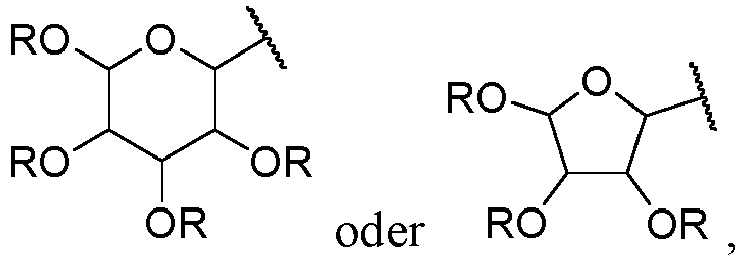 worin jede Gruppe R bei jedem Auftreten unabhängig ausgewählt ist aus Wasserstoff, substituierter oder unsubstituierter C1-C6-Alkylgruppe, substituiertem oder unsubstituiertem -(C=O)-(C1-C6)-Alkyl und substituiertem oder unsubstituiertem -(C=O)NH(C1-C6)-Alkyl, wobei die optionalen Substituenten ein oder mehrere Substituenten Rx sind; oder zwei benachbarte OR-Gruppen eine Isopropylidenketal- oder eine Acetalgruppe bilden, ausgewählt aus Methylen-, Methoxymethylen-, Ethoxymethylen-, Ethyliden-, Benzyliden- und p-Methoxybenzylidenacetalen;jede Gruppe Rg unabhängig ausgewählt ist aus Wasserstoff, substituiertem oder unsubstituiertem C1-C12-Alkyl, substituiertem oder unsubstituiertem C2-C12-Alkenyl und substituiertem oder unsubstituiertem C2-C12-Alkinyl, wobei die optionalen Substituenten ein oder mehrere Substituenten Rx sind;jede Gruppe Rh unabhängig ausgewählt ist aus Wasserstoff, einer Schutzgruppe für OH, substituiertem oder unsubstituiertem C1-C12-Alkyl, substituiertem oder unsubstituiertem C2-C12-Alkenyl, substituiertem oder unsubstituiertem C2-C12-Alkinyl, substituiertem oder unsubstituiertem C3-C6-Cycloalkyl-C1-C12-alkyl, substituiertem oder unsubstituiertem Heterocyclo-C1-C12-alkyl, substituiertem oder unsubstituiertem Aryl, substituierter oder unsubstituierter heterocyclischer Gruppe, -(CH2CH2O)pCH2CH3, -(CH2CH2O)pCH3, wobei p von 1 bis 25 ist und substituiertem oder unsubstituiertem Monosaccharidrest, wobei die optionalen Substituenten ein oder mehrere Substituenten Rx sind;Substituenten Rx ausgewählt sind aus der Gruppe, bestehend aus C1-C12-Alkylgruppen, die optional mit mindestens einer Gruppe Ry substituiert sein können, C2-C12-Alkenylgruppen, die optional mit mindestens einer Gruppe Ry substituiert sein können, C2-C12-Alkinylgruppen, die optional mit mindestens einer Gruppe Ry substituiert sein können, Halogenatomen, Oxogruppen, Thiogruppen, Cyanogruppen, Nitrogruppen, ORy, OCORy, OCOORy, CORy, COORy, OCONRyRz, CONRyRz, SRy, S(=O)Ry, SO2Ry, OSO2ORy, SSRy, P(=O)(Ry)ORz, OP(=O)(ORy)2, NRyRz, NRyC(=O)Rz, NRyC(=O)ORz, NRyC(=O)NRyRz, NRyC(=NRy)NRyRz, Arylgruppen mit 6 bis 18 Kohlenstoffatomen in einem oder mehreren Ringen, die optional mit einem oder mehreren Substituenten substituiert sein können, die gleich oder verschieden sein können, ausgewählt aus der Gruppe, bestehend aus Ry, ORy, OCORy, OCOORy, NRyRz, NRyCORz und NRyC(=NRy)NRyRz, Aralkylgruppen, umfassend eine Alkylgruppen mit von 1 bis 12 Kohlenstoffatomen, substituiert mit einer optional substituierten Arylgruppe, wie vorstehend definiert, Aralkyloxygruppen, umfassend eine Alkoxygruppe mit von 1 bis 12 Kohlenstoffatomen, substituiert mit einer optional substituierten Arylgruppe, wie vorstehend definiert und einer 5- bis 14-gliedrigen gesättigten oder ungesättigten heterocyclischen Gruppe mit einem oder mehreren Ringen und umfassend mindestens ein Sauerstoff-, Stickstoff- oder Schwefelatom in dem(den) Ring(en), wobei die heterocyclische Gruppe optional mit einem oder mehreren Substituenten Ry substituiert ist und, wo es mehr als einen optionalen Substituenten an jeder gegebenen Gruppe gibt, die optionalen Substituenten Ry gleich oder verschieden sein können, undjedes Ry und Rz unabhängig ausgewählt ist aus der Gruppe, bestehend aus Wasserstoff, C1-C12-Alkylgruppen, C1-C12-Alkylgruppen, die mit mindestens einem Halogenatom substituiert sind, Aralkylgruppen, umfassend eine C1-C12-Alkylgruppe, die substituiert ist mit einer Arylgruppe mit 6 bis 18 Kohlenstoffatomen in einem oder mehreren Ringen und Heterocycloalkylgruppe, umfassend eine C1-C12-Alkylgruppe, die substituiert ist mit einer 5- bis 14-gliedrigen gesättigten oder ungesättigten heterocyclischen Gruppe mit einem oder mehreren Ringen und umfassend mindestens ein Sauerstoff-, Stickstoff- oder Schwefelatom in dem(den) Ring(en); undwobei jede Alkyl-, Alkenyl- und Alkinylgruppe cyclisch oder nicht-cyclisch ist.
 - Verbindung nach Anspruch 1, die auch die Formel aufweist

- Verbindung nach Anspruch 1 oder 2, wobei R1 ausgewählt ist aus Wasserstoff, Halogen und substituiertem oder unsubstituiertem C2-C6-Alkinyl, wobei die optionalen Substituenten ein oder mehrere Substituenten Rx sind; oder ein pharmazeutisch verträgliches Salz oder pharmazeutisch verträglicher Ester davon.
- Verbindung nach Anspruch 1, die auch die Formel Ia aufweist:

- Verbindung nach Anspruch 4, die auch die Formel Ib aufweist:

- Verbindung nach einem vorhergehenden Anspruch, wobei R2 ausgewählt ist aus Wasserstoff, substituiertem oder unsubstituiertem C1-C6-Alkyl, substituiertem oder unsubstituiertem C2-C6-Alkenyl, wobei die optionalen Substituenten ein oder mehrere Substituenten Rx sind, -ORa und -NRcRd, worin Ra ausgewählt ist aus Wasserstoff, einer Silyletherschutzgruppe für OH, substituiertem oder unsubstituiertem C1-C12-Alkyl, substituiertem oder unsubstituiertem C2-C12-Alkenyl, substituiertem oder unsubstituiertem C2-C12-Alkinyl, substituiertem oder unsubstituiertem C3-C6-Cycloalkyl-C1-C6-alkyl, -(CH2CH2O)pCH2CH3 worin p von 1 bis 15 ist und die optionalen Substituenten ein oder mehrere Substituenten Rx sind; und Rc und Rd unabhängig ausgewählt sind aus substituiertem oder unsubstituiertem C1-C6-Alkyl, wobei die optionalen Substituenten ein oder mehrere Substituenten Rx sind; oder ein pharmazeutisch verträgliches Salz oder pharmazeutisch verträglicher Ester davon.
- Verbindung nach Anspruch 6, wobei R2 ausgewählt ist aus Wasserstoff, Methyl, Vinyl, Allyl, NEt2 und ORa, worin Ra ausgewählt ist aus Wasserstoff, Methyl, Ethyl, n-Butyl, n-Heptyl, Allyl, Propargyl, Cyclopropylmethyl, -(CH2)3NHBoc, -(CH2)3NH2 und -(CH2CH2O)3CH2CH3; oder ein pharmazeutisch verträgliches Salz oder pharmazeutisch verträglicher Ester davon.
- Verbindung nach einem vorhergehenden Anspruch, wobei R3 ausgewählt ist aus Halogen-substituiertem oder unsubstituiertem C1-C6-Alkyl und substituiertem oder unsubstituiertem C3-C4-Cycloalkyl-C1-C4-alkyl, wobei die optionalen Substituenten ein oder mehrere Substituenten Rx sind und die Halogensubstituenten ein oder mehrere Substituenten sind, unabhängig ausgewählt aus F, Cl, Br und I; oder ein pharmazeutisch verträgliches Salz oder pharmazeutisch verträglicher Ester davon.
- Verbindung nach Anspruch 8, wobei R3 ausgewählt ist aus n-Propyl, 3,3,3-Trifluorpropyl und Isobutyl; oder pharmazeutisch verträgliches Salz oder pharmazeutisch verträglicher Ester davon.
- Verbindung nach einem vorhergehenden Anspruch, wobei R4 ausgewählt ist aus Wasserstoff und substituiertem oder unsubstituiertem C1-C6-Alkyl, wobei die optionalen Substituenten ein oder mehrere Substituenten Rx sind; oder ein pharmazeutisch verträgliches Salz oder pharmazeutisch verträglicher Ester davon.
- Verbindung nach Anspruch 10, wobei R4 Wasserstoff oder Methyl ist; oder ein pharmazeutisch verträgliches Salz oder pharmazeutisch verträglicher Ester davon.
- Verbindung nach einem vorhergehenden Anspruch, wobei R5 ausgewählt ist aus -C(ORe)2Rg, -CH(NRcRd)Rg, -(C=O)Rg, -(C=NRc)Rg, -(C=N-ORh)Rg, -(C=N-O-(C=O)Rf)Rg, -(C=N-O-(C=O)ORa)Rg, -(C=N-O-[(P=O)(ORa)2])Rg, -(C=N-NRcRd)Rg, -(C=CH2)Rg und -(C=CH2)ORa, wobei:Rh ausgewählt ist aus Wasserstoff, einer Schutzgruppe für OH, substituiertem oder unsubstituiertem C1-C6-Alkyl, substituiertem oder unsubstituiertem C2-C6-Alkenyl, substituiertem oder unsubstituiertem C2-C6-Alkinyl, substituiertem oder unsubstituiertem Heterocyclo-C1-C6-alkyl, -(CH2CH2O)pCH2CH3, worin p von 1 bis 15 ist und ein substituierter oder unsubstituierter Monosaccharidrest der Formel:
 worin jede Gruppe R bei jedem Auftreten unabhängig ausgewählt ist aus Wasserstoff, substituierter oder unsubstituierter C1-C6-Alkylgruppe, substituiertem oder unsubstituiertem -(C=O)-(C1-C6)-Alkyl und substituiertem oder unsubstituiertem -(C=O)NH(C1-C6)-Alkyl; wobei die optionalen Substituenten ein oder mehrere Substituenten Rx sind; oder zwei benachbarte OR-Gruppen eine Isopropylidenketal- oder eine Acetalgruppe bilden, ausgewählt aus Methylen-, Methoxymethylen-, Ethoxymethylen-, Ethyliden-, Benzyliden- und p-Methoxybenzylidenacetalen;Rg substituiertes oder unsubstituiertes C1-C6-Alkyl ist, wobei die optionalen Substituenten ein oder mehrere Substituenten Rx sind;Re und Rd unabhängig ausgewählt sind aus Wasserstoff und substituiertem oder unsubstituiertem C1-C6-Alkyl, wobei die optionalen Substituenten ein oder mehrere Substituenten Rx sind;Ra substituiertes oder unsubstituiertes C1-C6-Alkyl ist, wobei die optionalen Substituenten ein oder mehrere Substituenten Rx sind;Re substituiertes oder unsubstituiertes C1-C6-Alkyl ist, wobei die optionalen Substituenten ein oder mehrere Substituenten Rx sind; undRf ausgewählt ist aus substituiertem oder unsubstituiertem C1-C6-Alkyl, -CH2O(CH2CH2O)pCH3, worin p von 1 bis 15 ist und die optionalen Substituenten ein oder mehrere Substituenten Rx sind und einer Gruppe der Formel:
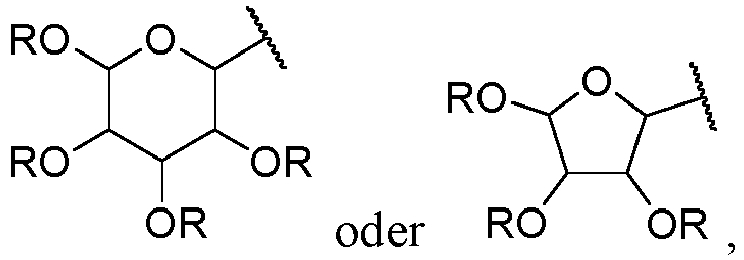 worin jede Gruppe R bei jedem Auftreten unabhängig ausgewählt ist aus Wasserstoff, substituierter oder unsubstituierter C1-C6-Alkylgruppe, substituiertem oder unsubstituiertem -(C=O)-(C1-C6)-Alkyl und substituiertem oder unsubstituiertem -(C=O)NH(C1-C6)-Alkyl, wobei die optionalen Substituenten ein oder mehrere Substituenten Rx sind; oder zwei benachbarte OR-Gruppen eine Isopropylidenketal- oder eine Acetalgruppe bilden, ausgewählt aus Methylen-, Methoxymethylen-, Ethoxymethylen-, Ethyliden-, Benzyliden- undp-Methoxybenzylidenacetalen;oder ein pharmazeutisch verträgliches Salz oder pharmazeutisch verträglicher Ester davon.
 - Verbindung nach Anspruch 12, wobei R5 ausgewählt ist aus -CH(NH2)Me, -(C=O)Me, -(C=NRc)Me, -(C=N-ORh)Me, -(C=N-O-(C=O)Rf)Me, -(C=N-NH2)Me, -(C=N-O-(C=O)ORa)Me, -(C=N-O-[(P=O)(ORa)2])Me, -(C=CH2)Me oder -(C=CH2)ORa, worin Ra Ethyl oder Benzyl ist, Rc -(CH2)3NHBoc ist, Rf -(CH2)5-NHBoc, -CH2O(CH2CH2O)2Mc oder eine Gruppe der Formel ist:
 und Rh ausgewählt ist aus Wasserstoff, Methyl, Allyl, Propargyl, -(CH2)3NHBoc, -(CH2)3NH2, -(CH2)3SH, -(CH2)4OH, -(CH2)4OP(=O)(OH)2, -(CH2)4OP(=O)(O t-Bu)2, -(CH2)4-[4λ2-Morpholin], -(CH2)3-[1-Methyl-4λ2-piperazin], -(CH2CH2O)3CH2CH3 und einem Monosaccharidrest der Formel:
 oder ein pharmazeutisch verträgliches Salz oder pharmazeutisch verträglicher Ester davon.
 - Verbindung nach Anspruch 1, ausgewählt aus


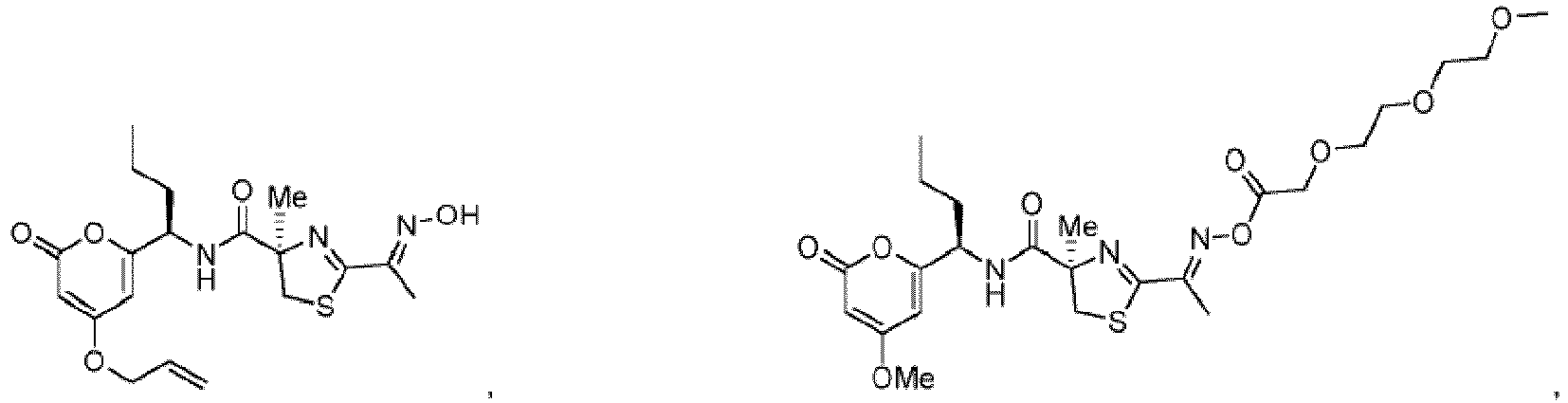
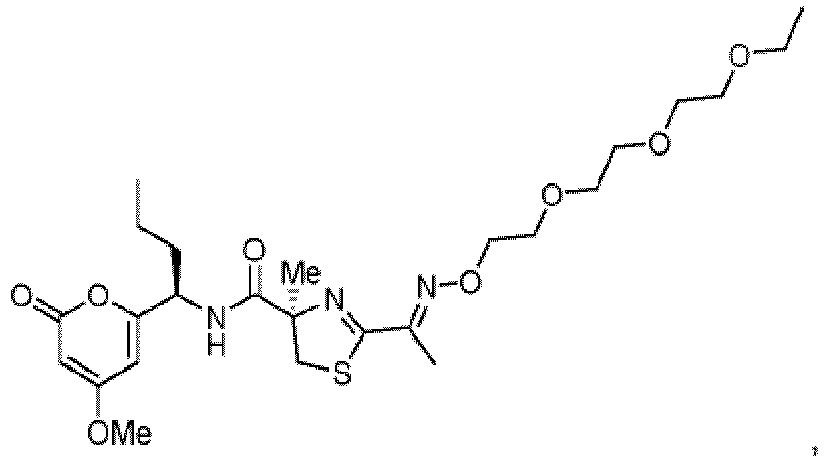
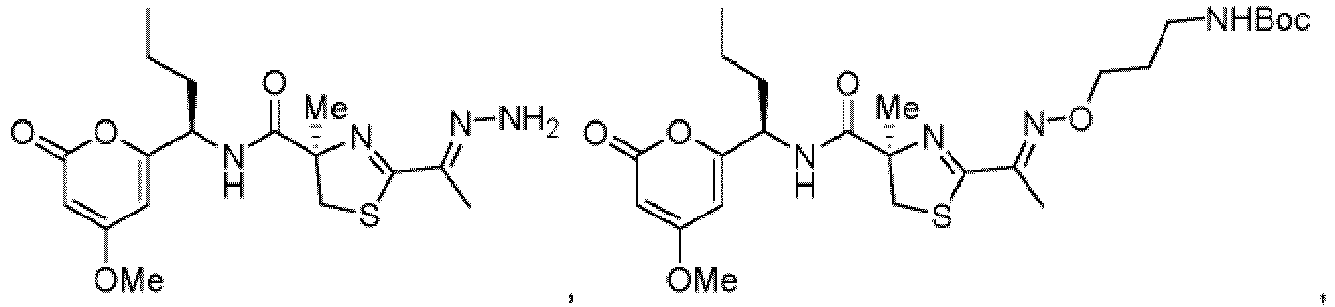




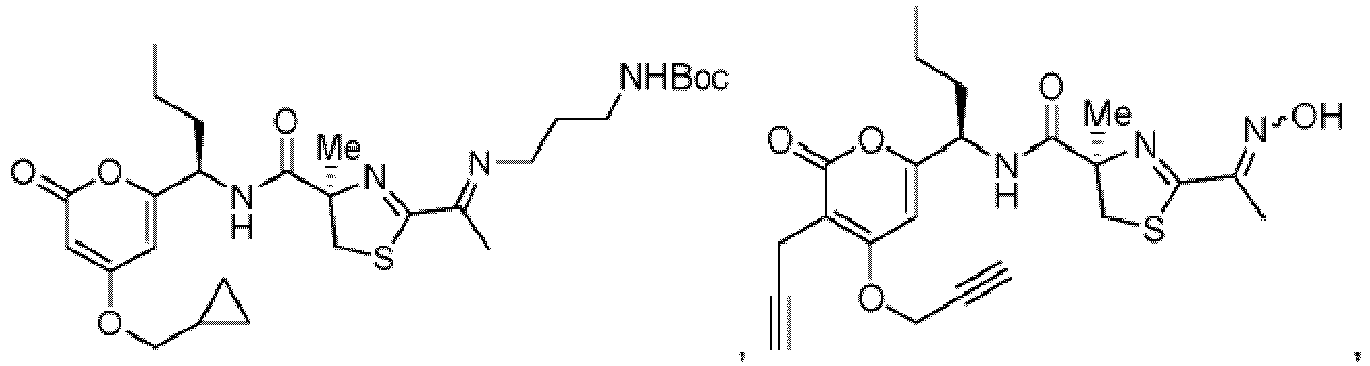


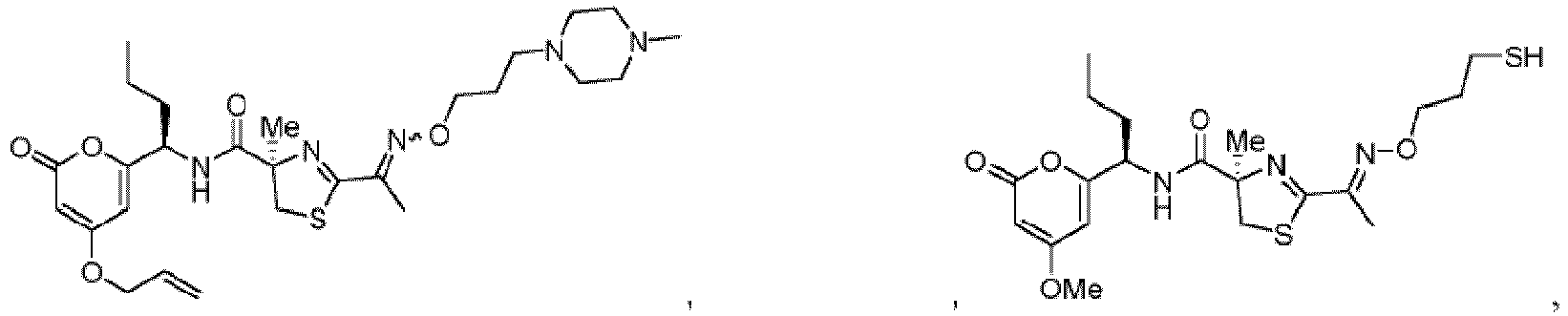


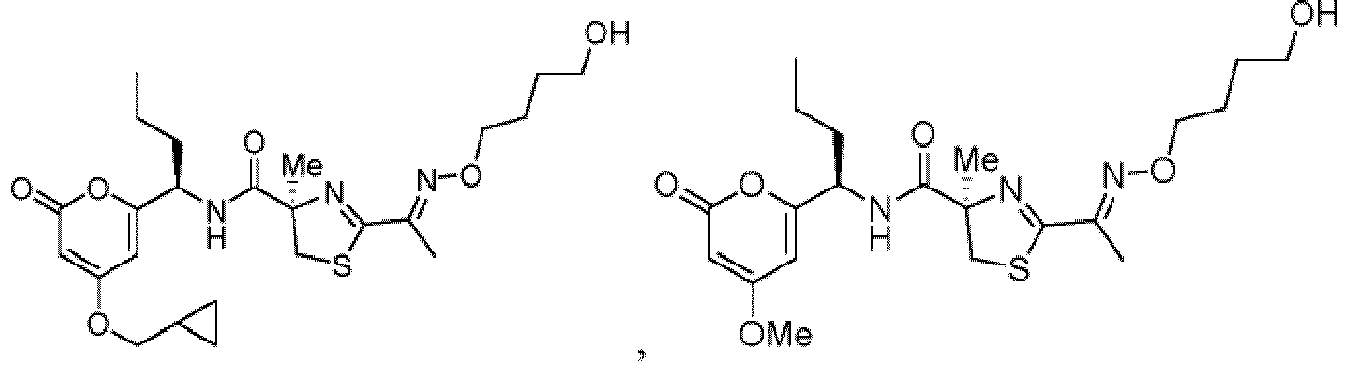


- Verbindung nach Anspruch 1 der Formel
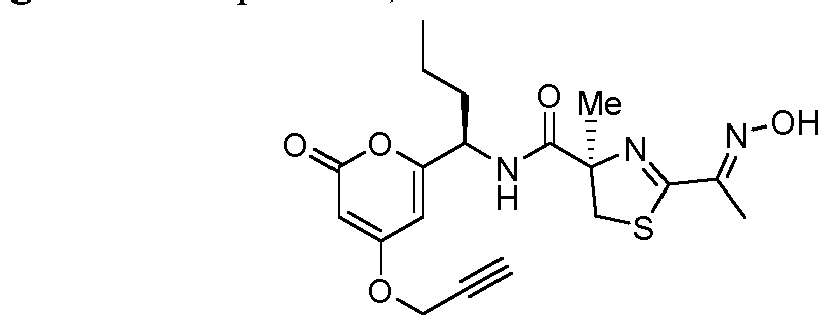
- Verbindung nach Anspruch 1, der Formel

- Verbindung nach Anspruch 1, der Formel

- Verbindung nach Anspruch 1, der Formel I oder ein pharmazeutisch verträgliches Salz oder pharmazeutisch verträglicher Ester davon
 R1 ausgewählt ist aus Wasserstoff, Halogen, substituiertem oder unsubstituiertem C1-C12-Alkyl, substituiertem oder unsubstituiertem C2-C12-Alkenyl und substituiertem oder unsubstituiertem C2-C12-Alkinyl, wobei die optionalen Substituenten ein oder mehrere Substituenten Rx sind;R2 ausgewählt ist aus Wasserstoff, Halogen, substituiertem oder unsubstituiertem C1-C24-Alkyl, substituiertem oder unsubstituiertem C2-C24-Alkenyl, substituiertem oder unsubstituiertem C2-C24-Alkinyl, -ORa, -OSO2Rb, -NRcRd, -NRc(C=O)Rf und -NRcSO2Rb, wobei die optionalen Substituenten ein oder mehrere Substituenten Rx sind;R3 ausgewählt ist aus Halogen-substituiertem oder unsubstituiertem C1-C12-Alkyl, Halogen-substituiertem oder unsubstituiertem C2-C12-Alkenyl, Halogen-substituiertem oder unsubstituiertem C2-C12-Alkinyl und substituiertem oder unsubstituiertem C3-C6-Cycloalkyl-C1-C12-alkyl, wobei die optionalen Substituenten ein oder mehrere Substituenten Rx sind und die Halogensubstituenten ein oder mehrere Substituenten sind, die unabhängig ausgewählt sind aus F, Cl, Br und I;R4 ausgewählt ist aus Wasserstoff, substituiertem oder unsubstituiertem C1-C12-Alkyl, substituiertem oder unsubstituiertem C2-C12-Alkenyl und substituiertem oder unsubstituiertem C2-C12-Alkinyl, wobei die optionalen Substituenten ein oder mehrere Substituenten Rx sind;R5 ausgewählt ist aus -C(ORe)2Rg, -C(SRe)2Rg, -CH(ORa)Rg, -CH(O-(C=O)Rf)Rg, -CH(NRcRd)Rg, -CH(NRc-(C=O)Rf)Rg, -CH(NRc-ORh)Rg, -(C=O)Rg, -(C=NRc)Rg, -(C=N-ORh)Rg, -(C=N-O-(C=O)Rf)Rg, -(C=N-NRcRd)Rg, -(C=O)ORa, -(C=O)NRc-ORh und -(C=O)NRcRd; oder R5 eine Gruppe
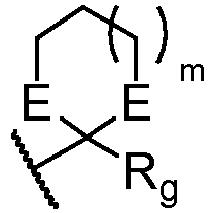 Y -O- ist;Z -S- ist;jede Gruppe Ra unabhängig ausgewählt ist aus Wasserstoff, einer Schutzgruppe für OH, substituiertem oder unsubstituiertem C1-C24-Alkyl, substituiertem oder unsubstituiertem C2-C24-Alkenyl, substituiertem oder unsubstituiertem C2-C24-Alkinyl, substituiertem oder unsubstituiertem C3-C6-Cycloalkyl-C1-C12-alkyl, substituiertem oder unsubstituiertem Aryl, substituierter oder unsubstituierter heterocyclischer Gruppe, -(CH2CH2O)pCH2CH3 und -(CH2CH2O)pCH3, wobei p von 1 bis 25 ist und die optionalen Substituenten ein oder mehrere Substituenten Rx sind;jede Gruppe Rb unabhängig ausgewählt ist aus substituiertem oder unsubstituiertem C1-C12-Alkyl, substituiertem oder unsubstituiertem C2-C12-Alkenyl, substituiertem oder unsubstituiertem C2-C12-Alkinyl, substituiertem oder unsubstituiertem Aryl und substituierter oder unsubstituierter heterocyclischer Gruppe, wobei die optionalen Substituenten ein oder mehrere Substituenten Rx sind;jede Gruppe Rc und Rd unabhängig ausgewählt ist aus Wasserstoff, einer Schutzgruppe für Amino, substituiertem oder unsubstituiertem C1-C12-Alkyl, substituiertem oder unsubstituiertem C2-C12-Alkenyl und substituiertem oder unsubstituiertem C2-C12-Alkinyl, wobei die optionalen Substituenten ein oder mehrere Substituenten Rx sind; oder Rc und Rd zusammen mit dem Stickstoffatom, an das sie gebunden sind, eine heterocyclische Gruppe bilden,jede Gruppe Re substituierte oder unsubstituierte C1-C12-Alkylgruppe ist, wobei die optionalen Substituenten ein oder mehrere Substituenten Rx sind;jede Gruppe Rf unabhängig ausgewählt ist aus Wasserstoff, substituiertem oder unsubstituiertem C1-C12-Alkyl, substituiertem oder unsubstituiertem C2-C12-Alkenyl, substituiertem oder unsubstituiertem C2-C12-Alkinyl, -CH2O(CH2CH2O)pCH2CH3 und -CH2O(CH2CH2O)pCH3, wobei p von 1 bis 25 ist und die optionalen Substituenten ein oder mehrere Substituenten Rx sind;jede Gruppe Rg unabhängig ausgewählt ist aus Wasserstoff, substituiertem oder unsubstituiertem C1-C12-Alkyl, substituiertem oder unsubstituiertem C2-C12-Alkenyl und substituiertem oder unsubstituiertem C2-C12-Alkinyl, wobei die optionalen Substituenten ein oder mehrere Substituenten Rx sind;jede Gruppe Rh unabhängig ausgewählt ist aus Wasserstoff, einer Schutzgruppe für OH, substituiertem oder unsubstituiertem C1-C12-Alkyl, substituiertem oder unsubstituiertem C2-C12-Alkenyl, substituiertem oder unsubstituiertem C2-C12-Alkinyl, substituiertem oder unsubstituiertem C3-C6-Cycloalkyl-C1-C12-alkyl, substituiertem oder unsubstituiertem Aryl, substituierter oder unsubstituierter heterocyclischer Gruppe, -(CH2CH2O)pCH2CH3, -(CH2CH2O)pCH3, wobei p von 1 bis 25 ist und substituiertem oder unsubstituiertem Monosaccharidrest, wobei die optionalen Substituenten ein oder mehrere Substituenten Rx sind;Substituenten Rx ausgewählt sind aus der Gruppe, bestehend aus C1-C12-Alkylgruppen, die optional mit mindestens einer Gruppe Ry substituiert sein können, C2-C12-Alkenylgruppen, die optional mit mindestens einer Gruppe Ry substituiert sein können, C2-C12-Alkinylgruppen, die optional mit mindestens einer Gruppe Ry substituiert sein können, Halogenatomen, Oxogruppen, Thiogruppen, Cyanogruppen, Nitrogruppen, ORy, OCORy, OCOORy, CORy, COORy, OCONRyRz, CONRyRz, SRy, S(=O)Ry, SO2Ry, SSRy, P(=O)(Ry)ORz, NRyRz, NRyCORz, NRyC(=O)NRyRz, NRyC(=NRy)NRyRz, Arylgruppen mit 6 bis 18 Kohlenstoffatomen in einem oder mehreren Ringen, die optional mit einem oder mehreren Substituenten substituiert sein können, die gleich oder verschieden sein können, ausgewählt aus der Gruppe, bestehend aus Ry, ORy, OCORy, OCOORy, NRyRz, NRyCORz und NRyC(=NRy)NRyRz, Aralkylgruppen, umfassend eine Alkylgruppen mit von 1 bis 12 Kohlenstoffatomen, substituiert mit einer optional substituierten Arylgruppe, wie vorstehend definiert, Aralkyloxygruppen, umfassend eine Alkoxygruppe mit von 1 bis 12 Kohlenstoffatomen, substituiert mit einer optional substituierten Arylgruppe, wie vorstehend definiert und einer 5- bis 14-gliedrigen gesättigten oder ungesättigten heterocyclischen Gruppe mit einem oder mehreren Ringen und umfassend mindestens ein Sauerstoff-, Stickstoff- oder Schwefelatom in dem(den) Ring(en), wobei die heterocyclische Gruppe optional mit einem oder mehreren Substituenten Ry substituiert ist und, wo es mehr als einen optionalen Substituenten an jeder gegebenen Gruppe gibt, die optionalen Substituenten Ry die gleich oder verschieden sein können, undjedes Ry und Rz unabhängig ausgewählt ist aus der Gruppe, bestehend aus Wasserstoff, C1-C12-Alkylgruppen, C1-C12-Alkylgruppen, die substituiert sind mit mindestens einem Halogenatom, Aralkylgruppen, umfassend eine C1-C12-Alkylgruppe, die mit einer Arylgruppe mit 6 bis 18 Kohlenstoffatomen in einem oder mehreren Ringen substituiert ist und Heterocycloalkylgruppe, umfassend eine C1-C12-Alkylgruppe, die mit einer 5- bis 14-gliedrigen gesättigten oder ungesättigten heterocyclischen Gruppe mit einem oder mehreren Ringen substituiert ist und umfassend mindestens ein Sauerstoff-, Stickstoff- oder Schwefelatom in dem(den) Ring(en).
 - Pharmazeutische Zusammensetzung, umfassend eine Verbindung wie in einem der Ansprüche 1 bis 18 definiert, oder ein pharmazeutisch verträgliches Salz oder pharmazeutisch verträglicher Ester davon, und einen pharmazeutisch verträglichen Träger.
- Dosierungsform, umfassend eine pharmazeutische Zusammensetzung wie in Anspruch 19 definiert.
- Verbindung wie in einem der Ansprüche 1 bis 18 definiert oder eine pharmazeutische Zusammensetzung wie in Anspruch 19 definiert oder eine Dosierungsform wie in Anspruch 20 definiert, zur Verwendung als Arzneimittel.
- Verbindung wie in einem der Ansprüche 1 bis 18 definiert, eine pharmazeutische Zusammensetzung wie in Anspruch 19 definiert oder eine Dosierungsform wie in Anspruch 20 definiert, zur Verwendung bei der Behandlung von Krebs.
- Verbindung, Zusammensetzung oder Dosierungsform zur Verwendung nach Anspruch 22, wobei der Krebs ausgewählt ist aus soliden Tumoren, Lungenkrebs, Dickdarmkrebs, Brustkrebs und Bauchspeicheldrüsenkrebs.
- Verfahren zur Gewinnung einer Verbindung wie in einem der Ansprüche 1 bis 18 definiert, umfassend das Kuppeln einer Verbindung der Formel II mit einer Verbindung der Formel III gemäß Schema 1

- Zwischenverbindung der Formel IIa
 R1 ausgewählt ist aus Wasserstoff, Halogen, substituiertem oder unsubstituiertem C1-C12-Alkyl, substituiertem oder unsubstituiertem C2-C12-Alkenyl und substituiertem oder unsubstituiertem C2-C12-Alkinyl, wobei die optionalen Substituenten ein oder mehrere Substituenten Rx sind;R2 ausgewählt ist aus Wasserstoff, Halogen, substituiertem oder unsubstituiertem C1-C24-Alkyl, substituiertem oder unsubstituiertem C2-C24-Alkenyl, substituiertem oder unsubstituiertem C2-C24-Alkinyl, -ORa, OSO2Rb, -NRcRd, -NRc(C=O)Rf und -NRcSO2Rb, wobei die optionalen Substituenten ein oder mehrere Substituenten Rx sind;R3 ausgewählt ist aus Halogen-substituiertem oder unsubstituiertem C1-C12-Alkyl, Halogen-substituiertem oder unsubstituiertem C2-C12-Alkenyl, Halogen-substituiertem oder unsubstituiertem C2-C12-Alkinyl und substituiertem oder unsubstituiertem C3-C6-Cycloalkyl-C1-C12-alkyl, wobei die optionalen Substituenten ein oder mehrere Substituenten Rx sind und die Halogensubstituenten ein oder mehrere Substituenten sind, die unabhängig ausgewählt sind aus F, C1, Br und I;R6 ausgewählt ist aus Wasserstoff und einer Carbamatschutzgruppe für Amino;Y -O- ist;Ra ausgewählt ist aus Wasserstoff, einer Schutzgruppe für OH, substituiertem oder unsubstituiertem C1-C24-Alkyl, substituiertem oder unsubstituiertem C2-C24-Alkenyl, substituiertem oder unsubstituiertem C2-C24-Alkinyl, substituiertem oder unsubstituiertem C3-C6-Cycloalkyl-C1-Clz-alkyl, substituiertem oder unsubstituiertem Aryl, substituierter oder unsubstituierter heterocyclischer Gruppe, -(CH2CH2O)pCH2CH3 und -(CH2CH2O)pCH3, wobei p von 1 bis 25 ist und die optionalen Substituenten ein oder mehrere Substituenten Rx sind;jede Gruppe Rb unabhängig ausgewählt ist aus substituiertem oder unsubstituiertem C1-C12-Alkyl, substituiertem oder unsubstituiertem C2-C12-Alkenyl, substituiertem oder unsubstituiertem C2-C12-Alkinyl, substituiertem oder unsubstituiertem Aryl und substituierter oder unsubstituierter heterocyclischer Gruppe, wobei die optionalen Substituenten ein oder mehrere Substituenten Rx sind;jede Gruppe Rc und Rd unabhängig ausgewählt sind aus Wasserstoff, einer Schutzgruppe für Amino, substituiertem oder unsubstituiertem C1-C12-Alkyl, substituiertem oder unsubstituiertem C2-C12-Alkenyl und substituiertem oder unsubstituiertem C2-C12-Alkinyl, wobei die optionalen Substituenten ein oder mehrere Substituenten Rx sind; oder Rc und Rd zusammen mit dem Stickstoffatom, an das sie gebunden sind, eine heterocyclische Gruppe bilden;Rf unabhängig ausgewählt ist aus Wasserstoff, substituiertem oder unsubstituiertem C1-C12-Alkyl, substituiertem oder unsubstituiertem C2-C12-Alkenyl, substituiertem oder unsubstituiertem C2-C12-Alkinyl, -CH2O(CH2CH2O)PCH2CH3 und -CH2O(CH2CH2O)PCH3, wobei p von 1 bis 25 ist und die optionalen Substituenten ein oder mehrere Substituenten Rx sind;Substituenten Rx ausgewählt sind aus der Gruppe, bestehend aus C1-C12-Alkylgruppen, die optional mit mindestens einer Gruppe Ry substituiert sein können, C2-C12-Alkenylgruppen, die optional mit mindestens einer Gruppe Ry substituiert sein können, C2-C12-Alkinylgruppen, die optional mit mindestens einer Gruppe Ry substituiert sein können, Halogenatomen, Oxogruppen, Thiogruppen, Cyanogruppen, Nitrogruppen, ORy, OCORy, OCOORy, CORy, COORy, OCONRyRz, CONRyRz, SRy, S(=O)Ry, SO2Ry, OSO2ORy, SSRy, P(=O)(Ry)ORz, OP(=O)(ORy)2, NRyRz, NRyC(=O)Rz, NRyC(=O)ORz, NRyC(=O)NRyRz, NRyC(=NRy)NRyRz, Arylgruppen mit 6 bis 18 Kohlenstoffatomen in einem oder mehreren Ringen, die optional mit einem oder mehreren Substituenten substituiert sein können, die gleich oder verschieden sein können, ausgewählt aus der Gruppe, bestehend aus Ry, ORy, OCORy, OCOORy, NRyRz, NRyCORz und NRyC(=NRy)NRyRz, Aralkylgruppen, umfassend eine Alkylgruppen mit von 1 bis 12 Kohlenstoffatomen, substituiert mit einer optional substituierten Arylgruppe, wie vorstehend definiert, Aralkyloxygruppen, umfassend eine Alkoxygruppe mit von 1 bis 12 Kohlenstoffatomen, substituiert mit einer optional substituierten Arylgruppe, wie vorstehend definiert, und einer 5- bis 14-gliedrigen gesättigten oder ungesättigten heterocyclischen Gruppe mit einem oder mehreren Ringen und umfassend mindestens ein Sauerstoff-, Stickstoff- oder Schwefelatom in dem(den) Ring(en), wobei die heterocyclische Gruppe optional mit einem oder mehreren Substituenten Ry substituiert ist und, wo es mehr als einen optionalen Substituenten an jeder gegebenen Gruppe gibt, die optionalen Substituenten Ry gleich oder verschieden sein können; undjedes Ry und Rz unabhängig ausgewählt ist aus der Gruppe, bestehend aus Wasserstoff, C1-C12-Alkylgruppen, C1-C12-Alkylgruppen, die mit mindestens einem Halogenatom substituiert sind, Aralkylgruppen, umfassend eine C1-C12-Alkylgruppe, die mit einer Arylgruppe mit 6 bis 18 Kohlenstoffatomen in einem oder mehreren Ringen substituiert ist und Heterocycloalkylgruppe, umfassend eine C1-C12-Alkylgruppe, die mit einer 5- bis 14-gliedrigen gesättigten oder ungesättigten heterocyclischen Gruppe mit einem oder mehreren Ringen substituiert ist und umfassend mindestens ein Sauerstoff-, Stickstoff- oder Schwefelatom in dem(den) Ring(en); undwobei jede Alkyl-, Alkenyl- und Alkinylgruppe cyclisch oder nicht-cyclisch ist;oder ein Salz davon.
 - Zwischenverbindung der Formel IIIa
 wobei R4 ausgewählt ist aus unsubstituiertem C1-C12-Alkyl, unsubstituiertem C2-C12-Alkenyl und unsubstituiertem C2-C12-Alkinyl,R5 ausgewählt ist aus -C(ORe)2Rg, -C(SRe)2Rg, -CH(ORa)Rg, -CH(O-(C=O)Rf)Rg, -CH(NRc-(C=O)Rf)Rg, -CH(NRc-ORh)Rg, -(C=O)Rg, -(C=NRc)Rg, -(C=N-ORh)Rg, -(C=N-O-(C=O)Rf)Rg, -(C=N-O-(C=O)ORa)Rg, -(C=N-O-[(P=O)(ORa)2])Rg, -(C=N-NRcRd)Rg, -(C=O)ORa, -(C=O)NRc-ORh, -(C=O)NRcRd, -(C=CH2)Rg und -(C=CH2)ORa; oder R5 eine Gruppe
 Z -S- ist;jede Gruppe Ra unabhängig ausgewählt ist aus Wasserstoff, einer Schutzgruppe für OH, substituiertem oder unsubstituiertem C1-C12-Alkyl, substituiertem oder unsubstituiertem C2-C12-Alkenyl, substituiertem oder unsubstituiertem C2-C12-Alkinyl, substituiertem oder unsubstituiertem C3-C6-Cycloalkyl-C1-C12-alkyl, substituiertem oder unsubstituiertem Aryl, substituierter oder unsubstituierter heterocyclischer Gruppe, -(CH2CH2O)pCH2CH3 und -(CH2CH2O)pCH3, wobei p von 1 bis 25 ist und die optionalen Substituenten ein oder mehrere Substituenten Rx sind;jede Gruppe Rc und Rd unabhängig ausgewählt ist aus Wasserstoff, einer Schutzgruppe für Amino, substituiertem oder unsubstituiertem C1-C12-Alkyl, substituiertem oder unsubstituiertem C2-C12-Alkenyl, substituiertem oder unsubstituiertem C2-C12-Alkinyl, wobei die optionalen Substituenten ein oder mehrere Substituenten Rx sind; oder Rc und Rd zusammen mit dem Stickstoffatom, an das sie gebunden sind, eine heterocyclische Gruppe bilden;jede Gruppe Re substituierte oder unsubstituierte C1-C12-Alkylgruppe ist, wobei die optionalen Substituenten ein oder mehrere Substituenten Rx sind;jede Gruppe Rf unabhängig ausgewählt ist aus Wasserstoff, substituiertem oder unsubstituiertem C1-C12-Alkyl, substituiertem oder unsubstituiertem C2-C12-Alkenyl, substituiertem oder unsubstituiertem C2-C12-Alkinyl, -CH2O(CH2CH2O)PCH2CH3, -CH2O(CH2CH2O)PCH3, wobei p von 1 bis 25 ist und die optionalen Substituenten ein oder mehrere Substituenten Rx sind und eine Gruppe der Formel:
 worin jede Gruppe R bei jedem Auftreten unabhängig ausgewählt ist aus Wasserstoff, substituierter oder unsubstituierter C1-C6-Alkylgruppe, substituiertem oder unsubstituiertem -(C=O)-(C1-C6)-Alkyl und substituiertem oder unsubstituiertem -(C=O)NH(C1-C6)-Alkyl, wobei die optionalen Substituenten ein oder mehrere Substituenten Rx sind; oder zwei benachbarte OR-Gruppen eine Isopropylidenketal- oder eine Acetalgruppe bilden, ausgewählt aus Methylen-, Methoxymethylen-, Ethoxymethylen-, Ethyliden-, Benzyliden- und p-Methoxybenzylidenacetalen;jede Gruppe Rg unabhängig ausgewählt ist aus Wasserstoff, substituiertem oder unsubstituiertem C1-C12-Alkyl, substituiertem oder unsubstituiertem C2-C12-Alkenyl und substituiertem oder unsubstituiertem C2-C12-Alkinyl, wobei die optionalen Substituenten ein oder mehrere Substituenten Rx sind;jede Gruppe Rh unabhängig ausgewählt ist aus Wasserstoff, einer Schutzgruppe für OH, substituiertem oder unsubstituiertem C1-C12-Alkyl, substituiertem oder unsubstituiertem C2-C12-Alkenyl, substituiertem oder unsubstituiertem C2-C12-Alkinyl, substituiertem oder unsubstituiertem C3-C6-Cycloalkyl-CI-C12-alkyl, substituiertem oder unsubstituiertem Heterocyclo-C1-C12-alkyl, substituiertem oder unsubstituiertem Aryl, substituierter oder unsubstituierter heterocyclischer Gruppe, -(CH2CH2O)pCH2CH3, -(CH2CH2O)pCH3, wobei p von 1 bis 25 ist und substituiertem oder unsubstituiertem Monosaccharidrest, wobei die optionalen Substituenten ein oder mehrere Substituenten Rx sind;Substituenten Rx ausgewählt sind aus der Gruppe, bestehend aus C1-C12-Alkylgruppen, die optional mit mindestens einer Gruppe Ry substituiert sein können, C2-C12-Alkenylgruppen, die optional mit mindestens einer Gruppe Ry substituiert sein können, C2-C12-Alkinylgruppen, die optional mit mindestens einer Gruppe Ry substituiert sein können, Halogenatomen, Oxogruppen, Thiogruppen, Cyanogruppen, Nitrogruppen, ORy, OCORy, OCOORy, CORy, COORy, OCONRyRz, CONRyRz, SRy, S(=O)Ry, SO2Ry, OSO2ORy, SSRy, P(=O)(Ry)ORz, OP(=O)(ORy)2, NRyRz, NRyC(=O)Rz, NRyC(=O)ORz, NRyC(=O)NRyRz, NRyC(=NRy)NRyRz, Arylgruppen mit 6 bis 18 Kohlenstoffatomen in einem oder mehreren Ringen, die optional mit einem oder mehreren Substituenten substituiert sein können, die gleich oder verschieden sein können, ausgewählt aus der Gruppe, bestehend aus Ry, ORy, OCORy, OCOORy, NRyRz, NRyCORz und NRyC(=NRy)NRyRz, Aralkylgruppen, umfassend eine Alkylgruppen mit von 1 bis 12 Kohlenstoffatomen, substituiert mit einer optional substituierten Arylgruppe, wie vorstehend definiert, Aralkyloxygruppen, umfassend eine Alkoxygruppe mit von 1 bis 12 Kohlenstoffatomen, substituiert mit einer optional substituierten Arylgruppe, wie vorstehend definiert, und einer 5- bis 14-gliedrigen gesättigten oder ungesättigten heterocyclischen Gruppe mit einem oder mehreren Ringen und umfassend mindestens ein Sauerstoff-, Stickstoff- oder Schwefelatom in dem(den) Ring(en), wobei die heterocyclische Gruppe optional mit einem oder mehreren Substituenten Ry substituiert ist und, wo es mehr als einen optionalen Substituenten an jeder gegebenen Gruppe gibt, die optionalen Substituenten Ry gleich oder verschieden sein können; undjedes Ry und Rz unabhängig ausgewählt ist aus der Gruppe, bestehend aus Wasserstoff, C1-C12-Alkylgruppen, C1-C12-Alkylgruppen, die mit mindestens einem Halogenatom substituiert sind, Aralkylgruppen, umfassend eine C1-C12-Alkylgruppe, die mit einer Arylgruppe mit 6 bis 18 Kohlenstoffatomen in einem oder mehreren Ringen substituiert ist und Heterocycloalkylgruppe, umfassend eine C1-C12-Alkylgruppe, die mit einer 5- bis 14-gliedrigen gesättigten oder ungesättigten heterocyclischen Gruppe mit einem oder mehreren Ringen substituiert ist und umfassend mindestens ein Sauerstoff-, Stickstoff- oder Schwefelatom in dem(den) Ring(en); undwobei jede Alkyl-, Alkenyl- und Alkinylgruppe cyclisch oder nicht-cyclisch ist; oder ein Salz davon.
Priority Applications (4)
| Application Number | Priority Date | Filing Date | Title |
|---|---|---|---|
| RS20230949A RS64727B1 (sr) | 2018-12-17 | 2019-12-17 | Antikancerogena jedinjenja |
| SM20230363T SMT202300363T1 (it) | 2018-12-17 | 2019-12-17 | Composti antitumorali |
| SI201930639T SI3898613T1 (sl) | 2018-12-17 | 2019-12-17 | Protirakave spojine |
| HRP20231286TT HRP20231286T1 (hr) | 2018-12-17 | 2019-12-17 | Antikancerogeni spojevi |
Applications Claiming Priority (2)
| Application Number | Priority Date | Filing Date | Title |
|---|---|---|---|
| EP18382934 | 2018-12-17 | ||
| PCT/EP2019/085544 WO2020127194A1 (en) | 2018-12-17 | 2019-12-17 | Anticancer compounds |
Publications (2)
| Publication Number | Publication Date |
|---|---|
| EP3898613A1 EP3898613A1 (de) | 2021-10-27 |
| EP3898613B1 true EP3898613B1 (de) | 2023-08-09 |
Family
ID=64746491
Family Applications (1)
| Application Number | Title | Priority Date | Filing Date |
|---|---|---|---|
| EP19832321.4A Active EP3898613B1 (de) | 2018-12-17 | 2019-12-17 | Antikrebsverbindungen |
Country Status (37)
| Country | Link |
|---|---|
| US (1) | US12215100B2 (de) |
| EP (1) | EP3898613B1 (de) |
| JP (1) | JP7525493B2 (de) |
| KR (1) | KR20210104791A (de) |
| CN (1) | CN113166102B (de) |
| AR (1) | AR116911A1 (de) |
| AU (1) | AU2019400736B2 (de) |
| BR (1) | BR112021011304A2 (de) |
| CA (1) | CA3123744A1 (de) |
| CL (1) | CL2021001584A1 (de) |
| CO (1) | CO2021009339A2 (de) |
| DK (1) | DK3898613T3 (de) |
| EA (1) | EA202191714A1 (de) |
| EC (1) | ECSP21050732A (de) |
| ES (1) | ES2961370T3 (de) |
| FI (1) | FI3898613T3 (de) |
| HR (1) | HRP20231286T1 (de) |
| HU (1) | HUE064529T2 (de) |
| IL (1) | IL284011B2 (de) |
| JO (1) | JOP20210139A1 (de) |
| LT (1) | LT3898613T (de) |
| MA (1) | MA54520B1 (de) |
| MD (1) | MD3898613T2 (de) |
| MX (1) | MX2021007276A (de) |
| MY (1) | MY203839A (de) |
| PH (1) | PH12021551438A1 (de) |
| PL (1) | PL3898613T3 (de) |
| PT (1) | PT3898613T (de) |
| RS (1) | RS64727B1 (de) |
| SG (1) | SG11202105992SA (de) |
| SI (1) | SI3898613T1 (de) |
| SM (1) | SMT202300363T1 (de) |
| TW (1) | TWI830837B (de) |
| UA (1) | UA129055C2 (de) |
| UY (1) | UY38516A (de) |
| WO (1) | WO2020127194A1 (de) |
| ZA (1) | ZA202104675B (de) |
Family Cites Families (5)
| Publication number | Priority date | Publication date | Assignee | Title |
|---|---|---|---|---|
| AUPR320701A0 (en) | 2001-02-20 | 2001-03-15 | Kim, Jonghee | The new cancer therapeutic agent with a thiopeptides |
| EP1654256A4 (de) | 2003-08-08 | 2009-03-11 | Merck & Co Inc | Heterocyclische tetrahydropyrancyclopentylheteroarylmodulatoren der chemokinrezeptoraktivität |
| GB0523098D0 (en) * | 2005-11-14 | 2005-12-21 | Pharma Mar Sa | Antitumoral compounds |
| US20100249176A1 (en) * | 2007-10-24 | 2010-09-30 | Barrow James C | Heterocycle amide t-type calcium channel antagonists |
| JP5685203B2 (ja) * | 2009-05-29 | 2015-03-18 | ラクオリア創薬株式会社 | カルシウムチャネル遮断薬またはナトリウムチャネル遮断薬としてのアリール置換カルボキサミド誘導体 |
-
2019
- 2019-12-17 MD MDE20211044T patent/MD3898613T2/ro unknown
- 2019-12-17 SM SM20230363T patent/SMT202300363T1/it unknown
- 2019-12-17 JP JP2021534773A patent/JP7525493B2/ja active Active
- 2019-12-17 EP EP19832321.4A patent/EP3898613B1/de active Active
- 2019-12-17 LT LTEPPCT/EP2019/085544T patent/LT3898613T/lt unknown
- 2019-12-17 FI FIEP19832321.4T patent/FI3898613T3/fi active
- 2019-12-17 DK DK19832321.4T patent/DK3898613T3/da active
- 2019-12-17 SG SG11202105992SA patent/SG11202105992SA/en unknown
- 2019-12-17 EA EA202191714A patent/EA202191714A1/ru unknown
- 2019-12-17 US US17/414,946 patent/US12215100B2/en active Active
- 2019-12-17 PT PT198323214T patent/PT3898613T/pt unknown
- 2019-12-17 KR KR1020217022034A patent/KR20210104791A/ko not_active Ceased
- 2019-12-17 HU HUE19832321A patent/HUE064529T2/hu unknown
- 2019-12-17 RS RS20230949A patent/RS64727B1/sr unknown
- 2019-12-17 MX MX2021007276A patent/MX2021007276A/es unknown
- 2019-12-17 AU AU2019400736A patent/AU2019400736B2/en active Active
- 2019-12-17 AR ARP190103695A patent/AR116911A1/es unknown
- 2019-12-17 WO PCT/EP2019/085544 patent/WO2020127194A1/en not_active Ceased
- 2019-12-17 MY MYPI2021003277A patent/MY203839A/en unknown
- 2019-12-17 CA CA3123744A patent/CA3123744A1/en active Pending
- 2019-12-17 MA MA54520A patent/MA54520B1/fr unknown
- 2019-12-17 BR BR112021011304-5A patent/BR112021011304A2/pt unknown
- 2019-12-17 SI SI201930639T patent/SI3898613T1/sl unknown
- 2019-12-17 IL IL284011A patent/IL284011B2/en unknown
- 2019-12-17 TW TW108146189A patent/TWI830837B/zh active
- 2019-12-17 ES ES19832321T patent/ES2961370T3/es active Active
- 2019-12-17 HR HRP20231286TT patent/HRP20231286T1/hr unknown
- 2019-12-17 JO JOP/2021/0139A patent/JOP20210139A1/ar unknown
- 2019-12-17 UA UAA202104151A patent/UA129055C2/uk unknown
- 2019-12-17 UY UY0001038516A patent/UY38516A/es active IP Right Grant
- 2019-12-17 PL PL19832321.4T patent/PL3898613T3/pl unknown
- 2019-12-17 CN CN201980082135.8A patent/CN113166102B/zh active Active
-
2021
- 2021-06-16 CL CL2021001584A patent/CL2021001584A1/es unknown
- 2021-06-17 PH PH12021551438A patent/PH12021551438A1/en unknown
- 2021-07-05 ZA ZA2021/04675A patent/ZA202104675B/en unknown
- 2021-07-08 EC ECSENADI202150732A patent/ECSP21050732A/es unknown
- 2021-07-16 CO CONC2021/0009339A patent/CO2021009339A2/es unknown
Also Published As
Similar Documents
| Publication | Publication Date | Title |
|---|---|---|
| AU2022200250C1 (en) | Antitumoral Compounds | |
| EP4389750A1 (de) | Nucleosidderivate und prodrugs davon mit viruswachstumshemmender wirkung | |
| EP3898613B1 (de) | Antikrebsverbindungen | |
| HK40055523B (en) | Anticancer compounds | |
| HK40055523A (en) | Anticancer compounds | |
| AU2008337605B2 (en) | Antitumoral compounds | |
| EA048678B1 (ru) | Противораковые соединения | |
| HK40069341B (en) | Antitumoral compounds | |
| HK40080330B (en) | Antitumoral compounds | |
| HK40023315B (en) | Antitumoral compounds | |
| HK40023315A (en) | Antitumoral compounds | |
| HK1149022B (en) | Antitumoral compounds |
Legal Events
| Date | Code | Title | Description |
|---|---|---|---|
| STAA | Information on the status of an ep patent application or granted ep patent |
Free format text: STATUS: UNKNOWN |
|
| STAA | Information on the status of an ep patent application or granted ep patent |
Free format text: STATUS: THE INTERNATIONAL PUBLICATION HAS BEEN MADE |
|
| PUAI | Public reference made under article 153(3) epc to a published international application that has entered the european phase |
Free format text: ORIGINAL CODE: 0009012 |
|
| STAA | Information on the status of an ep patent application or granted ep patent |
Free format text: STATUS: REQUEST FOR EXAMINATION WAS MADE |
|
| 17P | Request for examination filed |
Effective date: 20210701 |
|
| AK | Designated contracting states |
Kind code of ref document: A1 Designated state(s): AL AT BE BG CH CY CZ DE DK EE ES FI FR GB GR HR HU IE IS IT LI LT LU LV MC MK MT NL NO PL PT RO RS SE SI SK SM TR |
|
| REG | Reference to a national code |
Ref country code: HK Ref legal event code: DE Ref document number: 40055523 Country of ref document: HK |
|
| RAV | Requested validation state of the european patent: fee paid |
Extension state: TN Effective date: 20210701 Extension state: MD Effective date: 20210701 Extension state: MA Effective date: 20210701 |
|
| STAA | Information on the status of an ep patent application or granted ep patent |
Free format text: STATUS: EXAMINATION IS IN PROGRESS |
|
| 17Q | First examination report despatched |
Effective date: 20220413 |
|
| GRAP | Despatch of communication of intention to grant a patent |
Free format text: ORIGINAL CODE: EPIDOSNIGR1 |
|
| STAA | Information on the status of an ep patent application or granted ep patent |
Free format text: STATUS: GRANT OF PATENT IS INTENDED |
|
| INTG | Intention to grant announced |
Effective date: 20221117 |
|
| GRAJ | Information related to disapproval of communication of intention to grant by the applicant or resumption of examination proceedings by the epo deleted |
Free format text: ORIGINAL CODE: EPIDOSDIGR1 |
|
| STAA | Information on the status of an ep patent application or granted ep patent |
Free format text: STATUS: EXAMINATION IS IN PROGRESS |
|
| GRAP | Despatch of communication of intention to grant a patent |
Free format text: ORIGINAL CODE: EPIDOSNIGR1 |
|
| STAA | Information on the status of an ep patent application or granted ep patent |
Free format text: STATUS: GRANT OF PATENT IS INTENDED |
|
| INTC | Intention to grant announced (deleted) | ||
| INTG | Intention to grant announced |
Effective date: 20230222 |
|
| P01 | Opt-out of the competence of the unified patent court (upc) registered |
Effective date: 20230519 |
|
| GRAS | Grant fee paid |
Free format text: ORIGINAL CODE: EPIDOSNIGR3 |
|
| GRAA | (expected) grant |
Free format text: ORIGINAL CODE: 0009210 |
|
| STAA | Information on the status of an ep patent application or granted ep patent |
Free format text: STATUS: THE PATENT HAS BEEN GRANTED |
|
| RAP3 | Party data changed (applicant data changed or rights of an application transferred) |
Owner name: PHARMA MAR, S.A. |
|
| AK | Designated contracting states |
Kind code of ref document: B1 Designated state(s): AL AT BE BG CH CY CZ DE DK EE ES FI FR GB GR HR HU IE IS IT LI LT LU LV MC MK MT NL NO PL PT RO RS SE SI SK SM TR |
|
| REG | Reference to a national code |
Ref country code: GB Ref legal event code: FG4D Ref country code: TN Ref legal event code: VAGR Ref document number: TN/P/2023/000209 Country of ref document: TN |
|
| REG | Reference to a national code |
Ref country code: CH Ref legal event code: EP |
|
| REG | Reference to a national code |
Ref country code: IE Ref legal event code: FG4D |
|
| REG | Reference to a national code |
Ref country code: DE Ref legal event code: R096 Ref document number: 602019034794 Country of ref document: DE |
|
| REG | Reference to a national code |
Ref country code: MA Ref legal event code: VAGR Ref document number: 54520 Country of ref document: MA Kind code of ref document: B1 |
|
| REG | Reference to a national code |
Ref country code: PT Ref legal event code: SC4A Ref document number: 3898613 Country of ref document: PT Date of ref document: 20231017 Kind code of ref document: T Free format text: AVAILABILITY OF NATIONAL TRANSLATION Effective date: 20231010 |
|
| REG | Reference to a national code |
Ref country code: RO Ref legal event code: EPE |
|
| REG | Reference to a national code |
Ref country code: FI Ref legal event code: FGE |
|
| REG | Reference to a national code |
Ref country code: DK Ref legal event code: T3 Effective date: 20231106 Ref country code: NO Ref legal event code: T2 Effective date: 20230809 |
|
| REG | Reference to a national code |
Ref country code: EE Ref legal event code: FG4A Ref document number: E023566 Country of ref document: EE Effective date: 20230920 |
|
| REG | Reference to a national code |
Ref country code: SE Ref legal event code: TRGR |
|
| REG | Reference to a national code |
Ref country code: NL Ref legal event code: FP |
|
| REG | Reference to a national code |
Ref country code: GR Ref legal event code: EP Ref document number: 20230402051 Country of ref document: GR Effective date: 20231211 |
|
| REG | Reference to a national code |
Ref country code: MD Ref legal event code: VAGR Ref document number: 3898613 Country of ref document: MD Date of ref document: 20231231 Kind code of ref document: T2 |
|
| REG | Reference to a national code |
Ref country code: SK Ref legal event code: T3 Ref document number: E 42521 Country of ref document: SK |
|
| VSFP | Annual fee paid to validation state [announced via postgrant information from national office to epo] |
Ref country code: MD Payment date: 20231204 Year of fee payment: 5 |
|
| REG | Reference to a national code |
Ref country code: HR Ref legal event code: T1PR Ref document number: P20231286 Country of ref document: HR Ref country code: HR Ref legal event code: ODRP Ref document number: P20231286 Country of ref document: HR Payment date: 20231206 Year of fee payment: 5 |
|
| REG | Reference to a national code |
Ref country code: ES Ref legal event code: FG2A Ref document number: 2961370 Country of ref document: ES Kind code of ref document: T3 Effective date: 20240311 |
|
| REG | Reference to a national code |
Ref country code: HU Ref legal event code: AG4A Ref document number: E064529 Country of ref document: HU |
|
| REG | Reference to a national code |
Ref country code: DE Ref legal event code: R097 Ref document number: 602019034794 Country of ref document: DE |
|
| PLBE | No opposition filed within time limit |
Free format text: ORIGINAL CODE: 0009261 |
|
| STAA | Information on the status of an ep patent application or granted ep patent |
Free format text: STATUS: NO OPPOSITION FILED WITHIN TIME LIMIT |
|
| 26N | No opposition filed |
Effective date: 20240513 |
|
| REG | Reference to a national code |
Ref country code: HR Ref legal event code: ODRP Ref document number: P20231286 Country of ref document: HR Payment date: 20241210 Year of fee payment: 6 |
|
| PGFP | Annual fee paid to national office [announced via postgrant information from national office to epo] |
Ref country code: DE Payment date: 20241227 Year of fee payment: 6 |
|
| PGFP | Annual fee paid to national office [announced via postgrant information from national office to epo] |
Ref country code: ES Payment date: 20250102 Year of fee payment: 6 |
|
| PGFP | Annual fee paid to national office [announced via postgrant information from national office to epo] |
Ref country code: CH Payment date: 20250108 Year of fee payment: 6 |
|
| VSFP | Annual fee paid to validation state [announced via postgrant information from national office to epo] |
Ref country code: MD Payment date: 20241210 Year of fee payment: 6 |
|
| REG | Reference to a national code |
Ref country code: AT Ref legal event code: UEP Ref document number: 1597407 Country of ref document: AT Kind code of ref document: T Effective date: 20230809 |
|
| VSFP | Annual fee paid to validation state [announced via postgrant information from national office to epo] |
Ref country code: MA Payment date: 20231218 Year of fee payment: 5 |
|
| VSFP | Annual fee paid to validation state [announced via postgrant information from national office to epo] |
Ref country code: MA Payment date: 20241225 Year of fee payment: 6 |
|
| PGFP | Annual fee paid to national office [announced via postgrant information from national office to epo] |
Ref country code: PT Payment date: 20251203 Year of fee payment: 7 |
|
| REG | Reference to a national code |
Ref country code: CH Ref legal event code: U11 Free format text: ST27 STATUS EVENT CODE: U-0-0-U10-U11 (AS PROVIDED BY THE NATIONAL OFFICE) Effective date: 20260101 |
|
| REG | Reference to a national code |
Ref country code: HR Ref legal event code: ODRP Ref document number: P20231286 Country of ref document: HR Payment date: 20251204 Year of fee payment: 7 |
|
| PGFP | Annual fee paid to national office [announced via postgrant information from national office to epo] |
Ref country code: IS Payment date: 20251215 Year of fee payment: 7 |
|
| PGFP | Annual fee paid to national office [announced via postgrant information from national office to epo] |
Ref country code: LT Payment date: 20251202 Year of fee payment: 7 Ref country code: GB Payment date: 20251229 Year of fee payment: 7 |
|
| PGFP | Annual fee paid to national office [announced via postgrant information from national office to epo] |
Ref country code: NO Payment date: 20251231 Year of fee payment: 7 Ref country code: MC Payment date: 20251204 Year of fee payment: 7 |
|
| PGFP | Annual fee paid to national office [announced via postgrant information from national office to epo] |
Ref country code: SM Payment date: 20251209 Year of fee payment: 7 Ref country code: AT Payment date: 20251230 Year of fee payment: 7 Ref country code: MK Payment date: 20251204 Year of fee payment: 7 |
|
| PGFP | Annual fee paid to national office [announced via postgrant information from national office to epo] |
Ref country code: IT Payment date: 20251219 Year of fee payment: 7 Ref country code: FI Payment date: 20251226 Year of fee payment: 7 Ref country code: DK Payment date: 20251226 Year of fee payment: 7 |
|
| PGFP | Annual fee paid to national office [announced via postgrant information from national office to epo] |
Ref country code: LU Payment date: 20251229 Year of fee payment: 7 Ref country code: HR Payment date: 20251204 Year of fee payment: 7 Ref country code: HU Payment date: 20251205 Year of fee payment: 7 Ref country code: NL Payment date: 20251226 Year of fee payment: 7 Ref country code: FR Payment date: 20251226 Year of fee payment: 7 |
|
| VSFP | Annual fee paid to validation state [announced via postgrant information from national office to epo] |
Ref country code: MD Payment date: 20251205 Year of fee payment: 7 |
|
| PGFP | Annual fee paid to national office [announced via postgrant information from national office to epo] |
Ref country code: TR Payment date: 20251216 Year of fee payment: 7 Ref country code: AL Payment date: 20251210 Year of fee payment: 7 Ref country code: GR Payment date: 20251230 Year of fee payment: 7 Ref country code: BE Payment date: 20251229 Year of fee payment: 7 |
|
| PGFP | Annual fee paid to national office [announced via postgrant information from national office to epo] |
Ref country code: SE Payment date: 20251227 Year of fee payment: 7 |
|
| PGFP | Annual fee paid to national office [announced via postgrant information from national office to epo] |
Ref country code: CZ Payment date: 20251209 Year of fee payment: 7 Ref country code: IE Payment date: 20251229 Year of fee payment: 7 Ref country code: CY Payment date: 20251211 Year of fee payment: 7 |
|
| PGFP | Annual fee paid to national office [announced via postgrant information from national office to epo] |
Ref country code: MT Payment date: 20251202 Year of fee payment: 7 Ref country code: LV Payment date: 20251202 Year of fee payment: 7 |
|
| PGFP | Annual fee paid to national office [announced via postgrant information from national office to epo] |
Ref country code: PL Payment date: 20251209 Year of fee payment: 7 Ref country code: BG Payment date: 20251210 Year of fee payment: 7 |
|
| PGFP | Annual fee paid to national office [announced via postgrant information from national office to epo] |
Ref country code: EE Payment date: 20251203 Year of fee payment: 7 |
|
| PGFP | Annual fee paid to national office [announced via postgrant information from national office to epo] |
Ref country code: SK Payment date: 20251203 Year of fee payment: 7 Ref country code: RO Payment date: 20251205 Year of fee payment: 7 |
|
| PGFP | Annual fee paid to national office [announced via postgrant information from national office to epo] |
Ref country code: RS Payment date: 20251202 Year of fee payment: 7 |
|
| PGFP | Annual fee paid to national office [announced via postgrant information from national office to epo] |
Ref country code: SI Payment date: 20251201 Year of fee payment: 7 |