EP3892661B1 - Thermoplastic polyurethanes derived from lignin monomers - Google Patents
Thermoplastic polyurethanes derived from lignin monomers Download PDFInfo
- Publication number
- EP3892661B1 EP3892661B1 EP20168400.8A EP20168400A EP3892661B1 EP 3892661 B1 EP3892661 B1 EP 3892661B1 EP 20168400 A EP20168400 A EP 20168400A EP 3892661 B1 EP3892661 B1 EP 3892661B1
- Authority
- EP
- European Patent Office
- Prior art keywords
- lignin
- tpu
- polyol
- derived
- formula
- Prior art date
- Legal status (The legal status is an assumption and is not a legal conclusion. Google has not performed a legal analysis and makes no representation as to the accuracy of the status listed.)
- Active
Links
Images

Classifications
-
- C—CHEMISTRY; METALLURGY
- C08—ORGANIC MACROMOLECULAR COMPOUNDS; THEIR PREPARATION OR CHEMICAL WORKING-UP; COMPOSITIONS BASED THEREON
- C08G—MACROMOLECULAR COMPOUNDS OBTAINED OTHERWISE THAN BY REACTIONS ONLY INVOLVING UNSATURATED CARBON-TO-CARBON BONDS
- C08G18/00—Polymeric products of isocyanates or isothiocyanates
- C08G18/06—Polymeric products of isocyanates or isothiocyanates with compounds having active hydrogen
- C08G18/28—Polymeric products of isocyanates or isothiocyanates with compounds having active hydrogen characterised by the compounds used containing active hydrogen
- C08G18/40—High-molecular-weight compounds
- C08G18/64—Macromolecular compounds not provided for by groups C08G18/42 - C08G18/63
- C08G18/6492—Lignin containing materials; Wood resins; Wood tars; Derivatives thereof
-
- C—CHEMISTRY; METALLURGY
- C07—ORGANIC CHEMISTRY
- C07C—ACYCLIC OR CARBOCYCLIC COMPOUNDS
- C07C43/00—Ethers; Compounds having groups, groups or groups
- C07C43/02—Ethers
- C07C43/20—Ethers having an ether-oxygen atom bound to a carbon atom of a six-membered aromatic ring
- C07C43/23—Ethers having an ether-oxygen atom bound to a carbon atom of a six-membered aromatic ring containing hydroxy or O-metal groups
-
- C—CHEMISTRY; METALLURGY
- C08—ORGANIC MACROMOLECULAR COMPOUNDS; THEIR PREPARATION OR CHEMICAL WORKING-UP; COMPOSITIONS BASED THEREON
- C08G—MACROMOLECULAR COMPOUNDS OBTAINED OTHERWISE THAN BY REACTIONS ONLY INVOLVING UNSATURATED CARBON-TO-CARBON BONDS
- C08G18/00—Polymeric products of isocyanates or isothiocyanates
- C08G18/06—Polymeric products of isocyanates or isothiocyanates with compounds having active hydrogen
- C08G18/70—Polymeric products of isocyanates or isothiocyanates with compounds having active hydrogen characterised by the isocyanates or isothiocyanates used
- C08G18/72—Polyisocyanates or polyisothiocyanates
- C08G18/721—Two or more polyisocyanates not provided for in one single group C08G18/73 - C08G18/80
- C08G18/724—Combination of aromatic polyisocyanates with (cyclo)aliphatic polyisocyanates
-
- C—CHEMISTRY; METALLURGY
- C08—ORGANIC MACROMOLECULAR COMPOUNDS; THEIR PREPARATION OR CHEMICAL WORKING-UP; COMPOSITIONS BASED THEREON
- C08G—MACROMOLECULAR COMPOUNDS OBTAINED OTHERWISE THAN BY REACTIONS ONLY INVOLVING UNSATURATED CARBON-TO-CARBON BONDS
- C08G18/00—Polymeric products of isocyanates or isothiocyanates
- C08G18/06—Polymeric products of isocyanates or isothiocyanates with compounds having active hydrogen
- C08G18/70—Polymeric products of isocyanates or isothiocyanates with compounds having active hydrogen characterised by the isocyanates or isothiocyanates used
- C08G18/72—Polyisocyanates or polyisothiocyanates
- C08G18/73—Polyisocyanates or polyisothiocyanates acyclic
-
- C—CHEMISTRY; METALLURGY
- C08—ORGANIC MACROMOLECULAR COMPOUNDS; THEIR PREPARATION OR CHEMICAL WORKING-UP; COMPOSITIONS BASED THEREON
- C08G—MACROMOLECULAR COMPOUNDS OBTAINED OTHERWISE THAN BY REACTIONS ONLY INVOLVING UNSATURATED CARBON-TO-CARBON BONDS
- C08G18/00—Polymeric products of isocyanates or isothiocyanates
- C08G18/06—Polymeric products of isocyanates or isothiocyanates with compounds having active hydrogen
- C08G18/70—Polymeric products of isocyanates or isothiocyanates with compounds having active hydrogen characterised by the isocyanates or isothiocyanates used
- C08G18/72—Polyisocyanates or polyisothiocyanates
- C08G18/74—Polyisocyanates or polyisothiocyanates cyclic
- C08G18/76—Polyisocyanates or polyisothiocyanates cyclic aromatic
- C08G18/7657—Polyisocyanates or polyisothiocyanates cyclic aromatic containing two or more aromatic rings
- C08G18/7664—Polyisocyanates or polyisothiocyanates cyclic aromatic containing two or more aromatic rings containing alkylene polyphenyl groups
Definitions
- the present invention relates to thermoplastic polyurethanes containing lignin-derived monomers, lignin model compounds or the products of their respective functionalization in their structure. More specifically, this process relates to the use of 4-hydroxylalkylphenols and their derivatives as lignin-derived monomers or lignin model compounds. These can act either as chain extenders or be part of the polyol.
- the thermoplastic polyurethanes can be partially or fully bio-based. Furthermore, the invention relates to a method for preparing these thermoplastic polyurethanes and to their use.
- Polyurethanes are widely used polymers for applications such as coatings, molded articles, foams (rigid and flexible), sealants and synthetic fibers, among others.
- Current synthetic polyurethanes are the result of the reaction between di or polymeric isocyanate monomers and monomers containing hydroxyl group (diols, triols or polyols).
- Lignin is the second largest biopolymer on earth, second only to cellulose.
- lignin is not currently valorized. Due to its high content of hydroxyl groups (both aliphatic and aromatic), it has been pursued as polyol replacement in polyurethane synthesis ( Rev. Adv. Mat. Sci. 2015, 40, 146-154 ).
- lignins derived from cellulose isolation also known as technical lignins, have a high molecular weight and polydispersity due to the condensation that takes place in the harsh reaction conditions of cellulose isolation. As a result, these type of lignins typically lead to poor performance polymers.
- lignin-derived monomers for polyurethane synthesis is the ideal scenario, as it allows defined structure and the possibility for drop-in replacement of petrol-derived monomers.
- Some lignin model compounds have been used in polyurethane synthesis, such as dimerized ferulic acid ( Eur. Polym. J. 2015, 63, 186-193 ) or dimerized cresol ( Green Chem. 2015, 17, 4546-4551 )
- TPU thermoplastic polyurethanes
- the hard segments are the result of the reaction between diisocyanates with short-chain diols, so-called chain-extenders in the field, while the soft segment is constituted by the long-chain diols, so-called polyols in the field.
- both lignin-derived 4-hydroxyalkylphenol molecules and petroleum-derived 4-hydroxyalkylphenol model compounds of formula I are used as short-chain diols, i.e. as chain-extenders to form TPU, or as part of the soft phase.
- TPU need to have a linear chain and therefore, monomers with two hydroxyl groups, i.e. diols, are required.
- lignin in its macromolecular form or the oligomers derived from its depolymerization, are not suitable.
- thermoplastic behavior has been reported in TPU formed from partially acetylated lignin ( Fibers and Polymers, 2013, 14, 1082-1093 )
- the macromolecular lignin does not allow a precise control over the hydroxyl value, and consequently over the properties of the polymer formed.
- TPU typically display high elasticity combined with high mechanical strength, high impact properties, high abrasion resistance, low-temperature performance and oil and grease resistance. These properties make them suitable for a wide range of applications such as sporting goods, medical devices, mobile electronic devices, keyboard protectors for laptops, automotive instrument panels, caster wheels, power tools, footwear, performance films, wire and cable jacketing, adhesive and textile coating applications and 3D printing.
- the novel, fully or partially bio-based TPU can be used for the above listing applications.
- 4-hydroxyalkylphenol monomers described in Formula Ia can lead to 4-hydroxyalkylphenol monomers described in Formula Ia. These compounds can also be synthesized from petroleum-based chemicals. 4-hydroxyalkylphenol monomers can be functionalized to have two aliphatic diols, rendering the functionalized 4-hydroxyalkylphenol monomers (Formula Ib). Either 4-hydroxyalkylphenols (Formula Ia above) or the product of their derivatization (Formula Ib) can be used as short-chain diols (also termed chain extenders) or as part of the polyol mixture in the synthesis of TPU. Wherein;
- the lignin derived monomers or the products of their functionalization, commonly defined as in Formula I, are one of the components of the reaction mixture which also includes a diisocianate and long-chain diol (also termed polyol). If the lignin derived monomers are used as chain extenders, the composition can also include an additional chain extender. Optionally, one or more catalyst are added. By varying the type and ratio of the different reagents fine tuning of the chemical and physical properties of the TPU can be obtained. The method to synthesize the TPU may be conducted utilizing conventional processing equipment, catalysts, and processes. In this process the different components might be bio-based.
- the polymerization techniques useful for making the TPUs of this invention include conventional methods, such as reaction extrusion, batch processing, solution polymerization, reaction injection molding and cast polymerization.
- the (partially) bio-based TPU can serve as a replacement of petroleum-based TPU.
- the present invention provides the use of lignin-derived monomers, lignin model compounds or the products of their respective functionalization according to formula I, in the synthesis of a thermoplastic polyurethane (TPU); wherein
- thermoplastic polyurethane obtained thereof, i.e. comprising lignin-derived monomers, lignin model compounds or the products of their respective functionalization according to formula I.
- thermoplastic polyurethane (TPU) at least comprises the reaction product of a (a) an isocyanate composition; (b) lignin-derived monomers, lignin model compounds or the products of their respective functionalization according to any one of formula I, Ia, or Ib and (c) a polyol composition.
- the lignin-derived monomers, lignin model compounds or the products of their respective functionalization according to any one of formula I, la, or Ib function as chain extender. In one embodiment no further chain extenders are being used. In another embodiment additional chain extenders are being used.
- polyols comprising the lignin-derived monomers, lignin model compounds or the products of their respective functionalization according to any one of formula I, la, or Ib, could equally be obtained.
- TPU thermoplastic polyurethane
- such polyols could be used as one of the reagents, hence in one embodiment the TPU according to the invention is the reaction product of (a) an isocyanate; (b) a polyol composition containing lignin-derived monomers, lignin model compounds or the products of their respective functionalization according to any one of formula I, la, or lb as repeating unit; (c) a chain extender.
- the TPU is the reaction product of (a) an isocyanate; (b) a polyol mixture, in which at least one of the polyols contains lignin-derived monomers, lignin model compounds or the products of their respective functionalization according to any one of formula I, la, or lb as repeating unit; (c) a chain extender.
- the chain extender could either be the lignin-derived monomers, lignin model compounds or the products of their respective functionalization according to any one of formula I, la, or Ib, or a combination with further chain extenders.
- the thermoplastic polyurethane (TPU) according to the invention comprises the reaction product of (a) an isocyanate; (b) a polyol mixture, in which at least one of the polyols contains lignin-derived monomers, lignin model compounds or the products of their respective functionalization according to any one of formula I, la, or lb as repeating unit; (c) lignin-derived monomers, lignin model compounds or the products of their respective functionalization according to any one of formula I, la, or lb acting as a chain extender; optionally in combination with an additional chain extender.
- the isocyanate composition preferably comprises an aromatic diisocyanate, an aliphatic diisocyanate, a cycloaliphatic diisocyanate or mixture of any of them.
- the lignin-derived monomers, lignin model compounds or the product of their respective functionalization used in the synthesis of the TPU's according to the invention comprise the following structures Lignin-derived monomer Functionalized lignin-derived monomer Wherein;
- the lignin-derived monomers or the products of their functionalization as defined in the different embodiments herein before are present as an extract of depolymerized lignin comprising at least 80% weight of lignin-derived monomers of formula I, la, or Ib; more in particular as an extract of depolymerized lignin comprising at least 80% weight; even more particular at least 90% weight of lignin-derived monomers of formula III.
- the polyol composition as used in the synthesis of the TPU's according to the invention comprises a polyether polyol, polyester polyol, polyacrylated polyol, polycarbonate polyol, polysiloxane polyol or mixtures thereof, with a molecular weight from 200 to 8000.
- the polyol composition could be based or comprise lignin-derived monomers, lignin model compounds or the products of their respective functionalization according to formula I, Ia, or Ib as a repeating unit.
- the polyol composition comprises lignin-derived monomers, lignin model compounds or the products of their respective functionalization according to any one of formula I, la, or Ib as a repeating unit, optionally further comprising polyether polyol, polyester polyol, polyacrylated polyol, polycarbonate polyol, polysiloxane polyol or mixtures thereof, with a molecular weight from 200 to 8000.
- the additional chain extender composition comprises diols, diamines, and combinations thereof with 2 to 12 carbon atoms.
- lignin based materials Relying on lignin based materials, one, several or all components within the TPU's according to the invention could be or are bio-based.
- the equivalents of diisocyante to active hydrogen containing components are typically in ranges from 0.3 to 2.
- the molar ratio of the polyol component to the total chain extenders (lignin-derived monomers+ additional chain extenders) typically ranges from 99:1 to 1:99. In one embodiment the molar ratio of (functionalized) lignin-derived monomer to the additional chain extender ranges from 99:1 to 1:99.
- the TPU's as described herein could be obtained by reaction extrusion, batch processing, solution polymerization, reaction injection molding and cast polymerization; and can be used in different applications, mainly as a replacement of petroleum-based thermoplastic polyurethanes.
- the TPU of the present invention includes in their composition lignin-derived monomers, lignin model compounds or the products of their respective functionalization.
- lignin-derived monomers, lignin model compounds or the products of their respective functionalization generally represented by formula I and referred to as 4-hydroxyalkylphenol derived monomers from lignin, are used as short-chain diols (also termed chain extenders) or as part of the polyol mix, in the synthesis of TPU.
- the TPU of the present invention includes the reaction product of (a) an isocyanate; (b) 4-hydroxyalkylphenol derived monomers from lignin as defined in any one of formula I, la, or Ib; and (c) an optional long chain diol (polymeric diol, also termed polyol in the field).
- the TPU of the present invention includes the reaction product of (a) an isocyanate; (b) 4-hydroxyalkylphenol derived monomers from lignin as defined in any one of formula I, la, or lb ; (c) a long chain diol (polymeric diol, also termed polyol in the field); and (d) an additional chain extender.
- the TPU of the present invention includes the reaction product of (a) an isocyanate; (b) a long chain diol (polymeric diol, also termed polyol in the field) containing 4-hydroxyalkylphenol derived monomers from lignin as defined in any one of formula I, la, or lb as repeating unit; and (c) a chain extender.
- the TPU of the present invention includes the reaction product of (a) an isocyanate; (b) a mixture of long chain diols (polymeric diols, also termed polyols in the field) out of which at least one contains 4-hydroxyalkylphenol derived monomers from lignin as defined in formula I as repeating unit; and (c) a chain extender.
- the TPU of the present invention includes the reaction product of (a) an isocyanate; (b) a mixture of long chain diols (polymeric diols, also termed polyols in the field) out of which at least one contains 4-hydroxyalkylphenol derived monomers from lignin as defined in formula I as repeating unit; and (c) 4-hydroxyalkylphenol derived monomers from lignin as defined in any one of formula I, la, or lb acting as chain extenders.
- the 4-hydroxyalkylphenol derived monomers from lignin can be 4-hydroxyalkylphenols (Formula la); their derivatives (Formula Ib) or even combinations thereof.
- the 4-hydroxyalkylphenol derived monomers from lignin used in the synthesis of the TPU's can be either a 4-hydroxyalkylphenols according to Formula la; or a derivative according to Formula lb.
- the method to synthesize the TPU may be conducted utilizing conventional processing equipment, catalysts, and processes. In this process the different components might be bio-based.
- the isocyanate suitable for synthesizing the TPU is any of the isocyanates previously disclosed as suitable in the preparation of TPU, and include aliphatic, aromatic and cycloaliphatic diisocyanates, and mixtures thereof.
- Illustrative diisocyanates include, but are not limited to methylenebis(phenyl isocyanate) including the 4,4'-isomer, the 2,4'-isomer and mixtures thereof; 2,4- and 2,6-toluene diisocyanate and mixtures thereof; m - and p -phenylene diisocyanates; chlorophenylene diisocyanates; a,a'-xylylene diisocyanate; o-tolidine diisocyanate; 1,5-naphthalene diisocyanate; hexamethylene 1,6-diisocyanate; pentamethylene 1,5-diisocyanate; 1,4-butane diisocyanate; isophorone diisocyanate; methylenebis(cyclohexyl isocyanate) including the 4,4'-isomer, the 2,4'-isomer and mixtures thereof; cyclohexylene diisocyanates (1,2-; 1,3-; or
- the diisocyanates are selected from methylenebis(phenyl isocyanate) including the 4,4'-isomer, the 2,4'-isomer, and mixtures thereof; 2,4- and 2,6-toluene diisocyanate and mixtures thereof; hexamethylene 1,6-diisocyanate; pentamethylene 1,5-diisocyanate; methylenebis(cyclohexyl isocyanate) including the 4,4'-isomer, the 2,4'-isomer and mixtures thereof.
- the lignin-derived monomers in Formula la and/or the products of their functionalization are used as chain extender in the synthesis of TPU.
- the lignin-derived monomers are those as defined in formula III and the functionalized lignin-derived monomers are those as defined in formula IV Lignin-derived monomer Functionalized lignin-derived monomer Wherein;
- the lignin-derived monomers as defined in any one of formulas I, la, or lb are used as such in TPU synthesis.
- the composition of monomers in the depolymerized lignin will depend on the type of lignocellulose that is chosen as starting material and on the depolymerization conditions and reactions. Some types of depolymerization methods, especially reductive catalytic methods, allow the isolation of 4-hydroxylalkylphenols as defined in formulas I, la or Ib in good yields.
- the 4-hydroxylalkylphenols as defined in formulas I, la or III are obtained as mixture of monomers (variation in positions R 1 , R 2 , R 3 and R 4 ) wherein R 1 and R 2 are each independently H or CH 3 and R 3 and R 4 are each independently H or OCH 3 .
- Such mixtures of monomers can be used in the described protocol.
- 4-hydroxylalkylphenols can be separated from 4-alkylphenols by chemical or physical means, but it is possible that some 4-alkylphenols remain in the monomer mixture.
- trifunctional monomers or oligomers in the mixture they can act as a branching elements, leading to a branched or partially cross-linked polymer.
- thermoplastics material When using the mixture of monomers enriched in 4-hydroxylalkylphenols as chain extender, a thermoplastics material can be obtained by lowering the polyol to diisocyante ratio under 1.
- lignin model compounds can be used. Lignin model compounds are petroleum-derived compounds whose structure reproduce the lignin-derived molecules. Thus, although their origin is different their molecular structure, and therefore the properties of the resulting polymer, are the same. Consequently, in this patent, they are included under lignin-derived monomers term.
- the lignin-derived monomers are functionalized to obtain a di-aliphatic diol (Formulas Ib).
- This reaction can be performed with different chemicals, such as but not limited to cyclic ethers such as ethylene oxide, propylene oxide, butylene oxide, tetrahydrofuran or 5-methyl-tetrahydrofuran; cyclic carbonates such as ethylene carbonate and propylene carbonate; haloalcohols such as 2-chloroethanol, 2-iodoethanol, 3-chloro-1-propanol, 3-bromo-1-propanol and 4-chlorobutanol, 5-bromo-1-pentanol, 6-chlorohexanol, 8-chloro-1-octanol, 10-chloro-1-decanol.
- cyclic ethers such as ethylene oxide, propylene oxide, butylene oxide, tetrahydrofuran or 5-methyl-tetrahydrofuran
- phenolic hydroxyl group can be achieved in different ways.
- One option is by using a base that will deprotonate the phenolic hydroxyl but not the aliphatic hydroxyl.
- Examples of common bases that meet this criteria include, but are not limited to: ammonia, metal hydroxydes M(OH) x , preferentially alkali metal hydroxides (such NaOH or KOH); carbonate salts with the formula M x (CO3) y (such as Na 2 CO 3 or K 2 CO 3 ).
- the lignin-derived monomers and functionalized lignin-derived monomers might be transformed to amino alcohols or diamines. Also these can be used in TPU synthesis.
- the lignin derived monomers act as the chain extenders.
- a standard short-chain diol chain extender
- the molar ratio of the 4-hydroxyalkylphenol derived monomers from lignin to the additional chain extender might between 99:1to 1:99, preferably between 90:10 and 10:90, most preferably between 80:20 and 20:80.
- Additional chain extenders comprises diols, diamines, and combinations thereof with 2 to 12 carbon atoms.
- Illustrative chain extenders include, but are not limited to ethylene glycol; diethylene glycol, propylene glycol; dipropylene glycol; 1,4-butanediol; 1,6-hexanediol; 1,3-butanediol; 1,5-pentanediol; neopentylglycol; 2-ethyl-2-butyl- 1,3 -propanediol; 1,4-cyclohexanedimethanol; hexamethylenediol; heptanediol; nonanediol; dodecanediol; benzenedimethanol (1,2-; 1,3-; or 1,4- and mixtures thereof); bis(2-hydroxyethoxy)benzene (1,2-; 1,3-; or 1,4- and mixtures thereof); ethylenediamine; butanediamine; 1,2-propylene diamine; 1,6-hexamethylenediamine; piperazine; ethanolamine;
- the long-chain diol (also termed polyol) component suitable for synthesizing the TPU might be any from the categories of polyether polyols, polyester polyols, polyacrylated polyols, polycarbonate polyols or polysiloxane polyols or mixtures thereof with a molecular weight preferably from 200 to 8000, more preferably from 300 to 4000 and most preferably from 400 to 2000.
- the polyol may comprise a polyether polyol.
- Suitable polyether polyols may include polyether polyols derived from a diol or polyol reacted with an ether comprising an alkylene oxide, typically ethylene oxide or propylene oxide or mixtures thereof.
- Illustrative polyether polyols include, but are not limited to poly(ethylene glycol); poly(propylene glycol); poly(tetramethylene ether glycol), also known as polytetrahydrofuran.
- Suitable polyether polyols also include polyetheramines, especially diamines, and polyamide adducts such as the reaction product of ethylenediamine and propylene oxide. Copolyethers from the reaction of tetrahydrofuran and ethylene oxide or propylene oxide might also be used in the invention.
- the polyether composition might include a mixture of polyethers.
- the polyol might comprise a polyester polyol.
- Polyesters polyols are produced either by an esterification reaction of one or more glycols with one or more dicarboxylic acids or anhydrides; or by transesterification reaction of one or more glycols with esters of dicarboxylic acids.
- the dicarboxylic acids of the desired polyester can be aliphatic, cycloaliphatic, aromatic, or combinations thereof.
- dicarboxylic acids include, but are not limited to: succinic, glutaric, adipic, pimelic, suberic, azelaic, sebacic, dodecanedioic, isophthalic, terephthalic, cyclohexane dicarboxylic and mixtures thereof.
- Anhydrides of the above dicarboxylic acids such as phthalic anhydride, tetrahydrophthalic anhydride and mixtures thereof can also be used.
- the glycols which are reacted to form a desirable polyester intermediate can be aliphatic, aromatic, or combinations thereof, including any of the glycols described above in the chain extender section.
- Illustrative examples include ethylene glycol; 1,2-propanediol; 1,3-propanediol; 1,3-butanediol; 1,4-butanediol; 1,5-pentanediol; 1,6-hexanediol; neopentylglycol; 1,4-cyclohexanedimethanol; decamethylene glycol; dodecamethylene glycol, and mixtures thereof.
- the polyol might comprise a polyacrylated polyols.
- the polyol might comprise a polycarbonate polyol.
- Polycarbonate polyols can be produced by reacting diols, such as propylene glycol, 1,4-butanediol or 1,6-hexenediol or mixtures of them with diarylcarbonates.
- the polyol might comprise a polysiloxane polyols.
- Polysiloxane polyols can be produced by the dehydrogenation reaction between a polysiloxane hydride and an aliphatic polyhydric alcohol or a polyoxyalkylene alcohol.
- Illustrative examples include alpha-omega-hydroxypropyl terminated poly(dimethysiloxane); alpha-omega-amino propyl terminated poly(dimethysiloxane); copolymers of poly(dimethysiloxane) materials with a poly(alkylene oxide).
- the polyol from any of the above listed categories comprises 4-hydroxyalkylphenol derived monomers from lignin as defined in formula I as at least one of the repeating units.
- the polyols containing lignin derived monomers might be synthesized according to any of the methods used for transforming diols into polyols
- the polyol is a mixture of polyols of any of the above listed categories (polyether polyols, polyester polyols, polyacrylated polyols, polycarbonate polyols or polysiloxane polyols) where at least one of them comprises 4-hydroxyalkylphenol derived monomers from lignin as defined in formula I as at least one of the repeating units.
- the overall equivalent ratio of the total diisocyanate to the total equivalent of the active hydrogen containing components ranges from 0.3 to 2, more preferably from 0.5 to 1.5 and most preferably 0.7 to 1.2.
- lignin derived mixtures enriched in 4-hydroxyalkylphenols that contain molecules (dimers, oligomers) with functionality >2 are used, a ratio of diisocyante to isocyante reactive groups lower than 1 is used.
- Molar ratios of polyol to total short-chain diols might range preferably from 99:1 to 1:99, more preferably from 90:10 to 10:90, and most preferably from 80:20 to 20:80. The higher the ratio of short-chain diols, the harder the resulting TPU.
- Catalysts that can be used to accelerate the reaction between the isocyanate groups and the isocyanate-reactive groups (hydroxyl or amine) are not compulsory, and are presented for illustration purposes only. Two types of catalysts can be independently used.
- Tertiary amines such as but not limited to triethylamine; triethylenediamine; dimethylcyclohexylamine; N-methylmorpholine; N-ethylmorpholine; N,N,N',N'-tetramethylethylenediamine; N,N,N',N'-tetraethylethylenediamine; N,N-dimethylethanolamine; N,N-diethylethanolamine; N,N'-dimethylpiperazine; N,N,N',N'-tetramethylguanidine; N,N,N',N'-tetramethyl-1,3-butanediamine; 2-(dimethylaminoethoxy)ethanol diazabicyclo[2.2.2]oc
- Organic metal compounds such as but not limited to stannous octoate; stannous oleate; lead octoate; dibutyltin dioctoate; dibutyltin diluarate; dibutyltin diacetate; iron(III) acetylacetonate; magnesium acetyl acetonate; bismuth neodecanoate and mixtures thereof.
- the amount of catalyst used is generally within the range of 0.0001 to 1.0 percent by weight of the total weight of the reactants.
- customary auxiliaries and additives can also be added into the components, into the reaction mixture or after making the TPU, and are presented for illustration purposes only.
- examples of those include, but are not limited to flame retardants, antioxidants, nucleating agents, stabilizers against hydrolysis, light, heat, oxidation or discoloration, surface-active substances, lubricants and mold release agents, dyes and pigments, inhibitors, antimicrobial agents, impact modifiers, rheology modifiers, UV absorbers, inorganic and/or organic fillers, reinforcing materials and plasticizers.
- Chain regulators can be used optionally added. These compounds have only one functional group reactive toward isocyanates.
- the polymerization techniques useful for making the TPUs of this invention include conventional methods, such as reaction extrusion, batch processing, solution polymerization, reaction injection molding and cast polymerization.
- the (partially) bio-based TPU can serve as a replacement of petroleum-based TPU, for example but not limited to sporting goods, medical devices, mobile electronic devices, keyboard protectors for laptops, automotive instrument panels, caster wheels, power tools, footwear, performance films, wire and cable jacketing, adhesive and textile coating applications and 3D printing
- Lignin derived monomers may be extracted from lignin or synthesized from petroleum derived chemicals.
- the extraction of 4-(3-hydroxypropyl)-2-methoxyphenol (dihydroconiferyl alcohol, DCA) or 4-(3-hydroxypropyl)-2,6-dimethoxyphenol (dihydrosinapyl alcohol, DSA) might be performed according to the following method: DCA and / or DSA can be extracted from depolymerized lignin oil containing this compound, following an extraction protocol.
- the DCA and/or DSA in the depolymerized lignin oil is extracted by water.
- the lignin oil is mixed with water in a mass ratio of preferably in 1:1 to 1:100 grams to ml ratio, more preferably 1:2 to 1:50, most preferably 1:5 to 1:20.
- the mixture of lignin in water can be heated up to the boiling point of water, and keep stirring for a certain time between 5 min and 72h, preferably between 10 min and 48h, most preferably between 20 min and 24h. After the corresponding time, the mixture is let to cool and settle down and the water layer is collected, filtered. The remaining lignin might be again submitted to another extraction. Several extraction cycles can be performed to increase the yield of extracted monomer.
- the combined water layers are mixed and the water is removed, leading to a mixture highly enriched in DCA and/or DSA, together with some DCA and/or DSA dimers.
- extraction of DCA from the water phase using an organic solvent can be done, and then concentrate it.
- the mixture can be further purified by column chromatography or by crystallization.
- depolymerized lignin oil might be first fractionated using an organic solvent in which DCA and/or DSA is soluble such as but no limited to diethyl ether, ethyl acetate, methanol, ethanol, tetrahydrofuran, dioxane, dichloromethane, acetone, ethyl methyl ketone.
- organic solvent in which DCA and/or DSA is soluble such as but no limited to diethyl ether, ethyl acetate, methanol, ethanol, tetrahydrofuran, dioxane, dichloromethane, acetone, ethyl methyl ketone.
- Apolar solvents such as hexanes and toluene are not suitable.
- Fractionation involves stirring an amount of lignin in a volume of solvent, preferably in 1:1 to 1:100 grams to ml ratio, more preferably 1:2 to 1:50, most preferably 1:5 to 1:20
- the mixture of lignin in solvent might be heated up to the boiling point of the solvent.
- the stirring time is between 10 min and 72h, preferably between 1 h and 48h, most preferably between 2h and 24h.
- the soluble fraction is collected after filtration and the solvent removed. Sequential fractionations, using different solvents, are possible.
- the solvent fractionated lignin will be enriched in DCA and/or DSA compared to the starting lignin oil. This fraction is then fractionated with water.
- the lignin oil is mixed with water in a mass ratio of preferably in 1:1 to 1:100 grams to ml ratio, more preferably 1:2 to 1:50, most preferably 1:5 to 1:20.
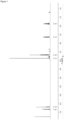
- the mixture of lignin in water can be heated up to the boiling point of water, and keep stirring for a certain time between 5 min and 72h, preferably between 10 min and 48h, most preferably between 20 min and 24h. After the corresponding time, the mixture is let to cool and settle down and the water layer is collected, filtered. The remaining lignin might be again submitted to another extraction. Several extraction cycles can be performed to increase the yield of extracted monomer. The combined water layers are mixed and the water is removed, leading to a mixture highly enriched in DCA and/or DSA, together with some DCA and/or DSA dimers ( Figure 1 - 1H NMR of highly enriched mixture in DCA extracted from lignin).
- DCA and DSA can also be synthesized from petrol-derived chemicals (Example 1 and 2 respectively)
- Aqueous hydrogen peroxide solution (30%, 28 mL) was added carefully and the solution was allowed to warm to room temperature, and it was left stirring for 1.5 hours. Afterwards, the mixture was poured into a beaker and diethyl ether was added causing the salt to precipitate. The two layers were decanted into a separation funnel and extractions using diethyl ether were performed. After two extractions the aqueous solution was acidified using hydrochloric acid, followed by two more extractions using diethyl ether. All organic layers were combined and washed using brine. The solvent was dried using magnesium sulfate, filtered and removed in vacuo. The obtained crude product was purified by recrystallization in chloroform/carbon disulfide mixture.
- dihydrosinapic acid 8 gram, 35 mmol was dissolved in anhydrous THF and cooled down to 0°C.
- Lithium aluminum hydride (3.00 gram, 79 mmol) was added portionwise over 1 hour. The reaction mixture was stirred at room temperature overnight. The reaction was quenched by slowly pouring it into ethyl acetate, followed by the addition of water. The aqueous layer was extracted with ethyl acetate, the organic layers were combined and washed using brine. The solvent was dried using magnesium sulphate, filtered and removed in vacuo. The product was obtained as yellow liquid in 91% yield.
- 4-hydroxyalkylphenols can be functionalized
- the solvent was dried using magnesium sulphate, filtered and removed in vacuo.
- the crude was purified by column chromatography, using ethyl acetate as the mobile phase.
- the product was obtained as a clear liquid in 86% yield, and solidified afterwards as a white solid.
- TPUs can be synthesized according to the following general protocol: In a dried round bottom flask, the polyol (long-chain diol) was dissolved in dry DMF and stirred at from between and about 80 °C or 100 °C. To this solution the diisocianate (MDI or HDI) was added and kept it reacting for 10-30 minutes. Afterwards the chain extender (lignin derived monomer, and if present the additional chain extender) were added followed by the catalyst (tin octanoate, 1 mol %).
- DCA and/or DSA the aforementioned functionalized lignin-derived monomers
- BA-DCA and/or BA-DSA aforementioned functionalized lignin-derived monomers
- the mixture was kept reacting for 10 min-20h; in particular for at least 3h; more in particular for 3h -20h; and then precipitated in water and the solids, i.e. the polymer filtered off.
- the resulting polymer was then dried in a vacuum oven, or alternatively the filtered polymer was dissolved in THF, poured in a mold and dried in a vacuum oven.
Landscapes
- Chemical & Material Sciences (AREA)
- Organic Chemistry (AREA)
- Health & Medical Sciences (AREA)
- Chemical Kinetics & Catalysis (AREA)
- Medicinal Chemistry (AREA)
- Polymers & Plastics (AREA)
- Life Sciences & Earth Sciences (AREA)
- Engineering & Computer Science (AREA)
- Materials Engineering (AREA)
- Wood Science & Technology (AREA)
- Polyurethanes Or Polyureas (AREA)
- Organic Low-Molecular-Weight Compounds And Preparation Thereof (AREA)
Priority Applications (10)
| Application Number | Priority Date | Filing Date | Title |
|---|---|---|---|
| PL20168400.8T PL3892661T3 (pl) | 2020-04-07 | 2020-04-07 | Termoplastyczne poliuretany pochodne monomerów ligninowych |
| EP20168400.8A EP3892661B1 (en) | 2020-04-07 | 2020-04-07 | Thermoplastic polyurethanes derived from lignin monomers |
| ES21715926T ES2976857T3 (es) | 2020-04-07 | 2021-04-06 | Poliuretanos termoplásticos derivados de monómeros de lignina |
| JP2022561118A JP2023522591A (ja) | 2020-04-07 | 2021-04-06 | リグニンモノマー由来熱可塑性ポリウレタン |
| EP21715926.8A EP4132989B1 (en) | 2020-04-07 | 2021-04-06 | Thermoplastic polyurethanes derived from lignin monomers |
| US17/995,521 US20240270897A1 (en) | 2020-04-07 | 2021-04-06 | Thermoplastic polyurethanes derived from lignin monomers |
| BR112022020049-8A BR112022020049B1 (pt) | 2020-04-07 | 2021-04-06 | Poliuretanos termoplásticos derivados de monômeros de lignina e usos dos mesmos |
| CN202180025232.0A CN115916859A (zh) | 2020-04-07 | 2021-04-06 | 由木质素单体获得的热塑性聚氨酯 |
| PCT/EP2021/058943 WO2021204803A1 (en) | 2020-04-07 | 2021-04-06 | Thermoplastic polyurethanes derived from lignin monomers |
| JP2026011616A JP2026067965A (ja) | 2020-04-07 | 2026-01-27 | リグニンモノマー由来熱可塑性ポリウレタン |
Applications Claiming Priority (1)
| Application Number | Priority Date | Filing Date | Title |
|---|---|---|---|
| EP20168400.8A EP3892661B1 (en) | 2020-04-07 | 2020-04-07 | Thermoplastic polyurethanes derived from lignin monomers |
Publications (2)
| Publication Number | Publication Date |
|---|---|
| EP3892661A1 EP3892661A1 (en) | 2021-10-13 |
| EP3892661B1 true EP3892661B1 (en) | 2024-09-25 |
Family
ID=70227807
Family Applications (2)
| Application Number | Title | Priority Date | Filing Date |
|---|---|---|---|
| EP20168400.8A Active EP3892661B1 (en) | 2020-04-07 | 2020-04-07 | Thermoplastic polyurethanes derived from lignin monomers |
| EP21715926.8A Active EP4132989B1 (en) | 2020-04-07 | 2021-04-06 | Thermoplastic polyurethanes derived from lignin monomers |
Family Applications After (1)
| Application Number | Title | Priority Date | Filing Date |
|---|---|---|---|
| EP21715926.8A Active EP4132989B1 (en) | 2020-04-07 | 2021-04-06 | Thermoplastic polyurethanes derived from lignin monomers |
Country Status (7)
| Country | Link |
|---|---|
| US (1) | US20240270897A1 (https=) |
| EP (2) | EP3892661B1 (https=) |
| JP (2) | JP2023522591A (https=) |
| CN (1) | CN115916859A (https=) |
| ES (1) | ES2976857T3 (https=) |
| PL (1) | PL3892661T3 (https=) |
| WO (1) | WO2021204803A1 (https=) |
Families Citing this family (4)
| Publication number | Priority date | Publication date | Assignee | Title |
|---|---|---|---|---|
| EP3892662A1 (en) * | 2020-04-07 | 2021-10-13 | Vito NV | Polyurethanes from depolymerized lignin containing lignin monomers |
| CN113533588A (zh) * | 2021-09-03 | 2021-10-22 | 山东农业大学 | 一种同时检测小麦茎秆中九种木质素单体交联结构的方法 |
| CN114478984A (zh) * | 2021-12-30 | 2022-05-13 | 广东粤港澳大湾区黄埔材料研究院 | 一种耐高温老化硬质聚氨酯弹性体及其制备方法 |
| CN116023597B (zh) * | 2022-12-27 | 2025-10-24 | 上海信斯帝克新材料有限公司 | 一种植物基增强3d打印树脂组合物及其成型方法 |
Family Cites Families (12)
| Publication number | Priority date | Publication date | Assignee | Title |
|---|---|---|---|---|
| JPS58222172A (ja) * | 1982-06-18 | 1983-12-23 | Asahi Chem Ind Co Ltd | 靴用接着剤組成物 |
| JPS596209A (ja) * | 1982-07-02 | 1984-01-13 | Asahi Chem Ind Co Ltd | 反応性の異なるイソシアネ−ト基を有するウレタンプレポリマ−の製造方法 |
| US5491210A (en) * | 1989-04-21 | 1996-02-13 | Kimberly-Clark Corporation | Thermally reversible polymers |
| JP4709188B2 (ja) * | 2007-07-10 | 2011-06-22 | 太陽ホールディングス株式会社 | ウレタン樹脂、それを含有する熱硬化性樹脂組成物及びその硬化物 |
| CN102504179B (zh) * | 2011-09-30 | 2015-02-25 | 南京金三力橡塑有限公司 | 一种耐水解的浇注型聚氨酯弹性体的制备方法 |
| WO2014201185A2 (en) | 2013-06-11 | 2014-12-18 | Battelle Memorial Institute | Bio-oil polyols, alkoxylated bio-oil polyols and bio-oil phenolic resins |
| WO2015126862A1 (en) | 2014-02-18 | 2015-08-27 | 3M Innovative Properties Company | Dental composition and use thereof |
| CN106661175A (zh) | 2014-06-11 | 2017-05-10 | 巴特尔纪念研究所 | 烷氧基化生物油多元醇组合物 |
| WO2018205020A1 (en) | 2017-05-09 | 2018-11-15 | Fpinnovations | Depolymerization of lignin for the production of bio-based polyols and phenols and lignin-based pf/pu/epoxy resins/foams |
| JP6948196B2 (ja) * | 2017-09-14 | 2021-10-13 | 株式会社クラレ | ポリウレタン、研磨層用ポリウレタン成形体及び研磨パッド |
| WO2020002361A1 (en) * | 2018-06-25 | 2020-01-02 | Katholieke Universiteit Leuven | Fractionation and depolymerisation of lignocellulosic material |
| EP3892662A1 (en) * | 2020-04-07 | 2021-10-13 | Vito NV | Polyurethanes from depolymerized lignin containing lignin monomers |
-
2020
- 2020-04-07 EP EP20168400.8A patent/EP3892661B1/en active Active
- 2020-04-07 PL PL20168400.8T patent/PL3892661T3/pl unknown
-
2021
- 2021-04-06 CN CN202180025232.0A patent/CN115916859A/zh active Pending
- 2021-04-06 JP JP2022561118A patent/JP2023522591A/ja active Pending
- 2021-04-06 ES ES21715926T patent/ES2976857T3/es active Active
- 2021-04-06 WO PCT/EP2021/058943 patent/WO2021204803A1/en not_active Ceased
- 2021-04-06 US US17/995,521 patent/US20240270897A1/en active Pending
- 2021-04-06 EP EP21715926.8A patent/EP4132989B1/en active Active
-
2026
- 2026-01-27 JP JP2026011616A patent/JP2026067965A/ja active Pending
Also Published As
| Publication number | Publication date |
|---|---|
| PL3892661T3 (pl) | 2024-12-23 |
| JP2023522591A (ja) | 2023-05-31 |
| JP2026067965A (ja) | 2026-04-21 |
| EP3892661A1 (en) | 2021-10-13 |
| CN115916859A (zh) | 2023-04-04 |
| WO2021204803A1 (en) | 2021-10-14 |
| US20240270897A1 (en) | 2024-08-15 |
| EP4132989A1 (en) | 2023-02-15 |
| EP4132989B1 (en) | 2024-03-13 |
| BR112022020049A2 (pt) | 2022-11-22 |
| EP4132989C0 (en) | 2024-03-13 |
| ES2976857T3 (es) | 2024-08-09 |
Similar Documents
| Publication | Publication Date | Title |
|---|---|---|
| EP4132989B1 (en) | Thermoplastic polyurethanes derived from lignin monomers | |
| US20230235111A1 (en) | Polyurethanes from depolymerized lignin containing lignin monomers | |
| CA1248134A (en) | Polyols and uses thereof | |
| WO2006088152A1 (ja) | ポリカーボネートジオール | |
| JPH0529648B2 (https=) | ||
| JPH0149407B2 (https=) | ||
| JP5345387B2 (ja) | 二級アルコール基を含有するポリエステルポリオールおよびポリウレタン、例えば、柔軟性ポリウレタン発泡体の製造におけるそれらの使用 | |
| WO2016103283A1 (en) | Bio-based aromatic diisocyanates for preparation of polyurethanes | |
| JP2885872B2 (ja) | 脂肪族コポリカーボネート及び該単位を含有するポリウレタン | |
| CN114174369A (zh) | 制备可热塑性加工的聚氨酯聚合物的方法 | |
| CN116096773B (zh) | 利用含葡萄糖的糖类组合物的多元醇组合物和包含该多元醇组合物的聚氨酯泡沫 | |
| CN112920363B (zh) | 一种热塑性聚氨酯弹性体增容剂及其制备方法与应用 | |
| JP4145039B2 (ja) | ポリエステルポリオールおよびポリウレタン、およびそれらの製造方法 | |
| EP3165552B1 (en) | Polycarbonates, polyurethanes, elastomers, processes for manufacturing polycarbonates, and processes for manufacturing polyurethanes | |
| CN117362253A (zh) | 一类生物基聚氨酯扩链剂及其制备方法 | |
| CN115975176A (zh) | 含异噁唑啉环的热塑性弹性体及其制备方法、应用 | |
| KR20020055838A (ko) | 열가소성 폴리우레탄 탄성체의 제조방법 | |
| KR102608307B1 (ko) | 입체장애 특성을 조절한 다이올, 이를 포함하는 저온 및 무촉매 조건에서 자가치유/재활용이 가능한 열경화성 폴리우레탄 소재 | |
| BR112022020049B1 (pt) | Poliuretanos termoplásticos derivados de monômeros de lignina e usos dos mesmos | |
| KR101037493B1 (ko) | 폴리우레탄 및 불포화폴리에스터수지, 불포화폴리우레탄 제조용 말레인산 폴리에스터 폴리올 혼합물 및 그의 제조방법 | |
| JP7787944B2 (ja) | 防水透湿膜 | |
| CN118546326A (zh) | 一种聚氨酯、聚氨酯的制备方法及聚氨酯催化剂 | |
| JP2024090958A (ja) | ポリ乳酸をベースとする新規ポリマー | |
| CN118878798A (zh) | 一种以乙醇酸甲酯为原料催化合成低聚聚酯多元醇的方法 |
Legal Events
| Date | Code | Title | Description |
|---|---|---|---|
| PUAI | Public reference made under article 153(3) epc to a published international application that has entered the european phase |
Free format text: ORIGINAL CODE: 0009012 |
|
| STAA | Information on the status of an ep patent application or granted ep patent |
Free format text: STATUS: THE APPLICATION HAS BEEN PUBLISHED |
|
| AK | Designated contracting states |
Kind code of ref document: A1 Designated state(s): AL AT BE BG CH CY CZ DE DK EE ES FI FR GB GR HR HU IE IS IT LI LT LU LV MC MK MT NL NO PL PT RO RS SE SI SK SM TR |
|
| STAA | Information on the status of an ep patent application or granted ep patent |
Free format text: STATUS: REQUEST FOR EXAMINATION WAS MADE |
|
| 17P | Request for examination filed |
Effective date: 20220325 |
|
| RBV | Designated contracting states (corrected) |
Designated state(s): AL AT BE BG CH CY CZ DE DK EE ES FI FR GB GR HR HU IE IS IT LI LT LU LV MC MK MT NL NO PL PT RO RS SE SI SK SM TR |
|
| STAA | Information on the status of an ep patent application or granted ep patent |
Free format text: STATUS: EXAMINATION IS IN PROGRESS |
|
| 17Q | First examination report despatched |
Effective date: 20230711 |
|
| GRAP | Despatch of communication of intention to grant a patent |
Free format text: ORIGINAL CODE: EPIDOSNIGR1 |
|
| STAA | Information on the status of an ep patent application or granted ep patent |
Free format text: STATUS: GRANT OF PATENT IS INTENDED |
|
| INTG | Intention to grant announced |
Effective date: 20240517 |
|
| GRAS | Grant fee paid |
Free format text: ORIGINAL CODE: EPIDOSNIGR3 |
|
| GRAA | (expected) grant |
Free format text: ORIGINAL CODE: 0009210 |
|
| STAA | Information on the status of an ep patent application or granted ep patent |
Free format text: STATUS: THE PATENT HAS BEEN GRANTED |
|
| AK | Designated contracting states |
Kind code of ref document: B1 Designated state(s): AL AT BE BG CH CY CZ DE DK EE ES FI FR GB GR HR HU IE IS IT LI LT LU LV MC MK MT NL NO PL PT RO RS SE SI SK SM TR |
|
| REG | Reference to a national code |
Ref country code: GB Ref legal event code: FG4D |
|
| REG | Reference to a national code |
Ref country code: CH Ref legal event code: EP |
|
| REG | Reference to a national code |
Ref country code: DE Ref legal event code: R096 Ref document number: 602020038192 Country of ref document: DE |
|
| REG | Reference to a national code |
Ref country code: IE Ref legal event code: FG4D |
|
| REG | Reference to a national code |
Ref country code: LT Ref legal event code: MG9D |
|
| PG25 | Lapsed in a contracting state [announced via postgrant information from national office to epo] |
Ref country code: NO Free format text: LAPSE BECAUSE OF FAILURE TO SUBMIT A TRANSLATION OF THE DESCRIPTION OR TO PAY THE FEE WITHIN THE PRESCRIBED TIME-LIMIT Effective date: 20241225 |
|
| PG25 | Lapsed in a contracting state [announced via postgrant information from national office to epo] |
Ref country code: GR Free format text: LAPSE BECAUSE OF FAILURE TO SUBMIT A TRANSLATION OF THE DESCRIPTION OR TO PAY THE FEE WITHIN THE PRESCRIBED TIME-LIMIT Effective date: 20241226 Ref country code: FI Free format text: LAPSE BECAUSE OF FAILURE TO SUBMIT A TRANSLATION OF THE DESCRIPTION OR TO PAY THE FEE WITHIN THE PRESCRIBED TIME-LIMIT Effective date: 20240925 |
|
| PG25 | Lapsed in a contracting state [announced via postgrant information from national office to epo] |
Ref country code: BG Free format text: LAPSE BECAUSE OF FAILURE TO SUBMIT A TRANSLATION OF THE DESCRIPTION OR TO PAY THE FEE WITHIN THE PRESCRIBED TIME-LIMIT Effective date: 20240925 |
|
| PG25 | Lapsed in a contracting state [announced via postgrant information from national office to epo] |
Ref country code: LV Free format text: LAPSE BECAUSE OF FAILURE TO SUBMIT A TRANSLATION OF THE DESCRIPTION OR TO PAY THE FEE WITHIN THE PRESCRIBED TIME-LIMIT Effective date: 20240925 |
|
| PG25 | Lapsed in a contracting state [announced via postgrant information from national office to epo] |
Ref country code: RS Free format text: LAPSE BECAUSE OF FAILURE TO SUBMIT A TRANSLATION OF THE DESCRIPTION OR TO PAY THE FEE WITHIN THE PRESCRIBED TIME-LIMIT Effective date: 20241225 |
|
| REG | Reference to a national code |
Ref country code: NL Ref legal event code: MP Effective date: 20240925 |
|
| PG25 | Lapsed in a contracting state [announced via postgrant information from national office to epo] |
Ref country code: RS Free format text: LAPSE BECAUSE OF FAILURE TO SUBMIT A TRANSLATION OF THE DESCRIPTION OR TO PAY THE FEE WITHIN THE PRESCRIBED TIME-LIMIT Effective date: 20241225 Ref country code: NO Free format text: LAPSE BECAUSE OF FAILURE TO SUBMIT A TRANSLATION OF THE DESCRIPTION OR TO PAY THE FEE WITHIN THE PRESCRIBED TIME-LIMIT Effective date: 20241225 Ref country code: LV Free format text: LAPSE BECAUSE OF FAILURE TO SUBMIT A TRANSLATION OF THE DESCRIPTION OR TO PAY THE FEE WITHIN THE PRESCRIBED TIME-LIMIT Effective date: 20240925 Ref country code: GR Free format text: LAPSE BECAUSE OF FAILURE TO SUBMIT A TRANSLATION OF THE DESCRIPTION OR TO PAY THE FEE WITHIN THE PRESCRIBED TIME-LIMIT Effective date: 20241226 Ref country code: FI Free format text: LAPSE BECAUSE OF FAILURE TO SUBMIT A TRANSLATION OF THE DESCRIPTION OR TO PAY THE FEE WITHIN THE PRESCRIBED TIME-LIMIT Effective date: 20240925 Ref country code: BG Free format text: LAPSE BECAUSE OF FAILURE TO SUBMIT A TRANSLATION OF THE DESCRIPTION OR TO PAY THE FEE WITHIN THE PRESCRIBED TIME-LIMIT Effective date: 20240925 |
|
| REG | Reference to a national code |
Ref country code: AT Ref legal event code: MK05 Ref document number: 1726601 Country of ref document: AT Kind code of ref document: T Effective date: 20240925 |
|
| PG25 | Lapsed in a contracting state [announced via postgrant information from national office to epo] |
Ref country code: NL Free format text: LAPSE BECAUSE OF FAILURE TO SUBMIT A TRANSLATION OF THE DESCRIPTION OR TO PAY THE FEE WITHIN THE PRESCRIBED TIME-LIMIT Effective date: 20240925 |
|
| PG25 | Lapsed in a contracting state [announced via postgrant information from national office to epo] |
Ref country code: PT Free format text: LAPSE BECAUSE OF FAILURE TO SUBMIT A TRANSLATION OF THE DESCRIPTION OR TO PAY THE FEE WITHIN THE PRESCRIBED TIME-LIMIT Effective date: 20250127 Ref country code: IS Free format text: LAPSE BECAUSE OF FAILURE TO SUBMIT A TRANSLATION OF THE DESCRIPTION OR TO PAY THE FEE WITHIN THE PRESCRIBED TIME-LIMIT Effective date: 20250125 |
|
| PG25 | Lapsed in a contracting state [announced via postgrant information from national office to epo] |
Ref country code: RO Free format text: LAPSE BECAUSE OF FAILURE TO SUBMIT A TRANSLATION OF THE DESCRIPTION OR TO PAY THE FEE WITHIN THE PRESCRIBED TIME-LIMIT Effective date: 20240925 Ref country code: SM Free format text: LAPSE BECAUSE OF FAILURE TO SUBMIT A TRANSLATION OF THE DESCRIPTION OR TO PAY THE FEE WITHIN THE PRESCRIBED TIME-LIMIT Effective date: 20240925 |
|
| PG25 | Lapsed in a contracting state [announced via postgrant information from national office to epo] |
Ref country code: ES Free format text: LAPSE BECAUSE OF FAILURE TO SUBMIT A TRANSLATION OF THE DESCRIPTION OR TO PAY THE FEE WITHIN THE PRESCRIBED TIME-LIMIT Effective date: 20240925 |
|
| PG25 | Lapsed in a contracting state [announced via postgrant information from national office to epo] |
Ref country code: EE Free format text: LAPSE BECAUSE OF FAILURE TO SUBMIT A TRANSLATION OF THE DESCRIPTION OR TO PAY THE FEE WITHIN THE PRESCRIBED TIME-LIMIT Effective date: 20240925 Ref country code: AT Free format text: LAPSE BECAUSE OF FAILURE TO SUBMIT A TRANSLATION OF THE DESCRIPTION OR TO PAY THE FEE WITHIN THE PRESCRIBED TIME-LIMIT Effective date: 20240925 |
|
| PG25 | Lapsed in a contracting state [announced via postgrant information from national office to epo] |
Ref country code: CZ Free format text: LAPSE BECAUSE OF FAILURE TO SUBMIT A TRANSLATION OF THE DESCRIPTION OR TO PAY THE FEE WITHIN THE PRESCRIBED TIME-LIMIT Effective date: 20240925 |
|
| PG25 | Lapsed in a contracting state [announced via postgrant information from national office to epo] |
Ref country code: IT Free format text: LAPSE BECAUSE OF FAILURE TO SUBMIT A TRANSLATION OF THE DESCRIPTION OR TO PAY THE FEE WITHIN THE PRESCRIBED TIME-LIMIT Effective date: 20240925 Ref country code: SK Free format text: LAPSE BECAUSE OF FAILURE TO SUBMIT A TRANSLATION OF THE DESCRIPTION OR TO PAY THE FEE WITHIN THE PRESCRIBED TIME-LIMIT Effective date: 20240925 |
|
| REG | Reference to a national code |
Ref country code: DE Ref legal event code: R097 Ref document number: 602020038192 Country of ref document: DE |
|
| PG25 | Lapsed in a contracting state [announced via postgrant information from national office to epo] |
Ref country code: DK Free format text: LAPSE BECAUSE OF FAILURE TO SUBMIT A TRANSLATION OF THE DESCRIPTION OR TO PAY THE FEE WITHIN THE PRESCRIBED TIME-LIMIT Effective date: 20240925 |
|
| PLBE | No opposition filed within time limit |
Free format text: ORIGINAL CODE: 0009261 |
|
| STAA | Information on the status of an ep patent application or granted ep patent |
Free format text: STATUS: NO OPPOSITION FILED WITHIN TIME LIMIT |
|
| 26N | No opposition filed |
Effective date: 20250626 |
|
| PG25 | Lapsed in a contracting state [announced via postgrant information from national office to epo] |
Ref country code: SE Free format text: LAPSE BECAUSE OF FAILURE TO SUBMIT A TRANSLATION OF THE DESCRIPTION OR TO PAY THE FEE WITHIN THE PRESCRIBED TIME-LIMIT Effective date: 20240925 |
|
| REG | Reference to a national code |
Ref country code: DE Ref legal event code: R119 Ref document number: 602020038192 Country of ref document: DE |
|
| REG | Reference to a national code |
Ref country code: CH Ref legal event code: H13 Free format text: ST27 STATUS EVENT CODE: U-0-0-H10-H13 (AS PROVIDED BY THE NATIONAL OFFICE) Effective date: 20251125 |
|
| PG25 | Lapsed in a contracting state [announced via postgrant information from national office to epo] |
Ref country code: LU Free format text: LAPSE BECAUSE OF NON-PAYMENT OF DUE FEES Effective date: 20250407 |
|
| PG25 | Lapsed in a contracting state [announced via postgrant information from national office to epo] |
Ref country code: MC Free format text: LAPSE BECAUSE OF FAILURE TO SUBMIT A TRANSLATION OF THE DESCRIPTION OR TO PAY THE FEE WITHIN THE PRESCRIBED TIME-LIMIT Effective date: 20240925 |
|
| GBPC | Gb: european patent ceased through non-payment of renewal fee |
Effective date: 20250407 |
|
| REG | Reference to a national code |
Ref country code: BE Ref legal event code: MM Effective date: 20250430 |
|
| PG25 | Lapsed in a contracting state [announced via postgrant information from national office to epo] |
Ref country code: DE Free format text: LAPSE BECAUSE OF NON-PAYMENT OF DUE FEES Effective date: 20251104 |
|
| PG25 | Lapsed in a contracting state [announced via postgrant information from national office to epo] |
Ref country code: GB Free format text: LAPSE BECAUSE OF NON-PAYMENT OF DUE FEES Effective date: 20250407 |
|
| PG25 | Lapsed in a contracting state [announced via postgrant information from national office to epo] |
Ref country code: HR Free format text: LAPSE BECAUSE OF FAILURE TO SUBMIT A TRANSLATION OF THE DESCRIPTION OR TO PAY THE FEE WITHIN THE PRESCRIBED TIME-LIMIT Effective date: 20240925 Ref country code: FR Free format text: LAPSE BECAUSE OF NON-PAYMENT OF DUE FEES Effective date: 20250430 |
|
| PG25 | Lapsed in a contracting state [announced via postgrant information from national office to epo] |
Ref country code: BE Free format text: LAPSE BECAUSE OF NON-PAYMENT OF DUE FEES Effective date: 20250430 |
|
| PG25 | Lapsed in a contracting state [announced via postgrant information from national office to epo] |
Ref country code: CH Free format text: LAPSE BECAUSE OF NON-PAYMENT OF DUE FEES Effective date: 20250430 |
|
| PG25 | Lapsed in a contracting state [announced via postgrant information from national office to epo] |
Ref country code: IE Free format text: LAPSE BECAUSE OF NON-PAYMENT OF DUE FEES Effective date: 20250407 |
|
| PGFP | Annual fee paid to national office [announced via postgrant information from national office to epo] |
Ref country code: TR Payment date: 20260327 Year of fee payment: 7 |
|
| PGFP | Annual fee paid to national office [announced via postgrant information from national office to epo] |
Ref country code: PL Payment date: 20260319 Year of fee payment: 7 |