EP3888159B1 - Gehäuse mit zumindest einem ersten und einem zweiten gehäuseteil - Google Patents
Gehäuse mit zumindest einem ersten und einem zweiten gehäuseteil Download PDFInfo
- Publication number
- EP3888159B1 EP3888159B1 EP20705899.1A EP20705899A EP3888159B1 EP 3888159 B1 EP3888159 B1 EP 3888159B1 EP 20705899 A EP20705899 A EP 20705899A EP 3888159 B1 EP3888159 B1 EP 3888159B1
- Authority
- EP
- European Patent Office
- Prior art keywords
- housing
- housing part
- profile rail
- interior space
- claw
- Prior art date
- Legal status (The legal status is an assumption and is not a legal conclusion. Google has not performed a legal analysis and makes no representation as to the accuracy of the status listed.)
- Active
Links
Images



Classifications
-
- H—ELECTRICITY
- H01—ELECTRIC ELEMENTS
- H01M—PROCESSES OR MEANS, e.g. BATTERIES, FOR THE DIRECT CONVERSION OF CHEMICAL ENERGY INTO ELECTRICAL ENERGY
- H01M50/00—Constructional details or processes of manufacture of the non-active parts of electrochemical cells other than fuel cells, e.g. hybrid cells
- H01M50/20—Mountings; Secondary casings or frames; Racks, modules or packs; Suspension devices; Shock absorbers; Transport or carrying devices; Holders
- H01M50/249—Mountings; Secondary casings or frames; Racks, modules or packs; Suspension devices; Shock absorbers; Transport or carrying devices; Holders specially adapted for aircraft or vehicles, e.g. cars or trains
-
- H—ELECTRICITY
- H01—ELECTRIC ELEMENTS
- H01M—PROCESSES OR MEANS, e.g. BATTERIES, FOR THE DIRECT CONVERSION OF CHEMICAL ENERGY INTO ELECTRICAL ENERGY
- H01M50/00—Constructional details or processes of manufacture of the non-active parts of electrochemical cells other than fuel cells, e.g. hybrid cells
- H01M50/20—Mountings; Secondary casings or frames; Racks, modules or packs; Suspension devices; Shock absorbers; Transport or carrying devices; Holders
- H01M50/202—Casings or frames around the primary casing of a single cell or a single battery
-
- H—ELECTRICITY
- H01—ELECTRIC ELEMENTS
- H01M—PROCESSES OR MEANS, e.g. BATTERIES, FOR THE DIRECT CONVERSION OF CHEMICAL ENERGY INTO ELECTRICAL ENERGY
- H01M50/00—Constructional details or processes of manufacture of the non-active parts of electrochemical cells other than fuel cells, e.g. hybrid cells
- H01M50/20—Mountings; Secondary casings or frames; Racks, modules or packs; Suspension devices; Shock absorbers; Transport or carrying devices; Holders
- H01M50/244—Secondary casings; Racks; Suspension devices; Carrying devices; Holders characterised by their mounting method
-
- H—ELECTRICITY
- H01—ELECTRIC ELEMENTS
- H01M—PROCESSES OR MEANS, e.g. BATTERIES, FOR THE DIRECT CONVERSION OF CHEMICAL ENERGY INTO ELECTRICAL ENERGY
- H01M50/00—Constructional details or processes of manufacture of the non-active parts of electrochemical cells other than fuel cells, e.g. hybrid cells
- H01M50/20—Mountings; Secondary casings or frames; Racks, modules or packs; Suspension devices; Shock absorbers; Transport or carrying devices; Holders
- H01M50/262—Mountings; Secondary casings or frames; Racks, modules or packs; Suspension devices; Shock absorbers; Transport or carrying devices; Holders with fastening means, e.g. locks
-
- H—ELECTRICITY
- H01—ELECTRIC ELEMENTS
- H01M—PROCESSES OR MEANS, e.g. BATTERIES, FOR THE DIRECT CONVERSION OF CHEMICAL ENERGY INTO ELECTRICAL ENERGY
- H01M50/00—Constructional details or processes of manufacture of the non-active parts of electrochemical cells other than fuel cells, e.g. hybrid cells
- H01M50/20—Mountings; Secondary casings or frames; Racks, modules or packs; Suspension devices; Shock absorbers; Transport or carrying devices; Holders
- H01M50/262—Mountings; Secondary casings or frames; Racks, modules or packs; Suspension devices; Shock absorbers; Transport or carrying devices; Holders with fastening means, e.g. locks
- H01M50/264—Mountings; Secondary casings or frames; Racks, modules or packs; Suspension devices; Shock absorbers; Transport or carrying devices; Holders with fastening means, e.g. locks for cells or batteries, e.g. straps, tie rods or peripheral frames
-
- H—ELECTRICITY
- H01—ELECTRIC ELEMENTS
- H01M—PROCESSES OR MEANS, e.g. BATTERIES, FOR THE DIRECT CONVERSION OF CHEMICAL ENERGY INTO ELECTRICAL ENERGY
- H01M2220/00—Batteries for particular applications
- H01M2220/20—Batteries in motive systems, e.g. vehicle, ship, plane
-
- Y—GENERAL TAGGING OF NEW TECHNOLOGICAL DEVELOPMENTS; GENERAL TAGGING OF CROSS-SECTIONAL TECHNOLOGIES SPANNING OVER SEVERAL SECTIONS OF THE IPC; TECHNICAL SUBJECTS COVERED BY FORMER USPC CROSS-REFERENCE ART COLLECTIONS [XRACs] AND DIGESTS
- Y02—TECHNOLOGIES OR APPLICATIONS FOR MITIGATION OR ADAPTATION AGAINST CLIMATE CHANGE
- Y02E—REDUCTION OF GREENHOUSE GAS [GHG] EMISSIONS, RELATED TO ENERGY GENERATION, TRANSMISSION OR DISTRIBUTION
- Y02E60/00—Enabling technologies; Technologies with a potential or indirect contribution to GHG emissions mitigation
- Y02E60/10—Energy storage using batteries
Definitions
- the present invention relates to a housing, in particular a battery housing, comprising at least one first housing part, at least one second housing part and at least one connecting element connecting the first housing part to the second housing part, the first housing part and the second housing part being set up in such a way that they are in one interconnected state separating a housing interior from an environment lying on the other side of the first housing part and the second housing part.
- housings are known from the prior art, which are composed of several housing parts, it being possible for the housing parts to be connected to one another in different ways.
- the interior of the housing and the components arranged therein can be protected from the environment and external influences such as moisture or dust in that the interior of the housing is enclosed or encapsulated by the housing parts.
- Reliable protection is necessary in particular for housings for electrical components, for example for a battery or an accumulator, for example of an electric bicycle.
- the interior of the housing can be protected in that, for example, the housing parts are glued together at their abutting contact surfaces and welded to one another. This creates a permanent connection.
- the disadvantage is that this connection cannot be easily released again and therefore the housing cannot be dismantled again in a simple manner and reassembled several times. It is not easy to replace or check components arranged in the interior of the housing.
- the assembly process for closing the housing ie the process of connecting the housing parts to one another, is very complex.
- connection points between the housing parts are not evenly loaded and are not evenly compressed.
- this is disadvantageous in that any seal that may be provided is not evenly compressed.
- very rigid housing materials have to be provided so that the less compressed sections between two strongly compressed connection points are also securely closed.
- the assembly process is complex in that tools have to be used.
- screw bosses must also be provided for the screws, which are disadvantageous in that the housing takes up a lot of space and a uniform outer surface of the housing cannot be achieved or only with increased use of material. This also has the disadvantage of increasing the weight of the housing.
- latching clips ie form-fitting clips for latching housing parts
- connecting elements can be detached again too easily. In the event of impacts from the outside against the housing or if the housing falls, there is therefore a risk that the locking clips will become detached and the housing parts will therefore no longer be securely connected to one another.
- DE 10 2016 225663 B3 relates to a battery housing made of housing parts, in which battery housing fastening elements are provided for the non-positive connection of the housing parts.
- U.S. 2010/307848 A1 relates to a housing with housing parts, in which clips are provided for connecting the housing parts.
- the object of the invention is therefore to provide a housing that can be assembled and disassembled in a simple manner and at the same time ensures reliable and permanent protection of the housing interior from the environment.
- the outlay for an assembly process should be as low as possible and at the same time a compact solution with low material costs and low weight should be provided.
- the housing according to the invention comprises at least one first housing part, at least one second housing part and at least one connecting element connecting the first housing part to the second housing part.
- the first housing part and the second housing part are set up in such a way that when they are connected to one another, they separate a housing interior from an environment lying on the other side of the first housing part and the second housing part.
- the housing is characterized in that the at least one connecting element is designed as a profile rail that engages with the first housing part and with the second housing part.
- the housing according to the invention can thus be assembled in a simple manner and can also be dismantled again if necessary, and at the same time protects components arranged in the interior of the housing in a reliable manner.
- a uniform connecting element is provided by the profile rail, which ensures a uniform form fit between the housing parts to be connected.
- the profile rail ensures uniform properties in the connection point along its entire extent, ie in particular uniform connection forces between the first housing part and the second housing part.
- connection means such as latching clips, which latch the housing parts to be connected to one another
- a housing that is more secure against the connection means being released again is provided.
- the elongated extension of the profile rail, which engages with the housing parts via recesses provided, ensures that even if the housing is hit or if the housing falls down, there is a significantly lower risk than with snap-in clips that the connecting element will come out of its recess again moved out.
- profile rails as connecting elements
- the profile rails that are in engagement can be sealed so that their form fit with the two housing parts cannot be detached without being destroyed.
- this form-fitting connection cannot again be designed to be non-destructively releasable by, after the profile rails have been pushed into the recesses or in the intended receiving space these recesses or this receiving space are closed by blocking elements, for example glued.
- the profile rails for connecting the housing parts are pushed into recesses provided in the housing parts or into the intended receiving space, with this pushing-in being difficult or impossible to undo.
- This can be achieved, for example, in that the profile rails first against a resistance via a in the recesses or in the Recording space provided blocking element must be pushed. Once placed completely in the recesses or in the receiving space in their intended position, the profile rails can no longer be pulled out non-destructively or only with great difficulty in the opposite direction against the resistance caused by the blocking element.
- the housing can also be designed in such a way that the profile rails provided as connecting elements for the housing parts are combined with other conventional connecting elements known from the prior art, such as screws or snap-in clips.
- the housing can be used, for example, as a battery housing, among other things for a bicycle, in particular for an electric bicycle, by using the accumulator to support the drive of the electric bicycle in the housing and thus safely protecting it from external weather influences.
- the housing can then be mounted on a frame of the electric bicycle using additional mounting means.
- the housing can also be used generally as a machine housing and can protect components arranged in the interior of the housing from external influences.
- At least one seal can be arranged between the first housing part and the second housing part on the side of the profile rail facing the housing interior.
- the interior of the housing is thus protected in a safe manner from external influences from the environment.
- the seal can be arranged between the two abutting contact surfaces of the housing parts to be connected.
- the seal can be designed to completely encircle the interior of the housing or it can also be provided only on partial sections, for example on individual housing side walls.
- the first housing part and the second housing part are set up in such a way that they abut one another when they are connected to one another and form a first contact surface and a second contact surface. Furthermore, at least the first housing part has a first contact surface in the region of the first hook section up.
- the profile rail has a first claw-shaped section which engages behind the first hook section when the first housing part is connected to the second housing part.
- the second housing part can have a second hook section in the area of the second contact surface, wherein the profile rail can have a second claw-shaped section that engages behind the second hook section when the first housing part is connected to the second housing part.
- claw-shaped sections on the profile rail which engage behind the hook sections of the housing parts, provides a structurally particularly simple embodiment of the housing.
- the housing can be easily assembled and disassembled. A renewed release of the connecting element is effectively prevented by the claw-shaped sections reaching behind the hook sections of the housing parts.
- the first housing part, the second housing part and the profile rail engage with one another when connected to one another in such a way that the first claw-shaped section of the profile rail and a first groove of the first housing part arranged on the side of the first hook section facing the housing interior form an interference fit.
- first housing part, the second housing part and the profile rail can also engage with one another in the interconnected state in such a way that the second claw-shaped section of the profile rail and a second groove of the second housing part arranged on the side of the second hook section facing the interior of the housing form an interference fit.
- interference fits ensures that a uniform pressure is produced at the connection point between the housing parts, ie the contact points or contact surfaces are pressed together evenly and any seal that may be provided becomes uniform compressed. A secure and uniform sealing of the housing interior from the environment is achieved.
- the interference fit between profile rail and housing parts also ensures that tolerance-related dimensional deviations are compensated and a secure connection between the housing parts is nevertheless guaranteed.
- the contact surfaces of the housing parts always meet and a defined compression of the seal is guaranteed.
- At least one oversize element protruding from the base of the first groove in particular at least one rib or nub, can be provided to form the interference fit between the first claw-shaped section and the first groove.
- At least one interference element protruding from the base of the second groove in particular at least one rib or nub, can be provided.
- the oversize elements can also be in the form of other geometries extending from the bottom of the grooves.
- the ribs or, in general, the oversize elements ensure that the receiving space provided for the profile rail or its claw-shaped sections is reduced.
- the accommodation space is reduced in that the ribs or oversize elements provide excess material in the grooves.
- This achieves an interference fit between the profile rail and the housing parts or between the claw-shaped sections and the grooves of the housing parts.
- a material overlap between the profile rail and the two housing parts is ensured by means of the ribs or oversize elements.
- the interference fit ensures that tolerance-related dimensional deviations are compensated for and a secure connection between the housing parts is nevertheless guaranteed.
- the contact surfaces of the housing parts always meet and a defined compression of the seal is guaranteed.
- At least one first outer side of the first housing part facing away from the housing interior preferably also a second outer side of the second housing part facing away from the housing interior, in the connected state of the first housing part with the second housing part, be designed flush with a profile rail outer side facing away from the housing interior.
- the profile rail can be embedded in the housing flush with the surface. This makes the entire optics look more homogeneous and canting or injury to parts protruding from the housing surface can be prevented in this way.
- a surface-flush design of the housing can be achieved without any elements or edges protruding from the outer surfaces of the housing.
- the at least one first housing part and the at least one second housing part can enclose the housing interior when connected to one another in such a way that they form at least four housing side walls, preferably substantially perpendicular to one another, with at least one, in particular three, preferably on Fours, the four housing side walls is provided as a connecting element in each case at least one profile rail.
- a housing design that is very easy to handle is thus achieved, since the housing parts can be brought together in a first step and connected to one another in a second step by inserting or pushing in the profile rails on at least one side of the housing.
- a hinged joint can be provided on this housing side wall, for example.
- the housing parts can then already be movably connected to one another by the hinge joint, so that the housing parts can be brought onto one another as intended after the hinge joint has been closed.
- the housing parts can then be connected to one another as intended by using at least one profile rail as a connecting element on at least one of the other housing side walls.
- the at least one first housing part and the at least one second housing part when connected to one another, can enclose the housing interior in such a way that they form at least four housing side walls, which are preferably substantially perpendicular to one another. and that at least two profile rails are provided as a connecting element on at least one side wall of the housing.
- These profile rails can, for example, be pushed into their intended receiving space from two opposite mounting directions.
- the production costs of housings of different sizes can also be reduced as a result, since uniform profile rails are provided in uniform sizes or lengths in order to close or produce housings of different sizes, comprising housing parts of different sizes or housing interiors of different sizes.
- housing side walls which are essentially perpendicular to one another means that the plane formed by the respective housing side wall runs perpendicular to the plane formed by the adjacent housing side wall.
- the resulting corners of the housing, which are created by two adjacent housing side walls, can be rounded, so that no sharp, right-angled edge has to be formed between two adjacent housing side walls that are essentially perpendicular to one another.
- the housing can be set up in such a way that the profile rail is arranged overlapping a corner of the housing formed by two adjacently arranged housing side walls.
- connection element for the positive connection of the housing to a holding device can be provided on the outside of the profile rail facing away from the housing interior.
- the external holding device can be, for example, the electric bicycle, to which the housing and the battery arranged therein, for example, can be positively connected in a simple manner.
- Mechanical locking of the housing to the environment or to the external holding device can advantageously be achieved.
- the connection elements are provided on the profile rail(s). In this way, material and space can be saved in a simple manner, since the profile rail can serve not only to connect the housing parts, but also to connect the housing to the environment.
- connection elements that have to be additionally installed, such as additional latching means, for example.
- connection element can be designed as a projection, locking lug or multi-tooth locking element.
- a quick form-fitting connection between the housing and the external holding device can be achieved as a result. Fast assembly is possible, also with simple movements, which is particularly advantageous when using the housing as a battery housing and its connection to an electric bicycle, since fewer movements and no special tools are required to mount the housing on the holding device .
- a holding device can be positively connected to the housing via the connecting element.
- FIG. 1 An exemplary embodiment of a housing 1 according to the invention is shown in 1 shown in a sectional side view.
- the housing 1 protects a housing interior 2 from an environment U.
- the housing 1 is constructed in several parts and comprises a first housing part 3 and a second housing part 4.
- the first housing part 3 and the second housing part 4 are generally assembled by connecting elements, in this case the first Housing part 3 and the second housing part 4 at least partially assembled by a profile rail 5 .
- the first housing part 3 and the second housing part 4 together with the connecting elements separate the housing interior 2 from the environment U. This separation serves, for example, to no moisture and no dust or other unwanted contaminants from the outside, ie from the environment U, penetrate into the housing interior 2.
- the housing 1 can be used, for example, as a battery housing, among other things for a bicycle, in particular for an electric bicycle, in that the accumulator is used to support the drive of the electric bicycle in the housing 1 and is thus securely protected from external weather influences.
- the housing 1 can then be mounted on a frame of the electric bicycle using additional mounting means.
- a housing according to the invention can also be used generally as a machine housing and can protect components arranged in the housing interior 2 from external influences.
- the housing 1 is shown in an at least partially interconnected state of the first housing part 3 with the second housing part 4.
- the housing 1 has two connection points between the first housing part 3 and the second housing part 4, a connection point shown at the upper end of the housing 1, at which no connection element or profile rail 5 is provided, and one at the right end of the housing 1 connection point shown, at which a connection element in the form of the profile rail 5 is already provided.
- the two housing parts 3 and 4 abut one another and form an impact surface or contact surface. How out 1 combined with 2 As can be seen, the first housing part 3 and the second housing part 4 are designed such that they collide when connected to one another and the first housing part 3 forms a first contact surface 3' and the second housing part 4 forms a second contact surface 4'.
- a seal 6 is also provided, which protects the housing interior 2 from external influences more securely.
- the seal 6 is arranged between the first housing part 3 and the second housing part 4 on the side of the profile rail 5 facing the housing interior 2 .
- the profile rail 5 which engages with the first housing part 3 and the second housing part 4 , is provided for the secure connection of the first housing part 3 to the second housing part 4 .
- the first housing part 3 has in the area of the first contact surface 3' ( 2 ) a first hook portion 7 on.
- the profile rail 5 has a first claw-shaped section 8 which engages behind the first hook section 7 when the first housing part 3 is connected to the second housing part 4 .
- the second housing part 4 also has in the area of the second contact surface 4' ( 2 ) has a second hook section 9, wherein the profile rail 5 also has a second claw-shaped section 10, which engages behind the second hook section 9 when the first housing part 3 is connected to the second housing part 4.
- the first hook section 7 is gripped behind by the first claw-shaped section 8 in that the first claw-shaped section 8 of the profile rail 5 engages in a first groove 11 of the first housing part 3 that is arranged on the side of the first hook section 7 that faces the housing interior 2.
- the first housing part 3, the second housing part 4 and the profile rail 5 are thus in the interconnected state in engagement with one another in such a way that the first and second claw-shaped section 8 or 10 of the rail 5 in the first groove 11 or in a engages in the second groove 12 of the second housing part 4 arranged on the side of the second hook section 9 facing the housing interior 2 .
- the first and second grooves 11 and 12 therefore represent recesses for the profile rail 5.
- the profile rail 5 can simply be pushed into the recesses provided in the first and second housing parts 3 and 4 for assembly, without tools having to be used, for example.
- the sliding in of the profile rail 5 takes place in a direction that extends parallel or along the grooves 11 or 12, ie also along or parallel to the outer wall of the housing 1.
- This sliding direction or generally the assembly direction M is therefore no longer as in Screws or locking clips of the prior art perpendicular to the outer wall of the housing 1.
- the assembly of the profile rail 5 can be done manually and without using special tools.
- ribs 14 are also provided in the first groove 11 and in the second groove 12 .
- the ribs 14 represent oversize elements protruding from the bottom of the first and second groove 11 and 12 respectively Grooves 11 and 12 may be formed from extending geometries. In this way, the ribs 14 or the oversize elements ensure that the receiving space provided by the first or second groove 11 or 12 for the first or second claw-shaped section 8 or 10 of the profile rail 5 is reduced. that the ribs 14 and oversize elements provide excess material in the grooves 11 and 12, respectively. This results in an interference fit between the first and second claw-shaped section 8 and 10 of the profile rail 5 and the first and second groove 11 and 12 of the first and second housing part 3 and 4, respectively.
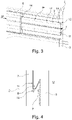
- the interference fit created by the ribs 14 is in 3 and 4 shown in detail.
- the interference fit between the profile rail 5 and the two housing parts 3 and 4 ensures that tolerance-related dimensional deviations are compensated for and a secure connection between the housing parts 3 and 4 is nevertheless guaranteed.
- a material overlap between the profile rail 5 and the two housing parts 3 and 4 is ensured by means of the ribs 14 .
- the ribs 14 are cut into by the profile rail 5 or by the first or second claw-shaped section 8 or 10 of the profile rail 5 as a result of the assembly process. In this way, the contact surfaces 3 ′ and 4 ′ always abut one another when the first housing part 3 is connected to the second housing part 4 .
- various blocking elements can also be provided in the grooves 11, 12 or generally in the receiving space provided for the profile rail 5.
- non-destructive detachment of the connection between the housing parts 3, 4 or non-destructive opening of the housing 1 can be ensured.
- the receiving space for the profile rail 5 can be sealed or glued. The profile rail 5 can then no longer be pulled out counter to the mounting direction M.
- blocking elements could already be provided in the receiving space, for example in the grooves 11, 12, with the profile rail 5 being able to overcome these blocking elements when it is pushed in along the assembly direction M, but the profile rail 5 then no longer able to deviate from its intended position counter to the assembly direction M. the housing 1 occluding position can be pushed back.
- a first outer side 15 of the first housing part 3 facing away from the housing interior 2 is flush with a profile rail outer side 17 facing away from the housing interior 2 when the first housing part 3 is connected to the second housing part 4 .
- a second outer side 16 of the second housing part 4 facing away from the housing interior 2 is also formed flush with the profile rail outer side 17 .
- the profile rail 5 is embedded in the housing 1 flush with the surface. This makes the entire optics look more homogeneous and canting or injury to parts protruding from the housing surface can be prevented in this way.
- a surface-flush design of the housing can be achieved without any elements or edges protruding from the outer surfaces of the housing.
- a further embodiment of the housing 1 is shown in a perspective view.
- the housing 1 can be seen from the outside in the connected state.
- 8 shows the housing 1 7 , wherein the inner workings of the housing 1 is illustrated.
- the housing interior 2 in such a way that four housing side walls 18, 19, 20, 21 are formed which are essentially perpendicular to one another.
- a profile rail 5.1, 5.2, 5.3, 5.4 is provided on all four housing side walls 18, 19, 20, 21 as a connecting element.
- a housing design that is very easy to handle is thus achieved, since the housing parts 3, 4 can be brought together in a first step and connected to one another in a second step by inserting or pushing in the profile rails 5.1, 5.2, 5.3, 5.4.
- a hinge joint for example, can be provided on this housing side wall.
- the housing parts can then already be movably connected to one another by the hinge joint, so that the housing parts can be brought onto one another as intended after the hinge joint has been closed.
- the housing parts can then be connected to one another as intended by using at least one profile rail as a connecting element on at least one of the other housing side walls.
- the seal 6 completely encircling the housing interior 2 can also be seen.
- the seal 6 could also be provided in partial sections and, for example, several straight individual pieces of a seal could be provided.
- housing 1 in 9 a further embodiment of the housing 1 is shown in a perspective view.
- the housing 1 can be seen from the outside in the connected state.
- Housing 1 differs from that in 7 Housing 1 shown only in that two profile rails 5.5 and 5.6 are provided on the housing side wall 18 instead of just one.
- These profile rails 5.5, 5.6 can, for example, be pushed into their intended receiving space from two opposite mounting directions M.1 and M.2.
- the production costs of housings of different sizes can also be reduced as a result, since uniform profile rails have uniform sizes or lengths be provided in order to close or produce housings of different sizes, comprising housing parts of different sizes or a housing interior of different sizes.
- FIG. 10 Another exemplary embodiment of a housing 1 is shown in a sectional, perspective view.
- the housing parts 3, 4 are again connected to one another via the profile rail 5, so that a housing interior 2 is shielded from the environment.
- the external holding device 22 can be, for example, the electric bicycle, to which the housing 1 and the battery arranged therein, for example, can be positively connected in a simple manner.
- the housing 1 also has two further profile rails 5.7 and 5.8. These rails 5.7, 5.8. could also be used analogously to the profile rails described above to connect the housing parts of the housing 1 to each other.
- the profile rail 5.7 is arranged overlapping the corner of the housing 1 formed by the two adjacently arranged housing side walls 21 and 23.
- the profile rail 5.8 in turn is arranged overlapping the corner of the housing 1 formed by the two adjacently arranged housing side walls 18 and 21.
- sharp-edged corners of the housing 1 can be avoided in an advantageous manner via the profile rails 5.7 or 5.8.
- the profile rails 5.7 and 5.8 provided in the corners can be made of a reinforced material in order to protect the housing 1 in a special way at the corners that are subject to greater stress.
- the resulting corners of the housing 1 can also be rounded off by the profile rails 5.7 and 5.8 provided in the corners of the housing, so that no sharp, right-angled edges are formed between the adjacent housing side walls 18 and 21 or 21 and 23, which are essentially perpendicular to one another is.
- connection element in the form of a locking lug 24 is provided for the form-fitting connection of the housing 1 to the holding device 22.
- Such a locking lug 24 or an alternative connection element could also be attached to the other profile rail 5 or also to one of the other profile rails in the previously illustrated and described exemplary embodiments.
- connection elements are provided on the 5.7 and 5.8 profile rails. In this way, there is no need for connection elements that have to be additionally installed, such as additional latching means.
- FIG. 11 Another embodiment of the housing 1 is shown, which differs only therein from the previously in the context of 10
- the exemplary embodiment described differs in that a second profile rail 5, shown on the left, is provided for connecting the two housing parts 3 and 4.
- a second profile rail 5 shown on the left
- the profile rails 5.7 and 5.8 provided in the corners can also be used to connect housing parts and not just, as shown here for clarification, to connect an external holding device 22.
- the locking lug 24 is used to positively connect the housing 1 to the holding device 22.
- this external holding device 22 could be mounted in a stationary and permanent manner on the electric bicycle, so that the Housing 1 connected to the electric bike in an easy-to-use manner by clicking and dismantled again without much effort could.
- the holding device 22 could also be implemented by the electric bicycle itself, for example in one piece with the frame of the electric bicycle.
- connection element In the view b) the 12 an alternative embodiment of a connection element is shown.
- a connection element As an alternative to the locking lug 24 described above, a multi-tooth locking element 25 is provided as a connecting element.
- Such a connection element can also advantageously be used to achieve a rapid form-fitting connection between the housing 1 and the external holding device 22 .
- Alternative configurations of connection elements are projections or barb elements.
Landscapes
- Chemical & Material Sciences (AREA)
- Chemical Kinetics & Catalysis (AREA)
- Electrochemistry (AREA)
- General Chemical & Material Sciences (AREA)
- Engineering & Computer Science (AREA)
- Aviation & Aerospace Engineering (AREA)
- Casings For Electric Apparatus (AREA)
- Details Of Connecting Devices For Male And Female Coupling (AREA)
- Battery Mounting, Suspending (AREA)
Description
- Die vorliegende Erfindung betrifft ein Gehäuse, insbesondere ein Batteriegehäuse, umfassend zumindest einen ersten Gehäuseteil, zumindest einen zweiten Gehäuseteil und zumindest ein den ersten Gehäuseteil mit dem zweiten Gehäuseteil verbindendes Verbindungselement, wobei der erste Gehäuseteil und der zweite Gehäuseteil derart eingerichtet sind, dass sie in einem miteinander verbundenen Zustand einen Gehäuseinnenraum von einer auf der anderen Seite des ersten Gehäuseteils und des zweiten Gehäuseteils liegenden Umgebung trennen.
- Aus dem Stand der Technik ist eine Vielzahl an Gehäusen bekannt, die aus mehreren Gehäuseteilen zusammengesetzt sind, wobei die Gehäuseteile auf unterschiedliche Arten miteinander verbunden werden können. So können der Gehäuseinnenraum und die darin angeordneten Bauteile vor der Umgebung und äußeren Einflüssen wie beispielsweise Nässe oder Staub dadurch geschützt werden, dass der Gehäuseinnenraum durch die Gehäuseteile eingeschlossen bzw. eingekapselt wird. Ein sicherer Schutz ist insbesondere bei Gehäusen für elektrische Bauteile, beispielsweise für eine Batterie bzw. einen Akkumulator zum Beispiel eines Elektrofahrrads, notwendig.
- Dabei kann der Gehäuseinnenraum geschützt werden, indem beispielsweise die Gehäuseteile an ihren aufeinanderstoßenden Kontaktflächen zusammengeklebt und miteinander verschweißt werden. So entsteht eine dauerhafte Verbindung. Nachteilig ist jedoch, dass diese Verbindung nicht einfach wieder lösbar und somit das Gehäuse nicht auf einfache Weise wieder demontiert und mehrfach montiert werden kann. Ein Austausch oder eine Kontrolle von im Gehäuseinnenraum angeordneten Bauteile ist nicht auf einfache Weise realisierbar. Ferner ist der Montageprozess zum Verschluss des Gehäuses, sprich der Vorgang des Verbindens der Gehäuseteile miteinander, sehr aufwendig.
- Als eine alternative Methode zum Verbinden von Gehäuseteilen sind aus dem Stand der Technik Schraubverbindungen bekannt. Problematisch ist hierbei jedoch, dass die Verbindungsstellen zwischen den Gehäuseteilen nicht gleichmäßig belastet und nicht gleichmäßig zusammengedrückt werden. Damit herrschen unterschiedlich starke Verbindungskräfte an unterschiedlichen Stellen entlang der Kontaktflächen zwischen den Gehäuseteilen. Es kommt also zu einer punktuellen Komprimierung im Bereich der Verbindungselemente, also im Bereich der Schrauben. Dies ist zum einen dahingehend nachteilig, dass eine eventuell vorgesehene Dichtung nicht gleichmäßig komprimiert wird. Zum anderen ist nachteilig, dass sehr steife Gehäusematerialien vorgesehen werden müssen, damit auch die weniger komprimierten Abschnitte zwischen zwei stark komprimierten Verbindungsstellen sicher verschlossen sind. Ferner ist der Montageprozess dahingehend aufwendig, dass Werkzeuge zum Einsatz kommen müssen. Schließlich müssen in der Regel auch Schraubdome für die Schrauben vorgesehen werden, die dahingehend nachteilig sind, dass das Gehäuse dadurch viel Platz beansprucht und keine bzw. nur unter erhöhten Materialeinsatz eine gleichmäßige Außenoberfläche des Gehäuses erzielt werden kann. Dies führt in nachteiliger Weise auch zu einem höheren Gewicht des Gehäuses.
- Eine weitere Alternative stellt die Verwendung von Rastklips, also formschlüssigen Klips zum Verrasten von Gehäuseteilen, als Verbindungselemente dar. Nachteilig hieran ist jedoch, dass sich solche Verbindungselemente zu einfach wieder lösen können. Bei Stößen von außen gegen das Gehäuse oder bei einem Hinfallen des Gehäuses besteht demnach die Gefahr, dass sich die Rastklips lösen und somit die Gehäuseteilen nicht mehr sicher miteinander verbunden sind.
-
DE 10 2016 225663 B3 betrifft ein Batteriegehäuse aus Gehäuseteilen, bei welchem Batteriegehäuse Befestigungselemente zum kraftschlüssigen Verbinden der Gehäuseteile vorgesehen sind. -
US 2010/307848 A1 betrifft ein Gehäuse mit Gehäuseteilen, bei welchem Clips zum Verbinden der Gehäuseteile vorgesehen sind. -
DE 20 2016 006515 U1 ,DE 10 2014 217523 A1 ,DE 10 2012 000996 A1 , sowieWO 2013/045530 A2 betreffen weiteren allgemeinen Stand der Technik an Gehäusen. - Aufgabe der Erfindung ist es daher, ein Gehäuse bereitzustellen, das auf einfache Weise montierbar und demontierbar ist und gleichzeitig einen sicheren und dauerhaften Schutz des Gehäuseinnenraums gegenüber der Umgebung gewährleistet.
- Insbesondere sollte der Aufwand für einen Montageprozess so gering wie möglich sein und gleichzeitig eine kompakte Lösung bei geringem Materialaufwand und mit geringem Gewicht bereitgestellt werden.
- Erfindungsgemäß wird diese Aufgabe durch eine Vorrichtung gemäß dem unabhängigen Anspruch 1 gelöst. Vorteilhafte Ausgestaltungen und Varianten der Erfindung ergeben sich aus den abhängigen Ansprüchen und der nachfolgenden Beschreibung. So können die in den Ansprüchen einzeln aufgeführten Merkmale in beliebiger, technisch sinnvoller Weise miteinander als auch mit den in der nachfolgenden Beschreibung näher erläuterten Merkmalen kombiniert werden und andere vorteilhafte Ausführungsvarianten der Erfindung darstellen.
- Das erfindungsgemäße Gehäuse umfasst zumindest einen ersten Gehäuseteil, zumindest einen zweiten Gehäuseteil und zumindest ein den ersten Gehäuseteil mit dem zweiten Gehäuseteil verbindendes Verbindungselement. Dabei sind der erste Gehäuseteil und der zweite Gehäuseteil derart eingerichtet, dass sie in einem miteinander verbundenen Zustand einen Gehäuseinnenraum von einer auf der anderen Seite des ersten Gehäuseteils und des zweiten Gehäuseteils liegenden Umgebung trennen. Das Gehäuse ist dadurch gekennzeichnet, dass das zumindest eine Verbindungselement als eine mit dem ersten Gehäuseteil und mit dem zweiten Gehäuseteil in Eingriff stehende Profilschiene ausgebildet ist.
- Das erfindungsgemäße Gehäuse lässt sich dadurch auf einfache Weise zusammenbauen und ist darüber hinaus bei Bedarf auch wieder demontierbar und schützt gleichzeitig im Gehäuseinnenraum angeordnete Bauteile auf sichere Weise. Durch die Profilschiene wird ein einheitliches Verbindungselement bereitgestellt, das für einen gleichmäßigen Formschluss zwischen den zu verbindenden Gehäuseteilen sorgt. Die Profilschiene sorgt dabei entlang ihrer gesamten Erstreckung für einheitliche Eigenschaften in der Verbindungsstelle, also insbesondere für gleichmäßige Verbindungskräfte, zwischen dem ersten Gehäuseteil und dem zweiten Gehäuseteil.
- Im Vergleich zu an vereinzelten Verbindungsstellen vorgesehen Verbindungsmitteln, wie etwa Schrauben, entstehen an den Kontaktflächen zwischen den Gehäuseteilen also keine Stellen unterschiedlich starker Komprimierung, sprich es herrscht keine lediglich punktuelle Komprimierung. So können auch weniger steife Gehäusematerialien verwendet werden, da die weniger komprimierten Dichtstrecken zwischen den Schraubpunkten entfallen. Außerdem entfällt die Notwendigkeit, Schraubdome vorzusehen, wodurch kompaktere und hinsichtlich des Gewichts leichtere Gehäuse erreicht werden. Ferner entfällt die Notwendigkeit, Werkzeuge während des Montageprozesses einzusetzen, da die Profilschiene auf einfache Weise, auch händisch, in die vorgesehenen Ausnehmungen eingeschoben werden kann.
- Im Vergleich zu anderen formschlüssigen Verbindungsmitteln wie etwa Rastklips, die die zu verbindenden Gehäuseteile miteinander verrasten, wird ein gegen ein erneutes Lösen der Verbindungsmittel sichereres Gehäuse bereitgestellt. Die längliche Erstreckung der Profilschiene, welche mit den Gehäuseteilen über vorgesehene Ausnehmungen in Eingriff steht, sorgt dafür, dass selbst bei Stößen gegen das Gehäuse oder einem Hinfallen des Gehäuses im Vergleich zu Rastklips eine erheblich geringere Gefahr besteht, dass sich das Verbindungselement aus seiner Ausnehmung wieder herausbewegt.
- Bei Bedarf kann durch das Vorsehen von Profilschienen als Verbindungselemente vorliegend auch eine dauerhafte und nicht erneut zerstörungsfreie Verbindung zwischen den Gehäuseteilen erreicht werden. Dazu können die in Eingriff stehenden Profilschienen versiegelt werden, sodass ihr Formschluss mit den beiden Gehäuseteilen nicht zerstörungsfrei lösbar ist. Beispielsweise kann nach einem in Eingriff Bringen der Profilschienen mit an den Gehäuseteilen vorgesehenen Ausnehmungen bzw. mit dem bestimmungsgemäßen Aufnahmeraum zur formschlüssigen Aufnahme der Profilschienen dieser Formschluss nicht erneut zerstörungsfrei lösbar ausgestaltet sein, indem nach dem Einschieben der Profilschienen in die Ausnehmungen bzw. in den bestimmungsgemäßen Aufnahmeraum diese Ausnehmungen bzw. dieser Aufnahmeraum durch blockierende Elemente verschlossen, beispielsweise verklebt, werden bzw. wird. Es ist auch denkbar, dass die Profilschienen zum Verbinden der Gehäuseteile in in den Gehäuseteilen vorgesehene Ausnehmungen bzw. in den bestimmungsgemäßen Aufnahmeraum eingeschoben werden, wobei dieses Einschieben gar nicht bzw. nur auf schwierige Weise wieder rückgängig gemacht werden kann. Dies kann etwa dadurch erreicht werden, dass die Profilschienen zunächst gegen einen Widerstand über ein in den Ausnehmungen bzw. in dem Aufnahmeraum vorgesehenes Blockadeelement geschoben werden müssen. Einmal ganz in die Ausnehmungen bzw. in den Aufnahmeraum in ihre bestimmungsgemäße Position versetzt können die Profilschienen dann gar nicht mehr zerstörungsfrei bzw. nur sehr schwer in die entgegengesetzte Richtung gegen den durch das Blockadeelement hervorgerufenen Widerstand herausgezogen werden.
- Generell können die Gehäuse auch derart ausgebildet sein, dass die als Verbindungselemente für die Gehäuseteile vorgesehenen Profilschienen mit anderen üblichen, aus dem Stand der Technik bekannten Verbindungselemente, wie etwa Schrauben oder Rastklips, kombiniert werden.
- Das Gehäuse kann zum Beispiel als Batteriegehäuse eingesetzt werden, unter anderem für ein Fahrrad, insbesondere für ein Elektrofahrrad, indem der Akkumulator zur Unterstützung des Antriebs des Elektrofahrrads in dem Gehäuse eingesetzt und somit sicher vor äußeren Witterungseinflüssen geschützt wird. Das Gehäuse kann dann mit weiteren Montagemitteln an einem Rahmen des Elektrofahrrads montiert werden. Darüber hinaus kann das Gehäuse auch allgemein als Maschinengehäuse eingesetzt werden und im Gehäuseinnenraum angeordnete Bauteile vor äußeren Einflüssen schützen.
- Gemäß einer ersten vorteilhaften Ausführungsform der Erfindung kann zwischen dem ersten Gehäuseteil und dem zweiten Gehäuseteil auf der dem Gehäuseinnenraum zugewandten Seite der Profilschiene gelegen zumindest eine Dichtung angeordnet sein. Der Gehäuseinnenraum wird somit auf sicherer Weise vor äußeren Einflüssen aus der Umgebung geschützt. Dabei kann die Dichtung zwischen den beiden aufeinanderstoßenden Kontaktflächen der zu verbindenden Gehäuseteile angeordnet sein. Die Dichtung kann den Gehäuseinnenraum vollständig umlaufend ausgebildet sein oder auch nur an Teilabschnitten, beispielsweise an einzelnen Gehäuseseitenwänden, vorgesehen sein.
- Erfindungsgemäß ist der erste Gehäuseteil und der zweite Gehäuseteil derart eingerichtet, dass sie im miteinander verbundenen Zustand aufeinanderstoßen und eine erste Kontaktfläche sowie eine zweite Kontaktfläche ausbilden. Ferner weist wenigstens der erste Gehäuseteil im Bereich der ersten Kontaktfläche einen ersten Hakenabschnitt auf. Dabei weist die Profilschiene einen ersten klauenförmigen Abschnitt auf, der den ersten Hakenabschnitt im miteinander verbundenen Zustand des ersten Gehäuseteils mit dem zweiten Gehäuseteil hintergreift.
- Weiter vorzugsweise kann der zweite Gehäuseteil in dem Bereich der zweiten Kontaktfläche einen zweiten Hakenabschnitt aufweisen, wobei die Profilschiene einen zweiten klauenförmigen Abschnitt aufweisen kann, der den zweiten Hakenabschnitt im miteinander verbundenen Zustand des ersten Gehäuseteils mit dem zweiten Gehäuseteil hintergreift.
- Durch die Ausbildung von klauenförmigen Abschnitten an der Profilschiene, die die Hakenabschnitte der Gehäuseteile hintergreifen, wird eine konstruktiv besonders einfache Ausführungsform des Gehäuses bereitgestellt. Das Gehäuse kann auf einfache Weise montiert und demontiert werden. Ein erneutes Lösen des Verbindungselementes wird durch das Hintergreifen der klauenförmigen Abschnitte hinter die Hakenabschnitte der Gehäuseteile effektiv verhindert.
- Erfindungsgemäß stehen der erste Gehäuseteil, der zweite Gehäuseteil und die Profilschiene im miteinander verbundenen Zustand derart miteinander in Eingriff, dass der erste klauenförmige Abschnitt der Profilschiene und eine auf der dem Gehäuseinnenraum zugewandten Seite des ersten Hakenabschnitts angeordnete, erste Nut des ersten Gehäuseteils eine Übermaßpassung ausbilden.
- Weiter vorzugsweise können der erste Gehäuseteil, der zweite Gehäuseteil und die Profilschiene im miteinander verbundenen Zustand ferner derart miteinander in Eingriff stehen, dass der zweite klauenförmige Abschnitt der Profilschiene und eine auf der dem Gehäuseinnenraum zugewandten Seite des zweiten Hakenabschnitts angeordnete, zweite Nut des zweiten Gehäuseteils eine Übermaßpassung ausbilden.
- Durch die Ausbildung von Übermaßpassungen wird sichergestellt, dass in der Verbindungsstelle zwischen den Gehäuseteilen eine gleichmäßige Pressung hervorgerufen wird, das heißt die Kontaktstellen bzw. Kontaktflächen werden gleichmäßig zusammengedrückt und eine eventuell vorgesehen Dichtung wird gleichmäßig komprimiert. Es wird eine sichere und gleichmäßige Abdichtung des Gehäuseinnenraums gegenüber der Umgebung erzielt. Die Übermaßpassung zwischen Profilschiene und Gehäuseteilen sorgt ferner dafür, dass toleranzbedingte Maßabweichungen kompensiert werden und dennoch eine sichere Verbindung zwischen den Gehäuseteilen gewährleistet wird. Die Kontaktflächen der Gehäuseteile stoßen stets aufeinander und es ist eine definierte Komprimierung der Dichtung gewährleistet.
- Nach einer weiteren Ausführungsform kann zur Ausbildung der Übermaßpassung zwischen dem ersten klauenförmigen Abschnitt und der ersten Nut wenigstens ein von dem Grund der ersten Nut hervorstehendes Übermaßelement, insbesondere wenigstens eine Rippe oder Noppe, vorgesehen sein.
- Weiter vorzugsweise kann zur Ausbildung der Übermaßpassung zwischen dem zweiten klauenförmigen Abschnitt und der zweiten Nut wenigstens ein von dem Grund der zweiten Nut hervorstehendes Übermaßelement, insbesondere wenigstens eine Rippe oder Noppe, vorgesehen sein.
- Alternativ können die Übermaßelemente auch anstatt in Form von Rippen oder Noppen in Form anderer sich vom Grund der Nuten aus erstreckenden Geometrien ausgebildet sein. Die Rippen bzw. allgemein die Übermaßelemente sorgen für eine Verkleinerung des bereitgestellten Aufnahmeraumes für die Profilschiene bzw. ihre klauenförmigen Abschnitte. Der Aufnahmeraum wird dadurch verkleinert, dass die Rippen bzw. Übermaßelemente überschüssiges Material in den Nuten bereitstellen. Dadurch wird eine Übermaßpassung zwischen Profilschiene und Gehäuseteilen bzw. zwischen klauenförmigen Abschnitten und den Nuten der Gehäuseteile erzielt. Es ist eine Materialüberschneidung zwischen Profilschiene und den beiden Gehäuseteilen mittels der Rippen bzw. Übermaßelemente gewährleistet. Die Übermaßpassung sorgt dafür, dass toleranzbedingte Maßabweichungen kompensiert werden und dennoch eine sichere Verbindung zwischen den Gehäuseteilen gewährleistet wird. Die Kontaktflächen der Gehäuseteile stoßen stets aufeinander und es ist eine definierte Komprimierung der Dichtung gewährleistet.
- Nach einer weiteren Ausführungsform kann zumindest eine vom Gehäuseinnenraum abgewandte, erste Außenseite des ersten Gehäuseteils, vorzugsweise auch eine vom Gehäuseinnenraum abgewandte, zweite Außenseite des zweiten Gehäuseteils, im miteinander verbundenen Zustand des ersten Gehäuseteils mit dem zweiten Gehäuseteil mit einer vom Gehäuseinnenraum abgewandten, Profilschienenaußenseite bündig abschließend ausgebildet sein. Die Profilschiene kann dadurch oberflächenbündig in das Gehäuse eingebettet sein. Dies lässt die gesamte Optik homogener wirken und ein Verkanten oder Verletzen an aus der Gehäuseoberfläche hervorragenden Teilen kann auf diese Weise verhindert werden. Es kann ein oberflächenbündiges Design des Gehäuses, ohne von den Gehäuseau-ßenflächen abstehende Elemente oder Kanten erzielt werden.
- Zusätzlich oder alternativ können der zumindest eine erste Gehäuseteil und der zumindest eine zweite Gehäuseteil im miteinander verbundenen Zustand den Gehäuseinnenraum derart umschließen, dass sie zumindest vier, vorzugsweise im Wesentlichen senkrecht aufeinander stehende, Gehäuseseitenwände ausbilden, wobei zumindest an einer, insbesondere an dreien, vorzugsweise an vieren, der vier Gehäuseseitenwände als Verbindungselement jeweils zumindest eine Profilschiene vorgesehen ist. Somit wird ein sehr einfach handzuhabendes Design eines Gehäuses erzielt, da die Gehäuseteile in einem ersten Schritt zusammengebracht und in einem zweiten Schritt durch das Einsetzen bzw. Einschieben der Profilschienen an wenigstens einer Seite des Gehäuses miteinander verbunden werden können. Bei einer Ausführungsform mit zumindest einer Gehäusewand, die nicht mit einer Profilschiene versehen ist, kann an dieser Gehäuseseitenwand beispielsweise ein Scharniergelenk vorgesehen sein. Dann können die Gehäuseteile durch das Scharniergelenk bereits beweglich miteinander verbunden sein, sodass nach einem Schließen des Scharniergelenks die Gehäuseteile bestimmungsgemäß aufeinander gebracht werden können. In einem nächsten Schritt können die Gehäuseteile dann dadurch bestimmungsgemäß miteinander verbunden werden, dass an wenigstens einer der anderen Gehäuseseitenwände, wenigstens eine Profilschiene als Verbindungselement eingesetzt wird.
- Nach einer weiteren Ausführungsform kann der zumindest eine erste Gehäuseteil und der zumindest eine zweite Gehäuseteil im miteinander verbundenen Zustand den Gehäuseinnenraum derart umschließen, dass sie zumindest vier, vorzugsweise im Wesentlichen senkrecht aufeinander stehende, Gehäuseseitenwände ausbilden, und dass zumindest an einer Gehäuseseitenwand als Verbindungselement zumindest zwei Profilschienen vorgesehen sind. Diese Profilschienen können beispielsweise von zwei entgegengesetzten Montagerichtungen in ihren vorgesehenen Aufnahmeraum eingeschoben werden. Es können dadurch auch die Herstellungskosten von Gehäusen in verschiedenen Größen reduziert werden, da einheitliche Profilschienen in einheitlichen Größen bzw. Längen bereitgestellt werden, um Gehäuse verschiedener Größen, umfassend verschieden große Gehäuseteile bzw. verschieden große Gehäuseinnenräume, zu verschließen bzw. herzustellen.
- Unter im Wesentlichen senkrecht aufeinander stehenden Gehäuseseitenwänden ist vorliegend gemeint, dass die durch die jeweilige Gehäuseseitenwand gebildete Ebene senkrecht zu der durch die benachbarte Gehäuseseitenwand gebildete Ebene verläuft. Die resultierenden Ecken des Gehäuses, die durch zwei benachbarten Gehäuseseitenwände entstehen, können dabei abgerundet ausgebildet sein, sodass keine scharfe, rechtwinklige Kante zwischen zwei benachbarten, im Wesentlichen senkrecht aufeinander stehenden Gehäuseseitenwänden ausgebildet sein muss.
- Nach einer weiteren Ausführungsform kann das Gehäuse derart eingerichtet sein, dass die Profilschiene eine durch zwei benachbart angeordnete Gehäuseseitenwände gebildete Ecke des Gehäuses übergreifend angeordnet ist.
- Nach einer weiteren Ausführungsform des Gehäuses kann an der dem Gehäuseinnenraum abgewandten Außenseite der Profilschiene zumindest ein Anbindungselement zum formschlüssigen Verbinden des Gehäuses mit einer Haltevorrichtung vorgesehen sein. Bei der externen Haltevorrichtung kann es sich beispielsweise um das Elektrofahrrad handeln, an welches somit das Gehäuse und die beispielsweise darin angeordnete Batterie auf einfache Weisung formschlüssig angebunden werden kann. Es kann in vorteilhafter Weise eine mechanische Arretierung des Gehäuses mit der Umgebung bzw. an der externen Haltevorrichtung erzielt werden. Dabei ist es besonders vorteilhaft, dass die Anbindungselemente an der bzw. den Profilschienen vorgesehen sind. So kann auf einfach Weise Material und Platz gespart werden, da die Profilschiene nicht lediglich dem Verbinden der Gehäuseteile, sondern auch dem Anbinden des Gehäuses an die Umgebung dienen kann.
- Auf zusätzlich zu montierende Anbindungselemente wie beispielsweise zusätzliche Rastmittel kann daher verzichtet werden.
- Nach einer weiteren Ausführungsform des Gehäuses kann das Anbindungselement als Vorsprung, Rastnase oder Vielzahn-Rastelement ausgebildet sein. In vorteilhafter Weise kann dadurch eine schnelle formschlüssige Verbindung zwischen Gehäuse und externer Haltevorrichtung erzielt werden. Eine schnelle Montage ist möglich, darüber hinaus auch mit einfachen Handgriffen, was insbesondere beim Einsatz des Gehäuses als Batteriegehäuse und dessen Anbindung an ein Elektrofahrrad von Vorteil ist, da wenige Handgriffe und ferner kein besonderes Werkzeug notwendig sind, um das Gehäuse an der Haltevorrichtung zu montieren.
- Nach einer weiteren Ausführungsform des Gehäuses kann über das Anbindungselement eine Haltevorrichtung formschlüssig mit dem Gehäuse verbunden sein.
- Weitere Vorteile, Besonderheiten und zweckmäßige Weiterbildungen der Erfindung ergeben sich ergeben sich nachfolgend aus den erläuterten Ausführungsbeispielen. Dabei zeigen im Einzelnen:
- Fig. 1
- ein Ausführungsbeispiel des erfindungsgemäßen Gehäuses in einer geschnittenen Seitenansicht in einem zumindest teilweise miteinander verbundenen Zustand des ersten Gehäuseteils mit dem zweiten Gehäuseteil;
- Fig. 2
- ein Teil des Gehäuses nach
Fig. 1 in einer perspektivischen Ansicht während des Vorgangs des Verbindens des ersten Gehäuseteils mit dem zweiten Gehäuseteil; - Fig. 3
- eine Detailansicht der Verbindungsstelle des ersten Gehäuseteils mit dem zweiten Gehäuseteil des Gehäuses nach
Fig. 1 in einer Seitenansicht während des Vorgangs des Verbindens des ersten Gehäuseteils mit dem zweiten Gehäuseteil; - Fig. 4
- eine Detailansicht der Verbindungsstelle des ersten Gehäuseteils und der Profilschiene des Gehäuses nach
Fig. 1 in einer Seitenansicht; - Fig. 5
- ein Teil des Gehäuses nach
Fig. 1 in einer weiteren perspektivischen Ansicht; - Fig. 6
- eine Detailansicht der Verbindungsstelle des ersten Gehäuseteils mit dem zweiten Gehäuseteil des Gehäuses nach
Fig. 1 in einer Seitenansicht; - Fig. 7
- ein weiteres Ausführungsbeispiel des erfindungsgemäßen Gehäuses in einer perspektivischen Ansicht;
- Fig. 8
- das Gehäuse aus
Fig. 7 , wobei das Innenleben des Gehäuses veranschaulicht ist; - Fig. 9
- ein weiteres Ausführungsbeispiel des erfindungsgemäßen Gehäuses in einer perspektivischen Ansicht;
- Fig. 10
- ein weiteres Ausführungsbeispiel eines erfindungsgemäßen Gehäuses in einer geschnittenen, perspektivischen Ansicht;
- Fig. 11
- ein weiteres Ausführungsbeispiel eines erfindungsgemäßen Gehäuses in einer geschnittenen Ansicht; und
- Fig. 12
- ein Detail aus
Fig. 11 in der Ansicht a), sowie eine alternative Ausgestaltung in der Ansicht b). - Es wird darauf hingewiesen, dass gleiche Bezugszeichen in den verschiedenen Figuren gleiche Bauteile bezeichnen. In Bezug auf eine Figur durchgeführte Beschreibungen bezüglich eines Bauteils gelten auch für die anderen Figuren und eine wiederholende Beschreibung wird vermieden.
- Ein Ausführungsbeispiel eines erfindungsgemäßen Gehäuses 1 ist in
Fig. 1 in einer geschnittenen Seitenansicht dargestellt. Das Gehäuse 1 schützt einen Gehäuseinnenraum 2 vor einer Umgebung U. Das Gehäuse 1 ist mehrteilig aufgebaut und umfasst einen ersten Gehäuseteil 3 und einen zweiten Gehäuseteil 4. Der erste Gehäuseteil 3 und der zweite Gehäuseteil 4 werden im Allgemeinen durch Verbindungselemente zusammengebaut, vorliegend sind der erste Gehäuseteil 3 und der zweite Gehäuseteil 4 durch eine Profilschiene 5 zumindest teilweise zusammengebaut. In einem zusammengebauten Zustand, also in einem miteinander verbundenen Zustand des ersten Gehäuseteils 3 mit dem zweiten Gehäuseteil 4, trennen der erste Gehäuseteil 3 und der zweite Gehäuseteil 4 zusammen mit den Verbindungselementen den Gehäuseinnenraum 2 von der Umgebung U. Diese Trennung dient beispielsweise dazu, dass keine Nässe und kein Staub oder sonstige ungewünschte Verunreinigungen von außen, also von der Umgebung U, in den Gehäuseinnenraum 2 eindringen. - Das Gehäuse 1 kann zum Beispiel als Batteriegehäuse eingesetzt werden, unter anderem für ein Fahrrad, insbesondere für ein Elektrofahrrad, indem der Akkumulator zur Unterstützung des Antriebs des Elektrofahrrads in dem Gehäuse 1 eingesetzt und somit sicher vor äußeren Witterungseinflüssen geschützt wird. Das Gehäuse 1 kann dann mit weiteren Montagemitteln an einem Rahmen des Elektrofahrrads montiert werden. Alternativ kann ein erfindungsgemäßes Gehäuse auch allgemein als Maschinengehäuse eingesetzt werden und im Gehäuseinnenraum 2 angeordnete Bauteile vor äußeren Einflüssen schützen.
- In
Fig. 1 ist das Gehäuse 1 in einem zumindest teilweise miteinander verbundenen Zustand des ersten Gehäuseteils 3 mit dem zweiten Gehäuseteil 4 dargestellt. So weist das Gehäuse 1 zwei Verbindungsstellen zwischen dem ersten Gehäuseteils 3 und dem zweiten Gehäuseteil 4 auf, eine am oberen Ende des Gehäuses 1 dargestellte Verbindungsstelle, an der noch kein Verbindungselement bzw. noch keine Profilschiene 5 vorgesehen ist, sowie eine am rechten Ende des Gehäuses 1 dargestellte Verbindungsstelle, an der bereits ein Verbindungselement in Form der Profilschiene 5 vorgesehen ist. - An der Verbindungsstelle zwischen dem ersten Gehäuseteil 3 und dem zweiten Gehäuseteil 4 stoßen die beiden Gehäuseteile 3 und 4 aneinander an und bilden eine Stoßfläche bzw. Kontaktfläche aus. Wie aus
Fig. 1 in Verbindung mitFig. 2 ersichtlich wird, sind der erste Gehäuseteil 3 und der zweite Gehäuseteil 4 derart eingerichtet sind, dass sie im miteinander verbundenen Zustand aufeinanderstoßen und dabei der erste Gehäuseteil 3 eine erste Kontaktfläche 3' bzw. der zweite Gehäuseteil 4 eine zweite Kontaktfläche 4' ausbilden. - In der rechten Verbindungsstelle des Gehäuses 1 ist ferner eine Dichtung 6 vorgesehen, die den Gehäuseinnenraum 2 sicherer vor äußeren Einflüssen schützt. Die Dichtung 6 ist zwischen dem ersten Gehäuseteil 3 und dem zweiten Gehäuseteil 4 auf der dem Gehäuseinnenraum 2 zugewandten Seite der Profilschiene 5 gelegen angeordnet.
- Zur sicheren Verbindung des ersten Gehäuseteils 3 mit dem zweiten Gehäuseteil 4 ist die Profilschiene 5 vorgesehen, die mit dem ersten Gehäuseteil 3 und mit dem zweiten Gehäuseteil 4 in Eingriff steht. Es liegt ein Formschluss zwischen dem ersten Gehäuseteil 3, dem zweiten Gehäuseteil 4 und der Profilschiene 5 vor. Dazu weist das erste Gehäuseteil 3 im Bereich der ersten Kontaktfläche 3' (
Fig. 2 ) einen ersten Hakenabschnitt 7 auf. Ferner weist die Profilschiene 5 einen ersten klauenförmigen Abschnitt 8 auf, der den ersten Hakenabschnitt 7 im miteinander verbundenen Zustand des ersten Gehäuseteils 3 mit dem zweiten Gehäuseteil 4 hintergreift. Auch der zweite Gehäuseteil 4 weist in dem Bereich der zweiten Kontaktfläche 4' (Fig. 2 ) einen zweiten Hakenabschnitt 9 auf, wobei die Profilschiene 5 ferner einen zweiten klauenförmigen Abschnitt 10 aufweist, der den zweiten Hakenabschnitt 9 im miteinander verbundenen Zustand des ersten Gehäuseteils 3 mit dem zweiten Gehäuseteil 4 hintergreift. - Das Hintergreifen von dem ersten Hakenabschnitt 7 durch den ersten klauenförmigen Abschnitt 8 erfolgt dadurch, dass der erste klauenförmige Abschnitt 8 der Profilschiene 5 in eine auf der dem Gehäuseinnenraum 2 zugewandten Seite des ersten Hakenabschnitts 7 angeordnete, erste Nut 11 des ersten Gehäuseteils 3 eingreift. Dies gilt analog für das Hintergreifen von dem zweiten Hakenabschnitt 9 durch den zweiten klauenförmigen Abschnitt 10. Der erste Gehäuseteil 3, der zweite Gehäuseteil 4 und die Profilschiene 5 stehen also derart im miteinander verbundenen Zustand miteinander in Eingriff, dass der erste bzw. zweite klauenförmige Abschnitt 8 bzw. 10 der Profilschiene 5 in die erste Nut 11 bzw. in eine auf der dem Gehäuseinnenraum 2 zugewandten Seite des zweiten Hakenabschnitts 9 angeordnete, zweite Nut 12 des zweiten Gehäuseteils 4 eingreift. Die erste bzw. zweite Nut 11 bzw. 12 stellen also Ausnehmungen für die Profilschiene 5 dar. Diese Ausnehmungen erstrecken sich entlang bzw. parallel zur Außenwand des Gehäuses 1, sodass sich auch die Profilschiene 5 entlang bzw. parallel zur Außenwand des Gehäuses 1 erstreckt. Damit erstreckt sich vorliegend das Verbindungselement auch anders als bei anderen Verbindungselementen des Standes der Technik, wie etwa Schrauben oder Rastklipps, nicht von der Außenwand des Gehäuses 1 in Richtung des Gehäuseinnenraums 2. Es steht somit auch mehr Platz für das Verbindungselement zur Verfügung als im Vergleich zu solchen des Standes der Technik, bei denen nur die Dicke der Wand des Gehäuses 1 als Platz zur Verfügung steht. Es wird daher vorliegend eine sicherere Verbindung zwischen den Gehäuseteilen 3 und 4 gewährleistet, ohne dass es eines erhöhten Materialaufwandes oder eines erhöhten Gewichts des Gehäuses bedarf. Die dargestellte Verbindungsart durch Vorsehen der Profilschiene 5 als Verbindungselement kann jedoch auch durch die Verwendung von üblichen Fügetechniken oder Verbindungsmitteln, wie Verschraubungen oder Verrastungen, ergänzt werden.
- Aus
Fig. 2 ist anhand der rechts dargestellten Verbindungsstelle ersichtlich, dass an der Stoßstelle zwischen dem ersten Gehäuseteil 3 und dem zweiten Gehäuseteil 4 extra ein durch Ausnehmungen in der ersten sowie zweiten Kontaktfläche 3' und 4' gebildeter Hohlraum 13 vorgesehen ist. Dieser Hohlraum 13 dient der Aufnahme der Dichtung 6. - Wie ferner anhand der Darstellung während des Vorgangs des Verbindens des ersten Gehäuseteils 3 mit dem zweiten Gehäuseteil 4 in
Fig. 2 zu erkennen ist, kann die Profilschiene 5 zur Montage einfach in die vorgesehenen Ausnehmungen des ersten und zweiten Gehäuseteils 3 und 4 eingeschoben werde, ohne dass beispielsweise Werkzeuge eingesetzt werden müssten. Das Einschieben der Profilschiene 5 erfolgt in eine Richtung, die sich parallel bzw. entlang der Nuten 11 bzw. 12 erstreckt, also auch entlang bzw. parallel zur Außenwand des Gehäuses 1. Diese Schieberichtung bzw. allgemein die Montagerichtung M ist also nicht mehr wie bei Schrauben oder Rastklipps des Standes der Technik senkrecht zur Außenwand des Gehäuses 1. Außerdem kann die Montage der Profilschiene 5 händisch und ohne Einsatz besonderer Werkzeuge erfolgen. - Wie in
Fig. 1 an der oberen Verbindungsstelle sowie inFig. 3 und Fig. 4 im Detail zu erkennen ist, sind in der ersten Nut 11 und in der zweiten Nut 12 ferner Rippen 14 vorgesehen. Die Rippen 14 stellen von dem Grund der ersten bzw. zweiten Nut 11 bzw. 12 hervorstehende Übermaßelemente dar. Alternativ bzw. ergänzend können diese Übermaßelemente auch anstatt in Form von Rippen 14 in Form von Noppen ausgebildet sein oder in Form von anderen sich vom Grund der Nuten 11 bzw. 12 aus erstreckenden Geometrien ausgebildet sein. Die Rippen 14 bzw. die Übermaßelemente sorgen auf diese Weise für eine Verkleinerung des durch die erste bzw. zweite Nut 11 bzw. 12 bereitgestellten Aufnahmeraum für den ersten bzw. zweiten klauenförmigen Abschnitt 8 bzw. 10 der Profilschiene 5. Der Aufnahmeraum wird dadurch verkleinert, dass die Rippen 14 bzw. Übermaßelemente überschüssiges Material in den Nuten 11 bzw. 12 bereitstellen. Dadurch wird eine Übermaßpassung zwischen dem ersten bzw. zweiten klauenförmigen Abschnitt 8 bzw. 10 der Profilschiene 5 und der ersten bzw. zweiten Nut 11 bzw. 12 des ersten bzw. zweiten Gehäuseteils 3 bzw. 4 erzielt. - Die durch die Rippen 14 entstehende Übermaßpassung ist in
Fig. 3 und Fig. 4 im Detail dargestellt. Die Übermaßpassung zwischen der Profilschiene 5 und den beiden Gehäuseteilen 3 und 4 sorgt dafür, dass toleranzbedingte Maßabweichungen kompensiert werden und dennoch eine sichere Verbindung zwischen den Gehäuseteilen 3 und 4 gewährleistet wird. Es ist eine Materialüberschneidung zwischen der Profilschiene 5 und den beiden Gehäuseteilen 3 und 4 mittels der Rippen 14 gewährleistet. Dabei werden die Rippen 14 von der Profilschiene 5 bzw. von dem ersten bzw. zweiten klauenförmigen Abschnitt 8 bzw. 10 der Profilschiene 5 durch den Montageprozess eingeschnitten. Auf diese Weise stoßen die Kontaktflächen 3' und 4' im miteinander verbundenen Zustand des ersten Gehäuseteils 3 mit dem zweiten Gehäuseteil 4 stets aufeinander. Aus dem Formschluss zwischen der Profilschiene 5 und den beiden Gehäuseteilen 3 und 4 entsteht dadurch gleichzeitig ein Kraftschluss zwischen dem ersten Gehäuseteil 3 und dem zweiten Gehäuseteil 4, da die beiden Gehäuseteile 3 und 4 an ihren Kontaktflächen 3' und 4' zusammengedrückt bzw. zusammengepresst werden. Dadurch ist auch eine definierte Komprimierung der Dichtung 6 gewährleistet. - Ferner können in den Nuten 11, 12 bzw. allgemein in dem für die Profilschiene 5 vorgesehenen Aufnahmeraum auch diverse Blockadeelemente vorgesehen sein. Dadurch kann beispielsweise ein nicht zerstörungsfreies Lösen der Verbindung der Gehäuseteile 3, 4 bzw. ein nicht zerstörungsfreies Öffnen des Gehäuses 1 gewährleistet werden. So kann der Aufnahmeraum für die Profilschiene 5, nachdem die Profilschiene 5 entlang der Montagerichtung M vollständig in ihre bestimmungsgemäße Position gebracht und das Gehäuse somit erfolgreich verschlossen ist, versiegelt oder verklebt werden. Die Profilschiene 5 kann sodann nicht mehr entgegen der Montagerichtung M herausgezogen werden. Alternativ könnten bereits Blockadeelemente in dem Aufnahmeraum, etwa in den Nuten 11, 12, vorgesehen sein, wobei die Profilschiene 5 diese Blockadeelemente beim Einschieben entlang der Montagrichtung M zwar überwinden kann, jedoch die Profilschiene 5 danach nicht mehr entgegen der Montagerichtung M von ihrer bestimmungsgemäßen, das Gehäuse 1 verschließenden Position zurückgeschoben werden kann.
- Wie aus
Fig. 5 bzw.Fig. 6 ersichtlich ist, ist eine vom Gehäuseinnenraum 2 abgewandte, erste Außenseite 15 des ersten Gehäuseteils 3 im miteinander verbundenen Zustand des ersten Gehäuseteils 3 mit dem zweiten Gehäuseteil 4 mit einer vom Gehäuseinnenraum 2 abgewandten, Profilschienenaußenseite 17 bündig abschließend ausgebildet. Ferner ist auch eine vom Gehäuseinnenraum 2 abgewandte, zweite Außenseite 16 des zweiten Gehäuseteils 4 mit der Profilschienenaußenseite 17 bündig abschließend ausgebildet. Die Profilschiene 5 ist dadurch oberflächenbündig in das Gehäuse 1 eingebettet. Dies lässt die gesamte Optik homogener wirken und ein Verkanten oder Verletzen an aus der Gehäuseoberfläche hervorragenden Teilen kann auf diese Weise verhindert werden. Es kann ein oberflächenbündiges Design des Gehäuses, ohne von den Gehäuseau-ßenflächen abstehende Elemente oder Kanten erzielt werden. - In
Fig. 7 ist eine weitere Ausführungsform des Gehäuses 1 in einer perspektivischen Ansicht dargestellt. Dabei ist das Gehäuse 1 im verbundenen Zustand von außen zu erkennen.Fig. 8 zeigt das Gehäuse 1 ausFig. 7 , wobei das Innenleben des Gehäuses 1 veranschaulicht ist. Wie aus einer Zusammenschau derFig. 7 und Fig. 8 deutlich wird, umschließen der erste Gehäuseteil 3 und der zweite Gehäuseteil 4 im dargestellten, miteinander verbundenen Zustand den Gehäuseinnenraum 2 derart, dass vier, im Wesentlichen senkrecht aufeinander stehende Gehäuseseitenwände 18, 19, 20, 21 ausgebildet sind. - Dabei ist an allen vier Gehäuseseitenwände 18, 19, 20, 21 als Verbindungselement jeweils eine Profilschiene 5.1, 5.2, 5.3, 5.4 vorgesehen. Somit wird ein sehr einfach handzuhabendes Design eines Gehäuses erzielt, da die Gehäuseteile 3, 4 in einem ersten Schritt zusammengebracht und in einem zweiten Schritt durch das Einsetzen bzw. Einschieben der Profilschienen 5.1, 5.2, 5.3, 5.4 miteinander verbunden werden können.
- Alternativ kann bei einer Ausführungsform mit zumindest einer Gehäusewand, die nicht mit einer Profilschiene versehen ist, an dieser Gehäuseseitenwand beispielsweise ein Scharniergelenk vorgesehen sein. Dann können die Gehäuseteile durch das Scharniergelenk bereits beweglich miteinander verbunden sein, sodass nach einem Schließen des Scharniergelenks die Gehäuseteile bestimmungsgemäß aufeinander gebracht werden können. In einem nächsten Schritt können die Gehäuseteile dann dadurch bestimmungsgemäß miteinander verbunden werden, dass an wenigstens einer der anderen Gehäuseseitenwände, wenigstens eine Profilschiene als Verbindungselement eingesetzt wird.
- In
Fig. 8 ist ferner die den Gehäuseinnenraum 2 vollständig umlaufende Dichtung 6 zu erkennen. Alternativ könnte die Dichtung 6 auch in Teilabschnitten vorgesehen sein und beispielsweise mehrere gerade Einzelstücke einer Dichtung vorgesehen sein. - In
Fig. 9 ist eine weitere Ausführungsform des Gehäuses 1 in einer perspektivischen Ansicht dargestellt. Dabei ist das Gehäuse 1 im verbundenen Zustand von außen zu erkennen. Das Gehäuse 1 unterscheidet sich von dem inFig. 7 gezeigten Gehäuse 1 lediglich dadurch, dass an der Gehäuseseitenwand 18 zwei Profilschienen 5.5 und 5.6 anstatt lediglich einer vorgesehen sind. Diese Profilschienen 5.5, 5.6 können beispielsweise von zwei entgegengesetzten Montagerichtungen M.1 und M.2 in ihren vorgesehenen Aufnahmeraum eingeschoben werden. Es können dadurch auch die Herstellungskosten von Gehäusen in verschiedenen Größen reduziert werden, da einheitliche Profilschienen in einheitlichen Größen bzw. Längen bereitgestellt werden, um Gehäuse verschiedener Größen, umfassend verschieden große Gehäuseteile bzw. einen verschieden großen Gehäuseinnenraum, zu verschließen bzw. herzustellen. - In
Fig. 10 ist ein weiteres Ausführungsbeispiel eines Gehäuses 1 in einer geschnittenen, perspektivischen Ansicht dargestellt. Dabei sind erneut die Gehäuseteile 3, 4 über die Profilschiene 5 miteinander verbunden, sodass ein Gehäuseinnenraum 2 von der Umgebung abgeschirmt ist. - Ferner ist in
Fig. 10 eine externe Haltevorrichtung 22 zu erkennen. Bei der externen Haltevorrichtung 22 kann es sich beispielsweise um das Elektrofahrrad handeln, an welches das Gehäuse 1 und die beispielsweise darin angeordnete Batterie auf einfache Weisung formschlüssig angebunden werden kann. - Das Gehäuse 1 weist neben der dargestellten Profilschiene 5 auch noch zwei weitere Profilschienen 5.7 und 5.8 auf. Diese Profilschienen 5.7, 5.8. könnten ebenfalls analog zu den zuvor beschriebenen Profilschienen dazu dienen, die Gehäuseteile des Gehäuses 1 miteinander zu verbinden.
- Im vorliegend dargestellten Ausführungsbeispiel ist die Profilschiene 5.7 die durch die zwei benachbart angeordneten Gehäuseseitenwände 21 und 23 gebildete Ecke des Gehäuses 1 übergreifend angeordnet. Die Profilschiene 5.8 wiederum ist die durch die zwei benachbart angeordneten Gehäuseseitenwände 18 und 21 gebildete Ecke des Gehäuses 1 übergreifend angeordnet. Dadurch können in vorteilhafter Weise über die Profilschienen 5.7 bzw. 5.8 scharfkantige Ecken des Gehäuses 1 vermieden werden. Insbesondere können die in den Ecken vorgesehenen Profilschienen 5.7 bzw. 5.8 aus einem verstärkten Material gebildet sein, um das Gehäuse 1 an den stärker beanspruchten Ecken auf besondere Weise zu schützen.
- Auch können durch die in den Ecken des Gehäuses vorgesehenen Profilschienen 5.7 und 5.8 die resultierenden Ecken des Gehäuses 1 abgerundet ausgebildet sein, sodass jeweils keine scharfe, rechtwinklige Kante zwischen den benachbarten, im Wesentlichen senkrecht aufeinander stehenden Gehäuseseitenwänden 18 und 21 bzw. 21 und 23 ausgebildet ist.
- Wie weiterhin aus
Fig. 10 ersichtlich, ist an den dem Gehäuseinnenraum 2 abgewandten Außenseiten der Profilschienen 5.7 bzw. 5.8 jeweils ein Anbindungselement in Form einer Rastnase 24 zum formschlüssigen Verbinden des Gehäuses 1 mit der Haltevorrichtung 22 vorgesehen. - Eine solche Rastnase 24 bzw. ein alternatives Anbindungselement könnte auch an der weiteren Profilschiene 5 bzw. ebenso in den zuvor dargestellten und beschriebenen Ausführungsbeispielen an einer der anderen Profilschienen angebracht sein.
- Über die Rastnasen 24 bzw. die Anbindungselemente im Allgemeinen kann in vorteilhafter Weise eine mechanische Arretierung des Gehäuses 1 mit der Umgebung bzw. im vorliegend dargestellten Ausführungsbeispiel konkret mit der externen Haltevorrichtung 22 erzielt werden. Dabei ist es besonders vorteilhaft, dass die Anbindungselemente an den 5.7 und 5.8 Profilschienen vorgesehen sind. So kann auf zusätzlich zu montierende Anbindungselemente wie beispielsweise zusätzliche Rastmittel verzichtet werden.
- In
Fig. 11 ist ein weiteres Ausführungsbeispiel des Gehäuses 1 gezeigt, das sich lediglich darin von dem zuvor im Rahmen vonFig. 10 beschriebenen Ausführungsbeispiel unterscheidet, dass eine zweite, links dargestellte Profilschiene 5 zum Verbinden der beiden Gehäuseteile 3 und 4 vorgesehen ist. Insofern kann hisichtlich der weiteren Merkmale auf die vorhergehende Beschreibung Bezug genommen werden. Es sei nochmals darauf hingewiesen, dass die in den Ecken vorgesehenen Profilschienen 5.7 und 5.8 auch dem Verbinden von Gehäuseteilen und nicht lediglich, wie vorliegend zur Verdeutlichung dargestellt, dem Anbinden einer externen Haltevorrichtung 22 dienen können. - In
Fig. 12 ist in der Ansicht a) eine Ecke des Gehäuses 1 im Detail, nämlich die Ecke links oben gemäßFig. 11 bzw. auchFig. 10 , dargestellt. Wie anhand derFig. 12 im Detail a) ersichtlich ist, dient die Rastnase 24 dem formschlüssigen Anbinden des Gehäuses 1 an die Haltevorrichtung 22. Bei einem Einsatz des Gehäuses 1 als Batteriegehäuse für ein Elektrofahrrad könnte einerseits diese externe Haltevorrichtung 22 ortsfest und dauerhaft an dem Elektrofahrrad montiert sein, sodass das Gehäuse 1 auf einfach handzuhabende Weise an das Elektrofahrrad durch Anklicken angebunden und auch ohne großen Aufwand wieder demontiert werden könnte. Die Haltevorrichtung 22 könnte andererseits auch durch das Elektrofahrrad selbst realisiert, z.B. einstückig mit dem Rahmen des Elektrofahrrads ausgebildet, sein. - In der Ansicht b) der
Fig. 12 ist eine alternative Ausführungsform eines Anbindungselementes dargestellt. So ist alternativ zur zuvor beschriebenen Rastnase 24 ein Vielzahn-Rastelement 25 als Anbindungselement vorgesehen. In vorteilhafter Weise kann auch durch ein solches Anbindungselement eine schnelle formschlüssige Verbindung zwischen Gehäuse 1 und externer Haltevorrichtung 22 erzielt werden. Alternative Ausgestaltungen von Anbindungselementen sind Vorsprünge oder Widerhakenelemente. -
- 1
- Gehäuse
- 2
- Gehäuseinnenraum
- 3
- erster Gehäuseteil
- 4
- zweiter Gehäuseteil
- 5, 5.1, 5.2, 5.3, 5.4, 5.5, 5.6, 5.7, 5.8
- Profilschiene
- 6
- Dichtung
- 7
- erster Hakenabschnitt (der Profilschiene)
- 8
- erster klauenförmiger Abschnitt (des ersten Gehäuseteils)
- 9
- zweiter Hakenabschnitt (der Profilschiene)
- 10
- zweiter klauenförmiger Abschnitt (des zweiten Gehäuseteils)
- 11
- erste Nut (des ersten Gehäuseteils)
- 12
- zweite Nut (des zweiten Gehäuseteils)
- 13
- Hohlraum
- 14
- Rippe
- 15
- erste Außenseite (des ersten Gehäuseteils)
- 16
- zweite Außenseite (des zweiten Gehäuseteils)
- 17
- Profilschienenaußenseite
- 18, 19, 20, 21, 23
- Gehäuseseitenwände
- 22
- Haltevorrichtung
- 24
- Rastnase
- 25
- Vielzahn-Rastelement
- U
- Umgebung
- M, M.1, M.2
- Montagerichtung
Claims (13)
- Gehäuse (1), insbesondere ein Batteriegehäuse, umfassend zumindest einen ersten Gehäuseteil (3), zumindest einen zweiten Gehäuseteil (4) und zumindest ein den ersten Gehäuseteil (3) mit dem zweiten Gehäuseteil (4) verbindendes Verbindungselement, wobei der erste Gehäuseteil (3) und der zweite Gehäuseteil (4) derart eingerichtet sind, dass sie in einem miteinander verbundenen Zustand einen Gehäuseinnenraum (2) von einer auf der anderen Seite des ersten Gehäuseteils (3) und des zweiten Gehäuseteils (4) liegenden Umgebung (U) trennen, wobei das zumindest eine Verbindungselement als eine mit dem ersten Gehäuseteil (3) und mit dem zweiten Gehäuseteil (4) in Eingriff stehende Profilschiene (5, 5.1, 5.2, 5.3, 5.4, 5.5, 5.6, 5.7, 5.8) ausgebildet ist, wobei der erste Gehäuseteil (3) und der zweite Gehäuseteil (4) derart eingerichtet sind, dass sie im miteinander verbundenen Zustand aufeinanderstoßen und eine erste Kontaktfläche (3') sowie eine zweite Kontaktfläche (4') ausbilden, wobei wenigstens der erste Gehäuseteil (3) im Bereich der ersten Kontaktfläche (3') einen ersten Hakenabschnitt (7) aufweist, und wobei die Profilschiene (5) einen ersten klauenförmigen Abschnitt (8) aufweist, der den ersten Hakenabschnitt (7) im miteinander verbundenen Zustand des ersten Gehäuseteils (3) mit dem zweiten Gehäuseteil (4) hintergreift, dadurch gekennzeichnet, dass der erste Gehäuseteil (3), der zweite Gehäuseteil (4) und die Profilschiene (5, 5.1, 5.2, 5.3, 5.4, 5.5, 5.6, 5.7, 5.8) im miteinander verbundenen Zustand derart miteinander in Eingriff stehen, dass der erste klauenförmige Abschnitt (8) der Profilschiene (5, 5.1, 5.2, 5.3, 5.4, 5.5, 5.6, 5.7, 5.8) und eine auf der dem Gehäuseinnenraum (2) zugewandten Seite des ersten Hakenabschnitts (7) angeordnete, erste Nut (11) des ersten Gehäuseteils (3) eine Übermaßpassung ausbilden.
- Gehäuse (1) nach Anspruch 1,
dadurch gekennzeichnet, dass zwischen dem ersten Gehäuseteil (3) und dem zweiten Gehäuseteil (4) auf der dem Gehäuseinnenraum (2) zugewandten Seite der Profilschiene (5, 5.1, 5.2, 5.3, 5.4, 5.5, 5.6) gelegen zumindest eine Dichtung (6) angeordnet ist. - Gehäuse (1) nach Anspruch 1 oder 2,
dadurch gekennzeichnet, dass der zweite Gehäuseteil (4) in dem Bereich der zweiten Kontaktfläche (4') einen zweiten Hakenabschnitt (9) aufweist, wobei die Profilschiene (5, 5.1, 5.2, 5.3, 5.4, 5.5, 5.6, 5.7, 5.8) einen zweiten klauenförmigen Abschnitt (10) aufweist, der den zweiten Hakenabschnitt (9) im miteinander verbundenen Zustand des ersten Gehäuseteils (3) mit dem zweiten Gehäuseteil (4) hintergreift. - Gehäuse (1) nach Anspruch 3,
dadurch gekennzeichnet, dass der erste Gehäuseteil (3), der zweite Gehäuseteil (4) und die Profilschiene (5, 5.1, 5.2, 5.3, 5.4, 5.5, 5.6, 5.7, 5.8) im miteinander verbundenen Zustand ferner derart miteinander in Eingriff stehen, dass der zweite klauenförmige Abschnitt (10) der Profilschiene (5, 5.1, 5.2, 5.3, 5.4, 5.5, 5.6, 5.7, 5.8) und eine auf der dem Gehäuseinnenraum (2) zugewandten Seite des zweiten Hakenabschnitts (9) angeordnete, zweite Nut (12) des zweiten Gehäuseteils (4) eine Übermaßpassung ausbilden. - Gehäuse (1) nach einem der Ansprüche 1 bis 4,
dadurch gekennzeichnet, dass zur Ausbildung der Übermaßpassung zwischen dem ersten klauenförmigen Abschnitt (8) und der ersten Nut (11) wenigstens ein von dem Grund der ersten Nut (11) hervorstehendes Übermaßelement, insbesondere wenigstens eine Rippe (14) oder Noppe, vorgesehen ist. - Gehäuse (1) nach Anspruch 4 oder 5,
dadurch gekennzeichnet, dass zur Ausbildung der Übermaßpassung zwischen dem zweiten klauenförmigen Abschnitt (10) und der zweiten Nut (12) wenigstens ein von dem Grund der zweiten Nut (12) hervorstehendes Übermaßelement, insbesondere wenigstens eine Rippe (14) oder Noppe, vorgesehen ist. - Gehäuse (1) nach einem der Ansprüche 1 bis 6,
dadurch gekennzeichnet, dass zumindest eine vom Gehäuseinnenraum (2) abgewandte, erste Außenseite (15) des ersten Gehäuseteils (3), vorzugsweise auch eine vom Gehäuseinnenraum (2) abgewandte, zweite Außenseite (16) des zweiten Gehäuseteils (4), im miteinander verbundenen Zustand des ersten Gehäuseteils (3) mit dem zweiten Gehäuseteil (4) mit einer vom Gehäuseinnenraum (2) abgewandten, Profilschienenaußenseite (17) bündig abschließend ausgebildet ist. - Gehäuse (1) nach einem der Ansprüche 1 bis 7,
dadurch gekennzeichnet, dass der zumindest eine erste Gehäuseteil (3) und der zumindest eine zweite Gehäuseteil (4) im miteinander verbundenen Zustand den Gehäuseinnenraum (2) derart umschließen, dass sie zumindest vier, vorzugsweise im Wesentlichen senkrecht aufeinander stehende, Gehäuseseitenwände (18, 19, 20, 21) ausbilden, und dass zumindest an einer, insbesondere an dreien, vorzugsweise an vieren, der vier Gehäuseseitenwände (18, 19, 20, 21) als Verbindungselement jeweils zumindest eine Profilschiene (5.1; 5.2; 5.3; 5.4; 5.5; 5.6) vorgesehen ist. - Gehäuse (1) nach einem der Ansprüche 1 bis 8,
dadurch gekennzeichnet, dass der zumindest eine erste Gehäuseteil (3) und der zumindest eine zweite Gehäuseteil (4) im miteinander verbundenen Zustand den Gehäuseinnenraum (2) derart umschließen, dass sie zumindest vier, vorzugsweise im Wesentlichen senkrecht aufeinander stehende, Gehäuseseitenwände (18, 19, 20, 21) ausbilden, und dass zumindest an einer Gehäuseseitenwand (18) als Verbindungselement zumindest zwei Profilschienen (5.5, 5.6) vorgesehen sind. - Gehäuse (1) nach einem der Ansprüche 1 bis 9,
dadurch gekennzeichnet, dass die Profilschiene (5.7, 5.8) eine durch zwei benachbart angeordnete Gehäuseseitenwände (18, 21; 21, 23) gebildete Ecke des Gehäuses (1) übergreifend angeordnet ist. - Gehäuse (1) nach einem der Ansprüche 1 bis 10,
dadurch gekennzeichnet, dass an der dem Gehäuseinnenraum (2) abgewandten Außenseite der Profilschiene (5.7, 5.8) zumindest ein Anbindungselement zum formschlüssigen Verbinden des Gehäuses (1) mit einer Haltevorrichtung (22) vorgesehen ist. - Gehäuse (1) nach Anspruch 11,
dadurch gekennzeichnet, dass das Anbindungselement als Vorsprung, Rastnase (24) oder Vielzahn-Rastelement (25) ausgebildet ist. - Gehäuse (1) nach Anspruch 11 oder 12,
dadurch gekennzeichnet, dass über das Anbindungselement eine Haltevorrichtung (22) formschlüssig mit dem Gehäuse verbunden ist.
Priority Applications (1)
| Application Number | Priority Date | Filing Date | Title |
|---|---|---|---|
| HRP20221119TT HRP20221119T1 (hr) | 2019-02-11 | 2020-02-11 | Kućište s najmanje prvim i drugim dijelom kućišta |
Applications Claiming Priority (2)
| Application Number | Priority Date | Filing Date | Title |
|---|---|---|---|
| DE102019103295.4A DE102019103295A1 (de) | 2019-02-11 | 2019-02-11 | Gehäuse mit zumindest einem ersten und einem zweiten Gehäuseteil |
| PCT/EP2020/053477 WO2020165173A1 (de) | 2019-02-11 | 2020-02-11 | Gehäuse mit zumindest einem ersten und einem zweiten gehäuseteil |
Publications (2)
| Publication Number | Publication Date |
|---|---|
| EP3888159A1 EP3888159A1 (de) | 2021-10-06 |
| EP3888159B1 true EP3888159B1 (de) | 2022-06-22 |
Family
ID=69630267
Family Applications (1)
| Application Number | Title | Priority Date | Filing Date |
|---|---|---|---|
| EP20705899.1A Active EP3888159B1 (de) | 2019-02-11 | 2020-02-11 | Gehäuse mit zumindest einem ersten und einem zweiten gehäuseteil |
Country Status (13)
| Country | Link |
|---|---|
| US (1) | US11545713B2 (de) |
| EP (1) | EP3888159B1 (de) |
| AU (1) | AU2020223465B2 (de) |
| CA (1) | CA3127275C (de) |
| DE (1) | DE102019103295A1 (de) |
| DK (1) | DK3888159T3 (de) |
| ES (1) | ES2927097T3 (de) |
| HR (1) | HRP20221119T1 (de) |
| HU (1) | HUE060209T2 (de) |
| LT (1) | LT3888159T (de) |
| PL (1) | PL3888159T3 (de) |
| PT (1) | PT3888159T (de) |
| WO (1) | WO2020165173A1 (de) |
Families Citing this family (1)
| Publication number | Priority date | Publication date | Assignee | Title |
|---|---|---|---|---|
| DE102024116220A1 (de) * | 2024-06-11 | 2025-12-11 | Eberspächer Catem Gmbh & Co. Kg | Elektrische Heizvorrichtung |
Family Cites Families (15)
| Publication number | Priority date | Publication date | Assignee | Title |
|---|---|---|---|---|
| DE4205960C2 (de) * | 1992-02-27 | 1993-12-02 | Harting Elektronik Gmbh | Elektrische Steckverbindung mit verriegelbaren Gehäusehälften |
| DE202006009667U1 (de) * | 2006-06-21 | 2006-08-31 | Richard Wöhr GmbH | Profil für modulares Gehäusesystem |
| JP2010284984A (ja) | 2009-06-09 | 2010-12-24 | Fuji Heavy Ind Ltd | 車両用バッテリ搭載構造 |
| US8609274B2 (en) * | 2010-03-24 | 2013-12-17 | Bren-Tronics Batteries International, L.L.C. | Nested heatsink housing for lithium ion cells |
| BR112012031165A2 (pt) * | 2010-06-09 | 2016-11-01 | Nissan Motor | módulo de bateria |
| AT511836B1 (de) * | 2011-09-29 | 2013-03-15 | Avl List Gmbh | Elektrischer energiespeicher für ein elektrofahrzeug |
| DE102012000996B4 (de) * | 2012-01-20 | 2022-01-27 | Sew-Eurodrive Gmbh & Co Kg | Anordnung mit einer Leiterplatte und Bauelementen |
| EP2672733B1 (de) * | 2012-06-06 | 2016-07-20 | Sivantos Pte. Ltd. | Wiederaufladbarer Batteriepack |
| US8785036B2 (en) * | 2012-10-31 | 2014-07-22 | Medtronic, Inc. | Electrochemical device and method for assembling an electrochemical device |
| CN103303596B (zh) * | 2013-05-03 | 2015-05-27 | 深圳市华星光电技术有限公司 | 液晶玻璃包装结构 |
| DE102014217523A1 (de) * | 2014-09-02 | 2016-03-03 | Robert Bosch Gmbh | Gehäuse, Batteriezellenmodul mit dem Gehäuse und Kraftfahrzeug |
| KR101624494B1 (ko) * | 2014-12-12 | 2016-05-26 | 주식회사 코캄 | 이차전지 모듈의 냉각 시스템 |
| DE202016006515U1 (de) * | 2016-10-20 | 2016-11-22 | Ads-Tec Gmbh | Akkublock aus einer Vielzahl von Akkuzellen |
| DE102016225662A1 (de) * | 2016-12-20 | 2018-06-21 | Volkswagen Aktiengesellschaft | Befestigungsanordnung an einem Batteriegehäuse und Batteriegehäuse mit einer derartigen Befestigungsanordnung |
| DE102016225663B3 (de) * | 2016-12-20 | 2018-06-07 | Volkswagen Aktiengesellschaft | Befestigungsanordnung an einem Batteriegehäuse und Batteriegehäuse mit einer derartigen Befestigungsanordnung |
-
2019
- 2019-02-11 DE DE102019103295.4A patent/DE102019103295A1/de not_active Withdrawn
-
2020
- 2020-02-11 CA CA3127275A patent/CA3127275C/en active Active
- 2020-02-11 PT PT207058991T patent/PT3888159T/pt unknown
- 2020-02-11 LT LTEPPCT/EP2020/053477T patent/LT3888159T/lt unknown
- 2020-02-11 DK DK20705899.1T patent/DK3888159T3/da active
- 2020-02-11 ES ES20705899T patent/ES2927097T3/es active Active
- 2020-02-11 EP EP20705899.1A patent/EP3888159B1/de active Active
- 2020-02-11 WO PCT/EP2020/053477 patent/WO2020165173A1/de not_active Ceased
- 2020-02-11 HU HUE20705899A patent/HUE060209T2/hu unknown
- 2020-02-11 PL PL20705899.1T patent/PL3888159T3/pl unknown
- 2020-02-11 US US17/429,557 patent/US11545713B2/en active Active
- 2020-02-11 HR HRP20221119TT patent/HRP20221119T1/hr unknown
- 2020-02-11 AU AU2020223465A patent/AU2020223465B2/en not_active Ceased
Also Published As
| Publication number | Publication date |
|---|---|
| WO2020165173A1 (de) | 2020-08-20 |
| US11545713B2 (en) | 2023-01-03 |
| DE102019103295A1 (de) | 2020-08-13 |
| HRP20221119T1 (hr) | 2022-11-25 |
| EP3888159A1 (de) | 2021-10-06 |
| ES2927097T3 (es) | 2022-11-02 |
| CA3127275A1 (en) | 2020-08-20 |
| LT3888159T (lt) | 2022-10-10 |
| PL3888159T3 (pl) | 2022-10-17 |
| AU2020223465A1 (en) | 2021-08-12 |
| AU2020223465B2 (en) | 2021-08-26 |
| CA3127275C (en) | 2023-01-24 |
| DK3888159T3 (da) | 2022-09-26 |
| HUE060209T2 (hu) | 2023-02-28 |
| PT3888159T (pt) | 2022-09-16 |
| US20220094008A1 (en) | 2022-03-24 |
Similar Documents
| Publication | Publication Date | Title |
|---|---|---|
| EP2642894B1 (de) | Befestigungsvorrichtung für wandteile | |
| DE102015114702B4 (de) | Halterahmen | |
| DE102008017423A1 (de) | Befestigungsvorrichtung zur Befestigung steckbarer elektrischer Gehäuse | |
| DE202008004699U1 (de) | Befestigungsvorrichtung zur Befestigung steckbarer elektrischer Gehäuse | |
| EP4035232A1 (de) | Elektrischer steckverbinder | |
| EP1842266B1 (de) | Elektrische anschlussklemme | |
| WO2015085994A1 (de) | Halterahmen für einen steckverbinder | |
| DE102014215809A1 (de) | Halterahmen und Verfahren zu seiner Herstellung | |
| EP3888159B1 (de) | Gehäuse mit zumindest einem ersten und einem zweiten gehäuseteil | |
| DE102006016277A1 (de) | Schnellverschluss | |
| WO2019101260A1 (de) | Schliesseinrichtung für einen schaltschrank und ein entsprechender schaltschrank | |
| WO2021058131A1 (de) | Elektrischer steckverbinder | |
| EP3050177B1 (de) | Gehäuseeinrichtung für eine elektrische anschlussklemme sowie elektrische anschlussklemme | |
| EP2787265A1 (de) | Eckwinkelstück | |
| DE102009017834A1 (de) | Rahmengestell sowie ein aus dem Rahmengestell aufgebauter Schaltschrank | |
| CH709435B1 (de) | Einsteckschloss für einen Flügel einer Tür oder eines Fensters. | |
| DE3640817A1 (de) | Abgeschirmtes gehaeuse | |
| DE602004011058T2 (de) | Abdeckmittel | |
| EP1709268A1 (de) | Stangenschloss zur montage in einem durchbruch in einer dünnen wand (indirekte klipsbefestigung) | |
| DE102019209405B4 (de) | Abdeckhaube für einen tür- oder fensterantrieb | |
| AT504198B1 (de) | Rahmenprofil | |
| DE202008003461U1 (de) | Eckverbinder zum Verbinden von Hohlprofil-Rahmenteilen zur Abstandshalterung von Isolierglasscheiben sowie Isolierglasfenster | |
| DE10101768A1 (de) | Bandsicherung | |
| WO2026052457A1 (de) | Schutzkappenvorrichtung, sperrvorrichtung, staubschutz-sperrvorrichtung und schliessvorrichtung | |
| DE19937625A1 (de) | Verriegelungselement |
Legal Events
| Date | Code | Title | Description |
|---|---|---|---|
| REG | Reference to a national code |
Ref country code: HR Ref legal event code: TUEP Ref document number: P20221119 Country of ref document: HR |
|
| STAA | Information on the status of an ep patent application or granted ep patent |
Free format text: STATUS: UNKNOWN |
|
| STAA | Information on the status of an ep patent application or granted ep patent |
Free format text: STATUS: THE INTERNATIONAL PUBLICATION HAS BEEN MADE |
|
| PUAI | Public reference made under article 153(3) epc to a published international application that has entered the european phase |
Free format text: ORIGINAL CODE: 0009012 |
|
| STAA | Information on the status of an ep patent application or granted ep patent |
Free format text: STATUS: REQUEST FOR EXAMINATION WAS MADE |
|
| 17P | Request for examination filed |
Effective date: 20210702 |
|
| AK | Designated contracting states |
Kind code of ref document: A1 Designated state(s): AL AT BE BG CH CY CZ DE DK EE ES FI FR GB GR HR HU IE IS IT LI LT LU LV MC MK MT NL NO PL PT RO RS SE SI SK SM TR |
|
| REG | Reference to a national code |
Ref country code: DE Ref legal event code: R079 Ref document number: 502020001268 Country of ref document: DE Free format text: PREVIOUS MAIN CLASS: H01M0002100000 Ipc: H01M0050200000 |
|
| GRAP | Despatch of communication of intention to grant a patent |
Free format text: ORIGINAL CODE: EPIDOSNIGR1 |
|
| STAA | Information on the status of an ep patent application or granted ep patent |
Free format text: STATUS: GRANT OF PATENT IS INTENDED |
|
| RIC1 | Information provided on ipc code assigned before grant |
Ipc: H01M 50/20 20210101AFI20211021BHEP |
|
| GRAJ | Information related to disapproval of communication of intention to grant by the applicant or resumption of examination proceedings by the epo deleted |
Free format text: ORIGINAL CODE: EPIDOSDIGR1 |
|
| STAA | Information on the status of an ep patent application or granted ep patent |
Free format text: STATUS: REQUEST FOR EXAMINATION WAS MADE |
|
| INTG | Intention to grant announced |
Effective date: 20211124 |
|
| GRAP | Despatch of communication of intention to grant a patent |
Free format text: ORIGINAL CODE: EPIDOSNIGR1 |
|
| STAA | Information on the status of an ep patent application or granted ep patent |
Free format text: STATUS: GRANT OF PATENT IS INTENDED |
|
| INTC | Intention to grant announced (deleted) | ||
| INTG | Intention to grant announced |
Effective date: 20220103 |
|
| GRAS | Grant fee paid |
Free format text: ORIGINAL CODE: EPIDOSNIGR3 |
|
| DAV | Request for validation of the european patent (deleted) | ||
| DAX | Request for extension of the european patent (deleted) | ||
| GRAA | (expected) grant |
Free format text: ORIGINAL CODE: 0009210 |
|
| STAA | Information on the status of an ep patent application or granted ep patent |
Free format text: STATUS: THE PATENT HAS BEEN GRANTED |
|
| AK | Designated contracting states |
Kind code of ref document: B1 Designated state(s): AL AT BE BG CH CY CZ DE DK EE ES FI FR GB GR HR HU IE IS IT LI LT LU LV MC MK MT NL NO PL PT RO RS SE SI SK SM TR |
|
| REG | Reference to a national code |
Ref country code: GB Ref legal event code: FG4D Free format text: NOT ENGLISH |
|
| REG | Reference to a national code |
Ref country code: CH Ref legal event code: EP |
|
| REG | Reference to a national code |
Ref country code: DE Ref legal event code: R096 Ref document number: 502020001268 Country of ref document: DE |
|
| REG | Reference to a national code |
Ref country code: AT Ref legal event code: REF Ref document number: 1500379 Country of ref document: AT Kind code of ref document: T Effective date: 20220715 |
|
| REG | Reference to a national code |
Ref country code: IE Ref legal event code: FG4D Free format text: LANGUAGE OF EP DOCUMENT: GERMAN |
|
| REG | Reference to a national code |
Ref country code: DE Ref legal event code: R081 Ref document number: 502020001268 Country of ref document: DE Owner name: PORSCHE EBIKE PERFORMANCE GMBH, DE Free format text: FORMER OWNER: FAZUA GMBH, 85521 OTTOBRUNN, DE |
|
| REG | Reference to a national code |
Ref country code: PT Ref legal event code: SC4A Ref document number: 3888159 Country of ref document: PT Date of ref document: 20220916 Kind code of ref document: T Free format text: AVAILABILITY OF NATIONAL TRANSLATION Effective date: 20220909 |
|
| REG | Reference to a national code |
Ref country code: SE Ref legal event code: TRGR |
|
| REG | Reference to a national code |
Ref country code: DK Ref legal event code: T3 Effective date: 20220919 |
|
| RAP4 | Party data changed (patent owner data changed or rights of a patent transferred) |
Owner name: PORSCHE EBIKE PERFORMANCE GMBH |
|
| REG | Reference to a national code |
Ref country code: NL Ref legal event code: FP |
|
| PG25 | Lapsed in a contracting state [announced via postgrant information from national office to epo] |
Ref country code: NO Free format text: LAPSE BECAUSE OF FAILURE TO SUBMIT A TRANSLATION OF THE DESCRIPTION OR TO PAY THE FEE WITHIN THE PRESCRIBED TIME-LIMIT Effective date: 20220922 Ref country code: GR Free format text: LAPSE BECAUSE OF FAILURE TO SUBMIT A TRANSLATION OF THE DESCRIPTION OR TO PAY THE FEE WITHIN THE PRESCRIBED TIME-LIMIT Effective date: 20220923 Ref country code: FI Free format text: LAPSE BECAUSE OF FAILURE TO SUBMIT A TRANSLATION OF THE DESCRIPTION OR TO PAY THE FEE WITHIN THE PRESCRIBED TIME-LIMIT Effective date: 20220622 Ref country code: BG Free format text: LAPSE BECAUSE OF FAILURE TO SUBMIT A TRANSLATION OF THE DESCRIPTION OR TO PAY THE FEE WITHIN THE PRESCRIBED TIME-LIMIT Effective date: 20220922 |
|
| REG | Reference to a national code |
Ref country code: ES Ref legal event code: FG2A Ref document number: 2927097 Country of ref document: ES Kind code of ref document: T3 Effective date: 20221102 |
|
| REG | Reference to a national code |
Ref country code: NL Ref legal event code: HC Owner name: PORSCHE EBIKE PERFORMANCE GMBH; DE Free format text: DETAILS ASSIGNMENT: CHANGE OF OWNER(S), CHANGE OF OWNER(S) NAME; FORMER OWNER NAME: FAZUA GMBH Effective date: 20220921 |
|
| REG | Reference to a national code |
Ref country code: HR Ref legal event code: T1PR Ref document number: P20221119 Country of ref document: HR |
|
| PG25 | Lapsed in a contracting state [announced via postgrant information from national office to epo] |
Ref country code: RS Free format text: LAPSE BECAUSE OF FAILURE TO SUBMIT A TRANSLATION OF THE DESCRIPTION OR TO PAY THE FEE WITHIN THE PRESCRIBED TIME-LIMIT Effective date: 20220622 Ref country code: LV Free format text: LAPSE BECAUSE OF FAILURE TO SUBMIT A TRANSLATION OF THE DESCRIPTION OR TO PAY THE FEE WITHIN THE PRESCRIBED TIME-LIMIT Effective date: 20220622 |
|
| REG | Reference to a national code |
Ref country code: AT Ref legal event code: HC Ref document number: 1500379 Country of ref document: AT Kind code of ref document: T Owner name: PORSCHE EBIKE PERFOMANCE GMBH, DE Effective date: 20221115 |
|
| PG25 | Lapsed in a contracting state [announced via postgrant information from national office to epo] |
Ref country code: SM Free format text: LAPSE BECAUSE OF FAILURE TO SUBMIT A TRANSLATION OF THE DESCRIPTION OR TO PAY THE FEE WITHIN THE PRESCRIBED TIME-LIMIT Effective date: 20220622 Ref country code: SK Free format text: LAPSE BECAUSE OF FAILURE TO SUBMIT A TRANSLATION OF THE DESCRIPTION OR TO PAY THE FEE WITHIN THE PRESCRIBED TIME-LIMIT Effective date: 20220622 Ref country code: RO Free format text: LAPSE BECAUSE OF FAILURE TO SUBMIT A TRANSLATION OF THE DESCRIPTION OR TO PAY THE FEE WITHIN THE PRESCRIBED TIME-LIMIT Effective date: 20220622 Ref country code: EE Free format text: LAPSE BECAUSE OF FAILURE TO SUBMIT A TRANSLATION OF THE DESCRIPTION OR TO PAY THE FEE WITHIN THE PRESCRIBED TIME-LIMIT Effective date: 20220622 |
|
| REG | Reference to a national code |
Ref country code: HR Ref legal event code: ODRP Ref document number: P20221119 Country of ref document: HR Payment date: 20230202 Year of fee payment: 4 |
|
| PG25 | Lapsed in a contracting state [announced via postgrant information from national office to epo] |
Ref country code: IS Free format text: LAPSE BECAUSE OF FAILURE TO SUBMIT A TRANSLATION OF THE DESCRIPTION OR TO PAY THE FEE WITHIN THE PRESCRIBED TIME-LIMIT Effective date: 20221022 |
|
| REG | Reference to a national code |
Ref country code: HU Ref legal event code: AG4A Ref document number: E060209 Country of ref document: HU |
|
| REG | Reference to a national code |
Ref country code: DE Ref legal event code: R097 Ref document number: 502020001268 Country of ref document: DE |
|
| PG25 | Lapsed in a contracting state [announced via postgrant information from national office to epo] |
Ref country code: AL Free format text: LAPSE BECAUSE OF FAILURE TO SUBMIT A TRANSLATION OF THE DESCRIPTION OR TO PAY THE FEE WITHIN THE PRESCRIBED TIME-LIMIT Effective date: 20220622 |
|
| PGFP | Annual fee paid to national office [announced via postgrant information from national office to epo] |
Ref country code: LU Payment date: 20230216 Year of fee payment: 4 Ref country code: LT Payment date: 20230131 Year of fee payment: 4 Ref country code: IE Payment date: 20230215 Year of fee payment: 4 Ref country code: FR Payment date: 20230217 Year of fee payment: 4 Ref country code: CZ Payment date: 20230130 Year of fee payment: 4 Ref country code: CH Payment date: 20230307 Year of fee payment: 4 |
|
| PLBE | No opposition filed within time limit |
Free format text: ORIGINAL CODE: 0009261 |
|
| STAA | Information on the status of an ep patent application or granted ep patent |
Free format text: STATUS: NO OPPOSITION FILED WITHIN TIME LIMIT |
|
| 26N | No opposition filed |
Effective date: 20230323 |
|
| PGFP | Annual fee paid to national office [announced via postgrant information from national office to epo] |
Ref country code: TR Payment date: 20230209 Year of fee payment: 4 Ref country code: SE Payment date: 20230220 Year of fee payment: 4 Ref country code: PT Payment date: 20230130 Year of fee payment: 4 Ref country code: PL Payment date: 20230127 Year of fee payment: 4 Ref country code: IT Payment date: 20230228 Year of fee payment: 4 Ref country code: HU Payment date: 20230203 Year of fee payment: 4 Ref country code: HR Payment date: 20230202 Year of fee payment: 4 Ref country code: BE Payment date: 20230220 Year of fee payment: 4 |
|
| PG25 | Lapsed in a contracting state [announced via postgrant information from national office to epo] |
Ref country code: SI Free format text: LAPSE BECAUSE OF FAILURE TO SUBMIT A TRANSLATION OF THE DESCRIPTION OR TO PAY THE FEE WITHIN THE PRESCRIBED TIME-LIMIT Effective date: 20220622 |
|
| PG25 | Lapsed in a contracting state [announced via postgrant information from national office to epo] |
Ref country code: MC Free format text: LAPSE BECAUSE OF FAILURE TO SUBMIT A TRANSLATION OF THE DESCRIPTION OR TO PAY THE FEE WITHIN THE PRESCRIBED TIME-LIMIT Effective date: 20220622 |
|
| PGFP | Annual fee paid to national office [announced via postgrant information from national office to epo] |
Ref country code: NL Payment date: 20240320 Year of fee payment: 5 |
|
| PGFP | Annual fee paid to national office [announced via postgrant information from national office to epo] |
Ref country code: DK Payment date: 20240314 Year of fee payment: 5 |
|
| REG | Reference to a national code |
Ref country code: HR Ref legal event code: PBON Ref document number: P20221119 Country of ref document: HR Effective date: 20240211 |
|
| REG | Reference to a national code |
Ref country code: LT Ref legal event code: MM4D Effective date: 20240211 |
|
| REG | Reference to a national code |
Ref country code: CH Ref legal event code: PL |
|
| REG | Reference to a national code |
Ref country code: SE Ref legal event code: EUG |
|
| PG25 | Lapsed in a contracting state [announced via postgrant information from national office to epo] |
Ref country code: HR Free format text: LAPSE BECAUSE OF NON-PAYMENT OF DUE FEES Effective date: 20240211 Ref country code: LT Free format text: LAPSE BECAUSE OF NON-PAYMENT OF DUE FEES Effective date: 20240211 |
|
| PG25 | Lapsed in a contracting state [announced via postgrant information from national office to epo] |
Ref country code: PT Free format text: LAPSE BECAUSE OF NON-PAYMENT OF DUE FEES Effective date: 20240812 |
|
| PG25 | Lapsed in a contracting state [announced via postgrant information from national office to epo] |
Ref country code: LU Free format text: LAPSE BECAUSE OF NON-PAYMENT OF DUE FEES Effective date: 20240211 |
|
| PG25 | Lapsed in a contracting state [announced via postgrant information from national office to epo] |
Ref country code: CH Free format text: LAPSE BECAUSE OF NON-PAYMENT OF DUE FEES Effective date: 20240229 |
|
| GBPC | Gb: european patent ceased through non-payment of renewal fee |
Effective date: 20240211 |
|
| PG25 | Lapsed in a contracting state [announced via postgrant information from national office to epo] |
Ref country code: CZ Free format text: LAPSE BECAUSE OF NON-PAYMENT OF DUE FEES Effective date: 20240211 |
|
| PG25 | Lapsed in a contracting state [announced via postgrant information from national office to epo] |
Ref country code: HU Free format text: LAPSE BECAUSE OF NON-PAYMENT OF DUE FEES Effective date: 20240212 |
|
| PG25 | Lapsed in a contracting state [announced via postgrant information from national office to epo] |
Ref country code: PT Free format text: LAPSE BECAUSE OF NON-PAYMENT OF DUE FEES Effective date: 20240812 Ref country code: LU Free format text: LAPSE BECAUSE OF NON-PAYMENT OF DUE FEES Effective date: 20240211 Ref country code: LT Free format text: LAPSE BECAUSE OF NON-PAYMENT OF DUE FEES Effective date: 20240211 Ref country code: HU Free format text: LAPSE BECAUSE OF NON-PAYMENT OF DUE FEES Effective date: 20240212 Ref country code: HR Free format text: LAPSE BECAUSE OF NON-PAYMENT OF DUE FEES Effective date: 20240211 Ref country code: CZ Free format text: LAPSE BECAUSE OF NON-PAYMENT OF DUE FEES Effective date: 20240211 Ref country code: CH Free format text: LAPSE BECAUSE OF NON-PAYMENT OF DUE FEES Effective date: 20240229 |
|
| PG25 | Lapsed in a contracting state [announced via postgrant information from national office to epo] |
Ref country code: BG Free format text: LAPSE BECAUSE OF FAILURE TO SUBMIT A TRANSLATION OF THE DESCRIPTION OR TO PAY THE FEE WITHIN THE PRESCRIBED TIME-LIMIT Effective date: 20220622 |
|
| PG25 | Lapsed in a contracting state [announced via postgrant information from national office to epo] |
Ref country code: BG Free format text: LAPSE BECAUSE OF FAILURE TO SUBMIT A TRANSLATION OF THE DESCRIPTION OR TO PAY THE FEE WITHIN THE PRESCRIBED TIME-LIMIT Effective date: 20220622 |
|
| REG | Reference to a national code |
Ref country code: BE Ref legal event code: MM Effective date: 20240229 |
|
| PG25 | Lapsed in a contracting state [announced via postgrant information from national office to epo] |
Ref country code: BE Free format text: LAPSE BECAUSE OF NON-PAYMENT OF DUE FEES Effective date: 20240229 |
|
| PG25 | Lapsed in a contracting state [announced via postgrant information from national office to epo] |
Ref country code: GB Free format text: LAPSE BECAUSE OF NON-PAYMENT OF DUE FEES Effective date: 20240211 |
|
| PG25 | Lapsed in a contracting state [announced via postgrant information from national office to epo] |
Ref country code: FR Free format text: LAPSE BECAUSE OF NON-PAYMENT OF DUE FEES Effective date: 20240229 |
|
| PG25 | Lapsed in a contracting state [announced via postgrant information from national office to epo] |
Ref country code: IE Free format text: LAPSE BECAUSE OF NON-PAYMENT OF DUE FEES Effective date: 20240211 |
|
| PG25 | Lapsed in a contracting state [announced via postgrant information from national office to epo] |
Ref country code: IE Free format text: LAPSE BECAUSE OF NON-PAYMENT OF DUE FEES Effective date: 20240211 Ref country code: GB Free format text: LAPSE BECAUSE OF NON-PAYMENT OF DUE FEES Effective date: 20240211 Ref country code: FR Free format text: LAPSE BECAUSE OF NON-PAYMENT OF DUE FEES Effective date: 20240229 Ref country code: BE Free format text: LAPSE BECAUSE OF NON-PAYMENT OF DUE FEES Effective date: 20240229 |
|
| PG25 | Lapsed in a contracting state [announced via postgrant information from national office to epo] |
Ref country code: IT Free format text: LAPSE BECAUSE OF NON-PAYMENT OF DUE FEES Effective date: 20240211 |
|
| PGFP | Annual fee paid to national office [announced via postgrant information from national office to epo] |
Ref country code: AT Payment date: 20250417 Year of fee payment: 5 |
|
| PG25 | Lapsed in a contracting state [announced via postgrant information from national office to epo] |
Ref country code: CY Free format text: LAPSE BECAUSE OF FAILURE TO SUBMIT A TRANSLATION OF THE DESCRIPTION OR TO PAY THE FEE WITHIN THE PRESCRIBED TIME-LIMIT; INVALID AB INITIO Effective date: 20200211 |
|
| REG | Reference to a national code |
Ref country code: DK Ref legal event code: EBP Effective date: 20250228 |
|
| REG | Reference to a national code |
Ref country code: NL Ref legal event code: MM Effective date: 20250301 |
|
| PG25 | Lapsed in a contracting state [announced via postgrant information from national office to epo] |
Ref country code: SE Free format text: LAPSE BECAUSE OF NON-PAYMENT OF DUE FEES Effective date: 20240212 |
|
| PG25 | Lapsed in a contracting state [announced via postgrant information from national office to epo] |
Ref country code: PL Free format text: LAPSE BECAUSE OF NON-PAYMENT OF DUE FEES Effective date: 20240211 |
|
| PG25 | Lapsed in a contracting state [announced via postgrant information from national office to epo] |
Ref country code: NL Free format text: LAPSE BECAUSE OF NON-PAYMENT OF DUE FEES Effective date: 20250301 |
|
| PG25 | Lapsed in a contracting state [announced via postgrant information from national office to epo] |
Ref country code: DK Free format text: LAPSE BECAUSE OF NON-PAYMENT OF DUE FEES Effective date: 20250228 |
|
| PGFP | Annual fee paid to national office [announced via postgrant information from national office to epo] |
Ref country code: ES Payment date: 20260319 Year of fee payment: 7 |
|
| PGFP | Annual fee paid to national office [announced via postgrant information from national office to epo] |
Ref country code: DE Payment date: 20260217 Year of fee payment: 7 |
|
| PG25 | Lapsed in a contracting state [announced via postgrant information from national office to epo] |
Ref country code: AT Free format text: LAPSE BECAUSE OF NON-PAYMENT OF DUE FEES Effective date: 20250211 |
|
| REG | Reference to a national code |
Ref country code: AT Ref legal event code: MM01 Ref document number: 1500379 Country of ref document: AT Kind code of ref document: T Effective date: 20250211 |