EP3887666B1 - Düse eines kraftstoffinjektors und kraftstoffinjektor mit einer solchen düse - Google Patents
Düse eines kraftstoffinjektors und kraftstoffinjektor mit einer solchen düse Download PDFInfo
- Publication number
- EP3887666B1 EP3887666B1 EP20704495.9A EP20704495A EP3887666B1 EP 3887666 B1 EP3887666 B1 EP 3887666B1 EP 20704495 A EP20704495 A EP 20704495A EP 3887666 B1 EP3887666 B1 EP 3887666B1
- Authority
- EP
- European Patent Office
- Prior art keywords
- nozzle
- contact surface
- rotation
- housing contact
- axis
- Prior art date
- Legal status (The legal status is an assumption and is not a legal conclusion. Google has not performed a legal analysis and makes no representation as to the accuracy of the status listed.)
- Active
Links
Images

Classifications
-
- F—MECHANICAL ENGINEERING; LIGHTING; HEATING; WEAPONS; BLASTING
- F02—COMBUSTION ENGINES; HOT-GAS OR COMBUSTION-PRODUCT ENGINE PLANTS
- F02M—SUPPLYING COMBUSTION ENGINES IN GENERAL WITH COMBUSTIBLE MIXTURES OR CONSTITUENTS THEREOF
- F02M61/00—Fuel-injectors not provided for in groups F02M39/00 - F02M57/00 or F02M67/00
- F02M61/16—Details not provided for in, or of interest apart from, the apparatus of groups F02M61/02 - F02M61/14
- F02M61/18—Injection nozzles, e.g. having valve seats; Details of valve member seated ends, not otherwise provided for
-
- F—MECHANICAL ENGINEERING; LIGHTING; HEATING; WEAPONS; BLASTING
- F02—COMBUSTION ENGINES; HOT-GAS OR COMBUSTION-PRODUCT ENGINE PLANTS
- F02M—SUPPLYING COMBUSTION ENGINES IN GENERAL WITH COMBUSTIBLE MIXTURES OR CONSTITUENTS THEREOF
- F02M61/00—Fuel-injectors not provided for in groups F02M39/00 - F02M57/00 or F02M67/00
- F02M61/04—Fuel-injectors not provided for in groups F02M39/00 - F02M57/00 or F02M67/00 having valves, e.g. having a plurality of valves in series
- F02M61/10—Other injectors with elongated valve bodies, i.e. of needle-valve type
-
- F—MECHANICAL ENGINEERING; LIGHTING; HEATING; WEAPONS; BLASTING
- F02—COMBUSTION ENGINES; HOT-GAS OR COMBUSTION-PRODUCT ENGINE PLANTS
- F02M—SUPPLYING COMBUSTION ENGINES IN GENERAL WITH COMBUSTIBLE MIXTURES OR CONSTITUENTS THEREOF
- F02M61/00—Fuel-injectors not provided for in groups F02M39/00 - F02M57/00 or F02M67/00
- F02M61/16—Details not provided for in, or of interest apart from, the apparatus of groups F02M61/02 - F02M61/14
- F02M61/168—Assembling; Disassembling; Manufacturing; Adjusting
-
- F—MECHANICAL ENGINEERING; LIGHTING; HEATING; WEAPONS; BLASTING
- F02—COMBUSTION ENGINES; HOT-GAS OR COMBUSTION-PRODUCT ENGINE PLANTS
- F02M—SUPPLYING COMBUSTION ENGINES IN GENERAL WITH COMBUSTIBLE MIXTURES OR CONSTITUENTS THEREOF
- F02M2200/00—Details of fuel-injection apparatus, not otherwise provided for
- F02M2200/03—Fuel-injection apparatus having means for reducing or avoiding stress, e.g. the stress caused by mechanical force, by fluid pressure or by temperature variations
-
- F—MECHANICAL ENGINEERING; LIGHTING; HEATING; WEAPONS; BLASTING
- F02—COMBUSTION ENGINES; HOT-GAS OR COMBUSTION-PRODUCT ENGINE PLANTS
- F02M—SUPPLYING COMBUSTION ENGINES IN GENERAL WITH COMBUSTIBLE MIXTURES OR CONSTITUENTS THEREOF
- F02M2200/00—Details of fuel-injection apparatus, not otherwise provided for
- F02M2200/16—Sealing of fuel injection apparatus not otherwise provided for
-
- F—MECHANICAL ENGINEERING; LIGHTING; HEATING; WEAPONS; BLASTING
- F02—COMBUSTION ENGINES; HOT-GAS OR COMBUSTION-PRODUCT ENGINE PLANTS
- F02M—SUPPLYING COMBUSTION ENGINES IN GENERAL WITH COMBUSTIBLE MIXTURES OR CONSTITUENTS THEREOF
- F02M2200/00—Details of fuel-injection apparatus, not otherwise provided for
- F02M2200/80—Fuel injection apparatus manufacture, repair or assembly
- F02M2200/803—Fuel injection apparatus manufacture, repair or assembly using clamp elements and fastening means; e.g. bolts or screws
-
- F—MECHANICAL ENGINEERING; LIGHTING; HEATING; WEAPONS; BLASTING
- F02—COMBUSTION ENGINES; HOT-GAS OR COMBUSTION-PRODUCT ENGINE PLANTS
- F02M—SUPPLYING COMBUSTION ENGINES IN GENERAL WITH COMBUSTIBLE MIXTURES OR CONSTITUENTS THEREOF
- F02M2200/00—Details of fuel-injection apparatus, not otherwise provided for
- F02M2200/80—Fuel injection apparatus manufacture, repair or assembly
- F02M2200/8076—Fuel injection apparatus manufacture, repair or assembly involving threaded members
Definitions
- the present invention relates to a nozzle of a fuel injector and a fuel injector with such a nozzle.
- fuel is usually injected into a combustion chamber via an injector in a specific quantity and for a specific period of time. Due to the very short injection durations, which are in the microsecond range, it is necessary to open and close the outlet opening of the injector at a very high frequency.
- An injector typically has a nozzle needle (also: injector needle), which allows high-pressure fuel to escape to the outside when an outlet hole in the injector is released.
- This nozzle needle works in Interacts with this outlet opening like a plug that allows fuel to escape when lifted. It is therefore necessary to lift this needle at relatively short intervals and to allow it to slide back into the outlet opening after a short time.
- the typical structure of such a fuel injector includes a nozzle that has a recess for receiving a part of the nozzle needle.
- an injector housing is provided in which the nozzle needle is raised and lowered.
- both the housing and the nozzle have a stop surface, which creates a sealing connection when the two parts exert a sufficiently high contact pressure.
- a nozzle clamping nut is usually provided, which engages the nozzle on a projection surface (also called: shoulder area or shoulder) and uses a threaded connection between the nozzle clamping nut and the housing to create the necessary pressure between them both stop surfaces of the nozzle and housing.
- the high tensile stresses are also the result of a contact surface of the nozzle and/or housing that is often spherically shaped in their contact area, which is intended to ensure a secure seal.
- the object of the present invention is therefore to develop a nozzle of a fuel injector or a fuel injector with such a nozzle in such a way that the tensile stresses occurring in conventional nozzles are reduced without increasing the complexity and costs of the nozzle.
- the nozzle of a fuel injector a rotationally symmetrical nozzle body with a cavity for inserting a nozzle needle, a nozzle tip provided at a longitudinal end of the nozzle body and having openings for discharging fuel, a housing contact surface provided at the other longitudinal end of the nozzle body is provided and is used for pressing onto a threaded housing of a fuel injector and a projection surface which is provided in the longitudinal extent of the nozzle body between the nozzle tip and the housing contact surface and is used to attach a nozzle clamping nut.
- the nozzle is designed in one piece and the minimum distance from the axis of rotation of the nozzle body to the projection surface is smaller than the minimum distance from the axis of rotation of the nozzle body to the housing contact surface.
- This design of the nozzle deliberately shifts the flow of force from the nozzle clamping nut, nozzle and housing to the outside, so that the tensile stress in the inner
- the transition area of the projection surface for attaching the nozzle clamping nut is reduced.
- the reduction in tensile stress in the transition area is due to the contact area between the nozzle and the housing now being located further out than the contact area between the nozzle and the nozzle clamping nut. This makes it possible to reduce the stress level to a safe level and to suppress the occurrence of cracks in this area.
- the maximum distance perpendicular to the axis of rotation of the nozzle body to an outer edge of the projection surface is smaller than the maximum distance perpendicular to the axis of rotation of the nozzle body to an outer edge of the housing contact surface.
- an inner line of the projection surface which defines the respective radial minimum distance of the projection surface to the axis of rotation along the circumference of the nozzle, has a smaller area than an inner line of the housing contact surface, which defines the respective radial minimum distance of the housing contact surface along the circumference of the nozzle.
- the minimum distance of the projection surface or the housing contact surface is determined for each angle along the circumference of the nozzle, so that a closing line is created for the projection surface or the housing contact surface, which surrounds the axis of rotation.
- the inner line of the projection surface or the housing contact surface corresponds to a circle, whereas in the case of a rotationally symmetrical nozzle, the line can correspond, for example, to a polygon or another rotationally symmetrical shape.
- the inner line of the housing contact surface completely encloses the inner line of the projection surface when projected along the axis of rotation. This ensures that the advantageous flow of force from the inside to the outside is present at every point in the circumferential direction of the nozzle.
- an outer line of the projection surface which defines the respective radial distance from the axis of rotation to an outer edge of the projection surface along the circumference of the nozzle, has a smaller area than an outer line of the housing contact surface, which along the circumference of the nozzle each defines a radial distance from the axis of rotation to an outer edge of the housing contact surface.
- the distance from the axis of rotation to an outer edge of the projection surface to its or the housing contact surface is determined, so that a closing line is created for the outer edge of the projection surface or the housing contact surface, which surrounds the axis of rotation.
- the outer line of the housing contact surface completely encloses the outer line of the projection surface when projected along the axis of rotation.
- the distance from the axis of rotation to an outer edge of the contact surface is therefore always greater at any specific angle in the circumferential direction than the distance from the axis of rotation to an outer edge of the cantilever surface at the specific angle in the circumferential direction.
- a center line of the projection surface which divides the distance from the inner to the outer line of the projection surface in the radial direction along the circumference of the nozzle, defines a smaller area than a center line of the housing contact surface, which divides the distance from the inner to the outer line of the housing contact surface (4) in the radial direction along the circumference of the nozzle.
- a center line is introduced which runs halfway between the outer line and the inner line and is located in the middle of the distance between the respective points for a certain circumferential angle of the outer and inner lines.
- center line of the housing contact surface completely encloses the center line of the projection surface when projected along the axis of rotation.
- the housing contact surface and/or the projection surface is arranged perpendicular to the axis of rotation of the nozzle body.
- the housing contact surface and/or the projection surface preferably has the shape of a circular ring. Furthermore, it can be provided that the inner diameter of the circular ring of the projection surface is smaller than the inner diameter of the circular ring of the housing contact surface. Alternatively or additionally, it can be provided that the outer diameter of the circular ring of the projection surface is smaller than the outer diameter of the circular ring of the housing contact surface.
- the invention also includes the advantageous development according to which the nozzle is designed in one piece.
- the nozzle is rotationally symmetrical.
- the nozzle continuously increases in its outer diameter and/or its inner diameter transverse to the axis of rotation from the tip to the housing contact surface.
- the cross section of the nozzle thus continuously increases from the nozzle tip to the housing contact surface or remains the same. It can only be the case that the corresponding edge is ground in the transition to the housing contact surface, so that the feature of the continuous increase in cross section is only valid until shortly before reaching the housing contact surface.
- the invention further comprises a fuel injector with a nozzle according to one of the previously discussed variants.
- the injector is further provided with a housing and a nozzle clamping nut, the nozzle clamping nut being in a threaded connection with the housing, so that the nozzle presses the housing contact surface of the nozzle against the housing by means of the force of the nozzle clamping nut on the projection surface.
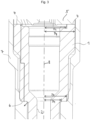
- Fig.1 shows a sectional view of a part of an injector for injecting fuel.
- the injector comprises a housing 5 in which, among other things, the nozzle needle 8 is accommodated. This protrudes from the housing 5 and is accommodated by the nozzle 1 in a receptacle 2 provided for this purpose. At its distal end, the nozzle 1 has its nozzle tip 3, which is provided with openings for discharging fuel.
- a nozzle clamping nut 7 is placed on the nozzle 1 and engaged with a thread provided on the housing 5.
- the threaded connection between the nozzle clamping nut 7 and the housing 5 presses the housing contact surface 4 of the nozzle 1 facing the housing 5 against a corresponding surface of the housing, resulting in a sealing connection.
- the nozzle clamping nut 7 presses against the projection surface 6 of the nozzle 1 and thus presses the nozzle 1 against the housing 5.
- the drawing also shows the axis of rotation 8 or, in the case of a rotationally symmetrical structure, the axis of rotation 8.
- the dotted rectangle shows the in Fig. 2 enlarged area shown.
- Fig.3 now shows a nozzle 1 according to the invention, wherein the already known elements of the nozzle 1 have been provided with the same reference numerals as in the previous figures. These will not be discussed separately in the following.
- the minimum distance D 1 from the axis of rotation 8 of the nozzle body 1 to the projection surface 6 is shown, which is smaller than the minimum distance D 2 from the axis of rotation 8 of the nozzle body 1 to the housing contact surface 4.
- the maximum distance D 3 perpendicular to the axis of rotation 8 of the nozzle body 1 to an outer edge of the projection surface 6 is smaller than the maximum distance D 4 perpendicular to the axis of rotation 8 of the nozzle body 1 to an outer edge of the housing contact surface 4. This also contributes to the desired reduction in the tensile stress in the transition region of the shoulder of the nozzle 1.
Landscapes
- Engineering & Computer Science (AREA)
- Chemical & Material Sciences (AREA)
- Combustion & Propulsion (AREA)
- Mechanical Engineering (AREA)
- General Engineering & Computer Science (AREA)
- Manufacturing & Machinery (AREA)
- Fuel-Injection Apparatus (AREA)
Description
- Die vorliegende Erfindung betrifft Düse eines Kraftstoffinjektors sowie einen Kraftstoffinjektor mit einer solchen Düse.
- In Brennkraftmaschinen wie Dieselmotoren oder auch Benzinmotoren wird in der Regel über einen Injektor Kraftstoff mit einer bestimmten Menge und für eine bestimmte Zeitdauer in einen Brennraum eingespritzt. Dabei ist es aufgrund der sehr geringen Einspritzdauern, die in Mikrosekunden-Bereich liegen, erforderlich, die Austrittsöffnung des Injektors mit einer sehr hohen Frequenz zu öffnen bzw. zu schließen.
- Da dem Fachmann das grundlegende Funktionsprinzip eines Injektors bekannt ist, wird nachfolgend nur kurz auf einige Aspekte eingegangen, die für das Verständnis der Erfindung von Vorteil sind.
US 2009/184185 A1 ,DE 10 2004 024119 A1 undWO 2005/008059 A1 offenbaren Düsen eines Kraftstoffinjektors. - Ein Injektor verfügt typischerweise über eine Düsennadel (auch: Injektornadel), die einen mit einem hohen Druck beaufschlagten Kraftstoff bei Freigeben eines Austrittslochs des Injektors nach Außen treten lässt. Diese Düsennadel wirkt im Zusammenspiel mit dieser Austrittsöffnung wie ein Pfropfen, der bei einem Anheben ein Austreten des Kraftstoffs ermöglicht. Demnach ist es also erforderlich, diese Nadel in relativ kurzen Zeitabständen anzuheben und nach einer kurzen Zeit erneut in die Austrittsöffnung zurückgleiten zu lassen.
- Der typische Aufbau eines solchen Kraftstoffinjektors umfasst dabei eine Düse, die eine Ausnehmung zur Aufnahme eines Teils der Düsennadel aufweist. Darüber hinaus ist ein Injektorgehäuse vorgesehen, in dem das Anheben und Senken der Düsennadel bewerkstelligt wird. Für ein Ansetzen der Düse an dem Gehäuse weist sowohl das Gehäuse als auch die Düse eine Anschlagfläche auf, die bei Ausüben eines ausreichend hohen Anpressdrucks der beiden Teile eine dichtende Verbindung erstellt. Um nun die Düse mit ausreichend hohem Druck gegen das Gehäuse zu drängen, ist in der Regel eine Düsenspannmutter vorgesehen, welche die Düse an einer Auskragungsfläche (auch genannt: Schulterbereich oder Schulter) angreift und mittels einer Gewindeverbindung von Düsenspannmutter und Gehäuse den nötigen Druck zwischen den beiden Anschlagflächen von Düse und Gehäuse erzeugt.
- Nachteilhaft hieran ist, dass im Übergangsbereich des Düsenkörpers hin zur der flanschartigen Auskragungsfläche durch den hohen notwendigen Druck Zugspannungen entstehen, die in diesem Bereich unter Betriebsbedingungen Risse sowie eine Rissbildung und einen Rissfortschritt begünstigen. So kommt es dort vermehrt zu Rissen (Schwingungsrisskorrosion), deren Auftreten durch die hohen Zugspannungen beim innenliegenden Übergang vom Düsenkörper zur Auskragungsfläche herrührt.
- Die hohen Zugspannungen sind darüber hinaus auch Resultat einer oftmals ballig ausgeformten Kontaktfläche von Düse und/oder Gehäuse in deren Kontaktbereich, womit eine sichere Abdichtung gewährleistet werden soll.
- Aus dem Stand der Technik sind unterschiedliche Ansätze bekannt, um die hohen Zugspannungen zu senken. So sind im Übergangsbereich zur flanschartigen Auskragungsfläche Freistiche vorgesehen worden oder die Oberflächen zusätzlich abgeschliffen worden. Auch wurde versucht, den Schulterbereich der Düse gegenüber den aggressiven und korrosionsfördernden Brenngasen abzudichten. Sämtliche dieser Ansätze bringen jedoch den Nachteil mit sich, dass diese aufwändig und kostenintensiv sind.
- Aufgabe der vorliegenden Erfindung ist es daher, eine Düse eines Kraftstoffinjektors bzw. einen Kraftstoffinjektor mit einer solchen Düse derart weiterzubilden, dass die bei herkömmlichen Düsen auftretenden Zugspannungen verringert werden ohne die Komplexität und die Kosten der Düse ansteigen zu lassen.
- Dies gelingt mit Hilfe der erfindungsgemäßen Düse, die sämtliche Merkmale des Anspruchs 1 aufweist. Weitere vorteilhafte Ausgestaltungen der Erfindung sind in den abhängigen Ansprüchen dargelegt.
- Demnach umfasst die Düse eines Kraftstoffinjektors nach Anspruch 1, einen drehsymmetrischen Düsenkörper mit einem Hohlraum zum Einführen einer Düsennadel, eine Düsenspitze, die an einem Längsende des Düsenkörpers vorgesehen ist und Öffnungen zum Auslassen von Kraftstoff aufweist, eine Gehäusekontaktfläche, die an dem anderen Längsende des Düsenkörpers vorgesehen ist und zum Anpressen an ein mit einem Gewinde versehenen Gehäuse eines Kraftstoffinjektors dient und eine Auskragungsfläche, die in der Längserstreckung des Düsenkörpers zwischen Düsenspitze und der Gehäusekontaktfläche vorgesehen ist und zum Ansetzen einer Düsenspannmutter dient. Die Düse ist einstückig ausgebildet und der minimale Abstand von der Drehachse des Düsenkörpers zur Auskragungsfläche ist kleiner als der minimale Abstand von der Drehachse des Düsenkörpers zur Gehäusekontaktfläche.
- Durch diesen Aufbau der Düse wird der Kraftfluss von Düsenspannmutter, Düse und Gehäuse bewusst nach außen verlegt, so dass die Zugspannung im inneren Übergangsbereich der Auskragungsfläche zum Ansetzen der Düsenspannmutter verringert wird. Die Verringerung der Zugspannung in dem Übergangsbereich ergibt sich, da der Kontaktbereich zwischen Düse und Gehäuse nun weiter außen angeordnet ist als der Kontaktbereich von Düse und Düsenspannmutter. So gelingt es, das Spannungsniveau auf ein unbedenkliches Maß abzusenken und das Auftreten von Rissen in diesem Bereich zu unterdrücken.
- Erfindungsgemäß ist vorgesehen, dass der maximale Abstand senkrecht zur Drehachse des Düsenkörpers zu einem äußeren Rand der Auskragungsfläche kleiner ist als der der maximale Abstand senkrecht zur Drehachse des Düsenkörpers zu einem äußeren Rand der Gehäusekontaktfläche.
- Auch dies bewirkt den als vorteilhaft angesehenen nach außen von der Drehachse der Düse weg verlaufenden Kraftfluss, der von der Düsenspannmutter ausgeht, durch die Düse verläuft und zum Gehäuse gerichtet ist.
- Ferner kann vorgesehen sein, dass eine Innenlinie der Auskragungsfläche, die entlang des Umfangs der Düse den jeweils radialen minimalen Abstand der Auskragungsfläche zur Drehachse definiert, eine kleinere Fläche besitzt als eine Innenlinie der Gehäusekontaktfläche, die entlang des Umfangs der Düse den jeweils radialen minimalen Abstand der Gehäusekontaktfläche definiert.
- In anderen Worten wird also für jeden Winkel entlang des Umfangs der Düse der minimale Abstand der Auskragungsfläche bzw. der Gehäusekontaktfläche bestimmt, so dass für die Auskragungsfläche bzw. die Gehäusekontaktfläche jeweils eine sich schließende Linie entsteht, die die Drehachse umgibt.
- Bei einer rotationssymmetrischen Düse entspricht die Innenlinie der Auskragungsfläche bzw. der Gehäusekontaktfläche einem Kreis, wohingegen bei einer drehsymmetrischen Düse die Linie bspw. einem Vieleck oder einer anderen drehsymmetrischen Form entsprechen kann.
- Ferner kann dabei vorgesehen sein, dass die Innenlinie der Gehäusekontaktfläche bei einer Projektion entlang der Drehachse die Innenlinie der Auskragungsfläche vollständig umschließt. Dadurch wird sichergestellt, dass an jedem Punkt in Umfangsrichtung der Düse der vorteilhafte Kraftfluss von innen nach außen vorliegt.
- Nach einer weiteren optionalen Modifikation der Düse besitzt eine Außenlinie der Auskragungsfläche, die entlang des Umfangs der Düse den jeweils radialen Abstand von der Drehachse zu einem äußeren Rand der Auskragungsfläche definiert, eine kleinere Fläche als eine Außenlinie der Gehäusekontaktfläche, die entlang des Umfangs der Düse den jeweils radialen Abstand von der Drehachse zu einem äußeren Rand der Gehäusekontaktfläche definiert.
- In anderen Worten wird also für jeden Winkel entlang des Umfangs der Düse der Abstand von der Drehachse zu einem äußeren Rand der Auskragungsfläche zu dessen bzw. der Gehäusekontaktfläche bestimmt, so dass für den äußeren Rand der Auskragungsfläche bzw. der Gehäusekontaktfläche jeweils eine sich schließende Linie entsteht, die die Drehachse umgibt.
- Dadurch kann weiter sichergestellt werden, dass der vorteilhafte Kraftfluss die gewünschte Orientierung von einem nahen Bereich der Drehachse im Bereich der Auskragungsfläche hin zu einem entfernteren Bereich der Drehachse im Bereich der Kontaktfläche besitzt.
- Auch hier kann vorzugsweise vorgesehen sein, dass die Außenlinie der Gehäusekontaktfläche bei einer Projektion entlang der Drehachse die Außenlinie der Auskragungsfläche vollständig umschließt. Der Abstand von der Drehachse zu einem äußeren Rand der Kontaktfläche ist also bei einem beliebigen bestimmten Winkel in Umfangsrichtung immer größer als der Abstand der Drehachse zu einem äußeren Rand der Auskragungsfläche bei dem bestimmen Winkel in Umfangsrichtung.
- Vorzugsweise definiert eine Mittenlinie der Auskragungsfläche, die entlang des Umfangs der Düse den Abstand von Innen- zur Außenlinie der Auskragungsfläche in Radialrichtung mittig unterteilt, eine kleinere Fläche als eine Mittenlinie der Gehäusekontaktfläche, die entlang des Umfangs der Düse den Abstand von Innenzur Außenlinie der Gehäusekontaktfläche (4) in Radialrichtung mittig unterteilt.
- Es wird eine Mittenlinie eingeführt, die in der Mitte zwischen der Außenlinie und der Innenlinie verläuft und in der Mitte des Abstands der jeweiligen Punkte für einen bestimmten Umfangswinkel von Außen- und Innenlinie angeordnet ist.
- Hier kann ebenfalls vorgesehen sein, dass die Mittenlinie der Gehäusekontaktfläche bei einer Projektion entlang der Drehachse die Mittenlinie der Auskragungsfläche vollständig umschließt.
- Nach einer weiteren Fortbildung der Erfindung ist die Gehäusekontaktfläche und/oder die Auskragungsfläche senkrecht zur Drehachse des Düsenkörpers angeordnet.
- Vorzugsweise besitzt dabei die Gehäusekontaktfläche und/oder die Auskragungsfläche die Form eines Kreisrings. Ferner kann dabei vorgesehen sein, dass der Innendurchmesser des Kreisrings der Auskragungsfläche kleiner ist als der Innendurchmesser des Kreisrings der Gehäusekontaktfläche. Alternativ oder zusätzlich kann vorgesehen sein, dass der Außendurchmesser des Kreisrings der Auskragungsfläche kleiner ist als der Außendurchmesser des Kreisrings der Gehäusekontaktfläche.
- Von der Erfindung ist ebenfalls die vorteilhafte Weiterbildung umfasst, wonach die Düse einstückig ausgebildet ist.
- Ferner kann nach der Erfindung vorgesehen sein, dass die Düse rotationssymmetrisch ausgebildet ist.
- Nach einer optionalen Modifikation der Erfindung ist vorgesehen, dass die Düse in ihrem Außendurchmesser und/oder ihrem Innendurchmesser quer zur Drehachse von der Spitze zur Gehäusekontaktfläche kontinuierlich zunimmt. Der Querschnitt der Düse nimmt somit von der Düsenspitze zur Gehäusekontaktfläche kontinuierlich zu oder bleibt gleich. Es kann lediglich der Fall sein, dass im Übergang zu Gehäusekontaktfläche die entsprechende Kante geschliffen ist, so dass das Merkmal der kontinuierlichen Querschnittszunahme nur bis kurz vor Erreichen der Gehäusekontaktfläche Gültigkeit hat.
- Die Erfindung umfasst ferner einen Kraftstoffinjektor mit einer Düse nach einer der vorhergehend diskutierten Varianten.
- Hierbei kann vorzugsweise vorgesehen sein, dass der Injektor ferner mit einem Gehäuse und einer Düsenspannmutter versehen ist, wobei die Düsenspannmutter mit dem Gehäuse in einer Gewindeverbindung steht, so dass die Düse mittels Krafteinwirkung der Düsenspannmutter auf die Auskragungsfläche die Gehäusekontaktfläche der Düse gegen das Gehäuse presst.
- Weitere Einzelheiten, Merkmale und Vorteile der Erfindung werden anhand der nachfolgenden Figurenbeschreibung ersichtlich. Dabei zeigen:
- Fig. 1:
- eine Schnittansicht eines Teils eines Injektors zur Kraftstoffeinspritzung nach dem Stand der Technik,
- Fig.2:
- einen vergrößerten Ausschnitt um den Schulterbereich der in
Fig. 1 dargestellten Düse, an dem die Düsenspannmutter angreift, und - Fig. 3:
- einen vergrößerten Ausschnitt um die Sitzplatte eines erfindungsgemäßen Injektors aus unterschiedlichen Ansichtsseiten.
-
Fig. 1 zeigt eine Schnittansicht eines Teils eines Injektors zum Einspritzen von Kraftstoff. - Der Injektor umfasst dabei ein Gehäuse 5, in dem unter anderem die Düsennadel 8 aufgenommen ist. Diese steht aus dem Gehäuse 5 hervor und wird von der Düse 1 in einer dafür vorgesehenen Aufnahme 2 aufgenommen. An ihrem distalen Ende weist die Düse 1 ihre Düsenspitze 3 auf, die mit Öffnungen zum Auslassen von Kraftstoff versehen ist.
- Um eine dichtende Verbindung von Gehäuse 5 und Düse 1 herzstellen, wird eine Düsenspannmutter 7 auf die Düse 1 aufgesetzt und mit einem am Gehäuse 5 vorgesehen Gewinde in Eingriff gebracht. Durch die Gewindeverbindung zwischen Düsenspannmutter 7 und Gehäuse 5 wird die zum Gehäuse 5 gerichtete Gehäusekontaktfläche 4 der Düse 1 gegen eine entsprechende Fläche des Gehäuses gepresst, so dass sich eine dichtende Verbindung ergibt. Dabei drängt die Düsenspannmutter 7 gegen die Auskragungsfläche 6 der Düse 1 und drängt so die Düse 1 gegen das Gehäuse 5. In der Zeichnung ist darüber hinaus auch die Drehachse 8 bzw. bei einem rotationssymmetrischen Aufbau die Rotationsachse 8 vorhanden.
- Das gepunktete Rechteck zeigt den in
Fig. 2 vergrößert dargestellten Bereich. - In der
Fig. 2 sind die bereits eingeführten Elemente mit den gleichen Bezugszeichen versehen wie in derFig. 1 . Der von einem Anlegen der Düsenspannmutter herrührende Kraftfluss ist dabei mit einem gewinkelten Pfeil dargestellt, der von einem entfernteren Bereich der Drehachse 8 zu einem näheren Bereich der Drehachse 8 verläuft. Dies ist in dem gegenüber der Auskragungsfläche 6 näher zur Drehachse 8 angeordneten Innenrand der Gehäusekontaktfläche 4 begründet, die den dargestellten Kraftfluss ermöglicht. Eine solche Anordnung führt im Ergebnis zu einer großen Zugspannung im Übergangsbereich zur flanschartigen Auskragung bzw. der Auskragungsfläche 6, wie es mit dem dicken in der Zeichnung schräg nach links unten gerichteten Pfeil symbolisiert ist. Das Vorhandensein einer solch hohen Zugspannung begünstigt das Auftreten von Rissen im Schulterbereich der Düse. -
Fig. 3 zeigt nun eine erfindungsgemäße Düse 1, wobei die bereits bekannten Elemente der Düse 1 mit den gleichen Bezugszeichen versehen worden sind wie in den vorhergehenden Figuren. Diese werden im Folgenden auch nicht mehr separat diskutiert. - Im Unterschied zum Stand der Technik stellt sich aufgrund der geänderten Gestaltung von der Gehäusekontaktfläche 4 ein anderer Kraftfluss von der Düsenspannmutter 7 über die Düse 1 und das Gehäuse 5 ein. Dieser Kraftfluss ist in der
Fig. 3 durch den gewinkelten Pfeil dargestellt, der von der Auskragungsfläche 6 zur Gehäusekontaktfläche 4 verläuft. Man erkennt, dass dieser nun bei Blickrichtung von unten nach oben (also von Auskragungsfläche 6 hin zur Gehäusekontaktfläche 4) nach außen hin gerichtet ist, was dazu führt, dass die Zugspannung im Übergangsbereich zur flanschartigen Auskragung bzw. der Auskragungsfläche 6 deutlich geringer ausfällt. Dies ist mit einem im Vergleich zurFig. 2 schlankeren Pfeil illustriert. - Ferner ist der minimale Abstand D1 von der Drehachse 8 des Düsenkörpers 1 zur Auskragungsfläche 6 dargestellt, der kleiner ist als der minimale Abstand D2 von der Drehachse 8 des Düsenkörpers 1 zur Gehäusekontaktfläche 4.
- Zudem ist in der vorliegenden Ausführungsform auch zu erkennen, dass der maximale Abstand D3 senkrecht zur Drehachse 8 des Düsenkörpers 1 zu einem äußeren Rand der Auskragungsfläche 6 kleiner ist als der maximale Abstand D4 senkrecht zur Drehachse 8 des Düsenkörpers 1 zu einem äußeren Rand der Gehäusekontaktfläche 4. Auch dies trägt zu der gewünschten Verringerung der Zugspannung im Übergangsbereich der Schulter der Düse 1 bei.
Claims (13)
- Düse eines Kraftstoffinjektors, umfassend:einen drehsymmetrischen Düsenkörper (1) mit einem Hohlraum (2) zum Einführen einer Düsennadel,eine Düsenspitze (3), die an einem Längsende des Düsenkörpers (1) vorgesehen ist und Öffnungen zum Auslassen von Kraftstoff aufweist,eine Gehäusekontaktfläche (4), die an dem anderen Längsende des Düsenkörpers (1) vorgesehen ist und zum Anpressen an ein mit einem Gewinde versehenen Gehäuse (5) eines Kraftstoffinjektors dient, undeine Auskragungsfläche (6), die in der Längserstreckung des Düsenkörpers (1) zwischen Düsenspitze (3) und der Gehäusekontaktfläche (4) vorgesehen ist und zum Ansetzen einer Düsenspannmutter (7) dient, wobeidie Düse einstückig ausgebildet ist, undder minimale Abstand (D1) von der Drehachse (8) des Düsenkörpers (1) zur Auskragungsfläche (6) kleiner ist als der minimale Abstand (D2) von der Drehachse (8) des Düsenkörpers (1) zur Gehäusekontaktfläche (4),wobeider maximale Abstand (D3) senkrecht zur Drehachse (8) des Düsenkörpers (1) zu einem äußeren Rand der Auskragungsfläche (6) kleiner ist als der der maximale Abstand (D4) senkrecht zur Drehachse (8) des Düsenkörpers (1) zu einem äußeren Rand der Gehäusekontaktfläche (4).
- Düse nach dem vorhergehenden Anspruch wobei eine Innenlinie der Auskragungsfläche (6), die entlang des Umfangs der Düse den jeweils radialen minimalen Abstand der Auskragungsfläche (6) zur Drehachse (8) definiert, eine kleinere Fläche besitzt als eine Innenlinie der Gehäusekontaktfläche (4), die entlang des Umfangs der Düse den jeweils radialen minimalen Abstand der Gehäusekontaktfläche (4) definiert.
- Düse nach Anspruch 2, wobei die Innenlinie der Gehäusekontaktfläche (4) bei einer Projektion entlang der Drehachse (8) die Innenlinie der Auskragungsfläche (6) vollständig umschließt.
- Düse nach einem der vorhergehenden Ansprüche, wobei eine Außenlinie der Auskragungsfläche (6), die entlang des Umfangs der Düse den jeweils radialen Abstand von der Drehachse (8) zu einem äußeren Rand der Auskragungsfläche (6) definiert, eine kleinere Fläche besitzt als eine Außenlinie der Gehäusekontaktfläche (4), die entlang des Umfangs der Düse den jeweils radialen Abstand von der Drehachse (8) zu einem äußeren Rand der Gehäusekontaktfläche (4) definiert.
- Düse nach Anspruch 4, wobei die Außenlinie der Gehäusekontaktfläche (4) bei einer Projektion entlang der Drehachse (8) die Außenlinie der Auskragungsfläche (6) vollständig umschließt.
- Düse nach den vorhergehenden Ansprüchen 2 bis 5, wobei eine Mittenlinie der Auskragungsfläche (6), die entlang des Umfangs der Düse den Abstand von Innen- zur Außenlinie der Auskragungsfläche (6) mittig unterteilt, eine kleinere Fläche definiert als eine Mittenlinie der Gehäusekontaktfläche (4), die entlang des Umfangs der Düse den Abstand von Innen- zur Außenlinie der Gehäusekontaktfläche (4) mittig unterteilt.
- Düse nach Anspruch 6, wobei die Mittenlinie der Gehäusekontaktfläche (4) bei einer Projektion entlang der Drehachse (8) die Mittenlinie der Auskragungsfläche (6) vollständig umschließt.
- Düse nach einem der vorhergehenden Ansprüche, wobei die Gehäusekontaktfläche (4) und/oder die Auskragungsfläche (6) senkrecht zur Drehachse (8) des Düsenkörpers (1) angeordnet sind.
- Düse nach einem der vorhergehenden Ansprüche, wobei die Gehäusekontaktfläche (4) und/oder die Auskragungsfläche (6) die Form eines Kreisrings aufweist.
- Düse nach einem der vorhergehenden Ansprüche, wobei die Düse rotationssymmetrisch ausgebildet ist.
- Düse nach einem der vorhergehenden Ansprüche, wobei die Düse in ihrem Außendurchmesser und/oder ihrem Innendurchmesser quer zur Drehachse (8) von der Spitze zur Gehäusekontaktfläche (4) kontinuierlich zunimmt.
- Kraftstoffinjektor mit einer Düse nach einem der vorhergehenden Ansprüche.
- Kraftstoffinjektor nach Anspruch 12, ferner mit einem Gehäuse (5) und einer Düsenspannmutter (7), wobei die Düsenspannmutter (7) mit dem Gehäuse (5) in einer Gewindeverbindung steht, so dass die Düse mittels Krafteinwirkung der Düsenspannmutter (7) auf die Auskragungsfläche (6) die Gehäusekontaktfläche (4) gegen das Gehäuse (5) presst.
Applications Claiming Priority (2)
| Application Number | Priority Date | Filing Date | Title |
|---|---|---|---|
| DE102019103329.2A DE102019103329A1 (de) | 2019-02-11 | 2019-02-11 | Düse eines Kraftstoffinjektors und Kraftstoffinjektor mit einer solchen Düse |
| PCT/EP2020/052929 WO2020165009A1 (de) | 2019-02-11 | 2020-02-06 | Düse eines kraftstoffinjektors und kraftstoffinjektor mit einer solchen düse |
Publications (2)
| Publication Number | Publication Date |
|---|---|
| EP3887666A1 EP3887666A1 (de) | 2021-10-06 |
| EP3887666B1 true EP3887666B1 (de) | 2024-04-03 |
Family
ID=69528826
Family Applications (1)
| Application Number | Title | Priority Date | Filing Date |
|---|---|---|---|
| EP20704495.9A Active EP3887666B1 (de) | 2019-02-11 | 2020-02-06 | Düse eines kraftstoffinjektors und kraftstoffinjektor mit einer solchen düse |
Country Status (6)
| Country | Link |
|---|---|
| US (1) | US12025086B2 (de) |
| EP (1) | EP3887666B1 (de) |
| CN (1) | CN113490790A (de) |
| DE (1) | DE102019103329A1 (de) |
| ES (1) | ES2982543T3 (de) |
| WO (1) | WO2020165009A1 (de) |
Family Cites Families (6)
| Publication number | Priority date | Publication date | Assignee | Title |
|---|---|---|---|---|
| JPH08254169A (ja) | 1995-03-17 | 1996-10-01 | Mitsubishi Heavy Ind Ltd | 内燃機関の燃料噴射弁 |
| WO2005008059A1 (de) | 2003-07-17 | 2005-01-27 | Ganser-Hydromag Ag | Brennstoffeinspritzventil für brennkraftmaschinen |
| DE102004024119B4 (de) | 2004-05-14 | 2006-04-20 | Siemens Ag | Düsenbaugruppe und Einspritzventil |
| US7963464B2 (en) * | 2008-01-23 | 2011-06-21 | Caterpillar Inc. | Fuel injector and method of assembly therefor |
| CH700396A1 (de) | 2009-02-09 | 2010-08-13 | Ganser Hydromag | Brennstoffeinspritzventil für Verbrennungskraftmaschinen. |
| DE102012217991A1 (de) | 2012-10-02 | 2014-04-03 | Continental Automotive Gmbh | Düsenbaugruppe für einen Fluidinjektor und Fluidinjektor |
-
2019
- 2019-02-11 DE DE102019103329.2A patent/DE102019103329A1/de not_active Withdrawn
-
2020
- 2020-02-06 US US17/430,308 patent/US12025086B2/en active Active
- 2020-02-06 ES ES20704495T patent/ES2982543T3/es active Active
- 2020-02-06 WO PCT/EP2020/052929 patent/WO2020165009A1/de not_active Ceased
- 2020-02-06 EP EP20704495.9A patent/EP3887666B1/de active Active
- 2020-02-06 CN CN202080014160.5A patent/CN113490790A/zh active Pending
Also Published As
| Publication number | Publication date |
|---|---|
| WO2020165009A1 (de) | 2020-08-20 |
| CN113490790A (zh) | 2021-10-08 |
| US12025086B2 (en) | 2024-07-02 |
| EP3887666A1 (de) | 2021-10-06 |
| US20220145839A1 (en) | 2022-05-12 |
| DE102019103329A1 (de) | 2020-08-13 |
| ES2982543T3 (es) | 2024-10-16 |
Similar Documents
| Publication | Publication Date | Title |
|---|---|---|
| DE102010032050B4 (de) | Düsenkörper mit Sackloch | |
| EP1408231B1 (de) | Einspritzvorrichtung zum Einspritzen von Kraftstoff | |
| EP3887666B1 (de) | Düse eines kraftstoffinjektors und kraftstoffinjektor mit einer solchen düse | |
| DE102009018767A1 (de) | Kraftstoffeinspritzdüse für eine Brennkraftmaschine | |
| DE102019209742A1 (de) | Düsenbaugruppe für einen Kraftstoffinjektor, Kraftstoffinjektor | |
| EP1523620B1 (de) | Einspritzventil | |
| EP3014104B1 (de) | Düsenbaugruppe für einen kraftstoffinjektor sowie kraftstoffinjektor | |
| EP1527272B1 (de) | Kraftstoffinjektor mit hochdruckfestem anschlussbereich | |
| WO2018091184A1 (de) | Injektor mit dreiteiligem ventilsitz | |
| DE102010030424A1 (de) | Steuerventil | |
| EP1597473B1 (de) | Kraftstoff-einspritzvorrichtung, insbesondere für brennkraftmaschinen mit kraftstoff-direkteinspritzung | |
| DE19853586A1 (de) | Demontagevorrichtung zur Demontage eines Brennstoffeinspritzventils | |
| DE10346845B4 (de) | Kraftstoffeinspritzventil für Brennkraftmaschinen | |
| DE19818200A1 (de) | Kraftstoffeinspritzventil | |
| EP3921535B1 (de) | Düse für einen kraftstoffinjektor | |
| EP3794227B1 (de) | Sitzplatte für einen injektor | |
| EP3803098B1 (de) | Verfahren zum fertigen einer düse zum einspritzen von kraftstoff | |
| WO2016102239A1 (de) | Düsenkörper und fluid-einspritzventil | |
| EP3999735B1 (de) | Kraftstoffinjektor | |
| EP0293371A1 (de) | Kraftstoff-einspritzdüse für brennkraftmaschinen. | |
| DE102021214315A1 (de) | Demontagevorrichtung zur Demontage eines Brennstoffeinspritzventils und Verfahren zur Demontage eines Brennstoffeinspritzventils | |
| WO2018015001A1 (de) | Kraftstoffinjektor | |
| DE102019209576A1 (de) | Injektor mit angepasster Gehäusegeometrie | |
| WO2025131354A1 (de) | Injektor zum einblasen eines gasförmigen mediums | |
| DE10002718A1 (de) | Kraftstoffeinspritzventil für Brennkraftmaschinen |
Legal Events
| Date | Code | Title | Description |
|---|---|---|---|
| STAA | Information on the status of an ep patent application or granted ep patent |
Free format text: STATUS: UNKNOWN |
|
| STAA | Information on the status of an ep patent application or granted ep patent |
Free format text: STATUS: THE INTERNATIONAL PUBLICATION HAS BEEN MADE |
|
| PUAI | Public reference made under article 153(3) epc to a published international application that has entered the european phase |
Free format text: ORIGINAL CODE: 0009012 |
|
| STAA | Information on the status of an ep patent application or granted ep patent |
Free format text: STATUS: REQUEST FOR EXAMINATION WAS MADE |
|
| 17P | Request for examination filed |
Effective date: 20210628 |
|
| AK | Designated contracting states |
Kind code of ref document: A1 Designated state(s): AL AT BE BG CH CY CZ DE DK EE ES FI FR GB GR HR HU IE IS IT LI LT LU LV MC MK MT NL NO PL PT RO RS SE SI SK SM TR |
|
| DAV | Request for validation of the european patent (deleted) | ||
| DAX | Request for extension of the european patent (deleted) | ||
| GRAP | Despatch of communication of intention to grant a patent |
Free format text: ORIGINAL CODE: EPIDOSNIGR1 |
|
| STAA | Information on the status of an ep patent application or granted ep patent |
Free format text: STATUS: GRANT OF PATENT IS INTENDED |
|
| INTG | Intention to grant announced |
Effective date: 20230905 |
|
| GRAS | Grant fee paid |
Free format text: ORIGINAL CODE: EPIDOSNIGR3 |
|
| P01 | Opt-out of the competence of the unified patent court (upc) registered |
Effective date: 20231228 |
|
| GRAA | (expected) grant |
Free format text: ORIGINAL CODE: 0009210 |
|
| STAA | Information on the status of an ep patent application or granted ep patent |
Free format text: STATUS: THE PATENT HAS BEEN GRANTED |
|
| AK | Designated contracting states |
Kind code of ref document: B1 Designated state(s): AL AT BE BG CH CY CZ DE DK EE ES FI FR GB GR HR HU IE IS IT LI LT LU LV MC MK MT NL NO PL PT RO RS SE SI SK SM TR |
|
| REG | Reference to a national code |
Ref country code: CH Ref legal event code: EP |
|
| REG | Reference to a national code |
Ref country code: DE Ref legal event code: R096 Ref document number: 502020007547 Country of ref document: DE |
|
| REG | Reference to a national code |
Ref country code: IE Ref legal event code: FG4D Free format text: LANGUAGE OF EP DOCUMENT: GERMAN |
|
| REG | Reference to a national code |
Ref country code: LT Ref legal event code: MG9D |
|
| REG | Reference to a national code |
Ref country code: NL Ref legal event code: MP Effective date: 20240403 |
|
| PG25 | Lapsed in a contracting state [announced via postgrant information from national office to epo] |
Ref country code: NL Free format text: LAPSE BECAUSE OF FAILURE TO SUBMIT A TRANSLATION OF THE DESCRIPTION OR TO PAY THE FEE WITHIN THE PRESCRIBED TIME-LIMIT Effective date: 20240403 |
|
| PG25 | Lapsed in a contracting state [announced via postgrant information from national office to epo] |
Ref country code: NL Free format text: LAPSE BECAUSE OF FAILURE TO SUBMIT A TRANSLATION OF THE DESCRIPTION OR TO PAY THE FEE WITHIN THE PRESCRIBED TIME-LIMIT Effective date: 20240403 |
|
| PG25 | Lapsed in a contracting state [announced via postgrant information from national office to epo] |
Ref country code: IS Free format text: LAPSE BECAUSE OF FAILURE TO SUBMIT A TRANSLATION OF THE DESCRIPTION OR TO PAY THE FEE WITHIN THE PRESCRIBED TIME-LIMIT Effective date: 20240803 |
|
| PG25 | Lapsed in a contracting state [announced via postgrant information from national office to epo] |
Ref country code: BG Free format text: LAPSE BECAUSE OF FAILURE TO SUBMIT A TRANSLATION OF THE DESCRIPTION OR TO PAY THE FEE WITHIN THE PRESCRIBED TIME-LIMIT Effective date: 20240403 |
|
| PG25 | Lapsed in a contracting state [announced via postgrant information from national office to epo] |
Ref country code: HR Free format text: LAPSE BECAUSE OF FAILURE TO SUBMIT A TRANSLATION OF THE DESCRIPTION OR TO PAY THE FEE WITHIN THE PRESCRIBED TIME-LIMIT Effective date: 20240403 Ref country code: FI Free format text: LAPSE BECAUSE OF FAILURE TO SUBMIT A TRANSLATION OF THE DESCRIPTION OR TO PAY THE FEE WITHIN THE PRESCRIBED TIME-LIMIT Effective date: 20240403 |
|
| PG25 | Lapsed in a contracting state [announced via postgrant information from national office to epo] |
Ref country code: GR Free format text: LAPSE BECAUSE OF FAILURE TO SUBMIT A TRANSLATION OF THE DESCRIPTION OR TO PAY THE FEE WITHIN THE PRESCRIBED TIME-LIMIT Effective date: 20240704 |
|
| PG25 | Lapsed in a contracting state [announced via postgrant information from national office to epo] |
Ref country code: PT Free format text: LAPSE BECAUSE OF FAILURE TO SUBMIT A TRANSLATION OF THE DESCRIPTION OR TO PAY THE FEE WITHIN THE PRESCRIBED TIME-LIMIT Effective date: 20240805 |
|
| REG | Reference to a national code |
Ref country code: ES Ref legal event code: FG2A Ref document number: 2982543 Country of ref document: ES Kind code of ref document: T3 Effective date: 20241016 |
|
| PG25 | Lapsed in a contracting state [announced via postgrant information from national office to epo] |
Ref country code: CZ Free format text: LAPSE BECAUSE OF FAILURE TO SUBMIT A TRANSLATION OF THE DESCRIPTION OR TO PAY THE FEE WITHIN THE PRESCRIBED TIME-LIMIT Effective date: 20240403 |
|
| PG25 | Lapsed in a contracting state [announced via postgrant information from national office to epo] |
Ref country code: PL Free format text: LAPSE BECAUSE OF FAILURE TO SUBMIT A TRANSLATION OF THE DESCRIPTION OR TO PAY THE FEE WITHIN THE PRESCRIBED TIME-LIMIT Effective date: 20240403 |
|
| PG25 | Lapsed in a contracting state [announced via postgrant information from national office to epo] |
Ref country code: LV Free format text: LAPSE BECAUSE OF FAILURE TO SUBMIT A TRANSLATION OF THE DESCRIPTION OR TO PAY THE FEE WITHIN THE PRESCRIBED TIME-LIMIT Effective date: 20240403 |
|
| PG25 | Lapsed in a contracting state [announced via postgrant information from national office to epo] |
Ref country code: PT Free format text: LAPSE BECAUSE OF FAILURE TO SUBMIT A TRANSLATION OF THE DESCRIPTION OR TO PAY THE FEE WITHIN THE PRESCRIBED TIME-LIMIT Effective date: 20240805 Ref country code: PL Free format text: LAPSE BECAUSE OF FAILURE TO SUBMIT A TRANSLATION OF THE DESCRIPTION OR TO PAY THE FEE WITHIN THE PRESCRIBED TIME-LIMIT Effective date: 20240403 Ref country code: NO Free format text: LAPSE BECAUSE OF FAILURE TO SUBMIT A TRANSLATION OF THE DESCRIPTION OR TO PAY THE FEE WITHIN THE PRESCRIBED TIME-LIMIT Effective date: 20240703 Ref country code: LV Free format text: LAPSE BECAUSE OF FAILURE TO SUBMIT A TRANSLATION OF THE DESCRIPTION OR TO PAY THE FEE WITHIN THE PRESCRIBED TIME-LIMIT Effective date: 20240403 Ref country code: IS Free format text: LAPSE BECAUSE OF FAILURE TO SUBMIT A TRANSLATION OF THE DESCRIPTION OR TO PAY THE FEE WITHIN THE PRESCRIBED TIME-LIMIT Effective date: 20240803 Ref country code: HR Free format text: LAPSE BECAUSE OF FAILURE TO SUBMIT A TRANSLATION OF THE DESCRIPTION OR TO PAY THE FEE WITHIN THE PRESCRIBED TIME-LIMIT Effective date: 20240403 Ref country code: GR Free format text: LAPSE BECAUSE OF FAILURE TO SUBMIT A TRANSLATION OF THE DESCRIPTION OR TO PAY THE FEE WITHIN THE PRESCRIBED TIME-LIMIT Effective date: 20240704 Ref country code: FI Free format text: LAPSE BECAUSE OF FAILURE TO SUBMIT A TRANSLATION OF THE DESCRIPTION OR TO PAY THE FEE WITHIN THE PRESCRIBED TIME-LIMIT Effective date: 20240403 Ref country code: CZ Free format text: LAPSE BECAUSE OF FAILURE TO SUBMIT A TRANSLATION OF THE DESCRIPTION OR TO PAY THE FEE WITHIN THE PRESCRIBED TIME-LIMIT Effective date: 20240403 Ref country code: BG Free format text: LAPSE BECAUSE OF FAILURE TO SUBMIT A TRANSLATION OF THE DESCRIPTION OR TO PAY THE FEE WITHIN THE PRESCRIBED TIME-LIMIT Effective date: 20240403 Ref country code: RS Free format text: LAPSE BECAUSE OF FAILURE TO SUBMIT A TRANSLATION OF THE DESCRIPTION OR TO PAY THE FEE WITHIN THE PRESCRIBED TIME-LIMIT Effective date: 20240703 |
|
| REG | Reference to a national code |
Ref country code: DE Ref legal event code: R097 Ref document number: 502020007547 Country of ref document: DE |
|
| PG25 | Lapsed in a contracting state [announced via postgrant information from national office to epo] |
Ref country code: DK Free format text: LAPSE BECAUSE OF FAILURE TO SUBMIT A TRANSLATION OF THE DESCRIPTION OR TO PAY THE FEE WITHIN THE PRESCRIBED TIME-LIMIT Effective date: 20240403 |
|
| PG25 | Lapsed in a contracting state [announced via postgrant information from national office to epo] |
Ref country code: EE Free format text: LAPSE BECAUSE OF FAILURE TO SUBMIT A TRANSLATION OF THE DESCRIPTION OR TO PAY THE FEE WITHIN THE PRESCRIBED TIME-LIMIT Effective date: 20240403 |
|
| PG25 | Lapsed in a contracting state [announced via postgrant information from national office to epo] |
Ref country code: RO Free format text: LAPSE BECAUSE OF FAILURE TO SUBMIT A TRANSLATION OF THE DESCRIPTION OR TO PAY THE FEE WITHIN THE PRESCRIBED TIME-LIMIT Effective date: 20240403 Ref country code: SK Free format text: LAPSE BECAUSE OF FAILURE TO SUBMIT A TRANSLATION OF THE DESCRIPTION OR TO PAY THE FEE WITHIN THE PRESCRIBED TIME-LIMIT Effective date: 20240403 |
|
| PG25 | Lapsed in a contracting state [announced via postgrant information from national office to epo] |
Ref country code: SM Free format text: LAPSE BECAUSE OF FAILURE TO SUBMIT A TRANSLATION OF THE DESCRIPTION OR TO PAY THE FEE WITHIN THE PRESCRIBED TIME-LIMIT Effective date: 20240403 |
|
| PG25 | Lapsed in a contracting state [announced via postgrant information from national office to epo] |
Ref country code: SM Free format text: LAPSE BECAUSE OF FAILURE TO SUBMIT A TRANSLATION OF THE DESCRIPTION OR TO PAY THE FEE WITHIN THE PRESCRIBED TIME-LIMIT Effective date: 20240403 Ref country code: SK Free format text: LAPSE BECAUSE OF FAILURE TO SUBMIT A TRANSLATION OF THE DESCRIPTION OR TO PAY THE FEE WITHIN THE PRESCRIBED TIME-LIMIT Effective date: 20240403 Ref country code: RO Free format text: LAPSE BECAUSE OF FAILURE TO SUBMIT A TRANSLATION OF THE DESCRIPTION OR TO PAY THE FEE WITHIN THE PRESCRIBED TIME-LIMIT Effective date: 20240403 Ref country code: EE Free format text: LAPSE BECAUSE OF FAILURE TO SUBMIT A TRANSLATION OF THE DESCRIPTION OR TO PAY THE FEE WITHIN THE PRESCRIBED TIME-LIMIT Effective date: 20240403 Ref country code: DK Free format text: LAPSE BECAUSE OF FAILURE TO SUBMIT A TRANSLATION OF THE DESCRIPTION OR TO PAY THE FEE WITHIN THE PRESCRIBED TIME-LIMIT Effective date: 20240403 |
|
| PLBE | No opposition filed within time limit |
Free format text: ORIGINAL CODE: 0009261 |
|
| STAA | Information on the status of an ep patent application or granted ep patent |
Free format text: STATUS: NO OPPOSITION FILED WITHIN TIME LIMIT |
|
| 26N | No opposition filed |
Effective date: 20250106 |
|
| PG25 | Lapsed in a contracting state [announced via postgrant information from national office to epo] |
Ref country code: SI Free format text: LAPSE BECAUSE OF FAILURE TO SUBMIT A TRANSLATION OF THE DESCRIPTION OR TO PAY THE FEE WITHIN THE PRESCRIBED TIME-LIMIT Effective date: 20240403 |
|
| PG25 | Lapsed in a contracting state [announced via postgrant information from national office to epo] |
Ref country code: SE Free format text: LAPSE BECAUSE OF FAILURE TO SUBMIT A TRANSLATION OF THE DESCRIPTION OR TO PAY THE FEE WITHIN THE PRESCRIBED TIME-LIMIT Effective date: 20240403 |
|
| PG25 | Lapsed in a contracting state [announced via postgrant information from national office to epo] |
Ref country code: MC Free format text: LAPSE BECAUSE OF FAILURE TO SUBMIT A TRANSLATION OF THE DESCRIPTION OR TO PAY THE FEE WITHIN THE PRESCRIBED TIME-LIMIT Effective date: 20240403 |
|
| PG25 | Lapsed in a contracting state [announced via postgrant information from national office to epo] |
Ref country code: LU Free format text: LAPSE BECAUSE OF NON-PAYMENT OF DUE FEES Effective date: 20250206 |
|
| REG | Reference to a national code |
Ref country code: BE Ref legal event code: MM Effective date: 20250228 |
|
| PG25 | Lapsed in a contracting state [announced via postgrant information from national office to epo] |
Ref country code: IT Free format text: LAPSE BECAUSE OF NON-PAYMENT OF DUE FEES Effective date: 20250206 |
|
| PG25 | Lapsed in a contracting state [announced via postgrant information from national office to epo] |
Ref country code: BE Free format text: LAPSE BECAUSE OF NON-PAYMENT OF DUE FEES Effective date: 20250228 |
|
| PG25 | Lapsed in a contracting state [announced via postgrant information from national office to epo] |
Ref country code: IE Free format text: LAPSE BECAUSE OF NON-PAYMENT OF DUE FEES Effective date: 20250206 |
|
| REG | Reference to a national code |
Ref country code: CH Ref legal event code: U11 Free format text: ST27 STATUS EVENT CODE: U-0-0-U10-U11 (AS PROVIDED BY THE NATIONAL OFFICE) Effective date: 20260301 |
|
| PGFP | Annual fee paid to national office [announced via postgrant information from national office to epo] |
Ref country code: GB Payment date: 20260226 Year of fee payment: 7 |
|
| PGFP | Annual fee paid to national office [announced via postgrant information from national office to epo] |
Ref country code: ES Payment date: 20260302 Year of fee payment: 7 |
|
| PGFP | Annual fee paid to national office [announced via postgrant information from national office to epo] |
Ref country code: DE Payment date: 20260303 Year of fee payment: 7 |
|
| PGFP | Annual fee paid to national office [announced via postgrant information from national office to epo] |
Ref country code: AT Payment date: 20260223 Year of fee payment: 7 |
|
| PG25 | Lapsed in a contracting state [announced via postgrant information from national office to epo] |
Ref country code: IT Free format text: LAPSE BECAUSE OF NON-PAYMENT OF DUE FEES Effective date: 20250206 |
|
| PGFP | Annual fee paid to national office [announced via postgrant information from national office to epo] |
Ref country code: IT Payment date: 20260227 Year of fee payment: 7 |
|
| PGRI | Patent reinstated in contracting state [announced from national office to epo] |
Ref country code: IT Effective date: 20250630 |
|
| PGFP | Annual fee paid to national office [announced via postgrant information from national office to epo] |
Ref country code: FR Payment date: 20260225 Year of fee payment: 7 |
|
| PGFP | Annual fee paid to national office [announced via postgrant information from national office to epo] |
Ref country code: CH Payment date: 20260301 Year of fee payment: 7 |