EP3865843A1 - Sniffing gas leak detector with hand probe - Google Patents
Sniffing gas leak detector with hand probe Download PDFInfo
- Publication number
- EP3865843A1 EP3865843A1 EP20156649.4A EP20156649A EP3865843A1 EP 3865843 A1 EP3865843 A1 EP 3865843A1 EP 20156649 A EP20156649 A EP 20156649A EP 3865843 A1 EP3865843 A1 EP 3865843A1
- Authority
- EP
- European Patent Office
- Prior art keywords
- gas
- vacuum pump
- conducting line
- sensor
- leak detector
- Prior art date
- Legal status (The legal status is an assumption and is not a legal conclusion. Google has not performed a legal analysis and makes no representation as to the accuracy of the status listed.)
- Pending
Links
Images
Classifications
-
- G—PHYSICS
- G01—MEASURING; TESTING
- G01M—TESTING STATIC OR DYNAMIC BALANCE OF MACHINES OR STRUCTURES; TESTING OF STRUCTURES OR APPARATUS, NOT OTHERWISE PROVIDED FOR
- G01M3/00—Investigating fluid-tightness of structures
- G01M3/02—Investigating fluid-tightness of structures by using fluid or vacuum
- G01M3/04—Investigating fluid-tightness of structures by using fluid or vacuum by detecting the presence of fluid at the leakage point
- G01M3/20—Investigating fluid-tightness of structures by using fluid or vacuum by detecting the presence of fluid at the leakage point using special tracer materials, e.g. dye, fluorescent material, radioactive material
- G01M3/202—Investigating fluid-tightness of structures by using fluid or vacuum by detecting the presence of fluid at the leakage point using special tracer materials, e.g. dye, fluorescent material, radioactive material using mass spectrometer detection systems
- G01M3/205—Accessories or associated equipment; Pump constructions
-
- G—PHYSICS
- G01—MEASURING; TESTING
- G01M—TESTING STATIC OR DYNAMIC BALANCE OF MACHINES OR STRUCTURES; TESTING OF STRUCTURES OR APPARATUS, NOT OTHERWISE PROVIDED FOR
- G01M3/00—Investigating fluid-tightness of structures
- G01M3/02—Investigating fluid-tightness of structures by using fluid or vacuum
- G01M3/04—Investigating fluid-tightness of structures by using fluid or vacuum by detecting the presence of fluid at the leakage point
- G01M3/20—Investigating fluid-tightness of structures by using fluid or vacuum by detecting the presence of fluid at the leakage point using special tracer materials, e.g. dye, fluorescent material, radioactive material
Definitions
- the invention relates to a gas leak detector with a hand-held sniffing probe.
- a vacuum pump is connected to the sniffing probe via a gas conducting line, such that the vacuum pump generates a vacuum pressure resulting in a gas flow into the suction inlet of the sniffing probe and through the gas conducting line into the vacuum pump.
- a gas solid state semiconductor sensor is arranged to analyze the gas flowing through the gas conducting line in order to identify a specific gas component.
- the solid state semiconductor sensor within the hand-held sniffing probe which is located at a remote distance from the vacuum pump.
- the hand-held probe is typically moved along the surface which is to be analyzed for the presence of a possible gas leak.
- the gas sensor may be sensitive to such movement of the hand-held probe, which might affect the correctness of the measurement signal generated by the gas sensor. This is particularly the case with a gas sensor of the metal oxide type, such as a solid state hydrogen sensor.
- mass spectrometric gas detection unit In mass spectrometric gas leak detectors, such as the INFICON XL3000flex, the mass spectrometric gas detection unit is typically comprised within the main component, because it is not possible to incorporate a large and heavy mass spectrometer into the hand-held sniffing probe.
- gas leak detectors of the Wise Technology type such as the INFICON Protec P3000XL.
- the gas detection unit comprises a helium selective permeable quartz membrane and the respective detection units are also incorporated in the main unit of the leak detector, because it is not possible to incorporate the large and heavy gas detection unit into a hand-held sniffing probe.
- Gas leak detectors employing a gas sensor of the solid state semiconductor type are used with sniffing probes with small sensors integrated into the hand-held probe in order to permit fast reaction times.
- the gas sensor is arranged at the location of the vacuum pump close to the vacuum pump and at a remote distance from the hand-held sniffing probe and its suction inlet, such that movements of the hand-held sniffing probe do not result in movement of the gas sensor.
- the gas sensor analyses the gas sucked in through the suction inlet during leak detection.
- the gas sensor directly analyses tracer gas components in the gas flow which is continuously or periodically sucked in.
- the gas sensor analyses tracer gas components in the entire gas flow, rather than separated components of the gas flow one after the other, such as in the case of a gas chromatograph sensor which separates a gas to be analysed into its separate components which are analyzed one after the other.
- the gas sensor of the invention on the other hand, analayzes the tracer gas components of the gas flow simultaneously, i. e. the gas components are sensed by the sensor simultaneously, rather than subsequently.
- the gas sensor is arranged at the low pressure inlet side of the vacuum pump, rather than at the outlet side of the vacuum pump, which is typically at atmospheric pressure.
- the low pressure inlet side is at a lower pressure than the outlet of the vacuum pump, i. e. typically at a pressure below atmospheric pressure.
- the gas sensor and the hand-held sniffing probe are connected by a first portion of a gas conducting line which connects the sniffing probe suction inlet at the sniffing tip of the sniffing probe with the inlet of a gas sensor.
- a second portion of this gas conducting line connects the outlet of the gas sensor with the inlet of the vacuum pump.
- the length of the first portion of the gas conducting line is larger than the length of the second portion, in order to achieve that the gas sensor is arranged close to the low pressure inlet of the vacuum pump and at a remote distance from the sniffing probe.
- the gas sensor is not arranged within or attached to the housing of the sniffing probe.
- the vacuum pump and the gas sensor may be arranged in a common housing of the gas leak detector, such that the common housing forms a leak detector device or instrument remote from the sniffing probe and connected to the sniffing probe via the gas conducting line.
- the gas conducting line may be a hose.
- the pump is typically operated to generate an inlet pressure of lower than 400 mbar, and preferably between 50 and 250 mbar, and a gas volume flow through the gas conducting line of approximately 20 - 3000 sccm (standard cubic centimetres per minute).
- the length of the gas conducting line and, particularly, of the first portion of the gas conducting line is below 10 meters and, preferably, below 5 meters.
- the inner diameter of the gas conducting line and, in particular, of the first portion thereof is below 5 mm, and preferably below 2 mm. This achieves an acceptably short response time of less than a few seconds between the point in time where a specific gas component to be detected enters the sniffing probe's suction inlet, and the point in time, at which the gas sensor detects the gas component.
- the gas sensor is a semiconductor sensor, such as a solid state hydrogen sensor.
- the length of the second portion of the gas conducting line between the gas sensor and the inlet of the vacuum pump is preferably below 1 meter, and even more preferably below 50 cm to arrange the sensor sufficiently close to the vacuum pump and sufficiently remote from the probe.
- the vacuum pump In operation, the vacuum pump generates a vacuum pressure of below 400 mbar within the gas conducting line, such that the gas sensor analyzes gas having a pressure of below 400 mbar and, preferably, between 50 and 250 mbar.
- the gas leak detector In operation, the gas leak detector generates a suction gas flow of approximately 20 - 3000 sccm through the gas conducting line.
- the orifice of the hand-held sniffing probe forms the suction inlet into the gas conducting line.
- the hand-held probe does not contain the gas sensor.
- the gas sensor is rather arranged close to the vacuum pump at the low pressure inlet of the vacuum pump.
- the hand-held sniffing probe might just be the distal end portion of the gas conduction line, where the orifice is formed by the open end portion at the distal tip of the gas conducting line.
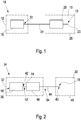
- FIG. 1 shows a prior art gas leak detector having a hand-held sniffing probe 10.
- the prior art gas leak detector comprises a housing 12 forming a gas leak detector instrument 14, which contains a vacuum pump 16.
- the sniffing probe 10 comprises a distal tip 18 having an orifice forming a suction inlet 20.
- the suction inlet 20 is connected to the inlet 22 of the vacuum pump 16 via a gas conducting line 24 formed by a hose-like fluid cable.
- gas sensor 26 is arranged at or within the hand-held sniffing probe 10, i. e. such as within a housing 28 of the sniffing probe 10.
- the length of the gas conducting line 24 between the gas sensor 26 and the gas inlet 22 of the vacuum pump 16 is thus much larger than the length of the gas conducting line 24 between the suction inlet 20 of the sniffing probe 10 and the gas sensor 26.
- a housing 32 of the leak detector instrument 34 not only contains the vacuum pump 36, but also the gas sensor 46.
- the gas conducting line 44 connects the distal tip of the sniffing probe 30 with the inlet 42 of the vacuum pump 36.
- a first portion 54 of the gas conducting line 44 connects the gas sensor 46 to the suction inlet 40 at the distal tip 18 of the sniffing probe 30.
- a second portion 52 of the gas conducting line 44 connects the inlet 42 of the vacuum pump 36 with the gas sensor 46.
- the gas sensor 46 is not arranged within the housing 48 of the sniffing probe 30. The gas sensor 46 is rather connected to the inlet 42 of the vacuum pump 36 via the second portion 52 of the gas conducting line 44.
- the gas conducting line 44 connects the distal tip of the sniffing probe 30 with the inlet 42 of the vacuum pump 36.
- the length of the second portion 52 of the gas conducting line 44 is much shorter than the length of the first portion 54.
- a first portion 54 of the gas conducting line 44 connects the gas sensor 46 to the suction inlet 40 at the distal tip 18 of the sniffing probe 30.
- the vacuum pump 36 has an outlet 56 open to atmosphere, while the inlet 42 of the vacuum pump 36 generates a vacuum pressure lower than atmospheric pressure in operation of the gas leak detector, preferably below 400 mbar.
- the first portion 54 of the gas conducting line 44 may be a hose-like fluid cable.
- the length of the first portion 54 is lower than 10 meters, and preferably lower than 5 meters, and larger than 1 meter.
- the inner diameter of both portions 52, 54 of the gas conducting line 44 is approximately 0,5 mm to 2 mm.
- the vacuum pump generates a gas flow into the suction inlet 40 and through the gas conducting line 44 of approximately 20 - 3000 sccm.
- the gas sensor 46 is a solid state semiconductor hydrogen sensor/ a tin oxide (SnO 2 ) sensor.
- a tin oxide (SnO 2 ) semiconductor sensor is sensitive to acceleration. In prior art detectors, such as according to figure 1 , where the sensor is mounted within the hand-held sniffing probe 10, this phenomenon severely restricts the use of the probe. Movements of the probe affect the measurement signal generated by the gad sensor 26.
- the idea of the invention is to move the gas sensor from the hand-held sniffing probe 10 to the leak detection instrument 34 containing the vacuum pump to avoid acceleration generated signals.
- the reaction time corresponds with the transport time of the gas from the suction inlet 40 at the distal tip 18 of the probe 30 to the gas sensor 46 inside the instrument 34.
- the transport time is reduced by reducing the pressure and the inner volume of the first portion 54 of the gas conducting line 44 between the probe 30 and the gas sensor 46.
- the inner volume is reduced by a maximum length of the first portion 54 of 3 meters and an inner diameter of 2 mm. In an alternative embodiment, the maximum length of the first portion 54 is 5 meters and its inner diameter 2 mm.
- the operation pressure within the first portion 54 of the conducting line 44 is reduced to 40 - 200 torr (approximately 50 - 250 mbar) by operation of the vacuum pump 36.
- An orifice is placed at the distal tip 18 of the gas conducting line 44 to form the suction inlet 40.
- the sensor 46 is located close to the pump 36 at its vacuum side, i. e. close to the low pressure inlet 42 of the vacuum pump 36.
Landscapes
- Physics & Mathematics (AREA)
- General Physics & Mathematics (AREA)
- Examining Or Testing Airtightness (AREA)
- Investigating Or Analyzing Materials By The Use Of Fluid Adsorption Or Reactions (AREA)
Priority Applications (5)
| Application Number | Priority Date | Filing Date | Title |
|---|---|---|---|
| EP20156649.4A EP3865843A1 (en) | 2020-02-11 | 2020-02-11 | Sniffing gas leak detector with hand probe |
| CN202180012279.3A CN115104017A (zh) | 2020-02-11 | 2021-01-18 | 带手持式探头的嗅探式气体泄漏检测器 |
| JP2022548816A JP7611258B2 (ja) | 2020-02-11 | 2021-01-18 | ハンドプローブを備える吸込み式ガスリーク検知器 |
| US17/797,654 US20230204447A1 (en) | 2020-02-11 | 2021-01-18 | Sniffing gas leak detector with hand probe |
| PCT/EP2021/050951 WO2021160377A1 (en) | 2020-02-11 | 2021-01-18 | Sniffing gas leak detector with hand probe |
Applications Claiming Priority (1)
| Application Number | Priority Date | Filing Date | Title |
|---|---|---|---|
| EP20156649.4A EP3865843A1 (en) | 2020-02-11 | 2020-02-11 | Sniffing gas leak detector with hand probe |
Publications (1)
| Publication Number | Publication Date |
|---|---|
| EP3865843A1 true EP3865843A1 (en) | 2021-08-18 |
Family
ID=69571836
Family Applications (1)
| Application Number | Title | Priority Date | Filing Date |
|---|---|---|---|
| EP20156649.4A Pending EP3865843A1 (en) | 2020-02-11 | 2020-02-11 | Sniffing gas leak detector with hand probe |
Country Status (5)
| Country | Link |
|---|---|
| US (1) | US20230204447A1 (enExample) |
| EP (1) | EP3865843A1 (enExample) |
| JP (1) | JP7611258B2 (enExample) |
| CN (1) | CN115104017A (enExample) |
| WO (1) | WO2021160377A1 (enExample) |
Citations (3)
| Publication number | Priority date | Publication date | Assignee | Title |
|---|---|---|---|---|
| DE4325419A1 (de) * | 1993-07-29 | 1995-02-02 | Ust Umweltsensortechnik Gmbh | Lecksuchgerät für Vakuumanlagen |
| US20080276692A1 (en) * | 2005-03-03 | 2008-11-13 | Inficon Gmbh | Leak Indicator Comprising a Sniffer Probe |
| EP3567356A1 (en) * | 2018-05-07 | 2019-11-13 | Inficon GmbH | Sniffing leak detector with switching valve and buffer chamber |
Family Cites Families (9)
| Publication number | Priority date | Publication date | Assignee | Title |
|---|---|---|---|---|
| JPH0695082B2 (ja) * | 1987-10-08 | 1994-11-24 | 新コスモス電機株式会社 | 吸引式オゾンガス検知器 |
| DE10133567A1 (de) * | 2001-07-13 | 2003-01-30 | Inficon Gmbh | Schnüffellecksucher und Verfahren zu seinem Betrieb |
| DE102005043494A1 (de) * | 2005-09-13 | 2007-03-15 | Inficon Gmbh | Lecksuchgerät mit Schnüffelsonde |
| DE102006034735A1 (de) * | 2006-07-27 | 2008-01-31 | Inficon Gmbh | Lecksuchgerät |
| DE102007043382A1 (de) * | 2007-09-12 | 2009-03-19 | Inficon Gmbh | Schnüffellecksucher |
| JP2012047651A (ja) * | 2010-08-30 | 2012-03-08 | Anest Iwata Corp | リーク検出装置 |
| CA3301451A1 (en) * | 2017-01-06 | 2026-03-02 | Exedra As | Plug, system and method for testing the integrity of a well barrier |
| FR3069639B1 (fr) * | 2017-07-26 | 2019-08-30 | Pfeiffer Vacuum | Sonde de reniflage, detecteur de fuites et procede de detection de fuites |
| JP7024643B2 (ja) * | 2018-07-18 | 2022-02-24 | 富士通株式会社 | におい測定装置、におい測定システム、及び、におい測定方法 |
-
2020
- 2020-02-11 EP EP20156649.4A patent/EP3865843A1/en active Pending
-
2021
- 2021-01-18 WO PCT/EP2021/050951 patent/WO2021160377A1/en not_active Ceased
- 2021-01-18 CN CN202180012279.3A patent/CN115104017A/zh active Pending
- 2021-01-18 US US17/797,654 patent/US20230204447A1/en not_active Abandoned
- 2021-01-18 JP JP2022548816A patent/JP7611258B2/ja active Active
Patent Citations (3)
| Publication number | Priority date | Publication date | Assignee | Title |
|---|---|---|---|---|
| DE4325419A1 (de) * | 1993-07-29 | 1995-02-02 | Ust Umweltsensortechnik Gmbh | Lecksuchgerät für Vakuumanlagen |
| US20080276692A1 (en) * | 2005-03-03 | 2008-11-13 | Inficon Gmbh | Leak Indicator Comprising a Sniffer Probe |
| EP3567356A1 (en) * | 2018-05-07 | 2019-11-13 | Inficon GmbH | Sniffing leak detector with switching valve and buffer chamber |
Also Published As
| Publication number | Publication date |
|---|---|
| US20230204447A1 (en) | 2023-06-29 |
| JP2023513730A (ja) | 2023-04-03 |
| CN115104017A (zh) | 2022-09-23 |
| JP7611258B2 (ja) | 2025-01-09 |
| WO2021160377A1 (en) | 2021-08-19 |
Similar Documents
| Publication | Publication Date | Title |
|---|---|---|
| JP4829326B2 (ja) | 漏れを検査しかつ漏れの箇所をつきとめるための方法ならびに該方法を実施するために適した装置 | |
| US9360465B2 (en) | Leak detector | |
| KR102684152B1 (ko) | 시험 가스 입구에서의 압력 측정 | |
| CN107179163A (zh) | 大型变压器密封元件的高速吸枪泄漏检测装置及检测方法 | |
| JP4182187B2 (ja) | 漏洩試験及び漏洩検出方法及び装置 | |
| CN110285930B (zh) | 单一组分连续检漏系统及其检漏方法 | |
| CN101133310B (zh) | 具有嗅吸探头的测漏器 | |
| JP2012518780A (ja) | 吸込み式漏れ検出器 | |
| US11441969B2 (en) | Method for determining the relative position of a gas leak | |
| CN101802583A (zh) | 嗅探检漏器 | |
| CN101263377B (zh) | 具有吸入探针的检漏器 | |
| JP2019529937A (ja) | 距離に応じてキャリアガス流量が制御される嗅気式漏洩検出器 | |
| EP3865843A1 (en) | Sniffing gas leak detector with hand probe | |
| JP4447266B2 (ja) | 排ガス流量計測装置およびこれを用いた排ガス計測システム | |
| JPH11153507A (ja) | リークデテクタ | |
| JPS58176540A (ja) | 地中埋設管から漏洩する都市ガスの検出装置 | |
| US20260016360A1 (en) | Sniffing leak-detection device with a semiconductor gas sensor and method for sniffing leak detection | |
| JP2023513730A5 (enExample) | ||
| McKinney | Practical application of leak detection methods | |
| CN120981710A (zh) | 测试气体传感器装置及测试气体泄漏检测方法 | |
| JPH06307967A (ja) | ガス漏洩検知装置 | |
| JPH09292302A (ja) | リークデテクタ |
Legal Events
| Date | Code | Title | Description |
|---|---|---|---|
| PUAI | Public reference made under article 153(3) epc to a published international application that has entered the european phase |
Free format text: ORIGINAL CODE: 0009012 |
|
| STAA | Information on the status of an ep patent application or granted ep patent |
Free format text: STATUS: THE APPLICATION HAS BEEN PUBLISHED |
|
| AK | Designated contracting states |
Kind code of ref document: A1 Designated state(s): AL AT BE BG CH CY CZ DE DK EE ES FI FR GB GR HR HU IE IS IT LI LT LU LV MC MK MT NL NO PL PT RO RS SE SI SK SM TR |
|
| STAA | Information on the status of an ep patent application or granted ep patent |
Free format text: STATUS: REQUEST FOR EXAMINATION WAS MADE |
|
| 17P | Request for examination filed |
Effective date: 20211117 |
|
| RBV | Designated contracting states (corrected) |
Designated state(s): AL AT BE BG CH CY CZ DE DK EE ES FI FR GB GR HR HU IE IS IT LI LT LU LV MC MK MT NL NO PL PT RO RS SE SI SK SM TR |
|
| STAA | Information on the status of an ep patent application or granted ep patent |
Free format text: STATUS: EXAMINATION IS IN PROGRESS |
|
| 17Q | First examination report despatched |
Effective date: 20230405 |
|
| APBN | Date of receipt of notice of appeal recorded |
Free format text: ORIGINAL CODE: EPIDOSNNOA2E |
|
| APAF | Appeal reference modified |
Free format text: ORIGINAL CODE: EPIDOSCREFNE |
|
| APAF | Appeal reference modified |
Free format text: ORIGINAL CODE: EPIDOSCREFNE |
|
| APBR | Date of receipt of statement of grounds of appeal recorded |
Free format text: ORIGINAL CODE: EPIDOSNNOA3E |
|
| APAV | Appeal reference deleted |
Free format text: ORIGINAL CODE: EPIDOSDREFNE |