EP3865639B1 - Rinnenreiniger und damit verbundene verfahren - Google Patents
Rinnenreiniger und damit verbundene verfahren Download PDFInfo
- Publication number
- EP3865639B1 EP3865639B1 EP21154975.3A EP21154975A EP3865639B1 EP 3865639 B1 EP3865639 B1 EP 3865639B1 EP 21154975 A EP21154975 A EP 21154975A EP 3865639 B1 EP3865639 B1 EP 3865639B1
- Authority
- EP
- European Patent Office
- Prior art keywords
- gutter
- cleaner
- fan assembly
- wheel
- gutter cleaner
- Prior art date
- Legal status (The legal status is an assumption and is not a legal conclusion. Google has not performed a legal analysis and makes no representation as to the accuracy of the status listed.)
- Active
Links
Images


Classifications
-
- E—FIXED CONSTRUCTIONS
- E04—BUILDING
- E04D—ROOF COVERINGS; SKY-LIGHTS; GUTTERS; ROOF-WORKING TOOLS
- E04D13/00—Special arrangements or devices in connection with roof coverings; Protection against birds; Roof drainage ; Sky-lights
- E04D13/04—Roof drainage; Drainage fittings in flat roofs, balconies or the like
- E04D13/076—Devices or arrangements for removing snow, ice or debris from gutters or for preventing accumulation thereof
- E04D13/0765—Cleaning tools
-
- B—PERFORMING OPERATIONS; TRANSPORTING
- B08—CLEANING
- B08B—CLEANING IN GENERAL; PREVENTION OF FOULING IN GENERAL
- B08B5/00—Cleaning by methods involving the use of air flow or gas flow
- B08B5/02—Cleaning by the force of jets, e.g. blowing-out cavities
-
- B—PERFORMING OPERATIONS; TRANSPORTING
- B25—HAND TOOLS; PORTABLE POWER-DRIVEN TOOLS; MANIPULATORS
- B25G—HANDLES FOR HAND IMPLEMENTS
- B25G1/00—Handle constructions
- B25G1/04—Handle constructions telescopic; extensible; sectional
Definitions
- the present disclosure relates to gutter cleaners, and more particularly to gutter cleaners that permit an operator to remain at a vertical elevation below the gutter during operation.
- Gutters are frequently used to transport water from rooftops to downspouts or other water channeling means in order to prevent damage associated with excessive roof water runoff.
- gutters are typically mounted on fascia or siding of buildings below the roofing shingles. Water can thus run from the shingles, into the gutters, and down adjoining downspouts.
- Gutter efficacy requires properly arranged gutters and clear pathways for water movement. Clogs or restrictions can block water flow and reduce gutter efficiency. In heavy rain, clogged gutters can result in spillover, reducing gutter utility and potentially causing damage to underlying structures, such as housing foundation.
- gutters become clogged is through trapped debris which collects over time.
- Exemplary debris includes leaves, branches, nuts, bird nests, and grains detached from overlying shingles. Leaves dropped by nearby trees during the months of fall are particularly troublesome and require annual, or even weekly, removal. Over time, debris compacts and hardens, further complicating gutter drainage.
- a roof debris removal apparatus is disclosed in US 2013/087168 A1 .
- the roof debris removal apparatus comprises a platform with a plurality of omnidirectional rollers disposed at the bottom corners thereof, with a telescopic pole connected to the platform for manipulating the apparatus in multiple directions across a roof surface by an operator standing on the ground.
- a leaf blower, floor dryer or a water jet mechanism is secured to the platform, and a power source is connected to the leaf blower, floor dryer or a water jet mechanism.
- the apparatus is utilized to remove debris, such as leaves and twigs, from a roof surface.
- US 9 267 291 B1 describes a portable air blower that is selectively removably secured to the upper end of a length adjustable extension pole to blow twigs, leaves or other debris from a rain gutter or other elevated structures or surfaces.
- the air blower has a prolate spheroid shape and comprises a body, a blower arranged in the body, and an air discharge nose cone attached to the body.
- US 4 121 320 A shows an air controlled overhead gutter cleaner having a head portion and a hollow supporting arm portion.
- the head is adapted for movement along the gutter under control of a person walking along the ground.
- the head is shaped such that as air, which is forced through the hollow support arm, exits from the head, leaves and other debris in the gutter are blown out of the gutter.
- a rear baffle is provided to deflect the expelled material forward and off the roof. Disks are mounted to head and serve to control the forward-backward movement of head.
- the gutter cleaning device comprises a rotating brush, which is mounted on a carriage which runs on the gutter and throws the dirt in the gutter out of the gutter by its rotational movement. Debris carried away by the brush is collected via a debris hopper in an on-board bag attached to the carriage.
- the brush is driven by a small, commercially available drill that is also attached to the carriage. Furthermore, wheels are provided on the carriage for guiding the gutter cleaning device along the gutter.
- US 4 238 866 describes a portable, motor-operated rain gutter cleaning device for removing leaves and other debris from rain gutters on buildings.
- An electric motor is pivotally mounted on the end of a telescoping rigid tubular handle with the electric cord for the motor extending along the interior of the handle to a switch mounted on the opposite handle end.
- a plurality of short sections of flexible line are mounted on the motor shaft for rotation with a high velocity by the motor.
- Each of the sections of line have a preformed configuration having a portion which extends in a generally radially outwardly direction from the shaft and an integrally connected portion which then extends in a generally concavely curved direction toward the direction of shaft rotation.
- a bracket is mounted on the motor housing and has a pair of rollers which are mounted at right angles with respect to a third roller to provide for rolling engagement with the horizontal and vertical outer edges of a rain gutter.
- the whirling action of the sections of line in combination with their preformed contour dislodges leaves from the gutter without cutting the same into small pieces.
- a user of the device walks along the ground below the roof edge and with the extended handle rolls the motor along the gutter on the rollers while energizing the motor by the switch.
- US 7 926 141 B2 discloses a gutter cleaner system and a method of a gutter cleaning system comprises providing a housing configured to fit into a gutter, disposing at least one impeller at an end of the housing, driving the impeller with an impeller drive facility, the impeller drive facility being disposed within the housing, and attaching the housing to a placement facility for guiding the housing along the gutter.
- the present disclosure is directed to a gutter cleaner including a fan assembly configured to generate airflow to blow debris from a gutter, a cage at least partially disposed around the fan assembly and configured to prevent ingress of clogging debris into the fan assembly, and a wheel system configured to roll along the gutter, wherein the wheel system is non-powered.
- the wheel system includes an inner wheel and an outer wheel, the outer wheel having a flange configured to interact with the gutter and to guide the gutter cleaner along the gutter, wherein the wheel system is configured to at least partially support the gutter cleaner.
- the fan assembly is disposed between the inner wheel and the outer wheel, and a diameter of the wheel system is greater than a maximum dimension of the fan assembly.
- the present disclosure is directed to a method of cleaning a gutter with the gutter cleaner of the first aspect.
- the method includes positioning the gutter cleaner at an operable area relative to the gutter, and moving the gutter cleaner along the length of the gutter.
- first,” “second,” and “third” may be used interchangeably to distinguish one component from another and do not necessarily signify sequence or importance of the individual components.
- terms of approximation, such as “generally,” or “about” include values within ten percent greater or less than the stated value. When used in the context of an angle or direction, such terms include within ten degrees greater or less than the stated angle or direction.
- “generally vertical” includes directions within ten degrees of vertical in any direction, e.g., clockwise or counter-clockwise.
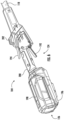
- FIG. 1 illustrates a perspective view of an exemplary gutter cleaner 100 including an upper portion 102 and a lower portion 104.
- the upper portion 102 is disposed generally above the lower portion 104, such as above a gutter to be cleaned.
- the upper portion 102 of the gutter cleaner 100 may be supported on a surface of the gutter and/or roof of a building.
- the lower portion 104 can be held by an operator located at a vertical elevation below the gutter. For instance, the operator can stand on nearby ground surface while holding the lower portion 102 of the gutter cleaner 100 such that the upper portion 104 is disposed at a vertical elevation above the gutter.
- the gutter cleaner 100 will generally include a fan assembly 106 configured to generate airflow, a cage 108 configured to prevent ingress of debris into the fan assembly 106 and prevent the upper portion 102 of the gutter cleaner 100 from dropping into the gutter and hitting mounting brackets/braces of the gutter, and a wheel system 110 configured to roll along the gutter and/or roof of the building and support the gutter cleaner 100 relative to the gutter.
- the fan assembly 106 can be configured to generate output airflow, A OUT , by drawing air, A IN , through an air inlet 114 ( FIG. 4 ) and biasing output airflow, A OUT , through an exit port 116 ( FIG. 4 ) in the fan assembly 106 toward the gutter.
- the fan assembly 106 can be configured to generate airflow at a volumetric airflow rate of at least 350 cubic feet per minute (cfm) during operation, such as at least 400 cfm, such as at least 450 cfm, such as at least 500 cfm.
- the fan assembly 106 can be configured to generate a thrust of at least 5 N, such as at least 6 N, such as at least 7 N, such as at least 8 N, such as at least 9 N, such as at least 10 N, such as at least 15 N, such as at least 20 N, such as at least 20 N.
- the fan assembly 102 can generate an airflow velocity of at least 100 miles per hour (MPH), such as at least 125 MPH, such as at least 150 MPH, such as at least 170 MPH.
- MPH miles per hour
- the fan assembly 102 can generate a thrust in a range of 5 N to 25 N and an airflow velocity in a range of 100 MPH and 170 MPH.
- the fan assembly 106 can generate a fixed volumetric airflow. In other instances, the fan assembly 106 can operate at variable speeds to produce variable airflow rates.
- the cage 108 can extend circumferentially around the fan assembly 106.
- the cage 108 can define a plurality of openings 112 through which air can be received by the fan assembly 106.
- the cage 108 can define a porosity, as measured by a ratio [O:M] of open space, O, of the openings 112 to material space, M, occupied by material of the cage 108, of at least 1:20, such as at least 1:15, such as at least 1:10, such as at least 1:5, such as at least 1:1, such as at least 5:1, such as at least 10:1.
- the openings 112 can extend around the entire circumference of the cage 108. In an embodiment, the openings 112 can be evenly distributed along the cage 108.
- the openings 112 can define a variable density.
- the porosity of the cage 108 can be greater at a first location than a second location.
- the first location can be located near the air inlet 114 of the fan assembly 106 and the second location can be disposed closer to the exit port 116 of the fan assembly 106.
- the air inlet 114 can more readily draw a larger air supply while the fan assembly 106 remains unclogged from airborne debris, e.g., debris raised from the gutter by the airflow generated by the fan assembly 106.
- the upper portion 102 of the gutter cleaner 100 can be coupled to the lower portion 104 of the gutter cleaner 100 through a handle 118.
- the handle 118 can have an adjustable length such that an operator can use the gutter cleaner 100 to clean gutters at various heights.
- the handle 118 can include a plurality of segments 120 coupled together at intermediary interfaces 122.
- the segments 120 can have similar lengths as one another.
- the segments 120 can define variable lengths.
- the interfaces 122 can comprise snap fits, interference fits, cotters, threaded or non-threaded fasteners, collars, or other known coupling elements.
- the handle 118 can extend longitudinally, including for example, telescopically nested segments 120 which can be selectively elongated or retracted according to need.
- longitudinal extension can occur manually, i.e., the operator can pull the segments 120 longitudinally.
- longitudinal extension of the handle 118 can be performed by a drive unit, such as an electric motor.
- the lower portion 104 of the gutter cleaner 100 can include, or be configured to engage with, operating elements 124 of the gutter cleaner 100 including, for example, one or more batteries, control units like triggers, safeties, and speed controls, processors, and the like.
- operating elements 124 of the gutter cleaner 100 including, for example, one or more batteries, control units like triggers, safeties, and speed controls, processors, and the like.
- the lowermost end 126 of the power portion 104 of the gutter cleaner 100 can be defined at least in part by the operating elements 124.
- An uppermost end 128 of the handle 118 can be directly or indirectly engaged with the fan assembly 106.
- engagement between the handle 118 and fan assembly 106 can be dynamic such that an operator can adjust an angular orientation of the fan assembly 106 with respect to the handle 118.
- the fan assembly 106 and handle 118 may be coupled together through a dynamic interface 130. In such a manner, the operator can select an appropriate angular orientation of the fan assembly 106 based on required need.
- Exemplary considerations for determining angular orientation of the fan assembly 106 with respect to the handle 118 include available standing area near the gutter, slope of the surface upon which the operator will be standing, obstructions impeding operator movement (e.g., porches, trees, bushes, etc.), and the height of the gutter.
- the dynamic interface 130 may be directly adjustable, i.e., the operator can adjust the angular orientation of the fan assembly 106 by directly manipulating the dynamic interface 130 prior to positioning the upper portion 102 of the gutter cleaner 100 on the gutter.
- the dynamic interface 130 may require manual access to reposition the angle of the fan assembly 106.
- the dynamic interface 130 may only be adjustable when the upper portion 102 of the gutter cleaner 100 is at the same elevation as the operator such that the operator can access the dynamic interface 130.
- the dynamic interface 130 may be indirectly adjustable. That is, the dynamic interface 130 may be configured to self-adjust to the gutter in situ. Referring to FIG.
- the dynamic interface 130 may include a ball joint 132 with a ball 134 disposed in a socket 136.
- the ball 134 can be coupled to either the handle 118 or the fan assembly 106 and the socket 136 can be connected to the other of the handle 118 and fan assembly 106.
- An adjuster 138 may be used to adjust tension in the ball joint 132.
- the adjuster 138 may include, for example, a threaded fastener configured to adjust the tension of the socket 136.
- the adjuster 138 can include a spring, a bayonet connection, cabling, non-threaded fasteners, or the like. Tighter sockets 136 may be less adjustable than looser sockets 136 in situ.
- the socket 136 should be tighter than when the operator wants to maintain rolling communication between the gutter cleaner 100 and gutter where the gutter has variable characteristics. That is, looser sockets 136 may permit the gutter cleaner 100 to more easily adapt to varying topography and conditions along the gutter.
- the dynamic interface 130 can include a second ball joint 142 including a second ball 144 and a second socket 146.
- the second ball joint 142 can be disposed at an opposite end of the dynamic interface 130.
- the dynamic interface 130 can include a first component 148 and a second component 150 extending between a first end 152 and a second end 154.
- the first and second components 148 and 150 may float relative to each other, e.g., be adjustable in at least one of their position and orientation with respect to one another, and be selectively adjusted relative to one another using the adjuster 138.
- the tension of the first and second ball joints 132 and 142 may be simultaneously adjusted by the adjuster 138.
- Use of two ball joints 132 and 142, i.e., two dynamic hinge locations, may facilitate easier operation of the gutter cleaner 100 in instances where a single ball joint is insufficient to accommodate the geometry of the gutter.
- the operator may be able to position the upper portion 102 of the gutter cleaner 100 above the gutter and cause the upper portion 102 to at least partially self-align with respect to the gutter. That is, the dynamic interface 130 can accommodate and semi-automatically adjust to an appropriate relative angle between the handle 118 and upper portion 102. In an embodiment, the operator can then selectively lock the dynamic interface 130 at the adjusted position.
- FIG. 2 illustrates an exemplary embodiment of the gutter cleaner 100 where the wheel system 110 includes two wheels - an inner wheel 156 and an outer wheel 158.
- the use of terms “inner” and “outer” is made with reference to the orientation of the gutter cleaner 100 when cleaning a gutter attached to a building. That is, the inner wheel 156 may be disposed closer to a roof of the building than the outer wheel 158. In certain instances, the inner wheel 156 may even contact the roof of the building instead of the gutter while the outer wheel 158 contacts the gutter.
- Features or characteristics specifically described with respect to either the inner wheel 156 or outer wheel 158 are not intended to be limited to that wheel and may be included on the other wheel instead of, or in addition to, inclusion on the described wheel, within the limits defined by the claims.
- the inner wheel 156 can have a circumferential profile configured to roll on a roof of a building.
- An outer edge 160 of the inner wheel 156 can have a tapered profile to conform more closely to the angled roof to be contacted.
- the outer edge 160 can define a discontinuous surface, including for example, one or more castellations, undulations, ridges, projections, tines, zig-zags, or other features which might allow the inner wheel 156 to more readily roll over a wider range of variable roof topography.
- Surface coatings, treatments, or attachments may be provided along the outer edge 160 to enhance grip with the roof and prevent the outer edge 160 from scraping there against.
- the outer wheel 158 can be configured to rest along an outer lip of the gutter during operation.
- the outer wheel 158 will include at least one flange 162 which can be extending around at least a portion of the circumference of the outer wheel 158.
- the flange 162 can extend into the gutter while a contact surface 164 of the outer wheel 158 rolls along the outer lip of the gutter.
- the flange 162 can extend downward along an outer edge of the gutter while the contact surface 164 rolls along the outer lip of the gutter.
- the flange 162 and contact surface 164 can maintain the gutter cleaner 100 aligned with respect to the gutter being cleaned.
- at least one of the flange 162 and contact surface 164 can include a surface coating, treatment, or attachment to enhance grip with the gutter and prevent the outer wheel 158 from scraping there against.
- At least one of the inner and outer wheels 156 and 158 can be configured to roll during gutter cleaning operations. That is, for example, the inner wheel 156 may roll along the roof and the outer wheel 158 may roll along the gutter while the operator moves the gutter cleaner 100 along the length of the gutter. In an embodiment, at least one of the inner and outer wheels 156 and 158 can be configured to maintain rolling contact with the gutter and/or roof.
- rolling contact refers to contact between bodies (e.g., two bodies) where a relative velocity between contacting surfaces of the bodies is zero, or approximately zero, at the point of contact.
- Rolling contact may be maintained even when the wheel(s) jumps or otherwise breaks rolling contact for short or temporary segments, e.g., when rolling over obstructions such as debris or at low friction areas of the roof where the wheel(s) loses traction.
- the inner and outer wheels 156 and 158 are non-powered.
- rotational resistance of the inner wheel 156, the outer wheel 158, or both can be adjustable.
- One exemplary method for adjusting rotational resistance as described with respect to the inner wheel 156 may include adjusting characteristics of an interface between the inner wheel 156 and a central hub 166 upon which the inner wheel 156 rotates.
- the central hub 166 can be connected to the handle 118 through intermediary framework 168 ( FIG. 4 ).
- the intermediary framework 168 can be connected to the handle 118 through a second hub 170 which forms a rotatable interface with the outer wheel 158.
- the rotational resistance between the second hub 170 and outer wheel 158 may optionally be adjustable.
- the inner and outer wheels 156 and 158 may lie along generally parallel planes. Referring to FIG. 5 , the inner and outer wheels 156 and 158 may alternatively lie along planes 172 and 174, respectively, which intersect one another. In an embodiment, the planes 172 and 174 can intersect at a location below the fan assembly 106, i.e., closer to the exit port 116 than the air inlet 114. In such a manner, the gutter cleaner 100 may taper to a narrower dimension where contact with the gutter occurs. The tapered profile allows the inlet area to be larger than the outlet area. This can improve performance over embodiments where the inlet and outlet areas have the same size as one another.
- FIG. 5 further illustrates an exemplary embodiment of the cage 108 where an upper portion 176 defines a generally planar segment extending between the inner and outer wheels 156 and 158 and a lower portion 178 defines a concave segment extending between the inner and outer wheels 156 and 158.
- FIG. 4 illustrates a cross-sectional view of the upper portion 102 of the gutter cleaner 100, including the fan assembly 106, cage 108, inner and outer wheels 156 and 158, the ball 134, hubs 166 and 170, and framework 168.
- the fan assembly 106 can be connected to the framework 168 which engages with the hubs 166 and 170 to permit the inner and outer wheels 156 and 158 to rotate when the gutter cleaner 100 is translated along the gutter.
- the fan assembly 106 can include a sidewall 180 defining a lumen 182 through which airflow can be biased.
- a fan 184 rotatably driven by a motor 186 can bias airflow through the lumen 182 in a direction corresponding with arrow 188.
- the airflow generated by the fan 184 can be biased through the exit port 116 to remove debris from the gutter there below.
- the fan 184 can be disposed above the motor 186. That is, the motor 186 can be disposed between the gutter and the fan 184.
- the lumen 182 can include one or more stators do remove air swirl from the airflow generated by the fan 184.
- the lumen 182 can be devoid of stators which remove air swirl. Without wishing to be bound by any particular theory, it is believed that in certain instances, swirling airflow may enhance debris removal from gutters as compared to airflow devoid of swirl.
- the cage 108 can define a primary opening 190 generally aligned with the exit port 116 of the fan assembly 106.
- the primary opening 190 can be disposed adjacent to the exit port 116 such that biased airflow can pass relatively unrestricted through the cage 108.
- the primary opening 190 has a circular profile.
- the primary opening 190 can define a non-circular profile, such as a polygonal profile, a non-circular arcuate profile (e.g., an oval), or a profile having a combination of polygonal and arcuate portions. Air passing through the primary opening 190 can contact debris within the gutter and clear the debris therefrom.
- the gutter cleaner 100 can pass over one or more downspouts of the gutter system.
- the gutter cleaner 100 can be used with the same configuration over the downspouts as the rest of the gutter system.
- the gutter cleaner 100 may include an attachment (not illustrated) for the primary opening 190 which further guides airflow into the downspout.
- the attachment may engage with the primary opening 190 (e.g., seat within or adjacent to the primary opening 190) and have an exit profile more similar to the shape of the downspout so as to maximize debris clearing efficacy.
- FIG. 6 illustrates part of the lower portion 104 of the gutter cleaner 100.
- the lower portion 104 includes the operating elements 124, including for instance a trigger 192, a trigger safety 194, and a battery port 196 configured to receive a battery 198.
- the battery port 196 and/or battery 198 can define the lowermost end 126 of the lower end 104.
- the battery port 196 can be disposed between the lowermost end 126 and the trigger 192. In such a manner, the weight of the battery 198, when attached to the battery port 196, can offset weight of components disposed on the upper portion 102 of the gutter cleaner 100.
- the battery 198 can be received in and/or removed from the battery port 196 by translating the battery 198 in a direction generally parallel with a length of the handle 118.
- One or more retention elements can selectively engage with the battery 198 to electrically connect the battery 198 relative to the battery port 196.
- the lower portion 104 can include a handle 200 disposed at a location readily available to access the trigger 192 and/or trigger safety 194.
- the gutter cleaner 100 can further include a secondary handle disposed along the handle 118 such that an operator can grip the gutter cleaner 100 with two hands disposed at two spaced apart locations.
- the secondary handle may be adjustably coupled with the handle 118 such that the operator can alter any one of a location and angular orientation of the secondary handle.
- An auxiliary fastener 202 may be disposed along the handle 118 to permit attachment of the gutter cleaner 100 to a harness, such as a waist band or shoulder strap, attached to the body of the operator.
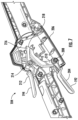
- FIG. 7 illustrates an exemplary embodiment of a cross-sectional view of part of the lower portion 104.
- the trigger 192 can include an engageable portion 204 extending outward from a body 206 of the handle 118.
- the trigger 192 can be rotatably coupled to the body 206 along an axis 208 whereby an actuator 210 of the trigger 192 can operatively move between an off-position and an on-position to engage the gutter cleaner 100.
- the trigger safety 194 can include an engageable portion 212 extending outward from the body 206 of the handle 118.
- the trigger safety 194 can be rotatably coupled to the body 206 along an axis 214 whereby an actuator 216 of the trigger safety 194 can move from a locked position to an unlocked position.
- a flange 218 of the actuator 216 may restrict the trigger 192 in the off-position and prevent the trigger 192 from moving to the on-position.
- the flange 218 can be cleared from the actuator 210 of the trigger 192, permitting the trigger to rotate and engaging the gutter cleaner 100.
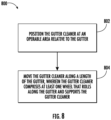
- FIG. 8 includes a method 800 of using a gutter cleaner to clean a gutter.
- the method 800 includes a step 802 of positioning the gutter cleaner at an operable area relative to the gutter.
- the step 802 of positioning the gutter cleaner may involve raising the upper portion 102 of the gutter cleaner from a first vertical elevation to a second vertical above the first vertical elevation.
- the second vertical elevation may correspond with a vertical elevation above the gutter, such as immediately above the gutter.
- the step 802 of positioning the gutter cleaner may further include contacting the inner and outer wheels 156 and 158 with the gutter and roof.
- the step 802 of positioning the gutter cleaner can additionally include aligning the gutter cleaner on the gutter such that a flange disposed on the at least one wheel of the at least one wheels interacts with the gutter and guides the gutter cleaner along the gutter.
- step 802 may be performed with the fan assembly 106 engaged. In this regard, at least some of the weight of the gutter cleaner 100 can be mitigated by the upward thrust generated by the fan assembly 106.
- the operator may adjust the length of the handle prior to positioning the gutter cleaner at step 802.
- the operator may adjust the angular position of one or more components, e.g., the fan assembly, of the gutter cleaner prior to positioning the gutter cleaner at step 802.
- the angle of the one or more components may be determinable based on the available area to maneuver below the gutter and any obstacles or obstructions which may prevent the operator from accessing the gutter.
- adjustment of the angular position of one or more components, e.g., the fan assembly can occur in situ, i.e., after step 802.
- a component of the upper portion of the gutter cleaner e.g., the at least one wheel
- the operator can cause the upper portion of the gutter cleaner to seat appropriately relative to the gutter.
- the operator can adjust the angular orientation of the gutter cleaner as needed, e.g., as the operator moves the gutter cleaner down the length of the gutter.
- the method 800 can further include a step 804 of moving the gutter cleaner along a length of the gutter.
- the gutter cleaner can include at least one wheel that rolls along the gutter and supports the gutter cleaner while being moved along the gutter.
- the method 800 can further include an operator standing at a vertical elevation below the gutter during the step 802 of positioning the gutter cleaner and maintaining control over the gutter cleaner via the handle during the step 804 of moving the gutter cleaner along the length of the gutter.
- the operator can use a harness attached to the gutter cleaner to assist in maintaining control over the gutter cleaner.
- the gutter cleaner can be engaged, i.e., powered on, and air biased from the fan assembly can pass through the grate and blow debris from the gutter.
- the operator may be able to adjust a variable speed of the fan assembly based on the amount and/or type of debris contained within the gutter. In other instances, the operator may be able to select only an on- and off-condition.
- Gutter cleaners and methods associated therewith in accordance with embodiments described herein can prevent the need for people to climb ladders or stand on elevated surfaces to clean gutters.
- the operator can dial in the gutter cleaner to their particular needs. Rolling engagement between the gutter cleaner and gutter and/or roof can prevent damage to the building while maintaining the gutter cleaner in proper alignment at all times.
- the operator may be able to mitigate at last some weight of the gutter cleaner by resting it at least partially on the gutter and/or roof while moving along the length of the gutter.
Landscapes
- Engineering & Computer Science (AREA)
- Architecture (AREA)
- Civil Engineering (AREA)
- Structural Engineering (AREA)
- Mechanical Engineering (AREA)
- Electric Vacuum Cleaner (AREA)
- Cleaning In General (AREA)
- Electric Suction Cleaners (AREA)
Claims (12)
- Rinnenreiniger (100), umfassend:eine Gebläsebaugruppe (106), die so konfiguriert ist, dass sie einen Luftstrom erzeugt, um Schmutz aus einer Rinne zu blasen;einen Käfig (108), der zumindest teilweise um die Gebläsebaugruppe (106) herum angeordnet und so konfiguriert ist, dass er das Eindringen von verstopfendem Schmutz in die Gebläsebaugruppe (106) verhindert; undein Radsystem (110), das so konfiguriert ist, dass es entlang der Rinne rollt, wobei das Radsystem (110) nicht mit Strom versorgt ist,wobei das Radsystem (110) ein Innenrad (156) und ein Außenrad (158) umfasst, wobei das Außenrad (158) einen Flansch (162) umfasst, der so konfiguriert ist, dass er mit der Rinne zusammenwirkt und den Rinnenreiniger (100) entlang der Rinne führt, wobei das Radsystem (110) so konfiguriert ist, dass es den Rinnenreiniger (100) zumindest teilweise stützt,wobeidie Gebläsebaugruppe (106) zwischen dem Innenrad (156) und dem Außenrad (158) angeordnet ist, wobei ein Durchmesser des Radsystems (110) größer ist als eine maximale Abmessung der Gebläsebaugruppe (106).
- Rinnenreiniger (100) nach Anspruch 1, wobei sich der Käfig (108) in Umfangsrichtung um die Gebläsebaugruppe (106) erstreckt und zwischen dem Innenrad (156) und dem Außenrad (158) angeordnet ist.
- Rinnenreiniger (100) nach Anspruch 1, wobei das Innenrad (156) und das Außenrad (158) jeweils entlang einer optimal passenden Ebene liegen, und wobei sich die optimal passenden Ebenen des Innenrads (156) und des Außenrads (158) schneiden.
- Rinnenreiniger (100) nach Anspruch 1, wobei das Radsystem (110) so konfiguriert ist, dass es einen Rollkontakt mit der Rinne aufrechterhält.
- Rinnenreiniger (100) nach Anspruch 1, wobei der Rinnenreiniger (100) ferner einen Griff (118) umfasst, der so konfiguriert ist, dass er mit einem Rahmen in Eingriff gebracht werden kann, wobei der Griff (118) so konfiguriert ist, dass ein Bediener die Gebläsebaugruppe (106) vom Boden aus fernbedienen kann.
- Rinnenreiniger (100) nach Anspruch 5, wobei die Gebläsebaugruppe (106) über eine dynamische Schnittstelle (130) mit dem Griff (118) verbunden ist, und wobei die dynamische Schnittstelle (130) vor Ort selbstjustierend ist.
- Rinnenreiniger (100) nach Anspruch 6, wobei der Rinnenreiniger (100) ferner eine Batterie (198) oder einen elektrischen Stecker umfasst, die entlang des Griffs (118) angeordnet und von der Gebläsebaugruppe (106) beabstandet sind.
- Rinnenreiniger (100) nach Anspruch 1, wobei der Käfig (108) eine primäre Öffnung (190) umfasst, die benachbart zu einer Austrittsöffnung (116) der Gebläsebaugruppe (106) angeordnet ist, und wobei die Öffnung (190) so konfiguriert ist, dass sie eine Düse aufnehmen kann, die mit einem Fallrohr der Rinne betätigbar ist.
- Verfahren zum Reinigen einer Rinne mit dem Rinnenreiniger (100) nach Anspruch 1, wobei das Verfahren umfasst:Positionieren des Rinnenreinigers (100) an einem betätigbaren Bereich relativ zur Rinne;Bewegen des Rinnenreinigers (100) entlang einer Länge der Rinne.
- Verfahren nach Anspruch 9, wobei die Gebläsebaugruppe (106) drehbar mit dem einen Radsystem (110) gekoppelt ist, so dass die Gebläsebaugruppe (106) in einer relativ festen Winkelposition bleibt, während sich das Radsystem (110) entlang der Länge der Rinne dreht.
- Verfahren nach Anspruch 9, ferner umfassend das Ausrichten des Rinnenreinigers (100) auf der Rinne, so dass ein Flansch (162), der an dem Außenrad (158) des Radsystems (110) angeordnet ist, mit der Rinne zusammenwirkt und den Rinnenreiniger (100) entlang der Rinne führt.
- Verfahren nach Anspruch 9, ferner umfassend:Stehen in einer vertikalen Höhe unterhalb der Rinne während des Schritts des Positionierens des Rinnenreinigers (100); undBeibehalten der Kontrolle über den Rinnenreiniger (100) über einen Griff (118), der sich von einer Gebläsebaugruppe (106) des Rinnenreinigers (100) erstreckt, während man den Rinnenreiniger (100) entlang der Länge der Rinne bewegt.
Applications Claiming Priority (1)
| Application Number | Priority Date | Filing Date | Title |
|---|---|---|---|
| US202062977570P | 2020-02-17 | 2020-02-17 |
Publications (3)
| Publication Number | Publication Date |
|---|---|
| EP3865639A1 EP3865639A1 (de) | 2021-08-18 |
| EP3865639B1 true EP3865639B1 (de) | 2025-06-18 |
| EP3865639C0 EP3865639C0 (de) | 2025-06-18 |
Family
ID=74550516
Family Applications (1)
| Application Number | Title | Priority Date | Filing Date |
|---|---|---|---|
| EP21154975.3A Active EP3865639B1 (de) | 2020-02-17 | 2021-02-03 | Rinnenreiniger und damit verbundene verfahren |
Country Status (6)
| Country | Link |
|---|---|
| US (1) | US11840838B2 (de) |
| EP (1) | EP3865639B1 (de) |
| CN (1) | CN113266113A (de) |
| AU (1) | AU2021200876A1 (de) |
| CA (1) | CA3107861A1 (de) |
| MX (1) | MX2021001195A (de) |
Families Citing this family (3)
| Publication number | Priority date | Publication date | Assignee | Title |
|---|---|---|---|---|
| CN209556457U (zh) * | 2019-01-03 | 2019-10-29 | 宁波东川游泳池设备有限公司 | 一种伸缩铝杆 |
| US11905711B2 (en) * | 2020-02-20 | 2024-02-20 | Techtronic Cordless Gp | Gutter cleaners and methods associated therewith |
| CN114346565B (zh) * | 2021-12-30 | 2023-04-07 | 无锡富灵达铝合金制品有限公司 | 一种铝合金车架用拼接装置 |
Family Cites Families (32)
| Publication number | Priority date | Publication date | Assignee | Title |
|---|---|---|---|---|
| US1423511A (en) * | 1918-07-31 | 1922-07-25 | Hoe & Co R | Routing tool |
| GB645847A (en) | 1946-10-10 | 1950-11-08 | Edgar Peter Senne | Improvements in or relating to vacuum cleaners |
| US4121320A (en) | 1977-06-27 | 1978-10-24 | Alexander Feiner | Air controlled gutter cleaner |
| US4168559A (en) | 1978-03-27 | 1979-09-25 | Henson Bobby G | Cleaning device |
| US4238866A (en) | 1979-08-14 | 1980-12-16 | Taylor Nelson D | Rain gutter cleaning device |
| DE9310420U1 (de) | 1993-07-13 | 1994-01-05 | Schönrock, Armin, 21224 Rosengarten | Vorrichtung zur Reinigung von Dachrinnen |
| DE19531442C3 (de) | 1995-08-26 | 2001-04-26 | Multi Cad Gmbh | Aufnahmevorrichtung |
| DE10050696B4 (de) | 2000-10-13 | 2014-12-24 | Andreas Stihl Ag & Co. | Handgeführtes Arbeitsgerät, insbesondere Hochentaster |
| US20060213027A1 (en) | 2005-03-24 | 2006-09-28 | Oberembt James M | Satellite dish and rain gutter cleaner |
| US7886399B2 (en) | 2006-08-15 | 2011-02-15 | Umagination Labs, L.P. | Systems and methods for robotic gutter cleaning along an axis of rotation |
| US7926141B2 (en) | 2006-08-15 | 2011-04-19 | Umagination Labs, L.P. | Systems and methods of a gutter cleaning system |
| US7743683B2 (en) * | 2006-08-15 | 2010-06-29 | Umagination Labs, L.P. | Systems and methods of a power tool system with interchangeable functional attachments powered by a direct rotational drive |
| US7979945B2 (en) * | 2006-08-15 | 2011-07-19 | Umagination Labs, L.P. | Systems and methods for robotic gutter cleaning |
| US8136254B2 (en) | 2007-02-06 | 2012-03-20 | Mtd Products Inc | Split power tool with extension |
| US8196251B2 (en) * | 2007-04-26 | 2012-06-12 | Irobot Corporation | Gutter cleaning robot |
| US9492941B2 (en) | 2007-11-08 | 2016-11-15 | Echo, Incorporated | Apparatus having a tool on an elongate pole |
| US7802338B1 (en) | 2009-06-10 | 2010-09-28 | Ira George Hall | Rain-gutter cleaning system |
| JP5418119B2 (ja) | 2009-09-30 | 2014-02-19 | 日立工機株式会社 | 作業機械 |
| US8646149B2 (en) | 2011-03-03 | 2014-02-11 | G.B.D. Corp. | Filter housing construction for a surface cleaning apparatus |
| US20130087168A1 (en) | 2011-10-05 | 2013-04-11 | Beville James | Roof Debris Removal Apparatus and Method of Use |
| CA2797364A1 (en) | 2011-12-01 | 2013-06-01 | Scienceha Inc. | Device for cleaning a rain gutter |
| GB2503257B (en) | 2012-06-20 | 2014-12-17 | Dyson Technology Ltd | A cleaning appliance |
| US8510910B1 (en) | 2012-07-24 | 2013-08-20 | Mark Ramsey | Air blower device for cleaning a rain gutter and other elevated surfaces |
| US9631370B2 (en) | 2012-12-20 | 2017-04-25 | Murray Andrew PATON | Gutter cleaning apparatus |
| US9364136B2 (en) | 2013-07-22 | 2016-06-14 | Cherie Devir | Pole cleaning apparatus |
| CN106231970B (zh) * | 2014-04-24 | 2019-03-01 | 胡斯华纳有限公司 | 鼓风机 |
| US9267291B1 (en) | 2014-10-27 | 2016-02-23 | Mark J. Ramsey | Air blower device for cleaning a rain gutter and other elevated surfaces |
| CN204174847U (zh) | 2014-10-28 | 2015-02-25 | 宁波伊司达工具有限公司 | 高度调节式高空吹风机 |
| CN107725413B (zh) | 2016-08-12 | 2021-07-13 | 德昌电机(深圳)有限公司 | 风机 |
| CN106510570A (zh) | 2016-12-21 | 2017-03-22 | 安徽天利粮油集团股份有限公司 | 便于握持的屋檐清洁刷 |
| PL3592917T3 (pl) | 2017-03-08 | 2021-08-23 | Husqvarna Ab | Oczyszczacz do rynien |
| CA2978279A1 (en) | 2017-09-01 | 2019-03-01 | Khoja E.K. Fatehally | Eavestrough cleaning/clearing tool |
-
2021
- 2021-01-13 US US17/148,152 patent/US11840838B2/en active Active
- 2021-01-29 MX MX2021001195A patent/MX2021001195A/es unknown
- 2021-02-03 EP EP21154975.3A patent/EP3865639B1/de active Active
- 2021-02-03 CA CA3107861A patent/CA3107861A1/en not_active Abandoned
- 2021-02-10 CN CN202110188463.5A patent/CN113266113A/zh active Pending
- 2021-02-11 AU AU2021200876A patent/AU2021200876A1/en active Pending
Also Published As
| Publication number | Publication date |
|---|---|
| CN113266113A (zh) | 2021-08-17 |
| CA3107861A1 (en) | 2021-08-17 |
| US11840838B2 (en) | 2023-12-12 |
| MX2021001195A (es) | 2021-08-18 |
| EP3865639C0 (de) | 2025-06-18 |
| EP3865639A1 (de) | 2021-08-18 |
| AU2021200876A1 (en) | 2021-09-02 |
| US20210254344A1 (en) | 2021-08-19 |
Similar Documents
| Publication | Publication Date | Title |
|---|---|---|
| US4402106A (en) | Blower attachment for cleaning rain gutters | |
| US4238866A (en) | Rain gutter cleaning device | |
| US11840838B2 (en) | Gutter cleaners and methods associated therewith | |
| US4121320A (en) | Air controlled gutter cleaner | |
| US4304498A (en) | Gutter cleaning apparatus | |
| US4319851A (en) | Device for cleaning rain gutters | |
| US8561623B2 (en) | Apparatus for removing debris from gutters, troughs and other overhead open conduits | |
| US8511000B2 (en) | Inline rotating rain gutter | |
| US6185782B1 (en) | Rain-gutter cleaning system | |
| US6257256B1 (en) | Apparatus for cleaning roof gutters | |
| US6202329B1 (en) | Apparatus for removing snow from rooftops | |
| US4168559A (en) | Cleaning device | |
| US20090183438A1 (en) | Debris removal gutter system | |
| US5988715A (en) | Apparatus for cleaning drain gutters | |
| US12378771B2 (en) | Pressure spray washer for cleaning gutters | |
| US4978241A (en) | Roof gutter maintenance and cleaning apparatus | |
| US4756043A (en) | Gutter and downspout cleaner | |
| US11905711B2 (en) | Gutter cleaners and methods associated therewith | |
| WO2008047295A1 (en) | A sweeper arrangement for sweeping a roof gutter | |
| EP2935720A1 (de) | Rinnenreinigungsvorrichtung | |
| US20130139332A1 (en) | Device for cleaning a rain gutter | |
| EP0128951A1 (de) | Reinigungsvorrichtung für dachrinnen | |
| JP3140796U (ja) | ハウス洗浄装置 | |
| US9175477B1 (en) | Gutter cleaning apparatus | |
| US20110179598A1 (en) | Gutter cleaning device and system |
Legal Events
| Date | Code | Title | Description |
|---|---|---|---|
| PUAI | Public reference made under article 153(3) epc to a published international application that has entered the european phase |
Free format text: ORIGINAL CODE: 0009012 |
|
| STAA | Information on the status of an ep patent application or granted ep patent |
Free format text: STATUS: THE APPLICATION HAS BEEN PUBLISHED |
|
| AK | Designated contracting states |
Kind code of ref document: A1 Designated state(s): AL AT BE BG CH CY CZ DE DK EE ES FI FR GB GR HR HU IE IS IT LI LT LU LV MC MK MT NL NO PL PT RO RS SE SI SK SM TR |
|
| STAA | Information on the status of an ep patent application or granted ep patent |
Free format text: STATUS: REQUEST FOR EXAMINATION WAS MADE |
|
| 17P | Request for examination filed |
Effective date: 20220217 |
|
| RBV | Designated contracting states (corrected) |
Designated state(s): AL AT BE BG CH CY CZ DE DK EE ES FI FR GB GR HR HU IE IS IT LI LT LU LV MC MK MT NL NO PL PT RO RS SE SI SK SM TR |
|
| STAA | Information on the status of an ep patent application or granted ep patent |
Free format text: STATUS: EXAMINATION IS IN PROGRESS |
|
| 17Q | First examination report despatched |
Effective date: 20220421 |
|
| GRAP | Despatch of communication of intention to grant a patent |
Free format text: ORIGINAL CODE: EPIDOSNIGR1 |
|
| STAA | Information on the status of an ep patent application or granted ep patent |
Free format text: STATUS: GRANT OF PATENT IS INTENDED |
|
| INTG | Intention to grant announced |
Effective date: 20250109 |
|
| GRAS | Grant fee paid |
Free format text: ORIGINAL CODE: EPIDOSNIGR3 |
|
| GRAA | (expected) grant |
Free format text: ORIGINAL CODE: 0009210 |
|
| STAA | Information on the status of an ep patent application or granted ep patent |
Free format text: STATUS: THE PATENT HAS BEEN GRANTED |
|
| AK | Designated contracting states |
Kind code of ref document: B1 Designated state(s): AL AT BE BG CH CY CZ DE DK EE ES FI FR GB GR HR HU IE IS IT LI LT LU LV MC MK MT NL NO PL PT RO RS SE SI SK SM TR |
|
| REG | Reference to a national code |
Ref country code: GB Ref legal event code: FG4D |
|
| REG | Reference to a national code |
Ref country code: CH Ref legal event code: EP |
|
| REG | Reference to a national code |
Ref country code: DE Ref legal event code: R096 Ref document number: 602021032316 Country of ref document: DE |
|
| REG | Reference to a national code |
Ref country code: CH Ref legal event code: EP |
|
| REG | Reference to a national code |
Ref country code: IE Ref legal event code: FG4D |
|
| U01 | Request for unitary effect filed |
Effective date: 20250716 |
|
| U07 | Unitary effect registered |
Designated state(s): AT BE BG DE DK EE FI FR IT LT LU LV MT NL PT RO SE SI Effective date: 20250722 |
|
| PG25 | Lapsed in a contracting state [announced via postgrant information from national office to epo] |
Ref country code: NO Free format text: LAPSE BECAUSE OF FAILURE TO SUBMIT A TRANSLATION OF THE DESCRIPTION OR TO PAY THE FEE WITHIN THE PRESCRIBED TIME-LIMIT Effective date: 20250918 Ref country code: GR Free format text: LAPSE BECAUSE OF FAILURE TO SUBMIT A TRANSLATION OF THE DESCRIPTION OR TO PAY THE FEE WITHIN THE PRESCRIBED TIME-LIMIT Effective date: 20250919 |
|
| PG25 | Lapsed in a contracting state [announced via postgrant information from national office to epo] |
Ref country code: HR Free format text: LAPSE BECAUSE OF FAILURE TO SUBMIT A TRANSLATION OF THE DESCRIPTION OR TO PAY THE FEE WITHIN THE PRESCRIBED TIME-LIMIT Effective date: 20250618 |
|
| PG25 | Lapsed in a contracting state [announced via postgrant information from national office to epo] |
Ref country code: RS Free format text: LAPSE BECAUSE OF FAILURE TO SUBMIT A TRANSLATION OF THE DESCRIPTION OR TO PAY THE FEE WITHIN THE PRESCRIBED TIME-LIMIT Effective date: 20250918 |
|
| PG25 | Lapsed in a contracting state [announced via postgrant information from national office to epo] |
Ref country code: IS Free format text: LAPSE BECAUSE OF FAILURE TO SUBMIT A TRANSLATION OF THE DESCRIPTION OR TO PAY THE FEE WITHIN THE PRESCRIBED TIME-LIMIT Effective date: 20251018 |
|
| PG25 | Lapsed in a contracting state [announced via postgrant information from national office to epo] |
Ref country code: SM Free format text: LAPSE BECAUSE OF FAILURE TO SUBMIT A TRANSLATION OF THE DESCRIPTION OR TO PAY THE FEE WITHIN THE PRESCRIBED TIME-LIMIT Effective date: 20250618 |
|
| PG25 | Lapsed in a contracting state [announced via postgrant information from national office to epo] |
Ref country code: CZ Free format text: LAPSE BECAUSE OF FAILURE TO SUBMIT A TRANSLATION OF THE DESCRIPTION OR TO PAY THE FEE WITHIN THE PRESCRIBED TIME-LIMIT Effective date: 20250618 |
|
| PG25 | Lapsed in a contracting state [announced via postgrant information from national office to epo] |
Ref country code: PL Free format text: LAPSE BECAUSE OF FAILURE TO SUBMIT A TRANSLATION OF THE DESCRIPTION OR TO PAY THE FEE WITHIN THE PRESCRIBED TIME-LIMIT Effective date: 20250618 |
|
| PG25 | Lapsed in a contracting state [announced via postgrant information from national office to epo] |
Ref country code: SK Free format text: LAPSE BECAUSE OF FAILURE TO SUBMIT A TRANSLATION OF THE DESCRIPTION OR TO PAY THE FEE WITHIN THE PRESCRIBED TIME-LIMIT Effective date: 20250618 |
|
| PG25 | Lapsed in a contracting state [announced via postgrant information from national office to epo] |
Ref country code: ES Free format text: LAPSE BECAUSE OF FAILURE TO SUBMIT A TRANSLATION OF THE DESCRIPTION OR TO PAY THE FEE WITHIN THE PRESCRIBED TIME-LIMIT Effective date: 20250618 |
|
| U20 | Renewal fee for the european patent with unitary effect paid |
Year of fee payment: 6 Effective date: 20260227 |
|
| PGFP | Annual fee paid to national office [announced via postgrant information from national office to epo] |
Ref country code: GB Payment date: 20260227 Year of fee payment: 6 |
|
| PLBE | No opposition filed within time limit |
Free format text: ORIGINAL CODE: 0009261 |
|
| STAA | Information on the status of an ep patent application or granted ep patent |
Free format text: STATUS: NO OPPOSITION FILED WITHIN TIME LIMIT |
|
| REG | Reference to a national code |
Ref country code: CH Ref legal event code: L10 Free format text: ST27 STATUS EVENT CODE: U-0-0-L10-L00 (AS PROVIDED BY THE NATIONAL OFFICE) Effective date: 20260430 |