EP3864673B1 - Procédé et installation de conversion d'hexafluorure d'uranium en dioxyde d'uranium - Google Patents
Procédé et installation de conversion d'hexafluorure d'uranium en dioxyde d'uranium Download PDFInfo
- Publication number
- EP3864673B1 EP3864673B1 EP18842707.4A EP18842707A EP3864673B1 EP 3864673 B1 EP3864673 B1 EP 3864673B1 EP 18842707 A EP18842707 A EP 18842707A EP 3864673 B1 EP3864673 B1 EP 3864673B1
- Authority
- EP
- European Patent Office
- Prior art keywords
- reactor
- percussion
- powder
- conversion
- filters
- Prior art date
- Legal status (The legal status is an assumption and is not a legal conclusion. Google has not performed a legal analysis and makes no representation as to the accuracy of the status listed.)
- Active
Links
Images


Classifications
-
- C—CHEMISTRY; METALLURGY
- C01—INORGANIC CHEMISTRY
- C01G—COMPOUNDS CONTAINING METALS NOT COVERED BY SUBCLASSES C01D OR C01F
- C01G43/00—Compounds of uranium
- C01G43/01—Oxides; Hydroxides
- C01G43/025—Uranium dioxide
-
- G—PHYSICS
- G21—NUCLEAR PHYSICS; NUCLEAR ENGINEERING
- G21C—NUCLEAR REACTORS
- G21C3/00—Reactor fuel elements and their assemblies; Selection of substances for use as reactor fuel elements
- G21C3/42—Selection of substances for use as reactor fuel
- G21C3/58—Solid reactor fuel Pellets made of fissile material
- G21C3/62—Ceramic fuel
- G21C3/623—Oxide fuels
-
- F—MECHANICAL ENGINEERING; LIGHTING; HEATING; WEAPONS; BLASTING
- F27—FURNACES; KILNS; OVENS; RETORTS
- F27B—FURNACES, KILNS, OVENS OR RETORTS IN GENERAL; OPEN SINTERING OR LIKE APPARATUS
- F27B7/00—Rotary-drum furnaces, i.e. horizontal or slightly inclined
-
- G—PHYSICS
- G21—NUCLEAR PHYSICS; NUCLEAR ENGINEERING
- G21C—NUCLEAR REACTORS
- G21C19/00—Arrangements for treating, for handling, or for facilitating the handling of, fuel or other materials which are used within the reactor, e.g. within its pressure vessel
- G21C19/42—Reprocessing of irradiated fuel
- G21C19/44—Reprocessing of irradiated fuel of irradiated solid fuel
- G21C19/48—Non-aqueous processes
-
- Y—GENERAL TAGGING OF NEW TECHNOLOGICAL DEVELOPMENTS; GENERAL TAGGING OF CROSS-SECTIONAL TECHNOLOGIES SPANNING OVER SEVERAL SECTIONS OF THE IPC; TECHNICAL SUBJECTS COVERED BY FORMER USPC CROSS-REFERENCE ART COLLECTIONS [XRACs] AND DIGESTS
- Y02—TECHNOLOGIES OR APPLICATIONS FOR MITIGATION OR ADAPTATION AGAINST CLIMATE CHANGE
- Y02E—REDUCTION OF GREENHOUSE GAS [GHG] EMISSIONS, RELATED TO ENERGY GENERATION, TRANSMISSION OR DISTRIBUTION
- Y02E30/00—Energy generation of nuclear origin
- Y02E30/30—Nuclear fission reactors
-
- Y—GENERAL TAGGING OF NEW TECHNOLOGICAL DEVELOPMENTS; GENERAL TAGGING OF CROSS-SECTIONAL TECHNOLOGIES SPANNING OVER SEVERAL SECTIONS OF THE IPC; TECHNICAL SUBJECTS COVERED BY FORMER USPC CROSS-REFERENCE ART COLLECTIONS [XRACs] AND DIGESTS
- Y02—TECHNOLOGIES OR APPLICATIONS FOR MITIGATION OR ADAPTATION AGAINST CLIMATE CHANGE
- Y02W—CLIMATE CHANGE MITIGATION TECHNOLOGIES RELATED TO WASTEWATER TREATMENT OR WASTE MANAGEMENT
- Y02W30/00—Technologies for solid waste management
- Y02W30/50—Reuse, recycling or recovery technologies
Definitions
- the present invention relates to the field of production of uranium dioxide (UO 2 ) powder, intended in particular for the manufacture of UO 2 pellets for nuclear fuel rods.
- UO 2 uranium dioxide
- gaseous UF 6 into uranium oxyfluoride (UO 2 F 2 ) by hydrolysis in a reactor, by injecting gaseous UF 6 and dry water vapor into the reactor to obtain UO 2 F 2 powder, then converting the UO 2 F 2 powder into UO 2 powder by pyrohydrolysis in a furnace, circulating the UO 2 F 2 powder in the furnace and injecting dry water vapor and dihydrogen (H 2 ) gas into the furnace.
- UO 2 F 2 uranium oxyfluoride
- the oven can be provided with means allowing energetic stirring of the UO 2 F 2 powder and promoting contact of the UO 2 F 2 powder with the dihydrogen and the water vapour.
- a co-product resulting from successive conversions UF 6 ⁇ UO 2 F 2 ⁇ UO 2 is gaseous hydrogen fluoride (HF) which is very toxic and corrosive.
- the hydrolysis reaction is carried out under a neutral gas atmosphere (or inert gas), preferably under a nitrogen atmosphere.
- neutral gas is injected into the reactor forming a gas flow sweeping the reactor.
- the neutral gas, the excess reactive gases and the hydrogen fluoride resulting from the conversion can be evacuated through filters intended to retain suspended particles, notably UO 2 F 2 and UO 2 particles.
- the filters gradually become clogged and can be unclogged regularly by counter-current injection of neutral gas.
- the conversion installation can be fitted with percussion members which strike against the external wall of the oven.
- US6136285 discloses such an installation for converting UF 6 into UO 2 for implementing such a conversion process.
- the UO 2 is generated in the form of sinterable powder making it possible to form UO 2 pellets by sintering.
- UO 2 powder intended to form UO 2 pellets must be homogeneous. It must have the lowest possible level of impurities (mainly fluorine) and preferably less than 50 ppm (50 ⁇ g/g of UOs), a specific surface area of between 1 m 2 /g and 4 m 2 /g, an oxygen/uranium ratio of between 1.80 and 2.50% and a relative humidity of less than 1%. It must have good mixing capacity and the ability to flow spontaneously (flowability), thus making it possible to support high pellet production rates.
- impurities mainly fluorine
- 50 ppm 50 ⁇ g/g of UOs
- specific surface area between 1 m 2 /g and 4 m 2 /g
- an oxygen/uranium ratio of between 1.80 and 2.50%
- a relative humidity of less than 1% It must have good mixing capacity and the ability to flow spontaneously (flowability), thus making it possible to support high pellet production rates.
- the sintered ceramic pellet also has a homogeneous particle size distribution (normal law) and a reactivity to natural sintering (or sinterability) making it possible to obtain on the sintered ceramic pellet a density greater than 96.5% of the theoretical density of the UO 2 and a hardness greater than 15 daN/m.
- the conversion installation operates continuously and smoothly.
- the accumulation of powders on the filtration organs causes progressive clogging of the filters and the resulting increased pressure loss causes an increase in the internal pressure of the conversion installation. This pressure variation can lead to the conversion installation being stopped to clean or change the filters before reaching the safety of the conversion installation by exceeding a pressure threshold.
- US7422626 teaches a process making it possible to carry out effective and homogeneous unclogging of the filters of the filtration organs without interrupting the evacuation of gases and thus to increase the efficiency of the installation.
- FR2771725A , WO0247794A1 And FR2778908A1 each discloses an installation for converting UF 6 into UO 2 comprising a filter unclogging device.
- One of the aims of the invention is to propose a process for converting UF 6 into UO 2 making it possible to increase the efficiency of the conversion process while producing a homogeneous UO 2 powder of constant quality.
- the invention proposes a process for converting uranium hexafluoride (UF 6 ) into uranium dioxide (UO 2 ) according to claim 1.
- the invention also relates to a conversion installation according to claim 12.
- the conversion installation 2 shown on the Figure 1 comprises a hydrolysis reactor 4 for the conversion of UF 6 into UO 2 F 2 powder, by reaction between gaseous UF 6 and dry water vapor injected into the reactor 4.
- the conversion installation 2 comprises a pyrohydrolysis furnace 6 for converting the UO 2 F 2 powder supplied by the reactor 4 into UO 2 powder, by reaction of the UO 2 F 2 powder with dry water vapor and gaseous H 2 injected into oven 6.
- the conversion installation 2 includes a supply device 8 configured to inject the reactive gases (gaseous UF 6 , dry water vapor and gaseous H 2 ) into the reactor 4 and into the furnace 6.
- the reactive gases gaseous UF 6 , dry water vapor and gaseous H 2
- the supply device 8 is supplied from reactive gas sources, comprising at least one source of gaseous UF 6 , at least one source of dry water vapor and at least one source of gaseous H 2 .
- the supply device 8 comprises reagent injection conduits 10 for injecting the reactive gases into the reactor 4 and into the furnace 6.
- the reagent injection conduits 10 comprise a UF injection conduit 6 supplying the reactor 4, a first steam injection conduit supplying the reactor 4, a second steam injection conduit supplying the furnace 6 and an H 2 injection conduit supplying the furnace 6.
- the supply device 8 is further configured for the injection of a neutral gas into the reactor 4, in particular in the production phase of the conversion installation 2, so that the conversion of UF 6 into UO 2 F 2 is carried out under a neutral gas atmosphere.
- the supply device 8 is configured to allow the injection of neutral gas into the reactor 4 without injecting neutral gas into the furnace 6.
- neutral sweep gas The neutral gas injected into reactor 4 in the production phase to carry out the conversion of UF 6 into UO 2 F 2 is called "neutral sweep gas" hereinafter.
- the supply device 8 is preferably configured for the injection of neutral sweeping gas together with dry water vapor (H 2 O) and UF 6 .
- the supply device 8 comprises for example a concentric injector 11 making it possible to inject dry water vapor (H 2 O), UF 6 and the neutral sweeping gas concentrically, ie by forming three concentric injection jets.
- a concentric injector 11 making it possible to inject dry water vapor (H 2 O), UF 6 and the neutral sweeping gas concentrically, ie by forming three concentric injection jets.
- the supply device 8 is further configured for the injection of neutral gas into the reactor 4 and into the furnace 6, so as to be able to maintain an atmosphere of neutral gas in the reactor 4 and in the furnace 6 when conversion installation 2 is not in the production phase.
- the supply device 8 injects neutral gas sweeping into the reactor 4 to carry out the conversion of UF 6 into UO 2 F 2 under a neutral gas atmosphere, without injecting neutral gas into the furnace 6, and, in the shutdown and start-up phase, the supply device 8 injects neutral gas into the reactor 4 and into the furnace 6 to maintain a neutral gas atmosphere.
- the supply device 8 comprises one or more neutral gas injection conduits 12 for the injection of neutral gas into the reactor 4 and/or into the furnace 6.
- Each neutral gas injection conduit 12 is supplied from from a neutral gas source.
- the neutral gas is preferably nitrogen (N 2 ).
- the concentric injector 11 is supplied by the reagent injection conduit 10 supplying the reactor 4 with water vapor (H 2 O), by the reagent injection conduit 10 supplying the reactor 4 in UF 6 , and by a neutral gas injection conduit 12, for the injection of the neutral sweeping gas into the reactor 4.
- the supply device 8 is configured for supplying the injection conduit of reagent 10 supplying the reactor 4 with water vapor (H 2 O) and/or the reagent injection conduit 10 supplying the reactor 4 with UF 6 with neutral gas during a shutdown or 'a start of the conversion installation 2.
- the supply device 8 comprises a respective supply actuator 14 arranged at the inlet of each reagent 10 or neutral gas 12 injection conduit, the supply actuator 14 making it possible to control the flow of gas in the injection conduit.
- the supply actuators 14 are provided in the form of flow regulators, capable of maintaining the flow of gas passing through them at a set value.
- the power supply actuators 14 of the power supply device 8 are resistant to seismic stress.
- the conversion installation 2 comprises an electronic control system 16 for controlling the conversion installation 2 and in particular the power supply device 8, in particular the power supply actuators 14.
- the reactor 4 delimits a reaction chamber 18 into which the reagent injection pipes 10 open, supplying the reactor 4 with gaseous UF 6 and dry water vapor, and in which the conversion of the UF 6 into UO 2 F 2 by hydrolysis.
- the UO 2 F 2 thus obtained is in the form of a powder falling to the bottom of the reaction chamber 18.
- the reactor 4 has an outlet pipe 20 extending from the reaction chamber 18 and connected to the furnace 6 to transfer the UO 2 F 2 powder from the bottom of the reaction chamber 18 to the furnace 6.
- the conversion installation 2 comprises a thermal enclosure 22 surrounding the reactor 4 and a heating device 24 for heating the internal volume of the thermal enclosure 22 and therefore the reactor 4.
- the furnace 6 has an inlet 26 connected to the outlet pipe 20 of the reactor 4 to receive the UO 2 F 2 powder and an outlet 28 to supply the UO 2 powder.
- the conversion installation 2 comprises a transfer device 30 for transferring the UO 2 F 2 powder from the reaction chamber 18 to the oven 6.
- the transfer device 30 here comprises a motorized endless screw driven by a motor for push the UO 2 F 2 powder from the reaction chamber 18 towards the inlet 26 of the oven 6.
- the oven 6 comprises a drum 32 having a central axis C, one axial end of which forms the inlet 26 and the opposite axial end forms the outlet 28 of the oven 6.
- the drum 32 is provided for the circulation of the UO 2 F 2 powder from the inlet 26 towards the outlet 28 with circulation of dry water vapor and H 2 in the oven 6 against the current of the powder of UO 2 F 2 .
- the drum 32 is rotatably mounted around its central axis C inclined relative to the horizontal so that the inlet 26 is higher than the outlet 28, the rotation of the drum 32 causing the powder to advance from the inlet 26 towards exit 28.
- the oven 6 comprises a motorized rotation drive device 33 configured to drive the drum 32 in rotation around its central axis C.
- the rotation drive device 33 comprises for example a motor and a transmission device, for example example chain or belt, coupling the motor to the drum 32.
- the oven 6 is advantageously provided with a crank which allows the drum 32 to rotate manually in the event of failure of the rotation drive device 33.
- the drum 32 is preferably provided with baffles 35 arranged inside the drum 32 to control the flow of the reactive gases and the passage time of the powder in the oven 6.
- the drum 32 is provided with lifting members 37 arranged projecting on the internal surface of the drum 32 and configured to lift and drop the powder present in the drum 32 due to the rotation of the drum 32 around the central axis C, to improve the mixing of the powder and promote homogeneous contact of the powder particles with the reactive gases circulating in the drum 32.
- the lifting members 37 are for example in the form of lifting vanes or lifting angles distributed on the internal surface of the drum 32.
- the drum 32 of the oven 6 and the transfer device 30 of the reaction chamber 18 are configured to operate independently of one another, in particular to allow one to be stopped altogether. while maintaining the functioning of the other.
- the drum 32 of the oven 6 and the transfer device 30 of the reaction chamber 18 are configured for independent rotation of the endless screw of the transfer device 30, on the one hand, and of the drum 32 , on the other hand, and in particular for stopping the rotation of one of the endless screw and the drum 32 while maintaining the rotation of the other.
- This arrangement allows, in the shutdown phases of the conversion installation 2, to finish evacuating the UO 2 powder from the oven 6 while the reactor 4, and in particular the transfer device 30, is already at a standstill.
- the second steam injection conduit and the H 2 injection conduit supply the drum 32 via the outlet 28 for the circulation of dry pyrohydrolysis water vapor and H 2 from exit 28 towards inlet 26 of oven 6.
- a neutral gas injection conduit 12 is connected to the reagent injection conduit 10 for the injection of H 2 into the oven 6 and/or to the reagent injection conduit 10 for the injection of H 2 O into the oven 6, so as to inject neutral gas into the oven 6 via this reagent injection conduit(s) 10 when stopping or starting the conversion installation 2, the injected neutral gas then circulating from the outlet 28 of the oven 6 towards the inlet 26 of the oven 6.
- the supply device 8 comprises a neutral gas injection conduit 12 for gas injection neutral in the oven 6 which opens directly into the oven 6 without passing through a reagent injection conduit 10.
- Supplying a reagent injection conduit 10 with neutral gas when the conversion installation 2 is shut down makes it possible to purge this reagent injection conduit 10 during shutdown. while injecting the neutral gas.
- Supplying a reagent injection conduit 10 with neutral gas during start-up allows the temperature of the conversion installation 2 to rise and the conversion installation 2 to be supplied with reagents when the parameters of the conversion The reaction is achieved in reactor 4, respectively oven 6.
- the oven 6 comprises a heating device 34 for heating the drum 32.
- the heating device 34 comprises heating elements 36 surrounding the drum 32 and distributed along the drum 32.
- the oven 6 comprises a thermal enclosure 38 surrounding the drum 32 and the heating elements 36.
- the conversion installation 2 comprises a collection device 40 for collecting the powder at the outlet of the oven 6.
- the collection device 40 comprises an inlet pipe 42 connected to the outlet 28 of the oven 6 and opening into a collection container 44.
- the collection device 40 comprises a thermal enclosure 46 surrounding the collection container 44.
- the second steam injection conduit and the H 2 injection conduit preferably open into the collection container 44.
- the conversion installation 2 comprises a capture device 50 for capturing and evacuating the gases rising into the reactor 4, including the excess reactive gases, hydrogen fluoride (HF) resulting from the conversion and the neutral gas.
- a capture device 50 for capturing and evacuating the gases rising into the reactor 4, including the excess reactive gases, hydrogen fluoride (HF) resulting from the conversion and the neutral gas.
- the capture device 50 is placed in the reactor 4, preferably in an upper region of the reaction chamber 18.
- the capture device 50 comprises a plurality of filters 52 to retain the solid materials which may be entrained by the gases rising into the reactor 4, in particular particles of UO 2 F 2 , or even UO 2 .
- the filters 52 are for example made of a porous material allowing the passage of excess reactive gases, neutral gas and HF resulting from the reaction of conversion of UF 6 into UO 2 F 2 then into UO 2 all while maintaining a retention capacity for UO 2 F 2 or UO 2 particles.
- the filters 52 are made of ceramic or nickel-based superalloy
- UO 2 F 2 and UO 2 powders are volatile and easily carried away by gas flows. Furthermore, they tend to adhere to the surfaces with which they come into contact.
- agglomerates of powder are then created, more or less heterogeneous in terms of composition and more or less compact, on the filters 52 and on the walls of the reactor 4 and the oven 6.
- These agglomerates of powder containing material fissile can in particular be concentrated in retention zones which may exist at various points of the conversion installation 2 such as for example at the junction between the reactor 4 and the furnace 6.
- the powder agglomerates can detach under their own weight and mix with the UO 2 F 2 powder and the UO 2 powder in powder form.
- the presence of compact clusters in the powder creates heterogeneities in the treatment of the powder in the oven 6 and can lead to the presence of residual UO 2 F 2 particles in the UO 2 powder obtained at the end of conversion, degrading thus its quality.
- a blockage can also occur at the level of the reagent injection device in the reactor 4, here the concentric injector 11.
- the UF 6 can crystallize at the outlet of the concentric injector 11 and thus block the supply of reagents to the reactor 4. It is therefore important to maintain a constant supply pressure, in particular when changing the UF 6 source.
- the conversion installation 2 advantageously comprises an unclogging device 53 configured for unclogging the filters 52, for example by pulse injection of neutral gas through the filters 52 in counter-current, ie towards the inside of the reaction chamber 18 of reactor 4.
- the neutral gas is for example nitrogen (N 2 ).
- the counter-current injection of neutral gas is likely to disturb the pressure balance inside the reactor 4. It is desirable to carry out the unclogging in a controlled manner, according to determined parameters to limit disturbances to the operation of the reactor 4, and in particular the pressure inside the reactor 4.
- the unclogging device 53 is configured to carry out the unclogging of the filters 52 in an automated manner, by proceeding with the unclogging sequentially by groups of distinct filter(s) 52.
- the unclogging device 53 is then configured to inject the neutral gas countercurrently sequentially into the different groups of filter(s) 52.
- Each group of filter(s) 52 comprises a single filter 52 or several filters 52.
- the filters 52 are grouped into two groups each containing a respective half of the filters 52 and unclogging is carried out alternately in the two groups with an injection of neutral gas carried out periodically, for example every 30 seconds. It is also possible to carry out the unclogging cycle, for example in thirds or quarters and/or to adapt the injection frequency.
- the counter-current neutral gas injection pressure in each filter 52 is chosen to limit disturbances in the reactor 4.
- a relative pressure applied to each filter 52 preferably between 2 and 5 bars, in particular between 3 and 4.5 bars, allows satisfactory unclogging of filter 52 to be obtained.
- the expression “relative pressure” refers to the pressure difference compared to atmospheric pressure.
- the unclogging device 53 is for example supplied by a tank 55 containing the neutral gas and maintained at a constant pressure.
- the counter-current neutral gas injection duration in each filter 52 is chosen to limit disturbances in the reactor 4 while allowing satisfactory unclogging, in particular over the entire surface of the filter 52 during the injection duration. .
- the counter-current neutral gas injection duration in each filter 52 is for example less than 1 s.
- the capture device 50 is configured to cut off the suction through this filter 52 before the injection of counter-current neutral gas to prevent the neutral gas used for unclogging escapes directly via the capture device 50.
- the unclogging device 53 is configured to carry out the unclogging in a cyclical manner, in particular with a period chosen to avoid the accumulation of powders on the filters 52 while limiting the impact of this injection on the operation of the conversion installation 2.
- the period is between 30 seconds and 1 minute.
- the unclogging device is configured to repeat the unclogging sequence automatically in a cyclic (or periodic) manner.
- Automatic, sequential and periodic unclogging of the filters 52 ensures operation of the conversion installation 2, for example example at a relative pressure of between 10 mbar and 500 mbar in reactor 4, preferably between 50 and 400 mbar and more preferably between 100 and 350 mbar, which makes it possible to obtain a UO 2 powder having satisfactory characteristics , in particular a reasonable and substantially constant fluorine content over time.
- Unclogging the filters 52 causes the clusters of powder formed on the filters 52 to fall and avoids an excessive rise in pressure in the reaction chamber 18.
- Sequential and periodic unclogging makes it possible to limit the size and compactness of the agglomerates of solid materials formed on the filters 52 and to avoid their detachment under their own weight and their fall by gravity in too large quantities to the bottom of the reaction chamber 18 in the transfer device 30.
- the mixture of compact agglomerates with the UO 2 F 2 powder in the powder state can in fact induce heterogeneities in the physical and chemical characteristics of the UO 2 powder which results from it and in particular on its fluorine content.
- Unclogging carried out by groups of several filters 52 prevents powder expelled from a filter 52 from sticking to another filter 52 as could be the case with individual unclogging of the filters 52. Unclogging carried out by groups of several filters 52 makes it possible to generate a powder mist and limit the formation of clusters.
- the unclogging device 53 includes a control, manual or automatic, to allow occasional unclogging of the filters 52, particularly when they reach the end of their life and the sequential and periodic unclogging becomes insufficient.
- This one-off unclogging can be a unitary unclogging of the filters 52 or an unclogging of a group of filters 52 of reduced size.
- the conversion installation 2 further comprises at least one flow device 56 intended to prevent the accumulation of powder on the walls of the reaction chamber 18 and sticking on the walls of the reaction chamber 18 clumps of powder evacuated from the filters 52 during the unclogging operation.
- the flow device 56 makes it possible to promote a continuous flow of the powder and stable conditions for supplying the oven 6 with UO 2 F 2 powder both in terms of quantity and in terms of quality, and in particular with a content in fluorine stable over time.
- the flow device is configured to vibrate and/or impact at least one wall of the reactor 4, preferably regularly or continuously.
- the flow device 56 comprises for example one or more percussion member(s), each percussion member being configured to impact a wall of the reactor 4 so as to generate a shock wave in the walls of the reactor 4, and/or one or more vibrating member(s), for example vibrating pots, each vibrating member being arranged on a wall of the reactor 4 and configured to generate a vibration signal (or vibration) and transmit this vibration to the walls of the reactor 4.
- the flow device 56 comprises one or more members which generate both shocks to separate the powder from the wall and vibrations to help it flow.
- the percussion organs, the vibrating organs and the organs delivering the two functions are called “flow organs”.
- the flow device comprises at least one flow member configured to vibrate and/or impact a wall of the reactor 4.
- the flow members allow regular or even continuous vibration of the walls of the reactor 4.
- the flow device 56 here comprises four flow members 58, for example of the electro-striker type, arranged two by two in two diametrically opposite positions on the exterior surface of the wall of the reactor 4.
- the flow device 56 comprises several flow members 58
- the flow members 58 are controlled to act sequentially.
- the number, position and operating sequence of the flow members 58 can be adapted as a function of the geometry of the reactor 4, the quality of the powder and the operating parameters of the unclogging device 53.
- Each flow member 58 can be fixed directly to the wall of the reactor 4 or, for example, via an intermediate part.
- the intermediate part is for example removable to facilitate its maintenance.
- the combination of the unclogging device 53 and a flow device 56 makes it possible to limit the size and compactness of the clusters of powder which are deposited on the filters 52 and on the walls of the reactor 4, to regulate the fall of the clusters at the bottom of reactor 4 and thus to ensure the homogeneity of the UO 2 powder, in particular a substantially constant fluorine content over time.
- the conversion installation 2 comprises sealing devices 54 to ensure sealing between the transfer device 30 and the reaction chamber 18, between the reactor 4 and the oven 6 and between the oven 6 and the collection device 40.
- the sealing devices 54 are arranged at the junction between the transfer device 30 and the reaction chamber 18, at the junction between the tubing of outlet 20 of the reactor 4 and the inlet 26 of the oven 6, and at the junction between the outlet 28 of the oven 6 and the inlet pipe 42 of the collection device 40.
- the sealing devices 54 ensure sealing by allowing the rotation of the transfer device 30 relative to the reactor 4 and the rotation of the drum 32 of the oven 6 relative to the reactor 4 and the collection device 40.
- the sealing devices 54 are pressurized with a neutral gas, and preferably nitrogen.
- the conversion installation 2 comprises for example pressurization supplies 57 arranged to supply the sealing devices 54 with a neutral pressurization gas.
- the pressure of the neutral gas supplying the sealing devices 54 is greater than that present in the conversion installation 2 to avoid any dissemination of powder outside the conversion installation 2.
- the neutral gas for pressurizing the sealing devices 54 are capable of passing into the reactor 4 and/or into the furnace 6, and the operating parameters of the reactor 4 and the furnace 6 are adapted to take into account this supply of neutral gas.
- the conversion installation 2 comprises at least one percussion device 60 for impacting a percussion surface 62 of the oven 6 so as to separate the UO 2 F 2 or UO 2 powder from the internal surface of the drum 32.
- the conversion installation 2 here comprises a percussion device 60 arranged at each axial end of the drum 32 to impact a percussion surface 62 formed by the external surface of the axial end of the drum 32 emerging axially from the thermal enclosure 38 of the oven 6.
- the percussion surface 62 is defined by any other surface of the oven 6 making it possible to transmit vibrations to the peripheral wall of the drum 32 when this percussion surface 62 of the oven 6 is struck.
- the conversion installation 2 can advantageously comprise several percussion devices 60 arranged at the same end of the drum 32 being distributed angularly around the drum 32.
- the conversion installation 2 comprises two groups of percussion devices 60, each group being arranged at a respective end among the two ends of the drum 32, and the percussion devices 60 of each group being distributed angularly around the drum 32.
- Percussion devices 60 are similar. Only a percussion device 60 is illustrated in more detail on the Figure 2 .
- each percussion device 60 comprises a striker 64 movable relative to the percussion surface 62 in a percussion direction P and an intermediate part 66 arranged between the striker 64 and the percussion surface 62 so that the striker 64 strikes the surface percussion 62 via the intermediate piece 66, the intermediate piece 66 being movable in the percussion direction P between a position spaced from the percussion surface 62 and a position of contact with the percussion surface 62 of the oven 6.
- the direction of percussion P is here perpendicular to the plane tangent to the surface of percussion 62 at the point of contact of the intermediate piece 66 with the surface of percussion 62.
- the direction of percussion P is here substantially radial with respect to the central axis C of the drum 32.
- the striker 64 is carried by a percussion actuator 68 capable of moving the striker 64 in reciprocating translation following the percussion direction P.
- the percussion actuator 68 is here a double-acting hydraulic or pneumatic cylinder.
- the percussion device 60 has a support 70 carrying the actuator 68 and the intermediate piece 66, so that the intermediate piece 66 is located between the striker 64 and the percussion surface 62.
- the intermediate piece 66 is slidably mounted on the support 70 following the percussion direction P.
- the intermediate part 66 has a rear surface 66A intended to be struck by the striker 64, and a front surface 66B intended to come into contact with the percussion surface 62. In the contact position, the front surface 66B is in contact with the surface percussion 62, and in the spaced position, the front surface 66B is spaced from the percussion surface 62.
- the percussion device 60 comprises an elastic return member 72 arranged to return the intermediate part 66 to the spaced position.
- the intermediate piece 66 is received in a housing 74 of the support 70, the elastic member 72 being interposed between an internal shoulder 74A of the housing 74 and an external shoulder 66C of the intermediate piece 66.
- the elastic member 72 is here a helical spring surrounding the intermediate piece 66 and compressed when the intermediate piece 66 moves from the spaced position to the contact position.
- the percussion device 60 comprises a position sensor 76 making it possible to know the position of the striker 64.
- the position sensor 76 is for example an inductive sensor placed near the intermediate part 66, and making it possible to determine whether or not the striker 64 is in contact with the intermediate part 66.
- the percussion actuator 68 is controlled according to the position signal provided by the position sensor 76.
- the percussion actuator 68 moves the striker 64 in reciprocating translation so as to move the striker 64 away from the intermediate piece 66 then move the striker 64 against the intermediate piece 66, so as to strike the percussion surface 62 through the intermediate part 66.
- the striker 64 moves the intermediate part 66 from the spaced position to the contact position against the elastic member 72.
- an intermediate part 66 distinct from the striker 64 and which is not permanently linked to the oven 6, makes it possible to 'use the intermediate part 66 as a sacrificial part or wearing part.
- the intermediate part 66 is mounted movable relative to the oven 6.
- the supply device 8 is configured to supply the reagents and the neutral gas, in particular the neutral sweeping gas, with determined flow rates.
- the heating device 24 of the reactor 4 is configured to maintain the chamber of the reactor 4 in an adequate temperature range for obtaining UO 2 F 2 and then UO 2 powders with the desired characteristics.
- the mass hourly rate of supply of reactor 4 with gaseous UF 6 is between 75 and 130 kg/h
- the mass hourly rate of supply of reactor 4 with water vapor dry hydrolysis is between 15 and 30 kg/h
- the temperature in reactor 4 is between 150 and 250°C.
- the mass hourly flow rate for supplying reactor 4 with gaseous UF 6 is between 90 and 120 kg/h and the mass hourly flow rate for supplying reactor 4 with dry hydrolysis water vapor is between 20 and 25 kg/h.
- the reactor 4 is supplied with UF 6 at a feed temperature of between 75°C and 130°C, preferably between 90°C and 120°C. °C.
- the conversion installation 2 comprises an emission device making it possible to emit the UF 6 continuously towards the reactor 4 with a regulated flow rate and temperature of UF 6 .
- UF 6 is transported in tanks which are for example cylindrical. At room temperature, UF 6 is in the solid state. The transition from the solid state to the gaseous state is carried out by heating the tanks, for example in a heating chamber, in particular in an oven (non-watertight) or in an autoclave (watertight).
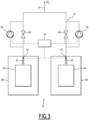
- the conversion installation 2 has an emission device 82 for supplying the reactor 4 with gaseous UF 6 from tanks 84 containing UF 6 .
- Each tank 84 is closed by a sealing valve 85.
- the emission device 82 comprises at least two heating enclosures 86, each heating enclosure 86 being designed to receive a reservoir 84 of UF 6 in the solid state and heat it to generate UF 6 in the gaseous state, the emission device 82 being configured to supply the reactor 4 sequentially from the heating enclosures 86, passing from a current heating enclosure 86 to a following heating enclosure 86 when the tank 84 received in said current heating enclosure 86 is not no longer sufficiently full, preferably without interruption of the flow of gaseous UF 6 supplying the reactor 4.
- each heating enclosure 86 is capable of heating and maintaining the respective reservoir 84 at a temperature higher than the triple point temperature of the 'UF 6 , for example at a temperature above 75°C and preferably at a nominal temperature of 95°C, for example 95°C ⁇ 10°C.
- the emission device 82 thus comprises a supply circuit 87 configured for the emission of UF 6 towards the reactor 4 selectively from one of the heating enclosures 86, while each other heating enclosure 86 heats a reservoir 84 awaiting the emission of UF 6 from this tank 84 or is recharged with a tank 84 filled with UF 6 .
- Each heating enclosure 86 is for example connected to the reactor 4 via a respective flow regulation valve 88, the closure of which makes it possible to isolate the heating enclosure 86 from the reactor 4 and the opening makes it possible to fluidly connect the heating enclosure 86 to the reactor 4.
- the opening of the valve 85 of the tank 84 then of the valve 88 allows the flow of the UF 6 from the heating enclosure 86 towards the reactor 4 due to a pressure difference between the tank 84 and the reactor 4.
- the heating enclosure 86 is then in a passive emission mode.
- each tank 84 is connected to the reactor 4 via a respective pump 90 associated with each heating enclosure 86 and arranged in parallel with the valve 88 associated with this heating enclosure 86.
- the pump 90 is preferably a pump with positive displacement and preferably a volumetric bellows pump.
- Activation of the pump 90 makes it possible to force the circulation of the gaseous UF 6 from the heating enclosure 86 towards the reactor 4 when the pressure in the reservoir 84 contained in the heating enclosure 86 is insufficient to ensure this circulation.
- the heating enclosure 86 is then in an active emission mode.
- valve 88 When valve 88 is open, pump 90 is bypassed.
- the emission device 82 comprises for example a device for opening the valve of the respective tank 84 from the outside of each heating enclosure 86 and an electronic control unit 92 configured to control the valve 88 and, where appropriate, the pump 90 associated with each heating enclosure 86 and ensure power supply sequentially from the heating enclosures 86, and, where appropriate, the transition from passive mode to active mode for each heating enclosure 86.
- the emission device 82 is for example configured to control the passage from one heating enclosure 86 to the next, and where appropriate the passage from passive mode to active mode in a manner controlled by the pressure in each tank 84.
- the emission device 82 comprises for example a pressure sensor 94 associated with each tank 84, the electronic control unit 92 being configured to control the valve 88 and, where appropriate, the pump 90 associated with each heating enclosure 86 depending on the measurements provided by the pressure sensors 94.
- a tank 84 is heated in a first heating chamber 86 preferably under a neutral gas atmosphere to improve the thermal exchanges between the atmosphere of the heating chamber 86 and the tank 84.
- the neutral gas is for example nitrogen.
- the pressure in the reservoir 84 of the first heating chamber 86 drops to a value close to that capable of causing a drop in the flow rate of the UF 6 and the inversion. flows between the reactor 4 and the tank 84 received in this first heating enclosure 86. There then still remain several kilograms of UF 6 in the tank 84.
- the first heating enclosure 86 switches from the mode of passive emission to active emission mode with the closing of the valve 88 and the start-up of the corresponding pump 90.
- the emission of UF 6 can thus continue until emission of almost all of the UF 6 contained in the reservoir 84 of the first heating enclosure 86, with for example a pressure at the end of emission of 100 mbar absolute in the tank 84.
- the tank 84 received in the second heating chamber 86 has reached the temperature required for the emission of UF 6 and the sealing valve 85 of the tank 84 is open.
- the valve 88 associated with the first heating chamber 86 closes and the valve 88 associated with the second heating chamber 86 opens and the emission of UF 6 continues from the reservoir 84 of the second heating chamber 86 without interruption and without significant modification of the flow rate, the temperature and the pressure of the UF 6 during the switch from the first heating enclosure 86 to the second heating enclosure 86.
- the valve 85 of the reservoir 84 received in the first heating enclosure 86 is closed and, after cooling, the first heating chamber 86 is vented to the atmosphere, unlocked and the tank 84 is evacuated and replaced by a new tank 84 filled with UF 6 .
- the valve 88 associated with the second heating chamber 86 can open before the valve 88 associated with the first heating chamber 86 closes and the emission of UF 6 continues from the two reservoirs 84, the first heating enclosure 86 operating in active emission mode and the second heating enclosure 86 operating in passive emission mode.
- the opening of the valve 88 associated with the second heating chamber 86 can occur for example at the time of closing the valve 88 and starting the pump 90 of the first heating chamber 86 or at any other time before stopping of the emission of UF 6 by the reservoir 84 of the first heating enclosure 86.
- valves 88 are resistant to seismic stress.
- the emission device 82 allows continuous production of the conversion installation 2, using almost all of the UF 6 contained in the tanks 84 with an emission of UF 6 at the required pressure and temperature and with the required flow rate.
- the reactor 4 is supplied with dry hydrolysis water vapor at a feed temperature of between 175°C and 300°C, in particular between 200°C and 270°C.
- the oven 6 is supplied with dry pyrohydrolysis water vapor with a mass hourly feed rate of between 25 and 40 kg/h, in particular between 30 and 35 kg/h.
- the oven 6 is supplied with dry pyrohydrolysis water vapor at a supply temperature of between 250°C and 450°C, preferably between 300°C and 400°C.
- the volume flow rate of supplying the furnace 6 with H 2 is between 10 and 25 Nm 3 /h, in particular between 15 and 20 Nm 3 /h ("Nm 3 /h" means normal cubic meters per hour and is a unit of measurement of the quantity of gas which corresponds to the content of a volume of one cubic meter, for a gas found under normal conditions of temperature and pressure (20°C and 1 atm)).
- H 2 is generally injected at room temperature.
- the injection parameters of the neutral sweep gas supplying reactor 4 influence the reactions occurring in reactor 4.
- the supply flow rate of the neutral sweeping gas to the reactor 4 is between 1.5 and 5 Nm 3 /h, the injection temperature of the neutral sweeping gas is between 80°C and 130°C, and the relative supply pressure of this neutral sweeping gas is greater than the relative pressure inside the reactor 4 and is preferably less than 1 bar.
- the supply flow rate of the neutral sweeping gas is between 2 and 3 Nm 3 /h and the injection temperature of the neutral sweeping gas is between 90 and 105°C.
- the heating elements 36 of the oven 6 are controlled to establish in the oven 6 a gradually increasing and then decreasing temperature from the inlet 26 of the oven 6 towards the outlet 28 of the oven 6.
- the oven 6 comprises for example several successive sections defined along the oven 6, here six successive sections S1 to S6 from the inlet 26 to the outlet 28 of the oven 6, each section S1 to S6 being heated by heating elements 36 dedicated to this section S1 to S6.
- the oven 6 includes a respective temperature sensor 80 associated with each section S1 to S6.
- the temperature of each section of the oven 6 is considered to be that measured by the temperature sensor 80 associated with this section.
- Each temperature sensor 80 is for example a thermocouple adjacent to the heating elements 36 associated with the section.
- the heating elements 36 dedicated to each section S1 to S6 are controlled independently of those dedicated to the other sections so that the temperature measured by the temperature sensor 80 located in this section is at a determined setpoint value.
- each section S1 to S6 is provided with several temperature sensors 80 and the temperature of each section S1 to S6 of the oven 6 is considered to be the average of the temperatures measured by the associated temperature sensors 80 in operation to this section S1 to S6.
- This temperature profile makes it possible to control the evolution of the pyrohydrolysis of the UO 2 F 2 powder, which is a complex reaction made up of several elementary reactions which depend in particular on the temperature.
- the unclogging device 53 carries out periodic unclogging, automatically and regularly. Furthermore, preferably, the flow device 56 vibrates and/or impacts the reactor 4, automatically, regularly or continuously, and/or the percussion device 60 impacts the oven 6, automatically and regularly, to remove the powder stuck to the internal walls before it forms large and/or compact clumps.
- the filters 52 can nevertheless become excessively clogged as the conversion installation 2 operates and as they age.
- the increase in the relative pressure inside the reactor 4 is generally representative of the fact that the unclogging of the filters 52 becomes insufficient.
- the relative pressure inside the reactor 4 remains between 10 mbar and 500 mbar, preferably between 50 and 400 mbar and even more preferably between 100 and 350 mbar.
- the conversion installation 2 includes a pressure sensor P1 to measure the pressure inside the reactor 4.
- control system 16 is configured to order a shutdown of the conversion installation 2.
- the safety threshold is for example between 100 and 500 mbar, preferably between 200 and 450 mbar and even more preferably between 200 and 400 mbar, in particular around 350 mbar.
- the unclogging device 53 is controlled to carry out one-off unclogging of the filters 52.
- the one-off unclogging can be carried out with a pressure of unclogging injection in the upper part of the neutral gas injection pressure range for sequential unclogging or even at an injection pressure higher than said range.
- Spot unclogging can also be carried out specifically on one or more filters 52, for example individually on one or more particular filters 52 which would be clogged, or together on a limited number of filters 52.
- the one-off unclogging threshold is for example set in a range of 100 mbar below the safety pressure of the installation and is for example 50 mbar and preferably 30 mbar lower than the safety threshold of the installation. 'facility.
- each filter 52 During unclogging, the injection of neutral gas inside each filter 52 makes it possible to expel the particles of UO 2 F 2 powder trapped on the exterior surface of the filter 52, while limiting the disturbances of the reactor 4 operating at a relative pressure between 10 mbar and 500 mbar.
- the vibration and/or percussion of one or more walls of the reactor 4, here by the flow device 56 equipping the reactor 4, also makes it possible to detach the particles of UO 2 F 2 powder which can become place on the internal wall of reactor 4.
- the percussion of a percussion surface 62 of the oven 6, here by the percussion device 60, makes it possible to avoid the formation of clusters of powder in the oven 6, which could also affect the quality of the UO 2 powder produced by the conversion installation 2.
- Controlling the flow rates of reactive gas and neutral sweeping gas and the temperature in the reactor 4 and in the oven 6 also allow the establishment of hydrolysis and pyrohydrolysis reactions under conditions for obtaining UO powder 2 satisfactory.
- all of the gases injected into the reactor 4 or into the furnace 6 are injected at a pressure higher than that existing in the reactor 4 or the furnace 6, for example at a pressure of at least 20 mbar at -above the pressure inside the reactor 4 or the furnace 6, and preferably at least 50 mbar above.
- a percussion device on the oven 6 is advantageous independently of the control of the conversion process and the conversion parameters.
Landscapes
- Engineering & Computer Science (AREA)
- Chemical & Material Sciences (AREA)
- Physics & Mathematics (AREA)
- Organic Chemistry (AREA)
- General Engineering & Computer Science (AREA)
- High Energy & Nuclear Physics (AREA)
- Plasma & Fusion (AREA)
- Inorganic Chemistry (AREA)
- Life Sciences & Earth Sciences (AREA)
- Geology (AREA)
- General Life Sciences & Earth Sciences (AREA)
- Ceramic Engineering (AREA)
- Mechanical Engineering (AREA)
- Devices And Processes Conducted In The Presence Of Fluids And Solid Particles (AREA)
- Physical Or Chemical Processes And Apparatus (AREA)
- Filtration Of Liquid (AREA)
- Filtering Of Dispersed Particles In Gases (AREA)
- Gas Separation By Absorption (AREA)
- Inorganic Compounds Of Heavy Metals (AREA)
Applications Claiming Priority (1)
| Application Number | Priority Date | Filing Date | Title |
|---|---|---|---|
| PCT/FR2018/052494 WO2020074791A1 (fr) | 2018-10-09 | 2018-10-09 | Procédé et installation de conversion d'hexafluorure d'uranium en dioxyde d'uranium |
Publications (2)
| Publication Number | Publication Date |
|---|---|
| EP3864673A1 EP3864673A1 (fr) | 2021-08-18 |
| EP3864673B1 true EP3864673B1 (fr) | 2024-04-17 |
Family
ID=65276207
Family Applications (1)
| Application Number | Title | Priority Date | Filing Date |
|---|---|---|---|
| EP18842707.4A Active EP3864673B1 (fr) | 2018-10-09 | 2018-10-09 | Procédé et installation de conversion d'hexafluorure d'uranium en dioxyde d'uranium |
Country Status (10)
| Country | Link |
|---|---|
| US (1) | US12384694B2 (pl) |
| EP (1) | EP3864673B1 (pl) |
| JP (1) | JP7179980B2 (pl) |
| KR (1) | KR102549353B1 (pl) |
| CN (1) | CN112840409B (pl) |
| EA (1) | EA202190741A1 (pl) |
| ES (1) | ES2980425T3 (pl) |
| PL (1) | PL3864673T3 (pl) |
| WO (1) | WO2020074791A1 (pl) |
| ZA (1) | ZA202102183B (pl) |
Families Citing this family (4)
| Publication number | Priority date | Publication date | Assignee | Title |
|---|---|---|---|---|
| ES2992890T3 (en) * | 2018-10-09 | 2024-12-19 | Framatome Sa | Process and facility for converting uranium hexafluoride into uranium dioxide |
| US12384693B2 (en) * | 2018-10-09 | 2025-08-12 | Framatome | Installation and method for converting uranium hexafluoride to uranium dioxide |
| CN113620346A (zh) * | 2021-07-20 | 2021-11-09 | 哈尔滨工程大学 | 一种高温氟化u3o8或uo3制备四氟化铀的方法 |
| CN114637343B (zh) * | 2022-03-23 | 2024-08-27 | 中国核电工程有限公司 | 一种六氟化铀转化物料流量控制系统及方法 |
Family Cites Families (18)
| Publication number | Priority date | Publication date | Assignee | Title |
|---|---|---|---|---|
| FR1211614A (fr) | 1958-08-29 | 1960-03-17 | Commissariat Energie Atomique | Perfectionnements apportés aux filtres industriels démontables, pour microfiltration, et notamment pour filtration de fluides nucléaires |
| US3579311A (en) | 1968-04-25 | 1971-05-18 | Gen Electric | Process and apparatus for producing uo2 powder |
| US3698697A (en) * | 1970-04-23 | 1972-10-17 | Atomic Energy Authority Uk | Rotary kilns |
| US3786120A (en) * | 1970-10-02 | 1974-01-15 | Gen Electric | Conversion of uranium hexafluoride to uranium dioxide structures of controlled density and grain size |
| GB2098085A (en) | 1981-05-12 | 1982-11-17 | Pvh Engineering Ltd | Controlling filter cleaning |
| JPH0653572B2 (ja) | 1986-05-27 | 1994-07-20 | 三菱マテリアル株式会社 | 六フツ化ウランから二酸化ウランを製造する方法 |
| JPH0751444B2 (ja) | 1991-02-20 | 1995-06-05 | インスティチュート・オブ・ヌクリアー・エナージィ・リサーチ・チャイニーズ・アトミック・エナージィ・カウンシル・タイワン・アール・オー・シー | ウラニル化合物をaduを経てuo2に転化する方法 |
| FR2771725B1 (fr) * | 1997-11-28 | 2000-02-04 | Franco Belge Combustibles | Procede et dispositif de conversion directe d'hexafluorure d'uranium en oxyde d'uranium |
| FR2778908B1 (fr) | 1998-05-19 | 2000-06-30 | Cogema | Systeme de filtration pour reacteur de conversion d'uf6 en oxyde d'uranium |
| FR2805044B1 (fr) | 2000-02-11 | 2002-05-17 | Franco Belge Combustibles | Procede et dispositif de determination de l'evolution d'une reaction chimique dans un four et de reglage de la reaction |
| FR2818159B1 (fr) | 2000-12-15 | 2003-10-03 | Franco Belge Combustibles | Procede et dispositif de decolmatage d'un filtre d'une installation de production d'oxyde d'uranium a partir d'hexafluorure d'uranium |
| JP3974462B2 (ja) | 2002-06-26 | 2007-09-12 | 核燃料サイクル開発機構 | 二酸化ウラン製造用ロータリーキルン |
| US7824640B1 (en) | 2006-07-25 | 2010-11-02 | Westinghouse Electric Co. Llc | Two step dry UO2 production process utilizing a positive sealing valve means between steps |
| JP4455564B2 (ja) | 2006-10-10 | 2010-04-21 | 独立行政法人 日本原子力研究開発機構 | 二酸化ウラン製造用ロータリーキルン |
| US8236076B2 (en) * | 2007-06-27 | 2012-08-07 | Dennis Grieve | Portable apparatus for cleaning air filters |
| KR20110061201A (ko) | 2009-12-01 | 2011-06-09 | 아토켐텍주식회사 | 화학가스 필터링 시스템의 제어 방법 |
| KR101364058B1 (ko) * | 2011-12-26 | 2014-02-20 | 재단법인 포항산업과학연구원 | 타르 정제설비 |
| ES2992890T3 (en) * | 2018-10-09 | 2024-12-19 | Framatome Sa | Process and facility for converting uranium hexafluoride into uranium dioxide |
-
2018
- 2018-10-09 EP EP18842707.4A patent/EP3864673B1/fr active Active
- 2018-10-09 US US17/283,003 patent/US12384694B2/en active Active
- 2018-10-09 WO PCT/FR2018/052494 patent/WO2020074791A1/fr not_active Ceased
- 2018-10-09 EA EA202190741A patent/EA202190741A1/ru unknown
- 2018-10-09 ES ES18842707T patent/ES2980425T3/es active Active
- 2018-10-09 KR KR1020217010447A patent/KR102549353B1/ko active Active
- 2018-10-09 JP JP2021520212A patent/JP7179980B2/ja active Active
- 2018-10-09 CN CN201880098551.2A patent/CN112840409B/zh active Active
- 2018-10-09 PL PL18842707.4T patent/PL3864673T3/pl unknown
-
2021
- 2021-03-31 ZA ZA2021/02183A patent/ZA202102183B/en unknown
Also Published As
| Publication number | Publication date |
|---|---|
| ZA202102183B (en) | 2022-06-29 |
| EA202190741A1 (ru) | 2021-07-21 |
| CN112840409B (zh) | 2024-06-14 |
| US12384694B2 (en) | 2025-08-12 |
| BR112021006260A2 (pt) | 2021-07-06 |
| JP2022502669A (ja) | 2022-01-11 |
| ES2980425T3 (es) | 2024-10-01 |
| CN112840409A (zh) | 2021-05-25 |
| JP7179980B2 (ja) | 2022-11-29 |
| WO2020074791A1 (fr) | 2020-04-16 |
| KR20210064253A (ko) | 2021-06-02 |
| PL3864673T3 (pl) | 2024-07-15 |
| KR102549353B1 (ko) | 2023-06-28 |
| EP3864673A1 (fr) | 2021-08-18 |
| US20210347653A1 (en) | 2021-11-11 |
Similar Documents
| Publication | Publication Date | Title |
|---|---|---|
| EP3864673B1 (fr) | Procédé et installation de conversion d'hexafluorure d'uranium en dioxyde d'uranium | |
| EP3864675B1 (fr) | Procédé et installation de conversion d'hexafluorure d'uranium en dioxyde d'uranium | |
| EP0960070B1 (fr) | Procede et dispositif de conversion directe d'hexafluorure d'uranium en oxyde d'uranium | |
| EP2183536B1 (fr) | Procede de surveillance d'un conduit des fumees reliant un four de cuisson de blocs carbones a un centre de traitement des fumees | |
| EP2035766A2 (fr) | Procede et dispositif de nettoyage des surfaces de ruissellement d'eau dans un echangeur thermique air/eau | |
| EP3009495A1 (fr) | Procédé et dispositif pour la pyro-gazéification d'une matière carbonée comprenant un bain de cendres en fusion | |
| EA043959B1 (ru) | Способ и установка конверсии гексафторида урана в диоксид урана | |
| EA045072B1 (ru) | Способ и оборудование для превращения гексафторида урана в диоксид урана | |
| WO2020074794A1 (fr) | Installation et procédé de conversion d'hexafluorure d'uranium en dioxyde d'uranium | |
| BR112021006260B1 (pt) | Método de conversão de hexafluoreto de urânio (uf6) em dióxido de urânio (uo2) e instalação de conversão | |
| BR112021005799B1 (pt) | Método de conversão de hexafluoreto de urânio em dióxido de urânio e instalação de conversão de hexafluoreto de urânio em dióxido de urânio | |
| WO1996011742A1 (fr) | Installation pour le traitement de dechets contenant une fraction organique | |
| FR2803283A1 (fr) | Procede et dispositif pour la transformation en continu de l'oxalate de plutonium en oxyde de plutonium | |
| EP4386298A1 (fr) | Systeme de fusion et procede de fusion de dechets d aluminium | |
| FR2684564A3 (en) | Process and plant for filtering dust-laden gaseous waste | |
| FR2492800A1 (fr) | Procede de production de matieres carbonees fortement activees | |
| BE516760A (pl) | ||
| FR2721992A1 (fr) | Procede et installation de refroidissement de machefers, et notamment de cendres issues de l'incineration d'ordures menageres | |
| CH277230A (fr) | Procédé de fabrication d'acétylène et gazogène pour la mise en oeuvre de ce procédé. | |
| FR2945228A1 (fr) | Reservoir de distribution pour ensemble de traitement cryogenique |
Legal Events
| Date | Code | Title | Description |
|---|---|---|---|
| STAA | Information on the status of an ep patent application or granted ep patent |
Free format text: STATUS: UNKNOWN |
|
| STAA | Information on the status of an ep patent application or granted ep patent |
Free format text: STATUS: THE INTERNATIONAL PUBLICATION HAS BEEN MADE |
|
| PUAI | Public reference made under article 153(3) epc to a published international application that has entered the european phase |
Free format text: ORIGINAL CODE: 0009012 |
|
| STAA | Information on the status of an ep patent application or granted ep patent |
Free format text: STATUS: REQUEST FOR EXAMINATION WAS MADE |
|
| 17P | Request for examination filed |
Effective date: 20210408 |
|
| AK | Designated contracting states |
Kind code of ref document: A1 Designated state(s): AL AT BE BG CH CY CZ DE DK EE ES FI FR GB GR HR HU IE IS IT LI LT LU LV MC MK MT NL NO PL PT RO RS SE SI SK SM TR |
|
| DAV | Request for validation of the european patent (deleted) | ||
| DAX | Request for extension of the european patent (deleted) | ||
| GRAP | Despatch of communication of intention to grant a patent |
Free format text: ORIGINAL CODE: EPIDOSNIGR1 |
|
| STAA | Information on the status of an ep patent application or granted ep patent |
Free format text: STATUS: GRANT OF PATENT IS INTENDED |
|
| INTG | Intention to grant announced |
Effective date: 20231204 |
|
| RIN1 | Information on inventor provided before grant (corrected) |
Inventor name: YAKOUBI, ALAIN Inventor name: MESONA, BRUNO Inventor name: FEUGIER, ANDRE |
|
| GRAS | Grant fee paid |
Free format text: ORIGINAL CODE: EPIDOSNIGR3 |
|
| GRAA | (expected) grant |
Free format text: ORIGINAL CODE: 0009210 |
|
| STAA | Information on the status of an ep patent application or granted ep patent |
Free format text: STATUS: THE PATENT HAS BEEN GRANTED |
|
| AK | Designated contracting states |
Kind code of ref document: B1 Designated state(s): AL AT BE BG CH CY CZ DE DK EE ES FI FR GB GR HR HU IE IS IT LI LT LU LV MC MK MT NL NO PL PT RO RS SE SI SK SM TR |
|
| REG | Reference to a national code |
Ref country code: GB Ref legal event code: FG4D Free format text: NOT ENGLISH |
|
| REG | Reference to a national code |
Ref country code: CH Ref legal event code: EP |
|
| REG | Reference to a national code |
Ref country code: DE Ref legal event code: R096 Ref document number: 602018068301 Country of ref document: DE |
|
| REG | Reference to a national code |
Ref country code: IE Ref legal event code: FG4D Free format text: LANGUAGE OF EP DOCUMENT: FRENCH |
|
| REG | Reference to a national code |
Ref country code: SE Ref legal event code: TRGR |
|
| REG | Reference to a national code |
Ref country code: LT Ref legal event code: MG9D |
|
| REG | Reference to a national code |
Ref country code: NL Ref legal event code: MP Effective date: 20240417 |
|
| REG | Reference to a national code |
Ref country code: AT Ref legal event code: MK05 Ref document number: 1678066 Country of ref document: AT Kind code of ref document: T Effective date: 20240417 |
|
| PG25 | Lapsed in a contracting state [announced via postgrant information from national office to epo] |
Ref country code: NL Free format text: LAPSE BECAUSE OF FAILURE TO SUBMIT A TRANSLATION OF THE DESCRIPTION OR TO PAY THE FEE WITHIN THE PRESCRIBED TIME-LIMIT Effective date: 20240417 |
|
| PG25 | Lapsed in a contracting state [announced via postgrant information from national office to epo] |
Ref country code: NL Free format text: LAPSE BECAUSE OF FAILURE TO SUBMIT A TRANSLATION OF THE DESCRIPTION OR TO PAY THE FEE WITHIN THE PRESCRIBED TIME-LIMIT Effective date: 20240417 |
|
| REG | Reference to a national code |
Ref country code: ES Ref legal event code: FG2A Ref document number: 2980425 Country of ref document: ES Kind code of ref document: T3 Effective date: 20241001 |
|
| PG25 | Lapsed in a contracting state [announced via postgrant information from national office to epo] |
Ref country code: IS Free format text: LAPSE BECAUSE OF FAILURE TO SUBMIT A TRANSLATION OF THE DESCRIPTION OR TO PAY THE FEE WITHIN THE PRESCRIBED TIME-LIMIT Effective date: 20240817 |
|
| PG25 | Lapsed in a contracting state [announced via postgrant information from national office to epo] |
Ref country code: BG Free format text: LAPSE BECAUSE OF FAILURE TO SUBMIT A TRANSLATION OF THE DESCRIPTION OR TO PAY THE FEE WITHIN THE PRESCRIBED TIME-LIMIT Effective date: 20240417 |
|
| PG25 | Lapsed in a contracting state [announced via postgrant information from national office to epo] |
Ref country code: HR Free format text: LAPSE BECAUSE OF FAILURE TO SUBMIT A TRANSLATION OF THE DESCRIPTION OR TO PAY THE FEE WITHIN THE PRESCRIBED TIME-LIMIT Effective date: 20240417 Ref country code: FI Free format text: LAPSE BECAUSE OF FAILURE TO SUBMIT A TRANSLATION OF THE DESCRIPTION OR TO PAY THE FEE WITHIN THE PRESCRIBED TIME-LIMIT Effective date: 20240417 |
|
| PG25 | Lapsed in a contracting state [announced via postgrant information from national office to epo] |
Ref country code: GR Free format text: LAPSE BECAUSE OF FAILURE TO SUBMIT A TRANSLATION OF THE DESCRIPTION OR TO PAY THE FEE WITHIN THE PRESCRIBED TIME-LIMIT Effective date: 20240718 |
|
| PG25 | Lapsed in a contracting state [announced via postgrant information from national office to epo] |
Ref country code: PT Free format text: LAPSE BECAUSE OF FAILURE TO SUBMIT A TRANSLATION OF THE DESCRIPTION OR TO PAY THE FEE WITHIN THE PRESCRIBED TIME-LIMIT Effective date: 20240819 |
|
| PG25 | Lapsed in a contracting state [announced via postgrant information from national office to epo] |
Ref country code: AT Free format text: LAPSE BECAUSE OF FAILURE TO SUBMIT A TRANSLATION OF THE DESCRIPTION OR TO PAY THE FEE WITHIN THE PRESCRIBED TIME-LIMIT Effective date: 20240417 |
|
| PGFP | Annual fee paid to national office [announced via postgrant information from national office to epo] |
Ref country code: PL Payment date: 20240923 Year of fee payment: 7 |
|
| PG25 | Lapsed in a contracting state [announced via postgrant information from national office to epo] |
Ref country code: LV Free format text: LAPSE BECAUSE OF FAILURE TO SUBMIT A TRANSLATION OF THE DESCRIPTION OR TO PAY THE FEE WITHIN THE PRESCRIBED TIME-LIMIT Effective date: 20240417 |
|
| PG25 | Lapsed in a contracting state [announced via postgrant information from national office to epo] |
Ref country code: PT Free format text: LAPSE BECAUSE OF FAILURE TO SUBMIT A TRANSLATION OF THE DESCRIPTION OR TO PAY THE FEE WITHIN THE PRESCRIBED TIME-LIMIT Effective date: 20240819 Ref country code: NO Free format text: LAPSE BECAUSE OF FAILURE TO SUBMIT A TRANSLATION OF THE DESCRIPTION OR TO PAY THE FEE WITHIN THE PRESCRIBED TIME-LIMIT Effective date: 20240717 Ref country code: LV Free format text: LAPSE BECAUSE OF FAILURE TO SUBMIT A TRANSLATION OF THE DESCRIPTION OR TO PAY THE FEE WITHIN THE PRESCRIBED TIME-LIMIT Effective date: 20240417 Ref country code: IS Free format text: LAPSE BECAUSE OF FAILURE TO SUBMIT A TRANSLATION OF THE DESCRIPTION OR TO PAY THE FEE WITHIN THE PRESCRIBED TIME-LIMIT Effective date: 20240817 Ref country code: HR Free format text: LAPSE BECAUSE OF FAILURE TO SUBMIT A TRANSLATION OF THE DESCRIPTION OR TO PAY THE FEE WITHIN THE PRESCRIBED TIME-LIMIT Effective date: 20240417 Ref country code: GR Free format text: LAPSE BECAUSE OF FAILURE TO SUBMIT A TRANSLATION OF THE DESCRIPTION OR TO PAY THE FEE WITHIN THE PRESCRIBED TIME-LIMIT Effective date: 20240718 Ref country code: FI Free format text: LAPSE BECAUSE OF FAILURE TO SUBMIT A TRANSLATION OF THE DESCRIPTION OR TO PAY THE FEE WITHIN THE PRESCRIBED TIME-LIMIT Effective date: 20240417 Ref country code: BG Free format text: LAPSE BECAUSE OF FAILURE TO SUBMIT A TRANSLATION OF THE DESCRIPTION OR TO PAY THE FEE WITHIN THE PRESCRIBED TIME-LIMIT Effective date: 20240417 Ref country code: AT Free format text: LAPSE BECAUSE OF FAILURE TO SUBMIT A TRANSLATION OF THE DESCRIPTION OR TO PAY THE FEE WITHIN THE PRESCRIBED TIME-LIMIT Effective date: 20240417 Ref country code: RS Free format text: LAPSE BECAUSE OF FAILURE TO SUBMIT A TRANSLATION OF THE DESCRIPTION OR TO PAY THE FEE WITHIN THE PRESCRIBED TIME-LIMIT Effective date: 20240717 |
|
| PGFP | Annual fee paid to national office [announced via postgrant information from national office to epo] |
Ref country code: RO Payment date: 20240930 Year of fee payment: 7 |
|
| PG25 | Lapsed in a contracting state [announced via postgrant information from national office to epo] |
Ref country code: DK Free format text: LAPSE BECAUSE OF FAILURE TO SUBMIT A TRANSLATION OF THE DESCRIPTION OR TO PAY THE FEE WITHIN THE PRESCRIBED TIME-LIMIT Effective date: 20240417 |
|
| REG | Reference to a national code |
Ref country code: DE Ref legal event code: R097 Ref document number: 602018068301 Country of ref document: DE |
|
| PG25 | Lapsed in a contracting state [announced via postgrant information from national office to epo] |
Ref country code: EE Free format text: LAPSE BECAUSE OF FAILURE TO SUBMIT A TRANSLATION OF THE DESCRIPTION OR TO PAY THE FEE WITHIN THE PRESCRIBED TIME-LIMIT Effective date: 20240417 |
|
| PGFP | Annual fee paid to national office [announced via postgrant information from national office to epo] |
Ref country code: CZ Payment date: 20241009 Year of fee payment: 7 |
|
| PG25 | Lapsed in a contracting state [announced via postgrant information from national office to epo] |
Ref country code: SK Free format text: LAPSE BECAUSE OF FAILURE TO SUBMIT A TRANSLATION OF THE DESCRIPTION OR TO PAY THE FEE WITHIN THE PRESCRIBED TIME-LIMIT Effective date: 20240417 |
|
| PG25 | Lapsed in a contracting state [announced via postgrant information from national office to epo] |
Ref country code: SM Free format text: LAPSE BECAUSE OF FAILURE TO SUBMIT A TRANSLATION OF THE DESCRIPTION OR TO PAY THE FEE WITHIN THE PRESCRIBED TIME-LIMIT Effective date: 20240417 |
|
| PGFP | Annual fee paid to national office [announced via postgrant information from national office to epo] |
Ref country code: ES Payment date: 20241108 Year of fee payment: 7 |
|
| PG25 | Lapsed in a contracting state [announced via postgrant information from national office to epo] |
Ref country code: SM Free format text: LAPSE BECAUSE OF FAILURE TO SUBMIT A TRANSLATION OF THE DESCRIPTION OR TO PAY THE FEE WITHIN THE PRESCRIBED TIME-LIMIT Effective date: 20240417 Ref country code: SK Free format text: LAPSE BECAUSE OF FAILURE TO SUBMIT A TRANSLATION OF THE DESCRIPTION OR TO PAY THE FEE WITHIN THE PRESCRIBED TIME-LIMIT Effective date: 20240417 Ref country code: EE Free format text: LAPSE BECAUSE OF FAILURE TO SUBMIT A TRANSLATION OF THE DESCRIPTION OR TO PAY THE FEE WITHIN THE PRESCRIBED TIME-LIMIT Effective date: 20240417 Ref country code: DK Free format text: LAPSE BECAUSE OF FAILURE TO SUBMIT A TRANSLATION OF THE DESCRIPTION OR TO PAY THE FEE WITHIN THE PRESCRIBED TIME-LIMIT Effective date: 20240417 |
|
| PG25 | Lapsed in a contracting state [announced via postgrant information from national office to epo] |
Ref country code: IT Free format text: LAPSE BECAUSE OF FAILURE TO SUBMIT A TRANSLATION OF THE DESCRIPTION OR TO PAY THE FEE WITHIN THE PRESCRIBED TIME-LIMIT Effective date: 20240417 |
|
| PLBE | No opposition filed within time limit |
Free format text: ORIGINAL CODE: 0009261 |
|
| STAA | Information on the status of an ep patent application or granted ep patent |
Free format text: STATUS: NO OPPOSITION FILED WITHIN TIME LIMIT |
|
| 26N | No opposition filed |
Effective date: 20250120 |
|
| PG25 | Lapsed in a contracting state [announced via postgrant information from national office to epo] |
Ref country code: SI Free format text: LAPSE BECAUSE OF FAILURE TO SUBMIT A TRANSLATION OF THE DESCRIPTION OR TO PAY THE FEE WITHIN THE PRESCRIBED TIME-LIMIT Effective date: 20240417 |
|
| REG | Reference to a national code |
Ref country code: DE Ref legal event code: R119 Ref document number: 602018068301 Country of ref document: DE |
|
| REG | Reference to a national code |
Ref country code: CH Ref legal event code: PL |
|
| PG25 | Lapsed in a contracting state [announced via postgrant information from national office to epo] |
Ref country code: MC Free format text: LAPSE BECAUSE OF FAILURE TO SUBMIT A TRANSLATION OF THE DESCRIPTION OR TO PAY THE FEE WITHIN THE PRESCRIBED TIME-LIMIT Effective date: 20240417 |
|
| PG25 | Lapsed in a contracting state [announced via postgrant information from national office to epo] |
Ref country code: DE Free format text: LAPSE BECAUSE OF NON-PAYMENT OF DUE FEES Effective date: 20250501 |
|
| PG25 | Lapsed in a contracting state [announced via postgrant information from national office to epo] |
Ref country code: LU Free format text: LAPSE BECAUSE OF NON-PAYMENT OF DUE FEES Effective date: 20241009 Ref country code: BE Free format text: LAPSE BECAUSE OF NON-PAYMENT OF DUE FEES Effective date: 20241031 |
|
| PG25 | Lapsed in a contracting state [announced via postgrant information from national office to epo] |
Ref country code: CH Free format text: LAPSE BECAUSE OF NON-PAYMENT OF DUE FEES Effective date: 20241031 |
|
| REG | Reference to a national code |
Ref country code: BE Ref legal event code: MM Effective date: 20241031 |
|
| PG25 | Lapsed in a contracting state [announced via postgrant information from national office to epo] |
Ref country code: IE Free format text: LAPSE BECAUSE OF NON-PAYMENT OF DUE FEES Effective date: 20241009 |
|
| PGFP | Annual fee paid to national office [announced via postgrant information from national office to epo] |
Ref country code: GB Payment date: 20251023 Year of fee payment: 8 |
|
| PGFP | Annual fee paid to national office [announced via postgrant information from national office to epo] |
Ref country code: FR Payment date: 20251027 Year of fee payment: 8 |
|
| PGFP | Annual fee paid to national office [announced via postgrant information from national office to epo] |
Ref country code: SE Payment date: 20251029 Year of fee payment: 8 |
|
| PG25 | Lapsed in a contracting state [announced via postgrant information from national office to epo] |
Ref country code: CY Free format text: LAPSE BECAUSE OF FAILURE TO SUBMIT A TRANSLATION OF THE DESCRIPTION OR TO PAY THE FEE WITHIN THE PRESCRIBED TIME-LIMIT; INVALID AB INITIO Effective date: 20181009 |
|
| PG25 | Lapsed in a contracting state [announced via postgrant information from national office to epo] |
Ref country code: HU Free format text: LAPSE BECAUSE OF FAILURE TO SUBMIT A TRANSLATION OF THE DESCRIPTION OR TO PAY THE FEE WITHIN THE PRESCRIBED TIME-LIMIT; INVALID AB INITIO Effective date: 20181009 |