EP3853956B1 - Leitungszuführungsanordnung - Google Patents
Leitungszuführungsanordnung Download PDFInfo
- Publication number
- EP3853956B1 EP3853956B1 EP19769985.3A EP19769985A EP3853956B1 EP 3853956 B1 EP3853956 B1 EP 3853956B1 EP 19769985 A EP19769985 A EP 19769985A EP 3853956 B1 EP3853956 B1 EP 3853956B1
- Authority
- EP
- European Patent Office
- Prior art keywords
- line
- support arm
- trolley
- reel
- supply arrangement
- Prior art date
- Legal status (The legal status is an assumption and is not a legal conclusion. Google has not performed a legal analysis and makes no representation as to the accuracy of the status listed.)
- Active
Links
Images




Classifications
-
- H—ELECTRICITY
- H02—GENERATION; CONVERSION OR DISTRIBUTION OF ELECTRIC POWER
- H02G—INSTALLATION OF ELECTRIC CABLES OR LINES, OR OF COMBINED OPTICAL AND ELECTRIC CABLES OR LINES
- H02G11/00—Arrangements of electric cables or lines between relatively-movable parts
- H02G11/02—Arrangements of electric cables or lines between relatively-movable parts using take-up reel or drum
-
- B—PERFORMING OPERATIONS; TRANSPORTING
- B60—VEHICLES IN GENERAL
- B60L—PROPULSION OF ELECTRICALLY-PROPELLED VEHICLES; SUPPLYING ELECTRIC POWER FOR AUXILIARY EQUIPMENT OF ELECTRICALLY-PROPELLED VEHICLES; ELECTRODYNAMIC BRAKE SYSTEMS FOR VEHICLES IN GENERAL; MAGNETIC SUSPENSION OR LEVITATION FOR VEHICLES; MONITORING OPERATING VARIABLES OF ELECTRICALLY-PROPELLED VEHICLES; ELECTRIC SAFETY DEVICES FOR ELECTRICALLY-PROPELLED VEHICLES
- B60L53/00—Methods of charging batteries, specially adapted for electric vehicles; Charging stations or on-board charging equipment therefor; Exchange of energy storage elements in electric vehicles
- B60L53/10—Methods of charging batteries, specially adapted for electric vehicles; Charging stations or on-board charging equipment therefor; Exchange of energy storage elements in electric vehicles characterised by the energy transfer between the charging station and the vehicle
- B60L53/14—Conductive energy transfer
- B60L53/18—Cables specially adapted for charging electric vehicles
-
- B—PERFORMING OPERATIONS; TRANSPORTING
- B60—VEHICLES IN GENERAL
- B60L—PROPULSION OF ELECTRICALLY-PROPELLED VEHICLES; SUPPLYING ELECTRIC POWER FOR AUXILIARY EQUIPMENT OF ELECTRICALLY-PROPELLED VEHICLES; ELECTRODYNAMIC BRAKE SYSTEMS FOR VEHICLES IN GENERAL; MAGNETIC SUSPENSION OR LEVITATION FOR VEHICLES; MONITORING OPERATING VARIABLES OF ELECTRICALLY-PROPELLED VEHICLES; ELECTRIC SAFETY DEVICES FOR ELECTRICALLY-PROPELLED VEHICLES
- B60L53/00—Methods of charging batteries, specially adapted for electric vehicles; Charging stations or on-board charging equipment therefor; Exchange of energy storage elements in electric vehicles
- B60L53/10—Methods of charging batteries, specially adapted for electric vehicles; Charging stations or on-board charging equipment therefor; Exchange of energy storage elements in electric vehicles characterised by the energy transfer between the charging station and the vehicle
- B60L53/14—Conductive energy transfer
-
- B—PERFORMING OPERATIONS; TRANSPORTING
- B60—VEHICLES IN GENERAL
- B60L—PROPULSION OF ELECTRICALLY-PROPELLED VEHICLES; SUPPLYING ELECTRIC POWER FOR AUXILIARY EQUIPMENT OF ELECTRICALLY-PROPELLED VEHICLES; ELECTRODYNAMIC BRAKE SYSTEMS FOR VEHICLES IN GENERAL; MAGNETIC SUSPENSION OR LEVITATION FOR VEHICLES; MONITORING OPERATING VARIABLES OF ELECTRICALLY-PROPELLED VEHICLES; ELECTRIC SAFETY DEVICES FOR ELECTRICALLY-PROPELLED VEHICLES
- B60L53/00—Methods of charging batteries, specially adapted for electric vehicles; Charging stations or on-board charging equipment therefor; Exchange of energy storage elements in electric vehicles
- B60L53/30—Constructional details of charging stations
- B60L53/302—Cooling of charging equipment
-
- B—PERFORMING OPERATIONS; TRANSPORTING
- B60—VEHICLES IN GENERAL
- B60L—PROPULSION OF ELECTRICALLY-PROPELLED VEHICLES; SUPPLYING ELECTRIC POWER FOR AUXILIARY EQUIPMENT OF ELECTRICALLY-PROPELLED VEHICLES; ELECTRODYNAMIC BRAKE SYSTEMS FOR VEHICLES IN GENERAL; MAGNETIC SUSPENSION OR LEVITATION FOR VEHICLES; MONITORING OPERATING VARIABLES OF ELECTRICALLY-PROPELLED VEHICLES; ELECTRIC SAFETY DEVICES FOR ELECTRICALLY-PROPELLED VEHICLES
- B60L53/00—Methods of charging batteries, specially adapted for electric vehicles; Charging stations or on-board charging equipment therefor; Exchange of energy storage elements in electric vehicles
- B60L53/30—Constructional details of charging stations
- B60L53/31—Charging columns specially adapted for electric vehicles
-
- B—PERFORMING OPERATIONS; TRANSPORTING
- B60—VEHICLES IN GENERAL
- B60L—PROPULSION OF ELECTRICALLY-PROPELLED VEHICLES; SUPPLYING ELECTRIC POWER FOR AUXILIARY EQUIPMENT OF ELECTRICALLY-PROPELLED VEHICLES; ELECTRODYNAMIC BRAKE SYSTEMS FOR VEHICLES IN GENERAL; MAGNETIC SUSPENSION OR LEVITATION FOR VEHICLES; MONITORING OPERATING VARIABLES OF ELECTRICALLY-PROPELLED VEHICLES; ELECTRIC SAFETY DEVICES FOR ELECTRICALLY-PROPELLED VEHICLES
- B60L53/00—Methods of charging batteries, specially adapted for electric vehicles; Charging stations or on-board charging equipment therefor; Exchange of energy storage elements in electric vehicles
- B60L53/30—Constructional details of charging stations
- B60L53/35—Means for automatic or assisted adjustment of the relative position of charging devices and vehicles
-
- B—PERFORMING OPERATIONS; TRANSPORTING
- B60—VEHICLES IN GENERAL
- B60M—POWER SUPPLY LINES, AND DEVICES ALONG RAILS, FOR ELECTRICALLY- PROPELLED VEHICLES
- B60M1/00—Power supply lines for contact with collector on vehicle
- B60M1/12—Trolley lines; Accessories therefor
-
- B—PERFORMING OPERATIONS; TRANSPORTING
- B60—VEHICLES IN GENERAL
- B60M—POWER SUPPLY LINES, AND DEVICES ALONG RAILS, FOR ELECTRICALLY- PROPELLED VEHICLES
- B60M1/00—Power supply lines for contact with collector on vehicle
- B60M1/30—Power rails
- B60M1/307—Supports
-
- H—ELECTRICITY
- H02—GENERATION; CONVERSION OR DISTRIBUTION OF ELECTRIC POWER
- H02G—INSTALLATION OF ELECTRIC CABLES OR LINES, OR OF COMBINED OPTICAL AND ELECTRIC CABLES OR LINES
- H02G11/00—Arrangements of electric cables or lines between relatively-movable parts
- H02G11/006—Arrangements of electric cables or lines between relatively-movable parts using extensible carrier for the cable, e.g. self-coiling spring
-
- Y—GENERAL TAGGING OF NEW TECHNOLOGICAL DEVELOPMENTS; GENERAL TAGGING OF CROSS-SECTIONAL TECHNOLOGIES SPANNING OVER SEVERAL SECTIONS OF THE IPC; TECHNICAL SUBJECTS COVERED BY FORMER USPC CROSS-REFERENCE ART COLLECTIONS [XRACs] AND DIGESTS
- Y02—TECHNOLOGIES OR APPLICATIONS FOR MITIGATION OR ADAPTATION AGAINST CLIMATE CHANGE
- Y02T—CLIMATE CHANGE MITIGATION TECHNOLOGIES RELATED TO TRANSPORTATION
- Y02T10/00—Road transport of goods or passengers
- Y02T10/60—Other road transportation technologies with climate change mitigation effect
- Y02T10/70—Energy storage systems for electromobility, e.g. batteries
-
- Y—GENERAL TAGGING OF NEW TECHNOLOGICAL DEVELOPMENTS; GENERAL TAGGING OF CROSS-SECTIONAL TECHNOLOGIES SPANNING OVER SEVERAL SECTIONS OF THE IPC; TECHNICAL SUBJECTS COVERED BY FORMER USPC CROSS-REFERENCE ART COLLECTIONS [XRACs] AND DIGESTS
- Y02—TECHNOLOGIES OR APPLICATIONS FOR MITIGATION OR ADAPTATION AGAINST CLIMATE CHANGE
- Y02T—CLIMATE CHANGE MITIGATION TECHNOLOGIES RELATED TO TRANSPORTATION
- Y02T10/00—Road transport of goods or passengers
- Y02T10/60—Other road transportation technologies with climate change mitigation effect
- Y02T10/7072—Electromobility specific charging systems or methods for batteries, ultracapacitors, supercapacitors or double-layer capacitors
-
- Y—GENERAL TAGGING OF NEW TECHNOLOGICAL DEVELOPMENTS; GENERAL TAGGING OF CROSS-SECTIONAL TECHNOLOGIES SPANNING OVER SEVERAL SECTIONS OF THE IPC; TECHNICAL SUBJECTS COVERED BY FORMER USPC CROSS-REFERENCE ART COLLECTIONS [XRACs] AND DIGESTS
- Y02—TECHNOLOGIES OR APPLICATIONS FOR MITIGATION OR ADAPTATION AGAINST CLIMATE CHANGE
- Y02T—CLIMATE CHANGE MITIGATION TECHNOLOGIES RELATED TO TRANSPORTATION
- Y02T90/00—Enabling technologies or technologies with a potential or indirect contribution to GHG emissions mitigation
- Y02T90/10—Technologies relating to charging of electric vehicles
- Y02T90/12—Electric charging stations
-
- Y—GENERAL TAGGING OF NEW TECHNOLOGICAL DEVELOPMENTS; GENERAL TAGGING OF CROSS-SECTIONAL TECHNOLOGIES SPANNING OVER SEVERAL SECTIONS OF THE IPC; TECHNICAL SUBJECTS COVERED BY FORMER USPC CROSS-REFERENCE ART COLLECTIONS [XRACs] AND DIGESTS
- Y02—TECHNOLOGIES OR APPLICATIONS FOR MITIGATION OR ADAPTATION AGAINST CLIMATE CHANGE
- Y02T—CLIMATE CHANGE MITIGATION TECHNOLOGIES RELATED TO TRANSPORTATION
- Y02T90/00—Enabling technologies or technologies with a potential or indirect contribution to GHG emissions mitigation
- Y02T90/10—Technologies relating to charging of electric vehicles
- Y02T90/14—Plug-in electric vehicles
Definitions
- the invention relates to a cable feed arrangement according to the features of patent claim 1.
- Electrically powered motor vehicles in particular commercial vehicles and cars, must regularly drive to charging stations or be recalled to a depot in order to be charged there. If it is possible, a flexible cable is connected to the motor vehicle to charge the batteries, not only when the vehicle is idle at night, but also, for example, when loading and unloading a truck.
- the loading and charging times of commercial vehicles are usually short to fully charge a battery.
- the more electricity is to be transmitted in a short time the larger the cable cross-section must be at the charging station.
- the line that runs from the charging station to the motor vehicle is flexible and usually like this it's hard that she's lying on the floor. This can lead to permanent damage to the cable.
- the clutches are heavily loaded.
- a conventional charging station often cannot be set up near the vehicle, either because there is not enough space or because the charging station can be approached or bypassed by the commercial vehicle. The charging cable would then have to be very long.
- the charging line is a tripping hazard for the user of the charging station.
- a charging station for electric vehicles which has a charging cable with a charging plug.
- the charging cable hangs on a rail so that it can be moved longitudinally via a weight compensation module in order to simplify handling of the charging cable.
- the JP 2011 160615 A discloses a device for charging a motor vehicle, in which a rail system is arranged in the ceiling area of a garage, to which a cable drum is attached.
- the cable drum can be moved to the desired position using the rail system.
- the charging cable is pulled down from the cable drum and can be plugged into the motor vehicle.
- the cable drum can rewind the cable so that it does not lie on the ground.
- the EP 2 551 145 A2 discloses a mobile charging station for electric vehicles that can be moved within a garage hanging on a rail system with transport rails.
- the transport rail serves as a busbar.
- the charging unit can be detached from the transport rail or power rail and carried to another location, for example in order to load another motor vehicle.
- Such a mobile charging station should have a weight of no more than 10 kg, in particular no more than 5 kg, so that the mobile charging stations of one Can be worn or transported by a user or robotically from a magazine to the transport rail or from a first transport rail to a second transport rail.
- the desired low weight means that the cable cross-sections are limited for reasons of weight.
- the U.S. 2010/277127 A1 discloses a stationary charging station.
- the charging cables should be actively cooled. Additional air cooling is therefore provided.
- the vehicle must be positioned close to the local station.
- the cable which can also be wound up, can lie on the floor and is therefore unprotected in certain areas.
- the CN 104 944 213 A discloses a cable reel in which electrical energy and liquids are transmitted by means of a combined cable.
- a charging facility is known in which the charging cable is guided on a horizontally pivotable arm so that it does not drag across the floor.
- a charging plug can be hung at the end of the cable on a base station that supports the boom.
- the invention is based on the object of demonstrating a cable feed system for electrically driven motor vehicles which simplifies handling and which at the same time enables larger currents to be conducted through.
- the line feed arrangement according to the invention for electrically driven motor vehicles has an electrical line for charging an energy store of the motor vehicle.
- the energy store is also referred to below as an accumulator, or accumulator for short.
- the electrical line is connected to an energy source, via which the current to be transported is provided.
- the invention provides that the electrical line is arranged on a support arm.
- the Support arm has a trolley for positioning the line that is to be routed to the motor vehicle.
- the support arm can be displaced in the horizontal direction or the trolley can be displaced in the horizontal direction relative to the support arm. This makes it possible to bring the line into a preferred connection position to the motor vehicle to be charged.
- the trolley is at a height above the motor vehicle to be loaded.
- the trolley has the function of releasing a free end of the line hanging down from the trolley on the support arm. Coming from above, this line is connected to the motor vehicle for charging.
- the clear height below the trolley which allows free passage for cars and trucks, is based on the national regulations for the dimensions of motor vehicles.
- the clear height is at least 4 m, preferably at least 4.5 m.
- the main advantage of the invention is that the electric line is supported and fed from above without contact with the ground.
- the line can be brought into the right position horizontally along and across the vehicle. It does not have to be laid across the motor vehicle or guided around the motor vehicle, but can be connected to the charging connection from above if the trolley is positioned appropriately.
- the free end of the line has a plug or a coupling.
- the orientation of plug and socket can deviate from the vertical.
- the electrical line is flexible.
- the line is also liquid-cooled. Liquid cooling makes it possible to use smaller cross sections. This makes the line lighter and more flexible. Although the liquid cooling entails somewhat greater technical complexity for such a line feed arrangement, the result is that the line is easier to handle because the line is lighter and therefore also more flexible.
- the line cross section is preferably not reduced in order to be able to transmit larger currents. It can even be enlarged.
- batteries can be loaded in a shorter time without the handling of the electrical line is difficult due to the large cross sections. In this way, it is possible to supply a truck with a large amount of electrical energy in a very short time, for example during loading and unloading, without the risk of the electrical line being run over or the charging station itself being damaged. for example due to shunting errors.
- the free end of the electrical line can be decoupled again and raised and taken up in a line store on the trolley or on the support arm.
- the invention also takes into account the possibility that the line can hang down freely from the support arm or from the trolley up to a certain length in order to be able to be easily reached by an operator.
- this has the disadvantage that there is a risk of colliding with the line when shunting.
- that free end of the line is retracted after loading at least so far in the direction of the trolley that a vehicle can maneuver freely underneath the line.
- the power supply arrangement comprises at least one hose reel for supplying and draining a cooling liquid to and from the electrical line;
- the hose reel is arranged in particular in the vicinity of a pivot axis of the support arm.
- the function of the hose reel is to provide the electrical cable with the required cooling liquid, regardless of the position on the support arm from which the electrical cable is lowered.
- the power can also be supplied via a power rail when using a hose reel.
- the electrical energy is preferably also transmitted at the same time via the hose reel, so that the hose reel is also a line or cable reel at the same time.
- the hose drum has a slip ring transmitter to transmit the electrical energy.
- the support arm can be pivoted about a vertical pivot axis.
- the support arm acts like the jib of a tower crane.
- the vertical pivot axis is located in or on a tower or a support column to which the support arm is attached.
- the support arm can unilaterally across from the stand out. It is also possible to arrange a counterweight on the side opposite the pivot axis.
- the support arm can in particular be configured in a lattice construction. Tensioning means above the support arm prevent sagging and enable a light and at the same time highly resilient construction with a wide extension. Such a line feed arrangement can be arranged outside.
- the support arm has a length that is preferably greater than the typical vehicle width of approximately 2.5 m. It has a length of 4-8 m, for example, so that there is sufficient maneuvering freedom relative to the central support column.
- the support arm itself is at a distance from the ground or the roadway.
- the support arm can also be attached to a support structure that does not support the support arm from below but holds it from above, for example on a ceiling structure, e.g. in a warehouse or in a vehicle hall.
- An alternative embodiment includes a frame construction on which the support arm is linearly displaceable.
- An individual positioning of the electrical cable is also possible by a linear displacement of the support arm and a simultaneous displacement of the trolley along the support arm.
- the linearly displaceable support arm can be mounted at both ends.
- the invention covers cable feed arrangements that work according to the principle of a column-mounted slewing crane or a gantry crane.
- the support arm can be guided along crane tracks or rails in the area of the walls or in the area of the pillars of a hall.
- the support arm can be fastened to such pillars serving as a support column.
- the support arm and/or the trolley are displaced by a motor drive in each case.
- an operating unit can be arranged on a support column, via which the support arm and the trolley can be moved into the correct position.
- the electrical cable can also be lowered downwards from the trolley via an electrical drive. All drives can be remote controlled.
- a wireless remote control can be provided.
- the trolley has a rope hanging down which cannot be damaged if a vehicle runs into this rope and also does not cause damage to the vehicle. With this rope, the trolley can be brought into the correct position manually. If you pull harder on the rope, the electric line can also be pulled down and connected.
- a cable drum for the cable is arranged on the trolley. The free end of the line can be lowered and raised by a drive.
- the cable reel is, for example, a motorized cable reel. To make it easier to lift the relatively heavy cable, it can also be a spring cable reel or a counterweight reel. The combination with a counterweight or with a spring balancer or a so-called balancer is also possible in order to easily bring the heavy electrical line into the connection position or the starting position with only little effort.
- a cable trolley system or a conductor rail can run along the support arm for power transmission. The trolley is electrically connected via the conductor rail in order to connect the line, which starts at the trolley, to electricity from an electrical energy source.
- cables and/or hoses are routed in bends. Cables and hoses are hung on the support arm in a clear manner so that they are not an obstacle in the traffic route of motor vehicles. It is important that the support arm is mounted high enough so that the individual loops of a cable trolley or cable drag system are always at a height that does not allow a collision with the vehicle.
- the cooling fluid is cooled in a heat exchanger.
- This heat exchanger is arranged remotely from the trolley, for example stationary on the support column. So that the cooling fluid can circulate, the hose reel winds one hose as a supply and one as a return.
- an arrangement of the heat exchanger in the vicinity of the support column can be useful.
- the heat exchanger can also be arranged at a distance from the support column and at a distance from the support arm. For example, it is possible to provide a common central heat exchanger when there are several support arms or line feed arrangements.
- the invention has the significant advantage that the heavy electric line is not an obstacle when not in use. Damage to the cable is therefore much less likely. In the shunting area of motor vehicles there are no obstacles such. B. ground-side charging stations. Significantly more current can be transmitted in a shorter time through cooled lines. The charging-related downtimes of the motor vehicles are reduced and the degree of utilization of the motor vehicles is improved.
- the line feed arrangement 1 serves to provide an electrically operated motor vehicle, not shown in detail, with electrical energy for charging its energy storage device.
- the electric motor vehicle is in particular a car or a truck, in particular a commercial vehicle.
- the motor vehicle is a motor-driven vehicle that is not tied to rails, ie a motor vehicle, a motorcycle or a towing vehicle.
- the cable feed arrangement 1 has a support arm 2 which is fastened to a support column T.
- the support arm 2 is fastened to the upper end of the support column T so that it is arranged at a distance from the bottom foot of the support column T, which allows the motor vehicles to be loaded to drive under the support arm 2 .
- the support arm 2 is longer than the support column T is high. It has a length of at least 4 m, preferably even at least 8 m.
- the trolley 3 on the support arm 2 which can be moved in the longitudinal direction of the support arm 2 .
- the trolley 3 is in every position on the support arm 2 above the motor vehicle to be loaded.
- the trolley 3 is used to bring an electric line 4 for charging an energy store of the motor vehicle in the correct position relative to the motor vehicle.
- the support arm 2 can be pivoted about a pivot axis S in the center of the support column T. As a result, it can be displaced in a floating manner in the horizontal direction.
- the trolley 3 can be displaced in the longitudinal direction of the support arm 2, so that within the reach of the support arm 2, various positions can be approached, at which one end 5 ( figure 3 ) the Line 4 can be lowered to charge the vehicle.
- a plug or a coupling can be arranged at the free end 5 of the line 4 in order to connect the line 4 to the motor vehicle.
- the line 4 can be wound up again and pulled up.
- a cable drum 6 on the trolley 3.
- the cable drum 6 can be a motorized cable drum, for example.
- the cable drum 6 can also be spring-loaded or equipped with a balancer, so that the electric cable 4 can be easily pulled upwards and can never automatically unwind from the cable drum 6. It is also conceivable that a movement of the cable drum 6 is released when a higher-level control unit gives the signal for release, for example when the driver of the vehicle has received authorization to draw power via the cable feed arrangement.
- the cable feed arrangement 1 can have a very long support arm. It is therefore provided that a guying arm 8 is arranged as an extension of the pivot axis S above the support arm T. Two guying means 9, 10, e.g. B. in the form of wire ropes, which are connected at different distances from the pivot axis S on the upper side with the support arm 2. As a result, the support arm 2 can be designed to be slim, but at the same time can carry high loads without deflection. In this case, the bracing arm 8 is firmly connected to the support arm 2 and can be pivoted about the pivot axis S together with the support arm 2 .
- the energy is supplied to the trolley 3 via at least one busbar.
- the conductor rail is in electrical contact with the trolley 3 and the electrical line 4 via a slip transmitter.
- the electrical cable 4 for transmitting the current is therefore located exclusively on the cable reel 6 on the trolley 3.
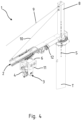
- figure 4 From the representation of figure 4 it can be seen that a heat exchanger 11 is attached to the trolley 3 .
- the line 4 is liquid-cooled. The resulting heat is via the heat exchanger 11 to the ambient air taken away.
- the heat exchanger 11 is arranged in the vicinity of the line 4 so that the heat can be dissipated directly on site.
- line 4 can be relatively short. You only have to bridge the distance from the trolley 3 to the ground or to the connection point of the vehicle in the vertical direction. As a result, the entire trolley 3 can be made comparatively light.
- figure 4 12 also shows a drive 12 comprising a motor and a transmission, via which the trolley 3 is driven and can be moved along the support arm 2.
- a difference compared to the first embodiment is that the power supply to the trolley 3 does not take place via a power rail, but via a hose reel 13.
- This hose reel is located on the carrier 2, but is stationary in the vicinity of the support column T.
- the hose reel 13 is used to supply and discharge a cooling liquid to and from the electrical line 4 on the trolley 3.
- the figures 7 and 8th show that two hoses are wound and unwound at the same time. These two hoses 14, 15 lead to the trolley 3 and to the electrical line 4 arranged there for charging the motor vehicle. Depending on the portion of the trolley 4, the hoses 14, 15 are wound up or down. It is possible within the scope of the invention for the electrical energy to also be transmitted via one of the hoses 14, 15. However, it is also conceivable that the hoses 14, 15 only carry a cooling liquid, in particular cooling water, which is cooled in a heat exchanger 16 on the support column T. The heat exchanger 16 is connected to the hoses 14, 15 in a manner that is not shown in detail. For this purpose, the hose reel has 13 double rotary unions.
- the heat exchanger 16 can also be arranged at a distance from the support column T.
- the heat exchanger 16 is preferably located in an area that allows it to be pivoted together with the support arm 2 .
- a cable bushing for the electrical power supply can be arranged in the area of a pivot bearing 17 on the upper side of the support column T.
- the pivoting movement of the support arm 2 can be limited so that the lines are not damaged during pivoting.
- Control signals can also be transmitted to the trolley 3 or to the drive 12 of the trolley 3 via additional sliding contacts.
Landscapes
- Engineering & Computer Science (AREA)
- Mechanical Engineering (AREA)
- Power Engineering (AREA)
- Transportation (AREA)
- Electric Propulsion And Braking For Vehicles (AREA)
- Superconductors And Manufacturing Methods Therefor (AREA)
- Communication Cables (AREA)
- Storing, Repeated Paying-Out, And Re-Storing Of Elongated Articles (AREA)
Description
- Die Erfindung betrifft eine Leitungszuführungsanordnung gemäß den Merkmalen des Patentanspruchs 1.
- Elektrisch angetriebene Kraftfahrzeuge, insbesondere Nutzfahrzeuge und PKWs müssen regelmäßig Ladestationen anfahren oder in ein Depot zurückgerufen werden, um dort geladen zu werden. Wenn es möglich ist, wird nicht nur bei nächtlichen Stillstandzeiten, sondern z.B. auch beim Be- und Entladen eines Lastkraftwagens eine bewegliche Leitung an das Kraftfahrzeug angeschlossen, um die Akkus zu laden.
- Die Be- und Ladezeiten von Nutzfahrzeugen sind in der Regel kurz, um einen Akku vollständig zu laden. Je mehr Strom in kurzer Zeit übertragen werden soll, desto größer muss der Leitungsquerschnitt an der Ladestation sein. Die Leitung, die von der Ladestation zum Kraftfahrzeug geführt wird, ist flexibel und in der Regel so schwer ist, dass sie auf dem Boden liegt. Dadurch kann es auf Dauer zu Beschädigungen an der Leitung kommen. Die Kupplungen werden stark belastet. Eine herkömmliche Ladestation kann zudem oftmals nicht in Fahrzeugnähe aufgestellt werden, da entweder der Platz nicht vorhanden ist oder weil die Ladestation vom Nutzfahrzeug an- oder umgefahren werden kann. Die Ladeleitung müsste dann sehr lang sein. Die Ladeleitung ist eine Stolperfalle für den Benutzer der Ladestation.
- Ferner ist zu berücksichtigen, dass die großen Leitungsquerschnitte die Handhabung der Leitungen stark erschweren. Es ist bekannt, Leitungen zu kühlen. Dann kann der Querschnitt der metallischen Leitung reduziert werden und damit auch das Gewicht gesenkt werden. Durch die Kühlung wird die Leitung jedoch etwas sperriger. Auch muss berücksichtigt werden, dass durch die Kühlung selbst Gewicht hinzukommt.
- Zum Stand der Technik ist auf die
DE 10 2017 100 638 A1 hinzuweisen. Es wird eine Ladestation für Elektrofahrzeuge offenbart, die ein Ladekabel mit einem Ladestecker hat. Das Ladekabel hängt über ein Gewichtsausgleichsmodul längsverschiebbar an einer Laufschiene, um die Handhabung des Ladekabels zu vereinfachen. - Die
JP 2011 160615 A - Die
EP 2 551 145 A2 offenbart eine mobile Ladestation für Elektrofahrzeuge, die innerhalb einer Garage hängend an einem Schienensystem mit Transportschienen verlagert werden kann. Die Transportschiene dient als Stromschiene. Die Ladeeinheit kann aus der Transport- bzw. Stromschiene ausgehängt werden und an einen anderen Ort getragen werden, beispielsweise um ein anderes Kraftfahrzeug zu laden. Eine solche mobile Ladestation soll ein Gewicht von höchstens 10 kg, insbesondere höchstens 5 kg haben, sodass die mobile Ladestationen von einem Benutzer oder robotisch von einem Magazin zu der Transportschiene oder von einer ersten Transportschiene zu einer zweiten Transportschiene getragen bzw. transportiert werden kann. Das angestrebte geringe Gewicht führt dazu, dass die Leitungsquerschnitte aus Gewichtsgründen begrenzt sind. - Die
US 2010/277127 A1 offenbart eine stationäre Ladestation. Die Ladekabel sollen aktiv gekühlt werden. Daher ist eine zusätzliche Luftkühlung vorgesehen. Bei diesem System muss das Fahrzeug nah an der lokalen Station positioniert werden. Zudem kann das Kabel, das auch aufgewickelt werden kann, auf dem Boden liegen und ist dadurch bereichsweise ungeschützt. - Die
CN 104 944 213 A offenbart eine Leitungstrommel, bei welcher mittels einer kombinierten Leitung elektrische Energie sowie Flüssigkeiten übertragen werden. - Aus der
JP 2012 090407 A - Hiervon ausgehend liegt der Erfindung die Aufgabe zugrunde, ein Leitungszuführungssystem für elektrisch angetriebene Kraftfahrzeuge aufzuzeigen, welches die Handhabung vereinfacht und welches gleichzeitig die Durchleitung größerer Ströme ermöglicht.
- Diese Aufgabe ist mit einer Leitungszuführungsanordnung gemäß den Merkmalen des Patentanspruchs 1 gelöst.
- Die Unteransprüche betreffen vorteilhafte Weiterbildungen der Erfindung.
- Die erfindungsgemäße Leitungszuführungsanordnung für elektrisch angetriebene Kraftfahrzeuge besitzt eine elektrische Leitung zum Laden eines Energiespeichers des Kraftfahrzeuges. Der Energiespeicher wird nachfolgend auch als Akkumulator, kurz Akku, bezeichnet. Die elektrische Leitung ist mit einer Energiequelle verbunden, über welche der zu transportierende Strom bereitgestellt wird. Bei der Erfindung ist vorgesehen, dass die elektrische Leitung an einem Tragarm angeordnet ist. Der Tragarm besitzt eine Laufkatze für die Positionierung der Leitung, die zu dem Kraftfahrzeug geführt werden soll. Der Tragarm ist in Horizontalrichtung verlagerbar oder es ist die Laufkatze relativ zum Tragarm in Horizontalrichtung verlagerbar. Dadurch ist es möglich, die Leitung in eine bevorzugte Anschlussposition zu dem zu ladenden Kraftfahrzeug zu bringen.
- Die Laufkatze befindet sich in einer Höhe oberhalb des zu ladenden Kraftfahrzeuges. Die Laufkatze hat die Funktion, ein freies Ende der Leitung freizugeben, das von der Laufkatze an dem Tragarm herunterhängt. Diese Leitung wird von oben kommend zum Laden an das Kraftfahrzeug angeschlossen. Die lichte Höhe unterhalb der Laufkatze, die eine freie Durchfahrt für PKWs und LKWs erlaubt, orientiert sich an den nationalen Vorschriften für die Abmessungen von Kraftfahrzeugen. Die lichte Höhe beträgt mindestens 4 m, bevorzugt mindestens 4,5 m.
- Der wesentliche Vorteil der Erfindung ist, dass die elektrische Leitung getragen wird und ohne Kontakt mit dem Boden von oben zugeführt wird. Die Leitung kann horizontal längs und quer zum Fahrzeug in die richtige Position gebracht werden. Sie muss nicht quer über das Kraftfahrzeug gelegt werden oder um das Kraftfahrzeug herum geführt werden, sondern kann bei entsprechender Positionierung der Laufkatze senkrecht von oben kommend an den Ladeanschluss angeschlossen werden. Hierzu besitzt das freie Ende der Leitung einen Stecker oder eine Kupplung. Die Orientierung von Stecker und Kupplung kann von der Senkrechten abweichen. Die elektrische Leitung ist flexibel.
- Die Leitung ist zudem flüssigkeitsgekühlt. Die Flüssigkeitskühlung ermöglicht es, kleinere Querschnitte zu verwenden. Die Leitung ist dadurch leichter und flexibler. Die Flüssigkeitskühlung bedingt zwar einen etwas höheren technischen Aufwand für eine solche Leitungszuführungsanordnung, im Ergebnis ist die Handhabung der Leitung jedoch einfacher, weil die Leitung leichter und damit auch flexibler ist.
- Wenn der Leitungsquerschnitt nicht reduziert wird, ist es bei gleichbleibendem Leitungsquerschnitt möglich, 30 - 50 % mehr Strom zu übertragen. Erfindungsgemäß ist vorgesehen, dass der Leitungsquerschnitt vorzugsweise nicht reduziert wird, um größere Ströme übertragen zu können. Er kann sogar vergrößert werden. Mit der Erfindung können Akkus in kürzerer Zeit geladen werden, ohne dass die Handhabung der elektrischen Leitung durch die großen Querschnitte erschwert ist. Auf diese Weise ist es möglich, einen Lkw beispielsweise während des Be- und Entladens in sehr kurzer Zeit mit einer großen Menge elektrischer Energie zu versorgen, ohne dass die Gefahr besteht, dass die elektrische Leitung überfahren wird oder dass Beschädigungen an der Ladestation selber erfolgen, beispielsweise durch Rangierfehler. Nach dem Laden kann das freie Ende der elektrischen Leitung wieder entkoppelt und angehoben werden und in einem Leitungsspeicher an der Laufkatze oder an dem Tragarm aufgenommen werden.
- Die Erfindung berücksichtigt auch die Möglichkeit, dass die Leitung bis zu einer bestimmten Länge frei von dem Tragarm bzw. von der Laufkatze herunterhängen kann, um von einem Bediener leicht erreicht werden zu können. Das hat allerdings den Nachteil, dass beim Rangieren die Gefahr besteht, mit der Leitung zu kollidieren. Vorzugsweise wird daher das, dass freie Ende der Leitung nach dem Laden zumindest soweit in Richtung zur Laufkatze eingezogen, dass ein Fahrzeug frei unterhalb der Leitung rangieren kann.
- Die Leistungszuführungsanordnung umfasst mindestens eine Schlauchtrommel zur Zuleitung und zur Ableitung einer Kühlflüssigkeit zur und von der elektrischen Leitung; Die Schlauchtrommel ist insbesondere in der Nähe einer Schwenkachse des Tragarms angeordnet. Die Schlauchtrommel hat die Funktion, der elektrischen Leitung die benötigte Kühlflüssigkeit bereitzustellen, unabhängig davon, von welcher Position am Tragarm die elektrische Leitung heruntergelassen wird. Die Stromzuführung kann auch bei Verwendung einer Schlauchtrommel über eine Stromschiene erfolgen. Vorzugsweise erfolgt über die Schlauchtrommel auch gleichzeitig die Übertragung der elektrischen Energie, sodass die Schlauchtrommel gleichzeitig auch eine Leitungs- oder Kabeltrommel ist. Die Schlauchtrommel besitzt in diesem Fall einen Schleifringübertrager zur Übertragung der elektrischen Energie.
- Der Tragarm ist insbesondere um eine vertikale Schwenkachse verschwenkbar. Der Tragarm fungiert wie der Ausleger eines Turmdrehkrans. Die vertikale Schwenkachse befindet sich in oder an einem Turm bzw. einer Tragsäule, an welcher der Tragarm befestigt ist. Der Tragarm kann einseitig quer von der Trägersäule abstehen. Es ist auch möglich, auf der der Schwenkachse gegenüberliegenden Seite ein Gegengewicht anzuordnen. Der Tragarm kann insbesondere in Gitterbauweise konfiguriert sein. Abspannmittel oberhalb des Tragarms verhindert ein Durchbiegen und ermöglichen eine leichte und gleichzeitig hoch belastbare Konstruktion mit weiter Auslage. Eine solche Leitungszuführungsanordnung kann im Außenbereich angeordnet sein. Der Tragarm besitzt eine Länge, die vorzugsweise größer ist als die typische Fahrzeugbreite von etwa 2,5 m. Er besitzt beispielsweise eine Länge von 4-8 m, sodass eine ausreichende Rangierfreiheit gegenüber der zentralen Tragsäule verbleibt.
- Der Tragarm selber befindet sich im Abstand zum Boden bzw. zur Fahrbahn. Der Tragarm kann auch an einer Tragkonstruktion befestigt sein, die den Tragarm nicht von unten stützt, sondern von oben hält, beispielsweise an einer Deckenkonstruktion z.B. in einer Lagerhalle oder auch einer Fahrzeughalle.
- Eine alternative Ausführungsform umfasst eine Rahmenkonstruktion an welcher der Tragarm linear verlagerbar ist. Durch eine lineare Verschiebung des Tragarms und eine gleichzeitige Verlagerung der Laufkatze entlang des Tragarms ist ebenfalls eine individuelle Positionierung der elektrischen Leitung möglich. Der linear verlegbare Tragarm kann an seinen beiden Enden gelagert sein. Die Erfindung erfasst Leitungszuführungsanordnungen, die nach dem Prinzip eines Säulenschwenkkrans bzw. eines Portalkrans arbeiten. Der Tragarm kann entlang von Kranbahnen oder Schienen im Bereich der Wände oder im Bereich von Stützpfeilern einer Halle geführt werden. Der Tragarm kann an derartigen als Tragsäule dienenden Stützpfeilern befestigt sein.
- Die Verlagerung des Tragarmes und/oder der Laufkatze erfolgt in einer vorteilhaften Weiterbildung der Erfindung durch jeweils einen motorischen Antrieb. Beispielsweise kann an einer Tragsäule eine Bedieneinheit angeordnet sein, über welche der Tragarm und die Laufkatze in die richtige Position verfahren werden können. Auch das Absenken der elektrischen Leitung von der Laufkatze nach unten kann über einen elektrischen Antrieb erfolgen. Alle Antriebe sind fernsteuerbar. Eine drahtlose Fernsteuerung kann vorgesehen sein.
- Es ist auch möglich, dass von der Laufkatze ein Seil herunterhängt, das nicht beschädigt werden kann, wenn ein Fahrzeug gegen dieses Seil fährt und auch keinen Schaden an dem Fahrzeug verursacht. Mit diesem Seil kann die Laufkatze manuell in die richtige Position gebracht werden. Wenn man stärker an dem Seil zieht, kann auch die elektrische Leitung heruntergezogen und angeschlossen werden. Es ist eine Leitungstrommel für die Leitung an der Laufkatze angeordnet. Das Absenken und Anheben des freien Endes der Leitung kann durch einen Antrieb erfolgen. Bei der Leitungstrommel handelt sich beispielsweise um eine Motorleitungstrommel. Um das Anheben des relativ schweren Kabels zu erleichtern, kann es sich auch um eine Federleitungstrommel handeln oder eine Gegengewichtstrommel. Auch die Kombination mit einem Gewichtsausgleich bzw. mit einem Federzug oder einem sogenannten Balancer ist möglich, um die schwere elektrische Leitung mit nur geringem Kraftaufwand leicht in die Anschlussposition bzw. die Ausgangsposition zu bringen. Für die Stromübertragung kann eine Kabelwagenanlage oder eine Stromschiene entlang des Tragarms verlaufen. Über die Stromschiene ist die Laufkatze elektrisch angeschlossen, um die Leitung, die bei der Laufkatze beginnt, mit Strom aus einer elektrischen Energiequelle zu verbinden.
- Bei einem System mit einer Kabelwagenanlage werden Kabel und/oder Schläuche in Bögen geführt. Kabel und Schläuche sind in übersichtlicher Weise an dem Tragarm aufgehängt, sodass sie keine Hindernisse im Verkehrsweg der Kraftfahrzeuge sind. Wichtig ist, dass der Tragarm hoch genug montiert ist, sodass bei einem Kabelwagen- oder auch Kabelschlepp-Systeme die einzelnen Schlaufen sich immer in einer Höhe befinden, die keine Kollision mit dem Kraftfahrzeug zulässt.
- Die Kühlung des Kühlfluides erfolgt in einem Wärmetauscher. Dieser Wärmetauscher ist entfernt von der Laufkatze angeordnet, beispielsweise stationär an der Tragsäule. Damit das Kühlfluid zirkulieren kann, wickelt die Schlauchtrommel einen Schlauch als Vorlauf und einen als Rücklauf.
- Wenn beispielsweise eine Stromschiene den nötigen Strom zu der Laufkatze überträgt, ist eine weitergehende Kühlung nur im Bereich der elektrischen Leitung an der Laufkatze erforderlich. Das Kühlfluid zirkuliert in dem Mantel der elektrischen Leitung und wird unmittelbar an dem Wärmetauscher der Laufkatze gekühlt.
- Unter bestimmten Umständen, beispielsweise aus akustischen Gründen, kann eine Anordnung des Wärmetauschers in der Nähe der Tragsäule zweckmäßig sein. Der Wärmetauscher kann auch im Abstand zur Tragsäule und im Abstand zum Tragarm angeordnet sein. Beispielsweise ist es bei mehreren Tragarmen bzw. Leitungszuführungsanordnungen möglich, einen gemeinsamen zentralen Wärmetauscher vorzusehen.
- Die Erfindung hat den wesentlichen Vorteil, dass die schwere elektrische Leitung bei Nichtgebrauch kein Hindernis ist. Eine Beschädigung der Leitung ist dadurch wesentlich unwahrscheinlicher. Im Rangierbereich der Kraftfahrzeuge gibt es keine Hindernisse, wie z. B. bodenseitige Ladesäulen. Durch gekühlte Leitungen kann in kürzerer Zeit deutlich mehr Strom übertragen werden. Die ladebedingten Stillstandzeiten der Kraftfahrzeuge werden verringert und der Ausnutzungsgrad der Kraftfahrzeuge wird verbessert.
- Die Erfindung wird nachfolgend anhand des in den
Figuren 5 bis 8 schematisch dargestellten Ausführungsbeispiels erläutert. DieFiguren 1 bis 4 zeigen keine Ausführungsformen der Erfindung. Sie dienen zu Illustration des Erfindungsgedankens, wobei in denFiguren 5 - 8 auf die Erläuterungen derFiguren 1 bis 4 Bezug genommen wird. Die dortigen Ausführungen haben insofern auch für die erfindungsgemäße Bauform gemäß denFiguren 5 bis 8 Bedeutung, mit der Ausnahme, dass der Wärmetauscher an der Laufkatze befestigt ist bzw. dass anders als bei der erfindungsgemäßen Ausführungsform derFiguren 5 und8 keine stationäre Schlauchtrommel zur Zu- und Ableitung einer Kühlflüssigkeit am Tragarm angeordnet ist. Es zeigen: - Figur 1
- eine erste Ausführungsform einer Leitungsführungsanordnung in einer perspektivischen Ansicht;
- Figur 2
- die Ausführungsform der Leitungszuführungsanordnung aus einer anderen Perspektive;
- Figur 3
- die Einzelheit III der
Figur 1 ; - Figur 4
- die Einzelheit IV aus
Figur 2 ; - Figur 5
- eine perspektivische Darstellung einer erfindungsgemäßen Ausführungsform einer Leitungszuführungsanordnung;
- Figur 6
- Leitungszuführungsanordnung der
Figur 5 in einer weiteren Perspektive; - Figur 7
- die Einzelheit VII der
Figur 5 und - Figur 8
- die Einzelheit VIII der
Figur 6 . - Die Leitungszuführungsanordnung 1 gemäß der
Figuren 1 bis 4 dient dazu, einem nicht näher dargestellten elektrisch betriebenen Kraftfahrzeug elektrische Energie zum Laden seiner Energiespeicher zur Verfügung zu stellen. Das elektrische Kraftfahrzeug ist insbesondere ein PKW oder ein LKW, insbesondere ein Nutzkraftfahrzeug. Es handelt sich bei dem Kraftfahrzeug um ein durch einen Motor angetriebenes, nicht an Schienen gebundenes Fahrzeug, also um einen Kraftwagen, ein Kraftrad oder um eine Zugmaschine. - Die Leitungszuführungsanordnung 1 besitzt einen Tragarm 2, der an einer Tragsäule T befestigt ist. Der Tragarm 2 ist am oberen Ende der Tragsäule T befestigt, sodass er in einem Abstand zum bodenseitigen Fuß der Tragsäule T angeordnet ist, der es den zu ladenden Kraftfahrzeugen erlaubt, unter dem Tragarm 2 hindurchzufahren.
- Der Tragarm 2 ist länger als die Tragsäule T hoch ist. Er besitzt eine Länge von mindestens 4 m vorzugsweise sogar mindestens 8 m.
- An den Tragarm 2 befindet sich eine Laufkatze 3, die in Längsrichtung des Tragarms 2 verfahrbar ist. Die Laufkatze 3 befindet sich in jeder Position am Tragarm 2 oberhalb des zu ladenden Kraftfahrzeuges. Die Laufkatze 3 dient dazu, eine elektrische Leitung 4 zum Laden eines Energiespeichers des Kraftfahrzeuges relativ zum Kraftfahrzeug in die richtige Position zu bringen. Hierzu kann der Tragarm 2 um eine Schwenkachse S in der Mitte der Tragsäule T verschwenkt werden. Dadurch ist er in Horizontalrichtung schwebend verlagerbar. Gleichzeitig ist die Laufkatze 3 in Längsrichtung zum Tragarm 2 verlagerbar, sodass innerhalb der Reichweite des Tragarmes 2 vielfältige Positionen anfahrbar sind, an denen ein Ende 5 (
Figur 3 ) der Leitung 4 heruntergelassen werden kann, um das Fahrzeug zu laden. An dem freien Ende 5 der Leitung 4 kann ein Stecker oder eine Kupplung angeordnet sein um die Leitung 4 an das Kraftfahrzeug anzuschließen. - Nach dem Laden kann die Leitung 4 wieder aufgewickelt werden und nach oben gezogen werden. Hierzu befindet sich an der Laufkatze 3 eine Leitungstrommel 6. Bei der Leitungstrommel 6 kann es sich beispielsweise um eine Motorleitungstrommel handeln. Die Leitungstrommel 6 kann auch federbelastet sein oder mit einem Balancer ausgestattet sein, sodass die elektrische Leitung 4 leicht nach oben gezogen werden kann und niemals selbsttätig von der Leitungstrommel 6 abwickeln kann. Es ist auch denkbar, dass eine Bewegung der Leitungstrommel 6 dann freigegeben wird, wenn eine übergeordnete Steuereinheit das Signal zur Freigabe gibt, beispielsweise, wenn der Fahrzeugführer die Autorisierung bekommen hat, Strom über die Leitungszuführungsanordnung zu beziehen.
- Die Leitungszuführungsanordnung 1 kann einen sehr langen Tragarm haben. Daher ist vorgesehen, dass oberhalb des Tragarms T ein Abspannarm 8 in Verlängerung der Schwenkachse S angeordnet ist. An dem Abspannarm 8 sind im Bereich seines oberen Endes zwei Abspannmittel 9, 10, z. B. in Form von Drahtseilen befestigt, die in unterschiedlichen Abständen von der Schwenkachse S oberseitig mit dem Tragarm 2 verbunden sind. Dadurch kann der Tragarm 2 schlank gestaltet sein, aber gleichzeitig hohe Lasten ohne Durchbiegung tragen. Der Abspannarm 8 ist in diesem Fall fest mit dem Tragarm 2 verbunden und zusammen mit dem Tragarm 2 um die Schwenkachse S verschwenkbar.
- Die Energiezuführung zu der Laufkatze 3 erfolgt über wenigstens eine Stromschiene. Die Stromschiene steht über einen Schleifübertrager mit der Laufkatze 3 und der elektrischen Leitung 4 in elektrischem Kontakt. Die elektrische Leitung 4 zum übertragen des Stroms befindet sich daher ausschließlich auf der Leitungstrommel 6 an der Laufkatze 3.
- Aus der Darstellung der
Figur 4 ist zu erkennen, dass an der Laufkatze 3 ein Wärmetauscher 11 befestigt ist. Die Leitung 4 ist flüssigkeitsgekühlt. Die dabei entstehende Wärme wird über den Wärmetauscher 11 an die Umgebungsluft abgeführt. Der Wärmetauscher 11 ist in der Nähe der Leitung 4 angeordnet, damit die Wärme unmittelbar vor Ort abgeführt werden kann. Die Leitung 4 kann dadurch relativ kurz ausfallen. Sie muss nur den Abstand von der Laufkatze 3 zum Boden bzw. zur Anschlussstelle des Fahrzeuges in Hochrichtung überbrücken. Dadurch kann die ganze Laufkatze 3 vergleichsweise leicht gestaltet sein.Figur 4 zeigt ferner einen Antrieb 12 umfassend einen Motor und ein Getriebe, über welchen die Laufkatze 3 angetrieben und entlang des Tragarms 2 verfahrbar ist. - Die
Figuren 5 bis 8 zeigen ein erfindungsgemäßes Ausführungsbeispiel, bei welchem die zuvor eingeführten Bezugszeichen für im Wesentlichen baugleiche Komponenten beibehalten werden. Darüber hinaus kann auf die vorstehende Beschreibung Bezug genommen werden. - Ein Unterschied gegenüber der ersten Ausführungsform besteht darin, dass die Energiezuführung zur Laufkatze 3 nicht über eine Stromschiene erfolgt, sondern über eine Schlauchtrommel 13. Diese Schlauchtrommel befindet sich auf dem Träger 2, allerdings stationär in der Nähe der Tragsäule T.
- Die Schlauchtrommel 13 dient zur Zu- und Ableitung einer Kühlflüssigkeit zur und von der elektrischen Leitung 4 an der Laufkatze 3. Die
Figuren 7 und8 zeigen, dass gleichzeitig zwei Schläuche auf- und abgewickelt werden. Diese beiden Schläuche 14, 15 führen zu der Laufkatze 3 und zu der dort angeordneten elektrischen Leitung 4 zum Laden des Kraftfahrzeuges. Je nach Portion der Laufkatze 4 werden die Schläuche 14, 15 auf- oder abgewickelt Es ist im Rahmen der Erfindung möglich, dass auch die Übertragung der elektrischen Energie über einen der Schläuche 14, 15 erfolgt. Denkbar ist aber auch, dass die Schläuche 14, 15 lediglich eine Kühlflüssigkeit, insbesondere Kühlwasser führen, das in einem Wärmetauscher 16 an der Tragsäule T gekühlt wird. Der Wärmetauscher 16 ist in nicht näher dargestellter Weise mit den Schläuchen 14, 15 verbunden. Hierzu besitzt die Schlauchtrommel 13 doppelte Drehdurchführungen. - Der Wärmetauscher 16 kann auch im Abstand von der Tragsäule T angeordnet sein. Vorzugsweise befindet sich der Wärmetauscher 16 in einem Bereich, der es ermöglicht, zusammen mit dem Tragarm 2 verschwenkt zu werden.
- Im Bereich eines Drehlagers 17 an der Oberseite der Tragsäule T kann eine Kabeldurchführung für die elektrische Energieversorgung, aber auch für kühlmittelführende Leitungen angeordnet sein. Damit die Leitungen beim Verschwenken nicht beschädigt wird, kann die Schwenkbewegung des Tragarms 2 begrenzt werden. Es ist aber auch denkbar, zumindest für die elektrische Zuleitung einen Schleifringübertrager im Bereich des Drehlagers vorzusehen. Auch können über weitere Schleifkontakte Steuersignale zu der Laufkatze 3 oder auch zu dem Antrieb 12 der Laufkatze 3 übermittelt werden.
-
- 1 -
- Leitungszuführungsanordnung
- 2 -
- Tragarm
- 3 -
- Laufkatze
- 4 -
- elektrische Leitung
- 5 -
- Verbinder
- 6 -
- Leistungstrommel
- 7 -
- Kabelführung
- 8 -
- Abspannarm
- 9 -
- Abspannmittel
- 10 -
- Abspannmittel
- 11 -
- Wärmetauscher
- 12 -
- Antrieb für 3
- 13 -
- Schlauchtrommel
- 14 -
- Schlauch
- 15 -
- Schlauch
- 16 -
- Wärmetauscher
- 17 -
- Drehlager
- S -
- Schwenkachse
- T -
- Tragsäule
Claims (9)
- Leitungszuführungsanordnung für elektrisch angetriebene Kraftfahrzeuge umfassend folgende Merkmale:a. Eine elektrische Leitung (4) zum Laden eines Energiespeichers des Kraftfahrzeuges ist an einem Tragarm (2) angeordnet; wobei der Tragarm (2) an einer Tragsäule (T) angeordnet ist;b. am Tragarm (2) befindet sich eine Laufkatze (3) für die Positionierung der Leitung (4);c. die Laufkatze (3) ist relativ zum Tragarm (2) in Horizontalrichtung verlagerbar oder der Tragarm (4) ist in Horizontalrichtung verlagerbar und die Laufkatze (3) ist relativ zum Tragarm (2) in Horizontalrichtung verlagerbar;d. die Laufkatze (3) ist dazu ausgebildet, sich in einer Höhe oberhalb des zu ladenden Kraftfahrzeuges zu befinden;e. ein freies Ende (5) der Leitung (4) hängt von der Laufkatze (3) an dem Tragarm (2) herunter, um von oben kommend zum Laden an das Kraftfahrzeug angeschlossen zu werden;f. die Leitung (4) ist flüssigkeitsgekühlt;gekennzeichnet durch folgende Merkmale:g. wenigstens eine Schlauchtrommel (13) ist am Tragarm (2) stationär in der Nähe zur Tragsäule (T) angeordnet und dient zur Zu- und Ableitung einer Kühlflüssigkeit zur und von der elektrischen Leitung (4) an der relativ zur Schlauchtrommel (13) verlagerbaren Laufkatze (3), wobei eine Leitungstrommel (6) für die Leitung (4) an der Laufkatze (3) angeordnet ist, um das freie Ende (5) der Leitung (4) zum Kraftfahrzeug abzusenken;h. ein Wärmetauscher (16) zum Kühlen der Kühlflüssigkeit ist entfernt von der Laufkatze (3) angeordnet.
- Leitungszuführungsanordnung nach Anspruch 1, dadurch gekennzeichnet, dass der Tragarm (2) um eine vertikale Schwenkachse (S) verschwenkbar ist.
- Leitungszuführungsanordnung nach Anspruch 1 oder 2, dadurch gekennzeichnet, dass der Tragarm (2) gegenüber der Tragsäule (T) verschwenkbar ist.
- Leitungszuführungsanordnung nach Anspruch 1, dadurch gekennzeichnet, dass der Tragarm (2) linear in Horizontalrichtung gegenüber einer Tragkonstruktion verlagerbar ist.
- Leitungszuführungsanordnung nach einem der Ansprüche 1 bis 4, gekennzeichnet durch einen motorischen Antrieb (12) zum Bewegen des Tragarmes (2) und/oder zum Bewegen der Laufkatze (3).
- Leitungszuführungsanordnung nach einem der Ansprüche 1 bis 5, dadurch gekennzeichnet, dass an dem Tragarm (2) eine Stromschiene angeordnet ist, wobei die Leitung (4) über die Laufkatze (3) elektrisch mit der Stromschiene verbunden ist.
- Leitungszuführungsanordnung nach einem der Ansprüche 1 bis 6, dadurch gekennzeichnet, dass die Leitungstrommel (6) eine Federleitungstrommel, eine Motorleitungstrommel oder eine Gegengewichtstrommel ist oder wobei die Leitung (4) mit einem Gewichtsausgleicher verbunden ist.
- Leitungszuführungsanordnung nach einem der Ansprüche 1 bis 7, dadurch gekennzeichnet, dass eine einzige Schlauchtrommel (13) vorgesehen ist mit einer doppelten Drehdurchführung zum Zuleiten und Ableiten von Kühlflüssigkeit.
- Leitungszuführungsanordnung nach einem der Ansprüche 1 bis 8, dadurch gekennzeichnet, dass die Schlauchtrommel (13) einen Schleifringübertrager aufweist, wobei über die Schlauchtrommel (13) auch die elektrische Leitung geführt ist.
Applications Claiming Priority (2)
| Application Number | Priority Date | Filing Date | Title |
|---|---|---|---|
| DE102018122663.2A DE102018122663A1 (de) | 2018-09-17 | 2018-09-17 | Leitungszuführungsanordnung |
| PCT/DE2019/100805 WO2020057693A1 (de) | 2018-09-17 | 2019-09-09 | Leitungszuführungsanordnung |
Publications (2)
| Publication Number | Publication Date |
|---|---|
| EP3853956A1 EP3853956A1 (de) | 2021-07-28 |
| EP3853956B1 true EP3853956B1 (de) | 2023-07-05 |
Family
ID=67997310
Family Applications (1)
| Application Number | Title | Priority Date | Filing Date |
|---|---|---|---|
| EP19769985.3A Active EP3853956B1 (de) | 2018-09-17 | 2019-09-09 | Leitungszuführungsanordnung |
Country Status (5)
| Country | Link |
|---|---|
| US (1) | US11267350B2 (de) |
| EP (1) | EP3853956B1 (de) |
| DE (1) | DE102018122663A1 (de) |
| ES (1) | ES2953743T3 (de) |
| WO (1) | WO2020057693A1 (de) |
Families Citing this family (7)
| Publication number | Priority date | Publication date | Assignee | Title |
|---|---|---|---|---|
| WO2024073963A1 (zh) * | 2022-10-07 | 2024-04-11 | 上海阪辉新能源科技有限公司 | 一种充电装置 |
| DE102023205169B4 (de) * | 2023-06-02 | 2025-11-27 | Siemens Aktiengesellschaft | Kabelmanagement für Ladestationen von Fahrzeugen |
| DE102023205522B3 (de) | 2023-06-14 | 2024-08-14 | Siemens Aktiengesellschaft | Vorrichtung und Verfahren zum Transportieren eines Ladekabels zum Laden eines Fahrzeugs |
| US20240425329A1 (en) * | 2023-06-21 | 2024-12-26 | Knight Industries & Associates, Inc. | Crane cable and hose management |
| CN116946818B (zh) * | 2023-09-20 | 2023-11-21 | 湖北第二师范学院 | 一种电动车辆充电装置 |
| WO2025209628A1 (de) | 2024-03-30 | 2025-10-09 | SBRS GmbH | Ladestation für elektrofahrzeuge, insbesondere nutzfahrzeuge, und nachrüstbare kopplungseinheit für ladestationen |
| DE102024111481B3 (de) * | 2024-03-30 | 2025-09-25 | SBRS GmbH | Ladestation für Elektrofahrzeuge, insbesondere Nutzfahrzeuge, und nachrüstbare Kopplungseinheit für Ladestationen |
Family Cites Families (18)
| Publication number | Priority date | Publication date | Assignee | Title |
|---|---|---|---|---|
| US1467253A (en) * | 1920-08-02 | 1923-09-04 | Stephen H Sharpsteen | Motor-driven circuit carriage |
| EP2238667A2 (de) | 2008-01-14 | 2010-10-13 | Aerovironment | Übertragungskabel mit gleitendem leiter |
| JP5586975B2 (ja) * | 2010-02-03 | 2014-09-10 | トヨタホーム株式会社 | 充電装置 |
| JP2012090407A (ja) * | 2010-10-19 | 2012-05-10 | Toyota Industries Corp | 車両用充電装置 |
| US8923882B2 (en) | 2011-07-26 | 2014-12-30 | Honeywell International Inc. | Determining a deployment of a wireless network |
| DE102011079870B4 (de) * | 2011-07-27 | 2015-02-19 | Christoph RULAND | Mobile Ladestation für Elektrofahrzeuge und Ladesystem |
| JP2013162550A (ja) * | 2012-02-01 | 2013-08-19 | Chuo Spring Co Ltd | 充電ケーブル用収容装置 |
| US9365116B2 (en) * | 2012-07-23 | 2016-06-14 | Ford Global Technologies, Llc | Vehicle recharging station and support devices |
| DE102012220218A1 (de) * | 2012-11-07 | 2014-05-08 | Continental Automotive Gmbh | Verfahren zum Laden einer Start- oder Traktionsbatterie eines Hybrid- oder Elektrokraftfahrzeugs sowie Fahrzeugkupplungsstück, Fahrzeugkupplungsanordnung, Batterieeinrichtung, Ladestationskupplung und Ladestation zur Ausführung des Verfahrens. |
| DE102014107153A1 (de) * | 2013-05-31 | 2014-12-04 | GM Global Technology Operations LLC (n. d. Gesetzen des Staates Delaware) | Elektrofahrzeug-Ladestation |
| JP2015047014A (ja) * | 2013-08-28 | 2015-03-12 | 河村電器産業株式会社 | 充電ケーブル支持アーム |
| CN104944213B (zh) | 2015-06-16 | 2018-02-06 | 温州牛牛气动科技有限公司 | 水气电复合型自动卷管器 |
| US10137793B2 (en) * | 2015-09-23 | 2018-11-27 | ScienBiziP Consulting(Shenzhen) Co., Ltd. | Wiper ring and charging pile using same |
| US10308122B2 (en) * | 2016-09-27 | 2019-06-04 | Alternative Engineering, Inc. | Heavy cable counter balance device |
| DE102016118193A1 (de) * | 2016-09-27 | 2018-03-29 | Phoenix Contact E-Mobility Gmbh | Elektrisches Kabel mit einer Kühlmittelleitung |
| DE202017100174U1 (de) * | 2016-10-19 | 2017-04-05 | Elektro-Bauelemente Gmbh | Ladestation für Elektrofahrzeuge |
| DE102017100638A1 (de) * | 2016-10-19 | 2018-04-19 | Elektro-Bauelemente Gmbh | Ladestation für Elektrofahrzeuge |
| CN107082030B (zh) * | 2017-05-24 | 2023-07-07 | 深圳市沃尔核材股份有限公司 | 充电设备冷却系统 |
-
2018
- 2018-09-17 DE DE102018122663.2A patent/DE102018122663A1/de not_active Ceased
-
2019
- 2019-09-09 ES ES19769985T patent/ES2953743T3/es active Active
- 2019-09-09 WO PCT/DE2019/100805 patent/WO2020057693A1/de not_active Ceased
- 2019-09-09 EP EP19769985.3A patent/EP3853956B1/de active Active
- 2019-09-09 US US17/276,749 patent/US11267350B2/en active Active
Also Published As
| Publication number | Publication date |
|---|---|
| DE102018122663A1 (de) | 2020-03-19 |
| ES2953743T3 (es) | 2023-11-15 |
| EP3853956A1 (de) | 2021-07-28 |
| US20210354574A1 (en) | 2021-11-18 |
| US11267350B2 (en) | 2022-03-08 |
| WO2020057693A1 (de) | 2020-03-26 |
Similar Documents
| Publication | Publication Date | Title |
|---|---|---|
| EP3853956B1 (de) | Leitungszuführungsanordnung | |
| EP0189955B1 (de) | Gleisloses knickgelenktes Untertagefahrzeug mit Elektromotorantrieb | |
| EP3102527B1 (de) | System und koppelvorrichtung zum automatischen ankoppeln einer fahrbaren maschine, insbesondere eines container-stapelkrans, an eine fahrversorgung, sowie kupplung hierfür | |
| EP3319190A1 (de) | Leitungsfahrwagen sowie montagesystem zur autonomen montage von armaturen an freileitungen | |
| DE2906514A1 (de) | Halbautomatisches warenlagersystem | |
| EP3924289B1 (de) | Kran sowie kabeltrommeleinheit hierfür | |
| EP2984021A1 (de) | Kran mit einem kranausleger, wobei die stromzuführung zum lasthaken und/oder laufkatze über ein zugkräfte übertragendes seil erfolgt | |
| DE102023205522B3 (de) | Vorrichtung und Verfahren zum Transportieren eines Ladekabels zum Laden eines Fahrzeugs | |
| EP0099935A1 (de) | Einstellbare Personenplattform | |
| EP0157192B1 (de) | Verfahren und Vorrichtung zum Anschliessen des Stromabnehmers eines Trolleyfahrzeugs an ein Stromschienensystem | |
| EP3529192A1 (de) | Laufkran | |
| WO2017063762A1 (de) | Schienenprofil für kran-hängebahnen und schwenkkräne mit integrierbarer energiekette | |
| EP0718233A2 (de) | Schlauchaufrollvorrichtung | |
| DE3911868C2 (de) | ||
| EP4607749A1 (de) | Mobile energieversorgungseinheit für eine mobile arbeitsmaschine | |
| EP3228492A1 (de) | Energiezuführung für eine umschlagmaschine | |
| DE102023205169B4 (de) | Kabelmanagement für Ladestationen von Fahrzeugen | |
| CH703049A2 (de) | Vorrichtung zum Anheben und Absenken von Lasten. | |
| EP2897892A1 (de) | Verfahren zum betrieb eines krans und kran | |
| DE10354083B4 (de) | Selbstverfahrbarer Container als Basisstation zur Durchführung von unterirdischen Installationen | |
| DE102016109445B4 (de) | Fahrzeug mit Hilfsantrieb | |
| DE102005051133B4 (de) | Fahrerloses Transportsystem | |
| DE102024116165B3 (de) | Nutzfahrzeug mit einer Ladestromweiterleitungsvorrichtung | |
| WO2025237552A1 (de) | Schleifleitungssystem | |
| EP1508472B9 (de) | Fahrzeug mit aufrichtbarer Plane |
Legal Events
| Date | Code | Title | Description |
|---|---|---|---|
| STAA | Information on the status of an ep patent application or granted ep patent |
Free format text: STATUS: UNKNOWN |
|
| STAA | Information on the status of an ep patent application or granted ep patent |
Free format text: STATUS: THE INTERNATIONAL PUBLICATION HAS BEEN MADE |
|
| PUAI | Public reference made under article 153(3) epc to a published international application that has entered the european phase |
Free format text: ORIGINAL CODE: 0009012 |
|
| STAA | Information on the status of an ep patent application or granted ep patent |
Free format text: STATUS: REQUEST FOR EXAMINATION WAS MADE |
|
| 17P | Request for examination filed |
Effective date: 20210326 |
|
| AK | Designated contracting states |
Kind code of ref document: A1 Designated state(s): AL AT BE BG CH CY CZ DE DK EE ES FI FR GB GR HR HU IE IS IT LI LT LU LV MC MK MT NL NO PL PT RO RS SE SI SK SM TR |
|
| DAV | Request for validation of the european patent (deleted) | ||
| DAX | Request for extension of the european patent (deleted) | ||
| GRAP | Despatch of communication of intention to grant a patent |
Free format text: ORIGINAL CODE: EPIDOSNIGR1 |
|
| STAA | Information on the status of an ep patent application or granted ep patent |
Free format text: STATUS: GRANT OF PATENT IS INTENDED |
|
| INTG | Intention to grant announced |
Effective date: 20230403 |
|
| GRAS | Grant fee paid |
Free format text: ORIGINAL CODE: EPIDOSNIGR3 |
|
| GRAA | (expected) grant |
Free format text: ORIGINAL CODE: 0009210 |
|
| STAA | Information on the status of an ep patent application or granted ep patent |
Free format text: STATUS: THE PATENT HAS BEEN GRANTED |
|
| AK | Designated contracting states |
Kind code of ref document: B1 Designated state(s): AL AT BE BG CH CY CZ DE DK EE ES FI FR GB GR HR HU IE IS IT LI LT LU LV MC MK MT NL NO PL PT RO RS SE SI SK SM TR |
|
| P01 | Opt-out of the competence of the unified patent court (upc) registered |
Effective date: 20230530 |
|
| REG | Reference to a national code |
Ref country code: CH Ref legal event code: EP |
|
| REG | Reference to a national code |
Ref country code: AT Ref legal event code: REF Ref document number: 1585705 Country of ref document: AT Kind code of ref document: T Effective date: 20230715 |
|
| REG | Reference to a national code |
Ref country code: DE Ref legal event code: R096 Ref document number: 502019008423 Country of ref document: DE |
|
| REG | Reference to a national code |
Ref country code: IE Ref legal event code: FG4D Free format text: LANGUAGE OF EP DOCUMENT: GERMAN |
|
| REG | Reference to a national code |
Ref country code: LT Ref legal event code: MG9D |
|
| REG | Reference to a national code |
Ref country code: NL Ref legal event code: MP Effective date: 20230705 |
|
| REG | Reference to a national code |
Ref country code: ES Ref legal event code: FG2A Ref document number: 2953743 Country of ref document: ES Kind code of ref document: T3 Effective date: 20231115 |
|
| PG25 | Lapsed in a contracting state [announced via postgrant information from national office to epo] |
Ref country code: NL Free format text: LAPSE BECAUSE OF FAILURE TO SUBMIT A TRANSLATION OF THE DESCRIPTION OR TO PAY THE FEE WITHIN THE PRESCRIBED TIME-LIMIT Effective date: 20230705 |
|
| PG25 | Lapsed in a contracting state [announced via postgrant information from national office to epo] |
Ref country code: GR Free format text: LAPSE BECAUSE OF FAILURE TO SUBMIT A TRANSLATION OF THE DESCRIPTION OR TO PAY THE FEE WITHIN THE PRESCRIBED TIME-LIMIT Effective date: 20231006 |
|
| PG25 | Lapsed in a contracting state [announced via postgrant information from national office to epo] |
Ref country code: IS Free format text: LAPSE BECAUSE OF FAILURE TO SUBMIT A TRANSLATION OF THE DESCRIPTION OR TO PAY THE FEE WITHIN THE PRESCRIBED TIME-LIMIT Effective date: 20231105 |
|
| PG25 | Lapsed in a contracting state [announced via postgrant information from national office to epo] |
Ref country code: SE Free format text: LAPSE BECAUSE OF FAILURE TO SUBMIT A TRANSLATION OF THE DESCRIPTION OR TO PAY THE FEE WITHIN THE PRESCRIBED TIME-LIMIT Effective date: 20230705 Ref country code: RS Free format text: LAPSE BECAUSE OF FAILURE TO SUBMIT A TRANSLATION OF THE DESCRIPTION OR TO PAY THE FEE WITHIN THE PRESCRIBED TIME-LIMIT Effective date: 20230705 Ref country code: PT Free format text: LAPSE BECAUSE OF FAILURE TO SUBMIT A TRANSLATION OF THE DESCRIPTION OR TO PAY THE FEE WITHIN THE PRESCRIBED TIME-LIMIT Effective date: 20231106 Ref country code: NO Free format text: LAPSE BECAUSE OF FAILURE TO SUBMIT A TRANSLATION OF THE DESCRIPTION OR TO PAY THE FEE WITHIN THE PRESCRIBED TIME-LIMIT Effective date: 20231005 Ref country code: LV Free format text: LAPSE BECAUSE OF FAILURE TO SUBMIT A TRANSLATION OF THE DESCRIPTION OR TO PAY THE FEE WITHIN THE PRESCRIBED TIME-LIMIT Effective date: 20230705 Ref country code: LT Free format text: LAPSE BECAUSE OF FAILURE TO SUBMIT A TRANSLATION OF THE DESCRIPTION OR TO PAY THE FEE WITHIN THE PRESCRIBED TIME-LIMIT Effective date: 20230705 Ref country code: IS Free format text: LAPSE BECAUSE OF FAILURE TO SUBMIT A TRANSLATION OF THE DESCRIPTION OR TO PAY THE FEE WITHIN THE PRESCRIBED TIME-LIMIT Effective date: 20231105 Ref country code: HR Free format text: LAPSE BECAUSE OF FAILURE TO SUBMIT A TRANSLATION OF THE DESCRIPTION OR TO PAY THE FEE WITHIN THE PRESCRIBED TIME-LIMIT Effective date: 20230705 Ref country code: GR Free format text: LAPSE BECAUSE OF FAILURE TO SUBMIT A TRANSLATION OF THE DESCRIPTION OR TO PAY THE FEE WITHIN THE PRESCRIBED TIME-LIMIT Effective date: 20231006 Ref country code: FI Free format text: LAPSE BECAUSE OF FAILURE TO SUBMIT A TRANSLATION OF THE DESCRIPTION OR TO PAY THE FEE WITHIN THE PRESCRIBED TIME-LIMIT Effective date: 20230705 |
|
| PG25 | Lapsed in a contracting state [announced via postgrant information from national office to epo] |
Ref country code: PL Free format text: LAPSE BECAUSE OF FAILURE TO SUBMIT A TRANSLATION OF THE DESCRIPTION OR TO PAY THE FEE WITHIN THE PRESCRIBED TIME-LIMIT Effective date: 20230705 |
|
| REG | Reference to a national code |
Ref country code: DE Ref legal event code: R097 Ref document number: 502019008423 Country of ref document: DE |
|
| PG25 | Lapsed in a contracting state [announced via postgrant information from national office to epo] |
Ref country code: SM Free format text: LAPSE BECAUSE OF FAILURE TO SUBMIT A TRANSLATION OF THE DESCRIPTION OR TO PAY THE FEE WITHIN THE PRESCRIBED TIME-LIMIT Effective date: 20230705 Ref country code: RO Free format text: LAPSE BECAUSE OF FAILURE TO SUBMIT A TRANSLATION OF THE DESCRIPTION OR TO PAY THE FEE WITHIN THE PRESCRIBED TIME-LIMIT Effective date: 20230705 Ref country code: EE Free format text: LAPSE BECAUSE OF FAILURE TO SUBMIT A TRANSLATION OF THE DESCRIPTION OR TO PAY THE FEE WITHIN THE PRESCRIBED TIME-LIMIT Effective date: 20230705 Ref country code: DK Free format text: LAPSE BECAUSE OF FAILURE TO SUBMIT A TRANSLATION OF THE DESCRIPTION OR TO PAY THE FEE WITHIN THE PRESCRIBED TIME-LIMIT Effective date: 20230705 Ref country code: CZ Free format text: LAPSE BECAUSE OF FAILURE TO SUBMIT A TRANSLATION OF THE DESCRIPTION OR TO PAY THE FEE WITHIN THE PRESCRIBED TIME-LIMIT Effective date: 20230705 Ref country code: SK Free format text: LAPSE BECAUSE OF FAILURE TO SUBMIT A TRANSLATION OF THE DESCRIPTION OR TO PAY THE FEE WITHIN THE PRESCRIBED TIME-LIMIT Effective date: 20230705 |
|
| REG | Reference to a national code |
Ref country code: CH Ref legal event code: PL |
|
| PLBE | No opposition filed within time limit |
Free format text: ORIGINAL CODE: 0009261 |
|
| STAA | Information on the status of an ep patent application or granted ep patent |
Free format text: STATUS: NO OPPOSITION FILED WITHIN TIME LIMIT |
|
| PG25 | Lapsed in a contracting state [announced via postgrant information from national office to epo] |
Ref country code: LU Free format text: LAPSE BECAUSE OF NON-PAYMENT OF DUE FEES Effective date: 20230909 |
|
| REG | Reference to a national code |
Ref country code: BE Ref legal event code: MM Effective date: 20230930 |
|
| PG25 | Lapsed in a contracting state [announced via postgrant information from national office to epo] |
Ref country code: LU Free format text: LAPSE BECAUSE OF NON-PAYMENT OF DUE FEES Effective date: 20230909 Ref country code: MC Free format text: LAPSE BECAUSE OF FAILURE TO SUBMIT A TRANSLATION OF THE DESCRIPTION OR TO PAY THE FEE WITHIN THE PRESCRIBED TIME-LIMIT Effective date: 20230705 |
|
| 26N | No opposition filed |
Effective date: 20240408 |
|
| GBPC | Gb: european patent ceased through non-payment of renewal fee |
Effective date: 20231005 |
|
| REG | Reference to a national code |
Ref country code: IE Ref legal event code: MM4A |
|
| PG25 | Lapsed in a contracting state [announced via postgrant information from national office to epo] |
Ref country code: IE Free format text: LAPSE BECAUSE OF NON-PAYMENT OF DUE FEES Effective date: 20230909 |
|
| PG25 | Lapsed in a contracting state [announced via postgrant information from national office to epo] |
Ref country code: GB Free format text: LAPSE BECAUSE OF NON-PAYMENT OF DUE FEES Effective date: 20231005 |
|
| PG25 | Lapsed in a contracting state [announced via postgrant information from national office to epo] |
Ref country code: CH Free format text: LAPSE BECAUSE OF NON-PAYMENT OF DUE FEES Effective date: 20230930 |
|
| PG25 | Lapsed in a contracting state [announced via postgrant information from national office to epo] |
Ref country code: IE Free format text: LAPSE BECAUSE OF NON-PAYMENT OF DUE FEES Effective date: 20230909 Ref country code: GB Free format text: LAPSE BECAUSE OF NON-PAYMENT OF DUE FEES Effective date: 20231005 Ref country code: CH Free format text: LAPSE BECAUSE OF NON-PAYMENT OF DUE FEES Effective date: 20230930 Ref country code: SI Free format text: LAPSE BECAUSE OF FAILURE TO SUBMIT A TRANSLATION OF THE DESCRIPTION OR TO PAY THE FEE WITHIN THE PRESCRIBED TIME-LIMIT Effective date: 20230705 |
|
| PG25 | Lapsed in a contracting state [announced via postgrant information from national office to epo] |
Ref country code: BE Free format text: LAPSE BECAUSE OF NON-PAYMENT OF DUE FEES Effective date: 20230930 |
|
| PG25 | Lapsed in a contracting state [announced via postgrant information from national office to epo] |
Ref country code: BG Free format text: LAPSE BECAUSE OF FAILURE TO SUBMIT A TRANSLATION OF THE DESCRIPTION OR TO PAY THE FEE WITHIN THE PRESCRIBED TIME-LIMIT Effective date: 20230705 |
|
| PG25 | Lapsed in a contracting state [announced via postgrant information from national office to epo] |
Ref country code: BG Free format text: LAPSE BECAUSE OF FAILURE TO SUBMIT A TRANSLATION OF THE DESCRIPTION OR TO PAY THE FEE WITHIN THE PRESCRIBED TIME-LIMIT Effective date: 20230705 |
|
| PG25 | Lapsed in a contracting state [announced via postgrant information from national office to epo] |
Ref country code: CY Free format text: LAPSE BECAUSE OF FAILURE TO SUBMIT A TRANSLATION OF THE DESCRIPTION OR TO PAY THE FEE WITHIN THE PRESCRIBED TIME-LIMIT; INVALID AB INITIO Effective date: 20190909 |
|
| PG25 | Lapsed in a contracting state [announced via postgrant information from national office to epo] |
Ref country code: HU Free format text: LAPSE BECAUSE OF FAILURE TO SUBMIT A TRANSLATION OF THE DESCRIPTION OR TO PAY THE FEE WITHIN THE PRESCRIBED TIME-LIMIT; INVALID AB INITIO Effective date: 20190909 |
|
| PGFP | Annual fee paid to national office [announced via postgrant information from national office to epo] |
Ref country code: DE Payment date: 20250819 Year of fee payment: 7 |
|
| PGFP | Annual fee paid to national office [announced via postgrant information from national office to epo] |
Ref country code: IT Payment date: 20250818 Year of fee payment: 7 |
|
| PGFP | Annual fee paid to national office [announced via postgrant information from national office to epo] |
Ref country code: FR Payment date: 20250818 Year of fee payment: 7 |
|
| REG | Reference to a national code |
Ref country code: AT Ref legal event code: MM01 Ref document number: 1585705 Country of ref document: AT Kind code of ref document: T Effective date: 20240909 |
|
| PG25 | Lapsed in a contracting state [announced via postgrant information from national office to epo] |
Ref country code: TR Free format text: LAPSE BECAUSE OF FAILURE TO SUBMIT A TRANSLATION OF THE DESCRIPTION OR TO PAY THE FEE WITHIN THE PRESCRIBED TIME-LIMIT Effective date: 20230705 |
|
| PG25 | Lapsed in a contracting state [announced via postgrant information from national office to epo] |
Ref country code: AT Free format text: LAPSE BECAUSE OF NON-PAYMENT OF DUE FEES Effective date: 20240909 |
|
| PGFP | Annual fee paid to national office [announced via postgrant information from national office to epo] |
Ref country code: ES Payment date: 20251020 Year of fee payment: 7 |
|
| PGFP | Annual fee paid to national office [announced via postgrant information from national office to epo] |
Ref country code: AT Payment date: 20260410 Year of fee payment: 5 |