EP3853199B1 - 2-(5-isopropyl-2-methyl-cyclohex-2-en-1-yl-) acetaldehyd und 2-(6-isopropyl-3-methyl-cyclohex-2-en-1-yl-) acetaldehyd als neue riechstoffe - Google Patents
2-(5-isopropyl-2-methyl-cyclohex-2-en-1-yl-) acetaldehyd und 2-(6-isopropyl-3-methyl-cyclohex-2-en-1-yl-) acetaldehyd als neue riechstoffe Download PDFInfo
- Publication number
- EP3853199B1 EP3853199B1 EP18778413.7A EP18778413A EP3853199B1 EP 3853199 B1 EP3853199 B1 EP 3853199B1 EP 18778413 A EP18778413 A EP 18778413A EP 3853199 B1 EP3853199 B1 EP 3853199B1
- Authority
- EP
- European Patent Office
- Prior art keywords
- agents
- formula
- methyl
- compounds
- iii
- Prior art date
- Legal status (The legal status is an assumption and is not a legal conclusion. Google has not performed a legal analysis and makes no representation as to the accuracy of the status listed.)
- Active
Links
Classifications
-
- C—CHEMISTRY; METALLURGY
- C07—ORGANIC CHEMISTRY
- C07C—ACYCLIC OR CARBOCYCLIC COMPOUNDS
- C07C47/00—Compounds having —CHO groups
- C07C47/20—Unsaturated compounds having —CHO groups bound to acyclic carbon atoms
- C07C47/225—Unsaturated compounds having —CHO groups bound to acyclic carbon atoms containing rings other than six-membered aromatic rings
-
- A—HUMAN NECESSITIES
- A61—MEDICAL OR VETERINARY SCIENCE; HYGIENE
- A61K—PREPARATIONS FOR MEDICAL, DENTAL OR TOILETRY PURPOSES
- A61K8/00—Cosmetics or similar toiletry preparations
- A61K8/18—Cosmetics or similar toiletry preparations characterised by the composition
- A61K8/30—Cosmetics or similar toiletry preparations characterised by the composition containing organic compounds
- A61K8/33—Cosmetics or similar toiletry preparations characterised by the composition containing organic compounds containing oxygen
-
- A—HUMAN NECESSITIES
- A61—MEDICAL OR VETERINARY SCIENCE; HYGIENE
- A61Q—SPECIFIC USE OF COSMETICS OR SIMILAR TOILETRY PREPARATIONS
- A61Q13/00—Formulations or additives for perfume preparations
-
- C—CHEMISTRY; METALLURGY
- C11—ANIMAL OR VEGETABLE OILS, FATS, FATTY SUBSTANCES OR WAXES; FATTY ACIDS THEREFROM; DETERGENTS; CANDLES
- C11B—PRODUCING, e.g. BY PRESSING RAW MATERIALS OR BY EXTRACTION FROM WASTE MATERIALS, REFINING OR PRESERVING FATS, FATTY SUBSTANCES, e.g. LANOLIN, FATTY OILS OR WAXES; ESSENTIAL OILS; PERFUMES
- C11B9/00—Essential oils; Perfumes
- C11B9/0026—Essential oils; Perfumes compounds containing an alicyclic ring not condensed with another ring
- C11B9/0034—Essential oils; Perfumes compounds containing an alicyclic ring not condensed with another ring the ring containing six carbon atoms
-
- C—CHEMISTRY; METALLURGY
- C11—ANIMAL OR VEGETABLE OILS, FATS, FATTY SUBSTANCES OR WAXES; FATTY ACIDS THEREFROM; DETERGENTS; CANDLES
- C11B—PRODUCING, e.g. BY PRESSING RAW MATERIALS OR BY EXTRACTION FROM WASTE MATERIALS, REFINING OR PRESERVING FATS, FATTY SUBSTANCES, e.g. LANOLIN, FATTY OILS OR WAXES; ESSENTIAL OILS; PERFUMES
- C11B9/00—Essential oils; Perfumes
- C11B9/0061—Essential oils; Perfumes compounds containing a six-membered aromatic ring not condensed with another ring
-
- A—HUMAN NECESSITIES
- A61—MEDICAL OR VETERINARY SCIENCE; HYGIENE
- A61K—PREPARATIONS FOR MEDICAL, DENTAL OR TOILETRY PURPOSES
- A61K2800/00—Properties of cosmetic compositions or active ingredients thereof or formulation aids used therein and process related aspects
- A61K2800/40—Chemical, physico-chemical or functional or structural properties of particular ingredients
- A61K2800/59—Mixtures
- A61K2800/591—Mixtures of compounds not provided for by any of the codes A61K2800/592 - A61K2800/596
Definitions
- the present invention relates to new compounds of the formula ( I ) and mixtures comprising or consisting of compounds of the formula ( I ).
- the present invention relates to a process for producing the compounds of the formula ( I ) and the use of the compounds of the formula ( I ) as a fragrance, in particular as a lily of the valley fragrance.
- the present invention relates to fragrance preparations and perfumed products or consumer goods which comprise at least one of the compounds of formula ( I ).
- EP 1 054 053 A1 describes tert-butyl-substituted cyclohexenes that smell like lily of the valley. While compound ( A ) smells aldehydic, floral, lily-of-the-valley and greasy, the methyl-substituted compound ( B ) is characterized by white floral odor notes alongside lily-of-the-valley.
- EP 2 578 671 A1 describes fragrances with a strong green, watery and floral odor note reminiscent of lily of the valley.
- WO 2017046071 A1 also describes cyclohexene with green and floral odor notes.
- fragrances In addition to their primary, namely olfactory properties, they should have additional positive secondary properties, such as higher stability under certain application conditions, higher substantivity and/or diffusivity or better adhesion. They should also have very good biodegradability and be dermatologically and toxicologically harmless.
- Fragrances that are characterized by the above-mentioned positive secondary properties enable increased effectiveness in the production of fragrance preparations and perfumed products. For example, by using fragrances with a better sensory profile, higher substantivity and/or better adhesion, the number and quantities of fragrances used in corresponding formulations can be optimized and/or minimized, resulting in sustainable resource conservation in the production of perfumed products leads.
- the primary object of the present invention was to provide new compounds with a floral odor note, in particular a lily-of-the-valley odor note, that is, the compounds should convey an odor impression that largely corresponds to the complexity of the natural smell of the lily-of-the-valley flower.
- these compounds should correspond to or be superior to the lily of the valley fragrances known from the prior art in terms of their secondary properties.
- the new fragrances should be based on renewable and natural raw materials, i.e. renewable raw materials.
- a further object of the present invention relates to the production of such novel compounds.
- An additional task relates to the provision of new compounds with a floral odor note, in particular a lily of the valley odor note, for use as fragrances or for the production of fragrance preparations, as well as perfumed products or consumer goods that include at least one of these new compounds.
- the term “compounds of the formula (I)” is understood to mean both the individual compounds of the formula (I) and all mixtures of the compounds of the formula (I) in any mixing ratio. This means that statements in the following description regarding “compounds of the formula ( I )” apply both to a single compound of the formula ( I ) and to mixtures consisting of or comprising compounds of the formula ( I ) in any mixing ratio.
- the compounds of the formula ( I ) can preferably be present in various forms, corresponding to the possible isomers, in particular the regioisomers for R1 and R2 and/or the stereoisomers of the formula ( I ), individually and as mixtures.
- a regioisomer is a compound of formula ( I ), in which R 1 represents a -CH 2 -CHO group and R 2 represents a hydrogen atom.
- a further regioisomer is a compound of formula ( I ), in which R 1 represents a hydrogen atom and R 2 represents a -CH 2 -CHO group.
- stereoisomers includes all possible diastereomers or enantiomers of the compounds of formula ( I ) .
- the definition of the compounds of the formula ( I ) also includes mixtures of the stereoisomers, in particular the racemates or enantiomerically enriched mixtures, as well as their enantiomerically pure forms.
- the compounds of formula ( I ) convey an odor impression that comes very close to the complexity of the natural smell of the lily of the valley blossom.
- the olfactory impression conveyed by the compounds of formula ( I ) is characterized by outstanding naturalness and complexity, particularly with regard to the lily of the valley odor note.
- the present invention relates to a compound of the formula ( I ) which is selected from the group consisting of the compounds of the formula ( II ) and compounds of the formula ( III ): as well as their stereoisomers, in particular diastereomers or enantiomers, or mixtures thereof.
- the compounds of the formula ( II ) or formula ( III ) according to the invention can be used as 2-(5-isopropyl-2-methylcyclohex-2-en-1-yl)acetaldehyde or as 2-(6-isopropyl-3 -methyl-cyclohex-2-en-1-yl-)acetaldehyde.
- the compounds of formula ( II ) or formula ( III ) according to the invention can be present individually or as mixtures of the aforementioned compounds of formula (II) or formula (III).
- the compounds of formula ( II ) are characterized by the fact that they have, in particular, aldehydic, floral, green, dry and lily-of-the-valley-like notes.
- the compounds of formula ( III ) have in particular green, aldehydic and floral odor notes that are pronounced of lily of the valley.
- the compounds of formula ( II ) or formula ( III ) can be present in various forms corresponding to the possible stereoisomers, in particular enantiomers or diastereomers, of formula ( II ) or formula ( III ).
- the definition of the compounds of the formula ( II ) or the formula ( III ) also includes mixtures of the stereoisomers, in particular the racemates or enantiomerically enriched mixtures, as well as their enantiomerically pure forms.
- the present invention relates to compounds of the formula ( II ), as represented by the formula ( IIa ) or the formula ( IIb ): and their mixtures.
- the enantiomerically pure compound of the formula ( IIa ) has in particular lily-of-the-valley-like, floral and green notes.
- the enantiomerically pure compound of the formula ( IIb ) has in particular floral, green and aldehydic notes.
- the present invention relates to compounds of the formula ( III ) , as represented by the formula ( IIIa ) or the formula ( IIIb ): and their mixtures.
- the enantiomerically pure compound of the formula ( IIIa ) has in particular aldehydic, green and floral notes that are pronounced of lily of the valley.
- the enantiomerically pure compound of the formula ( IIIb ) has in particular green, floral, aldehydic and lily of the valley-like notes.
- the compounds of the formula ( IIa ), the formula ( IIb ), the formula ( IIIa ) or the formula ( IIIb ) according to the invention and described above are preferably present as racemates, enantiomerically enriched mixtures or in their enantiomerically pure form.
- compounds of formula ( I ) refers to both the individual compounds selected from the group consisting of Compounds of the formula ( II ), compounds of the formula ( III ), compounds of the formula ( IIa ) or formula ( IIb ) and compounds of the formula ( IIIa ) or formula ( IIIb ), as well as their stereoisomers, as well as all mixtures of the the aforementioned compounds and their stereoisomers in any mixing ratio.
- the compounds according to the invention predominantly have lily-of-the-valley-like, floral and green notes.
- the invention relates to the compounds according to the invention as such individually or mixtures of the compounds according to the invention.
- a further subject of the present invention thus relates to mixtures comprising compounds of the formula ( I ), in particular (a) at least one compound of the formula ( II ) or a stereoisomer thereof, as defined above, and (b) at least one compound of the formula ( III ) or a stereoisomer thereof, as defined above, or consisting of compounds of the formula ( I ), in particular (a) at least one compound of the formula ( II ) or a stereoisomer thereof, as defined above, and (b) at least one compound of the formula ( III ) or a stereoisomer thereof, as defined above.
- One possibility for producing the compounds of formula ( I ) or formula ( II ) according to the invention is to acidically react the known compound 2-methyl-5-(1-methylethyl-)2-cyclohexen-1-ol ( IV ).
- the resulting acetals ( V ) are cleaved under acid catalysis into the vinyl ethers ( VI ), which are directly thermally converted into the desired aldehydes.
- the radicals R of the vinyl ether are selected from the group consisting of linear C1 to C20 alkyl radical, branched C1 to C20 alkyl radical, cyclopentyl radical and cyclohexyl radical.
- Another alternative possibility is the acidic reaction of the well-known and commercially available natural product 2-methyl-5-(1-methylethenyl-)2-cyclohexen-1-ol ( VII ) ( E. Klein, G. Ohloff, Tetrahedron, 1963, 19, 1091 ; AF Thomas, G. Ohloff, Hel. Chim. Acta 1970, 53 (5), 1145 ) with vinyl ethers (RO). The ones from it The resulting acetals ( VIII ) are split with acid catalysis into the vinyl ethers ( IX ), which are directly thermally converted into the aldehyde ( X ). Hydrogenation of the terminal double bond enables the formation of the desired aldehyde ( II ).
- the radicals R of the vinyl ether are selected from the group consisting of linear C1 to C20 alkyl radical, branched C1 to C20 alkyl radical, cyclopentyl radical and cyclohexyl radical.
- One possibility for producing the compounds of the formula ( I ) or formula ( III ) according to the invention is the acidic reaction of the known natural product 1-methyl-4-(1-methylethyl)2-cyclohexen-1-ol ( XI ) ( E. Klein, G. Ohloff, Tetrahedron, 1963, 19, 1091 ; AF Thomas, G. Ohloff, Hel. Chim. Acta, 1970, 53 (5), 1145 .) with vinyl ethers (RO).
- the resulting acetals ( XII ) are cleaved under acid catalysis into the vinyl ethers ( XIII ), which are directly thermally converted into the desired aldehydes.
- the radicals R of the vinyl ether are selected from the group consisting of linear C1 to C20 alkyl radical, branched C1 to C20 alkyl radical, cyclopentyl radical and cyclohexyl radical.
- Another alternative possibility is the acidic implementation of the known compound 1-methyl-4-(1-methylethenyl-)2-cyclohexen-1-ol ( XX ) with vinyl ethers.
- the resulting acetals ( XXI ) are cleaved under acid catalysis into the vinyl ethers ( XXII ), which are directly thermally converted into the aldehyde ( XXIII ). Hydrogenation of the terminal double bond enables the formation of the desired aldehyde ( III ).
- the radicals R of the vinyl ether are selected from the group consisting of linear C1 to C20 alkyl radical, branched C1 to C20 alkyl radical, cyclopentyl radical and cyclohexyl radical.
- step (i) of the processes according to the invention described above the compounds with the formulas ( IV ), ( VII ), ( XI ) and ( XX ) are converted into the acetals.
- Brranstedt acids or Lewis acids are preferably used as catalysts.
- the radicals R of the compounds of the formulas ( V ), ( VIII ), ( XII ) and ( XXI ) are defined as preferably linear alkyl with a chain length of C1 to C20, branched alkyl with a Chain length from C1 to C20, cyclopentyl or cyclohexyl.
- Steps (ii) and (iii) of the processes according to the invention described above are preferably carried out as a one-pot process.
- Brransted acids or Lewis acids are preferably used as catalysts.
- Steps (iv) of the processes according to the invention described above are carried out in the presence of hydrogen and a catalyst, for example palladium applied to a support material, under the usual conditions.
- a catalyst for example palladium applied to a support material
- advantageous carrier materials include: activated carbon, carbon, aluminum oxides, metal oxides, silica gels, zeolites, clays, clay granules, amorphous aluminum silicates, or other inorganic carriers.
- a preferred carrier material is activated carbon.
- a particularly preferred catalyst is palladium on activated carbon.
- the present invention further relates to the use of at least one of the compounds according to the invention, in particular the above-described compounds of the formulas ( I ), ( II ) or ( III ) or a stereoisomer thereof, or a mixture of the aforementioned compounds or stereoisomers thereof, as a fragrance, in particular as a lily of the valley scent, or for producing a fragrance preparation, in particular with a lily of the valley scent.
- a further subject of the present invention thus relates to a fragrance preparation which comprises at least one compound of the formulas (I), (II) or (III) or a stereoisomer thereof, as defined above, preferably in a sensorically effective amount.
- a fragrance preparation is a mixture of different substances which is produced from the corresponding substances according to a recipe or a recipe using a predetermined process.
- Such preparations are specifically manufactured and used for the purpose of conveying, modifying or intensifying a desired odor impression, which is usually perceived as pleasant or positive in some other way.
- a fragrance preparation according to the invention in particular in the form of a perfume oil, preferably with a lily of the valley odor note, consists of at least one or comprises at least one compound according to the invention, in particular a compound of the formulas (I), (II) or (III) or a stereoisomer thereof, as defined above, and one, two, three, four, five, six, seven, eight, nine, ten or more further fragrance(s) and/or flavoring(s) which are not compound(s).
- Formulas ( I ), ( II ) or ( III ) are.
- the fragrance preparation according to the invention comprises or consists of a compound of the formula ( II ) and a compound of the formula ( III ) or an isomer of these compounds.
- fragrance preparations By combining the compound(s) of the formulas ( I ), ( II ) or ( III ), as defined above, preferably in one of the embodiments specified as preferred, with one or more further fragrance(s) and/or flavoring(s) Interesting new fragrance preparations can be produced. In this way you can create mixtures with particularly interesting, natural, new and original notes. Fragrances and/or flavorings which, within the meaning of the above definition, are suitable as further fragrances or flavorings for use in a fragrance preparation according to the invention can be found, for example: Am S. Arctander, Perfume and Flavor Materials, Vol. I and II, Montclair, NJ 1969 , self-published, or K. Bauer et al., Common Fragrance and Flavor Materials, 4th Edition, Wiley-VCH, Weinheim 2001 .
- a fragrance preparation according to the invention in particular in the form of a perfume oil, comprises one, two or more fragrances according to the invention of the formulas (I), (II) or (III) with a lily of the valley odor note and optionally one or more further fragrances with an odor note selected from the group consisting of floral, sweet, watery, powdery.
- the amount of the at least one compound of the formulas (I), (II) or (III) or its isomer as defined above is in the range from 0.0001 to 40% by weight, preferably in the range from 0.001 to 25% by weight, based on the total weight of the fragrance preparation.
- the compounds according to the invention or fragrance preparations containing them for example perfume oils, can be adsorbed on solids or used (micro)encapsulated in carrier substances. These dosage forms can ensure both a fine distribution of the fragrances in the product and a controlled release during use.
- Such solids can be porous inorganic materials such as light sulfate, silica gels, zeolites, plasters, clays, clay granules, aerated concrete, etc. or organic materials such as wood, cellulose-based materials, sugar or plastics such as PVC, polyvinyl acetates or polyurethanes.
- porous inorganic materials such as light sulfate, silica gels, zeolites, plasters, clays, clay granules, aerated concrete, etc.
- organic materials such as wood, cellulose-based materials, sugar or plastics such as PVC, polyvinyl acetates or polyurethanes.
- Encapsulation products can be present, for example, spray-dried, as an inclusion complex or as an extrusion product.
- the microencapsulation of the perfume oils can be carried out, for example, by the so-called coacervation process with the help of capsule materials, for example made of polyurethane-like substances or soft gelatin.
- the spray-dried perfume oils can be produced, for example, by spray-drying an emulsion or dispersion containing the perfume oil, modified starches, proteins, dextrin and vegetable gums being able to be used as carrier substances.
- Inclusion complexes can be prepared, for example, by introducing dispersions of the perfume oil and cyclodextrins or urea derivatives into a suitable solvent, for example water.
- Extrusion products can be made by fusing the perfume oils with a suitable waxy substance and by extrusion with subsequent solidification, if necessary in a suitable solvent, e.g. isopropanol.
- a suitable solvent e.g. isopropanol.
- the adsorbates as well as the encapsulation products can be coated with suitable materials with a view to a more targeted fragrance release can be further optimized, for which waxy plastics such as polyvinyl alcohol can preferably be used.
- the amount of the compounds of the invention of the formulas (I), (II) or (III) or their isomers as defined above used is in the range of 0.00001 to 5% by weight, preferably in the range of 0.00001 to 1% by weight, and particularly preferably in the range of 0.0005 to 0.01% by weight, based on the total weight of the perfume oil composition .
- the compounds according to the invention to be used as fragrances, as defined above, and the mixtures thereof, as well as the fragrance preparations according to the invention, as defined above, are used in particular for the production of perfumed products.
- the present invention also relates to perfumed products or consumer goods, including their preliminary and intermediate products, which comprise a fragrance according to the invention or a fragrance preparation according to the invention.
- a perfumed product or consumer product according to the invention comprises the compounds according to the invention, as defined above, preferably in a sensory-effective amount.
- the compound according to the invention is used either individually or is part of a mixture or fragrance preparation according to the invention.
- Perfumed products or consumer goods often contain a variety of different chemical compounds.
- the use of the compounds according to the invention is particularly advantageous because of their low reactivity, so that neither the compounds according to the invention nor the ingredients of the consumer goods are adversely changed.
- the compounds according to the invention have the necessary influence to achieve the desired fragrance effect Concentrations do not adversely affect the physical or physicochemical properties of the consumer goods (e.g. the viscosity or the pH value).
- perfumed products or consumer goods are often preservatives, abrasives, anti-acne agents, anti-aging agents, antibacterial agents, anti-cellulite agents, anti-dandruff agents, anti-inflammatory agents, anti-irritation agents, anti-irritation agents, antimicrobial agents, Antioxidants, astringents, antiperspirants, antiseptic agents, antistatic agents, binders, buffers, carrier materials, chelating agents, cell stimulants, cleansing agents, nourishing agents, depilatory agents, surface-active substances, deodorants, antiperspirants, plasticizers, emulsifiers, enzymes, essential oils, fibers, film formers , fixators, foaming agents, foam stabilizers, substances for preventing foaming, foam boosters, fungicides, gelling agents, gelling agents, hair care products, hair shaping agents, hair straightening agents, moisturizing agents, moistening substances, moisturizing substances, bleaching agents, strengthening agents, stain removing agents, optically brightening
- the proportion of the fragrance according to the invention ie the compounds according to the invention of the formulas ( I ), ( II ) or ( III ) or their isomers as defined above, or the fragrance preparation according to the invention in the perfumed product or the consumer goods is 0.0001 to 5 weight. -%, preferably 0.001 to 2% by weight and particularly preferably 0.001 to 1%.
- Perfumed products or consumer goods within the meaning of the invention are detergents and cleaning agents, hygiene or care products, in particular from the area of body and hair care, cosmetics, household, fine fragrance (perfume), air care and air fresheners, in particular fabric softeners, Bleaching agents, disinfectants, fragrance release systems, skin sunscreens, hair care products and deodorants.
- Consumer goods are particularly acidic, alkaline and neutral cleaning agents, such as floor cleaners, window glass cleaners, dishwashing detergents, bathroom and sanitary cleaners, scouring milk, solid and liquid toilet cleaners, powder and foam carpet cleaners, liquid detergents, powdered detergents, laundry pre-treatment agents such as Bleaching agents, soaking agents and stain removers, laundry fabric softeners, laundry soaps, washing tablets, disinfectants, surface disinfectants and air fresheners in liquid, gel-like or solid carrier form, including for scenting toilets, aerosol sprays, waxes and polishes such as furniture polishes, floor waxes, shoe polishes and personal care products such as solid ones and liquid soaps, shower gels, shampoos, shaving soaps, shaving foams, bath oils, cosmetic emulsions of the oil-in-water, water-in-oil and water-in-oil-in-water types such as skin creams and - lotions, face creams and lotions, sun protection creams and lotions, after-sun creams
- the present invention also relates to a method for perfuming perfumed products or consumer goods, comprising adding at least one of the compounds according to the invention or the fragrance preparations according to the invention to products or consumer goods to be perfumed.
- the advantage of the compounds according to the invention or the fragrance preparations according to the invention in this process is that they can be easily incorporated into consumer goods.
- the compounds of the present invention are characterized by the fact that they convey an odor impression that largely corresponds to the complexity of the natural smell of the lily of the valley flower.
- they can be manufactured from renewable and natural raw materials, i.e. renewable raw materials.
- renewable raw materials i.e. renewable raw materials.
- a further advantage of the compounds according to the invention is their easy accessibility: their synthesis is based on endo-cyclic cyclohexenes instead of complicated exo-cyclohexenes.
- the raw product is placed in a 2 liter stirrer together with 500 ml of methanol and 50 g (1 mol) of hydrazine monohydrate are added at 0 - 5 °C. The temperature rises to 17 - 20 °C. Under cooling and nitrogen evolution 60 g (1 mol) of acetic acid added dropwise over 30 min at 20 - 25 °C. Stirring is continued for another 2 hours. The mixture is poured into 1500 ml of water and then extracted twice with 500 ml of MTBE each time. The MTBE phases are combined and washed successively with water and saturated sodium bicarbonate and then evaporated. 99 g of raw product are obtained.
- trans-4-isopropyl-1-methyl-cyclohex-2-en-1-ol and cis-4-isopropyl-1-methyl-cyclohex-2-en-1-ol are in a ratio of 1: 3.5 included.
- 26 g of a fraction are obtained which, according to GC/GCMS, contains 19% trans-4-isopropyl-1-methyl-cyclohex- 2-en-1-ol and 67% cis-4-isopropyl-1-methyl-cyclohex-2-en-1-ol.
- the distillate (26 g) is placed in a 0.1 liter double-walled vessel with a magnetic stirrer, thermostat connection, cooler and nitrogen atmosphere together with 0.1 g of 85% phosphoric acid. Then 22 g (0.22 mol) of butyl vinyl ether are added dropwise at 35 ° C over 1 to 2 hours. For further reaction, the mixture is stirred at 35 °C for another 2 hours. The mixture is washed at room temperature with 5% soda solution and then with 5% sodium chloride solution and then evaporated at 60 ° C and 700 to 5 mbar on a rotary evaporator. The yield is 31.3 g.
- composition of perfume oil A1 or A2 Composition of perfume oil A1 or A2:
- Perfume oil A1 (comparison) Perfume oil A2 (according to the invention) ETHYL ACETOACETATE 4.0 4.0 HEXENOL CIS-3 10% DPG 3.0 3.0 HEXENYL ACETATE CIS-3 10% DPG 3.0 3.0 HEXENYL BENZOATE CIS-3 10% DPG 3.0 3.0 VERTOCITRAL 10% DPG 5.0 5.0 CYCLOGALBANAT ® 10% DPG 3.0 3.0 STYRALYL ACETATE 10% DPG 6.0 6.0 BERGAMOT OIL BERGAPTEN FREE FF 6.0 6.0 MANDARIN OIL DIST. DECOL.
- composition of perfume oil B1 or B2 Composition of perfume oil B1 or B2:
- Perfume oil B1 (comparison) Perfume oil B2 (according to the invention) NONADIENAL TRANS,CIS-2.6 5% TEC 20% DPG 2.0 2.0 ETHYL ACETOACETATE 3.0 3.0 FARENAL® 10% DPG 5.0 5.0 VERTOCITRAL 3.0 3.0 CYCLOGALBANAT ® 10% DPG 2.0 2.0 STYRALYL ACETATE 3.0 3.0 MELONAL® 0.5 0.5 DIHYDRO MYRCENOL 15.0 15.0 LINALYL ACETATE 20.0 20.0 LEMON OIL TERPENES FLAVOR WONF 8.0 8.0 EUCALYPTOL NAT.
- perfume oil B1 or B2 With a dosage of 0.5% by weight of the perfume oil B1 or B2, the following result is obtained: Due to the proportion of 2-(6-isopropyl-3-methyl-cyclohex-2-en-1-yl)acetaldehyde Perfume oil B2 has a stronger floral note than perfume oil B1 without 2-(6-isopropyl-3-methyl-cyclohex-2-en-1-yl)acetaldehyde. Furthermore, perfume oil B2 has a greener top note than perfume oil B1.
Landscapes
- Chemical & Material Sciences (AREA)
- Life Sciences & Earth Sciences (AREA)
- Organic Chemistry (AREA)
- Health & Medical Sciences (AREA)
- Animal Behavior & Ethology (AREA)
- Veterinary Medicine (AREA)
- Public Health (AREA)
- General Health & Medical Sciences (AREA)
- Oil, Petroleum & Natural Gas (AREA)
- Wood Science & Technology (AREA)
- Chemical Kinetics & Catalysis (AREA)
- Engineering & Computer Science (AREA)
- Emergency Medicine (AREA)
- Birds (AREA)
- Epidemiology (AREA)
- Organic Low-Molecular-Weight Compounds And Preparation Thereof (AREA)
- Fats And Perfumes (AREA)
- Cosmetics (AREA)
Description
- Die vorliegende Erfindung betrifft neue Verbindungen der Formel (I)

- Verbindungen mit blumigem Geruch sind eine unverzichtbare Komponente in der Riechstoffindustrie sowie bei der Herstellung von Parfüms, Kosmetika, Körperpflegemitteln sowie Wasch- und Reinigungsmitteln und sonstigen Konsumgütern. Trotz einer Vielzahl bereits vorhandener Riechstoffe besteht seitens der Parfümerie weiterhin eine große Nachfrage nach neuen blumigen Riechstoffen, insbesondere nach Maiglöckchen-Geruchsnoten, die eine Erweiterung der parfümistischen Palette ermöglichen. Maiglöckchen-Geruchsnoten zählen zu den beliebten Geruchsnoten und werden sehr oft in Parfüms und Duftstoffmischungen verwendet. Umfangreiche Übersichtsartikel über die historische Entwicklung von Maiglöckchen-Riechstoffen sind nachzulesen in den Publikationen A. Goeke, P. Kraft, D. Lelievre, Perfumer & Flavorist, 2018, 43(3), 24 und J. Coulomb, Perfumer & Flavorist, 2018, 43 (4), 40.
- Aldehydische Cyclohexene sind in der Literatur als Riechstoffe beschrieben worden.
-
EP 1 054 053 A1 beschreibt tert-Butyl-substituierte Cyclohexene, die Maiglöckchen-artig riechen. Während Verbindung (A) aldehydisch, floral, nach Maiglöckchen und fettig riecht, zeichnet sich die Methyl-substituierte Verbindung (B) neben Maiglöckchen mit weißen blumigen Geruchsnoten aus.
-
EP 2 578 671 A1 beschreibt Riechstoffe mit einer starken grünen, wässrigen und blumigen Geruchsnote, die an Maiglöckchen erinnern.
-
WO 2017046071 A1 beschreibt ebenfalls Cyclohexene mit grünen und blumigen Geruchsnoten.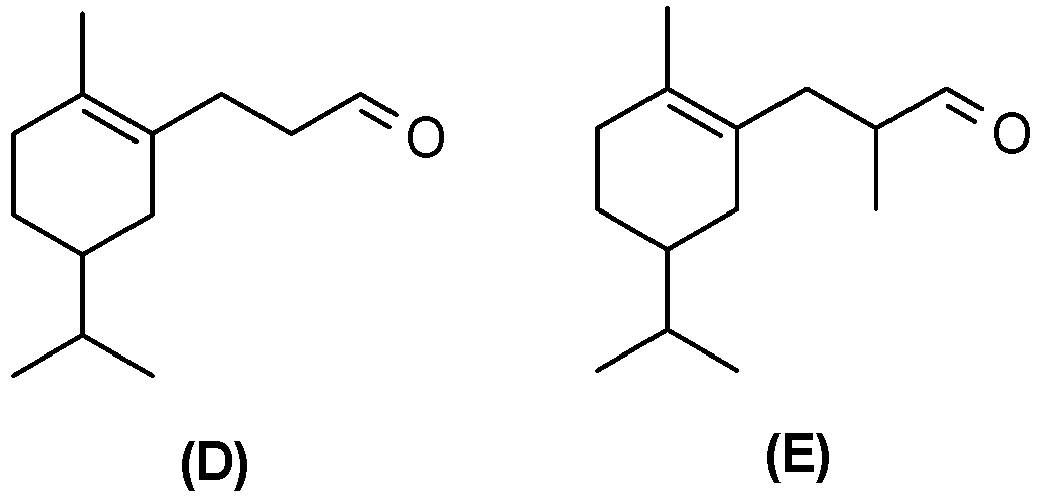
-
DE 101 14 176 A1 offenbart Cyclohexenacetaldehyde der allgemeinen Formel (F)
- Allen beschriebenen Cyclohexenen (A) bis (E) ist gemein, dass sie einen Propanalsubstituenten aufweisen. Die Synthesen sind mehrstufig und verlaufen teilweise unter moderaten Ausbeuten. Darüber hinaus verläuft die Synthese dieser Verbindungen über Cyclohexen-Derivate mit exo-ständiger Doppelbindung, die selektiv herzustellen chemisch aufwendig sind.
- An neue Riechstoffe werden sehr hohe Anforderungen gestellt: Neben ihren primären, nämlich geruchlichen Eigenschaften sollen sie zusätzliche positive Sekundäreigenschaften besitzen, wie z.B. eine höhere Stabilität unter bestimmten Anwendungsbedingungen, eine höhere Substantivität und/oder Diffusivität oder ein besseres Haftungsvermögen. Außerdem sollen sie eine sehr gute biologische Abbaubarkeit aufweisen und dermatologisch sowie toxikologisch unbedenklich sein.
- Riechstoffe, die sich durch die oben erwähnten positiven Sekundäreigenschaften auszeichnen, ermöglichen eine erhöhte Effektivität bei der Herstellung von Riechstoffzubereitungen und parfümierten Produkten. So können z.B. durch den Einsatz von Riechstoffen mit einem besseren sensorischen Profil, einer höheren Substantivität und/oder einem besseren Haftungsvermögen die Anzahl und die Einsatzmengen von Riechstoffen in entsprechenden Formulierungen optimiert und/oder minimiert werden, was zu einer nachhaltigen Ressourcenschonung bei der Herstellung parfümierter Produkte führt.
- Die primäre Aufgabe der vorliegenden Erfindung bestand darin, neue Verbindungen mit einer blumigen Geruchsnote, insbesondere einer Maiglöckchen-Geruchsnote, bereitzustellen, das heißt, die Verbindungen sollen einen Geruchseindruck vermitteln, der weitgehend der Komplexität des natürlichen Geruchs der Maiglöckchenblüte entspricht. Darüber hinaus sollten diese Verbindungen hinsichtlich ihrer Sekundäreigenschaften den aus dem Stand der Technik bekannten Maiglöckchen-Riechstoffen entsprechen oder überlegen sein. Außerdem sollten die neuen Riechstoffe zurückzuführen sein auf erneuerbare und natürliche Ausgangsmaterialien, d.h. nachwachsende Rohstoffe.
- Eine weitere Aufgabe der vorliegenden Erfindung bezieht sich auf die Herstellung solcher neuartigen Verbindungen.
- Eine zusätzliche Aufgabe betrifft die Bereitstellung von neuen Verbindungen mit einer blumigen Geruchsnote, insbesondere einer Maiglöckchen-Geruchsnote, zur Verwendung als Riechstoffe bzw. zur Herstellung von Riechstoffzubereitungen, sowie parfümierte Produkte bzw. Konsumgüter, die mindestens eine dieser neuen Verbindungen umfassen.
- Die gestellten Aufgaben werden erfindungsgemäß durch die Gegenstände der unabhängigen Patentansprüche gelöst. Weitere Aspekte und bevorzugte Ausgestaltungen der vorliegenden Erfindung ergeben sich aus dem Wortlaut der abhängigen Patentansprüche, der nachfolgenden Beschreibung sowie den Ausführungsbeispielen.
- Die Suche nach geeigneten Stoffen mit Maiglöckchen-Geruchsnote, die zur vorliegenden Erfindung führte, wurde durch folgende Sachverhalte erschwert:
- die Mechanismen der Geruchswahrnehmung sind nicht ausreichend bekannt; und
- die Zusammenhänge zwischen der speziellen Geruchswahrnehmung einerseits und der chemischen Struktur des zugehörigen Riechstoffs andererseits sind nicht hinreichend erforscht.
- Weiterhin führen bereits geringfügige Änderungen am strukturellen Aufbau eines bekannten Riechstoffs zu starken Änderungen der sensorischen Eigenschaften und beeinträchtigen die Verträglichkeit für den menschlichen Organismus.
- Der Erfolg der Suche nach geeigneten Riechstoffen hängt deshalb stark von der Intuition des Suchenden ab.
- Ein erster Gegenstand der vorliegenden Erfindung betrifft neue Verbindungen der allgemeinen Formel (I)

- R1 steht für H oder -CH2-CHO, und
- R2 steht für H oder -CH2-CHO,
- mit der Maßgabe, dass R1 ≠ R2 ist;
- sowie deren Stereoisomere oder Mischungen daraus.
- Im Kontext der vorliegenden Erfindung werden unter der Bezeichnung "Verbindungen der Formel (I)" sowohl die einzelnen Verbindungen der Formel (I) als auch sämtliche Mischungen der Verbindungen der Formel (I) in jedem beliebigen Mischungsverhältnis verstanden. Das heißt, Ausführungen in der nachfolgenden Beschreibung betreffend "Verbindungen der Formel (I)" gelten sowohl für eine einzelne Verbindung der Formel (I) als auch für Mischungen, bestehend aus oder umfassend Verbindungen der Formel (I) in jedem Mischungsverhältnis.
- Die Verbindungen der Formel (I) können erfindungsgemäß und bevorzugt in verschiedenen Formen vorliegen, entsprechend der möglichen Isomere, insbesondere der Regioisomere für R1 und R2 und/oder der Stereoisomere der Formel (I), und zwar einzeln sowie als Mischungen.
- In einer bevorzugten Ausgestaltung der Erfindung ist ein Regioisomer eine Verbindung der Formel (I), worin R1 eine -CH2-CHO-Gruppe und R2 ein Wasserstoffatom darstellt.
- In einer weiteren bevorzugten Ausgestaltung der Erfindung ist ein weiteres Regioisomer eine Verbindung der Formel (I), worin R1 ein Wasserstoffatom und R2 eine -CH2-CHO-Gruppe darstellt.
- Die erfindungsgemäßen Verbindungen der Formel (I), wie sie oben definiert wurden, können auch als Stereoisomere vorliegen. Im Kontext der vorliegenden Erfindung umfasst der Begriff Stereoisomere alle möglichen Diastereomere oder Enantiomere der Verbindungen der Formel (I).
- Desweiteren schließt die Definition der Verbindungen der Formel (I) ebenso Mischungen der Stereoisomere ein, insbesondere auch die Racemate oder enantiomerenangereicherte Mischungen, sowie deren enantiomerenreine Formen.
- Überraschenderweise hat sich gezeigt, dass die Verbindungen der Formel (I) einen Geruchseindruck vermitteln, der der Komplexität des natürlichen Geruchs der Maiglöckchenblüte sehr nahe kommt. Das heißt, der von den Verbindungen der Formel (I) vermittelte Geruchseindruck zeichnet sich durch eine herausragende Natürlichkeit und Komplexität aus, insbesondere hinsichtlich der Maiglöckchen-Geruchsnote.
- Darüber hinaus betrifft die vorliegende Erfindung eine Verbindung der Formel (I), die ausgewählt ist aus der Gruppe, die besteht aus den Verbindungen der Formel (II) und Verbindungen der Formel (III):

- Die erfindungsgemäßen Verbindungen der Formel (II) bzw. Formel (III) können als 2-(5-lsopropyl-2-methyl-cyclohex-2-en-1-yl-)acetaldehyd bzw. als 2-(6-Isopropyl-3-methyl-cyclohex-2-en-1-yl-)acetaldehyd bezeichnet werden.
- Die erfindungsgemäßen Verbindungen der Formel (II) oder der Formel (III) können einzeln vorliegen sowie als Mischungen aus den vorgenannten Verbindungen der Formel (II) oder der Formel (III).
- Die Verbindungen der Formel (II) zeichnen sich dadurch aus, dass sie insbesondere aldehydische, blumige, grüne, trockene und Maiglöckchen-artige Noten aufweisen. Die Verbindungen der Formel (III) weisen insbesondere grüne, aldehydische und blumige Geruchsnoten auf, die an Maiglöckchen erinnern.
- Die Verbindungen der Formel (II) oder der Formel (III) können in verschiedenen Formen entsprechend der möglichen Stereoisomere, insbesondere Enantiomere oder Diastereomere, der Formel (II) oder der Formel (III) vorliegen.
- Desweiteren schließt die Definition der Verbindungen der Formel (II) oder der Formel (III) ebenso Mischungen der Stereoisomere ein, insbesondere auch die Racemate oder enantiomerenangereicherte Mischungen, sowie deren enantiomerenreine Formen.
- In einer weiteren bevorzugten Ausgestaltung gemäß dem ersten Aspekt betrifft die vorliegende Erfindung Verbindungen der Formel (II), wie sie durch die Formel (IIa) oder die Formel (IIb) wiedergegeben werden:

- Die enantiomerenreine Verbindung der Formel (IIa) weist insbesondere Maiglöckchen-artige, blumige und grüne Noten auf. Die enantiomerenreine Verbindung der Formel (IIb) weist insbesondere blumige, grüne und aldehydische Noten auf.
- In einer weiteren bevorzugten Variante betrifft die vorliegende Erfindung Verbindungen der Formel (III), wie sie durch die Formel (IIIa) oder die Formel (IIIb) wiedergegeben werden:

- Die enantiomerenreine Verbindung der Formel (IIIa) weist insbesondere aldehydische, grüne und blumige Noten auf, die an Maiglöckchen erinnern.
- Die enantiomerenreine Verbindung der Formel (IIIb) weist insbesondere grüne, blumige, aldehydische und Maiglöckchen-artige Noten auf.
- Vorzugsweise liegen die erfindungsgemäßen und zuvor beschriebenen Verbindungen der Formel (IIa), der Formel (IIb), der Formel (IIIa) oder der Formel (IIIb) als Racemate, enantiomerenangereicherte Mischungen oder in ihrer enantiomerenreinen Form vor.
- Im vorliegenden Text werden von der Bezeichnung "Verbindungen der Formel (IIa)" bzw. "Verbindungen der Formel (IIb)" bzw. "Verbindungen der Formel (IIIa)" bzw. "Verbindungen der Formel (IIIb)" sowohl die einzelnen Verbindungen als auch sämtliche Mischungen aus den zuvorgenannten Verbindungen in jedem beliebigen Mischungsverhältnis umfasst.
- Von der Bezeichnung "Verbindungen der Formel (I)" werden sowohl die einzelnen Verbindungen, ausgewählt aus der Gruppe, bestehend aus den Verbindungen der Formel (II), Verbindungen der Formel (III), Verbindungen der Formel (IIa) bzw. Formel (IIb) und Verbindungen der Formel (IIIa) bzw. Formel (IIIb), als auch deren Stereoisomere, sowie sämtliche Mischungen aus den zuvorgenannten Verbindungen und deren Stereoisomere in jedem beliebigen Mischungsverhältnis umfasst.
- Überraschend weisen die erfindungsgemäßen Verbindungen vorwiegend Maiglöckchen-artige, blumige und grüne Noten auf.
- Die Erfindung betrifft die erfindungsgemäßen Verbindungen als solche einzeln oder auch Mischungen der erfindungsgemäßen Verbindungen.
- Ein weiterer Gegenstand der vorliegenden Erfindung betrifft somit Mischungen, umfassend Verbindungen der Formel (I), insbesondere (a) mindestens eine Verbindung der Formel (II) oder ein Stereoisomer davon, wie oben definiert, und (b) mindestens eine Verbindung der Formel (III) oder ein Stereoisomer davon, wie oben definiert, oder bestehend aus Verbindungen der Formel (I), insbesondere (a) mindestens einer Verbindung der Formel (II) oder ein Stereoisomer davon, wie oben definiert, und (b) mindestens einer Verbindung der Formel (III) oder ein Stereoisomer davon, wie oben definiert.
- Unter den Mischungen, die die Verbindungen der Formel (II), wie oben definiert, und (ii) die Verbindung der Formel (III), wie oben definiert, umfassen oder aus diesen beiden Verbindungen bestehen, sind erfindungsgemäß Mischungen bevorzugt mit
- einem Massenverhältnis der Verbindung der Formel (II) zu der Verbindung der Formel (III) im Bereich von 0,01 bis 99,99, vorzugsweise im Bereich von 0,1 bis 99,9, bevorzugt im Bereich von 0,5 bis 99,5, bevorzugt im Bereich von 1,0 bis 99,0, bevorzugt im Bereich von 1,5 bis 98,5, bevorzugt im Bereich von 2,0 bis 98,0;
und/oder - einem Gesamtanteil der Verbindungen der Formeln (II) und (III) größer als 0,01 Gew.-%, vorzugsweise größer als 1 Gew.-%, bevorzugt größer als 10 Gew.-%, weiter bevorzugt größer als 50 Gew.-%, besonders bevorzugt größer als 90 Gew.-%, bezogen auf das Gesamtgewicht der Mischung, umfassend Verbindung (II) und/oder (III).
- In einem weiteren Aspekt der vorliegenden Erfindung umfasst diese auch Herstellungsverfahren zur Herstellung der Verbindungen der Formel (I), Verbindungen der Formel (II) sowie Verbindungen der Formel (III), wobei mehrere alternative Syntheserouten möglich sind.
- Die erfindungsgemäßen Verbindungen der Formel (I) bzw. der Formel (II) lassen sich durch die nachfolgend näher beschriebenen Verfahren synthetisieren.
- Eine Möglichkeit zur Herstellung der erfindungsgemäßen Verbindungen der Formel (I) bzw. der Formel (II) besteht in der sauren Umsetzung der bekannten Verbindung 2-Methyl-5-(1-methylethyl-)2-cyclohexen-1-ol (IV) mit Vinylethern (R-O). Die daraus erhaltenen Acetale (V) werden sauer katalysiert in die Vinylether (VI) gespalten, die direkt thermisch in die gewünschten Aldehyde überführt werden. Die Reste R des Vinylethers sind ausgewählt aus der Gruppe, die besteht aus linearem C1- bis C20-Alkylrest, verzweigtem C1- bis C20-Alkylrest, Cyclopentylrest und Cyclohexylrest.

- Eine weitere alternative Möglichkeit besteht in der sauren Umsetzung des bekannten und kommerziell erhältlichen Naturstoffes 2-Methyl-5-(1-methylethenyl-)2-cyclohexen-1-ol (VII) (E. Klein, G. Ohloff, Tetrahedron, 1963, 19, 1091; A. F. Thomas, G. Ohloff, Hel. Chim. Acta 1970, 53 (5), 1145) mit Vinylethern (R-O). Die daraus erhaltenen Acetale (VIII) werden sauer katalysiert in die Vinylether (IX) gespalten, die direkt thermisch in den Aldehyd (X) überführt werden. Eine Hydrierung der terminalen Doppelbindung ermöglicht die Darstellung des gewünschten Aldehyds (II). Die Reste R des Vinylethers sind ausgewählt aus der Gruppe, die besteht aus linearem C1- bis C20-Alkylrest, verzweigtem C1- bis C20-Alkylrest, Cyclopentylrest und Cyclohexylrest.

- Die erfindungsgemäßen Verbindungen der Formel (I) bzw. der Formel (III) lassen sich durch die nachfolgend näher beschriebenen Verfahren synthetisieren.
- Eine Möglichkeit zur Herstellung der erfindungsgemäßen Verbindungen der Formel (I) bzw. der Formel (III) besteht in der sauren Umsetzung des bekannten Naturstoffes 1-Methyl-4-(1-methylethyl-)2-cyclohexen-1-ol (XI) (E. Klein, G. Ohloff, Tetrahedron, 1963, 19, 1091; A. F. Thomas, G. Ohloff, Hel. Chim. Acta, 1970, 53 (5), 1145.) mit Vinylethern (R-O). Die daraus erhaltenen Acetale (XII) werden sauer katalysiert in die Vinylether (XIII) gespalten, die direkt thermisch in die gewünschten Aldehyde überführt werden. Die Reste R des Vinylethers sind ausgewählt aus der Gruppe, die besteht aus linearem C1- bis C20-Alkylrest, verzweigtem C1- bis C20-Alkylrest, Cyclopentylrest und Cyclohexylrest.

- Eine weitere alternative Möglichkeit besteht in der sauren Umsetzung der bekannten Verbindung 1-Methyl-4-(1-methylethenyl-)2-cyclohexen-1-ol (XX) mit Vinylethern. Die daraus erhaltenen Acetale (XXI) werden sauer katalysiert in die Vinylether (XXII) gespalten, die direkt thermisch in den Aldehyd (XXIII) überführt werden. Eine Hydrierung der terminalen Doppelbindung ermöglicht die Darstellung des gewünschten Aldehyds (III). Die Reste R des Vinylethers sind ausgewählt aus der Gruppe, die besteht aus linearem C1- bis C20-Alkylrest, verzweigtem C1- bis C20-Alkylrest, Cyclopentylrest und Cyclohexylrest.

- In Schritt (i) der oben beschriebenen erfindungsgemäßen Verfahren werden die Verbindungen mit den Formeln (IV), (VII), (XI) und (XX) in die Acetale überführt. Hierzu werden vorzugsweise Brranstedtsäuren oder eine Lewissäuren als Katalysator eingesetzt.
- In Schritt (i) der oben beschriebenen erfindungsgemäßen Verfahren sind die Reste R der Verbindungen der Formeln (V), (VIII), (XII) und (XXI) definiert als vorzugsweise lineares Alkyl mit einer Kettenlänge von C1 bis C20, verzweigtes Alkyl mit einer Kettenlänge von C1 bis C20, Cyclopentyl oder Cyclohexyl.
- Die Schritte (ii) und (iii) der oben beschriebenen erfindungsgemäßen Verfahren werden vorzugsweise als Eintopfverfahren durchgeführt. Dabei wird sauer zu den Vinylethern (VI), (IX), (XIII) und (XXII) gespalten und anschließend bei einer Temperatur ≥ 150 °C, vorzugsweise bei einer Temperatur im Bereich von 150 bis 250 °C, noch mehr bevorzugt bei einer Temperatur im Bereich von 160 bis 180 °C, die Claisen-Umlagerung zu den Verbindungen (II), (III), (X) und (XXIII) vollzogen. Als Katalysator werden vorzugsweise Brranstedtsäuren oder Lewissäuren eingesetzt.
- Die Schritte (iv) der oben beschriebenen erfindungsgemäßen Verfahren werden in Gegenwart von Wasserstoff und eines Katalysators, beispielsweise von Palladium aufgebraucht auf ein Trägermaterial, unter den üblichen Bedingungen durchgeführt. Als vorteilhafte Trägermaterialien seien genannt: Aktivkohle, Kohle, Aluminiumoxide, Metalloxide, Kieselgele, Zeolithe,Tone, Tongranulate, amorphe Aluminiumsilicate, oder sonstige anorganische Träger. Ein bevorzugtes Trägermaterial ist Aktivkohle. Ein ganz besonders bevorzugter Katalysator ist Palladium auf Aktivkohle.
- Des Weiteren betrifft die vorliegende Erfindung die Verwendung mindestens einer der erfindungsgemäßen Verbindungen, insbesondere der oben beschriebenen Verbindungen der Formeln (I), (II) oder (III) oder ein Stereoisomer davon, oder einer Mischung aus den vorgenannten Verbindungen oder Stereoisomeren davon als Riechstoff, insbesondere als Maiglöckchenduft, oder zur Herstellung einer Riechstoffzubereitung, insbesondere mit Maiglöckchenduft.
- Ein weiterer Gegenstand der vorliegenden Erfindung betrifft somit eine Riechstoffzubereitung, die wenigstens eine Verbindung der Formeln (I), (II) oder (III) oder ein Stereoisomer davon, wie oben definiert, umfasst, vorzugsweise in einer sensorisch wirksamen Menge.
- Eine Riechstoffzubereitung ist im Rahmen der vorliegenden Erfindung eine Mischung verschiedener Stoffe, welche gemäß einem Rezept oder einer Rezeptur nach einem vorgegebenen Verfahren aus den entsprechenden Stoffen erzeugt wird. Solche Zubereitungen werden gezielt zu dem Zweck hergestellt und eingesetzt, einen gewünschten, üblicherweise als angenehm oder in einer sonstigen Weise positiv empfundenen Geruchseindruck zu vermitteln, zu modifizieren oder zu verstärken.
- Eine erfindungsgemäße Riechstoffzubereitung, insbesondere in Form eines Parfümöls, vorzugsweise mit einer Maiglöckchen-Geruchsnote, besteht aus mindestens einer oder umfasst mindestens eine erfindungsgemäße(n) Verbindung, insbesondere eine Verbindung der Formeln (I), (II) oder (III) oder ein Stereoisomer davon, wie oben definiert, und einen, zwei, drei, vier, fünf, sechs, sieben, acht, neun, zehn oder mehr weitere Riechstoff(e) und/oder Aromastoff(e), der/die keine Verbindung(en) der Formeln (I), (II) oder (III) sind.
- In einer bevorzugten Ausführungsform umfasst oder besteht die erfindungsgemäße Riechstoffzubereitung eine Verbindung der Formel (II) und eine Verbindung der Formel (III) oder ein Isomer dieser Verbindungen.
- Durch Kombination der Verbindung(en) der Formeln (I), (II) oder (III), wie oben definiert, vorzugsweise in einer der als bevorzugt angegebenen Ausgestaltungen, mit einem oder mehreren weiteren Riechstoff(en) und/oder Aromastoff(en) lassen sich interessante neue Riechstoffzubereitungen herstellen. Auf diese Weise lassen sich Mischungen mit besonders interessanten, natürlichen, neuen und originellen Noten kreieren. Riechstoffe und/oder Aromastoffe, die im Sinne der obigen Definition als weitere Riechstoffe oder Aromastoffe für den Einsatz in einer erfindungsgemäßem Riechstoffzubereitung geeignet sind, finden sich z. B. in S. Arctander, Perfume and Flavor Materials, Vol. I und II, Montclair, N. J. 1969, Eigenverlag, oder K. Bauer et al., Common Fragrance and Flavor Materials, 4th Edition, Wiley-VCH, Weinheim 2001.
- Im Einzelnen seien genannt:
- Extrakte aus natürlichen Rohstoffen wie Etherische Öle, Concretes, Absolues, Resine, Resinoide, Balsame, Tinkturen wie z. B. Ambratinktur; Amyrisöl; Angelicasamenöl; Angelicawurzelöl; Anisöl; Baldrianöl; Basilikumöl; Baummoos-Absolue; Bayöl; Beifußöl; Benzoeresin; Bergamotteöl; Bienenwachs-Absolue; Birkenteeröl; Bittermandelöl; Bohnenkrautöl; Buccoblätteröl; Cabreuvaöl; Cadeöl; Calmusöl; Campheröl; Canangaöl; Cardamomenöl; Cascarillaöl; Cassiaöl; Cassie-Absolue; Castoreum-absolue; Cedernblätteröl; Cedernholzöl; Cistusöl; Citronellöl; Citronenöl; Copaivabalsam; Copaivabalsamöl; Corianderöl; Costuswurzelöl; Cuminöl; Cypressenöl; Davanaöl; Dillkrautöl; Dillsamenöl; Eau de brouts-Absolue; Eichenmoos-Absolue; Elemiöl; Estragonöl; Eucalyptus-citriodora-Öl; Eucalyptusöl; Fenchelöl; Fichtennadelöl; Galbanumöl; Galbanumresin; Geraniumöl; Grapefruitöl; Guajakholzöl; Gurjunbalsam; Gurjunbalsamöl; Helichrysum-Absolue; Helichrysumöl; Ingweröl; Iriswurzel-Absolue; Iriswurzelöl; Jasmin-Absolue; Kalmusöl; Kamillenöl blau; Kamillenöl römisch; Karottensamenöl; Kaskarillaöl; Kiefernnadelöl; Krauseminzöl; Kümmelöl; Labdanumöl; Labdanum-Absolue; Labdanumresin; Lavandin-Absolue; Lavandinöl; Lavendel-Absolue; Lavendelöl; Lemongrasöl; Liebstocköl; Limetteöl destilliert; Limetteöl gepresst; Linaloeöl; Litsea-cubeba-Öl; Lorbeerblätteröl; Macisöl; Majoranöl; Mandarinenöl; Massoirindenöl; Mimosa-Absolue; Moschuskörneröl; Moschustinktur; Muskateller-Salbei-Öl; Muskatnussöl; Myrrhen-Absolue; Myrrhenöl; Myrtenöl; Nelkenblätteröl; Nelkenblütenöl; Neroliöl; Olibanum-Absolue; Olibanumöl; Opopanaxöl; Orangenblüten-Absolue; Orangenöl; Origanumöl; Palmarosaöl; Patchouliöl; Perillaöl; Perubalsamöl; Petersilienblätteröl; Petersiliensamenöl; Petitgrainöl; Pfefferminzöl; Pfefferöl; Pimentöl; Pineöl; Poleyöl; Rosen-Absolue; Rosenholzöl; Rosenöl; Rosmarinöl; Salbeiöl dalmatinisch; Salbeiöl spanisch; Sandelholzöl; Selleriesamenöl; Spiklavendelöl; Sternanisöl; Styraxöl; Tagetesöl; Tannennadelöl; Tea-tree-Öl; Terpentinöl; Thymianöl; Tolubalsam; Tonka-Absolue; Tuberosen-Absolue; Vanilleextrakt; Veilchenblätter-Absolue; Verbenaöl; Vetiveröl; Wacholderbeeröl; Weinhefenöl; Wermutöl; Wintergrünöl; Ylangöl; Ysopöl; Zibet-Absolue; Zimtblätteröl; Zimtrindenöl sowie Fraktionen davon, bzw. daraus isolierten Inhaltsstoffen;
- Einzel-Riechstoffe aus der Gruppe der Kohlenwasserstoffe, wie z.B. 3-Caren; α-Pinen; β-Pinen; α-Terpinen; γ-Terpinen; p-Cymol; Bisabolen; Camphen; Caryophyllen; Cedren; Farnesen; Limonen; Longifolen; Myrcen; Ocimen; Valencen; (E,Z)-1,3,5-Undecatrien; Styrol; Diphenylmethan;
- der aliphatischen Alkohole wie z.B. Hexanol; Octanol; 3-Octanol; 2,6-Dimethylheptanol; 2-Methyl-2-heptanol; 2-Methyl-2-octanol; (E)-2-Hexenol; 1-Octen-3-ol; Gemisch von 3,4,5,6,6-Pentamethyl-3/4-hepten-2-ol und 3,5,6,6-Tetramethyl-4-methyleneheptan-2-ol; (E,Z)-2,6-Nonadienol; 3,7-Dimethyl-7-methoxyoctan-2-ol; 9-Decenol; 10-Undecenol; 4-Methyl-3-decen-5-ol;
- der aliphatischen Aldehyde und deren Acetale wie z.B. Hexanal; Heptanal; Octanal; Nonanal; Decanal; Undecanal; Dodecanal; 2-Methyloctanal; 2-Methylnonanal; (E)-2-Hexenal; (Z)-4-Heptenal; 2,6-Dimethyl-5-heptenal; 10-Undecenal; (E)-4-Decenal; 2-Dodecenal;2,6,10-Trimethyl-9-undecenal; 2,6,10-Trimethyl-5,9-undecadienal; Heptanaldiethylacetal; 1,1-Dimethoxy-2,2,5-trimethyl-4-hexen; Citronellyloxyacetaldehyd; 1-(1-Methoxy-propoxy)-(E/Z)-3-hexen;
- der aliphatischen Ketone und deren Oxime wie z.B. 2-Heptanon; 2-Octanon; 3-Octanon; 2-Nonanon; 5-Methyl-3-heptanon; 5-Methyl-3-heptanonoxim; 2,4,4,7-Tetramethyl-6-octen-3-on; 6-Methyl-5-hepten-2-on;
- der aliphatischen schwefelhaltigen Verbindungen wie z.B. 3-Methylthio-hexanol; 3-Methylthiohexylacetat; 3-Mercaptohexanol; 3-Mercaptohexylacetat; 3-Mercapto hexylbutyrat; 3-Acetylthiohexylacetat; 1-Menthen-8-thiol;
- der aliphatischen Nitrile wie z.B. 2-Nonensäurenitril; 2-Undecensäurenitril; 2-Tridecensäurenitril; 3,12-Tridecadiensäurenitril; 3,7-Dimethyl-2,6-octadien-säurenitril; 3,7-Dimethyl-6-octensäurenitril;
- der Ester von aliphatischen Carbonsäuren wie z.B. (E)- und (Z)-3-Hexenylformiat; Ethylacetoacetat; Isoamylacetat; 3,5,5-Trimethylhexylacetat; 3-Methyl-2-butenylacetat; (E)-2-Hexenylacetat; (E)- und (Z)-3-Hexenylacetat; Octylacetat; 3-Octylacetat; 1-Octen-3-ylacetat; Ethylbutyrat; Butylbutyrat; Isoamylbutyrat; Hexylbutyrat; (E)- und (Z)-3-Hexenyl-isobutyrat; Hexylcrotonat; Ethylisovalerianat; Ethyl-2-methylpentanoat; Ethylhexanoat; Allylhexanoat; Ethylheptanoat; Allylheptanoat; Ethyloctanoat; Ethyl-(E,Z)-2,4-decadienoat; Methyl-2-octinat; Methyl-2-noninat; Allyl-2-isoamyloxyacetat; Methyl-3,7-dimethyl-2,6-octadien-oat;4-Methyl-2-pentyl-crotonat;
- der acyclischen Terpenalkohole wie z. B. Geraniol; Nerol; Lavadulol; Nerolidol; Farnesol; Tetrahydrolinalool; Tetrahydrogeraniol; 2,6-Dimethyl-7-octen-2-ol; 2,6-Dimethyloctan-2-ol; 2-Methyl-6-methylen-7-octen-2-ol; 2,6-Dimethyl-5,7-octadien-2-ol; 2,6-Dimethyl-3,5-octadien-2-ol; 3,7-Dimethyl-4,6-octadien-3-ol; 3,7-Dimethyl-1,5,7-octatrien-3-ol 2,6-Dimethyl-2,5,7-octatrien-1-ol; sowie deren Formiate, Acetate, Propionate, Isobutyrate, Butyrate, Isovalerianate, Pentanoate, Hexanoate, Crotonate, Tiglinate und 3-Methyl-2-butenoate;
- der acyclischen Terpenaldehyde und -ketone wie z. B. Citronellal; 7-Methoxy-3,7-dimethyloctanal; 2,6,10-Trimethyl-9-undecenal; Geranylaceton; sowie die Dimethyl- und Diethylacetale von Geranial, Neral;
- der cyclischen Terpenalkohole wie z. B. Menthol; Isopulegol; alpha-Terpineol; Terpinenol-4; Menthan-8-ol; Menthan-1-ol; Menthan-7-ol; Borneol; Isoborneol; Linalooloxid; Nopol; Cedrol; Ambrinol; Vetiverol; Guajol; sowie deren Formiate, Acetate, Propionate, Isobutyrate, Butyrate, Isovalerianate, Pentanoate, Hexanoate, Crotonate, Tiglinate und 3-Methyl-2-butenoate;
- der cyclischen Terpenaldehyde und -ketone wie z. B. Menthon; Isomenthon; 8-Mercaptomenthan-3-on; Carvon; Campher; Fenchon; alpha-lonon; beta-lonon; alphan-Methylionon; beta-n-Methylionon; alpha-Isomethylionon; beta-Isomethyl-ionon; alpha-Iron; beta-Damascenon; 1-(2,4,4-Trimethyl-2-cyclohexen-1-yl-)2-buten-1-on; 1,3,4,6,7,8a-Hexahydro-1,1,5,5-tetramethyl-2H-2,4a-methano-naphthalen-8-(5H)-on; 2-Methyl-4-(2,6,6-trimethyl-1-cyclohexen-1-yl-)2-butenal; Nootkaton; Dihydronootkaton; 4,6,8-Megastigmatrien-3-on; alpha-Sinensal; beta-Sinensal; acetyliertes Cedernholzöl (Methylcedrylketon);
- der cyclischen Alkohole wie z.B. 4-tert-Butylcyclohexanol; 3,3,5-Trimethylcyclohexanol; 3-Isocamphylcyclohexanol; 2,6,9-Trimethyl-Z2,Z5,E9-cyclododecatrien-1-ol; 2-Isobutyl-4-methyltetrahydro-2H-pyran-4-ol;
- der cycloaliphatischen Alkohole wie z.B. alpha,3,3-Trimethylcyclohexylmethanol;1-(4-Isopropylcyclohexyl-)ethanol; 2-Methyl-4-(2,2,3-trimethyl-3-cyclopent-1-yl-)butanol; 2-Methyl-4-(2,2,3-trimethyl-3-cyclopent-1-yl-)2-buten-1-ol; 3-Methyl-5-(2,2,3-trimethyl-3-cyclopent-1-yl-)pentan-2-ol; 3-Methyl-5-(2,2,3-trimethyl-3-cyclopent-1-yl-)4-penten-2-ol; 3,3-Dimethyl-5-(2,2,3-trimethyl-3-cyclopent-1-yl-)4-penten-2-ol; 1-(2,2,6-Trimethylcyclohexyl-)pentan-3-ol; 1-(2,2,6-Trimethylcyclohexyl-)hexan-3-ol;
- der cyclischen und cycloaliphatischen Ether wie z.B. Cineol; Cedrylmethylether; Cyclododecylmethylether; 1,1-Dimethoxycyclododecan; (Ethoxymethoxy-)cyclo-dodecan; alpha-Cedrenepoxid; 3a,6,6,9a-Tetramethyldodecahydro-naphtho[2,1-b]furan; 3a-Ethyl-6,6,9a-trimethyldodecahydronaphtho[2,1b]furan; 1,5,9-Trimethyl-13-oxabicyclo[10.1.0]trideca-4,8-dien; Rosenoxid; 2-(2,4-Dimethyl-3-cyclohexen-1-yl-)5-methyl-5-(1-methylpropyl-)1,3-dioxan;
- der cyclischen und makrocyclischen Ketone wie z.B. 4-tert.-Butylcyclohexanon; 2,2,5-Trimethyl-5-pentylcyclopentanon; 2-Heptylcyclopentanon; 2-Pentyl-cyclopentanon; 2-Hydroxy-3-methyl-2-cyclopenten-1-on; 3-Methyl-cis-2-penten-1-yl-2-cyclopenten-1-on; 3-Methyl-2-pentyl-2-cyclopenten-1-on; 3-Methyl-4-cyclopentadecenon; 3-Methyl-5-cyclopentadecenon; 3-Methylcyclopenta-decanon; 4-(1-Ethoxyvinyl-)3,3,5,5-tetramethylcyclohexanon; 4-tert.-Pentylcyclohexanon; 5-Cyclohexadecen-1-on; 6,7-Dihydro-1,1,2,3,3-pentamethyl-4(5H)-indanon; 8-Cyclohexadecen-1-on; 9-Cycloheptadecen-1-on; Cyclopentadecanon; Cyclohexadecanon;
- der cycloaliphatischen Aldehyde wie z.B. 2-Methyl-4-(2,2,6-trimethyl-cyclohexen-1-yl-)2-butenal; 4-(4-Hydroxy-4-methylpentyl-)3-cyclohexencarbaldehyd; 4-(4-Methyl-3-penten-1-yl-)3-cyclohexencarbaldehyd;
- der cycloaliphatischen Ketone wie z. B. 1-(3,3-Dimethylcyclohexyl-)4-penten-1-on; 2,2-Dimethyl-1-(2,4-dimethyl-3-cyclohexen-1-yl-)1-propanon; 1-(5,5-Dimethyl-1-cyclohexen-1-yl-)4-penten-1-on; 2,3,8,8-Tetramethyl-1,2,3,4,5,6,7,8-octahydro-2-naphtalenylmethylketon; Methyl-2,6,10-trimethyl-2,5,9-cyclododecatrienylketon; tert.-Butyl-(2,4-dimethyl-3-cyclohexen-1-yl-)keton;
- der Ester cyclischer Alkohole wie z.B. 2-tert-Butylcyclohexylacetat; 4-tert-Butylcyclohexylacetat; 2-tert-Pentylcyclohexylacetat; 4-tert-Pentylcyclohexylacetat; 3,3,5-Trimethylcyclohexylacetat; Decahydro-2-naphthylacetat; 2-Cyclopentylcyclopentylcrotonat; 3-Pentyltetrahydro-2H-pyran-4-ylacetat; Decahydro-2,5,5,8a-tetramethyl-2-naphthylacetat; 4,7-Methano-3a,4,5,6,7,7a-hexa-hydro-5, bzw. 6-indenylacetat; 4,7-Methano-3a,4,5,6,7,7a-hexahydro-5, bzw. 6-indenyl-propionat; 4,7-Methano-3a,4,5,6,7,7a-hexahydro-5- bzw. 6-inden-ylisobutyrat; 4,7-Methanooctahydro-5- bzw. 6-indenylacetat;
- der Ester cycloaliphatischer Alkohole wie z.B.1-Cyclohexylethylcrotonat;
- der Ester cycloaliphatischer Carbonsäuren wie z. B. Allyl-3-cyclohexylpropionat; Allylcyclohexyloxyacetat; cis- und trans-Methyldihydrojasmonat; cis- und trans-Methyljasmonat; Methyl-2-hexyl-3-oxocyclopentancarboxylat; Ethyl-2-ethyl-6,6-dimethyl-2-cyclohexencarboxylat; Ethyl-2,3,6,6-tetramethyl-2-cyclohexen-carboxylat; Ethyl-2-methyl-1,3-dioxolan-2-acetat;
- der aliphatischen Alkohole wie z.B. Benzylalkohol; 1-Phenylethylalkohol; 3-Phenylpropanol; 2-Phenylpropanol; 2-Phenoxyethanol; 2,2-Dimethyl-3-phenylpropanol; 2,2-Dimethyl-3-(3-methylphenyl)propanol; 1,1-Dimethyl-2-phenylethylalkohol; 1,1-Dimethyl-3-phenylpropanol; 1-Ethyl-1-methyl-3-phenylpropanol; 2-Methyl-5-phenylpentanol; 3-Methyl-5-phenylpentanol; 3-Phenyl-2-propen-1-ol; 4-Methoxybenzylalkohol; 1-(4-lsopropylphenyl)ethanol;
- der Ester von aliphatischen Alkoholen und aliphatischen Carbonsäuren wie z.B. Benzylacetat; Benzylpropionat; Benzylisobutyrat; Benzylisovalerianat; 2-Phenylethylacetat; 2-Phenylethylpropionat; 2-Phenylethylisobutyrat; 2-Phenylethylisovalerianat; 1-Phenylethylacetat; alpha-T richlormethylbenzylacetat; alpha,alpha-Dimethylphenylethylacetat; alpha,alpha-Dimethylphenylethylbutyrat; Cinnamylacetat; 2-Phenoxyethylisobutyrat; 4-Methoxybenzylacetat;
- der aliphatischen Ether wie z.B. 2-Phenylethylmethylether; 2-Phenylethylisoamylether; 2-Phenylethyl-1-ethoxyethylether; Phenylacetaldehyddimethylacetal; Phenylacetaldehyddiethylacetal; Hydratropaaldehyddimethylacetal; Phenylacetaldehydglycerinacetal; 2,4,6-Trimethyl-4-phenyl-1,3-dioxan; 4,4a,5,9b-Tetra-hydroindeno[1,2-d]-m-dioxin; 4,4a,5,9b-Tetrahydro-2,4-dimethylindeno[1,2-d]-m-dioxin;
- der aromatischen und aliphatischen Aldehyde wie z. B. Benzaldehyd; Phenylacetaldehyd; 3-Phenylpropanal; Hydratropaaldehyd; 4-Methylbenzaldehyd; 4-Methylphenylacetaldehyd; 3-(4-Ethylphenyl-)2,2-dimethylpropanal; 2-Methyl-3-(4-isopropylphenyl-)propanal; 2-Methyl-3-(4-isobutylphenyl-)propanal; 3-(4-tert.-Butylphenyl-)propanal; Zimtaldehyd; alpha-Butylzimtaldehyd; alpha-Hexylzimtaldehyd; 3-Methyl-5-phenylpentanal; 4-Methoxybenzaldehyd; 4-Hydroxy-3-methoxybenzaldehyd; 4-Hydroxy-3-ethoxybenzaldehyd; 3,4-Methylendioxybenzaldehyd; 3,4-Dimethoxybenzaldehyd; 2-Methyl-3-(4-methoxyphenyl-)propanal; 2-Methyl-3-(4-methylendioxyphenyl-)propanal;
- der aromatischen und aliphatischen Ketone wie z.B. Acetophenon; 4-Methylacetophenon; 4-Methoxyacetophenon; 4-tert.-Butyl-2,6-dimethylaceto-phenon; 4-Phenyl-2-butanon; 4-(4-Hydroxyphenyl-)2-butanon; 1-(2-Naphthalenyl-)ethanon;2-Benzofuranylethanon;(3-Methyl-2-benzofuranyl-)ethanon; Benzophenon; 1,1,2,3,3,6-Hexamethyl-5-indanylmethylketon; 6-tert.-Butyl-1,1-di-methyl-4-indanylmethylketon; 1-[2,3-dihydro-1,1,2,6-tetramethyl-3-(1-methylethyl-)1H-5-indenyl]ethanon; 5`,6`,7`,8`-Tetrahydro-3`,5`,5`,6`,8`,8`-hexamethyl-2-aceto-naphthon;
- der aromatischen und aliphatischen Carbonsäuren und deren Ester wie z.B. Benzoesäure; Phenylessigsäure; Methylbenzoat; Ethylbenzoat; Hexylbenzoat; Benzylbenzoat; Methylphenylacetat; Ethylphenylacetat; Geranylphenylacetat; Phenylethyl-phenylacetat; Methylcinnmat; Ethylcinnamat; Benzylcinnamat; Phenylethylcinnamat; Cinnamylcinnamat; Allylphenoxyacetat; Methylsalicylat; Hexylsalicylat; Cyclohexylsalicylat; Cis-3-Hexenylsalicylat; Benzylsalicylat; Phenylethylsalicylat; Methyl-2,4-dihydroxy-3,6-dimethylbenzoat; Ethyl-3-phenylglycidat; Ethyl-3-methyl-3-phenylglycidat;
- der stickstoffhaltigen aromatischen Verbindungen wie z.B. 2,4,6-Trinitro-1,3-dimethyl-5-tert.-butylbenzol; 3,5-Dinitro-2,6-dimethyl-4-tert.-butylacetophenon; Zimtsäurenitril; 3-Methyl-5-phenyl-2-pentensäurenitril; 3-Methyl-5-phenylpentan-säurenitril; Methylanthranilat; Methy-N-methylanthranilat; Schiff'sche Basen von Methylanthranilat mit 7-Hydroxy-3,7-dimethyloctanal, 2-Methyl-3-(4-tert.-butyl-phenyl-)propanal oder 2,4-Dimethyl-3-cyclohexencarbaldehyd; 6-lsopropyl-chinolin; 6-Isobutylchinolin; 6-sec.-Butylchinolin;2-(3-Phenylpropyl-)pyridin; Indol; Skatol; 2-Methoxy-3-isopropylpyrazin; 2-Isobutyl-3-methoxypyrazin;
- der Phenole, Phenylether und Phenylester wie z.B. Estragol; Anethol; Eugenylmethylether; Isoeugenol; Isoeugenylmethylether; Thymol; Carvacrol; Diphenylether; beta-Naphthylmethylether; beta-Naphthylethylether; beta-Naphthylisobutylether; 1,4-Dimethoxybenzol; Eugenylacetat; 2-Methoxy-4-methylphenol; 2-Ethoxy-5-(1-propenyl)phenol; p-Kresylphenylacetat;
- der heterocyclischen Verbindungen wie z.B. 2,5-Dimethyl-4-hydroxy-2H-furan-3-on; 2-Ethyl-4-hydroxy-5-methyl-2H-furan-3-on; 3-Hydroxy-2-methyl-4H-pyran-4-on; 2-Ethyl-3-hydroxy-4H-pyran-4-on;
- der Lactone wie z.B. 1,4-Octanolid; 3-Methyl-1,4-octanolid; 1,4-Nonanolid; 1,4-Decanolid; 8-Decen-1,4-olid; 1,4-Undecanolid; 1,4-Dodecanolid; 1,5-Decanolid; 1,5-Dodecanolid;4-Methyl-1,4-decanolid; 1,15-Pentadecanolid; 1,16-Hexadecanolid; 9-Hexadecen-1,16-olid; 10-Oxa-1,16-hexadecanolid; 11-Oxa-1,16-hexadecanolid; 12-Oxa-1,16-hexadecanolid; Ethylen-1,12-dodecandioat; Ethylen-1,13-tridecandioat; 2,3-Dihydrocumarin; Octahydrocumarin.
- In einer bevorzugten Ausführungsform umfasst eine erfindungsgemäße Riechstoffzubereitung, insbesondere in Form eines Parfümöls, einen, zwei oder mehr erfindungsgemäße Riechstoff(e) der Formeln (I), (II) oder (III) mit einer Maiglöckchen-Geruchsnote und optional einen oder mehrere weitere Riechstoffe mit einer Geruchsnote ausgewählt aus der Gruppe, die besteht aus blumig, süss, wässrig, pudrig.
- In einer erfindungsgemäßen Riechstoffzubereitung, insbesondere eines Parfümöls, liegt die Menge der wenigstens einen Verbindung der Formeln (I), (II) oder (III) oder ihres Isomers wie oben definiert, im Bereich von 0,0001 bis 40 Gew.-%, vorzugsweise im Bereich von 0,001 bis 25 Gew.-%, bezogen auf das Gesamtgewicht der Riechstoffzubereitung. Neben dem Einsatz als Flüssigkeit in Lösungen oder in Emulsionen können die erfindungsgemäßen Verbindungen oder diese enthaltende Riechstoffzubereitungen, beispielsweise Parfümöle, an Feststoffen adsorbiert oder in Trägerstoffen (mikro)verkapselt eingesetzt werden. Diese Darreichungsformen können sowohl für eine feine Verteilung der Riechstoffe im Produkt als auch für eine kontrollierte Freisetzung bei der Anwendung sorgen. Derartige Feststoffe können poröse anorganische Materialien wie Leichtsulfat, Kieselgele, Zeolithe, Gipse, Tone, Tongranulate, Gasbeton usw. oder organische Materialien wie Hölzer, Cellulosebasierende Stoffe, Zucker oder Kunststoffe wie PVC, Polyvinylacetate oder Polyurethane sein.
- Verkapselungsprodukte können beispielsweise sprühgetrocknet, als Einschluss-Komplex oder als Extrusions-Produkt vorliegen. Die Mikroverkapselung der Parfümöle kann beispielsweise durch das sogenannte Koazervationsverfahren mit Hilfe von Kapselmaterialien z.B. aus polyurethanartigen Stoffen oder Weichgelatine erfolgen. Die sprühgetrockneten Parfümöle können beispielsweise durch Sprühtrocknung einer das Parfümöl enthaltenden Emulsion, bzw. Dispersion hergestellt werden, wobei als Trägerstoffe modifizierte Stärken, Proteine, Dextrin und pflanzliche Gummen verwendet werden können. Einschluss-Komplexe können z.B. durch Eintragen von Dispersionen von dem Parfümöl und Cyclodextrinen oder Harnstoffderivaten in ein geeignetes Lösungsmittel, z.B. Wasser, hergestellt werden.
- Extrusions-Produkte können durch Verschmelzen der Parfümöle mit einem geeigneten wachsartigen Stoff und durch Extrusion mit nachfolgender Erstarrung, ggf. in einem geeigneten Lösungsmittel, z.B. Isopropanol, erfolgen.
- Die Adsorbate als auch die Verkapselungsprodukte können durch sogenanntes Coaten mit geeigneten Materialien im Hinblick auf eine gezieltere Duftfreisetzung weiter optimiert werden, wozu vorzugsweise wachsartige Kunststoffe wie z.B. Polyvinylalkohol verwendet werden können.
- Gemäß einer bevorzugten Ausführungsform der vorliegenden Erfindung liegt in Parfümöl-Kompositionen, die an einem Trägerstoff adsorbiert eingesetzt werden, die eingesetzte Menge der erfindungsgemäßen Verbindungen der Formeln (I), (II) oder (III) oder ihrer Isomere wie oben definiert, im Bereich von 0,00001 bis 5 Gew.-%, vorzugsweise im Bereich von 0,00001 bis 1 Gew.-%, und besonders bevorzugt im Bereich von 0,0005 bis 0,01 Gew.-%, bezogen auf das Gesamtgewicht der Parfümöl-Komposition.
- Die als Riechstoff zu verwendenden erfindungsgemäßen Verbindungen, wie sie oben definiert wurden, sowie die Mischungen daraus, sowie die erfindungsgemäßen Riechstoffzubereitungen, wie sie oben definiert wurden, werden insbesondere zur Herstellung parfümierter Produkte eingesetzt.
- Dementsprechend betrifft die vorliegende Erfindung auch parfümierte Produkte bzw. Konsumgüter, einschließlich deren Vor- und Zwischenprodukte, welche einen erfindungsgemäßen Riechstoff oder eine erfindungsgemäße Riechstoffzubereitung umfassen. Ein erfindungsgemäßes parfümiertes Produkt bzw. Konsumgut umfasst die erfindungsgemäßen Verbindungen, wie sie oben definiert wurden, vorzugsweise in einer sensorisch wirksamen Mengen. Dabei kommt die erfindungsgemäße Verbindung entweder einzeln zum Einsatz oder ist Bestandteil einer erfindungsgemäßen Mischung bzw. Riechstoffzubereitung.
- Parfümierte Produkte bzw. Konsumgüter enthalten oft eine Vielzahl unterschiedlicher chemischer Verbindungen. Der Einsatz der erfindungsgemäßen Verbindungen ist insbesondere vorteilhaft wegen deren geringer Reaktivität, so dass weder die erfindungsgemäßen Verbindungen noch die Inhaltsstoffe der Konsumgüter nachteilig verändert werden. Zudem beeinflussen die erfindungsgemäßen Verbindungen in den zur Erzielung der erwünschten Duftwirkung notwendigen Konzentrationen nicht nachteilig die physikalischen oder physikochemischen Eigenschaften der Konsumgüter (z.B. die Viskosität oder den pH-Wert).
- Bei den in parfümierten Produkten bzw. Konsumgütern enthaltenen Stoffen handelt es sich oftmals um Konservierungsmittel, Abrasiva, Antiakne-Mittel, Mittel gegen Hautalterung, antibakterielle Mittel, Anticellulitis-Mittel, Antischuppen-Mittel, entzündungshemmende Mittel, irritationsverhindernde Mittel, irritationshemmende Mittel, antimikrobielle Mittel, Antioxidantien, Adstringentien, schweisshemmende Mittel, antiseptische Mittel, Antistatika, Binder, Puffer, Trägermaterialien, Chelatbildnder, Zellstimulantien, reinigende Mittel, pflegende Mittel, Enthaarungsmittel, oberflächenaktive Substanzen, deodorierende Mittel, Antiperspirantien, Weichmacher, Emulgatoren, Enzyme, ätherische Öle, Fasern, Filmbildner, Fixateure, Schaumbildner, Schaumstabilisatoren, Substanzen zum Verhindern des Schäumens, Schaumbooster, Fungizide, gelierende Mittel, gelbildende Mittel, Haarpflegemittel, Haarverformungsmittel, Haarglättungsmittel, feuchtigkeitsspendende Mittel, anfeuchtende Substanzen, feuchthaltende Substanzen, bleichende Mittel, stärkende Mittel, fleckenentfernende Mittel, optisch aufhellende Mittel, imprägnierende Mittel, schmutzabweisende Mittel, reibungsverringernde Mittel, Gleitmittel, Feuchtigkeitscremes, Salben, Trübungsmittel, plastifizierende Mittel, deckfähige Mittel, Politur, Glanzmittel, Polymere, Pulver, Proteine, rückfettende Mittel, abschleifende Mittel, Silicone, hautberuhigende Mittel, hautreinigende Mittel, hautpflegende Mittel, hautheilende Mittel, Hautaufhellungsmittel, hautschützende Mittel, hauterweichende Mittel, kühlende Mittel, hautkühlende Mittel, wärmende Mittel, hautwärmende Mittel, Stabilisatoren, UV-absorbierende Mittel, UV-Filter, Waschmittel, Weichspüler, suspendierende Mittel, Hautbräunungsmittel, Verdickungsmittel, Vitamine, Öle, Wachse, Fette, Phospholipide, gesättigte Fettsäuren, ein- oder mehrfach ungesättigte Fettsäuren, α-Hydroxysäuren, Polyhydroxyfettsäuren, Verflüssiger, Farbstoffe, farbschützende Mittel, Pigmente, Antikorrosiva, Aromen, Geschmackstoffe, Riechstoffe, Polyole, Tenside, Elektrolyte, organische Lösungsmittel oder Silikonderivate. Mit diesen Stoffen weisen die erfindungsgemäßen Verbindungen in Mischungen eine hohe Kompatibilität auf.
- Der Mengenanteil des erfindungsgemäßen Riechstoffs, d.h. der erfindungsgemäßen Verbindungen der Formeln (I), (II) oder (III) oder ihrer Isomere wie oben definiert, oder der erfindungsgemäßen Riechstoffzubereitung in dem parfümierten Produkt bzw. den Konsumgütern beträgt 0,0001 bis 5 Gew.-%, bevorzugt 0,001 bis 2 Gew.-% und besonders bevorzugt 0,001 bis 1 %.
- Parfümierte Produkte bzw. Konsumgüter im Sinne der Erfindung sind Wasch- und Reinigungsmitteln, Hygiene- oder Pflegeprodukten, insbesondere aus dem Bereich der Körper- und Haarpflege, der Kosmetik, des Haushalts, Fine Fragrance (Parfüm), Air Care und Lufterfrischer, insbesondere Weichspüler, Bleichmittel, Desinfektionsmittel, Duftfreigabesysteme, Sonnenschutzmittel für die Haut, Haarpflegemittel und Deodorants. Besonders handelt es sich bei Konsumgütern um saure, alkalische und neutrale Reinigungsmittel, wie z.B. Fußbodenreiniger, Fensterglasreiniger, Geschirrspülmittel, Bad- und Sanitärreiniger, Scheuermilch, feste und flüssige WC-Reiniger, pulver- und schaumförmige Teppichreiniger, flüssige Waschmittel, pulverförmige Waschmittel, Wäschevorbehandlungsmittel wie Bleichmittel, Einweichmittel und Fleckenentferner, Wäscheweichspüler, Waschseifen, Waschtabletten, Desinfektionsmittel, Oberflächendesinfektionsmittel sowie Luftverbesserer in flüssiger, gelartiger oder auf einem festen Träger aufgebrachter Form einschließlich zur Beduftung von Toiletten, Aerosolsprays, Wachse und Polituren wie Möbelpolituren, Fußbodenwachse, Schuhcremes sowie Körperpflegemittel wie z.B. feste und flüssige Seifen, Duschgele, Shampoos, Rasierseifen, Rasierschäume, Badeöle, kosmetische Emulsionen vom Öl-in-Wasser-, vom Wasser-in-Öl- und vom Wasser-in-Öl-in-Wasser-Typ wie z.B. Hautcremes- und -lotionen, Gesichtscremes und -lotionen, Sonnenschutzcremes- und -lotionen, After-sun-cremes und -lotionen, Handcremes und -lotionen, Fußcremes und -lotionen, Enthaarungscremes und - lotionen, After-Shaves, After Shave-Cremes und Lotionen, Pre-Shaves, Bräunungscremes und -lotionen, Haarpflegeprodukte wie z.B. Haarsprays, Haargele, Haarlotionen, Haarspülungen, permanente und semipermanente Haarfärbemittel, Haarverformungsmittel wie Kaltwellen und Haarglättungsmittel, Haarwässer, Haarcremes und -lotionen, Erfrischungstücher, Deodorantien und Antiperspirantien wie z.B. Achselsprays, Roll-ons, Deosticks, Deocremes oder Produkte der dekorativen Kosmetik wie zum Beispiel Make-Up.
- Letztendlich betrifft die vorliegende Erfindung betrifft auch ein Verfahren zur Parfümierung von parfümierten Produkten bzw. Konsumgütern, umfassend das Hinzufügen mindestens einer der erfindungsgemäßen Verbindung oder der erfindungsgemäßen Riechstoffzubereitungen von zu parfümierenden Produkten bzw. Konsumgütern. Der Vorteil der erfindungsgemäßen Verbindungen oder der erfindungsgemäßen Riechstoffzubereitungen bei diesem Verfahren ist, dass sie sich leicht in Konsumgüter einarbeiten lassen.
- Die Verbindungen der vorliegenden Erfindung, wie sie oben beschrieben wurden, zeichnen sich dadurch aus, dass sie einen Geruchseindruck vermitteln, der weitgehend der Komplexität des natürlichen Geruchs der Maiglöckchenblüte entspricht. Darüber hinaus lassen sie sich aus erneuerbaren und natürlichen Ausgangsmaterialien, d.h. nachwachsenden Rohstoffen herstellen. Ein weiterer Vorteil der erfindungsgemäßen Verbindungen ist ihre leichte Zugänglichkeit: ihre Synthese erfolgt auf der Basis von endo-cyclischen Cyclohexenen anstelle von kompliziert hergestellten exo-Cyclohexenen.
- Die vorliegende Erfindung wird nachstehend anhand von Ausführungsbeispielen näher beschrieben.
-

- In einem 1 Liter-Doppelwandgefäß mit Kopfrührer, Thermostatanschluss, Kühler und Stickstoffatmosphäre werden 100 g 5-lsopropyl-2-methyl-cyclohex-2-en-1-ol (0,65 mol) und 0,4 g 85-%ige Phosphorsäure vorgelegt. Dann werden 98 g Butylvinylether (0,98 mol), in 1 bis 2 Stunden bei 35 °C zugetropft. Zur Nachreaktion wird noch 6 Stunden bei 35 °C nachgerührt. Der Ansatz wird bei Raumtemperatur mit 5-%iger Sodalösung und dann mit 5-%iger Natriumchloridlösung gewaschen und anschließend eingedampft. Die Rohausbeute beträgt 165 g.
- Das Rohprodukt wird in einem 500 ml-Dreihalskolben mit Magnetrührer, 20 cm-Vigreuxkolonne und Destillationsbrücke, zusammen mit 165 g Dibenzylether und 6,5 g Capronsäure vorgelegt und bei 90 mbar aufgeheizt. Bei 160 - 175 °C werden die entstehenden Leichtsieder innerhalb von 5 Stunden bis zu einer Kopftemperatur von ca. 80 °C abdestilliert. Anschließend erfolgt die Destillation des Rohprodukts (Sumpftemperatur: 125 - 170 °C, Kopftemperatur: 70 - 110 °C, Vakuum: 1 mbar). Es werden 72 g abdestilliert. Nach DB-1-GC bzw. GCMS sind 60 % Produkt als cis/trans-Isomere entstanden. Die Trennung der beiden Isomeren erfolgt an einer Spaltrohrkolonne (Fischer Spaltrohrkolonne ® HMS 500 AC). Siedepunkte bei 1 mbar:
- 2-(5-lsopropyl-2-methyl-cyclohex-2-en-1-yl)acetaldehyd: 71 °C, 2-(5-Isopropyl-2-methyl-cyclohex-2-en-1-yl)acetaldehyd: 73 °C.
- 2-(5-lsopropyl-2-methyl-cyclohex-2-en-1-yl)acetaldehyd: m/z : 43 (11), 55 (14), 67 (16), 81 (28), 93 (100), 109 (6), 119 (10), 136 (45), 147 (1), 180 (5) Geruchsbeschreibung: Aldehydisch, blumig nach Maiglöckchen, grün.
- 2-(5-Isopropyl-2-methyl-cyclohex-2-en-1-yl)acetaldehyd: m/z: 43 (13), 55 (17), 67 (21), 81 (33), 93 (100), 109 (9), 119 (13), 136 (55), 147 (2), 180 (4) Geruchsbeschreibung: grün, blumig nach Maiglöckchen, aldehydisch.
-

- In einem 2 Liter-Rührwerk werden 122 g (0,8 mol) Piperiton und 700 ml Methanol vorgelegt. Bei 0 - 5 °C werden 80 g 25-%ige (0,5 mol) Natronlauge langsam zugegeben. Die Temperatur steigt auf ca. 20 °C an. Unter leichter Kühlung werden 181 g 30-%iges (1,6 mol) Wasserstoffperoxid in 1 h, bei 28 - 33 °C zugetropft. Anschließend wird noch 6 h bei 28 °C nachgerührt. Dann wird auf 1000 ml Wasser gegossen und zweimal mit je 300 ml MTBE extrahiert. Die MTBE-Phasen werden vereinigt und nacheinander mit Wasser, 10-%iger Kaliumjodidlösung und Wasser peroxidfrei gewaschen und dann eingedampft. Es werden 130 g Rohprodukt erhalten. Nach GC/GCMS sind trans-Piperitonepoxid und cis-Piperitonepoxid in einem Verhältnis von 1 : 3,5 enthalten.
- Das Rohprodukt wird in einem 2 Liter-Rührwerk zusammen mit 500 ml Methanol vorgelegt und bei 0 - 5 °C mit 50 g (1 mol) Hydrazinmonohydrat versetzt. Die Temperatur steigt auf 17 - 20 °C an. Unter Kühlung und Stickstoffentwicklung werden 60 g (1 mol) Essigsäure in 30 min bei 20 - 25 °C zugetropft. Es wird noch für 2 h nachgerührt. Der Ansatz wird auf 1500 ml Wasser gegossen und dann zweimal mit je 500 ml MTBE extrahiert. Die MTBE-Phasen werden vereinigt und nacheinander mit Wasser und gesättigter Natriumhydrogencarbonat gewaschen und dann eingedampft. Es werden 99 g Rohprodukt erhalten. Nach GC/GCMS sind trans-4-lsopropyl-1-methyl-cyclohex-2-en-1-ol und cis-4-Isopropyl-1-methyl-cyclohex-2-en-1-ol in einem Verhältnis von 1: 3,5 enthalten. Bei der Destillation an einer 30-cm-Füllkörperkolonne werden bei einem Siedepunkt von 85 - 102 °C, bei 14 mbar, 26 g einer Fraktion erhalten, die nach GC/GCMS 19 % trans-4-Isopropyl-1-methyl-cyclohex-2-en-1-ol und 67 % cis-4-Isopropyl-1-methyl-cyclohex-2-en-1-ol enthält.
- Das Destillat (26 g) wird, in einem 0,1 Liter-Doppelwandgefäß mit Magnetrührer, Thermostatanschluss, Kühler und Stickstoffatmosphäre, zusammen mit 0,1 g 85-%iger Phosphorsäure vorgelegt. Dann werden 22 g (0,22 mol) Butylvinylether in 1 bis 2 Stunden bei 35 °C zugetropft. Zur Nachreaktion wird noch 2 Stunden bei 35 °C nachgerührt. Der Ansatz wird bei Raumtemperatur mit 5-%iger Sodalösung und dann mit 5-%iger Natriumchloridlösung gewaschen und anschließend bei 60 °C und 700 bis 5 mbar am Rotationsverdampfer eingedampft. Die Ausbeute beträgt 31,3 g.
- 30 g des Rohproduktes werden in einem 250-ml-Dreihalskolben mit Magnetrührer, 20 cm-Vigreuxkolonne und Destillationsbrücke zusammen mit 30 g Dibenzylether, und 1,5 g Capronsäure vorgelegt und bei 90 mbar aufgeheizt. Bei 160 - 175 °C werden die entstehenden Leichtsieder innerhalb von 3 Stunden bis zu einer Kopftemperatur von ca. 80 °C abdestilliert. Anschließend erfolgt die Destillation des Rohprodukts (Sumpftemperatur: 125 - 170 °C, Kopftemperatur: 65 - 90 °C, Vakuum: 1 mbar). Es werden 10 g abdestilliert.
- Nach DB-1-GC bzw. GCMS sind 60 % Produkt (cis/trans-Isomere) entstanden. m/z : 43 (17), 55 (23), 67 (36), 81 (100), 93 (77), 110 (19), 119 (18), 136 (47), 165 (13), 180 (14)
- Geruchsbeschreibung: Aldehydisch, grün, blumig, nach Maiglöckchen
- m/z: 43 (19), 55 (27), 67 (40), 81 (100), 93 (95), 110 (24), 119 (21), 136 (51), 165 (15), 180 (13)
- Geruchsbeschreibung: Grün, aldehydisch, blumig, nach Maiglöckchen.
-
Riechstoffe Gewichtsteile Parfümöl A1 (Vergleich) Parfümöl A2 (erfindungsgemäß) ETHYL ACETOACETATE 4,0 4,0 HEXENOL CIS-3 10% DPG 3,0 3,0 HEXENYL ACETATE CIS-3 10% DPG 3,0 3,0 HEXENYL BENZOATE CIS-3 10% DPG 3,0 3,0 VERTOCITRAL 10% DPG 5,0 5,0 CYCLOGALBANAT® 10% DPG 3,0 3,0 STYRALYL ACETATE 10% DPG 6,0 6,0 BERGAMOT OIL BERGAPTEN FREE FF 6,0 6,0 MANDARIN OIL DIST. DECOL. 15,0 15,0 METHYL ANTHRANILATE 10% DPG 5,0 5,0 RED BERRY EXTR. 2,0 2,0 DECALACTONE GAMMA 2,0 2,0 ALLYL CAPROATE 10% DPG 5,0 5,0 PRUNELLA TYPE BASE 6,0 6,0 HELIONAL 20,0 20,0 MUGETANOL 10,0 10,0 ETHYL LINALOOL 35,0 35,0 CITRONELLOL 950 10,0 10,0 GERANIOL SUPER 3,0 3,0 ROSAPHEN® 8,0 8,0 CITRONELLYL ACETATE EXTRA 2,0 2,0 DAMASCONE BETA 10% DPG 6,0 6,0 BENZYL ACETATE 10,0 10,0 HEDION HC/30 30,0 30,0 HEDIONE 140,0 140,0 HEXYL CINNAMIC ALDEHYDE ALPHA 30,0 30,0 LACTOJASMONE 3,0 3,0 BENZYL SALICYLATE 80,0 80,0 HEXENYL SALICYLATE CIS-3 30,0 30,0 METHYL IONONE GAMMA COEUR 3,0 3,0 CLOVE BUD OIL 1,0 1,0 VANILLIN 1,5 1,5 COUMARIN 1,0 1,0 AMBERWOOD® F 5,0 5,0 CASHMERAN 8,0 8,0 CEDRENE 15,0 15,0 ISO E SUPER NON DISCOLORING 50,0 50,0 BRAHMANOL® 25,0 25,0 SANDALORE 5,0 5,0 AMBROXIDE 2,0 2,0 AMBRETTOLIDE 5,0 5,0 AURELIONE® 16,0 16,0 GLOBALIDE® 24,0 24,0 MACROLlDE® SUPRA 16,0 16,0 INDOLE FF 10% DPG 5,0 5,0 2-(5-Isopropyl-2-methyl-cyclohex-2-en-1-yl)acetaldehyd 50,0 DIPROPYLENE GLYCOL 332,5 282,5 1.000,0 1.000,0 - Bei einer Dosierung von 6 Gew.-% des Parfümöls A1 bzw. A2 ergibt sich folgender Befund: Im Vergleich zum Parfümöl A1 verstärkt der Zusatz von 2-(5-Isopropyl-2-methyl-cyclohex-2-en-1-yl)acetaldehyd im Parfümöl A2 blumige Aspekte.
-
Riechstoffe Gewichtsteile Parfümöl B1 (Vergleich) Parfümöl B2 (erfindungsgemäß) NONADIENAL TRANS,CIS-2,6 5% TEC 20% DPG 2,0 2,0 ETHYL ACETOACETATE 3,0 3,0 FARENAL® 10% DPG 5,0 5,0 VERTOCITRAL 3,0 3,0 CYCLOGALBANAT® 10% DPG 2,0 2,0 STYRALYL ACETATE 3,0 3,0 MELONAL® 0,5 0,5 DIHYDRO MYRCENOL 15,0 15,0 LINALYL ACETATE 20,0 20,0 LEMON OIL TERPENES FLAVOR WONF 8,0 8,0 EUCALYPTOL NAT. 10% DPG 0,5 0,5 HEXYL ACETATE 1,5 1,5 ISOAMYL ACETATE 10% DPG 4,0 4,0 PRENYL ACETATE 10% DPG 4,0 4,0 ALDEHYDE C14 SO-CALLED 2,0 2,0 ETHYL METHYL BUTYRATE-2 1,0 1,0 ALLYL CYCLOHEXYL PROPIONATE 2,0 2,0 ALDEHYDE C16 SO-CALLED 1,0 1,0 FRAGOLANE® 0,5 0,5 MAJANTOL® 25,0 25,0 LINALOOL 40,0 40,0 DIMETHYL BENZYL CARBINOL 10,0 10,0 TERPINEOL PURE 10,0 10,0 PHENIRAT® 30,0 30,0 CITRONELLOL 950 15,0 15,0 GERANIOL 60 10,0 10,0 CITRONELLYL ACETATE EXTRA 2,0 2,0 HEDIONE 90,0 90,0 HEXYL CINNAMIC ALDEHYDE ALPHA 35,0 35,0 HEXYL SALICYLATE 160,0 160,0 METHYL OCTIN CARBONATE 10% DPG 2,0 2,0 CALONE 1951 10% DPG 1,0 1,0 GALAXOLIDE 50% IN IPM 20,0 20,0 ANETHOL SUPRA 21,5 CELSIUS 2,0 2,0 AGRUMEX HC 15,0 15,0 ORYCLON SPECIAL 40,0 40,0 2-(6-lsopropyl-3-methyl-cyclohex-2-en-1-yl)acetaldehyd 15,0 DIPROPYLENE GLYCOL 415,0 400,0 1.000,0 1.000,0 - Bei einer Dosierung von 0,5 Gew.-% des Parfümöls B1 bzw. B2 ergibt sich folgender Befund: Aufgrund des Anteils von 2-(6-lsopropyl-3-methyl-cyclohex-2-en-1-yl)acetaldehyd weist das Parfümöl B2 eine stärkere blumige Note auf als das Parfümöl B1 ohne 2-(6-Isopropyl-3-methyl-cyclohex-2-en-1-yl)acetaldehyd. Weiterhin zeigt Parfümöl B2 eine grünere Topnote als Parfümöl B1.
Claims (17)
- Verbindungen der Formel (I)
 R1 für H oder -CH2-CHO steht, undR2 für H oder -CH2-CHO steht,mit der Maßgabe, dass R1 ≠ R2 ist;sowie deren Stereoisomere oder Mischungen daraus.
 - Verbindungen nach Anspruch 1, worin die Verbindungen der Formel (I) durch die nachfolgende Formel (II) oder Formel (III) wiedergegeben werden:

- Verbindungen nach Anspruch 2, worin die Verbindungen der Formel (II) durch die nachfolgende Formel (IIa) oder Formel (IIb) wiedergegeben werden:

- Verbindungen nach Anspruch 2, worin die Verbindungen der Formel (III) durch die nachfolgende Formel (IIIa) oder Formel (IIIb) wiedergegeben werden:

- Mischung, umfassend oder bestehend aus (a) mindestens eine(r) Verbindung der Formel (II) oder ein Stereoisomer davon, und (b) mindestens eine(r) Verbindung der Formel (III) oder ein Stereoisomer davon nach einem der Ansprüche 2 bis 4.
- Verfahren zur Herstellung einer Verbindung der Formel (I) oder der Formel (II) nach Anspruch 1, 2 oder 3, umfassend die folgenden Schritte:(i) saure Umsetzung der Verbindung 2-Methyl-5-(1-methylethyl-)2-cyclohexen-1-ol (IV) mit wenigstens einem Vinylether (R-O) unter Erhalt eines Acetals (V);(ii) Spaltung des in Schritt (i) erhaltenen Acetals (V) durch saure Katalyse in einen Vinylether (VI); und(iii) thermische Überführung des in Schritt (ii) erhaltenen Vinylethers (VI) in den Aldehyd (II);gemäß dem nachfolgenden Reaktionsschema:

- Verfahren zur Herstellung einer Verbindung der Formel (I) oder der Formel (II) nach Anspruch 1, 2 oder 3, umfassend die folgenden Schritte:(i) saure Umsetzung der Verbindung 2-Methyl-5-(1-methylethenyl-)2-cyclohexen-1-ol (VII) mit wenigstens einem Vinylether (R-O) unter Erhalt eines Acetals (VIII);(ii) Spaltung des in Schritt (iv) erhaltenen Acetals (VIII) durch saure Katalyse in einen Vinylether (IX);(iii) thermische Überführung des in Schritt (v) erhaltenen Vinylethers (IX) in den Aldehyd (X); und(iv) Hydrierung der terminalen Doppelbindung unter Erhalt des Aldehyds (II);gemäß dem nachfolgenden Reaktionsschema:

- Verfahren zur Herstellung einer Verbindung der Formel (I) oder der Formel (III) nach Anspruch 1, 2 oder 4, umfassend die folgenden Schritte:(i) saure Umsetzung der Verbindung 1-Methyl-4-(1-methylethyl-)2-cyclohexen-1-ol (XI) mit wenigstens einem Vinylether (R-O) unter Erhalt eines Acetals (XII);(ii) Spaltung des in Schritt (vii) erhaltenen Acetals (XII) durch saure Katalyse in einen Vinylether (XIII); und(iii) thermische Überführung des in Schritt (viii) erhaltenen Vinylethers (XIII) in den Aldehyd (III);gemäß dem nachfolgenden Reaktionsschema:

- Verfahren zur Herstellung einer Verbindung der Formel (I) oder der Formel (III) nach Anspruch 1, 2 oder 4, umfassend die folgenden Schritte:(i) saure Umsetzung der Verbindung 1-Methyl-4-(1-methylethenyl-)2-cyclohexen-1-ol (XX) mit wenigstens einem Vinylether (R-O) unter Erhalt eines Acetals (XXI);(ii) Spaltung des in Schritt (vii) erhaltenen Acetals (XXI) durch saure Katalyse in einen Vinylether (XXII);(iii) thermische Überführung des in Schritt (viii) erhaltenen Vinylethers (XXII) in den Aldehyd (XXIII); und(iv) Hydrierung der terminalen Doppelbindung unter Erhalt des Aldehyds (III);gemäß dem nachfolgenden Reaktionsschema:

- Verfahren zur Herstellung einer Verbindung der Formel (II) oder einer Verbindung der Formel (III) nach einem der Ansprüche 6 bis 9, worin der Rest R des Vinylethers (R-O) in Schritt (i) ausgewählt ist aus der Gruppe, die besteht aus linearem C1- bis C20-Alkylrest, verzweigtem C1- bis C20-Alkylrest, Cyclopentylrest und Cyclohexylrest.
- Verwendung mindestens einer Verbindung der Formeln (I), (II) oder (III) oder ein Stereoisomer davon oder einer Mischung aus den Verbindungen der Formeln (I), (II) oder (III) oder dessen Stereoisomere nach einem der vorangehenden Ansprüche als Riechstoff oder zur Herstellung einer Riechstoffzubereitung.
- Riechstoff oder Riechstoffzubereitung, umfassend wenigstens eine Verbindung der Formeln (I), (II) oder (III) oder ein Stereoisomer davon nach einem der vorangehenden Ansprüche, vorzugsweise in einer sensorisch wirksamen Menge.
- Riechstoffzubereitung nach dem vorhergehenden Anspruch, weiterhin umfassend einen oder mehrere zusätzliche Riechstoff(e) und/oder Aromastoff(e), wobei der oder die mehreren zusätzliche(n) Riechstoff(e) und/oder Aromastoff(e) ausgewählt ist/sind aus der Gruppe, die besteht aus: Extrakten aus natürlichen Rohstoffen, vorzugsweise Etherische Öle, Concretes, Absolues, Resine, Resinoide, Balsame, Tinkturen und/oder Einzel-Riechstoffen, vorzugsweise aus der Gruppe der Kohlenwasserstoffe, der aliphatischen Alkohole, der aliphatischen Aldehyde und deren Acetale, der aliphatischen Ketone und deren Oxime, der aliphatischen schwefelhaltigen Verbindungen, der aliphatischen Nitrile, der Ester von aliphatischen Carbonsäuren, der acyclischen Terpenalkohole, der acyclischen Terpenaldehyde und -ketone, der cyclischen Terpenalkohole, der cyclischen Terpenaldehyde und -ketone, der cyclischen Alkohole, der cycloaliphatischen Alkohole, der cyclischen und cycloaliphatischen Ether, der cyclischen und makrocyclischen Ketone, der cycloaliphatischen Aldehyde, der cycloaliphatischen Ketone, der Ester cyclischer Alkohole, der Ester cycloaliphatischer Alkohole, der aliphatischen Alkohole, der Ester von aliphatischen Alkoholen und aliphatischen Carbonsäuren, der aliphatischen Ether, der aromatischen und aliphatischen Aldehyde, der aromatischen und aliphatischen Ketone, der aromatischen und aliphatischen Carbonsäuren und deren Ester, der stickstoffhaltigen aromatischen Verbindungen, der Phenole, Phenylether und Phenylester, der heterocyclischen Verbindungen, und der Lactone.
- Riechstoffzubereitung nach Anspruch 12 oder Anspruch 13, wobei die Gesamtmenge der Verbindungen der Formeln (I), (II) oder (III) nach einem der vorangehenden Ansprüche 0,00001 bis 5 Gew.-%, vorzugsweise 0,00001 bis 1 Gew.-%, und besonders bevorzugt 0,0005 bis 0,01 Gew.-%, beträgt, bezogen auf das Gesamtgewicht der Riechstoffzubereitung.
- Parfümiertes Produkt, umfassend einen Riechstoff oder eine Riechstoffzubereitung nach einem der Ansprüche 12 bis 14, und gegebenenfalls ein Ergänzungsmittel, bevorzugt einen Trägerstoff.
- Parfümiertes Produkt nach dem vorangehenden Anspruch, umfassend darüber hinaus einen oder mehrere Zusatzstoffe, ausgewählt aus der Gruppe, die besteht aus: Konservierungsmittel, Abrasiva, Antiakne-Mittel, Mittel gegen Hautalterung, antibakterielle Mittel, Anticellulitis-Mittel, Antischuppen-Mittel, entzündungshemmende Mittel, irritationsverhindernde Mittel, irritationshemmende Mittel, antimikrobielle Mittel, Antioxidantien, Adstringentien, schweißhemmende Mittel, antiseptische Mittel, Antistatika, Binder, Puffer, Trägermaterialien, Chelatbildner, Zellstimulantien, reinigende Mittel, pflegende Mittel, Enthaarungsmittel, oberflächenaktive Substanzen, deodorierende Mittel, Antiperspirantien, Weichmacher, Emulgatoren, Enzyme, ätherische Öle, Fasern, Filmbildner, Fixateure, Schaumbildner, Schaumstabilisatoren, Substanzen zum Verhindern des Schäumens, Schaumbooster, Fungizide, gelierende Mittel, gelbildende Mittel, Haarpflegemittel, Haarverformungsmittel, Haarglättungsmittel, feuchtigkeitsspendende Mittel, anfeuchtende Substanzen, feuchthaltende Substanzen, bleichende Mittel, stärkende Mittel, fleckenentfernende Mittel, optisch aufhellende Mittel, imprägnierende Mittel, schmutzabweisende Mittel, reibungsverringernde Mittel, Gleitmittel, Feuchtigkeitscremes, Salben, Trübungsmittel, plastifizierende Mittel, deckfähige Mittel, Politur, Glanzmittel, Polymere, Pulver, Proteine, rückfettende Mittel, abschleifende Mittel, Silicone, hautberuhigende Mittel, hautreinigende Mittel, hautpflegende Mittel, hautheilende Mittel, Hautaufhellungsmittel, hautschützende Mittel, hauterweichende Mittel, kühlende Mittel, hautkühlende Mittel, wärmende Mittel, hautwärmende Mittel, Stabilisatoren, UV-absorbierende Mittel, UV-Filter, Waschmittel, Weichspüler, suspendierende Mittel, Hautbräunungsmittel, Verdickungsmittel, Vitamine, Öle, Wachse, Fette, Phospholipide, gesättigte Fettsäuren, ein- oder mehrfach ungesättigte Fettsäuren, α-Hydroxysäuren, Polyhydroxyfettsäuren, Verflüssiger, Farbstoffe, farbschützende Mittel, Pigmente, Antikorrosiva, Aromen, Geschmackstoffe, Riechstoffe, Polyole, Tenside, Elektrolyte, organische Lösungsmittel oder Silikonderivate.
- Parfümiertes Produkt nach Anspruch 15 oder Anspruch 16, ausgewählt aus der Gruppe, die besteht aus: Wasch- und Reinigungsmitteln, Hygiene- oder Pflegeprodukten, insbesondere aus dem Bereich der Körper- und Haarpflege, der Kosmetik, des Haushalts, Fine Fragrance (Parfüm), Air Care und Lufterfrischer.
Applications Claiming Priority (1)
| Application Number | Priority Date | Filing Date | Title |
|---|---|---|---|
| PCT/EP2018/075387 WO2020057741A1 (de) | 2018-09-19 | 2018-09-19 | 2-(5-isopropyl-2-methyl-cyclohex-2-en-1-yl-) acetaldehyd und 2-(6-isopropyl-3-methyl-cyclohex-2-en-1-yl-) acetaldehyd als neue riechstoffe |
Publications (2)
| Publication Number | Publication Date |
|---|---|
| EP3853199A1 EP3853199A1 (de) | 2021-07-28 |
| EP3853199B1 true EP3853199B1 (de) | 2023-10-25 |
Family
ID=63683863
Family Applications (1)
| Application Number | Title | Priority Date | Filing Date |
|---|---|---|---|
| EP18778413.7A Active EP3853199B1 (de) | 2018-09-19 | 2018-09-19 | 2-(5-isopropyl-2-methyl-cyclohex-2-en-1-yl-) acetaldehyd und 2-(6-isopropyl-3-methyl-cyclohex-2-en-1-yl-) acetaldehyd als neue riechstoffe |
Country Status (5)
| Country | Link |
|---|---|
| US (1) | US11420921B2 (de) |
| EP (1) | EP3853199B1 (de) |
| CN (1) | CN112752745B (de) |
| ES (1) | ES2966828T3 (de) |
| WO (1) | WO2020057741A1 (de) |
Citations (2)
| Publication number | Priority date | Publication date | Assignee | Title |
|---|---|---|---|---|
| EP2578671B1 (de) * | 2011-10-07 | 2015-12-30 | Symrise AG | Riechstoffe mit Maiglöckchennote |
| EP3349862B1 (de) * | 2015-09-16 | 2019-09-04 | Firmenich SA | Grüne und maiglöckchenduftstoffzutat |
Family Cites Families (2)
| Publication number | Priority date | Publication date | Assignee | Title |
|---|---|---|---|---|
| DE60013353T2 (de) | 1999-05-19 | 2005-09-08 | Firmenich S.A. | Anwendung von substituierten Acetaldehyden mit einem cyclischen Substituent als Riechstoffbestandteile |
| DE10114176A1 (de) * | 2001-03-23 | 2002-09-26 | Cognis Deutschland Gmbh | Cyclohexenacetaldehyde |
-
2018
- 2018-09-19 US US17/276,442 patent/US11420921B2/en active Active
- 2018-09-19 WO PCT/EP2018/075387 patent/WO2020057741A1/de not_active Ceased
- 2018-09-19 CN CN201880097825.6A patent/CN112752745B/zh active Active
- 2018-09-19 EP EP18778413.7A patent/EP3853199B1/de active Active
- 2018-09-19 ES ES18778413T patent/ES2966828T3/es active Active
Patent Citations (2)
| Publication number | Priority date | Publication date | Assignee | Title |
|---|---|---|---|---|
| EP2578671B1 (de) * | 2011-10-07 | 2015-12-30 | Symrise AG | Riechstoffe mit Maiglöckchennote |
| EP3349862B1 (de) * | 2015-09-16 | 2019-09-04 | Firmenich SA | Grüne und maiglöckchenduftstoffzutat |
Also Published As
| Publication number | Publication date |
|---|---|
| ES2966828T3 (es) | 2024-04-24 |
| US11420921B2 (en) | 2022-08-23 |
| WO2020057741A1 (de) | 2020-03-26 |
| US20220033338A1 (en) | 2022-02-03 |
| EP3853199A1 (de) | 2021-07-28 |
| CN112752745B (zh) | 2024-01-26 |
| CN112752745A (zh) | 2021-05-04 |
Similar Documents
| Publication | Publication Date | Title |
|---|---|---|
| EP3206756B1 (de) | Verwendung von hexadeca-8,15-dienal als aromachemikalie | |
| EP3197987B1 (de) | Verwendung von isomerenreinem oder hoch isomerenangereichertem cis- oder trans-(2-isobutyl-4-methyl-tetrahydropyran-4-yl)acetat | |
| EP1914231A2 (de) | 2-Methyl-2-alkenyl-substituierte 1,3-Dioxane als Riechstoffe | |
| EP2578671A1 (de) | Riechstoffe mit Maiglöckchennote | |
| EP3200755A1 (de) | Verwendung neuartiger cyclischer carbaldehyde als aromastoff | |
| EP1682230A1 (de) | 4,8-dimethyl-7-nonen-2-on und 4,8-dimethylnonan-2-on als riechstoffe | |
| EP2803666A1 (de) | Cyclische Acetale und Ketale sowie deren Verwendung als Riechstoff | |
| EP3153493A1 (de) | Verfahren zur reinigung von cyclohexadec-8-en-1-on | |
| EP2848611B1 (de) | Octahydrobenzofurane und Octahydrochromene - Verfahren zur Herstellung und ihre Verwendung als Duftstoffe | |
| DE112007000301B4 (de) | Mischungen ungesättigter makrocyclischer Epoxide als Riechstoffe | |
| EP2072083B1 (de) | Verwendung von 2,4'-Dimethyl-propiophenon als Riechstoff | |
| WO2018233804A1 (de) | Neue ambra- und/oder indolartige riechstoffkompositionen | |
| EP1747186B1 (de) | Riechstoffmischung umfassend 3-Methylbenzylisobutyrat | |
| EP3612620B1 (de) | 4-ethyl-octen-2/3-nitril als riechstoff | |
| DE102007055124A1 (de) | 7-(3-Methylbut-2-en-1-yl)-2H-1,5-benzodioxepin-3(4H)-on als Riechstoff | |
| EP4045490B1 (de) | Neue aromatische monothioketale als riechstoffe | |
| EP1992606A1 (de) | Alkenacetale und ihre Verwendung als Riechstoffe | |
| DE102004047536A1 (de) | 4-Isoamylcyclohexanol als Riechstoff | |
| WO2005123889A1 (de) | Verwendung eines gemisches von cis- und trans-3-methyl-ϝ-decalacton sowie riechstoffkompositionen und parfümierte artikel umfassend ein solches gemisch | |
| WO2020057741A1 (de) | 2-(5-isopropyl-2-methyl-cyclohex-2-en-1-yl-) acetaldehyd und 2-(6-isopropyl-3-methyl-cyclohex-2-en-1-yl-) acetaldehyd als neue riechstoffe | |
| EP3153494A1 (de) | Verwendung neuartiger gemische von (e/z)-cyclopentadecenon-isomeren, deren herstellung und deren verwendung als aromastoff | |
| WO2007009982A1 (de) | 4-isoamylcyclohexanon als riechstoff | |
| EP1923389A1 (de) | 2-Isopropyl-5-methyloxepan und dessen Verwendung als Riechstoff | |
| WO2003097629A1 (de) | Ungesattigte makrocyclische oxalactone als riechstoffe | |
| WO2018192652A1 (de) | 1,1-dimeth/ethoxynon-3-in als riechstoff |
Legal Events
| Date | Code | Title | Description |
|---|---|---|---|
| STAA | Information on the status of an ep patent application or granted ep patent |
Free format text: STATUS: UNKNOWN |
|
| STAA | Information on the status of an ep patent application or granted ep patent |
Free format text: STATUS: THE INTERNATIONAL PUBLICATION HAS BEEN MADE |
|
| PUAI | Public reference made under article 153(3) epc to a published international application that has entered the european phase |
Free format text: ORIGINAL CODE: 0009012 |
|
| STAA | Information on the status of an ep patent application or granted ep patent |
Free format text: STATUS: REQUEST FOR EXAMINATION WAS MADE |
|
| 17P | Request for examination filed |
Effective date: 20210311 |
|
| AK | Designated contracting states |
Kind code of ref document: A1 Designated state(s): AL AT BE BG CH CY CZ DE DK EE ES FI FR GB GR HR HU IE IS IT LI LT LU LV MC MK MT NL NO PL PT RO RS SE SI SK SM TR |
|
| DAV | Request for validation of the european patent (deleted) | ||
| DAX | Request for extension of the european patent (deleted) | ||
| GRAP | Despatch of communication of intention to grant a patent |
Free format text: ORIGINAL CODE: EPIDOSNIGR1 |
|
| STAA | Information on the status of an ep patent application or granted ep patent |
Free format text: STATUS: GRANT OF PATENT IS INTENDED |
|
| RIC1 | Information provided on ipc code assigned before grant |
Ipc: A61Q 13/00 20060101ALI20230331BHEP Ipc: C11B 9/00 20060101ALI20230331BHEP Ipc: C07C 47/225 20060101AFI20230331BHEP |
|
| INTG | Intention to grant announced |
Effective date: 20230428 |
|
| GRAS | Grant fee paid |
Free format text: ORIGINAL CODE: EPIDOSNIGR3 |
|
| GRAA | (expected) grant |
Free format text: ORIGINAL CODE: 0009210 |
|
| STAA | Information on the status of an ep patent application or granted ep patent |
Free format text: STATUS: THE PATENT HAS BEEN GRANTED |
|
| AK | Designated contracting states |
Kind code of ref document: B1 Designated state(s): AL AT BE BG CH CY CZ DE DK EE ES FI FR GB GR HR HU IE IS IT LI LT LU LV MC MK MT NL NO PL PT RO RS SE SI SK SM TR |
|
| REG | Reference to a national code |
Ref country code: GB Ref legal event code: FG4D Free format text: NOT ENGLISH |
|
| REG | Reference to a national code |
Ref country code: CH Ref legal event code: EP |
|
| REG | Reference to a national code |
Ref country code: DE Ref legal event code: R096 Ref document number: 502018013519 Country of ref document: DE |
|
| REG | Reference to a national code |
Ref country code: IE Ref legal event code: FG4D Free format text: LANGUAGE OF EP DOCUMENT: GERMAN |
|
| REG | Reference to a national code |
Ref country code: LT Ref legal event code: MG9D |
|
| REG | Reference to a national code |
Ref country code: NL Ref legal event code: MP Effective date: 20231025 |
|
| PG25 | Lapsed in a contracting state [announced via postgrant information from national office to epo] |
Ref country code: NL Free format text: LAPSE BECAUSE OF FAILURE TO SUBMIT A TRANSLATION OF THE DESCRIPTION OR TO PAY THE FEE WITHIN THE PRESCRIBED TIME-LIMIT Effective date: 20231025 |
|
| PG25 | Lapsed in a contracting state [announced via postgrant information from national office to epo] |
Ref country code: GR Free format text: LAPSE BECAUSE OF FAILURE TO SUBMIT A TRANSLATION OF THE DESCRIPTION OR TO PAY THE FEE WITHIN THE PRESCRIBED TIME-LIMIT Effective date: 20240126 |
|
| PG25 | Lapsed in a contracting state [announced via postgrant information from national office to epo] |
Ref country code: IS Free format text: LAPSE BECAUSE OF FAILURE TO SUBMIT A TRANSLATION OF THE DESCRIPTION OR TO PAY THE FEE WITHIN THE PRESCRIBED TIME-LIMIT Effective date: 20240225 |
|
| PG25 | Lapsed in a contracting state [announced via postgrant information from national office to epo] |
Ref country code: LT Free format text: LAPSE BECAUSE OF FAILURE TO SUBMIT A TRANSLATION OF THE DESCRIPTION OR TO PAY THE FEE WITHIN THE PRESCRIBED TIME-LIMIT Effective date: 20231025 |
|
| REG | Reference to a national code |
Ref country code: ES Ref legal event code: FG2A Ref document number: 2966828 Country of ref document: ES Kind code of ref document: T3 Effective date: 20240424 |
|
| PG25 | Lapsed in a contracting state [announced via postgrant information from national office to epo] |
Ref country code: LT Free format text: LAPSE BECAUSE OF FAILURE TO SUBMIT A TRANSLATION OF THE DESCRIPTION OR TO PAY THE FEE WITHIN THE PRESCRIBED TIME-LIMIT Effective date: 20231025 Ref country code: IS Free format text: LAPSE BECAUSE OF FAILURE TO SUBMIT A TRANSLATION OF THE DESCRIPTION OR TO PAY THE FEE WITHIN THE PRESCRIBED TIME-LIMIT Effective date: 20240225 Ref country code: GR Free format text: LAPSE BECAUSE OF FAILURE TO SUBMIT A TRANSLATION OF THE DESCRIPTION OR TO PAY THE FEE WITHIN THE PRESCRIBED TIME-LIMIT Effective date: 20240126 Ref country code: BG Free format text: LAPSE BECAUSE OF FAILURE TO SUBMIT A TRANSLATION OF THE DESCRIPTION OR TO PAY THE FEE WITHIN THE PRESCRIBED TIME-LIMIT Effective date: 20240125 Ref country code: PT Free format text: LAPSE BECAUSE OF FAILURE TO SUBMIT A TRANSLATION OF THE DESCRIPTION OR TO PAY THE FEE WITHIN THE PRESCRIBED TIME-LIMIT Effective date: 20240226 |
|
| PG25 | Lapsed in a contracting state [announced via postgrant information from national office to epo] |
Ref country code: SE Free format text: LAPSE BECAUSE OF FAILURE TO SUBMIT A TRANSLATION OF THE DESCRIPTION OR TO PAY THE FEE WITHIN THE PRESCRIBED TIME-LIMIT Effective date: 20231025 Ref country code: RS Free format text: LAPSE BECAUSE OF FAILURE TO SUBMIT A TRANSLATION OF THE DESCRIPTION OR TO PAY THE FEE WITHIN THE PRESCRIBED TIME-LIMIT Effective date: 20231025 Ref country code: PL Free format text: LAPSE BECAUSE OF FAILURE TO SUBMIT A TRANSLATION OF THE DESCRIPTION OR TO PAY THE FEE WITHIN THE PRESCRIBED TIME-LIMIT Effective date: 20231025 Ref country code: NO Free format text: LAPSE BECAUSE OF FAILURE TO SUBMIT A TRANSLATION OF THE DESCRIPTION OR TO PAY THE FEE WITHIN THE PRESCRIBED TIME-LIMIT Effective date: 20240125 Ref country code: LV Free format text: LAPSE BECAUSE OF FAILURE TO SUBMIT A TRANSLATION OF THE DESCRIPTION OR TO PAY THE FEE WITHIN THE PRESCRIBED TIME-LIMIT Effective date: 20231025 Ref country code: HR Free format text: LAPSE BECAUSE OF FAILURE TO SUBMIT A TRANSLATION OF THE DESCRIPTION OR TO PAY THE FEE WITHIN THE PRESCRIBED TIME-LIMIT Effective date: 20231025 |
|
| PG25 | Lapsed in a contracting state [announced via postgrant information from national office to epo] |
Ref country code: DK Free format text: LAPSE BECAUSE OF FAILURE TO SUBMIT A TRANSLATION OF THE DESCRIPTION OR TO PAY THE FEE WITHIN THE PRESCRIBED TIME-LIMIT Effective date: 20231025 |
|
| PG25 | Lapsed in a contracting state [announced via postgrant information from national office to epo] |
Ref country code: CZ Free format text: LAPSE BECAUSE OF FAILURE TO SUBMIT A TRANSLATION OF THE DESCRIPTION OR TO PAY THE FEE WITHIN THE PRESCRIBED TIME-LIMIT Effective date: 20231025 |
|
| REG | Reference to a national code |
Ref country code: DE Ref legal event code: R097 Ref document number: 502018013519 Country of ref document: DE |
|
| PG25 | Lapsed in a contracting state [announced via postgrant information from national office to epo] |
Ref country code: SK Free format text: LAPSE BECAUSE OF FAILURE TO SUBMIT A TRANSLATION OF THE DESCRIPTION OR TO PAY THE FEE WITHIN THE PRESCRIBED TIME-LIMIT Effective date: 20231025 |
|
| PG25 | Lapsed in a contracting state [announced via postgrant information from national office to epo] |
Ref country code: SM Free format text: LAPSE BECAUSE OF FAILURE TO SUBMIT A TRANSLATION OF THE DESCRIPTION OR TO PAY THE FEE WITHIN THE PRESCRIBED TIME-LIMIT Effective date: 20231025 Ref country code: SK Free format text: LAPSE BECAUSE OF FAILURE TO SUBMIT A TRANSLATION OF THE DESCRIPTION OR TO PAY THE FEE WITHIN THE PRESCRIBED TIME-LIMIT Effective date: 20231025 Ref country code: RO Free format text: LAPSE BECAUSE OF FAILURE TO SUBMIT A TRANSLATION OF THE DESCRIPTION OR TO PAY THE FEE WITHIN THE PRESCRIBED TIME-LIMIT Effective date: 20231025 Ref country code: EE Free format text: LAPSE BECAUSE OF FAILURE TO SUBMIT A TRANSLATION OF THE DESCRIPTION OR TO PAY THE FEE WITHIN THE PRESCRIBED TIME-LIMIT Effective date: 20231025 Ref country code: DK Free format text: LAPSE BECAUSE OF FAILURE TO SUBMIT A TRANSLATION OF THE DESCRIPTION OR TO PAY THE FEE WITHIN THE PRESCRIBED TIME-LIMIT Effective date: 20231025 Ref country code: CZ Free format text: LAPSE BECAUSE OF FAILURE TO SUBMIT A TRANSLATION OF THE DESCRIPTION OR TO PAY THE FEE WITHIN THE PRESCRIBED TIME-LIMIT Effective date: 20231025 |
|
| PLBE | No opposition filed within time limit |
Free format text: ORIGINAL CODE: 0009261 |
|
| STAA | Information on the status of an ep patent application or granted ep patent |
Free format text: STATUS: NO OPPOSITION FILED WITHIN TIME LIMIT |
|
| 26N | No opposition filed |
Effective date: 20240726 |
|
| PG25 | Lapsed in a contracting state [announced via postgrant information from national office to epo] |
Ref country code: SI Free format text: LAPSE BECAUSE OF FAILURE TO SUBMIT A TRANSLATION OF THE DESCRIPTION OR TO PAY THE FEE WITHIN THE PRESCRIBED TIME-LIMIT Effective date: 20231025 |
|
| PG25 | Lapsed in a contracting state [announced via postgrant information from national office to epo] |
Ref country code: SI Free format text: LAPSE BECAUSE OF FAILURE TO SUBMIT A TRANSLATION OF THE DESCRIPTION OR TO PAY THE FEE WITHIN THE PRESCRIBED TIME-LIMIT Effective date: 20231025 |
|
| PG25 | Lapsed in a contracting state [announced via postgrant information from national office to epo] |
Ref country code: MC Free format text: LAPSE BECAUSE OF FAILURE TO SUBMIT A TRANSLATION OF THE DESCRIPTION OR TO PAY THE FEE WITHIN THE PRESCRIBED TIME-LIMIT Effective date: 20231025 |
|
| PG25 | Lapsed in a contracting state [announced via postgrant information from national office to epo] |
Ref country code: LU Free format text: LAPSE BECAUSE OF NON-PAYMENT OF DUE FEES Effective date: 20240919 |
|
| REG | Reference to a national code |
Ref country code: BE Ref legal event code: MM Effective date: 20240930 |
|
| PG25 | Lapsed in a contracting state [announced via postgrant information from national office to epo] |
Ref country code: BE Free format text: LAPSE BECAUSE OF NON-PAYMENT OF DUE FEES Effective date: 20240930 |
|
| PG25 | Lapsed in a contracting state [announced via postgrant information from national office to epo] |
Ref country code: IE Free format text: LAPSE BECAUSE OF NON-PAYMENT OF DUE FEES Effective date: 20240919 |
|
| REG | Reference to a national code |
Ref country code: CH Ref legal event code: U11 Free format text: ST27 STATUS EVENT CODE: U-0-0-U10-U11 (AS PROVIDED BY THE NATIONAL OFFICE) Effective date: 20251001 |
|
| PG25 | Lapsed in a contracting state [announced via postgrant information from national office to epo] |
Ref country code: FI Free format text: LAPSE BECAUSE OF FAILURE TO SUBMIT A TRANSLATION OF THE DESCRIPTION OR TO PAY THE FEE WITHIN THE PRESCRIBED TIME-LIMIT Effective date: 20231025 |
|
| PGFP | Annual fee paid to national office [announced via postgrant information from national office to epo] |
Ref country code: DE Payment date: 20250919 Year of fee payment: 8 |
|
| PGFP | Annual fee paid to national office [announced via postgrant information from national office to epo] |
Ref country code: GB Payment date: 20250923 Year of fee payment: 8 |
|
| PGFP | Annual fee paid to national office [announced via postgrant information from national office to epo] |
Ref country code: FR Payment date: 20250924 Year of fee payment: 8 |
|
| REG | Reference to a national code |
Ref country code: AT Ref legal event code: MM01 Ref document number: 1624523 Country of ref document: AT Kind code of ref document: T Effective date: 20240919 |
|
| PG25 | Lapsed in a contracting state [announced via postgrant information from national office to epo] |
Ref country code: AT Free format text: LAPSE BECAUSE OF NON-PAYMENT OF DUE FEES Effective date: 20240919 |
|
| PGFP | Annual fee paid to national office [announced via postgrant information from national office to epo] |
Ref country code: IT Payment date: 20250930 Year of fee payment: 8 |
|
| PGFP | Annual fee paid to national office [announced via postgrant information from national office to epo] |
Ref country code: CH Payment date: 20251001 Year of fee payment: 8 |
|
| PG25 | Lapsed in a contracting state [announced via postgrant information from national office to epo] |
Ref country code: CY Free format text: LAPSE BECAUSE OF FAILURE TO SUBMIT A TRANSLATION OF THE DESCRIPTION OR TO PAY THE FEE WITHIN THE PRESCRIBED TIME-LIMIT; INVALID AB INITIO Effective date: 20180919 |
|
| PGFP | Annual fee paid to national office [announced via postgrant information from national office to epo] |
Ref country code: ES Payment date: 20251020 Year of fee payment: 8 |
|
| PG25 | Lapsed in a contracting state [announced via postgrant information from national office to epo] |
Ref country code: HU Free format text: LAPSE BECAUSE OF FAILURE TO SUBMIT A TRANSLATION OF THE DESCRIPTION OR TO PAY THE FEE WITHIN THE PRESCRIBED TIME-LIMIT; INVALID AB INITIO Effective date: 20180919 |