EP3853045B1 - Reifen mit einer karkassenbewehrung aus einer einzigen schicht textiler verstärkungselemente - Google Patents
Reifen mit einer karkassenbewehrung aus einer einzigen schicht textiler verstärkungselemente Download PDFInfo
- Publication number
- EP3853045B1 EP3853045B1 EP19790672.0A EP19790672A EP3853045B1 EP 3853045 B1 EP3853045 B1 EP 3853045B1 EP 19790672 A EP19790672 A EP 19790672A EP 3853045 B1 EP3853045 B1 EP 3853045B1
- Authority
- EP
- European Patent Office
- Prior art keywords
- carcass reinforcement
- reinforcement layer
- axially
- elongation
- reinforcing elements
- Prior art date
- Legal status (The legal status is an assumption and is not a legal conclusion. Google has not performed a legal analysis and makes no representation as to the accuracy of the status listed.)
- Active
Links
Images

Classifications
-
- B—PERFORMING OPERATIONS; TRANSPORTING
- B60—VEHICLES IN GENERAL
- B60C—VEHICLE TYRES; TYRE INFLATION; TYRE CHANGING; CONNECTING VALVES TO INFLATABLE ELASTIC BODIES IN GENERAL; DEVICES OR ARRANGEMENTS RELATED TO TYRES
- B60C15/00—Tyre beads, e.g. ply turn-up or overlap
- B60C15/06—Flipper strips, fillers, or chafing strips and reinforcing layers for the construction of the bead
-
- B—PERFORMING OPERATIONS; TRANSPORTING
- B60—VEHICLES IN GENERAL
- B60C—VEHICLE TYRES; TYRE INFLATION; TYRE CHANGING; CONNECTING VALVES TO INFLATABLE ELASTIC BODIES IN GENERAL; DEVICES OR ARRANGEMENTS RELATED TO TYRES
- B60C15/00—Tyre beads, e.g. ply turn-up or overlap
- B60C15/06—Flipper strips, fillers, or chafing strips and reinforcing layers for the construction of the bead
- B60C2015/0617—Flipper strips, fillers, or chafing strips and reinforcing layers for the construction of the bead comprising a cushion rubber other than the chafer or clinch rubber
- B60C2015/0621—Flipper strips, fillers, or chafing strips and reinforcing layers for the construction of the bead comprising a cushion rubber other than the chafer or clinch rubber adjacent to the carcass turnup portion
-
- B—PERFORMING OPERATIONS; TRANSPORTING
- B60—VEHICLES IN GENERAL
- B60C—VEHICLE TYRES; TYRE INFLATION; TYRE CHANGING; CONNECTING VALVES TO INFLATABLE ELASTIC BODIES IN GENERAL; DEVICES OR ARRANGEMENTS RELATED TO TYRES
- B60C15/00—Tyre beads, e.g. ply turn-up or overlap
- B60C15/06—Flipper strips, fillers, or chafing strips and reinforcing layers for the construction of the bead
- B60C2015/0617—Flipper strips, fillers, or chafing strips and reinforcing layers for the construction of the bead comprising a cushion rubber other than the chafer or clinch rubber
- B60C2015/0625—Flipper strips, fillers, or chafing strips and reinforcing layers for the construction of the bead comprising a cushion rubber other than the chafer or clinch rubber provided at the terminal edge portion of a carcass or reinforcing layer
-
- B—PERFORMING OPERATIONS; TRANSPORTING
- B60—VEHICLES IN GENERAL
- B60C—VEHICLE TYRES; TYRE INFLATION; TYRE CHANGING; CONNECTING VALVES TO INFLATABLE ELASTIC BODIES IN GENERAL; DEVICES OR ARRANGEMENTS RELATED TO TYRES
- B60C9/00—Reinforcements or ply arrangement of pneumatic tyres
- B60C9/02—Carcasses
- B60C9/0238—Carcasses characterised by special physical properties of the carcass ply
Definitions
- the present invention relates to a tire with a radial carcass reinforcement consisting of a single layer of reinforcing elements.
- the carcass reinforcement is anchored on either side in the bead zone and is surmounted radially by a crown reinforcement.
- the carcass reinforcement is usually made up of two layers made up of textile reinforcement elements, at least one of the two carcass reinforcement layers being turned around a bead wire.
- Such a layer of aromatic polyamide reinforcing elements makes it possible, during prolonged travel, to protect the first layer of carcass reinforcement and improves the endurance performance of the tire.
- the crown reinforcement is made up of at least two layers, superimposed and formed of parallel wires or cables in each layer and crossed from one layer to the next, forming angles of between 10° and 45° with the circumferential direction.
- Said working layers, forming the working reinforcement can still be covered at least one so-called protective layer and formed of advantageously metallic and extensible reinforcing elements, called elastic. It may also comprise a layer of wires or metal cables with low extensibility making with the circumferential direction an angle of between 45° and 90°, this layer, called triangulation, being radially located between the carcass reinforcement and the first layer of so-called working vertex, formed of parallel wires or cables presenting angles at most equal to 45° in absolute value.
- the triangulation layer forms with at least said working layer a triangulated reinforcement, which presents, under the various stresses which it undergoes, few deformations, the triangulation layer having the essential role of taking up the transverse compression forces of which is the object all the reinforcing elements in the crown area of the tire.
- Cables are said to be inextensible when said cables exhibit, under a tensile force equal to 10% of the breaking force, a relative elongation at most equal to 0.2%.
- Cables are said to be elastic when said cables have, under a tensile force equal to the breaking load, a relative elongation at least equal to 3% with a maximum tangent modulus of less than 150 GPa.
- Circumferential reinforcing elements are reinforcing elements which form angles with the circumferential direction in the range +2.5°, -2.5° around 0°.
- the circumferential direction of the tire is the direction corresponding to the periphery of the tire and defined by the rolling direction of the tire.
- the transverse or axial direction of the tire is parallel to the axis of rotation of the tire.
- the radial direction is a direction intersecting the axis of rotation of the tire and perpendicular thereto.
- the axis of rotation of the tire is the axis around which it rotates in normal use.
- a radial or meridian plane is a plane which contains the axis of rotation of the tire.
- the median circumferential plane is a plane perpendicular to the axis of rotation of the tire and which divides the tire into two halves.
- the document WO 97/27070 describes an example of tires for light heavy-duty vehicles whose carcass reinforcement consists of two layers, each being turned around a bead wire in each of the beads.
- the semi-finished products corresponding to each of the layers of carcass reinforcement have different dimensions.
- the document EP 1 792 752 describes a tire for a light truck whose carcass reinforcement consists of two layers, only one being turned around a bead wire in each of the beads. The second layer comes to cover each of the reversals of the first layer in the areas of the beads.
- the document WO 97/27070 describes a tire for a light truck whose carcass reinforcement is made up of two layers combined with a third, shorter one that clamps the assembly to the bead wire requiring semi-finished layers of different sizes and a relatively complex manufacturing process .
- the document FR 2 773 519 A1 describes the bead zone of a truck tire consisting of a carcass layer comprising metal reinforcing elements.
- WO 98/52778 A1 describes the bead zone of a tire for civil engineering machinery whose carcass reinforcement consists of layers of metal reinforcing elements.
- An object of the invention is to provide tires for vehicles of the "small heavy-duty" type, which are lighter than conventional tires while ensuring satisfactory performance of the tires, in particular in terms of endurance.
- a tire with a radial carcass reinforcement comprising a crown reinforcement, itself capped radially by a tread, said tread being joined to two beads, comprising a bead wire, via two sidewalls, said carcass reinforcement consisting of a single layer formed of textile reinforcement elements inserted between two liner layers consisting of a rubber compound having a secant modulus of elasticity under tension at 10% elongation Mc, said layer of carcass reinforcement being turned around the bead in each of the beads, the ends of said first layer of carcass reinforcement being radially outer at the radially outermost point of the bead in each bead, said tire comprising in each sidewall a first filling element J, axially inside the outer surface of a sidewall and axially outside the upturn of the carcass reinforcement layer, consisting of a rubber compound having a secant modulus d elasticity under tension at 10% elongation M J , each bead comprising a second filling element T, consisting
- a radial carcass reinforcement means that the reinforcing elements of the carcass reinforcement layers are in a plane forming an angle with a radial plane less than or equal to 10°, the two planes being secant along an axis perpendicular to the axis of rotation.
- the load index of the tire is between 100 and 125.
- the load index of a tire is a numerical code associated with the maximum load that a tire can carry under the conditions of use specified by the tire manufacturer as defined in the document “Standards Manual”, 2017, from ETRTO (European Tire and Rim Technical Organisation), General Information, page G.7 .
- the modulus measurements are carried out in tension according to the AFNOR-NFT-46002 standard of September 1988: the nominal secant modulus (or apparent stress, in MPa) at 10% elongation (normal temperature and humidity conditions according to the AFNOR-NFT-40101 standard of December 1979).
- the modulus measurements of the rubber compositions are carried out on a new tire.
- the breaking force per unit width of a layer of reinforcing elements is determined from the measurements made on the reinforcing elements and the density of reinforcing elements of the layer, itself defined by the number of reinforcing elements per unit width.
- the density measurement is carried out by visually counting the number of threads present on a sample of undeformed fabric with a width of 10 cm. The number of threads counted is directly the density value of the fabric in threads/dm. The measurement is taken in the bead area of the tire, radially inside the bead.
- the mechanical properties are measured on fibers which have been subjected to prior conditioning.
- prior conditioning we mean the storage of the fibers for at least 48 hours, before measurement, in a standard atmosphere according to European standard NF EN ISO 139 (temperature of 20 +/- 2°C; relative humidity of 65 +/- - 4% RH).
- Properties mechanical extension (breaking force, elongation under load) are measured according to a specific measurement method, according to the ASTM D 885/D 885M - 10a standard of 2014 using calibrated static tensile machines of the INSTRON or ZWICK brand .
- the wires are pulled over an initial length between jaws of 400 mm at a nominal speed of 200 mm/min.
- the expression of the test results depends on the yarn tested: the test result can be either a single individual value or the average of 5 individual values.
- the measurements of the mechanical properties of the textile reinforcement elements are carried out on a new tire.
- the carcass reinforcement layer having a breaking force per unit of width greater than 4100 daN/dm.
- the tire thus defined according to the invention can be fitted to vehicles of the light truck type and has a reduced mass compared to conventional tires with performance in terms of endurance at least as good as those of more conventional tires.
- the breaking force value per unit of width greater than 3000 daN/dm or even greater than 4100 daN/dm of the carcass reinforcement layer allows in particular the holding of the tire to the inflation pressure.
- the tire according to the invention which comprises only one layer of carcass reinforcement turned around the beads improves the results in terms of endurance due to the absence of several ends of layers close to each other in the bead area.
- the inventors have also been able to demonstrate that the presence of the third and fourth filling elements B1 and B2, associated with the ratios of the secant modulus of elasticity under tension at 10% elongation of the calendering mixture of the carcass reinforcement layer on that of each of the third and fourth filling elements B1 and B2 make it possible to improve the endurance performance of the tire by limiting the risks of propagation of cracks which arise at the end of the reversal of the carcass reinforcement layer.
- the third and fourth filling elements B1 and B2 can merge and form a single filling element, the latter being folded around the end of the reversal of the layer of carcass reinforcement.
- the secant modulus of elasticity under tension at 10% elongation M T of the second filling element T is greater than 40 MPa and more preferably still greater than 50 MPa.
- Such rigidity of the second filling element T makes it possible to stiffen the zone of the bead and thus contributes to performance in terms of endurance.
- the radially outermost end of the second filling element T is radially inner at the end of the upturn of the carcass reinforcement layer.
- the inventors were thus able to demonstrate that the presence of the second filling element T thus remote from the end of the upturn of the carcass reinforcement layer further favored the reduction of the risk of propagation of cracks, in particular when the latter presents particularly high rigidity.
- the secant moduli of elasticity under tension at 10% elongation M J , M B2 satisfy the relationship M J / M B2 ⁇ 2.
- the inventors have also been able to demonstrate that this condition further limits the risks of crack propagation from the end of the upturn of the carcass reinforcement layer towards the outer surface of the tire and thus contributes to the performance in terms of endurance of the pneumatic.
- the textile reinforcement elements of the carcass reinforcement layer are assemblies consisting of several multifilament strands comprising at least one multifilament strand of aromatic polyamide or aromatic copolyamide, and at least one multifilament strand of polyester.
- the textile reinforcement elements of the carcass reinforcement layer are assemblies made up of two multifilament strands.
- the assembly does not comprise any other multifilamentary strand than the two multifilamentary strands of aromatic polyamide or aromatic copolyamide and of polyester.
- aromatic polyamide or aromatic copolyamide filament we recall in a well-known way that it is a filament of linear macromolecules formed of aromatic groups linked together by amide bonds of which at least 85% are directly linked to two nuclei aromatic fibers, and more particularly poly (p-phenylene terephthalamide) (or PPT'A) fibers, which have been manufactured for a very long time from optically anisotropic spinning compositions.
- aromatic polyamides or aromatic copolyamides mention may be made of polyarylamides (or PAA, in particular known under the trade name Ixef from Solvay), poly(metaxylylene adipamide), polyphthalamides (or PPA, in particular known under the trade name Amodel from the company Solvay), amorphous semi-aromatic polyamides (or PA 6-3T, in particular known under the trade name Trogamid from the company Evonik), meta-aramids (or poly(metaphenylene isophthalamide or PA MPD-I, in particular known under the trade name Nomex from the company Du Pont de Nemours) or para-aramids (or poly(paraphenylene terephthalamide or PA PPD-T, in particular known under the trade name Kevlar from the company Du Pont de Nemours or Twaron from the company Teijin).
- PAA polyarylamides
- PAA poly(metaxylylene adipamide)
- PPA polyphthalamides
- polyester filament it is recalled that it is a filament of linear macromolecules formed of groups linked together by ester bonds.
- Polyesters are made by polycondensation by esterification between a dicarboxylic acid or one of its derivatives a diol.
- polyethylene terephthalate can be made by polycondensation of terephthalic acid and ethylene glycol.
- PET polyethylene terephthalate
- PEN polyethylene naphthalate
- PBT polybutylene terephthalate
- PBN polybutylene naphthalate
- PPT' polypropylene terephthalate
- PPN polypropylene naphthalate
- the diameter of the textile reinforcement elements of the carcass reinforcement layer is less than or equal to 0.95 mm, preferably less than or equal to 0.80 mm, more preferably less than or equal to 0, 70mm.
- the density of textile reinforcement elements of the carcass reinforcement layer is between 90 and 130 reinforcement elements per decimetre, preferably between 100 and 125 reinforcement elements per decimetre and more preferably between 105 and 120 reinforcing elements per decimetre.
- the multifilamentary strand of aromatic polyamide or aromatic copolyamide and the multifilamentary strand of polyester are assembled together and are wound in a helix one around the other.
- the reinforcing elements of the carcass reinforcement layer are advantageously balanced in torsion.
- balanced in twists means that the two multifilament strands are wound with a substantially identical twist and that the twist of the monofilaments of each multifilament strand, that is to say the twist of the monofilaments of the multifilament polyamide strand or aromatic copolyamide and the twist of the monofilaments of the polyester strand is substantially zero.
- substantially zero residual torsion is meant that the residual torsion is strictly less than 2.5% of the torsion R3.
- the textile reinforcement elements are unbalanced in torsion.
- the measurement of the torsion R of the reinforcement element can be carried out by any method known to those skilled in the art, for example in accordance with standard ASTM D 885/D 885M - 10a of 2014.
- the titer (or linear density) of each strand is determined according to the ASTM D1423 standard. The title is given in tex (weight in grams of 1000 m of product).
- the reinforcing element also comprises a layer of an adhesive composition coating the assembly consisting of the two strands.
- an adhesive composition is for example of the RFL (acronym for Resorcinol-Formaldehyde-Latex) type.
- the torsion of the reinforcing elements is advantageously between 250 and 405 turns per meter, and preferably less than 380 turns per meter.
- the reinforcing element has sufficient endurance to be used in a tire suitable for vehicles of the light truck type and a relatively low risk of dispersion of its breaking force.
- the title of the multifilament strand of aromatic polyamide or aromatic copolyamide is between 140 and 210 tex, preferably between 160 and 180 tex.
- the reinforcing element would have a relatively high torsion, which would lead to a risk of dispersion of the breaking force.
- the reinforcing element would have a relatively low torsion, which would lead to a risk of a reduction in the 'endurance.
- the titer ranges of the multifilament strand of aromatic polyamide or aromatic copolyamide described above preferably make it possible to obtain a good strength-to-break strength-endurance compromise.
- the denier of the polyester multifilament strand is between 100 and 210 tex, preferably between 120 and 190 tex, more preferably between 130 and 180 tex.
- the reinforcing element thus has a good strength-to-break strength-endurance compromise.
- the tire has a load index greater than 102 and preferably less than or equal to 121.
- the nominal inflation pressure of the tire is less than 600 kPa and preferably greater than 370 kPa.
- the nominal inflation pressure of the tire is between 450 and 550 kPa.
- the sidewall height of the tire is between 120 and 170 mm.
- the sidewall height is defined within the meaning of the invention by the section height which is half the difference between the outer diameter of the tire and the nominal diameter of the rim as defined in the document “Engineering Design Information”, 2017, from ETRTO (European Tire and Rim Technical Organisation), General Information, page GI.5 .
- the aspect ratio of the tire according to the invention is advantageously between 60 and 75.
- the aspect ratio is the ratio expressed as a percentage of the height of the section of the tire on the nominal width of the section of the tire as defined in the document “Engineering Design Information”, 2017, from ETRTO (European Tire and Rim Technical Organisation), paragraph D, page GI.5 .
- the tire according to the invention is advantageously designed to be mounted on rims whose nominal diameter is between 14 and 17 inches.
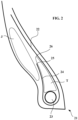
- FIG. 1 illustrates a schematic sectional representation of a bead 1 of a light truck type tire of size 215/75R16 whose load index is equal to 113. At the level of this bead 1 of the tire there is part of the layer of carcass reinforcement 2 wound around a bead wire 3 to form an upturn 4 having an end 5.
- the carcass reinforcement layer 2 consists of reinforcing elements between two liner layers formed from a rubber compound having secant moduli of elasticity under tension at 10% elongation Mc.
- the secant modulus of elasticity under tension at 10% elongation Mc of the carcass reinforcement layer 2 is equal to 5.8 MPa.
- first filler element J axially inside the sidewall and axially outside the upturn 4 of the first carcass reinforcement layer 2, consisting of a rubber compound having a secant modulus of elasticity under tension at 10% d elongation Mj equal to 7.9 MPa.
- the bead 1 further comprises a second filler element T extending the rod core radially outwards, consisting of a rubber compound having a secant modulus of elasticity under tension at 10% elongation M T equal to 54 MPa.
- the second filling element T has, in any meridian plane, a substantially triangular section.
- the radially outermost end 6 of the second filling element T is radially inner at the end 5 of the upturn 4 of the carcass reinforcement layer 2.
- FIG. 1 further illustrates the third and fourth filler elements B1 and B2 which are axially in contact with the end 5 of the upturn 4 of the carcass reinforcement layer 2.
- the secant moduli of elasticity under tension at 10% elongation M B1 and M B2 of the third and fourth filling elements B1 and B2 are equal to 5.8 MPa.
- the ratios Mc / M B1 and M C / M B2 are equal to 1 and therefore much lower than 2.
- the ratio M J / M B2 is equal to 1.8 and therefore well below 2.
- the reinforcing elements of the carcass reinforcement layer are assemblies consisting of a para-aramid (p-Aramide) multifilament strand, known under the trade name Twaron 1000 from the Teijin company, and a multifilament polyethylene terephthalate (PET), known under the trade name PET HMLS (High Modulus Low Shrinkage) from the companies Hyosung or Hailide, the two strands being wound in a helix one around the other.
- PET polyethylene terephthalate
- the reinforcement elements of the carcass reinforcement layer are balanced in torsion.
- the torsion of the p-Aramide/PET reinforcing elements of the carcass reinforcement layer is equal to 315 t/m.
- the title of the reinforcing elements of the carcass reinforcement layer expressed in tex is 167/167.
- the torsion factor K is equal to 5.9.
- the diameter of the reinforcing elements of the carcass reinforcement layer is equal to 0.67 mm.
- the breaking force of the reinforcement elements of the carcass reinforcement layer is equal to 40daN.
- the density of reinforcing elements in the carcass reinforcement layer is equal to 110 threads/dm.
- the carcass reinforcement layer has a breaking force per unit of width equal to 4400 daN/dm.
- the mass of the tire is equal to 15 kg.
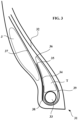
- FIG. 2 illustrates a schematic representation of a sectional view of a bead 21 according to one embodiment of a lightweight tire not in accordance with the invention for comparison purposes.
- This bead 21 corresponds to a tire similar to that of the invention, represented on the figure 1 but which differs therefrom by the absence of the third and fourth filling elements and whose end 26 of the filling element T is radially external to the end 25 of the upturn 24 of the carcass reinforcement layer 22.
- the end 25 of the upturn 24 of the carcass reinforcement layer 22 is thus axially in contact with the first filling element J and the second filling element T.
- the reinforcing elements of the carcass reinforcement layer are identical to those of the carcass reinforcement layer 2 of the tire according to the invention shown in the figure 1 .
- the mass of such a tire is equal to 15 kg.
- FIG. 3 illustrates a schematic representation of a sectional view of a bead 31 of a tire of usual design comprising two layers 32, 37 of carcass reinforcement.
- the first layer of carcass reinforcement 32 is turned around a bead wire 33 to form a turn-up 34. Also shown is a part of the second layer of carcass reinforcement 37, the end 38 of which is axially outside the bead wire 33 .
- the tire further comprises a layer 39 of aromatic polyamide reinforcing elements in contact with said first carcass reinforcement layer 32 over its entire length, at least a part being radially inside the bead wire 33 and said layer 39 of of aromatic polyamide reinforcement being interposed between the bead wire 33 and the first layer of carcass reinforcement 32.
- the reinforcing elements of the two carcass reinforcement layers 32 and 37 of the assemblies consist of two PET/PET multifilament strands.
- the twist of the PET/PET reinforcement elements is equal to 420 t/m.
- the title of the reinforcing elements of the carcass reinforcement layers expressed in tex is 144/144.
- the torsion factor K is equal to 7.4.
- the diameter of the reinforcing elements of the carcass reinforcement layers is equal to 0.62 mm.
- the breaking strength of the reinforcing elements of the carcass reinforcement layers is equal to 17.3 daN.
- the density of reinforcing elements in the two layers of carcass reinforcement is equal to 123 threads/dm.
- Each of the two layers 32, 37 of carcass reinforcement has a breaking force per unit of width equal to 2130 daN/dm.
- the mass of the tire is equal to 15.8 Kg.
- the three tires corresponding to the figure 1 , 2 And 3 are identical for everything that is not previously described and include in particular the same crown reinforcement.
- R1 tires are produced in accordance with the representation of the figure 2 .
- R2 tires are produced in accordance with the representation of the picture 3 .
- a threshold of mileage achieved is defined to consider the tires as being sufficiently enduring with reference to the reference tires R1.
- the R2 tires have reached the same mileage but have cracks in the J and T compounds which require the tires to be replaced.
- the tires I according to the invention have reached this same level of mileage and an in-depth examination of the tires has shown that they did not present any defect which could require the tires to be removed.
- the tires according to the invention therefore lead to satisfactory performance, particularly in terms of endurance.
Landscapes
- Engineering & Computer Science (AREA)
- Mechanical Engineering (AREA)
- Tires In General (AREA)
Claims (14)
- Reifen mit radialer Karkassenbewehrung (2), umfassend eine Scheitelbewehrung, die wiederum radial von einem Laufstreifen überdeckt wird, wobei der Laufstreifen über zwei Flanken mit zwei Wülsten (1), die einen Wulstkern (3) beinhalten, verbunden ist, wobei die Karkassenbewehrung (2) aus einer einzigen Lage besteht, die aus textilen Verstärkungselementen gebildet wird, die zwischen zwei Kalandrierlagen eingefügt sind, die aus einer Kautschukmischung bestehen, die einen Sekanten-Elastizitätsmodul unter Zug bei 10 % Dehnung MC aufweisen, wobei die Karkassenbewehrungslage (2) in jedem der Wülste (1) um den Wulstkern (3) herum umgeschlagen ist, wobei die Enden (5) der Karkassenbewehrungslage (2) in jedem Wulst radial außerhalb des radial äußersten Punkts des Wulstkerns sind, wobei der Reifen in jeder Flanke ein erstes Füllelement (J) umfasst, axial innerhalb der äußeren Fläche einer Flanke und axial außerhalb des Umschlags (4) der Karkassenbewehrungslage, das aus einer Kautschukmischung besteht, die einen Sekanten-Elastizitätsmodul unter Zug bei 10 % Dehnung MJ aufweist, wobei jeder Wulst (1) ein zweites Füllelement (T) umfasst, das aus einer Kautschukmischung besteht, die einen Sekanten-Elastizitätsmodulunter Zug bei 10 % Dehnung MT aufweist, das den Wulstkern radial nach außen verlängert, axial außerhalb der Karkassenbewehrungslage (2) und axial innerhalb des Umschlags (4) der Karkassenbewehrungslage, wobei der Reifen ein drittes Füllelement (B1) umfasst, das aus einer Kautschukmischung besteht, die einen Sekanten-Elastizitätsmodul unter Zug bei 10 % Dehnung MB1 aufweist, axial in Kontakt mit dem Umschlag (4) der Karkassenbewehrungslage und axial in Kontakt mit dem zweiten Füllelement (T), und ein viertes Füllelement (B2), das aus einer Kautschukmischung besteht, die einen Sekanten-Elastizitätsmodul unter Zug bei 10 % Dehnung MB2 aufweist, axial in Kontakt mit dem Umschlag (4) der Karkassenbewehrungslage und axial in Kontakt mit dem ersten Füllelement (J), wobei das dritte und das vierte Füllelement (B1) und (B2) radial außerhalb des Endes (5) des Umschlags (4) der Karkassenbewehrungslage axial in Kontakt miteinander sind,dadurch gekennzeichnet, dass die Karkassenbewehrungslage (2) eine Bruchkraft je Breiteneinheit von mehr als 3000 daN/dm aufweist,dass die Karkassenbewehrungslage (2) die einzige Lage aus Verstärkungselementen ist, die radial innerhalb des Wulstkerns (3) vorhanden ist, dass die Sekanten-Elastizitätsmodule unter Zug bei 10 % Dehnung MC, MB1 die Gleichung MC / MB1 < 2 erfüllen und dass die Sekanten-Elastizitätsmodule unter Zug bei 10 % Dehnung MC, MB2 die Gleichung MC / MB2 < 2 erfüllen.
- Reifen nach Anspruch 1, dadurch gekennzeichnet, dass der Lastindex des Reifens zwischen 100 und 125 beträgt.
- Reifen nach einem der Ansprüche 1 oder 2, dadurch gekennzeichnet, dass die Karkassenbewehrungslage (2) eine Bruchkraft je Breiteneinheit von mehr als 4100 daN/dm aufweist.
- Reifen nach einem der Ansprüche 1 bis 3, dadurch gekennzeichnet, dass der Sekanten-Elastizitätsmodul unter Zug bei 10 % Dehnung MT des zweiten Füllelements (T) größer als 40 MPa ist.
- Reifen nach einem der vorhergehenden Ansprüche, dadurch gekennzeichnet, dass das radial äußerste Ende (6) des zweiten Füllelements (T) radial innerhalb des Endes (5) des Umschlags (4) der Karkassenbewehrungslage ist.
- Reifen nach einem der vorhergehenden Ansprüche, dadurch gekennzeichnet, dass die Sekanten-Elastizitätsmodule unter Zug bei 10 % Dehnung MJ, MB2 die Gleichung MJ / MB2 < 2 erfüllen.
- Reifen nach einem der vorhergehenden Ansprüche, dadurch gekennzeichnet, dass der Abstand zwischen dem Ende (5) des Umschlags der Karkassenbewehrungslage und dem radial innersten Punkt des dem Wulstkern (3) umschriebenen Kreises zwischen 25 und 40 % des Abstands zwischen dem axial äußersten Punkt des Hauptteils der Karkassenbewehrungslage und dem radial innersten Punkt des dem Wulstkern umschriebenen Kreises beträgt.
- Reifen nach einem der vorhergehenden Ansprüche, dadurch gekennzeichnet, dass die textilen Verstärkungselemente der Karkassenbewehrungslage (2) Bündel sind, die aus mehreren Multifilamentfäden bestehen, die mindestens einen Multifilamentfaden aus aromatischem Polyamid oder aromatischem Copolyamid und mindestens einen Multifilamentfaden aus Polyester umfassen.
- Reifen nach einem der vorhergehenden Ansprüche, dadurch gekennzeichnet, dass die textilen Verstärkungselemente der Karkassenbewehrungslage (2) Bündel sind, die aus zwei Multifilamentfäden bestehen.
- Reifen nach einem der Ansprüche 8 oder 9, dadurch gekennzeichnet, dass der Titer des Multifilamentfadens aus aromatischem Polyamid oder aromatischem Copolyamid zwischen 140 und 210 tex beträgt.
- Reifen nach einem der Ansprüche 8 bis 10, dadurch gekennzeichnet, dass der Titer des Multifilamentfadens aus Polyester zwischen 100 und 210 tex beträgt.
- Reifen nach einem der vorhergehenden Ansprüche, dadurch gekennzeichnet, dass die Dichte der textilen Verstärkungselemente der Karkassenbewehrungslage (2) zwischen 90 und 130 Verstärkungselementen je Dezimeter beträgt.
- Reifen nach einem der vorhergehenden Ansprüche, dadurch gekennzeichnet, dass die textilen Verstärkungselemente der Karkassenbewehrungslage (2) drallausgeglichen sind.
- Verwendung eines Reifens nach einem der Ansprüche 1 bis 13 für ein Fahrzeug vom Typ Kleintransporter.
Applications Claiming Priority (2)
| Application Number | Priority Date | Filing Date | Title |
|---|---|---|---|
| FR1858514A FR3086206B1 (fr) | 2018-09-20 | 2018-09-20 | Pneumatique comportant une armature de carcasse formee d'une unique couche d'elements de renforcement textiles |
| PCT/FR2019/052180 WO2020058632A1 (fr) | 2018-09-20 | 2019-09-18 | Pneumatique comportant une armature de carcasse formee d'une unique couche d'elements de renforcement textiles |
Publications (2)
| Publication Number | Publication Date |
|---|---|
| EP3853045A1 EP3853045A1 (de) | 2021-07-28 |
| EP3853045B1 true EP3853045B1 (de) | 2023-07-12 |
Family
ID=63896455
Family Applications (1)
| Application Number | Title | Priority Date | Filing Date |
|---|---|---|---|
| EP19790672.0A Active EP3853045B1 (de) | 2018-09-20 | 2019-09-18 | Reifen mit einer karkassenbewehrung aus einer einzigen schicht textiler verstärkungselemente |
Country Status (5)
| Country | Link |
|---|---|
| EP (1) | EP3853045B1 (de) |
| CN (1) | CN112672892B (de) |
| CA (1) | CA3111390A1 (de) |
| FR (1) | FR3086206B1 (de) |
| WO (1) | WO2020058632A1 (de) |
Families Citing this family (1)
| Publication number | Priority date | Publication date | Assignee | Title |
|---|---|---|---|---|
| FR3133339B1 (fr) * | 2022-03-11 | 2024-03-15 | Michelin & Cie | Pneumatique avec une armature de carcasse simplifiée |
Family Cites Families (20)
| Publication number | Priority date | Publication date | Assignee | Title |
|---|---|---|---|---|
| JPS6432902A (en) * | 1987-07-28 | 1989-02-02 | Toyo Tire & Rubber Co | High durability radial tire |
| US6105643A (en) | 1996-01-25 | 2000-08-22 | The Goodyear Tire & Rubber Company | On/off road radial pneumatic light truck or automobile tire |
| KR20010012736A (ko) * | 1997-05-20 | 2001-02-26 | 스위셔 케드린 엠 | 비포장도로용 어스무버형 공기 타이어 |
| FR2773519B1 (fr) * | 1998-01-12 | 2000-02-11 | Michelin & Cie | Bourrelet de pneumatique avec elements de renfort circonferentiels |
| FR2827809A1 (fr) * | 2001-07-25 | 2003-01-31 | Michelin Soc Tech | Armature de carcasse en trois parties |
| JP4346372B2 (ja) * | 2003-07-14 | 2009-10-21 | 横浜ゴム株式会社 | 重荷重用空気入りラジアルタイヤ |
| JP4500117B2 (ja) * | 2004-07-05 | 2010-07-14 | 東洋ゴム工業株式会社 | 重荷重用空気入りラジアルタイヤ |
| ES2339039T3 (es) | 2004-09-24 | 2010-05-14 | The Yokohama Rubber Co., Ltd. | Neumatico radial para camiones ligeros. |
| FR2901178B1 (fr) * | 2006-05-22 | 2010-10-08 | Michelin Soc Tech | Pneumatique avec ancrage comportant un element de renfort bielastique |
| FR2952589B1 (fr) * | 2009-11-13 | 2011-11-11 | Michelin Soc Tech | Bourrelet de pneu pour vehicule petit poids lourd. |
| JP2012106531A (ja) * | 2010-11-15 | 2012-06-07 | Sumitomo Rubber Ind Ltd | 重荷重用タイヤ |
| FR2969035B1 (fr) * | 2010-12-21 | 2014-08-29 | Michelin Soc Tech | Pneumatique dont l'armature de carcasse est renforcee par une couche d'elements de renforcement dans la zone du bourrelet |
| FR2971733B1 (fr) * | 2011-02-17 | 2013-02-22 | Michelin Soc Tech | Pneumatique ayant des bourrelets perfectionnes. |
| JP5319736B2 (ja) * | 2011-06-15 | 2013-10-16 | 東洋ゴム工業株式会社 | 空気入りラジアルタイヤ |
| FR2983123B1 (fr) * | 2011-11-29 | 2014-01-03 | Michelin Soc Tech | Pneumatique ayant des bourrelets perfectionnes. |
| FR2995251B1 (fr) * | 2012-09-11 | 2014-08-29 | Michelin & Cie | Pneumatique comportant une armature de flanc supplementaire. |
| KR101350646B1 (ko) * | 2012-10-18 | 2014-01-10 | 금호타이어 주식회사 | 공기입 타이어의 코드 절상 방지 구조 |
| US9227467B2 (en) * | 2013-07-22 | 2016-01-05 | E I Du Pont De Nemours And Company | Pneumatic tire |
| FR3029841B1 (fr) * | 2014-12-16 | 2018-04-20 | Compagnie Generale Des Etablissements Michelin | Pneumatique comportant une armature de carcasse formee de deux couches |
| FR3029840B1 (fr) * | 2014-12-16 | 2018-04-20 | Compagnie Generale Des Etablissements Michelin | Pneumatique comportant une armature de carcasse formee de deux couches |
-
2018
- 2018-09-20 FR FR1858514A patent/FR3086206B1/fr active Active
-
2019
- 2019-09-18 EP EP19790672.0A patent/EP3853045B1/de active Active
- 2019-09-18 WO PCT/FR2019/052180 patent/WO2020058632A1/fr not_active Ceased
- 2019-09-18 CN CN201980059620.3A patent/CN112672892B/zh active Active
- 2019-09-18 CA CA3111390A patent/CA3111390A1/fr active Pending
Also Published As
| Publication number | Publication date |
|---|---|
| FR3086206B1 (fr) | 2020-08-28 |
| CA3111390A1 (fr) | 2020-03-26 |
| FR3086206A1 (fr) | 2020-03-27 |
| WO2020058632A1 (fr) | 2020-03-26 |
| EP3853045A1 (de) | 2021-07-28 |
| CN112672892A (zh) | 2021-04-16 |
| CN112672892B (zh) | 2022-11-15 |
Similar Documents
| Publication | Publication Date | Title |
|---|---|---|
| EP2906434B1 (de) | Notlaufreifen mit einer hybridkarkassenlage | |
| EP4225590B1 (de) | Reifen mit einer einzelkarkassenlage | |
| EP3768526B1 (de) | Reifen mit einer einzigen karkassenlage mit verbesserter verformungstiefe in der seitenwand nach dem einfahren | |
| EP3515727B1 (de) | Elastomerkomposit und reifen enthaltend ein solches komposit | |
| WO2022074341A1 (fr) | Ensemble monte comprenant un pneumatique | |
| WO2018051032A1 (fr) | Élément de renfort, composite d'élastomère et pneumatique comprenant cet élément de renfort | |
| EP3277869B1 (de) | Hybrides verstärkungselement mit differentialverdrehung | |
| EP3768882A1 (de) | Verbesserter aramidtextilkord mit mindestens einer dreifachen verdrillung | |
| EP4225589B1 (de) | Minifelgenreifen | |
| FR3029840A1 (fr) | Pneumatique comportant une armature de carcasse formee de deux couches | |
| EP4225592A1 (de) | Reifen mit zwei karkassenschichten | |
| EP3853045A1 (de) | Reifen mit einer karkassenbewehrung aus einer einzigen schicht textiler verstärkungselemente | |
| EP3484723A1 (de) | Reifen | |
| EP4100264B1 (de) | Luftreifen für ein landwirtschaftliches fahrzeug mit einem hybriden karkassenverstärkungselement | |
| EP3880492B1 (de) | Reifen für zweiradfahrzeug mit einer hybriden umreifungsverstärkung | |
| EP3484724B1 (de) | Luftreifen | |
| FR3137868A1 (fr) | Tissu pour pneumatique comprenant des éléments de renfort comprenant un assemblage constitué de deux brins multifilamentaires de polyamide 5,6 | |
| FR3167338A1 (fr) | Pneumatique comprenant au moins une nappe de frettage ultrafine permettant de bloquer le fluage des nappes de protection | |
| FR3159976A1 (fr) | Elément de renfort hybride élastique |
Legal Events
| Date | Code | Title | Description |
|---|---|---|---|
| STAA | Information on the status of an ep patent application or granted ep patent |
Free format text: STATUS: UNKNOWN |
|
| STAA | Information on the status of an ep patent application or granted ep patent |
Free format text: STATUS: THE INTERNATIONAL PUBLICATION HAS BEEN MADE |
|
| PUAI | Public reference made under article 153(3) epc to a published international application that has entered the european phase |
Free format text: ORIGINAL CODE: 0009012 |
|
| STAA | Information on the status of an ep patent application or granted ep patent |
Free format text: STATUS: REQUEST FOR EXAMINATION WAS MADE |
|
| 17P | Request for examination filed |
Effective date: 20210420 |
|
| AK | Designated contracting states |
Kind code of ref document: A1 Designated state(s): AL AT BE BG CH CY CZ DE DK EE ES FI FR GB GR HR HU IE IS IT LI LT LU LV MC MK MT NL NO PL PT RO RS SE SI SK SM TR |
|
| DAV | Request for validation of the european patent (deleted) | ||
| DAX | Request for extension of the european patent (deleted) | ||
| STAA | Information on the status of an ep patent application or granted ep patent |
Free format text: STATUS: EXAMINATION IS IN PROGRESS |
|
| 17Q | First examination report despatched |
Effective date: 20220525 |
|
| GRAP | Despatch of communication of intention to grant a patent |
Free format text: ORIGINAL CODE: EPIDOSNIGR1 |
|
| STAA | Information on the status of an ep patent application or granted ep patent |
Free format text: STATUS: GRANT OF PATENT IS INTENDED |
|
| RIC1 | Information provided on ipc code assigned before grant |
Ipc: B60C 9/02 20060101ALN20230123BHEP Ipc: B60C 15/06 20060101AFI20230123BHEP |
|
| INTG | Intention to grant announced |
Effective date: 20230227 |
|
| GRAS | Grant fee paid |
Free format text: ORIGINAL CODE: EPIDOSNIGR3 |
|
| GRAA | (expected) grant |
Free format text: ORIGINAL CODE: 0009210 |
|
| STAA | Information on the status of an ep patent application or granted ep patent |
Free format text: STATUS: THE PATENT HAS BEEN GRANTED |
|
| AK | Designated contracting states |
Kind code of ref document: B1 Designated state(s): AL AT BE BG CH CY CZ DE DK EE ES FI FR GB GR HR HU IE IS IT LI LT LU LV MC MK MT NL NO PL PT RO RS SE SI SK SM TR |
|
| REG | Reference to a national code |
Ref country code: CH Ref legal event code: EP |
|
| REG | Reference to a national code |
Ref country code: IE Ref legal event code: FG4D Free format text: LANGUAGE OF EP DOCUMENT: FRENCH |
|
| REG | Reference to a national code |
Ref country code: DE Ref legal event code: R096 Ref document number: 602019032680 Country of ref document: DE |
|
| REG | Reference to a national code |
Ref country code: LT Ref legal event code: MG9D |
|
| REG | Reference to a national code |
Ref country code: NL Ref legal event code: MP Effective date: 20230712 |
|
| REG | Reference to a national code |
Ref country code: AT Ref legal event code: MK05 Ref document number: 1586759 Country of ref document: AT Kind code of ref document: T Effective date: 20230712 |
|
| PG25 | Lapsed in a contracting state [announced via postgrant information from national office to epo] |
Ref country code: NL Free format text: LAPSE BECAUSE OF FAILURE TO SUBMIT A TRANSLATION OF THE DESCRIPTION OR TO PAY THE FEE WITHIN THE PRESCRIBED TIME-LIMIT Effective date: 20230712 |
|
| PG25 | Lapsed in a contracting state [announced via postgrant information from national office to epo] |
Ref country code: GR Free format text: LAPSE BECAUSE OF FAILURE TO SUBMIT A TRANSLATION OF THE DESCRIPTION OR TO PAY THE FEE WITHIN THE PRESCRIBED TIME-LIMIT Effective date: 20231013 |
|
| PG25 | Lapsed in a contracting state [announced via postgrant information from national office to epo] |
Ref country code: ES Free format text: LAPSE BECAUSE OF FAILURE TO SUBMIT A TRANSLATION OF THE DESCRIPTION OR TO PAY THE FEE WITHIN THE PRESCRIBED TIME-LIMIT Effective date: 20230712 |
|
| PG25 | Lapsed in a contracting state [announced via postgrant information from national office to epo] |
Ref country code: IS Free format text: LAPSE BECAUSE OF FAILURE TO SUBMIT A TRANSLATION OF THE DESCRIPTION OR TO PAY THE FEE WITHIN THE PRESCRIBED TIME-LIMIT Effective date: 20231112 |
|
| PG25 | Lapsed in a contracting state [announced via postgrant information from national office to epo] |
Ref country code: SE Free format text: LAPSE BECAUSE OF FAILURE TO SUBMIT A TRANSLATION OF THE DESCRIPTION OR TO PAY THE FEE WITHIN THE PRESCRIBED TIME-LIMIT Effective date: 20230712 Ref country code: RS Free format text: LAPSE BECAUSE OF FAILURE TO SUBMIT A TRANSLATION OF THE DESCRIPTION OR TO PAY THE FEE WITHIN THE PRESCRIBED TIME-LIMIT Effective date: 20230712 Ref country code: PT Free format text: LAPSE BECAUSE OF FAILURE TO SUBMIT A TRANSLATION OF THE DESCRIPTION OR TO PAY THE FEE WITHIN THE PRESCRIBED TIME-LIMIT Effective date: 20231113 Ref country code: NO Free format text: LAPSE BECAUSE OF FAILURE TO SUBMIT A TRANSLATION OF THE DESCRIPTION OR TO PAY THE FEE WITHIN THE PRESCRIBED TIME-LIMIT Effective date: 20231012 Ref country code: LV Free format text: LAPSE BECAUSE OF FAILURE TO SUBMIT A TRANSLATION OF THE DESCRIPTION OR TO PAY THE FEE WITHIN THE PRESCRIBED TIME-LIMIT Effective date: 20230712 Ref country code: LT Free format text: LAPSE BECAUSE OF FAILURE TO SUBMIT A TRANSLATION OF THE DESCRIPTION OR TO PAY THE FEE WITHIN THE PRESCRIBED TIME-LIMIT Effective date: 20230712 Ref country code: IS Free format text: LAPSE BECAUSE OF FAILURE TO SUBMIT A TRANSLATION OF THE DESCRIPTION OR TO PAY THE FEE WITHIN THE PRESCRIBED TIME-LIMIT Effective date: 20231112 Ref country code: HR Free format text: LAPSE BECAUSE OF FAILURE TO SUBMIT A TRANSLATION OF THE DESCRIPTION OR TO PAY THE FEE WITHIN THE PRESCRIBED TIME-LIMIT Effective date: 20230712 Ref country code: GR Free format text: LAPSE BECAUSE OF FAILURE TO SUBMIT A TRANSLATION OF THE DESCRIPTION OR TO PAY THE FEE WITHIN THE PRESCRIBED TIME-LIMIT Effective date: 20231013 Ref country code: FI Free format text: LAPSE BECAUSE OF FAILURE TO SUBMIT A TRANSLATION OF THE DESCRIPTION OR TO PAY THE FEE WITHIN THE PRESCRIBED TIME-LIMIT Effective date: 20230712 Ref country code: ES Free format text: LAPSE BECAUSE OF FAILURE TO SUBMIT A TRANSLATION OF THE DESCRIPTION OR TO PAY THE FEE WITHIN THE PRESCRIBED TIME-LIMIT Effective date: 20230712 Ref country code: AT Free format text: LAPSE BECAUSE OF FAILURE TO SUBMIT A TRANSLATION OF THE DESCRIPTION OR TO PAY THE FEE WITHIN THE PRESCRIBED TIME-LIMIT Effective date: 20230712 |
|
| PG25 | Lapsed in a contracting state [announced via postgrant information from national office to epo] |
Ref country code: PL Free format text: LAPSE BECAUSE OF FAILURE TO SUBMIT A TRANSLATION OF THE DESCRIPTION OR TO PAY THE FEE WITHIN THE PRESCRIBED TIME-LIMIT Effective date: 20230712 |
|
| REG | Reference to a national code |
Ref country code: DE Ref legal event code: R097 Ref document number: 602019032680 Country of ref document: DE |
|
| PG25 | Lapsed in a contracting state [announced via postgrant information from national office to epo] |
Ref country code: SM Free format text: LAPSE BECAUSE OF FAILURE TO SUBMIT A TRANSLATION OF THE DESCRIPTION OR TO PAY THE FEE WITHIN THE PRESCRIBED TIME-LIMIT Effective date: 20230712 Ref country code: RO Free format text: LAPSE BECAUSE OF FAILURE TO SUBMIT A TRANSLATION OF THE DESCRIPTION OR TO PAY THE FEE WITHIN THE PRESCRIBED TIME-LIMIT Effective date: 20230712 Ref country code: EE Free format text: LAPSE BECAUSE OF FAILURE TO SUBMIT A TRANSLATION OF THE DESCRIPTION OR TO PAY THE FEE WITHIN THE PRESCRIBED TIME-LIMIT Effective date: 20230712 Ref country code: DK Free format text: LAPSE BECAUSE OF FAILURE TO SUBMIT A TRANSLATION OF THE DESCRIPTION OR TO PAY THE FEE WITHIN THE PRESCRIBED TIME-LIMIT Effective date: 20230712 Ref country code: CZ Free format text: LAPSE BECAUSE OF FAILURE TO SUBMIT A TRANSLATION OF THE DESCRIPTION OR TO PAY THE FEE WITHIN THE PRESCRIBED TIME-LIMIT Effective date: 20230712 Ref country code: SK Free format text: LAPSE BECAUSE OF FAILURE TO SUBMIT A TRANSLATION OF THE DESCRIPTION OR TO PAY THE FEE WITHIN THE PRESCRIBED TIME-LIMIT Effective date: 20230712 |
|
| REG | Reference to a national code |
Ref country code: CH Ref legal event code: PL |
|
| PG25 | Lapsed in a contracting state [announced via postgrant information from national office to epo] |
Ref country code: LU Free format text: LAPSE BECAUSE OF NON-PAYMENT OF DUE FEES Effective date: 20230918 |
|
| PLBE | No opposition filed within time limit |
Free format text: ORIGINAL CODE: 0009261 |
|
| STAA | Information on the status of an ep patent application or granted ep patent |
Free format text: STATUS: NO OPPOSITION FILED WITHIN TIME LIMIT |
|
| REG | Reference to a national code |
Ref country code: BE Ref legal event code: MM Effective date: 20230930 |
|
| PG25 | Lapsed in a contracting state [announced via postgrant information from national office to epo] |
Ref country code: LU Free format text: LAPSE BECAUSE OF NON-PAYMENT OF DUE FEES Effective date: 20230918 Ref country code: IT Free format text: LAPSE BECAUSE OF FAILURE TO SUBMIT A TRANSLATION OF THE DESCRIPTION OR TO PAY THE FEE WITHIN THE PRESCRIBED TIME-LIMIT Effective date: 20230712 Ref country code: MC Free format text: LAPSE BECAUSE OF FAILURE TO SUBMIT A TRANSLATION OF THE DESCRIPTION OR TO PAY THE FEE WITHIN THE PRESCRIBED TIME-LIMIT Effective date: 20230712 |
|
| 26N | No opposition filed |
Effective date: 20240415 |
|
| GBPC | Gb: european patent ceased through non-payment of renewal fee |
Effective date: 20231012 |
|
| REG | Reference to a national code |
Ref country code: IE Ref legal event code: MM4A |
|
| PG25 | Lapsed in a contracting state [announced via postgrant information from national office to epo] |
Ref country code: IE Free format text: LAPSE BECAUSE OF NON-PAYMENT OF DUE FEES Effective date: 20230918 |
|
| PG25 | Lapsed in a contracting state [announced via postgrant information from national office to epo] |
Ref country code: GB Free format text: LAPSE BECAUSE OF NON-PAYMENT OF DUE FEES Effective date: 20231012 |
|
| PG25 | Lapsed in a contracting state [announced via postgrant information from national office to epo] |
Ref country code: CH Free format text: LAPSE BECAUSE OF NON-PAYMENT OF DUE FEES Effective date: 20230930 |
|
| PG25 | Lapsed in a contracting state [announced via postgrant information from national office to epo] |
Ref country code: IE Free format text: LAPSE BECAUSE OF NON-PAYMENT OF DUE FEES Effective date: 20230918 Ref country code: GB Free format text: LAPSE BECAUSE OF NON-PAYMENT OF DUE FEES Effective date: 20231012 Ref country code: CH Free format text: LAPSE BECAUSE OF NON-PAYMENT OF DUE FEES Effective date: 20230930 Ref country code: SI Free format text: LAPSE BECAUSE OF FAILURE TO SUBMIT A TRANSLATION OF THE DESCRIPTION OR TO PAY THE FEE WITHIN THE PRESCRIBED TIME-LIMIT Effective date: 20230712 |
|
| PG25 | Lapsed in a contracting state [announced via postgrant information from national office to epo] |
Ref country code: BE Free format text: LAPSE BECAUSE OF NON-PAYMENT OF DUE FEES Effective date: 20230930 |
|
| PG25 | Lapsed in a contracting state [announced via postgrant information from national office to epo] |
Ref country code: BG Free format text: LAPSE BECAUSE OF FAILURE TO SUBMIT A TRANSLATION OF THE DESCRIPTION OR TO PAY THE FEE WITHIN THE PRESCRIBED TIME-LIMIT Effective date: 20230712 |
|
| PG25 | Lapsed in a contracting state [announced via postgrant information from national office to epo] |
Ref country code: BG Free format text: LAPSE BECAUSE OF FAILURE TO SUBMIT A TRANSLATION OF THE DESCRIPTION OR TO PAY THE FEE WITHIN THE PRESCRIBED TIME-LIMIT Effective date: 20230712 |
|
| PG25 | Lapsed in a contracting state [announced via postgrant information from national office to epo] |
Ref country code: CY Free format text: LAPSE BECAUSE OF FAILURE TO SUBMIT A TRANSLATION OF THE DESCRIPTION OR TO PAY THE FEE WITHIN THE PRESCRIBED TIME-LIMIT; INVALID AB INITIO Effective date: 20190918 |
|
| PG25 | Lapsed in a contracting state [announced via postgrant information from national office to epo] |
Ref country code: HU Free format text: LAPSE BECAUSE OF FAILURE TO SUBMIT A TRANSLATION OF THE DESCRIPTION OR TO PAY THE FEE WITHIN THE PRESCRIBED TIME-LIMIT; INVALID AB INITIO Effective date: 20190918 |
|
| PGFP | Annual fee paid to national office [announced via postgrant information from national office to epo] |
Ref country code: DE Payment date: 20250919 Year of fee payment: 7 |
|
| PGFP | Annual fee paid to national office [announced via postgrant information from national office to epo] |
Ref country code: FR Payment date: 20250922 Year of fee payment: 7 |
|
| PG25 | Lapsed in a contracting state [announced via postgrant information from national office to epo] |
Ref country code: TR Free format text: LAPSE BECAUSE OF FAILURE TO SUBMIT A TRANSLATION OF THE DESCRIPTION OR TO PAY THE FEE WITHIN THE PRESCRIBED TIME-LIMIT Effective date: 20230712 |