EP3850056B1 - Receiver comprising a luminescent collector for optical data communication - Google Patents
Receiver comprising a luminescent collector for optical data communication Download PDFInfo
- Publication number
- EP3850056B1 EP3850056B1 EP19765250.6A EP19765250A EP3850056B1 EP 3850056 B1 EP3850056 B1 EP 3850056B1 EP 19765250 A EP19765250 A EP 19765250A EP 3850056 B1 EP3850056 B1 EP 3850056B1
- Authority
- EP
- European Patent Office
- Prior art keywords
- alkyl
- aryl
- unsubstituted
- substituted
- cycloalkyl
- Prior art date
- Legal status (The legal status is an assumption and is not a legal conclusion. Google has not performed a legal analysis and makes no representation as to the accuracy of the status listed.)
- Active
Links
Images
Classifications
-
- C—CHEMISTRY; METALLURGY
- C09—DYES; PAINTS; POLISHES; NATURAL RESINS; ADHESIVES; COMPOSITIONS NOT OTHERWISE PROVIDED FOR; APPLICATIONS OF MATERIALS NOT OTHERWISE PROVIDED FOR
- C09K—MATERIALS FOR MISCELLANEOUS APPLICATIONS, NOT PROVIDED FOR ELSEWHERE
- C09K11/00—Luminescent materials, e.g. electroluminescent or chemiluminescent
- C09K11/06—Luminescent materials, e.g. electroluminescent or chemiluminescent containing organic luminescent materials
-
- C—CHEMISTRY; METALLURGY
- C08—ORGANIC MACROMOLECULAR COMPOUNDS; THEIR PREPARATION OR CHEMICAL WORKING-UP; COMPOSITIONS BASED THEREON
- C08L—COMPOSITIONS OF MACROMOLECULAR COMPOUNDS
- C08L101/00—Compositions of unspecified macromolecular compounds
-
- H—ELECTRICITY
- H04—ELECTRIC COMMUNICATION TECHNIQUE
- H04B—TRANSMISSION
- H04B10/00—Transmission systems employing electromagnetic waves other than radio-waves, e.g. infrared, visible or ultraviolet light, or employing corpuscular radiation, e.g. quantum communication
- H04B10/60—Receivers
- H04B10/66—Non-coherent receivers, e.g. using direct detection
- H04B10/67—Optical arrangements in the receiver
-
- C—CHEMISTRY; METALLURGY
- C09—DYES; PAINTS; POLISHES; NATURAL RESINS; ADHESIVES; COMPOSITIONS NOT OTHERWISE PROVIDED FOR; APPLICATIONS OF MATERIALS NOT OTHERWISE PROVIDED FOR
- C09K—MATERIALS FOR MISCELLANEOUS APPLICATIONS, NOT PROVIDED FOR ELSEWHERE
- C09K2211/00—Chemical nature of organic luminescent or tenebrescent compounds
- C09K2211/10—Non-macromolecular compounds
- C09K2211/1018—Heterocyclic compounds
- C09K2211/1025—Heterocyclic compounds characterised by ligands
- C09K2211/1044—Heterocyclic compounds characterised by ligands containing two nitrogen atoms as heteroatoms
Definitions
- the present invention relates to a receiver comprising a luminescent collector (luminescent detector), to an optical data communication system comprising said receiver, and to the use of the luminescent collector as fast photodetector in a receiver for an optical data communication system.
- optical data communication especially optical wireless communication (OWC) like visible Light Communication (VLC), free space optical communication (FSO) and Li-Fi (Light Fidelity) are rapid growing technological fields that aim to implement fast and safe wireless communication to replace or complement existing wireless technologies.
- New technologies like the internet of things (being the basis for industry 4.0, IP 4.0 ® , etc.), wearables (i.e. smart electronic devices with microcontrollers that can be worn on the body as implant or accessories) and the general increase in mobile communication lead to a rapid increase in data streams and the necessity for new communication channels.
- OBC optical wireless communication
- VLC visible Light Communication
- FSO free space optical communication
- Li-Fi Light Fidelity
- New technologies like the internet of things (being the basis for industry 4.0, IP 4.0 ® , etc.), wearables (i.e. smart electronic devices with microcontrollers that can be worn on the body as implant or accessories) and the general increase in mobile communication lead to a rapid increase in data streams and the necessity for new communication channels.
- Li-Fi is the term established for the transmission of data through illumination using LED lighting that varies in its intensity for high speed wireless communication. Together with the widespread use of LED lighting in offices, streetlights and homes, Li-Fi is an added benefit to the existing lighting infrastructure.
- a portion of the emitted light is collected by a fiber and guided to a small area semiconductor photodiode. It is referred to the combined system of the luminescent concentrators and photodiode as a luminescent detector (LD). However, in T. G. Tiecke et al., no specific wavelength shifting dyes are mentioned.
- US 2017/0346556 A discloses an apparatus comprising: a wavelength-shifting element configured to receive an input-light signal, wherein the wavelength-shifting element comprises a wavelength-shifting material configured to: absorb at least a portion of the received input-light signal; and produce an emitted-light signal from the absorbed portion of the received input-light signal; a plasmonic grating comprising a plurality of plasmonic-structure elements, the plasmonic grating configured to: receive at least a portion of the emitted-light signal; and direct the received portion of the emitted-light signal toward a photodetector; and the photodetector configured to: receive the directed portion of the emitted-light signal; and produce an electrical current corresponding to the directed portion of the emitted-light signal.
- the inorganic materials cadmium/selenide/cadmium sulfide (CdSe/CdS) quantum dots and lead selenide/led sulfide (PdSe/PdS) quantum dots are mentioned.
- WO 2017/089540 A1 relates to a detector, a detector system and a method for determining a position of at least one object.
- the photoluminescence lifetime (fluorescent/phosphorescent lifetime or excited-state lifetime) of conventional phosphors as wavelength-shifting material is too long (ranging in the order of greater than 10 nanoseconds and up to some microseconds) to support high rates of data transfer.
- a receiver comprising a luminescent collector (luminescent detector) for use as fast photodetector in a receiver for an optical data communication system comprising at least one organic fluorescent colorant B selected from the group consisting of (B1) a naphthoylbenzimidazole compound, (B2) a cyanated naphthoylbenzimidazole compound, (B3) a cyanated perylene compound of formula (III), (B4) a cyanated compound of formula (IV), (B5) a benz(othi)oxanthene compound of formula (V), (B6) a benzimidazoxanthenisoquinoline compound of formulae (VIA) or (VIB), (B7) fluorescent compound comprising at least one structural unit of formua (VII), (B8) a perylene compound of formulae (VIII) or (IX), (B9) a naphthalene monoimide compound of formula (X),
- an optical data communication system comprising the receiver according to the present invention, and by the use of at least one organic fluorescent colorant B selected from the group consisting of the compounds (B1) to (B18) in a luminescent collector (luminescent detector) as photodetector in a receiver for an optical data communication system.
- the present invention relates to a receiver comprising a luminescent comprising
- the present invention further relates to a receiver comprising at least one organic fluorescent colorant B selected from the group consisting of B1, B2, B3, B4, B5, B7, B8, B11, B12, B13, B14, B15, B16, B17 and B18.
- the present invention further relates to an optical data communication system comprising
- the present invention further relates to the use of an organic fluorescent colorant B selected from the group consisting of B1, B2, B3, B4, B5, B7, B8, B11, B12, B13, B14, B15, B16, B17 and B18 in a luminescent collector in a receiver for an optical data communication system.
- an organic fluorescent colorant B selected from the group consisting of B1, B2, B3, B4, B5, B7, B8, B11, B12, B13, B14, B15, B16, B17 and B18 in a luminescent collector in a receiver for an optical data communication system.
- the optical data communication system comprises a receiver (R) to detect at least a part of the modulated electromagnetic radiation emitted by the transmitter (T).
- the receiver (R) according to the present invention comprises a luminescent collector. At the luminescent collector, the optical signal is collected and converted back to electrical current.
- a luminescent collector which is a combined system of wavelength shifting material and a detector, preferably a photodiode (PD or array of PDs), is employed in the receiver (R).
- the present invention therefore relates to luminescent collector comprising
- the wavelength shifting material is used instead of traditional optics to collect the modulated electromagnetic radiation or together with traditional optics to collect the modulated electromagnetic radiation.
- the wavelength shifting materials are optical waveguides (i.e. polymeric matrix materials, wherein suitable matrix materials are described below) doped with at least one organic fluorescent colorant B selected from the group consisting of B1, B2, B3, B4, B5, B7, B8, B11, B12, B13, B14, B15, B16, B17 and B18.
- the combined system of the wavelength shifting materials comprising at least one organic fluorescent colorant B selected from the group consisting of B1, B2, B3, B4, B5, B7, B8, B11, B12, B13, B14, B15, B16, B17 and B18 and a detector, preferably photodiode is the luminescent collector according to the present invention.
- the incident light, modulated with a communication signal (i.e. the modulated electromagnetic radiation, preferably emitted by the transmitter (T)), is absorbed by the at least one organic fluorescent colorant B selected from the group consisting of B1, B2, B3, B4, B5, B7, B8, B11, B12, B13, B14, B15, B16, B17 and B18, independently of the light incidence angle and subsequently re-emitted at a different wavelength.
- At least a portion of the emitted light in an ideal case all of the emitted light, is collected, for example by a fiber or a sheet, and guided by internal reflection to a detector, preferably a photodiode, more preferably a small area photodiode.
- the wavelength shifting material comprises at least one organic fluorescent colorant B selected from the group consisting of B1, B2, B3, B4, B5, B7, B8, B11, B12, B13, B14, B15, B16, B17 and B18 present in a polymeric matrix.
- organic fluorescent colorant B is molecularly dissolved in the polymeric matrix. Suitable polymeric matrix materials are mentioned in the following.
- the concentration of the organic fluorescent colorant B selected from the group consisting of B1, B2, B3, B4, B5, B7, B8, B11, B12, B13, B14, B15, B16, B17 and B18 in the polymeric matrix materials of the wavelength shifting material is set as a function of the thickness of the receiver and the type of polymer. If a thin polymer layer is used, the concentration of the organic fluorescent colorant B is generally higher than in the case of a thick polymer layer.
- the concentration of the organic fluorescent colorant B selected from the group consisting of B1, B2, B3, B4, B5, B7, B8, B11, B12, B13, B14, B15, B16, B17 and B18 is in the range from 0.0001 to 5% by weight, more preferably 0.001 to 0.5% by weight, based on the amount of matrix polymer used.
- the organic fluorescent colorant B selected from the group consisting of B1, B2, B3, B4, B5, B7, B8, B11, B12, B13, B14, B15, B16, B17 and B18 may be applied in the form of particles, which are usually molecularly dissolved in the polymeric matrix.
- the organic fluorescent colorant B is dissolved in a liquid contained in a container (e.g. glass) that includes the organic fluorescent colorant B in dissolved form.
- the wavelength shifting material may be present in form of sheets which may be curved and/or flexible, or may be composed of one or more fibers.
- the organic fluorescent colorant B selected from the group consisting of B1, B2, B3, B4, B5, B7, B8, B11, B12, B13, B14, B15, B16, B17 and B18 is present in a polymeric matrix.
- the polymeric matrix for the at least one organic fluorescent colorant B selected from the group consisting of B1, B2, B3, B4, B5, B7, B8, B11, B12, B13, B14, B15, B16, B17 and B18 according to the present invention is preferably selected from the group consisting of polystyrene, polycarbonate, polymethylmethacrylate, polyvinylpyrrolidone, polymethacrylate, polyvinyl acetate, polyvinyl chloride, polybutene, silicone, polyacrylate, epoxy resin, polyvinyl alcohol, poly(ethylene vinylalcohol)-copolymer (EVA, EVOH), polyacrylonitrile, polyvinylidene chloride (PVDC), polystyrene acrylonitrile (SAN), polybutylene terephthalate (PBT), polyethylene terephthalate (PET), polyvinyl butyrate (PVB), polyvinyl chloride (PVC), polyamides, polyoxymethylenes, polyimi
- the polymeric matrix material comprises at least one polymer selected from polystyrene, polymethylmethacrylate, polycarbonate, polyethylene terephthalate and mixtures thereof.
- Polystyrene is understood here to mean, inter alia, all homo- or copolymers which result from polymerization of styrene and/or derivatives of styrene.
- Derivatives of styrene are, for example, alkylstyrenes such as alpha-methylstyrene, ortho-, meta-, para-methylstyrene, para-butylstyrene, especially para-tert-butylstyrene, alkoxystyrene such as para-methoxystyrene, para-butoxystyrene, para-tert-butoxystyrene.
- suitable polystyrenes have a number average molecular weight M n of 10000 to 1000000 g/mol (determined by GPC), preferably 20000 to 750000 g/mol, more preferably 30000 to 500000 g/mol.
- the polymeric matrix comprises or is a homopolymer of styrene or styrene derivatives. More particularly, the polymeric matrix consists of polystyrene.
- the polymeric matrix comprises or is a styrene copolymer, which is likewise regarded as polystyrene in the context of this application.
- Styrene copolymers may comprise, as further constituents, for example, butadiene, acrylonitrile, maleic anhydride, vinylcarbazole or esters of acrylic, methacrylic or itaconic acid as monomers.
- Suitable styrene copolymers generally comprise at least 20% by weight of styrene, preferably at least 40% and more preferably at least 60% by weight of styrene. In another embodiment, they comprise at least 90% by weight of styrene.
- Preferred styrene copolymers are styrene-acrylonitrile copolymers (SAN) and acrylonitrile-butadiene-styrene copolymers (ABS), styrene-1,1'-diphenylethene copolymers, acrylic ester-styrene-acrylonitrile copolymers (ASA), methyl methacrylate- acrylonitrile-butadiene-styrene copolymers (MABS).
- a further preferred polymer is alpha-methylstyrene-acrylonitrile copolymer (AMSAN).
- the styrene homo- or copolymers can be prepared, for example, by free-radical polymerization, cationic polymerization, anionic polymerization or under the influence of organometallic catalysts (for example Ziegler-Natta catalysis). This can lead to isotactic, syndiotactic or atactic polystyrene or copolymers. They are preferably prepared by free-radical polymerization.
- the polymerization can be performed as a suspension polymerization, emulsion polymerization, solution polymerization or bulk polymerization.
- the polymeric matrix comprises or is polyethylene terephthalate.
- Polyethylene terephthalate is obtainable by condensation of ethylene glycol with terephthalic acid.
- the polymeric matrix comprises or is polycarbonate.
- Polycarbonates are polyesters of carbonic acid with aromatic or aliphatic dihydroxyl compounds. Preferred dihydroxyl compounds are, for example, methylenediphenylenedihydroxyl compounds, for example bisphenol A.
- One means of preparing polycarbonates is the reaction of suitable dihydroxyl compounds with phosgene in an interfacial polymerization. Another means is the reaction with diesters of carbonic acid such as diphenyl carbonate in a condensation polymerization. The preparation of suitable polycarbonates is described, for example, in Elias, Macromolecules, Weinheim 2007, p. 343-347 .
- the polymeric matrix comprises at least one 2,5-furandicarboxylate polyester (A) obtainable by reacting (i) at least one diol selected from an aliphatic C 2 -C 20 -diol and a cycloaliphatic C 3 -C 20 -diol, with (ii) 2,5-furandicarboxylic acid and/or an ester forming derivative thereof and (iii) optionally at least one further dicarboxylic acid selected from 1,2-cyclohexanedicarboxylic acid, 1,4-cyclohexanedicarboxylic acid, 3,4-furandicarboxylic acid, terephthalic acid and 2,5-naphthalic acid and/or an ester forming derivative thereof.
- A 2,5-furandicarboxylate polyester
- Suitable aliphatic C 2 -C 20 -diols are preferably linear or branched C 2 -C 15 -alkanediols, especially linear or branched C 2 -C 10 -alkanediols, such as ethane-1,2-diol (ethylene glycol), propane-1,2-diol, propane-1,3-diol (propylene glycol), butane-1,3-diol, butane-1,4-diol (butylene glycol), 2-methyl-1,3-propanediol, pentane-1,5-diol, 2,2-dimethyl-1,3-propanediol (neopentyl glycol), hexane-1,6-diol, heptane-1,7-diol, octane-1,8-diol, nonane-1,9-diol, decane-1,10
- Suitable cycloaliphatic C 3 -C 20 -diols are preferably C 3 -C 10 -cycloalkylenediols, such as 1,2-cyclopentanediol, 1,3-cyclopentanediol, 1,2-cyclohexanediol, 1,4-cyclohexanediol, 1,2-cycloheptanediol or 1,4-cycloheptanediol.
- Suitable cycloaliphatic C 3 -C 20 -diols include 1,3-cyclohexane dimethanol and 1,4-cyclohexane dimethanol, or 2,2,4,4-tetramethyl-1,3-cyclobutanediol, or combinations thereof.
- Particularly preferred diols are C 2 -C 6 -alkanediols, in particular ethane-1,2-diol, propane-1,2-diol, propane-1,3-diol, butane-1,3-diol, butane-1,4-diol, pentane-1,5-diol, 2,2-dimethyl-1,3-propanediol and mixtures thereof. More particularly preferred are ethane-1,2-diol and propane-1,3-diol. Especially preferred is ethane-1,2-diol.
- Bio-derived C 2 -C 10 -alkanediols especially C 2 -C 6 -alkanediols, such as ethane-1,2-diol and propane-1,3- diol.
- Bio-based ethane-1,2-diol may be obtained from a ligno-cellulosic biomass source by the conversion of the carbohydrates therein contained. Methods for preparing C 2 -C 10 -alkanediols from biomass are known in the art, for example from US 2011/0306804 .
- the diol component (i) is made up exclusively of one diol mentioned as preferred, especially ethane-1,2-diol.
- the diol component (i) may also comprise two, three or more than three different diols. If two, three or more than three different diols are used, preference is given to those mentioned above as being preferred. In this case, based on the total weight of component (i), ethane-1,2-diol is preferably the major component.
- Ester forming derivatives of 2,5-furandicarboxylic acids are especially C 1 -C 10 -dialkyl esters of 2,5-furandicarboxylic acid.
- Particularly preferred diesters are C 1 -C 6 -dialkyl esters of 2,5-furandicarboxylic acid, especially the dimethyl ester and diethyl ester.
- Component (ii) may also comprise two, three or more than three different diesters of 2,5-furandicarboxylic acid.
- 2,5-Furandicarboxylic acid can be produced from bio-based sugars.
- component (ii) is made up exclusively of 2,5-furandicarboxylic acid or of diester(s) of 2,5-furandicarboxylic acid.
- the 2,5-furandicarboxylate polyester (A) is selected from poly(ethylene-2,5-furandicarboxylate), poly(propylene-2,5-furandicarboxylate), poly(ethylene-co- propylene-2,5-furandicarboxylate), poly(butylene-2,5-furandicarboxylate), poly(pentylene-2,5-furandicarboxylate), poly(neopentylene-2,5-furandicarboxylate) and mixtures thereof.
- the polymeric matrix material for use in combination with the frequency converter is selected from the group consisting of poly(ethylene-2,5-furandicarboxylate), poly(trimethylene-2,5-furandicarboxylate) and poly(butylene-2,5-furandicarboxylate). More preferably, the polymeric matrix material for use in combination with the frequency converter is poly(ethylene-2,5-furandicarboxylate).
- the polymeric matrix material for use in combination with the frequency converter comprises a mixture (blend) of different 2,5-furandicarboxylate polyesters (A) as defined above, for example, a blend of poly(ethylene-2,5-furandicarboxylate) and poly(propylene-2,5-furandicarboxylate)
- Poly(propylene-2,5-furandicarboxylate) is also referred to as poly(trimethylene-2,5-furandicarboxylate); poly(butylene-2,5-furandicarboxylate) is also referred to as poly(tetramethylene-2,5-furan-dicarboxylate), poly(pentylene-2,5-furandicarboxylate) is also referred to as poly(pentamethylene-2,5-furan-dicarboxylate).
- 2,5-furandicarboxylate polyesters (A) obtainable by reacting at least one diol component (i) as defined above, component (ii) as defined above and at least one further diacid or diester component (iii) selected from 1,2-cyclohexane-dicarboxylic acid, 1,4-cyclohexanedicarboxylic acid, 3,4-furandicarboxylic acid, terephthalic acid and 2,6-naphthalic acid and/or an ester forming derivative thereof.
- Ester forming derivatives of 1,2-cyclohexanedicarboxylic acid, 1,3-cyclohexanedicarboxylic acid, 3,4-furandicarboxylic acid, terephthalic acid and 2,5-naphthalic acid are especially the C 1 -C 10 -dialkyl ester.
- Particularly preferred esters are C 1 -C 6 -dialkyl ester, especially the dimethyl ester and diethyl ester.
- Examples are poly(ethylene-2,5-furandicarboxylate-co-1,2-cyclohexanedicarboxylate), poly(ethylene-2,5-furandicarboxylate-co-1,4-cyclohexanedicarboxylate), poly(ethylene-2,5-furandicarboxylate-co-terephthalate), poly(ethylene-2,5-furandicar-boxylate-co-2,5-naphthalate) or poly(ethylene-2,5-furandicarboxylate-co-3,4-furandicarboxylate), preferably poly(ethylene-2,5-furandicarboxylate-co-terephthalate), poly(ethylene-2,5-furandicarboxylate-co-2,6-naphthalate) or poly(ethylene-2,5-furandicarboxylate-co-3,4-furandicarboxylate.
- the 2,5-furandicarboxylate polyester (A) can be prepared as described in US 2,551,731 .
- polymers which have been polymerized with exclusion of oxygen are used.
- the monomers during the polymerization comprised a total of not more than 1000 ppm of oxygen, more preferably not more than 100 ppm and especially preferably not more than 10 ppm.
- polymeric matrix materials are also UV curable or thermally curable resists like epoxy, acrylates or silicones.
- suitable polymers are optically transparent polymers. In another embodiment, suitable polymers are opaque polymers.
- optically transparent means completely optically transparent as well semi-transparent. Therefore, optically transparent means that at least 30% of the incident light enter through the polymer, preferably 30% to 100%, more preferably at least 50%, even more preferably 50% to 100%, most preferably at least 80%, even more most preferably 80% to 100%.
- the transparency (light transmission) of at least 30%, preferably 30% to 100%, more preferably at least 50%, even more preferably 50% to 100%, most preferably at least 80%, even more most preferably 80% to 100% is preferably determined as light transmission TL (380-780nm) based on EN 410.
- Opaque polymers do not allow transmission of light waves. In other words, one cannot see through an opaque polymer. Opacity occurs because of the reflection of light waves off the surface of a polymer.
- Suitable matrix polymers may comprise, as further constituents, additives, such as flame retardants, antioxidants, light stabilizers, UV absorbers, free-radical scavengers, antistats. Stabilizers of this kind are known to those skilled in the art.
- Suitable antioxidants or free-radical scavengers are, for example, phenols, especially sterically hindered phenols, such as butylhydroxyanisole (BHA) or butylhydroxytoluene (BHT), or sterically hindered amines (HALS).
- Stabilizers of this kind are sold, for example, by BASF under the Irganox ® trade name.
- antioxidants and free-radical scavengers can be supplemented by secondary stabilizers, such as phosphites or phosphonites, as sold, for example, by BASF under the Irgafos ® trade name.
- UV absorbers are, for example, benzotriazoles, such as 2-(2-hydroxyphenyl)-2H-benzotriazole (BTZ), triazines, such as (2-hydroxyphenyl)-s-triazine (HPT), hydroxybenzophenones (BP) or oxalanilides. UV absorbers of this kind are sold, for example, by BASF under the Uvi-nul ® trade name.
- suitable matrix polymers do not comprise any antioxidants or free-radical scavengers.
- the wavelength shifting material additionally comprises at least one scattering body.
- the wavelength shifting material is additionally employed with at least one inorganic white pigment as a scattering body.
- Suitable scattering bodies are inorganic white pigments, for example titanium dioxide, barium sulfate, lithopone, zinc oxide, zinc sulfide, calcium carbonate with a mean particle size to DIN 13320 of 0.01 to 10 ⁇ m, preferably 0.1 to 1 ⁇ m, more preferably 0.15 to 0.4 ⁇ m, especially scattering bodies based on TiO 2 .
- Scattering bodies are included in a composition
- a dye comprising at least one organic fluorescent colorant B selected from the group consisting of B1, B2, B3, B4, B5, B7, B8, B11, B12, B13, B14, B15, B16, B17 and B18, at least one polymeric matrix and at least one scattering body typically in an amount of 0.01 to 10% by weight, preferably 0.05 to 5% by weight, more preferably 0.1 to 2% by weight, based in each case on the polymeric matrix.
- suitable light scattering organic agents include those based on poly(acrylates); poly (alkyl methacrylates), for example poly(methyl methacrylate) (PMMA); poly (tetrafluoroethylene) (PTFE); silicone-based scattering agents, for example hydrolyzed poly(alkyl trialkoxysila-nes), and mixtures thereof.
- the size of these light scattering agents is usually in the range from 0.5 to 50 ⁇ m, preferably 1 to 10 ⁇ m.
- Useful scattering agents are for example a mixture of PMMA based scattering agent and silicone base scattering agent. Also suitable are light-scattering compositions which contain polymeric particles based on vinyl acrylate with a core/shell morphology in combination with TiO 2 as described in EP-A 634 445 .
- the at least one scattering agent is a poly(methyl methacrylate)-based scattering agent, silicone-based scattering agent or TiO 2 .
- the wavelength shifting material may optionally comprise further constituents, such as a backing layer.
- Backing layers serve to impart mechanical stability to the wavelength shifting material.
- the type of material for the backing layers is not crucial, provided that it is transparent and has the desired mechanical strength.
- Suitable materials for backing layers are, for example, glass or transparent rigid organic polymers, such as polycarbonate, polystyrene or polymethacrylates or polymethyl methacrylates.
- Backing layers generally have a thickness of 0.1 mm to 10 mm, preferably 0.2 mm to 5 mm, more preferably 0.3 mm to 2 mm.
- the wavelength shifting material has at least one barrier layer against oxygen and/or water, as disclosed in WO 2012/152812 .
- suitable barrier materials for barrier layers are, for example, glass, quartz, metal oxides, SiO 2 , a multilayer system composed of alternating layers of M 2 O 3 and SiO 2 layers, titanium nitride, SiO 2 /metal oxide multilayer materials, polyvinyl alcohol, polyacrylonitrile, polyvinylidene chloride (PVDC), liquid crystal polymers (LCP), polystyrene-acrylonitrile (SAN), polybutylene terephthalate (PBT), polybutylene naphthalate (PBN), polyethylene terephthalate (PET), polyethylene naphthalate (PEN), polyvinyl butyrate (PBT), polyvinyl chloride (PVC), polyamides, polyoxymethylenes, polyimides, polyetherimides, epoxy resins, polymers which derive from ethylene-vinyl acetate (
- a preferred material for barrier layers is glass or a multilayer system composed of alternating layers of AlO 3 and SiO 2 layers.
- suitable barrier layers have low permeability for oxygen.
- suitable barrier layers have low permeability for oxygen and water.
- the preparation of the wavelength shifting material is generally known by a person skilled in the art.
- the wavelength shifting material is formed by extrusion, fibre drawing, printing, coating or molding.
- the luminescent collector comprises at least one colorant B selected from the group consisting of B1, B2, B3, B4, B5, B7, B8, B11, B12, B13, B14, B15, , B16, B17, B18 and mixtures thereof.
- the luminescent collector comprises one or two organic fluorescent colorants B selected from the group consisting of B1, B2, B3, B4, B5, B7, B8, B11, B12, B13, B14, B15, B16, B17 and B18, more preferably one colorant B selected from the group consisting of B1, B2, B3, B4, B5, B7, B8, B11, B12, B13, B14, B15, B16, B17 and B18.
- Naphthoylbenzimidazole compounds of formula (I) are known from EP 17151931.7 .
- Compounds of formula (I) are usually yellow fluorescent compounds.
- R 8 and R 10 have the same meaning.
- R 7 and R 9 have the same meaning.
- R 8 and R 10 have the same meaning and R 7 and R 9 have the same meaning.
- R 7 and R 9 have the same meaning and are hydrogen.
- a particular preferred embodiment of the invention relates to compounds of formula (I-A), wherein
- R 8 is 4-cyanophenyl.
- R 10 is 4-cyanophenyl.
- a more particular preferred embodiment of the invention relates to compounds of formula (I-A), wherein
- R 3 is phenyl which carries 1 cyano group
- a further especially preferred embodiment of the invention relates to compounds of formula (I-A), wherein
- Examples of preferred compounds of formula (I-A) are the compounds of formulae (I-A.1), (I-A.2) (I-A.3) and (I-A.4)
- Cyanated naphthoylbenzimidazole compound of formula (II) are known from WO 2015/019270 .
- Compounds of formula (II) are usually green, yellow-green or yellow fluorescent dyes.
- the compound (II) is preferably selected from a compound of formula (II-A)
- compounds of formula (II) selected from compounds of formulae (11-1), (II-2), (II-3), (II-4), (II-5), (II-6), (II-7), (II-8), (II-9), (11-10), (II-11), (II-12), (II-13), (II-14), (II-15), (II-16), (II-17), (II-18), (II-19), (II-20), (II-21), (II-22), (II-23), (II-24), (II-25), (II-26), (II-27), (II-28), (II-29), (II-30), (II-31), (II-32), (II-33), (II-34), (II-35), (II-36), (II-37),
- Compounds of formula (III) are known from WO 2015/169935 .
- Compounds of formula (III) are usually yellow or yellow-green fluorescent dyes.
- the compound of formula (III) encompass the following compounds of formulae (III-a) and (III-b) as well as compounds of formulae (III-c) and (IIII-d): individually and mixtures thereof, in which R 31 , R 32 , R 33 , R 34 , R 35 , R 36 , R 37 , R 38 , Z 3 and Z 3* are each as defined above.
- compounds of formula (III) selected from compounds of formulae (111-1), (III-2), (III-3), (III-4), (III-5), (III-6), (III-7), (III-8), (III-9), (111-10), (111-11), (III-12), (III-13), (III-14), (III-15), (III-16), (III-17), (III-18), (III-19), (III-20) and mixtures thereof, in which
- Z 3* has the same meaning as Z 3 .
- Cyanated compounds of formula (IV) are subject-matter of WO 2016/151068 .
- Compounds of formula (IV) are usually yellow or yellow-green fluorescent dyes.
- the compound of formula (IV) is preferably a compound, wherein X 40 is O.
- compounds of formula (IV), wherein X 40 is S are also preferred. Prefer-rence is given to the compounds specified in WO 2016/151068 on page 24, line 10 to page 34, line 4.
- compounds of formula (IV) are especially preferred, wherein A is a radical of formula (A.2).
- Compounds of formula (IV), where A is a radical of formula (A.2) are also referred to as compounds of formula (IV-A.2), wherein m4, X 40 , R 41 , R 42 , R 43 , R 44 , R 45 and R 46 are as defined above.
- R 46 is preferably selected from hydrogen, linear C 1 -C 24 -alkyl, branched C 3 -C 24 -alkyl, C 6 -C 10 -aryl and C 6 -C 10 -aryl-C 1 -C 10 -alkylene, where the aryl ring in the two last mentioned moieties is unsubstituted or substituted with 1, 2, 3, 4 or 5 identical or different radicals R 46a .
- R 46 is selected from linear C 1 -C 24 -alkyl, a radical of formula (B.1) and a radical of formula (B.2) in which
- Preferred radicals of formula (B.1) are: 1-methylethyl, 1-methylpropyl, 1-methylbutyl, 1-methylpentyl, 1-methylhexyl, 1-methylheptyl, 1-methyloctyl, 1-ethylpropyl, 1-ethylbutyl, 1-ethylpentyl, 1-ethylhexyl, 1-ethylheptyl, 1-ethyloctyl, 1-propylbutyl, 1-propylpentyl, 1-propylhexyl, 1-propylheptyl, 1-propyloctyl, 1-butylpentyl, 1-butylhexyl, 1-butylheptyl, 1-butyloctyl, 1-pentylhexyl, 1-pentylheptyl, 1-pentyloctyl, 1-hexylheptyl, 1-hexyloctyl, 1-heptyloctyl.
- a particularly preferred radical of formula (B.2) is tert.-butyl.
- R 46 is a radical of formula (C.1), a radical of formula (C.2) or a radical of formula (C.3) where
- y is 0, i.e. the variable B is absent.
- R i is preferably selected from C 1 -C 24 -alkyl, more preferably linear C 1 -C 10 -alkyl or branched C 3 -C 10 -alkyl, especially isopropyl.
- R k is preferably selected from C 1 -C 30 -alkyl, more preferably linear C 1 -C 10 -alkyl or branched C 3 -C 10 -alkyl.
- the variable x in formulae C.2 and C.3 is preferably 1, 2 or 3.
- a special group of embodiments relates to compounds of formula (IV-A.2), wherein the variables m4, X 40 , R 41 , R 42 , R 43 , R 44 , and R 45 independently of each other or in particular in combination, have the following meanings:
- organic fluorescent colorant (B4) is selected from compounds IV-A.2-1, IV-A.2-6 and IV-A.2-9.
- Benzoxanthene compounds of formula (V) are known from WO 2014/131628 . Suitable compounds are depicted in in Fig. 2A, FIG. 2B and FIG. 2C of WO 2014/131628 . They are usually yellow or yellow-green fluorescent dyes. Benzothioxanthene compounds of formula (V) are known for example from US 3,357,985 . Preferred are benzothioxanthene compounds of formula (V), wherein X 5 is O or S, R 51 is C 1 -C 24 -alkyl and R 52 - R 59 are hydrogen. Preferably, R 51 is C 6 -C 20 -alkyl.
- Benzimidazoxanthenisoquinoline compounds of formula (VIA) and (VIB) are known from WO 2015/062916 . Suitable compounds are depicted at page 3, line 24 to page 8, line 24, especially FIG.3A, FIG.3B, FIG.3C of WO 2015/062916 .
- Compounds having a structural unit of formula (VII) are known from WO 2012/168395 . In general, they are yellow fluorescent dyes. With regard to the use in the optical receiver of the present invention, the compound having a structural unit of formula (VII) is preferably a compound as specified in WO 2012/168395 , at page 28, line14 to page 32, line 5.
- the compound having a structural unit of formula (VII) is more preferably selected from compounds of formulae (VII-1), (VII-2), (VII-3), (VII-4), (VII-5), (VII-6), (VII-7), (VII-8), (VII-9), (VII-10), (VII-11), (VII-12), (VII-13), (VII-14), (VII-15), (VII-16), (VII-17), (VII-18), (VII-19), (VII-20), (VII-21), (VII-22), (VII-23), (VII-24), (VII-25), (VII-26), (VII-27), (VII-28), (VII-29), (VII-30), (VII-31), (VII-32), (VII-33), (VII-34), (VII-35), (VII-36), (VII-37), (VII-38), (VII-39), (VII-40), (VII-
- Perylene imide compounds of formula (VIII) and (IX) are well known in the art, e.g. from
- 9-Cyano substituted perylene-3,4-dicarboxylic acid monoimides of formula (IX) are also known from WO 2004/029028 . They are usually orange fluorescent dyes.
- R 81 and R 82 are a linear or branched C 1 -C 18 alkyl radical, a C 4 -C 8 cycloalkyl radical which may be mono- or polysubstituted by halogen or by linear or branched C 1 -C 18 alkyl, or phenyl or naphthyl which may be mono- or polysubstituted by halogen or by linear or branched C 1 - C 18 alkyl.
- R 81 and R 82 have the same meaning.
- R 81 and R 82 in formula (VIII) represent compounds with what is called swallowtail substitution, as specified in WO 2009/037283 A1 at page 16 line 19 to page 25 line 8.
- R 81 and R 82 independently of each other, are a 1-alkylalkyl, for example 1-ethylpropyl, 1-propylbutyl, 1-butylpentyl, 1-pentylhexyl or 1-hexylheptyl.
- organic fluorescent colorant (B8) is selected from compounds (VIII-1 ) wherein
- x8 is 2.
- y8 is 2.
- R 181 and R 182 are selected from isopropyl and tert-butyl.
- a preferred compound of formula (VIII) is N,N'-bis(2,6-diisopropylphenyl)-3,4,9,10-perylenetetracarboxylic diimide.
- Suitable 9-cyano substituted perylene-3,4-dicarboxylic acid monoimides of formula (IX) are preferably those, wherein R 92 is a linear or branched C 1 -C 18 alkyl radical, a C 4 -C 8 cycloalkyl radical which may be mono- or polysubstituted by halogen or by linear or branched C 1 -C 18 alkyl, or phenyl or naphthyl which may be mono- or polysubstituted by halogen or by linear or branched C 1 - C 18 alkyl.
- R 92 in formula IX represents compounds with what is called swallowtail substitution, as specified in WO 2009/037283 A1 at page 16 line 19 to page 25 line 8.
- R 92 is a 1-alkylalkyl, for example 1-ethylpropyl, 1-propylbutyl, 1-butylpentyl, 1-pentylhexyl or 1-hexylheptyl.
- R 92 is 2,4-di(tert-butyl)phenyl 2,6-diisopropylphenyl or 2,6-di(tert-butyl)phenyl.
- R 92 is 2,6-diisopropylphenyl.
- 4-Amino-substituted naphthalimide compounds of formula (X) are known in the art. Suitable 4-amino substituted naphthalimide compounds of formula (X) are preferably those, wherein R 101 is linear or branched C 1 -C 10 -alkyl, C 2 -C 10 -alkyl which is interrupted by one or more oxygen, or C 3 -C 8 -cycloalkyl. R 102 is preferably hydrogen.
- a suitable compound of formula (X) is 4-(butylamino)-N-butyl-1,8-naphthalimide. Likewise preferably, R 102 is linear or branched C 1 -C 10 -alkyl.
- the compounds of formula (X) can be synthesized in two steps.
- the first step may be the condensation of 4-chloro-1,8-naphthalic anhydride with amines in a solvent such as 1,4-dioxane or 2-methoxyethanol under reflux yielding the corresponding 4-chloro-1,8-naphthalimides.
- the second step involves the substitution of the chlorine atom with aliphatic primary or secondary amines.
- Compounds of formulae (XIA) and (XIB) are known from US 5,470,502 . They are usually yellow fluorescent dyes. Preferred are compounds of formulae (XIA) and (XIB), wherein R 111 is linear C 1 -C 10 -alkyl or branched C 3 -C 10 -alkyl. Preferred examples are diisobutyl-3,9-perylenedicarboxylate, diisobutyl-3,10-perylenedicarboxylate and mixtures thereof. Especially preferred is a mixture of diisobutyl-3,9-perylenedicarboxylate and diisobutyl-3,10-perylenedicarboxylate.
- Suitable examples of compounds of formula (XIII) are for example the perylene derivatives specified in WO 2007/006717 , especially at page 1, line 5 to page 22, line 6; in US 4,845,223 , especially col. 2, line 54 to col. 6, line 54; in WO 2014, especially at page 3, line 20 to page 9, line 11; in EP3072887 ; and in EP16192617.5 , especially at page 35, line 34 to page 37, line 29.
- the compounds of formula (XIII) are usually orange or red fluorescent colorants.
- R 131 and R 132 are each independently selected from C 1 -C 10 -alkyl, 2,6-di(C 1 -C 10 -alkyl)aryl and 2,4-di(C 1 -C 10 -alkyl)aryl. More preferably, R 131 and R 132 are identical. Very particularly, R 131 and R 132 are each 2,6-diisopropylphenyl or 2,4-di- tert- butylphenyl. R 133 is preferably phenoxy, which is unsubstituted or substituted by 1 or 2 identical or different substituents selected from fluorine, chlorine, C 1 -C 10 -alkyl and phenyl. Preferably, p 13 is 2, 3 or 4, in particular 2 or 4.
- the compounds of formula (XIII) can be prepared in analogy to the methods described for example in WO 2007/006717 , US 4,845,223 , EP3072887 and WO 2014/122549 .
- Suitable organic fluorescent colorants B13 are, for example, N,N'-bis(2,6-diisopropylphenyl)-1,6,7,12-tetraphenoxyperylene-3,4:9,10-tetracarboximide, N,N'-bis(2,6-diisopropylphenyl)-1,7-di(2,6-diisopropylphenoxy)perylene-3,4:9,10-tetracarboximide, N,N'-bis(2,6-diisopropylphenyl)-1,6-di(2,6-diisopropylphenoxy)perylene-3,4:9,10-tetracarboximide, N,N'-bis(2,6-diisopropylphenyl)-1,7-di(p-tert-octylphenoxy)perylene-3,4;9,10-tetracarboximide, N,N'-bis(2,6
- organic fluorescent colorant (B13) is selected from compounds (XIII-1), (XIII-2), (XIII-3) and (XIII-4)
- Compounds of formula (XIV) are subject matter of WO 2017/121833 .
- Compounds of formula (IV) are usually orange or red fluorescent colorants.
- R 141 and R 142 are, independently of each other, selected from phenyl which is unsubstituted or substituted by 1, 2 or 3 C 1 -C 6 -alkyl; and R 143 , R 144 , R 145 , R 146 , R 147 , R 148 , R 149 , R 1410 , R 1411 , R 1412 , R 1413 , R 1414 , R 1415 , R 1416 , R 1417 and R 1418 are each hydrogen.
- the compound of formula (XIV) as defined above is preferably
- the compound of formula (XIV) can be prepared by reacting the appropriate chlorinated or brominated perylene bisimide of formula (XIVa) where
- the 2,2'-biphenol of formula (XIVc) may also be as defined for the 2,2'-biphenol of formula (XIVc) (if only one 2,2'-biphenol of formula (XlVb) is used for halogen replacement reaction).
- Suitable examples of compounds of formula (XV) are for example the compounds as specified in WO 2016/026863 , especially at page 6, line 32 to page 18, line 26. Especially preferred are the compounds 2455, 2452, 2517 and 2440 of WO 2016/026863 . Suitable examples of compounds of formula (XV) are also the compounds as specified in EP 3101087 , especially [0059] - [0078].
- organic fluorescent colorant (B15) is a compound of the formula (XV-1)
- the organic fluorescent colorant (B16) is selected from compounds (XVI-1) wherein
- x161 is 2.
- y162 is 2.
- R 161 and R 162 are selected from isopropyl and tert-butyl.
- organic fluorescent colorant (B16) is selected from compounds (XVI-2) wherein
- x161 is 2.
- y162 is 2.
- R 161 and R 162 are selected from isopropyl and tert-butyl.
- Cyanoaryl substituted benz(othi)oxanthene compounds of formula (XVII) are disclosed in EP17208597.9, filed on December 19, 2017 , with the title "Cyanoaryl substituted benz(othi)oxanthene compounds”.
- Preferred compounds according to the invention are compounds of formula I, wherein R 2 , R 3 , R 4 and R 5 are selected from the group consisting of the group consisting of hydrogen and C 6 -C 10 -aryl, which carries one, two or three cyano groups.
- R 2 and R 4 are selected from the group consisting of C 6 -C 10 -aryl, which carries one, two or three cyano groups.
- Particularly preferred R 2 and R 4 are each phenyl, which carries one, two or three cyano groups, especially one or two cyano group(s).
- Particularly preferred R 3 and R 5 are each hydrogen.
- variable A in the compounds of formula I is a diradical of the formula A.1.
- variable A in the compounds of formula I is a diradical of the formula A.2.
- R 6 is preferably selected from the group consisting of the group consisting of hydrogen, linear C 1 -C 24 -alkyl, branched C 3 -C 24 -alkyl, C 6 -C 10 -aryl and C 6 -C 10 -aryl-C 1 -C 10 -alkylene, where the aryl ring in the two last mentioned moieties is unsubstituted or substituted with 1, 2, 3, 4 or 5 identical or different radicals R 6a . More preferably, R 6 is selected from the group consisting of linear C 1 -C 24 -alkyl, a radical of the formula (B.1), a radical of the formula (B.2) and a radical (B.3) in which
- R 6 is linear C 6 -C 24 -alkyl.
- specific examples of R 6 are n-hexyl, n-heptyl, n-octyl, n-nonyl, n-decyl, n-undecyl, n-dodecyl, n-tridecyl, n-tetradecyl, n-pentadecyl, n-hexadecyl, n-heptadecyl, n-octadecyl, n-nonadecyl, n-eicosyl, n-uneicosyl, n-docosyl.
- variable A in the compounds of formula I is a diradical of the formula A.3.
- n in formula A.3 is preferably zero, one or two.
- R 7 if present, is preferably selected from the group consisting of cyano, bromine and phenyl which is unsubstituted or carries 1 or 2 radicals selected from the group consisting of C 1 -C 4 -alkyl.
- variable A in the compounds of formula I is a diradical of the formula A.4.
- o and p in formula A.4 are preferably zero, i.e. R 8 and R 9 are both absent.
- the sum of o and p is 1, 2, 3 or 4.
- R 8 and R 9 are, independently of each other, preferably selected from the group consisting of cyano, bromine, chlorine, C 1 -C 4 -alkyl, C 1 -C 4 -alkoxy, C 1 -C 4 -haloalkyl, phenyl and phenyloxy, wherein phenyl in the two last mentioned radicals is unsubstituted or carries 1, 2 or 3 substituents selected from the group consisting of C 1 -C 10 -alkyl.
- the cyano-substituted BODIPY (boron-dipyrromethene) dye selected from a compound of formulae (XVIIIa), (XVIIIb), (XVIIIc) or mixtures thereof (B18) is disclosed in EP18179281.3, filed June 22, 2018 with the title "Photostable green cyano-substituted boron-dipyrromethene dye for display and illumination application".
- the luminescent collector may comprise a plurality of organic fluorescent colorants (B) as defined above, for example from 1, 2, 3, 4, 5, 6, 7, 8, 9, 10 or more than 10.
- the luminescent collector comprises one or two organic fluorescent colorants (B), more preferably one organic fluorescent colorant (B).
- organic fluorescent colorants (B) are selected from the following compounds and mixtures thereof:
- halogen denotes in each case fluorine, bromine, chlorine or iodine, particularly chlorine, bromide or iodine.
- the expression "in each case unsubstituted or substituted C 1 -C 30 -alkyl, polyalkyleneoxy, C 1 -C 30 -alkoxy, C 1 -C 30 -alkylthio, C 3 -C 20 -cycloalkyl, C 3 -C 20 -cycloalkyloxy, C 6 -C 24 -aryl and C 6 -C 24 -aryloxy" represents unsubstituted or substituted C 1 -C 30 -alkyl, unsubstituted or substituted polyalkyleneoxy, unsubstituted or substituted C 1 -C 30 -alkoxy, unsubstituted or substituted C 1 -C 30 -alkylthio, unsubstituted or substituted C 3 -C 20 -cycloalkyl, unsubstituted or substituted C 3 -C 20 -cycloalkyloxy, unsubstituted
- aliphatic radical refers to an acyclic saturated or unsaturated, straight-chain or branched hydrocarbon radical. Usually the aliphatic radical has 1 to 100 carbon atoms. Examples for an aliphatic radical are alkyl, alkenyl and alkynyl.
- cycloaliphatic radical refers to a cyclic, nonaromatic saturated or unsaturated hydrocarbon radical having usually 3 to 20 ring carbon atoms. Examples are cycloalkanes, cycloalkenes, and cycloalkynes.
- the cycloaliphatic radical may also comprise heteroatoms or heteroatom groups selected from N, O, S and SO 2 .
- alkyl as used herein and in the alkyl moieties of alkoxy, alkylthio, alkylsulfinyl, alkylsulfonyl, alkylamino, dialkylamino, alkylcarbonyl, alkoxycarbonyl and the like refers to saturated straight-chain or branched hydrocarbon radicals having usually 1 to 100 ("C 1 -C 100 -alkyl"), 1 to 30 (“C 1 -C 30 -alkyl”),1 to 18 (“C 1 -C 18 -alkyl”), 1 to 12 (“C 1 -C 12 -alkyl”), 1 to 8 (“C 1 -C 8 -alkyl”) or 1 to 6 (“C 1 -C 6 -alkyl”) carbon atoms.
- Alkyl is preferably C 1 -C 30 -alkyl, more preferably C 1 -C 20 -alkyl.
- alkyl groups are especially methyl, ethyl, n-propyl, isopropyl, n-butyl, isobutyl, sec-butyl, tert-butyl, n-pentyl, 1-methylbutyl, 1-ethylpropyl, neo-pentyl, n-hexyl, 1-methylpentyl, 2-methylpentyl, 1-ethylbutyl, 2-ethylbutyl, n-heptyl, 1-methylhexyl, 2-methylhexyl, 1-ethylpentyl, 1-propylbutyl, 2-ethylpentyl, n-octyl, 1-methylheptyl, 2-methylheptyl, 1-ethylhexyl, 2-ethylhexy
- Substituted alkyl groups depending on the length of the alkyl chain, have one or more (e.g. 1, 2, 3, 4, 5 or more than 5) substituents. These are preferably each independently of each other selected from unsubstituted or substituted cycloalkyl, unsubstituted or substituted cycloalkyloxy, unsubstituted or substituted cycloalkylthio, unsubstituted or substituted heterocycloalkyl, unsubstituted or substituted aryl, unsubstituted or substituted aryloxy, unsubstituted or substituted arylthio, unsubstituted or substituted hetaryl, fluorine, chlorine, bromine, iodine, hydroxyl, mercapto, unsubstituted or substituted alkoxy, unsubstituted or substituted polyalkyleneoxy, unsubstituted or substituted alkylthio, unsubstituted or substituted
- substituted alkyl groups have one or more, for example 1, 2 or 3 substituent(s) selected from unsubstituted or substituted cycloalkyl, unsubstituted or substituted aryl, fluorine, chlorine, bromine, hydroxyl, alkoxy, polyalkyleneoxy, mercapto, alkylthio, cyano, nitro, NE 1 E 2 , -NR Ar1 COR Ar2 , -CONR Ar1 R Ar2 , -SO 2 NR Ar1 R Ar2 , and -SO 3 R Ar2 , where E 1 , E 2 , independently of each other, are hydrogen, unsubstituted or substituted C 1 -C 13 -alkyl, unsubstituted or substituted C 2 -C 18 -alkenyl, unsubstituted or substituted C 2 -C 18 -alkynyl, unsubstituted or substituted C 3 -C 20 -cycloalkyl or
- substituted alkyl groups are alkyl groups, wherein one hydrogen atom has been replaced by an aryl radical ("aralkyl”, also referred to hereinafter as arylalkyl or a-rylalkylene), in particular a phenyl radical.
- aryl radical also referred to hereinafter as arylalkyl or a-rylalkylene
- the aryl radical in turn may be unsubstituted or substituted, suitable substituents are the substituents mentioned below for aryl.
- aryl-C 1 -C 4 -alkyl include benzyl, 1-phenethyl, 2-phenetyl, 1-phenylpropyl, 2-phenylpropyl, 3-phenyl-1-propyl, 2-phenyl-2-propyl, naphthylmethyl, naphthylethyl etc.
- substituted alkyl groups are alkyl groups where some or all of the hydrogen atoms in these groups may be replaced by halogen atoms as mentioned above, for example C 1 -C 4 -haloalkyl.
- alkenyl refers to straight-chain or branched hydrocarbon groups having usually 2 to 100 (“C 2 -C 100 -alkenyl"), 2 to 18 (“C 2 -C 18 -alkenyl"), 2 to 10 (“C 2 -C 10 -alkenyl”), 2 to 8 (“C 2 -C 8 -alkenyl”), or 2 to 6 (“C 2 -C 6 -alkenyl”) carbon atoms and one or more, e.g. 2 or 3, double bonds in any position.
- Substituted alkenyl groups depending on the length of the alkenyl chain, have one or more (e.g. 1, 2, 3, 4, 5 or more than 5) substituents.
- substituted alkenyl groups have one or more, for example 1, 2 or 3 substituent(s) selected from unsubstituted or substituted cycloalkyl, unsubstituted or substituted aryl, fluorine, chlorine, bromine, hydroxyl, alkoxy, polyalkyleneoxy, mercapto, alkylthio, cyano, nitro, NE 1 E 2 , -NR Ar1 COR Ar2 , -CONR Ar1 R Ar2 , -SO 2 NR Ar1 R Ar2 , and -SO 3 R Ar2 , where E 1 , E 2 , independently of each other, are hydrogen, unsubstituted or substituted C 1 -C 18 -alkyl, unsubstituted or substituted C 2 -C 18 -alkenyl, unsubstituted or substituted C 2 -C 18 -alkynyl, unsubstituted or substituted C 3 -C 20 -cycloalkyl
- alkynyl refers to straight-chain or branched hydrocarbon groups having usually 2 to 100 (“C 2 -C 100 -alkynyl"), 2 to 18 (“C 2 -C 18 -alkynyl”), 2 to 10 (“C 2 -C 10 -alkynyl”), 2 to 8 (“C 2 -C 8 -alkynyl”), or 2 to 6 (“C 2 -C 6 -alkynyl”) carbon atoms and one or more, e.g. 2 or 3, triple bonds in any position.
- Substituted alkynyl groups have one or more (e.g. 1, 2, 3, 4, 5 or more than 5) substituents. These are preferably each independently of each other selected from unsubstituted or substituted cycloalkyl, unsubstituted or substituted cycloalkyloxy, unsubstituted or substituted cycloalkylthio, unsubstituted or substituted heterocycloalkyl, unsubstituted or substituted aryl, unsubstituted or substituted aryloxy, unsubstituted or substituted arylthio, unsubstituted or substituted hetaryl, fluorine, chlorine, bromine, iodine, hydroxyl, mercapto, unsubstituted or substituted alkoxy, unsubstituted or substituted polyalkyleneoxy, unsubstituted or substituted alkylthio, unsubstituted or substituted alkoxy, unsubstitute
- substituted alkynyl groups have one or more, for example 1, 2 or 3 substituent(s) selected from unsubstituted or substituted cycloalkyl, unsubstituted or substituted aryl, fluorine, chlorine, bromine, hydroxyl, alkoxy, polyalkyleneoxy, mercapto, alkylthio, cyano, nitro, NE 1 E 2 , -NR Ar1 COR Ar2 , -CONR Ar1 R Ar2 , -SO 2 NR Ar1 R Ar2 , and -SO 3 R Ar2 , where E 1 , E 2 , independently of each other, are hydrogen, unsubstituted or substituted C 1 -C 18 -alkyl, unsubstituted or substituted C 2 -C 18 -alkenyl, unsubstituted or substituted C 2 -C 18 -alkynyl, unsubstituted or substituted C 3 -C 20 -cycloalky
- alkoxy refers to an alkyl group bound through an oxygen atom, that is, an "alkoxy" group may be represented as -O-alkyl where alkyl is as defined above.
- C 1 -C 2 -Alkoxy is methoxy or ethoxy.
- C 1 -C 4 -Alkoxy is, for example, methoxy, ethoxy, n-propoxy, 1-methylethoxy (isopropoxy), butoxy, 1-methylpropoxy (sec-butoxy), 2-methylpropoxy (isobu-toxy) or 1,1-dimethylethoxy (tert-butoxy).
- unsubstituted or substituted alkoxy refers to -O-alkyl where alkyl is unsubstituted or substituted as defined above.
- polyoxyalkylene refers to an alkyl group bound through an oxygen atom to the remainder of the molecule, where alkyl is interrupted by one or more non-adjacent oxygen atoms and alkyl is as defined above.
- unsubstituted or substituted polyalkyleneoxy refers to -O-alkyl where alkyl is interrupted by one or more non-adjacent oxygen atoms and alkyl is unsubstituted or substituted as defined above.
- alkylthio refers to an alkyl group bound through a sulfur atom, that is, an "alkylthio" group may be represented as -S-alkyl where alkyl is as defined above.
- C 1 -C 2 -Alkylthio is methylthio or ethylthio.
- C 1 -C 4 -Alkylthio is, for example, methylthio, ethylthio, n-propylthio, 1-methylethylthio (isopropylthio), butylthio, 1-methylpropylthio (sec-butylthio), 2-methylpropylthio (isobutylthio) or 1,1-dimethylethylthio (tert-butylthio).
- unsubstituted or substituted alkylthio refers to -S-alkyl where alkyl is unsubstituted or substituted as defined above.
- cycloalkyl refers to mono- or bi- or polycyclic saturated hydrocarbon radicals having usually 3 to 24 (C 3 -C 24 -cycloalkyl), 3 to 20 (“C 3 -C 20 -cycloalkyl”) atoms, preferably 3 to 8 (“C 3 -C 8 -cycloalkyl") or 3 to 6 carbon atoms ("C 3 -C 6 -cycloalkyl”).
- monocyclic radicals having 3 to 6 carbon atoms comprise cyclopropyl, cyclobutyl, cyclopentyl and cyclohexyl.
- Examples of monocyclic radicals having 3 to 8 carbon atoms comprise cyclopropyl, cyclobutyl, cyclopentyl, cyclohexyl, cycloheptyl and cyclooctyl.
- Examples of bicyclic radicals having 7 to 12 carbon atoms comprise bicyclo[2.2.1]heptyl, bicyclo[3.1.1]heptyl, bicyclo[2.2.2]octyl, bicyclo[3.3.0]octyl, bicyclo[3.2.1]octyl, bicyclo[3.3.1]nonyl, bicyclo[4.2.1]nonyl, bicyclo[4.3.1]decyl, bicyclo[3.3.2]decyl, bicyclo[4.4.0]decyl, bicyclo[4.2.2]decyl, bicyclo[4.3.2] undecyl, bicyclo[3.3.3]undecyl, bicyclo[4.3.3]dodecyl
- Substituted cycloalkyl groups may, depending on the ring size, have one or more (e.g. 1, 2, 3, 4, 5 or more than 5) substituents. These are preferably each independently of each other selected from unsubstituted or substituted alkyl, unsubstituted or substituted alkenyl, unsubstituted or substituted alkynyl, unsubstituted or substituted cycloalkyl, unsubstituted or substituted cycloalkyloxy, unsubstituted or substituted cycloalkylthio, unsubstituted or substituted heterocycloalkyl, unsubstituted or substituted aryl, unsubstituted or substituted aryloxy, unsubstituted or substituted arylthio, unsubstituted or substituted hetaryl, fluorine, chlorine, bromine, iodine, hydroxyl, mercapto, unsubstituted or substituted
- substituted cycloalkyl groups have one or more, for example 1, 2 or 3 substituent(s) selected from unsubstituted or substituted alkyl, unsubstituted or substituted cycloalkyl, unsubstituted or substituted aryl, fluorine, chlorine, bromine, hydroxyl, alkoxy, polyalkyleneoxy, mercapto, alkylthio, cyano, nitro, NE 1 E 2 , -NR Ar1 COR Ar2 , -CONR Ar1 R Ar2 , -SO 2 NR Ar1 R Ar2 , and - SO 3 R Ar2 , where E 1 , E 2 , independently of each other, are hydrogen, unsubstituted or substituted C 1 -C 18 -alkyl, unsubstituted or substituted C 2 -C 18 -alkenyl, unsubstituted or substituted C 2 -C 18 -alkynyl, unsubstituted or
- cycloalkyloxy refers to a cycloalkyl group bound through an oxygen atom, that is, a “cycloalkyloxy” group may be represented as -O-cycloalkyl where cycloalkyl is as defined above.
- unsubstituted or substituted cycloalkyloxy refers to -O-cycloalkyl where cycloalkyl is unsubstituted or substituted as defined above.
- cycloalkylthio refers to a cycloalkyl group bound through a sulfur atom, that is, a “cycloalkylthio” group may be represented as -S-cycloalkyl where cycloalkyl is as defined above.
- unsubstituted or substituted cycloalkylthio refers to -S-cycloalkyl where cycloalkyl is unsubstituted or substituted as defined above.
- heterocycloalkyl refers to nonaromatic, partially unsaturated or fully saturated, heterocyclic rings having generally 5 to 8 ring members, preferably 5 or 6 ring members, comprising besides carbon atoms as ring members, one, two, three or four heteroatoms or heteroatom-containing groups selected from O, N, NR cc , S, SO and S(O) 2 as ring members, wherein R cc is hydrogen, C 1 -C 20 -alkyl, C 3 -C 24 -cycloalkyl, heterocycloalkyl, C 6 -C 24 -aryl or heteroaryl.
- heterocycloalkyl groups are especially pyrrolidinyl, piperidinyl, imidazolidinyl, pyrazolidinyl, oxazolidinyl, morpholinyl, thiazolidinyl, isothiazolidinyl, isoxazolidinyl, piperazinyl, tetrahydrothi-ophenyl, dihydrothien-2-yl, tetrahydrofuranyl, dihydrofuran-2-yl, tetrahydropyranyl, 2-oxazolinyl, 3-oxazolinyl, 4-oxazolinyl and dioxanyl.
- Substituted heterocycloalkyl groups may, depending on the ring size, have one or more (e.g. 1, 2, 3, 4, 5 or more than 5) substituents. These are preferably each independently of each other selected from unsubstituted or substituted alkyl, unsubstituted or substituted alkenyl, unsubsti-tuted or substituted alkynyl, unsubstituted or substituted cycloalkyl, unsubstituted or substituted cycloalkyloxy, unsubstituted or substituted cycloalkylthio, unsubstituted or substituted heterocycloalkyl, unsubstituted or substituted aryl, unsubstituted or substituted aryloxy, unsubstituted or substituted arylthio, unsubstituted or substituted hetaryl, fluorine, chlorine, bromine, iodine, hydroxyl, mercapto, unsubstituted or substitute
- substituted heterocycloalkyl groups have one or more, for example 1, 2 or 3 substituent(s) selected from unsubstituted or substituted alkyl, unsubstituted or substituted cycloalkyl, unsubstituted or substituted aryl, fluorine, chlorine, bromine, hydroxyl, alkoxy, polyalkyleneoxy, mercapto, alkylthio, cyano, nitro, NE 1 E 2 , -NR Ar1 COR Ar2 , -CONR Ar1 R Ar2 , - SO 2 NR Ar1 R Ar2 , and -SO 3 R Ar2 , where E 1 , E 2 , independently of each other, are hydrogen, unsubstituted or substituted C 1 -C 18 -alkyl, unsubstituted or substituted C 2 -C 18 -alkenyl, unsubstituted or substituted C 2 -C 18 -alkynyl, unsubstituted or
- aryl refers to phenyl and bi- or polycyclic carbocycles having at least one fused phenylene ring, which is bound to the remainder of the molecule.
- bi- or polycyclic carbocycles having at least one phenylene ring include naphthyl, tetrahydronaphthyl, indanyl, indenyl, anthracenyl, fluorenyl etc.
- aryl denotes phenyl and naphthyl.
- Substituted aryls may, depending on the number and size of their ring systems, have one or more (e.g. 1, 2, 3, 4, 5 or more than 5) substituents. These are preferably each independently of each other selected from unsubstituted or substituted alkyl, unsubstituted or substituted alkenyl, unsubstituted or substituted alkynyl, unsubstituted or substituted cycloalkyl, unsubstituted or substituted cycloalkyloxy, unsubstituted or substituted cycloalkylthio, unsubstituted or substituted heterocycloalkyl, unsubstituted or substituted aryl, unsubstituted or substituted aryloxy, unsubstituted or substituted arylthio, unsubstituted or substituted hetaryl, fluorine, chlorine, bromine, iodine, hydroxyl, mercapto, unsubstituted or
- substituted aryl groups have one or more, for example 1, 2 or 3 substituent(s) selected from unsubstituted or substituted alkyl, unsubstituted or substituted cycloalkyl, unsubstituted or substituted aryl, fluorine, chlorine, bromine, hydroxyl, alkoxy, polyalkyleneoxy, mercapto, alkylthio, cyano, nitro, NE 1 E 2 , -NR Ar1 COR Ar2 , -CONR Ar1 R Ar2 , -SO 2 NR Ar1 R Ar2 , and -SO 3 R Ar2 , where E 1 , E 2 , independently of each other, are hydrogen, unsubstituted or substituted C 1 -C 18 -alkyl, unsubstituted or substituted C 2 -C 18 -alkenyl, unsubstituted or substituted C 2 -C 18 -alkynyl, unsubstituted or substituted C
- Substituted aryl is preferably aryl substituted by at least one alkyl group ("alkaryl", also referred to hereinafter as alkylaryl).
- Alkaryl groups may, depending on the size of the aromatic ring system, have one or more (e.g. 1, 2, 3, 4, 5, 6, 7, 8, 9 or more than 9) alkyl substituents.
- the alkyl substituents may be unsubstituted or substituted. In this regard, reference is made to the above statements regarding unsubstituted and substituted alkyl.
- a special embodiment relates to alkaryl groups, wherein alkyl is unsubstituted.
- Alkaryl is preferably phenyl which bears 1, 2, 3, 4 or 5, preferably 1, 2 or 3, more preferably 1 or 2 alkyl substituents.
- Aryl which bears one or more alkyl radicals is, for example, 2-, 3- and 4-methylphenyl, 2,4-, 2,5-, 3,5- and 2,6-dimethylphenyl, 2,4,6-trimethylphenyl, 2-, 3- and 4-ethylphenyl, 2,4-, 2,5-, 3,5- and 2,6-diethylphenyl, 2,4,6-triethylphenyl, 2-, 3- and 4-n-propylphenyl, 2-, 3- and 4-iso-propylphenyl, 2,4-, 2,5-, 3,5- and 2,6-di-n-propylphenyl, 2,4,6-tripropylphenyl, 2-, 3- and 4-isopropylphenyl, 2,4-, 2,5-, 3,5- and 2,6-di-n-propylphenyl,
- C 6 -C 24 -aryloxy C 6 -C 24 -aryl as defined above, which is bonded to the skeleton via an oxygen atom (-O-). Preference is given to phenoxy and naphthyloxy.
- unsubstituted or substituted aryloxy refers to -O-aryl where aryl is unsubstituted or substituted as defined above.
- C 6 -C 24 -arylthio C 6 -C 24 -aryl as defined above, which is bonded to the skeleton via a sulfur atom (-S-). Preference is given to phenylthio and naphthylthio.
- unsubstituted or substituted arylthio refers to -S-aryl where aryl is unsubstituted or substituted as defined above.
- heteroaryl (also referred to as heteroaryl) comprises heteroaromatic, mono- or polycyclic groups. In addition to the ring carbon atoms, these have 1, 2, 3, 4 or more than 4 heteroatoms as ring members.
- the heteroatoms are preferably selected from oxygen, nitrogen, selenium and sulfur.
- the hetaryl groups have preferably 5 to 18, e.g. 5, 6, 8, 9, 10, 11, 12, 13 or 14, ring atoms.
- Monocyclic hetaryl groups are preferably 5- or 6-membered hetaryl groups, such as 2-furyl (furan-2-yl), 3-furyl (furan-3-yl), 2-thienyl (thiophen-2-yl), 3-thienyl (thiophen-3-yl), 1H-pyrrol-2-yl, 1H-pyrrol-3-yl, pyrrol-1-yl, imidazol-2-yl, imidazol-1-yl, imidazol-4-yl, pyrazol-1-yl, pyrazol-3-yl, pyrazol-4-yl, pyrazol-5-yl, 3-isoxazolyl, 4-isoxazolyl, 5-isoxazolyl, 3-isothiazolyl, 4-isothiazolyl, 5-isothiazolyl, 2-oxazolyl, 4-oxazolyl, 5-oxazolyl, 2-thiazolyl, 4-thiazolyl, 5-thiazo
- Polycyclic hetaryl groups have 2, 3, 4 or more than 4 fused rings.
- the fused-on rings may be aromatic, saturated or partly unsaturated.
- Examples of polycyclic hetaryl groups are quinolinyl, isoquinolinyl, indolyl, isoindolyl, indolizinyl, benzofuranyl, isobenzofuranyl, benzothiophenyl, benzoxazolyl, benzisoxazolyl, benzthiazolyl, benzoxadiazolyl, benzothiadiazolyl, benzoxazinyl, benzopyrazolyl, benzimidazolyl, benzotriazolyl, benzotriazinyl, benzoselenophenyl, thienothiophenyl, thienopyrimidyl, thiazolothiazolyl, dibenzopyrrolyl (carbazolyl), dibenzofuranyl, dibenzothioph
- Substituted hetaryl groups may, depending on the number and size of their ring systems, have one or more (e.g. 1, 2, 3, 4, 5 or more than 5) substituents. These are preferably each independently of each other selected from unsubstituted or substituted alkyl, unsubstituted or substituted alkenyl, unsubstituted or substituted alkynyl, unsubstituted or substituted cycloalkyl, unsubstituted or substituted cycloalkyloxy, unsubstituted or substituted cycloalkylthio, unsubstituted or substituted heterocycloalkyl, unsubstituted or substituted aryl, unsubstituted or substituted aryloxy, unsubstituted or substituted arylthio, unsubstituted or substituted hetaryl, fluorine, chlorine, bromine, iodine, hydroxyl, mercapto, unsubstitute
- substituted hetaryl groups have one or more, for example 1, 2 or 3 substituent(s) selected from unsubstituted or substituted alkyl, unsubstituted or substituted cycloalkyl, unsubstituted or substituted aryl, fluorine, chlorine, bromine, hydroxyl, alkoxy, polyalkyleneoxy, mercapto, alkylthio, cyano, nitro, NE 1 E 2 , -NR Ar1 COR Ar2 , -CONR Ar1 R Ar2 , -SO 2 NR Ar1 R Ar2 , and - SO 3 R Ar2 , where E 1 , E 2 , R Ar1 and R Ar2 are as defined above.
- substituent(s) selected from unsubstituted or substituted alkyl, unsubstituted or substituted cycloalkyl, unsubstituted or substituted aryl, fluorine, chlorine, bromine, hydroxyl, alkoxy, polyalkylene
- Fused ring systems can comprise alicyclic, aliphatic heterocyclic, aromatic and heteroaromatic rings and combinations thereof, hydroaromatic joined by fusion.
- Fused ring systems comprise two, three or more (e.g. 4, 5, 6, 7 or 8) rings.
- ortho-fusion i.e. each ring shares at least one edge or two atoms with each adjacent ring, and peri-fusion in which a carbon atom belongs to more than two rings.
- Preferred fused ring systems are ortho-fused ring systems.
- the organic fluorescent colorants B (B1 to B18) are characterized by short luminescence lifetimes.
- the conditions of the measurement of QY, ⁇ 0 and ⁇ v are given in the example part.
- the luminescence lifetime ⁇ 0 of the organic fluorescent colorants B is 0.1 ns to 10 ns, more preferably 0.2 ns to 7 ns.
- organic fluorescent colorants B (B1 to B18) to have a very short luminescence lifetime (decay time) and a high quantum yield. Such short luminescent lifetimes support high rates of data transmission.
- the detector is preferably a photodiode (PD) or an array of photodiodes (PDs), more preferably a small area photodiode.
- PD photodiode
- PDs photodiodes
- Suitable detectors are detectors usually employed in a receiver in an optical data communication system and are known to a person skilled in the art.
- At least one detector is present, preferably one or two detectors, more preferably one detector.
- the optical data communication system comprises a receiver (R) to detect at least a part of the modulated electromagnetic radiation emitted by the transmitter (T).
- the receiver (R) according to the present invention comprises a luminescent collector. At the luminescent collector, the optical signal is collected and converted back to electrical current.
- the receiver (R) is usually located to be irradiated by the modulated electromagnetic radiation (optical signal).
- the present invention therefore further relates to a receiver comprising at least one organic fluorescent colorant B selected from the group consisting of B1, B2, B3, B4, B5, B7, B8, B11, B12, B13, B14, B15, B16, B17 and B18.
- An example for a structure of a suitable receiver is for example mentioned in T. G. Tiecke et al., Optica, Vol. 3, No. 7, July 2016, 787-792 and in US 2017/0346556 A .
- the detector (corresponding to the luminous collector according to the present invention) in Tiecke et al. contains a spherical bundle of special fluorescent fibers. The bundle, between the size of a golf ball and tennis ball, is able to absorb (blue laser) light from any direction and re-emit it as green light. The green light is funneled to a small receiver that converts the light back to data.
- the receiver according to the present invention comprises a luminescence collector comprising the wavelength shifting materials comprising at least one organic fluorescent colorant B selected from the group consisting of B1, B2, B3, B4, B5, B7, B8, B11, B12, B13, B14, B15, B16, B17 and B18 and a detector, preferably photodiode.
- the organic fluorescent colorant B selected from the group consisting of B1, B2, B3, B4, B5, B7, B8, B11, B12, B13, B14, B15, B16, B17 and B18 preferably absorbs the modulated electromagnetic radiation emitted by a transmitter (T), i.e. a photon having a wavelength in a first wavelength band, and emits one or more photons having a wavelength in a second wavelength band.
- T transmitter
- the current signal may be electronically pre-amplified by means of a transimpedance amplifier (TIA), which is optionally present in the receiver.
- TIA transimpedance amplifier
- the transimpedance amplifier (TIA) is preferably coupled to the output of the detector.
- the receiver (R) usually further comprises a data analyzer that is coupled to the detector, preferably the photodiode, respectively to the optionally present TIA.
- the data analyzer is adapted to extract data from the detected modulated electromagnetic radiation as it is known in the art.
- the data analyzer may comprise for example a digital signal processor (DSP) with an analog-to-digital converter (ADC) for transformation of the analog current signal into a digital signal and demodulation of the information bits.
- the demodulated information bits form the output (E). In the case that the output (E) is digital signal, the conversion of the signal to a digital signal is omitted.
- an optical filter may be arranged before the detector, preferably the photodiode (PD or array of PDs), to select the modulated electromagnetic radiation emitted by the transmitter (T) in the optical spectrum.
- the optical filter greatly reduces the interference from ambient light.
- the focusing element includes a lens.
- the receiver therefore may additionally comprise a focusing element focusing and/or otherwise directing the photons having a wavelength in the second wavelength band to a detector.
- the focusing element includes a lens.
- the focusing element includes a compound parabolic concentrator (CPC).
- the focusing element includes a further wavelength shifting material configured to absorb photons having wavelengths in the second wavelength band and emit photons in a third wavelength band.
- the detector is configured to detect the photons having wavelengths in the third wavelength band.
- the wavelength shifting material may be configured to absorb and emit photons having wavelengths in multiple different (nonoverlapping) wavelength bands.
- the wavelength shifting material may include one or more types of dyes. Suitable dyes, in addition to organic fluorescent colorants B disclosed in the present application, are known to a person skilled in the art.
- the output of the detector is preferably coupled to a transimpedance amplifier (TIA) (as mentioned above) that converts a current signal produced by the detector into a voltage.
- TIA transimpedance amplifier
- the receiver resembles a standard receiver topology as known in the art.
- the surface of one or more of the components of the optical data communication system according to the present invention especially the surface of one or more of the components of the receiver and/or one or more components of the transmitter may be coated and/or structured. Suitable structures and coatings are known by a person skilled in the art.
- One or more components of the receiver may be for example coated with an antireflection coating and/or a coating for improving properties like demolding, heat resistance, chemical resistance, corrosion resistance, low friction performance, and weather resistance, for example a coating comprising SiO 2 and/or fluoropolymers (fluorocoating).
- the fibers in the optical data communication system are in one preferred embodiment coated by a cladding.
- a cladding is a layer surrounding the fiber core ("coating") with a thickness of typically 1 to 10 percent of the fiber radius. Its refractive index n clad is lower than n core .
- Typical materials for claddings of fibers, especially plastic fibers are PMMA or fluorinated polymers (FP) (fluoropolymers). Suitable Fluoropolymers are known by a person skilled in the art.
- An optical fiber may have one cladding or multiple claddings each with a lower refractive index than the underlying one.
- the claddings provide interfaces with decreasing refractive indices allowing repeated TIR (total internal reflection) which is used to confine and propagate light inside fiber. Fibers with only one cladding are called singleclad fibers while those with additional claddings are referred to as multiclad fibers.
- the present invention further relates to an optical data communication system comprising
- a suitable receiver and suitable organic fluorescent colorants B are mentioned above.
- an electrical signal is transformed to an optical signal in a transmitter.
- the modulated optical signal then propagates before arriving at a receiver.
- the optical signal is transformed back to an electrical signal.
- the optical data communication system according to the present invention is a free space optical data communication system.
- the modulated optical signal propagates through a free-space path before arriving at a receiver.
- the optical data communication system preferably the free space optical data communication system, according to the present invention is useful in indoor as well as in outdoor environments.
- the general setup for optical data communication systems, preferably for free space optical data communication systems, for indoor and outdoor environment are known by a person skilled in the art and for example described in " Principles of LED light communications", S. Dimitrov, H. Haas, Cambridge University Press 2015, Chapter 2.1 to Chapter 2.4 .
- the optical data communication system according to the present invention comprises:
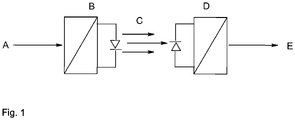
- FIG. 1 a general example for an optical data communication system is shown.
- Fig. 1 a general example for an optical data communication system is shown.
- Fig. 1 a general example for an optical data communication system is shown.
- transmitters useful in an optical data communication system especially optical wireless communication (OWC) system, according to the present invention are known to a person skilled in the art. See for example “ Principles of LED light communications", S. Dimitrov, H. Haas, Cambridge University Press 2015, Chapter 2.1 to Chapter 2.4 .
- the transmitter generally comprises a digital signal processor (DSP) with a digital-to-analog converter (DAC), which is employed for the modulation of the digital information bits (input (A)) and their transformation into an analog current signal.
- DSP digital signal processor
- DAC digital-to-analog converter
- the current drives an optical emitter, i.e. a light source (L).
- L optical emitter
- the light source (L) is usually either one or more light-emitting diodes (LED) or one or more laser diodes (LD), preferably one or more LEDs.
- the light source (L) preferably generates light of a single wavelength. However, it is also possible to employ a light source (L) generating white light. Suitable LEDs and LDs for generating light of a single wavelength or white light are known by a person skilled in the art.
- the transmitter (T) preferably comprises a modulator (M), preferably being adapted to modulate the first electromagnetic radiation emitted by the radiation source (L1) depending on data to be transmitted.
- M modulator
- the modulator (M) is coupled to the input (A).
- the input (A) transfers the data to be transmitted to the modulator (M) that converts such data into a modulation signal.
- a blue LED forming the radiation source (L1) emits blue light as first electromagnetic radiation that is modulated in accordance with the data to be transmitted.
- Such modulated blue light may converted by a frequency converter (L2) into modulated white light that forms a modulated second electromagnetic radiation.
- the second electromagnetic radiation is modulated in correspondence to the modulation of the first electromagnetic radiation, i.e. the modulation used for data transmission is maintained by the frequency converter (L2).
- Optical carrier modulation and demodulation are usually achieved through intensity modulation for example with direct detection (IM/DD).
- the desired waveform is modulated onto the instantaneous power of the optical carrier, and the detector generates a current proportional to the received instantaneous power; that is, only the intensity of the optical wave is detected, and there is no frequency or phase information (as for example mentioned in H. Elgala et al., Indoor optical wireless communication: Potential and state-of-the-art, TOPICS IN OPTICAL COMMUNICATIONS, Article in IEEE Communications Magazine October 2011 ).
- Suitable modulation technics are for example also described in H. Elgala et al., Indoor optical wireless communication: Potential and state-of-the-art, TOPICS IN OPTICAL COMMUNICATIONS, Article in IEEE Communications Magazine October 2011 : High average power efficiency can be achieved by employing single-carrier (SC) pulsed modulation techniques in which the time-dependent characteristics of the optical pulse is used to convey information.
- SC single-carrier
- OOK on-off keying
- PPM pulse-position modulation
- OOK is one of the oldest formats and is the simplest in terms of hardware implementation and integration. It also exhibits a good compromise between complexity and performance.
- PPM pulse-position modulation
- the occupied slot position denotes the bit combination conveyed by the symbol.
- PPM expands the signal bandwidth compared to OOK, but pro-vides higher power efficiency. Besides, the use of PPM imposes more system complexity than OOK since both slot- and symbol-level synchronizations, critical to system performance, are required at the receiver.
- Multiple-Subcarrier Modulation MSM techniques for OW (optical wireless) links are also generally suitable.
- OFDM is a practical realization of multiple-subcarrier modulation (MSM). OFDM is a parallel data transmission scheme in which high data rates can be achieved by transmitting orthogonal subcarriers.
- OFDM systems do not require complex channel equalizers, the time-varying channel can easily be estimated using frequency-domain channel estimation, and adaptive modulation can be applied based on the uplink/downlink (UL/DL) requested data rates and quality of service (QoS). Also, the possibility to combine OFDM with any multiple access scheme makes it an excellent preference for indoor OW applications.
- UL/DL uplink/downlink
- QoS quality of service
- the first electromagnetic radiation is modulated. Such modulation may be implemented by control of the radiation source. According to another embodiment, the first electromagnetic radiation may also be modulated after this radiation has been emitted by the radiation source.
- Input (A) and output (E) are usually information to be transferred, in the form of electrical digital or analog signals.
- the information to be transferred is in form of digital information bits.
- the optical path (C) may in general be any optical path suitable for optical communication known by a person skilled in the art.
- the optical path (C) is the free space, i.e. an optical wireless channel.
- the optical path is in an indoor and/or in an outdoor environment.
- the optical path is in an indoor environment.
- Outdoor optical wireless communications can be divided into ultra long-range free space links, medium-/long range links and short-range links.
- the ultra long-range free space links are for example used for networking a constellation of satellites.
- the medium-/long range links are for example used for inter-building networks or mobile backhaul.
- the short-range links are used for example car-to-car communications.
- Indoor optical wireless communication can be divided into short-range links and ultra-short range links.
- Short range links are for example optical WLAN, in-flight communications, car-to-infrastructure communications, indoor positioning and wireless automation.
- Indoor optical wireless communication is applied for example in homes, offices and warehouses ranging from TV control to IrDA (Infrared Data Association) ports on portable electronic devices such as mobile phones, digital cameras, personal digital assistants and laptops.
- Ultra short range links are for example inter-chip interconnections and in-body networks.
- the optical path is the free space in an indoor environment.
- the optical data communication system according to the present invention may further comprise an optical system in order to further shape the modulated electromagnetic radiation emitted by the transmitter (T).
- an optical amplifier lens, a collimator, and/or a diffusor can be employed to concentrate or broaden the modulated electromagnetic radiation.
- N,N'-bis(2,6-diisopropylphenyl)-1,6,7,12-tetraphenoxyperylene-3,4:9,10-tetracarboximide Dye 1 can be purchased from, e.g. from BASF SE.
- Dye 2 can be purchased, e.g. from BASF SE.
- Dye 3 can be purchased, e.g. from BASF SE
- Dye 4 can be purchased, e.g. from BASF SE.
- Dye 5 can be prepared in analogy to the methods described in EP 3072887 .
- Dye 7 can be purchased, e.g. from BASF SE.
- Dye 8 can be prepared as described in WO 2014/131628 .
- Dye 9 can be prepared as described in example 10 of WO 2012/168395 .
- Dye 10 can be prepared as described in example 3 of WO 2015/169935 .
- Dye 12 can be prepared as described in example 3 of WO 2015/019270 .
- Dye 13 can be prepared as described in example 1 of WO 2016/151068 .
- NMP N-methyl-2-pyrrolidone
- Dye 15 can be prepared as described in example 1 of WO 2017/121833 A1 .
- Dye 16 can be prepared in analogy to the compounds described in WO 2014/131628 .
- Dye 17 can be prepared as described in example 6 of WO 2016/151068 .
- Dye 18 can be prepared as described in example 5 of WO 2016/151068 .
- a mixture of 250 mL of quinoline, 8.8 g (0.032 mol) of 4-bromo-1,8-naphthalic anhydride, 11.0 g (0.032 mol; 90% purity) of the mixture from 19.3, 6.0 g (0.032 mol) of zinc acetate was heated at 130°C for 2 hours under nitrogen. After cooling to room temperature, 200 mL of methanol were added. The mixture was stirred over night followed by filtration. The residue was washed with methanol and water. 11.45 g (65%) of a yellow precipitate were obtained.
- a mixture of 11.0 g (0.02 mol) of the mixture of compounds from 19.4, 2.68 g (0.02 mol) of phenylboronic acid, 5.52 g (0.04 mol) of potassium carbonate, 30 mL of water, 250 mL of toluene and 0.23 g (0.0002 mol) of tetrakistriphenylphosphinepalladium was heated at 90°C for 2 hours. After cooling to room temperature, the residue was filtered off, washed with methanol and water and dried in vacuum to give 10.5 (95%) of a yellow-black residue.
- Dye 20 can be prepared as described in WO 2014/131628 .
- Dye 21 can be prepared in analogy to the methods described in WO 2012/168395 .
- Dye 22 can be prepared as described in WO 2012/168395 .
- Dye 23 can be prepared as described in European patent application 17151931.7
- Dye 24 can be prepared as described in example 2 of WO 2007/006717 .
- Dye 25 can be prepared as described in Chem. Eur. J. 1997, 3, S. 219-225 .
- Dye 26 can be prepared as described in EP17208597.9 .
- Dye 27 can be prepared as described in EP18179281.3 .
- the organic fluorescent colorants (dyes) synthesized according to the examples were used to produce wavelength shifting materials. For this purpose, they were incorporated as described hereinafter into a matrix composed of a polymer.
- the polymer used was PMMA (Plexiglas ® 6N from Evonik), polystyrene (PS168 N from BASF) and PC (Macrolon ® 2808 from Bayer).
- Fluorescence quantum yields (QY) of the analysis samples were measured with the C9920-02 quantum yield measuring system (from Hamamatsu). This was done by illuminating each of the samples with light of 445 to 455 nm in an integrating sphere (Ulbricht sphere). By comparison with the reference measurement in the Ulbricht sphere without sample, the unabsorbed fraction of the excitation light and the fluorescent light emitted by the sample are determined by means of a CCD spectrometer. Integration of the intensities of the spectrum of the unabsorbed excitation light and of that of the emitted fluorescent light gives the degree of absorption and fluorescence intensity, respectively and thus the fluorescence quantum yield of each sample can be calculated.
- the excited-state lifetime ( ⁇ v ) of the prepared thin films is measured by exciting the thin films with a pulsed diode laser with an excitation wavelength of 450 nm (Picoquant) operated at 10 kHz (85 ⁇ W, 105 ⁇ W/cm 2 ) and detecting the emission with time correlated single photon counting (TCSPC). This wavelength was chosen in order to be close to the lighting application, where a blue LED with 450 nm emission maximum is used. A mono-exponential fit to the decay curve was used to determine the excited-state lifetime ( ⁇ v ).
- Example 24 and 25 are illuminated with white light at 100 mW/cm 2 as their absorption at 450 nm is negligible.
- T80 in days is the time that the product of fluorescence and absorption decreases to 80% of its initial value.
- concentration of the dyes is chosen in a way so that they absorb about 50% of incoming blue light.
Landscapes
- Chemical & Material Sciences (AREA)
- Engineering & Computer Science (AREA)
- Organic Chemistry (AREA)
- Materials Engineering (AREA)
- Computer Networks & Wireless Communication (AREA)
- Electromagnetism (AREA)
- Physics & Mathematics (AREA)
- Signal Processing (AREA)
- Health & Medical Sciences (AREA)
- Chemical Kinetics & Catalysis (AREA)
- Medicinal Chemistry (AREA)
- Polymers & Plastics (AREA)
- Plural Heterocyclic Compounds (AREA)
- Optical Filters (AREA)
- Optical Communication System (AREA)
Applications Claiming Priority (2)
| Application Number | Priority Date | Filing Date | Title |
|---|---|---|---|
| EP18193781 | 2018-09-11 | ||
| PCT/EP2019/073944 WO2020053124A1 (en) | 2018-09-11 | 2019-09-09 | Receiver comprising a luminescent collector for optical data communication |
Publications (2)
| Publication Number | Publication Date |
|---|---|
| EP3850056A1 EP3850056A1 (en) | 2021-07-21 |
| EP3850056B1 true EP3850056B1 (en) | 2022-11-09 |
Family
ID=63557341
Family Applications (1)
| Application Number | Title | Priority Date | Filing Date |
|---|---|---|---|
| EP19765250.6A Active EP3850056B1 (en) | 2018-09-11 | 2019-09-09 | Receiver comprising a luminescent collector for optical data communication |
Country Status (7)
| Country | Link |
|---|---|
| US (1) | US12018192B2 (https=) |
| EP (1) | EP3850056B1 (https=) |
| JP (1) | JP7466545B2 (https=) |
| KR (1) | KR102929257B1 (https=) |
| CN (1) | CN112739794B (https=) |
| TW (1) | TWI822854B (https=) |
| WO (1) | WO2020053124A1 (https=) |
Families Citing this family (6)
| Publication number | Priority date | Publication date | Assignee | Title |
|---|---|---|---|---|
| KR20230147595A (ko) * | 2021-02-22 | 2023-10-23 | 닛토덴코 가부시키가이샤 | 보론 함유 환상 발광성 화합물 및 이것을 포함하는색변환 필름 |
| TWI888699B (zh) * | 2021-02-22 | 2025-07-01 | 日商日東電工股份有限公司 | 含硼環狀發光化合物和含有該含硼環狀發光化合物的色轉換膜 |
| KR20240065040A (ko) * | 2021-09-27 | 2024-05-14 | 닛토덴코 가부시키가이샤 | 보론 함유 환상 발광 화합물 및 이를 함유하는 색 변환 필름 |
| US12537605B2 (en) | 2021-12-29 | 2026-01-27 | Samsung Electronics Co., Ltd. | Apparatus and method for optical communication using organic photoelectric conversion device |
| KR20240145973A (ko) * | 2022-02-18 | 2024-10-07 | 닛토덴코 가부시키가이샤 | 붕소 함유 환상 발광 화합물 및 이를 함유하는 색변환 필름 |
| WO2023158976A1 (en) * | 2022-02-18 | 2023-08-24 | Nitto Denko Corporation | Boron-containing cyclic emissive compounds and color conversion film containing the same |
Family Cites Families (49)
| Publication number | Priority date | Publication date | Assignee | Title |
|---|---|---|---|---|
| GB621971A (en) | 1946-11-12 | 1949-04-25 | James Gordon Napier Drewitt | Improvements in polymers |
| DE1569735A1 (de) | 1965-07-30 | 1970-05-14 | Hoechst Ag | Verfahren zur Herstellung von Farbstoffen |
| US4845223A (en) | 1985-12-19 | 1989-07-04 | Basf Aktiengesellschaft | Fluorescent aryloxy-substituted perylene-3,4,9,10-tetracarboxylic acid diimides |
| DE3933903A1 (de) | 1989-10-11 | 1991-04-18 | Basf Ag | Fluoreszenzpigmente |
| GB9314604D0 (en) | 1993-07-14 | 1993-08-25 | Dow Deutschland Inc | Light diffuser composition |
| US6472050B1 (en) * | 1999-12-30 | 2002-10-29 | Avery Dennison Corporation | Light stable fluorescent vinyl suitable for use as a highway retroreflective roll-up sign |
| DE10243906A1 (de) | 2002-09-20 | 2004-04-01 | Basf Ag | 9-Cyanosubstituierte Perylen-3,4-dicarbonsäuremonoimide |
| US20070010833A1 (en) * | 2005-07-07 | 2007-01-11 | Don Tanaka | Method for interconnecting hollow bodies |
| DE102005032583A1 (de) | 2005-07-11 | 2007-01-25 | Basf Ag | Substituierte Rylenderivate |
| US7926730B2 (en) * | 2005-11-30 | 2011-04-19 | Pitney Bowes Inc. | Combined multi-spectral document markings |
| EP2565176B1 (en) * | 2006-05-08 | 2015-08-19 | Virent, Inc. | Methods for generating polyols |
| US20090078312A1 (en) | 2007-09-18 | 2009-03-26 | Basf Se | Verfahren zur herstellung von mit rylentetracarbonsaeurediimiden beschichteten substraten |
| JP5551688B2 (ja) | 2008-06-11 | 2014-07-16 | コーニンクレッカ フィリップス エヌ ヴェ | 照明システムに関する光学受信器 |
| NL2002382C2 (en) * | 2008-12-30 | 2010-07-01 | Furanix Technologies Bv | A process for preparing a polymer having a 2,5-furandicarboxylate moiety within the polymer backbone and such (co)polymers. |
| WO2010132740A2 (en) | 2009-05-14 | 2010-11-18 | Archer Daniels Midland Company | Oxidation of furfural compounds |
| US8519167B2 (en) | 2009-10-07 | 2013-08-27 | Furanix Technologies B.V. | Method for the preparation of 2,5-furandicarboxylic acid and esters thereof |
| JP5866290B2 (ja) | 2009-10-07 | 2016-02-17 | フラニックス テクノロジーズ ベスローテン フェンノートシャップ | 2,5−フランジカルボン酸を調製する方法及び2,5−フランジカルボン酸のジアルキルエステルを調製する方法 |
| GB2476300B (en) * | 2009-12-18 | 2012-11-07 | Eastman Kodak Co | Luminescent solar concentrator |
| RU2013154471A (ru) | 2011-05-10 | 2015-06-20 | Басф Се | Новые преобразователи цвета |
| US8942562B2 (en) * | 2011-05-31 | 2015-01-27 | A Optix Technologies, Inc. | Integrated commercial communications network using radio frequency and free space optical data communication |
| US9406848B2 (en) | 2011-06-10 | 2016-08-02 | Basf Se | Color converter |
| EP2771382B1 (en) * | 2011-10-24 | 2018-01-03 | Synvina C.V. | A process for preparing a polymer product having a 2,5-furandicarboxylate moiety within the polymer backbone to be used in bottle, film or fibre applications |
| GB2506383A (en) | 2012-09-27 | 2014-04-02 | Isis Innovation | Apparatus and method for data communication that uses optical concentration devices |
| CN105189695B (zh) | 2013-02-11 | 2018-03-13 | 飞利浦照明控股有限公司 | 苯氧基取代的二萘嵌苯‑3,4,9,10‑四羧酸二酰亚胺有机红光发射体、及使用其的发光器件 |
| JP2014160894A (ja) | 2013-02-19 | 2014-09-04 | Konica Minolta Inc | 光波長多重通信用波長監視装置および光波長多重通信装置 |
| EP2961813B1 (en) | 2013-03-01 | 2018-07-18 | Philips Lighting Holding B.V. | New class of green/yellow emitting phosphors based on benzoxanthene derivatives for led lighting |
| RU2670218C2 (ru) | 2013-08-05 | 2018-10-19 | Басф Се | Цианированные нафталинбензимидазольные соединения |
| CN105722945B (zh) | 2013-11-01 | 2018-12-21 | 飞利浦照明控股有限公司 | 用于led发光的基于苯并咪唑氧杂蒽异喹啉酮衍生物的新型发绿色/黄色光的磷光体 |
| GB201401584D0 (en) * | 2014-01-29 | 2014-03-19 | Bg Res Ltd | Intelligent detection of biological entities |
| WO2015137804A1 (en) | 2014-03-11 | 2015-09-17 | Furanix Technologies B.V. | Method for preparing a polyester under specific esterification conditions |
| US9919999B2 (en) | 2014-05-09 | 2018-03-20 | Basf Se | Cyanated perylene compounds |
| JP6396581B2 (ja) | 2014-08-21 | 2018-09-26 | フィリップス ライティング ホールディング ビー ヴィ | 共鳴エネルギ移動を示す高効率の分子 |
| KR101640511B1 (ko) * | 2014-12-30 | 2016-07-18 | 국민대학교 산학협력단 | 가시광 통신을 위한 송신 장치 및 수신 장치, 가시광 통신 시스템 |
| WO2016121733A1 (ja) | 2015-01-28 | 2016-08-04 | 大日本印刷株式会社 | 太陽電池モジュール |
| US11905363B2 (en) * | 2015-02-13 | 2024-02-20 | The Coca-Cola Company | Barrier enhanced pet multilayer container |
| EP3072887B1 (en) | 2015-03-26 | 2017-10-18 | Basf Se | N,n'-bis(2,6-diisopropylphenyl)-1,7-di(2,6-diphenylphenoxy)perylene-3,4;9,10-tetracarboximide, n,n'-bis(2,6-diisopropylphenyl)-1,6-di(2,6-diphenylphenoxy)perylene-3,4;9,10-tetracarboximide and the use thereof |
| WO2016151068A1 (en) | 2015-03-26 | 2016-09-29 | Basf Se | Cyanated benzoxanthene and benzothioxanthene compounds |
| EP3101087B1 (en) | 2015-06-03 | 2018-01-17 | Basf Se | Multiple chromophores with a perylenediimide skeleton |
| US9544054B1 (en) | 2015-08-10 | 2017-01-10 | Facebook, Inc. | Multidirectional communication system |
| WO2017089553A1 (en) * | 2015-11-25 | 2017-06-01 | Trinamix Gmbh | Detector for optically detecting at least one object |
| KR20180086198A (ko) | 2015-11-25 | 2018-07-30 | 트리나미엑스 게엠베하 | 적어도 하나의 물체를 광학적으로 검출하기 위한 검출기 |
| JP7458147B2 (ja) * | 2016-01-13 | 2024-03-29 | ストラ エンソ オーユーイー | 2,5-フランジカルボン酸ならびにその中間体および誘導体の製造方法 |
| WO2017121833A1 (en) | 2016-01-14 | 2017-07-20 | Basf Se | Perylene bisimides with rigid 2,2'-biphenoxy bridges |
| US9749044B1 (en) | 2016-04-05 | 2017-08-29 | Facebook, Inc. | Luminescent detector for free-space optical communication |
| TWI776840B (zh) | 2017-01-18 | 2022-09-11 | 德商巴地斯顏料化工廠 | 基於氰基芳基取代之伸萘甲醯基苯并咪唑化合物之螢光顏料 |
| US20190039299A1 (en) * | 2017-02-27 | 2019-02-07 | Voxel8, Inc. | 3d printing devices including mixing nozzles |
| US10932515B2 (en) * | 2017-02-27 | 2021-03-02 | Voxel8, Inc. | 3D printed articles of footwear with sensors and methods of forming the same |
| US20190023838A1 (en) * | 2017-07-20 | 2019-01-24 | Eastman Chemical Company | Production of polyethylene furanoate in a retrofitted pet plant |
| US11303355B2 (en) * | 2018-05-30 | 2022-04-12 | Apple Inc. | Optical structures in directional free-space optical communication systems for portable electronic devices |
-
2019
- 2019-09-09 CN CN201980059210.9A patent/CN112739794B/zh active Active
- 2019-09-09 US US17/275,532 patent/US12018192B2/en active Active
- 2019-09-09 TW TW108132361A patent/TWI822854B/zh active
- 2019-09-09 EP EP19765250.6A patent/EP3850056B1/en active Active
- 2019-09-09 KR KR1020217006926A patent/KR102929257B1/ko active Active
- 2019-09-09 WO PCT/EP2019/073944 patent/WO2020053124A1/en not_active Ceased
- 2019-09-09 JP JP2021537497A patent/JP7466545B2/ja active Active
Also Published As
| Publication number | Publication date |
|---|---|
| KR20210057037A (ko) | 2021-05-20 |
| JP2022500707A (ja) | 2022-01-04 |
| CN112739794B (zh) | 2024-08-13 |
| WO2020053124A1 (en) | 2020-03-19 |
| EP3850056A1 (en) | 2021-07-21 |
| TW202020057A (zh) | 2020-06-01 |
| KR102929257B1 (ko) | 2026-02-24 |
| CN112739794A (zh) | 2021-04-30 |
| TWI822854B (zh) | 2023-11-21 |
| US20220049158A1 (en) | 2022-02-17 |
| JP7466545B2 (ja) | 2024-04-12 |
| US12018192B2 (en) | 2024-06-25 |
Similar Documents
| Publication | Publication Date | Title |
|---|---|---|
| EP3850056B1 (en) | Receiver comprising a luminescent collector for optical data communication | |
| US11496223B2 (en) | Transmitter for transmitting data and for emitting electromagnetic radiation in the visible spectral range and data transmission system | |
| TWI776839B (zh) | 經1,6,7,12-四-(2-異丙基苯氧基)取代之苝四羧酸二醯亞胺 | |
| EP3601478B1 (en) | Poly(ethylene furan-2,5-dicarboxylate) as matrix material for color converters | |
| EP3802490B1 (en) | Optical data communication system comprising para-phenylenevinylenes and specific para-phenylenevinylenes |
Legal Events
| Date | Code | Title | Description |
|---|---|---|---|
| STAA | Information on the status of an ep patent application or granted ep patent |
Free format text: STATUS: UNKNOWN |
|
| STAA | Information on the status of an ep patent application or granted ep patent |
Free format text: STATUS: THE INTERNATIONAL PUBLICATION HAS BEEN MADE |
|
| PUAI | Public reference made under article 153(3) epc to a published international application that has entered the european phase |
Free format text: ORIGINAL CODE: 0009012 |
|
| STAA | Information on the status of an ep patent application or granted ep patent |
Free format text: STATUS: REQUEST FOR EXAMINATION WAS MADE |
|
| 17P | Request for examination filed |
Effective date: 20210412 |
|
| AK | Designated contracting states |
Kind code of ref document: A1 Designated state(s): AL AT BE BG CH CY CZ DE DK EE ES FI FR GB GR HR HU IE IS IT LI LT LU LV MC MK MT NL NO PL PT RO RS SE SI SK SM TR |
|
| DAV | Request for validation of the european patent (deleted) | ||
| DAX | Request for extension of the european patent (deleted) | ||
| GRAP | Despatch of communication of intention to grant a patent |
Free format text: ORIGINAL CODE: EPIDOSNIGR1 |
|
| STAA | Information on the status of an ep patent application or granted ep patent |
Free format text: STATUS: GRANT OF PATENT IS INTENDED |
|
| INTG | Intention to grant announced |
Effective date: 20220425 |
|
| GRAS | Grant fee paid |
Free format text: ORIGINAL CODE: EPIDOSNIGR3 |
|
| GRAA | (expected) grant |
Free format text: ORIGINAL CODE: 0009210 |
|
| STAA | Information on the status of an ep patent application or granted ep patent |
Free format text: STATUS: THE PATENT HAS BEEN GRANTED |
|
| AK | Designated contracting states |
Kind code of ref document: B1 Designated state(s): AL AT BE BG CH CY CZ DE DK EE ES FI FR GB GR HR HU IE IS IT LI LT LU LV MC MK MT NL NO PL PT RO RS SE SI SK SM TR |
|
| REG | Reference to a national code |
Ref country code: GB Ref legal event code: FG4D |
|
| REG | Reference to a national code |
Ref country code: CH Ref legal event code: EP Ref country code: AT Ref legal event code: REF Ref document number: 1530372 Country of ref document: AT Kind code of ref document: T Effective date: 20221115 |
|
| REG | Reference to a national code |
Ref country code: DE Ref legal event code: R096 Ref document number: 602019021760 Country of ref document: DE |
|
| REG | Reference to a national code |
Ref country code: IE Ref legal event code: FG4D |
|
| REG | Reference to a national code |
Ref country code: LT Ref legal event code: MG9D |
|
| REG | Reference to a national code |
Ref country code: NL Ref legal event code: MP Effective date: 20221109 |
|
| REG | Reference to a national code |
Ref country code: AT Ref legal event code: MK05 Ref document number: 1530372 Country of ref document: AT Kind code of ref document: T Effective date: 20221109 |
|
| PG25 | Lapsed in a contracting state [announced via postgrant information from national office to epo] |
Ref country code: SE Free format text: LAPSE BECAUSE OF FAILURE TO SUBMIT A TRANSLATION OF THE DESCRIPTION OR TO PAY THE FEE WITHIN THE PRESCRIBED TIME-LIMIT Effective date: 20221109 Ref country code: PT Free format text: LAPSE BECAUSE OF FAILURE TO SUBMIT A TRANSLATION OF THE DESCRIPTION OR TO PAY THE FEE WITHIN THE PRESCRIBED TIME-LIMIT Effective date: 20230309 Ref country code: NO Free format text: LAPSE BECAUSE OF FAILURE TO SUBMIT A TRANSLATION OF THE DESCRIPTION OR TO PAY THE FEE WITHIN THE PRESCRIBED TIME-LIMIT Effective date: 20230209 Ref country code: LT Free format text: LAPSE BECAUSE OF FAILURE TO SUBMIT A TRANSLATION OF THE DESCRIPTION OR TO PAY THE FEE WITHIN THE PRESCRIBED TIME-LIMIT Effective date: 20221109 Ref country code: FI Free format text: LAPSE BECAUSE OF FAILURE TO SUBMIT A TRANSLATION OF THE DESCRIPTION OR TO PAY THE FEE WITHIN THE PRESCRIBED TIME-LIMIT Effective date: 20221109 Ref country code: ES Free format text: LAPSE BECAUSE OF FAILURE TO SUBMIT A TRANSLATION OF THE DESCRIPTION OR TO PAY THE FEE WITHIN THE PRESCRIBED TIME-LIMIT Effective date: 20221109 Ref country code: AT Free format text: LAPSE BECAUSE OF FAILURE TO SUBMIT A TRANSLATION OF THE DESCRIPTION OR TO PAY THE FEE WITHIN THE PRESCRIBED TIME-LIMIT Effective date: 20221109 |
|
| PG25 | Lapsed in a contracting state [announced via postgrant information from national office to epo] |
Ref country code: RS Free format text: LAPSE BECAUSE OF FAILURE TO SUBMIT A TRANSLATION OF THE DESCRIPTION OR TO PAY THE FEE WITHIN THE PRESCRIBED TIME-LIMIT Effective date: 20221109 Ref country code: PL Free format text: LAPSE BECAUSE OF FAILURE TO SUBMIT A TRANSLATION OF THE DESCRIPTION OR TO PAY THE FEE WITHIN THE PRESCRIBED TIME-LIMIT Effective date: 20221109 Ref country code: LV Free format text: LAPSE BECAUSE OF FAILURE TO SUBMIT A TRANSLATION OF THE DESCRIPTION OR TO PAY THE FEE WITHIN THE PRESCRIBED TIME-LIMIT Effective date: 20221109 Ref country code: IS Free format text: LAPSE BECAUSE OF FAILURE TO SUBMIT A TRANSLATION OF THE DESCRIPTION OR TO PAY THE FEE WITHIN THE PRESCRIBED TIME-LIMIT Effective date: 20230309 Ref country code: HR Free format text: LAPSE BECAUSE OF FAILURE TO SUBMIT A TRANSLATION OF THE DESCRIPTION OR TO PAY THE FEE WITHIN THE PRESCRIBED TIME-LIMIT Effective date: 20221109 Ref country code: GR Free format text: LAPSE BECAUSE OF FAILURE TO SUBMIT A TRANSLATION OF THE DESCRIPTION OR TO PAY THE FEE WITHIN THE PRESCRIBED TIME-LIMIT Effective date: 20230210 |
|
| PG25 | Lapsed in a contracting state [announced via postgrant information from national office to epo] |
Ref country code: NL Free format text: LAPSE BECAUSE OF FAILURE TO SUBMIT A TRANSLATION OF THE DESCRIPTION OR TO PAY THE FEE WITHIN THE PRESCRIBED TIME-LIMIT Effective date: 20221109 |
|
| PG25 | Lapsed in a contracting state [announced via postgrant information from national office to epo] |
Ref country code: SM Free format text: LAPSE BECAUSE OF FAILURE TO SUBMIT A TRANSLATION OF THE DESCRIPTION OR TO PAY THE FEE WITHIN THE PRESCRIBED TIME-LIMIT Effective date: 20221109 Ref country code: RO Free format text: LAPSE BECAUSE OF FAILURE TO SUBMIT A TRANSLATION OF THE DESCRIPTION OR TO PAY THE FEE WITHIN THE PRESCRIBED TIME-LIMIT Effective date: 20221109 Ref country code: EE Free format text: LAPSE BECAUSE OF FAILURE TO SUBMIT A TRANSLATION OF THE DESCRIPTION OR TO PAY THE FEE WITHIN THE PRESCRIBED TIME-LIMIT Effective date: 20221109 Ref country code: DK Free format text: LAPSE BECAUSE OF FAILURE TO SUBMIT A TRANSLATION OF THE DESCRIPTION OR TO PAY THE FEE WITHIN THE PRESCRIBED TIME-LIMIT Effective date: 20221109 Ref country code: CZ Free format text: LAPSE BECAUSE OF FAILURE TO SUBMIT A TRANSLATION OF THE DESCRIPTION OR TO PAY THE FEE WITHIN THE PRESCRIBED TIME-LIMIT Effective date: 20221109 |
|
| REG | Reference to a national code |
Ref country code: DE Ref legal event code: R097 Ref document number: 602019021760 Country of ref document: DE |
|
| PG25 | Lapsed in a contracting state [announced via postgrant information from national office to epo] |
Ref country code: SK Free format text: LAPSE BECAUSE OF FAILURE TO SUBMIT A TRANSLATION OF THE DESCRIPTION OR TO PAY THE FEE WITHIN THE PRESCRIBED TIME-LIMIT Effective date: 20221109 Ref country code: AL Free format text: LAPSE BECAUSE OF FAILURE TO SUBMIT A TRANSLATION OF THE DESCRIPTION OR TO PAY THE FEE WITHIN THE PRESCRIBED TIME-LIMIT Effective date: 20221109 |
|
| PLBE | No opposition filed within time limit |
Free format text: ORIGINAL CODE: 0009261 |
|
| STAA | Information on the status of an ep patent application or granted ep patent |
Free format text: STATUS: NO OPPOSITION FILED WITHIN TIME LIMIT |
|
| 26N | No opposition filed |
Effective date: 20230810 |
|
| PG25 | Lapsed in a contracting state [announced via postgrant information from national office to epo] |
Ref country code: SI Free format text: LAPSE BECAUSE OF FAILURE TO SUBMIT A TRANSLATION OF THE DESCRIPTION OR TO PAY THE FEE WITHIN THE PRESCRIBED TIME-LIMIT Effective date: 20221109 |
|
| REG | Reference to a national code |
Ref country code: CH Ref legal event code: PL |
|
| PG25 | Lapsed in a contracting state [announced via postgrant information from national office to epo] |
Ref country code: LU Free format text: LAPSE BECAUSE OF NON-PAYMENT OF DUE FEES Effective date: 20230909 |
|
| REG | Reference to a national code |
Ref country code: BE Ref legal event code: MM Effective date: 20230930 |
|
| PG25 | Lapsed in a contracting state [announced via postgrant information from national office to epo] |
Ref country code: LU Free format text: LAPSE BECAUSE OF NON-PAYMENT OF DUE FEES Effective date: 20230909 Ref country code: IT Free format text: LAPSE BECAUSE OF FAILURE TO SUBMIT A TRANSLATION OF THE DESCRIPTION OR TO PAY THE FEE WITHIN THE PRESCRIBED TIME-LIMIT Effective date: 20221109 Ref country code: MC Free format text: LAPSE BECAUSE OF FAILURE TO SUBMIT A TRANSLATION OF THE DESCRIPTION OR TO PAY THE FEE WITHIN THE PRESCRIBED TIME-LIMIT Effective date: 20221109 |
|
| REG | Reference to a national code |
Ref country code: IE Ref legal event code: MM4A |
|
| PG25 | Lapsed in a contracting state [announced via postgrant information from national office to epo] |
Ref country code: IE Free format text: LAPSE BECAUSE OF NON-PAYMENT OF DUE FEES Effective date: 20230909 |
|
| PG25 | Lapsed in a contracting state [announced via postgrant information from national office to epo] |
Ref country code: CH Free format text: LAPSE BECAUSE OF NON-PAYMENT OF DUE FEES Effective date: 20230930 |
|
| PG25 | Lapsed in a contracting state [announced via postgrant information from national office to epo] |
Ref country code: IE Free format text: LAPSE BECAUSE OF NON-PAYMENT OF DUE FEES Effective date: 20230909 Ref country code: CH Free format text: LAPSE BECAUSE OF NON-PAYMENT OF DUE FEES Effective date: 20230930 |
|
| PG25 | Lapsed in a contracting state [announced via postgrant information from national office to epo] |
Ref country code: BE Free format text: LAPSE BECAUSE OF NON-PAYMENT OF DUE FEES Effective date: 20230930 |
|
| PG25 | Lapsed in a contracting state [announced via postgrant information from national office to epo] |
Ref country code: BG Free format text: LAPSE BECAUSE OF FAILURE TO SUBMIT A TRANSLATION OF THE DESCRIPTION OR TO PAY THE FEE WITHIN THE PRESCRIBED TIME-LIMIT Effective date: 20221109 |
|
| PG25 | Lapsed in a contracting state [announced via postgrant information from national office to epo] |
Ref country code: BG Free format text: LAPSE BECAUSE OF FAILURE TO SUBMIT A TRANSLATION OF THE DESCRIPTION OR TO PAY THE FEE WITHIN THE PRESCRIBED TIME-LIMIT Effective date: 20221109 |
|
| PG25 | Lapsed in a contracting state [announced via postgrant information from national office to epo] |
Ref country code: CY Free format text: LAPSE BECAUSE OF FAILURE TO SUBMIT A TRANSLATION OF THE DESCRIPTION OR TO PAY THE FEE WITHIN THE PRESCRIBED TIME-LIMIT; INVALID AB INITIO Effective date: 20190909 |
|
| PG25 | Lapsed in a contracting state [announced via postgrant information from national office to epo] |
Ref country code: HU Free format text: LAPSE BECAUSE OF FAILURE TO SUBMIT A TRANSLATION OF THE DESCRIPTION OR TO PAY THE FEE WITHIN THE PRESCRIBED TIME-LIMIT; INVALID AB INITIO Effective date: 20190909 |
|
| PGFP | Annual fee paid to national office [announced via postgrant information from national office to epo] |
Ref country code: DE Payment date: 20250926 Year of fee payment: 7 |
|
| PGFP | Annual fee paid to national office [announced via postgrant information from national office to epo] |
Ref country code: GB Payment date: 20250923 Year of fee payment: 7 |
|
| PGFP | Annual fee paid to national office [announced via postgrant information from national office to epo] |
Ref country code: FR Payment date: 20250925 Year of fee payment: 7 |
|
| PG25 | Lapsed in a contracting state [announced via postgrant information from national office to epo] |
Ref country code: TR Free format text: LAPSE BECAUSE OF FAILURE TO SUBMIT A TRANSLATION OF THE DESCRIPTION OR TO PAY THE FEE WITHIN THE PRESCRIBED TIME-LIMIT Effective date: 20221109 |