EP3849966B1 - Flavonverbindungen zur behandlung und prophylaxe von hepatitis-b-virusinfektion - Google Patents
Flavonverbindungen zur behandlung und prophylaxe von hepatitis-b-virusinfektion Download PDFInfo
- Publication number
- EP3849966B1 EP3849966B1 EP19769742.8A EP19769742A EP3849966B1 EP 3849966 B1 EP3849966 B1 EP 3849966B1 EP 19769742 A EP19769742 A EP 19769742A EP 3849966 B1 EP3849966 B1 EP 3849966B1
- Authority
- EP
- European Patent Office
- Prior art keywords
- chloro
- chromen
- oxo
- ethoxy
- phenoxy
- Prior art date
- Legal status (The legal status is an assumption and is not a legal conclusion. Google has not performed a legal analysis and makes no representation as to the accuracy of the status listed.)
- Active
Links
Images
Classifications
-
- C—CHEMISTRY; METALLURGY
- C07—ORGANIC CHEMISTRY
- C07D—HETEROCYCLIC COMPOUNDS
- C07D311/00—Heterocyclic compounds containing six-membered rings having one oxygen atom as the only hetero atom, condensed with other rings
- C07D311/02—Heterocyclic compounds containing six-membered rings having one oxygen atom as the only hetero atom, condensed with other rings ortho- or peri-condensed with carbocyclic rings or ring systems
- C07D311/04—Benzo[b]pyrans, not hydrogenated in the carbocyclic ring
- C07D311/22—Benzo[b]pyrans, not hydrogenated in the carbocyclic ring with oxygen or sulfur atoms directly attached in position 4
- C07D311/26—Benzo[b]pyrans, not hydrogenated in the carbocyclic ring with oxygen or sulfur atoms directly attached in position 4 with aromatic rings attached in position 2 or 3
- C07D311/28—Benzo[b]pyrans, not hydrogenated in the carbocyclic ring with oxygen or sulfur atoms directly attached in position 4 with aromatic rings attached in position 2 or 3 with aromatic rings attached in position 2 only
- C07D311/30—Benzo[b]pyrans, not hydrogenated in the carbocyclic ring with oxygen or sulfur atoms directly attached in position 4 with aromatic rings attached in position 2 or 3 with aromatic rings attached in position 2 only not hydrogenated in the hetero ring, e.g. flavones
-
- A—HUMAN NECESSITIES
- A61—MEDICAL OR VETERINARY SCIENCE; HYGIENE
- A61P—SPECIFIC THERAPEUTIC ACTIVITY OF CHEMICAL COMPOUNDS OR MEDICINAL PREPARATIONS
- A61P31/00—Antiinfectives, i.e. antibiotics, antiseptics, chemotherapeutics
- A61P31/12—Antivirals
- A61P31/20—Antivirals for DNA viruses
-
- C—CHEMISTRY; METALLURGY
- C07—ORGANIC CHEMISTRY
- C07D—HETEROCYCLIC COMPOUNDS
- C07D335/00—Heterocyclic compounds containing six-membered rings having one sulfur atom as the only ring hetero atom
- C07D335/04—Heterocyclic compounds containing six-membered rings having one sulfur atom as the only ring hetero atom condensed with carbocyclic rings or ring systems
- C07D335/06—Benzothiopyrans; Hydrogenated benzothiopyrans
-
- C—CHEMISTRY; METALLURGY
- C07—ORGANIC CHEMISTRY
- C07D—HETEROCYCLIC COMPOUNDS
- C07D405/00—Heterocyclic compounds containing both one or more hetero rings having oxygen atoms as the only ring hetero atoms, and one or more rings having nitrogen as the only ring hetero atom
- C07D405/02—Heterocyclic compounds containing both one or more hetero rings having oxygen atoms as the only ring hetero atoms, and one or more rings having nitrogen as the only ring hetero atom containing two hetero rings
- C07D405/04—Heterocyclic compounds containing both one or more hetero rings having oxygen atoms as the only ring hetero atoms, and one or more rings having nitrogen as the only ring hetero atom containing two hetero rings directly linked by a ring-member-to-ring-member bond
Definitions
- the present invention relates to organic compounds useful for therapy and/or prophylaxis of HBV infection in a mammal, and in particular to cccDNA (covalently closed circular DNA) inhibitors useful for treating HBV infection.
- cccDNA covalently closed circular DNA
- the present invention relates to novel flavone derivatives having pharmaceutical activity, pharmaceutical compositions containing them and their potential use as medicaments.
- the present invention relates to certain specific compounds of formula (I) as defined in the claims. Further disclosed are compounds of formula (I) wherein R 1 to R 3 , Gi, G 2 , A 1 to A 7 and W are as described below, or pharmaceutically acceptable salt, or enantiomer, or diastereomer thereof.
- Hepatitis B virus (HBV) infection is one of the most prevalent viral infections and is a leading cause of chronic hepatitis. It is estimated that worldwide, around 2 billion people have evidence of past or present infection with HBV. Over 250 million individuals are currently chronically infected with HBV and are therefore at high risk to develop liver fibrosis, cirrhosis and hepatocellular carcinoma (HCC). There are data to indicate ⁇ 800,000 deaths per year are directly linked to HBV infection ( Lozano, R. et al., Lancet (2012), 380 (9859), 2095-2128 ; Goldstein, S.T. et al., Int J Epidemiol (2005), 34 (6), 1329-1339 ).
- FDA-approved treatments for chronic hepatitis B include two type 1 interferons (IFN) which are IFNalfa-2b and pegylated IFN alfa-2a and six nucleos(t)ide analogues (NAs) which are lamivudine (3TC), tenofovir disoproxil fumarate (TDF), adefovir (ADV), telbivudine (LdT), entecavir (ETV), and vemlidy (tenofovir alafenamide (TAF)).
- IFN interferons
- TDF tenofovir disoproxil fumarate
- ADV adefovir
- LdT telbivudine
- ETV entecavir
- TAF vemlidy
- IFN treatment is finite, but it is known to have severe side effects, and only a small percentage of patients showed a sustained virological response, measured as loss of hepatitis B surface antigen (HBsAg).
- NAs are inhibitors of the HBV reverse transcriptase, profoundly reduce the viral load in vast majority of treated patients, and lead to improvement of liver function and reduced incidence of liver failure and hepatocellular carcinoma.
- the treatment of NAs is infinite ( Ahmed, M. et al., Drug Discov Today (2015), 20 (5), 548-561 ; Zoulim, F. and Locarnini, S., Gastroenterology (2009), 137 (5), 1593-1608 e1591-1592 ).
- HBV chronic infection is caused by persistence of covalently closed circular (ccc)DNA, which exists as an episomal form in hepatocyte nuclei.
- cccDNA serves as the template for viral RNA transcription and subsequent viral DNA generation. Only a few copies of cccDNA per liver cell can establish or re-initiate viral replication. Therefore, a complete cure of chronic hepatitis B will require elimination of cccDNA or permanently silencing of cccDNA.
- cccDNA is intrinsically very stable and currently available therapeutics could not eliminate cccDNA or permanently silence cccDNA ( Nassal, M., Gut (2015), 64 (12), 1972-1984 ; Gish, R.G.
- TW 201542202 discloses the use of polymethoxylated flavone in the manufacturing of a drug for treating hepatitis B, wherein the polymethodxylated flavone is selected from a group of nobiletin and tangeretin.
- CN 105640933 discloses an invention that belongs to the field of medicine and relates to the application of flavonoids in the preparation of anti-hepatitis B virus drugs.
- Objects of the present invention are specific compounds of formula (I) as defined in the claims, medicaments based on a compound in accordance with the invention as well as the compounds of the invention which act as cccDNA inhibitors for use in the treatment or prophylaxis of HBV infection.
- the compounds of formula (I) show superior anti-HBV activity.
- the compounds of formula (I) also show good PK profiles.
- the present invention relates to specific compounds of formula (I) as defined in the claims.
- C 1-6 alkyl alone or in combination signifies a saturated, linear- or branched chain alkyl group containing 1 to 6, particularly 1 to 4 carbon atoms, for example methyl, ethyl, propyl, isopropyl, 1-butyl, 2-butyl, tert -butyl and the like.
- Particular "C 1-6 alkyl” groups are methyl, ethyl, isopropyl and tert -butyl. More particularly, "C 1-6 alkyl” group is methyl.
- C 3-7 cycloalkyl denotes to a saturated carbon ring containing from 3 to 7 carbon atoms, particularly from 3 to 6 carbon atoms, for example, cyclopropyl, cyclobutyl, cyclopentyl, cyclohexyl, cycloheptyl and the like.
- Particular "C 3-7 cycloalkyl” group is cyclopropyl, cyclobutyl or cyclopentyl.
- C 1-6 alkoxy alone or in combination signifies a group C 1-6 alkyl-O-, wherein the "C 1-6 alkyl” is as defined above; for example methoxy, ethoxy, propoxy, iso -propoxy, n -butoxy, iso -butoxy, 2-butoxy, tert -butoxy, pentoxy, hexyloxy and the like.
- Particular "C 1-6 alkoxy” groups are methoxy, ethoxy and propoxy. More particularly, "C 1-6 alkoxy” group is methoxy or ethoxy.
- halogen means fluorine, chlorine, bromine or iodine.
- carbonyl alone or in combination refers to the group -C(O)-.
- enantiomer denotes two stereoisomers of a compound which are non-superimposable mirror images of one another.
- diastereomer denotes a stereoisomer with two or more centers of chirality and whose molecules are not mirror images of one another. Diastereomers have different physical properties, e.g. melting points, boiling points, spectral properties, and reactivities.
- the compounds according to the present invention may exist in the form of their pharmaceutically acceptable salts.
- pharmaceutically acceptable salt refers to conventional acid-addition salts or base-addition salts that retain the biological effectiveness and properties of the compounds of formula (I) and are formed from suitable non-toxic organic or inorganic acids or organic or inorganic bases.
- Acid-addition salts include for example those derived from inorganic acids such as hydrochloric acid, hydrobromic acid, hydroiodic acid, sulfuric acid, sulfamic acid, phosphoric acid and nitric acid, and those derived from organic acids such as p -toluenesulfonic acid, salicylic acid, methanesulfonic acid, oxalic acid, succinic acid, citric acid, malic acid, lactic acid, fumaric acid, and the like.
- Base-addition salts include those derived from ammonium, potassium, sodium and, quaternary ammonium hydroxides, such as for example, tetramethyl ammonium hydroxide.
- the chemical modification of a pharmaceutical compound into a salt is a technique well known to pharmaceutical chemists in order to obtain improved physical and chemical stability, hygroscopicity, flowability and solubility of compounds. It is for example described in Bastin R.J., et al., Organic Process Research & Development 2000, 4, 427-435 . Particular are the sodium salts of the compounds of formula (I).
- Racemates can be separated according to known methods into the enantiomers.
- diastereomeric salts which can be separated by crystallization are formed from the racemic mixtures by reaction with an optically active acid such as e.g. D- or L-tartaric acid, mandelic acid, malic acid, lactic acid or camphorsulfonic acid.
- the present invention provides (i) specific compounds as defined in the claims.
- (x) a compound of formula (I), or pharmaceutically acceptable salt, or enantiomer, or diastereomer thereof, wherein R 4 is halogen, C 1-6 alkyl or C 1-6 alkoxy.
- the compounds of the present invention are selected from:
- the compounds of the present invention are selected from:
- the compounds of the present invention can be prepared by any conventional means. Suitable processes for synthesizing these compounds as well as their starting materials are provided in the schemes below and in the subsequent examples. All substituents, in particular, R 1 to R 3 , X, Gi, G 2 , A 1 to A 7 are defined as below unless otherwise indicated. Furthermore, and unless explicitly otherwise stated, all reactions, reaction conditions, abbreviations and symbols have the meanings well known to a person of ordinary skill in the art. wherein Q is halogen, OTs, OTf or OMs; W is O or S.
- the final compound of formula I can also be prepared by starting with condensation of substituted ketone IV with substituted aldehyde XIII in the presence of a base, such as KOH, in a suitable solvent, such as ethanol, affords ⁇ , ⁇ -unsaturated carbonyl compound of formula XIV. Cyclization of compound of formula XIV in the presence of a suitable Lewis acid, such I 2 , in a suitable solvent, such as DMSO, affords final compound of formula I. wherein W is O or S.
- the intermediate X can also be prepared according to the Scheme 2.
- Cyclization of intermediate XVII in the presence of a suitable Lewis acid, such as I 2 , in a suitable solvent, such as DMSO affords intermediates X.
- the invention also relates to the specific compounds of formula (I) as defined in the claims for use as therapeutically active substance.
- Another embodiment provides pharmaceutical compositions or medicaments containing the compounds of the invention and a therapeutically inert carrier, diluent or excipient.
- compounds of formula (I) may be formulated by mixing at ambient temperature at the appropriate pH, and at the desired degree of purity, with physiologically acceptable carriers, i.e., carriers that are non-toxic to recipients at the dosages and concentrations employed into a galenical administration form.
- the pH of the formulation depends mainly on the particular use and the concentration of compound, but preferably ranges anywhere from about 3 to about 8.
- a compound of formula (I) is formulated in an acetate buffer, at pH 5.
- the compounds of formula (I) are sterile.
- the compound may be stored, for example, as a solid or amorphous composition, as a lyophilized formulation or as an aqueous solution.
- compositions are formulated, dosed, and administered in a fashion consistent with good medical practice.
- Factors for consideration in this context include the particular disorder being treated, the particular mammal being treated, the clinical condition of the individual patient, the cause of the disorder, the site of delivery of the agent, the method of administration, the scheduling of administration, and other factors known to medical practitioners.
- the "effective amount" of the compound to be administered will be governed by such considerations, and is the minimum amount necessary to inhibit cccDNA in HBV patients, consequently lead to the reduction of HBsAg and HBeAg (HBV e antigen) in serum. For example, such amount may be below the amount that is toxic to normal cells, or the mammal as a whole.
- the pharmaceutically effective amount of the compound of the invention administered parenterally per dose will be in the range of about 0.1 to 100 mg/kg, alternatively about 0.1 to 50 mg/kg of patient body weight per day, with the typical initial range of compound used being 0.3 to 15 mg/kg/day.
- oral unit dosage forms such as tablets and capsules, preferably contain from about 25 to about 1000 mg of the compound of the invention.
- the compounds of the invention may be administered by any suitable means, including oral, topical (including buccal and sublingual), rectal, vaginal, transdermal, parenteral, subcutaneous, intraperitoneal, intrapulmonary, intradermal, intrathecal and epidural and intranasal, and, if desired for local treatment, intralesional administration.
- Parenteral infusions include intramuscular, intravenous, intraarterial, intraperitoneal, or subcutaneous administration.
- the compounds of the present invention may be administered in any convenient administrative form, e.g., tablets, powders, capsules, solutions, dispersions, suspensions, syrups, sprays, suppositories, gels, emulsions, patches, etc.
- Such compositions may contain components conventional in pharmaceutical preparations, e.g., diluents, carriers, pH modifiers, sweeteners, bulking agents, and further active agents.
- a typical formulation is prepared by mixing a compound of the present invention and a carrier or excipient.
- Suitable carriers and excipients are well known to those skilled in the art and are described in detail in, e.g., Ansel, Howard C., et al., Ansel's Pharmaceutical Dosage Forms and Drug Delivery Systems. Philadelphia: Lippincott, Williams & Wilkins, 2004 ; Gennaro, Alfonso R., et al. Remington: The Science and Practice of Pharmacy. Philadelphia: Lippincott, Williams & Wilkins, 2000 ; and Rowe, Raymond C. Handbook of Pharmaceutical Excipients. Chicago, Pharmaceutical Press, 2005 .
- the formulations may also include one or more buffers, stabilizing agents, surfactants, wetting agents, lubricating agents, emulsifiers, suspending agents, preservatives, antioxidants, opaquing agents, glidants, processing aids, colorants, sweeteners, perfuming agents, flavoring agents, diluents and other known additives to provide an elegant presentation of the drug (i.e., a compound of the present invention or pharmaceutical composition thereof) or aid in the manufacturing of the pharmaceutical product (i.e., medicament).
- buffers stabilizing agents, surfactants, wetting agents, lubricating agents, emulsifiers, suspending agents, preservatives, antioxidants, opaquing agents, glidants, processing aids, colorants, sweeteners, perfuming agents, flavoring agents, diluents and other known additives to provide an elegant presentation of the drug (i.e., a compound of the present invention or pharmaceutical composition thereof) or aid in the manufacturing
- An example of a suitable oral dosage form is a tablet containing about 25 to 500 mg of the compound of the invention compounded with about 90 to 30 mg anhydrous lactose, about 5 to 40 mg sodium croscarmellose, about 5 to 30 mg polyvinylpyrrolidone (PVP) K30, and about 1 to 10 mg magnesium stearate.
- the powdered ingredients are first mixed together and then mixed with a solution of the PVP.
- the resulting composition can be dried, granulated, mixed with the magnesium stearate and compressed to tablet form using conventional equipment.
- An example of an aerosol formulation can be prepared by dissolving the compound, for example 5 to 400 mg, of the invention in a suitable buffer solution, e.g. a phosphate buffer, adding a tonicifier, e.g. a salt such sodium chloride, if desired.
- the solution may be filtered, e.g., using a 0.2 micron filter, to remove impurities and contaminants.
- An embodiment therefore, includes a pharmaceutical composition comprising a specific compound of Formula (I) as defined in the claims, or pharmaceutically acceptable salt or enantiomer or diastereomer thereof.
- the composition comprises a compound of the invention, or pharmaceutically acceptable salt or enantiomer or diastereomer thereof, together with a pharmaceutically acceptable carrier or excipient.
- Another embodiment includes a pharmaceutical composition
- a pharmaceutical composition comprising a compound of the invention, or pharmaceutically acceptable salt or enantiomer or diastereomer thereof for use in the treatment of HBV infection.
- references to the methods of treatment by therapy in the subsequent paragraphs of this description are to be interpreted as references to compounds, pharmaceutical compositions and medicaments of the present invention for use in those methods.
- the compounds of the invention can inhibit cccDNA and have anti-HBV activity. Accordingly, the compounds of the invention are useful for the treatment or prophylaxis of HBV infection.
- the compounds of the invention are useful for the inhibition of cccDNA.
- the compounds of the invention are also useful invention for the inhibition of HBeAg.
- the compounds of the invention are further useful for the inhibition of HBsAg.
- the compounds of the invention are useful for the inhibition of HBV DNA.
- the compounds of the invention are useful for the treatment or prophylaxis of HBV infection.
- Mass spectra generally only ions which indicate the parent mass are reported, and unless otherwise stated the mass ion quoted is the positive mass ion (M+H) + .
- Step 2 Preparation of cis -ethyl 3-[2-(4-formylphenoxy)ethoxy]cyclobutanecarboxylate
- Step 1 Preparation of ( E )-1-(3-chloro-2-hydroxy-phenyl)-3-[4-(2-hydroxyethoxy)phenyl]prop-2-en-1-one
- Step 3 Preparation of 3-[2-[4-(8-chloro-4-oxo-chromen-2-yl)phenoxy]ethoxy]cyclobutanecarboxylic acid
- Example 1-A The solid was further purified by supercritical fluid chromatography (SFC) to give cis -3-[2-[4-(8-chloro-4-oxo-chromen-2-yl)phenoxy]ethoxy]cyclobutanecarboxylic acid ( Example 1-A ) and trans -3-[2-[4-(8-chloro-4-oxo-chromen-2-yl)phenoxy]ethoxy]cyclobutanecarboxylic acid ( Example 1-B ).
- SFC supercritical fluid chromatography
- Step 1 Preparation of ( E )-1-(3-chloro-2-hydroxy-phenyl)-3-(4-methoxyphenyl)prop-2-en-1-one
- Step 5 Preparation of methyl 3-[2-[4-(8-chloro-4-oxo-chromen-2-yl)phenoxy]ethoxy]benzoate
- Step 2 Preparation of ethyl 2-[2-(p-tolylsulfonyloxy)ethoxy]cyclopropanecarboxylate
- Step 3 Preparation of ethyl 2-[2-[4-(8-chloro-4-oxo-chromen-2-yl)phenoxy]ethoxy]cyclopropanecarboxylate
- Example 4-A 40 mg, 20.4%
- Example 4-B 60 mg, 35%)
- Compound 6a was prepared in analogy to the procedure described for the preparation of Int-1 by using methyl 3-oxocyclopentanecarboxylate as the starting materials instead of methyl 3-oxocyclobutanecarboxylate in Step 2.
- Step 2 Preparation of methyl 3-[2-(p-tolylsulfonyloxy)ethoxy]cyclopentanecarboxylate
- Step 3 Preparation of methyl 3-[2-[4-(8-chloro-4-oxo-chromen-2-yl)phenoxy]ethoxy]cyclopentanecarboxylate
- Step 4 Preparation of 3-[2-[4-(8-chloro-4-oxo-chromen-2-yl)phenoxy]ethoxy]cyclopentanecarboxylic acid
- Compound 7a was prepared in analogy to the procedure described for the preparation of Int-1 by using methyl 4-oxocyclohexanecarboxylate as the starting materials instead of methyl 3-oxocyclobutanecarboxylate in Step 2.
- Step 2 Preparation of methyl 4-[2-(p-tolylsulfonyloxy)ethoxy]cyclohexanecarboxylate
- Step 3 Preparation of methyl 4-[2-[4-(8-chloro-4-oxo-chromen-2-yl)phenoxy]ethoxy]cyclohexanecarboxylate
- Step 4 Preparation of 4-[2-[4-(8-chloro-4-oxo-chromen-2-yl)phenoxy]ethoxy]cyclohexanecarboxylic acid
- Example 7-A 720 mg, 51.2%) and the other is Example 7-B (30mg, 2.1%).
- Step 4 Preparation of ethyl 2-[3-[[4-(8-chloro-4-oxo-chromen-2-yl)phenoxy]methyl]cyclobutoxy]acetate
- Step 1 Preparation of methyl 2-[2-[4-(8-chloro-4-oxo-chromen-2-yl)phenoxy]ethoxy]acetate
- Example 10 was prepared in analogy to the procedure described for the preparation of example 9 by using ethyl 3-chloropropanoate as the starting material instead of methyl 2-chloroacetate in Step 1.
- Step 2 Preparation of methyl 3-(2-chloro-1-methyl-ethoxy)cyclobutanecarboxylate
- Step 3 Preparation of 3-[2-[4-(8-chloro-4-oxo-chromen-2-yl)phenoxy]-1-methyl-ethoxy]cyclobutanecarboxylic acid
- Example 12 was prepared in analogy to the procedure described for the preparation of Example 7 by using methyl 3-(2-chloro-1-methyl-ethoxy)cyclobutanecarboxylate as the starting material instead of methyl 4-[2-(p-tolylsulfonyloxy)ethoxy]cyclohexanecarboxylate in Step 3.
- Step 2 Preparation of 3-[3-[4-(8-chloro-4-oxo-chromen-2-yl)phenoxy]propoxy]cyclobutanecarboxylic acid
- Example 13 was prepared in analogy to the procedure described for the preparation of Example 1 by using 8-chloro-2-[4-(3-hydroxypropoxy)phenyl]chromen-4-one as the starting material instead of 8-chloro-2-[4-(2-hydroxyethoxy)phenyl]chromen-4-one in Step 3.
- Step 2 Preparation of methyl 3-[3-[4-(8-chloro-4-oxo-chromen-2-yl)phenoxy]-2-hydroxy-propoxy] benzoate
- Step 3 Preparation of 3-[3-[4-(8-chloro-4-oxo-chromen-2-yl)phenoxy]-2-hydroxy-propoxy]benzoic acid
- Step 3 Preparation of ( E )-1-(3-chloro-4-fluoro-2-hydroxy-phenyl)-3-(4-methoxyphenyl)prop-2-en-1-one
- Step 5 Preparation of methyl 3-[2-[4-(8-chloro-7-fluoro-4-oxo-chromen-2-yl)phenoxy] ethoxy] cyclobutanecarboxylate
- Step 6 Preparation of 3-[2-[4-(8-chloro-7-fluoro-4-oxo-chromen-2-yl)phenoxy]ethoxy]cyclobutanecarboxylic acid
- Step 2 Preparation of 3-[2-[4-[( E )-3-(3-chloro-2,4-dihydroxy-phenyl)-3-oxo-prop-1-enyl] phenoxy] ethoxy] cyclobutanecarboxylic acid
- Step 3 Preparation of 3-[2-[4-(8-chloro-7-hydroxy-4-oxo-chromen-2-yl)phenoxy]ethoxy] cyclobutanecarboxylic acid
- Step 4 Preparation of methyl 3-[2-[4-(8-chloro-7-methoxy-4-oxo-chromen-2-yl)phenoxy] ethoxy] cyclobutanecarboxylate
- Step 5 Preparation of 3-[2-[4-(8-chloro-7-methoxy-4-oxo-chromen-2-yl)phenoxy]ethoxy]cyclobutanecarboxylic acid
- Compound 20a was prepared in analogy to the procedure described for the preparation of compound 15b by using 2-chloro-4-fluoro-phenol as the starting materials instead of 2-chloro-3-fluoro-phenol in Step 1.
- Step 2 Preparation of 3-[2-[4-[( E )-3-(3-chloro-5-fluoro-2-hydroxy-phenyl)-3-oxo-prop-1-enyl]phenoxy]ethoxy]cyclobutanecarboxylic acid
- Compound 20b was prepared in analogy to the procedure described for the preparation of compound 19b by using 1-(3-chloro-5-fluoro-2-hydroxy-phenyl)ethanone as the starting materials instead of 1-(3-chloro-2,4-dihydroxy-phenyl)ethanone in Step 2.
- Step 3 Preparation of 3-[2-[4-(8-chloro-6-fluoro-4-oxo-chromen-2-yl)phenoxy]ethoxy] cyclobutanecarboxylic acid
- Example 20 1 H NMR (DMSO- d 6 , 400MHz): ⁇ ppm 12.18 (s, 1H), 8.11-8.09 (m, 3H), 7.72-7.70 (m, 1H), 7.19-7.17 (m, 2H), 7.09-7.08 (m, 1H), 4.19-3.98 (m, 2H), 3.97-3.93 (m, 1H), 3.68-3.66 (m, 2H), 2.61-2.57 (m, 1H), 2.46-2.42 (m, 2H), 2.03-1.98 (m, 2H). MS obsd. (ESI + ) [(M+H) + ]: 433.1.
- Example 21 was prepared in analogy to the procedure described for the preparation of Example 15 by using 2,3-dichlorophenol as the starting materials instead of 2-chloro-3-fluorophenol in Step 1.
- Compound 22a was prepared in analogy to the procedure described for the preparation of compound 15b by using 4-bromo-2-chloro-phenol as the starting materials instead of 2-chloro-3-fluoro-phenol in Step 1.
- Compound 22b was prepared in analogy to the procedure described for the preparation of compound 15d by using 1-(5-bromo-3-chloro-2-hydroxy-phenyl)ethanone as the starting materials instead of 1-(3-chloro-4-fluoro-2-hydroxy-phenyl)ethanone in Step 3.
- Step 5 Preparation of 3-[2-[4-(8-chloro-6-cyano-4-oxo-chromen-2-yl)phenoxy]ethoxy] cyclobutanecarboxylic acid
- Example 22 was prepared in analogy to the procedure described for the preparation of Example 15 by using 8-chloro-2-(4-hydroxyphenyl)-4-oxo-chromene-6-carbonitrile as the starting materials instead of 8-chloro-7-fluoro-2-(4-hydroxyphenyl)chromen-4-one in Step 5 .
- Compound 23a was prepared in analogy to the procedure described for the preparation of compound 15b by using 4-bromo-2-chloro-phenol as the starting materials instead of 2-chloro-3-fluoro-phenol in Step 1 .
- Compound 23b was prepared in analogy to the procedure described for the preparation of compound 15d by using 1-(4-bromo-3-chloro-2-hydroxy-phenyl)ethanone as the starting materials instead of 1-(3-chloro-4-fluoro-2-hydroxy-phenyl)ethanone in Step 3.
- Step 5 Preparation of 3-[2-[4-(8-chloro-7-cyano-4-oxo-chromen-2-yl)phenoxy]ethoxy]cyclobutanecarboxylic acid
- Example 23 was prepared in analogy to the procedure described for the preparation of Example 15 by using 8-chloro-2-(4-hydroxyphenyl)-4-oxo-chromene-7-carbonitrile as the starting materials instead of 8-chloro-7-fluoro-2-(4-hydroxyphenyl)chromen-4-one in Step 5 .
- Step 3 Preparation of cis -3-[2-[4-[( E )-3-[3-chloro-6-hydroxy-2-(2-methoxyethoxymethoxy)phenyl]-3-oxo-prop-1-enyl]phenoxy]ethoxy]cyclobutanecarboxylic acid
- Step 4 Preparation of cis-3-[2-[4-(8-chloro-5-hydroxy-4-oxo-chromen-2-yl)phenoxy]ethoxy]cyclobutanecarboxylic acid
- Example 25 was prepared in analogy to the procedure described for the preparation of Example 19 by using cis -3-[2-[4-(8-chloro-5-hydroxy-4-oxo-chromen-2-yl)phenoxy]ethoxy]cyclobutanecarboxylic acid as the starting materials instead of 3-[2-[4-(8-chloro-7-hydroxy-4-oxo-chromen-2-yl)phenoxy]ethoxy]cyclobutanecarboxylic acid (intermediate 19c ) in Step 1.
- Example 27 was prepared in analogy to the procedure described for the preparation of Example 19 by using cis -3-[2-[4-(8-chloro-5-hydroxy-4-oxo-chromen-2-yl)phenoxy]ethoxy]cyclobutanecarboxylic acid and 2-iodopropane as the starting materials instead of 3-[2-[4-(8-chloro-7-hydroxy-4-oxo-chromen-2-yl)phenoxy]ethoxy]cyclobutanecarboxylic acid (intermediate 19c ) and iodomethane in Step 1.
- Compound 28a was prepared in analogy to the procedure described for the preparation of compound 15b by using 5-bromo-2-chloro-phenol as the starting materials instead of 2-chloro-3-fluoro-phenol in Step 1 .
- Step 2 Preparation of cis -3-[2-[4-[( E )-3-(6-bromo-3-chloro-2-hydroxy-phenyl)-3-oxo-prop-1-enyl]phenoxy] ethoxy] cyclobutanecarboxylic acid
- Example 28 was prepared in analogy to the procedure described for the preparation of Example 19 by using cis -3-[2-[4-[( E )-3-(6-bromo-3-chloro-2-hydroxy-phenyl)-3-oxo-prop-1-enyl]phenoxy]ethoxy]cyclobutanecarboxylic acid as the starting materials instead of 3-[2-[4-[( E )-3-(3-chloro-2,4-dihydroxy-phenyl)-3-oxo-prop-1-enyl]phenoxy]ethoxy]cyclobutanecarboxylic acid (intermediate 19b ) in Step 3 .
- Compound 29a was prepared in analogy to the procedure described for the preparation of compound 15b by using 2,5-dichlorophenol as the starting materials instead of 2-chloro-3-fluoro-phenol in Step 1.
- Example 29 was prepared in analogy to the procedure described for the preparation of Example 19 by using 1-(3,6-dichloro-2-hydroxy-phenyl)ethanone and cis-ethyl 3-(2-(4-formylphenoxy)ethoxy)cyclobutanecarboxylate as the starting materials instead of 1-(3-chloro-2,4-dihydroxy-phenyl)ethanone (intermediate 19a ) and methyl 3-[2-(4-formylphenoxy)ethoxy]cyclobutanecarboxylate in Step 2.
- Example 31 was prepared in analogy to the procedure described for the preparation of Example 30 by using 2,4,6-trimethyl-1,3,5,2,4,6-trioxatriborinane as the starting materials instead of cyclopropylboronic acid.
- Example 33 was prepared in analogy to the procedure described for the preparation of Example 19 by using 1-(3-bromo-2-hydroxy-phenyl)ethanone and cis -ethyl 3-(2-(4-formylphenoxy)ethoxy)cyclobutanecarboxylate as the starting materials instead of 1-(3-chloro-2,4-dihydroxy-phenyl)ethanone (intermediate 19a ) and methyl 3-[2-(4-formylphenoxy)ethoxy]cyclobutanecarboxylate in Step 2.
- Example 34 was prepared in analogy to the procedure described for the preparation of Example 30 by using 3-[2-[4-(8-bromo-4-oxo-chromen-2-yl)phenoxy]ethoxy]cyclobutanecarboxylic acid as the starting materials instead of cis-3-[2-[4-(5-bromo-8-chloro-4-oxo-chromen-2-yl)phenoxy]ethoxy]cyclobutanecarboxylic acid.
- Example 35 was prepared in analogy to the procedure described for the preparation of Example 30 by using 3-[2-[4-(8-bromo-4-oxo-chromen-2-yl)phenoxy]ethoxy]cyclobutanecarboxylic acid and 2,4,6-trimethyl-1,3,5,2,4,6-trioxatriborinane as the starting materials instead of cis-3-[2-[4-(5-bromo-8-chloro-4-oxo-chromen-2-yl)phenoxy]ethoxy]cyclobutanecarboxylic acid and 2,4,6-trimethyl-1,3,5,2,4,6-trioxatriborinane.
- Compound 37a was prepared in analogy to the procedure described for the preparation of compound 15b by using 2-chloro-5-fluoro-phenol as the starting materials instead of 2-chloro-3-fluoro-phenol in Step 1.
- Compound 37b was prepared in analogy to the procedure described for the preparation of compound 1a by using 1-(3-chloro-6-fluoro-2-hydroxy-phenyl)ethanone as the starting material instead of 1-(3-chloro-2-hydroxy-phenyl)ethanone in Step 1.
- Step 3 Preparation of 2-[2-[4-(8-chloro-5-fluoro-4-oxo-chromen-2-yl)phenoxy] ethoxy] acetic acid
- Example 37 was prepared in analogy to the procedure described for the preparation of Example 9 by using 8-chloro-5-fluoro-2-[4-(2-hydroxyethoxy)phenyl]chromen-4-one as the starting material instead of 8-chloro-2-[4-(2-hydroxyethoxy)phenyl]chromen-4-one in Step 1.
- Step 2 Preparation of 1-(3-chloro-2-hydroxy-phenyl)-3-(6-chloro-3-pyridyl)propane-1,3-dione
- Example 38-A 1 H NMR (DMSO- d 6 , 400MHz): ⁇ ppm12.62 (s, 1H), 8.85-8.95 (m, 1H), 8.30-8.38 (m, 1H), 8.00-8.07 (m, 1H), 7.89-7.96 (m, 1H), 7.43-7.51 (m, 1H), 6.97-7.06 (m, 2H), 4.44-4.54 (m, 2H), 3.92-4.04 (m, 1H), 3.63-3.78 (m, 2H), 2.59-2.67 (m, 1H), 2.43-2.53 (m, 2H), 1.98-2.17 (m, 2H). MS obsd. (ESI + ) [(M+H) + ]: 416.1.
- Compound 39b was prepared in analogy to the procedure described for the preparation of compound 38c by using 5-chloropyrazine-2-carbonyl chloride as the starting material instead of 6-chloropyridine-3-carbonyl chloride chloride in Step 1 .
- Step 3 Preparation of cis-3-[2-[5-(8-chloro-4-oxo-chromen-2-yl)pyrazin-2-yl]oxyethoxy]cyclobutanecarboxylic acid and cis-methyl 3-[2-[5-(8-chloro-4-oxo-chromen-2-yl)pyrazin-2-yl]oxyethoxy]cyclobutanecarboxylate
- Example 39 1 H NMR (DMSO- d 6 , 400MHz): ⁇ ppm8.83-8.98 (m, 1H), 8.52-8.62 (m, 1H), 7.99-8.09 (m, 2H), 7.43-7.58 (m, 1H), 7.02-7.13 (m, 1H), 4.50-4.56 (m, 2H), 3.92-3.99 (m, 1H), 3.68-3.75 (m, 2H), 2.55-2.63 (m, 1H), 2.39-2.48 (m, 2H), 1.94-2.05 (m, 2H). MS obsd. (ESI + ) [(M+H) + ]: 417.1.
- Compound 41b was prepared in analogy to the procedure described for the preparation of compound 38c by using 6-chloropyridazine-3-carbonyl chloride as the starting material instead of 6-chloropyridine-3-carbonyl chloride chloride in Step 1 .
- Step 3 Preparation of cis -methyl 3-[2-[6-(8-chloro-4-oxo-chromen-2-yl)pyridazin-3-yl]oxyethoxy]cyclobutanecarboxylate
- Compound 42a was prepared in analogy to the procedure described for the preparation of compound 38c by using 3-fluoro-4-methoxy-benzoyl chloride as the starting material instead of 6-chloropyridine-3-carbonyl chloride chloride in Step 1 .
- Step 3 Preparation of cis -3-[2-[4-(8-chloro-4-oxo-chromen-2-yl)-2-fluoro-phenoxy]ethoxy]cyclobutanecarboxylic acid
- Step 1 Preparation of 8-chloro-2-(3-chloro-4-methoxy-phenyl)chromen-4-one
- Compound 43a was prepared in analogy to the procedure described for the preparation of compound 38c by using 3-chloro-4-methoxy-benzoyl chloride as the starting material instead of 6-chloropyridine-3-carbonyl chloride chloride in Step 1 .
- Step 2 Preparation of cis-3-[2-[2-chloro-4-(8-chloro-4-oxo-chromen-2-yl)phenoxy]ethoxy]cyclobutanecarboxylic acid
- Example 43 was prepared in analogy to the procedure described for the preparation of Example 42 by using 8-chloro-2-(3-chloro-4-methoxy-phenyl)chromen-4-one as the starting material instead of 8-chloro-2-(3-fluoro-4-methoxy-phenyl)chromen-4-one in Step 2.
- Example 43 1 H NMR (DMSO- d 6 , 400MHz): ⁇ ppm 12.02-12.44 (m, 1H), 8.15-8.21 (m, 1H), 8.05-8.10 (m, 1H), 7.96-8.02 (m, 2H), 7.45-7.54 (m, 1H), 7.34-7.40 (m, 1H), 7.14-7.21 (m, 1H), 4.26-4.31 (m, 2H), 3.92-4.07 (m, 1H), 3.67-3.77 (m, 2H), 2.55-2.63 (m, 1H), 2.39-2.47 (m, 2H), 1.96-2.06 (m, 2H). MS obsd. (ESI + ) [(M+H) + ]: 449.1.
- Compound 44a was prepared in analogy to the procedure described for the preparation of compound 3c by using 3-bromo-4-methoxy-benzaldehyde as the starting material instead of 4-methoxybenzaldehyde in Step 1 .
- Step 2 Preparation of methyl 3-[2-[2-bromo-4-(8-chloro-4-oxo-chromen-2-yl)phenoxy]ethoxy]cyclobutanecarboxylate
- Step 3 Preparation of cis-3-[2-[2-bromo-4-(8-chloro-4-oxo-chromen-2-yl)phenoxy]ethoxy]cyclobutanecarboxylic acid
- Step 1 Preparation of methyl 3-[2-[4-(8-chloro-4-oxo-chromen-2-yl)-2-cyclopropyl-phenoxy]ethoxy]cyclobutanecarboxylate
- Step 2 Preparation of cis -3-[2-[4-(8-chloro-4-oxo-chromen-2-yl)-2-cyclopropyl-phenoxy]ethoxy]cyclobutanecarboxylic acid
- Step 1 Preparation of methyl 3-[2-[4-(8-chloro-4-oxo-chromen-2-yl)-2-cyano-phenoxy]ethoxy]cyclobutanecarboxylate
- Step 2 Preparation of 3-[2-[4-(8-chloro-4-oxo-chromen-2-yl)-2-cyano-phenoxy]ethoxy]cyclobutanecarboxylic acid
- Compound 47a was prepared in analogy to the procedure described for the preparation of compound 3c by using 4-methoxy-3-methyl-benzaldehyde as the starting material instead of 4-methoxybenzaldehyde in Step 1 .
- Step 2 Preparation of 3-[2-[4-(8-chloro-4-oxo-chromen-2-yl)-2-methyl-phenoxy]ethoxy]cyclobutanecarboxylic acid
- Example 47 was prepared in analogy to the procedure described for the preparation of Example 15 by using 8-chloro-2-(4-hydroxy-3-methyl-phenyl)chromen-4-one as the starting material instead of 8-chloro-2-(4-hydroxyphenyl)chromen-4-one in Step 5.
- Step 1 Preparation of 8-chloro-2-(4-hydroxy-3-isopropyl-phenyl)chromen-4-one
- Compound 48a was prepared in analogy to the procedure described for the preparation of compound 3c by using 3-isopropyl-4-methoxy-benzaldehyde as the starting material instead of 4-methoxybenzaldehyde in Step 1 .
- Step 2 Preparation of 3-[2-[4-(8-chloro-4-oxo-chromen-2-yl)-2-isopropyl-phenoxy]ethoxy]cyclobutanecarboxylic acid
- Example 48 was prepared in analogy to the procedure described for the preparation of Example 15 by using 8-chloro-2-(4-hydroxy-3-isopropyl-phenyl)chromen-4-one as the starting material instead of 8-chloro-2-(4-hydroxyphenyl)chromen-4-one in Step 5 .
- Example 48 1 H NMR (DMSO- d 6 , 400MHz): ⁇ ppm 8.04 - 7.91 (m, 4H), 7.53 - 7.43 (m, 1H), 7.22 - 7.14 (m, 1H), 7.13 - 7.05 (m, 1H), 4.25 - 4.16 (m, 2H), 3.98 - 3.89 (m, 1H), 3.71 - 3.65 (m, 2H), 2.90 - 2.80 (m, 1H), 2.61 - 2.57 (m, 0.6 H), 2.44 - 2.33 (m, 2H), 2.16 - 2.07 (m, 0.4 H), 2.03 - 1.92 (m, 2H), 1.34 - 1.17 (m, 6H). MS obsd. (ESI + ) [(M+H) + ]:457.3.
- Compound 49a was prepared in analogy to the procedure described for the preparation of compound 3c by using 2-fluoro-4-methoxy-benzaldehydeas the starting material instead of 4-methoxybenzaldehyde in Step 1 .
- Step 2 Preparation of methyl 3-[2-[4-(8-chloro-4-oxo-chromen-2-yl)-3-fluoro-phenoxy]ethoxy]cyclobutanecarboxylate
- Compound 49b was prepared in analogy to the procedure described for the preparation of compound 15f by using 8-chloro-2-(2-fluoro-4-hydroxy-phenyl)chromen-4-one as the starting material instead of 8-chloro-2-(4-hydroxyphenyl)chromen-4-one in Step 5.
- Step 2 Preparation of 3-[2-[4-(8-chloro-4-oxo-chromen-2-yl)-3-methoxy-phenoxy]ethoxy]cyclobutanecarboxylic acid
- Step 1 Preparation of ( E )-1-(3-chloro-2-hydroxy-phenyl)-3-(2-ethoxy-4-methoxy-phenyl)prop-2-en-1-one
- Compound 51b was prepared in analogy to the procedure described for the preparation of compound 3c by using ( E )-1-(3-chloro-2-hydroxy-phenyl)-3-(2-ethoxy-4-methoxy-phenyl)prop-2-en-1-one as the starting material instead of ( E )-1-(3-chloro-2-hydroxy-phenyl)-3-(4-methoxyphenyl)prop-2-en-1-one in Step 2.
- Step 3 Preparation of 3-[2-[4-(8-chloro-4-oxo-chromen-2-yl)-3-ethoxy-phenoxy] ethoxy] cyclobutanecarboxylic acid
- Example 51 was prepared in analogy to the procedure described for the preparation of Example 15 by using 8-chloro-2-(2-ethoxy-4-hydroxy-phenyl)chromen-4-one as the starting material instead of 8-chloro-2-(4-hydroxyphenyl)chromen-4-one in Step 5.
- Step 1 Preparation of ethyl 3-[2-[4-(3,8-dichloro-4-oxo-chromen-2-yl)phenoxy]ethoxy]cyclobutanecarboxylate
- Step 2 Preparation of 3-[2-[4-(3,8-dichloro-4-oxo-chromen-2-yl)phenoxy]ethoxy]cyclobutanecarboxylic acid
- Step 1 Preparation of 3-[2-[4-[( E )-3-(3-chloro-2-hydroxy-phenyl)-3-oxo-prop-1-enyl]phenoxy]ethoxy]cyclobutanecarboxylic acid
- Compound 55a was prepared in analogy to the procedure described for the preparation of compound 19b by using 1-(3-chloro-2-hydroxy-phenyl)ethanone as the starting material instead of 1-(3-chloro-2,4-dihydroxy-phenyl)ethanone in Step 5.
- Step 2 Preparation of cis-3-[2-[4-(8-chloro-3-hydroxy-4-oxo-chromen-2-yl)phenoxy]ethoxy]cyclobutanecarboxylic acid
- Step 3 Preparation of 3-[2-[4-(8-chloro-4-oxo-thiochromen-2-yl)phenoxy]ethoxy]cyclobutanecarboxylic acid
- Example 57 was prepared in analogy to the procedure described for the preparation of Example 15 by using 8-chloro-2-(4-hydroxyphenyl)thiochromen-4-one as the starting material instead of 8-chloro-2-(4-hydroxyphenyl)chromen-4-one in Step 5.
- Example 58 was prepared in analogy to the procedure described for the preparation of Example 9 by using 8-chloro-2-[4-(2-hydroxyethoxy)phenyl]thiochromen-4-one as the starting material instead of 8-chloro-2-[4-(2-hydroxyethoxy)phenyl]chromen-4-one in Step 1.
- Step 3 Preparation of tert-butyl 2-[2-[4-[8-chloro-3-(methoxymethoxy)-4-oxo-chromen-2-yl]phenoxy]ethoxy]acetate
- Compound 60a was prepared in analogy to the procedure described for the preparation of intermediate 3c by using 2-bromo-4-methoxy-benzaldehyde as the starting material instead of 4-methoxybenzaldehyde in Step 1.
- Step 2 Preparation of methyl 3-[2-[3-bromo-4-(8-chloro-4-oxo-chromen-2-yl)phenoxy]ethoxy]cyclobutanecarboxylate
- Compound 60 b was prepared in analogy to the procedure described for the preparation of compound 15f by using 2-(2-bromo-4-hydroxy-phenyl)-8-chloro-chromen-4-one as the starting material instead of 8-chloro-2-(4-hydroxyphenyl)chromen-4-one in Step 5.
- Step 3 Preparation of 3-[2-[4-(8-chloro-4-oxo-chromen-2-yl)-3-morpholino-phenoxy]ethoxy]cyclobutanecarboxylic acid
- Example 60 1 H NMR (DMSO- d 6 , 400MHz): ⁇ ppm 7.96-8.03 (m, 2H), 7.71-7.75 (m, 1H), 7.45-7.52 (m, 1H), 7.15 (s, 1H), 6.78-6.85 (m, 1H), 6.68-6.74 (m, 1H), 4.12-4.22 (m, 2H), 3.73-3.95 (m, 1H), 3.61-3.72 (m, 6H), 2.93-3.03 (m, 4H), 2.56-2.63 (m, 1H), 2.36-2.47 (m, 2H), 2.16 (m, 1H), 1.94-2.04 (m, 1H). MS obsd. (ESI + ) [(M+H) + ]:500.1.
- Step 1 Preparation of methyl 3-[2-[4-(8-chloro-6-fluoro-4-oxo-chromen-2-yl)phenoxy]ethoxy]cyclobutanecarboxylate
- Step 2 Preparation of methyl 3-[2-[4-(3-bromo-8-chloro-6-fluoro-4-oxo-chromen-2-yl)phenoxy]ethoxy]cyclobutanecarboxylate
- Step 3 Preparation of 3-[2-[4-(8-chloro-6-fluoro-3-hydroxy-4-oxo-chromen-2-yl)phenoxy]ethoxy]cyclobutanecarboxylic acid
- Step 4 Preparation of methyl 3-[2-[4-(8-chloro-6-fluoro-3-hydroxy-4-oxo-chromen-2-yl)phenoxy] ethoxy] cyclobutanecarboxylate
- Step 5 Preparation of methyl 3-[2-[4-[3-[bromo(difluoro)methoxy]-8-chloro-6-fluoro-4-oxo-chromen-2-yl]phenoxy]ethoxy]cyclobutanecarboxylate
- Step 6 Preparation of methyl 3-[2-[4-[8-chloro-6-fluoro-4-oxo-3-(trifluoromethoxy)chromen-2-yl]phenoxy]ethoxy]cyclobutanecarboxylate
- Step 1 Preparation of ethyl 3-[2-[4-(3-bromo-8-chloro-4-oxo-chromen-2-yl)phenoxy]ethoxy]cyclobutanecarboxylate
- Step 2 Preparation of 3-[2-[4-(3-bromo-8-chloro-4-oxo-chromen-2-yl)phenoxy]ethoxy]cyclobutanecarboxylic acid
- Step 2 Preparation of methyl 3-[2-[4-(6-bromo-8-chloro-4-oxo-chromen-2-yl)phenoxy]ethoxy]cyclobutanecarboxylate
- Step 3 Preparation of methyl 3-[2-[4-[8-chloro-4-oxo-6-(trifluoromethyl)chromen-2-yl]phenoxy]ethoxy]cyclobutanecarboxylate
- Step 4 Preparation of 3-[2-[4-[8-chloro-4-oxo-6-(trifluoromethyl)chromen-2-yl]phenoxy]ethoxy]cyclobutanecarboxylic acid
- Step 1 Preparation of methyl 3-[2-[4-(8-chloro-6-cyclopropyl-4-oxo-chromen-2-yl)phenoxy]ethoxy]cyclobutanecarboxylate
- Step 2 Preparation of 3-[2-[4-(8-chloro-6-cyclopropyl-4-oxo-chromen-2-yl)phenoxy]ethoxy]cyclobutanecarboxylic acid
- Step 1 Preparation of methyl 3-[2-[4-[8-chloro-4-oxo-6-(2-oxopyrrolidin-1-yl)chromen-2-yl]phenoxy]ethoxy]cyclobutanecarboxylate
- Step 2 Preparation of 3-[2-[4-[8-chloro-4-oxo-6-(2-oxopyrrolidin-1-yl)chromen-2-yl]phenoxy]ethoxy]cyclobutanecarboxylic acid
- Compound 69a was prepared in analogy to the procedure described for the preparation of compound 66a by using 7-bromo-8-chloro-2-(4-methoxyphenyl)chromen-4-one as the starting materials instead of 6-bromo-8-chloro-2-(4-methoxyphenyl)chromen-4-one in Step 1.
- Step 2 Preparation of methyl 3-[2-[4-(7-bromo-8-chloro-4-oxo-chromen-2-yl)phenoxy]ethoxy]cyclobutanecarboxylate
- Step 3 Preparation of 3-[2-[4-[8-chloro-4-oxo-7-(trifluoromethyl)chromen-2-yl]phenoxy]ethoxy]cyclobutanecarboxylic acid
- Example 69 was prepared in analogy to the procedure described for the preparation of example 66 by using methyl 3-[2-[4-(7-bromo-8-chloro-4-oxo-chromen-2-yl)phenoxy]ethoxy]cyclobutanecarboxylate as the starting materials instead of methyl 3-[2-[4-(6-bromo-8-chloro-4-oxo-chromen-2-yl)phenoxy]ethoxy]cyclobutanecarboxylate in Step 3.
- Example 69 1 H NMR (DMSO- d 6 , 400MHz): ⁇ ppm 8.05-8.17 (m, 3H), 7.83-7.95 (m, 1H), 7.14-7.23 (m, 3H), 4.13-4.25 (m, 3H), 3.62-3.71 (m, 2H), 2.87-2.97 (m, 1H), 2.39 (m, 2H), 2.10-2.22 (m, 2H). MS obsd. (ESI + )[(M+H) + ]: 482.9.
- Example 70 was prepared in analogy to the procedure described for the preparation of example 67 by using methyl 3-[2-[4-(7-bromo-8-chloro-4-oxo-chromen-2-yl)phenoxy]ethoxy]cyclobutanecarboxylate as the starting materials instead of methyl 3-[2-[4-(6-bromo-8-chloro-4-oxo-chromen-2-yl)phenoxy]ethoxy]cyclobutanecarboxylate in Step 1 .
- Step 2 Preparation of ethyl 2-[2-(p-tolylsulfonyloxy)ethoxy]acetate
- Step 3 Preparation of ethyl 2-[2-[4-(7-bromo-8-chloro-4-oxo-chromen-2-yl)phenoxy]ethoxy]acetate
- Step 2 Preparation of ( E )-1-(4-bromo-3-chloro-2-hydroxy-phenyl)-3-[4-(methoxymethoxy)-3-methyl-phenyl]prop-2-en-1-one
- Step 4 Preparation of methyl 3-[2-[4-(7-bromo-8-chloro-4-oxo-chromen-2-yl)-2-methyl-phenoxy]ethoxy]cyclobutanecarboxylate
- Step 5 Preparation of methyl 3-[2-[4-[8-chloro-4-oxo-7-(trifluoromethyl)chromen-2-yl]-2-methyl-phenoxy]ethoxy]cyclobutanecarboxylate
- Step 6 Preparation of 3-[2-[4-[8-chloro-4-oxo-7-(trifluoromethyl)chromen-2-yl]-2-methyl-phenoxy]ethoxy]cyclobutanecarboxylic acid
- Step 2 Preparation of cis-tert- butyl 3-(2-benzyloxyethoxy)cyclobutanecarboxylate
- Step 3 Preparation of cis-tert- butyl 3-(2-hydroxyethoxy)cyclobutanecarboxylate
- Step 4 Preparation of cis-tert-butyl 3-[2-(p-tolylsulfonyloxy)ethoxy]cyclobutanecarboxylate
- Step 6 Preparation of cis-tert- butyl 3-[2-[4-(7-bromo-8-chloro-4-oxo-chromen-2-yl)-2-chloro-phenoxy]ethoxy]cyclobutanecarboxylate
- Compound 73f was prepared in analogy to the procedure described for the preparation of compound 72d by using 8-chloro-2-(3-chloro-4-hydroxy-phenyl)-7-(trifluoromethyl)chromen-4-one and cis-tert -butyl 3-[2-(p-tolylsulfonyloxy)ethoxy]cyclobutanecarboxylate as the starting material instead of 7-bromo-8-chloro-2-(4-hydroxy-3-methyl-phenyl)chromen-4-one and methyl 3-[2-(p-tolylsulfonyloxy)ethoxy]cyclobutanecarboxylate in the step 4.
- Step 7 Preparation of cis-3-[2-[2-chloro-4-[8-chloro-4-oxo-7-(trifluoromethyl)chromen-2-yl]phenoxy]ethoxy]cyclobutanecarboxylic acid
- Example 73 was prepared in analogy to the procedure described for the preparation of example72 by using cis-tert -butyl 3-[2-[4-(7-bromo-8-chloro-4-oxo-chromen-2-yl)-2-chloro-phenoxy]ethoxy]cyclobutanecarboxylate as the starting materials instead of methyl 3-[2-[4-(7-bromo-8-chloro-4-oxo-chromen-2-yl)-2-methyl-phenoxy]ethoxy]cyclobutanecarboxylate in the step 5.
- HepDES19 is a cccDNA-producing cell line. In this cell line, HBeAg in the cell culture supernatant as surrogate marker, as HBeAg production depends on cccDNA level and activity. HepDES19 is an engineered cell line which contains a 1.1 unit length HBV genome, and pgRNA transcription from the transgene is controlled by Tetracycline (Tet). In the absence of Tet, pgRNA transcription will be induced, but HBV e antigen (HBeAg) could not be produced from this pgRNA due to very short leader sequence before the HBeAg start codon and the start codon is disrupted.
- Tet Tetracycline
- HBeAg could be used as a surrogate marker for cccDNA ( Zhou, T. et al., Antiviral Res.(2006), 72(2), 116-124 ; Guo, H. et al., J. Virol. (2007), 81(22), 12472-12484 ).
- HepDES19 cells were seeded at 2 ⁇ 10 6 cells per T150 flask and cultured with the culture medium (Dulbecco's Modified Eagle Medium: Nutrient Mixture F-12 [DMEM-F12, Gibco Cat. 11320-82], 10% Fetal Bovine Serum [FBS, Clontech Cat. 631101], 0.1mM Non-Essential Amino Acids Solution [NEAA, Gibco Cat. 11140-050], 50 ⁇ g/mL Penicillin-Streptomycin [PS, Invitrogen Cat. 15140-163], 500 ⁇ g/mL Geneticin [G418, Invitrogen Cat. 10131-027]) containing 3 ⁇ g/mL Tet (Sigma, Cat. 87128) for 5 days.
- the culture medium Dulbecco's Modified Eagle Medium: Nutrient Mixture F-12 [DMEM-F12, Gibco Cat. 11320-82], 10% Fetal Bovine Serum [FBS, Clontech Cat. 631101], 0.1mM
- Cells were then seeded at 4 ⁇ 10 6 cells per T150 in the same culture medium as described above in the absence of Tet for 8 days. Cells were then harvested and frozen at density of 2 ⁇ 10 6 cells per mL. For compound testing, the frozen cells were thawed and seeded into 96-well plates at a density of 6 ⁇ 10 4 cells per well. At 24hrs after seeding, half log serial dilutions of compounds made with Dimethyl sulfoxide (DMSO, Sigma, Cat. D2650) were further diluted with the same culture medium as described above before they were added to the cells to reach desired final compound concentrations and 1% DMSO concentration. Plates were then incubated at 37°C for another 5 days before measurement of HBeAg level and cell viability.
- DMSO Dimethyl sulfoxide
- Intracellular HBeAg level were measured with enzyme-linked immunosorbent assay (ELISA) kit (Shanghai Kehua Diagnostic Medical Products Co., Ltd). Cell viability was assessed using Cell Counting Kit-8 (Donjindo, Cat. CK04-20). IC 50 values were derived from the dose-response curve using 4 parameter logistic curve fit method.
- ELISA enzyme-linked immunosorbent assay
- the compounds of the present invention were tested for their capacity to inhibit extracellular HBeAg level as described herein.
- the compounds of this invention were found to have IC 50 below 50 ⁇ M.
- Particular compounds of formula (I) were found to have IC 50 below 5.0 ⁇ M.
- Results of HepDES19 primary screen assay are given in Table 1.
- Table 1 Activity data in HepDES19 primary screen assay Example No. IC 50 ( ⁇ M)
- Example No. IC 50 ( ⁇ M) Example No.
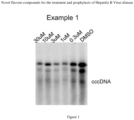
- HepDES19 cells were seeded at 4 ⁇ 10 6 cells per T150 in the culture medium (Dulbecco's Modified Eagle Medium: Nutrient Mixture F-12 [DMEM-F12, Gibco Cat. 11320-82], 10% Fetal Bovine Serum [FBS, Clontech Cat. 631101], 0.1mM Non-Essential Amino Acids Solution [NEAA, Gibco Cat. 11140-050], 50 ⁇ g/mL Penicillin-Streptomycin [PS, Invitrogen Cat. 15140-163], 500 ⁇ g/mL Geneticin [G418, Invitrogen Cat. 10131-027]) in the absence of Tet for 8 days. These cells were seeded at the density of 1 ⁇ 10 6 cells per well in 6-well plate.
- Hirt DNA of each sample was loaded into 1.2% 1x tris-acetate electrophoresis (TAE) agarose gel and separated at 90 voltages for 3 hours.
- TAE tris-acetate electrophoresis
- the gel was then treated in 50mM NaAc-HAc, pH4.2 for 30min at room temperature (RT), and then denatured by soaking in denaturation buffer (0.5 M sodium hydroxide, 1.5 M sodium chloride) at RT for 30-45 min.
- denaturation buffer 0.5 M sodium hydroxide, 1.5 M sodium chloride
- the gel was then treated with neutralization buffer (1M tris[hydroxymethyl]aminomethane pH7.4 and 1.5M NaCl) at RT for 30-45 min.
- the gel was transferred onto a pre-wet Nylon membrane (GE life science, Hybond N+) by capillary transfer method overnight, followed by UV crosslinking.
- the membrane was transferred into a hybridization tube, then rinsed with double distilled water at 60°C for 5 min. 10 mL of hybridization buffer (Lab kits, China) was added, the resulting sample was rotated in hybridization oven at 60°C for 1 hour.
- Digoxigenin (DIG)-labelled HBV probe was denatured at 95 °C for 10 minutes, and then 7 ⁇ L of denatured probe was added to the hybridization tube, which was rotated in hybridization oven at 60 °C overnight.
- the membrane was washed according to the procedure of DIG wash and block buffer set kit (Roche, Cat. 11 585 762 001), and then incubated with 50mL antibody solution (Antibody anti-Digoxigenin-AP Fab fragment [Roche Cat. 11093274910] diluted in fresh 1 ⁇ blocking buffer at 1:10,000) for 1 hour.
- the membrane was washed with 50 mL washing buffer (1 ⁇ Maleic buffer with 0.3% Tween-20) for 15 minutes twice, and equilibrated with 20mL detection buffer (0.1M tris[hydroxymethyl]aminomethane pH9.5, 0.1M sodium chloride) for 5 minutes.
- CDP-Star substrate (Roche, Cat. 12041677001) was added to the membrane for 5 minutes, and then the membrane was scanned by Bio-Rad Visualize Image System (Biorad, ChemiDoc-MP, Serial No. 731BR00916).
- Example 76 Cryopreserved primary human hepatocytes (PHH) assay
- This assay is used to confirm the anti-HBV effect of the compounds in HBV PHH infection assay.
- Cryopreserved PHH (BioreclamationIVT, Lot YJM) was thawed at 37°C and gently transferred into pre-warmed InVitroGRO HT medium(BioreclamationIVT, Cat. S03317). The mixture was centrifuged at 70 relative centrifugal force (RCF) for 3 minutes at RT, and the supernatant was discarded.
- Pre-warmed InVitroGRO CP medium BioreclamationIVT, Cat# S03316 was added to the cell pellet to gently re-suspend cells.
- the cells were seeded at the density of 5.8 ⁇ 10 4 cells per well to collagen I coated 96-well plate (Gibco, Cat. A1 142803) with the InVitroGRO CP medium. All plates were incubated at 37°C with 5% CO 2 and 85% humidity.
- the medium was changed to PHH culture medium (Dulbecco's Modified Eagle Medium (DMEM)/F12 (1:1) (Gibco, Cat. 11320-033), 10% fetal bovine serum (Gibco Cat. 10099141), 100 U/mL penicillin, 100 ⁇ g/mL streptomycin (Gibco, Cat. 151401-122), 5 ng/mL human epidermal growth factor (Invitrogen Cat. PHG0311L), 20 ng/mL dexamethasone (Sigma, Cat. D4902) and 250 ng/mL human recombinant insulin (Gibco, Cat. 12585-014)).
- DMEM Dulbecco's Modified Eagle Medium
- F12 (1:1 10% fetal bovine serum
- 10099141 100 U/mL penicillin
- 100 ⁇ g/mL streptomycin Gibco, Cat. 151401-122
- 5 ng/mL human epidermal growth factor Invitrogen Cat
- the cells were gently washed with PBS and refreshed with PHH culture medium supplemented with 1% DMSO, and 0.25mg/mL Matrix gel (Corning, Cat. 356237) at 200 ⁇ L per well. All plates were immediately placed in at 37°C CO 2 incubator.
- HBsAg IC 50 and HBV DNA IC 50 values were derived from the dose-response curve using 4 parameter logistic curve fit method.
- the compounds of formula (I) have HBsAg IC 50 ⁇ 20 ⁇ M, particularly ⁇ 1 ⁇ M; and HBV DNA IC 50 ⁇ 50 ⁇ M.
- Test results of the compounds of this invention as well as the reference compounds in Cryopreserved PHH assay are given in Table 2 and Table 3.
- Table 2 HBsAg IC 50 data in Cryopreserved PHH assay Example No. HBsAg IC 50 ( ⁇ M)
Landscapes
- Organic Chemistry (AREA)
- Chemical & Material Sciences (AREA)
- Health & Medical Sciences (AREA)
- Life Sciences & Earth Sciences (AREA)
- Virology (AREA)
- Chemical Kinetics & Catalysis (AREA)
- Medicinal Chemistry (AREA)
- Biotechnology (AREA)
- Communicable Diseases (AREA)
- Oncology (AREA)
- Engineering & Computer Science (AREA)
- General Chemical & Material Sciences (AREA)
- Molecular Biology (AREA)
- Nuclear Medicine, Radiotherapy & Molecular Imaging (AREA)
- Pharmacology & Pharmacy (AREA)
- Animal Behavior & Ethology (AREA)
- General Health & Medical Sciences (AREA)
- Public Health (AREA)
- Veterinary Medicine (AREA)
- Pharmaceuticals Containing Other Organic And Inorganic Compounds (AREA)
- Plural Heterocyclic Compounds (AREA)
Claims (5)
- Verbindung, ausgewählt aus3-[2-[4-(8-Chlor-4-oxo-chromen-2-yl)phenoxy]ethoxy]cyclobutancarbonsäure;Ethyl-3-[2-[4-(8-chlor-4-oxo-chromen-2-yl)phenoxy]ethoxy]cyclobutancarboxylat;3-[2-[4-(8-Chlor-4-oxo-chromen-2-yl)phenoxy]ethoxy]benzoesäure;Ethyl-2-[2-[4-(8-chlor-4-oxo-chromen-2-yl)phenoxy]ethoxy]cyclopropancarboxylat;cis-2-[2-[4-(8-Chlor-4-oxo-chromen-2-yl)phenoxy]ethoxy]cyclopropancarbonsäure;trans-2-[2-[4-(8-Chlor-4-oxo-chromen-2-yl)phenoxy]ethoxy]cyclopropancarbonsäure;3-[2-[4-(8-Chlor-4-oxo-chromen-2-yl)phenoxy]ethoxy]cyclopentancarbonsäure;cis-4-[2-[4-(8-Chlor-4-oxo-chromen-2-yl)phenoxy]ethoxy]cyclohexancarbonsäure;trans-4-[2-[4-(8-Chlor-4-oxo-chromen-2-yl)phenoxy]ethoxy]cyclohexancarbonsäure;2-[3-[[4-(8-Chlor-4-oxo-chromen-2-yl)phenoxy]methyl]cyclobutoxy]essigsäure;2-[2-[4-(8-Chlor-4-oxo-chromen-2-yl)phenoxy]ethoxy]essigsäure;3-[2-[4-(8-Chlor-4-oxo-chromen-2-yl)phenoxy]ethoxy]propansäure;3-[2-[4-(8-Chlor-4-oxo-chromen-2-yl)phenoxy]ethoxy]-2,2-dimethylpropansäure;3-[2-[4-(8-Chlor-4-oxo-chromen-2-yl)phenoxy]-1-methylethoxy]cyclobutancarbonsäure;3-[3-[4-(8-Chlor-4-oxo-chromen-2-yl)phenoxy]propoxy]cyclobutancarbonsäure;3-[3-[4-(8-Chlor-4-oxo-chromen-2-yl)phenoxy]-2-hydroxypropoxy]benzoesäure;3-[2-[4-(8-Chlor-7-fluor-4-oxo-chromen-2-yl)phenoxy]ethoxy]cyclobutancarbonsäure;3-[2-[4-(8-Chlor-7-methoxy-4-oxo-chromen-2-yl)phenoxy]ethoxy]cyclobutancarbonsäure;3-[2-[4-(8-Chlor-6-fluor-4-oxo-chromen-2-yl)phenoxy]ethoxy]cyclobutancarbonsäure;3-[2-[4-(7,8-Dichlor-4-oxo-chromen-2-yl)phenoxy]ethoxy]cyclobutancarbonsäure;3-[2-[4-(8-Chlor-6-cyano-4-oxo-chromen-2-yl)phenoxy]ethoxy]cyclobutancarbonsäure;3-[2-[4-(8-Chlor-7-cyano-4-oxo-chromen-2-yl)phenoxy]ethoxy]cyclobutancarbonsäure;cis-3-[2-[4-(8-Chlor-5-hydroxy-4-oxo-chromen-2-yl)phenoxy]ethoxy]cyclobutancarbonsäure;cis-3-[2-[4-(8-Chlor-5-methoxy-4-oxo-chromen-2-yl)phenoxy]ethoxy]cyclobutancarbonsäure;cis-3-[2-[4-(8-Chlor-5-isopropoxy-4-oxo-chromen-2-yl)phenoxy]ethoxy]cyclobutancarbonsäure;cis-3-[2-[4-(5-Brom-8-chlor-4-oxo-chromen-2-yl)phenoxy]ethoxy]cyclobutancarbonsäure;cis-3-[2-[4-(5,8-Dichlor-4-oxo-chromen-2-yl)phenoxy]ethoxy]cyclobutancarbonsäure;cis-3-[2-[4-(8-Chlor-5-cyclopropyl-4-oxo-chromen-2-yl)phenoxy]ethoxy]cyclobutancarbonsäure;cis-3-[2-[4-(8-Chlor-5-methyl-4-oxo-chromen-2-yl)phenoxy]ethoxy]cyclobutancarbonsäure;cis-3-[2-[4-(8-Brom-4-oxo-chromen-2-yl)phenoxy]ethoxy]cyclobutancarbonsäure;cis-3-[2-[4-(8-Cyclopropyl-4-oxo-chromen-2-yl)phenoxy]ethoxy]cyclobutancarbonsäure;cis-3-[2-[4-(8-Methyl-4-oxo-chromen-2-yl)phenoxy]ethoxy]cyclobutancarbonsäure;2-[2-[4-(8-Chlor-5-fluor-4-oxo-chromen-2-yl)phenoxy]ethoxyl]essigsäure;cis-3-[2-[[5-(8-Chlor-4-oxo-chromen-2-yl)-2-pyridyl]oxy]ethoxy]cyclobutancarbonsäure;trans-3-[2-[[5-(8-Chlor-4-oxo-chromen-2-yl)-2-pyridyl]oxy]ethoxy]cyclobutancarbonsäure;cis-3-[2-[5-(8-Chlor-4-oxo-chromen-2-yl)pyrazin-2-yl]oxyethoxy]cyclobutancarbonsäure;cis-Methyl-3-[2-[5-(8-chlor-4-oxo-chromen-2-yl)pyrazin-2-yl]oxyethoxy]cyclobutancarboxylat;cis-Methyl-3-[2-[6-(8-chlor-4-oxo-chromen-2-yl)pyridazin-3-yl]oxyethoxy]cyclobutancarboxylat;cis-3-[2-[4-(8-Chlor-4-oxo-chromen-2-yl)-2-fluorphenoxy]ethoxy]cyclobutancarbonsäure;cis-3-[2-[2-Chlor-4-(8-chlor-4-oxo-chromen-2-yl)phenoxy]ethoxy]cyclobutancarbonsäure;cis-3-[2-[2-Brom-4-(8-chlor-4-oxo-chromen-2-yl)phenoxy]ethoxy]cyclobutancarbonsäure;cis-3-[2-[4-(8-Chlor-4-oxo-chromen-2-yl)-2-cyclopropylphenoxy]ethoxy]cyclobutancarbonsäure;3-[2-[4-(8-Chlor-4-oxo-chromen-2-yl)-2-cyanophenoxy]ethoxy]cyclobutancarbonsäure;3-[2-[4-(8-Chlor-4-oxo-chromen-2-yl)-2-methylphenoxy]ethoxy]cyclobutancarbonsäure;3-[2-[4-(8-Chlor-4-oxo-chromen-2-yl)-2-isopropylphenoxy]ethoxy]cyclobutancarbonsäure;3-[2-[4-(8-Chlor-4-oxo-chromen-2-yl)-3-methoxyphenoxy]ethoxy]cyclobutancarbonsäure;3-[2-[4-(8-Chlor-4-oxo-chromen-2-yl)-3-ethoxyphenoxy]ethoxy]cyclobutancarbonsäure;3-[2-[4-(3,8-Dichlor-4-oxo-chromen-2-yl)phenoxy]ethoxy]cyclobutancarbonsäure;cis-3-[2-[4-(8-Chlor-3-hydroxy-4-oxo-chromen-2-yl)phenoxy]ethoxy]cyclobutancarbonsäure;cis-3-[2-[4-(8-Chlor-3-methoxy-4-oxo-chromen-2-yl)phenoxy]ethoxy]cyclobutancarbonsäure;3-[2-[4-(8-Chlor-4-oxo-thiochromen-2-yl)phenoxy]ethoxy]cyclobutancarbonsäure;2-[2-[4-(8-Chlor-4-oxo-thiochromen-2-yl)phenoxy]ethoxy]essigsäure;2-[2-[4-(8-Chlor-3-hydroxy-4-oxo-chromen-2-yl)phenoxy]ethoxy]essigsäure;3-[2-[4-(8-Chlor-4-oxo-chromen-2-yl)-3-morpholinophenoxy]ethoxy]cyclobutancarbonsäure;Methyl-3-[2-[4-[8-chlor-6-fluor-4-oxo-3-(trifluormethoxy)chromen-2-yl]phenoxy]ethoxy]cyclobutancarboxylat;3-[2-[4-[8-Chlor-6-fluor-4-oxo-3-(trifluormethoxy)chromen-2-yl]phenoxy]ethoxy]cyclobutancarbonsäure;3-[2-[4-(3-Brom-8-chlor-4-oxo-chromen-2-yl)phenoxy]ethoxy]cyclobutancarbonsäure;3-[2-[4-(3-Benzyloxy-8-chlor-4-oxo-chromen-2-yl)phenoxy]ethoxy]cyclobutancarbonsäure;3-[2-[4-[8-Chlor-4-oxo-6-(trifluormethyl)chromen-2-yl]phenoxy]ethoxy]cyclobutancarbonsäure;3-[2-[4-(8-Chlor-6-cyclopropyl-4-oxo-chromen-2-yl)phenoxy]ethoxy]cyclobutancarbonsäure;3-[2-[4-[8-Chlor-4-oxo-6-(2-oxopyrrolidin-1-yl)chromen-2-yl]phenoxy]ethoxy]cyclobutancarbonsäure;3-[2-[4-[8-Chlor-4-oxo-7-(trifluormethyl)chromen-2-yl]phenoxy]ethoxy]cyclobutancarbonsäure;3-[2-[4-(8-Chlor-7-cyclopropyl-4-oxo-chromen-2-yl)phenoxy]ethoxy]cyclobutancarbonsäure;Ethyl-2- [2- [4-(7-brom- 8-chlor-4-oxo-chromen-2-yl)phenoxy] ethoxy] acetat;3-[2-[4-[8-Chlor-4-oxo-7-(trifluormethyl)chromen-2-yl]-2-methylphenoxy]ethoxy]cyclobutancarbonsäure; undcis-3-[2-[2-Chlor-4-[8-chlor-4-oxo-7-(trifluormethyl)chromen-2-yl]phenoxy]ethoxy]cyclobutancarbonsäure;cis-3-[2-[4-(8-Chlor-4-oxo-chromen-2-yl)phenoxy]ethoxy]cyclobutancarbonsäure;trans-3-[2-[4-(8-Chlor-4-oxo-chromen-2-yl)phenoxy]ethoxy]cyclobutancarbonsäure;3-[2-[4-(8-Chlor-4-oxo-thiochromen-2-yl)phenoxy]ethoxy]cyclobutancarbonsäure;2-[2-[4-(8-Chlor-4-oxo-thiochromen-2-yl)phenoxy]ethoxy]essigsäure; und2-[2-[4-(8-Chlor-4-oxo-chromen-2-yl)phenoxy]ethoxy]acetamid;oder ein pharmazeutisch unbedenkliches Salz oder Enantiomer oder Diastereomer davon.
- Verbindung nach Anspruch 1, ausgewählt aus3-[2-[4-(8-Chlor-4-oxo-chromen-2-yl)phenoxy]ethoxy]cyclobutancarbonsäure;cis-3-[2-[4-(8-Chlor-4-oxo-chromen-2-yl)phenoxy]ethoxy]cyclobutancarbonsäure;trans-3-[2-[4-(8-Chlor-4-oxo-chromen-2-yl)phenoxy]ethoxy]cyclobutancarbonsäure;3-[2-[4-(8-Chlor-4-oxo-chromen-2-yl)phenoxy]-1-methylethoxy]cyclobutancarbonsäure;3-[2-[4-(8-Chlor-6-fluor-4-oxo-chromen-2-yl)phenoxy]ethoxy]cyclobutancarbonsäure;cis-3-[2-[4-(8-Chlor-5-methoxy-4-oxo-chromen-2-yl)phenoxy]ethoxy]cyclobutancarbonsäure;cis-3-[2-[4-(5,8-Dichlor-4-oxo-chromen-2-yl)phenoxy]ethoxy]cyclobutancarbonsäure;cis-3-[2-[4-(8-Brom-4-oxo-chromen-2-yl)phenoxy]ethoxy]cyclobutancarbonsäure;cis-3-[2-[4-(8-Chlor-4-oxo-chromen-2-yl)-2-fluorphenoxy]ethoxy]cyclobutancarbonsäure;cis-3-[2-[2-Chlor-4-(8-chlor-4-oxo-chromen-2-yl)phenoxy]ethoxy]cyclobutancarbonsäure;cis-3-[2-[2-Brom-4-(8-chlor-4-oxo-chromen-2-yl)phenoxy]ethoxy]cyclobutancarbonsäure;3-[2-[4-(8-Chlor-4-oxo-chromen-2-yl)-2-methylphenoxy]ethoxy]cyclobutancarbonsäure;3-[2-[4-(8-Chlor-4-oxo-chromen-2-yl)-3-ethoxyphenoxy]ethoxy]cyclobutancarbonsäure;3-[2-[4-(8-Chlor-4-oxo-thiochromen-2-yl)phenoxy]ethoxy]cyclobutancarbonsäure;2-[2-[4-(8-Chlor-4-oxo-thiochromen-2-yl)phenoxy]ethoxy]essigsäure; und2-[2-[4-(8-Chlor-4-oxo-chromen-2-yl)phenoxy]ethoxy]acetamid;oder ein pharmazeutisch unbedenkliches Salz oder Enantiomer oder Diastereomer davon.
- Verbindung nach einem der Ansprüche 1 bis 2 zur Verwendung als therapeutisch wirksame Substanz.
- Pharmazeutische Zusammensetzung, umfassend eine Verbindung nach einem der Ansprüche 1 bis 2 und einen therapeutisch inerten Träger.
- Verbindung nach einem der Ansprüche 1 bis 2 zur Verwendung bei der Behandlung oder Prophylaxe einer HBV-Infektion.
Applications Claiming Priority (2)
| Application Number | Priority Date | Filing Date | Title |
|---|---|---|---|
| PCT/EP2018/074851 WO2020052774A1 (en) | 2018-09-14 | 2018-09-14 | Flavone derivatives for the treatment and prophylaxis of hepatitis b virus disease |
| PCT/EP2019/074173 WO2020053249A1 (en) | 2018-09-14 | 2019-09-11 | Flavone compounds for the treatment and prophylaxis of hepatitis b virus disease |
Publications (3)
| Publication Number | Publication Date |
|---|---|
| EP3849966A1 EP3849966A1 (de) | 2021-07-21 |
| EP3849966B1 true EP3849966B1 (de) | 2023-10-25 |
| EP3849966C0 EP3849966C0 (de) | 2023-10-25 |
Family
ID=63667890
Family Applications (1)
| Application Number | Title | Priority Date | Filing Date |
|---|---|---|---|
| EP19769742.8A Active EP3849966B1 (de) | 2018-09-14 | 2019-09-11 | Flavonverbindungen zur behandlung und prophylaxe von hepatitis-b-virusinfektion |
Country Status (5)
| Country | Link |
|---|---|
| US (1) | US12012390B2 (de) |
| EP (1) | EP3849966B1 (de) |
| JP (1) | JP2022500373A (de) |
| CN (1) | CN112601743B (de) |
| WO (2) | WO2020052774A1 (de) |
Families Citing this family (1)
| Publication number | Priority date | Publication date | Assignee | Title |
|---|---|---|---|---|
| WO2021236578A1 (en) * | 2020-05-18 | 2021-11-25 | Salk Institute For Biological Studies | Chromen-4-one derivatives, such as e.g. flavones, for use as ck2 inhibitors for the treatment of neuroinflammation |
Family Cites Families (17)
| Publication number | Priority date | Publication date | Assignee | Title |
|---|---|---|---|---|
| EP1223928A2 (de) | 1999-07-08 | 2002-07-24 | Patrick Thomas Prendergast | Verwendung von flavonen, coumarinen oder verwandten verbindungen zur behandlung von infektionen |
| TWI332001B (en) | 2004-12-28 | 2010-10-21 | Ind Tech Res Inst | Compound for treating hepatitis b and composition thereof |
| CA2652617A1 (en) | 2006-05-19 | 2007-11-29 | The Hong Kong Polytechnic University | Flavonoid dimers and methods of making and using such |
| CN101708182A (zh) * | 2009-11-06 | 2010-05-19 | 上海双科医药科技有限公司 | 曲克芦丁在制备抗病毒性肝炎药物中的用途 |
| CN102617536A (zh) | 2011-01-27 | 2012-08-01 | 上海瑞广生化科技开发有限公司 | 异黄酮类化合物,其制备方法及其在制备抗病毒或抗肿瘤药物中的应用 |
| WO2013127361A1 (en) | 2012-03-01 | 2013-09-06 | The Hong Kong Polytechnic University | Alkyne-, azide- and triazole-containing flavonoids as modulators for multidrug resistance in cancers |
| CN103275051B (zh) | 2013-06-08 | 2015-12-09 | 陕西理工学院 | 一种7,3’,4’-三羟基黄酮衍生物及其在制备治疗肝癌药物中的应用 |
| CN109394752A (zh) | 2013-10-21 | 2019-03-01 | 德雷克塞尔大学 | 治疗慢性乙型肝炎病毒感染的sting激动剂的用途 |
| TWI535439B (zh) * | 2014-05-05 | 2016-06-01 | 華珍生物科技有限公司 | 甲氧基黃酮類化合物用以製備治療抗藥性b型肝炎之藥物之用途 |
| JP6517843B2 (ja) * | 2014-07-10 | 2019-05-22 | ダイムラー・アクチェンゲゼルシャフトDaimler AG | 反応物の流れを改善する燃料電池組立体 |
| JP6577795B2 (ja) | 2014-09-03 | 2019-09-18 | 日東電工株式会社 | ビスホスホネート剤を含む細胞性免疫用ワクチン医薬組成物 |
| CN105640933A (zh) * | 2014-11-18 | 2016-06-08 | 复旦大学 | 黄酮类化合物在制备抗乙肝病毒药物中的用途 |
| WO2016177655A1 (en) * | 2015-05-04 | 2016-11-10 | F. Hoffmann-La Roche Ag | Tetrahydropyridopyrimidines and tetrahydropyridopyridines as inhibitors of hbsag (hbv surface antigen) and hbv dna production for the treatment of hepatitis b virus infections |
| JP6957522B2 (ja) | 2016-05-26 | 2021-11-02 | エフ.ホフマン−ラ ロシュ アーゲーF. Hoffmann−La Roche Aktiengesellschaft | B型肝炎ウイルス疾患の治療および予防のためのキサントン誘導体 |
| CN107163096B (zh) * | 2017-05-26 | 2020-01-14 | 河南工业大学 | 曲克芦丁酰胺类衍生物及其合成方法和用途 |
| JP7323526B2 (ja) * | 2017-12-19 | 2023-08-08 | エフ. ホフマン-ラ ロシュ アーゲー | B型肝炎ウイルス疾患の治療及び予防用の新規キノリン化合物 |
| CN112912371A (zh) * | 2018-10-03 | 2021-06-04 | 豪夫迈·罗氏有限公司 | 用于治疗和预防乙型肝炎病毒疾病的黄酮衍生物 |
-
2018
- 2018-09-14 WO PCT/EP2018/074851 patent/WO2020052774A1/en not_active Ceased
-
2019
- 2019-09-11 JP JP2021512942A patent/JP2022500373A/ja not_active Ceased
- 2019-09-11 CN CN201980056010.8A patent/CN112601743B/zh not_active Expired - Fee Related
- 2019-09-11 US US17/275,502 patent/US12012390B2/en active Active
- 2019-09-11 WO PCT/EP2019/074173 patent/WO2020053249A1/en not_active Ceased
- 2019-09-11 EP EP19769742.8A patent/EP3849966B1/de active Active
Also Published As
| Publication number | Publication date |
|---|---|
| CN112601743B (zh) | 2023-12-19 |
| CN112601743A (zh) | 2021-04-02 |
| WO2020053249A1 (en) | 2020-03-19 |
| EP3849966A1 (de) | 2021-07-21 |
| JP2022500373A (ja) | 2022-01-04 |
| US12012390B2 (en) | 2024-06-18 |
| US20220363657A1 (en) | 2022-11-17 |
| WO2020052774A1 (en) | 2020-03-19 |
| EP3849966C0 (de) | 2023-10-25 |
Similar Documents
| Publication | Publication Date | Title |
|---|---|---|
| EP3099685B1 (de) | Neuartige dihydrochinolizinone zur behandlung und prophylaxe von hepatitis-b-virus-infektionen | |
| EP3325477B1 (de) | Neuartige tricyclische 4-pyridon-3-carbonsäure-derivate zur behandlung und prophylaxe von hepatitis-b-virus-infektion | |
| EP3458455B1 (de) | Neuartige pyrazinverbindungen mit sauerstoff-, schwefel- und stickstofflinker zur behandlung von infektionskrankheiten | |
| EP3215504B1 (de) | 6,7-dihydrobenzo[a]chinolizin-2-on-derivate zur behandlung und prophylaxe von hepatitis-b-virusinfektion | |
| EP3328855B1 (de) | Neuartige tetracyclische 4-oxo-pyridon-3-carbonsäure-derivate zur behandlung und prophylaxe von hepatitis-b-virus-infektionen | |
| TW201031675A (en) | Synthesis of purine nucleosides | |
| HK1244281A1 (en) | 2-oxo-6,7-dihydrobenzo[a]quinolizine-3-carboxylic acid derivatives for the treatment and prophylaxis of hepatitis b virus infection | |
| HU228398B1 (en) | Novel nucleosides and oligonucleotide analogues | |
| KR20170026494A (ko) | 치환된 뉴클레오타이드 유사체의 제조 방법 | |
| US11708344B2 (en) | Flavone derivatives for the treatment and prophylaxis of hepatitis B virus disease | |
| EP3849966B1 (de) | Flavonverbindungen zur behandlung und prophylaxe von hepatitis-b-virusinfektion | |
| JP3871705B2 (ja) | エポキシドの合成方法 | |
| EP3870295B1 (de) | Neuartige tricyclische verbindungen zur behandlung und prophylaxe von hepatitis-b-virus-infektion | |
| EP3911413B1 (de) | Substituiertes chromen-4-on zur behandlung und prophylaxe von hepatitis-b-virus-infektionen | |
| CN112996566B (zh) | 用于治疗和预防乙型肝炎病毒感染的苯并二氢吡喃-4-酮衍生物 | |
| EP3894402B1 (de) | N-enthaltende chromen-4-on-derivate zur behandlung und prophylaxe von hepatitis-b-virusinfektionen | |
| HK40048238A (en) | Flavone compounds for the treatment and prophylaxis of hepatitis b virus disease | |
| HK40048238B (zh) | 用於治疗和预防乙型肝炎病毒疾病的黄酮化合物 | |
| CN116390920A (zh) | 用于治疗和预防乙型肝炎病毒感染的芳族螺环酰胺衍生物 | |
| RU2798838C2 (ru) | Бициклическое гетероароматическое кольцевое производное | |
| EP3842439A1 (de) | Bicyclisches heteroaromatisches ringderivat | |
| TW201028430A (en) | Method of preparing deoxyribofuranose compounds | |
| HK40057573A (en) | Chroman-4-one derivatives for the treatment and prophylaxis of hepatitis b virus infection | |
| EP0442757A2 (de) | Therapeutische Nucleoside | |
| HK40057573B (zh) | 用於治疗和预防乙型肝炎病毒感染的苯并二氢吡喃-4-酮衍生物 |
Legal Events
| Date | Code | Title | Description |
|---|---|---|---|
| STAA | Information on the status of an ep patent application or granted ep patent |
Free format text: STATUS: UNKNOWN |
|
| STAA | Information on the status of an ep patent application or granted ep patent |
Free format text: STATUS: THE INTERNATIONAL PUBLICATION HAS BEEN MADE |
|
| PUAI | Public reference made under article 153(3) epc to a published international application that has entered the european phase |
Free format text: ORIGINAL CODE: 0009012 |
|
| STAA | Information on the status of an ep patent application or granted ep patent |
Free format text: STATUS: REQUEST FOR EXAMINATION WAS MADE |
|
| 17P | Request for examination filed |
Effective date: 20210414 |
|
| AK | Designated contracting states |
Kind code of ref document: A1 Designated state(s): AL AT BE BG CH CY CZ DE DK EE ES FI FR GB GR HR HU IE IS IT LI LT LU LV MC MK MT NL NO PL PT RO RS SE SI SK SM TR |
|
| DAV | Request for validation of the european patent (deleted) | ||
| DAX | Request for extension of the european patent (deleted) | ||
| STAA | Information on the status of an ep patent application or granted ep patent |
Free format text: STATUS: EXAMINATION IS IN PROGRESS |
|
| 17Q | First examination report despatched |
Effective date: 20220210 |
|
| GRAP | Despatch of communication of intention to grant a patent |
Free format text: ORIGINAL CODE: EPIDOSNIGR1 |
|
| STAA | Information on the status of an ep patent application or granted ep patent |
Free format text: STATUS: GRANT OF PATENT IS INTENDED |
|
| INTG | Intention to grant announced |
Effective date: 20230523 |
|
| GRAS | Grant fee paid |
Free format text: ORIGINAL CODE: EPIDOSNIGR3 |
|
| GRAA | (expected) grant |
Free format text: ORIGINAL CODE: 0009210 |
|
| STAA | Information on the status of an ep patent application or granted ep patent |
Free format text: STATUS: THE PATENT HAS BEEN GRANTED |
|
| AK | Designated contracting states |
Kind code of ref document: B1 Designated state(s): AL AT BE BG CH CY CZ DE DK EE ES FI FR GB GR HR HU IE IS IT LI LT LU LV MC MK MT NL NO PL PT RO RS SE SI SK SM TR |
|
| REG | Reference to a national code |
Ref country code: GB Ref legal event code: FG4D |
|
| REG | Reference to a national code |
Ref country code: CH Ref legal event code: EP |
|
| REG | Reference to a national code |
Ref country code: DE Ref legal event code: R096 Ref document number: 602019040122 Country of ref document: DE |
|
| REG | Reference to a national code |
Ref country code: IE Ref legal event code: FG4D |
|
| U01 | Request for unitary effect filed |
Effective date: 20231025 |
|
| U07 | Unitary effect registered |
Designated state(s): AT BE BG DE DK EE FI FR IT LT LU LV MT NL PT SE SI Effective date: 20231030 |
|
| PG25 | Lapsed in a contracting state [announced via postgrant information from national office to epo] |
Ref country code: GR Free format text: LAPSE BECAUSE OF FAILURE TO SUBMIT A TRANSLATION OF THE DESCRIPTION OR TO PAY THE FEE WITHIN THE PRESCRIBED TIME-LIMIT Effective date: 20240126 |
|
| PG25 | Lapsed in a contracting state [announced via postgrant information from national office to epo] |
Ref country code: IS Free format text: LAPSE BECAUSE OF FAILURE TO SUBMIT A TRANSLATION OF THE DESCRIPTION OR TO PAY THE FEE WITHIN THE PRESCRIBED TIME-LIMIT Effective date: 20240225 |
|
| PG25 | Lapsed in a contracting state [announced via postgrant information from national office to epo] |
Ref country code: ES Free format text: LAPSE BECAUSE OF FAILURE TO SUBMIT A TRANSLATION OF THE DESCRIPTION OR TO PAY THE FEE WITHIN THE PRESCRIBED TIME-LIMIT Effective date: 20231025 |
|
| PG25 | Lapsed in a contracting state [announced via postgrant information from national office to epo] |
Ref country code: IS Free format text: LAPSE BECAUSE OF FAILURE TO SUBMIT A TRANSLATION OF THE DESCRIPTION OR TO PAY THE FEE WITHIN THE PRESCRIBED TIME-LIMIT Effective date: 20240225 Ref country code: GR Free format text: LAPSE BECAUSE OF FAILURE TO SUBMIT A TRANSLATION OF THE DESCRIPTION OR TO PAY THE FEE WITHIN THE PRESCRIBED TIME-LIMIT Effective date: 20240126 Ref country code: ES Free format text: LAPSE BECAUSE OF FAILURE TO SUBMIT A TRANSLATION OF THE DESCRIPTION OR TO PAY THE FEE WITHIN THE PRESCRIBED TIME-LIMIT Effective date: 20231025 |
|
| PG25 | Lapsed in a contracting state [announced via postgrant information from national office to epo] |
Ref country code: RS Free format text: LAPSE BECAUSE OF FAILURE TO SUBMIT A TRANSLATION OF THE DESCRIPTION OR TO PAY THE FEE WITHIN THE PRESCRIBED TIME-LIMIT Effective date: 20231025 Ref country code: PL Free format text: LAPSE BECAUSE OF FAILURE TO SUBMIT A TRANSLATION OF THE DESCRIPTION OR TO PAY THE FEE WITHIN THE PRESCRIBED TIME-LIMIT Effective date: 20231025 Ref country code: NO Free format text: LAPSE BECAUSE OF FAILURE TO SUBMIT A TRANSLATION OF THE DESCRIPTION OR TO PAY THE FEE WITHIN THE PRESCRIBED TIME-LIMIT Effective date: 20240125 Ref country code: HR Free format text: LAPSE BECAUSE OF FAILURE TO SUBMIT A TRANSLATION OF THE DESCRIPTION OR TO PAY THE FEE WITHIN THE PRESCRIBED TIME-LIMIT Effective date: 20231025 |
|
| PG25 | Lapsed in a contracting state [announced via postgrant information from national office to epo] |
Ref country code: CZ Free format text: LAPSE BECAUSE OF FAILURE TO SUBMIT A TRANSLATION OF THE DESCRIPTION OR TO PAY THE FEE WITHIN THE PRESCRIBED TIME-LIMIT Effective date: 20231025 |
|
| REG | Reference to a national code |
Ref country code: DE Ref legal event code: R097 Ref document number: 602019040122 Country of ref document: DE |
|
| PG25 | Lapsed in a contracting state [announced via postgrant information from national office to epo] |
Ref country code: SK Free format text: LAPSE BECAUSE OF FAILURE TO SUBMIT A TRANSLATION OF THE DESCRIPTION OR TO PAY THE FEE WITHIN THE PRESCRIBED TIME-LIMIT Effective date: 20231025 |
|
| PG25 | Lapsed in a contracting state [announced via postgrant information from national office to epo] |
Ref country code: SM Free format text: LAPSE BECAUSE OF FAILURE TO SUBMIT A TRANSLATION OF THE DESCRIPTION OR TO PAY THE FEE WITHIN THE PRESCRIBED TIME-LIMIT Effective date: 20231025 Ref country code: SK Free format text: LAPSE BECAUSE OF FAILURE TO SUBMIT A TRANSLATION OF THE DESCRIPTION OR TO PAY THE FEE WITHIN THE PRESCRIBED TIME-LIMIT Effective date: 20231025 Ref country code: RO Free format text: LAPSE BECAUSE OF FAILURE TO SUBMIT A TRANSLATION OF THE DESCRIPTION OR TO PAY THE FEE WITHIN THE PRESCRIBED TIME-LIMIT Effective date: 20231025 Ref country code: CZ Free format text: LAPSE BECAUSE OF FAILURE TO SUBMIT A TRANSLATION OF THE DESCRIPTION OR TO PAY THE FEE WITHIN THE PRESCRIBED TIME-LIMIT Effective date: 20231025 |
|
| PLBE | No opposition filed within time limit |
Free format text: ORIGINAL CODE: 0009261 |
|
| STAA | Information on the status of an ep patent application or granted ep patent |
Free format text: STATUS: NO OPPOSITION FILED WITHIN TIME LIMIT |
|
| 26N | No opposition filed |
Effective date: 20240726 |
|
| PG25 | Lapsed in a contracting state [announced via postgrant information from national office to epo] |
Ref country code: MC Free format text: LAPSE BECAUSE OF FAILURE TO SUBMIT A TRANSLATION OF THE DESCRIPTION OR TO PAY THE FEE WITHIN THE PRESCRIBED TIME-LIMIT Effective date: 20231025 |
|
| REG | Reference to a national code |
Ref country code: CH Ref legal event code: PL |
|
| U90 | Renewal fees not paid: noting of loss of rights |
Free format text: RENEWAL FEE NOT PAID FOR YEAR 06 Effective date: 20250416 |
|
| GBPC | Gb: european patent ceased through non-payment of renewal fee |
Effective date: 20240911 |
|
| PG25 | Lapsed in a contracting state [announced via postgrant information from national office to epo] |
Ref country code: GB Free format text: LAPSE BECAUSE OF NON-PAYMENT OF DUE FEES Effective date: 20240911 |
|
| PG25 | Lapsed in a contracting state [announced via postgrant information from national office to epo] |
Ref country code: CH Free format text: LAPSE BECAUSE OF NON-PAYMENT OF DUE FEES Effective date: 20240930 |
|
| PG25 | Lapsed in a contracting state [announced via postgrant information from national office to epo] |
Ref country code: IE Free format text: LAPSE BECAUSE OF NON-PAYMENT OF DUE FEES Effective date: 20240911 |
|
| U93 | Unitary patent lapsed |
Free format text: RENEWAL FEE NOT PAID Effective date: 20240930 |
|
| PG25 | Lapsed in a contracting state [announced via postgrant information from national office to epo] |
Ref country code: CY Free format text: LAPSE BECAUSE OF FAILURE TO SUBMIT A TRANSLATION OF THE DESCRIPTION OR TO PAY THE FEE WITHIN THE PRESCRIBED TIME-LIMIT; INVALID AB INITIO Effective date: 20190911 |
|
| PG25 | Lapsed in a contracting state [announced via postgrant information from national office to epo] |
Ref country code: HU Free format text: LAPSE BECAUSE OF FAILURE TO SUBMIT A TRANSLATION OF THE DESCRIPTION OR TO PAY THE FEE WITHIN THE PRESCRIBED TIME-LIMIT; INVALID AB INITIO Effective date: 20190911 |