EP3849829B1 - Schräglenkerradaufhängung für ein über einen elektrischen oder pneumatischen motor angetriebenes rad - Google Patents
Schräglenkerradaufhängung für ein über einen elektrischen oder pneumatischen motor angetriebenes rad Download PDFInfo
- Publication number
- EP3849829B1 EP3849829B1 EP19765168.0A EP19765168A EP3849829B1 EP 3849829 B1 EP3849829 B1 EP 3849829B1 EP 19765168 A EP19765168 A EP 19765168A EP 3849829 B1 EP3849829 B1 EP 3849829B1
- Authority
- EP
- European Patent Office
- Prior art keywords
- swing arm
- tilted link
- tilted
- wheel suspension
- wheel
- Prior art date
- Legal status (The legal status is an assumption and is not a legal conclusion. Google has not performed a legal analysis and makes no representation as to the accuracy of the status listed.)
- Active
Links
Images



Classifications
-
- B—PERFORMING OPERATIONS; TRANSPORTING
- B60—VEHICLES IN GENERAL
- B60G—VEHICLE SUSPENSION ARRANGEMENTS
- B60G3/00—Resilient suspensions for a single wheel
- B60G3/02—Resilient suspensions for a single wheel with a single pivoted arm
- B60G3/12—Resilient suspensions for a single wheel with a single pivoted arm the arm being essentially parallel to the longitudinal axis of the vehicle
- B60G3/14—Resilient suspensions for a single wheel with a single pivoted arm the arm being essentially parallel to the longitudinal axis of the vehicle the arm being rigid
- B60G3/145—Resilient suspensions for a single wheel with a single pivoted arm the arm being essentially parallel to the longitudinal axis of the vehicle the arm being rigid the arm forming the axle housing
-
- B—PERFORMING OPERATIONS; TRANSPORTING
- B60—VEHICLES IN GENERAL
- B60G—VEHICLE SUSPENSION ARRANGEMENTS
- B60G3/00—Resilient suspensions for a single wheel
- B60G3/02—Resilient suspensions for a single wheel with a single pivoted arm
- B60G3/12—Resilient suspensions for a single wheel with a single pivoted arm the arm being essentially parallel to the longitudinal axis of the vehicle
- B60G3/14—Resilient suspensions for a single wheel with a single pivoted arm the arm being essentially parallel to the longitudinal axis of the vehicle the arm being rigid
-
- B—PERFORMING OPERATIONS; TRANSPORTING
- B60—VEHICLES IN GENERAL
- B60G—VEHICLE SUSPENSION ARRANGEMENTS
- B60G7/00—Pivoted suspension arms; Accessories thereof
- B60G7/001—Suspension arms, e.g. constructional features
-
- B—PERFORMING OPERATIONS; TRANSPORTING
- B60—VEHICLES IN GENERAL
- B60K—ARRANGEMENT OR MOUNTING OF PROPULSION UNITS OR OF TRANSMISSIONS IN VEHICLES; ARRANGEMENT OR MOUNTING OF PLURAL DIVERSE PRIME-MOVERS IN VEHICLES; AUXILIARY DRIVES FOR VEHICLES; INSTRUMENTATION OR DASHBOARDS FOR VEHICLES; ARRANGEMENTS IN CONNECTION WITH COOLING, AIR INTAKE, GAS EXHAUST OR FUEL SUPPLY OF PROPULSION UNITS IN VEHICLES
- B60K7/00—Disposition of motor in, or adjacent to, traction wheel
-
- B—PERFORMING OPERATIONS; TRANSPORTING
- B60—VEHICLES IN GENERAL
- B60K—ARRANGEMENT OR MOUNTING OF PROPULSION UNITS OR OF TRANSMISSIONS IN VEHICLES; ARRANGEMENT OR MOUNTING OF PLURAL DIVERSE PRIME-MOVERS IN VEHICLES; AUXILIARY DRIVES FOR VEHICLES; INSTRUMENTATION OR DASHBOARDS FOR VEHICLES; ARRANGEMENTS IN CONNECTION WITH COOLING, AIR INTAKE, GAS EXHAUST OR FUEL SUPPLY OF PROPULSION UNITS IN VEHICLES
- B60K7/00—Disposition of motor in, or adjacent to, traction wheel
- B60K7/0007—Disposition of motor in, or adjacent to, traction wheel the motor being electric
-
- B—PERFORMING OPERATIONS; TRANSPORTING
- B60—VEHICLES IN GENERAL
- B60K—ARRANGEMENT OR MOUNTING OF PROPULSION UNITS OR OF TRANSMISSIONS IN VEHICLES; ARRANGEMENT OR MOUNTING OF PLURAL DIVERSE PRIME-MOVERS IN VEHICLES; AUXILIARY DRIVES FOR VEHICLES; INSTRUMENTATION OR DASHBOARDS FOR VEHICLES; ARRANGEMENTS IN CONNECTION WITH COOLING, AIR INTAKE, GAS EXHAUST OR FUEL SUPPLY OF PROPULSION UNITS IN VEHICLES
- B60K7/00—Disposition of motor in, or adjacent to, traction wheel
- B60K7/0023—Disposition of motor in, or adjacent to, traction wheel the motor being pneumatic
-
- F—MECHANICAL ENGINEERING; LIGHTING; HEATING; WEAPONS; BLASTING
- F16—ENGINEERING ELEMENTS AND UNITS; GENERAL MEASURES FOR PRODUCING AND MAINTAINING EFFECTIVE FUNCTIONING OF MACHINES OR INSTALLATIONS; THERMAL INSULATION IN GENERAL
- F16D—COUPLINGS FOR TRANSMITTING ROTATION; CLUTCHES; BRAKES
- F16D55/00—Brakes with substantially-radial braking surfaces pressed together in axial direction, e.g. disc brakes
- F16D55/02—Brakes with substantially-radial braking surfaces pressed together in axial direction, e.g. disc brakes with axially-movable discs or pads pressed against axially-located rotating members
- F16D55/22—Brakes with substantially-radial braking surfaces pressed together in axial direction, e.g. disc brakes with axially-movable discs or pads pressed against axially-located rotating members by clamping an axially-located rotating disc between movable braking members, e.g. movable brake discs or brake pads
- F16D55/224—Brakes with substantially-radial braking surfaces pressed together in axial direction, e.g. disc brakes with axially-movable discs or pads pressed against axially-located rotating members by clamping an axially-located rotating disc between movable braking members, e.g. movable brake discs or brake pads with a common actuating member for the braking members
- F16D55/225—Brakes with substantially-radial braking surfaces pressed together in axial direction, e.g. disc brakes with axially-movable discs or pads pressed against axially-located rotating members by clamping an axially-located rotating disc between movable braking members, e.g. movable brake discs or brake pads with a common actuating member for the braking members the braking members being brake pads
- F16D55/226—Brakes with substantially-radial braking surfaces pressed together in axial direction, e.g. disc brakes with axially-movable discs or pads pressed against axially-located rotating members by clamping an axially-located rotating disc between movable braking members, e.g. movable brake discs or brake pads with a common actuating member for the braking members the braking members being brake pads in which the common actuating member is moved axially, e.g. floating caliper disc brakes
-
- F—MECHANICAL ENGINEERING; LIGHTING; HEATING; WEAPONS; BLASTING
- F16—ENGINEERING ELEMENTS AND UNITS; GENERAL MEASURES FOR PRODUCING AND MAINTAINING EFFECTIVE FUNCTIONING OF MACHINES OR INSTALLATIONS; THERMAL INSULATION IN GENERAL
- F16D—COUPLINGS FOR TRANSMITTING ROTATION; CLUTCHES; BRAKES
- F16D65/00—Parts or details
- F16D65/005—Components of axially engaging brakes not otherwise provided for
- F16D65/0056—Brake supports
- F16D65/0062—Brake supports integral with vehicle suspension, e.g. with the steering knuckle
-
- B—PERFORMING OPERATIONS; TRANSPORTING
- B60—VEHICLES IN GENERAL
- B60G—VEHICLE SUSPENSION ARRANGEMENTS
- B60G2200/00—Indexing codes relating to suspension types
- B60G2200/10—Independent suspensions
- B60G2200/13—Independent suspensions with longitudinal arms only
- B60G2200/132—Independent suspensions with longitudinal arms only with a single trailing arm
- B60G2200/1322—Independent suspensions with longitudinal arms only with a single trailing arm with a wishbone or triangular arm
-
- B—PERFORMING OPERATIONS; TRANSPORTING
- B60—VEHICLES IN GENERAL
- B60G—VEHICLE SUSPENSION ARRANGEMENTS
- B60G2200/00—Indexing codes relating to suspension types
- B60G2200/40—Indexing codes relating to the wheels in the suspensions
- B60G2200/422—Driving wheels or live axles
-
- B—PERFORMING OPERATIONS; TRANSPORTING
- B60—VEHICLES IN GENERAL
- B60G—VEHICLE SUSPENSION ARRANGEMENTS
- B60G2204/00—Indexing codes related to suspensions per se or to auxiliary parts
- B60G2204/10—Mounting of suspension elements
- B60G2204/12—Mounting of springs or dampers
- B60G2204/129—Damper mount on wheel suspension or knuckle
-
- B—PERFORMING OPERATIONS; TRANSPORTING
- B60—VEHICLES IN GENERAL
- B60G—VEHICLE SUSPENSION ARRANGEMENTS
- B60G2204/00—Indexing codes related to suspensions per se or to auxiliary parts
- B60G2204/10—Mounting of suspension elements
- B60G2204/18—Mounting of vehicle engines
-
- B—PERFORMING OPERATIONS; TRANSPORTING
- B60—VEHICLES IN GENERAL
- B60G—VEHICLE SUSPENSION ARRANGEMENTS
- B60G2204/00—Indexing codes related to suspensions per se or to auxiliary parts
- B60G2204/10—Mounting of suspension elements
- B60G2204/18—Mounting of vehicle engines
- B60G2204/182—Electric motor on wheel support
-
- B—PERFORMING OPERATIONS; TRANSPORTING
- B60—VEHICLES IN GENERAL
- B60G—VEHICLE SUSPENSION ARRANGEMENTS
- B60G2204/00—Indexing codes related to suspensions per se or to auxiliary parts
- B60G2204/10—Mounting of suspension elements
- B60G2204/20—Mounting of accessories, e.g. pump, compressor
- B60G2204/202—Mounting of accessories, e.g. pump, compressor of cables
-
- B—PERFORMING OPERATIONS; TRANSPORTING
- B60—VEHICLES IN GENERAL
- B60G—VEHICLE SUSPENSION ARRANGEMENTS
- B60G2206/00—Indexing codes related to the manufacturing of suspensions: constructional features, the materials used, procedures or tools
- B60G2206/01—Constructional features of suspension elements, e.g. arms, dampers, springs
- B60G2206/011—Modular constructions
-
- B—PERFORMING OPERATIONS; TRANSPORTING
- B60—VEHICLES IN GENERAL
- B60G—VEHICLE SUSPENSION ARRANGEMENTS
- B60G2206/00—Indexing codes related to the manufacturing of suspensions: constructional features, the materials used, procedures or tools
- B60G2206/01—Constructional features of suspension elements, e.g. arms, dampers, springs
- B60G2206/012—Hollow or tubular elements
-
- B—PERFORMING OPERATIONS; TRANSPORTING
- B60—VEHICLES IN GENERAL
- B60G—VEHICLE SUSPENSION ARRANGEMENTS
- B60G2206/00—Indexing codes related to the manufacturing of suspensions: constructional features, the materials used, procedures or tools
- B60G2206/01—Constructional features of suspension elements, e.g. arms, dampers, springs
- B60G2206/10—Constructional features of arms
- B60G2206/12—Constructional features of arms with two attachment points on the sprung part of the vehicle
-
- B—PERFORMING OPERATIONS; TRANSPORTING
- B60—VEHICLES IN GENERAL
- B60G—VEHICLE SUSPENSION ARRANGEMENTS
- B60G2206/00—Indexing codes related to the manufacturing of suspensions: constructional features, the materials used, procedures or tools
- B60G2206/01—Constructional features of suspension elements, e.g. arms, dampers, springs
- B60G2206/10—Constructional features of arms
- B60G2206/124—Constructional features of arms the arm having triangular or Y-shape, e.g. wishbone
-
- B—PERFORMING OPERATIONS; TRANSPORTING
- B60—VEHICLES IN GENERAL
- B60G—VEHICLE SUSPENSION ARRANGEMENTS
- B60G2206/00—Indexing codes related to the manufacturing of suspensions: constructional features, the materials used, procedures or tools
- B60G2206/01—Constructional features of suspension elements, e.g. arms, dampers, springs
- B60G2206/90—Maintenance
- B60G2206/91—Assembly procedures
- B60G2206/911—Assembly procedures using a modification kit
-
- B—PERFORMING OPERATIONS; TRANSPORTING
- B60—VEHICLES IN GENERAL
- B60G—VEHICLE SUSPENSION ARRANGEMENTS
- B60G2300/00—Indexing codes relating to the type of vehicle
- B60G2300/02—Trucks; Load vehicles
-
- B—PERFORMING OPERATIONS; TRANSPORTING
- B60—VEHICLES IN GENERAL
- B60G—VEHICLE SUSPENSION ARRANGEMENTS
- B60G2300/00—Indexing codes relating to the type of vehicle
- B60G2300/14—Buses
-
- B—PERFORMING OPERATIONS; TRANSPORTING
- B60—VEHICLES IN GENERAL
- B60G—VEHICLE SUSPENSION ARRANGEMENTS
- B60G2300/00—Indexing codes relating to the type of vehicle
- B60G2300/50—Electric vehicles; Hybrid vehicles
-
- B—PERFORMING OPERATIONS; TRANSPORTING
- B60—VEHICLES IN GENERAL
- B60K—ARRANGEMENT OR MOUNTING OF PROPULSION UNITS OR OF TRANSMISSIONS IN VEHICLES; ARRANGEMENT OR MOUNTING OF PLURAL DIVERSE PRIME-MOVERS IN VEHICLES; AUXILIARY DRIVES FOR VEHICLES; INSTRUMENTATION OR DASHBOARDS FOR VEHICLES; ARRANGEMENTS IN CONNECTION WITH COOLING, AIR INTAKE, GAS EXHAUST OR FUEL SUPPLY OF PROPULSION UNITS IN VEHICLES
- B60K11/00—Arrangement in connection with cooling of propulsion units
-
- F—MECHANICAL ENGINEERING; LIGHTING; HEATING; WEAPONS; BLASTING
- F16—ENGINEERING ELEMENTS AND UNITS; GENERAL MEASURES FOR PRODUCING AND MAINTAINING EFFECTIVE FUNCTIONING OF MACHINES OR INSTALLATIONS; THERMAL INSULATION IN GENERAL
- F16D—COUPLINGS FOR TRANSMITTING ROTATION; CLUTCHES; BRAKES
- F16D55/00—Brakes with substantially-radial braking surfaces pressed together in axial direction, e.g. disc brakes
- F16D2055/0004—Parts or details of disc brakes
- F16D2055/0008—Brake supports
Definitions
- the invention relates to a wheel suspension, according to the preamble of claim 1, for a wheel of a vehicle driven by an electric or pneumatic motor, in particular the rear wheel of a commercial vehicle.
- a wheel suspension for a wheel of a vehicle driven by an electric or pneumatic motor, in particular the rear wheel of a commercial vehicle.
- Examples of such a suspension are available US 2003/230443 A1 and DE 20 2017 001665 U1 known.
- DE 10 2013 000541 A1 discloses a longitudinal arm with electric wheel hub drive, with a braking device being attached to the motor housing.
- Wheel suspensions of the type in question have been known in practice for years.
- Single-link suspensions are particularly common for rear axles, for example trailing arm or semi-trailing arm suspensions. With these suspensions, the wheel is pivotably mounted on the vehicle using only a so-called handlebar - the swing arm.
- handlebar - the swing arm With these 1-link suspensions, longitudinal and transverse forces that occur during operation can be best absorbed if the swing arm is arranged at an angle (trailing arm suspension) and has two bearing points on the body side that are at a large distance from one another.
- a pivot axis of the rocker arm can run obliquely to a vehicle transverse axis in a horizontal plane (arrow angle) and can run obliquely to the vehicle transverse axis in a horizontal plane (roof angle).
- the known 1-link suspensions and in particular semi-trailing arm suspensions are usually provided with complicated connections for braking devices, in particular in order to transmit a braking torque from a braking device of the vehicle to the respective wheel.
- Conventional Brakes for example, are connected to a wheel carrier plate, and a shaft of the drive train is also regularly stored in the wheel suspension in order to drive the wheel.
- the present invention is therefore based on the object of simplifying a wheel suspension of the type mentioned at the outset and of designing it in a space-saving manner and making it more robust.
- a wheel suspension for a wheel of a vehicle driven by an electric or pneumatic motor is in particular the rear wheel of a commercial vehicle.
- the driven wheel is in particular the rear wheel of a commercial vehicle.
- These can be, for example, low-floor vehicles such as city buses and airport buses, double-deckers, or other commercial vehicles.
- the wheel suspension comprises a rocker arm which is mounted on the vehicle in a first region so as to be pivotable about a pivot axis and is supported on the vehicle in a second region.
- a first braking device is attached to the rocker arm in a third area.
- the underlying task can be solved in a surprisingly simple manner.
- the first braking device is more easily accessible for maintenance and replacement work.
- there is no need for a more complicated suspension of brake components, which are connected to a separate wheel carrier element in wheel suspensions according to the prior art. Attaching the braking device directly to the swing arm also saves money Installation space and simplifies the wheel suspension by eliminating a wheel carrier element.
- the first braking device can be a brake caliper of a disc brake.
- This can be a pneumatic disc brake, as is common in commercial vehicles according to the state of the art.
- the disc brake is preferably designed to be hydraulic or hydropneumatic, although electrical, electromechanical and electro-hydraulic braking devices are also conceivable.
- the rocker arm can have a recess and/or an accumulation of material in order to at least partially enclose a brake disc of the disc brake.
- This can protect the brake disc, for example from falling stones or other disruptive influences on a road - such as snow and ice, branches and bushes, potholes and uneven road surfaces.
- the brake disc is preferably connected in a rotationally fixed manner to the rotating part of the motor, so that a braking force applied to the brake disc directly transmits a braking torque to the wheel.
- the third region of the rocker can further be designed to attach a second braking device thereto.
- the second braking device is preferably not also designed as a brake caliper of a disc brake, but can also comprise another type of braking device.
- the second braking device can be a parking brake device.
- This can be a parking brake, which can also act on the brake disc.
- the first braking device and the second braking device can each be coupled to an upper side and a lower side of the rocker arm, or vice versa.
- the first braking device can be designed as a brake caliper and located on the top of the rocker arm.
- the second braking device designed as a parking brake device can be attached to the underside of the swing arm.
- Such a clever design of the third area of the swing arm creates a two-sided "TWO FACE" brake connection both at the top and bottom of the swing arm.
- first braking device and/or the second braking device can be attachable to the third region via an interface and/or via a brake adapter in order to implement a modular system.
- Different braking devices can be connected to the interface or brake adapter, for example via through holes or threaded holes.
- the modular system can in particular be designed to be modular, i.e. with universal or uniform interfaces for connecting different braking devices for different applications, for example for use in trucks, buses, or other commercial vehicles.
- a third region of the rocker arm can carry a part of the motor that is rotationally fixed relative to the rocker arm in order to transmit torque to the wheel with a rotating part of the motor.
- the engine therefore only drives one wheel of the vehicle. Instead of a complicated drive shaft mounting in the swingarm, the motor is connected directly to the swingarm.
- This solution saves space because there is no need for a drive train at all, meaning there is a lot more in the floor area of the vehicle Installation space is available for other purposes or components, for example to accommodate batteries in the vehicle substructure.
- the energy supply to the engine is ensured via short supply routes, and on the other hand, the center of gravity of the entire vehicle is shifted downwards. Thanks to a low shear point, electrically or pneumatically operated commercial vehicles can also be manufactured in a lightweight design and made even more energy-efficient.
- the motor is designed as a wheel hub drive.
- This can be a gearless permanent magnet synchronous motor (PMSM) with an external rotor, but the use of other drive concepts with countershaft gears or planetary gears is also conceivable.
- PMSM gearless permanent magnet synchronous motor
- This design of the motor as a wheel hub drive is particularly space-saving, since both the stationary and rotating parts of the motor as well as the wheel sit on the outside or wheel side of the swing arm, so that the entire wheel suspension is designed to be even more space-saving.
- the wheel suspension in city buses or airport buses, not only an even lower and more passenger-friendly low-floor design is made possible. Rather, by eliminating the countershaft gear, a larger passage width can be achieved between two wheel suspensions on an axle, for example the rear axle. The entire length of the vehicle could therefore be used for strollers or wheelchairs, for example.
- vehicles that are already in operation and are equipped with conventional drive trains and a 1-link suspension can be easily and cost-effectively converted to an electric drive or a pneumatic drive with a wheel suspension according to the invention.
- the batteries required for this can then be accommodated, for example, in the vehicle substructure instead of the drive train, or where the combustion engine was previously located, and dimensioned according to the requirements depending on the type of commercial vehicle in order to be able to guarantee the required range of the commercial vehicle.
- the wheel-suspended masses can be reduced despite an electric or pneumatic motor.
- the wheels deflect completely independently of each other thanks to the respective wheel suspension, and can be controlled and moved completely independently of each other by the respective motor, so that the vibration behavior of the vehicle can be improved.
- the swing arm is a semi-trailing arm swing arm.
- semi-trailing arm wheel suspensions are able to absorb the longitudinal and transverse forces that occur when driving in a particularly advantageous manner and to improve the chassis kinematics.
- the rocker arm has a sweep angle that lies in a first angular range between 10° and 25° and with a roof angle that lies in a second range between 0° and 5°.
- a sweep angle that lies in a first angular range between 10° and 25° and with a roof angle that lies in a second range between 0° and 5°.
- the use of semi-trailing arm suspensions results in particularly low tire wear and advantageous roll behavior.
- the first region of the rocker can be designed as a hollow body.
- the semi-trailing arm can therefore be manufactured using casting technology. However, it is also possible to manufacture the swingarm with sheet metal parts and by welding or 3D printing.
- the rocker arm can be made of metal, preferably cast steel or iron, although designs using aluminum, fiber-reinforced plastics (FRP) or similar materials are also conceivable.
- the swing arm can have a lattice or rib structure within the front area have, which increases the stability of the swing arm.
- the third area can be made of solid material.
- the second area can be made of solid material or as a hollow body, possibly with a grid or rib structure. This makes it possible to achieve weight reduction, for example. In one embodiment, the second area may be equal to the third area.
- the swing arm can preferably be mounted on the vehicle by means of two rubber bearings in the first area of the swing arm. Storage can take place via a subframe or a subframe.
- the swing arm can also be mounted using a torsion bar spring.
- the rocker arm can be supported on the vehicle in the second area via a vibration sensor.
- the rocker arm can in particular have an interface for connecting different types of vibration sensors.
- vibration pickup can be flexibly integrated into the wheel suspension. This can particularly depend on the type of vehicle or commercial vehicle.
- the respective vibration sensor can therefore be selected to be individually compatible for individual vehicle classes or vehicle types and connected uniformly via the interface.
- the suspension can also be retrofitted for future technologies.
- the repair and replacement of vibration sensors is also simplified, so that the service life of the wheel suspension increases.
- the complexity and costs of production also decrease with the variety of parts that have to be designed and kept in stock for different series.
- Fig. 1 shows a wheel suspension 1 for a wheel of a vehicle, in particular for a rear wheel of a commercial vehicle (not shown).
- the wheel of the vehicle is driven by an electric motor 2 in the form of a wheel hub drive.
- a rocker arm 3 is shown.
- the swingarm 3 has a first Area 4.
- the swing arm 3 is in the first area 4 on the vehicle (in Fig. 1 not shown).
- two through holes 5, 6 are provided in the first area 4, which define a pivot axis 7 of the rocker arm 3.
- a second area 8 of the rocker arm 3 serves to support the rocker arm 3 on the vehicle.
- an interface 9 is formed on the second region 8 in the form of an outer end face on the second region 8.
- a third area 10 can be seen, which carries a non-rotatable part of the motor 2.
- the swing arm 3 is a cast part made of metal, with the first region 4 of the swing arm 3 being designed as a hollow body.
- the second area 8 and the third area 10 of the rocker 3 are made of solid material.
- the third area 10 is arranged centrally between the first area 4 and the second area 8. Due to the leverage of the rocker arm 3, this configuration leads to a lower load on the wheel suspension 1 and is therefore kinematically advantageous.
- the second area 8 could also be arranged between the first area 4 and the third area 10.
- the non-rotatable part of the motor 2 is supported by the third region 10 of the rocker arm 3 in a particularly non-rotatable manner.
- the third area 10 comprises an outwardly directed conical surface (in Fig. 1 not visible) onto which the non-rotatable part of the motor 2 is pressed.
- the non-rotatable part of the motor 1 can cooperate with a rotating part of the motor 2 in order to transmit torque to the wheel, the wheel in turn being connected to the rotating part of the motor 2 in a non-rotatable manner.
- a first braking device 11 is also attached to the third area 10 of the rocker arm 3.
- the first braking device 11 is designed in the form of a brake caliper for a disc brake and has screw connections (in Fig. 1 not visible) fixed to the swing arm 3.
- the brake caliper interacts with a brake disc 12, which is connected to the rotating part of the motor 2 in a rotationally fixed manner.
- material accumulations 13 can be seen on the rocker arm 3, which at least partially enclose the brake disc 12 and thus protect it from mechanical interference.
- a brake adapter 14 for a second braking device in particular for a parking brake device in the form of a parking brake.
- Different types of brake adapters 14 for different types of braking devices can be attached to the rocker arm 3.
- the interface 9 serves to support the swing arm 3 on the vehicle or to connect different types of vibration sensors (in Fig. 1 not shown).
- the interface 9 is designed as an end face of the rocker arm 3 pointing away from the first region 10 and includes bores 15 for fastening elements (in Fig. 1 not shown) to vibration sensors or adapters (in Fig. 1 not shown) to be attached to the interface 9.
- a recess 16 is shown as an example on the end face, for example in order to align the adapter and transmit forces between the adapter and the interface.
- the recess 16 is designed in the form of a rectangular depression, with other expedient configurations of depressions or material accumulations being possible on the one hand on the interface 9 with correspondingly matching material accumulations or depressions on the adapter, depending on the application.
- the swing arm 3 is designed as a semi-trailing arm swing arm for a semi-trailing arm wheel suspension.
- the rocker arm 3 is arranged with a sweep angle 17 which lies in a first angular range between 10° and 25°.
- the sweep angle 17 is the angle between the pivot axis 7 and a vehicle transverse axis 18 in a horizontal plane 19.
- the rocker arm 3 is arranged with a roof angle 20, which lies in a second angular range between 0° and 5°.
- the roof angle 12 is the angle between the pivot axis 7 and the vehicle transverse axis 18 in a vertical plane 21.
- the oblique suspension - i.e. the mounting of the swing arm 3 on the vehicle - takes place at the through holes 5, 6 by means of two rubber bearings (not shown) in the first area 4 of the swing arm 3.
- the rubber bearings are either attached directly to the frame of the vehicle with a holder or to Mounted on a subframe to optimize driving comfort.
- a torsion bar spring can be attached along the pivot axis 7 for further suspension between at least one of the rubber bearings and the frame or subframe (not shown).
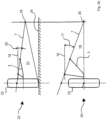
- the functionality of a semi-trailing arm wheel suspension and the relationship between sweep angle 17 and roof angle 18 become even clearer when looking at Fig. 2b .
- the upper part 22 of the Fig. 2b shows a view in the vertical plane 21.
- the wheel 23 stands on the road 24.
- the rocker arm 3 of the semi-trailing arm wheel suspension defines a pivot axis 7 on which an instantaneous pole 25 of the wheel 23 lies.
- the swing arm 3 is tilted in the vertical plane 21 about the roof angle 20.
- the lower part 25 of the Fig. 2b shows a view in the horizontal plane 19, i.e. from above. Also in the lower part of the Fig. 2b the pivot axis 7 is tilted, namely in the horizontal plane 19 by the sweep angle 17 in relation to the vehicle transverse axis 18.
- the sweep angle 17 By increasing the sweep angle 17, the change in camber during compression decreases.
- the roll center increases, and the roll center can be lowered again by changing the roof angle 20.
- by reducing the sweep angle 17 or by increasing the roof angle 20 more favorable braking pitch support can be achieved.
- Fig. 3 shows the wheel suspension 1 with a pneumatic braking device as a second braking device 26. Since the first braking device 11 designed as a brake caliper in Fig. 3 is missing, the brake disc 12 in. is non-rotatably connected to the rotating part of the motor 2 Fig. 3 easier to recognize.
- the interface 27 for the first braking device 11 is in the form of two recesses 28 on an upper side 29 of the rocker arm 3. At the recesses 28 there are two side walls 30 arranged on the wheel side, each with two through holes 31 for fastening means with which the first braking device - for example a brake caliper - can be attached to the top 29 of the rocker arm 3 (in Fig. 3 not shown).
- a second braking device 26 is connected, which is designed as a pneumatic braking device.
- a first braking device in the form of a brake caliper is coupled to the underside 32 of the rocker arm 3 and a second braking device is coupled to the top side 29 of the rocker arm 3, or other configurations with two braking devices on the upper side 29 and the underside 32 of the swing arm 3 (in Fig. 3 not shown).
- a line 33 is indicated, which runs along the rocker arm 3.
- the line 33 can be attached to the rocker arm 3 or arranged in a recess in the rocker arm 3.
- the line 33 runs through the first area 4 and the third area 10 of the rocker arm 3 up to a passage 34.
- the passage 34 runs through the rocker arm 8 and enables the line 33 to be guided into the interior of the wheel hub .
- Fig. 4 In the swing arm 3 lines the swing arm 3 can be seen integrated channels 35, which are arranged in the form of a heat exchanger.
- ribs 36 of the heat exchanger can be provided inside and/or outside the rocker arm, the ribs being in Fig. 4 in particular run within the swing arm 3.
- the ribs 36 can be integrated in particular into the first area 4 of the rocker arm 3, which can be designed as a hollow body with ribs 36 running through it.
- the engine can be cooled (in Fig. 4 not shown). Due to the design of the ribs 36 and lines of the heat exchanger as channels 35 integrated into the rocker arm 3, the variety of parts can be reduced. Furthermore, the heat transfer can take place within the heat exchanger close to the wheel, without coolant having to be conveyed over long distances and the temperature difference required for the operation of the heat exchanger thereby decreasing.
- a wheel suspension 1 in which a vibration sensor is connected to the interface 9 via an adapter 37.
- the vibration sensor is designed as a pneumatic spring-damper device.
- the Adapter 37 is designed as an extension of the rocker arm 3 and runs towards one end 38 in the direction away from the rocker arm.
- An air spring element 39 and a damper element 40 are attached to the end 38 of the adapter 37.
- An additional stabilizer 41 connected to the vehicle dampens vibrations of the rocker arm 3 and is connected to the adapter 37 by means of a stable link 42.
- Fig. 6 shows the assembly Fig. 5 without air suspension element and damper element. It can be seen that the end 38 has a substantially horizontal surface 43 to which the spring element and the damper element of the pneumatic spring-damper device 39, 40 can be coupled.
- Wheel suspension 1 shown has a vibration sensor which is connected to the interface 9 via another adapter 44.
- the swing arm 3 and the interface 9 for connecting the adapters 37, 44 do not need to be changed for this.
- both the interface 9 and the adapters 37, 44 are designed to implement a modular system.
- the vibration sensor is a hydropneumatic spring-damper device 45. With the hydropneumatic spring-damper device 45, rolling movements in curves can be largely eliminated, even without an additional stabilizer. The stiffness and vibration absorption behavior of the hydropneumatic spring-damper device 45 can be adjusted and regulated over a wide range and can therefore be kept constant almost independently of the load of the vehicle.
- the adapter 44 is designed in the form of a plate for mounting the hydropneumatic spring-damper device.
- Fig. 8 without hydropneumatic spring-damper device - it can be seen that the adapter 44, designed as a plate, has at its lower end a bearing fork 46 designed in the form of two elevations, each with bearing points for articulated mounting of the hydropneumatic spring-damper device are trained.
- the adapter 44 designed as a plate can - just like the one previously with reference to Figs. 5 and 6 described adapter 37 - are attached to the interface 9 via screw connections 48, and in the present exemplary embodiment is attached to the interface 9 via four screw connections 48 arranged in a square.
- the exemplary embodiments 37, 44 of the adapters described show how the interface 9 of the rocker arm 3 is suitable for connecting different types of vibration sensors 39, 40, 45.
- the interface 9 of the rocker arm 3 is adapted to attach thereto one of a plurality of different adapters 37, 44, for use with, for example, a pneumatic spring-damper device 39, 40, with a hydropneumatic spring-damper device 45, or can be adapted with electrical, electromechanical or electrohydraulic spring-damper devices. In this way, a modular system is realized.
Landscapes
- Engineering & Computer Science (AREA)
- Mechanical Engineering (AREA)
- General Engineering & Computer Science (AREA)
- Chemical & Material Sciences (AREA)
- Combustion & Propulsion (AREA)
- Transportation (AREA)
- Vehicle Body Suspensions (AREA)
- Arrangement Or Mounting Of Propulsion Units For Vehicles (AREA)
- Axle Suspensions And Sidecars For Cycles (AREA)
Description
- Die Erfindung betrifft eine Radaufhängung, nach dem Oberbegriff des Anspruchs 1, für ein über einen elektrischen oder pneumatischen Motor angetriebenes Rad eines Fahrzeugs, insbesondere Hinterrad eines Nutzfahrzeugs. Beispiele für eine solche Radaufhängung sind aus
US 2003/230443 A1 undDE 20 2017 001665 U1 bekannt.DE 10 2013 000541 A1 offenbart einen Längsarm mit elektrischem Radnabenantrieb, wobei eine Bremsvorrichtung am Motorgehäuse angebracht ist. - Radaufhängungen der in Rede stehenden Art sind seit Jahren aus der Praxis bekannt. Insbesondere für Hinterachsen sind 1-Lenker-Aufhängungen verbreitet, beispielsweise Längslenker- oder Schräglenkeraufhängungen. Bei diesen Aufhängungen ist das Rad über lediglich einen sogenannten Lenker - die Schwinge - schwenkbar am Fahrzeug gelagert. Bei diesen 1-Lenker-Aufhängern können im Betrieb auftretende Längs- und Querkräfte am günstigsten aufgefangen werden, wenn die Schwinge schräg angeordnet ist (Schräglenkeraufhängung) und aufbauseitig zwei Lagerstellen mit großem Abstand zueinander aufweist. Dabei kann eine Schwenkachse der Schwinge in einer horizontalen Ebene schräg zu einer Fahrzeugquerachse verlaufen (Pfeilungswinkel) und in einer horizontalen Ebene schräg zu der Fahrzeugquerachse verlaufen (Dachwinkel). Durch Manipulation des Pfeilungswinkels und/oder des Dachwinkels lässt sich beispielsweise das Wankzentrum, die Spurweitenänderung, die Bremsnickabstützung und die Sturzänderung gezielt manipulieren.
- Begrenzt wird diese Manipulierbarkeit dadurch, dass die linken und rechten Räder einer Achse bei Radaufhängungen nach dem Stand der Technik durch den Antriebsstrang - regelmäßig über ein Differentialgetriebe - miteinander gekoppelt sind. Durch Wechselwirkungen zwischen den Rädern lässt sich das Fahrzeugverhalten nur begrenzt beherrschen.
- Die bekannten 1-Lenker-Aufhängungen und insbesondere Schräglenkeraufhängungen sind in der Regel mit umständlichen Anbindungen für Bremsvorrichtungen versehen, insbesondere um ein Bremsdrehmoment von einer Bremsvorrichtung des Fahrzeugs auf das jeweilige Rad zu übertragen. Herkömmliche Bremsen sind beispielsweise an einer Radträgerplatte angebunden, regelmäßig auch eine Welle des Antriebsstrangs in der Radaufhängung lagern, um das Rad anzutreiben.
- Diese Art der Anbindung von Bremsvorrichtungen an eine Radaufhängung erfordert einen vergleichsweise großen Bauraum, der dann nicht mehr für andere Komponenten des Fahrzeugs nutzbar ist. Außerdem ist das Zusammenspiel der Bremsvorrichtung mit den anderen Elementen der Radaufhängungen kompliziert, empfindlich und schwierig zu kontrollieren.
- Der vorliegenden Erfindung liegt daher die Aufgabe zugrunde, eine Radaufhängung der eingangs genannten Art zu vereinfachen und auf platzsparende Weise auszugestalten und robuster weiterzubilden.
- Erfindungsgemäß wird die voranstehende Aufgabe durch die Merkmale des Anspruches 1 gelöst. Danach ist eine Radaufhängung für ein über einen elektrischen oder pneumatischen Motor angetriebenes Rad eines Fahrzeugs angegeben. Das angetriebene Rad ist insbesondere das Hinterrad eines Nutzfahrzeugs. Dabei kann es sich beispielsweise um Niederflurfahrzeuge wie Stadtbusse und Flughafenbusse, um Doppeldecker, oder um andere Nutzfahrzeuge handeln.
- Die Radaufhängung umfasst eine Schwinge, die in einem ersten Bereich um eine Schwenkachse schwenkbar an dem Fahrzeug gelagert ist, und in einem zweiten Bereich an dem Fahrzeug abgestützt ist. Eine erste Bremsvorrichtung ist in einem dritten Bereich an der Schwinge angebracht.
- In erfindungsgemäßer Weise ist erkannt worden, dass die zugrundeliegende Aufgabe auf überraschend einfache Weise gelöst werden kann. Durch das direkte Anbringen der Bremsvorrichtung an der Schwinge ist die erste Bremsvorrichtung für Wartungs- und Austauscharbeiten leichter zugänglich. Ferner erübrigt sich eine kompliziertere Aufhängung von Bremskomponenten, die bei Radaufhängungen nach dem Stand der Technik an einem separaten Radträgerelement angebunden sind. Das direkte Anbringen der Bremsvorrichtung an der Schwinge spart zudem Bauraum und vereinfacht die Radaufhängung durch den Wegfall eines Radträgerelements.
- Vorzugsweise kann die erste Bremsvorrichtung ein Bremssattel einer Scheibenbremse sein. Hierbei kann es sich um eine pneumatische Scheibenbremse handeln, so wie es bei Nutzfahrzeugen nach dem Stand der Technik üblich ist. Vorzugsweise ist die Scheibenbremse hydraulisch oder hydropneumatisch ausgeführt, allerdings sind auch elektrische, elektromechanische sowie elektrohydraulische Bremsvorrichtungen denkbar.
- Weiter vorzugsweise kann die Schwinge eine Aussparung und/oder eine Materialanhäufung aufweisen, um eine Bremsscheibe der Scheibenbremse wenigstens teilweise zu umschließen. Dadurch kann die Bremsscheibe geschützt werden, beispielsweise vor Steinschlag oder anderen Störeinflüssen auf einer Fahrbahn - wie zum Beispiel Schnee und Eis, Geäst und Gestrüpp, Schlaglöcher und Fahrbahnunebenheiten. Die Bremsscheibe ist vorzugsweise drehfest mit dem drehenden Teil des Motors verbunden, sodass eine auf die Bremsscheibe aufgeprägte Bremskraft direkt ein Bremsdrehmoment auf das Rad überträgt.
- Nach einer Ausführungsform kann der dritte Bereich der Schwinge ferner ausgebildet sein, um eine zweite Bremsvorrichtung daran zu anzubringen. Die zweite Bremsvorrichtung ist vorzugsweise nicht ebenfalls als Bremssattel einer Scheibenbremse ausgebildet, sondern kann auch eine andere Art von Bremsvorrichtung umfassen.
- Insbesondere kann die zweite Bremsvorrichtung eine Parkbremsvorrichtung sein. Dabei kann es sich um eine Feststellbremse handeln, die ebenfalls auf die Bremsscheibe wirken kann.
- Vorzugsweise können die erste Bremsvorrichtung und die zweite Bremsvorrichtung jeweils auf einer Oberseite und einer Unterseite der Schwinge ankoppelbar sein, oder umgekehrt. Beispielsweise kann die erste Bremsvorrichtung als Bremssattel ausgebildet sein, und sich auf der Oberseite der Schwinge befinden. Die als Parkbremsvorrichtung ausbildete zweite Bremsvorrichtung kann auf der Unterseite der Schwinge befestigt sein. Durch eine derartige geschickte Ausgestaltung des dritten Bereichs der Schwinge wird eine zweiseitige "TWO FACE" Bremsanbindung sowohl oben als auch unten an der Schwinge verwirklicht.
- Weiter vorzugsweise kann die erste Bremsvorrichtung und/oder die zweite Bremsvorrichtung über eine Schnittstelle und/oder über einen Bremsadapter an dem dritten Bereich anbringbar sein, um ein Baukastensystem zu verwirklichen. Dabei können unterschiedliche Bremsvorrichtungen beispielsweise über Durchgangsbohrungen oder Gewindebohrungen an Schnittstelle oder Bremsadapter angebunden werden. Das Baukastensystem kann insbesondere modular ausgebildet sein, also mit universellen oder einheitlichen Schnittstellen für die Anbindung verschiedener Bremsvorrichtungen für verschiedene Anwendungsfälle, beispielsweise für die Anwendung in LKW's, Bussen, oder anderen Nutzfahrzeugen.
- In weiteren Ausgestaltungen kann ein dritter Bereich der Schwinge einen gegenüber der Schwinge drehfesten Teil des Motors tragen, um mit einem drehenden Teil des Motors auf das Rad ein Drehmoment zu übertragen.
- Der Motor treibt somit lediglich ein Rad des Fahrzeugs an. Anstelle einer komplizierten Lagerung einer Antriebswelle in der Schwinge ist der Motor direkt mit der Schwinge verbunden. Diese Lösung ist platzsparend, denn ein Antriebsstrang entfällt komplett, so dass im Bodenbereich des Fahrzeugs sehr viel mehr Bauraum für andere Zwecke oder Bauteile zur Verfügung steht, beispielsweise um Batterien im Fahrzeugunterbau unterzubringen. Somit ist einerseits die Energieversorgung des Motors über kurze Zuleitungswege gesichert, andererseits wird der Schwerpunkt des gesamten Fahrzeugs nach unten verlagert. Durch einen tiefen Scherpunkt lassen sich auch elektrisch oder pneumatisch betriebene Nutzfahrzeuge in Leichtbauweise herstellen und noch energiesparender ausbilden.
- Erfindungsgemäß ist der Motor als Radnabenantrieb ausgebildet. Dabei kann es sich um einen getriebelosen permanenterregten Synchronmotor (PMSM) mit Außenläufer handeln, denkbar ist allerdings auch die Verwendung von anderen Antriebskonzepten mit Vorgelegegetrieben oder Planetengetrieben.
- Diese Ausgestaltung des Motors als Radnabenantrieb ist besonders platzsparend, da sowohl der stehende und der drehende Teil des Motors als auch das Rad außenseitig, bzw. radseitig auf der Schwinge sitzen, sodass die gesamte Radaufhängung noch platzsparender ausgeführt ist. Bei der Verwendung der Radaufhängung in Stadtbussen oder Flughafenbussen wird somit nicht nur eine noch niedrigere und noch fahrgastfreundlichere Niederflurbauweise ermöglicht. Vielmehr lässt sich durch Wegfall der Vorgelegegetriebe zudem eine größere Durchgangsbreite zwischen zwei Radaufhängungen einer Achse, beispielsweise der Hinterachse, realisieren. Das Fahrzeug wäre somit auf seiner gesamten Länge für beispielsweise Kinderwägen oder Rollstühle nutzbar.
- Ferner lassen sich auch bereits im Betrieb befindliche Fahrzeuge, die mit herkömmlichen Antriebssträngen und einer 1-Lenker- Aufhängung versehen sind, mit einer erfindungsgemäßen Radaufhängung einfach und kostengünstig auf einen Elektroantrieb beziehungsweise auf einen pneumatischen Antrieb umrüsten.
- Die dafür benötigten Batterien lassen sich dann beispielsweise im anstelle des Antriebsstrangs im Fahrzeugunterbau, oder dort, wo sich zuvor der Verbrennungsmotor befunden hat, unterbringen und je nach Art des Nutzfahrzeugs anforderungsgerecht dimensionieren, um eine erforderliche Reichweite des Nutzfahrzeugs gewährleisten zu können.
- Durch das Wegfallen der Elemente des Antriebsstrangs lassen sich trotz elektrischem oder pneumatischen Motor die radgefederten Massen reduzieren. Die Räder federn durch die jeweilige Radaufhängung vollkommen unabhängig voneinander ein, und lassen sich durch den jeweiligen Motor vollkommen unabhängig voneinander ansteuern und bewegen, so dass das Schwingungsverhalten des Fahrzeugs verbessert werden kann.
- Erfindungsgemäß ist die Schwinge eine Schräglenkerschwinge. Durch entsprechende Dimensionierung sind Schräglenkerradaufhängungen in der Lage, die beim Fahren auftretenden Längs- und Querkräfte besonders vorteilhaft aufzunehmen und die Fahrwerkskinematik zu verbessern.
- Vorzugsweise ist die Schwinge mit einem Pfeilungswinkel der in einem ersten Winkelbereich zwischen 10° und 25° liegt und mit einem Dachwinkel, der in einem zweiten Bereich zwischen 0° und 5° liegt. In diesen Winkelbereichen führt die Verwendung von Schräglenkeraufhängungen zu einem besonders geringen Reifenverschleiß und einem vorteilhaften Wankverhalten.
- Weiter vorzugsweise kann der erste Bereich der Schwinge als Hohlkörper ausgebildet sein. Somit lässt sich der Schräglenker unter Einsatz der Gusstechnologie herstellen. Möglich ist jedoch auch die Herstellung mit Blechteilen und durch Schweißen oder mittels 3D-Druck der Schwinge. Die Schwinge kann aus Metall, vorzugsweise aus Stahl- oder Eisenguss bestehen, wobei auch Ausgestaltungen unter Einsatz von Aluminium, faserverstärkten Kunststoffen (FVK) oder ähnlichen Werkstoffen denkbar sind. Vorzugsweise kann die Schwinge innerhalb des vorderen Bereich eine Gitter- oder Rippenstruktur aufweisen, was die Stabilität der Schwinge steigert. Der dritte Bereich kann in Vollmaterial ausgebildet sein. Der zweite Bereich kann je nach Anwendungsfall in Vollmaterial oder als Hohlkörper, gegebenenfalls mit einer Gitter- oder Rippenstruktur, ausgebildet sein. Somit lässt sich beispielsweise eine Gewichtsreduktion erreichen. In einer Ausführungsform kann der zweite Bereich gleich dem dritten Bereich sein.
- Vorzugsweise kann die Lagerung der Schwinge am Fahrzeug mittels zweier Gummilager im ersten Bereich der Schwinge ausgebildet sein. Die Lagerung kann über einen Hilfsrahmen beziehungsweise einen Fahrschemel, erfolgen. Zudem kann die Lagerung der Schwinge über eine Drehstabfeder erfolgen.
- Schließlich kann die Schwinge in dem zweiten Bereich über einen Schwingungsaufnehmer an dem Fahrzeug abgestützt sein. Hierbei kann die Schwinge insbesondere eine Schnittstelle zur Anbindung von unterschiedlichen Arten von Schwingungsaufnehmern aufweisen.
- Auf diese Weise lassen sich je nach Anwendungsfall unterschiedliche Arten von Schwingungsaufnehmen flexibel in die Radaufhängung integrieren. Dies kann insbesondere von der Art des Fahrzeugs oder Nutzfahrzeugs abhängig sein. Der jeweilige Schwingungsaufnehmer kann somit individuell kompatibel für einzelne Fahrzeugklassen oder Fahrzeugtypen ausgewählt und einheitlich über die Schnittstelle angebunden werden. Durch das Schaffen einer universellen Schnittstelle ist die Radaufhängung ferner für zukünftige Technologien nachrüstbar. Auch die Reparatur und der Austausch von Schwingungsaufnehmern wird vereinfacht, so dass die Lebensdauer der Radaufhängung steigt. Auch die Komplexität und die Kosten der Herstellung sinken mit der Vielfalt an Teilen, die für verschiedene Baureihen konstruiert und vorgehalten werden müssen.
- Es gibt nun verschiedene Möglichkeiten, die Lehre der vorliegenden Erfindung in vorteilhafter Weise auszugestalten und weiterzubilden. Dazu ist einerseits auf die dem Anspruch 1 nachgeordneten Ansprüche und andererseits auf die nachfolgende Erläuterung bevorzugter Ausführungsbeispiele der Erfindung anhand der Zeichnung zu verweisen. In Verbindung mit der Erläuterung der bevorzugten Ausführungsbeispiele der Erfindung anhand der Zeichnung werden auch im Allgemeinen bevorzugte Ausgestaltungen und Weiterbildungen der Lehre erläutert. In der Zeichnung zeigen
- Fig. 1
- eine perspektivische Ansicht einer erfindungsgemäßen Radaufhängung mit einem Motor,
- Fig. 2
- eine perspektivische Ansicht einer erfindungsgemäßen Radaufhängung ohne Motor,
- Fig. 3
- eine perspektivische Ansicht einer erfindungsgemäßen Radaufhängung mit Motor und ohne Bremssattel,
- Fig. 4
- eine perspektivische Ansicht einer erfindungsgemäßen Radaufhängung ohne Motor und ohne Bremssattel,
- Fig. 5
- eine perspektivische Ansicht einer erfindungsgemäßen Radaufhängung mit einer pneumatischen Federdämpfervorrichtung,
- Fig. 6
- eine perspektivische Ansicht einer erfindungsgemäßen Radaufhängung mit einem Adapter für eine pneumatische Federdämpfervorrichtung,
- Fig. 7
- eine perspektivische Ansicht einer erfindungsgemäßen Radaufhängung mit einer hydropneumatischen Federdämpfervorrichtung, und
- Fig. 8
- eine perspektivische Ansicht einer erfindungsgemäßen Radaufhängung mit einem Adapter für eine hydropneumatische Federdämpfervorrichtung.
-
Fig. 1 zeigt eine Radaufhängung 1 für ein Rad eines Fahrzeugs, insbesondere für ein Hinterrad eines Nutzfahrzeugs (nicht dargestellt). Das Rad des Fahrzeugs ist über einen elektrischen Motor 2 in Gestalt eines Radnabenantriebs angetrieben. Ferner ist eine Schwinge 3 zu abgebildet. Die Schwinge 3 hat einen ersten Bereich 4. Die Schwinge 3 ist in dem ersten Bereich 4 an dem Fahrzeug (inFig. 1 nicht dargestellt) gelagert. Hierfür sind im ersten Bereich 4 zwei Durchgangsbohrungen 5, 6 vorgesehen, die eine Schwenkachse 7 der Schwinge 3 definieren. Ein zweiter Bereich 8 der Schwinge 3 dient zur Abstützung der Schwinge 3 am Fahrzeug. Für diesen Zweck ist am zweiten Bereich 8 eine Schnittstelle 9 in Gestalt einer äußeren Stirnfläche am zweiten Bereich 8 ausgebildet. Ferner ist ein dritter Bereich 10 zu sehen, der einen drehfesten Teil des Motors 2 trägt. Die Schwinge 3 ist ein aus Metall gefertigtes Gussteil, wobei der erste Bereich 4 der Schwinge 3 als Hohlkörper ausgebildet ist. Der zweite Bereich 8 und der dritte Bereich 10 der Schwinge 3 sind in Vollmaterial ausgebildet. Beim Ausführungsbeispiel nachFig. 1 ist der dritte Bereich 10 zentral zwischen dem ersten Bereich 4 und dem zweiten Bereich 8 angeordnet. Aufgrund der Hebelwirkung der Schwinge 3 führt diese Ausgestaltung zu einer geringeren Belastung der Radaufhängung 1 und ist somit kinematisch vorteilhaft. Allerdings könnte ebenso der zweite Bereich 8 zwischen dem ersten Bereich 4 und dem dritten Bereich 10 angeordnet sein. - Der drehfeste Teil des Motors 2 wird von dem dritten Bereich 10 der Schwinge 3 insbesondere drehfest getragen. Hierzu umfasst der dritte Bereich 10 eine nach außen gerichtete kegelförmige Fläche (in
Fig. 1 nicht zu sehen), auf die der drehfeste Teil des Motors 2 aufgepresst ist. Somit kann der drehfeste Teil des Motors 1 mit einem drehenden Teil des Motors 2 zusammenwirken, um auf das Rad ein Drehmoment zu übertragen, wobei das Rad seinerseits drehfest mit dem drehenden Teil des Motors 2 verbunden ist. - Am dritten Bereich 10 der Schwinge 3 ist ferner eine erste Bremsvorrichtung 11 angebracht. Die erste Bremsvorrichtung 11 ist in Gestalt eines Bremssattels für eine Scheibenbremse ausgestaltet und über Schraubverbindungen (in
Fig. 1 nicht zu sehen) an der Schwinge 3 fixiert. Der Bremssattel wirkt mit einer Bremsscheibe 12 zusammen, die drehfest mit dem drehenden Teil des Motors 2 verbunden ist. Außerdem sind an der Schwinge 3 Materialanhäufungen 13 zu erkennen, die die Bremsscheibe 12 zumindest in teilweise umschließen und somit vor mechanischen Störeinflüssen schützen. - Zudem ist am dritten Bereich 10 auch ein Bremsadapter 14 für eine zweite Bremsvorrichtung (in
Fig. 1 nicht dargestellt) angebracht, insbesondere für eine Parkbremseinrichtung in Gestalt einer Feststellbremse. Es lassen sich verschiedenartige Bremsadapter 14 für verschiedenartige Bremsvorrichtungen an der Schwinge 3 anbringen. - Die Schnittstelle 9 dient zur Abstützung der Schwinge 3 am Fahrzeug beziehungsweise zur Anbindung von unterschiedlichen Arten von Schwingungsaufnehmern (in
Fig. 1 nicht dargestellt). Die Schnittstelle 9 ist als eine von dem ersten Bereich 10 weg zeigende Stirnfläche der Schwinge 3 ausgebildet und umfasst Bohrungen 15 für Befestigungselemente (inFig. 1 nicht dargestellt), um Schwingungsaufnehmer oder Adapter (inFig. 1 nicht dargestellt) an der Schnittstelle 9 anzubringen. Auf der Stirnfläche ist beispielhaft eine Aussparung 16 dargestellt, um beispielsweise den Adapter auszurichten und Kräfte zwischen dem Adapter und der Schnittstelle übertragen. InFig. 1 ist die Aussparung 16 in Gestalt einer rechteckigen Vertiefung ausgebildet, wobei je nach Anwendungsfall andere zweckmäßige Ausgestaltungen von Vertiefungen oder Materialhäufungen einerseits auf der Schnittstelle 9 mit entsprechend dazu passenden Materialhäufungen oder Vertiefungen auf dem Adapter möglich sind. - Nunmehr bezugnehmend auf
Fig. 2a ist die Schwinge 3 als Schräglenkerschwinge für eine Schräglenkerradaufhängung ausgebildet. Hierbei ist die Schwinge 3 mit einem Pfeilungswinkel 17 angeordnet, der in einem ersten Winkelbereich zwischen 10° und 25° liegt. Der Pfeilungswinkel 17 ist der Winkel zwischen der Schwenkachse 7 und einer Fahrzeugquerachse 18 in einer horizontalen Ebene 19. Ferner ist die Schwinge 3 mit einem Dachwinkel 20 angeordnet, der in einem zweiten Winkelbereich zwischen 0° und 5° liegt. Der Dachwinkel 12 ist der Winkel zwischen der Schwenkachse 7 und der Fahrzeugquerachse 18 in einer vertikalen Ebene 21. - Die schräge Aufhängung - also die Lagerung der Schwinge 3 am Fahrzeug - erfolgt dabei an den Durchgangsbohrungen 5, 6 mittels zweier Gummilager (nicht dargestellt) im ersten Bereich 4 der Schwinge 3. Die Gummilager sind entweder direkt mit einer Aufnahme am Rahmen des Fahrzeugs befestigt oder zur Optimierung des Fahrkomforts an einem Hilfsrahmen gelagert. Ferner kann entlang der Schwenkachse 7 eine Drehstabfeder zur weiteren Federung zwischen mindestens einem der Gummilager und dem Rahmen oder Hilfsrahmen angebracht sein (nicht dargestellt).
- Noch deutlicher wird die Funktionsweise einer Schräglenkerradaufhängung sowie das Verhältnis zwischen Pfeilungswinkel 17 und Dachwinkel 18 bei Betrachtung von
Fig. 2b . Der obere Teil 22 derFig. 2b zeigt eine Ansicht in der vertikalen Ebene 21. Das Rad 23 steht auf der Fahrbahn 24. Die Schwinge 3 der Schräglenkerradaufhängung definiert eine Schwenkachse 7, auf der ein Momentanpol 25 des Rads 23 liegt. Die Schwinge 3 ist in der vertikalen Ebene 21 um den Dachwinkel 20 gekippt. - Der untere Teil 25 der
Fig. 2b zeigt eine Ansicht in der horizontalen Ebene 19, also von oben. Auch im unteren Teil derFig. 2b ist die Schwenkachse 7 gekippt, nämlich in der horizontalen Ebene 19 um den Pfeilungswinkel 17 in Bezug auf diee Fahrzeugquerachse 18. Durch Vergrößern des Pfeilungswinkels 17 sinkt die Sturzänderung beim Einfedern. Ferner erhöht sich das Wankzentrum, wobei das Wankzentrum durch eine Änderung des Dachwinkels 20 wieder abgesenkt werden kann. Durch Verkleinern des Pfeilungswinkels 17 oder durch Vergrößern des Dachwinkels 20 hingegen lässt sich eine günstigere Bremsnickabstützung erreichen. -
Fig. 3 zeigt die Radaufhängung 1 mit einer pneumatischen Bremsvorrichtung als zweite Bremsvorrichtung 26. Da die als Bremssattel ausgebildete erste Bremsvorrichtung 11 inFig. 3 fehlt, ist die mit dem drehenden Teil des Motors 2 drehfest verbundene Bremsscheibe 12 inFig. 3 besser zu erkennen. Die Schnittstelle 27 für die erste Bremsvorrichtung 11 ist in Gestalt von zwei Aussparungen 28 auf einer Oberseite 29 der Schwinge 3 ausgebildet. An den Aussparungen 28 befinden sich zwei radseitig angeordnete Seitenwände 30 mit jeweils zwei Durchgangsbohrungen 31 für Befestigungsmittel, mit denen die erste Bremsvorrichtung - beispielsweise ein Bremssattel - an der Oberseite 29 der Schwinge 3 befestigt werden kann (inFig. 3 nicht dargestellt). Auf einer Unterseite 32 der Schwinge 3 ist anstelle eines Bremsadapters (inFig. 3 nicht dargestellt) eine zweite Bremsvorrichtung 26 angebunden, die als pneumatische Bremsvorrichtung ausgebildet ist. Denkbar ist jedoch auch der umgekehrte Fall, bei dem eine erste Bremsvorrichtung in Gestalt eines Bremssattels auf der Unterseite 32 der Schwinge 3 angekoppelt ist und eine zweite Bremsvorrichtung auf der Oberseite 29 der Schwinge 3 angekoppelt ist, oder andere Ausgestaltungen mit zwei Bremsvorrichtungen auf der Oberseite 29 und der Unterseite 32 der Schwinge 3 (inFig. 3 nicht dargestellt). - In
Fig. 4 ist eine Leitung 33 angedeutet, die entlang der Schwinge 3 verläuft. Die Leitung 33 kann an der Schwinge 3 befestigt oder in einer Aussparung der Schwinge 3 angeordnet sein. Im vorliegenden Ausführungsbeispiel verläuft ist die Leitung 33 durch den ersten Bereich 4 und den dritten Bereich 10 der Schwinge 3 bis hin zu einem Durchgang 34. Der Durchgang 34 verläuft durch die Schwinge 8 und ermöglicht eine Führung der Leitung 33 bis hinein in ein Inneres der Radnabe. - Ferner sind in
Fig. 4 in der Schwinge 3 Leitungen die Schwinge 3 integrierte Kanäle 35 zu sehen, die in Gestalt eines Wärmetauschers angeordnet sind. Hierbei können innerhalb und/oder außerhalb der Schwinge Rippen 36 des Wärmetausches vorgesehen sein, wobei die Rippen inFig. 4 insbesondere innerhalb der Schwinge 3 verlaufen. Die Rippen 36 lassen sich insbesondere in den ersten Bereich 4 der Schwinge 3 integrieren, der als mit Rippen 36 durchzogener Hohlkörper ausgestaltet werden kann. - Mit einem solchen Wärmetauscher lässt sich die Kühlung des Motors (in
Fig. 4 nicht dargestellt) optimieren. Aufgrund der Ausbildung der Rippen 36 und Leitungen des Wärmetauschers als in die Schwinge 3 integrierte Kanäle 35 kann die Teilevielfalt gesenkt werden. Weiterhin kann die Wärmeübertragung innerhalb des Wärmetauschers nah am Rad stattfinden, ohne dass Kühlmittel über lange Strecken hinweg gefördert werden muss und der für den Betrieb des Wärmetauschers erforderliche Temperaturunterschied dadurch absinkt. - In
Fig. 5 ist eine Radaufhängung 1 zu sehen, bei der ein Schwingungsaufnehmer über einen Adapter 37 an der Schnittstelle 9 angebunden ist. Der Schwingungsaufnehmer ist als eine pneumatische Feder-Dämpfer-Vorrichtung ausgebildet. Der Adapter 37 ist als eine Verlängerung der Schwinge 3 ausgebildet und läuft in Richtung weg von der Schwinge zu einem Ende 38 hin zu. An dem Ende 38 des Adapters 37 ist ein Luftfederelement 39 und ein Dämpferelement 40 befestigt. Ein zusätzlicher mit dem Fahrzeug verbundener Stabilisator 41 dämpft Schwingungen der Schwinge 3 und wird mittels eines Stabilenkers 42 mit dem Adapter 37 verbunden. -
Fig. 6 zeigt die Baugruppe ausFig. 5 ohne Luftfederelement und Dämpferelement. Es ist zu sehen, dass das Ende 38 eine im Wesentlichen horizontale Fläche 43 aufweist, an der das Federelement und das Dämpferelement der pneumatischen Feder-Dämpfer-Vorrichtung 39, 40 ankoppelbar sind. - Die in
Fig. 7 dargestellte Radaufhängung 1 weist einen Schwingungsaufnehmer auf, der über einen anderen Adapter 44 an der Schnittstelle 9 angebunden ist. Die Schwinge 3 sowie die Schnittstelle 9 für die Anbindung der Adapter 37, 44 muss hierfür nicht verändert werden. Auf diese Weise sind sowohl die Schnittstelle 9 als auch die Adapter 37, 44 ausgebildet, um ein Baukastensystem zu verwirklichen. Der Schwingungsaufnehmer ist eine hydropneumatische Feder-Dämpfer-Vorrichtung 45. Mit der hydropneumatischen Feder-Dämpfer-Vorrichtung 45 lassen sich Wankbewegungen in Kurven auch ohne einen zusätzlichen Stabilisator weitestgehend eliminieren. Steifigkeit und Schwingungsaufnahmeverhalten der hydropneumatischen Feder-Dämpfer-Vorrichtung 45 sind über einen großen Bereich einstell- und regelbar und lassen sich damit nahezu unabhängig von der Beladung des Fahrzeugs konstant halten. Zur Anbindung der hydropneumatischen Feder-Dämpfer-Vorrichtung 45 ist der Adapter 44 in Gestalt eines Plättchens zur Lagerung der hydropneumatische Feder-Dämpfer-Vorrichtung ausgebildet. - In
Fig. 8 - ohne hydropneumatische Feder-Dämpfer-Vorrichtung - ist zu sehen, dass der als Plättchen ausgebildete Adapter 44 an seinem unteren Ende eine in Gestalt zweier Erhöhungen ausgebildete Lagergabel 46 aufweist, die jeweils mit Lagerpunkten für eine gelenkige Lagerung der der hydropneumatische Feder-Dämpfer-Vorrichtung ausgebildet sind. Der als Plättchen ausgebildete Adapter 44 kann - ebenso wie der zuvor unter Bezugnahme auf dieFign. 5 und 6 beschriebene Adapter 37 - über Schraubverbindungen 48 an der Schnittstelle 9 befestigt werden, und ist im vorliegenden Ausführungsbeispiel über vier in einem Viereck angeordnete Schraubenverbindungen 48 an der Schnittstelle 9 befestigt. - Die in Verbindung mit den
Fign. 5 bis 8 beschriebenen beispielhaften Ausgestaltungen 37, 44 der Adapter zeigen auf, wie sich die Schnittstelle 9 der Schwinge 3 zur Anbindung unterschiedlicher Arten von Schwingungsaufnehmern 39, 40, 45 eignet. Die Schnittstelle 9 der Schwinge 3 ist angepasst, um daran einen von einer Mehrzahl von sich unterscheidenden Adaptern 37, 44 zu befestigen, die beispielsweise für die Verwendung mit einer pneumatischen Feder-Dämpfer-Vorrichtung 39, 40, mit einer hydropneumatischen Feder-Dämpfer-Vorrichtung 45, oder mit elektrischen, elektromechanischen oder elektrohydraulischen Feder-Dämpfer-Vorrichtungen angepasst sein können. Auf diese Weise ist ein Baukastensystem verwirklicht. - Hinsichtlich weiterer vorteilhafter Ausgestaltungen der erfindungsgemäßen Vorrichtung wird zur Vermeidung von Wiederholungen auf den allgemeinen Teil der Beschreibung sowie auf die beigefügten Ansprüche verwiesen.
- Schließlich sei ausdrücklich darauf hingewiesen, dass die voranstehend beschriebenen Ausführungsbeispiele der erfindungsgemäßen Vorrichtung lediglich zur Erörterung der beanspruchten Lehre dienen, diese jedoch nicht auf die Ausführungsbeispiele einschränken.
-
- 1
- Radaufhängung
- 2
- Motor
- 3
- Schwinge
- 4
- Erster Bereich
- 5
- Durchgangsbohrung
- 6
- Durchgangsbohrung
- 7
- Schwenkachse
- 8
- Zweiter Bereich
- 9
- Schnittstelle (Schwingungsaufnehmer)
- 10
- Dritter Bereich
- 11
- Erste Bremsvorrichtung
- 12
- Bremsscheibe
- 13
- Materialanhäufungen
- 14
- Bremsadapter
- 15
- Bohrungen
- 16
- Aussparung (Adapter)
- 17
- Pfeilungswinkel
- 18
- Fahrzeugquerachse
- 19
- Horizontale Ebene
- 20
- Dachwinkel
- 21
- Vertikale Ebene
- 22
- Oberer Teil von
Fig. 2b - 23
- Rad
- 24
- Fahrbahn
- 25
- Unterer Teil von
Fig. 2b - 26
- Zweite Bremsvorrichtung
- 27
- Schnittstelle (erste Bremsvorrichtung)
- 28
- Aussparung (erste Bremsvorrichtung)
- 29
- Oberseite
- 30
- Seitenwand
- 31
- Durchgangsbohrung
- 32
- Unterseite
- 33
- Leitung
- 34
- Durchgang
- 35
- Integrierte Kanäle
- 36
- Rippen
- 37
- Adapter (pneumatischer Schwingungsaufnehmer)
- 38
- Ende
- 39
- Luftfederelement
- 40
- Dämpferelement
- 41
- Stabilisator
- 42
- Stabilenker
- 43
- Horizontale Fläche
- 44
- Adapter (hydropneumatischer Schwingungsaufnehmer)
- 45
- Hydropneumatische Feder-Dämpfer-Vorrichtung
- 46
- Lagergabel
- 47
- Lagerpunkt
- 48
- Schraubverbindungen
Claims (11)
- Schräglenkerradaufhängung (1) für ein über einen elektrischen oder pneumatischen Motor (2) angetriebenes Rad (23) eines Fahrzeugs, insbesondere Hinterrad eines Nutzfahrzeugs, miteinem elektrischen oder pneumatischen Motor (2), undeiner Schräglenkerschwinge (3), die in einem ersten Bereich (4) an dem Fahrzeug gelagert ist, und in einem zweiten Bereich (8) an dem Fahrzeug abgestützt ist, undeiner ersten Bremsvorrichtung (11),wobei der Motor (2) als Radnabenantrieb ausgebildet ist,dadurch gekennzeichnet, dass die Bremsvorrichtung (11) in einem dritten Bereich (10) direkt an der Schräglenkerschwinge (3) angebracht ist.
- Schräglenkerradaufhängung (1) nach Anspruch 1, dadurch gekennzeichnet, dass die erste Bremsvorrichtung (11) ein Bremssattel einer Scheibenbremse ist.
- Schräglenkerradaufhängung (1) nach Anspruch 2, gekennzeichnet durch eine Aussparung (28) und/oder eine Materialanhäufung an der Schräglenkerschwinge (3), um eine Bremsscheibe (12) der Scheibenbremse wenigstens teilweise zu umschließen.
- Schräglenkerradaufhängung (1) nach Anspruch 2 oder 3, dadurch gekennzeichnet, dass der dritte Bereich (10) der Schräglenkerschwinge (3) ferner ausgebildet ist, um eine zweite Bremsvorrichtung (26) daran zu anzubringen.
- Schräglenkerradaufhängung (1) nach Anspruch 4, dadurch gekennzeichnet, dass die zweite Bremsvorrichtung (26) eine Parkbremsvorrichtung ist.
- Schräglenkerradaufhängung (1) nach Anspruch 4 oder 5, dadurch gekennzeichnet, dass die erste Bremsvorrichtung (11) und die zweite Bremsvorrichtung (26) jeweils auf einer Oberseite (29) und einer Unterseite (32) der Schräglenkerschwinge (3) ankoppelbar sind, oder umgekehrt.
- Schräglenkerradaufhängung (1) nach einem der Ansprüche 1 bis 6, dadurch gekennzeichnet, dass der dritte Bereich (10) der Schräglenkerschwinge (3) einen gegenüber der Schräglenkerschwinge (3) drehfesten Teil des Motors (2) trägt, um mit einem drehenden Teil des Motors (2) auf das Rad ein Drehmoment zu übertragen.
- Schräglenkerradaufhängung (1) nach einem der Ansprüche 1 bis 7, dadurch gekennzeichnet, dass die Schräglenkerschwinge (3) mit einem Pfeilungswinkel (17) angeordnet ist, der in einem ersten Winkelbereich zwischen 10° und 25° liegt, und mit einem Dachwinkel (20) angeordnet ist, der in einem zweiten Winkelbereich zwischen 0° und 5° liegt.
- Schräglenkerradaufhängung (1) nach einem der Ansprüche 1 bis 8, dadurch gekennzeichnet, dass der erste Bereich (4) der Schräglenkerschwinge (3) als Hohlkörper ausgebildet ist und der dritte Bereich (10) der Schwinge (3) in Vollmaterial ausgebildet ist, und die Schräglenkerschwinge (3) aus Metall, vorzugsweise als Gussteil gefertigt ist.
- Schräglenkerradaufhängung (1) nach einem der Ansprüche 1 bis 9, dadurch gekennzeichnet, dass die Lagerung der Schräglenkerschwinge am Fahrzeug mittels zweier Gummilager im ersten Bereich (4) der Schräglenkerschwinge (3) ausgebildet ist, die direkt oder über einen Hilfsrahmen an der Karosserie gelagert sind, vorzugsweise über eine Drehstabfeder.
- Schräglenkerradaufhängung (1) nach einem der Ansprüche 1 bis 10, dadurch gekennzeichnet, dass die Schräglenkerschwinge in dem zweiten Bereich über einen Schwingungsaufnehmer (39, 40, 45), insbesondere eine Feder-Dämpfer-Vorrichtung, an dem Fahrzeug abgestützt ist und die Schräglenkerschwinge (3) vorzugsweise eine Schnittstelle (9) zur Anbindung von unterschiedlichen Arten von Schwingungsaufnehmern (39, 40, 45) aufweist.
Applications Claiming Priority (3)
| Application Number | Priority Date | Filing Date | Title |
|---|---|---|---|
| DE102018215532 | 2018-09-12 | ||
| DE102018217347.8A DE102018217347A1 (de) | 2018-09-12 | 2018-10-10 | Radaufhängung und Schwinge für ein über einen elektrischen oder pneumatischen Motor angetriebenes Rad |
| PCT/DE2019/200093 WO2020052717A2 (de) | 2018-09-12 | 2019-07-31 | Radaufhängung und schwinge für ein über einen elektrischen oder pneumatischen motor angetriebenes rad |
Publications (2)
| Publication Number | Publication Date |
|---|---|
| EP3849829A2 EP3849829A2 (de) | 2021-07-21 |
| EP3849829B1 true EP3849829B1 (de) | 2023-10-11 |
Family
ID=69621203
Family Applications (1)
| Application Number | Title | Priority Date | Filing Date |
|---|---|---|---|
| EP19765168.0A Active EP3849829B1 (de) | 2018-09-12 | 2019-07-31 | Schräglenkerradaufhängung für ein über einen elektrischen oder pneumatischen motor angetriebenes rad |
Country Status (5)
| Country | Link |
|---|---|
| EP (1) | EP3849829B1 (de) |
| DE (1) | DE102018217347A1 (de) |
| ES (1) | ES2964098T3 (de) |
| PL (1) | PL3849829T3 (de) |
| WO (1) | WO2020052717A2 (de) |
Family Cites Families (12)
| Publication number | Priority date | Publication date | Assignee | Title |
|---|---|---|---|---|
| DE1675276A1 (de) * | 1968-01-29 | 1971-01-21 | Klaue Hermann | Fluessigkeitsgekuehlte Bremse,insbesondere fuer schwere Kraftfahrzeuge |
| DE4336654A1 (de) * | 1993-10-27 | 1995-05-04 | Zahnradfabrik Friedrichshafen | Radaufhängung |
| JP3848525B2 (ja) * | 2000-09-08 | 2006-11-22 | 本田技研工業株式会社 | 自動二輪車の制動装置 |
| WO2003057529A2 (en) * | 2002-01-08 | 2003-07-17 | Hypercar, Inc. | Advanced composite hybrid-electric vehicle |
| JP4568569B2 (ja) * | 2004-09-30 | 2010-10-27 | 本田技研工業株式会社 | パーキングブレーキ装置 |
| US7686315B2 (en) * | 2006-08-29 | 2010-03-30 | Arvinmeritor Technology, Llc | Wheel drive motor and trailing arm suspension |
| KR101278914B1 (ko) * | 2012-01-09 | 2013-06-26 | 주식회사 만도 | 인휠 모터 시스템의 장착 구조체 |
| DE102013210142A1 (de) * | 2013-05-31 | 2014-12-04 | Saf-Holland Gmbh | Lenkereinheit |
| DE102013214737A1 (de) * | 2013-07-29 | 2015-01-29 | Saf-Holland Gmbh | Lenkereinheit |
| DE102015213356A1 (de) * | 2015-07-16 | 2017-01-19 | Zf Friedrichshafen Ag | Antreibbare Verbundlenkerachse eines Fahrzeuges mit zwei Längslenkern |
| DE102015218793A1 (de) * | 2015-09-29 | 2017-03-30 | Bayerische Motoren Werke Aktiengesellschaft | Radaufhängung |
| DE202017001665U1 (de) * | 2017-03-29 | 2018-07-02 | Deutsches Zentrum für Luft- und Raumfahrt e.V. | Fahrwerksbauteil und Kraftfahrzeug |
-
2018
- 2018-10-10 DE DE102018217347.8A patent/DE102018217347A1/de active Pending
-
2019
- 2019-07-31 ES ES19765168T patent/ES2964098T3/es active Active
- 2019-07-31 EP EP19765168.0A patent/EP3849829B1/de active Active
- 2019-07-31 WO PCT/DE2019/200093 patent/WO2020052717A2/de not_active Ceased
- 2019-07-31 PL PL19765168.0T patent/PL3849829T3/pl unknown
Also Published As
| Publication number | Publication date |
|---|---|
| WO2020052717A3 (de) | 2020-05-14 |
| DE102018217347A1 (de) | 2020-03-12 |
| WO2020052717A2 (de) | 2020-03-19 |
| PL3849829T3 (pl) | 2024-03-18 |
| EP3849829A2 (de) | 2021-07-21 |
| ES2964098T3 (es) | 2024-04-04 |
Similar Documents
| Publication | Publication Date | Title |
|---|---|---|
| EP3849828B1 (de) | Radaufhängung und schwinge für ein über einen elektrischen oder pneumatischen motor angetriebenes rad | |
| EP2060416B1 (de) | Verstellvorrichtung für Radaufhängungen | |
| EP2576247A2 (de) | Einzelradaufhängung für ein gefedertes, lenkbares rad | |
| EP3452310B1 (de) | Einzelradaufhängung eines fahrzeugs mit einem radführenden blattfederelement aus einem faserverbund-werkstoff | |
| DE3342355A1 (de) | Fahrzeugaufhaengung | |
| EP3257691A1 (de) | Nutzfahrzeugfahrwerks-tragwerk und nutzfahrzeugfahrwerk | |
| DE19619189A1 (de) | Einzelradaufhängung für ein luftgefedertes, lenkbares Rad eines Omnibusses oder Lastkraftwagen | |
| EP2780182B1 (de) | Starrachse mit luftfederung | |
| WO2024074520A1 (de) | Radaufhängung für ein fahrzeugrad eines kraftwagens sowie kraftwagen | |
| EP3849830B1 (de) | Schräglenkerradaufhängung für ein über einen elektrischen oder pneumatischen motor angetriebenes rad | |
| EP3849829B1 (de) | Schräglenkerradaufhängung für ein über einen elektrischen oder pneumatischen motor angetriebenes rad | |
| WO2008089973A1 (de) | Einzelrad-aufhängung eines zweispur-fahrzeugs mit einem führungsbahnelement | |
| EP0871581B1 (de) | Zweiachsiges schienenfahrzeug-drehgestell | |
| EP1343644B1 (de) | Zweiwegefahrzeug zur durchführung von gleisoberbauarbeiten | |
| DE10218380A1 (de) | Einzelradaufhängung für Fahrzeuge, Anhänger oder landwirtschaftliche Geräte | |
| WO2024110110A1 (de) | Radaufhängung für ein kraftfahrzeug sowie entsprechendes kraftfahrzeug | |
| EP4335668A1 (de) | Achskonstruktion für ein nutzfahrzeug-fahrwerk mit einer als gussteil ausgeführten achsbrücke | |
| DE102021002349B4 (de) | Starres Nutzfahrzeugfahrwerk für Anhänger | |
| WO2024052477A1 (de) | Achskonstruktion für ein nutzfahrzeug-fahrwerk mit einer achsbrücke | |
| EP3148824B1 (de) | Achsanordnung | |
| WO2019096580A1 (de) | Einzelradantriebseinrichtung für ein kraftfahrzeug sowie entsprechendes kraftfahrzeug | |
| DE19537573C2 (de) | Allrad-Kfz | |
| DE202015102551U1 (de) | Achsanordnung | |
| DD152513A5 (de) | Achsanlenkung fuer eine angetriebene achse eines strassenfahrzeugs | |
| EP4253104A1 (de) | Radaufhängungsvorrichtung |
Legal Events
| Date | Code | Title | Description |
|---|---|---|---|
| STAA | Information on the status of an ep patent application or granted ep patent |
Free format text: STATUS: UNKNOWN |
|
| STAA | Information on the status of an ep patent application or granted ep patent |
Free format text: STATUS: THE INTERNATIONAL PUBLICATION HAS BEEN MADE |
|
| PUAI | Public reference made under article 153(3) epc to a published international application that has entered the european phase |
Free format text: ORIGINAL CODE: 0009012 |
|
| STAA | Information on the status of an ep patent application or granted ep patent |
Free format text: STATUS: REQUEST FOR EXAMINATION WAS MADE |
|
| 17P | Request for examination filed |
Effective date: 20210331 |
|
| AK | Designated contracting states |
Kind code of ref document: A2 Designated state(s): AL AT BE BG CH CY CZ DE DK EE ES FI FR GB GR HR HU IE IS IT LI LT LU LV MC MK MT NL NO PL PT RO RS SE SI SK SM TR |
|
| REG | Reference to a national code |
Ref country code: HK Ref legal event code: DE Ref document number: 40047670 Country of ref document: HK |
|
| DAV | Request for validation of the european patent (deleted) | ||
| DAX | Request for extension of the european patent (deleted) | ||
| STAA | Information on the status of an ep patent application or granted ep patent |
Free format text: STATUS: EXAMINATION IS IN PROGRESS |
|
| 17Q | First examination report despatched |
Effective date: 20220923 |
|
| GRAP | Despatch of communication of intention to grant a patent |
Free format text: ORIGINAL CODE: EPIDOSNIGR1 |
|
| STAA | Information on the status of an ep patent application or granted ep patent |
Free format text: STATUS: GRANT OF PATENT IS INTENDED |
|
| RIC1 | Information provided on ipc code assigned before grant |
Ipc: F16D 55/00 20060101ALI20230424BHEP Ipc: F16D 55/226 20060101ALI20230424BHEP Ipc: F16D 65/00 20060101ALI20230424BHEP Ipc: F16D 55/22 20060101ALI20230424BHEP Ipc: B60T 1/06 20060101ALI20230424BHEP Ipc: B60K 11/00 20060101ALI20230424BHEP Ipc: B60K 7/00 20060101ALI20230424BHEP Ipc: B60G 7/00 20060101ALI20230424BHEP Ipc: B60G 3/14 20060101AFI20230424BHEP |
|
| INTG | Intention to grant announced |
Effective date: 20230522 |
|
| GRAS | Grant fee paid |
Free format text: ORIGINAL CODE: EPIDOSNIGR3 |
|
| GRAA | (expected) grant |
Free format text: ORIGINAL CODE: 0009210 |
|
| STAA | Information on the status of an ep patent application or granted ep patent |
Free format text: STATUS: THE PATENT HAS BEEN GRANTED |
|
| P01 | Opt-out of the competence of the unified patent court (upc) registered |
Effective date: 20230809 |
|
| AK | Designated contracting states |
Kind code of ref document: B1 Designated state(s): AL AT BE BG CH CY CZ DE DK EE ES FI FR GB GR HR HU IE IS IT LI LT LU LV MC MK MT NL NO PL PT RO RS SE SI SK SM TR |
|
| REG | Reference to a national code |
Ref country code: GB Ref legal event code: FG4D Free format text: NOT ENGLISH |
|
| REG | Reference to a national code |
Ref country code: CH Ref legal event code: EP |
|
| REG | Reference to a national code |
Ref country code: DE Ref legal event code: R096 Ref document number: 502019009659 Country of ref document: DE |
|
| REG | Reference to a national code |
Ref country code: IE Ref legal event code: FG4D Free format text: LANGUAGE OF EP DOCUMENT: GERMAN |
|
| REG | Reference to a national code |
Ref country code: LT Ref legal event code: MG9D |
|
| REG | Reference to a national code |
Ref country code: NL Ref legal event code: MP Effective date: 20231011 |
|
| PG25 | Lapsed in a contracting state [announced via postgrant information from national office to epo] |
Ref country code: NL Free format text: LAPSE BECAUSE OF FAILURE TO SUBMIT A TRANSLATION OF THE DESCRIPTION OR TO PAY THE FEE WITHIN THE PRESCRIBED TIME-LIMIT Effective date: 20231011 |
|
| REG | Reference to a national code |
Ref country code: ES Ref legal event code: FG2A Ref document number: 2964098 Country of ref document: ES Kind code of ref document: T3 Effective date: 20240404 |
|
| PG25 | Lapsed in a contracting state [announced via postgrant information from national office to epo] |
Ref country code: GR Free format text: LAPSE BECAUSE OF FAILURE TO SUBMIT A TRANSLATION OF THE DESCRIPTION OR TO PAY THE FEE WITHIN THE PRESCRIBED TIME-LIMIT Effective date: 20240112 |
|
| PG25 | Lapsed in a contracting state [announced via postgrant information from national office to epo] |
Ref country code: IS Free format text: LAPSE BECAUSE OF FAILURE TO SUBMIT A TRANSLATION OF THE DESCRIPTION OR TO PAY THE FEE WITHIN THE PRESCRIBED TIME-LIMIT Effective date: 20240211 |
|
| PG25 | Lapsed in a contracting state [announced via postgrant information from national office to epo] |
Ref country code: LT Free format text: LAPSE BECAUSE OF FAILURE TO SUBMIT A TRANSLATION OF THE DESCRIPTION OR TO PAY THE FEE WITHIN THE PRESCRIBED TIME-LIMIT Effective date: 20231011 |
|
| PG25 | Lapsed in a contracting state [announced via postgrant information from national office to epo] |
Ref country code: LT Free format text: LAPSE BECAUSE OF FAILURE TO SUBMIT A TRANSLATION OF THE DESCRIPTION OR TO PAY THE FEE WITHIN THE PRESCRIBED TIME-LIMIT Effective date: 20231011 Ref country code: IS Free format text: LAPSE BECAUSE OF FAILURE TO SUBMIT A TRANSLATION OF THE DESCRIPTION OR TO PAY THE FEE WITHIN THE PRESCRIBED TIME-LIMIT Effective date: 20240211 Ref country code: GR Free format text: LAPSE BECAUSE OF FAILURE TO SUBMIT A TRANSLATION OF THE DESCRIPTION OR TO PAY THE FEE WITHIN THE PRESCRIBED TIME-LIMIT Effective date: 20240112 Ref country code: BG Free format text: LAPSE BECAUSE OF FAILURE TO SUBMIT A TRANSLATION OF THE DESCRIPTION OR TO PAY THE FEE WITHIN THE PRESCRIBED TIME-LIMIT Effective date: 20240111 Ref country code: PT Free format text: LAPSE BECAUSE OF FAILURE TO SUBMIT A TRANSLATION OF THE DESCRIPTION OR TO PAY THE FEE WITHIN THE PRESCRIBED TIME-LIMIT Effective date: 20240212 |
|
| PG25 | Lapsed in a contracting state [announced via postgrant information from national office to epo] |
Ref country code: SE Free format text: LAPSE BECAUSE OF FAILURE TO SUBMIT A TRANSLATION OF THE DESCRIPTION OR TO PAY THE FEE WITHIN THE PRESCRIBED TIME-LIMIT Effective date: 20231011 Ref country code: RS Free format text: LAPSE BECAUSE OF FAILURE TO SUBMIT A TRANSLATION OF THE DESCRIPTION OR TO PAY THE FEE WITHIN THE PRESCRIBED TIME-LIMIT Effective date: 20231011 Ref country code: NO Free format text: LAPSE BECAUSE OF FAILURE TO SUBMIT A TRANSLATION OF THE DESCRIPTION OR TO PAY THE FEE WITHIN THE PRESCRIBED TIME-LIMIT Effective date: 20240111 Ref country code: LV Free format text: LAPSE BECAUSE OF FAILURE TO SUBMIT A TRANSLATION OF THE DESCRIPTION OR TO PAY THE FEE WITHIN THE PRESCRIBED TIME-LIMIT Effective date: 20231011 Ref country code: HR Free format text: LAPSE BECAUSE OF FAILURE TO SUBMIT A TRANSLATION OF THE DESCRIPTION OR TO PAY THE FEE WITHIN THE PRESCRIBED TIME-LIMIT Effective date: 20231011 |
|
| PG25 | Lapsed in a contracting state [announced via postgrant information from national office to epo] |
Ref country code: DK Free format text: LAPSE BECAUSE OF FAILURE TO SUBMIT A TRANSLATION OF THE DESCRIPTION OR TO PAY THE FEE WITHIN THE PRESCRIBED TIME-LIMIT Effective date: 20231011 |
|
| REG | Reference to a national code |
Ref country code: DE Ref legal event code: R097 Ref document number: 502019009659 Country of ref document: DE |
|
| PG25 | Lapsed in a contracting state [announced via postgrant information from national office to epo] |
Ref country code: CZ Free format text: LAPSE BECAUSE OF FAILURE TO SUBMIT A TRANSLATION OF THE DESCRIPTION OR TO PAY THE FEE WITHIN THE PRESCRIBED TIME-LIMIT Effective date: 20231011 |
|
| PG25 | Lapsed in a contracting state [announced via postgrant information from national office to epo] |
Ref country code: SK Free format text: LAPSE BECAUSE OF FAILURE TO SUBMIT A TRANSLATION OF THE DESCRIPTION OR TO PAY THE FEE WITHIN THE PRESCRIBED TIME-LIMIT Effective date: 20231011 |
|
| PG25 | Lapsed in a contracting state [announced via postgrant information from national office to epo] |
Ref country code: SM Free format text: LAPSE BECAUSE OF FAILURE TO SUBMIT A TRANSLATION OF THE DESCRIPTION OR TO PAY THE FEE WITHIN THE PRESCRIBED TIME-LIMIT Effective date: 20231011 Ref country code: SK Free format text: LAPSE BECAUSE OF FAILURE TO SUBMIT A TRANSLATION OF THE DESCRIPTION OR TO PAY THE FEE WITHIN THE PRESCRIBED TIME-LIMIT Effective date: 20231011 Ref country code: RO Free format text: LAPSE BECAUSE OF FAILURE TO SUBMIT A TRANSLATION OF THE DESCRIPTION OR TO PAY THE FEE WITHIN THE PRESCRIBED TIME-LIMIT Effective date: 20231011 Ref country code: IT Free format text: LAPSE BECAUSE OF FAILURE TO SUBMIT A TRANSLATION OF THE DESCRIPTION OR TO PAY THE FEE WITHIN THE PRESCRIBED TIME-LIMIT Effective date: 20231011 Ref country code: EE Free format text: LAPSE BECAUSE OF FAILURE TO SUBMIT A TRANSLATION OF THE DESCRIPTION OR TO PAY THE FEE WITHIN THE PRESCRIBED TIME-LIMIT Effective date: 20231011 Ref country code: DK Free format text: LAPSE BECAUSE OF FAILURE TO SUBMIT A TRANSLATION OF THE DESCRIPTION OR TO PAY THE FEE WITHIN THE PRESCRIBED TIME-LIMIT Effective date: 20231011 Ref country code: CZ Free format text: LAPSE BECAUSE OF FAILURE TO SUBMIT A TRANSLATION OF THE DESCRIPTION OR TO PAY THE FEE WITHIN THE PRESCRIBED TIME-LIMIT Effective date: 20231011 |
|
| PGFP | Annual fee paid to national office [announced via postgrant information from national office to epo] |
Ref country code: PL Payment date: 20240621 Year of fee payment: 6 |
|
| PLBE | No opposition filed within time limit |
Free format text: ORIGINAL CODE: 0009261 |
|
| STAA | Information on the status of an ep patent application or granted ep patent |
Free format text: STATUS: NO OPPOSITION FILED WITHIN TIME LIMIT |
|
| 26N | No opposition filed |
Effective date: 20240712 |
|
| PGFP | Annual fee paid to national office [announced via postgrant information from national office to epo] |
Ref country code: DE Payment date: 20240927 Year of fee payment: 6 |
|
| PGFP | Annual fee paid to national office [announced via postgrant information from national office to epo] |
Ref country code: GB Payment date: 20240723 Year of fee payment: 6 |
|
| PGFP | Annual fee paid to national office [announced via postgrant information from national office to epo] |
Ref country code: FR Payment date: 20240724 Year of fee payment: 6 |
|
| PGFP | Annual fee paid to national office [announced via postgrant information from national office to epo] |
Ref country code: ES Payment date: 20240816 Year of fee payment: 6 |
|
| PG25 | Lapsed in a contracting state [announced via postgrant information from national office to epo] |
Ref country code: SI Free format text: LAPSE BECAUSE OF FAILURE TO SUBMIT A TRANSLATION OF THE DESCRIPTION OR TO PAY THE FEE WITHIN THE PRESCRIBED TIME-LIMIT Effective date: 20231011 |
|
| PG25 | Lapsed in a contracting state [announced via postgrant information from national office to epo] |
Ref country code: SI Free format text: LAPSE BECAUSE OF FAILURE TO SUBMIT A TRANSLATION OF THE DESCRIPTION OR TO PAY THE FEE WITHIN THE PRESCRIBED TIME-LIMIT Effective date: 20231011 |
|
| PG25 | Lapsed in a contracting state [announced via postgrant information from national office to epo] |
Ref country code: MC Free format text: LAPSE BECAUSE OF FAILURE TO SUBMIT A TRANSLATION OF THE DESCRIPTION OR TO PAY THE FEE WITHIN THE PRESCRIBED TIME-LIMIT Effective date: 20231011 |
|
| REG | Reference to a national code |
Ref country code: CH Ref legal event code: PL |
|
| PG25 | Lapsed in a contracting state [announced via postgrant information from national office to epo] |
Ref country code: LU Free format text: LAPSE BECAUSE OF NON-PAYMENT OF DUE FEES Effective date: 20240731 |
|
| PG25 | Lapsed in a contracting state [announced via postgrant information from national office to epo] |
Ref country code: LU Free format text: LAPSE BECAUSE OF NON-PAYMENT OF DUE FEES Effective date: 20240731 |
|
| PG25 | Lapsed in a contracting state [announced via postgrant information from national office to epo] |
Ref country code: CH Free format text: LAPSE BECAUSE OF NON-PAYMENT OF DUE FEES Effective date: 20240731 Ref country code: BE Free format text: LAPSE BECAUSE OF NON-PAYMENT OF DUE FEES Effective date: 20240731 |
|
| REG | Reference to a national code |
Ref country code: BE Ref legal event code: MM Effective date: 20240731 |
|
| PG25 | Lapsed in a contracting state [announced via postgrant information from national office to epo] |
Ref country code: IE Free format text: LAPSE BECAUSE OF NON-PAYMENT OF DUE FEES Effective date: 20240731 |
|
| REG | Reference to a national code |
Ref country code: AT Ref legal event code: MM01 Ref document number: 1619863 Country of ref document: AT Kind code of ref document: T Effective date: 20240731 |
|
| PG25 | Lapsed in a contracting state [announced via postgrant information from national office to epo] |
Ref country code: FI Free format text: LAPSE BECAUSE OF FAILURE TO SUBMIT A TRANSLATION OF THE DESCRIPTION OR TO PAY THE FEE WITHIN THE PRESCRIBED TIME-LIMIT Effective date: 20231011 |
|
| PG25 | Lapsed in a contracting state [announced via postgrant information from national office to epo] |
Ref country code: AT Free format text: LAPSE BECAUSE OF NON-PAYMENT OF DUE FEES Effective date: 20240731 |
|
| PG25 | Lapsed in a contracting state [announced via postgrant information from national office to epo] |
Ref country code: CY Free format text: LAPSE BECAUSE OF FAILURE TO SUBMIT A TRANSLATION OF THE DESCRIPTION OR TO PAY THE FEE WITHIN THE PRESCRIBED TIME-LIMIT; INVALID AB INITIO Effective date: 20190731 |
|
| REG | Reference to a national code |
Ref country code: DE Ref legal event code: R119 Ref document number: 502019009659 Country of ref document: DE |
|
| PG25 | Lapsed in a contracting state [announced via postgrant information from national office to epo] |
Ref country code: HU Free format text: LAPSE BECAUSE OF FAILURE TO SUBMIT A TRANSLATION OF THE DESCRIPTION OR TO PAY THE FEE WITHIN THE PRESCRIBED TIME-LIMIT; INVALID AB INITIO Effective date: 20190731 |
|
| GBPC | Gb: european patent ceased through non-payment of renewal fee |
Effective date: 20250731 |
|
| PG25 | Lapsed in a contracting state [announced via postgrant information from national office to epo] |
Ref country code: GB Free format text: LAPSE BECAUSE OF NON-PAYMENT OF DUE FEES Effective date: 20250731 |
|
| PG25 | Lapsed in a contracting state [announced via postgrant information from national office to epo] |
Ref country code: DE Free format text: LAPSE BECAUSE OF NON-PAYMENT OF DUE FEES Effective date: 20260203 |
|
| PG25 | Lapsed in a contracting state [announced via postgrant information from national office to epo] |
Ref country code: FR Free format text: LAPSE BECAUSE OF NON-PAYMENT OF DUE FEES Effective date: 20250731 |