EP3840930B1 - 3d-thermogeformtes element - Google Patents
3d-thermogeformtes element Download PDFInfo
- Publication number
- EP3840930B1 EP3840930B1 EP19783094.6A EP19783094A EP3840930B1 EP 3840930 B1 EP3840930 B1 EP 3840930B1 EP 19783094 A EP19783094 A EP 19783094A EP 3840930 B1 EP3840930 B1 EP 3840930B1
- Authority
- EP
- European Patent Office
- Prior art keywords
- porous structure
- structural element
- envelope
- reliefs
- thermal insulating
- Prior art date
- Legal status (The legal status is an assumption and is not a legal conclusion. Google has not performed a legal analysis and makes no representation as to the accuracy of the status listed.)
- Active
Links
Images





Classifications
-
- B—PERFORMING OPERATIONS; TRANSPORTING
- B60—VEHICLES IN GENERAL
- B60R—VEHICLES, VEHICLE FITTINGS, OR VEHICLE PARTS, NOT OTHERWISE PROVIDED FOR
- B60R13/00—Elements for body-finishing, identifying, or decorating; Arrangements or adaptations for advertising purposes
- B60R13/08—Insulating elements, e.g. for sound insulation
- B60R13/0815—Acoustic or thermal insulation of passenger compartments
-
- B—PERFORMING OPERATIONS; TRANSPORTING
- B29—WORKING OF PLASTICS; WORKING OF SUBSTANCES IN A PLASTIC STATE IN GENERAL
- B29C—SHAPING OR JOINING OF PLASTICS; SHAPING OF MATERIAL IN A PLASTIC STATE, NOT OTHERWISE PROVIDED FOR; AFTER-TREATMENT OF THE SHAPED PRODUCTS, e.g. REPAIRING
- B29C51/00—Shaping by thermoforming, i.e. shaping sheets or sheet like preforms after heating, e.g. shaping sheets in matched moulds or by deep-drawing; Apparatus therefor
- B29C51/006—Shaping by thermoforming, i.e. shaping sheets or sheet like preforms after heating, e.g. shaping sheets in matched moulds or by deep-drawing; Apparatus therefor for making articles having hollow walls
-
- B—PERFORMING OPERATIONS; TRANSPORTING
- B29—WORKING OF PLASTICS; WORKING OF SUBSTANCES IN A PLASTIC STATE IN GENERAL
- B29C—SHAPING OR JOINING OF PLASTICS; SHAPING OF MATERIAL IN A PLASTIC STATE, NOT OTHERWISE PROVIDED FOR; AFTER-TREATMENT OF THE SHAPED PRODUCTS, e.g. REPAIRING
- B29C51/00—Shaping by thermoforming, i.e. shaping sheets or sheet like preforms after heating, e.g. shaping sheets in matched moulds or by deep-drawing; Apparatus therefor
- B29C51/08—Deep drawing or matched-mould forming, i.e. using mechanical means only
- B29C51/082—Deep drawing or matched-mould forming, i.e. using mechanical means only by shaping between complementary mould parts
-
- B—PERFORMING OPERATIONS; TRANSPORTING
- B29—WORKING OF PLASTICS; WORKING OF SUBSTANCES IN A PLASTIC STATE IN GENERAL
- B29C—SHAPING OR JOINING OF PLASTICS; SHAPING OF MATERIAL IN A PLASTIC STATE, NOT OTHERWISE PROVIDED FOR; AFTER-TREATMENT OF THE SHAPED PRODUCTS, e.g. REPAIRING
- B29C51/00—Shaping by thermoforming, i.e. shaping sheets or sheet like preforms after heating, e.g. shaping sheets in matched moulds or by deep-drawing; Apparatus therefor
- B29C51/14—Shaping by thermoforming, i.e. shaping sheets or sheet like preforms after heating, e.g. shaping sheets in matched moulds or by deep-drawing; Apparatus therefor using multilayered preforms or sheets
- B29C51/145—Shaping by thermoforming, i.e. shaping sheets or sheet like preforms after heating, e.g. shaping sheets in matched moulds or by deep-drawing; Apparatus therefor using multilayered preforms or sheets having at least one layer of textile or fibrous material combined with at least one plastics layer
-
- B—PERFORMING OPERATIONS; TRANSPORTING
- B60—VEHICLES IN GENERAL
- B60K—ARRANGEMENT OR MOUNTING OF PROPULSION UNITS OR OF TRANSMISSIONS IN VEHICLES; ARRANGEMENT OR MOUNTING OF PLURAL DIVERSE PRIME-MOVERS IN VEHICLES; AUXILIARY DRIVES FOR VEHICLES; INSTRUMENTATION OR DASHBOARDS FOR VEHICLES; ARRANGEMENTS IN CONNECTION WITH COOLING, AIR INTAKE, GAS EXHAUST OR FUEL SUPPLY OF PROPULSION UNITS IN VEHICLES
- B60K1/00—Arrangement or mounting of electrical propulsion units
- B60K1/04—Arrangement or mounting of electrical propulsion units of the electric storage means for propulsion
-
- B—PERFORMING OPERATIONS; TRANSPORTING
- B60—VEHICLES IN GENERAL
- B60R—VEHICLES, VEHICLE FITTINGS, OR VEHICLE PARTS, NOT OTHERWISE PROVIDED FOR
- B60R13/00—Elements for body-finishing, identifying, or decorating; Arrangements or adaptations for advertising purposes
- B60R13/08—Insulating elements, e.g. for sound insulation
-
- B—PERFORMING OPERATIONS; TRANSPORTING
- B62—LAND VEHICLES FOR TRAVELLING OTHERWISE THAN ON RAILS
- B62D—MOTOR VEHICLES; TRAILERS
- B62D25/00—Superstructure or monocoque structure sub-units; Parts or details thereof not otherwise provided for
- B62D25/04—Door pillars ; windshield pillars
-
- B—PERFORMING OPERATIONS; TRANSPORTING
- B64—AIRCRAFT; AVIATION; COSMONAUTICS
- B64C—AEROPLANES; HELICOPTERS
- B64C1/00—Fuselages; Constructional features common to fuselages, wings, stabilising surfaces or the like
- B64C1/06—Frames; Stringers; Longerons ; Fuselage sections
- B64C1/066—Interior liners
-
- B—PERFORMING OPERATIONS; TRANSPORTING
- B64—AIRCRAFT; AVIATION; COSMONAUTICS
- B64C—AEROPLANES; HELICOPTERS
- B64C1/00—Fuselages; Constructional features common to fuselages, wings, stabilising surfaces or the like
- B64C1/40—Sound or heat insulation, e.g. using insulation blankets
-
- B—PERFORMING OPERATIONS; TRANSPORTING
- B29—WORKING OF PLASTICS; WORKING OF SUBSTANCES IN A PLASTIC STATE IN GENERAL
- B29C—SHAPING OR JOINING OF PLASTICS; SHAPING OF MATERIAL IN A PLASTIC STATE, NOT OTHERWISE PROVIDED FOR; AFTER-TREATMENT OF THE SHAPED PRODUCTS, e.g. REPAIRING
- B29C2791/00—Shaping characteristics in general
- B29C2791/004—Shaping under special conditions
- B29C2791/006—Using vacuum
-
- B—PERFORMING OPERATIONS; TRANSPORTING
- B29—WORKING OF PLASTICS; WORKING OF SUBSTANCES IN A PLASTIC STATE IN GENERAL
- B29C—SHAPING OR JOINING OF PLASTICS; SHAPING OF MATERIAL IN A PLASTIC STATE, NOT OTHERWISE PROVIDED FOR; AFTER-TREATMENT OF THE SHAPED PRODUCTS, e.g. REPAIRING
- B29C51/00—Shaping by thermoforming, i.e. shaping sheets or sheet like preforms after heating, e.g. shaping sheets in matched moulds or by deep-drawing; Apparatus therefor
- B29C51/002—Shaping by thermoforming, i.e. shaping sheets or sheet like preforms after heating, e.g. shaping sheets in matched moulds or by deep-drawing; Apparatus therefor characterised by the choice of material
-
- B—PERFORMING OPERATIONS; TRANSPORTING
- B29—WORKING OF PLASTICS; WORKING OF SUBSTANCES IN A PLASTIC STATE IN GENERAL
- B29K—INDEXING SCHEME ASSOCIATED WITH SUBCLASSES B29B, B29C OR B29D, RELATING TO MOULDING MATERIALS OR TO MATERIALS FOR MOULDS, REINFORCEMENTS, FILLERS OR PREFORMED PARTS, e.g. INSERTS
- B29K2105/00—Condition, form or state of moulded material or of the material to be shaped
- B29K2105/04—Condition, form or state of moulded material or of the material to be shaped cellular or porous
-
- B—PERFORMING OPERATIONS; TRANSPORTING
- B29—WORKING OF PLASTICS; WORKING OF SUBSTANCES IN A PLASTIC STATE IN GENERAL
- B29K—INDEXING SCHEME ASSOCIATED WITH SUBCLASSES B29B, B29C OR B29D, RELATING TO MOULDING MATERIALS OR TO MATERIALS FOR MOULDS, REINFORCEMENTS, FILLERS OR PREFORMED PARTS, e.g. INSERTS
- B29K2105/00—Condition, form or state of moulded material or of the material to be shaped
- B29K2105/06—Condition, form or state of moulded material or of the material to be shaped containing reinforcements, fillers or inserts
- B29K2105/08—Condition, form or state of moulded material or of the material to be shaped containing reinforcements, fillers or inserts of continuous length, e.g. cords, rovings, mats, fabrics, strands or yarns
-
- B—PERFORMING OPERATIONS; TRANSPORTING
- B29—WORKING OF PLASTICS; WORKING OF SUBSTANCES IN A PLASTIC STATE IN GENERAL
- B29K—INDEXING SCHEME ASSOCIATED WITH SUBCLASSES B29B, B29C OR B29D, RELATING TO MOULDING MATERIALS OR TO MATERIALS FOR MOULDS, REINFORCEMENTS, FILLERS OR PREFORMED PARTS, e.g. INSERTS
- B29K2105/00—Condition, form or state of moulded material or of the material to be shaped
- B29K2105/06—Condition, form or state of moulded material or of the material to be shaped containing reinforcements, fillers or inserts
- B29K2105/12—Condition, form or state of moulded material or of the material to be shaped containing reinforcements, fillers or inserts of short lengths, e.g. chopped filaments, staple fibres or bristles
-
- B—PERFORMING OPERATIONS; TRANSPORTING
- B29—WORKING OF PLASTICS; WORKING OF SUBSTANCES IN A PLASTIC STATE IN GENERAL
- B29K—INDEXING SCHEME ASSOCIATED WITH SUBCLASSES B29B, B29C OR B29D, RELATING TO MOULDING MATERIALS OR TO MATERIALS FOR MOULDS, REINFORCEMENTS, FILLERS OR PREFORMED PARTS, e.g. INSERTS
- B29K2995/00—Properties of moulding materials, reinforcements, fillers, preformed parts or moulds
- B29K2995/0001—Properties of moulding materials, reinforcements, fillers, preformed parts or moulds having particular acoustical properties
- B29K2995/0002—Properties of moulding materials, reinforcements, fillers, preformed parts or moulds having particular acoustical properties insulating
-
- B—PERFORMING OPERATIONS; TRANSPORTING
- B29—WORKING OF PLASTICS; WORKING OF SUBSTANCES IN A PLASTIC STATE IN GENERAL
- B29K—INDEXING SCHEME ASSOCIATED WITH SUBCLASSES B29B, B29C OR B29D, RELATING TO MOULDING MATERIALS OR TO MATERIALS FOR MOULDS, REINFORCEMENTS, FILLERS OR PREFORMED PARTS, e.g. INSERTS
- B29K2995/00—Properties of moulding materials, reinforcements, fillers, preformed parts or moulds
- B29K2995/0012—Properties of moulding materials, reinforcements, fillers, preformed parts or moulds having particular thermal properties
- B29K2995/0015—Insulating
-
- B—PERFORMING OPERATIONS; TRANSPORTING
- B29—WORKING OF PLASTICS; WORKING OF SUBSTANCES IN A PLASTIC STATE IN GENERAL
- B29K—INDEXING SCHEME ASSOCIATED WITH SUBCLASSES B29B, B29C OR B29D, RELATING TO MOULDING MATERIALS OR TO MATERIALS FOR MOULDS, REINFORCEMENTS, FILLERS OR PREFORMED PARTS, e.g. INSERTS
- B29K2995/00—Properties of moulding materials, reinforcements, fillers, preformed parts or moulds
- B29K2995/0037—Other properties
- B29K2995/0063—Density
-
- B—PERFORMING OPERATIONS; TRANSPORTING
- B29—WORKING OF PLASTICS; WORKING OF SUBSTANCES IN A PLASTIC STATE IN GENERAL
- B29L—INDEXING SCHEME ASSOCIATED WITH SUBCLASS B29C, RELATING TO PARTICULAR ARTICLES
- B29L2031/00—Other particular articles
- B29L2031/30—Vehicles, e.g. ships or aircraft, or body parts thereof
- B29L2031/3005—Body finishings
-
- B—PERFORMING OPERATIONS; TRANSPORTING
- B29—WORKING OF PLASTICS; WORKING OF SUBSTANCES IN A PLASTIC STATE IN GENERAL
- B29L—INDEXING SCHEME ASSOCIATED WITH SUBCLASS B29C, RELATING TO PARTICULAR ARTICLES
- B29L2031/00—Other particular articles
- B29L2031/30—Vehicles, e.g. ships or aircraft, or body parts thereof
- B29L2031/3005—Body finishings
- B29L2031/3011—Roof linings
-
- B—PERFORMING OPERATIONS; TRANSPORTING
- B29—WORKING OF PLASTICS; WORKING OF SUBSTANCES IN A PLASTIC STATE IN GENERAL
- B29L—INDEXING SCHEME ASSOCIATED WITH SUBCLASS B29C, RELATING TO PARTICULAR ARTICLES
- B29L2031/00—Other particular articles
- B29L2031/30—Vehicles, e.g. ships or aircraft, or body parts thereof
- B29L2031/3005—Body finishings
- B29L2031/3014—Door linings
-
- B—PERFORMING OPERATIONS; TRANSPORTING
- B29—WORKING OF PLASTICS; WORKING OF SUBSTANCES IN A PLASTIC STATE IN GENERAL
- B29L—INDEXING SCHEME ASSOCIATED WITH SUBCLASS B29C, RELATING TO PARTICULAR ARTICLES
- B29L2031/00—Other particular articles
- B29L2031/30—Vehicles, e.g. ships or aircraft, or body parts thereof
- B29L2031/3055—Cars
-
- B—PERFORMING OPERATIONS; TRANSPORTING
- B29—WORKING OF PLASTICS; WORKING OF SUBSTANCES IN A PLASTIC STATE IN GENERAL
- B29L—INDEXING SCHEME ASSOCIATED WITH SUBCLASS B29C, RELATING TO PARTICULAR ARTICLES
- B29L2031/00—Other particular articles
- B29L2031/30—Vehicles, e.g. ships or aircraft, or body parts thereof
- B29L2031/3076—Aircrafts
- B29L2031/3082—Fuselages
-
- B—PERFORMING OPERATIONS; TRANSPORTING
- B29—WORKING OF PLASTICS; WORKING OF SUBSTANCES IN A PLASTIC STATE IN GENERAL
- B29L—INDEXING SCHEME ASSOCIATED WITH SUBCLASS B29C, RELATING TO PARTICULAR ARTICLES
- B29L2031/00—Other particular articles
- B29L2031/724—Doors
-
- B—PERFORMING OPERATIONS; TRANSPORTING
- B32—LAYERED PRODUCTS
- B32B—LAYERED PRODUCTS, i.e. PRODUCTS BUILT-UP OF STRATA OF FLAT OR NON-FLAT, e.g. CELLULAR OR HONEYCOMB, FORM
- B32B38/00—Ancillary operations in connection with laminating processes
- B32B38/12—Deep-drawing
-
- B—PERFORMING OPERATIONS; TRANSPORTING
- B32—LAYERED PRODUCTS
- B32B—LAYERED PRODUCTS, i.e. PRODUCTS BUILT-UP OF STRATA OF FLAT OR NON-FLAT, e.g. CELLULAR OR HONEYCOMB, FORM
- B32B38/00—Ancillary operations in connection with laminating processes
- B32B38/18—Handling of layers or the laminate
- B32B38/1866—Handling of layers or the laminate conforming the layers or laminate to a convex or concave profile
-
- E—FIXED CONSTRUCTIONS
- E04—BUILDING
- E04B—GENERAL BUILDING CONSTRUCTIONS; WALLS, e.g. PARTITIONS; ROOFS; FLOORS; CEILINGS; INSULATION OR OTHER PROTECTION OF BUILDINGS
- E04B1/00—Constructions in general; Structures which are not restricted either to walls, e.g. partitions, or floors or ceilings or roofs
- E04B1/62—Insulation or other protection; Elements or use of specified material therefor
- E04B1/74—Heat, sound or noise insulation, absorption, or reflection; Other building methods affording favourable thermal or acoustical conditions, e.g. accumulating of heat within walls
- E04B1/76—Heat, sound or noise insulation, absorption, or reflection; Other building methods affording favourable thermal or acoustical conditions, e.g. accumulating of heat within walls specifically with respect to heat only
- E04B1/78—Heat insulating elements
- E04B1/80—Heat insulating elements slab-shaped
- E04B1/803—Heat insulating elements slab-shaped with vacuum spaces included in the slab
-
- E—FIXED CONSTRUCTIONS
- E04—BUILDING
- E04B—GENERAL BUILDING CONSTRUCTIONS; WALLS, e.g. PARTITIONS; ROOFS; FLOORS; CEILINGS; INSULATION OR OTHER PROTECTION OF BUILDINGS
- E04B1/00—Constructions in general; Structures which are not restricted either to walls, e.g. partitions, or floors or ceilings or roofs
- E04B1/62—Insulation or other protection; Elements or use of specified material therefor
- E04B1/74—Heat, sound or noise insulation, absorption, or reflection; Other building methods affording favourable thermal or acoustical conditions, e.g. accumulating of heat within walls
- E04B2001/742—Use of special materials; Materials having special structures or shape
-
- F—MECHANICAL ENGINEERING; LIGHTING; HEATING; WEAPONS; BLASTING
- F16—ENGINEERING ELEMENTS AND UNITS; GENERAL MEASURES FOR PRODUCING AND MAINTAINING EFFECTIVE FUNCTIONING OF MACHINES OR INSTALLATIONS; THERMAL INSULATION IN GENERAL
- F16L—PIPES; JOINTS OR FITTINGS FOR PIPES; SUPPORTS FOR PIPES, CABLES OR PROTECTIVE TUBING; MEANS FOR THERMAL INSULATION IN GENERAL
- F16L59/00—Thermal insulation in general
- F16L59/06—Arrangements using an air layer or vacuum
- F16L59/065—Arrangements using an air layer or vacuum using vacuum
-
- Y—GENERAL TAGGING OF NEW TECHNOLOGICAL DEVELOPMENTS; GENERAL TAGGING OF CROSS-SECTIONAL TECHNOLOGIES SPANNING OVER SEVERAL SECTIONS OF THE IPC; TECHNICAL SUBJECTS COVERED BY FORMER USPC CROSS-REFERENCE ART COLLECTIONS [XRACs] AND DIGESTS
- Y10—TECHNICAL SUBJECTS COVERED BY FORMER USPC
- Y10T—TECHNICAL SUBJECTS COVERED BY FORMER US CLASSIFICATION
- Y10T428/00—Stock material or miscellaneous articles
- Y10T428/23—Sheet including cover or casing
- Y10T428/231—Filled with gas other than air; or under vacuum
-
- Y—GENERAL TAGGING OF NEW TECHNOLOGICAL DEVELOPMENTS; GENERAL TAGGING OF CROSS-SECTIONAL TECHNOLOGIES SPANNING OVER SEVERAL SECTIONS OF THE IPC; TECHNICAL SUBJECTS COVERED BY FORMER USPC CROSS-REFERENCE ART COLLECTIONS [XRACs] AND DIGESTS
- Y10—TECHNICAL SUBJECTS COVERED BY FORMER USPC
- Y10T—TECHNICAL SUBJECTS COVERED BY FORMER US CLASSIFICATION
- Y10T428/00—Stock material or miscellaneous articles
- Y10T428/23—Sheet including cover or casing
- Y10T428/237—Noninterengaged fibered material encased [e.g., mat, batt, etc.]
-
- Y—GENERAL TAGGING OF NEW TECHNOLOGICAL DEVELOPMENTS; GENERAL TAGGING OF CROSS-SECTIONAL TECHNOLOGIES SPANNING OVER SEVERAL SECTIONS OF THE IPC; TECHNICAL SUBJECTS COVERED BY FORMER USPC CROSS-REFERENCE ART COLLECTIONS [XRACs] AND DIGESTS
- Y10—TECHNICAL SUBJECTS COVERED BY FORMER USPC
- Y10T—TECHNICAL SUBJECTS COVERED BY FORMER US CLASSIFICATION
- Y10T428/00—Stock material or miscellaneous articles
- Y10T428/24—Structurally defined web or sheet [e.g., overall dimension, etc.]
- Y10T428/24479—Structurally defined web or sheet [e.g., overall dimension, etc.] including variation in thickness
-
- Y—GENERAL TAGGING OF NEW TECHNOLOGICAL DEVELOPMENTS; GENERAL TAGGING OF CROSS-SECTIONAL TECHNOLOGIES SPANNING OVER SEVERAL SECTIONS OF THE IPC; TECHNICAL SUBJECTS COVERED BY FORMER USPC CROSS-REFERENCE ART COLLECTIONS [XRACs] AND DIGESTS
- Y10—TECHNICAL SUBJECTS COVERED BY FORMER USPC
- Y10T—TECHNICAL SUBJECTS COVERED BY FORMER US CLASSIFICATION
- Y10T428/00—Stock material or miscellaneous articles
- Y10T428/24—Structurally defined web or sheet [e.g., overall dimension, etc.]
- Y10T428/24479—Structurally defined web or sheet [e.g., overall dimension, etc.] including variation in thickness
- Y10T428/2457—Parallel ribs and/or grooves
-
- Y—GENERAL TAGGING OF NEW TECHNOLOGICAL DEVELOPMENTS; GENERAL TAGGING OF CROSS-SECTIONAL TECHNOLOGIES SPANNING OVER SEVERAL SECTIONS OF THE IPC; TECHNICAL SUBJECTS COVERED BY FORMER USPC CROSS-REFERENCE ART COLLECTIONS [XRACs] AND DIGESTS
- Y10—TECHNICAL SUBJECTS COVERED BY FORMER USPC
- Y10T—TECHNICAL SUBJECTS COVERED BY FORMER US CLASSIFICATION
- Y10T428/00—Stock material or miscellaneous articles
- Y10T428/24—Structurally defined web or sheet [e.g., overall dimension, etc.]
- Y10T428/24942—Structurally defined web or sheet [e.g., overall dimension, etc.] including components having same physical characteristic in differing degree
- Y10T428/24992—Density or compression of components
Definitions
- the present invention relates to a three-dimensional thermoformed element.
- lining elements typically interior lining, as in a vehicle, such as an aircraft, a train, a ship or an automobile, are already used for protection purposes, typically thermal and/or acoustic protection, or even as fire barrier element.
- the floor and the walls connecting the passenger compartment to the trunk space and the passenger compartment to the engine space are lined with insulating molded parts.
- These molded parts must be adapted to sometimes complex chassis parts, irregular in mechanical strength and/or protection capacity.
- Some three-dimensional molded parts for example for sound insulation, can be produced from PU (polyurethane) foam.
- PU foam is relatively expensive.
- PU foam is also difficult to recycle. Moldings made from conventional fiber mats, which are made from fiber materials by rollers, are only suitable to a limited degree.
- Fiber mats can only be used for weakly deformed parts. Also, due to the rolling method, they do not exhibit a uniform density distribution. Therefore, they often do not match the geometric and acoustic requirements imposed on these special castings.
- WO2017029462A1 does not deal with the problem of the thermal and acoustic protection of said “interior volume”, this within the framework of an industrial solution and requiring ease of handling, with an operational environment which requires being able to marry shapes which may be complex.
- the porous structure will be interposed between two major surfaces of said barrier wall.
- Major surface is to be understood in conjunction with “minor (or marginal) surface", which is the zone where there is inter-linking of the sheets (or sheet portions) forming the barrier wall and where these are sealed between them to close the envelope.
- the two “major surfaces” together form the zone (the largest: major) of the envelope delimited by this sealing zone and which forms the active part (thermally insulating) of the envelope.
- Porous means a material (or structure) having interstices allowing the passage of air. Porous materials, with open cells, therefore include foams but also fibrous materials (such as glass or rock wool).
- the passage interstices which can be described as pores have sizes less than 1 or 2 mm so as to be able to guarantee good thermal insulation, and preferably less than 10 micron.
- the porous structure may comprise or consist of polymer, mineral or natural fibres.
- fibers is to be understood conventionally. These are elongated elements having a length L (which corresponds to its largest dimension) and, transversely to this length, a section along which the fiber has a main dimension d (such as a width or a diameter), with a ratio such that L ⁇ 5d, and preferably L ⁇ 10d.
- the porous structure may be of a textile nature, which would provide a structuring effect, resulting in a fairly light element and of very varied shapes.
- thermoformable barrier wall may resemble a film, with a thickness of between 50 and 200 microns. But it could be thicker.
- the envelope will then be a flexible object whose shape (like its material: the film) and that of the porous structure that it surrounds will adapt to each other.
- a synonym would then be: bag or pouch
- the envelope surrounds the porous structure, covering it completely.
- thermoformed barrier wall will have a double effect: that of increasing the thermal protection of said element, due to the depression created in the envelope, and that of mechanically maintaining the 3D shape.
- the three-dimensional porous structure may or may not contain a binder (implied chemical).
- thermoformed wall such as a film
- the thermoformed wall has a breaking strength greater than 1 MPa, and preferably between 10 MPa and 300 MPa.
- the wall will be able to impose on the porous structure the expected 3D shape, by forcing it to deform relative to its raw initial shape, typically a 2D shape.
- the porous structure can include a binder, so that, in the case of fibers, a matrix is formed where said fibers will thus be bonded together at their contact or crossing zones. But this is not compulsory. Both assumptions are discussed in more detail below.
- the binder will preferably comprise a glue and/or an adhesive.
- thermoformed element may further comprise, in the casing, a thermal insulator, so that at ambient temperature and pressure, the thermoformed element has, through the barrier wall, a coefficient of thermal conductivity ( ⁇ ) less than 30mW/m.K.
- ambient temperature and pressure mean respectively 20°C and 10 5 Pa, to within 10%.
- phase change material MCP; PCM in English.
- said element will present favorably, to within 5%, a thickness between 0.8 and 20mm, and a density between 5 and 350Kg/ m3 .
- the pore volume (void space) will be between 80 and 99% (by volume).
- the insulation will be improved, without penalizing either the weight or the size.
- thermal insulating element and the second porous structure be enclosed together in a second envelope which will typically be a film (thickness less than 1/10mm) and which may be an anti-corrosion wall.
- a second envelope which will typically be a film (thickness less than 1/10mm) and which may be an anti-corrosion wall.
- - fire (meeting the following specifications: UL94 V0 and/or FAR 25.856; then with further improved safety).
- the second porous structure may have a curved shape and/or reliefs and/or hollows.
- the heat insulating element and the second porous structure will typically be interposed between two said major surfaces of said wall, which will then be thermoformed at the location of said two major surfaces.
- figure 1 an assembly 1 thermoformed in three dimensions, of the PIV (vacuum insulating panel) type.
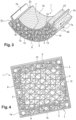
- thermoformed assembly 1 like therefore the fibrous textile structure 5, is shown bent; but they could also have common local reliefs and/or hollows, such as for example in zones 25, 27 respectively on the figure 7 , or in figure 5.6 (areas 21, 23). In English, these depressions and reliefs (or bumps) can be "embossments”.
- the porous structure 5 will advantageously be based on powder or a fibrous textile structure and thus will comprise fibers 3 that are polymers, mineral (glass, basalt for example) or natural (cellulose, flax, hemp for example).
- the fibrous textile structure 5 will then be a woven or a non-woven.
- a felt will be interesting for its intrinsic compression (felt is a compressed, non-woven structure obtained by pressing and agglutinating fibers). In addition to this intrinsic compression, the felt would advantageously subsequently be compressed in the mold (30a or 30b below; Figures 11-13 ) formatting.
- An airgel is also possible, but if a compression of the porous structure does not work in its favour. Avoid using a foam that loses its thermal insulation quality from a certain degree of compression.
- the felt or more generally the fibrous textile structure 5, can take the form of a plate (see figure 8 : e ⁇ I ⁇ L) or a block (e ⁇ I ⁇ L).
- the shape will typically be 2D (planar).
- a chemical binder is not required (solution of the figure 8 ).
- the wall 7a is thermoformable, in the sense that it then comprises a polymer film which has been thermoformed: polymer alone or lined with metal, such as a complex or composite film: metallized PET film where PET has been vaporized by aluminium.
- the polymer film (alone or therefore lined with metal) 7a will have been thermoformed at the location of the two major (or main) surfaces, S1 and S2 picture 3 Or 6 (surfaces opposite each other, in dashed lines), between which the fibrous textile structure 5, which is three-dimensional, has a curved shape and/or reliefs 21 and/or hollows 23.
- This thermoforming of the polymer film 7a will therefore not have been limited, as in a 2D flat part, to the minor/marginal peripheral zone in terms of surface (zones 7b figure 1 , 3 since these are cuts) where there is inter-binding of the sheets forming the wall 7a and where these sheets are sealed together, typically heat-sealed, to close the envelope.
- the envelope 7 contains the porous structure 5 in a closed manner; and its wall 7a follows the shape of this porous structure, where it faces it (major surfaces S1 and S2).
- the porous structure 5 will present itself favorably as at least one plate differing from a block in that there then exists a ratio of at least five between the thickness e3 and the length (L3) and width (l3).
- the sealing on itself of the wall 7a could have consisted of gluing or welding.
- the material 7a will favorably have a thickness of between 30 and 800 microns, preferably between 50 and 150 microns.
- the assembly 1 has a maximum thickness less than or equal to 20mm, preferably 8mm and even more preferably 3mm. And if a thermoformed polymer-based film 7a is used, it is recommended that it then has a tensile strength such that the desired integrity of the 3D shape is maintained.
- This tensile strength in English / UTS, often abbreviated as (TS), or “ultimate strength", Ftu) of a type 7a film, whether in a version after the aforementioned thermoforming step , or before (state of this film as marketed before its implementation in accordance with the present invention), will be favorably greater than 1 MPa, and preferably between 10 MPa and 300 MPa and even more preferably between 50 MPa and 100 MPa.
- the formed assembly 1 has first zones 10a1 having a first thickness e1 and second zones 10b1 having a second thickness e2 greater than the first thickness e1 (e1 ⁇ e2), the first zones 10a1 having a porous structure density greater than that of the second zones 10b1; see figure 7 where, if the maximum thickness is assumed to be e2, we will have e2 ⁇ 8mm and preferably e2 ⁇ 3mm.
- the respective densities of porous material 3 in the first zones 10a1 and second zones 10b1 will each be uniform (equal) over all the respective thicknesses e1, e2.
- These variations in densities between the zones such as 10a1, 10b1 can be reached starting from different thicknesses of these zones between them (respectively e1+X and e2+X).
- the generally uniform compression on the outer surface of the porous structure 5, created during the thermoforming of the barrier wall 7a, will make it possible to achieve the aforementioned thicknesses, respectively e1 and e2.
- a chemical supply binder 9 is present in the porous structure 5. Once compressed/formed into 3D, the porous material 3 will then retain this state by itself.
- the manufacturing technique can be that of EP-A-2903800 , a fibrous structure and a manufacturing method are known from the documents FROM 103 24 735 .
- binder 9 epoxy or phenolic resin can be used.
- the binder 9 participates both in shaping the porous structure 5 (during thermoforming) and in maintaining the integrity of its shape over time.
- a binder 9 reacting to heat such as polypropylene, or a phenolic resin
- it will be heated so that the porous material melts and a rigid molded part, non-deformable, is formed.
- an exclusively metal wall 7a a few tenths of a mm thick may be suitable, it may be preferred, during step a), to choose a thermoformable wall, then, during step d), to heat this wall of so that the two major surfaces S1, S2 heated soften. This ductility will then be taken advantage of to shape under pressure, by molding, the wall 7a and the material of the structure 5. The whole thing is then allowed to cool.
- the polymer film option 7a could be a polyimide or PEEK film, or polyethylene, or polypropylene.
- the molding can comprise a molding between a male cavity 340a and a female cavity 340b of the mold 30a, as figure 11 .
- the deformable membrane 340c may be made of flexible plastic or rubber-based withstanding a temperature of 140 to 200°C.
- the set 1 it is possible to add, in the casing 7, at least one thermal insulator 11, so that at ambient temperature and pressure, the set 1 has, through the film 7a, a coefficient of thermal conductivity ( ⁇ ) less than 40mW/mK, and preferably less than 20mW/mK; see figure 2 .
- the thermal insulation 11 can then usefully be dispersed in the structure 5.
- thermal insulator 11 in the form of particles, a variable concentration depending on the location can be achieved.
- the assembly 1 also comprises, in the casing 7, at least one phase change material 13 (PCM), which can therefore also be dispersed in the structure 5 ( picture 3 ).
- PCM phase change material 13
- THE figures 4-6 show privileged, operational examples of variable densifications/dispersions of the material 3 and of the particles 11 and/or 13, in the porous structure 5, under the envelope 7.
- the structure 5 comprises, peripherally, an overdensification or overconcentration, for example, of fibers 3 and of (particles of) PCM 13.
- the overdensification of material 3 is located around the attachment zones of the part 1 corresponding to the through passages (circles) of which some are referenced 15. This overdensification can result from an initial dosage, for example of fibres, which is greater in certain areas than in others. It can also result from greater compression in some areas than in others.
- the structure 5 of part 1 is thinner in part 10a2 (thickness e1), than it is in part(s) 10b2 (thickness e2). It is in the finer part 10a2 that there is an over-densification or over-concentration of (particles of) thermal insulation 11, to compensate for the lesser thickness and to maintain a homogeneous thermal conductivity.
- the porous structure 5 of the part 1 is overloaded with material 3 (increased fiber density, for example) in zones 10c by which the part can be fixed via for example the rods 17 and where the part has angles, therefore zones potential mechanical weakness.
- material 3 increase fiber density, for example
- those 10c define integrated reinforcement or mechanical structuring zones, without the need for external reinforcement.
- zone(s) 10d structure 5 is (over)loaded with MCP (particles) 13, where part 1 has one or more zone(s) of heat exchange with a refrigerant or heat transfer fluid 19.
- MCP particles
- part 1 has one or more zone(s) of heat exchange with a refrigerant or heat transfer fluid 19.
- the formed assembly 1 in three dimensions can in particular define therein an inner lining element of a structural element, said structural element separating between them an external environment and an internal volume to be insulated or protected thermally and acoustically from this external environment, this with constraints of cramped volume, particular shapes and/or weight to be limited as much as possible.
- the lining element 39 is therefore interposed between the volumes 35 and 37.
- the structural element 33 can be a door panel, metallic, composite (ie composed of several materials; for example a mixture of synthetic resin and mineral, natural or synthetic fibers) or plastic. It defines in the example the structural frame of an automobile door.
- a sheet metal 41 of the door can be fixed to it defining the exterior trim of the door.
- Interior side can be fixed to it an interior trim 43 (passenger compartment side), so that the assembly 1 is interposed between the sheet 41 and the interior trim 43.
- the curved shape and / or the reliefs 21 and / or hollow 23 of the element 1 are engaged (s) at least in part with the complementary shape, curved and / or hollow 231 and / or reliefs 211, of the element 33 structural, to substantially match at least part of the contour; see figure 9 .
- attachments to the structural element 33 may include screwing, riveting or other, for example via rods 17.
- a charge or a heat transfer fluid 19 will be preferred here.
- thermal insulation 11 such as at least one layer of polyurethane, or polyester fibers dispersed in the porous structure
- the preferred heat exchange zone or zones 10d are located, that is to say there where one will have identified, in the direction of the thickness (e) of the envelope 7, one or more zones where the local thermal conductivity coefficient ( ⁇ ) is higher than a predefined threshold, between the volumes 35 and 37 .
- the aforementioned structural element 33 can therefore be defined by a protective plate 33a.
- the plate 33a metal, extends like a floor (or is part of this floor) and provides protection against gravel, in particular. We only see part of it figure 10 .
- the aforementioned interior lining element 39 e is here defined by one or more plates 390 comprising one or more elements 1, with a 3D shape (here partly curved), interposed between the external environment 35 and a plate 41 of battery pack cooling 47.
- the cooling plate 41 comprises channels 49 for the circulation of a cooling fluid arranged in heat exchange with the battery pack 47.
- the cooling fluid circulates in the channels 49 via an inlet 49a and an outlet 49b which communicate with the channels 49.
- the underside of the support plate 53 on which the electric battery pack 47 rests forms a cover vis-à-vis the channels 49 which are sealed against it , by their edges. Additionally or alternatively the support plate 53 may be part of the battery compartment in which the battery pack 47 is enclosed.
- the (each) thermal insulating element 1 is sandwiched between the plate 33a and the cooling plate 41 .
- the plate 41 has reliefs and hollows, at least some of which are defined by the channels 49, on the upper face.
- the protective plate 33a also has reliefs 330 and hollows 331.
- each element 1 itself has, as already indicated, said reliefs 210 and recesses 230, this here on the two major surfaces (lower and upper) of the thermoformed barrier wall; but these reliefs and hollows are different on the lower and upper faces, since we look, the reliefs and hollows of the plate 33a and of the plate 41 are different from each other, but complementary to those of the element (s) 1.
- said at least one thermally insulating element 1 comprising its porous structure 5 in its envelope 7 formed by the barrier wall 7a, as for example on the figure 4 for a plan view.
- This wall 7 is always thermoformed at the location of said two major surfaces (S1, S2) between which the porous structure 5, which is three-dimensional, therefore has a curved shape and/or reliefs and/or hollows, as shown schematically. .
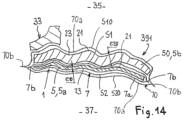
- the second density is lower than the first density, and the first porous structure 5 is superimposed with the second porous structure 50.
- the two major surfaces S10, S20 are the image on the envelope 70 and its wall 70a of the two major surfaces S1, S2 on the envelope 7 and its wall 7a.
- the minor/marginal peripheral zone in terms of surface, here 70b image of 7b, remains.
- the second envelope 70 is not necessarily under vacuum.
- the second porous structure 50 can be in a third vacuum envelope, itself therefore then housed, with the first envelope 70, in the second envelope 70.
- the second porous structure 50 will have a thickness e20 greater than the thickness e10 of the first porous structure 5, this being considered everywhere or on at least most of the largest of the surfaces of the two porous structures 5.50.
- the thickness e20 can be from 3 to 15mm.
- the thickness e10 can be from 0.5 to 2.5mm.
- the first density can be more than 100 to 800 kg/m 3 ; the second density can be from 5 to less than 100 kg/m 3 .
- the first porous structure 5 provides relevant thermal and acoustic insulation.
- the second porous structure 50 provides reinforced thermal insulation and acoustic insulation that is more limited at low frequencies, but good at high frequencies. A hybrid solution is thus obtained with a heavy assembly (with mass effect) which absorbs at low frequencies (20 to 200 Hz) by the first porous structure 5 and at high frequencies (above 200 Hz) by the second porous structure 50.
- the pillars or the body and their trim in the passenger compartment are therefore concerned.
- cockpit is to be understood as “space receiving occupants to be transported” and an aircraft is a “vehicle”; therefore an aircraft fuselage is also concerned.
- the foam layer 69 and the coating 67 can be 2 to 5 mm thick, together, the thermal insulating element 1 3 to 6 mm, structural element 33 4 to 10 mm.
- the structural element 33 (which may be composite) actually forms a second part of said “structural element”, the first part being formed by the exterior bodywork 63 .
- FIG. 15 makes it possible to diagram an approximate view from above of the roof part 60 of the vehicle which is doubled by the structure presented below; the front of the passenger compartment (of the vehicle) is front, the rear rear; schematic boundaries are drawn figure 15 ; the thermal insulating element 1 can be in one or more parts to occupy most of it at least on the surface.
- the longitudinal axis is X1.
- Passages 71a, 71b can be provided through the part of the roof 60 (and of the heat insulating element(s) 1, if necessary) for the ceiling lights respectively in the front seats and in the rear seats.
- the part of the roof 60 is laterally rounded, at 60a (idem on the opposite side, at 60b), in particular.
- the porous structure 5, which is three-dimensional, is at least curved, as shown schematically figure 17 , with a detail according to 0for example picture 3 Or 14 .
- a so-called secondary layer 85 of thermal and acoustic insulation is interposed between the sheets 77 and the layer of air 79.
- Sheets 77 are typically 1.5 to 3mm thick; the primary and secondary layers 81.85 from 15 to 30mm.
- this wall has a curved shape, as illustrated Figures 18-19 , or even reliefs and/or hollows, for example at the location (around) of portholes 95.
- the porous structure 5, which is three-dimensional, is at least curved, as we have schematized at the place of tearing figure 19 .
- the most structuring structures are the longerons 93 which, like the stringers 91, extend parallel to the longitudinal axis (aircraft axis) X2.
- Frames 89 extend circumferentially around axis X2.
- the thermal insulating element 1 can be covered with an aesthetic coating 99 (such as a liner) which can be found at 101 as an inner lining of the outer skin/sheets 77.
- an aesthetic coating 99 such as a liner
- each heat insulating element 1 extends around the accessible part of the frame concerned. It can match its shape, because the barrier wall 7a (and/or 7b; not shown) has been thermoformed and the porous structure 5 (idem) is three-dimensional and has been shaped by compression. The two elements 1 and 89 are then engaged together.
- the cohesion between the elements of the part of the roof 60 or of the assembly (or fuselage structure) 75 can for example be ensured by gluing and/or screwing, with the presence of spacers if necessary. .
- the assembly therefore makes it possible to ensure a good compromise of thermo-acoustic insulation.
- the outer envelope 70 with film 70a is optional: the PIV defined by the element 5 in its sealed envelope 7 is combined with the insulation formed by the said second porous structure 50 (for example glass wool or a foam) fixed for example to the lateral ends of the roof (mechanical or chemical grip).
- the air layer 65 can be established by spacers, not shown.
- the thermal insulating element 1 of the solutions presented in connection with the figures 15-20 may advantageously be supplemented in such a way that the inner lining element (392 figure 17 , 19 , 20 ) further comprises a second porous structure 50 comprising the same porous material 5a, or a different porous material 5b, having a second density, the second density being lower than the first density and the first and second porous structures (5,50) being superimposed, like figure 14 .
Landscapes
- Engineering & Computer Science (AREA)
- Mechanical Engineering (AREA)
- Chemical & Material Sciences (AREA)
- Transportation (AREA)
- Combustion & Propulsion (AREA)
- Aviation & Aerospace Engineering (AREA)
- Physics & Mathematics (AREA)
- Acoustics & Sound (AREA)
- Textile Engineering (AREA)
- Vehicle Interior And Exterior Ornaments, Soundproofing, And Insulation (AREA)
- Thermal Insulation (AREA)
- Laminated Bodies (AREA)
- Blow-Moulding Or Thermoforming Of Plastics Or The Like (AREA)
Claims (11)
- Baugruppe, enthaltend:- ein Strukturelement (33), das zwischen einer Außenumgebung (35) und einem abzuschirmenden Innenraum (37) eingefügt ist,- und ein innenliegendes Auskleidungselement (39, 390, 391, 392) zum Auskleiden des Strukturelements (33), wobei das innenliegende Auskleidungselement zumindest ein wärmeisolierendes Element (1) unter Vakuum aufweist, das enthält:- eine komprimierte poröse Struktur (5), die eine erste poröse Struktur definiert, die ein poröses Material (5a) mit einer ersten Dichte enthält,- eine luftdicht verschlossene erste Hülle (7),-- die eine thermoformbare, luftdichte erste Sperrwand (7a) aufweist,-- in welcher ersten Hülle die erste poröse Struktur (5) eingeschlossen ist, deren Form von der Sperrwand (7a) gefolgt wird, und-- in welcher ersten Hülle bei äußerer Raumtemperatur und Umgebungsdruck ein Druck zwischen weniger als 105 Pa und mehr als 10-2 Pa herrscht, wobei das innenliegende Auskleidungselement (39, 390, 391, 392) ferner eine zweite poröse Struktur (50) enthält, die das gleiche poröse Material (5a) oder ein anderes poröses Material (5b) mit einer zweiten Dichte enthält, wobei die zweite Dichte geringer als die erste Dichte ist, wobei die erste und die zweite poröse Struktur (5, 50) übereinander angeordnet sind,dadurch gekennzeichnet, dass zur thermischen und akustischen Abschirmung des Innenraums (37) die Baugruppe derart ausgeführt ist, dass- das poröse Material der ersten porösen Struktur (5) eine Dichte zwischen mehr als 100 kg/m3 und 800 kg/m3 aufweist, und das poröse Material der zweiten porösen Struktur (50) eine Dichte zwischen 5 kg/m3 und weniger als 100 kg/m3 aufweist,- die zweite poröse Struktur (50) eine Dicke (e20) aufweist, die größer als die Dicke (e10) der ersten porösen Struktur ist,- das Strukturelement (33) und das zumindest eine wärmeisolierende Element (1) dreidimensional ausgebildet sind und somit eine gebogene Form und/oder Erhebungen und/oder Vertiefungen aufweisen,- die dreidimensional ausgebildete erste poröse Struktur (5) eine gebogene Form und/oder Erhebungen und/oder Vertiefungen aufweist,- die gebogene Form und/oder die Erhebungen und/oder Vertiefungen des zumindest einen wärmeisolierenden Elements (1) zumindest teilweise mit der gebogenen Form und/oder den Erhebungen und/oder Vertiefungen des Strukturelements (33) in Eingriff steht/stehen, um im Wesentlichen zumindest einen Teil der Kontur davon anzunehmen,- die zweite poröse Struktur (5, 50) eine gebogene Form und/oder Erhebungen und/oder Vertiefungen aufweist, und- das wärmeisolierende Element (1) und die zweite poröse Struktur (50)-- zusammen in einer zweiten Hülle (70) eingeschlossen sind, die nicht unter Vakuum steht,-- und zwischen zwei Hauptflächen (S10, S20) einer Wand (70a) der zweiten Hülle (70), zweite Wand (70a) genannt, eingefügt sind, die an den beiden Hauptflächen thermogeformt ist, wobei die Schmalfläche einer Wand als derjenige Bereich zu verstehen ist, in welchem die die Sperrwand bildenden Lagen oder Lagenabschnitte miteinander verbunden sind und wo diese miteinander versiegelt sind, um komplementär die Hülle zu verschließen, wobei die Hauptfläche derselben Wand als derjenige Bereich der Hülle zu verstehen ist, welcher von diesem Versiegelungsbereich eingegrenzt ist.
- Baugruppe nach Anspruch 1,
wobei die erste Hülle (7) innenliegend enthält:- bereichsweise einen oder mehrere Bereiche (10d) zum Wärmeaustausch mit einem Kälte- oder Wärmeträgerfluid (19),- und/oder einen oder mehrere Bereiche (10a1,10a2) mit geringerer Dicke (e1), die von dem oder den Bereichen (7b) beabstandet liegen, in denen die erste Hülle (7) luftdicht verschlossen ist,- und/oder eine bereichsweise Füllung aus einem Phasenwechselmaterial (PCM; 13),- und/oder eine bereichsweise Füllung aus einem Wärmeisolator (11), wo sich der oder die Vorzugsbereiche für den Wärmeaustausch befindet/befinden,- und/oder eine Überdichte an porösem Material (3) im Vergleich zu anderen Bereichen aus porösem Material, wo sich der oder die Befestigungsbereiche befindet/befinden und/oder wo sich der oder die Vorzugsbereiche (10d) befindet/befinden und/oder wo sich der oder die Bereiche mit geringerer Dicke (e1) befindet/befinden. - Baugruppe nach einem der vorangehenden Ansprüche,
wobei das oder jedes wärmeisolierende Element (1) eine maximale Dicke von weniger als oder gleich 20 mm aufweist und wobei- die erste poröse Struktur (5) frei von chemischem Bindemittel (9) ist und eine Dichte zwischen 10 kg/m3 und 300 kg/m3 aufweist, und- die thermogeformte erste Sperrwand (7a) eine Bruchfestigkeit hat und auf allen Seiten der ersten porösen Struktur eine unebene Form aufweist, die die Form der ersten porösen Struktur (5) vorgibt, so dass die erste Hülle (7) die Form der ersten porösen Struktur (5) beibehält. - Baugruppe nach Anspruch 1 oder 2,
wobei die erste poröse Struktur (5) ein chemisches Bindemittel (9) enthält. - Baugruppe nach einem der vorangehenden Ansprüche, wobei- die erste poröse Struktur (5) zwischen zwei Hauptflächen (S1, S2) der ersten Sperrwand (7a) eingefügt ist, und- die erste Sperrwand (7a) an den beiden Hauptflächen (S1, S2) thermogeformt ist, und- zwischen den beiden Hauptflächen (S1, S2) der ersten Sperrwand (7a) die erste poröse Struktur (5) erste Bereiche (10b2) mit einer ersten Dicke (e2) und zweite Bereiche (10a1) mit einer zweiten Dicke (e1), die geringer ist als die erste Dicke (e2), aufweist, wobei die zweiten Bereiche eine Dichte an porösem Material (3) aufweisen, die höher ist als die Dichte an porösem Material (3) in den ersten Bereichen.
- Baugruppe nach einem der vorangehenden Ansprüche, wobei- das Strukturelement (33) ein Türblatt aus Metall, Verbundwerkstoff oder Kunststoff ist, das einen Strukturrahmen einer Autotür definiert, und- die Baugruppe ferner enthält:-- auf einer Außenseite des Strukturelements (33) ein Türblech (41), das eine Außenverkleidung der Tür definiert und an dem Strukturelement (33) befestigt ist, und-- auf einer Innenseite des Strukturelements (33) eine Innenverkleidung (43), die an dem Strukturelement (33) befestigt ist, so dass das innenliegende Auskleidungselement (39), welches das wärmeisolierende Element (1) enthält, zwischen dem Türblech (41) und der Innenverkleidung (43) angeordnet ist.
- Baugruppe nach einem der Ansprüche 1 bis 5, wobei- das Strukturelement (33) ein Karosserieteil (44) eines Fahrzeugs oder ein Abschirmungspaneel (33a) ist, und- das innenliegende Auskleidungselement (390) zwischen der Außenumgebung (35) und einer Kühlplatte (41) eines im Innenraum (37) angeordneten Batteriepakets zur elektrischen Versorgung des Fahrzeugs eingefügt ist, wobei das Fahrzeug vom Typ Hybrid oder vollelektrisch ist, wobei das zumindest eine wärmeisolierende Element (1) zwischen dem Paneel (33a) zur Abschirmung (33) und der Kühlplatte (41), die in Wärmeaustausch mit dem Batteriepaket angeordnete Kühlmittelumlaufkanäle umfasst, sandwichartig angeordnet ist.
- Baugruppe nach Anspruch 7, wobei- die Kühlplatte (41) Erhebungen und Vertiefungen aufweist, von denen zumindest einige durch die Kühlmittelumlaufkanäle definiert sind,- das Strukturelement (33) die Erhebungen und Vertiefungen aufweist,- das zumindest eine wärmeisolierende Element (1) die Erhebungen und Vertiefungen auf beiden Hauptflächen der ersten Sperrwand (7a) aufweist, und- auf den beiden Hauptflächen der ersten Sperrwand (7a)-- die jeweiligen Erhebungen des zumindest einen wärmeisolierenden Elements (1) mit den jeweiligen Vertiefungen der Kühlplatte (41) und des Strukturelements (33) in Eingriff stehen,-- die jeweiligen Vertiefungen des zumindest einen wärmeisolierenden Elements (1) mit den jeweiligen Erhebungen der Kühlplatte (41) und des Strukturelements (33) in Eingriff stehen.
- Baugruppe nach einem der Ansprüche 1 bis 5, wobei- das Strukturelement (63, 77) ein Karosserieteil (60, 75) eines Kraftfahrzeugs umfasst, das eine Fahrgastzelle (61) des Fahrzeugs umgibt, und- die Baugruppe ferner von dem Strukturelement (63, 77) zu dem zumindest einen wärmeisolierenden Element (1) hin eine Luftschicht (65) und dann einen weiteres Strukturelementteil (33) umfasst.
- Baugruppe nach einem der Ansprüche 1 bis 5, wobei- das Strukturelement (63, 77) ein Luftfahrzeug-Rumpfteil (75) umfasst, das einen Passagierraum (61) umgibt, und- die Baugruppe ferner zwischen dem Strukturelement (63, 77) und dem zumindest einen wärmeisolierenden Element (1) eine Luftschicht (79) mit einer Dicke zumindest gleich 20 mm umfasst.
- Baugruppe nach einem der Ansprüche 1 bis 5, wobei das Strukturelement enthält:- Außenplatten (63, 77), die zu einem Luftfahrzeug-Rumpfteil (75) gehören und innen aneinander befestigt sind,- Rahmen (89) und/oder Holme (91) und/oder Längsträger (93), die jeweils einzeln von zumindest einem wärmeisolierenden Element (1) und der zweiten porösen Struktur (50) umgeben sind.
Applications Claiming Priority (2)
| Application Number | Priority Date | Filing Date | Title |
|---|---|---|---|
| FR1857600A FR3085128B1 (fr) | 2018-08-22 | 2018-08-22 | Element thermoforme 3d |
| PCT/FR2019/051949 WO2020039148A1 (fr) | 2018-08-22 | 2019-08-22 | Elément thermoformé 3d |
Publications (2)
| Publication Number | Publication Date |
|---|---|
| EP3840930A1 EP3840930A1 (de) | 2021-06-30 |
| EP3840930B1 true EP3840930B1 (de) | 2023-05-17 |
Family
ID=65201130
Family Applications (2)
| Application Number | Title | Priority Date | Filing Date |
|---|---|---|---|
| EP19783093.8A Active EP3840929B1 (de) | 2018-08-22 | 2019-08-22 | 3d-thermogeformtes element |
| EP19783094.6A Active EP3840930B1 (de) | 2018-08-22 | 2019-08-22 | 3d-thermogeformtes element |
Family Applications Before (1)
| Application Number | Title | Priority Date | Filing Date |
|---|---|---|---|
| EP19783093.8A Active EP3840929B1 (de) | 2018-08-22 | 2019-08-22 | 3d-thermogeformtes element |
Country Status (5)
| Country | Link |
|---|---|
| US (2) | US20210316673A1 (de) |
| EP (2) | EP3840929B1 (de) |
| CN (2) | CN112770892A (de) |
| FR (1) | FR3085128B1 (de) |
| WO (2) | WO2020039147A1 (de) |
Families Citing this family (5)
| Publication number | Priority date | Publication date | Assignee | Title |
|---|---|---|---|---|
| FR3085128B1 (fr) * | 2018-08-22 | 2022-01-07 | Hutchinson | Element thermoforme 3d |
| FR3149301A1 (fr) * | 2023-06-05 | 2024-12-06 | Safran Seats | Panneau, notamment pour un élement de mobilier, en particulier d'une unité de siège |
| CN116834330B (zh) * | 2023-07-03 | 2025-12-30 | 重庆平伟汽车系统有限公司 | 复合材料pcm带孔类产品一次成型模具及一次成型方法 |
| US20250058867A1 (en) * | 2023-08-18 | 2025-02-20 | The Boeing Company | Insulation Blanket Assemblies and Methods |
| EP4574651A1 (de) * | 2023-12-21 | 2025-06-25 | Wingtra AG | Flugwerkteil eines flugwerks eines unbemannten luftfahrzeugs und verfahren zur herstellung davon |
Citations (3)
| Publication number | Priority date | Publication date | Assignee | Title |
|---|---|---|---|---|
| JPH07187008A (ja) * | 1993-12-24 | 1995-07-25 | Inoac Corp | 自動車天井の衝撃吸収構造 |
| WO2017153691A1 (fr) * | 2016-03-11 | 2017-09-14 | Hutchinson | Barrière thermique en particulier pour batterie(s) ainsi pourvue(s) |
| WO2017153693A1 (fr) * | 2016-03-11 | 2017-09-14 | Hutchinson | Véhicule à habitacle isolé par une barrière thermique |
Family Cites Families (35)
| Publication number | Priority date | Publication date | Assignee | Title |
|---|---|---|---|---|
| US4035215A (en) | 1976-04-05 | 1977-07-12 | Allen Industries, Inc. | Process for making sound insulation components |
| GB1585125A (en) * | 1976-07-26 | 1981-02-25 | Bfg Glassgroup | Vitreous building elements |
| US5164254A (en) * | 1991-01-15 | 1992-11-17 | Chicopee | Hoodliner |
| JPH07151297A (ja) * | 1993-11-29 | 1995-06-13 | Meisei Kogyo Kk | 真空断熱構造体 |
| JPH11217051A (ja) * | 1998-02-03 | 1999-08-10 | Hayashi Gijutsu Kenkyusho:Kk | 自動車用内装材 |
| JP3137946B2 (ja) * | 1998-09-22 | 2001-02-26 | 明星工業株式会社 | 断熱パネル及びその製造方法 |
| JP2002337256A (ja) * | 2001-05-18 | 2002-11-27 | Jamco Corp | 真空断熱パネルとその製造方法 |
| DE10152759B4 (de) * | 2001-10-29 | 2006-03-16 | Johnson Controls Gmbh | Verkleidungselement für den Innenraum eines Fahrzeugs |
| US6726980B2 (en) * | 2001-11-09 | 2004-04-27 | Owens Corning Fiberglass Technology, Inc. | Acoustic doorliner with integral water barrier |
| US20030124314A1 (en) * | 2001-12-31 | 2003-07-03 | Michael Rajendran S. | Structurally enhanced sound and heat energy absorbing liner and related method |
| US20040180176A1 (en) * | 2003-03-14 | 2004-09-16 | Rusek Stanley J. | Vaccum insulation article |
| DE10324735B3 (de) | 2003-05-30 | 2004-11-11 | Fiber Engineering Gmbh | Verfahren und Vorrichtung zur Herstellung von dreidimensional ausgeprägten Formteilen sowie Formteil |
| DE102004010939A1 (de) * | 2004-01-23 | 2005-11-03 | Woschko Winlite Gmbh | Verfahren zum Herstellen eines Vakuumpaneels, sowie Vakuumpaneel, insbesondere für Wärmedämmzwecke |
| WO2005119118A1 (ja) * | 2004-06-03 | 2005-12-15 | Matsushita Electric Industrial Co., Ltd. | 真空断熱材および、真空断熱材を具備する保冷機器 |
| JP4661670B2 (ja) * | 2006-04-20 | 2011-03-30 | 株式会社日立製作所 | 断熱体 |
| JP2008202709A (ja) * | 2007-02-21 | 2008-09-04 | Matsushita Electric Ind Co Ltd | 真空断熱材の配設方法 |
| DE102011079209A1 (de) * | 2011-07-14 | 2013-01-17 | BSH Bosch und Siemens Hausgeräte GmbH | Vakuumisolationselement |
| DE102011052513A1 (de) * | 2011-08-09 | 2013-02-14 | Rehau Ag + Co. | Batteriegehäuseteil zur Aufnahme einer Traktionsbatterie eines Elektrofahrzeugs und Verfahren zur Herstellung des Batteriegehäuseteils |
| FR2979308B1 (fr) * | 2011-08-24 | 2013-09-27 | Faurecia Automotive Ind | Ensemble d'insonorisation, notamment pour un vehicule automobile |
| DE102011116457A1 (de) * | 2011-10-20 | 2013-04-25 | Gm Global Technology Operations, Llc | Innenraumteil für einen Fahrgastraum eines Kraftfahrzeugs |
| CN102788229B (zh) * | 2012-07-23 | 2015-05-13 | 青岛科瑞新型环保材料有限公司 | 一种密度均匀、高生产效率的真空绝热板的制作方法 |
| DE102012019534A1 (de) | 2012-10-05 | 2014-04-10 | Fiber Engineering Gmbh | Vorrichtung und Verfahren zum Herstellen von Formteilen aus Fasermaterial |
| US9464751B2 (en) * | 2013-02-06 | 2016-10-11 | Samsung Electronics Co., Ltd. | Vacuum insulation material, insulation case unit, and refrigerator |
| JP2015096740A (ja) * | 2013-11-15 | 2015-05-21 | パナソニックIpマネジメント株式会社 | 真空断熱筐体 |
| CN206369054U (zh) * | 2013-11-15 | 2017-08-01 | 松下知识产权经营株式会社 | 真空隔热壳体 |
| WO2015098248A1 (ja) * | 2013-12-26 | 2015-07-02 | オートリブ ディベロップメント エービー | ステアリングホイール |
| US9688454B2 (en) * | 2014-08-05 | 2017-06-27 | Sonoco Development, Inc. | Double bag vacuum insulation panel for steam chest molding |
| FR3027996B1 (fr) * | 2014-11-04 | 2017-12-29 | Electricite De France | Panneau piv avec ondulations en surface, element de paroi et enceinte d'isolation thermique incluant un tel panneau |
| GB2534185B (en) * | 2015-01-15 | 2017-03-29 | Kingspan Holdings (Irl) Ltd | Vacuum insulating panel |
| CN204477606U (zh) * | 2015-01-26 | 2015-07-15 | 黄国平 | 一种新型真空绝热板 |
| WO2017029462A1 (fr) * | 2015-08-20 | 2017-02-23 | Hutchinson | Ensemble isolant thermique et structure isolee par cet ensemble |
| US10041724B2 (en) * | 2015-12-08 | 2018-08-07 | Whirlpool Corporation | Methods for dispensing and compacting insulation materials into a vacuum sealed structure |
| FR3048661B1 (fr) * | 2016-03-10 | 2018-04-20 | Treves Products, Services & Innovation | Procede de realisation d’un ecran de protection thermo-acoustique pour vehicule automobile |
| FR3070301B1 (fr) * | 2017-08-22 | 2021-02-12 | Hutchinson | Ensemble thermoforme 3d |
| FR3085128B1 (fr) * | 2018-08-22 | 2022-01-07 | Hutchinson | Element thermoforme 3d |
-
2018
- 2018-08-22 FR FR1857600A patent/FR3085128B1/fr not_active Expired - Fee Related
-
2019
- 2019-08-22 US US17/269,930 patent/US20210316673A1/en not_active Abandoned
- 2019-08-22 CN CN201980063955.2A patent/CN112770892A/zh active Pending
- 2019-08-22 WO PCT/FR2019/051948 patent/WO2020039147A1/fr not_active Ceased
- 2019-08-22 CN CN201980061733.7A patent/CN112739523A/zh active Pending
- 2019-08-22 EP EP19783093.8A patent/EP3840929B1/de active Active
- 2019-08-22 US US17/269,902 patent/US11858431B2/en active Active
- 2019-08-22 EP EP19783094.6A patent/EP3840930B1/de active Active
- 2019-08-22 WO PCT/FR2019/051949 patent/WO2020039148A1/fr not_active Ceased
Patent Citations (3)
| Publication number | Priority date | Publication date | Assignee | Title |
|---|---|---|---|---|
| JPH07187008A (ja) * | 1993-12-24 | 1995-07-25 | Inoac Corp | 自動車天井の衝撃吸収構造 |
| WO2017153691A1 (fr) * | 2016-03-11 | 2017-09-14 | Hutchinson | Barrière thermique en particulier pour batterie(s) ainsi pourvue(s) |
| WO2017153693A1 (fr) * | 2016-03-11 | 2017-09-14 | Hutchinson | Véhicule à habitacle isolé par une barrière thermique |
Also Published As
| Publication number | Publication date |
|---|---|
| FR3085128A1 (fr) | 2020-02-28 |
| EP3840929A1 (de) | 2021-06-30 |
| EP3840929B1 (de) | 2023-04-19 |
| WO2020039147A1 (fr) | 2020-02-27 |
| US20210316673A1 (en) | 2021-10-14 |
| US11858431B2 (en) | 2024-01-02 |
| WO2020039148A1 (fr) | 2020-02-27 |
| US20210323215A1 (en) | 2021-10-21 |
| EP3840930A1 (de) | 2021-06-30 |
| FR3085128B1 (fr) | 2022-01-07 |
| CN112770892A (zh) | 2021-05-07 |
| CN112739523A (zh) | 2021-04-30 |
Similar Documents
| Publication | Publication Date | Title |
|---|---|---|
| EP3840930B1 (de) | 3d-thermogeformtes element | |
| FR3081261A1 (fr) | Batterie et vehicule equipe d'une telle batterie | |
| CN103813895B (zh) | 机动车辆用工作液箱 | |
| EP3672780B1 (de) | 3d-geformte anordnung | |
| FR3040210B1 (fr) | Ensemble modulaire pour stockeur ou batterie | |
| EP3338046B1 (de) | Anordnung | |
| EP3337964B1 (de) | Thermische vorrichtung für ein fluid mit ablenkblechen sowie zugehörige kreise | |
| EP3338047B1 (de) | Einheit zur speicherung von wärmeenergie | |
| JP2022110559A (ja) | 組電池用熱伝達抑制シート及び組電池 | |
| EP2412613A1 (de) | Karosseriemodul für Kühlfahrzeug mit Vakuum-Isolierpaneel, und entsprechendes Herstellungsverfahren | |
| FR3127849A1 (fr) | Compartiment pour un equipement susceptible de degager de la chaleur | |
| WO2021123538A1 (fr) | Compartiment pour un équipement susceptible de dégager de la chaleur | |
| EP2671782A1 (de) | Karosseriemodul für ein Kühlfahrzeug mit einem Vakuumisolationspaneel, und dessen Herstellungsverfahren. | |
| WO2006134079A1 (fr) | Piece composite telle qu'un panneau, comportant une structure alveolaire a nids d'abeille | |
| EP3338020B1 (de) | Anordnung und gegliederte tafel mit zwischenpositionierungsteilen zur wärmedämmung | |
| WO2020099752A1 (fr) | Compartiment pour dispositif de stockage d'energie electrique pour vehicule automobile | |
| WO2024068312A1 (en) | Photovoltaic sandwich panel pv vehicle cladding sandwich panel, thermally insulated cargo box and vehicle comprising such panel | |
| FR3040212A1 (fr) | Ensemble isolant thermique et structure isolee par cet ensemble | |
| EP4449541A1 (de) | Fach für eine wärmeabgebende vorrichtung |
Legal Events
| Date | Code | Title | Description |
|---|---|---|---|
| STAA | Information on the status of an ep patent application or granted ep patent |
Free format text: STATUS: UNKNOWN |
|
| STAA | Information on the status of an ep patent application or granted ep patent |
Free format text: STATUS: THE INTERNATIONAL PUBLICATION HAS BEEN MADE |
|
| PUAI | Public reference made under article 153(3) epc to a published international application that has entered the european phase |
Free format text: ORIGINAL CODE: 0009012 |
|
| STAA | Information on the status of an ep patent application or granted ep patent |
Free format text: STATUS: REQUEST FOR EXAMINATION WAS MADE |
|
| 17P | Request for examination filed |
Effective date: 20210319 |
|
| AK | Designated contracting states |
Kind code of ref document: A1 Designated state(s): AL AT BE BG CH CY CZ DE DK EE ES FI FR GB GR HR HU IE IS IT LI LT LU LV MC MK MT NL NO PL PT RO RS SE SI SK SM TR |
|
| DAV | Request for validation of the european patent (deleted) | ||
| DAX | Request for extension of the european patent (deleted) | ||
| STAA | Information on the status of an ep patent application or granted ep patent |
Free format text: STATUS: EXAMINATION IS IN PROGRESS |
|
| 17Q | First examination report despatched |
Effective date: 20220104 |
|
| GRAP | Despatch of communication of intention to grant a patent |
Free format text: ORIGINAL CODE: EPIDOSNIGR1 |
|
| STAA | Information on the status of an ep patent application or granted ep patent |
Free format text: STATUS: GRANT OF PATENT IS INTENDED |
|
| INTG | Intention to grant announced |
Effective date: 20221202 |
|
| GRAS | Grant fee paid |
Free format text: ORIGINAL CODE: EPIDOSNIGR3 |
|
| GRAA | (expected) grant |
Free format text: ORIGINAL CODE: 0009210 |
|
| STAA | Information on the status of an ep patent application or granted ep patent |
Free format text: STATUS: THE PATENT HAS BEEN GRANTED |
|
| AK | Designated contracting states |
Kind code of ref document: B1 Designated state(s): AL AT BE BG CH CY CZ DE DK EE ES FI FR GB GR HR HU IE IS IT LI LT LU LV MC MK MT NL NO PL PT RO RS SE SI SK SM TR |
|
| REG | Reference to a national code |
Ref country code: GB Ref legal event code: FG4D Free format text: NOT ENGLISH |
|
| REG | Reference to a national code |
Ref country code: DE Ref legal event code: R096 Ref document number: 602019029103 Country of ref document: DE |
|
| REG | Reference to a national code |
Ref country code: CH Ref legal event code: EP |
|
| REG | Reference to a national code |
Ref country code: IE Ref legal event code: FG4D Free format text: LANGUAGE OF EP DOCUMENT: FRENCH |
|
| REG | Reference to a national code |
Ref country code: AT Ref legal event code: REF Ref document number: 1568231 Country of ref document: AT Kind code of ref document: T Effective date: 20230615 |
|
| P01 | Opt-out of the competence of the unified patent court (upc) registered |
Effective date: 20230526 |
|
| REG | Reference to a national code |
Ref country code: LT Ref legal event code: MG9D |
|
| REG | Reference to a national code |
Ref country code: NL Ref legal event code: MP Effective date: 20230517 |
|
| REG | Reference to a national code |
Ref country code: AT Ref legal event code: MK05 Ref document number: 1568231 Country of ref document: AT Kind code of ref document: T Effective date: 20230517 |
|
| PG25 | Lapsed in a contracting state [announced via postgrant information from national office to epo] |
Ref country code: SE Free format text: LAPSE BECAUSE OF FAILURE TO SUBMIT A TRANSLATION OF THE DESCRIPTION OR TO PAY THE FEE WITHIN THE PRESCRIBED TIME-LIMIT Effective date: 20230517 Ref country code: PT Free format text: LAPSE BECAUSE OF FAILURE TO SUBMIT A TRANSLATION OF THE DESCRIPTION OR TO PAY THE FEE WITHIN THE PRESCRIBED TIME-LIMIT Effective date: 20230918 Ref country code: NO Free format text: LAPSE BECAUSE OF FAILURE TO SUBMIT A TRANSLATION OF THE DESCRIPTION OR TO PAY THE FEE WITHIN THE PRESCRIBED TIME-LIMIT Effective date: 20230817 Ref country code: NL Free format text: LAPSE BECAUSE OF FAILURE TO SUBMIT A TRANSLATION OF THE DESCRIPTION OR TO PAY THE FEE WITHIN THE PRESCRIBED TIME-LIMIT Effective date: 20230517 Ref country code: ES Free format text: LAPSE BECAUSE OF FAILURE TO SUBMIT A TRANSLATION OF THE DESCRIPTION OR TO PAY THE FEE WITHIN THE PRESCRIBED TIME-LIMIT Effective date: 20230517 Ref country code: AT Free format text: LAPSE BECAUSE OF FAILURE TO SUBMIT A TRANSLATION OF THE DESCRIPTION OR TO PAY THE FEE WITHIN THE PRESCRIBED TIME-LIMIT Effective date: 20230517 |
|
| PGFP | Annual fee paid to national office [announced via postgrant information from national office to epo] |
Ref country code: GB Payment date: 20230822 Year of fee payment: 5 |
|
| PG25 | Lapsed in a contracting state [announced via postgrant information from national office to epo] |
Ref country code: RS Free format text: LAPSE BECAUSE OF FAILURE TO SUBMIT A TRANSLATION OF THE DESCRIPTION OR TO PAY THE FEE WITHIN THE PRESCRIBED TIME-LIMIT Effective date: 20230517 Ref country code: PL Free format text: LAPSE BECAUSE OF FAILURE TO SUBMIT A TRANSLATION OF THE DESCRIPTION OR TO PAY THE FEE WITHIN THE PRESCRIBED TIME-LIMIT Effective date: 20230517 Ref country code: LV Free format text: LAPSE BECAUSE OF FAILURE TO SUBMIT A TRANSLATION OF THE DESCRIPTION OR TO PAY THE FEE WITHIN THE PRESCRIBED TIME-LIMIT Effective date: 20230517 Ref country code: LT Free format text: LAPSE BECAUSE OF FAILURE TO SUBMIT A TRANSLATION OF THE DESCRIPTION OR TO PAY THE FEE WITHIN THE PRESCRIBED TIME-LIMIT Effective date: 20230517 Ref country code: IS Free format text: LAPSE BECAUSE OF FAILURE TO SUBMIT A TRANSLATION OF THE DESCRIPTION OR TO PAY THE FEE WITHIN THE PRESCRIBED TIME-LIMIT Effective date: 20230917 Ref country code: HR Free format text: LAPSE BECAUSE OF FAILURE TO SUBMIT A TRANSLATION OF THE DESCRIPTION OR TO PAY THE FEE WITHIN THE PRESCRIBED TIME-LIMIT Effective date: 20230517 Ref country code: GR Free format text: LAPSE BECAUSE OF FAILURE TO SUBMIT A TRANSLATION OF THE DESCRIPTION OR TO PAY THE FEE WITHIN THE PRESCRIBED TIME-LIMIT Effective date: 20230818 |
|
| PGFP | Annual fee paid to national office [announced via postgrant information from national office to epo] |
Ref country code: FR Payment date: 20230828 Year of fee payment: 5 Ref country code: DE Payment date: 20230821 Year of fee payment: 5 |
|
| PG25 | Lapsed in a contracting state [announced via postgrant information from national office to epo] |
Ref country code: FI Free format text: LAPSE BECAUSE OF FAILURE TO SUBMIT A TRANSLATION OF THE DESCRIPTION OR TO PAY THE FEE WITHIN THE PRESCRIBED TIME-LIMIT Effective date: 20230517 |
|
| PG25 | Lapsed in a contracting state [announced via postgrant information from national office to epo] |
Ref country code: SK Free format text: LAPSE BECAUSE OF FAILURE TO SUBMIT A TRANSLATION OF THE DESCRIPTION OR TO PAY THE FEE WITHIN THE PRESCRIBED TIME-LIMIT Effective date: 20230517 |
|
| PG25 | Lapsed in a contracting state [announced via postgrant information from national office to epo] |
Ref country code: SM Free format text: LAPSE BECAUSE OF FAILURE TO SUBMIT A TRANSLATION OF THE DESCRIPTION OR TO PAY THE FEE WITHIN THE PRESCRIBED TIME-LIMIT Effective date: 20230517 Ref country code: SK Free format text: LAPSE BECAUSE OF FAILURE TO SUBMIT A TRANSLATION OF THE DESCRIPTION OR TO PAY THE FEE WITHIN THE PRESCRIBED TIME-LIMIT Effective date: 20230517 Ref country code: RO Free format text: LAPSE BECAUSE OF FAILURE TO SUBMIT A TRANSLATION OF THE DESCRIPTION OR TO PAY THE FEE WITHIN THE PRESCRIBED TIME-LIMIT Effective date: 20230517 Ref country code: EE Free format text: LAPSE BECAUSE OF FAILURE TO SUBMIT A TRANSLATION OF THE DESCRIPTION OR TO PAY THE FEE WITHIN THE PRESCRIBED TIME-LIMIT Effective date: 20230517 Ref country code: DK Free format text: LAPSE BECAUSE OF FAILURE TO SUBMIT A TRANSLATION OF THE DESCRIPTION OR TO PAY THE FEE WITHIN THE PRESCRIBED TIME-LIMIT Effective date: 20230517 Ref country code: CZ Free format text: LAPSE BECAUSE OF FAILURE TO SUBMIT A TRANSLATION OF THE DESCRIPTION OR TO PAY THE FEE WITHIN THE PRESCRIBED TIME-LIMIT Effective date: 20230517 |
|
| REG | Reference to a national code |
Ref country code: DE Ref legal event code: R097 Ref document number: 602019029103 Country of ref document: DE |
|
| PG25 | Lapsed in a contracting state [announced via postgrant information from national office to epo] |
Ref country code: MC Free format text: LAPSE BECAUSE OF FAILURE TO SUBMIT A TRANSLATION OF THE DESCRIPTION OR TO PAY THE FEE WITHIN THE PRESCRIBED TIME-LIMIT Effective date: 20230517 |
|
| PLBE | No opposition filed within time limit |
Free format text: ORIGINAL CODE: 0009261 |
|
| STAA | Information on the status of an ep patent application or granted ep patent |
Free format text: STATUS: NO OPPOSITION FILED WITHIN TIME LIMIT |
|
| REG | Reference to a national code |
Ref country code: CH Ref legal event code: PL |
|
| PG25 | Lapsed in a contracting state [announced via postgrant information from national office to epo] |
Ref country code: MC Free format text: LAPSE BECAUSE OF FAILURE TO SUBMIT A TRANSLATION OF THE DESCRIPTION OR TO PAY THE FEE WITHIN THE PRESCRIBED TIME-LIMIT Effective date: 20230517 |
|
| PG25 | Lapsed in a contracting state [announced via postgrant information from national office to epo] |
Ref country code: LU Free format text: LAPSE BECAUSE OF NON-PAYMENT OF DUE FEES Effective date: 20230822 |
|
| 26N | No opposition filed |
Effective date: 20240220 |
|
| PG25 | Lapsed in a contracting state [announced via postgrant information from national office to epo] |
Ref country code: LU Free format text: LAPSE BECAUSE OF NON-PAYMENT OF DUE FEES Effective date: 20230822 Ref country code: CH Free format text: LAPSE BECAUSE OF NON-PAYMENT OF DUE FEES Effective date: 20230831 |
|
| PG25 | Lapsed in a contracting state [announced via postgrant information from national office to epo] |
Ref country code: SI Free format text: LAPSE BECAUSE OF FAILURE TO SUBMIT A TRANSLATION OF THE DESCRIPTION OR TO PAY THE FEE WITHIN THE PRESCRIBED TIME-LIMIT Effective date: 20230517 |
|
| REG | Reference to a national code |
Ref country code: BE Ref legal event code: MM Effective date: 20230831 |
|
| PG25 | Lapsed in a contracting state [announced via postgrant information from national office to epo] |
Ref country code: SI Free format text: LAPSE BECAUSE OF FAILURE TO SUBMIT A TRANSLATION OF THE DESCRIPTION OR TO PAY THE FEE WITHIN THE PRESCRIBED TIME-LIMIT Effective date: 20230517 Ref country code: IT Free format text: LAPSE BECAUSE OF FAILURE TO SUBMIT A TRANSLATION OF THE DESCRIPTION OR TO PAY THE FEE WITHIN THE PRESCRIBED TIME-LIMIT Effective date: 20230517 |
|
| PG25 | Lapsed in a contracting state [announced via postgrant information from national office to epo] |
Ref country code: IE Free format text: LAPSE BECAUSE OF NON-PAYMENT OF DUE FEES Effective date: 20230822 |
|
| PG25 | Lapsed in a contracting state [announced via postgrant information from national office to epo] |
Ref country code: IE Free format text: LAPSE BECAUSE OF NON-PAYMENT OF DUE FEES Effective date: 20230822 |
|
| PG25 | Lapsed in a contracting state [announced via postgrant information from national office to epo] |
Ref country code: BE Free format text: LAPSE BECAUSE OF NON-PAYMENT OF DUE FEES Effective date: 20230831 |
|
| PG25 | Lapsed in a contracting state [announced via postgrant information from national office to epo] |
Ref country code: BG Free format text: LAPSE BECAUSE OF FAILURE TO SUBMIT A TRANSLATION OF THE DESCRIPTION OR TO PAY THE FEE WITHIN THE PRESCRIBED TIME-LIMIT Effective date: 20230517 |
|
| PG25 | Lapsed in a contracting state [announced via postgrant information from national office to epo] |
Ref country code: BG Free format text: LAPSE BECAUSE OF FAILURE TO SUBMIT A TRANSLATION OF THE DESCRIPTION OR TO PAY THE FEE WITHIN THE PRESCRIBED TIME-LIMIT Effective date: 20230517 |
|
| REG | Reference to a national code |
Ref country code: DE Ref legal event code: R119 Ref document number: 602019029103 Country of ref document: DE |
|
| GBPC | Gb: european patent ceased through non-payment of renewal fee |
Effective date: 20240822 |
|
| PG25 | Lapsed in a contracting state [announced via postgrant information from national office to epo] |
Ref country code: DE Free format text: LAPSE BECAUSE OF NON-PAYMENT OF DUE FEES Effective date: 20250301 |
|
| PG25 | Lapsed in a contracting state [announced via postgrant information from national office to epo] |
Ref country code: GB Free format text: LAPSE BECAUSE OF NON-PAYMENT OF DUE FEES Effective date: 20240822 |
|
| PG25 | Lapsed in a contracting state [announced via postgrant information from national office to epo] |
Ref country code: FR Free format text: LAPSE BECAUSE OF NON-PAYMENT OF DUE FEES Effective date: 20240831 |
|
| PG25 | Lapsed in a contracting state [announced via postgrant information from national office to epo] |
Ref country code: CY Free format text: LAPSE BECAUSE OF FAILURE TO SUBMIT A TRANSLATION OF THE DESCRIPTION OR TO PAY THE FEE WITHIN THE PRESCRIBED TIME-LIMIT; INVALID AB INITIO Effective date: 20190822 |
|
| PG25 | Lapsed in a contracting state [announced via postgrant information from national office to epo] |
Ref country code: HU Free format text: LAPSE BECAUSE OF FAILURE TO SUBMIT A TRANSLATION OF THE DESCRIPTION OR TO PAY THE FEE WITHIN THE PRESCRIBED TIME-LIMIT; INVALID AB INITIO Effective date: 20190822 |
|
| PG25 | Lapsed in a contracting state [announced via postgrant information from national office to epo] |
Ref country code: TR Free format text: LAPSE BECAUSE OF FAILURE TO SUBMIT A TRANSLATION OF THE DESCRIPTION OR TO PAY THE FEE WITHIN THE PRESCRIBED TIME-LIMIT Effective date: 20230517 |