EP3831366A1 - Verfahren zur hydratisierung von lyophilisierter cyclophosphamidzusammensetzung und produkt davon - Google Patents
Verfahren zur hydratisierung von lyophilisierter cyclophosphamidzusammensetzung und produkt davon Download PDFInfo
- Publication number
- EP3831366A1 EP3831366A1 EP19844577.7A EP19844577A EP3831366A1 EP 3831366 A1 EP3831366 A1 EP 3831366A1 EP 19844577 A EP19844577 A EP 19844577A EP 3831366 A1 EP3831366 A1 EP 3831366A1
- Authority
- EP
- European Patent Office
- Prior art keywords
- composition
- freeze
- cyclophosphamide
- hydrated
- cpp
- Prior art date
- Legal status (The legal status is an assumption and is not a legal conclusion. Google has not performed a legal analysis and makes no representation as to the accuracy of the status listed.)
- Pending
Links
Images



Classifications
-
- A—HUMAN NECESSITIES
- A61—MEDICAL OR VETERINARY SCIENCE; HYGIENE
- A61K—PREPARATIONS FOR MEDICAL, DENTAL OR TOILETRY PURPOSES
- A61K31/00—Medicinal preparations containing organic active ingredients
- A61K31/66—Phosphorus compounds
- A61K31/675—Phosphorus compounds having nitrogen as a ring hetero atom, e.g. pyridoxal phosphate
-
- A—HUMAN NECESSITIES
- A61—MEDICAL OR VETERINARY SCIENCE; HYGIENE
- A61K—PREPARATIONS FOR MEDICAL, DENTAL OR TOILETRY PURPOSES
- A61K47/00—Medicinal preparations characterised by the non-active ingredients used, e.g. carriers or inert additives; Targeting or modifying agents chemically bound to the active ingredient
- A61K47/02—Inorganic compounds
-
- A—HUMAN NECESSITIES
- A61—MEDICAL OR VETERINARY SCIENCE; HYGIENE
- A61K—PREPARATIONS FOR MEDICAL, DENTAL OR TOILETRY PURPOSES
- A61K47/00—Medicinal preparations characterised by the non-active ingredients used, e.g. carriers or inert additives; Targeting or modifying agents chemically bound to the active ingredient
- A61K47/06—Organic compounds, e.g. natural or synthetic hydrocarbons, polyolefins, mineral oil, petrolatum or ozokerite
- A61K47/08—Organic compounds, e.g. natural or synthetic hydrocarbons, polyolefins, mineral oil, petrolatum or ozokerite containing oxygen, e.g. ethers, acetals, ketones, quinones, aldehydes, peroxides
- A61K47/10—Alcohols; Phenols; Salts thereof, e.g. glycerol; Polyethylene glycols [PEG]; Poloxamers; PEG/POE alkyl ethers
-
- A—HUMAN NECESSITIES
- A61—MEDICAL OR VETERINARY SCIENCE; HYGIENE
- A61K—PREPARATIONS FOR MEDICAL, DENTAL OR TOILETRY PURPOSES
- A61K47/00—Medicinal preparations characterised by the non-active ingredients used, e.g. carriers or inert additives; Targeting or modifying agents chemically bound to the active ingredient
- A61K47/06—Organic compounds, e.g. natural or synthetic hydrocarbons, polyolefins, mineral oil, petrolatum or ozokerite
- A61K47/26—Carbohydrates, e.g. sugar alcohols, amino sugars, nucleic acids, mono-, di- or oligo-saccharides; Derivatives thereof, e.g. polysorbates, sorbitan fatty acid esters or glycyrrhizin
-
- A—HUMAN NECESSITIES
- A61—MEDICAL OR VETERINARY SCIENCE; HYGIENE
- A61K—PREPARATIONS FOR MEDICAL, DENTAL OR TOILETRY PURPOSES
- A61K9/00—Medicinal preparations characterised by special physical form
- A61K9/0012—Galenical forms characterised by the site of application
- A61K9/0019—Injectable compositions; Intramuscular, intravenous, arterial, subcutaneous administration; Compositions to be administered through the skin in an invasive manner
-
- A—HUMAN NECESSITIES
- A61—MEDICAL OR VETERINARY SCIENCE; HYGIENE
- A61K—PREPARATIONS FOR MEDICAL, DENTAL OR TOILETRY PURPOSES
- A61K9/00—Medicinal preparations characterised by special physical form
- A61K9/08—Solutions
-
- A—HUMAN NECESSITIES
- A61—MEDICAL OR VETERINARY SCIENCE; HYGIENE
- A61K—PREPARATIONS FOR MEDICAL, DENTAL OR TOILETRY PURPOSES
- A61K9/00—Medicinal preparations characterised by special physical form
- A61K9/14—Particulate form, e.g. powders, Processes for size reducing of pure drugs or the resulting products, Pure drug nanoparticles
- A61K9/19—Particulate form, e.g. powders, Processes for size reducing of pure drugs or the resulting products, Pure drug nanoparticles lyophilised, i.e. freeze-dried, solutions or dispersions
Definitions
- the present invention relates to the pharmaceutical formulation field and particularly relates to a method for hydrating Cyclophosphamide freeze-dried composition and product thereof.
- the stability of pharmaceutical active ingredient is important and is generally influenced by various factors, including moisture content.
- the moisture content should be controlled within a particular range rather than a value as low as possible.
- CPP cyclophosphamide
- the anhydrate is very unstable at a temperature over 25°C or at low relative humidity.
- the anhydrate will absorb water to form a monohydrate at a relative humidity of 20-30% RH or higher.
- monohydrate is a stable form, it will lose crystal water in dry environment (e.g., relative humidity lower than about 20%).
- the stability is not very good and it is very desirable for the stability of pharmaceutical active ingredient to maintain particular moisture content.
- it is very difficult to keep uniform crystal moisture content of CPP in all of the freeze-drying bottles by controlling freeze-drying process. This results in commercial manufacturing problems.
- U.S. Pat. Nos. 4,537,883 and 5,413,995 disclose various CPP freeze-dried products, wherein after freeze-drying of the solution containing CPP and excipient, the freeze-dried composition is hydrated.
- the hydrating process comprises: 1) after freeze-drying, sterile air and/or nitrogen with relative humidity of 80% is introduced into freeze-drying chamber at normal atmosphere and room temperature to give CPP freeze-dried products with moisture content in a given range; or 2) sterile water vapor is introduced into freeze-drying chamber at reduced pressure and room temperature to give CPP freeze-dried products with moisture content in a given range.
- U.S. Pat. No. 4,659,699 discloses a two-step process for preparing CPP freeze-dried products, wherein the hydrating process comprises: sufficient water vapor is sprayed into freeze-drying chamber with nozzle to allow the relative humidity in the freeze-drying chamber above 75%; the water vapor is constantly sprayed for 5 min-2 h to allow the relative humidity in the freeze-drying chamber above about 85% until the freeze-dried composition absorb sufficient water to give CPP freeze-dried products with moisture content in a given range.
- An object of present invention is to provide a method for hydrating Cyclophosphamide freeze-dried composition or a method for preparing a hydrated Cyclophosphamide freeze-dried composition.
- a method for hydrating Cyclophosphamide freeze-dried composition comprising:
- the Cyclophosphamide in step (a) is in the form of hydrate, anhydrate or mixture thereof, preferably Cyclophosphamide monohydrate.
- the moisture content of the freeze-dried composition obtained in step (b) is no more than about 5%, preferably no more than about 4%, more preferably no more than about 3%, most preferably no more than about 2%.
- the liquid water used in step (c) is in the form of pure water or aqueous solution.
- the aqueous solution in step (c) is preferably the aqueous solution of which the relative humidity value under room temperature is 40-100% RH.
- the example may be the aqueous solution containing one or more selected from the group consisting of a strong acid, a strong alkali, a glycerol, an inorganic salt and a pharmaceutically acceptable excipient, preferably the aqueous solution containing glycerol or inorganic salt.
- the aqueous solution containing strong acid is the aqueous solution containing sulphuric acid.
- the aqueous solution containing strong alkali is the aqueous solution containing potassium hydroxide or sodium hydroxide.
- the glycerol concentration in the glycerol-containing aqueous solution may be adjusted according to the required relative humidity, and may be 0-100 wt% based on the total weight of aqueous solution.
- it may be 10 wt%, 20 wt%, 30 wt%, 35 wt%, 40 wt%, 45 wt%, 50 wt%, 55 wt%, 60 wt%, 70 wt%, 80 wt%, 90 wt% or 100 wt%, preferably 20-60 wt%, more preferably 30-50 wt%, especially 35-45 wt%, particularly 40 wt%.
- the aqueous solution containing inorganic salt is the anion-containing aqueous solution of one or more selected from the group consisting of sodium salt, potassium salt, lithium salt, magnesium salt, calcium salt, ammonium salt, cesium salt, cobalt salt and strontium salt, preferably the aqueous solution containing one or more selected from the group consisting of cesium fluoride, lithium bromide, zinc bromide, lithium chloride, calcium bromide, lithium iodide, potassium acetate, potassium fluoride, magnesium chloride, sodium iodide, potassium carbonate, potassium nitrate, sodium bromide, cobalt chloride, potassium iodide, strontium chloride, sodium nitrate, sodium chloride, ammonium chloride, potassium bromide, ammonium sulfate, potassium chloride, strontium nitrate, potassium nitrate, potassium sulfate, potassium chromate, sodium phosphate, sodium dihydrogen phosphate,
- the inorganic salt concentration in the inorganic salt-containing aqueous solution may be adjusted according to the required relative humidity and may be the concentration of 0-100% saturation. For example, it may be the concentration of 5% saturation, 10% saturation, 20% saturation, 30% saturation, 40% saturation, 50% saturation, 60% saturation, 70% saturation, 80% saturation, 90% saturation or 100% saturation.
- the aqueous solution containing pharmaceutically acceptable excipient is the aqueous solution containing one or more selected from the group consisting of saccharides, organic solvents and surfactants.
- the moisture content of the hydrated Cyclophosphamide freeze-dried composition obtained in step (c) is about 2-7%, preferably about 3-6%, more preferably about 3.7-5.5%, especially 3.5-5.5%.
- the moisture content of the hydrated Cyclophosphamide freeze-dried composition obtained in step (c) is about 4-12%, preferably about 5-10%, more preferably about 6-9%.
- a hydrated Cyclophosphamide freeze-dried composition which is obtained by the hydrating process according to the invention.
- the moisture content of the hydrated composition is about 2-7%, preferably about 3-6%, more preferably about 3.7-5.5%, such as about 3.5-5.5%.
- the moisture content of the hydrated Cyclophosphamide freeze-dried composition is about 4-12%, preferably about 5-10%, more preferably about 6-9%.
- the term “approximate” or “about” usually refers to the value of the variable and all the values of the variable within the experimental error (for example, within an average 95% confidence interval) or within ⁇ 10% of the specified value, or a wider range.
- the ranges descriped herein such as the expression with both upper and lower limits of a range (such as 3.5-5.5%) or just upper or lower limit of a range (such as more than 96% or less than 36.0 ⁇ m), or the expression "at least” or “at most” (such as at least 95%), all encompass the values of the listed end points.
- one or more refers to one, two, three, four, five, six, seven, eight, nine or more.
- pharmaceutical active ingredient refers to a chemical entity which is effectively used for treating or preventing target disease or disorder.
- pharmaceutical active ingredient used in the present invention.
- the active agent in freeze-dried product with relatively strict requirement for moisture content range is particularly suitable.
- the pharmaceutical active ingredient is Cyclophosphamide.
- Cyclophosphamide is a bifunctional nitrogen mustard alkylating agent as non-specific cell cycle medicine. It can interfere with DNA and RNA function and is clinically used to treat malignant lymphoma, multiple myeloma, leukemia, breast cancer, ovarian cancer, cervical cancer, prostate cancer, colon cancer, bronchogenic carcinoma, lung cancer or the like, and can also be used to treat rheumatoid arthritis, childhood nephrotic syndrome and autoimmune disease. Accordingly, the composition, formulation of the present invention or products obtained according to the present method can also be used in these applications.
- CPP is white crystal or powder with crystallinity and is soluble in water, normal saline or ethanol. It has the chemical name of P-[N,N-bis( ⁇ -chloroethyl)]-1-oxa-3-aza-2-phosphocyclohexane-P-oxide and structural formula as formula (I).
- the nitrogen mustard compounds are not stable in aqueous solution and are prone to degradation. Therefore, the commercially available or developing CPP products are mainly sterile injectable powder prepared by freeze-drying process.
- Cyclophosphamide monohydrate refers to Cyclophosphamide in form of monohydrate with molecular formula of C 7 H 15 C 12 N 2 O 2 P ⁇ H 2 O.
- the moisture content in CPP monohydrate can be determined for example by Karl-Fischer direct titrimetric method described in USP 40-NF 35 Method I ⁇ 921>.
- Cyclophosphamide anhydrate refers to CPP in form of anhydrate with molecular formula of C 7 H 15 C 12 N 2 O 2 P.
- the Cyclophosphamide used may be in the form of hydrate (e.g. monohydrate), anhydrate or mixture thereof, preferably monohydrate.
- cyclophosphamide impurity A refers to the particular cyclophosphamide related compound or related chemical species with the chemical name of Bis(2-chloroethyl)amine hydrochloride, and structure formula as formula (II):
- cyclophosphamide impurity B refers to the particular cyclophosphamide related compound or related chemical species with the chemical name of 3-(2-Chloroethyl)-2-oxo-2-hydroxy-1,3,6,2-oxadiazaphosphonane, or alternatively, 3-(2-Chloroethyl)octahydro-2-hydroxy-1,3,6,2-oxadiazaphosphonine 2-oxide, and structural formula as formula (III):
- cyclophosphamide impurity D refers to the particular cyclophosphamide related compound or related chemical species with the chemical name of 3-[[2-[(2-Chloroethyl)amino]ethyl]amino]propyl Monophosphate Dihydrochloride, and structural formula as formula (IV):
- the impurity content can be measured by conventional means in the art, such as measured by HPLC.
- freeze-dried pharmaceutical composition refers to the composition in freeze-dried form which is obtained by freeze-drying of aqueous solution containing pharmaceutical active agent and an optional pharmaceutically acceptable excipient.
- active agent used is Cyclophosphamide
- freeze-dried composition is also referred to as “freeze-dried Cyclophosphamide composition” or “Cyclophosphamide freeze-dried composition”.
- freeze-dried Cyclophosphamide composition or “Cyclophosphamide freeze-dried composition”.
- the two terms have the same meaning and can be interchangeably used.
- a method for hydrating Cyclophosphamide freeze-dried composition or "a method for preparing a hydrated Cyclophosphamide freeze-dried composition” have the same meaning and can be used interchangeably herein. It can also be described as “a hydration method according to the present invention”.
- hydrated freeze-dried (pharmaceutical) composition refers to the composition or product which is obtained by hydrating (pharmaceutical) composition in freeze-dried form with the method according to the invention.
- the active agent therein is Cyclophosphamide.
- the basis for calculating moisture content in freeze-dried composition and hydrated composition is generally Cyclophosphamide monohydrate.
- Cyclophosphamide monohydrate when Cyclophosphamide is present in the form of monohydrate, anhydrate or mixture thereof, the anhydrate or other possible forms are converted into Cyclophosphamide monohydrate for calculation.
- the moisture content in composition or product may be calculated based on the weight of the composition or product.
- the moisture content in the freeze-dried composition is no more than about 9%, preferably no more than about 7%, more preferably no more than about 5.5%, most preferably no more than about 3.5%.
- the moisture content in the freeze-dried composition is no more than about 5%, such as no more than about 4%, no more than about 3% or no more than about 2%.
- the moisture content in the hydrated composition is about 4-12%, preferably about 5-10%, more preferably about 6-9%, most preferably about 6.5-9.0%, such as 6.5-8.8%.
- the moisture content in the hydrated composition is about 2-7%, preferably about 3-6%, more preferably about 3.5-5.5%, such as about 3.7-5% or about 3.5-5%.
- liquid water refers to water which is used in liquid form.
- the liquid water may be used in the form of pure water or aqueous solution.
- pure water when used in hydrating step, is not intended to mean the purity of water but refers to no additional substance like solute is intentionally added in the water.
- impurities contained in the pure water used comprising for example a small amount of minerals which are present in the water.
- Water in such a form due to its vast majority of water per se (for example, 95% or more, 98% or more, 99% or more), is also encompassed in the above-mentioned pure water.
- the liquid water with real high purity such as distilled water, purified water, deionized water or the liquid water without particular requirement for purity like tap-water can be used.
- aqueous solution refers to the solution containing solute wherein water is used as solvent.
- solute contained in the aqueous solution for example the aqueous solution, which under room temperature produces relative humidity of about 40-100%RH, preferably about 60-98%RH, more preferably about 70-90%RH ,such as 70-95%RH can be used, and for example can be selected from the group consisting of pure water, aqueous solution containing one or more of a strong acid, a strong alkali, a glycerol, an inorganic salt and a pharmaceutically acceptable excipient, preferably the aqueous solution containing glycerol or inorganic salt.
- aqueous solution containing glycerol refers to the solution containing glycerol as solute, wherein water is used as solvent.
- concentration of solute therein can be adjusted according to the required relative humidity and and may be 0-100 wt% based on the total weight of aqueous solution.
- it can be the concentration of 10 wt%, 20 wt%, 30 wt%, 35 wt%, 40 wt%, 45 wt%, 50 wt%, 55 wt%, 60 wt%, 70 wt%, 80 wt%, 90 wt% or 100 wt%, preferably 20-60 wt%, more preferably 30-50 wt%, especially 35-45 wt%, particularly 40 wt%.
- the concentration is calculated based on the total weight of the aqueous solution.
- aqueous solution containing inorganic salt refers to the solution containing inorganic salt as solute, wherein water is used as solvent.
- the examples may be the anion-containing aqueous solution of one or more selected from the group consisting of sodium salt, potassium salt, lithium salt, magnesium salt, calcium salt, ammonium salt, cesium salt, cobalt salt and strontium salt.
- the anion is counter ion in the solution, for example fluoride ion, chloride ion, bromide ion, iodide ion, acetate, carbonate, bicarbonate, nitrate, sulfate, hydrogen sulfate, chromate, phosphate, hydrogen phosphate, dihydrogen phosphate, citrate or the like.
- the specific examples comprise but not limited to the aqueous solution of one or more selected from the group consisting of cesium fluoride, lithium bromide, zinc bromide, lithium chloride, calcium bromide, lithium iodide, potassium acetate, potassium fluoride, magnesium chloride, sodium iodide, potassium carbonate, potassium nitrate, sodium bromide, cobalt chloride, potassium iodide, strontium chloride, sodium nitrate, sodium chloride, ammonium chloride, potassium bromide, ammonium sulfate, potassium chloride, strontium nitrate, potassium nitrate, potassium sulfate, potassium chromate, sodium phosphate, sodium dihydrogen phosphate, disodium hydrogen phosphate, potassium phosphate, potassium dihydrogen phosphate, dipotassium hydrogen phosphate, sodium citrate, and potassium citrate, more preferably the aqueous solution of one or more selected from the group consisting of cesium fluoride, lithium bromide
- the aqueous solution containing inorganic salt may be saturated solution or unsaturated solution.
- concentration of the solute therein can be adjusted according to required relative humidity and can be concentration of 0-100% saturation. For example, it can be concentration of 5% saturation, 10% saturation, 20% saturation, 30% saturation, 40% saturation, 50% saturation, 60% saturation, 70% saturation, 80% saturation, 90% saturation or 100% saturation.
- saturated inorganic salt solution refers to a solution system wherein the inorganic salt as solute cannot be further solubilized at a certain temperature.
- the saturated inorganic salt solution is generally prepared from salt and water (e.g. deionized water) with certain purity, wherein some of the salt should be kept as insoluble state. Accordingly, as for the saturated inorganic salt solution, the amount of inorganic salt at given temperature will generally be about 30%-90% more than that for saturation state.
- RH relative humidity
- d 1 real water vapor density
- d 2 saturated water vapor density
- RH(%) d 1 / d 2 ⁇ 100%.
- a hygrothermograph made of particular temperature and humidity detecting material, e.g. TempTale®4 electronic hygrothermograph is generally used to determine and record temperature and humidity.
- room temperature refers to ambient temperature and is generally 15-30°C. There is no particular limitation to the hydrating process according to the invention with respect to temperature, for example, it may be performed under room temperature.
- normal atmosphere refers to one atmospheric pressure.
- redissolving time refers to the time required for reconstituting freeze-dried composition or hydrated composition with certain diluent with shaking to full dissolution.
- the diluent used may be 0.9% sodium chloride solution or sterile water for injection commonly used in formulation field.
- a redissolving time of no more than 5 min means good redissolving property
- a redissolving time of no more than 2 min means very good redissolving property.
- a redissolving time of no more than 10 min means good redissolving property
- a redissolving time of no more than 5 min means very good redissolving property
- stable refers to CPP freeze-dried composition or hydrated composition which after maintenance under appropriate condition for a period of time has variation of CPP content and impurities within limited ranges.
- a stable hydrated CPP freeze-dried composition means it has CPP content of 90%-110% within testing period after maintenance under extreme rigor condition (e.g. 45°C or 40°C/75% RH) for a period of time (e.g. 1 week, 2 weeks or longer), or under accelerated condition (e.g. 30°C/60%RH or 25°C/60%RH) for a period of time (e.g. 1 month, 3 months, 6 months or longer), or under storage condition (e.g. 2-8°C) for a period of time (e.g. a year or longer).
- extreme rigor condition e.g. 45°C or 40°C/75% RH
- accelerated condition e.g. 30°C/60%RH or 25°C/60%RH
- a period of time e.g. 1 month
- pharmaceutically acceptable refers to contact with tissue of the patient within normal medical judgment without inappropriate toxicity, irritation, anaphylaxis etc., having a reasonable beneficial/risk ratio and is effect for target use.
- Cyclophosphamide freeze-dried composition comprising:
- Step (a) preparation of the aqueous solution can be performed in mixing liquid tank.
- a pharmaceutically acceptable excipient e.g. water for injection
- the pharmaceutically acceptable excipient is added into water and then Cyclophosphamide is added.
- Cyclophosphamide is added into water and then the pharmaceutically acceptable excipient is added.
- Cyclophosphamide is directly added into water.
- Cyclophosphamide used may be in the form of hydrate (e.g. monohydrate), anhydrate or mixture thereof. In a preferable embodiment, Cyclophosphamide is in the form of monohydrate.
- the pharmaceutically acceptable excipient comprises but not limited to one or more of saccharides, carboxylic acids, amino acids, buffering salts.
- the saccharides may be selected from the group consisting of polyalcohol with about 5-about 9 carbon atoms, e.g. mannitol, sorbitol, galactitol or the like; monosaccharide with about 5-10 carbon atoms, particularly natural aldohexose, e.g. glucose (dextrose), mannose, galactose or the like; disaccharide with 12 carbon atoms, e.g. natural sucrose, lactose or the like; polysaccharide, e.g. starch or the like; or one or more of the above saccharides.
- the saccharides may be one or more of mannitol, sorbitol, lactose.
- Mannitol is an isomer of sorbitol with different orientation of hydroxyl group for 2-carbon atom in these two alcohols. Mannitol is easily soluble in water and is white and transparent solid with sweet taste like sucrose. D-Mannitol may be used as mannitol, for example the commercially available products EMPROVE® from Merck and Pearlitol® from Roquette. Mannitol used comprises but not limited to the form of ⁇ -mannitol, ⁇ -mannitol.
- the carboxylic acids may be one or more selected from the group consisting of succinic acid, citric acid, maleic acid and tartaric acid. In a preferable embodiment, the carboxylic acids may be selected from the group consisting of tartaric acid.
- the amino acids may be one or more selected from the group consisting of arginine, serine, glycine, valine and alanine. In a preferable embodiment, the amino acids may be one or more selected from the group consisting of arginine and alanine.
- the buffering salts may be one or more selected from the group consisting of sodium salt or potassium salt of acetic acid, citric acid, carbonic acid and phosphoric acid.
- the buffering salts may be preferably one or more of sodium carbonate, sodium bicarbonate.
- the amount of the optional pharmaceutically acceptable excipient based on the total weight of the pharmaceutical active ingredient (e.g. CPP monohydrate) and the optional pharmaceutically acceptable excipient, may be about 20-90% (w/w), preferably about 25-75% (w/w), more preferably about 30-60%(w/w), even more preferably about 35-45%(w/w), for example including but not limited to 35%(w/w), 41%(w/w), 45%(w/w) or the like.
- the pharmaceutical formulation according to the invention comprises the above pharmaceutically acceptable excipients but not limited to the same.
- a person skilled in the art can make various modifications, changes or equivalences to the above excipients according to conventional technology, which are encompassed within the scope of the invention.
- Step (a) and before Step (b) sterilization is performed.
- the aqueous solution may be freeze-dried after sterilization.
- the process for sterilization for example the process of filtrating sterilization may be used.
- the aqueous solution prior to freeze-drying is sterilized with filtration.
- the filtrating sterilization is performed with 0.22 ⁇ m hydrophilic microfiltration membrane.
- the microfiltration membrane may have a texture of polyether sulfone (PES), for example one or more selected from the group consisting of commercially available products Millipore Express® from Merck; or of polyvinylidene fluoride (PVDF), for example one or more selected from the group consisting of commercially available products Durapore® from Merck.
- PES polyether sulfone
- PVDF polyvinylidene fluoride
- the microfiltration membrane for filtrating sterilization may have a texture of PES, for example one or more selected from the group consisting of commercially available products Millipore Express® from Merck, but not limited to the same.
- Step (b) the aqueous solution obtained in Step (a) is freeze-dried. That is, the aqueous solution is frozen for crystallization at low temperature and then the temperature is raised to allow the solvent (water) therein to sublimate from solid to gas directly, so as to give the freeze-dried composition.
- the freeze-drying can be performed in freeze-drying bottle.
- the sizes of 30 ml ⁇ 75 mm (volume ⁇ height), 50 ml ⁇ 73 mm (volume ⁇ height) or 100 ml ⁇ 100 mm (volume ⁇ height) may be used.
- the freezing is performed in the freezing chamber of freeze-drying box.
- the temperature of the shelf in freeze-drying chamber is lowered to about -20°C to about -50°C rapidly.
- the temperature lowering rate may be about 0.1-20°C/min, preferably about 0.1-10°C/min, more preferably about 0.5-5°C/min, for example comprising but not limited to about 1°C/min or the like.
- the temperature of the shelf is finally lowered to about -30°C-about -60°C, preferably about -35°C-about -55°C, more preferably about -40°C-about -50°C, for example comprising but not limited to about -45°C or the like.
- the time for freezing is about 1-about 10 h, preferably about 2-about 8 h, more preferably about 4-about 6 h, for example comprising but not limited to about 4 h, 5 h, 6 h or the like.
- the temperature raising procedure of the freeze-drying there is no particular limitation to the temperature raising procedure of the freeze-drying, and it can be done in one temperature raising process or be done in multiple temperature raising processes, for example two, three, four or the like.
- the temperature raising procedure is done in two processes. For example, under vacuum, firstly the shelf in freeze-drying chamber is heated within certain time to a certain temperature for a period of time, till the moisture content in the freeze-dried product is about 0%-about 20%, preferably about 0%-about 10%. Secondly, under vacuum, the shelf in freeze-drying chamber is heated within certain time to a certain temperature for a period of time, till the moisture content in the freeze-dried product is about 0%-about 5%, preferably about 0%-about 3%, so as to give the freeze-dried composition.
- the first heating rate of the shelf is about 0. 1-2°C/min, preferably about 0.1-0.5°C/min. In a further preferable embodiment, the first heating of the shelf is heating to about -10 to about 10°C, preferably about -1°C to about 9°C.
- the maintaining time after the first heating of shelf is about 10-about 80 h, preferably about 15-about 70 h.
- the heating rate of the second heating of the shelf is about 0.1-2°C/min, preferably about 0.1-0.5°C/min.
- the second heating of the shelf is heating to about 15-about 30°C, preferably about 20-about 26°C.
- the maintaining time after second heating of the shelf is about 3-about 30 h, preferably about 4-25 h.
- the moisture content in the freeze-dried composition can be determined by the Karl-Fischer direct titrimetric method described in USP 40-NF 35 Method I ⁇ 921>, or by Karl-Fischer volumetric titrimetric method described in Chinese pharmacopoeia 2015 , Section III, General rule (0832 moisture determination).
- the moisture content in the freeze-dried composition is no more than about 9%, preferably no more than 7%, more preferably no more than about 5.5%, most preferably no more than about 3.5%.
- the moisture content in the freeze-dried composition is no more than about 5%, preferably no more than about 4%, more preferably no more than about 3%, most preferably no more than about 2%, for example comprising but not limited to about 3.0%, about 2.9%, about 2.8%, about 2.7%, about 2.6%, about 2.5%, about 2.4%, about 2.3%, about 2.2%, about 2.1%, about 2.0% or the like.
- Step (c) the freeze-dried composition is hydrated with liquid water to give the hydrated freeze-dried composition.
- the liquid water refers to water which is used in liquid form when performing hydrating.
- the liquid water may be used in the form of pure water or aqueous solution.
- the pure water used comprises but not limited to purified water, distilled water, deionized water, tap-water or the like.
- the aqueous solution refers to those aqueous solutions under room temperature producing relative humidity of about 40-100%RH, preferably about 60-98%RH, more preferably about 70-90%RH, and for example can be selected from the group consisting of aqueous solutions containing one or more of a strong acid, a strong alkali, a glycerol, an inorganic salt and a pharmaceutically acceptable excipient, preferably aqueous solution containing glycerol or inorganic salt.
- the aqueous solution can be sterilized according to the properties of the solution, for example by filtrating sterilization or autoclave sterilization.
- the relative humidity during the hydration Step (c) is about 60 to about 98%, such as 70-90%.
- the strong acid-containing aqueous solution is aqueous solution containing sulphuric acid.
- the strong alkali-containing aqueous solution is aqueous solution containing potassium hydroxide or sodium hydroxide.
- the inorganic salt-containing aqueous solution is anion-containing aqueous solution of one or more selected from the group consisting of sodium salt, potassium salt, lithium salt, magnesium salt, calcium salt, ammonium salt, cesium salt, cobalt salt and strontium salt, preferably anion-containing aqueous solution of one or more selected from the group consisting of sodium salt, potassium salt, lithium salt, magnesium salt.
- the anion is counter ion in the solution, for example fluoride ion, chloride ion, bromide ion, iodide ion, acetate, carbonate, bicarbonate, nitrate, sulfate, hydrogen sulfate, chromate, phosphate, hydrogen phosphate, dihydrogen phosphate, citrate or the like.
- aqueous solutions containing one or more selected from the group consisting of cesium fluoride, lithium bromide, zinc bromide, lithium chloride, calcium bromide, lithium iodide, potassium acetate, potassium fluoride, magnesium chloride, sodium iodide, potassium carbonate, potassium nitrate, sodium bromide, cobalt chloride, potassium iodide, strontium chloride, sodium nitrate, sodium chloride, ammonium chloride, potassium bromide, ammonium sulfate, potassium chloride, strontium nitrate, potassium nitrate, potassium sulfate, potassium chromate, sodium phosphate, sodium dihydrogen phosphate, disodium hydrogen phosphate, potassium phosphate, potassium dihydrogen phosphate, dipotassium hydrogen phosphate, sodium citrate and potassium citrate, more preferably aqueous solutions containing one or more selected from the group consisting of cesium fluoride, lithium bromide, lithium chloride, potassium acetate
- the glycerol concentration in the glycerol-containing aqueous solution can be adjusted according to the required relative humidity and can be 0-100 wt% concentration based on total weight of the aqueous solution, for example 10 wt%, 20 wt%, 30 wt%, 35 wt%, 40 wt%, 45 wt%, 50 wt%, 55 wt%, 60 wt%, 70 wt%, 80 wt%, 90 wt% or 100 wt%, preferably 20-60 wt%, more preferably 30-50 wt%.
- the inorganic salt concentration in the inorganic salt-containing aqueous solution can be adjusted according to the required relative humidity and can be concentration of 0-100% saturation, for example 5% saturation, 10% saturation, 20% saturation, 30% saturation, 40% saturation, 50% saturation, 60% saturation, 70% saturation, 80% saturation, 90% saturation or 100% saturation.
- the pharmaceutically acceptable excipient-containing aqueous solution is the aqueous solution containing one or more selected from the group consisting of saccharides, organic solvents and surfactants.
- the saccharides-containing aqueous solution may be aqueous solutions of polyalcohol with about 5-about 9 carbon atoms, e.g. mannitol, sorbitol, galactitol or the like; monosaccharide with about 5-10 carbon atoms, particularly natural aldohexose, e.g. glucose (dextrose), mannose, galactose or the like; disaccharide with 12 carbon atoms, e.g. natural sucrose, lactose or the like; polysaccharide, e.g. starch or the like; or one or more of the above saccharides.
- the saccharides-containing aqueous solution is aqueous solution containing one or more of mannitol, sorbitol and lactose.
- the organic solvents-containing aqueous solution may be aqueous solution of one or more selected from the group consisting of methanol, ethanol, propanediol, polyethylene glycol 200, polyethylene glycol 400 and polyethylene glycol 600.
- the concentration of organic solvents in the organic solvents-containing aqueous solution can be adjusted according to the required relative humidity.
- the surfactants are selected from the group consisting of sodium dodecyl sulfate (SDS), oxirane-epoxypropane block copolymer, polyvinylether, sorbitan ester, polyoxyethylene sorbitan ester, polyoxyethylene fatty acid ester, polyoxyethylene castor oil and derivative thereof, polyethylene glycol fatty acid ester, or combination thereof.
- SDS sodium dodecyl sulfate
- oxirane-epoxypropane block copolymer polyvinylether
- sorbitan ester polyoxyethylene sorbitan ester
- polyoxyethylene fatty acid ester polyoxyethylene castor oil and derivative thereof
- polyethylene glycol fatty acid ester or combination thereof.
- the surfactants are one or more selected from the group consisting of oxirane-epoxypropane block copolymer, polyoxyethylene sorbitan ester, polyoxyethylene castor oil and derivative thereof, most preferably one or more of Poloxamer 188, Polyoxyethylene (20) sorbitan monoleate (Tween® 80) and polyoxyethylene hydrogenated castor oil (Cremophor® RH40).
- the concentration of surfactant in the surfactant-containing aqueous solution can be adjusted according to required relative humidity.
- liquid water can be subjected to sterilization prior to use, for example by filtrating sterilization or steaming sterilization.
- the amount of liquid water used in the method according to the invention which mainly depends on the exposure surface and volume of the freeze-drying chamber. It is required that the introduced amount of liquid water maintains the relative humidity in the freeze-drying chamber about 40-100%RH (e.g. 50-100%RH), preferably about 60-98%RH, more preferably about 70-90%RH.
- the amount of aqueous solution is about 100-about 1000 g.
- the means for hydrating with liquid water according to the invention can be introduced by various ways to maintain the freeze-drying chamber required relative humidity, for example under normal temperature/normal atmosphere or normal temperature/micro negative pressure, about 40-100%RH (e.g. 50-100%RH), preferably about 60-98%RH, more preferably about 70-90%RH.
- 40-100%RH e.g. 50-100%RH
- 60-98%RH preferably about 70-90%RH.
- the following exemplary procedures may be used: 1) after completion of freeze-drying, when the freeze-drying chamber returns to normal atmosphere/room temperature, the front box door is opened and the sterile liquid water is placed on the baseplate or shelf tray of the freeze-drying chamber, the box door is closed and the hydration is performed under normal temperature/normal atmosphere or normal temperature/micro negative pressure; 2) after completion of freeze-drying, when the freeze-drying chamber returns to normal atmosphere/room temperature, the liquid water is introduced to baseplate or shelf tray of the freeze-drying chamber via pipeline and the hydration is performed under normal temperature/normal atmosphere or normal temperature/micro negative pressure; 3) after completion of freeze-drying, when the freeze-drying chamber returns to normal atmosphere/room temperature, the closed container placed on the baseplate or shelf tray of the freeze-drying chamber in advance is opened by electronic controller and the hydration is performed under normal temperature/normal atmosphere or normal temperature/micro negative pressure.
- the moisture content in hydrated freeze-dried composition can be determined by the Karl-Fischer direct titrimetric method described in USP 40-NF 35 Method I ⁇ 921>, or by Karl-Fischer volumetric titrimetric method described in Chinese pharmacopoeia 2015 , Section III, General rule (0832 moisture determination).
- the hydration in Step (c) can be performed under normal temperature, for example 15-30°C.
- the hydration in Step (c) can be performed under normal atmosphere or micro negative pressure.
- the micro negative pressure may be about 10-90 kPa, preferably about 30-70 kPa, more preferably about 40-60 kPa, e.g. about 60 kPa.
- the moisture content in the obtained hydrated composition is about 4-12%, preferably about 5-10%, more preferably about 6-9%, most preferably about 6.5-9.0%, such as 6.5-8.8%, for example, comprising but not limited to about 6.5%, about 6.6%, about 6.7%, about 6.8%, about 6.9%, about 7.0%, about 7.1%, about 7.2%, about 7.3%, about 7.4%, about 7.5%, about 7.6%, about 7.7%, about 7.8%, about 7.9%, about 8.0%, about 8.1%, about 8.2%, about 8.3%, about 8.4%, about 8.5%, about 8.6%, about 8.7%, about 8.8%, about 8.9% and about 9.0%.
- the moisture content in the hydrated composition is about 2-7%, preferably about 3-6%, e.g. 3.7-5%, more preferably about 3.5-5.5%, e.g. 3.5-5%, for example, comprising but not limited to about 3.3%, about 3.4%, 3.5%, about 3.6%, about 3.7%, about 3.8%, about 3.9%, 4.0%, about 4.1%, about 4.2%, about 4.3%, about 4.4%, about 4.5%, about 4.6%, about 4.7%, about 4.8%, about 4.9%, about 5.0%, about 5.1%, about 5.2%, about 5.3%, about 5.4% and about 5.5%.
- the obtained product does not have satisfactory appearance nor is stable with respect to pharmaceutics.
- the moisture in hydrated composition is insufficient, particularly less than about 4% (based on Cyclophosphamide monohydrate), the hydrated composition under room temperature will show melting.
- the CPP freeze-dried composition cannot be maintained homogeneous for freeze-dried cake during storage when the moisture content is too high or too low.
- Step (c) The time for hydration in Step (c) can be adjusted according to practical requirements.
- CPP freeze-dried composition in 500 mg strength it can be performed for about 8 h or longer, about 12 h or longer, about 16 h or longer, about 20 h or longer, about 24 h or longer, about 32 h or longer, about 40 h or longer, or it can be performed for about 4-40 h, e.g. about 8-32 h, about 12-28 h, about 16 h, about 24 h or the like.
- CPP freeze-dried composition in 2 g strength it can be performed for about 12 h or longer, about 24 h or longer, about 36 h or longer, about 48 h or longer, about 72 h or longer, about 96 h or longer, about 120 h or longer, or it can be performed for about 12-120 h, e.g. about 12-48 h, about 12-36 h, about 48-120 h, about 48-96 h, about 24 h, about 72 h or the like.
- freeze-dried CPP composition with hydrating treatment or hydrated CPP freeze-dried composition which is obtained by the method according to the invention.
- Cyclophosphamide in the composition is in the form of monohydrate (CPP monohydrate).
- the composition comprises a pharmaceutically acceptable excipient, preferably mannitol, particularly ⁇ -mannitol.
- the composition according to the invention can be in the form of injectable composition or (sterile) injectable formulation.
- the composition according to the invention can be made as 500 mg, 1000 mg or 2000 mg strength.
- the freeze-dried composition with hydrating treatment has homogenous and plump appearance.
- the freeze-dried composition with hydrating treatment has one or more following features: based on Cyclophosphamide monohydrate, the moisture content is about 4-12%, preferably about 5-10%, more preferably about 6-9%, most preferably about 6.5-8.8%; based on the weight of the hydrated composition, the moisture content of the hydrated composition is about 2-7%, preferably about 3-6%, such as about 3.7-5%, 3.5-5.5%; it is stable in storage against degradation; the volume keeps unchanged with loose texture; it has excellent appearance; it is sterilized against contamination.
- composition comprising hydrated freeze-dried Cyclophosphamide.
- the moisture content of the composition according to the invention is no more than about 5.5%. In another embodiment, based on the weight of the composition, the moisture content of the composition according to the invention is no less than about 3.5%. In some embodiments, based on the weight of the composition, the moisture content of the composition according to the invention comprises but not limited to about 3.5%, about 3.6%, about 3.7%, about 3.8%, about 3.9%, about 4.0%, about 4.1%, about 4.2%, about 4.3%, about 4.4%, about 4.5%, about 4.6%, about 4.7%, about 4.8%, about 4.9%, about 5.0%, about 5.1%, about 5.2%, about 5.3%, about 5.4% and about 5.5%, especially about 4%.
- composition comprising hydrated freeze-dried Cyclophosphamide according to the invention shows excellent stability.
- the composition comprises at least about 90%, preferably at least about 95%, more preferably at least about 99% cyclophosphamide after 3 weeks at 45°C. In another embodiment, based on the weight of composition, the composition comprises at least about 95%, preferably at least about 99% cyclophosphamide after 1 month at 45°C and 75% relative humidity. In another embodiment, based on the weight of composition, the composition comprises at least about 90%, preferably at least about 95%, more preferably at least about 99% cyclophosphamide after 3 months at 40°C and 75% relative humidity. The the composition is preferably used in injection, particularly sterile injection.
- the stability of the composition according to the invention is also reflected in the relatively low content of impurities A, B, D after a certain amount of time.
- the composition comprises less than 0.7% cyclophosphamide impurity B, as measured by HPLC, after the composition is redissolved in diluent and maintained at room temperature for up to 6 hours.
- the content of cyclophosphamide impurity D is less than about 0.6% under such condition.
- the content of cyclophosphamide impurity A is less than about 0.05% under such condition.
- the content of total impurities is less than about 1.5%.
- the composition comprises at least about 95%, preferably at least about 98% cyclophosphamide.
- the diluent used may be, e.g. 0.9% sodium chloride solution.
- the composition according to the invention comprises less than about 1.2% cyclophosphamide impurity B, as measured by HPLC, after the composition is redissolved in diluent and maintained at room temperature for up to 12 hours.
- the content of cyclophosphamide impurity D is less than about 0.7% under such condition.
- the content of cyclophosphamide impurity A is less than about 0.05%.
- the content of total impurities is less than about 2.2%.
- the composition comprises at least about 95%, preferably at least about 98% cyclophosphamide.
- the diluent used may be, e.g. 0.9% sodium chloride solution.
- the content of impurity B is less than about 0.1%, preferably less than about 0.05%, more preferably less than about 0.02%.
- the content of impurity D is less than about 0.85%, preferably less than about 0.80%, more preferably less than about 0.75%.
- the content of impurity A is less than about 0.1%, preferably less than about 0.05%. Under such condition, the content of total impurities is less than 1.3%, preferably less than 1.1%, more preferably less than 1.0%.
- the content of the impurities can be measured by HPLC.
- the content of impurity B is less than about 0.10%, preferably less than about 0.05%.
- the content of impurity D is less than about 1.0%, preferably less than about 0.9%, more preferably less than about 0.8%.
- the content of impurity A is less than about 0.1%, preferably less than about 0.05%. Under such condition, the content of total impurities is less than about 1.3%, preferably less than 1.1%, more preferably less than 1.0%.
- the content of the impurities can be measured by HPLC.
- composition based on the weight of the composition, the composition comprising at least about 95% cyclophosphamide after 1 month at 40°C and 75% relative humidity; or based on the weight of the composition, the composition comprising at least about 90% cyclophosphamide after 3 months at 40°C and 75% relative humidity.
- injectable composition comprising at least about 95% cyclophosphamide and less than 0.7% cyclophosphamide impurity B, as measured by HPLC, after the composition is redissolved in diluent and maintained at room temperature for up to 6 hours.
- a sterile injectable formulation prepared by the (hydrated) composition according to the invention and diluent, wherein based on the weight of the composition, the composition comprises hydrated cyclophosphamide with a moisture content of no less than about 3.5%; or in another embodiment, with a moisture content of no more than about 5.5%.
- a sterile injectable formulation prepared by mixing the (hydrated) composition according to the invention with diluent, wherein the freeze-dried composition comprises hydrated cyclophosphamide, and wherein the formulation comprises at least about 95% (e.g., at least about 98%) cyclophosphamide and less than 0.7% cyclophosphamide impurity B, as measured by HPLC, when the formulation is maintained at room temperature for up to 6 hours after redissolving.
- the freeze-dried composition comprises hydrated cyclophosphamide
- the formulation comprises at least about 95% (e.g., at least about 98%) cyclophosphamide and less than 0.7% cyclophosphamide impurity B, as measured by HPLC, when the formulation is maintained at room temperature for up to 6 hours after redissolving.
- redissolving time of the composition according to the invention in diluent is less than 5 minutes, preferably less than 3 minutes, more preferably less than 2 minutes, e.g., less than 1 minute. Redissolving time may be measured on, e.g. 500 mg, 1 g or 2 g strength.
- the dilution used may be, e.g. 0.9% sodium chloride solution.
- the bulk density of the composition according to the invention is less than about 0.0650 g/mL, e.g., less than about 0.0600, such as about 0.055 g/mL, about 0.052 g/mL, about 0.05 g/mL.
- the tapped density of the composition according to the invention is about less than 0.3500 g/mL, e.g., less than about 0.3000 g/mL, such as about 0.26 g/mL, about 0.23 g/mL, about 0.2 g/mL, about 0.19 g/mL.
- the skeletal density of the composition according to the invention is more than about 1.3000 g/mL, e.g., more than about 1.4700 g/mL, such as about 1.48 g/mL, about 1.5 g/mL, about 1.52 g/mL, about 1.6 g/mL.
- the porosity of the composition according to the invention is more than about 94%, e.g., more than about 96%, such as about 97%, about 98%.
- Composition according to the invention may also be characterized by particle size distribution.
- the particle size distribution of the composition is characterized by a D50 value of less than 11.0 ⁇ m.
- the particle size distribution of the composition is characterized by a D90 value of less than 36.0 ⁇ m, e.g., less than 29.0 ⁇ m.
- the particle size distribution of the composition is characterized by a D10 value of less than 4.0 ⁇ m, e.g., less than 3.5 ⁇ m.
- compositions having at least one of the following: i) the bulk density is less than about 0.0600 g/mL; ii) the tapped density is less than about 0.300 g/ml; iii) the skeletal density is greater than 1.4700 g/mL; iv) the porosity is greater than 96%.
- a composition having at least one of the following: i) the particle size distribution is characterized by a D50 value of less than 11.0 ⁇ m; ii) the particle size distribution is characterized by a D90 value of less than 36.0 ⁇ m, e.g., less than 29.0 ⁇ m.
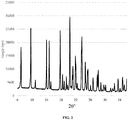
- the XRD pattern of the composition according to the invention or the hydrated freeze-dried Cyclophosphamide contained therein has characteristic peaks at 20.4°, 23.6°, 23.7° and 25.2° of 2 ⁇ 0.2 2 ⁇ .
- the crystalline form of hydrated CPP freeze-dried composition which is hydrated by pure water has characteristic peaks at 20.4°, 23.6°, 23.7° and 25.2° of 2 ⁇ 0.2° 2 ⁇ . It may further have characteristic peaks at 20.4°, 21.9°, 22.1°, 23.6°, 23.7°, 25.2°, and 25.4° of 2 ⁇ 0.2° 2 ⁇ .
- the characteristic peaks of the XRD pattern of the hydrated CPP freeze-dried composition which is hydrated by pure water are as shown in Table 15.
- the XRD pattern of the hydrated CPP freeze-dried composition which is hydrated by pure water is (substantially) as shown in Fig. 2 .
- the crystalline form of hydrated CPP freeze-dried composition which is hydrated by sodium chloride solution (70%) has characteristic peaks at 20.4°, 21.9°, 23.6° and 23.7° of 2 ⁇ 0.2° 2 ⁇ . It may further have characteristic peaks at 20.4°, 21.9°, 22.1°, 23.6°, 23.7° and 25.4° of 2 ⁇ 0.2° 2 ⁇ .
- the characteristic peaks of the XRD pattern of the hydrated CPP freeze-dried composition which is hydrated by sodium chloride solution (70%) are as shown in Table 16.
- the XRD pattern of the hydrated CPP freeze-dried composition which is hydrated by sodium chloride solution (70%) is (substantially) as shown in Fig. 3 .
- the crystalline form of hydrated CPP freeze-dried composition which is hydrated by glycerin solution (40%) has characteristic peaks at 20.4°, 23.6°, 23.7° and 25.2° of 2 ⁇ 0.2° 2 ⁇ . It may further have characteristic peaks at 20.4°, 21.9°, 22.1°, 23.6°, 23.7°, 25.2° and 25.3° of 2 ⁇ 0.2° 2 ⁇ .
- the XRD pattern of the hydrated CPP freeze-dried composition which is hydrated by glycerin solution (40%) is (substantially) as shown in Fig. 4 .
- the cyclophosphamide in the composition according to the invention is in the form of monohydrate (CPP monohydrate).
- the composition according to the invention may also comprise a pharmaceutically acceptable excipient.
- the pharmaceutically acceptable excipient may be referred to those described above for step (a).
- the pharmaceutically acceptable excipient is one or more selected from the group consisting of saccharides, carboxylic acids, amino acids and buffering salts, preferably saccharides, such as mannitol, particularly ⁇ -mannitol.
- the composition according to the invention comprises mannitol, preferably ⁇ -mannitol.
- the pharmaceutically acceptable excipient based on the total weight of the pharmaceutical active ingredient (e.g., CPP monohydrate) and the optional pharmaceutically acceptable excipient, may be about 20-90%(w/w), preferably about 25-75%(w/w), more preferably about 30-60%(w/w), even more preferably about 35-45%(w/w), for example including but not limited to 35%(w/w), 41%(w/w), 45%(w/w) or the like.
- composition according to the invention may be in the form of injectable composition or (sterile) injectable formulation. In other specific embodiments, composition according to the invention may be made in 500 mg, 1000 mg or 2000 mg strength.
- composition comprising hydrated freeze-dried cyclophosphamide may be prepared by the method according to the invention.
- the composition according to the invention has homogenous and plump appearance.
- the composition according to the invention has one or more following features: based on Cyclophosphamide monohydrate, the moisture content is about 4-12%, preferably about 5-10%, more preferably about 6-9%, most preferably about 6.5-9.0%, e.g. 6.5-8.8%; based on the weight of the hydrated composition, the moisture content of the hydrated composition is about 2-7%, preferably 3-6%, such as about 3.7-5%, 3.5-5.5%; it is stable in storage against degradation; the volume keeps unchanged with loose texture; it has excellent appearance; it is sterilized against contamination.
- the pharmaceutical active ingredients like CPP With respect to the pharmaceutical active ingredients like CPP, it has certain requirements for moisture content in terms of stability and the moisture content should not be over high or over low. Therefore, it is essential to maintain certain moisture content for the stability.
- the problem with the past and current preparations of freeze-dried products lies in: it is convenient to use simple freeze-drying process to freeze-dry the moisture content in the composition to a certain range; in commercial production, however, it is difficult to maintain the moisture contents in all freeze-drying bottles uniform by controlling freeze-drying process.
- There are some methods for hydrating products after freeze-drying For example, the sterile air/nitrogen with certain humidity is introduced into freeze-drying chamber.
- freeze-drying penicillin bottles or in freeze-drying box which not only contaminates the freeze-dried composition but also renders the hydration of freeze-dried composition inhomogeneity.
- the above processes are not suitable for commercial production.
- the hydrating process has the advantages in that, easy operation, safety, low cost, effective reduction of difference in batches, better storage stability, and being suitable for commercial production.
- the hydrated products according to the invention do not contain glycerol, which statisfies the requirements related to injectable formulation.
- Cyclophosphamide is purchased from Lianyungang Guike Pharmaceutical Co. Ltd., Haizheng or Hetero; mannitol is purchased from Merck.
- Moisture determination Karl-Fischer volumetric titrimetric method described in Chinese pharmacopoeia 2015, Section III, General rule (0832 moisture determination) is used.
- Karl-Fischer moisture meter (model MKS AT-520, KEM) is used to determine moisture content: an appropriate amount of test sample is weighed precisely (for example, active ingredient CPP, CPP freeze-dried composition or hydrated CPP freeze-dried composition, about 1-5 ml of Fischer solution is used) and is placed in dry conical flask with plug, to which is added an appropriate amount of anhydrous methanol and Fischer solution is used for titration with constant shaking (or stirring) till the solution turns reddish brown from light yellow. A blank test is also performed.
- Moisture content in test sample % A ⁇ B F W ⁇ 100 %
- A is the volume of Fischer solution used for test sample, ml
- B is the volume of Fischer solution used for blank, ml
- F is weight of water corresponding to 1 ml of Fischer solution, mg
- W is weight of test sample, mg.
- the hydrated CPP freeze-dried composition in 500 mg strength is used as an example.
- sample stock solution (1 mg/ml anhydrous Cyclophosphamide): an appropriate amount of water is added into sample bottle with shaking until complete dissolution of the sample, which is transferred to 500 ml volumetric flask.
- the sample bottle is washed with pure water to ensure complete transfer of all samples into the volumetric flask.
- the volumetric flask is metered with pure water into calibration and shaken for homogeneity.
- sample solution 0.5 mg/ml anhydrous Cyclophosphamide
- 25 ml of sample stock solution and 5.0 ml of internal control solution precisely weighed 185 mg of ethyl p-hydroxybenzoate control is dissolved in 1000 ml volumetric flask, to which is added 250 ml of ethanol.
- pure water is used to meter to calibration with shaking
- 50 ml volumetric flask which is metered with pure water to calibration with shaking and then used for HPLC analysis.
- Redissolving time determination 25 ml of 0.9% sodium chloride solution is added to penicillin bottle with sample (hydrated CPP freeze-dried composition in 500 mg strength), or 100 ml of 0.9% sodium chloride solution is added to penicillin bottle with sample (hydrated CPP freeze-dried composition in 2 g strength), and the penicillin bottle is shaken by hand for complete dissolution of the sample. The redissolving time is observed and recorded.
- Example 1 Preparation of various aqueous solutions
- SDS sodium dodecyl sulfate
- Tween 80 1 g and 5 g of Tween 80 were placed in beakers with 100 ml of purified water, which were stirred under room temperature to clear to give Tween 80 solutions with concentrations of 1% and 5%, respectively.
- glycerol 40 g was placed in a beaker with 60 g of purified water, which was stirred under room temperature to clear to give glycerol solution with concentration of 40% w/w.
- glycerol 50 g was placed in a beaker with 50 g of purified water, which was stirred under room temperature to clear to give glycerol solution with concentration of 50% w/w.
- mannitol 18 g was placed in a beaker with 100 ml of purified water, which was stirred under room temperature to clear. 5 g of mannitol was then added with stirring to give saturated mannitol solution.
- aqueous solutions with different saturation or concentration and purified water can provide relative humidity of 50%RH or more after 0.5 h in the dryer.
- Various levels of relative humidity can be achieved by changing the types of aqueous solutions or changing the saturation or concentration of solute in the aqueous solutions.
- Table 1-1 Relative humidity in dryer time/h RH (%) 30% saturation NaBr solution 70% saturation NaBr solution 30% saturation NaCl solution 70% saturation NaCl solution 100% saturation NaCl solution 30% saturation KCl solution 70% saturation KCl solution 100% saturation KCl solution 30% saturation K 2 SO 4 solution 70% saturation K 2 SO 4 solution 1% SDS solution 1% SDS solution 1% Tween 80 solution 5% Tween 80 solution 30% glycerol solution 40% glycerol solution 50% glycerol solution 100% saturation mannitol solution pure water 0 33.2 29.9 47.3 39.5 38.4 43.0 38.4 35.5 30.0 35.5 26.9 62.0 29.1 52.0 62.0 63.0 62.6 86.4 30.2 0.5 82.1 69.7 85.8 71.1 55.6 86.1 72.9 70.9 74.8 89.1 79.8 96.1 81.1 85.4 75.6 80.8 75.4 90.5 94.4 1.0 85.2 72.2 89.5 77.4 61.5 91.0 80.6 75.7 77.6 91.5
- the sodium chloride solution of 70% saturation was sterilized with high pressure steaming sterilizer (121°C, about 15 min) and divided into 16 stainless steel trays (tray size: 300 mm ⁇ 220 mm ⁇ 50 mm).
- high pressure steaming sterilizer 121°C, about 15 min
- 16 stainless steel trays 300 mm ⁇ 220 mm ⁇ 50 mm.
- the front door of freeze-drying box model DG-2010BSCSIP/CIP, Shanghai Gonghe Vacuum Sci &Tech Co., Ltd.
- the stainless steel trays with the sodium chloride solution of 70% saturation were pushed to 9 th baffle of the freeze-drying machine (baffle size 1200 mm ⁇ 900 mm) and the front door of the freeze-drying box was closed.
- the temperature of the baffle was maintained as about 25°C, vacuum of about 60 kPa was applied and the septum valve was closed.
- Table 2-1 Relative humidity of sodium chloride solution of 70% saturation in freeze-drying box (25°C, about 60 kPa) Time point (h) RH% Time point (h) RH% 0 45.8 6.5 80.2 0.5 60.7 7.0 80.2 1.0 67.2 7.5 80.7 1.5 72.0 8.0 80.2 2.0 74.6 8.5 80.2 2.5 76.8 9.0 80.2 3.0 77.6 9.5 80.7 3.5 78.9 10.0 80.2 4.0 79.4 10.5 80.7 4.5 79.8 11.0 80.2 5.0 80.2 11.5 80.7 5.5 80.2 12.0 80.7 6.0 80.2
- Example 3 Hydration of freeze-dried composition with saturated sodium bromide solution (relative humidity is 60% RH under room temperature)
- CPP freeze-dried composition was prepared and hydrated according to the following procedures.
- Example 4 Hydration of freeze-dried composition with saturated sodium chloride solution (relative humidity is 75% RH under room temperature)
- CPP freeze-dried composition was obtained according to the procedures in 1)-3) of Example 3. Hydration was performed according to the following procedures. 4) The inlet valve was opened to allow sterile air to come into the freeze-drying box. The vacuum state was released, and the inlet valve was closed.
- freeze-drying box model LYO-0.5, Shanghai Tofflon Sci &Tech Co., Ltd.
- the front door of freeze-drying box was opened, the steaming sterilized saturated sodium chloride solution was placed in the sterile tray on the bottom shelf (shelf 4) and the front door was locked.
- the penicillin bottles with hydrated CPP freeze-dried compositions were taken out at 16 h and 24 h and provided with aluminum plastic compound cap to give hydrated CPP freeze-dried composition in 500 mg strength, respectively.
- the saturated sodium chloride solution was placed in the dryer and allowed to stand for 24 h.
- the CPP freeze-dried composition was taken out from the freeze-drying box, half stoppered and put into the dryer.
- the penicillin bottles with hydrated CPP freeze-dried compositions were stoppered at 8 h, 16 h and 40 h, taken out and provided with aluminum plastic compound cap to give hydrated CPP freeze-dried compositions in 500 mg strength, respectively.
- the moisture content, CPP content and redissolving time were determined for CPP freeze-dried composition hydrated with saturated sodium chloride solution in the freeze-drying box, respectively.
- the CPP freeze-dried compositions hydrated for 16 h and 24 h were placed in 45°C oven and sampled for determining CPP contents after 1 week and 2 weeks, respectively. The results were shown in Table 4-1.
- Table 4-1 Physicochemical properties of hydrated CPP freeze-dried composition Hydrating time Moisture Content % 1 Moisture content % 2 CPP content % Redissolving time (min) Stability-CPP content% 45°C-1 week 45°C-3 weeks 0h 2.1 3.6 102.9 / 72.0 30.5 16 h shelf 1 4.2 7.1 102.0 1.75 100.5 99.8 shelf 3 5.1 8.7 102.2 1.76 101.5 100.2 24 h shelf 1 4.7 8.0 102.5 1.77 101.4 98.7 shelf 3 4.9 8.3 102.6 1.70 99.4 100.3 1 moisture content% calculated based on freeze-dried composition. 2 moisture content% calculated based on CPP monohydrate.
- Table 4-2 Physicochemical properties of hydrated CPP freeze-dried composition
- the CPP freeze-dried composition without hydration of saturated sodium chloride solution had the moisture content of 3.6% and was not stable at 45°C environment for 1 week.
- the CPP freeze-dried composition hydrated with saturated sodium chloride solution in freeze-drying box had satisfactory moisture content, CPP content and redissolving time. Even placed at 45°C environment for 3 weeks, the CPP content was no less than 99%, showing excellent stability.
- hydrations for 16 h and 24 h can both obtain hydrated CPP freeze-dried composition with good properties.
- no matter where the saturated sodium chloride solution was placed in the freeze-drying box shelf it can provide stable hydrating environment, thereby obtaining satisfactory hydrated CPP freeze-dried composition.
- the CPP freeze-dried composition without hydration of saturated sodium chloride solution has the redissolving time of 9.5 min, which was unsatisfactory.
- the CPP freeze-dried composition without hydration had the moisture content of 3.6% and was not stable at 45°C environment for 1 week.
- the CPP freeze-dried composition hydrated with saturated sodium chloride solution in the dryer had satisfactory moisture content, CPP content and redissolving time.
- the CPP freeze-dried composition hydrated for 16 h was stable at 45°C environment for 2 weeks and was very stable at extreme rigor environment (40°C/75%RH) for 1 month and 3 months.
- the stability at such environment was even better than the active ingredient CPP monohydrate.
- Example 5 Hydration of freeze-dried composition with saturated potassium chloride solution (relative humidity is 85% RH under room temperature)
- the CPP freeze-dried composition was obtained according to procedures in 1)-3) of Example 3.
- the hydration was performed as follows.
- the inlet valve was opened to allow sterile air to come into the freeze-drying box.
- the vacuum state was released, and the inlet valve was closed.
- the front door of the freeze-drying box was opened, the steaming sterilized saturated potassium chloride solution was placed in the sterile tray on the bottom shelf and the front door was locked.
- the penicillin bottles with hydrated CPP freeze-dried compositions were stoppered at 8 h, 12 h and 16 h, taken out and provided with aluminum plastic compound cap to give hydrated CPP freeze-dried compositions in 500 mg strength, respectively.
- the CPP freeze-dried composition hydrated with saturated potassium chloride solution in penicillin bottles showed homogenous and plump state.
- the CPP freeze-dried composition without hydration of saturated potassium chloride solution had the moisture content of 1.9% and was not stable.
- the CPP freeze-dried composition hydrated with saturated potassium chloride solution in the freeze-drying box had satisfactory moisture content, CPP content and redissolving time.
- the CPP freeze-dried composition hydrated with saturated potassium chloride solution for 24 h was stable at 45°C environment for 2 weeks.
- Example 6 Hydration of freeze-dried composition with saturated potassium sulfate solution (relative humidity is 98% RH under room temperature)
- the CPP freeze-dried composition was obtained according to procedures in 1)-3) of Example 3.
- the hydration was performed as follows. The saturated potassium sulfate solution was placed in the dryer and was allowed to stand for 24 h. The CPP freeze-dried composition was half stoppered and placed in the dryer. The penicillin bottles with hydrated CPP freeze-dried composition were stoppered at 8 h, 16 h and 40 h, taken out and provided with aluminum plastic compound cap to give hydrated CPP freeze-dried composition in 500 mg strength, respectively.
- the CPP freeze-dried compositions hydrated with saturated potassium sulfate solution in penicillin bottle showed homogenous and plump state.
- the moisture content, CPP content and redissolving time were determined for CPP freeze-dried composition hydrated with saturated potassium sulfate solution in the dryer, respectively.
- the CPP freeze-dried composition hydrated for 16 h was placed in 45°C oven and was sampled for determining CPP contents after 1 week and 2 weeks, respectively.
- the CPP freeze-dried composition hydrated for 16 h was placed in 40°C/75%RH stability test chamber, sampled after 1 month and 3 months for determining CPP contents. The results were shown in Table 6-1.
- Table 6-1 Physicochemical properties of hydrated CPP freeze-dried composition Hydrating time (h) Moisture content% 1 Redissolving time (min) CPP content% Stability-CPP content % 45°C-1 week 45°C-2 weeks 40°C/75%RH-1 month 40°C/75%RH-3 months 0 3.6 9.5 103.1 / / / / 8 7.8 1.4 100.5 / / / / 16 7.7 1.5 91.5 103.6 101.2 101.7 99.3 40 7.7 3.5 103.2 / / / / 1 moisture content% calculated based on CPP monohydrate.
- the CPP freeze-dried composition hydrated with saturated potassium sulfate solution in the dryer had satisfactory moisture content, CPP content and redissolving time.
- the CPP freeze-dried composition hydrated for 16 h was stable at 45°C environment for 2 weeks and was very stable at extreme rigor environment (40°C/75%RH) for 1 month and 3 months.
- the stability at such environment was even better than the active ingredient CPP monohydrate.
- Example 7 Hydration of freeze-dried composition with pure water (relative humidity is 100% RH under room temperature)
- the CPP freeze-dried composition was prepared and hydrated according to the following procedures.
- the inlet valve of the freeze-drying box was opened to allow sterile air to come into freeze-drying box.
- the vacuum state was released, and the inlet valve was closed.
- the front door of freeze-drying box (model LYO-0.5, Shanghai Tofflon Sci &Tech Co., Ltd.) was opened, the steaming sterilized pure water was placed in the sterile tray on the bottom shelf and the front door was locked. Vacuum was applied to prechamber of the freeze-drying box under room temperature until the pressure was about 60 kPa.
- the septum valve was closed and the hydration was initiated.
- the penicillin bottles with hydrated CPP freeze-dried compositions were stoppered at 24 h, taken out and provided with aluminum plastic compound cap to give hydrated CPP freeze-dried composition in 2 g strength.
- the CPP freeze-dried compositions hydrated with pure water under normal atmosphere and micro negative pressure in penicillin bottles showed homogenous and plump state.
- Example 8 Hydration of freeze-dried composition with pure water (relative humidity is 100% RH under room temperature)
- the CPP freeze-dried composition was obtained according to procedures in 1)-3) of Example 3.
- the hydration was performed as follows. 4) The inlet valve was opened to allow sterile air to come into the freeze-drying box. The vacuum state was released, and the inlet valve was closed. The front door of the freeze-drying box was opened, the steaming sterilized pure water was placed in the sterile tray on the bottom shelf and the front door was locked.
- the penicillin bottles with hydrated CPP freeze-dried compositions were stoppered at 16 h and 24 h, taken out and provided with aluminum plastic compound cap to give hydrated CPP freeze-dried composition in 500 mg strength, respectively.
- the CPP freeze-dried compositions hydrated with pure water under normal atmosphere and micro negative pressure in penicillin bottles showed homogenous and plump state.
- the CPP freeze-dried composition without hydration of pure water under normal atmosphere had the moisture content of 1.9%, which was not stable and the redissolving time of 2.08 min.
- the CPP freeze-dried composition hydrated with pure water under normal atmosphere in the freeze-drying box had satisfactory moisture content, CPP content and redissolving time.
- the CPP freeze-dried compositions hydrated with pure water for 16 and 24 h were stable at 45°C environment for 2 weeks. Therefore, with the hydrating process according to the invention, the CPP freeze-dried composition with significantly improved stability can be obtained.
- the CPP freeze-dried composition without hydration of pure water had the moisture content of 2.9%, while the CPP freeze-dried composition hydrated with pure water had satisfactory moisture content and CPP content. Moreover, the CPP freeze-dried composition hydrated with pure water under micro negative pressure for 15 h was stable at 40°C/75%RH environment for 1 month. Therefore, with the hydrating process according to the invention, the CPP freeze-dried composition with significantly improved stability can be obtained.
- the hydration was performed as follows. 4) The inlet valve of freeze-drying box was opened to allow sterile air to come into freeze-drying box. The vacuum state was released, and the inlet valve was closed. The front door of the freeze-drying box was opened, the steaming sterilized sodium chloride solution of 70% saturation was placed in the sterile tray on the bottom shelf and the front door was locked. Vacuum was applied to prechamber of the freeze-drying box under room temperature until the pressure was about 60 kPa. The septum valve was closed and the hydration was initiated. The penicillin bottles with hydrated CPP freeze-dried compositions were stoppered at 15 h, taken out and provided with aluminum plastic compound cap to give hydrated CPP freeze-dried composition in 500 mg strength.
- the CPP freeze-dried compositions in 500 mg strength hydrated with sodium chloride solution of 70% saturation under micro negative pressure in penicillin bottles showed homogenous and plump state.
- Table 9-1 Physicochemical properties of hydrated CPP freeze-dried composition Hydrating time(h) Moisture content% 1 Moisture content% 2 CPP content% Redissolving time (min) Stability-CPP content% 40°C/75%RH-1 month 0 1.7 2.9 99.8 / / 15 4.1 7.0 100.9 / 96.9 1 moisture content% calculated based on the weight of freeze-dried composition. 2 moisture content% calculated based on the weight of CPP monohydrate.
- Example 10.1 Hydration of freeze-dried composition under micro negative pressure with 30% glycerol solution
- the hydration was performed as follows. 4) The inlet valve of freeze-drying box was opened to allow sterile air to come into freeze-drying box. The vacuum state was released, and the inlet valve was closed. The front door of freeze-drying box was opened, the steaming sterilized 30% glycerol solution was placed in the sterile tray on the bottom shelf (tray surface area: 330 cm 2 ) and the front door was locked. Vacuum was applied to prechamber of the freeze-drying box under room temperature until the pressure was about 50 kPa. The septum valve was closed, and the hydration was initiated. The penicillin bottles with hydrated CPP freeze-dried compositions were stoppered at 8 h, taken out and provided with aluminum plastic compound cap to give hydrated CPP freeze-dried composition in 500 mg strength.
- the CPP freeze-dried compositions in 500 mg strength hydrated with 30% glycerol solution under micro negative pressure in penicillin bottles showed homogenous and plump state.
- the moisture content was determined for CPP freeze-dried composition in 500 mg strength hydrated with 30% glycerol solution under micro negative pressure in freeze-drying box and the results were shown in Table 10-1.
- Table 10-1 Physicochemical properties of hydrated CPP freeze-dried composition Hydrating time(h) Moisture content% 1 Moisture content% 2 0 1.2 2.0 8 4.0 6.8 1 moisture content% calculated based on the weight of freeze-dried composition. 2 moisture content% calculated based on the weight of CPP monohydrate.
- Example 10.2 Hydration of freeze-dried composition under micro negative pressure with 40% glycerol solution
- the hydration was performed as follows. 4) The inlet valve of freeze-drying box was opened to allow sterile air to come into freeze-drying box. The vacuum state was released, and the inlet valve was closed. The front door of freeze-drying box was opened, the steaming sterilized 40% glycerol solution was placed in the sterile tray on the bottom shelf (tray surface area: 330 cm 2 ) and the front door was locked. Vacuum was applied to prechamber of the freeze-drying box under room temperature until the pressure was about 50 kPa. The septum valve was closed, and the hydration was initiated. The penicillin bottles with hydrated CPP freeze-dried compositions were stoppered at 20 h, taken out and provided with aluminum plastic compound cap to give hydrated CPP freeze-dried composition in 500 mg strength.
- the CPP freeze-dried compositions in 500 mg strength hydrated with 40% glycerol solution under micro negative pressure in penicillin bottles showed homogenous and plump state.
- the moisture content was determined for CPP freeze-dried composition in 500 mg strength hydrated with 40% glycerol solution under micro negative pressure in freeze-drying box and the results were shown in Table below.
- Table 10-2 Physicochemical properties of hydrated CPP freeze-dried composition Hydrating time(h) Moisture content% 1 Moisture content% 2 0 1.1 1.9 20 4.1 7.0 1 moisture content% calculated based on the weight of freeze-dried composition. 2 moisture content% calculated based on the weight of CPP monohydrate.
- Example 8 The following Examples were hydrated CPP freeze-dried composition prepared by hydrating with pure water, sodium chorolde solution (70% saturation) or glycerol solution (40 wt%) respectively.
- the preparation methods can be referred to Example 8, 9 and 10 (10.2) respectively and can be adjusted according to the required strength.
- Example 11 Bulk Density (BD or p0)
- BD of the test sample (for example, active ingredient CPP, the hydrated CPP freeze-dried composition) is measured in a graduated Cylinder as per the Method I described in USP ⁇ 616>.
- TD of the test sample is measured as per the Method I described in USP ⁇ 616> which is obtained by mechanically tapping a graduated measuring cylinder (TAP Density Tester, Sotax TD2) containing the test sample.
- Table 12 Tapped Density Sample Strength (g) Hydration Solution (Hydration Pressure 50 kPa) Tapped Density (g/mL) Active ingredient CPP (Currently marketed product) / / 0.9369 Hydrated CPP freeze-dried composition (Product according to the present invention) 0.5 40% glycerol solution (w/w) 0.2160 Purified water 0.2313 70% saturated sodium chloride solution 0.1903 1 40% glycerol solution (w/w) 0.2124 2 40% glycerol solution (w/w) 0.2573
- results of the porosity are listed in Table 14.
- Table 14 Porosity Sample Strength (g) Hydration Solution (Hydration Pressure 50 kPa) Porosity (%) Active ingredient CPP (Currently marketed product) NA NA 56.28 Hydrated CPP freeze-dried composition (Product according to the present invention) 0.5 40% glycerol solution (w/w) 96.60 Purified water 96.29 70% saturation sodium chloride solution 96.43 1 40% glycerol solution (w/w) 96.63 2 40% glycerol solution (w/w) 96.46
- Example 15 Powder X-ray diffraction (XRD)
- test sample for example, active ingredient CPP, mannitol, the hydrated CPP freeze-dried composition
- test sample for example, active ingredient CPP, mannitol, the hydrated CPP freeze-dried composition
- the XRD patterns were recorded by Bruker's D8 Advance Diffractometer (Karlsruhe, West Germany) equipped with a 2 ⁇ compensating slit, using Cu K ⁇ radiation (1.54 ⁇ ), at 40 kV and 40 mA passing through parabolic filter with divergence slit (0.5°), anti-scattering slit (0.5°) and receiving slit (1 mm).
- the diffractometer was calibrated for accuracy of peak positions with corundum.
- XRD patterns were obtained by scanning in continuous mode over an angular range of 6-36° 2 ⁇ with a step size of 0.02° and a dwell time of 1 s.
- Diffractograms were analyzed using MDI/JADE (version 6.0) diffraction software.
- the standard diffractograms of ⁇ - and ⁇ -mannitol were generated using Mercury software using the cif files with reference codes DMANTL07 and DMANTL10, respectively.
- XRD patterns were shown in FIG. 1 .
- FIG. 1 showed overlaid XRD patterns obtained from CPP monohydrate, hydrated CPP freeze-dried compositions (initial ingredients include monohydrate CPP and ⁇ -mannitol) and the two polymorphic forms of anhydrous mannitol.
- Hydrated CPP freeze-dried compositions showed characteristic peaks of ⁇ -mannitol instead of ⁇ -mannitol (at 2 ⁇ values of 9.7° but no peak at 16.8°). Additionally, hydrated CPP freeze-dried compositions also exhibited characteristic peaks of CPP monohydrate (at 2 ⁇ values of 7.0°, 10.9°, 14.0°, and 17.8°).
- ⁇ -polymorph of mannitol is stable and ⁇ -polymorph is metastable. Lyophilization of the solution containing only mannitol, yielded a mixture of ⁇ -(major) and ⁇ -(minor) polymorphs of mannitol. However, in the presence of CPP in the mannitol solution, only ⁇ -polymorph was observed in the lyophilized sample.
- the crystalline form of hydrated freeze-dried cyclophosphamide composition that was hydrated by pure water according to the methods described in embodiments of the present invention may be characterized by an XRD pattern having characteristic peaks at 20.4°, 23.6°, 23.7°, and 25.2° of 2 ⁇ 0.2° 2 ⁇ .
- the crystalline form of hydrated freeze-dried cyclophosphamide composition that is hydrated by pure water according to the methods described in embodiments of the present invention may also or alternatively be characterized by an XRD pattern having characteristic peaks at 20.4°, 21.9°, 22.1°, 23.6°, 23.7°, 25.2°, and 25.4° of 2 ⁇ 0.2° 2 ⁇ .
- the crystalline form of hydrated freeze-dried cyclophosphamide composition that is hydrated by pure water according to the methods described in embodiments of the present invention may be characterized by a powder X-ray diffraction pattern substantially as shown in FIG. 2 .
- the crystalline form of hydrated freeze-dried cyclophosphamide composition that is hydrated by pure water according to the methods described in embodiments of the present invention may also or alternatively be characterized by an XRD pattern having peaks substantially as provided in Table 15 ( ⁇ 0.2° 2 ⁇ ) below. Table 15 XRD of CPP Freezed-dried Compositions Hydrated by Pure Water Peak No. Pos.
- the crystalline form of hydrated freeze-dried cyclophosphamide composition that was hydrated by sodium chloride solution (70%) according to the methods described in embodiments of the present invention may be characterized by an XRD pattern having characteristic peaks at 20.4°, 21.9°, 23.6°, and 23.7° of 20 ⁇ 0.2° 2 ⁇ .
- the crystalline form of hydrated freeze-dried cyclophosphamide composition that is hydrated by sodium chloride solution (70%) according to the methods described in embodiments of the present invention may also or alternatively be characterized by an XRD pattern having characteristic peaks at 20.4°, 21.9°, 22.1°, 23.6°, 23.7°, and 25.4° of 2 ⁇ 0.2° 2 ⁇ .
- the crystalline form of hydrated freeze-dried cyclophosphamide composition that is hydrated by sodium chloride solution (70%) according to the methods described in embodiments of the present invention may be characterized by an XRD pattern substantially as shown in FIG. 3 .
- the crystalline form of hydrated freeze-dried cyclophosphamide composition that is hydrated by sodium chloride solution according to the methods described in embodiments of the present invention may also or alternatively be characterized by an XRD pattern having peaks substantially as provided in Table 16 ( ⁇ 0.2° 2 ⁇ ) below.
- the crystalline form of hydrated freeze-dried cyclophosphamide composition that is hydrated by glycerol solution (40%) according to the methods described in embodiments of the present invention may be characterized by an XRD pattern having characteristic peaks at 20.4°, 23.6°, 23.7°, and 25.2° of 2 ⁇ 0.2° 2 ⁇ .
- the crystalline form of hydrated freeze-dried cyclophosphamide composition that is hydrated by glycerol solution (40%) according to the methods described in embodiments of the present invention may also or alternatively be characterized by an XRD pattern having characteristic peaks at 20.4°, 21.9°, 22.1°, 23.6°, 23.7°, 25.2°, and 25.3° of 2 ⁇ 0.2° 2 ⁇ .
- the crystalline form of hydrated freeze-dried cyclophosphamide composition that is hydrated by glycerol solution (40%) according to the methods described in embodiments of the present invention may be characterized by an XRD pattern substantially as shown in FIG. 4 .
- the crystalline form of hydrated freeze-dried cyclophosphamide composition that is hydrated by glycerol solution according to the methods described in embodiments of the present invention may be characterized by an XRD pattern having peaks substantially as provided in Table 17 ( ⁇ 0.2° 2 ⁇ ) below.
- Test method and parameters were as follows: Instrument OMEC Topsizer Material refractive index 1.5 absorption 0.1 Model Air Dispersion/Dry model Sensitivity enhanced Calculation model general particle shape irregular Dispersion pressure 400 kpa Feed speed 100% Feed slit 0.8 cm Obscuration 1-10 Measuring time 8 s Background time 8 s Measure cycle 3
- D50 refers to the median particle diameter, wherein half of the particle population has a diameter below such value.
- D90 refers to the particle diameter wherein 90% of the particle population has a diameter below such value.
- D10 refers to the particle diameter wherein 10% of the particle population has a diameter below such value.
- Test samples for example, active ingredient CPP, hydrated freeze-dried CPP composition
- 0.9% sodium chloride injection to 20 mg/ml.
- content and impurity profiles in Room Temperature (RT) and Refrigerator (2-8°C) are determined respectively.
- Test samples for example, active ingredient CPP, hydrated freeze-dried CPP composition
- Table 21 Stability Condition 45 °C -1 Week 45 °C -2 Weeks Sample Active ingredient CPP (Currently marketed product) Hydrated CPP freeze-dried composition (Product according to the present invention ) Active ingredient CPP (Currently marketed product) Hydrated CPP freeze-dried composition (Product according to the present invention) Hydration solution (Hydration pressure 50kPa) NA 40% glycerol solution (w/w) Purified Water 70% saturation sodium chloride solution NA 40% glycerol solution (w/w) Purified Water 70% saturation sodium chloride solution Impurity B (%) 0.61 0.02 0.02 0.02 1.40 0.05 0.07 0.03 Impurity D (%) 0.71 0.74 0.80 0.83 0.98 0.84 0.93 0.74 Impurity A (%) 0.65 0.06 0.05 0.07 1.82 0.09
- CPP freeze-dried composition 500 mg, active ingredient CPP from Haizheng, Hetero or Guike
- CPP freeze-dried composition is obtained by hydrating with 40% glycerol solution, purified water and 70% saturation sodium chloride solution, respectively.
- the hydrated CPP freezed-dried composition according to the invention is free of glycerol, which statisfys the requirements to injectable formulation for use.
Landscapes
- Health & Medical Sciences (AREA)
- Chemical & Material Sciences (AREA)
- Life Sciences & Earth Sciences (AREA)
- Veterinary Medicine (AREA)
- Pharmacology & Pharmacy (AREA)
- Epidemiology (AREA)
- Medicinal Chemistry (AREA)
- Animal Behavior & Ethology (AREA)
- General Health & Medical Sciences (AREA)
- Public Health (AREA)
- Engineering & Computer Science (AREA)
- Chemical Kinetics & Catalysis (AREA)
- General Chemical & Material Sciences (AREA)
- Oil, Petroleum & Natural Gas (AREA)
- Dermatology (AREA)
- Bioinformatics & Cheminformatics (AREA)
- Biochemistry (AREA)
- Molecular Biology (AREA)
- Inorganic Chemistry (AREA)
- Pharmaceuticals Containing Other Organic And Inorganic Compounds (AREA)
- Medicinal Preparation (AREA)
Applications Claiming Priority (3)
| Application Number | Priority Date | Filing Date | Title |
|---|---|---|---|
| CN201810875707.5A CN110787137A (zh) | 2018-08-03 | 2018-08-03 | 环磷酰胺冻干组合物的水化方法及其产品 |
| CN201811367499.4A CN111195235A (zh) | 2018-11-16 | 2018-11-16 | 一种水化环磷酰胺冻干组合物的方法及其产品 |
| PCT/CN2019/099251 WO2020025069A1 (zh) | 2018-08-03 | 2019-08-05 | 一种水化环磷酰胺冻干组合物的方法及其产品 |
Publications (2)
| Publication Number | Publication Date |
|---|---|
| EP3831366A1 true EP3831366A1 (de) | 2021-06-09 |
| EP3831366A4 EP3831366A4 (de) | 2022-05-18 |
Family
ID=69230821
Family Applications (1)
| Application Number | Title | Priority Date | Filing Date |
|---|---|---|---|
| EP19844577.7A Pending EP3831366A4 (de) | 2018-08-03 | 2019-08-05 | Verfahren zur hydratisierung von lyophilisierter cyclophosphamidzusammensetzung und produkt davon |
Country Status (4)
| Country | Link |
|---|---|
| US (2) | US12453737B2 (de) |
| EP (1) | EP3831366A4 (de) |
| CN (1) | CN112533591A (de) |
| WO (1) | WO2020025069A1 (de) |
Families Citing this family (1)
| Publication number | Priority date | Publication date | Assignee | Title |
|---|---|---|---|---|
| CN112533591A (zh) | 2018-08-03 | 2021-03-19 | 上海宣泰医药科技股份有限公司 | 一种水化环磷酰胺冻干组合物的方法及其产品 |
Family Cites Families (38)
| Publication number | Priority date | Publication date | Assignee | Title |
|---|---|---|---|---|
| US4537883A (en) | 1982-11-12 | 1985-08-27 | Mead Johnson & Company | Lyophilized cyclophosphamide |
| US5227374A (en) | 1982-11-12 | 1993-07-13 | Mead Johnson & Company | Lyophilized cyclophosphamide |
| US4659699A (en) * | 1983-08-22 | 1987-04-21 | Cetus-Ben Venue Therapeutics | Process for freeze drying cyclophosphamide |
| US4797388A (en) | 1984-05-21 | 1989-01-10 | Cetus Corporation | Pharmaceutical compositions with galactitol as carrier |
| US4775533A (en) | 1987-02-24 | 1988-10-04 | Erbamont, Inc. | Reconstitution of dry fill cyclophosphamide |
| US5036060A (en) | 1988-07-25 | 1991-07-30 | Fujisawa Usa, Inc. | Cyclophosphamide |
| CA2001552C (en) | 1988-11-14 | 1997-07-22 | The Upjohn Company | Cyclophosphamide - sodium bicarbonate lyophilizates |
| US5066647A (en) | 1989-04-20 | 1991-11-19 | Erbamont, Inc. | Cyclophosphamide - alanine lyophilizates |
| CA2013474C (en) | 1989-04-20 | 2000-01-18 | Pharmacia Inc. | Cyclophosphamide - alanine lyophilizates |
| CA2053065C (en) | 1990-10-15 | 1998-02-10 | Nageswara R. Palepu | Cyclophosphamide - sodium bicarbonate lyophilizates |
| CA2063058A1 (en) | 1991-04-09 | 1992-10-10 | Nageswara Rao Palepu | Process for hydrating lyophilized compositions using atomized water |
| US5268368A (en) | 1991-05-17 | 1993-12-07 | Erbamont, Inc. | Cyclophosphamide--amino acid lyophilizates |
| US5336669A (en) | 1991-12-10 | 1994-08-09 | Erbamont, Inc. | Cyclophosphamide monohydrate and lactose |
| GB2271281A (en) | 1992-10-09 | 1994-04-13 | Orion Yhtymae Oy | Stabilised cyclophosphamide compositions |
| US5418223A (en) | 1993-05-20 | 1995-05-23 | Erbamont, Inc. | Method for lyophilization of cyclophosphamide and product |
| FI971533A7 (fi) | 1994-10-13 | 1997-04-11 | Wakamoto Pharma Co Ltd | Lyofilisoituja farmaseuttisia valmisteita, jotka kykenevät muodostamaa n vesipitoisen lääkekoostumuksen, jolla on palautuvan, lämpökovettuvan geelittymisen ominaisuus |
| EP1938798A1 (de) | 2002-02-22 | 2008-07-02 | Schering Corporation | Pharmazeutische Formulierungen aus antineoplastischen Wirkstoffen, insbesondere Temozolomiden, sowie Herstellungs- und Verwendungsverfahren dafür |
| WO2004030659A1 (en) | 2002-09-30 | 2004-04-15 | Acusphere, Inc. | Sustained release porous microparticles for inhalation |
| CN1923280A (zh) | 2005-08-30 | 2007-03-07 | 孔庆忠 | 一种含双氯乙胺类药物的抗癌缓释注射剂 |
| CN101564413A (zh) * | 2008-04-25 | 2009-10-28 | 北京和润创新医药科技发展有限公司 | 一种冠心苏合制剂及其制备方法 |
| CN102058524A (zh) | 2009-11-13 | 2011-05-18 | 天津金世制药有限公司 | 一种环磷酰胺注射液及其制备方法 |
| CN102258488B (zh) * | 2011-07-19 | 2012-10-31 | 江苏奥赛康药业股份有限公司 | 一种注射用克林霉素磷酸酯组合物及其制备方法 |
| WO2013152118A1 (en) | 2012-04-04 | 2013-10-10 | Utc Fire & Security Americas Corporation, Inc. | Remote alert messaging display and confirmation |
| US20150290226A1 (en) | 2012-10-29 | 2015-10-15 | Leiutis Pharmaceuticals Pvt. Ltd. | Novel lyophilized compositions of cyclophosphamide |
| WO2014068585A1 (en) | 2012-10-29 | 2014-05-08 | Leiutis Pharmaceuticals Pvt. Ltd. | Novel lyophilized compositions of cyclophosphamide |
| CN103536546A (zh) | 2013-10-15 | 2014-01-29 | 海南卫康制药(潜山)有限公司 | 注射用环磷酰胺组合物冻干粉针 |
| CN106456654A (zh) | 2014-05-09 | 2017-02-22 | 奥罗医学制药有限公司 | 环磷酰胺液体浓缩制剂 |
| US10016447B2 (en) | 2014-09-26 | 2018-07-10 | Intas Pharmaceuticals Ltd. | Pharmaceutical composition having improved content uniformity |
| WO2016132270A1 (en) | 2015-02-16 | 2016-08-25 | Leiutis Pharmaceuticals Pvt Ltd | Stable ready to use cyclophosphamide liquid formulations |
| US20170014374A1 (en) | 2015-07-13 | 2017-01-19 | Thorne Research, Inc. | Composition for treatment of dyslipidemia and inflammation |
| WO2017207719A1 (en) | 2016-06-02 | 2017-12-07 | Amneal Pharmaceuticals Company Gmbh | Cyclophosphamide composition and method for preparation thereof |
| KR20180041814A (ko) | 2016-10-14 | 2018-04-25 | 한국유나이티드제약 주식회사 | 유기용매 유리 동결건조 시클로포스파미드의 제조방법 |
| US10149857B2 (en) | 2017-03-09 | 2018-12-11 | Ampac Fine Chemicals Llc | Lyophilized cyclophosphamide composition and methods of preparation thereof |
| CN107236004B (zh) | 2017-07-02 | 2019-03-29 | 石家庄学院 | 二氢杨梅素环磷酰胺衍生物及其制备方法和应用 |
| CN107540711A (zh) | 2017-09-26 | 2018-01-05 | 山东印迹生物技术有限公司 | 一种环磷酰胺的结晶方法 |
| CN208564140U (zh) | 2018-07-10 | 2019-03-01 | 浙江永强集团股份有限公司 | 遮阳伞及其伞座 |
| CN112533591A (zh) | 2018-08-03 | 2021-03-19 | 上海宣泰医药科技股份有限公司 | 一种水化环磷酰胺冻干组合物的方法及其产品 |
| WO2020100088A1 (en) | 2018-11-16 | 2020-05-22 | Sinotherapeutics Inc. | A process for hydrating cyclophosphamide freeze-dried composition and product thereof |
-
2019
- 2019-08-05 CN CN201980051898.6A patent/CN112533591A/zh active Pending
- 2019-08-05 EP EP19844577.7A patent/EP3831366A4/de active Pending
- 2019-08-05 WO PCT/CN2019/099251 patent/WO2020025069A1/zh not_active Ceased
- 2019-08-05 US US17/265,678 patent/US12453737B2/en active Active
-
2025
- 2025-06-17 US US19/240,969 patent/US20250312363A1/en active Pending
Also Published As
| Publication number | Publication date |
|---|---|
| EP3831366A4 (de) | 2022-05-18 |
| CN112533591A (zh) | 2021-03-19 |
| US20250312363A1 (en) | 2025-10-09 |
| WO2020025069A1 (zh) | 2020-02-06 |
| US12453737B2 (en) | 2025-10-28 |
| US20220133754A1 (en) | 2022-05-05 |
Similar Documents
| Publication | Publication Date | Title |
|---|---|---|
| CN102387790B (zh) | 蛋白酶抑制剂的冻干饼 | |
| JP3503943B2 (ja) | 結晶質アミホスチン組成物及びその調製方法並びに使用 | |
| ES2573982T3 (es) | Proceso para la producción de coevaporados y complejos que comprenden voriconazol y ciclodextrina | |
| US20250312363A1 (en) | Method for hydrating lyophilized cyclophosphamide composition and product thereof | |
| JP6182262B2 (ja) | 抗がん剤を含む安定な水溶性医薬組成物 | |
| KR20130136466A (ko) | 카스포펀진 조성물 | |
| US20250082672A1 (en) | Metal (hydr) oxide composite comprising poorly soluble drug, method for manufacturing same, and pharmaceutical composition comprising same | |
| CN101500571A (zh) | 稳定的冻干制剂 | |
| EP3395371B1 (de) | Wirkstoffeinschlussverbindung, zubereitung daraus und herstellungsverfahren dafür | |
| US20200155579A1 (en) | Process for Hydrating Cyclophosphamide Freeze-Dried Composition and Product Thereof | |
| CN101611040A (zh) | 哌拉西林钠的新颖结晶 | |
| KR20140053907A (ko) | 니코란딜 함유 의약 조성물 | |
| US20220323356A1 (en) | Metal (hydr)oxide composite comprising poorly soluble drug, method for preparing same, and pharmaceutical composition comprising same | |
| CN103462910A (zh) | 一种注射用阿奇霉素组合物及其制备方法 | |
| CN103980279B (zh) | 一种甲氨蝶呤化合物及注射用甲氨蝶呤 | |
| CN102846563B (zh) | 一种培美曲塞二钠注射用组合物及其制备方法 | |
| EP2896625A1 (de) | Cokristall von piperacillin-natrium und sulbactam-natrium und herstellungsverfahren dafür sowie pharmazeutische zusammensetzungen damit und verwendungen davon | |
| CN104800172A (zh) | 注射用卡络磺钠粉针剂和制法 | |
| ES2853349T3 (es) | Formulaciones farmacéuticas estables | |
| Benavent et al. | Nystatin antifungal micellar systems on endotracheal tubes: Development, characterization and in vitro evaluation | |
| EP3770165B1 (de) | Posaconazolphosphateestermonocholinsalz, verfahren zu seiner herstellung und seine verwendung | |
| CN111195235A (zh) | 一种水化环磷酰胺冻干组合物的方法及其产品 | |
| CN110787137A (zh) | 环磷酰胺冻干组合物的水化方法及其产品 | |
| CN110840849A (zh) | 一种用于5-氟尿嘧啶前药的粉针剂及其制备方法和应用 | |
| CN103435615B (zh) | 一种更昔洛韦化合物、制备方法及其药物组合物 |
Legal Events
| Date | Code | Title | Description |
|---|---|---|---|
| STAA | Information on the status of an ep patent application or granted ep patent |
Free format text: STATUS: THE INTERNATIONAL PUBLICATION HAS BEEN MADE |
|
| PUAI | Public reference made under article 153(3) epc to a published international application that has entered the european phase |
Free format text: ORIGINAL CODE: 0009012 |
|
| STAA | Information on the status of an ep patent application or granted ep patent |
Free format text: STATUS: REQUEST FOR EXAMINATION WAS MADE |
|
| 17P | Request for examination filed |
Effective date: 20210302 |
|
| AK | Designated contracting states |
Kind code of ref document: A1 Designated state(s): AL AT BE BG CH CY CZ DE DK EE ES FI FR GB GR HR HU IE IS IT LI LT LU LV MC MK MT NL NO PL PT RO RS SE SI SK SM TR |
|
| DAV | Request for validation of the european patent (deleted) | ||
| DAX | Request for extension of the european patent (deleted) | ||
| A4 | Supplementary search report drawn up and despatched |
Effective date: 20220419 |
|
| RIC1 | Information provided on ipc code assigned before grant |
Ipc: A61K 31/675 20060101ALI20220411BHEP Ipc: A61K 47/26 20060101ALI20220411BHEP Ipc: A61K 47/02 20060101ALI20220411BHEP Ipc: A61K 47/12 20060101ALI20220411BHEP Ipc: A61K 47/10 20170101ALI20220411BHEP Ipc: A61K 31/66 20060101ALI20220411BHEP Ipc: A61K 9/19 20060101AFI20220411BHEP |
|
| STAA | Information on the status of an ep patent application or granted ep patent |
Free format text: STATUS: EXAMINATION IS IN PROGRESS |