EP3829418B1 - Metall-oberflächen-verhältnis einer mikrokanüle - Google Patents
Metall-oberflächen-verhältnis einer mikrokanüle Download PDFInfo
- Publication number
- EP3829418B1 EP3829418B1 EP19745648.6A EP19745648A EP3829418B1 EP 3829418 B1 EP3829418 B1 EP 3829418B1 EP 19745648 A EP19745648 A EP 19745648A EP 3829418 B1 EP3829418 B1 EP 3829418B1
- Authority
- EP
- European Patent Office
- Prior art keywords
- base
- metal coating
- sensor
- tip
- capsule
- Prior art date
- Legal status (The legal status is an assumption and is not a legal conclusion. Google has not performed a legal analysis and makes no representation as to the accuracy of the status listed.)
- Active
Links
Images

Classifications
-
- A—HUMAN NECESSITIES
- A61—MEDICAL OR VETERINARY SCIENCE; HYGIENE
- A61B—DIAGNOSIS; SURGERY; IDENTIFICATION
- A61B5/00—Measuring for diagnostic purposes; Identification of persons
- A61B5/145—Measuring characteristics of blood in vivo, e.g. gas concentration or pH-value ; Measuring characteristics of body fluids or tissues, e.g. interstitial fluid or cerebral tissue
- A61B5/14507—Measuring characteristics of blood in vivo, e.g. gas concentration or pH-value ; Measuring characteristics of body fluids or tissues, e.g. interstitial fluid or cerebral tissue specially adapted for measuring characteristics of body fluids other than blood
- A61B5/1451—Measuring characteristics of blood in vivo, e.g. gas concentration or pH-value ; Measuring characteristics of body fluids or tissues, e.g. interstitial fluid or cerebral tissue specially adapted for measuring characteristics of body fluids other than blood for interstitial fluid
- A61B5/14514—Measuring characteristics of blood in vivo, e.g. gas concentration or pH-value ; Measuring characteristics of body fluids or tissues, e.g. interstitial fluid or cerebral tissue specially adapted for measuring characteristics of body fluids other than blood for interstitial fluid using means for aiding extraction of interstitial fluid, e.g. microneedles or suction
-
- A—HUMAN NECESSITIES
- A61—MEDICAL OR VETERINARY SCIENCE; HYGIENE
- A61B—DIAGNOSIS; SURGERY; IDENTIFICATION
- A61B5/00—Measuring for diagnostic purposes; Identification of persons
- A61B5/145—Measuring characteristics of blood in vivo, e.g. gas concentration or pH-value ; Measuring characteristics of body fluids or tissues, e.g. interstitial fluid or cerebral tissue
- A61B5/14532—Measuring characteristics of blood in vivo, e.g. gas concentration or pH-value ; Measuring characteristics of body fluids or tissues, e.g. interstitial fluid or cerebral tissue for measuring glucose, e.g. by tissue impedance measurement
-
- A—HUMAN NECESSITIES
- A61—MEDICAL OR VETERINARY SCIENCE; HYGIENE
- A61B—DIAGNOSIS; SURGERY; IDENTIFICATION
- A61B5/00—Measuring for diagnostic purposes; Identification of persons
- A61B5/68—Arrangements of detecting, measuring or recording means, e.g. sensors, in relation to patient
- A61B5/6846—Arrangements of detecting, measuring or recording means, e.g. sensors, in relation to patient specially adapted to be brought in contact with an internal body part, i.e. invasive
- A61B5/6847—Arrangements of detecting, measuring or recording means, e.g. sensors, in relation to patient specially adapted to be brought in contact with an internal body part, i.e. invasive mounted on an invasive device
- A61B5/685—Microneedles
-
- A—HUMAN NECESSITIES
- A61—MEDICAL OR VETERINARY SCIENCE; HYGIENE
- A61B—DIAGNOSIS; SURGERY; IDENTIFICATION
- A61B2505/00—Evaluating, monitoring or diagnosing in the context of a particular type of medical care
- A61B2505/07—Home care
-
- A—HUMAN NECESSITIES
- A61—MEDICAL OR VETERINARY SCIENCE; HYGIENE
- A61B—DIAGNOSIS; SURGERY; IDENTIFICATION
- A61B2560/00—Constructional details of operational features of apparatus; Accessories for medical measuring apparatus
- A61B2560/04—Constructional details of apparatus
- A61B2560/0443—Modular apparatus
-
- A—HUMAN NECESSITIES
- A61—MEDICAL OR VETERINARY SCIENCE; HYGIENE
- A61B—DIAGNOSIS; SURGERY; IDENTIFICATION
- A61B5/00—Measuring for diagnostic purposes; Identification of persons
- A61B5/68—Arrangements of detecting, measuring or recording means, e.g. sensors, in relation to patient
- A61B5/6801—Arrangements of detecting, measuring or recording means, e.g. sensors, in relation to patient specially adapted to be attached to or worn on the body surface
- A61B5/6802—Sensor mounted on worn items
- A61B5/681—Wristwatch-type devices
-
- A—HUMAN NECESSITIES
- A61—MEDICAL OR VETERINARY SCIENCE; HYGIENE
- A61B—DIAGNOSIS; SURGERY; IDENTIFICATION
- A61B5/00—Measuring for diagnostic purposes; Identification of persons
- A61B5/68—Arrangements of detecting, measuring or recording means, e.g. sensors, in relation to patient
- A61B5/6801—Arrangements of detecting, measuring or recording means, e.g. sensors, in relation to patient specially adapted to be attached to or worn on the body surface
- A61B5/6813—Specially adapted to be attached to a specific body part
- A61B5/6824—Arm or wrist
-
- A—HUMAN NECESSITIES
- A61—MEDICAL OR VETERINARY SCIENCE; HYGIENE
- A61B—DIAGNOSIS; SURGERY; IDENTIFICATION
- A61B5/00—Measuring for diagnostic purposes; Identification of persons
- A61B5/68—Arrangements of detecting, measuring or recording means, e.g. sensors, in relation to patient
- A61B5/6801—Arrangements of detecting, measuring or recording means, e.g. sensors, in relation to patient specially adapted to be attached to or worn on the body surface
- A61B5/683—Means for maintaining contact with the body
- A61B5/6831—Straps, bands or harnesses
-
- A—HUMAN NECESSITIES
- A61—MEDICAL OR VETERINARY SCIENCE; HYGIENE
- A61B—DIAGNOSIS; SURGERY; IDENTIFICATION
- A61B5/00—Measuring for diagnostic purposes; Identification of persons
- A61B5/68—Arrangements of detecting, measuring or recording means, e.g. sensors, in relation to patient
- A61B5/6801—Arrangements of detecting, measuring or recording means, e.g. sensors, in relation to patient specially adapted to be attached to or worn on the body surface
- A61B5/683—Means for maintaining contact with the body
- A61B5/6832—Means for maintaining contact with the body using adhesives
-
- A—HUMAN NECESSITIES
- A61—MEDICAL OR VETERINARY SCIENCE; HYGIENE
- A61B—DIAGNOSIS; SURGERY; IDENTIFICATION
- A61B5/00—Measuring for diagnostic purposes; Identification of persons
- A61B5/68—Arrangements of detecting, measuring or recording means, e.g. sensors, in relation to patient
- A61B5/6801—Arrangements of detecting, measuring or recording means, e.g. sensors, in relation to patient specially adapted to be attached to or worn on the body surface
- A61B5/683—Means for maintaining contact with the body
- A61B5/6839—Anchoring means, e.g. barbs
-
- A—HUMAN NECESSITIES
- A61—MEDICAL OR VETERINARY SCIENCE; HYGIENE
- A61B—DIAGNOSIS; SURGERY; IDENTIFICATION
- A61B5/00—Measuring for diagnostic purposes; Identification of persons
- A61B5/68—Arrangements of detecting, measuring or recording means, e.g. sensors, in relation to patient
- A61B5/6846—Arrangements of detecting, measuring or recording means, e.g. sensors, in relation to patient specially adapted to be brought in contact with an internal body part, i.e. invasive
- A61B5/6879—Means for maintaining contact with the body
- A61B5/688—Means for maintaining contact with the body using adhesives
-
- A—HUMAN NECESSITIES
- A61—MEDICAL OR VETERINARY SCIENCE; HYGIENE
- A61B—DIAGNOSIS; SURGERY; IDENTIFICATION
- A61B5/00—Measuring for diagnostic purposes; Identification of persons
- A61B5/68—Arrangements of detecting, measuring or recording means, e.g. sensors, in relation to patient
- A61B5/6846—Arrangements of detecting, measuring or recording means, e.g. sensors, in relation to patient specially adapted to be brought in contact with an internal body part, i.e. invasive
- A61B5/6879—Means for maintaining contact with the body
- A61B5/6882—Anchoring means
Definitions
- the present invention relates to a device for body monitoring via analysis of body fluid, typically interstitial, using microneedles.
- the present invention relates to the management of sweat present on the skin where the microneedles are positioned.
- Some pathologies such as diabetes require daily monitoring of biochemical parameters of the human body, i.e. concentrations of certain compounds (blood sugar in the example of glucose).
- interstitial fluid that is, the fluid that fills the space between the blood capillaries and the cells. It has an ionic composition close to that of blood plasma.
- microneedles are held on the skin with an adhesive strip.
- One example is the GlucoWatch device, which used iontophoresis (and not needles).
- interferences related to sweat present on the skin may be interferences related to sweat present on the skin. These interferences also depend on the thickness of the epidermis, which varies between individuals: the thickness of the skin to reach the interstitial fluid is then not the same.
- the invention aims to address these difficulties.
- the invention provides a sensor for measuring analytes present in a bodily fluid in a living being according to claim 1.
- the height of the base is greater than 200 ⁇ m and preferably greater than 300 ⁇ m.
- the senor comprises a plurality of groups comprising at least one microneedle as defined above, a group defining a working electrode, a group defining a reference electrode, and preferably a counter-electrode, or even a neutral electrode.
- the microneedles of the two groups are spaced apart by at least 1 mm (to avoid pollution by the production of hydrogen peroxide).
- the height of the tip is between 200 and 700 ⁇ m, preferably between 300 and 500 ⁇ m.
- the base has a pyramid shape.
- the base has a pyramidal shape, with a width greater than 140 ⁇ m.
- the substrate is polymer or silicon, or not metal.
- the biochemical element completely covers the metal coating of the tip and partially covers the metal coating of the base.
- the biochemical element partially covers the metal coating of the tip.
- system further comprises a patch attachable to the capsule, the patch having adhesive power to the skin.
- a sensor for measuring analytes present in a bodily fluid of a living being (typically the interstitial fluid) will be described.
- This sensor is inserted into a body monitoring system 1 which will be described later.
- the sensor comprises a substrate and at least one microneedle 210, preferably a plurality of sets of microneedles 210.
- microneedles 210 is meant a preferably full needle (because no need to take liquid), with a total height between 100 ⁇ m and 1000 ⁇ m, preferably 300 ⁇ m and 800 ⁇ m. Each of these advantageous characteristics of the microneedles 210 can be taken separately or in combination with the others.
- the microneedle 210 comprises a base 210a, integral with the substrate 242 and which extends therefrom in a main direction Z.
- the microneedle 210 further comprises a tip 210b, integral with the base 210a, which also extends in the main direction Z.
- the 210b tip is fully covered with a metal coating.
- the base 210a is partially covered with a metal coating, preferably in the form of a track 210c from the substrate 242 to the metal coating of the tip 210b.
- the metal coating may be, as a variant, a metal coating arranged directly below the metal coating of the tip.
- the microneedle may mainly comprise silicon. In the case of silicon, the microneedles have an external non-conductive protective SiO 2 layer, formed by oxidation of the silicon on the surface. Thus, the microneedle may not comprise an additional coating to the SiO 2 layer, such a coating being used in the prior art to electrically insulate the base of the microneedle.
- a biochemical element which is capable of reacting with the analyte (to allow measurements relating to this analyte) at least partially covers the metal coating.
- the entire metal coating of the tip 210b is covered with the biochemical element and the metal coating of the base 210a is not covered.
- the base 210a may be in contact with sweat from the skin via piercing the skin.
- the biochemical element can be deposited on the metal coating of the base 210a, preferably of the track 210c.
- the surface density of biochemical elements deposited on the track 210c depends on the chemical affinity between the element biochemical and the surface of the base 210a. It can be different for example if the track 210c is made of metal while the rest of the surface is made of silicon.
- Biochemical elements can be deposited evenly on track 210c.
- the chemistry and/or adsorption capabilities of the biochemical elements can be controlled such that the biochemical elements are deposited only on the metal coating and not on the substrate 242, thereby saving the amount of chemical elements used in the manufacture of the electrodes.
- the metal surface of the base can be a metal surface arranged directly under the metal surface of the tip, but not covered by biochemical elements.
- the biochemical elements are adapted to interact with any conductive material and therefore with track 210C.
- the substrate 242 is made of polymer or silicon, or any other non-metallic material.
- the base 210a and the tip 210b (before metal coating) can be made of the same material as the substrate.
- the metal also functions to transmit the electrical signals generated by the biochemical element when it reacts with the analyte.
- the proposed solution is to limit the presence of the biochemical elements adapted to interact with the track 210c on the base 210a, which means that it is necessary to limit the presence of the metal coating on the base.
- the surface ratio of the metal coating of the base 210a on the total surface of the base 210a is between 1 and 20%. This means that the metal coating in the form of track 210c of the base 210a represents between 1 and 20% of the surface of the base 210a. If the surface ratio of the metal coating of the base 210a on the total surface of the base 210a is greater than 20%, the electrical noise caused by the presence of sweat can make the measurement insignificant.
- the value of 1% is related to the fact that the presence of metal coating on the base 210a is necessary for the transmission of signals and the value of 20% is related to the fact of limiting the risk of having biochemical element on the base 210a of the microneedle 210.
- the ratio is between 1% and 15%.
- the base 210a has a dimension along the main direction Z (called height) greater than 200 ⁇ m, and preferably 300 ⁇ m. This value is linked to the thickness of the epidermis, which is generally between 80 and 180 ⁇ m before accessing the interstitial fluid (depending on the type of skin). With 200 ⁇ m, the probability that the tip 210b is well bathed in interstitial fluid is greatly increased.
- the tip 210b for its part, has a dimension in the main direction (called height) between 200 and 700 ⁇ m and preferably between 300 and 500 ⁇ m.
- the microneedle 210 has a minimum height of 340 ⁇ m and a maximum height approximately equal to 1000 ⁇ m.
- the height of the tip 210b and the height of the base 210c are chosen to ensure on the one hand that the tip is in good contact with the interstitial fluid and on the other hand that the hypodermis (where the mechanical nerves and a greater density of blood vessels are located) is not reached.
- the sensor typically comprises several groups of microneedles 210 verifying the preceding characteristics. More specifically, each group of microneedles 210 comprises at least one functionalized microneedle 210, i.e. intended for the same function. A distinction is thus generally made between a group forming a working electrode, a group forming a reference electrode, and possibly a group forming a counter-electrode and sometimes a group forming a neutral electrode (which is distinguished in material from the reference electrode).
- the microneedles 210 advantageously consist of a network of microneedles 210 in contact with the skin when the capsule 220 is placed on a person's body.
- the groups are spaced at least 1 mm apart, or even 2 mm or 3 mm. This means that the distance between two microneedles 210 of two respective groups is greater than or equal to 1 mm, or even 2 mm or 3 mm.
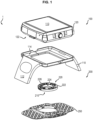
- the sensor presented is advantageously mounted on a capsule 220 which can be coupled to a housing 120 to form a body monitoring system.
- the present invention relates to an electronic body monitoring system 1. It is an improvement of the device of the document WO2018104647 . Therefore, the invention fits into the same general concept of an integral, autonomous, low-pain, low-hygienic-risk and reusable system.
- Body monitoring means checking the biochemical constants of a person carrying system 1, typically the concentration of a protein, a hormone, a marker, oxygen, nutrients, etc., in the person's interstitial fluid.
- a person carrying system typically the concentration of a protein, a hormone, a marker, oxygen, nutrients, etc.
- An example is blood sugar.
- the person skilled in the art may monitor, if necessary, other physical body quantities such as lactate, hydration, etc.
- interstitial fluid The description will be illustrated with interstitial fluid but applies to other body fluids such as blood.
- System 1 is said to be autonomous, because it does not require the use of additional hardware.
- System 1 is intended to be attached to a limb of a living being, typically an arm or leg of a human being.
- the preferred attachment area is the wrist where System 1 is similar to a watch.
- System 1 is formed of two modules 100, 200 connected together by a separable link 300 which is reusable.
- the first module 100 comprises in particular means for attaching and tightening 110 (which may comprise a bracelet or strap 112 and a receptacle 114) the system 1 to a member and the second module 200 comprises a capsule 220 which integrates the sensor described above (FIG. 3).
- the microneedles 210 of the sensor when the first module 100 is in position on the member, make it possible to analyze a body fluid, as mentioned above.
- the microneedles 210 advantageously consist of an array of microneedles 210 in contact with the skin when the first module 100 is placed on a person's body.
- said microneedles 210 comprise between four and fifty microneedles, substantially pyramidal.
- the two modules 100 and 200 each have a coupling face 122, 222, of complementary shape, which makes it possible to place the second module 200 in a reception location of the first module 100.
- first module 100 and the second module 200 are configured to be coupled by a separable link 300.
- This link 300 secures the two modules 100, 200.
- the first module 100 further comprises a housing 120 in which are arranged data processing means (in particular a processor or a microcontroller) configured to process measurements acquired by the sensor, and where appropriate data storage means.
- data in particular a memory, in particular of the flash type, and/or the memory of the microcontroller
- the data processing means are also used to generate instructions to different components. In the context of this description, these different functions are provided by the same unit. However, it is possible to provide dedicated processors.
- the system also comprises a battery for the electrical power supply of the components, advantageously rechargeable, for example via a port (which it is understood can also be used to connect the system 1 for example to a computer to download the acquired and/or processed data).
- the system 1 can comprise wireless connection means (in particular of the WiFi type, but also Bluetooth, or even 3G/4G) for connection to a network, in particular the Internet, and a user interface such as a screen, possibly touch-sensitive, to display the monitoring results to the user.
- wireless connection means in particular of the WiFi type, but also Bluetooth, or even 3G/4G
- a network in particular the Internet
- a user interface such as a screen, possibly touch-sensitive
- the housing 120 further comprises electrical connectors, on its coupling face 122 with the coupling face 222 capsule 220.
- the capsule 220 of the second module has a closed box shape, typically sealed, which can be coupled with the housing 120 100.
- This capsule 220 is interchangeable, which makes it possible to obtain an economical and efficient system, where only the so-called consumable parts must be changed.
- the capsule 220 can have an annular shape, with a through opening 224 in the center.
- the capsule 220 comprises electrical connectors 226, on a coupling face 222 with the housing 120, which can cooperate with the electrical connectors of the housing 120. If there is transmission of fluid from the second module to the first then additional fluidic connectors are provided on the capsule 220 and the box 120.
- the second module 200 comprises a patch 250, removably secured to the capsule 220.
- the second module (capsule 220 and patch 250) forms an interchangeable assembly of the system which is chosen according to the type of monitoring required and depending on the state of deterioration of the microneedles 210 and/or the sensor.
- the capsule 220 contains the microneedles 210 and/or the sensor, changing the capsule 220 makes it possible to change sensors if they are at the end of their life or if it is desired to change the physical quantity measured, in a simple, rapid and safe manipulation, without having to throw away other parts (in particular the first module).
- the 220 capsule minimizes the amount of expensive components and/or materials (advanced electronic equipment such as a battery or wireless communication means), it is relatively inexpensive.
Landscapes
- Health & Medical Sciences (AREA)
- Life Sciences & Earth Sciences (AREA)
- Physics & Mathematics (AREA)
- Medical Informatics (AREA)
- Surgery (AREA)
- Engineering & Computer Science (AREA)
- Biomedical Technology (AREA)
- Heart & Thoracic Surgery (AREA)
- Biophysics (AREA)
- Molecular Biology (AREA)
- Pathology (AREA)
- Animal Behavior & Ethology (AREA)
- General Health & Medical Sciences (AREA)
- Public Health (AREA)
- Veterinary Medicine (AREA)
- Optics & Photonics (AREA)
- Emergency Medicine (AREA)
- Measurement Of The Respiration, Hearing Ability, Form, And Blood Characteristics Of Living Organisms (AREA)
Claims (10)
- Sensor zur Messung von Analyten in einer Körperflüssigkeit in einem Lebewesen, wobei der Sensor umfasst:- ein Substrat (242),- mindestens eine Mikronadel (210), wobei die Mikronadel (210) Folgendes umfasst:eine Basis (210a), die fest mit dem Substrat (242) verbunden ist, wobei die Höhe der Basis (210a) mehr als 200 µm beträgt und teilweise eine Metallbeschichtung (210c) umfasst,eine Spitze (210b), die fest mit der Basis (210a) verbunden ist und vollständig mit einer Metallbeschichtung bedeckt ist,ein biochemisches Element, das mit Analyten reagieren kann und die metallische Beschichtung der Spitze (210b) zumindest teilweise bedeckt,dadurch gekennzeichnet, dass das Verhältnis der Metalloberfläche (210c) der Basis (210a) zur Gesamtoberfläche der Basis (210a) zwischen 1 und 20% liegt, wobei das biochemische Element zumindest teilweise die Metallbeschichtung (210c) und nicht den Rest der Oberfläche der Basis (210a) bedeckt.
- Sensor nach Anspruch 1, wobei sich die Metallbeschichtung (210c) der Basis (210a) von der Metallbeschichtung der Spitze (210b) aus erstreckt.
- Sensor nach einem der Ansprüche 1 bis 2, der eine Vielzahl von Gruppen mit mindestens einer Mikronadel (210) nach Anspruch 1 umfasst, wobei eine Gruppe eine Arbeitselektrode definiert, eine Gruppe eine Referenzelektrode definiert, und vorzugsweise eine Gegenelektrode oder sogar eine neutrale Elektrode.
- Sensor nach Anspruch 3, wobei die Mikronadeln der beiden Gruppen um mindestens 1 mm voneinander beabstandet sind.
- Sensor nach einem der Ansprüche 1 bis 4, wobei die Höhe der Spitze (210b) zwischen 200 und 700 pm, vorzugsweise zwischen 300 und 500 pm, liegt.
- Sensor nach einem der Ansprüche 1 bis 5, wobei die Basis (210a) eine Pyramidenform hat.
- Sensor nach einem der Ansprüche 1 bis 6, wobei das Substrat aus einem Polymer oder Silizium oder nicht aus Metall besteht.
- Sensor nach einem der Ansprüche 1 bis 7, wobei das biochemische Element die Metallbeschichtung der Spitze (210b) vollständig bedeckt.
- Körperüberwachungssystem (1), das dafür bestimmt ist, an einem Körperglied eines Lebewesens befestigt zu werden, umfassend:- ein Gehäuse (120) mit einer Kopplungsfläche (122),- eine Kapsel (220) mit einem Sensor nach einem der Ansprüche 1 bis 8, wobei die Kapsel lösbar mit der Kopplungsfläche (122) des Gehäuses (120) in Eingriff gebracht werden kann.
- Körperüberwachungssystem (1) nach Anspruch 9, das ferner ein Pflaster (250) umfasst, das an der Kapsel (220) befestigt werden kann, wobei das Pflaster (250) ein Haftvermögen auf der Haut aufweist.
Applications Claiming Priority (2)
| Application Number | Priority Date | Filing Date | Title |
|---|---|---|---|
| EP18306067.2A EP3603490A1 (de) | 2018-08-03 | 2018-08-03 | Metall-oberflächen-verhältnis einer mikrokanüle |
| PCT/EP2019/070943 WO2020025818A1 (fr) | 2018-08-03 | 2019-08-02 | Ratio métal/surface de microaiguille |
Publications (2)
| Publication Number | Publication Date |
|---|---|
| EP3829418A1 EP3829418A1 (de) | 2021-06-09 |
| EP3829418B1 true EP3829418B1 (de) | 2024-11-06 |
Family
ID=63259473
Family Applications (2)
| Application Number | Title | Priority Date | Filing Date |
|---|---|---|---|
| EP18306067.2A Withdrawn EP3603490A1 (de) | 2018-08-03 | 2018-08-03 | Metall-oberflächen-verhältnis einer mikrokanüle |
| EP19745648.6A Active EP3829418B1 (de) | 2018-08-03 | 2019-08-02 | Metall-oberflächen-verhältnis einer mikrokanüle |
Family Applications Before (1)
| Application Number | Title | Priority Date | Filing Date |
|---|---|---|---|
| EP18306067.2A Withdrawn EP3603490A1 (de) | 2018-08-03 | 2018-08-03 | Metall-oberflächen-verhältnis einer mikrokanüle |
Country Status (2)
| Country | Link |
|---|---|
| EP (2) | EP3603490A1 (de) |
| WO (1) | WO2020025818A1 (de) |
Cited By (5)
| Publication number | Priority date | Publication date | Assignee | Title |
|---|---|---|---|---|
| US12279888B2 (en) | 2020-07-29 | 2025-04-22 | Biolinq Incorporated | Continuous analyte monitoring system with microneedle array |
| US12336816B2 (en) | 2023-02-02 | 2025-06-24 | Biolinq Incorporated | Method for improved sensor sensitivity of a microneedle-based continuous analyte monitoring system |
| US12369830B2 (en) | 2017-03-11 | 2025-07-29 | Biolinq Incorporated | Methods for achieving an isolated electrical interface between an anterior surface of a microneedle structure and a posterior surface of a support structure |
| US12599337B1 (en) | 2017-08-08 | 2026-04-14 | Biolinq Incorporated | Method and system for confirmation of microneedle-based analyte-selective sensor insertion into viable tissue via electrical interrogation |
| US12629060B2 (en) | 2025-05-20 | 2026-05-19 | Biolinq Incorporated | Method for improved sensor sensitivity of a microneedle-based continuous analyte monitoring system |
Families Citing this family (2)
| Publication number | Priority date | Publication date | Assignee | Title |
|---|---|---|---|---|
| FR3108837B1 (fr) * | 2020-04-06 | 2022-03-11 | Pkvitality | Dispositif de mesure d’analyte comprenant un patch adhesif |
| CN116359303A (zh) * | 2023-02-22 | 2023-06-30 | 中山大学 | 一种微针电极及其制备方法与应用 |
Family Cites Families (4)
| Publication number | Priority date | Publication date | Assignee | Title |
|---|---|---|---|---|
| EP1820441A1 (de) * | 2006-02-16 | 2007-08-22 | Roche Diagnostics GmbH | Mikronadelanordnung mit Sensor basierend auf der abgeschwächten Totalreflexion (ATR) |
| US20090301994A1 (en) * | 2008-05-12 | 2009-12-10 | Rajmohan Bhandari | Methods for Wafer Scale Processing of Needle Array Devices |
| CN105228522B (zh) | 2013-03-14 | 2018-06-26 | 萨诺智能公司 | 用于生物监测的人体上的微传感器 |
| FR3059886B1 (fr) | 2016-12-09 | 2021-04-09 | Pk Paris | Dispositif de surveillance corporelle |
-
2018
- 2018-08-03 EP EP18306067.2A patent/EP3603490A1/de not_active Withdrawn
-
2019
- 2019-08-02 EP EP19745648.6A patent/EP3829418B1/de active Active
- 2019-08-02 WO PCT/EP2019/070943 patent/WO2020025818A1/fr not_active Ceased
Cited By (7)
| Publication number | Priority date | Publication date | Assignee | Title |
|---|---|---|---|---|
| US12369830B2 (en) | 2017-03-11 | 2025-07-29 | Biolinq Incorporated | Methods for achieving an isolated electrical interface between an anterior surface of a microneedle structure and a posterior surface of a support structure |
| US12605100B2 (en) | 2017-03-11 | 2026-04-21 | Biolinq Incorporated | Methods for achieving an isolated electrical interface between an anterior surface of a microneedle structure and a posterior surface of a support structure |
| US12599337B1 (en) | 2017-08-08 | 2026-04-14 | Biolinq Incorporated | Method and system for confirmation of microneedle-based analyte-selective sensor insertion into viable tissue via electrical interrogation |
| US12279888B2 (en) | 2020-07-29 | 2025-04-22 | Biolinq Incorporated | Continuous analyte monitoring system with microneedle array |
| US12453516B2 (en) | 2020-07-29 | 2025-10-28 | Biolinq Incorporated | Continuous analyte monitoring system with microneedle array |
| US12336816B2 (en) | 2023-02-02 | 2025-06-24 | Biolinq Incorporated | Method for improved sensor sensitivity of a microneedle-based continuous analyte monitoring system |
| US12629060B2 (en) | 2025-05-20 | 2026-05-19 | Biolinq Incorporated | Method for improved sensor sensitivity of a microneedle-based continuous analyte monitoring system |
Also Published As
| Publication number | Publication date |
|---|---|
| EP3603490A1 (de) | 2020-02-05 |
| EP3829418A1 (de) | 2021-06-09 |
| WO2020025818A1 (fr) | 2020-02-06 |
Similar Documents
| Publication | Publication Date | Title |
|---|---|---|
| EP3829437B1 (de) | Mikronadeleindringungsmanagement | |
| EP3829418A1 (de) | Metall-oberflächen-verhältnis einer mikronadel | |
| EP3829436B1 (de) | Multipositionskapsel | |
| EP2216649B1 (de) | Tragbares Gerät zur Messung einer körperlichen Flüssigkeit | |
| EP3829438B1 (de) | Beidseitig steifes klebepflaster | |
| FR3117766A1 (fr) | Dispositif de surveillance corporelle a gamme de detection etendue | |
| WO2018104647A1 (fr) | Dispositif de surveillance corporelle | |
| EP0624653A1 (de) | Scheibenförmiger, multizonaler, elektrochemischer Sensor für die Bestimmung von Glykose | |
| EP4009865A1 (de) | Körperüberwachungssystem mit mikronadel | |
| WO2020025821A1 (fr) | Système de surveillance corporelle avec liaison séparable | |
| EP3740118B1 (de) | System zur körperüberwachung durch elektrophorese | |
| EP4135578A1 (de) | Vorbereitung eines nadelsensors für ein körperüberwachungssystem | |
| EP4064961B1 (de) | Detektion einer chemischen spezies im schweiss eines probanden | |
| EP4009864B1 (de) | Körperüberwachungssystem mit einer mikronadel | |
| EP4404825B1 (de) | Anordnung zur vorbereitung eines sensors für eine körperüberwachungsvorrichtung | |
| EP4346557B1 (de) | Nachweis einer chemischen spezies im schweiss einer person | |
| EP4099902B1 (de) | Gerät mit heftpflaster zur messung eines analyts | |
| BE1024080A1 (fr) | Capteur de detection de glucose de plantes a rhizome | |
| FR3138320A1 (fr) | Procédé de fabrication d’une micro-aiguille et en particulier métallisation de la pointe d’une microaiguille | |
| EP3946052B1 (de) | Tragbare vorrichtung zur messung des gesundheitszustands eines benutzers | |
| EP4570175A1 (de) | Personengetragene vorrichtung zur analyse einer biologischen flüssigkeit und verfahren zur implementierung davon | |
| FR3120779A1 (fr) | Capteur pour dispositif de surveillance corporelle limitant les irritations | |
| EP4319635A1 (de) | Körperüberwachungsvorrichtung mit verbesserten elektrischen kontakten | |
| FR3076705A1 (fr) | Systeme de surveillance corporelle avec double mousse |
Legal Events
| Date | Code | Title | Description |
|---|---|---|---|
| STAA | Information on the status of an ep patent application or granted ep patent |
Free format text: STATUS: UNKNOWN |
|
| STAA | Information on the status of an ep patent application or granted ep patent |
Free format text: STATUS: THE INTERNATIONAL PUBLICATION HAS BEEN MADE |
|
| PUAI | Public reference made under article 153(3) epc to a published international application that has entered the european phase |
Free format text: ORIGINAL CODE: 0009012 |
|
| STAA | Information on the status of an ep patent application or granted ep patent |
Free format text: STATUS: REQUEST FOR EXAMINATION WAS MADE |
|
| 17P | Request for examination filed |
Effective date: 20210302 |
|
| AK | Designated contracting states |
Kind code of ref document: A1 Designated state(s): AL AT BE BG CH CY CZ DE DK EE ES FI FR GB GR HR HU IE IS IT LI LT LU LV MC MK MT NL NO PL PT RO RS SE SI SK SM TR |
|
| DAV | Request for validation of the european patent (deleted) | ||
| DAX | Request for extension of the european patent (deleted) | ||
| GRAP | Despatch of communication of intention to grant a patent |
Free format text: ORIGINAL CODE: EPIDOSNIGR1 |
|
| STAA | Information on the status of an ep patent application or granted ep patent |
Free format text: STATUS: GRANT OF PATENT IS INTENDED |
|
| INTG | Intention to grant announced |
Effective date: 20230110 |
|
| 19U | Interruption of proceedings before grant |
Effective date: 20230427 |
|
| 19W | Proceedings resumed before grant after interruption of proceedings |
Effective date: 20240603 |
|
| RAP3 | Party data changed (applicant data changed or rights of an application transferred) |
Owner name: WIZP AS |
|
| GRAS | Grant fee paid |
Free format text: ORIGINAL CODE: EPIDOSNIGR3 |
|
| GRAA | (expected) grant |
Free format text: ORIGINAL CODE: 0009210 |
|
| STAA | Information on the status of an ep patent application or granted ep patent |
Free format text: STATUS: THE PATENT HAS BEEN GRANTED |
|
| AK | Designated contracting states |
Kind code of ref document: B1 Designated state(s): AL AT BE BG CH CY CZ DE DK EE ES FI FR GB GR HR HU IE IS IT LI LT LU LV MC MK MT NL NO PL PT RO RS SE SI SK SM TR |
|
| REG | Reference to a national code |
Ref country code: GB Ref legal event code: FG4D Free format text: NOT ENGLISH |
|
| REG | Reference to a national code |
Ref country code: CH Ref legal event code: EP |
|
| REG | Reference to a national code |
Ref country code: DE Ref legal event code: R096 Ref document number: 602019061507 Country of ref document: DE |
|
| REG | Reference to a national code |
Ref country code: IE Ref legal event code: FG4D Free format text: LANGUAGE OF EP DOCUMENT: FRENCH |
|
| REG | Reference to a national code |
Ref country code: LT Ref legal event code: MG9D |
|
| REG | Reference to a national code |
Ref country code: NL Ref legal event code: MP Effective date: 20241106 |
|
| PG25 | Lapsed in a contracting state [announced via postgrant information from national office to epo] |
Ref country code: IS Free format text: LAPSE BECAUSE OF FAILURE TO SUBMIT A TRANSLATION OF THE DESCRIPTION OR TO PAY THE FEE WITHIN THE PRESCRIBED TIME-LIMIT Effective date: 20250306 Ref country code: PT Free format text: LAPSE BECAUSE OF FAILURE TO SUBMIT A TRANSLATION OF THE DESCRIPTION OR TO PAY THE FEE WITHIN THE PRESCRIBED TIME-LIMIT Effective date: 20250306 Ref country code: HR Free format text: LAPSE BECAUSE OF FAILURE TO SUBMIT A TRANSLATION OF THE DESCRIPTION OR TO PAY THE FEE WITHIN THE PRESCRIBED TIME-LIMIT Effective date: 20241106 |
|
| PG25 | Lapsed in a contracting state [announced via postgrant information from national office to epo] |
Ref country code: NL Free format text: LAPSE BECAUSE OF FAILURE TO SUBMIT A TRANSLATION OF THE DESCRIPTION OR TO PAY THE FEE WITHIN THE PRESCRIBED TIME-LIMIT Effective date: 20241106 Ref country code: FI Free format text: LAPSE BECAUSE OF FAILURE TO SUBMIT A TRANSLATION OF THE DESCRIPTION OR TO PAY THE FEE WITHIN THE PRESCRIBED TIME-LIMIT Effective date: 20241106 |
|
| REG | Reference to a national code |
Ref country code: AT Ref legal event code: MK05 Ref document number: 1738426 Country of ref document: AT Kind code of ref document: T Effective date: 20241106 |
|
| PG25 | Lapsed in a contracting state [announced via postgrant information from national office to epo] |
Ref country code: BG Free format text: LAPSE BECAUSE OF FAILURE TO SUBMIT A TRANSLATION OF THE DESCRIPTION OR TO PAY THE FEE WITHIN THE PRESCRIBED TIME-LIMIT Effective date: 20241106 |
|
| PG25 | Lapsed in a contracting state [announced via postgrant information from national office to epo] |
Ref country code: ES Free format text: LAPSE BECAUSE OF FAILURE TO SUBMIT A TRANSLATION OF THE DESCRIPTION OR TO PAY THE FEE WITHIN THE PRESCRIBED TIME-LIMIT Effective date: 20241106 |
|
| PG25 | Lapsed in a contracting state [announced via postgrant information from national office to epo] |
Ref country code: NO Free format text: LAPSE BECAUSE OF FAILURE TO SUBMIT A TRANSLATION OF THE DESCRIPTION OR TO PAY THE FEE WITHIN THE PRESCRIBED TIME-LIMIT Effective date: 20250206 |
|
| PG25 | Lapsed in a contracting state [announced via postgrant information from national office to epo] |
Ref country code: LV Free format text: LAPSE BECAUSE OF FAILURE TO SUBMIT A TRANSLATION OF THE DESCRIPTION OR TO PAY THE FEE WITHIN THE PRESCRIBED TIME-LIMIT Effective date: 20241106 Ref country code: GR Free format text: LAPSE BECAUSE OF FAILURE TO SUBMIT A TRANSLATION OF THE DESCRIPTION OR TO PAY THE FEE WITHIN THE PRESCRIBED TIME-LIMIT Effective date: 20250207 Ref country code: AT Free format text: LAPSE BECAUSE OF FAILURE TO SUBMIT A TRANSLATION OF THE DESCRIPTION OR TO PAY THE FEE WITHIN THE PRESCRIBED TIME-LIMIT Effective date: 20241106 |
|
| PG25 | Lapsed in a contracting state [announced via postgrant information from national office to epo] |
Ref country code: PL Free format text: LAPSE BECAUSE OF FAILURE TO SUBMIT A TRANSLATION OF THE DESCRIPTION OR TO PAY THE FEE WITHIN THE PRESCRIBED TIME-LIMIT Effective date: 20241106 |
|
| PG25 | Lapsed in a contracting state [announced via postgrant information from national office to epo] |
Ref country code: RS Free format text: LAPSE BECAUSE OF FAILURE TO SUBMIT A TRANSLATION OF THE DESCRIPTION OR TO PAY THE FEE WITHIN THE PRESCRIBED TIME-LIMIT Effective date: 20250206 |
|
| PG25 | Lapsed in a contracting state [announced via postgrant information from national office to epo] |
Ref country code: SM Free format text: LAPSE BECAUSE OF FAILURE TO SUBMIT A TRANSLATION OF THE DESCRIPTION OR TO PAY THE FEE WITHIN THE PRESCRIBED TIME-LIMIT Effective date: 20241106 |
|
| PG25 | Lapsed in a contracting state [announced via postgrant information from national office to epo] |
Ref country code: DK Free format text: LAPSE BECAUSE OF FAILURE TO SUBMIT A TRANSLATION OF THE DESCRIPTION OR TO PAY THE FEE WITHIN THE PRESCRIBED TIME-LIMIT Effective date: 20241106 |
|
| PG25 | Lapsed in a contracting state [announced via postgrant information from national office to epo] |
Ref country code: EE Free format text: LAPSE BECAUSE OF FAILURE TO SUBMIT A TRANSLATION OF THE DESCRIPTION OR TO PAY THE FEE WITHIN THE PRESCRIBED TIME-LIMIT Effective date: 20241106 |
|
| PG25 | Lapsed in a contracting state [announced via postgrant information from national office to epo] |
Ref country code: RO Free format text: LAPSE BECAUSE OF FAILURE TO SUBMIT A TRANSLATION OF THE DESCRIPTION OR TO PAY THE FEE WITHIN THE PRESCRIBED TIME-LIMIT Effective date: 20241106 |
|
| PG25 | Lapsed in a contracting state [announced via postgrant information from national office to epo] |
Ref country code: SK Free format text: LAPSE BECAUSE OF FAILURE TO SUBMIT A TRANSLATION OF THE DESCRIPTION OR TO PAY THE FEE WITHIN THE PRESCRIBED TIME-LIMIT Effective date: 20241106 |
|
| PG25 | Lapsed in a contracting state [announced via postgrant information from national office to epo] |
Ref country code: CZ Free format text: LAPSE BECAUSE OF FAILURE TO SUBMIT A TRANSLATION OF THE DESCRIPTION OR TO PAY THE FEE WITHIN THE PRESCRIBED TIME-LIMIT Effective date: 20241106 |
|
| PG25 | Lapsed in a contracting state [announced via postgrant information from national office to epo] |
Ref country code: IT Free format text: LAPSE BECAUSE OF FAILURE TO SUBMIT A TRANSLATION OF THE DESCRIPTION OR TO PAY THE FEE WITHIN THE PRESCRIBED TIME-LIMIT Effective date: 20241106 |
|
| REG | Reference to a national code |
Ref country code: DE Ref legal event code: R097 Ref document number: 602019061507 Country of ref document: DE |
|
| PG25 | Lapsed in a contracting state [announced via postgrant information from national office to epo] |
Ref country code: SE Free format text: LAPSE BECAUSE OF FAILURE TO SUBMIT A TRANSLATION OF THE DESCRIPTION OR TO PAY THE FEE WITHIN THE PRESCRIBED TIME-LIMIT Effective date: 20241106 |
|
| PLBE | No opposition filed within time limit |
Free format text: ORIGINAL CODE: 0009261 |
|
| STAA | Information on the status of an ep patent application or granted ep patent |
Free format text: STATUS: NO OPPOSITION FILED WITHIN TIME LIMIT |
|
| PGFP | Annual fee paid to national office [announced via postgrant information from national office to epo] |
Ref country code: DE Payment date: 20250812 Year of fee payment: 7 |
|
| 26N | No opposition filed |
Effective date: 20250807 |
|
| PGFP | Annual fee paid to national office [announced via postgrant information from national office to epo] |
Ref country code: GB Payment date: 20250826 Year of fee payment: 7 |
|
| PGFP | Annual fee paid to national office [announced via postgrant information from national office to epo] |
Ref country code: FR Payment date: 20250710 Year of fee payment: 7 |
|
| PGFP | Annual fee paid to national office [announced via postgrant information from national office to epo] |
Ref country code: CH Payment date: 20250901 Year of fee payment: 7 |
|
| PG25 | Lapsed in a contracting state [announced via postgrant information from national office to epo] |
Ref country code: MC Free format text: LAPSE BECAUSE OF FAILURE TO SUBMIT A TRANSLATION OF THE DESCRIPTION OR TO PAY THE FEE WITHIN THE PRESCRIBED TIME-LIMIT Effective date: 20241106 |
|
| PG25 | Lapsed in a contracting state [announced via postgrant information from national office to epo] |
Ref country code: LU Free format text: LAPSE BECAUSE OF NON-PAYMENT OF DUE FEES Effective date: 20250802 |
|
| REG | Reference to a national code |
Ref country code: CH Ref legal event code: R17 Free format text: ST27 STATUS EVENT CODE: U-0-0-R10-R17 (AS PROVIDED BY THE NATIONAL OFFICE) Effective date: 20260417 |