EP3740118B1 - System zur körperüberwachung durch elektrophorese - Google Patents
System zur körperüberwachung durch elektrophorese Download PDFInfo
- Publication number
- EP3740118B1 EP3740118B1 EP19703948.0A EP19703948A EP3740118B1 EP 3740118 B1 EP3740118 B1 EP 3740118B1 EP 19703948 A EP19703948 A EP 19703948A EP 3740118 B1 EP3740118 B1 EP 3740118B1
- Authority
- EP
- European Patent Office
- Prior art keywords
- needle
- electrophoresis
- skin
- electrodes
- sensor
- Prior art date
- Legal status (The legal status is an assumption and is not a legal conclusion. Google has not performed a legal analysis and makes no representation as to the accuracy of the status listed.)
- Active
Links
Images



Classifications
-
- A—HUMAN NECESSITIES
- A61—MEDICAL OR VETERINARY SCIENCE; HYGIENE
- A61B—DIAGNOSIS; SURGERY; IDENTIFICATION
- A61B5/00—Measuring for diagnostic purposes; Identification of persons
- A61B5/145—Measuring characteristics of blood in vivo, e.g. gas concentration or pH-value ; Measuring characteristics of body fluids or tissues, e.g. interstitial fluid or cerebral tissue
- A61B5/14507—Measuring characteristics of blood in vivo, e.g. gas concentration or pH-value ; Measuring characteristics of body fluids or tissues, e.g. interstitial fluid or cerebral tissue specially adapted for measuring characteristics of body fluids other than blood
- A61B5/1451—Measuring characteristics of blood in vivo, e.g. gas concentration or pH-value ; Measuring characteristics of body fluids or tissues, e.g. interstitial fluid or cerebral tissue specially adapted for measuring characteristics of body fluids other than blood for interstitial fluid
- A61B5/14514—Measuring characteristics of blood in vivo, e.g. gas concentration or pH-value ; Measuring characteristics of body fluids or tissues, e.g. interstitial fluid or cerebral tissue specially adapted for measuring characteristics of body fluids other than blood for interstitial fluid using means for aiding extraction of interstitial fluid, e.g. microneedles or suction
-
- A—HUMAN NECESSITIES
- A61—MEDICAL OR VETERINARY SCIENCE; HYGIENE
- A61B—DIAGNOSIS; SURGERY; IDENTIFICATION
- A61B5/00—Measuring for diagnostic purposes; Identification of persons
- A61B5/05—Detecting, measuring or recording for diagnosis by means of electric currents or magnetic fields; Measuring using microwaves or radio waves
- A61B5/053—Measuring electrical impedance or conductance of a portion of the body
-
- A—HUMAN NECESSITIES
- A61—MEDICAL OR VETERINARY SCIENCE; HYGIENE
- A61B—DIAGNOSIS; SURGERY; IDENTIFICATION
- A61B5/00—Measuring for diagnostic purposes; Identification of persons
- A61B5/145—Measuring characteristics of blood in vivo, e.g. gas concentration or pH-value ; Measuring characteristics of body fluids or tissues, e.g. interstitial fluid or cerebral tissue
- A61B5/14539—Measuring characteristics of blood in vivo, e.g. gas concentration or pH-value ; Measuring characteristics of body fluids or tissues, e.g. interstitial fluid or cerebral tissue for measuring pH
-
- A—HUMAN NECESSITIES
- A61—MEDICAL OR VETERINARY SCIENCE; HYGIENE
- A61B—DIAGNOSIS; SURGERY; IDENTIFICATION
- A61B5/00—Measuring for diagnostic purposes; Identification of persons
- A61B5/68—Arrangements of detecting, measuring or recording means, e.g. sensors, in relation to patient
- A61B5/6801—Arrangements of detecting, measuring or recording means, e.g. sensors, in relation to patient specially adapted to be attached to or worn on the body surface
- A61B5/6844—Monitoring or controlling distance between sensor and tissue
-
- A—HUMAN NECESSITIES
- A61—MEDICAL OR VETERINARY SCIENCE; HYGIENE
- A61B—DIAGNOSIS; SURGERY; IDENTIFICATION
- A61B5/00—Measuring for diagnostic purposes; Identification of persons
- A61B5/68—Arrangements of detecting, measuring or recording means, e.g. sensors, in relation to patient
- A61B5/6846—Arrangements of detecting, measuring or recording means, e.g. sensors, in relation to patient specially adapted to be brought in contact with an internal body part, i.e. invasive
- A61B5/6847—Arrangements of detecting, measuring or recording means, e.g. sensors, in relation to patient specially adapted to be brought in contact with an internal body part, i.e. invasive mounted on an invasive device
- A61B5/6848—Needles
-
- A—HUMAN NECESSITIES
- A61—MEDICAL OR VETERINARY SCIENCE; HYGIENE
- A61B—DIAGNOSIS; SURGERY; IDENTIFICATION
- A61B2562/00—Details of sensors; Constructional details of sensor housings or probes; Accessories for sensors
- A61B2562/02—Details of sensors specially adapted for in-vivo measurements
- A61B2562/029—Humidity sensors
-
- A—HUMAN NECESSITIES
- A61—MEDICAL OR VETERINARY SCIENCE; HYGIENE
- A61B—DIAGNOSIS; SURGERY; IDENTIFICATION
- A61B5/00—Measuring for diagnostic purposes; Identification of persons
- A61B5/145—Measuring characteristics of blood in vivo, e.g. gas concentration or pH-value ; Measuring characteristics of body fluids or tissues, e.g. interstitial fluid or cerebral tissue
- A61B5/14532—Measuring characteristics of blood in vivo, e.g. gas concentration or pH-value ; Measuring characteristics of body fluids or tissues, e.g. interstitial fluid or cerebral tissue for measuring glucose, e.g. by tissue impedance measurement
-
- A—HUMAN NECESSITIES
- A61—MEDICAL OR VETERINARY SCIENCE; HYGIENE
- A61B—DIAGNOSIS; SURGERY; IDENTIFICATION
- A61B5/00—Measuring for diagnostic purposes; Identification of persons
- A61B5/42—Detecting, measuring or recording for evaluating the gastrointestinal, the endocrine or the exocrine systems
- A61B5/4261—Evaluating exocrine secretion production
- A61B5/4266—Evaluating exocrine secretion production sweat secretion
-
- A—HUMAN NECESSITIES
- A61—MEDICAL OR VETERINARY SCIENCE; HYGIENE
- A61B—DIAGNOSIS; SURGERY; IDENTIFICATION
- A61B5/00—Measuring for diagnostic purposes; Identification of persons
- A61B5/68—Arrangements of detecting, measuring or recording means, e.g. sensors, in relation to patient
- A61B5/6846—Arrangements of detecting, measuring or recording means, e.g. sensors, in relation to patient specially adapted to be brought in contact with an internal body part, i.e. invasive
- A61B5/6847—Arrangements of detecting, measuring or recording means, e.g. sensors, in relation to patient specially adapted to be brought in contact with an internal body part, i.e. invasive mounted on an invasive device
- A61B5/685—Microneedles
Definitions
- the present invention relates to microfluidics. More specifically, it relates to a body monitoring system via interstitial fluid analysis.
- Some pathologies such as diabetes require daily monitoring of biochemical parameters of the human body, i.e. concentrations of certain compounds (blood sugar in the example of glucose).
- interstitial fluid that is, the fluid that fills the space between the blood capillaries and the cells. It has an ionic composition close to that of blood plasma.
- GlucoWatch uses a phenomenon called iontophoresis (or iontophoresis) in which an electric field "attracts" interstitial fluid through the skin to a sensor on the wall of the device.
- iontophoresis or iontophoresis
- transcutaneous probes have been proposed in the form of a self-adhesive patch placing a "needle sensor” just under the skin, so as to place the sensor in permanent fluid communication with the interstitial fluid, for continuous monitoring.
- transcutaneous patch-type probes include wireless communication means for sending measurements on the interstitial fluid, for example, to a mobile terminal, for storage and processing (verification of thresholds and variations, production of statistics, triggering of alerts if necessary, etc.).
- wireless communication means for sending measurements on the interstitial fluid, for example, to a mobile terminal, for storage and processing (verification of thresholds and variations, production of statistics, triggering of alerts if necessary, etc.).
- Examples include the sugarBEAT TM or FreeStyle Libre systems.
- patches are much more reliable and less painful than iontophoresis devices), but are restrictive and expensive due to the single-use patch that must be changed regularly.
- the patches tend to come off, tear off when changing clothes or making sudden movements, and are very visible: the wearer can be stigmatized as "sick".
- the present invention relates to a body monitoring device according to claim 1.
- the invention also relates to a capsule comprising a device as described above.
- the present invention relates to an electronic body monitoring system 1.
- Body monitoring means checking the biochemical constants of a person carrying system 1, typically the concentration of a protein, a hormone, a marker, oxygen, nutrients, etc., in the person's interstitial fluid.
- a person carrying system typically the concentration of a protein, a hormone, a marker, oxygen, nutrients, etc.
- An example is blood sugar.
- the person skilled in the art may monitor, if necessary, other physical bodily quantities such as temperature, hydration, etc.
- the system can be separated into two modules: a box 2 and a capsule 3 (see Figures 3a to 3c ).
- the term device will be used, with the same reference 3, for what concerns the capsule.
- the device 3 thus comprises at least one sensor 24 of a physical quantity of the interstitial liquid, in particular a sensor of a “biochemical” nature. » that is to say allowing the analysis of the interstitial liquid in particular by detecting a compound for example using several electrodes in contact with the interstitial liquid, and advantageously at least one second sensor such as a temperature sensor allowing the analysis of the interstitial liquid sampled to be adjusted (taking into account the viscosity of the fluid as a function of the temperature).
- a sensor 24 of a physical quantity of the interstitial liquid in particular a sensor of a “biochemical” nature. » that is to say allowing the analysis of the interstitial liquid in particular by detecting a compound for example using several electrodes in contact with the interstitial liquid, and advantageously at least one second sensor such as a temperature sensor allowing the analysis of the interstitial liquid sampled to be adjusted (taking into account the viscosity of the fluid as a function of the temperature).
- It also comprises data processing means 11 (in particular a processor or a microcontroller) configured to process measurements acquired by the sensor 24, and where appropriate data storage means 12 (in particular a memory, in particular of the flash type, and/or the memory of the microcontroller) making it possible for example to store these measurements, and/or a date of the first use of each sensor 24 to calculate an expiry date of the sensor(s) 24 (biochemical sensors have a limited lifespan).
- the data processing means 11 are also used to generate instructions to different components. In the context of this description, these different functions are provided by the same unit. However, it is possible to provide dedicated processors.
- the system also comprises a battery 13 for the electrical power supply of the components, advantageously rechargeable, for example via the port 10 (which it is understood can also be used to connect the system 1 for example to a computer to download the acquired and/or processed data).
- the system 1 can comprise wireless connection means (in particular of the WiFi type, but also Bluetooth, or even 3G/4G) for connection to a network, in particular the Internet, and a user interface such as a screen, possibly touch-sensitive, to display the monitoring results to the user.
- wireless connection means in particular of the WiFi type, but also Bluetooth, or even 3G/4G
- a network in particular the Internet
- a user interface such as a screen, possibly touch-sensitive
- the device 3 further comprises a set 40 of electrophoresis electrodes, configured to be in contact with the skin and cause electrophoresis under the skin, i.e. cause a concentration of the interstitial liquid.
- the system comprises an electrical signal generator 14. Given the voltages and amperage involved, this electrical signal generator 40 can be confused with the data processing means.
- the electrical signal generator 14 is controlled by the data processing means 11.
- the present device 3 comprises a fluid circuit 20 on which are arranged means 25 for transcutaneous sampling of interstitial liquid, said sensor 24, and a pump, said pump being controlled by the data processing means 11.
- Said means for transcutaneous sampling 25 of interstitial fluid advantageously consist of a network of micro-needles in contact with the skin when the device 3 is placed on the body of a person (we will see how later).
- the micro-needles allow the extraction of interstitial fluid from the dermis in a painless manner without blood beading.
- said transcutaneous sampling means 25 comprise between four and sixteen microneedles (in particular four, nine or sixteen in the form of a square), substantially pyramidal, with tips of a height of between 0.3 mm and 0.8 mm, each with a hole of a diameter of between 0.04 and 0.22 mm.
- microneedles in particular four, nine or sixteen in the form of a square
- substantially pyramidal with tips of a height of between 0.3 mm and 0.8 mm, each with a hole of a diameter of between 0.04 and 0.22 mm.
- the pump can be made in different shapes.
- the pump comprises a foam 21A or 21B or 21C or several foams 21A, 21B, 21C in series which draws the fluid thanks to their hydrophilicity and capillarity.
- the foam 21A draws the fluid a first time, which is then drawn from the foam 21A by the foam 21B, which is then drawn from the foam 21B by the foam 21C.
- the foam 21C is in contact with the sensor 24, so that the latter can carry out measurements on the interstitial liquid stored in the foam 21B.
- the foam 21C, said evacuation foam has the function of emptying the foam 21b and facilitating the evaporation of the liquid it stores. This evaporation can be done naturally, with the ambient air, or with the aid of a radiator 46 which heats said foam 21b.
- the radiator 46 is then controlled by the data processing means 11.
- the circulation is then two-way, that is to say that a balance is achieved between the foams and the interstitial liquid of the skin.
- the measuring foam 21B may be movable, using a passive mechanism 50 in the capsule 3, attached to the foam 21B and an active mechanism 60, in the housing 2, and connected together by an interface 70, as described in the French patent application in the name of the same applicant filed
- the numerical references are identical.
- the system 1 may also include a conductivity meter 44, which makes it possible to determine whether the foams 21A or 21B are soaked with liquid. In particular, the conductivity of the mobile foam 21B (not illustrated) is measured.
- a conductivity meter 44 makes it possible to determine whether the foams 21A or 21B are soaked with liquid. In particular, the conductivity of the mobile foam 21B (not illustrated) is measured.
- the pump 21 may be a piezoelectric micro-pump allowing suction by means of a membrane vibration system.
- the pump 21 When it operates (on command of the data processing means 11) it will cause the transcutaneous extraction (through the epidermis) of interstitial liquid from the body (the dermis under the epidermis), its circulation through the circuit 20 to the sensor 24 which will analyze it, then its arrival at the absorbent foam (not shown) thus allowing it to be stored and evacuated by evaporation (the foam is advantageously in exchange with the atmosphere, in particular through a gas-porous fabric, so as to allow this evaporation, but advantageously liquid-tight (for example based on polytetrafluoroethylene) so as to prevent the penetration of liquids such as sweat from the outside).
- the circulation is then only one-way, which means that the sampling means 25 are the only fluid inlet, and the foam is the only outlet. There is no cycle.
- the electrode assembly 40 comprises at least two electrodes 41, 42 (of the type a positive electrode 41 and a negative electrode 42) which make it possible to apply an electric field by a voltage difference. Under the influence of the electric field, the Na+ ions present in the interstitial fluid move towards the negative electrode, carrying with them the glucose molecules, which causes an accumulation under the skin ( via a mini-inflammation).
- electrophoresis is not used to cause interstitial fluid to pass through the skin, electrophoresis can be applied at lower values (intensity from 10 ⁇ A to 300 ⁇ A), which avoids the prohibitive pain that exists with this type of technique.
- An example of an electrophoresis signal includes a voltage of 23V, ⁇ 2 V, with a frequency of 200Hz.
- the electrode assembly 40 may be comprised of needles or a flat surface such as a plate. The needle penetrates the skin while the plate remains on the skin.
- the negative electrode 42 is positioned in proximity to the sampling means 25 in order to increase the presence of interstitial liquid there and promote their sampling.
- proximity it is meant that the sampling means 25 are positioned where the concentration of interstitial liquid increases thanks to the electrodes, preferably where the concentration is maximum.
- the two electrodes 41, 42 are located on either side of the sampling means 25.
- the sampling means 25 comprise a plurality of hollow microneedles.
- a microneedle simply designates a small needle (of dimensions as previously mentioned).
- the negative electrode 42 is a needle, positioned with the plurality of needles of the sampling means 25.
- this electrode can be a needle of the sampling means 25. This makes it possible to have a more compact device 3, which has fewer elements to insert into the skin, and which is particularly effective since the sampling is done exactly at the level of the negative electrode.
- the figure 4 illustrates such a needle-electrode 25, 42.
- the needle which is a hollow tube
- the needle-electrode 25, 42 comprises inside a coating 42b adapted for a micro-cannula.
- metal on the outer surface is done either using a metal electrode, in which case the interior may comprise the coating 42b, or using a polymer electrode with for example using a metal coating 42a.
- needles 25, or even all of the needles 25, act as electrodes.
- the system 1 may also comprise a conductivity meter comprising electrodes for measuring the conductivity of the skin (which changes depending on the humidity of the skin - sweat, the outside weather for example).
- the conductivity meter also comprises another generator 15 of electrical signals, configured to power the conductivity electrodes. In practice, this generator 15 is the same as the generator of electrical signals 14.
- the generator 15 of electrical signals is controlled by the data processing means 11.
- the conductivity electrodes are the same as the electrophoresis electrodes 41, 42. This makes it possible to gain in compactness and simplicity, but also to have a conductivity measurement that is extremely relevant for electrophoresis.
- the conductivity measurement is managed by the data processing means 11. From this measurement, the electrophoresis value is adapted to avoid using a voltage/intensity that is too low (therefore no concentration) or too high (therefore pain).
- Conductivity control is done before or concomitantly with the use of electrophoresis to accumulate interstitial fluid for sampling or measurement.
- a hygrometry sensor, a heart rate sensor and/or an accelerometer, especially in combination with skin conductivity measurement, can be used to assess the level of sweat on the skin. Knowing the sweat level allows for better correction of measurements, especially for blood glucose or lactate, because sweat is loaded with glucose and lactate.
- Measuring the pH of the skin is a relevant data for characterizing sweat. This measurement can be made using an electrode in the device, in particular one of the electrophoresis electrodes, in particular by placing a particular coating on a specific location of the electrode. The data processing means are then programmed to be able to determine the level of sweat from the pH measurement.
- the plurality of needles 25 comprises at least one needle of shorter length (i.e. the tip does not reach the same level). This shorter needle is connected to an electrode and a needle of normal length is connected to another electrode. By measuring the conductivity between these two electrodes, it can be known whether the needles are well inserted or not to collect interstitial fluid.
- a conductivity meter comprising the aforementioned shorter needle and another needle, as well as an electrical signal generator, which is generally the generator 14, is similarly defined.
- one needle among the plurality of needles 25 may be associated with a conductivity meter comprising electrodes, as illustrated in the figure 4 (this principle is applicable to all needles).
- two electrodes 27, 28 are arranged on either side of the needle 25, in a section plane orthogonal to the main extension axis of the needle.
- the electrodes can be formed by specific elements, for example at one end of the needle 25 (end opposite the end which samples the interstitial liquid), as shown in the figure 4 .
- the conductivity meter further comprises an electrical signal generator, typically the generator 15.
- the electrical signal generator is controlled by the data processing means 11.
- the electrical signal generator 14 The conductimetry data is then processed by the data processing means 11.
- System 1 is integral. This means that there is no main module such as a mobile terminal connected wirelessly to a bulky and expensive secondary module (due to the need to equip it with a battery, wireless communication means, etc.) in the form of a patch stuck to the skin. System 1 is thus autonomous.
- the device 3 then takes the form of a watch, for example, with a face F against the skin of the arm, and an opposite face accommodating, for example, a screen.
- reusable means of attachment to the body typically consisting of a strap or bracelet configured to surround the limb (and not an adhesive element), in particular a watch strap.
- reusable is understood here in contrast to “single-use” as was the case with patches, which cannot be reused after being detached from the skin and must be thrown away.
- a bracelet can be opened and closed many times.
- the system 1 is configured so that when placed on the skin (i.e. when the attachment means secure it to the body) the transcutaneous sampling means 25 are held against the skin (or at least in the immediate vicinity) to allow sampling.
- the term device 3 refers to the capsule.
- the capsule therefore comprises a face intended to be placed on a substantially flat surface, such as the wrist of a hand. On this face are therefore the electrodes 41, 42 and the needles 25.
- system 1 remains composed of two modules 2, 3 but the latter are not physically separated as could be the case in the prior art and are even in direct, mechanical connection.
- the housing 2 and the capsule 3 comprise for this purpose transmission means for transmitting electrical signals, such as contactless wireless links (transmitter/receiver) or electrical connectors 12a, 12b (contacts, or even Figures 2a , 3a ) and, in the case of a pump in the housing, fluid connections not shown).
- the electrical connectors 12a, 12b are configured so that, when the capsule 3 is engaged with the housing 2, said electrical connectors 12a, 12b provide a connection between, on the one hand, the data processing means 11, the electrical signal generator(s) 14, 15 and, on the other hand, the sensor 24 (for sending back the measurement data) and the set of electrophoresis electrodes 40 (and the other components that require instructions and/or to send signals), and the conductivity electrodes 27, 28.
- said fluid connectors 22a, 22b, 22c, 22d ensure that the fluid circuit 10 extends in a sealed manner both in the housing 2 and the capsule 3 (so that the suction power of the pump 21 is not impaired).
- the capsule 3 thus constitutes an interchangeable subassembly of the system 1 which can be chosen according to the desired type of monitoring. Indeed, since the capsule contains the sensor(s) 24, changing the capsule makes it possible to change the sensors 24 if they are at the end of their life or if it is desired to change the physical quantity measured, in a simple, quick and safe manipulation, without having to throw away other parts (in particular the box 2). It is noted in this respect that the capsule 3 preserves the sensors 24 very effectively, and needs to be changed less often than a patch (the same capsule can be used for a month).
- Capsule 3 contains no pump or advanced electronics such as a battery or wireless communications, it is significantly less expensive than a patch.
- the present system 1 is therefore much more practical than the systems known from the prior art, but above all much less expensive to use, without there being the slightest hygienic risk, and without pain due to the insertion of a needle or strong electricity.
- the capsule 3 is the only part of the system 1 that can be in contact with interstitial liquid, since it contains the absorbent foam 21A, B or C (beyond which the fluid collected cannot rise).
- the removable capsule prevents contamination of the housing 2 and makes it possible to replace the capsule 3 at the end of the life of the sensors 24 or to change the type of capsule 3 in a simple, quick and safe operation, without having to throw away other parts.
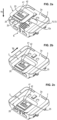
- the capsule 3 engages with the housing 2 according to two successive translation movements T1 and T2 ( Figures 2a to 2c ).
- the reverse movement allows the capsule 3 to be disengaged.
- the first movement T1 consists of bringing the capsule 3 towards the housing 2 to attach the electrical connectors 12a/b and the second movement T2 consists of sliding the capsule 3 along the housing 2 to engage the mechanical connection 70.
- the electrical connectors 12a/b are flexible (with spring for example).
- the device is similar to what has been previously described, except that it does not include a sensor and serves simply to collect the fluid. The fluid is then recovered (for example from the foams) to be analyzed elsewhere.
- the device comprises at least one needle (preferably a plurality), which act as skin piercing means.
- the needle(s) are positioned one or more sensors, typically in the form of a coating (chemical sensor) at the end of the needle that is inserted into the body.
- needles are used for measurement (and include a sensor) and that some needles are used only for electrophoresis (in particular for questions of material and coating).
- the needles are then generally full, but they can also be hollow.
- the rest of the measurement system 1 is applicable to this embodiment (processing means, connectivity, etc.).
- the system described above makes it possible to implement an interstitial fluid extraction process in an efficient, minimally invasive and almost painless manner.
- the electrophoresis step is not calibrated so that the interstitial fluid passes through the skin. Therefore, this method allows the use of an amperage between 10 and 300 ⁇ A, which are lower than the amperages for electrophoresis that must allow the molecules of interest to pass through the skin.
- this process is applicable to any membrane separating a liquid comprising ions or charged elements located behind a membrane from another environment and for which it is desired to extract this liquid through the membrane.
- the system and method described above more generally involves the use of subcutaneous electrophoresis using two electrodes to concentrate the interstitial fluid and collect it using a needle.
- this use is applicable to any membrane separating a liquid comprising ions or charged elements located behind a membrane from another environment and for which it is desired to extract this liquid through the membrane.
Landscapes
- Health & Medical Sciences (AREA)
- Life Sciences & Earth Sciences (AREA)
- Physics & Mathematics (AREA)
- Molecular Biology (AREA)
- Animal Behavior & Ethology (AREA)
- Pathology (AREA)
- Engineering & Computer Science (AREA)
- Biomedical Technology (AREA)
- Heart & Thoracic Surgery (AREA)
- Medical Informatics (AREA)
- Veterinary Medicine (AREA)
- Surgery (AREA)
- Biophysics (AREA)
- General Health & Medical Sciences (AREA)
- Public Health (AREA)
- Optics & Photonics (AREA)
- Nuclear Medicine, Radiotherapy & Molecular Imaging (AREA)
- Radiology & Medical Imaging (AREA)
- Measurement Of The Respiration, Hearing Ability, Form, And Blood Characteristics Of Living Organisms (AREA)
- Measuring And Recording Apparatus For Diagnosis (AREA)
Claims (15)
- Vorrichtung (3) zur Körperüberwachung, umfassend mindestens eine Nadel (25), die ausgelegt ist, um mit der Interstitialflüssigkeit in Kontakt zu kommen, wobei die Nadel ausgelegt ist, um Interstitialflüssigkeit zu entnehmen oder eine physikalische Größe davon zu messen,
dadurch gekennzeichnet, dassdie Vorrichtung (3) Elektrophorese-Elektroden (41, 42) umfasst, die ausgelegt sind, um mit der Haut in Kontakt zu sein und eine Elektrophorese unter der Haut zu bewirken, ohne dass die Interstitialflüssigkeit die Haut durchquert, wenn sie von einem Strom mit einer Stärke von unter 300 µA, vorzugsweise von zwischen 10 µA und 300 µA, versorgt werden,und dadurch, dassdie mindestens eine Nadel (25) in der Nähe von mindestens einer der Elektroden (42) positioniert ist,so dass die Elektrophorese eine Ansammlung von Interstitialflüssigkeit im Bereich der mindestens einen der Elektroden (42) im Kontakt mit der Haut und im Bereich der Nadel (25) bewirkt, ohne dass sie die Haut durchquert. - Vorrichtung (3) nach Anspruch 1, wobei mindestens eine Nadel (25) als Elektrophorese-Elektrode (42) fungiert, vorzugsweise alle Nadeln (25).
- Vorrichtung (3) nach Anspruch 2, wobei die andere Elektrophorese-Elektrode (41) eine ebene Fläche wie eine Platte ist.
- Vorrichtung (3) nach einem der vorhergehenden Ansprüche, ferner umfassend mindestens einen Sensor (24) für eine physikalische Größe der Interstitialflüssigkeit, wobei der Sensor ausgelegt ist, um mit der Interstitialflüssigkeit in Kontakt zu sein, um eine physikalische Größe der Interstitialflüssigkeit zu messen.
- Vorrichtung (3) nach einem der Ansprüche 1 bis 4, wobei die mindestens eine Nadel transkutane Probenahmemittel (25) beispielsweise in Form einer oder mehrerer hohler Nadeln bildet.
- Vorrichtung (3) nach Anspruch 4, wobei sich der mindestens eine Sensor (24) im Bereich des Endes der Nadel befindet, das ausgelegt ist, um in den Körper eingeführt zu werden, wobei der Sensor (24) durch Beschichtung gebildet ist und die Sensornadel vorzugsweise massiv ist.
- Vorrichtung nach Anspruch 6, umfassend ferner mindestens eine Nadel, die sich von der Sensornadel unterscheidet und als Elektrophorese-Elektrode (42) dient.
- Vorrichtung (3) nach einem der Ansprüche 1 bis 7 in Kombination mit Anspruch 2, wobei die Elektrodennadel ganz oder nur an ihrer Außenfläche Metall (42a) umfasst.
- Vorrichtung (3) nach einem der Ansprüche 1 bis 8, wobei eine der Nadeln (25) kürzer ist als die anderen, wobei die Nadel eine Elektrode zur Messung der Leitfähigkeit bildet, um festzustellen, ob die Nadeln richtig eingeführt sind.
- Vorrichtung (3) nach einem der Ansprüche 1 bis 9, wobei eine Nadel (25) zwei Elektroden (27, 28) umfasst, die ausgelegt sind, um die Leitfähigkeit in einer Ebene quer zu einer Erstreckungsrichtung der Nadel zu messen, um zu ermitteln, ob die Nadel mit Flüssigkeit in Kontakt steht oder damit gefüllt ist.
- Vorrichtung (3) nach einem der Ansprüche 1 bis 10, die ausgelegt ist, um den pH-Wert der Haut zu messen, beispielsweise mit Hilfe von mindestens einer der Elektrophorese-Elektroden (27, 28), um den Schweißpegel zu messen.
- Vorrichtung (3) nach einem der Ansprüche 1 bis 11, wobei mindestens eine der Elektroden eine Nadel ist.
- Kapsel (3), umfassend eine Vorrichtung nach einem der Ansprüche 1 bis 12.
- System (1), umfassend:- eine Vorrichtung (2) nach einem der Ansprüche 1 bis 12 oder eine Kapsel nach Anspruch 13,- Datenverarbeitungsmittel (11), die ausgelegt ist, um die Daten des Sensors (24) zu verarbeiten, und- einen Generator (14) elektrischer Signale, der ausgelegt ist, um die Elektrophorese-Elektrodenanordnung zu versorgen, wobei der Generator (14) elektrischer Signale ausgelegt ist, um Signale von unter oder gleich 300 µA zu erzeugen.
- Verfahren zur Entnahme oder Messung von Interstitialflüssigkeit, das mit Hilfe einer Vorrichtung nach einem der Ansprüche 1 bis 12 oder einer Kapsel nach Anspruch 13 oder einem System (1) nach Anspruch 14 durchgeführt wird, umfassend einen Schritt der:- Elektrophorese mit Hilfe von Elektroden (41, 42), um Interstitialflüssigkeit unter der Haut mit Hilfe der Elektroden anzusammeln, ohne dass die Flüssigkeit die Haut durchquert, wobei die Elektrophorese mit Werten von unter oder gleich 300 µA angewendet wird,- Entnahme oder Messung von angesammelter Interstitialflüssigkeit mit Hilfe einer Nadel (25).
Applications Claiming Priority (2)
| Application Number | Priority Date | Filing Date | Title |
|---|---|---|---|
| FR1850346A FR3076706B1 (fr) | 2018-01-16 | 2018-01-16 | Systeme de surveillance corporelle par electrophorese |
| PCT/EP2019/051073 WO2019141742A1 (fr) | 2018-01-16 | 2019-01-16 | Système de surveillance corporelle par électrophorèse |
Publications (2)
| Publication Number | Publication Date |
|---|---|
| EP3740118A1 EP3740118A1 (de) | 2020-11-25 |
| EP3740118B1 true EP3740118B1 (de) | 2024-11-06 |
Family
ID=62222818
Family Applications (1)
| Application Number | Title | Priority Date | Filing Date |
|---|---|---|---|
| EP19703948.0A Active EP3740118B1 (de) | 2018-01-16 | 2019-01-16 | System zur körperüberwachung durch elektrophorese |
Country Status (3)
| Country | Link |
|---|---|
| EP (1) | EP3740118B1 (de) |
| FR (1) | FR3076706B1 (de) |
| WO (1) | WO2019141742A1 (de) |
Families Citing this family (4)
| Publication number | Priority date | Publication date | Assignee | Title |
|---|---|---|---|---|
| EP3772332A1 (de) * | 2019-08-08 | 2021-02-10 | PKvitality | Körperüberwachungssystem mit einer mikronadel |
| EP3861933A1 (de) * | 2020-02-05 | 2021-08-11 | PKvitality | Vorrichtung zur messung eines analyten und zum einführen von mikronadeln in die haut |
| FR3117766B1 (fr) * | 2020-12-21 | 2025-02-28 | Pkvitality | Dispositif de surveillance corporelle a gamme de detection etendue |
| FR3118412B1 (fr) * | 2020-12-31 | 2025-10-10 | Pkvitality | Procede de surveillance corporelle multi entrees |
Family Cites Families (1)
| Publication number | Priority date | Publication date | Assignee | Title |
|---|---|---|---|---|
| US6379324B1 (en) * | 1999-06-09 | 2002-04-30 | The Procter & Gamble Company | Intracutaneous microneedle array apparatus |
-
2018
- 2018-01-16 FR FR1850346A patent/FR3076706B1/fr active Active
-
2019
- 2019-01-16 WO PCT/EP2019/051073 patent/WO2019141742A1/fr not_active Ceased
- 2019-01-16 EP EP19703948.0A patent/EP3740118B1/de active Active
Also Published As
| Publication number | Publication date |
|---|---|
| FR3076706B1 (fr) | 2026-02-20 |
| FR3076706A1 (fr) | 2019-07-19 |
| EP3740118A1 (de) | 2020-11-25 |
| WO2019141742A1 (fr) | 2019-07-25 |
Similar Documents
| Publication | Publication Date | Title |
|---|---|---|
| EP3829437B1 (de) | Mikronadeleindringungsmanagement | |
| FR3059886A1 (fr) | Dispositif de surveillance corporelle | |
| WO2019141743A1 (fr) | Système de surveillance corporelle avec adhésif | |
| EP3829438B1 (de) | Beidseitig steifes klebepflaster | |
| EP3829419B1 (de) | Körperüberwachungssystem mit lösbarer verbindung | |
| EP3829436B1 (de) | Multipositionskapsel | |
| EP3740118A1 (de) | System zur körperüberwachung durch elektrophorese | |
| US20120022352A1 (en) | Blood sensor, blood testing apparatus, and method for controlling blood testing apparatus | |
| EP2216649A1 (de) | Tragbares Gerät zur Messung einer körperlichen Flüssigkeit | |
| WO2020025818A1 (fr) | Ratio métal/surface de microaiguille | |
| EP4135578A1 (de) | Vorbereitung eines nadelsensors für ein körperüberwachungssystem | |
| EP4404825B1 (de) | Anordnung zur vorbereitung eines sensors für eine körperüberwachungsvorrichtung | |
| EP4064961B1 (de) | Detektion einer chemischen spezies im schweiss eines probanden | |
| EP4009864A1 (de) | Körperüberwachungssystem mit einer mikronadel | |
| FR3076704A1 (fr) | Systeme de surveillance corporelle avec mousse mobile | |
| EP4099902B1 (de) | Gerät mit heftpflaster zur messung eines analyts | |
| FR3076705A1 (fr) | Systeme de surveillance corporelle avec double mousse | |
| FR3158871A1 (fr) | Dispositif de mesure biochimique par test salivaire au moyen de couples vecteur de prélèvement – capteur | |
| EP4570175A1 (de) | Personengetragene vorrichtung zur analyse einer biologischen flüssigkeit und verfahren zur implementierung davon | |
| WO2021009376A1 (fr) | Systeme de surveillance corporelle avec adhesif | |
| FR3128109A1 (fr) | Mise en service accélérée d’un capteur à microaiguilles | |
| FR3121833A1 (fr) | Systeme de surveillance corporelle avec adhesif |
Legal Events
| Date | Code | Title | Description |
|---|---|---|---|
| STAA | Information on the status of an ep patent application or granted ep patent |
Free format text: STATUS: UNKNOWN |
|
| STAA | Information on the status of an ep patent application or granted ep patent |
Free format text: STATUS: THE INTERNATIONAL PUBLICATION HAS BEEN MADE |
|
| PUAI | Public reference made under article 153(3) epc to a published international application that has entered the european phase |
Free format text: ORIGINAL CODE: 0009012 |
|
| STAA | Information on the status of an ep patent application or granted ep patent |
Free format text: STATUS: REQUEST FOR EXAMINATION WAS MADE |
|
| 17P | Request for examination filed |
Effective date: 20200810 |
|
| AK | Designated contracting states |
Kind code of ref document: A1 Designated state(s): AL AT BE BG CH CY CZ DE DK EE ES FI FR GB GR HR HU IE IS IT LI LT LU LV MC MK MT NL NO PL PT RO RS SE SI SK SM TR |
|
| AX | Request for extension of the european patent |
Extension state: BA ME |
|
| DAV | Request for validation of the european patent (deleted) | ||
| DAX | Request for extension of the european patent (deleted) | ||
| STAA | Information on the status of an ep patent application or granted ep patent |
Free format text: STATUS: EXAMINATION IS IN PROGRESS |
|
| 17Q | First examination report despatched |
Effective date: 20221121 |
|
| GRAP | Despatch of communication of intention to grant a patent |
Free format text: ORIGINAL CODE: EPIDOSNIGR1 |
|
| STAA | Information on the status of an ep patent application or granted ep patent |
Free format text: STATUS: GRANT OF PATENT IS INTENDED |
|
| INTG | Intention to grant announced |
Effective date: 20230519 |
|
| 19U | Interruption of proceedings before grant |
Effective date: 20230427 |
|
| 19W | Proceedings resumed before grant after interruption of proceedings |
Effective date: 20240603 |
|
| GRAJ | Information related to disapproval of communication of intention to grant by the applicant or resumption of examination proceedings by the epo deleted |
Free format text: ORIGINAL CODE: EPIDOSDIGR1 |
|
| GRAP | Despatch of communication of intention to grant a patent |
Free format text: ORIGINAL CODE: EPIDOSNIGR1 |
|
| INTG | Intention to grant announced |
Effective date: 20240611 |
|
| RAP3 | Party data changed (applicant data changed or rights of an application transferred) |
Owner name: WIZP AS |
|
| GRAS | Grant fee paid |
Free format text: ORIGINAL CODE: EPIDOSNIGR3 |
|
| GRAA | (expected) grant |
Free format text: ORIGINAL CODE: 0009210 |
|
| STAA | Information on the status of an ep patent application or granted ep patent |
Free format text: STATUS: THE PATENT HAS BEEN GRANTED |
|
| AK | Designated contracting states |
Kind code of ref document: B1 Designated state(s): AL AT BE BG CH CY CZ DE DK EE ES FI FR GB GR HR HU IE IS IT LI LT LU LV MC MK MT NL NO PL PT RO RS SE SI SK SM TR |
|
| REG | Reference to a national code |
Ref country code: GB Ref legal event code: FG4D Free format text: NOT ENGLISH |
|
| REG | Reference to a national code |
Ref country code: CH Ref legal event code: EP |
|
| REG | Reference to a national code |
Ref country code: DE Ref legal event code: R096 Ref document number: 602019061455 Country of ref document: DE |
|
| REG | Reference to a national code |
Ref country code: IE Ref legal event code: FG4D Free format text: LANGUAGE OF EP DOCUMENT: FRENCH |
|
| REG | Reference to a national code |
Ref country code: LT Ref legal event code: MG9D |
|
| REG | Reference to a national code |
Ref country code: NL Ref legal event code: MP Effective date: 20241106 |
|
| PG25 | Lapsed in a contracting state [announced via postgrant information from national office to epo] |
Ref country code: HR Free format text: LAPSE BECAUSE OF FAILURE TO SUBMIT A TRANSLATION OF THE DESCRIPTION OR TO PAY THE FEE WITHIN THE PRESCRIBED TIME-LIMIT Effective date: 20241106 Ref country code: IS Free format text: LAPSE BECAUSE OF FAILURE TO SUBMIT A TRANSLATION OF THE DESCRIPTION OR TO PAY THE FEE WITHIN THE PRESCRIBED TIME-LIMIT Effective date: 20250306 Ref country code: PT Free format text: LAPSE BECAUSE OF FAILURE TO SUBMIT A TRANSLATION OF THE DESCRIPTION OR TO PAY THE FEE WITHIN THE PRESCRIBED TIME-LIMIT Effective date: 20250306 |
|
| PG25 | Lapsed in a contracting state [announced via postgrant information from national office to epo] |
Ref country code: NL Free format text: LAPSE BECAUSE OF FAILURE TO SUBMIT A TRANSLATION OF THE DESCRIPTION OR TO PAY THE FEE WITHIN THE PRESCRIBED TIME-LIMIT Effective date: 20241106 Ref country code: FI Free format text: LAPSE BECAUSE OF FAILURE TO SUBMIT A TRANSLATION OF THE DESCRIPTION OR TO PAY THE FEE WITHIN THE PRESCRIBED TIME-LIMIT Effective date: 20241106 |
|
| REG | Reference to a national code |
Ref country code: AT Ref legal event code: MK05 Ref document number: 1738424 Country of ref document: AT Kind code of ref document: T Effective date: 20241106 |
|
| PG25 | Lapsed in a contracting state [announced via postgrant information from national office to epo] |
Ref country code: BG Free format text: LAPSE BECAUSE OF FAILURE TO SUBMIT A TRANSLATION OF THE DESCRIPTION OR TO PAY THE FEE WITHIN THE PRESCRIBED TIME-LIMIT Effective date: 20241106 |
|
| PG25 | Lapsed in a contracting state [announced via postgrant information from national office to epo] |
Ref country code: ES Free format text: LAPSE BECAUSE OF FAILURE TO SUBMIT A TRANSLATION OF THE DESCRIPTION OR TO PAY THE FEE WITHIN THE PRESCRIBED TIME-LIMIT Effective date: 20241106 |
|
| PG25 | Lapsed in a contracting state [announced via postgrant information from national office to epo] |
Ref country code: NO Free format text: LAPSE BECAUSE OF FAILURE TO SUBMIT A TRANSLATION OF THE DESCRIPTION OR TO PAY THE FEE WITHIN THE PRESCRIBED TIME-LIMIT Effective date: 20250206 |
|
| PG25 | Lapsed in a contracting state [announced via postgrant information from national office to epo] |
Ref country code: AT Free format text: LAPSE BECAUSE OF FAILURE TO SUBMIT A TRANSLATION OF THE DESCRIPTION OR TO PAY THE FEE WITHIN THE PRESCRIBED TIME-LIMIT Effective date: 20241106 Ref country code: GR Free format text: LAPSE BECAUSE OF FAILURE TO SUBMIT A TRANSLATION OF THE DESCRIPTION OR TO PAY THE FEE WITHIN THE PRESCRIBED TIME-LIMIT Effective date: 20250207 Ref country code: LV Free format text: LAPSE BECAUSE OF FAILURE TO SUBMIT A TRANSLATION OF THE DESCRIPTION OR TO PAY THE FEE WITHIN THE PRESCRIBED TIME-LIMIT Effective date: 20241106 |
|
| PGFP | Annual fee paid to national office [announced via postgrant information from national office to epo] |
Ref country code: CH Payment date: 20250225 Year of fee payment: 7 |
|
| PG25 | Lapsed in a contracting state [announced via postgrant information from national office to epo] |
Ref country code: PL Free format text: LAPSE BECAUSE OF FAILURE TO SUBMIT A TRANSLATION OF THE DESCRIPTION OR TO PAY THE FEE WITHIN THE PRESCRIBED TIME-LIMIT Effective date: 20241106 |
|
| PG25 | Lapsed in a contracting state [announced via postgrant information from national office to epo] |
Ref country code: RS Free format text: LAPSE BECAUSE OF FAILURE TO SUBMIT A TRANSLATION OF THE DESCRIPTION OR TO PAY THE FEE WITHIN THE PRESCRIBED TIME-LIMIT Effective date: 20250206 |
|
| PG25 | Lapsed in a contracting state [announced via postgrant information from national office to epo] |
Ref country code: SM Free format text: LAPSE BECAUSE OF FAILURE TO SUBMIT A TRANSLATION OF THE DESCRIPTION OR TO PAY THE FEE WITHIN THE PRESCRIBED TIME-LIMIT Effective date: 20241106 |
|
| PG25 | Lapsed in a contracting state [announced via postgrant information from national office to epo] |
Ref country code: DK Free format text: LAPSE BECAUSE OF FAILURE TO SUBMIT A TRANSLATION OF THE DESCRIPTION OR TO PAY THE FEE WITHIN THE PRESCRIBED TIME-LIMIT Effective date: 20241106 |
|
| PG25 | Lapsed in a contracting state [announced via postgrant information from national office to epo] |
Ref country code: EE Free format text: LAPSE BECAUSE OF FAILURE TO SUBMIT A TRANSLATION OF THE DESCRIPTION OR TO PAY THE FEE WITHIN THE PRESCRIBED TIME-LIMIT Effective date: 20241106 |
|
| PG25 | Lapsed in a contracting state [announced via postgrant information from national office to epo] |
Ref country code: RO Free format text: LAPSE BECAUSE OF FAILURE TO SUBMIT A TRANSLATION OF THE DESCRIPTION OR TO PAY THE FEE WITHIN THE PRESCRIBED TIME-LIMIT Effective date: 20241106 |
|
| PG25 | Lapsed in a contracting state [announced via postgrant information from national office to epo] |
Ref country code: SK Free format text: LAPSE BECAUSE OF FAILURE TO SUBMIT A TRANSLATION OF THE DESCRIPTION OR TO PAY THE FEE WITHIN THE PRESCRIBED TIME-LIMIT Effective date: 20241106 |
|
| PG25 | Lapsed in a contracting state [announced via postgrant information from national office to epo] |
Ref country code: CZ Free format text: LAPSE BECAUSE OF FAILURE TO SUBMIT A TRANSLATION OF THE DESCRIPTION OR TO PAY THE FEE WITHIN THE PRESCRIBED TIME-LIMIT Effective date: 20241106 |
|
| PG25 | Lapsed in a contracting state [announced via postgrant information from national office to epo] |
Ref country code: IT Free format text: LAPSE BECAUSE OF FAILURE TO SUBMIT A TRANSLATION OF THE DESCRIPTION OR TO PAY THE FEE WITHIN THE PRESCRIBED TIME-LIMIT Effective date: 20241106 |
|
| REG | Reference to a national code |
Ref country code: DE Ref legal event code: R097 Ref document number: 602019061455 Country of ref document: DE |
|
| PG25 | Lapsed in a contracting state [announced via postgrant information from national office to epo] |
Ref country code: SE Free format text: LAPSE BECAUSE OF FAILURE TO SUBMIT A TRANSLATION OF THE DESCRIPTION OR TO PAY THE FEE WITHIN THE PRESCRIBED TIME-LIMIT Effective date: 20241106 |
|
| PLBE | No opposition filed within time limit |
Free format text: ORIGINAL CODE: 0009261 |
|
| STAA | Information on the status of an ep patent application or granted ep patent |
Free format text: STATUS: NO OPPOSITION FILED WITHIN TIME LIMIT |
|
| PG25 | Lapsed in a contracting state [announced via postgrant information from national office to epo] |
Ref country code: MC Free format text: LAPSE BECAUSE OF FAILURE TO SUBMIT A TRANSLATION OF THE DESCRIPTION OR TO PAY THE FEE WITHIN THE PRESCRIBED TIME-LIMIT Effective date: 20241106 Ref country code: LU Free format text: LAPSE BECAUSE OF NON-PAYMENT OF DUE FEES Effective date: 20250116 |
|
| 26N | No opposition filed |
Effective date: 20250807 |
|
| PG25 | Lapsed in a contracting state [announced via postgrant information from national office to epo] |
Ref country code: BE Free format text: LAPSE BECAUSE OF NON-PAYMENT OF DUE FEES Effective date: 20250131 |
|
| REG | Reference to a national code |
Ref country code: BE Ref legal event code: MM Effective date: 20250131 |
|
| PGFP | Annual fee paid to national office [announced via postgrant information from national office to epo] |
Ref country code: FR Payment date: 20251212 Year of fee payment: 8 |
|
| PG25 | Lapsed in a contracting state [announced via postgrant information from national office to epo] |
Ref country code: IE Free format text: LAPSE BECAUSE OF NON-PAYMENT OF DUE FEES Effective date: 20250116 |
|
| PGFP | Annual fee paid to national office [announced via postgrant information from national office to epo] |
Ref country code: GB Payment date: 20260127 Year of fee payment: 8 |
|
| PGFP | Annual fee paid to national office [announced via postgrant information from national office to epo] |
Ref country code: DE Payment date: 20260114 Year of fee payment: 8 |