EP3820060A1 - Rundfunksystem, endgerät, rundfunkverfahren, betriebsverfahren für endgerät und programm - Google Patents
Rundfunksystem, endgerät, rundfunkverfahren, betriebsverfahren für endgerät und programm Download PDFInfo
- Publication number
- EP3820060A1 EP3820060A1 EP19831358.7A EP19831358A EP3820060A1 EP 3820060 A1 EP3820060 A1 EP 3820060A1 EP 19831358 A EP19831358 A EP 19831358A EP 3820060 A1 EP3820060 A1 EP 3820060A1
- Authority
- EP
- European Patent Office
- Prior art keywords
- identification information
- information
- audio signal
- voice
- terminal apparatus
- Prior art date
- Legal status (The legal status is an assumption and is not a legal conclusion. Google has not performed a legal analysis and makes no representation as to the accuracy of the status listed.)
- Withdrawn
Links
Images


Classifications
-
- H—ELECTRICITY
- H04—ELECTRIC COMMUNICATION TECHNIQUE
- H04L—TRANSMISSION OF DIGITAL INFORMATION, e.g. TELEGRAPHIC COMMUNICATION
- H04L12/00—Data switching networks
- H04L12/02—Details
- H04L12/16—Arrangements for providing special services to substations
- H04L12/18—Arrangements for providing special services to substations for broadcast or conference, e.g. multicast
- H04L12/1895—Arrangements for providing special services to substations for broadcast or conference, e.g. multicast for short real-time information, e.g. alarms, notifications, alerts, updates
-
- G—PHYSICS
- G10—MUSICAL INSTRUMENTS; ACOUSTICS
- G10L—SPEECH ANALYSIS TECHNIQUES OR SPEECH SYNTHESIS; SPEECH RECOGNITION; SPEECH OR VOICE PROCESSING TECHNIQUES; SPEECH OR AUDIO CODING OR DECODING
- G10L17/00—Speaker identification or verification techniques
- G10L17/02—Preprocessing operations, e.g. segment selection; Pattern representation or modelling, e.g. based on linear discriminant analysis [LDA] or principal components; Feature selection or extraction
-
- H—ELECTRICITY
- H04—ELECTRIC COMMUNICATION TECHNIQUE
- H04H—BROADCAST COMMUNICATION
- H04H20/00—Arrangements for broadcast or for distribution combined with broadcast
- H04H20/10—Arrangements for replacing or switching information during the broadcast or the distribution
-
- H—ELECTRICITY
- H04—ELECTRIC COMMUNICATION TECHNIQUE
- H04L—TRANSMISSION OF DIGITAL INFORMATION, e.g. TELEGRAPHIC COMMUNICATION
- H04L12/00—Data switching networks
- H04L12/02—Details
- H04L12/16—Arrangements for providing special services to substations
- H04L12/18—Arrangements for providing special services to substations for broadcast or conference, e.g. multicast
-
- H—ELECTRICITY
- H04—ELECTRIC COMMUNICATION TECHNIQUE
- H04L—TRANSMISSION OF DIGITAL INFORMATION, e.g. TELEGRAPHIC COMMUNICATION
- H04L12/00—Data switching networks
- H04L12/02—Details
- H04L12/16—Arrangements for providing special services to substations
- H04L12/18—Arrangements for providing special services to substations for broadcast or conference, e.g. multicast
- H04L12/1881—Arrangements for providing special services to substations for broadcast or conference, e.g. multicast with schedule organisation, e.g. priority, sequence management
-
- H—ELECTRICITY
- H04—ELECTRIC COMMUNICATION TECHNIQUE
- H04L—TRANSMISSION OF DIGITAL INFORMATION, e.g. TELEGRAPHIC COMMUNICATION
- H04L65/00—Network arrangements, protocols or services for supporting real-time applications in data packet communication
- H04L65/40—Support for services or applications
- H04L65/401—Support for services or applications wherein the services involve a main real-time session and one or more additional parallel real-time or time sensitive sessions, e.g. white board sharing or spawning of a subconference
- H04L65/4015—Support for services or applications wherein the services involve a main real-time session and one or more additional parallel real-time or time sensitive sessions, e.g. white board sharing or spawning of a subconference where at least one of the additional parallel sessions is real time or time sensitive, e.g. white board sharing, collaboration or spawning of a subconference
-
- H—ELECTRICITY
- H04—ELECTRIC COMMUNICATION TECHNIQUE
- H04L—TRANSMISSION OF DIGITAL INFORMATION, e.g. TELEGRAPHIC COMMUNICATION
- H04L65/00—Network arrangements, protocols or services for supporting real-time applications in data packet communication
- H04L65/60—Network streaming of media packets
- H04L65/61—Network streaming of media packets for supporting one-way streaming services, e.g. Internet radio
- H04L65/611—Network streaming of media packets for supporting one-way streaming services, e.g. Internet radio for multicast or broadcast
-
- H—ELECTRICITY
- H04—ELECTRIC COMMUNICATION TECHNIQUE
- H04N—PICTORIAL COMMUNICATION, e.g. TELEVISION
- H04N21/00—Selective content distribution, e.g. interactive television or video on demand [VOD]
- H04N21/20—Servers specifically adapted for the distribution of content, e.g. VOD servers; Operations thereof
- H04N21/23—Processing of content or additional data; Elementary server operations; Server middleware
- H04N21/233—Processing of audio elementary streams
-
- H—ELECTRICITY
- H04—ELECTRIC COMMUNICATION TECHNIQUE
- H04N—PICTORIAL COMMUNICATION, e.g. TELEVISION
- H04N21/00—Selective content distribution, e.g. interactive television or video on demand [VOD]
- H04N21/40—Client devices specifically adapted for the reception of or interaction with content, e.g. set-top-box [STB]; Operations thereof
- H04N21/47—End-user applications
- H04N21/488—Data services, e.g. news ticker
- H04N21/4882—Data services, e.g. news ticker for displaying messages, e.g. warnings, reminders
-
- H—ELECTRICITY
- H04—ELECTRIC COMMUNICATION TECHNIQUE
- H04N—PICTORIAL COMMUNICATION, e.g. TELEVISION
- H04N21/00—Selective content distribution, e.g. interactive television or video on demand [VOD]
- H04N21/80—Generation or processing of content or additional data by content creator independently of the distribution process; Content per se
- H04N21/83—Generation or processing of protective or descriptive data associated with content; Content structuring
- H04N21/835—Generation of protective data, e.g. certificates
- H04N21/8352—Generation of protective data, e.g. certificates involving content or source identification data, e.g. Unique Material Identifier [UMID]
-
- G—PHYSICS
- G06—COMPUTING OR CALCULATING; COUNTING
- G06F—ELECTRIC DIGITAL DATA PROCESSING
- G06F40/00—Handling natural language data
- G06F40/20—Natural language analysis
-
- G—PHYSICS
- G10—MUSICAL INSTRUMENTS; ACOUSTICS
- G10L—SPEECH ANALYSIS TECHNIQUES OR SPEECH SYNTHESIS; SPEECH RECOGNITION; SPEECH OR VOICE PROCESSING TECHNIQUES; SPEECH OR AUDIO CODING OR DECODING
- G10L15/00—Speech recognition
- G10L15/26—Speech to text systems
-
- H—ELECTRICITY
- H04—ELECTRIC COMMUNICATION TECHNIQUE
- H04L—TRANSMISSION OF DIGITAL INFORMATION, e.g. TELEGRAPHIC COMMUNICATION
- H04L65/00—Network arrangements, protocols or services for supporting real-time applications in data packet communication
- H04L65/80—Responding to QoS
-
- H—ELECTRICITY
- H04—ELECTRIC COMMUNICATION TECHNIQUE
- H04M—TELEPHONIC COMMUNICATION
- H04M11/00—Telephonic communication systems specially adapted for combination with other electrical systems
- H04M11/04—Telephonic communication systems specially adapted for combination with other electrical systems with alarm systems, e.g. fire, police or burglar alarm systems
Definitions
- the present disclosure relates to a technique for broadcasting various types of information.
- Patent Document 1 discloses a configuration to transmit, through a broadcasting and communication network, text data that corresponds to digital broadcast.
- a digital broadcast reception device upon receipt of the digital broadcast transmits the text data to a terminal apparatus by way of near field communication, such as Bluetooth (registered trademark).
- Patent Document 1 Japanese Patent Application Laid-Open Publication No. 2009-38774
- Patent Document 1 requires a communication device for near field communication to acquire the text data.
- the present disclosure has been made in view of the above circumstances, and has as an object provision of a wide variety of information to a user of a terminal apparatus without need for a communication device for near field communication.
- a broadcast system includes: an acquirer configured to acquire a first audio signal and a second audio signal and a broadcaster configured to selectively perform one of a plurality of broadcast operations including a first broadcast operation to transmit the first audio signal and a second broadcast operation to transmit the second audio signal.
- the first audio signal includes (i) a first voice and (ii) a sound component representative of first identification information that corresponds to first related information related to the first voice, the first related information being provided from a distribution apparatus via a communication network to a terminal apparatus, and the second audio signal includes (i) a second voice and (ii) a sound component representative of second identification information that corresponds to second related information related to the second voice, the second related information being registered in advance in the terminal apparatus.
- a terminal apparatus includes: an information extractor configured to extract identification information from an audio signal generated by a sound receiving device upon receiving a playback sound that is played by a playback apparatus; and an operation controller configured to selectively perform either (i) a first acquiring operation to acquire first related information that corresponds to the identification information by transmitting the identification information to a distribution apparatus via a communication network, or (ii) a second acquiring operation to acquire second related information that corresponds to the identification information from a storage device of the terminal apparatus, and the operation controller determines whether trigger data is acquired, and when the trigger data is acquired, the operation controller switches one of the first acquiring operation and the second acquiring operation to the other.
- a broadcasting method includes: acquiring a first audio signal and a second audio signal, and selectively performing one of a plurality of broadcast operations including a first broadcast operation to transmit the first audio signal and a second broadcast operation to transmit the second audio signal.
- the first audio signal includes (i) a first voice and (ii) a sound component that represents first identification information that corresponds to first related information related to the first voice, the first related information being provided via a communication network from a distribution apparatus to a terminal apparatus
- the second audio signal includes (i) a second voice and (ii) a sound component that represents second identification information that corresponds to second related information related to the second voice, the second related information being registered in advance in the terminal apparatus.
- a method for operating a terminal apparatus includes: extracting identification information from an audio signal generated by a sound receiving device upon receiving a playback sound that is played by a playback apparatus; and selectively performing either (i) a first acquiring operation to acquire first related information that corresponds to the identification information by transmitting the identification information to a distribution apparatus via a communication network, or (ii) a second acquiring operation to acquire second related information that corresponds to the identification information from a storage device in the terminal apparatus, and the operation controller determines whether trigger data is acquired, and when the trigger data is acquired, the operation controller switches one of the first acquiring operation and the second acquiring operation to the other.
- a method for operating a terminal apparatus includes: extracting identification information from an audio signal generated by a sound receiving device upon receiving a playback sound that is played by a playback apparatus; determining whether the identification information extracted by the information extractor is either first identification information or second identification information; in a case in which the extracted identification information is the first identification information, performing a first acquiring operation to acquire first related information that corresponds to the first identification information by transmitting the first identification information to a distribution apparatus via a communication network; and in a case in which the extracted identification information is the second identification information, performing a second acquiring operation to acquire second related information that corresponds to the second identification information from a storage device in the terminal apparatus.
- a program causes a processor in a terminal apparatus to function as: an information extractor configured to extract identification information from an audio signal generated by a sound receiving device upon receiving a playback sound that is played by a playback apparatus; and an operation controller configured to selectively perform either (i) a first acquiring operation to acquire first related information that corresponds to the identification information by transmitting the identification information to a distribution apparatus via a communication network, or (ii) a second acquiring operation to acquire second related information that corresponds to the identification information from a storage device of the terminal apparatus, and the operation controller determines whether trigger data is acquired, and when the trigger data is acquired, the operation controller switches one of the first acquiring operation and the second acquiring operation to the other.
- a program causes a processor in a terminal apparatus to function as: an information extractor configured to extract identification information from an audio signal generated by a sound receiving device upon receiving a playback sound that is played by a playback apparatus; and an operation controller configured to: determine whether the identification information extracted by the information extractor is first identification information or second identification information; in a case in which the extracted identification information is the first identification information, perform a first acquiring operation to acquire first related information that corresponds to the first identification information by transmitting the first identification information to a distribution apparatus via a communication network; and in a case in which the extracted identification information is the second identification information, perform a second acquiring operation to acquire second related information that corresponds to the second identification information from a storage device of the terminal apparatus.
- FIG. 1 is a block diagram illustrating an example of a configuration of an information providing system 100 according to a first embodiment of the present disclosure.
- the information providing system 100 is a computer system that provides various types of information to viewers who watch and listen to a content C provided through broadcasting.
- a content C provided through broadcasting.
- the information providing system 100 includes a terminal apparatus 10, a broadcast system 20, a voice recognition apparatus 30, a distribution apparatus 40, and a playback apparatus 50.
- the terminal apparatus 10 and the distribution apparatus 40 are capable of communicating with each other via a communication network 70, such as, for example, a mobile communication network and/or the Internet.
- Information R related to the content C broadcast from the broadcast system 20 (hereafter, "related information") is provided to the terminal apparatus 10 for use by a viewer who watches and listens to the content C using the playback apparatus 50.
- the terminal apparatus 10 is a portable information terminal such as a mobile phone, a smartphone, a tablet terminal, or a personal computer.
- FIG. 2 is a block diagram illustrative of an example of a configuration of the broadcast system 20 according to the first embodiment.
- the broadcast system 20 is a computer system for broadcast of the content C. Specifically, the broadcast system 20 transmits data X that represents the content C (hereafter, "broadcast data"). In the first embodiment, the broadcast data X is transmitted via broadcast waves.
- the broadcast data X includes an image signal V that represents images of the content C, and an audio signal A that represents sound of the content C.
- the broadcast system 20 broadcasts a first content C1 and a second content C2.
- the first content C1 is, for example, a television program with low emergency content. Examples of the content C1 include regularly broadcast television programs, such as dramas, movies, variety shows, and sports programs.
- the second content C2 is, for example, a television program with high emergency content. Specifically, the second content C2 is a television program that includes emergency news that provides information about an emergency (a disaster such as an earthquake, fire, and others).
- the second content C2 may also be a television program that includes weather forecasts. Namely, the second content C2 may be predictable, fixed-phrase content (i.e., content that can be preset).
- related information R1 related to a voice of the first content C1 (hereafter, a "first voice") is provided to the terminal apparatus 10.
- related information R2 related to a voice of the second content C2 (hereafter, "second voice") is provided to the terminal apparatus 10.
- the related information R1 (an example of first related information) is acquired from the distribution apparatus 40 via the communication network 70.
- the related information R2 (an example of second related information) is acquired from a storage device of the terminal apparatus 10. That is, the related information R2 is acquired without need for communication via the communication network 70.
- the related information R2 is registered in advance in the storage device of the terminal apparatus 10.
- the broadcast system 20 includes a first processor 201, a second processor 202, a switcher 203, a communication device 204, and a broadcast device 205 (an example of broadcaster).
- the functions of the first processor 201, the second processor 202, and the switcher 203 are realized by executing programs by one or more processors, such as a CPU (Central Processing Unit).
- processors such as a CPU (Central Processing Unit).
- the first processor 201 generates broadcast data X1 of the first content C1.
- the broadcast data X1 includes an image signal V1 and an audio signal A1.
- the first processor 201 generates the broadcast data X1 by performing edit processing on broadcast data X1z.
- the broadcast data X1z is recorded using a recording device at a designated studio.
- the recording device includes an image capture device configured to generate an image signal V1z by capturing an image of a subject, and a sound receiving device configured to generate an audio signal A1z based on received sound.
- a first voice is contained in the sound represented by the audio signal A1z.
- the first voice is, for example, a voice spoken by a cast member of the first content C1.
- the broadcast data X1z is constituted of the image signal V1z and the audio signal A1z.
- the edit processing performed by the first processor 201 includes audio processing to generate the audio signal A1 from the audio signal A1z, and image processing to generate the image signal V1 from the image signal V1z.
- the image processing includes various kinds of processes to adjust the characteristics of the image represented by the image signal V1z.
- the audio processing includes various kinds of processes to adjust the frequency characteristics of the audio signal A1z.
- the audio processing in the first embodiment includes a process of adding identification information D1 to the audio signal A1z (hereafter, "first process").
- the identification information D1 is repeatedly added to the audio signal A1z at a predetermined cycle.
- the identification information D1 (an example of first identification information) is information that identifies the related information R1.
- the identification information D1 according to the first embodiment is indicative of a broadcast station that broadcasts the first content C1 (that is, a program including a first voice).
- the first process is signal processing to generate the audio signal A1 by adding together the audio signal A1z and a modulated signal.
- the modulated signal represents the identification information D1 in the form of a sound component. That is, the audio signal A1 contains the first voice and a sound component that represents the identification information D1.
- a modulated signal is generated by, for example, frequency-modulating a carrier wave at a certain frequency with the identification information D1.
- a modulated signal may be generated by sequentially performing spread modulation on the identification information D1 by use of a spreading code, and by performing frequency conversion by use of a predetermined-frequency carrier.
- the frequency band of a modulated signal is set to a frequency band within which the playback apparatus 50 can output a sound and the terminal apparatus 10 can receive a sound, while being set higher than the frequency band of a voice to be heard by a user of the terminal apparatus 10 in a normal environment (for example, 18 kHz or higher and 20 kHz or lower). Therefore, a sound component of the identification information D1 is scarcely audible to the user of the terminal apparatus 10.
- the frequency band of a modulated signal can be set to any frequency band. For example, a modulated signal can be modulated to fall within an audible frequency band.
- the broadcast data X1 including the image signal V1 and the audio signal A1 is generated by the edit processing described above.
- the second processor 202 generates broadcast data X2 of the second content C2.
- the broadcast data X2 includes an image signal V2 and an audio signal A2.
- the second processor 202 generates the broadcast data X2 by performing edit processing on broadcast data X2z.
- the broadcast data X2z is recorded by a recording device in a designated studio in substantially the same manner as the broadcast data X1z.
- the broadcast data X2z is constituted of an image signal V2z and an audio signal A2z.
- a second voice is contained in the sound represented by the audio signal A2z.
- the second voice is, for example, a voice spoken by a cast member of the second content C2.
- the second voice may be a voice that conveys information about an emergency.
- the edit processing performed by the second processor 202 includes audio processing to generate the audio signal A2 from the audio signal A2z, and image processing to generate the image signal V2 from the image signal V2z.
- the image processing includes various kinds of processes to adjust the characteristics of the image represented by the image signal V2z.
- the audio processing includes various kinds of processes to adjust the frequency characteristics of the audio signal A2z.
- the audio processing in the first embodiment includes a process of adding identification information D2 to the audio signal A2z (hereafter, "second process").
- the identification information D2 is repeatedly added to the audio signal A2z at a predetermined cycle.
- the identification information D2 (an example of second identification information) is information that identifies the related information R2.
- the second process is signal processing that generates the audio signal A2 by adding together the audio signal A2z and a modulated signal.
- the modulated signal represents the identification information D2 in the form of a sound component. That is, the audio signal A2 contains the second voice and a sound component that represents the identification information D2.
- a modulated signal is generated by, for example, frequency-modulating a carrier wave at a predetermined frequency with the identification information D2 in substantially the same manner as in the first process.
- Identification information D (D1 and D2) may be prepared in advance, or may be generated each time the identification information D is added to the audio signal A.
- the broadcast data X2 including the image signal V2 and the audio signal A2 is generated by the edit processing described above.
- the broadcast device 205 is configured to broadcast various kinds of content C.
- the broadcast device 205 is constituted of a transmitter configured to transmit the broadcast data X to a radio tower that transmits the broadcast data X via broadcast waves.
- the broadcast data X representative of the content C is transmitted from the broadcast device 205 to the playback apparatus 50.
- the broadcast device 205 according to the first embodiment selectively performs either an operation to broadcast the first content C1 including the audio signal A1 (hereafter, "first broadcast operation") or an operation to broadcast the second content C2 including the audio signal A2 (hereafter, "second broadcast operation").
- the broadcast data X1 which represents the first content C1
- the broadcast data X2 which represents the second content C2
- an administrator of the broadcast system 20 to provide the broadcast system 20 with an instruction to switch one of the first broadcast operation and the second broadcast operation to the other (hereafter, a "switch instruction") by, for example, operating an input device.
- the switcher 203 receives a switch instruction
- the switcher 203 switches one of the first broadcast operation and the second broadcast operation to the other in accordance with the switch instruction.
- the switcher 203 acquires the broadcast data X from one of the first processor 201 or the second processor 202, and outputs the acquired broadcast data X to the broadcast device 205. That is, the first content C1 or the second content C2 is selectively broadcast.
- the switcher 203 is an example of an acquirer configured to acquire the audio signal A1 and the audio signal A2.
- the communication device 204 is configured to communicate with the voice recognition apparatus 30 by wire or wirelessly. Specifically, the communication device 204 transmits to the voice recognition apparatus 30 the audio signal A1 of the first content C1 and the identification information D1 corresponding to the audio signal A1. The communication device 204 may transmit a signal (the audio signal A1z) that differs from the audio signal A1 to the voice recognition apparatus 30 if it is possible for the voice recognition apparatus 30 to recognize a voice represented by the signal.
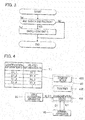
- FIG. 3 is a flowchart illustrating an example of processing performed by the broadcast system 20.
- the switcher 203 in the broadcast system 20 determines whether a switch instruction is supplied (Sa1). Upon supply of a switch instruction (YES at Sa1), the switcher 203 switches the content C in accordance with the switch instruction (Sa2).
- the voice recognition apparatus 30 in FIG. 1 performs voice recognition on the audio signal A1 transmitted from the broadcast system 20. Since a first voice is included in the audio signal A1, text that represents a spoken content of the first voice can be identified. Any publicly known technique can be employed for voice recognition of the audio signal A1, such as recognition processing using an audio model, for example, an HMM (Hidden Markov Model) and a language model that indicates language constraints.
- a result W of the voice recognition of the audio signal A1 hereafter, "recognition result”
- identification information D1 that corresponds to the audio signal A1 (i.e., the identification information D1 transmitted together with the audio signal A1 from the broadcast system 20) are transmitted to the distribution apparatus 40.
- voice recognition is performed on the audio signal A1 of the first content C1.
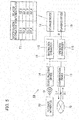
- FIG. 4 is a block diagram illustrating an example of a configuration of the distribution apparatus 40.
- the distribution apparatus 40 according to the first embodiment includes a communication device 401, a storage device 403, and an identifier 405.
- the communication device 401 communicates individually with the voice recognition apparatus 30 and the terminal apparatus 10.
- the voice recognition apparatus 30 and the distribution apparatus 40 communicate with each other, for example, by wire or wirelessly.
- the communication device 401 according to the first embodiment receives the identification information D1 and the recognition result W transmitted from the voice recognition apparatus 30.
- the communication device 401 receives from the terminal apparatus 10 via the communication network 70 a request for the related information R1.
- the identification information D1 is included in the request from the terminal apparatus 10.
- the storage device 403 stores various types of data for providing the related information R1 to the terminal apparatus 10. Any publicly known recording medium, for example, a semiconductor recording medium and a magnetic recording medium, or any combination of different types of recording media can be employed as the storage device 403.
- the storage device 403 according to the first embodiment stores a first table T1.
- the first table T1 is a data table in which the identification information D1 and the related information R1 are registered in association with each other.
- the related information R1 may be the recognition result W of the audio signal A1. Specifically, the recognition result W and the identification information D1 transmitted from the voice recognition apparatus 30 are associated with each other and registered in the first table T1.
- the first table T1 a broadcast station that broadcasts the first content C1 and text (that is, subtitles) of a first voice included in the first content C1 are associated with each other. Since the audio signal A1 is transmitted to the voice recognition apparatus 30 from each of broadcast stations, in actuality, the related information R1 can be registered in association with each of the broadcast stations in the first table T1.
- the identifier 405 identifies the related information R1 in response to a request from the terminal apparatus 10.
- the first table T1 is used to identify the related information R1.
- the identifier 405 identifies related information R1 that corresponds to the identification information D1 transmitted from the terminal apparatus 10, from among a plurality of pieces of the identification information D1 registered in the first table T1.
- the function of the identifier 405 is realized by executing a program by one or more processors, such as a CPU (Central Processing Unit).
- the communication device 401 transmits the related information R1 identified by the identifier 405 to the terminal apparatus 10.
- the playback apparatus 50 plays the content C represented by the broadcast data X transmitted from the broadcast system 20.
- a typical example of the playback apparatus 50 is a television receiver.
- the playback apparatus 50 according to the first embodiment plays the first content C1 upon receiving the broadcast data X1, and plays the second content C2 upon receiving the broadcast data X2.
- the playback apparatus 50 includes a receiver configured to receive the broadcast data X, a display device configured to display various types of image (for example, a liquid crystal panel), and a sound output device configured to output various types of sound (for example, a speaker).
- the display device displays images in accordance with the image signal V included in the broadcast data X received by the receiver.
- the sound output device outputs sound in accordance with the audio signal A included in the broadcast data X received by the receiver.
- a first voice and sound that represents the identification information D1 are output.
- a second voice and sound that represents the identification information D2 are output.
- the sound output device according to the first embodiment not only serves as an audio device that plays a voice of the content C, but also serves as a transmitter that transmits to a surrounding the identification information D (D1 and D2) via sound communication by way of sound waves, i.e., vibration of air, that act as a transmission medium. That is, in the first embodiment, the identification information D is transmitted to the surrounding via sound communication from the sound output device, which is configured to output a voice of the content.
- the identification information D is transmitted repeatedly at a predetermined cycle concurrently with the output of a voice.
- FIG. 5 is a block diagram illustrating an example of a configuration of the terminal apparatus 10.
- the terminal apparatus 10 includes a controller 11, a storage device 12, a communication device 13, a sound receiving device 14, and a presentation device 15.
- the sound receiving device 14 is an audio device configured to receive sound in the surrounding (a microphone). Specifically, the sound receiving device 14 receives sound output by the playback apparatus 50, and generates an audio signal Y that represents a waveform of the sound.
- the identification information D1 is included in the audio signal Y.
- the identification information D2 is included in the audio signal Y.
- the sound receiving device 14 is not only used for a voice call or voice recording during video capture, but also acts as a receiver configured to receive the identification information D (D1 and D2) via sound communication by way of sound waves, i.e., vibration of air, that act as a transmission medium. Illustrations of an A/D converter configured to convert the audio signal Y generated by the sound receiving device 14 from analog to digital form are omitted for the sake of convenience. Instead of the sound receiving device 14 integrated with the terminal apparatus 10, a separate sound receiving device 14 may be connected to the terminal apparatus 10 either by wire or wirelessly.
- the communication device 13 communicates with the distribution apparatus 40 via the communication network 70 under control of the controller 11.
- the communication device 13 according to the first embodiment transmits a request for the related information R1 to the distribution apparatus 40, and receives the related information R1 from the distribution apparatus 40.
- the controller 11 (an example of a computer) is constituted of one or more processors, such as a CPU (Central Processing Unit).
- the controller 11 integrally controls each element of the terminal apparatus 10.
- the storage device 12 stores programs to be executed by the controller 11 and various types of data to be used by the controller 11. Any publicly known recording medium, for example, a semiconductor recording medium or a magnetic recording medium, or any combination of multiple types of recording media can be employed as the storage device 12.
- the storage device 12 stores a second table T2.
- the second table T2 is a data table in which the identification information D2 and the related information R2 are registered in association with each other.
- the identification information D2 and the related information R2 are registered in advance in the second table T2.
- the second table T2 is acquired in advance from a webserver.
- the related information R2 relates to a second voice. Since the second content C2 is, for example, a television program to convey information about an emergency, the spoken content of the second voice can be predicted in advance.
- the second content C2 can include a spoken content of a second voice that announces occurrence of an earthquake, such as "an earthquake has occurred.”
- the second voice may be a spoken content that represents weather conditions, "it will be fine tomorrow" or "it will start raining from the evening.” Since the second content C2 can be in the form of fixed phrases, it is possible for a broadcast station to preset the second content C2.
- text that represents the spoken content of the second voice i.e., subtitles
- the text representative of the spoken content of the second voice need not perfectly match the related information R2. It is of note that each individual broadcast station may use a different second table T2, or a second table T2 may be shared by broadcast stations.
- the controller 11 realizes functions (an information extractor 113 and an operation controller 115) by executing a program stored in the storage device 12. Some of the functions of the controller 11 may be realized by a dedicated electronic circuit. The functions of the controller 11 may be installed in a plurality of devices.
- the information extractor 113 extracts the identification information D (D1 or D2) from the audio signal Y generated by the sound receiving device 14 upon receiving a playback sound that is played by the playback apparatus 50. Specifically, the information extractor 113 extracts the identification information D by performing, for example, a filtering process that emphasizes the frequency band including a sound component of the identification information D in the audio signal Y, and a demodulating process that corresponds to the modulating process performed on the identification information D.
- the identification information D extracted by the information extractor 113 is used to acquire related information R that corresponds to the extracted identification information D (that is, related information R about a voice of each content C output by the playback apparatus 50).
- the identification information D1 is used to acquire the related information R1 from the distribution apparatus 40.
- the identification information D2 is used to acquire the related information R2 from the storage device 12 of the terminal apparatus 10.
- the operation controller 115 acquires the related information R corresponding to the identification information D, and causes the presentation device 15 to play the acquired related information R.
- the operation controller 115 according to the first embodiment acquires the related information R by using different methods depending on the identification information D.
- the terminal apparatus 10 acquires related information R1 that corresponds to the extracted identification information D1 from the distribution apparatus 40.
- the terminal apparatus 10 acquires related information R2 that corresponds to the extracted identification information D2 from the storage device 12.
- the presentation device 15 is a playback apparatus configured to present the related information R to a user.
- the presentation device 15 according to the first embodiment includes a display device configured to display images represented by the related information R. That is, the display device displays the related information R (R1 or R2) that relates to a voice of the content played by the playback apparatus 50.
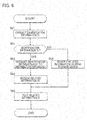
- FIG. 6 is a flowchart illustrating an example of processing performed by the terminal apparatus 10.
- the processing in FIG. 6 is initiated.
- the information extractor 113 extracts the identification information D from the audio signal Y generated by the sound receiving device 14 (Sb1).
- the operation controller 115 determines whether the identification information D extracted by the information extractor 113 is the identification information D1 (Sb2).
- the operation controller 115 uses the second table T2 to determine whether the identification information D is the identification information D1.
- the operation controller 115 determines that the extracted identification information D is the identification information D1.
- the operation controller 115 determines that the extracted identification information D is not the identification information D1 (i.e., the extracted identification information D is the identification information D2).
- the operation controller 115 transmits the identification information D1 to the distribution apparatus 40 (Sb3).
- the operation controller 115 receives related information R1 that corresponds to the identification information D1 from the distribution apparatus 40 (Sb4).
- the processes carried out at Steps Sb3 and Sb4 together is an operation to acquire the related information R1 corresponding to the transmitted identification information D1 by transmission of the identification information D1 to the distribution apparatus 40 (hereafter, "first acquiring operation").
- the operation controller 115 identifies related information R2 that corresponds to the identification information D2 from the storage device 12. Specifically, the operation controller 115 identifies related information R2 that corresponds to the identification information D2 extracted by the information extractor 113, which is one of the plurality of pieces of the identification information D2 registered in the second table T2.
- the process at Step Sb5 is an operation to acquire the related information R2 corresponding to the identification information D2 from the storage device 12 of the terminal apparatus 10 (hereafter, "second acquiring operation").
- the first acquiring operation according to the first embodiment is an operation to acquire the related information R1, which represents a recognition result W of the audio signal A1 including a first voice.
- the related information R1 is acquired based on the identification information D1 extracted from the audio signal Y generated by the sound receiving device 14 upon receiving a playback sound of the first voice.
- the second acquiring operation according to the first embodiment is an operation to acquire the related information R2, which is related to a second voice and registered in advance, based on the identification information D2 extracted from the audio signal Y, which is generated by the sound receiving device 14 upon receiving a playback sound of the second voice.
- the operation controller 115 causes the presentation device 15 to play the related information R acquired by the first acquiring operation or the second acquiring operation (Sb6). That is, the presentation device 15 displays the related information R related to a voice of the content played by the playback apparatus 50.
- a sound component of the identification information D1 is included in the audio signal A1 transmitted as a result of the first broadcast operation, while a sound component of the identification information D2 is included in the audio signal A2 transmitted as a result of the second broadcast operation. Therefore, the related information R1 and the related information R2 can be provided to a user of the terminal apparatus 10 by reproducing the audio signal A. That is, a wide variety of information can be provided to a user of the terminal apparatus 10 without need for a communication device for near field communication.
- the terminal apparatus 10 receives sound played by the playback apparatus 50 in the first broadcast operation and extracts the identification information D1 from the sound, so that the terminal apparatus 10 can acquire related information R1 related to a first voice via the communication network 70. Therefore, while reducing a storage capacity required in the terminal apparatus 10, it is possible for the terminal apparatus 10 to acquire a wide variety of information, such as subtitles, concurrently with broadcast of a program. In contrast, when the second broadcast operation is performed, the related information R2 related to a second voice can be acquired from the storage device 12 of the terminal apparatus 10 on the basis of the identification information D2 extracted from sound played by the playback apparatus 50. Therefore, it is possible to acquire high emergency fixed-phrase information such as emergency information without need for communication via the communication network 70. Thus, a wide variety of related information R1 can be provided while requiring less storage capacity, and at the same time, the related information R2 can be reliably provided without need for communication via the communication network 70.
- the terminal apparatus 10 can acquire the identification information D1 corresponding to the related information R2 registered in advance on a second voice. It is thus possible to reliably provide the related information R2, which is indicative of the content of the second voice to, for example, hearing-impaired persons who have difficulty hearing the second voice, or foreigners who are unable to understand the content of the second voice.
- the first broadcast operation is simpler as compared to, for example, a configuration in which the identification information D1 differs for each individual recognition result W of the audio signal A1, or a configuration in which the identification information D1 differs for each individual first content C1.
- the configuration according to the first embodiment is also advantageous in that a storage capacity required in the distribution apparatus 40 can be reduced.
- the second voice is a voice that announces information about an emergency, it is necessary to reliably provide the related information R2 to the terminal apparatus 10. Therefore, the configuration to acquire the related information R2 without need for communication via the communication network 70 is particularly effective in a case where the second voice is such a voice.
- the terminal apparatus 10 switches the acquiring operation between the first acquiring operation and the second acquiring operation based on trigger data transmitted from the broadcast system 20.
- the broadcast system 20 according to the second embodiment selectively performs either the first broadcast operation or the second broadcast operation in substantially the same manner as in the first embodiment.
- the broadcast system 20 transmits trigger data to the playback apparatus 50.
- the switcher 203 When the switcher 203 receives a switch instruction, the switcher 203 switches one of the first broadcast operation and the second broadcast operation to the other in substantially the same manner as in the first embodiment.
- the switcher 203 according to the second embodiment receives a switch instruction, the switcher 203 adds trigger data to the content C (C1 and C2) broadcast by the broadcast device 205.
- the trigger data according to the second embodiment is a command for the terminal apparatus 10 to switch one of the first acquiring operation and the second acquiring operation to the other.
- the switcher 203 adds to the audio signal A, which includes the content C, a modulated signal representative of the trigger data as a sound component.
- the audio signal A contains a voice of the content C, a sound component of the identification information D, and a sound component of the trigger data.
- the broadcast device 205 transmits the broadcast data X including the audio signal A and the image signal V to the playback apparatus 50.
- the trigger data is not continuously added to the audio signal A, but is added to the audio signal A immediately after the switcher 203 receives the switch instruction. That is, the trigger data is added either to the content C immediately before the broadcast operation is switched, or to the content C immediately after the broadcast operation is switched.
- the playback apparatus 50 plays the content C in accordance with the broadcast data X transmitted by the broadcast system 20 in substantially the same manner as in the first embodiment.
- sound that represents trigger data is output in addition to a voice of the content C, along with sound that represents the identification information D. Therefore, in addition to the sound component of the identification information D, a sound component of the trigger data can be included in the audio signal Y generated by the sound receiving device 14 in the terminal apparatus 10 according to the second embodiment.
- the information extractor 113 extracts the identification information D and the trigger data from the audio signal Y generated by the sound receiving device 14.
- the trigger data is extracted by use of a method that is substantially the same as that for extracting the identification information D.
- the operation controller 115 determines whether trigger data is acquired. When the trigger data is acquired, the operation controller 115 switches one of the first acquiring operation and the second acquiring operation to the other.
- the operation controller 115 determines whether the information extractor 113 has extracted trigger data from the audio signal Y When the information extractor 113 has extracted the trigger data, the operation controller 115 switches one of the first acquiring operation and the second acquiring operation to the other. Specifically, when the trigger data instructs the operation controller 115 to switch from the first acquiring operation to the second acquiring operation, the operation controller 115 switches the first acquiring operation to the second acquiring operation. In contrast, when the trigger data instructs the operation controller 115 to switch from the second acquiring operation to the first acquiring operation, the operation controller 115 switches the second acquiring operation to the first acquiring operation.
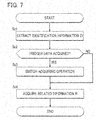
- FIG. 7 is a flowchart illustrating an example of processing performed by the terminal apparatus 10 according to the second embodiment.
- the processing in FIG. 7 is initiated.
- the information extractor 113 extracts the identification information D from the audio signal Y (Sc1). Since there is added trigger data in the audio signal Y immediately after the broadcast system 20 receives a switch instruction, the information extractor 113 may extract the trigger data in some cases.
- the operation controller 115 determines whether the trigger data is acquired (Sc2). Specifically, it is determined whether the information extractor 113 has extracted the trigger data.
- the operation controller 115 switches one of the first acquiring operation and the second acquiring operation to the other in accordance with the trigger data (Sc3).
- the operation controller 115 acquires the related information R by an acquiring operation after having been switched (Sc4).
- the operation controller 115 acquires the related information R without performing the process at Step Sc3 (Sc4).
- the first acquiring operation and the second acquiring operation are switched from one to the other when trigger data is extracted from the audio signal Y generated upon receiving a playback sound. This makes it possible to switch the acquiring operation between the first acquiring operation and the second acquiring operation without need for discrimination between the identification information D1 and the identification information D2 (for example, the process at Sb2 in FIG. 6 ).
- a third embodiment there is assumed a case of occurrence of a specific event (for example, an emergency).
- the emergency include disaster events such as an earthquake, fire, and heavy rain.
- an alarm device or an emergency vehicle for example, an ambulance
- the terminal apparatus 10 detects the alarm sound, the terminal apparatus 10 switches the first acquiring operation to the second acquiring operation.
- FIG. 8 is a block diagram illustrating an example of a configuration of the terminal apparatus 10 according to the third embodiment.
- a trigger data acquirer 117 is added to the terminal apparatus 10 according to the second embodiment.
- the sound receiving device 14 of the terminal apparatus 10 receives sound including an alarm sound, and generates an audio signal Q that represents a waveform of the sound.
- the trigger data acquirer 117 generates trigger data by analyzing the audio signal Q generated by the sound receiving device 14.
- the trigger data according to the third embodiment represents an occurrence of a specific event. Specifically, when the trigger data acquirer 117 determines that an alarm sound is included in the audio signal Q as a result of analyzing the audio signal Q, the trigger data acquirer 117 generates trigger data. That is, the trigger data acquirer 117 functions as an element configured to acquire trigger data. When an alarm sound is determined not to be included in the audio signal Q, trigger data is not generated.
- the operation controller 115 determines whether trigger data is acquired. When the trigger data is acquired, the operation controller 115 switches one of the first acquiring operation and the second acquiring operation to the other. Specifically, the operation controller 115 determines whether the trigger data acquirer 117 has acquired the trigger data. When the operation controller 115 determines that the trigger data acquirer 117 has acquired the trigger data, the operation controller 115 switches the first acquiring operation to the second acquiring operation.
- the broadcast system 20 need not add the trigger data to the content C.
- trigger data is acquired by receiving an alarm sound from an alarm device or an emergency vehicle.
- the method for acquiring trigger data is not limited to the example described above.
- the terminal apparatus 10 may acquire trigger data by receiving the alarm sound played by the playback apparatus 50. That is, trigger data is generated by receiving a sound informing occurrence of a specific event.
- the method for acquiring trigger data is not limited to receiving a sound informing the occurrence of a specific event.
- an alarm system that transmits alarm data representative of an occurrence of a disaster or other events to the terminal apparatus 10 (for example, push communication).
- the trigger data acquirer 117 acquires the alarm data transmitted from the alarm system as trigger data.
- the operation controller 115 switches the first acquiring operation to the second acquiring operation.
- a broadcast system includes: an acquirer configured to acquire a first audio signal and a second audio signal and a broadcaster configured to selectively perform one of a plurality of broadcast operations including a first broadcast operation to transmit the first audio signal and a second broadcast operation to transmit the second audio signal.
- the first audio signal includes (i) a first voice and (ii) a sound component representative of first identification information that corresponds to first related information related to the first voice, the first related information being provided from a distribution apparatus via a communication network to a terminal apparatus
- the second audio signal includes (i) a second voice and (ii) a sound component representative of second identification information that corresponds to second related information related to the second voice, the second related information being registered in advance in the terminal apparatus.
- the sound component of the first identification information is included in the first audio signal transmitted by the first broadcast operation
- the sound component of the second identification information is included in the second audio signal transmitted by the second broadcast operation.
- the terminal apparatus receives sound played by a playback apparatus in the first broadcast operation to extract the first identification information, so that the terminal apparatus can acquire the first related information related to the first voice via a communication network. Therefore, while a required storage capacity of the terminal apparatus can be reduced, the terminal apparatus can acquire a wide variety of information such as subtitles concurrently with broadcast of a program.
- the second broadcast operation is executed, the second identification information is extracted from sound that is played by the playback apparatus, and the second related information related to the second voice can be acquired from a storage device of the terminal apparatus on the basis of the extracted second identification information. Therefore, it is possible to acquire high emergency fixed-phrase information such as emergency information without need for communication via the communication network.
- a wide variety of the first related information can be provided while the required storage capacity can be reduced.
- the second related information can be reliably provided without need for communication via the communication network.
- a storage device of the terminal apparatus refers to a storage device provided in a terminal apparatus, or a storage device externally connected to the terminal apparatus by wire or wirelessly.
- the first related information is text representative of a spoken content of the first voice.
- the first related information is text representative of a spoken content of the first voice.
- the second voice is a voice that provides fixed-phrase information.
- the content of a second voice such as a voice that informs about an emergency or a voice that informs about weather forecasts, is in fixed phrases. It is thus possible to define the content of the second related information in advance. Therefore, the configuration in which the second related information is stored in the storage device of the terminal apparatus is particularly effective for a case where the content of the second voice is fixed-phase information.
- a terminal apparatus includes: an information extractor configured to extract identification information from an audio signal generated by a sound receiving device upon receiving a playback sound that is played by a playback apparatus; and an operation controller configured to selectively perform either (i) a first acquiring operation to acquire first related information that corresponds to the identification information by transmitting the identification information via a communication network to a distribution apparatus, or (ii) a second acquiring operation to acquire second related information that corresponds to the identification information from a storage device of the terminal apparatus, and the operation controller determines whether trigger data is acquired, and when the trigger data is acquired, the operation controller switches one of the first acquiring operation and the second acquiring operation to the other.
- related information can be acquired by extracting the identification information from the audio signal generated upon receiving a playback sound.
- the first related information is acquired from the distribution apparatus via the communication network by the first acquiring operation. Therefore, while reducing the storage capacity required in the terminal apparatus, the terminal apparatus can acquire a wide variety of information such as subtitles concurrently with broadcast of a program.
- the second related information is acquired from the storage device of the terminal apparatus by the second acquiring operation. It is thus possible, for example, to acquire high emergency fixed-phrase information such as emergency information without need for communication via the communication network.
- a wide variety of the first related information can be provided while requiring less storage capacity, and at the same time, the second related information can be reliably provided without need for communication via the communication network.
- the first acquiring operation and the second acquiring operation are switched from one to the other. It is thus possible to switch the acquiring operation between the first acquiring operation and the second acquiring operation, for example, without need to discriminate between identification information used for the first acquiring operation and identification information used for the second acquiring operation.
- the information extractor extracts the trigger data from the audio signal, and the operation controller determines whether the information extractor has extracted the trigger data.
- the trigger data is extracted from the audio signal generated upon receiving a playback sound. Therefore, by use of a simple configuration in which the trigger data is included in the playback sound, it is possible to switch the acquiring operation between the first acquiring operation and the second acquiring operation.
- the terminal apparatus further includes a trigger data acquirer configured to acquire trigger data representative of an occurrence of a specific event, and the operation controller is configured to determine whether the trigger data acquirer has acquired the trigger data.
- a trigger data acquirer configured to acquire trigger data representative of an occurrence of a specific event
- the operation controller is configured to determine whether the trigger data acquirer has acquired the trigger data.
- a terminal apparatus includes: an information extractor configured to extract identification information from an audio signal generated by a sound receiving device upon receiving a playback sound that is played by a playback apparatus; and an operation controller configured to: determine whether the identification information extracted by the information extractor is first identification information or second identification information; in a case in which the extracted identification information is the first identification information, perform a first acquiring operation to acquire first related information that corresponds to the first identification information by transmitting via a communication network the first identification information to a distribution apparatus; and in a case in which the extracted identification information is the second identification information, perform a second acquiring operation to acquire second related information that corresponds to the second identification information from a storage device of the terminal apparatus.
- the identification information is either the first identification information or the second identification information. Therefore, it is unnecessary to transmit, to the terminal apparatus, data for switching one of the first acquiring operation and the second acquiring operation to the other, for example.
- the operation controller determines whether the identification information extracted by the information extractor is either the first identification information or the second identification information based on a numerical value represented by at least a part of the identification information extracted by the information extractor. In the aspect described above, it is determined whether the extracted identification information is the first identification information or the second identification information based on a numerical value represented by at least a part of the identification information. Thus, it is unnecessary to store the second identification information in the terminal apparatus in advance, for example.
- the first acquiring operation is an operation to acquire first related information representative of text that represents a spoken content of a first voice that is the playback sound
- the second acquiring operation is an operation to acquire second related information on a second voice, which is the playback sound, the second related information being registered in advance.
- the first related information representative of text that represents a spoken content of the first voice can be acquired via the communication network, while the second related information registered in advance on the second voice can be acquired from the storage device of the terminal apparatus.
- the present disclosure is also realized as a broadcasting method for a broadcast system according to each aspect described above as an example, or as a method for operating a terminal apparatus according to each aspect described above as an example.
- a broadcasting method for a broadcast system includes: acquiring a first audio signal and a second audio signal, and selectively performing one of a plurality of broadcast operations including a first broadcast operation to transmit the first audio signal and a second broadcast operation to transmit the second audio signal.
- the first audio signal includes (i) a first voice and (ii) a sound component that represents first identification information that corresponds to first related information related to the first voice, the first related information being provided via a communication network from a distribution apparatus to a terminal apparatus, and the second audio signal includes (i) a second voice and (ii) a sound component that represents second identification information that corresponds to second related information related to the second voice, the second related information being registered in advance in the terminal apparatus.
- a method for operating a terminal apparatus includes: extracting identification information from an audio signal generated by a sound receiving device upon receiving a playback sound that is played by a playback apparatus; and selectively performing either (i) a first acquiring operation to acquire first related information that corresponds to the identification information by transmitting the identification information to a distribution apparatus via a communication network, or (ii) a second acquiring operation to acquire second related information that corresponds to the identification information from a storage device in the terminal apparatus, and the operation controller determines whether trigger data is acquired, and when the trigger data is acquired, the operation controller switches one of the first acquiring operation and the second acquiring operation to the other.
- a method for operating a terminal apparatus includes: extracting identification information from an audio signal generated by a sound receiving device upon receiving a playback sound that is played by a playback apparatus; determining whether the identification information extracted by the information extractor is either first identification information or second identification information; in a case in which the extracted identification information is the first identification information, performing a first acquiring operation to acquire first related information that corresponds to the first identification information by transmitting the first identification information to a distribution apparatus via a communication network; and in a case in which the extracted identification information is the second identification information, performing a second acquiring operation to acquire second related information that corresponds to the second identification information from a storage device in the terminal apparatus.
- a program causes a processor in a terminal apparatus to function as: an information extractor configured to extract identification information from an audio signal generated by a sound receiving device upon receiving a playback sound that is played by a playback apparatus; and an operation controller configured to selectively perform either (i) a first acquiring operation to acquire first related information that corresponds to the identification information by transmitting the identification information to a distribution apparatus via a communication network, or (ii) a second acquiring operation to acquire second related information that corresponds to the identification information from a storage device of the terminal apparatus, and the operation controller determines whether trigger data is acquired, and when the trigger data is acquired, the operation controller switches one of the first acquiring operation and the second acquiring operation to the other.
- a program causes a processor in a terminal apparatus to function as: an information extractor configured to extract identification information from an audio signal generated by a sound receiving device upon receiving a playback sound that is played by a playback apparatus; and an operation controller configured to: determine whether the identification information extracted by the information extractor is first identification information or second identification information; in a case in which the extracted identification information is the first identification information, perform a first acquiring operation to acquire first related information that corresponds to the first identification information by transmitting the first identification information to a distribution apparatus via a communication network; and in a case in which the extracted identification information is the second identification information, perform a second acquiring operation to acquire second related information that corresponds to the second identification information from a storage device of the terminal apparatus.
- 10... terminal apparatus 100... information providing system, 11... controller, 113... information extractor, 115... operation controller, 117... trigger data acquirer, 12... storage device, 13... communication device, 14... sound receiving device, 15... presentation device, 20... broadcast system, 201... first processor, 202... second processor, 203... switcher, 204... communication device, 205... broadcast device, 30... voice recognition apparatus, 40... distribution apparatus, 401... communication device, 403... storage device, 405... identifier, 50... playback apparatus, 70... communication network.
Landscapes
- Engineering & Computer Science (AREA)
- Multimedia (AREA)
- Signal Processing (AREA)
- Computer Networks & Wireless Communication (AREA)
- Physics & Mathematics (AREA)
- Theoretical Computer Science (AREA)
- Health & Medical Sciences (AREA)
- Audiology, Speech & Language Pathology (AREA)
- Computational Linguistics (AREA)
- Human Computer Interaction (AREA)
- Acoustics & Sound (AREA)
- Artificial Intelligence (AREA)
- Computer Vision & Pattern Recognition (AREA)
- General Health & Medical Sciences (AREA)
- General Engineering & Computer Science (AREA)
- General Physics & Mathematics (AREA)
- Computer Security & Cryptography (AREA)
- Two-Way Televisions, Distribution Of Moving Picture Or The Like (AREA)
- Telephonic Communication Services (AREA)
Applications Claiming Priority (2)
| Application Number | Priority Date | Filing Date | Title |
|---|---|---|---|
| JP2018126053 | 2018-07-02 | ||
| PCT/JP2019/025939 WO2020009038A1 (ja) | 2018-07-02 | 2019-06-28 | 放送システム、端末装置、放送方法、端末装置の動作方法、および、プログラム |
Publications (2)
| Publication Number | Publication Date |
|---|---|
| EP3820060A1 true EP3820060A1 (de) | 2021-05-12 |
| EP3820060A4 EP3820060A4 (de) | 2022-03-30 |
Family
ID=69060859
Family Applications (1)
| Application Number | Title | Priority Date | Filing Date |
|---|---|---|---|
| EP19831358.7A Withdrawn EP3820060A4 (de) | 2018-07-02 | 2019-06-28 | Rundfunksystem, endgerät, rundfunkverfahren, betriebsverfahren für endgerät und programm |
Country Status (5)
| Country | Link |
|---|---|
| US (1) | US11438397B2 (de) |
| EP (1) | EP3820060A4 (de) |
| JP (2) | JP6766981B2 (de) |
| CN (1) | CN112368958A (de) |
| WO (1) | WO2020009038A1 (de) |
Families Citing this family (1)
| Publication number | Priority date | Publication date | Assignee | Title |
|---|---|---|---|---|
| KR20230140236A (ko) * | 2022-03-29 | 2023-10-06 | 현대자동차주식회사 | 차량 및 그 제어 방법 |
Family Cites Families (28)
| Publication number | Priority date | Publication date | Assignee | Title |
|---|---|---|---|---|
| US5907793A (en) * | 1992-05-01 | 1999-05-25 | Reams; David A. | Telephone-based interactive broadcast or cable radio or television methods and apparatus |
| US5995553A (en) * | 1997-01-28 | 1999-11-30 | Tft, Inc. | Encoder/decoder for emergency alert system |
| US5917887A (en) * | 1997-09-08 | 1999-06-29 | Tft, Inc. | Emergency alert communication system wherein emergency messages are received by a radio frequency receiver and routed to a telephone device |
| US6510207B1 (en) * | 1999-06-29 | 2003-01-21 | Agere Systems Inc. | Voice messaging system storage of emergency alert system warnings |
| US6553215B1 (en) * | 2000-07-27 | 2003-04-22 | Kim-Por Chung | Weather radio control |
| EP2288121A3 (de) | 2000-11-30 | 2011-06-22 | Intrasonics S.A.R.L. | Telekommunikationsvorrichtung mit Audioübertragung-interaktivem Betrieb |
| JP4700211B2 (ja) | 2001-03-26 | 2011-06-15 | 株式会社日立国際電気 | 携帯無線機及び警報システム |
| ATE550755T1 (de) * | 2001-08-28 | 2012-04-15 | Panasonic Corp | Empfangsverfahren für funkübertragungen |
| US7844035B2 (en) * | 2003-08-07 | 2010-11-30 | Stanley Pietrowicz | Dial-out voice notification system |
| CN101018095B (zh) * | 2006-02-07 | 2012-09-05 | 株式会社东芝 | 紧急信息快报系统 |
| JP2006211692A (ja) * | 2006-02-10 | 2006-08-10 | Sony Corp | 送受信装置および送受信方法、受信装置および受信方法、並びに送信装置および送信方法 |
| JP2009038774A (ja) | 2007-08-03 | 2009-02-19 | Nec Corp | デジタル放送受信システム、デジタル放送受信方法、およびデジタル放送受信プログラム |
| KR100881074B1 (ko) * | 2008-07-30 | 2009-01-30 | 아카데미정보통신 (주) | 로컬방송시스템 |
| JP2010187256A (ja) * | 2009-02-13 | 2010-08-26 | Panasonic Corp | 通信システム、並びに放送情報送信装置および通信装置 |
| US8520821B2 (en) * | 2009-07-24 | 2013-08-27 | Citrix Systems, Inc. | Systems and methods for switching between computer and presenter audio transmission during conference call |
| US20110191801A1 (en) * | 2010-02-04 | 2011-08-04 | Jawanth Vytheeswaran | System and methods for switching between two or more media streams |
| JP5523217B2 (ja) * | 2010-06-24 | 2014-06-18 | Toa株式会社 | 音声放送システム及び情報端末 |
| WO2013086122A1 (en) * | 2011-12-06 | 2013-06-13 | Devine Christopher F | Targeted content insertion for devices receiving radio broadcast content |
| WO2013118711A1 (ja) * | 2012-02-08 | 2013-08-15 | エイディシーテクノロジー株式会社 | 情報端末及び情報提供サーバ |
| WO2013129587A1 (ja) * | 2012-03-02 | 2013-09-06 | ヤマハ株式会社 | コンテンツ提供システム、コンテンツ提供方法、コンテンツ編集装置、コンテンツ解析システム、および、放送局id放音装置 |
| JP2013247615A (ja) * | 2012-05-29 | 2013-12-09 | Yamaha Corp | コンテンツ提供システム、コンテンツ提供方法、コンテンツ解析システム、および、放送局id放音装置 |
| US8863172B2 (en) * | 2012-03-17 | 2014-10-14 | Time Warner Cable Enterprises Llc | Emergency alert system methods and apparatus |
| JP2013232182A (ja) * | 2012-04-02 | 2013-11-14 | Yamaha Corp | コンテンツ配信システム、サーバ装置及び端末装置 |
| JP2014187490A (ja) * | 2013-03-22 | 2014-10-02 | Yamaha Corp | 放送受信装置及び端末装置 |
| JP5871088B1 (ja) * | 2014-07-29 | 2016-03-01 | ヤマハ株式会社 | 端末装置、情報提供システム、情報提供方法およびプログラム |
| US20170213552A1 (en) * | 2016-01-26 | 2017-07-27 | Motorola Mobility Llc | Detection of audio public announcements by a mobile device |
| JP6213700B1 (ja) | 2016-01-26 | 2017-10-18 | ヤマハ株式会社 | 端末装置、情報提供方法およびプログラム |
| US10129594B2 (en) * | 2017-03-21 | 2018-11-13 | Amplivy, Inc. | Content-activated intelligent, autonomous audio/video source controller |
-
2019
- 2019-06-28 JP JP2020521393A patent/JP6766981B2/ja active Active
- 2019-06-28 EP EP19831358.7A patent/EP3820060A4/de not_active Withdrawn
- 2019-06-28 WO PCT/JP2019/025939 patent/WO2020009038A1/ja not_active Ceased
- 2019-06-28 CN CN201980044319.5A patent/CN112368958A/zh active Pending
-
2020
- 2020-09-10 JP JP2020152023A patent/JP7302559B2/ja active Active
- 2020-12-29 US US17/136,490 patent/US11438397B2/en active Active
Also Published As
| Publication number | Publication date |
|---|---|
| JP6766981B2 (ja) | 2020-10-14 |
| WO2020009038A1 (ja) | 2020-01-09 |
| US11438397B2 (en) | 2022-09-06 |
| US20210120055A1 (en) | 2021-04-22 |
| CN112368958A (zh) | 2021-02-12 |
| EP3820060A4 (de) | 2022-03-30 |
| JPWO2020009038A1 (ja) | 2020-08-20 |
| JP7302559B2 (ja) | 2023-07-04 |
| JP2021005882A (ja) | 2021-01-14 |
Similar Documents
| Publication | Publication Date | Title |
|---|---|---|
| AU2015297648B2 (en) | Terminal device, information providing system, information presentation method, and information providing method | |
| US20070288954A1 (en) | Wallpaper setting apparatus and method for audio channel in digital multimedia broadcasting service | |
| US11930248B2 (en) | Information processing apparatus, information processing method, transmission apparatus, and transmission method | |
| WO2012144379A1 (ja) | 供給装置、供給方法、受信装置、受信方法、プログラム、および放送システム | |
| CN115706762B (zh) | 一种移动直播实时语音识别生成字幕的方法及装置 | |
| JP6957485B2 (ja) | 情報処理装置、情報処理方法、プログラム、および情報処理システム | |
| US11438397B2 (en) | Broadcast system, terminal apparatus, method for operating terminal apparatus, and recording medium | |
| KR20060127459A (ko) | 디지털방송 콘텐츠 변환 기능을 갖는 디지털방송용 단말기및 그 방법 | |
| KR20130071296A (ko) | 디지털 방송 송신기, 디지털 방송 수신기 및 그들의 오디오 디스크립션 디스크립터 처리 방법 | |
| US10846150B2 (en) | Information processing method and terminal apparatus | |
| US20170134782A1 (en) | Transmission device, transmission method, reception device, and reception method | |
| JP2015018079A (ja) | 字幕音声生成装置 | |
| KR101559170B1 (ko) | 영상표시장치 및 그 제어방법 | |
| KR100846284B1 (ko) | 휴대용 단말기의 방송 정보 공유 방법 | |
| JP2017118576A (ja) | 受信装置、受信方法、プログラム、及び記憶媒体 | |
| JP2009260685A (ja) | 放送受信装置 | |
| JP7087745B2 (ja) | 端末装置、情報提供システム、端末装置の動作方法および情報提供方法 | |
| EP3534362A1 (de) | Verfahren und vorrichtung zur ausgabe von audio | |
| KR100783973B1 (ko) | 방송 수신장치 | |
| JP7210939B2 (ja) | 情報提供方法、端末装置の動作方法、配信システムおよびプログラム | |
| JP2019012959A (ja) | コンテンツ提供装置、コンテンツ提供方法およびコンテンツ提供プログラム | |
| KR20090074659A (ko) | 자막 정보 제공 방법 | |
| JP2017069705A (ja) | 受信装置、受信方法、放送システムおよびプログラム | |
| JP2016116032A (ja) | 受信装置、放送システム、受信方法及びプログラム | |
| JP2017017741A (ja) | 放送システム及び放送方法 |
Legal Events
| Date | Code | Title | Description |
|---|---|---|---|
| STAA | Information on the status of an ep patent application or granted ep patent |
Free format text: STATUS: THE INTERNATIONAL PUBLICATION HAS BEEN MADE |
|
| PUAI | Public reference made under article 153(3) epc to a published international application that has entered the european phase |
Free format text: ORIGINAL CODE: 0009012 |
|
| STAA | Information on the status of an ep patent application or granted ep patent |
Free format text: STATUS: REQUEST FOR EXAMINATION WAS MADE |
|
| 17P | Request for examination filed |
Effective date: 20210128 |
|
| AK | Designated contracting states |
Kind code of ref document: A1 Designated state(s): AL AT BE BG CH CY CZ DE DK EE ES FI FR GB GR HR HU IE IS IT LI LT LU LV MC MK MT NL NO PL PT RO RS SE SI SK SM TR |
|
| DAV | Request for validation of the european patent (deleted) | ||
| DAX | Request for extension of the european patent (deleted) | ||
| A4 | Supplementary search report drawn up and despatched |
Effective date: 20220225 |
|
| RIC1 | Information provided on ipc code assigned before grant |
Ipc: H04L 65/401 20220101ALI20220221BHEP Ipc: H04L 12/18 20060101ALI20220221BHEP Ipc: H04L 65/611 20220101ALI20220221BHEP Ipc: H04N 21/435 20110101ALI20220221BHEP Ipc: H04N 21/238 20110101ALI20220221BHEP Ipc: H04N 21/235 20110101ALI20220221BHEP Ipc: H04M 11/00 20060101ALI20220221BHEP Ipc: H04H 60/82 20080101ALI20220221BHEP Ipc: H04H 60/58 20080101ALI20220221BHEP Ipc: H04H 60/48 20080101ALI20220221BHEP Ipc: H04H 20/93 20080101ALI20220221BHEP Ipc: H04H 20/31 20080101ALI20220221BHEP Ipc: G10L 15/00 20130101ALI20220221BHEP Ipc: H04H 60/37 20080101AFI20220221BHEP |
|
| STAA | Information on the status of an ep patent application or granted ep patent |
Free format text: STATUS: THE APPLICATION HAS BEEN WITHDRAWN |
|
| 18W | Application withdrawn |
Effective date: 20230131 |