EP3818038B1 - Verfahren zur herstellung von arylaminen - Google Patents
Verfahren zur herstellung von arylaminen Download PDFInfo
- Publication number
- EP3818038B1 EP3818038B1 EP19733807.2A EP19733807A EP3818038B1 EP 3818038 B1 EP3818038 B1 EP 3818038B1 EP 19733807 A EP19733807 A EP 19733807A EP 3818038 B1 EP3818038 B1 EP 3818038B1
- Authority
- EP
- European Patent Office
- Prior art keywords
- group
- compound
- bis
- substituted
- radicals
- Prior art date
- Legal status (The legal status is an assumption and is not a legal conclusion. Google has not performed a legal analysis and makes no representation as to the accuracy of the status listed.)
- Active
Links
Classifications
-
- C—CHEMISTRY; METALLURGY
- C07—ORGANIC CHEMISTRY
- C07C—ACYCLIC OR CARBOCYCLIC COMPOUNDS
- C07C209/00—Preparation of compounds containing amino groups bound to a carbon skeleton
- C07C209/04—Preparation of compounds containing amino groups bound to a carbon skeleton by substitution of functional groups by amino groups
- C07C209/22—Preparation of compounds containing amino groups bound to a carbon skeleton by substitution of functional groups by amino groups by substitution of other functional groups
-
- C—CHEMISTRY; METALLURGY
- C07—ORGANIC CHEMISTRY
- C07D—HETEROCYCLIC COMPOUNDS
- C07D405/00—Heterocyclic compounds containing both one or more hetero rings having oxygen atoms as the only ring hetero atoms, and one or more rings having nitrogen as the only ring hetero atom
- C07D405/02—Heterocyclic compounds containing both one or more hetero rings having oxygen atoms as the only ring hetero atoms, and one or more rings having nitrogen as the only ring hetero atom containing two hetero rings
- C07D405/04—Heterocyclic compounds containing both one or more hetero rings having oxygen atoms as the only ring hetero atoms, and one or more rings having nitrogen as the only ring hetero atom containing two hetero rings directly linked by a ring-member-to-ring-member bond
-
- C—CHEMISTRY; METALLURGY
- C07—ORGANIC CHEMISTRY
- C07B—GENERAL METHODS OF ORGANIC CHEMISTRY; APPARATUS THEREFOR
- C07B37/00—Reactions without formation or introduction of functional groups containing hetero atoms, involving either the formation of a carbon-to-carbon bond between two carbon atoms not directly linked already or the disconnection of two directly linked carbon atoms
- C07B37/04—Substitution
-
- C—CHEMISTRY; METALLURGY
- C07—ORGANIC CHEMISTRY
- C07B—GENERAL METHODS OF ORGANIC CHEMISTRY; APPARATUS THEREFOR
- C07B43/00—Formation or introduction of functional groups containing nitrogen
- C07B43/04—Formation or introduction of functional groups containing nitrogen of amino groups
-
- C—CHEMISTRY; METALLURGY
- C07—ORGANIC CHEMISTRY
- C07C—ACYCLIC OR CARBOCYCLIC COMPOUNDS
- C07C209/00—Preparation of compounds containing amino groups bound to a carbon skeleton
- C07C209/68—Preparation of compounds containing amino groups bound to a carbon skeleton from amines, by reactions not involving amino groups, e.g. reduction of unsaturated amines, aromatisation, or substitution of the carbon skeleton
-
- C—CHEMISTRY; METALLURGY
- C07—ORGANIC CHEMISTRY
- C07C—ACYCLIC OR CARBOCYCLIC COMPOUNDS
- C07C211/00—Compounds containing amino groups bound to a carbon skeleton
- C07C211/43—Compounds containing amino groups bound to a carbon skeleton having amino groups bound to carbon atoms of six-membered aromatic rings of the carbon skeleton
- C07C211/54—Compounds containing amino groups bound to a carbon skeleton having amino groups bound to carbon atoms of six-membered aromatic rings of the carbon skeleton having amino groups bound to two or three six-membered aromatic rings
-
- C—CHEMISTRY; METALLURGY
- C07—ORGANIC CHEMISTRY
- C07C—ACYCLIC OR CARBOCYCLIC COMPOUNDS
- C07C211/00—Compounds containing amino groups bound to a carbon skeleton
- C07C211/43—Compounds containing amino groups bound to a carbon skeleton having amino groups bound to carbon atoms of six-membered aromatic rings of the carbon skeleton
- C07C211/57—Compounds containing amino groups bound to a carbon skeleton having amino groups bound to carbon atoms of six-membered aromatic rings of the carbon skeleton having amino groups bound to carbon atoms of six-membered aromatic rings being part of condensed ring systems of the carbon skeleton
- C07C211/58—Naphthylamines; N-substituted derivatives thereof
-
- C—CHEMISTRY; METALLURGY
- C07—ORGANIC CHEMISTRY
- C07C—ACYCLIC OR CARBOCYCLIC COMPOUNDS
- C07C213/00—Preparation of compounds containing amino and hydroxy, amino and etherified hydroxy or amino and esterified hydroxy groups bound to the same carbon skeleton
- C07C213/08—Preparation of compounds containing amino and hydroxy, amino and etherified hydroxy or amino and esterified hydroxy groups bound to the same carbon skeleton by reactions not involving the formation of amino groups, hydroxy groups or etherified or esterified hydroxy groups
-
- C—CHEMISTRY; METALLURGY
- C07—ORGANIC CHEMISTRY
- C07C—ACYCLIC OR CARBOCYCLIC COMPOUNDS
- C07C217/00—Compounds containing amino and etherified hydroxy groups bound to the same carbon skeleton
- C07C217/78—Compounds containing amino and etherified hydroxy groups bound to the same carbon skeleton having amino groups and etherified hydroxy groups bound to carbon atoms of six-membered aromatic rings of the same carbon skeleton
- C07C217/80—Compounds containing amino and etherified hydroxy groups bound to the same carbon skeleton having amino groups and etherified hydroxy groups bound to carbon atoms of six-membered aromatic rings of the same carbon skeleton having amino groups and etherified hydroxy groups bound to carbon atoms of non-condensed six-membered aromatic rings
- C07C217/82—Compounds containing amino and etherified hydroxy groups bound to the same carbon skeleton having amino groups and etherified hydroxy groups bound to carbon atoms of six-membered aromatic rings of the same carbon skeleton having amino groups and etherified hydroxy groups bound to carbon atoms of non-condensed six-membered aromatic rings of the same non-condensed six-membered aromatic ring
- C07C217/84—Compounds containing amino and etherified hydroxy groups bound to the same carbon skeleton having amino groups and etherified hydroxy groups bound to carbon atoms of six-membered aromatic rings of the same carbon skeleton having amino groups and etherified hydroxy groups bound to carbon atoms of non-condensed six-membered aromatic rings of the same non-condensed six-membered aromatic ring the oxygen atom of at least one of the etherified hydroxy groups being further bound to an acyclic carbon atom
-
- C—CHEMISTRY; METALLURGY
- C07—ORGANIC CHEMISTRY
- C07C—ACYCLIC OR CARBOCYCLIC COMPOUNDS
- C07C303/00—Preparation of esters or amides of sulfuric acids; Preparation of sulfonic acids or of their esters, halides, anhydrides or amides
- C07C303/26—Preparation of esters or amides of sulfuric acids; Preparation of sulfonic acids or of their esters, halides, anhydrides or amides of esters of sulfonic acids
- C07C303/30—Preparation of esters or amides of sulfuric acids; Preparation of sulfonic acids or of their esters, halides, anhydrides or amides of esters of sulfonic acids by reactions not involving the formation of esterified sulfo groups
-
- C—CHEMISTRY; METALLURGY
- C07—ORGANIC CHEMISTRY
- C07D—HETEROCYCLIC COMPOUNDS
- C07D209/00—Heterocyclic compounds containing five-membered rings, condensed with other rings, with one nitrogen atom as the only ring hetero atom
- C07D209/56—Ring systems containing three or more rings
- C07D209/80—[b, c]- or [b, d]-condensed
- C07D209/82—Carbazoles; Hydrogenated carbazoles
-
- C—CHEMISTRY; METALLURGY
- C07—ORGANIC CHEMISTRY
- C07D—HETEROCYCLIC COMPOUNDS
- C07D209/00—Heterocyclic compounds containing five-membered rings, condensed with other rings, with one nitrogen atom as the only ring hetero atom
- C07D209/56—Ring systems containing three or more rings
- C07D209/80—[b, c]- or [b, d]-condensed
- C07D209/82—Carbazoles; Hydrogenated carbazoles
- C07D209/86—Carbazoles; Hydrogenated carbazoles with only hydrogen atoms, hydrocarbon or substituted hydrocarbon radicals, directly attached to carbon atoms of the ring system
Definitions
- the invention relates to a process for preparing compounds containing at least one arylamino group by palladium-catalyzed coupling reaction of an amino compound with an aryl compound.
- aryl or heteroarylamino compounds are often important intermediates in multistep syntheses.
- aryl or heteroarylamino compounds are used as active pharmaceutical ingredients and as functional materials, for example in electronic devices.
- achieving a high yield in the coupling step and avoiding by-products are of great importance, since otherwise syntheses on an industrial scale are difficult to achieve.
- it is essential that side reactions are largely avoided.
- a high selectivity in the presence of other functional groups is also desirable.
- inorganic bases such as KOH, NaOH, CS 2 CO 3 or K 3 PO 4
- very strong bases such as alkali amides or alkyl lithium
- LiOtBu lithium tert-butanolate
- CN coupling reactions Hard-Buchwald coupling
- sulfonates as the leaving group.
- NaOtBu which is typically used in CN coupling reactions, or KOtBu
- significantly improved yields can be achieved.
- significantly fewer side reactions are observed when using sulfonates as the leaving group, in particular significantly less hydrolysis of the sulfonate leaving group.
- the use of LiOtBu as a base enables a selective conversion of sulfonate groups, especially triflate, in the presence of chlorine substituents. Such a selectivity is not observed with NaOtBu as the base.
- LiOtBu as a base for the coupling of aliphatic amines is of Louie et al. (Tetrahedron Lett. 1995, 36, 3609 ) already described. However, almost no conversion is obtained in this reaction with aliphatic amines.
- the invention is therefore a method for preparing a secondary or tertiary arylamino compound by a palladium-catalyzed coupling reaction between a primary or secondary arylamino compound and an aryl compound, characterized in that the method in the presence of lithium tert-butanolate (LiOtBu) as Base is performed.
- LiOtBu lithium tert-butanolate
- the use of a primary arylamino compound leads to a secondary or tertiary arylamino compound
- the use of a secondary arylamino compound leads to a tertiary arylamino compound as reaction product.
- the process of the invention employs a secondary arylamino compound and the product is a tertiary arylamino compound.
- An arylamino compound for the purposes of the present invention is understood as meaning an amine to which at least one optionally substituted aromatic or heteroaromatic ring system is bonded.
- a primary arylamino compound is a compound containing a primary amino group -NH 2 , which is attached to an optionally substituted aromatic or heteroaromatic ring system.
- a secondary arylamino compound is a compound containing a secondary amino group -NH- which is attached to two optionally substituted aromatic or heteroaromatic ring systems.
- An aromatic ring system and a heteroaromatic ring system can also be attached to the nitrogen.
- a tertiary arylamino compound is a compound containing a tertiary nitrogen atom N attached to three optionally substituted aromatic or heteroaromatic ring systems.
- One aromatic ring system and two heteroaromatic ring systems or two aromatic ring systems and one heteroaromatic ring system can also be bonded to the nitrogen.
- the aromatic or heteroaromatic ring systems may be the same or different.
- the aromatic or heteroaromatic ring systems in the secondary or tertiary amine can also be linked to one another via a single bond or a bivalent group to form a ring.
- the reaction of a carbazole is also possible.
- an aryl compound is understood as meaning an optionally substituted organic compound containing at least one aromatic or heteroaromatic ring system.
- the aryl compound contains a leaving group which is split off in the coupling reaction according to the invention. Preferred leaving groups are listed below.
- An aryl group within the meaning of this invention contains 6 to 40 carbon atoms; a heteroaryl group within the meaning of this invention contains 2 to 40 carbon atoms and at least one heteroatom, with the proviso that the sum of carbon atoms and heteroatoms is at least 5.
- the heteroatoms are preferably selected from N, O and/or S.
- An aryl group or heteroaryl group is either a simple aromatic cycle, ie benzene, or a simple heteroaromatic cycle, for example pyridine, pyrimidine, thiophene, etc., or one fused aryl or heteroaryl group, for example naphthalene, anthracene, phenanthrene, quinoline, isoquinoline, etc. understood.
- An aromatic ring system within the meaning of this invention contains 6 to 60 carbon atoms in the ring system, preferably 6 to 40 carbon atoms.
- a heteroaromatic ring system for the purposes of this invention contains 1 to 60 carbon atoms, preferably 1 to 40 carbon atoms, and at least one heteroatom in the ring system, with the proviso that the sum of carbon atoms and heteroatoms is at least 5.
- the heteroatoms are preferably selected from N, O and / or S.
- An aromatic or heteroaromatic ring system in the context of this invention is to be understood as a system which does not necessarily only contain aryl or heteroaryl groups, but also in which several aryl or heteroaryl groups a non-aromatic moiety (preferably less than 10% of those other than H atoms), such as B. a C, N or O atom or a carbonyl group can be interrupted.
- aryl or heteroaryl groups a non-aromatic moiety (preferably less than 10% of those other than H atoms), such as B. a C, N or O atom or a carbonyl group can be interrupted.
- systems such as 9,9′-spirobifluorene, 9,9-diarylfluorene, triarylamine, diaryl ether, stilbene, etc. should also be understood as aromatic ring systems in the context of this invention.
- systems in which two or more aryl or heteroaryl groups are bonded directly to each other such as.
- a C 1 - to C 20 -alkyl group in which individual H atoms or CH 2 groups can also be substituted by the groups mentioned above, for example the radicals methyl, ethyl, n-propyl, i -propyl, cyclopropyl, n-butyl, i-butyl, s-butyl, t-butyl, cyclobutyl, 2-methylbutyl, n-pentyl, s-pentyl, t-pentyl, 2-pentyl, neo-pentyl, cyclopentyl, n -Hexyl, s-hexyl, t-hexyl, 2-hexyl, 3-hexyl, neo-hexyl, cyclohexyl, 1-methylcyclopentyl, 2-methylpentyl, n-heptyl, 2-heptyl, 3-h
- alkenyl group is understood to mean, for example, ethenyl, propenyl, butenyl, pentenyl, cyclopentenyl, hexenyl, cyclohexenyl, heptenyl, cycloheptenyl, octenyl, cyclooctenyl or cyclooctadienyl.
- An alkynyl group is understood to mean, for example, ethynyl, propynyl, butynyl, pentynyl, hexynyl, heptynyl or octynyl.
- a C 1 - to C 40 -alkoxy group is understood as meaning, for example, methoxy, trifluoromethoxy, ethoxy, n-propoxy, i-propoxy, n-butoxy, i-butoxy, s-butoxy, t-butoxy or 2-methylbutoxy.
- a cyclic alkyl, alkoxy or thioalkoxy group within the meaning of this invention is understood to mean a monocyclic, a bicyclic or a polycyclic group.
- An aromatic or heteroaromatic ring system with 5-60 aromatic ring atoms which can be substituted with the abovementioned radicals and which can be linked via any position on the aromatic or heteroaromatic, is understood to mean, for example, groups derived from benzene, naphthalene , anthracene, benzanthracene, phenanthrene, benzophenanthrene, pyrene, chrysene, perylene, fluoranthene, benzofluoranthene, naphthacene, pentacene, benzopyrene, biphenyl, biphenylene, terphenyl, terphenylene, fluorene, spirobifluorene, dihydrophenanthrene, dihydropyrene, tetrahydropyrene, cis or trans indenofluorene, cis or trans monobenzoindenofluorene, cis or trans dibenzoindenofluor
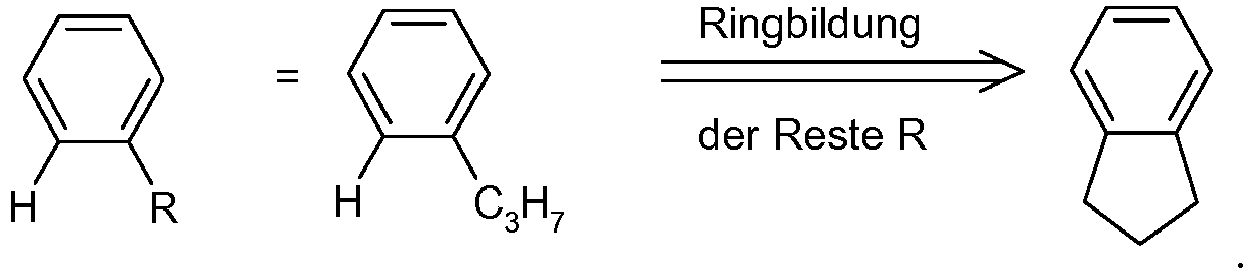
- the above formulation should also be understood to mean that if one of the two radicals is hydrogen, the second radical binds to the position to which the hydrogen atom was bonded, forming a ring. This should be illustrated by the following scheme:
- a palladium-catalyzed coupling reaction is understood to mean a reaction between two organic compounds in which a single bond is formed between the two compounds with palladium catalysis. This occurs with formal cleavage of a small molecule. Preferably, no further reactions occur at the two compounds.
- the coupling reaction takes place between an arylamino compound and an aryl compound, the aryl compound having a leaving group which is preferably selected from the group consisting of optionally substituted alkyl sulfonate, optionally substituted aryl sulfonate, halide and diazonium.
- the formed single bond takes the place of the N-H bond of the arylamino compound and the bond to the leaving group of the aryl compound.
- the compound of formula (2), Ar-(X) n represents the above aryl compound wherein X represents the leaving group.
- [Pd] represents the palladium compound used as a catalyst.
- R′ is the same or different, so that a secondary arylamino compound is preferably used to prepare a tertiary arylamino compound.
- the process according to the invention is also suitable for the synthesis of oligomeric or polymeric arylamino compounds.
- Such a reaction can be carried out by reacting an aryl compound having at least two leaving groups with an arylamino compound having at least two amino groups.
- the basic reaction scheme shown above, comprising a bond formation between a nitrogen atom and an aryl group, is still valid for this.
- the process according to the invention is preferred for the production of small organic compounds, i. H. Compounds with a molecular weight of less than 5000 Da, more preferably less than 3000 Da and most preferably less than 2000 Da are used.
- Preferred arylamino compounds as starting materials are diarylamino compounds.
- Suitable arylamino compounds are, in particular, those arylamino compounds in which one or both of the groups R or R' which are bonded to the nitrogen atom are sterically demanding.
- One or both groups R and/or R' can also represent an aromatic or heteroaromatic ring system which carries a substituent in the ortho position to the bond to the nitrogen atom, or an aromatic or heteroaromatic ring system which has a fused ring in the ortho position to the bond to the nitrogen atom.
- the process according to the invention leads to very good yields, while the yields for such amines with NaOtBu as the base are significantly poorer or, depending on the substrate, no conversion is observed at all.
- the term “sterically demanding” is understood to mean that a group or a substituent has a large spatial extent.
- the presence of a bulky group typically slows down reactions at positions adjacent or in close proximity to that group. In extreme cases, the reaction is so slow that it can no longer be used preparatively.
- Steric hindrance can be caused by any group and is greater depending the spatial extension (steric demand) of the group is larger.
- steric demand increases in the series H, methyl, ethyl, isopropyl, tert-butyl, such that H is the least bulky group and tert-butyl is the most bulky group in this series.
- Suitable aromatic or heteroaromatic ring systems in the arylamino compound or suitable groups R and R 'in formula (1) are preferably selected identically or differently on each occurrence from an aromatic or heteroaromatic ring system with 5 to 30 aromatic ring atoms, each of which can be substituted by one or more radicals R 1 , where radicals R and R' can be linked to one another and thus form a ring.
- R and R' particularly preferably represent, identically or differently on each occurrence, an aromatic or heteroaromatic ring system having 5 to 18 aromatic ring atoms, which can be substituted by one or more R 1 radicals.
- R and R' represent an aromatic or heteroaromatic ring system having 5 to 18 aromatic ring atoms, which contains at least one radical R 1 that is not equal to H and D in the ortho position to the bond to the nitrogen atom.
- Suitable aromatic or heteroaromatic ring systems in the arylamino compound or suitable groups R and R' in formula (1), if R' does not represent H or D, are selected identically or differently on each occurrence from phenyl, biphenyl, in particular ortho-, meta- or para-biphenyl, terphenyl, in particular ortho-, meta-, para- or branched terphenyl, quaterphenyl, in particular ortho-, meta-, para- or branched quaterphenyl, fluorene, which via the 1-, 2-, 3- or 4-position, spirobifluorene, which can be linked via the 1-, 2-, 3- or 4-position, naphthalene, which can be linked via the 1- or 2-position, indole, benzofuran, benzothiophene, Carbazole, which can be linked via the 1-, 2-, 3- or 4-position, dibenzofuran, which can be linked via the 1-, 2-, 3- or 4-position can, dibenzothi
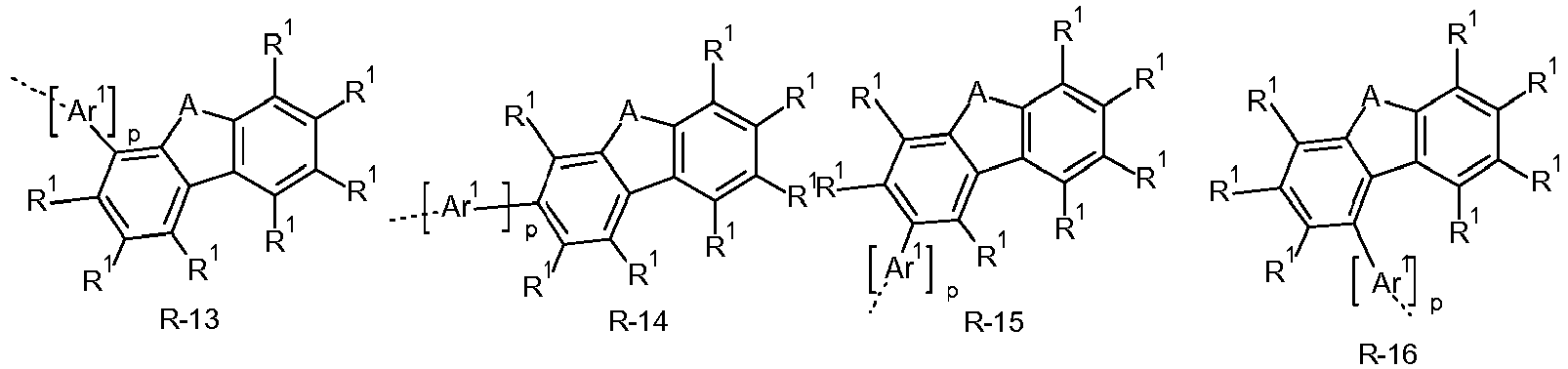
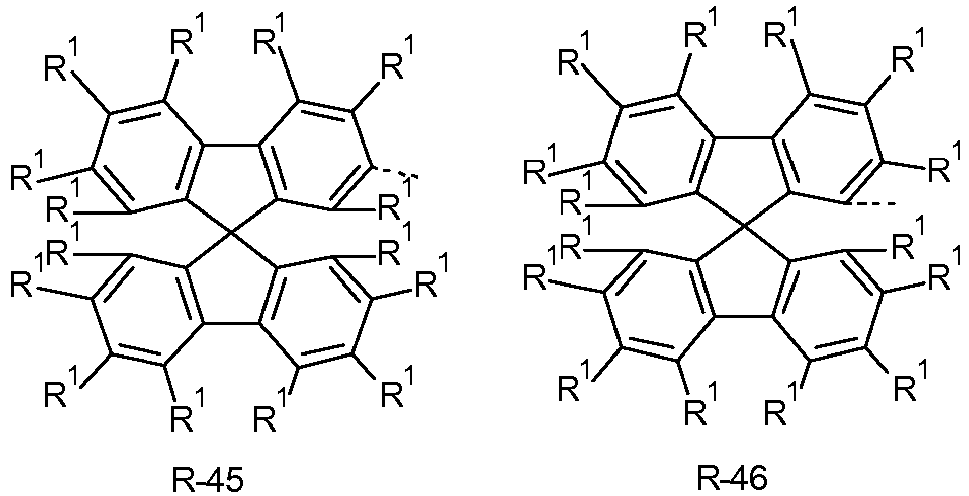
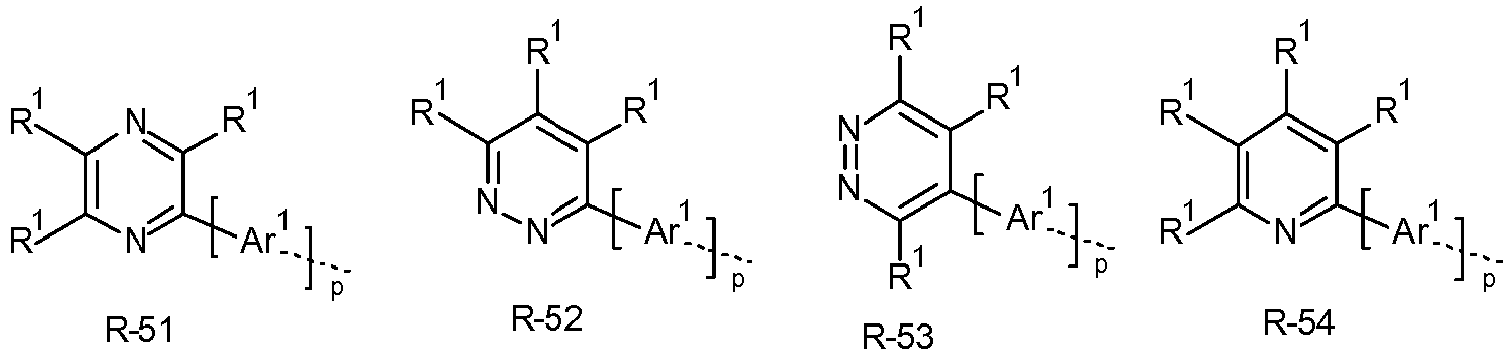
- R-1 to R-46 and R-69 to R-75 are preferred.
- Preferred amines are the compounds listed in the table below.
- the leaving group in the aryl compound or the group X in the compound of formula (2), i.e. Ar-(X) n is preferably selected from the group consisting of optionally substituted alkyl sulfonate, optionally substituted aryl sulfonate, halide and diazonium.
- optionally substituted alkyl sulfonates are trifluoromethyl sulfonate (triflate, CF 3 SO 3 -) and methyl sulfonate (mesylate, CH 3 SO 3 -).
- optionally substituted aryl sulfonates are phenyl sulfonate (C 6 H 5 -SO 3 -) and tolyl sulfonate (tosylate, CH 3 -C 6 H 4 -SO 3 -).
- halides are Cl, Br and I.
- the leaving group or the group X is preferably the same or different on each occurrence selected from the group consisting of triflate, phenylsulfonate and tosylate, particularly preferably triflate.
- the index n in the compound of the formula (2) is preferably 1, 2, 3, 4 or 5, particularly preferably 1 or 2 and very particularly preferably 1.
- the aromatic or heteroaromatic ring system in the aryl compound or the Ar group in formula (2) is preferably an aromatic or heteroaromatic ring system having 5 to 30 aromatic ring atoms, which can be substituted by one or more R 1 radicals.
- the aryl or heteroaryl group to which the leaving group X is attached is preferably not an electron-poor group.
- the Ar group therefore preferably represents a purely aromatic ring system or an electron-rich heteroaromatic ring system.
- An electron-poor heteroaryl group in the context of the present invention is a six-membered heteroaryl group which contains at least one nitrogen atom, or a five-membered heteroaryl group which contains at least two heteroatoms are selected from N, O or S, where at least one heteroatom is N. Further aryl or heteroaryl groups can be fused onto these heteroaryl groups.
- an electron-rich heteroaryl group in the context of the present invention is a five-membered heteroaryl group which contains exactly one heteroatom selected from O, S or N, the nitrogen being substituted and further aryl groups being able to be fused to the five-membered ring.
- Examples of electron-rich heteroaryl groups for the purposes of the present invention are dibenzofuran, dibenzothiophene, carbazole, indenocarbazole and indolocarbazole.
- Suitable aromatic or heteroaromatic ring systems in the aryl compound or suitable Ar groups in formula (2) are selected from phenyl, biphenyl, in particular ortho-, meta- or para-biphenyl, terphenyl, in particular ortho-, meta-, para- or branched Terphenyl, quaterphenyl, in particular ortho-, meta-, para- or branched quaterphenyl, fluorene, which can be linked via the 1-, 2-, 3- or 4-position, spirobifluorene, which can be linked via the 1-, 2-, 3- - or 4-position can be linked, naphthalene, which can be linked via the 1- or 2-position, indole, benzofuran, benzothiophene, carbazole, which can be linked via the 1-, 2-, 3- or 4-position can be linked, dibenzofuran, which can be linked via the 1-, 2-, 3- or 4-position, dibenzothiophene, which can be linked via the 1-, 2-, 3- or 4-
- the aromatic or heteroaromatic ring system in the aryl compound or Ar in formula (2) is preferably an aromatic or heteroaromatic ring system with 10 to 30 aromatic ring atoms, which has at least two aromatic or heteroaromatic rings fused with one another, one of which is an aromatic or .heteroaromatic ring is fused to the other aromatic ring in a position ortho to bond to the leaving group and to bond to X, respectively.
- This also applies, for example, to dibenzofuran or dibenzothiophene, each of which carries a leaving group in the 1-position, or to carbazole, which carries a leaving group in the 4-position.
- the substituent R 1 which is bonded to the nitrogen atom is preferably an aromatic or heteroaromatic ring system having 5 to 24 aromatic ring atoms, which can also be substituted by one or more R 2 radicals.
- this substituent R 1 is identical or different on each occurrence for an aromatic or heteroaromatic ring system having 6 to 24 aromatic ring atoms, in particular having 6 to 18 aromatic ring atoms, which has no fused aryl groups and which has no fused heteroaryl groups in which two or more aromatic or heteroaromatic 6-ring groups are fused directly to one another, and which in each case can also be substituted by one or more radicals R 2 .
- phenyl, biphenyl, terphenyl and quaterphenyl with linkage patterns as listed above for Ar-1 to Ar-11, it being possible for these structures to be substituted by one or more R 2 radicals instead of R 1 , but they are preferably unsubstituted.
- the substituents R 1 which are bonded to this carbon atom are preferably identical or different on each occurrence for a linear alkyl group having 1 to 10 carbon atoms or for a branched or cyclic alkyl group 3 to 10 carbon atoms or an aromatic or heteroaromatic ring system having 5 to 24 aromatic ring atoms, which can also be substituted by one or more R 2 radicals.
- R 1 very particularly preferably represents a methyl group or a phenyl group.
- the radicals R 1 can also form a ring system with one another, which leads to a spiro system.
- the aryl compounds Ar-(X) n can also contain sterically demanding groups Ar, as well as groups Ar which are substituted with sterically demanding groups R 1 , for example in the ortho-position to the bond to the leaving group X, since the process according to the invention leads to good yields even with sterically demanding aryl compounds Ar-(X) n .
- R 1 is particularly preferably selected on each occurrence, identically or differently, from H, D, F, CN, N(R 2 ) 2 or a straight-chain alkyl group having 1 to 5 carbon atoms or a branched or cyclic alkyl group having 3 to 6 carbon atoms. Atoms, where each of the above groups can be substituted by one or more R 2 radicals, or an aromatic or heteroaromatic ring system having 6 to 14 aromatic ring atoms, each of which can be substituted by one or more R 2 radicals; two or more radicals R 1 can be linked to one another and thus form a ring.
- R 2 is particularly preferably selected identically or differently on each occurrence from H, D, F, CN, N(R 3 ) 2 or a straight-chain alkyl group having 1 to 5 carbon atoms or a branched or cyclic alkyl group having 3 to 6 carbon atoms, it being possible for the above-mentioned groups to be substituted by one or more radicals R 3 in each case, or an aromatic or heteroaromatic ring system having 6 to 14 aromatic ring atoms, each of which may be substituted by one or more R 3 radicals; two or more radicals R 2 can be linked to one another and thus form a ring.
- R 3 is preferably identical or different on each occurrence, H, D, F, an alkyl group having 1 to 5 carbon atoms or an aromatic ring system having 6 to 12 aromatic ring atoms.
- the compounds obtained as a reaction product are characterized in that in the aryl compound the place of the bond to the leaving group or the place of the bond to X is an Ar-N bond, where N denotes the nitrogen atom of the arylamino compound.
- Preferred products of the process according to the invention are therefore combinations of the aryl compound and arylamino compound indicated above as being preferred.
- the reaction is carried out in the presence of lithium tert-butanolate (LiOtBu) as the base.
- the base is preferably added to the mixture at the beginning of the reaction.
- the base is preferably used in an amount of 0.5 to 10 equivalents, based on the amount of aryl compound used. More preferably 0.6 to 6 equivalents, very preferably 1 to 4 equivalents and most preferably 2 to 3 equivalents of base are used. If the aryl compound contains more than one leaving group, the base is used in accordance with the amount of the leaving groups in the aryl compound used.
- a palladium compound is used as a catalyst in the process according to the invention. This can be added either at the beginning of the reaction or at a later point in time. It is preferred if the Catalyst is added to the mixture only after the addition of the base is complete. However, the catalyst can also already be present in the mixture when the base is added.
- the term "catalyst" in the context of the present application should be understood to mean both an actually catalytically active species and a catalyst precursor which forms the catalytically active species in the reaction mixture.
- Preferred catalysts in the context of the present application are homogeneous catalysts, ie catalysts which are dissolved in the reaction medium. In general, such compounds as are used according to the prior art for palladium-catalyzed CN coupling reactions can be used as catalysts. These are known in principle to those skilled in the art of organic synthesis.
- the catalyst is preferably used in an amount of 0.001 to 10.0 mol %, particularly preferably 0.01 to 5.0 mol %, very particularly preferably 0.1 to 3.0 mol %, in particular 0.5 to 2.5 mol %, based on the aryl compound. If the aryl compound contains more than one leaving group, the catalyst is added according to the amount of the leaving groups in the aryl compound used.
- the catalyst comprises palladium and one or more ligands.
- the catalyst can be added as a single compound comprising both the palladium and one or more ligands.
- the catalyst can be formed in situ in the reaction mixture from separately added palladium compound and ligand.
- Suitable palladium compounds that can be used as independent catalysts without additional ligands are selected from Pd(PPh 3 ) 4 , Pd-iPr-cinnamyl-Cl CX31 ( CAS no. 884879-23-6 ), Pd-SiPR-cinnamyl-Cl CX32 ( CAS no. 884879-24-7 ), Pd-PEPPSI-iPR ( CAS no. 905459-27-0 ) and Pd-PEPPSI-iPent ( CAS no. 1158652-41-5 ).
- Suitable palladium compounds as catalyst components that are used with additional ligands are selected from PdCl 2 ( CAS no. 7647-10-1 ), Pd(OAc) 2 ( CAS no. 3375-31-3 ), ( CH3CN ) 2PdCl2 ( CAS no. 14592-56-4 ), bis(dibenzylideneacetone)palladium (Pd(dba) 2 ) ( CAS no. 32005-36-0 ) and tris(dibenzylideneacetone)dipalladium (Pd 2 (dba) 3 ) ( CAS no. 51364-51-3 ).
- Pd(OAc) 2 is preferred.
- the ligands are preferably selected from monodentate and oligodentate ligands, in particular monodentate ligands.
- Preferred ligands are selected from phosphines, phosphites, amines, aminophosphines and N-heterocyclic carbenes.
- Suitable phosphines and amines for use as ligands are in WO 2011/008725 , WO 2006/074315 and U.S.6307087 disclosed.
- Suitable N-heterocyclic carbenes for use as ligands are in CA2556850 disclosed.
- Monodentate and bidentate phosphines, in particular monodentate phosphines, are preferred.
- Suitable phosphines as ligands are selected from dicyclohexylphosphino-2',6'-dimethoxybiphenyl (SPhos, CAS no. 657408-07-6 ), dicyclohexylphosphino-2',6'-diisopropoxybiphenyl (RuPhos, CAS no. 787618-22-8 ), di-tert-butyl(2',4',6'-triisopropyl-3,6-dimethoxybiphenyl-2-yl)phosphine ( t BuBrettPhos, CAS no.
- SPhos dicyclohexylphosphino-2',6'-dimethoxybiphenyl
- RuPhos CAS no. 787618-22-8
- dicyclohexyl(2',4',6'-triisopropyl-3,6-dimethoxybiphenyl-2-yl)phosphine (BrettPhos, CAS no. 1070663-78-3 ), trimethylphosphine ( CAS no. 594-09-2 ), triethylphosphine ( CAS no. 554-70-1 ), tripropylphosphine ( CAS no. 2234-97-1 ), triisopropylphosphine ( CAS no. 6476-36-4 ), tributylphosphine ( CAS no. 998-40-3 ), tri-tert-butylphosphine ( CAS no.
- triphenylphosphine CAS no. 603-35-0
- di-tert-butyl-chloro-phosphine CAS no. 13716-10-4
- trimethyl phosphite CAS No.121-45-9
- triethyl phosphite CAS no. 122-52-1
- tripropyl phosphite CAS no. 923-99-9
- triisopropyl phosphite CAS no. 116-17-6
- tributyl phosphite CAS no. 102-85-2
- tricyclohexyl phosphite CAS no.
- ligands are Cy-JohnPhos ( CAS no. 247940-06-3 ), CataCxium Pcy ( CAS no. 672937-60-9 ), Aphos ( CAS no. 932710-63-9 ), XantPhos ( CAS no. 161265-03-8 ) and Xphos ( CAS no. 564483-18-7 ).
- Preferred ligands are SPhos, XPhos and CPhos, particularly preferably SPhos.
- the palladium compound and the phosphine ligand are preferably used in a Pd:phosphine ratio in the range from 1:1 to 1:4, particularly preferably in the range from 1:1.5 to 1:2.5 and very particularly preferably in the range from 1:1.8 to 1 : 2.2.
- the palladium compound and the phosphine ligand are preferably used in a Pd:phosphine ratio in the range from 1:0.5 to 1:2, particularly preferably in the range from 1:0.75 to 1:1.5, very particularly preferably in the range from 1:0.9 to 1 : 1.1.
- the process according to the invention is preferably carried out in the liquid phase in solution or suspension.
- the lithium salt for example lithium triflate
- the reaction mixture precipitates out of the reaction mixture in the course of the reaction.
- Any aprotic organic solvent can be used. Solvents known to those skilled in the art of organic synthesis suitable for use in palladium-catalyzed CN coupling reactions are suitable. Suitability for use in the reactions according to the invention means in particular that they are inert to the reaction conditions.
- Particularly preferred solvents are selected from benzene, toluene, 1,2-xylene, 1,3-xylene, 1,4-xylene, mesitylene, tetrahydrofuran (THF), 1,4-dioxane, dimethoxyethane (dme) and bis(2- methoxyethyl)ether (diglyme).
- Anhydrous solvents are preferably used. Very particular preference is given to toluene, 1,2-xylene, 1,3-xylene, 1,4-xylene and mesitylene, in particular toluene.
- the reaction can be carried out under normal pressure or under increased pressure.
- the reaction is carried out under an inert gas atmosphere, for example under a nitrogen or argon atmosphere.
- an inert gas atmosphere for example under a nitrogen or argon atmosphere.
- the reaction time is typically between a few minutes and a few days, preferably between a few minutes and 100 hours, particularly preferably between 15 minutes and 80 hours and very particularly preferably between 2 hours and 30 hours.
- the times given relate to the total duration of the reaction.
- the reaction temperature is preferably between 0 and 300.degree. C., particularly preferably between 20 and 200.degree. C., very particularly preferably between 60 and 150.degree.
- the reaction temperatures given refer to the main phase of the reaction, during which all components are present in the mixture and the C-N bond formation takes place.
- the reaction is carried out under reflux, so that the reaction temperature is determined on the basis of the solvent used. Therefore, a preferred reaction temperature when using toluene as a solvent is 100°C, 144°C for 1,2-xylene, 139°C for 1,3-xylene, 138°C for 1,4-xylene and 165°C for mesitylene .
- the base is placed in a solvent together with the reactants, ie the arylamino compound and the aryl compound, and rendered inert.
- the catalyst solution is prepared, preferably using the same solvent that is also used in the reaction solution. The catalyst solution is then added to the reaction mixture and the mixture is reacted at elevated temperature.
- the catalyst or the palladium compound and the ligand can also be added in solid form.
- the products obtained in the process according to the invention are secondary arylamines, they are preferably used as an intermediate for the preparation of tertiary arylamines. If the products obtained in the process according to the invention are tertiary arylamines, these are preferably used as functional materials in electronic devices.
- the electronic devices are selected, for example, from the group consisting of organic electroluminescent devices (OLEDs), organic integrated circuits (OICs), organic field effect transistors (OFETs), organic thin film transistors (OTFTs), organic light-emitting transistors (OLETs), organic solar cells (OSCs), organic optical detectors, organic photoreceptors, organic field quench devices (OFQDs), organic light-emitting electrochemical cells (OLECs), and organic laser diodes (O-lasers).
- OLEDs organic electroluminescent devices
- OICs organic integrated circuits
- OFETs organic field effect transistors
- OFTs organic thin film transistors
- OLETs organic light-emitting transistors
- OSCs organic solar cells
- O optical detectors organic photoreceptors
- OFQDs organic field quench devices
- O-emitting electrochemical cells O-lasers
- O-lasers organic laser diodes
- Another object of the present invention is the use of LiOtBu as a base in a palladium-catalyzed coupling reaction between an arylamino compound and an aryl compound.
- the arylamino compound and the aryl compound are as defined above.
- the process according to the invention combined with a preceding Suzuki coupling, enables the selective functionalization of aromatic or heteroaromatic compounds.
- an aryl compound that is substituted with two leaving groups one of which is a halide and the other is a sulfonate
- the choice of the catalyst system can be used to determine whether the sulfonate leaving group or the halide leaving group is reacted selectively.
- Other suitable reaction conditions are those typically used for Suzuki couplings, for example using Pd 2 (dba) 3 as the palladium compound, Na 2 CO 3 or K 2 CO 3 as the base and a mixture of toluene or another organic compound Solvent and water as reaction medium.
- the solvents and reagents can e.g. B. from Sigma-ALDRICH or ABCR.
- the respective information in square brackets or the numbers given for individual compounds relate to the CAS numbers of the compounds known from the literature.
- the triflate, amine and base are weighed out in a glove box under an argon atmosphere. After addition of the catalyst and ligand, the solvent is added and the vessel sealed. The reaction vessel is removed from the glove box and stirred in an oil bath at an internal temperature of 110° C. for 16 h. After cooling to room temperature, a sample is taken and analyzed by HPLC.
- Example 2 the reaction of Example 2 is carried out with a different catalyst system, varying the amount of catalyst and base.
- a system of Pd(OAc) 2 and SPhos is used as the catalyst for this (Table 2).
- ⁇ b>Table 2 Optimization of the experimental parameters for the Pd(OAc) ⁇ sub>2 ⁇ /sub> / SPhos / LiOtBu system. ⁇ sup>[a] ⁇ /sup> ⁇ /b> E.g.
- reaction is carried out with other ligands and other substrates while maintaining Pd(OAc) 2 as the palladium source and LiOtBu as the base (Tables 3 and 4).
- carbazole is used as the secondary amine, i.e. an amine in which the two aromatic groups are linked (Table 6).
- the reaction with LiOtBu as a base leads to a significantly better yield compared to NaOtBu.
- the aryl compound used is 1-naphthyl triflate, i.e. a compound with a fused aryl group (Table 7).
- the reaction with LiOtBu as the base leads to a significantly better yield compared to NaOtBu.
- ⁇ b>Table 7 ⁇ sup>[a] ⁇ /sup>: ⁇ /b> E.g.
- the aryl compound 1-naphthyl triflate ie an aryl compound with a fused aryl group
- phenyl-ortho-biphenylamine as the bulky secondary amine
- the reaction with LiOtBu as the base leads to a good yield, while with NaOtBu as the base almost no conversion to the tertiary amine is observed.
- ⁇ b>Table 8 ⁇ sup>[a] ⁇ /sup>: ⁇ /b> E.g.
- the aryl compound used is para-chlorophenyl triflate, which has two potential leaving groups, the chlorine group and the triflate group. This is reacted selectively at the triflate group with ortho-biphenyl-phenyl-amine as the sterically demanding amine (Table 13).
- the reaction with LiOtBu as the base leads to a good yield, while with NaOtBu as the base almost no conversion to the tertiary amine is observed.
- Example 14 Reaction of phenyl triflate with a primary amine to give a secondary amine
- a phenylsulfonate is used as the leaving group.
- para-tolyl-phenylsulfonate is reacted with ortho-biphenyl-phenyl-amine as the bulky secondary amine (Table 15).
- the reaction with LiOtBu as a base leads to a significantly better yield compared to NaOtBu.
- This example describes the preparation of the starting material for example 16, which has a triflate leaving group, from a compound which has both triflate and bromine leaving groups.
- the bromine group is selectively converted in the Suzuki coupling.
- Catalyst System (Ratio) A 100 [%] A 102 [%] A 103 [%] 1 Pd(PPh 3 ) 4 2 52 33 2 Pd 2 dba 3 / PPh 3 (1:2) 2 52 31 3 Pd 2 dba 3 / P(o-tol)3 (1:2) 0 80 3 4 Pd 2 dba 3 / SHos (1:2) 5 11 73 5 Pd 2 dba 3 / Xphos (1:2) 4 24 61 6 Pd 2 dba 3 / CM Phos (1:2) 18 6 5 7 Pd 2 dba 3 / PCy 3 (1:2) 3 70 11 8th Pd 2 dba 3 / P(t-Bu) 3 (1:2) 3 7 1 9 Pd 2 dba 3 / CataCxium A (1:2) 0 74 9 10 Pd-PEPPSI-iPr 0 73 12 [a] Reaction conditions: 1.27 mmol of tri
- test parameters for the catalyst/ligand system Pd 2 dba 3 / P( o -Tol) 3 are further optimized (Table 17).
- ⁇ b>Table 17 Optimization of the test parameters for the system Pd ⁇ sub>2 ⁇ /sub>dba ⁇ sub>3 ⁇ /sub> / P( ⁇ i>o ⁇ /i>-Tol) ⁇ sub>3 ⁇ / sub> System for displaying 102. ⁇ sup>[a] ⁇ /sup> ⁇ /b> E.g.
- This example describes the preparation of starting materials for the process according to the invention which have a bromine leaving group from a compound which has both triflate and bromine as leaving groups.
- the triflate group is selectively converted in the Suzuki coupling.
Landscapes
- Chemical & Material Sciences (AREA)
- Organic Chemistry (AREA)
- Chemical Kinetics & Catalysis (AREA)
- Indole Compounds (AREA)
- Organic Low-Molecular-Weight Compounds And Preparation Thereof (AREA)
- Pyridine Compounds (AREA)
- Low-Molecular Organic Synthesis Reactions Using Catalysts (AREA)
- Plural Heterocyclic Compounds (AREA)
Description
- Die Erfindung betrifft ein Verfahren zur Herstellung von Verbindungen enthaltend mindestens eine Arylaminogruppe durch palladiumkatalysierte Kupplungsreaktion einer Aminoverbindung mit einer Arylverbindung.
- Das Knüpfen einer Bindung zwischen einem Stickstoffatom und einer Aryl- bzw. Heteroarylgruppe stellt eine Schlüsselreaktion in der organischen Synthese dar. Entsprechend sind Aryl- bzw. Heteroarylaminoverbindungen oftmals wichtige Zwischenprodukte in mehrstufigen Synthesen. Weiterhin finden Aryl- bzw. Heteroarylaminoverbindungen Verwendung als pharmazeutische Wirkstoffe, sowie als funktionelle Materialien, beispielsweise in elektronischen Vorrichtungen. In allen Fällen ist das Erzielen einer hohen Ausbeute im Kupplungsschritt, sowie das Vermeiden von Nebenprodukten von großer Bedeutung, da andernfalls Synthesen im industriellen Maßstab nur schwer realisierbar sind. Weiterhin ist es zur Erzielung einer hohen Produktreinheit unabdingbar, dass Nebenreaktionen weitestgehend unterbleiben. Wünschenswert ist weiterhin eine hohe Selektivität bei der Anwesenheit weiterer funktioneller Gruppen.
- Im Stand der Technik sind Verfahren zur Synthese von Arylaminoverbindungen bekannt, bei denen als Edukte eine Aminoverbindung und eine Arylverbindung unter Palladiumkatalyse in Anwesenheit einer Base zur Reaktion gebracht werden (Hartwig-Buchwald-Kupplung). Solche Verfahren sind unter anderem beschrieben in
WO2017/148565 , in Maxim A. Topchiy et al.(European Journal of Organic Chemistry 2014, 16, 3319), in Chil Won Lee et al. (Organic Electronics 14, 1, 370), inUS 5,576,460 , in Guram et al. (Angew. Chem., Int. Ed. 1995, 43, 1348), in Louie et al. (Tetrahedron Lett. 1995, 36, 3609), sowie in Surry et al. (Chemical Science 2011, 2, 27). Im Stand der Technik bekannte Versuche zur Weiterentwicklung der Methode betreffen überwiegend die Verwendung neuartiger Ligand-Katalysatorsysteme (Surry et al., Chemical Science 2011, 2, 27). Gemäß dem Stand der Technik wird in der Hartwig-Buchwald-Reaktion typischerweise NaOtBu eingesetzt (siehe o. g. Literaturstellen oder Kuwano et al., Synlett 2010, 1819). Weiterhin ist die Verwendung anorganischer Basen wie KOH, NaOH, CS2CO3 oder K3PO4 bekannt (siehe o. g. Literaturstellen), ebenso wie die Verwendung sehr starker Basen, wie Alkaliamide oder Alkyllithium (WO 2013/068075 ). - Trotz der insgesamt guten Effizienz dieser Verfahren und ihrer breiten Anwendbarkeit besteht Bedarf an einer Verbesserung der Methode, insbesondere in Hinblick auf langsam reagierende und/oder sterisch anspruchsvolle Edukte, sowie im Hinblick auf hydrolyseempfindliche Edukte, beispielsweise solche mit Triflaten oder anderen Sulfonaten als Abgangsgruppe. Weiterhin besteht Bedarf an einer Verbesserung des Verfahrens in Hinblick auf Produktausbeute sowie Verringerung der Bildung von Nebenprodukten, insbesondere der Bildung der defunktionalisierten Arylverbindung. Die genannten Probleme treten insbesondere beim Einsatz sterisch gehinderter Edukte auf, beispielsweise ortho-substituierter Arylverbindungen oder sekundärer Aminoverbindungen mit sterisch anspruchsvollen Substituenten. Die Bildung der hydrolysierten Arylverbindung als Nebenprodukt tritt insbesondere bei der Verwendung von Triflat oder anderen Sulfonaten als Abgangsgruppe auf. Auch eine Verbesserung der Selektivität bei Anwesenheit mehrerer unterschiedlicher Gruppen, die als Abgangsgruppe dienen können, ist wünschenswert.
- Überraschend wurde gefunden, dass sich Lithium-tert-butanolat (LiOtBu) als Base hervorragend zur Verwendung in palladiumkatalysierten C-N-Kupplungsreaktionen (Hartwig-Buchwald-Kupplung) für die Kupplung von Aryl- bzw. Heteroarylaminen eignet. Dies gilt insbesondere bei Verwendung von Sulfonaten als Abgangsgruppe. Im Vergleich zur Verwendung von NaOtBu, welches typischerweise in C-N-Kupplungsreaktionen verwendet wird, oder KOtBu lassen sich dadurch deutlich verbesserte Ausbeuten erzielen. Gleichzeitig werden bei Verwendung von Sulfonaten als Abgangsgruppe deutlich weniger Nebenreaktionen beobachtet, insbesondere deutlich weniger Hydrolyse der Sulfonatabgangsgruppe. Weiterhin ermöglicht die Verwendung von LiOtBu als Base eine selektive Umsetzung von Sulfonatgruppen, insbesondere von Triflat, in Gegenwart von Chlorsubstituenten. Eine derartige Selektivität wird mit NaOtBu als Base nicht beobachtet.
- Die Verwendung von LiOtBu als Base für die Kupplung aliphatischer Amine wird von Louie et al. (Tetrahedron Lett. 1995, 36, 3609) bereits beschrieben. Bei dieser Reaktion mit aliphatischen Aminen wird jedoch nahezu kein Umsatz erhalten.
- Gegenstand der Erfindung ist daher ein Verfahren zur Herstellung einer sekundären bzw. tertiären Arylaminoverbindung durch eine palladium-katalysierte Kupplungsreaktion zwischen einer primären bzw. sekundären Arylaminoverbindung und einer Arylverbindung, dadurch gekennzeichnet, dass das Verfahren in Anwesenheit von Lithium-tert-butanolat (LiOtBu) als Base durchgeführt wird.
- Dabei führt der Einsatz einer primären Arylaminoverbindung, je nach Katalysator, zu einer sekundären oder tertiären Arylaminoverbindung, und der Einsatz einer sekundären Arylaminoverbindung führt zu einer tertiären Arylaminoverbindung als Reaktionsprodukt. In einer bevorzugten Ausführungsform der Erfindung wird bei dem erfindungsgemäßen Verfahren eine sekundäre Arylaminoverbindung eingesetzt, und es handelt sich bei dem Produkt um eine tertiäre Arylaminoverbindung.
- Unter einer Arylaminoverbindung im Sinne der vorliegenden Erfindung wird ein Amin verstanden, an das mindestens ein optional substituiertes aromatisches bzw. heteroaromatisches Ringsystem gebunden ist. Dabei ist eine primäre Arylaminoverbindung eine Verbindung, enthaltend eine primäre Aminogruppe -NH2, welche an ein optional substituiertes aromatisches oder heteroaromatisches Ringsystem gebunden ist. Eine sekundäre Arylaminoverbindung ist eine Verbindung, enthaltend eine sekundäre Aminogruppe -NH-, welche an zwei optional substituierte aromatische oder heteroaromatische Ringsysteme gebunden ist. Dabei kann auch ein aromatisches Ringsystem und ein heteroaromatisches Ringsystem an den Stickstoff gebunden sein. Eine tertiäre Arylaminoverbindung ist eine Verbindung, enthaltend ein tertiäres Stickstoffatom N, welches an drei optional substituierte aromatische oder heteroaromatische Ringsysteme gebunden ist. Dabei kann auch ein aromatisches Ringsystem und zwei heteroaromatische Ringsysteme oder zwei aromatische Ringsysteme und ein heteroaromatisches Ringsystem an den Stickstoff gebunden sein. Dabei können die aromatischen oder heteroaromatischen Ringsysteme gleich oder verschieden sein. Weiterhin können die aromatischen oder heteroaromatischen Ringsysteme in dem sekundären oder tertiären Amin auch über eine Einfachbindung oder eine bivalente Gruppe miteinander zu einem Ring verknüpft sein. So ist beispielsweise auch die Reaktion eines Carbazols möglich.
- Unter einer Arylverbindung wird im Rahmen der vorliegenden Erfindung eine optional substituierte organische Verbindung enthaltend mindestens ein aromatisches bzw. heteroaromatisches Ringsystem verstanden. Dabei enthält die Arylverbindung eine Abgangsgruppe, welche in der erfindungsgemäßen Kupplungsreaktion abgespalten wird. Bevorzugte Abgangsgruppen werden hinten aufgeführt.
- Eine Arylgruppe im Sinne dieser Erfindung enthält 6 bis 40 C-Atome; eine Heteroarylgruppe im Sinne dieser Erfindung enthält 2 bis 40 C-Atome und mindestens ein Heteroatom, mit der Maßgabe, dass die Summe aus C-Atomen und Heteroatomen mindestens 5 ergibt. Die Heteroatome sind bevorzugt ausgewählt aus N, O und/oder S. Dabei wird unter einer Arylgruppe bzw. Heteroarylgruppe entweder ein einfacher aromatischer Cyclus, also Benzol, bzw. ein einfacher heteroaromatischer Cyclus, beispielsweise Pyridin, Pyrimidin, Thiophen, etc., oder eine kondensierte Aryl- oder Heteroarylgruppe, beispielsweise Naphthalin, Anthracen, Phenanthren, Chinolin, Isochinolin, etc., verstanden.
- Ein aromatisches Ringsystem im Sinne dieser Erfindung enthält 6 bis 60 C-Atome im Ringsystem, bevorzugt 6 bis 40 C-Atome. Ein heteroaromatisches Ringsystem im Sinne dieser Erfindung enthält 1 bis 60 C-Atome, bevorzugt 1 bis 40 C-Atome, und mindestens ein Heteroatom im Ringsystem, mit der Maßgabe, dass die Summe aus C-Atomen und Heteroatomen mindestens 5 ergibt. Die Heteroatome sind bevorzugt ausgewählt aus N, O und/oder S. Unter einem aromatischen oder heteroaromatischen Ringsystem im Sinne dieser Erfindung soll ein System verstanden werden, das nicht notwendigerweise nur Aryl- oder Heteroarylgruppen enthält, sondern in dem auch mehrere Aryl- oder Heteroarylgruppen durch eine nichtaromatische Einheit (bevorzugt weniger als 10% der von H verschiedenen Atome), wie z. B. ein C-, N- oder O-Atom oder eine Carbonylgruppe, unterbrochen sein können. So sollen beispielsweise auch Systeme wie 9,9'-Spirobifluoren, 9,9-Diarylfluoren, Triarylamin, Diarylether, Stilben, etc. als aromatische Ringsysteme im Sinne dieser Erfindung verstanden werden. Weiterhin sollen Systeme, in denen zwei oder mehrere Aryl- oder Heteroarylgruppen direkt aneinander gebunden sind, wie z. B. Biphenyl, Terphenyl, Quaterphenyl oder Bipyridin, ebenfalls als aromatisches bzw. heteroaromatisches Ringsystem verstanden werden.
- Im Rahmen der vorliegenden Erfindung werden unter einer C1- bis C20-Alkylgruppe, in der auch einzelne H-Atome oder CH2-Gruppen durch die oben genannten Gruppen substituiert sein können, beispielsweise die Reste Methyl, Ethyl, n-Propyl, i-Propyl, Cyclopropyl, n-Butyl, i-Butyl, s-Butyl, t-Butyl, Cyclobutyl, 2-Methylbutyl, n-Pentyl, s-Pentyl, t-Pentyl, 2-Pentyl, neo-Pentyl, Cyclopentyl, n-Hexyl, s-Hexyl, t-Hexyl, 2-Hexyl, 3-Hexyl, neo-Hexyl, Cyclohexyl, 1-Methylcyclopentyl, 2-Methylpentyl, n-Heptyl, 2-Heptyl, 3-Heptyl, 4-Heptyl, Cycloheptyl, 1-Methylcyclohexyl, n-Octyl, 2-Ethylhexyl, Cyclooctyl, 1-Bicyclo[2,2,2]octyl, 2-Bicyclo[2,2,2]-octyl, 2-(2,6-Dimethyl)octyl, 3-(3,7-Dimethyl)octyl, Adamantyl, Trifluormethyl, Pentafluorethyl, 2,2,2-Trifluorethyl, 1,1-Dimethyl-n-hex-1-yl-, 1,1-Dimethyl-n-hept-1-yl-, 1,1-Dimethyl-n-oct-1-yl-, 1,1-Dimethyl-n-dec-1-yl-, 1,1-Dimethyl-n-dodec-1-yl-, 1,1-Dimethyl-n-tetradec-1-yl-, 1,1-Dimethyl-n-hexadec-1-yl-, 1,1-Dimethyl-n-octadec-1-yl-, 1,1-Diethyl-n-hex-1-yl-, 1,1-Diethyl-n-hept-1-yl-, 1,1-Diethyl-n-oct-1-yl-, 1,1-Diethyl-n-dec-1-yl-, 1,1-Diethyl-n-dodec-1-yl-, 1,1-Diethyl-n-tetradec-1-yl-, 1,1-Diethyln-n-hexadec-1-yl-, 1,1-Diethyl-n-octadec-1-yl-, 1-(n-Propyl)-cyclohex-1-yl-, 1-(n-Butyl)-cyclohex-1-yl-, 1-(n-Hexyl)-cyclohex-1-yl-, 1-(n-Octyl)-cyclohex-1-yl- und 1-(n-Decyl)-cyclohex-1-yl- verstanden. Unter einer Alkenylgruppe werden beispielsweise Ethenyl, Propenyl, Butenyl, Pentenyl, Cyclopentenyl, Hexenyl, Cyclohexenyl, Heptenyl, Cycloheptenyl, Octenyl, Cyclooctenyl oder Cyclooctadienyl verstanden. Unter einer Alkinylgruppe werden beispielsweise Ethinyl, Propinyl, Butinyl, Pentinyl, Hexinyl, Heptinyl oder Octinyl verstanden. Unter einer C1- bis C40-Alkoxygruppe werden beispielsweise Methoxy, Trifluormethoxy, Ethoxy, n-Propoxy, i-Propoxy, n-Butoxy, i-Butoxy, s-Butoxy, t-Butoxy oder 2-Methylbutoxy verstanden. Unter einer cyclischen Alkyl-, Alkoxy- oder Thioalkoxygruppe im Sinne dieser Erfindung wird eine monocyclische, eine bicyclische oder eine polycyclische Gruppe verstanden.
- Unter einem aromatischen oder heteroaromatischen Ringsystem mit 5 - 60 aromatischen Ringatomen, welches noch jeweils mit den oben genannten Resten substituiert sein kann und welches über beliebige Positionen am Aromaten bzw. Heteroaromaten verknüpft sein kann, werden beispielsweise Gruppen verstanden, die abgeleitet sind von Benzol, Naphthalin, Anthracen, Benzanthracen, Phenanthren, Benzophenanthren, Pyren, Chrysen, Perylen, Fluoranthen, Benzfluoranthen, Naphthacen, Pentacen, Benzpyren, Biphenyl, Biphenylen, Terphenyl, Terphenylen, Fluoren, Spirobifluoren, Dihydrophenanthren, Dihydropyren, Tetrahydropyren, cis- oder trans-Indenofluoren, cis- oder trans-Monobenzoindenofluoren, cis- oder trans-Dibenzoindenofluoren, Truxen, Isotruxen, Spirotruxen, Spiroisotruxen, Furan, Benzofuran, Isobenzofuran, Dibenzofuran, Thiophen, Benzothiophen, Isobenzothiophen, Dibenzothiophen, Thiazin, Oxazin, Pyrrol, Indol, Isoindol, Carbazol, Indolocarbazol, Indenocarbazol, Pyridin, Chinolin, Isochinolin, Acridin, Phenanthridin, Benzo-5,6-chinolin, Benzo-6,7-chinolin, Benzo-7,8-chinolin, Phenothiazin, Phenoxazin, Pyrazol, Indazol, Imidazol, Benzimidazol, Naphthimidazol, Phenanthrimidazol, Pyridimidazol, Pyrazinimidazol, Chinoxalinimidazol, Oxazol, Benzoxazol, Naphthoxazol, Anthroxazol, Phenanthroxazol, Isoxazol, 1,2-Thiazol, 1,3-Thiazol, Isothiazol, Benzothiazol, Pyridazin, Benzopyridazin, Pyrimidin, Benzpyrimidin, Chinoxalin, 1,5-Diazaanthracen, 2,7-Diazapyren, 2,3-Diazapyren, 1,6-Diazapyren, 1,8-Diazapyren, 4,5-Diazapyren, 4,5,9,10-Tetraazaperylen, Pyrazin, Phenazin, Phenoxazin, Phenothiazin, Fluorubin, Naphthyridin, Azacarbazol, Benzocarbolin, Phenanthrolin, 1,2,3-Triazol, 1,2,4-Triazol, Benzotriazol, 1,2,3-Oxadiazol, 1,2,4-Oxadiazol, 1,2,5-Oxadiazol, 1,3,4-Oxadiazol, Isoxadiazol, 1,2,3-Thiadiazol, 1,2,4-Thiadiazol, 1,2,5-Thiadiazol, 1,3,4-Thiadiazol, 1,3,5-Triazin, 1,2,4-Triazin, 1,2,3-Triazin, Tetrazol, 1,2,4,5-Tetrazin, 1,2,3,4-Tetrazin, 1,2,3,5-Tetrazin, Purin, Pteridin, Indolizin, Cumarin und Benzothiadiazol.
- Unter der Formulierung, dass zwei oder mehr Reste bzw. Gruppen miteinander einen Ring bilden können, soll im Rahmen der vorliegenden Beschreibung unter anderem verstanden werden, dass die beiden Reste bzw. Gruppen miteinander durch eine chemische Bindung unter formaler Abspaltung von zwei Wasserstoffatomen verknüpft sind. Dies wird durch das folgende Schema verdeutlicht.

- Weiterhin soll unter der oben genannten Formulierung aber auch verstanden werden, dass für den Fall, dass einer der beiden Reste Wasserstoff darstellt, der zweite Rest unter Bildung eines Rings an die Position, an die das Wasserstoffatom gebunden war, bindet. Dies soll durch das folgende Schema verdeutlicht werden:
- Unter einer palladiumkatalysierten Kupplungsreaktion wird im Rahmen der vorliegenden Erfindung eine Reaktion zwischen zwei organischen Verbindungen verstanden, bei der unter Palladiumkatalyse eine Einfachbindung zwischen den beiden Verbindungen gebildet wird. Dies erfolgt unter formaler Abspaltung eines kleinen Moleküls. Bevorzugt treten dabei keine weiteren Reaktionen an den beiden Verbindungen auf. Die Kupplungsreaktion erfolgt erfindungsgemäß zwischen einer Arylaminoverbindung und einer Arylverbindung, wobei die Arylverbindung eine Abgangsgruppe aufweist, welche bevorzugt ausgewählt ist aus der Gruppe bestehend aus optional substituiertem Alkylsulfonat, optional substituiertem Arylsulfonat, Halogenid und Diazonium. In der Kupplungsreaktion tritt die gebildete Einfachbindung an die Stelle der N-H-Bindung der Arylaminoverbindung und an die Stelle der Bindung zur Abgangsgruppe der Arylverbindung.
- Eine bevorzugte Ausführungsform des erfindungsgemäßen Verfahrens entspricht dem folgenden Schema:

- Ar
- ist ein aromatisches oder heteroaromatisches Ringsystem mit 5 bis 60 aromatischen Ringatomen, das mit einem oder mehreren Resten R1 substituiert sein kann;
- R
- ist gleich oder verschieden bei jedem Auftreten ein aromatisches oder heteroaromatisches Ringsystem mit 5 bis 60 aromatischen Ringatomen, das jeweils durch einen oder mehrere Reste R1 substituiert sein kann;
- R'
- ist gleich oder verschieden R oder steht für H oder D; dabei können R und R' direkt oder über eine Gruppe R1 miteinander verknüpft sein und so zusammen mit dem Stickstoffatom, an das sie binden, ein Ringsystem bilden;
- R1
- ist gleich oder verschieden bei jedem Auftreten ausgewählt aus H, D, F, Cl, Br, I, B(OR2)2, CHO, C(=O)R2, CR2=C(R2)2, CN, C(=O)OR2, C(=O)N(R2)2, Si(R2)3, N(R2)2, NO2, P(=O)(R2)2, OSO2R2, OR2, S(=O)R2, S(=O)2R2, einer geradkettigen Alkyl-, Alkoxy- oder Thioalkylgruppe mit 1 bis 20 C-Atomen oder einer verzweigten oder cyclischen Alkyl-, Alkoxy- oder Thioalkylgruppe mit 3 bis 20 C-Atomen oder einer Alkenyl- oder Alkinylgruppe mit 2 bis 20 C-Atomen, wobei die oben genannten Gruppen jeweils mit einem oder mehreren Resten R2 substituiert sein können und wobei eine oder mehrere CH2-Gruppen in den oben genannten Gruppen durch -R2C=CR2-, -C≡C-, Si(R2)2, C=O, C=S, C=NR2, -C(=O)O-, -C(=O)NR2-, NR2, P(=O)(R2), -O-, -S-, SO oder SO2 ersetzt sein können und wobei ein oder mehrere H-Atome in den oben genannten Gruppen durch D, F, Cl, Br, I, CN oder NO2 ersetzt sein können, oder einem aromatischen oder heteroaromatischen Ringsystem mit 5 bis 30 aromatischen Ringatomen, das jeweils durch einen oder mehrere Reste R2 substituiert sein kann, oder einer Aryl- oder Heteroaryloxygruppe mit 5 bis 30 aromatischen Ringatomen, die durch einen oder mehrere Reste R2 substituiert sein kann; dabei können zwei oder mehr Reste R1 miteinander verknüpft sein und so einen Ring bilden;
- R2
- ist gleich oder verschieden bei jedem Auftreten ausgewählt aus H, D, F, Cl, Br, I, B(OR3)2, CHO, C(=O)R3, CR3=C(R3)2, CN, C(=O)OR3, C(=O)N(R3)2, Si(R3)3, N(R3)2, NO2, P(=O)(R3)2, OSO2R3, OR3, S(=O)R3, S(=O)2R3, einer geradkettigen Alkyl-, Alkoxy- oder Thioalkylgruppe mit 1 bis 20 C-Atomen oder einer verzweigten oder cyclischen Alkyl-, Alkoxy- oder Thioalkylgruppe mit 3 bis 20 C-Atomen oder einer Alkenyl- oder Alkinylgruppe mit 2 bis 20 C-Atomen, wobei die oben genannten Gruppen jeweils mit einem oder mehreren Resten R3 substituiert sein können und wobei eine oder mehrere CH2-Gruppen in den oben genannten Gruppen durch -R3C=CR3-, -C≡C-, Si(R3)2, C=O, C=S, C=NR3, -C(=O)O-, -C(=O)NR3-, NR3, P(=O)(R3), -O-, -S-, SO oder SO2 ersetzt sein können und wobei ein oder mehrere H-Atome in den oben genannten Gruppen durch D, F, Cl, Br, I, CN oder NO2 ersetzt sein können, oder einem aromatischen oder heteroaromatischen Ringsystem mit 5 bis 30 aromatischen Ringatomen, das jeweils durch einen oder mehrere Reste R3 substituiert sein kann, oder einer Aryl- oder Heteroaryloxygruppe mit 5 bis 30 aromatischen Ringatomen, die durch einen oder mehrere Reste R3 substituiert sein kann; dabei können zwei oder mehr Reste R2 miteinander verknüpft sein und so einen Ring bilden;
- R3
- ist bei jedem Auftreten gleich oder verschieden H, D, F oder ein aliphatischer, aromatischer oder heteroaromatischer organischer Rest mit 1 bis 20 C-Atomen, in dem auch ein oder mehrere H-Atome durch D oder F ersetzt sein können; dabei können zwei oder mehr Substituenten R3 miteinander verknüpft sein und so einen Ring bilden;
- X
- ist bei jedem Auftreten gleich oder verschieden eine Abgangsgruppe;
- n
- ist eine ganze Zahl von 1 bis 10.
- Dabei stellt die Verbindung der Formel (1)

- Die Verbindung der Formel (2), Ar-(X)n, stellt die oben genannte Arylverbindung dar, wobei X die Abgangsgruppe darstellt.
- Die Verbindung der Formel (3)

- Weiterhin steht in der oben aufgeführten Reaktionsgleichung [Pd] für die Palladiumverbindung, die als Katalysator eingesetzt wird.
- In einer bevorzugten Ausführungsform ist R' gleich oder verschieden R, so dass bevorzugt eine sekundäre Arylaminoverbindung zur Herstellung einer tertiären Arylaminoverbindung eingesetzt wird.
- Das erfindungsgemäße Verfahren eignet sich auch zur Synthese von oligomeren oder polymeren Arylaminoverbindungen. Eine derartige Reaktion kann durch Umsetzung einer Arylverbindung mit mindestens zwei Abgangsgruppen mit einer Arylaminoverbindung, die mindestens zwei Aminogruppen aufweist, erfolgen. Das oben gezeigte prinzipielle Reaktionsschema umfassend eine Bindungsknüpfung zwischen einem Stickstoffatom und einer Arylgruppe ist dafür weiterhin gültig.
- Bevorzugt wird das erfindungsgemäße Verfahren zur Herstellung von kleinen organischen Verbindungen, d. h. Verbindungen mit einem Molekulargewicht von weniger als 5000 Da, besonders bevorzugt weniger als 3000 Da und ganz besonders bevorzugt weniger als 2000 Da, verwendet.
- Bevorzugte Arylaminoverbindungen als Edukte sind Diarylaminoverbindungen. Geeignete Arylaminoverbindungen sind insbesondere auch solche Arylaminoverbindungen, bei denen eine oder beide der Gruppen R bzw. R', welche an das Stickstoffatom gebunden sind, sterisch anspruchsvoll sind. Dabei können auch eine oder beide Gruppen R und/oder R' ein aromatisches oder heteroaromatisches Ringsystem darstellen, welches einen Substituenten in ortho-Position zur Bindung an das Stickstoffatom trägt, oder ein aromatisches oder heteroaromatisches Ringsystem, welches einen ankondensierten Ring in ortho-Position zur Bindung an das Stickstoffatom trägt. Gerade auch mit Arylaminoverbindungen, welche sterisch anspruchsvolle Gruppen R bzw. R' tragen, führt das erfindungsgemäße Verfahren zu sehr guten Ausbeuten, während die Ausbeuten für solche Amine mit NaOtBu als Base wesentlich schlechter sind bzw. je nach Substrat überhaupt kein Umsatz beobachtet wird.
- Unter dem Begriff "sterisch anspruchsvoll" wird im Rahmen der vorliegenden Erfindung verstanden, dass eine Gruppe oder ein Substituent eine große räumliche Ausdehnung aufweist. Das Vorhandensein einer sterisch anspruchsvollen Gruppe führt typischerweise zu einer Verlangsamung von Reaktionen in Positionen, welche benachbart oder in räumlicher Nähe zu dieser Gruppe liegen. Im Extremfall ist die Reaktion so stark verlangsamt, dass sie präparativ nicht mehr genutzt werden kann. Sterische Hinderung kann durch beliebige Gruppen verursacht werden und ist umso größer, je größer die Raumausdehnung (sterischer Anspruch) der Gruppe ist. Der sterische Anspruch steigt beispielsweise in der Reihe H, Methyl, Ethyl, Isopropyl, tert-Butyl an, so dass H die am wenigsten sterisch anspruchsvolle Gruppe und tert-Butyl die sterisch anspruchvollste Gruppe in dieser Reihe darstellt.
- Geeignete aromatische bzw. heteroaromatische Ringsysteme in der Arylaminoverbindung bzw. geeignete Gruppen R und R' in Formel (1), falls R' nicht für H oder D steht, sind bevorzugt gleich oder verschieden bei jedem Auftreten ausgewählt aus einem aromatischen oder heteroaromatischen Ringsystem mit 5 bis 30 aromatischen Ringatomen, das jeweils durch einen oder mehrere Reste R1 substituiert sein kann, wobei Reste R und R' miteinander verknüpft sein und so einen Ring bilden können. Besonders bevorzugt stellen R und R', falls R' nicht für H oder D steht, gleich oder verschieden bei jedem Auftreten ein aromatisches oder heteroaromatisches Ringsystem mit 5 bis 18 aromatischen Ringatomen dar, das durch einen oder mehrere Reste R1 substituiert sein kann.
- In einer Ausführungsform der Erfindung stellen R und R', falls R' nicht für H oder D steht, gleich oder verschieden bei jedem Auftreten ein aromatisches oder heteroaromatisches Ringsystem mit 5 bis 18 aromatischen Ringatomen dar, welches mindestens einen Rest R1 ungleich H und D in ortho-Position zur Bindung an das Stickstoffatom aufweist.
- Geeignete aromatische bzw. heteroaromatische Ringsysteme in der Arylaminoverbindung bzw. geeignete Gruppen R und R' in Formel (1), wenn R' nicht für H oder D steht, sind gleich oder verschieden bei jedem Auftreten ausgewählt aus Phenyl, Biphenyl, insbesondere ortho-, meta- oder para-Biphenyl, Terphenyl, insbesondere ortho-, meta-, para- oder verzweigtem Terphenyl, Quaterphenyl, insbesondere ortho-, meta-, para- oder verzweigtem Quaterphenyl, Fluoren, welches über die 1-, 2-, 3- oder 4-Position verknüpft sein kann, Spirobifluoren, welches über die 1-, 2-, 3- oder 4-Position verknüpft sein kann, Naphthalin, welches über die 1- oder 2-Position verknüpft sein kann, Indol, Benzofuran, Benzothiophen, Carbazol, welches über die 1-, 2-, 3- oder 4-Position verknüpft sein kann, Dibenzofuran, welches über die 1-, 2-, 3- oder 4-Position verknüpft sein kann, Dibenzothiophen, welches über die 1-, 2-, 3- oder 4-Position verknüpft sein kann, Indenocarbazol, Indolocarbazol, Phenanthren oder Triphenylen, welche jeweils mit einem oder mehreren Resten R1 substituiert sein können. Weiterhin geeignet sind Arylaminoverbindungen, in denen R und R' zusammen mit dem Stickstoffatom, an das sie gebunden sind, ein Carbazol, Indenocarbazol oder Indolocarbazol bilden, das jeweils durch einen oder mehrere Reste R1 substituiert sein kann.
- Beispiele für geeignete aromatische bzw. heteroaromatische Ringsysteme in der Arylaminoverbindung bzw. für geeignete Gruppen R und R', wenn R' nicht für H oder D steht, sind dabei die Gruppen der folgenden Formeln R-1 bis R-75,





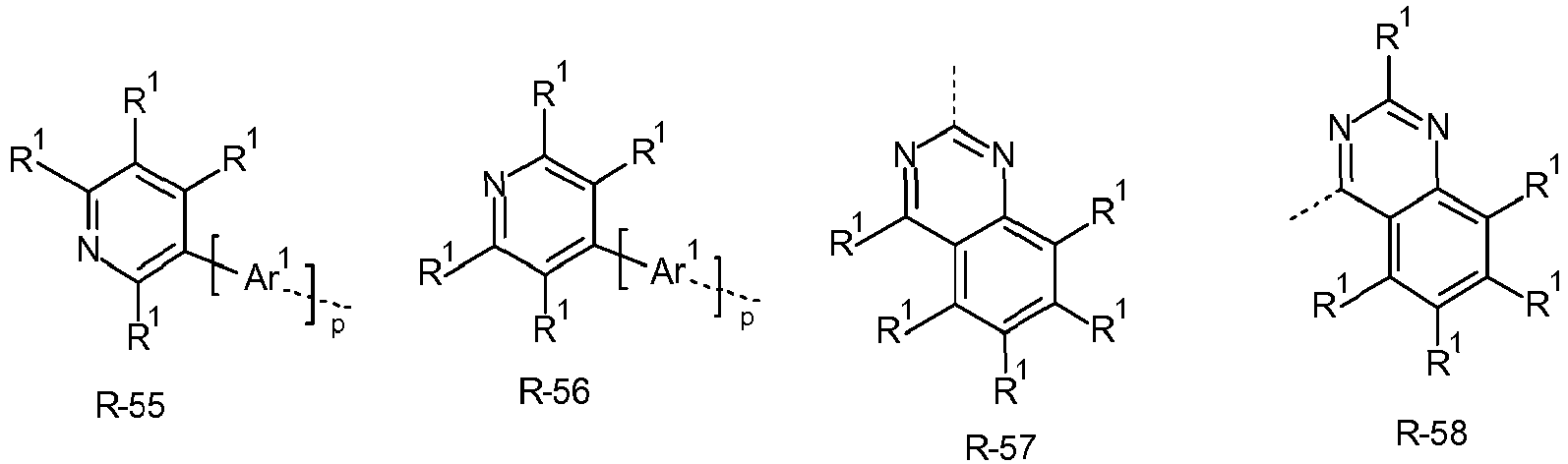


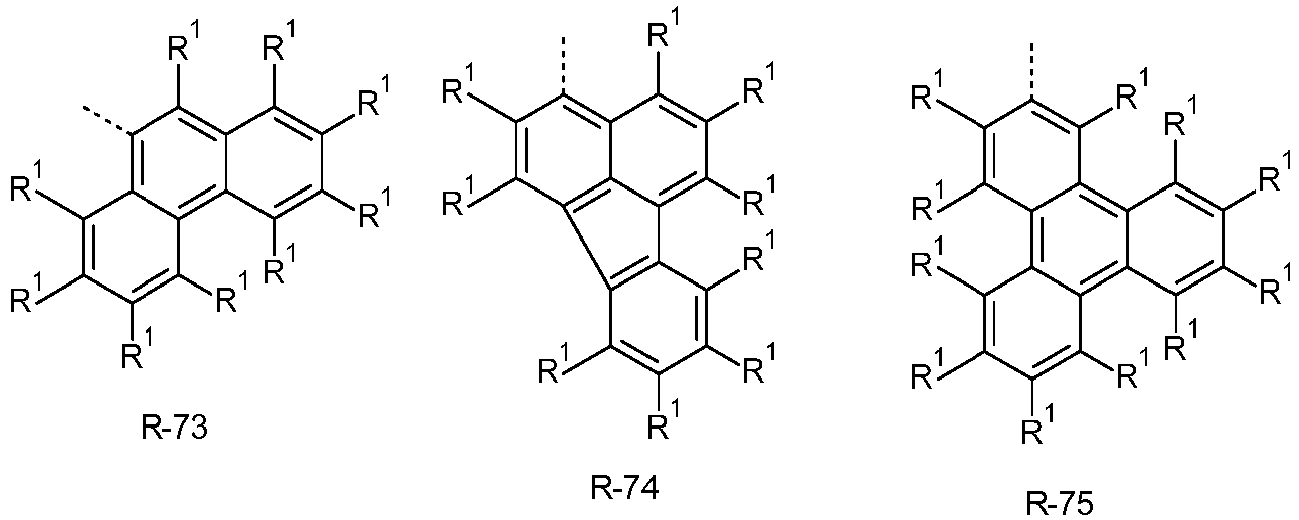
- Ar1
- ist bei jedem Auftreten gleich oder verschieden ein bivalentes aromatisches oder heteroaromatisches Ringsystem mit 6 bis 18 aromatischen Ringatomen, welches jeweils mit einem oder mehreren Resten R1 substituiert sein kann;
- A
- ist bei jedem Auftreten gleich oder verschieden C(R1)2, NR1, O oder S;
- p
- ist 0 oder 1, wobei p = 0 bedeutet, dass die Gruppe Ar1 nicht vorhanden ist und dass die entsprechende aromatische bzw. heteroaromatische Gruppe direkt an das Stickstoffatom gebunden ist;
- q
- ist 0 oder 1, wobei q = 0 bedeutet, dass an dieser Position keine Gruppe A gebunden ist und an die entsprechenden Kohlenstoffatome statt dessen Reste R1 gebunden sind.
- Dabei sind die Strukturen R-1 bis R-46 und R-69 bis R-75 bevorzugt.
- Bevorzugte Amine sind die in der folgenden Tabelle aufgeführten Verbindungen.


- Die Abgangsgruppe in der Arylverbindung bzw. die Gruppe X in der Verbindung der Formel (2), also Ar-(X)n, ist bevorzugt ausgewählt ist aus der Gruppe bestehend aus optional substituiertem Alkylsulfonat, optional substituiertem Arylsulfonat, Halogenid und Diazonium. Beispiele für optional substituierte Alkylsulfonate sind Trifluormethylsulfonat (Triflat, CF3SO3-) und Methylsulfonat (Mesylat, CH3SO3-). Beispiele für optional substituierte Arylsulfonate sind Phenylsulfonat (C6H5-SO3-) und Tolylsulfonat (Tosylat, CH3-C6H4-SO3-). Beispiele für Halogenide sind Cl, Br und I. Bevorzugt ist die Abgangsgruppe bzw. die Gruppe X gleich oder verschieden bei jedem Auftreten ausgewählt aus der Gruppe bestehend aus Triflat, Phenylsulfonat und Tosylat, besonders bevorzugt Triflat.
- Bevorzugt ist der Index n in der Verbindung der Formel (2) gleich 1, 2, 3, 4 oder 5, besonders bevorzugt gleich 1 oder 2 und ganz besonders bevorzugt gleich 1.
- Das aromatische bzw. heteroaromatische Ringsystem in der Arylverbindung bzw. die Gruppe Ar in Formel (2) stellt bevorzugt ein aromatisches oder heteroaromatisches Ringsystem mit 5 bis 30 aromatischen Ringatomen dar, welches mit einem oder mehreren Resten R1 substituiert sein kann. Dabei ist die Aryl- bzw. Heteroarylgruppe, an die die Abgangsgruppe X gebunden ist, bevorzugt keine elektronenarme Gruppe. Die Gruppe Ar stellt daher bevorzugt ein rein aromatisches Ringsystem oder ein elektronenreiches heteroaromatisches Ringsystem dar. Eine elektronenarme Heteroarylgruppe im Sinne der vorliegenden Erfindung ist eine Sechsring-Heteroarylgruppe, welche mindestens ein Stickstoffatom enthält, oder eine Fünfring-Heteroarylgruppe, welche mindestens zwei Heteroatome enthält, die ausgewählt sind aus N, O oder S, wobei mindestens ein Heteroatom für N steht. Dabei können an diese Heteroarylgruppen jeweils noch weitere Aryl- oder Heteroarylgruppen ankondensiert sein. Dagegen ist eine elektronenreiche Heteroarylgruppe im Sinne der vorliegenden Erfindung eine Fünfring-Heteroarylgruppe, welche genau ein Heteroatom enthält, das ausgewählt ist aus O, S oder N, wobei der Stickstoff substituiert ist und wobei noch weitere Arylgruppen an den Fünfring ankondensiert sein können. Beispiele für elektronenreiche Heteroarylgruppen im Sinne der vorliegenden Erfindung sind Dibenzofuran, Dibenzothiophen, Carbazol, Indenocarbazol und Indolocarbazol.
- Geeignete aromatische bzw. heteroaromatische Ringsysteme in der Arylverbindung bzw. geeignete Gruppen Ar in Formel (2) sind ausgewählt aus Phenyl, Biphenyl, insbesondere ortho-, meta- oder para-Biphenyl, Terphenyl, insbesondere ortho-, meta-, para- oder verzweigtem Terphenyl, Quaterphenyl, insbesondere ortho-, meta-, para- oder verzweigtem Quaterphenyl, Fluoren, welches über die 1-, 2-, 3- oder 4-Position verknüpft sein kann, Spirobifluoren, welches über die 1-, 2-, 3- oder 4-Position verknüpft sein kann, Naphthalin, welches über die 1- oder 2-Position verknüpft sein kann, Indol, Benzofuran, Benzothiophen, Carbazol, welches über die 1-, 2-, 3- oder 4-Position verknüpft sein kann, Dibenzofuran, welches über die 1-, 2-, 3- oder 4-Position verknüpft sein kann, Dibenzothiophen, welches über die 1-, 2-, 3- oder 4-Position verknüpft sein kann, Indenocarbazol, Indolocarbazol, Phenanthren oder Triphenylen, welche jeweils mit einem oder mehreren Resten R1 substituiert sein können.
- Weiterhin bevorzugt stellt das aromatische bzw. heteroaromatische Ringsystem in der Arylverbindung bzw. Ar in Formel (2) ein aromatisches oder heteroaromatisches Ringsystem mit 10 bis 30 aromatischen Ringatomen dar, welches mindestens zwei miteinander kondensierte aromatische bzw. heteroaromatische Ringe aufweist, wobei der eine aromatische bzw. heteroaromatische Ring in einer ortho-Position zur Bindung an die Abgangsgruppe bzw. zur Bindung an X an den anderen aromatischen Ring ankondensiert ist. Dies gilt auch beispielsweise für Dibenzofuran oder Dibenzothiophen, welches jeweils in 1-Position eine Abgangsgruppe trägt, oder für Carbazol, welches in 4-Position eine Abgangsgruppe trägt.
- Beispiele für geeignete aromatische bzw. heteroaromatische Ringsysteme in der Arylverbindung bzw. für geeignete Gruppen Ar sind dabei die Gruppen der folgenden Formeln Ar-1 bis Ar-53,


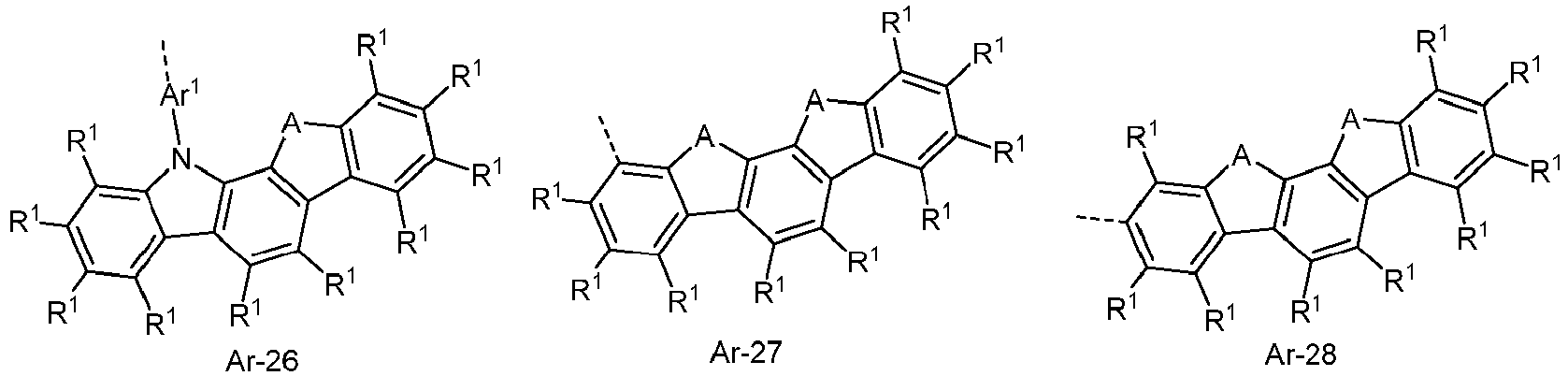


- Ar1
- ist bei jedem Auftreten gleich oder verschieden ein bivalentes aromatisches oder heteroaromatisches Ringsystem mit 6 bis 18 aromatischen Ringatomen, welches jeweils mit einem oder mehreren Resten R1 substituiert sein kann;
- A
- ist bei jedem Auftreten gleich oder verschieden C(R1)2, NR1, O oder S;
- p
- ist 0 oder 1, wobei p = 0 bedeutet, dass die Gruppe Ar1 nicht vorhanden ist und dass die entsprechende aromatische bzw. heteroaromatische Gruppe direkt an die Abgangsgruppe bzw. die Gruppe X gebunden ist;
- q
- ist 0 oder 1, wobei q = 0 bedeutet, dass an dieser Position keine Gruppe A gebunden ist und an die entsprechenden Kohlenstoffatome statt dessen Reste R1 gebunden sind.
- Wenn die oben genannten Gruppen für R, R' bzw. Ar mehrere Gruppen A aufweisen, so kommen hierfür alle Kombinationen aus der Definition von A in Frage. Bevorzugte Ausführungsformen sind dann solche, in denen eine Gruppe A für NR1 und die andere Gruppe A für C(R1)2 steht oder in denen beide Gruppen A für NR1 stehen oder in denen beide Gruppen A für O stehen.
- Wenn A für NR1 steht, steht der Substituent R1, der an das Stickstoffatom gebunden ist, bevorzugt für ein aromatisches oder heteroaromatisches Ringsystem mit 5 bis 24 aromatischen Ringatomen, welches auch durch einen oder mehrere Reste R2 substituiert sein kann. In einer besonders bevorzugten Ausführungsform steht dieser Substituent R1 gleich oder verschieden bei jedem Auftreten für ein aromatisches oder heteroaromatisches Ringsystem mit 6 bis 24 aromatischen Ringatomen, insbesondere mit 6 bis 18 aromatischen Ringatomen, welches keine kondensierten Arylgruppen aufweist und welches keine kondensierten Heteroarylgruppen, in denen zwei oder mehr aromatische bzw. heteroaromatische 6-RingGruppen direkt aneinander ankondensiert sind, aufweist, und welches jeweils auch durch einen oder mehrere Reste R2 substituiert sein kann. Bevorzugt sind Phenyl, Biphenyl, Terphenyl und Quaterphenyl mit Verknüpfungsmustern, wie vorne für Ar-1 bis Ar-11 aufgeführt, wobei diese Strukturen statt durch R1 durch einen oder mehrere Reste R2 substituiert sein können, bevorzugt aber unsubstituiert sind.
- Wenn A für C(R1)2 steht, stehen die Substituenten R1, die an dieses Kohlenstoffatom gebunden sind, bevorzugt gleich oder verschieden bei jedem Auftreten für eine lineare Alkylgruppe mit 1 bis 10 C-Atomen oder für eine verzweigte oder cyclische Alkylgruppe mit 3 bis 10 C-Atomen oder für ein aromatisches oder heteroaromatisches Ringsystem mit 5 bis 24 aromatischen Ringatomen, welches auch durch einen oder mehrere Reste R2 substituiert sein kann. Ganz besonders bevorzugt steht R1 für eine Methylgruppe oder für eine Phenylgruppe. Dabei können die Reste R1 auch miteinander ein Ringsystem bilden, was zu einem Spirosystem führt.
- Dabei können die Arylverbindungen Ar-(X)n auch sterisch anspruchsvolle Gruppen Ar enthalten, ebenso wie Gruppen Ar, welche mit sterisch anspruchsvollen Gruppen R1, beispielsweise in ortho-Position zur Bindung an die Abgangsgruppe X, substituiert sind, da das erfindungsgemäße Verfahren auch mit sterisch anspruchsvollen Arylverbindungen Ar-(X)n zu guten Ausbeuten führt.
- Bevorzugt ist R1 bei jedem Auftreten gleich oder verschieden ausgewählt aus H, D, F, CN, Si(R2)3, N(R2)2 oder einer geradkettigen Alkyl- oder Alkoxygruppe mit 1 bis 10 C-Atomen oder einer verzweigten oder cyclischen Alkyl- oder Alkoxygruppe mit 3 bis 10 C-Atomen, wobei die oben genannten Gruppen jeweils mit einem oder mehreren Resten R2 substituiert sein können und wobei in den oben genannten Gruppen eine oder mehrere CH2-Gruppen durch -R2C=CR2- oder -O- ersetzt sein können, oder ein aromatisches oder heteroaromatisches Ringsystem mit 5 bis 24 aromatischen Ringatomen, das jeweils mit einem oder mehreren Resten R2 substituiert sein kann; dabei können zwei oder mehr Reste R1 miteinander verknüpft sein und so einen Ring bilden. Besonders bevorzugt ist R1 bei jedem Auftreten gleich oder verschieden ausgewählt aus H, D, F, CN, N(R2)2 oder einer geradkettigen Alkylgruppe mit 1 bis 5 C-Atomen oder einer verzweigten oder cyclischen Alkylgruppe mit 3 bis 6 C-Atomen, wobei die oben genannten Gruppen jeweils mit einem oder mehreren Resten R2 substituiert sein können, oder ein aromatisches oder heteroaromatisches Ringsystem mit 6 bis 14 aromatischen Ringatomen, das jeweils mit einem oder mehreren Resten R2 substituiert sein kann; dabei können zwei oder mehr Reste R1 miteinander verknüpft sein und so einen Ring bilden.
- Bevorzugt ist R2 bei jedem Auftreten gleich oder verschieden ausgewählt aus H, D, F, CN, Si(R3)3, N(R3)2 oder einer geradkettigen Alkyl- oder Alkoxygruppe mit 1 bis 10 C-Atomen oder einer verzweigten oder cyclischen Alkyl- oder Alkoxygruppe mit 3 bis 10 C-Atomen, wobei die oben genannten Gruppen jeweils mit einem oder mehreren Resten R3 substituiert sein können und wobei in den oben genannten Gruppen eine oder mehrere CH2-Gruppen durch -R3C=CR3- oder -O- ersetzt sein können, oder ein aromatisches oder heteroaromatisches Ringsystem mit 5 bis 24 aromatischen Ringatomen, das jeweils mit einem oder mehreren Resten R3 substituiert sein kann; dabei können zwei oder mehr Reste R2 miteinander verknüpft sein und so einen Ring bilden. Besonders bevorzugt ist R2 bei jedem Auftreten gleich oder verschieden ausgewählt aus H, D, F, CN, N(R3)2 oder einer geradkettigen Alkylgruppe mit 1 bis 5 C-Atomen oder einer verzweigten oder cyclischen Alkylgruppe mit 3 bis 6 C-Atomen, wobei die oben genannten Gruppen jeweils mit einem oder mehreren Resten R3 substituiert sein können, oder ein aromatisches oder heteroaromatisches Ringsystem mit 6 bis 14 aromatischen Ringatomen, das jeweils mit einem oder mehreren Resten R3 substituiert sein kann; dabei können zwei oder mehr Reste R2 miteinander verknüpft sein und so einen Ring bilden.
- Bevorzugt ist R3 bei jedem Auftreten gleich oder verschieden H, D, F, eine Alkylgruppe mit 1 bis 5 C-Atomen oder ein aromatisches Ringsystem mit 6 bis 12 aromatischen Ringatomen.
- Die als Reaktionsprodukt erhaltenen Verbindungen sind dadurch gekennzeichnet, dass in der Arylverbindung an die Stelle der Bindung zur Abgangsgruppe bzw. die Stelle der Bindung zu X eine Bindung Ar-N tritt, wobei N das Stickstoffatom der Arylaminoverbindung bezeichnet. Bevorzugte Verfahrensprodukte des erfindungsgemäßen Verfahrens sind somit Kombinationen der oben als bevorzugt angegebenen Arylverbindung und Arylaminoverbindung.
- Erfindungsgemäß wird die Reaktion in Anwesenheit von Litium-tert-butanolat (LiOtBu) als Base durchgeführt. Die Base wird bevorzugt zu Beginn der Reaktion zur Mischung hinzugegeben.
- Die Base wird bevorzugt in einer Menge von 0.5 bis 10 Äquivalenten, bezogen auf die Stoffmenge an eingesetzter Arylverbindung, eingesetzt. Besonders bevorzugt werden 0.6 bis 6 Äquivalente, ganz besonders bevorzugt 1 bis 4 Äquivalente und am stärksten bevorzugt 2 bis 3 Äquivalente an Base eingesetzt. Enthält die Arylverbindung mehr als eine Abgangsgruppe, wird die Base entsprechend der Stoffmenge der Abgangsgruppen in der eingesetzten Arylverbindung eingesetzt.
- Im erfindungsgemäßen Verfahren wird eine Palladiumverbindung als Katalysator eingesetzt. Diese kann entweder zu Beginn der Reaktion oder zu einem späteren Zeitpunkt zugegeben werden. Es ist bevorzugt, wenn der Katalysator erst nach abgeschlossener Zugabe der Base zur Mischung hinzugegeben wird. Der Katalysator kann aber auch bereits in der Mischung vorhanden sein, wenn die Base zugegeben wird. Unter dem Begriff "Katalysator" im Rahmen der vorliegenden Anmeldung soll sowohl eine tatsächlich katalytisch aktive Spezies als auch eine Katalysatorvorstufe verstanden werden, welche in der Reaktionsmischung die katalytisch aktive Spezies bildet. Bevorzugte Katalysatoren im Rahmen der vorliegenden Anmeldung sind homogene Katalysatoren, also Katalysatoren, welche im Reaktionsmedium gelöst vorliegen. Als Katalysatoren können generell solche Verbindungen eingesetzt werden, wie sie gemäß dem Stand der Technik für palladium-katalysierte C-N-Kupplungsreaktionen verwendet werden. Diese sind dem Fachmann der organischen Synthese prinzipiell bekannt.
- Der Katalysator wird bevorzugt in einer Menge von 0.001 bis 10.0 mol-% eingesetzt, besonders bevorzugt 0.01 bis 5.0 mol-%, ganz besonders bevorzugt 0.1 bis 3.0 mol-%, insbesondere 0.5 bis 2.5 mol-% bezogen auf die Arylverbindung. Enthält die Arylverbindung mehr als eine Abgangsgruppe, wird der Katalysator entsprechend der Stoffmenge der Abgangsgruppen in der eingesetzten Arylverbindung zugegeben.
- Der Katalysator umfasst Palladium sowie einen oder mehrere Liganden. Der Katalysator kann als eine einzige Verbindung, umfassend sowohl das Palladium als auch einen oder mehrere Liganden, zugegeben werden. Alternativ kann der Katalysator in situ in der Reaktionsmischung aus separat zugegebener Palladiumverbindung und Ligand gebildet werden.
- Geeignete Palladiumverbindungen, die als eigenständige Katalysatoren ohne zusätzliche Liganden eingesetzt werden können, sind ausgewählt aus Pd(PPh3)4, Pd-iPr-cinnamyl-Cl CX31 (CAS-Nr. 884879-23-6), Pd-SiPR-cinnamyl-Cl CX32 (CAS-Nr. 884879-24-7), Pd-PEPPSI-iPR (CAS-Nr. 905459-27-0) und Pd-PEPPSI-iPent (CAS-Nr. 1158652-41-5).
- Geeignete Palladiumverbindungen als Katalysatorbestandteile, die mit zusätzlichen Liganden eingesetzt werden, sind ausgewählt aus PdCl2 (CAS-Nr. 7647-10-1), Pd(OAc)2 (CAS-Nr. 3375-31-3), (CH3CN)2PdCl2 (CAS-Nr. 14592-56-4), Bis(dibenzylidenaceton)palladium (Pd(dba)2) (CAS-Nr. 32005-36-0) und Tris(dibenzylidenaceton)dipalladium (Pd2(dba)3) (CAS-Nr. 51364-51-3). Bevorzugt ist Pd(OAc)2.
- Die Liganden sind bevorzugt ausgewählt aus monodentaten und oligodentaten Liganden, insbesondere monodentaten Liganden. Bevorzugte Liganden sind ausgewählt aus Phosphinen, Phosphiten, Aminen, Aminophosphinen und N-heterocyclischen Carbenen. Geeignete Phosphine und Amine zur Verwendung als Liganden sind in
WO 2011/008725 ,WO 2006/074315 undUS 6307087 offenbart. Geeignete N-heterocyclische Carbene zur Verwendung als Liganden sind inCA 2556850 offenbart. Bevorzugt sind monodentate und bidentate Phosphine, insbesondere monodentate Phosphine. - Geeignete Phosphine als Liganden sind ausgewählt aus Dicyclohexylphosphino-2',6'-dimethoxybiphenyl (SPhos, CAS-Nr. 657408-07-6), Dicyclohexylphosphino-2',6'-di-isopropoxybiphenyl (RuPhos, CAS-Nr. 787618-22-8), Di-tert-butyl(2',4',6'-triisopropyl-3,6-dimethoxybiphenyl-2-yl)phosphin (tBuBrettPhos, CAS-Nr. 1160861-53-9), Dicyclohexyl(2',4',6'-triisopropyl-3,6-dimethoxybiphenyl-2-yl)phosphin (BrettPhos, CAS-Nr. 1070663-78-3), Trimethylphosphin (CAS-Nr. 594-09-2), Triethylphosphin (CAS-Nr. 554-70-1), Tripropylphosphin (CAS-Nr. 2234-97-1), Triisopropylphosphin (CAS-Nr. 6476-36-4), Tributylphosphin (CAS-Nr. 998-40-3), Tri-tert-butyl-phosphin (CAS-Nr. 13716-12-6), Triphenylphosphin (CAS-Nr. 603-35-0), Di-tert-butyl-chloro-phosphin (CAS-Nr. 13716-10-4), Trimethylphosphit (CAS-Nr.121-45-9), Triethylphosphit (CAS-Nr. 122-52-1), Tripropylphosphit (CAS-Nr. 923-99-9), Triisopropylphosphit (CAS-Nr. 116-17-6), Tributylphosphit (CAS-Nr. 102-85-2), Tricyclohexylphosphit (CAS-Nr. 15205-58-0), Tri(o-tolyl)phosphin (CAS-Nr. 6163-58-2), Triisopropylphosphin (CAS-Nr. 6476-36-4), Tricyclohexylphosphin (CAS-Nr. 2622-14-2), 2,2'-Bis(diphenylphosphino)-1,1'-binaphthyl (BINAP, CAS-Nr. 98327-87-8), 1,2-Bis(dimethylphosphino)ethan (CAS-Nr. 23936-60-9), 1,2-Bis(di-ethylphosphino)ethan (CAS-Nr. 6411-21-8), 1,2-Bis(dipropylphosphino)-ethan (CAS-Nr. 86071-87-6), 1,2-Bis(diisopropylphosphino)ethan (CAS-Nr. 87532-69-2), 1,2-Bis(dibutyl-phosphino)ethan (CAS-Nr. 4141-59-7), 1,2-Bis(dicyclohexylphosphino)ethan (CAS-Nr. 23743-26-2), 1,3-Bis(dicyclo-hexyl-phosphino)propan (CAS-Nr. 103099-52-1), 1,3-Bis(diisopropylphos-phino)propan (CAS-Nr. 91159-11-4), 1,4-Bis(diisopropyl-phosphino)-butan (CAS-Nr. 80499-19-0), 2,4-Bis(dicyclohexylphosphino)pentan (CAS-Nr. 96377-46-7) und 1,1'-Bis(diphenylphosphino)ferroce (dppf, CAS-Nr. 12150-46-8). Weiterhin als Liganden geeignet sind Cy-JohnPhos (CAS-Nr. 247940-06-3), CataCxium Pcy (CAS-Nr. 672937-60-9), Aphos (CAS-Nr. 932710-63-9), XantPhos (CAS-Nr. 161265-03-8) und XPhos (CAS-Nr. 564483-18-7). Bevorzugte Liganden sind SPhos, XPhos und CPhos, besonders bevorzugt SPhos.
- Die Palladiumverbindung und der Phosphinligand werden für Monophosphine bevorzugt in einem Verhältnis Pd : Phosphin im Bereich von 1 : 1 bis 1 : 4 eingesetzt, besonders bevorzugt im Bereich von 1 : 1.5 bis 1 : 2.5 und ganz besonders bevorzugt im Bereich von 1 : 1.8 bis 1 : 2.2. Für Biphosphine werden die Palladiumverbindung und der Phosphinligand bevorzugt in einem Verhältnis Pd : Phosphin im Bereich von 1 : 0.5 bis 1 : 2 eingesetzt, besonders bevorzugt im Bereich von 1 : 0.75 bis 1 : 1.5, ganz besonders bevorzugt im Bereich von 1 : 0.9 bis 1 : 1.1.
- Das erfindungsgemäße Verfahren wird bevorzugt in flüssiger Phase in Lösung oder Suspension durchgeführt. Dabei fällt je nach Abgangsgruppe das Lithiumsalz, beispielsweise Lithiumtriflat, im Laufe der Reaktion aus der Reaktionsmischung aus. Es kann dabei ein beliebiges aprotisches organisches Lösemittel eingesetzt werden. Geeignet sind die dem Fachmann auf dem Gebiet der organischen Synthese bekannten Lösemittel mit Eignung zur Verwendung in palladiumkatalysierten C-N-Kupplungsreaktionen. Unter Eignung zur Verwendung in den erfindungsgemäßen Reaktionen wird insbesondere verstanden, dass diese inert gegenüber den Reaktionsbedingungen sind. Besonders bevorzugte Lösungsmittel sind ausgewählt aus Benzol, Toluol, 1,2-Xylol, 1,3-Xylol, 1,4-Xylol, Mesitylen, Tetrahydrofuran (THF), 1,4-Dioxan, Dimethoxyethan (dme) und Bis(2-methoxyethyl)ether (diglyme). Bevorzugt werden wasserfreie Lösungsmittel eingesetzt. Ganz besonders bevorzugt sind Toluol, 1,2-Xylol, 1,3-Xylol, 1,4-Xylol und Mesitylen, insbesondere Toluol.
- Die Reaktion kann unter Normaldruck oder unter erhöhtem Druck durchgeführt werden.
- Gemäß einer bevorzugten Ausführungsform wird die Reaktion unter Inertgasatmosphäre durchgeführt, beispielsweise unter Stickstoff- oder Argonatmosphäre. Besonders gute Ergebnisse werden erzielt, wenn auf die konsequente Einhaltung sehr guter Inertbedingungen geachtet wird, wie sie beispielsweise in einer Glovebox vorliegen.
- Die Reaktionsdauer beträgt typischerweise zwischen wenigen Minuten und einigen Tagen, bevorzugt zwischen wenigen Minuten und 100 h, besonders bevorzugt zwischen 15 Minuten und 80 h und ganz besonders bevorzugt zwischen 2 h und 30 h. Die angegebenen Zeiten beziehen sich auf die Gesamtdauer der Reaktion.
- Die Reaktionstemperatur beträgt bevorzugt zwischen 0 und 300 °C, besonders bevorzugt zwischen 20 und 200 °C, ganz besonders bevorzugt zwischen 60 und 150 °C. Die angegebenen Reaktionstemperaturen beziehen sich auf die Hauptphase der Reaktion, während der alle Komponenten in der Mischung vorliegen und die C-N-Bindungsknüpfung stattfindet. In einer weiteren bevorzugten Ausführungsform wird die Reaktion unter Rückfluss durchgeführt, so dass sich die Reaktionstemperatur anhand des verwendeten Lösemittels bestimmt. Daher ist eine bevorzugte Reaktionstemperatur bei Verwendung von Toluol als Lösemittel 100 °C, bei 1,2-Xylol 144 °C, bei 1,3-Xylol 139 °C, bei 1,4-Xylol 138 °C und bei Mesitylen 165 °C.
- Typischerweise wird die Base zusammen mit den Reaktanden, also der Arylaminoverbindung und der Arylverbindung, in einem Lösemittel vorgelegt und inertisiert. Parallel dazu wird die Katalysatorlösung vorbereitet, wobei bevorzugt dasselbe Lösemittel verwendet wird, welches auch in der Reaktionslösung verwendet wird. Die Katalysatorlösung wird dann zu der Reaktionsmischung zugegeben und die Mischung bei erhöhter Temperatur zur Reaktion gebracht. Alternativ kann der Katalysator bzw. die Palladiumverbindung und der Ligand auch in fester Form zugegeben werden.
- Die allgemeine Reaktionsführung und Aufarbeitung sowie die verwendeten Geräte und Reaktionsgefäße sind nicht genauer spezifiziert. Der Fachmann kann unter Beachtung der Ausführungsbeispiele und unter Hinzuziehung seines allgemeinen Fachwissens geeignete Ausführungsformen auswählen. Insbesondere geeignet sind solche Methoden, wie sie dem Fachmann allgemein für Hartwig-Buchwald-Kupplungen bekannt sind.
- Wenn es sich bei den im erfindungsgemäßen Verfahren erhaltenen Produkte um sekundäre Arylamine handelt, werden diese bevorzugt als Zwischenstufe zur Herstellung tertiärer Arylamine eingesetzt. Wenn es sich bei den im erfindungsgemäßen Verfahren erhaltenen Produkten um tertiäre Arylamine handelt, werden diese bevorzugt als Funktionsmaterialien in elektronischen Vorrichtungen eingesetzt. Dabei sind die elektronischen Vorrichtungen beispielsweise ausgewählt aus der Gruppe bestehend aus organischen Elektrolumineszenzvorrichtungen (OLEDs), organischen integrierten Schaltungen (OICs), organischen Feld-Effekt-Transistoren (OFETs), organischen Dünnfilmtransistoren (OTFTs), organischen lichtemittierenden Transistoren (OLETs), organischen Solarzellen (OSCs), organischen optischen Detektoren, organischen Photorezeptoren, organischen Feld-Quench-Devices (OFQDs), organischen lichtemittierenden elektrochemischen Zellen (OLECs) und organischen Laserdioden (O-Laser). Bevorzugt werden die erhaltenen Verfahrensprodukte als Lochtransportmaterialien und/oder als fluoreszierende Emittermaterialien und/oder als Elektronenblockiermaterialien und/oder als Exzitonenblockiermaterialien und/oder als Matrixmaterialien in elektronischen Vorrichtungen verwendet, insbesondere in organischen Elektrolumineszenzvorrichtungen. Es sind jedoch auch andere Verwendungen möglich, abhängig vom Grundkörper der Produkte und den zusätzlich zur Aminogruppe vorhandenen Substituenten.
- Ein weiterer Gegenstand der vorliegenden Erfindung ist die Verwendung von LiOtBu als Base in einer palladiumkatalysierten Kupplungsreaktion zwischen einer Arylaminoverbindung und einer Arylverbindung. Die Arylaminoverbindung und die Arylverbindung sind dabei wie oben angegeben definiert.
- Das erfindungsgemäße Verfahren, kombiniert mit einer vorausgehenden Suzuki-Kupplung, ermöglicht die selektive Funktionalisierung aromatischer bzw. heteroaromatischer Verbindungen. So ist es beispielsweise möglich, in einer Arylverbindung, welche mit zwei Abgangsgruppen substituiert ist, von denen eine Abgangsgruppe ein Halogenid und die andere ein Sulfonat ist, zunächst selektiv das Halogenid mit einem Boronsäurederivat in einer Suzuki-Kupplung umzusetzen und dann in einem weiteren Schritt das Sulfonat in einer C-N-Kupplungsreaktion gemäß der vorliegenden Erfindung. Alternativ ist es möglich, zunächst selektiv das Sulfonat mit einem Boronsäurederivat in einer Suzuki-Kupplung umzusetzen und dann in einem weiteren Schritt das Halogenid in einer C-N-Kupplungsreaktion gemäß der vorliegenden Erfindung umzusetzen. Dabei lässt sich über die Wahl des Katalysatorsystems bestimmen, ob selektiv die Sulfonat-Abgangsgruppe oder selektiv die Halogenid-Abgangsgruppe umgesetzt wird. So erhält man eine selektive Umsetzung der Halogenid-Abgangsgruppe, beispielsweise Bromid, in der Suzuki-Kupplung, wenn Tri-ortho-tolylphosphin als Ligand eingesetzt wird, insbesondere in einem Verhältnis Pd : Phosphin in der Größenordnung von 1 : 4. Weiterhin erhält man eine selektive Umsetzung der Sulfonat-Abgangsgruppe, beispielsweise Triflat, in der Suzuki-Kupplung, wenn dppb (1,4-Bis(diphenylphosphino)butan) als Ligand eingesetzt wird, insbesondere in einem Verhältnis Pd : Phosphin in der Größenordnung von 1 : 4. Als weitere Reaktionsbedingungen eignen sich Bedingungen, wie sie üblicherweise für Suzuki-Kupplungen verwendet werden, also beispielsweise der Einsatz von Pd2(dba)3 als Palladiumverbindung, Na2CO3 oder K2CO3 als Base und eine Mischung aus Toluol oder einem anderen organischen Lösemittel und Wasser als Reaktionsmedium.
- Das erfindungsgemäße Verfahren weist gegenüber Verfahren gemäß dem Stand der Technik die folgenden Vorteile auf:
- 1) Die Verwendung von LiOtBu führt im Vergleich zu anderen Basen, insbesondere im Vergleich zu NaOtBu oder KOtBu, zu einer deutlich verbesserten Ausbeute. Dies gilt vor allem beim Einsatz von Sulfonaten, insbesondere von Triflat, als Abgangsgruppe. Das erfindungsgemäße Verfahren zeichnet sich unter anderem dadurch aus, dass eine hohe Ausbeute an Produkt und eine geringe Bildung von Nebenprodukten auftritt.
- 2) Auch bei der Verwendung sterisch anspruchsvoller Arylaminoverbindungen bzw. sterisch anspruchsvoller Arylverbindungen als Edukte wird im erfindungsgemäßen Verfahren nur wenig Nebenprodukt in Form einer Defunktionalisierung oder einer Kupplung der verwendeten Base beobachtet. Dies stellt eine deutliche Verbesserung gegenüber der Verwendung von NaOtBu oder KOtBu als Base dar.
- 3) Die Verwendung von LiOtBu als Base führt zu einer hohen Reinheit der erhaltenen Verbindungen. Dies ist gerade für den Einsatz der Verbindungen als Funktionsmaterialien in elektronischen Vorrichtungen von großer Bedeutung. Dabei wird die Bildung von Nebenprodukten, welche sich bereits in geringer Menge abträglich auf die Leistungsdaten der elektronischen Vorrichtung auswirken, durch die Verwendung von LiOtBu zurückgedrängt.
- 4) Das erfindungsgemäße Verfahren kann auch in einem Maßstab, wie es für die industrielle Anwendung erforderlich ist, also in einem Maßstab von bis zu mehreren Kilogramm durchgeführt werden.
- 5) Das Verfahren kann mit einer geringen Menge an eingesetztem Katalysator und unter milden Reaktionsbedingungen durchgeführt werden.
- Die folgenden Beispiele dienen der Verdeutlichung und detaillierten Beschreibung der Erfindung, ohne sie dadurch einschränken zu wollen.
- Die nachfolgenden Synthesen werden, sofern nicht anders angegeben, unter einer Schutzgasatmosphäre in getrockneten Lösungsmitteln durchgeführt. Die Lösungsmittel und Reagenzien können z. B. von Sigma-ALDRICH bzw. ABCR bezogen werden. Die jeweiligen Angaben in eckigen Klammern bzw. die zu einzelnen Verbindungen angegebenen Nummern beziehen sich auf die CAS-Nummern der literaturbekannten Verbindungen.
- In einer Glovebox werden das Triflat, das Amin und die Base unter einer Argonatmosphäre abgewogen. Nach Zugabe von Katalysator und Ligand wird das Lösungsmittel hinzugefügt und das Gefäß verschlossen. Das Reaktionsgefäß wird aus der Glovebox ausgeschleust und im Ölbad bei 110 °C Innentemperatur für 16 h gerührt. Nach Abkühlen auf Raumtemperatur wird eine Probe entnommen und per HPLC analysiert.
- In der folgenden Reaktion wird Pd-iPr-cinnamyl-Cl CX31 (CAS-Nr. 884879-23-6) als Katalysator eingesetzt. Als Base wird LiOtBu gemäß der vorliegenden Erfindung bzw. als Vergleich gemäß dem Stand der Technik NaOtBu oder KOtBu eingesetzt. Die Ergebnisse sind in Tabelle 1 zusammengefasst. Dabei führt die Reaktion mit LiOtBu als Base zu einer deutlich besseren Ausbeute im Vergleich zu NaOtBu oder KOtBu, und auch bei Reduktion der Katalysatormenge wird weiterhin eine gute Ausbeute erhalten.

Tabelle 1[a]: Variation der Base für Pd-iPr-cinnamyl-Cl CX31 als Katalysator Bsp. [Pd] [mol%] Base (200 mol%) A1 [%] A2 [%] A3 [%] A4 [%] 1 (Vgl.) 2 NaOtBu 0 12 58 25 2 (Vgl.) 2 KOtBu 0 28 1 52 3 2 LiOtBu 1 3 91 1 4 0.5 LiOtBu 11 17 40 30 [a] Reaktionsbedingungen: 0.44 mmol Trifluormethansulfonsäure-8-(9-phenyl-9H-carbazol-3-yl)-dibenzofuran-1-yl-ester 1, 0.48 mmol Biphenyl-4-yl-(9,9- dimethyl-9H-fluoren-4-yl)-amin 2, 8 mL Toluol, 110 °C, 16 h. Flächenprozente bestimmt durch HPLC. - In diesem Beispiel wird die Reaktion aus Beispiel 2 mit einem anderen Katalysatorsystem unter Variation der Menge an Katalysator und Base durchgeführt. Hierfür wird als Katalysator ein System aus Pd(OAc)2 und SPhos verwendet (Tabelle 2).
Tabelle 2: Optimierung der Versuchsparameter für das Pd(OAc)2 / SPhos / LiOtBu System.[a] Bsp. Pd(OAc)2 [mol%] SPhos [mol%] LiOtBu [mol%] A1 [%] A2 [%] A3 [%] A4 [%] 1 1 2 220 2 6 82 8 2 1 2 150 8 3 75 8 3 1 2 110 25 3 57 12 4 0.5 1 220 2 8 74 14 5 1 1 220 2 6 83 5 6 1 1.5 220 1 8 82 6 7 2 4 200 0 3 94 0 8 2 4 250 0 3 95 0 9 2 4 300 0 3 95 0 [a] Reaktionsbedingungen: 0.44 mmol Trifluormethansulfonsäure-8-(9-phenyl-9H-carbazol-3-yl)-dibenzofuran-1-yl-ester 1, 0.48 mmol Biphenyl-4-yl-(9,9- dimethyl-9H-fluoren-4-yl)-amin 2, 8 mL Toluol, 110 °C, 16 h. Flächenprozente bestimmt durch HPLC. - In diesem Beispiel wird die Reaktion mit anderen Liganden und anderen Substraten unter Beibehaltung von Pd(OAc)2 als Palladiumquelle und LiOtBu als Base durchgeführt (Tabellen 3 und 4).
-

Tabelle 3[8]: Variation des Lianden Bsp. Ligand A5 [%] A6 [%] A7 [%] A8 [%] 1 SPhos 4 mol% 0.02 0.69 96.4 k.A. 2 XantPhos 2 mol% 0.09 4.79 71.3 k.A. 3 CPhos 4 mol% 0.54 1.09 95.8 k.A. 4 XPhos 4 mol% 0.32 0.76 96.9 k.A. [a] Reaktionsbedingungen: 0.60 mmol Trifluormethansulfonsäure-4-(9-phenyl-9H-carbazol-3-yl)-dibenzofuran-1-yl-ester 5, 0.60 mmol Bis-biphenyl-4-yl-amin 6, 250 mol% LiOtBu, 2 mol% Pd(OAc)2, 6.0 ml Toluol, 110 °C, 16 h. Flächenprozent bestimmt durch HPLC. -

Tabelle 4[8]: Variation der Liganden Bsp. Ligand A5 [%] A2 [%] A9 [%] A8 [%] k.A. 1 SPhos 1.37 4.71 84.0 2 XPhos 0.75 2.98 87.5 k.A. [a] Reaktionsbedingungen: 0.35 mmol Trifluormethansulfonsäure-4-(9-phenyl-9H-carbazol-3-yl)-dibenzofuran-1-yl-ester 5, 0.39 mmol Biphenyl-4-yl-(9,9-dimethyl-9H-fluoren-4-yl)-amin 2, 220 mol% LiOtBu, 2 mol% Pd(OAc)2, 4 mol% Ligand, 6.0 ml Toluol, 110 °C, 16 h. Flächenprozent bestimmt durch HPLC. - In diesem Beispiel werden die Reaktionsbedingungen aus Tabelle 3, Eintrag 4 und Tabelle 4, Eintrag 2 auf andere Substrate übertragen (Tabelle 5). Dafür wird in diesem Beispiel Phenyltriflat mit ortho-Biphenyl-phenyl-amin als sterisch anspruchsvollem sekundären Amin umgesetzt. Dabei führt die Reaktion mit LiOtBu als Base zu einer signifikant besseren Ausbeute im Vergleich zu NaOtBu.

Tabelle 5 [a] : Bsp. Base A10 [%] A11 [%] A12 [%] A13 [%] 1 LiOtBu 0 15.3 76.4 k.A. 2 (Vgl.) NaOtBu 0 91.3 2.3 k.A. [a] Reaktionsbedingungen: 0.86 mmol Phenyl-trifluormethansulfonat 10, 0.95 mmol Biphenyl-2-yl-phenylamin 11, 220 mol% Base, 2 mol% Pd(OAc)2, 4 mol% XPhos, 5.7 ml Toluol, 110 °C, 16 h. Flächenprozente bestimmt durch HPLC. - In diesem Beispiel wird als sekundäres Amin Carbazol eingesetzt, also ein Amin, in dem die beiden aromatischen Gruppen miteinander verknüpft sind (Tabelle 6). Dabei führt die Reaktion mit LiOtBu als Base zu einer deutlich besseren Ausbeute im Vergleich zu NaOtBu.

Tabelle 6 [a] : Bsp. Base A10 [%] A14 [%] A15 [%] A13 [%] 1 LiOtBu 0 k.A. 96.1 k.A. 2 (Vgl.) NaOtBu 0 k.A. 77.8 k.A. [a] Reaktionsbedingungen: 0.86 mmol Phenyl-trifluormethansulfonat 10, 0.95 mmol Carbazol 14, 220 mol% Base, 2 mol% Pd(OAc)2, 4 mol% XPhos, 5.7 ml Toluol, 110 °C, 16 h. Flächenprozente bestimmt durch HPLC. - In diesem Beispiel wird als Arylverbindung 1-Naphthyltriflat eingesetzt, also eine Verbindung mit einer kondensierten Arylgruppe (Tabelle 7). Dabei führt die Reaktion mit LiOtBu als Base zu einer signifikant besseren Ausbeute im Vergleich zu NaOtBu.

Tabelle 7 [a]: Bsp. Base A16 [%] A17 [%] A18 [%] A19 [%] 1 LiOtBu 0.5 3.2 94.1 0.2 2 (Vgl.) NaOtBu 0 32.4 8.5 46.9 [a] Reaktionsbedingungen: 0.70 mmol 1-Naphthyl-trifluormethansulfonat 16, 0.77 mmol Diphenylamin 17, 220 mol% Base, 2 mol% Pd(OAc)2, 4 mol% XPhos, 5.7 ml Toluol, 110 °C, 16 h. Flächenprozente bestimmt durch HPLC. - In diesem Beispiel wird als Arylverbindung 1-Naphthyltriflat, also eine Arylverbindung mit kondensierter Arylgruppe, mit Phenyl-ortho-biphenylamin als sterisch anspruchsvollem sekundären Amin umgesetzt (Tabelle 8). Dabei führt die Reaktion mit LiOtBu als Base zu einer guten Ausbeute, während mit NaOtBu als Base fast überhaupt keine Umsetzung zum tertiären Amin beobachtet wird.

Tabelle 8 [a]: Bsp. Base A16 [%] A11 [%] A20 [%] A19 [%] 1 LiOtBu 19.9 21.4 51.6 0 2 (Vgl.) NaOtBu 0.1 55.9 0.4 35.6 [a] Reaktionsbedingungen: 0.70 mmol 1-Naphthyl-trifluormethansulfonat 16, 0.77 mmol Biphenyl-2-yl-phenylamin 11, 220 mol% Base, 2 mol% Pd(OAc)2, 4 mol% XPhos, 5.7 ml Toluol, 110 °C, 16 h. Flächenprozente bestimmt durch HPLC. - In diesem Beispiel wird ortho-Biphenyltriflat als sterisch anspruchsvolle Arylverbindung mit Phenyl-ortho-biphenylamin als sterisch anspruchsvollem Amin umgesetzt (Tabelle 9). Dabei führt die Reaktion mit LiOtBu als Base zu einer guten Ausbeute, während mit NaOtBu als Base überhaupt keine Umsetzung zum tertiären Amin beobachtet wird.

Tabelle 9 [a] : Bsp. Base A21 [%] A11 [%] A22 [%] A23 [%] 1 LiOtBu 3.3 29.9 21.2 2.5 2 (Vgl.) NaOtBu 0 63.6 0 33.7 [a] Reaktionsbedingungen: 0.65 mmol Biphenyl-2-yl-trifluormethansulfonat 21, 0.72 mmol Biphenyl-2-yl-phenylamin 11, 220 mol% Base, 2 mol% Pd(OAc)2, 4 mol% XPhos, 5.7 ml Toluol, 110 °C, 16 h. Flächenprozente bestimmt durch HPLC. - In diesem Beispiel wird ortho-Biphenyltriflat als sterisch anspruchsvolle Arylverbindung mit Diphenylamin als sekundäres Amin umgesetzt (Tabelle 10). Dabei führt die Reaktion mit LiOtBu als Base zu einer sehr guten Ausbeute, während mit NaOtBu als Base überhaupt keine Umsetzung zum tertiären Amin beobachtet wird.

Tabelle 10 [a] : Bsp. Base A21 [%] A17 [%] A24 [%] A23 [%] 1 LiOtBu 0 5.5 89.7 0.3 2 (Vgl.) NaOtBu 0 45.5 0 52.5 [a] Reaktionsbedingungen: 0.65 mmol Biphenyl-2-yl-trifluormethansulfonat 21, 0.72 mmol Diphenylamin 17, 220 mol% Base, 2 mol% Pd(OAc)2, 4 mol% XPhos, 5.7 ml Toluol, 110 °C, 16 h. Flächenprozente bestimmt durch HPLC. - In diesem Beispiel wird ein Carbazolylderivat, welches in 4-Position mit Triflat als Abgangsgruppe substituiert ist, als sterisch anspruchsvolle Arylverbindung mit Carbazol als sekundärem Amin umgesetzt (Tabelle 11). Dabei führt die Reaktion mit LiOtBu als Base zu einer guten Ausbeute, während mit NaOtBu als Base überhaupt keine Umsetzung zum C-N-gekuppelten Produkt beobachtet wird.

Tabelle 11 [a] : Bsp. Base A25 [%] A14 [%] A26 [%] A27 [%] 1 LiOtBu 61.5 13.5 18.1 4.1 2 (Vgl.) NaOtBu 0 92.4 0 2.0 [a] Reaktionsbedingungen: 0.50 mmol 9-Phenyl-9H-carbazol-4-yl-trifluormethansulfon-säureester 25, 0.55 mmol Carbazol 14, 220 mol% Base, 2 mol% Pd(OAc)2, 4 mol% XPhos, 5.7 ml Toluol, 110 °C, 16 h. Flächenprozente bestimmt durch HPLC. - In diesem Beispiel wird para-Methoxyphenyl-triflat als Arylverbindung mit para-Biphenyl-2,4-(diphenyl)phenyl-amin als sterisch anspruchsvollem sekundären Amin umgesetzt (Tabelle 12). Dabei führt die Reaktion mit LiOtBu als Base zu einer guten Ausbeute, während mit NaOtBu als Base fast keine Umsetzung zum tertiären Amin beobachtet wird.

Tabelle 12 [a] : Bsp. Base A28 [%] A29 [%] A30 [%] A31 [%] 1 LiOtBu 3.7 59.5 28.2 k.A. 2 (Vgl.) NaOtBu 0 95.3 < 1.0 k.A. [a] Reaktionsbedingungen: 0.76 mmol 4-Methoxyphenyl-trifluormethansulfonat 28, 0.83 mmol 2,4-Diphenyl-N-(4-phenylphenyl)anilin 29, 220 mol% Base, 2 mol% Pd(OAc)2, 4 mol% XPhos, 5.7 ml Toluol, 110 °C, 16 h. Flächenprozente bestimmt durch HPLC. - In diesem Beispiel wird als Arylverbindung para-Chlorphenyl-triflat eingesetzt, welches mit der Chlorgruppe und der Triflatgruppe zwei potentielle Abgangsgruppen aufweist. Dieses wird mit ortho-Biphenyl-phenyl-amin als sterisch anspruchsvollem Amin selektiv an der Triflatgruppe umgesetzt (Tabelle 13). Dabei führt die Reaktion mit LiOtBu als Base zu einer guten Ausbeute, während mit NaOtBu als Base fast keine Umsetzung zum tertiären Amin beobachtet wird.

Tabelle 13 [a] : Bsp. Base A32 [%] A11 [%] A33 [%] A34 [%] k.A. 1 LiOtBu 1.7 20.3 71.3 2 (Vgl.) NaOtBu 1.5 85.6 5 k.A. [a] Reaktionsbedingungen: 0.76 mmol 4-Chlorphenyl-trifluormethansulfonat 32, 0.84 mmol Biphenyl-2-yl-phenyl-amin 11, 220 mol% Base, 2 mol% Pd(OAc)2, 4 mol% XPhos, 5.7 ml Toluol, 110 °C, 15 h. Flächenprozente bestimmt durch HPLC. - In diesem Beispiel wird Phenyltriflat mit Anilin als primäre Arylaminoverbindung umgesetzt (Tabelle 14). Dabei führt die Reaktion mit LiOtBu als Base zu einer deutlich besseren Ausbeute im Vergleich zu NaOtBu.

Tabelle 14[a]: Bsp. Base A10 [%] A38 [%] A17 [%] A13 [%] k.A. 1 LiOtBu 0 1.2 98.8 2 (Vgl.) NaOtBu 0 17.2 82.8 k.A. [a] Reaktionsbedingungen: 0.88 mmol Phenyl-trifluormethansulfonat 10, 0.97 mmol Anilin 38, 220 mol% Base, 2 mol% Pd(OAc)2, 4 mol% XPhos, 5.7 ml Toluol, 110 °C, 15 h. Flächenprozente bestimmt durch HPLC. - In diesem Beispiel wird ein Phenylsulfonat als Abgangsgruppe verwendet. Hierfür wird para-Tolyl-phenylsulfonat mit ortho-Biphenyl-phenyl-amin als sterisch anspruchsvolles sekundäres Amin umgesetzt (Tabelle 15). Dabei führt die Reaktion mit LiOtBu als Base zu einer deutlich besseren Ausbeute im Vergleich zu NaOtBu.

Tabelle 15[a]: Bsp. Ligand Base A39 [%] A11 [%] A40 [%] A41 [%] k.A. 1 XPhos LiOtBu 7.4 52.4 32.7 2 (Vgl.) XPhos NaOtBu 3.12 81.3 10.9 k.A. 3 BrettPhos LiOtBu 3.6 68.3 23.6 k.A. 4 (Vgl.) BrettPhos NaOtBu 0 92.4 4 k.A. [a] Reaktionsbedingungen: 0.81 mmol Phenyl 4-methylbenzolsulfonat 39, 0.88 mmol Biphenyl-2-yl-phenyl-amin 11, 220 mol% Base, 2 mol% Pd(OAc)2, 4 mol% Ligand, 5.7 ml Toluol, 110 °C, 15 h. Flächenprozente bestimmt durch HPLC. -

- In einem Autoklaven werden 98.0 g (172 mmol) Trifluormethansulfonsäure-8-(9-phenyl-9H-carbazol-3-yl)-dibenzofuran-1-yl-ester 1, 76.1 g (189 mmol, 110 mol%) (9,9-Dimethyl-9H-fluoren-4-yl)-(9,9-dimethyl-9H-fluoren-2-yl)-amin 32 sowie 30.3 g (379 mmol, 220 mol%) LiOtBu eingewogen und in 1.90 L wasserfreiem Toluol suspendiert. Das Gemisch wird dreimal entgast und mit Stickstoff geflutet. Parallel werden in einer Glovebox unter Argonatmosphäre 0.78 g (3.49 mmol, 2.03 mol%) Pd(OAc)2 und 3.37 g (7.07 mmol, 4.11 mol%) XPhos abgewogen, in 100 ml wasserfreiem Toluol gelöst und 1 h gerührt. Anschließend wird die Katalystaorlösung im Stickstoff-Gegenstrom zu der Eduktlösung gegeben und die Mischung für 16 h bei 110 °C gerührt. Nach Abkühlen auf Raumtemperatur wird eine 3%ige N-Acetylcystein Lösung zugegeben und das Gemisch 30 min gerührt. Nach Phasentrennung wird die organische Phase über basisches Aluminiumoxid filtriert und anschließend aufkonzentriert. Der Rückstand wird mit einem Gemisch aus n-Heptan und Ethanol versetzt, und der kristallisierte Feststoff wird durch zwei Heißextraktionen mit n-Heptan / Toluol über basischem Aluminiumoxid weiter aufgereinigt. Anschließend wird der erhaltene Feststoff in THF gelöst und über basisches Aluminiumoxid filtriert. Das Filtrat wird eingeengt und mit n-Heptan versetzt. Der erhaltene Feststoff wird abschließend im Hochvakuum sublimiert. Ausbeute: 85.2 g (105 mmol, 65.0 %), Reinheit > 99.9 % nach HPLC.
- Dieses Beispiel beschreibt die Herstellung des Edukts für Beispiel 16, welches eine Triflat-Abgangsgruppe aufweist, aus einer Verbindung, die sowohl Triflat, als auch Brom als Abgangsgruppen aufweist. Dabei wird selektiv die Bromgruppe in der Suzuki-Kupplung umgesetzt.
- Das Edukt und die Boronsäure werden zusammen mit dem Katalysator und dem Liganden eingewogen und im Lösungsmittel gelöst. Das Gemisch wird 5 min. lang mit Argon gesättigt und anschließend bei der angegebenen Temperatur für 16 h gerührt. Nach Abkühlen auf Raumtemperatur wird eine Probe entnommen und per HPLC oder GC-MS analysiert. Die Ergebnisse des Katalysator-Screenings sind in Tabelle 16 zusammengefasst.

Tabelle 16: Katalysator Screening für die Darstellung von 102.[a] Bsp. Katalysatorsystem (Verhältnis) A100 [%] A102 [%] A103 [%] 1 Pd(PPh3)4 2 52 33 2 Pd2dba3 / PPh3 (1:2) 2 52 31 3 Pd2dba3 / P(o-Tol)3 (1:2) 0 80 3 4 Pd2dba3 / SPhos (1:2) 5 11 73 5 Pd2dba3 / XPhos (1:2) 4 24 61 6 Pd2dba3 / CMPhos (1:2) 18 6 5 7 Pd2dba3 / PCy3 (1:2) 3 70 11 8 Pd2dba3 / P(t-Bu)3 (1:2) 3 7 1 9 Pd2dba3 / CataCxium A (1:2) 0 74 9 10 Pd-PEPPSI-iPr 0 73 12 [a] Reaktionsbedingungen: 1.27 mmol Trifluormethansulfonsäure-8-brom-dibenzofuran-1-yl-ester 100, 1.52 mmol 9-Phenylcarbazol-3-yl-boronsäure, 2.53 mmol Kaliumcarbonat, 1 mol% [Pd], 5.75 ml Toluol, 2.00 ml Wasser, 90 °C, 16 h. Flächenprozent bestimmt durch HPLC. Gehalt der Boronsäure kann wegen Co-Eluation mit Toluol nicht bestimmt werden. - Die Versuchsparamter für das Katalysator/Ligand System Pd2dba3 / P(o-Tol)3 werden weiter optimiert (Tabelle 17).
Tabelle 17: Optimierung der Versuchsparameter für das System Pd2dba3 / P(o-Tol)3 System zur Darstellung von 102.[a] Bsp. mol% Pd2dba3 / P(o-Tol)3 K2CO3 [mol%] 101 [mol%] T [°C] A100 [%] A102 [%] A103 [%] 1 0.25 : 1 200 120 80 0 78 0 2 0.25 : 1.5 200 120 80 0 79 0 3 0.5:2 200 110 80 0 83 0 4 0.5:2 120 110 80 0 83 0 5 0.5:2 120 100 70 2 83 0 6 0.5:2 120 80 70 5 79 0 7[b] 0.5:2 200 120 80 0 87 (78[c]) 0 [a] Reaktionsbedingungen: 1.27 mmol mmol ruormetansuonsure-rom-dibenzofuran-1-yl-ester 100, 5.75 ml Toluol, 2.00 ml Wasser, 16 h. Flächenprozente bestimmt durch HPLC. Gehalt der Boronsäure konnte wegen Co-Eluation mit Toluol nicht bestimmt werden, [b] Up-Scaling Reaktion mit 78 g 100. [c] Isolierte Ausbeute. - Analog zu den Reaktionsbedingungen in Tabelle 17 können folgende Verbindungen dargestellt werden:
Edukt 1 Edukt 2 Produkt Produktgehalt nach GC-MS 


81 % 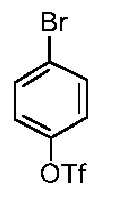


78 % 


95 % 


90 % - Dieses Beispiel beschreibt die Herstellung von Edukten für das erfindungsgemäße Verfahren, welche eine Brom-Abgangsgruppe aufweisen, aus einer Verbindung, die sowohl Triflat, als auch Brom als Abgangsgruppen aufweist. Dabei wird selektiv die Triflatgruppe in der Suzuki-Kupplung umgesetzt.

- Es werden 20.0 g (49.2 mmol) Trifluormethansulfonsäure-8-brom-dibenzofuran-1-yl-ester, 14.8 g (51.6 mmol) N-Phenylcarbazol-3-boronsäure und 13.6 g (98.3 mmol) Kaliumcarbonat in 400 ml Toluol und 100 ml Wasser suspendiert und 20 min lang mit Argon inertisiert. Nach Zugabe von 337 mg (0.37 mmol) Pd2dba3 und 629 mg (1.47 mmol) dppb wird das Gemisch für 48 h zum Rückfluss erhitzt. Nach Abkühlen auf Raumtemperatur wird die wässrige Phase abgetrennt, die organische Phase wird zweimal mit Wasser gewaschen, über Natriumsulfat getrocknet und eingeengt. Der Rückstand wird aus 500 ml Ethanol kristallisiert und als Feststoff erhalten. Ausbeute: 22.0 g (45.1 mmol, 92 %). Reinheit > 98 %.
Claims (15)
- Verfahren zur Herstellung einer sekundären bzw. tertiären Arylaminoverbindung durch eine palladiumkatalysierte Kupplungsreaktion zwischen einer primären bzw. sekundären Arylaminoverbindung und einer Arylverbindung, dadurch gekennzeichnet, dass das Verfahren in Anwesenheit von Lithium-tert-butanolat (LiOtBu) als Base durchgeführt wird.
- Verfahren nach Anspruch 1, dadurch gekennzeichnet, dass als Arylaminoverbindung eine Verbindung gemäß Formel (1) eingesetzt wird,
 R ist gleich oder verschieden bei jedem Auftreten ein aromatisches oder heteroaromatisches Ringsystem mit 5 bis 60 aromatischen Ringatomen, das jeweils durch einen oder mehrere Reste R1 substituiert sein kann;R' ist gleich oder verschieden R oder steht für H oder D; dabei können R und R' direkt oder über eine Gruppe R1 miteinander verknüpft sein und so zusammen mit dem Stickstoffatom, an das sie binden, ein Ringsystem bilden;R1 ist gleich oder verschieden bei jedem Auftreten ausgewählt aus H, D, F, Cl, Br, I, B(OR2)2, CHO, C(=O)R2, CR2=C(R2)2, CN, C(=O)OR2, C(=O)N(R2)2, Si(R2)3, N(R2)2, NO2, P(=O)(R2)2, OSO2R2, OR2, S(=O)R2, S(=O)2R2, einer geradkettigen Alkyl-, Alkoxy- oder Thioalkylgruppe mit 1 bis 20 C-Atomen oder einer verzweigten oder cyclischen Alkyl-, Alkoxy- oder Thioalkylgruppe mit 3 bis 20 C-Atomen oder einer Alkenyl- oder Alkinylgruppe mit 2 bis 20 C-Atomen, wobei die oben genannten Gruppen jeweils mit einem oder mehreren Resten R2 substituiert sein können und wobei eine oder mehrere CH2-Gruppen in den oben genannten Gruppen durch -R2C=CR2-, -C≡C-, Si(R2)2, C=O, C=S, C=NR2, -C(=O)O-, -C(=O)NR2-, NR2, P(=O)(R2), -O-, -S-, SO oder SO2 ersetzt sein können und wobei ein oder mehrere H-Atome in den oben genannten Gruppen durch D, F, Cl, Br, I, CN oder NO2 ersetzt sein können, oder einem aromatischen oder heteroaromatischen Ringsystem mit 5 bis 30 aromatischen Ringatomen, das jeweils durch einen oder mehrere Reste R2 substituiert sein kann, oder einer Aryl- oder Heteroaryloxygruppe mit 5 bis 30 aromatischen Ringatomen, die durch einen oder mehrere Reste R2 substituiert sein kann; dabei können zwei oder mehr Reste R1 miteinander verknüpft sein und so einen Ring bilden;R2 ist gleich oder verschieden bei jedem Auftreten ausgewählt aus H, D, F, Cl, Br, I, B(OR3)2, CHO, C(=O)R3, CR3=C(R3)2, CN, C(=O)OR3, C(=O)N(R3)2, Si(R3)3, N(R3)2, NO2, P(=O)(R3)2, OSO2R3, OR3, S(=O)R3, S(=O)2R3, einer geradkettigen Alkyl-, Alkoxy- oder Thioalkylgruppe mit 1 bis 20 C-Atomen oder einer verzweigten oder cyclischen Alkyl-, Alkoxy- oder Thioalkylgruppe mit 3 bis 20 C-Atomen oder einer Alkenyl- oder Alkinylgruppe mit 2 bis 20 C-Atomen, wobei die oben genannten Gruppen jeweils mit einem oder mehreren Resten R3 substituiert sein können und wobei eine oder mehrere CH2-Gruppen in den oben genannten Gruppen durch -R3C=CR3-, -C≡C-, Si(R3)2, C=O, C=S, C=NR3, -C(=O)O-, -C(=O)NR3-, NR3, P(=O)(R3), -O-, -S-, SO oder SO2 ersetzt sein können und wobei ein oder mehrere H-Atome in den oben genannten Gruppen durch D, F, Cl, Br, I, CN oder NO2 ersetzt sein können, oder einem aromatischen oder heteroaromatischen Ringsystem mit 5 bis 30 aromatischen Ringatomen, das jeweils durch einen oder mehrere Reste R3 substituiert sein kann, oder einer Aryl- oder Heteroaryloxygruppe mit 5 bis 30 aromatischen Ringatomen, die durch einen oder mehrere Reste R3 substituiert sein kann; dabei können zwei oder mehr Reste R2 miteinander verknüpft sein und so einen Ring bilden;R3 ist bei jedem Auftreten gleich oder verschieden H, D, F oder ein aliphatischer, aromatischer oder heteroaromatischer organischer Rest mit 1 bis 20 C-Atomen, in dem auch ein oder mehrere H-Atome durch D oder F ersetzt sein können; dabei können zwei oder mehr Substituenten R3 miteinander verknüpft sein und so einen Ring bilden.
 - Verfahren nach Anspruch 1 oder 2, dadurch gekennzeichnet, dass als Arylverbindung eine Verbindung gemäß Formel (2) eingesetzt wird,
 Ar ist ein aromatisches oder heteroaromatisches Ringsystem mit 5 bis 60 aromatischen Ringatomen, das mit einem oder mehreren Resten R1 substituiert sein kann;X ist bei jedem Auftreten gleich oder verschieden eine Abgangsgruppe;n ist eine ganze Zahl von 1 bis 10.
 - Verfahren nach Anspruch 2 oder 3, dadurch gekennzeichnet, dass R und R', wenn R' nicht für H oder D steht, gleich oder verschieden bei jedem Auftreten ausgewählt sind aus der Gruppe bestehend aus Phenyl, Biphenyl, Terphenyl, Quaterphenyl, Fluorenyl, Spirobifluorenyl, Naphthyl, Indolyl, Benzofuranyl, Benzothienyl, Carbazolyl, Dibenzofuranyl, Dibenzothienyl, Indenocarbazolyl, Indolocarbazolyl, Phenanthryl oder Triphenylenyl, welche jeweils mit einem oder mehreren Resten R1 substituiert sein können.
- Verfahren nach einem oder mehreren der Ansprüche 1 bis 4, dadurch gekennzeichnet, dass die Arylverbindung mit einer Abgangsgruppe substituiert ist und die Abgangsgruppe bzw. die Gruppe X in der Verbindung der Formel (2) ausgewählt ist aus der Gruppe bestehend aus optional substituiertem Alkylsulfonat, optional substituiertem Arylsulfonat, Halogenid und Diazonium.
- Verfahren nach Anspruch 5, dadurch gekennzeichnet, dass die Arylverbindung mit einer Abgangsgruppe substituiert ist und die Abgangsgruppe bzw. die Gruppe X in der Verbindung der Formel (2) ausgewählt ist aus der Gruppe bestehend aus Triflat, Phenylsulfonat und Tosylat.
- Verfahren nach einem oder mehreren der Ansprüche 1 bis 6, dadurch gekennzeichnet, dass das aromatische bzw. heteroaromatische Ringsystem in der Arylverbindung bzw. die Gruppe Ar in der Verbindung der Formel (2) ausgewählt ist aus der Gruppe bestehend aus Phenyl, Biphenyl, Terphenyl, Quaterphenyl, Fluorenyl, Spirobifluorenyl, Naphthyl, Indolyl, Benzofuranyl, Benzothienyl, Carbazolyl, Dibenzofuranyl, Dibenzothienyl, Indenocarbazolyl, Indolocarbazolyl, Phenanthrenyl oder Triphenylenyl, welche jeweils mit einem oder mehreren Resten R1 substituiert sein können.
- Verfahren nach einem oder mehreren der Ansprüche 1 bis 7, dadurch gekennzeichnet, dass Lithium-tert-butanolat in einer Menge von 0.5 bis 10 Äquivalenten, bezogen auf die Stoffmenge an eingesetzter Arylverbindung, eingesetzt wird.
- Verfahren nach einem oder mehreren der Ansprüche 1 bis 8, dadurch gekennzeichnet, dass als Katalysator PdCl2, Pd(OAc)2, (CH3CN)2PdCl2, Bis(dibenzylidenaceton)dipalladium oder Tris(dibenzylidenaceton)dipalladium zusammen mit mindestens einem Liganden eingesetzt wird.
- Verfahren nach einem oder mehreren der Ansprüche 1 bis 9, dadurch gekennzeichnet, dass als Ligand für den Katalysator Phosphine, Phosphite, Amine, Aminophosphine oder N-heterocyclischen Carbene eingesetzt werden.
- Verfahren nach Anspruch 10, dadurch gekennzeichnet, dass das Phosphin ausgewählt ist aus der Gruppe bestehend aus Dicyclohexylphosphino-2',6'-dimethoxybiphenyl, Dicyclohexylphosphino-2',6'-di-iso-propoxybiphenyl, Di-tert-butyl(2',4',6'-triisopropyl-3,6-dimethoxybi-phenyl-2-yl)phosphin, Dicyclohexyl(2',4',6'-triisopropyl-3,6-dimethoxy-biphenyl-2-yl)phosphin, Trimethylphosphin, Triethylphosphin, Tripropylphosphin, Triisopropylphosphin, Tributylphosphin, Tri-tert-butyl-phosphin, Tricyclohexylphosphin, Triphenylphosphin, Di-tert-butyl-chloro-phosphin, Triphenylphosphin, Tri(o-tolyl)phosphin, Triisopropylphosphin, Tricyclohexylphosphin, 2,2'-Bis(diphenylphosphino)-1,1'-bi-naphthyl (BINAP), 1,2-Bis(dimethylphosphino)ethan, 1,2-Bis(diethyl-phosphino)ethan, 1,2-Bis(dipropylphosphino)-ethan, 1,2- Bis(diiso-propylphosphino)ethan, 1,2-Bis(dibutyl-phosphino)ethan, 1,2- Bis(di-cyclohexylphosphino)ethan, 1,3-Bis(dicyclohexyl-phosphino)propan, 1,3-Bis(diisopropylphosphino)propan, 1,4-Bis(diisopropyl-phosphino)-butan, 2,4-Bis(dicyclohexylphosphino)pentan, 1,1'-Bis(diphenyl-phosphino)ferrocen, SPhos, PCy3, Cy-JohnPhos, CataCxium Pcy, APhos, XantPhos, dppf, XPhos und BrettPhos.
- Verfahren nach einem oder mehreren der Ansprüche 9 bis 11, dadurch gekennzeichnet, dass die Palladiumverbindung und der Phosphinligand für Monophosphine in einem Verhältnis Pd : Phosphin von 1 : 1 bis 1 : 4 eingesetzt werden und dass die Palladiumverbindung und der Phosphinligand für Biphosphine in einem Verhältnis Pd : Phosphin von 1 : 0.5 bis 1 : 2 eingesetzt werden.
- Verfahren nach einem oder mehreren der Ansprüche 1 bis 12, dadurch gekennzeichnet, dass das Verfahren in einem oder mehreren aprotischen organischen Lösemitteln, bevorzugt ausgewählt aus Benzol, Toluol, 1,2-Xylol, 1,3-Xylol, 1,4-Xylol, Mesitylen, Tetrahydrofuran (THF), 1,4-Dioxan, Dimethoxyethan (dme) und Bis(2-methoxyethyl)ether (diglyme), durchgeführt wird.
- Verfahren nach einem oder mehreren der Ansprüche 1 bis 13, dadurch gekennzeichnet, dass das Verfahren unter Inertgasatmosphäre durchgeführt wird.
- Verwendung von LiOtBu als Base in einer palladiumkatalysierten Kupplungsreaktion zwischen einer Arylaminoverbindung und einer Arylverbindung.
Applications Claiming Priority (2)
| Application Number | Priority Date | Filing Date | Title |
|---|---|---|---|
| EP18181706 | 2018-07-04 | ||
| PCT/EP2019/067535 WO2020007770A1 (de) | 2018-07-04 | 2019-07-01 | Verfahren zur herstellung von arylaminen |
Publications (2)
| Publication Number | Publication Date |
|---|---|
| EP3818038A1 EP3818038A1 (de) | 2021-05-12 |
| EP3818038B1 true EP3818038B1 (de) | 2022-08-03 |
Family
ID=62873249
Family Applications (1)
| Application Number | Title | Priority Date | Filing Date |
|---|---|---|---|
| EP19733807.2A Active EP3818038B1 (de) | 2018-07-04 | 2019-07-01 | Verfahren zur herstellung von arylaminen |
Country Status (6)
| Country | Link |
|---|---|
| US (1) | US20220127251A1 (de) |
| EP (1) | EP3818038B1 (de) |
| JP (1) | JP2021529207A (de) |
| KR (1) | KR102785431B1 (de) |
| CN (1) | CN112469690B (de) |
| WO (1) | WO2020007770A1 (de) |
Families Citing this family (2)
| Publication number | Priority date | Publication date | Assignee | Title |
|---|---|---|---|---|
| CN110669040A (zh) * | 2019-09-26 | 2020-01-10 | 上海天马有机发光显示技术有限公司 | 化合物、显示面板和显示装置 |
| CN116425638B (zh) * | 2023-06-13 | 2023-12-05 | 北京海望氢能科技有限公司 | 一种n-烷基咔唑的制备方法 |
Family Cites Families (14)
| Publication number | Priority date | Publication date | Assignee | Title |
|---|---|---|---|---|
| US5576460A (en) | 1994-07-27 | 1996-11-19 | Massachusetts Institute Of Technology | Preparation of arylamines |
| US6307087B1 (en) | 1998-07-10 | 2001-10-23 | Massachusetts Institute Of Technology | Ligands for metals and improved metal-catalyzed processes based thereon |
| JP5244399B2 (ja) | 2005-01-10 | 2013-07-24 | マサチューセッツ インスティテュート オブ テクノロジー | 遷移金属を触媒とする炭素−窒素結合および炭素−炭素結合形成反応 |
| CA2556850A1 (en) | 2005-08-24 | 2007-02-24 | Total Synthesis, Ltd. | Transition metal complexes of n-heterocyclic carbenes, method of preparation and use in transition metal catalyzed organic transformations |
| JP5374966B2 (ja) * | 2008-08-25 | 2013-12-25 | 三菱化学株式会社 | アミン化合物の製造方法、並びに電子写真感光体、感光体カートリッジ、及び画像形成装置の製造方法 |
| WO2011008725A2 (en) | 2009-07-13 | 2011-01-20 | Massachusetts Institute Of Technology | Metal-catalyzed carbon-fluorine bond formation |
| JP5796487B2 (ja) * | 2011-08-09 | 2015-10-21 | 東ソー株式会社 | 不均一触媒およびそれを用いたトリアリールアミン化合物の製造方法 |
| US9499474B2 (en) * | 2011-11-11 | 2016-11-22 | Merck Patent Gmbh | Process for producing arylamines |
| JP2017531635A (ja) * | 2014-10-08 | 2017-10-26 | ダウ グローバル テクノロジーズ エルエルシー | フルオロスルホネート化合物をアミン化合物にカップリングさせるための方法 |
| WO2016143868A1 (ja) * | 2015-03-10 | 2016-09-15 | 国立大学法人北海道大学 | 高分子遷移金属錯体、その製造方法及びその利用 |
| CA2979101C (en) * | 2015-06-05 | 2023-01-24 | Dalhousie University | Ligand for catalyst or pre-catalyst and method of forming c(sp2)-n bond |
| EP3176161A1 (de) * | 2015-12-02 | 2017-06-07 | Umicore AG & Co. KG | Buchwald-hartwig arylierungsverfahren zur herstellung tertiärer arylamine |
| KR102740106B1 (ko) * | 2016-03-03 | 2024-12-09 | 메르크 파텐트 게엠베하 | 유기 전계 발광 장치용 재료 |
| JP7023176B2 (ja) * | 2018-05-09 | 2022-02-21 | 公益財団法人相模中央化学研究所 | 9-(1-ナフチル)-9h-カルバゾール誘導体の製造方法 |
-
2019
- 2019-07-01 WO PCT/EP2019/067535 patent/WO2020007770A1/de not_active Ceased
- 2019-07-01 CN CN201980044258.2A patent/CN112469690B/zh active Active
- 2019-07-01 EP EP19733807.2A patent/EP3818038B1/de active Active
- 2019-07-01 US US17/257,738 patent/US20220127251A1/en not_active Abandoned
- 2019-07-01 JP JP2021500062A patent/JP2021529207A/ja active Pending
- 2019-07-01 KR KR1020217003013A patent/KR102785431B1/ko active Active
Also Published As
| Publication number | Publication date |
|---|---|
| US20220127251A1 (en) | 2022-04-28 |
| KR20210029215A (ko) | 2021-03-15 |
| JP2021529207A (ja) | 2021-10-28 |
| WO2020007770A1 (de) | 2020-01-09 |
| EP3818038A1 (de) | 2021-05-12 |
| KR102785431B1 (ko) | 2025-03-21 |
| CN112469690A (zh) | 2021-03-09 |
| CN112469690B (zh) | 2024-04-16 |
Similar Documents
| Publication | Publication Date | Title |
|---|---|---|
| EP3423542B1 (de) | Materialien für organische elektrolumineszenzvorrichtungen | |
| EP3174954B1 (de) | Materialien für organische elektrolumineszenzvorrichtungen | |
| EP4416155A1 (de) | Materialien für organische elektrolumineszenzvorrichtungen | |
| WO2016023608A1 (de) | Materialien für organische elektrolumineszenzvorrichtungen | |
| DE102005043163A1 (de) | Verbindungen für organische elektronische Vorrichtungen | |
| EP3140302A1 (de) | Materialien für organische elektrolumineszenzvorrichtungen | |
| EP1807481A1 (de) | Organische elektrolumineszenzvorrichtung | |
| DE102007053771A1 (de) | Organische Elektrolumineszenzvorrichtungen | |
| WO2015197156A1 (de) | Materialien für organische elektrolumineszenzvorrichtungen | |
| EP3103148B1 (de) | Organische moleküle zur verwendung in optoelektronischen bauelementen | |
| EP2776386B1 (de) | Verfahren zur herstellung von arylaminen | |
| WO2021185829A1 (de) | Heterocyclische verbindungen für organische elektrolumineszenzvorrichtungen | |
| EP4410073A1 (de) | Organische elektrolumineszierende vorrichtung | |
| EP3818038A1 (de) | Verfahren zur herstellung von arylaminen | |
| WO2023078812A1 (de) | Benzofuro[3,2-d]pyrimidin-2,4-dicarbonitril-derivate und ähnliche verbindungen für organische elektrolumineszenzvorrichtungen | |
| EP4330257B1 (de) | Stickstoffhaltige, heterocyclische verbindungen für organische elektrolumineszenzvorrichtungen | |
| WO2019002183A1 (de) | Verfahren zur herstellung substituierter stickstoffhaltiger heterocyclen | |
| EP4652169A1 (de) | Heterocyclen für organische elektrolumineszenzvorrichtungen | |
| EP4612157A2 (de) | Stickstoffhaltige heterocyclen für organische elektrolumineszenzvorrichtungen | |
| DE102005034575A1 (de) | Verfahren zur C-C-Kupplung aktivierter Aromaten | |
| EP4649084A1 (de) | Stickstoffhaltige heterocyclen für organische elektrolumineszenzvorrichtungen | |
| WO2024056625A1 (de) | Verfahren zur herstellung von materialien für die verwendung in elektronischen vorrichtungen | |
| WO2025181124A1 (de) | Materialien für organische elektrolumineszenzvorrichtungen | |
| WO2023099430A1 (de) | Triphenylen-triazin-dibenzofuran/dibenzothiophen-derivate für organische elektrolumineszenzvorrichtungen |
Legal Events
| Date | Code | Title | Description |
|---|---|---|---|
| STAA | Information on the status of an ep patent application or granted ep patent |
Free format text: STATUS: UNKNOWN |
|
| STAA | Information on the status of an ep patent application or granted ep patent |
Free format text: STATUS: THE INTERNATIONAL PUBLICATION HAS BEEN MADE |
|
| PUAI | Public reference made under article 153(3) epc to a published international application that has entered the european phase |
Free format text: ORIGINAL CODE: 0009012 |
|
| STAA | Information on the status of an ep patent application or granted ep patent |
Free format text: STATUS: REQUEST FOR EXAMINATION WAS MADE |
|
| 17P | Request for examination filed |
Effective date: 20201228 |
|
| AK | Designated contracting states |
Kind code of ref document: A1 Designated state(s): AL AT BE BG CH CY CZ DE DK EE ES FI FR GB GR HR HU IE IS IT LI LT LU LV MC MK MT NL NO PL PT RO RS SE SI SK SM TR |
|
| DAV | Request for validation of the european patent (deleted) | ||
| DAX | Request for extension of the european patent (deleted) | ||
| REG | Reference to a national code |
Ref country code: DE Ref legal event code: R079 Ref document number: 502019005156 Country of ref document: DE Free format text: PREVIOUS MAIN CLASS: C07C0209220000 Ipc: C07B0037040000 |
|
| GRAP | Despatch of communication of intention to grant a patent |
Free format text: ORIGINAL CODE: EPIDOSNIGR1 |
|
| STAA | Information on the status of an ep patent application or granted ep patent |
Free format text: STATUS: GRANT OF PATENT IS INTENDED |
|
| RIC1 | Information provided on ipc code assigned before grant |
Ipc: C07C 309/65 20060101ALI20220215BHEP Ipc: C07C 211/58 20060101ALI20220215BHEP Ipc: C07C 211/56 20060101ALI20220215BHEP Ipc: C07C 211/55 20060101ALI20220215BHEP Ipc: C07C 211/54 20060101ALI20220215BHEP Ipc: C07D 405/04 20060101ALI20220215BHEP Ipc: C07D 209/82 20060101ALI20220215BHEP Ipc: C07C 303/30 20060101ALI20220215BHEP Ipc: C07C 213/08 20060101ALI20220215BHEP Ipc: C07C 209/22 20060101ALI20220215BHEP Ipc: C07B 43/04 20060101ALI20220215BHEP Ipc: C07B 37/04 20060101AFI20220215BHEP |
|
| INTG | Intention to grant announced |
Effective date: 20220316 |
|
| GRAS | Grant fee paid |
Free format text: ORIGINAL CODE: EPIDOSNIGR3 |
|
| GRAA | (expected) grant |
Free format text: ORIGINAL CODE: 0009210 |
|
| STAA | Information on the status of an ep patent application or granted ep patent |
Free format text: STATUS: THE PATENT HAS BEEN GRANTED |
|
| AK | Designated contracting states |
Kind code of ref document: B1 Designated state(s): AL AT BE BG CH CY CZ DE DK EE ES FI FR GB GR HR HU IE IS IT LI LT LU LV MC MK MT NL NO PL PT RO RS SE SI SK SM TR |
|
| REG | Reference to a national code |
Ref country code: AT Ref legal event code: REF Ref document number: 1508621 Country of ref document: AT Kind code of ref document: T Effective date: 20220815 Ref country code: CH Ref legal event code: EP |
|
| REG | Reference to a national code |
Ref country code: DE Ref legal event code: R096 Ref document number: 502019005156 Country of ref document: DE |
|
| REG | Reference to a national code |
Ref country code: IE Ref legal event code: FG4D Free format text: LANGUAGE OF EP DOCUMENT: GERMAN |
|
| REG | Reference to a national code |
Ref country code: LT Ref legal event code: MG9D |
|
| REG | Reference to a national code |
Ref country code: NL Ref legal event code: MP Effective date: 20220803 |
|
| PG25 | Lapsed in a contracting state [announced via postgrant information from national office to epo] |
Ref country code: SE Free format text: LAPSE BECAUSE OF FAILURE TO SUBMIT A TRANSLATION OF THE DESCRIPTION OR TO PAY THE FEE WITHIN THE PRESCRIBED TIME-LIMIT Effective date: 20220803 Ref country code: RS Free format text: LAPSE BECAUSE OF FAILURE TO SUBMIT A TRANSLATION OF THE DESCRIPTION OR TO PAY THE FEE WITHIN THE PRESCRIBED TIME-LIMIT Effective date: 20220803 Ref country code: PT Free format text: LAPSE BECAUSE OF FAILURE TO SUBMIT A TRANSLATION OF THE DESCRIPTION OR TO PAY THE FEE WITHIN THE PRESCRIBED TIME-LIMIT Effective date: 20221205 Ref country code: NO Free format text: LAPSE BECAUSE OF FAILURE TO SUBMIT A TRANSLATION OF THE DESCRIPTION OR TO PAY THE FEE WITHIN THE PRESCRIBED TIME-LIMIT Effective date: 20221103 Ref country code: NL Free format text: LAPSE BECAUSE OF FAILURE TO SUBMIT A TRANSLATION OF THE DESCRIPTION OR TO PAY THE FEE WITHIN THE PRESCRIBED TIME-LIMIT Effective date: 20220803 Ref country code: LV Free format text: LAPSE BECAUSE OF FAILURE TO SUBMIT A TRANSLATION OF THE DESCRIPTION OR TO PAY THE FEE WITHIN THE PRESCRIBED TIME-LIMIT Effective date: 20220803 Ref country code: LT Free format text: LAPSE BECAUSE OF FAILURE TO SUBMIT A TRANSLATION OF THE DESCRIPTION OR TO PAY THE FEE WITHIN THE PRESCRIBED TIME-LIMIT Effective date: 20220803 Ref country code: FI Free format text: LAPSE BECAUSE OF FAILURE TO SUBMIT A TRANSLATION OF THE DESCRIPTION OR TO PAY THE FEE WITHIN THE PRESCRIBED TIME-LIMIT Effective date: 20220803 Ref country code: ES Free format text: LAPSE BECAUSE OF FAILURE TO SUBMIT A TRANSLATION OF THE DESCRIPTION OR TO PAY THE FEE WITHIN THE PRESCRIBED TIME-LIMIT Effective date: 20220803 |
|
| PG25 | Lapsed in a contracting state [announced via postgrant information from national office to epo] |
Ref country code: PL Free format text: LAPSE BECAUSE OF FAILURE TO SUBMIT A TRANSLATION OF THE DESCRIPTION OR TO PAY THE FEE WITHIN THE PRESCRIBED TIME-LIMIT Effective date: 20220803 Ref country code: IS Free format text: LAPSE BECAUSE OF FAILURE TO SUBMIT A TRANSLATION OF THE DESCRIPTION OR TO PAY THE FEE WITHIN THE PRESCRIBED TIME-LIMIT Effective date: 20221203 Ref country code: HR Free format text: LAPSE BECAUSE OF FAILURE TO SUBMIT A TRANSLATION OF THE DESCRIPTION OR TO PAY THE FEE WITHIN THE PRESCRIBED TIME-LIMIT Effective date: 20220803 Ref country code: GR Free format text: LAPSE BECAUSE OF FAILURE TO SUBMIT A TRANSLATION OF THE DESCRIPTION OR TO PAY THE FEE WITHIN THE PRESCRIBED TIME-LIMIT Effective date: 20221104 |
|
| PG25 | Lapsed in a contracting state [announced via postgrant information from national office to epo] |
Ref country code: SM Free format text: LAPSE BECAUSE OF FAILURE TO SUBMIT A TRANSLATION OF THE DESCRIPTION OR TO PAY THE FEE WITHIN THE PRESCRIBED TIME-LIMIT Effective date: 20220803 Ref country code: RO Free format text: LAPSE BECAUSE OF FAILURE TO SUBMIT A TRANSLATION OF THE DESCRIPTION OR TO PAY THE FEE WITHIN THE PRESCRIBED TIME-LIMIT Effective date: 20220803 Ref country code: DK Free format text: LAPSE BECAUSE OF FAILURE TO SUBMIT A TRANSLATION OF THE DESCRIPTION OR TO PAY THE FEE WITHIN THE PRESCRIBED TIME-LIMIT Effective date: 20220803 Ref country code: CZ Free format text: LAPSE BECAUSE OF FAILURE TO SUBMIT A TRANSLATION OF THE DESCRIPTION OR TO PAY THE FEE WITHIN THE PRESCRIBED TIME-LIMIT Effective date: 20220803 |
|
| REG | Reference to a national code |
Ref country code: DE Ref legal event code: R097 Ref document number: 502019005156 Country of ref document: DE |
|
| PG25 | Lapsed in a contracting state [announced via postgrant information from national office to epo] |
Ref country code: SK Free format text: LAPSE BECAUSE OF FAILURE TO SUBMIT A TRANSLATION OF THE DESCRIPTION OR TO PAY THE FEE WITHIN THE PRESCRIBED TIME-LIMIT Effective date: 20220803 Ref country code: EE Free format text: LAPSE BECAUSE OF FAILURE TO SUBMIT A TRANSLATION OF THE DESCRIPTION OR TO PAY THE FEE WITHIN THE PRESCRIBED TIME-LIMIT Effective date: 20220803 |
|
| PLBE | No opposition filed within time limit |
Free format text: ORIGINAL CODE: 0009261 |
|
| STAA | Information on the status of an ep patent application or granted ep patent |
Free format text: STATUS: NO OPPOSITION FILED WITHIN TIME LIMIT |
|
| P01 | Opt-out of the competence of the unified patent court (upc) registered |
Effective date: 20230519 |
|
| PG25 | Lapsed in a contracting state [announced via postgrant information from national office to epo] |
Ref country code: AL Free format text: LAPSE BECAUSE OF FAILURE TO SUBMIT A TRANSLATION OF THE DESCRIPTION OR TO PAY THE FEE WITHIN THE PRESCRIBED TIME-LIMIT Effective date: 20220803 |
|
| 26N | No opposition filed |
Effective date: 20230504 |
|
| PG25 | Lapsed in a contracting state [announced via postgrant information from national office to epo] |
Ref country code: SI Free format text: LAPSE BECAUSE OF FAILURE TO SUBMIT A TRANSLATION OF THE DESCRIPTION OR TO PAY THE FEE WITHIN THE PRESCRIBED TIME-LIMIT Effective date: 20220803 |
|
| PG25 | Lapsed in a contracting state [announced via postgrant information from national office to epo] |
Ref country code: MC Free format text: LAPSE BECAUSE OF FAILURE TO SUBMIT A TRANSLATION OF THE DESCRIPTION OR TO PAY THE FEE WITHIN THE PRESCRIBED TIME-LIMIT Effective date: 20220803 |
|
| PG25 | Lapsed in a contracting state [announced via postgrant information from national office to epo] |
Ref country code: MC Free format text: LAPSE BECAUSE OF FAILURE TO SUBMIT A TRANSLATION OF THE DESCRIPTION OR TO PAY THE FEE WITHIN THE PRESCRIBED TIME-LIMIT Effective date: 20220803 |
|
| REG | Reference to a national code |
Ref country code: CH Ref legal event code: PL |
|
| REG | Reference to a national code |
Ref country code: BE Ref legal event code: MM Effective date: 20230731 |
|
| PG25 | Lapsed in a contracting state [announced via postgrant information from national office to epo] |
Ref country code: LU Free format text: LAPSE BECAUSE OF NON-PAYMENT OF DUE FEES Effective date: 20230701 |
|
| GBPC | Gb: european patent ceased through non-payment of renewal fee |
Effective date: 20230701 |
|
| PG25 | Lapsed in a contracting state [announced via postgrant information from national office to epo] |
Ref country code: LU Free format text: LAPSE BECAUSE OF NON-PAYMENT OF DUE FEES Effective date: 20230701 |
|
| REG | Reference to a national code |
Ref country code: IE Ref legal event code: MM4A |
|
| PG25 | Lapsed in a contracting state [announced via postgrant information from national office to epo] |
Ref country code: CH Free format text: LAPSE BECAUSE OF NON-PAYMENT OF DUE FEES Effective date: 20230731 Ref country code: GB Free format text: LAPSE BECAUSE OF NON-PAYMENT OF DUE FEES Effective date: 20230701 |
|
| PG25 | Lapsed in a contracting state [announced via postgrant information from national office to epo] |
Ref country code: IT Free format text: LAPSE BECAUSE OF FAILURE TO SUBMIT A TRANSLATION OF THE DESCRIPTION OR TO PAY THE FEE WITHIN THE PRESCRIBED TIME-LIMIT Effective date: 20220803 Ref country code: FR Free format text: LAPSE BECAUSE OF NON-PAYMENT OF DUE FEES Effective date: 20230731 Ref country code: BE Free format text: LAPSE BECAUSE OF NON-PAYMENT OF DUE FEES Effective date: 20230731 |
|
| PG25 | Lapsed in a contracting state [announced via postgrant information from national office to epo] |
Ref country code: IE Free format text: LAPSE BECAUSE OF NON-PAYMENT OF DUE FEES Effective date: 20230701 |
|
| PG25 | Lapsed in a contracting state [announced via postgrant information from national office to epo] |
Ref country code: IE Free format text: LAPSE BECAUSE OF NON-PAYMENT OF DUE FEES Effective date: 20230701 |
|
| PG25 | Lapsed in a contracting state [announced via postgrant information from national office to epo] |
Ref country code: BG Free format text: LAPSE BECAUSE OF FAILURE TO SUBMIT A TRANSLATION OF THE DESCRIPTION OR TO PAY THE FEE WITHIN THE PRESCRIBED TIME-LIMIT Effective date: 20220803 |
|
| PG25 | Lapsed in a contracting state [announced via postgrant information from national office to epo] |
Ref country code: BG Free format text: LAPSE BECAUSE OF FAILURE TO SUBMIT A TRANSLATION OF THE DESCRIPTION OR TO PAY THE FEE WITHIN THE PRESCRIBED TIME-LIMIT Effective date: 20220803 |
|
| PG25 | Lapsed in a contracting state [announced via postgrant information from national office to epo] |
Ref country code: CY Free format text: LAPSE BECAUSE OF FAILURE TO SUBMIT A TRANSLATION OF THE DESCRIPTION OR TO PAY THE FEE WITHIN THE PRESCRIBED TIME-LIMIT; INVALID AB INITIO Effective date: 20190701 |
|
| PG25 | Lapsed in a contracting state [announced via postgrant information from national office to epo] |
Ref country code: HU Free format text: LAPSE BECAUSE OF FAILURE TO SUBMIT A TRANSLATION OF THE DESCRIPTION OR TO PAY THE FEE WITHIN THE PRESCRIBED TIME-LIMIT; INVALID AB INITIO Effective date: 20190701 |
|
| REG | Reference to a national code |
Ref country code: AT Ref legal event code: MM01 Ref document number: 1508621 Country of ref document: AT Kind code of ref document: T Effective date: 20240701 |
|
| PGFP | Annual fee paid to national office [announced via postgrant information from national office to epo] |
Ref country code: DE Payment date: 20250620 Year of fee payment: 7 |
|
| PG25 | Lapsed in a contracting state [announced via postgrant information from national office to epo] |
Ref country code: AT Free format text: LAPSE BECAUSE OF NON-PAYMENT OF DUE FEES Effective date: 20240701 |
|
| PG25 | Lapsed in a contracting state [announced via postgrant information from national office to epo] |
Ref country code: TR Free format text: LAPSE BECAUSE OF FAILURE TO SUBMIT A TRANSLATION OF THE DESCRIPTION OR TO PAY THE FEE WITHIN THE PRESCRIBED TIME-LIMIT Effective date: 20220803 |
|
| PGFP | Annual fee paid to national office [announced via postgrant information from national office to epo] |
Ref country code: AT Payment date: 20260410 Year of fee payment: 5 |