EP3816263A2 - Verfahren zur hemmung der staubentwicklung, bodenstabilisatorzusammensetzung und diese enthaltende sprühvorrichtung - Google Patents
Verfahren zur hemmung der staubentwicklung, bodenstabilisatorzusammensetzung und diese enthaltende sprühvorrichtung Download PDFInfo
- Publication number
- EP3816263A2 EP3816263A2 EP19855053.5A EP19855053A EP3816263A2 EP 3816263 A2 EP3816263 A2 EP 3816263A2 EP 19855053 A EP19855053 A EP 19855053A EP 3816263 A2 EP3816263 A2 EP 3816263A2
- Authority
- EP
- European Patent Office
- Prior art keywords
- lysine
- soil stabilizer
- soil
- composition
- stabilizer composition
- Prior art date
- Legal status (The legal status is an assumption and is not a legal conclusion. Google has not performed a legal analysis and makes no representation as to the accuracy of the status listed.)
- Withdrawn
Links
Images
Classifications
-
- A—HUMAN NECESSITIES
- A01—AGRICULTURE; FORESTRY; ANIMAL HUSBANDRY; HUNTING; TRAPPING; FISHING
- A01B—SOIL WORKING IN AGRICULTURE OR FORESTRY; PARTS, DETAILS, OR ACCESSORIES OF AGRICULTURAL MACHINES OR IMPLEMENTS, IN GENERAL
- A01B79/00—Methods for working soil
-
- C—CHEMISTRY; METALLURGY
- C09—DYES; PAINTS; POLISHES; NATURAL RESINS; ADHESIVES; COMPOSITIONS NOT OTHERWISE PROVIDED FOR; APPLICATIONS OF MATERIALS NOT OTHERWISE PROVIDED FOR
- C09K—MATERIALS FOR MISCELLANEOUS APPLICATIONS, NOT PROVIDED FOR ELSEWHERE
- C09K17/00—Soil-conditioning materials or soil-stabilising materials
- C09K17/14—Soil-conditioning materials or soil-stabilising materials containing organic compounds only
-
- C—CHEMISTRY; METALLURGY
- C09—DYES; PAINTS; POLISHES; NATURAL RESINS; ADHESIVES; COMPOSITIONS NOT OTHERWISE PROVIDED FOR; APPLICATIONS OF MATERIALS NOT OTHERWISE PROVIDED FOR
- C09K—MATERIALS FOR MISCELLANEOUS APPLICATIONS, NOT PROVIDED FOR ELSEWHERE
- C09K3/00—Materials not provided for elsewhere
- C09K3/22—Materials not provided for elsewhere for dust-laying or dust-absorbing
Definitions
- the present application relates to a method of suppressing dust generation, a soil stabilizer composition, and a spraying device including the soil stabilizer composition.
- Soil stabilizers generally contain inorganic salts to suppress dust generated in the soil or contain water-soluble polymers to improve the water absorbing property of the soil, as major components.
- Inorganic salts are easily removed from the surface horizon by rain and the like.
- Inorganic salt soil stabilizers such as MgCl 2 require continuous water supply to maintain dust suppression activity.
- inorganic soil stabilizers are deposited on the surface of the soil as a crystalline salt.
- inorganic soil stabilizers themselves are the source of the dust.
- Inorganic salt soil stabilizers are dissolved by rain and are easily removed from the surface horizon and flow into the river, etc., and thus have a negative influence on the aquatic ecosystem of, for example, the river.
- inorganic salt soil stabilizers corrode roads, steel structures, etc. existing on the surface of the soil to reduce their durability. The use of excessive inorganic salt soil stabilizers may cause environmental problems such as soil acidification and plant death.
- Aqueous polymer soil stabilizers require a long time to decompose in the soil, and aqueous polymers and/or decomposers thereof may act as toxic components to the soil ecosystem, causing problems of environmental pollution.
- One aspect of the present disclosure is to provide a method of suppressing dust generation that provides an excellent dust suppression capability.
- Another aspect of the present disclosure is to provide a soil stabilizer composition that provides an excellent dust suppression capability and water-holding properties.
- Another aspect of the present application is to provide a spraying device including a soil stabilizer composition.
- a method of suppressing dust generation including preparing a soil stabilizer composition including a salt of lysine and citric acid; and a solvent; and spraying the soil stabilizer composition on soil.
- a soil stabilizer composition including a salt of lysine and citric acid; and a solvent.
- a spraying device including the soil stabilizer composition.
- the method of suppressing dust generation according to one embodiment provides excellent dust suppression capability by using a novel soil stabilizer composition.
- the soil stabilizer composition according to another embodiment provides excellent dust suppression capability and hygroscopicity at the same time by having a novel composition containing an aqueous low molecular weight material as a main component.
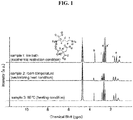
- FIG.1 shows the 1 H nuclear magnetic resonance spectrum (NMR) analysis results according to Reference Example 6.
- adheresion refers to a tendency in which two different objects (except for gas) come close or contact each other and then pull each other.
- adheresion refers to a tendency in which two different objects (except for gases) require certain force (or work) to separate after they come close or contact each other.
- viscoelasticity refers to a tendency in which when a force is applied to an object, a flow without a restoring force and an elastic deformation having a restoring force occur simultaneously, with respect to deformation.
- Materials with viscoelasticity have both solid and liquid properties.
- viscosity used herein is derived from the internal friction between molecules and refers to a property to interfere with the flow of any material. Friction is the force that tries to prevent the difference in the distribution of flow velocity. Adhesion and viscosity are different properties. Materials with high viscosity may have little adhesion, and materials with low viscosity may have high adhesion.
- the "soil stabilizer composition” is used to suppress the generation of fugitive dust and to suppress erosion by changing the binding of the soil particles or interparticle gaps so as to improve the physical and/or chemical properties of the soil, thereby ultimately stabilizing the soil.
- soil used herein includes, in addition to the earth's surface or underground natural soils, dirts, or ground, laminates, for example, natural minerals such as coal, iron ore, calcium oxide, or the like; aggregates such as sand, gravel, or the like; processed minerals such as coke, cement, calcium hydroxide, or the like; synthetic compounds such as fertilizers or the like; and natural organic materials such as grains or the like.
- the soil contains particles or grains of a size that are scattered by wind or the like.
- fugitive dust refers to dust directly discharged to the atmosphere without an outlet from the source thereof.
- a soil stabilizer composition includes a salt of lysine and a salt of the citric acid; and a solvent.
- the salt of lysine and citric acid is a low molecular weight substance, but provide adhesion.
- the salt of lysine and citric acid is located between soil particles at the surface of the soil and/or inside the soil to bind them to stabilize the soil. Therefore, the dust generated from the soil is suppressed.
- a salt of lysine and citric acid have viscosity, and thus have water resistance so that they are not easily removed from inside the soil and/or the surface of the soil.
- the soil stabilizer provides soil stabilizing effects for a long time.
- the salt of lysine and citric acid binds to water in an aqueous solution and holds moisture inside the soil, and thus, provides soil stabilization effects for a long time.
- the salt of lysine and citric acid is aqueous salts, it absorbs moisture in the air or inside the soil and has a capacity of binding to water and thus, prevents rapid drying of the soil. Since the salt of lysine and citric acid is low molecular weight substances, they are easily decomposed compared to polymers and are harmless to life and the environment, and thus, are environmentally friendly.
- the soil stabilizer composition further includes at least one selected from, for example, a thickener, a tackifier, and a stabilizer.
- the thickener increases the viscosity of the soil stabilizer composition.
- the thickener may be, for example, at least one selected from xanthan gum, guar gum, arabic gum, tragacanth gum, galactan, carob gum, karaya gum, carrageenan, acacia gum, mannan, quince seeds (marmelo), algae colloid (algae extract), starch (derived from rice, corn, potatoes, and the like), glycyrrhizin, alginin, sodium alginate, collagen, alginate, gelatin, Furcellaran, casein, locust bean gum, chitosan, albumin, dextran, succinoglucan, pullulan, tragacanthin, hyaluronic acid, pectin, alginic acid, agar, galactomannans, beta-cyclodextrin, amylase, polyethylene oxide(PEO), polyethylene glycol(PEG), polyvinylpyrrol
- An amount of the thickener in the soil stabilizer composition may be, based on 100 parts by weight, 10 parts by weight or less, 9 parts by weight or less, 8 parts by weight or less, 7 parts by weight or less, 6 parts by weight or less, 5 parts by weight or less, 4 parts by weight or less, 3 parts by weight or less, 2 parts by weight or less, 1 part by weight or less, or 0.1 parts by weight or less. Since the soil stabilizer composition has such ranges of thickener, increased dust suppression capability and/or water-holding capacities may be provided.
- the tackifier may increase the adhesion of the soil stabilizer composition.
- the tackifier may include at least one selected from: rosin and its modified products, such as rosin, hydrogenated rosin, polymerized rosin, male rosin, rosin glycerin, modified phenolic resin, rosin acid, rosin ester, and the like; terpene-based resin, such as terpene resin, terpene-phenol resin, terpene-styrene resin, and the like; petroleum resin, such as C5 petroleum resin, C9 petroleum resin, bicyclic ronadiene petroleum resin, hydrogenated petroleum resin, and the like; resin emulsion, such as rosin emulsion, TPR water based resin, 2402 resin emulsion, petroleum resin emulsion, cumarone indene resin, and the like; phenolic resin, such as cashew oil modified phenolic resin, tall oil modified phenolic resin, and the like; and polymethyls
- An amount of the tackifier in the soil stabilizer composition may be, based on 100 parts by weight, 10 parts by weight or less, 9 parts by weight or less, 8 parts by weight or less, 7 parts by weight or less, 6 parts by weight or less, 5 parts by weight or less, 4 parts by weight or less, 3 parts by weight or less, 2 parts by weight or less, 1 part by weight or less, or 0.1 parts by weight or less. Since the soil stabilizer composition has such ranges of tackifier, increased dust suppression capability and/or water-holding capacities may be provided.
- the stabilizer for example, increases phase stability of the soil stabilizer composition by enhancing dispersion of active components of the soil stabilizer composition in aqueous composition solutions.
- the stabilizer may include, for example, at least one selected from monohydric alcohols, polyhydric alcohols, and polyhydric amines.
- the stabilizer may include at least one selected from, for example, glycerol, alkylene glycol, dialkylene glycol, benzenediol, benzenetriol, dialcoholamine, trialcoholamine, arabitol, mannitol, isomalt, xylitol, sorbitol, maltitol, erythritol, ribitol, dulsitol, lactitol, trytol, iditol, polyglycitol, methanol, ethanol, propane-2-ol, butan-1-ol, pentan-1ol, ethane-1,2-diol, propane-1,2-diol, propane-1,2,3-triol, butane-1,3-diol, butane-1,2,3,4-tetraol, pentane-1,2,3,4,5-pentol, hexane-1,2,3,4,5,6-hexol, h
- An amount of the stabilizer in the soil stabilizer composition may be, based on 100 parts by weight of the soil stabilizer composition, 10 parts by weight or less, 9 parts by weight or less, 8 parts by weight or less, 7 parts by weight or less, 6 parts by weight or less, 5 parts by weight or less, 4 parts by weight or less, 3 parts by weight or less, 2 parts by weight or less, 1 part by weight or less, or 0.1 parts by weight or less. Since the soil stabilizer composition has such ranges of stabilizer, increased dust suppression capability and/or water-holding capacities may be provided.
- the amount of the salt of lysine and citric acid in the soil stabilizer composition may be, based on a total weight of an organic solid content, 0.1 wt% or more, 0.5 wt% or more, 1 wt% or more, 2.5 wt% or more, 5 wt% or more, 10 wt% or more, 20 wt% or more, 30 wt% or more, 40 wt% or more, 50 wt% or more, 60 wt% or more, 70 wt% or more, 80 wt% or more, or 90 wt% or more.
- the sum of an amount of citric acid and an amount of lysine may be from about 0.1 parts by weight to about 100 parts by weight, about 0.5 parts by weight to about 100 parts by weight, about 1 part by weight to about 100 parts by weight, about 2.5 parts by weight to about 100 parts by weight, about 5 parts by weight to about 100 parts by weight, about 10 parts by weight to about 100 parts by weight, about 20 parts by weight to about 100 parts by weight, about 30 parts by weight to about 100 parts by weight, about 40 parts by weight to about 100 parts by weight, about 50 parts by weight to about 100 parts by weight, about 60 parts by weight to about 100 parts by weight, about 70 parts by weight to about 99 parts by weight, about 80 parts by weight to about 98 parts by weight, or about 85 parts by weight to about 97 parts by weight. Since the salt of lysine and citric acid has such ranges, dust suppression capability and/or water-holding capacities may be further improved.
- the soil stabilizer composition may be free from precipitates. Since the soil stabilizer composition does not contain precipitates, improved dust suppression capability and/or water-holding capacities may be obtained.
- Precipitates may be precipitates of at least one selected from lysine, and citric acid.
- these precipitates may include a case in which, as shown in Reaction Scheme 1, an insoluble salt (AB(s)) is obtained due to a chemical change of a lysine aqueous solution (A(aq)) and a citric acid aqueous solution (B(aq)), and a case in which, as shown in Reaction Scheme 2, lysine solid (A(s)) or citric acid solid (B(s)) precipitates from the lysine aqueous solution (A(aq)) or the citric acid aqueous solution (B(aq)) or lysine solid (A(s)) or citric acid solid (B(s)) does not dissolve in a solvent and remains in an unsoluble state.
- AB(s) insoluble salt
- this case further includes a case in which the thickener precipitates in the soil stabilizer composition or the thickener does not dissolve in a solvent and remains in an insoluble state.
- precipititates used herein refer to precipitates produced before spraying the soil stabilizer composition, or during storage and distribution of the soil stabilizer composition.
- lysine used herein is a kind of basic ⁇ -amino acid, and lysine may be biosynthesized from oxal acetic acid via the lysine biosynthetic pathway, or chemically synthesized.
- Lysine may include one kind of lysine or a mixture of one or more kinds of lysine.
- Lysine may be one or more selected from L-lysine represented by Formula 1, D-lysine represented by Formula 2, and a salt thereof.
- Lysine salt may include, for example, lysine sulfate, lysine acetate, lysine hydrochloride, lysine monohydrochloride, lysine dihydrochloride, lysine monohydrate, lysine acetylsalicylate, lysine phosphate, lysine dephosphate, lysine carbonate, or a mixture or combination thereof.
- lysine salts may be converted to a lysine free form.
- lysine salts to lysine
- commercially available lysine raw materials may be used herein.
- the lysine may be D-lysine, L-lysine and/or DL-lysine, and since these materials have identical or similar physiochemical properties, the adhesive compositions including these materials may also have identical or similar characteristics and thus are within the scope of the present disclosure.
- the citric acid is one of the organic acids and may be represented by Formula 3.
- the salt of lysine and citric acid is present in the form of a salt solution in the soil stabilizer composition.
- lysine, citric acid, and water are mixed, lysine and citric acid do not form covalent compounds or insoluble salts, but exist in the form of, for example, a salt solution.
- the amounts of lysine, citric acid, and water may be controlled in such a way that lysine and citric acid do not form a crystal or precipitates.
- the soil stabilizer composition may have excellent dust suppression capability and/or water-holding properties and/or hygroscopicity and may be easily, uniformly applied to the soil.
- the soil stabilizer composition may have excellent dust suppression capability and/or water-holding properties, and may be used as a soil stabilizer.
- the mixed mol ratio of lysine and citric acid may be 5: 1 to 1: 5.
- the mixed mol ratio of lysine and citric acid may be from 5:1 to 1:5, 5:1 to 1:3, 5:1 to 1:2, 5:1 to 1:1.5, 5:1 to 1:1, 3:1 to 1:5, 3:1 to 1:3, 3:1 to 1:2, 3:1 to 1:1.5, 3:1 to 1:1, 1.5:1 to 1:5, 1.5:1 to 1:3, 1.5:1 to 1:2, 1.5:1 to 1:1.5, or 1.5:1 to 1:1.
- the amount of lysine to citric acid is greater than or smaller than such ranges, the dust suppression capability and/or water-holding properties may be decreased or the storage stability or preservation stability of the soil stabilizer composition may be degraded.
- the amount of a solid content in the soil stabilizer composition may be, based on 100 parts by weight of the soil stabilizer composition, 70 parts by weight or less, for example, from about 0.1 parts by weight to about 70 parts by weight, about 1 part by weight to about 70 parts by weight, about 1 part by weight to about 60 parts by weight, about 1 part by weight to about 50 parts by weight, about 1 part by weight to about 40 parts by weight, about 1 part by weight to about 30 parts by weight, about 1 part by weight to about 20 parts by weight, or about 1 part by weight to about 10 parts by weight.
- the amount of the solid content When the amount of the solid content is within such ranges, it is easy to apply the soil stabilizer composition on the soil, and when the amount of the solid content is 70 parts by weight or more, precipitates may be formed and thus the soil stabilizer composition may not be available. Even when the amount is of the solid content is decreased, since precipitates may not be formed and water-holding capacities may be maintained, the amount of the solid content may be adjusted to be from about 0.1 parts by weight to about 10 parts by weight according to a field to be applied.
- the soil stabilizer composition may include citric acid and lysine in the form of a condensate containing the citric acid and the lysine as a unit.
- the condensate may be a dimer, a trimer, or an oligomer, and the amount of the condensate may be, based on 100 parts by weight of the sum of the amount of citric acid and the amount of lysine, 20 parts by weight or less, 10 parts by weight or less, or 1 part by weight or less, and may include 0.
- the condensate is included in such an amount greater than these upper limits, the water-holding properties of an adhesive composition may be reduced or the fluidity thereof may be decreased, leading to difficulties in obtaining uniform coating and maintaining a liquid state.
- the salt of lysine and citric acid may provide the adhesion property to the soil stabilizer composition by forming a kind of a network therein caused by a strong interaction, for example, between lysine and citric acid, among lysine, citric acid, and water, or among lysine, citric acid, water, and a thickener. Lysine has two amino groups and citric acid has three carbonyl groups.
- the non-covalent electron pair of the carbonyl groups of citric acid and hydrogen of the amino groups of lysine have strong interactions through an ionic hydrogen bond.
- the non-covalent electron pair of the carbonyl groups of citric acid, hydrogen of the amino groups of lysine, and water have strong interactions through an ionic hydrogen bond.
- the salt of lysine and citric acid in the soil stabilizer composition remains in a liquid state and provides excellent adhesive characteristics without precipitating into a crystal form (solid state) or the form of precipitates at room temperature (25°C). Due to the adhesion property, the soil stabilizer composition may have dust suppression capability and water-holding properties.
- the solvent for the soil stabilizer composition may be an aqueous solvent.
- the aqueous solvent may include at least one selected from, for example, water and alcohols.
- the aqueous solvent may include water as a main component and alcohol as an auxiliary component.
- the aqueous solvent may include one or more alcohol solvents selected from deionized water, primary alcohols, polyhydric alcohols, diols, and triols.
- the mixed weight ratio of deionized water to alcohol in the soil stabilizer composition may be, for example, 1:1 to 10:0, 1:1 to 10:1, 1:1 to 5:1, or 1:1 to 3:2.
- the alcohol solvent may be, for example, a monohydric alcohol, a polyhydric alcohol, a unsaturated aliphatic alcohol, an alicyclic alcohol, or a mixture thereof.
- the monohydric alcohol may include, for example, one or more alcohol selected from methanol, ethanol, propane-2-ol, butane-1-ol, pentane-1-ol, and hexadecan-1-ol.
- the polyhydric alcohol may include, for example, at least one selected from ethane-1,2-diol, propane-1,2-diol, propane-1,2,3-triol, butane-1,3-diol, butane-1,2,3,4-tetraol, pentane-1,2,3,4,5-pentol, hexane-1,2,3,4,5,6-hexol, and heptane-1,2,3,4,5,6,7-heptol.
- the unsaturated aliphatic alcohol may include at least one selected from, for example, prop-2-ene-1-ol, 3,7-dimethylocta-2,6-dien-1-ol, prop-2-yn-1-ol, cyclohexane-1,2,3,4,5,6-hexol, and 2-(2-propyl)-5-methyl-cyclohexane-1-ol.
- the alicyclic alcohol may include at least one selected from, for example, cyclopentanol, cyclohexanol, and cycloheptanol.
- the pH of the soil stabilizer composition may be from about 2 to about 11, about 2 to about 9.5, or about 2 to about 8.5.
- the storage stability and preservation stability of the soil stabilizer composition are improved and the long-term storage performance thereof is improved.
- the soil stabilizer composition has excellent adhesion properties and no sedimentation even after long-term storage, in addition to immediately after manufacture.
- the soil stabilizer composition retains its stability even after storage or distribution of, for example, 14 days or more, 2 months or more, 6 months or more, 12 months or more, or 24 months or more, and does not produce precipitates and properties thereof are not changed.
- the temperature of the environment where the soil stabilizer composition is stored may be from about -18 °C to about 80 °C, for example, about -18 °C to about 45 °C, about 0 °C to about 60 °C, about 0 °C to about 45 °C, about 0 °C to about 40 °C, or about 20 °C to about 40 °C.
- the formulation and quality thereof may not be affected. For example, when stored at a low temperature, the soil stabilizer composition needs to be left at room temperature for some time before use.
- the soil stabilizer composition When the amount of the solid content of the salt of lysine and citric acid is 10 parts by weight or more based on 100 parts by weight of the soil stabilizer composition, the soil stabilizer composition has a viscosity of, for example, 1.0 mPa ⁇ s and the initial tack is 0.1 mJ or more, at room temperature (e.g., 25 °C ⁇ 1 °C).
- the soil stabilizer composition has a viscosity of, for example, about 1.0 mPa ⁇ s to about 5000 mPa ⁇ s, about 1.0 mPa ⁇ s to about 3000 mPa ⁇ s, about 1.0 mPa ⁇ s to about 2000 mPa ⁇ s, about 1.0 mPa ⁇ s to about 1000 mPa ⁇ s, about 1.0 mPa ⁇ s to about 900 mPa ⁇ s, about 1.0 mPa ⁇ s to about 800 mPa ⁇ s, about 1.0 to about 700 mPa ⁇ s, about 1.0 mPa ⁇ s to about 600 mPa ⁇ s, about 1.0 mPa ⁇ s to about 500 mPa ⁇ s, about 1.0 mPa ⁇ s to about 400 mPa ⁇ s, about 1.0 mPa ⁇ s to about 1.0 mPa ⁇ s to about 5000 mPa ⁇ s, about 1.0 mPa ⁇ s to about 3000 mPa ⁇ s,
- the soil stabilizer composition has the initial tack of, for example, about 0.1 mJ to about 20 mJ, about 0.1 mJ to about 15 mJ, about 0.1 mJ to about 10 mJ, about 0.1 mJ to about 5 mJ, about 0.1 mJ to about 4 mJ, about 0.1 mJ to about 3 mJ, about 0.1 mJ to about 2 mJ, about 0.1 mJ to about 1 mJ, or about 0.1 mJ to about 0.5 mJ, at room temperature (e.g., 25 °C ⁇ 1 °C).
- the soil stabilizer composition has such ranges of initial tack, the dust generation may be effectively suppressed.
- the soil stabilizer composition includes a thickener, improved viscosity and/or initial tacks may be obtained compared to compositions containing salts of lysine and citric acid alone.
- the soil stabilizer composition including the thickener may have, for example, a viscosity of 50.0 mPa ⁇ s or more and an initial tack of 1.0 mJ or more.
- the soil stabilizer composition including the thickener may be, at room temperature (e.g., 25°C ⁇ 1°C), a viscosity of, for example, about 50.0 mPa ⁇ s to about 50000 mPa ⁇ s, about 50.0 mPa ⁇ s to about 30000 mPa ⁇ s, about 50.0 mPa ⁇ s to about 20000 mPa ⁇ s, about 50.0 mPa ⁇ s to about 10000 mPa ⁇ s, about 50.0 mPa ⁇ s to about 5000 mPa ⁇ s, about 50.0 mPa ⁇ s to about 3000 mPa ⁇ s, about 50.0 mPa ⁇ s to about 1000 mPa ⁇ s, about 50.0 mPa ⁇ s to about 800 mPa ⁇ s, about 50.0 mPa ⁇ s to about 600 mPa ⁇ s, about 50.0 mPa ⁇ s to about 400 mPa ⁇ s, about 50.0 mPa ⁇ s to about 300 mPa ⁇
- the soil stabilizer composition including the thickener may have, at room temperature (e.g., 25 °C ⁇ 1 °C), an initial tack of, for example, about 1.0 mJ to about 50 mJ, about 1.0 mJ to about 40 mJ, about 1.0 mJ to about 30 mJ, about 1.0 mJ to about 20 mJ, about 1.0 mJ to about 10 mJ, or about 1.0 mJ to about 5.0 mJ.
- room temperature e.g. 25 °C ⁇ 1 °C
- an initial tack of, for example, about 1.0 mJ to about 50 mJ, about 1.0 mJ to about 40 mJ, about 1.0 mJ to about 30 mJ, about 1.0 mJ to about 20 mJ, about 1.0 mJ to about 10 mJ, or about 1.0 mJ to about 5.0 mJ.
- the soil stabilizer composition may have a relative water-holding property represented by Formula 4 of, for example, 1% or more with respect to water (i.e., control F).
- the soil stabilizer composition may have a relative efficiency of water-holding capacity represented by Formula 4 of, for example, about 1.0% to about 300%, about 1.0% to about 200%, about 1.0% to about 150%, about 1.0% to about 100%, about 1.0% to about 50%, about 10% to about 300%, about 10% to about 200%, about 10% to about 150%, about 20% to about 300%, about 20% to about 200%, about 20% to about 150%, about 30% to about 300%, about 30% to about 200%, or about 30% to about 150%.
- Formula 4 of, for example, about 1.0% to about 300%, about 1.0% to about 200%, about 1.0% to about 150%, about 1.0% to about 100%, about 1.0% to about 50%, about 10% to about 300%, about 10% to about 200%, about 10% to about 150%, about 20% to about 300%, about 20% to about 200%, about 20% to about 150%, about 30% to about 300%, about 30% to about 200%, or about 30% to about 150%.
- the soil stabilizer composition may have a relative efficiency of water-holding capacity represented by Formula 4 of, for example, about 1.0% to about 300%, about 1.0% to about 200%, about 1.0% to about 150%, about 1.0% to about 100%, about 1.0% to about 50%, about 10% to about 300%, about 10% to about 200%, about 10% to about 150%, about 20% to about 300%, about 20% to about 200%, about 20% to about 150%, about 30% to about 300%, about 30% to about 200%, or about 30% to about 150%.
- Formula 4 of, for example, about 1.0% to about 300%, about 1.0% to about 200%, about 1.0% to about 150%, about 1.0% to about 100%, about 1.0% to about 50%, about 10% to about 300%, about 10% to about 200%, about 10% to about 150%, about 20% to about 300%, about 20% to about 200%, about 20% to about 150%, about 30% to about 300%, about 30% to about 200%, or about 30% to about 150%.
- the soil stabilizer composition may have a relative efficiency of water-holding capacity represented by Formula 4 of, for example, about 1.0% to about 300%, about 1.0% to about 200%, about 1.0% to about 150%, about 10% to about 300%, about 10% to about 200%, about 10% to about 150%, about 20% to about 300%, about 20% to about 200%, about 20% to about 150%, about 30% to about 300%, about 30% to about 200%, or about 30% to about 150%.
- the soil stabilizer composition may have a relative efficiency of water-holding capacity represented by Formula 4 of, for example, about 1.0% to about 300%, about 1.0% to about 200%, about 1.0% to about 150%, about 10% to about 300%, about 10% to about 200%, about 10% to about 150%, about 20% to about 300%, about 20% to about 200%, about 20% to about 150%, about 30% to about 300%, about 30% to about 200%, or about 30% to about 150%.
- the soil stabilizer composition may have a compressive strength of, for example, 17 kgf or more, with respect to water (i.e. control F), wherein the compressive strength is obtained after drying at a temperature of 60 °C according to 3) a soil compression drying evaluation method described in Example 5.
- the soil stabilizer composition may have a compressive strength of, for example, about 17 kgf to about 2000 kgf, or about 17 kgf to about 1500 kgf, with respect to water (i.e. distilled water), wherein the compressive strength is obtained after drying at a temperature of 60 °C according to 3) a soil compression drying evaluation method described in Example 5.
- the soil stabilizer composition may have a compressive strength of, for example, about 17 kgf to about 2500 kgf, about 17 kgf to about 2000 kgf, or about 17 kgf to about 1500 kgf, with respect to water (i.e. distilled water), wherein the compressive strength is obtained after drying at a temperature of 60 °C according to 3) a soil compression drying evaluation method described in Example 5.
- the soil stabilizer composition may have a compressive strength of, for example, about 17 kgf to about 5000 kgf, about 17 kgf to about 2500 kgf, about 17 kgf to about 2000 kgf, or about 17 kgf to about 1500 kgf, with respect to water (i.e. distilled water), wherein the compressive strength is obtained after drying at a temperature of 60 °C according to 3) a soil compression drying evaluation method described in Example 5.
- the soil stabilizer composition may have a compressive strength of, for example, about 17 kgf to about 10000 kgf, about 17 kgf to about 5000 kgf, about 17 kgf to about 2500 kgf, about 17 kgf to about 2000 kgf, or about 17 kgf to about 1500 kgf, with respect to water (i.e. distilled water), wherein the compressive strength is obtained after drying at a temperature of 60 °C according to 3) a soil compression drying evaluation method described in Example 5.
- the soil stabilizer composition may have a compressive strength of, for example, about 17 kgf to about 15000 kgf, about 17 kgf to about 10000 kgf, about 17 kgf to about 5000 kgf, about 17 kgf to about 2500 kgf, about 17 kgf to about 2000 kgf, or about 17 kgf to about 1500 kgf, with respect to water (i.e. distilled water), wherein the compressive strength is obtained after drying at a temperature of 60 °C according to 3) a soil compression drying evaluation method described in Example 5.
- a compressive strength of, for example, about 17 kgf to about 15000 kgf, about 17 kgf to about 10000 kgf, about 17 kgf to about 5000 kgf, about 17 kgf to about 2500 kgf, about 17 kgf to about 2000 kgf, or about 17 kgf to about 1500 kgf, with respect to water (i.e. distilled water), wherein the compressive strength is obtained after drying at a temperature of 60 °C according to 3) a soil compression drying evaluation method described in Example 5.
- the soil stabilizer composition may have a compressive strength of, for example, about 17 kgf to about 20000 kgf, about 17 kgf to about 15000 kgf, about 17 kgf to about 10000 kgf, about 17 kgf to about 5000 kgf, about 17 kgf to about 2500 kgf, about 17 kgf to about 2000 kgf, or about 17 kgf to about 1500 kgf, with respect to water (i.e. distilled water), wherein the compressive strength is obtained after drying at a temperature of 60 °C according to 3) a soil compression drying evaluation method described in Example 5.
- the soil stabilizer composition may have a compressive strength of, for example, about 17 kgf to about 25000 kgf, about 17 kgf to about 20000 kgf, about 17 kgf to about 15000 kgf, about 17 kgf to about 10000 kgf, about 17 kgf to about 5000 kgf, about 17 kgf to about 2500 kgf, about 17 kgf to about 2000 kgf, or about 17 kgf to about 1500 kgf, with respect to water (i.e. distilled water), wherein the compressive strength is obtained after drying at a temperature of 60 °C according to 3) a soil compression drying evaluation method described in Example 5.
- a compressive strength of, for example, about 17 kgf to about 25000 kgf, about 17 kgf to about 20000 kgf, about 17 kgf to about 15000 kgf, about 17 kgf to about 10000 kgf, about 17 kgf to about 5000 kgf, about 17 kgf to about 2500 kgf, about 17 kgf to about 2000 kgf, or about 17 kgf to about 1500 kgf, with respect to water
- the soil stabilizer composition may have a compressive strength of, for example, about 17 kgf to about 30000 kgf, about 17 kgf to about 25000 kgf, about 17 kgf to about 20000 kgf, about 17 kgf to about 15000 kgf, about 17 kgf to about 10000 kgf, about 17 kgf to about 5000 kgf, about 17 kgf to about 2500 kgf, about 17 kgf to about 2000 kgf, or about 17 kgf to about 1500 kgf, with respect to water (i.e. distilled water), wherein the compressive strength is obtained after drying at a temperature of 60 °C according to 3) a soil compression drying evaluation method described in Example 5.
- a compressive strength of, for example, about 17 kgf to about 30000 kgf, about 17 kgf to about 25000 kgf, about 17 kgf to about 20000 kgf, about 17 kgf to about 15000 kgf, about 17 kgf to about 10000 kgf, about 17 kgf to about 5000 kgf, about 17 kgf to about 2500 kgf, about 17 kg
- the soil stabilizer composition may further include, when needed, one or more additive selected from a reactive diluent, an emulsifier, a plasticizer, a filler, an anti-aging agent, a curing accelerator, a flame retardant, a coagulant, a surfactant, a thickener, a ultraviolet (UV) blocking agent, an elastomer, a pigment, a dye, a fragrance, an anti-static agent, an anti-blocking agent, a slip agent, an inorganic filler, a kneading agents, a stabilizer, a reforming resin, a coupling agent, a leveling agent, a fluorescent brightener, a dispersant, a heat stabilizer, an optical stabilizer, a UV absorber, a wax, a wetting agent, an antioxidant, a preservative, and a lubricant.
- the total amount of the additive is not particularly limited, and various additives may be available in various weight ranges depending on the application.
- a reactive diluent refers to a diluent that helps respective components of a composition uniformly coated on a subject to which the composition is applied, and may be at least one selected from, for example, n-butylglycidylether, aliphaticglycidylether, 2-ethylhexylglycidylether, phenylglycidylether, O-cresylglycidylether, nonylphenylglycidylether, p-tertbutylphenylglycidylether, 1.4-butanedioldiglycidylether, 1.6-hexanedioldiglycidylether, neopentylglycidylether, 1.4-cyclohexanedimethyloldiglycidylether, polypropyleneglycoldiglycidylether, ethyleneglycoldiglycidylether, polyethyleneglycoldiglycidylether,
- the emulsifier may include at least one selected from, for example, polyoxyethylene and a copolymer of polyoxypropylene, polyoxyethylene and a copolymer of polyoctylphenylether, and sodium dodecylbenzenesulphide.
- the plasticizer may improve a processing flow or stretching.
- the plasticizer may also improve the electrical insulation, adhesion property, cold resistance, light resistance, oil resistance, soap-resistant, flame retardant and flame resistance, thermal stability, ease of processing (intramolecularactivity), activity (intermolecular activity), and non-toxicity of a composition.
- the plasticizer for improving the cold resistance property and the like may be, for example, dioctyl adipate (DOA), dioctyl azelate (DOZ), dioctyl sebacate (DOS), flexol TOF(UCC Inc.), or polyethylene glycol ester.
- the plasticizer for improving heat resistance (non-volatile) and non-performance may be, for example, polyester, a polymer blend, such as nitrile butadiene rubber (NBR), trimellitic acid ester, or pentaerythritol ester.
- the plasticizer for improving light resistance properties may be, for example, DOP, DOA, DOS, polyester, epoxidized soybean oil (ESBO), or the like.
- the plasticizer for improving oil resistance may be, for example, phosplex aromatic phosphate ester (product name: TPP, TCP, 112(CDP), 179A(TXP)), polyesters, or NBR, and the plasticizer for improving soap-resistance properties may be, for example, TCP, ESBO, or polyesters.
- phosplex aromatic phosphate ester product name: TPP, TCP, 112(CDP), 179A(TXP)
- polyesters or NBR
- the plasticizer for improving soap-resistance properties may be, for example, TCP, ESBO, or polyesters.
- the plasticizer for improving the flame retardant and flame resistance properties may be, for example, phosphate, such as TCP, TXP, etc. , paraffin chloride, alkyl chloride stearate, or NBR, and the plasticizer for thermal stability may be ESBO, DOZ, DOS, DOP, polyethylene glycol ester, or the like.
- the plasticizer for ease of processing may be, for example, DOA. BBP, TOF, TCP, or octyldiphenyl phosphate, and the plasticizer for activity may be, for example, DOZ, DOS, dibasic lead phosphate (DLP), ESBO, or polyethyleneglycolester.
- the plasticizer for and non-toxicity may be BPBG, octyldiphenyl phosphate, ESBO, citric acid ester, NBR, or the like.
- the plasticizer may be dibutylphthalate (DBP), dihexylphthalate (DHP), di-2-ethylhexylphthalate (DOP), di-n-octylphthalate (DnOP), diisooctylphthalate (DIOP), didecylphthalate (DDP), diisodecylphthalate (DIDP), C8 ⁇ C10 mixed higher alcoholphthalate, butylbenzylphthalate (BBP), dioctyladipate (DOA), dioctyl azelate(DOZ), dioctyl sebacate (DOS), tricresylphosphate (TCP), trikisylenylphosphate (TXP), monooctyldiphenylphosphate (Santicizer141), monobutyl-dixylenylphosphate, trioctylphosphate (TOF), aromatic oil, polybutene, paraffin, or the like.
- DDP diis
- the surfactant may be any surfactant that is commonly used in the art.
- the surfactant may be a C 8 -C 18 alkyl sulfate, a C 8 -C 18 alkyl ether sulfate or alkylaryl ether sulfate having 40 or less of ethyleneoxide units or propyleneoxide units in hydrophobic groups, a C 8 -C 18 alkyl sulfonate, an alkylaryl sulfonate, an ester and semiester of sulfosuccinic acid having monohydric alcohol or alkylphenol, a C 8 -C 40 alkyl polyglycol ether or alkylaryl polyglycol ether having ethyleneoxide units, or the like.
- SDS sodium dodecyl sulfate
- Na-silicate or the like may be used.
- Fillers are added to improve the strength, durability and workability of a composition, and may be, for example, calcium carbonate, talc, ceramic, silica, dolomite, clay, titanium white, galvanized, carbon (anti shrink, anti blocking), potassium carbonate, titanium oxide, liquid polysulfide polymer, volatile diluents, magnesium oxide, processing oil, etc.
- the curing accelerator examples include dibutyltin dilaurate, JCS-50 (manufactured by Johoku Chemical Co., Ltd.), and formate TK-1 (manufactured by Mitsui Chemical Co., Ltd.).
- the antioxidant may be, for example, dibutyl hydroxytoluene (BHT), Irganox (registered trademark) 1010, Irganox (registered trademark) 1035FF, Irganox (registered trademark) 565 (all are products of Chiba Specialty Chemicals, Inc.).
- the anti-static agent is not particularly limited, and may be 1-hexyl-4-methylpyridiniumhexafluorophosphate, dodecylpyridiniumhexafluorophosphate, fluorinated organometallic compound(for example, HQ-115 from 3M Co., Ltd), alkali metal salt (for example, NaPF 6 , NaSbF 6 , KPF 6 , or KSbF 6 ), a conductive polymer (for example, polythiophene(PEDOT of Bayer Co., Ltd), polyaniline, or polypyrrole), metal oxide (for example, indium-doped tin oxide (ITO), antimony-doped tin oxide (ATO), tin oxide, zinc oxide, antimony oxide, or indium oxide), a quaternary ammonium salt (for example, poly(acrylamide-co-diallyldimethylammonium chloride) solution of Sigma-Aldrich Co., Ltd), 1-butyl-3-methyl imida
- Elastomer is a rubber or a polymer having the property of elastomer, and may be, for example, ethylene-vinyl acetate copolymer, acrylic rubber, natural rubber, isoprene rubber, styrene butadiene rubber, chloroprenerubber, butyl rubber, ethylenepropylene rubber, styrene-ethylene-butylene-styrene copolymer, or arcrylonitrile-butadiene copolymer.
- the fluorescent brightener may be a benzooxazole compound, a benzothiazole compound, or a benzoimidazole compound.
- the pigment may be a natural or synthetic pigment, and according to other classification references, the pigment may be an inorganic or organic pigment.
- the fragrance may be, for example, but not limited to, peppermint oil, spearmint oil, carvone, or menthol, which are used separately or in combination.
- the flame retardant may be melamine cyanurate, magnesium hydroxide, lead stone, zeolite, soda silicate, aluminum hydroxide, antimony, or the like.
- the additive for improving water resistance may be glyoxal.
- modified resins include polyol resins, phenol resins, acrylic resins, polyester resins, polyolefin resins, epoxy resins, epoxidized polybutadiene resins, and the like.
- Coupling agents may improve adhesion and adhesion reliability between an adhesive composition and a packaging material.
- the addition of such a coupling agent may improve adhesion reliability when a composition is left for a long time under high temperature and/or high humidity conditions.
- the coupling agent are silane compounds, such as ⁇ -glycidoxypropyltriethoxy silane ⁇ -glycidoxypropyl trimethoxy silane, ⁇ -glycidoxypropyl methyldiethoxy silane, ⁇ -glycidoxypropyl triethoxy silane, 3-mercaptopropyltrimethoxy silane, vinyltrimethoxysilane, vinyltriethoxy silane, ⁇ -methacryloxypropyltrimethoxy silane, ⁇ -methacryloxy propyl triethoxy silane, ⁇ -aminopropyl trimethoxy silane, ⁇ -aminopropyl triethoxy silane, 3-isocyanatopropyl triethoxy si
- the kneading agent may be an aromatic hydrocarbon resin.
- the anti-aging agent may be N-(1,3-dimethylbutyl)-N'-phenyl-p-phenylenediamine.
- the wetting agent may be one or a mixture of for example, a saccharide, glycerin, sorbitol aqueous solution and an amorphous sorbitol aqueous solution.
- the UV absorber may be ethylhexyl methoxycinnamate (for example, 2-ethylhexyl 4-methoxycinnamate), ethylhexyl salicylate, 4-methylbenzylidene camphor, isoamylp-methoxycinnamate, octocrylene, phenylbenzimidazolesulfonic acid, homosalate, synoxate, ethylhexyltrizone, polysilicone-15, TEA-salicylate, PABA, ethylhexyl dimethylpava, or glyceryl PAVA. These may be used alone or in combination of 2 or more thereof.
- ethylhexyl methoxycinnamate for example, 2-ethylhexyl 4-methoxycinnamate
- ethylhexyl salicylate 4-methylbenzylidene camphor
- a method of suppressing dust generation may include preparing a soil stabilizer composition including the salt of lysine and citric acid and a solvent; and spraying the prepared soil stabilizer composition onto the soil.
- the soil stabilizer composition including the salt of lysine and citric acid and the solvent onto the soil, the generation of dust from the soil is suppressed and the water-holding properties of the soil may be improved. Thus, the soil is stabilized.
- the soil stabilizer composition used in the method of suppressing dust generation may further include one or more selected from a thickener, a stabilizer, and a tackifier.
- the thickener, the stabilizer, and the tackifier may be understood by referring to the description presented in connection with the soil stabilizer composition.
- the mixed mol ratio of lysine and citric acid in the soil stabilizer composition used in the method of suppressing dust formation may be from 5: 1 to 1: 5.
- the mixed mol ratio of lysine and citric acid may be from 5:1 to 1:5, 5:1 to 1:3, 5:1 to 1:2, 5:1 to 1:1.5, 5:1 to 1:1, 3:1 to 1:5, 3:1 to 1:3, 3:1 to 1:2, 3:1 to 1:1.5, 3:1 to 1:1, 1.5:1 to 1:5, 1.5:1 to 1:3, 1.5:1 to 1:2, 1.5:1 to 1:1.5, or 1.5:1 to 1:1.
- the amount of lysine to citric acid is greater than or smaller than such ranges, the dust suppression capability and/or water-holding properties may be decreased or the storage stability or preservation stability of the soil stabilizer composition may be degraded.
- the method of suppressing dust formation may further include controlling the amount of the solid content in the soil stabilizer composition to be, based on 100 parts by weight of the soil stabilizer composition, from about 0.1 parts by weight to about 70 parts by weight, about 0.1 parts by weight to about 60 parts by weight, about 0.1 parts by weight to about 50 parts by weight, about 0.5 parts by weight to about 50 parts by weight, about 0.5 parts by weight to about 40 parts by weight, about 0.5 parts by weight to about 30 parts by weight, about 0.5 parts by weight to about 20 parts by weight, about 0.5 parts by weight to about 10 parts by weight, or about 1 part by weight to about 5 parts by weight.
- the quantity of the soil stabilizer composition sprayed onto the soil may be from about 0.1 L/m 2 to about 5 L/m 2 , about 0.5 L/m 2 to about 5 L/m 2 , about 0.5 L/m 2 to about 4 L/m 2 , about 0.5 L/m 2 to about 3 L/m 2 , about 1 L/m 2 to about 3 L/m 2 , or about 1.5 L/m 2 to about 2.5 L/m 2
- the quantity for spray amount within these ranges, the dust generation from soil may be effectively suppressed and the water-containing properties of the soil may be improved.
- the preparing of the soil stabilizer composition may include mixing lysine, citric acid, and water and stirring the mixture at a temperature of 80 °C or less.
- the soil stabilizer composition is prepared by preparing a mixture of lysine, citric acid, and water, and stirring the prepared mixture at a temperature of 80 °C or less.
- the stirring at a temperature of 80°C or less may be carried out at a temperature of, for example, about 0°C to about 80°C, about 0°C to about 75°C, about 0°C to about 70°C, about 0°C to about 65°C, or about 0°C to about 60°C.
- the stirring at a temperature of 80°C or less may include, for example, i) a first step of mixing at a temperature of about 0°C to about 80°C, about 0°C to about 75°C, about 0°C to about 70°C, or about 0 to about 60°C, and ii) a second step of cooling at room temperature (about 20 °C to about 30 °C).
- citric acid may be added to an aqueous solution of lysine or lysine, citric acid, and water may be mixed at the same time.
- one or more selected from the thickener, the stabilizer, the tackifier may be further added.
- the thickener may be used in the form of a thickener solution dissolved in water.
- the soil stabilizer composition may further include a process of removing the water and the solvent by concentrating under reduced pressure to control the amount of the solid content to be in a certain range.
- a spraying device includes the soil stabilizer composition described above.
- the spraying device may include a nozzle through which the soil stabilizer composition is sprayed and a container for diluting or storing the soil stabilizer composition.
- the soil stabilizer composition contained in the container may be moved to the nozzle and sprayed therethrough to the outside.
- the container and the nozzle may be connected by a supplier and do not necessarily have to be adjacent to each other.
- the container is located on the ground, the nozzle is located underground, and the container and nozzle may be connected by the supplier such as a hose.
- the type of the spraying device is not particularly limited and the spraying device may be manual or automatic, large or small, mobile or stationary.
- the spraying device may be a vehicle, a helicopter, an airplane, or the like.
- the soil stabilizer composition may be pre-manufactured and then added to the spraying device, or a raw material therefor is added to the container and the soil stabilizer composition is prepared or diluted directly in the container.
- raw materials for the soil stabilizer composition may be supplied to the nozzle through separate pipes and then mixed therein to prepare and spray the soil stabilizer composition to the outside at the same time.
- the dry product of the soil stabilizer composition contains the salt of lysine and citric acid and is solid at room temperature.
- the dry product of the soil stabilizer composition may be obtained.
- the dry product of the soil stabilizer composition includes the salt of lysine and citric acid, which is placed on at least one position selected from on the surface of the soil surface and inside the soil.
- the salt of lysine and citric acid may be coated on the surface of the particles that constitute the soil or placed among the particles to bind the particles. When moisture is added, the dry product may be restored to an aqueous solution.
- the dry product of the soil stabilizer composition may further include, for example, a thickener in addition to the salt of lysine and citric acid. Since the dry product of the soil stabilizer composition includes the thickener, dust suppression capability and/or water-holding properties may be further improved.
- Example 1A Preparation of the soil stabilizer composition including the salt of lysine and citric acid, and thickener: a mol ratio of lysine and citric acid was 1.5:1 and an amount of the solid content of lysine and citric acid was 50 wt%
- DIW Distilled water
- 50 g of 54 wt% L-lysine free form aqueous solution was added to 100 g of 54 wt% L-lysine free form aqueous solution and then, stirred at room temperature (25 °C) for 30 minutes while lysine was diluted.
- 47.31 g of citric acid (CA) and xanthan gum were slowly added to the diluted lysine at room temperature (25 °C) while stirring for 1 hour. Then, the resultant was stirred at a temperature of 60 °C for 1 hour. Subsequently, after the reaction mixture reached room temperature (25 °C), the reaction was terminated to obtain 202.62 g of the soil stabilizer composition.
- CA citric acid
- xanthan gum were slowly added to the diluted lysine at room temperature (25 °C) while stirring for 1 hour.
- the resultant was stirred at a temperature of 60 °C for 1 hour.
- the reaction was terminated to
- the amount of the solid content of lysine and citric acid in the soil stabilizer composition was about 50 parts by weight based on 100 parts by weight of the soil stabilizer composition, and the mixed mol ratio of lysine to citric acid was 1.5: 1.
- the amount of xanthan gum was 0.977 wt% based on the total weight of the soil stabilizer composition and the solvent was deionized water.
- Example 1B Preparation of the soil stabilizer composition including the salt of lysine and citric acid, thickener and stabilizer: a mol ratio of lysine and citric acid was 3:1 and an amount of the solid content of lysine and citric acid was 50 wt%
- the soil stabilizer composition was prepared in the same manner as used to prepare Example 1A, except that the mol ratio of lysine to citric acid was 3:1.
- Example 1C Preparation of the soil stabilizer composition including the salt of lysine and citric acid, thickener and stabilizer: a mol ratio of lysine and citric acid was 1: 3 and an amount of the solid content of lysine and citric acid was 50 wt%
- the soil stabilizer composition was prepared in the same manner as used to prepare Example 1A, except that the mol ratio of lysine to citric acid was 1:3.
- Example 1D Preparation of the soil stabilizer composition including the salt of lysine and citric acid, thickener and stabilizer: a mol ratio of lysine and citric acid was 5:1 and an amount of the solid content of lysine and citric acid was 50 wt%
- the soil stabilizer composition was prepared in the same manner as used to prepare Example 1A, except that the mol ratio of lysine to citric acid was 5:1.
- Example 1E Preparation of the soil stabilizer composition including the salt of lysine and citric acid, thickener and stabilizer: a mol ratio of lysine and citric acid was 1: 5 and an amount of the solid content of lysine and citric acid was 50 wt%
- the soil stabilizer composition was prepared in the same manner as used to prepare Example 1A, except that the mol ratio of lysine to citric acid was 1:5.
- Example 1F Preparation of the soil stabilizer composition including the salt of lysine and citric acid, thickener and stabilizer: a mol ratio of lysine and citric acid was 10:1 and an amount of the solid content of lysine and citric acid was 50 wt%
- the soil stabilizer composition was prepared in the same manner as used to prepare Example 1A, except that the mol ratio of lysine to citric acid was 10:1.
- Example 1G Preparation of the soil stabilizer composition including the salt of lysine and citric acid, thickener and stabilizer: a mol ratio of lysine and citric acid was 1:10 and an amount of the solid content of lysine and citric acid was 50 wt%
- the soil stabilizer composition was prepared in the same manner as used to prepare Example 1A, except that the mol ratio of lysine to citric acid was 1:10.
- the soil stabilizer compositions were prepared according to the methods described in Examples 1A to 1G.
- the soil stabilizer composition (the mol ratio of lysine to citric acid is 1.5:1 and the amount of solid content of lysine to citric acid is 50 wt%) obtained in Example 1A was diluted with water in such a manner that the amount of solid content was 1 wt%, 2.5 wt%, 5 wt%, 7.5 wt%, and 10 wt% (Composition a-1, Composition a-2, Composition a-3, Composition a-4, and Composition a-5).
- the soil stabilizer composition (the mol ratio of lysine to citric acid is 3:1 and the amount of solid content of lysine to citric acid is 50 wt%) obtained in Example 1B was diluted with water in such a manner that the amount of solid content was 1.5 wt%, 2 wt%, and 2.5 wt% (Composition a-6, Composition a-7, and Composition a-8).
- the soil stabilizer composition (the mol ratio of lysine to citric acid is 1:3 and the amount of solid content of lysine to citric acid is 50 wt%) obtained in Example 1C was diluted with water in such a manner that the amount of solid content was 1.5 wt%, 2 wt%, and 2.5 wt% (Composition a-9, Composition a-10, and Composition a-11).
- the soil stabilizer composition (the mol ratio of lysine to citric acid is 5:1 and the amount of solid content of lysine to citric acid is 50 wt%) obtained in Example 1D was diluted with water in such a manner that the amount of solid content was 1.5 wt%, 2 wt%, and 2.5 wt% (Composition a-12, Composition a-13, and Composition a-14).
- the soil stabilizer composition (the mol ratio of lysine to citric acid is 1:5 and the amount of solid content of lysine to citric acid is 50 wt%) obtained in Example 1E was diluted with water in such a manner that the amount of solid content was 1.5 wt%, 2 wt%, and 2.5 wt% (Composition a-15, Composition a-16, and Composition a-17).
- the soil stabilizer composition (the mol ratio of lysine to citric acid is 10:1 and the amount of solid content of lysine to citric acid is 50 wt%) obtained in Example 1F was diluted with water in such a manner that the amount of solid content was 2.5 wt% (Composition a-18).
- the soil stabilizer composition (the mol ratio of lysine to citric acid is 1:10 and the amount of solid content of lysine to citric acid is 50 wt%) obtained in Example 1G was diluted with water in such a manner that the amount of solid content was 2.5 wt% (Composition a-19).
- control A a commercially available soil stabilizer (DUS-CON, Presto Co.Ltd) containing magnesium chloride (MgCl 2 ) was prepared.
- the soil stabilizer was diluted before use in such a way that the amount of solid content was 20 wt% according to the guidelines for the soil stabilizer.
- control B a commercially available soil stabilizer (Dustdown, ecoclean) containing, as a major component, a polyvinylacetate/polyethylene copolymer emulsion was prepared.
- the soil stabilizer was diluted before use in such a way that the amount of solid content was 2 wt% according to the guidelines for the soil stabilizer.
- Equation 1 Wo is the sand weight before blowing, and W 1 is the sand weight after blowing for 2 minutes at a wind speed of 1.5 m/s to 1.6 m/s.
- the soil stabilizer compositions were prepared according to the methods described in Example 1A.
- the soil stabilizer composition obtained in Example 1A was diluted with water to control the amount of the solid content to be 1 wt%, 2.5 wt%, 5 wt%, and 10 wt% (Compositions a-1 to a-3, and a-5).
- Controls A and B were the same compositions as described above.
- compositions with good water resistance have a small penetration height (depth)
- compositions with poor water resistance that is, compositions that dissolve well in water have a great penetration height (depth).
- Equation 2 Ho is the total height of the sand filled in the glass column and H 1 is the height of the sand penetrated by the soil stabilizer composition.
- the dust suppression efficiency was evaluated in the same manner as described above before and after percolation of 750 mm of water per unit area.
- a cone-shaped structure was prepared by stacking 50 g of powder of sub-bituminous coal having the calory of 5,000 kcal/kg-coal to 5,500 kcal/kg-coal
- compositions a-1 to a-19, control A, control B, and control C were each sprayed in an amount of 2 L/m 2 on the surface of the structure from a point spaced apart from the outmost contact point between the structure and the substrate by 10 cm, and then, dried at a temperature of 25°C ⁇ 1°C for 48 hours.
- the dried structure was exposed to blowing at a wind speed of 4 m/s to 5 m/s for 2 minutes, and then the weights of the structures before and after the blowing were compared to evaluate the coal dust scattering suppression ratio according to Equation 3 below.
- the soil stabilizer compositions (a-1 to a-19) prepared according to Examples 1A to 1G had higher sand dust suppression ratios than control C, and had a sand dust suppression ratio which is similar to those of controls A and B.
- the soil stabilizer compositions (a-1 to a-17) prepared according to Examples 1A to 1G had higher coal dust suppression ratios than controls A, B, and C, and the soil stabilizer compositions (a-18 to a-19) had a coal dust suppression ratio which is similar to that of control C.
- [Table 2] Composition Percolation ratio [%] a-1 100 a-2 81 a-3 50 a-5 44 control A 100
- the soil stabilizer compositions prepared according to Example 1A showed a percolation ratio which is equal to or lower than that of control A, and ultimately, a water resistance which is equal to or greater than that of control A.
- Table 3 Composition Sand dust suppression ratio before water permeation [%] Sand dust suppression ratio after water permeation [%] difference in sand dust suppression ratio before/after water percolation [%] a-1 99.8 29.4 70.4 a-2 99.8 30.2 70.0 a-3 99.8 36.6 63.2 a-5 99.9 46.3 53.6 control A 99.7 29.3 70.4
- the soil stabilizer compositions prepared according to Example 1A (a-1 to a-3 and a-5) showed a difference in the sand dust suppression ratio that is equal to or lower than that of control A. That is, the soil stabilizer compositions showed improved water resistance properties.
- DIW Distilled water
- CA citric acid
- the reaction mixture reached room temperature (25 °C)
- the amount of the solid content of the soil stabilizer composition was about 50 parts by weight based on 100 parts by weight of the soil stabilizer composition, and the mixed mol ratio of lysine to citric acid was 1.5: 1, and the solvent was deionized water.
- the soil stabilizer composition was prepared in the same manner as used to prepare Example 3A, except that the mol ratio of lysine to citric acid was 3:1.
- the soil stabilizer composition was prepared in the same manner as used to prepare Example 3A, except that the mol ratio of lysine to citric acid was 1:3.
- the soil stabilizer composition was prepared in the same manner as used to prepare Example 3A, except that the mol ratio of lysine to citric acid was 5:1.
- the soil stabilizer composition was prepared in the same manner as used to prepare Example 3A, except that the mol ratio of lysine to citric acid was 1:5.
- the soil stabilizer composition was prepared in the same manner as used to prepare Example 3A, except that the mol ratio of lysine to citric acid was 10:1.
- the soil stabilizer composition was prepared in the same manner as used to prepare Example 3A, except that the mol ratio of lysine to citric acid was 1:10.
- DIW Distilled water
- 50 g of 54 wt% L-lysine free form aqueous solution was added to 100 g of 54 wt% L-lysine free form aqueous solution and then, stirred at room temperature (25°C) for 30 minutes while lysine was diluted.
- 47.31 g of citric acid (CA) and xanthan gum were slowly added to the diluted lysine at room temperature (25 °C) while stirring for 1 hour. Then, the resultant was stirred at a temperature of 60 °C for 1 hour. Subsequently, after the reaction mixture reached room temperature (25 °C), the reaction was terminated to obtain 202.62 g of the soil stabilizer composition.
- CA citric acid
- xanthan gum were slowly added to the diluted lysine at room temperature (25 °C) while stirring for 1 hour.
- the resultant was stirred at a temperature of 60 °C for 1 hour.
- the reaction was terminated to obtain
- the amount of the solid content of the soil stabilizer composition was about 50 parts by weight based on 100 parts by weight of the soil stabilizer composition, and the mixed mol ratio of lysine to citric acid was 1.5: 1, and the solvent was deionized water.
- the amount of xanthan gum was 0.977 wt%.
- the soil stabilizer composition was prepared in the same manner as used to prepare Example 4A, except that the mol ratio of lysine to citric acid was 3:1.
- the soil stabilizer composition was prepared in the same manner as used to prepare Example 4A, except that the mol ratio of lysine to citric acid was 1:3.
- the soil stabilizer composition was prepared in the same manner as used to prepare Example 4A, except that the mol ratio of lysine to citric acid was 5:1.
- the soil stabilizer composition was prepared in the same manner as used to prepare Example 4A, except that the mol ratio of lysine to citric acid was 1:5.
- the soil stabilizer composition was prepared in the same manner as used to prepare Example 4A, except that the mol ratio of lysine to citric acid was 10:1.
- the soil stabilizer composition was prepared in the same manner as used to prepare Example 4A, except that the mol ratio of lysine to citric acid was 1:10.
- Example 5 Analysis of water-holding capacities, hygroscopicity, and soil compressive strength of adhesive composition according to mixed mol ratio of lysine to citric acid
- the soil stabilizer compositions were prepared according to the methods described in Examples 3A to 3G.
- the soil stabilizer composition prepared according to Example 3A (mol ratio of lysine to citric acid was 1.5:1) was diluted in such a way that the amount of solid content was 5 wt%, 10 wt%, 20 wt%, 25 wt% 30 wt%, 40 wt%, and 50 wt%.
- the soil stabilizer composition prepared according to Example 3B (mol ratio of lysine to citric acid was 3:1) was diluted in such a way that the amount of solid content was 5 wt%, 10 wt%, 20 wt%, and 25 wt% (Composition b-8, Composition b-9, Composition b-10, and Composition b-11).
- the soil stabilizer composition prepared according to Example 3C (mol ratio of lysine to citric acid was 1:3) was diluted in such a way that the amount of solid content was 5 wt%, 10 wt%, 20 wt%, and 25 wt% (Composition b-12, Composition b-13, Composition b-14, and Composition b-15).
- the soil stabilizer composition prepared according to Example 3D (mol ratio of lysine to citric acid was 5:1) was diluted in such a way that the amount of solid content was 5 wt%, 10 wt%, 20 wt%, and 25 wt% (Composition b-16, Composition b-17, Composition b-18, and Composition b-19).
- the soil stabilizer composition prepared according to Example 3E (mol ratio of lysine to citric acid was 1:5) was diluted in such a way that the amount of solid content was 5 wt%, 10 wt%, 20 wt%, and 25 wt% (Composition b-20, Composition b-21, Composition b-22, and Composition b-23).
- the soil stabilizer composition prepared according to Example 3F (mol ratio of lysine to citric acid was 10:1) was diluted in such a way that the amount of solid content was 10 wt%, 20 wt%, and 25 wt% (Composition b-24, Composition b-25, and Composition b-26).
- the soil stabilizer composition prepared according to Example 3G (mol ratio of lysine to citric acid was 1:10) was diluted in such a way that the amount of solid content was 10 wt%, 20 wt%, and 25 wt% (Composition b-27, Composition b-28, and Composition b-29).
- the soil stabilizer compositions were prepared according to the methods described in Examples 4A to 4G.
- the soil stabilizer composition prepared according to Example 4B (mol ratio of lysine to citric acid was 3:1) was diluted in such a way that the amount of solid content was 5 wt%, 10 wt%, 20 wt%, and 25 wt% (Composition c-8, Composition c-9, Composition c-10, and Composition c-11).
- the soil stabilizer composition prepared according to Example 4C (mol ratio of lysine to citric acid was 1:3) was diluted in such a way that the amount of solid content was 5 wt%, 10 wt%, 20 wt%, and 25 wt% (Composition c-12, Composition c-13, Composition c-14, and Composition c-15).
- the soil stabilizer composition prepared according to Example 4D (mol ratio of lysine to citric acid was 5:1) was diluted in such a way that the amount of solid content was 5 wt%, 10 wt%, 20 wt%, and 25 wt% (Composition c-16, Composition c-17, Composition c-18, and Composition c-19).
- the soil stabilizer composition prepared according to Example 4E (mol ratio of lysine to citric acid was 1:5) was diluted in such a way that the amount of solid content was 5 wt%, 10 wt%, 20 wt%, and 25 wt% (Composition c-20, Composition c-21, Composition c-22, and Composition c-23).
- the soil stabilizer composition prepared according to Example 4F (mol ratio of lysine to citric acid was 10:1) was diluted in such a way that the amount of solid content was 25 wt% and 50 wt% (Composition c-24 and Composition c-25).
- the soil stabilizer composition prepared according to Example 4G (mol ratio of lysine to citric acid was 1:10) was diluted in such a way that the amount of solid content was 25 wt% and 50 wt% (Composition c-26 and Composition c-27).
- compositions D-1, D-2, and D-3 a commercially available soil stabilizer (DUS-CON, Presto Co.Ltd) containing magnesium chloride (MgCl 2 ) was prepared.
- the soil stabilizer was diluted according to the guidelines therefor in such a manner that the amount of solid content of the soil stabilizer was 10 wt%, 20 wt%, and 25 wt% (Compositions D-1, D-2, and D-3).
- control E a commercially available soil stabilizer (Dustdown, ecoclean) containing, as a major component, a polyvinylacetate/polyethylene copolymer emulsion was prepared.
- the soil stabilizer was diluted according to the guidelines therefor in such a manner that the amount of solid content of the soil stabilizer was 10 wt%, 20 wt%, and 25 wt% (Compositions E-1, E-2, and E-3).
- a mixed soil was placed in a plastic container with a width of 7.8 cm and a length of 7.8 cm and the soil stabilizer compositions of Examples 3A to 3G, Examples 4A to 4G, control D, control E, and control F were sprayed on the surface of mixed soil.
- the mixed soil was prepared by mixing sand, in which particles with an average particle diameter of 142.3 ⁇ m occupied 87.6% (d10 68.31 ⁇ m, d50 128.1 ⁇ m, d90 229.8 ⁇ m), and clay, in which particles with a particle diameter of 400 mesh or less occupied 12.4%, and adjusting the moisture content thereof to be 18.6%.
- Equation 4 moisture decrease ratio of the soil after spraying of water is obtained by using water instead of the composition in Equation 5.
- the smaller moisture decrease ratio leads to a smaller loss of moisture compared to a mixed soil containing pure water (control F), and the higher relative water-holding property leads to a higher moisture holding ratio compared to a mixed soil containing pure water (control F).
- Relative efficiency of water-holding capacity % 1 ⁇ moisture decrease ratio of the soil after spraying of composition / moisture decrease ratio of the soil after spraying of water ⁇ 100
- Moisture decrease ratio of the soil after spraying of composition weight of mixed soil immediately after spraying of composition ⁇ weight of the mixed soil after 24 hours / weight of mixed soil immediately after spraying of composition ⁇ 100
- the soil stabilizer compositions of Examples 3A to 3G, Examples 4A to 4G, control D, and control E, and control F were each added in an amount of 25 g into a plastic container having a width of 7.8 cm and a length of 7.8 cm.
- a mixture of 20 g of each of the soil stabilizer compositions of Examples 3A to 3G, Examples 4A to 4G, control D, and control E and 20 g of sand was loaded in a plastic container having a width of 7.8 cm and a length of 7.8 cm, and dried at a temperature of 60°C ⁇ 1°C for 3 hours.
- the soil stabilizer compositions prepared according to Examples 3A to 3G and Examples 4A to 4G had lower moisture decrease ratio in the soil than those of control D and control E and control F. That is, the soil stabilizer compositions showed improved relative efficiency of water-holding capacity in the soil. [Table 5] No.
- Lysine:CA (mol ratio) Amount of solid content (%) Water-holding capacities after 24 hours (%) b-4 1.5:1 25 32.5 c-4 1.5:1 25 35.7 b-11 3:1 25 33.2 c-11 3:1 25 39.3 b-15 1:3 25 31.2 c-15 1:3 25 37.5 b-19 5:1 25 31.2 c-19 5:1 25 40.2 b-23 1:5 25 29.8 c-23 1:5 25 35.3 b-26 10:1 25 14.6 c-24 10:1 25 18.7 b-29 1:10 25 16.0 c-26 1:10 25 28.3 control D (D-3) - 25 67.9 control E (E-3) - 25 10.1 control F - 0 0 0
- the soil stabilizer compositions prepared according to Examples 3A to 3G and Examples 4A to 4G had a higher moisture decrease ratio therein than control D but a lower moisture decrease ratio therein than control E and control F. That is, as shown in Table 4 and Table 5, the soil stabilizer compositions provide excellent water-holding properties in the soil, and the soil stabilizer compositions themselves also showed good inherent efficiency of water holding capacity. [Table 6] No.
- Lysine:CA (mol ratio) Amount of solid content (%) Compressive strength after drying at a temperature of 60°C (kgf) b-2 1.5:1 10 34.5 c-2 1.5:1 10 156.3 b-9 3:1 10 63.8 b-13 1:3 10 15.8 b-17 5:1 10 55.0 b-21 1:5 10 18.7 b-24 10:1 10 11.8 b-27 1:10 10 13.2 control F - 0 16.9 control D-1 - 10 7.9 b-3 1.5:1 20 40.9 c-3 1.5:1 20 359.4 b-10 3:1 20 89.8 b-14 1:3 20 21.1 b-18 5:1 20 91.8 b-22 1:5 20 24.8 b-25 10:1 20 11.5 b-28 1:10 20 14.2 control D-2 - 20 10.1 b-5 1.5:1 30 347.5 c-5 1.5:1 30 714.9 b-6 1.5:1 40 857.9 c-6 1.5:1 40 1142.1 b-7 1.5:1 50 1351.9 c-7 1.5
- the soil stabilizer compositions prepared according to Examples 3A to 3G and Examples 4A to 4G showed increased soil compressive strength in the soil compared to control D and control F. Therefore, the soil stabilizer compositions prepared according to Examples 3A to 3G and Examples 4A to 4G may effectively prevent the decomposition of the soil. [Table 7] No.
- Lysine:CA (mol ratio) Amount of solid content (%) Moisture absorption ratio (%) b-2 1.5:1 10 6.6 b-9 3:1 10 10.0 b-13 1:3 10 7.3 b-17 5:1 10 10.9 b-21 1:5 10 8.0 b-24 10:1 10 12.0 b-27 1:10 10 8.3 control D-1 - 10 32.6 control E-1 - 10 0.1 control F - 0 0.0 b-4 1.5:1 25 5.9 c-4 1.5:1 25 7.9 b-11 3:1 25 15.5 b-15 1:3 25 6.4 b-19 5:1 25 16.2 b-23 1:5 25 9.4 b-26 10:1 25 17.4 b-29 1:10 25 12.4 control D (D-3) - 25 68.3 control E (E-3) - 25 0.1 control F - 0 0.0
- the soil stabilizer compositions prepared Examples 3A to 3G and Examples 4A to 4G showed increased moisture absorption ratio compared to control E and control F. That is, the soil stabilizer compositions prepared according to Examples 3A to 3G and Examples 4A to 4G showed improved hygroscopicity and may prevent drying of the soil.
- Control D is an inorganic salt soil stabilizer, and accordingly, provided a high moisture absorption ratio compared to the soil stabilizer compositions prepared according to Example 3A to 3G.
- control D as shown in Table 1, Table 2, Table 4, and Table 6, showed a low dust suppression ratio, poor water-holding capacities in the soil, poor composition water-holding capacities, and low soil compressive strength, compared to the soil stabilizer compositions prepared according to Examples 3A to 3G.
- control D which is the inorganic salt soil stabilizer, as described in the prior art section, is dissolved by rain, easily removed from the surface horizon, introduced into the river, etc., which has a negative effect on the salt concentration on the water ecosystem such as the river, and corrodes roads, steel structures, etc. existing on the soil surface to deteriorate the durability thereof.
- the use of excess inorganic salt soil stabilizer causes environmental problems such as soil acidification, plant death, or the like.
- composition including lysine and citric acid at a mol ratio of 1:1
- Distilled water DIW
- 70.97 g of citric acid (CA) was slowly added to the diluted lysine at room temperature (25 °C) while stirring for 1 hour. Then, the resultant was stirred at a temperature of 60 °C for 1 hour. Subsequently, after the reaction mixture reached room temperature (25 °C), the reaction was terminated to obtain 249.93 g of adhesive composition.
- the amount of the solid content of the soil stabilizer composition was about 50 parts by weight based on 100 parts by weight of the soil stabilizer composition, and the mixed mol ratio of lysine to citric acid was 1:1, and the solvent was deionized water.
- composition including lysine and other organic acid at a mol ratio of 1:1 Composition including lysine and other organic acid at a mol ratio of 1:1
- a composition was prepared in the same manner as the above method, except that only a different type of organic acid was used.
- a composition was prepared in the same manner as in Example 1, except that, instead of citric acid, each of acetic acid, glutamic acid, glutaric acid, tartaric acid, aspartic acid, fumaric acid, glyoxylic acid, 4-ketoprimelic acid, pyruvic acid, 1,3-acetone dicarboxylic acid was used.
- each composition was applied to a thickness of about 50 ⁇ m on a 50 ⁇ m thick OPP film (Samyoung Chemical Co., Ltd.) by using a bar coater.
- the film with the composition thereon was left at room temperature (25°C) and at a relative humidity 60 ⁇ 10% for 14 days, and then, a change in the surface of the OPP film on which the adhesive composition was applied was identified and the shape change was evaluated.
- compositions containing lysine and citric acid did not form precipitates, whereas compositions containing other organic acids and lysine formed precipitates and could not evaluate the adhesion properties thereof.
- compositions When a composition was prepared by mixing lysine and various organic acids, it was confirmed that not all compositions are a composition that does not form precipitates and show the adhesion property.
- an adhesive composition containing lysine and citric acid was prepared. 25 g of each of the additional solvents described below was added to 50 g of the prepared adhesive composition (mol ratio of lysine to citric acid was 1:1, and an amount of solid content was 50 parts by weight), and then, stirred for 1 hour.
- an adhesive composition containing lysine and citric acid was prepared.
- the amount of solid content in the adhesive composition was controlled to be 10 wt%, 20 wt%, 30 wt%, 40 wt%, 50 wt%, 60 wt%, 61 wt%, 62 wt%, 63 wt%, 64 wt%, 65 wt%, 66 wt%, 67 wt%, 68 wt%, 69 wt%, 70 wt%, 71 wt%, 72 wt%, and 75 wt%.
- the mol ratio of lysine to citric acid was 1:1
- Compositions 1-1 to 1-19 The amount of solid content was controlled depending on the amount of water.
- Respective adhesive compositions were quantified in an amount of 1g on an aluminum dish having a diameter of 5 cm. Afterwards, the formation of precipitates in the adhesive compositions was observed for 14 days at room temperature (25 °C) and at a relative humidity 60 ⁇ 10%.
- Viscosity was measured by using a rotary viscometer (manufacturer: AMYRHEOLOGY, product name: RM200 TOUCH CP400 or RM200 TOUCH) at a temperature of 25 ⁇ 1°C, at LV-1 spindle, and at 60 rpm.
- the initial tack was evaluated on the compositions which had not formed precipitates.
- the initial tack was evaluated by using Anton Paar Co., Ltd Rheometer measuring equipment, by which the initial adhesive strengths of the adhesive compositions were compared.
- a probe formed of SUS material and having a diameter of 25 mm was brought into contact with the adhesive composition for 1 minute and 0.01 mm gap was maintained, and then the probe was peeled at a constant speed. The force required for separating the probe was measured to quantitatively evaluate an instantaneous initial adhesiveness.
- an adhesive composition containing lysine and citric acid was prepared.
- the amount of water was controlled in such a manner that the amount of the solid content in the adhesive composition was 10 wt%.
- Mol ratio of lysine to citric acid was 1:1)(Composition 2-1)
- control 1 Commercially available polyvinyl alcohol based adhesive (PVA 088-50, Qingdao Sanhuan Colorchem CO., Ltd) was prepared, and then, the amount of water was controlled in such a way that the amount of solid content was 10 wt% to prepare an adhesive composition (hereinafter refer to as control 1).
- the adhesive composition according to the present application showed the same level of initial tack as compared to the polyvinyl alcohol-based adhesive composition (control 1).
- an adhesive composition containing lysine and citric acid was prepared (the followings 3-1 to 3-3).
- the molar ratio of lysine and citric acid was 1.5: 1, 1: 1, and 1: 1.5 to prepare adhesive compositions. (the amount of solid content of 50 parts by weight)
- an adhesive composition containing lysine and citric acid was prepared (the followings 3-4 to 3-6). However, the molar ratio of lysine and citric acid was 1.5: 1, 1: 1, and 1: 1.5 to prepare adhesive compositions, and methanol was additionally used as a solvent. The weight ratio of the deionized water and methanol was 1:1. (the amount of solid content of 50 parts by weight)
- an adhesive composition containing lysine and citric acid was prepared (the followings 3-7 to 3-8).
- methanol other than deionized water was added, and the weight ratio of deionized water to methanol was set to 6: 4, and 4: 6.
- mol ratio of lysine and citric acid was 1:1, amount of solid content was 50 parts by weight
- control 2 a commercially available acrylic adhesive (K901, Hansung P & I) (hereinafter referred to as control 2) (amount of solid content of 59 wt%) was prepared. Peel strength of each of the adhesive compositions was evaluated according to the following method, and evaluation results are shown in Table 10 below.
- a sample was coated on the surface of the PET film (50 ⁇ m thickness) to a thickness of 11 ⁇ m by using a bar coater. After drying in an oven at a temperature of 60 °C for 4 minutes, lamination was carried out with a PET film (38 ⁇ m thick) using a dry laminator device (roller speed 1.9 m/min, roller temp. 60°C). The laminated specimen was dried for 72 hr in an oven controlled at a temperature of 30 °C. The peel strength of the dried specimen was measured according to an ASTM D1876 "180 ° T Peel strength measurement" method.
- the PET film adhered onto a stainless steel by using the adhesive composition according to the present application was separated within 1 hour, and a similar peel strength was provided even with a lower amount of solid content compared to control 2.
- the peel strength was improved when water and alcohol were used as solvents.
- the increased peel strength is because the adhesive composition using the mixed solvent has a lower contact angle than the adhesive composition containing only deionized water and, as a result, has a better coating property on the substrate.
- deionized water and alcohol had the weight ratio of 4: 6, phase separation occurred in the adhesive composition, and thus the prepared adhesive composition was not available.
- the composition of the adhesive composition was analyzed according to temperature conditions.
- the NMR analyzer and conditions used in the present application are as follows.
- NMR analysis results are shown in FIG. 1 .
- the compositions prepared at temperatures of 0 °C, 25 °C, and 80 °C all showed 1 H NMR peaks at the same positions, and chemical shifts did not occur, and thus, it is seen that all of the compositions have the same composition.
- lysine and citric acid are present in the form of a mixture, and there are no condensates of lysine and citric acid, or even when the condensate is formed, the amount thereof would be very small.
- the method of suppressing dust generation according to one embodiment provides excellent dust suppression capability by using a novel soil stabilizer composition.
- the soil stabilizer composition according to another embodiment provides excellent dust suppression capability and hygroscopicity at the same time by having a novel composition containing an aqueous low molecular weight material as a main component.
Landscapes
- Chemical & Material Sciences (AREA)
- Engineering & Computer Science (AREA)
- Materials Engineering (AREA)
- Organic Chemistry (AREA)
- Life Sciences & Earth Sciences (AREA)
- Soil Sciences (AREA)
- General Life Sciences & Earth Sciences (AREA)
- Mechanical Engineering (AREA)
- Environmental Sciences (AREA)
- Soil Conditioners And Soil-Stabilizing Materials (AREA)
- Processing Of Solid Wastes (AREA)
Applications Claiming Priority (3)
| Application Number | Priority Date | Filing Date | Title |
|---|---|---|---|
| KR20180104009 | 2018-08-31 | ||
| KR1020190105271A KR102284844B1 (ko) | 2018-08-31 | 2019-08-27 | 먼지 생성을 억제하는 방법, 토양안정제 조성물, 및 이를 포함하는 분무 장치 |
| PCT/KR2019/011181 WO2020046059A2 (ko) | 2018-08-31 | 2019-08-30 | 먼지 생성을 억제하는 방법, 토양안정제 조성물, 및 이를 포함하는 분무 장치 |
Publications (2)
| Publication Number | Publication Date |
|---|---|
| EP3816263A2 true EP3816263A2 (de) | 2021-05-05 |
| EP3816263A4 EP3816263A4 (de) | 2022-03-09 |
Family
ID=69642793
Family Applications (1)
| Application Number | Title | Priority Date | Filing Date |
|---|---|---|---|
| EP19855053.5A Withdrawn EP3816263A4 (de) | 2018-08-31 | 2019-08-30 | Verfahren zur hemmung der staubentwicklung, bodenstabilisatorzusammensetzung und diese enthaltende sprühvorrichtung |
Country Status (4)
| Country | Link |
|---|---|
| EP (1) | EP3816263A4 (de) |
| CN (1) | CN112334564B (de) |
| RU (1) | RU2767058C1 (de) |
| WO (1) | WO2020046059A2 (de) |
Families Citing this family (3)
| Publication number | Priority date | Publication date | Assignee | Title |
|---|---|---|---|---|
| KR102280739B1 (ko) * | 2018-08-31 | 2021-07-27 | 씨제이제일제당 주식회사 | 라벨용 점착 조성물, 이의 제조 방법, 이를 포함하는 점착 시트 및 물품 |
| KR102284844B1 (ko) | 2018-08-31 | 2021-08-03 | 씨제이제일제당 주식회사 | 먼지 생성을 억제하는 방법, 토양안정제 조성물, 및 이를 포함하는 분무 장치 |
| CN111349421B (zh) * | 2020-04-24 | 2023-04-07 | 青岛科技大学 | 一种环保抑尘剂及其制备方法 |
Family Cites Families (15)
| Publication number | Priority date | Publication date | Assignee | Title |
|---|---|---|---|---|
| US5932473A (en) * | 1997-09-30 | 1999-08-03 | Becton Dickinson And Company | Preparation of a cell culture substrate coated with poly-D-lysine |
| JP4562874B2 (ja) * | 2000-07-13 | 2010-10-13 | 花王株式会社 | 土壌処理剤組成物 |
| AU2003207467A1 (en) * | 2002-01-07 | 2003-07-24 | Abbott Gmbh And Co. Kg | Crystallization of amino acids using ultrasonic agitation |
| US7398935B2 (en) * | 2004-05-14 | 2008-07-15 | Nalco Company | Methods and compositions for dust control and freeze control |
| WO2006001345A1 (ja) * | 2004-06-23 | 2006-01-05 | Kyowa Hakko Kogyo Co., Ltd. | L-リジン・クエン酸塩結晶 |
| JP2009525986A (ja) * | 2006-02-03 | 2009-07-16 | メディミューン,エルエルシー | タンパク質製剤 |
| JP4979080B2 (ja) * | 2007-07-18 | 2012-07-18 | ミヨシ油脂株式会社 | 緑化パレットの土壌飛散防止剤 |
| KR20090053763A (ko) * | 2009-04-29 | 2009-05-27 | 김덕섭 | 황사방지 또는 사막녹지용 친환경도포제와 이의 조성방법 |
| CN101602947A (zh) * | 2009-07-21 | 2009-12-16 | 张鹰 | 一种土壤生物反应剂及其生产工艺 |
| WO2012143418A1 (en) * | 2011-04-20 | 2012-10-26 | Sandoz Ag | STABLE PHARMACEUTICAL LIQUID FORMULATIONS OF THE FUSION PROTEIN TNFR:Fc |
| DE102011056142A1 (de) * | 2011-12-07 | 2013-06-13 | Manfred Rüdinger | Metabolisierbare Salze und deren Verwendung in Diagnostik und Therapie |
| KR101647266B1 (ko) * | 2012-08-21 | 2016-08-09 | 다이니치 세이카 고교 가부시키가이샤 | 수성 액상 조성물, 수성 도공액, 기능성 도공막, 및 복합 재료 |
| CN103599080B (zh) * | 2013-11-26 | 2015-08-19 | 广东隆赋药业有限公司 | 一种注射用单磷酸阿糖腺苷的药用组合物 |
| WO2015184490A1 (en) * | 2014-06-03 | 2015-12-10 | Commonwealth Scientific And Industrial Research Organisation | Sprayable polymer membrane for agriculture |
| CA3057057A1 (en) * | 2017-03-21 | 2018-09-27 | Cj Cheiljedang Corporation | Adhesive composition and method for preparing same |
-
2019
- 2019-08-30 WO PCT/KR2019/011181 patent/WO2020046059A2/ko not_active Ceased
- 2019-08-30 EP EP19855053.5A patent/EP3816263A4/de not_active Withdrawn
- 2019-08-30 RU RU2020141619A patent/RU2767058C1/ru active
- 2019-08-30 CN CN201980040082.3A patent/CN112334564B/zh active Active
Also Published As
| Publication number | Publication date |
|---|---|
| RU2767058C1 (ru) | 2022-03-16 |
| CN112334564A (zh) | 2021-02-05 |
| WO2020046059A2 (ko) | 2020-03-05 |
| CN112334564B (zh) | 2022-05-31 |
| EP3816263A4 (de) | 2022-03-09 |
| WO2020046059A3 (ko) | 2020-04-23 |
Similar Documents
| Publication | Publication Date | Title |
|---|---|---|
| US11624028B2 (en) | Method of suppressing dust generation, soil stabilizing composition, and spray device including soil stabilizing composition | |
| CA2881612C (en) | Anti-corrosive zinc primer coating compositions comprising hollow glass spheres|and a conductive pigment | |
| CN112334564B (zh) | 抑制灰尘产生的方法、土壤稳定组成物及包含土壤稳定组成物的喷洒装置 | |
| EP3604470B1 (de) | Haftzusammensetzung und verfahren zur herstellung davon | |
| KR20230161981A (ko) | 2 성분 (2k) 경화성 접착제 조성물 | |
| KR102247366B1 (ko) | 팽창성 발포체 안정화용 계면활성제 | |
| KR20200026100A (ko) | 지대용 점착 조성물, 이의 제조 방법, 이를 포함하는 지대 용지 및 지대 | |
| EP2531559A1 (de) | Härtbare zusammensetzungen mit verbesserten brandeigenschaften | |
| EP2596056A1 (de) | Zusatzstoffkombination für dichtungsanwendungen | |
| KR101688938B1 (ko) | 인을 포함하는 환경친화형 난연성 폴리우레탄수지의 제조방법 | |
| JP2019011457A (ja) | ポリカルボジイミド組成物の製造方法、ポリカルボジイミド組成物、水分散組成物、溶液組成物、樹脂組成物および樹脂硬化物 | |
| KR102280739B1 (ko) | 라벨용 점착 조성물, 이의 제조 방법, 이를 포함하는 점착 시트 및 물품 | |
| JP2010209190A (ja) | 粘着シート | |
| JP2019031667A (ja) | 親水性ポリイソシアネート組成物、硬化剤組成物及び水系コーティング組成物 | |
| JP2019035076A (ja) | 親水性ポリイソシアネート組成物、硬化剤組成物及び水系コーティング組成物 | |
| JP2016528311A (ja) | 導電性充填剤を含有するコーティング組成物 | |
| US20150072581A1 (en) | Nanocellulose Composites and Methods for their Preparation and Use | |
| US20140231705A1 (en) | Aqueous polymer composition for removing dust | |
| Wang et al. | Tailoring disulfide-embedded lignin-based hydrophobic self-healing coatings for metal protection | |
| JP2011068764A (ja) | ウレタン架橋系室温硬化性組成物 | |
| CN115820070B (zh) | 一种持效耐腐蚀的锌烯底漆组合物及其制备方法 | |
| CN103788339A (zh) | 异氰酸酯化合物的混合物及其作为乳化剂的使用 | |
| RU2434920C1 (ru) | Композиция для спортивных покрытий | |
| CN113801461B (zh) | 改善了储存稳定性的组合物 | |
| JP2013133432A (ja) | タイヤパンクシール剤 |
Legal Events
| Date | Code | Title | Description |
|---|---|---|---|
| STAA | Information on the status of an ep patent application or granted ep patent |
Free format text: STATUS: THE INTERNATIONAL PUBLICATION HAS BEEN MADE |
|
| PUAI | Public reference made under article 153(3) epc to a published international application that has entered the european phase |
Free format text: ORIGINAL CODE: 0009012 |
|
| STAA | Information on the status of an ep patent application or granted ep patent |
Free format text: STATUS: REQUEST FOR EXAMINATION WAS MADE |
|
| 17P | Request for examination filed |
Effective date: 20201210 |
|
| AK | Designated contracting states |
Kind code of ref document: A2 Designated state(s): AL AT BE BG CH CY CZ DE DK EE ES FI FR GB GR HR HU IE IS IT LI LT LU LV MC MK MT NL NO PL PT RO RS SE SI SK SM TR |
|
| DAV | Request for validation of the european patent (deleted) | ||
| DAX | Request for extension of the european patent (deleted) | ||
| A4 | Supplementary search report drawn up and despatched |
Effective date: 20220209 |
|
| RIC1 | Information provided on ipc code assigned before grant |
Ipc: C09K 3/22 20060101ALI20220203BHEP Ipc: C09K 17/14 20060101AFI20220203BHEP |
|
| STAA | Information on the status of an ep patent application or granted ep patent |
Free format text: STATUS: EXAMINATION IS IN PROGRESS |
|
| 17Q | First examination report despatched |
Effective date: 20220906 |
|
| GRAP | Despatch of communication of intention to grant a patent |
Free format text: ORIGINAL CODE: EPIDOSNIGR1 |
|
| STAA | Information on the status of an ep patent application or granted ep patent |
Free format text: STATUS: GRANT OF PATENT IS INTENDED |
|
| P01 | Opt-out of the competence of the unified patent court (upc) registered |
Effective date: 20230606 |
|
| INTG | Intention to grant announced |
Effective date: 20230629 |
|
| STAA | Information on the status of an ep patent application or granted ep patent |
Free format text: STATUS: THE APPLICATION IS DEEMED TO BE WITHDRAWN |
|
| 18D | Application deemed to be withdrawn |
Effective date: 20231110 |